<?xml version="1.0" encoding="ISO-8859-1"?><article xmlns:mml="http://www.w3.org/1998/Math/MathML" xmlns:xlink="http://www.w3.org/1999/xlink" xmlns:xsi="http://www.w3.org/2001/XMLSchema-instance">
<front>
<journal-meta>
<journal-id>1027-2852</journal-id>
<journal-title><![CDATA[Biotecnología Aplicada]]></journal-title>
<abbrev-journal-title><![CDATA[Biotecnol Apl]]></abbrev-journal-title>
<issn>1027-2852</issn>
<publisher>
<publisher-name><![CDATA[Editorial Elfos Scientiae]]></publisher-name>
</publisher>
</journal-meta>
<article-meta>
<article-id>S1027-28522016000200003</article-id>
<title-group>
<article-title xml:lang="en"><![CDATA[P3, a monoclonal antibody capable to activate B-1a cells]]></article-title>
<article-title xml:lang="es"><![CDATA[P3, un anticuerpo monoclonal capaz de activar células B-1a]]></article-title>
</title-group>
<contrib-group>
<contrib contrib-type="author">
<name>
<surname><![CDATA[Martínez]]></surname>
<given-names><![CDATA[Darel]]></given-names>
</name>
<xref ref-type="aff" rid="A01"/>
</contrib>
<contrib contrib-type="author">
<name>
<surname><![CDATA[Cabrera]]></surname>
<given-names><![CDATA[Lianet]]></given-names>
</name>
<xref ref-type="aff" rid="A01"/>
</contrib>
<contrib contrib-type="author">
<name>
<surname><![CDATA[Hernández]]></surname>
<given-names><![CDATA[Ana María]]></given-names>
</name>
<xref ref-type="aff" rid="A01"/>
</contrib>
</contrib-group>
<aff id="A01">
<institution><![CDATA[,Center of Molecular Immunology Tumor Immunology Direction ]]></institution>
<addr-line><![CDATA[Havana 11600 ]]></addr-line>
<country>Cuba</country>
</aff>
<pub-date pub-type="pub">
<day>00</day>
<month>06</month>
<year>2016</year>
</pub-date>
<pub-date pub-type="epub">
<day>00</day>
<month>06</month>
<year>2016</year>
</pub-date>
<volume>33</volume>
<numero>2</numero>
<fpage>2211</fpage>
<lpage>2216</lpage>
<copyright-statement/>
<copyright-year/>
<self-uri xlink:href="http://scielo.sld.cu/scielo.php?script=sci_arttext&amp;pid=S1027-28522016000200003&amp;lng=en&amp;nrm=iso"></self-uri><self-uri xlink:href="http://scielo.sld.cu/scielo.php?script=sci_abstract&amp;pid=S1027-28522016000200003&amp;lng=en&amp;nrm=iso"></self-uri><self-uri xlink:href="http://scielo.sld.cu/scielo.php?script=sci_pdf&amp;pid=S1027-28522016000200003&amp;lng=en&amp;nrm=iso"></self-uri><kwd-group>
<kwd lng="en"><![CDATA[B-1a cells]]></kwd>
<kwd lng="en"><![CDATA[idiotypic response]]></kwd>
<kwd lng="en"><![CDATA[immunogenicity]]></kwd>
<kwd lng="en"><![CDATA[monoclonal antibody]]></kwd>
<kwd lng="es"><![CDATA[células B-1a]]></kwd>
<kwd lng="es"><![CDATA[respuesta idiotípica]]></kwd>
<kwd lng="es"><![CDATA[inmunogenicidad]]></kwd>
<kwd lng="es"><![CDATA[anticuerpo monoclonal]]></kwd>
</kwd-group>
</article-meta>
</front><body><![CDATA[ <DIV class="Part"   >        <P align="right"   ><font size="2" color="#000000" face="Verdana, Arial, Helvetica, sans-serif"><b>RESEARCH      </b> </font></P >       <P   >&nbsp;</P >   <FONT size="+1" color="#000000">        <P   > </P >       <P   ><font size="4" color="#211E1F" face="Verdana, Arial, Helvetica, sans-serif"><B>P3,      a monoclonal antibody capable to activate B-1a cells </b></font></P >       <P   >&nbsp;</P >   <FONT size="+1" color="#211E1F"><B>        <P   ></P >   </B> <FONT size="+1" color="#000000">       <P   ><font size="3" color="#211E1F" face="Verdana, Arial, Helvetica, sans-serif"><B>P3,      un anticuerpo monoclonal capaz de activar c&eacute;lulas B-1a </b></font></P >       <P   >&nbsp;</P >       <P   >&nbsp;</P >   <FONT size="+1" color="#211E1F">       ]]></body>
<body><![CDATA[<P   ></P >   <FONT size="+1" color="#000000">       <P   ><b><font size="2" color="#211E1F" face="Verdana, Arial, Helvetica, sans-serif">Darel      Mart&iacute;nez, Lianet Cabrera, Ana Mar&iacute;a Hern&aacute;ndez </font></b><font size="2" color="#211E1F" face="Verdana, Arial, Helvetica, sans-serif"></font></P >   <FONT size="+1" color="#211E1F">        <P   > </P >   <FONT size="+1" color="#000000">        <P   ><font size="2" color="#211E1F" face="Verdana, Arial, Helvetica, sans-serif">Tumor      Immunology Direction, Center of Molecular Immunology. 216 St. &amp; 15th Ave,      Havana, P.O.Box. 16040, Havana 11600, Cuba. </font></P >       <P   >&nbsp;</P >       <P   >&nbsp;</P >   <FONT size="+1" color="#211E1F"> </font></font></font></font></font></font></font></font>   <hr>   <FONT size="+1" color="#000000"><FONT size="+1" color="#211E1F"><FONT size="+1" color="#000000"><FONT size="+1" color="#211E1F"><FONT size="+1" color="#000000"><FONT size="+1" color="#211E1F"><FONT size="+1" color="#000000"><FONT size="+1" color="#211E1F">        <P   > </P >       <P   ><b><font face="Verdana, Arial, Helvetica, sans-serif" size="2">ABSTRACT </font></b></P >       <P   ><font face="Verdana, Arial, Helvetica, sans-serif" size="2">P3 is a murine IgM      mAb that recognizes N-glycolylated gangliosides, glycolipids expressed on      the cell membranes of most vertebrates. It also binds other self-antigens      like sulfatides and has high homology with an antibody that recognizes myelin      oligodendrocytes. Previously it was demonstrated that P3 mAb is able to activate      an idiotypic cascade involving autologous anti-idiotypic B and T cells, in      the absence of adjuvant or carrier protein, despite being a self-protein.      The anti-P3 idiotype response is mediated not only by CD4<sup>+</sup>, but      also by CD8<sup>+</sup> T cells. B-1a cells are the dominant B cell population      during the early phases of development, when the idiotypic connectivity is      established. Germline natural antibodies secreted by these cells play fundamental      roles fighting infections and keeping the homeostasis. In this work, we show      that the P3 mAb was able to recognize B-1a cells from na&iuml;ve BALB/c mice.      This antibody induced the overexpression of the activation markers CD25, CD69      and CD86, and increased the secretion of IgM and a mixed pattern of IFN-</font><font size="+1" color="#000000"><font size="+1" color="#211E1F"><font size="+1" color="#000000"><font size="+1" color="#211E1F"><font size="+1" color="#000000"><font size="+1" color="#211E1F"><font size="+1" color="#000000"><font size="+1" color="#211E1F"><font face="Verdana, Arial, Helvetica, sans-serif" size="2">&gamma;</font></font></font></font></font></font></font></font></font><font face="Verdana, Arial, Helvetica, sans-serif" size="2">,      IL-4 and IL-10 cytokines by B-1a cells. The P3 mAb ability of activating the      B-1a cells could contribute to its immunogenicity in the syngeneic model,      further supporting its use as a tool to specifically target and stimulate      B-1a cells. </font></P >       <P   ><font face="Verdana, Arial, Helvetica, sans-serif" size="2"><i><b>Keywords</b></i><b>:</b>      B-1a cells, idiotypic response, immunogenicity, monoclonal antibody.</font></P >   </font></font></font></font></font></font></font></font>    <hr>   <FONT size="+1" color="#000000"><FONT size="+1" color="#211E1F"><FONT size="+1" color="#000000"><FONT size="+1" color="#211E1F"><FONT size="+1" color="#000000"><FONT size="+1" color="#211E1F"><FONT size="+1" color="#000000"><FONT size="+1" color="#211E1F">        ]]></body>
<body><![CDATA[<P   ><font face="Verdana, Arial, Helvetica, sans-serif" size="2"><B>RESUMEN </b></font></P >       <P   ><font face="Verdana, Arial, Helvetica, sans-serif" size="2">El P3 es un anticuerpo      monoclonal murino de isotipo IgM, que reconoce a los gangli&oacute;sidos N-glicolilados      (un tipo de glicol&iacute;pidos presente en la membrana celular de la mayor&iacute;a      de los vertebrados), a otros auto-ant&iacute;genos como los sulf&aacute;tidos      y posee una alta homolog&iacute;a con un anticuerpo que reconoce a la mielina      de los oligodendrocitos. A pesar de ser una prote&iacute;na aut&oacute;loga,      previamente se demostr&oacute; que es capaz de activar una cascada idiot&iacute;pica      de c&eacute;lulas B y T CD4<sup>+</sup> y CD8<sup>+</sup> anti-idiot&iacute;picas      en ausencia de adyuvantes o prote&iacute;nas transportadoras. Las c&eacute;lulas      B-1a son la poblaci&oacute;n dominante durante las fases tempranas del desarrollo,      cuando se establece la conectividad idiot&iacute;pica, y los anticuerpos naturales      de l&iacute;nea germinal secretados por estas c&eacute;lulas desempe&ntilde;an      un papel fundamental en la protecci&oacute;n contra infecciones y el mantenimiento      de la homeostasis. En este trabajo se demostr&oacute; que el AcM P3 es capaz      de reconocer a c&eacute;lulas B-1a de ratones BALB/c v&iacute;rgenes. Este      anticuerpo indujo en dichas c&eacute;lulas la expresi&oacute;n a altos niveles      de los marcadores de activaci&oacute;n CD25, CD69 y CD86, la secreci&oacute;n      de IgM y un patr&oacute;n mixto de las citocinas IFN-</font><font size="+1" color="#000000"><font size="+1" color="#211E1F"><font size="+1" color="#000000"><font size="+1" color="#211E1F"><font size="+1" color="#000000"><font size="+1" color="#211E1F"><font size="+1" color="#000000"><font size="+1" color="#211E1F"><font face="Verdana, Arial, Helvetica, sans-serif" size="2">&gamma;</font></font></font></font></font></font></font></font></font><font face="Verdana, Arial, Helvetica, sans-serif" size="2">,      IL-4 e IL-10. La capacidad del AcM P3 para activar c&eacute;lulas B-1a puede      contribuir a su inmunogenicidad en el modelo sing&eacute;nico y, adem&aacute;s,      ser usada como una herramienta para direccionar espec&iacute;ficamente contra      las c&eacute;lulas B-1a y estimularlas. </font></P >       <P   ><font face="Verdana, Arial, Helvetica, sans-serif" size="2"><i><b>Palabras clave</b></i><b>:</b>      c&eacute;lulas B-1a, respuesta idiot&iacute;pica, inmunogenicidad, anticuerpo      monoclonal. </font></P >   </font></font></font></font></font></font></font></font>    <hr>   <FONT size="+1" color="#000000"><FONT size="+1" color="#211E1F"><FONT size="+1" color="#000000"><FONT size="+1" color="#211E1F"><FONT size="+1" color="#000000"><FONT size="+1" color="#211E1F"><FONT size="+1" color="#000000"><FONT size="+1" color="#211E1F">        <P   >&nbsp;</P >       <P   >&nbsp;</P >       <P   > </P >       <P   ><font face="Verdana, Arial, Helvetica, sans-serif" size="3"><B>INTRODUCTION </b></font></P >       <P   ><font face="Verdana, Arial, Helvetica, sans-serif" size="2">P3 is a monoclonal      antibody (mAb) of IgM isotype, which recognizes N-glycolylated gangliosides      and sulfatides, both self-antigens in mice. It was also reported that the      variable region of P3 is shared by the antibody A4ac, isolated from a mouse      with experimental allergic encephalomyelitis, which recognizes myelin oligodendrocytes      [1]. The P3 mAb triggers a strong anti-idiotypic response in the syngeneic      BALB/c mice model, even in the absence of adjuvant </font></P >       <P   ><font face="Verdana, Arial, Helvetica, sans-serif" size="2">or carrier protein      [2], which is not a common phenomenon [3]. Some authors have suggested that      the IgM isotype or the presence of somatic hypermutations could be important      factors to explain the immunogenicity of autologous immunoglobulins [4-6].      Curiously, the immunogenicity of the P3 mAb idiotype has been demonstrated      in the absence of any constant domain [7] and the P3 mAb variable region is      coded by germline genes [8]. Therefore, the intrinsic properties of the P3      mAb idiotype and its capacity to interact with immune cells could explain      the capacity of P3 to induce a strong anti-idiotypic response. </font></P >       <P   ><font face="Verdana, Arial, Helvetica, sans-serif" size="2">Previously, we showed      that both CD4<sup>+</sup> and CD8<sup>+</sup> T cells participate in the anti-P3      idiotypic response [9], in spite of the role of B cells remaining to be studied.      Noteworthy, the variable region of the heavy chain (VH) of P3 mAb is germline      and belongs to the Q52 (VH2) gene family, which was previously observed in      autoantibodies against gangliosides and frequently used by CD5<sup>+</sup>      B-1 lymphocytes (B-1a) [8,10]. B-1a cells are the main B cell population of      peritoneal and pleural cavities in mice [11], and represent the dominant B      cell population during the early developmental phases, when the idiotypic      connectivity is established [12]. </font></P >       ]]></body>
<body><![CDATA[<P   ><font face="Verdana, Arial, Helvetica, sans-serif" size="2">B-1a cells are characterized      by different levels of expression of typical B lymphocyte lineage surface      molecules, as B220 (CD45R)low, IgMhigh, IgDlow, CD19 and CD43, but, unlike      the B-2 cells, B-1a lack CD23 and express CD5. B-1a cells also differ from      splenic B-2 cells in their antibody repertoire, developmental pathway, BCR      signaling [13] and show a higher ca-pacity to activate T cells, preferentially      to a Th1/Th17 phenotype [14-16]. A distinctive characteristic of B-1 cells      is the spontaneous secretion of natural antibodies (nAbs). nAbs are usually      of IgM isotype, coded by germline genes and have important functions both      in the protection against pathogens and in the maintenance of homeostasis      [17]. </font></P >       <P   ><font face="Verdana, Arial, Helvetica, sans-serif" size="2">Therefore, this work      was aimed to study the capacity of P3 mAb to recognize and activate B-1a cells.      Our results showed that P3 mAb is able to recognize a high percentage of mouse      peritoneal B-1a cells, stimulating this population in vitro to secrete IgM      and a mixed cytokine pattern. The P3 mAb capacity to interact with B-1a cells      may contribute to the high immunogenicity seen for this mAb and its capacity      to activate CD4<sup>+</sup> and CD8<sup>+</sup> T cells in the syngeneic model.      </font></P >       <P   >&nbsp;</P >       <P   ><font face="Verdana, Arial, Helvetica, sans-serif" size="2"><B><font size="3">MATERIALS      AND METHODS </font></b></font></P >   <B>        <P   ><font face="Verdana, Arial, Helvetica, sans-serif" size="2">Animals </font></P >   </B>        <P   ><font face="Verdana, Arial, Helvetica, sans-serif" size="2">BALB/c mice, female      of 6-8 weeks old, were purchased from the Center for Laboratory Animal Production      (Cenpalab, Havana, Cuba). Animals were housed and bred in a barrier maintained      room according to the guidelines stipulated by the Animal Subject Committee      Reviews Board at the Center of Molecular Immunology (CIM, Havana, Cuba). The      study was performed with the approval from CIM&rsquo;s Institutional Animal      Care and Use Committee and experiments were conducted in agreement with CIM&rsquo;s      institutional guidelines to avoid unnecessary animal suffering. </font></P >       <P   ><font face="Verdana, Arial, Helvetica, sans-serif" size="2"><B>mAbs </b></font></P >       <P   ><font face="Verdana, Arial, Helvetica, sans-serif" size="2">The P3 mAb (IgM,      k) recognizes NeuGc-containing gangliosides and sulphated glycolipids. It      was isolated from BALB/c mice immunized with liposomes containing NeuGcGM3      [18]. The P3 mAb was purified from ascitic fluid by gel filtration chromatography      using a Sephacryl S-300 high-resolution column (Pharmacia, Sweden). The column      was equilibrated with PBS 1&times; (0.5 M NaCl, 2.7 mM KCl, 8 mM Na<sub>2</sub>HPO<sub>4</sub>,      1.5 mM KH<sub>2</sub>PO<sub>4</sub>; pH 7.4). The 6E4 (IgM, k) anti-mouse      EGFR mAb, which is not immunogenic in the syngeneic model, was purified by      the same methodology and used as isotype control in all the experiments. Both      purified mAbs were pyrogen-free products according to results of the Gel-clot      Endotoxin Testing (Pyrotell, USA). </font></P >       <P   ><font face="Verdana, Arial, Helvetica, sans-serif" size="2"><B>ELISA for IgM      quantification </b></font></P >       <P   ><font face="Verdana, Arial, Helvetica, sans-serif" size="2">Solid phase ELISA      was performed using 96-well polystyrene MaxiSorp microtiter plates (Nunc,      USA). Plates were coated with 10 &mu;g/mL of goat anti-mouse IgM serum (Sigma,      USA) in coating buffer (11 mM Na<sub>2</sub>CO<sub>3</sub>, 35 mM NaHCO<sub>3</sub>;      pH 9.6) and incubated over night at 4 &deg;C. Plates were blocked with PBS      1&times; (0.14 M NaCl, 2.7 mM KCl, 8 mM Na<sub>2</sub>HPO<sub>4</sub>, 1.5      mM KH<sub>2</sub>PO<sub>4</sub>, pH 7.4) plus 1 % BSA, for 1 h at 37 &deg;C.      Then, plates were incubated with serial dilutions of purified IgM mAbs from      1:300 to 1:24 300. Purified mouse polyclonal IgM antibodies (Sigma, USA) were      used in a range of 0.8 to 100 ng/mL for quantification purposes. Alkaline      phosphatase-conjugated goat anti-mouse IgM (Fc&mu;-specific; Jackson Immunoresearch      Laboratories, USA) was used as secondary antibody at 0.03 &mu;g/mL. The reaction      was developed with 1 mg/mL p-nitro-phenyl phosphate substrate (Sigma, USA)      in diethanolamine buffer (pH 9.8). Five washes in PBS 1&times; plus 0.05 %      Tween 20 and 1 % BSA were carried out between each ELISA step. The absorbance      was measured at 405 nm in an iMark ELISA microplate reader (Biorad, </font><font face="Verdana, Arial, Helvetica, sans-serif" size="2">USA).      The optical density (OD) values from the mAbs samples were analyzed using      the Microsoft&reg; Excel program, to determine a value of concentration by      plotting the OD values into a commercial IgM standard curve (Sigma, USA).      </font></P >       ]]></body>
<body><![CDATA[<P   ><font face="Verdana, Arial, Helvetica, sans-serif" size="2"><B>Isolation of B-1a      cells </b></font></P >       <P   ><font face="Verdana, Arial, Helvetica, sans-serif" size="2">Peritoneal washouts      were obtained from na&iuml;ve BALB/c mice and the B-1a cells were isolated      by negative selection, using magnetic microbeads conjugated to a cocktail      of biotin-conjugated antibodies against non-B-1a cells as first labeling reagent      (B-1a Cell Biotin-Antibody Cocktail) and Anti-Biotin MicroBeads as secondary      labeling reagent (Miltenyi Biotec, Germany), following the manufacturer&rsquo;s      instructions. The purity of the cell population was evaluated by flow cytometry,      incubating the purified cells with anti-B220/FITC and anti-CD5/PECy5 (BD Bioscience,      USA) for 20 min on ice. The binding was detected using a Gallios flow cytometer      (8 Colors/2 Lasers configuration; Beckman Coulter, USA) and analyzed by the      Kaluza 1.2 software (Beckman Coulter, USA). Binding was checked to be higher      than 90 % in all cases. </font></P >       <P   ><font face="Verdana, Arial, Helvetica, sans-serif" size="2"><B>Recognition of      B-1a cells by P3 mAb </b></font></P >       <P   ><font face="Verdana, Arial, Helvetica, sans-serif" size="2">In order to study      the capacity of P3 mAb to recognize peritoneal B-1a cells, peritoneal washouts      were obtained from na&iuml;ve BALB/c mice. Subsequently, 3 &times; 10<sup>5</sup>      cells were incubated for 20 min on ice with anti- B220/FITC and anti-CD5/PECy5      (BD Bioscience), to identify B-1a cells, and 10 &mu;g/mL of biotinylated P3      mAb or control IgM, followed by FITC-conjugated streptavidin (BD Biosciences,      USA), all diluted in PBS 1&times; plus 1 % BSA. Binding was detected using      a Gallios flow cytometer and analyzed by the Kaluza 1.2 software (both from      Beckman Coulter, USA). In order to determine whether the immunization with      P3 mAb increased the number of recognized cells, BALB/c mice received in the      flank one subcutaneous dose of 50 &mu;g of the antibody, in 200 &mu;L of PBS      1&times;. Three days afterwards, mice were sacrificed, the peritoneal washouts      obtained and peritoneal B-1a cells tested for recognition by P3 or the control      mAb as described. </font></P >       <P   ><font face="Verdana, Arial, Helvetica, sans-serif" size="2"><B>Activation of      B-1a cells by P3 mAb </b></font></P >       <P   ><font face="Verdana, Arial, Helvetica, sans-serif" size="2">To determine whether      P3 mAb was able to activate B-1a cells, 3 &times; 10<sup>5</sup> B-1a cells      were isolated as previously described and cultured in RPMI-1640 medium (Gibco,      USA), supplemented with 10 % fetal calf serum (FCS), sodium pyruvate, L-glutamine,      10 U/mL penicillin and 10 mg/mL streptomycin (Gibco, USA), for 72 h in the      presence of 100 &mu;g/mL of P3 mAb or an IgM isotype control (6E4 mAb, CIM,      Cuba). The expression of B-1a cell activation markers was detected by flow      cytometry, after the incubation of cells with anti-CD25/PE, anti-CD69 (M1.2F3)/PECy7      or anti-CD86/B7-2 (GL1)/PE for 20 min on ice, while the cell population phenotype      was confirmed using anti-B220/FITC and anti-CD5/PECy5 (all con-jugates from      BD Biosciences, USA). </font></P >       <P   ><font face="Verdana, Arial, Helvetica, sans-serif" size="2">Cytokine production      was detected by intracellular staining. The cells were fixed and permeabilized,      according to the manufacturer&rsquo;s protocol, with BD Cytofix/Cytoperm Buffers      and incubated with anti-IFN-</font><font size="+1" color="#000000"><font size="+1" color="#211E1F"><font size="+1" color="#000000"><font size="+1" color="#211E1F"><font size="+1" color="#000000"><font size="+1" color="#211E1F"><font size="+1" color="#000000"><font size="+1" color="#211E1F"><font face="Verdana, Arial, Helvetica, sans-serif" size="2">&gamma;</font></font></font></font></font></font></font></font></font><font face="Verdana, Arial, Helvetica, sans-serif" size="2">/PE,      anti-IL-4/PE and anti-IL-10/PE (BD Biosciences, USA). The staining was detected      using a Gallios flow cytometer and analyzed by the Kaluza 1.2 software (Beckman      Coulter, USA). In all cases, at least 10 000 events were acquired from lymphocytes      in the B220<sup>+</sup>CD5<sup>+</sup> region. </font></P >       <P   ><font face="Verdana, Arial, Helvetica, sans-serif" size="2"><B>Detection of IgM      secretion by ELISPOT </b></font></P >       <P   ><font face="Verdana, Arial, Helvetica, sans-serif" size="2">Peritoneal B-1a cells      purified from BALB/c mice were incubated three days with 100 &mu;g/mL of P3      mAb or control Ab, in the culture medium described before. After extensive      washing 10 000 cells were transfer to ELISPOT plates (Multi-Screen-IP Plates,      Millipore), coated with 10 &mu;g/mL anti-mouse IgM Ab (SouthernBiotech). After      six hours at 37 &deg;C under CO<sub>2</sub> atmosphere, the plates were washed      with PBS 0.02 % Tween 20 and the pots of secreted antibodies were detected      with 0.06 &mu;g/mL alkaline phosphatase-conjugated goat anti-mouse IgM (Fc&mu;-      specific; Jackson Immunoresearch Laboratories). The reaction was developed      with 2 % dimethylformamide, 0.4 mM 5-bromo-4-chloro-3-indolyl phosphate and      0.36 mM p-nitro blue tetrazolium chloride substrate (KPL, USA), diluted in      buffer 0.1 M NaHCO<sub>3</sub>/1.0 mM MgCl<sub>2</sub>, pH 9.8. The number      of spots were determined using the Phoretix Expression software (NonLinear      Dynamics, United Kingdom), filtering for circularity, peak height, volume      and area. </font></P >       <P   ><font face="Verdana, Arial, Helvetica, sans-serif" size="2"><B>Statistical analysis      </b></font></P >       ]]></body>
<body><![CDATA[<P   ><font face="Verdana, Arial, Helvetica, sans-serif" size="2">In each experiment      values were obtained in triplicate and figures shown one result representative      of at least twice independent experiments. The differences between two groups      were evaluated by Mann-Whitney U test. The differences were considered significant      when p &le; 0.05. All statistical tests were one-tailed, and conducted using      SSPS for Windows version 19.0.0.1 software. </font></P >       <P   >&nbsp;</P >       <P   ><font face="Verdana, Arial, Helvetica, sans-serif" size="2"><B><font size="3">RESULTS      </font></b></font></P >   <B>        <P   ><font face="Verdana, Arial, Helvetica, sans-serif" size="2">B-1a cells recognition      by P3 mAb </font></P >   </B>        <P   ><font face="Verdana, Arial, Helvetica, sans-serif" size="2">The capacity of P3      mAb to recognize peritoneal B-1a cells obtained from na&iuml;ve BALB/c mice      was assessed by flow cytometry. P3 mAb specifically recognized up to 19 %      of peritoneal B-1a cells, suggesting different clones are involved the interaction      (<a href="/img/revistas/bta/v33n2/f0103216.gif">Figure 1A and B</a>).      To determine whether a previous immunization would increase the percentage      of recognized B-1a cells, the binding of P3 to peritoneal B-1a cells was analyzed      three days after BALB/c mice were immunized with one dose of 50 &mu;g of P3      mAb or the control IgM. There were no differences between the percentages      of peritoneal B-1a cells recognized by P3 mAb from immunized or na&iuml;ve      mice (<a href="/img/revistas/bta/v33n2/f0103216.gif">Figure 1 C and D</a>).      This suggested that P3 mAb immunization does not induce B-1a cells proliferation,      which has been previously reported for other antigens recognized by this B      cell population [19]. </font></P >       
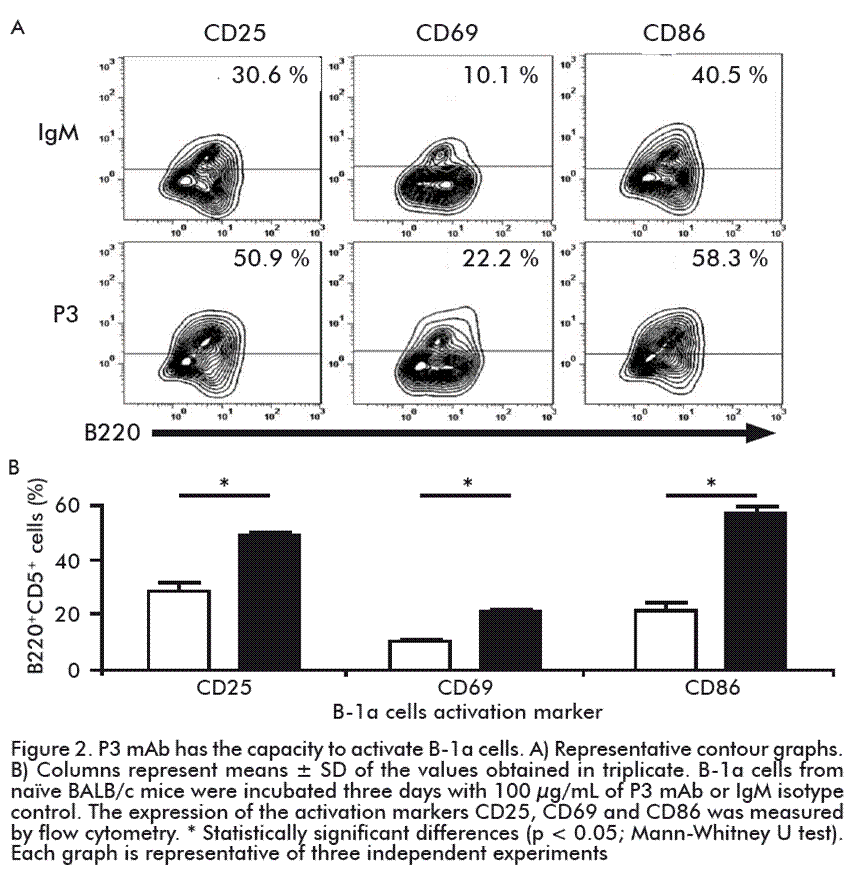
<P   ><font face="Verdana, Arial, Helvetica, sans-serif" size="2"><B>Evaluation of      P3 mAb capacity to activate B-1a cells </b></font></P >       <P   ><font face="Verdana, Arial, Helvetica, sans-serif" size="2">Next, we wanted to      know whether P3 mAb was able not only to recognize, but also activate B-1a      cells. </font></P >       <P   ><font face="Verdana, Arial, Helvetica, sans-serif" size="2">With this aim, the      expression of activation markers on the surface of na&iuml;ve B-1a cells was      tested after in vitro incubation with P3 mAb. As shown in <a href="/img/revistas/bta/v33n2/f0203216.gif">figure      2</a>, the culture of na&iuml;ve peritoneal B-1a cells with P3 mAb during      three days induced a higher percentage of B-1a cells expressing the activation      markers CD25, CD69 and CD86 (1.6, 2.1 and 1.4 fold change, respectively),      in comparison with the cells cultured with the control antibody. In addition,      we tested IFN-</font><font size="+1" color="#000000"><font size="+1" color="#211E1F"><font size="+1" color="#000000"><font size="+1" color="#211E1F"><font size="+1" color="#000000"><font size="+1" color="#211E1F"><font size="+1" color="#000000"><font size="+1" color="#211E1F"><font face="Verdana, Arial, Helvetica, sans-serif" size="2">&gamma;</font></font></font></font></font></font></font></font></font><font face="Verdana, Arial, Helvetica, sans-serif" size="2">,      IL-10 and IL-4 cytokine production by na&iuml;ve peritoneal B-1a cells by      intracellular staining, after three days in culture with the P3 mAb. Compared      to cells cultured with the control IgM, the presence of P3 mAb increased the      percentages of B-1a cells producing all the cytokines tested, suggesting this      mAb induces a mixed cytokine pattern (<a href="/img/revistas/bta/v33n2/f0303216.gif">Figure      3</a>). </font></P >       
<P   ><font face="Verdana, Arial, Helvetica, sans-serif" size="2">Since a hallmark      of B-1a cells is their capacity to spontaneously secrete IgM antibodies [17,      20], we evaluated whether the P3 mAb has the capacity to induce a higher level      of IgM secretion by these cells. Peritoneal B-1a cells from na&iuml;ve BALB/c      mice were incubated three days with P3 mAb and the IgM secretion by B-1a cells      was measured by ELISPOT. As is shown in <a href="/img/revistas/bta/v33n2/f0403216.gif">figure      4</a>, the P3 mAb was able to induce a significant increase in the number      of spots of IgM secreting B-1a cells. </font></P >       
<P   ><font face="Verdana, Arial, Helvetica, sans-serif" size="2">Discussion P3 is      a monoclonal antibody with the ability to induce a strong anti-idiotypic response      in the absence of adjuvant or carrier protein in the syngeneic model, which      is not a frequently observed phenomenon [3, 21, 22]. It also recognizes other      self-molecules like sulfatides [18]. Our group previously showed that P3 is      able to activate idiotypic networks that involve not only B but also T cells      [23]. In fact, it was also proved that CD4<sup>+</sup> but also CD8+ T cells      were indispensable for P3 to induce an anti-idiotypic response [9]. The variable      region of P3 mAb is encoded by genes in the germline and belongs to the VHQ52      family (VH2) [8], a feature it shares with other anti-ganglioside antibodies      [24-26]. This VH family is frequently used by B-1a cells, which recently were      also proved to be able to secrete anti-NeuGcGM3 antibodies [27]. Since B-1a      is the dominant B cell population in the neonatal period, when the idiotypic      networks are established [17], and due to its ability to strongly activate      T cells [14- 16], we studied whether P3 mAb was able to interact with B-1a.      </font></P >       ]]></body>
<body><![CDATA[<P   ><font face="Verdana, Arial, Helvetica, sans-serif" size="2">P3 mAb was able to      recognize in vitro up to 19 % of peritoneal B-1a cells, suggesting this antibody      recognizes clones with different specificities. This could be explained by      the existence of a regulatory idiotope in the variable region of P3 mAb, as      was proposed by P&eacute;rez et al. [23]. The percentage of recognized B-1a      cells did not increased with P3 mAb immunization, evidencing that this antibody      does not induce B-1a cell proliferation in vivo. This was in agreement with      previous reports for other antigens recognized by this B cell population [19].      </font></P >       <P   ><font face="Verdana, Arial, Helvetica, sans-serif" size="2">Interestingly, in      addition to recognizing peritoneal B-1a cells, P3 mAb was able to activate      this population in vitro, without the mediation of any other cell population,      increasing the percentage of cells expressing the activation markers CD25,      CD69 and CD86. </font></P >       <P   ><font face="Verdana, Arial, Helvetica, sans-serif" size="2">Although the role      of B cells in the immune response is usually framed in its capacity to secrete      antibodies, B cells are professional antigen presenting cells [28-30]. Specifically      B-1a cells constitutively express high levels of MHC-II and co-stimulatory      molecules CD80 and CD86 [31], and several studies have demonstrated their      ability to present antigens to T lymphocytes [15, 16]. The culture with P3      mAb also increased the percentage of B-1a cells producing IFN-</font><font size="+1" color="#000000"><font size="+1" color="#211E1F"><font size="+1" color="#000000"><font size="+1" color="#211E1F"><font size="+1" color="#000000"><font size="+1" color="#211E1F"><font size="+1" color="#000000"><font size="+1" color="#211E1F"><font face="Verdana, Arial, Helvetica, sans-serif" size="2">&gamma;</font></font></font></font></font></font></font></font></font><font face="Verdana, Arial, Helvetica, sans-serif" size="2">,      IL-4, and IL-10, a mixed cytokine pattern, reinforcing the idea that several      B-1a clones are simultaneously activated. In our case, the percentage of IFN-</font><font size="+1" color="#000000"><font size="+1" color="#211E1F"><font size="+1" color="#000000"><font size="+1" color="#211E1F"><font size="+1" color="#000000"><font size="+1" color="#211E1F"><font size="+1" color="#000000"><font size="+1" color="#211E1F"><font face="Verdana, Arial, Helvetica, sans-serif" size="2">&gamma;</font></font></font></font></font></font></font></font></font><font face="Verdana, Arial, Helvetica, sans-serif" size="2"><sup>+</sup>      B-1a cells was higher than IL-4<sup>+</sup> or IL-10<sup>+</sup> cells, suggesting      the induction of a predominant Th1 response. This is consistent with previous      reports showing a preferential polarization to Th1/Th17 by B-1a cells [14].      Our results suggest that B-1a cells could mediate the idiotypic interactions      between B and T cells induced by this mAb in the syngeneic model. </font></P >       <P   ><font face="Verdana, Arial, Helvetica, sans-serif" size="2">The activation with      P3 mAb in vitro also induced a higher percentage of B-1a cells secreting IgM,      a fundamental role of these cells [32, 33]. Noteworthy, natural antibodies      (nAbs) secreted by B-1a cells are the first barrier against pathogens, especially      relevant before the establishment of a specific immune response [33]. Despite      their low affinity, these antibodies can directly neutralize early replication      of pathogens [34,35] or activate the complement cascade [36]. nAbs also keep      the homeostasis by the removal of dead cells, oxidized and transformed epitopes      [37,38]. Additionally, natural IgMs have been related with enhanced IgG response      by B-2 cells [39,40]. nAbs frequently also cross-react with self-antigens,      including other antibodies [41,42]. It would be important to study the specificities      of the B-1a cells activated by P3 mAb. To our knowledge, this is the first      report of a monoclonal antibody with the capacity to recognize, activate and      stimulate B-1a cells to secrete nAbs. Further studies are required to confirm      this potentiality in vivo. Moreover, the P3 mAb could be used as a tool to      specifically stimulate this population in instances where B-1a cells and nAbs      could be crucial, like immunodeficiency and atherosclerosis, among others      [43-45]. </font></P >       <P   >&nbsp;</P >       <P   ><font face="Verdana, Arial, Helvetica, sans-serif" size="2"><B><font size="3">CONFLICT      OF INTERESTS STATEMENT </font></b></font></P >       <P   ><font face="Verdana, Arial, Helvetica, sans-serif" size="2">The authors declare      the absence of conflict of interests. </font></P >       <P   >&nbsp;</P >       <P   ><font face="Verdana, Arial, Helvetica, sans-serif" size="2"><B><font size="3">REFERENCES      </font></b></font></P >       <!-- ref --><P   ><font face="Verdana, Arial, Helvetica, sans-serif" size="2">1. Libbey JE, Peterson      LK, Tsunoda I, Fujinami RS. Monoclonal MOG-reactive autoantibody from progressive      EAE has the characteristics of a natural antibody. J Neuroimmunol. 2006;173(1-2):135-45.          </font></P >       <!-- ref --><P   ><font face="Verdana, Arial, Helvetica, sans-serif" size="2">2. Vazquez AM, Perez      A, Hernandez AM, Macias A, Alfonso M, Bombino G, <i>et al</i>. Syngeneic anti-idiotypic      monoclonal antibodies to an anti-NeuGc-containing ganglioside monoclonal antibody.      Hybridoma. 1998;17(6):527-34.     </font></P >       <!-- ref --><P   ><font face="Verdana, Arial, Helvetica, sans-serif" size="2">3. Ismaili J, Brait      M, Leo O, Urbain J. Assessment of a functional role of auto-anti-idiotypes      in idiotype dominance. Eur J Immunol. 1995;25(3):830-7.     </font></P >       <!-- ref --><P   ><font face="Verdana, Arial, Helvetica, sans-serif" size="2">4. Reitan SK, Hannestad      K. The primary IgM antibody repertoire: a source of potent idiotype immunogens.      Eur J Immunol. 2001;31(7):2143-53.     </font></P >       <!-- ref --><P   ><font face="Verdana, Arial, Helvetica, sans-serif" size="2">5. Reitan SK, Hannestad      K. Immunoglobulin heavy chain constant regions regulate immunity and tolerance      to idiotypes of antibody variable regions. Proc Natl Acad Sci U S A. 2002;99(11):7588-93.          </font></P >       <!-- ref --><P   ><font face="Verdana, Arial, Helvetica, sans-serif" size="2">6. Zhang X, Smith      DS, Guth A, Wysocki LJ. A receptor presentation hypothesis for T cell help      that recruits autoreactive B cells. J Immunol. 2001;166(3):1562-71.     </font></P >       <!-- ref --><P   ><font face="Verdana, Arial, Helvetica, sans-serif" size="2">7. Lopez-Requena      A, Bestagno M, Mateo de Acosta C, Cesco-Gaspere M, Vazquez AM, Perez R, <i>et      al</i>. Gangliosides, Ab1 and Ab2 antibodies III. The idiotype of anti-ganglioside      mAb P3 is immunogenic in a T cell-dependent manner. Mol Immunol. 2007;44(11):2915-22.          </font></P >       <!-- ref --><P   ><font face="Verdana, Arial, Helvetica, sans-serif" size="2">8. Perez A, Lombardero      J, Mateo C, Mustelier G, Alfonso M, Vazquez AM, <i>et al</i>. Immunogenetic      analysis of variable regions encoding AB1 and gamma-type AB2 antibodies from      the NeuGc-containing ganglioside family. Hybridoma. 2001;20(4):211-21.     </font></P >       <!-- ref --><P   ><font face="Verdana, Arial, Helvetica, sans-serif" size="2">9. Martinez D, Rodriguez      N, Grinan T, Rondon T, Vazquez AM, Perez R, <i>et al</i>. P3 mAb: An Immunogenic      Anti-NeuGcGM3 Antibody with Unusual Immunoregulatory Properties. Front Immunol.      2012;3:94.     </font></P >       <!-- ref --><P   ><font face="Verdana, Arial, Helvetica, sans-serif" size="2">10. Ben-Yehuda A,      Szabo P, LeMaoult J, Manavalan JS, Weksler ME. Increased VH 11 and VH Q52      gene use by splenic B cells in old mice associated with oligoclonal expansions      of CD5 + B cells. Mech Ageing Dev. 1998;103(2):111-21.     </font></P >       <!-- ref --><P   ><font face="Verdana, Arial, Helvetica, sans-serif" size="2">11. Margry B, Wieland      WH, van Kooten PJ, van Eden W, Broere F. Peritoneal cavity B-1a cells promote      peripheral CD4+ T-cell activation. Eur J Immunol. 2013;43(9):2317-26.     </font></P >       <!-- ref --><P   ><font face="Verdana, Arial, Helvetica, sans-serif" size="2">12. Elliott M, Kearney      JF. Idiotypic regulation of development of the B-cell repertoire. Ann N Y      Acad Sci. 1992;651:336-45.     </font></P >       <!-- ref --><P   ><font face="Verdana, Arial, Helvetica, sans-serif" size="2">13. Hayakawa K, Hardy      RR. Development and function of B-1 cells. Curr Opin Immunol. 2000;12(3):346-53.          </font></P >       <!-- ref --><P   ><font face="Verdana, Arial, Helvetica, sans-serif" size="2">14. Zhong X, Gao      W, Degauque N, Bai C, Lu Y, Kenny J, <i>et al</i>. Reciprocal generation of      Th1/Th17 and T(reg) cells by B1 and B2 B cells. Eur J Immunol. 2007;37(9):2400-4.          </font></P >       <!-- ref --><P   ><font face="Verdana, Arial, Helvetica, sans-serif" size="2">15. Gao J, Ma X,      Gu W, Fu M, An J, Xing Y, <i>et al</i>. Novel functions of murine B1 cells:      active phagocytic and microbicidal abilities. Eur J Immunol. 2012;42(4):982-92.          </font></P >       <!-- ref --><P   ><font face="Verdana, Arial, Helvetica, sans-serif" size="2">16. Parra D, Rieger      AM, Li J, Zhang YA, Randall LM, Hunter CA, <i>et al</i>. Pivotal advance:      peritoneal cavity B-1 B cells have phagocytic and microbicidal capacities      and present phagocytosed antigen to CD4+ T cells. J Leukoc Biol. 2012;91(4):525-36.          </font></P >       <!-- ref --><P   ><font face="Verdana, Arial, Helvetica, sans-serif" size="2">17. Baumgarth N.      The double life of a B-1 cell: self-reactivity selects for protective effector      functions. Nat Rev Immunol. 2011;11(1):34-46.     </font></P >       <!-- ref --><P   ><font face="Verdana, Arial, Helvetica, sans-serif" size="2">18. Vazquez AM, Alfonso      M, Lanne B, Karlsson KA, Carr A, Barroso O, <i>et al</i>. Generation of a      murine monoclonal antibody specific for N-glycolylneuraminic acid-containing      gangliosides that also recognizes sulfated glycolipids. Hybridoma. 1995;14(6):551-6.          </font></P >       <!-- ref --><P   ><font face="Verdana, Arial, Helvetica, sans-serif" size="2">19. Morris DL, Rothstein      TL. Abnormal transcription factor induction through the surface immunoglobulin      M receptor of B-1 lymphocytes. J Exp Med. 1993;177(3):857-61.     </font></P >       <P   ><font face="Verdana, Arial, Helvetica, sans-serif" size="2">20. Gronwall C, Silverman      GJ. Natural IgM: beneficial autoantibodies for the control of inflammatory      and autoimmune disease. J Clin Immunol. 2014;34 Suppl 1:S12-21. </font></P >       <!-- ref --><P   ><font face="Verdana, Arial, Helvetica, sans-serif" size="2">21. Bogen B, Jorgensen      T, Hannestad K. Recognition of lambda 1 and lambda 2 murine light chains by      carrier-specific isologous T helper cells; effect of L-H chain assembly. Eur      J Immunol. 1983;13(5):353-9.     </font></P >       ]]></body>
<body><![CDATA[<!-- ref --><P   ><font face="Verdana, Arial, Helvetica, sans-serif" size="2">22. Hernandez AM,      Rodriguez M, Lopez- Requena A, Beausoleil I, Perez R, Vazquez AM. Generation      of anti-Neu-glycolyl-ganglioside antibodies by immunization with an anti-idiotype      monoclonal antibody: A self versus non-self-matter. Immunobiology. 2005;210(1):11-21.          </font></P >       <!-- ref --><P   ><font face="Verdana, Arial, Helvetica, sans-serif" size="2">23. Perez A, Mier      ES, Vispo NS, Vazquez AM, Perez Rodriguez R. A monoclonal antibody against      NeuGc-containing gangliosides contains a regulatory idiotope involved in the      interaction with B and T cells. Mol Immunol. 2002;39(1-2):103-12.     </font></P >       <!-- ref --><P   ><font face="Verdana, Arial, Helvetica, sans-serif" size="2">24. Zenita K, Hirashima      K, Shigeta K, Hiraiwa N, Takada A, Hashimoto K, <i>et al</i>. Northern hybridization      analysis of VH gene expression in murine monoclonal antibodies directed to      cancer-associated ganglioside antigens having various sialic acid linkages.      J Immunol. 1990;144(11):4442-51.     </font></P >       <!-- ref --><P   ><font face="Verdana, Arial, Helvetica, sans-serif" size="2">25. Weng NP, Ritter      E, Yucel E, Zhang D, Ritter G, Marcus DM. Specificity and structure of murine      monoclonal antibodies against GM1 ganglioside. J Neuroimmunol. 1994;55(1):61-8.          </font></P >       <!-- ref --><P   ><font face="Verdana, Arial, Helvetica, sans-serif" size="2">26. Lopez-Requena      A, Mateo De Acosta C, Vazquez AM, Perez R. Immunogenicity of autologous immunoglobulins:      principles and practices. Mol Immunol. 2007;44(11):3076-82.     </font></P >       ]]></body>
<body><![CDATA[<P   ><font face="Verdana, Arial, Helvetica, sans-serif" size="2">27. Rodriguez-Zhurbenko      N, Rabade-Chediak M, Martinez D, Grinan T, Hernandez AM. Anti-NeuGcGM3 reactivity:      a possible role of natural antibodies and B-1 cells in tumor immunosurveillance.      Ann N Y Acad Sci. 2015;1362:224-38. </font></P >       <!-- ref --><P   ><font face="Verdana, Arial, Helvetica, sans-serif" size="2">28. van Rooijen N.      Direct intrafollicular differentiation of memory B cells into plasma cells.      Immunol Today. 1990;11(5):154-7.     </font></P >       <!-- ref --><P   ><font face="Verdana, Arial, Helvetica, sans-serif" size="2">29. Kelsoe G. Life      and death in germinal centers (redux). Immunity. 1996;4(2):107-11.     </font></P >       <P   ><font face="Verdana, Arial, Helvetica, sans-serif" size="2">30. Gulbranson-Judge      A, Casamayor-Palleja M, MacLennan IC. Mutually dependent T and B cell responses      in germinal centers. Ann N Y Acad Sci. 1997;815:199-210. </font></P >       <!-- ref --><P   ><font face="Verdana, Arial, Helvetica, sans-serif" size="2">31. Vigna AF, Godoy      LC, Rogerio de Almeida S, Mariano M, Lopes JD. Characterization of B-1b cells      as antigen presenting cells in the immune response to gp43 from Paracoccidioides      brasiliensis in vitro. Immunol Lett. 2002;83(1):61-6.     </font></P >       <P   ><font face="Verdana, Arial, Helvetica, sans-serif" size="2">32. Ehrenstein MR,      O&rsquo;Keefe TL, Davies SL, Neuberger MS. Targeted gene disruption reveals      a role for natural secretory IgM in the maturation of the primary immune response.      Proc Natl Acad Sci U S A. 1998;95(17):10089-93. </font></P >       <!-- ref --><P   ><font face="Verdana, Arial, Helvetica, sans-serif" size="2">33. Baumgarth N,      Tung JW, Herzenberg LA. Inherent specificities in natural antibodies: a key      to immune defense against pathogen invasion. Springer Semin Immunopathol.      2005;26(4):347-62.     </font></P >       <!-- ref --><P   ><font face="Verdana, Arial, Helvetica, sans-serif" size="2">34. Ochsenbein AF,      Fehr T, Lutz C, Suter M, Brombacher F, Hengartner H, et al. Control of early      viral and bacterial distribution and disease by natural antibodies. Science.      1999;286(5447):2156-9.     </font></P >       <P   ><font face="Verdana, Arial, Helvetica, sans-serif" size="2">35. Baumgarth N,      Chen J, Herman OC, Jager GC, Herzenberg LA. The role of B-1 and B-2 cells      in immune protection from influenza virus infection. Curr Top Microbiol Immunol.      2000;252:163-9. </font></P >       <!-- ref --><P   ><font face="Verdana, Arial, Helvetica, sans-serif" size="2">36. Jayasekera JP,      Moseman EA, Carroll MC. Natural antibody and complement mediate neutralization      of influenza virus in the absence of prior immunity. J Virol. 2007;81(7):3487-94.          </font></P >       <!-- ref --><P   ><font face="Verdana, Arial, Helvetica, sans-serif" size="2">37. Chou MY, Fogelstrand      L, Hartvigsen K, Hansen LF, Woelkers D, Shaw PX, <i>et al</i>. Oxidation-specific      epitopes are dominant targets of innate natural antibodies in mice and humans.      J Clin Invest. 2009;119(5):1335-49.     </font></P >       <!-- ref --><P   ><font face="Verdana, Arial, Helvetica, sans-serif" size="2">38. Kaveri SV, Silverman      GJ, Bayry J. Natural IgM in immune equilibrium and harnessing their therapeutic      potential. J Immunol. 2012;188(3):939-45.     </font></P >       ]]></body>
<body><![CDATA[<!-- ref --><P   ><font face="Verdana, Arial, Helvetica, sans-serif" size="2">39. Boes M, Esau      C, Fischer MB, Schmidt T, Carroll M, Chen J. Enhanced B-1 cell development,      but impaired IgG antibody responses in mice deficient in secreted IgM. J Immunol.      1998;160(10):4776-87.     </font></P >       <!-- ref --><P   ><font face="Verdana, Arial, Helvetica, sans-serif" size="2">40. Baumgarth N,      Herman OC, Jager GC, Brown LE, Herzenberg LA, Chen J. B-1 and B-2 cell-derived      immunoglobulin M antibodies are nonredundant components of the protective      response to influenza virus infection. J Exp Med. 2000;192(2):271-80.     </font></P >       <!-- ref --><P   ><font face="Verdana, Arial, Helvetica, sans-serif" size="2">41. Jeong HD, Teale      JM. Contribution of the CD5+ B cell to D-proximal VH family expression early      in ontogeny. J Immunol. 1990;145(8):2725-9.     </font></P >       <P   ><font face="Verdana, Arial, Helvetica, sans-serif" size="2">42. Casali P, Kasaian      MT, Haughton G. B-1 (CD5 B) cells. In: Coutinho A, Kazatchkine MD, editores.      Autoimmunity Physiology and Disease New York: Wiley-Liss Inc.; 1994. p. 57.      </font></P >       <!-- ref --><P   ><font face="Verdana, Arial, Helvetica, sans-serif" size="2">43. Bayry J, Lacroix-Desmazes      S, Donkova- Petrini V, Carbonneil C, Misra N, Lepelletier Y, <i>et al</i>.      Natural antibodies sustain differentiation and maturation of human dendritic      cells. Proc Natl Acad Sci U S A. 2004;101(39) :14210-5.     </font></P >       <!-- ref --><P   ><font face="Verdana, Arial, Helvetica, sans-serif" size="2">44. Hamanova M, Chmelikova      M, Nentwich I, Thon V, Lokaj J. Anti-Gal IgM, IgA and IgG natural antibodies      in childhood. Immunol Lett. 2015;164(1):40-3.     </font></P >       <P   ><font face="Verdana, Arial, Helvetica, sans-serif" size="2">45. Rothstein TL.      Natural Antibodies as Rheostats for Susceptibility to Chronic Diseases in      the Aged. Front Immunol. 2016;7:127. </font></P >       <P   >&nbsp;</P >       <P   >&nbsp;</P >       <P   > </P >   <FONT size="+1">        <P   ><font size="2" face="Verdana, Arial, Helvetica, sans-serif">Received in June,      2016.     <br>     </font><font face="Verdana, Arial, Helvetica, sans-serif" size="2">Accepted      in June, 2016. </font></P >       <P   >&nbsp;</P >       <P   >&nbsp;</P >   <FONT size="+1">        <P   > </P >       ]]></body>
<body><![CDATA[<P   ><i><font size="2" face="Verdana, Arial, Helvetica, sans-serif">Ana Mar&iacute;a      Hern&aacute;ndez</font></i><font size="2" face="Verdana, Arial, Helvetica, sans-serif">.      Tumor Immunology Direction, Center of Molecular Immunology. 216 St. &amp;      15th Ave, Havana, P.O.Box. 16040, Havana 11600, Cuba. E-mail: <A href="mailto:anita@cim.sld.cu">      <FONT color="#0000FF">anita@cim.sld.cu</font></A>.</font></P >   </font></font></font></font></font></font></font></font></font></font></DIV >      ]]></body><back>
<ref-list>
<ref id="B1">
<label>1</label><nlm-citation citation-type="journal">
<person-group person-group-type="author">
<name>
<surname><![CDATA[Libbey]]></surname>
<given-names><![CDATA[JE]]></given-names>
</name>
<name>
<surname><![CDATA[Peterson]]></surname>
<given-names><![CDATA[LK]]></given-names>
</name>
<name>
<surname><![CDATA[Tsunoda]]></surname>
<given-names><![CDATA[I]]></given-names>
</name>
<name>
<surname><![CDATA[Fujinami]]></surname>
<given-names><![CDATA[RS]]></given-names>
</name>
</person-group>
<article-title xml:lang="en"><![CDATA[Monoclonal MOG-reactive autoantibody from progressive EAE has the characteristics of a natural antibody]]></article-title>
<source><![CDATA[J Neuroimmunol]]></source>
<year>2006</year>
<volume>173</volume>
<numero>1</numero>
<issue>1</issue>
<page-range>2):135-45</page-range></nlm-citation>
</ref>
<ref id="B2">
<label>2</label><nlm-citation citation-type="journal">
<person-group person-group-type="author">
<name>
<surname><![CDATA[Vazquez]]></surname>
<given-names><![CDATA[AM]]></given-names>
</name>
<name>
<surname><![CDATA[Perez]]></surname>
<given-names><![CDATA[A]]></given-names>
</name>
<name>
<surname><![CDATA[Hernandez]]></surname>
<given-names><![CDATA[AM]]></given-names>
</name>
<name>
<surname><![CDATA[Macias]]></surname>
<given-names><![CDATA[A]]></given-names>
</name>
<name>
<surname><![CDATA[Alfonso]]></surname>
<given-names><![CDATA[M]]></given-names>
</name>
<name>
<surname><![CDATA[Bombino]]></surname>
<given-names><![CDATA[G]]></given-names>
</name>
</person-group>
<article-title xml:lang="en"><![CDATA[Syngeneic anti-idiotypic monoclonal antibodies to an anti-NeuGc-containing ganglioside monoclonal antibody]]></article-title>
<source><![CDATA[Hybridoma]]></source>
<year>1998</year>
<volume>17</volume>
<numero>6</numero>
<issue>6</issue>
<page-range>527-34</page-range></nlm-citation>
</ref>
<ref id="B3">
<label>3</label><nlm-citation citation-type="journal">
<person-group person-group-type="author">
<name>
<surname><![CDATA[Ismaili]]></surname>
<given-names><![CDATA[J]]></given-names>
</name>
<name>
<surname><![CDATA[Brait]]></surname>
<given-names><![CDATA[M]]></given-names>
</name>
<name>
<surname><![CDATA[Leo]]></surname>
<given-names><![CDATA[O]]></given-names>
</name>
<name>
<surname><![CDATA[Urbain]]></surname>
<given-names><![CDATA[J]]></given-names>
</name>
</person-group>
<article-title xml:lang="en"><![CDATA[Assessment of a functional role of auto-anti-idiotypes in idiotype dominance]]></article-title>
<source><![CDATA[Eur J Immunol]]></source>
<year>1995</year>
<volume>25</volume>
<numero>3</numero>
<issue>3</issue>
<page-range>830-7</page-range></nlm-citation>
</ref>
<ref id="B4">
<label>4</label><nlm-citation citation-type="journal">
<person-group person-group-type="author">
<name>
<surname><![CDATA[Reitan]]></surname>
<given-names><![CDATA[SK]]></given-names>
</name>
<name>
<surname><![CDATA[Hannestad]]></surname>
<given-names><![CDATA[K]]></given-names>
</name>
</person-group>
<article-title xml:lang="en"><![CDATA[The primary IgM antibody repertoire: a source of potent idiotype immunogens]]></article-title>
<source><![CDATA[Eur J Immunol]]></source>
<year>2001</year>
<volume>31</volume>
<numero>7</numero>
<issue>7</issue>
<page-range>2143-53</page-range></nlm-citation>
</ref>
<ref id="B5">
<label>5</label><nlm-citation citation-type="journal">
<person-group person-group-type="author">
<name>
<surname><![CDATA[Reitan]]></surname>
<given-names><![CDATA[SK]]></given-names>
</name>
<name>
<surname><![CDATA[Hannestad]]></surname>
<given-names><![CDATA[K]]></given-names>
</name>
</person-group>
<article-title xml:lang="en"><![CDATA[Immunoglobulin heavy chain constant regions regulate immunity and tolerance to idiotypes of antibody variable regions]]></article-title>
<source><![CDATA[Proc Natl Acad Sci U S A]]></source>
<year>2002</year>
<volume>99</volume>
<numero>11</numero>
<issue>11</issue>
<page-range>7588-93</page-range></nlm-citation>
</ref>
<ref id="B6">
<label>6</label><nlm-citation citation-type="journal">
<person-group person-group-type="author">
<name>
<surname><![CDATA[Zhang]]></surname>
<given-names><![CDATA[X]]></given-names>
</name>
<name>
<surname><![CDATA[Smith]]></surname>
<given-names><![CDATA[DS]]></given-names>
</name>
<name>
<surname><![CDATA[Guth]]></surname>
<given-names><![CDATA[A]]></given-names>
</name>
<name>
<surname><![CDATA[Wysocki]]></surname>
<given-names><![CDATA[LJ]]></given-names>
</name>
</person-group>
<article-title xml:lang="en"><![CDATA[A receptor presentation hypothesis for T cell help that recruits autoreactive B cells]]></article-title>
<source><![CDATA[J Immunol]]></source>
<year>2001</year>
<volume>166</volume>
<numero>3</numero>
<issue>3</issue>
<page-range>1562-71</page-range></nlm-citation>
</ref>
<ref id="B7">
<label>7</label><nlm-citation citation-type="journal">
<person-group person-group-type="author">
<name>
<surname><![CDATA[Lopez-Requena]]></surname>
<given-names><![CDATA[A]]></given-names>
</name>
<name>
<surname><![CDATA[Bestagno]]></surname>
<given-names><![CDATA[M]]></given-names>
</name>
<name>
<surname><![CDATA[Mateo de Acosta]]></surname>
<given-names><![CDATA[C]]></given-names>
</name>
<name>
<surname><![CDATA[Cesco-Gaspere]]></surname>
<given-names><![CDATA[M]]></given-names>
</name>
<name>
<surname><![CDATA[Vazquez]]></surname>
<given-names><![CDATA[AM]]></given-names>
</name>
<name>
<surname><![CDATA[Perez]]></surname>
<given-names><![CDATA[R]]></given-names>
</name>
</person-group>
<article-title xml:lang="en"><![CDATA[Gangliosides, Ab1 and Ab2 antibodies III. The idiotype of anti-ganglioside mAb P3 is immunogenic in a T cell-dependent manner]]></article-title>
<source><![CDATA[Mol Immunol]]></source>
<year>2007</year>
<volume>44</volume>
<numero>11</numero>
<issue>11</issue>
<page-range>2915-22</page-range></nlm-citation>
</ref>
<ref id="B8">
<label>8</label><nlm-citation citation-type="journal">
<person-group person-group-type="author">
<name>
<surname><![CDATA[Perez]]></surname>
<given-names><![CDATA[A]]></given-names>
</name>
<name>
<surname><![CDATA[Lombardero]]></surname>
<given-names><![CDATA[J]]></given-names>
</name>
<name>
<surname><![CDATA[Mateo]]></surname>
<given-names><![CDATA[C]]></given-names>
</name>
<name>
<surname><![CDATA[Mustelier]]></surname>
<given-names><![CDATA[G]]></given-names>
</name>
<name>
<surname><![CDATA[Alfonso]]></surname>
<given-names><![CDATA[M]]></given-names>
</name>
<name>
<surname><![CDATA[Vazquez]]></surname>
<given-names><![CDATA[AM]]></given-names>
</name>
</person-group>
<article-title xml:lang="en"><![CDATA[Immunogenetic analysis of variable regions encoding AB1 and gamma-type AB2 antibodies from the NeuGc-containing ganglioside family]]></article-title>
<source><![CDATA[Hybridoma]]></source>
<year>2001</year>
<volume>20</volume>
<numero>4</numero>
<issue>4</issue>
<page-range>211-21</page-range></nlm-citation>
</ref>
<ref id="B9">
<label>9</label><nlm-citation citation-type="journal">
<person-group person-group-type="author">
<name>
<surname><![CDATA[Martinez]]></surname>
<given-names><![CDATA[D]]></given-names>
</name>
<name>
<surname><![CDATA[Rodriguez]]></surname>
<given-names><![CDATA[N]]></given-names>
</name>
<name>
<surname><![CDATA[Grinan]]></surname>
<given-names><![CDATA[T]]></given-names>
</name>
<name>
<surname><![CDATA[Rondon]]></surname>
<given-names><![CDATA[T]]></given-names>
</name>
<name>
<surname><![CDATA[Vazquez]]></surname>
<given-names><![CDATA[AM]]></given-names>
</name>
<name>
<surname><![CDATA[Perez]]></surname>
<given-names><![CDATA[R]]></given-names>
</name>
</person-group>
<article-title xml:lang="en"><![CDATA[P3 mAb: An Immunogenic Anti-NeuGcGM3 Antibody with Unusual Immunoregulatory Properties]]></article-title>
<source><![CDATA[Front Immunol]]></source>
<year>2012</year>
<volume>3</volume>
<page-range>94</page-range></nlm-citation>
</ref>
<ref id="B10">
<label>10</label><nlm-citation citation-type="journal">
<person-group person-group-type="author">
<name>
<surname><![CDATA[Ben-Yehuda]]></surname>
<given-names><![CDATA[A]]></given-names>
</name>
<name>
<surname><![CDATA[Szabo]]></surname>
<given-names><![CDATA[P]]></given-names>
</name>
<name>
<surname><![CDATA[LeMaoult]]></surname>
<given-names><![CDATA[J]]></given-names>
</name>
<name>
<surname><![CDATA[Manavalan]]></surname>
<given-names><![CDATA[JS]]></given-names>
</name>
<name>
<surname><![CDATA[Weksler]]></surname>
<given-names><![CDATA[ME]]></given-names>
</name>
</person-group>
<article-title xml:lang="en"><![CDATA[Increased VH 11 and VH Q52 gene use by splenic B cells in old mice associated with oligoclonal expansions of CD5 + B cells]]></article-title>
<source><![CDATA[Mech Ageing Dev]]></source>
<year>1998</year>
<volume>103</volume>
<numero>2</numero>
<issue>2</issue>
<page-range>111-21</page-range></nlm-citation>
</ref>
<ref id="B11">
<label>11</label><nlm-citation citation-type="journal">
<person-group person-group-type="author">
<name>
<surname><![CDATA[Margry]]></surname>
<given-names><![CDATA[B]]></given-names>
</name>
<name>
<surname><![CDATA[Wieland]]></surname>
<given-names><![CDATA[WH]]></given-names>
</name>
<name>
<surname><![CDATA[van Kooten]]></surname>
<given-names><![CDATA[PJ]]></given-names>
</name>
<name>
<surname><![CDATA[van Eden]]></surname>
<given-names><![CDATA[W]]></given-names>
</name>
<name>
<surname><![CDATA[Broere]]></surname>
<given-names><![CDATA[F]]></given-names>
</name>
</person-group>
<article-title xml:lang="en"><![CDATA[Peritoneal cavity B-1a cells promote peripheral CD4+ T-cell activation]]></article-title>
<source><![CDATA[Eur J Immunol]]></source>
<year>2013</year>
<volume>43</volume>
<numero>9</numero>
<issue>9</issue>
<page-range>2317-26</page-range></nlm-citation>
</ref>
<ref id="B12">
<label>12</label><nlm-citation citation-type="journal">
<person-group person-group-type="author">
<name>
<surname><![CDATA[Elliott]]></surname>
<given-names><![CDATA[M]]></given-names>
</name>
<name>
<surname><![CDATA[Kearney]]></surname>
<given-names><![CDATA[JF]]></given-names>
</name>
</person-group>
<article-title xml:lang="en"><![CDATA[Idiotypic regulation of development of the B-cell repertoire]]></article-title>
<source><![CDATA[Ann N Y Acad Sci]]></source>
<year>1992</year>
<volume>651</volume>
<page-range>336-45</page-range></nlm-citation>
</ref>
<ref id="B13">
<label>13</label><nlm-citation citation-type="journal">
<person-group person-group-type="author">
<name>
<surname><![CDATA[Hayakawa]]></surname>
<given-names><![CDATA[K]]></given-names>
</name>
<name>
<surname><![CDATA[Hardy]]></surname>
<given-names><![CDATA[RR]]></given-names>
</name>
</person-group>
<article-title xml:lang="en"><![CDATA[Development and function of B-1 cells]]></article-title>
<source><![CDATA[Curr Opin Immunol]]></source>
<year>2000</year>
<volume>12</volume>
<numero>3</numero>
<issue>3</issue>
<page-range>346-53</page-range></nlm-citation>
</ref>
<ref id="B14">
<label>14</label><nlm-citation citation-type="journal">
<person-group person-group-type="author">
<name>
<surname><![CDATA[Zhong]]></surname>
<given-names><![CDATA[X]]></given-names>
</name>
<name>
<surname><![CDATA[Gao]]></surname>
<given-names><![CDATA[W]]></given-names>
</name>
<name>
<surname><![CDATA[Degauque]]></surname>
<given-names><![CDATA[N]]></given-names>
</name>
<name>
<surname><![CDATA[Bai]]></surname>
<given-names><![CDATA[C]]></given-names>
</name>
<name>
<surname><![CDATA[Lu]]></surname>
<given-names><![CDATA[Y]]></given-names>
</name>
<name>
<surname><![CDATA[Kenny]]></surname>
<given-names><![CDATA[J]]></given-names>
</name>
</person-group>
<article-title xml:lang="en"><![CDATA[Reciprocal generation of Th1/Th17 and T(reg) cells by B1 and B2 B cells]]></article-title>
<source><![CDATA[Eur J Immunol]]></source>
<year>2007</year>
<volume>37</volume>
<numero>9</numero>
<issue>9</issue>
<page-range>2400-4</page-range></nlm-citation>
</ref>
<ref id="B15">
<label>15</label><nlm-citation citation-type="journal">
<person-group person-group-type="author">
<name>
<surname><![CDATA[Gao]]></surname>
<given-names><![CDATA[J]]></given-names>
</name>
<name>
<surname><![CDATA[Ma]]></surname>
<given-names><![CDATA[X]]></given-names>
</name>
<name>
<surname><![CDATA[Gu]]></surname>
<given-names><![CDATA[W]]></given-names>
</name>
<name>
<surname><![CDATA[Fu]]></surname>
<given-names><![CDATA[M]]></given-names>
</name>
<name>
<surname><![CDATA[An]]></surname>
<given-names><![CDATA[J]]></given-names>
</name>
<name>
<surname><![CDATA[Xing]]></surname>
<given-names><![CDATA[Y]]></given-names>
</name>
</person-group>
<article-title xml:lang="en"><![CDATA[Novel functions of murine B1 cells: active phagocytic and microbicidal abilities]]></article-title>
<source><![CDATA[Eur J Immunol]]></source>
<year>2012</year>
<volume>42</volume>
<numero>4</numero>
<issue>4</issue>
<page-range>982-92</page-range></nlm-citation>
</ref>
<ref id="B16">
<label>16</label><nlm-citation citation-type="journal">
<person-group person-group-type="author">
<name>
<surname><![CDATA[Parra]]></surname>
<given-names><![CDATA[D]]></given-names>
</name>
<name>
<surname><![CDATA[Rieger]]></surname>
<given-names><![CDATA[AM]]></given-names>
</name>
<name>
<surname><![CDATA[Li]]></surname>
<given-names><![CDATA[J]]></given-names>
</name>
<name>
<surname><![CDATA[Zhang]]></surname>
<given-names><![CDATA[YA]]></given-names>
</name>
<name>
<surname><![CDATA[Randall]]></surname>
<given-names><![CDATA[LM]]></given-names>
</name>
<name>
<surname><![CDATA[Hunter]]></surname>
<given-names><![CDATA[CA]]></given-names>
</name>
</person-group>
<article-title xml:lang="en"><![CDATA[Pivotal advance: peritoneal cavity B-1 B cells have phagocytic and microbicidal capacities and present phagocytosed antigen to CD4+ T cells]]></article-title>
<source><![CDATA[J Leukoc Biol]]></source>
<year>2012</year>
<volume>91</volume>
<numero>4</numero>
<issue>4</issue>
<page-range>525-36</page-range></nlm-citation>
</ref>
<ref id="B17">
<label>17</label><nlm-citation citation-type="journal">
<person-group person-group-type="author">
<name>
<surname><![CDATA[Baumgarth]]></surname>
<given-names><![CDATA[N]]></given-names>
</name>
</person-group>
<article-title xml:lang="en"><![CDATA[The double life of a B-1 cell: self-reactivity selects for protective effector functions]]></article-title>
<source><![CDATA[Nat Rev Immunol]]></source>
<year>2011</year>
<volume>11</volume>
<numero>1</numero>
<issue>1</issue>
<page-range>34-46</page-range></nlm-citation>
</ref>
<ref id="B18">
<label>18</label><nlm-citation citation-type="journal">
<person-group person-group-type="author">
<name>
<surname><![CDATA[Vazquez]]></surname>
<given-names><![CDATA[AM]]></given-names>
</name>
<name>
<surname><![CDATA[Alfonso]]></surname>
<given-names><![CDATA[M]]></given-names>
</name>
<name>
<surname><![CDATA[Lanne]]></surname>
<given-names><![CDATA[B]]></given-names>
</name>
<name>
<surname><![CDATA[Karlsson]]></surname>
<given-names><![CDATA[KA]]></given-names>
</name>
<name>
<surname><![CDATA[Carr]]></surname>
<given-names><![CDATA[A]]></given-names>
</name>
<name>
<surname><![CDATA[Barroso]]></surname>
<given-names><![CDATA[O]]></given-names>
</name>
</person-group>
<article-title xml:lang="en"><![CDATA[Generation of a murine monoclonal antibody specific for N-glycolylneuraminic acid-containing gangliosides that also recognizes sulfated glycolipids]]></article-title>
<source><![CDATA[Hybridoma]]></source>
<year>1995</year>
<volume>14</volume>
<numero>6</numero>
<issue>6</issue>
<page-range>551-6</page-range></nlm-citation>
</ref>
<ref id="B19">
<label>19</label><nlm-citation citation-type="journal">
<person-group person-group-type="author">
<name>
<surname><![CDATA[Morris]]></surname>
<given-names><![CDATA[DL]]></given-names>
</name>
<name>
<surname><![CDATA[Rothstein]]></surname>
<given-names><![CDATA[TL]]></given-names>
</name>
</person-group>
<article-title xml:lang="en"><![CDATA[Abnormal transcription factor induction through the surface immunoglobulin M receptor of B-1 lymphocytes]]></article-title>
<source><![CDATA[J Exp Med]]></source>
<year>1993</year>
<volume>177</volume>
<numero>3</numero>
<issue>3</issue>
<page-range>857-61</page-range></nlm-citation>
</ref>
<ref id="B20">
<label>20</label><nlm-citation citation-type="journal">
<person-group person-group-type="author">
<name>
<surname><![CDATA[Gronwall]]></surname>
<given-names><![CDATA[C]]></given-names>
</name>
<name>
<surname><![CDATA[Silverman]]></surname>
<given-names><![CDATA[GJ]]></given-names>
</name>
</person-group>
<article-title xml:lang="en"><![CDATA[Natural IgM: beneficial autoantibodies for the control of inflammatory and autoimmune disease]]></article-title>
<source><![CDATA[J Clin Immunol]]></source>
<year>2014</year>
<volume>34</volume>
<numero>^s1</numero>
<issue>^s1</issue>
<supplement>1</supplement>
<page-range>12-21</page-range></nlm-citation>
</ref>
<ref id="B21">
<label>21</label><nlm-citation citation-type="journal">
<person-group person-group-type="author">
<name>
<surname><![CDATA[Bogen]]></surname>
<given-names><![CDATA[B]]></given-names>
</name>
<name>
<surname><![CDATA[Jorgensen]]></surname>
<given-names><![CDATA[T]]></given-names>
</name>
<name>
<surname><![CDATA[Hannestad]]></surname>
<given-names><![CDATA[K]]></given-names>
</name>
</person-group>
<article-title xml:lang="en"><![CDATA[Recognition of lambda 1 and lambda 2 murine light chains by carrier-specific isologous T helper cells; effect of L-H chain assembly]]></article-title>
<source><![CDATA[Eur J Immunol]]></source>
<year>1983</year>
<volume>13</volume>
<numero>5</numero>
<issue>5</issue>
<page-range>353-9</page-range></nlm-citation>
</ref>
<ref id="B22">
<label>22</label><nlm-citation citation-type="journal">
<person-group person-group-type="author">
<name>
<surname><![CDATA[Hernandez]]></surname>
<given-names><![CDATA[AM]]></given-names>
</name>
<name>
<surname><![CDATA[Rodriguez]]></surname>
<given-names><![CDATA[M]]></given-names>
</name>
<name>
<surname><![CDATA[Lopez- Requena]]></surname>
<given-names><![CDATA[A]]></given-names>
</name>
<name>
<surname><![CDATA[Beausoleil]]></surname>
<given-names><![CDATA[I]]></given-names>
</name>
<name>
<surname><![CDATA[Perez]]></surname>
<given-names><![CDATA[R]]></given-names>
</name>
<name>
<surname><![CDATA[Vazquez]]></surname>
<given-names><![CDATA[AM]]></given-names>
</name>
</person-group>
<article-title xml:lang="en"><![CDATA[Generation of anti-Neu-glycolyl-ganglioside antibodies by immunization with an anti-idiotype monoclonal antibody: A self versus non-self-matter]]></article-title>
<source><![CDATA[Immunobiology]]></source>
<year>2005</year>
<volume>210</volume>
<numero>1</numero>
<issue>1</issue>
<page-range>11-21</page-range></nlm-citation>
</ref>
<ref id="B23">
<label>23</label><nlm-citation citation-type="journal">
<person-group person-group-type="author">
<name>
<surname><![CDATA[Perez]]></surname>
<given-names><![CDATA[A]]></given-names>
</name>
<name>
<surname><![CDATA[Mier]]></surname>
<given-names><![CDATA[ES]]></given-names>
</name>
<name>
<surname><![CDATA[Vispo]]></surname>
<given-names><![CDATA[NS]]></given-names>
</name>
<name>
<surname><![CDATA[Vazquez]]></surname>
<given-names><![CDATA[AM]]></given-names>
</name>
<name>
<surname><![CDATA[Perez Rodriguez]]></surname>
<given-names><![CDATA[R]]></given-names>
</name>
</person-group>
<article-title xml:lang="en"><![CDATA[A monoclonal antibody against NeuGc-containing gangliosides contains a regulatory idiotope involved in the interaction with B and T cells]]></article-title>
<source><![CDATA[Mol Immunol]]></source>
<year>2002</year>
<volume>39</volume>
<numero>1</numero>
<issue>1</issue>
<page-range>2):103-12</page-range></nlm-citation>
</ref>
<ref id="B24">
<label>24</label><nlm-citation citation-type="journal">
<person-group person-group-type="author">
<name>
<surname><![CDATA[Zenita]]></surname>
<given-names><![CDATA[K]]></given-names>
</name>
<name>
<surname><![CDATA[Hirashima]]></surname>
<given-names><![CDATA[K]]></given-names>
</name>
<name>
<surname><![CDATA[Shigeta]]></surname>
<given-names><![CDATA[K]]></given-names>
</name>
<name>
<surname><![CDATA[Hiraiwa]]></surname>
<given-names><![CDATA[N]]></given-names>
</name>
<name>
<surname><![CDATA[Takada]]></surname>
<given-names><![CDATA[A]]></given-names>
</name>
<name>
<surname><![CDATA[Hashimoto]]></surname>
<given-names><![CDATA[K]]></given-names>
</name>
</person-group>
<article-title xml:lang="en"><![CDATA[Northern hybridization analysis of VH gene expression in murine monoclonal antibodies directed to cancer-associated ganglioside antigens having various sialic acid linkages]]></article-title>
<source><![CDATA[J Immunol]]></source>
<year>1990</year>
<volume>144</volume>
<numero>11</numero>
<issue>11</issue>
<page-range>4442-51</page-range></nlm-citation>
</ref>
<ref id="B25">
<label>25</label><nlm-citation citation-type="journal">
<person-group person-group-type="author">
<name>
<surname><![CDATA[Weng]]></surname>
<given-names><![CDATA[NP]]></given-names>
</name>
<name>
<surname><![CDATA[Ritter]]></surname>
<given-names><![CDATA[E]]></given-names>
</name>
<name>
<surname><![CDATA[Yucel]]></surname>
<given-names><![CDATA[E]]></given-names>
</name>
<name>
<surname><![CDATA[Zhang]]></surname>
<given-names><![CDATA[D]]></given-names>
</name>
<name>
<surname><![CDATA[Ritter]]></surname>
<given-names><![CDATA[G]]></given-names>
</name>
<name>
<surname><![CDATA[Marcus]]></surname>
<given-names><![CDATA[DM]]></given-names>
</name>
</person-group>
<article-title xml:lang="en"><![CDATA[Specificity and structure of murine monoclonal antibodies against GM1 ganglioside]]></article-title>
<source><![CDATA[J Neuroimmunol]]></source>
<year>1994</year>
<volume>55</volume>
<numero>1</numero>
<issue>1</issue>
<page-range>61-8</page-range></nlm-citation>
</ref>
<ref id="B26">
<label>26</label><nlm-citation citation-type="journal">
<person-group person-group-type="author">
<name>
<surname><![CDATA[Lopez-Requena]]></surname>
<given-names><![CDATA[A]]></given-names>
</name>
<name>
<surname><![CDATA[Mateo De Acosta]]></surname>
<given-names><![CDATA[C]]></given-names>
</name>
<name>
<surname><![CDATA[Vazquez]]></surname>
<given-names><![CDATA[AM]]></given-names>
</name>
<name>
<surname><![CDATA[Perez]]></surname>
<given-names><![CDATA[R]]></given-names>
</name>
</person-group>
<article-title xml:lang="en"><![CDATA[Immunogenicity of autologous immunoglobulins: principles and practices]]></article-title>
<source><![CDATA[Mol Immunol]]></source>
<year>2007</year>
<volume>44</volume>
<numero>11</numero>
<issue>11</issue>
<page-range>3076-82</page-range></nlm-citation>
</ref>
<ref id="B27">
<label>27</label><nlm-citation citation-type="journal">
<person-group person-group-type="author">
<name>
<surname><![CDATA[Rodriguez-Zhurbenko]]></surname>
<given-names><![CDATA[N]]></given-names>
</name>
<name>
<surname><![CDATA[Rabade-Chediak]]></surname>
<given-names><![CDATA[M]]></given-names>
</name>
<name>
<surname><![CDATA[Martinez]]></surname>
<given-names><![CDATA[D]]></given-names>
</name>
<name>
<surname><![CDATA[Grinan]]></surname>
<given-names><![CDATA[T]]></given-names>
</name>
<name>
<surname><![CDATA[Hernandez]]></surname>
<given-names><![CDATA[AM]]></given-names>
</name>
</person-group>
<article-title xml:lang="en"><![CDATA[Anti-NeuGcGM3 reactivity: a possible role of natural antibodies and B-1 cells in tumor immunosurveillance]]></article-title>
<source><![CDATA[Ann N Y Acad Sci]]></source>
<year>2015</year>
<volume>1362</volume>
<numero>^s1</numero>
<issue>^s1</issue>
<supplement>1</supplement>
<page-range>224-38</page-range></nlm-citation>
</ref>
<ref id="B28">
<label>28</label><nlm-citation citation-type="journal">
<person-group person-group-type="author">
<name>
<surname><![CDATA[van Rooijen]]></surname>
<given-names><![CDATA[N]]></given-names>
</name>
</person-group>
<article-title xml:lang="en"><![CDATA[Direct intrafollicular differentiation of memory B cells into plasma cells]]></article-title>
<source><![CDATA[Immunol Today]]></source>
<year>1990</year>
<volume>11</volume>
<numero>5</numero>
<issue>5</issue>
<page-range>154-7</page-range></nlm-citation>
</ref>
<ref id="B29">
<label>29</label><nlm-citation citation-type="journal">
<person-group person-group-type="author">
<name>
<surname><![CDATA[Kelsoe]]></surname>
<given-names><![CDATA[G]]></given-names>
</name>
</person-group>
<article-title xml:lang="en"><![CDATA[Life and death in germinal centers (redux)]]></article-title>
<source><![CDATA[Immunity]]></source>
<year>1996</year>
<volume>4</volume>
<numero>2</numero>
<issue>2</issue>
<page-range>107-11</page-range></nlm-citation>
</ref>
<ref id="B30">
<label>30</label><nlm-citation citation-type="journal">
<person-group person-group-type="author">
<name>
<surname><![CDATA[Gulbranson-Judge]]></surname>
<given-names><![CDATA[A]]></given-names>
</name>
<name>
<surname><![CDATA[Casamayor-Palleja]]></surname>
<given-names><![CDATA[M]]></given-names>
</name>
<name>
<surname><![CDATA[MacLennan]]></surname>
<given-names><![CDATA[IC]]></given-names>
</name>
</person-group>
<article-title xml:lang="en"><![CDATA[Mutually dependent T and B cell responses in germinal centers]]></article-title>
<source><![CDATA[Ann N Y Acad Sci]]></source>
<year>1997</year>
<volume>815</volume>
<numero>^s1</numero>
<issue>^s1</issue>
<supplement>1</supplement>
<page-range>199-210</page-range></nlm-citation>
</ref>
<ref id="B31">
<label>31</label><nlm-citation citation-type="journal">
<person-group person-group-type="author">
<name>
<surname><![CDATA[Vigna]]></surname>
<given-names><![CDATA[AF]]></given-names>
</name>
<name>
<surname><![CDATA[Godoy]]></surname>
<given-names><![CDATA[LC]]></given-names>
</name>
<name>
<surname><![CDATA[Rogerio de Almeida]]></surname>
<given-names><![CDATA[S]]></given-names>
</name>
<name>
<surname><![CDATA[Mariano]]></surname>
<given-names><![CDATA[M]]></given-names>
</name>
<name>
<surname><![CDATA[Lopes]]></surname>
<given-names><![CDATA[JD]]></given-names>
</name>
</person-group>
<article-title xml:lang="en"><![CDATA[Characterization of B-1b cells as antigen presenting cells in the immune response to gp43 from Paracoccidioides brasiliensis in vitro]]></article-title>
<source><![CDATA[Immunol Lett]]></source>
<year>2002</year>
<volume>83</volume>
<numero>1</numero>
<issue>1</issue>
<page-range>61-6</page-range></nlm-citation>
</ref>
<ref id="B32">
<label>32</label><nlm-citation citation-type="journal">
<person-group person-group-type="author">
<name>
<surname><![CDATA[Ehrenstein]]></surname>
<given-names><![CDATA[MR]]></given-names>
</name>
<name>
<surname><![CDATA[O'Keefe]]></surname>
<given-names><![CDATA[TL]]></given-names>
</name>
<name>
<surname><![CDATA[Davies]]></surname>
<given-names><![CDATA[SL]]></given-names>
</name>
<name>
<surname><![CDATA[Neuberger]]></surname>
<given-names><![CDATA[MS]]></given-names>
</name>
</person-group>
<article-title xml:lang="en"><![CDATA[Targeted gene disruption reveals a role for natural secretory IgM in the maturation of the primary immune response]]></article-title>
<source><![CDATA[Proc Natl Acad Sci U S A]]></source>
<year>1998</year>
<volume>95</volume>
<numero>17</numero>
<issue>17</issue>
<page-range>10089-93</page-range></nlm-citation>
</ref>
<ref id="B33">
<label>33</label><nlm-citation citation-type="journal">
<person-group person-group-type="author">
<name>
<surname><![CDATA[Baumgarth]]></surname>
<given-names><![CDATA[N]]></given-names>
</name>
<name>
<surname><![CDATA[Tung]]></surname>
<given-names><![CDATA[JW]]></given-names>
</name>
<name>
<surname><![CDATA[Herzenberg]]></surname>
<given-names><![CDATA[LA]]></given-names>
</name>
</person-group>
<article-title xml:lang="en"><![CDATA[Inherent specificities in natural antibodies: a key to immune defense against pathogen invasion]]></article-title>
<source><![CDATA[Springer Semin Immunopathol]]></source>
<year>2005</year>
<volume>26</volume>
<numero>4</numero>
<issue>4</issue>
<page-range>347-62</page-range></nlm-citation>
</ref>
<ref id="B34">
<label>34</label><nlm-citation citation-type="journal">
<person-group person-group-type="author">
<name>
<surname><![CDATA[Ochsenbein]]></surname>
<given-names><![CDATA[AF]]></given-names>
</name>
<name>
<surname><![CDATA[Fehr]]></surname>
<given-names><![CDATA[T]]></given-names>
</name>
<name>
<surname><![CDATA[Lutz]]></surname>
<given-names><![CDATA[C]]></given-names>
</name>
<name>
<surname><![CDATA[Suter]]></surname>
<given-names><![CDATA[M]]></given-names>
</name>
<name>
<surname><![CDATA[Brombacher]]></surname>
<given-names><![CDATA[F]]></given-names>
</name>
<name>
<surname><![CDATA[Hengartner]]></surname>
<given-names><![CDATA[H]]></given-names>
</name>
</person-group>
<article-title xml:lang="en"><![CDATA[Control of early viral and bacterial distribution and disease by natural antibodies]]></article-title>
<source><![CDATA[Science]]></source>
<year>1999</year>
<volume>286</volume>
<numero>5447</numero>
<issue>5447</issue>
<page-range>2156-9</page-range></nlm-citation>
</ref>
<ref id="B35">
<label>35</label><nlm-citation citation-type="journal">
<person-group person-group-type="author">
<name>
<surname><![CDATA[Baumgarth]]></surname>
<given-names><![CDATA[N]]></given-names>
</name>
<name>
<surname><![CDATA[Chen]]></surname>
<given-names><![CDATA[J]]></given-names>
</name>
<name>
<surname><![CDATA[Herman]]></surname>
<given-names><![CDATA[OC]]></given-names>
</name>
<name>
<surname><![CDATA[Jager]]></surname>
<given-names><![CDATA[GC]]></given-names>
</name>
<name>
<surname><![CDATA[Herzenberg]]></surname>
<given-names><![CDATA[LA]]></given-names>
</name>
</person-group>
<article-title xml:lang="en"><![CDATA[The role of B-1 and B-2 cells in immune protection from influenza virus infection]]></article-title>
<source><![CDATA[Curr Top Microbiol Immunol]]></source>
<year>2000</year>
<volume>252</volume>
<numero>^s1</numero>
<issue>^s1</issue>
<supplement>1</supplement>
<page-range>163-9</page-range></nlm-citation>
</ref>
<ref id="B36">
<label>36</label><nlm-citation citation-type="journal">
<person-group person-group-type="author">
<name>
<surname><![CDATA[Jayasekera]]></surname>
<given-names><![CDATA[JP]]></given-names>
</name>
<name>
<surname><![CDATA[Moseman]]></surname>
<given-names><![CDATA[EA]]></given-names>
</name>
<name>
<surname><![CDATA[Carroll]]></surname>
<given-names><![CDATA[MC]]></given-names>
</name>
</person-group>
<article-title xml:lang="en"><![CDATA[Natural antibody and complement mediate neutralization of influenza virus in the absence of prior immunity]]></article-title>
<source><![CDATA[J Virol]]></source>
<year>2007</year>
<volume>81</volume>
<numero>7</numero>
<issue>7</issue>
<page-range>3487-94</page-range></nlm-citation>
</ref>
<ref id="B37">
<label>37</label><nlm-citation citation-type="journal">
<person-group person-group-type="author">
<name>
<surname><![CDATA[Chou]]></surname>
<given-names><![CDATA[MY]]></given-names>
</name>
<name>
<surname><![CDATA[Fogelstrand]]></surname>
<given-names><![CDATA[L]]></given-names>
</name>
<name>
<surname><![CDATA[Hartvigsen]]></surname>
<given-names><![CDATA[K]]></given-names>
</name>
<name>
<surname><![CDATA[Hansen]]></surname>
<given-names><![CDATA[LF]]></given-names>
</name>
<name>
<surname><![CDATA[Woelkers]]></surname>
<given-names><![CDATA[D]]></given-names>
</name>
<name>
<surname><![CDATA[Shaw]]></surname>
<given-names><![CDATA[PX]]></given-names>
</name>
</person-group>
<article-title xml:lang="en"><![CDATA[Oxidation-specific epitopes are dominant targets of innate natural antibodies in mice and humans]]></article-title>
<source><![CDATA[J Clin Invest]]></source>
<year>2009</year>
<volume>119</volume>
<numero>5</numero>
<issue>5</issue>
<page-range>1335-49</page-range></nlm-citation>
</ref>
<ref id="B38">
<label>38</label><nlm-citation citation-type="journal">
<person-group person-group-type="author">
<name>
<surname><![CDATA[Kaveri]]></surname>
<given-names><![CDATA[SV]]></given-names>
</name>
<name>
<surname><![CDATA[Silverman]]></surname>
<given-names><![CDATA[GJ]]></given-names>
</name>
<name>
<surname><![CDATA[Bayry]]></surname>
<given-names><![CDATA[J]]></given-names>
</name>
</person-group>
<article-title xml:lang="en"><![CDATA[Natural IgM in immune equilibrium and harnessing their therapeutic potential]]></article-title>
<source><![CDATA[J Immunol]]></source>
<year>2012</year>
<volume>188</volume>
<numero>3</numero>
<issue>3</issue>
<page-range>939-45</page-range></nlm-citation>
</ref>
<ref id="B39">
<label>39</label><nlm-citation citation-type="journal">
<person-group person-group-type="author">
<name>
<surname><![CDATA[Boes]]></surname>
<given-names><![CDATA[M]]></given-names>
</name>
<name>
<surname><![CDATA[Esau]]></surname>
<given-names><![CDATA[C]]></given-names>
</name>
<name>
<surname><![CDATA[Fischer]]></surname>
<given-names><![CDATA[MB]]></given-names>
</name>
<name>
<surname><![CDATA[Schmidt]]></surname>
<given-names><![CDATA[T]]></given-names>
</name>
<name>
<surname><![CDATA[Carroll]]></surname>
<given-names><![CDATA[M]]></given-names>
</name>
<name>
<surname><![CDATA[Chen]]></surname>
<given-names><![CDATA[J]]></given-names>
</name>
</person-group>
<article-title xml:lang="en"><![CDATA[Enhanced B-1 cell development, but impaired IgG antibody responses in mice deficient in secreted IgM]]></article-title>
<source><![CDATA[J Immunol]]></source>
<year>1998</year>
<volume>160</volume>
<numero>10</numero>
<issue>10</issue>
<page-range>4776-87</page-range></nlm-citation>
</ref>
<ref id="B40">
<label>40</label><nlm-citation citation-type="journal">
<person-group person-group-type="author">
<name>
<surname><![CDATA[Baumgarth]]></surname>
<given-names><![CDATA[N]]></given-names>
</name>
<name>
<surname><![CDATA[Herman]]></surname>
<given-names><![CDATA[OC]]></given-names>
</name>
<name>
<surname><![CDATA[Jager]]></surname>
<given-names><![CDATA[GC]]></given-names>
</name>
<name>
<surname><![CDATA[Brown]]></surname>
<given-names><![CDATA[LE]]></given-names>
</name>
<name>
<surname><![CDATA[Herzenberg]]></surname>
<given-names><![CDATA[LA]]></given-names>
</name>
<name>
<surname><![CDATA[Chen]]></surname>
<given-names><![CDATA[J]]></given-names>
</name>
</person-group>
<article-title xml:lang="en"><![CDATA[B-1 and B-2 cell-derived immunoglobulin M antibodies are nonredundant components of the protective response to influenza virus infection]]></article-title>
<source><![CDATA[J Exp Med]]></source>
<year>2000</year>
<volume>192</volume>
<numero>2</numero>
<issue>2</issue>
<page-range>271-80</page-range></nlm-citation>
</ref>
<ref id="B41">
<label>41</label><nlm-citation citation-type="journal">
<person-group person-group-type="author">
<name>
<surname><![CDATA[Jeong]]></surname>
<given-names><![CDATA[HD]]></given-names>
</name>
<name>
<surname><![CDATA[Teale]]></surname>
<given-names><![CDATA[JM]]></given-names>
</name>
</person-group>
<article-title xml:lang="en"><![CDATA[Contribution of the CD5+ B cell to D-proximal VH family expression early in ontogeny]]></article-title>
<source><![CDATA[J Immunol]]></source>
<year>1990</year>
<volume>145</volume>
<numero>8</numero>
<issue>8</issue>
<page-range>2725-9</page-range></nlm-citation>
</ref>
<ref id="B42">
<label>42</label><nlm-citation citation-type="book">
<person-group person-group-type="author">
<name>
<surname><![CDATA[Casali]]></surname>
<given-names><![CDATA[P]]></given-names>
</name>
<name>
<surname><![CDATA[Kasaian]]></surname>
<given-names><![CDATA[MT]]></given-names>
</name>
<name>
<surname><![CDATA[Haughton]]></surname>
<given-names><![CDATA[G]]></given-names>
</name>
</person-group>
<source><![CDATA[B-1 (CD5 B) cells. En: Coutinho A, Kazatchkine MD, editores]]></source>
<year>1994</year>
<publisher-loc><![CDATA[Autoimmunity Physiology and Disease New York ]]></publisher-loc>
<publisher-name><![CDATA[Wiley-Liss Inc]]></publisher-name>
</nlm-citation>
</ref>
<ref id="B43">
<label>43</label><nlm-citation citation-type="journal">
<person-group person-group-type="author">
<name>
<surname><![CDATA[Bayry]]></surname>
<given-names><![CDATA[J]]></given-names>
</name>
<name>
<surname><![CDATA[Lacroix-Desmazes]]></surname>
<given-names><![CDATA[S]]></given-names>
</name>
<name>
<surname><![CDATA[Donkova- Petrini]]></surname>
<given-names><![CDATA[V]]></given-names>
</name>
<name>
<surname><![CDATA[Carbonneil]]></surname>
<given-names><![CDATA[C]]></given-names>
</name>
<name>
<surname><![CDATA[Misra]]></surname>
<given-names><![CDATA[N]]></given-names>
</name>
<name>
<surname><![CDATA[Lepelletier]]></surname>
<given-names><![CDATA[Y]]></given-names>
</name>
</person-group>
<article-title xml:lang="en"><![CDATA[Natural antibodies sustain differentiation and maturation of human dendritic cells]]></article-title>
<source><![CDATA[Proc Natl Acad Sci U S A]]></source>
<year>2004</year>
<volume>101</volume>
<numero>39</numero>
<issue>39</issue>
<page-range>14210-5</page-range></nlm-citation>
</ref>
<ref id="B44">
<label>44</label><nlm-citation citation-type="journal">
<person-group person-group-type="author">
<name>
<surname><![CDATA[Hamanova]]></surname>
<given-names><![CDATA[M]]></given-names>
</name>
<name>
<surname><![CDATA[Chmelikova]]></surname>
<given-names><![CDATA[M]]></given-names>
</name>
<name>
<surname><![CDATA[Nentwich]]></surname>
<given-names><![CDATA[I]]></given-names>
</name>
<name>
<surname><![CDATA[Thon]]></surname>
<given-names><![CDATA[V]]></given-names>
</name>
<name>
<surname><![CDATA[Lokaj]]></surname>
<given-names><![CDATA[J]]></given-names>
</name>
</person-group>
<article-title xml:lang="en"><![CDATA[Anti-Gal IgM, IgA and IgG natural antibodies in childhood]]></article-title>
<source><![CDATA[Immunol Lett]]></source>
<year>2015</year>
<volume>164</volume>
<numero>1</numero>
<issue>1</issue>
<page-range>40-3</page-range></nlm-citation>
</ref>
<ref id="B45">
<label>45</label><nlm-citation citation-type="journal">
<person-group person-group-type="author">
<name>
<surname><![CDATA[Rothstein]]></surname>
<given-names><![CDATA[TL]]></given-names>
</name>
</person-group>
<article-title xml:lang="en"><![CDATA[Natural Antibodies as Rheostats for Susceptibility to Chronic Diseases in the Aged]]></article-title>
<source><![CDATA[Front Immunol]]></source>
<year>2016</year>
<volume>7</volume>
<numero>^s1</numero>
<issue>^s1</issue>
<supplement>1</supplement>
<page-range>127</page-range></nlm-citation>
</ref>
</ref-list>
</back>
</article>