<?xml version="1.0" encoding="ISO-8859-1"?><article xmlns:mml="http://www.w3.org/1998/Math/MathML" xmlns:xlink="http://www.w3.org/1999/xlink" xmlns:xsi="http://www.w3.org/2001/XMLSchema-instance">
<front>
<journal-meta>
<journal-id>1027-2852</journal-id>
<journal-title><![CDATA[Biotecnología Aplicada]]></journal-title>
<abbrev-journal-title><![CDATA[Biotecnol Apl]]></abbrev-journal-title>
<issn>1027-2852</issn>
<publisher>
<publisher-name><![CDATA[Editorial Elfos Scientiae]]></publisher-name>
</publisher>
</journal-meta>
<article-meta>
<article-id>S1027-28522016000200005</article-id>
<title-group>
<article-title xml:lang="en"><![CDATA[BluBAC system for determining microbial growth in clinical microbiological diagnosis samples by combining photostimulation and turbidimetry]]></article-title>
<article-title xml:lang="es"><![CDATA[Sistema BluBAC para la determinación del crecimiento microbiano en muestras para el diagnóstico clínico microbiológico mediante fotoestimulación y turbidimetría]]></article-title>
</title-group>
<contrib-group>
<contrib contrib-type="author">
<name>
<surname><![CDATA[Ramírez-Frómeta]]></surname>
<given-names><![CDATA[Nardo]]></given-names>
</name>
<xref ref-type="aff" rid="A01"/>
</contrib>
<contrib contrib-type="author">
<name>
<surname><![CDATA[Lamothe-Nuviola]]></surname>
<given-names><![CDATA[Carlos A]]></given-names>
</name>
<xref ref-type="aff" rid="A01"/>
</contrib>
<contrib contrib-type="author">
<name>
<surname><![CDATA[Riverón-Rodríguez]]></surname>
<given-names><![CDATA[Elier]]></given-names>
</name>
<xref ref-type="aff" rid="A01"/>
</contrib>
<contrib contrib-type="author">
<name>
<surname><![CDATA[Moreno-Barrios]]></surname>
<given-names><![CDATA[Carmen Y]]></given-names>
</name>
<xref ref-type="aff" rid="A01"/>
</contrib>
<contrib contrib-type="author">
<name>
<surname><![CDATA[Regueiro-Gómez]]></surname>
<given-names><![CDATA[Angel]]></given-names>
</name>
<xref ref-type="aff" rid="A02"/>
</contrib>
<contrib contrib-type="author">
<name>
<surname><![CDATA[Felice]]></surname>
<given-names><![CDATA[Carmelo J]]></given-names>
</name>
<xref ref-type="aff" rid="A03"/>
</contrib>
</contrib-group>
<aff id="A02">
<institution><![CDATA[,Instituto Superior Politécnico José Antonio Echeverría, ISPJAE Centro de Bioingeniería, CEBIO ]]></institution>
<addr-line><![CDATA[La Habana ]]></addr-line>
<country>Cuba</country>
</aff>
<aff id="A03">
<institution><![CDATA[,Universidad Nacional de Tucumán  ]]></institution>
<addr-line><![CDATA[San Miguel de Tucumán ]]></addr-line>
<country>Argentina</country>
</aff>
<aff id="A01">
<institution><![CDATA[,Centro Nacional de Investigaciones Científicas, CNIC  ]]></institution>
<addr-line><![CDATA[La Habana ]]></addr-line>
<country>Cuba</country>
</aff>
<pub-date pub-type="pub">
<day>00</day>
<month>06</month>
<year>2016</year>
</pub-date>
<pub-date pub-type="epub">
<day>00</day>
<month>06</month>
<year>2016</year>
</pub-date>
<volume>33</volume>
<numero>2</numero>
<fpage>2221</fpage>
<lpage>2226</lpage>
<copyright-statement/>
<copyright-year/>
<self-uri xlink:href="http://scielo.sld.cu/scielo.php?script=sci_arttext&amp;pid=S1027-28522016000200005&amp;lng=en&amp;nrm=iso"></self-uri><self-uri xlink:href="http://scielo.sld.cu/scielo.php?script=sci_abstract&amp;pid=S1027-28522016000200005&amp;lng=en&amp;nrm=iso"></self-uri><self-uri xlink:href="http://scielo.sld.cu/scielo.php?script=sci_pdf&amp;pid=S1027-28522016000200005&amp;lng=en&amp;nrm=iso"></self-uri><kwd-group>
<kwd lng="en"><![CDATA[photostimulation, turbidimetric method]]></kwd>
<kwd lng="en"><![CDATA[clinical microbiological diagnosis]]></kwd>
<kwd lng="en"><![CDATA[blue light]]></kwd>
<kwd lng="en"><![CDATA[Escherichia coli]]></kwd>
<kwd lng="en"><![CDATA[BluBAC]]></kwd>
<kwd lng="es"><![CDATA[fotoestimulación]]></kwd>
<kwd lng="es"><![CDATA[método turbidimétrico]]></kwd>
<kwd lng="es"><![CDATA[diagnóstico clínico microbiológico]]></kwd>
<kwd lng="es"><![CDATA[luz azul]]></kwd>
<kwd lng="es"><![CDATA[Escherichia coli]]></kwd>
<kwd lng="es"><![CDATA[BluBAC]]></kwd>
</kwd-group>
</article-meta>
</front><body><![CDATA[ <DIV class="Part"   >        <P align="right"   ><font size="2" color="#000000" face="Verdana, Arial, Helvetica, sans-serif"><b>FOCUS      </b> </font></P >       <P   >&nbsp;</P >       <P   ><font size="4" color="#211E1F" face="Verdana, Arial, Helvetica, sans-serif"><B>BluBAC      system for determining microbial growth in clinical microbiological diagnosis      samples by combining photostimulation and turbidimetry </b></font></P >   <FONT size="+1" color="#000000"><FONT size="+1">        <P   >&nbsp;</P >   <FONT size="+1" color="#211E1F"><B>        <P   ></P >   </B> <FONT size="+1" color="#000000">       <P   ><font size="3" color="#211E1F" face="Verdana, Arial, Helvetica, sans-serif"><B>Sistema      BluBAC para la determinaci&oacute;n del crecimiento microbiano en muestras      para el diagn&oacute;stico cl&iacute;nico microbiol&oacute;gico mediante fotoestimulaci&oacute;n      y turbidimetr&iacute;a </b></font></P >       <P   >&nbsp;</P >       <P   >&nbsp;</P >   <FONT size="+1" color="#211E1F">       <P   ></P >   <FONT size="+1" color="#000000">       ]]></body>
<body><![CDATA[<P   ><b><font size="2" color="#211E1F" face="Verdana, Arial, Helvetica, sans-serif">Nardo      Ram&iacute;rez-Fr&oacute;meta<sup>1</sup>, Carlos A Lamothe-Nuviola<sup>1</sup>,      Elier River&oacute;n-Rodr&iacute;guez<sup>1</sup>, Carmen Y Moreno-Barrios<sup>1</sup>,      Angel Regueiro-G&oacute;mez<sup>2</sup>, Carmelo J Felice<sup>3</sup> </font></b><font size="2" color="#211E1F" face="Verdana, Arial, Helvetica, sans-serif"></font></P >   <FONT size="+1" color="#211E1F"><FONT size="+1"><FONT size="+1"><FONT size="+1"><FONT size="+1"><FONT size="+1"><FONT size="+1"><FONT size="+1"><FONT size="+1"><FONT size="+1"><FONT size="+1"><FONT size="+1">        <P   > </P >   <FONT size="+1" color="#000000">        <P   ><font size="2" color="#211E1F" face="Verdana, Arial, Helvetica, sans-serif"><sup>1</sup>      Centro Nacional de Investigaciones Cient&iacute;ficas, CNIC. Ave. 25 y Calle      158, Playa, Apartado Postal 6412, La Habana, C&oacute;digo Postal 10600, Cuba.      </font>    <br>     <font size="2" face="Verdana, Arial, Helvetica, sans-serif"><sup>2</sup> Centro      de Bioingenier&iacute;a, CEBIO, Instituto Superior Polit&eacute;cnico Jos&eacute;      Antonio Echeverr&iacute;a, ISPJAE, La Habana, Cuba. </font>    <br>     <font size="2" face="Verdana, Arial, Helvetica, sans-serif"><sup>3</sup> Universidad      Nacional de Tucum&aacute;n, San Miguel de Tucum&aacute;n, Argentina. </font></P >   <FONT size="+1" color="#211E1F"><FONT size="+1"><FONT size="+1"><FONT size="+1">        <P   >&nbsp;</P >       <P   >&nbsp;</P >   <FONT size="+1"><FONT size="+1"> </font></font></font></font></font></font></font></font></font></font></font></font></font></font></font></font></font></font></font></font></font></font></font></font></font>    <hr>   <FONT size="+1" color="#000000"><FONT size="+1"><FONT size="+1" color="#211E1F"><FONT size="+1" color="#000000"><FONT size="+1" color="#211E1F"><FONT size="+1" color="#000000"><FONT size="+1" color="#211E1F"><FONT size="+1"><FONT size="+1"><FONT size="+1"><FONT size="+1"><FONT size="+1"><FONT size="+1"><FONT size="+1"><FONT size="+1"><FONT size="+1"><FONT size="+1"><FONT size="+1"><FONT size="+1" color="#000000"><FONT size="+1" color="#211E1F"><FONT size="+1"><FONT size="+1"><FONT size="+1"><FONT size="+1"><FONT size="+1">       <P   ><font size="2" face="Verdana, Arial, Helvetica, sans-serif"><B>ABSTRACT </b></font></P >       <P   ><font size="2" face="Verdana, Arial, Helvetica, sans-serif">An experimental Workstation      was designed, named BluBAC, intended for the microbiological diagnosis in      clinical samples, which integrates photostimulation in two zones of the visible      light spectrum: red (625 to 644 nm) and blue (430 to 480 nm), together with      turbidimetric determinations in biological samples. It allows the analysis      of photostimulation on microbial growth. The workstation comprises optoelectronic      components and a MSP430 family microcontroller, connected through a Usb port      to a computer for processing and visualizing the output signals com-ing from      the samples. The signals are obtained through a graphic control interface      in Visual Studio. The influence of the stimulation parameters (wavelength,      light intensity, frequency and intensity of stimulation) on the growth of      <I>Escherichia coli </I>cells was studied in bacterial cell cultures in DKD      medium. The combination of photostimulation with turbidimetric determinations      facilitated microbial detection, with decreased lag time and a longer exponential      growth phase, stimulating bacterial growth more than other methods previously      reported. These results evidenced the potential advantages of the experimental      workstation BluBAC over other clinical microbiological diagnostic systems      available in the market. </font></P >       <P   ><font size="2" face="Verdana, Arial, Helvetica, sans-serif"><I><b>Keywords</b></I><b>:</b>      photostimulation, turbidimetric method, clinical microbiological diagnosis,      blue light, <I>Escherichia coli</I>, BluBAC. </font></P >   </font></font></font></font></font></font></font></font></font></font></font></font></font></font></font></font></font></font></font></font></font></font></font></font></font>    <hr>   <FONT size="+1" color="#000000"><FONT size="+1"><FONT size="+1" color="#211E1F"><FONT size="+1" color="#000000"><FONT size="+1" color="#211E1F"><FONT size="+1" color="#000000"><FONT size="+1" color="#211E1F"><FONT size="+1"><FONT size="+1"><FONT size="+1"><FONT size="+1"><FONT size="+1"><FONT size="+1"><FONT size="+1"><FONT size="+1"><FONT size="+1"><FONT size="+1"><FONT size="+1"><FONT size="+1" color="#000000"><FONT size="+1" color="#211E1F"><FONT size="+1"><FONT size="+1"><FONT size="+1"><FONT size="+1"><FONT size="+1">       ]]></body>
<body><![CDATA[<P   ><font size="2" face="Verdana, Arial, Helvetica, sans-serif"><b>RESUMEN </b></font></P >       <P   ><font size="2" face="Verdana, Arial, Helvetica, sans-serif">Se dise&ntilde;&oacute;      la estaci&oacute;n de trabajo experimental BluBAC para el diagn&oacute;stico      microbiol&oacute;gico en muestras cl&iacute;nicas, que integra la fotoestimulaci&oacute;n      en dos zonas del espectro luminoso visible: rojo (630 nm) y azul (de 430 a      480 nm) y permite la medici&oacute;n de turbidez en las muestras biol&oacute;gicas.      De esta forma se puede analizar la influencia de la fotoestimulaci&oacute;n      en el crecimiento microbiano. La misma est&aacute; formada por dispositivos      optoelectr&oacute;nicos y un microcontrolador de la familia MSP430 conectado      a un ordenador a trav&eacute;s de un puerto USB, en el que se procesan y grafican      las se&ntilde;ales de salida de las muestras, dichas se&ntilde;ales obtenidas      a trav&eacute;s de una interfaz de control en Visual Studio. Se estudi&oacute;      la influencia de los par&aacute;metros del est&iacute;mulo aplicado (longitud      de onda, intensidad luminosa, frecuencia de estimulaci&oacute;n e intensidad      del est&iacute;mulo) sobre el crecimiento de c&eacute;lulas de <I>Escherichia      coli </I>cultivada en medio DKD. Se observ&oacute; que la combinaci&oacute;n      de la fotoestimulaci&oacute;n con la determinaci&oacute;n de turbidez facilita      la detecci&oacute;n microbiana con un tiempo de latencia menor y una fase      exponencial de mayor duraci&oacute;n, lo que permiti&oacute; estimular el      crecimiento del microorganismo mucho m&aacute;s que mediante otros m&eacute;todos      previamente reportados. Estos resultados evidenciaron las ventajas potenciales      de la estaci&oacute;n experimental BluBAC sobre otros sistemas disponibles      comercialmente para el diagn&oacute;stico microbiol&oacute;gico en muestras      cl&iacute;nicas. </font></P >       <P   ><font size="2" face="Verdana, Arial, Helvetica, sans-serif"><I><b>Palabras clave</b></I><b>:</b>      fotoestimulaci&oacute;n, m&eacute;todo turbidim&eacute;trico, diagn&oacute;stico      cl&iacute;nico microbiol&oacute;gico, luz azul, <I>Escherichia coli</I>, BluBAC.      </font></P >       <P   > </P >   </font></font></font></font></font></font></font></font></font></font></font></font></font></font></font></font></font></font></font></font></font></font></font></font></font>    <hr>   <FONT size="+1" color="#000000"><FONT size="+1"><FONT size="+1" color="#211E1F"><FONT size="+1" color="#000000"><FONT size="+1" color="#211E1F"><FONT size="+1" color="#000000"><FONT size="+1" color="#211E1F"><FONT size="+1"><FONT size="+1"><FONT size="+1"><FONT size="+1"><FONT size="+1"><FONT size="+1"><FONT size="+1"><FONT size="+1"><FONT size="+1"><FONT size="+1"><FONT size="+1"><FONT size="+1" color="#000000"><FONT size="+1" color="#211E1F"><FONT size="+1"><FONT size="+1"><FONT size="+1"><FONT size="+1"><FONT size="+1">        <P   >&nbsp;</P >       <P   >&nbsp;</P >       <P   ><font size="2" face="Verdana, Arial, Helvetica, sans-serif"><b><font size="3">INTRODUCTION      </font></b></font></P >       <P   ><font size="2" face="Verdana, Arial, Helvetica, sans-serif">Photostimulation      is the process by which light is absorbed by cellular molecules and subsequently      converted into energy. When a cell is photostimulated, the molecules bearing      conjugated double bonds absorb light at a particular wavelength set by its      chemical composition and attained a higher energy state. Then, those energized      and excited molecules transfer the excess energy to other nearby molecules,      triggering a series of biochemical processes. Among the metabolic processes      and biochemical reactions susceptible to photostimulation effects at different      wavelengths there are the synthesis of adenosine triphosphate (ATP) and the      synthesis of growth factors, among others [1]. </font></P >       <P   ><font size="2" face="Verdana, Arial, Helvetica, sans-serif">Hence, the resulting      effects in cell function from the increased synthesis of ATP, which is the      main cell energetic intermediary molecule, and also the increased production      of reactive oxygen species (ROS), initiate signal transduction cascades leading      to the downstream expression of growth factors and ultimately to cell proliferation.      Particularly, ROS affect homeostasis parameters such as cellular pH which      alters cell functions, calcium ion concentrations which stimulate the different      signaling pathways, including the activation of photoreceptors and also growth      factors production [2]. It is known that small changes in ATP concentrations      could significantly affect the cell metabolism, since an increased energetic      state could improve the metabolic performance even in cells undergoing deleterious      processes [3, 4]. </font></P >       <P   ><font size="2" face="Verdana, Arial, Helvetica, sans-serif">Moreover, a series      of experiments have demonstrated that ATP is not solely implied in a higher      energetic state but also for an increased signaling among cells in multicellular      organisms [5]. Therefore, the photostimulation of ATP is fundamental to understand      the ubiquitous effects of photoaception mechanisms [5, 6]. </font></P >       ]]></body>
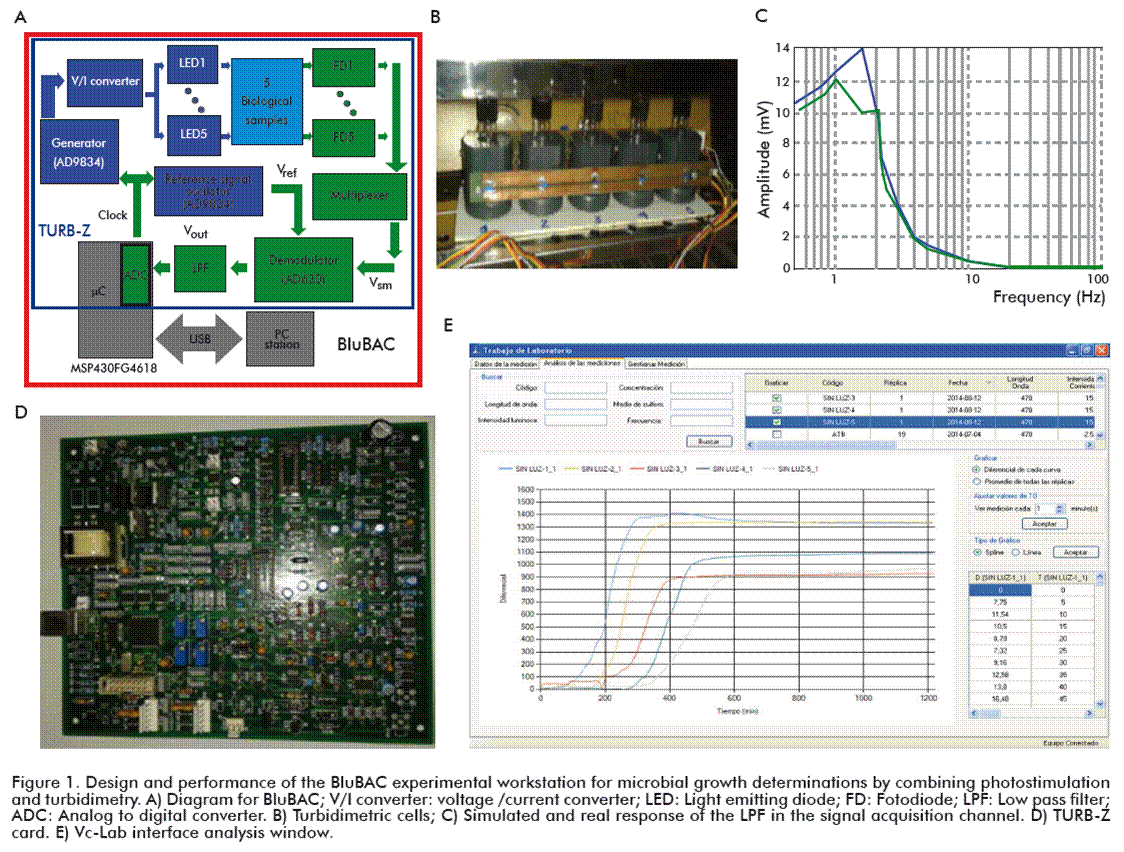
<body><![CDATA[<P   ><font size="2" face="Verdana, Arial, Helvetica, sans-serif">Seven types of photoaceptor      proteins have been described so far: rhodopsins; xantopsins; phytochromes;      cryptochromes; LOV-domain (light, oxygen and tension domain) carrying proteins;      BLUF (blue light utilizing flavine adenosine dinucleotide) domain proteins      and the family of eight proteins resistant to ultraviolet light [7]. Of them,      blue light, that is the one of higher frequency for simulation, is perceived      by cryptochromes, LOV-domain and BLUF-domain proteins, which have been characterized      in detail through biochemical and biophysical methods from photon absorption      downstream the signal transduction cascades to the final biological activities      [8]. After the initial photoexcitation event, intrinsic structural changes      are induced in photoreceptors, such as the formation of double covalent linkage      of the chromophore [9]. </font></P >       <P   ><font size="2" face="Verdana, Arial, Helvetica, sans-serif">There have been described      methods to take advantage of the photostimulation processes described above      for microbial manipulation with varied purposes. For instance, a method was      patented to stimulate the metabolism of non-phytotrophe microorganisms with      blue light [10], those microorganisms been applied in bioremediation strategies      or in biotechnological process for the production of biomolecules. However,      such effects on microbial growth could be also used for diagnostic application      in microbial clinical samples, particularly in those pathogens susceptible      to photostimulation. </font></P >       <P   ><font size="2" face="Verdana, Arial, Helvetica, sans-serif">Therefore, in this      work is described the design of the experimental workstation BluBAC, intended      for microbial diagnostics in clinical samples. The effect of photostimulation      on cell growth in biological samples susceptible to it for diagnostic purposes      was studied through the stimulation of microorganisms in the 430-480 nm wavelength      range [11]. Moreover, procedures were established for the fast detection of      bacterial growth after its photostimulation, particularly in liquid medium,      characterized through optical stimulation parameters (wavelength, light intensity,      stimulation frequency and intensity). </font></P >       <P   >&nbsp;</P >       <P   ><font size="2" face="Verdana, Arial, Helvetica, sans-serif"><b><font size="3">DESIGN      OF THE BLUBAC EXPERIMENTAL WORKSTATION </font></b></font></P >       <P   ><font size="2" face="Verdana, Arial, Helvetica, sans-serif">The BluBAC experimental      (<a href="/img/revistas/bta/v33n2/f0105216.gif">Figure 1A</a>) was designed to study the effects of      photostimulation on different microbial strains. It is composed of the TURB-Z      electronic control and data acquisition card, together with an interface for      computer programmable control. The TURB-Z board was organized in two sections,      one to generate the photostimulatory signal and the other for the reception      and measure of the resulting signal. </font></P >       
<P   ><font size="2" face="Verdana, Arial, Helvetica, sans-serif">The stimulation block      generates a low level signal delivered from 5 LED lamps to the biological      samples to be analyzed. Each LED stimulates a single turbidimetric measuring      well in the sample platen, adjusted to provide simultaneously the same stimulatory      signal (<a href="/img/revistas/bta/v33n2/f0105216.gif">Figure 1B</a>). The signal is controlled attending      to four main parameters: wavelength, frequency, light intensity (candela)      and stimulus light intensity (current). The stimulation block generate stimulatory      and also reference signals, for what it includes a tension-current conversion      unit (Howland&rsquo;s generator) and two AD9834 circuits to generate the respective      stimulatory and reference signals for the demodulation process. This device      is a low power (20 mW) direct digital synthesizer (DDS) able to generate high      quality sinusoidal and triangular signals [12]. </font></P >       
<P   ><font size="2" face="Verdana, Arial, Helvetica, sans-serif">The reception unit      measures the intensity of the light signal passing through the sample by means      of an opto-electronic integrated circuit OPT-301, which includes a photodiode      and a monolithic transimpedance amplifier. The output of the photodetector      is connected to a synchronous demodulation unit (AD630), which filters the      signal and converts it with the aid of a lock amplifier, synchronizing the      signal for the subsequent demodulation process. The processing unit (minicontroller      MSP430FG4618) generates an average value from readings to minimize the errors      derived from coupling interferences. </font></P >       <P   ><font size="2" face="Verdana, Arial, Helvetica, sans-serif">Turbidimetry was      implemented based on light absorption as a function of the concentration of      bacterial cells, in compliance with the Lambert-Beer&rsquo;s law [13], according      to the equation 1: </font></P >       <P align="center"   ><img src="/img/revistas/bta/v33n2/fr0105216.gif" width="451" height="72"></P >       

]]></body>
<body><![CDATA[<P   ><font size="2" face="Verdana, Arial, Helvetica, sans-serif">The acquisition channel      employs an AD630 demodulator to obtain the results, by integrating the turbidimetric      method and the photostimulation (Vsm) with the aid of a sinusoidal reference      signal (Vref), responding to the equation: </font></P >       <P align="center"   ><img src="/img/revistas/bta/v33n2/fr0205216.gif" width="576" height="54"></P >       
<P   ><font size="2" face="Verdana, Arial, Helvetica, sans-serif">Where: A, amplitude      of the imput signal; B, amplitude of the reference signal; and w, angular      frequency. </font></P >       <P   ><font size="2" face="Verdana, Arial, Helvetica, sans-serif">A low pass filter      (structure Sallen &amp; Key, Butterwort, second order and a 2-Hz threshold      frequency) eliminates the 2 wt components (<a href="/img/revistas/bta/v33n2/f0105216.gif">Figure 1C</a>)      from the output readings, guaranteeing that the input tension of the A/D converter      to depend solely on the amplitude (A), this parameter proportionally related      to the absorbance of the sample (i.e., cell concentration in the biological      sample). The A/D converter (resolution 10 b) acquires the data and the attached      microcontroller (<a href="/img/revistas/bta/v33n2/f0105216.gif">Figure 1D</a>) send them to a PC through      a USB port. </font></P >       
<P   ><font size="2" face="Verdana, Arial, Helvetica, sans-serif">The workstation includes      an interface in the PC (<a href="/img/revistas/bta/v33n2/f0105216.gif">Figure 1E</a>) to run the equipment      and also to monitor in real time the growth curve of microorganisms, with      three operation windows: configuration of acquisition parameters, management      of the measuring system and data analysis. </font></P >       
<P   >&nbsp;</P >       <P   ><font size="2" face="Verdana, Arial, Helvetica, sans-serif"><b><font size="3">ANALYSIS      OF THE INFLUENCE OF OPTICAL STIMULATION PARAMETERS ON THE MEASUREMENT OF MICROBIAL      SAMPLES</font></b> </font></P >       <P   ><font size="2" face="Verdana, Arial, Helvetica, sans-serif">Experiments were      run on samples of <i>Escherichia coli</i> strain ATCC 25923. Suspensions of      bacterial cells were prepared in DKD medium at an initial concentration of      10<sup>4</sup> c.f.u./mL, as determined by colony plate counts. Cells were      cultured for at 37 &ordm;C for 18 h in a Memmert incubator model INE 700,      and growth curves were established by turbidimetry readings at 5-min intervals.      </font></P >       <P   ><font size="2" face="Verdana, Arial, Helvetica, sans-serif">The cell suspensions      were continuously stimulated with low intensity blue light (1.8, 7 or 11 cd)      at 470 nm, or red light in the wavelength range of 625 to 644 nm at 7, 11      or 21 cd. </font></P >       <P   ><font size="2" face="Verdana, Arial, Helvetica, sans-serif">As shown in <a href="/img/revistas/bta/v33n2/f0205216.gif">figure      2A</a>, the change of stimulation with red light from 7 to 11 cd increases      the exponential phase of the growth curve and decreases the duration of the      lag phase. Nevertheless, the duration of the exponential growth phase decreases      by increasing the intensity from 11 to 21 cd. This indicates a sort of saturation      effect in the photoreception mechanism. In general, the curves of tension      over time obtained with 11 cd are statistically higher than the curves obtained      at 7 and 21 cd (<a href="/img/revistas/bta/v33n2/f0205216.gif">Figure 2A</a>). </font></P >       
]]></body>
<body><![CDATA[<P   ><font size="2" face="Verdana, Arial, Helvetica, sans-serif">Otherwise, the stimulation      with blue light (l = 470 nm) induces bacterial growth proportinal to light      intensity. This effect not only influenced on the span of the exponential      growth phase, but also reduced the duration of the lag phase, and, therefore,      shortens the time required for detection. The shorter detection periods were      achieved at 11 cd, as in the red light experiments (<a href="/img/revistas/bta/v33n2/f0205216.gif">Figure      2B</a>). </font></P >       
<P   ><font size="2" face="Verdana, Arial, Helvetica, sans-serif">The stimulation attained      at the end of the exponential phase of growth is higher with the low intensity      blue light at 470 nm, as compared to that of the red light (625 nm). The results      obtained at the assayed wavelengths coincide with reports for other non-photosynthetic      microorganisms, in spite of using a different methodology. Greppin and Gouda      re-ported a 20 to 40 % increase in the replication rate of <i>Pseudomonas      fluorescens</i> by irradiating it with blue or red light [14, 15]. </font></P >       <P   ><font size="2" face="Verdana, Arial, Helvetica, sans-serif">Other groups have      successfully stimulated the growth of <i>Blastocladiella emersonii</i> [16],      <i>Candida guillermondii</i> [17], <i>Torula utilis</i> [18], and <i>Transtochytrium      roseum</i> and <i>Sclerotinia fructigena</i> [19], by irradiating cells with      light in the range from 400 to 500 nm. Sucong <i>et al</i>. irradiated <i>Corynebacterium      crenatum</i> cells with a N<sub>2</sub> laser beam (337 nm, 6 mJ pulse energy,      10 ns and 10 Hz), and observed that cells receiving low dose radiations (&lt;      258 J/cm<sup>2</sup>) increased cell division rates, cellular respiration,      glutamic acid concentration, glutamate dehydrogenase activity and cell permeability      [20]. Fedoseyeva <i>et al</i>. found that the activation dose following He-Ne      laser irradiation was species-specific, by comparing cell growth and protein      synthesis kinetics in cultures of <i>Saccharomyces cerevisiae</i>, Candida      maltose and Candida boidinii [21, 22], and also for <i>Torulopsis sphaerica</i>      and <i>Endmyces magnussi</i> [22, 23]. </font></P >       <P   ><font size="2" face="Verdana, Arial, Helvetica, sans-serif">The abovementioned      studies evidence the influence of the stimulation parameters on bacterial      cell growth kinetics, further influenced by the culture conditions and the      cell physiological state at the time of irradiation. In fact, experiments      run by Carlyle have shown the influence of the culture medium composition      on the behavior of the light irradiation, either stimulating or inhibiting      the growth rate. Additionally, as found by Fedoseyeva <i>et al</i>. [22],      oxygen consumption was determinant for the increase in cell growth after the      light stimulation. Moreover, the respiratory activity of non-irradiated yeast      cultures positively correlated to its susceptibility to be activated by He-Ne      laser irradiation (&lambda; = 632.8 nm), as similarly detected between the      NADH-dehydrogenase activity and biomass production [24]. </font></P >       <P   >&nbsp;</P >       <P   ><font size="2" face="Verdana, Arial, Helvetica, sans-serif"><b><font size="3">EFFECT      OF THE FREQUENCY OF THE STIMULATION SIGNAL IN THE GROWTH RATE OF <i>E. COLI</i>      CELLS </font> </b></font></P >       <P   ><font size="2" face="Verdana, Arial, Helvetica, sans-serif">The frequencies in      the 10 to 250 Hz range provided a higher stimulation level of cell growth      rates (<a href="/img/revistas/bta/v33n2/f0305216.gif">Figure 3A</a>). In fact, statistically significant      differences were found in the period required for detection, approximately,      a 40 % reduction in the average time for detection in respect to the other      analyzed frequencies. Best results were achieved at 100 Hz, this value coincidently      in the activation range reported by Lloyd et al. [25], who reported that the      activity of enzymes involved in physiological processes (e.g., respiration,      nutrition, cell division and growth) are influenced by light frequencies in      the range of 5 to 100 Hz. </font></P >       
<P   >&nbsp;</P >       <P   ><font size="3" face="Verdana, Arial, Helvetica, sans-serif"><b>INFLUENCE OF THE      LIGHT INTENSITY OF THE STIMULUS ON THE <i>E. COLI </i>GROWTH KINETICS </b></font></P >       <P   ><font size="2" face="Verdana, Arial, Helvetica, sans-serif">The signal intensity      proportionally increased the growth kinetics of <i>E. coli</i> cultures (<a href="/img/revistas/bta/v33n2/f0305216.gif">Figure      3B</a>). In fact, the increase in the current intensity not only stimulated      growth significantly, but also decreased the duration of the lag phase. The      20 mA intensity was found as optimal. </font></P >       
]]></body>
<body><![CDATA[<P   >&nbsp;</P >       <P   ><font size="3" face="Verdana, Arial, Helvetica, sans-serif"><b>THE BLUBAC SYSTEM      AS AN ALTERNATIVE FOR FAST CLINICAL MICROBIAL DIAGNOSIS </b></font></P >       <P   ><font size="2" face="Verdana, Arial, Helvetica, sans-serif">The BluBAC system      was developed combining the photostimulation of cells and a turbidimetric      detection unit to detect cell growth. This combination is advantageous over      available commercial systems for fast microbiological diagnosis, which stimulate      microbial growth through biological compounds in the culture medium and control      temperature and humidity changes, instead of photostimulation, and sense the      effect by optical detection based on turbidity measures (<a href="/img/revistas/bta/v33n2/t0105216.gif">Table</a>).      Such systems have two remarkable limitations: 1) the relative long periods      required for detection, as compared to those obtained with the BluBAC unit      (20 min; manuscript in preparation); and 2) higher costs of the equipment      itself and the operation materials (30 000 to 150 000 USD; <a href="/img/revistas/bta/v33n2/t0105216.gif">table</a>).      These negatively impacts on the economic accessibility to those systems for      small or medium size laboratories, clinics and hospitals. </font></P >       
<P   ><font size="2" face="Verdana, Arial, Helvetica, sans-serif">Additionally, the      BluBAC system was validated with clinical samples from patients. In those      experiments, it was found that stimulation at 470 nm similarly stimulated      growth in all the microorganisms tested, what could possibly indicate that      similar biological structures and processes susceptible to photostimulation      could be triggered, further reducing the detection time (manuscript in preparation).      </font></P >       <P   ><font size="2" face="Verdana, Arial, Helvetica, sans-serif">In summary, the BluBAC      workstation supports high sensitivity measures of microbial growth at different      wavelengths. Wavelength, light intensity, and signal frequency and intensity,      as determined in <i>E. coli</i>, statistically influence on detection time      and the microbial growth kinetics. This last parameter is modified by photostimulation,      with decreased lag time, the shortage of the exponential growth phase and      increased growth rate. All these results justify the good performance of the      BluBAC workstation in clinical microbiology laboratories and industrial processing      system. </font></P >       <P   >&nbsp;</P >       <P   ><font size="3" face="Verdana, Arial, Helvetica, sans-serif"><b>ACKNOWLEDGEMENTS      </b> </font></P >       <P   ><font size="2" face="Verdana, Arial, Helvetica, sans-serif">This work was supported      by the collaboration between the Bioengineering Department at the Higher Polytechnic      Institute Jos&eacute; Antonio Echeverr&iacute;a (IPSJAE) and the Microbiological      Diagnostic Department at the National Center of Scientific Research. </font></P >       <P   >&nbsp;</P >       <P   ><font size="3" face="Verdana, Arial, Helvetica, sans-serif"><b>REFERENCES </b></font></P >       ]]></body>
<body><![CDATA[<!-- ref --><P   ><font size="2" color="#000000" face="Verdana, Arial, Helvetica, sans-serif">1.      Karu T. Primary and secondary mechanisms of action of visible to near-IR radiation      on cells. J Photochem Photobiol B.1999;49(1):1-17.     </font></P >   <FONT size="+1" color="#000000">        <!-- ref --><P   ><font size="2" face="Verdana, Arial, Helvetica, sans-serif">2. Kushibiki T, Tajiri      T, Ninomiya Y, Awazu K. Chondrogenic mRNA expression in prechondrogenic cells      after blue laser irradiation. J Photochem Photobiol B. 2010;98(3):211-5.     </font></P >       <!-- ref --><P   ><font size="2" face="Verdana, Arial, Helvetica, sans-serif">3. Eells JT, Wong-Riley      MT, VerHoeve J, Henry M, Buchman EV, Kane MP, <i>et al</i>. Mitochondrial      signal introduction in accelerated wound and retinal healing by near-infrared      light therapy. Mitochondrion. 2004;4(5-6):559-67.     </font></P >       <!-- ref --><P   ><font size="2" face="Verdana, Arial, Helvetica, sans-serif">4. Wong-Riley MT,      Liang HL, Eells JT, Chance B, Henry MM, Buchmann E, <i>et al</i>. Photobiomodulation      directly benefits primary neurons functionally inactivated by toxins: role      of cytochrome c oxidase. J Biol Chem. 2005;280(6):4761-71.     </font></P >       <!-- ref --><P   ><font size="2" face="Verdana, Arial, Helvetica, sans-serif">5. Burnstock G. Purines      and sensory nerves. Handb Exp Pharmacol. 2009;194:332-92.     </font></P >       ]]></body>
<body><![CDATA[<!-- ref --><P   ><font size="2" face="Verdana, Arial, Helvetica, sans-serif">6. Khakh B, Burnstock      G. The double life of ATP. Sci Am. 2009;301(6):84-92.     </font></P >       <!-- ref --><P   ><font size="2" face="Verdana, Arial, Helvetica, sans-serif">7. Masuda S. Light      Detection and Signal Transduction in the BLUF Photoreceptors. Plant Cell Physiol.      2013;54(2):171-9.     </font></P >       <!-- ref --><P   ><font size="2" face="Verdana, Arial, Helvetica, sans-serif">8. Jung A, Domratcheva      T, Tarutina M, Wu Q, Wen-huang Ko, Shoeman RL, <i>et al</i>. Structure of      a bacterial BLUF photoreceptor: Insights into blue light-mediated signal transduction.      Proc Natl Acad Sci USA. 2005;102(35):12350-5.     </font></P >       <P   ><font size="2" face="Verdana, Arial, Helvetica, sans-serif">9. van der Horst      MA, Hellingwerf KJ. Photoreceptor proteins, &ldquo;star actors of modern times&rdquo;:      a review of the functional dynamics in the structure of representative members      of six different photoreceptor families. Acc Chem Res. 2004;37(1):13-20. </font></P >       <P   ><font size="2" face="Verdana, Arial, Helvetica, sans-serif">10. Girinsky O, Girardin      N, inventors; Girinsky O, Girardin N, assignee. Use of blue light for stimulating      the metabolism of non-phototrophic microorganisms. WO2014072934A1; 2014 May      15. </font></P >       <!-- ref --><P   ><font size="2" face="Verdana, Arial, Helvetica, sans-serif">11. Ram&iacute;rez-Fr&oacute;meta      N, Lamothe-Nuviola CA, River&oacute;n-Rodr&iacute;guez E, Moreno-Barrios CY,      Regueiro-G&oacute;mez A, Contreras OR. Sistema para la detecci&oacute;n de      microorganismos fotosint&eacute;ticos y no fotosint&eacute;ticos en muestras      biol&oacute;gicas por fotoestimulaci&oacute;n controlada. Patent pending,      CU 2016- 0070; 2016.     </font></P >       ]]></body>
<body><![CDATA[<!-- ref --><P   ><font size="2" face="Verdana, Arial, Helvetica, sans-serif">12. Analog-Devices.      AD9834, 20 mW Power, 2.3 V to 5.5 V, 75 MHz Complete DDS; 2014.     </font></P >       <!-- ref --><P   ><font size="2" face="Verdana, Arial, Helvetica, sans-serif">13. Frederic-Walton      H, Reyes J. An&aacute;lisis qu&iacute;mico e instrumental moderno. Barcelona:      Editorial Revert&eacute;; 1983.     </font></P >       <!-- ref --><P   ><font size="2" face="Verdana, Arial, Helvetica, sans-serif">14. Greppin H, Gouda      S, Schorer E. Action de la lumiere sur les colonies de Pseudomonas fluorescens      Mig. Arch Sci.1965;18:646.     </font></P >       <!-- ref --><P   ><font size="2" face="Verdana, Arial, Helvetica, sans-serif">15. Greppin H, Gouda      S. Lumisynthese chez Pseudomonas fluorescens et sa nature adaptative. Mig      Arch Sci.1965;18:642.     </font></P >       <!-- ref --><P   ><font size="2" face="Verdana, Arial, Helvetica, sans-serif">16. Cantino EC, Horenstein      EA. The stimulatory effect of light upon growth and CO fixation in Blastocladiella.The      SKI cycle. Mycologiya.1956;48:777-99.     </font></P >       ]]></body>
<body><![CDATA[<!-- ref --><P   ><font size="2" face="Verdana, Arial, Helvetica, sans-serif">17. Fraikin G, Verkhoturov      V, Rubin LB. The phytochromic system in yeasts Candida guillermondii. VestnikMGU      (Biol).1973;4:51-5.     </font></P >       <!-- ref --><P   ><font size="2" face="Verdana, Arial, Helvetica, sans-serif">18. Konev SV, Lyskova      TI, Prokopova JV. Stimulative action of visible light upon division and respiration      of yeast cells. Proc Ukr Acad Sci.1970;6:51-6.     </font></P >       <!-- ref --><P   ><font size="2" face="Verdana, Arial, Helvetica, sans-serif">19. Carlile MJ. The      photobiology of fungi. Annu Rev Plant Physiol.1965;16:175-202.     </font></P >       <P   ><font size="2" face="Verdana, Arial, Helvetica, sans-serif">20. Sucong L, Shengii      Y, Dong L. Biological effects of N laser on bacterium. In: Proc. Conf. Lasers      Electro-Optics Int Quant. Electron Conf. Anaheim, CA, 1990 May 21-25. </font></P >       <!-- ref --><P   ><font size="2" face="Verdana, Arial, Helvetica, sans-serif">21. Fedoseyeva GE,      Karu TI, Lyapunova TS, Pomoshnikova NA, Meiseel MN. Sensitivity of yeast cultures      to low-intensity red light. Mikrobiologiya.1987;56:792-6.     </font></P >       <!-- ref --><P   ><font size="2" face="Verdana, Arial, Helvetica, sans-serif">22. Fedoseyeva GE,      Karu TI, Lyapunova TS, Pomoshnikova NA, Meiseel MN. The activation of yeast      metabolism with He-Ne laser radiation. I. Protein synthesis in various cultures.      Lasers Life Sci.1988;2:137-46.     </font></P >       <!-- ref --><P   ><font size="2" face="Verdana, Arial, Helvetica, sans-serif">23. Fedoseyeva GE,      Karu TI, Letokhov VS, Lobko VV, Pomoshnikova NA, Lyapunova TS, <i>et al</i>.      Effect of He-Ne laser radiation on the reproduction rate and protein synthesis      in the yeast. Laser Chem.1984;5:27-33.     </font></P >       <!-- ref --><P   ><font size="2" face="Verdana, Arial, Helvetica, sans-serif">24. Fedoseyeva GE,      Karu TI, Lyapunova TS, Pomoshnikova NA, Meiseel MN. The activation of yeast      metabolism with He-Ne laser radiation. II. Activity of enzymes of oxidative      and phosphorous metabolism. Lasers LiIe Sci. 1988;2:147-54.     </font></P >       <!-- ref --><P   ><font size="2" face="Verdana, Arial, Helvetica, sans-serif">25. Lloyd D, Poole      RK, Edwards SW. The Cell Division Cycle, Temporal Organization and Control      of Cellular Growth and Reproduction. New York: Academic Press; 1982.     </font></P >       <P   >&nbsp;</P >       <P   >&nbsp;</P >       <P   > </P >       ]]></body>
<body><![CDATA[<P   ><font size="2" color="#211E1F" face="Verdana, Arial, Helvetica, sans-serif">Received      in June, 2016.     <br>     </font><font size="2" face="Verdana, Arial, Helvetica, sans-serif">Accepted      in June, 2016. </font></P >       <P   >&nbsp;</P >       <P   >&nbsp;</P >   <FONT size="+1" color="#211E1F">        <P   ><font size="2" face="Verdana, Arial, Helvetica, sans-serif"><i>Nardo Ram&iacute;rez-Fr&oacute;meta</i>.      Centro Nacional de Investigaciones Cient&iacute;ficas, CNIC. Ave. 25 y Calle      158, Playa, Apartado Postal 6412, La Habana, C&oacute;digo Postal 10600, Cuba.      E-mail: <a href="mailto:nardo.ramirez@cnic.edu.cu">nardo.ramirez@cnic.edu.cu</a>.</font></P >   </font></font></font></font></font></font></font></font></font></font></font></font></font></font></font></font></font></font></font></font></font></font></font></font></font></font></font></DIV >      ]]></body><back>
<ref-list>
<ref id="B1">
<label>1</label><nlm-citation citation-type="journal">
<person-group person-group-type="author">
<name>
<surname><![CDATA[Karu]]></surname>
<given-names><![CDATA[T]]></given-names>
</name>
</person-group>
<article-title xml:lang="en"><![CDATA[Primary and secondary mechanisms of action of visible to near-IR radiation on cells]]></article-title>
<source><![CDATA[J Photochem Photobiol B]]></source>
<year>1999</year>
<volume>49</volume>
<numero>1</numero>
<issue>1</issue>
<page-range>1-17</page-range></nlm-citation>
</ref>
<ref id="B2">
<label>2</label><nlm-citation citation-type="journal">
<person-group person-group-type="author">
<name>
<surname><![CDATA[Kushibiki]]></surname>
<given-names><![CDATA[T]]></given-names>
</name>
<name>
<surname><![CDATA[Tajiri]]></surname>
<given-names><![CDATA[T]]></given-names>
</name>
<name>
<surname><![CDATA[Ninomiya]]></surname>
<given-names><![CDATA[Y]]></given-names>
</name>
<name>
<surname><![CDATA[Awazu]]></surname>
<given-names><![CDATA[K]]></given-names>
</name>
</person-group>
<article-title xml:lang="en"><![CDATA[Chondrogenic mRNA expression in prechondrogenic cells after blue laser irradiation]]></article-title>
<source><![CDATA[J Photochem Photobiol B]]></source>
<year>2010</year>
<volume>98</volume>
<numero>3</numero>
<issue>3</issue>
<page-range>211-5</page-range></nlm-citation>
</ref>
<ref id="B3">
<label>3</label><nlm-citation citation-type="journal">
<person-group person-group-type="author">
<name>
<surname><![CDATA[Eells]]></surname>
<given-names><![CDATA[JT]]></given-names>
</name>
<name>
<surname><![CDATA[Wong-Riley]]></surname>
<given-names><![CDATA[MT]]></given-names>
</name>
<name>
<surname><![CDATA[VerHoeve]]></surname>
<given-names><![CDATA[J]]></given-names>
</name>
<name>
<surname><![CDATA[Henry]]></surname>
<given-names><![CDATA[M]]></given-names>
</name>
<name>
<surname><![CDATA[Buchman]]></surname>
<given-names><![CDATA[EV]]></given-names>
</name>
<name>
<surname><![CDATA[Kane]]></surname>
<given-names><![CDATA[MP]]></given-names>
</name>
</person-group>
<article-title xml:lang="en"><![CDATA[Mitochondrial signal introduction in accelerated wound and retinal healing by near-infrared light therapy]]></article-title>
<source><![CDATA[Mitochondrion]]></source>
<year>2004</year>
<volume>4</volume>
<numero>5</numero>
<issue>5</issue>
<page-range>6):559-67</page-range></nlm-citation>
</ref>
<ref id="B4">
<label>4</label><nlm-citation citation-type="journal">
<person-group person-group-type="author">
<name>
<surname><![CDATA[Wong-Riley]]></surname>
<given-names><![CDATA[MT]]></given-names>
</name>
<name>
<surname><![CDATA[Liang]]></surname>
<given-names><![CDATA[HL]]></given-names>
</name>
<name>
<surname><![CDATA[Eells]]></surname>
<given-names><![CDATA[JT]]></given-names>
</name>
<name>
<surname><![CDATA[Chance]]></surname>
<given-names><![CDATA[B]]></given-names>
</name>
<name>
<surname><![CDATA[Henry]]></surname>
<given-names><![CDATA[MM]]></given-names>
</name>
<name>
<surname><![CDATA[Buchmann]]></surname>
<given-names><![CDATA[E]]></given-names>
</name>
</person-group>
<article-title xml:lang="en"><![CDATA[Photobiomodulation directly benefits primary neurons functionally inactivated by toxins: role of cytochrome c oxidase]]></article-title>
<source><![CDATA[J Biol Chem]]></source>
<year>2005</year>
<volume>280</volume>
<numero>6</numero>
<issue>6</issue>
<page-range>4761-71</page-range></nlm-citation>
</ref>
<ref id="B5">
<label>5</label><nlm-citation citation-type="journal">
<person-group person-group-type="author">
<name>
<surname><![CDATA[Burnstock]]></surname>
<given-names><![CDATA[G]]></given-names>
</name>
</person-group>
<article-title xml:lang="en"><![CDATA[Purines and sensory nerves]]></article-title>
<source><![CDATA[Handb Exp Pharmacol]]></source>
<year>2009</year>
<volume>194</volume>
<page-range>332-92</page-range></nlm-citation>
</ref>
<ref id="B6">
<label>6</label><nlm-citation citation-type="journal">
<person-group person-group-type="author">
<name>
<surname><![CDATA[Khakh]]></surname>
<given-names><![CDATA[B]]></given-names>
</name>
<name>
<surname><![CDATA[Burnstock]]></surname>
<given-names><![CDATA[G]]></given-names>
</name>
</person-group>
<article-title xml:lang="en"><![CDATA[The double life of ATP]]></article-title>
<source><![CDATA[Sci Am]]></source>
<year>2009</year>
<volume>301</volume>
<numero>6</numero>
<issue>6</issue>
<page-range>84-92</page-range></nlm-citation>
</ref>
<ref id="B7">
<label>7</label><nlm-citation citation-type="journal">
<person-group person-group-type="author">
<name>
<surname><![CDATA[Masuda]]></surname>
<given-names><![CDATA[S]]></given-names>
</name>
</person-group>
<article-title xml:lang="en"><![CDATA[Light Detection and Signal Transduction in the BLUF Photoreceptors]]></article-title>
<source><![CDATA[Plant Cell Physiol]]></source>
<year>2013</year>
<volume>54</volume>
<numero>2</numero>
<issue>2</issue>
<page-range>171-9</page-range></nlm-citation>
</ref>
<ref id="B8">
<label>8</label><nlm-citation citation-type="journal">
<person-group person-group-type="author">
<name>
<surname><![CDATA[Jung]]></surname>
<given-names><![CDATA[A]]></given-names>
</name>
<name>
<surname><![CDATA[Domratcheva]]></surname>
<given-names><![CDATA[T]]></given-names>
</name>
<name>
<surname><![CDATA[Tarutina]]></surname>
<given-names><![CDATA[M]]></given-names>
</name>
<name>
<surname><![CDATA[Wu]]></surname>
<given-names><![CDATA[Q]]></given-names>
</name>
<name>
<surname><![CDATA[Wen-huang]]></surname>
<given-names><![CDATA[Ko]]></given-names>
</name>
<name>
<surname><![CDATA[Shoeman]]></surname>
<given-names><![CDATA[RL]]></given-names>
</name>
</person-group>
<article-title xml:lang="en"><![CDATA[Structure of a bacterial BLUF photoreceptor: Insights into blue light-mediated signal transduction]]></article-title>
<source><![CDATA[Proc Natl Acad Sci USA]]></source>
<year>2005</year>
<volume>102</volume>
<numero>35</numero>
<issue>35</issue>
<page-range>12350-5</page-range></nlm-citation>
</ref>
<ref id="B9">
<label>9</label><nlm-citation citation-type="journal">
<person-group person-group-type="author">
<name>
<surname><![CDATA[van der Horst]]></surname>
<given-names><![CDATA[MA]]></given-names>
</name>
<name>
<surname><![CDATA[Hellingwerf]]></surname>
<given-names><![CDATA[KJ]]></given-names>
</name>
</person-group>
<article-title xml:lang="en"><![CDATA[Photoreceptor proteins, "star actors of modern times": a review of the functional dynamics in the structure of representative members of six different photoreceptor families]]></article-title>
<source><![CDATA[Acc Chem Res]]></source>
<year>2004</year>
<volume>37</volume>
<numero>1</numero>
<issue>1</issue>
<page-range>13-20</page-range></nlm-citation>
</ref>
<ref id="B10">
<label>10</label><nlm-citation citation-type="">
<person-group person-group-type="author">
<name>
<surname><![CDATA[Girinsky]]></surname>
<given-names><![CDATA[O]]></given-names>
</name>
<name>
<surname><![CDATA[Girardin]]></surname>
<given-names><![CDATA[N]]></given-names>
</name>
</person-group>
<source><![CDATA[en]]></source>
<year></year>
</nlm-citation>
</ref>
<ref id="B11">
<label>11</label><nlm-citation citation-type="">
<person-group person-group-type="author">
<name>
<surname><![CDATA[Ramírez-Frómeta]]></surname>
<given-names><![CDATA[N]]></given-names>
</name>
<name>
<surname><![CDATA[Lamothe-Nuviola]]></surname>
<given-names><![CDATA[CA]]></given-names>
</name>
<name>
<surname><![CDATA[Riverón-Rodríguez]]></surname>
<given-names><![CDATA[E]]></given-names>
</name>
<name>
<surname><![CDATA[Moreno-Barrios]]></surname>
<given-names><![CDATA[CY]]></given-names>
</name>
<name>
<surname><![CDATA[Regueiro-Gómez]]></surname>
<given-names><![CDATA[A]]></given-names>
</name>
<name>
<surname><![CDATA[Contreras]]></surname>
<given-names><![CDATA[OR]]></given-names>
</name>
</person-group>
<source><![CDATA[Sistema para la detección de microorganismos fotosintéticos y no fotosintéticos en muestras biológicas por fotoestimulación controlada]]></source>
<year>2016</year>
</nlm-citation>
</ref>
<ref id="B12">
<label>12</label><nlm-citation citation-type="">
<source><![CDATA[Analog-Devices. AD9834, 20 mW Power, 2.3 V to 5.5 V, 75 MHz Complete DDS]]></source>
<year>2014</year>
</nlm-citation>
</ref>
<ref id="B13">
<label>13</label><nlm-citation citation-type="book">
<person-group person-group-type="author">
<name>
<surname><![CDATA[Frederic-Walton]]></surname>
<given-names><![CDATA[H]]></given-names>
</name>
<name>
<surname><![CDATA[Reyes]]></surname>
<given-names><![CDATA[J]]></given-names>
</name>
</person-group>
<source><![CDATA[Análisis químico e instrumental moderno]]></source>
<year>1983</year>
<publisher-loc><![CDATA[Barcelona ]]></publisher-loc>
<publisher-name><![CDATA[Editorial Reverté]]></publisher-name>
</nlm-citation>
</ref>
<ref id="B14">
<label>14</label><nlm-citation citation-type="journal">
<person-group person-group-type="author">
<name>
<surname><![CDATA[Greppin]]></surname>
<given-names><![CDATA[H]]></given-names>
</name>
<name>
<surname><![CDATA[Gouda]]></surname>
<given-names><![CDATA[S]]></given-names>
</name>
<name>
<surname><![CDATA[Schorer]]></surname>
<given-names><![CDATA[E]]></given-names>
</name>
</person-group>
<article-title xml:lang="en"><![CDATA[Action de la lumiere sur les colonies de Pseudomonas fluorescens Mig]]></article-title>
<source><![CDATA[Arch Sci]]></source>
<year>1965</year>
<volume>18</volume>
<page-range>646</page-range></nlm-citation>
</ref>
<ref id="B15">
<label>15</label><nlm-citation citation-type="journal">
<person-group person-group-type="author">
<name>
<surname><![CDATA[Greppin]]></surname>
<given-names><![CDATA[H]]></given-names>
</name>
<name>
<surname><![CDATA[Gouda]]></surname>
<given-names><![CDATA[S]]></given-names>
</name>
</person-group>
<article-title xml:lang="en"><![CDATA[Lumisynthese chez Pseudomonas fluorescens et sa nature adaptative]]></article-title>
<source><![CDATA[Mig Arch Sci]]></source>
<year>1965</year>
<volume>18</volume>
<page-range>642</page-range></nlm-citation>
</ref>
<ref id="B16">
<label>16</label><nlm-citation citation-type="journal">
<person-group person-group-type="author">
<name>
<surname><![CDATA[Cantino]]></surname>
<given-names><![CDATA[EC]]></given-names>
</name>
<name>
<surname><![CDATA[Horenstein]]></surname>
<given-names><![CDATA[EA]]></given-names>
</name>
</person-group>
<article-title xml:lang="en"><![CDATA[The stimulatory effect of light upon growth and CO fixation in Blastocladiella.The SKI cycle]]></article-title>
<source><![CDATA[Mycologiya]]></source>
<year>1956</year>
<volume>48</volume>
<page-range>777-99</page-range></nlm-citation>
</ref>
<ref id="B17">
<label>17</label><nlm-citation citation-type="journal">
<person-group person-group-type="author">
<name>
<surname><![CDATA[Fraikin]]></surname>
<given-names><![CDATA[G]]></given-names>
</name>
<name>
<surname><![CDATA[Verkhoturov]]></surname>
<given-names><![CDATA[V]]></given-names>
</name>
<name>
<surname><![CDATA[Rubin]]></surname>
<given-names><![CDATA[LB]]></given-names>
</name>
</person-group>
<article-title xml:lang="en"><![CDATA[The phytochromic system in yeasts Candida guillermondii]]></article-title>
<source><![CDATA[VestnikMGU (Biol)]]></source>
<year>1973</year>
<volume>4</volume>
<page-range>51-5</page-range></nlm-citation>
</ref>
<ref id="B18">
<label>18</label><nlm-citation citation-type="journal">
<person-group person-group-type="author">
<name>
<surname><![CDATA[Konev]]></surname>
<given-names><![CDATA[SV]]></given-names>
</name>
<name>
<surname><![CDATA[Lyskova]]></surname>
<given-names><![CDATA[TI]]></given-names>
</name>
<name>
<surname><![CDATA[Prokopova]]></surname>
<given-names><![CDATA[JV]]></given-names>
</name>
</person-group>
<article-title xml:lang="en"><![CDATA[Stimulative action of visible light upon division and respiration of yeast cells]]></article-title>
<source><![CDATA[Proc Ukr Acad Sci]]></source>
<year>1970</year>
<volume>6</volume>
<page-range>51-6</page-range></nlm-citation>
</ref>
<ref id="B19">
<label>19</label><nlm-citation citation-type="journal">
<person-group person-group-type="author">
<name>
<surname><![CDATA[Carlile]]></surname>
<given-names><![CDATA[MJ]]></given-names>
</name>
</person-group>
<article-title xml:lang="en"><![CDATA[The photobiology of fungi]]></article-title>
<source><![CDATA[Annu Rev Plant Physiol]]></source>
<year>1965</year>
<volume>16</volume>
<page-range>175-202</page-range></nlm-citation>
</ref>
<ref id="B20">
<label>20</label><nlm-citation citation-type="">
<person-group person-group-type="author">
<name>
<surname><![CDATA[Sucong]]></surname>
<given-names><![CDATA[L]]></given-names>
</name>
<name>
<surname><![CDATA[Shengii]]></surname>
<given-names><![CDATA[Y]]></given-names>
</name>
<name>
<surname><![CDATA[Dong]]></surname>
<given-names><![CDATA[L]]></given-names>
</name>
</person-group>
<article-title xml:lang="en"><![CDATA[Biological effects of N laser on bacterium]]></article-title>
<source><![CDATA[Proc. Conf. Lasers Electro-Optics Int Quant. Electron Conf. Anaheim, CA]]></source>
<year>1990</year>
<page-range>0</page-range></nlm-citation>
</ref>
<ref id="B21">
<label>21</label><nlm-citation citation-type="journal">
<person-group person-group-type="author">
<name>
<surname><![CDATA[Fedoseyeva]]></surname>
<given-names><![CDATA[GE]]></given-names>
</name>
<name>
<surname><![CDATA[Karu]]></surname>
<given-names><![CDATA[TI]]></given-names>
</name>
<name>
<surname><![CDATA[Lyapunova]]></surname>
<given-names><![CDATA[TS]]></given-names>
</name>
<name>
<surname><![CDATA[Pomoshnikova]]></surname>
<given-names><![CDATA[NA]]></given-names>
</name>
<name>
<surname><![CDATA[Meiseel]]></surname>
<given-names><![CDATA[MN]]></given-names>
</name>
</person-group>
<article-title xml:lang="en"><![CDATA[Sensitivity of yeast cultures to low-intensity red light]]></article-title>
<source><![CDATA[Mikrobiologiya]]></source>
<year>1987</year>
<volume>56</volume>
<page-range>792-6</page-range></nlm-citation>
</ref>
<ref id="B22">
<label>22</label><nlm-citation citation-type="journal">
<person-group person-group-type="author">
<name>
<surname><![CDATA[Fedoseyeva]]></surname>
<given-names><![CDATA[GE]]></given-names>
</name>
<name>
<surname><![CDATA[Karu]]></surname>
<given-names><![CDATA[TI]]></given-names>
</name>
<name>
<surname><![CDATA[Lyapunova]]></surname>
<given-names><![CDATA[TS]]></given-names>
</name>
<name>
<surname><![CDATA[Pomoshnikova]]></surname>
<given-names><![CDATA[NA]]></given-names>
</name>
<name>
<surname><![CDATA[Meiseel]]></surname>
<given-names><![CDATA[MN]]></given-names>
</name>
</person-group>
<article-title xml:lang="en"><![CDATA[The activation of yeast metabolism with He-Ne laser radiation. I. Protein synthesis in various cultures]]></article-title>
<source><![CDATA[Lasers Life Sci]]></source>
<year>1988</year>
<volume>2</volume>
<page-range>137-46</page-range></nlm-citation>
</ref>
<ref id="B23">
<label>23</label><nlm-citation citation-type="journal">
<person-group person-group-type="author">
<name>
<surname><![CDATA[Fedoseyeva]]></surname>
<given-names><![CDATA[GE]]></given-names>
</name>
<name>
<surname><![CDATA[Karu]]></surname>
<given-names><![CDATA[TI]]></given-names>
</name>
<name>
<surname><![CDATA[Letokhov]]></surname>
<given-names><![CDATA[VS]]></given-names>
</name>
<name>
<surname><![CDATA[Lobko]]></surname>
<given-names><![CDATA[VV]]></given-names>
</name>
<name>
<surname><![CDATA[Pomoshnikova]]></surname>
<given-names><![CDATA[NA]]></given-names>
</name>
<name>
<surname><![CDATA[Lyapunova]]></surname>
<given-names><![CDATA[TS]]></given-names>
</name>
</person-group>
<article-title xml:lang="en"><![CDATA[Effect of He-Ne laser radiation on the reproduction rate and protein synthesis in the yeast]]></article-title>
<source><![CDATA[Laser Chem]]></source>
<year>1984</year>
<volume>5</volume>
<page-range>27-33</page-range></nlm-citation>
</ref>
<ref id="B24">
<label>24</label><nlm-citation citation-type="journal">
<person-group person-group-type="author">
<name>
<surname><![CDATA[Fedoseyeva]]></surname>
<given-names><![CDATA[GE]]></given-names>
</name>
<name>
<surname><![CDATA[Karu]]></surname>
<given-names><![CDATA[TI]]></given-names>
</name>
<name>
<surname><![CDATA[Lyapunova]]></surname>
<given-names><![CDATA[TS]]></given-names>
</name>
<name>
<surname><![CDATA[Pomoshnikova]]></surname>
<given-names><![CDATA[NA]]></given-names>
</name>
<name>
<surname><![CDATA[Meiseel]]></surname>
<given-names><![CDATA[MN]]></given-names>
</name>
</person-group>
<article-title xml:lang="en"><![CDATA[The activation of yeast metabolism with He-Ne laser radiation. II. Activity of enzymes of oxidative and phosphorous metabolism]]></article-title>
<source><![CDATA[Lasers LiIe Sci]]></source>
<year>1988</year>
<volume>2</volume>
<page-range>147-54</page-range></nlm-citation>
</ref>
<ref id="B25">
<label>25</label><nlm-citation citation-type="book">
<person-group person-group-type="author">
<name>
<surname><![CDATA[Lloyd]]></surname>
<given-names><![CDATA[D]]></given-names>
</name>
<name>
<surname><![CDATA[Poole]]></surname>
<given-names><![CDATA[RK]]></given-names>
</name>
<name>
<surname><![CDATA[Edwards]]></surname>
<given-names><![CDATA[SW]]></given-names>
</name>
</person-group>
<source><![CDATA[The Cell Division Cycle, Temporal Organization and Control of Cellular Growth and Reproduction]]></source>
<year>1982</year>
<publisher-loc><![CDATA[New York ]]></publisher-loc>
<publisher-name><![CDATA[Academic Press]]></publisher-name>
</nlm-citation>
</ref>
</ref-list>
</back>
</article>
