<?xml version="1.0" encoding="ISO-8859-1"?><article xmlns:mml="http://www.w3.org/1998/Math/MathML" xmlns:xlink="http://www.w3.org/1999/xlink" xmlns:xsi="http://www.w3.org/2001/XMLSchema-instance">
<front>
<journal-meta>
<journal-id>1027-2852</journal-id>
<journal-title><![CDATA[Biotecnología Aplicada]]></journal-title>
<abbrev-journal-title><![CDATA[Biotecnol Apl]]></abbrev-journal-title>
<issn>1027-2852</issn>
<publisher>
<publisher-name><![CDATA[Editorial Elfos Scientiae]]></publisher-name>
</publisher>
</journal-meta>
<article-meta>
<article-id>S1027-28522016000400001</article-id>
<title-group>
<article-title xml:lang="en"><![CDATA[In vitro propagation of the Orito banana cultivar (Musa acuminata AA)]]></article-title>
<article-title xml:lang="es"><![CDATA[Propagación in vitro de banano variedad Orito (Musa acuminata AA)]]></article-title>
</title-group>
<contrib-group>
<contrib contrib-type="author">
<name>
<surname><![CDATA[Cruz-Rosero]]></surname>
<given-names><![CDATA[Nicolás]]></given-names>
</name>
<xref ref-type="aff" rid="A01"/>
</contrib>
<contrib contrib-type="author">
<name>
<surname><![CDATA[Canchignia-Martínez]]></surname>
<given-names><![CDATA[Hayron]]></given-names>
</name>
<xref ref-type="aff" rid="A02"/>
</contrib>
<contrib contrib-type="author">
<name>
<surname><![CDATA[Morante-Carriel]]></surname>
<given-names><![CDATA[Jaime]]></given-names>
</name>
<xref ref-type="aff" rid="A01"/>
</contrib>
<contrib contrib-type="author">
<name>
<surname><![CDATA[Nieto-Rodríguez]]></surname>
<given-names><![CDATA[Enrique]]></given-names>
</name>
<xref ref-type="aff" rid="A01"/>
</contrib>
<contrib contrib-type="author">
<name>
<surname><![CDATA[Cruz-Rosero]]></surname>
<given-names><![CDATA[Edwin]]></given-names>
</name>
<xref ref-type="aff" rid="A03"/>
</contrib>
<contrib contrib-type="author">
<name>
<surname><![CDATA[Cabrera-Casanova]]></surname>
<given-names><![CDATA[Daniela]]></given-names>
</name>
<xref ref-type="aff" rid="A02"/>
</contrib>
</contrib-group>
<aff id="A02">
<institution><![CDATA[,Universidad Técnica Estatal de Quevedo Facultad de Ciencias Agrarias ]]></institution>
<addr-line><![CDATA[Quevedo ]]></addr-line>
<country>Ecuador</country>
</aff>
<aff id="A03">
<institution><![CDATA[,Universidad Técnica Estatal de Quevedo Facultad de Ciencias Empresariales ]]></institution>
<addr-line><![CDATA[Quevedo ]]></addr-line>
<country>Ecuador</country>
</aff>
<aff id="A01">
<institution><![CDATA[,Universidad Técnica Estatal de Quevedo Facultad de Ciencias Ambientales Laboratorio de Cultivo de Tejidos]]></institution>
<addr-line><![CDATA[Quevedo ]]></addr-line>
<country>Ecuador</country>
</aff>
<pub-date pub-type="pub">
<day>00</day>
<month>12</month>
<year>2016</year>
</pub-date>
<pub-date pub-type="epub">
<day>00</day>
<month>12</month>
<year>2016</year>
</pub-date>
<volume>33</volume>
<numero>4</numero>
<fpage>4201</fpage>
<lpage>4204</lpage>
<copyright-statement/>
<copyright-year/>
<self-uri xlink:href="http://scielo.sld.cu/scielo.php?script=sci_arttext&amp;pid=S1027-28522016000400001&amp;lng=en&amp;nrm=iso"></self-uri><self-uri xlink:href="http://scielo.sld.cu/scielo.php?script=sci_abstract&amp;pid=S1027-28522016000400001&amp;lng=en&amp;nrm=iso"></self-uri><self-uri xlink:href="http://scielo.sld.cu/scielo.php?script=sci_pdf&amp;pid=S1027-28522016000400001&amp;lng=en&amp;nrm=iso"></self-uri><kwd-group>
<kwd lng="en"><![CDATA[In vitro culture]]></kwd>
<kwd lng="en"><![CDATA[propagation]]></kwd>
<kwd lng="en"><![CDATA[greenhouse]]></kwd>
<kwd lng="en"><![CDATA[banana]]></kwd>
<kwd lng="en"><![CDATA[Musa acuminata]]></kwd>
<kwd lng="es"><![CDATA[cultivo in vitro]]></kwd>
<kwd lng="es"><![CDATA[propagación]]></kwd>
<kwd lng="es"><![CDATA[invernadero]]></kwd>
<kwd lng="es"><![CDATA[banano]]></kwd>
<kwd lng="es"><![CDATA[Musa acuminata]]></kwd>
</kwd-group>
</article-meta>
</front><body><![CDATA[ <DIV class="Part"   >        <P align="right"   ><font size="2" color="#000000" face="Verdana, Arial, Helvetica, sans-serif"><b>RESEARCH      </b></font></P >       <P align="right"   >&nbsp;</P >   <FONT size="+1" color="#000000">        <P   > </P >   <FONT size="+1">        <P   ><font size="4" face="Verdana, Arial, Helvetica, sans-serif"> <FONT color="#211E1F"><B>In      vitro <I>propagation of the Orito banana cultivar (</I>Musa acuminata <I>AA)      </I></b></font></font></P >       <P   >&nbsp;</P >   <FONT size="+1"><FONT size="+1" color="#211E1F"><B>        <P   ></P >   </B> <FONT size="+1" color="#000000">        <P   ><font size="3" face="Verdana, Arial, Helvetica, sans-serif"> <FONT color="#211E1F"><B>Propagaci&oacute;n      </B><I>in vitro </I><B>de banano variedad Orito (</B><I>Musa acuminata </I><B>AA)      </b></font></font></P >       <P   >&nbsp;</P >       <P   >&nbsp;</P >   <FONT size="+1"><FONT size="+1" color="#211E1F"><B>        ]]></body>
<body><![CDATA[<P   > </P >       <P   ></P >   </B> <FONT size="+1" color="#000000">        <P   ><font size="2" color="#211E1F" face="Verdana, Arial, Helvetica, sans-serif"><b>Nicol&aacute;s      Cruz-Rosero<sup>1</sup>, Hayron Canchignia-Mart&iacute;nez<sup>2</sup>, Jaime      Morante-Carriel<sup>1</sup>, Enrique Nieto-Rodr&iacute;guez<sup>1</sup>, Edwin      Cruz-Rosero<sup>3</sup>, Daniela Cabrera-Casanova<sup>2</sup> </b> </font></P >   <FONT size="+1" color="#211E1F"><FONT size="+1"><FONT size="+1"><FONT size="+1"><FONT size="+1"><FONT size="+1"><FONT size="+1"><FONT size="+1"><FONT size="+1"><FONT size="+1"><FONT size="+1"><FONT size="+1">        <P   > </P >   <FONT size="+1" color="#000000">        <P   ><font size="2" color="#211E1F" face="Verdana, Arial, Helvetica, sans-serif"><sup>1</sup>      Laboratorio de Cultivo de Tejidos, Facultad de Ciencias Ambientales, Universidad      T&eacute;cnica Estatal de Quevedo. Km 1.5 v&iacute;a a Santo Domingo de los      Ts&aacute;chilas, EC.120501, Quevedo, Ecuador.     <br>     <sup> 2</sup> Facultad de Ciencias Agrarias, Universidad T&eacute;cnica Estatal      de Quevedo, Quevedo, Ecuador.     <br>     3 Facultad de Ciencias Empresariales, Universidad T&eacute;cnica Estatal de      Quevedo, Quevedo, Ecuador. </font></P >       <P   >&nbsp;</P >       <P   >&nbsp;</P >   </font></font></font></font></font></font></font></font></font></font></font></font></font></font></font></font></font></font></font></font></font>    <FONT size="+1" color="#000000"><FONT size="+1"><FONT size="+1"><FONT size="+1" color="#211E1F"><FONT size="+1" color="#000000"><FONT size="+1"><FONT size="+1" color="#211E1F"><FONT size="+1" color="#000000"><FONT size="+1" color="#211E1F"><FONT size="+1"><FONT size="+1"><FONT size="+1"><FONT size="+1"><FONT size="+1"><FONT size="+1"><FONT size="+1"><FONT size="+1"><FONT size="+1"><FONT size="+1"><FONT size="+1"><FONT size="+1" color="#000000">    </font></font></font></font></font></font></font></font></font></font></font></font></font></font></font></font></font></font></font></font></font>    <hr>   <FONT size="+1" color="#000000"><FONT size="+1"><FONT size="+1"><FONT size="+1" color="#211E1F"><FONT size="+1" color="#000000"><FONT size="+1"><FONT size="+1" color="#211E1F"><FONT size="+1" color="#000000"><FONT size="+1" color="#211E1F"><FONT size="+1"><FONT size="+1"><FONT size="+1"><FONT size="+1"><FONT size="+1"><FONT size="+1"><FONT size="+1"><FONT size="+1"><FONT size="+1"><FONT size="+1"><FONT size="+1"><FONT size="+1" color="#000000">        <P   ><font size="2" color="#211E1F" face="Verdana, Arial, Helvetica, sans-serif"><B>ABSTRACT      </b></font></P >   <FONT size="+1" color="#211E1F"><FONT size="+1"><FONT size="+1"><FONT size="+1"><FONT size="+1"><FONT size="+1"><FONT size="+1" color="#000000"><FONT size="+1" color="#211E1F">        ]]></body>
<body><![CDATA[<P   ><font face="Verdana, Arial, Helvetica, sans-serif" size="2">Traditional banana      propagation methods do not meet the demand of the crop or ensure the availability      of disease-free plants. Moreover, the yield and productivity of the banana      propagated by the traditional route is reduced due to the attack of diseases.      <I>In vitro </I>micropropagation is the tool that allows obtaining plants      with excellent characteristics: health, high vigor and fruit yield. Hence,      in this research, a protocol was established for the <I>in vitro </I>propagation      of the Orito banana cultivar (<I>M. acuminata </I>AA), comprising four phases      (establishment, multiplication, rooting and acclimatization). Corms were used      as planting material, the corresponding recesses were made before taking them      to the laboratory. In the first phase (aseptic establishment of buds), contamination      by microorganisms was efficiently controlled in T2 (0.1 % Tween 80 + 20 %      chlorine + 0.2 % mercury bichloride for 5 min) obtaining 100 % contamination-free      explants and 100 % survival. The healthy and aseptic explants were transferred      to the multiplication phase, showing similar effects in the number of shoots      (1.31) for all the concentrations studied, for the variable length of shoots      T1 containing the lowest concentration (2 mg/L BAP + 0.43 mg/L IAA), a length      of 8.57 cm was obtained. The resulting shoots were transferred to an <I>in      vitro </I>cooling medium, and then to the greenhouse for rooting and <I>ex      vitro </I>acclimatization using sand as substrate. In this last phase, 100      % survival, 7 roots per plant and an average height of 11.40 cm were obtained.      The results were optimal and the plants generated by this technique were vigorous,      healthy and aseptic. </font></P >       <P   ><font face="Verdana, Arial, Helvetica, sans-serif" size="2"><I><b>Keywords:</b>      In vitro </I>culture, propagation, greenhouse, banana, <I>Musa acuminata</I>.      </font></P >   </font></font></font></font></font></font></font></font></font></font></font></font></font></font></font></font></font></font></font></font></font></font></font></font></font></font></font></font></font>   <hr>   <FONT size="+1" color="#000000"><FONT size="+1"><FONT size="+1"><FONT size="+1" color="#211E1F"><FONT size="+1" color="#000000"><FONT size="+1"><FONT size="+1" color="#211E1F"><FONT size="+1" color="#000000"><FONT size="+1" color="#211E1F"><FONT size="+1"><FONT size="+1"><FONT size="+1"><FONT size="+1"><FONT size="+1"><FONT size="+1"><FONT size="+1"><FONT size="+1"><FONT size="+1"><FONT size="+1"><FONT size="+1"><FONT size="+1" color="#000000"><FONT size="+1" color="#211E1F"><FONT size="+1"><FONT size="+1"><FONT size="+1"><FONT size="+1"><FONT size="+1"><FONT size="+1" color="#000000"><FONT size="+1" color="#211E1F">        <P   > </P >       <P   > </P >   <FONT size="+1" color="#000000">        <P   ><font size="2" color="#211E1F" face="Verdana, Arial, Helvetica, sans-serif"><B>RESUMEN      </b></font></P >   <FONT size="+1" color="#211E1F">        <P   ><font face="Verdana, Arial, Helvetica, sans-serif" size="2">Los m&eacute;todos      de propagaci&oacute;n tradicional de banano no satisfacen la demanda del cultivo      ni garantizan la obtenci&oacute;n de plantas libres de enfermedades o altos      rendimientos al ser propagados por la v&iacute;a tradicional, producto del      ataque de enfermedades. La micropropagaci&oacute;n <I>in vitro </I>es la herramienta      que permite obtener plantas con excelentes caracter&iacute;sticas: sanidad,      alto vigor y rendimiento de frutos. Por ello, en esta investigaci&oacute;n      se estableci&oacute; un protocolo para la propagaci&oacute;n <I>in vitro </I>de      banano variedad Orito (<I>M. acuminata </I>AA), con cuatro fases (establecimiento,      multiplicaci&oacute;n, enraizamiento y aclimatizaci&oacute;n). Se parti&oacute;      de cormos, a los que se les realizaron los respectivos rebajes antes de llevarlos      al laboratorio. En la primera fase de establecimiento as&eacute;ptico de yemas      se control&oacute; eficientemente la contaminaci&oacute;n por microorganismos      en el tratamiento T2 (Tween 80 0.1 % con cloro 20 % y HgCl2 0.2 % durante      5 min), obteniendo explantes completamente libres de contaminaci&oacute;n      y con un 100 % de </font><font face="Verdana, Arial, Helvetica, sans-serif" size="2">supervivencia.      Los explantes sanos y as&eacute;pticos fueron transferidos a la fase de multiplicaci&oacute;n,      y mostraron efectos similares en el n&uacute;mero de brotes (1.31) para todas      las concentraciones estudiadas. La variable longitud de brote fue de 8.57      cm para el T1 (menor concentraci&oacute;n de BAP 2 mg/L m&aacute;s AIA 0.43      mg/L). Los brotes obtenidos fueron sucesivamente transferidos a un medio de      refrescamiento <I>in vitro </I>y al invernadero para su enraizamiento y aclimataci&oacute;n      <I>ex vitro </I>en arena. En esta &uacute;ltima fase se obtuvo un 100 % de      supervivencia, 7 ra&iacute;ces por planta y una altura promedio de 11.40 cm,      y las plantas obtenidas fueron vigorosas, sanas y as&eacute;pticas. </font></P >   <FONT size="+1"><FONT size="+1">     <P   ><font face="Verdana, Arial, Helvetica, sans-serif" size="2"><I><b>Palabras clave:</b>      </I>cultivo <I>in vitro</I>, propagaci&oacute;n, invernadero, banano, <I>Musa      acuminata.</I> </font></P >   </font></font></font></font></font></font></font></font></font></font></font></font></font></font></font></font></font></font></font></font></font></font></font></font></font></font></font></font></font></font></font></font></font>    <hr>   <FONT size="+1" color="#000000"><FONT size="+1"><FONT size="+1"><FONT size="+1" color="#211E1F"><FONT size="+1" color="#000000"><FONT size="+1"><FONT size="+1" color="#211E1F"><FONT size="+1" color="#000000"><FONT size="+1" color="#211E1F"><FONT size="+1"><FONT size="+1"><FONT size="+1"><FONT size="+1"><FONT size="+1"><FONT size="+1"><FONT size="+1"><FONT size="+1"><FONT size="+1"><FONT size="+1"><FONT size="+1"><FONT size="+1" color="#000000"><FONT size="+1" color="#211E1F"><FONT size="+1"><FONT size="+1"><FONT size="+1"><FONT size="+1"><FONT size="+1"><FONT size="+1" color="#000000"><FONT size="+1" color="#211E1F"><FONT size="+1" color="#000000"><FONT size="+1" color="#211E1F"><FONT size="+1"><FONT size="+1">        <P   >&nbsp;</P >       <P   >&nbsp;</P >       <P   ><b><font face="Verdana, Arial, Helvetica, sans-serif" size="3">INTRODUCTION </font></b></P >   <B></B>        ]]></body>
<body><![CDATA[<P   ><font face="Verdana, Arial, Helvetica, sans-serif" size="2">Orito banana or baby      banana (<I>Musa acuminata </I>AA), is an edible product. In Ecuador, the cultivation      of this species is very important for thousands of Ecuadorian families, due      to the national and international demand, and it is exported to the European      Union and US. The climatic conditions and the characteristics of the soil      where orito banana is grown are adequate for the good development of this      musaceae, where plantations are predominantly managed in an organic and traditional      way [1]. </font></P >       <P   ><font face="Verdana, Arial, Helvetica, sans-serif" size="2">Ecuador had 221 775      hectares of banana until 2012 [2], with an estimate of 8000 hectares growing      <I>M. acuminata </I>AA. Around 19 000 boxes of 16 pounds are exported weekly      and 988 000 boxes annually with similar amount. About 10 tons of Orito banana      are exported monthly to Europe; mainly to Rotterdam, in the Netherlands [3].      As a whole, 2011 was a good year for the export sector. The country sold 7176.7      tons of fruit to the world, generating revenues of US $ 3.6 million, compared      to US $ 3.4 million in 2010 [4]. </font></P >       <P   ><font face="Verdana, Arial, Helvetica, sans-serif" size="2">The cultivation of      this musacea is carried out in the provinces of Guayas, Azuay, El Oro, Bol&iacute;var,      Cotopaxi and Chimborazo. The largest extensions of this crop are located in      the area of Bucay (Guayas). Cultivation is predominantly organic and traditional      [3]. However, traditional banana propagation methods do not meet the demand      of the crop or ensure the availability of disease-free plants. In addition,      the yield and productivity of banana propagated traditionally are reduced      due to infestations, such as: black sigatoka (<I>Mycosphaerella fijiensis</I>),      herenque (<I>Ralstonia solanacearum</I>), Panama disease (<I>Fusarium oxixporum</I>)      which have risk the genetic resource for food and establishment of new crops      [5]. </font></P >       <P   ><font face="Verdana, Arial, Helvetica, sans-serif" size="2">In this scenario,      micropropagation is a tool that allows obtaining large quantities of plants      with good characteristics in terms of phenotype, genotype, establishment,      high vigor and fruit yield. Moreover, it reduces the risk of dissemination      of pests and diseases, as it occurs with the taking of plantlets (shoots)      from already established plantations. <I>In vitro </I>micropropagation allows      obtaining plants from a small fragment of tissue cultured under sterile conditions      [6]. The <I>in vitro </I>culture of plant tissue is used as to overcome propagation      difficulties and to avoid the extinction of valuable species [7]. This strategy      has been applied by several researchers in different species obtaining good      results for the massive propagation of musaceae [8-11]. </font></P >       <P   ><font face="Verdana, Arial, Helvetica, sans-serif" size="2">In <I>Musa </I>spp.,      the beneficial effect of cytokinins on the formation of axillary shoots and      on apical buds grown <I>in vitro </I>is known [12]. However, very little information      is available on the <I>in vitro </I>propagation of Orito bananas by the use      of whole corms. Given the importance of growing this species in Ecuador and      improving plantations of small and medium producers, the objective of this      research was to establish a protocol for the <I>in vitro </I>propagation of      Orito banana cultivar (<I>M. acuminata </I>AA). </font></P >       <P   >&nbsp;</P >   <B>        <P   ><font face="Verdana, Arial, Helvetica, sans-serif" size="3">MATERIALS AND METHODS      </font></P >       <P   ><font face="Verdana, Arial, Helvetica, sans-serif" size="2">Vegetal material      </font></P >   </B>        <P   ><font face="Verdana, Arial, Helvetica, sans-serif" size="2">The vegetative material      was obtained from Orito banana corms (<I>M. acuminata </I>AA) donated by the      &ldquo;Cruz&rdquo; farm owned by Mr. Gelio Cruz, located in La Mana, Cotopaxi      Province, Ecuador. </font></P >       <P   ><font face="Verdana, Arial, Helvetica, sans-serif" size="2"><B>Culture media      </b></font></P >       ]]></body>
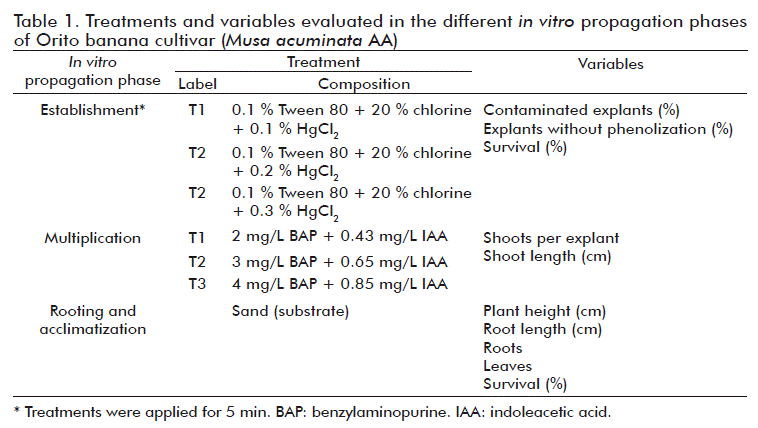
<body><![CDATA[<P   ><font face="Verdana, Arial, Helvetica, sans-serif" size="2">The culture medium      was MS [6] with 7 g/L bacto-agar as a gelling agent (Becton, Dickinson &amp;      Company) and 20 g/L sucrose. pH was adjusted to 5.7 with NaOH, then sterilized      at 121 &ordm;C for 15 min. The inoculation and transfer of Orito meristems      was carried out in the laminar flow cabinet. </font></P >   <B>        <P   ><font face="Verdana, Arial, Helvetica, sans-serif" size="2"><I>In vitro </I>propagation      phases</font></P >   </B>        <P   ><font face="Verdana, Arial, Helvetica, sans-serif" size="2"><B><I>Aseptic disinfection      and establishment of buds </I></b></font></P >       <P   ><font face="Verdana, Arial, Helvetica, sans-serif" size="2">The whole corms of      Orito underwent a manual cleaning process, eliminating the necrosed roots      and parts with the help of razors, until reaching dimensions of 4 cm2 approximately.      After cleaning, they were placed in sterile distilled water with 0.1 % Tween      80 and 20 % chlorine for 20 min. Then, the explants were transferred to the      laminar flow cabinet and a second recess was made, followed by disinfection      treatment using Tween 80, 20 % chlorine and different concentrations of mercury      bichloride (HgCl2) (<a href="/img/revistas/bta/v33n4/t0101416.gif">Table 1</a>), making three rinses      with sterile distilled water. Finally, the plant material was placed in 250-mL      capacity flasks containing 20 mL of the semisolid MS medium, 10 mL/L ascorbic      acid and 50 mg/L L-Cysteine were added to the medium to avoid the phenolization      of the explants. </font></P >   <FONT size="+1"><FONT size="+1"><FONT size="+1"><FONT size="+1">        
<P   ><font face="Verdana, Arial, Helvetica, sans-serif" size="2"><B><I>Multiplication      culture medium </I></b></font></P >       <P   ><font face="Verdana, Arial, Helvetica, sans-serif" size="2">The type and different      concentrations of growth regulators to improve the <I>in vitro </I>multiplication      rate of Orito banana were evaluated in this phase. For performing this experiment,      the aseptic shoots of the first phase were transferred to the MS multiplication      medium with plant growth regulators (benzylaminopurine (BAP) and indoleacetic      acid (IAA)) (<a href="/img/revistas/bta/v33n4/t0101416.gif">Table 1</a>). Then, the obtained shoots      were then segmented and placed in liquid MS medium, containing 30 g/L of sucrose      and 1 g/L of activated carbon for one month. The idea of using this medium      was to generate a cooling and conditioning stage, so that the shoots increase      in vigor before being taken to the rooting phase. Explants were exposed to      continuous fluorescent white light (37 &mu;mol/m2 s) and temperature of 25      &plusmn; 2 &deg;C. </font></P >   <FONT size="+1"><FONT size="+1">        
<P   ><font face="Verdana, Arial, Helvetica, sans-serif" size="2"><B><I>Rooting and      </I>ex vitro <I>acclimatization of vitroplants </I></b></font></P >       <P   ><font face="Verdana, Arial, Helvetica, sans-serif" size="2">For rooting and acclimatization,      vitroplants from the cooling and <I>in vitro </I>conditioning stage were used      as plant material. The vitroplants were placed in germinating trays with sand      substrate (particles between 0.063 and 2 mm) without plant growth regulators,      covered with a plastic tunnel to preserve the relative humidity and applying      irrigation with microsprinklers at a one-minute frequency every hour, for      four weeks. </font></P >       <P   ><font face="Verdana, Arial, Helvetica, sans-serif" size="2"><B>Experimental design      and statistical analysis</B> </font></P >       <P   ><font face="Verdana, Arial, Helvetica, sans-serif" size="2">In order to analyze      the test conditions in the establishment and multiplication stages, the completely      randomized design (CRD) was used considering 3 treatments and 4 replicates      each. The experimental unit consisted of four explants, with averages corresponding      to 16 explants per treatment. All the evaluated variables were subjected to      variance analysis to determine statistical significance; while for establishing      the differences between the means of the treatments, the Duncan&rsquo;s Multiple      Range Test at 95 % probability was used. In the rooting and acclimatization      phase, descriptive statistical tests were applied, considering 15 vitroplants      and the evaluation was performed at 28 days. </font></P >       ]]></body>
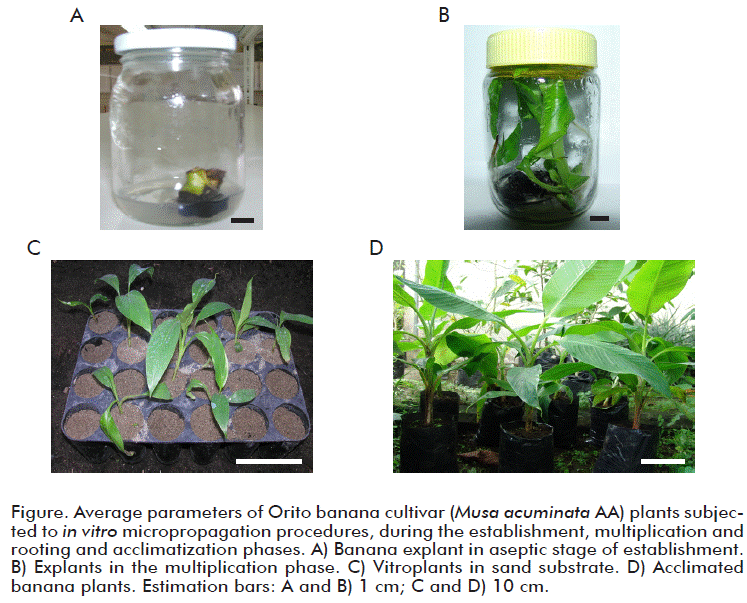
<body><![CDATA[<P   >&nbsp;</P >       <P   ><font face="Verdana, Arial, Helvetica, sans-serif" size="2"><B><font size="3">RESULTS      AND DISCUSSION </font> </b></font></P >   <B>        <P   ><font face="Verdana, Arial, Helvetica, sans-serif" size="2">Aseptic establishment      of Orito buds </font></P >   </B>        <P   ><font face="Verdana, Arial, Helvetica, sans-serif" size="2">The aseptic establishment      of buds was achieved by combination of T2 (0.1 % Tween 80 + 20 % chlorine      + 0.2 % HgCl2) for 5 min (<a href="/img/revistas/bta/v33n4/f0101416.gif">Figure A</a>), being effective      for the control of pollutants like bacteria and fungi. These results are similar      to those reported by other authors who, when using 20 % chlorine for 20 min      plus 0.1 % HgCl2 for 10 min obtained 100 % survival and contaminant-free shoots      in the micropropagation of the Maque&ntilde;o banana cultivar [13]. In the      <I>in vitro </I>establishment of &ldquo;Cambur Manzano&#750; banana a high      percentage of viable explants was obtained and low percentage of bacterial      contamination, within the first week of cultivation [9]. </font></P >   <FONT size="+1"><FONT size="+1"><FONT size="+1"><FONT size="+1">        
<P   ><font face="Verdana, Arial, Helvetica, sans-serif" size="2">Subsequently, 10      mg/L ascorbic acid and 50 mg/L L-Cysteine were added to the MS culture medium      to avoid phenolization of the plant tissue, resulting in a low rate of explants      with phenolization (6.25 %) in the T1 treatment, which implied obtaining a      high percentage of survival (<a href="/img/revistas/bta/v33n4/t0201416.gif">Table      2</a>). In other works, the addition of 1 g/L of activated carbon and incubation      in darkness for two weeks also minimized this phenomenon in apical meristem      cultures of Maque&ntilde;o and <I>Musa balbisiana </I>banana cultivars [13,      14]. Oxidations of explants were also noted during cropping of </font><font face="Verdana, Arial, Helvetica, sans-serif" size="2">Harton      apices [10], in explants in &ldquo;Cambur manzano&rdquo; banana exhibited      a generalized oxidation in the tissue causing increased mortality [15, 16].      Oxidation in explants and contamination in the <I>in vitro </I>aseptic establishment      stage are the main causes of loss of plant material that can be controlled      with good disinfection and reducing oxidation with activated charcoal [8].      In this phase, suitable shoots were obtained for the <I>in vitro </I>multiplication      of banana aseptic buds. </font></P >       
<P   ><font face="Verdana, Arial, Helvetica, sans-serif" size="2"><B>Multiplication      phase </b></font></P >       <P   ><font face="Verdana, Arial, Helvetica, sans-serif" size="2">The addition of cytokinins      and auxins for the regeneration of axillary buds in the multiplication phase      promoted an increase in the rate of axillary tissue formation, the averages      obtained were between 1.25 and 1.31 shoots (<a href="/img/revistas/bta/v33n4/f0101416.gif">Figure      B</a>). These results indicate that the concentrations used in this research      do not seem to be sufficient to promote significant sprouting of buds. These      results were superior, for the multiplication phase of the &ldquo;Cambur Manzano&#750;      babana (<I>Musa </I>AAB), obtaining 0.85 shoots per explant when using 5 mg/L      of BAP, but by increasing the dose of BAP to (10 mg/L) obtained 2.3 shoots      per explant [17]. In another research on &ldquo;Cambur Manzano&#750; banana      cultivating apical buds in a nutrient medium with 5.0 mg/L of BAP, and cultivating      buds extracted from whole corms with the same concentrations, 1.5 shoots were      obtained per explant in both cases [9]; this low proliferation of shoots is      associated with <I>M. balbisiana </I>cultivars that show low multiplication      rate or no <I>in vitro </I>response [18]. The capacity of shoot proliferation      in <I>M. balbisiana </I>also depends on the cultivar and clone [19]. </font></P >       
<P   ><font face="Verdana, Arial, Helvetica, sans-serif" size="2">These results are      lower than those obtained by other authors who achieved a better response      in the Maque&ntilde;o banana cultivar propagation, by supplementing with 5      mg/L BAP + 1.2 mg/L IAA, the average multiplication rate was 2.5 shoots [13].      Regarding shoot length, the best treatment was T1 for an average of 8.57 cm.      This coincided with another report on the obtainment of larger microstems      by culture medium supplementation with a lower concentration of cytokinins,      since this is achieved by decreasing cell division and promoting tissue elongation      by the action of auxins [20]. It is important to mention that as the concentration      of cytokinins (BAP) in the culture medium increases, the length of the shoot      decreases (<a href="/img/revistas/bta/v33n4/t0201416.gif">Table 2</a>; multiplication phase). Other      authors indicate that in <I>Musa </I>spp., the beneficial effect of cytokinins      on the formation of axillary shoots on apical buds grown <I>in vitro </I>is      known [11, 12]. At this stage, the presence of contaminating microorganisms      was not detected, the same result as obtained in <I>Musa acuminata </I>(Simmunds)      and &ldquo;Cambur Manzano&rdquo; banana [8, 9]. </font></P >       
<P   ><font face="Verdana, Arial, Helvetica, sans-serif" size="2"><B>Acclimatization      and rooting phase </b></font></P >       <P   ><font face="Verdana, Arial, Helvetica, sans-serif" size="2">Once the <I>in vitro      </I>propagation of the seedlings has been completed, it is essential to adapt      them to the uncontrolled <I>ex vitro </I>environmental conditions, both at      cultivation houses and under field conditions [21]. Plants must adapt themselves      both morphologically and physiologically after their transfer from <I>in vitro      </I>culture to <I>ex vitro </I>conditions, that is to say, when changing their      heterotrophic or mixotrophic metabolism to the autotroph one [22]. </font></P >       ]]></body>
<body><![CDATA[<P   ><font face="Verdana, Arial, Helvetica, sans-serif" size="2">Transfer from the      <I>in vitro </I>to <I>ex vitro </I>phase is the determining factor where high      risks of seedling mortality are verified. In this work, the two phases of      acclimatization and rooting of shoots were developed under greenhouse conditions,      using germinating trays and sand as substrate without addition of plant growth      regulators (<a href="/img/revistas/bta/v33n4/f0101416.gif">Figure C</a>). This phase was previously      implemented by another researcher who used rooting beds with sand substrate      under a sprinkler system and 50 % shade [23]. Banana seedlings were not subjected      to addition of rooting regulators (exogenous auxin), and 28 days after the      shoots were established, 100 % survived, with vitroplants of average height      11.40 cm, 6.28 cm of root length, 7 roots, and an average of 4.83 leaves each      (<a href="/img/revistas/bta/v33n4/t0201416.gif">Table 2</a>; rooting and acclimatization phase). The      substrate employed allowed a uniform distribution of O2 that favored the development      of the seedling root system. Availability of O2 is essential for the development      of the root system, where its demand is greater at 21 &deg;C due to the metabolism      required by the plant [24]. </font></P >   <FONT size="+1"><FONT size="+1"><FONT size="+1"><FONT size="+1">        
<P   ><font face="Verdana, Arial, Helvetica, sans-serif" size="2">The results obtained      in this phase of the research exceeded those obtained by other authors who      worked on the propagation of the Maque&ntilde;o banana cultivar, the results      obtained were: 6.10 cm of root length, 10.7 cm height and 80 % survival [13].      At two months, the plants were completely acclimated, ready to be established      in the field (<a href="/img/revistas/bta/v33n4/f0101416.gif">Figure D</a>). </font></P >       
<P   ><font face="Verdana, Arial, Helvetica, sans-serif" size="2">The <I>in vitro </I>propagation      protocol of Orito banana apical buds from corms obtained from a plantation,      represents a contribution to the micropropagation of this species and generates      the knowledge for the development of future studies tending to improve the      multiplication rate. With the protocol used during the <I>in vitro </I>establishment      phase, contamination-free and viable explants were obtained to continue the      propagation process. The number of shoots </font><font face="Verdana, Arial, Helvetica, sans-serif" size="2">obtained      per explant in the multiplication phase was 1.31. The results obtained when      evaluating the two phases together, acclimatization and rooting of the shoots      under greenhouse conditions, using germination trays and sand as substrate      without addition of growth regulators, were excellent. This allowed completing      successfully the entire <I>in vitro </I>propagation process, as well as saving      time and resources. </font></P >       <P   >&nbsp;</P >       <P   ><font face="Verdana, Arial, Helvetica, sans-serif" size="2"><B><font size="3">CONCLUSIONS      </font></b></font></P >       <P   ><font face="Verdana, Arial, Helvetica, sans-serif" size="2">By means of the <I>in      vitro </I>micropropagation protocol used in the present research, it was possible      to establish aseptic buds of Orito banana (<I>Musa acuminata </I>AA). In the      multiplication phase, the concentrations of BAP plus IAA showed similar effects      in all evaluated treatments. However, they favored the sprouting of buds and      bud elongation. The use of germinating trays with sand substrate in the rooting      and <I>ex vitro </I>acclimation phases allowed obtain vigorous, healthy, aseptic      plants with 100 % survival. The Orito banana plants obtained by <I>in vitro      </I>propagation developed normally and after two months were ready for field      establishment. </font></P >       <P   >&nbsp;</P >   <B>        <P   ><font face="Verdana, Arial, Helvetica, sans-serif" size="3">ACKNOWLEDGEMENTS      </font></P >   </B>        <P   ><font face="Verdana, Arial, Helvetica, sans-serif" size="2">The authors thank      to Mr. Gelio Cruz for the donation of the vegetative material, and to the      members of the Cell and Plant Tissue Culture Laboratory of the Quevedo State      Technical University (UTEQ), in Ecuador, where this research was conducted      in 2015, for their collaboration. This work was financed by the UTEQ (Quevedo,      Ecuador). </font></P >       <P   >&nbsp;</P >   <B>        ]]></body>
<body><![CDATA[<P   ><font face="Verdana, Arial, Helvetica, sans-serif" size="3">REFERENCES </font></P >       <P   ></P >   </B> <FONT size="+1" color="#000000">        <!-- ref --><P   ><font size="2" color="#211E1F" face="Verdana, Arial, Helvetica, sans-serif">1.      INIAP. Gu&iacute;a para el manejo org&aacute;nico del banano Orito. Experiencias      compiladas a partir de agricultores y t&eacute;cnicos. Quito: INIAP; 2004.          </font></P >   <FONT size="+1" color="#211E1F">        <!-- ref --><P   ><font face="Verdana, Arial, Helvetica, sans-serif" size="2">2. MAGAP. Serie hist&oacute;rica      2000-2012. 2015 [cited 2016 Aug 11]. Available from: <A href="http://sinagap.agricultura.gob.ec/banano" target="_blank">      <FONT color="#0000FF">http://sinagap.agricultura.gob.ec/banano</font></A>      </font></P >   <FONT color="#0000FF">        <P   ><font color="#211E1F" face="Verdana, Arial, Helvetica, sans-serif" size="2">3.      El banano orito despunta en los mercados. El Agro. 2014. 2014 Mar 31 [cited      2016 Aug 11]. Available from: <A href="http://www.revistaelagro.com/2014/03/31/el-banano-orito-despunta-en-los-mercados" target="_blank">      <FONT color="#0000FF">http://www.revistaelagro.com/2014/03/31/el-banano-orito-despunta-en-los-mercados</font></A>      </font></P >   <FONT color="#211E1F"><FONT color="#0000FF">        <P   ><font color="#211E1F" face="Verdana, Arial, Helvetica, sans-serif" size="2">4.      PROECUADOR. Exportaci&oacute;n de guineo &ldquo;creci&oacute;&rdquo; un 63%.      2012 Apr 14 [cited 2016 Aug 11]. Available from: <FONT color="#0000FF"><a href="http://www.pro-ecuador.gob.ec/2012/04/04/exportacion-de-guineo-orito-crecio-un-63%20" target="_blank">http://www.pro-ecuador.gob.ec/2012/04/04/exportacion-de-guineo-orito-crecio-un-63      </a></font></font></P >   <FONT color="#211E1F"><FONT color="#0000FF">        <!-- ref --><P   ><font color="#211E1F" face="Verdana, Arial, Helvetica, sans-serif" size="2">5.      Aular J, C&aacute;ceres M. Consideraciones sobre la producci&oacute;n de frutas      en Venezuela. Rev Brasileira Fruticult. 2011;3(1):187-198.     </font></P >   <FONT color="#211E1F">        <!-- ref --><P   ><font face="Verdana, Arial, Helvetica, sans-serif" size="2">6. Murashige T, Skoog      F. A revised medium for rapid growth and biossays of tobacco cultures. Physiol      Plant. 1962;15:473-97.     </font></P >       <!-- ref --><P   ><font face="Verdana, Arial, Helvetica, sans-serif" size="2">7. Delgado M, Cuba      M, Hechenleitner P, Thiers O. Propagaci&oacute;n vegetativa de taique (<I>Desfontainia      spinos&aacute;</I>) y tepa (<I>Laureliopsis philippian&aacute;</I>) con fines      ornamentales. Bosque (Valdivia). 2008;29(2):120-6.     </font></P >       <!-- ref --><P   ><font face="Verdana, Arial, Helvetica, sans-serif" size="2">8. Medina M, Medina      C, Medina L. Propagaci&oacute;n in vitro de <I>Musa acuminata </I>(Simmunds)      pl&aacute;tano bocadillo del Choc&oacute;, Colombia, a partir del cultivo      de meristemos apicales. Rev Biodiversidad Neotropical. 2015;5(1):47-53.     </font></P >       <!-- ref --><P   ><font face="Verdana, Arial, Helvetica, sans-serif" size="2">9. Rios G, A&ntilde;ez      N, Ram&iacute;rez M, Bracho B, Araujo D, Su&aacute;rez H, <I>et al. </I>Cultivo      <I>in vitro </I>de yemas, tratadas con benciladenina, provenientes de cormos      enteros o seccionados de pl&aacute;tano &ldquo;Cambur Manzano&rdquo;. Bioagro,      2013;25(2):137-42.     </font></P >       <!-- ref --><P   ><font face="Verdana, Arial, Helvetica, sans-serif" size="2">10. Uzc&aacute;tegui      J, Osorio D, Rivas M. Evaluaci&oacute;n del comportamiento <I>in vitro </I>de      &aacute;pices de pl&aacute;tano <I>Musa </I>AAB cv. &ldquo;Hart&oacute;n&rdquo;      y &ldquo;Hart&oacute;n Doble Tallo&rdquo;. Producci&oacute;n Agropecuaria.      2010;3(1):7-12.     </font></P >       <!-- ref --><P   ><font face="Verdana, Arial, Helvetica, sans-serif" size="2">11. Hoyos J, Perea      R, Velasco R. Evaluaci&oacute;n del efecto de diferentes concentraciones de      fitohormonas en la micropropagaci&oacute;n del pl&aacute;tano dominico Hart&oacute;n      (<I>Musa </I>AAB Simmonds). Biotecnolog&iacute;a en el Sector Agropecuario      y Agroindustrial. 2008;6(2):7-18.     </font></P >       <!-- ref --><P   ><font face="Verdana, Arial, Helvetica, sans-serif" size="2">12. Ram&iacute;rez-Villalobos      M, De Garc&iacute;a E, Lindorf H. Cambios morfoanat&oacute;micos en los &aacute;pices      del v&aacute;stago y de la ra&iacute;z del banano Williams (AAA, <I>Musa </I>spp.)      bajo distintas concentraciones de N6-benciladenina1,2. J Agric Univ Puerto      Rico. 2008; 92(1-2):53-72.     </font></P >       <!-- ref --><P   ><font face="Verdana, Arial, Helvetica, sans-serif" size="2">13. Canchignia F,      Sigcha L, Toaquiza J, Ramos L, Saucedo S, Carranza S, <I>et al. </I>Alternativas      para la Propagaci&oacute;n <I>in vitro </I>de Pl&aacute;tano Variedad Maque&ntilde;o      (<I>Musa </I>balbisiana AAB). Ciencia y Tecnolog&iacute;a. 2008;(1):43-8.          </font></P >       <!-- ref --><P   ><font face="Verdana, Arial, Helvetica, sans-serif" size="2">14. Sep&uacute;lveda      N, Murillo M, Medina M. Propagaci&oacute;n <I>in vitro </I>de mus&aacute;ceas      del Choc&oacute; a partir de meristemos radiculares. Investigaci&oacute;n,      Biodiversidad y Desarrollo. 2008;27(1):96-9.     </font></P >       <!-- ref --><P   ><font face="Verdana, Arial, Helvetica, sans-serif" size="2">15. Villegas Z, Gim&eacute;nez      C, V&iacute;lchez J, Moreno M, Sandoval L, Colmenares M. Oxidaci&oacute;n      en la inducci&oacute;n de la embriog&eacute;nesis som&aacute;tica a partir      de flores masculinas inmaduras de Gran Enano (<I>Musa </I>AAA). Revista de      la Facultad de Agronom&iacute;a. 2008;25(3):570-88.     </font></P >       <!-- ref --><P   ><font face="Verdana, Arial, Helvetica, sans-serif" size="2">16. Albarran J, Gonz&aacute;lez      A, Gonz&aacute;lez O, Salazar E, Trujillo I, Fuchs M, <I>et al</I>. Embriog&eacute;nesis      som&aacute;tica a partir de flores masculinas de pineo gigante y cambur manzano.      Agron Trop. 2009;59(4):363-71.     </font></P >       <!-- ref --><P   ><font face="Verdana, Arial, Helvetica, sans-serif" size="2">17. Silva A, Trujillo      I, Vidal M, P&eacute;rez V. Evaluaci&oacute;n de la inducci&oacute;n de variabilidad      gen&eacute;tica en cambur manzano (<I>Musa </I>AAB) a trav&eacute;s de marcadores      RAPD. Agron Trop. 2009;59(4):413-22.     </font></P >       <!-- ref --><P   ><font face="Verdana, Arial, Helvetica, sans-serif" size="2">18. Colmenares M,      Gim&eacute;nez C. Multiplicaci&oacute;n <I>in vitro </I>de <I>Musa </I>spp.      mediante sistema de inmersi&oacute;n temporal. Revista de la Facultad de Agronom&iacute;a.      2003;20(4):468-77.     </font></P >       <!-- ref --><P   ><font face="Verdana, Arial, Helvetica, sans-serif" size="2">19. Ram&iacute;rez-Villalobos      M, Lindorf H, Garc&iacute;a E. Cambios morfoanat&oacute;micos del &aacute;pice      del v&aacute;stago en banano CIEN BTA-03 y su parental Williams bajo condiciones      in vitro. Revista de la Facultad de Agronom&iacute;a (LUZ). 2011;28(1):62-72.          </font></P >       <!-- ref --><P   ><font face="Verdana, Arial, Helvetica, sans-serif" size="2">20. Arredondo A.      Establecimiento de cadenas proliferativas y enraizamiento <I>in vitro </I>de      <I>Juglans regia </I>L. a partir de embriones [disertaci&oacute;n]. Concepci&oacute;n:      Universidad de Concepci&oacute;n; 2000.     </font></P >       <!-- ref --><P   ><font face="Verdana, Arial, Helvetica, sans-serif" size="2">21. Izquierdo H,      Gonz&aacute;lez M, N&uacute;&ntilde;ez M, Proenza R, &Aacute;lvarez I. Efectos      de la aplicaci&oacute;n de un an&aacute;logo espirost&aacute;nico de brasinoesteroides      en vitroplantas de banano (<I>Musa </I>spp.) durante la fase de aclimatizaci&oacute;n.      Cult Trop. 2012;33(1):71-6.     </font></P >       <!-- ref --><P   ><font face="Verdana, Arial, Helvetica, sans-serif" size="2">22. Rodr&iacute;guez      A, Posada-P&eacute;rez L, G&oacute;mez R, Reyes M, Tejeda, M. Aclimatizaci&oacute;n      de plantas de <I>Carica papaya </I>var. &lsquo;Maradol roja&rsquo; obtenidas      por embriog&eacute;nesis som&aacute;tica. Biotecnol Veg. 2009;9(2):91-7.     </font></P >       <P   ><font face="Verdana, Arial, Helvetica, sans-serif" size="2">23. Monteuuis O.      Recent advances in mass clonal propagation of Teak [abstract]. In: BIO-REFOR.      Proceedings of the International Workshop BIO-REFOR. Kangar, Malaysia: BIO-REFOR;      1995. p. 1-3. </font></P >       <!-- ref --><P   ><font face="Verdana, Arial, Helvetica, sans-serif" size="2">24. De Leij F, Dixon-Hardy      J, Lynch J. Effect of 2,4-diacetylphloroglucinol-producing and non-producing      strains of <I>Pseudomonas fluorescens </I>on root development of pea seedlings      in three different soil types and its effect on nodulation by <I>Rhizobium</I>.      Biol Fert Soils. 2002;35(2):114-21.     </font></P >       <P   >&nbsp;</P >       <P   >&nbsp;</P >       <P   ><font size="2" face="Verdana, Arial, Helvetica, sans-serif">Received in October,      2016.     <br>     Accepted in December, 2016.<B><I> </I></B> </font></P >   <FONT size="+1"><FONT size="+1">        ]]></body>
<body><![CDATA[<P   >&nbsp;</P >       <P   >&nbsp;</P >       <P   ><font face="Verdana, Arial, Helvetica, sans-serif" size="2"><i>Nicol&aacute;s      Cruz-Rosero</i>. Laboratorio de Cultivo de Tejidos, Facultad de Ciencias Ambientales,      Universidad T&eacute;cnica Estatal de Quevedo. Km 1.5 v&iacute;a a Santo Domingo      de los Ts&aacute;chilas, EC.120501, Quevedo, Ecuador. E-mail: <A href="mailto:jcruz@uteq.edu.ec">      <FONT color="#0000FF">jcruz@uteq.edu.ec</font></A><FONT color="#0000FF"> <FONT color="#211E1F">;      <A href="mailto:nicolascruz83@gmail.com"> <FONT color="#0000FF">nicolascruz83@gmail.com</font></A><FONT color="#0000FF"><FONT color="#211E1F">.      </font></font></font></font></font></P >   <FONT color="#0000FF"><FONT color="#211E1F"><FONT color="#0000FF"><FONT color="#211E1F">        <P   > </P >       <P   > </P >   </font></font></font></font></font></font></font></font></font></font></font></font></font></font></font></font></font></font></font></font></font></font></font></font></font></font></font></font></font></font></font></font></font></font></font></font></font></font></font></font></font></font></font></font></font></font></font></font></font></font></font></font></font></font></font></font></font></font></font></font></font></DIV >      ]]></body><back>
<ref-list>
<ref id="B1">
<label>1</label><nlm-citation citation-type="book">
<collab>INIAP</collab>
<source><![CDATA[Guía para el manejo orgánico del banano Orito. Experiencias compiladas a partir de agricultores y técnicos]]></source>
<year>2004</year>
<publisher-loc><![CDATA[Quito ]]></publisher-loc>
<publisher-name><![CDATA[INIAP]]></publisher-name>
</nlm-citation>
</ref>
<ref id="B2">
<label>2</label><nlm-citation citation-type="">
<collab>MAGAP</collab>
<source><![CDATA[Serie histórica 2000-2012]]></source>
<year>2015</year>
</nlm-citation>
</ref>
<ref id="B3">
<label>3</label><nlm-citation citation-type="">
<source><![CDATA[El banano orito despunta en los mercados. El Agro]]></source>
<year>2014</year>
<month> M</month>
<day>ar</day>
</nlm-citation>
</ref>
<ref id="B4">
<label>4</label><nlm-citation citation-type="">
<collab>PROECUADOR</collab>
<source><![CDATA[]]></source>
<year>2012</year>
<month> A</month>
<day>pr</day>
</nlm-citation>
</ref>
<ref id="B5">
<label>5</label><nlm-citation citation-type="journal">
<person-group person-group-type="author">
<name>
<surname><![CDATA[Aular]]></surname>
<given-names><![CDATA[J]]></given-names>
</name>
<name>
<surname><![CDATA[Cáceres]]></surname>
<given-names><![CDATA[M]]></given-names>
</name>
</person-group>
<article-title xml:lang="es"><![CDATA[Consideraciones sobre la producción de frutas en Venezuela]]></article-title>
<source><![CDATA[Rev Brasileira Fruticult]]></source>
<year>2011</year>
<volume>3</volume>
<numero>1</numero>
<issue>1</issue>
<page-range>187-198</page-range></nlm-citation>
</ref>
<ref id="B6">
<label>6</label><nlm-citation citation-type="journal">
<person-group person-group-type="author">
<name>
<surname><![CDATA[Murashige]]></surname>
<given-names><![CDATA[T]]></given-names>
</name>
<name>
<surname><![CDATA[Skoog]]></surname>
<given-names><![CDATA[F]]></given-names>
</name>
</person-group>
<article-title xml:lang="en"><![CDATA[A revised medium for rapid growth and biossays of tobacco cultures]]></article-title>
<source><![CDATA[Physiol Plant]]></source>
<year>1962</year>
<volume>15</volume>
<page-range>473-97</page-range></nlm-citation>
</ref>
<ref id="B7">
<label>7</label><nlm-citation citation-type="journal">
<person-group person-group-type="author">
<name>
<surname><![CDATA[Delgado]]></surname>
<given-names><![CDATA[M]]></given-names>
</name>
<name>
<surname><![CDATA[Cuba]]></surname>
<given-names><![CDATA[M]]></given-names>
</name>
<name>
<surname><![CDATA[Hechenleitner]]></surname>
<given-names><![CDATA[P]]></given-names>
</name>
<name>
<surname><![CDATA[Thiers]]></surname>
<given-names><![CDATA[O]]></given-names>
</name>
</person-group>
<article-title xml:lang="es"><![CDATA[Propagación vegetativa de taique (Desfontainia spinosá) y tepa (Laureliopsis philippianá) con fines ornamentales]]></article-title>
<source><![CDATA[Bosque (Valdivia)]]></source>
<year>2008</year>
<volume>29</volume>
<numero>2</numero>
<issue>2</issue>
<page-range>120-6</page-range></nlm-citation>
</ref>
<ref id="B8">
<label>8</label><nlm-citation citation-type="journal">
<person-group person-group-type="author">
<name>
<surname><![CDATA[Medina]]></surname>
<given-names><![CDATA[M]]></given-names>
</name>
<name>
<surname><![CDATA[Medina]]></surname>
<given-names><![CDATA[C]]></given-names>
</name>
<name>
<surname><![CDATA[Medina]]></surname>
<given-names><![CDATA[L]]></given-names>
</name>
</person-group>
<article-title xml:lang="es"><![CDATA[Propagación in vitro de Musa acuminata (Simmunds) plátano bocadillo del Chocó, Colombia, a partir del cultivo de meristemos apicales]]></article-title>
<source><![CDATA[Rev Biodiversidad Neotropical]]></source>
<year>2015</year>
<volume>5</volume>
<numero>1</numero>
<issue>1</issue>
<page-range>47-53</page-range></nlm-citation>
</ref>
<ref id="B9">
<label>9</label><nlm-citation citation-type="journal">
<person-group person-group-type="author">
<name>
<surname><![CDATA[Rios]]></surname>
<given-names><![CDATA[G]]></given-names>
</name>
<name>
<surname><![CDATA[Añez]]></surname>
<given-names><![CDATA[N]]></given-names>
</name>
<name>
<surname><![CDATA[Ramírez]]></surname>
<given-names><![CDATA[M]]></given-names>
</name>
<name>
<surname><![CDATA[Bracho]]></surname>
<given-names><![CDATA[B]]></given-names>
</name>
<name>
<surname><![CDATA[Araujo]]></surname>
<given-names><![CDATA[D]]></given-names>
</name>
<name>
<surname><![CDATA[Suárez]]></surname>
<given-names><![CDATA[H]]></given-names>
</name>
</person-group>
<article-title xml:lang="es"><![CDATA[Cultivo in vitro de yemas, tratadas con benciladenina, provenientes de cormos enteros o seccionados de plátano & ldquo;Cambur Manzano & rdquo]]></article-title>
<source><![CDATA[Bioagro]]></source>
<year>2013</year>
<volume>25</volume>
<numero>2</numero>
<issue>2</issue>
<page-range>137-42</page-range></nlm-citation>
</ref>
<ref id="B10">
<label>10</label><nlm-citation citation-type="journal">
<person-group person-group-type="author">
<name>
<surname><![CDATA[Uzcátegui]]></surname>
<given-names><![CDATA[J]]></given-names>
</name>
<name>
<surname><![CDATA[Osorio]]></surname>
<given-names><![CDATA[D]]></given-names>
</name>
<name>
<surname><![CDATA[Rivas]]></surname>
<given-names><![CDATA[M]]></given-names>
</name>
</person-group>
<article-title xml:lang="es"><![CDATA[Evaluación del comportamiento in vitro de ápices de plátano Musa AAB cv. & ldquo;Hartón & rdquo; y & ldquo;Hartón Doble Tallo & rdquo]]></article-title>
<source><![CDATA[Producción Agropecuaria]]></source>
<year>2010</year>
<volume>3</volume>
<numero>1</numero>
<issue>1</issue>
<page-range>7-12</page-range></nlm-citation>
</ref>
<ref id="B11">
<label>11</label><nlm-citation citation-type="journal">
<person-group person-group-type="author">
<name>
<surname><![CDATA[Hoyos]]></surname>
<given-names><![CDATA[J]]></given-names>
</name>
<name>
<surname><![CDATA[Perea]]></surname>
<given-names><![CDATA[R]]></given-names>
</name>
<name>
<surname><![CDATA[Velasco]]></surname>
<given-names><![CDATA[R]]></given-names>
</name>
</person-group>
<article-title xml:lang="es"><![CDATA[Evaluación del efecto de diferentes concentraciones de fitohormonas en la micropropagación del plátano dominico Hartón (Musa AAB Simmonds)]]></article-title>
<source><![CDATA[Biotecnología en el Sector Agropecuario y Agroindustrial]]></source>
<year>2008</year>
<volume>6</volume>
<numero>2</numero>
<issue>2</issue>
<page-range>7-18</page-range></nlm-citation>
</ref>
<ref id="B12">
<label>12</label><nlm-citation citation-type="journal">
<person-group person-group-type="author">
<name>
<surname><![CDATA[Ramírez-Villalobos]]></surname>
<given-names><![CDATA[M]]></given-names>
</name>
<name>
<surname><![CDATA[De García]]></surname>
<given-names><![CDATA[E]]></given-names>
</name>
<name>
<surname><![CDATA[Lindorf]]></surname>
<given-names><![CDATA[H]]></given-names>
</name>
</person-group>
<article-title xml:lang="es"><![CDATA[Cambios morfoanatómicos en los ápices del vástago y de la raíz del banano Williams (AAA, Musa spp.) bajo distintas concentraciones de N6-benciladenina1,2]]></article-title>
<source><![CDATA[J Agric Univ Puerto Rico]]></source>
<year>2008</year>
<volume>92</volume>
<numero>1</numero>
<issue>1</issue>
<page-range>2):53-72</page-range></nlm-citation>
</ref>
<ref id="B13">
<label>13</label><nlm-citation citation-type="journal">
<person-group person-group-type="author">
<name>
<surname><![CDATA[Canchignia]]></surname>
<given-names><![CDATA[F]]></given-names>
</name>
<name>
<surname><![CDATA[Sigcha]]></surname>
<given-names><![CDATA[L]]></given-names>
</name>
<name>
<surname><![CDATA[Toaquiza]]></surname>
<given-names><![CDATA[J]]></given-names>
</name>
<name>
<surname><![CDATA[Ramos]]></surname>
<given-names><![CDATA[L]]></given-names>
</name>
<name>
<surname><![CDATA[Saucedo]]></surname>
<given-names><![CDATA[S]]></given-names>
</name>
<name>
<surname><![CDATA[Carranza]]></surname>
<given-names><![CDATA[S]]></given-names>
</name>
</person-group>
<article-title xml:lang="es"><![CDATA[Alternativas para la Propagación in vitro de Plátano Variedad Maqueño (Musa balbisiana AAB)]]></article-title>
<source><![CDATA[Ciencia y Tecnología]]></source>
<year>2008</year>
<numero>1</numero>
<issue>1</issue>
<page-range>43-8</page-range></nlm-citation>
</ref>
<ref id="B14">
<label>14</label><nlm-citation citation-type="journal">
<person-group person-group-type="author">
<name>
<surname><![CDATA[Sepúlveda]]></surname>
<given-names><![CDATA[N]]></given-names>
</name>
<name>
<surname><![CDATA[Murillo]]></surname>
<given-names><![CDATA[M]]></given-names>
</name>
<name>
<surname><![CDATA[Medina]]></surname>
<given-names><![CDATA[M]]></given-names>
</name>
</person-group>
<article-title xml:lang="es"><![CDATA[Propagación in vitro de musáceas del Chocó a partir de meristemos radiculares]]></article-title>
<source><![CDATA[Investigación, Biodiversidad y Desarrollo]]></source>
<year>2008</year>
<volume>27</volume>
<numero>1</numero>
<issue>1</issue>
<page-range>96-9</page-range></nlm-citation>
</ref>
<ref id="B15">
<label>15</label><nlm-citation citation-type="journal">
<person-group person-group-type="author">
<name>
<surname><![CDATA[Villegas]]></surname>
<given-names><![CDATA[Z]]></given-names>
</name>
<name>
<surname><![CDATA[Giménez]]></surname>
<given-names><![CDATA[C]]></given-names>
</name>
<name>
<surname><![CDATA[Vílchez]]></surname>
<given-names><![CDATA[J]]></given-names>
</name>
<name>
<surname><![CDATA[Moreno]]></surname>
<given-names><![CDATA[M]]></given-names>
</name>
<name>
<surname><![CDATA[Sandoval]]></surname>
<given-names><![CDATA[L]]></given-names>
</name>
<name>
<surname><![CDATA[Colmenares]]></surname>
<given-names><![CDATA[M]]></given-names>
</name>
</person-group>
<article-title xml:lang="es"><![CDATA[Oxidación en la inducción de la embriogénesis somática a partir de flores masculinas inmaduras de Gran Enano (Musa AAA)]]></article-title>
<source><![CDATA[Revista de la Facultad de Agronomía]]></source>
<year>2008</year>
<volume>25</volume>
<numero>3</numero>
<issue>3</issue>
<page-range>570-88</page-range></nlm-citation>
</ref>
<ref id="B16">
<label>16</label><nlm-citation citation-type="journal">
<person-group person-group-type="author">
<name>
<surname><![CDATA[Albarran]]></surname>
<given-names><![CDATA[J]]></given-names>
</name>
<name>
<surname><![CDATA[González]]></surname>
<given-names><![CDATA[A]]></given-names>
</name>
<name>
<surname><![CDATA[González]]></surname>
<given-names><![CDATA[O]]></given-names>
</name>
<name>
<surname><![CDATA[Salazar]]></surname>
<given-names><![CDATA[E]]></given-names>
</name>
<name>
<surname><![CDATA[Trujillo]]></surname>
<given-names><![CDATA[I]]></given-names>
</name>
<name>
<surname><![CDATA[Fuchs]]></surname>
<given-names><![CDATA[M]]></given-names>
</name>
</person-group>
<article-title xml:lang="es"><![CDATA[Embriogénesis somática a partir de flores masculinas de pineo gigante y cambur manzano]]></article-title>
<source><![CDATA[Agron Trop]]></source>
<year>2009</year>
<volume>59</volume>
<numero>4</numero>
<issue>4</issue>
<page-range>363-71</page-range></nlm-citation>
</ref>
<ref id="B17">
<label>17</label><nlm-citation citation-type="journal">
<person-group person-group-type="author">
<name>
<surname><![CDATA[Silva]]></surname>
<given-names><![CDATA[A]]></given-names>
</name>
<name>
<surname><![CDATA[Trujillo]]></surname>
<given-names><![CDATA[I]]></given-names>
</name>
<name>
<surname><![CDATA[Vidal]]></surname>
<given-names><![CDATA[M]]></given-names>
</name>
<name>
<surname><![CDATA[Pérez]]></surname>
<given-names><![CDATA[V]]></given-names>
</name>
</person-group>
<article-title xml:lang="es"><![CDATA[Evaluación de la inducción de variabilidad genética en cambur manzano (Musa AAB) a través de marcadores RAPD]]></article-title>
<source><![CDATA[Agron Trop]]></source>
<year>2009</year>
<volume>59</volume>
<numero>4</numero>
<issue>4</issue>
<page-range>413-22</page-range></nlm-citation>
</ref>
<ref id="B18">
<label>18</label><nlm-citation citation-type="journal">
<person-group person-group-type="author">
<name>
<surname><![CDATA[Colmenares]]></surname>
<given-names><![CDATA[M]]></given-names>
</name>
<name>
<surname><![CDATA[Giménez]]></surname>
<given-names><![CDATA[C]]></given-names>
</name>
</person-group>
<article-title xml:lang="es"><![CDATA[Multiplicación in vitro de Musa spp. mediante sistema de inmersión temporal]]></article-title>
<source><![CDATA[Revista de la Facultad de Agronomía]]></source>
<year>2003</year>
<volume>20</volume>
<numero>4</numero>
<issue>4</issue>
<page-range>468-77</page-range></nlm-citation>
</ref>
<ref id="B19">
<label>19</label><nlm-citation citation-type="journal">
<person-group person-group-type="author">
<name>
<surname><![CDATA[Ramírez-Villalobos]]></surname>
<given-names><![CDATA[M]]></given-names>
</name>
<name>
<surname><![CDATA[Lindorf]]></surname>
<given-names><![CDATA[H]]></given-names>
</name>
<name>
<surname><![CDATA[García]]></surname>
<given-names><![CDATA[E]]></given-names>
</name>
</person-group>
<article-title xml:lang="es"><![CDATA[Cambios morfoanatómicos del ápice del vástago en banano CIEN BTA-03 y su parental Williams bajo condiciones in vitro]]></article-title>
<source><![CDATA[Revista de la Facultad de Agronomía (LUZ)]]></source>
<year>2011</year>
<volume>28</volume>
<numero>1</numero>
<issue>1</issue>
<page-range>62-72</page-range></nlm-citation>
</ref>
<ref id="B20">
<label>20</label><nlm-citation citation-type="book">
<person-group person-group-type="author">
<name>
<surname><![CDATA[Arredondo]]></surname>
<given-names><![CDATA[A]]></given-names>
</name>
</person-group>
<source><![CDATA[Establecimiento de cadenas proliferativas y enraizamiento in vitro de Juglans regia L. a partir de embriones (disertación)]]></source>
<year>2000</year>
<publisher-loc><![CDATA[Concepción ]]></publisher-loc>
<publisher-name><![CDATA[Universidad de Concepción]]></publisher-name>
</nlm-citation>
</ref>
<ref id="B21">
<label>21</label><nlm-citation citation-type="journal">
<person-group person-group-type="author">
<name>
<surname><![CDATA[Izquierdo]]></surname>
<given-names><![CDATA[H]]></given-names>
</name>
<name>
<surname><![CDATA[González]]></surname>
<given-names><![CDATA[M]]></given-names>
</name>
<name>
<surname><![CDATA[Núñez]]></surname>
<given-names><![CDATA[M]]></given-names>
</name>
<name>
<surname><![CDATA[Proenza]]></surname>
<given-names><![CDATA[R]]></given-names>
</name>
<name>
<surname><![CDATA[Álvarez]]></surname>
<given-names><![CDATA[I]]></given-names>
</name>
</person-group>
<article-title xml:lang="en"><![CDATA[Efectos de la aplicación de un análogo espirostánico de brasinoesteroides en vitroplantas de banano (Musa spp.) durante la fase de aclimatización]]></article-title>
<source><![CDATA[Cult Trop]]></source>
<year>2012</year>
<volume>33</volume>
<numero>1</numero>
<issue>1</issue>
<page-range>71-6</page-range></nlm-citation>
</ref>
<ref id="B22">
<label>22</label><nlm-citation citation-type="journal">
<person-group person-group-type="author">
<name>
<surname><![CDATA[Rodríguez]]></surname>
<given-names><![CDATA[A]]></given-names>
</name>
<name>
<surname><![CDATA[Posada-Pérez]]></surname>
<given-names><![CDATA[L]]></given-names>
</name>
<name>
<surname><![CDATA[Gómez]]></surname>
<given-names><![CDATA[R]]></given-names>
</name>
<name>
<surname><![CDATA[Reyes]]></surname>
<given-names><![CDATA[M]]></given-names>
</name>
<name>
<surname><![CDATA[Tejeda]]></surname>
<given-names><![CDATA[M]]></given-names>
</name>
</person-group>
<article-title xml:lang="es"><![CDATA[Aclimatización de plantas de Carica papaya var. & lsquo;Maradol roja & rsquo; obtenidas por embriogénesis somática]]></article-title>
<source><![CDATA[Biotecnol Veg]]></source>
<year>2009</year>
<volume>9</volume>
<numero>2</numero>
<issue>2</issue>
<page-range>91-7</page-range></nlm-citation>
</ref>
<ref id="B23">
<label>23</label><nlm-citation citation-type="book">
<person-group person-group-type="author">
<name>
<surname><![CDATA[Monteuuis]]></surname>
<given-names><![CDATA[O]]></given-names>
</name>
</person-group>
<article-title xml:lang="en"><![CDATA[Recent advances in mass clonal propagation of Teak (abstract)]]></article-title>
<collab>BIO-REFOR</collab>
<source><![CDATA[Proceedings of the International Workshop BIO-REFOR]]></source>
<year>1995</year>
<page-range>1-3</page-range><publisher-loc><![CDATA[Kangar, Malaysia ]]></publisher-loc>
<publisher-name><![CDATA[BIO-REFOR]]></publisher-name>
</nlm-citation>
</ref>
<ref id="B24">
<label>24</label><nlm-citation citation-type="journal">
<person-group person-group-type="author">
<name>
<surname><![CDATA[De Leij]]></surname>
<given-names><![CDATA[F]]></given-names>
</name>
<name>
<surname><![CDATA[Dixon-Hardy]]></surname>
<given-names><![CDATA[J]]></given-names>
</name>
<name>
<surname><![CDATA[Lynch]]></surname>
<given-names><![CDATA[J]]></given-names>
</name>
</person-group>
<article-title xml:lang="en"><![CDATA[Effect of 2,4-diacetylphloroglucinol-producing and non-producing strains of Pseudomonas fluorescens on root development of pea seedlings in three different soil types and its effect on nodulation by Rhizobium]]></article-title>
<source><![CDATA[Biol Fert Soils]]></source>
<year>2002</year>
<volume>35</volume>
<numero>2</numero>
<issue>2</issue>
<page-range>114-21</page-range></nlm-citation>
</ref>
</ref-list>
</back>
</article>