<?xml version="1.0" encoding="ISO-8859-1"?><article xmlns:mml="http://www.w3.org/1998/Math/MathML" xmlns:xlink="http://www.w3.org/1999/xlink" xmlns:xsi="http://www.w3.org/2001/XMLSchema-instance">
<front>
<journal-meta>
<journal-id>1027-2852</journal-id>
<journal-title><![CDATA[Biotecnología Aplicada]]></journal-title>
<abbrev-journal-title><![CDATA[Biotecnol Apl]]></abbrev-journal-title>
<issn>1027-2852</issn>
<publisher>
<publisher-name><![CDATA[Editorial Elfos Scientiae]]></publisher-name>
</publisher>
</journal-meta>
<article-meta>
<article-id>S1027-28522017000100003</article-id>
<title-group>
<article-title xml:lang="en"><![CDATA[Standardization of variables involved in cadmium and zinc microbial removal from aqueous solutions]]></article-title>
<article-title xml:lang="es"><![CDATA[Estandarización de variables involucradas en la remoción microbiana de cadmio y cinc en solución acuosa]]></article-title>
</title-group>
<contrib-group>
<contrib contrib-type="author">
<name>
<surname><![CDATA[Carballo-Valdés]]></surname>
<given-names><![CDATA[María E]]></given-names>
</name>
<xref ref-type="aff" rid="A01"/>
</contrib>
<contrib contrib-type="author">
<name>
<surname><![CDATA[Martínez]]></surname>
<given-names><![CDATA[Armando]]></given-names>
</name>
<xref ref-type="aff" rid="A01"/>
</contrib>
<contrib contrib-type="author">
<name>
<surname><![CDATA[Salgado]]></surname>
<given-names><![CDATA[Irina]]></given-names>
</name>
<xref ref-type="aff" rid="A01"/>
</contrib>
<contrib contrib-type="author">
<name>
<surname><![CDATA[Pérez]]></surname>
<given-names><![CDATA[Lizandra]]></given-names>
</name>
<xref ref-type="aff" rid="A01"/>
</contrib>
<contrib contrib-type="author">
<name>
<surname><![CDATA[Cruz]]></surname>
<given-names><![CDATA[Mario]]></given-names>
</name>
<xref ref-type="aff" rid="A01"/>
</contrib>
<contrib contrib-type="author">
<name>
<surname><![CDATA[Liva]]></surname>
<given-names><![CDATA[María B]]></given-names>
</name>
<xref ref-type="aff" rid="A02"/>
</contrib>
<contrib contrib-type="author">
<name>
<surname><![CDATA[Alleyne]]></surname>
<given-names><![CDATA[Sheyla]]></given-names>
</name>
<xref ref-type="aff" rid="A02"/>
</contrib>
<contrib contrib-type="author">
<name>
<surname><![CDATA[Rodríguez]]></surname>
<given-names><![CDATA[Mónica M]]></given-names>
</name>
<xref ref-type="aff" rid="A03"/>
</contrib>
<contrib contrib-type="author">
<name>
<surname><![CDATA[Garza]]></surname>
<given-names><![CDATA[Yolanda]]></given-names>
</name>
<xref ref-type="aff" rid="A03"/>
</contrib>
</contrib-group>
<aff id="A02">
<institution><![CDATA[,Universidad de La Habana Instituto de Ciencia y Tecnología de los Materiales Laboratorio LUCES]]></institution>
<addr-line><![CDATA[Habana ]]></addr-line>
<country>Cuba</country>
</aff>
<aff id="A03">
<institution><![CDATA[,Universidad Autónoma de Coahuila Facultad de Ciencias Químicas Departamento de Biotecnología]]></institution>
<addr-line><![CDATA[ ]]></addr-line>
<country>Mexico</country>
</aff>
<aff id="A01">
<institution><![CDATA[,University of Havana Faculty of Biology Microbiology and Virology Department]]></institution>
<addr-line><![CDATA[Habana ]]></addr-line>
<country>Cuba</country>
</aff>
<pub-date pub-type="pub">
<day>00</day>
<month>03</month>
<year>2017</year>
</pub-date>
<pub-date pub-type="epub">
<day>00</day>
<month>03</month>
<year>2017</year>
</pub-date>
<volume>34</volume>
<numero>1</numero>
<fpage>1221</fpage>
<lpage>1225</lpage>
<copyright-statement/>
<copyright-year/>
<self-uri xlink:href="http://scielo.sld.cu/scielo.php?script=sci_arttext&amp;pid=S1027-28522017000100003&amp;lng=en&amp;nrm=iso"></self-uri><self-uri xlink:href="http://scielo.sld.cu/scielo.php?script=sci_abstract&amp;pid=S1027-28522017000100003&amp;lng=en&amp;nrm=iso"></self-uri><self-uri xlink:href="http://scielo.sld.cu/scielo.php?script=sci_pdf&amp;pid=S1027-28522017000100003&amp;lng=en&amp;nrm=iso"></self-uri><kwd-group>
<kwd lng="en"><![CDATA[microorganisms]]></kwd>
<kwd lng="en"><![CDATA[biosorption]]></kwd>
<kwd lng="en"><![CDATA[removal]]></kwd>
<kwd lng="en"><![CDATA[cadmium]]></kwd>
<kwd lng="en"><![CDATA[zinc]]></kwd>
<kwd lng="en"><![CDATA[treatment variables]]></kwd>
<kwd lng="es"><![CDATA[microorganismos]]></kwd>
<kwd lng="es"><![CDATA[biosorción]]></kwd>
<kwd lng="es"><![CDATA[remoción]]></kwd>
<kwd lng="es"><![CDATA[cadmio]]></kwd>
<kwd lng="es"><![CDATA[cinc]]></kwd>
<kwd lng="es"><![CDATA[variables del tratamiento]]></kwd>
</kwd-group>
</article-meta>
</front><body><![CDATA[ <DIV class="Sect"   >        <P align="right"   ><font size="2" color="#000000" face="Verdana, Arial, Helvetica, sans-serif"><b>RESEARCH      </b> </font></P >       <P   >&nbsp;</P >   <FONT size="+1" color="#000000">        <P   > </P >       <P   ><font size="4"><b><font color="#211E1F" face="Verdana, Arial, Helvetica, sans-serif">Standardization      of variables involved in cadmium and zinc microbial removal from aqueous solutions      </font></b></font></P >       <P   >&nbsp;</P >   <FONT size="+1" color="#211E1F"><FONT size="+1" color="#000000">        <P   > </P >   <FONT size="+1">       <P   ><b><font size="3" color="#211E1F" face="Verdana, Arial, Helvetica, sans-serif">Estandarizaci&oacute;n      de variables involucradas en la remoci&oacute;n microbiana de cadmio y cinc      en soluci&oacute;n acuosa </font></b></P >       <P   >&nbsp;</P >       <P   >&nbsp;</P >   <FONT size="+1" color="#211E1F">        ]]></body>
<body><![CDATA[<P   > </P >       <P   ></P >   <FONT size="+1" color="#000000">       <P   ><b><font size="2" color="#211E1F" face="Verdana, Arial, Helvetica, sans-serif">Mar&iacute;a      E Carballo-Vald&eacute;s<sup>1</sup>, Armando Mart&iacute;nez<sup>1</sup>,      Irina Salgado<sup>1</sup>, Lizandra P&eacute;rez<sup>1</sup>, Mario Cruz<sup>1</sup>,      Mar&iacute;a B Liva<sup>2</sup>, Sheyla Alleyne<sup>2</sup>, M&oacute;nica      M Rodr&iacute;guez<sup>3</sup>, Yolanda Garza<sup>3</sup> </font></b></P >   <FONT size="+1" color="#211E1F"><FONT size="+1"><FONT size="+1"><FONT size="+1"><FONT size="+1"><FONT size="+1"><FONT size="+1"><FONT size="+1"><FONT size="+1"><FONT size="+1"><FONT size="+1"><FONT size="+1"><FONT size="+1"><FONT size="+1"><FONT size="+1"><FONT size="+1"><FONT size="+1"><FONT size="+1">        <P   > </P >   <FONT size="+1" color="#000000">        <P   ><font size="2" color="#211E1F" face="Verdana, Arial, Helvetica, sans-serif"><sup>1</sup>      Microbiology and Virology Department. Faculty of Biology, University of Havana.      25 e/ J e I No 455, Vedado, Plaza de la Revoluci&oacute;n, Habana, Cuba. </font>    <br>     <font size="2" face="Verdana, Arial, Helvetica, sans-serif"><sup>2</sup> Laboratorio      LUCES. Instituto de Ciencia y Tecnolog&iacute;a de los Materiales, Universidad      de La Habana. Zapata y G s/n, Vedado, Plaza de la Revoluci&oacute;n, Habana,      Cuba. </font>    <br>     <font size="2" face="Verdana, Arial, Helvetica, sans-serif"><sup>3</sup> Departamento      de Biotecnolog&iacute;a, Facultad de Ciencias Qu&iacute;micas, Universidad      Aut&oacute;noma de Coahuila, Mexico. </font></P >   <FONT size="+1" color="#211E1F"><FONT size="+1"><FONT size="+1"><FONT size="+1">        <P   >&nbsp;</P >       <P   >&nbsp;</P >   <FONT size="+1"><FONT size="+1">        <P   > </P >   </font></font></font></font></font></font></font></font></font></font></font></font></font></font></font></font></font></font></font></font></font></font></font></font></font></font></font></font></font></font></font>    <hr>   <FONT size="+1" color="#000000"><FONT size="+1" color="#211E1F"><FONT size="+1" color="#000000"><FONT size="+1"><FONT size="+1" color="#211E1F"><FONT size="+1" color="#000000"><FONT size="+1" color="#211E1F"><FONT size="+1"><FONT size="+1"><FONT size="+1"><FONT size="+1"><FONT size="+1"><FONT size="+1"><FONT size="+1"><FONT size="+1"><FONT size="+1"><FONT size="+1"><FONT size="+1"><FONT size="+1"><FONT size="+1"><FONT size="+1"><FONT size="+1"><FONT size="+1"><FONT size="+1"><FONT size="+1" color="#000000"><FONT size="+1" color="#211E1F"><FONT size="+1"><FONT size="+1"><FONT size="+1"><FONT size="+1"><FONT size="+1">       ]]></body>
<body><![CDATA[<P   ><b><font size="2" face="Verdana, Arial, Helvetica, sans-serif">ABSTRACT </font></b></P >       <P   > </P >   <FONT size="+1" color="#000000">        <P   ><font size="2" face="Verdana, Arial, Helvetica, sans-serif"> <FONT color="#211E1F">Water      is an important natural resource for life and its chemical pollution is one      of the most serious problems the current society is facing. Therefore, an      environment-friendly method to reduce metal contaminants of aquatic ecosystems      is required, and one potentially useful method for treatment of wastewater      comprises the use of microbial biosorption. The objective of this work was      to determine the effects of the main variables involved in cadmium and zinc      removal by <I>Pseudomonas mendocina </I>(Ps-1) and <I>Saccharomyces cerevisiae      </I>(Sc-10). Variables like pH, metal concentration, physiological age of      the culture and state of the microbial biomass were assessed. The pH, metal      concentration and the dead or inactive biomass had greater significant effect      on the biosorption of cadmium and zinc by both microorganisms. The adjustment      of the variables tested facilitated the increase of capture levels of the      metal ions, which indicates that under the determined conditions <I>P. mendocina      </I>(Ps-1) and <I>S. cerevisiae </I>(Sc-10) can be used in the decontamination      of wastewater containing both heavy metals. </font></font></P >   <FONT size="+1"><FONT size="+1" color="#211E1F">        <P   ><font size="2" face="Verdana, Arial, Helvetica, sans-serif"><b><i>Keywords:</i></b>      microorganisms, biosorption, removal, cadmium, zinc, treatment variables.      </font></P >   </font></font></font></font></font></font></font></font></font></font></font></font></font></font></font></font></font></font></font></font></font></font></font></font></font></font></font></font></font></font></font></font></font></font>    <hr>   <FONT size="+1" color="#000000"><FONT size="+1" color="#211E1F"><FONT size="+1" color="#000000"><FONT size="+1"><FONT size="+1" color="#211E1F"><FONT size="+1" color="#000000"><FONT size="+1" color="#211E1F"><FONT size="+1"><FONT size="+1"><FONT size="+1"><FONT size="+1"><FONT size="+1"><FONT size="+1"><FONT size="+1"><FONT size="+1"><FONT size="+1"><FONT size="+1"><FONT size="+1"><FONT size="+1"><FONT size="+1"><FONT size="+1"><FONT size="+1"><FONT size="+1"><FONT size="+1"><FONT size="+1" color="#000000"><FONT size="+1" color="#211E1F"><FONT size="+1"><FONT size="+1"><FONT size="+1"><FONT size="+1"><FONT size="+1"><FONT size="+1" color="#000000"><FONT size="+1"><FONT size="+1" color="#211E1F">       <P   > </P >       <P   ><b><font size="2" face="Verdana, Arial, Helvetica, sans-serif">RESUMEN</font></b><font size="2" face="Verdana, Arial, Helvetica, sans-serif">      </font></P >       <P   ><font size="2" face="Verdana, Arial, Helvetica, sans-serif">El agua es un recurso      natural importante para la vida y su contaminaci&oacute;n qu&iacute;mica constituye      uno de los problemas m&aacute;s graves que enfrenta la sociedad actual. Un      m&eacute;todo amigable con el medio ambiente para disminuir contaminantes      met&aacute;licos de ecosistemas acu&aacute;ticos lo constituye la biosorci&oacute;n      microbiana con aplicaci&oacute;n en el tratamiento de aguas residuales. El      objetivo de este trabajo fue determinar los efectos de las principales variables      involucradas en el proceso de remoci&oacute;n de cadmio y cinc por <I>Pseudomonas      mendocina </I>(Ps-1) y <I>Saccharomyces cerevisiae </I>(Sc-10). Se evaluaron      las variables pH, concentraci&oacute;n de los metales, edad fisiol&oacute;gica      del cultivo y estado de la biomasa microbiana. El pH, la concentraci&oacute;n      de los metales y la biomasa muerta o inactiva presentaron un mayor efecto      significativo sobre la biosorci&oacute;n de cadmio y cinc por ambos microorganismos.      El ajuste de las variables ensayadas facilit&oacute; incrementar los niveles      de captura de los iones met&aacute;licos, lo que indica que bajo las condiciones      determinadas <I>P. mendocina </I>(Ps-1) y <I>S. cerevisiae </I>(Sc-10) pueden      utilizarse en la descontaminaci&oacute;n de aguas residuales que contienen      ambos metales pesados. </font></P >       <P   ><font size="2" face="Verdana, Arial, Helvetica, sans-serif"><b><i>Palabras clave:</i></b>      microorganismos, biosorci&oacute;n, remoci&oacute;n, cadmio, cinc, variables      del tratamiento. </font></P >       <P   > </P >   </font></font></font></font></font></font></font></font></font></font></font></font></font></font></font></font></font></font></font></font></font></font></font></font></font></font></font></font></font></font></font></font></font></font>    <hr>   <FONT size="+1" color="#000000"><FONT size="+1" color="#211E1F"><FONT size="+1" color="#000000"><FONT size="+1"><FONT size="+1" color="#211E1F"><FONT size="+1" color="#000000"><FONT size="+1" color="#211E1F"><FONT size="+1"><FONT size="+1"><FONT size="+1"><FONT size="+1"><FONT size="+1"><FONT size="+1"><FONT size="+1"><FONT size="+1"><FONT size="+1"><FONT size="+1"><FONT size="+1"><FONT size="+1"><FONT size="+1"><FONT size="+1"><FONT size="+1"><FONT size="+1"><FONT size="+1"><FONT size="+1" color="#000000"><FONT size="+1" color="#211E1F"><FONT size="+1"><FONT size="+1"><FONT size="+1"><FONT size="+1"><FONT size="+1"><FONT size="+1" color="#000000"><FONT size="+1"><FONT size="+1" color="#211E1F">        <P   >&nbsp;</P >       ]]></body>
<body><![CDATA[<P   >&nbsp;</P >       <P   ><font size="2" face="Verdana, Arial, Helvetica, sans-serif"><b><font size="3">INTRODUCTION      </font></b></font></P >       <P   ><font size="2" face="Verdana, Arial, Helvetica, sans-serif">Environmental pollution      by heavy metals compromises the quality of water resources, human health and      ecosystems in general [1, 2]. The resistance of these inorganic compounds      to biodegradation conditions their permanence in nature, as well as their      incorporation and accumulation through the food chain to toxic levels. Their      toxicity supports the negative environmental impact they produce, even at      very low concentrations [3, 4]. Cadmium affects the renal system, liver, blood,      bone degeneration and can cause cancer [5]. On the other hand, the accumulation      of zinc in organisms causes stress and toxic effects on cells [6, 7]. These      damages indicate the need to remove these metals from the effluents, before      being discharged to the receiving bodies, in particular to aquatic environments.      </font></P >       <P   ><font size="2" face="Verdana, Arial, Helvetica, sans-serif">Water is an essential      component for life and its contamination by metallic species has been recognized      and reported by different authors [4, 8]. The application of biotechnological      processes with microbial biomass is an ecological alternative for the protection      of this natural resource. Metabolic activity and physiological responses of      bacteria, yeasts, fungi and microalgae facilitate the removal of metals from      contaminated effluents [9, 10]. On the other hand, cell structures favor the      use of microorganisms as biosorbents, due to the diversity of cation sorption      sites present in the cell wall [11]. </font></P >       <P   ><font size="2" face="Verdana, Arial, Helvetica, sans-serif">The bioremediation      of environments contaminated by heavy metals, through mechanisms such as bioaccumulation      and biosorption allow the capture of cations by microbial cells [12-14]. These      bioprocesses depend on the microorganism and on the environmental conditions.      Different operational parameters such as: pH, ion and cell concentration,      microorganism-metal contact time, biomass pretreatment and culture age, have      a significant influence on metal bioremediation [4, 15], since they are involved      in the sequestration of ions. Thus, it is necessary to study the experimental      conditions that increase the natural capacities of microbial biosorbents to      capture heavy metals. The objective of this work was to determine the effect      of the adjustment of different environmental variables on zinc and cadmium      removal by <I>Pseudomonas mendocina </I>(Ps-1) and <I>Saccharomyces cerevisiae      </I>(Sc-10). </font></P >       <P   >&nbsp;</P >       <P   ><font size="2" face="Verdana, Arial, Helvetica, sans-serif"><b><font size="3">MATERIALS      AND METHODS </font></b> </font></P >       <P   ><font size="2" face="Verdana, Arial, Helvetica, sans-serif"><b>Microorganisms      used </b> </font></P >       <P   ><font size="2" face="Verdana, Arial, Helvetica, sans-serif">The microorganisms      <I>Pseudomonas mendocina </I>(Ps-1) and <I>Saccharomyce cerevisiae </I>(Sc-10)      were used, from the Collection of Microbial Cultures of the Faculty of Biology,      University of Havana and selected for having levels of zinc and cadmium ion      removal above 20 mg/g, reported previously [16]. </font></P >       <P   ><font size="2" face="Verdana, Arial, Helvetica, sans-serif"><b>Metal solutions      </b></font></P >       ]]></body>
<body><![CDATA[<P   ><font size="2" face="Verdana, Arial, Helvetica, sans-serif">Cd (II) and Zn (II)      solutions were prepared in sterile bidistilled water, from salts of cadmium      chloride tetrahydrate (CdCl<sub>2</sub> &middot; 4H<sub>2</sub>O) and zinc      sulfate heptahydrate (ZnSO<sub>4</sub>&middot;7H<sub>2</sub>O), both at the      concentration of 1 mM/L, and their pH was adjusted to a value of 6.0. </font></P >   <FONT size="+1"><FONT size="+1"><FONT size="+1"><FONT size="+1"><FONT size="+1"><FONT size="+1"><FONT size="+1"><FONT size="+1">        <P   ><font size="2" face="Verdana, Arial, Helvetica, sans-serif"><b>Microbial culture      </b> </font></P >       <P   ><font size="2" face="Verdana, Arial, Helvetica, sans-serif">Bacteria was cultured      in Nutrient broth and nutrient agar medium [17] and yeats in Yeast glucose      medium (5 g yeast extract, 10 g glucose, 1 L distilled water; pH 7.0) [17].      Briefly, preinoculums were prepared by microbial inoculation of 50 mL of the      respective liquid medium cultures in erlenmeyers of 250-mL effective volume.      The flask were inoculated with a loop from solid medium cultures either in      Nutrient agar (bacterium) and Yeast extract-glucose agar (yeast), and incubated      at 30 &plusmn; 2 &ordm;C for 4 h under agitation (100 rpm). Biomasses were      propagated in erlenmeyers flasks of 500 mL effective volume, filled with 200      mL of the given liquid medium for each type of microorganism as used for preinoculation.      The flasks were inoculated from each preinoculum at 5 % of the final volume.      Two cultures were done per microorganisms, in order to provide enough material      for the experiments of metal ion removal. </font></P >       <P   ><font size="2" face="Verdana, Arial, Helvetica, sans-serif"><b>Biosorption experiments      </b> </font></P >       <P   ><font size="2" face="Verdana, Arial, Helvetica, sans-serif">Cultures in nutrient      broth and yeast-glucose extract were obtained for the bacteria and yeast,      respectively, which were incubated at 30 &deg;C in an orbital screen (Infors      HT, Labotron, Switzerland) at 100 rpm for 24 h. Each culture was precipitated      and washed with double distilled water by centrifugation at 3500 <I>g </I>for      20 min in a Labofuge 200 centrifuge, Kendro Laboratory, Germany. Subsequently,      the microbial biomasses were contacted with the individual metals solutions      in a biomass-metal ratio of 2 g/L: 1 mM/L. The microorganism-metal suspension      was stirred in </font><font size="2" face="Verdana, Arial, Helvetica, sans-serif">orbital      screen at 100 rpm at 28 &deg;C, the pH maintained at 6.0 with 0.1 M HCl or      0.1 M NaOH. At 24 h the supernatant was harvested at 3200 <I>g </I>for 20      min, in Eppendorf Centrifuge (Sigma 1-14, Sigma Laborzentrifugen, Germany).      After the biosorption experiments the residual metal was determined to 1 mL      of the supernatant by atomic absorption spectrometry. In the control of the      biosorption process solutions of the metals were used, at the concentrations      established in each experiment, without adding the biomass and maintaining      the same experimental conditions of the samples. </font></P >       <P   ><font size="2" face="Verdana, Arial, Helvetica, sans-serif"><b>Residual metal      analysis </b> </font></P >       <P   ><font size="2" face="Verdana, Arial, Helvetica, sans-serif">Residual metal samples      were analyzed on an air flame-acetylene atomic absorption spectrometer (Philips      PU 9100X, The Netherlands). The lamp current used for 8 mA for Cd (II) and      10 mA for Zn (II). Wavelengths of 228.8 nm and 230.9 nm were used for Cd (II)      and Zn (II), respectively. The instrumental conditions were optimized for      achieving maximum sensitivity. Reagents of analytical purity or higher were      used. Standard solutions of Cd (II) and Zn (II) were prepared by dilution      of standard certified reference solutions of 1000 &mu;g/mL; (Merk, Darmstadt,      Germany). Deionized water with conductivity less than 0.05 &mu;S/cm (Milli-Q      Ultrapure Water, Millipore, Bedford, MA, USA) was used. All samples were analyzed      according to the instructions of the equipment manufacturer. </font></P >       <P   ><font size="2" face="Verdana, Arial, Helvetica, sans-serif">The amount of metal      captured by microbial biomass (q: mg of metal per gram of biomass, expressed      as mg/g) was calculated by the mass balance equation for biosorbents, as reported      in the literature [13]. </font></P >       <P   ><font size="2" face="Verdana, Arial, Helvetica, sans-serif"><b>Test of the biosorption      of metals under different experimental conditions </b></font></P >       <P   ><font size="2" face="Verdana, Arial, Helvetica, sans-serif">The conditions established      in the biosorption experiment, previously described, were maintained and only      the analyzed factor was varied as appropriate, as follows. </font></P >       ]]></body>
<body><![CDATA[<P   ><font size="2" face="Verdana, Arial, Helvetica, sans-serif"><I><b>pH </b></I></font></P >       <P   ><font size="2" face="Verdana, Arial, Helvetica, sans-serif">The initial pH of      the solutions of the metals was adjusted to values of 5.0; 6.0 and 7.0 by      using 0.1 M HCl or 0.1 M NaOH. Later on, the microbial biomass was added and      in each biomass-metal slurry the initial pH value was maintained up to 24      h by addition of the acid or base as required. </font></P >       <P   ><font size="2" face="Verdana, Arial, Helvetica, sans-serif"><I><b>Initial concentration      of the metal </b></I></font></P >       <P   ><font size="2" face="Verdana, Arial, Helvetica, sans-serif">The solutions of      the metals were used at the following concentrations 1; 1.5 and 2 mM/L. </font></P >       <P   ><font size="2" face="Verdana, Arial, Helvetica, sans-serif"><b><i>Determination      of the physiological age of the culture </i></b></font></P >       <P   ><font size="2" face="Verdana, Arial, Helvetica, sans-serif">The capture of metals      was carried out with microbial biomass collected in two different physiological      stages, corresponding to the 14 and 24 h of growth. Microbial growth in nutrient      broth for bacteria and yeast-glucose extract for yeast, incubated at 30 &deg;C      in orbital screen (Infors HT, Labotron, Switzerland) at 100 rpm for 24 h,      was estimated by a spectrophotometer (JENWAY 6305 Spectrophotometer, UK) at      </font><font size="+1" color="#000000"><font size="+1" color="#211E1F"><font size="+1" color="#000000"><font size="+1" color="#211E1F"><font size="+1" color="#000000"><font size="+1" color="#211E1F"><font size="+1" color="#000000"><font size="+1" color="#211E1F"><font size="+1" color="#000000"><font size="+1" color="#211E1F"><font size="+1" color="#000000"><font size="+1" color="#211E1F"><font size="+1" color="#000000"><font size="+1"><font size="+1" color="#211E1F"><font size="+1"><font size="+1"><font size="2" face="Verdana, Arial, Helvetica, sans-serif">&lambda;</font></font></font></font></font></font></font></font></font></font></font></font></font></font></font></font></font></font><font size="2" face="Verdana, Arial, Helvetica, sans-serif">=      640 nm and at different time intervals of 2 h, against non-inoculated medium      used as target. Growth curves were determined by relating absorbance, measured      periodically, against time [18]. </font></P >       <P   ><font size="2" face="Verdana, Arial, Helvetica, sans-serif"><b><i>Biomass inactivation      </i> </b> </font></P >       <P   ><font size="2" face="Verdana, Arial, Helvetica, sans-serif">Cell pellets collected      by centrifugation, after 24 h of growth, were inactivated by dry heat at 60      &deg;C in a furnace for 12 h and then brought into contact with the solutions      of metals. </font></P >       <P   ><font size="2" face="Verdana, Arial, Helvetica, sans-serif"><b>Statistical analyses      </b> </font></P >       <P   ><font size="2" face="Verdana, Arial, Helvetica, sans-serif">All the experiments      were run in triplicate. Experimental data were tested by ANOVA and normal      distribution and variance homogeneity were determined by the Kolmogorov-Smirnov      and Bartlett&rsquo;s tests, respectively. The amount of captured metal per      gram of biomass (q mg/g) was evaluated by one-tailed ANOVA. Then, statistically      significant results were analyzed by the Tukey&rsquo;s test run <I>a posteriori</I>,      by comparing means at a significance level of 0.05. Results were processed      with the aid of the Microsoft Excel&reg; software and the statistical package      Statistica for Win-dows, version 6.1. The error of the mean was expressed      as standard deviation. </font></P >       ]]></body>
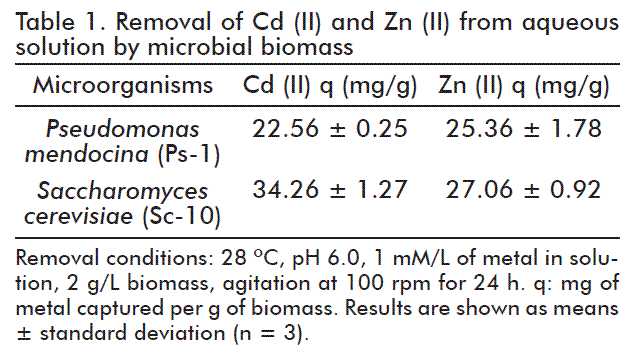
<body><![CDATA[<P   >&nbsp;</P >       <P   > </P >       <P   ><b><font size="3" face="Verdana, Arial, Helvetica, sans-serif">RESULTS </font></b></P >       <P   ><font size="2" face="Verdana, Arial, Helvetica, sans-serif">Zinc and cadmium      removal values (<a href="/img/revistas/bta/v34n1/t0103117.gif">Table 1</a>) show that the bacterium      <I>P. mendocina </I>(Ps-1) and the yeast <I>S. cerevisiae </I>(Sc-10) showed      capacity for capturing both metals. The bacterium reached removal values higher      than 22 mg/g and yeast above 27 mg/g, which were higher in the capture of      cadmium ions. </font></P >       
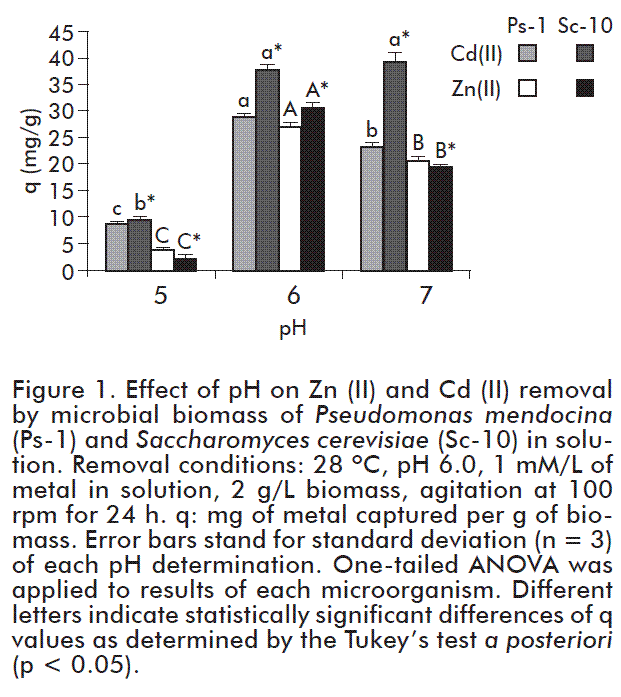
<P   ><font size="2" face="Verdana, Arial, Helvetica, sans-serif"><a href="/img/revistas/bta/v34n1/f0103117.gif">Figure      1</a> shows the influence of pH on the removal of metals by bacterium and      yeast. The lowest zinc and cadmium capture was observed at pH 5.0 values,      followed by an increase by both microbial biomasses at pH 6.0. The increase      of this variable at pH 7.0 caused the cation capture values to decrease, except      for cadmium which did not show significant differences in yeast removal at      pH 6.0 and 7.0. </font></P >       
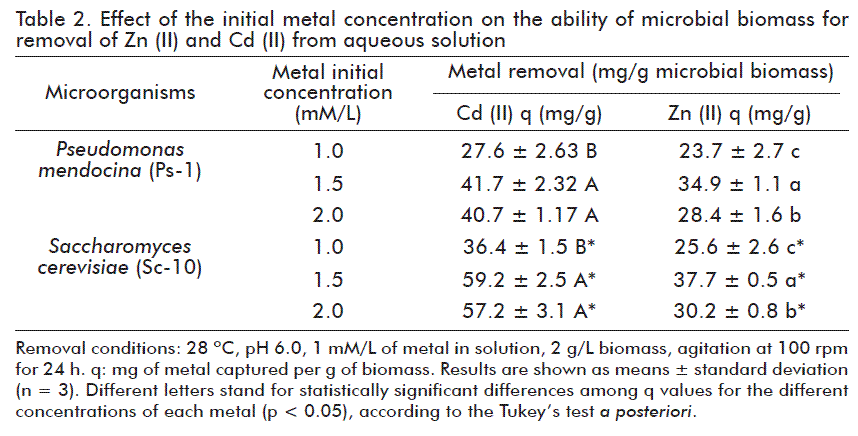
<P   ><font size="2" face="Verdana, Arial, Helvetica, sans-serif">The effect of metal      concentration in solution on the microbial removal process is shown in <a href="/img/revistas/bta/v34n1/t0203117.gif">Table      2</a>. The two microorganisms tested achieved the highest capture of zinc      and cadmium at the concentration of 1.5 mM/L, with removal values of more      than 34 mg/g of zinc and 41 mg/g of cadmium. Statistical analyses indicated      that at the higher concentrations a different behavior is evident for each      metal in both microorganisms, since zinc capture decreases, maintaining cadmium      removal stable. </font></P >       
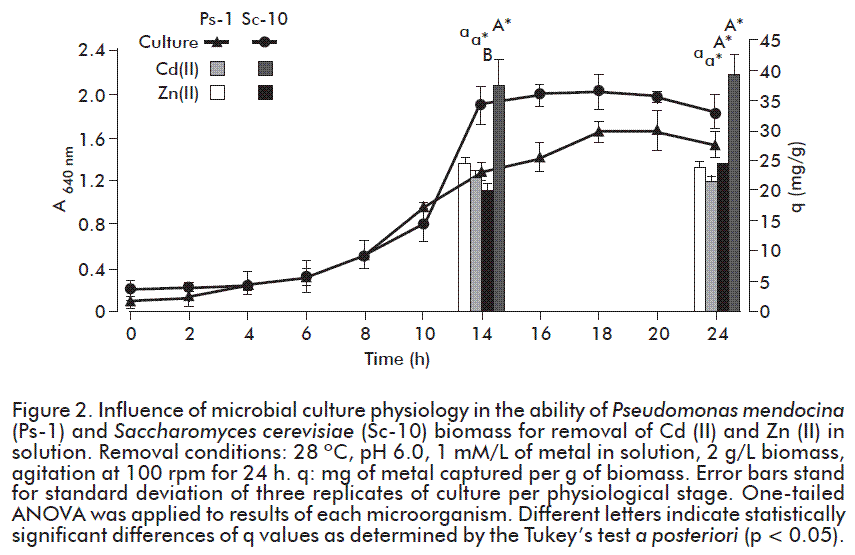
<P   ><font size="2" face="Verdana, Arial, Helvetica, sans-serif"><a href="/img/revistas/bta/v34n1/f0203117.gif">Figure      2</a> shows that zinc and cadmium capture levels by <I>P. mendocina </I>(Ps-1)      did not show significant differences between the two physiological stages      analyzed, corresponding to the final stage of exponential growth (14 h) and      to the Stationary growth phase (24 h). A similar behavior was detected in      cadmium removal by <I>S. cerevisiae </I>(Sc-10). Nevertheless, yeast reached      statistically higher capture values against zinc ions with cells grown up      to 24 h. </font></P >       
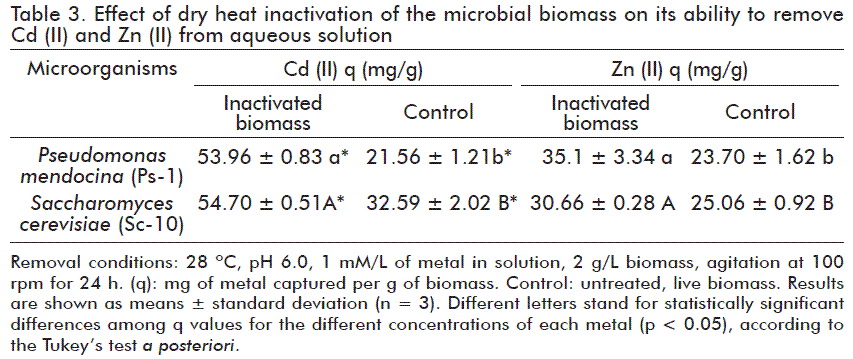
<P   ><font size="2" face="Verdana, Arial, Helvetica, sans-serif">Cellular inactivation      caused by dry heat pretreatment, applied to bacteria and yeast biomass, provided      increases in zinc and cadmium ion sequestration. This favorable effect in      the removal of metals is shown in <a href="/img/revistas/bta/v34n1/t0303117.gif">Table      3</a>, where it is observed that the dead biomass of <I>P. mendocina </I>(Ps-1)      and <I>S. cerevisiae </I>(Sc-10) had higher capacity for the capture of cadmium      ions. </font></P >       
<P   >&nbsp;</P >       <P   > </P >       ]]></body>
<body><![CDATA[<P   ><b><font size="3" face="Verdana, Arial, Helvetica, sans-serif">DISCUSSION </font></b></P >       <P   ><font size="2" face="Verdana, Arial, Helvetica, sans-serif">The removal of zinc      and cadmium by bacteria and yeast is a consequence of interactions between      cells and metal ions, based on the properties of each of the microbial species      (biochemical, structural, physiological and genetic) and of the chemical characteristics      of cations. The capture of these chemical contaminants may be bioaccumulation-mediated      [1, 19], a mechanism dependent on cellular metabolism involving living cells,      requiring transport systems that internalize the cations to cytosol [20] and      by biosorption. In particular, the biosorption mechanism is present in living      and dead cells; it is characterized as being passive and requires different      functional groups such as carboxyls, hydroxyls, phosphates and amino, components      of microbial cell walls. These negatively charged groups act as active metal      binding sites through physicochemical interactions that favor the extracellular      accumulation of cations [21]. </font></P >       <P   ><font size="2" face="Verdana, Arial, Helvetica, sans-serif">Reductions in the      capture of metals at pH 5.0 are related to the protonation of the functional      groups. At this pH, competences are established between protons and cations      with the ligands of the cell wall and extracellular capture of metal ions      is limited. At higher pH values, the retention of metals in biomass is facilitated      by the predominance of negative charges on the cell surface, as the amount      of H<sup>+</sup> decreases [22], which could explain the results at pH 6 and      7, as compared to the 5.0 value. Other authors have supported the increased      availability of active sites in the cell wall by increasing pH in the biomass-metal      suspension [23, 24]. Nevertheless, a decrease in the capture of the ions at      pH 7 was detected, which may be due to the possible formation of hydroxylated      complexes of metal ions [25]. Precipitation of metal ions as hydroxides at      pH values above 6.0 has been corroborated in previous works [26, 27]. An exception      in this behavior was obtained in cadmium capture by <I>S. cerevisiae </I>(Sc-10).      Yeasts have the ability to accumulate intracellularly high cadmium concentrations      by the presence of metallothioneins, cysteine-rich proteins that have high      affinity for this ion, compared to others [28]. This capture mechanism may      be less dependent on the chemistry of the metal in solution. </font></P >       <P   ><font size="2" face="Verdana, Arial, Helvetica, sans-serif">The results indicated      that metal removal capacity increased and reached saturation with the increased      initial concentration of zinc and cadmium ions in the aqueous solution. At      low metal concentrations, the interactions between them and the binding sites      are favored by the availability of free functional groups located in the cellular      envelopes [29]. All this said, this behavior does not remain linear at higher      concentrations, where ion retention by microbial biomass decreases or stabilizes      due to saturation of the cell surface with cations [3, 30]. The lack of sufficient      free functional groups for biosorption, as a consequence of their saturation,      favors the availability of non-adsorbed cations in the aqueous solution [31].      </font></P >       <P   ><font size="2" face="Verdana, Arial, Helvetica, sans-serif">Zinc and cadmium      ion retention by <I>P. mendocina </I>(Ps-1) and <I>S. cerevisiae </I>(Sc-10)      in different physiological stages or growth phases may be due to the extracellular      and intracellular capture of metals. Similar results have been reported for      other microbial species in metal capture [23, 32]. In extracelular accumulation,      the interactions of ions with active groups of the cell surface [23] are fundamental      and can occur throughout the cell cycle. Bioaccumulation requires cellular      metabolism [33] and it is therefore associated with a more active physiological      state. Metal removal by microorganisms is a complex process that depends on      the age of the culture, among other factors [14, 23]. This biotic factor affects      the capture of metals because of structural changes in the cell wall or due      to the decrease of the entrance of ions into the interior of the cell [34],      which can explain the decrease in zinc capture by yeast at 24 h of growth.      </font></P >       <P   ><font size="2" face="Verdana, Arial, Helvetica, sans-serif">The increase in metal      capture by inactivated or dead cells, compared to the removal abilities of      living cells, is the result of the effectiveness of the pre-treatment by dry      heat. This physical method could remove impurities present on the cell surface,      offer greater surface area and expose intracellular components from the rupture      of cellular envelopes. In this manner, a greater exposure of functional groups      constituting cation binding sites is facilitated [21, 35]. Pretreatment to      microbial biomass by different physical and chemical methods has been supported      in literature as an alternative to increase metal removal [35] and in the      determination of biosorption mechanisms [36]. Cell inactivation could eliminate      any potential harmful effect of <I>P. mendocina </I>for human health when      applied in large amounts for bioremediation, since it is not a GRAS (generally      regarded as safe) microorganism. This may also favor the use of <I>S. cerevisiae</I>,      which is GRAS certified. </font></P >       <P   >&nbsp;</P >       <P   > </P >       <P   ><b><font size="3" face="Verdana, Arial, Helvetica, sans-serif">CONCLUSIONS</font></b><font size="2" face="Verdana, Arial, Helvetica, sans-serif">      </font></P >       <P   ><font size="2" face="Verdana, Arial, Helvetica, sans-serif"><I>Pseudomonas mendocina      </I>(Ps-1) and Saccharomyces cerevisiae (Sc-10) have considerable capacity      as biosorbents for the removal of Zn (II) and Cd (II) from aqueous solutions.      In metal removal, it was very important to adjust factors influencing the      process, which allowed increasing ion capture capacities in both microorganisms.      The pH value 6.0 as well as the initial concentration of zinc (1.5 mM/L) and      cadmium (1.5 to 2.0 mM/L) resulted in the most favorable operating conditions      for removal. Cell inactivation was effective and the increased capture of      Cd (II) in 2.5 and 1.7 times by bacterium and yeast, respectively, was highlighted      in this condition. Application of dead biomass in the disposal of metal contaminants      can be an economically viable, efficient and environment-friendly method to      prevent environmental damage caused by zinc and cadmium.</font></P >       ]]></body>
<body><![CDATA[<P   >&nbsp;</P >       <P   > </P >       <P   ><b><font size="3" face="Verdana, Arial, Helvetica, sans-serif">REFERENCES </font></b></P >       <P   > </P >   <FONT size="+1" color="#000000">        <!-- ref --><P   ><font size="2" color="#211E1F" face="Verdana, Arial, Helvetica, sans-serif">1.      Samarth DP, Chandekar CJ, Bhadekar RK. Biosorption of heavy metals from aqueous      solution using <I>Bacillus licheniformis</I>. Int J Pure Appl Sci Technol.      2012;10(2):12-9.     </font></P >   <FONT size="+1" color="#211E1F">        <!-- ref --><P   ><font size="2" face="Verdana, Arial, Helvetica, sans-serif">2. Abbi O, Kazemi      M. A review study of biosorption of heavy metals and comparison between different      biosorbents. J Mater Environ Sci. 2015;6:1386-99.     </font></P >       <!-- ref --><P   ><font size="2" face="Verdana, Arial, Helvetica, sans-serif">3. Abioye DS, Adefisan      AE, Aransiola SA, Damisa D. Biosorption of chromium by <I>Bacillus subtilis      </I>and P<I>seudomonas aeruginosa </I>isolated from waste dump site. Expert      Opin Environ Biol. 2015;4:1.     </font></P >       ]]></body>
<body><![CDATA[<!-- ref --><P   ><font size="2" face="Verdana, Arial, Helvetica, sans-serif">4. Patel R, Chandel      M. Effect of pH and temperature on the biosorption of heavy metals by <I>Bacillus      licheniformis</I>. Int J Sci Res. 2015;4:2272-5.     </font></P >       <!-- ref --><P   ><font size="2" face="Verdana, Arial, Helvetica, sans-serif">5. Zaki S, Farag      S. Isolation and molecular characterization of some copper biosorped strains.      Int J Environ Sci Tech. 2010;7:553-60.     </font></P >       <!-- ref --><P   ><font size="2" face="Verdana, Arial, Helvetica, sans-serif">6. Broadley MR, White      PJ, Hammond JP, Zelko I, Lux A. Zinc in plants. New Phytol. 2007;173(4):677-702.          </font></P >       <!-- ref --><P   ><font size="2" face="Verdana, Arial, Helvetica, sans-serif">7. Ahmed MJ, Uddin      MN, Islam MN, Islam MS, Abdullah MF. Physicochemical assessment of soil pollutants      due to the ship breaking activities and its impact on the coastal zone of      Chittagong, Bangladesh. Eur Chem Bull. 2013;2(12):975-80.     </font></P >       <!-- ref --><P   ><font size="2" face="Verdana, Arial, Helvetica, sans-serif">8. Daboor SM. Application      of bacterial biomass as a potential heavy metal bioremoval agent. Afr J Microbiol      Res. 2014;8:2229-37.     </font></P >       ]]></body>
<body><![CDATA[<!-- ref --><P   ><font size="2" face="Verdana, Arial, Helvetica, sans-serif">9. Aryal M, Liakopoulou-Kyriakides      M. Binding mechanism and biosorption characteristics of Fe (III) by <I>Pseudomonas      </I>sp. cells. J Water Sustain. 2013;3(3):117-31.     </font></P >       <!-- ref --><P   ><font size="2" face="Verdana, Arial, Helvetica, sans-serif">10. Olukanni DO,      Agunwamba JC, Ugwu EI. Biosorption of heavy metals in industrial wastewater      using microorganisms (<I>Pseudomonas aeruginosa</I>). Am J Sci Ind Res. 2014;5(2):81-7.          </font></P >       <P   ><font size="2" face="Verdana, Arial, Helvetica, sans-serif">11. Jaroslawiecka      A, Piotrowska-Segel Z. Lead resistance in microorganisms. Microbiol. 2014;160(Pt      1):12-25. </font></P >       <!-- ref --><P   ><font size="2" face="Verdana, Arial, Helvetica, sans-serif">12. Nanganuru HY,      Korrapati N. Studies on biosorption of cadmium by <I>Pseudomonas putida</I>.      Int J Eng Res Appl. 2012;2(3):2217-9.     </font></P >       <!-- ref --><P   ><font size="2" face="Verdana, Arial, Helvetica, sans-serif">13. Ahmady-Asbchin      S. Comparison of biosorption of cadmium (II) from aqueous solution, by <I>Bacillus      </I>sp. and <I>Pseudomonas aeruginosa</I>. Iran J Chem Eng. 2013;10(2):14-21.          </font></P >       <!-- ref --><P   ><font size="2" face="Verdana, Arial, Helvetica, sans-serif">14. Lin J, Harichund      C. Isolation and characterization of heavy metal removing bacterial bioflocculants.      Afr J Microbiol Res. 2011;4(6):599-607.     </font></P >       <!-- ref --><P   ><font size="2" face="Verdana, Arial, Helvetica, sans-serif">15. Mohamed DS. Application      of bacterial biomass as a potential heavy metal bioremoval agent. Afr J Microbiol      Res. 2014;8:2229-37.     </font></P >       <!-- ref --><P   ><font size="2" face="Verdana, Arial, Helvetica, sans-serif">16. Carballo ME,      Mart&iacute;nez A, Salgado I, Maldener I, Alvarez M, Boza A, <I>et al</I>.      Capacidad de captura de cadmio y cinc por bacterias, microalgas y levaduras.      Rev Cubana Cienc Biol. 2012;1(1):10-23.     </font></P >       <!-- ref --><P   ><font size="2" face="Verdana, Arial, Helvetica, sans-serif">17. Atlas RM. Handbook      of microbiological media. 4th edition. Washington: CRC Press; 2010.     </font></P >       <!-- ref --><P   ><font size="2" face="Verdana, Arial, Helvetica, sans-serif">18. Madigan MT, Martinko      JM, Bender KS, Buckley DH, Stahl DA. Brock Biology of Microorganisms. 14th      edition. New York: Pearson Education, Inc.; 2015.     </font></P >       <!-- ref --><P   ><font size="2" face="Verdana, Arial, Helvetica, sans-serif">19. Odokuma O, Akponah      E. Effect of concentration and contact time on heavy metal uptake by three      bacterial isolates. J Environ Ch Ecotoxico. 2012;2(6):84-97.     </font></P >       <!-- ref --><P   ><font size="2" face="Verdana, Arial, Helvetica, sans-serif">20. Banerjee S, Gothalwal      R, Sahu PK, Sao S. Microbial observation in bioaccumulation of heavy metals      from the ash dyke of thermal power plants of Chhattisgarh, India. Adv Biosci      Biotechnol. 2015;6(2):131-8.     </font></P >       <!-- ref --><P   ><font size="2" face="Verdana, Arial, Helvetica, sans-serif">21. Archana A, Jaitly      AK. Mycoremediation: utilization of fungi for reclamation of heavy metals      at their optimum remediation conditions. Biolife. 2015;3:77-106.     </font></P >       <!-- ref --><P   ><font size="2" face="Verdana, Arial, Helvetica, sans-serif">22. Feng N, Guo X,      Liang S, Zhu Y, Liu J. Biosorption of heavy metals from aqueous solutions      by chemically modified orange peel. J Hazard Mater. 2011;185(1):49-54.     </font></P >       <!-- ref --><P   ><font size="2" face="Verdana, Arial, Helvetica, sans-serif">23. Joo JH, Hassan      SHA, Oh SE. Comparative study of biosorption of Zn2+ by P<I>seudomonas aeruginosa      </I>and <I>Bacillus cereus</I>. Int Biodeter Biodegrad. 2010;64(8):734-41.          </font></P >       <!-- ref --><P   ><font size="2" face="Verdana, Arial, Helvetica, sans-serif">24. Farooq U, Kozinski      J, Khan MA, Athar M. Biosorption of heavy metal ions using wheat based biosorbents-a      review of the recent literature. Bioresour Technol. 2010;101(14):5043-53.          </font></P >       <!-- ref --><P   ><font size="2" face="Verdana, Arial, Helvetica, sans-serif">25. Bhagyalakshmi      MG, Sarma PN. Removal of Ni (II) from aqueous solutions using sugarcane bagasse.      J Chem Pharm Res. 2015;7:140-7.     </font></P >       <!-- ref --><P   ><font size="2" face="Verdana, Arial, Helvetica, sans-serif">26. Abdel-Ghani NT,      El-Chaghaby GA. Biosorption for metal ions removal from aqueous solutions:      a review of recent studies. Int J Latest Res Sci Technol. 2014;3(1):24-42.          </font></P >       <!-- ref --><P   ><font size="2" face="Verdana, Arial, Helvetica, sans-serif">27. Lunavath V, Mamidala      E. Preliminary phytochemical screening and antibacterial studies of the leaves      of <I>Eclipta alba</I>. Int J Pharma Biosci. 2013;4:380-4.     </font></P >       <!-- ref --><P   ><font size="2" face="Verdana, Arial, Helvetica, sans-serif">28. Thippeswamy B,      Shivakumar CK, Krishnappa M. Accumulation potency of heavy metals by <I>Saccharomyces      </I>sp. indigenous to paper mill effluent. J Environ Res Dev. 2012;6:439-45.          </font></P >       <!-- ref --><P   ><font size="2" face="Verdana, Arial, Helvetica, sans-serif">29. Acosta I, Zarate      M, C&aacute;rdenas JF, Guti&eacute;rrez C. Bioadsorci&oacute;n de cadmio en      soluci&oacute;n acuosa por biomasa f&uacute;ngica. Rev Inf Tecnol. 2007;18:9-14.          </font></P >       <!-- ref --><P   ><font size="2" face="Verdana, Arial, Helvetica, sans-serif">30. Iram I, Abrar      S. Biosorption of copper and lead by heavy metal resistant fungal isolates.      Int J Sci Res Publ. 2015;5:1-5.     </font></P >       <!-- ref --><P   ><font size="2" face="Verdana, Arial, Helvetica, sans-serif">31. Mohammad O, Mohammad      SK, Almas Z. Biosorption of heavy metals by <I>Bacillus thurigiensis </I>strain      OSM29 originating from industrial effluent contaminated north Indian soil.      Saudi J Biol Sci. 2013;20:121-9.     </font></P >       <!-- ref --><P   ><font size="2" face="Verdana, Arial, Helvetica, sans-serif">32. Ghaedi M, Hajati      S, Karimi F, Barazesh B, Ghezelbash G. Equilibrium, kinetic and isotherm of      some metal ion biosorption. J Ind Eng Chem. 2013;19:987-92.     </font></P >       <!-- ref --><P   ><font size="2" face="Verdana, Arial, Helvetica, sans-serif">33. Zolgharnein H,      Mohd-Azmi ML, Saad MZ, Mutalib AR, Mohamed CAR. Detection of plasmids in heavy      metal resistance bacteria isolated from the Persian Gulf and enclosed industrial      areas. Iran J Biotechnol. 2007;5:232-9.     </font></P >       <!-- ref --><P   ><font size="2" face="Verdana, Arial, Helvetica, sans-serif">34. Delgado A, Barreiro      AM, Novais MJ. Heavy metal biosorption by the mycelium of <I>Fusarium flocciferum</I>.      Int Biodeter Biodegrad. 1996;37:241-4.     </font></P >       <!-- ref --><P   ><font size="2" face="Verdana, Arial, Helvetica, sans-serif">35. Runa R, Prasad      TM. Assessing the morphological characters for taxonomic significance among      intraspecific variations of <I>Catharanthus roseu</I>s. Biolife. 2014;2:1002-7.          </font></P >       <!-- ref --><P   ><font size="2" face="Verdana, Arial, Helvetica, sans-serif">36. Barange M, Srivastava      A, Srivastava JK, Palsania J. Biosorption of heavy metals from wastewater      by using microalgae. Int J Chem Phys Sci. 2014;3(6):67-81.     </font></P >       <P   >&nbsp;</P >       <P   >&nbsp;</P >       <P   > </P >   <FONT size="+1" color="#000000">        <P   ><font size="2" color="#211E1F" face="Verdana, Arial, Helvetica, sans-serif">Received      in July, 2016.     <br>     </font><font size="2" face="Verdana, Arial, Helvetica, sans-serif">Accepted      in March, 2017. </font></P >       ]]></body>
<body><![CDATA[<P   >&nbsp;</P >       <P   >&nbsp;</P >   <FONT size="+1" color="#211E1F"><FONT size="+1" color="#000000">        <P   > </P >       <P   ><i><font size="2" color="#211E1F" face="Verdana, Arial, Helvetica, sans-serif">Mar&iacute;a      E Carballo-Vald&eacute;s</font></i><font size="2" color="#211E1F" face="Verdana, Arial, Helvetica, sans-serif">.      Microbiology and Virology Department. Faculty of Biology, University of Havana.      25 e/ J e I No 455, Vedado, Plaza de la Revoluci&oacute;n, Habana, Cuba. E-mail:      <A href="mailto:mecarballo@fbio.uh.cu"> <FONT color="#0000FF">mecarballo@fbio.uh.cu</font></A><FONT color="#0000FF">.</font></font></P >   </font></font></font></font></font></font></font></font></font></font></font></font></font></font></font></font></font></font></font></font></font></font></font></font></font></font></font></font></font></font></font></font></font></font></font></font></font></font></font></font></font></font></font></font></font></font></font></DIV >      ]]></body><back>
<ref-list>
<ref id="B1">
<label>1</label><nlm-citation citation-type="journal">
<person-group person-group-type="author">
<name>
<surname><![CDATA[Samarth]]></surname>
<given-names><![CDATA[DP]]></given-names>
</name>
<name>
<surname><![CDATA[Chandekar]]></surname>
<given-names><![CDATA[CJ]]></given-names>
</name>
<name>
<surname><![CDATA[Bhadekar]]></surname>
<given-names><![CDATA[RK]]></given-names>
</name>
</person-group>
<article-title xml:lang="en"><![CDATA[Biosorption of heavy metals from aqueous solution using Bacillus licheniformis]]></article-title>
<source><![CDATA[Int J Pure Appl Sci Technol]]></source>
<year>2012</year>
<volume>10</volume>
<numero>2</numero>
<issue>2</issue>
<page-range>12-9</page-range></nlm-citation>
</ref>
<ref id="B2">
<label>2</label><nlm-citation citation-type="journal">
<person-group person-group-type="author">
<name>
<surname><![CDATA[Abbi]]></surname>
<given-names><![CDATA[O]]></given-names>
</name>
<name>
<surname><![CDATA[Kazemi]]></surname>
<given-names><![CDATA[M]]></given-names>
</name>
</person-group>
<article-title xml:lang="en"><![CDATA[A review study of biosorption of heavy metals and comparison between different biosorbents]]></article-title>
<source><![CDATA[J Mater Environ Sci]]></source>
<year>2015</year>
<volume>6</volume>
<page-range>1386-99</page-range></nlm-citation>
</ref>
<ref id="B3">
<label>3</label><nlm-citation citation-type="journal">
<person-group person-group-type="author">
<name>
<surname><![CDATA[Abioye]]></surname>
<given-names><![CDATA[DS]]></given-names>
</name>
<name>
<surname><![CDATA[Adefisan]]></surname>
<given-names><![CDATA[AE]]></given-names>
</name>
<name>
<surname><![CDATA[Aransiola]]></surname>
<given-names><![CDATA[SA]]></given-names>
</name>
<name>
<surname><![CDATA[Damisa]]></surname>
<given-names><![CDATA[D]]></given-names>
</name>
</person-group>
<article-title xml:lang="en"><![CDATA[Biosorption of chromium by Bacillus subtilis and Pseudomonas aeruginosa isolated from waste dump site]]></article-title>
<source><![CDATA[Expert Opin Environ Biol]]></source>
<year>2015</year>
<volume>4</volume>
<page-range>1</page-range></nlm-citation>
</ref>
<ref id="B4">
<label>4</label><nlm-citation citation-type="journal">
<person-group person-group-type="author">
<name>
<surname><![CDATA[Patel]]></surname>
<given-names><![CDATA[R]]></given-names>
</name>
<name>
<surname><![CDATA[Chandel]]></surname>
<given-names><![CDATA[M]]></given-names>
</name>
</person-group>
<article-title xml:lang="en"><![CDATA[Effect of pH and temperature on the biosorption of heavy metals by Bacillus licheniformis]]></article-title>
<source><![CDATA[Int J Sci Res]]></source>
<year>2015</year>
<volume>4</volume>
<page-range>2272-5</page-range></nlm-citation>
</ref>
<ref id="B5">
<label>5</label><nlm-citation citation-type="journal">
<person-group person-group-type="author">
<name>
<surname><![CDATA[Zaki]]></surname>
<given-names><![CDATA[S]]></given-names>
</name>
<name>
<surname><![CDATA[Farag]]></surname>
<given-names><![CDATA[S]]></given-names>
</name>
</person-group>
<article-title xml:lang="en"><![CDATA[Isolation and molecular characterization of some copper biosorped strains]]></article-title>
<source><![CDATA[Int J Environ Sci Tech]]></source>
<year>2010</year>
<volume>7</volume>
<page-range>553-60</page-range></nlm-citation>
</ref>
<ref id="B6">
<label>6</label><nlm-citation citation-type="journal">
<person-group person-group-type="author">
<name>
<surname><![CDATA[Broadley]]></surname>
<given-names><![CDATA[MR]]></given-names>
</name>
<name>
<surname><![CDATA[White]]></surname>
<given-names><![CDATA[PJ]]></given-names>
</name>
<name>
<surname><![CDATA[Hammond]]></surname>
<given-names><![CDATA[JP]]></given-names>
</name>
<name>
<surname><![CDATA[Zelko]]></surname>
<given-names><![CDATA[I]]></given-names>
</name>
<name>
<surname><![CDATA[Lux]]></surname>
<given-names><![CDATA[A]]></given-names>
</name>
</person-group>
<article-title xml:lang="en"><![CDATA[Zinc in plants]]></article-title>
<source><![CDATA[New Phytol]]></source>
<year>2007</year>
<volume>173</volume>
<numero>4</numero>
<issue>4</issue>
<page-range>677-702</page-range></nlm-citation>
</ref>
<ref id="B7">
<label>7</label><nlm-citation citation-type="journal">
<person-group person-group-type="author">
<name>
<surname><![CDATA[Ahmed]]></surname>
<given-names><![CDATA[MJ]]></given-names>
</name>
<name>
<surname><![CDATA[Uddin]]></surname>
<given-names><![CDATA[MN]]></given-names>
</name>
<name>
<surname><![CDATA[Islam]]></surname>
<given-names><![CDATA[MN]]></given-names>
</name>
<name>
<surname><![CDATA[Islam]]></surname>
<given-names><![CDATA[MS]]></given-names>
</name>
<name>
<surname><![CDATA[Abdullah]]></surname>
<given-names><![CDATA[MF]]></given-names>
</name>
</person-group>
<article-title xml:lang="en"><![CDATA[Physicochemical assessment of soil pollutants due to the ship breaking activities and its impact on the coastal zone of Chittagong, Bangladesh]]></article-title>
<source><![CDATA[Eur Chem Bull]]></source>
<year>2013</year>
<volume>2</volume>
<numero>12</numero>
<issue>12</issue>
<page-range>975-80</page-range></nlm-citation>
</ref>
<ref id="B8">
<label>8</label><nlm-citation citation-type="journal">
<person-group person-group-type="author">
<name>
<surname><![CDATA[Daboor]]></surname>
<given-names><![CDATA[SM]]></given-names>
</name>
</person-group>
<article-title xml:lang="en"><![CDATA[Application of bacterial biomass as a potential heavy metal bioremoval agent]]></article-title>
<source><![CDATA[Afr J Microbiol Res]]></source>
<year>2014</year>
<volume>8</volume>
<page-range>2229-37</page-range></nlm-citation>
</ref>
<ref id="B9">
<label>9</label><nlm-citation citation-type="journal">
<person-group person-group-type="author">
<name>
<surname><![CDATA[Aryal]]></surname>
<given-names><![CDATA[M]]></given-names>
</name>
<name>
<surname><![CDATA[Liakopoulou-Kyriakides]]></surname>
<given-names><![CDATA[M]]></given-names>
</name>
</person-group>
<article-title xml:lang="en"><![CDATA[Binding mechanism and biosorption characteristics of Fe (III) by Pseudomonas sp. cells]]></article-title>
<source><![CDATA[J Water Sustain]]></source>
<year>2013</year>
<volume>3</volume>
<numero>3</numero>
<issue>3</issue>
<page-range>117-31</page-range></nlm-citation>
</ref>
<ref id="B10">
<label>10</label><nlm-citation citation-type="journal">
<person-group person-group-type="author">
<name>
<surname><![CDATA[Olukanni]]></surname>
<given-names><![CDATA[DO]]></given-names>
</name>
<name>
<surname><![CDATA[Agunwamba]]></surname>
<given-names><![CDATA[JC]]></given-names>
</name>
<name>
<surname><![CDATA[Ugwu]]></surname>
<given-names><![CDATA[EI]]></given-names>
</name>
</person-group>
<article-title xml:lang="en"><![CDATA[Biosorption of heavy metals in industrial wastewater using microorganisms (Pseudomonas aeruginosa)]]></article-title>
<source><![CDATA[Am J Sci Ind Res]]></source>
<year>2014</year>
<volume>5</volume>
<numero>2</numero>
<issue>2</issue>
<page-range>81-7</page-range></nlm-citation>
</ref>
<ref id="B11">
<label>11</label><nlm-citation citation-type="journal">
<person-group person-group-type="author">
<name>
<surname><![CDATA[Jaroslawiecka]]></surname>
<given-names><![CDATA[A]]></given-names>
</name>
<name>
<surname><![CDATA[Piotrowska-Segel]]></surname>
<given-names><![CDATA[Z]]></given-names>
</name>
</person-group>
<article-title xml:lang="en"><![CDATA[Lead resistance in microorganisms]]></article-title>
<source><![CDATA[Microbiol]]></source>
<year>2014</year>
<volume>160</volume>
<numero>12 Pt 1</numero>
<issue>12 Pt 1</issue>
<page-range>25</page-range></nlm-citation>
</ref>
<ref id="B12">
<label>12</label><nlm-citation citation-type="journal">
<person-group person-group-type="author">
<name>
<surname><![CDATA[Nanganuru]]></surname>
<given-names><![CDATA[HY]]></given-names>
</name>
<name>
<surname><![CDATA[Korrapati]]></surname>
<given-names><![CDATA[N]]></given-names>
</name>
</person-group>
<article-title xml:lang="en"><![CDATA[Studies on biosorption of cadmium by Pseudomonas putida]]></article-title>
<source><![CDATA[Int J Eng Res Appl]]></source>
<year>2012</year>
<volume>2</volume>
<numero>3</numero>
<issue>3</issue>
<page-range>2217-9</page-range></nlm-citation>
</ref>
<ref id="B13">
<label>13</label><nlm-citation citation-type="journal">
<person-group person-group-type="author">
<name>
<surname><![CDATA[Ahmady-Asbchin]]></surname>
<given-names><![CDATA[S]]></given-names>
</name>
</person-group>
<article-title xml:lang="en"><![CDATA[Comparison of biosorption of cadmium (II) from aqueous solution, by Bacillus sp. and Pseudomonas aeruginosa]]></article-title>
<source><![CDATA[Iran J Chem Eng]]></source>
<year>2013</year>
<volume>10</volume>
<numero>2</numero>
<issue>2</issue>
<page-range>14-21</page-range></nlm-citation>
</ref>
<ref id="B14">
<label>14</label><nlm-citation citation-type="journal">
<person-group person-group-type="author">
<name>
<surname><![CDATA[Lin]]></surname>
<given-names><![CDATA[J]]></given-names>
</name>
<name>
<surname><![CDATA[Harichund]]></surname>
<given-names><![CDATA[C]]></given-names>
</name>
</person-group>
<article-title xml:lang="en"><![CDATA[Isolation and characterization of heavy metal removing bacterial bioflocculants]]></article-title>
<source><![CDATA[Afr J Microbiol Res]]></source>
<year>2011</year>
<volume>4</volume>
<numero>6</numero>
<issue>6</issue>
<page-range>599-607</page-range></nlm-citation>
</ref>
<ref id="B15">
<label>15</label><nlm-citation citation-type="journal">
<person-group person-group-type="author">
<name>
<surname><![CDATA[Mohamed]]></surname>
<given-names><![CDATA[DS]]></given-names>
</name>
</person-group>
<article-title xml:lang="en"><![CDATA[Application of bacterial biomass as a potential heavy metal bioremoval agent]]></article-title>
<source><![CDATA[Afr J Microbiol Res]]></source>
<year>2014</year>
<volume>8</volume>
<page-range>2229-37</page-range></nlm-citation>
</ref>
<ref id="B16">
<label>16</label><nlm-citation citation-type="journal">
<person-group person-group-type="author">
<name>
<surname><![CDATA[Carballo]]></surname>
<given-names><![CDATA[ME]]></given-names>
</name>
<name>
<surname><![CDATA[Martínez]]></surname>
<given-names><![CDATA[A]]></given-names>
</name>
<name>
<surname><![CDATA[Salgado]]></surname>
<given-names><![CDATA[I]]></given-names>
</name>
<name>
<surname><![CDATA[Maldener]]></surname>
<given-names><![CDATA[I]]></given-names>
</name>
<name>
<surname><![CDATA[Alvarez]]></surname>
<given-names><![CDATA[M]]></given-names>
</name>
<name>
<surname><![CDATA[Boza]]></surname>
<given-names><![CDATA[A]]></given-names>
</name>
</person-group>
<article-title xml:lang="es"><![CDATA[Capacidad de captura de cadmio y cinc por bacterias, microalgas y levaduras]]></article-title>
<source><![CDATA[Rev Cubana Cienc Biol]]></source>
<year>2012</year>
<volume>1</volume>
<numero>1</numero>
<issue>1</issue>
<page-range>10-23</page-range></nlm-citation>
</ref>
<ref id="B17">
<label>17</label><nlm-citation citation-type="book">
<person-group person-group-type="author">
<name>
<surname><![CDATA[Atlas]]></surname>
<given-names><![CDATA[RM]]></given-names>
</name>
</person-group>
<source><![CDATA[Handbook of microbiological media. 4th edition]]></source>
<year>2010</year>
<publisher-loc><![CDATA[Washington ]]></publisher-loc>
<publisher-name><![CDATA[CRC Press]]></publisher-name>
</nlm-citation>
</ref>
<ref id="B18">
<label>18</label><nlm-citation citation-type="book">
<person-group person-group-type="author">
<name>
<surname><![CDATA[Madigan]]></surname>
<given-names><![CDATA[MT]]></given-names>
</name>
<name>
<surname><![CDATA[Martinko]]></surname>
<given-names><![CDATA[JM]]></given-names>
</name>
<name>
<surname><![CDATA[Bender]]></surname>
<given-names><![CDATA[KS]]></given-names>
</name>
<name>
<surname><![CDATA[Buckley]]></surname>
<given-names><![CDATA[DH]]></given-names>
</name>
<name>
<surname><![CDATA[Stahl]]></surname>
<given-names><![CDATA[DA]]></given-names>
</name>
</person-group>
<source><![CDATA[Brock Biology of Microorganisms. 14th edition]]></source>
<year>2015</year>
<publisher-loc><![CDATA[New York ]]></publisher-loc>
<publisher-name><![CDATA[Pearson Education, Inc]]></publisher-name>
</nlm-citation>
</ref>
<ref id="B19">
<label>19</label><nlm-citation citation-type="journal">
<person-group person-group-type="author">
<name>
<surname><![CDATA[Odokuma]]></surname>
<given-names><![CDATA[O]]></given-names>
</name>
<name>
<surname><![CDATA[Akponah]]></surname>
<given-names><![CDATA[E]]></given-names>
</name>
</person-group>
<article-title xml:lang="en"><![CDATA[Effect of concentration and contact time on heavy metal uptake by three bacterial isolates]]></article-title>
<source><![CDATA[J Environ Ch Ecotoxico]]></source>
<year>2012</year>
<volume>2</volume>
<numero>6</numero>
<issue>6</issue>
<page-range>84-97</page-range></nlm-citation>
</ref>
<ref id="B20">
<label>20</label><nlm-citation citation-type="journal">
<person-group person-group-type="author">
<name>
<surname><![CDATA[Banerjee]]></surname>
<given-names><![CDATA[S]]></given-names>
</name>
<name>
<surname><![CDATA[Gothalwal]]></surname>
<given-names><![CDATA[R]]></given-names>
</name>
<name>
<surname><![CDATA[Sahu]]></surname>
<given-names><![CDATA[PK]]></given-names>
</name>
<name>
<surname><![CDATA[Sao]]></surname>
<given-names><![CDATA[S]]></given-names>
</name>
</person-group>
<article-title xml:lang="en"><![CDATA[Microbial observation in bioaccumulation of heavy metals from the ash dyke of thermal power plants of Chhattisgarh, India]]></article-title>
<source><![CDATA[Adv Biosci Biotechnol]]></source>
<year>2015</year>
<volume>6</volume>
<numero>2</numero>
<issue>2</issue>
<page-range>131-8</page-range></nlm-citation>
</ref>
<ref id="B21">
<label>21</label><nlm-citation citation-type="journal">
<person-group person-group-type="author">
<name>
<surname><![CDATA[Archana]]></surname>
<given-names><![CDATA[A]]></given-names>
</name>
<name>
<surname><![CDATA[Jaitly]]></surname>
<given-names><![CDATA[AK]]></given-names>
</name>
</person-group>
<article-title xml:lang="en"><![CDATA[Mycoremediation: utilization of fungi for reclamation of heavy metals at their optimum remediation conditions]]></article-title>
<source><![CDATA[Biolife]]></source>
<year>2015</year>
<volume>3</volume>
<page-range>77-106</page-range></nlm-citation>
</ref>
<ref id="B22">
<label>22</label><nlm-citation citation-type="journal">
<person-group person-group-type="author">
<name>
<surname><![CDATA[Feng]]></surname>
<given-names><![CDATA[N]]></given-names>
</name>
<name>
<surname><![CDATA[Guo]]></surname>
<given-names><![CDATA[X]]></given-names>
</name>
<name>
<surname><![CDATA[Liang]]></surname>
<given-names><![CDATA[S]]></given-names>
</name>
<name>
<surname><![CDATA[Zhu]]></surname>
<given-names><![CDATA[Y]]></given-names>
</name>
<name>
<surname><![CDATA[Liu]]></surname>
<given-names><![CDATA[J]]></given-names>
</name>
</person-group>
<article-title xml:lang="en"><![CDATA[Biosorption of heavy metals from aqueous solutions by chemically modified orange peel]]></article-title>
<source><![CDATA[J Hazard Mater]]></source>
<year>2011</year>
<volume>185</volume>
<numero>1</numero>
<issue>1</issue>
<page-range>49-54</page-range></nlm-citation>
</ref>
<ref id="B23">
<label>23</label><nlm-citation citation-type="journal">
<person-group person-group-type="author">
<name>
<surname><![CDATA[Joo]]></surname>
<given-names><![CDATA[JH]]></given-names>
</name>
<name>
<surname><![CDATA[Hassan]]></surname>
<given-names><![CDATA[SHA]]></given-names>
</name>
<name>
<surname><![CDATA[Oh]]></surname>
<given-names><![CDATA[SE]]></given-names>
</name>
</person-group>
<article-title xml:lang="en"><![CDATA[Comparative study of biosorption of Zn2+ by Pseudomonas aeruginosa and Bacillus cereus]]></article-title>
<source><![CDATA[Int Biodeter Biodegrad]]></source>
<year>2010</year>
<volume>64</volume>
<numero>8</numero>
<issue>8</issue>
<page-range>734-41</page-range></nlm-citation>
</ref>
<ref id="B24">
<label>24</label><nlm-citation citation-type="journal">
<person-group person-group-type="author">
<name>
<surname><![CDATA[Farooq]]></surname>
<given-names><![CDATA[U]]></given-names>
</name>
<name>
<surname><![CDATA[Kozinski]]></surname>
<given-names><![CDATA[J]]></given-names>
</name>
<name>
<surname><![CDATA[Khan]]></surname>
<given-names><![CDATA[MA]]></given-names>
</name>
<name>
<surname><![CDATA[Athar]]></surname>
<given-names><![CDATA[M]]></given-names>
</name>
</person-group>
<article-title xml:lang="en"><![CDATA[Biosorption of heavy metal ions using wheat based biosorbents-a review of the recent literature]]></article-title>
<source><![CDATA[Bioresour Technol]]></source>
<year>2010</year>
<volume>101</volume>
<numero>14</numero>
<issue>14</issue>
<page-range>5043-53</page-range></nlm-citation>
</ref>
<ref id="B25">
<label>25</label><nlm-citation citation-type="journal">
<person-group person-group-type="author">
<name>
<surname><![CDATA[Bhagyalakshmi]]></surname>
<given-names><![CDATA[MG]]></given-names>
</name>
<name>
<surname><![CDATA[Sarma]]></surname>
<given-names><![CDATA[PN]]></given-names>
</name>
</person-group>
<article-title xml:lang="en"><![CDATA[Removal of Ni (II) from aqueous solutions using sugarcane bagasse]]></article-title>
<source><![CDATA[J Chem Pharm Res]]></source>
<year>2015</year>
<volume>7</volume>
<page-range>140-7</page-range></nlm-citation>
</ref>
<ref id="B26">
<label>26</label><nlm-citation citation-type="journal">
<person-group person-group-type="author">
<name>
<surname><![CDATA[Abdel-Ghani]]></surname>
<given-names><![CDATA[NT]]></given-names>
</name>
<name>
<surname><![CDATA[El-Chaghaby]]></surname>
<given-names><![CDATA[GA]]></given-names>
</name>
</person-group>
<article-title xml:lang="en"><![CDATA[Biosorption for metal ions removal from aqueous solutions: a review of recent studies]]></article-title>
<source><![CDATA[Int J Latest Res Sci Technol]]></source>
<year>2014</year>
<volume>3</volume>
<numero>1</numero>
<issue>1</issue>
<page-range>24-42</page-range></nlm-citation>
</ref>
<ref id="B27">
<label>27</label><nlm-citation citation-type="journal">
<person-group person-group-type="author">
<name>
<surname><![CDATA[Lunavath]]></surname>
<given-names><![CDATA[V]]></given-names>
</name>
<name>
<surname><![CDATA[Mamidala]]></surname>
<given-names><![CDATA[E]]></given-names>
</name>
</person-group>
<article-title xml:lang="en"><![CDATA[Preliminary phytochemical screening and antibacterial studies of the leaves of Eclipta alba]]></article-title>
<source><![CDATA[Int J Pharma Biosci]]></source>
<year>2013</year>
<volume>4</volume>
<page-range>380-4</page-range></nlm-citation>
</ref>
<ref id="B28">
<label>28</label><nlm-citation citation-type="journal">
<person-group person-group-type="author">
<name>
<surname><![CDATA[Thippeswamy]]></surname>
<given-names><![CDATA[B]]></given-names>
</name>
<name>
<surname><![CDATA[Shivakumar]]></surname>
<given-names><![CDATA[CK]]></given-names>
</name>
<name>
<surname><![CDATA[Krishnappa]]></surname>
<given-names><![CDATA[M]]></given-names>
</name>
</person-group>
<article-title xml:lang="en"><![CDATA[Accumulation potency of heavy metals by Saccharomyces sp. indigenous to paper mill effluent]]></article-title>
<source><![CDATA[J Environ Res Dev]]></source>
<year>2012</year>
<volume>6</volume>
<page-range>439-45</page-range></nlm-citation>
</ref>
<ref id="B29">
<label>29</label><nlm-citation citation-type="journal">
<person-group person-group-type="author">
<name>
<surname><![CDATA[Acosta]]></surname>
<given-names><![CDATA[I]]></given-names>
</name>
<name>
<surname><![CDATA[Zarate]]></surname>
<given-names><![CDATA[M]]></given-names>
</name>
<name>
<surname><![CDATA[Cárdenas]]></surname>
<given-names><![CDATA[JF]]></given-names>
</name>
<name>
<surname><![CDATA[Gutiérrez]]></surname>
<given-names><![CDATA[C]]></given-names>
</name>
</person-group>
<article-title xml:lang="es"><![CDATA[Bioadsorción de cadmio en solución acuosa por biomasa fúngica]]></article-title>
<source><![CDATA[Rev Inf Tecnol]]></source>
<year>2007</year>
<volume>18</volume>
<page-range>9-14</page-range></nlm-citation>
</ref>
<ref id="B30">
<label>30</label><nlm-citation citation-type="journal">
<person-group person-group-type="author">
<name>
<surname><![CDATA[Iram]]></surname>
<given-names><![CDATA[I]]></given-names>
</name>
<name>
<surname><![CDATA[Abrar]]></surname>
<given-names><![CDATA[S]]></given-names>
</name>
</person-group>
<article-title xml:lang="en"><![CDATA[Biosorption of copper and lead by heavy metal resistant fungal isolates]]></article-title>
<source><![CDATA[Int J Sci Res Publ]]></source>
<year>2015</year>
<volume>5</volume>
<page-range>1-5</page-range></nlm-citation>
</ref>
<ref id="B31">
<label>31</label><nlm-citation citation-type="journal">
<person-group person-group-type="author">
<name>
<surname><![CDATA[Mohammad]]></surname>
<given-names><![CDATA[O]]></given-names>
</name>
<name>
<surname><![CDATA[Mohammad]]></surname>
<given-names><![CDATA[SK]]></given-names>
</name>
<name>
<surname><![CDATA[Almas]]></surname>
<given-names><![CDATA[Z]]></given-names>
</name>
</person-group>
<article-title xml:lang="es"><![CDATA[Biosorption of heavy metals by Bacillus thurigiensis strain OSM29 originating from industrial effluent contaminated north Indian soil]]></article-title>
<source><![CDATA[Saudi J Biol Sci]]></source>
<year>2013</year>
<volume>20</volume>
<page-range>121-9</page-range></nlm-citation>
</ref>
<ref id="B32">
<label>32</label><nlm-citation citation-type="journal">
<person-group person-group-type="author">
<name>
<surname><![CDATA[Ghaedi]]></surname>
<given-names><![CDATA[M]]></given-names>
</name>
<name>
<surname><![CDATA[Hajati]]></surname>
<given-names><![CDATA[S]]></given-names>
</name>
<name>
<surname><![CDATA[Karimi]]></surname>
<given-names><![CDATA[F]]></given-names>
</name>
<name>
<surname><![CDATA[Barazesh]]></surname>
<given-names><![CDATA[B]]></given-names>
</name>
<name>
<surname><![CDATA[Ghezelbash]]></surname>
<given-names><![CDATA[G]]></given-names>
</name>
</person-group>
<article-title xml:lang="en"><![CDATA[Equilibrium, kinetic and isotherm of some metal ion biosorption]]></article-title>
<source><![CDATA[J Ind Eng Chem]]></source>
<year>2013</year>
<volume>19</volume>
<page-range>987-92</page-range></nlm-citation>
</ref>
<ref id="B33">
<label>33</label><nlm-citation citation-type="journal">
<person-group person-group-type="author">
<name>
<surname><![CDATA[Zolgharnein]]></surname>
<given-names><![CDATA[H]]></given-names>
</name>
<name>
<surname><![CDATA[Mohd-Azmi]]></surname>
<given-names><![CDATA[ML]]></given-names>
</name>
<name>
<surname><![CDATA[Saad]]></surname>
<given-names><![CDATA[MZ]]></given-names>
</name>
<name>
<surname><![CDATA[Mutalib]]></surname>
<given-names><![CDATA[AR]]></given-names>
</name>
<name>
<surname><![CDATA[Mohamed]]></surname>
<given-names><![CDATA[CAR]]></given-names>
</name>
</person-group>
<article-title xml:lang="en"><![CDATA[Detection of plasmids in heavy metal resistance bacteria isolated from the Persian Gulf and enclosed industrial areas]]></article-title>
<source><![CDATA[Iran J Biotechnol]]></source>
<year>2007</year>
<volume>5</volume>
<page-range>232-9</page-range></nlm-citation>
</ref>
<ref id="B34">
<label>34</label><nlm-citation citation-type="journal">
<person-group person-group-type="author">
<name>
<surname><![CDATA[Delgado]]></surname>
<given-names><![CDATA[A]]></given-names>
</name>
<name>
<surname><![CDATA[Barreiro]]></surname>
<given-names><![CDATA[AM]]></given-names>
</name>
<name>
<surname><![CDATA[Novais]]></surname>
<given-names><![CDATA[MJ]]></given-names>
</name>
</person-group>
<article-title xml:lang="en"><![CDATA[Heavy metal biosorption by the mycelium of Fusarium flocciferum]]></article-title>
<source><![CDATA[Int Biodeter Biodegrad]]></source>
<year>1996</year>
<volume>37</volume>
<page-range>241-4</page-range></nlm-citation>
</ref>
<ref id="B35">
<label>35</label><nlm-citation citation-type="journal">
<person-group person-group-type="author">
<name>
<surname><![CDATA[Runa]]></surname>
<given-names><![CDATA[R]]></given-names>
</name>
<name>
<surname><![CDATA[Prasad]]></surname>
<given-names><![CDATA[TM]]></given-names>
</name>
</person-group>
<article-title xml:lang="en"><![CDATA[Assessing the morphological characters for taxonomic significance among intraspecific variations of Catharanthus roseus]]></article-title>
<source><![CDATA[Biolife]]></source>
<year>2014</year>
<volume>2</volume>
<page-range>1002-7</page-range></nlm-citation>
</ref>
<ref id="B36">
<label>36</label><nlm-citation citation-type="journal">
<person-group person-group-type="author">
<name>
<surname><![CDATA[Barange]]></surname>
<given-names><![CDATA[M]]></given-names>
</name>
<name>
<surname><![CDATA[Srivastava]]></surname>
<given-names><![CDATA[A]]></given-names>
</name>
<name>
<surname><![CDATA[Srivastava]]></surname>
<given-names><![CDATA[JK]]></given-names>
</name>
<name>
<surname><![CDATA[Palsania]]></surname>
<given-names><![CDATA[J]]></given-names>
</name>
</person-group>
<article-title xml:lang="en"><![CDATA[Biosorption of heavy metals from wastewater by using microalgae]]></article-title>
<source><![CDATA[Int J Chem Phys Sci]]></source>
<year>2014</year>
<volume>3</volume>
<numero>6</numero>
<issue>6</issue>
<page-range>67-81</page-range></nlm-citation>
</ref>
</ref-list>
</back>
</article>