<?xml version="1.0" encoding="ISO-8859-1"?><article xmlns:mml="http://www.w3.org/1998/Math/MathML" xmlns:xlink="http://www.w3.org/1999/xlink" xmlns:xsi="http://www.w3.org/2001/XMLSchema-instance">
<front>
<journal-meta>
<journal-id>1027-2852</journal-id>
<journal-title><![CDATA[Biotecnología Aplicada]]></journal-title>
<abbrev-journal-title><![CDATA[Biotecnol Apl]]></abbrev-journal-title>
<issn>1027-2852</issn>
<publisher>
<publisher-name><![CDATA[Editorial Elfos Scientiae]]></publisher-name>
</publisher>
</journal-meta>
<article-meta>
<article-id>S1027-28522017000400001</article-id>
<title-group>
<article-title xml:lang="en"><![CDATA[Using Montanide&trade; ISA 50 V2 as adjuvant for the formulation of the anti-tick Gavac® vaccine]]></article-title>
<article-title xml:lang="es"><![CDATA[Uso de Montanide&trade; ISA 50 V2 como adyuvante para la formulación de la vacuna Gavac® contra las garrapatas]]></article-title>
</title-group>
<contrib-group>
<contrib contrib-type="author">
<name>
<surname><![CDATA[Heredia]]></surname>
<given-names><![CDATA[Carlos Perez]]></given-names>
</name>
<xref ref-type="aff" rid="A01"/>
</contrib>
<contrib contrib-type="author">
<name>
<surname><![CDATA[González-Fernández]]></surname>
<given-names><![CDATA[Nemecio]]></given-names>
</name>
<xref ref-type="aff" rid="A01"/>
</contrib>
<contrib contrib-type="author">
<name>
<surname><![CDATA[Moreira-Rubio]]></surname>
<given-names><![CDATA[Alain]]></given-names>
</name>
<xref ref-type="aff" rid="A02"/>
</contrib>
<contrib contrib-type="author">
<name>
<surname><![CDATA[Zamora-Sánchez]]></surname>
<given-names><![CDATA[Jesús]]></given-names>
</name>
<xref ref-type="aff" rid="A03"/>
</contrib>
<contrib contrib-type="author">
<name>
<surname><![CDATA[Pérez-González]]></surname>
<given-names><![CDATA[Eikel]]></given-names>
</name>
<xref ref-type="aff" rid="A04"/>
</contrib>
<contrib contrib-type="author">
<name>
<surname><![CDATA[Bricaud]]></surname>
<given-names><![CDATA[Matthieu]]></given-names>
</name>
<xref ref-type="aff" rid="A05"/>
</contrib>
<contrib contrib-type="author">
<name>
<surname><![CDATA[Gaucheron]]></surname>
<given-names><![CDATA[Jérôme]]></given-names>
</name>
<xref ref-type="aff" rid="A06"/>
</contrib>
<contrib contrib-type="author">
<name>
<surname><![CDATA[Alfaro-Martínez]]></surname>
<given-names><![CDATA[Arlenis]]></given-names>
</name>
<xref ref-type="aff" rid="A07"/>
</contrib>
<contrib contrib-type="author">
<name>
<surname><![CDATA[Salinas-Rodríguez]]></surname>
<given-names><![CDATA[Diasmarys]]></given-names>
</name>
<xref ref-type="aff" rid="A02"/>
</contrib>
<contrib contrib-type="author">
<name>
<surname><![CDATA[Sardiñas-Padrón]]></surname>
<given-names><![CDATA[Madelyn]]></given-names>
</name>
<xref ref-type="aff" rid="A02"/>
</contrib>
<contrib contrib-type="author">
<name>
<surname><![CDATA[Domingo-Puentes]]></surname>
<given-names><![CDATA[Marilyn]]></given-names>
</name>
<xref ref-type="aff" rid="A02"/>
</contrib>
<contrib contrib-type="author">
<name>
<surname><![CDATA[Segura-Silva]]></surname>
<given-names><![CDATA[Ruthdaly]]></given-names>
</name>
<xref ref-type="aff" rid="A02"/>
</contrib>
</contrib-group>
<aff id="A02">
<institution><![CDATA[,Centro de Ingeniería Genética y Biotecnología de Camagüey Grupo de Control de la Calidad ]]></institution>
<addr-line><![CDATA[Camagüey ]]></addr-line>
<country>Cuba</country>
</aff>
<aff id="A03">
<institution><![CDATA[,Centro de Ingeniería Genética y Biotecnología de Camagüey Dirección General ]]></institution>
<addr-line><![CDATA[Camagüey ]]></addr-line>
<country>Cuba</country>
</aff>
<aff id="A04">
<institution><![CDATA[,Centro de Ingeniería Genética y Biotecnología de Camagüey Grupo de Control de la Calidad ]]></institution>
<addr-line><![CDATA[ ]]></addr-line>
<country>Cuba</country>
</aff>
<aff id="A05">
<institution><![CDATA[,SEPPIC  ]]></institution>
<addr-line><![CDATA[Paris ]]></addr-line>
<country>France</country>
</aff>
<aff id="A06">
<institution><![CDATA[,SEPPIC  ]]></institution>
<addr-line><![CDATA[Castres ]]></addr-line>
<country>France</country>
</aff>
<aff id="A07">
<institution><![CDATA[,Centro de Ingeniería Genética y Biotecnología de Camagüey Grupo de Ingeniería ]]></institution>
<addr-line><![CDATA[ ]]></addr-line>
<country>Cuba</country>
</aff>
<aff id="A01">
<institution><![CDATA[,Centro de Ingeniería Genética y Biotecnología de Camagüey Grupo de Desarrollo Tecnológico ]]></institution>
<addr-line><![CDATA[Camagüey ]]></addr-line>
<country>Cuba</country>
</aff>
<pub-date pub-type="pub">
<day>00</day>
<month>12</month>
<year>2017</year>
</pub-date>
<pub-date pub-type="epub">
<day>00</day>
<month>12</month>
<year>2017</year>
</pub-date>
<volume>34</volume>
<numero>4</numero>
<fpage>4201</fpage>
<lpage>4205</lpage>
<copyright-statement/>
<copyright-year/>
<self-uri xlink:href="http://scielo.sld.cu/scielo.php?script=sci_arttext&amp;pid=S1027-28522017000400001&amp;lng=en&amp;nrm=iso"></self-uri><self-uri xlink:href="http://scielo.sld.cu/scielo.php?script=sci_abstract&amp;pid=S1027-28522017000400001&amp;lng=en&amp;nrm=iso"></self-uri><self-uri xlink:href="http://scielo.sld.cu/scielo.php?script=sci_pdf&amp;pid=S1027-28522017000400001&amp;lng=en&amp;nrm=iso"></self-uri><kwd-group>
<kwd lng="en"><![CDATA[Tick control]]></kwd>
<kwd lng="en"><![CDATA[Gavac vaccine]]></kwd>
<kwd lng="en"><![CDATA[adjuvant formulation]]></kwd>
<kwd lng="en"><![CDATA[Montanide ISA 50 V2]]></kwd>
<kwd lng="en"><![CDATA[physicochemical properties]]></kwd>
<kwd lng="en"><![CDATA[cattle]]></kwd>
<kwd lng="es"><![CDATA[control de garrapatas]]></kwd>
<kwd lng="es"><![CDATA[vacuna Gavac]]></kwd>
<kwd lng="es"><![CDATA[formulación adyuvante]]></kwd>
<kwd lng="es"><![CDATA[Montanide ISA 50 V2]]></kwd>
<kwd lng="es"><![CDATA[características fisicoquímicas]]></kwd>
<kwd lng="es"><![CDATA[ganado vacuno]]></kwd>
</kwd-group>
</article-meta>
</front><body><![CDATA[ <DIV class="Part"   >        <P align="right"   ><font face="Verdana, Arial, Helvetica, sans-serif" size="2"><b>RESEARCH</b></font></P >       <P   >&nbsp;</P >       <P   ><font size="2" color="#211E1F" face="Verdana, Arial, Helvetica, sans-serif"><B><font size="4">Using      Montanide&trade; ISA 50 V2 as adjuvant for the formulation of the anti-tick      Gavac&reg; vaccine </font></b></font></P >       <P   >&nbsp;</P >   <FONT size="+1" color="#211E1F"><B><FONT size="+1"><FONT size="+1">        <P   ></P >   </font></font></B><FONT size="+1"><FONT size="+1">        <P   ><font size="3" face="Verdana, Arial, Helvetica, sans-serif"> <FONT color="#211E1F"><B>Uso      de Montanide&trade; ISA 50 V2 como adyuvante para la formulaci&oacute;n de      la vacuna Gavac&reg; contra las garrapatas </b></font></font></P >       <P   >&nbsp;</P >       <P   >&nbsp;</P >   <FONT size="+1"><FONT size="+1" color="#211E1F"><FONT size="+1"><FONT size="+1">        <P   ></P >   </font></font><FONT size="+1"><FONT size="+1">        ]]></body>
<body><![CDATA[<P   ><b><font size="2" color="#211E1F" face="Verdana, Arial, Helvetica, sans-serif">Carlos      Perez Heredia<SUP>1</sup>, Nemecio Gonz&aacute;lez-Fern&aacute;ndez<SUP>1</sup>,      Alain Moreira-Rubio<SUP>2</sup>, Jes&uacute;s Zamora-S&aacute;nchez<SUP>3</sup>,      Eikel P&eacute;rez-Gonz&aacute;lez<SUP>4</sup>, Matthieu Bricaud<SUP>5</sup>,      J&eacute;r&ocirc;me Gaucheron<SUP>6</sup>, Arlenis Alfaro-Mart&iacute;nez<SUP>7</sup>,      Diasmarys Salinas-Rodr&iacute;guez<SUP>2</sup>, Madelyn Sardi&ntilde;as-Padr&oacute;n<SUP>2</sup>,      Marilyn Domingo-Puentes<SUP>2</sup>, Ruthdaly Segura-Silva<SUP>2</sup> </font></b><font size="2" color="#211E1F" face="Verdana, Arial, Helvetica, sans-serif"></font><FONT size="+1" color="#211E1F"><FONT size="+1"><FONT size="+1"><FONT size="+1"><FONT size="+1"><FONT size="+1"><FONT size="+1"><FONT size="+1"><FONT size="+1"><FONT size="+1"><FONT size="+1"><FONT size="+1"><FONT size="+1"><FONT size="+1"><FONT size="+1"><FONT size="+1"><FONT size="+1"><FONT size="+1"><FONT size="+1"><FONT size="+1"><FONT size="+1"><FONT size="+1"><FONT size="+1"><FONT size="+1">      </font></font></font></font></font></font></font></font></font></font></font></font></font></font></font></font></font></font></font></font></font></font></font></font></P >   <FONT size="+1" color="#211E1F"><FONT size="+1"><FONT size="+1"><FONT size="+1"><FONT size="+1"><FONT size="+1"><FONT size="+1"><FONT size="+1"><FONT size="+1"><FONT size="+1"><FONT size="+1"><FONT size="+1"><FONT size="+1"><FONT size="+1"><FONT size="+1"><FONT size="+1"><FONT size="+1"><FONT size="+1"><FONT size="+1"><FONT size="+1"><FONT size="+1"><FONT size="+1"><FONT size="+1"><FONT size="+1">        <P   > </P >   <FONT size="+1" color="#000000">        <P   ><font size="2" color="#211E1F" face="Verdana, Arial, Helvetica, sans-serif"><SUP>1</sup>      Grupo de Desarrollo Tecnol&oacute;gico, Centro de Ingenier&iacute;a Gen&eacute;tica      y Biotecnolog&iacute;a de Camag&uuml;ey Circunvalaci&oacute;n Norte y Ave.      Finlay, Camag&uuml;ey, Camag&uuml;ey, Cuba.    <br>     </font><font size="2" face="Verdana, Arial, Helvetica, sans-serif"><SUP>2</sup>      Grupo de Control de la Calidad, Centro de Ingenier&iacute;a Gen&eacute;tica      y Biotecnolog&iacute;a de Camag&uuml;ey, Cuba.    <br>     </font><font size="2" face="Verdana, Arial, Helvetica, sans-serif"><sup>3</sup>      Direcci&oacute;n General, Centro de Ingenier&iacute;a Gen&eacute;tica y Biotecnolog&iacute;a      de Camag&uuml;ey, Cuba.    <br>     </font><font size="2" face="Verdana, Arial, Helvetica, sans-serif"><sup>4</sup>      Departamento de Producci&oacute;n, Centro de Ingenier&iacute;a Gen&eacute;tica      y Biotecnolog&iacute;a de Camag&uuml;ey, Cuba.    <br>     </font><font size="2" face="Verdana, Arial, Helvetica, sans-serif"><sup>5</sup>      SEPPIC - Paris, France.    <br>     </font><font size="2" face="Verdana, Arial, Helvetica, sans-serif"><sup>6</sup>      SEPPIC - Castres, France.    <br>     </font><font size="2" face="Verdana, Arial, Helvetica, sans-serif"><sup>7</sup>      Grupo de Ingenier&iacute;a, Centro de Ingenier&iacute;a Gen&eacute;tica y      Biotecnolog&iacute;a de Camag&uuml;ey, Cuba. </font></P >   <FONT size="+1" color="#211E1F"><FONT size="+1"><FONT size="+1"><FONT size="+1"><FONT size="+1"><FONT size="+1"><FONT size="+1"><FONT size="+1"><FONT size="+1"><FONT size="+1"><FONT size="+1"><FONT size="+1">        <P   >&nbsp;</P >       ]]></body>
<body><![CDATA[<P   >&nbsp;</P >   <FONT size="+1"><FONT size="+1"> </font></font></font></font></font></font></font></font></font></font></font></font></font></font></font></font></font></font></font></font></font></font></font></font></font></font></font></font></font></font></font></font></font></font></font></font></font></font></font></font></font></font></font></font></font></font>    <hr>   <FONT size="+1" color="#211E1F"><FONT size="+1"><FONT size="+1"><FONT size="+1"><FONT size="+1" color="#211E1F"><FONT size="+1"><FONT size="+1"><FONT size="+1" color="#211E1F"><FONT size="+1"><FONT size="+1"><FONT size="+1"><FONT size="+1"><FONT size="+1"><FONT size="+1"><FONT size="+1"><FONT size="+1"><FONT size="+1"><FONT size="+1"><FONT size="+1"><FONT size="+1"><FONT size="+1"><FONT size="+1"><FONT size="+1"><FONT size="+1"><FONT size="+1"><FONT size="+1"><FONT size="+1"><FONT size="+1"><FONT size="+1"><FONT size="+1"><FONT size="+1"><FONT size="+1" color="#000000"><FONT size="+1" color="#211E1F"><FONT size="+1"><FONT size="+1"><FONT size="+1"><FONT size="+1"><FONT size="+1"><FONT size="+1"><FONT size="+1"><FONT size="+1"><FONT size="+1"><FONT size="+1"><FONT size="+1"><FONT size="+1"><FONT size="+1">       <P   > </P >       <P   ><b><font face="Verdana, Arial, Helvetica, sans-serif" size="2">ABSTRACT </font></b></P >       <P   ><font face="Verdana, Arial, Helvetica, sans-serif" size="2">Infestations with      cattle tick (<I>Rhipicephalus microplus</I>) have an economic impact by reducing      animal weight gain and milk production. An alternative for tick control in      cattle is the use of Gavac&reg; vaccine, which contains the Bm86 antigen as      active pharmaceutical ingredient. In this work, Montanide&trade; ISA 50 V2      was evaluated as adjuvant for Gavac&reg; to homogenize the formulation process.      The current adjuvant (mineral oil), the proposed Montanide&trade; ISA 50 V2      and the emulsion formed were subjected to physicochemical characterizations.      The results confirmed that both adjuvants were physicochemically similar and      the derived emulsions exhibited better characteristics when using Montanide&trade;      ISA 50 V2. The three batches studied 24 months for stability showed results      analytically consistent with the expected ones, confirming that Gavac&reg;      immunogen is stable for two years. Until October 2017, nine vaccine batches      equivalent to 1.5 million doses were obtained containing Montanide&trade;      ISA 50 V2 as a new variant of vaccine adjuvant formulation. Those batches      were compared with historical data, showing similar qualitative and biological      activity properties. Therefore, it was proposed that the use of Montanide&trade;      ISA 50 V2 as adjuvant for the Bm86 antigen formulation of the Gavac&reg; vaccine      provides better qualitative physicochemical characteristics, to be corroborated      in vaccination trials in cattle. </font></P >   <FONT size="+1"><FONT size="+1"><FONT size="+1"><FONT size="+1"><FONT size="+1"><FONT size="+1"><FONT size="+1"><FONT size="+1">        <P   ><font face="Verdana, Arial, Helvetica, sans-serif" size="2"><i><b>Keywords:</b></i>      Tick control, Gavac vaccine, adjuvant formulation, Montanide ISA 50 V2, physicochemical      properties, cattle. </font></P >   </font></font></font></font></font></font></font></font></font></font></font></font></font></font></font></font></font></font></font></font></font></font></font></font></font></font></font></font></font></font></font></font></font></font></font></font></font></font></font></font></font></font></font></font></font></font></font></font></font></font></font></font></font></font>    <hr>   <FONT size="+1" color="#211E1F"><FONT size="+1"><FONT size="+1"><FONT size="+1"><FONT size="+1" color="#211E1F"><FONT size="+1"><FONT size="+1"><FONT size="+1" color="#211E1F"><FONT size="+1"><FONT size="+1"><FONT size="+1"><FONT size="+1"><FONT size="+1"><FONT size="+1"><FONT size="+1"><FONT size="+1"><FONT size="+1"><FONT size="+1"><FONT size="+1"><FONT size="+1"><FONT size="+1"><FONT size="+1"><FONT size="+1"><FONT size="+1"><FONT size="+1"><FONT size="+1"><FONT size="+1"><FONT size="+1"><FONT size="+1"><FONT size="+1"><FONT size="+1"><FONT size="+1" color="#000000"><FONT size="+1" color="#211E1F"><FONT size="+1"><FONT size="+1"><FONT size="+1"><FONT size="+1"><FONT size="+1"><FONT size="+1"><FONT size="+1"><FONT size="+1"><FONT size="+1"><FONT size="+1"><FONT size="+1"><FONT size="+1"><FONT size="+1"><FONT size="+1"><FONT size="+1"><FONT size="+1"><FONT size="+1"><FONT size="+1"><FONT size="+1"><FONT size="+1"><FONT size="+1">       <P   > </P >       <P   ><b><font face="Verdana, Arial, Helvetica, sans-serif" size="2">RESUMEN </font></b></P >       <P   > </P >   <FONT size="+1" color="#000000">        <P   > <font size="2" color="#211E1F" face="Verdana, Arial, Helvetica, sans-serif">Las      infestaciones con garrapatas del ganado (<I>Rhipicephalus microplus</I>) causan      p&eacute;rdidas a la econom&iacute;a al reducir el aumento de peso de los      animales y la producci&oacute;n de leche. Una alternativa para el control      de las garrapatas en el ganado es el uso de Gavac&reg;, vacuna que contiene      al ant&iacute;geno Bm86 como ingrediente farmac&eacute;utico activo. En este      trabajo se evalu&oacute; la formulaci&oacute;n de Gavac&reg; con la </font><font face="Verdana, Arial, Helvetica, sans-serif" size="2">inclusi&oacute;n      de Montanide &trade; ISA 50 V2 como adyuvante para homogeneizar el proceso      de formulaci&oacute;n. El adyuvante actual (aceite mineral), el Montanide      &trade; ISA 50 V2 propuesto y la emulsi&oacute;n formada fueron caracterizados      seg&uacute;n par&aacute;metros fisicoqu&iacute;micos. Los resultados confirmaron      que ambos adyuvantes eran fisicoqu&iacute;micamente similares y las emulsiones      derivadas exhib&iacute;an mejores caracter&iacute;sticas cuando se utilizaba      Montanide &trade; ISA 50 V2. Los tres lotes a los que se les evalu&oacute;      la estabilidad durante 24 meses mostraron resultados anal&iacute;ticamente      consistentes con los esperados, lo que confirma que el inmun&oacute;geno Gavac&reg;      es estable por dos a&ntilde;os. Hasta octubre de 2017, se obtuvieron nueve      lotes de vacunas equivalentes a 1.5 millones de dosis que conten&iacute;an      Montanide &trade; ISA 50 V2 como nuevo adjuvante en la formulaci&oacute;n      vacunal. Esos lotes se compararon contra los datos hist&oacute;ricos, lo cual      demostr&oacute; que los lotes similares desde el punto de vista cualitativo      y de actividad biol&oacute;gica. Por lo tanto, se propuso que el uso de Montanide      &trade; ISA 50 V2 como adyuvante para la formulaci&oacute;n del ant&iacute;geno      Bm86 de la vacuna Gavac&reg; proporciona mejores caracter&iacute;sticas fisicoqu&iacute;micas      cualitativas, lo cual deber&aacute; ser corroborado durante los ensayos de      vacunaci&oacute;n del ganado. </font></P >   <FONT size="+1" color="#211E1F"><FONT size="+1"><FONT size="+1"><FONT size="+1"><FONT size="+1"><FONT size="+1"><FONT size="+1"><FONT size="+1"><FONT size="+1">        <P   ><font face="Verdana, Arial, Helvetica, sans-serif" size="2"><i><b>Palabras clave:</b></i>      control de garrapatas, vacuna Gavac, formulaci&oacute;n adyuvante, Montanide      ISA 50 V2, caracter&iacute;sticas fisicoqu&iacute;micas, ganado vacuno.</font></P >   </font></font></font></font></font></font></font></font></font></font></font></font></font></font></font></font></font></font></font></font></font></font></font></font></font></font></font></font></font></font></font></font></font></font></font></font></font></font></font></font></font></font></font></font></font></font></font></font></font></font></font></font></font></font></font></font></font></font></font></font></font></font></font></font>    <hr>       ]]></body>
<body><![CDATA[<p>&nbsp;</p>       <p>&nbsp;</p>       <p><b><font face="Verdana, Arial, Helvetica, sans-serif" size="3">INTRODUCTION      </font></b></p>   <FONT size="+1" color="#211E1F"><FONT size="+1"><FONT size="+1"><FONT size="+1"><FONT size="+1" color="#211E1F"><FONT size="+1"><FONT size="+1"><FONT size="+1" color="#211E1F"><FONT size="+1"><FONT size="+1"><FONT size="+1"><FONT size="+1"><FONT size="+1"><FONT size="+1"><FONT size="+1"><FONT size="+1"><FONT size="+1"><FONT size="+1"><FONT size="+1"><FONT size="+1"><FONT size="+1"><FONT size="+1"><FONT size="+1"><FONT size="+1"><FONT size="+1"><FONT size="+1"><FONT size="+1"><FONT size="+1"><FONT size="+1"><FONT size="+1"><FONT size="+1"><FONT size="+1" color="#000000"><FONT size="+1" color="#211E1F"><FONT size="+1"><FONT size="+1"><FONT size="+1"><FONT size="+1"><FONT size="+1"><FONT size="+1"><FONT size="+1"><FONT size="+1"><FONT size="+1"><FONT size="+1"><FONT size="+1"><FONT size="+1"><FONT size="+1"><FONT size="+1"><FONT size="+1"><FONT size="+1"><FONT size="+1"><FONT size="+1"><FONT size="+1"><FONT size="+1"><FONT size="+1"><FONT size="+1" color="#000000"><FONT size="+1" color="#211E1F"><FONT size="+1"><FONT size="+1"><FONT size="+1"><FONT size="+1"><FONT size="+1"><FONT size="+1"><FONT size="+1"><FONT size="+1">     <P   ><font face="Verdana, Arial, Helvetica, sans-serif" size="2"><I>Rhipicephalus      </I>(<I>Boophilus</I>) spp. ticks are disseminated mainly in tropical and      subtropical regions [1-3]. Among them, cattle tick (<I>Rhipicephalus microplus</I>)      infestations have an economic impact in cattle by reducing animal weight gain      and milk production. They are also carriers of pathogens causing significant      diseases such as babesiosis and anaplasmosis [4]. In Australia, cattle losses      by cattle tick Boophilus (Rhipicephalus) microplus were estimated to be US$      62 million, while in Brazil they accounted for around US$ 3.24 billion per      year [5]. In India, there were estimates of US$ 498.7 million per year [6].      Moreover, direct and indirect losses related with tick-borne disease are difficult      to estimate. It was estimated that when crossbred Holstein-Zebu cows are infested      with an average of 105 ticks, with a reduction in 23 % of milk yield per day      expected [7]. Animals with an average of 40 ticks per day could lose weight      up to 20 kg per year [6]. Economic losses, accompanied of the zoonotic danger      by ticks affectation, foster research on new strategies for tick control [8].      </font></P >       <P   ><font face="Verdana, Arial, Helvetica, sans-serif" size="2">Among the alternatives      proven effective for tick control in cattle is vaccination. One of the vaccines      available for tick control in cattle is Gavac&reg; (Heber Biotec S.A., Cuba),      which contains the <I>B. microplus </I>Bm86 protein as Active Pharmaceutical      Ingredient (API) [9]. It has been proven effective for more than 20 years      of use in Cuba, Venezuela and other Central America countries, as part of      integrated pest management systems. In Venezuela, it has been applied in more      than 38 000 farms, thereby reducing in 83.7 % the use of chemical acaricides      equivalent to 260 000 kg [10]. </font></P >   <FONT size="+1"><FONT size="+1">        <P   ><font face="Verdana, Arial, Helvetica, sans-serif" size="2">Gavac&reg; has also      been evaluated in the boundaries of the United States and Mexico, for a possible      establishment of integrated control. Miller <I>et al</I>. [11] showed that      vaccination was able to control tick infestation in 99.9 % of animals after      5 weeks and 91.4 % at 5.5 months. Those results were widely validated at the      CATVAC meeting [12]. The use of Gavac&reg; have also shown significant protection      levels in camels infected by H<I>yalomma dromedarii </I>and <I>H. a. anatolicum      </I>[13]. </font></P >   <FONT size="+1"><FONT size="+1"><FONT size="+1"><FONT size="+1">        <P   ><font face="Verdana, Arial, Helvetica, sans-serif" size="2">However, new research      is needed to enhance the immunogenicity of the Gavac&reg; vaccine, to cope      with increasing demands on effectiveness improvements. One strategy for vaccine      improvement consists on adjuvant replacement. Particularly, Montanide&trade;      ISA 50 V2 has been tested in various species of animals with excellent immunogenicity      results [14-17]. Its effectiveness has been demonstrated equivalent to that      of classical adjuvants such as Freund&rsquo;s, guaranteeing a memory immune      response and reducing adverse effects [20]. Moreover, it enhanced the cellular      cellular response against the antigens tested, also showing a higher homogeneity      in the humoral response [19, 20]. It was shown that production processes including      this adjuvant also displayed improved development and scale-up processes for      the obtained injectable products [21]. </font></P >   <FONT size="+1"><FONT size="+1">        <P   ><font face="Verdana, Arial, Helvetica, sans-serif" size="2">Therefore, with this      aim and following an agreement with SEPPIC, it was evaluated the replacement      of the Gavac&reg; vaccine adjuvant (a mix of mineral oil and Montanide&trade;      888 VG) with Montanide&trade; ISA 50 V2 adjuvant in the formulation, as part      of the vaccine production process.</font></P >       <P   >&nbsp;</P >   <FONT size="+1"><FONT size="+1">        <P   ><font face="Verdana, Arial, Helvetica, sans-serif" size="3"><b>MATERIALS AND      METHODS </b> </font></P >       ]]></body>
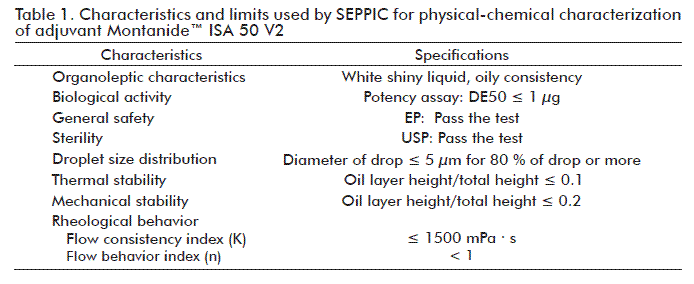
<body><![CDATA[<P   ><font face="Verdana, Arial, Helvetica, sans-serif" size="2"><B>Physicochemical      characterization of adjuvants </b></font></P >       <P   ><font face="Verdana, Arial, Helvetica, sans-serif" size="2">The formulations      of the Gavac&reg; vaccine with either Montanide&trade; ISA 50 V2 or Montanide&trade;      888 VG-mineral oil mixture were characterized. Assessments were done jointly      with the adjuvants&rsquo; manufacturer (SEPPIC, France). The characteristics,      methods and limits established by SEPPIC. </font></P >   <FONT size="+1"><FONT size="+1">        <P   ><font face="Verdana, Arial, Helvetica, sans-serif" size="2">Then, the two adjuvants      analyzed were formulated using a phase volume ration of 60 parts of the aqueous      phase and 40 parts as oily phase (current ratio as established in the formulation      of Gavac&reg;). The mixture Montanide&trade; 888 VG-mineral oil was prepared      at a 1:9 v/v ratio, and Montanide&trade; ISA 50 V2 was used as provided by      the manufacturer. </font></P >   <FONT size="+1"><FONT size="+1">        <P   ><font face="Verdana, Arial, Helvetica, sans-serif" size="2">Formulations were      characterized by standardized tests by SEPPIC: viscosity, with a Brookfield      viscometer with spindle 63 at 60 min-1 (mPa&middot;s); syringeability, with      a 10-mL syringe 21 Gauge &times; 1 inch length needle and time (s) for discharge      of 10 mL of formulation; droplet size, by using a Malvern MasterSizer S granulometer      (&mu;m). </font></P >   <FONT size="+1"><FONT size="+1">        <P   ><font face="Verdana, Arial, Helvetica, sans-serif" size="2">Statistical comparisons      were established with the GraphPad Prism Software, and paired samples were      compared by the Student&rsquo;s t test with Welch&rsquo;s correction and a      95 % confidence interval. </font></P >       <P   ><font face="Verdana, Arial, Helvetica, sans-serif" size="2"><B>Assessment of      batch formulation and stability </b></font></P >       <P   ><font face="Verdana, Arial, Helvetica, sans-serif" size="2">Three batches using      the new adjuvant Montanide&trade; ISA 50 V2 were formulated. The Bm86 protein      (protein purity higher than 95 %) was used as API, and a at 10-L batch formulation      was prepared in a SD-41 emulsifier equipment (IKA, Germany), with droplet      size adjusted to 1 &mu;m. Batches were released and their stability monitored      according to test procedures as established at the CIGB (<a href="/img/revistas/bta/v34n4/t0101417.gif">Table      1</a>). Stability was studied in the range of 2-8 &ordm;C. Biological activity      was determined in mice handled by following the National Institutes of Health      guide for the care and use of laboratory animals [22].</font></P >       
<P   >&nbsp;</P >       <P   > </P >       <P   ><b><font face="Verdana, Arial, Helvetica, sans-serif" size="3">RESULTS AND DISCUSSION      </font></b></P >       ]]></body>
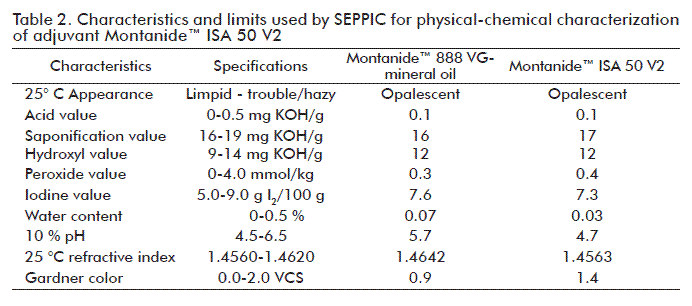
<body><![CDATA[<P   ><font face="Verdana, Arial, Helvetica, sans-serif" size="2"><B>Physicochemical      characterization of adjuvants</B> </font></P >       <P   ><font face="Verdana, Arial, Helvetica, sans-serif" size="2">The physicochemical      characterization of both adjuvants formulations analyzed shows that results      comply with the value limits established by manufacturers (<a href="/img/revistas/bta/v34n4/t0201417.gif">Table      2</a>). Only the refractive index of the prior adjuvant formulation (mix of      mineral oil and Montanide&trade; 888 VG) showed a value out of the established      limits, a behavior caused by the type of mineral oil used in the old formulation.      All this shows that both adjuvant formulations meet the quality specifica-tions      attending to their physicochemical properties. In fact, both adjuvants show      similar characteristics, an aspect essential for the approval given by the      Cuban regulatory agency on using Montanide&trade; ISA 50 V2 for Gavac&reg;      formulation. Following these results, the emulsions were further characterized      to evaluate the influence of both adjuvants. </font></P >   <FONT size="+1"><FONT size="+1">        
<P   ><font face="Verdana, Arial, Helvetica, sans-serif" size="2">As shown in <a href="/img/revistas/bta/v34n4/t0301417.gif">table      3</a>, there were no statistically significant differences between viscosity      values of emulsions containing both adjuvants. The use of Montanide&trade;      ISA 50 V2 induced a decrease of viscosity of about 300 mPa&middot;s. This      behavior guarantees that the inclusion of a new adjuvant in the production      process provides a better applicability of the immunogen in the field. Noteworthy,      it should be noted that the ratio used in the study is not the one suggested      by SEPPIC (50 parts of aqueous phase and 50 parts of oily phase in the volume).      Advantageously, the ratio used in the study supports a 10 % increase in the      internal phase of the emulsion, what increases the viscosity of the system.      It is emphasized that this w/o formulation ratio is the one used for the formulation      of the Gavac&reg; immunogen for the last 20 years, and proven in the field      without associated adverse events. </font></P >   <FONT size="+1"><FONT size="+1">        
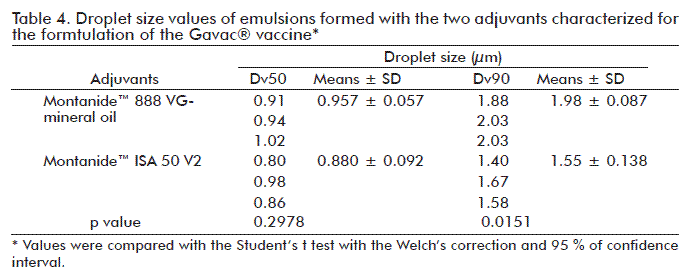
<P   ><font face="Verdana, Arial, Helvetica, sans-serif" size="2">The same improved      behavior was found in syringeability, with a reduction in approximately 30      s the time required for the new adjuvant, further reducing the back pressure      to be overcome during the administration of the vaccine. Values lower than      60 s are reported by SEPPIC for the 50 parts of aqueous phase and 50 parts      of oily phase in volume. The improved syringeability is in agreement with      the increased viscosity found, resulting from the raise in the relationship      of the internal phase. </font></P >       <P   ><font face="Verdana, Arial, Helvetica, sans-serif" size="2">Another relevant      property evaluated was droplet size (<a href="/img/revistas/bta/v34n4/t0401417.gif">Table 4</a>).      The results of Dv50 did not show statistically significant differences between      the characterized groups. Nevertheless, there was a trend to increase drop      size when using the old adjuvant. This provides 50 % of the droplets with      a size lower than 1 &mu;m. In the case of Dv90, a significant statistical      difference was detected, with a reduction in 0.5 &mu;m with the use of the      new adjuvant formulation. In all cases, 90 % of the droplets were smaller      than 2 &mu;m. Overall, decreasing droplet size of the emulsion with the new      adjuvant can reduce the sedimentation rate that derives in its enhanced stability      [23]. Moreover, small droplet size may favor biological activity by the slow      release of the active principle and its enhanced bioavailability [24, 25].      </font></P >       
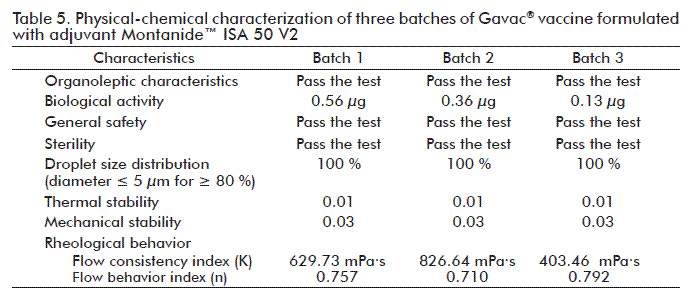
<P   ><font face="Verdana, Arial, Helvetica, sans-serif" size="2"><b>Batch release      for the stability study </b></font></P >       <P   ><font face="Verdana, Arial, Helvetica, sans-serif" size="2">The qualitative characteristics      evaluated for batch release in all cases passed the test (<a href="/img/revistas/bta/v34n4/t0501417.gif">Table      5</a>), highlighting the importance of the general safety and sterility. On      the contrary, some variations were found in the biological activity and rheological      behavior. Changes in biological activity commonly derive from the use of different      API batches, with animal models also influencing its variability. For viscosity,      variability may be caused by fluctuations in operating parameters coming from      the reduced production scale. Even so, the observed variability did not determine      significant changes in product&rsquo;s quality. The droplet size distribution,      mechanical and thermal stability showed favorable results, well above the      established limits as for the formulation of Gavac&reg; immunogen with the      old adjuvant. It was seen that all evaluated properties met the specifications,      ensuring that the produced batches were released and could be used for the      stability study.</font></P >   <FONT size="+1"><FONT size="+1">        
<P   ><font face="Verdana, Arial, Helvetica, sans-serif" size="2"><b>Sta</b><B>bility      study of the Gavac&reg; immunogen formulated with Montanide&trade; ISA 50      V2 </b></font></P >       <P   ><font size="2" face="Verdana, Arial, Helvetica, sans-serif">Produced batches      were checked for the stability parameters evaluated upon release. Thermal      and mechanical stability values of the accelerated stability tests were lower      than 0.05 for the six-month period, with no further information provided due      to its short duration. </font></P >   <FONT size="+1"><FONT size="+1">        <P   ><font face="Verdana, Arial, Helvetica, sans-serif" size="2">The qualitative properties      evaluated for the 24 months of the full stability analysis met product specifications.      No changes were observed either in color or appearance of the product. Favorable      general safety profiles were evidenced throughout the study, guaranteeing      the safe use of the product. Sterility was evaluated upon release and 24 months      thereafter. It was determined that in this interval of time the container-closure      system was effective and that none of the critical components contributed      to microbiological contamination of the vaccine. </font></P >       ]]></body>
<body><![CDATA[<P   ><font face="Verdana, Arial, Helvetica, sans-serif" size="2">The performance of      biological activity for the 24 months of analysis is depicted in <a href="/img/revistas/bta/v34n4/f0101417.gif">figure      1</a>. Biological activity is regarded as protective when 50 % of vaccinated      mice are able to seroconvert at doses lower than 1 &mu;g. Immunization assay      were conducted in female Balb/C, <I>H2d</I>, <I>q </I>haplotype, the variations      seen maybe arising from the limited number of animals used (n = 10) and the      animal model tested [26]. Values were all within the specified limits for      all data points, thus ensuring that the product maintains its biological activity      for the next 24 months after the manufacturing date. </font></P >       
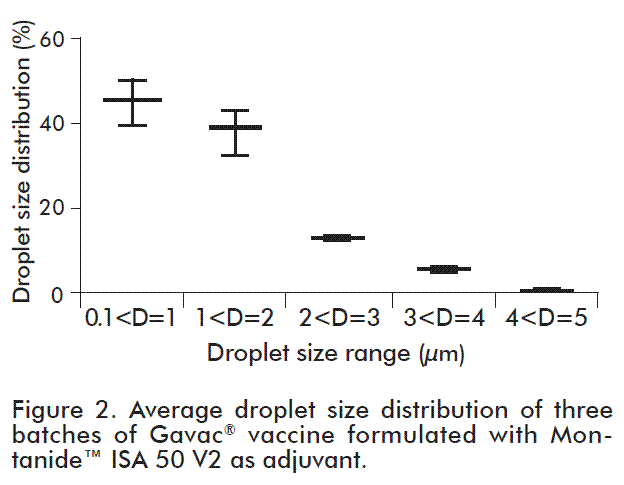
<P   ><font face="Verdana, Arial, Helvetica, sans-serif" size="2">Additionally, the      average frequency of the droplet size in the dispersed phase was evaluated      at every evaluation period in the stability study (<a href="/img/revistas/bta/v34n4/f0201417.gif">Figure      2</a>). As shown, there were no droplets with values above 5 &mu;m. In fact,      80 % of the droplets were below 2 &mu;m. The distribution obtained guarantees      a favorable stability of the Gavac&reg; immunogen within 24 months after the      manufacturing date. Similar profiles were obtained in all the evaluated points.      </font></P >   <FONT size="+1"><FONT size="+1">        
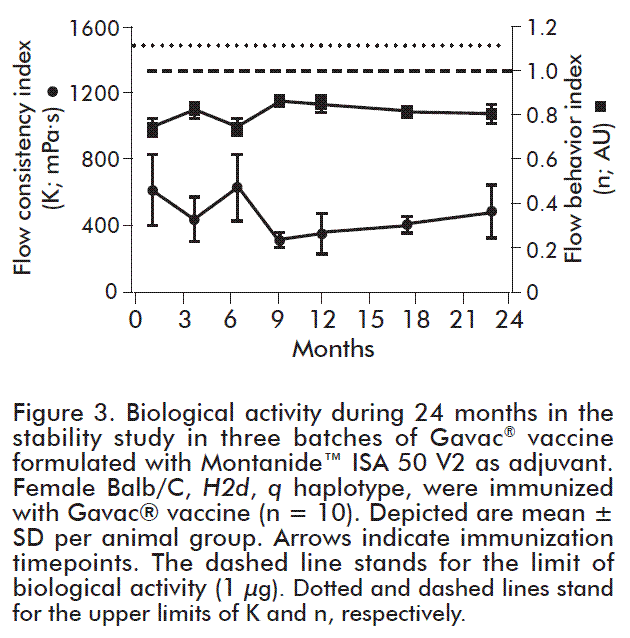
<P   ><font face="Verdana, Arial, Helvetica, sans-serif" size="2">Thermal and mechanical      stability values were lower than 0.05 in all evaluated points, for all produced      batches. Tests were performed only during the first six months, and the observed      behavior provided physically stable emulsions for up to 24 months in the range      2-8 &ordm;C. </font></P >       <P   ><font face="Verdana, Arial, Helvetica, sans-serif" size="2">Regarding the rheological      behavior, this is one of physical characteristics directly affecting the application      of the Gavac&reg; immunogen. The values for parameters of Flow consistency      index (K) and Flow behavior index (n) are shown in <a href="/img/revistas/bta/v34n4/f0301417.gif">figure      3</a>. All determinations were within the established limits (K &le; 1500      mPa&middot;s and n &lt; 1). </font></P >   <FONT size="+1"><FONT size="+1">        
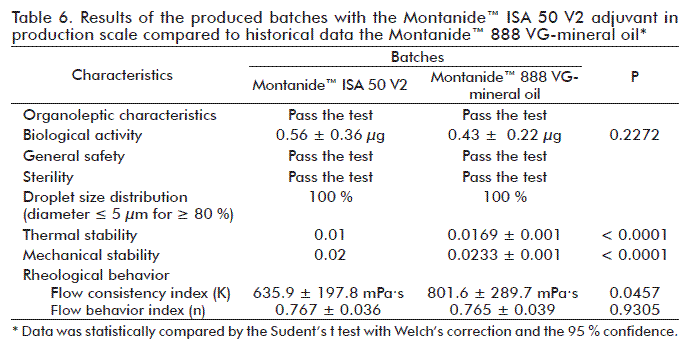
<P   ><font face="Verdana, Arial, Helvetica, sans-serif" size="2"><B>Implementation      and use of the Montanide&trade; ISA 50 V2 for Gavac&reg; formulation </b></font></P >       <P   ><font size="2" face="Verdana, Arial, Helvetica, sans-serif">All the quality specifications      for the Gavac&reg; immunogen were fulfilled for the parameters evaluated in      the stability study. Moreover, results were documented and presented to the      Cuban regulatory authorities for veterinary drugs, supporting their approval      on the use the of new adjuvant formulation of the immunogen Gavac&reg; vaccine.      Up to 9 batches were formulated with the new adjuvant, equivalent to more      than 1.5 million vaccine doses, their properties detailed in <a href="/img/revistas/bta/v34n4/t0601417.gif">Table      6</a>. </font></P >   <FONT size="+1"><FONT size="+1"><FONT size="+1"><FONT size="+1"><FONT size="+1"><FONT size="+1">        
<P   ><font face="Verdana, Arial, Helvetica, sans-serif" size="2">The batches produced      with the new adjuvant were also compared with historical data of the old adjuvant      in the previous year. No significant differences in biological activity were      observed, despite each batch was formulated with a different API. Moreover,      no relevant reports were found in the scientific literature which could be      relevant as to be contrasted to. For thermal and mechanical stability, statistically      significant differences were detected, the values obtained in the batches      produced with the new adjuvant formulation found better than historical data.      In the rheologi-cal behavior, significant differences were observed between      the values of flow consistency index, with a reduction in 170 mPa&middot;s,      corroborating the behavior observed during the characterization of the obtained      emulsions. No significant differences were found in the flow behavior index      between formulations.</font></P >       <P   >&nbsp;</P >       <P   > </P >       <P   ><font size="3" face="Verdana, Arial, Helvetica, sans-serif"><B>CONCLUSIONS </b></font></P >   <FONT size="+1">        ]]></body>
<body><![CDATA[<P   ><font face="Verdana, Arial, Helvetica, sans-serif" size="2">Despite overall similar      results, the use of Montanide&trade; ISA 50 V2 reduced viscosity of the Gavac&reg;      vaccine formulation in about 300 mPa&middot;s and 30 s in syringeability,      compared the previous formulation using the Montanide&trade; 888 VG-mineral      oil mixture as adjuvant. Droplet size values were similar, although the new      formulation set a trend of droplet size reduction in Dv50 and Dv90. During      the stability study, none of the evaluated quality characteristics were outside      the limits for the product Gavac&reg;. Thus, it is demonstrated that from      the physical, chemical and biological points of view, the new formulation      containing Montanide&trade; ISA 50 V2 as adjuvant meets the limits approved      for the assay. In comparison with historical data, better behavior was achieved      with the new adjuvant attending to the quality properties among batches, confirming      preliminary results obtained when characterizing the emulsions formed with      both adjuvants. These results confirm the adequate use of Montanide&trade;      ISA 50 V2 as adequate for the formulation of Gavac&reg;. This will reduce      the dependence on multiple providers for mineral oil as previously required,      thereby reducing that variability source during formulation among batches      and, therefore, guaranteeing greater consistency during the vaccine production      process.</font></P >       <P   >&nbsp;</P >   <FONT size="+1"><FONT size="+1"><FONT size="+1"><FONT size="+1"><FONT size="+1"><FONT size="+1"><FONT size="+1">        <P   > </P >       <P   ><font size="3"><b><font face="Verdana, Arial, Helvetica, sans-serif">ACKNOWLEDGEMENTS      </font></b></font></P >       <P   ><font face="Verdana, Arial, Helvetica, sans-serif" size="2">The authors thank      a group of collaborators for their contribution during batch production, analytical      techniques and process documentation: Jorge Castillo Wilson, Mayara Recio      Cruz, Lidiana Mart&iacute;nez Armas, Idianis Saldivar Merino, William Pena      Guimaraes, Ileana S&aacute;nchez Ortiz, Rosa Basulto Morales, Licette Le&oacute;n      Barreras and Oscar Compte Alberto, all of them from the Center for Genetic      Engineering and Biotechnology of Camag&uuml;ey.</font></P >       <P   >&nbsp;</P >       <P   > </P >       <P   ><b><font face="Verdana, Arial, Helvetica, sans-serif" size="3">REFERENCES </font></b></P >       <P   > </P >   <FONT size="+1" color="#000000">        <!-- ref --><P   > <font size="2" color="#211E1F" face="Verdana, Arial, Helvetica, sans-serif">1.      Enr&iacute;quez A, Bou&eacute; O, Redondo M, Montero C, Machado H, Joglar      M, <I>et al</I>. Desarrollo y aplicaci&oacute;n en bovinos de la nueva formulaci&oacute;n      vacunal Gavacplus contra la garrapata <I>Boophilus microplus</I>. Biotecnol      Apl. 1999;19(1):15-7.     </font></P >   <FONT size="+1" color="#211E1F">        <!-- ref --><P   ><font face="Verdana, Arial, Helvetica, sans-serif" size="2">2. Barker SC, Murrell      A. Systematics and evolution of ticks with a list of valid genus and species      names. Parasitology. 2004;129 Suppl:S15-36.     </font></P >       <!-- ref --><P   ><font face="Verdana, Arial, Helvetica, sans-serif" size="2">3. Estrada-Pena A,      Bouattour A, Camicas JL, Guglielmone A, Horak I, Jongejan F, <I>et al</I>.      The known distribution and ecological preferences of the tick subgenus <I>Boophilus      </I>(<I>Acari</I>: <I>Ixodidae</I>) in Africa and Latin America. Exp Appl      Acarol. 2006;38(2-3):219-35.     </font></P >       <!-- ref --><P   ><font face="Verdana, Arial, Helvetica, sans-serif" size="2">4. Olwoch JM, Van      Jaarsveld AS, Scholtz CH, Horak IG. Climate change and the genus <I>Rhipicephalus      </I>(<I>Acari</I>: <I>Ixodidae</I>) in Africa. Onderstepoort J Vet Res. 2007;74(1):45-72.          </font></P >       <!-- ref --><P   ><font face="Verdana, Arial, Helvetica, sans-serif" size="2">5. Peter RJ, Van      den Bossche P, Penzhorn BL, Sharp B. Tick, fly, and mosquito control lessons      from the past, solutions for the future. Vet Parasitol. 2005;132:205-15.     </font></P >       <!-- ref --><P   ><font face="Verdana, Arial, Helvetica, sans-serif" size="2">6. Grisi L, Leite      RC, Martins JR, Barros AT, Andreotti R, Cancado PH, <I>et al</I>. Reassessment      of the potential economic impact of cattle parasites in Brazil. Rev Bras Parasitol      Vet. 2014;23(2):150-6.     </font></P >       <P   ><font face="Verdana, Arial, Helvetica, sans-serif" size="2">7. Manjunathachar      HV, Saravanan BC, Kesavan M, Karthik K, Rathod P, Gopi M, <I>et al</I>. Economic      importance of ticks and their effective control strategies. Asian Pac J Trop      Dis. 2014;4 Suppl. 2:S770-9. </font></P >       <!-- ref --><P   ><font face="Verdana, Arial, Helvetica, sans-serif" size="2">8. Sudhakar NR, Manjunathachar      HV, Karthik K, Sahu S, Gopi M, Shanthaveer SB. RNA interference in parasites:      prospects and pitfalls. Adv Anim Vet Sci. 2013;1:1-6.     </font></P >       <!-- ref --><P   ><font face="Verdana, Arial, Helvetica, sans-serif" size="2">9. Rodriguez M, Penichet      ML, Mouris AE, Labarta V, Luaces LL, Rubiera R, <I>et al</I>. Control of Boophilus      microplus populations in grazing cattle vaccinated with a recombinant Bm86      antigen preparation. Vet Parasitol. 1995;57(4):339-49.     </font></P >       <!-- ref --><P   ><font face="Verdana, Arial, Helvetica, sans-serif" size="2">10. Klous G, Huss      A, Heederik DJJ, Coutinho RA. Human-livestock contacts and their relationship      to transmission of zoonotic pathogens, a systematic review of literature.      One Health. 2016;2:65-76.     </font></P >       <!-- ref --><P   ><font face="Verdana, Arial, Helvetica, sans-serif" size="2">11. Suarez M, Rubi      J, P&eacute;rez D, Cordova V, Salazar Y, Vielma A, <I>et al</I>. High impact      and effectiveness of Gavac&trade; vaccine in the national program for control      of bovine ticks <I>Rhipicephalus microplus </I>in Venezuela. Livest Sci. 2016;187:48-52.          </font></P >       ]]></body>
<body><![CDATA[<!-- ref --><P   ><font face="Verdana, Arial, Helvetica, sans-serif" size="2">12. Miller R, Estrada-Pena      A, Almazan C, Allen A, Jory L, Yeater K, <I>et al</I>. Exploring the use of      an anti-tick vaccine as a tool for the integrated eradication of the cattle      fever tick, <I>Rhipicephalus </I>(<I>Boophilus</I>) <I>annulatus</I>. Vaccine.      2012;30(38):5682-7.     </font></P >       <!-- ref --><P   ><font face="Verdana, Arial, Helvetica, sans-serif" size="2">13. Schetters T,      Bishop R, Crampton M, Kopacek P, Lew-Tabor A, Maritz-Olivier C, <I>et al</I>.      Cattle tick vaccine researchers join forces in CATVAC. Parasit Vectors. 2016;9:105.          </font></P >       <!-- ref --><P   ><font face="Verdana, Arial, Helvetica, sans-serif" size="2">14. Hassan I, Hassan      S, El Hussein A, Rodr&iacute;guez M. Evaluation of the recombinant Bm86 antigen      (Gavac&trade;) against Hyalomma dromedarii and <I>H. a. anatolicum </I>(<I>Acari</I>:      <I>Ixodidae</I>) in Sudan. Biotecnol Apl. 2007;24(2):122-5.     </font></P >       <P   ><font face="Verdana, Arial, Helvetica, sans-serif" size="2">15. Dummer LA, Araujo      IL, Finger PF, dos Santos AG, Jr., da Rosa MC, Conceicao FR, <I>et al</I>.      Immune responses of mice against recombinant bovine herpesvirus 5 glycoprotein      D. Vaccine. 2014;32(21):2413-9. </font></P >       <!-- ref --><P   ><font face="Verdana, Arial, Helvetica, sans-serif" size="2">18. Jorge S, de Oliveira      NR, Marchioro SB, Fisch A, Gomes CK, Hartleben CP, <I>et al</I>. The Mycoplasma      hyopneumoniae recombinant heat shock protein P42 induces an immune response      in pigs under field conditions. Comp Immunol Microbiol Infect Dis. 2014;37(4):229-36.          </font></P >       <!-- ref --><P   ><font face="Verdana, Arial, Helvetica, sans-serif" size="2">19. Ibrahim Eel S,      Gamal WM, Hassan AI, Mahdy Sel D, Hegazy AZ, Abdel-Atty MM. Comparative study      on the immunopotentiator effect of ISA 201, ISA 61, ISA 50, ISA 206 used in      trivalent foot and mouth disease vaccine. Vet World. 2015;8(10):1189-98.     </font></P >       <!-- ref --><P   ><font face="Verdana, Arial, Helvetica, sans-serif" size="2">20. Shokri M, Roohvand      F, Alimohammadian MH, Ebrahimirad M, Ajdary S. Comparing Montanide ISA 720      and 50-V2 adjuvants formulated with LmSTI1 protein of Leishmania major indicated      the potential cytokine patterns for induction of protective immune responses      in BALB/c mice. Mol Immunol. 2016;76:108-15.     </font></P >       <P   ><font face="Verdana, Arial, Helvetica, sans-serif" size="2">21. Martinez D, Perez      JM, Sheikboudou C, Debus A, Bensaid A. Comparative efficacy of Freund&rsquo;s      and Montanide ISA50 adjuvants for the immunisation of goats against heartwater      with inactivated Cowdria ruminantium. Vet Parasitol. 1996;67(3-4):175-84.      </font></P >       <!-- ref --><P   ><font face="Verdana, Arial, Helvetica, sans-serif" size="2">22. National Research      Council of the National Academies. Guide for the care and use of laboratory      animals. 8th Edition. Washington: The National Academies Press; 2011.     </font></P >       <!-- ref --><P   ><font face="Verdana, Arial, Helvetica, sans-serif" size="2">23. Marcelino I,      Lefrancois T, Martinez D, Giraud-Girard K, Aprelon R, Mandonnet N, <I>et al</I>.      A user-friendly and scalable process to prepare a ready-to-use inactivated      vaccine: the example of heartwater in ruminants under tropical conditions.      Vaccine. 2015;33(5):678-85.     </font></P >       <!-- ref --><P   ><font face="Verdana, Arial, Helvetica, sans-serif" size="2">24. Souza WJ, Santos      KMC, Cruz AA, Franceschi E, Dariva C, Santos AF. Effect of water content,      temperature and average droplet size on the settling velocity of water-in-oil      emulsions. Braz J Chem Eng. 2015;32:455-64.     </font></P >       ]]></body>
<body><![CDATA[<!-- ref --><P   ><font face="Verdana, Arial, Helvetica, sans-serif" size="2">25. Katare YK, Muthukumaran      T, Panda AK. Influence of particle size, antigen load, dose and additional      adjuvant on the immune response from antigen loaded PLA microparticles. Int      J Pharm. 2005;301(1-2):149-60.     </font></P >       <!-- ref --><P   ><font face="Verdana, Arial, Helvetica, sans-serif" size="2">26. Sellers RS, Clifford      CB, Treuting PM, Brayton C. Immunological variation between inbred laboratory      mouse strains: points to consider in phenotyping genetically immunomodified      mice. Vet Pathol. 2012;49(1):32-43.     </font></P >       <P   >&nbsp;</P >       <P   >&nbsp;</P >   <FONT size="+1">        <P   > </P >       <P   > </P >       <P   ><i><font face="Verdana, Arial, Helvetica, sans-serif" size="2">Received in May,      2017.    <br>     Accepted in October, 2017.</font></i></P >       ]]></body>
<body><![CDATA[<P   >&nbsp;</P >       <P   >&nbsp;</P >       <P   > </P >       <P   > </P >       <P   ><font size="2" face="Verdana, Arial, Helvetica, sans-serif"><i>Carlos P&eacute;rez      Heredia</i>. Grupo de Desarrollo Tecnol&oacute;gico, Centro de Ingenier&iacute;a      Gen&eacute;tica y Biotecnolog&iacute;a de Camag&uuml;ey. Circunvalaci&oacute;n      Norte y Ave. Finlay, Camag&uuml;ey, Camag&uuml;ey, Cuba. E-mail: <A href="mailto:carlos.perez@cigb.edu.cu">      <FONT color="#0000FF">carlos.perez@cigb.edu.cu</font></A>.</font></P >   </font></font></font></font></font></font></font></font></font></font></font></font></font></font></font></font></font></font></font></font></font></font></font></font></font></font></font></font></font></font></font></font></font></font></font></font></font></font></font></font></font></font></font></font></font></font></font></font></font></font></font></font></font></font></font></font></font></font></font></font></font></font></font></font></font></font></font></font></font></font></font></font></font></font></font></font></font></font></font></font></font></font></font></font></font></font></font></font></font></font></font></font></font></font></font></font></font></font></font></font></font></font></font></font></font></font></font></font></font></DIV >      ]]></body><back>
<ref-list>
<ref id="B1">
<label>1</label><nlm-citation citation-type="journal">
<person-group person-group-type="author">
<name>
<surname><![CDATA[Enríquez]]></surname>
<given-names><![CDATA[A]]></given-names>
</name>
<name>
<surname><![CDATA[Boué]]></surname>
<given-names><![CDATA[O]]></given-names>
</name>
<name>
<surname><![CDATA[Redondo]]></surname>
<given-names><![CDATA[M]]></given-names>
</name>
<name>
<surname><![CDATA[Montero]]></surname>
<given-names><![CDATA[C]]></given-names>
</name>
<name>
<surname><![CDATA[Machado]]></surname>
<given-names><![CDATA[H]]></given-names>
</name>
<name>
<surname><![CDATA[Joglar]]></surname>
<given-names><![CDATA[M]]></given-names>
</name>
</person-group>
<article-title xml:lang="es"><![CDATA[Desarrollo y aplicación en bovinos de la nueva formulación vacunal Gavacplus contra la garrapata Boophilus microplus]]></article-title>
<source><![CDATA[Biotecnol Apl]]></source>
<year>1999</year>
<volume>19</volume>
<numero>1</numero>
<issue>1</issue>
<page-range>15-7</page-range></nlm-citation>
</ref>
<ref id="B2">
<label>2</label><nlm-citation citation-type="journal">
<person-group person-group-type="author">
<name>
<surname><![CDATA[Barker]]></surname>
<given-names><![CDATA[SC]]></given-names>
</name>
<name>
<surname><![CDATA[Murrell]]></surname>
<given-names><![CDATA[A]]></given-names>
</name>
</person-group>
<article-title xml:lang="en"><![CDATA[Systematics and evolution of ticks with a list of valid genus and species names]]></article-title>
<source><![CDATA[Parasitology]]></source>
<year>2004</year>
<volume>129</volume>
<numero>^sSuppl</numero>
<issue>^sSuppl</issue>
<supplement>Suppl</supplement>
<page-range>S15-36</page-range></nlm-citation>
</ref>
<ref id="B3">
<label>3</label><nlm-citation citation-type="journal">
<person-group person-group-type="author">
<name>
<surname><![CDATA[Estrada-Pena]]></surname>
<given-names><![CDATA[A]]></given-names>
</name>
<name>
<surname><![CDATA[Bouattour]]></surname>
<given-names><![CDATA[A]]></given-names>
</name>
<name>
<surname><![CDATA[Camicas]]></surname>
<given-names><![CDATA[JL]]></given-names>
</name>
<name>
<surname><![CDATA[Guglielmone]]></surname>
<given-names><![CDATA[A]]></given-names>
</name>
<name>
<surname><![CDATA[Horak]]></surname>
<given-names><![CDATA[I]]></given-names>
</name>
<name>
<surname><![CDATA[Jongejan]]></surname>
<given-names><![CDATA[F]]></given-names>
</name>
</person-group>
<article-title xml:lang="en"><![CDATA[The known distribution and ecological preferences of the tick subgenus Boophilus (Acari: Ixodidae) in Africa and Latin America]]></article-title>
<source><![CDATA[Exp Appl Acarol]]></source>
<year>2006</year>
<volume>38</volume>
<numero>2-3</numero>
<issue>2-3</issue>
<page-range>219-35</page-range></nlm-citation>
</ref>
<ref id="B4">
<label>4</label><nlm-citation citation-type="journal">
<person-group person-group-type="author">
<name>
<surname><![CDATA[Olwoch]]></surname>
<given-names><![CDATA[JM]]></given-names>
</name>
<name>
<surname><![CDATA[Van Jaarsveld]]></surname>
<given-names><![CDATA[AS]]></given-names>
</name>
<name>
<surname><![CDATA[Scholtz]]></surname>
<given-names><![CDATA[CH]]></given-names>
</name>
<name>
<surname><![CDATA[Horak]]></surname>
<given-names><![CDATA[IG]]></given-names>
</name>
</person-group>
<article-title xml:lang="en"><![CDATA[Climate change and the genus Rhipicephalus (Acari: Ixodidae) in Africa]]></article-title>
<source><![CDATA[Onderstepoort J Vet Res]]></source>
<year>2007</year>
<volume>74</volume>
<numero>1</numero>
<issue>1</issue>
<page-range>45-72</page-range></nlm-citation>
</ref>
<ref id="B5">
<label>5</label><nlm-citation citation-type="journal">
<person-group person-group-type="author">
<name>
<surname><![CDATA[Peter]]></surname>
<given-names><![CDATA[RJ]]></given-names>
</name>
<name>
<surname><![CDATA[Van den Bossche]]></surname>
<given-names><![CDATA[P]]></given-names>
</name>
<name>
<surname><![CDATA[Penzhorn]]></surname>
<given-names><![CDATA[BL]]></given-names>
</name>
<name>
<surname><![CDATA[Sharp]]></surname>
<given-names><![CDATA[B]]></given-names>
</name>
</person-group>
<article-title xml:lang="en"><![CDATA[Tick, fly, and mosquito control lessons from the past, solutions for the future]]></article-title>
<source><![CDATA[Vet Parasitol]]></source>
<year>2005</year>
<volume>132</volume>
<page-range>205-15</page-range></nlm-citation>
</ref>
<ref id="B6">
<label>6</label><nlm-citation citation-type="journal">
<person-group person-group-type="author">
<name>
<surname><![CDATA[Grisi]]></surname>
<given-names><![CDATA[L]]></given-names>
</name>
<name>
<surname><![CDATA[Leite]]></surname>
<given-names><![CDATA[RC]]></given-names>
</name>
<name>
<surname><![CDATA[Martins]]></surname>
<given-names><![CDATA[JR]]></given-names>
</name>
<name>
<surname><![CDATA[Barros]]></surname>
<given-names><![CDATA[AT]]></given-names>
</name>
<name>
<surname><![CDATA[Andreotti]]></surname>
<given-names><![CDATA[R]]></given-names>
</name>
<name>
<surname><![CDATA[Cancado]]></surname>
<given-names><![CDATA[PH]]></given-names>
</name>
</person-group>
<article-title xml:lang="en"><![CDATA[Reassessment of the potential economic impact of cattle parasites in Brazil]]></article-title>
<source><![CDATA[Rev Bras Parasitol Vet]]></source>
<year>2014</year>
<volume>23</volume>
<numero>2</numero>
<issue>2</issue>
<page-range>150-6</page-range></nlm-citation>
</ref>
<ref id="B7">
<label>7</label><nlm-citation citation-type="journal">
<person-group person-group-type="author">
<name>
<surname><![CDATA[Manjunathachar]]></surname>
<given-names><![CDATA[HV]]></given-names>
</name>
<name>
<surname><![CDATA[Saravanan]]></surname>
<given-names><![CDATA[BC]]></given-names>
</name>
<name>
<surname><![CDATA[Kesavan]]></surname>
<given-names><![CDATA[M]]></given-names>
</name>
<name>
<surname><![CDATA[Karthik]]></surname>
<given-names><![CDATA[K]]></given-names>
</name>
<name>
<surname><![CDATA[Rathod]]></surname>
<given-names><![CDATA[P]]></given-names>
</name>
<name>
<surname><![CDATA[Gopi]]></surname>
<given-names><![CDATA[M]]></given-names>
</name>
</person-group>
<article-title xml:lang="en"><![CDATA[Economic importance of ticks and their effective control strategies]]></article-title>
<source><![CDATA[Asian Pac J Trop Dis]]></source>
<year>2014</year>
<volume>4</volume>
<numero>^s2</numero>
<issue>^s2</issue>
<supplement>2</supplement>
<page-range>S770-9</page-range></nlm-citation>
</ref>
<ref id="B8">
<label>8</label><nlm-citation citation-type="journal">
<person-group person-group-type="author">
<name>
<surname><![CDATA[Sudhakar]]></surname>
<given-names><![CDATA[NR]]></given-names>
</name>
<name>
<surname><![CDATA[Manjunathachar]]></surname>
<given-names><![CDATA[HV]]></given-names>
</name>
<name>
<surname><![CDATA[Karthik]]></surname>
<given-names><![CDATA[K]]></given-names>
</name>
<name>
<surname><![CDATA[Sahu]]></surname>
<given-names><![CDATA[S]]></given-names>
</name>
<name>
<surname><![CDATA[Gopi]]></surname>
<given-names><![CDATA[M]]></given-names>
</name>
<name>
<surname><![CDATA[Shanthaveer]]></surname>
<given-names><![CDATA[SB]]></given-names>
</name>
</person-group>
<article-title xml:lang="en"><![CDATA[RNA interference in parasites: prospects and pitfalls]]></article-title>
<source><![CDATA[Adv Anim Vet Sci]]></source>
<year>2013</year>
<volume>1</volume>
<page-range>1-6</page-range></nlm-citation>
</ref>
<ref id="B9">
<label>9</label><nlm-citation citation-type="journal">
<person-group person-group-type="author">
<name>
<surname><![CDATA[Rodriguez]]></surname>
<given-names><![CDATA[M]]></given-names>
</name>
<name>
<surname><![CDATA[Penichet]]></surname>
<given-names><![CDATA[ML]]></given-names>
</name>
<name>
<surname><![CDATA[Mouris]]></surname>
<given-names><![CDATA[AE]]></given-names>
</name>
<name>
<surname><![CDATA[Labarta]]></surname>
<given-names><![CDATA[V]]></given-names>
</name>
<name>
<surname><![CDATA[Luaces]]></surname>
<given-names><![CDATA[LL]]></given-names>
</name>
<name>
<surname><![CDATA[Rubiera]]></surname>
<given-names><![CDATA[R]]></given-names>
</name>
</person-group>
<article-title xml:lang="en"><![CDATA[Control of Boophilus microplus populations in grazing cattle vaccinated with a recombinant Bm86 antigen preparation]]></article-title>
<source><![CDATA[Vet Parasitol]]></source>
<year>1995</year>
<volume>57</volume>
<numero>4</numero>
<issue>4</issue>
<page-range>339-49</page-range></nlm-citation>
</ref>
<ref id="B10">
<label>10</label><nlm-citation citation-type="journal">
<person-group person-group-type="author">
<name>
<surname><![CDATA[Klous]]></surname>
<given-names><![CDATA[G]]></given-names>
</name>
<name>
<surname><![CDATA[Huss]]></surname>
<given-names><![CDATA[A]]></given-names>
</name>
<name>
<surname><![CDATA[Heederik]]></surname>
<given-names><![CDATA[DJJ]]></given-names>
</name>
<name>
<surname><![CDATA[Coutinho]]></surname>
<given-names><![CDATA[RA]]></given-names>
</name>
</person-group>
<article-title xml:lang="en"><![CDATA[Human-livestock contacts and their relationship to transmission of zoonotic pathogens, a systematic review of literature]]></article-title>
<source><![CDATA[One Health]]></source>
<year>2016</year>
<volume>2</volume>
<page-range>65-76</page-range></nlm-citation>
</ref>
<ref id="B11">
<label>11</label><nlm-citation citation-type="journal">
<person-group person-group-type="author">
<name>
<surname><![CDATA[Suarez]]></surname>
<given-names><![CDATA[M]]></given-names>
</name>
<name>
<surname><![CDATA[Rubi]]></surname>
<given-names><![CDATA[J]]></given-names>
</name>
<name>
<surname><![CDATA[Pérez]]></surname>
<given-names><![CDATA[D]]></given-names>
</name>
<name>
<surname><![CDATA[Cordova]]></surname>
<given-names><![CDATA[V]]></given-names>
</name>
<name>
<surname><![CDATA[Salazar]]></surname>
<given-names><![CDATA[Y]]></given-names>
</name>
<name>
<surname><![CDATA[Vielma]]></surname>
<given-names><![CDATA[A]]></given-names>
</name>
</person-group>
<article-title xml:lang="en"><![CDATA[High impact and effectiveness of Gavac&#153; vaccine in the national program for control of bovine ticks Rhipicephalus microplus in Venezuela]]></article-title>
<source><![CDATA[Livest Sci]]></source>
<year>2016</year>
<volume>187</volume>
<page-range>48-52</page-range></nlm-citation>
</ref>
<ref id="B12">
<label>12</label><nlm-citation citation-type="journal">
<person-group person-group-type="author">
<name>
<surname><![CDATA[Miller]]></surname>
<given-names><![CDATA[R]]></given-names>
</name>
<name>
<surname><![CDATA[Estrada-Pena]]></surname>
<given-names><![CDATA[A]]></given-names>
</name>
<name>
<surname><![CDATA[Almazan]]></surname>
<given-names><![CDATA[C]]></given-names>
</name>
<name>
<surname><![CDATA[Allen]]></surname>
<given-names><![CDATA[A]]></given-names>
</name>
<name>
<surname><![CDATA[Jory]]></surname>
<given-names><![CDATA[L]]></given-names>
</name>
<name>
<surname><![CDATA[Yeater]]></surname>
<given-names><![CDATA[K]]></given-names>
</name>
</person-group>
<article-title xml:lang="en"><![CDATA[Exploring the use of an anti-tick vaccine as a tool for the integrated eradication of the cattle fever tick, Rhipicephalus (Boophilus) annulatus]]></article-title>
<source><![CDATA[Vaccine]]></source>
<year>2012</year>
<volume>30</volume>
<numero>38</numero>
<issue>38</issue>
<page-range>5682-7</page-range></nlm-citation>
</ref>
<ref id="B13">
<label>13</label><nlm-citation citation-type="journal">
<person-group person-group-type="author">
<name>
<surname><![CDATA[Schetters]]></surname>
<given-names><![CDATA[T]]></given-names>
</name>
<name>
<surname><![CDATA[Bishop]]></surname>
<given-names><![CDATA[R]]></given-names>
</name>
<name>
<surname><![CDATA[Crampton]]></surname>
<given-names><![CDATA[M]]></given-names>
</name>
<name>
<surname><![CDATA[Kopacek]]></surname>
<given-names><![CDATA[P]]></given-names>
</name>
<name>
<surname><![CDATA[Lew-Tabor]]></surname>
<given-names><![CDATA[A]]></given-names>
</name>
<name>
<surname><![CDATA[Maritz-Olivier]]></surname>
<given-names><![CDATA[C]]></given-names>
</name>
</person-group>
<article-title xml:lang="en"><![CDATA[Cattle tick vaccine researchers join forces in CATVAC]]></article-title>
<source><![CDATA[Parasit Vectors]]></source>
<year>2016</year>
<volume>9</volume>
<page-range>105</page-range></nlm-citation>
</ref>
<ref id="B14">
<label>14</label><nlm-citation citation-type="journal">
<person-group person-group-type="author">
<name>
<surname><![CDATA[Hassan]]></surname>
<given-names><![CDATA[I]]></given-names>
</name>
<name>
<surname><![CDATA[Hassan]]></surname>
<given-names><![CDATA[S]]></given-names>
</name>
<name>
<surname><![CDATA[El Hussein]]></surname>
<given-names><![CDATA[A]]></given-names>
</name>
<name>
<surname><![CDATA[Rodríguez]]></surname>
<given-names><![CDATA[M]]></given-names>
</name>
</person-group>
<article-title xml:lang="en"><![CDATA[Evaluation of the recombinant Bm86 antigen (Gavac&#153;) against Hyalomma dromedarii and H. a. anatolicum (Acari: Ixodidae) in Sudan]]></article-title>
<source><![CDATA[Biotecnol Apl]]></source>
<year>2007</year>
<volume>24</volume>
<numero>2</numero>
<issue>2</issue>
<page-range>122-5</page-range></nlm-citation>
</ref>
<ref id="B15">
<label>15</label><nlm-citation citation-type="journal">
<person-group person-group-type="author">
<name>
<surname><![CDATA[Dummer]]></surname>
<given-names><![CDATA[LA]]></given-names>
</name>
<name>
<surname><![CDATA[Araujo]]></surname>
<given-names><![CDATA[IL]]></given-names>
</name>
<name>
<surname><![CDATA[Finger]]></surname>
<given-names><![CDATA[PF]]></given-names>
</name>
<name>
<surname><![CDATA[dos Santos]]></surname>
<given-names><![CDATA[AG]]></given-names>
</name>
<name>
<surname><![CDATA[da Rosa]]></surname>
<given-names><![CDATA[MC]]></given-names>
</name>
<name>
<surname><![CDATA[Conceicao]]></surname>
<given-names><![CDATA[FR]]></given-names>
</name>
</person-group>
<article-title xml:lang="en"><![CDATA[Immune responses of mice against recombinant bovine herpesvirus 5 glycoprotein D]]></article-title>
<source><![CDATA[Vaccine]]></source>
<year>2014</year>
<volume>32</volume>
<numero>21</numero>
<issue>21</issue>
<page-range>2413-9</page-range></nlm-citation>
</ref>
<ref id="B16">
<label>18</label><nlm-citation citation-type="journal">
<person-group person-group-type="author">
<name>
<surname><![CDATA[Jorge]]></surname>
<given-names><![CDATA[S]]></given-names>
</name>
<name>
<surname><![CDATA[de Oliveira]]></surname>
<given-names><![CDATA[NR]]></given-names>
</name>
<name>
<surname><![CDATA[Marchioro]]></surname>
<given-names><![CDATA[SB]]></given-names>
</name>
<name>
<surname><![CDATA[Fisch]]></surname>
<given-names><![CDATA[A]]></given-names>
</name>
<name>
<surname><![CDATA[Gomes]]></surname>
<given-names><![CDATA[CK]]></given-names>
</name>
<name>
<surname><![CDATA[Hartleben]]></surname>
<given-names><![CDATA[CP]]></given-names>
</name>
</person-group>
<article-title xml:lang="en"><![CDATA[The Mycoplasma hyopneumoniae recombinant heat shock protein P42 induces an immune response in pigs under field conditions]]></article-title>
<source><![CDATA[Comp Immunol Microbiol Infect Dis]]></source>
<year>2014</year>
<volume>37</volume>
<numero>4</numero>
<issue>4</issue>
<page-range>229-36</page-range></nlm-citation>
</ref>
<ref id="B17">
<label>19</label><nlm-citation citation-type="journal">
<person-group person-group-type="author">
<name>
<surname><![CDATA[Ibrahim Eel]]></surname>
<given-names><![CDATA[S]]></given-names>
</name>
<name>
<surname><![CDATA[Gamal]]></surname>
<given-names><![CDATA[WM]]></given-names>
</name>
<name>
<surname><![CDATA[Hassan]]></surname>
<given-names><![CDATA[AI]]></given-names>
</name>
<name>
<surname><![CDATA[Mahdy Sel]]></surname>
<given-names><![CDATA[D]]></given-names>
</name>
<name>
<surname><![CDATA[Hegazy]]></surname>
<given-names><![CDATA[AZ]]></given-names>
</name>
<name>
<surname><![CDATA[Abdel-Atty]]></surname>
<given-names><![CDATA[MM]]></given-names>
</name>
</person-group>
<article-title xml:lang="en"><![CDATA[Comparative study on the immunopotentiator effect of ISA 201, ISA 61, ISA 50, ISA 206 used in trivalent foot and mouth disease vaccine]]></article-title>
<source><![CDATA[Vet World]]></source>
<year>2015</year>
<volume>8</volume>
<numero>10</numero>
<issue>10</issue>
<page-range>1189-98</page-range></nlm-citation>
</ref>
<ref id="B18">
<label>20</label><nlm-citation citation-type="journal">
<person-group person-group-type="author">
<name>
<surname><![CDATA[Shokri]]></surname>
<given-names><![CDATA[M]]></given-names>
</name>
<name>
<surname><![CDATA[Roohvand]]></surname>
<given-names><![CDATA[F]]></given-names>
</name>
<name>
<surname><![CDATA[Alimohammadian]]></surname>
<given-names><![CDATA[MH]]></given-names>
</name>
<name>
<surname><![CDATA[Ebrahimirad]]></surname>
<given-names><![CDATA[M]]></given-names>
</name>
<name>
<surname><![CDATA[Ajdary]]></surname>
<given-names><![CDATA[S]]></given-names>
</name>
</person-group>
<article-title xml:lang="en"><![CDATA[Comparing Montanide ISA 720 and 50-V2 adjuvants formulated with LmSTI1 protein of Leishmania major indicated the potential cytokine patterns for induction of protective immune responses in BALB/c mice]]></article-title>
<source><![CDATA[Mol Immunol]]></source>
<year>2016</year>
<volume>76</volume>
<page-range>108-15</page-range></nlm-citation>
</ref>
<ref id="B19">
<label>21</label><nlm-citation citation-type="journal">
<person-group person-group-type="author">
<name>
<surname><![CDATA[Martinez]]></surname>
<given-names><![CDATA[D]]></given-names>
</name>
<name>
<surname><![CDATA[Perez]]></surname>
<given-names><![CDATA[JM]]></given-names>
</name>
<name>
<surname><![CDATA[Sheikboudou]]></surname>
<given-names><![CDATA[C]]></given-names>
</name>
<name>
<surname><![CDATA[Debus]]></surname>
<given-names><![CDATA[A]]></given-names>
</name>
<name>
<surname><![CDATA[Bensaid]]></surname>
<given-names><![CDATA[A]]></given-names>
</name>
</person-group>
<article-title xml:lang="en"><![CDATA[Comparative efficacy of Freund's and Montanide ISA50 adjuvants for the immunisation of goats against heartwater with inactivated Cowdria ruminantium]]></article-title>
<source><![CDATA[Vet Parasitol]]></source>
<year>1996</year>
<volume>67</volume>
<numero>3-4</numero>
<issue>3-4</issue>
<page-range>175-84</page-range></nlm-citation>
</ref>
<ref id="B20">
<label>22</label><nlm-citation citation-type="book">
<collab>National Research Council of the National Academies</collab>
<source><![CDATA[Guide for the care and use of laboratory animals]]></source>
<year>2011</year>
<edition>8</edition>
<publisher-loc><![CDATA[Washington ]]></publisher-loc>
<publisher-name><![CDATA[The National Academies Press]]></publisher-name>
</nlm-citation>
</ref>
<ref id="B21">
<label>23</label><nlm-citation citation-type="journal">
<person-group person-group-type="author">
<name>
<surname><![CDATA[Marcelino]]></surname>
<given-names><![CDATA[I]]></given-names>
</name>
<name>
<surname><![CDATA[Lefrancois]]></surname>
<given-names><![CDATA[T]]></given-names>
</name>
<name>
<surname><![CDATA[Martinez]]></surname>
<given-names><![CDATA[D]]></given-names>
</name>
<name>
<surname><![CDATA[Giraud-Girard]]></surname>
<given-names><![CDATA[K]]></given-names>
</name>
<name>
<surname><![CDATA[Aprelon]]></surname>
<given-names><![CDATA[R]]></given-names>
</name>
<name>
<surname><![CDATA[Mandonnet]]></surname>
<given-names><![CDATA[N]]></given-names>
</name>
</person-group>
<article-title xml:lang="en"><![CDATA[A user-friendly and scalable process to prepare a ready-to-use inactivated vaccine: the example of heartwater in ruminants under tropical conditions]]></article-title>
<source><![CDATA[Vaccine]]></source>
<year>2015</year>
<volume>33</volume>
<numero>5</numero>
<issue>5</issue>
<page-range>678-85</page-range></nlm-citation>
</ref>
<ref id="B22">
<label>24</label><nlm-citation citation-type="journal">
<person-group person-group-type="author">
<name>
<surname><![CDATA[Souza]]></surname>
<given-names><![CDATA[WJ]]></given-names>
</name>
<name>
<surname><![CDATA[Santos]]></surname>
<given-names><![CDATA[KMC]]></given-names>
</name>
<name>
<surname><![CDATA[Cruz]]></surname>
<given-names><![CDATA[AA]]></given-names>
</name>
<name>
<surname><![CDATA[Franceschi]]></surname>
<given-names><![CDATA[E]]></given-names>
</name>
<name>
<surname><![CDATA[Dariva]]></surname>
<given-names><![CDATA[C]]></given-names>
</name>
<name>
<surname><![CDATA[Santos]]></surname>
<given-names><![CDATA[AF]]></given-names>
</name>
</person-group>
<article-title xml:lang="en"><![CDATA[Effect of water content, temperature and average droplet size on the settling velocity of water-in-oil emulsions]]></article-title>
<source><![CDATA[Braz J Chem Eng]]></source>
<year>2015</year>
<volume>32</volume>
<page-range>455-64</page-range></nlm-citation>
</ref>
<ref id="B23">
<label>25</label><nlm-citation citation-type="journal">
<person-group person-group-type="author">
<name>
<surname><![CDATA[Katare]]></surname>
<given-names><![CDATA[YK]]></given-names>
</name>
<name>
<surname><![CDATA[Muthukumaran]]></surname>
<given-names><![CDATA[T]]></given-names>
</name>
<name>
<surname><![CDATA[Panda]]></surname>
<given-names><![CDATA[AK]]></given-names>
</name>
</person-group>
<article-title xml:lang="en"><![CDATA[Influence of particle size, antigen load, dose and additional adjuvant on the immune response from antigen loaded PLA microparticles]]></article-title>
<source><![CDATA[Int J Pharm]]></source>
<year>2005</year>
<volume>301</volume>
<numero>1-2</numero>
<issue>1-2</issue>
<page-range>149-60</page-range></nlm-citation>
</ref>
<ref id="B24">
<label>26</label><nlm-citation citation-type="journal">
<person-group person-group-type="author">
<name>
<surname><![CDATA[Sellers]]></surname>
<given-names><![CDATA[RS]]></given-names>
</name>
<name>
<surname><![CDATA[Clifford]]></surname>
<given-names><![CDATA[CB]]></given-names>
</name>
<name>
<surname><![CDATA[Treuting]]></surname>
<given-names><![CDATA[PM]]></given-names>
</name>
<name>
<surname><![CDATA[Brayton]]></surname>
<given-names><![CDATA[C]]></given-names>
</name>
</person-group>
<article-title xml:lang="en"><![CDATA[Immunological variation between inbred laboratory mouse strains: points to consider in phenotyping genetically immunomodified mice]]></article-title>
<source><![CDATA[Vet Pathol]]></source>
<year>2012</year>
<volume>49</volume>
<numero>1</numero>
<issue>1</issue>
<page-range>32-43</page-range></nlm-citation>
</ref>
</ref-list>
</back>
</article>