<?xml version="1.0" encoding="ISO-8859-1"?><article xmlns:mml="http://www.w3.org/1998/Math/MathML" xmlns:xlink="http://www.w3.org/1999/xlink" xmlns:xsi="http://www.w3.org/2001/XMLSchema-instance">
<front>
<journal-meta>
<journal-id>1027-2852</journal-id>
<journal-title><![CDATA[Biotecnología Aplicada]]></journal-title>
<abbrev-journal-title><![CDATA[Biotecnol Apl]]></abbrev-journal-title>
<issn>1027-2852</issn>
<publisher>
<publisher-name><![CDATA[Editorial Elfos Scientiae]]></publisher-name>
</publisher>
</journal-meta>
<article-meta>
<article-id>S1027-28522017000400003</article-id>
<title-group>
<article-title xml:lang="en"><![CDATA[Methods for determining the biological activity of nematicidal products]]></article-title>
<article-title xml:lang="es"><![CDATA[Métodos para determinar la actividad biológica de productos nematicidas]]></article-title>
</title-group>
<contrib-group>
<contrib contrib-type="author">
<name>
<surname><![CDATA[Wong Padilla]]></surname>
<given-names><![CDATA[Idania]]></given-names>
</name>
<xref ref-type="aff" rid="A01"/>
</contrib>
<contrib contrib-type="author">
<name>
<surname><![CDATA[Somontes Sánchez]]></surname>
<given-names><![CDATA[Danalay]]></given-names>
</name>
<xref ref-type="aff" rid="A01"/>
</contrib>
<contrib contrib-type="author">
<name>
<surname><![CDATA[Rodriguez Risco]]></surname>
<given-names><![CDATA[Francisco]]></given-names>
</name>
<xref ref-type="aff" rid="A01"/>
</contrib>
<contrib contrib-type="author">
<name>
<surname><![CDATA[Morán Valdivia]]></surname>
<given-names><![CDATA[Rolando]]></given-names>
</name>
<xref ref-type="aff" rid="A01"/>
</contrib>
<contrib contrib-type="author">
<name>
<surname><![CDATA[González Fernández]]></surname>
<given-names><![CDATA[Nemecio]]></given-names>
</name>
<xref ref-type="aff" rid="A02"/>
</contrib>
<contrib contrib-type="author">
<name>
<surname><![CDATA[Heredia]]></surname>
<given-names><![CDATA[Carlos Pérez]]></given-names>
</name>
<xref ref-type="aff" rid="A02"/>
</contrib>
<contrib contrib-type="author">
<name>
<surname><![CDATA[Paneque Díaz]]></surname>
<given-names><![CDATA[Yunier]]></given-names>
</name>
<xref ref-type="aff" rid="A02"/>
</contrib>
</contrib-group>
<aff id="A02">
<institution><![CDATA[,Centro de Ingeniería Genética y Biotecnología de Camagüey Grupo de Desarrollo Tecnológico ]]></institution>
<addr-line><![CDATA[ ]]></addr-line>
<country>Cuba</country>
</aff>
<aff id="A01">
<institution><![CDATA[,Centro de Ingeniería Genética y Biotecnología de Camagüey Departamento de Investigaciones ]]></institution>
<addr-line><![CDATA[Camagüey ]]></addr-line>
<country>Cuba</country>
</aff>
<pub-date pub-type="pub">
<day>00</day>
<month>12</month>
<year>2017</year>
</pub-date>
<pub-date pub-type="epub">
<day>00</day>
<month>12</month>
<year>2017</year>
</pub-date>
<volume>34</volume>
<numero>4</numero>
<fpage>4301</fpage>
<lpage>4304</lpage>
<copyright-statement/>
<copyright-year/>
<self-uri xlink:href="http://scielo.sld.cu/scielo.php?script=sci_arttext&amp;pid=S1027-28522017000400003&amp;lng=en&amp;nrm=iso"></self-uri><self-uri xlink:href="http://scielo.sld.cu/scielo.php?script=sci_abstract&amp;pid=S1027-28522017000400003&amp;lng=en&amp;nrm=iso"></self-uri><self-uri xlink:href="http://scielo.sld.cu/scielo.php?script=sci_pdf&amp;pid=S1027-28522017000400003&amp;lng=en&amp;nrm=iso"></self-uri><kwd-group>
<kwd lng="en"><![CDATA[biological activity]]></kwd>
<kwd lng="en"><![CDATA[HeberNem]]></kwd>
<kwd lng="en"><![CDATA[Meloidogyne]]></kwd>
<kwd lng="en"><![CDATA[hydrogen sulphide]]></kwd>
<kwd lng="en"><![CDATA[nematodes]]></kwd>
<kwd lng="en"><![CDATA[nematicides]]></kwd>
<kwd lng="es"><![CDATA[actividad biológica]]></kwd>
<kwd lng="es"><![CDATA[HeberNem]]></kwd>
<kwd lng="es"><![CDATA[Meloidogyne]]></kwd>
<kwd lng="es"><![CDATA[sulfuro de hidrógeno]]></kwd>
<kwd lng="es"><![CDATA[nematodos]]></kwd>
<kwd lng="es"><![CDATA[nematicidas]]></kwd>
</kwd-group>
</article-meta>
</front><body><![CDATA[ <DIV class="Part"   >        <P align="right"   ><font size="2" color="#000000" face="Verdana, Arial, Helvetica, sans-serif"><b>TECHNIQUE      </b> </font></P >       <P   >&nbsp;</P >   <FONT size="+1" color="#000000">        <P   ></P >       <P   > </P >       <P   > </P >   <FONT size="+1">       <P   ><font size="4" face="Verdana, Arial, Helvetica, sans-serif"> <FONT color="#211E1F"><B>Methods      for determining the biological activity of nematicidal products </b></font></font></P >   <FONT size="+1"><FONT size="+1" color="#211E1F"><B>        <P   ></P >   </B> <FONT size="+1" color="#000000">        <P   >&nbsp;</P >       <P   ><font size="2" face="Verdana, Arial, Helvetica, sans-serif"><FONT color="#211E1F"><B><font size="3">M&eacute;todos      para determinar la actividad biol&oacute;gica de productos nematicidas </font></b></font></font></P >       ]]></body>
<body><![CDATA[<P   >&nbsp;</P >       <P   >&nbsp;</P >   <FONT size="+1"><FONT size="+1" color="#211E1F">       <P   > </P >       <P   ></P >   <FONT size="+1" color="#000000">       <P   ><b><font size="2" color="#211E1F" face="Verdana, Arial, Helvetica, sans-serif">Idania      Wong Padilla<sup>1</sup>, Danalay Somontes S&aacute;nchez<sup>1</sup>, Francisco      Rodriguez Risco<sup>1</sup>, Rolando Mor&aacute;n Valdivia<sup>1</sup>, Nemecio      Gonz&aacute;lez Fern&aacute;ndez<sup>2</sup>, Carlos P&eacute;rez Heredia<sup>2</sup>,      Yunier Paneque D&iacute;az<sup>2</sup> </font></b><font size="2" color="#211E1F" face="Verdana, Arial, Helvetica, sans-serif"></font></P >       <P   ><FONT size="+1" color="#211E1F"><FONT size="+1"><FONT size="+1"><FONT size="+1"><FONT size="+1"><FONT size="+1"><FONT size="+1"><FONT size="+1"><FONT size="+1"><FONT size="+1"><FONT size="+1"><FONT size="+1"><FONT size="+1"><FONT size="+1"></font></font></font></font></font></font></font></font></font></font></font></font></font></font></P >   <FONT size="+1" color="#211E1F"><FONT size="+1"><FONT size="+1"><FONT size="+1"><FONT size="+1"><FONT size="+1"><FONT size="+1"><FONT size="+1"><FONT size="+1"><FONT size="+1"><FONT size="+1"><FONT size="+1"><FONT size="+1"><FONT size="+1">       <P   > </P >   <FONT size="+1" color="#000000">        <P   ><font size="2" color="#211E1F" face="Verdana, Arial, Helvetica, sans-serif"><sup>1</sup>      Departamento de Investigaciones, Centro de Ingenier&iacute;a Gen&eacute;tica      y Biotecnolog&iacute;a de Camag&uuml;ey. Circunvalaci&oacute;n Norte y Ave.      Finlay, Camag&uuml;ey, Camag&uuml;ey, Cuba.    <br>     </font><font size="2" face="Verdana, Arial, Helvetica, sans-serif"><sup>2</sup>      Grupo de Desarrollo Tecnol&oacute;gico, Centro de Ingenier&iacute;a Gen&eacute;tica      y Biotecnolog&iacute;a de Camag&uuml;ey, Cuba. </font></P >   <FONT size="+1" color="#211E1F"><FONT size="+1">        <P   >&nbsp;</P >       ]]></body>
<body><![CDATA[<P   >&nbsp;</P >   <FONT size="+1"><FONT size="+1">        <P   > </P >   <FONT size="+1"> </font></font></font></font></font></font></font></font></font></font></font></font></font></font></font></font></font></font></font></font></font></font></font></font></font></font></font></font>    <hr>   <FONT size="+1" color="#000000"><FONT size="+1"><FONT size="+1"><FONT size="+1" color="#211E1F"><FONT size="+1" color="#000000"><FONT size="+1"><FONT size="+1" color="#211E1F"><FONT size="+1" color="#000000"><FONT size="+1" color="#211E1F"><FONT size="+1"><FONT size="+1"><FONT size="+1"><FONT size="+1"><FONT size="+1"><FONT size="+1"><FONT size="+1"><FONT size="+1"><FONT size="+1"><FONT size="+1"><FONT size="+1"><FONT size="+1"><FONT size="+1"><FONT size="+1" color="#000000"><FONT size="+1" color="#211E1F"><FONT size="+1"><FONT size="+1"><FONT size="+1"><FONT size="+1">       <P   ><font face="Verdana, Arial, Helvetica, sans-serif" size="2"><b>ABSTRACT </b></font></P >       <P   ><font size="2" face="Verdana, Arial, Helvetica, sans-serif">Three methods are      presented, to evaluate the nematicidal activity of the bioproduct HeberNem&reg;      against eggs and larvae of <I>Meloidogyne </I>spp. They are a tool to determine      the nematicidal effect of formulations of bioproducts composed of microorganisms      that affect the life cycle of the nematodes. The first method or in vitro      test allows determining the percentage of inhibition of egg hatching with      a coefficient of variation lower than 5 %, and the percentage of reduction      larvae survival vs. control with a coefficient of variation lower than 15      %. The second method allows calculating the concentration of microorganisms      capable of producing hydrogen sulfide during the product&rsquo;s development      studies. And the third method consists of an essay in 1 L pots containing      a 1:1 (v/v) peat-sand mixture indicator plants, to determine the technical      effectiveness of the product against eggs and larvae of <I>Meloidogyne </I>spp.      Five weeks after sowing, the degree of root infestation is determined and      the effectiveness of each treatment is calculated with respect to the untreated      control. The HeberNem&reg; formulations tested showed greater than 90 % egg      hatching inhibition and 52 % larval survival reduction for the 5 &times; 106      c.f.u./mL concentration. In the pot trial, the technical effectiveness obtained      was greater than 50 % with respect to the control. </font></P >   <FONT size="+1"><FONT size="+1"><FONT size="+1">        <P   ><font face="Verdana, Arial, Helvetica, sans-serif" size="2"><I><b>Keywords:</b>      </I>biological activity, HeberNem, Meloidogyne, hydrogen sulphide, nematodes,      nematicides. </font></P >   </font></font></font></font></font></font></font></font></font></font></font></font></font></font></font></font></font></font></font></font></font></font></font></font></font></font></font></font></font></font></font>    <hr>   <FONT size="+1" color="#000000"><FONT size="+1"><FONT size="+1"><FONT size="+1" color="#211E1F"><FONT size="+1" color="#000000"><FONT size="+1"><FONT size="+1" color="#211E1F"><FONT size="+1" color="#000000"><FONT size="+1" color="#211E1F"><FONT size="+1"><FONT size="+1"><FONT size="+1"><FONT size="+1"><FONT size="+1"><FONT size="+1"><FONT size="+1"><FONT size="+1"><FONT size="+1"><FONT size="+1"><FONT size="+1"><FONT size="+1"><FONT size="+1"><FONT size="+1" color="#000000"><FONT size="+1" color="#211E1F"><FONT size="+1"><FONT size="+1"><FONT size="+1"><FONT size="+1"><FONT size="+1"><FONT size="+1"><FONT size="+1">       <P   ><font face="Verdana, Arial, Helvetica, sans-serif" size="2"><b>RESUMEN </b></font></P >       <P   ><font face="Verdana, Arial, Helvetica, sans-serif" size="2">El presente trabajo      muestran tres m&eacute;todos que eval&uacute;an la actividad nematicida del      bioproducto HeberNem&reg; frente huevos y larvas de <I>Meloidogyne </I>spp.      Estos son una herramienta para determinar el efecto nematicida de las formulaciones      de bioproductos compuestos por microorganismos que afectan al ciclo de vida      de los nematodos. El primer m&eacute;todo o ensayo <I>in vitro </I>permite      determinar los porcientos de inhibici&oacute;n de la eclosi&oacute;n de los      huevos con un coeficiente de variaci&oacute;n menor al 5 %. Y el porciento      de reducci&oacute;n de la supervivencia de las larvas con respecto al testigo,      con un coeficiente de variaci&oacute;n menor al 15 %. El segundo m&eacute;todo      permite calcular la concentraci&oacute;n de microorganismos capaces de producir      sulfuro de hidr&oacute;geno en las formulaciones durante el desarrollo del      producto. Y el tercer m&eacute;todo consiste en un ensayo en macetas de 1      L que contienen una mezcla de arena:turba en proporci&oacute;n 1:1 (v/v),      con plantas indicadoras para determinar in vivo la efectividad t&eacute;cnica      del producto frente a la infecci&oacute;n con huevos y larvas de <I>Meloidogyne      </I>spp. A las cinco semanas posteriores </font><font face="Verdana, Arial, Helvetica, sans-serif" size="2">a      la siembra se determina el grado de infestaci&oacute;n de las ra&iacute;ces      y se calcula la efectividad de cada tratamiento con respecto al testigo no      tratado. Las formulaciones de HeberNem&reg; ensayadas mostraron una inhibici&oacute;n      de la eclosi&oacute;n de los huevos superior al 90 % y una reducci&oacute;n      de la supervivencia de las larvas del 52 %, para la concentraci&oacute;n de      c&eacute;lulas de 5 &times; 106 c.f.u./mL. En el ensayo en macetas la efectividad      t&eacute;cnica obtenida fue superior al 50 % respecto al testigo. </font></P >   <FONT size="+1"><FONT size="+1">        <P   ><font face="Verdana, Arial, Helvetica, sans-serif" size="2"><I><b>Palabras clave:</b>      </I>actividad biol&oacute;gica, HeberNem, Meloidogyne, sulfuro de hidr&oacute;geno,      nematodos, nematicidas. </font></P >   </font></font></font></font></font></font></font></font></font></font></font></font></font></font></font></font></font></font></font></font></font></font></font></font></font></font></font></font></font></font></font></font></font>    <hr>   <FONT size="+1" color="#000000"><FONT size="+1"><FONT size="+1"><FONT size="+1" color="#211E1F"><FONT size="+1" color="#000000"><FONT size="+1"><FONT size="+1" color="#211E1F"><FONT size="+1" color="#000000"><FONT size="+1" color="#211E1F"><FONT size="+1"><FONT size="+1"><FONT size="+1"><FONT size="+1"><FONT size="+1"><FONT size="+1"><FONT size="+1"><FONT size="+1"><FONT size="+1"><FONT size="+1"><FONT size="+1"><FONT size="+1"><FONT size="+1"><FONT size="+1" color="#000000"><FONT size="+1" color="#211E1F"><FONT size="+1"><FONT size="+1"><FONT size="+1"><FONT size="+1"><FONT size="+1"><FONT size="+1"><FONT size="+1"><FONT size="+1"><FONT size="+1">        <P   >&nbsp;</P >       <P   >&nbsp;</P >       ]]></body>
<body><![CDATA[<P   ></P >       <P   ></P >       <P   > </P >       <P   ><b><font face="Verdana, Arial, Helvetica, sans-serif" size="3">INTRODUCTION </font></b></P >       <P   ><font face="Verdana, Arial, Helvetica, sans-serif" size="2">The production of      vegetables in Cuba through protected cultivation technology began in the 1990&rsquo;s      with the objective of satisfying the growing demand and reducing the damages      and losses caused by the pests of some insects that attack these crops. But      soon a new threat emerged affecting plantations: the root-not nematodes of      the genus <I>Meloidogyne </I>[1-4]. In studies conducted in eight provinces      in Cuba, <I>Meloidogyne </I>spp. was considered the main problem in tomato      and melon, followed by pests of insects and several phytopathogens. In the      case of pepper, the mite <I>Polyphago-tarsonemus latus </I>constitutes its      main problem, followed by insects and <I>Meloidogyne </I>spp. [2, 5]. </font></P >       <P   ><font face="Verdana, Arial, Helvetica, sans-serif" size="2">For several years,      the chemical control was the single strategy available against root-knot nematodes,      with methyl bromide as the main soil fumigant. Later on, its use was restricted      first and further banned due to the harmful effects to the environment and      man [1, 6]. Since then, new studies were started and other improved management      practices applied worldwide against this pest [7, 8], with biological control      among them [9-12]. The most widely used bio-product in Cuba is the bionmaticide      HeberNem&reg;, with a total of 2560.65 hectares treated so far. The effectiveness      of this product is mediated by the combined action of the metabolites produced      by the <I>Tsukamurella paurometabola </I>bacterium which is its active component      together with the hydrogen sulfide released in the closest vicinity of the      nematode and the ammonium hydroxide formed [13]. Besides, the extracellular      excretion of proteases and chitinases weakens the egg wall (composed of 70      % chitin) and damage the cuticle of the larvae [5]. </font></P >   <FONT size="+1"><FONT size="+1">        <P   ><font face="Verdana, Arial, Helvetica, sans-serif" size="2">However, to develop      and also for the wide application of this type of bioproduct, it is required      to implement effective analytical assays, in order to measure the activity      of the bioproduct and also to assay its nematicidal potential and effect.      Therefore, this work was aimed to present the analytical methods used for      both, determining the biological activity of the nematicidal product HeberNem&reg;      and to test its nematicidal activity in pots. These procedures could be also      applied to test other bioproducts for the same purpose. </font></P >       <P   >&nbsp;</P >   <FONT size="+1"><FONT size="+1">        <P   ><font face="Verdana, Arial, Helvetica, sans-serif" size="3"><b>MATERIALS AND      METHODS </b> </font></P >       <P   ><font face="Verdana, Arial, Helvetica, sans-serif" size="2">Method 1: In vitro      method to determine nematicidal activity against nematode eggs and larvae      </font></P >       ]]></body>
<body><![CDATA[<P   ><font face="Verdana, Arial, Helvetica, sans-serif" size="2"><I><b>Preparation      of eggs and larvae </b></I> </font></P >       <P   ><font face="Verdana, Arial, Helvetica, sans-serif" size="2"><I>Meloidogyne </I>spp.      egg masses were removed with needles under a stereo microscope from the roots      of infested plants as previously described [14-16]. Then, the masses were      placed in a 0.5 % sodium hypochlorite solution for 3 min and subsequently      washed three or four times with sterile deionized water to remove the remaining      hypochlorite [5, 15, 18]. Larvae were obtained from eggs by incubating it      in sterile deionized water at 28-30 &deg; C for 5-6 days [15, 16, 18]. </font></P >       <P   ><font face="Verdana, Arial, Helvetica, sans-serif" size="2"><I><b>HeberNem&reg;      sample preparation </b></I> </font></P >       <P   ><font face="Verdana, Arial, Helvetica, sans-serif" size="2">All samples were      prepared just before testing. Bioproduct samples (1 mL for the liquid or 1      g of the solid pre-sentations of HeberNem&reg;) are resuspended in 10 mL of      0.1 % water peptone solution and suspended in up to 10 mL of the same solution.      Then, four 1:10 serial dilutions are prepared. </font></P >       <P   ><font face="Verdana, Arial, Helvetica, sans-serif" size="2"><I><b>Assays </b></I>      </font></P >       <P   ><font face="Verdana, Arial, Helvetica, sans-serif" size="2">Sterile 24-well plates      (Nunc, USA) containing 0.9 mL of 0.1 % water peptone solution and 100 eggs      or larvae are applied per well. Subsequently, three replicates were prepared      and 0.1 mL of the last dilution of each product samples were added to the      wells. The controls were prepared by adding the same volume of water peptone      solution without product. The plates were incubated at 28-30 &deg;C for 96      h, and hatched larvae were counted on each well, expressed as egg hatching      percentage. The percentage of hatching inhibition was calculated for each      sample by dividing the percentage of hatched eggs of each treatment over the      hatching percentage of the controls [15, 16, 18]. For larvae, they were transferred      to sterile deionized water after a 72-h of incubation with the samples, and      incubated for other 24 h before the final count of live and dead larvae under      the microscope. Larvae survival was calculated at the end of the test and      expressed as percentage. Results were statistically analyzed by using the      STATGRAPHICS Centurion XVI, version 16. 1. 11 software. </font></P >       <P   ><font face="Verdana, Arial, Helvetica, sans-serif" size="2"><b>Method 2: Concentration      of microorganisms capable of producing hydrogen sulfide </b></font></P >       <P   ><font face="Verdana, Arial, Helvetica, sans-serif" size="2">The method is based      on the reaction of the hydrogen sulfide produced by the microorganism with      lead acetate, leading to the formation of lead sulfide. The reaction occurs      on a filter paper Watman 3MM (Whatman, UK) slightly moistened with lead acetate.      Samples taken directly from the bioproducts or soil samples previously treated      with them were tested. Standard curves were from a HeberNem&reg; stock solution      of known concentration in the concentration range of range 104-109 c.f.u./mL.      </font></P >   <FONT size="+1"><FONT size="+1"><FONT size="+1"><FONT size="+1"><FONT size="+1"><FONT size="+1">        <P   ><font face="Verdana, Arial, Helvetica, sans-serif" size="2">Samples were analyzed      in duplicates. For this, 1 g of each sample was placed into a sterile assay      tube containing 9 mL of 0.9 % NaCl (Merck, Germany) solution supplemented      with 1 g/L peptone (Oxoid, UK) and 1 mL/L of Tween 80 (Merck, Germany). The      tube was gently shaken for 30 min at room temperature. Then, two 1:10 dilutions      of each sample were prepared. For the test, 24-well plates were used, by adding      1 ml of each sample dilution in triplicates. The hydrogen sulfide production      was induced by adding 0.1 mL of 15 mM Cysteine (Sigma-Aldrich, USA) solution      into each well, placing a filter paper on the top of the plate and further      adding 20 &mu;L of 0.1 M lead acetate (Sigma, USA) solution on the filter      paper at the top of each well. The plate was tightly capped, to avoid gas      release as the reaction took place. The assay was run for 18-20 hours at 37      &deg;C for hydrogen sulfide production. The filter paper was subsequently      removed from the plate, and the amount of lead acetate formed corresponding      to the samples wells was estimated as proportional to the intensity of the      dark spots of lead sulfide produced. Spots are then measured by densitometry,      using the Scan Prot Software (Bover Fuentes E, CIGB). Bacterium concentration      (c.f.u./mL) was estimated by interpolating the values of spot intensity of      the samples assayed into a standard curve of spot intensity vs. <I>T. paurometabola      </I>samples of known concentration. Data adjustment and the best fit curve      equations were generated with the aid of STATGRAPHICS Centurion XVI, version      16. 1. 11 software. </font></P >       <P   ><font face="Verdana, Arial, Helvetica, sans-serif" size="2"><b>Method 3: Pot      trial with indicator plants </b></font></P >       ]]></body>
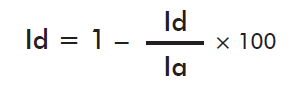
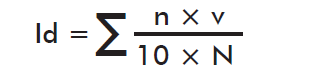
<body><![CDATA[<P   ><font face="Verdana, Arial, Helvetica, sans-serif" size="2">In this trial, a      1:1 mix of sterile sand and peat as substrate in 1 kg pots is used. Infestation      was performed with 3000 <I>Meloidogyne </I>sp. eggs separated from roots of      infested tomato plants [16]. </font></P >       <P   ><font face="Verdana, Arial, Helvetica, sans-serif" size="2">The bioproduct formulations      are applied directly to the substrate three days before the infestation. The      indicator plant used in this trial was the tomato susceptible variety UC 82B.      The degree of root damage was determined as Root Gall Index (RGI), 35 days      after planting, according to the scale of 0-10 degrees [19]. Infestation severity      was evaluated using the Townsend-Heuberger&rsquo;s formula [20]: </font></P >       <P align="center"   ><img src="/img/revistas/bta/v34n4/fr0103417.gif" width="309" height="82"></P >       
<P   ><font face="Verdana, Arial, Helvetica, sans-serif" size="2">where Id is the index      of treatment infestation with the formulation evaluated; n is the degree of      infestation according to the scale; v is the number of plants per degree of      infestation and N the total number of plants evaluated. Id is also calculated      for the control without treatment, in which case it is named Ia. </font></P >       <P   ><font face="Verdana, Arial, Helvetica, sans-serif" size="2">The technical effectiveness      of each Hebernem&reg; product formulation (ET (%)) was calculated using the      Abbott&rsquo;s formula [21]: </font></P >       <P align="center"   ><img src="/img/revistas/bta/v34n4/fr0203417.gif" width="301" height="93"></P >       
<P   >&nbsp;</P >       <P   > </P >       <P   ><b><font face="Verdana, Arial, Helvetica, sans-serif" size="3">RESULTS AND DISCUSSION      </font></b></P >       <P   ><font face="Verdana, Arial, Helvetica, sans-serif" size="2">Methods to evaluate      the mechanisms of action of nematicidal bioproducts are essential to select      the optimal product for nematode control in plants. They also provide us with      information on the quality of the different formulations under analysis. Regarding      HeberNem&reg;, its active ingredient (<I>T. paurometabola</I>) has been studied      and patented as nematicidal agent, including the methods used to determine      its biological activity [22, 23]. In those studies, pure cul-tures in LB liquid      medium were assayed. However, in this work a new strategy was followed (Method      2), by separating the different components from the bacterium as a pre-treatment      before starting the biological activity tests of the product formulation.      Therefore, 1 g of HeberNem&reg; was washed twice with a 0.1 % sterile peptone      solution and cellS were subsequently resuspended in the same solution before      use. </font></P >       ]]></body>
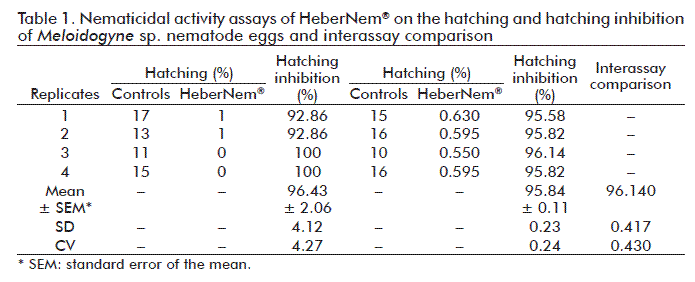
<body><![CDATA[<P   ><font face="Verdana, Arial, Helvetica, sans-serif" size="2">Analyzing the results      obtained by this first method, the bioproduct HeberNem&reg; exhibited more      potent nematicidal activity against eggs than larvae of <I>M. incognita</I>.      This is significant because the egg stage is the one showing the highest resistance      during the entire nematode life cycle [24]. </font></P >       <P   ><font face="Verdana, Arial, Helvetica, sans-serif" size="2">The results of two      assays for the determination of nematicidal activity of a solid HeberNem&reg;      formulation against nematode eggs are shown in <a href="/img/revistas/bta/v34n4/t0103417.gif">Table      1</a>. The product caused 96.14 % of egg hatching inhibition. When evaluating      different serial dilutions of the bioproduct (1/10), up to the order of 5.85      &times; 104 c.f.u./ mL, more than 90 % inhibition of egg hatching was observed      (<a href="/img/revistas/bta/v34n4/t0203417.gif">Table 2</a>). </font></P >   <FONT size="+1"><FONT size="+1"><FONT size="+1"><FONT size="+1">        
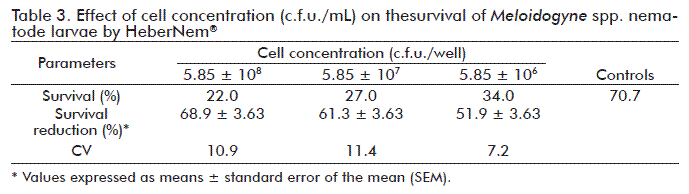
<P   ><font face="Verdana, Arial, Helvetica, sans-serif" size="2">Three product dilutions      were also tested to evaluate the effect of HeberNem&reg; on larvae, the lowest      containing 5 &times; 106 c.f.u./well. It was demonstrated at this cellular      concentration that the product was able to reduce larval survival by 51.9      % (<a href="/img/revistas/bta/v34n4/t0303417.gif">Table 3</a>). </font></P >   <FONT size="+1"><FONT size="+1">        
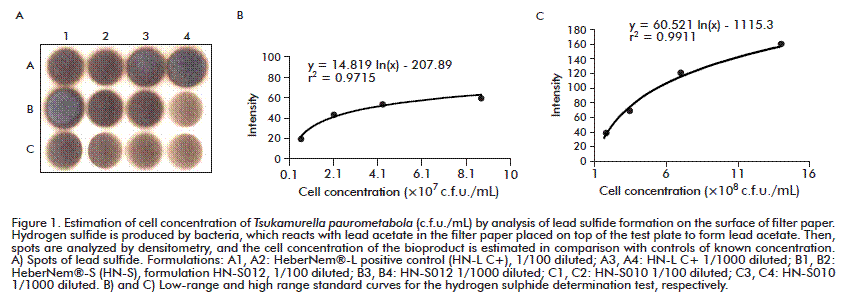
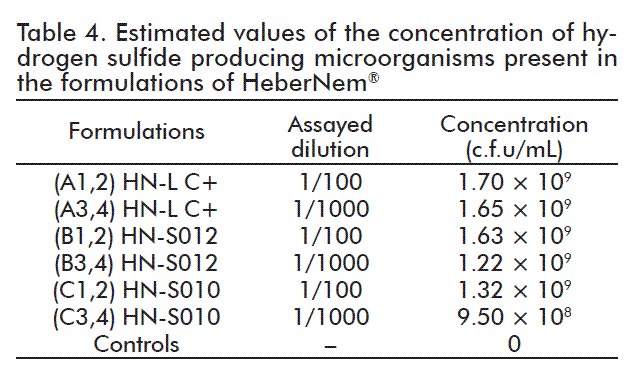
<P   ><font face="Verdana, Arial, Helvetica, sans-serif" size="2">The results obtained      by this method in the evaluation of the nematicidal activity of the different      HeberNem&reg; formulations corroborate previous results by Mena <I>et al</I>.      [5, 23], by using culture supernatants of <I>T. paurometabola </I>active component      of HeberNem&reg;. In that study, the damage caused in eggs and larvae of nematodes      was found as caused by proteases, chitinases and collagenases excreted by      bacteria into the culture medium. </font></P >   <FONT size="+1"><FONT size="+1">        <P   ><font face="Verdana, Arial, Helvetica, sans-serif" size="2">Many bacteria displaying      nematicidal activity are able to produce hydrogen sulfide from amino acids      such as cysteine. This is the case of the active component bacterium of the      HeberNem&reg; bioproduct [23]. In fact, its evaluation <I>in vitro </I>against      different species of nematodes (zoonematodes and phytonematodes) demonstrated      that the nematicidal effect was mediated in part by the hydrogen sulfide produced      by the bacteria during their growth in liquid LB medium which gets into contact      with the eggs and larvae of the nematodes [23]. </font></P >   <FONT size="+1"><FONT size="+1">        <P   ><font face="Verdana, Arial, Helvetica, sans-serif" size="2">Results obtained      with Method 2 are shown in <a href="/img/revistas/bta/v34n4/f10103417.gif">figure 1</a>. The observed      dark areas correspond to the lead sulfide formed by the reaction of the lead      acetate and the hydrogen sulfide released by the bacteria contained in the      product (<a href="/img/revistas/bta/v34n4/f10103417.gif">Figure 1A</a>). This method supports the      quantification of the concentration of microorganisms capable of producing      hydrogen sulfide, through the presence of the lead sulfide formed on the surface      of the filter paper, further indicating the development of this property on      the microorganisms by the pretreatment. The intensity of the lead sulfide      spots formed is proportional to the c.f.u./mL present in the formulations      assayed. Moreover, the high sensitivity of this method allows detecting small      differences in the microbial concentration of the formulations tested. Microorganisms&rsquo;      concentrations were determined by standard curves (<a href="/img/revistas/bta/v34n4/f10103417.gif">Figure      1B and 1C</a>) and the result of two different formulations of the product      is shown in <a href="/img/revistas/bta/v34n4/t0403417.gif">Table 4</a>. The result of the liquid formulation      of a known concentration was included as control. </font></P >       
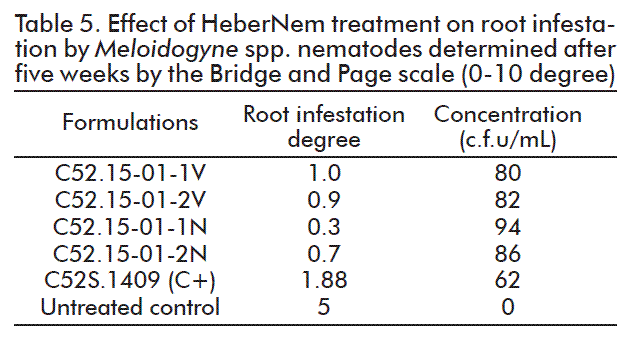
<P   ><font face="Verdana, Arial, Helvetica, sans-serif" size="2">The potting results      showed a reduction in nematode infestation rates in the roots of plant treated      with the different HeberNem&reg; formulations, in comparison with the degree      of infestation in control plants (<a href="/img/revistas/bta/v34n4/t0503417.gif">Table 5</a>). The      technical effectiveness of the treatments was calculated from the degrees      of final infestation of each treatment with the Bridge and Page&rsquo;s 0-10      scale as described [19]. It was shown that the new formulations were effective      for nematode control (<a href="/img/revistas/bta/v34n4/t0503417.gif">Table 5</a>). </font></P >       
<P   >&nbsp;</P >       <P   > </P >       <P   ><b><font face="Verdana, Arial, Helvetica, sans-serif" size="3">CONCLUSIONS </font></b></P >       ]]></body>
<body><![CDATA[<P   ><font face="Verdana, Arial, Helvetica, sans-serif" size="2">The methods described      here are very useful in the evaluation of the bioproducts for the control      of nematodes affecting plants. The specificity of the test against eggs and      larvae allowed us to evaluate the effect of the bioproduct formulations over      different developmental stages of the nematodes. The HeberNem&reg; formulations      tested showed nematicidal activity on eggs and larvae of <I>Meloidogyne </I>spp.      The effect on nematode eggs was higher (95.14 % inhibition of hatching) compared      to the effect on the larvae (68.9 % reduction in survival). </font></P >   <FONT size="+1"><FONT size="+1">        <P   ><font face="Verdana, Arial, Helvetica, sans-serif" size="2">Through the second      method proposed here (Method 2), the concentration of active microorganisms      in the bioproducts was estimated by the indirect measure of hydrogen sulfide.      Potting assays were used to evaluate the technical effectiveness of the three      different treatments and formulations under study, and all the formulations      tested exhibited nematode control activity for a technical effectiveness greater      than 50 %. Thus, it is possible to give an appropriate evaluation on the quality      of the nematicidal bioproduct HeberNem&reg; or other similar bioproducts for      nematode control with the use of these three methods. </font></P >       <P   >&nbsp;</P >   <FONT size="+1"><FONT size="+1">        <P   > </P >   <FONT size="+1" color="#000000">        <P   ><b><font face="Verdana, Arial, Helvetica, sans-serif" size="3">REFERENCES </font></b></P >       <!-- ref --><P   ><font size="2" color="#211E1F" face="Verdana, Arial, Helvetica, sans-serif">1.      Cuadra R, Zayas MA, Mel&eacute;ndez O, Ramos N, Alvarez S, Li&ntilde;eiro      LD, et al. Medidas agrot&eacute;cnicas para el control de <I>Meloidogyne incognita      </I>en cultivo protegido del pepino. Fitosanidad. 2013;17(3):161-5.     </font></P >   <FONT size="+1" color="#211E1F">        <P   ><font face="Verdana, Arial, Helvetica, sans-serif" size="2">2. G&oacute;mez L.      Diagn&oacute;stico y potencialidad de la pr&aacute;ctica agrot&eacute;cnica      en el manejo de <I>Meloidogyne </I>spp. en la producci&oacute;n protegida      de hortalizas [Tesis al grado de Doctor en Ciencias Agr&iacute;colas]: CENSA,      La Habana; 2007. </font></P >       <P   ><font face="Verdana, Arial, Helvetica, sans-serif" size="2">3. Wesemael WL, Viviaene      N, Moens M. Root&ndash;knot nematodes (<I>Meloidogyne </I>spp.) in Europe.      Nematology. 2011;13(1):3-16. </font></P >       <!-- ref --><P   ><font face="Verdana, Arial, Helvetica, sans-serif" size="2">4. Seid A, Fininsa      Ch, Mekete T, Decraemer W, Wesemael WM. Tomato (<I>Solanum lycopersicum</I>)      and root-knot nematodes (Meloidogyne spp.) - a century -old battle. Nematology.      2015;17(9):995-1009.     </font></P >   <FONT size="+1">        <!-- ref --><P   ><font size="2" face="Verdana, Arial, Helvetica, sans-serif">5. Mena J, Pimentel      E, Veloz L, Hern&aacute;ndez A, Le&oacute;n L, Ram&iacute;rez Y, <I>et al</I>.      Aislamiento y determinaci&oacute;n de cepas bacterianas con actividad nematicida.      Mecanismo de acci&oacute;n de <I>T. paurometabola </I>C-924 sobre nematodos.      Biotecnol Apl. 2003;20(4):248-52.     </font></P >   <FONT size="+1">        <!-- ref --><P   ><font face="Verdana, Arial, Helvetica, sans-serif" size="2">6. P&eacute;rez E.      Tecnolog&iacute;as en el proceso de eliminaci&oacute;n del bromuro de metilo      en tratamientos al suelo en Cuba. La Habana: Editorial Cidisav; 2012.     </font></P >       <P   ><font face="Verdana, Arial, Helvetica, sans-serif" size="2">7. Medina J, Miranda      L, Soria C, Dom&iacute;nguez P, P&eacute;rez RM, Zea T, <I>et al</I>. Alternativas      biol&oacute;gicas al bromuro de metilo en la fresa de Huelva (Espa&ntilde;a).      Resultados de dos a&ntilde;os de actividades. In: INISAV. II Taller Latinoamericano      de Biocontrol de Fitopat&oacute;genos. La Habana: INISAV; 2010. p. 53. </font></P >       <P   ><font face="Verdana, Arial, Helvetica, sans-serif" size="2">8. Rodr&iacute;guez      R. Management of phytopathogenic nematodes: Present situation and challenges,      In: Seminario Internacional de Sanidad Agropecuaria; 2011 May 13-16; La Habana,      Cuba: CENSA; 2011. p. 63. </font></P >       <P   ><font face="Verdana, Arial, Helvetica, sans-serif" size="2">9. Mena J, Pimentel      E, Borroto C, Smith E, Mesa L, Le&oacute;n L, <I>et al</I>. Extensi&oacute;n      Nacional del bionematicida HeberNem, para el control de fitonematodos en los      cultivos protegidos. La Habana: Instituto de Investigaciones Hort&iacute;colas      &ldquo;Liliana Dimitrova&rdquo;; 2006. </font></P >       <!-- ref --><P   ><font face="Verdana, Arial, Helvetica, sans-serif" size="2">10. Ar&eacute;valo      J, Hidalgo L, Martins I, Sousa JF, Castro JM, Carneiro M, <I>et al</I>. Cultural      and morphological characterization of <I>Pochonia chlamydosporia </I>and <I>Lecanicillium      psalliotae </I>isolated from Meloidogyne mayaguensis eggs in Brazil. Tropical      Plant Pathol. 2009;34(33):158-63.     </font></P >       ]]></body>
<body><![CDATA[<!-- ref --><P   ><font face="Verdana, Arial, Helvetica, sans-serif" size="2">11. Raddy HM, Fouad      AFA, Montasser SA, Abdel-Lateef MF, EL-Samadisy AM. Efficacy of six nematicides      and six commercial bioproducts against root knot nematode, <I>Meloidogyne      incognita </I>on tomato. J Appl Sci Res. 2013;9(7):4410-7.     </font></P >       <!-- ref --><P   ><font face="Verdana, Arial, Helvetica, sans-serif" size="2">12. Raza MS, Imran      M, Afzal M, Azeem M, Riaz A, Awais M. Evaluation of bio-nematicides against      the development of root knot nematode (Meloidogyne incognita) in tomato. J      Entomol Zool Stud. 2014;2(6):333-5.     </font></P >       <!-- ref --><P   ><font face="Verdana, Arial, Helvetica, sans-serif" size="2">13. Hern&aacute;ndez      A, Pimentel E, Mena J. Minibioreactor-gas collector for determining bacteria-produced      hydrogen sulfide. Electron J Biotechnol. 2003;6(3):223-32.     </font></P >       <!-- ref --><P   ><font face="Verdana, Arial, Helvetica, sans-serif" size="2">14. Zasada IA, Klassen      W, Meyer SLF, Collado M, Abdul-Baki AA. Velvetbean (Mucuna pruriens) extracts:      Impact on Meloidogyne incognita survival and on <I>Lycopersicon esculentum      </I>and <I>Lactuca sativa </I>germination and growth. Pest Manag Sci. 2006;62:1122-7.          </font></P >       <!-- ref --><P   ><font face="Verdana, Arial, Helvetica, sans-serif" size="2">15. Tae-Kyun H, Jae-Kook      L, Jae-Won H, Soon-II K, Dong-Ro Ch, Young-Joon A. Toxicity of <I>Kaempferia      galanga </I>rhizome-derived extract and steam distillate to <I>Meloidogyne      incognita </I>juveniles and eggs, and their effects on <I>Lycopersicon esculentum      </I>germination and growth. Nematology. 2010;12(5):775-82.     </font></P >       ]]></body>
<body><![CDATA[<P   ><font face="Verdana, Arial, Helvetica, sans-serif" size="2">16. Mena J, Pimentel      E, Hern&aacute;ndez A, Le&oacute;n L, Ramirez Y, Wong I, et al. HeberNem:      sustituto de tratamientos qu&iacute;micos en Cultivo protegidos. XVI Forum      de Ciencia y T&eacute;cnica. 2007 [cited 2016 Dec 18]. Available from: <FONT color="#0000FF"><a href="http://www.forumcyt.cu/UserFiles/forum/Textos/0908001.pdf." target="_blank">http://www.forumcyt.cu/UserFiles/forum/Textos/0908001.pdf.      </a> </font></font></P >   <FONT color="#0000FF">        <!-- ref --><P   ><font color="#211E1F" face="Verdana, Arial, Helvetica, sans-serif" size="2">17.      Mc Bride RG, Mikkelsen RL, Barker KR. A comparison of three methods for determining      root-knot nematode infection of cotton roots. Nematropica. 1999;29(2):147-51.          </font></P >   <FONT color="#211E1F">        <!-- ref --><P   ><font face="Verdana, Arial, Helvetica, sans-serif" size="2">18. Sharma RN, Saxena      KN. Orientation and developmental inhibition in the housefly by certain terpenoids.      J Med Entomol. 1974;11(5):617-21.     </font></P >       <!-- ref --><P   ><font face="Verdana, Arial, Helvetica, sans-serif" size="2">19. Bridge J, Page      SLJ. Estimation of root-knot nematodes infestation levels using a rating chart.      Trop Pest Manag. 1980;26:296-8.     </font></P >       <!-- ref --><P   ><font face="Verdana, Arial, Helvetica, sans-serif" size="2">20. Townsend GR,      Heuberger JV. Methods for estimating losses caused by diseases in fungicide      experiments. Plant Dis Rep. 1943;24:340-43.     </font></P >       <!-- ref --><P   ><font face="Verdana, Arial, Helvetica, sans-serif" size="2">21. Abbott WS. A      method of computing the effectiveness of an insecticide. J Econ Entomol. 1925;18:265-7.          </font></P >       <P   ><font face="Verdana, Arial, Helvetica, sans-serif" size="2">22. Mena J, de la      Riva G, V&aacute;zquez R, inventors; Center for Genetic Engineering and Biotechnology,      assignee. Nematicide agent and method for the bio-control of nematodes. WO      04794 A1, 1996 Feb 22. </font></P >       <P   ><font face="Verdana, Arial, Helvetica, sans-serif" size="2">23. Mena J, Pimentel      E, Hern&aacute;ndez A, inventors; Center for Genetic Engineering and Biotechnology,      assignee. Pesticidal and antiparasitic compositions. US Patent 0071663 A1,      2004 April. </font></P >       <P   ><font face="Verdana, Arial, Helvetica, sans-serif" size="2">24. Wharton D A.      Nematode survival strategies. In: Lee DL, editors. The biology of nematodes.      New York: Taylor &amp; Francis; 2002 p. 389-411. </font></P >       <P   >&nbsp;</P >       <P   >&nbsp;</P >       <P   > </P >   <FONT size="+1">       <P   > </P >   <FONT size="+1">       <P   > </P >       <P   ><i><font face="Verdana, Arial, Helvetica, sans-serif" size="2">Received in May,      2017.    ]]></body>
<body><![CDATA[<br>     Accepted in October, 2017.</font></i></P >       <P   >&nbsp;</P >       <P   >&nbsp;</P >       <P   > </P >   <FONT size="+1">        <P   ><i><font face="Verdana, Arial, Helvetica, sans-serif" size="2">Idania Wong Padilla</font></i><font face="Verdana, Arial, Helvetica, sans-serif" size="2">.      Departamento de Investigaciones, Centro de Ingenier&iacute;a Gen&eacute;tica      y Biotecnolog&iacute;a de Camag&uuml;ey. Circunvalaci&oacute;n Norte y Ave.      Finlay, Camag&uuml;ey, Camag&uuml;ey, Cuba. E-mail: <A href="mailto:idania.wong@cigb.edu.cu">      <FONT color="#0000FF">idania.wong@cigb.edu.cu</font></A><FONT color="#0000FF"><FONT color="#211E1F">.      </font></font></font></P >   </font></font></font></font></font></font></font></font></font></font></font></font></font></font></font></font></font></font></font></font></font></font></font></font></font></font></font></font></font></font></font></font></font></font></font></font></font></font></font></font></font></font></font></font></font></font></font></font></font></font></font></font></font></font></font></font></font></font></font></font></font></font></font></font></font></font></DIV >      ]]></body><back>
<ref-list>
<ref id="B1">
<label>1</label><nlm-citation citation-type="journal">
<person-group person-group-type="author">
<name>
<surname><![CDATA[Cuadra]]></surname>
<given-names><![CDATA[R]]></given-names>
</name>
<name>
<surname><![CDATA[Zayas]]></surname>
<given-names><![CDATA[MA]]></given-names>
</name>
<name>
<surname><![CDATA[Meléndez]]></surname>
<given-names><![CDATA[O]]></given-names>
</name>
<name>
<surname><![CDATA[Ramos]]></surname>
<given-names><![CDATA[N]]></given-names>
</name>
<name>
<surname><![CDATA[Alvarez]]></surname>
<given-names><![CDATA[S]]></given-names>
</name>
<name>
<surname><![CDATA[Liñeiro]]></surname>
<given-names><![CDATA[LD]]></given-names>
</name>
</person-group>
<article-title xml:lang="es"><![CDATA[Medidas agrotécnicas para el control de Meloidogyne incognita en cultivo protegido del pepino]]></article-title>
<source><![CDATA[Fitosanidad]]></source>
<year>2013</year>
<volume>17</volume>
<numero>3</numero>
<issue>3</issue>
<page-range>161-5</page-range></nlm-citation>
</ref>
<ref id="B2">
<label>2</label><nlm-citation citation-type="">
<person-group person-group-type="author">
<name>
<surname><![CDATA[Gómez]]></surname>
<given-names><![CDATA[L]]></given-names>
</name>
</person-group>
<source><![CDATA[Diagnóstico y potencialidad de la práctica agrotécnica en el manejo de Meloidogyne spp. en la producción protegida de hortalizas]]></source>
<year></year>
</nlm-citation>
</ref>
<ref id="B3">
<label>3</label><nlm-citation citation-type="journal">
<person-group person-group-type="author">
<name>
<surname><![CDATA[Wesemael]]></surname>
<given-names><![CDATA[WL]]></given-names>
</name>
<name>
<surname><![CDATA[Viviaene]]></surname>
<given-names><![CDATA[N]]></given-names>
</name>
<name>
<surname><![CDATA[Moens]]></surname>
<given-names><![CDATA[M]]></given-names>
</name>
</person-group>
<article-title xml:lang="en"><![CDATA[Root-knot nematodes (Meloidogyne spp.) in Europe]]></article-title>
<source><![CDATA[Nematology]]></source>
<year>2011</year>
<volume>13</volume>
<numero>1</numero>
<issue>1</issue>
<page-range>3-16</page-range></nlm-citation>
</ref>
<ref id="B4">
<label>4</label><nlm-citation citation-type="journal">
<person-group person-group-type="author">
<name>
<surname><![CDATA[Seid]]></surname>
<given-names><![CDATA[A]]></given-names>
</name>
<name>
<surname><![CDATA[Fininsa]]></surname>
<given-names><![CDATA[Ch]]></given-names>
</name>
<name>
<surname><![CDATA[Mekete]]></surname>
<given-names><![CDATA[T]]></given-names>
</name>
<name>
<surname><![CDATA[Decraemer]]></surname>
<given-names><![CDATA[W]]></given-names>
</name>
<name>
<surname><![CDATA[Wesemael]]></surname>
<given-names><![CDATA[WM]]></given-names>
</name>
</person-group>
<article-title xml:lang="en"><![CDATA[Tomato (Solanum lycopersicum) and root-knot nematodes (Meloidogyne spp.) - a century -old battle]]></article-title>
<source><![CDATA[Nematology]]></source>
<year>2015</year>
<volume>17</volume>
<numero>9</numero>
<issue>9</issue>
<page-range>995-1009</page-range></nlm-citation>
</ref>
<ref id="B5">
<label>5</label><nlm-citation citation-type="journal">
<person-group person-group-type="author">
<name>
<surname><![CDATA[Mena]]></surname>
<given-names><![CDATA[J]]></given-names>
</name>
<name>
<surname><![CDATA[Pimentel]]></surname>
<given-names><![CDATA[E]]></given-names>
</name>
<name>
<surname><![CDATA[Veloz]]></surname>
<given-names><![CDATA[L]]></given-names>
</name>
<name>
<surname><![CDATA[Hernández]]></surname>
<given-names><![CDATA[A]]></given-names>
</name>
<name>
<surname><![CDATA[León]]></surname>
<given-names><![CDATA[L]]></given-names>
</name>
<name>
<surname><![CDATA[Ramírez]]></surname>
<given-names><![CDATA[Y]]></given-names>
</name>
</person-group>
<article-title xml:lang="es"><![CDATA[Aislamiento y determinación de cepas bacterianas con actividad nematicida. Mecanismo de acción de T. paurometabola C-924 sobre nematodos]]></article-title>
<source><![CDATA[Biotecnol Apl]]></source>
<year>2003</year>
<volume>20</volume>
<numero>4</numero>
<issue>4</issue>
<page-range>248-52</page-range></nlm-citation>
</ref>
<ref id="B6">
<label>6</label><nlm-citation citation-type="book">
<person-group person-group-type="author">
<name>
<surname><![CDATA[Pérez]]></surname>
<given-names><![CDATA[E]]></given-names>
</name>
</person-group>
<source><![CDATA[Tecnologías en el proceso de eliminación del bromuro de metilo en tratamientos al suelo en Cuba]]></source>
<year>2012</year>
<publisher-loc><![CDATA[La Habana ]]></publisher-loc>
<publisher-name><![CDATA[Editorial Cidisav]]></publisher-name>
</nlm-citation>
</ref>
<ref id="B7">
<label>7</label><nlm-citation citation-type="book">
<person-group person-group-type="author">
<name>
<surname><![CDATA[Medina]]></surname>
<given-names><![CDATA[J]]></given-names>
</name>
<name>
<surname><![CDATA[Miranda]]></surname>
<given-names><![CDATA[L]]></given-names>
</name>
<name>
<surname><![CDATA[Soria]]></surname>
<given-names><![CDATA[C]]></given-names>
</name>
<name>
<surname><![CDATA[Domínguez]]></surname>
<given-names><![CDATA[P]]></given-names>
</name>
<name>
<surname><![CDATA[Pérez]]></surname>
<given-names><![CDATA[RM]]></given-names>
</name>
<name>
<surname><![CDATA[Zea]]></surname>
<given-names><![CDATA[T]]></given-names>
</name>
</person-group>
<article-title xml:lang="es"><![CDATA[Alternativas biológicas al bromuro de metilo en la fresa de Huelva (España). Resultados de dos años de actividades]]></article-title>
<collab>INISAV</collab>
<source><![CDATA[II Taller Latinoamericano de Biocontrol de Fitopatógenos]]></source>
<year>2010</year>
<page-range>53</page-range><publisher-loc><![CDATA[La Habana ]]></publisher-loc>
<publisher-name><![CDATA[INISAV]]></publisher-name>
</nlm-citation>
</ref>
<ref id="B8">
<label>8</label><nlm-citation citation-type="book">
<person-group person-group-type="author">
<name>
<surname><![CDATA[Rodríguez]]></surname>
<given-names><![CDATA[R]]></given-names>
</name>
</person-group>
<article-title xml:lang="en"><![CDATA[Management of phytopathogenic nematodes: Present situation and challenges]]></article-title>
<source><![CDATA[II Taller Latinoamericano de Biocontrol de Fitopatógenos]]></source>
<year>2010</year>
<page-range>63</page-range><publisher-loc><![CDATA[La Habana ]]></publisher-loc>
<publisher-name><![CDATA[INISAV]]></publisher-name>
</nlm-citation>
</ref>
<ref id="B9">
<label>9</label><nlm-citation citation-type="book">
<person-group person-group-type="author">
<name>
<surname><![CDATA[Mena]]></surname>
<given-names><![CDATA[J]]></given-names>
</name>
<name>
<surname><![CDATA[Pimentel]]></surname>
<given-names><![CDATA[E]]></given-names>
</name>
<name>
<surname><![CDATA[Borroto]]></surname>
<given-names><![CDATA[C]]></given-names>
</name>
<name>
<surname><![CDATA[Smith]]></surname>
<given-names><![CDATA[E]]></given-names>
</name>
<name>
<surname><![CDATA[Mesa]]></surname>
<given-names><![CDATA[L]]></given-names>
</name>
<name>
<surname><![CDATA[León]]></surname>
<given-names><![CDATA[L]]></given-names>
</name>
</person-group>
<source><![CDATA[Extensión Nacional del bionematicida HeberNem, para el control de fitonematodos en los cultivos protegidos]]></source>
<year>2006</year>
<publisher-loc><![CDATA[La Habana ]]></publisher-loc>
<publisher-name><![CDATA[Instituto de Investigaciones Hortícolas "Liliana Dimitrova"]]></publisher-name>
</nlm-citation>
</ref>
<ref id="B10">
<label>10</label><nlm-citation citation-type="journal">
<person-group person-group-type="author">
<name>
<surname><![CDATA[Arévalo]]></surname>
<given-names><![CDATA[J]]></given-names>
</name>
<name>
<surname><![CDATA[Hidalgo]]></surname>
<given-names><![CDATA[L]]></given-names>
</name>
<name>
<surname><![CDATA[Martins]]></surname>
<given-names><![CDATA[I]]></given-names>
</name>
<name>
<surname><![CDATA[Sousa]]></surname>
<given-names><![CDATA[JF]]></given-names>
</name>
<name>
<surname><![CDATA[Castro]]></surname>
<given-names><![CDATA[JM]]></given-names>
</name>
<name>
<surname><![CDATA[Carneiro]]></surname>
<given-names><![CDATA[M]]></given-names>
</name>
</person-group>
<article-title xml:lang="en"><![CDATA[Cultural and morphological characterization of Pochonia chlamydosporia and Lecanicillium psalliotae isolated from Meloidogyne mayaguensis eggs in Brazil]]></article-title>
<source><![CDATA[Tropical Plant Pathol]]></source>
<year>2009</year>
<volume>34</volume>
<numero>33</numero>
<issue>33</issue>
<page-range>158-63</page-range></nlm-citation>
</ref>
<ref id="B11">
<label>11</label><nlm-citation citation-type="journal">
<person-group person-group-type="author">
<name>
<surname><![CDATA[Raddy]]></surname>
<given-names><![CDATA[HM]]></given-names>
</name>
<name>
<surname><![CDATA[Fouad]]></surname>
<given-names><![CDATA[AFA]]></given-names>
</name>
<name>
<surname><![CDATA[Montasser]]></surname>
<given-names><![CDATA[SA]]></given-names>
</name>
<name>
<surname><![CDATA[Abdel-Lateef]]></surname>
<given-names><![CDATA[MF]]></given-names>
</name>
<name>
<surname><![CDATA[EL-Samadisy]]></surname>
<given-names><![CDATA[AM]]></given-names>
</name>
</person-group>
<article-title xml:lang="en"><![CDATA[Efficacy of six nematicides and six commercial bioproducts against root knot nematode, Meloidogyne incognita on tomato]]></article-title>
<source><![CDATA[J Appl Sci Res]]></source>
<year>2013</year>
<volume>9</volume>
<numero>7</numero>
<issue>7</issue>
<page-range>4410-7</page-range></nlm-citation>
</ref>
<ref id="B12">
<label>12</label><nlm-citation citation-type="journal">
<person-group person-group-type="author">
<name>
<surname><![CDATA[Raza]]></surname>
<given-names><![CDATA[MS]]></given-names>
</name>
<name>
<surname><![CDATA[Imran]]></surname>
<given-names><![CDATA[M]]></given-names>
</name>
<name>
<surname><![CDATA[Afzal]]></surname>
<given-names><![CDATA[M]]></given-names>
</name>
<name>
<surname><![CDATA[Azeem]]></surname>
<given-names><![CDATA[M]]></given-names>
</name>
<name>
<surname><![CDATA[Riaz]]></surname>
<given-names><![CDATA[A]]></given-names>
</name>
<name>
<surname><![CDATA[Awais]]></surname>
<given-names><![CDATA[M]]></given-names>
</name>
</person-group>
<article-title xml:lang="en"><![CDATA[Evaluation of bio-nematicides against the development of root knot nematode (Meloidogyne incognita) in tomato]]></article-title>
<source><![CDATA[J Entomol Zool Stud]]></source>
<year>2014</year>
<volume>2</volume>
<numero>6</numero>
<issue>6</issue>
<page-range>333-5</page-range></nlm-citation>
</ref>
<ref id="B13">
<label>13</label><nlm-citation citation-type="journal">
<person-group person-group-type="author">
<name>
<surname><![CDATA[Hernández]]></surname>
<given-names><![CDATA[A]]></given-names>
</name>
<name>
<surname><![CDATA[Pimentel]]></surname>
<given-names><![CDATA[E]]></given-names>
</name>
<name>
<surname><![CDATA[Mena]]></surname>
<given-names><![CDATA[J]]></given-names>
</name>
</person-group>
<article-title xml:lang="en"><![CDATA[Minibioreactor-gas collector for determining bacteria-produced hydrogen sulfide]]></article-title>
<source><![CDATA[Electron J Biotechnol]]></source>
<year>2003</year>
<volume>6</volume>
<numero>3</numero>
<issue>3</issue>
<page-range>223-32</page-range></nlm-citation>
</ref>
<ref id="B14">
<label>14</label><nlm-citation citation-type="journal">
<person-group person-group-type="author">
<name>
<surname><![CDATA[Zasada]]></surname>
<given-names><![CDATA[IA]]></given-names>
</name>
<name>
<surname><![CDATA[Klassen]]></surname>
<given-names><![CDATA[W]]></given-names>
</name>
<name>
<surname><![CDATA[Meyer]]></surname>
<given-names><![CDATA[SLF]]></given-names>
</name>
<name>
<surname><![CDATA[Collado]]></surname>
<given-names><![CDATA[M]]></given-names>
</name>
<name>
<surname><![CDATA[Abdul-Baki]]></surname>
<given-names><![CDATA[AA]]></given-names>
</name>
</person-group>
<article-title xml:lang="en"><![CDATA[Velvetbean (Mucuna pruriens) extracts: Impact on Meloidogyne incognita survival and on Lycopersicon esculentum and Lactuca sativa germination and growth]]></article-title>
<source><![CDATA[Pest Manag Sci]]></source>
<year>2006</year>
<volume>62</volume>
<page-range>1122-7</page-range></nlm-citation>
</ref>
<ref id="B15">
<label>15</label><nlm-citation citation-type="journal">
<person-group person-group-type="author">
<name>
<surname><![CDATA[Tae-Kyun]]></surname>
<given-names><![CDATA[H]]></given-names>
</name>
<name>
<surname><![CDATA[Jae-Kook]]></surname>
<given-names><![CDATA[L]]></given-names>
</name>
<name>
<surname><![CDATA[Jae-Won]]></surname>
<given-names><![CDATA[H]]></given-names>
</name>
<name>
<surname><![CDATA[Soon-II]]></surname>
<given-names><![CDATA[K]]></given-names>
</name>
<name>
<surname><![CDATA[Dong-Ro]]></surname>
<given-names><![CDATA[Ch]]></given-names>
</name>
<name>
<surname><![CDATA[Young-Joon]]></surname>
<given-names><![CDATA[A]]></given-names>
</name>
</person-group>
<article-title xml:lang="en"><![CDATA[Toxicity of Kaempferia galanga rhizome-derived extract and steam distillate to Meloidogyne incognita juveniles and eggs, and their effects on Lycopersicon esculentum germination and growth]]></article-title>
<source><![CDATA[Nematology]]></source>
<year>2010</year>
<volume>12</volume>
<numero>5</numero>
<issue>5</issue>
<page-range>775-82</page-range></nlm-citation>
</ref>
<ref id="B16">
<label>16</label><nlm-citation citation-type="book">
<person-group person-group-type="author">
<name>
<surname><![CDATA[Mena]]></surname>
<given-names><![CDATA[J]]></given-names>
</name>
<name>
<surname><![CDATA[Pimentel]]></surname>
<given-names><![CDATA[E]]></given-names>
</name>
<name>
<surname><![CDATA[Hernández]]></surname>
<given-names><![CDATA[A]]></given-names>
</name>
<name>
<surname><![CDATA[León]]></surname>
<given-names><![CDATA[L]]></given-names>
</name>
<name>
<surname><![CDATA[Ramirez]]></surname>
<given-names><![CDATA[Y]]></given-names>
</name>
<name>
<surname><![CDATA[Wong]]></surname>
<given-names><![CDATA[I]]></given-names>
</name>
</person-group>
<source><![CDATA[HeberNem: sustituto de tratamientos químicos en Cultivo protegidos]]></source>
<year>2007</year>
<publisher-loc><![CDATA[La Habana ]]></publisher-loc>
<publisher-name><![CDATA[XVI Forum de Ciencia y Técnica]]></publisher-name>
</nlm-citation>
</ref>
<ref id="B17">
<label>17</label><nlm-citation citation-type="journal">
<person-group person-group-type="author">
<name>
<surname><![CDATA[Mc Bride]]></surname>
<given-names><![CDATA[RG]]></given-names>
</name>
<name>
<surname><![CDATA[Mikkelsen]]></surname>
<given-names><![CDATA[RL]]></given-names>
</name>
<name>
<surname><![CDATA[Barker]]></surname>
<given-names><![CDATA[KR]]></given-names>
</name>
</person-group>
<article-title xml:lang="en"><![CDATA[A comparison of three methods for determining root-knot nematode infection of cotton roots]]></article-title>
<source><![CDATA[Nematropica]]></source>
<year>1999</year>
<volume>29</volume>
<numero>2</numero>
<issue>2</issue>
<page-range>147-51</page-range></nlm-citation>
</ref>
<ref id="B18">
<label>18</label><nlm-citation citation-type="journal">
<person-group person-group-type="author">
<name>
<surname><![CDATA[Sharma]]></surname>
<given-names><![CDATA[RN]]></given-names>
</name>
<name>
<surname><![CDATA[Saxena]]></surname>
<given-names><![CDATA[KN]]></given-names>
</name>
</person-group>
<article-title xml:lang="en"><![CDATA[Orientation and developmental inhibition in the housefly by certain terpenoids]]></article-title>
<source><![CDATA[J Med Entomol]]></source>
<year>1974</year>
<volume>11</volume>
<numero>5</numero>
<issue>5</issue>
<page-range>617-21</page-range></nlm-citation>
</ref>
<ref id="B19">
<label>19</label><nlm-citation citation-type="journal">
<person-group person-group-type="author">
<name>
<surname><![CDATA[Bridge]]></surname>
<given-names><![CDATA[J]]></given-names>
</name>
<name>
<surname><![CDATA[Page]]></surname>
<given-names><![CDATA[SLJ]]></given-names>
</name>
</person-group>
<article-title xml:lang="en"><![CDATA[Estimation of root-knot nematodes infestation levels using a rating chart]]></article-title>
<source><![CDATA[Trop Pest Manag]]></source>
<year>1980</year>
<volume>26</volume>
<page-range>296-8</page-range></nlm-citation>
</ref>
<ref id="B20">
<label>20</label><nlm-citation citation-type="journal">
<person-group person-group-type="author">
<name>
<surname><![CDATA[Townsend]]></surname>
<given-names><![CDATA[GR]]></given-names>
</name>
<name>
<surname><![CDATA[Heuberger]]></surname>
<given-names><![CDATA[JV]]></given-names>
</name>
</person-group>
<article-title xml:lang="en"><![CDATA[Methods for estimating losses caused by diseases in fungicide experiments]]></article-title>
<source><![CDATA[Plant Dis Rep]]></source>
<year>1943</year>
<volume>24</volume>
<page-range>340-43</page-range></nlm-citation>
</ref>
<ref id="B21">
<label>21</label><nlm-citation citation-type="journal">
<person-group person-group-type="author">
<name>
<surname><![CDATA[Abbott]]></surname>
<given-names><![CDATA[WS]]></given-names>
</name>
</person-group>
<article-title xml:lang="en"><![CDATA[A method of computing the effectiveness of an insecticide]]></article-title>
<source><![CDATA[J Econ Entomol]]></source>
<year>1925</year>
<volume>18</volume>
<page-range>265-7</page-range></nlm-citation>
</ref>
<ref id="B22">
<label>22</label><nlm-citation citation-type="">
<person-group person-group-type="author">
<name>
<surname><![CDATA[Mena]]></surname>
<given-names><![CDATA[J]]></given-names>
</name>
<name>
<surname><![CDATA[de la Riva]]></surname>
<given-names><![CDATA[G]]></given-names>
</name>
<name>
<surname><![CDATA[Vázquez]]></surname>
<given-names><![CDATA[R]]></given-names>
</name>
</person-group>
<source><![CDATA[en]]></source>
<year></year>
</nlm-citation>
</ref>
<ref id="B23">
<label>23</label><nlm-citation citation-type="">
<person-group person-group-type="author">
<name>
<surname><![CDATA[Mena]]></surname>
<given-names><![CDATA[J]]></given-names>
</name>
<name>
<surname><![CDATA[Pimentel]]></surname>
<given-names><![CDATA[E]]></given-names>
</name>
<name>
<surname><![CDATA[Hernández]]></surname>
<given-names><![CDATA[A]]></given-names>
</name>
</person-group>
<source><![CDATA[Pesticidal and antiparasitic compositions]]></source>
<year></year>
</nlm-citation>
</ref>
<ref id="B24">
<label>24</label><nlm-citation citation-type="book">
<person-group person-group-type="author">
<name>
<surname><![CDATA[Wharton D]]></surname>
<given-names><![CDATA[A]]></given-names>
</name>
</person-group>
<article-title xml:lang="en"><![CDATA[Nematode survival strategies]]></article-title>
<person-group person-group-type="editor">
<name>
<surname><![CDATA[Lee]]></surname>
<given-names><![CDATA[DL]]></given-names>
</name>
</person-group>
<source><![CDATA[The biology of nematodes]]></source>
<year>2002</year>
<page-range>389-411</page-range><publisher-loc><![CDATA[New York ]]></publisher-loc>
<publisher-name><![CDATA[Taylor & Francis]]></publisher-name>
</nlm-citation>
</ref>
</ref-list>
</back>
</article>