<?xml version="1.0" encoding="ISO-8859-1"?><article xmlns:mml="http://www.w3.org/1998/Math/MathML" xmlns:xlink="http://www.w3.org/1999/xlink" xmlns:xsi="http://www.w3.org/2001/XMLSchema-instance">
<front>
<journal-meta>
<journal-id>1027-2852</journal-id>
<journal-title><![CDATA[Biotecnología Aplicada]]></journal-title>
<abbrev-journal-title><![CDATA[Biotecnol Apl]]></abbrev-journal-title>
<issn>1027-2852</issn>
<publisher>
<publisher-name><![CDATA[Editorial Elfos Scientiae]]></publisher-name>
</publisher>
</journal-meta>
<article-meta>
<article-id>S1027-28522017000400004</article-id>
<title-group>
<article-title xml:lang="en"><![CDATA[Comparison of economic indicators of the sucrose acid inversion or by enzymatic hydrolysis]]></article-title>
<article-title xml:lang="es"><![CDATA[Comparación de los indicadores económicos para la operación de inversión ácida de sacarosa o mediante hidrólisis enzimática]]></article-title>
</title-group>
<contrib-group>
<contrib contrib-type="author">
<name>
<surname><![CDATA[Gómez-Brizuela]]></surname>
<given-names><![CDATA[Leissy]]></given-names>
</name>
<xref ref-type="aff" rid="A01"/>
</contrib>
<contrib contrib-type="author">
<name>
<surname><![CDATA[Luis-Orozco]]></surname>
<given-names><![CDATA[Jesús]]></given-names>
</name>
<xref ref-type="aff" rid="A02"/>
</contrib>
<contrib contrib-type="author">
<name>
<surname><![CDATA[Ramírez-Pérez]]></surname>
<given-names><![CDATA[Héctor L]]></given-names>
</name>
<xref ref-type="aff" rid="A01"/>
</contrib>
<contrib contrib-type="author">
<name>
<surname><![CDATA[Yll-Lavín]]></surname>
<given-names><![CDATA[Mario]]></given-names>
</name>
<xref ref-type="aff" rid="A02"/>
</contrib>
<contrib contrib-type="author">
<name>
<surname><![CDATA[Díaz-Suarez]]></surname>
<given-names><![CDATA[Santiago]]></given-names>
</name>
<xref ref-type="aff" rid="A02"/>
</contrib>
<contrib contrib-type="author">
<name>
<surname><![CDATA[Michelena-Álvarez]]></surname>
<given-names><![CDATA[Georgina]]></given-names>
</name>
<xref ref-type="aff" rid="A03"/>
</contrib>
<contrib contrib-type="author">
<name>
<surname><![CDATA[Dustet-Mendoza]]></surname>
<given-names><![CDATA[Julio C]]></given-names>
</name>
<xref ref-type="aff" rid="A04"/>
</contrib>
</contrib-group>
<aff id="A02">
<institution><![CDATA[,Universidad de Matanzas Facultad de Ciencias Técnicas ]]></institution>
<addr-line><![CDATA[ ]]></addr-line>
<country>Cuba</country>
</aff>
<aff id="A03">
<institution><![CDATA[,Instituto Cubano de investigaciones de los derivados de la Caña de Azúcar, ICIDCA  ]]></institution>
<addr-line><![CDATA[La Habana ]]></addr-line>
<country>Cuba</country>
</aff>
<aff id="A04">
<institution><![CDATA[,Universidad Tecnológica de la Habana José Antonio Echevarría Facultad de Ingeniería Química ]]></institution>
<addr-line><![CDATA[La Habana ]]></addr-line>
<country>Cuba</country>
</aff>
<aff id="A01">
<institution><![CDATA[,Universidad de Matanzas Centro de Estudios Biotecnológicos ]]></institution>
<addr-line><![CDATA[ ]]></addr-line>
<country>Cuba</country>
</aff>
<pub-date pub-type="pub">
<day>00</day>
<month>12</month>
<year>2017</year>
</pub-date>
<pub-date pub-type="epub">
<day>00</day>
<month>12</month>
<year>2017</year>
</pub-date>
<volume>34</volume>
<numero>4</numero>
<fpage>4401</fpage>
<lpage>4404</lpage>
<copyright-statement/>
<copyright-year/>
<self-uri xlink:href="http://scielo.sld.cu/scielo.php?script=sci_arttext&amp;pid=S1027-28522017000400004&amp;lng=en&amp;nrm=iso"></self-uri><self-uri xlink:href="http://scielo.sld.cu/scielo.php?script=sci_abstract&amp;pid=S1027-28522017000400004&amp;lng=en&amp;nrm=iso"></self-uri><self-uri xlink:href="http://scielo.sld.cu/scielo.php?script=sci_pdf&amp;pid=S1027-28522017000400004&amp;lng=en&amp;nrm=iso"></self-uri><kwd-group>
<kwd lng="en"><![CDATA[sucrose]]></kwd>
<kwd lng="en"><![CDATA[immobilized invertase]]></kwd>
<kwd lng="en"><![CDATA[enzymatic hydrolysis]]></kwd>
<kwd lng="en"><![CDATA[economic evaluation]]></kwd>
<kwd lng="es"><![CDATA[sacarosa]]></kwd>
<kwd lng="es"><![CDATA[invertasa inmobilizada]]></kwd>
<kwd lng="es"><![CDATA[hidrólisis enzimática]]></kwd>
<kwd lng="es"><![CDATA[evaluación económica]]></kwd>
</kwd-group>
</article-meta>
</front><body><![CDATA[ <DIV class="Part"   >        <P align="right"   ><font size="2" color="#000000" face="Verdana, Arial, Helvetica, sans-serif"><b>FOCUS      </b> </font></P >       <P align="right"   >&nbsp;</P >   <FONT size="+1" color="#000000">        <P   > </P >       <P   ><font size="4" color="#211E1F" face="Verdana, Arial, Helvetica, sans-serif"><B>Comparison      of economic indicators of the sucrose acid inversion or by enzymatic hydrolysis      </b></font></P >       <P   >&nbsp;</P >   <FONT size="+1" color="#211E1F"><B>        <P   ></P >   </B> <FONT size="+1" color="#000000">       <P   ><font size="3" color="#211E1F" face="Verdana, Arial, Helvetica, sans-serif"><B>Comparaci&oacute;n      de los indicadores econ&oacute;micos para la operaci&oacute;n de inversi&oacute;n      &aacute;cida de sacarosa o mediante hidr&oacute;lisis enzim&aacute;tica </b></font></P >       <P   >&nbsp;</P >       <P   >&nbsp;</P >   <FONT size="+1" color="#211E1F">       ]]></body>
<body><![CDATA[<P   ></P >   <FONT size="+1" color="#000000">       <P   ><b><font size="2" color="#211E1F" face="Verdana, Arial, Helvetica, sans-serif">Leissy      G&oacute;mez-Brizuela<sup>1</sup>, Jes&uacute;s Luis-Orozco<sup>2</sup>, H&eacute;ctor      L Ram&iacute;rez-P&eacute;rez<sup>1</sup>, Mario Yll-Lav&iacute;n<sup>2</sup>,      Santiago D&iacute;az-Suarez<sup>2</sup>, Georgina Michelena-&Aacute;lvarez<sup>3</sup>,      Julio C Dustet-Mendoza<sup>4</sup> </font></b><font size="2" color="#211E1F" face="Verdana, Arial, Helvetica, sans-serif"></font></P >       <P   >&nbsp;</P >   <FONT size="+1" color="#211E1F"><FONT size="+1"><FONT size="+1"><FONT size="+1"><FONT size="+1"><FONT size="+1"><FONT size="+1"><FONT size="+1"><FONT size="+1"><FONT size="+1"><FONT size="+1"><FONT size="+1"><FONT size="+1"><FONT size="+1">        <P   > </P >       <P   ><font size="2" face="Verdana, Arial, Helvetica, sans-serif"><sup>1</sup> Centro      de Estudios Biotecnol&oacute;gicos, Universidad de Matanzas. Carretera a Varadero      Km 31/2, Matanzas, Cuba.     <br>     </font><font size="2" face="Verdana, Arial, Helvetica, sans-serif"><SUP>2</sup>      Facultad de Ciencias T&eacute;cnicas, Universidad de Matanzas. Carretera a      Varadero Km 31/2, Matanzas, Cuba.     <br>     </font><font size="2" face="Verdana, Arial, Helvetica, sans-serif"><sup>3</sup>      Instituto Cubano de investigaciones de los derivados de la Ca&ntilde;a de      Az&uacute;car, ICIDCA. V&iacute;a Blanca 804 y Carretera Central, San Miguel      del Padr&oacute;n, La Habana, Cuba.    <br>     </font><font size="2" face="Verdana, Arial, Helvetica, sans-serif"><sup>4</sup>      Facultad de Ingenier&iacute;a Qu&iacute;mica, Universidad Tecnol&oacute;gica      de la Habana Jos&eacute; Antonio Echevarr&iacute;a. Calle 114 # 11901 entre      Ciclov&iacute;a y Rotonda. Marianao, La Habana, Cuba. </font></P >   <FONT size="+1"><FONT size="+1"><FONT size="+1"><FONT size="+1"><FONT size="+1"><FONT size="+1">        <P   >&nbsp;</P >       <P   >&nbsp;</P >   <FONT size="+1"><FONT size="+1"> </font></font></font></font></font></font></font></font></font></font></font></font></font></font></font></font></font></font></font></font></font></font></font></font></font></font></font>    <hr>   <FONT size="+1" color="#000000"><FONT size="+1" color="#211E1F"><FONT size="+1" color="#000000"><FONT size="+1" color="#211E1F"><FONT size="+1" color="#000000"><FONT size="+1" color="#211E1F"><FONT size="+1"><FONT size="+1"><FONT size="+1"><FONT size="+1"><FONT size="+1"><FONT size="+1"><FONT size="+1"><FONT size="+1"><FONT size="+1"><FONT size="+1"><FONT size="+1"><FONT size="+1"><FONT size="+1"><FONT size="+1"><FONT size="+1"><FONT size="+1"><FONT size="+1"><FONT size="+1"><FONT size="+1"><FONT size="+1"><FONT size="+1">       ]]></body>
<body><![CDATA[<P   > </P >       <P   ><b><font face="Verdana, Arial, Helvetica, sans-serif" size="2">ABSTRACT </font></b></P >       <P   ><font face="Verdana, Arial, Helvetica, sans-serif" size="2">Glucose and fructose      production is based in the inversion of sucrose. This work was aimed to obtain      both com-pounds by enzymatic hydrolysis using immobilized invertase. The biocatalyst      used was invertase-Chitosan:Chitin-carboxymethylcellulose which retained 50      % of the activity after 170 days of operation. The substitution of the acid      inversion in the technological process to produce glucose and syrup by continuous      enzymatic inversion was evaluated at the Basic Industrial Unit &ldquo;Chiquitico      Fabregat&rdquo;, in Villa Clara, Cuba. Parameters of design and operational      conditions of the bed reactor were analyzed. The preliminary feasibility evaluation      of the industrial enzymatic process showed its technical and economical superiority      over the acid inversion system. </font></P >       <P   ><font face="Verdana, Arial, Helvetica, sans-serif" size="2"><b>Keywords:</b><I>      </I>sucrose, immobilized invertase, enzymatic hydrolysis, economic evaluation.      </font></P >   </font></font></font></font></font></font></font></font></font></font></font></font></font></font></font></font></font></font></font></font></font></font></font></font></font></font></font>    <hr>   <FONT size="+1" color="#000000"><FONT size="+1" color="#211E1F"><FONT size="+1" color="#000000"><FONT size="+1" color="#211E1F"><FONT size="+1" color="#000000"><FONT size="+1" color="#211E1F"><FONT size="+1"><FONT size="+1"><FONT size="+1"><FONT size="+1"><FONT size="+1"><FONT size="+1"><FONT size="+1"><FONT size="+1"><FONT size="+1"><FONT size="+1"><FONT size="+1"><FONT size="+1"><FONT size="+1"><FONT size="+1"><FONT size="+1"><FONT size="+1"><FONT size="+1"><FONT size="+1"><FONT size="+1"><FONT size="+1"><FONT size="+1">       <P   > </P >       <P   ><b><font face="Verdana, Arial, Helvetica, sans-serif" size="2">RESUMEN </font></b></P >       <P   ><font face="Verdana, Arial, Helvetica, sans-serif" size="2">El proceso de producci&oacute;n      de glucosa y fructosa se basa en la inversi&oacute;n de la sacarosa. El presente      trabajo propone la obtenci&oacute;n de los mismos mediante hidr&oacute;lisis      enzim&aacute;tica empleando invertasa inmovilizada. El biocatalizador utilizado      es invertasa-quitosana:quitina-carboximetilcelulosa, el cual retiene un 50      % de la actividad al termino de 170 d&iacute;as de operaci&oacute;n. Se evalu&oacute;      la sustituci&oacute;n de la etapa de inversi&oacute;n &aacute;cida por una      inversi&oacute;n enzim&aacute;tica en continuo durante el proceso tecnol&oacute;gico      de obtenci&oacute;n de glucosa y sirope de fructosa, implementado en la Unidad      Empresarial de Base Chiquitico Fabregat, de Villa Clara, Cuba. Se calcularon      los par&aacute;metros de dise&ntilde;o y las condiciones de operaci&oacute;n      del reactor de lecho fijo propuesto. La valoraci&oacute;n econ&oacute;mica      preliminar de la implementaci&oacute;n industrial del proceso enzim&aacute;tico      demostr&oacute; la superioridad t&eacute;cnica y econ&oacute;mica del mismo.      </font></P >       <P   ><font face="Verdana, Arial, Helvetica, sans-serif" size="2"><I><b>Palabras clave:</b>      </I>Sacarosa, invertasa inmobilizada, hidr&oacute;lisis enzim&aacute;tica,      evaluaci&oacute;n econ&oacute;mica. </font></P >   </font></font></font></font></font></font></font></font></font></font></font></font></font></font></font></font></font></font></font></font></font></font></font></font></font></font></font>    <hr>   <FONT size="+1" color="#000000"><FONT size="+1" color="#211E1F"><FONT size="+1" color="#000000"><FONT size="+1" color="#211E1F"><FONT size="+1" color="#000000"><FONT size="+1" color="#211E1F"><FONT size="+1"><FONT size="+1"><FONT size="+1"><FONT size="+1"><FONT size="+1"><FONT size="+1"><FONT size="+1"><FONT size="+1"><FONT size="+1"><FONT size="+1"><FONT size="+1"><FONT size="+1"><FONT size="+1"><FONT size="+1"><FONT size="+1"><FONT size="+1"><FONT size="+1"><FONT size="+1"><FONT size="+1"><FONT size="+1"><FONT size="+1">       <P   >&nbsp;</P >       <P   >&nbsp;</P >       ]]></body>
<body><![CDATA[<P   ><font face="Verdana, Arial, Helvetica, sans-serif" size="3"><b>INTRODUCTION </b></font></P >       <P   ><font face="Verdana, Arial, Helvetica, sans-serif" size="2">Inverted syrups are      sucrose hydrolysis products of equivalent sweetness, which are composed of      mixtures of sucrose, glucose and fructose (up to 50 % of the mixture). They      are more soluble, hygroscopic, show lower freezing point, viscosity and are      non-cristalizing, all these properties justifying their preferential and irreplaceable      use as part of several products in the food industry. </font></P >       <P   ><font face="Verdana, Arial, Helvetica, sans-serif" size="2">These syrups are      obtained by a technological process denominated sucrose inversion, which can      be developed through acidification, ion exchange or enzymatic methods. Acidification      has been extensively used, despite the formation of undesirable byproducts      and the induced corrosion on the equipment, while ion exchange procedures      generate high amounts of wastes and consume large quantities of chemical products      for regenerating ion exchange resins. To circumvent these problems, enzymatic      methods using convertase enzymes has been introduced, providing highly specific      methods. </font></P >       <P   ><font face="Verdana, Arial, Helvetica, sans-serif" size="2">Enzymes are generally      soluble molecules, difficult to reuse and of low stability, and together with      the high cost for its production, all these make difficult their application      at industrial scale [1-3]. One strategy further improving its use considers      enzyme immovilization in inert matrices bioreactors [4, 5]. </font></P >       <P   ><font face="Verdana, Arial, Helvetica, sans-serif" size="2">In Cuba, sucrose      inversion has been traditionally made by acidification with a nationally developed      methodology operating under discontinuous regime. It normally renders glucose      and fructose-rich syrups from refined sucrose, but consuming phosphoric acid      at high temperatures (85-90&deg;C), further generating other stained compounds      carrying ashes and undesired byproducts [6, 7]. </font></P >       <P   ><font face="Verdana, Arial, Helvetica, sans-serif" size="2">Therefore, in this      work it was economically estimated the implementation of an enzymatic sucrose      inversion system, employing an invertase-chitosan biocatalyst immobilized      onto a chitin-carboxymethylcellulose support. The biocatalyst was produced      at the laboratories of the University of Matanzas, Cuba, for the hydrolysis      of sucrose into glucose and fructose. The proposed system operates under continuous      regime without adding chemical reagents, devoid of corrosive effects as the      ones demonstrated by the acid hydrolysis and rendering high quality syrups      at eco-nomically competitive costs. </font></P >       <P   >&nbsp;</P >       <P   ><font face="Verdana, Arial, Helvetica, sans-serif" size="2"><b><font size="3">MATERIALS      AND METHODS </font></b> </font></P >       <P   ><font face="Verdana, Arial, Helvetica, sans-serif" size="2"><b>System design      </b></font></P >       <P   ><font face="Verdana, Arial, Helvetica, sans-serif" size="2">Sucrose was enzymatically      hydrolyzed by using an invertase-chitosan:chitin-carboxymethylcellulose (INV-QSA:Chit-CMC)      biocatalyst, which was synthesized following the methodology described by      G&oacute;mez <I>et al</I>. [8]. The traditional sucrose acid hydrolysis process      for glucose production (acidic glucose) was used as reference process for      operation modification. </font></P >       ]]></body>
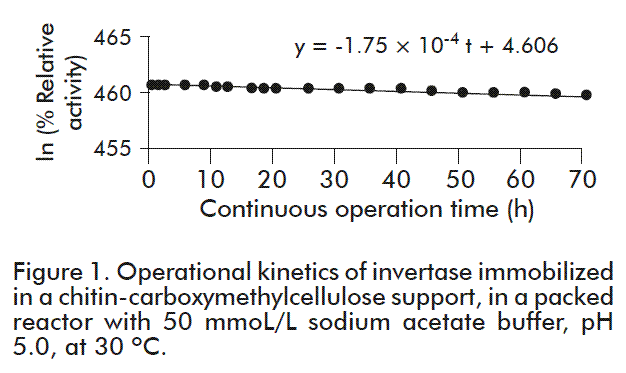
<body><![CDATA[<P   ><font face="Verdana, Arial, Helvetica, sans-serif" size="2">The price of the      INV-QSA:Chit-CMC biocatalyst was estimated assuming the 80 % cost of raw materials      as established by Fern&aacute;ndez <I>et al</I>. [9], in addition to other      costs (equipment, power, water, labor workforce salary, maintenance of facilities      and depreciation). The costs for the acquisition of raw materials were based      on criteria from the Import Division of the Ministry of Higher Education of      Cuba [10]. Revenues were set as 10 %. </font></P >       <P   ><font face="Verdana, Arial, Helvetica, sans-serif" size="2">Biocatalyst half-life      and periods corresponding to conversion intervals were calculated from the      mathematic processing of the equation ruling the operation kinetics of invertase      immobilized onto the chitin-car-boxymethylcellulose support (<a href="/img/revistas/bta/v34n4/f10104417.gif">Figure      1</a>). </font></P >       
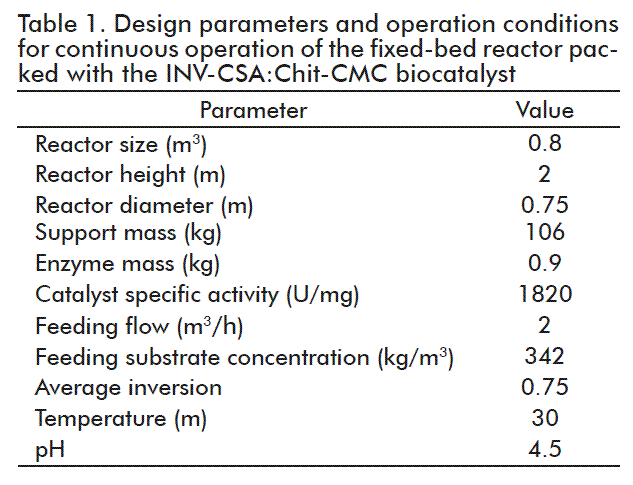
<P   ><font face="Verdana, Arial, Helvetica, sans-serif" size="2">Design parameters      and operation conditions are described in <a href="/img/revistas/bta/v34n4/t10104417.gif">table 1</a>,      and the operational process flow chart in <a href="/img/revistas/bta/v34n4/f20104417.gif">figure 2A</a>      shows the operating process for the biocatalytic reactor during the industrial      process producing glucose and fructose syrup. </font></P >       
<P   ><font face="Verdana, Arial, Helvetica, sans-serif" size="2"><b>Technological      process for production of glucose and fructose syrup by acid hydrolysis </b></font></P >       <P   ><font face="Verdana, Arial, Helvetica, sans-serif" size="2">The acid hydrolysis      process to obtain glucose and fructose syrup is composed of seven steps (<a href="/img/revistas/bta/v34n4/f20104417.gif">Figure      2B</a>). At start, refined sugar is dissolved into a dissolver tank provided      with mechanical air stirring and steam heating, in which inversion is further      done by adding phosphoric acid under operational control until finished. The      inverted solution is further pumped into the cooling crystallizer for the      first crystallization up to a capacity of 90 %, where cooling by air bubbling      takes place. When temperature reaches 35 &ordm;C, the solution is pumped into      the operational crystallizers where they get seeded by a specific seeding      material on each one. When the mass becomes exhausted (15-20), it is purged      through a filter press, generating the fructose enriched syrup which is pumped      into the storage tank. </font></P >       
<P   ><font face="Verdana, Arial, Helvetica, sans-serif" size="2">Glucose cakes are      dissolved into the dissolver tank and then they are pumped into the cooling      crystallizer for the second crystallization process. This time the solution      is cooled by air bubbling and, after reaching 40 &ordm;C, it is pumped into      the operational crystallizers for specific seeding. Then, when the mass is      exhausted after seven days, it is purged by discontinuous centrifugation.      The mother liquor corresponding to glucose-rich syrup is returned to the first      crystallizer. </font></P >       <P   ><font face="Verdana, Arial, Helvetica, sans-serif" size="2">Glucose obtained      is then packed, weighed and stored at dry and fresh conditions. </font></P >       <P   ><font face="Verdana, Arial, Helvetica, sans-serif" size="2">Comparatively, the      acid hydrolysis process requires a dissolver with agitation and a pump, while      the enzymatic hydrolysis process includes an additional dissolver with agitation      and the enzyme-containing column<FONT color="#40AC47">. </font></font></P >   <FONT color="#40AC47"><FONT color="#211E1F">        <P   ><font face="Verdana, Arial, Helvetica, sans-serif" size="2"><b>Preliminary economic      estimation </b></font></P >       <P   ><font face="Verdana, Arial, Helvetica, sans-serif" size="2">The economic evaluation      was done in two steps, the fist evaluating the feasibility of the base case      and the second estimating the economic impact of the time for enzyme replacement.      </font></P >       ]]></body>
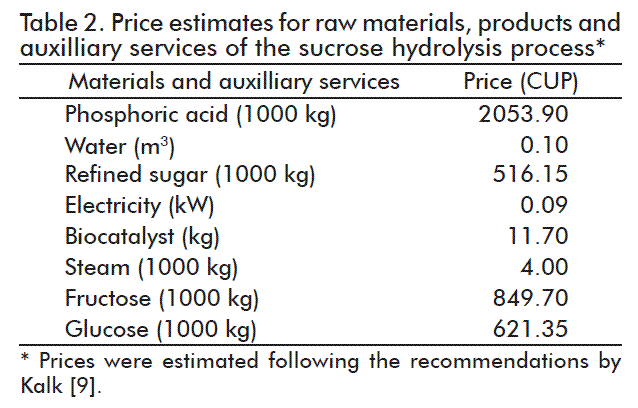
<body><![CDATA[<P   ><font face="Verdana, Arial, Helvetica, sans-serif" size="2">Premises were: </font></P >       <P   ><font face="Verdana, Arial, Helvetica, sans-serif" size="2">1. A working year      was assumed of 170 days, corresponding to the half-life of the biocatalyzer      (enzymatic glucose). During the operation of the enzymatic reactor in the      traditional acid hydrolysis (acid glucose) process, it is operated for 85      production cycles at the top capacity of the plant (15 cycles per month).      </font></P >       <P   ><font face="Verdana, Arial, Helvetica, sans-serif" size="2">2. The sucrose hydrolysis      step was the only one considered. </font></P >       <P   ><font face="Verdana, Arial, Helvetica, sans-serif" size="2">The estimates for      raw materials, products and auxiliary services of the sucrose hydrolysis process      and the marketing prices corresponding to those established at the acid glucose      plant are listed in <a href="/img/revistas/bta/v34n4/t20104417.gif">table 2</a>. </font></P >       
<P   ><font face="Verdana, Arial, Helvetica, sans-serif" size="2">The preliminary economic      feasibility of the process was analyzed following the indicators recommended      by Peter and Timmerhaus [11]. </font></P >       <P   ><font face="Verdana, Arial, Helvetica, sans-serif" size="2">Amortized costs were      estimated for the acid hydrolysis following the parameters proposed by Turton      and Bailie [12], and data for the enzymatic reactor was used as defined by      the reactor design. Production volume and production value in both processes      are determined considering glucose and glucose syrup production.</font></P >       <P   >&nbsp;</P >       <P   > </P >       <P   ><font size="3"><b><font face="Verdana, Arial, Helvetica, sans-serif">RESULTS      AND DISCUSSION </font></b></font></P >       <P   ><font face="Verdana, Arial, Helvetica, sans-serif" size="2">The preliminary economic      estimation of using the INV-QSA:Chit-CMC during the enzymatic hydrolysis of      sucrose considered only the inversion step. In fact, it is proposed to replace      acid hydrolysis by the enzymatic hydrolysis. Regarding the equipment, the      discontinuous reactor used in the acid hydrolysis is substituted by a fixed-bed      reactor packed with the INV-QSA:Chit-CMC biocatalyst, this last supporting      the continuous operation. The projection followed the design proposed by Mart&iacute;nez      [13] for a reactor using immobilized invertase as fixed-bed. </font></P >       ]]></body>
<body><![CDATA[<P   ><font face="Verdana, Arial, Helvetica, sans-serif" size="2">As shown in <a href="/img/revistas/bta/v34n4/t30104417.gif">table      3</a>, the production cost of enzymatic glucose exceeds in 33 % the value      for the traditional acid hydrolysis process, reaching 1 528 390.06 CUP (Cuban      peso). This is caused mainly by the increased volume of sucrose being processed,      with a higher consumption of raw materials, the use of two dissolvers and      a higher power demand for the process, together with increased salary costs.      Nevertheless, the entire value of the product obtained is 2.4 fold the value      of the acid glucose product, despite the increased cost of the enzymatic glucose      process, also derived from the continuous production regime that generates      a higher production volume in a given time unit. The operational/monetary      unit (CUP) balance is less than 1.0 for both processes, being lower for the      enzymatic hydrolysis (0.51) as compared to the acid hydrolysis (0.82), and      derived from the increased production volume. </font></P >       
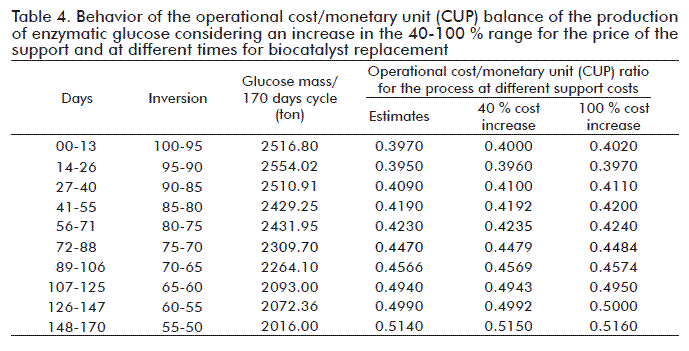
<P   ><font face="Verdana, Arial, Helvetica, sans-serif" size="2">In a second step,      there was analyzed the influence of two other factors on the operational cost/monetary      unit (CUP) balance: enzyme turnover and support increased costs. The analysis      was carried out foreseeing errors when estimating the cost of the support,      assuming increase values in the range 40-100 % (<a href="/img/revistas/bta/v34n4/t40104417.gif">Table      4</a>). An operation cycle comprised 170 days corresponding to an operating      year, with time intervals in days corresponding to changes for conversion      over time. As demonstrated by values obtained (<a href="/img/revistas/bta/v34n4/t40104417.gif">Table      4</a>), there was seen a tendency for the production to decrease on day 13      of operation, while increasing the operational cost/monetary unit (CUP) balance.      Additionally, there were two options for improving yields, leading the operation      to proceed until days 26 or 40. This provides valuable information as to when      it is more feasible to change the biocatalyst used as fixed-bed, from the      economic and technical points of views. </font></P >       
<P   ><font face="Verdana, Arial, Helvetica, sans-serif" size="2">In fact, the lowest      estimation of the operational cost/monetary unit (CUP) balance is attained      at day 26, providing the highest amount of glucose produced in the entire      170-days period, with a conversion yield equivalent to that of the acid hydrolysis      of sucrose. Nevertheless, the process operating for 26 days would require      more stops to replace the exhausted biocatalyst than leaving the process to      continue until day 40. At this time, the operational cost/monetary unit (CUP)      balance and conversion yield are similar to that on day 26 and it is not detrimental      for the subsequent steps of the process for glucose production. </font></P >       <P   ><font face="Verdana, Arial, Helvetica, sans-serif" size="2">The other options      can be considered according to the conditions and the availability of the      support, or attending to the properties and quality of the final product required      at the end of the hydrolysis. Noteworthy, the cost of the support does not      put at risk the application of the enzymatic hydrolysis, since the operational      cost/monetary unit (CUP) balance is still lower than that of the acid hydrolysis      even doubling the price of the support, for all the analyzed combinations.      </font></P >       <P   ><font face="Verdana, Arial, Helvetica, sans-serif" size="2">In summary, the preliminary      economic analysis evidences the feasibility of the proposed enzymatic conversion      process proposed, which is superior in both its technical and economic aspects      to the acid hydrolysis process for sucrose conversion. This also validates      the introduction of the INV-QSA:Chit-CMC biocatalyst as part of an industrial      scale process.</font></P >       <P   >&nbsp;</P >       <P   > </P >       <P   ><font size="3"><b><font face="Verdana, Arial, Helvetica, sans-serif">ACKNOWLEDGEMENTS</font></b></font><font face="Verdana, Arial, Helvetica, sans-serif" size="2">      </font></P >       <P   ><font face="Verdana, Arial, Helvetica, sans-serif" size="2">The authors thank      to Eng. Jorge Luis C&aacute;rdenas Morales, who is the Technical Director      of the Basic Industrial Unit (UEB) Refinery &ldquo;Chiquitico Fabregat&rdquo;,      in Villa Clara, Cuba, for providing the data for the economic estimations.</font></P >       <P   >&nbsp;</P >       ]]></body>
<body><![CDATA[<P   ><font face="Verdana, Arial, Helvetica, sans-serif" size="3"><b>REFERENCES </b></font></P >       <P   > </P >   <FONT size="+1" color="#000000">        <!-- ref --><P   ><font size="2" color="#211E1F" face="Verdana, Arial, Helvetica, sans-serif">1.      Datta S, Christena R, Rani Y, Rajaram S. Enzyme immobilization: an overview      on techniques and support materials. 3Biotech. 2013;3(1):1-9.     </font></P >   <FONT size="+1" color="#211E1F">        <!-- ref --><P   ><font face="Verdana, Arial, Helvetica, sans-serif" size="2">2. Bolivar JM, Eisl      I, Nidetzky B. Advanced characterization of immobilized enzymes as heterogeneous      biocatalysts. Catalysis Today. 2015;259:66-80.     </font></P >       <!-- ref --><P   ><font face="Verdana, Arial, Helvetica, sans-serif" size="2">3. Carvalho F, Paradiso      P, Saramago B, Ferraria AM, Botelho do Rego AM, Fernandes P. An integrated      approach for the detailed characterization of an immobilized enzyme. J Mol      Catal B: Enzymatic. 2016;125:64-74.     </font></P >       <!-- ref --><P   ><font face="Verdana, Arial, Helvetica, sans-serif" size="2">4. Aguilera J, Est&eacute;vez      C. La Biotecnolog&iacute;a Industrial: una realidad hoy, una necesidad ma&ntilde;ana.      Biotech Magazine. Publicaciones M K M. 2014 [cited: 2014 May]. Available from:      <A href="http://www.mkm-pi.com/biotech/la-biotecnologia-industrial-una-realidad-hoy-una-necesidad-ma&Atilde;&plusmn;ana/" target="_blank">      <FONT color="#0000FF">http://www.mkm-pi.com/biotech/la-biotecnologia-industrial-una-realidad-hoy-una-necesidad-ma&ntilde;ana/</font></A>      </font></P >   <FONT color="#0000FF">        <!-- ref --><P   ><font color="#211E1F" face="Verdana, Arial, Helvetica, sans-serif" size="2">5.      Patel AK, Singhania, RR, Pandey A. Novel enzymatic processes applied to the      food industry. Curr Op Food Sci. 2016;7:64-72.     </font></P >   <FONT color="#211E1F">        <!-- ref --><P   ><font face="Verdana, Arial, Helvetica, sans-serif" size="2">6. Duarte E. Siropes      invertidos. Pasado y presente. Revista ATAC. 1997:47.     </font></P >       <P   ><font face="Verdana, Arial, Helvetica, sans-serif" size="2">7. Albertini A, Cadena      P, Silva J, Nascimento G, Reis A, Freire V, et al. Performance of invertase      immobilized on glass&ndash;ceramic supports in batch bioreactor. Chem Eng      J. 2012;187:341-50. </font></P >       <!-- ref --><P   ><font face="Verdana, Arial, Helvetica, sans-serif" size="2">8. G&oacute;mez L,      Ram&iacute;rez HL, Villalonga R. Immobilization of chitosan-invertase neoglycoconjugate      on carboxymethylcellulose-modified chitin. Prep Biochem Biotechnol. 2006;36:259-71.          </font></P >       <!-- ref --><P   ><font face="Verdana, Arial, Helvetica, sans-serif" size="2">9. Fern&aacute;ndez      E, Gonzales G, Mayo O. Ingenier&iacute;a econ&oacute;mica para ingenieros      qu&iacute;micos. La Habana: Facultad de Ingenier&iacute;a Qu&iacute;mica,      CUJAE; 2002.     </font></P >       <!-- ref --><P   ><font face="Verdana, Arial, Helvetica, sans-serif" size="2">10. AZCUBA. Contrato      marco de suministros, noviembre de 2014. Matanzas: Azcuba; 2014.     </font></P >       ]]></body>
<body><![CDATA[<P   ><font face="Verdana, Arial, Helvetica, sans-serif" size="2">11. Peters MS, Timmerhaus      KD. Plant design and economics for chemical engineers. 4th Ed. Singapore:      McGraw- Hill; 1991. </font></P >       <!-- ref --><P   ><font face="Verdana, Arial, Helvetica, sans-serif" size="2">12. Turton R, Bailie      WB. Analysis, synthesis and design of chemical processes. New York: Prentice      Hall; 2009.     </font></P >       <!-- ref --><P   ><font face="Verdana, Arial, Helvetica, sans-serif" size="2">13. Mart&iacute;nez      CL. Tesis en opci&oacute;n al t&iacute;tulo de Ingeniero Qu&iacute;mico. Matanzas:      Universidad de Matanzas; 2014.     </font></P >       <P   >&nbsp;</P >       <P   >&nbsp;</P >       <P   > </P >   <FONT size="+1">       <P   > </P >       <P   ><i><font face="Verdana, Arial, Helvetica, sans-serif" size="2">Received in May,      2017.    ]]></body>
<body><![CDATA[<br>     Accepted in October, 2017.</font></i></P >       <P   >&nbsp;</P >       <P   >&nbsp;</P >       <P   ><font size="2" face="Verdana, Arial, Helvetica, sans-serif"><i>Leissy G&oacute;mez-Brizuela</i>.      Centro de Estudios Biotecnol&oacute;gicos, Universidad de Matanzas. Carretera      a Varadero Km 31/2, Matanzas, Cuba. E-mail: <A href="mailto:gpescuela.mtz@infomed.sld.cu">      <FONT color="#0000FF">gpescuela.mtz@infomed.sld.cu</font></A><FONT color="#0000FF"><FONT color="#211E1F">.      </font></font></font></P >   </font></font></font></font></font></font></font></font></font></font></font></font></font></font></font></font></font></font></font></font></font></font></font></font></font></font></font></font></font></font></font></font></font></font></DIV >      ]]></body><back>
<ref-list>
<ref id="B1">
<label>1</label><nlm-citation citation-type="journal">
<person-group person-group-type="author">
<name>
<surname><![CDATA[Datta]]></surname>
<given-names><![CDATA[S]]></given-names>
</name>
<name>
<surname><![CDATA[Christena]]></surname>
<given-names><![CDATA[R]]></given-names>
</name>
<name>
<surname><![CDATA[Rani]]></surname>
<given-names><![CDATA[Y]]></given-names>
</name>
<name>
<surname><![CDATA[Rajaram]]></surname>
<given-names><![CDATA[S]]></given-names>
</name>
</person-group>
<article-title xml:lang="en"><![CDATA[en]]></article-title>
<source><![CDATA[Enzyme immobilization: an overview on techniques and support materials. 3Biotech]]></source>
<year>2013</year>
<volume>3</volume>
<numero>1</numero>
<issue>1</issue>
<page-range>1-9</page-range></nlm-citation>
</ref>
<ref id="B2">
<label>2</label><nlm-citation citation-type="journal">
<person-group person-group-type="author">
<name>
<surname><![CDATA[Bolivar]]></surname>
<given-names><![CDATA[JM]]></given-names>
</name>
<name>
<surname><![CDATA[Eisl]]></surname>
<given-names><![CDATA[I]]></given-names>
</name>
<name>
<surname><![CDATA[Nidetzky]]></surname>
<given-names><![CDATA[B]]></given-names>
</name>
</person-group>
<article-title xml:lang="en"><![CDATA[Advanced characterization of immobilized enzymes as heterogeneous biocatalysts]]></article-title>
<source><![CDATA[Catalysis Today]]></source>
<year>2015</year>
<volume>259</volume>
<page-range>66-80</page-range></nlm-citation>
</ref>
<ref id="B3">
<label>3</label><nlm-citation citation-type="journal">
<person-group person-group-type="author">
<name>
<surname><![CDATA[Carvalho]]></surname>
<given-names><![CDATA[F]]></given-names>
</name>
<name>
<surname><![CDATA[Paradiso]]></surname>
<given-names><![CDATA[P]]></given-names>
</name>
<name>
<surname><![CDATA[Saramago]]></surname>
<given-names><![CDATA[B]]></given-names>
</name>
<name>
<surname><![CDATA[Ferraria]]></surname>
<given-names><![CDATA[AM]]></given-names>
</name>
<name>
<surname><![CDATA[Botelho do Rego]]></surname>
<given-names><![CDATA[AM]]></given-names>
</name>
<name>
<surname><![CDATA[Fernandes]]></surname>
<given-names><![CDATA[P]]></given-names>
</name>
</person-group>
<article-title xml:lang="en"><![CDATA[An integrated approach for the detailed characterization of an immobilized enzyme]]></article-title>
<source><![CDATA[J Mol Catal B: Enzymatic]]></source>
<year>2016</year>
<volume>125</volume>
<page-range>64-74</page-range></nlm-citation>
</ref>
<ref id="B4">
<label>4</label><nlm-citation citation-type="journal">
<person-group person-group-type="author">
<name>
<surname><![CDATA[Aguilera]]></surname>
<given-names><![CDATA[J]]></given-names>
</name>
<name>
<surname><![CDATA[Estévez]]></surname>
<given-names><![CDATA[C]]></given-names>
</name>
</person-group>
<article-title xml:lang="es"><![CDATA[La Biotecnología Industrial: una realidad hoy, una necesidad mañana]]></article-title>
<source><![CDATA[Biotech Magazine. Publicaciones M K M]]></source>
<year>2014</year>
</nlm-citation>
</ref>
<ref id="B5">
<label>5</label><nlm-citation citation-type="journal">
<person-group person-group-type="author">
<name>
<surname><![CDATA[Patel]]></surname>
<given-names><![CDATA[AK]]></given-names>
</name>
<name>
<surname><![CDATA[Singhania]]></surname>
<given-names><![CDATA[RR]]></given-names>
</name>
<name>
<surname><![CDATA[Pandey]]></surname>
<given-names><![CDATA[A]]></given-names>
</name>
</person-group>
<article-title xml:lang="en"><![CDATA[Novel enzymatic processes applied to the food industry]]></article-title>
<source><![CDATA[Curr Op Food Sci]]></source>
<year>2016</year>
<volume>7</volume>
<page-range>64-72</page-range></nlm-citation>
</ref>
<ref id="B6">
<label>6</label><nlm-citation citation-type="journal">
<person-group person-group-type="author">
<name>
<surname><![CDATA[Duarte]]></surname>
<given-names><![CDATA[E]]></given-names>
</name>
</person-group>
<article-title xml:lang="es"><![CDATA[Siropes invertidos. Pasado y presente]]></article-title>
<source><![CDATA[Revista ATAC]]></source>
<year>1997</year>
<page-range>47</page-range></nlm-citation>
</ref>
<ref id="B7">
<label>7</label><nlm-citation citation-type="journal">
<person-group person-group-type="author">
<name>
<surname><![CDATA[Albertini]]></surname>
<given-names><![CDATA[A]]></given-names>
</name>
<name>
<surname><![CDATA[Cadena]]></surname>
<given-names><![CDATA[P]]></given-names>
</name>
<name>
<surname><![CDATA[Silva]]></surname>
<given-names><![CDATA[J]]></given-names>
</name>
<name>
<surname><![CDATA[Nascimento]]></surname>
<given-names><![CDATA[G]]></given-names>
</name>
<name>
<surname><![CDATA[Reis]]></surname>
<given-names><![CDATA[A]]></given-names>
</name>
<name>
<surname><![CDATA[Freire]]></surname>
<given-names><![CDATA[V]]></given-names>
</name>
</person-group>
<article-title xml:lang="en"><![CDATA[Performance of invertase immobilized on glass-ceramic supports in batch bioreactor]]></article-title>
<source><![CDATA[Chem Eng J]]></source>
<year>2012</year>
<volume>187</volume>
<page-range>341-50</page-range></nlm-citation>
</ref>
<ref id="B8">
<label>8</label><nlm-citation citation-type="journal">
<person-group person-group-type="author">
<name>
<surname><![CDATA[Gómez]]></surname>
<given-names><![CDATA[L]]></given-names>
</name>
<name>
<surname><![CDATA[Ramírez]]></surname>
<given-names><![CDATA[HL]]></given-names>
</name>
<name>
<surname><![CDATA[Villalonga]]></surname>
<given-names><![CDATA[R]]></given-names>
</name>
</person-group>
<article-title xml:lang="en"><![CDATA[Immobilization of chitosan-invertase neoglycoconjugate on carboxymethylcellulose-modified chitin]]></article-title>
<source><![CDATA[Prep Biochem Biotechnol]]></source>
<year>2006</year>
<volume>36</volume>
<page-range>259-71</page-range></nlm-citation>
</ref>
<ref id="B9">
<label>9</label><nlm-citation citation-type="book">
<person-group person-group-type="author">
<name>
<surname><![CDATA[Fernández]]></surname>
<given-names><![CDATA[E]]></given-names>
</name>
<name>
<surname><![CDATA[Gonzales]]></surname>
<given-names><![CDATA[G]]></given-names>
</name>
<name>
<surname><![CDATA[Mayo]]></surname>
<given-names><![CDATA[O]]></given-names>
</name>
</person-group>
<source><![CDATA[Ingeniería económica para ingenieros químicos]]></source>
<year>2002</year>
<publisher-loc><![CDATA[La Habana ]]></publisher-loc>
<publisher-name><![CDATA[Facultad de Ingeniería Química, CUJAE]]></publisher-name>
</nlm-citation>
</ref>
<ref id="B10">
<label>10</label><nlm-citation citation-type="book">
<collab>AZCUBA</collab>
<source><![CDATA[Contrato marco de suministros, noviembre de 2014]]></source>
<year>2014</year>
<publisher-loc><![CDATA[Matanzas ]]></publisher-loc>
<publisher-name><![CDATA[Azcuba]]></publisher-name>
</nlm-citation>
</ref>
<ref id="B11">
<label>11</label><nlm-citation citation-type="book">
<person-group person-group-type="author">
<name>
<surname><![CDATA[Peters]]></surname>
<given-names><![CDATA[MS]]></given-names>
</name>
<name>
<surname><![CDATA[Timmerhaus]]></surname>
<given-names><![CDATA[KD]]></given-names>
</name>
</person-group>
<source><![CDATA[Plant design and economics for chemical engineers]]></source>
<year>1991</year>
<edition>4</edition>
<publisher-loc><![CDATA[Singapore ]]></publisher-loc>
<publisher-name><![CDATA[McGraw-Hill]]></publisher-name>
</nlm-citation>
</ref>
<ref id="B12">
<label>12</label><nlm-citation citation-type="book">
<person-group person-group-type="author">
<name>
<surname><![CDATA[Turton]]></surname>
<given-names><![CDATA[R]]></given-names>
</name>
<name>
<surname><![CDATA[Bailie]]></surname>
<given-names><![CDATA[WB]]></given-names>
</name>
</person-group>
<source><![CDATA[Analysis, synthesis and design of chemical processes]]></source>
<year>2009</year>
<publisher-loc><![CDATA[New York ]]></publisher-loc>
<publisher-name><![CDATA[Prentice Hall]]></publisher-name>
</nlm-citation>
</ref>
<ref id="B13">
<label>13</label><nlm-citation citation-type="book">
<person-group person-group-type="author">
<name>
<surname><![CDATA[Martínez]]></surname>
<given-names><![CDATA[CL]]></given-names>
</name>
</person-group>
<source><![CDATA[Tesis en opción al título de Ingeniero Químico]]></source>
<year>2014</year>
<publisher-loc><![CDATA[Matanzas ]]></publisher-loc>
<publisher-name><![CDATA[Universidad de Matanzas]]></publisher-name>
</nlm-citation>
</ref>
</ref-list>
</back>
</article>