<?xml version="1.0" encoding="ISO-8859-1"?><article xmlns:mml="http://www.w3.org/1998/Math/MathML" xmlns:xlink="http://www.w3.org/1999/xlink" xmlns:xsi="http://www.w3.org/2001/XMLSchema-instance">
<front>
<journal-meta>
<journal-id>1027-2852</journal-id>
<journal-title><![CDATA[Biotecnología Aplicada]]></journal-title>
<abbrev-journal-title><![CDATA[Biotecnol Apl]]></abbrev-journal-title>
<issn>1027-2852</issn>
<publisher>
<publisher-name><![CDATA[Editorial Elfos Scientiae]]></publisher-name>
</publisher>
</journal-meta>
<article-meta>
<article-id>S1027-28522018000300005</article-id>
<title-group>
<article-title xml:lang="en"><![CDATA[Evaluation of the immunomodulatory activity of bioproducts obtained from the edible-medicinal mushroom Pleurotus ostreatus]]></article-title>
<article-title xml:lang="es"><![CDATA[Evaluación de la actividad inmunomoduladora de bioproductos obtenidos de la seta comestible-medicinal Pleurotus ostreatus]]></article-title>
</title-group>
<contrib-group>
<contrib contrib-type="author">
<name>
<surname><![CDATA[Morris-Quevedo]]></surname>
<given-names><![CDATA[Humberto J]]></given-names>
</name>
<xref ref-type="aff" rid="A01"/>
</contrib>
<contrib contrib-type="author">
<name>
<surname><![CDATA[Llauradó-Maury]]></surname>
<given-names><![CDATA[Gabriel]]></given-names>
</name>
<xref ref-type="aff" rid="A01"/>
</contrib>
<contrib contrib-type="author">
<name>
<surname><![CDATA[Bermúdez-Savón]]></surname>
<given-names><![CDATA[Rosa C]]></given-names>
</name>
<xref ref-type="aff" rid="A01"/>
</contrib>
<contrib contrib-type="author">
<name>
<surname><![CDATA[Cos]]></surname>
<given-names><![CDATA[Paul]]></given-names>
</name>
<xref ref-type="aff" rid="A02"/>
</contrib>
<contrib contrib-type="author">
<name>
<surname><![CDATA[Lebeque-Pérez]]></surname>
<given-names><![CDATA[Yamila]]></given-names>
</name>
<xref ref-type="aff" rid="A01"/>
</contrib>
<contrib contrib-type="author">
<name>
<surname><![CDATA[Beltrán-Delgado]]></surname>
<given-names><![CDATA[Yaixa]]></given-names>
</name>
<xref ref-type="aff" rid="A01"/>
</contrib>
<contrib contrib-type="author">
<name>
<surname><![CDATA[Tamayo-Ortega]]></surname>
<given-names><![CDATA[Vivian]]></given-names>
</name>
<xref ref-type="aff" rid="A03"/>
</contrib>
<contrib contrib-type="author">
<name>
<surname><![CDATA[Fong-Lores]]></surname>
<given-names><![CDATA[Onel]]></given-names>
</name>
<xref ref-type="aff" rid="A04"/>
</contrib>
<contrib contrib-type="author">
<name>
<surname><![CDATA[Marcos-Albear]]></surname>
<given-names><![CDATA[Jane]]></given-names>
</name>
<xref ref-type="aff" rid="A04"/>
</contrib>
<contrib contrib-type="author">
<name>
<surname><![CDATA[Gaime-Perraud]]></surname>
<given-names><![CDATA[Isabelle]]></given-names>
</name>
<xref ref-type="aff" rid="A05"/>
</contrib>
</contrib-group>
<aff id="A02">
<institution><![CDATA[,University of Amberes Faculty of Pharmaceutical, Biomedical and Veterinary Sciences Laboratory of Microbiología, Parasitology and Hygiene (LMPH)]]></institution>
<addr-line><![CDATA[ ]]></addr-line>
<country>Belgium</country>
</aff>
<aff id="A03">
<institution><![CDATA[,Hospital Oncológico Provincial Conrado Benítez  ]]></institution>
<addr-line><![CDATA[Santiago de Cuba ]]></addr-line>
<country>Cuba</country>
</aff>
<aff id="A04">
<institution><![CDATA[,Centro de Toxicología y Biomedicina (TOXIMED)  ]]></institution>
<addr-line><![CDATA[Santiago de Cuba ]]></addr-line>
<country>Cuba</country>
</aff>
<aff id="A05">
<institution><![CDATA[,Instituto de Investigaciones para el Desarrollo (IRD) Instituto Mediterráneo de Biodiversidad y Ecología Marina y Continental (IMBE) ]]></institution>
<addr-line><![CDATA[ ]]></addr-line>
<country>Francia</country>
</aff>
<aff id="A01">
<institution><![CDATA[,Universidad de Oriente Facultad de Ciencias Naturales y Exactas Centro de Estudios de Biotecnología Industrial]]></institution>
<addr-line><![CDATA[Santiago de Cuba ]]></addr-line>
<country>Cuba</country>
</aff>
<pub-date pub-type="pub">
<day>00</day>
<month>09</month>
<year>2018</year>
</pub-date>
<pub-date pub-type="epub">
<day>00</day>
<month>09</month>
<year>2018</year>
</pub-date>
<volume>35</volume>
<numero>3</numero>
<fpage>3511</fpage>
<lpage>3514</lpage>
<copyright-statement/>
<copyright-year/>
<self-uri xlink:href="http://scielo.sld.cu/scielo.php?script=sci_arttext&amp;pid=S1027-28522018000300005&amp;lng=en&amp;nrm=iso"></self-uri><self-uri xlink:href="http://scielo.sld.cu/scielo.php?script=sci_abstract&amp;pid=S1027-28522018000300005&amp;lng=en&amp;nrm=iso"></self-uri><self-uri xlink:href="http://scielo.sld.cu/scielo.php?script=sci_pdf&amp;pid=S1027-28522018000300005&amp;lng=en&amp;nrm=iso"></self-uri><kwd-group>
<kwd lng="en"><![CDATA[Pleurotus ostreatus]]></kwd>
<kwd lng="en"><![CDATA[mycelium]]></kwd>
<kwd lng="en"><![CDATA[fruting bodies]]></kwd>
<kwd lng="en"><![CDATA[NutriSetas®]]></kwd>
<kwd lng="en"><![CDATA[immunomodulation]]></kwd>
<kwd lng="en"><![CDATA[immunonutrition]]></kwd>
<kwd lng="en"><![CDATA[immunodeficiencies]]></kwd>
<kwd lng="es"><![CDATA[Pleurotus ostreatus]]></kwd>
<kwd lng="es"><![CDATA[micelio]]></kwd>
<kwd lng="es"><![CDATA[cuerpos fructíferos]]></kwd>
<kwd lng="es"><![CDATA[NutriSetas®]]></kwd>
<kwd lng="es"><![CDATA[immunomodulación]]></kwd>
<kwd lng="es"><![CDATA[immunonutrición]]></kwd>
<kwd lng="es"><![CDATA[immunodeficiencias]]></kwd>
</kwd-group>
</article-meta>
</front><body><![CDATA[ <DIV class="Part"   >        <P align="right"   ><font size="2" color="#000000" face="Verdana, Arial, Helvetica, sans-serif"><b>REPORT      </b></font></P >       <P align="right"   >&nbsp;</P >   <FONT size="+1" color="#000000">        <P   > </P >       <P   ><b><font size="4" face="Verdana, Arial, Helvetica, sans-serif">Evaluation of      the immunomodulatory activity of bioproducts obtained from the edible-medicinal      mushroom <I>Pleurotus ostreatus </I></font></b></P >       <P   >&nbsp;</P >       <P   > </P >   <FONT size="+1">        <P   ><font size="3" color="#211E1F" face="Verdana, Arial, Helvetica, sans-serif"><B>Evaluaci&oacute;n      de la actividad inmunomoduladora de bioproductos obtenidos de la seta comestible-medicinal      <I>Pleurotus ostreatus</I></b></font><font size="2" color="#211E1F" face="Verdana, Arial, Helvetica, sans-serif"><B>      </b></font></P >       <P   >&nbsp;</P >       <P   >&nbsp;</P >   <FONT size="+1" color="#211E1F">        ]]></body>
<body><![CDATA[<P   ></P >   <FONT size="+1" color="#000000">        <P   ><b><font size="2" face="Verdana, Arial, Helvetica, sans-serif">Humberto J Morris-Quevedo<sup>1</sup>,      Gabriel Llaurad&oacute;-Maury<sup>1</sup>, Rosa C Berm&uacute;dez-Sav&oacute;n<sup>1</sup>,      Paul Cos<sup>2</sup>, Yamila Lebeque-P&eacute;rez<sup>1</sup>, Yaixa Beltr&aacute;n-Delgado<sup>1</sup>,      Vivian Tamayo-Ortega<sup>3</sup>, Onel Fong-Lores<sup>4</sup>, Jane Marcos-Albear<sup>4</sup>,      Isabelle Gaime-Perraud<sup>5</sup> </font></b><font size="2" face="Verdana, Arial, Helvetica, sans-serif">      </font></P >       <P   ><font size="2" face="Verdana, Arial, Helvetica, sans-serif"><sup>1</sup> Centro      de Estudios de Biotecnolog&iacute;a Industrial, Facultad de Ciencias Naturales      y Exactas, Universidad de Oriente. Ave. Patricio Lumumba s/n, Santiago de      Cuba 5, CP 90500, Cuba.</font><font size="2" face="Verdana, Arial, Helvetica, sans-serif">    <br>     <sup>2</sup> Laboratory of Microbiolog&iacute;a, Parasitology and Hygiene      (LMPH), Faculty of Pharmaceutical, Biomedical and Veterinary Sciences, University      of Amberes, Belgium.</font><font size="2" face="Verdana, Arial, Helvetica, sans-serif">    <br>     <sup>3</sup> Hospital Oncol&oacute;gico Provincial Conrado Ben&iacute;tez,      Santiago de Cuba, Cuba.    <br>     <sup>4</sup> Centro de Toxicolog&iacute;a y Biomedicina (TOXIMED), Santiago      de Cuba, Cuba.    <br>     <sup>5</sup> Instituto Mediterr&aacute;neo de Biodiversidad y Ecolog&iacute;a      Marina y Continental (IMBE), Instituto de Investigaciones para el Desarrollo      (IRD), Marsella, Francia. </font></P >       <P   >&nbsp;</P >       <P   >&nbsp;</P >   </font></font></font></font>    <hr>   <FONT size="+1" color="#000000"><FONT size="+1"><FONT size="+1" color="#211E1F"><FONT size="+1" color="#000000">    <font size="2" face="Verdana, Arial, Helvetica, sans-serif"><b>ABSTRACT</b></font>       <P   ><font size="2" face="Verdana, Arial, Helvetica, sans-serif">Edible mushrooms      are an important source for obtaining novel substances of nutritional and      biopharmaceutical interest. In this regard, in Cuba, the consumption of mushrooms      of the genus <i>Pleurotus</i> spp. has been promoted as part of the Urban      Agriculture Program. Taking advantage of its availability and considering      previous reports on their content of compounds with potential application,      in this work, there was investigated the immunomodulatory and immunonutrition      properties of biopreparations from this mushroom. New methodologies were developed      to generate biopreparations from the mycelium and fruiting bodies of <i>Pleurotus      ostreatus</i>. The obtained bioproducts were generated by biomass aqueous      extraction and/or drying, which led to the registration of the NutriSetas&reg;      tradename. The bioproducts contained mainly carbohydrates (including &szlig;-glucans)      and proteins, among other secondary metabolites with potential biological      activity. They showed M1-polarizing effects on macrophage populations, and      the aqueous fraction obtained from the mycelium by submerged fermentation      was able to stimulate the complement system alternative pathway. Noteworthy,      the aqueous extract displayed radioprotective effects on the hematopoietic      and immunological parameters when administered in a mice biomodel of ionizing      radiation-induced secondary immunodeficiency. Similar immunostimulatory effects,      either in the humoral or cellular immune responses, were found with dry and      powdered preparations from fruiting bodies. Their immunonutritional effect      in an experimental model of protein-energetic malnutrition in Balb/c mice      evidenced nutritional recovery and immunological improvement status. This      provided the first report of such an effect for edible mushroom preparations.      This work received the Annual Award of the Cuban Academy of Sciences for the      year 2017.</font></P >       ]]></body>
<body><![CDATA[<P   ><font size="2" face="Verdana, Arial, Helvetica, sans-serif"><b><i>Keywords:</i></b>      <i>Pleurotus ostreatus</i>, mycelium, fruting bodies, NutriSetas&reg;, immunomodulation,      immunonutrition, immunodeficiencies.</font></P >   </font></font></font></font> <hr>   <FONT size="+1" color="#000000"><FONT size="+1"><FONT size="+1" color="#211E1F"><FONT size="+1" color="#000000">        <P   ><font face="Verdana, Arial, Helvetica, sans-serif" size="2"><b>RESUMEN</b></font></P >       <P   ><font face="Verdana, Arial, Helvetica, sans-serif" size="2">Los hongos comestibles      son una fuente importante para la obtenci&oacute;n de nuevas sustancias de      inter&eacute;s nutricional y biofarmac&eacute;utico. En Cuba se ha promovido      el consumo de hongos del g&eacute;nero <i>Pleurotus</i> spp. como parte del      Programa de Agricultura Urbana. En este trabajo se investig&oacute; las propiedades      inmunomoduladoras e inmunonutricionales de preparaciones de este hongo, dada      su disponibilidad y los informes previos sobre su contenido de compuestos      con potencial aplicaci&oacute;n para estos fines. Se establecieron nuevas      metodolog&iacute;as para obtener biopreparaciones a partir del micelio y de      los cuerpos fruct&iacute;feros de <i>Pleurotus</i> spp., mediante la extracci&oacute;n      acuosa de biomasa, el secado, o ambos, lo cual deriv&oacute; en el registro      de la marca comercial NutriSetas&reg;. Los bioproductos contuvieron principalmente      carbohidratos (incluidos los &szlig;-glucanos) y prote&iacute;nas, entre otros      metabolitos secundarios con actividad biol&oacute;gica potencial. Las preparaciones      tuvieron un efecto polarizador hacia fenotipo M1 en poblaciones de macr&oacute;fagos,      y la fracci&oacute;n acuosa obtenida del micelio mediante fermentaci&oacute;n      sumergida estimul&oacute; la ruta alternativa de activaci&oacute;n del sistema      del complemento. Notablemente, el extracto acuoso tuvo efecto radioprotector      en los par&aacute;metros hematopoy&eacute;ticos e inmunol&oacute;gicos al      administrarlo en biomodelos de inmunodeficiencia secundaria inducida por radiaci&oacute;n      ionizante en ratones. Las preparaciones secas y en polvo de cuerpos fruct&iacute;feros      fueron igualmente inmunoestimuladoras de la respuesta inmune humoral y celular.      Se evidenci&oacute; su efecto inmunonutricional en un modelo de malnutrici&oacute;n      proteica-energ&eacute;tica en ratones Balb/c. Este fue el primer informe de      tales efectos para preparaciones de hongos comestibles. Este trabajo mereci&oacute;      el Premio Anual de la Academia de Ciencias de Cuba para el a&ntilde;o 2017.</font></P >       <P   ><font face="Verdana, Arial, Helvetica, sans-serif" size="2"><i><b>Palabras clave:</b></i>      <i>Pleurotus ostreatus</i>, micelio, cuerpos fruct&iacute;feros, NutriSetas&reg;,      immunomodulaci&oacute;n, immunonutrici&oacute;n, immunodeficiencias.</font></P >   </font></font></font></font>   <hr>   <FONT size="+1" color="#000000"><FONT size="+1"><FONT size="+1" color="#211E1F"><FONT size="+1" color="#000000">       <P   >&nbsp;</P >   </font></font></font></font><FONT size="+1" color="#000000"><FONT size="+1"><FONT size="+1" color="#211E1F"><FONT size="+1" color="#000000">        <P   >&nbsp;</P >       <P   > </P >       <P   ><b><font size="3" face="Verdana, Arial, Helvetica, sans-serif">INTRODUCTION </font></b></P >       <P   ><font size="2" color="#211E1F" face="Verdana, Arial, Helvetica, sans-serif">Currently,      the prevalence of secondary or acquired immunodeficiency states represent      a healthcare problem worldwide [1]. Secondary immunodeficiencies are characterized      by the deterioration of one or several cellular or molecular components of      the system immunity, or both, thereby increasing the susceptibility of the      organism to infectious diseases and the development of cancer. Additionally,      cancer therapies including chemo- and radiotherapy, malnutrition, HIV-AIDS,      surgical procedures, severe burns, stress, among others, are the most frequent      causes of immunodeficiencies [1]. </font></P >   <FONT size="+1" color="#211E1F">        <P   ><font size="2" face="Verdana, Arial, Helvetica, sans-serif">For these reasons,      there is growing interest in the search for immunomodulators of natural origin,      devoid of severe side effects and with application in immunotherapy. In addition      to plants, mushrooms are attractive natural sources of compounds with pharmacological      potential as immunomodulators [2]. They have been part of the arsenal of traditional      medicine throughout the development of the human civilization. Moreover, during      the last decade, edible-medicinal mushrooms began to be used for obtaining      extracts and biomolecules through biotechnological procedures, bearing with      immunomodulatory and antitumor properties. Despite, the field is mostly unexplored,      since only 3 % of research on natural products reaching preclinical and clinical      phases comprises mushrooms as natural source. Therefore, the so-called &lsquo;mycotherapy&rsquo;      is still a promise [3]. </font></P >       ]]></body>
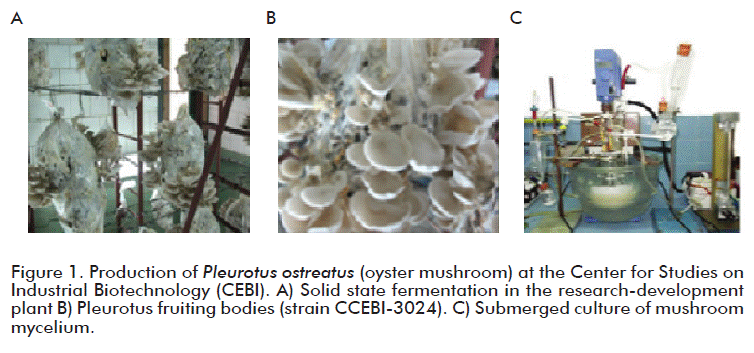
<body><![CDATA[<P   ><font size="2" face="Verdana, Arial, Helvetica, sans-serif">In this setting,      the <I>Pleurotus </I>genus (Pleurotaceae, Basidiomycota) is one of the most      frequent mushrooms sources used for identifying bioactive compounds of complementing      or stimulatory activity on the immune response [2, 4]. Those compounds comprise      substances of high molecular weight, mainly (1,3)-(1,6)-&beta;-glucan polysaccharides,      proteins, proteoglycans and polysaccharide-protein complexes, as well as different      secondary metabolites of low molecular weight. These substances modulate signaling      cascades involved in the immune responses, either innate (activation of natural      killer cells (NK), neutrophils, complement, monocyte-macrophage system) or      adaptive (stimulation of antibody production by B cells and the differentiation      of T helper cells in Th1 and Th2 profiles) [2, 4]. </font></P >       <P   ><font size="2" face="Verdana, Arial, Helvetica, sans-serif">In Cuba, the introduction,      production and consumption of mushrooms of the genus <I>Pleurotus </I>(fungus      oyster) have been promoted in several provinces as part of the National Program      of Urban Agriculture due to its high nutritional value [5]. One of the main      working strategies at the Center of Studies on Industrial Biotechnology, located      in the </font></P >       <P   ><font size="2" face="Verdana, Arial, Helvetica, sans-serif">eastern region of      the country, has been the development of projects devoted to <I>P. ostreatus      </I>cultivation and to obtain new products for nutritional, functional and      immunoceutic application. This mushroom has been produced by solid state fermentation      on agricultural residual substrates and by submerged culture of mushroom mycelium      [6] (<a href="/img/revistas/bta/v35n3/f0105318.gif">Figure 1</a>). </font></P >       
<P   ><font size="2" face="Verdana, Arial, Helvetica, sans-serif">Research advances      made in recent years on using <I>P. ostreatus </I>as source for medicinal      products indicate that there still several aspects remaining to be addressed      for the efficient implementation of current technologies. Particularly, the      extraction procedures, the establishment of precise characterization assays      to elucidate the mechanism of action of the extracted compounds and testing      for the possible synergy between some of the extracted bioactive compounds      need to get addressed. Noteworthy, the immunomodulatory action over the immune      system of the nutritional application of <I>P. ostreatus </I>also remained      uncovered [7]. Therefore, this work was aimed to evaluate the immunomodulatory      action of the <I>P. ostreatus </I>mushroom <I>in vitro </I>and in experimental      animal models of secondary immunodeficiencies. </font></P >       <P   >&nbsp;</P >       <P   > </P >   <FONT size="+1" color="#000000">        <P   ><font size="3"><b><font face="Verdana, Arial, Helvetica, sans-serif">MAIN RESULTS      </font></b></font></P >       <P   ><font size="2" color="#211E1F" face="Verdana, Arial, Helvetica, sans-serif">A      critical path was established with novel theoretical and practical approaches      as platform for evaluating the immunomodulatory profile of biopreparations      from the mycelium and fruiting bodies of <I>Pleurotus</I>. This allowed the      development of formulations enriched in bioactive metabolites with potential      applications in immunotherapy and immunonutrition: two preparations of fruiting      bodies, an aqueous extract named CW-E obtained at low temperatures, and a      dry and pulverized biomass as raw material for 500 mg tablets of a nutritional      supplement under development. Additionally, an aqueous extract of the mycelium      obtained at high temperatures, named Myc-E, was prepared. </font></P >   <FONT size="+1" color="#211E1F">        <P   ><font size="2" face="Verdana, Arial, Helvetica, sans-serif">These methodologies      were completely novel, aimed to obtain preparations from <I>Pleurotus </I>spp.      which showed immunoceutic activity, with no similar descriptions in the literature.      Their novelty allowed issuing a patent of invention and to the registration      of the trademark NutriSetas&reg; [8, 9]. The extraction procedure is conducted      under controlled conditions and is scalable and technically accomplishable.      The resulting immunoceutic preparation can be further fractionated for the      aim of increasing its specificity and homogeneity. Studies evaluating the      acute oral toxicity and repeated dose tests did not evidenced any alterations      in normal clinical signs and biochemical parameters when administered in animals      [10]. This indicated that the obtained products were safe and devoid of toxic      effects. </font></P >       <P   ><font size="2" face="Verdana, Arial, Helvetica, sans-serif">Afterwards, the products      were characterized for their main components as starting criteria for the      preclinical evaluation of their immunomodulatory properties. The biological      effects of mushrooms found while conducting this work are summarized in <a href="/img/revistas/bta/v35n3/f0206318.gif">figure      2</a>. </font></P >   <FONT size="+1" color="#000000">        
]]></body>
<body><![CDATA[<P   ><font size="2" color="#211E1F" face="Verdana, Arial, Helvetica, sans-serif">The      aqueous extracts of the mycelium and fruiting bodies, as well as the dry powder      preparation, were predominantly composed of carbohydrates (36- 70 %) and proteins      (15-30 %). The respective values were in the range described for edible and      medicinal mushrooms. The potential medicinal applications of the preparations      obtained was also supported by the presence in the composition of (1,3)-(1,6)-&beta;-glucan      polysaccharides, which are the ones providing most of the biological activity.      There were also identified secondary metabolites such as triterpenes, quinones      and flavonoids which could display immunomodulatory, antitumor and antioxidant      activities [5, 11, 12]. </font></P >   <FONT size="+1" color="#211E1F">        <P   ><font size="2" face="Verdana, Arial, Helvetica, sans-serif"><I>In vitro </I>characterizations      showed that the Myc-E mycelial extract assayed at 50-100 &mu;g/well in cell      culture plates displayed an activator effect on murine peritoneal macrophages.      This was evidenced by the increased glucose consumption (1.8-2.9-fold) by      cells when incubated with the extract and a higher lysosomal acid phosphatase      activity (133-184 %) as compared to untreated controls. The dose-dependent      effect evidenced in the increase of the enzymatic activity suggested the presence      of compounds capable of binding receptors on the surface of macrophage, such      as &beta;-glucans [13, 14]. Moreover, the expression of the inducible nitric      oxide synthase (iNOS) enzyme gene and the production of nitric oxide (ON)      were found increased in RAW 264.7 macrophages. These results indicated the      polarizing effect of <I>Pleurotus </I>extracts towards the M1 pro-inflammatory      profile in macrophages, providing the first report on that activity. Macrophage      polarization M1 profile plays an important role in host defense and cytotoxic      activity against tumor cells [10]. Myc E also stimulated the complement alternative      pathway, an activity seldom reported for edible mushrooms [14]. </font></P >       <P   ><font size="2" face="Verdana, Arial, Helvetica, sans-serif">From the clinical      perspective, new technologies for obtaining immunoceuticals from edible fungi      could provide solutions to several issues of immunotherapy. Therefore, this      work was completed by evaluating the immunomodulatory effects induced by administering      <I>Pleurotus </I>biopreparations in three animal models of secondary immunodeficiencies:      1) BALB/c mice immunosuppressed with cyclophosphamide (CY); 2) BALB/c mice      immunosuppressed by exposure to ionizing radiation; and 3) malnourished BALB/c      mice. Results in these three models provided the first clues on the <I>Pleurotus</I>-derived      biopreparations mechanism of action <I>in vivo</I>. </font></P >       <P   ><font size="2" face="Verdana, Arial, Helvetica, sans-serif">The Myc-E aqueous      extract of <I>P. ostreatus </I>mycelium was administered for 7 days (100 mg/kg,      intraperitoneally) to BALB/c mice treated with cyclophosphamide (CY). This      last is a drug commonly used in cancer therapy and causing secondary immunosuppression.      In this model, the treatment with Myc-E was associated with a less pronounced      immunosuppression and a faster hematopoietic recovery. This was evidenced      by higher white blood cell counts in peripheral blood and stimulation of in      vivo activity of the monocyte-macrophage system [15]. </font></P >       <P   ><font size="2" face="Verdana, Arial, Helvetica, sans-serif">Similar results were      reported when administering Myc-E in a prophylactic regime to irradiated BALB/c      mice, what demonstrated the potential radioprotective effect of <I>Pleurotus</I>      spp. bioproducts [16]. This was reflected by an </font><font size="2" face="Verdana, Arial, Helvetica, sans-serif">increased      maturation, differentiation and proliferation capacity of the different myeloid      and lymphoid bone marrow cell populations. The effect was detected as mediated      by hematopoietic cytokines as the colony-stimulating factors. </font></P >       <P   ><font size="2" face="Verdana, Arial, Helvetica, sans-serif">Additionally, the      prophylactic oral administration of a dry preparation of <I>Pleurotus </I>fruiting      bodies favored the synthesis of the globulin fraction and stimulated the cellular      immunity in BALB/c mice immunosuppressed with CY. The antigen-specific delayed      type hypersensitivity (DTH) reaction measured at 48 and 72 h in treated animals      was similar to that of animals without immunosuppressive treatment. It was      followed to a higher mass index of popliteal lymph nodes. This result suggested      an immunostimulatory effect of the preparation on helper T cell response (CD4+      Th1 lymphocytes). The stimulation of the lymphoproliferative response of splenocytes      was also evidenced, as induced by aqueous- and methanol-based extracts obtained      from the powder of <I>Pleurotus </I>fruiting bodies [11, 17]. Regarding the      regenerative properties found at cellular level, which could attenuate the      secondary effects derived from conventional treatments against cancer, these      natural bioproducts could be applied as alternative treatment against side      effects of aggressive chemotherapy, radiotherapy regimens and surgeries. </font></P >       <P   ><font size="2" face="Verdana, Arial, Helvetica, sans-serif">Another promising      line of research comprises immunonutrition as improving gastrointestinal function,      cellular immunity and the outcome of inflammatory processes in the gut. In      this sense, an animal model of malnutrition was implemented in malnourished      BALB/c mice for the evaluation of supplements and medicines [18]. When an      aqueous extract of <I>P. ostreatus </I>fruiting bodies (CW-E; 100 mg/kg) was      administered in this model, positive immunonutritional effects were detected,      involving the recovery of liver function and the induction of cellular synthesis      processes in the Intestinal mucosa. CW-E also restored hematopoietic activity,      functionality of macrophages and humoral and cellular immune responses, showing      increased anti-goat red blood cells antibody titers and DTH responses [7].      These were also the first reports on the application of biopreparations of      edible fungi for immunonutrition, paving the way for the obtention of other      <I>Pleurotus </I>spp.-based products for immunonutrition. Moreover, it was      possible to postulate a model of synergistic stimulation of the gut immune      system by the compounds present in these bioproducts. </font></P >       <P   >&nbsp;</P >       <P   ><font size="2" color="#000000" face="Verdana, Arial, Helvetica, sans-serif"><b><font size="3">SCIENTIFIC      RELEVANCE AND IMPACT OF THE RESULTS</font> </b></font></P >   <FONT size="+1" color="#000000">        <P   ><font size="2" color="#211E1F" face="Verdana, Arial, Helvetica, sans-serif">Immunoceptive      biopreparations were obtained from the aqueous extraction, by drying mycelial      biomass and fruiting bodies of <I>P. ostreatus</I>, or both, providing the      essentials for the formulation of products with immunomodulatory activity.      From a theoretical perspective, this work provides new insights on the immunomodulatory      profile of compounds found in <I>P. ostreatus </I>mushrooms, which could be      the source for the development of a new set of biotherapeutic products. The      biopreparations obtained could have several potential applications in the      food and pharmaceutical industries, to formulate functional foods, dietary      supplements and nutraceutics, able to be marketed. They could also contribute      to the therapeutic nutritional interventions in cancer, immunodeficiencies      and other diseases, aiding to improve the social and economic benefits. </font></P >       ]]></body>
<body><![CDATA[<P   >&nbsp;</P >   <FONT size="+1" color="#211E1F"><FONT size="+1" color="#000000">        <P   > </P >       <P   ><b><font size="3" face="Verdana, Arial, Helvetica, sans-serif">REFERENCES </font></b></P >       <!-- ref --><P   ><font size="2" color="#211E1F" face="Verdana, Arial, Helvetica, sans-serif">1.      Murphy K, Weaver C. Janeway&rsquo;s Immunobiology. 9th Edition. London: Garland      Science; 2016.     </font></P >   <FONT size="+1" color="#211E1F">        <P   ><font size="2" face="Verdana, Arial, Helvetica, sans-serif">2. Morris HJ, Llaurad&oacute;      G, Beltr&aacute;n Y, Lebeque Y, Berm&uacute;dez RC, Garc&iacute;a N, <I>et      al</I>. The use of mushrooms in the development of functional foods, drugs      and nutraceuticals. In: Ferreira I, Barros L, Morales P, editors. Wild Plants,      Mushrooms and Nuts: Functional Food Properties and Applications. Chichester:      John Wiley and Sons, Ltd.; 2017. p. 123-57. </font></P >       <!-- ref --><P   ><font size="2" face="Verdana, Arial, Helvetica, sans-serif">3. Wasser SP. Medicinal      mushroom science: Current perspectives, advances, evidences, and challenges.      Biomed J. 2014;37(6):345-56.     </font></P >       <!-- ref --><P   ><font size="2" face="Verdana, Arial, Helvetica, sans-serif">4. Oloke JK, Adebayo      EA. Effectiveness of immunotherapies from oyster mushroom (<I>Pleurotus </I>species)      in the management of immunocompromised patients. Int J Immunol. 2015;3:8-20.          </font></P >       ]]></body>
<body><![CDATA[<P   ><font size="2" face="Verdana, Arial, Helvetica, sans-serif">5. Morris HJ, Bermudez      RC, Llaurado G, Beltran Y, Garcia N. Mushroom science in Cuba: towards new      opportunities for developing functional foods/nutraceuticals. In: Singh M,      editor. Proceedings of the 8th International Conference on Mushroom Biology      and Mushroom Products (ICMBMP8). New Delhi, India. Solan: ICAR-Directorate      of Mushroom Research and INRA; 2014. p. 422-32. </font></P >       <P   ><font size="2" face="Verdana, Arial, Helvetica, sans-serif">6. Morris HJ, Llaurad&oacute;      G, Lebeque Y, Fontaine R, Berm&uacute;dez RC, Garc&iacute;a N, <I>et al</I>.      Productos inmunoc&eacute;uticos derivados del hongo comestible-medicinal Pleurotus      sp. Cultivado sobre pulpa de caf&eacute; en Cuba. En: S&aacute;nchez JE, Mata      G (Eds). Hongos comestibles y medicinales en Iberoam&eacute;rica. Investigaci&oacute;n      y desarrollo en un entorno multicultural. Tapachula, Chiapas: El Colegio de      la Frontera Sur; 2012. p. 309-18. </font></P >       <!-- ref --><P   ><font size="2" face="Verdana, Arial, Helvetica, sans-serif">7. Llaurado G, Morris      HJ, Lebeque Y, Venet G, Fong O, Marcos J, <I>et al</I>. Oral administration      of an aqueous extract from the oyster mushroom <I>Pleurotus ostreatus </I>enhances      the immunonutritional recovery of malnourished mice. Biomed Pharmacother.      2016;83:1456-63.     </font></P >       <P   ><font size="2" face="Verdana, Arial, Helvetica, sans-serif">8. Morris HJ, Llaurad&oacute;      G, Beltr&aacute;n Y. Lebeque Y, Fontaine R, Berm&uacute;dez RC, Rodr&iacute;guez      S, inventores; Centro de Estudios de Biotecnolog&iacute;a Industrial, Universidad      de Oriente. Procedimiento para la obtenci&oacute;n de un preparado inmunoc&eacute;utico      de <I>Pleurotus </I>spp. Patente Cubana 23717. 2011 Jul 19. </font></P >       <!-- ref --><P   ><font size="2" face="Verdana, Arial, Helvetica, sans-serif">9. Centro de Estudios      de Biotecnolog&iacute;a Industrial, Universidad de Oriente. Certificado de      Registro de Marca NUTRISETAS. Certificado n&uacute;mero 2010-0554. 2012 Jun      5. La Habana: Oficina Cubana de la Propiedad Industrial; 2010.     </font></P >       <!-- ref --><P   ><font size="2" face="Verdana, Arial, Helvetica, sans-serif">10. Llaurad&oacute;      G. Evaluaci&oacute;n de la actividad inmunomoduladora de bioproductos obtenidos      de la seta comestible <I>Pleurotus </I>sp. [Tesis Doctoral en Ciencias de      la Salud]. Santiago de Cuba: Universidad de Oriente; 2016.     </font></P >       <!-- ref --><P   ><font size="2" face="Verdana, Arial, Helvetica, sans-serif">11. Llaurad&oacute;      G, Morris HJ, Lebeque Y, Guti&eacute;rrez A, Fontaine R, Berm&uacute;dez RC,      <I>et al</I>. Phytochemical screening and effects on cell-mediated immune      response of <I>Pleurotus </I>fruiting bodies powder. Food Agric Immunol. 2013;24:295-304.          </font></P >       <!-- ref --><P   ><font size="2" face="Verdana, Arial, Helvetica, sans-serif">12. Morris HJ, Beltr&aacute;n      Y, Llaurad&oacute; G, Batista PL, Perraud-Gaime I, Garc&iacute;a N, <I>et      al</I>. Mycelia from <I>Pleurotus </I>sp. (oyster mushroom): a new wave of      antimicrobials, anticancer and antioxidant bio-ingredients. Int J Phytocos      Nat Ingred. 2017;4:3.     </font></P >       <!-- ref --><P   ><font size="2" face="Verdana, Arial, Helvetica, sans-serif">13. Morris HJ, Lebeque      Y, Fontaine R, Berm&uacute;dez RC, Llaurad&oacute; G, Marcos J. A note on      the <I>in vitro </I>macrophage-stimulating activity of water-soluble extracts      from mycelium of <I>Pleurotus </I>sp. Food Agric Immunol. 2007;18:31-7.     </font></P >       <!-- ref --><P   ><font size="2" face="Verdana, Arial, Helvetica, sans-serif">14. Llaurad&oacute;      G, Morris HJ, Ferrera L, Camacho M, Cast&aacute;n L, Lebeque Y, <I>et al</I>.      In-vitro antimicrobial activity and complement/macrophage stimulating effects      of a hot-water extract from mycelium of the oyster mushroom <I>Pleurotus </I>sp.      Innov Food Sci Emerg Technol. 2015;30:177-83.     </font></P >       <!-- ref --><P   ><font size="2" face="Verdana, Arial, Helvetica, sans-serif">15. Morris HJ, Marcos      J, Llaurad&oacute; G, Fontaine R, Tamayo V, Garcia N. Immunomodulating effects      of hot water extract from <I>Pleurotus ostreatus </I>mycelium on cyclophosphamide      treated mice. Micol Apl Int. 2003;15:7-13.     </font></P >       <!-- ref --><P   ><font size="2" face="Verdana, Arial, Helvetica, sans-serif">16. Llaurad&oacute;      G, Morris HJ, Tamayo V, Lebeque Y, Beltr&aacute;n Y, Marcos J, <I>et al</I>.      Haematopoiesis radioprotection in Balb/c mice by an aqueous mycelium extract      from the Basidiomycete Pleurotus ostreatus mushroom. Nat Prod Res. 2015;29:1557-61.          </font></P >       <P   ><font size="2" face="Verdana, Arial, Helvetica, sans-serif">17. Morris HJ, Llaurad&oacute;      G, Guti&eacute;rrez A, Lebeque Y, Fontaine R, Beltr&aacute;n Y, <i>et al</i>.      Immunomodulating properties of <I>Pleurotus </I>sp. fruiting bodies powder      on cyclophosphamide treated mice. In: Savoie JM, Foulongne-Oriol M, Largeteau      M, editors. Proceedings of the 7th International Conference on Mushroom Biology      and Mushroom Products (ICMBMP7), vol. 1. Arcachon, France; 2011. Bordeaux:      World Society for Mushroom Biology and Mushroom Products, and INRA. 2011;      p 329-38. </font></P >       <!-- ref --><P   ><font size="2" face="Verdana, Arial, Helvetica, sans-serif">18. Morris HJ, Carrillo      OV, Llaurado G, Alonso ME, Bermudez RC, Lebeque Y, <i>et al</i>. Effect of      starvation and refeeding on biochemical and immunological status of Balb/c      mice: an experimental model of malnutrition. Immunopharmacol Immunotoxicol.      2011;33(3):438-46.     </font></P >       <P   >&nbsp;</P >       <P   >&nbsp;</P >   <FONT size="+1" color="#000000">        <P   > </P >       <P   > </P >       <P   ><font size="2" face="Verdana, Arial, Helvetica, sans-serif"><I>Humberto J Morris-Quevedo</I>.      Centro de Estudios de Biotecnolog&iacute;a Industrial, Facultad de Ciencias      Naturales y Exactas, Universidad de Oriente. Ave. Patricio Lumumba s/n, Santiago      de Cuba 5, CP 90500, Cuba. E-mail: <A href="mailto:jquevedo@uo.edu.cu"> <FONT color="#0000FF">jquevedo@uo.edu.cu</font></A><FONT color="#0000FF"><FONT color="#000000">.</font></font></font></P >   </font></font></font></font></font></font></font></font></font></font></font></font></font></font></DIV >      ]]></body><back>
<ref-list>
<ref id="B1">
<label>1</label><nlm-citation citation-type="book">
<person-group person-group-type="author">
<name>
<surname><![CDATA[Murphy]]></surname>
<given-names><![CDATA[K]]></given-names>
</name>
<name>
<surname><![CDATA[Weaver]]></surname>
<given-names><![CDATA[C]]></given-names>
</name>
</person-group>
<source><![CDATA[Janeway & rsquo;s Immunobiology]]></source>
<year>2016</year>
<edition>9</edition>
<publisher-loc><![CDATA[London ]]></publisher-loc>
<publisher-name><![CDATA[Garland Science]]></publisher-name>
</nlm-citation>
</ref>
<ref id="B2">
<label>2</label><nlm-citation citation-type="book">
<person-group person-group-type="author">
<name>
<surname><![CDATA[Morris]]></surname>
<given-names><![CDATA[HJ]]></given-names>
</name>
<name>
<surname><![CDATA[Llauradó]]></surname>
<given-names><![CDATA[G]]></given-names>
</name>
<name>
<surname><![CDATA[Beltrán]]></surname>
<given-names><![CDATA[Y]]></given-names>
</name>
<name>
<surname><![CDATA[Lebeque]]></surname>
<given-names><![CDATA[Y]]></given-names>
</name>
<name>
<surname><![CDATA[Bermúdez]]></surname>
<given-names><![CDATA[RC]]></given-names>
</name>
<name>
<surname><![CDATA[García]]></surname>
<given-names><![CDATA[N]]></given-names>
</name>
</person-group>
<article-title xml:lang="en"><![CDATA[The use of mushrooms in the development of functional foods, drugs and nutraceuticals]]></article-title>
<person-group person-group-type="editor">
<name>
<surname><![CDATA[Ferreira]]></surname>
<given-names><![CDATA[I]]></given-names>
</name>
<name>
<surname><![CDATA[Barros]]></surname>
<given-names><![CDATA[L]]></given-names>
</name>
<name>
<surname><![CDATA[Morales]]></surname>
<given-names><![CDATA[P]]></given-names>
</name>
</person-group>
<source><![CDATA[Wild Plants, Mushrooms and Nuts: Functional Food Properties and Applications]]></source>
<year>2017</year>
<page-range>123-57</page-range><publisher-loc><![CDATA[Chichester ]]></publisher-loc>
<publisher-name><![CDATA[John Wiley and Sons, Ltd]]></publisher-name>
</nlm-citation>
</ref>
<ref id="B3">
<label>3</label><nlm-citation citation-type="journal">
<person-group person-group-type="author">
<name>
<surname><![CDATA[Wasser]]></surname>
<given-names><![CDATA[SP]]></given-names>
</name>
</person-group>
<article-title xml:lang="en"><![CDATA[Medicinal mushroom science: Current perspectives, advances, evidences, and challenges]]></article-title>
<source><![CDATA[Biomed J]]></source>
<year>2014</year>
<volume>37</volume>
<numero>6</numero>
<issue>6</issue>
<page-range>345-56</page-range></nlm-citation>
</ref>
<ref id="B4">
<label>4</label><nlm-citation citation-type="journal">
<person-group person-group-type="author">
<name>
<surname><![CDATA[Oloke]]></surname>
<given-names><![CDATA[JK]]></given-names>
</name>
<name>
<surname><![CDATA[Adebayo]]></surname>
<given-names><![CDATA[EA]]></given-names>
</name>
</person-group>
<article-title xml:lang="en"><![CDATA[Effectiveness of immunotherapies from oyster mushroom (Pleurotus species) in the management of immunocompromised patients]]></article-title>
<source><![CDATA[Int J Immunol]]></source>
<year>2015</year>
<volume>3</volume>
<page-range>8-20</page-range></nlm-citation>
</ref>
<ref id="B5">
<label>5</label><nlm-citation citation-type="book">
<person-group person-group-type="author">
<name>
<surname><![CDATA[Morris]]></surname>
<given-names><![CDATA[HJ]]></given-names>
</name>
<name>
<surname><![CDATA[Bermudez]]></surname>
<given-names><![CDATA[RC]]></given-names>
</name>
<name>
<surname><![CDATA[Llaurado]]></surname>
<given-names><![CDATA[G]]></given-names>
</name>
<name>
<surname><![CDATA[Beltran]]></surname>
<given-names><![CDATA[Y]]></given-names>
</name>
<name>
<surname><![CDATA[Garcia]]></surname>
<given-names><![CDATA[N]]></given-names>
</name>
</person-group>
<article-title xml:lang="en"><![CDATA[Mushroom science in Cuba: towards new opportunities for developing functional foods/nutraceuticals]]></article-title>
<person-group person-group-type="editor">
<name>
<surname><![CDATA[Singh]]></surname>
<given-names><![CDATA[M]]></given-names>
</name>
</person-group>
<source><![CDATA[Proceedings of the 8th International Conference on Mushroom Biology and Mushroom Products (ICMBMP8). New Delhi, India]]></source>
<year>2014</year>
<page-range>422-32</page-range><publisher-loc><![CDATA[Solan ]]></publisher-loc>
<publisher-name><![CDATA[ICAR-Directorate of Mushroom Research and INRA]]></publisher-name>
</nlm-citation>
</ref>
<ref id="B6">
<label>6</label><nlm-citation citation-type="book">
<person-group person-group-type="author">
<name>
<surname><![CDATA[Morris]]></surname>
<given-names><![CDATA[HJ]]></given-names>
</name>
<name>
<surname><![CDATA[Llauradó]]></surname>
<given-names><![CDATA[G]]></given-names>
</name>
<name>
<surname><![CDATA[Lebeque]]></surname>
<given-names><![CDATA[Y]]></given-names>
</name>
<name>
<surname><![CDATA[Fontaine]]></surname>
<given-names><![CDATA[R]]></given-names>
</name>
<name>
<surname><![CDATA[Bermúdez]]></surname>
<given-names><![CDATA[RC]]></given-names>
</name>
<name>
<surname><![CDATA[García]]></surname>
<given-names><![CDATA[N]]></given-names>
</name>
</person-group>
<article-title xml:lang="es"><![CDATA[Productos inmunocéuticos derivados del hongo comestible-medicinal Pleurotus sp. Cultivado sobre pulpa de café en Cuba]]></article-title>
<person-group person-group-type="editor">
<name>
<surname><![CDATA[Sánchez]]></surname>
<given-names><![CDATA[JE]]></given-names>
</name>
<name>
<surname><![CDATA[Mata]]></surname>
<given-names><![CDATA[G]]></given-names>
</name>
</person-group>
<source><![CDATA[Hongos comestibles y medicinales en Iberoamérica. Investigación y desarrollo en un entorno multicultural]]></source>
<year>2012</year>
<publisher-loc><![CDATA[Tapachula, Chiapas ]]></publisher-loc>
<publisher-name><![CDATA[El Colegio de la Frontera Sur]]></publisher-name>
</nlm-citation>
</ref>
<ref id="B7">
<label>7</label><nlm-citation citation-type="journal">
<person-group person-group-type="author">
<name>
<surname><![CDATA[Llaurado]]></surname>
<given-names><![CDATA[G]]></given-names>
</name>
<name>
<surname><![CDATA[Morris]]></surname>
<given-names><![CDATA[HJ]]></given-names>
</name>
<name>
<surname><![CDATA[Lebeque]]></surname>
<given-names><![CDATA[Y]]></given-names>
</name>
<name>
<surname><![CDATA[Venet]]></surname>
<given-names><![CDATA[G]]></given-names>
</name>
<name>
<surname><![CDATA[Fong]]></surname>
<given-names><![CDATA[O]]></given-names>
</name>
<name>
<surname><![CDATA[Marcos]]></surname>
<given-names><![CDATA[J]]></given-names>
</name>
</person-group>
<article-title xml:lang="en"><![CDATA[Oral administration of an aqueous extract from the oyster mushroom Pleurotus ostreatus enhances the immunonutritional recovery of malnourished mice]]></article-title>
<source><![CDATA[Biomed Pharmacother]]></source>
<year>2016</year>
<volume>83</volume>
<page-range>1456-63</page-range></nlm-citation>
</ref>
<ref id="B8">
<label>8</label><nlm-citation citation-type="">
<person-group person-group-type="author">
<name>
<surname><![CDATA[Morris]]></surname>
<given-names><![CDATA[HJ]]></given-names>
</name>
<name>
<surname><![CDATA[Llauradó]]></surname>
<given-names><![CDATA[G]]></given-names>
</name>
<name>
<surname><![CDATA[Beltrán]]></surname>
<given-names><![CDATA[Y]]></given-names>
</name>
<name>
<surname><![CDATA[Lebeque]]></surname>
<given-names><![CDATA[Y]]></given-names>
</name>
<name>
<surname><![CDATA[Fontaine]]></surname>
<given-names><![CDATA[R]]></given-names>
</name>
<name>
<surname><![CDATA[Bermúdez]]></surname>
<given-names><![CDATA[RC]]></given-names>
</name>
<name>
<surname><![CDATA[Rodríguez]]></surname>
<given-names><![CDATA[S]]></given-names>
</name>
</person-group>
<source><![CDATA[Procedimiento para la obtención de un preparado inmunocéutico de Pleurotus spp.]]></source>
<year></year>
</nlm-citation>
</ref>
<ref id="B9">
<label>9</label><nlm-citation citation-type="book">
<collab>Centro de Estudios de Biotecnología Industrial</collab>
<collab>Universidad de Oriente</collab>
<source><![CDATA[Certificado de Registro de Marca NUTRISETAS. Certificado número 2010-0554. 2012 Jun 5]]></source>
<year>2010</year>
<publisher-loc><![CDATA[La Habana ]]></publisher-loc>
<publisher-name><![CDATA[Oficina Cubana de la Propiedad Industrial]]></publisher-name>
</nlm-citation>
</ref>
<ref id="B10">
<label>10</label><nlm-citation citation-type="book">
<person-group person-group-type="author">
<name>
<surname><![CDATA[Llauradó]]></surname>
<given-names><![CDATA[G]]></given-names>
</name>
</person-group>
<source><![CDATA[Evaluación de la actividad inmunomoduladora de bioproductos obtenidos de la seta comestible Pleurotus sp. (Tesis Doctoral en Ciencias de la Salud)]]></source>
<year>2016</year>
<publisher-loc><![CDATA[Santiago de Cuba ]]></publisher-loc>
<publisher-name><![CDATA[Universidad de Oriente]]></publisher-name>
</nlm-citation>
</ref>
<ref id="B11">
<label>11</label><nlm-citation citation-type="journal">
<person-group person-group-type="author">
<name>
<surname><![CDATA[Llauradó]]></surname>
<given-names><![CDATA[G]]></given-names>
</name>
<name>
<surname><![CDATA[Morris]]></surname>
<given-names><![CDATA[HJ]]></given-names>
</name>
<name>
<surname><![CDATA[Lebeque]]></surname>
<given-names><![CDATA[Y]]></given-names>
</name>
<name>
<surname><![CDATA[Gutiérrez]]></surname>
<given-names><![CDATA[A]]></given-names>
</name>
<name>
<surname><![CDATA[Fontaine]]></surname>
<given-names><![CDATA[R]]></given-names>
</name>
<name>
<surname><![CDATA[Bermúdez]]></surname>
<given-names><![CDATA[RC]]></given-names>
</name>
</person-group>
<article-title xml:lang="en"><![CDATA[Phytochemical screening and effects on cell-mediated immune response of Pleurotus fruiting bodies powder]]></article-title>
<source><![CDATA[Food Agric Immunol]]></source>
<year>2013</year>
<volume>24</volume>
<page-range>295-304</page-range></nlm-citation>
</ref>
<ref id="B12">
<label>12</label><nlm-citation citation-type="journal">
<person-group person-group-type="author">
<name>
<surname><![CDATA[Morris]]></surname>
<given-names><![CDATA[HJ]]></given-names>
</name>
<name>
<surname><![CDATA[Beltrán]]></surname>
<given-names><![CDATA[Y]]></given-names>
</name>
<name>
<surname><![CDATA[Llauradó]]></surname>
<given-names><![CDATA[G]]></given-names>
</name>
<name>
<surname><![CDATA[Batista]]></surname>
<given-names><![CDATA[PL]]></given-names>
</name>
<name>
<surname><![CDATA[Perraud-Gaime]]></surname>
<given-names><![CDATA[I]]></given-names>
</name>
<name>
<surname><![CDATA[García]]></surname>
<given-names><![CDATA[N]]></given-names>
</name>
</person-group>
<article-title xml:lang="en"><![CDATA[Mycelia from Pleurotus sp. (oyster mushroom): a new wave of antimicrobials, anticancer and antioxidant bio-ingredients]]></article-title>
<source><![CDATA[Int J Phytocos Nat Ingred]]></source>
<year>2017</year>
<volume>4</volume>
<page-range>3</page-range></nlm-citation>
</ref>
<ref id="B13">
<label>13</label><nlm-citation citation-type="journal">
<person-group person-group-type="author">
<name>
<surname><![CDATA[Morris]]></surname>
<given-names><![CDATA[HJ]]></given-names>
</name>
<name>
<surname><![CDATA[Lebeque]]></surname>
<given-names><![CDATA[Y]]></given-names>
</name>
<name>
<surname><![CDATA[Fontaine]]></surname>
<given-names><![CDATA[R]]></given-names>
</name>
<name>
<surname><![CDATA[Bermúdez]]></surname>
<given-names><![CDATA[RC]]></given-names>
</name>
<name>
<surname><![CDATA[Llauradó]]></surname>
<given-names><![CDATA[G]]></given-names>
</name>
<name>
<surname><![CDATA[Marcos]]></surname>
<given-names><![CDATA[J]]></given-names>
</name>
</person-group>
<article-title xml:lang="en"><![CDATA[A note on the in vitro macrophage-stimulating activity of water-soluble extracts from mycelium of Pleurotus sp]]></article-title>
<source><![CDATA[Food Agric Immunol]]></source>
<year>2007</year>
<volume>18</volume>
<page-range>31-7</page-range></nlm-citation>
</ref>
<ref id="B14">
<label>14</label><nlm-citation citation-type="journal">
<person-group person-group-type="author">
<name>
<surname><![CDATA[Llauradó]]></surname>
<given-names><![CDATA[G]]></given-names>
</name>
<name>
<surname><![CDATA[Morris]]></surname>
<given-names><![CDATA[HJ]]></given-names>
</name>
<name>
<surname><![CDATA[Ferrera]]></surname>
<given-names><![CDATA[L]]></given-names>
</name>
<name>
<surname><![CDATA[Camacho]]></surname>
<given-names><![CDATA[M]]></given-names>
</name>
<name>
<surname><![CDATA[Castán]]></surname>
<given-names><![CDATA[L]]></given-names>
</name>
<name>
<surname><![CDATA[Lebeque]]></surname>
<given-names><![CDATA[Y]]></given-names>
</name>
</person-group>
<article-title xml:lang="en"><![CDATA[In-vitro antimicrobial activity and complement/macrophage stimulating effects of a hot-water extract from mycelium of the oyster mushroom Pleurotus sp]]></article-title>
<source><![CDATA[Innov Food Sci Emerg Technol]]></source>
<year>2015</year>
<volume>30</volume>
<page-range>177-83</page-range></nlm-citation>
</ref>
<ref id="B15">
<label>15</label><nlm-citation citation-type="journal">
<person-group person-group-type="author">
<name>
<surname><![CDATA[Morris]]></surname>
<given-names><![CDATA[HJ]]></given-names>
</name>
<name>
<surname><![CDATA[Marcos]]></surname>
<given-names><![CDATA[J]]></given-names>
</name>
<name>
<surname><![CDATA[Llauradó]]></surname>
<given-names><![CDATA[G]]></given-names>
</name>
<name>
<surname><![CDATA[Fontaine]]></surname>
<given-names><![CDATA[R]]></given-names>
</name>
<name>
<surname><![CDATA[Tamayo]]></surname>
<given-names><![CDATA[V]]></given-names>
</name>
<name>
<surname><![CDATA[Garcia]]></surname>
<given-names><![CDATA[N]]></given-names>
</name>
</person-group>
<article-title xml:lang="en"><![CDATA[Immunomodulating effects of hot water extract from Pleurotus ostreatus mycelium on cyclophosphamide treated mice]]></article-title>
<source><![CDATA[Micol Apl Int]]></source>
<year>2003</year>
<volume>15</volume>
<page-range>7-13</page-range></nlm-citation>
</ref>
<ref id="B16">
<label>16</label><nlm-citation citation-type="journal">
<person-group person-group-type="author">
<name>
<surname><![CDATA[Llauradó]]></surname>
<given-names><![CDATA[G]]></given-names>
</name>
<name>
<surname><![CDATA[Morris]]></surname>
<given-names><![CDATA[HJ]]></given-names>
</name>
<name>
<surname><![CDATA[Tamayo]]></surname>
<given-names><![CDATA[V]]></given-names>
</name>
<name>
<surname><![CDATA[Lebeque]]></surname>
<given-names><![CDATA[Y]]></given-names>
</name>
<name>
<surname><![CDATA[Beltrán]]></surname>
<given-names><![CDATA[Y]]></given-names>
</name>
<name>
<surname><![CDATA[Marcos]]></surname>
<given-names><![CDATA[J]]></given-names>
</name>
</person-group>
<article-title xml:lang="en"><![CDATA[Haematopoiesis radioprotection in Balb/c mice by an aqueous mycelium extract from the Basidiomycete Pleurotus ostreatus mushroom]]></article-title>
<source><![CDATA[Nat Prod Res]]></source>
<year>2015</year>
<volume>29</volume>
<page-range>1557-61</page-range></nlm-citation>
</ref>
<ref id="B17">
<label>17</label><nlm-citation citation-type="book">
<person-group person-group-type="author">
<name>
<surname><![CDATA[Morris]]></surname>
<given-names><![CDATA[HJ]]></given-names>
</name>
<name>
<surname><![CDATA[Llauradó]]></surname>
<given-names><![CDATA[G]]></given-names>
</name>
<name>
<surname><![CDATA[Gutiérrez]]></surname>
<given-names><![CDATA[A]]></given-names>
</name>
<name>
<surname><![CDATA[Lebeque]]></surname>
<given-names><![CDATA[Y]]></given-names>
</name>
<name>
<surname><![CDATA[Fontaine]]></surname>
<given-names><![CDATA[R]]></given-names>
</name>
<name>
<surname><![CDATA[Beltrán]]></surname>
<given-names><![CDATA[Y]]></given-names>
</name>
</person-group>
<article-title xml:lang="en"><![CDATA[Immunomodulating properties of Pleurotus sp. fruiting bodies powder on cyclophosphamide treated mice]]></article-title>
<person-group person-group-type="editor">
<name>
<surname><![CDATA[Savoie]]></surname>
<given-names><![CDATA[JM]]></given-names>
</name>
<name>
<surname><![CDATA[Foulongne-Oriol]]></surname>
<given-names><![CDATA[M]]></given-names>
</name>
<name>
<surname><![CDATA[Largeteau]]></surname>
<given-names><![CDATA[M]]></given-names>
</name>
</person-group>
<source><![CDATA[Proceedings of the 7th International Conference on Mushroom Biology and Mushroom Products (ICMBMP7), vol. 1. Arcachon, France; 2011]]></source>
<year>2011</year>
<page-range>0</page-range><publisher-loc><![CDATA[Bordeaux ]]></publisher-loc>
<publisher-name><![CDATA[World Society for Mushroom Biology and Mushroom Products, and INRA]]></publisher-name>
</nlm-citation>
</ref>
<ref id="B18">
<label>18</label><nlm-citation citation-type="journal">
<person-group person-group-type="author">
<name>
<surname><![CDATA[Morris]]></surname>
<given-names><![CDATA[HJ]]></given-names>
</name>
<name>
<surname><![CDATA[Carrillo]]></surname>
<given-names><![CDATA[OV]]></given-names>
</name>
<name>
<surname><![CDATA[Llaurado]]></surname>
<given-names><![CDATA[G]]></given-names>
</name>
<name>
<surname><![CDATA[Alonso]]></surname>
<given-names><![CDATA[ME]]></given-names>
</name>
<name>
<surname><![CDATA[Bermudez]]></surname>
<given-names><![CDATA[RC]]></given-names>
</name>
<name>
<surname><![CDATA[Lebeque]]></surname>
<given-names><![CDATA[Y]]></given-names>
</name>
</person-group>
<article-title xml:lang="en"><![CDATA[Effect of starvation and refeeding on biochemical and immunological status of Balb/c mice: an experimental model of malnutrition]]></article-title>
<source><![CDATA[Immunopharmacol Immunotoxicol]]></source>
<year>2011</year>
<volume>33</volume>
<numero>3</numero>
<issue>3</issue>
<page-range>438-46</page-range></nlm-citation>
</ref>
</ref-list>
</back>
</article>