<?xml version="1.0" encoding="ISO-8859-1"?><article xmlns:mml="http://www.w3.org/1998/Math/MathML" xmlns:xlink="http://www.w3.org/1999/xlink" xmlns:xsi="http://www.w3.org/2001/XMLSchema-instance">
<front>
<journal-meta>
<journal-id>1028-4796</journal-id>
<journal-title><![CDATA[Revista Cubana de Plantas Medicinales]]></journal-title>
<abbrev-journal-title><![CDATA[Rev Cubana Plant Med]]></abbrev-journal-title>
<issn>1028-4796</issn>
<publisher>
<publisher-name><![CDATA[ECIMED]]></publisher-name>
</publisher>
</journal-meta>
<article-meta>
<article-id>S1028-47962010000300002</article-id>
<title-group>
<article-title xml:lang="es"><![CDATA[Cardiac cellular actions of quebrachidine, an indole alkaloid isolated from Rauwolfia viridis Roem et Schult.]]></article-title>
<article-title xml:lang="en"><![CDATA[Acciones celulares cardíacas de la quebrachidina, un alcaloide indólico aislado de Rauwolfia viridis Roem et Schult.]]></article-title>
</title-group>
<contrib-group>
<contrib contrib-type="author">
<name>
<surname><![CDATA[Álvarez]]></surname>
<given-names><![CDATA[Julio L.]]></given-names>
</name>
<xref ref-type="aff" rid="A01"/>
</contrib>
<contrib contrib-type="author">
<name>
<surname><![CDATA[Vassort]]></surname>
<given-names><![CDATA[Guy]]></given-names>
</name>
<xref ref-type="aff" rid="A02"/>
</contrib>
</contrib-group>
<aff id="A02">
<institution><![CDATA[,Unité de Recherches de Physiopathologie Cardiovasculaire  ]]></institution>
<addr-line><![CDATA[Montpellier ]]></addr-line>
<country>France</country>
</aff>
<aff id="A01">
<institution><![CDATA[,Laboratorio de Electrofisiología Instituto de Cardiología y Cirugía Cardiovascular ]]></institution>
<addr-line><![CDATA[Ciudad de La Habana ]]></addr-line>
<country>Cuba</country>
</aff>
<pub-date pub-type="pub">
<day>00</day>
<month>09</month>
<year>2010</year>
</pub-date>
<pub-date pub-type="epub">
<day>00</day>
<month>09</month>
<year>2010</year>
</pub-date>
<volume>15</volume>
<numero>3</numero>
<fpage>105</fpage>
<lpage>118</lpage>
<copyright-statement/>
<copyright-year/>
<self-uri xlink:href="http://scielo.sld.cu/scielo.php?script=sci_arttext&amp;pid=S1028-47962010000300002&amp;lng=en&amp;nrm=iso"></self-uri><self-uri xlink:href="http://scielo.sld.cu/scielo.php?script=sci_abstract&amp;pid=S1028-47962010000300002&amp;lng=en&amp;nrm=iso"></self-uri><self-uri xlink:href="http://scielo.sld.cu/scielo.php?script=sci_pdf&amp;pid=S1028-47962010000300002&amp;lng=en&amp;nrm=iso"></self-uri><abstract abstract-type="short" xml:lang="en"><p><![CDATA[INTRODUCTION: the search for new drugs with safer therapeutic profiles in Cardiology is still a need and natural products, particularly from plants, constitute an excellent source of new compounds. OBJECTIVE: to study the cardiac cellular actions of quebrachidine an indole alkaloid, extracted from the roots of Rauwolfia viridis R et S, known as Quebrachidine, which is structurally related to the antiarrhythmics ajmaline and prajmaline. METHODS: several complementary experimental approaches to evaluate the effects of quebrachidine on the electrophysiological and contractile properties of cardiac tissues and cells were used. RESULTS: quebrachidine increased the ventricular fibrillation threshold in anaesthetized rabbits. It decreased the maximum rate of depolarization and increased the duration of the ventricular action potential in different species. These actions were accompanied by a positive inotropic effect over a broad concentration range and were consistent with the increase in Ca2+ currents recorded in single ventricular cardiomyocytes. CONCLUSIONS: the present results demonstrate that quebrachidine keeps the antiarrhythmic profile of ajmaline and prajmaline but also demonstrates a net positive inotropic action on cardiac tissues predictive of better therapeutic safety margin. Our results suggest that ajmalan-like molecular structures could provide a sound basis for the search of effective antiarrhythmics with positive inotropic effect.]]></p></abstract>
<abstract abstract-type="short" xml:lang="es"><p><![CDATA[INTRODUCCIÓN: la búsqueda de nuevos fármacos con perfiles terapéuticos más seguros en cardiología, es aun una necesidad y los productos naturales, particularmente de plantas, constituyen una fuente excelente de nuevos compuestos. OBJETIVOS: estudiar las acciones celulares cardíacas de la quebrachidina, un alcaloide indólico extraído de las raíces de Rauwolfia viridis R et S, el cual está estructuralmente relacionado con los antiarrítmicos ajmalina y prajmalina. MÉTODOS: se utilizaron diferentes modelos experimentales complementarios para evaluar los efectos de la quebrachidina sobre las propiedades electrofisiológicas y contráctiles de tejidos y células cardíacas. RESULTADOS: la quebrachidina incrementó el umbral para la fibrilación ventricular en conejos anestesiados. Este alcaloide redujo la velocidad máxima de despolarización y aumentó la duración del potencial de acción ventricular de diferentes especies. Estas acciones estuvieron acompañadas de un efecto inotrópico positivo en un amplio rango de concentraciones y asociadas a un incremento en las corrientes de Ca2+ en cardiomiocitos ventriculares aislados. CONCLUSIONES: estos resultados demuestran que la quebrachidina conserva el perfil antiarrítmico de la ajmalina y la prajmalina pero muestra un efecto inotrópico positivo neto en tejidos cardíacos lo cual predice un mejor margen de seguridad terapéutico. Los resultados sugieren que las estructuras moleculares con núcleo ajmalano pueden constituir una base firme para la búsqueda de antiarrítmicos con efecto inotrópico positivo.]]></p></abstract>
<kwd-group>
<kwd lng="en"><![CDATA[quebrachidine]]></kwd>
<kwd lng="en"><![CDATA[ajmaline]]></kwd>
<kwd lng="en"><![CDATA[prajmaline]]></kwd>
<kwd lng="en"><![CDATA[indole alkaloids]]></kwd>
<kwd lng="en"><![CDATA[Rauwolfia]]></kwd>
<kwd lng="en"><![CDATA[antiarrhythmics]]></kwd>
<kwd lng="en"><![CDATA[natural products]]></kwd>
<kwd lng="es"><![CDATA[quebrachidina]]></kwd>
<kwd lng="es"><![CDATA[ajmalina]]></kwd>
<kwd lng="es"><![CDATA[prajmalina]]></kwd>
<kwd lng="es"><![CDATA[alcaloides indólicos]]></kwd>
<kwd lng="es"><![CDATA[Rauwolfia]]></kwd>
<kwd lng="es"><![CDATA[antiarrítmicos]]></kwd>
<kwd lng="es"><![CDATA[productos naturales]]></kwd>
</kwd-group>
</article-meta>
</front><body><![CDATA[ <div align="right">        <p><font face="Verdana" size="2"><B>ART&Iacute;CULO ORIGINAL</B></font></p>        <p>&nbsp; </p>  </div>      <P>      <P>      <P><font face="Verdana" size="2"><b><font size="4">Cardiac cellular actions of     quebrachidine, an indole alkaloid isolated from <I>Rauwolfia viridis </I>Roem     et Schult.</font></b></font>       <P>      <P>     <P>     <P>     ]]></body>
<body><![CDATA[<P>       <P>       <P><font face="Verdana" size="3"><b>Acciones celulares card&iacute;acas de la     quebrachidina, un alcaloide ind&oacute;lico aislado de <I>Rauwolfia</I> <I>viridis</I>     Roem et Schult. </b></font>      <P>      <P>       <P>       <P><font face="Verdana" size="2"><b>Julio L. &Aacute;lvarez,<SUP>I</SUP> Guy Vassort<SUP>II</SUP>     </b></font>       <P>       <P>       <P><font face="Verdana" size="2">IDoctor en Ciencias. Laboratorio de Electrofisiolog&iacute;a.     Instituto de Cardiolog&iacute;a y Cirug&iacute;a Cardiovascular. Ciudad de La     Habana, Cuba.    ]]></body>
<body><![CDATA[<br>    </font><font face="Verdana" size="2">IIDoctor en Ciencias. Unit&eacute; de Recherches     de Physiopathologie Cardiovasculaire, U-637 INSERM. CHU Arnaud de Villeneuve,     Montpellier, France. </font>       <P>      <P>   <hr size="1" noshade>  <font face="Verdana" size="2"><B>ABSTRACT </B></font>       <p><font face="Verdana" size="2"><B>INTRODUCTION</b>:<B> </B>the search for new     drugs with safer therapeutic profiles in Cardiology is still a need and natural     products, particularly from plants, constitute an excellent source of new compounds.     <B>    <br>    OBJECTIVE:</B> to study the cardiac cellular actions of quebrachidine an indole     alkaloid, extracted from the roots of <I>Rauwolfia viridis R et S</I>, known     as Quebrachidine, which is structurally related to the antiarrhythmics ajmaline     and prajmaline. <B>    <br>    METHODS</B>: several complementary experimental approaches to evaluate the effects     of quebrachidine on the electrophysiological and contractile properties of cardiac     tissues and cells were used. <B>    <br>    RESULTS:</B> quebrachidine increased the ventricular fibrillation threshold     in anaesthetized rabbits. It decreased the maximum rate of depolarization and     increased the duration of the ventricular action potential in different species.     These actions were accompanied by a positive inotropic effect over a broad concentration     range and were consistent with the increase in Ca<SUP>2+</SUP> currents recorded     in single ventricular cardiomyocytes. <B>    <br>    CONCLUSIONS</B>: the present results demonstrate that quebrachidine keeps the     antiarrhythmic profile of ajmaline and prajmaline but also demonstrates a net     positive inotropic action on cardiac tissues predictive of better therapeutic     safety margin. Our results suggest that ajmalan-like molecular structures could     provide a sound basis for the search of effective antiarrhythmics with positive     inotropic effect. </font> </p>  <B></B>       <P>       <P><font face="Verdana" size="2"><B>Key words: </B>quebrachidine, ajmaline, prajmaline,     indole alkaloids, <I>Rauwolfia</I>, antiarrhythmics, natural products. </font>  <hr size="1" noshade>  <font face="Verdana" size="2"><B>RESUMEN </B></font>       ]]></body>
<body><![CDATA[<p><font face="Verdana" size="2"><B>INTRODUCCI&Oacute;N</b>:<B> </B>la b&uacute;squeda     de nuevos f&aacute;rmacos con perfiles terap&eacute;uticos m&aacute;s seguros     en cardiolog&iacute;a, es aun una necesidad y los productos naturales, particularmente     de plantas, constituyen una fuente excelente de nuevos compuestos. <B>    <br>    OBJETIVOS</B>:<B> </B>estudiar las acciones celulares card&iacute;acas de la     quebrachidina, un alcaloide ind&oacute;lico extra&iacute;do de las ra&iacute;ces     de <I>Rauwolfia viridis R et S</I>, el cual est&aacute; estructuralmente relacionado     con los antiarr&iacute;tmicos ajmalina y prajmalina. <B>    <br>    M&Eacute;TODOS</B>:<B> </B>se utilizaron diferentes modelos experimentales complementarios     para evaluar los efectos de la quebrachidina sobre las propiedades electrofisiol&oacute;gicas     y contr&aacute;ctiles de tejidos y c&eacute;lulas card&iacute;acas. <B>    <br>    RESULTADOS</B>: la quebrachidina increment&oacute; el umbral para la fibrilaci&oacute;n     ventricular en conejos anestesiados. Este alcaloide redujo la velocidad m&aacute;xima     de despolarizaci&oacute;n y aument&oacute; la duraci&oacute;n del potencial     de acci&oacute;n ventricular de diferentes especies. Estas acciones estuvieron     acompa&ntilde;adas de un efecto inotr&oacute;pico positivo en un amplio rango     de concentraciones y asociadas a un incremento en las corrientes de Ca<SUP>2+</SUP>     en cardiomiocitos ventriculares aislados. <B>    <br>    CONCLUSIONES</B>:<B> </B>estos resultados demuestran que la quebrachidina conserva     el perfil antiarr&iacute;tmico de la ajmalina y la prajmalina pero muestra un     efecto inotr&oacute;pico positivo neto en tejidos card&iacute;acos lo cual predice     un mejor margen de seguridad terap&eacute;utico. Los resultados sugieren que     las estructuras moleculares con n&uacute;cleo ajmalano pueden constituir una     base firme para la b&uacute;squeda de antiarr&iacute;tmicos con efecto inotr&oacute;pico     positivo. </font> </p>  <B></B>       <P>       <P><font face="Verdana" size="2"><B>Palabras clave: </B>quebrachidina, ajmalina,     prajmalina, alcaloides ind&oacute;licos, <I>Rauwolfia</I>, antiarr&iacute;tmicos,     productos naturales. </font>  <hr size="1" noshade>      <P>      <P>       <P>        ]]></body>
<body><![CDATA[<P><font face="Verdana" size="2"><B><font size="3">INTRODUCTION</font></B> </font>       <P>       <P><font face="Verdana" size="2">Cardiac arrhythmias are a leading cause of death     in patients suffering from cardiac diseases and there is still a need to search     for safe and efficient treatments.<SUP>1</SUP> Recently, new therapeutic approaches     have emerged but for most of them there is a long road to go before their successful     and safe application.<SUP>2</SUP> </font>      <P><font face="Verdana" size="2">Despite the discouraging results with antiarrhythmic     drugs in large randomized placebo-controlled clinical studies carried out late     in the eighties and the early nineties,<SUP>3-5</SUP> several compounds are     still used in antiarrhythmic therapy alone or in combination with implantable     cardioverter defibrillators<SUP>6</SUP> and the search for new targets and more     specific drugs still goes on.<SUP>7</SUP> As for most of our life needs, natural     products, particularly from plants, constitute an excellent source of new compounds     that can often give substantial contribution to drug innovation by providing     novel chemical structures (and/or mechanisms of action) with potential therapeutic     properties. In this sense, the antiarrhythmic properties of indole alkaloids     obtained from the roots of <I>Rauwolfia serpentina</I>, are known since the     pioneering work of <I>Arora</I> and <I>Madam</I>.<SUP>8</SUP> These authors     were the first to characterize the pharmacological properties of ajmaline (ajmalan-17,     21-diol) later introduced in clinics by <I>Kleinsorge</I>.<SUP>9</SUP> Since     then, several structural derivatives having an ajmalan nucleus, have been characterized     and employed in clinics.<SUP>10</SUP> </font>      <P><font face="Verdana" size="2">It is considered that these compounds exert their     antiarrhythmic action by decreasing the fast inward Na<SUP>+</SUP> current I<SUB>Na</SUB>     in a voltage- and use-dependent manner, thus slowing conduction and increasing     the effective refractory period (for a review see 10). Among the ajmaline derivatives,     prajmaline (prajmalium, 17R, 21<font face="Symbol">a</font>-dihydroxy-4-propylajmalinium)     shows the longer half time and the higher potency of action, thus offering a     low toxicity. Another peculiarity of prajmaline is that at therapeutic levels     (<font face="Symbol">&raquo;</font> 100 ng/mL) the drug exerts no negative inotropic     effect.<SUP>10</SUP> At the cellular level, this could be explained by the fact     that prajmaline increases the L-type Ca<SUP>2+</SUP> current (I<SUB>CaL</SUB>)     in single cardiac cells.<SUP>11,12</SUP> This is an important property since     the CAST studies<SUP>3,4</SUP> have suggested that the increased mortality in     patients treated with antiarrhythmics, could be well related to their negative     inotropic effect, particularly flecainide and encainide. It is to note that     ajmaline is currently used as a diagnostic challenge to disclose the full-blown     electrocardiographic pattern of Brugada syndrome in family members to support     the diagnosis of this lethal inherited cardiac arrhythmia.<SUP>13</SUP> </font>       <P><font face="Verdana" size="2">No quantitative structure-activity relationship     exists for alkaloids with an ajmalan nucleus although early in the sixties,     <I>Bonati</I> and co-workers exposed some fundamental results about ajmaline-like     structures with antiarrhythmic actions.<SUP>14,15</SUP> Other structurally related     alkaloids like vincristine and vinblastine are known to induce positive chronotropic     and inotropic effects and antiarrhythmic activity in cultured cardiac cells.<SUP>16</SUP>     </font>      <P><font face="Verdana" size="2">With the aim to further characterize the cardiac     cellular actions of indole alkaloids with an ajmalan nucleus, we performed experiments     with quebrachidine (ajmalan-16-carboxylic acid-19,20 didehydro-1-demethyl-17-hydroxy-methyl     ester) a molecule closely related to ajmaline but with a higher lipid solubility,     comparable to that of prajmaline. The results show that quebrachidine retains     the Na<SUP>+</SUP> current inhibition properties of its congeners while it displays     a significant positive inotropic effect.</font>      <P>       <P>       <P><font face="Verdana" size="2"><B><font size="3">METHODS</font></B> </font>       ]]></body>
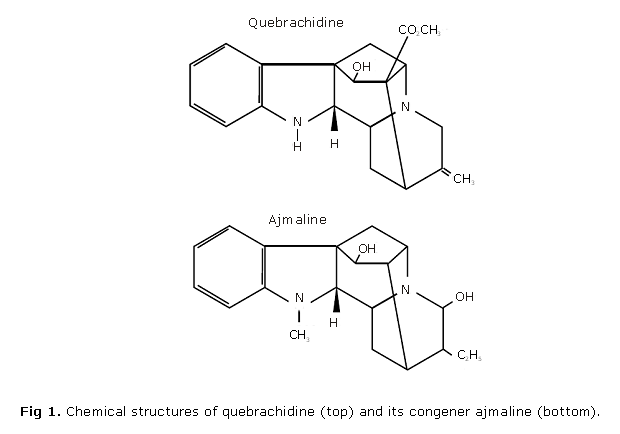
<body><![CDATA[<P>       <P><font face="Verdana" size="2"><I>Isolation and purification of quebrachidine</I>:     quebrachidine (ajmalan-16-carboxylic acid-19,20 didehydro-1-demethyl-17-hydroxy-methyl     ester; see <a href="/img/revistas/pla/v15n3/f0102310.gif">figure 1</a>) was kindly provided by Dr. J.     Mart&iacute;nez. It was isolated and purified from the roots of <I>Rauwolfia     viridis </I>Roem et Schult as previously described.<SUP>17,18</SUP> At pH 7.4     the relative lipophylicity of quebrachidine/ajmaline is 4.24, determined by     the n-octanol/water partition coefficients (sodium mono-di-phosphate/NaOH buffer)     while that of prajmaline/ajmaline is 3.29 (Mart&iacute;nez J, personal communication).     Quebrachidine was first dissolved at acidic pH to get a 10 mmol/L stock solution     (stored at 4 &#186;C) and directly added to the physiological solution at the     desired concentrations. </font>       
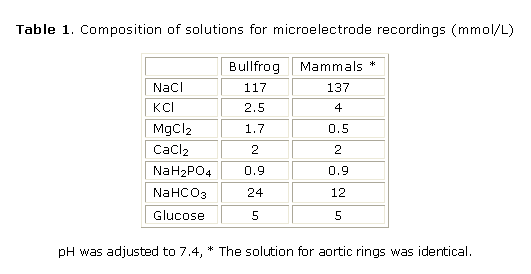
<P>       <P>       <P>       <P><font face="Verdana" size="2"><I>Electrocardiography in anaesthetized rabbits</I>:     rabbits were anaesthetized with sodium pentobarbital (30 mg/kg) and ventilated     through a tracheotomy with a volume-adjusted respirator. The electrocardiographic     leads I, II and III were simultaneously recorded. The left femoral vein was     cannulated for infusion of solutions. The heart was exposed through a mid thoracotomy     and a pair of platinum wires was fixed above the left ventricular epicardium     for stimulation. The &quot;ventricular fibrillation threshold&quot; (VFT) was     estimated using the following stimulation protocol: 30 pulses of 2 ms duration     were applied, at a cycle length of 20 ms, with increasing intensities. The fibrillation     threshold was considered to be the lowest current intensity (in mA) that induced     six or more sustained ventricular responses once finished the stimulation. The     value was only taken into account if it was replicated at least two times. We     took advantage that with the rabbit model, ventricular fibrillation was spontaneously     resumed in more than 90 % of trials. Animals were allowed to stabilize for 30     minutes before beginning the experiments. </font>       <P>       <P><font face="Verdana" size="2"><I>Electrophysiological and mechanical recordings     in multicellular cardiac preparations</I>: mammals (rat, rabbit and guinea pig)     were anaesthetized with sodium pentobarbital (30 mg/kg) and bullfrogs (<I>Rana     catesbeiana</I>) were decapitated and pithed. The hearts were rapidly removed     and dissected in a well oxygenated physiological solution at room temperature     (21-23 &#176;C; see <a href="#tab1">Table 1</a> for composition of solutions).     Action potentials using high-resistance (10-20 M<font face="Symbol">W</font>)     microelectrodes and contractions using a force transducer and stainless steel     hooks were recorded from right ventricular papillary muscles (or from small     frog ventricular strips) fixed to the bottom of a 2.5 mL recording chamber continuously     perfused (10 mL/min; 35 &#176;C or room temperature for frogs preparations)     as previously described<SUP>19</SUP>. Stimulation (2 ms, twice the threshold)     was achieved by field electrodes and the stimulation frequency was 75/min and     12/min for mammalian and frog preparations respectively. </font>       <P>       <P>       ]]></body>
<body><![CDATA[<P align="center"><a name="tab1"></a><img src="/img/revistas/pla/v15n3/t0102310.gif" width="531" height="274">      
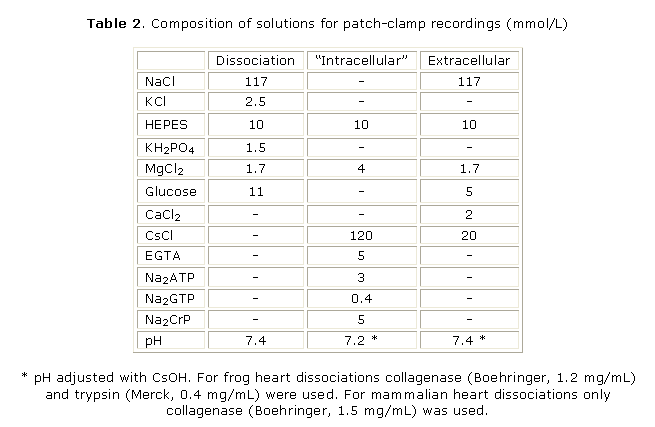
<P>       <P><font face="Verdana" size="2"><I>Patch-clamp experiments on isolated cardiomyocytes</I>     </font>      <P>       <P><font face="Verdana" size="2">a) <i>Cell dissociation</i>: experiments were     carried out on single atrial and ventricular cells dissociated from bullfrog     hearts and on single ventricular cardiomyocytes form rat, rabbit and guinea-pig     hearts. Frog cardiomyocytes were enzymatically dissociated according to the     method developed in our laboratories.<SUP>20,21</SUP> Cardiomyocytes from mammalian     hearts were enzymatically isolated according to Alvarez et al.<SUP>12</SUP>     (see <a href="/img/revistas/pla/v15n3/t0202310.gif">Table 2</a> for the composition of solutions). Yields     of viable elongated cells were 40-60 % for mammalian hearts and &gt; 80 % for     frog hearts. Isolated mammalian cardiomyocytes were kept in physiological solution     (Ca<SUP>2+</SUP> = 1 mmol/L) at room temperature (21-23 EC) and used within     6-8 hours. Frog cardiomyocytes were placed in a refrigerator (10 EC) and could     be used for as long as 24 hours. </font>       
<P>       <P>       <P><font face="Verdana" size="2">b) <i>Recording of ionic currents</i>:<B> </B>the     methods for whole-cell patch-clamp recording were essentially the same as described     before.<SUP>12,20</SUP> Extracellular solutions contained 20 mmol/L CsCl (instead     of KCl; see <a href="/img/revistas/pla/v15n3/t0202310.gif">table 2</a>) to inhibit K<SUP>+</SUP> currents.     For recording Ca<SUP>2+</SUP> currents tetrodotoxin (TTX) was used to inhibit     the Na<SUP>+</SUP> current (I<SUB>Na</SUB>) at 3 &#181;mol/L for frog cells     and 50 &#181;mol/L for mammalian cells. When I<SUB>Na</SUB> was recorded (only     in frog ventricular cardiomyocytes) the extracellular solution contained 50     % NaCl (substituted by choline chloride + 10 &#181;mol/L atropine) and 3mmol/L     CoCl<SUB>2</SUB> to block the L-type Ca<SUP>2+</SUP> current (I<SUB>CaL</SUB>).     Patch-clamp pipettes had resistances of 2 - 3 M<font face="Symbol">W</font>     for bullfrog cardiomyocytes or 0.9 - 1 M<font face="Symbol">W</font> for mammalian     cardiomyocytes and were filled with a solution containing 120 mmol/L CsCl to     ensure complete blockade of K<SUP>+</SUP> currents (<a href="/img/revistas/pla/v15n3/t0202310.gif">Table     2</a>). Pulse generation and data acquisition were done using a computer and     the ACQUIS1 software (version 2.0; CNRS License; France) with a LabMaster DMA     interface (Scientific Solutions; Solon, OH, USA). Membrane capacitance (Cm)     was estimated by applying 2-mV, 20-ms hyperpolarizing voltage-clamp pulses from     the holding potential. Capacitive spikes were fitted to a single exponential     and Cm was calculated according to: </font>       
<P>       <P><font face="Verdana" size="2">Cm= <font face="Symbol">t</font><SUB>m</SUB>     . I<SUB>0</SUB> / V<SUB>m</SUB> (1 - I<SUB>ss</SUB> / I<SUB>0</SUB>) </font>       ]]></body>
<body><![CDATA[<P>       <P><font face="Verdana" size="2">where <font face="Symbol">t</font><SUB>m</SUB>     is the membrane time constant, I<SUB>0</SUB> is the peak capacitive spike, I<SUB>ss</SUB>     the steady state current at the end of the 20 ms pulse and V<SUB>m</SUB> = 2     mV. Ionic currents were normalized to Cm to obtain current density (pA/pF).     </font>       <P><font face="Verdana" size="2">The holding membrane potential was set at -100     mV in frog cardiomyocytes and -80 mV in mammalian ones. For routine monitoring     of I<SUB>CaL</SUB> the membrane was depolarized to 0 mV during 200 ms every     4 s. The T-type Ca-current (I<SUB>CaT</SUB>) was only studied in frog atrial     cells and was routinely evoked by a 200-ms depolarization to -50 mV where no     interference with I<SUB>CaL</SUB> exists.<SUP>11,19,20</SUP> Recordings of I<SUB>Na</SUB>     were accomplished in frog ventricular cells with 50 ms pulses to 0 mV every     4 s. Ca<SUP>+</SUP> and Na<SUP>+</SUP> currents to voltage relationships and     their respective availability curves were estimated according to standardized     pulse protocols.<SUP>11,19,20</SUP> All patch-clamp experiments were conducted     at room temperature (21-23 EC). </font>      <P><font face="Verdana" size="2"><I>Force measurements in aortic rabbit rings</I>:     Abdominal aortic rings, about 3-mm width were dissected from rabbits and rats     under animal anaesthesia, fixed to the bottom of a 3-mL perfusion chamber and     to a force transducer with stainless steel hooks and perfused (10 mL/min) with     physiological solution (<a href="#tab1">table 1</a>) at 35EC. A resting tension     of 800 mg was applied and the rings were stabilized for one hour in these conditions.     Contractions were induced by a solution with high K (isotonic, 140 mmol/L, without     endothelial activity) or with norepinephrine (10 &#181;mol/L). </font>       <P><font face="Verdana" size="2">Results were analyzed by a paired <I>Student's</I>     t-test and are expressed as means and standard error of the means. They were     considered to be statistically significant at p&lt; 0.05. </font>      <P>       <P>       <P><font face="Verdana" size="3"><B>RESULTS</B> </font>       <P>       <P><font face="Verdana" size="2"><I>Effects of quebrachidine on Ventricular Fibrillation     Threshold (VFT)</I>: VFT in anaesthetized rabbits was estimated as described     in Methods. In control condition VFT was 30.4 &#177; 4.2 mA (N = 8). In the     absence of pharmacokinetic data for quebrachidine, we decided to test concentrations     of 0.3 and 3 mg/kg (infused consecutively with an interval of 15 min) which     roughly correspond to circulating concentrations of 1 - 2 and 30 - 60 &#181;mol/L.     VFT was significantly (p &lt; 0.05) increased by 55 &#177; 12 % at 0.3 mg/kg     and 62 &#177; 18 % at 3 mg/kg respectively (N= 8). The RR interval, however,     was not significantly modified. From a control value of 260 &#177; 12 ms it     changed to 268 &#177; 13 ms at 0.3 mg/kg and to 283 &#177; 20 ms at 3 mg/kg.     </font>      ]]></body>
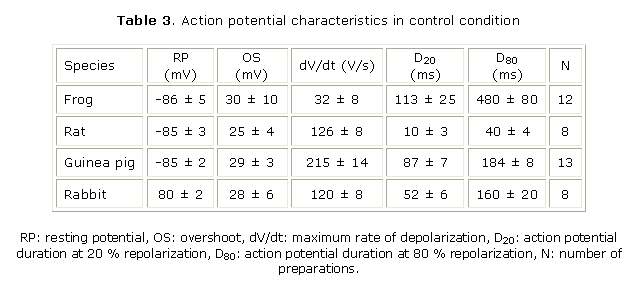
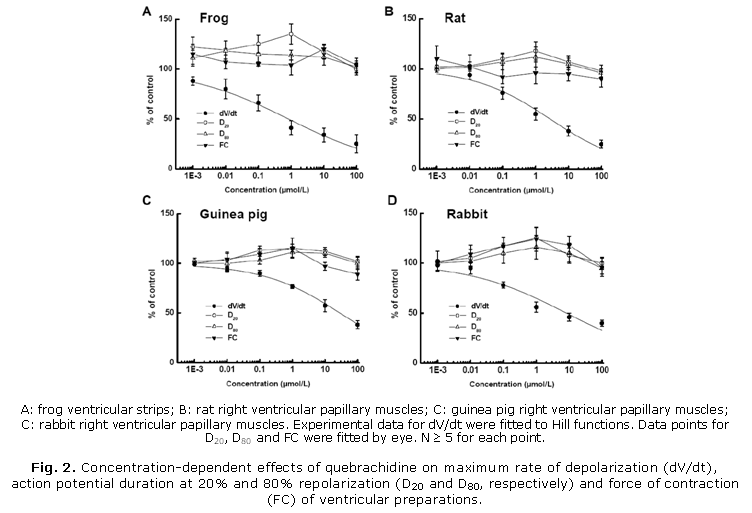
<body><![CDATA[<P>       <P><font face="Verdana" size="2"><I>Effects of quebrachidine on action potential     and force of contraction</I>: action potential characteristics under control     condition are summarized in <a href="/img/revistas/pla/v15n3/t0302310.gif">table 3</a>. <a href="/img/revistas/pla/v15n3/f0202310.gif">Figure     2</a> (A - D) summarizes the effects of different quebrachidine concentrations     on maximum rate of depolarization (dV/dt), action potential duration (measured     at 20 % and 80 % of repolarization, D<SUB>20</SUB> and D<SUB>80</SUB>, respectively)     and force of contraction of frog ventricular strips and mammalian right ventricular     papillary muscles.<B> </B>Quebrachidine decreased dV/dt in a concentration-dependent     manner. Experimental data were fitted to a Hill function and estimated<B> </B>IC50     for dV/dt inhibition were 0.8, 2.8, 29 and 9.8 &#181;mol/L for frog, rat, guinea     pig and rabbit, respectively.<B> </B><a href="/img/revistas/pla/v15n3/f0202310.gif">Figure 2</a> also     shows that quebrachidine increased D<SUB>20</SUB> and D<SUB>80</SUB> over the     whole concentration range studied in the different ventricular preparations     although without a clear-cut concentration-dependency. However, maximal increases     in D<SUB>20</SUB> and D<SUB>80</SUB> were obtained at 1 &#181;mol/L concentration     in all species except frog ventricular strips in which maximal increase in D<SUB>80</SUB>     was obtained at 0.01 &#181;mol/L. Quebrachidine induced a clear-cut positive     inotropic effect in frog, guinea pig and rabbit ventricular preparations with     maximal increases in force of contraction at 1 - 10 &#181;mol/L. In rat ventricle     however, the positive inotropic effect was noticeably only at 0.001 &#181;mol/L.     In four rabbit papillary muscles, the positive inotropic effect of 10 &#181;mol/L     quebrachidine was additive to that of 1 &#181;mol/L isoproterenol (<font face="Symbol">b</font>-adrenergic     agonist) or 1 &#181;mol/L of the &quot;Ca<SUP>2+</SUP>-agonist&quot; BAY K 8644     (not shown). This action of quebrachidine was not prevent by propranolol (1     &#181;mol/L) or prazosin (1 &#181;mol/L). Resting potential and overshoot of     action potential were not affected by quebrachidine at any concentration in     any of the studied species. All effects of quebrachidine on action potential     and contraction were readily reverted upon washout with control physiological     solution. </font>       
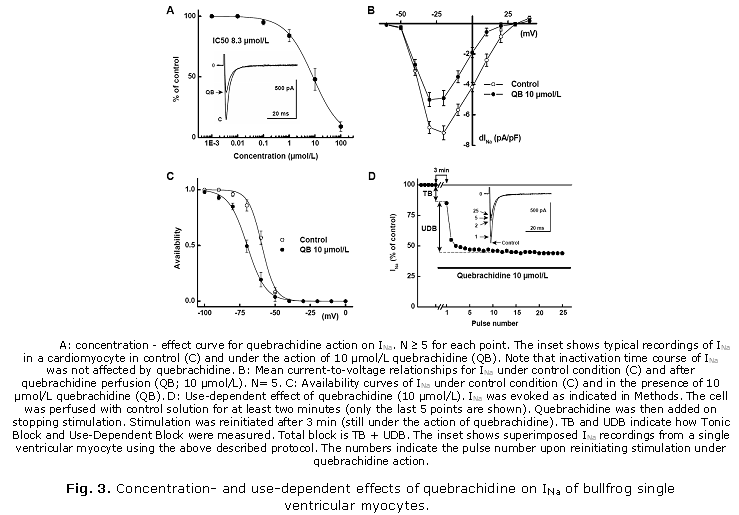
<P>       <P>       <P><font face="Verdana" size="2"><I>Effects of quebrachidine on Na<SUP>+</SUP>     current of single bullfrog ventricular cardiomyocytes</I>:<B> </B>in an attempt     to obtain reliable voltage control during the flow of I<SUB>Na</SUB>, experiments     were performed only on frog ventricular cardiomyocytes which display a low I<SUB>Na</SUB>     density in low-Na<SUP>+</SUP> extracellular solution<SUP>11</SUP> (see Methods).     Under these conditions peak inward I<SUB>Na</SUB> was maximal at -20 mV with     a density of 7.1 &#177; 0.6 pA/pF and a time for half inactivation (t<SUB>50%</SUB>)     of 3.3 &#177; 0.2 ms (N= 8). Quebrachidine induced a concentration-dependent     decrease in<B> </B>I<SUB>Na</SUB> with an IC50 of 8.3 &#181;mol/L (<a href="/img/revistas/pla/v15n3/f0302310.gif">Fig.     3A</a>). </font><font face="Verdana" size="2">However, t<SUB>50%</SUB> was not     significantly affected. The quebrachidine-induced decrease in I<SUB>Na</SUB>     was both voltage- and frequency-dependent. Voltage-dependent block was assessed     at 10 &#181;mol/L concentration. Current-to-voltage relationships and availability     curves of I<SUB>Na</SUB> were shifted by <font face="Symbol">&raquo;</font>     10 mV in the hyperpolarizing direction (Fig. <a href="/img/revistas/pla/v15n3/f0302310.gif">3 B</a>     and <a href="/img/revistas/pla/v15n3/f0302310.gif">C</a>). Potential for half-availability was shifted     by 10.5 &#177; 1.8 mV in the hyperpolarizing direction and the slope factor     increased from 4.67 &#177; 0.3 mV to 6.54 &#177; 0.2 mV (N= 8). In partially     depolarized cells (holding potential of -70 mV) on which different quebrachidine     concentrations were applied, the IC50 for I<SUB>Na</SUB> inhibition was decreased     to 0.65 &#181;mol/L. As mentioned above, I<SUB>Na</SUB> block by quebrachidine     (10 &#181;mol/L) was also frequency-dependent (<a href="/img/revistas/pla/v15n3/f0302310.gif">Fig. 3D</a>)     with a small tonic or first pulse decrease of I<SUB>Na</SUB> of 15.6 &#177;     6.2 % of control (. 28 % of total block) and a fast use-dependent decrease which     represent an additional decrease of 40.2 &#177; 2.2 % (<font face="Symbol">&raquo;</font>     72 % of total block) at a holding potential of -100 mV. The effects of quebrachidine     on I<SUB>Na</SUB> were reverted upon washout with normal physiological solution.     </font>       
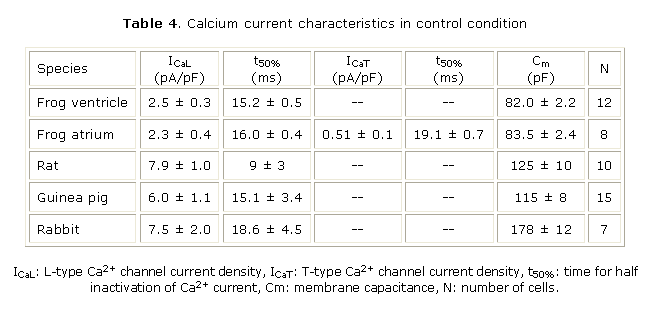
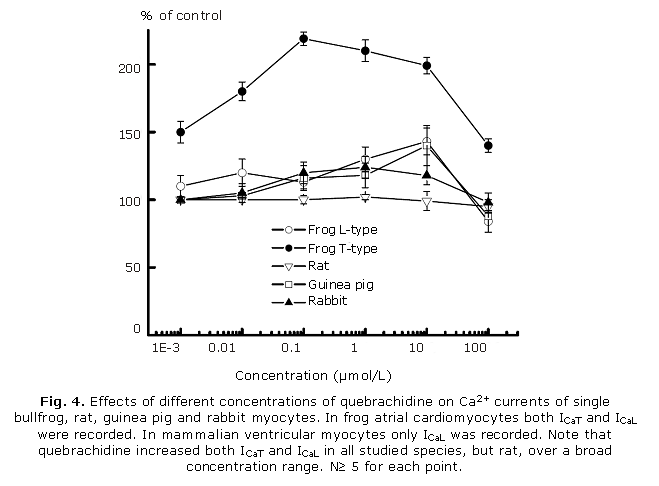
<P>       <P>       <P><font face="Verdana" size="2"><I>Effects of quebrachidine on Ca<SUP>2+</SUP><SUB>     </SUB>currents of single cardiomyocytes</I>:<B> </B>we have previously reported     that when a frog atrial (but not ventricular) cell is depolarized from a holding     potential of - 100 mV, two distinct Ca currents can be evoked, I<SUB>CaT</SUB>     and I<SUB>CaL</SUB>.<SUP>11,20,21</SUP> Their activation characteristics permitted     us to monitor changes in peak I<SUB>CaT</SUB> without significant contamination     of I<SUB>CaL</SUB>. Since there were no differences in membrane capacitance     (Cm) and I<SUB>CaL</SUB> density in atrial and ventricular cells results for     I<SUB>CaL</SUB> were pooled. No attempts were done to check for I<SUB>CaT</SUB>     in guinea pig and rabbit ventricular myocytes since in our hands, less than     30 % of these cells exhibited both I<SUB>CaL</SUB> and I<SUB>CaT</SUB>. <a href="/img/revistas/pla/v15n3/t0402310.gif">Table     4</a> summarizes the characteristics of calcium currents under control conditions     in the four species studied and <a href="/img/revistas/pla/v15n3/f0402310.gif">figure 4</a> shows that     quebrachidine induced an increase in both I<SUB>CaT</SUB> and I<SUB>CaL</SUB>     in bullfrog cardiomyocytes and in I<SUB>CaL</SUB> in guinea pig and rabbit ventricular     myocytes over a broad concentration range. </font>       
<P>       <P><font face="Verdana" size="2">Quebrachidine was less effective on I<SUB>CaL</SUB>     in rat ventricular myocytes. The effects of quebrachidine on I<SUB>CaL</SUB>     were voltage-dependent since current-to-voltage relationships and availability     curves for Ca<SUP>2+</SUP> currents were shifted to more negative potentials.     At 10 &#181;mol/L concentration, potential for half availability of I<SUB>CaL</SUB>     was shifted by about 5 mV in the hyperpolarizing direction in all species studied     except rat ventricular myocytes in which it was not significantly modified (5.8     &#177; 0.9 mV in frog; 5.2 &#177; 1.0 mV in guinea pig and 4.7 &#177; 0.8 mV     in rabbit; N<font face="Symbol">&#179;</font> 4). Times for half-inactivation     of Ca<SUP>2+</SUP> currents were, however, not modified by quebrachidine. The     effects of quebrachidine on Ca<SUP>2+</SUP> currents were reverted upon washout     with normal physiological solution. </font>       ]]></body>
<body><![CDATA[<P><font face="Verdana" size="2"><I>Effects of quebrachidine on smooth muscle     contractile activity</I>: Quebrachidine had no effect on KCl- and norepinephrine-induced     contraction of rat aortic rings at any of the concentrations studied (N= 5).     However, in rabbit aortic rings, quebrachidine induced a relaxing effect of     KCl-induced contraction which was not concentration-dependent. At quebrachidine     concentrations of 10, 30 and 100 &#181;mol/L aortic contraction was significantly     reduced to 65 &#177; 12 %, 56 &#177; 18 % and 64 &#177; 14 % of control (N=     5). No effects of quebrachidine were observed on the norepinephrine-induced     contraction of rabbit aortic rings. </font>      <P>       <P>       <P><font face="Verdana" size="3"><B>DISCUSSION</B> </font>       <P>       <P><font face="Verdana" size="2">The main conclusion of this paper is that quebrachidine,     like its congeners ajmaline and prajmaline displays a Class 1 antiarrhythmic     action by inhibiting in a concentration-, voltage- and use-dependent manner     the fast inward Na<SUP>+</SUP> current I<SUB>Na</SUB>. Moreover, like prajmaline,     quebrachidine induces a positive inotropic effect at concentrations that significantly     decreased I<SUB>Na</SUB>. This effect is be attributable to an increase in Ca<SUP>2+</SUP>     current and could counterbalance the negative inotropy generally seen with compounds     that reduce the intracellular Na<SUP>+</SUP> concentration by inhibiting I<SUB>Na</SUB>.     </font>      <P><font face="Verdana" size="2">Quebrachidine is one and three orders of magnitude     less potent than ajmaline and prajmaline, respectively in inhibiting I<SUB>Na</SUB>     with corresponding IC50s in bullfrog ventricular cells of 8.3 &#181;mol/L (present     results), 0.7 &#181;mol/L and 0.01 &#181;mol/L.<SUP>10,11</SUP> It has been     concluded that the difference in potency between ajmaline and prajmaline could     be related to the higher liposolubility of prajmaline.<SUP>10</SUP> The contrary     holds for quebrachidine which is more liposoluble than prajmaline but much less     potent on I<SUB>Na</SUB>. This makes difficult to draw any conclusion from a     (quantitative) structure-activity relationship analysis. At present, there is     no structural data of the possible receptor(s) site(s) for quebrachidine within     the Na<SUP>+</SUP> channel that could shed some light to the mode of action     of quebrachidine and other ondole alkaloids at the molecular level. However,     the voltage- and strong use-dependent quebrachidine block of I<SUB>Na</SUB>     suggests that like ajmaline and prajmaline, quebrachidine is an inactivated     state channel blocker.<SUP>10-12</SUP> This characteristic inhibitory action     on I<SUB>Na</SUB>, together with the relatively high IC50 for normally polarized     cells, suggests that quebrachidine could be an antiarrhythmic with a good safety     profile (less side effects). More preclinical trials are of course needed to     confirm this assertion. The inhibitory action of quebrachidine on dV/dt (an     indirect estimate of I<SUB>Na</SUB>) of action potential of different mammalian     species indicate that it is a Na<SUP>+</SUP> channel blocker. However, the estimated     IC50 were variable: 2.8, 29 and 9.8 &#181;mol/L for rat, guinea pig and rabbit,     respectively and were inversely related to the dV/dt value under control condition     (<a href="/img/revistas/pla/v15n3/t0302310.gif">table 3</a>) suggesting that I<SUB>Na</SUB> inhibition     could be related to Na<SUP>+</SUP> channel density. The difference between IC50s     obtained for I<SUB>Na</SUB> in single bullfrog cardiomyocytes (8.3 &#181;mol/L)     and dV/dt in bullfrog ventricular strips (0.8 &#181;mol/L) could be easily explained     by the voltage-dependent action of quebrachidine since the resting membrane     potential was more negative in single cells (holding potential of -100 mV) than     in bullfrog ventricular strips (<font face="Symbol">&raquo;</font> -85 mV).     In fact, when single bullfrog cardiomyocytes were depolarized (holding potential=     -70 mV) the IC50 decreased to 0.65 &#181;mol/L a value that is fully comparable     with the IC50 obtained in ventricular strips. </font>       
<P><font face="Verdana" size="2">Action potential duration was increased by quebrachidine     in the four species we studied. Particularly, action potential duration at the     plateau level (D<SUB>20</SUB>) was markedly increased by this indole alkaloid.     This effect can be well explained by the increase in Ca<SUP>2+</SUP> currents     under the action of quebrachidine (see below). However, actions on other repolarizing     currents (e.g. decrease in K<SUP>+</SUP> currents) can not at present be ruled     out. At concentrations over 10 &#181;mol/L both ajmaline and prajmaline are     reported to inhibit a delayed outward rectifier K<SUP>+</SUP> current in nerve<SUP>22</SUP>     as well as the transient outward current I<SUB>to</SUB> in rat ventricular cardiomyocytes     (Alvarez JL; unpublished results). </font>      <P><font face="Verdana" size="2">Perhaps the most interesting result is that quebrachidine,     together with its I<SUB>Na</SUB> inhibitory action, displayed a net positive     inotropic effect in bullfrog, guinea pig and rabbit ventricular preparations.     A less marked effect was observed in rat. The positive inotropic effect is similar     to that previously reported for prajmaline<SUP>10-12</SUP> and seems to be independent     of adrenergic receptor activation since it was not prevented by propranolol     or prazosin and was additive to the positive inotropic effect of isoproterenol.     While this action can be explained by an increase in Ca<SUP>2+</SUP> currents     (see below) the receptor site within the Ca<SUP>2+</SUP> channels need to be     elucidated. Our results suggest that quebrachidine does not interact with the     dihydropyridine receptor site since its positive inotropic action is additive     to that of BAY K 8644 a dihydropyridine with &quot;Ca<SUP>2+</SUP> agonist&quot;     properties. In fact, quebrachidine does not interact with the dihydropyridine     (PN 200-110) or fenilalkylamine (D 888) sites within the L-type Ca<SUP>2+</SUP>     channel (Escande D, personal communication). </font>       <P><font face="Verdana" size="2">Nevertheless, in sharp contrast with most antiarrhythmics     (for review see reference 10), quebrachidine increases both T- and L-type Ca<SUP>2+</SUP>     currents, and like prajmaline<SUP>11,12</SUP> this action was voltage-dependent     thus sharing similarities in their mechanisms of action with dihydropyridine     Ca<SUP>2+</SUP> agonists.<SUP>23</SUP> However, inactivation time courses of     I<SUB>CaT</SUB> and I<SUB>CaL</SUB> were not affected by quebrachidine. While     the increases in Ca<SUP>2+</SUP> currents were large enough to account for the     positive inotropic action of this alkaloid, we can not rule out interactions     of this molecule with other structures implicated in the control of the excitation-contraction     coupling in the cardiac cell (e.g. the sarcoplasmic reticulum Ca<SUP>2+</SUP>     channel) that could contribute to the positive inotropic effect. No attempts     were done to quantitatively correlate the positive inotropic effect with the     increase in I<SUB>CaL</SUB> in different species. It is to note however, that     where an increase in I<SUB>CaL</SUB> was found a consistent positive inotropic     effect was evident. In this sense it is to note that in rat ventricle where     the positive inotropic effect was weak or absent, there was almost no effect     on I<SUB>CaL</SUB>. </font>      ]]></body>
<body><![CDATA[<P><font face="Verdana" size="2">Another interesting property of quebrachidine     is its poor effect on vascular smooth muscle. No effect was observed on rat     aortic rings while a limited relaxing action was achieved in rabbit aortic rings     only at high concentrations. </font>      <P><font face="Verdana" size="2">To conclude, quebrachidine is an interesting     molecule since its electrophysiological profile is similar to that of the well-known     and structurally related antiarrhythmics ajmaline and prajmaline while its significant     positive inotropic effect in cardiac tissues suggest that it could be devoid     of the adverse side-effects of most antiarrhythmic drugs. Our results also confirm     that indole alkaloids from <I>Rauwolfia </I>sp. constitute an excellent source     of new compounds with potential therapeutic properties. </font>      <P>       <P>       <P>       <P><font face="Verdana" size="3"><B>ACKNOWLEDGMENTS</B> </font>       <P>       <P><font face="Verdana" size="2">We wish to express our gratitude to Lic. M. Arpa     and Lic. G. Garrido who collaborated in some preliminary experiments and to     Dr. J. Mart&iacute;nez for providing quebrachidine. The skillful technical assistance     of M. Carrabeo with the anaesthetized rabbits is greatly acknowledged. </font>      <P>       <P>       ]]></body>
<body><![CDATA[<P><font face="Verdana" size="3"><B>REFERENCES</B> </font>       <P>       <!-- ref --><P><font face="Verdana" size="2">1. Jordan PN, Christini DJ. Therapies for ventricular     cardiac arrhythmias. Critical Rev Biomed Engin. 2005;33:557-604. </font>    <!-- ref --><P><font face="Verdana" size="2">2. Cho HC, Marb&aacute;n E. Biological therapies     for cardiac arrhythmias: can genes and cells replace drugs and devices? Circ     Res. 2010;106:674-85. </font>    <!-- ref --><P><font face="Verdana" size="2">3. The CAST Investigators I. Preliminary report:     effect of encainide and flecainide on mortality in a randomized trial of arrhythmia     suppression after myocardial infarction. N Engl J Med. 1989; 321:406-12. </font>    <!-- ref --><P><font face="Verdana" size="2">4. The CAST Investigators II.<B> </B>Effect of     the antiarrhythmic agent moricizine on survival after myocardial infarction.     N Engl J Med. 1992;327:227-33. </font>    <!-- ref --><P><font face="Verdana" size="2">5. Waldo AL, Camm AJ, deRuyter H, Friedman PL,     MacNeil DJ, Pauls JF, et al. Effect of d-sotalol on mortality in patients with     left ventricular dysfunction after recent and remote myocardial infarction.     The SWORD Investigators. Survival With Oral d-Sotalol. Lancet. 1996;348:7-12.     </font>    <!-- ref --><P><font face="Verdana" size="2">6. Nattel S, Carlsson L. Innovative approaches     to anti-arrhythmic drug therapy. Nature Rev Drug Discovery. 2006;5:1034-49.     </font>    <!-- ref --><P><font face="Verdana" size="2">7. Roden DM, Kannankeril PJ, Darbar D. Arrhythmia     pharmacogenomics: methodological considerations. Curr Pharm Des. 2009;15:3734-41.     </font>    <!-- ref --><P><font face="Verdana" size="2">8. Arora RB, Madan BR.<B> </B>Antiarrhythmics     VI. Ajmaline and serpentine in experimental cardiac arrhythmias. J Pharmacol     Exp Therap. 1956;117:62-7. </font>    <!-- ref --><P><font face="Verdana" size="2">9. Kleinsorge H. Klinische Untersuchungen &uuml;ber     die Wirkungsweise des Rauwolfia-alkaloids bei Herzrhythmusst&ouml;rungen insbesondere     der Extrasystolie. Med Clin. 1959;54:409-16. </font>    <!-- ref --><P><font face="Verdana" size="2">10. Alvarez JL, Vassort G.<B> </B>Prajmalium.     Cardiovasc Drugs Revs. 1993;11:385-410. </font>    <!-- ref --><P><font face="Verdana" size="2">11. ________________.<B> </B>Dual action of prajmalium     on the Ca-current in frog isolated cardiomyocytes. J Mol Cell Cardiol. 1991;23:627-38.     </font>    <!-- ref --><P><font face="Verdana" size="2">12. Alvarez JL, Rubio LS, Garrido G. Vassort     G.<B> </B>Prajmalium, an antiarrhythmic with positive inotropic effect: Mechanism     of action in rabbit single cardiomyocytes. J Cardiovasc Pharmacol. 1992;20:43-9.     </font>    <!-- ref --><P><font face="Verdana" size="2">13. Yap YG, Behr ER, Camm AJ. Drug-induced Brugada     syndrome. Europace. 2009;11:989-94. </font>    <!-- ref --><P><font face="Verdana" size="2">14. Bonati A, Bocchia A.<B> </B>Derivati dell'ajmalina.     Nota I. Il Farmaco Ed Sc. 1963;18:84-93. </font>    <!-- ref --><P><font face="Verdana" size="2">15.<B> </B>Bonati A, Bombardelli E.<B> </B>Derivati     dell'ajmalina. Nota II. Il Farmaco Ed Sc. 1963;18:851-63. </font>    <!-- ref --><P><font face="Verdana" size="2">16. Lampidis TJ, Kolonias D, Savaraj N, Rubin     RW.<B> </B>Cardiostimulatory and antiarrhythmic activity of tubulin-binding     agents. Proc Natl Acad Sci USA. 1992;89:1256-60. </font>    <!-- ref --><P><font face="Verdana" size="2">17. Mart&iacute;nez JA, Rodr&iacute;guez MR,     Dehesa MA, Machu&aacute; M. Alcaloides de Rauwolfia. IX. Alcaloide de la corteza     de la ra&iacute;z de <I>R. viridis </I>Roem. et Schult. Rev Cubana Quim. 1988;4:43-51.     </font>    <!-- ref --><P><font face="Verdana" size="2">18. Mart&iacute;nez JA, Bello A, Montero O, Fuente     V. Bases d&eacute;biles minoritarias de la ra&iacute;z de <I>Rauwolfia</I> <I>viridis</I>     Roem et Schult. Rev Cubana Farm. 1997;31:188-91. </font>    <!-- ref --><P><font face="Verdana" size="2">19. Alvarez JL, Dortic&oacute;s F, Morlans J.     Changes in electrical and mechanical activities of rabbit papillary muscle during     hypoxic perfusion. J Physiol (Paris). 1981;77:807-12. </font>    <!-- ref --><P><font face="Verdana" size="2">20. Alvarez JL, Vassort G.<B> </B>Properties     of the low-threshold Ca current in frog atrial cardiomyocytes. A comparison     with the high-threshold Ca current. J Gen Physiol. 1992;100:519-45. </font>    <!-- ref --><P><font face="Verdana" size="2">21. Alvarez JL, Rubio L, Vassort G. Facilitation     of T-type Ca- current in bullfrog atrial cells: voltage-dependent relief of     a G-protein inhibitory tone. J Physiol (L). 1996;491(2):321-34. </font>    <!-- ref --><P><font face="Verdana" size="2">22. Khodorov BI, Zhaborovskaya LD. Blockade of     sodium and potassium currents in the node of Ranvier by ajmaline and N-propyl     ajmaline. Gen Physiol Biophys. 1983;2:233-68. </font>    <!-- ref --><P><font face="Verdana" size="2">23. Bechem M, Schramm M. Electrophysiology of     dihydropyridine calcium agonists. In: Morad M, editor. The calcium channel:     structure, function and implications; 1988. p. 63-70. </font>    <P>      <P>       <P>       <P>       <P><font face="Verdana" size="2">Recibido: 26 de abril de 2010.     ]]></body>
<body><![CDATA[<br>    Aprobado: 23 de junio de 2010. </font>       <P>      <P>      <P>       <P><font face="Verdana" size="2">Dr. <I>Julio L. &Aacute;lvarez.</I> Laboratorio     de Electrofisiolog&iacute;a. Instituto de Cardiolog&iacute;a y Cirug&iacute;a     Cardiovascular. Edificio Asclepios. 17 y Paseo, Vedado, CP 10400. Ciudad de     La Habana, Cuba. Tel&eacute;f.: 8360831. E-mail: <a href="mailto:alvarezj@infomed.sld.cu">alvarezj@infomed.sld.cu</a></font>        ]]></body><back>
<ref-list>
<ref id="B1">
<label>1</label><nlm-citation citation-type="journal">
<person-group person-group-type="author">
<name>
<surname><![CDATA[Jordan]]></surname>
<given-names><![CDATA[PN]]></given-names>
</name>
<name>
<surname><![CDATA[Christini]]></surname>
<given-names><![CDATA[DJ]]></given-names>
</name>
</person-group>
<article-title xml:lang="en"><![CDATA[Therapies for ventricular cardiac arrhythmias]]></article-title>
<source><![CDATA[Critical Rev Biomed Engin.]]></source>
<year>2005</year>
<volume>33</volume>
<page-range>557-604</page-range></nlm-citation>
</ref>
<ref id="B2">
<label>2</label><nlm-citation citation-type="journal">
<person-group person-group-type="author">
<name>
<surname><![CDATA[Cho]]></surname>
<given-names><![CDATA[HC]]></given-names>
</name>
<name>
<surname><![CDATA[Marbán]]></surname>
<given-names><![CDATA[E.]]></given-names>
</name>
</person-group>
<article-title xml:lang="en"><![CDATA[Biological therapies for cardiac arrhythmias:: can genes and cells replace drugs and devices?]]></article-title>
<source><![CDATA[Circ Res]]></source>
<year>2010</year>
<volume>106</volume>
<page-range>674-85</page-range></nlm-citation>
</ref>
<ref id="B3">
<label>3</label><nlm-citation citation-type="journal">
<article-title xml:lang="en"><![CDATA[The CAST Investigators I.: Preliminary report: effect of encainide and flecainide on mortality in a randomized trial of arrhythmia suppression after myocardial infarction.]]></article-title>
<source><![CDATA[N Engl J Med]]></source>
<year>1989</year>
<volume>321</volume>
<page-range>406-12</page-range></nlm-citation>
</ref>
<ref id="B4">
<label>4</label><nlm-citation citation-type="journal">
<article-title xml:lang="en"><![CDATA[The CAST Investigators II.: Effect of the antiarrhythmic agent moricizine on survival after myocardial infarction]]></article-title>
<source><![CDATA[N Engl J Med.]]></source>
<year>1992</year>
<volume>327</volume>
<page-range>227-33</page-range></nlm-citation>
</ref>
<ref id="B5">
<label>5</label><nlm-citation citation-type="journal">
<person-group person-group-type="author">
<name>
<surname><![CDATA[Waldo]]></surname>
<given-names><![CDATA[AL]]></given-names>
</name>
<name>
<surname><![CDATA[Camm]]></surname>
<given-names><![CDATA[AJ]]></given-names>
</name>
<name>
<surname><![CDATA[deRuyter]]></surname>
<given-names><![CDATA[H]]></given-names>
</name>
<name>
<surname><![CDATA[Friedman]]></surname>
<given-names><![CDATA[PL]]></given-names>
</name>
<name>
<surname><![CDATA[MacNeil]]></surname>
<given-names><![CDATA[DJ]]></given-names>
</name>
<name>
<surname><![CDATA[Pauls]]></surname>
<given-names><![CDATA[JF]]></given-names>
</name>
</person-group>
<article-title xml:lang="en"><![CDATA[Effect of d-sotalol on mortality in patients with left ventricular dysfunction after recent and remote myocardial infarction.: The SWORD Investigators. Survival With Oral d-Sotalol.]]></article-title>
<source><![CDATA[Lancet]]></source>
<year>1996</year>
<volume>348</volume>
<page-range>7-12</page-range></nlm-citation>
</ref>
<ref id="B6">
<label>6</label><nlm-citation citation-type="journal">
<person-group person-group-type="author">
<name>
<surname><![CDATA[Nattel]]></surname>
<given-names><![CDATA[S]]></given-names>
</name>
<name>
<surname><![CDATA[Carlsson]]></surname>
<given-names><![CDATA[L]]></given-names>
</name>
</person-group>
<article-title xml:lang="en"><![CDATA[Innovative approaches to anti-arrhythmic drug therapy]]></article-title>
<source><![CDATA[Nature Rev Drug Discovery.]]></source>
<year>2006</year>
<volume>5</volume>
<page-range>1034-49</page-range></nlm-citation>
</ref>
<ref id="B7">
<label>7</label><nlm-citation citation-type="journal">
<person-group person-group-type="author">
<name>
<surname><![CDATA[Roden]]></surname>
<given-names><![CDATA[DM]]></given-names>
</name>
<name>
<surname><![CDATA[Kannankeril]]></surname>
<given-names><![CDATA[PJ]]></given-names>
</name>
<name>
<surname><![CDATA[Darbar]]></surname>
<given-names><![CDATA[D]]></given-names>
</name>
</person-group>
<article-title xml:lang="en"><![CDATA[Arrhythmia pharmacogenomics: methodological considerations]]></article-title>
<source><![CDATA[Curr Pharm Des.]]></source>
<year>2009</year>
<volume>15</volume>
<page-range>3734-41</page-range></nlm-citation>
</ref>
<ref id="B8">
<label>8</label><nlm-citation citation-type="journal">
<person-group person-group-type="author">
<name>
<surname><![CDATA[Arora]]></surname>
<given-names><![CDATA[RB]]></given-names>
</name>
<name>
<surname><![CDATA[Madan]]></surname>
<given-names><![CDATA[BR]]></given-names>
</name>
</person-group>
<article-title xml:lang="en"><![CDATA[Antiarrhythmics VI: Ajmaline and serpentine in experimental cardiac arrhythmias]]></article-title>
<source><![CDATA[J Pharmacol Exp Therap.]]></source>
<year>1956</year>
<volume>117</volume>
<page-range>62-7</page-range></nlm-citation>
</ref>
<ref id="B9">
<label>9</label><nlm-citation citation-type="journal">
<person-group person-group-type="author">
<name>
<surname><![CDATA[Kleinsorge]]></surname>
<given-names><![CDATA[H]]></given-names>
</name>
</person-group>
<article-title xml:lang="de"><![CDATA[Klinische Untersuchungen über die Wirkungsweise des Rauwolfia-alkaloids bei Herzrhythmusstörungen insbesondere der Extrasystolie]]></article-title>
<source><![CDATA[Med Clin.]]></source>
<year>1959</year>
<volume>54</volume>
<page-range>409-16</page-range></nlm-citation>
</ref>
<ref id="B10">
<label>10</label><nlm-citation citation-type="journal">
<person-group person-group-type="author">
<name>
<surname><![CDATA[Alvarez]]></surname>
<given-names><![CDATA[JL]]></given-names>
</name>
<name>
<surname><![CDATA[Vassort]]></surname>
<given-names><![CDATA[G]]></given-names>
</name>
</person-group>
<article-title xml:lang="la"><![CDATA[Prajmalium]]></article-title>
<source><![CDATA[Cardiovasc Drugs Revs.]]></source>
<year>1993</year>
<volume>11</volume>
<page-range>385-410</page-range></nlm-citation>
</ref>
<ref id="B11">
<label>11</label><nlm-citation citation-type="journal">
<article-title xml:lang="en"><![CDATA[Dual action of prajmalium on the Ca-current in frog isolated cardiomyocytes]]></article-title>
<source><![CDATA[J Mol Cell Cardiol.]]></source>
<year>1991</year>
<volume>23</volume>
<page-range>627-38</page-range></nlm-citation>
</ref>
<ref id="B12">
<label>12</label><nlm-citation citation-type="journal">
<person-group person-group-type="author">
<name>
<surname><![CDATA[Alvarez]]></surname>
<given-names><![CDATA[JL]]></given-names>
</name>
<name>
<surname><![CDATA[Rubio]]></surname>
<given-names><![CDATA[LS]]></given-names>
</name>
<name>
<surname><![CDATA[Garrido]]></surname>
<given-names><![CDATA[G]]></given-names>
</name>
<name>
<surname><![CDATA[Vassort]]></surname>
<given-names><![CDATA[G]]></given-names>
</name>
</person-group>
<article-title xml:lang="en"><![CDATA[Prajmalium, an antiarrhythmic with positive inotropic effect: Mechanism of action in rabbit single cardiomyocytes]]></article-title>
<source><![CDATA[J Cardiovasc Pharmacol.]]></source>
<year>1992</year>
<volume>20</volume>
<page-range>43-9</page-range></nlm-citation>
</ref>
<ref id="B13">
<label>13</label><nlm-citation citation-type="journal">
<person-group person-group-type="author">
<name>
<surname><![CDATA[Yap]]></surname>
<given-names><![CDATA[YG]]></given-names>
</name>
<name>
<surname><![CDATA[Behr]]></surname>
<given-names><![CDATA[ER]]></given-names>
</name>
<name>
<surname><![CDATA[Camm]]></surname>
<given-names><![CDATA[AJ]]></given-names>
</name>
</person-group>
<article-title xml:lang="en"><![CDATA[Drug-induced Brugada syndrome]]></article-title>
<source><![CDATA[Europace.]]></source>
<year>2009</year>
<volume>11</volume>
<page-range>989-94</page-range></nlm-citation>
</ref>
<ref id="B14">
<label>14</label><nlm-citation citation-type="journal">
<person-group person-group-type="author">
<name>
<surname><![CDATA[Bonati]]></surname>
<given-names><![CDATA[A]]></given-names>
</name>
<name>
<surname><![CDATA[Bocchia]]></surname>
<given-names><![CDATA[A]]></given-names>
</name>
</person-group>
<article-title xml:lang="it"><![CDATA[Derivati dell'ajmalina: Nota I]]></article-title>
<source><![CDATA[Il Farmaco Ed Sc.]]></source>
<year>1963</year>
<volume>18</volume>
<page-range>84-93</page-range></nlm-citation>
</ref>
<ref id="B15">
<label>15</label><nlm-citation citation-type="journal">
<person-group person-group-type="author">
<name>
<surname><![CDATA[Bonati]]></surname>
<given-names><![CDATA[A]]></given-names>
</name>
<name>
<surname><![CDATA[Bombardelli]]></surname>
<given-names><![CDATA[E]]></given-names>
</name>
</person-group>
<article-title xml:lang="it"><![CDATA[Derivati dell'ajmalina: Nota II]]></article-title>
<source><![CDATA[Il Farmaco Ed Sc.]]></source>
<year>1963</year>
<volume>18</volume>
<page-range>851-63</page-range></nlm-citation>
</ref>
<ref id="B16">
<label>16</label><nlm-citation citation-type="journal">
<person-group person-group-type="author">
<name>
<surname><![CDATA[Lampidis]]></surname>
<given-names><![CDATA[TJ]]></given-names>
</name>
<name>
<surname><![CDATA[Kolonias]]></surname>
<given-names><![CDATA[D]]></given-names>
</name>
<name>
<surname><![CDATA[Savaraj]]></surname>
<given-names><![CDATA[N]]></given-names>
</name>
<name>
<surname><![CDATA[Rubin]]></surname>
<given-names><![CDATA[RW]]></given-names>
</name>
</person-group>
<article-title xml:lang="en"><![CDATA[Cardiostimulatory and antiarrhythmic activity of tubulin-binding agents]]></article-title>
<source><![CDATA[Proc Natl Acad Sci USA.]]></source>
<year>1992</year>
<volume>89</volume>
<page-range>1256-60</page-range></nlm-citation>
</ref>
<ref id="B17">
<label>17</label><nlm-citation citation-type="journal">
<person-group person-group-type="author">
<name>
<surname><![CDATA[Martínez]]></surname>
<given-names><![CDATA[JA]]></given-names>
</name>
<name>
<surname><![CDATA[Rodríguez]]></surname>
<given-names><![CDATA[MR]]></given-names>
</name>
<name>
<surname><![CDATA[Dehesa]]></surname>
<given-names><![CDATA[MA]]></given-names>
</name>
<name>
<surname><![CDATA[Machuá]]></surname>
<given-names><![CDATA[M.]]></given-names>
</name>
</person-group>
<article-title xml:lang="es"><![CDATA[Alcaloides de Rauwolfia.: IX. Alcaloide de la corteza de la raíz de R. viridis Roem. et Schult.]]></article-title>
<source><![CDATA[Rev Cubana Quim]]></source>
<year>1988</year>
<volume>4</volume>
<page-range>43-51</page-range></nlm-citation>
</ref>
<ref id="B18">
<label>18</label><nlm-citation citation-type="journal">
<person-group person-group-type="author">
<name>
<surname><![CDATA[Martínez]]></surname>
<given-names><![CDATA[JA]]></given-names>
</name>
<name>
<surname><![CDATA[Bello]]></surname>
<given-names><![CDATA[A]]></given-names>
</name>
<name>
<surname><![CDATA[Montero]]></surname>
<given-names><![CDATA[O]]></given-names>
</name>
<name>
<surname><![CDATA[Fuente]]></surname>
<given-names><![CDATA[V]]></given-names>
</name>
</person-group>
<article-title xml:lang="es"><![CDATA[Bases débiles minoritarias de la raíz de Rauwolfia viridis Roem et Schult]]></article-title>
<source><![CDATA[Rev Cubana Farm.]]></source>
<year>1997</year>
<volume>31</volume>
<page-range>188-91</page-range></nlm-citation>
</ref>
<ref id="B19">
<label>19</label><nlm-citation citation-type="journal">
<person-group person-group-type="author">
<name>
<surname><![CDATA[Alvarez]]></surname>
<given-names><![CDATA[JL]]></given-names>
</name>
<name>
<surname><![CDATA[Dorticós]]></surname>
<given-names><![CDATA[F]]></given-names>
</name>
<name>
<surname><![CDATA[Morlans]]></surname>
<given-names><![CDATA[J]]></given-names>
</name>
</person-group>
<article-title xml:lang="en"><![CDATA[Changes in electrical and mechanical activities of rabbit papillary muscle during hypoxic perfusion]]></article-title>
<source><![CDATA[J Physiol (Paris).]]></source>
<year>1981</year>
<volume>77</volume>
<page-range>807-12</page-range></nlm-citation>
</ref>
<ref id="B20">
<label>20</label><nlm-citation citation-type="journal">
<person-group person-group-type="author">
<name>
<surname><![CDATA[Alvarez]]></surname>
<given-names><![CDATA[JL]]></given-names>
</name>
<name>
<surname><![CDATA[Vassort]]></surname>
<given-names><![CDATA[G]]></given-names>
</name>
</person-group>
<article-title xml:lang="en"><![CDATA[Properties of the low-threshold Ca current in frog atrial cardiomyocytes: A comparison with the high-threshold Ca current]]></article-title>
<source><![CDATA[J Gen Physiol.]]></source>
<year>1992</year>
<volume>100</volume>
<page-range>519-45</page-range></nlm-citation>
</ref>
<ref id="B21">
<label>21</label><nlm-citation citation-type="journal">
<person-group person-group-type="author">
<name>
<surname><![CDATA[Alvarez]]></surname>
<given-names><![CDATA[JL]]></given-names>
</name>
<name>
<surname><![CDATA[Rubio]]></surname>
<given-names><![CDATA[L]]></given-names>
</name>
<name>
<surname><![CDATA[Vassort]]></surname>
<given-names><![CDATA[G]]></given-names>
</name>
</person-group>
<article-title xml:lang="en"><![CDATA[Facilitation of T-type Ca- current in bullfrog atrial cells: voltage-dependent relief of a G-protein inhibitory tone]]></article-title>
<source><![CDATA[J Physiol (L).]]></source>
<year>1996</year>
<volume>491</volume>
<numero>2</numero>
<issue>2</issue>
<page-range>321-34</page-range></nlm-citation>
</ref>
<ref id="B22">
<label>22</label><nlm-citation citation-type="journal">
<person-group person-group-type="author">
<name>
<surname><![CDATA[Khodorov]]></surname>
<given-names><![CDATA[BI]]></given-names>
</name>
<name>
<surname><![CDATA[Zhaborovskaya]]></surname>
<given-names><![CDATA[LD]]></given-names>
</name>
</person-group>
<article-title xml:lang="en"><![CDATA[Blockade of sodium and potassium currents in the node of Ranvier by ajmaline and N-propyl ajmaline]]></article-title>
<source><![CDATA[Gen Physiol Biophys.]]></source>
<year>1983</year>
<volume>2</volume>
<page-range>233-68</page-range></nlm-citation>
</ref>
<ref id="B23">
<label>23</label><nlm-citation citation-type="">
<person-group person-group-type="author">
<name>
<surname><![CDATA[Bechem]]></surname>
<given-names><![CDATA[M]]></given-names>
</name>
<name>
<surname><![CDATA[Schramm]]></surname>
<given-names><![CDATA[M.]]></given-names>
</name>
</person-group>
<article-title xml:lang="en"><![CDATA[Electrophysiology of dihydropyridine calcium agonists.]]></article-title>
<person-group person-group-type="editor">
<name>
<surname><![CDATA[Morad]]></surname>
<given-names><![CDATA[M]]></given-names>
</name>
</person-group>
<source><![CDATA[The calcium channel:: structure, function and implications]]></source>
<year>1988</year>
<page-range>p. 63-70</page-range></nlm-citation>
</ref>
</ref-list>
</back>
</article>