<?xml version="1.0" encoding="ISO-8859-1"?><article xmlns:mml="http://www.w3.org/1998/Math/MathML" xmlns:xlink="http://www.w3.org/1999/xlink" xmlns:xsi="http://www.w3.org/2001/XMLSchema-instance">
<front>
<journal-meta>
<journal-id>1028-4796</journal-id>
<journal-title><![CDATA[Revista Cubana de Plantas Medicinales]]></journal-title>
<abbrev-journal-title><![CDATA[Rev Cubana Plant Med]]></abbrev-journal-title>
<issn>1028-4796</issn>
<publisher>
<publisher-name><![CDATA[ECIMED]]></publisher-name>
</publisher>
</journal-meta>
<article-meta>
<article-id>S1028-47962016000300010</article-id>
<title-group>
<article-title xml:lang="en"><![CDATA[Kinetic study of the quenching of singlet oxygen by naringin isolated from peels of the fruit of bitter orange (Citrus aurantium I.)]]></article-title>
<article-title xml:lang="es"><![CDATA[Cinética del Quenching del oxígeno singulete por naringina aislada de cáscaras del fruto de naranja agria (citrus aurantium l.)]]></article-title>
</title-group>
<contrib-group>
<contrib contrib-type="author">
<name>
<surname><![CDATA[Diaz-Uribe]]></surname>
<given-names><![CDATA[Carlos E]]></given-names>
</name>
<xref ref-type="aff" rid="A01"/>
</contrib>
<contrib contrib-type="author">
<name>
<surname><![CDATA[Oliveros]]></surname>
<given-names><![CDATA[Grace]]></given-names>
</name>
<xref ref-type="aff" rid="A01"/>
</contrib>
<contrib contrib-type="author">
<name>
<surname><![CDATA[Muñoz-Acevedo]]></surname>
<given-names><![CDATA[Amner]]></given-names>
</name>
<xref ref-type="aff" rid="A02"/>
</contrib>
<contrib contrib-type="author">
<name>
<surname><![CDATA[Vallejo Lozada]]></surname>
<given-names><![CDATA[William A]]></given-names>
</name>
<xref ref-type="aff" rid="A01"/>
</contrib>
</contrib-group>
<aff id="A01">
<institution><![CDATA[,Grupo de Investigación en Fotoquímica y Fotobiología  ]]></institution>
<addr-line><![CDATA[ ]]></addr-line>
<country>Colombia</country>
</aff>
<aff id="A02">
<institution><![CDATA[,Grupo de Investigación en Química y Biología  ]]></institution>
<addr-line><![CDATA[ ]]></addr-line>
<country>Colombia</country>
</aff>
<pub-date pub-type="pub">
<day>00</day>
<month>09</month>
<year>2016</year>
</pub-date>
<pub-date pub-type="epub">
<day>00</day>
<month>09</month>
<year>2016</year>
</pub-date>
<volume>21</volume>
<numero>3</numero>
<fpage>359</fpage>
<lpage>368</lpage>
<copyright-statement/>
<copyright-year/>
<self-uri xlink:href="http://scielo.sld.cu/scielo.php?script=sci_arttext&amp;pid=S1028-47962016000300010&amp;lng=en&amp;nrm=iso"></self-uri><self-uri xlink:href="http://scielo.sld.cu/scielo.php?script=sci_abstract&amp;pid=S1028-47962016000300010&amp;lng=en&amp;nrm=iso"></self-uri><self-uri xlink:href="http://scielo.sld.cu/scielo.php?script=sci_pdf&amp;pid=S1028-47962016000300010&amp;lng=en&amp;nrm=iso"></self-uri><kwd-group>
<kwd lng="en"><![CDATA[naringin]]></kwd>
<kwd lng="en"><![CDATA[singlet oxygen]]></kwd>
<kwd lng="en"><![CDATA[rubrene]]></kwd>
<kwd lng="en"><![CDATA[Citrus aurantium]]></kwd>
<kwd lng="es"><![CDATA[naringina]]></kwd>
<kwd lng="es"><![CDATA[oxígeno singulete]]></kwd>
<kwd lng="es"><![CDATA[rubreno]]></kwd>
<kwd lng="es"><![CDATA[Citrus aurantium]]></kwd>
</kwd-group>
</article-meta>
</front><body><![CDATA[  <font face="Verdana, Arial, Helvetica, sans-serif" size="2"></font>      <p align="right"><font size="2"><b><font size="2"><b><font size="2"><b><font size="2"><b><font size="2"><b><font size="2"><b><font size="2"><b><font size="2"><b><font face="Verdana, Arial, Helvetica, sans-serif">Rev    Cubana Plant Med. 2016;21(3)</font></b></font></b></font></b></font></b></font></b></font></b></font></b></font></b></font></p>     <p align="right"><font size="2"><b><font face="Verdana, Arial, Helvetica, sans-serif">ART&Iacute;CULO    ORIGINAL</font></b></font> </p>     <p>&nbsp;</p>     <p><font face="Verdana, Arial, Helvetica, sans-serif" size="2"><b><font face="Verdana, Arial, Helvetica, sans-serif" size="2"><b><font size="4">Kinetic    study of the quenching of singlet oxygen by naringin isolated from peels of    the fruit of bitter orange (<i>Citrus aurantium</i> I.)</font></b></font></b></font></p>     <p>&nbsp;</p>     <p><font face="Verdana, Arial, Helvetica, sans-serif" size="2"><b><font size="3">Cin&#233;tica    del <i>Quenching</i> del ox&#237;geno singulete por naringina aislada de c&#225;scaras    del fruto de naranja agria (<i>citrus aurantium l.</i>)</font><font size="4">    </font></b></font></p>     <p>&nbsp;</p>     <p>&nbsp;</p>     <p><font face="Verdana, Arial, Helvetica, sans-serif" size="2"><b>Carlos E. Diaz-Uribe,<sup>I    </sup>Grace Oliveros,<sup>I</sup> Amner Mu&#241;oz-Acevedo,<sup>II</sup> William    A. Vallejo Lozada<sup>I</sup> </b></font></p>     ]]></body>
<body><![CDATA[<p> <font face="Verdana, Arial, Helvetica, sans-serif" size="2"><sup>I </sup>    Grupo de Investigaci&#243;n en Fotoqu&#237;mica y Fotobiolog&#237;a, Kil&#243;metro    7 v&#237;a Puerto Colombia. Colombia.    <br>   </font><font face="Verdana, Arial, Helvetica, sans-serif" size="2"><sup>II </sup>    Grupo de Investigaci&#243;n en Qu&#237;mica y Biolog&#237;a. Kil&#243;metro    5 v&#237;a Puerto Colombia. Colombia.</font></p>     <p>&nbsp;</p>     <p>&nbsp;</p> <hr>     <p><font face="Verdana, Arial, Helvetica, sans-serif" size="2"><b>ABSTRACT</b>    </font></p>     <p> <font face="Verdana, Arial, Helvetica, sans-serif" size="2"><b>Introduction:</b>    antioxidant activity is the capacity of a substance to inhibit oxidative degradation,    mainly through its ability to react with both radical and non-radical species    (e.g. singlet oxygen). Interest by scientific communities in the study of the    antioxidant capacity of natural compounds has increased in recent years, due    to their possible applications in the pharmaceutical, cosmetic and food industries.    <br>   <b>Objective:</b> estimate the antioxidant capacity of naringin against singlet    oxygen using the rubrene method.     <br>   <b>Methods:</b> naringin was isolated from peels of the fruit of bitter orange    (<i>Citrus aurantium</i>) and characterized using several spectroscopic techniques    (UV-Vis and FTIR). The global rate constant for the reaction of <sup>1</sup>O<sub>2</sub>    with naringin was determined with the Stern-Volmer plot derived from a stationary    kinetic state based on the competition reaction with rubrene.     <br>   <b>Results:</b> results showed that naringin acted as singlet oxygen quenching    agent with a global rate constant of 2.1 x 10<sup>7</sup> M<sup>-1</sup>s<sup>-1</sup>    (derived from the linear relationship of Stern-Volmer).     <br>   <b>Conclusion:</b> the kinetic study conducted suggests that naringin could    be used as a singlet oxygen quenching agent in biological systems to protect    them from oxidative damage. </font></p>     ]]></body>
<body><![CDATA[<p> <font face="Verdana, Arial, Helvetica, sans-serif" size="2"><b>Keywords:</b>    naringin, singlet oxygen, rubrene, <i>Citrus aurantium.</i></font></p> <hr>     <p><font face="Verdana, Arial, Helvetica, sans-serif" size="2"><b>RESUMEN</b>    </font></p>     <p> <font face="Verdana, Arial, Helvetica, sans-serif" size="2"><b>Introducci&#243;n</b>:    la actividad antioxidante es la capacidad de una sustancia para inhibir la degradaci&#243;n    oxidativa y act&#250;a principalmente a trav&#233;s de su capacidad para reaccionar    con las especies de radicales y no radicales (por ejemplo, ox&#237;geno singulete).    En los &#250;ltimos a&#241;os, se han incrementado el inter&#233;s de las comunidades    cient&#237;ficas en el estudio de la capacidad antioxidante de los compuestos    naturales debido a sus posibles aplicaciones en la industria farmac&#233;utica,    cosm&#233;tica y alimentaria.     <br>   <b>Objetivo</b>: estimar la capacidad antioxidante de la naringina contra el    ox&#237;geno singulete usando el m&#233;todo de rubreno.     <br>   <b>M&#233;todos:</b> la naringina se aisl&#243; de c&#225;scaras del fruto de    la naranja agria (<i>Citrus aurantium</i>) y se caracteriz&#243; por algunas    t&#233;cnicas espectrosc&#243;picas (UV-Vis y FT-IR). La constante de velocidad    global para la reacci&#243;n de <sup>1</sup>O<sub>2</sub> con la naringina se    determin&#243; por medio del gr&#225;fico de Stern-Volmer derivado de una cin&#233;tica    en estado estacionario basada en la reacci&#243;n de competici&#243;n con el    rubreno.     <br>   <b>Resultados:</b> los resultados mostraron que la naringina actu&#243; como    un <i>quenching</i> del ox&#237;geno singulete con una constante de velocidad    global de 2.1 x 10 <sup>7</sup> M<sup>-1</sup>s<sup>-1</sup> (derivado de la    relaci&#243;n lineal de Stern-Volmer).     <br>   </font><font face="Verdana, Arial, Helvetica, sans-serif" size="2"><b>Conclusi&#243;n</b>:    el estudio cin&#233;tico sugiere que la naringina se podr&#237;a utilizar como    un <i>quenching</i> del ox&#237;geno singulete en sistemas biol&#243;gicos y    protegerlos del da&#241;o oxidativo. </font></p>     <p> <font face="Verdana, Arial, Helvetica, sans-serif" size="2"><b>Palabras clave</b>:    naringina; ox&#237;geno singulete; rubreno; <i>Citrus aurantium</i>.</font></p> <hr>     <p>&nbsp;</p>     <p>&nbsp;</p>     ]]></body>
<body><![CDATA[<p><font face="Verdana, Arial, Helvetica, sans-serif" size="2"><b><font size="3">INTRODUCTION</font></b>    </font></p>     <p><font face="Verdana, Arial, Helvetica, sans-serif" size="2"> Research about    singlet oxygen has been focused on specific chemical species in the medical    sciences with regard to disease factors and health maintenance.<sup>1-3</sup>    Singlet oxygen reacts with many kinds of biological targets including lipids,    proteins, DNA, and RNA<sup>4,5</sup> inducing the deterioration of biological    systems. This degradation is associated to different pathological events such    as pigmentation, cataract, skin aging, and cancer.<sup>6-8</sup> Currently,    it is well known the different routes to produce singlet oxygen in biological    systems, e.g., photosensitization<sup>9</sup> and oxidative endogenous processes<sup>.10</sup></font></p>     <p><font face="Verdana, Arial, Helvetica, sans-serif" size="2"> Several natural    antioxidants (e.g., carotenoids, vitamins and flavonoids), constituents of fruits    and vegetables<sup>11</sup>, "quench" to singlet oxygen through the physical    and chemical mechanisms. Flavonoids are natural phenolic compounds<sup>12</sup>    with antioxidant properties defined: the reaction mechanisms of these compounds    on singlet oxygen have been reported (<a href="#eq1">Eq. 1</a>).<sup>13,14</sup></font></p>     <p align="left"><img src="/img/revistas/pla/v21n3/ecuacion%20_005.gif" width="551" height="57"><font face="Verdana, Arial, Helvetica, sans-serif" size="2">    <a name="eq1"></a></font></p>     <p><font face="Verdana, Arial, Helvetica, sans-serif" size="2"> Where <i>k</i><sub>Q</sub>    is the overall rate constant for the reaction of <sup>1</sup>O<sub>2</sub> with    flavonoids (=<i>k</i><sub>q</sub> + <i>k</i> <sub>r</sub>), <i>k</i><sub>q</sub>    and <i>k</i><sub>r</sub> are the rate constants for the physical quenching and    chemical reaction, respectively. </font></p>     <p><font face="Verdana, Arial, Helvetica, sans-serif" size="2"> Naringin (4&#180;,5,7-trihydroxyflavanone-7-b-L-rhamnoglucoside-(1,2)-    a-D-glucopyranoside) is one flavanone found in citrus fruits. This compound    has showed biological properties such as anti-inflammatory, anti-carcinogenicity<sup>5</sup>    and neuro-protective effect<sup>.6</sup></font></p>     <p><font face="Verdana, Arial, Helvetica, sans-serif" size="2"> In the scientific    literature consulted, only one kinetic report (Montenegro <i>et al.</i><sup>15</sup>)    about the quenching of singlet oxygen (photo-chemically generated) by naringin    was found. In this work, we studied antioxidant capacity of the naringin against    singlet oxygen (chemically generated) using the rubrene method. Here, naringin    was isolated from fruit peels of bitter orange (<i>Citrus aurantium</i>). The    overall rate constant was determined from the steady-state treatment. </font></p>     <p>&nbsp; </p>     <p><font face="Verdana, Arial, Helvetica, sans-serif" size="2"><b><font size="3">METHODS</font></b>    </font></p>     <p><font face="Verdana, Arial, Helvetica, sans-serif" size="2"><b>Reagents and    equipment</b> </font></p>     ]]></body>
<body><![CDATA[<p><font face="Verdana, Arial, Helvetica, sans-serif" size="2"> All reagents (ethanol,    dichloromethane, butanol, sodium dodecyl sulphate, sodium molybdate, hydrogen    peroxide, rubrene) used in this work were analytical grade. UV-Vis and FT-IR    (KBr) spectra were obtained by Hewlett-Packard 8453 spectrophotometer, Bruker    Tensor 27 spectrometers, respectively. </font></p>     <p> <font face="Verdana, Arial, Helvetica, sans-serif" size="2"><b>Isolation of    naringin from Citrus aurantium</b> </font></p>     <p><font face="Verdana, Arial, Helvetica, sans-serif" size="2"><i>Citrus aurantium</i>    (bitter orange) fruits, in fresh and ripe state, were collected from Baranoa    (latitude 10&#186; 73' 33", longitude 74&#186; 91' 66" - Atl&#225;ntico, Colombia)    between April and May 2013. After washing the fruits, the flavedo was mechanically    separated of the albedo. Naringin was isolated from fruit peels according to    the procedure described by Ikan<sup>16</sup>. After isolation, the solid was    chemically characterized by UV-Vis and FT-IR techniques. </font></p>     <p> <font face="Verdana, Arial, Helvetica, sans-serif" size="2"><b>Generation    and quenching of singlet oxygen</b> </font></p>     <p><font face="Verdana, Arial, Helvetica, sans-serif" size="2"> Singlet oxygen    was generated by the chemical reaction of Na<sub>2</sub>MoO<sub>4</sub> and    H<sub>2</sub>O<sub>2, </sub>in the darkness, based on the methodology proposed    by Aubry and Bouttemy<sup>17</sup>. The oil/water microemulsion (inverted micelle)    was prepared from Na<sub>2</sub>MoO<sub>4</sub>.2H <sub>2</sub>O (0.2 M, 6.0    mL), SDS (4.7 g), 1-butanol (9.4 g), and dichloromethane (60.0 mL), with magnetic    stirring at room temperature (25 &#176;C). Then, rubrene (0.2 mmol)/naringin    (0.0 mM to 8.4 mM) and the microemulsion (15 mL) were introduced into a batch    reactor with stirring. Subsequently, H <sub>2</sub>O<sub>2</sub> (15 %, 10 &#956;L)    were added to each solution. The solutions with rubrene were monitored at 522    nm. </font></p>     <p> <font face="Verdana, Arial, Helvetica, sans-serif" size="2"><b>Determination    of overall singlet oxygen quenching rate</b> </font></p>     <p><font face="Verdana, Arial, Helvetica, sans-serif" size="2"> The overall rate    constant <i>k</i><sub>Q</sub> (=<i>k</i><sub>q</sub> + <i>k</i><sub>r</sub>)    for the reaction of <sup>1</sup>O<sub>2</sub> with naringin was determined by    means of a Stern-Volmer plot derived from steady state kinetic based on the    competition reaction using rubrene (standard compound) and ethanol (solvent)    at 25 &#176;C. The estimated experimental error for the rate constant (<i>k</i><sub>Q</sub>)    was less than five percent (5 %). </font></p>     <p>&nbsp; </p>     <p><font face="Verdana, Arial, Helvetica, sans-serif" size="2"><b><font size="3">RESULTS</font>    </b> </font></p>     <p><font face="Verdana, Arial, Helvetica, sans-serif" size="2"><b>Characterization    of isolated naringin</b> </font></p>     ]]></body>
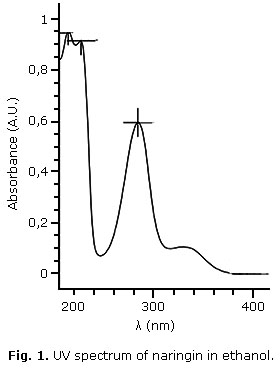
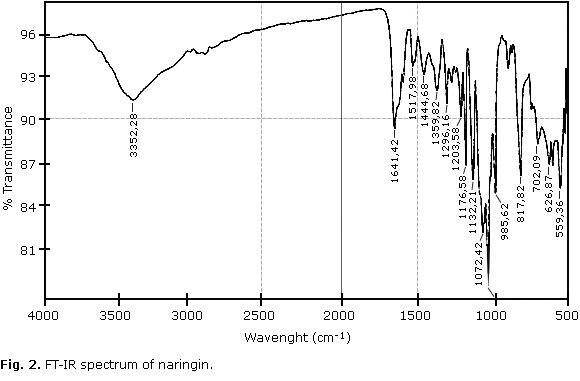
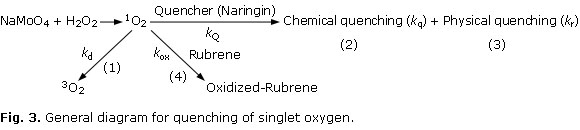
<body><![CDATA[<p><font face="Verdana, Arial, Helvetica, sans-serif" size="2"> The UV spectrum    of naringin in ethanol is shown in <a href="#fig1">Fig 1</a>. Naringin exhibits    two major absorption bands in the UV region, at 284 nm (band I) representing    B-ring absorption (cinnamoyl system), and at 229 nm (band II), considered to    be associated with the absorption involving the A ring benzoyl system, this    is a typical result for flavones and flavonols.<sup>18</sup></font></p>     <p align="center"><a name="fig1"></a><img src="/img/revistas/pla/v21n3/f0110316.jpg" width="280" height="368">  </p>     <p>&nbsp; </p>     <p><font face="Verdana, Arial, Helvetica, sans-serif" size="2"> The FT-IR spectrum    of naringin is shown in <a href="#fig2">Fig 2</a>. This spectrum is characterized    by vibrational bands mainly due to the OH, C-H, C=O, and C=C functional groups.    The u (OH), u (C-H), u (C=O), u (C=C) for naringin appear at 3425 cm<sup>-1</sup>,    2957-2859 cm<sup>-1</sup>, 1645 cm<sup>-1</sup>, respectively.<sup>18</sup></font></p>     <p align="center"><a name="fig2"></a><img src="/img/revistas/pla/v21n3/f0210316.jpg" width="580" height="381"></p>     <p>&nbsp; </p>     <p> <font face="Verdana, Arial, Helvetica, sans-serif" size="2"><b>Overall rate    constants (k<sub>Q</sub>) for the reaction of <sup>1</sup>O<sub>2</sub> with    naringin</b> </font></p>     <p>&nbsp; </p>     <p><font face="Verdana, Arial, Helvetica, sans-serif" size="2"> Singlet oxygen    could disappear by 4 routes (reactions 1 to 4, <a href="#fig4">Fig 3</a>): non-radiative    decay (1), singlet oxygen chemical quenching (2), singlet oxygen physical quenching    (3) and reaction with rubrene (4). </font></p>     <p align="center"><a name="fig3"></a><img src="/img/revistas/pla/v21n3/f0310316.jpg" width="580" height="130"></p>     ]]></body>
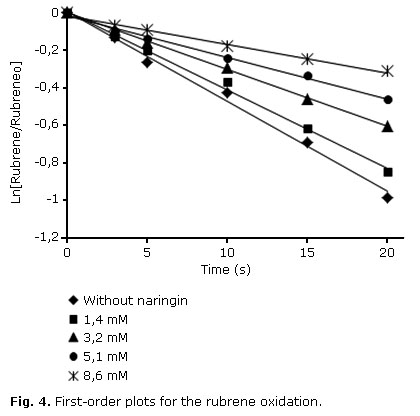
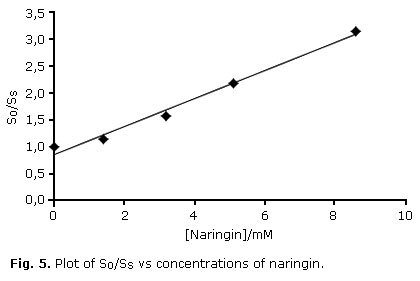
<body><![CDATA[<p>&nbsp; </p>     <p><font face="Verdana, Arial, Helvetica, sans-serif" size="2"> In this study,    two solutions of equal volume, the first containing naringin and the latter    without a quencher and each one having the same initial concentration of rubrene,    were exposed to the same amount of singlet oxygen. <a href="#fig4">Fig 4</a>    shows the effect of naringin on rubrene oxidation induced by singlet oxygen    in ethanol. </font></p>     <p align="center"><a name="fig4"></a><img src="/img/revistas/pla/v21n3/f0410316.jpg" width="420" height="416"></p>     <p>&nbsp; </p>     <p><font face="Verdana, Arial, Helvetica, sans-serif" size="2"> The results showed    that naringin inhibited the oxidation of rubrene efficiently in a concentration-dependent    manner; besides, the linear fitting of the plots indicated that rubrene oxidation    followed a first-order kinetics. </font></p>     <p><font face="Verdana, Arial, Helvetica, sans-serif" size="2"> The overall rate    constant <i>k</i><sub>Q</sub> (=<i>k</i><sub>q</sub> + <i>k</i><sub>r</sub>)    for the reaction of <sup>1</sup>O<sub>2</sub> with naringin was determined in    ethanol by Eq. 2 derived from the steady-state treatment of <a href="#fig3">Fig    3</a>. </font></p>     <p> <font face="Verdana, Arial, Helvetica, sans-serif" size="2"><i>S</i> <sub>0</sub>    /<i>S</i><sub>S</sub> = 1 + [(<i>k</i><sub>q</sub> + <i>k</i><sub>r</sub>)/<i>k</i><sub>d</sub>][Naringin]    (Eq. 2) </font></p>     <p><font face="Verdana, Arial, Helvetica, sans-serif" size="2"> Where <i>S</i><sub>0</sub>    and <i>S</i><sub>S</sub> are slopes of the first-order plots of disappearance    of <sup>1</sup>O<sub>2</sub> acceptor, rubrene, in absence and presence of naringin,    respectively. <i>k</i><sub>d</sub> is the rate of deactivation of <sup>1</sup>O<sub>2</sub>    in ethanol. A plot of <i>S</i><sub>0</sub>/<i>S</i><sub>S</sub> vs concentration    of naringin is shown in <a href="#fig5">Fig 5</a>. The overall rate constant    (<i>k</i><sub>Q</sub>) was calculated by using the value of <i>k</i><sub>d</sub>    in ethanol (<i>k</i><sub>d</sub>= 8.3 x 10<sup>4</sup> s<sup>-1</sup>), reported    by Merkel and Kearns.<sup>19</sup></font></p>     <div align="center">       <p><font face="Verdana, Arial, Helvetica, sans-serif" size="2"><a name="fig5"></a><img src="/img/revistas/pla/v21n3/f0510316.jpg" width="420" height="281"></font></p>       ]]></body>
<body><![CDATA[<p><font face="Verdana, Arial, Helvetica, sans-serif" size="2"><br clear="all"/>     </font></p> </div>     <p><font face="Verdana, Arial, Helvetica, sans-serif" size="2"> The <i>k</i><sub>Q</sub>    value obtained was 2.1 x 10<sup>7</sup> M<sup>-1</sup>s<sup>-1</sup>. This result    indicated that the naringin could act as scavenger of <sup>1</sup>O<sub>2</sub>.    The quenching process probably occurs via reversible charge transfer with the    formation of an "exciplex" (excited complex): the mechanism involves an excited    state encounter complex with a partial character of charge transfer, in which    the <sup>1</sup>O<sub>2</sub> is the acceptor species.<sup>20,21</sup></font></p>     <p>&nbsp;</p>     <p> <font face="Verdana, Arial, Helvetica, sans-serif" size="2"><b><font size="3">DISCUSSION</font></b>    </font></p>     <p><font face="Verdana, Arial, Helvetica, sans-serif" size="2"> The flavonoids    act as quenchers of singlet oxygen; Tournaire <i>et al.</i><sup>13</sup> reported    that the efficiency of the physical quenching (<i>k</i> <sub>q</sub>) is mainly    controlled by the presence of a catechol moiety on ring B, whereas the structure    of ring C (particularly the presence of a hydroxyl group activating the 2,3-double    bond) is the main factor determining the efficiency of the chemical reactivity    (<i>k</i><sub>r</sub>) of flavonoids with <sup>1</sup>O<sub>2</sub>. However,    the chemical reaction is almost negligible due to <i>k</i><sub>Q</sub>&#187;<i>k</i><sub>q</sub>.    The total reactivity scale (<i>k</i><sub>Q</sub>) is dominated by <i>k</i><sub>q</sub>,    which is in general higher than <i>k</i><sub>r</sub>. </font></p>     <p><font face="Verdana, Arial, Helvetica, sans-serif" size="2"> Nagai <i>et al.</i><sup>21    </sup>determined the rate constants of flavonoids without a 2,3-double bond    and studied the effect of p-conjugation between A- (resorcinol) and B- (phenol)    rings on the reaction rates. In this work was found that the 4'-OH group in    the B-ring contributed to the <sup>1</sup>O <sub>2</sub> quenching action by    flavonoid, while the resorcinol structure in the A-ring contributed partly (4-17%)    to the <sup>1</sup>O<sub>2</sub> quenching. The overall rate constant (3.7 x    10<sup>6</sup> M<sup>-1</sup>s<sup>-1</sup>) for the reaction of <sup>1</sup>O<sub>2</sub>    with naringenin reported was smaller than the value obtained (2.1 x 10<sup>7</sup>    M<sup>-1</sup>s<sup>-1</sup>) for naringin in this work; this could be due to    that naringin is the glycosilated naringenin (flavanone) and the sugar molecules    could be contributing to the <sup>1</sup>O<sub>2</sub> quenching, through stabilization    of excited complex formed. Nonetheless, the quenching rates of a-tocopherol    (2.1 x 10<sup>8</sup> M<sup>-1</sup>s<sup>-1</sup>) and b-carotene (1.6 x 10<sup>10</sup>    M<sup>-1</sup>s<sup>-1</sup>), the main quenchers of <sup>1</sup>O<sub>2</sub>    <sup>22,23</sup>, are one to three orders of magnitude higher than that of naringin.    On the other hand, the rate constants (<i>k</i><sub>Q</sub>) for some flavonoids    are resemble to naringin: chrysin (2.0 x 10<sup>7</sup> M<sup>-1</sup>s<sup>-1</sup>),    apigenin (2.8 x 10<sup>7</sup> M<sup>-1</sup>s<sup>-1</sup>), rutin (1.2 x 10<sup>8</sup>    M <sup>-1</sup>s<sup>-1</sup>), quercetin (4.6 x 10<sup>8</sup> M<sup>-1</sup>s<sup>-1</sup>),    myricetin (5.1 x 10<sup>8</sup> M<sup>-1</sup>s<sup>-1</sup>), catechins (1.1    x 10<sup>7 </sup>M<sup>-1</sup>s<sup>-1 </sup>- 1.5 x 10<sup>8</sup> M<sup>-1</sup>s<sup>-1</sup>)    <sup>21</sup>. Finally, it is worth mentioning that the synthetic antioxidants    BHA (<i>terc</i>-butylhydroxyanisol, 3.4 x 10<sup>7</sup> M<sup>-1</sup>s<sup>-1</sup>)    and BHT (<i>terc</i> -di-butylhydroxytoluene, 4.3 x 10<sup>6</sup> M<sup>-1</sup>s<sup>-1</sup>)    <sup>24 </sup>have singlet oxygen quenching activities comparable to naringin.    </font></p>     <p><font face="Verdana, Arial, Helvetica, sans-serif" size="2"> Most reactions    of <sup>1</sup>O<sub>2</sub> with biological targets (lipids, proteins (amino    acids), DNA, and RNA) occur <i>per</i> chemical via rather than physical route    inducing to cell death and mutations <sup>4,5</sup>. For instance, the quenching    rates for stearic, oleic, and linoleic acids, cholesterol and DNA <sup>21 </sup>are    9.0 x 10<sup>3</sup> M<sup>-1</sup>s<sup>-1</sup>, 1.7 x 10<sup>4</sup> M<sup>-1</sup>s<sup>-1</sup>,    4.2 x 10 <sup>4</sup> M<sup>-1</sup>s<sup>-1</sup>, 5.7 x 10<sup>4</sup> M<sup>-1</sup>s<sup>-1</sup>,    and 5.1 x 10<sup>5</sup> M<sup>-1</sup>s<sup>-1</sup>, in that order. The <i>k</i><sub>Q</sub>    value (2.1 x 10<sup>7</sup> M<sup>-1</sup>s<sup>-1</sup>) determined for naringin    was two to four orders of magnitude higher than those fatty acids and DNA. This    result suggests that naringin could contribute to the protection of the lipid    peroxidation and the degradation of DNA in photosynthetic systems, by quenching    <sup>1</sup>O<sub>2</sub>. Finally, our results are relevant and important due    to that the naringin was obtained from a low-cost source such as orange peel    wastes and, this implementation could be used to diminish the environmental    impact by accumulation of these natural residues. </font></p>     <p><font face="Verdana, Arial, Helvetica, sans-serif" size="2"> In this work,    we isolated naringin from <i>C. aurantium, </i>the analysis through<i> </i>UV    and FT-IR confirmed the identity of compound. Furthermore, we showed that naringin    is a quencher of singlet oxygen, one of the most important reactive oxygen species.    The naringin inhibited the rubrene oxidation by singlet oxygen and the overall    rate constant in ethanol was 2.1 x 10<sup>7</sup> M<sup>-1</sup>s<sup>-1</sup>.    The kinetic study suggests that the naringin could be used as a singlet oxygen    quencher in biological systems and protect them of oxidative damage. Finally,    we found a practical application for orange peel waste, an low-cost and abundant    resource. </font></p>     <p> <font face="Verdana, Arial, Helvetica, sans-serif" size="2"><i>Acknowledgments    </i> - A-MA thanks to Universidad del Norte for the financial support through    of the Strategic Area "Biodiversidad, Servicios Ecosist&#233;micos y Bienestar    Humano" (Code Project 2013-DI0024). </font></p> <font face="Verdana, Arial, Helvetica, sans-serif" size="2"><b> <br clear="all"/> </b> </font>      <p> <font face="Verdana, Arial, Helvetica, sans-serif" size="2"><b><font size="3">REFERENCES</font></b>    </font></p>     ]]></body>
<body><![CDATA[<!-- ref --><p><font face="Verdana, Arial, Helvetica, sans-serif" size="2"> 1. Schrag M, Mueller    C, Zabel M, Crofton A, Kirsch WM, Ghribi O, et al. Oxidative stress in blood    in Alzheimer's disease and mild cognitive impairment: A meta-analysis. Neurobiol.    Dis. 2013;59(0):100-10.     </font></p>     <!-- ref --><p><font face="Verdana, Arial, Helvetica, sans-serif" size="2"> 2. Stief TW. The    physiology and pharmacology of singlet oxygen. Med. Hypotheses. 2003;60(4):567-72.        </font></p>     <!-- ref --><p><font face="Verdana, Arial, Helvetica, sans-serif" size="2"> 3. Al-Gubory KH,    Fowler PA, Garrel C. The roles of cellular reactive oxygen species, oxidative    stress and antioxidants in pregnancy outcomes. Int. J. Biochem. Cell B. 2012;42(10):1634-50.        </font></p>     <!-- ref --><p><font face="Verdana, Arial, Helvetica, sans-serif" size="2"> 4. Ray RS, Mujtaba    SF, Dwivedi A, Yadav N, Verma A, Kushwaha HN, et al. Singlet oxygen mediated    DNA damage induced phototoxicity by ketoprofen resulting in mitochondrial depolarization    and lysosomal destabilization. Toxicology. 2013;314(0):229-37.     </font></p>     <!-- ref --><p><font face="Verdana, Arial, Helvetica, sans-serif" size="2"> 5. Wenli Y, Yaping    Z. Chemiluminescence evaluation of oxidative damage to biomolecules induced    by singlet oxygen and the protective effects of antioxidants. Biochim. Biophys.    Acta. 2005;1725(1):30-4.     </font></p>     ]]></body>
<body><![CDATA[<!-- ref --><p><font face="Verdana, Arial, Helvetica, sans-serif" size="2"> 6. Wen X, Wu J,    Wang F, Liu B, Huang C, Wei Y. Deconvoluting the role of reactive oxygen species    and autophagy in human diseases. Free Rad. Biol. Med. 2013;65(0):402-10.     </font></p>     <!-- ref --><p><font face="Verdana, Arial, Helvetica, sans-serif" size="2"> 7. Mehdi MM, Rizvi    SI. Plasma protein hydroperoxides during aging in humans: correlation with paraoxonase    1 (PON1) arylesterase activity and plasma total thiols. Arch. Med. Res.2013;44(2):136-41.        </font></p>     <!-- ref --><p><font face="Verdana, Arial, Helvetica, sans-serif" size="2"> 8. Zigler J, Goosey    JD. Singlet oxygen as a possible factor in human senile nuclear cataract development.    Curr Eye Res. 1984;3(1):59-65.     </font></p>     <!-- ref --><p><font face="Verdana, Arial, Helvetica, sans-serif" size="2"> 9. Kanofsky J.R.<b>    </b>Singlet oxygen production by biological systems.<b> </b> Chem Biol Interact.    1989;70(1-2):1-28.     </font></p>     <!-- ref --><p><font face="Verdana, Arial, Helvetica, sans-serif" size="2"> 10. Glette J,    Sandberg S. Phototoxicity of tetracyclines as related to singlet oxygen production    and uptake by polymorphonuclear leukocytes. Biochem Pharmacol. 1986,35(17):2883-85.        </font></p>     ]]></body>
<body><![CDATA[<!-- ref --><p><font face="Verdana, Arial, Helvetica, sans-serif" size="2"> 11. Harasym J,    Oledzki R. Effect of fruit and vegetable antioxidants on total antioxidant capacity    of blood plasma. Nutrition. 2014;30(5):511-17.     </font></p>     <!-- ref --><p><font face="Verdana, Arial, Helvetica, sans-serif" size="2"> 12. Agati G, Azzarello    E, Pollastri S, Tattini M. Flavonoids as antioxidants in plants: Location and    functional significance. Plant Science. 2012;196(0):67-76.     </font></p>     <!-- ref --><p><font face="Verdana, Arial, Helvetica, sans-serif" size="2"> 13. Tournaire    C, Croux S, Maurette MT, Beck I, Hocquaux M, Braun AM, et al. Antioxidant activity    of flavonoids: Efficiency of singlet oxygen (<sup>1</sup> &#916;<sub>g</sub>)    quenching. J. Photochem. Photobiol. B: Biol.1993;19(3):205-15.     </font></p>     <!-- ref --><p><font face="Verdana, Arial, Helvetica, sans-serif" size="2"> 14. Mukai K, Nagai    S, Ohara K. Kinetic study of the quenching reaction of singlet oxygen by tea    catechins in ethanol solution. Free Rad. Biol. Med. 2005; 39(6):752-61.     </font></p>     <!-- ref --><p><font face="Verdana, Arial, Helvetica, sans-serif" size="2"> 15 Montenegro    MA, Nazareno MA, Borsarelli CD. Kinetic study of the photosensitized oxygenation    of the flavanone naringin and its chalcone. J. Photochem. Photobiol. A: Chem.    2007;186(1):47-56.     </font></p>     ]]></body>
<body><![CDATA[<!-- ref --><p><font face="Verdana, Arial, Helvetica, sans-serif" size="2"> 16. Ikan R. Acetogenins    in Natural Products. London and New York: Academic Press; 1969.     </font></p>     <!-- ref --><p><font face="Verdana, Arial, Helvetica, sans-serif" size="2"> 17. Aubry JM,    Bouttemy S. Preparative oxidation of organic compounds in microemulsions with    singlet oxygen generated chemically by the sodium molybdate/hydrogen peroxide    system. J. Am. Chem. Soc. 1997;119(23):5286-94.     </font></p>     <p><font face="Verdana, Arial, Helvetica, sans-serif" size="2"> 18. &#214;zy&#252;rek    M, Akp&#305;nar D, Bener M, T&#252;rkkan B, G&#252;&#231;l&#252; K, Apak R.    Novel oxime based flavanone, naringin-oxime: Synthesis, characterization and    screening for antioxidant activity. Chem-Biol. Interact. 2014;212(0):40-46.    </font></p>     <!-- ref --><p><font face="Verdana, Arial, Helvetica, sans-serif" size="2"> 19. Merkel PB,    Kearns DR. Radiationless decay of singlet molecular oxygen in solution. Experimental    and theoretical study of electronic-to-vibrational energy transfer. J. Am. Chem.    Soc.1972;94(21):7244-53.     </font></p>     <!-- ref --><p><font face="Verdana, Arial, Helvetica, sans-serif" size="2"> 20. Thomas MJ,    Foote CS. Chemistry of singlet oxygen-XXVI. Photooxygenation of phenols. Photochem.    Photobiol. 1978;27(6):683-93.     </font></p>     <!-- ref --><p><font face="Verdana, Arial, Helvetica, sans-serif" size="2"> 21. Nagai S, Ohara    K, Mukai K. Kinetic Study of the Quenching Reaction of Singlet Oxygen by Flavonoids    in Ethanol Solution. J. Phys. Chem. B. 2005; 109(9):4234-40.     </font></p>     <!-- ref --><p><font face="Verdana, Arial, Helvetica, sans-serif" size="2"> 22. Mukai K, Ouchi    A, Nakano M. Kinetic study of the quenching reaction of singlet oxygen by pyrroloquinolinequinol    (PQQH2, a reduced form of pyrroloquinolinequinone) in micellar Solution. J.    Agric. Food Chem. 2011,59(5):1705-12.     </font></p>     <!-- ref --><p><font face="Verdana, Arial, Helvetica, sans-serif" size="2"> 23. Ouchi A, Aizawa    K, Iwasaki Y, Inakuma T, Terao J, Nagaoka SI, et al. Kinetic study of the quenching    reaction of singlet oxygen by carotenoids and food extracts in solution. Developmentof    a Singlet Oxygen Absorption Capacity (SOAC) Assay Method. J. Agric. Food Chem.    2010;58(18):9967-78.     </font></p>     <p><font face="Verdana, Arial, Helvetica, sans-serif" size="2"> 24. Kim JI, Lee    JH, Choi DS, Won BM, Jung MY, Park J. Kinetic study of the quenching reaction    of singlet oxygen by common synthetic antioxidants (tert-butylhydroxyanisol,    tert-di-butylhydroxytoluene, and tert-butylhydroquinone) as compared with &#945;-Tocopherol.    J. Food Sci. 2009,74(5):362-69. </font></p>     <p>&nbsp; </p>     <p>&nbsp; </p>     <p><font face="Verdana, Arial, Helvetica, sans-serif" size="2">Recibido: 31 de    julio de 2015.     <br>   </font><font face="Verdana, Arial, Helvetica, sans-serif" size="2">Aprobado:    1 de abril de 2016. </font></p>     ]]></body>
<body><![CDATA[<p>&nbsp;</p>     <p>&nbsp;</p>      ]]></body><back>
<ref-list>
<ref id="B1">
<label>1</label><nlm-citation citation-type="journal">
<person-group person-group-type="author">
<name>
<surname><![CDATA[Schrag]]></surname>
<given-names><![CDATA[M]]></given-names>
</name>
<name>
<surname><![CDATA[Mueller]]></surname>
<given-names><![CDATA[C]]></given-names>
</name>
<name>
<surname><![CDATA[Zabel]]></surname>
<given-names><![CDATA[M]]></given-names>
</name>
<name>
<surname><![CDATA[Crofton]]></surname>
<given-names><![CDATA[A]]></given-names>
</name>
<name>
<surname><![CDATA[Kirsch]]></surname>
<given-names><![CDATA[WM]]></given-names>
</name>
<name>
<surname><![CDATA[Ghribi]]></surname>
<given-names><![CDATA[O]]></given-names>
</name>
</person-group>
<article-title xml:lang="en"><![CDATA[Oxidative stress in blood in Alzheimer's disease and mild cognitive impairment: A meta-analysis]]></article-title>
<source><![CDATA[Neurobiol. Dis]]></source>
<year>2013</year>
<volume>59</volume>
<numero>0</numero>
<issue>0</issue>
<page-range>100-10</page-range></nlm-citation>
</ref>
<ref id="B2">
<label>2</label><nlm-citation citation-type="journal">
<person-group person-group-type="author">
<name>
<surname><![CDATA[Stief]]></surname>
<given-names><![CDATA[TW]]></given-names>
</name>
</person-group>
<article-title xml:lang="en"><![CDATA[The physiology and pharmacology of singlet oxygen]]></article-title>
<source><![CDATA[Med Hypotheses]]></source>
<year>2003</year>
<volume>60</volume>
<numero>4</numero>
<issue>4</issue>
<page-range>567-72</page-range></nlm-citation>
</ref>
<ref id="B3">
<label>3</label><nlm-citation citation-type="journal">
<person-group person-group-type="author">
<name>
<surname><![CDATA[Al-Gubory]]></surname>
<given-names><![CDATA[KH]]></given-names>
</name>
<name>
<surname><![CDATA[Fowler]]></surname>
<given-names><![CDATA[PA]]></given-names>
</name>
<name>
<surname><![CDATA[Garrel]]></surname>
<given-names><![CDATA[C]]></given-names>
</name>
</person-group>
<article-title xml:lang="en"><![CDATA[The roles of cellular reactive oxygen species, oxidative stress and antioxidants in pregnancy outcomes]]></article-title>
<source><![CDATA[Int. J. Biochem Cell B]]></source>
<year>2012</year>
<volume>42</volume>
<numero>10</numero>
<issue>10</issue>
<page-range>1634-50</page-range></nlm-citation>
</ref>
<ref id="B4">
<label>4</label><nlm-citation citation-type="journal">
<person-group person-group-type="author">
<name>
<surname><![CDATA[Ray]]></surname>
<given-names><![CDATA[RS]]></given-names>
</name>
<name>
<surname><![CDATA[Mujtaba]]></surname>
<given-names><![CDATA[SF]]></given-names>
</name>
<name>
<surname><![CDATA[Dwivedi]]></surname>
<given-names><![CDATA[A]]></given-names>
</name>
<name>
<surname><![CDATA[Yadav]]></surname>
<given-names><![CDATA[N]]></given-names>
</name>
<name>
<surname><![CDATA[Verma]]></surname>
<given-names><![CDATA[A]]></given-names>
</name>
<name>
<surname><![CDATA[Kushwaha]]></surname>
<given-names><![CDATA[HN]]></given-names>
</name>
</person-group>
<article-title xml:lang="en"><![CDATA[Singlet oxygen mediated DNA damage induced phototoxicity by ketoprofen resulting in mitochondrial depolarization and lysosomal destabilization]]></article-title>
<source><![CDATA[Toxicology]]></source>
<year>2013</year>
<volume>314</volume>
<numero>0</numero>
<issue>0</issue>
<page-range>229-37</page-range></nlm-citation>
</ref>
<ref id="B5">
<label>5</label><nlm-citation citation-type="journal">
<person-group person-group-type="author">
<name>
<surname><![CDATA[Wenli]]></surname>
<given-names><![CDATA[Y]]></given-names>
</name>
<name>
<surname><![CDATA[Yaping]]></surname>
<given-names><![CDATA[Z]]></given-names>
</name>
</person-group>
<article-title xml:lang="en"><![CDATA[Chemiluminescence evaluation of oxidative damage to biomolecules induced by singlet oxygen and the protective effects of antioxidants]]></article-title>
<source><![CDATA[Biochim. Biophys Acta]]></source>
<year>2005</year>
<volume>1725</volume>
<numero>1</numero>
<issue>1</issue>
<page-range>30-4</page-range></nlm-citation>
</ref>
<ref id="B6">
<label>6</label><nlm-citation citation-type="journal">
<person-group person-group-type="author">
<name>
<surname><![CDATA[Wen]]></surname>
<given-names><![CDATA[X]]></given-names>
</name>
<name>
<surname><![CDATA[Wu]]></surname>
<given-names><![CDATA[J]]></given-names>
</name>
<name>
<surname><![CDATA[Wang]]></surname>
<given-names><![CDATA[F]]></given-names>
</name>
<name>
<surname><![CDATA[Liu]]></surname>
<given-names><![CDATA[B]]></given-names>
</name>
<name>
<surname><![CDATA[Huang]]></surname>
<given-names><![CDATA[C]]></given-names>
</name>
<name>
<surname><![CDATA[Wei]]></surname>
<given-names><![CDATA[Y]]></given-names>
</name>
</person-group>
<article-title xml:lang="en"><![CDATA[Deconvoluting the role of reactive oxygen species and autophagy in human diseases]]></article-title>
<source><![CDATA[Free Rad. Biol Med]]></source>
<year>2013</year>
<volume>65</volume>
<numero>0</numero>
<issue>0</issue>
<page-range>402-10</page-range></nlm-citation>
</ref>
<ref id="B7">
<label>7</label><nlm-citation citation-type="journal">
<person-group person-group-type="author">
<name>
<surname><![CDATA[Mehdi]]></surname>
<given-names><![CDATA[MM]]></given-names>
</name>
<name>
<surname><![CDATA[Rizvi]]></surname>
<given-names><![CDATA[SI]]></given-names>
</name>
</person-group>
<article-title xml:lang="en"><![CDATA[Plasma protein hydroperoxides during aging in humans: correlation with paraoxonase 1 (PON1) arylesterase activity and plasma total thiols.]]></article-title>
<source><![CDATA[Arch. Med Res]]></source>
<year>2013</year>
<volume>44</volume>
<numero>2</numero>
<issue>2</issue>
<page-range>136-41</page-range></nlm-citation>
</ref>
<ref id="B8">
<label>8</label><nlm-citation citation-type="journal">
<person-group person-group-type="author">
<name>
<surname><![CDATA[Zigler]]></surname>
<given-names><![CDATA[J]]></given-names>
</name>
<name>
<surname><![CDATA[Goosey]]></surname>
<given-names><![CDATA[JD]]></given-names>
</name>
</person-group>
<article-title xml:lang="en"><![CDATA[Singlet oxygen as a possible factor in human senile nuclear cataract development]]></article-title>
<source><![CDATA[Curr Eye Res]]></source>
<year>1984</year>
<volume>3</volume>
<numero>1</numero>
<issue>1</issue>
<page-range>59-65</page-range></nlm-citation>
</ref>
<ref id="B9">
<label>9</label><nlm-citation citation-type="journal">
<person-group person-group-type="author">
<name>
<surname><![CDATA[Kanofsky]]></surname>
<given-names><![CDATA[JR]]></given-names>
</name>
</person-group>
<article-title xml:lang="en"><![CDATA[Singlet oxygen production by biological systems]]></article-title>
<source><![CDATA[Chem Biol Interact]]></source>
<year>1989</year>
<volume>70</volume>
<numero>1-2</numero>
<issue>1-2</issue>
<page-range>1-28</page-range></nlm-citation>
</ref>
<ref id="B10">
<label>10</label><nlm-citation citation-type="journal">
<person-group person-group-type="author">
<name>
<surname><![CDATA[Glette]]></surname>
<given-names><![CDATA[J]]></given-names>
</name>
<name>
<surname><![CDATA[Sandberg]]></surname>
<given-names><![CDATA[S]]></given-names>
</name>
</person-group>
<article-title xml:lang="en"><![CDATA[Phototoxicity of tetracyclines as related to singlet oxygen production and uptake by polymorphonuclear leukocytes]]></article-title>
<source><![CDATA[Biochem Pharmacol]]></source>
<year>1986</year>
<volume>35</volume>
<numero>17</numero>
<issue>17</issue>
<page-range>2883-85</page-range></nlm-citation>
</ref>
<ref id="B11">
<label>11</label><nlm-citation citation-type="journal">
<person-group person-group-type="author">
<name>
<surname><![CDATA[Harasym]]></surname>
<given-names><![CDATA[J]]></given-names>
</name>
<name>
<surname><![CDATA[Oledzki]]></surname>
<given-names><![CDATA[R]]></given-names>
</name>
</person-group>
<article-title xml:lang="en"><![CDATA[Effect of fruit and vegetable antioxidants on total antioxidant capacity of blood plasma]]></article-title>
<source><![CDATA[Nutrition]]></source>
<year>2014</year>
<volume>30</volume>
<numero>5</numero>
<issue>5</issue>
<page-range>511-17</page-range></nlm-citation>
</ref>
<ref id="B12">
<label>12</label><nlm-citation citation-type="journal">
<person-group person-group-type="author">
<name>
<surname><![CDATA[Agati]]></surname>
<given-names><![CDATA[G]]></given-names>
</name>
<name>
<surname><![CDATA[Azzarello]]></surname>
<given-names><![CDATA[E]]></given-names>
</name>
<name>
<surname><![CDATA[Pollastri]]></surname>
<given-names><![CDATA[S]]></given-names>
</name>
<name>
<surname><![CDATA[Tattini]]></surname>
<given-names><![CDATA[M]]></given-names>
</name>
</person-group>
<article-title xml:lang="en"><![CDATA[Flavonoids as antioxidants in plants: Location and functional significance]]></article-title>
<source><![CDATA[Plant Science]]></source>
<year>2012</year>
<volume>196</volume>
<numero>0</numero>
<issue>0</issue>
<page-range>67-76</page-range></nlm-citation>
</ref>
<ref id="B13">
<label>13</label><nlm-citation citation-type="journal">
<person-group person-group-type="author">
<name>
<surname><![CDATA[Tournaire]]></surname>
<given-names><![CDATA[C]]></given-names>
</name>
<name>
<surname><![CDATA[Croux]]></surname>
<given-names><![CDATA[S]]></given-names>
</name>
<name>
<surname><![CDATA[Maurette]]></surname>
<given-names><![CDATA[MT]]></given-names>
</name>
<name>
<surname><![CDATA[Beck]]></surname>
<given-names><![CDATA[I]]></given-names>
</name>
<name>
<surname><![CDATA[Hocquaux]]></surname>
<given-names><![CDATA[M]]></given-names>
</name>
<name>
<surname><![CDATA[Braun]]></surname>
<given-names><![CDATA[AM]]></given-names>
</name>
</person-group>
<article-title xml:lang="en"><![CDATA[Antioxidant activity of flavonoids: Efficiency of singlet oxygen (1 ?g) quenching.]]></article-title>
<source><![CDATA[J. Photochem. Photobiol B: Biol]]></source>
<year>1993</year>
<volume>19</volume>
<numero>3</numero>
<issue>3</issue>
<page-range>205-15</page-range></nlm-citation>
</ref>
<ref id="B14">
<label>14</label><nlm-citation citation-type="journal">
<person-group person-group-type="author">
<name>
<surname><![CDATA[Mukai]]></surname>
<given-names><![CDATA[K]]></given-names>
</name>
<name>
<surname><![CDATA[Nagai]]></surname>
<given-names><![CDATA[S]]></given-names>
</name>
<name>
<surname><![CDATA[Ohara]]></surname>
<given-names><![CDATA[K]]></given-names>
</name>
</person-group>
<article-title xml:lang="en"><![CDATA[Kinetic study of the quenching reaction of singlet oxygen by tea catechins in ethanol solution]]></article-title>
<source><![CDATA[Free Rad. Biol Med]]></source>
<year>2005</year>
<volume>39</volume>
<numero>6</numero>
<issue>6</issue>
<page-range>752-61</page-range></nlm-citation>
</ref>
<ref id="B15">
<label>15</label><nlm-citation citation-type="journal">
<person-group person-group-type="author">
<name>
<surname><![CDATA[Montenegro]]></surname>
<given-names><![CDATA[MA]]></given-names>
</name>
<name>
<surname><![CDATA[Nazareno]]></surname>
<given-names><![CDATA[MA]]></given-names>
</name>
<name>
<surname><![CDATA[Borsarelli]]></surname>
<given-names><![CDATA[CD]]></given-names>
</name>
</person-group>
<article-title xml:lang="en"><![CDATA[Kinetic study of the photosensitized oxygenation of the flavanone naringin and its chalcone]]></article-title>
<source><![CDATA[J. Photochem. Photobiol A. Chem]]></source>
<year>2007</year>
<volume>186</volume>
<numero>1</numero>
<issue>1</issue>
<page-range>47-56</page-range></nlm-citation>
</ref>
<ref id="B16">
<label>16</label><nlm-citation citation-type="book">
<person-group person-group-type="author">
<name>
<surname><![CDATA[Ikan]]></surname>
<given-names><![CDATA[R]]></given-names>
</name>
</person-group>
<source><![CDATA[Acetogenins in Natural Products]]></source>
<year>1969</year>
<publisher-loc><![CDATA[London and New York ]]></publisher-loc>
<publisher-name><![CDATA[Academic Press]]></publisher-name>
</nlm-citation>
</ref>
<ref id="B17">
<label>17</label><nlm-citation citation-type="journal">
<person-group person-group-type="author">
<name>
<surname><![CDATA[Aubry]]></surname>
<given-names><![CDATA[JM]]></given-names>
</name>
<name>
<surname><![CDATA[Bouttemy]]></surname>
<given-names><![CDATA[S]]></given-names>
</name>
</person-group>
<article-title xml:lang="en"><![CDATA[Preparative oxidation of organic compounds in microemulsions with singlet oxygen generated chemically by the sodium molybdate/hydrogen peroxide system]]></article-title>
<source><![CDATA[J. Am. Chem Soc]]></source>
<year>1997</year>
<volume>119</volume>
<numero>23</numero>
<issue>23</issue>
<page-range>5286-94</page-range></nlm-citation>
</ref>
<ref id="B18">
<label>18</label><nlm-citation citation-type="journal">
<person-group person-group-type="author">
<name>
<surname><![CDATA[Özyürek]]></surname>
<given-names><![CDATA[M]]></given-names>
</name>
<name>
<surname><![CDATA[Akpinar]]></surname>
<given-names><![CDATA[D]]></given-names>
</name>
<name>
<surname><![CDATA[Bener]]></surname>
<given-names><![CDATA[M]]></given-names>
</name>
<name>
<surname><![CDATA[Türkkan]]></surname>
<given-names><![CDATA[B]]></given-names>
</name>
<name>
<surname><![CDATA[Güçlü]]></surname>
<given-names><![CDATA[K]]></given-names>
</name>
<name>
<surname><![CDATA[Apak]]></surname>
<given-names><![CDATA[R]]></given-names>
</name>
</person-group>
<article-title xml:lang="en"><![CDATA[Novel oxime based flavanone, naringin-oxime: Synthesis, characterization and screening for antioxidant activity.]]></article-title>
<source><![CDATA[Chem-Biol Interact]]></source>
<year>2014</year>
<volume>212</volume>
<numero>0</numero>
<issue>0</issue>
<page-range>40-46</page-range></nlm-citation>
</ref>
<ref id="B19">
<label>19</label><nlm-citation citation-type="journal">
<person-group person-group-type="author">
<name>
<surname><![CDATA[Merkel]]></surname>
<given-names><![CDATA[PB]]></given-names>
</name>
<name>
<surname><![CDATA[Kearns]]></surname>
<given-names><![CDATA[DR]]></given-names>
</name>
</person-group>
<article-title xml:lang="en"><![CDATA[Radiationless decay of singlet molecular oxygen in solutionExperimental and theoretical study of electronic-to-vibrational energy transfer]]></article-title>
<source><![CDATA[J. Am. Chem Soc]]></source>
<year>1972</year>
<volume>94</volume>
<numero>21</numero>
<issue>21</issue>
<page-range>7244-53</page-range></nlm-citation>
</ref>
<ref id="B20">
<label>20</label><nlm-citation citation-type="journal">
<person-group person-group-type="author">
<name>
<surname><![CDATA[Thomas]]></surname>
<given-names><![CDATA[MJ]]></given-names>
</name>
<name>
<surname><![CDATA[Foote]]></surname>
<given-names><![CDATA[CS]]></given-names>
</name>
</person-group>
<article-title xml:lang="en"><![CDATA[Chemistry of singlet oxygen-XXVIPhotooxygenation of phenols]]></article-title>
<source><![CDATA[Photochem Photobiol]]></source>
<year>1978</year>
<volume>27</volume>
<numero>6</numero>
<issue>6</issue>
<page-range>683-93</page-range></nlm-citation>
</ref>
<ref id="B21">
<label>21</label><nlm-citation citation-type="journal">
<person-group person-group-type="author">
<name>
<surname><![CDATA[Nagai]]></surname>
<given-names><![CDATA[S]]></given-names>
</name>
<name>
<surname><![CDATA[Ohara]]></surname>
<given-names><![CDATA[K]]></given-names>
</name>
<name>
<surname><![CDATA[Mukai]]></surname>
<given-names><![CDATA[K]]></given-names>
</name>
</person-group>
<article-title xml:lang="en"><![CDATA[Kinetic Study of the Quenching Reaction of Singlet Oxygen by Flavonoids in Ethanol Solution]]></article-title>
<source><![CDATA[J. Phys. Chem]]></source>
<year>2005</year>
<volume>109</volume>
<numero>9</numero>
<issue>9</issue>
<page-range>4234-40</page-range></nlm-citation>
</ref>
<ref id="B22">
<label>22</label><nlm-citation citation-type="journal">
<person-group person-group-type="author">
<name>
<surname><![CDATA[Mukai]]></surname>
<given-names><![CDATA[K]]></given-names>
</name>
<name>
<surname><![CDATA[Ouchi]]></surname>
<given-names><![CDATA[A]]></given-names>
</name>
<name>
<surname><![CDATA[Nakano]]></surname>
<given-names><![CDATA[M]]></given-names>
</name>
</person-group>
<article-title xml:lang="en"><![CDATA[Kinetic study of the quenching reaction of singlet oxygen by pyrroloquinolinequinol (PQQH2, a reduced form of pyrroloquinolinequinone) in micellar Solution]]></article-title>
<source><![CDATA[J. Agric Food Chem]]></source>
<year>2011</year>
<volume>59</volume>
<numero>5</numero>
<issue>5</issue>
<page-range>1705-12</page-range></nlm-citation>
</ref>
<ref id="B23">
<label>23</label><nlm-citation citation-type="journal">
<person-group person-group-type="author">
<name>
<surname><![CDATA[Ouchi]]></surname>
<given-names><![CDATA[A]]></given-names>
</name>
<name>
<surname><![CDATA[Aizawa]]></surname>
<given-names><![CDATA[K]]></given-names>
</name>
<name>
<surname><![CDATA[Iwasaki]]></surname>
<given-names><![CDATA[Y]]></given-names>
</name>
<name>
<surname><![CDATA[Inakuma]]></surname>
<given-names><![CDATA[T]]></given-names>
</name>
<name>
<surname><![CDATA[Terao]]></surname>
<given-names><![CDATA[J]]></given-names>
</name>
<name>
<surname><![CDATA[Nagaoka]]></surname>
<given-names><![CDATA[SI]]></given-names>
</name>
</person-group>
<article-title xml:lang="en"><![CDATA[Kinetic study of the quenching reaction of singlet oxygen by carotenoids and food extracts in solutionDevelopmentof a Singlet Oxygen Absorption Capacity (SOAC) Assay Method]]></article-title>
<source><![CDATA[J. Agric Food Chem]]></source>
<year>2010</year>
<volume>58</volume>
<numero>18</numero>
<issue>18</issue>
<page-range>9967-78</page-range></nlm-citation>
</ref>
<ref id="B24">
<label>24</label><nlm-citation citation-type="journal">
<person-group person-group-type="author">
<name>
<surname><![CDATA[Kim]]></surname>
<given-names><![CDATA[JI]]></given-names>
</name>
<name>
<surname><![CDATA[Lee]]></surname>
<given-names><![CDATA[JH]]></given-names>
</name>
<name>
<surname><![CDATA[Choi]]></surname>
<given-names><![CDATA[DS]]></given-names>
</name>
<name>
<surname><![CDATA[Won]]></surname>
<given-names><![CDATA[BM]]></given-names>
</name>
<name>
<surname><![CDATA[Jung]]></surname>
<given-names><![CDATA[MY]]></given-names>
</name>
<name>
<surname><![CDATA[Park]]></surname>
<given-names><![CDATA[J]]></given-names>
</name>
</person-group>
<article-title xml:lang="en"><![CDATA[Kinetic study of the quenching reaction of singlet oxygen by common synthetic antioxidants (tert-butylhydroxyanisol, tert-di-butylhydroxytoluene, and tert-butylhydroquinone) as compared with a-Tocopherol]]></article-title>
<source><![CDATA[J. Food Sci]]></source>
<year>2009</year>
<volume>74</volume>
<numero>5</numero>
<issue>5</issue>
<page-range>362-69</page-range></nlm-citation>
</ref>
</ref-list>
</back>
</article>