<?xml version="1.0" encoding="ISO-8859-1"?><article xmlns:mml="http://www.w3.org/1998/Math/MathML" xmlns:xlink="http://www.w3.org/1999/xlink" xmlns:xsi="http://www.w3.org/2001/XMLSchema-instance">
<front>
<journal-meta>
<journal-id>1561-3194</journal-id>
<journal-title><![CDATA[Revista de Ciencias Médicas de Pinar del Río]]></journal-title>
<abbrev-journal-title><![CDATA[Rev Ciencias Médicas]]></abbrev-journal-title>
<issn>1561-3194</issn>
<publisher>
<publisher-name><![CDATA[Editorial Ciencias Médicas]]></publisher-name>
</publisher>
</journal-meta>
<article-meta>
<article-id>S1561-31942018000300008</article-id>
<title-group>
<article-title xml:lang="es"><![CDATA[Relación entre varicocele, disfunción sexual y niveles séricos de testosterona]]></article-title>
<article-title xml:lang="en"><![CDATA[Relationship between varicocele, sexual dysfunction and serum testosterone levels]]></article-title>
</title-group>
<contrib-group>
<contrib contrib-type="author">
<name>
<surname><![CDATA[Baños Hernández]]></surname>
<given-names><![CDATA[Ihosvani]]></given-names>
</name>
<xref ref-type="aff" rid="A01"/>
</contrib>
<contrib contrib-type="author">
<name>
<surname><![CDATA[de Armas Ampudia]]></surname>
<given-names><![CDATA[Iliana]]></given-names>
</name>
<xref ref-type="aff" rid="A01"/>
</contrib>
<contrib contrib-type="author">
<name>
<surname><![CDATA[Ramos Padilla]]></surname>
<given-names><![CDATA[Kenia]]></given-names>
</name>
<xref ref-type="aff" rid="A01"/>
</contrib>
<contrib contrib-type="author">
<name>
<surname><![CDATA[Castillo García]]></surname>
<given-names><![CDATA[Idelma]]></given-names>
</name>
<xref ref-type="aff" rid="A02"/>
</contrib>
</contrib-group>
<aff id="A01">
<institution><![CDATA[,Hospital General Docente Abel Santamaría Cuadrado. Pinar del Río. Cuba  ]]></institution>
<addr-line><![CDATA[Pinar del Río ]]></addr-line>
<country>Cuba</country>
</aff>
<aff id="A02">
<institution><![CDATA[,Hospital Clínico Quirúrgico Dr. León Cuervo Rubio. Pinar del Río. Cuba.  ]]></institution>
<addr-line><![CDATA[Pinar del Río ]]></addr-line>
<country>Cuba</country>
</aff>
<pub-date pub-type="pub">
<day>00</day>
<month>06</month>
<year>2018</year>
</pub-date>
<pub-date pub-type="epub">
<day>00</day>
<month>06</month>
<year>2018</year>
</pub-date>
<volume>22</volume>
<numero>3</numero>
<fpage>73</fpage>
<lpage>81</lpage>
<copyright-statement/>
<copyright-year/>
<self-uri xlink:href="http://scielo.sld.cu/scielo.php?script=sci_arttext&amp;pid=S1561-31942018000300008&amp;lng=en&amp;nrm=iso"></self-uri><self-uri xlink:href="http://scielo.sld.cu/scielo.php?script=sci_abstract&amp;pid=S1561-31942018000300008&amp;lng=en&amp;nrm=iso"></self-uri><self-uri xlink:href="http://scielo.sld.cu/scielo.php?script=sci_pdf&amp;pid=S1561-31942018000300008&amp;lng=en&amp;nrm=iso"></self-uri><kwd-group>
<kwd lng="es"><![CDATA[VARICOCELE]]></kwd>
<kwd lng="es"><![CDATA[DISFUNCIÓN ERÉCTIL]]></kwd>
<kwd lng="es"><![CDATA[TESTOSTERONA]]></kwd>
<kwd lng="en"><![CDATA[VARICOCELE]]></kwd>
<kwd lng="en"><![CDATA[ERECTILE DYSFUNCTION]]></kwd>
<kwd lng="en"><![CDATA[TESTOSTERONE]]></kwd>
</kwd-group>
</article-meta>
</front><body><![CDATA[ <P  ALIGN=right ><FONT size="2" FACE="Verdana, Arial, Helvetica, sans-serif"><B>ART&Iacute;CULO ORIGINAL</B></FONT></P>     <P  ALIGN=right >&nbsp;</P>     <P ALIGN=justify ><FONT size="4" FACE="Verdana, Arial, Helvetica, sans-serif"><SPAN LANG="es-ES"><B>Relaci&oacute;n entre varicocele, disfunci&oacute;n sexual y niveles s&eacute;ricos de testosterona</B></SPAN></FONT></P>     <P ALIGN=justify >&nbsp;</P>     <P LANG="en-US" CLASS="western" ALIGN=justify STYLE="margin-bottom: 0cm">   <FONT size="3" FACE="Verdana, Arial, Helvetica, sans-serif"><B>Relationship between varicocele, sexual dysfunction and serum testosterone levels</B></FONT></P>     <P LANG="en-US" ALIGN=justify STYLE="margin-top: 0.49cm; margin-bottom: 0.49cm">&nbsp;</P>     <P LANG="en-US" ALIGN=justify STYLE="margin-top: 0.49cm; margin-bottom: 0.49cm">&nbsp;</P>     <P LANG="es-ES" CLASS="western" ALIGN=justify STYLE="margin-bottom: 0cm">   <FONT size="2" FACE="Verdana, Arial, Helvetica, sans-serif"><B>Ihosvani Ba&ntilde;os Hern&aacute;ndez, </B><SUP><B>1</B></SUP><B> Iliana de Armas Ampudia, </B><SUP><B>2</B></SUP><B> Kenia Ramos Padilla, </B><SUP><B>3</B></SUP><B> Idelma Castillo Garc&iacute;a </B><SUP><B>4</B></SUP></FONT></P>     <P LANG="es-ES" CLASS="western" ALIGN=justify STYLE="margin-bottom: 0cm">   <font size="2" face="Verdana, Arial, Helvetica, sans-serif"><SUP>1 </SUP>M&eacute;dico. Especialista de Segundo Grado en Urolog&iacute;a. Profesor Titular. Unidad de Androlog&iacute;a Hospital General Docente Abel Santamar&iacute;a Cuadrado. Pinar del R&iacute;o. Cuba. </font><FONT COLOR="#0000ff" size="2" face="Verdana, Arial, Helvetica, sans-serif"><U><A CLASS="western" HREF="mailto:ibanos@infomed.sld.cu">ibanos@infomed.sld.cu</A></U></FONT></P>     <P LANG="es-ES" CLASS="western" ALIGN=justify STYLE="margin-bottom: 0cm">   <font size="2" face="Verdana, Arial, Helvetica, sans-serif"><SUP>2</SUP>   M&eacute;dica<B>.   </B>Especialista de Primer Grado en Medicina General Integral y en Urolog&iacute;a. M&aacute;ster en Longevidad Satisfactoria. Profesora Auxiliar. Unidad de Androlog&iacute;a. Hospital General Cl&iacute;nico Quir&uacute;rgico Docente Abel Santamar&iacute;a Cuadrado. Pinar del R&iacute;o. Cuba. </font><FONT COLOR="#0000ff" size="2" face="Verdana, Arial, Helvetica, sans-serif"><U><A CLASS="western" HREF="mailto:Ily2014@nauta.cu">Ily2014@nauta.cu</A></U></FONT></P>     ]]></body>
<body><![CDATA[<P LANG="es-ES" CLASS="western" ALIGN=justify STYLE="margin-bottom: 0cm">   <font size="2" face="Verdana, Arial, Helvetica, sans-serif"><SUP>3</SUP> M&eacute;dica. Especialista de Segundo Grado en Medicina Tradicional y Natural. M&aacute;ster en Medicina Bioenerg&eacute;tica y naturalista. Profesora Auxiliar. Hospital General  Docente Abel Santamar&iacute;a Cuadrado. Pinar del R&iacute;o. Cuba. </font><FONT COLOR="#0000ff" size="2" face="Verdana, Arial, Helvetica, sans-serif"><U><A CLASS="western" HREF="mailto:Keniaramospadilla74@gmail.com">Keniaramospadilla74@gmail.com</A></U></FONT></P>     <P LANG="es-ES" CLASS="western" ALIGN=justify STYLE="margin-bottom: 0cm">   <font size="2" face="Verdana, Arial, Helvetica, sans-serif"><SUP>4 </SUP>M&eacute;dica.   Especialista de Segundo Grado en   Urolog&iacute;a. Profesora Auxiliar. Hospital Cl&iacute;nico Quir&uacute;rgico Dr. Le&oacute;n Cuervo Rubio. Pinar del R&iacute;o. Cuba. </font><FONT COLOR="#0000ff" size="2" face="Verdana, Arial, Helvetica, sans-serif"><U><A CLASS="western" HREF="mailto:ideindy@nauta.cu">ideindy@nauta.cu</A></U></FONT></P>     <P LANG="es-ES" CLASS="western" ALIGN=justify STYLE="margin-bottom: 0cm">&nbsp;</P>     <P LANG="es-ES" CLASS="western" ALIGN=justify STYLE="margin-bottom: 0cm">&nbsp;</P>     <p align="justify"><font face="Verdana" size="2"><b>Recibido: </b><i>16   de noviembre de 2017</i></font>    <br> <font face="Verdana" size="2"><b>Aprobado: </b><i> 03 de marzo de 2018</i></font></p> <hr>     <P LANG="es-ES" CLASS="western" ALIGN=justify STYLE="margin-bottom: 0cm">   <FONT size="2" FACE="Verdana, Arial, Helvetica, sans-serif"><B>RESUMEN</B></FONT></P>     <P LANG="es-ES" CLASS="western" ALIGN=justify STYLE="margin-bottom: 0cm">   <FONT size="2" FACE="Verdana, Arial, Helvetica, sans-serif"><B>Introducci&oacute;n: </B>la relaci&oacute;n del varicocele con la disfunci&oacute;n sexual er&eacute;ctil y la concentraci&oacute;n de testosterona no ha sido totalmente esclarecida. </FONT>    <br> <FONT size="2" FACE="Verdana, Arial, Helvetica, sans-serif"><B>Objetivo:</B> evaluar la posible relaci&oacute;n entre la presencia de varicocele, los niveles plasm&aacute;ticos de testosterona y la disfunci&oacute;n sexual er&eacute;ctil. </FONT>    <br> <FONT size="2" FACE="Verdana, Arial, Helvetica, sans-serif"><B>M&eacute;todo:</B> se realiz&oacute; un estudio transversal en Pinar del R&iacute;o, entre los a&ntilde;os 2014-17</FONT><FONT COLOR="#000000" size="2" face="Verdana, Arial, Helvetica, sans-serif">.</FONT><FONT size="2" FACE="Verdana, Arial, Helvetica, sans-serif"> Se estableci&oacute; la correlaci&oacute;n entre la presencia del varicocele y la disfunci&oacute;n sexual er&eacute;ctil.  Se compararon los niveles de testosterona en los pacientes con y sin varicocele. Para las variables categorizadas se utiliz&oacute; la prueba de X<SUP>2</SUP>.  Las variables cuantitativas se compararon mediante la prueba t de Student.</FONT><FONT size="2" face="Verdana, Arial, Helvetica, sans-serif"><SPAN LANG="es-ES"> Los an&aacute;lisis fueron realizados con el software SPSS 23 con un 95 % de certeza.</SPAN>     ]]></body>
<body><![CDATA[<br> <B>Resultados:</B></FONT>   <FONT size="2" face="Verdana, Arial, Helvetica, sans-serif">la prevalencia en los pacientes con varicocele fue del 38,6 %, y en los que no lo presentaban fue de un 26,1 %. El test de Chi cuadrado (X<SUP>2</SUP> =6,5; p = 0,01) mostr&oacute; una asociaci&oacute;n significativa entre ambas entidades y la raz&oacute;n de disparidad muestra un ligero incremento del riesgo de padecer de disfunci&oacute;n sexual er&eacute;ctil en caso de presentar varicocele, (OR=1,7; IC 95 %= 1,14-2,78). La media de la concentraci&oacute;n s&eacute;rica de testosterona fue inferior en los pacientes con varicocele (11,8 nmol/L versus 16,1 nmol/L). La prueba t de Student (t=5,6; p = 0,00) mostr&oacute; una diferencia significativa en ambos grupos con relaci&oacute;n a las determinaciones de dicha hormona<SPAN LANG="es-ES"><B>.     <br> </B></SPAN><B>Conclusiones:</B> estos hallazgos sugieren que el varicocele puede estar implicado en la aparici&oacute;n de disfunci&oacute;n sexual debido al descenso de los niveles de testosterona. </FONT></P>     <P ALIGN=justify STYLE="margin-top: 0.49cm; margin-bottom: 0.49cm"><FONT size="2" FACE="Verdana, Arial, Helvetica, sans-serif"><SPAN LANG="es-ES"><B>DeCS:</B> VARICOCELE; </SPAN>DISFUNCI&Oacute;N ER&Eacute;CTIL; <SPAN LANG="es-ES">TESTOSTERONA.</SPAN></FONT></P> <hr>     <P LANG="es-ES" CLASS="western" ALIGN=justify STYLE="margin-bottom: 0cm">   <FONT size="2" FACE="Verdana, Arial, Helvetica, sans-serif"><SPAN LANG="en-US"><B>ABSTRACT    <BR>       <BR>   Introduction:</B> the relationship of varicocele with erectile sexual dysfunction and testosterone concentration has not been fully elucidated. </SPAN></FONT>    <br> <FONT size="2" FACE="Verdana, Arial, Helvetica, sans-serif"><SPAN LANG="en-US"><B>Objective:</B> to assess the possible relationship between the presence of varicocele, testosterone</SPAN></FONT>   <FONT size="2" FACE="Verdana, Arial, Helvetica, sans-serif"><SPAN LANG="en-US">serum levels</SPAN></FONT>   <FONT size="2" FACE="Verdana, Arial, Helvetica, sans-serif"><SPAN LANG="en-US">and erectile sexual dysfunction. </SPAN></FONT>     <br> <FONT size="2" FACE="Verdana, Arial, Helvetica, sans-serif"><SPAN LANG="en-US"><B>Method:</B> a cross-sectional study was conducted in Pinar del R&iacute;o, during the years 2014-2017. The correlation between the presence of varicocele and erectile sexual dysfunction was established. Testosterone levels were compared in patients with and without varicocele. For categorized variables, the X2 test was applied. The quantitative variables were compared using the t-Student test. The analyses were performed with SPSS 23 software and a 95 % certainty.</SPAN></FONT>     <br> <FONT size="2" FACE="Verdana, Arial, Helvetica, sans-serif"><SPAN LANG="en-US"><B>Results:</B> the prevalence in patients with varicocele was 38.6 % and in those who did not suffer from it, it was 26.1 %. Chi square test (X</SPAN><SUP><SPAN LANG="en-US">2 </SPAN></SUP><SPAN LANG="en-US">= 6.5, p = 0.01) showed a significant association between both entities and the inconsistency ratio shows a slight increase in the risk of suffering from erectile sexual dysfunction in case of varicocele, OR = 1.7 95 % CI = 1.14-2.78. The mean testosterone serum concentration was lower in patients with varicocele (11.8 nmol / L versus 16.1 nmol / L). The t-Student test (t = 5.6, p = 0.00) showed a significant difference in both groups in relation to the determinations of this hormone. </SPAN></FONT>    <br> <FONT size="2" FACE="Verdana, Arial, Helvetica, sans-serif"><SPAN LANG="en-US"><B>Conclusions:</B> these findings suggest varicocele might be involved in the occurrence of sexual dysfunction due to decreased levels of testosterone. </SPAN></FONT></P>     ]]></body>
<body><![CDATA[<P ALIGN=justify STYLE="margin-top: 0.49cm; margin-bottom: 0.49cm"><FONT size="2" FACE="Verdana, Arial, Helvetica, sans-serif"><SPAN LANG="es-ES"><B>DeCS</B>: </SPAN>VARICOCELE;&nbsp;ERECTILE DYSFUNCTION;&nbsp;TESTOSTERONE.<B>&nbsp;</B></FONT></P> <hr>     <P ALIGN=justify STYLE="margin-top: 0.49cm; margin-bottom: 0.49cm">&nbsp;</P>     <P ALIGN=justify STYLE="margin-top: 0.49cm; margin-bottom: 0.49cm">&nbsp;</P>     <P ALIGN=justify STYLE="margin-top: 0.49cm; margin-bottom: 0.49cm"><FONT size="3" FACE="Verdana, Arial, Helvetica, sans-serif"><B>INTRODUCCI&Oacute;N</B></FONT></P>     <P LANG="es-ES" CLASS="western" ALIGN=justify STYLE="margin-bottom: 0cm">   <FONT size="2" FACE="Verdana, Arial, Helvetica, sans-serif"><SPAN LANG="es-ES">La disfunci&oacute;n sexual er&eacute;ctil (DSE) se define como la incapacidad persistente o recurrente para conseguir o mantener la suficiente rigidez del pene que permita una relaci&oacute;n sexual satisfactoria. </SPAN>Es uno de los problemas de salud cr&oacute;nicos m&aacute;s frecuentes en los mayores de 40 y afecta al menos 12 millones de hombres en Estados Unidos<SPAN LANG="es-ES">. Puede ser causada por factores vasculares, neurol&oacute;gicos, psicol&oacute;gicos y hormonales. Est&aacute; relacionada con enfermedades como la diabetes mellitus, la hipertensi&oacute;n arterial, la hiperlipidemia, la obesidad y la deficiencia de testosterona, as&iacute; como h&aacute;bitos t&oacute;xicos como el consumo de alcohol y el cigarro. </SPAN><SUP><SPAN LANG="es-ES">(1)</SPAN></SUP></FONT></P>     <P LANG="es-ES" CLASS="western" ALIGN=justify STYLE="margin-bottom: 0cm">   <FONT size="2" FACE="Verdana, Arial, Helvetica, sans-serif"><SPAN LANG="es-ES">Elvaricocele es definido como una excesiva dilataci&oacute;n del plexo pampiniforme. </SPAN><SUP><SPAN LANG="es-ES">(2) </SPAN></SUP><SPAN LANG="es-ES">Est&aacute; presente en el 15-20 % de la poblaci&oacute;n masculina general y hasta un 35 % en los pacientes con infertilidad. </SPAN><SUP><SPAN LANG="es-ES">(3)</SPAN></SUP></FONT></P>     <P LANG="es-ES" CLASS="western" ALIGN=justify STYLE="margin-bottom: 0cm">   <FONT size="2" FACE="Verdana, Arial, Helvetica, sans-serif">La <SPAN LANG="es-ES">relaci&oacute;n del varicocele con la infertilidad ha sido bien establecida por sus efectos negativos sobre la espermatog&eacute;nesis</SPAN>.  El efecto del varicocele sobre las c&eacute;lulas de Leydig, y por consiguiente, sobre la producci&oacute;n de testosterona ha sido bien estudiado en modelos animales. En el hombre contin&uacute;a siendo un tema controvertido. <SUP>(4)</SUP></FONT></P>     <P LANG="es-ES" CLASS="western" ALIGN=justify STYLE="margin-bottom: 0cm">   <FONT size="2" FACE="Verdana, Arial, Helvetica, sans-serif"><SPAN LANG="es-ES">Muy pocas investigaciones han evaluado la asociaci&oacute;n del varicocele con la disfunci&oacute;n sexual er&eacute;ctil. </SPAN><SUP><SPAN LANG="es-ES">(5)</SPAN></SUP></FONT></P>     <P LANG="es-ES" CLASS="western" ALIGN=justify STYLE="margin-bottom: 0cm">   <FONT size="2" FACE="Verdana, Arial, Helvetica, sans-serif"><SPAN LANG="es-ES">La presente investigaci&oacute;n persigue como objetivos   comparar los niveles de testosterona en los pacientes que presentan o no varicocele y determinar la asociaci&oacute;n de este con la DSE.</SPAN></FONT></P>     <P CLASS="western" ALIGN=justify STYLE="margin-bottom: 0cm">&nbsp;</P>     ]]></body>
<body><![CDATA[<P LANG="es-ES" CLASS="western" ALIGN=justify STYLE="margin-bottom: 0cm">   <FONT size="3" FACE="Verdana, Arial, Helvetica, sans-serif"><B>M&Eacute;TODO</B></FONT></P>     <P LANG="es-ES" CLASS="western" ALIGN=justify STYLE="margin-bottom: 0cm">   <FONT size="2" FACE="Verdana, Arial, Helvetica, sans-serif">Se realiz&oacute; una investigaci&oacute;n observacional, con un dise&ntilde;o transversal o de corte en los hospitales Le&oacute;n Cuervo Rubio y Abel Santamar&iacute;a Cuadrado, Pinar del Rio, entre los a&ntilde;os 2014-17.</FONT></P>     <P LANG="es-ES" CLASS="western" ALIGN=justify STYLE="margin-bottom: 0cm">   <FONT size="2" FACE="Verdana, Arial, Helvetica, sans-serif">La poblaci&oacute;n de referencia estuvo constituida por 386 pacientes que acudieron a consulta externa de urolog&iacute;a en el referido periodo y estuvieron de acuerdo con participar en el estudio. Solo se excluyeron los que hab&iacute;an recibido tratamiento m&eacute;dico o quir&uacute;rgico previo para la DSE y el varicocele. Con todos se procedi&oacute; de la siguiente forma:</FONT></P>     <P LANG="es-ES" CLASS="western" ALIGN=justify STYLE="margin-bottom: 0cm">   <FONT size="2" FACE="Verdana, Arial, Helvetica, sans-serif">Se les aplic&oacute; un instrumento diagn&oacute;stico de DSE, el cuestionario&nbsp;reducido de&nbsp;Disfunci&oacute;n&nbsp;Er&eacute;ctil. <SPAN LANG="es-ES">(IIEF&#8208;5,&nbsp;International&nbsp;Index&nbsp;of Erectile&nbsp;Function),</SPAN> que cuenta con cinco preguntas (anexo 1). Los sujetos con una puntuaci&oacute;n superior a 21 no la padecen, los que tienen una puntuaci&oacute;n inferior a nueve presentan una DSE severa, entre 10 y 15 moderada y entre 16-21 ligera, un examen f&iacute;sico general y determinaci&oacute;n hormonal. Como la secreci&oacute;n de testosterona obedece a un est&aacute;ndar circadiano, la extracci&oacute;n de sangre fue realizada por la ma&ntilde;ana, hasta las 11 horas. Para el diagn&oacute;stico del varicocele se emple&oacute; el examen f&iacute;sico y la ecograf&iacute;a escrotal. Se incluyeron solo los pacientes con varicocele cl&iacute;nico.</FONT></P>     <P LANG="es-ES" CLASS="western" ALIGN=justify STYLE="margin-bottom: 0cm">   <FONT size="2" FACE="Verdana, Arial, Helvetica, sans-serif"><B>Variables estudiadas</B></FONT></P>     <P LANG="es-ES" CLASS="western" ALIGN=justify STYLE="margin-bottom: 0cm">   <FONT size="2" FACE="Verdana, Arial, Helvetica, sans-serif">Varicocele y DSE: Operacionalizadas como cualitativas nominales dicot&oacute;micas, de acuerdo a su presencia o ausencia.</FONT></P>     <P LANG="es-ES" CLASS="western" ALIGN=justify STYLE="margin-bottom: 0cm">   <FONT size="2" FACE="Verdana, Arial, Helvetica, sans-serif">Color de la piel: Operacionalizada como cualitativa nominal polit&oacute;nica.</FONT></P>     <P LANG="es-ES" CLASS="western" ALIGN=justify STYLE="margin-bottom: 0cm">   <FONT size="2" FACE="Verdana, Arial, Helvetica, sans-serif">Testosterona y edad: Operacionalizadas como cuantitativas continuas.  </FONT></P>     <P LANG="es-ES" CLASS="western" ALIGN=justify STYLE="margin-bottom: 0cm">   <FONT size="2" FACE="Verdana, Arial, Helvetica, sans-serif"><B>An&aacute;lisis estad&iacute;sticos</B></FONT></P>     <P LANG="es-ES" CLASS="western" ALIGN=justify STYLE="margin-bottom: 0cm">   <FONT size="2" FACE="Verdana, Arial, Helvetica, sans-serif">Se estableci&oacute; la correlaci&oacute;n entre la presencia del varicocele y la DSE. </FONT></P>     ]]></body>
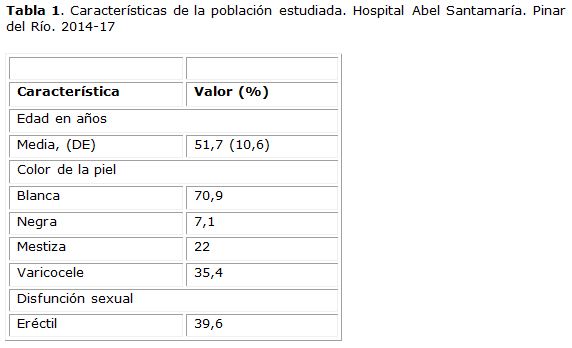
<body><![CDATA[<P LANG="es-ES" CLASS="western" ALIGN=justify STYLE="margin-bottom: 0cm">   <FONT size="2" FACE="Verdana, Arial, Helvetica, sans-serif">Se compararon los niveles de testosterona en los pacientes con y sin varicocele.</FONT></P>     <P LANG="es-ES" CLASS="western" ALIGN=justify STYLE="margin-bottom: 0cm">   <FONT size="2" FACE="Verdana, Arial, Helvetica, sans-serif">Las variables categorizadas (varicocele y DSE) se resumieron como frecuencias absolutas y relativas. Se utiliz&oacute; en su an&aacute;lisis el test de Chi cuadrado y la raz&oacute;n de disparidad (Odds ratio). Las variables cuantitativas (testosterona y edad) se resumieron con la media y la desviaci&oacute;n est&aacute;ndar. Se emple&oacute; en estas la prueba t de Student. Como la testosterona no present&oacute; una distribuci&oacute;n normal, se transformaron los datos con el logaritmo en base 10 y se comprob&oacute; la normalidad con la prueba de Kolmogorov-Smirnov.<SPAN LANG="es-ES"> Los an&aacute;lisis fueron realizados con el software SPSS 23 con un 95 %  de certeza.</SPAN></FONT></P>     <P CLASS="western" ALIGN=justify STYLE="margin-bottom: 0cm"><FONT size="2" FACE="Verdana, Arial, Helvetica, sans-serif"><B>Consideraciones &eacute;ticas</B></FONT></P>     <P CLASS="western" ALIGN=justify STYLE="margin-bottom: 0cm"><FONT size="2" FACE="Verdana, Arial, Helvetica, sans-serif">La investigaci&oacute;n fue aprobada por el comit&eacute; de &eacute;tica de la instituci&oacute;n. No se realizaron experimentos sobre los pacientes y se obtuvo el consentimiento informado en cada caso.</FONT></P>     <P CLASS="western" ALIGN=justify STYLE="margin-bottom: 0cm">&nbsp;</P>     <P ALIGN=justify STYLE="margin-top: 0.49cm; margin-bottom: 0.49cm"><FONT size="3" FACE="Verdana, Arial, Helvetica, sans-serif"><SPAN LANG="es-ES"><B>RESULTADOS </B></SPAN></FONT></P>     <P LANG="es-ES" CLASS="western" ALIGN=justify STYLE="margin-bottom: 0cm">   <FONT size="2" FACE="Verdana, Arial, Helvetica, sans-serif">La edad media fue de 51,7 a&ntilde;os. El blanco fue el color de la piel predominante, 70,9 % de los pacientes. El varicocele fue diagnosticado en el 35,4 % y la DSE en el 39,6 % de los pacientes respectivamente (tabla 1).</FONT></P>     <P LANG="es-ES" CLASS="western" ALIGN=center STYLE="margin-bottom: 0cm"><img src="/img/revistas/rpr/v22n3/t0108318.JPG" width="572" height="348"></P>     
<P LANG="es-ES" CLASS="western" ALIGN=justify STYLE="margin-bottom: 0cm">   <FONT size="2" face="Verdana, Arial, Helvetica, sans-serif"> La prevalencia de la DSE en los pacientes con varicocele fue del 38,6 %, y en los que no lo presentaban fue de un 26,1 %. El test de Chi cuadrado (X<SUP>2</SUP>= 6.59; p = 0.01) mostr&oacute; una asociaci&oacute;n significativa entre ambas entidades, y la raz&oacute;n de disparidad muestra un incremento del riesgo de padecer de DSE en caso de presentar varicocele, OR- 1,7; IC 95 %= 1,1-2,8, (tabla 2).</FONT></P>     <P align="center" CLASS="western" STYLE="margin-bottom: 0cm" LANG="es-ES"><img src="/img/revistas/rpr/v22n3/t0208318.JPG" width="566" height="251"><font size="2" face="Verdana, Arial, Helvetica, sans-serif">    
]]></body>
<body><![CDATA[<BR> </font></P>     <P ALIGN=justify STYLE="margin-top: 0.49cm; margin-bottom: 0.49cm"><FONT size="2" FACE="Verdana, Arial, Helvetica, sans-serif"><SPAN LANG="es-ES">La media de la concentraci&oacute;n s&eacute;rica de testosterona fue inferior en los pacientes con varicocele</SPAN> (11,8 versus 16,1).<SPAN LANG="es-ES"> La prueba t de Student mostr&oacute; una diferencia significativa en ambos grupos con relaci&oacute;n a las determinaciones de dicha hormona p=0,00 (tabla 3).</SPAN></FONT></P>     <P align="center" STYLE="margin-top: 0.49cm; margin-bottom: 0cm"><img src="/img/revistas/rpr/v22n3/t0308318.JPG" width="562" height="167"></P>     
<P LANG="es-ES" CLASS="western" ALIGN=justify STYLE="margin-bottom: 0cm">&nbsp;</P>     <P LANG="es-ES" CLASS="western" ALIGN=justify STYLE="margin-bottom: 0cm">   <FONT size="3" FACE="Verdana, Arial, Helvetica, sans-serif"><B>DISCUSI&Oacute;N</B></FONT></P>     <P LANG="es-ES" CLASS="western" ALIGN=justify STYLE="margin-bottom: 0cm">&nbsp;</P>     <P LANG="es-ES" CLASS="western" ALIGN=justify STYLE="margin-bottom: 0cm">   <FONT size="2" FACE="Verdana, Arial, Helvetica, sans-serif">La prevalencia del varicocele en las consultas de urolog&iacute;a general no aparece descrita en la literatura, pero s&iacute; se sabe que su presencia se incrementa con la edad y es de aproximadamente 33 % entre los 50-60 a&ntilde;os.<SUP> (6) </SUP>Estos datos coinciden con los obtenidos en el presente estudio, donde la edad media de la poblaci&oacute;n fue de 51,7 a&ntilde;os y el varicocele se diagnostic&oacute; en el 35,4 % de los pacientes.</FONT></P>     <P LANG="es-ES" CLASS="western" ALIGN=justify STYLE="margin-bottom: 0cm">   <FONT size="2" FACE="Verdana, Arial, Helvetica, sans-serif">La prevalencia de DSE en las poblaciones generales fluct&uacute;a entre un 33 y un 52 % y muestra tambi&eacute;n una tendencia a aumentar con el envejecimiento.<SUP> (7)</SUP></FONT></P>     <P LANG="es-ES" CLASS="western" ALIGN=justify STYLE="margin-bottom: 0cm">   <FONT size="2" FACE="Verdana, Arial, Helvetica, sans-serif">Similares resultados se describen en la presente investigaci&oacute;n, donde el 39,6 % de los pacientes present&oacute; alg&uacute;n grado de DSE.</FONT></P>     <P LANG="es-ES" CLASS="western" ALIGN=justify STYLE="margin-bottom: 0cm">   <FONT size="2" FACE="Verdana, Arial, Helvetica, sans-serif">Los efectos adversos del varicocele sobre el epitelio germinal, aunque todav&iacute;a no son bien comprendidos, han sido documentados y descritos en profundidad. <SUP>(8,9)</SUP> Pero existe otro ac&aacute;pite que no ha sido bien estudiado y resta como una asignatura pendiente, el efecto de este sobre las c&eacute;lulas de Leydig, el desarrollo de hipogonadismo, y por ende, la aparici&oacute;n de disfunci&oacute;n sexual. Estudios realizados en animales de laboratorio muestran que el varicocele incrementa la apoptosis de c&eacute;lulas de Leydig y disminuye las concentraciones intratubulares de testosterona. <SUP>(10, 11)</SUP></FONT></P>     ]]></body>
<body><![CDATA[<P LANG="es-ES" CLASS="western" ALIGN=justify STYLE="margin-bottom: 0cm">   <FONT size="2" FACE="Verdana, Arial, Helvetica, sans-serif">En el campo de la epidemiolog&iacute;a humana los estudios existentes muestran resultados contradictorios. Algunos presentan incrementos en los niveles de testosterona despu&eacute;s de la reparaci&oacute;n del varicocele. <SUP>(4,12)</SUP>   Sin embargo, otros arriban a conclusiones diferentes. <SUP>(13)</SUP> Aunque los cambios en las concentraciones de testosterona despu&eacute;s de la reparaci&oacute;n quir&uacute;rgica parecen evidentes, muchos de estos estudios son retrospectivos y con un n&uacute;mero escaso de pacientes<SPAN LANG="es-ES">. Adem&aacute;s, en muchos casos se incluyen pacientes con cifras basales de testosterona normales y la mayor&iacute;a no investiga la presencia de s&iacute;ntomas de deficiencia androg&eacute;nica, lo que hace dif&iacute;cil la extrapolaci&oacute;n de estos resultados a hombres con hipogonadismo.</SPAN></FONT></P>     <P LANG="es-ES" CLASS="western" ALIGN=justify STYLE="margin-bottom: 0cm">   <FONT size="2" FACE="Verdana, Arial, Helvetica, sans-serif">La asociaci&oacute;n del varicocele con la DSE encontrada en esta pesquisa es dif&iacute;cil de explicar, ya que existen solo dos investigaciones, las cuales eval&uacute;an la relaci&oacute;n entre ambas entidades. En un estudio de casos y controles realizado en Taiw&aacute;n, el an&aacute;lisis de regresi&oacute;n log&iacute;stica muestra un incremento del riesgo de DSE en los casos con previo diagn&oacute;stico</FONT>   <FONT size="2" FACE="Verdana, Arial, Helvetica, sans-serif">de varicocele, (OR-3,09; IC= 2,67-3.49). <SUP>(14)</SUP> Esto habla a favor de un v&iacute;nculo entre el varicocele y la aparici&oacute;n de disfunci&oacute;n sexual, aunque no con la severidad de la misma. En una pesquisa realizada en China se llega a la conclusi&oacute;n de que   en los pacientes con varicocele grado III y II existe un aumento del riesgo de hipogonadismo y se confirm&oacute; una funci&oacute;n er&eacute;ctil alterada correlacionada con los niveles de testosterona y duraci&oacute;n de la infertilidad.</FONT></P>     <P LANG="es-ES" CLASS="western" ALIGN=justify STYLE="margin-bottom: 0cm">   <FONT size="2" FACE="Verdana, Arial, Helvetica, sans-serif">La actividad sexual ha reportado mejor&iacute;as despu&eacute;s de la varicocelectom&iacute;a en pacientes con o sin disfunci&oacute;n sexual previa. <SUP>(15)</SUP></FONT></P>     <P LANG="es-ES" CLASS="western" ALIGN=justify STYLE="margin-bottom: 0cm">   <FONT size="2" FACE="Verdana, Arial, Helvetica, sans-serif">Los resultados de este trabajo deben ser interpretados con precauci&oacute;n, ya que debido a su naturaleza transversal no permiten establecer una clara relaci&oacute;n causa-efecto entre la presencia del varicocele, la DSE y los niveles inferiores de testosterona en estos pacientes. Asimismo, existen las limitaciones emanadas de la propia testosterona. Con los medios de laboratorio utilizados se determin&oacute; solo la testosterona total, no la libre que es la biol&oacute;gicamente &uacute;til, pero que resulta extremadamente dif&iacute;cil y cara su dosificaci&oacute;n.</FONT></P>     <P LANG="es-ES" CLASS="western" ALIGN=justify STYLE="margin-bottom: 0cm">   <FONT size="2" FACE="Verdana, Arial, Helvetica, sans-serif">Nuevas investigaciones, que tengan en cuenta estos aspectos, son necesarias para establecer un claro v&iacute;nculo entre el varicocele, la DSE y la disminuci&oacute;n de los niveles s&eacute;ricos de testosterona.</FONT></P>     <P LANG="es-ES" CLASS="western" ALIGN=justify STYLE="margin-bottom: 0cm">&nbsp;</P>     <P LANG="es-ES" CLASS="western" ALIGN=justify STYLE="margin-bottom: 0cm">   <FONT size="3" FACE="Verdana, Arial, Helvetica, sans-serif"><B>REFERENCIAS BIBLIOGRAF&Iacute;CAS</B></FONT></P>     <!-- ref --><p align="justify" class="western" style="margin-bottom: 0cm" lang="es-ES"><FONT size="2" face="Verdana, Arial, Helvetica, sans-serif"><SPAN LANG="en-US">1. Rew   KT, Heidelbaugh       JJ. Erectile         Dysfunction. </SPAN><SPAN LANG="es-ES">Am           Fam Physician [Internet]. 2016 [citado 2016 Nov 15]; 94(10):820-7. Disponible en: </SPAN><U><A CLASS="western" HREF="https://www.aafp.org/afp/2016/1115/p820.pdf"><SPAN LANG="es-ES">https://www.aafp.org/afp/2016/1115/p820.pdf</SPAN></A></U></FONT><!-- ref --><p align="justify" class="western" style="margin-bottom: 0cm" lang="es-ES"><FONT size="2" face="Verdana, Arial, Helvetica, sans-serif"><SPAN LANG="en-US">2. Hayden   RP, Tanrikut       C.         Testosterone and Varicocele. Urol           Clin North Am [Internet].</SPAN></FONT>   <FONT size="2" FACE="Verdana, Arial, Helvetica, sans-serif"><SPAN LANG="es-ES">2016     May [citado 2016 Nov 15]; 43(2):223-32. Disponible en:   </SPAN><A CLASS="western" HREF="http://www.urologic.theclinics.com/article/S0094-0143%2816%2900010-0/abstract"><U><SPAN LANG="es-ES">http://www.urologi</SPAN>c.theclinics.com/article/S0094-0143%2816%2900010-0/abstract</U></A> </FONT><p align="justify" class="western" style="margin-bottom: 0cm" lang="es-ES"><FONT size="2" FACE="Verdana, Arial, Helvetica, sans-serif">3. Wang   J, Xia SJ, L<SPAN LANG="es-ES">iu     ZH, Tao L, Ge JF, Xu CM, et al. </SPAN><SPAN LANG="en-US">Inguinal       and subinguinal micro-varicocelectomy,       the optimal surgical management of varicocele: a meta-analysis.       Asian Journal of Androlog [Internet]. 2015 Jan [citado 2016 Nov 15];       17(1): 74&ndash;80. Disponible en:</SPAN></FONT> <FONT size="2" face="Verdana, Arial, Helvetica, sans-serif"><U><A CLASS="western" HREF="https://www.ncbi.nlm.nih.gov/pmc/articles/PMC4291882/"><SPAN LANG="en-US">https://www.ncbi.nlm.nih.gov/pmc/articles/PMC4291882/</SPAN></A></U></FONT></p>     ]]></body>
<body><![CDATA[<!-- ref --><p align="justify" class="western" style="margin-bottom: 0cm" lang="es-ES"><FONT size="2" face="Verdana, Arial, Helvetica, sans-serif"><SPAN LANG="es-ES">4. Abdel-Meguid   TA,&nbsp;Farsi     HM,&nbsp;Al-Sayyad       A,&nbsp;Tayib         A.</SPAN></FONT>   <FONT size="2" face="Verdana, Arial, Helvetica, sans-serif"><SPAN LANG="en-US">Effects     of&nbsp;varicocele&nbsp;on serum&nbsp;testosterone&nbsp;and changes     of&nbsp;testosterone&nbsp;after varicocelectomy: a prospective   controlled study.</SPAN></FONT>   <font size="2" face="Verdana, Arial, Helvetica, sans-serif"><SPAN LANG="es-ES">Urology     [Internet].&nbsp;2014       Nov [citado   2016 Nov 15];           84(5): 1081-7. Disponible             en: </SPAN><U><A CLASS="western" HREF="https://scholar.google.com/scholar?oe=utf-8&amp;um=1&amp;ie=UTF-8&amp;lr&amp;q=related:ruEz3zUhqAMBHM:scholar.google.com/"><SPAN LANG="es-ES">https://scholar.google.com/scholar?oe=utf-8&amp;um=1&amp;ie=UTF-8&amp;lr&amp;q=related:ruEz3zUhqAMBHM:scholar.google.com/</SPAN></A></U></font><p align="justify" class="western" style="margin-bottom: 0cm" lang="es-ES">   <FONT size="2" FACE="Verdana, Arial, Helvetica, sans-serif"><SPAN LANG="en-US">5. Dabaja   AA, Goldstein M.</SPAN></FONT>   <FONT size="2" FACE="Verdana, Arial, Helvetica, sans-serif"><SPAN LANG="en-US">When       is a varicocele repair indicated: the dilemma of hypogonadism and   erectile dysfunction?</SPAN></FONT>   <FONT size="2" FACE="Verdana, Arial, Helvetica, sans-serif"><SPAN LANG="en-US">Asian       Journal of Andrology [Internet]. 2016 Marzo [citado       2016 Nov 15];   18(2), 213&ndash;6. Disponible en: </SPAN><U><A CLASS="western" HREF="https://www.ncbi.nlm.nih.gov/pmc/articles/PMC4770488/pdf/AJA-18-213.pdf"><SPAN LANG="en-US">https://www.ncbi.nlm.nih.gov/pmc/articles/PMC4770488/pdf/AJA-18-213.pdf</SPAN></A></U></FONT></p>     <p align="justify" class="western" style="margin-bottom: 0cm" lang="es-ES">   <FONT size="2" FACE="Verdana, Arial, Helvetica, sans-serif"><SPAN LANG="en-US">6. Alsaikhan       B, Alrabeeah K, Delouya G, Zini A. Epidemiology of varicocele. Asian       Journal of Andrology [Internet].   2016 [citado 2016 Nov 15]; 18: 179&ndash;81. Disponible en:</SPAN></FONT> <FONT size="2" face="Verdana, Arial, Helvetica, sans-serif"><U><A CLASS="western" HREF="https://www.ncbi.nlm.nih.gov/pmc/articles/PMC4770482/pdf/AJA-18-179.pdf"><SPAN LANG="en-US">https://www.ncbi.nlm.nih.gov/pmc/articles/PMC4770482/pdf/AJA-18-179.pdf</SPAN></A></U></FONT></p>     <!-- ref --><p align="justify" class="western" style="margin-bottom: 0cm" lang="es-ES">   <FONT size="2" FACE="Verdana, Arial, Helvetica, sans-serif"><SPAN LANG="en-US">7. &Ccedil;ayan       S, Kendirci M, Yaman &Ouml;,  A&#351;&ccedil;&#305; R, Orhan I, Usta       MF, et al. Prevalence of erectile dysfunction       in men over 40 years of age in Turkey: Results from the Turkish       Society of Andrology Male Sexual Health Study Group. </SPAN>Turk       J Urol <SPAN LANG="es-ES">[Internet].</SPAN>   2017 jun <SPAN LANG="es-ES">[citado         2017 Nov 15]</SPAN>;       43(2): 122-9.<SPAN LANG="es-ES">   Disponible en: </SPAN><U><A CLASS="western" HREF="https://www.ncbi.nlm.nih.gov/pmc/articles/PMC5503428/"><SPAN LANG="es-ES">https://www.ncbi.nlm.nih.gov/pmc/articles/PMC5503428/</SPAN></A></U></FONT><p align="justify" class="western" style="margin-bottom: 0cm" lang="es-ES">   <FONT size="2" FACE="Verdana, Arial, Helvetica, sans-serif"><SPAN LANG="en-US">8. Khosravanian       H, Razi M, Farokhi M ,  Khosravanian N. Simultaneous       Administration of Dexamethasone and Vitamin E Reversed Experimental       Varicocele-induced Impact in testicular tissue in Rats; Correlation   with Hsp70-2 Chaperone Expression. </SPAN><SPAN LANG="es-ES">Int         Braz J Urol</SPAN></FONT>   <FONT size="2" FACE="Verdana, Arial, Helvetica, sans-serif"><SPAN LANG="es-ES">[Internet].     2015 Jul [citado     2017 Nov 15];   41(4): 773&ndash;90. Disponible en: </SPAN><U><A CLASS="western" HREF="https://www.ncbi.nlm.nih.gov/pmc/articles/PMC4757008/"><SPAN LANG="es-ES">https://www.ncbi.nlm.nih.gov/pmc/articles/PMC4757008/</SPAN></A></U></FONT></p>     <!-- ref --><p align="justify" style="margin-bottom: 0cm"><FONT size="2" FACE="Verdana, Arial, Helvetica, sans-serif"><SPAN LANG="en">9. Whelan   P, Levine L. Effects of varicocelectomy on serum testosterone.   </SPAN>Transl   Androl Urol [Internet]. 2016 Dec [citado   2017 Nov 15];   5(6):866-76. Disponible en: <U><A CLASS="western" HREF="https://www.ncbi.nlm.nih.gov/pmc/articles/PMC5182225/">https://www.ncbi.nlm.nih.gov/pmc/articles/PMC5182225/</A></U></FONT><p align="justify" class="western" style="margin-bottom: 0cm; widows: 0; orphans: 0" lang="es-ES">   <FONT size="2" FACE="Verdana, Arial, Helvetica, sans-serif"><SPAN LANG="en">10. Hsiao       W, Rosoff JS, Pale JR, Powell JL, Goldstein M. Varicocelectomy is       associated with increases in serum testosterone independent of       clinical grade. </SPAN><SPAN LANG="es-ES">Urology   2013; 81: 1213&ndash;7. Disponible en: </SPAN><U><A CLASS="western" HREF="http://www.goldjournal.net/article/S0090-4295%2813%2900214-8/fulltext"><SPAN LANG="en">http://www.goldjournal.net/article/S0090-4295%2813%2900214-8/fulltext</SPAN></A></U></FONT></p>     <!-- ref --><p align="justify" class="western" style="margin-bottom: 0cm; widows: 0; orphans: 0" lang="es-ES">   <FONT size="2" FACE="Verdana, Arial, Helvetica, sans-serif"><SPAN LANG="en-US">11. Re&#351;orlu       B, Cengiz K, Erhan S. The Significance of Age on Success of Surgery       for Patients with Varicocele. Int Urol Nephrol </SPAN><SPAN LANG="es-ES">[Internet].         </SPAN><SPAN LANG="en-US">2010</SPAN><SPAN LANG="es-ES">[citado           2017 Nov 15]</SPAN><SPAN LANG="en-US">;   42:351-56. Disponible en:</SPAN></FONT> <FONT size="2" face="Verdana, Arial, Helvetica, sans-serif"><U><A CLASS="western" HREF="https://link.springer.com/content/pdf/10.1007%2Fs11255-009-9589-y.pdf"><SPAN LANG="en">https://link.springer.com/content/pdf/10.1007%2Fs11255-009-9589-y.pdf</SPAN></A></U></FONT><!-- ref --><p align="justify" style="margin-bottom: 0cm"><font size="2" face="Verdana, Arial, Helvetica, sans-serif"><SPAN LANG="en-US"> 12. Keller   JJ,&nbsp;Chen     YK,&nbsp;Lin       HC. Varicocele         is associated with erectile dysfunction: a population-based         case-control study. </SPAN><A CLASS="western" HREF="https://www.ncbi.nlm.nih.gov/pubmed/22524472">J           Sex Med<U>.</U></A>&nbsp;2012             Jul; 9(7):1745-52.<SPAN LANG="en-US">             Disponible en:             </SPAN><U><A CLASS="western" HREF="http://onlinelibrary.wiley.com/doi/10.1111/j.1743-6109.2012.02736.x/full"><SPAN LANG="en-US">http://onlinelibrary.wiley.com/doi/10.1111/j.1743-6109.2012.02736.x/full</SPAN></A></U></font><p align="justify" style="margin-bottom: 0cm"><FONT size="2" face="Verdana, Arial, Helvetica, sans-serif">13. Ji   B, Jin XB. Varicocele is associated with hypogonadism and impared   erectile function: a prospective comparative study.   Andrologia[Internet]. 2017 Aug[citado     2017 Nov 15];     49(6). Disponible en: <U><A CLASS="western" HREF="http://www.jsm.jsexmed.org/article/S1743-6095(15)33436-6/pdf">http://www.jsm.jsexmed.org/article/S1743-6095(15)33436-6/pdf</A></U></FONT></p>     ]]></body>
<body><![CDATA[<!-- ref --><p align="justify" class="western" style="margin-bottom: 0cm; background: #ffffff" lang="es-ES">   <font size="2" face="Verdana, Arial, Helvetica, sans-serif"><SPAN LANG="es-ES">14. Najari       BB,&nbsp;Introna         L,&nbsp;Paduch   DA.</SPAN></font>   <FONT size="2" FACE="Verdana, Arial, Helvetica, sans-serif"><SPAN LANG="en-US">Improvements       in Patient Reported&nbsp;Sexual&nbsp;Function after Microsurgical       Varicocelectomy. </SPAN><SPAN LANG="es-ES">Urology</SPAN>[Internet]<SPAN LANG="es-ES">.&nbsp;</SPAN>2017       Dic. <SPAN LANG="es-ES">[citado         2017 Dic 15];</SPAN>   (110)104-9.<SPAN LANG="es-ES">   Disponible en:   </SPAN><U><A CLASS="western" HREF="http://www.goldjournal.net/article/S0090-4295%2816%2930194-7/fulltext"><SPAN LANG="es-ES">http://www.goldjournal.net/article/S0090-4295%2816%2930194-7/fulltext</SPAN></A></U></FONT><!-- ref --><p align="justify" class="western" style="margin-bottom: 0.49cm; background: #ffffff" lang="es-ES">   <FONT size="2" face="Verdana, Arial, Helvetica, sans-serif"><SPAN LANG="en-US">15. Ji       B, Jin XB. Varicocele is associated with hypogonadism and impared       erectile function: a prospective comparative study. </SPAN>Andrologia   [Internet].  2016<SPAN LANG="es-ES">[citado         2017 Dic 15]</SPAN>;           49(6).<SPAN LANG="es-ES">           Disponible en:           </SPAN><U><A CLASS="western" HREF="http://onlinelibrary.wiley.com/doi/10.1111/and.12683/pdf"><SPAN LANG="es-ES">http://onlinelibrary.wiley.com/doi/10.1111/and.12683/pdf</SPAN></A></U></FONT><P ALIGN=justify STYLE="margin-top: 0.49cm; margin-bottom: 0.49cm"><FONT SIZE=2 face="Verdana, Arial, Helvetica, sans-serif"><B>Anexo 1.</B></FONT></P>     <P ALIGN=justify STYLE="margin-top: 0.49cm"><FONT SIZE=2 face="Verdana, Arial, Helvetica, sans-serif">Cuestionario&nbsp;reducido   de&nbsp;Disfunci&oacute;n&nbsp;Er&eacute;ctil.   (IIEF&#8208;5,&nbsp;International&nbsp;Index&nbsp;of Erectile&nbsp;Function)&nbsp;</FONT></P>     <P align="justify" CLASS="western" STYLE="margin-bottom: 0cm" LANG="es-ES"><FONT size="2" FACE="Verdana, Arial, Helvetica, sans-serif"><B>1. &iquest;C&oacute;mo califica usted su confianza en poder lograr o mantener una erecci&oacute;n?</B></FONT></P> <OL>    <LI>    <P align="justify" STYLE="margin-bottom: 0.35cm"><FONT size="2" FACE="Verdana, Arial, Helvetica, sans-serif">Muy 	baja___ 2. Baja___ 3. Moderada___ 4. Elevada___ 5. Muy elevada___</FONT></P>     </OL>     <P align="justify" CLASS="western" STYLE="margin-bottom: 0cm" LANG="es-ES"><FONT size="2" FACE="Verdana, Arial, Helvetica, sans-serif"><B>2. Cuando usted tuvo erecciones con estimulaci&oacute;n sexual. &iquest;Con qu&eacute; frecuencia fueron sus     erecciones lo suficientemente fuertes como para lograr la penetraci&oacute;n? </B></FONT></P>     <P align="justify" CLASS="western" STYLE="margin-bottom: 0cm" LANG="es-ES"><FONT size="2" FACE="Verdana, Arial, Helvetica, sans-serif">0. No tuve actividad sexual___ 1. Casi nunca___ 2. Unas pocas veces (menos de la mitad de las veces) ___ 3. A veces (la mitad de las veces) ___ 4. La mayor&iacute;a de las veces (m&aacute;s de la mitad de los casos) ___ 5. Casi siempre___</FONT></P>     ]]></body>
<body><![CDATA[<P align="justify" CLASS="western" STYLE="margin-bottom: 0cm" LANG="es-ES"><FONT size="2" FACE="Verdana, Arial, Helvetica, sans-serif"><B>3. Durante la relaci&oacute;n sexual. &iquest;Con qu&eacute; frecuencia fue capaz de mantener la erecci&oacute;n despu&eacute;s de haber penetrado su pareja?</B></FONT></P>     <P align="justify" CLASS="western" STYLE="margin-bottom: 0cm" LANG="es-ES"><FONT size="2" FACE="Verdana, Arial, Helvetica, sans-serif">0. No intent&eacute; tener relaciones sexuales___ 1. Casi nunca___ 2. Unas pocas veces (mucho menos de la mitad de las veces) ___ 3. A veces (aproximadamente la mitad de las veces) ___ 4. La mayor&iacute;a de las veces (mucho m&aacute;s de la mitad de las veces) ___ 5. Casi siempre___</FONT></P>     <P align="justify" CLASS="western" STYLE="margin-bottom: 0cm" LANG="es-ES"><FONT size="2" FACE="Verdana, Arial, Helvetica, sans-serif"><B>4. Durante la relaci&oacute;n sexual. &iquest;Cu&aacute;n dif&iacute;cil fue mantener su erecci&oacute;n hasta la finalizaci&oacute;n de la relaci&oacute;n?</B></FONT></P>     <P align="justify" CLASS="western" STYLE="margin-bottom: 0cm" LANG="es-ES"><FONT size="2" FACE="Verdana, Arial, Helvetica, sans-serif">0. No intent&eacute; tener relaciones sexuales___ 1. Extremadamente dif&iacute;cil___ 2. Muy dif&iacute;cil___ 3.Dificil___</FONT></P>     <P align="justify" CLASS="western" STYLE="margin-bottom: 0cm" LANG="es-ES"><FONT size="2" FACE="Verdana, Arial, Helvetica, sans-serif">4. Ligeramente dif&iacute;cil___ 5. No tuve dificultades___</FONT></P>     <P align="justify" CLASS="western" STYLE="margin-bottom: 0cm" LANG="es-ES"><FONT size="2" FACE="Verdana, Arial, Helvetica, sans-serif"><B>5. Cuando intent&oacute; tener una relaci&oacute;n sexual. &iquest;Con qu&eacute; frecuencia fue esta satisfactoria para usted?</B></FONT></P>     <P align="justify" CLASS="western" STYLE="margin-bottom: 0cm" LANG="es-ES"><FONT size="2" FACE="Verdana, Arial, Helvetica, sans-serif">0. No intent&eacute; tener relaciones sexuales___ 1. Casi nunca___ 2. Unas pocas veces (mucho menos que la mitad de las veces) ___ 3. A veces (aproximadamente la mitad de las veces) ___ 4. La mayor&iacute;a de las veces (mucho m&aacute;s de la mitad de las veces) ___ 5. Casi siempre___</FONT></P>     <P align="justify" CLASS="western" STYLE="margin-bottom: 0cm" LANG="es-ES">&nbsp;</P>     <P ALIGN=justify STYLE="margin-top: 0.49cm; margin-bottom: 0.49cm"></P>     <p lang="en&#45;US" align="right"><FONT size="2" FACE="Verdana, Arial, Helvetica, sans-serif"><B>Ihosvani Ba&ntilde;os Hern&aacute;ndez: </B><span class="western" style="margin-bottom: 0cm">M&eacute;dico. Especialista de Segundo Grado en Urolog&iacute;a. Profesor Titular. Unidad de Androlog&iacute;a Hospital General Docente Abel Santamar&iacute;a Cuadrado. Pinar del R&iacute;o. Cuba</span></FONT><font face="verdana" size="2">. </font><font face="Verdana, Arial, Helvetica, sans-serif" size="2"><em><strong>Si usted desea contactar con el autor  de la investigaci&oacute;n h&aacute;galo <a href="mailto:ibanos@infomed.sld.cu" target="_blank">aqu&iacute;</a></strong></em></font> </p>     ]]></body>
<body><![CDATA[ ]]></body><back>
<ref-list>
<ref id="B1">
<label>1</label><nlm-citation citation-type="journal">
<person-group person-group-type="author">
<name>
<surname><![CDATA[Rew]]></surname>
<given-names><![CDATA[KT]]></given-names>
</name>
<name>
<surname><![CDATA[Heidelbaugh]]></surname>
<given-names><![CDATA[JJ]]></given-names>
</name>
</person-group>
<article-title xml:lang="en"><![CDATA[Erectile Dysfunction]]></article-title>
<source><![CDATA[Am Fam Physician]]></source>
<year>2016</year>
<volume>94</volume>
<numero>10</numero>
<issue>10</issue>
<page-range>820-7</page-range></nlm-citation>
</ref>
<ref id="B2">
<label>2</label><nlm-citation citation-type="journal">
<person-group person-group-type="author">
<name>
<surname><![CDATA[Hayden]]></surname>
<given-names><![CDATA[RP]]></given-names>
</name>
<name>
<surname><![CDATA[Tanrikut]]></surname>
<given-names><![CDATA[C]]></given-names>
</name>
</person-group>
<article-title xml:lang="en"><![CDATA[Testosterone and Varicocele]]></article-title>
<source><![CDATA[Urol Clin North Am]]></source>
<year>2016</year>
<month> M</month>
<day>ay</day>
<volume>43</volume>
<numero>2</numero>
<issue>2</issue>
<page-range>223-32</page-range></nlm-citation>
</ref>
<ref id="B3">
<label>3</label><nlm-citation citation-type="journal">
<person-group person-group-type="author">
<name>
<surname><![CDATA[Wang]]></surname>
<given-names><![CDATA[J]]></given-names>
</name>
<name>
<surname><![CDATA[Xia]]></surname>
<given-names><![CDATA[SJ]]></given-names>
</name>
<name>
<surname><![CDATA[Liu]]></surname>
<given-names><![CDATA[ZH]]></given-names>
</name>
<name>
<surname><![CDATA[Tao]]></surname>
<given-names><![CDATA[L]]></given-names>
</name>
<name>
<surname><![CDATA[Ge]]></surname>
<given-names><![CDATA[JF]]></given-names>
</name>
<name>
<surname><![CDATA[Xu]]></surname>
<given-names><![CDATA[CM]]></given-names>
</name>
</person-group>
<article-title xml:lang="en"><![CDATA[Inguinal and subinguinal micro-varicocelectomy, the optimal surgical management of varicocele: a meta-analysis]]></article-title>
<source><![CDATA[Asian Journal of Androlog]]></source>
<year>2015</year>
<month> J</month>
<day>an</day>
<volume>17</volume>
<numero>1</numero>
<issue>1</issue>
<page-range>74-80</page-range></nlm-citation>
</ref>
<ref id="B4">
<label>4</label><nlm-citation citation-type="journal">
<person-group person-group-type="author">
<name>
<surname><![CDATA[Abdel-Meguid]]></surname>
<given-names><![CDATA[TA]]></given-names>
</name>
<name>
<surname><![CDATA[Farsi]]></surname>
<given-names><![CDATA[HM]]></given-names>
</name>
<name>
<surname><![CDATA[Al-Sayyad]]></surname>
<given-names><![CDATA[A]]></given-names>
</name>
<name>
<surname><![CDATA[Tayib]]></surname>
<given-names><![CDATA[A]]></given-names>
</name>
</person-group>
<article-title xml:lang="en"><![CDATA[Effects of varicocele on serum testosterone and changes of testosterone after varicocelectomy: a prospective controlled study]]></article-title>
<source><![CDATA[Urology]]></source>
<year>2014</year>
<month> N</month>
<day>ov</day>
<volume>8</volume>
<numero>(</numero>
<issue>(</issue>
<page-range>1081-7</page-range></nlm-citation>
</ref>
<ref id="B5">
<label>5</label><nlm-citation citation-type="journal">
<person-group person-group-type="author">
<name>
<surname><![CDATA[Dabaja]]></surname>
<given-names><![CDATA[AA]]></given-names>
</name>
<name>
<surname><![CDATA[Goldstein]]></surname>
<given-names><![CDATA[M]]></given-names>
</name>
</person-group>
<article-title xml:lang="en"><![CDATA[When is a varicocele repair indicated: the dilemma of hypogonadism and erectile dysfunction?]]></article-title>
<source><![CDATA[Asian Journal of Andrology]]></source>
<year>2016</year>
<month> M</month>
<day>ar</day>
<volume>18</volume>
<numero>2</numero>
<issue>2</issue>
<page-range>213-6</page-range></nlm-citation>
</ref>
<ref id="B6">
<label>6</label><nlm-citation citation-type="journal">
<person-group person-group-type="author">
<name>
<surname><![CDATA[Alsaikhan]]></surname>
<given-names><![CDATA[B]]></given-names>
</name>
<name>
<surname><![CDATA[Alrabeeah]]></surname>
<given-names><![CDATA[K]]></given-names>
</name>
<name>
<surname><![CDATA[Delouya]]></surname>
<given-names><![CDATA[G]]></given-names>
</name>
<name>
<surname><![CDATA[Zini]]></surname>
<given-names><![CDATA[A]]></given-names>
</name>
</person-group>
<article-title xml:lang="en"><![CDATA[Epidemiology of varicocele.]]></article-title>
<source><![CDATA[Asian Journal of Andrology]]></source>
<year>2016</year>
<volume>18</volume>
<page-range>179-81</page-range></nlm-citation>
</ref>
<ref id="B7">
<label>7</label><nlm-citation citation-type="journal">
<person-group person-group-type="author">
<name>
<surname><![CDATA[Çayan]]></surname>
<given-names><![CDATA[S]]></given-names>
</name>
<name>
<surname><![CDATA[Kendirci]]></surname>
<given-names><![CDATA[M]]></given-names>
</name>
<name>
<surname><![CDATA[Yaman]]></surname>
<given-names><![CDATA[Ö]]></given-names>
</name>
<name>
<surname><![CDATA[A&#351;ç&#305;]]></surname>
<given-names><![CDATA[R]]></given-names>
</name>
<name>
<surname><![CDATA[Orhan]]></surname>
<given-names><![CDATA[I]]></given-names>
</name>
<name>
<surname><![CDATA[Usta]]></surname>
<given-names><![CDATA[MF]]></given-names>
</name>
</person-group>
<article-title xml:lang="en"><![CDATA[Prevalence of erectile dysfunction in men over 40 years of age in Turkey: Results from the Turkish Society of Andrology Male Sexual Health Study Group]]></article-title>
<source><![CDATA[Turk J Urol]]></source>
<year>2017</year>
<month> j</month>
<day>un</day>
<volume>43</volume>
<numero>2</numero>
<issue>2</issue>
<page-range>122-9</page-range></nlm-citation>
</ref>
<ref id="B8">
<label>8</label><nlm-citation citation-type="journal">
<person-group person-group-type="author">
<name>
<surname><![CDATA[Khosravanian]]></surname>
<given-names><![CDATA[H]]></given-names>
</name>
<name>
<surname><![CDATA[Razi]]></surname>
<given-names><![CDATA[M]]></given-names>
</name>
<name>
<surname><![CDATA[Farokhi]]></surname>
<given-names><![CDATA[M]]></given-names>
</name>
<name>
<surname><![CDATA[Khosravanian]]></surname>
<given-names><![CDATA[N]]></given-names>
</name>
</person-group>
<article-title xml:lang="en"><![CDATA[Simultaneous Administration of Dexamethasone and Vitamin E Reversed Experimental Varicocele-induced Impact in testicular tissue in Rats; Correlation with Hsp70-2 Chaperone Expression]]></article-title>
<source><![CDATA[Int Braz J Urol]]></source>
<year>2015</year>
<month> J</month>
<day>ul</day>
<volume>41</volume>
<numero>4</numero>
<issue>4</issue>
<page-range>773-90</page-range></nlm-citation>
</ref>
<ref id="B9">
<label>9</label><nlm-citation citation-type="">
<source><![CDATA[]]></source>
<year></year>
</nlm-citation>
</ref>
<ref id="B10">
<label>10</label><nlm-citation citation-type="journal">
<person-group person-group-type="author">
<name>
<surname><![CDATA[Hsiao]]></surname>
<given-names><![CDATA[W]]></given-names>
</name>
<name>
<surname><![CDATA[Rosoff]]></surname>
<given-names><![CDATA[JS]]></given-names>
</name>
<name>
<surname><![CDATA[Pale]]></surname>
<given-names><![CDATA[JR]]></given-names>
</name>
<name>
<surname><![CDATA[Powell]]></surname>
<given-names><![CDATA[JL]]></given-names>
</name>
<name>
<surname><![CDATA[Goldstein]]></surname>
<given-names><![CDATA[M]]></given-names>
</name>
</person-group>
<article-title xml:lang="en"><![CDATA[Varicocelectomy is associated with increases in serum testosterone independent of clinical grade.]]></article-title>
<source><![CDATA[Urology]]></source>
<year>2013</year>
<volume>81</volume>
<page-range>1213-7</page-range></nlm-citation>
</ref>
<ref id="B11">
<label>11</label><nlm-citation citation-type="journal">
<person-group person-group-type="author">
<name>
<surname><![CDATA[Re&#351;orlu]]></surname>
<given-names><![CDATA[B]]></given-names>
</name>
<name>
<surname><![CDATA[Cengiz]]></surname>
<given-names><![CDATA[K]]></given-names>
</name>
<name>
<surname><![CDATA[Erhan]]></surname>
<given-names><![CDATA[S]]></given-names>
</name>
</person-group>
<article-title xml:lang="en"><![CDATA[The Significance of Age on Success of Surgery for Patients with Varicocele]]></article-title>
<source><![CDATA[Int Urol Nephrol]]></source>
<year>2010</year>
<numero>42</numero>
<issue>42</issue>
<page-range>351-56</page-range></nlm-citation>
</ref>
<ref id="B12">
<label>12</label><nlm-citation citation-type="journal">
<person-group person-group-type="author">
<name>
<surname><![CDATA[Keller]]></surname>
<given-names><![CDATA[JJ]]></given-names>
</name>
<name>
<surname><![CDATA[Chen]]></surname>
<given-names><![CDATA[YK]]></given-names>
</name>
<name>
<surname><![CDATA[Lin]]></surname>
<given-names><![CDATA[HC]]></given-names>
</name>
</person-group>
<article-title xml:lang="en"><![CDATA[Varicocele is associated with erectile dysfunction: a population-based case-control study]]></article-title>
<source><![CDATA[J Sex Med]]></source>
<year>2012</year>
<month> J</month>
<day>ul</day>
<volume>9</volume>
<numero>7</numero>
<issue>7</issue>
<page-range>1745-52</page-range></nlm-citation>
</ref>
<ref id="B13">
<label>13</label><nlm-citation citation-type="journal">
<person-group person-group-type="author">
<name>
<surname><![CDATA[Ji]]></surname>
<given-names><![CDATA[B]]></given-names>
</name>
<name>
<surname><![CDATA[Jin]]></surname>
<given-names><![CDATA[XB]]></given-names>
</name>
</person-group>
<article-title xml:lang="en"><![CDATA[Varicocele is associated with hypogonadism and impared erectile function: a prospective comparative study]]></article-title>
<source><![CDATA[Andrologia]]></source>
<year>2016</year>
<volume>49</volume>
<numero>6</numero>
<issue>6</issue>
</nlm-citation>
</ref>
<ref id="B14">
<label>14</label><nlm-citation citation-type="journal">
<person-group person-group-type="author">
<name>
<surname><![CDATA[Najari]]></surname>
<given-names><![CDATA[BB]]></given-names>
</name>
<name>
<surname><![CDATA[Introna]]></surname>
<given-names><![CDATA[L]]></given-names>
</name>
<name>
<surname><![CDATA[Paduch]]></surname>
<given-names><![CDATA[DA]]></given-names>
</name>
</person-group>
<article-title xml:lang="en"><![CDATA[Improvements in Patient Reported Sexual Function after Microsurgical Varicocelectomy]]></article-title>
<source><![CDATA[Urology]]></source>
<year>2017</year>
<month> D</month>
<day>ic</day>
<numero>110</numero>
<issue>110</issue>
<page-range>104-9</page-range></nlm-citation>
</ref>
<ref id="B15">
<label>15</label><nlm-citation citation-type="journal">
<person-group person-group-type="author">
<name>
<surname><![CDATA[Ji]]></surname>
<given-names><![CDATA[B]]></given-names>
</name>
<name>
<surname><![CDATA[Jin]]></surname>
<given-names><![CDATA[XB]]></given-names>
</name>
</person-group>
<article-title xml:lang="en"><![CDATA[Varicocele is associated with hypogonadism and impared erectile function: a prospective comparative study]]></article-title>
<source><![CDATA[Andrologia]]></source>
<year>2016</year>
<volume>49</volume>
<numero>6</numero>
<issue>6</issue>
</nlm-citation>
</ref>
</ref-list>
</back>
</article>
