<?xml version="1.0" encoding="ISO-8859-1"?><article xmlns:mml="http://www.w3.org/1998/Math/MathML" xmlns:xlink="http://www.w3.org/1999/xlink" xmlns:xsi="http://www.w3.org/2001/XMLSchema-instance">
<front>
<journal-meta>
<journal-id>1815-5901</journal-id>
<journal-title><![CDATA[Ingeniería Energética]]></journal-title>
<abbrev-journal-title><![CDATA[Energética]]></abbrev-journal-title>
<issn>1815-5901</issn>
<publisher>
<publisher-name><![CDATA[Universidad Tecnológica de La Habana José Antonio Echeverría, Cujae]]></publisher-name>
</publisher>
</journal-meta>
<article-meta>
<article-id>S1815-59012017000300006</article-id>
<title-group>
<article-title xml:lang="en"><![CDATA[Energy savings from occupancy based control of the fan coil unit speeds: a case study]]></article-title>
<article-title xml:lang="es"><![CDATA[Ahorro de energía mediante control por presencia del ventilador del acondicionador de aire: caso de estudio]]></article-title>
</title-group>
<contrib-group>
<contrib contrib-type="author">
<name>
<surname><![CDATA[Hernández-Tabares]]></surname>
<given-names><![CDATA[Lorenzo]]></given-names>
</name>
<xref ref-type="aff" rid="A01"/>
</contrib>
</contrib-group>
<aff id="A01">
<institution><![CDATA[,Centro de Aplicaciones Tecnológicas y Desarrollo Nuclear  ]]></institution>
<addr-line><![CDATA[ ]]></addr-line>
<country>Cuba</country>
</aff>
<pub-date pub-type="pub">
<day>00</day>
<month>12</month>
<year>2017</year>
</pub-date>
<pub-date pub-type="epub">
<day>00</day>
<month>12</month>
<year>2017</year>
</pub-date>
<volume>38</volume>
<numero>3</numero>
<fpage>208</fpage>
<lpage>212</lpage>
<copyright-statement/>
<copyright-year/>
<self-uri xlink:href="http://scielo.sld.cu/scielo.php?script=sci_arttext&amp;pid=S1815-59012017000300006&amp;lng=en&amp;nrm=iso"></self-uri><self-uri xlink:href="http://scielo.sld.cu/scielo.php?script=sci_abstract&amp;pid=S1815-59012017000300006&amp;lng=en&amp;nrm=iso"></self-uri><self-uri xlink:href="http://scielo.sld.cu/scielo.php?script=sci_pdf&amp;pid=S1815-59012017000300006&amp;lng=en&amp;nrm=iso"></self-uri><abstract abstract-type="short" xml:lang="en"><p><![CDATA[The guest spends a considerable time out of the hotel room but he usually keeps working the highest speeds of the fan coil unit. These units are frequently overlooked as a potential source of energy savings. On the other hand, with real time occupancy measurements and simple control algorithms high degree of energy saving is possible t obtain. In this work was analyzed the guest behavior towards the fan coil unit speed. The possible energy saving to obtain, if during the absence of the guest the 2nd or the 3rd speed of the fan coil unit is switched to the 1st, was calculated. The selected fan coil speed is proposed as an indicator of guest comfort. An occupancy based control that acts over the fan coil unit speed, when the guest is not in the room, is recommended for hotel rooms]]></p></abstract>
<abstract abstract-type="short" xml:lang="es"><p><![CDATA[El huésped pasa un tiempo considerable fuera de su habitación hotelera pero usualmente mantiene funcionando las velocidades más altas del aire acondicionado. Estos equipos son frecuentemente subestimados como fuentes potenciales de ahorro de energía. Por otra parte, con mediciones en tiempo real de la presencia del huésped y simples algoritmos de control un alto grado de ahorro de energía puede lograrse. En este trabajo fue analizado el comportamiento del huésped en relación a la velocidad del aire acondicionado. Fue calculado el ahorro de energía a obtener si durante la ausencia del huésped de la habitación se conmutasen la 2da o 3ra velocidad del aire acondicionado a la 1ra. Se propone utilizar la velocidad del aire acondicionado seleccionada por el huésped como indicador de su confort. Se recomienda emplear en las habitaciones hoteleras un control por presencia que actúe sobre la velocidad del aire acondicionado cuando el huésped no esté presente]]></p></abstract>
<kwd-group>
<kwd lng="en"><![CDATA[energy savings]]></kwd>
<kwd lng="en"><![CDATA[occupancy based control]]></kwd>
<kwd lng="en"><![CDATA[fan coil unit]]></kwd>
<kwd lng="en"><![CDATA[hotel]]></kwd>
<kwd lng="en"><![CDATA[HVAC]]></kwd>
<kwd lng="es"><![CDATA[ahorro de energía]]></kwd>
<kwd lng="es"><![CDATA[control por presencia]]></kwd>
<kwd lng="es"><![CDATA[hotel]]></kwd>
<kwd lng="es"><![CDATA[HVAC]]></kwd>
<kwd lng="es"><![CDATA[unidad de aire]]></kwd>
</kwd-group>
</article-meta>
</front><body><![CDATA[ <p align="right"><font size="2" face="Verdana, Arial, Helvetica, sans-serif"><b>APLICACIONES INDUSTRIALES</b></font></p>     <p>&nbsp;</p>     <p><font size="4" face="Verdana, Arial, Helvetica, sans-serif"><b>Energy savings from occupancy based control of the fan coil unit speeds: a  case study</b></font></p>     <p><b><font size="2" face="Verdana, Arial, Helvetica, sans-serif">    <font size="3">Ahorro de energ&iacute;a mediante  control por presencia del ventilador del acondicionador de aire: caso de  estudio</font></font></b></p>     <p>&nbsp;</p>     <p>&nbsp;</p>     <p><font size="2" face="Verdana, Arial, Helvetica, sans-serif"> <b>MSc. Lorenzo Hern&aacute;ndez-Tabares </b></font></p>     <p><font size="2" face="Verdana, Arial, Helvetica, sans-serif"> Centro de Aplicaciones Tecnol&oacute;gicas y Desarrollo Nuclear  (CEADEN), La Habana, Cuba.</font></p>     <p>&nbsp;</p>     <p>&nbsp;</p> <hr>     ]]></body>
<body><![CDATA[<p><font size="2" face="Verdana, Arial, Helvetica, sans-serif">ABSTRACT</font></p>     <p><font size="2" face="Verdana, Arial, Helvetica, sans-serif"> The guest spends  a considerable time out of the hotel room but he usually keeps working the  highest speeds of the fan coil unit. These units are frequently overlooked as a  potential source of energy savings. On the other hand, with real time occupancy  measurements and simple control algorithms high degree of energy saving is  possible t obtain. In this work was analyzed the guest behavior towards the fan  coil unit speed. The possible energy saving to obtain, if during the absence of  the guest the 2nd or the 3rd speed of the fan coil unit is switched to the 1st,  was calculated. The selected fan coil speed is proposed as an indicator of  guest comfort. An occupancy based control that acts over the fan coil unit  speed, when the guest is not in the room, is recommended for hotel rooms. </font></p>     <p><font size="2" face="Verdana, Arial, Helvetica, sans-serif">  <b>Key  words:</b> energy savings; occupancy based control; fan coil  unit; hotel; HVAC.</font></p> <hr>     <p><font size="2" face="Verdana, Arial, Helvetica, sans-serif">RESUMEN</font></p>     <p><font size="2" face="Verdana, Arial, Helvetica, sans-serif">El hu&eacute;sped pasa un tiempo considerable fuera de su habitaci&oacute;n  hotelera pero usualmente mantiene funcionando las velocidades m&aacute;s altas del  aire acondicionado. Estos equipos son frecuentemente subestimados como fuentes  potenciales de ahorro de energ&iacute;a. Por otra parte, con mediciones en tiempo real  de la presencia del hu&eacute;sped y simples algoritmos de control un alto grado de  ahorro de energ&iacute;a puede lograrse. En este trabajo fue analizado el  comportamiento del hu&eacute;sped en relaci&oacute;n a la velocidad del aire acondicionado.  Fue calculado el ahorro de energ&iacute;a a obtener si durante la ausencia del hu&eacute;sped  de la habitaci&oacute;n se conmutasen la 2da o 3ra velocidad del aire acondicionado a  la 1ra. Se propone&nbsp; utilizar la velocidad  del aire acondicionado seleccionada por el hu&eacute;sped como indicador de su  confort. Se recomienda emplear en las habitaciones hoteleras un control por  presencia que act&uacute;e sobre la velocidad del aire acondicionado cuando el hu&eacute;sped  no est&eacute; presente.</font></p>     <p><font size="2" face="Verdana, Arial, Helvetica, sans-serif">      <b>Palabras  clave: </b>ahorro de energ&iacute;a; control por  presencia; hotel; HVAC; unidad de aire acondicionado.</font></p> <hr>     <p>&nbsp;</p>     <p>&nbsp;</p>     <p><font size="3" face="Verdana, Arial, Helvetica, sans-serif"><b>INTRODUCTION</b></font></p>     <p><font size="2" face="Verdana, Arial, Helvetica, sans-serif"> Energy  efficiency in buildings is today a prime objective for energy policy at  regional, national and international levels [1]. Particularly, the lodging  sector is notorious for its high, and sometimes irrational, energetic  consumption [2]. In Caribbean Hotels, due to the high temperatures, the  climatization takes around the 65% of the total electric consumption [2], and  in several Cuban touristic lodging companies this consumption represents 8 to  20 % of the total running costs [3]. Hotel guest rooms account for 40 to 80 %  of energy use in the hospitality industry so they may hold great potential for  cost savings [4].</font></p>     ]]></body>
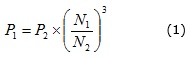
<body><![CDATA[<p><font size="2" face="Verdana, Arial, Helvetica, sans-serif">User activity  and behavior is considered as a key element and has long been used for control  of various devices such as artificial light, heating, ventilation, and air  conditioning [5]. While occupancy prediction leads to small energy savings [6],  with real time occupancy measurements high degree of them is possible just  using simple control algorithms [7]. In fact, [6] and [7] assert that high  energy savings without sacrificing comfort are possible with only occupancy  measurements. The occupancy based control (OBC) is a well developed concept and  from the 1990s has been indicated for hotels and other public buildings with  short term and variable occupancy [8]. Occupant behavior is one of the major  factors influencing building energy consumption and contributing to uncertainty  in building energy use prediction and simulation. Its understanding is  insufficient both in building design, operation and retrofit. Although there  has been growing research and applications in this field, there are still  significant challenges and opportunities [9]. Recent papers, in both  theoretical and practical way, have focused on OBC for improving energy efficiency  in several types of building rooms [6-8, 10, 11].</font></p>     <p><font size="2" face="Verdana, Arial, Helvetica, sans-serif"> That hotel room  guests often leave their air conditioning equipment running during their  absence is something known and reported [10]. Fan coil units (FCUs) are  frequently overlooked as a potential source of savings, although several  hundreds to thousands of them may be in a single building. Furthermore, they  usually employ low efficiency fractional horsepower motors (typically 60 %  efficient) [12]. For around ten years, techniques as variable speed drive (VSD)  have been used for retrofitting on FCUs [12], however using high efficiency  equipment, is an opportunity that has not been correctly exploited worldwide [13].</font></p>     <p><font size="2" face="Verdana, Arial, Helvetica, sans-serif"> This paper was  focused on the FCU speed the guest left turned on when he was out of the room.  The objective was to study the guest&acute;s behavior toward FCU speeds, to quantify  the energy savings possible to obtain if during guest&acute;s absence to turn down  the highest FCU speeds, as well as to propose the late as a useful OBC strategy  for those installations with less efficient FCUs. It is also proposed to  consider the selected FCU speed as a guest comfort satisfaction indicator.</font></p>     <p>&nbsp;</p>     <p><b><font size="4" face="Verdana, Arial, Helvetica, sans-serif"> MATERIALS AND METHODS</font></b></p>     <p><font size="2" face="Verdana, Arial, Helvetica, sans-serif"> The study was  carried out in the &quot;Paradisus R&iacute;o de Oro&quot; hotel in the northeast of Cuba  utilizing the installed there Sauter EY2400 Provi+ building management system  (BMS). With that system we were able to gather information about the guest  presence and the selected by him FCU speed.</font></p>     <p><font size="2" face="Verdana, Arial, Helvetica, sans-serif"> In case the  guest is absent, the installed there room OBC sets back the temperature set  point from 24 &ordm;C to 28 &ordm;C but takes no action over the selected FCU speed. The electric  power that can be saved by slowing down the FCU speeds is represented in  <a href="#e1">equation (1)</a> considering, that the power consumed by the FCU motor will increase  with the third power of its revolutions [14].</font></p>     <p align="center"><img src="/img/revistas/rie/v38n3/e0106317.gif" width="190" height="58"><a name="e1"></a></p>     
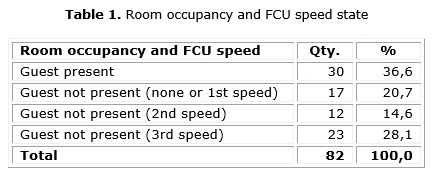
<p><font size="2" face="Verdana, Arial, Helvetica, sans-serif">where: <i>P</i> is the  electric power and <i>N</i> the rotation speed.</font></p>     <p><font size="2" face="Verdana, Arial, Helvetica, sans-serif"> The first step  was to know how many rooms were affected by this particular guest behavior. A  total of 82 rooms were randomly selected for the survey. As a result, almost 43  % of them had selected on the second or the third FCU speed when the guest was  not in the room (<a href="#t1">table 1</a>).</font></p>     ]]></body>
<body><![CDATA[<p align="center"><img src="/img/revistas/rie/v38n3/t0106317.gif" width="432" height="179"><a name="t1"></a></p>     
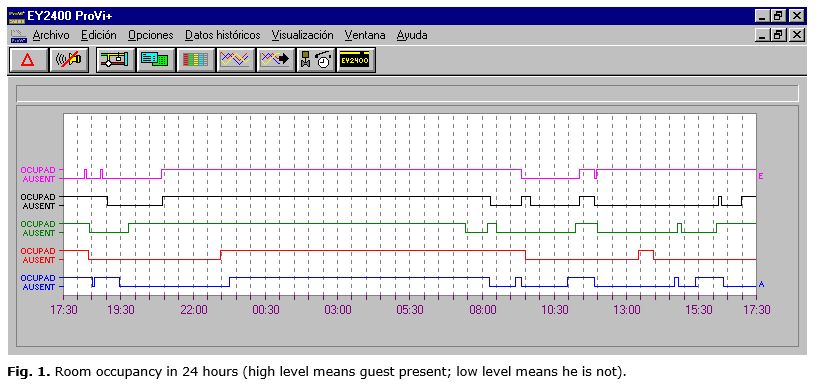
<p><font size="2" face="Verdana, Arial, Helvetica, sans-serif">In second  place, it was necessary to estimate for how long the client is outside the  room. Five rooms were randomly selected and continuously monitored for 24  h. The historical data of room occupancy was recorded using the BMS (<a href="/img/revistas/rie/v38n3/f0106317.jpg">fig. 1</a>)  and placed in <a href="#t2">table 2</a>. It was calculated that the client is out of the room for  about 9 hours and 18 min a day (9,3 in decimal representation), which is  more than the third part of the day.</font></p>     
<p align="center"><img src="/img/revistas/rie/v38n3/t0206317.gif" width="569" height="241"><a name="t2"></a></p>     
<p><font size="2" face="Verdana, Arial, Helvetica, sans-serif">The energy  savings by commuting the 2nd or the 3rd FCU speed to the 1st when the client is  out of the room can be calculated using the following <a href="#e2">equation (2)</a>:</font></p>     <p align="center"><img src="/img/revistas/rie/v38n3/e0206317.gif" width="547" height="27"><a name="e2"></a></p>     
<p align="left"><font size="2" face="Verdana, Arial, Helvetica, sans-serif">where:</font>    <br>   <font size="2" face="Verdana, Arial, Helvetica, sans-serif"><i>E</i>: Energy  savings (in kWh).    <br>       <i>NTH</i>: total  hotel guest rooms.    <br>       <i>HA</i>: Hotel  occupancy in one year (1=100%).    <br>       <i>D</i>: Number of  days to include in the calculus of E.    ]]></body>
<body><![CDATA[<br>       <i>HD</i>: daily  hours of guest absence (in hours).    <br>       <i>H</i><sub>3</sub>: Number of  rooms without guest and with 3rd speed (%).    <br>       <i>H</i><sub>2</sub>: Number of  rooms without guest and with 2nd speed (%).    <br>   DPIII-I: Electric power difference between 3rd and 1st  FCU speed (in kW).     <br> DPII-I: Electric power difference between 2nd and 1st  FCU speed (in kW).</font></p>     <p><font size="2" face="Verdana, Arial, Helvetica, sans-serif"> The <a href="#e3">equation (3)</a>,  shows a simplified version of the equation (2):</font></p>     <p align="center"><img src="/img/revistas/rie/v38n3/e0306317.gif" width="463" height="32"><a name="e3"></a></p>     
<p><font size="2" face="Verdana, Arial, Helvetica, sans-serif"> Using the  <a href="#e3">equation (3)</a> the energy saving for the 298 room hotel, in a month and with an  occupancy level of 80 % was calculated. The differences in power of the FCU  speeds were calculated from their technical datasheets (DPIII-I = 0,136  kW and DPII-I = 0,037 kW).</font></p>     <p>&nbsp;</p>     <p><font size="2" face="Verdana, Arial, Helvetica, sans-serif"> <font size="3"><b>RESULTS AND DISCUSSIONS</b></font></font></p>     ]]></body>
<body><![CDATA[<p><font size="2" face="Verdana, Arial, Helvetica, sans-serif">   As said before,  43 % of the rooms had selected on the 2nd or the 3rd FCU speed when the guest  was not in the room which is a considerable amount of them. On the other hand,  9,3 h of guest absence is more than the third part of the day. So, both facts  imply a potential source of power savings. In one month, the hotel consumes 196  MWh of electric energy; then, the calculated energy savings of 2,9 MWh is about  1,5 % of this monthly consumption. Although 1,5 % could be considered a small  figure, its value depends on the other building load energy losses, as pool,  restaurants, kitchens, conference rooms, boutiques, disco and so on. In a hotel  with none of these mentioned spaces the energy savings percentage will be  higher.</font></p>     <p><font size="2" face="Verdana, Arial, Helvetica, sans-serif"> What makes the  guest to select one or another FCU speed is something not defined but related  with his perception of comfort. When the room is too hot, is a common behavior  that the guest puts the FCU at full speed, on the contrary, when it is too cold  he slows down the FCU speed. So, the guest sees the FCU speed as another room  temperature control, rather than an indoor air quality one. Following this  analysis we propose to interpret FCU speed off as &quot;comfort unwanted&quot;, the  lowest FCU speed as &quot;high comfort satisfaction&quot;; middle speed can be seen as  &quot;comfort satisfaction&quot; and the highest speed as &quot;comfort dissatisfaction&quot;.  Therefore, monitoring the selected FCU speed could bring immediate information  about the guest comfort satisfaction.</font></p>     <p>&nbsp;</p>     <p><b><font size="3" face="Verdana, Arial, Helvetica, sans-serif">CONCLUSIONS</font></b></p>     <p><font size="2" face="Verdana, Arial, Helvetica, sans-serif"> The guest  behavior towards the fan coil unit speed was studied. Keeping on the highest  FCU speeds during guest absence was a behavior that affected almost the half of  the rooms for about a third part of a day. Consequently, acting over the FCU  speed when the guest is not in the room, will help in saving energy. In this  sense, switching down the FCU speeds during guest absence is a recommended  algorithm to be used in a typical room OBC of a hotel or a similar building. An  analysis of how much energy can be saved, and an equation to properly calculate  it was developed. A similar analysis and equation can be applied to a similar  building by using their specific FCU electric parameters. </font></p>     <p><font size="2" face="Verdana, Arial, Helvetica, sans-serif"> The selected by  the guest FCU speed is in relation with his level of room comfort satisfaction.  A simple relation between guest comfort and FCU speed was proposed and  qualified. However, further studies that would take into account not only the  FCU speed, but also the variation of the room temperature set point (24 &plusmn; 2 &ordm;C)  made by the guest should be done.</font></p>     <p><font size="2" face="Verdana, Arial, Helvetica, sans-serif"> As monitoring  the selected FCU speed brings immediate information about the guest comfort  satisfaction, it is a useful tool while doing research or managing the  installation.</font></p>     <p>&nbsp;</p>     <p><font size="3" face="Verdana, Arial, Helvetica, sans-serif"> <b>REFERENCES</b></font></p>     <p><font size="2" face="Verdana, Arial, Helvetica, sans-serif">1. P&eacute;rez Lombard L. A review on buildings energy consumption information.  Energy and Buildings. 2008;40(3):394&ndash;398. ISSN 0378-7788.</font></p>     ]]></body>
<body><![CDATA[<!-- ref --><p><font size="2" face="Verdana, Arial, Helvetica, sans-serif">2.&nbsp;Montelier Hern&aacute;ndez S. <i> et al.</i> Operational strategies for  power saving in Climatization Centralized  Systems by means of frozen water in tourism hotels. Retos Tur&iacute;sticos. 2010;9(1):10-14.     ISSN 1681-9713.</font></p>     <!-- ref --><p><font size="2" face="Verdana, Arial, Helvetica, sans-serif">3. Esp&iacute;n P&eacute;rez M. <i>et al.</i> Study about cooling water storage in centralized air conditioning system.  Ingenier&iacute;a Energ&eacute;tica. 2014;XXXV(3):252-262.     ISSN 1815-5901.</font></p>     <!-- ref --><p><font size="2" face="Verdana, Arial, Helvetica, sans-serif">4. Raber J. Balancing hotel energy use and guest  comfort. Heating/Piping/Air Conditioning Engineering. 2015;87(5):12-18.     ISSN 1527-4055.</font></p>     <p><font size="2" face="Verdana, Arial, Helvetica, sans-serif">5. Nguyen T.A., Aiello M. Energy intelligent buildings based on  user activity: A survey. Energy and Buildings. 2013;56(sn.):244&ndash;257.  ISSN 0378-7788.</font></p>     <p><font size="2" face="Verdana, Arial, Helvetica, sans-serif">6. Goyal S. et al. Occupancy based zone climate control for  energy efficient buildings: Complexity vs. performance. Applied Energy. 2013;106:209&ndash;221. ISSN 0306-2619.</font></p>     <p><font size="2" face="Verdana, Arial, Helvetica, sans-serif">7. Goyal S., et al. Experimental study of occupancy-based control of HVAC zones. Applied Energy. 2015;140:75&ndash;84. ISSN 0306-2619.</font></p>     <p><font size="2" face="Verdana, Arial, Helvetica, sans-serif">8. Lo L.J., Novoselac A., &quot;Localized air-conditioning with  occupancy control in an open office. Energy and Buildings, 2010, vol.42, n.7,  p. 1120&ndash;1128, ISSN 0378-7788.</font></p>     ]]></body>
<body><![CDATA[<p><font size="2" face="Verdana, Arial, Helvetica, sans-serif">9. Hong, T. et al. Advances in research and applications of energy-related occupant behavior in  buildings. Energy and Buildings. 2016;116:694&ndash;702. ISSN  0378-7788.</font></p>     <!-- ref --><p><font size="2" face="Verdana, Arial, Helvetica, sans-serif">10. Kumpanon AP. et al. Guest Room Energy Management System. Energy Engineering. 2015;112(5):50-65.     ISSN 1546-0118.</font></p>     <!-- ref --><p><font size="2" face="Verdana, Arial, Helvetica, sans-serif">11. Kleiminger W. Occupancy Sensing and Prediction for Automated  Energy Savings. A thesis submitted to attain the degree of Doctor of Sciences  of ETH Zurich. Diss. ETH No. 22632. 2015. [Consulted: November 10, 2016].  Available at: <a href="https://doi.org/10.3929/ethz-a-010450096" target="_blank">https://doi.org/10.3929/ethz-a-010450096</a>.    </font></p>     <!-- ref --><p><font size="2" face="Verdana, Arial, Helvetica, sans-serif">12. Putz C. Variable speed drives on fan coils yield savings.  AFE Facilities Engineering. 2006:7-8. ISSN 1088-5900.    </font></p>     <!-- ref --><p><font size="2" face="Verdana, Arial, Helvetica, sans-serif">13. Viego Felipe PR. et  al. Barriers to increase the efficiency of electric engine driven systems.  Revista Universidad y Sociedad. 2015;7(3):63-73.     ISSN 2218-3620.</font></p>     <p><font size="2" face="Verdana, Arial, Helvetica, sans-serif">14. AFISAE. T&eacute;cnicas de la regulaci&oacute;n y gesti&oacute;n de energ&iacute;a en  edificios. 1ra. ed., Asociaci&oacute;n Espa&ntilde;ola de Fabricantes e Importadores de  Aparatos y Sistemas para la Automatizaci&oacute;n de Edificios. 1992, p. 256, 162-163.  ISBN 84-604-2904-0.</font></p>     ]]></body>
<body><![CDATA[<p>&nbsp;</p>     <p>&nbsp;</p>     <p><font size="2">Recibido: febrero de 2017                         <br> Aprobado: junio de 2017</font></p>     <p>&nbsp;</p>     <p>&nbsp;</p>     <p><font size="3" face="Verdana, Arial, Helvetica, sans-serif"><b>AUTOR</b></font></p>     <p><font size="2" face="Verdana, Arial, Helvetica, sans-serif"> <i>Lorenzo Hern&aacute;ndez-Tabares.</i>  Ingeniero en  Electr&oacute;nica Industrial. M&aacute;ster en Ciencias T&eacute;cnicas. Investigador Agregado.  Centro de Aplicaciones Tecnol&oacute;gicas y Desarrollo Nuclear (CEADEN), La Habana,  Cuba.    <br>   e-mail: <a href="mailto:lorenzo@ceaden.edu.cu">lorenzo@ceaden.edu.cu</a></font></p>      ]]></body><back>
<ref-list>
<ref id="B1">
<label>1</label><nlm-citation citation-type="journal">
<person-group person-group-type="author">
<name>
<surname><![CDATA[Pérez Lombard]]></surname>
<given-names><![CDATA[L]]></given-names>
</name>
</person-group>
<article-title xml:lang="en"><![CDATA[A review on buildings energy consumption information]]></article-title>
<source><![CDATA[Energy and Buildings]]></source>
<year>2008</year>
<volume>40</volume>
<numero>3</numero>
<issue>3</issue>
<page-range>394-398</page-range></nlm-citation>
</ref>
<ref id="B2">
<label>2</label><nlm-citation citation-type="journal">
<collab>Montelier Hernández S et al</collab>
<article-title xml:lang="en"><![CDATA[Operational strategies for power saving in Climatization Centralized Systems by means of frozen water in tourism hotels]]></article-title>
<source><![CDATA[Retos Turísticos]]></source>
<year>2010</year>
<volume>9</volume>
<numero>1</numero>
<issue>1</issue>
<page-range>10-14</page-range></nlm-citation>
</ref>
<ref id="B3">
<label>3</label><nlm-citation citation-type="journal">
<person-group person-group-type="author">
<name>
<surname><![CDATA[Espín Pérez]]></surname>
<given-names><![CDATA[M]]></given-names>
</name>
</person-group>
<article-title xml:lang="en"><![CDATA[Study about cooling water storage in centralized air conditioning system]]></article-title>
<source><![CDATA[Ingeniería Energética]]></source>
<year>2014</year>
<volume>XXXV</volume>
<numero>3</numero>
<issue>3</issue>
<page-range>252-262</page-range></nlm-citation>
</ref>
<ref id="B4">
<label>4</label><nlm-citation citation-type="journal">
<person-group person-group-type="author">
<name>
<surname><![CDATA[Raber]]></surname>
<given-names><![CDATA[J]]></given-names>
</name>
</person-group>
<article-title xml:lang="en"><![CDATA[Balancing hotel energy use and guest comfort]]></article-title>
<source><![CDATA[Heating/Piping/Air Conditioning Engineering]]></source>
<year>2015</year>
<volume>87</volume>
<numero>5</numero>
<issue>5</issue>
<page-range>12-18</page-range></nlm-citation>
</ref>
<ref id="B5">
<label>5</label><nlm-citation citation-type="journal">
<person-group person-group-type="author">
<name>
<surname><![CDATA[Nguyen]]></surname>
<given-names><![CDATA[TA]]></given-names>
</name>
<name>
<surname><![CDATA[Aiello]]></surname>
<given-names><![CDATA[M]]></given-names>
</name>
</person-group>
<article-title xml:lang="en"><![CDATA[Energy intelligent buildings based on user activity: A survey]]></article-title>
<source><![CDATA[Energy and Buildings]]></source>
<year>2013</year>
<volume>56</volume>
<page-range>244-257</page-range></nlm-citation>
</ref>
<ref id="B6">
<label>6</label><nlm-citation citation-type="journal">
<person-group person-group-type="author">
<name>
<surname><![CDATA[Goyal]]></surname>
<given-names><![CDATA[S]]></given-names>
</name>
</person-group>
<article-title xml:lang="en"><![CDATA[Occupancy based zone climate control for energy efficient buildings: Complexity vs. performance]]></article-title>
<source><![CDATA[Applied Energy]]></source>
<year>2013</year>
<volume>106</volume>
<page-range>209-221</page-range></nlm-citation>
</ref>
<ref id="B7">
<label>7</label><nlm-citation citation-type="journal">
<person-group person-group-type="author">
<name>
<surname><![CDATA[Goyal]]></surname>
<given-names><![CDATA[S]]></given-names>
</name>
</person-group>
<article-title xml:lang="en"><![CDATA[Experimental study of occupancy-based control of HVAC zones]]></article-title>
<source><![CDATA[Applied Energy]]></source>
<year>2015</year>
<volume>140</volume>
<page-range>75-84</page-range></nlm-citation>
</ref>
<ref id="B8">
<label>8</label><nlm-citation citation-type="journal">
<person-group person-group-type="author">
<name>
<surname><![CDATA[Lo]]></surname>
<given-names><![CDATA[LJ]]></given-names>
</name>
<name>
<surname><![CDATA[Novoselac]]></surname>
<given-names><![CDATA[A]]></given-names>
</name>
</person-group>
<article-title xml:lang="en"><![CDATA[Localized air-conditioning with occupancy control in an open office]]></article-title>
<source><![CDATA[Energy and Buildings]]></source>
<year>2010</year>
<volume>42</volume>
<numero>7</numero>
<issue>7</issue>
<page-range>1120-1128</page-range></nlm-citation>
</ref>
<ref id="B9">
<label>9</label><nlm-citation citation-type="journal">
<person-group person-group-type="author">
<name>
<surname><![CDATA[Hong]]></surname>
<given-names><![CDATA[T]]></given-names>
</name>
</person-group>
<article-title xml:lang="en"><![CDATA[Advances in research and applications of energy-related occupant behavior in buildings]]></article-title>
<source><![CDATA[Energy and Buildings]]></source>
<year>2016</year>
<volume>116</volume>
<page-range>694-702</page-range></nlm-citation>
</ref>
<ref id="B10">
<label>10</label><nlm-citation citation-type="journal">
<person-group person-group-type="author">
<name>
<surname><![CDATA[Kumpanon]]></surname>
<given-names><![CDATA[AP]]></given-names>
</name>
</person-group>
<article-title xml:lang="en"><![CDATA[Guest Room Energy Management System]]></article-title>
<source><![CDATA[Energy Engineering]]></source>
<year>2015</year>
<volume>112</volume>
<numero>5</numero>
<issue>5</issue>
<page-range>50-65</page-range></nlm-citation>
</ref>
<ref id="B11">
<label>11</label><nlm-citation citation-type="">
<person-group person-group-type="author">
<name>
<surname><![CDATA[Kleiminger]]></surname>
<given-names><![CDATA[W]]></given-names>
</name>
</person-group>
<source><![CDATA[Occupancy Sensing and Prediction for Automated Energy Savings]]></source>
<year></year>
</nlm-citation>
</ref>
<ref id="B12">
<label>12</label><nlm-citation citation-type="journal">
<person-group person-group-type="author">
<name>
<surname><![CDATA[Putz]]></surname>
<given-names><![CDATA[C]]></given-names>
</name>
</person-group>
<article-title xml:lang="en"><![CDATA[Variable speed drives on fan coils yield savings]]></article-title>
<source><![CDATA[AFE Facilities Engineering]]></source>
<year>2006</year>
<page-range>7-8</page-range></nlm-citation>
</ref>
<ref id="B13">
<label>13</label><nlm-citation citation-type="journal">
<person-group person-group-type="author">
<name>
<surname><![CDATA[Viego Felipe]]></surname>
<given-names><![CDATA[PR]]></given-names>
</name>
</person-group>
<article-title xml:lang="en"><![CDATA[Barriers to increase the efficiency of electric engine driven systems]]></article-title>
<source><![CDATA[Revista Universidad y Sociedad]]></source>
<year>2015</year>
<volume>7</volume>
<numero>3</numero>
<issue>3</issue>
<page-range>63-73</page-range></nlm-citation>
</ref>
<ref id="B14">
<label>14</label><nlm-citation citation-type="book">
<collab>AFISAE</collab>
<source><![CDATA[Técnicas de la regulación y gestión de energía en edificios]]></source>
<year>1992</year>
<edition>1</edition>
<page-range>256</page-range><publisher-name><![CDATA[Asociación Española de Fabricantes e Importadores de Aparatos y Sistemas para la Automatización de Edificios]]></publisher-name>
</nlm-citation>
</ref>
</ref-list>
</back>
</article>