<?xml version="1.0" encoding="ISO-8859-1"?><article xmlns:mml="http://www.w3.org/1998/Math/MathML" xmlns:xlink="http://www.w3.org/1999/xlink" xmlns:xsi="http://www.w3.org/2001/XMLSchema-instance">
<front>
<journal-meta>
<journal-id>1815-5936</journal-id>
<journal-title><![CDATA[Ingeniería Industrial]]></journal-title>
<abbrev-journal-title><![CDATA[Ing. Ind.]]></abbrev-journal-title>
<issn>1815-5936</issn>
<publisher>
<publisher-name><![CDATA[Facultad de Ingeniería Industrial, Instituto Superior Politécnico José Antonio Echeverría, Cujae.]]></publisher-name>
</publisher>
</journal-meta>
<article-meta>
<article-id>S1815-59362012000100007</article-id>
<title-group>
<article-title xml:lang="es"><![CDATA[Técnicas evolutivas en problemas multi-objetivos en el proceso de planificación de la producción]]></article-title>
<article-title xml:lang="en"><![CDATA[Evolutionary techniques for multi-objective problems in production planning]]></article-title>
</title-group>
<contrib-group>
<contrib contrib-type="author">
<name>
<surname><![CDATA[Frutos-Alazard]]></surname>
<given-names><![CDATA[Mariano]]></given-names>
</name>
<xref ref-type="aff" rid="A01"/>
</contrib>
<contrib contrib-type="author">
<name>
<surname><![CDATA[Tohmé-Hauptmann]]></surname>
<given-names><![CDATA[Fernando]]></given-names>
</name>
<xref ref-type="aff" rid="A02"/>
</contrib>
</contrib-group>
<aff id="A01">
<institution><![CDATA[,Universidad Nacional del Sur Departamento de Ingeniería ]]></institution>
<addr-line><![CDATA[Bahía Blanca ]]></addr-line>
<country>Argentina</country>
</aff>
<aff id="A02">
<institution><![CDATA[,Universidad Nacional del Sur Departamento de Economía ]]></institution>
<addr-line><![CDATA[Bahía Blanca ]]></addr-line>
<country>Argentina</country>
</aff>
<pub-date pub-type="pub">
<day>00</day>
<month>04</month>
<year>2012</year>
</pub-date>
<pub-date pub-type="epub">
<day>00</day>
<month>04</month>
<year>2012</year>
</pub-date>
<volume>33</volume>
<numero>1</numero>
<fpage>50</fpage>
<lpage>59</lpage>
<copyright-statement/>
<copyright-year/>
<self-uri xlink:href="http://scielo.sld.cu/scielo.php?script=sci_arttext&amp;pid=S1815-59362012000100007&amp;lng=en&amp;nrm=iso"></self-uri><self-uri xlink:href="http://scielo.sld.cu/scielo.php?script=sci_abstract&amp;pid=S1815-59362012000100007&amp;lng=en&amp;nrm=iso"></self-uri><self-uri xlink:href="http://scielo.sld.cu/scielo.php?script=sci_pdf&amp;pid=S1815-59362012000100007&amp;lng=en&amp;nrm=iso"></self-uri><abstract abstract-type="short" xml:lang="es"><p><![CDATA[La planificación, en el ámbito productivo, se encarga de diseñar, coordinar, administrar y controlar todas las operaciones que se hallan presentes en la explotación de los sistemas productivos. En este marco de trabajo, aparecen numerosos Problemas de Optimización Multi-objetivo (MOPs). Éstos constan de varias funciones que suelen ser complejas y evaluarlas puede ser muy costoso. La optimización multi-objetivo es la disciplina que trata de encontrar las soluciones, denominadas Pareto óptimas, a este tipo de problemas. La compleja resolución de los MOPs es debida a las dimensiones propias del problema, al carácter combinatorio de los algoritmos y a la naturaleza de los objetivos, los cuales están vinculados a la eficiencia del sistema. En las últimas décadas muchos MOPs vinculados a la producción han sido tratados con éxito con técnicas de resolución basadas en Algoritmos Genéticos. En este trabajo se evalúa a NSGAII (Non-dominated Sorting Genetic Algorithm II), SPEAII (Strength Pareto Evolutionary Algorithm II) y a sus antecesores, NSGA y SPEA, en el proceso de planificación de la producción no estandarizada. Luego de la experiencia realizada, el algoritmo NSGAII mostró mayor eficiencia.]]></p></abstract>
<abstract abstract-type="short" xml:lang="en"><p><![CDATA[Planning in production environments takes care of designing, coordinating, managing and controlling all the operations existing in the use of productive systems. There are, in the framework analyzed within this work, several relevant Multi-Objective Optimization Problems (MOPs). They consist of several functions which tend to be complex and expensive to evaluate. Multi-objective optimization is the discipline developed to provide solutions, called Pareto optimal, for the simultaneous optimization of those functions. The costs of solving MOPs is due to the dimension of the problems, the combinatorial nature of the algorithms and the kind of objectives represented, linked to the efficiency of the system.. In the last decades several production-related MOPs have been handled successfully by means of Genetic Algorithms. Here we will evaluate the performance of some particular genetic-based algorithms like NSGAII (Non-dominated Sorting Genetic Algorithm II), SPEAII (Strength Pareto Evolutionary Algorithm II) and their predecessors, NSGA and SPEA, in the process of planning non-standardized production activities. After the experiment was carried out, the NSGAII algorithm proved to be more efficient.]]></p></abstract>
<kwd-group>
<kwd lng="es"><![CDATA[algoritmo memético multi-objetivo]]></kwd>
<kwd lng="es"><![CDATA[configuración productiva tipo job-shop]]></kwd>
<kwd lng="es"><![CDATA[frontera de Pareto]]></kwd>
<kwd lng="es"><![CDATA[optimización multi-objetivo]]></kwd>
<kwd lng="en"><![CDATA[multi-objective memetic algorithm]]></kwd>
<kwd lng="en"><![CDATA[job-shop production environment]]></kwd>
<kwd lng="en"><![CDATA[Pareto frontier]]></kwd>
<kwd lng="en"><![CDATA[multi-objective optimization]]></kwd>
</kwd-group>
</article-meta>
</front><body><![CDATA[ <div align="right">       <p><font face="Verdana" size="2"><b>ART&Iacute;CULO ORIGINAL</b></font></p>       <p>&nbsp;</p> </div>     <div align="right"></div>     <P>     <P><font face="Verdana" size="2"><b><font size="4">T&eacute;cnicas evolutivas    en problemas multi-objetivos en el proceso de planificaci&oacute;n de la producci&oacute;n</font></b></font>      <P>&nbsp;     <P>     <P><font face="Verdana" size="3"><b>Evolutionary techniques for multi-objective    problems in production planning</b></font>     <P>&nbsp;     ]]></body>
<body><![CDATA[<P>&nbsp;      <P>     <P><font face="Verdana" size="2"><b>Mariano Frutos-Alazard, <sup>I</sup> Fernando    Tohm&eacute;-Hauptmann, <sup>II</sup> </b></font>      <P>      <P><font face="Verdana" size="2"><sup>I</sup> Universidad Nacional del Sur, Departamento    de Ingenier&iacute;a. Bah&iacute;a Blanca, Argentina.    <br>   </font><font face="Verdana" size="2"><sup>II</sup> Universidad Nacional del    Sur, Departamento de Econom&iacute;a. Bah&iacute;a Blanca, Argentina. </font>      <P>&nbsp;     <P>&nbsp;      <P>     <P> <hr>     ]]></body>
<body><![CDATA[<P><font face="Verdana" size="2"><b>RESUMEN</b></font>      <P><font face="Verdana" size="2">La planificaci&oacute;n, en el &aacute;mbito    productivo, se encarga de dise&ntilde;ar, coordinar, administrar y controlar    todas las operaciones que se hallan presentes en la explotaci&oacute;n de los    sistemas productivos. En este marco de trabajo, aparecen numerosos Problemas    de Optimizaci&oacute;n Multi-objetivo (MOPs). &Eacute;stos constan de varias    funciones que suelen ser complejas y evaluarlas puede ser muy costoso. La optimizaci&oacute;n    multi-objetivo es la disciplina que trata de encontrar las soluciones, denominadas    Pareto &oacute;ptimas, a este tipo de problemas. La compleja resoluci&oacute;n    de los MOPs es debida a las dimensiones propias del problema, al car&aacute;cter    combinatorio de los algoritmos y a la naturaleza de los objetivos, los cuales    est&aacute;n vinculados a la eficiencia del sistema. En las &uacute;ltimas d&eacute;cadas    muchos MOPs vinculados a la producci&oacute;n han sido tratados con &eacute;xito    con t&eacute;cnicas de resoluci&oacute;n basadas en Algoritmos Gen&eacute;ticos.    En este trabajo se eval&uacute;a a NSGAII (<i>Non-dominated Sorting Genetic    Algorithm</i> II), SPEAII (<i>Strength Pareto Evolutionary Algorithm</i> II)    y a sus antecesores, NSGA y SPEA, en el proceso de planificaci&oacute;n de la    producci&oacute;n no estandarizada. Luego de la experiencia realizada, el algoritmo    NSGAII mostr&oacute; mayor eficiencia. </font>      <P>      <P><font face="Verdana" size="2"><b>Palabras clave</b>: algoritmo mem&eacute;tico    multi-objetivo, configuraci&oacute;n productiva tipo job-shop, frontera de Pareto,    optimizaci&oacute;n multi-objetivo. </font>  <hr>     <P><font face="Verdana" size="2"><b>ABSTRACT</b></font>     <P><font face="Verdana" size="2">Planning in production environments takes care    of designing, coordinating, managing and controlling all the operations existing    in the use of productive systems. There are, in the framework analyzed within    this work, several relevant Multi-Objective Optimization Problems (MOPs). They    consist of several functions which tend to be complex and expensive to evaluate.    Multi-objective optimization is the discipline developed to provide solutions,    called Pareto optimal, for the simultaneous optimization of those functions.    The costs of solving MOPs is due to the dimension of the problems, the combinatorial    nature of the algorithms and the kind of objectives represented, linked to the    efficiency of the system.. In the last decades several production-related MOPs    have been handled successfully by means of Genetic Algorithms. Here we will    evaluate the performance of some particular genetic-based algorithms like NSGAII    (Non-dominated Sorting Genetic Algorithm II), SPEAII (Strength Pareto Evolutionary    Algorithm II) and their predecessors, NSGA and SPEA, in the process of planning    non-standardized production activities. After the experiment was carried out,    the NSGAII algorithm proved to be more efficient. </font>      <P>      <P><b><font face="Verdana" size="2">Key words</font></b><font face="Verdana" size="2">:    multi-objective memetic algorithm, job-shop production environment, Pareto frontier,    multi-objective optimization. </font>  <hr>     <p>&nbsp;</p>     <p>&nbsp;</p>     ]]></body>
<body><![CDATA[<P>     <P><font size="3"><b><font face="Verdana">INTRODUCCI&Oacute;N</font></b></font>     <P>     <P>     <P>      <P>      <P>&nbsp;</p>     <P><font face="Verdana" size="2">La programaci&oacute;n de la producci&oacute;n    en un ambiente productivo tipo <i>Job-Shop</i> implica asignar y dimensionar    adecuadamente los recursos involucrados en el mismo [1; 2; 3; 4]. Para ello,    es necesario contar con procedimientos eficientes que permitan optimizar decisiones    en este &aacute;mbito. El problema de secuenciaci&oacute;n de operaciones en    un entorno <i>Job-Shop</i> es, por lo general, muy dif&iacute;cil de resolver.    El mismo ha sido clasificado como <i>NP-Hard</i>, es decir, no se ha encontrado    un algoritmo polin&oacute;mico para resolverlo, por lo que el tiempo para encontrar    una soluci&oacute;n crece exponencialmente con respecto al tama&ntilde;o del    problema [5; 6]. Se han dado diversas propuestas sobre c&oacute;mo plantear    el problema, para posteriormente darle soluci&oacute;n a trav&eacute;s de una    gran variedad de algoritmos [7; 8; 9; 10; 11]. La mayor&iacute;a de estos problemas    involucran la optimizaci&oacute;n simult&aacute;nea de 2 &oacute; m&aacute;s    objetivos, los cuales, generalmente se encuentran en conflicto entre s&iacute;    [12; 13]. Este tipo de problemas se denominan multi-objetivo y, por su naturaleza,    suelen tener m&uacute;ltiples soluciones. Se incluyen en este art&iacute;culo,    algunos conceptos fundamentales sobre optimizaci&oacute;n multi-objetivo. En    estas definiciones asumimos, sin p&eacute;rdida de generalidad, la minimizaci&oacute;n    de todos los objetivos. </font> </p> <font face="Verdana" size="2">A. Problema de Optimizaci&oacute;n Multi-objetivo:  es encontrar un vector <img src="file:///C|/SciELO/serial/rii/v33n1/img/e0107112.gif" width="100" height="34">que  satisfaga las <i>q</i> restricciones de desigualdad <img src="file:///C|/SciELO/serial/rii/v33n1/img/e0207112.gif" width="128" height="34">,  las <i>p</i> restricciones de igualdad <img src="file:///C|/SciELO/serial/rii/v33n1/img/e0307112.gif" width="128" height="34">,  y que minimice la funci&oacute;n vector <img src="file:///C|/SciELO/serial/rii/v33n1/img/e0407112.gif" width="222" height="35">;  donde <img src="file:///C|/SciELO/serial/rii/v33n1/img/e0507112.gif" width="123" height="30">,  es el vector de variables de decisi&oacute;n. El conjunto de todos los valores  que satisfacen las restricciones define la regi&oacute;n de soluciones factibles &#937; y  cualquier punto en <img src="file:///C|/SciELO/serial/rii/v33n1/img/e0607112.gif" width="51" height="24">es  una soluci&oacute;n factible. </font>      <P><font face="Verdana" size="2">B. Optimalidad de Pareto: un punto <img src="file:///C|/SciELO/serial/rii/v33n1/img/e0707112.gif" width="49" height="22">es    un &oacute;ptimo de Pareto si para cada <img src="file:///C|/SciELO/serial/rii/v33n1/img/e0607112.gif" width="51" height="24">,    hay al menos una <i>i</i> para el cual <img src="file:///C|/SciELO/serial/rii/v33n1/img/e0807112.gif" width="118" height="29">.    Esta definici&oacute;n dice que <img src="file:///C|/SciELO/serial/rii/v33n1/img/e0907112.gif" width="24" height="28">es    un &oacute;ptimo de Pareto, si no existe ning&uacute;n vector factible <img src="file:///C|/SciELO/serial/rii/v33n1/img/e1007112.gif" width="18" height="24">que    mejore alg&uacute;n objetivo sin causar simult&aacute;neamente un empeoramiento    en, al menos, otro objetivo. </font>      <P><font face="Verdana" size="2">C. Dominancia de Pareto: un vector <img src="file:///C|/SciELO/serial/rii/v33n1/img/e1107112.gif" width="112" height="27">se    dice que domina a otro vector <img src="file:///C|/SciELO/serial/rii/v33n1/img/e1207112.gif" width="109" height="27">(representado    por <img src="file:///C|/SciELO/serial/rii/v33n1/img/e1307112.gif" width="49" height="24">)    si y s&oacute;lo si <img src="file:///C|/SciELO/serial/rii/v33n1/img/e1407112.gif" width="18" height="26">es    parcialmente menor que <img src="file:///C|/SciELO/serial/rii/v33n1/img/e1507112.gif" width="17" height="23">;    es decir, <img src="file:///C|/SciELO/serial/rii/v33n1/img/e1607112.gif" width="91" height="24">,    <img src="file:///C|/SciELO/serial/rii/v33n1/img/e1707112.gif" width="185" height="24">.    </font>      ]]></body>
<body><![CDATA[<P><font face="Verdana" size="2">D. Conjunto &Oacute;ptimo de Pareto: para un    Problema de Optimizaci&oacute;n Multi-objetivo dado <img src="file:///C|/SciELO/serial/rii/v33n1/img/e1807112.gif" width="36" height="24">,    el Conjunto &oacute;ptimo de Pareto se define como <img src="file:///C|/SciELO/serial/rii/v33n1/img/e1907112.gif" width="254" height="28">.    </font>      <P><font face="Verdana" size="2">E. Frontera de Pareto: Para un Problema de Optimizaci&oacute;n    Multi-objetivo dado <img src="file:///C|/SciELO/serial/rii/v33n1/img/e1807112.gif" width="36" height="24">y    su Conjunto &Oacute;ptimo de Pareto <img src="file:///C|/SciELO/serial/rii/v33n1/img/e2007112.gif" width="25" height="24">,    la Frontera de Pareto se define como <img src="file:///C|/SciELO/serial/rii/v33n1/img/e2107112.gif" width="155" height="30">.    </font>      <P><font face="Verdana" size="2">Obtener la frontera de Pareto es la meta principal    de la optimizaci&oacute;n multi-objetivo. De todas maneras, dado que esta frontera    puede contener un gran n&uacute;mero de puntos, una buena soluci&oacute;n debe    contener un n&uacute;mero limitado de ellos, localizados lo m&aacute;s cerca    posible de la frontera de Pareto exacta, y estar uniformemente distribuidos    a lo largo de la misma, para que sean de la mayor utilidad posible al experto    que interpreta las soluciones. </font>     <P><font face="Verdana" size="2">Debido a sus diversas ventajas, el uso de algoritmos    evolutivos se ha vuelto muy popular en optimizaci&oacute;n multi-objetivo [14;    15]. Entre los diversos algoritmos evolutivos que se han utilizado, uno de los    m&aacute;s interesantes en su desarrollo y aplicaci&oacute;n es el Algoritmo    Gen&eacute;tico (GA, <i>Genetic Algorithm</i>) [16; 17; 18]. La alta tasa de    convergencia de &eacute;stos implica un costo en problemas multi-objetivo, ya    que se pierde diversidad de soluciones, lo cual se refleja en fronteras de Pareto    pobremente distribuidas. Sin embargo, si se complementa al algoritmo con un    m&eacute;todo de b&uacute;squeda local eficiente, es posible dise&ntilde;ar    un algoritmo multi-objetivo que requiera un n&uacute;mero muy bajo de evaluaciones    de la funci&oacute;n de aptitud. A este tipo de algoritmo combinado se lo llama    Algoritmo Mem&eacute;tico Multi-objetivo [19]. </font>      <P><font face="Verdana" size="2">El resto del art&iacute;culo est&aacute; organizado    de la siguiente manera. En la secci&oacute;n II se proporciona una descripci&oacute;n    general del algoritmo propuesto. En la secci&oacute;n III se enuncian los algoritmos    a comparar, se presentan las experiencias y se exponen los resultados obtenidos    con cada uno de los procedimientos.     <BR>   Adem&aacute;s, en este punto, se establece el procedimiento de comparaci&oacute;n.    Finalmente, en la secci&oacute;n IV, se presentan las conclusiones y algunos    posibles trabajos futuros. </font>     <P>      <P>      <P>&nbsp;     <P><font face="Verdana" size="2"><b><font size="3">M&Eacute;TODOS</font></b> </font>     ]]></body>
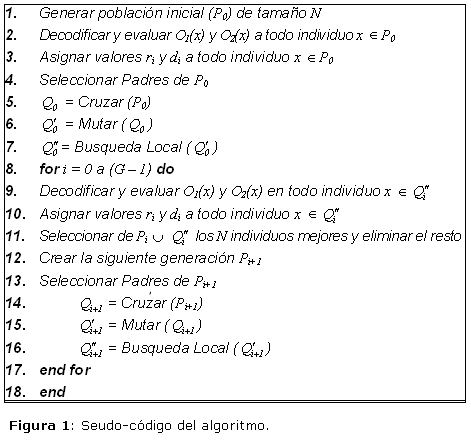
<body><![CDATA[<P>&nbsp;      <P>      <P><font face="Verdana" size="2">El problema de secuenciaci&oacute;n de operaciones    en un entorno <i>Job-Shop</i> (JSSP, <i>Job-Shop Scheduling Problem</i>) consiste    en organizar la ejecuci&oacute;n de n trabajos a ser realizados en m m&aacute;quinas.    Es decir, se tiene un conjunto finito <i>J</i> de trabajos </font> <font face="Verdana" size="2"><img src="file:///C|/SciELO/serial/rii/v33n1/img/e2207112.gif" width="65" height="35">,    los cuales deben ser procesados por un conjunto finito <i>M</i> de m&aacute;quinas    <img src="file:///C|/SciELO/serial/rii/v33n1/img/e2307112.gif" width="78" height="34">.    Al procesamiento de una operaci&oacute;n de un trabajo <img src="file:///C|/SciELO/serial/rii/v33n1/img/e2407112.gif" width="25" height="33">en    una m&aacute;quina <img src="file:///C|/SciELO/serial/rii/v33n1/img/e2507112.gif" width="33" height="32">se    la denomina operaci&oacute;n <img src="file:///C|/SciELO/serial/rii/v33n1/img/e2607112.gif" width="36" height="38">,    donde <i>i</i> indica el orden en que deben ser realizadas el conjunto de operaciones    de un mismo trabajo <img src="file:///C|/SciELO/serial/rii/v33n1/img/e2707112.gif" width="28" height="36">.    La operaci&oacute;n <img src="file:///C|/SciELO/serial/rii/v33n1/img/e2607112.gif" width="36" height="38">requiere    el uso de una m&aacute;quina <img src="file:///C|/SciELO/serial/rii/v33n1/img/e2507112.gif" width="33" height="32">durante    un tiempo ininterrumpido <img src="file:///C|/SciELO/serial/rii/v33n1/img/e2807112.gif" width="29" height="37">,    conocido como tiempo de procesamiento. </font>      <P><font face="Verdana" size="2">En base a lo mencionado, el algoritmo propuesto    opera en base a un cromosoma que representa la secuenciaci&oacute;n de las operaciones    <img src="file:///C|/SciELO/serial/rii/v33n1/img/e2607112.gif" width="36" height="38">a    realizarse en cada una de las m&aacute;quinas <img src="file:///C|/SciELO/serial/rii/v33n1/img/e2507112.gif" width="33" height="32">.    La codificaci&oacute;n del mismo se presenta como una lista ordenada de n&uacute;meros    enteros, los cuales representan el orden en que los trabajos ser&aacute;n realizados    en cada m&aacute;quina [20], como se muestra en la <a href="/img/revistas/rii/v33n1/t0107112.jpg" target="_blank">tabla    1</a>. Es decir, se designa con valores entre <i>0</i> y <i>n!-1</i> la secuencia    de trabajos en cada m&aacute;quina. Para <i>m = 4</i> y <i>n = 3</i>, 0&#8594;J1J2J3,    1&#8594;J1J3J2, 2&#8594;J2J1J3, 3&#8594;J2J3J1, 4&#8594;J3J1J2 y 5&#8594;J3J2J1.    </font>      <P>      <P>      <P><font face="Verdana" size="2">La poblaci&oacute;n inicial es conformada por    individuos cuyo cromosoma es constituido por genes seleccionados de manera aleatoria.    Una vez establecido el cromosoma, se procede a la decodificaci&oacute;n y evaluaci&oacute;n    de los individuos en t&eacute;rminos del <i>Makespan</i> (tiempo en terminar    todos los trabajos) [21] (<a href="#e29">ecuaci&oacute;n 1</a>) y el <i>Delay</i>    (tiempo de retardo del trabajo que termina con mayor retraso con respecto a    una fecha consignada) [22] (<a href="#e30">ecuaci&oacute;n 2</a>). </font>      <P><img src="/img/revistas/rii/v33n1/e2907112.gif" alt="ecuación 1" width="182" height="33"><font face="Verdana" size="2">(1) <a name="e29"></a> </font>      <P><font face="Verdana" size="2"> <img src="/img/revistas/rii/v33n1/e3007112.gif" alt="ecuación 2" width="178" height="33">(2)    <a name="e30"></a> </font>      <P><font face="Verdana" size="2">Donde se corresponde con la fecha de culminaci&oacute;n    del trabajo y es el retraso del trabajo con respecto a una fecha consignada.    Poder evaluar los cromosomas en t&eacute;rmino de estos dos objetivos, permite    determinar la criticidad de cada una de las m&aacute;quinas que intervienen    en el proceso productivo. El algoritmo opera con operadores gen&eacute;ticos    b&aacute;sicos, gracias al dise&ntilde;o establecido para el cromosoma. Luego    de que los individuos fueron afectados por los operadores gen&eacute;ticos y    antes de que &eacute;stos formen parte de la nueva poblaci&oacute;n, se les    aplica a ellos un operador de mejora. Este operador se dise&ntilde;&oacute;    siguiendo el desarrollo de la meta-heur&iacute;stica <i>Simulated Annealing</i>    (SA) [23]. &Eacute;sta es una t&eacute;cnica que presenta una b&uacute;squeda    local guiada para progresar desde una soluci&oacute;n a otra de mejor calidad.    SA introduce una estrategia de aceptaci&oacute;n que permite explorar temporalmente    &aacute;reas desfavorables del espacio de b&uacute;squeda. Cabe mencionar que    el esquema de la soluci&oacute;n va cambiando con la alteraci&oacute;n aleatoria    del valor de los genes que conforman cada cromosoma. Se diferencia este procedimiento    de otros al incorporar direcciones de b&uacute;squeda con criterios de densidad.    Despu&eacute;s de que los operadores gen&eacute;ticos y de mejora han sido aplicados,    y la poblaci&oacute;n ha sido decodificada y evaluada, el algoritmo contin&uacute;a    de acuerdo a NSGAII (<i>Non-Dominated Sorting Genetic Algorithm</i> II) [24].    NSGAII utiliza una estrategia elitista junto con un mecanismo expl&iacute;cito    de diversidad. En la <a href="#f01">figura 1</a> se presenta el seudo-c&oacute;digo    del algoritmo y en la <a href="/img/revistas/rii/v33n1/f0207112.gif" target="_blank">figura 2</a> su esquema    general. </font>      ]]></body>

<body><![CDATA[<P align="center"><img src="/img/revistas/rii/v33n1/f0107112.gif" alt="Figura 1 Seudo-c&oacute;digo del algoritmo" width="471" height="442"><a name="f01"></a>     <P>     <P>     <P>     <P>     <P>      <P>      <P>      <P>      <P>      ]]></body>
<body><![CDATA[<P>      <P>     <P>&nbsp;     <P><font size="3"><b><font face="Verdana">RESULTADOS</font></b></font>     <P>&nbsp;      <P>      <P><font face="Verdana" size="2">Se presentan, en este punto, las caracter&iacute;sticas    principales de los 3 algoritmos evolutivos multi-objetivos a ser comparados    con NSGAII. Los algoritmos son los siguientes: NSGA (<i>Non-dominated Sorting    Genetic Algorithm</i>) [25], SPEA (<i>Strength Pareto Evolutionary algorithm</i>)    [26] y SPEAII (<i>Strength Pareto Evolutionary algorithm</i> II) [27]. El algoritmo    NSGA clasifica los individuos en varias capas o frentes. Esta clasificaci&oacute;n    consiste en agrupar a todos los individuos no dominados en un frente, con un    valor de <i>fitness</i> igual para todos los individuos. Este valor es proporcional    al tama&ntilde;o de la poblaci&oacute;n, para as&iacute; proporcionar un potencial    reproductivo igual para todos los individuos de este frente. Entonces, el grupo    de individuos clasificados es ignorado y otro frente de individuos es considerado.    El proceso contin&uacute;a hasta que se clasifican a todos los individuos en    la poblaci&oacute;n. Puesto que los individuos en el primer frente tienen el    valor de <i>fitness</i> mayor, consiguen siempre m&aacute;s atenci&oacute;n    que el resto de la poblaci&oacute;n. SPEA, es un algoritmo que utiliza un archivo    que contiene las soluciones no dominadas encontradas. En cada generaci&oacute;n,    se copian los individuos no dominados a ese archivo y se borran de &eacute;ste    las soluciones dominadas. Para cada individuo en el sistema externo, se computa    un valor de fuerza o <i>strength</i> proporcional al n&uacute;mero de las soluciones    a las cuales cada individuo domina. En SPEA, el <i>fitness</i> de cada miembro    de la poblaci&oacute;n actual se computa seg&uacute;n las fuerzas de todas las    soluciones no dominadas externas que la dominen. SPEAII tiene diferencias importantes    con respecto a su precursor. Este algoritmo incorpora una estrategia fina de    asignaci&oacute;n del <i>fitness</i> que considera, para cada individuo, el    n&uacute;mero de los individuos que lo dominan y el n&uacute;mero de los individuos    por los cuales es dominado. Adem&aacute;s, utiliza la t&eacute;cnica del &quot;vecino    m&aacute;s cercano&quot; para la valoraci&oacute;n de la densidad, dirigiendo    la b&uacute;squeda en forma m&aacute;s eficiente. </font>      <P><font face="Verdana" size="2">En un an&aacute;lisis preliminar de estos algoritmos,    se verific&oacute; que el proceso de mejoramiento de soluciones tiende a estabilizarse    en torno a la generaci&oacute;n 200, por lo que se defini&oacute; el n&uacute;mero    de generaciones igual a 500, dando as&iacute; un margen para un mejoramiento    tard&iacute;o de la soluci&oacute;n. Los par&aacute;metros y las caracter&iacute;sticas    del equipamiento utilizado durante los ensayos fueron: tama&ntilde;o de la poblaci&oacute;n:    200, n&uacute;mero de generaciones: 500, tipo de cruce: <i>Uniform</i>, probabilidad    de cruce: 0.90, tipo de mutaci&oacute;n: <i>Two-swap</i>, probabilidad de mutaci&oacute;n:    0.01, tipo de b&uacute;squeda local: <i>Simulated Annealing</i>, probabilidad    de b&uacute;squeda local: 0.01, CPU: 3.00 GHZ y RAM: 1.00 GB. Los problemas    resueltos fueron: la01, la02, la03, la04, la05, la06, la07, la08, la09 y la10    [28]. Estos problemas son los m&aacute;s populares en cuanto al JSSP se refiere.    Son variados en tama&ntilde;o y complejidad. Se muestran los resultados obtenidos    con los algoritmos presentados en el punto anterior para un an&aacute;lisis    multi-objetivo haciendo <i>Makespan</i> vs. <i>Delay</i>. Los resultados se    analizaron de la siguiente manera [23]. Se corri&oacute; cada algoritmo 10 veces.    Se obtuvo para cada algoritmo los conjuntos de soluciones no dominadas: P<sub>1</sub>,    P<sub>2</sub>,&#133;, P<sub>10</sub>. Se cre&oacute; una superpoblaci&oacute;n    P<sub>T</sub> = P<sub>1 </sub>&#8746; P<sub>2</sub> &#8746; ...&#8746; P<sub>10</sub>    para cada uno de los algoritmos. De cada superpoblaci&oacute;n se extrajeron    las soluciones no dominadas, formando as&iacute; el frente de Pareto de cada    algoritmo: <i>Y<sub>NSGA</sub>, Y<sub>SPEA</sub>, Y<sub>NSGAII</sub></i> y <i>Y<sub>SPEAII</sub></i>.    Es decir, se agrupan las soluciones de todas las r&eacute;plicas y se eliminan    las dominadas con el fin de estipular una frontera de Pareto para cada algoritmo.    Los frentes de Pareto desarrollados por cada algoritmo se muestran en las <a href="/img/revistas/rii/v33n1/f0307112.jpg" target="_blank">figuras    3</a>, <a href="/img/revistas/rii/v33n1/f0407112.jpg" target="_blank">4</a>, <a href="/img/revistas/rii/v33n1/f0507112.jpg" target="_blank">5</a>,    <a href="/img/revistas/rii/v33n1/f0607112.jpg" target="_blank">6</a> y <a href="/img/revistas/rii/v33n1/f0707112.jpg" target="_blank">7</a>.    </font>      <P>      <P>      ]]></body>
<body><![CDATA[<P>      <P>      <P>      <P>      <P>      <P>      <P>      <P>      <P>      <P>      ]]></body>
<body><![CDATA[<P>      <P>      <P>      <P>&nbsp;     <P><font face="Verdana" size="2"><b><font size="3">DISCUSI&Oacute;N</font></b>    </font>     <P>&nbsp;      <P>      <P><font face="Verdana" size="2">Para obtener una aproximaci&oacute;n del frente    Pareto &oacute;ptimo<em> &#374;</em><sub>true</sub>, se toma al conjunto de    soluciones <i>Y<sub>NSGA</sub></i> &#8746;<i> Y<sub>SPEA </sub></i>&#8746;<i>    Y<sub>NSGAII </sub></i>&#8746;<i> Y<sub>SPEAII</sub></i>, y se eliminan de &eacute;l    las soluciones dominadas. Para la comparaci&oacute;n se tendr&aacute; en cuenta:    la cantidad de soluciones de cada algoritmo que se encuentran en<em> &#374;</em><sub>true</sub>    (<em>&#374;</em><sub>true</sub>), la cantidad de soluciones que son dominadas    por<b> </b><em>&#374;</em><sub>true</sub> (<img src="file:///C|/SciELO/serial/rii/v33n1/img/e3107112.gif" width="41" height="27">),    el n&uacute;mero de soluciones encontradas por cada algoritmo (<em>&#374;</em><sub>alg</sub>)    y el porcentaje de soluciones en<em> &#374;</em><sub>true</sub> (% <em>&#374;</em><sub>true</sub>).    En los problemas la01 (<a href="/img/revistas/rii/v33n1/t0207112.gif" target="_blank">tabla 2</a>(a)),    la04 (<a href="/img/revistas/rii/v33n1/t0307112.gif" target="_blank">tabla 3</a>(b)), la08 (<a href="/img/revistas/rii/v33n1/t0407112.gif" target="_blank">tabla    4</a>(b)), la09 (<a href="/img/revistas/rii/v33n1/t0507112.gif" target="_blank">tabla 5</a>(a))    y la10 (<a href="/img/revistas/rii/v33n1/t0507112.gif" target="_blank">tabla 5</a> (b)), se puede    apreciar que NSGA, SPEA, NSGAII y SPEAII, poseen el 100% de sus soluciones en    <em>&#374;</em><sub>true</sub>. No existe dominancia de un algoritmo hacia otro.    En el problema la02 (<a href="/img/revistas/rii/v33n1/t0207112.gif" target="_blank">tabla 2</a>(b)),    se observa que NSGAII posee el 100% de sus soluciones en <em>&#374;</em><sub>true</sub>.    Si bien SPEAII tiene el 100% de efectividad, no tiene a todas las soluciones    de <b> </b><em>&#374;</em><sub>true</sub>. SPEA alcanza un 92,8% de efectividad,    ya que de un total de 14 soluciones, solo 1 de ellas es dominada por <b> </b><em>&#374;</em><sub>true</sub>.    Se observa que NSGAII y SPEAII dominan a NSGA en 2 soluciones y a SPEA en 1    soluci&oacute;n. Adem&aacute;s, SPEA domina a NSGA en 1 soluci&oacute;n. En    el problema la03 (<a href="/img/revistas/rii/v33n1/t0307112.gif" target="_blank">tabla 3</a>(a)), se observa    que NSGAII posee el 100% de sus soluciones en <em>&#374;</em><sub>true</sub>.    Si bien SPEAII tiene el 100% de efectividad, no tiene a todas las soluciones    de <b> </b><em>&#374;</em><sub>true</sub>. Se observa que NSGAII y SPEAII dominan    a NSGA y a SPEA en 1 soluci&oacute;n. </font>      <P><font face="Verdana" size="2">En el problema la05 (<a href="/img/revistas/rii/v33n1/t0607112.gif" target="_blank">tabla    6</a> (a)), se aprecia que NSGAII posee el 100% de sus soluciones en <b> </b><em>&#374;</em><sub>true</sub>.    Si bien NSGA tiene el 100% de efectividad, no tiene a todas las soluciones de    <b> </b><em>&#374;</em><sub>true</sub>. Se observa que NSGAII domina a SPEA    y a SPEAII en 1 soluci&oacute;n. En el problema la06 (<a href="/img/revistas/rii/v33n1/t0607112.gif" target="_blank">tabla    6</a> (b)), se observa que solo NSGAII posee el 100% de sus soluciones en <b>    </b><em>&#374;</em><sub>true</sub>. Se aprecia que NSGAII domina a NSGA, a SPEA    y a SPEAII en 1 soluci&oacute;n. En el problema la07 (<a href="/img/revistas/rii/v33n1/t0407112.gif" target="_blank">tabla    4</a> (a)), se observa que SPEAII posee el 100% de sus soluciones en <b> </b><em>&#374;</em><sub>true</sub>.    Si bien NSGAII tiene el 100% de efectividad, no tiene todas las soluciones de    <b> </b><em>&#374;</em><sub>true</sub>. Se observa que NSGAII y SPEAII dominan    a NSGA y a SPEA en 1 soluci&oacute;n. </font>      <P>      ]]></body>
<body><![CDATA[<P>      <P>      <P>      <P>      <P>      <P>      <P>      <P>&nbsp;     <P><font face="Verdana" size="2"><b><font size="3">CONCLUSIONES</font></b></font>     <P>&nbsp;      ]]></body>
<body><![CDATA[<P>      <P><font face="Verdana" size="2">Se compar&oacute; al algoritmo NSGAII con otros    algoritmos evolutivos multi-objetivo. Los casos abordados fueron problemas de    secuenciaci&oacute;n de operaciones encontrados en la literatura especializada.    Se recuerda que este tipo de problema es uno de los <i>NP-Hard</i> m&aacute;s    estudiado en la literatura y su tratamiento es un tema de investigaci&oacute;n    actual. Se pudo observar que, en la mayor&iacute;a de los problemas, la calidad    de las soluciones obtenidas con NSGAII respecto a las alcanzadas con SPEAII,    fue igual o superior. NSGAII super&oacute; a NSGA y a SPEA. Se puede concluir    que el algoritmo propuesto tiene muy buen desempe&ntilde;o, siendo una buena    opci&oacute;n para resolver este problema. Como parte de trabajos futuros, se    podr&iacute;an estudiar planteamientos multi-objetivo distintos de este problema.    Se est&aacute; experimentando con otras t&eacute;cnicas eficientes de b&uacute;squeda    local para lograr una exploraci&oacute;n m&aacute;s agresiva. Finalmente, resultar&iacute;a    de inter&eacute;s evaluar este procedimiento en otros tipos de problemas y as&iacute;    verificar si el esquema propuesto realmente produce ahorros importantes en el    procesamiento, sin sacrificar de manera significativa la convergencia. Sin lugar    a dudas, queda mucho trabajo que se puede realizar para tener un algoritmo m&aacute;s    eficiente y robusto. </font>      <P>      <P>     <P>&nbsp;     <P><font face="Verdana" size="2"><b><font size="3">REFERENCIAS</font></b></font>     <P>&nbsp;      <P>      <!-- ref --><P><font face="Verdana" size="2">1. ADAMS, J.; BALAS, E.; ZAWACK, D., &quot;The    Shifting Bottleneck Procedure for job shop scheduling&quot; Management Science,    1998, vol. 34, pp. 391-401, ISSN 0025-1909.     </font>     ]]></body>
<body><![CDATA[<!-- ref --><P><font face="Verdana" size="2">2. DE GIOVANNI, L.; PEZZELLA F., &quot;An improved    genetic algorithm for the distributed and flexible job-shop scheduling problem&quot;    European Journal of Operational Research, 2010, vol. 200, no. 2, pp. 395-408,    ISSN 0377-2217.     </font>     <!-- ref --><P><font face="Verdana" size="2">3. PARK, B. J.; CHOI H. R.; KIM, H. S. A., &quot;Hybrid    genetic algorithm for the job shop scheduling problems&quot; Computers and Industrial    Engineering, 2003, vol. 45, no. 4, pp. 597-613, ISSN 0360-8352.     </font>     <!-- ref --><P><font face="Verdana" size="2">4. TSAI, C. F.; LIN, F. C., &quot;A new hybrid    heuristic technique for solving job-shop scheduling problem&quot;, en Intelligent    Data Acquisition and Advanced Computing Systems: Technology and Applications.    Second IEEE International Workshop Lviv, Ucrania, 2003, ISBN 80-967402-6-1.        </font>     <!-- ref --><P><font face="Verdana" size="2">5. PAPADIMITRIOU, C. H., Computational complexity,    USA, Addison Wesley, 1994, ISBN 0-201-53082-1.     </font>     <!-- ref --><P><font face="Verdana" size="2">6. ULLMAN, J. D., &quot;Np-complete scheduling    problems&quot; Journal of Computer and System sciences, 1975, vol. 10, pp. 384-393,    ISSN 0022-0000.     </font>     ]]></body>
<body><![CDATA[<!-- ref --><P><font face="Verdana" size="2">7. DELLA CROCE, F.; GROSSO, A.; SALASSA, F.,    &quot;A matheuristic approach for the two-machine total completion time flow-shop    problem&quot; Annals of Operations Research, 2011, July, ISSN 0254-5330.     </font>     <!-- ref --><P><font face="Verdana" size="2">8. HEINONEN, J.; PETTERSSON, F., &quot;Hybrid    ant colony optimization and visibility studies applied to a job shop scheduling    problem&quot; Applied Mathematics and Computation, 2007, vol. 187, no.2, pp.    989-998, ISSN 0096-3003.     </font>     <!-- ref --><P><font face="Verdana" size="2">9. LIN, Y.; PFUND, M.; FOWLER, J., &quot;Heuristics    for minimizing regular performance measures in unrelated parallel machine scheduling    problems&quot; Computers &amp; Operations Research, 2011, vol. 38, no. 6, pp.    901-916, ISSN 0305-0548.     </font>     <!-- ref --><P><font face="Verdana" size="2">10. MERKLE, D.; MIDDENDORF, M., &quot;A new approach    to solve permutation scheduling problems with ant colony optimization&quot;,    en Applications of Evolutionary Computing. EvoWorkshops Italia, 2001, vol. 2037,    pp. 484-494. ISBN 3-540-41920-9.     </font>     <!-- ref --><P><font face="Verdana" size="2">11. WU, C. G.; XING, X. L.; LEE, H. P.; ZHOU,    C. G.; LIANG, Y. C. , &quot;Genetic Algorithm Application on the Job Shop Scheduling    Problem&quot;, en Machine Learning and Cybernetics Shanghai, Proceedings of    2004 International Conference, 2004, vol. 4, pp. 2102- 2106. ISBN 0-780-38403-2.        </font>     ]]></body>
<body><![CDATA[<!-- ref --><P><font face="Verdana" size="2">12. FRUTOS, M.; TOHM&Eacute;, F., &quot;Desarrollo    de un procedimiento gen&eacute;tico dise&ntilde;ado para programar la producci&oacute;n    en un sistema de manufactura tipo job-shop&quot;, en VI Congreso Espa&ntilde;ol    sobre Meta-heur&iacute;sticas, Algoritmos Evolutivos y Bioinspirados M&aacute;laga,    2009, ISBN 974-84-691-6813-4.     </font>     <!-- ref --><P><font face="Verdana" size="2">13. STEINER, G.; ZHANG, R., &quot;Minimizing    the weighted number of tardy jobs with due date assignment and capacity-constrained    deliveries&quot; Annals of Operations Research, 2011, vol. 191, no. 1, pp. 171-181,    ISSN 0254-5330.     </font>     <!-- ref --><P><font face="Verdana" size="2">14. COELLO, C. A.; VAN VELDHUIZEN, D. A., LAMONT,    G. B., Evolutionary Algorithms for Solving Multi-Objective Problems, New York,    Kluwer Academic Publishers, 2002, ISBN 0-306-46762-3.     </font>     <!-- ref --><P><font face="Verdana" size="2">15. CORT&Eacute;S, D.; COELLO, C. A.; CORT&Eacute;S,    N. C., &quot;Use of an Artificial Immune System for Job Shop Scheduling&quot;,    en Second International Conference on Artificial Immune Systems Edinburgh (Scotland),    Springer-Verlag. Lecture Notes in Computer Science, 2003, vol. 2787, pp. 1-10.    ISBN 3-540-40766-9.     </font>      <!-- ref --><P><font face="Verdana" size="2">16. CHAO-HSIEN, J.; HAN-CHIANG, H., &quot;A hybrid    genetic algorithm for no-wait job-shop cheduling problems&quot; Expert Systems    with Applications, 2009, vol. 36, no. 3, pp. 5800-5806, ISSN 0957-4174.     </font>     ]]></body>
<body><![CDATA[<!-- ref --><P><font face="Verdana" size="2">17. CHINYAO, L.; YULING, Y., &quot;Genetic algorithm-based    heuristics for an open shop scheduling problem with setup, processing, and removal    times separated&quot; Robotics and Computer-Integrated Manufacturing, 2009,    vol. 25, no. 2, pp. 314-322, ISSN 0736-5845.     </font>     <!-- ref --><P><font face="Verdana" size="2">18. GOLDBERG, D. E., &quot;Genetic Algorithms    in Search&quot;, Optimization and Machine Learning, Massachusetts, Addison Wesley,    1989, ISBN 0-201-15767-5.     </font>     <P>      <!-- ref --><P><font face="Verdana" size="2">19. ISHIBUCHI, H.; YOSHIDA, T., MURATA, T., &quot;Balance    Between Genetic Search and Local Search in Memetic Algorithms for Multiobjective    Permutation Flow-shop Scheduling&quot; IEEE Transactions on Evolutionary Computation,    2003, vol. 7, no. 2, pp. 204-223, ISSN 1089-778X.     </font>     <!-- ref --><P><font face="Verdana" size="2">20. FRUTOS, M.; OLIVERA, A. C., TOHM&Eacute;,    F., &quot;A Memetic Algorithm Based on a NSGAII Scheme for the Flexible Job-Shop    Scheduling Problem&quot; Annals of Operations Research, 2010, vol. 181, pp.    745-765, ISSN 0254-5330.     </font>     <!-- ref --><P><font face="Verdana" size="2">21. CHENG, C. C.; SMITH, S. F., &quot;Applying    constraint satisfaction techniques to job shop scheduling&quot; Annals of Operations    Research, 1997, vol. 70, pp. 327-357, ISSN 0254-5330.     </font>     <!-- ref --><P><font face="Verdana" size="2">22. ARMENTANO, V. A.; SCRICH, C. R., &quot;Tabu    search for minimizing total tardiness in a job shop&quot; Int. J. Production    Economics, 2000, vol. 63, pp. 131-140, ISSN 0925-5273.     </font>     <!-- ref --><P><font face="Verdana" size="2">23. DOWSLAND, K. A., Simulated Annealing, Modern    Heuristic Techniques for Combinatorial Problems, Oxford, C. R. Reeves. Blackwell    Scientific Pub, 1993, ISBN 1-55860-260-7.     </font>     <!-- ref --><P><font face="Verdana" size="2">24. DEB, K., PRATAP, A., AGARWAL, S.; MEYARIVAN,    T., &quot;A Fast and Elitist Multi-objective Genetic Algorithm: NSGAII&quot;    IEEE Transactions on Evolutionary Computation, 2002, vol. 6, no. 2, pp. 182-197,    ISSN 1089-778X.     </font>     <!-- ref --><P><font face="Verdana" size="2">25. SRINIVAS, N., &quot;Multiobjective optimization    using nondominated sorting in genetic algorithms&quot;, [master thesis], Kuanpur    (India), Indian Institute of Technology, 1994.     </font>      <!-- ref --><P><font face="Verdana" size="2">26. ZITZLER, E.; THIELE, L., &quot;Multiobjective    Evolutionary Algorithms: A comparative Case Study and the Strength Pareto Approach&quot;    IEEE Transactions on Evolutionary Computation, 1999, vol. 3, no. 4, pp. 257-271,    ISSN 1089-778X.     </font>     <!-- ref --><P><font face="Verdana" size="2">27. ZITZLER, E.; LAUMANNS, M.; THIELE, L., &quot;SPEAII:    Improving the strength pareto evolutionary algorithm for multiobjective optimization&quot;,    Evolutionary Methods for Design. Optimisations and Control, Athens (Greece),    Giannakoglou, Tsahalis, Periaux, Papailiou, and Fogarty, 2002, pp. 19-26, ISBN    84-89925-97-6.     </font>     <!-- ref --><P><font face="Verdana" size="2">28. BEASLEY, J. E., &quot;OR-Library: Distributing    Test Problems by Electronic Mail&quot; Journal of the Operations Research Society,    1990, vol. 41, no. 11, pp. 1069-1072, ISSN 0160-5682.     </font>     <P>&nbsp;     <P>&nbsp;      <P>     <P><font face="Verdana" size="2">Recibido: 14 de abril de 2011    <br>   Aprobado: 6 de diciembre de 2011</font>     ]]></body>
<body><![CDATA[<P>     <P>     <P>     <P>     <P>     <P>      <P>     <P>     <P>&nbsp;     <P>&nbsp;     ]]></body>
<body><![CDATA[<P><font face="Verdana" size="2"><i>Mariano Frutos-Alazard. </i>Departamento de    Ingenier&iacute;a, Universidad Nacional del Sur. Bah&iacute;a Blanca, Argentina.    Correo electr&oacute;nico: <a href="mailto:mfrutos@uns.edu.ar">mfrutos@uns.edu.ar</a></font>       ]]></body><back>
<ref-list>
<ref id="B1">
<label>1</label><nlm-citation citation-type="journal">
<person-group person-group-type="author">
<name>
<surname><![CDATA[ADAMS]]></surname>
<given-names><![CDATA[J.]]></given-names>
</name>
<name>
<surname><![CDATA[BALAS]]></surname>
<given-names><![CDATA[E.]]></given-names>
</name>
<name>
<surname><![CDATA[ZAWACK]]></surname>
<given-names><![CDATA[D.]]></given-names>
</name>
</person-group>
<article-title xml:lang="en"><![CDATA[The Shifting Bottleneck Procedure for job shop scheduling]]></article-title>
<source><![CDATA[Management Science]]></source>
<year>1998</year>
<volume>34</volume>
<page-range>391-401</page-range></nlm-citation>
</ref>
<ref id="B2">
<label>2</label><nlm-citation citation-type="journal">
<person-group person-group-type="author">
<name>
<surname><![CDATA[DE GIOVANNI]]></surname>
<given-names><![CDATA[L.]]></given-names>
</name>
<name>
<surname><![CDATA[PEZZELLA]]></surname>
<given-names><![CDATA[F.]]></given-names>
</name>
</person-group>
<article-title xml:lang="en"><![CDATA[An improved genetic algorithm for the distributed and flexible job-shop scheduling problem]]></article-title>
<source><![CDATA[European Journal of Operational Research]]></source>
<year>2010</year>
<volume>200</volume>
<numero>2</numero>
<issue>2</issue>
<page-range>395-408</page-range></nlm-citation>
</ref>
<ref id="B3">
<label>3</label><nlm-citation citation-type="journal">
<person-group person-group-type="author">
<name>
<surname><![CDATA[PARK]]></surname>
<given-names><![CDATA[B. J.]]></given-names>
</name>
<name>
<surname><![CDATA[CHOI]]></surname>
<given-names><![CDATA[H. R.]]></given-names>
</name>
<name>
<surname><![CDATA[KIM]]></surname>
<given-names><![CDATA[H. S. A.]]></given-names>
</name>
</person-group>
<article-title xml:lang="en"><![CDATA[Hybrid genetic algorithm for the job shop scheduling problems]]></article-title>
<source><![CDATA[Computers and Industrial Engineering]]></source>
<year>2003</year>
<volume>45</volume>
<numero>4</numero>
<issue>4</issue>
<page-range>597-613</page-range></nlm-citation>
</ref>
<ref id="B4">
<label>4</label><nlm-citation citation-type="">
<person-group person-group-type="author">
<name>
<surname><![CDATA[TSAI]]></surname>
<given-names><![CDATA[C. F.]]></given-names>
</name>
<name>
<surname><![CDATA[LIN]]></surname>
<given-names><![CDATA[F. C.]]></given-names>
</name>
</person-group>
<source><![CDATA[A new hybrid heuristic technique for solving job-shop scheduling problem]]></source>
<year>2003</year>
<publisher-loc><![CDATA[Lviv ]]></publisher-loc>
</nlm-citation>
</ref>
<ref id="B5">
<label>5</label><nlm-citation citation-type="book">
<person-group person-group-type="author">
<name>
<surname><![CDATA[PAPADIMITRIOU]]></surname>
<given-names><![CDATA[C. H.]]></given-names>
</name>
</person-group>
<source><![CDATA[Computational complexity]]></source>
<year>1994</year>
<publisher-name><![CDATA[Addison Wesley]]></publisher-name>
</nlm-citation>
</ref>
<ref id="B6">
<label>6</label><nlm-citation citation-type="journal">
<person-group person-group-type="author">
<name>
<surname><![CDATA[ULLMAN]]></surname>
<given-names><![CDATA[J. D.]]></given-names>
</name>
</person-group>
<article-title xml:lang="en"><![CDATA[Np-complete scheduling problems]]></article-title>
<source><![CDATA[Journal of Computer and System sciences]]></source>
<year>1975</year>
<volume>10</volume>
<page-range>384-393</page-range></nlm-citation>
</ref>
<ref id="B7">
<label>7</label><nlm-citation citation-type="journal">
<person-group person-group-type="author">
<name>
<surname><![CDATA[DELLA CROCE]]></surname>
<given-names><![CDATA[F.]]></given-names>
</name>
<name>
<surname><![CDATA[GROSSO]]></surname>
<given-names><![CDATA[A.]]></given-names>
</name>
<name>
<surname><![CDATA[SALASSA]]></surname>
<given-names><![CDATA[F.]]></given-names>
</name>
</person-group>
<article-title xml:lang="en"><![CDATA[A matheuristic approach for the two-machine total completion time flow-shop problem]]></article-title>
<source><![CDATA[Annals of Operations Research]]></source>
<year>2011</year>
<month>, </month>
<day>Ju</day>
</nlm-citation>
</ref>
<ref id="B8">
<label>8</label><nlm-citation citation-type="journal">
<person-group person-group-type="author">
<name>
<surname><![CDATA[HEINONEN]]></surname>
<given-names><![CDATA[J.]]></given-names>
</name>
<name>
<surname><![CDATA[PETTERSSON]]></surname>
<given-names><![CDATA[F.]]></given-names>
</name>
</person-group>
<article-title xml:lang="en"><![CDATA[Hybrid ant colony optimization and visibility studies applied to a job shop scheduling problem]]></article-title>
<source><![CDATA[Applied Mathematics and Computation]]></source>
<year>2007</year>
<volume>187</volume>
<numero>2</numero>
<issue>2</issue>
<page-range>989-998</page-range></nlm-citation>
</ref>
<ref id="B9">
<label>9</label><nlm-citation citation-type="journal">
<person-group person-group-type="author">
<name>
<surname><![CDATA[LIN]]></surname>
<given-names><![CDATA[Y.]]></given-names>
</name>
<name>
<surname><![CDATA[PFUND]]></surname>
<given-names><![CDATA[M.]]></given-names>
</name>
<name>
<surname><![CDATA[FOWLER]]></surname>
<given-names><![CDATA[J.]]></given-names>
</name>
</person-group>
<article-title xml:lang="en"><![CDATA[Heuristics for minimizing regular performance measures in unrelated parallel machine scheduling problems]]></article-title>
<source><![CDATA[Computers & Operations Research]]></source>
<year>2011</year>
<volume>38</volume>
<numero>6</numero>
<issue>6</issue>
<page-range>901-916</page-range></nlm-citation>
</ref>
<ref id="B10">
<label>10</label><nlm-citation citation-type="">
<person-group person-group-type="author">
<name>
<surname><![CDATA[MERKLE]]></surname>
<given-names><![CDATA[D.]]></given-names>
</name>
<name>
<surname><![CDATA[MIDDENDORF]]></surname>
<given-names><![CDATA[M.]]></given-names>
</name>
</person-group>
<source><![CDATA[A new approach to solve permutation scheduling problems with ant colony optimization]]></source>
<year>2001</year>
<volume>2037</volume>
<page-range>484-494</page-range></nlm-citation>
</ref>
<ref id="B11">
<label>11</label><nlm-citation citation-type="">
<person-group person-group-type="author">
<name>
<surname><![CDATA[WU]]></surname>
<given-names><![CDATA[C. G.]]></given-names>
</name>
<name>
<surname><![CDATA[XING]]></surname>
<given-names><![CDATA[X. L.]]></given-names>
</name>
<name>
<surname><![CDATA[LEE]]></surname>
<given-names><![CDATA[H. P.]]></given-names>
</name>
<name>
<surname><![CDATA[ZHOU]]></surname>
<given-names><![CDATA[C. G.]]></given-names>
</name>
<name>
<surname><![CDATA[LIANG]]></surname>
<given-names><![CDATA[Y. C.]]></given-names>
</name>
</person-group>
<source><![CDATA[Genetic Algorithm Application on the Job Shop Scheduling Problem]]></source>
<year>2004</year>
<volume>4</volume>
<page-range>2102- 2106</page-range></nlm-citation>
</ref>
<ref id="B12">
<label>12</label><nlm-citation citation-type="">
<person-group person-group-type="author">
<name>
<surname><![CDATA[FRUTOS]]></surname>
<given-names><![CDATA[M.]]></given-names>
</name>
<name>
<surname><![CDATA[TOHMÉ]]></surname>
<given-names><![CDATA[F.]]></given-names>
</name>
</person-group>
<source><![CDATA[Desarrollo de un procedimiento genético diseñado para programar la producción en un sistema de manufactura tipo job-shop]]></source>
<year>2009</year>
<publisher-loc><![CDATA[Málaga ]]></publisher-loc>
</nlm-citation>
</ref>
<ref id="B13">
<label>13</label><nlm-citation citation-type="journal">
<person-group person-group-type="author">
<name>
<surname><![CDATA[STEINER]]></surname>
<given-names><![CDATA[G.]]></given-names>
</name>
<name>
<surname><![CDATA[ZHANG]]></surname>
<given-names><![CDATA[R.]]></given-names>
</name>
</person-group>
<article-title xml:lang="en"><![CDATA[Minimizing the weighted number of tardy jobs with due date assignment and capacity-constrained deliveries]]></article-title>
<source><![CDATA[Annals of Operations Research]]></source>
<year>2011</year>
<volume>191</volume>
<numero>1</numero>
<issue>1</issue>
<page-range>171-181</page-range></nlm-citation>
</ref>
<ref id="B14">
<label>14</label><nlm-citation citation-type="book">
<person-group person-group-type="author">
<name>
<surname><![CDATA[COELLO]]></surname>
<given-names><![CDATA[C. A.]]></given-names>
</name>
<name>
<surname><![CDATA[VAN VELDHUIZEN]]></surname>
<given-names><![CDATA[D. A.]]></given-names>
</name>
<name>
<surname><![CDATA[LAMONT]]></surname>
<given-names><![CDATA[G. B.]]></given-names>
</name>
</person-group>
<source><![CDATA[Evolutionary Algorithms for Solving Multi-Objective Problems]]></source>
<year>2002</year>
<publisher-loc><![CDATA[New York ]]></publisher-loc>
<publisher-name><![CDATA[Kluwer Academic Publishers]]></publisher-name>
</nlm-citation>
</ref>
<ref id="B15">
<label>15</label><nlm-citation citation-type="book">
<person-group person-group-type="author">
<name>
<surname><![CDATA[CORTÉS]]></surname>
<given-names><![CDATA[D.]]></given-names>
</name>
<name>
<surname><![CDATA[COELLO]]></surname>
<given-names><![CDATA[C. A.]]></given-names>
</name>
<name>
<surname><![CDATA[CORTÉS]]></surname>
<given-names><![CDATA[N. C.]]></given-names>
</name>
</person-group>
<source><![CDATA[Use of an Artificial Immune System for Job Shop Scheduling]]></source>
<year>2003</year>
<volume>2787</volume>
<page-range>1-10</page-range><publisher-loc><![CDATA[Edinburgh ]]></publisher-loc>
<publisher-name><![CDATA[Springer-Verlag]]></publisher-name>
</nlm-citation>
</ref>
<ref id="B16">
<label>16</label><nlm-citation citation-type="journal">
<person-group person-group-type="author">
<name>
<surname><![CDATA[CHAO-HSIEN]]></surname>
<given-names><![CDATA[J.]]></given-names>
</name>
<name>
<surname><![CDATA[HAN-CHIANG]]></surname>
<given-names><![CDATA[H.]]></given-names>
</name>
</person-group>
<article-title xml:lang="en"><![CDATA[A hybrid genetic algorithm for no-wait job-shop cheduling problems]]></article-title>
<source><![CDATA[Expert Systems with Applications]]></source>
<year>2009</year>
<volume>36</volume>
<numero>3</numero>
<issue>3</issue>
<page-range>5800-5806</page-range></nlm-citation>
</ref>
<ref id="B17">
<label>17</label><nlm-citation citation-type="journal">
<person-group person-group-type="author">
<name>
<surname><![CDATA[CHINYAO]]></surname>
<given-names><![CDATA[L.]]></given-names>
</name>
<name>
<surname><![CDATA[YULING]]></surname>
<given-names><![CDATA[Y.]]></given-names>
</name>
</person-group>
<article-title xml:lang="en"><![CDATA[Genetic algorithm-based heuristics for an open shop scheduling problem with setup, processing, and removal times separated]]></article-title>
<source><![CDATA[Robotics and Computer-Integrated Manufacturing]]></source>
<year>2009</year>
<volume>25</volume>
<numero>2</numero>
<issue>2</issue>
<page-range>314-322</page-range></nlm-citation>
</ref>
<ref id="B18">
<label>18</label><nlm-citation citation-type="book">
<person-group person-group-type="author">
<name>
<surname><![CDATA[GOLDBERG]]></surname>
<given-names><![CDATA[D. E.]]></given-names>
</name>
</person-group>
<source><![CDATA[Genetic Algorithms in Search]]></source>
<year>1989</year>
<publisher-loc><![CDATA[Massachusetts ]]></publisher-loc>
<publisher-name><![CDATA[Addison Wesley]]></publisher-name>
</nlm-citation>
</ref>
<ref id="B19">
<label>19</label><nlm-citation citation-type="journal">
<person-group person-group-type="author">
<name>
<surname><![CDATA[ISHIBUCHI]]></surname>
<given-names><![CDATA[H]]></given-names>
</name>
<name>
<surname><![CDATA[YOSHIDA]]></surname>
<given-names><![CDATA[T.]]></given-names>
</name>
<name>
<surname><![CDATA[MURATA]]></surname>
<given-names><![CDATA[T.]]></given-names>
</name>
</person-group>
<article-title xml:lang="en"><![CDATA[Balance Between Genetic Search and Local Search in Memetic Algorithms for Multiobjective Permutation Flow-shop Scheduling]]></article-title>
<source><![CDATA[IEEE Transactions on Evolutionary Computation]]></source>
<year>2003</year>
<volume>7</volume>
<numero>2</numero>
<issue>2</issue>
<page-range>204-223</page-range></nlm-citation>
</ref>
<ref id="B20">
<label>20</label><nlm-citation citation-type="journal">
<person-group person-group-type="author">
<name>
<surname><![CDATA[FRUTOS]]></surname>
<given-names><![CDATA[M.]]></given-names>
</name>
<name>
<surname><![CDATA[OLIVERA]]></surname>
<given-names><![CDATA[A. C.]]></given-names>
</name>
<name>
<surname><![CDATA[TOHMÉ]]></surname>
<given-names><![CDATA[F.]]></given-names>
</name>
</person-group>
<article-title xml:lang="en"><![CDATA[A Memetic Algorithm Based on a NSGAII Scheme for the Flexible Job-Shop Scheduling Problem]]></article-title>
<source><![CDATA[Annals of Operations Research]]></source>
<year>2010</year>
<volume>181</volume>
<page-range>745-765</page-range></nlm-citation>
</ref>
<ref id="B21">
<label>21</label><nlm-citation citation-type="journal">
<person-group person-group-type="author">
<name>
<surname><![CDATA[CHENG]]></surname>
<given-names><![CDATA[C. C.]]></given-names>
</name>
<name>
<surname><![CDATA[SMITH]]></surname>
<given-names><![CDATA[S. F.]]></given-names>
</name>
</person-group>
<article-title xml:lang="en"><![CDATA[Applying constraint satisfaction techniques to job shop scheduling]]></article-title>
<source><![CDATA[Annals of Operations Research]]></source>
<year>1997</year>
<volume>70</volume>
<page-range>327-357</page-range></nlm-citation>
</ref>
<ref id="B22">
<label>22</label><nlm-citation citation-type="journal">
<person-group person-group-type="author">
<name>
<surname><![CDATA[ARMENTANO]]></surname>
<given-names><![CDATA[V. A.]]></given-names>
</name>
<name>
<surname><![CDATA[SCRICH]]></surname>
<given-names><![CDATA[C. R.]]></given-names>
</name>
</person-group>
<article-title xml:lang="en"><![CDATA[Tabu search for minimizing total tardiness in a job shop]]></article-title>
<source><![CDATA[Int. J. Production Economics]]></source>
<year>2000</year>
<volume>63</volume>
<page-range>131-140</page-range></nlm-citation>
</ref>
<ref id="B23">
<label>23</label><nlm-citation citation-type="book">
<person-group person-group-type="author">
<name>
<surname><![CDATA[DOWSLAND]]></surname>
<given-names><![CDATA[K. A.]]></given-names>
</name>
</person-group>
<source><![CDATA[Simulated Annealing, Modern Heuristic Techniques for Combinatorial Problems]]></source>
<year>1993</year>
<publisher-loc><![CDATA[Oxford ]]></publisher-loc>
<publisher-name><![CDATA[C. R. Reeves. Blackwell Scientific Pub]]></publisher-name>
</nlm-citation>
</ref>
<ref id="B24">
<label>24</label><nlm-citation citation-type="journal">
<person-group person-group-type="author">
<name>
<surname><![CDATA[DEB]]></surname>
<given-names><![CDATA[K.]]></given-names>
</name>
<name>
<surname><![CDATA[PRATAP]]></surname>
<given-names><![CDATA[A.]]></given-names>
</name>
<name>
<surname><![CDATA[AGARWAL]]></surname>
<given-names><![CDATA[S.]]></given-names>
</name>
<name>
<surname><![CDATA[MEYARIVAN]]></surname>
<given-names><![CDATA[T.]]></given-names>
</name>
</person-group>
<article-title xml:lang="en"><![CDATA[A Fast and Elitist Multi-objective Genetic Algorithm: NSGAII]]></article-title>
<source><![CDATA[IEEE Transactions on Evolutionary Computation]]></source>
<year>2002</year>
<volume>6</volume>
<numero>2</numero>
<issue>2</issue>
<page-range>182-197</page-range></nlm-citation>
</ref>
<ref id="B25">
<label>25</label><nlm-citation citation-type="">
<person-group person-group-type="author">
<name>
<surname><![CDATA[SRINIVAS]]></surname>
<given-names><![CDATA[N.]]></given-names>
</name>
</person-group>
<source><![CDATA[Multiobjective optimization using nondominated sorting in genetic algorithms]]></source>
<year>1994</year>
<publisher-loc><![CDATA[Kuanpur ]]></publisher-loc>
</nlm-citation>
</ref>
<ref id="B26">
<label>26</label><nlm-citation citation-type="journal">
<person-group person-group-type="author">
<name>
<surname><![CDATA[ZITZLER]]></surname>
<given-names><![CDATA[E.]]></given-names>
</name>
<name>
<surname><![CDATA[THIELE]]></surname>
<given-names><![CDATA[L.]]></given-names>
</name>
</person-group>
<article-title xml:lang="en"><![CDATA[Multiobjective Evolutionary Algorithms: A comparative Case Study and the Strength Pareto Approach]]></article-title>
<source><![CDATA[IEEE Transactions on Evolutionary Computation]]></source>
<year>1999</year>
<volume>3</volume>
<numero>4</numero>
<issue>4</issue>
<page-range>257-271</page-range></nlm-citation>
</ref>
<ref id="B27">
<label>27</label><nlm-citation citation-type="book">
<person-group person-group-type="author">
<name>
<surname><![CDATA[ZITZLER]]></surname>
<given-names><![CDATA[E.]]></given-names>
</name>
<name>
<surname><![CDATA[LAUMANNS]]></surname>
<given-names><![CDATA[M.]]></given-names>
</name>
<name>
<surname><![CDATA[THIELE]]></surname>
<given-names><![CDATA[L.]]></given-names>
</name>
</person-group>
<source><![CDATA[SPEAII: Improving the strength pareto evolutionary algorithm for multiobjective optimization]]></source>
<year>2002</year>
<page-range>19-26</page-range><publisher-loc><![CDATA[Athens ]]></publisher-loc>
<publisher-name><![CDATA[Giannakoglou, Tsahalis, Periaux, Papailiou, and Fogarty]]></publisher-name>
</nlm-citation>
</ref>
<ref id="B28">
<label>28</label><nlm-citation citation-type="journal">
<person-group person-group-type="author">
<name>
<surname><![CDATA[BEASLEY]]></surname>
<given-names><![CDATA[J. E.]]></given-names>
</name>
</person-group>
<article-title xml:lang="en"><![CDATA[OR-Library: Distributing Test Problems by Electronic Mail]]></article-title>
<source><![CDATA[Journal of the Operations Research Society]]></source>
<year>1990</year>
<volume>41</volume>
<numero>11</numero>
<issue>11</issue>
<page-range>1069-1072</page-range></nlm-citation>
</ref>
</ref-list>
</back>
</article>