<?xml version="1.0" encoding="ISO-8859-1"?><article xmlns:mml="http://www.w3.org/1998/Math/MathML" xmlns:xlink="http://www.w3.org/1999/xlink" xmlns:xsi="http://www.w3.org/2001/XMLSchema-instance">
<front>
<journal-meta>
<journal-id>1815-5944</journal-id>
<journal-title><![CDATA[Ingeniería Mecánica]]></journal-title>
<abbrev-journal-title><![CDATA[Ingeniería Mecánica]]></abbrev-journal-title>
<issn>1815-5944</issn>
<publisher>
<publisher-name><![CDATA[Facultad de Ingeniería Mecánica. Instituto Superior Politécnico "José Antonio Echeverría"]]></publisher-name>
</publisher>
</journal-meta>
<article-meta>
<article-id>S1815-59442017000100005</article-id>
<title-group>
<article-title xml:lang="es"><![CDATA[Application of building energy simulation in the validating of operational strategies of HVAC systems on a tropical hotel]]></article-title>
<article-title xml:lang="en"><![CDATA[Aplicación de la simulación energética de edificios en la validación de estrategias operacionales de sistemas HVAC en un hotel tropical]]></article-title>
</title-group>
<contrib-group>
<contrib contrib-type="author">
<name>
<surname><![CDATA[Díaz-Torres]]></surname>
<given-names><![CDATA[Yamilé]]></given-names>
</name>
<xref ref-type="aff" rid="A01"/>
</contrib>
<contrib contrib-type="author">
<name>
<surname><![CDATA[Valdivia-Noda]]></surname>
<given-names><![CDATA[Yarelis]]></given-names>
</name>
<xref ref-type="aff" rid="A01"/>
</contrib>
<contrib contrib-type="author">
<name>
<surname><![CDATA[Monteagudo-Yanes]]></surname>
<given-names><![CDATA[José Pedro]]></given-names>
</name>
<xref ref-type="aff" rid="A01"/>
</contrib>
<contrib contrib-type="author">
<name>
<surname><![CDATA[Miranda-Torres]]></surname>
<given-names><![CDATA[Yudit]]></given-names>
</name>
<xref ref-type="aff" rid="A02"/>
</contrib>
</contrib-group>
<aff id="A01">
<institution><![CDATA[,Universidad de Cienfuegos, Centro de Estudio de Energía y Medio Ambiente, CEEMA  ]]></institution>
<addr-line><![CDATA[Cienfuegos ]]></addr-line>
<country>Cuba</country>
</aff>
<aff id="A02">
<institution><![CDATA[,Universidad de Cienfuegos. Departamento de Recursos Humanos  ]]></institution>
<addr-line><![CDATA[Cienfuegos ]]></addr-line>
<country>Cuba</country>
</aff>
<pub-date pub-type="pub">
<day>00</day>
<month>04</month>
<year>2017</year>
</pub-date>
<pub-date pub-type="epub">
<day>00</day>
<month>04</month>
<year>2017</year>
</pub-date>
<volume>20</volume>
<numero>1</numero>
<fpage>31</fpage>
<lpage>38</lpage>
<copyright-statement/>
<copyright-year/>
<self-uri xlink:href="http://scielo.sld.cu/scielo.php?script=sci_arttext&amp;pid=S1815-59442017000100005&amp;lng=en&amp;nrm=iso"></self-uri><self-uri xlink:href="http://scielo.sld.cu/scielo.php?script=sci_abstract&amp;pid=S1815-59442017000100005&amp;lng=en&amp;nrm=iso"></self-uri><self-uri xlink:href="http://scielo.sld.cu/scielo.php?script=sci_pdf&amp;pid=S1815-59442017000100005&amp;lng=en&amp;nrm=iso"></self-uri><abstract abstract-type="short" xml:lang="en"><p><![CDATA[This paper validates a trading strategy of a water-cooled chiller centralized system on a tropical hotel considered a transit hotel during last year 2013 was implemented empirically. For the same thermal loads climate with a building simulation tool called TRNSYS software for critical conditions, occupancy, weather and constructive characteristics of the system was calculated. Thermal load profiles for different levels of occupancy, comparing the installed thermal capacity were evaluated. Also it takes into account the particularities of occupancy in the hotel. This research proposed measures that complement the hotel&#8217;s energy management. Finally the strategy implemented allowed the hotel, savings403 123,76 kWh/year, and issuing leaving 371,27 t of CO2/year into the atmosphere. It meant about average consumption of the whole hotel for three months. It had an economic impact of 53212,33 USD/year.]]></p></abstract>
<abstract abstract-type="short" xml:lang="es"><p><![CDATA[El presente trabajo valida una estrategia de operación del sistema centralizado de agua helada en un hotel tropical considerado un hotel de tránsito que durante el año 2013 se puso en práctica de forma empírica. Para el mismo se calculó las cargas térmicas de climatización con utilizando una herramienta para la simulación de edificaciones, software TRNSYS, para condiciones críticas, de ocupación, meteorológicas y las características constructivas de la instalación. Se evaluaron los perfiles de carga térmica para distintos niveles de ocupación, comparándose con la capacidad térmica instalada. Además se tienen en cuenta las particularidades de ocupación del hotel. En esta investigación se proponen medidas que complementan la administración de la energía. Finalmente la implementación de esta estrategia permitió el ahorro de 403 123,76 kWh /año, dejándose de emitir 371,27 t de CO2/año a la atmosfera. Este ahorro representa el consumo del hotel en un periodo de tres meses y tiene un impacto económico de of 53212,33 USD/año.]]></p></abstract>
<kwd-group>
<kwd lng="en"><![CDATA[operational strategies]]></kwd>
<kwd lng="en"><![CDATA[HVAC]]></kwd>
<kwd lng="en"><![CDATA[thermal Load]]></kwd>
<kwd lng="en"><![CDATA[water-cooled centralized system]]></kwd>
<kwd lng="en"><![CDATA[chiller]]></kwd>
<kwd lng="es"><![CDATA[estrategia operacional]]></kwd>
<kwd lng="es"><![CDATA[HVAC]]></kwd>
<kwd lng="es"><![CDATA[cargas térmicas]]></kwd>
<kwd lng="es"><![CDATA[sistema centralizado de agua helada]]></kwd>
<kwd lng="es"><![CDATA[enfriadoras]]></kwd>
</kwd-group>
</article-meta>
</front><body><![CDATA[ <p align="right" ><font face="verdana" size="2"><b>ART&Iacute;CULO    ORIGINAL</b></font></p>     <p align="right" >&nbsp;</p>  	     <p align="justify"><font face="verdana" size="4"><b>Application of building energy    simulation in the validating of operational strategies of HVAC systems on a    tropical hotel</b></font></p>     <p align="justify">&nbsp;</p>  	     <p align="justify"><font face="verdana" size="3"><b>Aplicaci&oacute;n de la simulaci&oacute;n    energ&eacute;tica de edificios en la validaci&oacute;n de estrategias operacionales    de sistemas HVAC en un hotel tropical</b></font></p>     <p align="justify">&nbsp;</p>     <p align="justify">&nbsp;</p>     <p align="justify"><font face="verdana" size="2"><b>Yamil&eacute; D&iacute;az&#45;Torres<sup>I</sup>,    Yarelis Valdivia&#45;Noda<sup>l</sup>, Jos&eacute; Pedro Monteagudo&#45;Yanes<sup>I</sup>,    Yudit Miranda&#45;Torres<sup>II</sup></b></font></p>  	     <p align="justify"><font face="verdana" size="2"><sup>I.</sup> Universidad de Cienfuegos,    Centro de Estudio de Energ&iacute;a y Medio Ambiente, CEEMA. Cienfuegos, Cuba    <br>   </font><font face="verdana" size="2"><sup>II.</sup> Universidad de Cienfuegos. Departamento    de Recursos Humanos. Cienfuegos, Cuba</font></p>  	     ]]></body>
<body><![CDATA[<p align="justify">&nbsp;</p>     <p align="justify">&nbsp;</p>  	<hr>     <p><font face="Verdana" size="2"><b>ABSTRACT</b></font> </p>     <p align="justify"><font face="verdana" size="2">This paper validates a trading    strategy of a water&#45;cooled chiller centralized system on a tropical hotel    considered a transit hotel during last year 2013 was implemented empirically.    For the same thermal loads climate with a building simulation tool called TRNSYS    software for critical conditions, occupancy, weather and constructive characteristics    of the system was calculated. Thermal load profiles for different levels of    occupancy, comparing the installed thermal capacity were evaluated. Also it    takes into account the particularities of occupancy in the hotel. This research    proposed measures that complement the hotel&rsquo;s energy management. Finally    the strategy implemented allowed the hotel, savings403 123,76 kWh/year, and    issuing leaving 371,27 t of CO2/year into the atmosphere. It meant about average    consumption of the whole hotel for three months. It had an economic impact of    53212,33 USD/year.</font></p>  	     <p align="justify"><font face="verdana" size="2"><b>Key words: </b>operational    strategies, HVAC, thermal Load; water&#45;cooled centralized system, chiller.</font></p>     <p align="justify"><font face="verdana" size="2"><b>RESUMEN</b></font></p>     <p align="justify"><font face="verdana" size="2">El presente trabajo valida una    estrategia de operaci&oacute;n del sistema centralizado de agua helada en un    hotel tropical considerado un hotel de tr&aacute;nsito que durante el a&ntilde;o    2013 se puso en pr&aacute;ctica de forma emp&iacute;rica. Para el mismo se calcul&oacute;    las cargas t&eacute;rmicas de climatizaci&oacute;n con utilizando una herramienta    para la simulaci&oacute;n de edificaciones, software TRNSYS, para condiciones    cr&iacute;ticas, de ocupaci&oacute;n, meteorol&oacute;gicas y las caracter&iacute;sticas    constructivas de la instalaci&oacute;n. Se evaluaron los perfiles de carga t&eacute;rmica    para distintos niveles de ocupaci&oacute;n, compar&aacute;ndose con la capacidad    t&eacute;rmica instalada. Adem&aacute;s&nbsp; se tienen en cuenta las particularidades    de ocupaci&oacute;n del hotel. En esta investigaci&oacute;n se proponen medidas    que complementan la administraci&oacute;n de la energ&iacute;a. Finalmente la    implementaci&oacute;n de esta estrategia permiti&oacute; el ahorro de 403 123,76    kWh /a&ntilde;o, dej&aacute;ndose de emitir 371,27 t de CO2/a&ntilde;o a la    atmosfera. Este ahorro representa el consumo del hotel en un periodo de tres    meses y tiene un impacto econ&oacute;mico de of 53212,33 USD/a&ntilde;o.</font></p>  	     <p align="justify"><font face="verdana" size="2"><b>Palabras claves:</b> estrategia    operacional, HVAC, cargas t&eacute;rmicas, sistema centralizado de agua helada,    enfriadoras.</font></p>  	 <hr>     <p align="justify">&nbsp;</p>     <p align="justify"><font face="verdana" size="3"><b>INTRODUCTION</b></font></p>     ]]></body>
<body><![CDATA[<p align="justify"><font face="verdana" size="2">In tropical weather country like Cuba, the demand for cooling of indoor air is growing due to increasing comfort expectations and increasing cooling loads. However, Heating, Ventilating and Air&#45;Conditioning (HVAC) systems in hotel facilities are the dominant energy consuming appliances, recent studies reveals that they may represent a 60 % of the total electricity consumption in comparison to other electrical appliances due the high temperature and moisture of the Caribbean zone &#91;1&#93;</font></p>  	    <p align="justify"><font face="verdana" size="2">HVAC systems used in hotels are usually water&#45;cooled chiller system &#91;2&#93;. The initial investment in these centralized systems is about 2,2 times larger than Air Handling Unit (AHU), but achieved comfort is superior because of its quieter operation, and from an aesthetic point of view inside and outside the building. Chillers present strong opportunities for energy reduction. The energy efficiency of these systems depends on the heavily on its operational control and operational strategies are applied, taking into consideration all the factors involved to achieve minimum energy consumption &#91;3&#93;. Without sacrifice of thermal comfort, it&rsquo;s necessary to reset the suitable operating parameters, such as the chilled water temperature and supply air temperature in order to have energy saving with immediate effect.</font></p>  	    <p align="justify"><font face="verdana" size="2">Budaiwi and Abdou &#91;4&#93; investigated the impact of operational zoning and HVAC system intermittent operation strategies on the energy performance of mosques, the places of worship for Muslims, while thermal comfort is maintained. Energy simulation modeling was used for evaluating alternative zoning and HVAC operation strategies. Results indicated that up to 23 % reduction in annual cooling energy was achieved by employing suitable HVAC operation strategy and system over&#45;sizing, and 30 % reduction was achieved by appropriate operational zoning. Comparing the cooling energy consumption of HVAC during summer continuous operation of an un&#45;insulated mosque with the consumption of the insulated mosque with properly oversized HVAC system operated for 1&nbsp;h during each prayer, indicated that as much as 46 % of cooling energy reduction can be achieved. Furthermore, using proper operational zoning and HVAC operation strategies was expected to bring about an additional significant energy reduction.</font></p>  	    <p align="justify"><font face="verdana" size="2">Ardehali and Smith &#91;5&#93; analyzed various operational strategies applied to older&#45; and newer&#45;type commercial office buildings on Des Moines Iowa, using constant&#45;air&#45;volume&#45;reheat and variable&#45;air&#45;volume&#45;reheat HVAC systems, respectively. The operational strategies were: night purge (NP), fan optimum start and stop (OSS), condenser water reset (CWR) and chilled water reset (CHWR). The results show that, in general, NP is not an effective strategy in buildings with low thermal mass storage, OSS reduces fan energy, and CWR and CHWR can be effective for chillers with multi&#45;stage unloading characteristics. The most energy&#45;efficient operational strategies were the combination of OSS, CWR, and CHWR for the older&#45;type building, and OSS for the newer&#45;type building. Economically, the most effective was the OSS strategy for the older&#45;type building and the CHWR strategy for the newer&#45;type building.</font></p>  	    <p align="justify"><font face="verdana" size="2">Fong <i>et al</i>. &#91;6&#93; presented a simulation&#45;optimization approach for the effective energy management of HVAC system. Using a metaheuristic simulation&#150;EP (evolutionary programming) they suggest optimum settings (chilled water supply and air temperatures) for different operations in response to the dynamic cooling loads and changing weather conditions throughout a year of a local project. This reset scheme would have a saving potential of about 7 % compared to the existing operational settings.</font></p>  	    <p align="justify"><font face="verdana" size="2">Yu and Chang &#91;7&#93; evaluate operating cost savings of a chiller system integrated with optimal control of cooling towers and condenser water pumps. A sophisticated chiller system model was used to establish how different control methods influence the annual electricity and water consumption of chillers operating for the cooling load profile of a reference hotel. It was estimated that applying load&#45;based speed control to the cooling tower fans and condenser water pumps could reduce the annual electricity consumption on 8,6% and operating cost on 9,9 % relative to the equivalent system using constant speed fans and pumps with a fixed set point of 29,4 <sup>o</sup>C for cooling water temperature control.</font></p>  	    <p align="justify"><font face="verdana" size="2">Starting in 2013, at a hotel in Cuba, taking into account the characteristics of occupation it wasbegun empirically anoperational strategy HVAC system in order to reduce their energy consumption. The purpose of this paper are validate the operation strategy by analyzing thermal load profiles taking into consideration the weather conditions, building characteristics and hotel occupancy, and proposing measures to improve this strategy.</font></p>  	     <p>&nbsp;</p>    <p align="justify"><font face="verdana" size="3"><b>METHODS AND MATERIALS</b></font></p>  	     <p align="justify"><font face="verdana" size="2"><b>Thermal loads methods for    facilities</b></font></p>  	    ]]></body>
<body><![CDATA[<p align="justify"><font face="verdana" size="2">Selecting the appropriate size of a chiller is significant to an efficient chilled water system. Sizing of the chiller or chillers should always be done using a thorough calculation of the maximum space cooling loads and process loads. Loads for space cooling are calculated based on outdoor design conditions, solar loads, estimated cooling loads associated with internal loads from people and equipment, and infiltration and ventilation loads. Once the maximum cooling loads are determined the total size, in tons, of the chiller can be determined.</font></p>  	    <p align="justify"><font face="verdana" size="2">To guaranteethe thermal loads calculations there are several methods: Instantaneous loads, E20 Carrier and CLTD/ASHRAE CLF, Transfer Functions Method (TFM) and Thermal Balance. Currently simulating thermal loads is one of the most widespread resources available for the determination of thermal loads in buildings. It is supported by integrated software package methodologies. These programs can reduce the execution time of tasks and analyze a large number of possible solutions with minimal resources. For these applications on the market there are a set of packages for thermal simulation of buildings, such as TRNSYS, DOE&#45;2, ENERGY PLUS COOL PACK simulator UABC, Trane TRACE, DP&#45;AIR (Polytechnic University of Valencia), Saunier Duval, MC4, among others.</font></p>  	    <p align="justify"><font face="verdana" size="2">TRNSYS is a transient simulation program systems with modular structure designed to solve complex energy systems splitting problems into a series of small components and configured assemblies using an integrated graphical interface known as TRNSYS Simulation Studio, where the user specifies the components that constitute the system and the manner in which they are connected. The compiler solves the system of differential and algebraic equations representing the whole system &#91;8&#93;. TRNSYS is compatible with the requirements of ANSI / ASHRAE Standard 140&#45;2001 (ANSI / ASHRAE 2001).</font></p>  	     <p align="justify"><font face="verdana" size="2">The TRNSYS interface interacts    with the user as a graphic programming tool. This means that no previous knowledge    of a programming language is necessary to create and run a simulation, although    TRNSYS allows modifying its component models with several common programming    languages. Component models refer to subroutines that the TRNSYS program libraries    incorporate in its standard version, each subroutine models a specific component.    The accuracy of a thermal simulation result is determined by the input data.    This input data mainly consists of the building geometry, internal loads, HVAC    systems and components, weather data, operating strategies and schedules, and    simulation specific parameters, as show the <a href="#f01">figure 1</a>.</font></p>     <p align="center"><a name="f01"></a><img src="/img/revistas/im/v20n1/f0105117.jpg" width="421" height="368" alt="Fig. 1. General input data of thermal simulation engines [9]"></p>  	    
<p align="justify"><font face="verdana" size="2">TRNSYS is able to determine the dynamics of involvement in the thermal zone due to the following disturbances: temperature of dry and wet bulb, solar radiation, natural and artificial lighting, infiltration, ventilation, occupancy and equipment. For building simulation, type 56, this component models the thermal behavior of building having multiple thermal zones. The building description is ready by this component from a set of external files. The files can be generated based on user supplied information by running the preprocessor program called TRNBuild. The building thermal and simulations model was developed based on the following &#91;10&#93;:</font></p>  	 <ul>       <li><font face="verdana" size="2">Building construction detail and occupancy      schedules</font></li>       <li><font face="verdana" size="2"> List of indoor lights, equipment and machines</font></li>       <li><font face="verdana" size="2">Centralized HVAC systems in the building</font></li>       <li><font face="verdana" size="2"> Cooling load types in the building</font></li>     ]]></body>
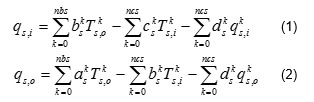
<body><![CDATA[</ul>     <p align="justify"><font face="verdana" size="2">Heat balance method is used by    TRNSYS as a base for all calculations. For conductive heat gain at the surface    on each wall, TRNSYS (manual volume 6) use TFM method as a simplification of    the complicated heat balance method. The methodology exposed for Bhaskoro <i>et    al</i>, are, <a href="#e12">equations 1 and 2</a>: &#91;11&#93;</font></p>     <p align="justify"><a name="e12"></a><img src="/img/revistas/im/v20n1/e0105117.jpg" width="314" height="102" alt="Ecuaciones 1 y 2"></p>  	     
<p ><font face="verdana" size="2">Where q<sub>si/so</sub> are the conduction heat    flux from the wall at the inside/outside surface. T<sub>s,i/s,o</sub> the inside/outside    surface temperature. These time series equations in terms of surface temperatures    and heat fluxes are evaluated at equal time intervals. The superscript k refers    to the term in the time series. The current time is k = 0, the previous time    is for k = 1, etc.&nbsp; The timebase on which these calculations are based    is specified by the user within the TRNBUILD description.&nbsp; The coefficients    of the time series (a's,b's, c's, and d's) are determined within the TRNBUILD    program using the z&#45;transfer function routines.</font></p>     <p align="justify"><font face="verdana" size="2">Heat gain through radiation and    convection within the zone were calculated using the star network given by,    <a href="#e03">equation 3</a>:</font></p>     <p align="justify"><a name="e03"></a><img src="/img/revistas/im/v20n1/e0305117.jpg" width="336" height="48" alt="Ecuaci&oacute;n 3"></p>  	     
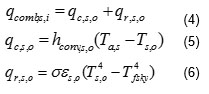
<p ><font face="verdana" size="2">Where R<sub>equiv</sub> is equivalent resistant    between the wall with a node, T<sub>star</sub>: artificial temperature node,    q<sub>c,s,I</sub> convection heat flux on the internal surface of the walland    q<sub>r,s,I</sub> are the long wave radiation heat flux on the internal surface    of the wall. Heat gain through radiation and convection for external surface    were calculated by, <a href="#e456">equations 4, 5 and 6</a>:</font></p>     <p ><font face="verdana" size="2"><a name="e456"></a></font><img src="/img/revistas/im/v20n1/e0405117.jpg" width="209" height="94" alt="Ecuaciones 4, 5 y 6"></p>     
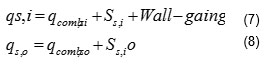
<p ><font face="verdana" size="2">Where, q<sub>comb,s,i/o</sub> is combined convective    and long wave radiation of inside/outside surface. h<sub>conv,s,o</sub>, is    the convective heat transfer coefficient on the surface of the wall, Ta,s, is    the ambient temperature , T<sub>fsky</sub>, fictive sky temperature. The Stephan&#150;Boltzmann    constant is describe by &#963; and &#949;<sub>s</sub> is the long&#45;wave emissivity    of the surface. Then, total heat gain through inside and outside surface of    the wall are, <a href="#e78">equations 7 and 8</a>:</font></p>     <p ><font face="verdana" size="2"><a name="e78"></a></font><img src="/img/revistas/im/v20n1/e0705117.jpg" width="266" height="66" alt="Ecuaciones 7 y 8"></p>     
]]></body>
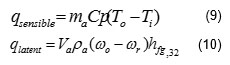
<body><![CDATA[<p ><font face="verdana" size="2">q<sub>s,i/s,o</sub> are surface inside/outside    conduction heat flux of the wall,S<sub>s,i/s,o</sub> the radiation inside/outsideheat    flux absorbed on the surface of the wall (solar and radiative gains) and Wall&#45;gain    is an user&#45;defined energy flow to the inside wall or window surfaces.</font></p>  	     <p align="justify"><font face="verdana" size="2">Long wave emissivity was 0,9    for wall. The value based on window library. Solar absortance coefficient for    wall based on the table provide by TRNSYS. Convective heat Transfers coefficient    for inside and outside wall were set 11 kJh<sup>&#45;1</sup>m<sup>&#45;2</sup>    and 6411 kJh<sup>&#45;1</sup>m<sup>&#45;2</sup> as recommended by the software    &#91;12&#93;. Latent and sensible heat gain from ventilation and infiltration    air is calculated using, <a href="#e910">equations 9 and 10</a> &#91;13&#93;</font></p>     <p align="justify"><font face="verdana" size="2"><a name="e910"></a></font><img src="/img/revistas/im/v20n1/e0905117.jpg" width="230" height="65" alt="Ecuaciones 9 y 10"></p>     
<p ><font face="verdana" size="2">Where m<sub>a</sub> is the mass of air, Cp the    specific heat of air, Va the flow rate, &#961; the density of outdoor air, &#969;,    humidity and h<sub>fg,32</sub> is the latent heat of vaporization at 32 <sup>o</sup>F.    Minimum ventilation rate required in each room is calculated based on ASHRAE    standard present in the <a href="#e11">equation 11</a>:</font></p>     <p ><font face="verdana" size="2"><a name="e11"></a></font><img src="/img/revistas/im/v20n1/e1105117.jpg" width="200" height="43" alt="Ecuaci&oacute;n 11"></p>     
<p ><font face="verdana" size="2">On this <a href="#e11">equation 11</a> R<sub>p</sub>    is the occupant ventilation component, Na, the number of occupant, Ra the building    ventilation component and A is the room area.</font></p>  	    <p ><font face="verdana" size="2">Other Building simulations assumptions were:</font></p>  	 <ul>       <li><font face="verdana" size="2"> Heat gain from the electrics device, heat      gain from lighting, heat gain from building envelope would contributed to      sensible cooling load.</font></li>       <li><font face="verdana" size="2">Heat gain from occupant, ventilation and infiltration      would contribute to both latent and sensible cooling load</font></li>       <li><font face="verdana" size="2">The amount of heat gain per occupant is based      on ISO 7730 table. Degree level of activity was inputted to get the portion      of sensible and latent heat from the table.</font></li>       ]]></body>
<body><![CDATA[<li><font face="verdana" size="2">Convective and radiative fraction for heat      gain from electric devices were 0,7 and 0,32 while for artificial lights,      the values were 0,6 and 0,4&nbsp; &#91;14&#93;</font></li>       <li><font face="verdana" size="2">Design temperature and RH were based on ASHRAE      where 25 <sup>o</sup>C of operative temperature and 50 % of RH for comfort      zone</font></li>       <li><font face="verdana" size="2">Infiltration by air change rate and Ventilation      supplied by the Air Handing Unit (AHU) as required by ASHRAE standard, were      based on type of thermal zone.</font></li>       <li><font face="verdana" size="2">For a major analysis, the simulation was separate      into two periods: summer periods and winter periods</font></li>     </ul>     <p align="justify">&nbsp;</p>  	     <p align="justify"><font face="verdana" size="3"><b>RESULTS AND DISCUSION </b></font><font face="verdana" size="2">    </font></p>  	     <p align="justify"><font face="verdana" size="2"><b>Main characteristic of the    building. Thermal loads</b></font></p>  	    <p align="justify"><font face="verdana" size="2">The building considered in the study is a hotel with 149 rooms available for tourism. The main building has a capacity of one hundred thirty six rooms (136), and also features a block of thirteen (13) cabins located in the pool area. It is constructed with a concrete structure with exterior walls double block of six inches, an air space in the center for these walls are acoustic and interior walls of single block, with glass windows in the main building overlooking the northern part and wooden doors in the south aisle. The cabins are constructed in a similar manner except that south wall is made of glass. Shop and restaurant also have very large glazed areas with large heat gains in this area.</font></p>  	     <p align="justify"><font face="verdana" size="2">The HVAC systems of the hotel    are two water chillers model: CHAWT&#45;1402&#45;AT&#45;BP&#45;RC&#45;100 C1&#45;VT,    the cooling capacity: 404 kW each. (115 TR) chilled water flow GW&#45;70 m<sup>3</sup>/h.    Temperature Input / Output: 11/6 &deg;C. To calculate the thermal loads hotel,    first it was divided by type rooms. They are classified according to their dimension,    neighboring rooms, and the influence of solar radiation on the roof and external    walls. Based on these criteria, 13 types of heating zones or rooms with very    similar characteristics of thermal load were identified, as shown at <a href="/img/revistas/im/v20n1/f0205117.jpg">figure    2</a>.</font></p>     
]]></body>
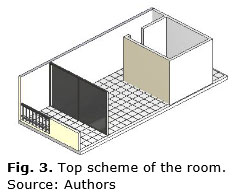
<body><![CDATA[<p align="justify"><font face="verdana" size="2">All thermal zones were modeled    in TRNSYS. In this simulation environment, the thermal load of the resulting    guestroom module is calculated as a function of: the comfort set point temperature,    weather variables for the situated geographic zone, and the heat gains due to    occupancy and equipment presented in the guestrooms. The physical description    of the defined thermal zones is shown in <a href="/img/revistas/im/v20n1/t0105117.jpg">table    1</a> and <a href="#f03">figure 3</a>.</font></p>     
<p align="center"><font face="verdana" size="2"><a name="f03"></a></font><img src="/img/revistas/im/v20n1/f0305117.jpg" width="232" height="196" alt="Fig. 3. Top scheme of the room. Source: Authors"><font face="verdana" size="2">&nbsp;</font></p>  	     
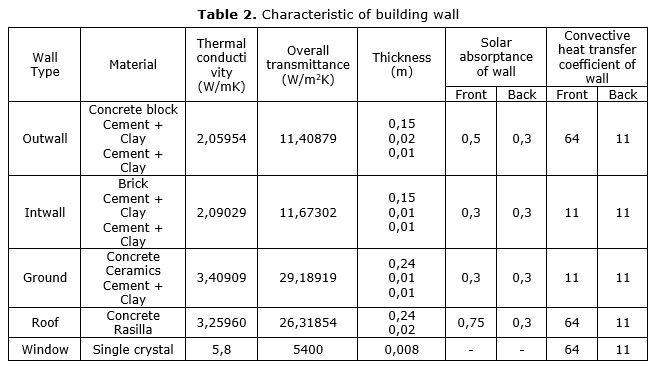
<p align="left" ><font face="verdana" size="2">The building was simulated in TRNSYS    environment, using the TRYNBUILD application, including in TRNSYS package. Four    different walls were considered, whose values of transmittance and front and    back solar absorbance are shown in <a href="/img/revistas/im/v20n1/t0205117.jpg">table    2</a>.</font></p>     
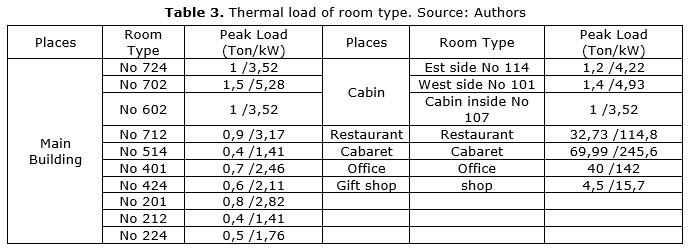
<p align="justify"><font face="verdana" size="2">In Cuba the predominant climate    is warm and tropical with a rainy season in summer. Its geographical position    located near the Tropic of Cancer makes achieving high solar radiation values    averaging 5 kWh/m<sup>2</sup>day. Temperatures are generally high, with average    temperatures of 26 <sup>0</sup>C and 32 <sup>0</sup>C held in the summer, determining    the character of its warm climate &#91;16&#93;. Weather variations affect a    building, its thermal state, and its technical systems in a variety of ways.    This study focused on the effects of the following weather variables: global    and diffuse solar radiation and dry bulb air temperature as climate disturbances    to the guestroom module dynamics. These data were provided by Cienfuegos&acute;s    Weather Institute.</font></p>  	     <p align="justify"><font face="verdana" size="2">Regarding the heat gains due    to occupancy and equipment presented in the guestroom module, it was considered    that the internal heat gains were defined for constant occupancy of three people    in the room, (100 % occupancy). Profits are also defined by artificial light    and a color TV 19&#45;21 Pot = 120 W. For earnings infiltration factor 0,8 was    assumed. Under these requirements in <a href="/img/revistas/im/v20n1/t0305117.jpg">table    3</a> thermal loads for each room type at 24 h are presented. These thermal    gains are automatically calculated and added to the total thermal load based    on the corresponding values for these magnitudes in TRNSYS according to a hotel.</font></p>     
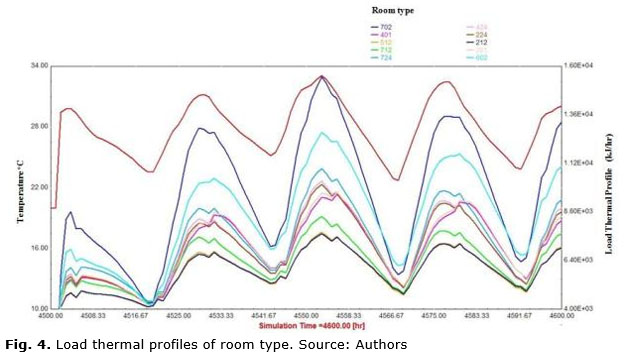
<p align="justify"><font face="verdana" size="2">The main building thermal profiles    present a dynamic behavior for each hour of the day. <a href="/img/revistas/im/v20n1/f0405117.jpg">figure    4</a> shows the profile of thermal load for several days in July.</font></p>     
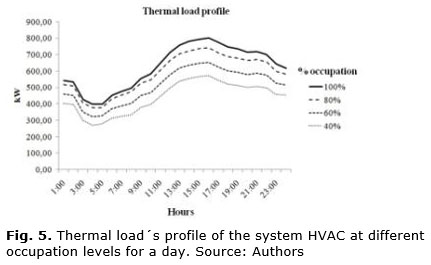
<p align="justify"><font face="verdana" size="2"><b>Relationship between thermal    loading of each cooling circuit and capacity of installed equipment</b></font></p>  	    <p align="justify"><font face="verdana" size="2">The HVAC system is composed by 6 hydraulic circuits: the residential block located in the main building is divided into two separate circuits, eastside and the other to the west side; circuit cabins, restaurant circuit, cabaret, and finally, areas nobles&rsquo; circuit belonging to the offices and shop.</font></p>  	    <p align="justify"><font face="verdana" size="2">Considering the total room type that integrate each of the hydraulic circuits, the following occupation strategies implemented at the hotel are: first occupy the west side of the main building, from top to bottom, and from left to right, this side of the hotel have a better view of the city. Once occupied this side, the east side deals from top to bottom and left to right. As last alternative the cabins are occupied. In all cases closely meets the requirements of tourists, which usually allows implementing this strategy. The occupation of the two suites is independent.</font></p>  	     <p align="justify"><font face="verdana" size="2">The values of occupation with    the above considerations are: 60 rooms (40 % occupancy), spaced on the west    side.89 rooms (60 %), located throughout the westside and in the upper floors    from the eastside.119 rooms (80%), located on the west side and in almost the    entire east side.149 rooms (100 %), hotel full occupied. <a href="#f05">figure    5</a> shows the load profile for each per cent of occupancyunder critical conditions    during summer season.</font></p>     ]]></body>
<body><![CDATA[<p align="center"><font face="verdana" size="2"><a name="f05"></a></font><img src="/img/revistas/im/v20n1/f0505117.jpg" width="431" height="265" alt="Fig. 5: Thermal load&acute;s profile of the system HVAC at different occupation levels for a day. Source: Authors"></p>  	 <font face="verdana" size="2">The HVAC system meets the demand of the installed  load: the installed chiller capacity: 808 kW (230 tons of cooling) and the demand  for air&#45;conditioned premises is of 805,17 kW (229,05 tons).</font>     
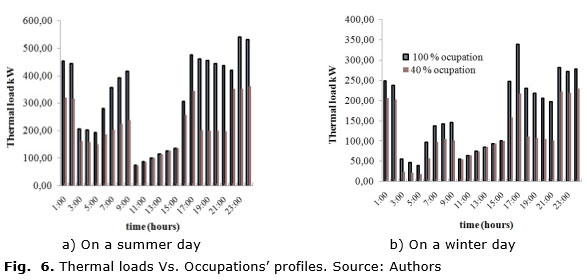
<p align="justify"><font face="verdana" size="2"><b>Trading strategies considering    hotel occupancy</b></font></p>  	    <p align="justify"><font face="verdana" size="2">As described above Jagua hotel is considered a transit hotel. In it, the tourists leave the facility after breakfast to carry out different activities until they return again at 4:00 pm. For these cases the operating strategy of the HVAC system to reduce power consumption without affecting comfort is as follows:</font></p>  	     <p align="justify"><font face="verdana" size="2">The pump restaurant circuit is    connected from 6.30 am to 10.00 am. At 9.00 am rooms circuits (pumps 4,5 and    6) and cabins stop, until 4:30 pm that connects again. Then at 5:30 pm the restaurant    circuit is connected again until 10:00 pm. The cabaret circuit is connected    from 10:00 pm until 2:00 am. It stays connected throughout the daytime the areas    nobles circuits until 5:00 pm. In <a href="/img/revistas/im/v20n1/f0605117.jpg">figure    6a</a> fluctuating loads for occupancy levels corresponding to 100 % and 40    %, ona summer day is displayed, and <a href="/img/revistas/im/v20n1/f0605117.jpg">figure    6b</a> fluctuating loads to the same levels shown, but on a winter day.</font></p>     
<p align="justify"><font face="verdana" size="2">Given this behavior of loads,    this operational strategy allows:</font></p>  	 <ul>       <li><font face="verdana" size="2">Working with a chiller in the hours between      8:00 am and 4:00 pm; with a temperature of ice water (set point) of 9 &deg;C.</font></li>       <li><font face="verdana" size="2">Working with a chiller during the winter months.</font></li>       <li><font face="verdana" size="2">Continue with a chiller if the occupancy is      less than 44% between the hours of 4:00 pm and 10:00 pm then connect the other      chiller for the cabaret circuit until 2:00 am.</font></li>       <li><font face="verdana" size="2">If the occupancy is less than 44 % occupation      as follows: from top to bottom and left to right, leaving latter occupying      the top floor and the east corner. With 8 &deg;C chilled water output.</font></li>       <li><font face="verdana" size="2"> Working with a chiller in the schedule from      2:00 a.m. to 6:30 am, with set point of 10 &deg;C</font></li>       ]]></body>
<body><![CDATA[<li><font face="verdana" size="2"> No match schedules service restaurant with      cabaret</font></li>       <li><font face="verdana" size="2">Occupy the east side of the building from      top to bottom and left to right, leaving as a last resort rooms upstairs and      the east corner. In the cabins occupy the middle and east first, leaving the      West Side as a last option.</font></li>       <li><font face="verdana" size="2"> Working with two different points for every      season: in summer and in winter 8/9 &ordm;C to 9/10 &ordm;C.</font></li>     </ul>     <p align="justify"><font face="verdana" size="2">Total savings that were obtained    by applying the new operating strategy and Jagua hotel occupancy was 403 123,76    kWh/year, and issuing leaving 371.27 t of CO<sub>2</sub>/year into the atmosphere.    It meant about average consumption of the whole hotel for three months. It had    an economic impact of 53212,33 USD/year. Furthermore, considering the installed    chiller part load work during the daytime, the installation of a smaller capacity    chiller is proposed.</font></p>     <p align="justify">&nbsp;</p>  	     <p align="justify"><font face="verdana" size="3"><b>CONCLUSION </b></font></p>  	     <p align="justify"><font face="verdana" size="2">The validity of the operating    strategy of centralized chilled water system that uses the hotel through a careful    calculation of thermal loads throw TRNSYS software, considering the structural    characteristics of this installation and weather conditions where it is located    was verified. The HVAC system is properly sized. But the performance characteristics    of this hotel let take various measures that lead to a considerable saving of    electricity, operating costs and environmental impact.</font></p>     <p align="justify">&nbsp;</p>  	     <p align="justify"><font face="verdana" size="3"><b>REFERENCES</b></font><font face="verdana" size="2">    </font></p>  	    ]]></body>
<body><![CDATA[<!-- ref --><p align="justify"><font face="verdana" size="2">1. Acosta A, Gonzalez A, Zamare&ntilde;o    J, et al. Energy savings and guaranteed thermal comfort in hotel rooms though    nonlinear model predictive controllers Energy and Buildings. 2016;129:59&#45;68.    &nbsp;</font></p>  	    <!-- ref --><p align="justify"><font face="verdana" size="2">2. Vega B, Castellanos L, Monteagudo J. Modeling and identification of the cooling dynamics of a tropical island hotel. Energy and Buildings. 2015;92:19&#45;28.    &nbsp;</font></p>  	    <!-- ref --><p align="justify"><font face="verdana" size="2">3. Hartman T. The Hartman LOOP Chiller Plant Design and Operating Technologies. Improve Chiller Plant Efficiency. Atlanta, Georgia, EUA: Hartmanco; 1999.     &#91;Citado 10 de diciembre de 2014&#93;. Disponible en: <a href="http://www.hartmanco.com/pdf/a33.pdf">http://www.hartmanco.com/pdf/a33.pdf</a> &nbsp;</font></p>  	    <!-- ref --><p align="justify"><font face="verdana" size="2">4. Budaiwi I, Abdou A. HVAC system operational strategies for reduced energy consumption in buildings with intermittent occupancy: The case of mosques. Energy conversion and management. 2013;73:37&#45;50.    &nbsp;</font></p>  	    <!-- ref --><p align="justify"><font face="verdana" size="2">5. Morteza M A, Theodore F. S. Evaluation of HVAC system operational strategies for commercial buildings. Energy Conversion and Management. 1997;38(3):225&#150;36.    &nbsp;</font></p>  	    ]]></body>
<body><![CDATA[<!-- ref --><p align="justify"><font face="verdana" size="2">6. Fong KF, Hanby VI, Chow TT. HVAC system optimization for energy management by evolutionary programming. Energy and Buildings. 2006;38(3):220&#45;31.    &nbsp;</font></p>  	    <!-- ref --><p align="justify"><font face="verdana" size="2">7. Yu FW, Chang KT. Economic benefits of optimal control for water&#45;cooled chiller systems serving hotels in a subtropical climate. Energy and Buildings. 2010;42(2):203&#45;9.    &nbsp;</font></p>  	    <!-- ref --><p align="justify"><font face="verdana" size="2">8. Zogou O, Stamatelos A. Optimization of thermal performance of a building with ground source heat pump system (TRNSYS). Energy Conversion &amp; Management. 2007;48:2853&#45;63.    &nbsp;</font></p>  	    <!-- ref --><p align="justify"><font face="verdana" size="2">9. Bahar Y, Pere C, Landrieu J, et al. Thermal Simulation Tool for Building and Its Interoperability through the Building Information Modeling (BIM) Platform. Buildings. 2013;3:380&#45;98.    &nbsp;</font></p>  	    <!-- ref --><p align="justify"><font face="verdana" size="2">10. Haq Gilani S, Shiraz M, Bhaskoro P. Energy saving technique for cooling dominated academic building: Techno&#45;economic analysis of its application. Applied Energy. 2014;132:192&#45;9.    &nbsp;</font></p>  	    ]]></body>
<body><![CDATA[<!-- ref --><p align="justify"><font face="verdana" size="2">11. Bhaskoro P, Ul Haq S, Shiraz M. Simulation of energy saving potential of a centralized HVAC systems in an academic building using adaptive cooling technique Energy Conversion and Management. 2013;75:617&#45;28.    &nbsp;</font></p>  	    <!-- ref --><p align="justify"><font face="verdana" size="2">12. Cengel Y, Boles M. Thermodynamics: an engineering approach. 5ta ed. New York, USA: McGraw&#45;Hill; 2008.    </font></p>  	    <!-- ref --><p align="justify"><font face="verdana" size="2">13. Wank S. Handbook of air conditioning and refrigeration. 2da ed. New York, USA: McGraw&#45;Hill; 2000.    </font></p>  	    <!-- ref --><p align="justify"><font face="verdana" size="2">14. Pedersen C, Fisher D, Spitler J, et al. Cooling and Heating load calculations principles. Atlanta, USA: American Society of Heating, Refrigerating and Air&#45;Conditionesr Engineers; 1998.    </font></p>  	     <!-- ref --><p align="justify"><font face="verdana" size="2">15. Vega BB, Cigler O, Oldewurtel    J, et al. Model Predictive Control for a Tropical Island Hotel. In: 11 th REHVA    World Congress &amp; 8th International Conference on IAQVEC &#45; "Energy Efficient,    Smart and Healthy Buildings", Clima 2013; Chez Republic: Czech Technical University    in Prague; 2013.     &#91;Citado 16 de enero de 2016&#93; Disponible en: <a href="https://www.eeh.ee.ethz.ch/uploads/tx_ethpublications/2013_07_05_VegaOldewurtel_RHEVA2013.pdf">https://www.eeh.ee.ethz.ch/uploads/tx_ethpublications/2013_07_05_VegaOldewurtel_RHEVA2013.pdf</a></font></p>  	     ]]></body>
<body><![CDATA[<!-- ref --><p align="justify"><font face="verdana" size="2">16. D&iacute;az Y, Monteagudo    J, Bravo D. An&aacute;lisis energ&eacute;tico de un sistema hibrido de producci&oacute;n    de fr&iacute;o. Ingenier&iacute;a energ&eacute;tica. 2014;36(1):38&#45;49.    &nbsp;</font></p>     <p align="justify">&nbsp;</p>     <p align="justify">&nbsp;</p>     <p align="justify"><font face="verdana" size="2">Recibido: 16 de junio de 2016.    <br>   Aceptado: 30 de septiembre de 2016.</font></p>     <p align="justify">&nbsp;</p>  	    <p align="justify"><font face="verdana" size="2">&nbsp;</font></p>  	     <p align="justify"><font face="verdana" size="2"><i>Yamil&eacute; D&iacute;az&#45;Torres</i>,    Universidad de Cienfuegos, Centro de Estudio de Energ&iacute;a y Medio Ambiente,    CEEMA. Cienfuegos, Cuba    <br>   Correo electr&oacute;nico: <a href="mailto:ydtorres@ucf.edu.cu">ydtorres@ucf.edu.cu</a></font></p>     ]]></body>
<body><![CDATA[ ]]></body><back>
<ref-list>
<ref id="B1">
<label>1</label><nlm-citation citation-type="journal">
<person-group person-group-type="author">
<name>
<surname><![CDATA[Acosta]]></surname>
<given-names><![CDATA[A]]></given-names>
</name>
<name>
<surname><![CDATA[Gonzalez]]></surname>
<given-names><![CDATA[A]]></given-names>
</name>
<name>
<surname><![CDATA[Zamareño]]></surname>
<given-names><![CDATA[J]]></given-names>
</name>
</person-group>
<article-title xml:lang="en"><![CDATA[Energy savings and guaranteed thermal comfort in hotel rooms though nonlinear model predictive controllers Energy and]]></article-title>
<source><![CDATA[Buildings]]></source>
<year>2016</year>
<volume>129</volume>
<page-range>59-68</page-range></nlm-citation>
</ref>
<ref id="B2">
<label>2</label><nlm-citation citation-type="journal">
<person-group person-group-type="author">
<name>
<surname><![CDATA[Vega]]></surname>
<given-names><![CDATA[B]]></given-names>
</name>
<name>
<surname><![CDATA[Castellanos]]></surname>
<given-names><![CDATA[L]]></given-names>
</name>
<name>
<surname><![CDATA[Monteagudo]]></surname>
<given-names><![CDATA[J]]></given-names>
</name>
</person-group>
<article-title xml:lang="en"><![CDATA[Modeling and identification of the cooling dynamics of a tropical island hotel]]></article-title>
<source><![CDATA[Energy and Buildings]]></source>
<year>2015</year>
<volume>92</volume>
<page-range>19-28</page-range></nlm-citation>
</ref>
<ref id="B3">
<label>3</label><nlm-citation citation-type="book">
<person-group person-group-type="author">
<name>
<surname><![CDATA[Hartman]]></surname>
<given-names><![CDATA[T]]></given-names>
</name>
</person-group>
<source><![CDATA[The Hartman LOOP Chiller Plant Design and Operating Technologies.Improve Chiller Plant Efficiency. Atlanta, Georgia,]]></source>
<year>1999</year>
<publisher-loc><![CDATA[EUA ]]></publisher-loc>
<publisher-name><![CDATA[Hartmanco]]></publisher-name>
</nlm-citation>
</ref>
<ref id="B4">
<label>4</label><nlm-citation citation-type="journal">
<person-group person-group-type="author">
<name>
<surname><![CDATA[Budaiwi]]></surname>
<given-names><![CDATA[I]]></given-names>
</name>
<name>
<surname><![CDATA[Abdou]]></surname>
<given-names><![CDATA[A]]></given-names>
</name>
</person-group>
<article-title xml:lang="en"><![CDATA[HVAC system operational strategies for reduced energy consumption in buildings with intermittent occupancy: The case of mosques]]></article-title>
<source><![CDATA[Energy conversion and management]]></source>
<year>2013</year>
<volume>73</volume>
<page-range>37-50</page-range></nlm-citation>
</ref>
<ref id="B5">
<label>5</label><nlm-citation citation-type="journal">
<person-group person-group-type="author">
<name>
<surname><![CDATA[Morteza M]]></surname>
<given-names><![CDATA[A]]></given-names>
</name>
<name>
<surname><![CDATA[Theodore]]></surname>
<given-names><![CDATA[F]]></given-names>
</name>
</person-group>
<article-title xml:lang="en"><![CDATA[S: Evaluation of HVAC system operational strategies for commercial buildings]]></article-title>
<source><![CDATA[Energy Conversion and Management]]></source>
<year>1997</year>
<volume>38</volume>
<numero>3</numero>
<issue>3</issue>
<page-range>225-36</page-range></nlm-citation>
</ref>
<ref id="B6">
<label>6</label><nlm-citation citation-type="journal">
<person-group person-group-type="author">
<name>
<surname><![CDATA[Fong]]></surname>
<given-names><![CDATA[KF]]></given-names>
</name>
<name>
<surname><![CDATA[Hanby]]></surname>
<given-names><![CDATA[VI]]></given-names>
</name>
<name>
<surname><![CDATA[Chow]]></surname>
<given-names><![CDATA[TT]]></given-names>
</name>
</person-group>
<article-title xml:lang="en"><![CDATA[HVAC system optimization for energy management by evolutionary programming]]></article-title>
<source><![CDATA[Energy and Buildings]]></source>
<year>2006</year>
<volume>38</volume>
<numero>3</numero>
<issue>3</issue>
<page-range>220-31</page-range></nlm-citation>
</ref>
<ref id="B7">
<label>7</label><nlm-citation citation-type="journal">
<person-group person-group-type="author">
<name>
<surname><![CDATA[Yu]]></surname>
<given-names><![CDATA[FW]]></given-names>
</name>
<name>
<surname><![CDATA[Chang]]></surname>
<given-names><![CDATA[KT]]></given-names>
</name>
</person-group>
<article-title xml:lang="en"><![CDATA[Economic benefits of optimal control for water-cooled chiller systems serving hotels in a subtropical climate]]></article-title>
<source><![CDATA[Energy and Buildings]]></source>
<year>2010</year>
<volume>42</volume>
<numero>2</numero>
<issue>2</issue>
<page-range>203-9</page-range></nlm-citation>
</ref>
<ref id="B8">
<label>8</label><nlm-citation citation-type="journal">
<person-group person-group-type="author">
<name>
<surname><![CDATA[Zogou]]></surname>
<given-names><![CDATA[O]]></given-names>
</name>
<name>
<surname><![CDATA[Stamatelos]]></surname>
<given-names><![CDATA[A]]></given-names>
</name>
</person-group>
<article-title xml:lang="en"><![CDATA[Optimization of thermal performance of a building with ground source heat pump system (TRNSYS)]]></article-title>
<source><![CDATA[Energy Conversion & Management]]></source>
<year>2007</year>
<volume>48</volume>
<page-range>2853-63</page-range></nlm-citation>
</ref>
<ref id="B9">
<label>9</label><nlm-citation citation-type="journal">
<person-group person-group-type="author">
<name>
<surname><![CDATA[Bahar]]></surname>
<given-names><![CDATA[Y]]></given-names>
</name>
<name>
<surname><![CDATA[Pere]]></surname>
<given-names><![CDATA[C]]></given-names>
</name>
<name>
<surname><![CDATA[Landrieu]]></surname>
<given-names><![CDATA[J]]></given-names>
</name>
</person-group>
<article-title xml:lang="en"><![CDATA[Thermal Simulation Tool for Building and Its Interoperability through the Building Information Modeling (BIM) Platform]]></article-title>
<source><![CDATA[Buildings]]></source>
<year>2013</year>
<volume>3</volume>
<page-range>380-98</page-range></nlm-citation>
</ref>
<ref id="B10">
<label>10</label><nlm-citation citation-type="journal">
<person-group person-group-type="author">
<name>
<surname><![CDATA[Haq Gilani]]></surname>
<given-names><![CDATA[S]]></given-names>
</name>
<name>
<surname><![CDATA[Shiraz]]></surname>
<given-names><![CDATA[M]]></given-names>
</name>
<name>
<surname><![CDATA[Bhaskoro]]></surname>
<given-names><![CDATA[P]]></given-names>
</name>
</person-group>
<article-title xml:lang="en"><![CDATA[Energy saving technique for cooling dominated academic building: Techno-economic analysis of its application]]></article-title>
<source><![CDATA[Applied Energy]]></source>
<year>2014</year>
<volume>132</volume>
<page-range>192-9</page-range></nlm-citation>
</ref>
<ref id="B11">
<label>11</label><nlm-citation citation-type="journal">
<person-group person-group-type="author">
<name>
<surname><![CDATA[Bhaskoro]]></surname>
<given-names><![CDATA[P]]></given-names>
</name>
<name>
<surname><![CDATA[Ul Haq]]></surname>
<given-names><![CDATA[S]]></given-names>
</name>
<name>
<surname><![CDATA[Shiraz]]></surname>
<given-names><![CDATA[M]]></given-names>
</name>
</person-group>
<article-title xml:lang="en"><![CDATA[Simulation of energy saving potential of a centralized HVAC systems in an academic building using adaptive cooling technique Energy Conversion and]]></article-title>
<source><![CDATA[Management]]></source>
<year>2013</year>
<volume>75</volume>
<page-range>617-28</page-range></nlm-citation>
</ref>
<ref id="B12">
<label>12</label><nlm-citation citation-type="book">
<person-group person-group-type="author">
<name>
<surname><![CDATA[Cengel]]></surname>
<given-names><![CDATA[Y]]></given-names>
</name>
<name>
<surname><![CDATA[Boles]]></surname>
<given-names><![CDATA[M]]></given-names>
</name>
</person-group>
<source><![CDATA[Thermodynamics: an engineering approach. 5ta ed. New York,]]></source>
<year>2008</year>
<publisher-loc><![CDATA[USA ]]></publisher-loc>
<publisher-name><![CDATA[McGraw-Hill]]></publisher-name>
</nlm-citation>
</ref>
<ref id="B13">
<label>13</label><nlm-citation citation-type="book">
<person-group person-group-type="author">
<name>
<surname><![CDATA[Wank]]></surname>
<given-names><![CDATA[S]]></given-names>
</name>
</person-group>
<source><![CDATA[Handbook of air conditioning and refrigeration.2da ed. New York,]]></source>
<year>2000</year>
<publisher-loc><![CDATA[USA ]]></publisher-loc>
<publisher-name><![CDATA[McGraw-Hill]]></publisher-name>
</nlm-citation>
</ref>
<ref id="B14">
<label>14</label><nlm-citation citation-type="book">
<person-group person-group-type="author">
<name>
<surname><![CDATA[Pedersen]]></surname>
<given-names><![CDATA[C]]></given-names>
</name>
<name>
<surname><![CDATA[Fisher]]></surname>
<given-names><![CDATA[D]]></given-names>
</name>
<name>
<surname><![CDATA[Spitler]]></surname>
<given-names><![CDATA[J]]></given-names>
</name>
</person-group>
<source><![CDATA[Cooling and Heating load calculations principles.Atlanta,]]></source>
<year>1998</year>
<publisher-loc><![CDATA[USA ]]></publisher-loc>
<publisher-name><![CDATA[American Society of Heating, Refrigerating and Air-Conditionesr Engineers]]></publisher-name>
</nlm-citation>
</ref>
<ref id="B15">
<label>15</label><nlm-citation citation-type="book">
<person-group person-group-type="author">
<name>
<surname><![CDATA[Vega]]></surname>
<given-names><![CDATA[BB]]></given-names>
</name>
<name>
<surname><![CDATA[Cigler]]></surname>
<given-names><![CDATA[O]]></given-names>
</name>
<name>
<surname><![CDATA[Oldewurtel]]></surname>
<given-names><![CDATA[J]]></given-names>
</name>
</person-group>
<article-title xml:lang="en"><![CDATA[Model Predictive Control for a Tropical Island Hotel]]></article-title>
<source><![CDATA[11 th REHVA World Congress & 8th International Conference on IAQVEC - "Energy Efficient, Smart and Healthy Buildings", Clima 2013;]]></source>
<year>2013</year>
<publisher-loc><![CDATA[Chez Republic ]]></publisher-loc>
<publisher-name><![CDATA[Czech Technical University in Prague]]></publisher-name>
</nlm-citation>
</ref>
<ref id="B16">
<label>16</label><nlm-citation citation-type="journal">
<person-group person-group-type="author">
<name>
<surname><![CDATA[Díaz]]></surname>
<given-names><![CDATA[Y]]></given-names>
</name>
<name>
<surname><![CDATA[Monteagudo]]></surname>
<given-names><![CDATA[J]]></given-names>
</name>
<name>
<surname><![CDATA[Bravo]]></surname>
<given-names><![CDATA[D]]></given-names>
</name>
</person-group>
<article-title xml:lang="pt"><![CDATA[Análisis energético de un sistema hibrido de producción de frío]]></article-title>
<source><![CDATA[Ingeniería energética]]></source>
<year>2014</year>
<volume>36</volume>
<numero>1</numero>
<issue>1</issue>
<page-range>38-49</page-range></nlm-citation>
</ref>
</ref-list>
</back>
</article>