<?xml version="1.0" encoding="ISO-8859-1"?><article xmlns:mml="http://www.w3.org/1998/Math/MathML" xmlns:xlink="http://www.w3.org/1999/xlink" xmlns:xsi="http://www.w3.org/2001/XMLSchema-instance">
<front>
<journal-meta>
<journal-id>2071-0054</journal-id>
<journal-title><![CDATA[Revista Ciencias Técnicas Agropecuarias]]></journal-title>
<abbrev-journal-title><![CDATA[Rev Cie Téc Agr]]></abbrev-journal-title>
<issn>2071-0054</issn>
<publisher>
<publisher-name><![CDATA[Universidad Agraria de La Habana]]></publisher-name>
</publisher>
</journal-meta>
<article-meta>
<article-id>S2071-00542012000300001</article-id>
<title-group>
<article-title xml:lang="en"><![CDATA[Determination of basics mechanical properties in a tropical clay soil as a function of dry bulk density and moisture]]></article-title>
<article-title xml:lang="es"><![CDATA[Determinación de las Propiedades Mecánicas en un Suelo Arcilloso como Función de la Densidad y el Contenido de Humedad]]></article-title>
</title-group>
<contrib-group>
<contrib contrib-type="author">
<name>
<surname><![CDATA[López Bravo]]></surname>
<given-names><![CDATA[Elvis]]></given-names>
</name>
<xref ref-type="aff" rid="A01"/>
</contrib>
<contrib contrib-type="author">
<name>
<surname><![CDATA[Herrera Suárez]]></surname>
<given-names><![CDATA[Miguel]]></given-names>
</name>
<xref ref-type="aff" rid="A01"/>
</contrib>
<contrib contrib-type="author">
<name>
<surname><![CDATA[González Cueto]]></surname>
<given-names><![CDATA[Omar]]></given-names>
</name>
<xref ref-type="aff" rid="A01"/>
</contrib>
<contrib contrib-type="author">
<name>
<surname><![CDATA[Tijskens]]></surname>
<given-names><![CDATA[Engelbert]]></given-names>
</name>
<xref ref-type="aff" rid="A02"/>
</contrib>
<contrib contrib-type="author">
<name>
<surname><![CDATA[Ramon]]></surname>
<given-names><![CDATA[Herman]]></given-names>
</name>
<xref ref-type="aff" rid="A02"/>
</contrib>
</contrib-group>
<aff id="A01">
<institution><![CDATA[,Central University Marta Abreu of Las Villas Faculty of Agricultural and Animal Sciences Department of Agricultural Engineering]]></institution>
<addr-line><![CDATA[Villa Clara ]]></addr-line>
<country>Cuba</country>
</aff>
<aff id="A02">
<institution><![CDATA[,Division of Mechatronics Biostatistics and Sensors (MeBioS) Faculty of Bioscience Engineering]]></institution>
<addr-line><![CDATA[ ]]></addr-line>
</aff>
<pub-date pub-type="pub">
<day>00</day>
<month>09</month>
<year>2012</year>
</pub-date>
<pub-date pub-type="epub">
<day>00</day>
<month>09</month>
<year>2012</year>
</pub-date>
<volume>21</volume>
<numero>3</numero>
<fpage>05</fpage>
<lpage>11</lpage>
<copyright-statement/>
<copyright-year/>
<self-uri xlink:href="http://scielo.sld.cu/scielo.php?script=sci_arttext&amp;pid=S2071-00542012000300001&amp;lng=en&amp;nrm=iso"></self-uri><self-uri xlink:href="http://scielo.sld.cu/scielo.php?script=sci_abstract&amp;pid=S2071-00542012000300001&amp;lng=en&amp;nrm=iso"></self-uri><self-uri xlink:href="http://scielo.sld.cu/scielo.php?script=sci_pdf&amp;pid=S2071-00542012000300001&amp;lng=en&amp;nrm=iso"></self-uri><abstract abstract-type="short" xml:lang="en"><p><![CDATA[Specific information about physical-mechanical properties of soil is a support for simulation by computation techniques as Finite Element and Discrete Element methods to predict the soil behavior during soil tool interaction. Determination of basics mechanical properties needed for mathematical modeling of clay soils on the arable layer were carried out using triaxial compression and modified shear box test. Variations in shear strength, Yong’s modulus, internal friction angle, soil-metal friction angle, cohesion and adhesion were determined at different experimental levels of gravimetric water content and soil dry bulk density. Multi-factorial regression analysis to estimate the corresponding values of above properties was performed resulting on statistical prediction equations for all basic mechanical properties under study.]]></p></abstract>
<abstract abstract-type="short" xml:lang="es"><p><![CDATA[La información detallada sobre las propiedades físico-mecánicas de los suelos constituye el soporte para la simulación mediante técnicas de cómputo como los métodos de Elemento Finito y de Elementos Discretos, los que están dirigidos a predecir la respuesta del suelo durante la interacción con las herramientas de labranza. La determinación de las propiedades mecánicas básicas incluidas en los modelos matemáticos que caracterizan la superficie de trabajo de los suelos cohesivos fue llevada a cabo mediante la ejecución de ensayos de compresión triaxiales y de corte directo modificado. La variación en los esfuerzos de corte, el módulo de Young, el ángulo de fricción interna, la fricción suelo-metal así como la cohesión y la adherencia fueron determinadas a diferentes niveles de humedad y densidad seca. Con el objetivo de estimar los valores de las propiedades mencionadas se realizó el análisis de regresión multifactorial obteniéndose las correspondientes ecuaciones estadísticas de predicción.]]></p></abstract>
<kwd-group>
<kwd lng="en"><![CDATA[tillage]]></kwd>
<kwd lng="en"><![CDATA[triaxial test]]></kwd>
<kwd lng="en"><![CDATA[elastic modulus]]></kwd>
<kwd lng="en"><![CDATA[shear test]]></kwd>
<kwd lng="en"><![CDATA[ensayo de corte]]></kwd>
<kwd lng="en"><![CDATA[friction angle]]></kwd>
<kwd lng="es"><![CDATA[Labranza]]></kwd>
<kwd lng="es"><![CDATA[Ensayos triaxiales]]></kwd>
<kwd lng="es"><![CDATA[Modulo de Elasticidad]]></kwd>
<kwd lng="es"><![CDATA[Angulo de fricción]]></kwd>
</kwd-group>
</article-meta>
</front><body><![CDATA[ <p align="right"><font face="Verdana" size="2"><strong>ARTÍCULO ORIGINAL</strong></font></p>    <p align="right">&nbsp;</p>    <p><font face="Verdana" size="4"><b>Determination  of basics mechanical properties in a tropical clay soil as a function of dry bulk  density and moisture</b></font></p>    <P>&nbsp;</P>    <p><font face="Verdana"><b><font size="3">Determinación  de las Propiedades Mecánicas en un Suelo Arcilloso como Función de la Densidad&nbsp;y  el Contenido de Humedad</font></b></font></p>    <p>&nbsp;</p>    <p>&nbsp;</p>    <p><FONT FACE="Verdana" SIZE="2"><b>M.  Sc. Elvis López Bravo<sup>I</sup>, Dr. C. Miguel Herrera Suárez<sup>I</sup>, Dr.  C. Omar González Cueto<sup>I</sup>, Dr. C. Engelbert Tijskens<sup>II</sup>, Dr.  C. Herman Ramon<sup>II</sup></b></FONT></p>    <p><font face="Verdana" size="2"><sup>I  </sup>Central University&nbsp;“Marta Abreu” of Las Villas, Faculty of Agricultural  and Animal Sciences,&nbsp; Department of Agricultural Engineering,&nbsp; Villa  Clara, Cuba.    <br> <sup>II </sup>Division of Mechatronics, Biostatistics and Sensors  (MeBioS), Faculty of Bioscience Engineering, Department of Biosystems,&nbsp; Heverlee,  Belgium. </font></p>    ]]></body>
<body><![CDATA[<p><font face="Verdana" size="2">    <br></font></p><hr>     <p><b><font face="Verdana" size="2">ABSTRACT</font></b></p>    <p><font face="Verdana" size="2">Specific  information about physical-mechanical properties of soil is a support for simulation  by computation techniques as Finite Element and Discrete Element methods to predict  the soil behavior during soil tool interaction. Determination of basics mechanical  properties needed for mathematical modeling of clay soils on the arable layer  were carried out using triaxial compression and modified shear box test. Variations  in shear strength, Yong’s modulus, internal friction angle, soil-metal friction  angle, cohesion and adhesion were determined at different experimental levels  of gravimetric water content and soil dry bulk density. Multi-factorial regression  analysis to estimate the corresponding values of above properties was performed  resulting on statistical prediction equations for all basic mechanical properties  under study.    <br>     <br> <b>Key words:</b> tillage, triaxial test, elastic modulus,  shear test, friction angle.</font></p><hr>     <p><font face="Verdana" size="2">    <br>  <b>RESUMEN</b></font></p>    <p><font face="Verdana" size="2">La información detallada  sobre las propiedades físico-mecánicas de los suelos&nbsp;constituye el&nbsp;soporte  para la simulación mediante&nbsp;técnicas de cómputo como los métodos de Elemento  Finito y de Elementos Discretos, los que están dirigidos a&nbsp;predecir la respuesta&nbsp;del&nbsp;suelo  durante la interacción con las&nbsp;herramientas de labranza. La determinación  de las propiedades mecánicas básicas incluidas en los modelos matemáticos&nbsp;que  caracterizan&nbsp;la superficie de trabajo de los suelos cohesivos fue llevada  a cabo&nbsp;mediante la ejecución de ensayos de compresión triaxiales y de corte  directo modificado. La variación en los esfuerzos de corte, el módulo de Young,  el ángulo de fricción interna, la fricción suelo-metal así como la cohesión y  la adherencia fueron determinadas a diferentes niveles de humedad y densidad seca.  Con el objetivo de estimar&nbsp;los valores de las propiedades mencionadas&nbsp;se  realizó el&nbsp;análisis de regresión multifactorial obteniéndose las correspondientes  ecuaciones estadísticas de predicción.     <br>     ]]></body>
<body><![CDATA[<br> <b>Palabras clave:</b> labranza,  ensayos triaxiales, modulo de elasticidad, ensayo de corte, angulo de fricción.  &nbsp;</font></p><hr>     <p>&nbsp;</p>    <p>&nbsp;</p>    <p align="left"><b><font face="Verdana">INTRODUCTION</font></b><font face="Verdana" size="2">    <br>      <br> The optimum design of tillage tools and traffic systems aims at decreasing  damages to soil structure. However, soil behavior under external load can change  according to its physical and chemical properties, resulting on different design  according of soil requirement. Specific content of water under action of stress,  with certain amount of micro-cracks and linear pores, divides soil clods&nbsp;into&nbsp;small  fragments, this relation is called index of&nbsp;soil physical quality and have  a linearly and positively correlation with soil friability (Dexter y Birkas, 2004).      <br>     <br> In the area of simulation and geo-statistics several methods for predicting  soil behavior in real-time by measuring draught on cutting tools were introduced  with accuracy and advantage over traditional penetrometer methods (Adamchuk <i>et  al.,</i> 2004; Saeys <i>et al.,</i> 2004; Mouazen y Ramon, 2006). On the other  hand, soil simulation becomes a powerful tool for increasing the quality of tool  design; however, the prognostics about the behavior of soil-soil and soil-tool  interaction can be wrong with inaccurate selection of soil mechanical properties.  Frictional, elasto-plastic, hypo-plastic and visco-plastic models require a group  of soil parameters based on laboratory test as: elastic modulus, poison’s ratio,  soil density, internal friction and soil cohesion; correct values of all this  properties define the real prognostic of soil deformation and draft demanding.  Model of soil using&nbsp;finite element (Mootaz <i>et al., </i>2003; Abo-Elnor  <i>et al.,</i> 2004; Huang <i>et al.,</i> 2004; Abbas <i>et al.,</i> 2006) and  discrete element methods&nbsp;was developed in order to reproduce the laboratory  and field experiment, this simulation&nbsp;showed well accuracy in term of force-displacement  and general relationship between the soil mechanical properties and the physical  soil condition. Predictive model developed basically for clay behavior is the  well-known Cam Clay Model, A modified Clay Cam Model was introduced to improve  this model; however, it is only suitable for clay with low cementation.     <br>     <br>  Mechanical properties behavior of Cuban soil&nbsp;related with soil moisture and  bulk densities have been used to make numerical simulation related with soil compaction  (González Cueto <i>et al.,</i> 2009)&nbsp;getting a prognostic pressures over  the soil by the effect of wheel inflation and weight. A methodology to obtain  the parameters for a Finite Element model by mean of&nbsp;soil mechanical test  in Ferralitic soil has been used obtaining accurate result with Duncan &amp; Chan&nbsp;model  (Herrera, 2010). Also the mechanical response in a Oxisol soil has been obtained  using the elastic-plastic Dunker-Prager Model to reproduce the stress-strain curve  (Herrera <i>et al., </i>2008).    ]]></body>
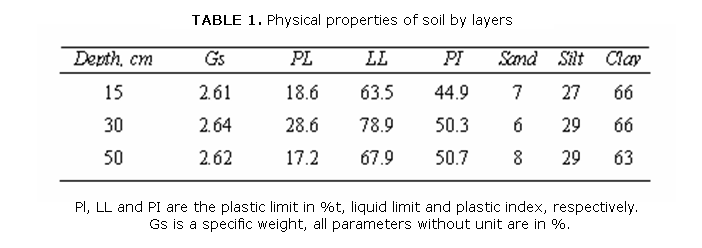
<body><![CDATA[<br>     <br> Taken in consideration the necessity of  the right parameters of soil to implement the numerical model the objective of  this study is to obtain the behavior of the basic mechanical properties needed  for numerical simulation of soil-soil, and soil-metal interfaces as a function  of dry bulk density and water content in a cohesive tropical soil.</font></p>    <p align="left">&nbsp;</p>    <p><font face="Verdana"><b>METHODS</b></font><font face="Verdana" size="2">    <br>      <br> <b>Soil physical properties</b>    <br>     <br> Soil specimens were collected in  four diagonal points at three different depths: 15; 30 and 50 cm, from sugar cane  fields located at the central region of Cuban Island. Texture and physical&nbsp;properties&nbsp;showed  in <a href="/img/revistas/rcta/v21n3/t0101312.gif">Table 1</a> were obtained  by combination of soil sieve and hydrometer test&nbsp;(Archer y Marks, 1985).  Attended to high content of expansive clay the soil was classified as a Vertisol  according to the international classification based on the soil taxonomy.    
<br>      <br> &nbsp;</font><font face="Verdana" size="2"> &nbsp;</font></p>    ]]></body>
<body><![CDATA[<p align="justify"><font face="Verdana" size="2"><b>Modified  direct shear box test </b>    <br>     <br> Direct shear box modification was used to  obtain the soil-metal adhesion and soil-metal friction coefficient. Soil samples  were remolded and prepared for direct shear test using standard apparatus (<a href="/img/revistas/rcta/v21n3/f0101312.gif">Figure  1a</a>), seven specimens of soil&nbsp;were molded with four replicas, using experimental  combination of&nbsp;gravimetric water content&nbsp;measured as a percentage of  dry weight at 15, 20, 25, 30 and 35%&nbsp;and&nbsp;soil bulk density at 1,0; 1,2  and 1,4 g·cm<sup>-3</sup>.     
<br>     <br> &nbsp;The dimensions of the cylindrical soil  samples were 70 mm diameter and 16 mm height (<a href="/img/revistas/rcta/v21n3/f0101312.gif">Figure  1b</a>). Normal pressures at 35, 50, 75 and 100 kPa on the upper box were applied  for testing four similar samples of the same combination, constant velocity of  1 mm·min<sup>-1</sup> was used to slide the bottom of the shear box, data of relative  displacement versus shear forces were collected during the sliding time. The strength  coefficients were calculated according to Mohr-Coulomb criterion of soil failure.    
<br>      <br>     <br>     <br> <b>Standard triaxial compression test     <br> </b>    ]]></body>
<body><![CDATA[<br> The mechanical  properties related to soil-soil interaction were obtained by standard triaxial  undrained unconsolidated compression test. Internal friction angle, cohesion and  Young’s modulus of soil were determined by testing eleven specimens each one with  four replicas. Soil cylindrical samples with 50 mm diameter and 100 mm height  were obtained by mixed, remolded and conformed the soil collected (<a href="/img/revistas/rcta/v21n3/f0201312.gif">Figure  2a</a>). In order to get four different principal stress combinations (</font><font face="Symbol">s</font><font face="Verdana"><sub>1</sub>  - </font><font face="Symbol">s</font><font face="Verdana"><sub>3</sub></font><font face="Verdana" size="2">)  the axial pressure of water was changed at 36, 50, 75 and 100 kPa. The principal  axial stress was supplied pressing on top of the soil cylinder (<a href="/img/revistas/rcta/v21n3/f0201312.gif">Figure  2b</a>), at constant velocity of 1 mm·min<sup>-1</sup>.    
<br>     <br> </font><font face="Verdana" size="2">  Mohr-Coulomb criterion of conical failure surface was used in order to determine  the soil shear strength. This criterion establishes a direct relationship of shear  stress at failure </font><font face="Symbol" size="2">t</font><font face="Verdana" size="2"><sub>f</sub>  with soil cohesion </font> <i><font face="Verdana">c</font></i><font face="Verdana" size="2">,  normal stress </font> <font face="Symbol">s</font><font face="Verdana" size="2"><sub>n</sub>  and internal friction angle</font><font face="Symbol" size="2"> </font><font face="Symbol">j</font><font face="Verdana" size="2">  . Maximum stress at failure (</font><font face="Symbol">s<sub>1</sub>- s<sub>3</sub></font><font face="Verdana" size="2">)  obtained at four confined pressures was plotted on tension-shear plane and a straight  line was drawn. Based on data from triaxial compression test for each experimental  combination, Young’s Modulus was adopted as the slope of the linear section of  the stress strain curve.    <br>     <br> &nbsp;</font></p>    <p>&nbsp;</p>    <p align="justify"><font face="Verdana"><b>RESULTS  AND DISCUSSION</b></font><font face="Verdana" size="2">    <br>     <br> <b>Shear Strength  </b>    <br>     ]]></body>
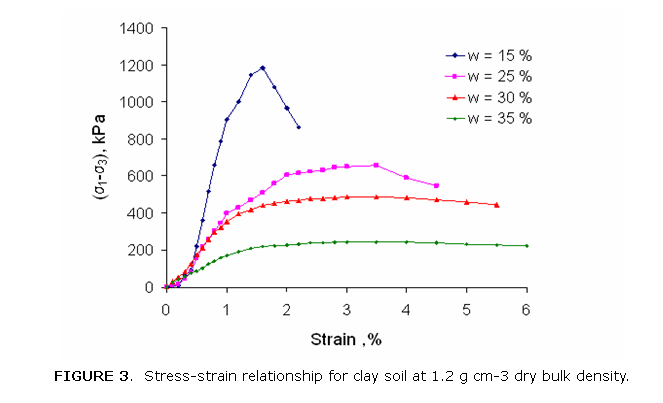
<body><![CDATA[<br> The average of stress-strain values at four different content of  water, testing with constant density of 1,2 g·cm<sup>-3</sup> (<a href="/img/revistas/rcta/v21n3/f0301312.gif">Figure  3</a>), shows the variation of soil failure patter. The maximum stress was reached  at minimum content of water showing a typical curve of fragile materials, cementation  process forms a strong inter-granular bonds as a result of high content of clay  and pressures, other studies on clay soil shows that&nbsp;the values of shear  strength&nbsp;depends also on the mineralogical properties of clay (Dolinar, 2010).Large  plastic deformation at lower level of moisture become undefined the failure shear  point. For all contents of water, the soil under study showed high values of failure  in comparison with&nbsp;loam and sandy soils (McKyes y Maswaure, 1997). Studies&nbsp;carried  out in Ferrasol soil&nbsp;with 32% of&nbsp;clay (Suárez <i>et al.,</i> 2008) report&nbsp;values  of&nbsp;shear&nbsp;strength around 20% less on the failure point, however the  pattern&nbsp;of behavior was the same at different contents of water.     
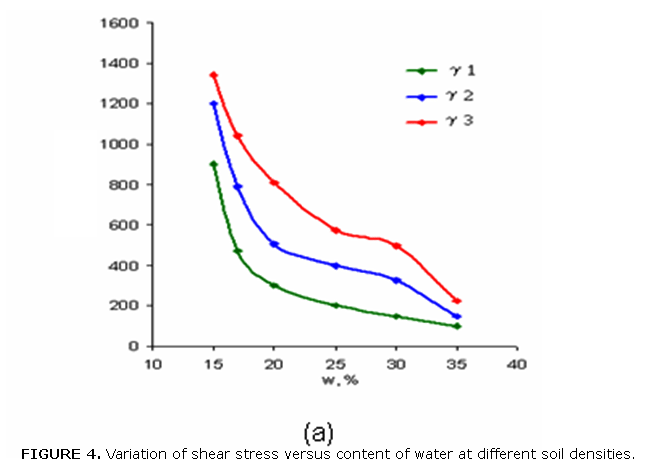
<br> &nbsp;    <br>  </font><font face="Verdana" size="2"> The result of soil shear strength calculated  at 50 kPa axial pressure from triaxial test, show an important increment when  decrease in soil moisture for all levels of dry bulk densities under studies (<a href="/img/revistas/rcta/v21n3/f0401312.gif">Figure  4</a>), however non linear relation was found almost between water content and  shear strength, The curve is clearly divided in two sections: over 20% the void  spaces are filling by water and the soil strength depend mainly&nbsp;of pore water  pressure while the other section is characterized by high values&nbsp;according  to&nbsp;the strong clay cementation process.    
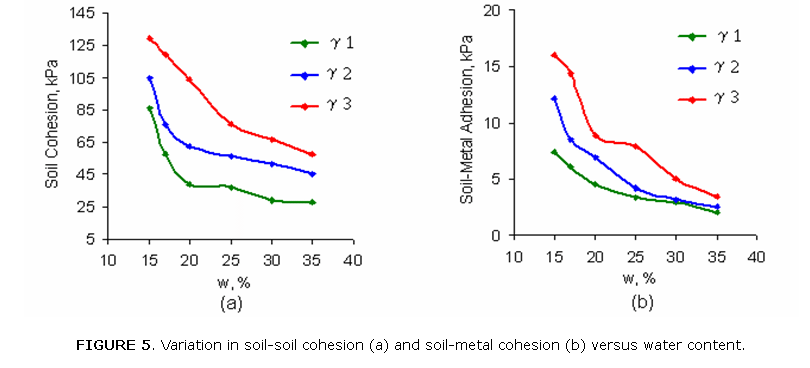
<br>     <br> </font><font face="Verdana" size="2">  Compacted soil shows more linearity with respect of change in moisture; nonetheless  between 25 to 30% of water content remain the tendency to form a constant interval.  At maximum value of water content the stress for all densities reach the minimum  points for the current experiment, possible explained by the dissolution of intergranular  bonds reducing internal tension and making possible slide soil layers over water  films.     <br>     <br> <b>Soil cohesion</b>    <br>     <br> Soil natural cohesion, obtained  by triaxial compression test as function of dry bulk density and moisture exhibit  a strong dependence with both factors (<a href="/img/revistas/rcta/v21n3/f0501312.gif">Figure  5a</a>); the increment on dry bulk density reduce the void ratio, making possible  the strong connection between grain of soil, on the other hand shape irregularities  contribute to reinforce the union, the abundant clay and silt particles cover  the void spaces into the soil joining the element in contact.     
<br>     ]]></body>
<body><![CDATA[<br> For samples  lower than 20% of water content cohesion experiment a rapidly increment, above  this value decrease with low ratio, also&nbsp;tending to be constant almost for  bulk densities at 1,0 and 1,2 g·cm<sup>-3</sup>, similar&nbsp;patterns of behavior  were obtained by McKyes in&nbsp;clay soils (Zhang <i>et al.,</i> 1986; McKyes  <i>et al.,</i> 1994). The property of clay to hold on the metal surface at different  condition obtained by modified direct shear box test follow the same pattern of  soil cohesion (<a href="/img/revistas/rcta/v21n3/f0501312.gif">Figure 5b</a>),  however the effect of water on this case is different, slide process is aid by  water films on the metal surface making a lubricant function. </font><font face="Verdana" size="2">      
<br>     <br> &nbsp;</font><font face="Verdana" size="2">However, cohesion in compacted  soil (</font><font size="2" face="Symbol"> g</font><font face="Verdana" size="2"><sub>3  </sub>= 1,4 g·cm<sup>-3</sup>) showed more dependence on water content in the  interval of 20 to 35%. The soil-metal cohesion tended to be independent of dry  bulk density for values of water content over 30%, this behavior results from  the lubrication process on the metal surface by the fluid of water. The statistical  equations result from multiple regression analysis to predict the cohesion and  soil adhesion are written as:</font></p>    <p align="right"><font face="Verdana" size="2">&nbsp;    <br>      <br> <i>c<sub>s-s</sub> </i>= 10,1 + 11,4</font><font face="Symbol">g</font><font face="Verdana" size="2">  + 0,1w<sup>2</sup> – 12,3 w&nbsp;&nbsp;&nbsp;&nbsp;&nbsp;&nbsp;&nbsp;&nbsp;&nbsp;&nbsp;&nbsp;&nbsp;&nbsp;&nbsp;  R<sup>2 </sup>= 93,7%&nbsp;&nbsp;&nbsp;&nbsp;&nbsp;&nbsp;&nbsp;&nbsp;&nbsp;&nbsp;&nbsp;&nbsp;&nbsp;&nbsp;&nbsp;&nbsp;&nbsp;&nbsp;&nbsp;&nbsp;&nbsp;&nbsp;&nbsp;&nbsp;&nbsp;&nbsp;&nbsp;&nbsp;&nbsp;&nbsp;&nbsp;&nbsp;&nbsp;&nbsp;&nbsp;&nbsp;&nbsp;&nbsp;&nbsp;&nbsp;&nbsp;&nbsp;&nbsp;&nbsp;&nbsp;&nbsp;&nbsp;&nbsp;&nbsp;&nbsp;&nbsp;&nbsp;&nbsp;&nbsp;&nbsp;&nbsp;&nbsp;&nbsp;&nbsp;&nbsp;&nbsp;&nbsp;&nbsp;&nbsp;&nbsp;&nbsp;&nbsp;&nbsp;&nbsp;&nbsp;&nbsp;&nbsp;&nbsp;&nbsp;&nbsp;&nbsp;&nbsp;&nbsp;&nbsp;&nbsp;&nbsp;&nbsp;&nbsp;&nbsp;&nbsp;&nbsp;&nbsp;&nbsp;&nbsp;&nbsp;&nbsp;&nbsp;&nbsp;&nbsp;&nbsp;&nbsp;&nbsp;  (1)    <br>     <br> <i>c</i><sub><i>s-m</i> </sub>= -13,6 + 8,5</font><font face="Symbol">g</font><font size="2" face="Symbol">  </font><font face="Verdana" size="2">+ 0.4 w&nbsp;&nbsp;&nbsp;&nbsp;&nbsp;&nbsp;&nbsp;&nbsp;&nbsp;&nbsp;&nbsp;&nbsp;&nbsp;&nbsp;&nbsp;&nbsp;&nbsp;&nbsp;&nbsp;&nbsp;&nbsp;&nbsp;&nbsp;&nbsp;&nbsp;&nbsp;&nbsp;  R<sup>2</sup> = 94,5%&nbsp;&nbsp;&nbsp;&nbsp;&nbsp;&nbsp;&nbsp;&nbsp;&nbsp;&nbsp;&nbsp;&nbsp;&nbsp;&nbsp;&nbsp;&nbsp;&nbsp;&nbsp;&nbsp;&nbsp;&nbsp;&nbsp;&nbsp;&nbsp;&nbsp;&nbsp;&nbsp;&nbsp;&nbsp;&nbsp;&nbsp;&nbsp;&nbsp;&nbsp;&nbsp;&nbsp;&nbsp;&nbsp;&nbsp;&nbsp;&nbsp;&nbsp;&nbsp;&nbsp;&nbsp;&nbsp;&nbsp;&nbsp;&nbsp;&nbsp;&nbsp;&nbsp;&nbsp;&nbsp;&nbsp;&nbsp;&nbsp;&nbsp;&nbsp;&nbsp;&nbsp;&nbsp;&nbsp;&nbsp;&nbsp;&nbsp;&nbsp;&nbsp;&nbsp;&nbsp;&nbsp;&nbsp;&nbsp;&nbsp;&nbsp;&nbsp;&nbsp;&nbsp;&nbsp;&nbsp;&nbsp;&nbsp;&nbsp;&nbsp;&nbsp;&nbsp;&nbsp;&nbsp;&nbsp;&nbsp;&nbsp;&nbsp;&nbsp;&nbsp;&nbsp;&nbsp;&nbsp;  (2)    <br>     <br> &nbsp;</font></p>    ]]></body>
<body><![CDATA[<p><font face="Verdana" size="2">Where (<i>c<sub>s-s</sub>)</i>  is soil cohesion and (<i>c<sub>s-m</sub></i>) soil-metal adhesion measured in  kPa, (</font><font size="2" face="Symbol">g</font><font face="Verdana" size="2">)  dry bulk density and (w) water content. The <a href="/img/revistas/rcta/v21n3/f0601312.gif">figure  6a</a> and <a href="/img/revistas/rcta/v21n3/f0601312.gif">6b</a> show the  prediction values using above equations with mean absolute error of 5,6 kPa for  soil cohesion and 0,85 kPa for soil adhesion.</font><font face="Verdana" size="2">  &nbsp;</font></p>    
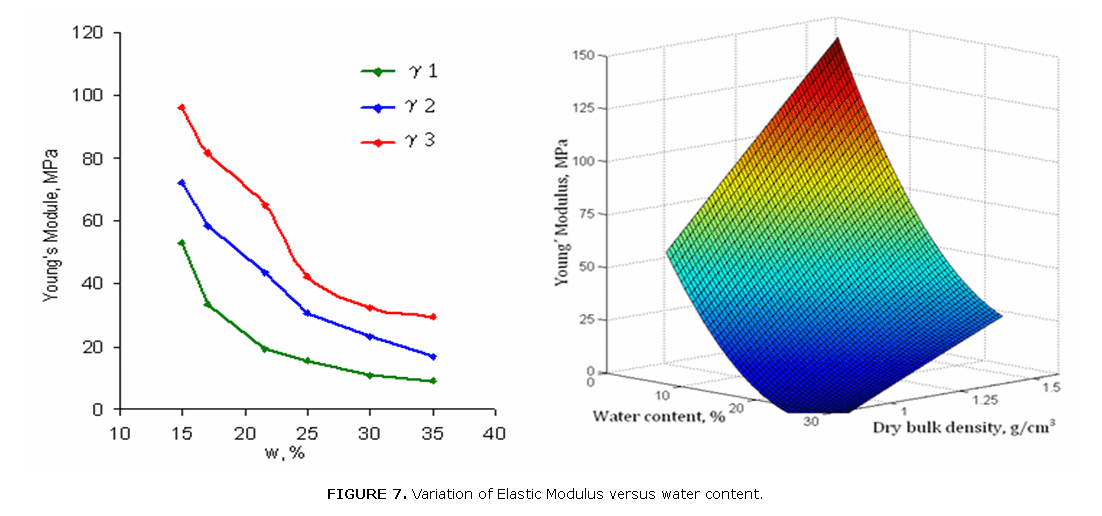
<p><font face="Verdana" size="2">    <br>     <br> <b>Elastic Modulus    <br>  </b>    <br> Strong relation with&nbsp;water content&nbsp;and also with bulk density  was found in elastic modulus, values obtained from studies carried out on three  kinds of soil&nbsp;(Kézdi, 1980), showed the same pattern, though the results  obtained there were quite lower; that difference is attributed to the quality  of&nbsp;Vertisol to form hard structure during&nbsp;consolidation with constant  pressure.    <br>     <br> Soil elasticity have substantial changes on different physical  condition. For all bulk density the Young’s Modulus (E) show the same pattern  of behavior, sank gradually after reaching 25% of water content and rising rapidly  under dry condition (<a href="/img/revistas/rcta/v21n3/f0701312.gif">Figure  7</a>).The state of plastic deformation is reaches by loose soil at average of  40 MPa with respect to compacted soil for all range of water content, remarking  the influence of bulk density. Statistical relationship was found as expression  of the predictable behavior of Elastic Modulus:</font><font face="Verdana" size="2">  &nbsp;</font></p>    
<p align="right"><font face="Verdana" size="2">    <br>     ]]></body>
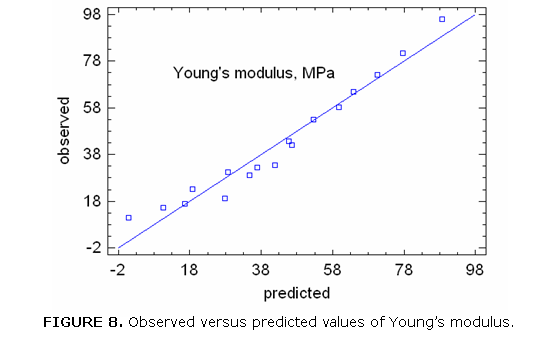
<body><![CDATA[<br> <i>E  </i>= 82,1 + 89,8</font><font size="2" face="Symbol"> </font> <font face="Symbol">  g</font><font face="Verdana" size="2"> + 0,1 w<sup>2</sup> – 10,2 w&nbsp;&nbsp;&nbsp;&nbsp;&nbsp;&nbsp;&nbsp;&nbsp;&nbsp;&nbsp;&nbsp;&nbsp;&nbsp;&nbsp;&nbsp;&nbsp;&nbsp;&nbsp;  R<sup>2</sup> = 95,5%&nbsp;&nbsp;&nbsp;&nbsp;&nbsp;&nbsp;&nbsp;&nbsp;&nbsp;&nbsp;&nbsp;&nbsp;&nbsp;&nbsp;&nbsp;&nbsp;&nbsp;&nbsp;&nbsp;&nbsp;&nbsp;&nbsp;&nbsp;&nbsp;&nbsp;&nbsp;&nbsp;&nbsp;&nbsp;&nbsp;&nbsp;&nbsp;&nbsp;&nbsp;&nbsp;&nbsp;&nbsp;&nbsp;&nbsp;&nbsp;&nbsp;&nbsp;&nbsp;&nbsp;&nbsp;&nbsp;&nbsp;&nbsp;&nbsp;&nbsp;&nbsp;&nbsp;&nbsp;&nbsp;&nbsp;&nbsp;&nbsp;&nbsp;&nbsp;&nbsp;&nbsp;&nbsp;&nbsp;&nbsp;&nbsp;&nbsp;&nbsp;&nbsp;&nbsp;&nbsp;&nbsp;&nbsp;&nbsp;&nbsp;&nbsp;&nbsp;&nbsp;&nbsp;&nbsp;&nbsp;&nbsp;&nbsp;&nbsp;&nbsp;&nbsp;&nbsp;&nbsp;&nbsp;  (3)    <br>     <br> &nbsp;</font></p>    <p><font face="Verdana" size="2">Where (E) is Young´s  Modulus measured in MPa.     <br>     <br> Graph of observed versus predicted values is  represented in the<a href="#f8"> figure 8</a>, the mean absolute error of Young’s  Modulus from prediction equation is 3,1 MPa. </font></p>    <p align="center"><font face="Verdana" size="2">    <br>      <br> <a name="f8"></a>    <br> <img src="/img/revistas/rcta/v21n3/f0801312.gif" width="557" height="346">  &nbsp;</font></p>    
]]></body>
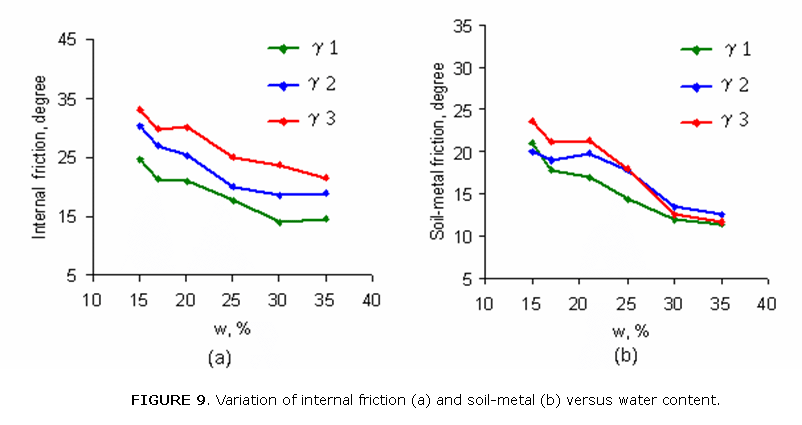
<body><![CDATA[<p>&nbsp;</p>    <p><font face="Verdana" size="2"><b>Soil friction</b>    <br>      <br> Soil friction angle on the soil-soil interface (<a href="/img/revistas/rcta/v21n3/f0901312.gif">Figure  9a</a>) tends to reach maximum values at low content of water; this behavior is  most evident on soil-metal interface (<a href="/img/revistas/rcta/v21n3/f0901312.gif">Figure  9b</a>) consequence of layer of water stored on the metal surface providing&nbsp;lubrication  during sliding. The same result&nbsp;was found in fine-grained soil (Yao y D.Zeng.,  1988). However, some authors&nbsp;found no relation between soil and bulk density  (McKyes <i>et al.,</i> 1994; Mouazen <i>et al., </i>2002); that behavior was observed  only for soil-metal friction (Figure 10b). Different results can be attributed  of particular soil quality and the range of water content that were used for each  investigation.</font></p>    
<p><font face="Verdana" size="2">    <br> Bulk density on  soil-metal interface have some slight fluctuation in the range of 1,2 degree for  all contents of water, no significant statistical influence was observed and this  effect was excluded to the model. Relationships for prediction of soil     <br>     <br>      <br>     <br> friction angles were written as: </font></p>    ]]></body>
<body><![CDATA[<p align="right"><font face="Verdana" size="2">    <br>      <br> <i>f <sub>s-m </sub></i>= -23,6 + 12,9 ln (w)&nbsp;&nbsp;&nbsp;&nbsp;&nbsp;&nbsp;&nbsp;&nbsp;&nbsp;&nbsp;&nbsp;&nbsp;&nbsp;&nbsp;&nbsp;&nbsp;&nbsp;&nbsp;&nbsp;&nbsp;&nbsp;&nbsp;&nbsp;&nbsp;&nbsp;&nbsp;&nbsp;&nbsp;&nbsp;&nbsp;&nbsp;  &nbsp;R<sup>2 </sup>= 91,7%&nbsp;&nbsp;&nbsp;&nbsp;&nbsp;&nbsp;&nbsp;&nbsp;&nbsp;&nbsp;&nbsp;&nbsp;&nbsp;&nbsp;&nbsp;&nbsp;&nbsp;&nbsp;&nbsp;&nbsp;&nbsp;&nbsp;&nbsp;&nbsp;&nbsp;&nbsp;&nbsp;&nbsp;&nbsp;&nbsp;&nbsp;&nbsp;&nbsp;&nbsp;&nbsp;&nbsp;&nbsp;&nbsp;&nbsp;&nbsp;&nbsp;&nbsp;&nbsp;&nbsp;&nbsp;&nbsp;&nbsp;&nbsp;&nbsp;&nbsp;&nbsp;&nbsp;&nbsp;&nbsp;&nbsp;&nbsp;&nbsp;&nbsp;&nbsp;&nbsp;&nbsp;&nbsp;&nbsp;&nbsp;&nbsp;&nbsp;&nbsp;&nbsp;&nbsp;&nbsp;&nbsp;&nbsp;&nbsp;&nbsp;&nbsp;&nbsp;&nbsp;&nbsp;&nbsp;&nbsp;&nbsp;&nbsp;&nbsp;&nbsp;&nbsp;&nbsp;&nbsp;&nbsp;&nbsp;&nbsp;&nbsp;&nbsp;  (4)    <br>     <br> <i>f <sub>s-s</sub></i> = 22,1 + 0,5 w – 37,5 </font> <font face="Symbol">g</font><font face="Verdana" size="2">  + 16,4 </font><font face="Symbol">g</font><font face="Verdana" size="2"><sup>2</sup>&nbsp;&nbsp;&nbsp;&nbsp;&nbsp;&nbsp;&nbsp;&nbsp;&nbsp;&nbsp;&nbsp;&nbsp;&nbsp;&nbsp;&nbsp;&nbsp;&nbsp;  R<sup>2 </sup>= 96,5%&nbsp;&nbsp;&nbsp;&nbsp;&nbsp;&nbsp;&nbsp;&nbsp;&nbsp;&nbsp;&nbsp;&nbsp;&nbsp;&nbsp;&nbsp;&nbsp;&nbsp;&nbsp;&nbsp;&nbsp;&nbsp;&nbsp;&nbsp;&nbsp;&nbsp;&nbsp;&nbsp;&nbsp;&nbsp;&nbsp;&nbsp;&nbsp;&nbsp;&nbsp;&nbsp;&nbsp;&nbsp;&nbsp;&nbsp;&nbsp;&nbsp;&nbsp;&nbsp;&nbsp;&nbsp;&nbsp;&nbsp;&nbsp;&nbsp;&nbsp;&nbsp;&nbsp;&nbsp;&nbsp;&nbsp;&nbsp;&nbsp;&nbsp;&nbsp;&nbsp;&nbsp;&nbsp;&nbsp;&nbsp;&nbsp;&nbsp;&nbsp;&nbsp;&nbsp;&nbsp;&nbsp;&nbsp;&nbsp;&nbsp;&nbsp;&nbsp;&nbsp;&nbsp;&nbsp;&nbsp;&nbsp;&nbsp;&nbsp;&nbsp;&nbsp;&nbsp;&nbsp;&nbsp;&nbsp;&nbsp;&nbsp;  ( 5)    <br>     <br> &nbsp;</font></p>    <p><font face="Verdana" size="2">Where (<i>f<sub>s-m</sub>)</i>  is soil metal friction and (<i>f<sub>s-s</sub></i>) soil internal&nbsp;friction  measured in degree, (</font><font face="Symbol">g</font><font face="Verdana" size="2">)  dry bulk density and (w) water content.&nbsp;</font></p>    <p>&nbsp;</p>    <p><font face="Verdana"><b>CONCLUSION</b></font><font face="Verdana" size="2">    ]]></body>
<body><![CDATA[<br>      <br> A set of prognostic equations is proposed, able to calculate the predictive  values of elastic modulus, cohesion, adhesion, internal friction and soil-metal  friction as a function of dry bulk density and gravimetric water content.    <br>      <br> The stress-strain curve shows the transition between fragile into plastic  behavior testing by triaxial unconsolidated compression test at different water  content. Shear strength determined at 50 kPa axial pressure show the quality to  forming a hard structure, when water content is higher than 20% reaching maximum  point under dry condition.    <br>     <br> Soil cohesion and soil adhesion have a strong  dependence with water content, showing the same pattern for different levels densities,  cohesion values on soil-metal interface during sliding time decrease at least  70% to respect of soil-soil cohesion, for values up to 25% of water content soil  adhesion for loose and medium soil become similar.    <br>     <br> The Elastic modulus  increase under dry condition up to 100 MPa, predominated by the influence of water  content, bulk density play a secondary roll. Similarly internal friction angle  is affected by the water content and weak connection was found between soil-metal  friction angle and bulk density.</font></p>    <p style="line-height: 150%; margin-top: 0; margin-bottom: 0">  <font face="Verdana" size="2">    <br> </font><font face="Verdana"><b>REFERENCES</b></font><font face="Verdana" size="2">    ]]></body>
<body><![CDATA[<br>  &nbsp;</font></p>    <!-- ref --><p style="line-height: 150%; margin-top: 0; margin-bottom: 0"><font size="2" face="Verdana, Arial, Helvetica, sans-serif">1.  ABBAS, E.-Z.; P. C. JOHN ; W. A. DAVID: Three-dimensional finite elements for  the analysis of soil contamination using a multiple-porosity approach, International  Journal for Numerical and Analytical Methods in Geomechanics, 30(7): 577-597,  2006.    <br>     <!-- ref --><br> 2. ABO-ELNOR, M.; R. HAMILTON ; J. T. BOYLE: Simulation of soil-blade  interaction for sandy soil using advanced 3D finite element analysis, Soil and  Tillage Research, 75(1): 61-73, 2004.    <br>     <!-- ref --><br> 3. ADAMCHUK, V. I.; J. W. HUMMEL;  M. T. MORGAN ; S. K. UPADHYAYA: On-the-go soil sensors for precision agriculture,  Computers and Electronics in Agriculture, 44(1): 71-91, 2004.    <br>     <br> 4. ARCHER,  J. R. ; M. J. MARKS: Techniques for Measuring Soil Physical Properties, ADAS Reference  Book: 22,130, 1985.    <br>     <!-- ref --><br> 5. DEXTER, A. R. ; M. BIRKAS: Prediction of the soil  structures produced by tillage, Soil and Tillage Research, 79(2): 233-238, 2004.    <br>      <!-- ref --><br> 6. DOLINAR, B.: Predicting the normalized, undrained shear strength of saturated  fine-grained soils using plasticity-value correlations, Applied Clay Science,  47(3-4): 428-432, 2010.    <br>     <!-- ref --><br> 7. GONZ&Aacute;LEZ, C. O.; C. IGLESIAS; M. HERRERA;  E. L&Oacute;PEZ y A. L. S&Aacute;NCHEZ: Influencia de la densidad de volumen en  par&aacute;metros elastopl&aacute;sticos empleados para la modelaci&oacute;n de  la compactaci&oacute;n del suelo, Revista Ciencias T&eacute;cnicas Agropecuarias,  18(1): 2009.    <br>     <br> 8. HERRERA, S. M.; C. E. IGLESIAS; O. GONZ&Aacute;LEZ; E.  L&Oacute;PEZ y A. L. S&Aacute;NCHEZ I: Simulaci&oacute;n mediante el M&eacute;todo  de Elementos Finitos de la respuesta mec&aacute;nica de un Oxisol, Revista Ciencias  T&eacute;cnicas Agropecuarias, 16(4): 55-61, 2008.    <br>     <!-- ref --><br> 9. HUANG, W.; D. SHENG;  S. W. SLOAN ; H. S. YU: Finite element analysis of cone penetration in cohesionless  soil, Computers and Geotechnics, 31(7): 517-528, 2004.    <br>     <br> 10. K&Eacute;ZDI,  &Aacute;.: Handbook of soil mechanics, Vol. 2 Soil Testing, Amsterdam, 1980.    ]]></body>
<body><![CDATA[<br>      <!-- ref --><br> 11. MCKYES, E. ; J. MASWAURE: Effect of design parameters of flat tillage  tools on loosening of a clay soil, Soil and Tillage Research, 43(3-4): 195-204,  1997.    <br>     <!-- ref --><br> 12. MCKYES, E.; P. NYAMUGAFATA ; K. W. NYAMAPFENE: Characterization  of cohesion, friction and sensitivity of two hardsetting soils from Zimbabwe,  Soil and Tillage Research, 29(4): 357-366, 1994.    <br>     <br> 13. MIGUEL HERRERA SU&Aacute;REZ  , O. Gonz&aacute;lez, C. IGLESIAS, A. DE LA ROSA, R. MADRUGA: Estudio de la exactitud  del modelo hiperb&oacute;lico de Duncan y Chan en la predicci&oacute;n de la relaci&oacute;n  esfuerzo deformaci&oacute;n de tres suelos arcillosos cubanos, Revista Ciencias  T&eacute;cnicas Agropecuarias, (19),(4): 2010.    <br>     <br> 14. MOOTAZ, A. E.; H.  R. ; J. T. BOYLE: 3D Dynamic analysis of soil–tool interaction using the finite  element method, Soil Tillage Research, 40: 51-62, 2003.    <br>     <!-- ref --><br> 15. MOUAZEN,  A. M.; H. RAMON: Development of on-line measurement system of bulk density based  on on-line measured draught, depth and soil moisture content, Soil and Tillage  Research, 86(2): 218-229, 2006.    <br>     <!-- ref --><br> 16. MOUAZEN, A. M.; H. RAMON ; J. D.  BAERDEMAEKER: Effects of Bulk Density and Moisture Content on Selected Mechanical  Properties of Sandy Loam Soil, Biosystems Engineering, 83(2): 217-224, 2002.    <br>      <!-- ref --><br> 17. SAEYS, W.; A. M. MOUAZEN; J. ANTHONIS ; H. RAMON: An Automatic Depth  Control System for Online Measurement of Spatial Variation in Soil Compaction,  Part 2: Modelling of the Depth Control System, Biosystems Engineering, 89(3):  267-280, 2004.    <br>     <!-- ref --><br> 18. SU&Aacute;REZ, M. H.; C. I. CORONEL; O. G. CUETO;  E. L. BRAVO y &Aacute;. S. IZNAGA: Propiedades mec&aacute;nicas de un Rhodic Ferralsol  requeridas para la simulaci&oacute;n de la interacci&oacute;n suelo implemento  de labranza mediante el M&eacute;todo de Elementos Finitos: Parte I, Revista Ciencias  T&eacute;cnicas Agropecuarias, 17(3): 31-37, 2008.    <br>     <!-- ref --><br> 19. YAO, Y. ; D.ZENG.:  Investigation on the relationship between sliding speed and soil-metal friction,  Trans. Chinese Soc. Agric.Math., 19(4): 33-40, 1988.    <br>     <!-- ref --><br> 20. ZHANG, J. X.;  Z. Z. SANG ;L.R.GAO: Adhesion and friction between soils and solids, Trans. Chinese  Soc. Agric.Math., 17(1): 32-40, 1986.    </font></p>    <p></p>    <p style="line-height: 150%; margin-top: 0; margin-bottom: 0">&nbsp;</p>    <p style="line-height: 150%; margin-top: 0; margin-bottom: 0">&nbsp;</p>    <p><font size="2" face="Verdana, Arial, Helvetica, sans-serif">Recibido:  9 de diciembre de 2010.    <br> Aprobado: 19 de mayo de 2012.     <br>     <br></font></p>    <p>&nbsp;</p>    <p><font size="2" face="Verdana, Arial, Helvetica, sans-serif">    ]]></body>
<body><![CDATA[<br>  </font></p>    <p> <i><font face="Verdana" size="2">Elvis López Bravo,</font></i><font size="2" face="Verdana, Arial, Helvetica, sans-serif">  </font><font face="Verdana" size="2">Central University&nbsp;“Marta Abreu” of  Las Villas, Faculty of Agricultural and Animal Sciences,&nbsp; Department of Agricultural  Engineering,&nbsp; Villa Clara, Cuba,</font><font size="2" face="Verdana, Arial, Helvetica, sans-serif">  Correo electrónico: &nbsp;</font><font face="Verdana" size="2"><a href="mailto:elvislb@uclv.edu.cu">elvislb@uclv.edu.cu</a></font></p>      ]]></body><back>
<ref-list>
<ref id="B1">
<label>1</label><nlm-citation citation-type="journal">
<person-group person-group-type="author">
<name>
<surname><![CDATA[ABBAS]]></surname>
<given-names><![CDATA[E.-Z]]></given-names>
</name>
<name>
<surname><![CDATA[JOHN]]></surname>
<given-names><![CDATA[P. C]]></given-names>
</name>
<name>
<surname><![CDATA[W. A]]></surname>
<given-names><![CDATA[DAVID]]></given-names>
</name>
</person-group>
<article-title xml:lang="en"><![CDATA[Three-dimensional finite elements for the analysis of soil contamination using a multiple-porosity approach]]></article-title>
<source><![CDATA[International Journal for Numerical and Analytical Methods in Geomechanics]]></source>
<year>2006</year>
<volume>30</volume>
<numero>7</numero>
<issue>7</issue>
<page-range>577-597</page-range></nlm-citation>
</ref>
<ref id="B2">
<label>2</label><nlm-citation citation-type="journal">
<person-group person-group-type="author">
<name>
<surname><![CDATA[ABO-ELNOR]]></surname>
<given-names><![CDATA[M]]></given-names>
</name>
<name>
<surname><![CDATA[HAMILTON]]></surname>
<given-names><![CDATA[R]]></given-names>
</name>
<name>
<surname><![CDATA[BOYLE]]></surname>
<given-names><![CDATA[J. T]]></given-names>
</name>
</person-group>
<article-title xml:lang="en"><![CDATA[Simulation of soil-blade interaction for sandy soil using advanced 3D finite element analysis]]></article-title>
<source><![CDATA[Soil and Tillage Research]]></source>
<year>2004</year>
<volume>75</volume>
<numero>1</numero>
<issue>1</issue>
<page-range>61-73</page-range></nlm-citation>
</ref>
<ref id="B3">
<label>3</label><nlm-citation citation-type="journal">
<person-group person-group-type="author">
<name>
<surname><![CDATA[ADAMCHUK]]></surname>
<given-names><![CDATA[V. I]]></given-names>
</name>
<name>
<surname><![CDATA[HUMMEL]]></surname>
<given-names><![CDATA[J. W]]></given-names>
</name>
<name>
<surname><![CDATA[MORGAN]]></surname>
<given-names><![CDATA[M. T]]></given-names>
</name>
<name>
<surname><![CDATA[UPADHYAYA]]></surname>
<given-names><![CDATA[S. K]]></given-names>
</name>
</person-group>
<article-title xml:lang="en"><![CDATA[On-the-go soil sensors for precision agriculture]]></article-title>
<source><![CDATA[Computers and Electronics in Agriculture]]></source>
<year>2004</year>
<volume>44</volume>
<numero>1</numero>
<issue>1</issue>
<page-range>71-91</page-range></nlm-citation>
</ref>
<ref id="B4">
<label>4</label><nlm-citation citation-type="">
<person-group person-group-type="author">
<name>
<surname><![CDATA[ARCHER]]></surname>
<given-names><![CDATA[J. R]]></given-names>
</name>
<name>
<surname><![CDATA[MARKS]]></surname>
<given-names><![CDATA[M. J]]></given-names>
</name>
</person-group>
<source><![CDATA[Techniques for Measuring Soil Physical Properties]]></source>
<year>1985</year>
</nlm-citation>
</ref>
<ref id="B5">
<label>5</label><nlm-citation citation-type="journal">
<person-group person-group-type="author">
<name>
<surname><![CDATA[DEXTER]]></surname>
<given-names><![CDATA[A. R]]></given-names>
</name>
<name>
<surname><![CDATA[BIRKAS]]></surname>
<given-names><![CDATA[M]]></given-names>
</name>
</person-group>
<article-title xml:lang="en"><![CDATA[Prediction of the soil structures produced by tillage]]></article-title>
<source><![CDATA[Soil and Tillage Research]]></source>
<year>2004</year>
<volume>79</volume>
<numero>2</numero>
<issue>2</issue>
<page-range>233-238</page-range></nlm-citation>
</ref>
<ref id="B6">
<label>6</label><nlm-citation citation-type="journal">
<person-group person-group-type="author">
<name>
<surname><![CDATA[DOLINAR]]></surname>
<given-names><![CDATA[B]]></given-names>
</name>
</person-group>
<article-title xml:lang="en"><![CDATA[Predicting the normalized, undrained shear strength of saturated fine-grained soils using plasticity-value correlations]]></article-title>
<source><![CDATA[Applied Clay Science]]></source>
<year>2010</year>
<volume>47</volume>
<numero>3-4</numero>
<issue>3-4</issue>
<page-range>428-432</page-range></nlm-citation>
</ref>
<ref id="B7">
<label>7</label><nlm-citation citation-type="journal">
<person-group person-group-type="author">
<name>
<surname><![CDATA[GONZÁLEZ]]></surname>
<given-names><![CDATA[C. O]]></given-names>
</name>
<name>
<surname><![CDATA[IGLESIAS]]></surname>
<given-names><![CDATA[C]]></given-names>
</name>
<name>
<surname><![CDATA[HERRERA]]></surname>
<given-names><![CDATA[M]]></given-names>
</name>
<name>
<surname><![CDATA[LÓPEZ]]></surname>
<given-names><![CDATA[E]]></given-names>
</name>
<name>
<surname><![CDATA[SÁNCHEZ]]></surname>
<given-names><![CDATA[A. L]]></given-names>
</name>
</person-group>
<article-title xml:lang="es"><![CDATA[Influencia de la densidad de volumen en parámetros elastoplásticos empleados para la modelación de la compactación del suelo]]></article-title>
<source><![CDATA[Revista Ciencias Técnicas Agropecuarias]]></source>
<year>2009</year>
<volume>18</volume>
<numero>1</numero>
<issue>1</issue>
</nlm-citation>
</ref>
<ref id="B8">
<label>8</label><nlm-citation citation-type="journal">
<person-group person-group-type="author">
<name>
<surname><![CDATA[HERRERA]]></surname>
<given-names><![CDATA[S. M]]></given-names>
</name>
<name>
<surname><![CDATA[IGLESIAS]]></surname>
<given-names><![CDATA[C. E]]></given-names>
</name>
<name>
<surname><![CDATA[GONZÁLEZ]]></surname>
<given-names><![CDATA[O]]></given-names>
</name>
<name>
<surname><![CDATA[LÓPEZ]]></surname>
<given-names><![CDATA[E]]></given-names>
</name>
<name>
<surname><![CDATA[SÁNCHEZ]]></surname>
<given-names><![CDATA[A. L]]></given-names>
</name>
</person-group>
<article-title xml:lang="es"><![CDATA[Simulación mediante el Método de Elementos Finitos de la respuesta mecánica de un Oxisol]]></article-title>
<source><![CDATA[Revista Ciencias Técnicas Agropecuarias]]></source>
<year>2008</year>
<volume>16</volume>
<numero>4</numero>
<issue>4</issue>
<page-range>55-61</page-range></nlm-citation>
</ref>
<ref id="B9">
<label>9</label><nlm-citation citation-type="journal">
<person-group person-group-type="author">
<name>
<surname><![CDATA[HUANG]]></surname>
<given-names><![CDATA[W]]></given-names>
</name>
<name>
<surname><![CDATA[SHENG]]></surname>
<given-names><![CDATA[D]]></given-names>
</name>
<name>
<surname><![CDATA[SLOAN]]></surname>
<given-names><![CDATA[S W.]]></given-names>
</name>
<name>
<surname><![CDATA[YU]]></surname>
<given-names><![CDATA[H. S]]></given-names>
</name>
</person-group>
<article-title xml:lang="en"><![CDATA[Finite element analysis of cone penetration in cohesionless soil]]></article-title>
<source><![CDATA[Computers and Geotechnics]]></source>
<year>2004</year>
<volume>31</volume>
<numero>7</numero>
<issue>7</issue>
<page-range>517-528</page-range></nlm-citation>
</ref>
<ref id="B10">
<label>10</label><nlm-citation citation-type="">
<person-group person-group-type="author">
<name>
<surname><![CDATA[KÉZDI]]></surname>
<given-names><![CDATA[Á]]></given-names>
</name>
</person-group>
<source><![CDATA[Handbook of soil mechanics]]></source>
<year>1980</year>
<publisher-loc><![CDATA[Amsterdam ]]></publisher-loc>
</nlm-citation>
</ref>
<ref id="B11">
<label>11</label><nlm-citation citation-type="journal">
<person-group person-group-type="author">
<name>
<surname><![CDATA[MCKYES]]></surname>
<given-names><![CDATA[E]]></given-names>
</name>
<name>
<surname><![CDATA[MASWAURE]]></surname>
<given-names><![CDATA[J]]></given-names>
</name>
</person-group>
<article-title xml:lang="en"><![CDATA[Effect of design parameters of flat tillage tools on loosening of a clay soil]]></article-title>
<source><![CDATA[Soil and Tillage Research]]></source>
<year>1997</year>
<volume>43</volume>
<numero>3-4</numero>
<issue>3-4</issue>
<page-range>195-204</page-range></nlm-citation>
</ref>
<ref id="B12">
<label>12</label><nlm-citation citation-type="journal">
<person-group person-group-type="author">
<name>
<surname><![CDATA[MCKYES]]></surname>
</name>
<name>
<surname><![CDATA[NYAMUGAFATA]]></surname>
<given-names><![CDATA[P]]></given-names>
</name>
<name>
<surname><![CDATA[NYAMAPFENE]]></surname>
<given-names><![CDATA[K. W]]></given-names>
</name>
</person-group>
<article-title xml:lang="en"><![CDATA[Characterization of cohesion, friction and sensitivity of two hardsetting soils from Zimbabwe]]></article-title>
<source><![CDATA[Soil and Tillage Research]]></source>
<year>1994</year>
<volume>29</volume>
<numero>4</numero>
<issue>4</issue>
<page-range>357-366</page-range></nlm-citation>
</ref>
<ref id="B13">
<label>13</label><nlm-citation citation-type="journal">
<person-group person-group-type="author">
<name>
<surname><![CDATA[HERRERA SUÁREZ]]></surname>
<given-names><![CDATA[MIGUEL]]></given-names>
</name>
<name>
<surname><![CDATA[González]]></surname>
<given-names><![CDATA[O]]></given-names>
</name>
<name>
<surname><![CDATA[IGLESIAS]]></surname>
<given-names><![CDATA[C]]></given-names>
</name>
<name>
<surname><![CDATA[DE LA ROSA]]></surname>
<given-names><![CDATA[A]]></given-names>
</name>
<name>
<surname><![CDATA[MADRUGA]]></surname>
<given-names><![CDATA[R]]></given-names>
</name>
</person-group>
<article-title xml:lang="es"><![CDATA[Estudio de la exactitud del modelo hiperbólico de Duncan y Chan en la predicción de la relación esfuerzo deformación de tres suelos arcillosos cubanos]]></article-title>
<source><![CDATA[Revista Ciencias Técnicas Agropecuarias]]></source>
<year>2010</year>
<numero>19</numero>
<issue>19</issue>
</nlm-citation>
</ref>
<ref id="B14">
<label>14</label><nlm-citation citation-type="journal">
<person-group person-group-type="author">
<name>
<surname><![CDATA[MOOTAZ]]></surname>
<given-names><![CDATA[A. E]]></given-names>
</name>
<name>
<surname><![CDATA[BOYLE]]></surname>
<given-names><![CDATA[J. T]]></given-names>
</name>
</person-group>
<article-title xml:lang="en"><![CDATA[3D Dynamic analysis of soil-tool interaction using the finite element method]]></article-title>
<source><![CDATA[Soil Tillage Research]]></source>
<year>2003</year>
<numero>40</numero>
<issue>40</issue>
<page-range>51-62</page-range></nlm-citation>
</ref>
<ref id="B15">
<label>15</label><nlm-citation citation-type="journal">
<person-group person-group-type="author">
<name>
<surname><![CDATA[MOUAZEN]]></surname>
<given-names><![CDATA[A. M]]></given-names>
</name>
<name>
<surname><![CDATA[RAMON]]></surname>
<given-names><![CDATA[H]]></given-names>
</name>
</person-group>
<article-title xml:lang="en"><![CDATA[Development of on-line measurement system of bulk density based on on-line measured draught, depth and soil moisture content]]></article-title>
<source><![CDATA[Soil and Tillage Research]]></source>
<year>2006</year>
<volume>86</volume>
<numero>2</numero>
<issue>2</issue>
<page-range>218-229</page-range></nlm-citation>
</ref>
<ref id="B16">
<label>16</label><nlm-citation citation-type="journal">
<person-group person-group-type="author">
<name>
<surname><![CDATA[MOUAZEN]]></surname>
<given-names><![CDATA[A. M]]></given-names>
</name>
<name>
<surname><![CDATA[RAMON]]></surname>
<given-names><![CDATA[H]]></given-names>
</name>
<name>
<surname><![CDATA[BAERDEMAEKER]]></surname>
<given-names><![CDATA[J. D]]></given-names>
</name>
</person-group>
<article-title xml:lang="en"><![CDATA[Effects of Bulk Density and Moisture Content on Selected Mechanical Properties of Sandy Loam Soil]]></article-title>
<source><![CDATA[Biosystems Engineering]]></source>
<year>2002</year>
<volume>83</volume>
<numero>2</numero>
<issue>2</issue>
<page-range>217-224</page-range></nlm-citation>
</ref>
<ref id="B17">
<label>17</label><nlm-citation citation-type="journal">
<person-group person-group-type="author">
<name>
<surname><![CDATA[SAEYS]]></surname>
<given-names><![CDATA[W]]></given-names>
</name>
<name>
<surname><![CDATA[MOUAZEN]]></surname>
<given-names><![CDATA[A. M]]></given-names>
</name>
<name>
<surname><![CDATA[ANTHONIS]]></surname>
<given-names><![CDATA[J]]></given-names>
</name>
<name>
<surname><![CDATA[RAMON]]></surname>
<given-names><![CDATA[H]]></given-names>
</name>
</person-group>
<article-title xml:lang="en"><![CDATA[An Automatic Depth Control System for Online Measurement of Spatial Variation in Soil Compaction, Part 2: Modelling of the Depth Control System]]></article-title>
<source><![CDATA[Biosystems Engineering]]></source>
<year>2004</year>
<volume>89</volume>
<numero>3</numero>
<issue>3</issue>
<page-range>267-280</page-range></nlm-citation>
</ref>
<ref id="B18">
<label>18</label><nlm-citation citation-type="journal">
<person-group person-group-type="author">
<name>
<surname><![CDATA[SUÁREZ]]></surname>
<given-names><![CDATA[M. H]]></given-names>
</name>
<name>
<surname><![CDATA[CORONEL]]></surname>
<given-names><![CDATA[C. I]]></given-names>
</name>
<name>
<surname><![CDATA[CUETO]]></surname>
<given-names><![CDATA[O. G]]></given-names>
</name>
<name>
<surname><![CDATA[BRAVO]]></surname>
<given-names><![CDATA[E. L]]></given-names>
</name>
<name>
<surname><![CDATA[IZNAGA]]></surname>
<given-names><![CDATA[Á. S]]></given-names>
</name>
</person-group>
<article-title xml:lang="es"><![CDATA[Propiedades mecánicas de un Rhodic Ferralsol requeridas para la simulación de la interacción suelo implemento de labranza mediante el Método de Elementos Finitos: Parte I]]></article-title>
<source><![CDATA[Revista Ciencias Técnicas Agropecuarias]]></source>
<year>2008</year>
<volume>17</volume>
<numero>3</numero>
<issue>3</issue>
<page-range>31-37</page-range></nlm-citation>
</ref>
<ref id="B19">
<label>19</label><nlm-citation citation-type="journal">
<person-group person-group-type="author">
<name>
<surname><![CDATA[YAO]]></surname>
<given-names><![CDATA[Y]]></given-names>
</name>
<name>
<surname><![CDATA[ZENG]]></surname>
<given-names><![CDATA[D]]></given-names>
</name>
</person-group>
<article-title xml:lang="en"><![CDATA[Investigation on the relationship between sliding speed and soil-metal friction]]></article-title>
<source><![CDATA[Trans. Chinese Soc. Agric.Math]]></source>
<year>1988</year>
<volume>19</volume>
<numero>4</numero>
<issue>4</issue>
<page-range>33-40</page-range></nlm-citation>
</ref>
<ref id="B20">
<label>20</label><nlm-citation citation-type="journal">
<person-group person-group-type="author">
<name>
<surname><![CDATA[ZHANG]]></surname>
<given-names><![CDATA[J. X]]></given-names>
</name>
<name>
<surname><![CDATA[SANG]]></surname>
<given-names><![CDATA[Z. Z]]></given-names>
</name>
<name>
<surname><![CDATA[GAO]]></surname>
<given-names><![CDATA[L.R]]></given-names>
</name>
</person-group>
<article-title xml:lang="en"><![CDATA[Adhesion and friction between soils and solids]]></article-title>
<source><![CDATA[Trans. Chinese Soc. Agric.Math]]></source>
<year>1986</year>
<volume>17</volume>
<numero>1</numero>
<issue>1</issue>
<page-range>32-40</page-range></nlm-citation>
</ref>
</ref-list>
</back>
</article>