<?xml version="1.0" encoding="ISO-8859-1"?><article xmlns:mml="http://www.w3.org/1998/Math/MathML" xmlns:xlink="http://www.w3.org/1999/xlink" xmlns:xsi="http://www.w3.org/2001/XMLSchema-instance">
<front>
<journal-meta>
<journal-id>2071-0054</journal-id>
<journal-title><![CDATA[Revista Ciencias Técnicas Agropecuarias]]></journal-title>
<abbrev-journal-title><![CDATA[Rev Cie Téc Agr]]></abbrev-journal-title>
<issn>2071-0054</issn>
<publisher>
<publisher-name><![CDATA[Universidad Agraria de La Habana]]></publisher-name>
</publisher>
</journal-meta>
<article-meta>
<article-id>S2071-00542014000100004</article-id>
<title-group>
<article-title xml:lang="en"><![CDATA[Two-phase anaerobic digestion of coffee wet wastewater: Effect of recycle on anaerobic process performance]]></article-title>
<article-title xml:lang="es"><![CDATA[Digestión anaerobia en dos fases de las aguas residuales del beneficiado húmedo de café: el efecto de la recirculación en el funcionamiento del proceso anaerobio]]></article-title>
</title-group>
<contrib-group>
<contrib contrib-type="author">
<name>
<surname><![CDATA[Guardia Puebla]]></surname>
<given-names><![CDATA[Yans]]></given-names>
</name>
<xref ref-type="aff" rid="A01"/>
</contrib>
<contrib contrib-type="author">
<name>
<surname><![CDATA[Rodríguez Pérez]]></surname>
<given-names><![CDATA[Suyén]]></given-names>
</name>
<xref ref-type="aff" rid="A02"/>
</contrib>
<contrib contrib-type="author">
<name>
<surname><![CDATA[Cuscó Varona]]></surname>
<given-names><![CDATA[Yennys]]></given-names>
</name>
<xref ref-type="aff" rid="A01"/>
</contrib>
<contrib contrib-type="author">
<name>
<surname><![CDATA[Jiménez Hernández]]></surname>
<given-names><![CDATA[Janet]]></given-names>
</name>
<xref ref-type="aff" rid="A03"/>
</contrib>
<contrib contrib-type="author">
<name>
<surname><![CDATA[Sánchez Girón]]></surname>
<given-names><![CDATA[Víctor]]></given-names>
</name>
<xref ref-type="aff" rid="A04"/>
</contrib>
</contrib-group>
<aff id="A01">
<institution><![CDATA[,Universidad de Granma (UDG) Departamento de Ciencias Técnicas ]]></institution>
<addr-line><![CDATA[Bayamo ]]></addr-line>
<country>Cuba</country>
</aff>
<aff id="A02">
<institution><![CDATA[,Universidad de Oriente (UO) Centro de Estudios de Biotecnología Industrial (CEBI) ]]></institution>
<addr-line><![CDATA[Santiago de Cuba ]]></addr-line>
</aff>
<aff id="A03">
<institution><![CDATA[,Universidad de Sancti Spíritus Centro de Estudios de Energía y Procesos Industriales ]]></institution>
<addr-line><![CDATA[Sancti Spíritus ]]></addr-line>
<country>Cuba</country>
</aff>
<aff id="A04">
<institution><![CDATA[,Universidad Politécnica de Madrid (UPM) Escuela Técnica Superior de Ingenieros Agrónomos (ETSIA) ]]></institution>
<addr-line><![CDATA[Madrid ]]></addr-line>
<country>España</country>
</aff>
<pub-date pub-type="pub">
<day>00</day>
<month>03</month>
<year>2014</year>
</pub-date>
<pub-date pub-type="epub">
<day>00</day>
<month>03</month>
<year>2014</year>
</pub-date>
<volume>23</volume>
<numero>1</numero>
<fpage>25</fpage>
<lpage>31</lpage>
<copyright-statement/>
<copyright-year/>
<self-uri xlink:href="http://scielo.sld.cu/scielo.php?script=sci_arttext&amp;pid=S2071-00542014000100004&amp;lng=en&amp;nrm=iso"></self-uri><self-uri xlink:href="http://scielo.sld.cu/scielo.php?script=sci_abstract&amp;pid=S2071-00542014000100004&amp;lng=en&amp;nrm=iso"></self-uri><self-uri xlink:href="http://scielo.sld.cu/scielo.php?script=sci_pdf&amp;pid=S2071-00542014000100004&amp;lng=en&amp;nrm=iso"></self-uri><abstract abstract-type="short" xml:lang="en"><p><![CDATA[The present work shows the results of the two-phase anaerobic digestion assessment for the treatment of coffee wet wastewater. The effect of recycle on the anaerobic digestion process was studied. Twooverall organic loading rate (OLR) values of 4,2 and 5,7 kgCOD·m-3·d-1, with same overall hydraulic retention time (HRT) of 21,5 h was evaluated.In a two-phase system wereapplied two recycle rate of 0,4 and 1,0, of the effluent of an UASB-UAF methanogenic hybrid reactor towards an UASB acidogenic reactor. In the anaerobic system with a recycle rate of 1,0 the total chemical oxygen demand (COD) removal was 90%. The introduction of the recycle decreased the concentration of total volatile fatty acids (VFA), but it did not affect their composition, suggesting that the degradation pattern did not change. The presence of the acidogenic reactor in the two-phase system improved the stability of the anaerobic digestion process and increased the efficiency of methanogenic digester.]]></p></abstract>
<abstract abstract-type="short" xml:lang="es"><p><![CDATA[El presente trabajo muestra los resultados de la evaluación de la digestión anaerobia en dos fases para el tratamiento de las aguas residuales del beneficiado húmedo de café. Se estudió el efecto de la recirculación en el proceso de digestión anaerobia. Fueron evaluados dos valores de cargas orgánicas volumétricas (COV) generales de 4,2 y 5,7 kgCOD·m-3·d-1, con los mismos tiempo de retención hidráulica (TRH) generales de 21,5 horas. En el sistema en dos fases fueron aplicadas dos tasas de recirculación de 0,4 y 1,0, del efluente de un reactor híbrido metanogénico UASB-UAF hacia un reactor acidogénico UASB. En el sistema anaerobio con una tasa de recirculación de 1,0, la eficiencia de eliminación de la demanda química de oxígeno (DQO) fue del 90%. La introducción de la recirculación disminuyó la concentración de los ácidos grasos volátiles (AGV), pero no cambió su composición, lo que indica que el patrón de degradación de esos ácidos no cambió. La presencia de un reactor acidogénico en un sistema en dos fases mejora la estabilidad del proceso de digestión anaerobia u aumenta la eficiencia del digestor metanogénico.]]></p></abstract>
<kwd-group>
<kwd lng="en"><![CDATA[anaerobic digestion]]></kwd>
<kwd lng="en"><![CDATA[coffee wet wastewater]]></kwd>
<kwd lng="en"><![CDATA[recycle]]></kwd>
<kwd lng="en"><![CDATA[two-phase system]]></kwd>
<kwd lng="en"><![CDATA[hybrid reactor]]></kwd>
<kwd lng="es"><![CDATA[digestión anaerobia]]></kwd>
<kwd lng="es"><![CDATA[aguas residuales de café]]></kwd>
<kwd lng="es"><![CDATA[recirculación]]></kwd>
<kwd lng="es"><![CDATA[sistema en dos fases]]></kwd>
<kwd lng="es"><![CDATA[reactor híbrido]]></kwd>
</kwd-group>
</article-meta>
</front><body><![CDATA[ <div align="right">       <p><font face="Verdana, Arial, Helvetica, sans-serif" size="2"><B>ART&Iacute;CULO      ORIGINAL </B></font></p>       <p>&nbsp;</p> </div> <B>     <P>      <P>      <P><font face="Verdana, Arial, Helvetica, sans-serif" size="4">Two-phase anaerobic    digestion of coffee wet wastewater: Effect of recycle on anaerobic process performance</font>      <P>&nbsp;      <P>      <P><font face="Verdana, Arial, Helvetica, sans-serif" size="3">Digestión anaerobia en dos fases de las aguas residuales del beneficiado húmedo de café: el efecto de la recirculación en el funcionamiento del proceso anaerobio</font>      <P>&nbsp;     ]]></body>
<body><![CDATA[<P>&nbsp; </B>     <P>      <P>      <P><b><font face="Verdana, Arial, Helvetica, sans-serif" size="2">Dr.C. Yans Guardia    Puebla<sup>I</sup>, Dr.C. Suyén Rodríguez Pérez<sup>II</sup>, Ing. Yennys Cuscó    Varona<sup>I</sup>, M.C. Janet Jiménez Hernández<sup>III</sup>, Dr.C. Víctor    Sánchez Girón<sup>IV</sup> </font></b><font face="Verdana, Arial, Helvetica, sans-serif" size="2">    </font>      <P><font face="Verdana, Arial, Helvetica, sans-serif" size="2"><sup>I</sup> Universidad    de Granma (UDG), Departamento de Ciencias Técnicas, Bayamo, Cuba. <sup>    <br>   II</sup> Universidad de Oriente (UO), Centro de Estudios de Biotecnología Industrial    (CEBI), Santiago de Cuba.    <br>   <sup>III</sup> Universidad de Sancti Spíritus, Centro de Estudios de Energía    y Procesos Industriales, Sancti Spíritus, Cuba.    <br>   <sup>IV</sup> Universidad Politécnica de Madrid (UPM), Escuela Técnica Superior    de Ingenieros Agrónomos (ETSIA), Madrid, España.</font>      <P>&nbsp;     <P>&nbsp; <hr>     ]]></body>
<body><![CDATA[<P>      <P>      <P> <font face="Verdana, Arial, Helvetica, sans-serif" size="2"><B>ABSTRACT </B></font>      <p><font face="Verdana, Arial, Helvetica, sans-serif" size="2">The present work    shows the results of the two-phase anaerobic digestion assessment for the treatment    of coffee wet wastewater. The effect of recycle on the anaerobic digestion process    was studied. Twooverall organic loading rate (OLR) values of 4,2 and 5,7 kgCOD·m<sup>-3</sup>·d<sup>-1</sup>,    with same overall hydraulic retention time (HRT) of 21,5 h was evaluated.In    a two-phase system wereapplied two recycle rate of 0,4 and 1,0, of the effluent    of an UASB-UAF methanogenic hybrid reactor towards an UASB acidogenic reactor.    In the anaerobic system with a recycle rate of 1,0 the total chemical oxygen    demand (COD) removal was 90%. The introduction of the recycle decreased the    concentration of total volatile fatty acids (VFA), but it did not affect their    composition, suggesting that the degradation pattern did not change. The presence    of the acidogenic reactor in the two-phase system improved the stability of    the anaerobic digestion process and increased the efficiency of methanogenic    digester. </font></p>     <p><font face="Verdana, Arial, Helvetica, sans-serif" size="2">   <b>Key words:</b> anaerobic digestion, coffee wet wastewater, recycle, two-phase    system, hybrid reactor.</font></p> <hr>      <P> <font face="Verdana, Arial, Helvetica, sans-serif" size="2"><B>RESUMEN</B></font>      <P><font face="Verdana, Arial, Helvetica, sans-serif" size="2"> El presente trabajo    muestra los resultados de la evaluación de la digestión anaerobia en dos fases    para el tratamiento de las aguas residuales del beneficiado húmedo de café.    Se estudió el efecto de la recirculación en el proceso de digestión anaerobia.    Fueron evaluados dos valores de cargas orgánicas volumétricas (COV) generales    de 4,2 y 5,7 kgCOD·m<sup>-3</sup>·d<sup>-1</sup>, con los mismos tiempo de retención    hidráulica (TRH) generales de 21,5 horas. En el sistema en dos fases fueron    aplicadas dos tasas de recirculación de 0,4 y 1,0, del efluente de un reactor    híbrido metanogénico UASB-UAF hacia un reactor acidogénico UASB. En el sistema    anaerobio con una tasa de recirculación de 1,0, la eficiencia de eliminación    de la demanda química de oxígeno (DQO) fue del 90%. La introducción de la recirculación    disminuyó la concentración de los ácidos grasos volátiles (AGV), pero no cambió    su composición, lo que indica que el patrón de degradación de esos ácidos no    cambió. La presencia de un reactor acidogénico en un sistema en dos fases mejora    la estabilidad del proceso de digestión anaerobia u aumenta la eficiencia del    digestor metanogénico.</font>      <p><font face="Verdana, Arial, Helvetica, sans-serif" size="2">   <b>Palabras clave:</b> digestión anaerobia, aguas residuales de café, recirculación,    sistema en dos fases, reactor híbrido.</font> </p> <hr>      <P>      <P>&nbsp;     ]]></body>
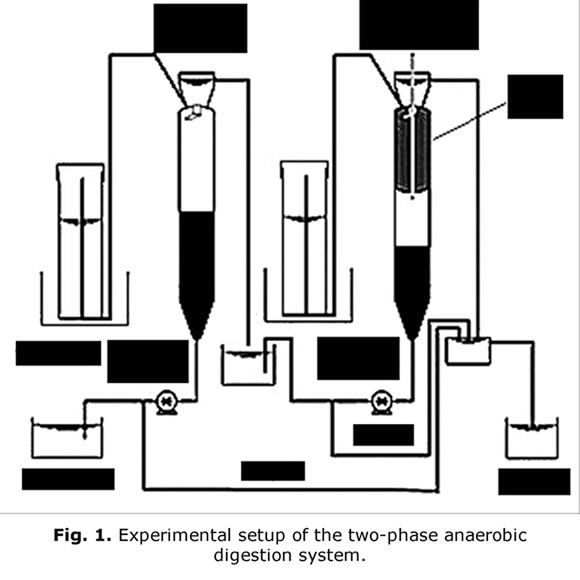
<body><![CDATA[<P>&nbsp;     <P><font face="Verdana, Arial, Helvetica, sans-serif" size="2"><B><font size="3">INTRODUCTION</font></B>    </font>      <P><font face="Verdana, Arial, Helvetica, sans-serif" size="2"> The anaerobic    digestion is a fundamental process that combined with other appropriate methods,    either aerobic or physical-chemical, can be a suitable and sustainable technology    to treat waste in developing countries. The microbiology of the anaerobic digestion    is a complex ecosystem that involves several groups of microorganisms. In the    first stage (hydrolysis), the complex organic polymers (polysaccharides, proteins    and lipids) are hydrolyzed to organic compounds more simple and soluble (sugars,    amino acids and fatty acids). The acidogenesis and acetogenesis are the second    and third phases, respectively, where the intermediate groups are degraded by    the acidogenic microorganisms forming volatile fatty acids (VFA) which are later    on converted into acetate (CH<sub>3</sub>COOH), carbon dioxide (CO<sub>2</sub>)    and hydrogen (H<sub>2</sub>) by the acetogenic bacteria. Finally, in the fourth    phase (methanogenesis), the methane is originated by the methanogenic population    (acetoclastic and hydrogenotrophic bacteria) due to the acetate conversion and    by the H<sub>2</sub>-CO<sub>2</sub> route, respectively (Pavlostatis, et al.,    1991).In the conventional process, the forming-VFA microorganisms and forming-methane    microorganisms stay together inside a reactor, where a delicate balance among    those bacteria groups must exist, since both groups differ widely in physiological    terms, nutritional needs, growth kinetic and sensitivity to the environmental    conditions (Yang, et al., 2003; Dareioti, et al., 2009). </font>      <P><font face="Verdana, Arial, Helvetica, sans-serif" size="2">Ghosh and Pohland    were the first in suggesting the physical separation of the forming-acids and    forming-methane microbial populations in two separated reactors where the optimal    conditions for each microorganism group are established, improving, therefore,    the stability and control of the process (Pohland and Ghosh, 1971). The first    reactor would be used for the VFA production and the second reactor for the    methane production. This configuration overcomes the restriction of the conventional    method of the anaerobic digestion, increasing the robustness of the system,    and facilitating a better application, control and optimization of the process    (Dareioti, et al., 2009). In addition, it allows the selection and enrichment    of the different groups of microorganisms in each separated reactor, increasing    the stability of the process by a better control of the acidogenic phase while    preventing the overload and inhibition by toxic compounds (Caramillo and Rincon,    2012). The recycle of the effluent treated in the methanogenic reactor towards    the acidogenic reactor is a method that facilitates the hydrolysis of the organic    matter in the two-phase anaerobic digestion. Similarly, it improves the extraction    conditions of the organic matter and, at the same time, the produced buffer    capacity prevents the excessive acidification in the reactor (Stabnikova, et    al. 2008). This method provides the dilution of the polluting organic load to    the anaerobic reactor and the reuse of the alkalinity produced in the process    in the acidification reactor. On the other hand, as the pH of the affluent in    this phase can be partially controlled there is a possibility of reducing the    operational costs thanks to a decrease in the amount of extra alkalinity added    to the system (Azbar, et al., 2001; Demirel and Yenigün, 2002; Kraemer and Bagley,    2005). </font>     <P><font face="Verdana, Arial, Helvetica, sans-serif" size="2">As it has been    exposed in the previous lines, the recycle of part of the effluent of a methanogenic    reactor to the hydrolysis-acidification reactor in the two-phase anaerobic digestion    system is a fundamental step to obtain the optimization of an anaerobic process.Furthermore,    economic savings can be achieved because the demand of buffer substances for    adjusting the pH of the wastewater entering the digester decreases. In consequence,    the aim of this work was to assess the operation response of a two-phase anaerobic    digestion system under recycle of part of the effluent of the methanogenic reactor    towards the acidification reactor. </font>      <P>&nbsp;      <P>      <P><font face="Verdana, Arial, Helvetica, sans-serif" size="3"><B>M&Eacute;TODOS</B></font><font face="Verdana, Arial, Helvetica, sans-serif" size="2"><B><I>    </I></B> </font>      <P><font face="Verdana, Arial, Helvetica, sans-serif" size="2"><b>Reactors </b></font>     <P><font face="Verdana, Arial, Helvetica, sans-serif" size="2"><a href="#F1">Figure    1</a> shows a scheme of the configuration of the laboratory scale anaerobic    system that was used, which consisted of two reactors that constituted the anaerobic    process. The reactors were kept at mesophilic temperature (37±1ºC) in a constant-temperature    room. Two-phase anaerobic digestion system consisted of a UASB reactor for hydrolysis-acidification    phase and a hybrid UASB-UAF reactor for acetogenesis-methanogenesis phase. In    this system, the first reactor was a glass cylindrical reactor, of 0,35 m of    height and 0,076 m of diameter and nominal volume of 2,13 L. This reactor was    equipped with a Masterflex® L/S® variable-speed modular drive (model HV-07553-75,    6-600 rpm). The second reactor was based on another glass cylinder of 0,43 m    of height and 0.076 m of diameter and nominal volume of 2,0 L. This other reactor    was fed with a Masterflex® L/S® variable-speed modular drive (model HV-07553-80,    1-100 rpm). In the upper third of the hybrid methanogenic reactor were placed    0,67 L of crushed and sieved zeolite, with a particles diameter between 2,0-4,76    mm and filter height of 0,14 m. </font>      ]]></body>
<body><![CDATA[<P align="center"><img src="/img/revistas/rcta/v23n1/f0104114.jpg" width="580" height="580"><a name="F1"></a>      
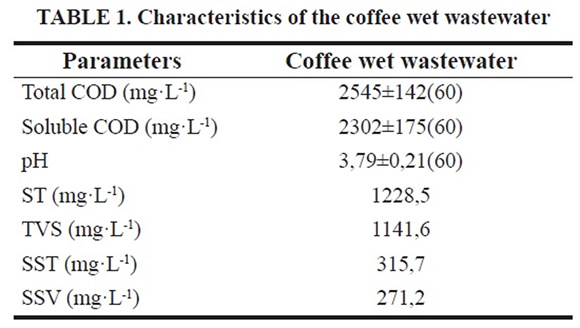
<P><font face="Verdana, Arial, Helvetica, sans-serif" size="2"><b>Feed and seed    </b></font>     <P><font face="Verdana, Arial, Helvetica, sans-serif" size="2">The inoculum used    was granular sludge coming from an industrial scale UASB reactor that processed    canned juice wastewaters having a volatile suspended solid (VSS) concentration    of 73,5 g·L<sup>-1</sup>. The laboratory reactors were fed with coffee wet processing    wastewater, located in Ixhuatlán community, Veracruz, Mexico. The composition    of the wastewater is shown in <a href="#T1">Table    1</a>. As the coffee wet processing wastewater was acid its pH had to be adjusted    using sodium bicarbonate (NaHCO<sub>3</sub>). </font>     <P align="center"><img src="/img/revistas/rcta/v23n1/t0104114.jpg" width="580" height="328"><a name="T1"></a>      
<P><font face="Verdana, Arial, Helvetica, sans-serif" size="2"><b>Experimental    procedure </b> </font>     <P><font face="Verdana, Arial, Helvetica, sans-serif" size="2">The hydrolytic-acidogenic    phase reactor and the acetogenic-methanogenic phase reactor of the two-phase    system were inoculated, respectively, with 0,64 and 0,4 L of the granular sludge    already mentioned. Once the inoculation was completed the start-up phase took    place. The start-up of the two-phase system lasted three weeks. When concluding    the three week it was considered that the systems had quasi-stationary state    conditions, so two recycle rates, 0,4 and 1,0, in a cycle of three weeks each    one, were evaluated and denominated Run1 and Run2. The characteristics of the    different evaluation conditions are detailed in <a href="/img/revistas/rcta/v23n1/t0204114.jpg">Table    2</a>. Each OLR evaluation was carried out in a period of 3 weeks. With the    aim of increasing the alkalinity available to deliver to the first reactor it    was established an internal recycle rate of 0,2 in the second reactor. </font>      
<P><font face="Verdana, Arial, Helvetica, sans-serif" size="2"><b>Analytical methods    </b></font>     <P><font face="Verdana, Arial, Helvetica, sans-serif" size="2">The alkalinity    ratio (&alpha;) was calculated as the quotient of partial alkalinity at pH 5,75    and total alkalinity at pH 4,30. Total and soluble chemical oxygen demand (COD)    analyses were carried out using a HACH COD reactor (digestion at 150ºC for 2    h) according to the closed reflux colorimetric method described in Standard    Methods for the Examination of Water and Wastewater (APHA, 1995). Volatile Fatty    Acids (VFA) were analyzed with a gas chromatograph (Chromatograph SRI model    8610, with a flame detector, Zebron column, and Helium gas carrier to 30 psi).    The biogas production was daily quantified by displacement of the liquid column    placed in each of the reactors gas meters. The methane concentration in biogas    was measured by gas chromatography (Chromatograph Fisher Gas Partitioner Model    1200, equipped with a detector of thermal conductivity, double column Porapack    Q and mesh molecular SA, with Helium gas carrier flow of 25 mL·min<sup><sup>-1</sup></sup>).    </font>      <P>&nbsp;      <P>      ]]></body>
<body><![CDATA[<P><font face="Verdana, Arial, Helvetica, sans-serif" size="3"><B>RESULTS AND DISCUSSION</B></font><font face="Verdana, Arial, Helvetica, sans-serif" size="2"><B>    </B> </font>      <P><font face="Verdana, Arial, Helvetica, sans-serif" size="2">UASB reactor for    the hydrolysis-acidogenesis phase <a href="/img/revistas/rcta/v23n1/f0204114.jpg">Figure    2a</a> shows the evolution of the pH in the effluent of the acidogenic reactor.    During the start-up stage, the system showed an average pH value in the effluent    of 6,25±0,21, once the pH of the wastewater to be treated was adjusted to an    initial value of 6,5. These conditions provided an adequate acclimatization    of theacidogenic bacteria in the start-up stage, thus achieving an adequate    substrate for the methanogenic bacteria of the next phase. Because a pH of 6,0    was the objective to reach in the effluent of the acidogenic stage, the pH of    the wastewater to treat was reduced during the Run1 assessment to values of    6,0 and 5,6 in two consecutive stages (<a href="/img/revistas/rcta/v23n1/f0204114.jpg">Figure    2a</a>). For this purpose part of the methanogenic effluent was recycled toward    the first reactor. When the recycle was induced, a larger hydraulic load having    a pH close to 8,0 coming from second reactor enters to the first reactor, causing    an eventual increase in H<SUP>+</sup> concentration in this last reactor, that    resulted in an increase of the alkalinity in the system. According to Romli,et    al., (1994), the recycle effect influences the conversion of CO<sub><sub>2</sub></sub>    dissolved to CO2 gaseous, which reduces the consumption of an alkali substance    to adjust the pH. Thus, in a two-phase anaerobic system in steady-state conditions    the use of an appropriate recycle flow will maintain to a minimum the total    operating costs. In Run1 the recycle ratio was 0,4 and it rose up to 1,0 in    Run2. For this reason two other pH drops to values of 5,5 and 5,4 were carried    out in days 50 and 57, respectively. This pH decrease resulted in an effluent    pH interval whose range was 5,80-6,13, and an average value of 6,06±1,17. This    pH interval is very close to the interval reported as optimal in the literature,    because it provides suitable environmental conditions for the hydrolytic-acidogenic    bacteria, besides providing a stable substrate for the methanogenic phase (Bouallagui,    et al., 2004; Demirer, et al. 2004, Ponsa, et al., 2008). </font>      
<P><font face="Verdana, Arial, Helvetica, sans-serif" size="2">As it is observed    in the <a href="/img/revistas/rcta/v23n1/f0204114.jpg">Figure 2b</a>, the    recycle did not have a significant effect in the alpha index, because there    were not significant differences between the average values observed in the    two recycle ratios. When all the data measured in Run1 and Run2 were considered,    the alpha index mean value was 0,27±0,02, and the alkalinity mean value was    837 mgCaCO<sub>3</sub>·L<sup>-1</sup>. Such low alpha index and alkalinity mean    values were expected since the purpose of the acidogenic phase is the VFA production.    Therefore, the high concentrations of VFA in this reactor were responsible for    the low mean values of those two variables (Leitão, et al., 2006; Perez and    Torres, 2008). <a href="/img/revistas/rcta/v23n1/f0204114.jpg">Figures    2c</a> and <a href="/img/revistas/rcta/v23n1/f0204114.jpg">2d</a> show    the VFA concentrations and the COD removal efficiency behavior in the effluent    of the acidogenic reactor for the two recycle rates evaluated. The compounds    that resulted in this second experiment with recycle were acetic acid (55-56%),    propionic acid (34-35%) and butyric acid (9-11%), and their respective concentrations    were 388-418 mg·L<sup>-1</sup>, 243-261 mg·L<sup><sup>-1</sup></sup> and 65-85    mg·L<sup>-1</sup>. On the other hand, the interval of the COD removal efficiency    varied within the range of 32-38% for both conditions (Run1 and Run2), and the    average acidification degree was 35±3%. The analysis of each VFA group showed    that the recycle did not influence in the relative composition of them, indicating    that the recycle did not affect the degradation pattern of the residual. Romli    et al. (1994) observed a similar situation and they reported that the increase    of the recycle has the effect of diluting the VFA and the wastewater concentration    to treat. Biogas production and methane concentration are observed in the <a href="/img/revistas/rcta/v23n1/f0204114.jpg">Figure    2e</a>. The biogas production and methane concentration achieved average values    of 0,72±0,17 m<sup>3</sup>·kgCOD<sup>-1</sup><sub>rem</sub>·d<sup>-1</sup> and    15±1,7%, respectively. </font>      
<P><font face="Verdana, Arial, Helvetica, sans-serif" size="2"><b>Hybrid UASB-UAF    reactor for the acetogenic-methanogenic phase </b></font>     <P><font face="Verdana, Arial, Helvetica, sans-serif" size="2">Effluent pH values    of the methanogenic reactor were observed in the interval of 7,68-8,03, with    an average value of 7,9±0,3 (<a href="/img/revistas/rcta/v23n1/f0204114.jpg">Figure    2a</a>). This pH interval allows concluding that an appropriate performance    of the methanogenic phase was achieved. Alpha index values were measured in    a range of 0,55-0,68 (<a href="/img/revistas/rcta/v23n1/f0204114.jpg">Figure    2b</a>) and the total alkalinity mean value was 1231±93 mgCaCO<sub>3</sub>·L<sup>-1</sup>.    The main pH buffer compounds in an anaerobic reactor are the alkalinity produced    by ions bicarbonates (titration until pH 5,75) and the VFA (titration until    pH 4,3) (Hass, and Adam, 1995). The limiting steps of this two-stage treatment    were the last two phases of the anaerobic process (acetogenesis and methanogenesis)    because this agro-industrial wastewater consisted of high carbohydrate concentrations.    Taking into account the values of total alkalinity reached, they provided adequate    buffering capacity to prevent any VFA accumulation and the imbalance of the    system. A factor that affects an anaerobic system is the organic overload generated    by the frequent variation in the amount and concentration of this sort of wastewaters    due to the variability of the coffee grain harvest. This phenomenon hampers    OLR control, inducing a potential risk of overloading the anaerobic reactor    by the application of an OLR higher than the one applied initially. </font>      
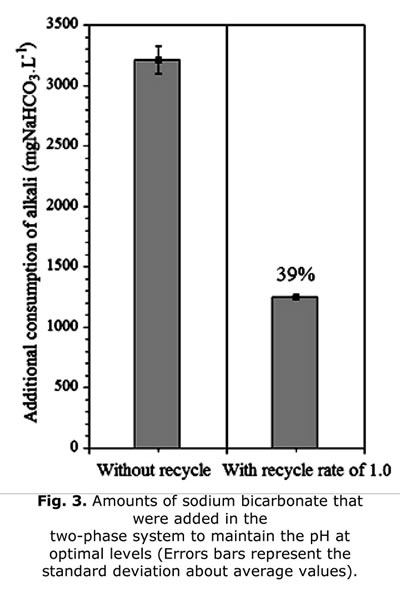
<P><font face="Verdana, Arial, Helvetica, sans-serif" size="2">The effluent recycle    from the methanogenic reactor towards the acidogenic reactor reduced the sodium    bicarbonate consumption required in the latter to increase the pH of the incoming    wastewater. In <a href="#F3">Figure 3</a>    can be seen the amounts of sodium bicarbonate that were added in the acidogenic    reactor to maintain the pH at optimal levels. A decrease of 39% in the sodium    bicarbonate consumption was reached by the two-phase system with the recycle    rate of 1,0, because it increased the alkalinity in the acidogenic reactor.    These results confirm that the recycle enables to decrease the operation costs    in a two-phase anaerobic system, due to smaller alkalinity consumption. This    observation agrees with what has been reported by other authors. For example,    in a study carried out by Kida and Sonoda (1992), the alkalinity consumption    decreased from 2,6 g L<sup>-1</sup> to 2,2 g·L<sup>-1</sup> with the introduction    of the effluent recycle from the gasification reactor to the liquefaction reactor,    with the use of CSTR and AFBR reactors for the acidification and methanogenesis    stages, respectively. According to Romli, et al., (1994), an increase of the    recycle rate is inversely proportional to the decrease of the additional alkalinity    consumption in an anaerobic reactor. Therefore, the effluent recycle allows    decreasing the use of an alkaline substance, so it influences significantly    in the operation cost of an anaerobic system. </font>     <P align="center"><img src="/img/revistas/rcta/v23n1/f0304114.jpg" width="400" height="596"><a name="F3"></a>      
<P><font face="Verdana, Arial, Helvetica, sans-serif" size="2">Average acetic    and propionic acid concentrations in the effluent were of 76±21 mg L<sup>-1</sup>    and 43±7 mg·L<sup>-1</sup>, respectively, whereas the butyric acid concentration    was below the chromatograph detection limit. It was observed a tendency toward    a decrease of the VFA concentration with the introduction of recycle (<a href="/img/revistas/rcta/v23n1/f0204114.jpg">Figure    2c</a>), indicating that the anaerobic methanogenic microorganisms were stimulated    by this factor because the amount of VFA degraded was higher than without recycle.    Recycle allows a better distribution of the anaerobic bacteria, a higher dispersion    of the metabolic products produced, and a greater nutrient diffusion. Observed    VFA concentration values were lower than the VFA levels reported as inhibitory    of the methanogenic bacteria (Wang, et al., 2009). Therefore, the environmental    conditions existing in the methanogenic reactor were adequate for the fast conversion    of intermediate products of the anaerobic metabolism. </font>      
<P><font face="Verdana, Arial, Helvetica, sans-serif" size="2">A beneficial effect    of the recycle in terms of the organic polluting degradation was observed. The    average total COD removal was 90±1%, while for the soluble COD removal it was    93,2±0,87% (<a href="/img/revistas/rcta/v23n1/f0204114.jpg">Figure 2d</a>).    In the hybrid reactor UASB-UAF, the development of a microbial biofilm attached    to an inert medium (zeolite) produced a greater retention of active biomass,    thus enhancing stability in the two-phase system. Other authors have reported    similar results (Parawira, et al., 2006; Zinatizadeh, et al., 2006 a,b; Singh    and Prerna, 2009; Selvamurugan, et al., 2010). Recycle also allowed the increase    of the applied OLR in the anaerobic system in two-phases. An increase of the    OLR of up to 5,7 kgCOD·m<sup>-3</sup>·d<sup>-1</sup> did not affect the performance    of the process, maintaining high degradation efficiencies of the organic matter    (<a href="/img/revistas/rcta/v23n1/f0204114.jpg">Figure 2d</a>). Several    authors have confirmed that the methanogenic hybrid UASB-UAF reactor is very    efficient in retaining high amounts of biomass under conditions of applied organic    overload (Zinatizadeh, et al., 2006 a,b; Singh and Prerna, 2009). </font>      
<P><font face="Verdana, Arial, Helvetica, sans-serif" size="2">The average total    biogas production in the methanogenic reactor of the two-phase system was 0,13±0,02m<sup>3</sup>·kgCOD<sup>-1</sup><sub>rem</sub>·d<sup>-1</sup>.    In Run1, when a recycle rate of 0,4 in the acidogenic reactor was considered,    the methane concentration in the biogas produced varied in an interval of 59-67%;    whereas increasing the recycle rate to 1.0 in the same reactor, the methane    concentration decreased to 52-59%; which indicated that the increase in the    recycle rate decreased the methane concentration in the biogas. According to    Romli et al. (1994), an increase in the recycle rate eventually increases the    CO<sub>2</sub> production in the biogas. </font>      ]]></body>
<body><![CDATA[<P>&nbsp;     <P><font face="Verdana, Arial, Helvetica, sans-serif" size="3"><b>CONCLUSIONS    </b></font>     <P><font face="Verdana, Arial, Helvetica, sans-serif" size="2">In the two-phase    anaerobic digestion system, recycle cased an alkalinity reutilization that resulted    in a rise in the pH of the acidogenic reactor. </font>     <P><font face="Verdana, Arial, Helvetica, sans-serif" size="2">There circulation    did not affect the VFA production in the acidogenic anaerobic reactor, but reduced    its concentration in the effluent. </font>     <P><font face="Verdana, Arial, Helvetica, sans-serif" size="2">Total and soluble    COD removal efficiency in the two-phase system was higher, reaching values above    90%. </font>     <P><font face="Verdana, Arial, Helvetica, sans-serif" size="2">In the two-phase    system with a recycle rate of 1,0 from the acidogenic reactor to the methanogenic    reactor, the consumption of sodium bicarbonate was 39% lower than same conditions    without recycle. Recycle increased the OLR applied in the two-phase system without    being affected the COD efficiency removal, but at the expense of a decrease    in the concentration of methane in the biogas. </font>     <P>&nbsp;     <P><font face="Verdana, Arial, Helvetica, sans-serif" size="3"><b>ACKNOWLEDGEMENTS</b></font>     <P><font face="Verdana, Arial, Helvetica, sans-serif" size="2"> The authors would    like to thank the support from Dr. Adalberto Noyola-Robles, Dr. Juan Morgan-Sagastume,M.Sc.    Margarita Cisneros and Ing. Roberto Briones, technicians at UNAM (Mexico D.F.,    Mexico),The support of Agro-Industrias Unidas de México S.A. is gratefully acknowledged.    The senior author would like to thanks the SEP of Mexico and the UPM (Madrid,    Spain) the scholarships granted.</font>     <P><font face="Verdana, Arial, Helvetica, sans-serif" size="2"><b>Nota:</b> La    mención de marcas comerciales de equipos, instrumentos o materiales específicos    obedece a propósitos de identificación, no existiendo ningún compromiso promocional    con relación a los mismos, ni por los autores ni por el editor. </font>      ]]></body>
<body><![CDATA[<P>&nbsp;     <P>&nbsp;      <P>     <P>     <P>      <P><font face="Verdana, Arial, Helvetica, sans-serif" size="3"><B>REFERENCIAS    BIBLIOGR&Aacute;FICAS</B></font><font face="Verdana, Arial, Helvetica, sans-serif" size="2">    </font>      <!-- ref --><P><font face="Verdana, Arial, Helvetica, sans-serif" size="2">1. AZBAR, N., URSILLO,    P., SPEECE, R.: “Effect of process configuration and substrate complexity on    the performance of anaerobic processes”, <i>Wat. Res.</i>, No. 35: 817-829:    2001.     </font>      <!-- ref --><P><font face="Verdana, Arial, Helvetica, sans-serif" size="2">2. BOUALLAGUI,    H., TORRIJOS, M., GODON, J., MOLCTTA, R., CHEIKH, R., TOUHAMI, Y., DELGENES,    J., HAMDI, M.: “Two-phase anaerobic digestion of fruit and vegetable wastes:    Bioreactors performance”, <i>J. Biochem. Eng</i>., (21): 193-197, 2004.     </font>      ]]></body>
<body><![CDATA[<!-- ref --><P><font face="Verdana, Arial, Helvetica, sans-serif" size="2">3. CARAMILLO, R.,    RINCON, J.: “Effect of inhibitory compounds on the two-phase anaerobic digestion    performance of diluted wastewaters from the alimentary industry”, <i>Chem. Eng.    J.</i>, (193-194): 68-76, 2012.     </font>      <!-- ref --><P><font face="Verdana, Arial, Helvetica, sans-serif" size="2">4. DAREIOTI, M.,    DOKIANAKIS, S., STAMATELATOU, K., ZAFIRI, C., KORNAROS, M.: “Biogas production    from anaerobic co-digestion of agroindustrial wastewaters under mesophilic conditions    in a two-stage process”, <i>Desalination</i>, (248): 891-906, 2009.     </font>      <!-- ref --><P><font face="Verdana, Arial, Helvetica, sans-serif" size="2">5. DEMIRER, G.,    CHEN, S.: “Effects of retention time and organic loading rate on anaerobic acidification    and biogasification of dairy manure”, <i>J. Chem. Technol. Biotechnol.</i>,    (79): 1381-1387, 2004.     </font>      <!-- ref --><P><font face="Verdana, Arial, Helvetica, sans-serif" size="2">6. HASS, D., ADAM,    N.: “Use of a simple titration procedure to determinate H2CO3 alkalinity and    volatile fatty acids for process control in waste-water treatment”, <i>Water    SA</i>, (21): 307-318, 1995.     </font>      <!-- ref --><P><font face="Verdana, Arial, Helvetica, sans-serif" size="2">7. KIDA, K., SONODA,    Y.: “Treatment of coffee waste by slurry-state anaerobic digestion”, <i>J. Ferment.    Bioeng.</i>, (69): 354-359, 1992.     </font>      ]]></body>
<body><![CDATA[<!-- ref --><P><font face="Verdana, Arial, Helvetica, sans-serif" size="2">8. KRAEMER, J.,    BAGLEY, D.: “Continuous fermentative hydrogen production using a two-phase reactor    system with recycle”, <i>Environ. Sci. Technol.</i>, (39): 3819-3825, 2005.        </font>      <!-- ref --><P><font face="Verdana, Arial, Helvetica, sans-serif" size="2">9. LEITÃO, R.,    HAANDEL, A., ZEEMAN, G., LETTINGA, G.: “The effects of operational and environmental    variations on anaerobic wastewater treatment system: A review”, <i>Bioresour.    Technol.</i>, (97): 1105-1118 2006.     </font>      <!-- ref --><P><font face="Verdana, Arial, Helvetica, sans-serif" size="2">10. PARAWIRA, W.,    MURTO, M., ZUAUYA, R., MATTIASSON, B.: “Comparative performance of a UASB reactor    and an anaerobic packed-bed reactor when treating potato waste leachate”, <i>Renew.    Energy.</i>, (31): 893-903 2006.     </font>      <!-- ref --><P><font face="Verdana, Arial, Helvetica, sans-serif" size="2">11. PAVLOSTATHIS,    S., GIRALDO-GOMEZ, E.: “Kinetics of anaerobic treatment: a critical review”,    <i>Crit. Rev. Environ. Control</i>, (21): 411-490, 1991.     </font>      <!-- ref --><P><font face="Verdana, Arial, Helvetica, sans-serif" size="2">12. PEREZ, A.,    TORRES, P.: “Índices de alcalinidad para el control del tratamiento anaerobio    de las aguas residuales fácilmente acidificables”, <i>Ingeniería Sanitaria</i>,    (10): 41-52, 2008.     </font>      ]]></body>
<body><![CDATA[<!-- ref --><P><font face="Verdana, Arial, Helvetica, sans-serif" size="2">13. POHLAND, F.,    GHOSH, S.: “Developments in anaerobic stabilization of organic wastes: The two-phase    concept”, <i>Envir. Letters</i>, (1): 255-266, 1971.     </font>      <!-- ref --><P><font face="Verdana, Arial, Helvetica, sans-serif" size="2">14. PONSA, S.,    FERRER, I.., VAZQUEZ, F., FONT, X.: “Optimization of the hydrolytic-acidogenic    anaerobic digestion stage (55ºC) of sewage sludge”, <i>Wat. Res.</i>, (42):    3972-3980, 2008.     </font>      <!-- ref --><P><font face="Verdana, Arial, Helvetica, sans-serif" size="2">15. ROMLI, M.,    GREENFIELD, P., LEE, P.: “Effect of recycle on a two-phase high-rate anaerobic    wastewater treatment system”, <i>Wat. Res.</i>, (28): 475-482, 1994.     </font>      <!-- ref --><P><font face="Verdana, Arial, Helvetica, sans-serif" size="2">16. SELVAMURUGAN,    M., DORAISAMY, P., MAHESWARI, M.: “An integrated treatment system for coffee    processing wastewater using anaerobic and aerobic process”, <i>Ecological Engineering</i>,    (36): 1686-1960, 2010.     </font>      <!-- ref --><P><font face="Verdana, Arial, Helvetica, sans-serif" size="2">17. STABNIKOVA,    O., XUE-YAN, L., JING-YUAN, W.: “Anaerobic digestion of food waste in a hybrid    anaerobic solid-liquid system with leachate recirculation in an acidogenic reactor”,    <i>Biochem. Eng. J.</i>, (41): 198-201, 2008.     </font>      ]]></body>
<body><![CDATA[<!-- ref --><P><font face="Verdana, Arial, Helvetica, sans-serif" size="2">18. WANG, Y., ZHANG,    Y., WANG, J., MENG, L.: “Effects of volatile fatty acid concentrations on methane    yield and methanogenic bacteria”, <i>Biomass & Bioenergy</i>, (33): 848-853,    2009.     </font>      <!-- ref --><P><font face="Verdana, Arial, Helvetica, sans-serif" size="2">19. YANG, K., YU,    Y., HWANG, S.: “Selective optimization in thermophilicacidogenesis of the cheese-whey    wastewater to acid acetic and butyric acids: partial acidification and methanation”,    <i>Wat. Res.</i>, (37): 2467-2477, 2003.     </font>      <!-- ref --><P><font face="Verdana, Arial, Helvetica, sans-serif" size="2">20. ZINATIZADEH,    A., MOHAMED, A., ABDULLAH, A., MASHITAH, A., ISA, M., NAJAFPOUR, D.: “Process    modeling and analysis of palm oil mill effluent treatment in an up-flow anaerobic    sludge fixed film bioreactor using response surface methodology (RMS)”, <i>Wat.    Res.</i>, (40): 3193-3208, 2006.     </font>      <!-- ref --><P><font face="Verdana, Arial, Helvetica, sans-serif" size="2">21. ZINATIZADEH,    A., MOHAMED, A., NAJAFPOUR, D., ISA, M., NASROLLAHZADEH, H.: “Kinetic evaluation    of high rate POME digestion in an UASFF bioreactor”, <i>Process Biochem.</i>,    (41): 1038-1046, 2006.     </font>      <P>&nbsp;     <P>&nbsp;      ]]></body>
<body><![CDATA[<P>     <P>     <P>      <P>      <P><font face="Verdana, Arial, Helvetica, sans-serif" size="2"><b>Recibido:</b>    20 de mayo de 2012.    <BR>   <b>Aprobado:</b> 5 de septiembre de 2013. </font>      <P>&nbsp;     <P>&nbsp;      <P>     <P>     ]]></body>
<body><![CDATA[<P>      <P>      <P><font face="Verdana, Arial, Helvetica, sans-serif" size="2"><I>Yans Guardia Puebla</I>. Universidad de Granma (UDG), Departamento de Ciencias Técnicas, Carretera Manzanillo, km 17 ½, Peralejo, Bayamo, CP 85100, Cuba. Correo electr&oacute;nico: <U><FONT COLOR="#0000ff"><a href="mailto:yguardiap@udg.co.cu">yguardiap@udg.co.cu</a></FONT></U>    </font>       ]]></body>
<back>
<ref-list>
<ref id="B1">
<label>1</label><nlm-citation citation-type="journal">
<person-group person-group-type="author">
<name>
<surname><![CDATA[AZBAR]]></surname>
<given-names><![CDATA[N.]]></given-names>
</name>
<name>
<surname><![CDATA[URSILLO]]></surname>
<given-names><![CDATA[P.]]></given-names>
</name>
<name>
<surname><![CDATA[SPEECE]]></surname>
<given-names><![CDATA[R.]]></given-names>
</name>
</person-group>
<article-title xml:lang="en"><![CDATA[Effect of process configuration and substrate complexity on the performance of anaerobic processes]]></article-title>
<source><![CDATA[Wat. Res.]]></source>
<year>2001</year>
<numero>35</numero>
<issue>35</issue>
<page-range>817-829</page-range></nlm-citation>
</ref>
<ref id="B2">
<label>2</label><nlm-citation citation-type="journal">
<person-group person-group-type="author">
<name>
<surname><![CDATA[BOUALLAGUI]]></surname>
<given-names><![CDATA[H.]]></given-names>
</name>
<name>
<surname><![CDATA[TORRIJOS]]></surname>
<given-names><![CDATA[M.]]></given-names>
</name>
<name>
<surname><![CDATA[GODON]]></surname>
<given-names><![CDATA[J.]]></given-names>
</name>
<name>
<surname><![CDATA[MOLCTTA]]></surname>
<given-names><![CDATA[R.]]></given-names>
</name>
<name>
<surname><![CDATA[CHEIKH]]></surname>
<given-names><![CDATA[R.]]></given-names>
</name>
<name>
<surname><![CDATA[TOUHAMI]]></surname>
<given-names><![CDATA[Y.]]></given-names>
</name>
<name>
<surname><![CDATA[DELGENES]]></surname>
<given-names><![CDATA[J.]]></given-names>
</name>
<name>
<surname><![CDATA[HAMDI]]></surname>
<given-names><![CDATA[M.]]></given-names>
</name>
</person-group>
<article-title xml:lang="en"><![CDATA[“Two-phase anaerobic digestion of fruit and vegetable wastes: Bioreactors performance]]></article-title>
<source><![CDATA[J. Biochem. Eng.]]></source>
<year>2004</year>
<numero>21</numero>
<issue>21</issue>
<page-range>193-197</page-range></nlm-citation>
</ref>
<ref id="B3">
<label>3</label><nlm-citation citation-type="journal">
<person-group person-group-type="author">
<name>
<surname><![CDATA[CARAMILLO]]></surname>
<given-names><![CDATA[R.]]></given-names>
</name>
<name>
<surname><![CDATA[RINCON]]></surname>
<given-names><![CDATA[J.]]></given-names>
</name>
</person-group>
<article-title xml:lang="en"><![CDATA[Effect of inhibitory compounds on the two-phase anaerobic digestion performance of diluted wastewaters from the alimentary industry]]></article-title>
<source><![CDATA[Chem. Eng. J.]]></source>
<year>2012</year>
<numero>193-194</numero>
<issue>193-194</issue>
<page-range>68-76</page-range></nlm-citation>
</ref>
<ref id="B4">
<label>4</label><nlm-citation citation-type="journal">
<person-group person-group-type="author">
<name>
<surname><![CDATA[DAREIOTI]]></surname>
<given-names><![CDATA[M.]]></given-names>
</name>
<name>
<surname><![CDATA[DOKIANAKIS]]></surname>
<given-names><![CDATA[S.]]></given-names>
</name>
<name>
<surname><![CDATA[STAMATELATOU]]></surname>
<given-names><![CDATA[K.]]></given-names>
</name>
<name>
<surname><![CDATA[ZAFIRI]]></surname>
<given-names><![CDATA[C.]]></given-names>
</name>
<name>
<surname><![CDATA[KORNAROS]]></surname>
<given-names><![CDATA[M.]]></given-names>
</name>
</person-group>
<article-title xml:lang="en"><![CDATA[Biogas production from anaerobic co-digestion of agroindustrial wastewaters under mesophilic conditions in a two-stage process]]></article-title>
<source><![CDATA[Desalination]]></source>
<year>2009</year>
<numero>248</numero>
<issue>248</issue>
<page-range>891-906</page-range></nlm-citation>
</ref>
<ref id="B5">
<label>5</label><nlm-citation citation-type="journal">
<person-group person-group-type="author">
<name>
<surname><![CDATA[DEMIRER]]></surname>
<given-names><![CDATA[G.]]></given-names>
</name>
<name>
<surname><![CDATA[CHEN]]></surname>
<given-names><![CDATA[S.]]></given-names>
</name>
</person-group>
<article-title xml:lang="en"><![CDATA[Effects of retention time and organic loading rate on anaerobic acidification and biogasification of dairy manure]]></article-title>
<source><![CDATA[J. Chem. Technol. Biotechnol.]]></source>
<year>2004</year>
<numero>79</numero>
<issue>79</issue>
<page-range>1381-1387</page-range></nlm-citation>
</ref>
<ref id="B6">
<label>6</label><nlm-citation citation-type="journal">
<person-group person-group-type="author">
<name>
<surname><![CDATA[HASS]]></surname>
<given-names><![CDATA[D.]]></given-names>
</name>
<name>
<surname><![CDATA[ADAM]]></surname>
<given-names><![CDATA[N.]]></given-names>
</name>
</person-group>
<article-title xml:lang="en"><![CDATA[Use of a simple titration procedure to determinate H2CO3 alkalinity and volatile fatty acids for process control in waste-water treatment]]></article-title>
<source><![CDATA[Water SA]]></source>
<year>1995</year>
<numero>21</numero>
<issue>21</issue>
<page-range>307-318</page-range></nlm-citation>
</ref>
<ref id="B7">
<label>7</label><nlm-citation citation-type="journal">
<person-group person-group-type="author">
<name>
<surname><![CDATA[KIDA]]></surname>
<given-names><![CDATA[K.]]></given-names>
</name>
<name>
<surname><![CDATA[SONODA]]></surname>
<given-names><![CDATA[Y.]]></given-names>
</name>
</person-group>
<article-title xml:lang="en"><![CDATA[Treatment of coffee waste by slurry-state anaerobic digestion]]></article-title>
<source><![CDATA[J. Ferment. Bioeng.]]></source>
<year>1992</year>
<numero>69</numero>
<issue>69</issue>
<page-range>354-359</page-range></nlm-citation>
</ref>
<ref id="B8">
<label>8</label><nlm-citation citation-type="journal">
<person-group person-group-type="author">
<name>
<surname><![CDATA[KRAEMER]]></surname>
<given-names><![CDATA[J.]]></given-names>
</name>
<name>
<surname><![CDATA[BAGLEY]]></surname>
<given-names><![CDATA[D.]]></given-names>
</name>
</person-group>
<article-title xml:lang="en"><![CDATA[Continuous fermentative hydrogen production using a two-phase reactor system with recycle]]></article-title>
<source><![CDATA[Environ. Sci. Technol.]]></source>
<year>2005</year>
<numero>39</numero>
<issue>39</issue>
<page-range>3819-3825</page-range></nlm-citation>
</ref>
<ref id="B9">
<label>9</label><nlm-citation citation-type="journal">
<person-group person-group-type="author">
<name>
<surname><![CDATA[LEITÃO]]></surname>
<given-names><![CDATA[R.]]></given-names>
</name>
<name>
<surname><![CDATA[HAANDEL]]></surname>
<given-names><![CDATA[A.]]></given-names>
</name>
<name>
<surname><![CDATA[ZEEMAN]]></surname>
<given-names><![CDATA[G.]]></given-names>
</name>
<name>
<surname><![CDATA[LETTINGA]]></surname>
<given-names><![CDATA[G.]]></given-names>
</name>
</person-group>
<article-title xml:lang="en"><![CDATA[The effects of operational and environmental variations on anaerobic wastewater treatment system: A review]]></article-title>
<source><![CDATA[Bioresour. Technol.]]></source>
<year>2006</year>
<numero>97</numero>
<issue>97</issue>
<page-range>1105-1118</page-range></nlm-citation>
</ref>
<ref id="B10">
<label>10</label><nlm-citation citation-type="journal">
<person-group person-group-type="author">
<name>
<surname><![CDATA[PARAWIRA]]></surname>
<given-names><![CDATA[W.]]></given-names>
</name>
<name>
<surname><![CDATA[MURTO]]></surname>
<given-names><![CDATA[M.]]></given-names>
</name>
<name>
<surname><![CDATA[ZUAUYA]]></surname>
<given-names><![CDATA[R.]]></given-names>
</name>
<name>
<surname><![CDATA[MATTIASSON]]></surname>
<given-names><![CDATA[B.]]></given-names>
</name>
</person-group>
<article-title xml:lang="en"><![CDATA[Comparative performance of a UASB reactor and an anaerobic packed-bed reactor when treating potato waste leachate]]></article-title>
<source><![CDATA[Renew. Energy.]]></source>
<year>2006</year>
<numero>31</numero>
<issue>31</issue>
<page-range>893-903</page-range></nlm-citation>
</ref>
<ref id="B11">
<label>11</label><nlm-citation citation-type="journal">
<person-group person-group-type="author">
<name>
<surname><![CDATA[PAVLOSTATHIS]]></surname>
<given-names><![CDATA[S.]]></given-names>
</name>
<name>
<surname><![CDATA[GIRALDO-GOMEZ]]></surname>
<given-names><![CDATA[E.]]></given-names>
</name>
</person-group>
<article-title xml:lang="en"><![CDATA[“Kinetics of anaerobic treatment: a critical review]]></article-title>
<source><![CDATA[Crit. Rev. Environ. Control]]></source>
<year>1991</year>
<numero>21</numero>
<issue>21</issue>
<page-range>411-490</page-range></nlm-citation>
</ref>
<ref id="B12">
<label>12</label><nlm-citation citation-type="journal">
<person-group person-group-type="author">
<name>
<surname><![CDATA[PEREZ]]></surname>
<given-names><![CDATA[A.]]></given-names>
</name>
<name>
<surname><![CDATA[TORRES]]></surname>
<given-names><![CDATA[P.]]></given-names>
</name>
</person-group>
<article-title xml:lang="es"><![CDATA[Índices de alcalinidad para el control del tratamiento anaerobio de las aguas residuales fácilmente acidificables]]></article-title>
<source><![CDATA[Ingeniería Sanitaria]]></source>
<year>2008</year>
<numero>10</numero>
<issue>10</issue>
<page-range>41-52</page-range></nlm-citation>
</ref>
<ref id="B13">
<label>13</label><nlm-citation citation-type="journal">
<person-group person-group-type="author">
<name>
<surname><![CDATA[POHLAND]]></surname>
<given-names><![CDATA[F.]]></given-names>
</name>
<name>
<surname><![CDATA[GHOSH]]></surname>
<given-names><![CDATA[S.]]></given-names>
</name>
</person-group>
<article-title xml:lang="en"><![CDATA[Developments in anaerobic stabilization of organic wastes: The two-phase concept]]></article-title>
<source><![CDATA[Envir. Letters]]></source>
<year>1971</year>
<numero>1</numero>
<issue>1</issue>
<page-range>255-266</page-range></nlm-citation>
</ref>
<ref id="B14">
<label>14</label><nlm-citation citation-type="journal">
<person-group person-group-type="author">
<name>
<surname><![CDATA[PONSA]]></surname>
<given-names><![CDATA[S.]]></given-names>
</name>
<name>
<surname><![CDATA[FERRER]]></surname>
<given-names><![CDATA[I.]]></given-names>
</name>
<name>
<surname><![CDATA[VAZQUEZ]]></surname>
<given-names><![CDATA[F.]]></given-names>
</name>
<name>
<surname><![CDATA[FONT]]></surname>
<given-names><![CDATA[X.]]></given-names>
</name>
</person-group>
<article-title xml:lang="en"><![CDATA[Optimization of the hydrolytic-acidogenic anaerobic digestion stage (55ºC) of sewage sludge]]></article-title>
<source><![CDATA[Wat. Res.]]></source>
<year>2008</year>
<numero>42</numero>
<issue>42</issue>
<page-range>3972-3980</page-range></nlm-citation>
</ref>
<ref id="B15">
<label>15</label><nlm-citation citation-type="journal">
<person-group person-group-type="author">
<name>
<surname><![CDATA[ROMLI]]></surname>
<given-names><![CDATA[M.]]></given-names>
</name>
<name>
<surname><![CDATA[GREENFIELD]]></surname>
<given-names><![CDATA[P.]]></given-names>
</name>
<name>
<surname><![CDATA[LEE]]></surname>
<given-names><![CDATA[P.]]></given-names>
</name>
</person-group>
<article-title xml:lang="en"><![CDATA[Effect of recycle on a two-phase high-rate anaerobic wastewater treatment system]]></article-title>
<source><![CDATA[Wat. Res.]]></source>
<year>1994</year>
<numero>28</numero>
<issue>28</issue>
<page-range>475-482</page-range></nlm-citation>
</ref>
<ref id="B16">
<label>16</label><nlm-citation citation-type="journal">
<person-group person-group-type="author">
<name>
<surname><![CDATA[SELVAMURUGAN]]></surname>
<given-names><![CDATA[M.]]></given-names>
</name>
<name>
<surname><![CDATA[DORAISAMY]]></surname>
<given-names><![CDATA[P.]]></given-names>
</name>
<name>
<surname><![CDATA[MAHESWARI]]></surname>
<given-names><![CDATA[M.]]></given-names>
</name>
</person-group>
<article-title xml:lang="en"><![CDATA[An integrated treatment system for coffee processing wastewater using anaerobic and aerobic process]]></article-title>
<source><![CDATA[Ecological Engineering]]></source>
<year>2010</year>
<numero>36</numero>
<issue>36</issue>
<page-range>1686-1960</page-range></nlm-citation>
</ref>
<ref id="B17">
<label>17</label><nlm-citation citation-type="journal">
<person-group person-group-type="author">
<name>
<surname><![CDATA[STABNIKOVA]]></surname>
<given-names><![CDATA[O.]]></given-names>
</name>
<name>
<surname><![CDATA[XUE-YAN]]></surname>
<given-names><![CDATA[L.]]></given-names>
</name>
<name>
<surname><![CDATA[JING-YUAN]]></surname>
<given-names><![CDATA[W.]]></given-names>
</name>
</person-group>
<article-title xml:lang="en"><![CDATA[Anaerobic digestion of food waste in a hybrid anaerobic solid-liquid system with leachate recirculation in an acidogenic reactor]]></article-title>
<source><![CDATA[Biochem. Eng. J.]]></source>
<year>2008</year>
<numero>41</numero>
<issue>41</issue>
<page-range>198-201</page-range></nlm-citation>
</ref>
<ref id="B18">
<label>18</label><nlm-citation citation-type="journal">
<person-group person-group-type="author">
<name>
<surname><![CDATA[WANG]]></surname>
<given-names><![CDATA[Y.]]></given-names>
</name>
<name>
<surname><![CDATA[ZHANG]]></surname>
<given-names><![CDATA[Y.]]></given-names>
</name>
<name>
<surname><![CDATA[WANG]]></surname>
<given-names><![CDATA[J.]]></given-names>
</name>
<name>
<surname><![CDATA[MENG]]></surname>
<given-names><![CDATA[L.]]></given-names>
</name>
</person-group>
<article-title xml:lang="en"><![CDATA[Effects of volatile fatty acid concentrations on methane yield and methanogenic bacteria]]></article-title>
<source><![CDATA[Biomass & Bioenergy]]></source>
<year>2009</year>
<numero>33</numero>
<issue>33</issue>
<page-range>848-853</page-range></nlm-citation>
</ref>
<ref id="B19">
<label>19</label><nlm-citation citation-type="journal">
<person-group person-group-type="author">
<name>
<surname><![CDATA[YANG]]></surname>
<given-names><![CDATA[K.]]></given-names>
</name>
<name>
<surname><![CDATA[YU]]></surname>
<given-names><![CDATA[Y.]]></given-names>
</name>
<name>
<surname><![CDATA[HWANG]]></surname>
<given-names><![CDATA[S.]]></given-names>
</name>
</person-group>
<article-title xml:lang="en"><![CDATA[Selective optimization in thermophilicacidogenesis of the cheese-whey wastewater to acid acetic and butyric acids: partial acidification and methanation]]></article-title>
<source><![CDATA[Wat. Res.]]></source>
<year>2003</year>
<numero>37</numero>
<issue>37</issue>
<page-range>2467-2477</page-range></nlm-citation>
</ref>
<ref id="B20">
<label>20</label><nlm-citation citation-type="journal">
<person-group person-group-type="author">
<name>
<surname><![CDATA[ZINATIZADEH]]></surname>
<given-names><![CDATA[A.]]></given-names>
</name>
<name>
<surname><![CDATA[MOHAMED]]></surname>
<given-names><![CDATA[A.]]></given-names>
</name>
<name>
<surname><![CDATA[ABDULLAH]]></surname>
<given-names><![CDATA[A.]]></given-names>
</name>
<name>
<surname><![CDATA[MASHITAH]]></surname>
<given-names><![CDATA[A.]]></given-names>
</name>
<name>
<surname><![CDATA[ISA]]></surname>
<given-names><![CDATA[M.]]></given-names>
</name>
<name>
<surname><![CDATA[NAJAFPOUR]]></surname>
<given-names><![CDATA[D.]]></given-names>
</name>
</person-group>
<article-title xml:lang="en"><![CDATA[Process modeling and analysis of palm oil mill effluent treatment in an up-flow anaerobic sludge fixed film bioreactor using response surface methodology (RMS)]]></article-title>
<source><![CDATA[Wat. Res.]]></source>
<year>2006</year>
<numero>40</numero>
<issue>40</issue>
<page-range>3193-3208</page-range></nlm-citation>
</ref>
<ref id="B21">
<label>21</label><nlm-citation citation-type="journal">
<person-group person-group-type="author">
<name>
<surname><![CDATA[MASHITAH]]></surname>
<given-names><![CDATA[A.]]></given-names>
</name>
<name>
<surname><![CDATA[ABDULLAH]]></surname>
<given-names><![CDATA[A.]]></given-names>
</name>
<name>
<surname><![CDATA[MOHAMED]]></surname>
<given-names><![CDATA[A.]]></given-names>
</name>
<name>
<surname><![CDATA[ZINATIZADEH]]></surname>
<given-names><![CDATA[A.]]></given-names>
</name>
<name>
<surname><![CDATA[NASROLLAHZADEH]]></surname>
<given-names><![CDATA[H.]]></given-names>
</name>
</person-group>
<article-title xml:lang="en"><![CDATA[Kinetic evaluation of high rate POME digestion in an UASFF bioreactor]]></article-title>
<source><![CDATA[Process Biochem]]></source>
<year>2006</year>
<numero>41</numero>
<issue>41</issue>
<page-range>1038-1046</page-range></nlm-citation>
</ref>
</ref-list>
</back>
</article>