<?xml version="1.0" encoding="ISO-8859-1"?><article xmlns:mml="http://www.w3.org/1998/Math/MathML" xmlns:xlink="http://www.w3.org/1999/xlink" xmlns:xsi="http://www.w3.org/2001/XMLSchema-instance">
<front>
<journal-meta>
<journal-id>2071-0054</journal-id>
<journal-title><![CDATA[Revista Ciencias Técnicas Agropecuarias]]></journal-title>
<abbrev-journal-title><![CDATA[Rev Cie Téc Agr]]></abbrev-journal-title>
<issn>2071-0054</issn>
<publisher>
<publisher-name><![CDATA[Universidad Agraria de La Habana]]></publisher-name>
</publisher>
</journal-meta>
<article-meta>
<article-id>S2071-00542015000200008</article-id>
<title-group>
<article-title xml:lang="en"><![CDATA[Innovative ways of improving mechanization of high-quality seeds]]></article-title>
<article-title xml:lang="es"><![CDATA[Vías innovadoras para mejorar la mecanización de semillas de alta calidad]]></article-title>
</title-group>
<contrib-group>
<contrib contrib-type="author">
<name>
<surname><![CDATA[Tarasenko]]></surname>
<given-names><![CDATA[A.P.]]></given-names>
</name>
<xref ref-type="aff" rid="A01"/>
</contrib>
<contrib contrib-type="author">
<name>
<surname><![CDATA[Orobinskii]]></surname>
<given-names><![CDATA[V.I.]]></given-names>
</name>
<xref ref-type="aff" rid="A01"/>
</contrib>
<contrib contrib-type="author">
<name>
<surname><![CDATA[Merchalova]]></surname>
<given-names><![CDATA[M.E.]]></given-names>
</name>
<xref ref-type="aff" rid="A01"/>
</contrib>
<contrib contrib-type="author">
<name>
<surname><![CDATA[Buravlev]]></surname>
<given-names><![CDATA[N.E.]]></given-names>
</name>
<xref ref-type="aff" rid="A01"/>
</contrib>
</contrib-group>
<aff id="A01">
<institution><![CDATA[,EkoNiva Technology Holding  ]]></institution>
<addr-line><![CDATA[Voronezh ]]></addr-line>
<country>Russia</country>
</aff>
<pub-date pub-type="pub">
<day>00</day>
<month>06</month>
<year>2015</year>
</pub-date>
<pub-date pub-type="epub">
<day>00</day>
<month>06</month>
<year>2015</year>
</pub-date>
<volume>24</volume>
<numero>2</numero>
<fpage>49</fpage>
<lpage>52</lpage>
<copyright-statement/>
<copyright-year/>
<self-uri xlink:href="http://scielo.sld.cu/scielo.php?script=sci_arttext&amp;pid=S2071-00542015000200008&amp;lng=en&amp;nrm=iso"></self-uri><self-uri xlink:href="http://scielo.sld.cu/scielo.php?script=sci_abstract&amp;pid=S2071-00542015000200008&amp;lng=en&amp;nrm=iso"></self-uri><self-uri xlink:href="http://scielo.sld.cu/scielo.php?script=sci_pdf&amp;pid=S2071-00542015000200008&amp;lng=en&amp;nrm=iso"></self-uri><abstract abstract-type="short" xml:lang="en"><p><![CDATA[This paper shows the survey of the results of quality ratings of grain obtained from drum-type and rotary combine harvesters during the winter wheat harvesting. It has been determined that rotary combine harvesters significantly reduce grain damage. With continuous fractional methods of grain postharvest treatment being used, it is possible to simplify the design of seed cleaning machine and to reduce energy and material resources with less grain damage.]]></p></abstract>
<abstract abstract-type="short" xml:lang="es"><p><![CDATA[Este artículo muestra los resultados de las clasificaciones de la calidad del grano obtenidos con combinadas cosechadoras con órganos de corte de tipo tambor y rotatorias durante la cosecha de trigo de invierno. Se ha determinado que las cosechadoras de órgano rotatorio reducen significativamente el daño a los granos. Con los métodos de fraccionamiento ininterrumpido de tratamiento poscosecha del grano, se hace posible simplificar el diseño de las máquinas de limpieza de los granos y reducir la energía y los recursos materiales con menos daño del cereal.]]></p></abstract>
<kwd-group>
<kwd lng="en"><![CDATA[drum-type and rotary combine harvesters]]></kwd>
<kwd lng="en"><![CDATA[grain damage]]></kwd>
<kwd lng="en"><![CDATA[simplification of seed cleaning machine]]></kwd>
<kwd lng="en"><![CDATA[reduction of the energy and material resources]]></kwd>
<kwd lng="es"><![CDATA[cosechadoras con órganos de corte de tipo tambor y rotatorias]]></kwd>
<kwd lng="es"><![CDATA[daño a los granos, simplificación de las máquina de limpieza de semillas]]></kwd>
<kwd lng="es"><![CDATA[reducción de los gastos de energía y recursos materiales]]></kwd>
</kwd-group>
</article-meta>
</front><body><![CDATA[ <div align="right">       <p><font face="Verdana, Arial, Helvetica, sans-serif" size="2"><B>ART&Iacute;CULO      ORIGINAL </B></font></p>       <p>&nbsp;</p> </div> <B>     <P>      <P>      <P><font face="Verdana, Arial, Helvetica, sans-serif" size="4">Innovative ways of improving mechanization  of high-quality seeds </font>     <P>&nbsp;      <P>      <P><font face="Verdana, Arial, Helvetica, sans-serif" size="3">Vías innovadoras para mejorar la mecanización  de semillas de alta calidad </font>      <P>&nbsp;     ]]></body>
<body><![CDATA[<P>&nbsp; </B>     <P>      <P>      <P><b><font face="Verdana, Arial, Helvetica, sans-serif" size="2">Dr. A.P. Tarasenko, Dr. V.I. Orobinskii, Ph.D. M.E. Merchalova, Ph.D. N.E. Buravlev</font></b>      <P><font face="Verdana, Arial, Helvetica, sans-serif" size="2">EkoNiva Technology Holding, Voronezh, Russia.</font>      <P>&nbsp;     <P>&nbsp; <hr>     <P>      <P>      <P> <font face="Verdana, Arial, Helvetica, sans-serif" size="2"><B>ABSTRACT </B></font>      ]]></body>
<body><![CDATA[<p style="text-align: justify;"><font face="Verdana, Arial, Helvetica, sans-serif" size="2">This paper shows the survey of the results of quality ratings of grain obtained from drum-type and rotary combine harvesters during the winter wheat harvesting. It has been determined that rotary combine harvesters significantly reduce grain damage. With continuous fractional methods of grain postharvest treatment being used, it is possible to simplify the design of seed cleaning machine and to reduce energy and material resources with less grain damage. </font></p>     <p><font face="Verdana, Arial, Helvetica, sans-serif" size="2"><b>Key words:</b>    drum-type and rotary combine harvesters, grain damage, simplification of seed cleaning machine, reduction of the energy and material resources. </font> </p> <hr>      <P> <font face="Verdana, Arial, Helvetica, sans-serif" size="2"><B>RESUMEN </B></font>      <P style="text-align: justify;"><font face="Verdana, Arial, Helvetica, sans-serif" size="2">Este artículo muestra los resultados de las clasificaciones de la calidad del grano obtenidos con combinadas cosechadoras con órganos de corte de tipo tambor y rotatorias durante la cosecha de trigo de invierno. Se ha determinado que las cosechadoras de órgano rotatorio reducen significativamente el daño a los granos. Con los métodos de fraccionamiento ininterrumpido de tratamiento poscosecha del grano, se hace posible simplificar el diseño de las máquinas de limpieza de los granos y reducir la energía y los recursos materiales con menos daño del cereal.</font>      <p style="text-align: justify;"><font face="Verdana, Arial, Helvetica, sans-serif" size="2"><b>Palabras clave:</b>    cosechadoras con órganos de corte de tipo tambor y rotatorias, daño a los granos, simplificación de las máquina de limpieza de semillas, reducción de los gastos de energía y recursos materiales.</font> </p> <hr>      <P>      <P>&nbsp;     <P>&nbsp;     <P><font face="Verdana, Arial, Helvetica, sans-serif" size="3"><B>INTRODUCTION</B></font>      <P style="text-align: justify;"><font face="Verdana, Arial, Helvetica, sans-serif" size="2">    </font><font face="Verdana, Arial, Helvetica, sans-serif" size="2">A key task    of agribusiness is a sustainable growth of grain production. The food security    of the state is significantly determined by the total harvest of the grain,    which is needed for raising seed funds, for providing people with high-quality    food products and animal husbandry with grain forage. In order to successfully    boost production of the high-quality grain and seeds it is needed to promptly    implement new innovative technological and engineering solutions during the    harvesting and postharvest treatment (Lachuga et al., 2009; Tarasenko et al.,    2013). The main reason for the decrease in the seed germination is the high    level of their damage during the harvesting and post-harvest treatment (Pugachev,    1976; GOSAGROPROM, 1988; Aniskin et al., 1992; Pyanykh & Rodimtsev, 2000). Another    reason is the “loads” of the unprocessed grains on the trashing floor that are    accumulated because of inefficient production of the grain cleaning machinery.    In order to get high-quality food grain it is needed to lower grain damage during    the harvest and also to organize continuous processing of the grain heap, which    is coming from combine harvester. When the coming from the combine harvester    grain heap is stacked to the trashing floor, it is exposed to the weather conditions    and microorganisms (Orobinskii, 2006). Moreover it is subjected to additional    grain damage for 4…6% during the loading to the grain-loader or throwing over    to the grain-thrower. This increases energy and resource spend for the grain    production and obtained seeds often do not meet the requirements of GOST (State    Standards) (GOST R 52325-2005). For preventing this it is necessary to apply    continuous processing of the grain heap especially in the seed-growing farms.    This will lessen both the total grain damage and the presence of the most dangerous    types of grain damage. </font>     ]]></body>
<body><![CDATA[<P>&nbsp;      <P>      <P><font face="Verdana, Arial, Helvetica, sans-serif" size="3"><B>METHODS</B></font>     <P style="text-align: justify;"><font face="Verdana, Arial, Helvetica, sans-serif" size="2">    In order to impartially appraise the influence of the grain damage on the sowing    qualities of seeds, it is necessary to use the following index of damage T,    when the all kinds of damages lead to the same situation, where the germ is    damaged. </font>     <P align="center"><img src="/img/revistas/rcta/v24n2/e0108215.gif" width="480" height="56">      
<P style="text-align: justify;"><font face="Verdana, Arial, Helvetica, sans-serif" size="2">    where: G1…G6 are the percentage of the grain with the ejected germ, damaged    germ, damaged coat of germ, damaged coat of the germ and endosperm, damaged    endosperm, damaged coat of endosperm; b1…b6 are the coefficients determined    by the formula: </font>     <P align="center"><img src="/img/revistas/rcta/v24n2/e0208215.gif" width="168" height="32">      

<P style="text-align: justify;"><font face="Verdana, Arial, Helvetica, sans-serif" size="2">    where: B7 is the germination of the undamaged grain,%, Bi is the germination    of the grain with the damages under consideration,%, </font>      <P style="text-align: justify;"><font face="Verdana, Arial, Helvetica, sans-serif" size="2">The    multiyear research results demonstrated that the laboratory germination of the    winter wheat averaged: without damages 99%, with damages: of the germ 50,8%,    of the endosperm 60,6%, of the germ coat 85,6%, of the germ and endosperm coat    83,4%, of the endosperm coat 94,4%. </font>     <P>&nbsp;      ]]></body>
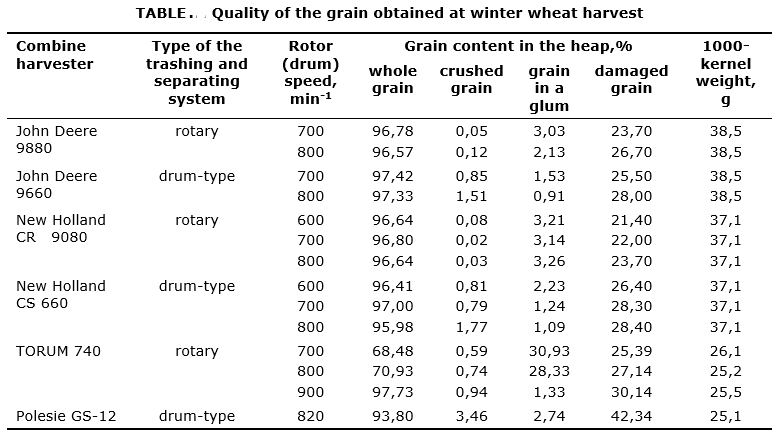
<body><![CDATA[<P>      <P><font face="Verdana, Arial, Helvetica, sans-serif" size="3"><B>RESULTS    AND DISCUSSION</B></font>     <P style="text-align: justify;"><font face="Verdana, Arial, Helvetica, sans-serif" size="2">    Nowadays national and foreign companies produce combine harvesters with the    drum-type system or rotary trashing and separating system. Several foreign companies    switched over to the production of the combine harvester only with the rotary    trashing and separating system. </font>      <P style="text-align: justify;"><font face="Verdana, Arial, Helvetica, sans-serif" size="2">Both    the rotary and drum-type combine harvesters are used in the Central Black Earth    Region of Russia, however drum-type combine harvesters are prevailing at the    present time. The damaged grain, which is arriving to the post-harvest treatment    in the grain heap, drastically makes it difficult to obtain certified seeds    and often high-quality food grain. It has been established that every 10% of    the damaged seeds decreases yield capacity of the cereal crops by 1,0…2,5 dt/ha    and the higher the level of the damaged seeds, the greater the reduction of    the yield capacity. Only due to the high level of the damaged grain annual harvest    shortfall makes up 10…15 million tons (Erov et al., 2009). The highest damage    of the grain exists during the harvesting. Therefore the most important scientific    and production task is to find ways of reducing grain damage during the harvesting    period. Talking about Central - Black Earth region the drum-type combine harvesters    of national and foreign companies are preferably used. More and more rotary    combine harvesters both of foreign companies «New Holland», «John Deere», «Case    IH», «Massey Fergusson», «Challenger», «Fendt» and of national «Torum 740» are    emerging on the fields in the recent years (Truflyak & Trubilin, 2013; Tarasenko,    2013).</font>     <P style="text-align: justify;"><font face="Verdana, Arial, Helvetica, sans-serif" size="2">    The quality of the grain obtained at harvest basically hinges on structural    features of the trashing and separating system and its operating mode, namely    on amount and level of mechanical effect on the grain during the harvesting    period.</font>     <P style="text-align: justify;"><font face="Verdana, Arial, Helvetica, sans-serif" size="2">    The survey results of the quality of the winter wheat grains obtained by drum-type    combine harvesters such as John Deere» 9660, «New Holland» CS 660, Polesie GS-12    and rotary combine harvesters such as «New Holland» CR 9080, «John Deere» 9880    and «Torum 740» are shown in <a href="/img/revistas/rcta/v24n2/t0108215.gif">table    </a> below.</font>      
<P style="text-align: justify;"><font face="Verdana, Arial, Helvetica, sans-serif" size="2">    According to the <a href="/img/revistas/rcta/v24n2/t0108215.gif">Table    </a> the grain heap obtained by rotary combine harvesters contains less crushed    and damaged grain.</font>      
<P style="text-align: justify;"><font face="Verdana, Arial, Helvetica, sans-serif" size="2">The    survey results show that rotary combine harvester «New Holland» CR 9080 causes    minimal shattering of grain and grain damage during the winter wheat harvest.</font>     <P style="text-align: justify;"><font face="Verdana, Arial, Helvetica, sans-serif" size="2">    Moreover rotor speed influences on content of the grain in a glum in the grain    heap. Necessary rotor speed should be set just according to the level of the    grain in a glum. This index is easily monitored in the field conditions. If    the grain heap contains a lot of grain in a glum it is necessary to increase    rotor speed. In addition to the above the content of the crushed and damaged    grain will increase a little. </font>     <P style="text-align: justify;"><font face="Verdana, Arial, Helvetica, sans-serif" size="2">The    sample obtained from rotary combine harvesters at rotor speed 800 min-1 practically    lacks caryopses with ejected germ. </font>     ]]></body>
<body><![CDATA[<P style="text-align: justify;"><font face="Verdana, Arial, Helvetica, sans-serif" size="2">Comparing    level of shattering and damage of the grain caused by combine harvesters it    is important to note that the higher level of the shattering and damage of the    grain cased by rotary combine harvester «John Deere» is brought by feed beater-accelerator    and also this level is explained by the grain auger used for delivering grain    heap to the cleaning. </font>     <P style="text-align: justify;"><font face="Verdana, Arial, Helvetica, sans-serif" size="2">The    combine harvester «Torum 740» in comparison with the combine harvester «New    Holland» CR 9080 boosts shattering and damage of the grain through the increase    of amount and level of the mechanical effect on the grain in the crop feed elevator.    </font>     <P style="text-align: justify;"><font face="Verdana, Arial, Helvetica, sans-serif" size="2">The    studies demonstrated that the use of the rotary combine harvesters allows significant    decrease in the damage of the grain during the harvesting and especially during    the seeds harvesting. In comparison with drum-type combine harvester «New Holland»    CS 660 the rotary combine harvesters «New Holland» CR 9080, «John Deere» 9880    and «Torum 740» reduce on the average the shattering of the grain in 25,92;    16,85 and 8,68 respectively and the damage of the grain in 1,24; 1,12 and 1,11    times. The results show that change-over to the production of the rotary combine    harvesters will reduce damage of the grain during the harvesting. This will    allow improving quality of the seeds, to lower seeding rate and to increase    yielding capacity.</font>     <P style="text-align: justify;"><font face="Verdana, Arial, Helvetica, sans-serif" size="2">    Influence of the rotor or drum speed n on the shattering of the grain caused    by rotary and drum-type combine harvesters is described by equations (3) and    (4) with enough accuracy, where &#1044;<sub>p</sub> is the rotary combine harvesters    and &#1044;<sub>&#1005;</sub>is the drum-type combine harvesters:</font>      <P align="center"><img src="/img/revistas/rcta/v24n2/e0308215.gif" width="572" height="30">      
<P align="center"><img src="/img/revistas/rcta/v24n2/e0408215.gif" width="568" height="26">     
<P style="text-align: justify;"><font face="Verdana, Arial, Helvetica, sans-serif" size="2">Damage    of the grain caused by rotary T<sub>&Pi;p,p</sub>, and drum-type combine harvesters    , T<sub>&Pi;p,&#1005;</sub> is described by described by equations (5) and (6):</font>      <P align="center"><img src="/img/revistas/rcta/v24n2/e0508215.gif" width="572" height="30">      
<P align="center"><img src="/img/revistas/rcta/v24n2/e0608215.gif" width="576" height="34">     
<P style="text-align: justify;"><font face="Verdana, Arial, Helvetica, sans-serif" size="2">The    studies demonstrated that the use of the rotary combine harvesters allows significant    decrease in the shattering and the damage of the grain during the harvesting.    Then during the postharvest treatment of the grain heap on the air-screen grain    cleaner for the first cleaning, including its fractionation and separation of    the grain of size less than 2,6 mm to the forage fraction, it is possible to    exclude from production line air-screen grain cleaner for the final cleaning    of the grain heap and also to exclude screening machine. In addition to the    above two bucket elevators (for delivering grain and moving it in the screening    machine by the grain auger) are excluded from production line. This will allow    to reduce amount and level of mechanical effect on the grain and to lessen its    damage during the postharvest treatment (Drichina, 2006; Orobinskii, 2012; Tarasenko    et al., 2012). Several large weeds left in the grain heap and the unthrashed    grain will be separated by air separation machine (Tarasenko et al., 2006).    This decreases amount and level of mechanical effect on the grain heap during    the postharvest treatment and also lessens shattering and damage of the grain.    Moreover energy and material costs for postharvest treatment of the grain heap    and for seed preparation are significantly reduced. </font>     ]]></body>
<body><![CDATA[<P style="text-align: justify;"><font face="Verdana, Arial, Helvetica, sans-serif" size="2">Consequently,    what is extremely relevant is that the use of the rotary combine harvesters    will considerably lessen shattering and damage of the grain during the harvesting    period and simplify the design of the seed-cleaning machine including costs    of the postharvest seed preparations. </font>     <P>&nbsp;      <P><font face="Verdana, Arial, Helvetica, sans-serif" size="3"><B>CONCLUSIONS</B></font>     <P style="text-align: justify;"><font face="Verdana, Arial, Helvetica, sans-serif" size="2">    &#149; It has been determined that rotary combine harvesters significantly reduce grain    damage. </font>     <P style="text-align: justify;"><font face="Verdana, Arial, Helvetica, sans-serif" size="2">&#149;    With continuous fractional methods of grain postharvest treatment being used,    it is possible to simplify the design of seed cleaning machine and to reduce    energy and material resources with less grain damage. </font>      <P>&nbsp;      <P><font face="Verdana, Arial, Helvetica, sans-serif" size="3"><B>REFERENCES</B></font>     <!-- ref --><P style="text-align: justify;"><font face="Verdana, Arial, Helvetica, sans-serif" size="2">    1. ANISKIN, V.I., DRINCHA V.M., PEHALSKY I.A.: “Damage of the Small Grain Crops    at the Machine Processing”, <i>Herald of the Agricultural Science</i>, ISSN:    0206–6335, (24): 22-23, 1992.     </font>      <!-- ref --><P style="text-align: justify;"><font face="Verdana, Arial, Helvetica, sans-serif" size="2">2.    DRICHA, V.M.: <i>Research of Grain Separation and Development of Machinery Technology    and its Preparation</i>, 384pp., Ed. MODEK, ISBN 5-89395-737-7, Voronezh, Russia,    2006.     </font>      <!-- ref --><P style="text-align: justify;"><font face="Verdana, Arial, Helvetica, sans-serif" size="2">3.    EROV, Y.V., NURULLIN E.G., KARIMOV H.Z., SALAHIEV D.Z.: <i>Innovations in the    Post-harvest Processing of Grain and Seeds</i>, 103pp., Ed. Slovo, ISBN: 978-5-98356-074-1    Kazan,Tatarstan, Russia, 2009.    </font>      <P style="text-align: justify;"><font face="Verdana, Arial, Helvetica, sans-serif" size="2">    4. <i>Reducing of the Mechanical Damage during Harvesting and Grain Handling:    Recommendations</i>, 1988, 21pp., Gosagroprom USSR, Agropromizdat, USSR, 1988.</font>      <!-- ref --><P style="text-align: justify;"><font face="Verdana, Arial, Helvetica, sans-serif" size="2">    5. GOST, R. <i>52325-2005: Seeds of Agricultural Plants. Varietal and Sowing    Quality</i>, Vig. 2005.    </font>      <!-- ref --><P style="text-align: justify;"><font face="Verdana, Arial, Helvetica, sans-serif" size="2">    6. LACHUGA, U.F., IZMAILOV A.U., ZIULIN A.N.: “High-efficiency Resource and    Energy Saving Technologies and Technical Tools of Grain Postharvest Treatment”,    <i>Agricultural Machinery and Technologies</i>, ISSN: 2073-7599 (1): 2-9. 2009.        </font>      <!-- ref --><P style="text-align: justify;"><font face="Verdana, Arial, Helvetica, sans-serif" size="2">7.    OROBINSKII, V.I.: “Influence of Microorganisms and Keeping Period on Sowing    Qualities of Seeds”, <i>Mechanization and Electrification of Agriculture</i>,    ISSN: 0206–572X, (11): 5-6, 2006.     </font>      ]]></body>
<body><![CDATA[<!-- ref --><P style="text-align: justify;"><font face="Verdana, Arial, Helvetica, sans-serif" size="2">8.    OROBINSKII, V.I., “Influence of Sieve Pattern in Sieve Pan on Fractionation    of Grain Heap”, <i>Techniques in Agriculture</i>, ISSN: 0131-7105, (3): 32-34,    2012.     </font>      <!-- ref --><P style="text-align: justify;"><font face="Verdana, Arial, Helvetica, sans-serif" size="2">9.    PUGACHEV, A.N.: <i>Grain Damage Caused by Machines</i>, Kolos, Moscow, 1976.        </font>      <!-- ref --><P style="text-align: justify;"><font face="Verdana, Arial, Helvetica, sans-serif" size="2">10.    PYANYKH, V.P., RODIMTSEV S.A. “Reducing of the Grain Damage during the Thrashing”,    <i>Mechanization and Electrification of Agriculture</i>, ISSN: 0206–572X, (12):    4-6, 2000.     </font>      <!-- ref --><P style="text-align: justify;"><font face="Verdana, Arial, Helvetica, sans-serif" size="2">11.    TARASENKO, A.P., MERCHALOVA, M.E., MIRONENKO, D.N.: “Improving of Mechanization    of Postharvest Seeds Treatment”, <i>Tractors and Agricultural Machinery</i>,    ISSN: 0235–8573, (1): 50-52, 2006.     </font>      <!-- ref --><P style="text-align: justify;"><font face="Verdana, Arial, Helvetica, sans-serif" size="2">12.    TARASENKO, A.P., OROBINSKII, V.I., MERCHALOVA, M.E., CHERNYSHOV, A.V., SOROKIN,    N.N.: <i>Fractionation of Grain Heap on Sieves</i>, Agricultural Machines and    Technologies, ISSN 2320 – 026X, (5): 26-29, 2012.     </font>      ]]></body>
<body><![CDATA[<!-- ref --><P style="text-align: justify;"><font face="Verdana, Arial, Helvetica, sans-serif" size="2">13.    TARASENKO, A.P., OROBINSKII, V.I., MERCHALOVA, M.E.: “Innovative Ways of Improving    Grain Postharvest Treatment”, <i>Journal of Forestry Engineering</i>, ISSN:    1494-2119 (Print), 1913-2220 (Online) (1): 83-85, 2013.     </font>      <!-- ref --><P style="text-align: justify;"><font face="Verdana, Arial, Helvetica, sans-serif" size="2">14.    TARASENKO, A.P.: <i>Rotary Combine Harvesters</i>, 188pp., Ed. Lan, ISBN 978-5-8114-1465-9,    Moscow, Russia, 2013.     </font>      <!-- ref --><P style="text-align: justify;"><font face="Verdana, Arial, Helvetica, sans-serif" size="2">15.    TRUFLYAK, E.V., TRUBILIN, E.I., <i>Modern Combine Harvesters</i>, 319pp., Krasnodar,    Russia, 2013.     </font>      <P>&nbsp;     <P>&nbsp;      <P>     <P>     ]]></body>
<body><![CDATA[<P>      <P>      <P><font face="Verdana, Arial, Helvetica, sans-serif" size="2"><b>Recibido:</b>    28 de mayo de 2013.    <BR>   <b>Aprobado:</b> 22 de septiembre de 2014. </font>      <P>&nbsp;     <P>&nbsp;      <P>     <P>     <P>      <P>      ]]></body>
<body><![CDATA[<P><font face="Verdana, Arial, Helvetica, sans-serif" size="2"><I>A.P. Tarasenko</I>.    EkoNiva Technology Holding. Michurina Street, 394087, Voronezh, Russia. Correo electr&oacute;nico: <U><FONT COLOR="#0000ff"><a href="mailto:orgdep@diip.vsau.ru">orgdep@diip.vsau.ru</a></FONT></U>    </font>       ]]></body><back>
<ref-list>
<ref id="B1">
<label>1</label><nlm-citation citation-type="journal">
<person-group person-group-type="author">
<name>
<surname><![CDATA[ANISKIN]]></surname>
<given-names><![CDATA[V.I.]]></given-names>
</name>
<name>
<surname><![CDATA[DRINCHA]]></surname>
<given-names><![CDATA[V.M.]]></given-names>
</name>
<name>
<surname><![CDATA[PEHALSKY]]></surname>
<given-names><![CDATA[I.A.]]></given-names>
</name>
</person-group>
<article-title xml:lang="en"><![CDATA[Damage of the Small Grain Crops at the Machine Processing]]></article-title>
<source><![CDATA[Herald of the Agricultural Science]]></source>
<year>1992</year>
<numero>24</numero>
<issue>24</issue>
<page-range>22-23</page-range></nlm-citation>
</ref>
<ref id="B2">
<label>2</label><nlm-citation citation-type="book">
<person-group person-group-type="author">
<name>
<surname><![CDATA[DRICHA]]></surname>
<given-names><![CDATA[V.M.]]></given-names>
</name>
</person-group>
<source><![CDATA[Research of Grain Separation and Development of Machinery Technology and its Preparation]]></source>
<year>2006</year>
<page-range>384</page-range><publisher-loc><![CDATA[Voronezh ]]></publisher-loc>
<publisher-name><![CDATA[Ed. MODEK]]></publisher-name>
</nlm-citation>
</ref>
<ref id="B3">
<label>3</label><nlm-citation citation-type="book">
<person-group person-group-type="author">
<name>
<surname><![CDATA[EROV]]></surname>
<given-names><![CDATA[Y.V.]]></given-names>
</name>
<name>
<surname><![CDATA[NURULLIN]]></surname>
<given-names><![CDATA[E.G.]]></given-names>
</name>
<name>
<surname><![CDATA[KARIMOV]]></surname>
<given-names><![CDATA[H.Z.]]></given-names>
</name>
<name>
<surname><![CDATA[SALAHIEV]]></surname>
<given-names><![CDATA[D.Z.]]></given-names>
</name>
</person-group>
<source><![CDATA[Innovations in the Post-harvest Processing of Grain and Seeds]]></source>
<year>2009</year>
<page-range>103</page-range><publisher-loc><![CDATA[Kazan^eTatarstan Tatarstan]]></publisher-loc>
<publisher-name><![CDATA[Ed. Slovo]]></publisher-name>
</nlm-citation>
</ref>
<ref id="B4">
<label>4</label><nlm-citation citation-type="book">
<source><![CDATA[Reducing of the Mechanical Damage during Harvesting and Grain Handling: Recommendations]]></source>
<year>1988</year>
<page-range>21</page-range><publisher-name><![CDATA[Gosagroprom USSR, Agropromizdat]]></publisher-name>
</nlm-citation>
</ref>
<ref id="B5">
<label>5</label><nlm-citation citation-type="">
<person-group person-group-type="author">
<name>
<surname><![CDATA[GOST]]></surname>
<given-names><![CDATA[R.]]></given-names>
</name>
</person-group>
<source><![CDATA[52325-2005: Seeds of Agricultural Plants. Varietal and Sowing Quality]]></source>
<year>2005</year>
</nlm-citation>
</ref>
<ref id="B6">
<label>6</label><nlm-citation citation-type="journal">
<person-group person-group-type="author">
<name>
<surname><![CDATA[LACHUGA]]></surname>
<given-names><![CDATA[U.F.]]></given-names>
</name>
<name>
<surname><![CDATA[IZMAILOV]]></surname>
<given-names><![CDATA[A.U.]]></given-names>
</name>
<name>
<surname><![CDATA[ZIULIN]]></surname>
<given-names><![CDATA[A.N.]]></given-names>
</name>
</person-group>
<article-title xml:lang="en"><![CDATA[High-efficiency Resource and Energy Saving Technologies and Technical Tools of Grain Postharvest Treatment]]></article-title>
<source><![CDATA[Agricultural Machinery and Technologies]]></source>
<year>2009</year>
<numero>1</numero>
<issue>1</issue>
<page-range>2-9</page-range></nlm-citation>
</ref>
<ref id="B7">
<label>7</label><nlm-citation citation-type="journal">
<person-group person-group-type="author">
<name>
<surname><![CDATA[OROBINSKII]]></surname>
<given-names><![CDATA[V.I.]]></given-names>
</name>
</person-group>
<article-title xml:lang="en"><![CDATA[Influence of Microorganisms and Keeping Period on Sowing Qualities of Seeds]]></article-title>
<source><![CDATA[Mechanization and Electrification of Agriculture]]></source>
<year>2006</year>
<numero>11</numero>
<issue>11</issue>
<page-range>5-6</page-range></nlm-citation>
</ref>
<ref id="B8">
<label>8</label><nlm-citation citation-type="journal">
<person-group person-group-type="author">
<name>
<surname><![CDATA[OROBINSKII]]></surname>
<given-names><![CDATA[V.I.]]></given-names>
</name>
</person-group>
<article-title xml:lang="en"><![CDATA[Influence of Sieve Pattern in Sieve Pan on Fractionation of Grain Heap]]></article-title>
<source><![CDATA[Techniques in Agriculture]]></source>
<year>2012</year>
<numero>3</numero>
<issue>3</issue>
<page-range>32-34</page-range></nlm-citation>
</ref>
<ref id="B9">
<label>9</label><nlm-citation citation-type="">
<person-group person-group-type="author">
<name>
<surname><![CDATA[PUGACHEV]]></surname>
<given-names><![CDATA[A.N.]]></given-names>
</name>
</person-group>
<source><![CDATA[Grain Damage Caused by Machines]]></source>
<year>1976</year>
<publisher-loc><![CDATA[KolosMoscow ]]></publisher-loc>
</nlm-citation>
</ref>
<ref id="B10">
<label>10</label><nlm-citation citation-type="journal">
<person-group person-group-type="author">
<name>
<surname><![CDATA[PYANYKH]]></surname>
<given-names><![CDATA[V.P.]]></given-names>
</name>
<name>
<surname><![CDATA[RODIMTSEV]]></surname>
<given-names><![CDATA[S.A.]]></given-names>
</name>
</person-group>
<article-title xml:lang="en"><![CDATA[Reducing of the Grain Damage during the Thrashing]]></article-title>
<source><![CDATA[Mechanization and Electrification of Agriculture]]></source>
<year>2000</year>
<numero>12</numero>
<issue>12</issue>
<page-range>4-6</page-range></nlm-citation>
</ref>
<ref id="B11">
<label>11</label><nlm-citation citation-type="journal">
<person-group person-group-type="author">
<name>
<surname><![CDATA[TARASENKO]]></surname>
<given-names><![CDATA[A.P.]]></given-names>
</name>
<name>
<surname><![CDATA[MERCHALOVA]]></surname>
<given-names><![CDATA[M.E.]]></given-names>
</name>
<name>
<surname><![CDATA[MIRONENKO]]></surname>
<given-names><![CDATA[D.N.]]></given-names>
</name>
</person-group>
<article-title xml:lang="en"><![CDATA[Improving of Mechanization of Postharvest Seeds Treatment]]></article-title>
<source><![CDATA[Tractors and Agricultural Machinery]]></source>
<year>2006</year>
<numero>1</numero>
<issue>1</issue>
<page-range>50-52</page-range></nlm-citation>
</ref>
<ref id="B12">
<label>12</label><nlm-citation citation-type="journal">
<person-group person-group-type="author">
<name>
<surname><![CDATA[MERCHALOVA]]></surname>
<given-names><![CDATA[M.E.]]></given-names>
</name>
<name>
<surname><![CDATA[TARASENKO]]></surname>
<given-names><![CDATA[A.P.]]></given-names>
</name>
<name>
</name>
<name>
<surname><![CDATA[CHERNYSHOV]]></surname>
<given-names><![CDATA[A.V.]]></given-names>
</name>
<name>
<surname><![CDATA[SOROKIN]]></surname>
<given-names><![CDATA[N.N.]]></given-names>
</name>
</person-group>
<article-title xml:lang="en"><![CDATA[Fractionation of Grain Heap on Sieves]]></article-title>
<source><![CDATA[Agricultural Machines and Technologies]]></source>
<year>2012</year>
<numero>5</numero>
<issue>5</issue>
<page-range>26-29</page-range></nlm-citation>
</ref>
<ref id="B13">
<label>13</label><nlm-citation citation-type="journal">
<person-group person-group-type="author">
<name>
</name>
<name>
<surname><![CDATA[TARASENKO]]></surname>
<given-names><![CDATA[A.P.]]></given-names>
</name>
<name>
<surname><![CDATA[MERCHALOVA]]></surname>
<given-names><![CDATA[M.E.]]></given-names>
</name>
</person-group>
<article-title xml:lang="en"><![CDATA[Innovative Ways of Improving Grain Postharvest Treatment]]></article-title>
<source><![CDATA[Journal of Forestry Engineering]]></source>
<year>2013</year>
<numero>1</numero>
<issue>1</issue>
<page-range>83-85</page-range></nlm-citation>
</ref>
<ref id="B14">
<label>14</label><nlm-citation citation-type="book">
<person-group person-group-type="author">
<name>
</name>
</person-group>
<person-group person-group-type="editor">
<name>
</name>
</person-group>
<source><![CDATA[Rotary Combine Harvesters]]></source>
<year>2013</year>
<page-range>188</page-range><publisher-loc><![CDATA[Moscow ]]></publisher-loc>
<publisher-name><![CDATA[Ed. Lan]]></publisher-name>
</nlm-citation>
</ref>
<ref id="B15">
<label>15</label><nlm-citation citation-type="">
<person-group person-group-type="author">
<name>
<surname><![CDATA[TRUFLYAK]]></surname>
<given-names><![CDATA[E.V.]]></given-names>
</name>
<name>
<surname><![CDATA[TRUBILIN]]></surname>
<given-names><![CDATA[E.I.]]></given-names>
</name>
</person-group>
<source><![CDATA[Modern Combine Harvesters]]></source>
<year>2013</year>
<page-range>319</page-range><publisher-loc><![CDATA[Krasnodar ]]></publisher-loc>
</nlm-citation>
</ref>
</ref-list>
</back>
</article>