<?xml version="1.0" encoding="ISO-8859-1"?><article xmlns:mml="http://www.w3.org/1998/Math/MathML" xmlns:xlink="http://www.w3.org/1999/xlink" xmlns:xsi="http://www.w3.org/2001/XMLSchema-instance">
<front>
<journal-meta>
<journal-id>2071-0054</journal-id>
<journal-title><![CDATA[Revista Ciencias Técnicas Agropecuarias]]></journal-title>
<abbrev-journal-title><![CDATA[Rev Cie Téc Agr]]></abbrev-journal-title>
<issn>2071-0054</issn>
<publisher>
<publisher-name><![CDATA[Universidad Agraria de La Habana]]></publisher-name>
</publisher>
</journal-meta>
<article-meta>
<article-id>S2071-00542016000100006</article-id>
<title-group>
<article-title xml:lang="en"><![CDATA[Effect of Moisture and Soil Compaction on Tillage Operations]]></article-title>
<article-title xml:lang="es"><![CDATA[Efecto de la humedad y la compactación del suelo en operaciones de labranza]]></article-title>
</title-group>
<contrib-group>
<contrib contrib-type="author">
<name>
<surname><![CDATA[López Bravo]]></surname>
<given-names><![CDATA[Elvis]]></given-names>
</name>
<xref ref-type="aff" rid="A01"/>
</contrib>
<contrib contrib-type="author">
<name>
<surname><![CDATA[Herrera Suárez]]></surname>
<given-names><![CDATA[Miguel]]></given-names>
</name>
<xref ref-type="aff" rid="A01"/>
</contrib>
<contrib contrib-type="author">
<name>
<surname><![CDATA[González Cueto]]></surname>
<given-names><![CDATA[Omar]]></given-names>
</name>
<xref ref-type="aff" rid="A01"/>
</contrib>
<contrib contrib-type="author">
<name>
<surname><![CDATA[Iglesias Coronel]]></surname>
<given-names><![CDATA[Ciro]]></given-names>
</name>
<xref ref-type="aff" rid="A02"/>
</contrib>
<contrib contrib-type="author">
<name>
<surname><![CDATA[Ramon]]></surname>
<given-names><![CDATA[Herman]]></given-names>
</name>
<xref ref-type="aff" rid="A03"/>
</contrib>
</contrib-group>
<aff id="A01">
<institution><![CDATA[,Central University Marta Abreu of Las Villas. Faculty of Agricultural and Animal Sciences. Department of Agricultural Engineering.]]></institution>
<addr-line><![CDATA[Villa Clara Santa Clara]]></addr-line>
<country>Cuba</country>
</aff>
<aff id="A02">
<institution><![CDATA[,Universidad Agraria de La Habana.  ]]></institution>
<addr-line><![CDATA[Mayabeque San José de las Lajas]]></addr-line>
<country>Cuba</country>
</aff>
<aff id="A03">
<institution><![CDATA[,Faculty of Bioscience Engineering. Department of Biosystems. Division of Mechatronics, Biostatistics and Sensors (MeBioS).]]></institution>
<addr-line><![CDATA[Heverlee ]]></addr-line>
<country>Belgium</country>
</aff>
<pub-date pub-type="pub">
<day>00</day>
<month>03</month>
<year>2016</year>
</pub-date>
<pub-date pub-type="epub">
<day>00</day>
<month>03</month>
<year>2016</year>
</pub-date>
<volume>25</volume>
<numero>1</numero>
<fpage>32</fpage>
<lpage>37</lpage>
<copyright-statement/>
<copyright-year/>
<self-uri xlink:href="http://scielo.sld.cu/scielo.php?script=sci_arttext&amp;pid=S2071-00542016000100006&amp;lng=en&amp;nrm=iso"></self-uri><self-uri xlink:href="http://scielo.sld.cu/scielo.php?script=sci_abstract&amp;pid=S2071-00542016000100006&amp;lng=en&amp;nrm=iso"></self-uri><self-uri xlink:href="http://scielo.sld.cu/scielo.php?script=sci_pdf&amp;pid=S2071-00542016000100006&amp;lng=en&amp;nrm=iso"></self-uri><abstract abstract-type="short" xml:lang="en"><p><![CDATA[In the present paper, soil tillage under different moisture and dry bulk density is discussed. An experimental installation called soil-bin was used to perform the measurement of vertical and draft forces over the tool. The soil used was classified as Oxisol, characterized by a high clay content and mechanical strength. The compaction in soil-bin is performed using a roller compactor and confirmed by measurement moisture and dry bulk density in all sections. The main results show a close dependence between physical soil condition and resulting forces. The maximum levels of forces were found for density and moisture in dry and compacted state. Meanwhile, maximum values of soil profile were obtained for low densities and moisture. Similarly, for medium content of moisture increases the amount of aggregates sized less than 10 mm.]]></p></abstract>
<abstract abstract-type="short" xml:lang="es"><p><![CDATA[En el presente trabajo se aborda la labranza de un suelo agrícola bajo diferentes condiciones de humedad y densidad del suelo. En el mismo se emplea una instalación experimental de pruebas o canal de suelo, el cual se acondicionó con los medios para la medición de las tensiones verticales y horizontales en el apero. El suelo empleado está clasificado como un Oxisol y se caracteriza por su alto contenido de arcilla y resistencia mecánica. La compactación del suelo del canal se realizó empleando un rodillo compactador, la misma se comprobó por medio de mediciones de humedad y densidad en las diferentes secciones. Los principales resultados muestran la dependencia existente entre el estado físico del suelo y las fuerzas resultantes. Las tensiones alcanzaron valores máximos para niveles de densidad y humedad de suelo seco y compactado. Por su parte, en el perfil del suelo se obtuvo valores máximos para bajas densidades con humedades medias. De igual forma para condiciones medias de humedad y densidad se obtuvo una mayor fragmentación con predominio de agregados menores a 10 mm.]]></p></abstract>
<kwd-group>
<kwd lng="en"><![CDATA[dry bulk density]]></kwd>
<kwd lng="en"><![CDATA[tensometry]]></kwd>
<kwd lng="en"><![CDATA[soil profile]]></kwd>
<kwd lng="en"><![CDATA[soil-bin]]></kwd>
<kwd lng="en"><![CDATA[aggregates]]></kwd>
<kwd lng="es"><![CDATA[densidad]]></kwd>
<kwd lng="es"><![CDATA[tensometría]]></kwd>
<kwd lng="es"><![CDATA[perfil de suelo]]></kwd>
<kwd lng="es"><![CDATA[canal de suelo]]></kwd>
<kwd lng="es"><![CDATA[agregado]]></kwd>
</kwd-group>
</article-meta>
</front><body><![CDATA[ <div align="right">       <p><font face="Verdana, Arial, Helvetica, sans-serif" size="2"><B>ART&Iacute;CULO      ORIGINAL </B></font></p>       <p>&nbsp;</p> </div> <B>     <P>      <P>      <P><font face="Verdana, Arial, Helvetica, sans-serif" size="4">Effect of Moisture and Soil Compaction on Tillage Operations </font>      <P>&nbsp;      <P>      <P><font face="Verdana, Arial, Helvetica, sans-serif" size="3">Efecto de la humedad y la compactación del suelo  en operaciones de labranza</font>      <P>&nbsp;     ]]></body>
<body><![CDATA[<P>&nbsp; </B>     <P>      <P>      <P><b><font face="Verdana, Arial, Helvetica, sans-serif" size="2">Dr.C. Elvis    López Bravo<sup>I</sup>, Dr.C. Miguel Herrera Suárez<sup>I</sup>, Dr.C. Omar    González Cueto<sup>I</sup>, Dr.C. Ciro Iglesias Coronel<sup>II</sup>, Dr.C.    Herman Ramon<sup>III</sup> </font></b>      <P><font face="Verdana, Arial, Helvetica, sans-serif" size="2"><sup>I</sup> Central    University Marta Abreu of Las Villas. Faculty of Agricultural and Animal Sciences.    Department of Agricultural Engineering. Santa Clara, Villa Clara, Cuba.     <br>   <sup>II</sup> Universidad Agraria de La Habana. San José de las Lajas, Mayabeque,    Cuba.     <br>   <sup>III</sup> Faculty of Bioscience Engineering. Department of Biosystems.    Division of Mechatronics, Biostatistics and Sensors (MeBioS). Heverlee, Belgium.    </font>      <P>&nbsp;     <P>&nbsp; <hr>     <P>      ]]></body>
<body><![CDATA[<P>      <P> <font face="Verdana, Arial, Helvetica, sans-serif" size="2"><B>ABSTRACT </B></font>      <p style="text-align: justify;"><font face="Verdana, Arial, Helvetica, sans-serif" size="2">In the present paper, soil tillage under different moisture and dry bulk density is discussed. An experimental installation called soil-bin was used to perform the measurement of vertical and draft forces over the tool. The soil used was classified as Oxisol, characterized by a high clay content and mechanical strength. The compaction in soil-bin is performed using a roller compactor and confirmed by measurement moisture and dry bulk density in all sections. The main results show a close dependence between physical soil condition and resulting forces. The maximum levels of forces were found for density and moisture in dry and compacted state. Meanwhile, maximum values of soil profile were obtained for low densities and moisture. Similarly, for medium content of moisture increases the amount of aggregates sized less than 10 mm. </font></p>     <p><font face="Verdana, Arial, Helvetica, sans-serif" size="2"><b>Key words:</b>    dry bulk density, tensometry, soil profile, soil-bin, aggregates. </font> </p> <hr>      <P> <font face="Verdana, Arial, Helvetica, sans-serif" size="2"><B>RESUMEN  </B></font>      <P style="text-align: justify;"><font face="Verdana, Arial, Helvetica, sans-serif" size="2">En el presente trabajo se aborda la labranza de un suelo agrícola bajo diferentes condiciones de humedad y densidad del suelo. En el mismo se emplea una instalación experimental de pruebas o canal de suelo, el cual se acondicionó con los medios para la medición de las tensiones verticales y horizontales en el apero. El suelo empleado está clasificado como un Oxisol y se caracteriza por su alto contenido de arcilla y resistencia mecánica. La compactación del suelo del canal se realizó empleando un rodillo compactador, la misma se comprobó por medio de mediciones de humedad y densidad en las diferentes secciones. Los principales resultados muestran la dependencia existente entre el estado físico del suelo y las fuerzas resultantes. Las tensiones alcanzaron valores máximos para niveles de densidad y humedad de suelo seco y compactado. Por su parte, en el perfil del suelo se obtuvo valores máximos para bajas densidades con humedades medias. De igual forma para condiciones medias de humedad y densidad se obtuvo una mayor fragmentación con predominio de agregados menores a 10 mm. </font>      <p><font face="Verdana, Arial, Helvetica, sans-serif" size="2"><b>Palabras clave:</b>    densidad, tensometría, perfil de suelo, canal de suelo, agregado. </font> </p> <hr>      <P>      <P>&nbsp;     <P>&nbsp;     ]]></body>
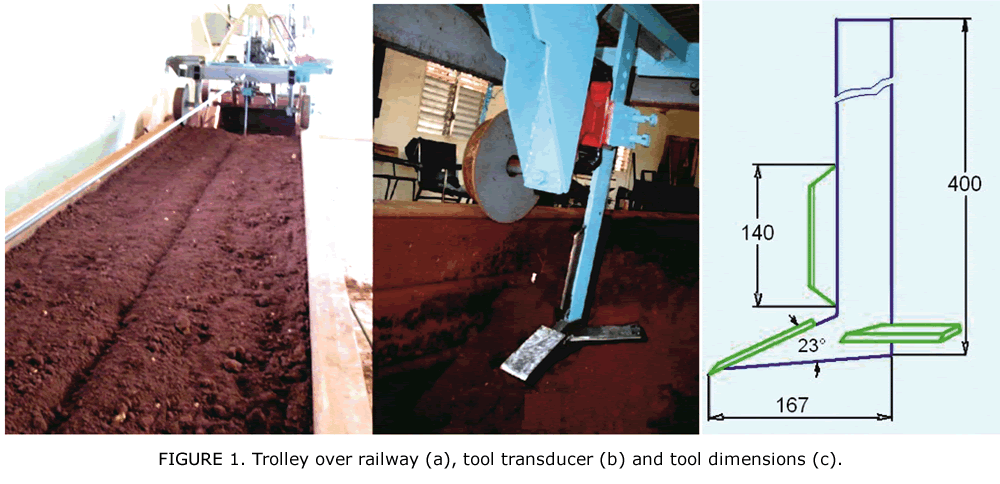
<body><![CDATA[<P><font face="Verdana, Arial, Helvetica, sans-serif" size="3"><B>INTRODUCTION</B></font>      <P style="text-align: justify;"><font face="Verdana, Arial, Helvetica, sans-serif" size="2">The soil physical conditions are strongly connected with the final structures    of the aggregates resulting from tillage. Traction force in arable soils also    is affected by soil physics parameters as soil moisture and compaction increasing    the power consumption (Solhjou <i>et    al</i>., 2013; Tagar <i>et    al</i>., 2014; Tim Chamen    <i>et    al</i>., 2015). Tillage operation in a soil-bin condition plays an intermediate    role between theoretical designs and field applications. Different soil-bin    designs have been used for research on measuring dynamic forces during soil    cutting. The magnitude of the force in longitudinal direction or draft force    defines the energy required for the tillage operation. Several studies have    correlated soil resistance with the draft force through testing different tool    geometries using the draft force magnitude as a soil strength indicator (Lara    Coba <i>et    al</i>., 2011; Obermayr <i>et    al</i>., 2011; Bravo <i>et    al</i>., 2014; Hasimu; Chen,    2014). The determination of the critical speed related to soil deformation during    high speed tillage was carried out using a soil-bin trolley (Kushwaha; Linke,    1996). To validate a continuous model a monorail soil-bin system was designed    using silt and compacted clay soil. They found an increment in power, tool draft    and soil pulverisation with increase in speed. Empirical equations to predict    draft forces have been developed by Sahu; Raheman (2006). The draft forces for    these models were measured in a soil-bin during tillage using a simple tillage-tool    in a loam soil, taken as reference condition. Generally, the experiments in    soil-bin lead to more consistent data, avoiding the variability of soil structure,    keeping control over operational parameters and reducing the effects of climatological    factors. Under soil-bin test in controlling condition the soil moisture and    soil compaction can be manage to make in the soil different physical estates.    Draft and vertical forces measured for all these conditions are used to compare    the results with the model prediction (Mak <i>et    al</i>., 2012; Chen <i>et    al</i>., 2013).    Also soil parameters related to the effect of the tool on soil loosing can be    controlled and related to the soil condition. </font>     <P style="text-align: justify;"><font face="Verdana, Arial, Helvetica, sans-serif" size="2">The    objective of the present research is to investigate the force variations and    soil loosening indicators during tillage. A multi-blade tool was designed for    non-inversion tillage and tested at several soil conditions in the Oxisol soil.</font>     <P>&nbsp;      <P><font face="Verdana, Arial, Helvetica, sans-serif" size="3"><B>METHODS</B></font>     <P style="text-align: justify;"><font face="Verdana, Arial, Helvetica, sans-serif" size="2">    To measure the variation of tillage performance at different soil physical conditions,    a longitudinal indoor soil-bin was used (<a href="/img/revistas/rcta/v25n1/f0106116.gif">Figure    1a</a>). The effective working area was sized at 1.5 m width, 8.0 m length.    The soil-bin was filled with Oxisol soil located in the occcidental region of    the Cuban island. A multi-blade tool called cultivator was manufactured for    the experiment. This tool was designed for operation in the upper layer of the    soil (<a href="/img/revistas/rcta/v25n1/f0106116.gif">Figure    1c</a>).</font>      
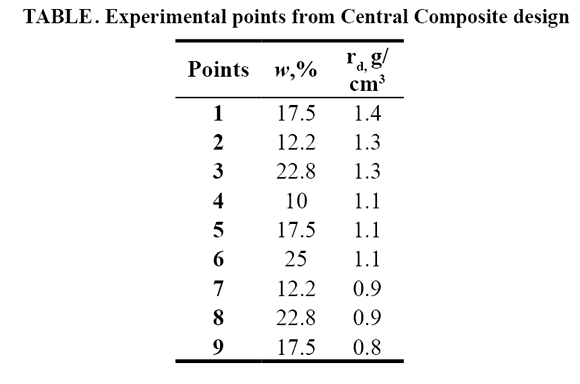
<P style="text-align: justify;"><font face="Verdana, Arial, Helvetica, sans-serif" size="2">Between    the trolley and the tool was connected the transducer ring; the deformable device    was set up at the centre work of the soil-bin. The system was mounted on steel    wheels rolling over a steel railway; also a steel cable was used to connect    the trolley to the gear reducer, getting a constant velocity of 3.6 km/h. </font>     <P style="text-align: justify;"><font face="Verdana, Arial, Helvetica, sans-serif" size="2">Focusing    on the effect of changing soil moisture content and compaction level, the experiment    was organised using a Central Composite design for these two elements. Soil    water content and dry bulk density were combined at nine levels and four centre    point replications. <a href="#T1">Table</a> shows the planned experimental combinations.</font>      <P align="center"><img src="/img/revistas/rcta/v25n1/t0106116.gif" width="580" height="384"><a name="T1"></a>      
<P style="text-align: justify;"><font face="Verdana, Arial, Helvetica, sans-serif" size="2">    During tillage tests at different soil conditions, the following response variables    were measured: horizontal force on the tool, vertical forces on the tool, soil    density changes after tillage, soil profiles after tillage, and soil particles    sizes distribution. </font>     ]]></body>
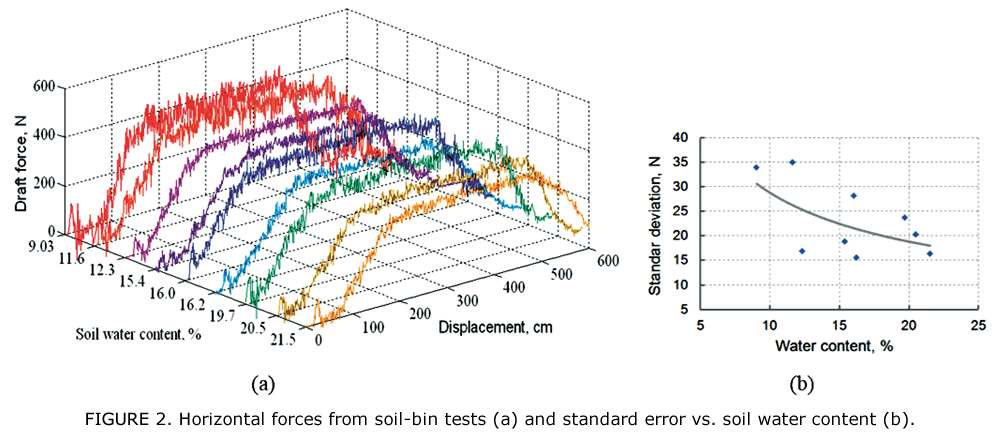
<body><![CDATA[<P style="text-align: justify;"><font face="Verdana, Arial, Helvetica, sans-serif" size="2">Draft    and vertical forces were measured by the transducer designed for 5 kN capacity    and non-linearity at 0.02%. The system was driven by an embedded controller    Data logger NIcRIO-9012 from National instruments, Austin, TX, USA. For signal    condition a module NI 9237 for full and half bridge connections was used. This    module includes bridge excitation, signal amplification, multiplexing and signal    filtering according to the data range. To manage the system a virtual instrument    of Lab-View program was designed and installed in a Compact HP 6000 laptop.    </font>     <P>&nbsp;      <P>      <P><font face="Verdana, Arial, Helvetica, sans-serif" size="3"><B>RESULTS AND DISCUSSION</B></font>     <P style="text-align: justify;"><font face="Verdana, Arial, Helvetica, sans-serif" size="2"><b>Draft    force response</b></font>     <P style="text-align: justify;"><font face="Verdana, Arial, Helvetica, sans-serif" size="2">    The draft forces obtained from the tests at the soil conditions defined in <a href="#T1">Table</a>    are shown in <a href="/img/revistas/rcta/v25n1/f0206116.gif">Figure    2a</a>. The nominal force of each test was determined as the force average obtained    from 150 to 450 cm in the tool trajectory. </font>      
<P style="text-align: justify;"><font face="Verdana, Arial, Helvetica, sans-serif" size="2">The    draft force variation was found to be between 350 and 390 N. The force standard    deviation increases in dry soil conditions as shown in <a href="/img/revistas/rcta/v25n1/f0206116.gif">Figure    2b</a>, revealing the stiffness of the soil. This pattern was well observed    in test 4 carried out at the smallest soil water content w = 9.0%. In fact,    the magnitude of the forces characterises the general state of soil strength    and affected also by the soil compaction level. The soil pattern of deformation    has been found to be related with the intensity of force oscillations. Other    authors had explained the gradual building up of the draft force and the attainment    of the dynamic stability of the force as a function of the surcharge over the    soil by the action of the tool, eventually defined by the general soil strength    (Hasimu; Chen, 2014; Tagar <i>et al</i>., 2014) </font>      
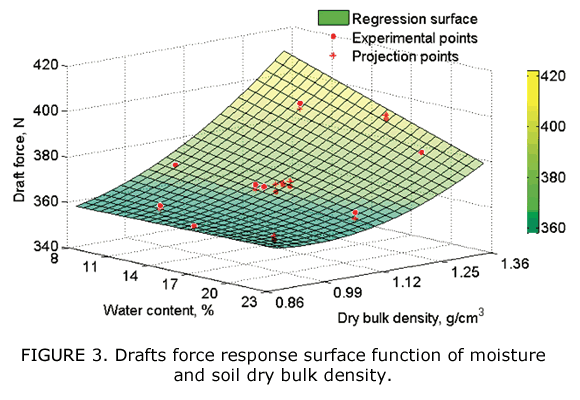
<P style="text-align: justify;"><font face="Verdana, Arial, Helvetica, sans-serif" size="2">The    influence of water content and dry bulk density in draft force response is shown    in <a href="#F3">Figure 3</a>. For all values of soil moisture under study when    the dry bulk density increases, the draft force increases too. However, this    increase for higher soil moisture w = 23%, is moderated in the range between    0.9 to 1.0 g/cm<sup>3</sup>). </font>     <P align="center"><img src="/img/revistas/rcta/v25n1/f0306116.gif" width="580" height="400"><a name="F3"></a>      
<P style="text-align: justify;"><font face="Verdana, Arial, Helvetica, sans-serif" size="2">On    the other hand, the influence of the soil water content is appreciable as the    soil compaction increases (r<sub>d</sub> > 1.12 g/cm<sup>3</sup>). As the moisture    increases the soil strength decreases. However, for smaller dry bulk densities,    the influence of moisture is negligible. As was found by Sahu; Raheman (2006),    the soil compaction is the main factor that contributes to the increase in draft    force. The authors, in spite of including parameters as tillage depth, operation    speed and tool shape decided to keep water content constant. However, in several    researches a significant effect of the moisture content was found for tillage    forces. In general, they have focused on finding the optimum water content for    tillage, defined as workability state (Mueller <i>et    al</i>., 2003; Barzegar <i>et    al</i>.,    2004; Mosaddeghi <i>et    al</i>., 2009). This condition is related with the minimal draft    force needed to obtain the maximum soil loosening. The independent analysis    of the draft force behaviour in the soil under study subject that the optimal    water content can be placed between 14 to 23% and also beyond this point. To    reduce the range of the optimum soil moisture, the loosening indicator discussed    in next sections provides the entire information. </font>      ]]></body>
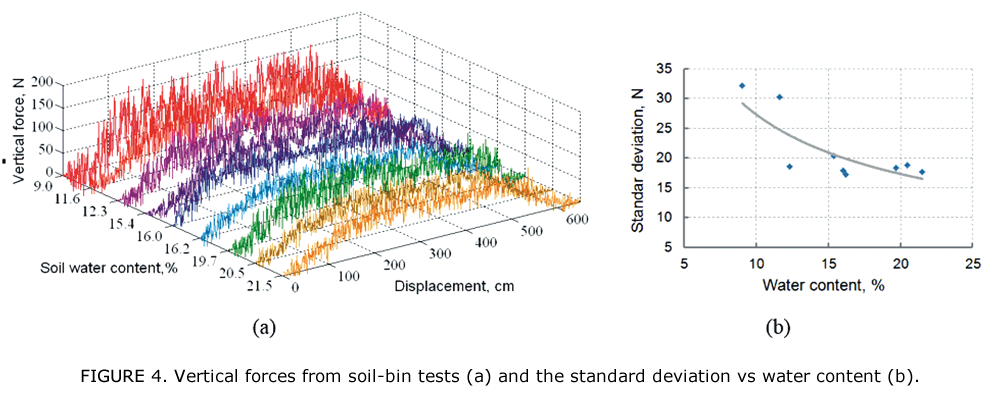
<body><![CDATA[<P style="text-align: justify;"><font face="Verdana, Arial, Helvetica, sans-serif" size="2"><b>Vertical    force response</b></font>     <P style="text-align: justify;"><font face="Verdana, Arial, Helvetica, sans-serif" size="2">    The soil physical conditions defined by the different experimental tests also    modify the reaction force measured in the vertical direction oriented in down    sense. This vertical component is related with the pressure applied by the tool    over the soil foot surface and the compaction in the surface below the tool    travel, usually called plough-pan. As shown in <a href="/img/revistas/rcta/v25n1/f0406116.gif">Figure    4a</a>, the reaction force magnitudes during the tests are found in the range    of 76 to 97 N. The standard errors increase when the soil becomes drier, showing    a similar pattern for the horizontal force in relation with the soil moisture    (<a href="/img/revistas/rcta/v25n1/f0406116.gif">Figure    4b</a>). </font>      
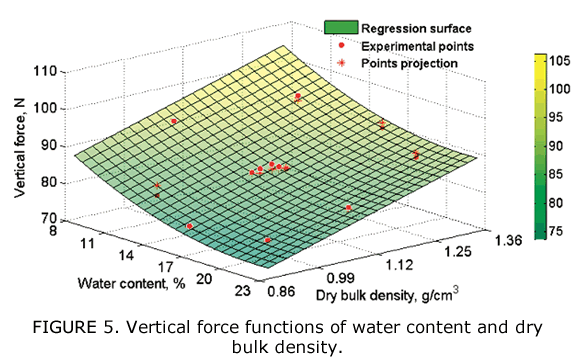
<P style="text-align: justify;"><font face="Verdana, Arial, Helvetica, sans-serif" size="2">Vertical    force response surfaces as a function of dry bulk density and moisture content    are shown in <a href="#F5">Figure 5</a>. As it was expected, the force increases    with soil become denser and decreases with water content. These results are    in accordance with the variation in soil strength parameters like cohesion,    friction and soil elasticity. The susceptibility of the soil to compaction,    however, is related to factors as content of clay and the critical water content    (Saffih-Hdadi <i>et al</i>., 2009). </font>     <P align="center"><img src="/img/revistas/rcta/v25n1/f0506116.gif" width="580" height="361"><a name="F5"></a>      
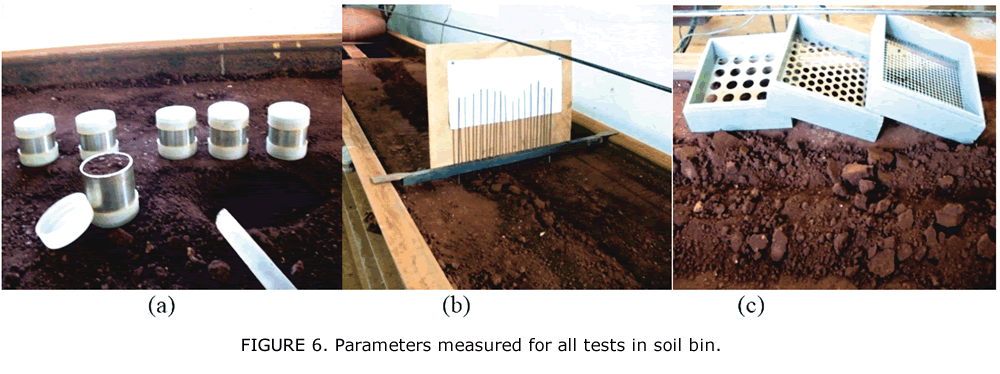
<P style="text-align: justify;"><font face="Verdana, Arial, Helvetica, sans-serif" size="2"><b>    Soil loosening indicators </b></font>     <P style="text-align: justify;"><font face="Verdana, Arial, Helvetica, sans-serif" size="2">As    indicators of soil loosening variations in the initial dry bulk density, soil    profile and particle size distribution by the tillage operation were measured    during each different test in the soil-bin. The final dry bulk density was obtained    from the disturbed soil (<a href="/img/revistas/rcta/v25n1/f0606116.gif">Figure    6a</a>), according to the procedure explained in section 2.4. </font>      
<P style="text-align: justify;"><font face="Verdana, Arial, Helvetica, sans-serif" size="2">The    soil profile was measured after soil tillage by the profilometer method as shown    in <a href="/img/revistas/rcta/v25n1/f0606116.gif">Figure    6b</a>, and the soil texture classification was carried out by sieving using    four different mesh sizes (<a href="/img/revistas/rcta/v25n1/f0606116.gif">Figure    6c</a>). </font>      
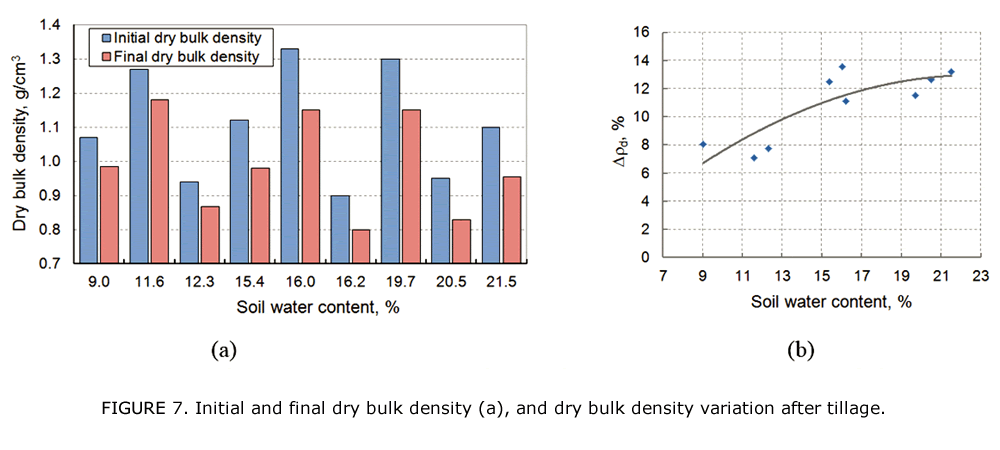
<P style="text-align: justify;"><font face="Verdana, Arial, Helvetica, sans-serif" size="2">The    variation of the dry bulk density through the different experimental points    is showed versus water content in <a href="/img/revistas/rcta/v25n1/f0706116.gif">Figure    7a</a>. </font>      
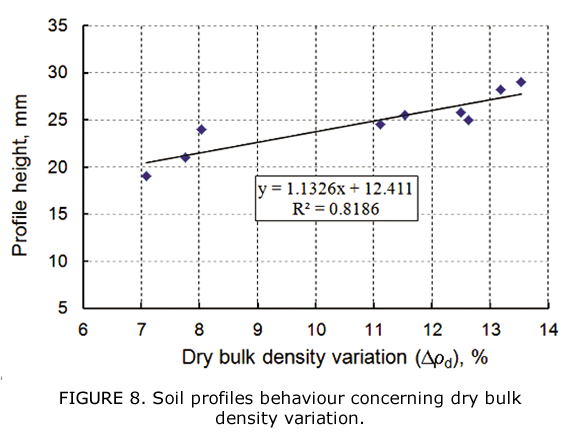
<P style="text-align: justify;"><font face="Verdana, Arial, Helvetica, sans-serif" size="2">For    all combination of water content and dry bulk density tested, the loosening    effect during the tillage is denoted by smaller values of final dry bulk density    (red bar). As the soil water content increases, the proportional variation of    dry bulk density Dr<sub>d</sub> respect to its initial value also increases    as is shown in <a href="/img/revistas/rcta/v25n1/f0706116.gif">Figure    7b</a>. However, for the experimental points with water content beyond 15% the    variation tents to be constant. According with the results discussed in section    2.6.4, as the water content increases a reduction of inter-particle bond resistance    take places, maximising the grain fragmentation during soil-tool interaction.    The results are in line with those found by Arvidsson <i>et al</i>. (2004),    the authors concluded that tillage operation at specific water content before    soil plastic limit provides a large proportion of small aggregates, and also    reduces the energy demanded for tillage. The soil profile, measured after tillage    was found strongly connected with the variation of dry bulk density as shown    in <a href="#F8">Figure 8</a>. </font>     
<P align="center"><img src="/img/revistas/rcta/v25n1/f0806116.gif" width="580" height="446"><a name="F8"></a>      
]]></body>
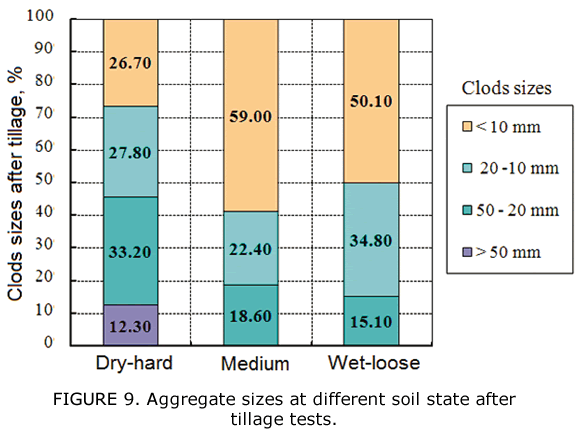
<body><![CDATA[<P style="text-align: justify;"><font face="Verdana, Arial, Helvetica, sans-serif" size="2">In    the analysis, the variation of the profile height reached after each test was    established as a function of the dry bulk density variation. The relationship    shows a linear increase in the height of the soil profile with increasing Dr<sub>d</sub>.    The behaviour of the soil corresponds with the volumetric changes taking place    in the soil granular structure during soil loosening. </font>      <P style="text-align: justify;"><font face="Verdana, Arial, Helvetica, sans-serif" size="2"><b>Soil    aggregates distribution</b> </font>     <P style="text-align: justify;"><font face="Verdana, Arial, Helvetica, sans-serif" size="2">The    soil was classified in four groups of sizes to calculate their proportion in    the soil disrupted by tillage. For the analysis three points were selected to    represent the extremes and the centre of the experimental region called dry-hard    (w = 11.6%, r<sub>d</sub> = 1.27 g/cm<sup>3</sup>), medium (w = 15.4%, r<sub>d</sub>    = 1.12 g/cm<sup>3</sup>) and wet-loose (w = 20.5%, r<sub>d</sub> = 0.95 g/cm<sup>3</sup>).    The particle distribution in the three conditions is shown in <a href="#F9">Figure    9</a>. </font>      <P align="center"><img src="/img/revistas/rcta/v25n1/f0906116.gif" width="580" height="441"><a name="F9"></a>      
<P style="text-align: justify;"><font face="Verdana, Arial, Helvetica, sans-serif" size="2">The    increment in the size of the aggregates for the scale of <i>a</i><sub>s</sub>    < 10 mm is an indicator of better seed bed preparation. Inversely, the amount    of aggregates in the scale of <i>a</i><sub>s</sub> > 50 mm shows an incomplete loosening of soil.    For the medium soil condition, the smaller grain of soil represents more than    50% of the sample. In contrast, the dry-hard soil condition contains aggregates    more than 10% bigger than 50 mm. Finally in soil at wet-loose state the number    of smaller particles results slightly lower than medium one. As the soil becomes    compacted, the aggregated size in the scale of <i>a</i><sub>s</sub> between 20 and 50 increases.    However for the medium moisture the maximum proportion of <i>a</i><sub>s</sub> < 10 mm is obtained.    Then, considering that the draft forces obtained in section 4.6.1, slightly    decrease as the moisture increase, the optimum water content for tillage this    kind of soil can be placed close to w = 15.4%. </font>      <P>&nbsp;      <P><font face="Verdana, Arial, Helvetica, sans-serif" size="3"><B>CONCLUSIONS</B></font>     <P style="text-align: justify;"><font face="Verdana, Arial, Helvetica, sans-serif" size="2">    &#149; The draft force increased with the increment in soil compaction especially    for dry bulk density beyond 1.1 g/cm3. The effect of soil water content, was    negligible for lower soil compaction, however, as the soil bulk density increases    the draft force fall under the effect of the water content. </font>     <P style="text-align: justify;"><font face="Verdana, Arial, Helvetica, sans-serif" size="2">&#149; The    magnitude of the vertical force was found to vary between 76 and 97 N. The pressure    exerted on the soil bottom increases along with the dry bulk density. Inversely,    for all levels of compaction, the water content reduces the magnitude of the    force in the vertical direction. </font>     <P style="text-align: justify;"><font face="Verdana, Arial, Helvetica, sans-serif" size="2">&#149; By    tillage operations, soil bulk density changes proportionally to the initial    soil compaction. This variation also is affected by the water content. The height    of soil profile measured in the transversal section of disturbed soil after    tillage showed a linear correlation with the variation of dry bulk density.</font>     ]]></body>
<body><![CDATA[<P style="text-align: justify;"><font face="Verdana, Arial, Helvetica, sans-serif" size="2">&#149;     The proportion of the aggregates with sizes less than 10 mm measured after tillage    in three different soil conditions, called dry-hard, medium and wet-loose, vary    with the soil state. As soil compaction increases the aggregates size after    tillage also increase. </font>     <P>&nbsp;     <P>&nbsp;      <P><font face="Verdana, Arial, Helvetica, sans-serif" size="3"><B>REFERENCES</B></font>     <!-- ref --><P style="text-align: justify;"><font face="Verdana, Arial, Helvetica, sans-serif" size="2">    1. ARVIDSSON, J.; T. KELLER; K. GUSTAFSSON: “Specific draught for mouldboard    plough, chisel plough and disc harrow at different water contents”, <I>Soil    and Tillage Research</i>, ISSN: 0167-1987, 79 (2): 221-231, 2004.     </font>      <!-- ref --><P style="text-align: justify;"><font face="Verdana, Arial, Helvetica, sans-serif" size="2">2.    BARZEGAR, A.; A. M. HASHEMI; S. J. HERBERT; M. A. ASOODAR: “Interactive effects    of tillage system and soil water content on aggregate size distribution for    seedbed preparation in Fluvisols in southwest Iran“. <I>Soil & Tillage Research</i>,    ISSN: 0167-1987, 78 (45-52): 2004.     </font>      <!-- ref --><P style="text-align: justify;"><font face="Verdana, Arial, Helvetica, sans-serif" size="2">3.    BRAVO, E. L.; E. TIJSKENS; M. H. SUÁREZ; O. GONZALEZ CUETO; H. RAMON: “Prediction    model for non-inversion soil tillage implemented on discrete element method”,    <I>Computers and Electronics in Agriculture</i>, ISSN: 0168-1699, 106 (0): 120-127,    2014.     </font>      ]]></body>
<body><![CDATA[<!-- ref --><P style="text-align: justify;"><font face="Verdana, Arial, Helvetica, sans-serif" size="2">4.    CHEN, Y.; L. J. MUNKHOLM; T. NYORD: “A discrete element model for soilâ€“sweep    interaction in three different soils”, <I>Soil and Tillage Research</i>, ISSN:    0167-1987, 126 (0): 34-41, 2013.    </font>      <!-- ref --><P style="text-align: justify;"><font face="Verdana, Arial, Helvetica, sans-serif" size="2">5.    HASIMU, A.; Y. CHEN: “Soil disturbance and draft force of selected seed openers”,    <I>Soil and Tillage Research</i>, ISSN: 0167-1987, 140 (0): 48-54, 2014.    </font>      <!-- ref --><P style="text-align: justify;"><font face="Verdana, Arial, Helvetica, sans-serif" size="2">6.    KUSHWAHA, R. L.; C. LINKE: “Draft-speed relationship of simple tillage tools    at high operating speeds”, <I>Soil & Tillage Research</i>, ISSN: 0167-1987,    39 (1-2): 61-73, 1996.    </font>      <!-- ref --><P style="text-align: justify;"><font face="Verdana, Arial, Helvetica, sans-serif" size="2">7.    LARA COBA, D.; M. HERRERA SUÁREZ; C. E. IGLESIAS CORONEL: “Sensoramiento continúo    de la compactación del suelo: revisión y análisis”, <I>Revista Ciencias Técnicas    Agropecuarias</i>, ISSN: 1010-2760, E-ISSN: 2071-0054, (20): 35-40, 2011.     </font>      <!-- ref --><P style="text-align: justify;"><font face="Verdana, Arial, Helvetica, sans-serif" size="2">8.    MAK, J.; Y. CHEN; M. A. SADEK: “Determining parameters of a discrete element    model for soil–tool interaction”, <I>Soil & Tillage Research</i>, ISSN: 0167-1987,    (118): 117-122, 2012.     </font>      ]]></body>
<body><![CDATA[<!-- ref --><P style="text-align: justify;"><font face="Verdana, Arial, Helvetica, sans-serif" size="2">9.    MOSADDEGHI, M. R.; M. MORSHEDIZAD; A. A. MAHBOUBI; A. R. DEXTER; R. SCHULIN:    “Laboratory evaluation of a model for soil crumbling for prediction of the optimum    soil water content for tillage”, <I>Soil and Tillage Research</i>, ISSN: 0167-1987,    105 (2): 242-250, 2009.     </font>      <!-- ref --><P style="text-align: justify;"><font face="Verdana, Arial, Helvetica, sans-serif" size="2">10.    MUELLER, L.; U. SCHINDLER; N. R. FAUSEY; R. LAL: “Comparison of methods for    estimating maximum soil water content for optimum workability”. <I>Soil and    Tillage Research</i>, ISSN: 0167-1987, (72): 9-20, 2003.     </font>      <!-- ref --><P style="text-align: justify;"><font face="Verdana, Arial, Helvetica, sans-serif" size="2">11.    OBERMAYR, M.; K. DRESSLER; C. VRETTOS; P. EBERHARD: “Prediction of draft forces    in cohesionless soil with the Discrete Element Method”, <I>Journal of Terramechanics</i>,    ISSN: 0022-4898, 48 (3): 47-58, 2011.     </font>      <!-- ref --><P style="text-align: justify;"><font face="Verdana, Arial, Helvetica, sans-serif" size="2">12.    SAFFIH-HDADI, K.; P. DÉFOSSEZ; G. RICHARD; Y. J. CUI; A. M. TANG; V. CHAPLAIN:    “A method for predicting soil susceptibility to the compaction of surface layers    as a function of water content and bulk density”, <I>Soil and Tillage Research</i>,    ISSN: 0167-1987, 105 (1): 96-103, 2009.     </font>      <!-- ref --><P style="text-align: justify;"><font face="Verdana, Arial, Helvetica, sans-serif" size="2">13.    SAHU, R. K.; H. RAHEMAN: “Draught Prediction of Agricultural Implements using    Reference Tillage Tools in Sandy Clay Loam Soil”, <I>Biosystems Engineering</i>,    ISSN: 1537-5110, 94 (2): 275-284, 2006.     </font>      ]]></body>
<body><![CDATA[<!-- ref --><P style="text-align: justify;"><font face="Verdana, Arial, Helvetica, sans-serif" size="2">14.    SOLHJOU, A.; J. M. A. DESBIOLLES; J. M. FIELKE: “Soil translocation by narrow    openers with various blade face geometries”, <I>Biosystems Engineering</i>,    ISSN: 1537-5110, 114 (3): 259-266, 2013.    </font>      <!-- ref --><P style="text-align: justify;"><font face="Verdana, Arial, Helvetica, sans-serif" size="2">15.    TAGAR, A. A.; C. JI; Q. DING; J. ADAMOWSKI; F. A. CHANDIO; I. A. MARI: “Soil    failure patterns and draft as influenced by consistency limits: An evaluation    of the remolded soil cutting test”, <I>Soil and Tillage Research</i>, ISSN:    0167-1987, 137 (0): 58-66, 2014.     </font>      <!-- ref --><P style="text-align: justify;"><font face="Verdana, Arial, Helvetica, sans-serif" size="2">16.    TIM CHAMEN, W. C.; A. P. MOXEY; W. TOWERS; B. BALANA; P. D. HALLETT: “Mitigating    arable soil compaction: A review and analysis of available cost and benefit    data”, <I>Soil and Tillage Research</i>, ISSN: 0167-1987, 146, Part A (0): 10-25,    2015.     </font>      <P>&nbsp;     <P>&nbsp;      <P>     <P>     ]]></body>
<body><![CDATA[<P>      <P>      <P><font face="Verdana, Arial, Helvetica, sans-serif" size="2"><b>Recibido:</b>    28 de enero de 2015.    <BR>   <b>Aprobado:</b> 9 de octubre de 2015. </font>      <P>&nbsp;     <P>&nbsp;      <P>     <P>     <P>      <P>      ]]></body>
<body><![CDATA[<P><font face="Verdana, Arial, Helvetica, sans-serif" size="2"><I>Elvis Lopez    Bravo</I>. <font face="Verdana, Arial, Helvetica, sans-serif" size="2">Central    University “Marta Abreu” of Las Villas. Faculty of Agricultural and Animal Sciences.    Department of Agricultural Engineering. Santa Clara, Villa Clara, Cuba</font>.    Correo electr&oacute;nico: <U><FONT COLOR="#0000ff"><a href="mailto:elvislb@uclv.edu.cu">elvislb@uclv.edu.cu</a></FONT></U></font>      <P><font face="Verdana, Arial, Helvetica, sans-serif" size="2"><I>Miguel Herrera    Suarez</I>. <font face="Verdana, Arial, Helvetica, sans-serif" size="2">Central    University “Marta Abreu” of Las Villas. Faculty of Agricultural and Animal Sciences.    Department of Agricultural Engineering. Santa Clara, Villa Clara, Cuba</font>.    Correo electr&oacute;nico: <U><FONT COLOR="#0000ff"><a href="mailto:miguelhs2000@yahoo.com">miguelhs2000@yahoo.com</a></FONT></U></font>      <P><font face="Verdana, Arial, Helvetica, sans-serif" size="2"><I>Omar González    Cueto</I>. <font face="Verdana, Arial, Helvetica, sans-serif" size="2">Central    University “Marta Abreu” of Las Villas. Faculty of Agricultural and Animal Sciences.    Department of Agricultural Engineering. Santa Clara, Villa Clara, Cuba</font>.    Correo electr&oacute;nico: <U><FONT COLOR="#0000ff"><a href="mailto:omar@uclv.edu.cu">omar@uclv.edu.cu</a></FONT></U></font>      <P><font face="Verdana, Arial, Helvetica, sans-serif" size="2"><I>Ciro Iglesias    Coronel</I>. <font face="Verdana, Arial, Helvetica, sans-serif" size="2">Universidad Agraria de La Habana. San José de las Lajas, Mayabeque,    Cuba</font>.    Correo electr&oacute;nico: <U><FONT COLOR="#0000ff"><a href="mailto:ciro@unah.edu.cu">ciro@unah.edu.cu</a></FONT></U></font>      <P><font face="Verdana, Arial, Helvetica, sans-serif" size="2"><I>Herman Ramon</I>.    <font face="Verdana, Arial, Helvetica, sans-serif" size="2">Faculty of Bioscience Engineering. Department of Biosystems.    Division of Mechatronics, Biostatistics and Sensors (MeBioS). Heverlee, Belgium</font>.    Correo electr&oacute;nico: <U><FONT COLOR="#0000ff"><a href="mailto:elvislb@uclv.edu.cu">elvislb@uclv.edu.cu</a></FONT></U></font>       ]]></body><back>
<ref-list>
<ref id="B1">
<label>1</label><nlm-citation citation-type="journal">
<person-group person-group-type="author">
<name>
<surname><![CDATA[ARVIDSSON]]></surname>
<given-names><![CDATA[J.]]></given-names>
</name>
<name>
<surname><![CDATA[KELLER]]></surname>
<given-names><![CDATA[T.]]></given-names>
</name>
<name>
<surname><![CDATA[GUSTAFSSON]]></surname>
<given-names><![CDATA[K.]]></given-names>
</name>
</person-group>
<article-title xml:lang="en"><![CDATA[Specific draught for mouldboard plough, chisel plough and disc harrow at different water contents]]></article-title>
<source><![CDATA[Soil and Tillage Research]]></source>
<year>2004</year>
<volume>79</volume>
<numero>2</numero>
<issue>2</issue>
<page-range>221-231</page-range></nlm-citation>
</ref>
<ref id="B2">
<label>2</label><nlm-citation citation-type="journal">
<person-group person-group-type="author">
<name>
<surname><![CDATA[BARZEGAR]]></surname>
<given-names><![CDATA[A.]]></given-names>
</name>
<name>
<surname><![CDATA[HASHEMI]]></surname>
<given-names><![CDATA[A. M.]]></given-names>
</name>
<name>
<surname><![CDATA[HERBERT]]></surname>
<given-names><![CDATA[S. J.]]></given-names>
</name>
<name>
<surname><![CDATA[ASOODAR]]></surname>
<given-names><![CDATA[M. A.]]></given-names>
</name>
</person-group>
<article-title xml:lang="en"><![CDATA[Interactive effects of tillage system and soil water content on aggregate size distribution for seedbed preparation in Fluvisols in southwest Iran]]></article-title>
<source><![CDATA[Soil & Tillage Research]]></source>
<year>2004</year>
<volume>78</volume>
<numero>45-52</numero>
<issue>45-52</issue>
</nlm-citation>
</ref>
<ref id="B3">
<label>3</label><nlm-citation citation-type="journal">
<person-group person-group-type="author">
<name>
<surname><![CDATA[BRAVO]]></surname>
<given-names><![CDATA[E. L.]]></given-names>
</name>
<name>
<surname><![CDATA[TIJSKENS]]></surname>
<given-names><![CDATA[E.]]></given-names>
</name>
<name>
<surname><![CDATA[SUÁREZ]]></surname>
<given-names><![CDATA[M. H.]]></given-names>
</name>
<name>
<surname><![CDATA[GONZALEZ CUETO]]></surname>
<given-names><![CDATA[O.]]></given-names>
</name>
<name>
<surname><![CDATA[RAMON]]></surname>
<given-names><![CDATA[H.]]></given-names>
</name>
</person-group>
<article-title xml:lang="en"><![CDATA[Prediction model for non-inversion soil tillage implemented on discrete element method]]></article-title>
<source><![CDATA[Computers and Electronics in Agriculture]]></source>
<year>2014</year>
<volume>106</volume>
<numero>0</numero>
<issue>0</issue>
<page-range>120-127</page-range></nlm-citation>
</ref>
<ref id="B4">
<label>4</label><nlm-citation citation-type="journal">
<person-group person-group-type="author">
<name>
<surname><![CDATA[CHEN]]></surname>
<given-names><![CDATA[Y.]]></given-names>
</name>
<name>
<surname><![CDATA[MUNKHOLM]]></surname>
<given-names><![CDATA[L. J.]]></given-names>
</name>
<name>
<surname><![CDATA[NYORD]]></surname>
<given-names><![CDATA[T.]]></given-names>
</name>
</person-group>
<article-title xml:lang="en"><![CDATA[A discrete element model for soilâ€“sweep interaction in three different soils]]></article-title>
<source><![CDATA[Soil and Tillage Research]]></source>
<year>2013</year>
<volume>126</volume>
<numero>0</numero>
<issue>0</issue>
<page-range>34-41</page-range></nlm-citation>
</ref>
<ref id="B5">
<label>5</label><nlm-citation citation-type="journal">
<person-group person-group-type="author">
<name>
<surname><![CDATA[CHEN]]></surname>
<given-names><![CDATA[Y.]]></given-names>
</name>
<name>
</name>
</person-group>
<article-title xml:lang="en"><![CDATA[Soil disturbance and draft force of selected seed openers]]></article-title>
<source><![CDATA[Soil and Tillage Research]]></source>
<year>2014</year>
<volume>140</volume>
<numero>0</numero>
<issue>0</issue>
<page-range>48-54</page-range></nlm-citation>
</ref>
<ref id="B6">
<label>6</label><nlm-citation citation-type="journal">
<person-group person-group-type="author">
<name>
<surname><![CDATA[KUSHWAHA]]></surname>
<given-names><![CDATA[R. L.]]></given-names>
</name>
<name>
<surname><![CDATA[LINKE]]></surname>
<given-names><![CDATA[C.]]></given-names>
</name>
</person-group>
<article-title xml:lang="en"><![CDATA[Draft-speed relationship of simple tillage tools at high operating speeds]]></article-title>
<source><![CDATA[Soil & Tillage Research]]></source>
<year>1996</year>
<volume>39</volume>
<numero>1-2</numero>
<issue>1-2</issue>
<page-range>61-73</page-range></nlm-citation>
</ref>
<ref id="B7">
<label>7</label><nlm-citation citation-type="journal">
<person-group person-group-type="author">
<name>
<surname><![CDATA[LARA COBA]]></surname>
<given-names><![CDATA[D.]]></given-names>
</name>
<name>
<surname><![CDATA[HERRERA SUÁREZ]]></surname>
<given-names><![CDATA[M.]]></given-names>
</name>
<name>
<surname><![CDATA[IGLESIAS CORONEL]]></surname>
<given-names><![CDATA[C. E.]]></given-names>
</name>
</person-group>
<article-title xml:lang="es"><![CDATA[Sensoramiento continúo de la compactación del suelo: revisión y análisis]]></article-title>
<source><![CDATA[Revista Ciencias Técnicas Agropecuarias]]></source>
<year>2011</year>
<numero>20</numero>
<issue>20</issue>
<page-range>35-40</page-range></nlm-citation>
</ref>
<ref id="B8">
<label>8</label><nlm-citation citation-type="journal">
<person-group person-group-type="author">
<name>
<surname><![CDATA[MAK]]></surname>
<given-names><![CDATA[J.]]></given-names>
</name>
<name>
<surname><![CDATA[CHEN]]></surname>
<given-names><![CDATA[Y.]]></given-names>
</name>
<name>
<surname><![CDATA[SADEK]]></surname>
<given-names><![CDATA[M. A.]]></given-names>
</name>
</person-group>
<article-title xml:lang="en"><![CDATA[Determining parameters of a discrete element model for soil-tool interaction]]></article-title>
<source><![CDATA[Soil & Tillage Research]]></source>
<year>2012</year>
<numero>118</numero>
<issue>118</issue>
<page-range>117-122</page-range></nlm-citation>
</ref>
<ref id="B9">
<label>9</label><nlm-citation citation-type="journal">
<person-group person-group-type="author">
<name>
<surname><![CDATA[MOSADDEGHI]]></surname>
<given-names><![CDATA[M. R.]]></given-names>
</name>
<name>
<surname><![CDATA[MORSHEDIZAD]]></surname>
<given-names><![CDATA[M.]]></given-names>
</name>
<name>
<surname><![CDATA[MAHBOUBI]]></surname>
<given-names><![CDATA[A. A.]]></given-names>
</name>
<name>
<surname><![CDATA[DEXTER]]></surname>
<given-names><![CDATA[A. R.]]></given-names>
</name>
<name>
<surname><![CDATA[SCHULIN]]></surname>
<given-names><![CDATA[R.]]></given-names>
</name>
</person-group>
<article-title xml:lang="en"><![CDATA[Laboratory evaluation of a model for soil crumbling for prediction of the optimum soil water content for tillage]]></article-title>
<source><![CDATA[Soil and Tillage Research]]></source>
<year>2009</year>
<volume>105</volume>
<numero>2</numero>
<issue>2</issue>
<page-range>242-250</page-range></nlm-citation>
</ref>
<ref id="B10">
<label>10</label><nlm-citation citation-type="journal">
<person-group person-group-type="author">
<name>
<surname><![CDATA[MUELLER]]></surname>
<given-names><![CDATA[L.]]></given-names>
</name>
<name>
<surname><![CDATA[SCHINDLER]]></surname>
<given-names><![CDATA[U.]]></given-names>
</name>
<name>
<surname><![CDATA[FAUSEY]]></surname>
<given-names><![CDATA[N. R.]]></given-names>
</name>
<name>
<surname><![CDATA[LAL]]></surname>
<given-names><![CDATA[R.]]></given-names>
</name>
</person-group>
<article-title xml:lang="en"><![CDATA[Comparison of methods for estimating maximum soil water content for optimum workability]]></article-title>
<source><![CDATA[Soil and Tillage Research]]></source>
<year>2003</year>
<numero>72</numero>
<issue>72</issue>
<page-range>9-20</page-range></nlm-citation>
</ref>
<ref id="B11">
<label>11</label><nlm-citation citation-type="journal">
<person-group person-group-type="author">
<name>
<surname><![CDATA[OBERMAYR]]></surname>
<given-names><![CDATA[M.]]></given-names>
</name>
<name>
<surname><![CDATA[DRESSLER]]></surname>
<given-names><![CDATA[K.]]></given-names>
</name>
<name>
<surname><![CDATA[VRETTOS]]></surname>
<given-names><![CDATA[C.]]></given-names>
</name>
<name>
<surname><![CDATA[EBERHARD]]></surname>
<given-names><![CDATA[P.]]></given-names>
</name>
</person-group>
<article-title xml:lang="en"><![CDATA[Prediction of draft forces in cohesionless soil with the Discrete Element Method]]></article-title>
<source><![CDATA[Journal of Terramechanics]]></source>
<year>2011</year>
<volume>48</volume>
<numero>3</numero>
<issue>3</issue>
<page-range>47-58</page-range></nlm-citation>
</ref>
<ref id="B12">
<label>12</label><nlm-citation citation-type="journal">
<person-group person-group-type="author">
<name>
<surname><![CDATA[SAFFIH-HDADI]]></surname>
<given-names><![CDATA[K.]]></given-names>
</name>
<name>
<surname><![CDATA[DÉFOSSEZ]]></surname>
<given-names><![CDATA[P.]]></given-names>
</name>
<name>
<surname><![CDATA[RICHARD]]></surname>
<given-names><![CDATA[G.]]></given-names>
</name>
<name>
<surname><![CDATA[CUI]]></surname>
<given-names><![CDATA[Y. J.]]></given-names>
</name>
<name>
<surname><![CDATA[TANG]]></surname>
<given-names><![CDATA[A. M.]]></given-names>
</name>
<name>
<surname><![CDATA[CHAPLAIN]]></surname>
<given-names><![CDATA[V.]]></given-names>
</name>
</person-group>
<article-title xml:lang="en"><![CDATA[A method for predicting soil susceptibility to the compaction of surface layers as a function of water content and bulk density]]></article-title>
<source><![CDATA[Soil and Tillage Research]]></source>
<year>2009</year>
<volume>105</volume>
<numero>1</numero>
<issue>1</issue>
<page-range>96-103</page-range></nlm-citation>
</ref>
<ref id="B13">
<label>13</label><nlm-citation citation-type="journal">
<person-group person-group-type="author">
<name>
<surname><![CDATA[SAHU]]></surname>
<given-names><![CDATA[R. K.]]></given-names>
</name>
<name>
<surname><![CDATA[RAHEMAN]]></surname>
<given-names><![CDATA[H.]]></given-names>
</name>
</person-group>
<article-title xml:lang="en"><![CDATA[Draught Prediction of Agricultural Implements using Reference Tillage Tools in Sandy Clay Loam Soil]]></article-title>
<source><![CDATA[Biosystems Engineering]]></source>
<year>2006</year>
<volume>94</volume>
<numero>2</numero>
<issue>2</issue>
<page-range>275-284</page-range></nlm-citation>
</ref>
<ref id="B14">
<label>14</label><nlm-citation citation-type="journal">
<person-group person-group-type="author">
<name>
<surname><![CDATA[SOLHJOU]]></surname>
<given-names><![CDATA[A.]]></given-names>
</name>
<name>
<surname><![CDATA[DESBIOLLES]]></surname>
<given-names><![CDATA[J. M. A.]]></given-names>
</name>
<name>
<surname><![CDATA[FIELKE]]></surname>
<given-names><![CDATA[J. M.]]></given-names>
</name>
</person-group>
<article-title xml:lang="en"><![CDATA[Soil translocation by narrow openers with various blade face geometries]]></article-title>
<source><![CDATA[Biosystems Engineering]]></source>
<year>2013</year>
<volume>114</volume>
<numero>3</numero>
<issue>3</issue>
<page-range>259-266</page-range></nlm-citation>
</ref>
<ref id="B15">
<label>15</label><nlm-citation citation-type="journal">
<person-group person-group-type="author">
<name>
<surname><![CDATA[TAGAR]]></surname>
<given-names><![CDATA[A. A.]]></given-names>
</name>
<name>
<surname><![CDATA[JI]]></surname>
<given-names><![CDATA[C.]]></given-names>
</name>
<name>
<surname><![CDATA[DING]]></surname>
<given-names><![CDATA[Q.]]></given-names>
</name>
<name>
<surname><![CDATA[ADAMOWSKI]]></surname>
<given-names><![CDATA[J.]]></given-names>
</name>
<name>
<surname><![CDATA[CHANDIO]]></surname>
<given-names><![CDATA[F. A.]]></given-names>
</name>
<name>
<surname><![CDATA[MARI]]></surname>
<given-names><![CDATA[I. A.]]></given-names>
</name>
</person-group>
<article-title xml:lang="en"><![CDATA[Soil failure patterns and draft as influenced by consistency limits: An evaluation of the remolded soil cutting test]]></article-title>
<source><![CDATA[Soil and Tillage Research]]></source>
<year>2014</year>
<volume>137</volume>
<numero>0</numero>
<issue>0</issue>
<page-range>58-66</page-range></nlm-citation>
</ref>
<ref id="B16">
<label>16</label><nlm-citation citation-type="journal">
<person-group person-group-type="author">
<name>
<surname><![CDATA[TIM CHAMEN]]></surname>
<given-names><![CDATA[W. C.]]></given-names>
</name>
<name>
<surname><![CDATA[MOXEY]]></surname>
<given-names><![CDATA[A. P.]]></given-names>
</name>
<name>
<surname><![CDATA[TOWERS]]></surname>
<given-names><![CDATA[W.]]></given-names>
</name>
<name>
<surname><![CDATA[BALANA]]></surname>
<given-names><![CDATA[B.]]></given-names>
</name>
<name>
<surname><![CDATA[HALLETT]]></surname>
<given-names><![CDATA[P. D.]]></given-names>
</name>
</person-group>
<article-title xml:lang="en"><![CDATA[Mitigating arable soil compaction: A review and analysis of available cost and benefit data]]></article-title>
<source><![CDATA[Soil and Tillage Research]]></source>
<year>2015</year>
<volume>146</volume>
<numero>0</numero>
<issue>0</issue>
<page-range>10-25</page-range></nlm-citation>
</ref>
</ref-list>
</back>
</article>