<?xml version="1.0" encoding="ISO-8859-1"?><article xmlns:mml="http://www.w3.org/1998/Math/MathML" xmlns:xlink="http://www.w3.org/1999/xlink" xmlns:xsi="http://www.w3.org/2001/XMLSchema-instance">
<front>
<journal-meta>
<journal-id>2079-3480</journal-id>
<journal-title><![CDATA[Cuban Journal of Agricultural Science]]></journal-title>
<abbrev-journal-title><![CDATA[Cuban J. Agric. Sci.]]></abbrev-journal-title>
<issn>2079-3480</issn>
<publisher>
<publisher-name><![CDATA[Editorial del Instituto de Ciencia Animal]]></publisher-name>
</publisher>
</journal-meta>
<article-meta>
<article-id>S2079-34802015000100002</article-id>
<title-group>
<article-title xml:lang="en"><![CDATA[Preliminary evaluation of the Sorbial probiotic as additive for dairy goats in grazing]]></article-title>
<article-title xml:lang="es"><![CDATA[Evaluación preliminar del probiótico Sorbial, como aditivo para cabras lecheras en pastoreo de gramíneas]]></article-title>
</title-group>
<contrib-group>
<contrib contrib-type="author">
<name>
<surname><![CDATA[Reyes]]></surname>
<given-names><![CDATA[J.J]]></given-names>
</name>
<xref ref-type="aff" rid="A01"/>
</contrib>
<contrib contrib-type="author">
<name>
<surname><![CDATA[Hurtado]]></surname>
<given-names><![CDATA[E]]></given-names>
</name>
<xref ref-type="aff" rid="A02"/>
</contrib>
<contrib contrib-type="author">
<name>
<surname><![CDATA[Rey]]></surname>
<given-names><![CDATA[Sara]]></given-names>
</name>
<xref ref-type="aff" rid="A01"/>
</contrib>
<contrib contrib-type="author">
<name>
<surname><![CDATA[Alfonso]]></surname>
<given-names><![CDATA[F]]></given-names>
</name>
<xref ref-type="aff" rid="A01"/>
</contrib>
<contrib contrib-type="author">
<name>
<surname><![CDATA[Noda]]></surname>
<given-names><![CDATA[Aida]]></given-names>
</name>
<xref ref-type="aff" rid="A01"/>
</contrib>
</contrib-group>
<aff id="A01">
<institution><![CDATA[,Instituto de Ciencia Animal  ]]></institution>
<addr-line><![CDATA[San José de las Lajas Mayabeque]]></addr-line>
<country>Cuba</country>
</aff>
<aff id="A02">
<institution><![CDATA[,Empresa Agropecuaria “Guaicanamar” Unidad Majana ]]></institution>
<addr-line><![CDATA[Jaruco Mayabeque]]></addr-line>
</aff>
<pub-date pub-type="pub">
<day>00</day>
<month>03</month>
<year>2015</year>
</pub-date>
<pub-date pub-type="epub">
<day>00</day>
<month>03</month>
<year>2015</year>
</pub-date>
<volume>49</volume>
<numero>1</numero>
<fpage>11</fpage>
<lpage>15</lpage>
<copyright-statement/>
<copyright-year/>
<self-uri xlink:href="http://scielo.sld.cu/scielo.php?script=sci_arttext&amp;pid=S2079-34802015000100002&amp;lng=en&amp;nrm=iso"></self-uri><self-uri xlink:href="http://scielo.sld.cu/scielo.php?script=sci_abstract&amp;pid=S2079-34802015000100002&amp;lng=en&amp;nrm=iso"></self-uri><self-uri xlink:href="http://scielo.sld.cu/scielo.php?script=sci_pdf&amp;pid=S2079-34802015000100002&amp;lng=en&amp;nrm=iso"></self-uri><abstract abstract-type="short" xml:lang="en"><p><![CDATA[To evaluate the Sorbial probiotic as additive for dairy goats in grazing under tropic conditions, 180 dairy goats were evaluated (90 Saanen and 90 Alpina), with 41.3 ± 0.4 kg of live weight, 23.6 days of lactation and 2.1parturition as average. The study lasted 245 days. Goats grazing (start grass and natural grass mixing) and were supplemented with 0.46 kg of concentrate animal-1 d-1. They were randomly distributed in 2 treatments: A.10g of probiotic in post parturition, until 100 days of lactation, and B. 0g of probiotic post parturition probiotic. The results of milk production showed that goats that consumed the probiotic, in both breeds, produced 3.9% more milk (P < 0.05) than those that did not consume it. Although, the Saanen goats produced 2.4% more milk (P < 0.05) than the Alpinas. With the probiotic usage, milk quality improved (P < 0.05) in 6.9 and 7.8% for the fat percentage and non fat solids. The costs of the milk liter, per supplement concepts, decreased (P < 0.05) in 0.012 and 0.007 Cuban pesos due to the probiotic inclusion, for Saanen and Alpine breeds, respectively. In this study conditions, the use of the probiotic during the first 100 lactation days, decreased costs per supplement concepts]]></p></abstract>
<abstract abstract-type="short" xml:lang="es"><p><![CDATA[Para evaluar el probiótico Sorbial como aditivo para cabras lecheras en pastoreo de gramíneas en las condiciones del trópico, se evaluaron 180 cabras lecheras (90 Saanen y 90 Alpina), con 41.3 ± 0.4 kg de peso vivo, 23.6 d de lactancia y 2.1 partos como promedio. La duración del estudio fue de 245 d. Las cabras pastaron gramíneas (mezcla de pasto estrella y pasto natural) y se suplementaron con 0.46 kg de concentrado animal-1 d-1. Se distribuyeron aleatoriamente en dos tratamientos: A. 10 g de probiótico en el post-parto, hasta los 100 d de lactancia, y B.0 g de probiótico post-parto. Los resultados de la producción de leche indicaron que las cabras que consumieron el probiótico, en ambas razas, produjeron 3.9 % más de leche (P < 0.05) que las que no lo consumieron. Sin embargo, las cabras Saanen produjeron 2.4 % más de leche (P < 0.05) que las Alpinas. Con la utilización del probiótico, la calidad de la leche mejoró (P < 0.05) en 6.9 y 7.8 % para el porcentaje de grasa y sólidos no grasos. Los costos del litro de leche, por concepto de suplementos, disminuyeron (P < 0.05) en 0.012 y 0.007 pesos cubanos por la inclusión del probiótico, para las razas Saanen y Alpinas, respectivamente. En las condiciones de este estudio, la utilización del probiótico durante los primeros 100 d de lactancia, mejoró la producción y calidad láctea, y disminuyó los costos por concepto de suplementos]]></p></abstract>
<kwd-group>
<kwd lng="en"><![CDATA[production]]></kwd>
<kwd lng="en"><![CDATA[milk quality]]></kwd>
<kwd lng="en"><![CDATA[cost]]></kwd>
<kwd lng="en"><![CDATA[breeds]]></kwd>
<kwd lng="es"><![CDATA[producción]]></kwd>
<kwd lng="es"><![CDATA[calidad de la leche]]></kwd>
<kwd lng="es"><![CDATA[costo]]></kwd>
<kwd lng="es"><![CDATA[razas]]></kwd>
</kwd-group>
</article-meta>
</front><body><![CDATA[ <p align="right"><font size="2" face="Verdana, Arial, Helvetica, sans-serif"><b>ORIGINAL ARTICLE</b></font></p>     <p>&nbsp;</p>     <p align="justify"><font size="4" face="Verdana, Arial, Helvetica, sans-serif"><strong>Preliminary evaluation of the Sorbial probiotic as additive for dairy goats in grazing</strong></font></p>     <p>&nbsp;</p>     <p align="justify"><font size="3" face="Verdana, Arial, Helvetica, sans-serif"><strong>Evaluación preliminar del probiótico Sorbial, como aditivo para cabras lecheras en pastoreo de gramíneas </strong></font></p>     <p align="justify">&nbsp;</p>     <p>&nbsp;</p>     <p><font size="2" face="Verdana, Arial, Helvetica, sans-serif"><strong>J.J. Reyes,</strong><sup><strong>I</strong></sup><strong> E. Hurtado,</strong><sup><strong>II</strong></sup><strong> Sara Rey,</strong><sup><strong>I</strong></sup><strong> F. Alfonso,</strong><sup><strong>I</strong></sup><strong> Aida Noda,</strong><sup><strong>I</strong></sup></font></p>     <p><font size="2" face="Verdana, Arial, Helvetica, sans-serif"><strong> </strong></font><font size="2" face="Verdana, Arial, Helvetica, sans-serif"><sup>I</sup>Instituto de Ciencia Animal, Apartado Postal 24, San José de las Lajas, Mayabeque, Cuba.    <br>   <sup>II</sup>Empresa Agropecuaria “Guaicanamar”, Unidad Majana, Jaruco, Mayabeque.</font></p>     ]]></body>
<body><![CDATA[<p>&nbsp;</p>     <p>&nbsp;</p> <hr>     <p><font size="2" face="Verdana, Arial, Helvetica, sans-serif"><strong>ABSTRACT</strong></font></p> <font size="2" face="Verdana, Arial, Helvetica, sans-serif">    <p align="JUSTIFY">To evaluate the Sorbial probiotic as additive for   dairy goats in grazing under tropic conditions, 180 dairy goats  were   evaluated (90 Saanen and 90 Alpina), with 41.3 &plusmn; 0.4 kg of   live weight, 23.6 days of lactation and 2.1parturition as average. The   study lasted 245 days. Goats grazing (start grass and natural   grass mixing) and were supplemented with 0.46 kg of concentrate   animal<sup>-1</sup> d<sup>-1</sup>. They were randomly distributed in 2   treatments: A.10g of probiotic in post parturition, until 100 days   of lactation, and B. 0g of probiotic post parturition probiotic. The   results of milk production showed that goats that consumed the   probiotic, in both breeds, produced 3.9% more milk   (P &lt; 0.05) than those that did not consume it. Although, the Saanen   goats produced 2.4% more milk (P &lt; 0.05) than the Alpinas. With the   probiotic usage, milk quality improved (P &lt;   0.05) in 6.9 and 7.8% for the fat percentage and non fat solids. The   costs of the milk liter, per supplement concepts, decreased (P &lt;   0.05) in 0.012 and 0.007 Cuban pesos due to the   probiotic inclusion, for Saanen and Alpine breeds, respectively. In this   study conditions, the use of the probiotic during the first 100   lactation days, decreased costs per supplement concepts.</p> </font>     <p><font size="2" face="Verdana, Arial, Helvetica, sans-serif"><strong>Key words:</strong> production, milk quality, cost, breeds.</font></p> <hr>     <p><font size="2" face="Verdana, Arial, Helvetica, sans-serif"><strong>RESUMEN</strong></font></p>     <p align="justify"><font size="2" face="Verdana, Arial, Helvetica, sans-serif">Para evaluar el probi&oacute;tico Sorbial como aditivo para cabras lecheras en   pastoreo de gram&iacute;neas en las condiciones del tr&oacute;pico, se evaluaron 180   cabras lecheras (90 Saanen y 90   Alpina), con 41.3 &plusmn; 0.4 kg de peso vivo, 23.6 d de lactancia y 2.1   partos como promedio. La duraci&oacute;n del estudio fue de 245 d. Las cabras   pastaron gram&iacute;neas (mezcla de pasto estrella y   pasto natural) y se suplementaron con 0.46 kg de concentrado   animal<sup>-1</sup> d<sup>-1</sup>. Se distribuyeron aleatoriamente en   dos tratamientos: A. 10 g de probi&oacute;tico en el post-parto, hasta los 100 d     de lactancia, y B.0 g de probi&oacute;tico post-parto. Los resultados de  la   producci&oacute;n de leche indicaron que las cabras que consumieron el   probi&oacute;tico, en ambas razas, produjeron 3.9 % m&aacute;s   de leche (P &lt; 0.05) que las que no lo consumieron. Sin embargo, las   cabras Saanen produjeron 2.4 % m&aacute;s de leche (P &lt; 0.05) que las   Alpinas. Con la utilizaci&oacute;n del probi&oacute;tico, la   calidad de la leche mejor&oacute; (P &lt; 0.05) en 6.9 y 7.8 % para el   porcentaje de grasa y s&oacute;lidos no grasos. Los costos del litro de leche,   por concepto de suplementos, disminuyeron (P &lt; 0.05) en   0.012 y 0.007 pesos cubanos por la inclusi&oacute;n del probi&oacute;tico, para las   razas Saanen y Alpinas, respectivamente. En las condiciones de este   estudio, la utilizaci&oacute;n del probi&oacute;tico durante   los primeros 100 d de lactancia, mejor&oacute; la producci&oacute;n y calidad l&aacute;ctea, y   disminuy&oacute; los costos por concepto de suplementos.</font></p>     <p><font size="2" face="Verdana, Arial, Helvetica, sans-serif"><strong>Palabras    clave:</strong>    producción, calidad de la leche, costo, razas.</font></p> <hr>     <p>&nbsp;</p>     <p>&nbsp;</p>     ]]></body>
<body><![CDATA[<p><font size="2" face="Verdana, Arial, Helvetica, sans-serif"><strong><font size="3">INTRODUCTION</font></strong></font></p> <font size="2" face="Verdana, Arial, Helvetica, sans-serif">    <p align="JUSTIFY">The same as it happens with others ruminant species,   the production and composition of goat milk is affected by diverse   factors, like breed,   individual characteristics of the animal, lactation state, handling,   climate and food composition (Vega <em>et al.</em> 2009). </p>     <p align="JUSTIFY">The use of probiotics has demonstrated its positive effects on the production and health of the animals (Bittar <em>et al.</em> 2004, Acosta <em>et al.</em> 2007 and   Zapata 2011).The properties of the same ones have been demonstrated   under the conditions of temperate countries, where food systems are   different   regarding to the tropical area and supplements carries out an important   function. Their benefits have also been evidenced in Cuba conditions   (Rodr&iacute;guez <em>et al.</em> 2007 and Vega 2007), in bovine (Soca <em>et al.</em>2011) and monogastric species specifically. </p>     <p align="JUSTIFY">Sorbial is a probiotic constituted by the mixture of two lactobacillus   (<em>Lactobacillus rhamnosus</em> and <em>Lactobacillus   acidophilus</em>). Due to its benefits, its use in farm animals is very beneficial(Bernardeau <em>et al.</em> 2000). </p>     <p>The objective of this study was to evaluate the Sorbial probiotic   in the production and milk quality in grazing goats, under tropical   conditions.</p> </font>     <p>&nbsp;</p>     <p><font size="3" face="Verdana, Arial, Helvetica, sans-serif"> <strong>MATERIALS AND METHODS</strong> </font></p> <font size="2" face="Verdana, Arial, Helvetica, sans-serif">    <p align="JUSTIFY">During 245 days, included in the dry season (January 6   to May 15) and rainy season (May16 to August 30), 180 dairy goats were   evaluated with a   live weight of 41.3 &plusmn; 0.4kg, 23.6 days of lactation and 2.1   average parturition. The goats belonged to two breeds (90 Saanen and 90   Alpina). They were included   to the experiment once the parturition was carried out. </p>     <p align="JUSTIFY">Animals were kept in grazing conditions (16 h d<sup>-1</sup>), distributed in five paddocks (2.4 ha   paddock<sup>-1</sup>) with a mixture of 65% of star grass   (<em>Cynodon nlemfluensis</em>) and 35% of natural grasses,   such as <em>Paspalum notatum</em> and <em>Dichanthium   caricosum</em>. </p>     <p align="JUSTIFY">The animals of both breeds were randomLy   distributed. There were kept in mind the milk production of the previous   lactation, number of lactation   and the date of possible parturition in the two treatments: </p>     ]]></body>
<body><![CDATA[<p align="JUSTIFY">A. 10g of Sorbial probiotic, post parturition until 100 lactation days. </p>     <p align="JUSTIFY">B. 0g of Sorbial probiotic. </p>     <p align="JUSTIFY"> In both treatments, during the milking, was given 0.46kg of concentrate and in case of the A treatment, 10 g of the probiotic  was added .The goats had water and mineral salts <em>ad libitum</em>.In the dry season,1.0 kg of hay   animal<sup>-1</sup>d<sup>-1</sup> was given to   compensate the lack of  grass availability. </p>     <p align="JUSTIFY">The grass availability was considered by Haydock and Shaw (1975) method. </p>     <p align="JUSTIFY"> Milk production was individually measured every   fifteen days during lactation, 100 mL of milk were took to determine its   chemical composition   (fat, protein, lactase, non fatty solids NFS and total solids TS), in an   equipment of infrared technique from the FOSS (Milko Scan TM Minus 6). </p>     <p align="JUSTIFY">The supplement and probiotic intake was measured   daily. A sample of 200g from the food offered to the animals was taken   to determine its   bromatological composition. To calculate the dry matter percentage a   Binder forced air oven at 60&deg;C was used until reach constant weight. The   determination of   protein and crude fiber content was determined according to AOAC (1995). </p>     <p align="JUSTIFY">To calculate cost per supplementation, the methodology offered by Zabala and Perez (1999) was used. </p>     <p align="JUSTIFY">The multiplicative model (Menchaca 1978) was used   for the statistical analysis to the milk production, fat and protein   percentage. The   effects treatment, breed, season, and number of lactation were   controlled.Datas was transformed according Ln .To the remainder   measurements variance   analysis was applied, according a completely randomized design. The   treatment breed and season was controlled. </p>     <p>The Infostat program, Version12.0 (Balzarini <em>et al.</em>2012) and Duncan 1995 test was used, to establish differences among means.</p></font>     <p>&nbsp;</p>     ]]></body>
<body><![CDATA[<p><font size="3" face="Verdana, Arial, Helvetica, sans-serif"><strong>RESULTS AND DISCUSSION</strong></font></p> <font size="2" face="Verdana, Arial, Helvetica, sans-serif">    <p align="JUSTIFY">The availability and composition of foods offered to   the animals show that the quality is lower, mainly in the dry season, in   which the crude   protein percent decreased (P &lt; 0.01) at 20.5 % and crude fiber   increased(P &lt; 0.05) at 7.9 %. </p>     <p align="JUSTIFY">The total availability, 1.78kg DM   animal<sup>-1</sup> d<sup>-1</sup>, of voluminous food (grass and hay)   did not limit the intake; this allowed an appropriate selection   and intake of the most nutritious parts of the grass. It also   facilitated, higher quality of the ingested material regarding the   results of the total availability   (Vega <em>et al.</em>2009).This effect was marked during rainy season. In this season, the studied variables were higher(P &lt; 0.01) (<a href="/img/revistas/cjas/v49n1/t0102115.gif">table 1</a>).</p>     
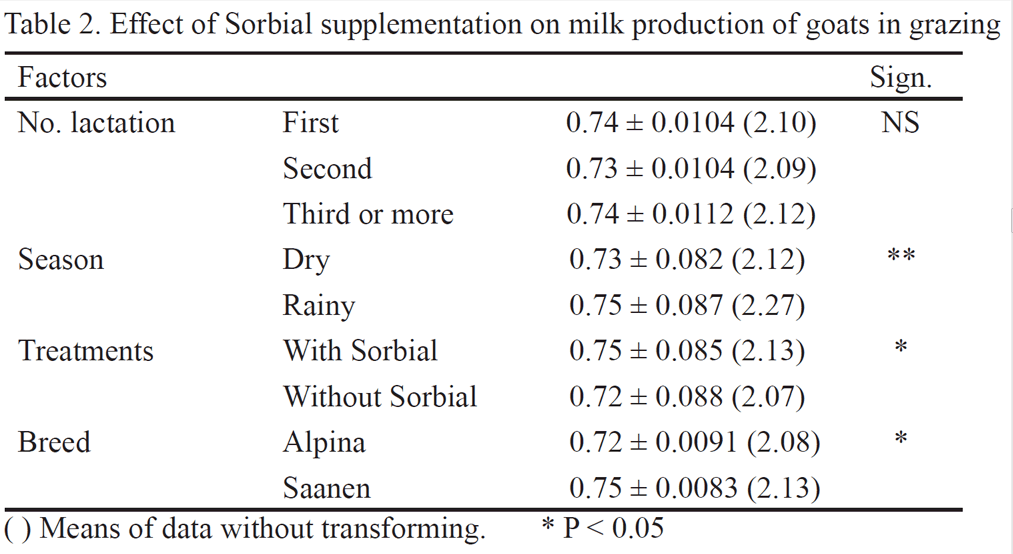
<p align="JUSTIFY">With the use of the probiotic, the results in   milk production (<a href="/img/revistas/cjas/v49n1/t0202115.gif">table 2</a>) showed that there was not interaction between   the studied effects. The number   of lactation did not differ. However, goats produced 7.1% more than (P &lt; 0.01) milk in the rainy season. The   animals that intake the probiotic, in any of the two breeds, produced   3.9% more of milk (P &lt; 0.05)   regarding those that did not consume it .Saanen goats produced 2.4% more   of milk (P &lt; 0.05) than the Alpina breed. </p>     
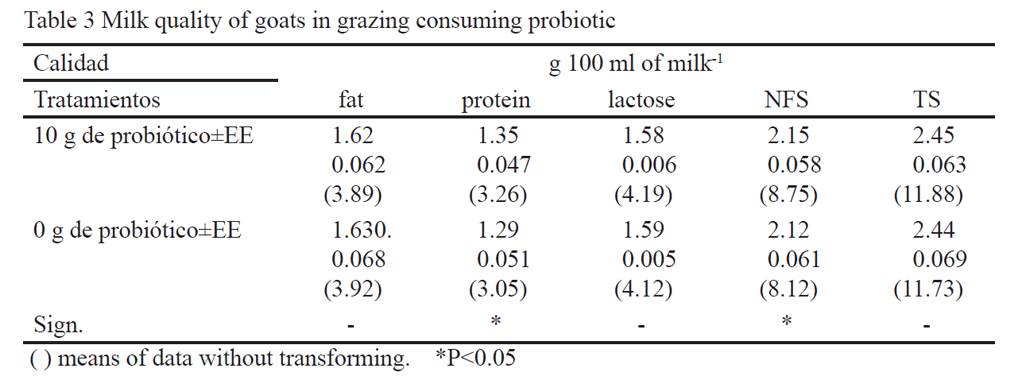
<p align="JUSTIFY">The higher milk productions in the rainy period responded to the quality of the base food (Roca- Fern&aacute;ndez <em>et al.</em> 2012), regardless that in the dry season the goats had as   average 69d less of lactation. This factor influenced in that the   differences between seasons were only 7.1%. </p>     <p align="JUSTIFY"> Frau <em>et al.</em> (2013) reported higher milk   productions in Saanen goats than in Alpina, although the productive   levels of both were lower in 1.45 and   2.1 times, regarding to that is stated in this study. The Saanen goats   are typical animals, with dairy purpose, they show higher milk   production but with   a lower fat content, while the animals from Anglo Nubia breed, showed   higher fat percentage in its milk (Salvador and Mart&iacute;nez, 2007). </p>     <p align="JUSTIFY">With the use of the Sorbial probiotic similar   results in the increase of milk productivity in dairy cows (Bernardeau   and Guillier, 2003) have   been informed, that showed increases between 404-960 kg of total milk in   the lactation, by the use of the probiotic concept; this effect is   associated to   the improvements in the use of consumed foods and, therefore, to the   higher nutrients absorption. </p>     <p align="JUSTIFY">In <a href="/img/revistas/cjas/v49n1/t0302115.gif">table 3</a>, is showed that there was not   interaction treatment/breed in the indicators of milk quality. The fat   percentage, lactose and total solids did   not differ among treatments. The fat average determined in the research   coincides with the informed in others studies (Borges <em>et al.</em> 2004, Torres 2004, Vegas <em>et   al.</em> 2007 and Frau <em>et al.</em> 2012),in those that have been indicated that the originally breeds from Europe, like Alpina and Saanen, produced milk   ,under normal conditions, with 4.0% of fat approximately. </p>     
<p align="JUSTIFY">The content of milky fat of the two studied   breeds was higher regarding to the 2.4% of reports, according to tables   of food composition from   the National Nutrition Institute of Mexico (Anon 2005); in turn, this   value is lower to the one referred by Frau <em>et al.</em> (2013), who informed 5.32%, and show the variability of this milk component, according to food conditions and breed. </p>     <p align="JUSTIFY">The protein content in the caprine milk was 4.9%   more (P &lt; 0.05) in the supplemented animals with the probiotic,   regarding to non supplemented.   This can be explain by the possible improvements of ruminal conditions   and therefore, by the increase of the protein passing to the animal low   tract (Vaca <em>et al.</em> 2004). </p>     ]]></body>
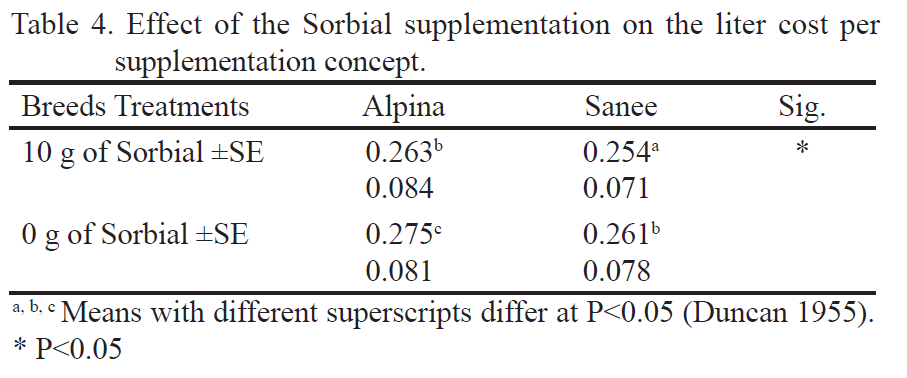
<body><![CDATA[<p align="JUSTIFY">Milk protein varies less than the fat during the lactation (Haenlein 1996), for these two breeds, the values informed by Soryal <em>et al.</em> (2004 and 2005) were 2.88 and 3.08% respectively, lower to those of this research. </p>     <p align="JUSTIFY">This increase in the protein percentage in the   milk of the supplemented goats with the probiotic favored increase of   7.8 % ( P &lt; 0.05) in NFS. In   same way, this milk component, in both treatments, was in the ranges   informed by Soryal <em>et al.</em> (2005) and Frau <em>et al.</em> (2013). </p>     <p align="JUSTIFY">The average lactose levels of goats milk did not   differ among treatments and were in the ranges informed by other   researches (Soryal <em>et al.</em> 2004 and 2004 and Keskin <em>et   al.</em> 2004).The same happened with the TS (Keskin <em>et al.</em> 2004 and Vega <em>et al.</em> 2007).However, TS percentages higher at 14.9% in   the milk of Saanen goats &frac34;, regarding to other European breeds crossings were informed by Frau <em>et al.</em> (2013). </p>     <p align="JUSTIFY">The costs of the produced milk liter (<a href="/img/revistas/cjas/v49n1/t0402115.gif">table 4</a>),   per supplement concept (concentrate and probiotic), decreased (P &lt;   0.05) at 0.012 and 0.007   Cuban pesos in Alpina and Saanen breeds respectively, when were   supplemented with the Sorbial; In same way the production costs of   Saanen goats,   decreased (P &lt; 0.05) at 0.009 and 0.014 Cuban pesos, related to   Alpinas goats, supplemented or not, respectively. </p>     
<p align="JUSTIFY">The results of this research showed the feasibility of giving, during the first 100 d of lactation, 10g of Sorbial goat<sup>-1</sup> d<sup>-1</sup>.With the used of this probiotic the milky production was increased, in total lactation specifically, and improved the   chemical composition of the milk. Besides, the production costs per supplement decreased. </p> </font>     <p>&nbsp;</p>     <p><font size="3" face="Verdana, Arial, Helvetica, sans-serif"><strong>ACKNOWLEDGEMENTS</strong></font></p>     <p align="justify"><font size="2" face="Verdana, Arial, Helvetica, sans-serif">Thanks to the French firm Sorbial SAS, especially to Mrs. Yves Legarda   and Mr. Emilio Gonz&aacute;lez, to provide the probiotic.It is also   expressed gratitude to the workers from the caprine company &laquo;Majana&raquo;,   belonging to the Empresa Agropecuaria &laquo;Guaicanamar&raquo;, in Mayabeque   province, for the given help to develop this research.</font></p>     <p>&nbsp;</p>     <p><font size="2" face="Verdana, Arial, Helvetica, sans-serif"><font size="3"><strong>BIBLIOGRAPHY</strong></font></font></p> <font size="2" face="Verdana, Arial, Helvetica, sans-serif"></font>    ]]></body>
<body><![CDATA[<p align="justify"><font size="2" face="Verdana, Arial, Helvetica, sans-serif">Acosta A., Lon-Wo E., Garcia Y., Dieppa O. &amp; Febles M. 2007. <span lang="EN-US">&lsquo;&lsquo;Effect of  a probiotic mixture (Lactobacillus acidophilus and Lactobacillus rhamnosus) on  the productive performance, carcass yield and economic indicators of broiler  chickens&rsquo;&rsquo;. </span><em>Cuban Journal of Agricultural Science</em>, 41 (4), pp. 335&ndash;338.</font></p>     <!-- ref --><p align="justify"><font size="2" face="Verdana, Arial, Helvetica, sans-serif">Anon. 2005. <em>Consejo para el fomento de la calidad de la  leche y sus derivados. Sistema producto leche - muestreo de leche y productos  l&aacute;cteos</em>. no. <span lang="EN-US">NMX-F-718-COFOCALEC-2005,  Inst. A.C. COFOCALEC, M&eacute;xico.    </span></font></p>     <p align="justify"><font size="2" face="Verdana, Arial, Helvetica, sans-serif"><span lang="EN-US">AOAC International. 1995. <em>Official  methods of analysis of AOAC International</em>. 16th ed., vol. 1, AOAC  International, ISBN: 978-0-935584-54-7, Available:  &lt;<a href="http://www.cabdirect.org/abstracts/19951414840.html;jsessionid=F473A9F5FB5AA48E5B87E3FC0986D738" target="_blank">http://www.cabdirect.org/abstracts/19951414840.html;jsessionid=F473A9F5FB5AA48E5B87E3FC0986D738</a>&gt;,  [Accessed:&nbsp;</span>May 10, 2014<span lang="EN-US">].</span></font></p>     <!-- ref --><p align="justify"><font size="2" face="Verdana, Arial, Helvetica, sans-serif">Balzarini M. G., Casanoves F., Di Rienzo J. A., Gonz&aacute;lez L. A. &amp; Robledo C. W. 2012. <em>Software  estad&iacute;stico Infostat</em>. version 2012, C&oacute;rdoba, Argentina.    </font></p>     <p align="justify"><font size="2" face="Verdana, Arial, Helvetica, sans-serif">Bernardeau M. &amp; Guillier F. 2003. <span lang="EN-US">&lsquo;&lsquo;Efficacy of two lactobacillion on animal health and zootechnical  performances&rsquo;&rsquo;. In: <em>Affiches et communications orales pressentes dans des  Congres Internationaux</em>, France.</span></font></p>     <p align="justify"><font size="2" face="Verdana, Arial, Helvetica, sans-serif"><span lang="EN-US">Bernardeau M., Guillier F.,  Vernoux J. P. &amp; Gueguen M. 2003. &lsquo;&lsquo;In vitro evaluation of probiotic  potentialities of two lactobacilli for animal feed&rsquo;&rsquo;. In: <em>Affiches et  communications orales pressentes dans des Congres Internationaux</em>, France.</span></font></p>     <p align="justify"><font size="2" face="Verdana, Arial, Helvetica, sans-serif">Bernardeau M., Vernoux J. P. &amp; Gueguen M. 2000. <span lang="EN-US">&lsquo;&lsquo;Probiotics for animals.  Fermented food, fermentation and instestinal flora&rsquo;&rsquo;. </span>In: New York, Symposium.</font></p>     <p align="justify"><font size="2" face="Verdana, Arial, Helvetica, sans-serif">Bittar C. M., Menezes P., Salgado  J. G., Da Silva C. E., G&oacute;mez P. &amp; De P&aacute;dua M.  2004. &lsquo;&lsquo;Avalia&ccedil;ao da inclusao  de diferentes aditivos em concentrado para vacas em lacta&ccedil;ao mantidas  em pastagen s de capim Tanzania&rsquo;&rsquo;. In: <em>41 Reuniao  anual da Sociedades Brasileiras de Zootecnia</em>, Campo Grande, MS, Brazil, pp. 1&ndash;5.</font></p>     ]]></body>
<body><![CDATA[<p align="justify"><font size="2" face="Verdana, Arial, Helvetica, sans-serif"><span lang="EN-US">Borges H., Cordeiro P. &amp;  Bresslau S. 2004. <em>Seasonal variation of goat milk composition and somatic  cell count in south-eastern Brazil. The future of the sheep and goat dairy  sectors</em>. Zaragoza, Spain: International Dairy Federation, Available:  &lt;<a href="http://www.capritec.com.br/pdf/short_paper_brazil.doc" target="_blank">http://www.capritec.com.br/pdf/short_paper_brazil.doc</a>&gt;,  [Accessed:&nbsp;</span>May 10, 2014<span lang="EN-US">].</span></font></p>     <p align="justify"><font size="2" face="Verdana, Arial, Helvetica, sans-serif"><span lang="EN-US">Duncan D. B. 1955. &lsquo;&lsquo;Multiple  Range and Multiple F Tests&rsquo;&rsquo;. <em>Biometrics</em>, 11 (1), pp. 1&ndash;42, ISSN:  0006-341X, DOI: 10.2307/3001478.</span></font></p>     <p align="justify"><font size="2" face="Verdana, Arial, Helvetica, sans-serif"><span lang="EN-US">Fekadu B., Soryal K., Zeng S.,  Hekken D. V., Bah B. &amp; Villaquiran M. 2005. &lsquo;&lsquo;Changes in goat milk  composition during lactation and their effect on yield and quality of hard and  semi-hard cheeses&rsquo;&rsquo;. <em>Small Ruminant Research</em>, 59 (1), pp. 55&ndash;63, ISSN:  0921-4488, DOI: 10.1016/j.smallrumres.2004.12.003.</span></font></p>     <p align="justify"><font size="2" face="Verdana, Arial, Helvetica, sans-serif"><span lang="EN-US">Frau F., Font G., Paz R. &amp;  Pece N. 2012. </span>&lsquo;&lsquo;Composici&oacute;n  f&iacute;sico-qu&iacute;mica y calidad microbiol&oacute;gica de leche de cabra en reba&ntilde;o bajo  sistema extensivo en Santiago del Estero (Argentina)&rsquo;&rsquo;. <em>Revista de la Facultad de Agronom&iacute;a, La Plata</em>, 111 (1), pp. 1&ndash;7.</font></p>     <p align="justify"><font size="2" face="Verdana, Arial, Helvetica, sans-serif">Frau S. F., Font de Valdez G., Paz R. &amp; Pece N. 2013. <span lang="EN-US">&lsquo;&lsquo;Physicochemical composition and microbiological quality of goat milk  produced in Santiago del Estero Province (Argentine)&rsquo;&rsquo;. </span><em>Archivos Latinoamericanos de  Producci&oacute;n Animal</em>, 21 (1), Available:  &lt;<a href="http://www.ojs.alpa.org.ve/index.php/ojs_files/article/view/2232" target="_blank">http://www.ojs.alpa.org.ve/index.php/ojs_files/article/view/2232</a>&gt;, [Accessed:&nbsp;May 10, 2014].</font></p>     <p align="justify"><font size="2" face="Verdana, Arial, Helvetica, sans-serif"><span lang="EN-US">Haenlein G. F. W. 1996.  &lsquo;&lsquo;Nutritional value of dairy products of ewe and goat&rsquo;&rsquo;. <em>International Dairy  Federation</em>, (3), pp. 159&ndash;178.</span></font></p>     <p align="justify"><font size="2" face="Verdana, Arial, Helvetica, sans-serif"><span lang="EN-US">Haydock K. P. &amp; Shaw N. H.  1975. &lsquo;&lsquo;The comparative yield meted for estimating dry matter of pastore&rsquo;&rsquo;. <em>Austr.  J. Agric. Anim. Husb.</em>, 15, p. 663.</span></font></p>     <p align="justify"><font size="2" face="Verdana, Arial, Helvetica, sans-serif"><span lang="EN-US">Keskin M., Avsar Y. &amp; Bur  O. 2004. &lsquo;&lsquo;A comparative study on the milk yield and milk composition of two  different goat genotypes under the climate of the Eastern Mediterranean&rsquo;&rsquo;. <em>Turkish  Journal of Veterinary and Animal Sciences</em>, 28 (3), pp. 531&ndash;536.</span></font></p>     <!-- ref --><p align="justify"><font size="2" face="Verdana, Arial, Helvetica, sans-serif"><span lang="EN-US">Menchaca M. 1978. </span><em>Modelo multiplicativo con efectos de  curva de lactancias controlada para el an&aacute;lisis estad&iacute;stico de experimentos con  vacas lecheras</em>. PhD.Thesis.    </font></p>     ]]></body>
<body><![CDATA[<p align="justify"><font size="2" face="Verdana, Arial, Helvetica, sans-serif">Roca-Fern&aacute;ndez  A. I., Gonz&aacute;lez-Rodr&iacute;guez A. &amp; V&aacute;zquez-Y&aacute;&ntilde;ez O. P. 2012. <span lang="EN-US">&lsquo;&lsquo;Effect of pasture allowance and cows&rsquo; lactation stage on perennial  ryegrass sward quality, pasture dry matter intake and milk performance of  Holstein-Friesian cows&rsquo;&rsquo;. </span><em>Spanish Journal of Agricultural Research</em>, 10 (2), pp. 393&ndash;408.</font></p>     <p align="justify"><font size="2" face="Verdana, Arial, Helvetica, sans-serif">Rodr&iacute;guez  B., Acosta A., Dieppa O. &amp; Febles M. 2007. &lsquo;&lsquo;Empleo de un probi&oacute;tico  en gallinas ponedoras j&oacute;venes&rsquo;&rsquo;. In: <em>XX Congreso Latinoamericano de Avicultura</em>,  Brasil, pp. 40&ndash;42.</font></p>     <p align="justify"><font size="2" face="Verdana, Arial, Helvetica, sans-serif">Salvador A.  &amp; Mart&iacute;nez G. 2007. &lsquo;&lsquo;Factores que afectan la producci&oacute;n y composici&oacute;n de  la leche de cabra: Revisi&oacute;n bibliogr&aacute;fica&rsquo;&rsquo;. <em>Rev. Fac.  Cs. Vets</em>, 48 (2), pp. 61&ndash;76.</font></p>     <p align="justify"><font size="2" face="Verdana, Arial, Helvetica, sans-serif">Soca M.,  Ojeda F., Canchila E. R. &amp; Soca M. 2011. &lsquo;&lsquo;Efecto del probi&oacute;tico  Sorbial&reg; en el comportamiento productivo y la salud  animal de terneros en pastoreo&rsquo;&rsquo;. <em><span lang="EN-US">Pastos y Forrajes</span></em><span lang="EN-US">, 34 (4), pp. 463&ndash;472.</span></font></p>     <p align="justify"><font size="2" face="Verdana, Arial, Helvetica, sans-serif"><span lang="EN-US">Soryal K. A., Zeng S. S., Min  B. R., Hart S. P. &amp; Beyene F. A. 2004. &lsquo;&lsquo;Effect of feeding systems on  composition of goat milk and yield of Domiati cheese&rsquo;&rsquo;. <em>Small Ruminant  Research</em>, 54 (1), pp. 121&ndash;129.</span></font></p>     <p align="justify"><font size="2" face="Verdana, Arial, Helvetica, sans-serif"><span lang="EN-US">Soryal K., Beyene F. A., Zeng  S., Bah B. &amp; Tesfai K. 2005. &lsquo;&lsquo;Effect of goat breed and milk composition on  yield, sensory quality, fatty acid concentration of soft cheese during  lactation&rsquo;&rsquo;. </span><em>Small Ruminant Research</em>, 58 (3), pp. 275&ndash;281.</font></p>     <p align="justify"><font size="2" face="Verdana, Arial, Helvetica, sans-serif">Torres C.  2004. &lsquo;&lsquo;Principales razas caprinas en M&eacute;xico&rsquo;&rsquo;. <em>Revista Cabras</em>, pp. 6&ndash;8.</font></p>     <p align="justify"><font size="2" face="Verdana, Arial, Helvetica, sans-serif">Vacca G. M., Carcangiu V., Dettori L. M. &amp; Bini P. P.  2004. <span lang="EN-US">&lsquo;&lsquo;Relationships between body condition score, milk yield and milk  composition of Sarda goat&rsquo;&rsquo;. <em>Journal of Animal and Feed Sciences</em>, 13  (Suppl. 1), pp. 705&ndash;708.</span></font></p>     <!-- ref --><p align="justify"><font size="2" face="Verdana, Arial, Helvetica, sans-serif"><span lang="EN-US">Vega D. M. 2007. </span><em>Efecto de una mezcla probi&oacute;tica (Lactobacillus acidophilus y Lactobacillus rhamnosus) en el comportamiento productivo y la fisiolog&iacute;a  digestiva de la gallina ponedora (White l egorhon  L33) de 24 a 36 semanas de postura</em>. Graduated Thesis, Riobamba, Ecuador.    </font></p>     ]]></body>
<body><![CDATA[<p align="justify"><font size="2" face="Verdana, Arial, Helvetica, sans-serif">Vega S.,  Guti&eacute;rrez R., Ram&iacute;rez A., Gonz&aacute;lez M., D&iacute;az&ndash;Gonz&aacute;lez G., Salas J., Gonz&aacute;lez C.,  Coronado M., Schettino B. &amp; Alberti A. 2009. <em>Leche  de cabra: producci&oacute;n, composici&oacute;n y aptitud industrial. Tecnolog&iacute;a</em>. ,  Tecnolog&iacute;a, Available:  &lt;<a href="http://www.alfaeditores.com/ carnilac/OctubreNoviembre2005/TECNOLOGIA/leche/cabra.htm" target="_blank">http://www.alfaeditores.com/ carnilac/OctubreNoviembre2005/TECNOLOGIA/leche/cabra.htm</a>&gt;,  [Accessed:&nbsp;May 10, 2014].</font></p>     <p align="justify"><font size="2" face="Verdana, Arial, Helvetica, sans-serif">Vega S.,  Guti&eacute;rrez R., Ram&iacute;rez A., Gonz&aacute;lez M., D&iacute;az-Gonz&aacute;lez G., Salas J., Gonz&aacute;lez C.,  Coronado M., Schettino B., Alberti A. &amp; others. <span lang="EN-US">2007. &lsquo;&lsquo;Physico-chemical  characteristics and composition of goat milk from Alpine French and Saanen in  rainy and dry season.&rsquo;&rsquo;. </span><em>Revista de Salud Animal</em>, 29 (3), pp. 160&ndash;166.</font></p>     <!-- ref --><p align="justify"><font size="2" face="Verdana, Arial, Helvetica, sans-serif">Zabala J.  &amp; P&eacute;rez F. 1999. <em>Normas y procedimientos para la planificaci&oacute;n y  determinaci&oacute;n del costo de producci&oacute;n. Fichas de costo carne y leche</em>. Inst.  MINAG, p. 18.    </font></p>     <!-- ref --><p align="justify"><font size="2" face="Verdana, Arial, Helvetica, sans-serif">Zapata C.  2011. <em>Valoraci&oacute;n del efecto del cultivo de lactobacilos (Vitafert)  en la cr&iacute;a de terneros en Tabasco</em>. Master Thesis,  Tabasco, M&eacute;xico.    </font></p>     <p align="justify">&nbsp;</p> <font size="2" face="Verdana, Arial, Helvetica, sans-serif"></font>     <p>&nbsp;</p>     <p><font size="2" face="Verdana, Arial, Helvetica, sans-serif">Received: May 10, 2014    <br>   Accepted: November 1, 2014</font></p>     ]]></body>
<body><![CDATA[<p>&nbsp;</p>     <p>&nbsp;</p>     <p align="justify"><font size="2" face="Verdana, Arial, Helvetica, sans-serif"><em>J.J. Reyes,</em> Instituto de Ciencia Animal, Apartado Postal 24, San José de las Lajas, Mayabeque, Cuba.    Email: <a href="mailto:jreyes@ica.co.cu">jreyes@ica.co.cu</a></font></p>      ]]></body><back>
<ref-list>
<ref id="B1">
<nlm-citation citation-type="journal">
<person-group person-group-type="author">
<name>
<surname><![CDATA[Acosta]]></surname>
<given-names><![CDATA[A.]]></given-names>
</name>
<name>
<surname><![CDATA[Lon-Wo]]></surname>
<given-names><![CDATA[E.]]></given-names>
</name>
<name>
<surname><![CDATA[Garcia]]></surname>
<given-names><![CDATA[Y.]]></given-names>
</name>
<name>
<surname><![CDATA[Dieppa]]></surname>
<given-names><![CDATA[O.]]></given-names>
</name>
<name>
<surname><![CDATA[Febles]]></surname>
<given-names><![CDATA[M.]]></given-names>
</name>
</person-group>
<article-title xml:lang="nd"><![CDATA[Effect of a probiotic mixture (Lactobacillus acidophilus and Lactobacillus rhamnosus) on the productive performance, carcass yield and economic indicators of broiler chickens]]></article-title>
<source><![CDATA[Cuban Journal of Agricultural Science]]></source>
<year>2007</year>
<volume>41</volume>
<numero>4</numero>
<issue>4</issue>
<page-range>335–338</page-range></nlm-citation>
</ref>
<ref id="B2">
<nlm-citation citation-type="">
<person-group person-group-type="author">
<name>
<surname><![CDATA[Anon]]></surname>
</name>
</person-group>
<source><![CDATA[Consejo para el fomento de la calidad de la leche y sus derivados. Sistema producto leche - muestreo de leche y productos lácteos]]></source>
<year>2005</year>
<publisher-loc><![CDATA[México ]]></publisher-loc>
</nlm-citation>
</ref>
<ref id="B3">
<nlm-citation citation-type="book">
<person-group person-group-type="author">
<name>
<surname><![CDATA[AOAC International]]></surname>
</name>
</person-group>
<source><![CDATA[Official methods of analysis of AOAC International]]></source>
<year>1995</year>
<volume>1</volume>
<edition>16th</edition>
<publisher-name><![CDATA[AOAC International]]></publisher-name>
</nlm-citation>
</ref>
<ref id="B4">
<nlm-citation citation-type="">
<person-group person-group-type="author">
<name>
<surname><![CDATA[Balzarini]]></surname>
<given-names><![CDATA[M. G.]]></given-names>
</name>
<name>
<surname><![CDATA[Casanoves]]></surname>
<given-names><![CDATA[F.]]></given-names>
</name>
<name>
<surname><![CDATA[Di Rienzo]]></surname>
<given-names><![CDATA[J. A.]]></given-names>
</name>
<name>
<surname><![CDATA[González]]></surname>
<given-names><![CDATA[L. A.]]></given-names>
</name>
<name>
<surname><![CDATA[Robledo]]></surname>
<given-names><![CDATA[C. W.]]></given-names>
</name>
</person-group>
<source><![CDATA[Software estadístico Infostat]]></source>
<year>2012</year>
<publisher-loc><![CDATA[Córdoba, Argentina ]]></publisher-loc>
</nlm-citation>
</ref>
<ref id="B5">
<nlm-citation citation-type="">
<person-group person-group-type="author">
<name>
<surname><![CDATA[Bernardeau]]></surname>
<given-names><![CDATA[M.]]></given-names>
</name>
<name>
<surname><![CDATA[Guillier]]></surname>
<given-names><![CDATA[F.]]></given-names>
</name>
</person-group>
<article-title xml:lang="nd"><![CDATA[Efficacy of two lactobacillion on animal health and zootechnical performances]]></article-title>
<source><![CDATA[]]></source>
<year>2003</year>
<publisher-loc><![CDATA[France ]]></publisher-loc>
</nlm-citation>
</ref>
<ref id="B6">
<nlm-citation citation-type="">
<person-group person-group-type="author">
<name>
<surname><![CDATA[Bernardeau]]></surname>
<given-names><![CDATA[M.]]></given-names>
</name>
<name>
<surname><![CDATA[Guillier]]></surname>
<given-names><![CDATA[F.]]></given-names>
</name>
<name>
<surname><![CDATA[Vernoux]]></surname>
<given-names><![CDATA[J. P.]]></given-names>
</name>
<name>
<surname><![CDATA[Gueguen]]></surname>
<given-names><![CDATA[M.]]></given-names>
</name>
</person-group>
<article-title xml:lang="nd"><![CDATA[In vitro evaluation of probiotic potentialities of two lactobacilli for animal feed]]></article-title>
<source><![CDATA[]]></source>
<year>2003</year>
<publisher-loc><![CDATA[France ]]></publisher-loc>
</nlm-citation>
</ref>
<ref id="B7">
<nlm-citation citation-type="">
<person-group person-group-type="author">
<name>
<surname><![CDATA[Bernardeau]]></surname>
<given-names><![CDATA[M.]]></given-names>
</name>
<name>
<surname><![CDATA[Vernoux]]></surname>
<given-names><![CDATA[J. P.]]></given-names>
</name>
<name>
<surname><![CDATA[Gueguen]]></surname>
<given-names><![CDATA[M.]]></given-names>
</name>
</person-group>
<article-title xml:lang="nd"><![CDATA[Probiotics for animals. Fermented food, fermentation and instestinal flora]]></article-title>
<source><![CDATA[]]></source>
<year>2000</year>
<publisher-loc><![CDATA[New York ]]></publisher-loc>
</nlm-citation>
</ref>
<ref id="B8">
<nlm-citation citation-type="">
<person-group person-group-type="author">
<name>
<surname><![CDATA[Bittar]]></surname>
<given-names><![CDATA[C. M.]]></given-names>
</name>
<name>
<surname><![CDATA[Menezes]]></surname>
<given-names><![CDATA[P.]]></given-names>
</name>
<name>
<surname><![CDATA[Salgado]]></surname>
<given-names><![CDATA[J. G.]]></given-names>
</name>
<name>
<surname><![CDATA[Da Silva]]></surname>
<given-names><![CDATA[C. E.]]></given-names>
</name>
<name>
<surname><![CDATA[Gómez]]></surname>
<given-names><![CDATA[P.]]></given-names>
</name>
<name>
<surname><![CDATA[De Pádua]]></surname>
<given-names><![CDATA[M.]]></given-names>
</name>
</person-group>
<article-title xml:lang="nd"><![CDATA[Avaliaçao da inclusao de diferentes aditivos em concentrado para vacas em lactaçao mantidas em pastagen s de capim Tanzania]]></article-title>
<source><![CDATA[]]></source>
<year>2004</year>
<page-range>1–5</page-range><publisher-loc><![CDATA[Campo Grande, MS, Brazil ]]></publisher-loc>
</nlm-citation>
</ref>
<ref id="B9">
<nlm-citation citation-type="book">
<person-group person-group-type="author">
<name>
<surname><![CDATA[Borges]]></surname>
<given-names><![CDATA[H.]]></given-names>
</name>
<name>
<surname><![CDATA[Cordeiro]]></surname>
<given-names><![CDATA[P.]]></given-names>
</name>
<name>
<surname><![CDATA[Bresslau]]></surname>
<given-names><![CDATA[S.]]></given-names>
</name>
</person-group>
<source><![CDATA[Seasonal variation of goat milk composition and somatic cell count in south-eastern Brazil. The future of the sheep and goat dairy sectors]]></source>
<year>2004</year>
<publisher-loc><![CDATA[Zaragoza, Spain ]]></publisher-loc>
<publisher-name><![CDATA[International Dairy Federation]]></publisher-name>
</nlm-citation>
</ref>
<ref id="B10">
<nlm-citation citation-type="journal">
<person-group person-group-type="author">
<name>
<surname><![CDATA[Duncan]]></surname>
<given-names><![CDATA[D. B.]]></given-names>
</name>
</person-group>
<article-title xml:lang="nd"><![CDATA[Multiple Range and Multiple F Tests]]></article-title>
<source><![CDATA[Biometrics]]></source>
<year>1955</year>
<volume>11</volume>
<numero>1</numero>
<issue>1</issue>
<page-range>1–42</page-range></nlm-citation>
</ref>
<ref id="B11">
<nlm-citation citation-type="journal">
<person-group person-group-type="author">
<name>
<surname><![CDATA[Fekadu]]></surname>
<given-names><![CDATA[B.]]></given-names>
</name>
<name>
<surname><![CDATA[Soryal]]></surname>
<given-names><![CDATA[K.]]></given-names>
</name>
<name>
<surname><![CDATA[Zeng]]></surname>
<given-names><![CDATA[S.]]></given-names>
</name>
<name>
<surname><![CDATA[Hekken]]></surname>
<given-names><![CDATA[D. V.]]></given-names>
</name>
<name>
<surname><![CDATA[Bah]]></surname>
<given-names><![CDATA[B.]]></given-names>
</name>
<name>
<surname><![CDATA[Villaquiran]]></surname>
<given-names><![CDATA[M.]]></given-names>
</name>
</person-group>
<article-title xml:lang="nd"><![CDATA[Changes in goat milk composition during lactation and their effect on yield and quality of hard and semi-hard cheeses]]></article-title>
<source><![CDATA[Small Ruminant Research]]></source>
<year>2005</year>
<volume>59</volume>
<numero>1</numero>
<issue>1</issue>
<page-range>55–63</page-range></nlm-citation>
</ref>
<ref id="B12">
<nlm-citation citation-type="journal">
<person-group person-group-type="author">
<name>
<surname><![CDATA[Frau]]></surname>
<given-names><![CDATA[F.]]></given-names>
</name>
<name>
<surname><![CDATA[Font]]></surname>
<given-names><![CDATA[G.]]></given-names>
</name>
<name>
<surname><![CDATA[Paz]]></surname>
<given-names><![CDATA[R.]]></given-names>
</name>
<name>
<surname><![CDATA[Pece]]></surname>
<given-names><![CDATA[N.]]></given-names>
</name>
</person-group>
<article-title xml:lang="nd"><![CDATA[Composición físico-química y calidad microbiológica de leche de cabra en rebaño bajo sistema extensivo en Santiago del Estero (Argentina)]]></article-title>
<source><![CDATA[Revista de la Facultad de Agronomía, La Plata]]></source>
<year>2012</year>
<volume>111</volume>
<numero>1</numero>
<issue>1</issue>
<page-range>1–7</page-range></nlm-citation>
</ref>
<ref id="B13">
<nlm-citation citation-type="journal">
<person-group person-group-type="author">
<name>
<surname><![CDATA[Frau]]></surname>
<given-names><![CDATA[S. F.]]></given-names>
</name>
<name>
<surname><![CDATA[Font de Valdez]]></surname>
<given-names><![CDATA[G.]]></given-names>
</name>
<name>
<surname><![CDATA[Paz]]></surname>
<given-names><![CDATA[R.]]></given-names>
</name>
<name>
<surname><![CDATA[Pece]]></surname>
<given-names><![CDATA[N.]]></given-names>
</name>
</person-group>
<article-title xml:lang="nd"><![CDATA[Physicochemical composition and microbiological quality of goat milk produced in Santiago del Estero Province (Argentine)]]></article-title>
<source><![CDATA[Archivos Latinoamericanos de Producción Animal]]></source>
<year>2013</year>
<volume>21</volume>
<numero>1</numero>
<issue>1</issue>
</nlm-citation>
</ref>
<ref id="B14">
<nlm-citation citation-type="journal">
<person-group person-group-type="author">
<name>
<surname><![CDATA[Haenlein]]></surname>
<given-names><![CDATA[G. F. W.]]></given-names>
</name>
</person-group>
<article-title xml:lang="nd"><![CDATA[Nutritional value of dairy products of ewe and goat]]></article-title>
<source><![CDATA[International Dairy Federation]]></source>
<year>1996</year>
<numero>3</numero>
<issue>3</issue>
<page-range>159–178</page-range></nlm-citation>
</ref>
<ref id="B15">
<nlm-citation citation-type="journal">
<person-group person-group-type="author">
<name>
<surname><![CDATA[Haydock]]></surname>
<given-names><![CDATA[K. P.]]></given-names>
</name>
<name>
<surname><![CDATA[Shaw]]></surname>
<given-names><![CDATA[N. H.]]></given-names>
</name>
</person-group>
<article-title xml:lang="nd"><![CDATA[The comparative yield meted for estimating dry matter of pastore]]></article-title>
<source><![CDATA[Austr. J. Agric. Anim. Husb.]]></source>
<year>1975</year>
<volume>15</volume>
<page-range>663</page-range></nlm-citation>
</ref>
<ref id="B16">
<nlm-citation citation-type="journal">
<person-group person-group-type="author">
<name>
<surname><![CDATA[Keskin]]></surname>
<given-names><![CDATA[M.]]></given-names>
</name>
<name>
<surname><![CDATA[Avsar]]></surname>
<given-names><![CDATA[Y.]]></given-names>
</name>
<name>
<surname><![CDATA[Bur]]></surname>
<given-names><![CDATA[O.]]></given-names>
</name>
</person-group>
<article-title xml:lang="nd"><![CDATA[A comparative study on the milk yield and milk composition of two different goat genotypes under the climate of the Eastern Mediterranean]]></article-title>
<source><![CDATA[Turkish Journal of Veterinary and Animal Sciences]]></source>
<year>2004</year>
<volume>28</volume>
<numero>3</numero>
<issue>3</issue>
<page-range>531–536</page-range></nlm-citation>
</ref>
<ref id="B17">
<nlm-citation citation-type="">
<person-group person-group-type="author">
<name>
<surname><![CDATA[Menchaca]]></surname>
<given-names><![CDATA[M.]]></given-names>
</name>
</person-group>
<source><![CDATA[Modelo multiplicativo con efectos de curva de lactancias controlada para el análisis estadístico de experimentos con vacas lecheras]]></source>
<year>1978</year>
</nlm-citation>
</ref>
<ref id="B18">
<nlm-citation citation-type="journal">
<person-group person-group-type="author">
<name>
<surname><![CDATA[Roca-Fernández]]></surname>
<given-names><![CDATA[A. I.]]></given-names>
</name>
<name>
<surname><![CDATA[González-Rodríguez]]></surname>
<given-names><![CDATA[A.]]></given-names>
</name>
<name>
<surname><![CDATA[Vázquez-Yáñez]]></surname>
<given-names><![CDATA[O. P.]]></given-names>
</name>
</person-group>
<article-title xml:lang="nd"><![CDATA[Effect of pasture allowance and cows’ lactation stage on perennial ryegrass sward quality, pasture dry matter intake and milk performance of Holstein-Friesian cows]]></article-title>
<source><![CDATA[Spanish Journal of Agricultural Research]]></source>
<year>2012</year>
<volume>10</volume>
<numero>2</numero>
<issue>2</issue>
<page-range>393–408</page-range></nlm-citation>
</ref>
<ref id="B19">
<nlm-citation citation-type="">
<person-group person-group-type="author">
<name>
<surname><![CDATA[Rodríguez]]></surname>
<given-names><![CDATA[B.]]></given-names>
</name>
<name>
<surname><![CDATA[Acosta]]></surname>
<given-names><![CDATA[A.]]></given-names>
</name>
<name>
<surname><![CDATA[Dieppa]]></surname>
<given-names><![CDATA[O.]]></given-names>
</name>
<name>
<surname><![CDATA[Febles]]></surname>
<given-names><![CDATA[M.]]></given-names>
</name>
</person-group>
<article-title xml:lang="nd"><![CDATA[Empleo de un probiótico en gallinas ponedoras jóvenes]]></article-title>
<source><![CDATA[]]></source>
<year>2007</year>
<page-range>40–42</page-range><publisher-loc><![CDATA[Brasil ]]></publisher-loc>
</nlm-citation>
</ref>
<ref id="B20">
<nlm-citation citation-type="journal">
<person-group person-group-type="author">
<name>
<surname><![CDATA[Salvador]]></surname>
<given-names><![CDATA[A.]]></given-names>
</name>
<name>
<surname><![CDATA[Martínez]]></surname>
<given-names><![CDATA[G.]]></given-names>
</name>
</person-group>
<article-title xml:lang="nd"><![CDATA[Factores que afectan la producción y composición de la leche de cabra: Revisión bibliográfica]]></article-title>
<source><![CDATA[Rev. Fac. Cs. Vets]]></source>
<year>2007</year>
<volume>48</volume>
<numero>2</numero>
<issue>2</issue>
<page-range>61–76</page-range></nlm-citation>
</ref>
<ref id="B21">
<nlm-citation citation-type="journal">
<person-group person-group-type="author">
<name>
<surname><![CDATA[Soca]]></surname>
<given-names><![CDATA[M.]]></given-names>
</name>
<name>
<surname><![CDATA[Ojeda]]></surname>
<given-names><![CDATA[F.]]></given-names>
</name>
<name>
<surname><![CDATA[Canchila]]></surname>
<given-names><![CDATA[E. R.]]></given-names>
</name>
<name>
<surname><![CDATA[Soca]]></surname>
<given-names><![CDATA[M.]]></given-names>
</name>
</person-group>
<article-title xml:lang="nd"><![CDATA[Efecto del probiótico Sorbial® en el comportamiento productivo y la salud animal de terneros en pastoreo]]></article-title>
<source><![CDATA[Pastos y Forrajes]]></source>
<year>2011</year>
<volume>34</volume>
<numero>4</numero>
<issue>4</issue>
<page-range>463–472</page-range></nlm-citation>
</ref>
<ref id="B22">
<nlm-citation citation-type="journal">
<person-group person-group-type="author">
<name>
<surname><![CDATA[Soryal]]></surname>
<given-names><![CDATA[K.]]></given-names>
</name>
<name>
<surname><![CDATA[Beyene]]></surname>
<given-names><![CDATA[F. A.]]></given-names>
</name>
<name>
<surname><![CDATA[Zeng]]></surname>
<given-names><![CDATA[S.]]></given-names>
</name>
<name>
<surname><![CDATA[Bah]]></surname>
<given-names><![CDATA[B.]]></given-names>
</name>
<name>
<surname><![CDATA[Tesfai]]></surname>
<given-names><![CDATA[K.]]></given-names>
</name>
</person-group>
<article-title xml:lang="nd"><![CDATA[Effect of goat breed and milk composition on yield, sensory quality, fatty acid concentration of soft cheese during lactation]]></article-title>
<source><![CDATA[Small Ruminant Research]]></source>
<year>2005</year>
<volume>58</volume>
<numero>3</numero>
<issue>3</issue>
<page-range>275–281</page-range></nlm-citation>
</ref>
<ref id="B23">
<nlm-citation citation-type="journal">
<person-group person-group-type="author">
<name>
<surname><![CDATA[Soryal]]></surname>
<given-names><![CDATA[K. A.]]></given-names>
</name>
<name>
<surname><![CDATA[Zeng]]></surname>
<given-names><![CDATA[S. S.]]></given-names>
</name>
<name>
<surname><![CDATA[Min]]></surname>
<given-names><![CDATA[B. R.]]></given-names>
</name>
<name>
<surname><![CDATA[Hart]]></surname>
<given-names><![CDATA[S. P.]]></given-names>
</name>
<name>
<surname><![CDATA[Beyene]]></surname>
<given-names><![CDATA[F. A.]]></given-names>
</name>
</person-group>
<article-title xml:lang="nd"><![CDATA[Effect of feeding systems on composition of goat milk and yield of Domiati cheese]]></article-title>
<source><![CDATA[Small Ruminant Research]]></source>
<year>2004</year>
<volume>54</volume>
<numero>1</numero>
<issue>1</issue>
<page-range>121–129</page-range></nlm-citation>
</ref>
<ref id="B24">
<nlm-citation citation-type="journal">
<person-group person-group-type="author">
<name>
<surname><![CDATA[Torres]]></surname>
<given-names><![CDATA[C.]]></given-names>
</name>
</person-group>
<article-title xml:lang="nd"><![CDATA[Principales razas caprinas en México]]></article-title>
<source><![CDATA[Revista Cabras]]></source>
<year>2004</year>
<page-range>6–8</page-range></nlm-citation>
</ref>
<ref id="B25">
<nlm-citation citation-type="journal">
<person-group person-group-type="author">
<name>
<surname><![CDATA[Vacca]]></surname>
<given-names><![CDATA[G. M.]]></given-names>
</name>
<name>
<surname><![CDATA[Carcangiu]]></surname>
<given-names><![CDATA[V.]]></given-names>
</name>
<name>
<surname><![CDATA[Dettori]]></surname>
<given-names><![CDATA[L. M.]]></given-names>
</name>
<name>
<surname><![CDATA[Bini]]></surname>
<given-names><![CDATA[P. P.]]></given-names>
</name>
</person-group>
<article-title xml:lang="nd"><![CDATA[Relationships between body condition score, milk yield and milk composition of Sarda goat]]></article-title>
<source><![CDATA[Journal of Animal and Feed Sciences]]></source>
<year>2004</year>
<volume>13</volume>
<numero>Suppl. 1</numero>
<issue>Suppl. 1</issue>
<page-range>705–708</page-range></nlm-citation>
</ref>
<ref id="B26">
<nlm-citation citation-type="">
<person-group person-group-type="author">
<name>
<surname><![CDATA[Vega]]></surname>
<given-names><![CDATA[D. M.]]></given-names>
</name>
</person-group>
<source><![CDATA[Efecto de una mezcla probiótica (Lactobacillus acidophilus y Lactobacillus rhamnosus) en el comportamiento productivo y la fisiología digestiva de la gallina ponedora (White l egorhon L33) de 24 a 36 semanas de postura]]></source>
<year>2007</year>
<publisher-loc><![CDATA[Riobamba, Ecuador ]]></publisher-loc>
</nlm-citation>
</ref>
<ref id="B27">
<nlm-citation citation-type="">
<person-group person-group-type="author">
<name>
<surname><![CDATA[Vega]]></surname>
<given-names><![CDATA[S.]]></given-names>
</name>
<name>
<surname><![CDATA[Gutiérrez]]></surname>
<given-names><![CDATA[R.]]></given-names>
</name>
<name>
<surname><![CDATA[Ramírez]]></surname>
<given-names><![CDATA[A.]]></given-names>
</name>
<name>
<surname><![CDATA[González]]></surname>
<given-names><![CDATA[M.]]></given-names>
</name>
<name>
<surname><![CDATA[Díaz–González]]></surname>
<given-names><![CDATA[G.]]></given-names>
</name>
<name>
<surname><![CDATA[Salas]]></surname>
<given-names><![CDATA[J.]]></given-names>
</name>
<name>
<surname><![CDATA[González]]></surname>
<given-names><![CDATA[C.]]></given-names>
</name>
<name>
<surname><![CDATA[Coronado]]></surname>
<given-names><![CDATA[M.]]></given-names>
</name>
<name>
<surname><![CDATA[Schettino]]></surname>
<given-names><![CDATA[B.]]></given-names>
</name>
<name>
<surname><![CDATA[Alberti]]></surname>
<given-names><![CDATA[A.]]></given-names>
</name>
</person-group>
<source><![CDATA[Leche de cabra: producción, composición y aptitud industrial. Tecnología]]></source>
<year>2009</year>
</nlm-citation>
</ref>
<ref id="B28">
<nlm-citation citation-type="journal">
<person-group person-group-type="author">
<name>
<surname><![CDATA[Vega]]></surname>
<given-names><![CDATA[S.]]></given-names>
</name>
<name>
<surname><![CDATA[Gutiérrez]]></surname>
<given-names><![CDATA[R.]]></given-names>
</name>
<name>
<surname><![CDATA[Ramírez]]></surname>
<given-names><![CDATA[A.]]></given-names>
</name>
<name>
<surname><![CDATA[González]]></surname>
<given-names><![CDATA[M.]]></given-names>
</name>
<name>
<surname><![CDATA[Díaz-González]]></surname>
<given-names><![CDATA[G.]]></given-names>
</name>
<name>
<surname><![CDATA[Salas]]></surname>
<given-names><![CDATA[J.]]></given-names>
</name>
<name>
<surname><![CDATA[González]]></surname>
<given-names><![CDATA[C.]]></given-names>
</name>
<name>
<surname><![CDATA[Coronado]]></surname>
<given-names><![CDATA[M.]]></given-names>
</name>
<name>
<surname><![CDATA[Schettino]]></surname>
<given-names><![CDATA[B.]]></given-names>
</name>
<name>
<surname><![CDATA[Alberti]]></surname>
<given-names><![CDATA[A.]]></given-names>
</name>
</person-group>
<article-title xml:lang="nd"><![CDATA[Physico-chemical characteristics and composition of goat milk from Alpine French and Saanen in rainy and dry season.]]></article-title>
<source><![CDATA[Revista de Salud Animal]]></source>
<year>2007</year>
<volume>29</volume>
<numero>3</numero>
<issue>3</issue>
<page-range>160–166</page-range></nlm-citation>
</ref>
<ref id="B29">
<nlm-citation citation-type="">
<person-group person-group-type="author">
<name>
<surname><![CDATA[Zabala]]></surname>
<given-names><![CDATA[J.]]></given-names>
</name>
<name>
<surname><![CDATA[Pérez]]></surname>
<given-names><![CDATA[F.]]></given-names>
</name>
</person-group>
<source><![CDATA[Normas y procedimientos para la planificación y determinación del costo de producción. Fichas de costo carne y leche]]></source>
<year>1999</year>
<page-range>18</page-range></nlm-citation>
</ref>
<ref id="B30">
<nlm-citation citation-type="">
<person-group person-group-type="author">
<name>
<surname><![CDATA[Zapata]]></surname>
<given-names><![CDATA[C.]]></given-names>
</name>
</person-group>
<source><![CDATA[Valoración del efecto del cultivo de lactobacilos (Vitafert) en la cría de terneros en Tabasco]]></source>
<year>2011</year>
<publisher-loc><![CDATA[Tabasco, México ]]></publisher-loc>
</nlm-citation>
</ref>
</ref-list>
</back>
</article>