<?xml version="1.0" encoding="ISO-8859-1"?><article xmlns:mml="http://www.w3.org/1998/Math/MathML" xmlns:xlink="http://www.w3.org/1999/xlink" xmlns:xsi="http://www.w3.org/2001/XMLSchema-instance">
<front>
<journal-meta>
<journal-id>2079-3480</journal-id>
<journal-title><![CDATA[Cuban Journal of Agricultural Science]]></journal-title>
<abbrev-journal-title><![CDATA[Cuban J. Agric. Sci.]]></abbrev-journal-title>
<issn>2079-3480</issn>
<publisher>
<publisher-name><![CDATA[Editorial del Instituto de Ciencia Animal]]></publisher-name>
</publisher>
</journal-meta>
<article-meta>
<article-id>S2079-34802015000300004</article-id>
<title-group>
<article-title xml:lang="en"><![CDATA[Short communication: U.S. dairy selection programs impact in Argentina]]></article-title>
<article-title xml:lang="es"><![CDATA[Comunicación corta: impacto de los programas de selección de ganado lechero estadounidense en Argentina]]></article-title>
</title-group>
<contrib-group>
<contrib contrib-type="author">
<name>
<surname><![CDATA[Marini]]></surname>
<given-names><![CDATA[P. R]]></given-names>
</name>
<xref ref-type="aff" rid="A01"/>
</contrib>
<contrib contrib-type="author">
<name>
<surname><![CDATA[López]]></surname>
<given-names><![CDATA[R. G]]></given-names>
</name>
<xref ref-type="aff" rid="A02"/>
</contrib>
<contrib contrib-type="author">
<name>
<surname><![CDATA[Di Masso]]></surname>
<given-names><![CDATA[R. J]]></given-names>
</name>
<xref ref-type="aff" rid="A03"/>
</contrib>
</contrib-group>
<aff id="A01">
<institution><![CDATA[,Facultad de Ciencias Veterinarias- UNR Cátedra de Producción de Bovinos Lecheros ]]></institution>
<addr-line><![CDATA[Casilda ]]></addr-line>
<country>Argentina</country>
</aff>
<aff id="A02">
<institution><![CDATA[,Instituto de Ciencia Animal  ]]></institution>
<addr-line><![CDATA[ ]]></addr-line>
<country>Cuba</country>
</aff>
<aff id="A03">
<institution><![CDATA[,Facultad de Ciencias Veterinarias- UNR Cátedra de Genética ]]></institution>
<addr-line><![CDATA[ ]]></addr-line>
<country>Argentina</country>
</aff>
<pub-date pub-type="pub">
<day>00</day>
<month>09</month>
<year>2015</year>
</pub-date>
<pub-date pub-type="epub">
<day>00</day>
<month>09</month>
<year>2015</year>
</pub-date>
<volume>49</volume>
<numero>3</numero>
<fpage>299</fpage>
<lpage>305</lpage>
<copyright-statement/>
<copyright-year/>
<self-uri xlink:href="http://scielo.sld.cu/scielo.php?script=sci_arttext&amp;pid=S2079-34802015000300004&amp;lng=en&amp;nrm=iso"></self-uri><self-uri xlink:href="http://scielo.sld.cu/scielo.php?script=sci_abstract&amp;pid=S2079-34802015000300004&amp;lng=en&amp;nrm=iso"></self-uri><self-uri xlink:href="http://scielo.sld.cu/scielo.php?script=sci_pdf&amp;pid=S2079-34802015000300004&amp;lng=en&amp;nrm=iso"></self-uri><abstract abstract-type="short" xml:lang="en"><p><![CDATA[The aim of this study was to evaluate the milk index as an indicator of productive efficiency for dairy cows on pasture systems, compared with the usual indicator based solely on accumulated individual production. Age, total milk production and milk index from 127 dairy cows, classified by the Holstein Argentino Breeders Association (ACHA), were used, showing a cumulative production greater than 50,000 liters. Data were obtained from a commercial herd kept in the city of Totoras, province of Santa Fe, Argentina, during the period 1990-2009. The evidence confirm previous results showing that greater individual production at the end of the productive life of cows do not always guarantee a better result in terms of productive efficiency. The milk index, as an indicator of productive efficiency, allows a better assessment of the performance of dairy cows kept on pasture systems. It is concluded that this indicator has intrinsic advantages as it quantifies the level of adjustment between the genetic potential of the herd for milk production and the particular characteristics of the production system in which that potential is expressed]]></p></abstract>
<abstract abstract-type="short" xml:lang="es"><p><![CDATA[El objetivo de este estudio fue evaluar el índice lechero como un indicador de eficiencia productiva para vacas lecheras en sistemas de pastos, comparado con el indicador usual que se basa solamente en la producción individual acumulada. Se utilizaron la edad, producción de leche total e indicador lechero de 127 vacas lecheras clasificadas por la Holstein Argentino Breeders Association (ACHA), que mostraron una producción acumulativa mayor a 50 000 litros. Los datos se obtuvieron de un rebaño comercial ubicado en la ciudad de Totoras, provincia de Santa Fe, Argentina, durante el período de 1990-2009. La evidencia confirma resultados anteriores que demuestran que una mayor producción individual al final de la vida productiva de las vacas no siempre garantiza un mejor resultado en la eficiencia productiva. El índice lechero, como indicador de la eficiencia productiva, permite una mejor evaluación del comportamiento de vacas lecheras en sistemas de pastos. Se concluye que este indicador tiene ventajas intrínsecas debido a que cuantifica el ajuste entre el potencial genético del rebaño para la producción de leche y las características específicas del sistema productivo en el que se expresa este potencial]]></p></abstract>
<kwd-group>
<kwd lng="en"><![CDATA[milk index]]></kwd>
<kwd lng="en"><![CDATA[genotype x environment interaction]]></kwd>
<kwd lng="en"><![CDATA[artificial selection]]></kwd>
<kwd lng="en"><![CDATA[imported semen]]></kwd>
<kwd lng="es"><![CDATA[índice lechero]]></kwd>
<kwd lng="es"><![CDATA[interacción medio ambiente x genotipo]]></kwd>
<kwd lng="es"><![CDATA[selección artificial]]></kwd>
<kwd lng="es"><![CDATA[semen importado]]></kwd>
</kwd-group>
</article-meta>
</front><body><![CDATA[ <p align="right"><font size="2" face="Verdana, Arial, Helvetica,   sans-serif"><b>COMUNICACI&Oacute;N CORTA</b></font></p>     <p>&nbsp;</p>     <p align="justify"><font size="4" face="Verdana, Arial, Helvetica, sans-serif"><b>Short communication:  U.S. dairy selection programs impact in Argentina </b></font></p>     <p align="justify">&nbsp;</p>     <p align="justify"><font size="3" face="Verdana, Arial, Helvetica, sans-serif"><b>Comunicación corta: impacto de los programas de selección de ganado lechero estadounidense en Argentina</b></font></p>     <p align="justify">&nbsp;</p>     <p align="justify">&nbsp;</p>     <p align="justify"><font size="2" face="Verdana, Arial, Helvetica, sans-serif"><b>P. R. Marini,</b><sup><b>I</b></sup><b> R. G. López,</b><sup><b>II</b></sup><b> R. J. Di Masso,</b><sup><b>III</b></sup></font></p> <font size="2" face="Verdana, Arial, Helvetica, sans-serif"><sup>I</sup>Cátedra de Producción de Bovinos Lecheros. Facultad de Ciencias Veterinarias - UNR, Ovidio Lagos y Ruta 33,    2170 Casilda, Argentina.</font>       <p></p>       <br>   <font size="2" face="Verdana, Arial, Helvetica, sans-serif"><sup>II</sup>Instituto de Ciencia Animal – ICA. Cuba.</font>       ]]></body>
<body><![CDATA[<p></p>       <br>   <font size="2" face="Verdana, Arial, Helvetica, sans-serif"><sup>III</sup>Cátedra de Genética, Facultad de Ciencias Veterinarias – UNR, Argentina.</font>       <p></p>      <p align="justify">&nbsp;</p>     <p align="justify">&nbsp;</p> <hr align="JUSTIFY">     <p align="justify"><font size="2" face="Verdana, Arial, Helvetica, sans-serif"><b>ABSTRACT</b></font></p>     <p align="justify"><font size="2" face="Verdana, Arial, Helvetica, sans-serif">The aim of this study was to evaluate the milk index as an indicator of productive efficiency for dairy cows on pasture systems, compared with the usual indicator based solely on accumulated individual production. Age, total milk production and milk index from 127 dairy cows, classified by the Holstein Argentino Breeders Association (ACHA), were used, showing a cumulative production greater than 50,000 liters. Data were obtained from a commercial herd kept in the city of Totoras, province of Santa Fe, Argentina, during the period 1990-2009. The evidence confirm previous results showing that greater individual production at the end of the productive life of cows do not always guarantee a better result in terms of productive efficiency. The milk index, as an indicator of productive efficiency, allows a better assessment of the performance of dairy cows kept on pasture systems. It is concluded that this indicator has intrinsic advantages as it quantifies the level of adjustment between the genetic potential of the herd for milk production and the particular characteristics of the production system in which that potential is expressed.</font></p>     <p align="justify"><font size="2" face="Verdana, Arial, Helvetica, sans-serif"><b>Key words:</b> milk index, genotype x environment interaction, artificial selection, imported semen.</font></p> <hr align="JUSTIFY">     <p align="justify"><font size="2" face="Verdana, Arial, Helvetica, sans-serif"><b>RESUMEN</b></font></p>     <p align="justify"><font size="2" face="Verdana, Arial, Helvetica, sans-serif">El objetivo de este estudio fue evaluar el &iacute;ndice lechero como un indicador de eficiencia productiva  para vacas lecheras en sistemas de pastos, comparado con el indicador usual que se basa solamente en la producci&oacute;n individual acumulada. Se utilizaron la edad, producci&oacute;n de leche total e indicador lechero de 127 vacas lecheras clasificadas por la Holstein Argentino Breeders Association (ACHA), que mostraron una producci&oacute;n acumulativa mayor a 50 000 litros. Los datos se obtuvieron de un reba&ntilde;o comercial ubicado en la ciudad de Totoras, provincia de Santa Fe, Argentina, durante el per&iacute;odo de 1990-2009. La evidencia confirma resultados anteriores que demuestran que una mayor producci&oacute;n individual al final de la vida productiva de las vacas no siempre garantiza un mejor resultado en la eficiencia productiva. El &iacute;ndice lechero, como indicador de la eficiencia productiva, permite una mejor evaluaci&oacute;n del comportamiento de vacas lecheras en sistemas de pastos. Se concluye que este indicador tiene ventajas intr&iacute;nsecas debido a que cuantifica el ajuste entre el potencial gen&eacute;tico del reba&ntilde;o para la producci&oacute;n de leche y las caracter&iacute;sticas espec&iacute;ficas del sistema productivo en el que se expresa este potencial.</font></p>     ]]></body>
<body><![CDATA[<p align="justify"><font size="2" face="Verdana, Arial, Helvetica, sans-serif"><b>Palabras    clave:</b>    índice lechero, interacción medio ambiente x genotipo, selección artificial, semen importado .</font></p> <hr align="JUSTIFY">     <p align="justify">&nbsp;</p>     <p align="justify">&nbsp;</p> <font size="2" face="Verdana, Arial, Helvetica, sans-serif"></font>    <p align="justify"><strong><font size="3" face="Verdana, Arial, Helvetica, sans-serif">INTRODUCTION</font></strong></p>     <p align="justify"><font size="2" face="Verdana, Arial, Helvetica, sans-serif">In a paper written as a contribution for  the Symposium: Selection for milk yield, Hansen (1999) discusses the consequences  of this procedure from the point of view of a geneticist, and argues that  because of the global replacement of native populations of dairy cows all over  the world, the consequences of selection programs in the United States would  have evident international implications. North American Holsteins have been  selected for increased body size for many years (Van Raden <em>et al.</em> 2010).  Scores gathered by the Holstein Association USA (Brattleboro, VT) continue to  place more favorable ratings on cows with larger body size through the use of  body size composite, which is calculated from the 4 linear traits of stature,  strength, body depth, and rump width (Holstein Association USA Inc. 2011). This  statement seems to be applicable to dairy production in Argentina, taking into  account that most of the semen used to inseminate Argentinean Holstein cows is  from American origin. In 1997, Argentina was the second largest importer of  bull semen in the world (Beltramino 1997). Argentine imported a total of 2.3  million semen doses in 2001 and 83% of them were from bulls of dairy breeds  from the U.S. and Canada. As this situation has not change nowadays (CABIA  2008), it allows speculating that the genetic progress observed in the  countries of origin of these bulls moved to a large extent to the herd of  Holstein cows in Argentina, a concept that is generally shared by importers,  sellers and advisers. The consequences of such assertion clash with the  purposes stated in a totalizing vision of national milk production (Molinuevo,  2005) that emphasizes the adjustment that must exist between the genetic  potential of a productive species and characteristics of the environment in  which that species should express this potential. This mismatch is reflected on  a deterioration of the reproductive performance of cows of high productive  performance, when reared in an environment not able to fulfill their  nutritional requirements. To characterize more accurately the performance of  dairy cows in these grazing systems, a new indicator called milk index (MI) was  defined (Marini and Oyarzabal 2002ab). Milk index includes the total milk  production accumulated by one cow over all the lactations by the time required  for the same cow to achieve this production (MI: total milk production in liters/number  of days required to produce them, i.e.: age in days at the end of the last  lactation minus age in days at the first calving). Its use allows the  comparison among cows with different number of lactations, including the impact  of eventual reproductive failures not considered by total milk production, and  the traditional value is used as productive indicator. </font></p>     <p align="justify"><font size="2" face="Verdana, Arial, Helvetica, sans-serif">The main aim of this study was to  empirically test the hypothesis that the use of semen of Holstein bulls  selected in the United States resulted in a mismatch of local populations  commonly used for milk production in pasture systems, and to discuss the  implications of the practice of inseminating cows with semen from bulls  selected in a different productive     <br>   system. </font></p>     <p align="justify">&nbsp;</p>     <p align="justify"><strong><font size="3" face="Verdana, Arial, Helvetica, sans-serif">MATERIALS AND METHODS </font></strong></p>     <p align="justify"><font size="2" face="Verdana, Arial, Helvetica, sans-serif">Data from 127 dairy cows classified by  ACHA (Argentine Holstein Breeders Association) were used, as belonging to a  particular category because of their cumulative production of more than 50,000  liters. They were obtained from a commercial herd establishment located in the  city of Totoras, Santa Fe, Argentina, during the period 1990-2009. Milk index  values for each cow were plotted against average milk production per lactation  of the same cow. The property comprises official milk control Totoras Rural  Society, official agency No. 13 official entity and presents management  guidelines (health, food and technical assistance) which places in these areas  above the overall average of that basin. Food is basically pasture (alfalfa)  with supplementation (corn grain, corn silage and rolls) provided in different  proportions according to the seasonal availability of alfalfa pastures.  Gynecological examination was periodically performed and the cows were  inseminated with semen from American and Canadian origin. As the relationship  between milk index and average milk production per lactation, within each  group, was consistent with a linear model, characterized by the value of the  two parameters (slope and intercept) of the linear function, they were  estimated by linear regression. The group effect on the values of both  estimates was assessed by mean of an analysis of covariance. Cows belonging to  each of the mentioned groups were also characterized in terms of the values of  the following traits: AGE (cow age, in days), PROD1 (total milk production, in  liters), PROD2 (daily milk production, in liters per day), MI (milk index, in  liters per day), CALV (number of calving), SERV (total number of services per  pregnancy), INT (calving interval, in months), and FAT (milk fat content, in %).  The group effect on each response variable was assessed by means of a one way  analysis of variance, followed by Bonferroni multiple comparisons test as in  the case of using the parametric alternative and the nonparametric variable  number de calving (Kruskal-Wallis rank test) followed by Dunn multiple  comparisons tests as in the case of using the nonparametric alternatives.</font></p>     ]]></body>
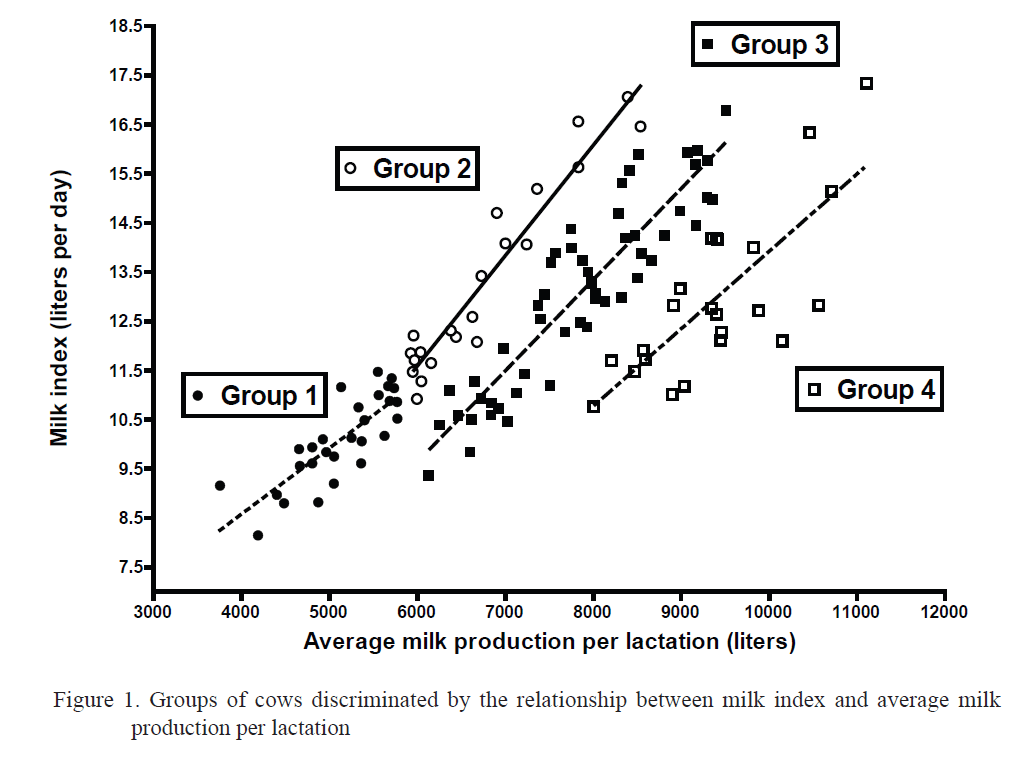
<body><![CDATA[<p align="justify">&nbsp;</p>     <p align="justify"><strong><font size="3" face="Verdana, Arial, Helvetica, sans-serif">RESULTS AND DISCUSSION </font></strong></p>     <p align="justify"><font size="2" face="Verdana, Arial, Helvetica, sans-serif">Visual inspection of the resulting scatter diagram (<a href="/img/revistas/cjas/v49n3/f0104315.gif">figure 1</a>)  allowed to identify four groups of animals which were characterized according  to the following description:</font></p>     
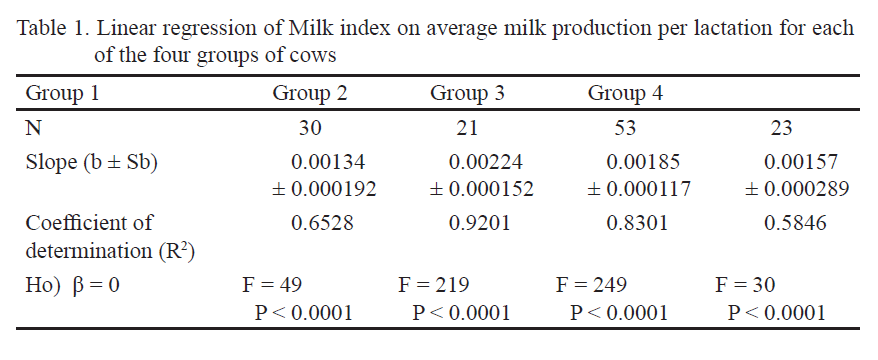
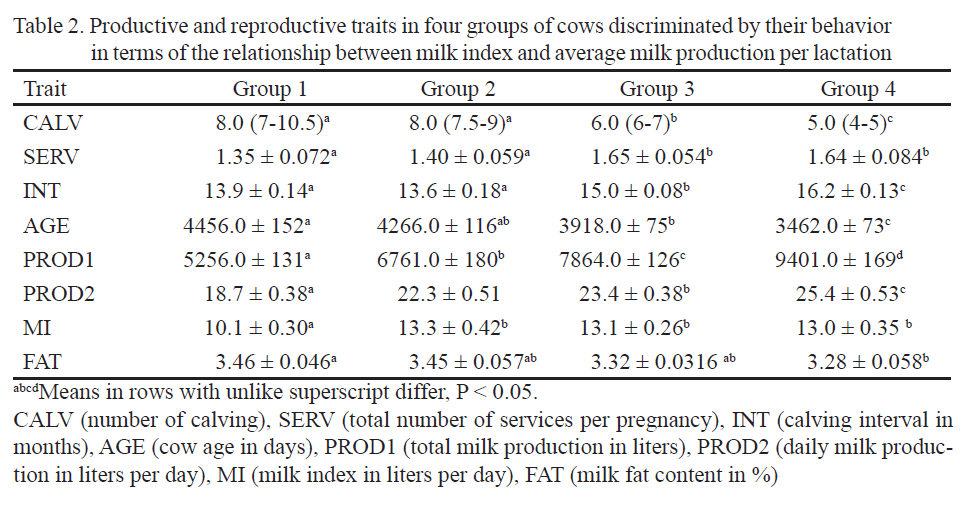
<p align="justify"><font size="2" face="Verdana, Arial, Helvetica, sans-serif">Group 1: Cows similar to those belonging to a commercial dairy farm  in a pasture system.</font></p>     <p align="justify"><font size="2" face="Verdana, Arial, Helvetica, sans-serif">Group 2: Cows with high milk production within the trend showed by  Group 1</font></p>     <p align="justify"><font size="2" face="Verdana, Arial, Helvetica, sans-serif">Group 3: Cows with similar variation in milk index values but  displaced to the right, i.e. with higher milk production per lactation</font></p>     <p align="justify"><font size="2" face="Verdana, Arial, Helvetica, sans-serif">Group 4: Cows with high productivity.</font></p>     <p align="justify"><font size="2" face="Verdana, Arial, Helvetica, sans-serif">A  statistically significant difference between the slopes of the regression lines  (F=2.87, P=0.0395), prevented to compare their intercept values (<a href="/img/revistas/cjas/v49n3/t0104315.gif">table 1</a>). This  result revealed differences in the pattern of change of milk index values in  terms of increased average daily production of milk in each of the four groups  of cows.&nbsp; As <a href="/img/revistas/cjas/v49n3/t0204315.gif">table 2</a> shows, cows of Group  1, with the lowest milk index values, can be characterized from a productive  point of view as those with the lowest average milk production per lactation,  the lowest milk production per day and the highest milk fat content. From a  reproductive point of view, they have less number of services per pregnancy and  lower calving interval. Cows in Group 4 showed the highest average milk  production per lactation, the highest milk production per day and the lowest  milk fat content. They were also those that required more services per  pregnancy and showed the highest calving interval. This group includes the  youngest cows, and although it presents, in average, milk index values  significantly higher than Group 1, it does not differ from cows located in  Group 2 and Group 3 in terms of MI values. Cows in Group 2 did not differ from  those located in Group 1 either in age and number of calving or in the mean  values of the other reproductive traits. So, their high milk index values did  not demonstrate differences in reproductive traits, but in their best  productive performance due to a higher average milk production per lactation  and per day, without significant differences in milk fat content. Cows in Group  1 represent those with normal production levels in dairy farms of the region,  which do not affect their reproductive performance when reared on pasture. Cows  in Group 2 would represent the type of cow to be expected if the productive  level of those in Group 1 is increased by improving basically the nutritional  environment. In contrast, cows in Group 3 present the same average milk index  values than those in Group 2, but their increased milk production was achieved  at the expense of deteriorating their reproductive performance, in  correspondence with the results of Hen&aacute;ndez <em>et al.</em> (2014). Cows in Group  4 would be the most extreme case of this trend observed in the information  collected, with higher production, greater reproductive impairment and equal  rate of milk. With the current evaluation criteria that prioritize the  productive aspects, cows belonging to Group 4 first, and then Group 3 would be  best to present both the best productions of average daily milk per lactation.  But when they are evaluated based on their rates of milk, and they are no  longer better than those in Group 2, with lower production values but better  reproductive rates exhibited the same rate of milk. An index of    13 liters of milk/day can be obtained with 6,800 (Group 2), 7,800 (Group 3) and  9,400 (Group 4) liters and its value reveals reproductive impairment concomitant  with better growth performance. On the other hand, the same reproductive  performance may be accompanied by productions of 5,200 (Group 1) or 6,800  (Group 2) liters per lactation, and, in this case, the difference in terms of  production shows a better milk index value (10 vs. 13 liters / day). These data  confirm previous results showing that increased individual production at the  end of the productive life of the cow does not always guarantee better  production efficiency (Marini and Oyarzabal, 2002 a b). In these production  systems based on direct grazing, there would be a limit on the expected  production of a cow above which reproduction suffers. Since the cow to produce  milk must be reproduced, there is a clear antagonism to be taken into account  when deciding the criteria to be applied in improving such systems. Therefore,  it is important to have information on the implications of directional  selection for production, first, for using the selection criteria that do not  depress other characters such as reproductive, and, second, for contributing to  the discussion on how to determine which is the most suitable and profitable  grazing system leading to greater sustainability of such systems. <a href="/img/revistas/cjas/v49n3/f0104315.gif">Figure 1</a> shows&nbsp; a clear evolution of the animal  that was included to these systems in Argentina since the beginnings of the  biotypes in 1992, with the massive importation of semen of American and  Canadian origin. The quest for greater individual production massively imposed  as a general criterion for all drums. The use of milk yield as a selection  criterion allowed a significant genetic progress in the countries that lie at  the forefront of dairy breeding. In the U.S., for example, the accumulated  genetic progress of the bulls used in artificial insemination increased in 37  kg per year in the 60&acute;s, 79 kg per year in the 70&acute;s, 102 kg per year in the  80&acute;s and 116 kg per year in the early 90&acute;s (Hansen 1999). Genetic improvement  is one, but not the unique, tool for achieving an efficient and competitive  dairy production. In developed countries, the association of selection  objectives, adequate to their production conditions with the successful use of  genetic resources, has allowed to accumulate a genetic progress for milk  production from 0.8 to 1.5% per year. In Argentina, genetic improvement of  dairy cattle has been interpreted as synonymous of the use of imported semen.  This approach ignores that the biological and economical efficiency of dairy  farms depend not only on the higher production per lactation, but also on a set  of components like cow longevity, its reproductive efficiency&nbsp; and the efficiency of the rearing process of  heifers for replacement. The existence of genotype-environment interactions  made evident the necessity of restricting the use of imported semen for the  insemination of cows kept under intensive confined systems with a high level of  supplementation that ensure the fulfill of their nutritional requirements. For  the maintenance of traditional outdoor production systems on pasture it is  necessary to use semen from bulls which had been selected under similar local  environmental conditions, it is usually done in beef production systems. </font></p>     
<p align="justify"><font size="2" face="Verdana, Arial, Helvetica, sans-serif">In this context, the milk index is presented as an indicator of  productive efficiency that enables a comprehensive assessment of the  performance of dairy cows kept in grazing systems because it comprises the  degree of fit / mismatch between the genetic potential of producing each  individual and the characteristics of the production system in which this  potential must be expressed.</font></p>     <p align="justify">&nbsp;</p>     ]]></body>
<body><![CDATA[<p align="justify"><strong><font size="3" face="Verdana, Arial, Helvetica, sans-serif">ACKNOWLEDGEMENTS</font></strong></p>     <p align="justify"><font size="2" face="Verdana, Arial, Helvetica, sans-serif">The authors would like to acknowledge MV Gustavo Magnano for  contributing data to this study.</font></p>     <p align="justify">&nbsp;</p>     <p align="justify"><strong><font size="3" face="Verdana, Arial, Helvetica, sans-serif"><span lang="EN-US">REFERENCES</span></font></strong></p>     <p align="justify"><font size="2" face="Verdana, Arial, Helvetica, sans-serif"><span lang="EN-US">Beltramino, F. E. 1997. “Eficiencia de razas  lecheras”. In: <em>Temas de Producci&oacute;n Lechera</em>, (ser. Publ. Misc., no. ser.  84), INTA, pp. 59&ndash;65.</span></font></p>     <!-- ref --><p align="justify"><font size="2" face="Verdana, Arial, Helvetica, sans-serif"><span lang="EN-US">CABIA. 2008. <em>C&aacute;mara Argentina de Biotecnolog&iacute;a de  la Reproducci&oacute;n e Inseminaci&oacute;n Artificial</em>. , Available: &lt;<a href="http://200.49.155.36/cabia/ estadistica.aps" target="_blank">http://200.49.155.36/cabia/  estadistica.aps</a>&gt;    .</span></font></p>     <p align="justify"><font size="2" face="Verdana, Arial, Helvetica, sans-serif"><span lang="EN-US">Hansen, L.  B. 1999. &ldquo;Consequences of selection for milk from a geneticist`s view point&rdquo;. <em>J. Dairy Sci.</em>, 83: 1145&ndash;1150.</span></font></p>     <!-- ref --><p align="justify"><font size="2" face="Verdana, Arial, Helvetica, sans-serif"><span lang="EN-US">Hansen, L. B. 2005. <em>Vacas lecheras funcionales</em>.  EE.UU: Universidad de Minnesota, 3 p.    </span></font></p>     ]]></body>
<body><![CDATA[<p align="justify"><font size="2" face="Verdana, Arial, Helvetica, sans-serif"><span lang="EN-US">Hern&aacute;ndez, A., Ponce de Le&oacute;n, R., Garc&iacute;a, L. R.,  Marini, P. R., Guerra, D., Padr&oacute;n, Y., Garc&iacute;a, S. M., L&oacute;pez, M., Gonz&aacute;lez, S.,  Qui&ntilde;ones, D., L&oacute;pez, O. &amp; Pacheco, R. A. 2014. &ldquo;Relaci&oacute;n gen&eacute;tica entre la  producci&oacute;n de leche, la reproducci&oacute;n y la longevidad en vacas Mamb&iacute; de Cuba&rdquo;.  In: <em>XV Jornadas de Divulgaci&oacute;n T&eacute;cnico Cient&iacute;ficas en Ciencias Veterinarias  y II Jornada Latinoamericana</em>, pp. 191&ndash;192.</span></font></p>     <!-- ref --><p align="justify"><font size="2" face="Verdana, Arial, Helvetica, sans-serif"><span lang="EN-US">Holstein  Association USA Inc. 2011. <em>Holstein type-production sire summaries</em>. Brattleboro, VT: Holstein  Association USA Inc.    </span></font></p>     <p align="justify"><font size="2" face="Verdana, Arial, Helvetica, sans-serif"><span lang="EN-US">Marini, P. R. &amp; Oyarzabal, M. I. 2002a. &ldquo;Patrones  de producci&oacute;n en vacas lecheras. 1 Componentes de la producci&oacute;n y sus  caracter&iacute;sticas seg&uacute;n nivel de producci&oacute;n&rdquo;. <em>Rev. Arg.  Prod. Anim.</em>, 22 (1): 29&ndash;46.</span></font></p>     <p align="justify"><font size="2" face="Verdana, Arial, Helvetica, sans-serif"><span lang="EN-US">Marini, P.  R. &amp; Oyarzabal, M. I. 2002b. &ldquo;Patrones de producci&oacute;n en vacas lecheras. 2  Descripci&oacute;n de la vaca promedio y estimaci&oacute;n de los ingresos seg&uacute;n categor&iacute;as  de producci&oacute;n&rdquo;. <em>Rev. Arg. Prod. Anim.</em>, 22 (1): 47&ndash;60.</span></font></p>     <!-- ref --><p align="justify"><font size="2" face="Verdana, Arial, Helvetica, sans-serif"><span lang="EN-US">Molinuevo, H. A. 2005. <em>Gen&eacute;tica bovina y producci&oacute;n  en pastoreo</em>. INTA, 348 p.    </span></font></p>     <!-- ref --><p align="justify"><font size="2" face="Verdana, Arial, Helvetica, sans-serif"><span lang="EN-US">Vanraden, P. M., Cole, J. B., Tooker, M. E. &amp; Cooper, T. A. 2010. <em>Genetic  base changes for January 2010</em>. , Available:  &lt;<a href="http://aipl.arsusda.gov/reference/base2010.htm" target="_blank">http://aipl.arsusda.gov/reference/base2010.htm</a>&gt;    .</span></font></p>     <p align="justify">&nbsp;</p>     ]]></body>
<body><![CDATA[<p align="justify">&nbsp;</p>     <p align="justify"><font size="2" face="Verdana, Arial, Helvetica, sans-serif">Received: January 23, 2014    <br> Accepted: March 16, 2015</font></p>     <p align="justify">&nbsp;</p>     <p align="justify">&nbsp;</p>     <p align="justify"><font size="2" face="Verdana, Arial, Helvetica, sans-serif"><i>P. R. Marini,</i> Cátedra de Producción de Bovinos Lecheros. Facultad de Ciencias Veterinarias - UNR, Ovidio Lagos y Ruta 33,  2170 Casilda, Argentina.    Email: <a href="mailto:pmarini@fveter.unr.edu.ar">pmarini@fveter.unr.edu.ar</a></font></p>      ]]></body><back>
<ref-list>
<ref id="B1">
<nlm-citation citation-type="book">
<person-group person-group-type="author">
<name>
<surname><![CDATA[Beltramino]]></surname>
<given-names><![CDATA[F. E.]]></given-names>
</name>
</person-group>
<article-title xml:lang="nd"><![CDATA[Eficiencia de razas lecheras]]></article-title>
<source><![CDATA[Temas de Producción Lechera]]></source>
<year>1997</year>
<page-range>59-65</page-range><publisher-name><![CDATA[INTA]]></publisher-name>
</nlm-citation>
</ref>
<ref id="B2">
<nlm-citation citation-type="">
<person-group person-group-type="author">
<name>
<surname><![CDATA[CABIA]]></surname>
</name>
</person-group>
<source><![CDATA[Cámara Argentina de Biotecnología de la Reproducción e Inseminación Artificial]]></source>
<year>2008</year>
</nlm-citation>
</ref>
<ref id="B3">
<nlm-citation citation-type="journal">
<person-group person-group-type="author">
<name>
<surname><![CDATA[Hansen]]></surname>
<given-names><![CDATA[L. B.]]></given-names>
</name>
</person-group>
<article-title xml:lang="nd"><![CDATA[Consequences of selection for milk from a geneticist`s view point]]></article-title>
<source><![CDATA[J. Dairy Sci.]]></source>
<year>1999</year>
<volume>83</volume>
<page-range>1145-1150</page-range></nlm-citation>
</ref>
<ref id="B4">
<nlm-citation citation-type="book">
<person-group person-group-type="author">
<name>
<surname><![CDATA[Hansen]]></surname>
<given-names><![CDATA[L. B.]]></given-names>
</name>
</person-group>
<source><![CDATA[Vacas lecheras funcionales]]></source>
<year>2005</year>
<page-range>3</page-range><publisher-loc><![CDATA[EE.UU ]]></publisher-loc>
<publisher-name><![CDATA[Universidad de Minnesota]]></publisher-name>
</nlm-citation>
</ref>
<ref id="B5">
<nlm-citation citation-type="">
<person-group person-group-type="author">
<name>
<surname><![CDATA[Hernández]]></surname>
<given-names><![CDATA[A.]]></given-names>
</name>
<name>
<surname><![CDATA[Ponce de León]]></surname>
<given-names><![CDATA[R.]]></given-names>
</name>
<name>
<surname><![CDATA[García]]></surname>
<given-names><![CDATA[L. R.]]></given-names>
</name>
<name>
<surname><![CDATA[Marini]]></surname>
<given-names><![CDATA[P. R.]]></given-names>
</name>
<name>
<surname><![CDATA[Guerra]]></surname>
<given-names><![CDATA[D.]]></given-names>
</name>
<name>
<surname><![CDATA[Padrón]]></surname>
<given-names><![CDATA[Y.]]></given-names>
</name>
<name>
<surname><![CDATA[García]]></surname>
<given-names><![CDATA[S. M.]]></given-names>
</name>
<name>
<surname><![CDATA[López]]></surname>
<given-names><![CDATA[M.]]></given-names>
</name>
<name>
<surname><![CDATA[González]]></surname>
<given-names><![CDATA[S.]]></given-names>
</name>
<name>
<surname><![CDATA[Quiñones]]></surname>
<given-names><![CDATA[D.]]></given-names>
</name>
<name>
<surname><![CDATA[López]]></surname>
<given-names><![CDATA[O.]]></given-names>
</name>
<name>
<surname><![CDATA[Pacheco]]></surname>
<given-names><![CDATA[R. A.]]></given-names>
</name>
</person-group>
<article-title xml:lang="nd"><![CDATA[Relación genética entre la producción de leche, la reproducción y la longevidad en vacas Mambí de Cuba]]></article-title>
<source><![CDATA[]]></source>
<year>2014</year>
<page-range>191-192</page-range></nlm-citation>
</ref>
<ref id="B6">
<nlm-citation citation-type="book">
<person-group person-group-type="author">
<name>
<surname><![CDATA[Holstein Association USA Inc.]]></surname>
</name>
</person-group>
<source><![CDATA[Holstein type-production sire summaries]]></source>
<year>2011</year>
<publisher-loc><![CDATA[Brattleboro, VT ]]></publisher-loc>
<publisher-name><![CDATA[Holstein Association USA Inc.]]></publisher-name>
</nlm-citation>
</ref>
<ref id="B7">
<nlm-citation citation-type="journal">
<person-group person-group-type="author">
<name>
<surname><![CDATA[Marini]]></surname>
<given-names><![CDATA[P. R.]]></given-names>
</name>
<name>
<surname><![CDATA[Oyarzabal]]></surname>
<given-names><![CDATA[M. I.]]></given-names>
</name>
</person-group>
<article-title xml:lang="nd"><![CDATA[Patrones de producción en vacas lecheras. 1 Componentes de la producción y sus características según nivel de producción]]></article-title>
<source><![CDATA[Rev. Arg. Prod. Anim.]]></source>
<year>2002</year>
<volume>22</volume>
<numero>1</numero>
<issue>1</issue>
<page-range>29-46</page-range></nlm-citation>
</ref>
<ref id="B8">
<nlm-citation citation-type="journal">
<person-group person-group-type="author">
<name>
<surname><![CDATA[Marini]]></surname>
<given-names><![CDATA[P. R.]]></given-names>
</name>
<name>
<surname><![CDATA[Oyarzabal]]></surname>
<given-names><![CDATA[M. I.]]></given-names>
</name>
</person-group>
<article-title xml:lang="nd"><![CDATA[Patrones de producción en vacas lecheras. 2 Descripción de la vaca promedio y estimación de los ingresos según categorías de producción]]></article-title>
<source><![CDATA[Rev. Arg. Prod. Anim.]]></source>
<year>2002</year>
<volume>22</volume>
<numero>1</numero>
<issue>1</issue>
<page-range>47-60</page-range></nlm-citation>
</ref>
<ref id="B9">
<nlm-citation citation-type="book">
<person-group person-group-type="author">
<name>
<surname><![CDATA[Molinuevo]]></surname>
<given-names><![CDATA[H. A.]]></given-names>
</name>
</person-group>
<source><![CDATA[Genética bovina y producción en pastoreo]]></source>
<year>2005</year>
<page-range>348</page-range><publisher-name><![CDATA[INTA]]></publisher-name>
</nlm-citation>
</ref>
<ref id="B10">
<nlm-citation citation-type="">
<person-group person-group-type="author">
<name>
<surname><![CDATA[Vanraden]]></surname>
<given-names><![CDATA[P. M.]]></given-names>
</name>
<name>
<surname><![CDATA[Cole]]></surname>
<given-names><![CDATA[J. B.]]></given-names>
</name>
<name>
<surname><![CDATA[Tooker]]></surname>
<given-names><![CDATA[M. E.]]></given-names>
</name>
<name>
<surname><![CDATA[Cooper]]></surname>
<given-names><![CDATA[T. A.]]></given-names>
</name>
</person-group>
<source><![CDATA[Genetic base changes for January 2010]]></source>
<year>2010</year>
</nlm-citation>
</ref>
</ref-list>
</back>
</article>