<?xml version="1.0" encoding="ISO-8859-1"?><article xmlns:mml="http://www.w3.org/1998/Math/MathML" xmlns:xlink="http://www.w3.org/1999/xlink" xmlns:xsi="http://www.w3.org/2001/XMLSchema-instance">
<front>
<journal-meta>
<journal-id>2079-3480</journal-id>
<journal-title><![CDATA[Cuban Journal of Agricultural Science]]></journal-title>
<abbrev-journal-title><![CDATA[Cuban J. Agric. Sci.]]></abbrev-journal-title>
<issn>2079-3480</issn>
<publisher>
<publisher-name><![CDATA[Editorial del Instituto de Ciencia Animal]]></publisher-name>
</publisher>
</journal-meta>
<article-meta>
<article-id>S2079-34802015000300008</article-id>
<title-group>
<article-title xml:lang="en"><![CDATA[Profile of fatty acids of Longissimus dorsi muscle and productive indicators of sheeps, supplemented with pods of Acacia cochliacantha, in grasslands native to dry tropics]]></article-title>
<article-title xml:lang="es"><![CDATA[Perfil de ácidos grasos del Longissimus dorsi e indicadores productivos de corderos, suplementados con vainas de Acacia cochliacantha, en praderas nativas del trópico seco]]></article-title>
</title-group>
<contrib-group>
<contrib contrib-type="author">
<name>
<surname><![CDATA[Mireles]]></surname>
<given-names><![CDATA[E.J]]></given-names>
</name>
<xref ref-type="aff" rid="A01"/>
</contrib>
<contrib contrib-type="author">
<name>
<surname><![CDATA[Rodríguez]]></surname>
<given-names><![CDATA[D]]></given-names>
</name>
<xref ref-type="aff" rid="A02"/>
</contrib>
<contrib contrib-type="author">
<name>
<surname><![CDATA[Jordán]]></surname>
<given-names><![CDATA[H]]></given-names>
</name>
<xref ref-type="aff" rid="A02"/>
</contrib>
<contrib contrib-type="author">
<name>
<surname><![CDATA[Valdivia]]></surname>
<given-names><![CDATA[M]]></given-names>
</name>
<xref ref-type="aff" rid="A03"/>
</contrib>
<contrib contrib-type="author">
<name>
<surname><![CDATA[Ramírez]]></surname>
<given-names><![CDATA[A]]></given-names>
</name>
<xref ref-type="aff" rid="A04"/>
</contrib>
<contrib contrib-type="author">
<name>
<surname><![CDATA[García]]></surname>
<given-names><![CDATA[A]]></given-names>
</name>
<xref ref-type="aff" rid="A04"/>
</contrib>
<contrib contrib-type="author">
<name>
<surname><![CDATA[Olivares]]></surname>
<given-names><![CDATA[J]]></given-names>
</name>
<xref ref-type="aff" rid="A01"/>
</contrib>
</contrib-group>
<aff id="A01">
<institution><![CDATA[,Universidad Autónoma de Guerrero Unidad Académica de Medicina Veterinaria y Zootecnia ]]></institution>
<addr-line><![CDATA[ ]]></addr-line>
<country>México</country>
</aff>
<aff id="A02">
<institution><![CDATA[,Instituto de Ciencia Animal  ]]></institution>
<addr-line><![CDATA[San José de las Lajas Mayabeque]]></addr-line>
<country>Cuba</country>
</aff>
<aff id="A03">
<institution><![CDATA[,Universidad Nacional Autónoma de México Facultad de Química Laboratorio de Química y Análisis de Alimentos]]></institution>
<addr-line><![CDATA[ D.F]]></addr-line>
<country>México</country>
</aff>
<aff id="A04">
<institution><![CDATA[,Universidad Nacional Autónoma de México Facultad de Medicina Veterinaria y Zootecnia Departamento de Nutrición Animal y Bioquímica]]></institution>
<addr-line><![CDATA[ ]]></addr-line>
</aff>
<pub-date pub-type="pub">
<day>00</day>
<month>09</month>
<year>2015</year>
</pub-date>
<pub-date pub-type="epub">
<day>00</day>
<month>09</month>
<year>2015</year>
</pub-date>
<volume>49</volume>
<numero>3</numero>
<fpage>329</fpage>
<lpage>338</lpage>
<copyright-statement/>
<copyright-year/>
<self-uri xlink:href="http://scielo.sld.cu/scielo.php?script=sci_arttext&amp;pid=S2079-34802015000300008&amp;lng=en&amp;nrm=iso"></self-uri><self-uri xlink:href="http://scielo.sld.cu/scielo.php?script=sci_abstract&amp;pid=S2079-34802015000300008&amp;lng=en&amp;nrm=iso"></self-uri><self-uri xlink:href="http://scielo.sld.cu/scielo.php?script=sci_pdf&amp;pid=S2079-34802015000300008&amp;lng=en&amp;nrm=iso"></self-uri><abstract abstract-type="short" xml:lang="en"><p><![CDATA[Daily weight gain, hot carcass yield and profile of fatty acids of Longissimus dorsi muscle were determined in 30 Pelibuey-Black Belly x Dorper-Katahdin lambs, with 20 ± 2 kg of liveweight, supplemented with ground pods of Acacia cochliacantha, in irrigated native grasslands. The animals were selected at random and three treatments were designed: 1) grazing and 0 % of supplementation, 2) grazing plus 15 % of supplementation, and 3) grazing plus 30 % of supplementation with Acacia cochliacantha, according to the dry matter requirements. The grasslands were composed by shrubs, grasses and herbaceous plants. Daily weight gain, hot carcass yield, weight of liver, kidneys and heart, perirenal and pericardial fat, and profile of fatty acids were determined. The analysis of variance was applied to the data. There were no significant differences in daily weight gain (68, 59 and 63 g), hot carcass yield (37.08, 37.84 and 39.09 %), weight of viscera and intramuscular fat (1.59, 1.84 and 1.72 %). There was a C18:2-n6/c18:3-n3 (omega 6/omega 3) relation of 3.53, 3.25 and 3.38 in the Longissimus dorsi muscle, for the 0, 15 and 30 % supplementation groups, respectively. The treatment with 30 % of supplementation had the lowest content (P<0.05) of C22:1n-9, regarding the control treatment. It can be concluded that lambs in irrigated native grasslands, with or without supplementation of pods of Acacia cochliacantha, produced acceptable hot carcass yield and daily weight gains, and a close relation of C18:2-n6/c18:3-n3. There was only a decrease of erucic acid (C22:1n-9) in the Longissimus dorsi muscle of the supplemented animals]]></p></abstract>
<abstract abstract-type="short" xml:lang="es"><p><![CDATA[Se determinó la ganancia diaria de peso, el rendimiento de la canal caliente y el perfil de ácidos grasos del Longissimus dorsi de 30 corderos Pelibuey-Black Belly x Dorper-Katahdin, de 20 ± 2 kg de peso vivo, suplementados con vaina molida de Acacia cochliacantha, en pastoreo de praderas nativas irrigadas. Los animales se seleccionaron completamente al azar y se diseñaron tres tratamientos: 1) pastoreo y 0 % de suplementación; 2) pastoreo más 15 % suplementación; 3) pastoreo más 30 % de suplementación con Acacia cochliacantha, según los requerimientos de materia seca. Las praderas estuvieron compuestas por gramíneas, arbustivas y herbáceas. Se determinó la ganancia diaria de peso, el rendimiento en canal caliente, el peso del hígado, riñones, corazón, grasa pericárdica y perirenal y perfil de ácidos grasos. A los datos se les aplicó análisis de varianza. No hubo diferencias significativas en la ganancia diaria de peso (68, 59 y 63 g), rendimiento en canal caliente (37.08, 37.84 y 39.09 %), peso de las vísceras y grasa intramuscular (1.59, 1.84 y 1.72 %). Hubo relación C18:2-n6/c18:3-n3 (omega 6/omega 3) de 3.53, 3.25 y 3.38 en el músculo Longissimus dorsi, para los grupos con 0, 15 y 30 % de suplementación, respectivamente. El tratamiento con 30 % de suplementación tuvo menor contenido (P < 0.05) de C22:1n-9, con respecto al tratamiento control. Se concluye que los corderos en praderas nativas irrigadas, con suplementación de vaina Acacia cochliacantha o sin ella, produjeron ganancia diaria de peso y rendimientos en canal caliente aceptables y relación estrecha de C18:2-n6/c18:3-n3. Solo hubo disminución del ácido erúcico (C22:1n-9) en el Longissimus dorsi en los animales suplementados]]></p></abstract>
<kwd-group>
<kwd lng="en"><![CDATA[ovine]]></kwd>
<kwd lng="en"><![CDATA[daily weight gain]]></kwd>
<kwd lng="en"><![CDATA[intramuscular fat]]></kwd>
<kwd lng="en"><![CDATA[supplementation]]></kwd>
<kwd lng="en"><![CDATA[Acacia cochliacantha]]></kwd>
<kwd lng="es"><![CDATA[ovinos]]></kwd>
<kwd lng="es"><![CDATA[ganancia diaria de peso]]></kwd>
<kwd lng="es"><![CDATA[grasa intramuscular]]></kwd>
<kwd lng="es"><![CDATA[suplementación]]></kwd>
<kwd lng="es"><![CDATA[Acacia cochliacantha]]></kwd>
</kwd-group>
</article-meta>
</front><body><![CDATA[ <p align="right"><font size="2" face="Verdana, Arial, Helvetica,   sans-serif"><b>ORIGINAL ARTICLE</b></font></p>     <p>&nbsp;</p>     <p align="justify"><font size="4" face="Verdana, Arial, Helvetica, sans-serif"><b>Profile of fatty acids of <em>Longissimus dorsi</em> muscle and productive indicators of sheeps, supplemented with pods of <em>Acacia cochliacantha</em>, in grasslands native to dry tropics</b></font></p>     <p align="justify">&nbsp;</p>     <p align="justify"><font size="3" face="Verdana, Arial, Helvetica, sans-serif"><b>Perfil de ácidos grasos del <em>Longissimus dorsi</em> e indicadores productivos de corderos, suplementados con vainas de <em>Acacia cochliacantha</em>, en praderas nativas del trópico seco</b></font></p>     <p align="justify">&nbsp;</p>     <p align="justify">&nbsp;	</p>     <p align="justify"><font size="2" face="Verdana, Arial, Helvetica, sans-serif"><b>E.J. Mireles,</b><sup><b>I</b></sup><b> D. Rodríguez,</b><sup><b>II</b></sup><b> H. Jordán,</b><sup><b>II</b></sup><b> M. Valdivia,</b><sup><b>III</b></sup><b> A. Ramírez,</b><sup><b>IV</b></sup><b> A. García,</b><sup><b>IV</b></sup><b> J. Olivares,</b><sup><b>I</b></sup></font></p>     <p align="justify"><font size="2" face="Verdana, Arial, Helvetica, sans-serif"><sup>I</sup>Unidad Académica de Medicina Veterinaria y Zootecnia de la Universidad Autónoma de Guerrero, México.    km 2.5 Carretera Cd. Altamirano- Iguala Cd Altamirano Gro. CP 40660.    <br>   </font><font size="2" face="Verdana, Arial, Helvetica, sans-serif"><sup>II</sup>Instituto de Ciencia Animal, Apartado Postal 24, San José de las Lajas, Mayabeque, Cuba.    ]]></body>
<body><![CDATA[<br>   </font><font size="2" face="Verdana, Arial, Helvetica, sans-serif"><sup>III</sup>Laboratorio de Química y Análisis de Alimentos, Facultad de Química, Universidad Nacional Autónoma de México.        Av. Universidad 3000, Coyoacán, Del Carmen, 04510 Ciudad de México, D.F., México.    <br>   </font><font size="2" face="Verdana, Arial, Helvetica, sans-serif"><sup>IV</sup>Departamento de Nutrición Animal y Bioquímica, Facultad de Medicina Veterinaria y Zootecnia, Universidad    Nacional Autónoma de México.</font></p>     <p align="justify">&nbsp;</p>     <p align="justify">&nbsp;</p> <hr align="JUSTIFY">     <p align="justify"><font size="2" face="Verdana, Arial, Helvetica, sans-serif"><b>ABSTRACT</b></font></p>     <p align="justify"><font size="2" face="Verdana, Arial, Helvetica, sans-serif">Daily  weight gain, hot carcass yield and profile of fatty acids of <em>Longissimus  dorsi</em> muscle were determined in 30 Pelibuey-Black Belly x Dorper-Katahdin  lambs, with 20 &plusmn; 2 kg of liveweight, supplemented with ground pods of <em>Acacia  cochliacantha</em>, in irrigated native grasslands. The animals were selected at  random and three treatments were designed: 1) grazing and 0 % of  supplementation, 2) grazing plus 15 % of supplementation, and 3) grazing plus  30 % of supplementation with <em>Acacia cochliacantha</em>, according to the dry  matter requirements. The grasslands were composed by shrubs, grasses and  herbaceous plants. Daily weight gain, hot carcass yield, weight of liver,  kidneys and heart, perirenal and pericardial fat, and profile of fatty acids  were determined. The analysis of variance was applied to the data. There were  no significant differences in daily weight gain (68, 59 and 63 g), hot carcass  yield (37.08, 37.84 and 39.09 %), weight of viscera and intramuscular fat  (1.59, 1.84 and 1.72 %). There was a C18:2-n6/c18:3-n3 (omega 6/omega 3)  relation of 3.53, 3.25 and 3.38 in the <em>Longissimus dorsi</em> muscle, for the  0, 15 and 30 % supplementation groups, respectively. The treatment with 30 % of  supplementation had the lowest content (P&lt;0.05) of C22:1n-9, regarding the  control treatment. It can be concluded that lambs in irrigated native  grasslands, with or without supplementation of pods of <em>Acacia cochliacantha</em>,  produced acceptable hot carcass yield and daily weight gains, and a close  relation of&nbsp; C18:2-n6/c18:3-n3. There was  only a decrease of erucic acid (C22:1n-9) in the <em>Longissimus dorsi</em> muscle of the supplemented animals.</font></p>     <p align="justify"><font size="2" face="Verdana, Arial, Helvetica, sans-serif"><b>Key words:</b> ovine, daily weight gain, intramuscular fat, supplementation, <em>Acacia cochliacantha</em>.</font></p> <hr align="JUSTIFY">     <p align="justify"><font size="2" face="Verdana, Arial, Helvetica, sans-serif"><b>RESUMEN</b></font></p>     <p align="justify"><font size="2" face="Verdana, Arial, Helvetica, sans-serif">Se determin&oacute; la ganancia diaria de peso, el rendimiento  de la canal caliente y el perfil de &aacute;cidos grasos del <em>Longissimus dorsi</em> de 30 corderos Pelibuey-Black Belly x Dorper-Katahdin, de 20 &plusmn; 2 kg de peso  vivo, suplementados con vaina molida de <em>Acacia cochliacantha</em>, en  pastoreo de praderas nativas irrigadas. Los animales se seleccionaron  completamente al azar y se dise&ntilde;aron tres tratamientos: 1) pastoreo y 0 % de  suplementaci&oacute;n; 2) pastoreo m&aacute;s 15 % suplementaci&oacute;n; 3) pastoreo m&aacute;s 30 % de  suplementaci&oacute;n con <em>Acacia cochliacantha</em>, seg&uacute;n los requerimientos de  materia seca. Las praderas estuvieron compuestas por gram&iacute;neas, arbustivas y  herb&aacute;ceas. Se determin&oacute; la ganancia diaria de peso, el rendimiento en canal  caliente, el peso del h&iacute;gado, ri&ntilde;ones, coraz&oacute;n, grasa peric&aacute;rdica y perirenal y  perfil de &aacute;cidos grasos. A los datos se les aplic&oacute; an&aacute;lisis de varianza. No  hubo&nbsp; diferencias significativas en la  ganancia diaria de peso (68, 59 y 63 g), rendimiento en canal caliente (37.08,  37.84 y 39.09 %), peso de las v&iacute;sceras y grasa intramuscular (1.59, 1.84 y 1.72  %). Hubo relaci&oacute;n C18:2-n6/c18:3-n3 (omega 6/omega 3) de 3.53, 3.25 y 3.38 en  el m&uacute;sculo&nbsp; <em>Longissimus dorsi</em>,  para&nbsp; los grupos con 0, 15 y 30 % de  suplementaci&oacute;n, respectivamente. El tratamiento con 30 % de suplementaci&oacute;n tuvo  menor contenido (P &lt; 0.05) de C22:1n-9, con respecto al tratamiento control.  Se concluye que los corderos en praderas nativas irrigadas, con&nbsp; suplementaci&oacute;n de vaina <em>Acacia  cochliacantha</em> o sin ella, produjeron ganancia diaria de peso y rendimientos  en canal caliente aceptables y relaci&oacute;n estrecha de C18:2-n6/c18:3-n3. Solo  hubo disminuci&oacute;n del &aacute;cido er&uacute;cico (C22:1n-9) en el <em>Longissimus dorsi</em> en  los animales suplementados.</font></p>     <p align="justify"><font size="2" face="Verdana, Arial, Helvetica, sans-serif"><b>Palabras    clave:</b>    ovinos, ganancia diaria de peso, grasa intramuscular, suplementaci&oacute;n <em>Acacia cochliacantha</em>.</font></p> <hr align="JUSTIFY">     ]]></body>
<body><![CDATA[<p align="justify">&nbsp;</p>     <p align="justify">&nbsp;</p>     <p align="justify"><strong><font size="3" face="Verdana, Arial, Helvetica, sans-serif">INTRODUCTION</font></strong></p>     <p align="justify"><font size="2" face="Verdana, Arial, Helvetica, sans-serif">Ovine meat production in Mexico is not enough to cover  the demand of this product. Therefore, more than 40 % of the national  consumption is imported (Mart&iacute;nez <em>et al.</em> 2009). Feeding based on forages  generates a reduction of productive indexes, but at low costs compared to the  intensive fattening based on grains and pastes of oleaginous plants, to obtain  daily weight gains (DWG) of 250 g or more (Macedo and Castellanos 2004 and  Mac&iacute;as <em>et al.</em> 2010). The meat of sheep fed with forages show less  content of fat and a beneficial fatty acid  profile for the health of consumers, regarding those fed with large amounts of  grain in the ration (Velazco <em>et al.</em> 2004 and Nuernberg <em>et al.</em> 2008). Nowadays, it is important the production of hair sheep, with a great  performance in systems of low inputs, based on forages of medium nutritional  quality that produce small and lean carcasses, with different chemical  composition, compared to the animals fattened with grain-rich diets (Johnson <em>et  al.</em> 2010 and Turner <em>et al.</em> 2014).&nbsp;&nbsp;&nbsp;&nbsp;&nbsp; </font></p>     <p align="justify"><font size="2" face="Verdana, Arial, Helvetica, sans-serif">Lamb grazing in irrigated  native grasslands and the physical control of weeds is an alternative for  feeding lambs, together with the supplementation with shrub fruits. The  objective of this study was to determine daily weight gain (DWG), carcass  yield, weight of some viscera and perirenal and pericardial fat, and to perform  a proximal chemical analysis and find the profile of fatty acids of the <em>Longissimus  dorsi</em> muscle of sheeps in native grasslands, with irrigation and  supplementation with ground pods of <em>Acacia cochliacantha</em>.</font></p>     <p align="justify">&nbsp;</p>     <p align="justify"><strong><font size="3" face="Verdana, Arial, Helvetica, sans-serif">MATERIALS AND METHODS</font></strong></p>     <p align="justify"><font size="2" face="Verdana, Arial, Helvetica, sans-serif">This study was carried out from October, 2012 to  January, 2013, at the Facultad de Medicina Veterinaria y Zootecnia from the  Universidad Aut&oacute;noma of Guerrero, located at km 2.5 de la carretera Altamirano-  Iguala, Pungarabato municipality, Tierra Caliente region, Guerrero, Mexico.  This area is located at 18&ordm; 20` 30&rdquo; NL and 100&ordm; 39` 18&rdquo; WL. The climate,  according to a classification of K&ouml;open, is subhumid warm AW0 type (INIA1982).</font></p>     <p align="justify"><font size="2" face="Verdana, Arial, Helvetica, sans-serif"><em>Animals</em>. An amount of 30  Pelibuey-Black Belly x Dorper-Katahdin lambs were used, with    20 &plusmn; 2 kg of liveweight. They were wormed and injected intramuscularly with A,  D, E vitamins before the beginning of the experimental period, and they were  divided completely at random into three treatments: 1) 100 % gazing with 0 % of  supplementation (control treatment), 2) grazing plus 15 % of supplementation,  and 3) grazing plus 30 % of supplementation (30 % treatment). The ground pods  of <em>Acacia cochliacantha</em> were used as supplementation, with 102 g and 205  g, respectively. <a href="/img/revistas/cjas/v49n3/t0108315.gif">Table 1</a> shows the chemical composition of the diets.</font></p>     
<p align="justify"><font size="2" face="Verdana, Arial, Helvetica, sans-serif"><em>Grazing</em>. Six mixed native  grasslands were used, with 20 x 40 m, with rotational grazing of five days per  30 d of recovery, with irrigation every seven days and annual application of  ovine manure (10 t ha<sup>-1</sup> a&ntilde;o<sup>-1</sup>) during the dry period  (Gonz&aacute;lez 1995).</font></p>     ]]></body>
<body><![CDATA[<p align="justify"><font size="2" face="Verdana, Arial, Helvetica, sans-serif">Weeds were extracted from their root for their control.  Grass cutting was performed every three months to avoid the growth of shrubs  over 50 cm high. The botanical composition was determined with the use of two  exclusion cages (1x1m) FAO (1996), located in three grasslands, selected at  random, one per each    treatment.</font></p>     <p align="justify"><font size="2" face="Verdana, Arial, Helvetica, sans-serif">The mean botanical composition of diets was formed by  grasses (<em>Chloris virgata</em> Sw 72.28 %, <em>Cynodon dactylon</em> (L.) Pers.  5.52 % and Setaria spp.&nbsp; 6.10 %), shrubs  (<em>Acacia cochliacantha</em> 6.93 %, <em>Acacia farnesiana</em> (L.) Willd. 3.19  %, <em>Prosopis laevigata</em> 0.16 % and <em>Pithecellobium dulce</em> 1.01 %),  legumes (<em>Indigofera jamaicencis</em> Spreng 0.03 %), and herbaceous plants (<em>Desmanthus  virgatus</em> (L) 0.27 %, <em>Ipomoea pedatisecta</em> Mart. et Gal 3.34 %, <em>Mitracarpus  hirtus</em> (L) DC 0.11 %, <em>Aeschynomene americana</em> (L) 0.34 % and <em>Euphorbia  nutans</em> Lam. 0.72 %).</font></p>     <p align="justify"><font size="2" face="Verdana, Arial, Helvetica, sans-serif"><em>Experimental procedure</em>.  Lambs grazed daily from 9.00 a.m. to 6.00 p.m. During the night, they were kept  in pens (3 x 3 m), with ground floor and galvanized roof, with free access to  water in the treatments with 15 and 30 %. The animals received ground pods of <em>Acacia  cochliacantha</em> in feeding troughs every day, with 102 and 205 g of DM/lamb,  equivalent to 15 and 30 % of dry matter requirements, respectively, according  to NRC (2007).</font></p>     <p align="justify"><font size="2" face="Verdana, Arial, Helvetica, sans-serif">The adapting period lasted 10 d. the record of  liveweight was performed every 21 d for five periods.</font></p>     <p align="justify"><font size="2" face="Verdana, Arial, Helvetica, sans-serif">Six lambs were sacrificed from each group, selected at  random. The living animal and the hot carcass were weighed with a scale of 100  g. A top loading balance was used to weight the pericardial and perirenal fat,  heart, kidneys, liver and gallbladder.&nbsp; </font></p>     <p align="justify"><font size="2" face="Verdana, Arial, Helvetica, sans-serif">A sample of the <em>Longissimus dorsi</em> muscle of each  sheep was taken, through a dissection from the first to the seventh thoracic  vertebra of the left side of the carcass. The samples were refrigerated at 4 &ordm;C  during 24 h and, later, they were frozen up to -20 &ordm;C until their     <br>   processing.</font></p>     <p align="justify"><font size="2" face="Verdana, Arial, Helvetica, sans-serif">The studied variables were total weight gain (TWG),  daily weight gain (DWG), hot carcass yield (HCY), weight of the pericardial and  perirenal fat, and weight of the heart, kidneys and gallbladder. Proximal  chemical analysis, content of gallic acid and profile of fatty acids were  performed to the <em>Longissimus dorsi</em> muscle. The fatty acids were  classified as total lipids (TL), saturated fatty acids (SFA), mono-unsaturated  fatty acids (MUFA) and polyunsaturated fatty acids (PUFA).</font></p>     <p align="justify"><font size="2" face="Verdana, Arial, Helvetica, sans-serif"><em>Chemical analysis</em>. The  bromatological composition of the consumed grass and the supplement was  determined at the Laboratorio de Bromatolog&iacute;a y Bioqu&iacute;mica de la Universidad  Nacional Aut&oacute;noma de M&eacute;xico (UNAM), according to AOAC (2003). The NDF and ADF  were determined according to the described by Van Soest <em>et al.</em> (1991). <em>In  vitro</em> digestibility of dry matter (IVDDM) of diets of grazing lambs was  determined regarding the technique of Tilley and Terry (1963), and the  digestibility of <em>Acacia cochliacantha</em> pods was performed <em>In vivo</em>,  using the conventional method, according to McDonald <em>et al.</em> (2006).</font></p>     <p align="justify"><font size="2" face="Verdana, Arial, Helvetica, sans-serif">Muscle samples  were processed at the Laboratorio de Qu&iacute;mica y An&aacute;lisis de Alimentos de la  Facultad de Qu&iacute;mica de la Universidad Nacional Aut&oacute;noma de M&eacute;xico. A proximal chemical analysis was also  carried out. Humidity was determined through dehydration at 60 &ordm;C, ashes  through incineration at 550 &ordm;C and the crude protein by the method of Kjeldahl  (AOAC 2003). Total lipids (TL) were determined according to Folch <em>et al.</em> (1957). Identification and quantification of fatty acids were performed through  saponification and methylation, using gas chromatography in Varian Star 3400 CX  equipment, with Split injector and flame ionization (Bligh and Dyer 1959, and  Morrisson and Smith 1964). Total poly-phenols (TP) were determined according to  Folin-Ciocalteu, through the colorimetric method proposed by Taga <em>et al.</em> (1984). TP concentration was calculated using the gallic acid as standard. </font></p>     ]]></body>
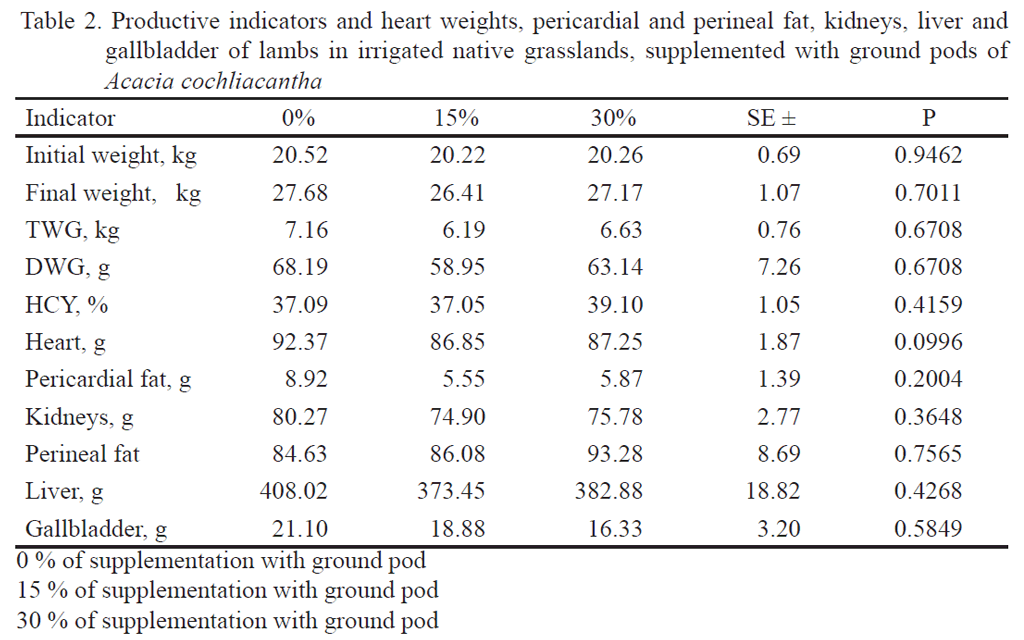
<body><![CDATA[<p align="justify"><font size="2" face="Verdana, Arial, Helvetica, sans-serif"><em>Statistical analysis</em>.  Data underwent a statistical analysis of variance, with a linear model. The  test of Duncan (1955) for P &lt; 0.05 was applied to the means, according to  the InfoStat statistical package, version 2012 (Balzarini <em>et al.</em> 2012).</font></p>     <p align="justify">&nbsp;</p>     <p align="justify"><strong><font size="3" face="Verdana, Arial, Helvetica, sans-serif">RESULTS AND DISCUSSION</font></strong></p>     <p align="justify"><font size="2" face="Verdana, Arial, Helvetica, sans-serif">The supplement intake in both groups was 100 %. <a href="/img/revistas/cjas/v49n3/t0208315.gif">Table 2</a> shows that the DWG of the three treatments statistically similar, with 63 g as  average. The values of the treatments with 15 (59 g) and 30 % (63 g) can be  attributed to the high content of CF and lignin in the pods, compared to the  forage from grazing (<a href="/img/revistas/cjas/v49n3/t0108315.gif">table 1</a>). This possibly led to a lower digestibility of  the celluloses in the pods and, with that, to a lower energy contribution  (Bondi 1989).&nbsp;&nbsp; </font></p>     
<p align="justify"><font size="2" face="Verdana, Arial, Helvetica, sans-serif">The contribution of the supplement was 49.68g (15%) and  99.85 g (30%) of dry matter, which possibly provoked the decrease equivalent to  forage in grazing.</font></p>     <p align="justify"><font size="2" face="Verdana, Arial, Helvetica, sans-serif">Values of DWG, HCY, and weights of liver, gallbladder,  heart, kidneys, and&nbsp; pericardial and perirenal  fat (<a href="/img/revistas/cjas/v49n3/t0208315.gif">table 2</a>), as well as the percentages of humidity, protein, polyphenols and  fat from the <em>Longissimus dorsi</em> muscle (<a href="/img/revistas/cjas/v49n3/t0308315.gif">table 3</a>) had no statistical  differences among treatments. This can be attributed to the similarities of  diets in the content of all the nutrients of consumed forage in the grasslands  (<a href="/img/revistas/cjas/v49n3/t0108315.gif">table 1</a>), and to the probable substitutive effect of the fruit in the intake  of grasses in the treatments with 15 and 30 %.</font></p>     
<p align="justify"><font size="2" face="Verdana, Arial, Helvetica, sans-serif">The DWG of this study were similar or close to those  reported by V&aacute;zquez <em>et al.</em> (2012), who reffered values of 68 g in  Pelibuey x Dorper lambs grazing <em>Paspalum notatum</em> and <em>Axonopus  compressus</em>, supplemented with nutritional blocks with 20 % <em>Leucaena  leucocephala</em>&nbsp; plus&nbsp; 20 % of wheat bran. Likewise, Fern&aacute;ndez <em>et  al.</em> (1997) stated 71 g in lambs grazing native grasslands, complemented  with nutritional blocks. Ortiz <em>et al.</em> (2007) indicated 77 g with a  feeding based on <em>Bothriochloa pertusa</em> and supplemented with molasses (6  g kg<sup>-1</sup> of liveweight). This can possibly be attributed to the variety  of plant species (grasses, shrubs and herbaceous plants) from the grasslands  consumed by the lambs in this    study.</font></p>     <p align="justify"><font size="2" face="Verdana, Arial, Helvetica, sans-serif">Regarding the HCY of grazing lambs, Romano <em>et al.</em> (1983) and Lemes <em>et al.</em> (2014) reported figures of 37.2 and 37.16 %,  respectively. Ortiz <em>et al.</em> (2007) pointed out 45.8 %, when lambs were  fed with native grasslands of <em>Bothriochloa pertusa</em> and supplemented with  molasses    (6 g kg<sup>-1</sup> of liveweight). This could be caused by the highest  ingestion of energy represented by the supplementation.</font></p>     <p align="justify"><font size="2" face="Verdana, Arial, Helvetica, sans-serif">Regarding liver weight, Ortiz <em>et al.</em> (2007)  reported 537 g in lambs fed in native grasslands of <em>Bothriochloa pertusa</em> and supplemented with molasses (6 g kg<sup>-1</sup> of liveweight). This is  probably caused by the sugars provided by the molasses. These authors pointed  out similar values for kidney weight (79 g) and heart weight (106 g),  respectively.&nbsp; </font></p>     <p align="justify"><font size="2" face="Verdana, Arial, Helvetica, sans-serif">Fat percentages were statistically similar among  treatments, with 1.71 % as average value, which gives the meat its lean  characteristic (<a href="/img/revistas/cjas/v49n3/t0308315.gif">table 3</a>).</font></p>     
]]></body>
<body><![CDATA[<p align="justify"><font size="2" face="Verdana, Arial, Helvetica, sans-serif">The sum of TFA, SFA, MUFA, and PFA of the <em>Longissimus  dorsi</em> muscle, that of C12:0, C14:0 and C16:0 (lauric, miristic&nbsp; and palmitic acids), the values of C18:0  (estearic acid),&nbsp; C18:O (oleic acid) and  the C18:2-n6/c18:3 relationship (<a href="/img/revistas/cjas/v49n3/t0408315.gif">table 4</a>) were statistically similar among treatments  with 0, 15 and 30 % of supplementation with ground pods of <em>Acacia  cochliacantha</em>.</font></p>     
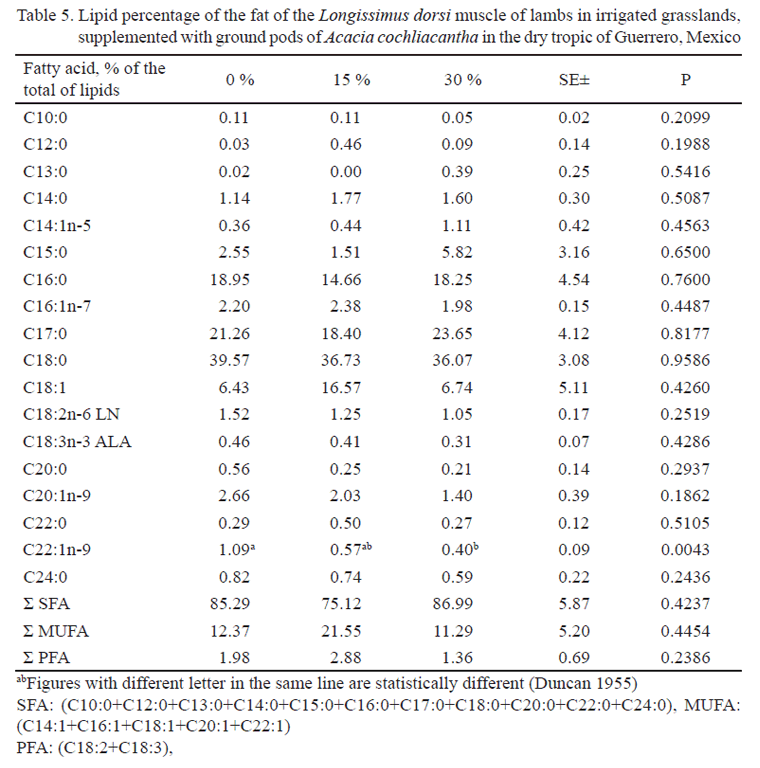
<p align="justify"><font size="2" face="Verdana, Arial, Helvetica, sans-serif">The contents of TFA, determined in the <em>Longissimus  dorsi</em> muscle of the lambs in this study, were similar to those pointed out  by D&iacute;az <em>et al.</em> (2005) in lambs (1682.75 mg) in an extensive system from  Uruguay. However, TFA values in lambs fed with grain-enriched rations in  Germany and the United Kingdom were 2,808.75 mg and 2 430.74 mg, respectively.</font></p>     <p align="justify"><font size="2" face="Verdana, Arial, Helvetica, sans-serif">The average percentage in the three treatments of C18:1  was reduced, to 9.91 %. Reza <em>et al.</em> (2012) reported 39.91 % and Mazzone <em>et  al.</em> (2010) stated 30.87 % in lambs fed with hay from grasslands and  supplemented with grains. This difference could be caused by the  supplementation, which influenced on the poly-unsaturated/saturated (P/S) fatty  acids relation, with 0.19 and 0.42, respectively, regarding the 0.03 obtained  in this study.</font></p>     <p align="justify"><font size="2" face="Verdana, Arial, Helvetica, sans-serif">Fat contents and the profile  of fatty acids from the <em>Longissimus dorsi</em> muscle obtained in this study  can be attributed to the forages consumed during grazing and to the  supplementation with pods of <em>Acacia cochliacantha</em>. It can be also  attributed to the possible effect of tannins within the shrub leaves (24.82 %)  (Olivares <em>et al.</em> 2014) and within the supplement    (5.03 %) (Reyes <em>et al.</em> 2013) because these metabolites decrease the  hydrogenation of fats at ruminal level, as informed by Priolo <em>et al.</em> (2005) and Vasta <em>et al.</em> (2007). </font></p>     <p align="justify"><font size="2" face="Verdana, Arial, Helvetica, sans-serif">Among the percentages of SFA, the C18:0 had the highest  representation (37.46 %). Consequently, percentages corresponding to C12:0,  C14:0 and C14:0 decreased (<a href="/img/revistas/cjas/v49n3/t0508315.gif">table 5</a>). This condition is related to the benefits  it brings to human health (Paim <em>et al.</em> 2014). Regarding the estearic  acid (C18:0), Willems <em>et al.</em> (2014) stated 36.30 %, and amounts similar  to those of this study in grazing lambs. </font></p>     
<p align="justify"><font size="2" face="Verdana, Arial, Helvetica, sans-serif">The percentage of fat in the  lambs of this study, lower than 2 % of the <em>Longissimus dorsi</em> muscle,  belongs to diets based on forages. Reza <em>et al.</em> (2012) reported a similar  situation, with 1.92 % in lambs fed in an extensive system. These values can be  attributed to carcasses considered as lean. However, these authors obtained  2.41 % of fat with the grain supplementation. Mazzone <em>et al.</em> (2010)  informed 2.80 %, attributed to the energy supplementation represented by  grains. </font></p>     <p align="justify"><font size="2" face="Verdana, Arial, Helvetica, sans-serif">The reduced contents of  C12:0, C14:0, C16:0, C18:0 and C18:1, and the close relation of  C18:2-n6/c18:3-n3, obtained in this study, are beneficial for human health,  regarding the prevention of cardiovascular diseases (Webb and O&acute;Nell 2008,  Russo 2009, Hunter <em>et al.</em>&nbsp; 2010,  Dervishi <em>et al.</em>  2011 and Paim <em>et al.</em> 2014). </font></p>     <p align="justify"><font size="2" face="Verdana, Arial, Helvetica, sans-serif">The C:22:1n-9&nbsp; was  different (P &lt; 0.05) among treatments. However, the amount of this  mono-unsaturated fatty acid was not reflected on the whole amount of MUFA  (<a href="/img/revistas/cjas/v49n3/t0508315.gif">table 5</a>).</font></p>     
<p align="justify">&nbsp;</p>     <p align="justify"><strong><font size="3" face="Verdana, Arial, Helvetica, sans-serif">CONCLUSIONS </font></strong></p>     ]]></body>
<body><![CDATA[<p align="justify"><font size="2" face="Verdana, Arial, Helvetica, sans-serif">Lambs in native grasslands,  irrigated and supplemented with or without pods of <em>Acacia cochliacantha</em>,  produced acceptable DWG and HCY. It was also confirmed that there was a close  relation of C18:2-n6/c18:3-n3, with a decrease of C22:1n-9 only in the <em>Longissimus  dorsi</em> muscle of the supplemented animals. </font></p>     <p align="justify">&nbsp;</p>     <p align="justify"><font size="3" face="Verdana, Arial, Helvetica, sans-serif"><strong>REFERENCES</strong></font></p>     <!-- ref --><p align="justify"><font size="2" face="Verdana, Arial, Helvetica, sans-serif">AOAC 2003. <em>Official Methods  of Analysis</em>. 23rd ed., Washington D.C.: Ass. Off. Anal. Chem.    </font></p>     <!-- ref --><p align="justify"><font size="2" face="Verdana, Arial, Helvetica, sans-serif">Balzarini, M. G., Gonz&aacute;lez, L., Tablada, M.,  Casanoves, F., Di Rienzo, J. A. &amp; Robledo, C. W. 2012. <em>Paquete  estad&iacute;stico INFOSTAT</em>. Argentina: Universidad Nacional de C&oacute;rdoba.    </font></p>     <p align="justify"><font size="2" face="Verdana, Arial, Helvetica, sans-serif">Bligh, E. G. &amp; Dyer, W. J. 1959. &lsquo;&lsquo;A rapid method of total extraction and purification&rsquo;&rsquo;. <em>Can J. Biochem. Physiol</em>, 37: 911.</font></p>     <!-- ref --><p align="justify"><font size="2" face="Verdana, Arial, Helvetica, sans-serif">Bondi, A. A. 1989. <em>Nutrici&oacute;n animal</em>. Zaragoza,  Espa&ntilde;a: Acribia, 50-161 p.    </font></p>     ]]></body>
<body><![CDATA[<p align="justify"><font size="2" face="Verdana, Arial, Helvetica, sans-serif">Dervishi, E., Serrano, C., Joy, M., Serrano, M.,  Rodellar, C. &amp; Calvo, J. H. 2011. &lsquo;&lsquo;The effect of feeding system  in the expression of genes related with fat metabolism in semitendinous muscle  in sheep&rsquo;&rsquo;. <em>Meat Sci.</em>, 89: 91.</font></p>     <p align="justify"><font size="2" face="Verdana, Arial, Helvetica, sans-serif">D&iacute;az, M. T., Ivarez, I. A., De la Fuente, J., Sa&ntilde;udo,  M. M., Campo, M. A., Oliver, M. A., Font, I., Furnols, M., Montossi, F., San  Juli&aacute;n, R., Nute, G. R. &amp; Ca&ntilde;eque, V. 2005. &lsquo;&lsquo;Fatty acid  composition of meat from typical lamb production systems of Spain, United  Kingdom, Germany and Uruguay&rsquo;&rsquo;. <em>Meat Sci.</em>, 71: 256.</font></p>     <!-- ref --><p align="justify"><font size="2" face="Verdana, Arial, Helvetica, sans-serif">FAO 1996. <em>Principios de manejo de praderas  naturales</em>. 2nd ed., Santiago de Chile: Instituto Nacional de Tecnolog&iacute;a  Agropecuaria-INTA, Oficina Regional de la FAO para Am&eacute;rica Latina y el Caribe,  118-119 p.    </font></p>     <p align="justify"><font size="2" face="Verdana, Arial, Helvetica, sans-serif">Fern&aacute;ndez, G., San Mart&iacute;n, F. &amp; Escurra, E. 1997.  &lsquo;&lsquo;Uso de bloques nutricionales en la suplementaci&oacute;n de ovinos al pastoreo&rsquo;&rsquo;. <em>Rev. Inv. Pec</em>, 8: 29.</font></p>     <p align="justify"><font size="2" face="Verdana, Arial, Helvetica, sans-serif">Folch, J. M., Less, M. &amp;  Sloane-Stanley, G. 1957. &lsquo;&lsquo;A simple method of the isolation and purification of  total lipids&rsquo;&rsquo;. <em>J. Biol.  Chem.</em>, 226: 497.</font></p>     <!-- ref --><p align="justify"><font size="2" face="Verdana, Arial, Helvetica, sans-serif">Gonz&aacute;lez, S. A. 1995. <em>Aplicaci&oacute;n y efecto residual  del esti&eacute;rcol en producci&oacute;n y calidad del buffel (Cenchrus ciliaris C.V.  Texas-4464) en el tr&oacute;pico seco</em>. M.Sc. Thesis, Universidad de Colima,  M&eacute;xico, Available: &lt;<a href="http://digest.ucol.mx/tesis posgrado/Pdf Gonzalez Sotelo.pdf" target="_blank">http://digest.ucol.mx/tesis  posgrado/Pdf%20Gonzalez%20Sotelo.pdf</a>&gt;, [Consulted:&nbsp;January 10, 2012].    </font></p>     <p align="justify"><font size="2" face="Verdana, Arial, Helvetica, sans-serif">Hunter, J. E., Zhang, J. &amp;  Kris-Etherton, P. M. 2010. &lsquo;&lsquo;Cardiovascular disease risk of dietary stearic  acid co pared with trans, other saturated, and unsaturated fatty acids: a  systematic review&rsquo;&rsquo;. <em>Animal J.  Clin. Nutr.</em>, 91: 46.</font></p>     <!-- ref --><p align="justify"><font size="2" face="Verdana, Arial, Helvetica, sans-serif">INIA 1982. <em>Diagn&oacute;stico de la problem&aacute;tica del  cultivo de ma&iacute;z en la regi&oacute;n de la Tierra Caliente (Guerrero y Michoac&aacute;n)</em>.  Altamirano Guerrero, M&eacute;xico: Mimeo.    </font></p>     <p align="justify"><font size="2" face="Verdana, Arial, Helvetica, sans-serif">Johnson, C. R., Doyle, S. P. &amp; Long, R. S. 2010. &lsquo;&lsquo;Effect of feeding systems on meat goat growth, performance and carcass  traits&rsquo;&rsquo;. <em>Sheep and Goat Research J.</em>, 25: 78.</font></p>     <p align="justify"><font size="2" face="Verdana, Arial, Helvetica, sans-serif">Lemes, J. S., Osorio, M. T.  M., Gonzaga, J. C. S., Martins, L. S., Esteves, R. M. G. &amp; Lehmen, R. I.  2014. &lsquo;&lsquo;Caracteristicas  da carcaca e da carne de cordeiros Corridale maneejados em duas alturas de  miletho&rsquo;&rsquo;. <em>Arch. Zootec.</em>, 63: 161.</font></p>     <p align="justify"><font size="2" face="Verdana, Arial, Helvetica, sans-serif">Macedo, R. &amp; Castellanos, Y. 2004. &lsquo;&lsquo;Rentabilidad  de un sistema intensivo de producci&oacute;n ovino en el tr&oacute;pico&rsquo;&rsquo;. <em>Avances Inv.  Agropec.</em>, 8: 1.</font></p>     <p align="justify"><font size="2" face="Verdana, Arial, Helvetica, sans-serif">Mac&iacute;as, U., &Aacute;lvarez, F. D., Rodr&iacute;guez, J., Correa, A.,  Torrentera, N. G., Molina, L. &amp; Avenda&ntilde;o, L. 2010. &lsquo;&lsquo;Crecimiento y  caracter&iacute;sticas de canal en corderos Pelibuey puros y cruzados F1 con razas  Dorper y Katahdin en confinamiento&rsquo;&rsquo;. <em>Arch. Med. Vet.</em>, 42: 147.</font></p>     <p align="justify"><font size="2" face="Verdana, Arial, Helvetica, sans-serif">Mart&iacute;nez, G. S., Aguirre, O. J., Zepeda, G. J., Ulloa,  C. R., Figueroa, M. R., Mac&iacute;as, C. H. &amp; Moreno, F. L. A. 2009. &lsquo;&lsquo;La  ovinocultura de Nayarit, M&eacute;xico&rsquo;&rsquo;. In: Cavalloti V. B. A. &amp; Marcof A. C. F.  (eds.), <em>Ganader&iacute;a y Seguridad Alimentaria en Tiempo de Crisis</em>, Chapingo,  M&eacute;xico, DF, pp. 305&ndash;309.</font></p>     <p align="justify"><font size="2" face="Verdana, Arial, Helvetica, sans-serif">Mazzone, G., Giammarco, M., Vignola, G., Sardi, L.  &amp; Lambertini, L. 2010. &lsquo;&lsquo;Effects of season on  caracass and meat quality of suckling Apennine&rsquo;&rsquo;. <em>Meat. Sci.</em>, 86: 474.</font></p>     <p align="justify"><font size="2" face="Verdana, Arial, Helvetica, sans-serif">McDonald, P., Edwards, R. A.,  Greenhalgh, J. F. D. &amp; Morgan, C. A. 2006. &lsquo;&lsquo;Nutrici&oacute;n animal&rsquo;&rsquo;. In: <em>Valoraci&oacute;n de los  alimentos (A) Digestibilidad</em>, 6th ed., Zaragoza, Espa&ntilde;a: Acribia, pp.  205&ndash;208.</font></p>     <p align="justify"><font size="2" face="Verdana, Arial, Helvetica, sans-serif">Morrison, W. R. &amp; Smith,  L. M. 1964. &lsquo;&lsquo;Preparation of fatty acid esters and dimethyl acetals from  lipidis with boron fluoridemethanol&rsquo;&rsquo;. <em>J. Lip. Res.</em>, 5: 600.</font></p>     <!-- ref --><p align="justify"><font size="2" face="Verdana, Arial, Helvetica, sans-serif">NRC 2007. <em>Nutrient  Requirements of Small Ruminants</em>. Washington, D.C.: National Research  Council, 256-257 p.    </font></p>     <p align="justify"><font size="2" face="Verdana, Arial, Helvetica, sans-serif">Nuernberg, K., Fischer, A.,  Ender, K. &amp; Dannenberger, D. 2008. &lsquo;&lsquo;Meat quality and fatty acid  composition of lipids in muscle and fatty tissue of Skudde lambs fed grass  versus concentrate&rsquo;&rsquo;. <em>Small  Ruminant Res.</em>, 74: 279.</font></p>     <p align="justify"><font size="2" face="Verdana, Arial, Helvetica, sans-serif">Olivares, P. J., Avil&eacute;s, N. F., Albarr&aacute;n, P. B.,  Hern&aacute;ndez, R. S., C&oacute;rdova, I. A., Mancera, V. A. &amp; Castel&aacute;n, O. 2014. &lsquo;&lsquo;Chemical composition of leguminous tree foliage and efecto of polyethylene  glycol on gas production and <em>in vitro</em> digestion parameters&rsquo;&rsquo;. <em>Agroecosystems</em>, 17: 207.</font></p>     <p align="justify"><font size="2" face="Verdana, Arial, Helvetica, sans-serif">Ortiz, A., El&iacute;as, A. &amp; Valdivie, M. 2007.  &lsquo;&lsquo;Evaluaci&oacute;n de la pollinaza de cascarilla de caf&eacute; como complemento alimenticio  en la ceba de ovinos en pastoreo&rsquo;&rsquo;. <em>Pastos y Forrajes</em>, 30: 279.</font></p>     <p align="justify"><font size="2" face="Verdana, Arial, Helvetica, sans-serif">Paim, T. P., Viana, P., Brandao, E., Amador, S.,  Barbosa, T., Cardoso, C., Dantas, A. M. M., Rodriguez, S. . ., McManus, C.,  Abdalla, A. L. &amp; Louvandinia, H. 2014. &lsquo;&lsquo;Carcass  straits and fatty acid profile of meat fed different cotton seed by-products&rsquo;&rsquo;. <em>Small Ruminant Res.</em>, 116: 71.</font></p>     <p align="justify"><font size="2" face="Verdana, Arial, Helvetica, sans-serif">Priolo, A., Bella, M., Lanza,  M., Galofaro, V., Biondi, L., Barbagallo, D., Ben Salem, H. &amp; Pennisi, P.  2005. &lsquo;&lsquo;Caracass and meat quality of lambs fed fresh sulla (<em>Hedysarum  coronarium</em> L.) with or without polyethulene glycol or concentrate&rsquo;&rsquo;. <em>Small Ruminant Res.</em>, 59: 281.</font></p>     <p align="justify"><font size="2" face="Verdana, Arial, Helvetica, sans-serif">Reyes, E. R., Torres, E. A. C., Olivares, J., Rojas,  S., Avil&eacute;s, F., C&oacute;rdova, A., Villa, A., Valencia, M. T., Guti&eacute;rrez, I. &amp;  Mireles, M. E. J. 2013. &lsquo;&lsquo;Composici&oacute;n qu&iacute;mica del fruto de tres arb&oacute;reas  forrajeras tropicales y an&aacute;lisis de su digestibilidad y producci&oacute;n de gas <em>in  vitro</em>&rsquo;&rsquo;. In: <em>XIII Reuni&oacute;n de ALPA y IV Congreso Internacional de  Producci&oacute;n Animal Tropical</em>, La Habana, Cuba, pp. 1407&ndash;1410.</font></p>     <p align="justify"><font size="2" face="Verdana, Arial, Helvetica, sans-serif">Reza, A. Y., Kohram, H., Zare,  A. S., Nik Khanh, A. &amp; Campbell, A. W. 2012. &lsquo;&lsquo;Comparisons of them eat  quality and fatty acid composition of traditional fat-tailed (Call) and tailed  (Zel) Iranian sheep breeds&rsquo;&rsquo;. <em>Meat Sci.</em>, 92: 417.</font></p>     <p align="justify"><font size="2" face="Verdana, Arial, Helvetica, sans-serif">Romano, M. J. L., Hern&aacute;ndez, G. J. &amp; Castellanos,  R. A. 1983. &lsquo;&lsquo;Repercusi&oacute;n del valor nutritivo de la dieta sobre el crecimiento  del borrego Pelibuey&rsquo;&rsquo;. <em>Tec. Pec. Mex.</em>, 45: 67.</font></p>     <p align="justify"><font size="2" face="Verdana, Arial, Helvetica, sans-serif">Russo, G. L. 2009. &lsquo;&lsquo;Dietary  n_6 and n_3 polyunsaturated fatty acids: From chemistry to clinical  implications in cardiovascular prevention&rsquo;&rsquo;. <em>Biochem. Pharmacology</em>, 77:  937.</font></p>     ]]></body>
<body><![CDATA[<p align="justify"><font size="2" face="Verdana, Arial, Helvetica, sans-serif">Taga, M., Miller, E. &amp;  Pratt, D. 1984. &lsquo;&lsquo;Chia seeds as sourse of natural lipid antioxidants&rsquo;&rsquo;. <em>J.  Am. Oil Chem. Soc.</em>, 61: 928.</font></p>     <p align="justify"><font size="2" face="Verdana, Arial, Helvetica, sans-serif">Tilley, J. M. A. &amp; Terry,  R. A. 1963. &lsquo;&lsquo;A two-stage technique for the A two-stage technique for the in  vitro digestion of forage crops&rsquo;&rsquo;. <em>Brit. Grass. Soc.</em>, 18: 104&ndash;113.</font></p>     <p align="justify"><font size="2" face="Verdana, Arial, Helvetica, sans-serif">Turner, K. E., Belesky, D. P.,  Cassida, K. A. &amp; Zerby, H. N. 2014. &lsquo;&lsquo;Carcass merit and meat in Suffolk  lambs, Katahdin lambs, and meat-goat kids finished on grass-legume pasture with  and without supplementation&rsquo;&rsquo;. <em>Meat Science.</em>, 98: 211.</font></p>     <p align="justify"><font size="2" face="Verdana, Arial, Helvetica, sans-serif">Van Soest, P. J., Robertson,  J. B. &amp; Lewis, B. A. 1991. &lsquo;&lsquo;Methods for dietary fiber, neutral detergent  fiber and non-starch polysaccharides in relation to animal nutrition&rsquo;&rsquo;. <em>J. Dairy Sci.</em>, 74: 3583.</font></p>     <p align="justify"><font size="2" face="Verdana, Arial, Helvetica, sans-serif">Vasta, V., Nudda, A., Cannas, A., Lanza, M.,  Barbagallo, D., Bella, M. &amp; Priolo, A. 2007. &lsquo;&lsquo;Intramuscular  fatty acid composition of lambs given a tanniniferous diet with or without  polyethylene glycole supplementation&rsquo;&rsquo;. <em>Meat Sci.</em>, 76: 739.</font></p>     <p align="justify"><font size="2" face="Verdana, Arial, Helvetica, sans-serif">V&aacute;zquez, M. P., Castel&aacute;n, O. O. A., Garc&iacute;a, M. . .  &amp; Avil&eacute;s, N. F. 2012. &lsquo;&lsquo;Uso de bloques nutricionales como complemento para  ovinos en el tr&oacute;pico seco del altiplano central de M&eacute;xico&rsquo;&rsquo;. <em>Tropical and  Subtropical Agroecosystems</em>, 15: 87.</font></p>     <p align="justify"><font size="2" face="Verdana, Arial, Helvetica, sans-serif">Velazco, S., Ca&ntilde;eque, V., Lauzurica, S., P&eacute;rez, C.  &amp; Huidobro, F. 2004. &lsquo;&lsquo;Effect of different feed on  meat quality and fatty acid composition of lambs fattened at pasture&rsquo;&rsquo;. <em>Meat  Sci.</em>, 66: 457.</font></p>     <p align="justify"><font size="2" face="Verdana, Arial, Helvetica, sans-serif">Webb, E. C. &amp; O&rsquo;Neill, H.  A. 2008. &lsquo;&lsquo;The animal fat paradox and meat quality&rsquo;&rsquo;. <em>Meat Sci.</em>, 80: 28.</font></p>     <p align="justify"><font size="2" face="Verdana, Arial, Helvetica, sans-serif">  Willems, H., Kreuzer, M. &amp; Leiber, F. 2014.  &lsquo;&lsquo;Alpha-linolenic and linoleic acid in meat and adipose tissue of grazing lambs  differ among alpine pasture types with contrasting plant species and phenolic  compound composition&rsquo;&rsquo;. <em>Small  Ruminant Res.</em>, 116:  173.</font> </p>     <p align="justify">&nbsp;</p>     ]]></body>
<body><![CDATA[<p align="justify">&nbsp;</p>     <p align="justify"><font size="2" face="Verdana, Arial, Helvetica, sans-serif">Received: November 12, 2014    <br> Accepted: May 25, 2015</font></p>     <p align="justify">&nbsp;</p>     <p align="justify">&nbsp;</p>     <p align="justify"><font size="2" face="Verdana, Arial, Helvetica, sans-serif"><i>E.J. Mireles,</i> Unidad Académica de Medicina Veterinaria y Zootecnia de la Universidad Autónoma de Guerrero, México.  km 2.5 Carretera Cd. Altamirano- Iguala Cd Altamirano Gro. CP 40660.    Email: <a href="mailto:emirelesmartinez@gmail.com">emirelesmartinez@gmail.com</a></font></p>      ]]></body><back>
<ref-list>
<ref id="B1">
<nlm-citation citation-type="book">
<person-group person-group-type="author">
<name>
<surname><![CDATA[AOAC]]></surname>
</name>
</person-group>
<source><![CDATA[Official Methods of Analysis]]></source>
<year>2003</year>
<edition>23rd</edition>
<publisher-loc><![CDATA[Washington D.C. ]]></publisher-loc>
<publisher-name><![CDATA[Ass. Off. Anal. Chem.]]></publisher-name>
</nlm-citation>
</ref>
<ref id="B2">
<nlm-citation citation-type="book">
<person-group person-group-type="author">
<name>
<surname><![CDATA[Balzarini]]></surname>
<given-names><![CDATA[M. G.]]></given-names>
</name>
<name>
<surname><![CDATA[González]]></surname>
<given-names><![CDATA[L.]]></given-names>
</name>
<name>
<surname><![CDATA[Tablada]]></surname>
<given-names><![CDATA[M.]]></given-names>
</name>
<name>
<surname><![CDATA[Casanoves]]></surname>
<given-names><![CDATA[F.]]></given-names>
</name>
<name>
<surname><![CDATA[Di Rienzo]]></surname>
<given-names><![CDATA[J. A.]]></given-names>
</name>
<name>
<surname><![CDATA[Robledo]]></surname>
<given-names><![CDATA[C. W.]]></given-names>
</name>
</person-group>
<source><![CDATA[Paquete estadístico INFOSTAT]]></source>
<year>2012</year>
<publisher-loc><![CDATA[Argentina ]]></publisher-loc>
<publisher-name><![CDATA[Universidad Nacional de Córdoba]]></publisher-name>
</nlm-citation>
</ref>
<ref id="B3">
<nlm-citation citation-type="journal">
<person-group person-group-type="author">
<name>
<surname><![CDATA[Bligh]]></surname>
<given-names><![CDATA[E. G.]]></given-names>
</name>
<name>
<surname><![CDATA[Dyer]]></surname>
<given-names><![CDATA[W. J.]]></given-names>
</name>
</person-group>
<article-title xml:lang="nd"><![CDATA[A rapid method of total extraction and purification]]></article-title>
<source><![CDATA[Can J. Biochem. Physiol]]></source>
<year>1959</year>
<volume>37</volume>
<page-range>911</page-range></nlm-citation>
</ref>
<ref id="B4">
<nlm-citation citation-type="book">
<person-group person-group-type="author">
<name>
<surname><![CDATA[Bondi]]></surname>
<given-names><![CDATA[A. A.]]></given-names>
</name>
</person-group>
<source><![CDATA[Nutrición animal]]></source>
<year>1989</year>
<page-range>50-161</page-range><publisher-loc><![CDATA[Zaragoza, España ]]></publisher-loc>
<publisher-name><![CDATA[Acribia]]></publisher-name>
</nlm-citation>
</ref>
<ref id="B5">
<nlm-citation citation-type="journal">
<person-group person-group-type="author">
<name>
<surname><![CDATA[Dervishi]]></surname>
<given-names><![CDATA[E.]]></given-names>
</name>
<name>
<surname><![CDATA[Serrano]]></surname>
<given-names><![CDATA[C.]]></given-names>
</name>
<name>
<surname><![CDATA[Joy]]></surname>
<given-names><![CDATA[M.]]></given-names>
</name>
<name>
<surname><![CDATA[Serrano]]></surname>
<given-names><![CDATA[M.]]></given-names>
</name>
<name>
<surname><![CDATA[Rodellar]]></surname>
<given-names><![CDATA[C.]]></given-names>
</name>
<name>
<surname><![CDATA[Calvo]]></surname>
<given-names><![CDATA[J. H.]]></given-names>
</name>
</person-group>
<article-title xml:lang="nd"><![CDATA[The effect of feeding system in the expression of genes related with fat metabolism in semitendinous muscle in sheep]]></article-title>
<source><![CDATA[Meat Sci.]]></source>
<year>2011</year>
<volume>89</volume>
<page-range>91</page-range></nlm-citation>
</ref>
<ref id="B6">
<nlm-citation citation-type="journal">
<person-group person-group-type="author">
<name>
<surname><![CDATA[Díaz]]></surname>
<given-names><![CDATA[M. T.]]></given-names>
</name>
<name>
<surname><![CDATA[Ivarez]]></surname>
<given-names><![CDATA[I. A.]]></given-names>
</name>
<name>
<surname><![CDATA[De la Fuente]]></surname>
<given-names><![CDATA[J.]]></given-names>
</name>
<name>
<surname><![CDATA[Sañudo]]></surname>
<given-names><![CDATA[M. M.]]></given-names>
</name>
<name>
<surname><![CDATA[Campo]]></surname>
<given-names><![CDATA[M. A.]]></given-names>
</name>
<name>
<surname><![CDATA[Oliver]]></surname>
<given-names><![CDATA[M. A.]]></given-names>
</name>
<name>
<surname><![CDATA[Font]]></surname>
<given-names><![CDATA[I.]]></given-names>
</name>
<name>
<surname><![CDATA[Furnols]]></surname>
<given-names><![CDATA[M.]]></given-names>
</name>
<name>
<surname><![CDATA[Montossi]]></surname>
<given-names><![CDATA[F.]]></given-names>
</name>
<name>
<surname><![CDATA[San Julián]]></surname>
<given-names><![CDATA[R.]]></given-names>
</name>
<name>
<surname><![CDATA[Nute]]></surname>
<given-names><![CDATA[G. R.]]></given-names>
</name>
<name>
<surname><![CDATA[Cañeque]]></surname>
<given-names><![CDATA[V.]]></given-names>
</name>
</person-group>
<article-title xml:lang="nd"><![CDATA[Fatty acid composition of meat from typical lamb production systems of Spain, United Kingdom, Germany and Uruguay]]></article-title>
<source><![CDATA[Meat Sci.]]></source>
<year>2005</year>
<volume>71</volume>
<page-range>256</page-range></nlm-citation>
</ref>
<ref id="B7">
<nlm-citation citation-type="book">
<person-group person-group-type="author">
<name>
<surname><![CDATA[FAO]]></surname>
</name>
</person-group>
<source><![CDATA[Principios de manejo de praderas naturales]]></source>
<year>1996</year>
<edition>2nd</edition>
<page-range>118-119</page-range><publisher-loc><![CDATA[Santiago de Chile ]]></publisher-loc>
<publisher-name><![CDATA[Instituto Nacional de Tecnología Agropecuaria-INTA, Oficina Regional de la FAO para América Latina y el Caribe]]></publisher-name>
</nlm-citation>
</ref>
<ref id="B8">
<nlm-citation citation-type="journal">
<person-group person-group-type="author">
<name>
<surname><![CDATA[Fernández]]></surname>
<given-names><![CDATA[G.]]></given-names>
</name>
<name>
<surname><![CDATA[San Martín]]></surname>
<given-names><![CDATA[F.]]></given-names>
</name>
<name>
<surname><![CDATA[Escurra]]></surname>
<given-names><![CDATA[E.]]></given-names>
</name>
</person-group>
<article-title xml:lang="nd"><![CDATA[Uso de bloques nutricionales en la suplementación de ovinos al pastoreo]]></article-title>
<source><![CDATA[Rev. Inv. Pec]]></source>
<year>1997</year>
<volume>8</volume>
<page-range>29</page-range></nlm-citation>
</ref>
<ref id="B9">
<nlm-citation citation-type="journal">
<person-group person-group-type="author">
<name>
<surname><![CDATA[Folch]]></surname>
<given-names><![CDATA[J. M.]]></given-names>
</name>
<name>
<surname><![CDATA[Less]]></surname>
<given-names><![CDATA[M.]]></given-names>
</name>
<name>
<surname><![CDATA[Sloane-Stanley]]></surname>
<given-names><![CDATA[G.]]></given-names>
</name>
</person-group>
<article-title xml:lang="nd"><![CDATA[A simple method of the isolation and purification of total lipids]]></article-title>
<source><![CDATA[J. Biol. Chem.]]></source>
<year>1957</year>
<volume>226</volume>
<page-range>497</page-range></nlm-citation>
</ref>
<ref id="B10">
<nlm-citation citation-type="book">
<person-group person-group-type="author">
<name>
<surname><![CDATA[González]]></surname>
<given-names><![CDATA[S. A.]]></given-names>
</name>
</person-group>
<source><![CDATA[Aplicación y efecto residual del estiércol en producción y calidad del buffel (Cenchrus ciliaris C.V. Texas-4464) en el trópico seco]]></source>
<year>1995</year>
<publisher-loc><![CDATA[México ]]></publisher-loc>
<publisher-name><![CDATA[Universidad de Colima]]></publisher-name>
</nlm-citation>
</ref>
<ref id="B11">
<nlm-citation citation-type="journal">
<person-group person-group-type="author">
<name>
<surname><![CDATA[Hunter]]></surname>
<given-names><![CDATA[J. E.]]></given-names>
</name>
<name>
<surname><![CDATA[Zhang]]></surname>
<given-names><![CDATA[J.]]></given-names>
</name>
<name>
<surname><![CDATA[Kris-Etherton]]></surname>
<given-names><![CDATA[P. M.]]></given-names>
</name>
</person-group>
<article-title xml:lang="nd"><![CDATA[Cardiovascular disease risk of dietary stearic acid co pared with trans, other saturated, and unsaturated fatty acids: a systematic review]]></article-title>
<source><![CDATA[Animal J. Clin. Nutr.]]></source>
<year>2010</year>
<volume>91</volume>
<page-range>46</page-range></nlm-citation>
</ref>
<ref id="B12">
<nlm-citation citation-type="book">
<person-group person-group-type="author">
<name>
<surname><![CDATA[INIA]]></surname>
</name>
</person-group>
<source><![CDATA[Diagnóstico de la problemática del cultivo de maíz en la región de la Tierra Caliente (Guerrero y Michoacán)]]></source>
<year>1982</year>
<publisher-loc><![CDATA[Altamirano Guerrero, México ]]></publisher-loc>
<publisher-name><![CDATA[Mimeo]]></publisher-name>
</nlm-citation>
</ref>
<ref id="B13">
<nlm-citation citation-type="journal">
<person-group person-group-type="author">
<name>
<surname><![CDATA[Johnson]]></surname>
<given-names><![CDATA[C. R.]]></given-names>
</name>
<name>
<surname><![CDATA[Doyle]]></surname>
<given-names><![CDATA[S. P.]]></given-names>
</name>
<name>
<surname><![CDATA[Long]]></surname>
<given-names><![CDATA[R. S.]]></given-names>
</name>
</person-group>
<article-title xml:lang="nd"><![CDATA[Effect of feeding systems on meat goat growth, performance and carcass traits]]></article-title>
<source><![CDATA[Sheep and Goat Research J.]]></source>
<year>2010</year>
<volume>25</volume>
<page-range>78</page-range></nlm-citation>
</ref>
<ref id="B14">
<nlm-citation citation-type="journal">
<person-group person-group-type="author">
<name>
<surname><![CDATA[Lemes]]></surname>
<given-names><![CDATA[J. S.]]></given-names>
</name>
<name>
<surname><![CDATA[Osorio]]></surname>
<given-names><![CDATA[M. T. M.]]></given-names>
</name>
<name>
<surname><![CDATA[Gonzaga]]></surname>
<given-names><![CDATA[J. C. S.]]></given-names>
</name>
<name>
<surname><![CDATA[Martins]]></surname>
<given-names><![CDATA[L. S.]]></given-names>
</name>
<name>
<surname><![CDATA[Esteves]]></surname>
<given-names><![CDATA[R. M. G.]]></given-names>
</name>
<name>
<surname><![CDATA[Lehmen]]></surname>
<given-names><![CDATA[R. I.]]></given-names>
</name>
</person-group>
<article-title xml:lang="nd"><![CDATA[Caracteristicas da carcaca e da carne de cordeiros Corridale maneejados em duas alturas de miletho]]></article-title>
<source><![CDATA[Arch. Zootec.]]></source>
<year>2014</year>
<volume>63</volume>
<page-range>161</page-range></nlm-citation>
</ref>
<ref id="B15">
<nlm-citation citation-type="journal">
<person-group person-group-type="author">
<name>
<surname><![CDATA[Macedo]]></surname>
<given-names><![CDATA[R.]]></given-names>
</name>
<name>
<surname><![CDATA[Castellanos]]></surname>
<given-names><![CDATA[Y.]]></given-names>
</name>
</person-group>
<article-title xml:lang="nd"><![CDATA[Rentabilidad de un sistema intensivo de producción ovino en el trópico]]></article-title>
<source><![CDATA[Avances Inv. Agropec.]]></source>
<year>2004</year>
<volume>8</volume>
<page-range>1</page-range></nlm-citation>
</ref>
<ref id="B16">
<nlm-citation citation-type="journal">
<person-group person-group-type="author">
<name>
<surname><![CDATA[Macías]]></surname>
<given-names><![CDATA[U.]]></given-names>
</name>
<name>
<surname><![CDATA[Álvarez]]></surname>
<given-names><![CDATA[F. D.]]></given-names>
</name>
<name>
<surname><![CDATA[Rodríguez]]></surname>
<given-names><![CDATA[J.]]></given-names>
</name>
<name>
<surname><![CDATA[Correa]]></surname>
<given-names><![CDATA[A.]]></given-names>
</name>
<name>
<surname><![CDATA[Torrentera]]></surname>
<given-names><![CDATA[N. G.]]></given-names>
</name>
<name>
<surname><![CDATA[Molina]]></surname>
<given-names><![CDATA[L.]]></given-names>
</name>
<name>
<surname><![CDATA[Avendaño]]></surname>
<given-names><![CDATA[L.]]></given-names>
</name>
</person-group>
<article-title xml:lang="nd"><![CDATA[Crecimiento y características de canal en corderos Pelibuey puros y cruzados F1 con razas Dorper y Katahdin en confinamiento]]></article-title>
<source><![CDATA[Arch. Med. Vet.]]></source>
<year>2010</year>
<volume>42</volume>
<page-range>147</page-range></nlm-citation>
</ref>
<ref id="B17">
<nlm-citation citation-type="">
<person-group person-group-type="author">
<name>
<surname><![CDATA[Martínez]]></surname>
<given-names><![CDATA[G. S.]]></given-names>
</name>
<name>
<surname><![CDATA[Aguirre]]></surname>
<given-names><![CDATA[O. J.]]></given-names>
</name>
<name>
<surname><![CDATA[Zepeda]]></surname>
<given-names><![CDATA[G. J.]]></given-names>
</name>
<name>
<surname><![CDATA[Ulloa]]></surname>
<given-names><![CDATA[C. R.]]></given-names>
</name>
<name>
<surname><![CDATA[Figueroa]]></surname>
<given-names><![CDATA[M. R.]]></given-names>
</name>
<name>
<surname><![CDATA[Macías]]></surname>
<given-names><![CDATA[C. H.]]></given-names>
</name>
<name>
<surname><![CDATA[Moreno]]></surname>
<given-names><![CDATA[F. L. A.]]></given-names>
</name>
</person-group>
<article-title xml:lang="nd"><![CDATA[La ovinocultura de Nayarit, México]]></article-title>
<person-group person-group-type="editor">
<name>
<surname><![CDATA[Cavalloti]]></surname>
<given-names><![CDATA[V. B. A.]]></given-names>
</name>
<name>
<surname><![CDATA[Marcof]]></surname>
<given-names><![CDATA[A. C. F.]]></given-names>
</name>
</person-group>
<source><![CDATA[Ganadería y Seguridad Alimentaria en Tiempo de Crisis]]></source>
<year>2009</year>
<page-range>305-309</page-range><publisher-loc><![CDATA[Chapingo, México, DF ]]></publisher-loc>
</nlm-citation>
</ref>
<ref id="B18">
<nlm-citation citation-type="journal">
<person-group person-group-type="author">
<name>
<surname><![CDATA[Mazzone]]></surname>
<given-names><![CDATA[G.]]></given-names>
</name>
<name>
<surname><![CDATA[Giammarco]]></surname>
<given-names><![CDATA[M.]]></given-names>
</name>
<name>
<surname><![CDATA[Vignola]]></surname>
<given-names><![CDATA[G.]]></given-names>
</name>
<name>
<surname><![CDATA[Sardi]]></surname>
<given-names><![CDATA[L.]]></given-names>
</name>
<name>
<surname><![CDATA[Lambertini]]></surname>
<given-names><![CDATA[L.]]></given-names>
</name>
</person-group>
<article-title xml:lang="nd"><![CDATA[Effects of season on caracass and meat quality of suckling Apennine]]></article-title>
<source><![CDATA[Meat. Sci.]]></source>
<year>2010</year>
<volume>86</volume>
<page-range>474</page-range></nlm-citation>
</ref>
<ref id="B19">
<nlm-citation citation-type="book">
<person-group person-group-type="author">
<name>
<surname><![CDATA[McDonald]]></surname>
<given-names><![CDATA[P.]]></given-names>
</name>
<name>
<surname><![CDATA[Edwards]]></surname>
<given-names><![CDATA[R. A.]]></given-names>
</name>
<name>
<surname><![CDATA[Greenhalgh]]></surname>
<given-names><![CDATA[J. F. D.]]></given-names>
</name>
<name>
<surname><![CDATA[Morgan]]></surname>
<given-names><![CDATA[C. A.]]></given-names>
</name>
</person-group>
<article-title xml:lang="nd"><![CDATA[Nutrición animal]]></article-title>
<source><![CDATA[Valoración de los alimentos (A) Digestibilidad]]></source>
<year>2006</year>
<edition>6th</edition>
<page-range>205-208</page-range><publisher-loc><![CDATA[Zaragoza, España ]]></publisher-loc>
<publisher-name><![CDATA[Acribia]]></publisher-name>
</nlm-citation>
</ref>
<ref id="B20">
<nlm-citation citation-type="journal">
<person-group person-group-type="author">
<name>
<surname><![CDATA[Morrison]]></surname>
<given-names><![CDATA[W. R.]]></given-names>
</name>
<name>
<surname><![CDATA[Smith]]></surname>
<given-names><![CDATA[L. M.]]></given-names>
</name>
</person-group>
<article-title xml:lang="nd"><![CDATA[Preparation of fatty acid esters and dimethyl acetals from lipidis with boron fluoridemethanol]]></article-title>
<source><![CDATA[J. Lip. Res.]]></source>
<year>1964</year>
<volume>5</volume>
<page-range>600</page-range></nlm-citation>
</ref>
<ref id="B21">
<nlm-citation citation-type="book">
<person-group person-group-type="author">
<name>
<surname><![CDATA[NRC]]></surname>
</name>
</person-group>
<source><![CDATA[Nutrient Requirements of Small Ruminants]]></source>
<year>2007</year>
<page-range>256-257</page-range><publisher-loc><![CDATA[Washington, D.C. ]]></publisher-loc>
<publisher-name><![CDATA[National Research Council]]></publisher-name>
</nlm-citation>
</ref>
<ref id="B22">
<nlm-citation citation-type="journal">
<person-group person-group-type="author">
<name>
<surname><![CDATA[Nuernberg]]></surname>
<given-names><![CDATA[K.]]></given-names>
</name>
<name>
<surname><![CDATA[Fischer]]></surname>
<given-names><![CDATA[A.]]></given-names>
</name>
<name>
<surname><![CDATA[Ender]]></surname>
<given-names><![CDATA[K.]]></given-names>
</name>
<name>
<surname><![CDATA[Dannenberger]]></surname>
<given-names><![CDATA[D.]]></given-names>
</name>
</person-group>
<article-title xml:lang="nd"><![CDATA[Meat quality and fatty acid composition of lipids in muscle and fatty tissue of Skudde lambs fed grass versus concentrate]]></article-title>
<source><![CDATA[Small Ruminant Res.]]></source>
<year>2008</year>
<volume>74</volume>
<page-range>279</page-range></nlm-citation>
</ref>
<ref id="B23">
<nlm-citation citation-type="journal">
<person-group person-group-type="author">
<name>
<surname><![CDATA[Olivares]]></surname>
<given-names><![CDATA[P. J.]]></given-names>
</name>
<name>
<surname><![CDATA[Avilés]]></surname>
<given-names><![CDATA[N. F.]]></given-names>
</name>
<name>
<surname><![CDATA[Albarrán]]></surname>
<given-names><![CDATA[P. B.]]></given-names>
</name>
<name>
<surname><![CDATA[Hernández]]></surname>
<given-names><![CDATA[R. S.]]></given-names>
</name>
<name>
<surname><![CDATA[Córdova]]></surname>
<given-names><![CDATA[I. A.]]></given-names>
</name>
<name>
<surname><![CDATA[Mancera]]></surname>
<given-names><![CDATA[V. A.]]></given-names>
</name>
<name>
<surname><![CDATA[Castelán]]></surname>
<given-names><![CDATA[O.]]></given-names>
</name>
</person-group>
<article-title xml:lang="nd"><![CDATA[Chemical composition of leguminous tree foliage and efecto of polyethylene glycol on gas production and in vitro digestion parameters]]></article-title>
<source><![CDATA[Agroecosystems]]></source>
<year>2014</year>
<volume>17</volume>
<page-range>207</page-range></nlm-citation>
</ref>
<ref id="B24">
<nlm-citation citation-type="journal">
<person-group person-group-type="author">
<name>
<surname><![CDATA[Ortiz]]></surname>
<given-names><![CDATA[A.]]></given-names>
</name>
<name>
<surname><![CDATA[Elías]]></surname>
<given-names><![CDATA[A.]]></given-names>
</name>
<name>
<surname><![CDATA[Valdivie]]></surname>
<given-names><![CDATA[M.]]></given-names>
</name>
</person-group>
<article-title xml:lang="nd"><![CDATA[Evaluación de la pollinaza de cascarilla de café como complemento alimenticio en la ceba de ovinos en pastoreo]]></article-title>
<source><![CDATA[Pastos y Forrajes]]></source>
<year>2007</year>
<volume>30</volume>
<page-range>279</page-range></nlm-citation>
</ref>
<ref id="B25">
<nlm-citation citation-type="journal">
<person-group person-group-type="author">
<name>
<surname><![CDATA[Paim]]></surname>
<given-names><![CDATA[T. P.]]></given-names>
</name>
<name>
<surname><![CDATA[Viana]]></surname>
<given-names><![CDATA[P.]]></given-names>
</name>
<name>
<surname><![CDATA[Brandao]]></surname>
<given-names><![CDATA[E.]]></given-names>
</name>
<name>
<surname><![CDATA[Amador]]></surname>
<given-names><![CDATA[S.]]></given-names>
</name>
<name>
<surname><![CDATA[Barbosa]]></surname>
<given-names><![CDATA[T.]]></given-names>
</name>
<name>
<surname><![CDATA[Cardoso]]></surname>
<given-names><![CDATA[C.]]></given-names>
</name>
<name>
<surname><![CDATA[Dantas]]></surname>
<given-names><![CDATA[A. M. M.]]></given-names>
</name>
<name>
<surname><![CDATA[Rodriguez]]></surname>
<given-names><![CDATA[S. . .]]></given-names>
</name>
<name>
<surname><![CDATA[McManus]]></surname>
<given-names><![CDATA[C.]]></given-names>
</name>
<name>
<surname><![CDATA[Abdalla]]></surname>
<given-names><![CDATA[A. L.]]></given-names>
</name>
<name>
<surname><![CDATA[Louvandinia]]></surname>
<given-names><![CDATA[H.]]></given-names>
</name>
</person-group>
<article-title xml:lang="nd"><![CDATA[Carcass straits and fatty acid profile of meat fed different cotton seed by-products]]></article-title>
<source><![CDATA[Small Ruminant Res.]]></source>
<year>2014</year>
<volume>116</volume>
<page-range>71</page-range></nlm-citation>
</ref>
<ref id="B26">
<nlm-citation citation-type="journal">
<person-group person-group-type="author">
<name>
<surname><![CDATA[Priolo]]></surname>
<given-names><![CDATA[A.]]></given-names>
</name>
<name>
<surname><![CDATA[Bella]]></surname>
<given-names><![CDATA[M.]]></given-names>
</name>
<name>
<surname><![CDATA[Lanza]]></surname>
<given-names><![CDATA[M.]]></given-names>
</name>
<name>
<surname><![CDATA[Galofaro]]></surname>
<given-names><![CDATA[V.]]></given-names>
</name>
<name>
<surname><![CDATA[Biondi]]></surname>
<given-names><![CDATA[L.]]></given-names>
</name>
<name>
<surname><![CDATA[Barbagallo]]></surname>
<given-names><![CDATA[D.]]></given-names>
</name>
<name>
<surname><![CDATA[Ben Salem]]></surname>
<given-names><![CDATA[H.]]></given-names>
</name>
<name>
<surname><![CDATA[Pennisi]]></surname>
<given-names><![CDATA[P.]]></given-names>
</name>
</person-group>
<article-title xml:lang="nd"><![CDATA[Caracass and meat quality of lambs fed fresh sulla (Hedysarum coronarium L.) with or without polyethulene glycol or concentrate]]></article-title>
<source><![CDATA[Small Ruminant Res.]]></source>
<year>2005</year>
<volume>59</volume>
<page-range>281</page-range></nlm-citation>
</ref>
<ref id="B27">
<nlm-citation citation-type="">
<person-group person-group-type="author">
<name>
<surname><![CDATA[Reyes]]></surname>
<given-names><![CDATA[E. R.]]></given-names>
</name>
<name>
<surname><![CDATA[Torres]]></surname>
<given-names><![CDATA[E. A. C.]]></given-names>
</name>
<name>
<surname><![CDATA[Olivares]]></surname>
<given-names><![CDATA[J.]]></given-names>
</name>
<name>
<surname><![CDATA[Rojas]]></surname>
<given-names><![CDATA[S.]]></given-names>
</name>
<name>
<surname><![CDATA[Avilés]]></surname>
<given-names><![CDATA[F.]]></given-names>
</name>
<name>
<surname><![CDATA[Córdova]]></surname>
<given-names><![CDATA[A.]]></given-names>
</name>
<name>
<surname><![CDATA[Villa]]></surname>
<given-names><![CDATA[A.]]></given-names>
</name>
<name>
<surname><![CDATA[Valencia]]></surname>
<given-names><![CDATA[M. T.]]></given-names>
</name>
<name>
<surname><![CDATA[Gutiérrez]]></surname>
<given-names><![CDATA[I.]]></given-names>
</name>
<name>
<surname><![CDATA[Mireles]]></surname>
<given-names><![CDATA[M. E. J.]]></given-names>
</name>
</person-group>
<article-title xml:lang="nd"><![CDATA[Composición química del fruto de tres arbóreas forrajeras tropicales y análisis de su digestibilidad y producción de gas in vitro]]></article-title>
<source><![CDATA[]]></source>
<year>2013</year>
<page-range>1407-1410</page-range><publisher-loc><![CDATA[La Habana, Cuba ]]></publisher-loc>
</nlm-citation>
</ref>
<ref id="B28">
<nlm-citation citation-type="journal">
<person-group person-group-type="author">
<name>
<surname><![CDATA[Reza]]></surname>
<given-names><![CDATA[A. Y.]]></given-names>
</name>
<name>
<surname><![CDATA[Kohram]]></surname>
<given-names><![CDATA[H.]]></given-names>
</name>
<name>
<surname><![CDATA[Zare]]></surname>
<given-names><![CDATA[A. S.]]></given-names>
</name>
<name>
<surname><![CDATA[Nik Khanh]]></surname>
<given-names><![CDATA[A.]]></given-names>
</name>
<name>
<surname><![CDATA[Campbell]]></surname>
<given-names><![CDATA[A. W.]]></given-names>
</name>
</person-group>
<article-title xml:lang="nd"><![CDATA[Comparisons of them eat quality and fatty acid composition of traditional fat-tailed (Call) and tailed (Zel) Iranian sheep breeds]]></article-title>
<source><![CDATA[Meat Sci.]]></source>
<year>2012</year>
<volume>92</volume>
<page-range>417</page-range></nlm-citation>
</ref>
<ref id="B29">
<nlm-citation citation-type="journal">
<person-group person-group-type="author">
<name>
<surname><![CDATA[Romano]]></surname>
<given-names><![CDATA[M. J. L.]]></given-names>
</name>
<name>
<surname><![CDATA[Hernández]]></surname>
<given-names><![CDATA[G. J.]]></given-names>
</name>
<name>
<surname><![CDATA[Castellanos]]></surname>
<given-names><![CDATA[R. A.]]></given-names>
</name>
</person-group>
<article-title xml:lang="nd"><![CDATA[Repercusión del valor nutritivo de la dieta sobre el crecimiento del borrego Pelibuey]]></article-title>
<source><![CDATA[Tec. Pec. Mex.]]></source>
<year>1983</year>
<volume>45</volume>
<page-range>67</page-range></nlm-citation>
</ref>
<ref id="B30">
<nlm-citation citation-type="journal">
<person-group person-group-type="author">
<name>
<surname><![CDATA[Russo]]></surname>
<given-names><![CDATA[G. L.]]></given-names>
</name>
</person-group>
<article-title xml:lang="nd"><![CDATA[Dietary n_6 and n_3 polyunsaturated fatty acids: From chemistry to clinical implications in cardiovascular prevention]]></article-title>
<source><![CDATA[Biochem. Pharmacology]]></source>
<year>2009</year>
<volume>77</volume>
<page-range>937</page-range></nlm-citation>
</ref>
<ref id="B31">
<nlm-citation citation-type="journal">
<person-group person-group-type="author">
<name>
<surname><![CDATA[Taga]]></surname>
<given-names><![CDATA[M.]]></given-names>
</name>
<name>
<surname><![CDATA[Miller]]></surname>
<given-names><![CDATA[E.]]></given-names>
</name>
<name>
<surname><![CDATA[Pratt]]></surname>
<given-names><![CDATA[D.]]></given-names>
</name>
</person-group>
<article-title xml:lang="nd"><![CDATA[Chia seeds as sourse of natural lipid antioxidants]]></article-title>
<source><![CDATA[J. Am. Oil Chem. Soc.]]></source>
<year>1984</year>
<volume>61</volume>
<page-range>928</page-range></nlm-citation>
</ref>
<ref id="B32">
<nlm-citation citation-type="journal">
<person-group person-group-type="author">
<name>
<surname><![CDATA[Tilley]]></surname>
<given-names><![CDATA[J. M. A.]]></given-names>
</name>
<name>
<surname><![CDATA[Terry]]></surname>
<given-names><![CDATA[R. A.]]></given-names>
</name>
</person-group>
<article-title xml:lang="nd"><![CDATA[A two-stage technique for the A two-stage technique for the in vitro digestion of forage crops]]></article-title>
<source><![CDATA[Brit. Grass. Soc.]]></source>
<year>1963</year>
<volume>18</volume>
<page-range>104-113</page-range></nlm-citation>
</ref>
<ref id="B33">
<nlm-citation citation-type="journal">
<person-group person-group-type="author">
<name>
<surname><![CDATA[Turner]]></surname>
<given-names><![CDATA[K. E.]]></given-names>
</name>
<name>
<surname><![CDATA[Belesky]]></surname>
<given-names><![CDATA[D. P.]]></given-names>
</name>
<name>
<surname><![CDATA[Cassida]]></surname>
<given-names><![CDATA[K. A.]]></given-names>
</name>
<name>
<surname><![CDATA[Zerby]]></surname>
<given-names><![CDATA[H. N.]]></given-names>
</name>
</person-group>
<article-title xml:lang="nd"><![CDATA[Carcass merit and meat in Suffolk lambs, Katahdin lambs, and meat-goat kids finished on grass-legume pasture with and without supplementation]]></article-title>
<source><![CDATA[Meat Science.]]></source>
<year>2014</year>
<volume>98</volume>
<page-range>211</page-range></nlm-citation>
</ref>
<ref id="B34">
<nlm-citation citation-type="journal">
<person-group person-group-type="author">
<name>
<surname><![CDATA[Van Soest]]></surname>
<given-names><![CDATA[P. J.]]></given-names>
</name>
<name>
<surname><![CDATA[Robertson]]></surname>
<given-names><![CDATA[J. B.]]></given-names>
</name>
<name>
<surname><![CDATA[Lewis]]></surname>
<given-names><![CDATA[B. A.]]></given-names>
</name>
</person-group>
<article-title xml:lang="nd"><![CDATA[Methods for dietary fiber, neutral detergent fiber and non-starch polysaccharides in relation to animal nutrition]]></article-title>
<source><![CDATA[J. Dairy Sci.]]></source>
<year>1991</year>
<volume>74</volume>
<page-range>3583</page-range></nlm-citation>
</ref>
<ref id="B35">
<nlm-citation citation-type="journal">
<person-group person-group-type="author">
<name>
<surname><![CDATA[Vasta]]></surname>
<given-names><![CDATA[V.]]></given-names>
</name>
<name>
<surname><![CDATA[Nudda]]></surname>
<given-names><![CDATA[A.]]></given-names>
</name>
<name>
<surname><![CDATA[Cannas]]></surname>
<given-names><![CDATA[A.]]></given-names>
</name>
<name>
<surname><![CDATA[Lanza]]></surname>
<given-names><![CDATA[M.]]></given-names>
</name>
<name>
<surname><![CDATA[Barbagallo]]></surname>
<given-names><![CDATA[D.]]></given-names>
</name>
<name>
<surname><![CDATA[Bella]]></surname>
<given-names><![CDATA[M.]]></given-names>
</name>
<name>
<surname><![CDATA[Priolo]]></surname>
<given-names><![CDATA[A.]]></given-names>
</name>
</person-group>
<article-title xml:lang="nd"><![CDATA[Intramuscular fatty acid composition of lambs given a tanniniferous diet with or without polyethylene glycole supplementation]]></article-title>
<source><![CDATA[Meat Sci.]]></source>
<year>2007</year>
<volume>76</volume>
<page-range>739</page-range></nlm-citation>
</ref>
<ref id="B36">
<nlm-citation citation-type="journal">
<person-group person-group-type="author">
<name>
<surname><![CDATA[Vázquez]]></surname>
<given-names><![CDATA[M. P.]]></given-names>
</name>
<name>
<surname><![CDATA[Castelán]]></surname>
<given-names><![CDATA[O. O. A.]]></given-names>
</name>
<name>
<surname><![CDATA[García]]></surname>
<given-names><![CDATA[M. . .]]></given-names>
</name>
<name>
<surname><![CDATA[Avilés]]></surname>
<given-names><![CDATA[N. F.]]></given-names>
</name>
</person-group>
<article-title xml:lang="nd"><![CDATA[Uso de bloques nutricionales como complemento para ovinos en el trópico seco del altiplano central de México]]></article-title>
<source><![CDATA[Tropical and Subtropical Agroecosystems]]></source>
<year>2012</year>
<volume>15</volume>
<page-range>87</page-range></nlm-citation>
</ref>
<ref id="B37">
<nlm-citation citation-type="journal">
<person-group person-group-type="author">
<name>
<surname><![CDATA[Velazco]]></surname>
<given-names><![CDATA[S.]]></given-names>
</name>
<name>
<surname><![CDATA[Cañeque]]></surname>
<given-names><![CDATA[V.]]></given-names>
</name>
<name>
<surname><![CDATA[Lauzurica]]></surname>
<given-names><![CDATA[S.]]></given-names>
</name>
<name>
<surname><![CDATA[Pérez]]></surname>
<given-names><![CDATA[C.]]></given-names>
</name>
<name>
<surname><![CDATA[Huidobro]]></surname>
<given-names><![CDATA[F.]]></given-names>
</name>
</person-group>
<article-title xml:lang="nd"><![CDATA[Effect of different feed on meat quality and fatty acid composition of lambs fattened at pasture]]></article-title>
<source><![CDATA[Meat Sci.]]></source>
<year>2004</year>
<volume>66</volume>
<page-range>457</page-range></nlm-citation>
</ref>
<ref id="B38">
<nlm-citation citation-type="journal">
<person-group person-group-type="author">
<name>
<surname><![CDATA[Webb]]></surname>
<given-names><![CDATA[E. C.]]></given-names>
</name>
<name>
<surname><![CDATA[O’Neill]]></surname>
<given-names><![CDATA[H. A.]]></given-names>
</name>
</person-group>
<article-title xml:lang="nd"><![CDATA[The animal fat paradox and meat quality]]></article-title>
<source><![CDATA[Meat Sci.]]></source>
<year>2008</year>
<volume>80</volume>
<page-range>28</page-range></nlm-citation>
</ref>
<ref id="B39">
<nlm-citation citation-type="journal">
<person-group person-group-type="author">
<name>
<surname><![CDATA[Willems]]></surname>
<given-names><![CDATA[H.]]></given-names>
</name>
<name>
<surname><![CDATA[Kreuzer]]></surname>
<given-names><![CDATA[M.]]></given-names>
</name>
<name>
<surname><![CDATA[Leiber]]></surname>
<given-names><![CDATA[F.]]></given-names>
</name>
</person-group>
<article-title xml:lang="nd"><![CDATA[Alpha-linolenic and linoleic acid in meat and adipose tissue of grazing lambs differ among alpine pasture types with contrasting plant species and phenolic compound composition]]></article-title>
<source><![CDATA[Small Ruminant Res.]]></source>
<year>2014</year>
<volume>116</volume>
<page-range>173</page-range></nlm-citation>
</ref>
</ref-list>
</back>
</article>