<?xml version="1.0" encoding="ISO-8859-1"?><article xmlns:mml="http://www.w3.org/1998/Math/MathML" xmlns:xlink="http://www.w3.org/1999/xlink" xmlns:xsi="http://www.w3.org/2001/XMLSchema-instance">
<front>
<journal-meta>
<journal-id>2079-3480</journal-id>
<journal-title><![CDATA[Cuban Journal of Agricultural Science]]></journal-title>
<abbrev-journal-title><![CDATA[Cuban J. Agric. Sci.]]></abbrev-journal-title>
<issn>2079-3480</issn>
<publisher>
<publisher-name><![CDATA[Editorial del Instituto de Ciencia Animal]]></publisher-name>
</publisher>
</journal-meta>
<article-meta>
<article-id>S2079-34802015000300010</article-id>
<title-group>
<article-title xml:lang="en"><![CDATA[Effect of four inclusion levels of Morus alba L. cv. cubana on microbial populations and fermentative products in river buffalo (Bubalus bubalis) rumen liquid]]></article-title>
<article-title xml:lang="es"><![CDATA[Efecto de cuatro niveles de inclusión de Morus alba L. vc. cubana en las poblaciones microbianas y productos fermentativos en líquido ruminal de búfalos de río (Bubalus bubalis)]]></article-title>
</title-group>
<contrib-group>
<contrib contrib-type="author">
<name>
<surname><![CDATA[González]]></surname>
<given-names><![CDATA[Niurka]]></given-names>
</name>
<xref ref-type="aff" rid="A01"/>
</contrib>
<contrib contrib-type="author">
<name>
<surname><![CDATA[Galindo]]></surname>
<given-names><![CDATA[Juana]]></given-names>
</name>
<xref ref-type="aff" rid="A01"/>
</contrib>
<contrib contrib-type="author">
<name>
<surname><![CDATA[Abdalla]]></surname>
<given-names><![CDATA[A.L.]]></given-names>
</name>
<xref ref-type="aff" rid="A02"/>
</contrib>
</contrib-group>
<aff id="A01">
<institution><![CDATA[,Instituto de Ciencia Animal  ]]></institution>
<addr-line><![CDATA[San José de las Lajas Mayabeque]]></addr-line>
<country>Cuba</country>
</aff>
<aff id="A02">
<institution><![CDATA[,Centro de Energía Nuclear para la Agricultura  ]]></institution>
<addr-line><![CDATA[Piracicaba São Paulo]]></addr-line>
<country>Brasil</country>
</aff>
<pub-date pub-type="pub">
<day>00</day>
<month>09</month>
<year>2015</year>
</pub-date>
<pub-date pub-type="epub">
<day>00</day>
<month>09</month>
<year>2015</year>
</pub-date>
<volume>49</volume>
<numero>3</numero>
<fpage>349</fpage>
<lpage>356</lpage>
<copyright-statement/>
<copyright-year/>
<self-uri xlink:href="http://scielo.sld.cu/scielo.php?script=sci_arttext&amp;pid=S2079-34802015000300010&amp;lng=en&amp;nrm=iso"></self-uri><self-uri xlink:href="http://scielo.sld.cu/scielo.php?script=sci_abstract&amp;pid=S2079-34802015000300010&amp;lng=en&amp;nrm=iso"></self-uri><self-uri xlink:href="http://scielo.sld.cu/scielo.php?script=sci_pdf&amp;pid=S2079-34802015000300010&amp;lng=en&amp;nrm=iso"></self-uri><abstract abstract-type="short" xml:lang="en"><p><![CDATA[To know by means of in vitro fermentation the effect of mulberry inclusion (M. alba Linn. cv. cubana) on the microbial populations and fermentative products in river buffalo (Bubalus bubalis) rumen liquid, four inclusion levels of M. alba Linn. cv. cubana (0, 15, 30, and 45 %) in a star grass(Cynodon nlemfuensis) basic diet were evaluated. The treatments chemical composition, gas volume and accumulated methane were determined at 4, 8, 12 and 24 h of fermentation. The sowing and count of total viable bacteria, cellulolytics, proteolytics, methanogenics and cellulolytic fungi were carried out at 0, 4 and 8 h. The protozoa count, the pH and ammonia concentration (NH3) was made at 0, 4, 8, 12 and 24 h of incubation. A completely randomized design with factorial arrangement was applied. The treatments and the fermentation hours were the factors and four repetitions were made in time. From eight and up to 24h, all the treatments with M. alba had gas productions higher than the control (P < 0.0001), although the 30 and 45 % inclusion promoted similar amounts to each other (52.92 and 54.13 mL/g DM, respectively).The ruminal methane production was higher, when including 15 and 45 % de M. alba L. cv. cubana (P < 0.05), while the incorporation of 30% originated a volume that did not differ from control treatment. The populations of bacteria, fungi and protozoa, the pH, and the ammonia concentration were not affected with the M. alba inclusion. The obtained results allow to conclude that 15, 30 and 45 % of Morus alba cv. cubana inclusion do not exerts effect on the rumen microbial populations , pH and ammonia concentration, but when this plant is included in 15 and 45 % it increase the ruminal methane production]]></p></abstract>
<abstract abstract-type="short" xml:lang="es"><p><![CDATA[Para conocer mediante fermentación in vitro el efecto de la inclusión de morera (M. alba Linn. vc. cubana) en las poblaciones microbianas y productos fermentativos en el líquido ruminal de búfalos de río (Bubalus bubalis), se evaluaron cuatro niveles de inclusión de M. alba Linn. vc. cubana (0, 15, 30, y 45 %) en una dieta base de pasto estrella (Cynodon nlemfuensis). Se determinó la composición química de los tratamientos, el volumen de gas y metano acumulado a las 4, 8, 12 y 24 h de fermentación. La siembra y el conteo de bacterias viables totales, celulolíticas, proteolíticas, metanogénicas y hongos celulolíticos se realizó a las 0, 4 y 8 h. El conteo de protozoos, el pH y la concentración de amoníaco (NH3) se efectuó a las 0, 4, 8, 12 y 24 h de incubación. Se aplicó diseño completamente aleatorizado con arreglo factorial. Los factores fueron los tratamientos y las horas de fermentación, y se efectuaron cuatro repeticiones en tiempo. A partir de las ocho y hasta las 24 h, todos los tratamientos con M. alba tuvieron producciones de gas superiores al control (P < 0.0001), aunque la inclusión de 30 y 45 % promovió cantidades similares entre sí (52.92 y 54.13 mL/g MS, respectivamente). La producción de metano ruminal fue superior, cuando se incluyó 15 y 45 % de M. alba L. vc. cubana (P < 0.05), mientras que la incorporación de 30 % originó un volumen que no difirió del tratamiento control. Las poblaciones de bacterias, hongos y protozoos, el pH y la concentración de amoníaco no se afectaron con la inclusión de M. alba. Los resultados obtenidos permiten concluir que 15, 30 y 45 % de inclusión de Morus alba vc. cubana no ejerce efecto en las poblaciones microbianas del rumen, pH y concentración de amoníaco, pero cuando esta planta se incluye en 15 y 45 % incrementa la producción de metano ruminal]]></p></abstract>
<kwd-group>
<kwd lng="en"><![CDATA[fermentation]]></kwd>
<kwd lng="en"><![CDATA[methane]]></kwd>
<kwd lng="en"><![CDATA[microorganisms]]></kwd>
<kwd lng="en"><![CDATA[mulberry]]></kwd>
<kwd lng="en"><![CDATA[rumen]]></kwd>
<kwd lng="es"><![CDATA[fermentación]]></kwd>
<kwd lng="es"><![CDATA[metano]]></kwd>
<kwd lng="es"><![CDATA[microorganismos]]></kwd>
<kwd lng="es"><![CDATA[morera]]></kwd>
<kwd lng="es"><![CDATA[rumen]]></kwd>
</kwd-group>
</article-meta>
</front><body><![CDATA[ <p align="right"><font size="2" face="Verdana, Arial, Helvetica,   sans-serif"><b>ORIGINAL ARTICLE</b></font></p>     <p>&nbsp;</p>     <p align="justify"><font size="4" face="Verdana, Arial, Helvetica, sans-serif"><b>Effect of four inclusion levels of <em>Morus alba</em> L. cv. cubana on microbial populations and fermentative products in river buffalo (<em>Bubalus bubalis</em>) rumen liquid</b></font></p>     <p align="justify">&nbsp;</p>     <p align="justify"><font size="3" face="Verdana, Arial, Helvetica, sans-serif"><b>Efecto de cuatro niveles de inclusión de <em>Morus alba</em> L. vc. cubana en las poblaciones microbianas y productos fermentativos en líquido ruminal de búfalos de río (<em>Bubalus bubalis</em>)</b></font></p>     <p align="justify">&nbsp;</p>     <p align="justify">&nbsp;</p>     <p align="justify"><font size="2" face="Verdana, Arial, Helvetica, sans-serif"><b>Niurka González,</b><sup><b>I</b></sup><b> Juana Galindo,</b><sup><b>I</b></sup><b> A.L. Abdalla,</b><sup><b>II</b></sup></font></p> <font size="2" face="Verdana, Arial, Helvetica, sans-serif"><sup>I</sup>Instituto de Ciencia Animal, Apartado Postal 24, San José de las Lajas, Mayabeque, Cuba.</font><font size="2" face="Verdana, Arial, Helvetica, sans-serif"><sup>    <br>   II</sup>Centro de Energía Nuclear para la Agricultura. Piracicaba. São Paulo. Brasil.</font>   </p>     <p align="justify">&nbsp;</p>     ]]></body>
<body><![CDATA[<p align="justify">&nbsp;</p> <hr align="JUSTIFY">     <p align="justify"><font size="2" face="Verdana, Arial, Helvetica, sans-serif"><b>ABSTRACT</b></font></p>     <p align="justify"><font size="2" face="Verdana, Arial, Helvetica, sans-serif">To know by means of <em>in vitro</em> fermentation the  effect of mulberry inclusion (<em>M. alba</em> Linn. cv. cubana) on the microbial  populations and fermentative products in river buffalo (<em>Bubalus bubalis</em>)  rumen liquid, four inclusion levels of <em>M. alba</em> Linn. cv. cubana (0, 15,  30, and 45 %) in a star grass(<em>Cynodon nlemfuensis</em>) basic diet were  evaluated. The treatments chemical composition, gas volume and accumulated  methane were determined at 4, 8, 12 and 24 h of fermentation. The sowing and  count of total viable bacteria, cellulolytics, proteolytics, methanogenics and  cellulolytic fungi were carried out at 0, 4 and 8 h. The protozoa count, the pH  and ammonia concentration (NH<sub>3</sub>) was made at 0, 4, 8, 12 and 24 h of  incubation. A completely randomized design with factorial arrangement was  applied. The treatments and the fermentation hours were the factors and four  repetitions were made in time. From eight and up to 24h, all the treatments  with <em>M. alba</em> had gas productions higher than the control (P &lt; 0.0001),  although the 30 and 45 % inclusion promoted similar amounts to each other  (52.92 and 54.13 mL/g DM, respectively).The ruminal methane production was  higher, when including 15 and 45 % de <em>M. alba</em> L. cv. cubana (P &lt;  0.05), while the incorporation of 30% originated a volume that did not differ  from control treatment. The populations of bacteria, fungi and protozoa, the  pH, and the ammonia concentration were not affected with the <em>M. alba</em> inclusion. The obtained results allow to conclude that 15, 30 and 45 % of <em>Morus  alba</em> cv. cubana inclusion do not exerts effect on the rumen microbial  populations , pH and ammonia concentration, but when this plant is included in  15 and 45 % it increase the ruminal methane production.</font></p>     <p align="justify"><font size="2" face="Verdana, Arial, Helvetica, sans-serif"><b>Key words:</b> fermentation, methane, microorganisms, mulberry,  rumen.</font></p> <hr align="JUSTIFY">     <p align="justify"><font size="2" face="Verdana, Arial, Helvetica, sans-serif"><b>RESUMEN</b></font></p>     <p align="justify"><font size="2" face="Verdana, Arial, Helvetica, sans-serif">Para  conocer mediante fermentaci&oacute;n <em>in vitro</em> el efecto de la inclusi&oacute;n de  morera (<em>M. alba</em> Linn. vc. cubana) en las poblaciones microbianas y&nbsp; productos fermentativos en el l&iacute;quido ruminal  de b&uacute;falos de r&iacute;o (<em>Bubalus bubalis</em>), se evaluaron cuatro niveles de  inclusi&oacute;n de <em>M. alba</em> Linn. vc. cubana (0, 15, 30, y 45 %) en una dieta  base de pasto estrella (<em>Cynodon nlemfuensis</em>). Se determin&oacute; la  composici&oacute;n qu&iacute;mica de los tratamientos, el volumen de gas y metano acumulado a  las 4, 8, 12 y 24 h de fermentaci&oacute;n. La siembra y el conteo de bacterias  viables totales, celulol&iacute;ticas, proteol&iacute;ticas, metanog&eacute;nicas y hongos  celulol&iacute;ticos se realiz&oacute; a las 0, 4 y 8 h. El conteo de protozoos, el pH y la  concentraci&oacute;n de amon&iacute;aco (NH<sub>3</sub>) se efectu&oacute; a las 0, 4, 8, 12 y 24 h  de incubaci&oacute;n. Se aplic&oacute; dise&ntilde;o completamente aleatorizado con arreglo  factorial. Los factores fueron los tratamientos y las horas de fermentaci&oacute;n, y  se efectuaron cuatro repeticiones en tiempo. A partir de las ocho y hasta las  24 h, todos los tratamientos con <em>M. alba</em> tuvieron producciones de gas  superiores al control (P &lt; 0.0001), aunque la inclusi&oacute;n de 30 y  45 % promovi&oacute; cantidades similares entre s&iacute; (52.92 y  54.13 mL/g MS, respectivamente). La producci&oacute;n de metano ruminal fue superior,  cuando se incluy&oacute;&nbsp; 15 y&nbsp; 45 % de <em>M. alba</em> L. vc. cubana  (P &lt; 0.05), mientras que la incorporaci&oacute;n de 30 %&nbsp; origin&oacute; un volumen que no difiri&oacute; del  tratamiento control. Las poblaciones de bacterias, hongos y protozoos, el pH y  la concentraci&oacute;n de amon&iacute;aco no se afectaron con la inclusi&oacute;n de <em>M. alba</em>.  Los resultados obtenidos permiten concluir que&nbsp;  15, 30 y 45 % de inclusi&oacute;n de <em>Morus alba</em> vc. cubana no ejerce  efecto en las poblaciones microbianas del rumen, pH y&nbsp; concentraci&oacute;n de amon&iacute;aco, pero cuando esta  planta se incluye en 15 y 45 % incrementa la producci&oacute;n de metano ruminal.</font></p>     <p align="justify"><font size="2" face="Verdana, Arial, Helvetica, sans-serif"><b>Palabras    clave:</b>    fermentaci&oacute;n, metano, microorganismos, morera, rumen.</font></p> <hr align="JUSTIFY">     <p align="justify">&nbsp;</p>     <p align="justify">&nbsp;</p>     <p align="justify"><font size="2" face="Verdana, Arial, Helvetica, sans-serif"><strong><font size="3">INTRODUCTION</font></strong></font></p>     ]]></body>
<body><![CDATA[<p align="justify"><font size="2" face="Verdana, Arial, Helvetica, sans-serif">In Cuba, for some years, it  is researched about the control of the ruminal methanogenesis (Galindo <em>et  al.</em> 2003).The same as in many countries, diet manipulation and the use of  plants as part of it, is one of the used strategies for being more feasible  under the current economic conditions of the country. In this sense, the mulberry  (<em>Morus alba</em> Linn.) is highlight as forage source because of its capacity  of biomass production, chemical composition (Duke 2001), high degradability and  excellent results on ruminants nutrition (Kandylis <em>et al.</em> 2009), so that  their evaluation in the control of the ruminal methanogenesis becomes  necessary. </font></p>     <p align="justify"><font size="2" face="Verdana, Arial, Helvetica, sans-serif">Delgado <em>et al.</em> (2007), when evaluating the  mulberry effect on the control of ruminal metehanogenesis&nbsp;&nbsp; founded that the 25 % inclusion of this tree  reduces methane production. Taking into account this result, Gonz&aacute;lez <em>et al.</em> (2011) decided to deepen in the mulberry study and to evaluate the effect of  different varieties on microbial populations, fermentative products and methane  production, in <em>in vitro</em> conditions with river buffalo&nbsp; (<em>Bubalus bubalis</em>) rumen liquid.</font></p>     <p align="justify"><font size="2" face="Verdana, Arial, Helvetica, sans-serif">These authors selected the most promissory variety to  control ruminal methanogenesis. From the evaluated varieties ( cubana,  acorazonada, tigreada and indonesia), the cubana variety was the most promising  to control the ruminal methanogenesis, when its inclusion in a diet based on  star grass&nbsp; (<em>Cynodon nlemfuensis</em>)  was of    30%.</font></p>     <p align="justify"><font size="2" face="Verdana, Arial, Helvetica, sans-serif">Given these results, it was considered to carry out  studies in those that other inclusion levels of this mulberry variety were  evaluated, to determine which their effects were on microbial populations,  products from ruminal fermentation and among these, specifically methane  production.&nbsp; </font></p>     <p align="justify"><font size="2" face="Verdana, Arial, Helvetica, sans-serif">The objective of this research was to evaluate, <em>in  vitro</em>, the effect of four inclusion levels of mulberry (<em>Morus alba</em> Linn.) cv. cubana on microbial populations and fermentative products in river  buffalo (<em>Bubalus bubalis</em>) rumen liquid.</font></p>     <p align="justify">&nbsp;</p>     <p align="justify"><strong><font size="3" face="Verdana, Arial, Helvetica, sans-serif">MATERIALS AND METHODS</font></strong></p>     <p align="justify"><font size="2" face="Verdana, Arial, Helvetica, sans-serif">The gas <em>in vitro</em> production technique was  applied, described by Theodorou <em>et al.</em> (1994) and modified by Rodr&iacute;guez <em>et  al.</em> (2008).</font></p>     <p align="justify"><font size="2" face="Verdana, Arial, Helvetica, sans-serif"><em>Animals and diet.</em> Two  adult river buffalo bulls crossbred of Bufalipso fitted with rumen cannula and  average weight of 453 kg were used as donor of rumen liquor. They were  allocated in individual pens, under shade and <em>ad libitum</em> water and  feeds. Both received <em>ad libitum</em> star grass (<em>Cynodon nlemfuensis</em>)  and supplementation was not applied.</font></p>     <p align="justify"><font size="2" face="Verdana, Arial, Helvetica, sans-serif"><em>Treatments</em>. Four  treatments were evaluated, which corresponded with different mulberry inclusion  levels to a star grass (SG) basic diet: 1) 100 % of SG (Control), 2) SG + 15 %&nbsp;&nbsp; <em>M. alba</em> L. cv. cubana, 3) SG + 30 % <em>M.  alba</em> L. cv. cubana and 4) SG + 45 %&nbsp; <em>M.  alba</em> L. cv.     ]]></body>
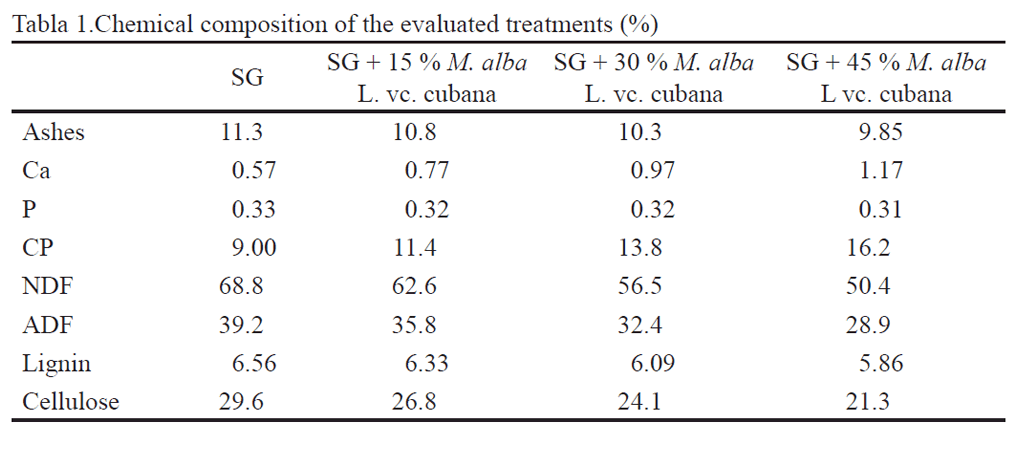
<body><![CDATA[<br>   cubana.</font></p>     <p align="justify"><font size="2" face="Verdana, Arial, Helvetica, sans-serif">In <a href="/img/revistas/cjas/v49n3/t0110315.gif">table 1</a> is showed the chemical composition of the  evaluated treatments.</font></p>     
<p align="justify"><font size="2" face="Verdana, Arial, Helvetica, sans-serif"><em>Experimental procedure</em>. Samples of 0.5 g from each treatment  were weighed and added to the glass bottles of 100 mL. The animals under  fasting were extracted the rumen liquor through the cannula, using a vacuum  pump. The material was kept in a hermetically sealed thermo to guarantee the  temperature (39 &deg;C) and anaerobiosis conditions during the transfer to the  laboratory. </font></p>     <p align="justify"><font size="2" face="Verdana, Arial, Helvetica, sans-serif">The rumen content of both animals was mixed and filtered  through muslin. The resulting solid was added a small portion of buffering  solution of Menke and Steingass(1988) and was stirred for a few seconds in a  domestic blender to loosen the microorganisms adhered to the fiber. Later, the  filtered material from this portion was added to the liquid fraction. The rumen  liquor was kept under CO<sub>2</sub> atmosphere.</font></p>     <p align="justify"><font size="2" face="Verdana, Arial, Helvetica, sans-serif">Each bottle was added, a mixture of 50 mL of rumen  liquor and buffering solution of Menke and Steingass at a ratio of 1:3 (v/v)  and they were sealed with butyl and agrafe taps. Bottles without substrate were  included as blanks to correct the effect of rumen liquor on the volumes of gas  produced. All bottles were randomly put in a controlled bath at 39 &deg;C.</font></p>     <p align="justify"><font size="2" face="Verdana, Arial, Helvetica, sans-serif">The gas was measured by motion of the embolus of a  syringe of 10 mL, after the puncture of the tap. The gas volume and accumulated  methane, the pH and ammonia concentration, were determined at 4, 8, 12, and 24  h of fermentation.</font></p>     <p align="justify"><font size="2" face="Verdana, Arial, Helvetica, sans-serif">The sowing and count of total viable bacteria,  cellulolytics, proteolytics, methanogenics and cellulolytic fungi were made at  0, 4 and 8 h of incubation. The protozoa count was carried out at 0, 4, 8, 12  and 24 h of fermentation.</font></p>     <p align="justify"><font size="2" face="Verdana, Arial, Helvetica, sans-serif"><em>Chemical analysis</em>: The  determination of the chemical composition of the experimental diets was carried  out according to AOAC (2005). The fibrous fractions were analyzed by the  procedure of Goering and van Soest (1970).The ammonia concentration was  determined by the Conway (1957) method and that of methane, by gas  chromatography, using a Philips    PU-4400 chromatographer with capillary column of 25 m, with stationary phase  DB<sup>-1</sup>. The&nbsp;&nbsp; FID detector was used and H<sub>2</sub>  (1 mL. min<sup>-1</sup>) as gas carrier. The temperature of the detector and of  the injector was of    200 &deg;C, and that of the column, was of 60 &deg;C. One milliliter of gas from the  syringe was injected. The calculations of methane concentration were performed  from the equation obtained in the calibration curve:    y= 0.0001x + 2.8515 (R<sup>2</sup> = 0.99).</font></p>     <p align="justify"><font size="2" face="Verdana, Arial, Helvetica, sans-serif"><em>Microbiological analysis</em>:  The Hungate (1970) culture technique in roll tubes and under strict  anaerobiosis conditions was used. The sowing of total viable bacteria,  cellulotytics and proteolytics were made in Caldwell and Bryant (1966) culture  medium, modified by El&iacute;as (1971). In the case of proteolytics bacteria, 10% of  skim milk was added, according to Galindo <em>et al.</em> (1984). To determine  the fungi population, the Joblin (1981) culture mean was used. The methanogenic  microorganisms were cultivated in the culture medium described by Anderson and  Horn (1987), with mixture of hydrogen and carbon dioxide gases (60:40). For  inoculations, three dilutions were used and each of them was replied three times.  The counts of colonies of total viable bacteria, cellulolytics, proteolytics,  methanogenics and fungi, were carried out by means of the roll tubes placement  under a magnifying glass. The colonies that showed digestion halo were counted.  The results were expressed in unit colony formers (ucf) for bacteria and in  unit thallus formers (utf) for fungi.</font></p>     <p align="justify"><font size="2" face="Verdana, Arial, Helvetica, sans-serif">The protozoa were preserved in formol at 10%. Then, they  were directly counted to the optic microscope in a Neubauer camera, after  tinted with a violet gentian solution at 0.01 % in glacial acid.</font></p>     ]]></body>
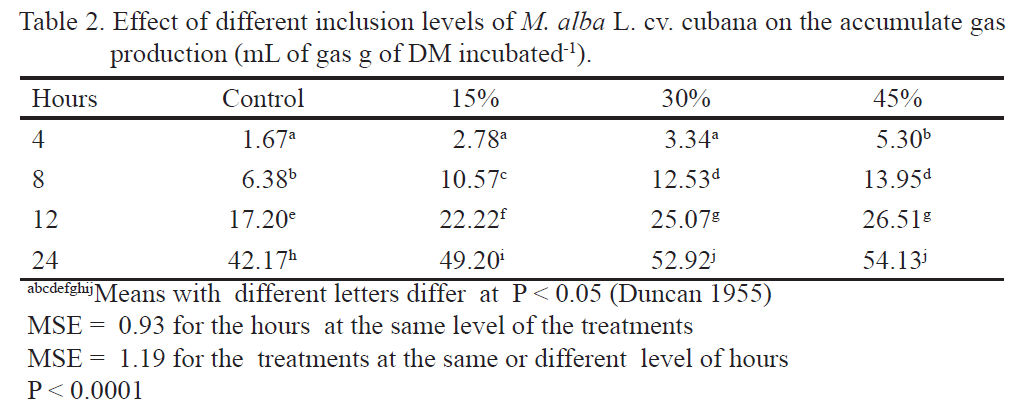
<body><![CDATA[<p align="justify"><font size="2" face="Verdana, Arial, Helvetica, sans-serif"><em>Experimental design and statistical analysis: </em>A completely randomized design with factorial arrangement was used.  The treatments and fermentation hours were the factors. Four repetitions were  made in time.</font></p>     <p align="justify"><font size="2" face="Verdana, Arial, Helvetica, sans-serif">For the results processing, a multivariate variance  analysis was used. In case of find interaction between treatments and sampling  hours, a split plot model was applied. The main plots were the treatments and  the subplot, sampling hours. In case of not find interaction, a lineal model  for the effects of treatments and sampling hours was used. Duncan test for P  &lt; 0.05 was applied when necessary (Duncan 1955). The statistical software  INFOSTAT was used proposed by Di Rienzo <em>et al.</em> (2012).</font></p>     <p align="justify">&nbsp;</p>     <p align="justify"><strong><font size="3" face="Verdana, Arial, Helvetica, sans-serif">RESULTS AND DISCUSSION</font></strong></p>     <p align="justify"><font size="2" face="Verdana, Arial, Helvetica, sans-serif">The systems of <em>in vitro</em> incubation have been used during decades to evaluate foods for ruminants  (Stalker <em>et al.</em> 2013 and Muetzel <em>et al.</em> 2014).The <em>in vitro</em> gas production is one of the methods used with this purpose. This method allows  evaluating the digestibility of the forages organic matter and can offer  information of the degradation speed of foods (Fabio <em>et al.</em> 2008). </font></p>     <p align="justify"><font size="2" face="Verdana, Arial, Helvetica, sans-serif"><a href="/img/revistas/cjas/v49n3/t0210315.gif">Table 2</a> shows the obtained results in gas production  during this study. It can verify that, as the hours passes, the gas volumes for  all treatments are increased. From eight hours up to 24 h of incubation, all  treatments in which <em>M. alba</em> L. cv. cubana is included showed gas  productions higher than the control treatment. The 30 and 45 % of inclusion of  this mulberry variety produced similar gas quantities. </font></p>     
<p align="justify"><font size="2" face="Verdana, Arial, Helvetica, sans-serif">The mulberry is  characterized for its high contents of easy fermentation carbohydrates, so it  is expected that their participation in animals ration increases the  digestibility in the rumen. This results in higher gases production. If the NDF  values of the treatments under study (<a href="/img/revistas/cjas/v49n3/t0110315.gif">table 1</a>) are observed, it can be notice  that, when <em>Morus alba</em> L. cv. cubana is included, this indicator  decrease. So, there is higher quantity of cellular content and therefore,  higher ruminal degradation occurs. </font></p>     
<p align="justify"><font size="2" face="Verdana, Arial, Helvetica, sans-serif">The ruminal methane production was higher when 15 and 45  % <em>M. alba</em> L. cv. cubana was included, although the different inclusion  levels of this variety did not show differences between them for this indicator  (<a href="/img/revistas/cjas/v49n3/f0110315.gif">figure 1</a>). The inclusion of 30% of cubana variety produced a methane volume  that did not differ of the control, results that were similar to those obtained  by Gonz&aacute;lez <em>et al.</em> (2010).&nbsp; </font></p>     
<p align="justify"><font size="2" face="Verdana, Arial, Helvetica, sans-serif">The structural  carbohydrates, as the cellulose and the hemicellulose, are fermented to a lower  speed than those not structurals and produce more methane per digested  substrate unit (Molano <em>et al.</em> 2008).This was previously showed by  Galindo <em>et al.</em> (2003),whose explained that higher ruminal cellulolisis  of the food can also increase the production of this gas. If it is taken into  account that cubana variety inclusion increases the methane production for all  levels, except for 30%, it could think that the inclusion of this plant in the  diet favors the degradation process of the rumen cellulose.&nbsp;&nbsp; </font></p>     <p align="justify"><font size="2" face="Verdana, Arial, Helvetica, sans-serif">The inclusion of 15, 30 and 45 % of <em>M. alba</em> L.  cv. cubana did not produce effects on populations of cellulolitic, proteolitic,  methanogenesis and total viable bacteria, fungi and protozoa (<a href="/img/revistas/cjas/v49n3/t0310315.gif">table 3</a>). These  results are explained, if there are kept in mind the interrelations that are  stated between the microorganisms populations in the rumen. Cheng <em>et al.</em> (2009) explained that the rumen microorganisms degrade the plants fibers and  produce a variety of final products, in those that are included the acetate,  format, lactate, ethanol, H<sub>2</sub> and CO<sub>2</sub>, some of those that  are used by the methanogens to produce methane. </font></p>     
]]></body>
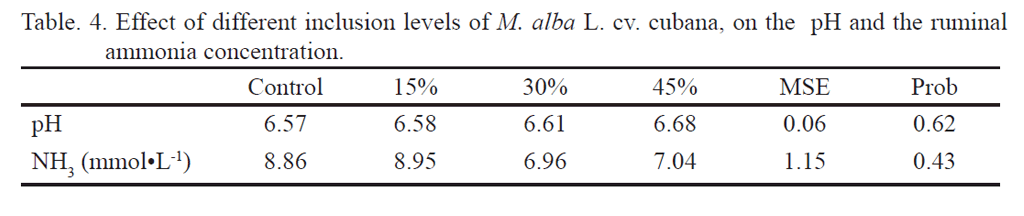
<body><![CDATA[<p align="justify"><font size="2" face="Verdana, Arial, Helvetica, sans-serif">So it could be expected that if some of the populations  is affected, it would also be reflected in the methanogens `population. The  protozoa counts, when not experiencing affectations with the mulberry  inclusion, could explain that the methanogens numbers did not neither have  variation, since the protozoa provides of a habitat for the methanogens (Hung <em>et  al.</em> 2013).</font></p>     <p align="justify"><font size="2" face="Verdana, Arial, Helvetica, sans-serif">The methane is produced by  the methanogenics Archaea during the food use in the rumen (Chong <em>et al.</em> 2014 and Chuntrakort <em>et al.</em> 2014) but, according to Machm&uuml;ller <em>et al.</em> (2003), the methanogenesis cannot always correlate with the methanogens numbers  in the rumen. An experiment carried out by Kamra <em>et al.</em> (2006) show that  while the methanogenesis is completely inhibited when there is presence of  sulfonic bromoethane acid (SBE), methanogens number, quantified by means of PCR  in real time, was not completely eliminated. If it considered the opinion that  the methane production in the rumen is not necessarily correlated with the  methanogens number, then it is logical that the increase in methane production,  when 15 and 45 % of <em>M. alba</em> L. cv. cubana is included, was not reflected  in increase in the methanogens counts for these treatments. The analysis of  this result allows sharing the criteria exposed by Liu <em>et al.</em> (2013)  regarding that the relation between methanogens and methane production is an  aspect that needs further researches.</font></p>     <p align="justify"><font size="2" face="Verdana, Arial, Helvetica, sans-serif">In <a href="/img/revistas/cjas/v49n3/t0410315.gif">table 4</a> is show that the inclusion of different <em>M.  alba</em> L. cv. cubana levels did not produce effects on the pH and the ammonia  concentration in the rumen.</font></p>     
<p align="justify"><font size="2" face="Verdana, Arial, Helvetica, sans-serif">It is known that if the pH in the rumen decrease,  negative effect on the fiber degradation and foods intake is produce and as  consequence, an acidosis occurs (Wallace <em>et al.</em> 2006).With the <em>M.  alba</em> L. cv. cubana inclusion in the ration, the pH was near to the  neutrality, favoring that the fiber degradation in the ruminal liquor was not  affected. This could explain the higher methane productions obtained for 15 and  45% of the cubana variety inclusion regarding the control. </font></p>     <p align="justify"><font size="2" face="Verdana, Arial, Helvetica, sans-serif">The higher levels of  degradable protein in the rumen caused increase in the ruminal amamonia  production (Dhali <em>et al.</em> 2006 and Saro <em>et al.</em> 2014).All seems  that the mulberry has high composition of non degradable protein in the rumen,  and this was reflected in the ammonia concentrations obtained when including  15, 30 and 45 % of the cubana variety. Liu <em>et al.</em> (2001) and Singh and  Makkar (2002) informed moderate values of non protein nitrogen and effective  degradability of crude protein of the mulberry leaves of 54.9 % and 57  %,respectively. These authors explained that this plant can be a satisfactory  food for the synthesis of microbial protein in the rumen and therefore, favors  higher microbial protein supply to the intestine. Yao <em>et al.</em> (2000) and  Liu <em>et al.</em> (2001) explained that the mulberry can be use as protein  supplement for the ruminants. The use of experimental diets in ruminants showed  that the mulberry nutritive value is as high as that of some high quality foods  already well-known. </font></p>     <p align="justify"><font size="2" face="Verdana, Arial, Helvetica, sans-serif">The 15, 30 and 45 % of <em>Morus alba</em> cv. cubana  inclusion have no effect on the rumen microbial populations, the pH and the  ammonia concentration, but increase the ruminal methane production, when  including the 15 and 45 % in the diet.</font></p>     <p align="justify">&nbsp;</p>     <p align="justify"><strong><font size="3" face="Verdana, Arial, Helvetica, sans-serif">ACKNOWLEDGEMENTS </font></strong></p>     <p align="justify"><font size="2" face="Verdana, Arial, Helvetica, sans-serif">The authors appreciate the CAPES, Brazil financing, for  the research development.</font></p>     <p align="justify">&nbsp;</p>     ]]></body>
<body><![CDATA[<p align="justify"><font size="3" face="Verdana, Arial, Helvetica, sans-serif"><strong>REFERENCES</strong></font></p>     <p align="justify"><font size="2" face="Verdana, Arial, Helvetica, sans-serif">Anderson, M. A. &amp; Horn, G.  M. 1987. &lsquo;&lsquo;Effect of Lasalocic in wheight gain, ruminal fermentation and forage  intake of stocker cattle grasing wintwer pasture&rsquo;&rsquo;. <em>J. Animal Sci.</em>, 65:  865.</font></p>     <!-- ref --><p align="justify"><font size="2" face="Verdana, Arial, Helvetica, sans-serif">AOAC 2005. <em>Official Methods  of Analysis</em>. 18th ed., Gaithersburg, M.D., USA: AOAC International.    </font></p>     <p align="justify"><font size="2" face="Verdana, Arial, Helvetica, sans-serif">Caldwell, D. R. &amp; Bryant,  M. P. 1966. &lsquo;&lsquo;Medium without fluid for non selective enumeration and isolation  of rumen bacteria&rsquo;&rsquo;. <em>Appl. Microbrobiolgy</em>, 14: 794.</font></p>     <p align="justify"><font size="2" face="Verdana, Arial, Helvetica, sans-serif">Cheng, Y. F., Edwards, J. E.,  Allison, G. G., Zhu, W. Y. &amp; Theodorou, M. K. 2009. &lsquo;&lsquo;Diversity and  activity of enriched ruminal cultures of anaerobic fungi and methanogens grown  together on lignocellulose in consecutive batch culture&rsquo;&rsquo;. <em>Bioresource  Technol.</em>, 100: 4821.</font></p>     <p align="justify"><font size="2" face="Verdana, Arial, Helvetica, sans-serif">Chong, L., Zhuping, Z.,  Tongjun, G., Yongming, L. &amp; Hongmin, D. 2014. &lsquo;&lsquo;Changes in methane  emission, rumen fermentation, and methanogenic community in response to silage  and dry cornstalk diets&rsquo;&rsquo;. <em>J. Basic Microbiol.</em>, 54: 521.</font></p>     <p align="justify"><font size="2" face="Verdana, Arial, Helvetica, sans-serif">Chuntrakort, P., Otsuka, M.,  Hayashi, K., Takenaka, A., Udchachon, S. &amp; Sommart, K. 2014. &lsquo;&lsquo;The effect  of dietary coconut kernels whole cotton seeds and sunflower seeds on the intake  digestibility and enteric methane emission of Zebu beef cattle fed rice straw  based diets&rsquo;&rsquo;. <em>Livestock Sci.</em>, 161: 80.</font></p>     <!-- ref --><p align="justify"><font size="2" face="Verdana, Arial, Helvetica, sans-serif">Conway, E. C. 1957. <em>Microdiffusion  analysis and volumetric error</em>. 4th ed., London: Crosby Lackwood, Sons, Ltd.    </font></p>     ]]></body>
<body><![CDATA[<p align="justify"><font size="2" face="Verdana, Arial, Helvetica, sans-serif">Delgado, D. C., Gonzalez, R.,  Galindo, J., Cairo, J. &amp; Almeida, M. 2007. &lsquo;&lsquo;Potential of <em>Trichantera  gigantea</em> and <em>Morus alba</em> to reduce <em>in vitro</em> rumen methane  production&rsquo;&rsquo;. <em>Cuban Journal of Agricultural Science</em>, 41: 319.</font></p>     <p align="justify"><font size="2" face="Verdana, Arial, Helvetica, sans-serif">Dhali, A., Mishra, D. P.,  Mehla, R. K. &amp; Sirohi, S. K. 2006. &lsquo;&lsquo;Usefulness of milk urea concentration  to monitor the herd reproductive performance in crossbred Karan- fries cows&rsquo;&rsquo;. <em>Asian-Australasian J. Animal Sci.</em>, 19: 26.</font></p>     <!-- ref --><p align="justify"><font size="2" face="Verdana, Arial, Helvetica, sans-serif">Di Rienzo, J. A., Casanoves, F., Balzarini, M. G.,  Gonz&aacute;lez, L., Tablada, M. &amp; Robledo, C. W. 2012. <em>InfoStat</em>. version  2012, (Windows), Universidad Nacional de C&oacute;rdoba, Argentina: Grupo InfoStat,  Available: &lt;<a href="http://www.infostat.com.ar/" target="_blank">http://www.infostat.com.ar/</a>&gt;    .</font></p>     <!-- ref --><p align="justify"><font size="2" face="Verdana, Arial, Helvetica, sans-serif">Duke, J. A. 2001. <em>Morus  alba (L.)</em>. , Available: &lt;<a href="http://newcrop.hort.purdue. edu/newcrop/dukeenergy" target="_blank">http://newcrop.hort.purdue.  edu/newcrop/dukeenergy</a>&gt;, [Consulted:&nbsp;December 1, 2001].    </font></p>     <p align="justify"><font size="2" face="Verdana, Arial, Helvetica, sans-serif">Duncan, D. B. 1955. &lsquo;&lsquo;Multiple  range and multiple F test&rsquo;&rsquo;. <em>Biometrics</em>, 11: 1.</font></p>     <!-- ref --><p align="justify"><font size="2" face="Verdana, Arial, Helvetica, sans-serif">El&iacute;as, A. 1971. <em>The rumen  bacteria of animals fed on a high molasses-urea diet</em>. Ph.D. Thesis, Aberdeen.    </font></p>     <p align="justify"><font size="2" face="Verdana, Arial, Helvetica, sans-serif">Fabio, Z., Calabr&oacute;, S., Piccolo, V., Durso, S.,  Tudisco, R., Bovera, F., Cutrignelli, M. I. &amp; Infascelli, F. 2008. &lsquo;&lsquo;Diets with different forage/concentrate ratios for the Mediterranean  Italia Buffalo: <em>In vivo</em> Digestibility&rsquo;&rsquo;. <em>Asian- Australasian J. Animal Sci.</em>, 21: 75.</font></p>     ]]></body>
<body><![CDATA[<p align="justify"><font size="2" face="Verdana, Arial, Helvetica, sans-serif">Galindo, J., El&iacute;as, A. &amp; Cordero, J. 1984. &lsquo;&lsquo;The addition of zeolite to silages diets. II. The effect of zeolite on  rumen microbial population of cows consuming silage&rsquo;&rsquo;. <em>Cuban Journal of  Agricultural Science</em>, 18: 51.</font></p>     <p align="justify"><font size="2" face="Verdana, Arial, Helvetica, sans-serif">Galindo, J., El&iacute;as, A., P&eacute;rez,  M. C., Palenzuela, T. &amp; Aldana, A. I. 2003. &lsquo;&lsquo;Effect of monensin on the in  vitro methane production in three ruminal ecological systems&rsquo;&rsquo;. <em>Cuban  Journal of Agricultural Science</em>, 37: 181.</font></p>     <!-- ref --><p align="justify"><font size="2" face="Verdana, Arial, Helvetica, sans-serif">Goering, H. K. &amp; van  Soest, P. J. 1970. <em>Forage Fiber  Analysis</em>. (ser.  Agricultural Hardbook, no. ser. 379), Washington, USA: Departament of  Agricultura.    </font></p>     <p align="justify"><font size="2" face="Verdana, Arial, Helvetica, sans-serif">Gonz&aacute;lez, N., Galindo, J., Aldana, A. I., Moreira, O.,  Sarduy, L. R., Abdalla, L. A. &amp; Santos, M. R. 2010. &lsquo;&lsquo;Evaluation of different varieties of mulberry Morus alba) in the control  of the methanogenesis in buffalo rumen liquid&rsquo;&rsquo;. <em>Cuban Journal of  Agricultural Science</em>, 44: 37.</font></p>     <!-- ref --><p align="justify"><font size="2" face="Verdana, Arial, Helvetica, sans-serif">Hungate, P. E. 1970. <em>A roll  tube method for cultivation in microbiology</em>. Morris J. B. &amp; Ribbons D.  B. (eds.), New York: Academic Press, Inc., 117 p.    </font></p>     <p align="justify"><font size="2" face="Verdana, Arial, Helvetica, sans-serif">Hung, L. V., Wanapat, M. &amp;  Cherdthong, A. 2013. &lsquo;&lsquo;Effects of Leucaena leaf pellet on bacterial diversity  and microbial protein synthesis in swamp buffalo fed on rice straw&rsquo;&rsquo;. <em>Livestock  Sci.</em>, 151: 188.</font></p>     <p align="justify"><font size="2" face="Verdana, Arial, Helvetica, sans-serif">Joblin, K. N. 1981.  &lsquo;&lsquo;Isolation, enumeration and maintenance of rumen anaerobic fungi in roll  tubes&rsquo;&rsquo;. <em>Applied and Environment Microbiology</em>, 42: 1119.</font></p>     <p align="justify"><font size="2" face="Verdana, Arial, Helvetica, sans-serif">Kamra, D. N., Agarwal, N.  &amp; Chaudhary, L. C. 2006. &lsquo;&lsquo;Inhibition of ruminal methanogenesis by tropical  plants containing secondary compounds&rsquo;&rsquo;. In: <em>International Congress Series  1293</em>, pp. 156&ndash;163.</font></p>     ]]></body>
<body><![CDATA[<p align="justify"><font size="2" face="Verdana, Arial, Helvetica, sans-serif">Kandylis, K., Hadjigeorgiou  &amp; Harizanis, P. 2009. &lsquo;&lsquo;The nutritive value of mulberry leaves (<em>Morus  alba</em>) as a feed supplemented for sheep&rsquo;&rsquo;. <em>Trop. Anim. Health Prod.</em>,  41: 17.</font></p>     <p align="justify"><font size="2" face="Verdana, Arial, Helvetica, sans-serif">Liu, C., Zhu, Z. P., Shang,  B., Chen, Y. X., Guo, T. J. &amp; Luo, Y. M. 2013. &lsquo;&lsquo;Long-term effects of  ensiled cornstalk diet on methane emission, rumen fermentation, methanogenesis  and weight gain in sheep&rsquo;&rsquo;. <em>Small Ruminant Res.</em>, 115: 15.</font></p>     <p align="justify"><font size="2" face="Verdana, Arial, Helvetica, sans-serif">Liu, J. X., Yao, J., Yan, B.,  Yu, J. Q. &amp; Shi, Z. Q. 2001. &lsquo;&lsquo;Effects of mulberry leaves to replace  rapeseed meal on performance of sheep feeding on ammoniated rice straw diet&rsquo;&rsquo;. <em>Small  Ruminant Res.</em>, 39: 131.</font></p>     <p align="justify"><font size="2" face="Verdana, Arial, Helvetica, sans-serif">Machm&uuml;ller, A., Soliva, C. R.  &amp; Kreuzer, M. 2003. &lsquo;&lsquo;Methane-suppressing effect of myristic acid in sheep  as affected by dietary calcium and forage proportion&rsquo;&rsquo;. <em>The British J. Nutrition</em>,  90: 529.</font></p>     <p align="justify"><font size="2" face="Verdana, Arial, Helvetica, sans-serif">Menke, K. H. &amp; Steingass,  H. 1988. &lsquo;&lsquo;Estimation of the energetic feed value obtained from chemical  analysis and <em>in vitro</em> gas production using rumen fluid&rsquo;&rsquo;. <em>Animal Res.  Devel.</em>, 28: 1.</font></p>     <p align="justify"><font size="2" face="Verdana, Arial, Helvetica, sans-serif">Molano, G., Knight, T. W.  &amp; Clark, H. 2008. &lsquo;&lsquo;Fumaric acid supplements have no effect on methane  emissions per unit of feef intake in wether lambs&rsquo;&rsquo;. <em>Australian J.  Experimental Agric.</em>, 48: 165.</font></p>     <p align="justify"><font size="2" face="Verdana, Arial, Helvetica, sans-serif">Muetzel, S., Hunt, C. &amp;  Tavendale, M. H. 2014. &lsquo;&lsquo;A fully automated incubation system for the  measurement of gas production and gas composition&rsquo;&rsquo;. <em>Animal Feed Sci. and  Technol.</em>, 196: 1.</font></p>     <p align="justify"><font size="2" face="Verdana, Arial, Helvetica, sans-serif">Rodr&iacute;guez, R., Garc&iacute;a, C. C.,  Oramas, A., Hern&aacute;ndez, Y. &amp; Dom&iacute;nguez, M. 2008. &lsquo;&lsquo;Use of polyethylene  glycol and zeolita to improve the nutritive value of Albizia lebbekoides in <em>in  vitro</em> conditions&rsquo;&rsquo;. <em>Cuban Journal of Agricultural Science</em>, 42: 263.</font></p>     <p align="justify"><font size="2" face="Verdana, Arial, Helvetica, sans-serif">Saro, C., Ranilla, M. J.,  Tejido, M. L. &amp; Carro, M. D. 2014. &lsquo;&lsquo;Influence of forage type in the diet  of sheep on rumen microbiota and fermentation characteristics&rsquo;&rsquo;. <em>Livestock Sci.</em>, 160: 52.</font></p>     <p align="justify"><font size="2" face="Verdana, Arial, Helvetica, sans-serif">Singh, B. &amp; Makkar, H. P.  S. 2002. &lsquo;&lsquo;The potential of mulberry foliage as a feed supplement in India&rsquo;&rsquo;.  In: Sanchez (ed.), <em>Mulberry for animal production</em>, (ser. FAO Animal  Production and Health paper, no. ser. 147), Roma, Italia: FAO.</font></p>     ]]></body>
<body><![CDATA[<p align="justify"><font size="2" face="Verdana, Arial, Helvetica, sans-serif">Stalker, L. A., Lorenz, B. G.,  Ahern, N. A. &amp; Klopfensteir, T. J. 2013. &lsquo;&lsquo;Inclusion of forage standards  with known <em>in vivo</em> digestibility in <em>in vitro</em> procedures&rsquo;&rsquo;. <em>Livestock  Sci.</em>, 151: 198.</font></p>     <p align="justify"><font size="2" face="Verdana, Arial, Helvetica, sans-serif">Theodorou, M. K., Williams, B.  A., Dhanoa, M. S., Mc Allan, A. B. &amp; France, J. 1994. &lsquo;&lsquo;A simple gas  production method using a pressure transducer to determine the fermentation  kinetics of ruminants feed&rsquo;&rsquo;. <em>Animal Feed Sci. Technol.</em>, 48: 185.</font></p>     <p align="justify"><font size="2" face="Verdana, Arial, Helvetica, sans-serif">Wallace, R. J., Wood, T. A.,  Rowe, A., Price, J., Yanez, D. R., Williams, S. P. &amp; Newbold, C. J. 2006.  &lsquo;&lsquo;Encapsulated fumaric acid as a means of decreasing ruminal methane  emissions&rsquo;&rsquo;. In: <em>International Congress Series 1293</em>, pp. 148&ndash;151.</font></p>     <p align="justify"><font size="2" face="Verdana, Arial, Helvetica, sans-serif">  Yao, J., Yan, B., Wang, X. Q. &amp; Liu, J. X.  2000. &lsquo;&lsquo;Nutritional evaluation of mulberry leaves as feeds for ruminants&rsquo;&rsquo;. <em>Livestock Res. Rural Devel</em>, 12: 9.</font></p>     <p align="justify">&nbsp;</p>     <p align="justify">&nbsp;</p>     <p align="justify"><font size="2" face="Verdana, Arial, Helvetica, sans-serif">Received: June 1, 2015    <br> Accepted: July 1, 2015</font></p>     <p align="justify">&nbsp;</p>     <p align="justify">&nbsp;</p>     ]]></body>
<body><![CDATA[<p align="justify"><font size="2" face="Verdana, Arial, Helvetica, sans-serif"><i>Niurka González,</i> Instituto de Ciencia Animal, Apartado Postal 24, San José de las Lajas, Mayabeque, Cuba.    Email: <a href="mailto:ngonzalez@ica.co.cu">ngonzalez@ica.co.cu</a></font></p>      ]]></body><back>
<ref-list>
<ref id="B1">
<nlm-citation citation-type="journal">
<person-group person-group-type="author">
<name>
<surname><![CDATA[Anderson]]></surname>
<given-names><![CDATA[M. A.]]></given-names>
</name>
<name>
<surname><![CDATA[Horn]]></surname>
<given-names><![CDATA[G. M.]]></given-names>
</name>
</person-group>
<article-title xml:lang="nd"><![CDATA[Effect of Lasalocic in wheight gain, ruminal fermentation and forage intake of stocker cattle grasing wintwer pasture]]></article-title>
<source><![CDATA[J. Animal Sci.]]></source>
<year>1987</year>
<volume>65</volume>
<page-range>865</page-range></nlm-citation>
</ref>
<ref id="B2">
<nlm-citation citation-type="book">
<person-group person-group-type="author">
<name>
<surname><![CDATA[AOAC]]></surname>
</name>
</person-group>
<source><![CDATA[Official Methods of Analysis]]></source>
<year>2005</year>
<edition>18th</edition>
<publisher-loc><![CDATA[Gaithersburg, M.D., USA ]]></publisher-loc>
<publisher-name><![CDATA[AOAC International]]></publisher-name>
</nlm-citation>
</ref>
<ref id="B3">
<nlm-citation citation-type="journal">
<person-group person-group-type="author">
<name>
<surname><![CDATA[Caldwell]]></surname>
<given-names><![CDATA[D. R.]]></given-names>
</name>
<name>
<surname><![CDATA[Bryant]]></surname>
<given-names><![CDATA[M. P.]]></given-names>
</name>
</person-group>
<article-title xml:lang="nd"><![CDATA[Medium without fluid for non selective enumeration and isolation of rumen bacteria]]></article-title>
<source><![CDATA[Appl. Microbrobiolgy]]></source>
<year>1966</year>
<volume>14</volume>
<page-range>794</page-range></nlm-citation>
</ref>
<ref id="B4">
<nlm-citation citation-type="journal">
<person-group person-group-type="author">
<name>
<surname><![CDATA[Cheng]]></surname>
<given-names><![CDATA[Y. F.]]></given-names>
</name>
<name>
<surname><![CDATA[Edwards]]></surname>
<given-names><![CDATA[J. E.]]></given-names>
</name>
<name>
<surname><![CDATA[Allison]]></surname>
<given-names><![CDATA[G. G.]]></given-names>
</name>
<name>
<surname><![CDATA[Zhu]]></surname>
<given-names><![CDATA[W. Y.]]></given-names>
</name>
<name>
<surname><![CDATA[Theodorou]]></surname>
<given-names><![CDATA[M. K.]]></given-names>
</name>
</person-group>
<article-title xml:lang="nd"><![CDATA[Diversity and activity of enriched ruminal cultures of anaerobic fungi and methanogens grown together on lignocellulose in consecutive batch culture]]></article-title>
<source><![CDATA[Bioresource Technol.]]></source>
<year>2009</year>
<volume>100</volume>
<page-range>4821</page-range></nlm-citation>
</ref>
<ref id="B5">
<nlm-citation citation-type="journal">
<person-group person-group-type="author">
<name>
<surname><![CDATA[Chong]]></surname>
<given-names><![CDATA[L.]]></given-names>
</name>
<name>
<surname><![CDATA[Zhuping]]></surname>
<given-names><![CDATA[Z.]]></given-names>
</name>
<name>
<surname><![CDATA[Tongjun]]></surname>
<given-names><![CDATA[G.]]></given-names>
</name>
<name>
<surname><![CDATA[Yongming]]></surname>
<given-names><![CDATA[L.]]></given-names>
</name>
<name>
<surname><![CDATA[Hongmin]]></surname>
<given-names><![CDATA[D.]]></given-names>
</name>
</person-group>
<article-title xml:lang="nd"><![CDATA[Changes in methane emission, rumen fermentation, and methanogenic community in response to silage and dry cornstalk diets]]></article-title>
<source><![CDATA[J. Basic Microbiol.]]></source>
<year>2014</year>
<volume>54</volume>
<page-range>521</page-range></nlm-citation>
</ref>
<ref id="B6">
<nlm-citation citation-type="journal">
<person-group person-group-type="author">
<name>
<surname><![CDATA[Chuntrakort]]></surname>
<given-names><![CDATA[P.]]></given-names>
</name>
<name>
<surname><![CDATA[Otsuka]]></surname>
<given-names><![CDATA[M.]]></given-names>
</name>
<name>
<surname><![CDATA[Hayashi]]></surname>
<given-names><![CDATA[K.]]></given-names>
</name>
<name>
<surname><![CDATA[Takenaka]]></surname>
<given-names><![CDATA[A.]]></given-names>
</name>
<name>
<surname><![CDATA[Udchachon]]></surname>
<given-names><![CDATA[S.]]></given-names>
</name>
<name>
<surname><![CDATA[Sommart]]></surname>
<given-names><![CDATA[K.]]></given-names>
</name>
</person-group>
<article-title xml:lang="nd"><![CDATA[The effect of dietary coconut kernels whole cotton seeds and sunflower seeds on the intake digestibility and enteric methane emission of Zebu beef cattle fed rice straw based diets]]></article-title>
<source><![CDATA[Livestock Sci.]]></source>
<year>2014</year>
<volume>161</volume>
<page-range>80</page-range></nlm-citation>
</ref>
<ref id="B7">
<nlm-citation citation-type="book">
<person-group person-group-type="author">
<name>
<surname><![CDATA[Conway,]]></surname>
<given-names><![CDATA[E. C.]]></given-names>
</name>
</person-group>
<source><![CDATA[Microdiffusion analysis and volumetric error]]></source>
<year>1957</year>
<edition>4th</edition>
<publisher-loc><![CDATA[London ]]></publisher-loc>
<publisher-name><![CDATA[Crosby Lackwood, Sons, Ltd]]></publisher-name>
</nlm-citation>
</ref>
<ref id="B8">
<nlm-citation citation-type="journal">
<person-group person-group-type="author">
<name>
<surname><![CDATA[Delgado]]></surname>
<given-names><![CDATA[D. C.]]></given-names>
</name>
<name>
<surname><![CDATA[Gonzalez]]></surname>
<given-names><![CDATA[R.]]></given-names>
</name>
<name>
<surname><![CDATA[Galindo]]></surname>
<given-names><![CDATA[J.]]></given-names>
</name>
<name>
<surname><![CDATA[Cairo]]></surname>
<given-names><![CDATA[J.]]></given-names>
</name>
<name>
<surname><![CDATA[Almeida]]></surname>
<given-names><![CDATA[M.]]></given-names>
</name>
</person-group>
<article-title xml:lang="nd"><![CDATA[Potential of Trichantera gigantea and Morus alba to reduce in vitro rumen methane production]]></article-title>
<source><![CDATA[Cuban Journal of Agricultural Science]]></source>
<year>2007</year>
<volume>41</volume>
<page-range>319</page-range></nlm-citation>
</ref>
<ref id="B9">
<nlm-citation citation-type="journal">
<person-group person-group-type="author">
<name>
<surname><![CDATA[Dhali]]></surname>
<given-names><![CDATA[A.]]></given-names>
</name>
<name>
<surname><![CDATA[Mishra]]></surname>
<given-names><![CDATA[D. P.]]></given-names>
</name>
<name>
<surname><![CDATA[Mehla]]></surname>
<given-names><![CDATA[R. K.]]></given-names>
</name>
<name>
<surname><![CDATA[Sirohi]]></surname>
<given-names><![CDATA[S. K.]]></given-names>
</name>
</person-group>
<article-title xml:lang="nd"><![CDATA[Usefulness of milk urea concentration to monitor the herd reproductive performance in crossbred Karan- fries cows]]></article-title>
<source><![CDATA[Asian-Australasian J. Animal Sci.]]></source>
<year>2006</year>
<volume>19</volume>
<page-range>26</page-range></nlm-citation>
</ref>
<ref id="B10">
<nlm-citation citation-type="book">
<person-group person-group-type="author">
<name>
<surname><![CDATA[Di Rienzo]]></surname>
<given-names><![CDATA[J. A.]]></given-names>
</name>
<name>
<surname><![CDATA[Casanoves]]></surname>
<given-names><![CDATA[F.]]></given-names>
</name>
<name>
<surname><![CDATA[Balzarini]]></surname>
<given-names><![CDATA[M. G.]]></given-names>
</name>
<name>
<surname><![CDATA[González]]></surname>
<given-names><![CDATA[L.]]></given-names>
</name>
<name>
<surname><![CDATA[Tablada]]></surname>
<given-names><![CDATA[M.]]></given-names>
</name>
<name>
<surname><![CDATA[Robledo]]></surname>
<given-names><![CDATA[C. W.]]></given-names>
</name>
</person-group>
<source><![CDATA[InfoStat]]></source>
<year>2012</year>
<publisher-loc><![CDATA[Universidad Nacional de Córdoba, Argentina ]]></publisher-loc>
<publisher-name><![CDATA[Grupo InfoStat]]></publisher-name>
</nlm-citation>
</ref>
<ref id="B11">
<nlm-citation citation-type="">
<person-group person-group-type="author">
<name>
<surname><![CDATA[Duke]]></surname>
<given-names><![CDATA[J. A.]]></given-names>
</name>
</person-group>
<source><![CDATA[Morus alba (L.)]]></source>
<year>2001</year>
</nlm-citation>
</ref>
<ref id="B12">
<nlm-citation citation-type="journal">
<person-group person-group-type="author">
<name>
<surname><![CDATA[Duncan]]></surname>
<given-names><![CDATA[D. B.]]></given-names>
</name>
</person-group>
<article-title xml:lang="nd"><![CDATA[Multiple range and multiple F test]]></article-title>
<source><![CDATA[Biometrics]]></source>
<year>1955</year>
<volume>11</volume>
<page-range>1</page-range></nlm-citation>
</ref>
<ref id="B13">
<nlm-citation citation-type="">
<person-group person-group-type="author">
<name>
<surname><![CDATA[Elías]]></surname>
<given-names><![CDATA[A.]]></given-names>
</name>
</person-group>
<source><![CDATA[The rumen bacteria of animals fed on a high molasses-urea diet]]></source>
<year>1971</year>
<publisher-loc><![CDATA[Aberdeen ]]></publisher-loc>
</nlm-citation>
</ref>
<ref id="B14">
<nlm-citation citation-type="journal">
<person-group person-group-type="author">
<name>
<surname><![CDATA[Fabio]]></surname>
<given-names><![CDATA[Z.]]></given-names>
</name>
<name>
<surname><![CDATA[Calabró]]></surname>
<given-names><![CDATA[S.]]></given-names>
</name>
<name>
<surname><![CDATA[Piccolo]]></surname>
<given-names><![CDATA[V.]]></given-names>
</name>
<name>
<surname><![CDATA[Durso]]></surname>
<given-names><![CDATA[S.]]></given-names>
</name>
<name>
<surname><![CDATA[Tudisco]]></surname>
<given-names><![CDATA[R.]]></given-names>
</name>
<name>
<surname><![CDATA[Bovera]]></surname>
<given-names><![CDATA[F.]]></given-names>
</name>
<name>
<surname><![CDATA[Cutrignelli]]></surname>
<given-names><![CDATA[M. I.]]></given-names>
</name>
<name>
<surname><![CDATA[Infascelli]]></surname>
<given-names><![CDATA[F.]]></given-names>
</name>
</person-group>
<article-title xml:lang="nd"><![CDATA[Diets with different forage/concentrate ratios for the Mediterranean Italia Buffalo: In vivo Digestibility]]></article-title>
<source><![CDATA[Asian- Australasian J. Animal Sci.]]></source>
<year>2008</year>
<volume>21</volume>
<page-range>75</page-range></nlm-citation>
</ref>
<ref id="B15">
<nlm-citation citation-type="journal">
<person-group person-group-type="author">
<name>
<surname><![CDATA[Galindo]]></surname>
<given-names><![CDATA[J.]]></given-names>
</name>
<name>
<surname><![CDATA[Elías]]></surname>
<given-names><![CDATA[A.]]></given-names>
</name>
<name>
<surname><![CDATA[Cordero]]></surname>
<given-names><![CDATA[J.]]></given-names>
</name>
</person-group>
<article-title xml:lang="nd"><![CDATA[The addition of zeolite to silages diets. II. The effect of zeolite on rumen microbial population of cows consuming silage]]></article-title>
<source><![CDATA[Cuban Journal of Agricultural Science]]></source>
<year>1984</year>
<volume>18</volume>
<page-range>51</page-range></nlm-citation>
</ref>
<ref id="B16">
<nlm-citation citation-type="journal">
<person-group person-group-type="author">
<name>
<surname><![CDATA[Galindo]]></surname>
<given-names><![CDATA[J.]]></given-names>
</name>
<name>
<surname><![CDATA[Elías]]></surname>
<given-names><![CDATA[A.]]></given-names>
</name>
<name>
<surname><![CDATA[Pérez]]></surname>
<given-names><![CDATA[M. C.]]></given-names>
</name>
<name>
<surname><![CDATA[Palenzuela]]></surname>
<given-names><![CDATA[T.]]></given-names>
</name>
<name>
<surname><![CDATA[Aldana]]></surname>
<given-names><![CDATA[A. I.]]></given-names>
</name>
</person-group>
<article-title xml:lang="nd"><![CDATA[Effect of monensin on the in vitro methane production in three ruminal ecological systems]]></article-title>
<source><![CDATA[Cuban Journal of Agricultural Science]]></source>
<year>2003</year>
<volume>37</volume>
<page-range>181</page-range></nlm-citation>
</ref>
<ref id="B17">
<nlm-citation citation-type="book">
<person-group person-group-type="author">
<name>
<surname><![CDATA[Goering]]></surname>
<given-names><![CDATA[H. K.]]></given-names>
</name>
<name>
<surname><![CDATA[van Soest]]></surname>
<given-names><![CDATA[P. J.]]></given-names>
</name>
</person-group>
<source><![CDATA[Forage Fiber Analysis]]></source>
<year>1970</year>
<publisher-loc><![CDATA[Washington, USA ]]></publisher-loc>
<publisher-name><![CDATA[Departament of Agricultura]]></publisher-name>
</nlm-citation>
</ref>
<ref id="B18">
<nlm-citation citation-type="journal">
<person-group person-group-type="author">
<name>
<surname><![CDATA[González]]></surname>
<given-names><![CDATA[N.]]></given-names>
</name>
<name>
<surname><![CDATA[Galindo]]></surname>
<given-names><![CDATA[J.]]></given-names>
</name>
<name>
<surname><![CDATA[Aldana]]></surname>
<given-names><![CDATA[A. I.]]></given-names>
</name>
<name>
<surname><![CDATA[Moreira]]></surname>
<given-names><![CDATA[O.]]></given-names>
</name>
<name>
<surname><![CDATA[Sarduy]]></surname>
<given-names><![CDATA[L. R.]]></given-names>
</name>
<name>
<surname><![CDATA[Abdalla]]></surname>
<given-names><![CDATA[L. A.]]></given-names>
</name>
<name>
<surname><![CDATA[Santos]]></surname>
<given-names><![CDATA[M. R.]]></given-names>
</name>
</person-group>
<article-title xml:lang="nd"><![CDATA[Evaluation of different varieties of mulberry Morus alba) in the control of the methanogenesis in buffalo rumen liquid]]></article-title>
<source><![CDATA[Cuban Journal of Agricultural Science]]></source>
<year>2010</year>
<volume>44</volume>
<page-range>37</page-range></nlm-citation>
</ref>
<ref id="B19">
<nlm-citation citation-type="book">
<person-group person-group-type="author">
<name>
<surname><![CDATA[Hungate]]></surname>
<given-names><![CDATA[P. E.]]></given-names>
</name>
<name>
<surname><![CDATA[Morris]]></surname>
<given-names><![CDATA[J. B.]]></given-names>
</name>
<name>
<surname><![CDATA[Ribbons]]></surname>
<given-names><![CDATA[D. B.]]></given-names>
</name>
</person-group>
<source><![CDATA[A roll tube method for cultivation in microbiology]]></source>
<year>1970</year>
<page-range>117</page-range><publisher-loc><![CDATA[New York ]]></publisher-loc>
<publisher-name><![CDATA[Academic Press, Inc.]]></publisher-name>
</nlm-citation>
</ref>
<ref id="B20">
<nlm-citation citation-type="journal">
<person-group person-group-type="author">
<name>
<surname><![CDATA[Hung]]></surname>
<given-names><![CDATA[L. V.]]></given-names>
</name>
<name>
<surname><![CDATA[Wanapat]]></surname>
<given-names><![CDATA[M.]]></given-names>
</name>
<name>
<surname><![CDATA[Cherdthong]]></surname>
<given-names><![CDATA[A.]]></given-names>
</name>
</person-group>
<article-title xml:lang="nd"><![CDATA[Effects of Leucaena leaf pellet on bacterial diversity and microbial protein synthesis in swamp buffalo fed on rice straw]]></article-title>
<source><![CDATA[Livestock Sci.]]></source>
<year>2013</year>
<volume>151</volume>
<page-range>188</page-range></nlm-citation>
</ref>
<ref id="B21">
<nlm-citation citation-type="journal">
<person-group person-group-type="author">
<name>
<surname><![CDATA[Joblin]]></surname>
<given-names><![CDATA[K. N.]]></given-names>
</name>
</person-group>
<article-title xml:lang="nd"><![CDATA[Isolation, enumeration and maintenance of rumen anaerobic fungi in roll tubes]]></article-title>
<source><![CDATA[Applied and Environment Microbiology]]></source>
<year>1981</year>
<volume>42</volume>
<page-range>1119</page-range></nlm-citation>
</ref>
<ref id="B22">
<nlm-citation citation-type="">
<person-group person-group-type="author">
<name>
<surname><![CDATA[Kamra]]></surname>
<given-names><![CDATA[D. N.]]></given-names>
</name>
<name>
<surname><![CDATA[Agarwal]]></surname>
<given-names><![CDATA[N.]]></given-names>
</name>
<name>
<surname><![CDATA[Chaudhary]]></surname>
<given-names><![CDATA[L. C.]]></given-names>
</name>
</person-group>
<article-title xml:lang="nd"><![CDATA[Inhibition of ruminal methanogenesis by tropical plants containing secondary compounds]]></article-title>
<source><![CDATA[]]></source>
<year>2006</year>
<page-range>156-163</page-range></nlm-citation>
</ref>
<ref id="B23">
<nlm-citation citation-type="journal">
<person-group person-group-type="author">
<name>
<surname><![CDATA[Kandylis]]></surname>
<given-names><![CDATA[K.]]></given-names>
</name>
<name>
<surname><![CDATA[Hadjigeorgiou]]></surname>
</name>
<name>
<surname><![CDATA[Harizanis]]></surname>
<given-names><![CDATA[P.]]></given-names>
</name>
</person-group>
<article-title xml:lang="nd"><![CDATA[The nutritive value of mulberry leaves (Morus alba) as a feed supplemented for sheep]]></article-title>
<source><![CDATA[Trop. Anim. Health Prod.]]></source>
<year>2009</year>
<volume>41</volume>
<page-range>17</page-range></nlm-citation>
</ref>
<ref id="B24">
<nlm-citation citation-type="journal">
<person-group person-group-type="author">
<name>
<surname><![CDATA[Liu]]></surname>
<given-names><![CDATA[C.]]></given-names>
</name>
<name>
<surname><![CDATA[Zhu]]></surname>
<given-names><![CDATA[Z. P.]]></given-names>
</name>
<name>
<surname><![CDATA[Shang]]></surname>
<given-names><![CDATA[B.]]></given-names>
</name>
<name>
<surname><![CDATA[Chen]]></surname>
<given-names><![CDATA[Y. X.]]></given-names>
</name>
<name>
<surname><![CDATA[Guo]]></surname>
<given-names><![CDATA[T. J.]]></given-names>
</name>
<name>
<surname><![CDATA[Luo]]></surname>
<given-names><![CDATA[Y. M.]]></given-names>
</name>
</person-group>
<article-title xml:lang="nd"><![CDATA[Long-term effects of ensiled cornstalk diet on methane emission, rumen fermentation, methanogenesis and weight gain in sheep]]></article-title>
<source><![CDATA[Small Ruminant Res.]]></source>
<year>2013</year>
<volume>115</volume>
<page-range>15</page-range></nlm-citation>
</ref>
<ref id="B25">
<nlm-citation citation-type="journal">
<person-group person-group-type="author">
<name>
<surname><![CDATA[Liu]]></surname>
<given-names><![CDATA[J. X.]]></given-names>
</name>
<name>
<surname><![CDATA[Yao]]></surname>
<given-names><![CDATA[J.]]></given-names>
</name>
<name>
<surname><![CDATA[Yan]]></surname>
<given-names><![CDATA[B.]]></given-names>
</name>
<name>
<surname><![CDATA[Yu]]></surname>
<given-names><![CDATA[J. Q.]]></given-names>
</name>
<name>
<surname><![CDATA[Shi]]></surname>
<given-names><![CDATA[Z. Q.]]></given-names>
</name>
</person-group>
<article-title xml:lang="nd"><![CDATA[Effects of mulberry leaves to replace rapeseed meal on performance of sheep feeding on ammoniated rice straw diet]]></article-title>
<source><![CDATA[Small Ruminant Res.]]></source>
<year>2001</year>
<volume>39</volume>
<page-range>131</page-range></nlm-citation>
</ref>
<ref id="B26">
<nlm-citation citation-type="journal">
<person-group person-group-type="author">
<name>
<surname><![CDATA[Machmüller]]></surname>
<given-names><![CDATA[A.]]></given-names>
</name>
<name>
<surname><![CDATA[Soliva]]></surname>
<given-names><![CDATA[C. R.]]></given-names>
</name>
<name>
<surname><![CDATA[Kreuzer]]></surname>
<given-names><![CDATA[M.]]></given-names>
</name>
</person-group>
<article-title xml:lang="nd"><![CDATA[Methane-suppressing effect of myristic acid in sheep as affected by dietary calcium and forage proportion]]></article-title>
<source><![CDATA[The British J. Nutrition]]></source>
<year>2003</year>
<volume>90</volume>
<page-range>529</page-range></nlm-citation>
</ref>
<ref id="B27">
<nlm-citation citation-type="journal">
<person-group person-group-type="author">
<name>
<surname><![CDATA[Menke]]></surname>
<given-names><![CDATA[K. H.]]></given-names>
</name>
<name>
<surname><![CDATA[Steingass]]></surname>
<given-names><![CDATA[H.]]></given-names>
</name>
</person-group>
<article-title xml:lang="nd"><![CDATA[Estimation of the energetic feed value obtained from chemical analysis and in vitro gas production using rumen fluid]]></article-title>
<source><![CDATA[Animal Res. Devel.]]></source>
<year>1988</year>
<volume>28</volume>
<page-range>1</page-range></nlm-citation>
</ref>
<ref id="B28">
<nlm-citation citation-type="journal">
<person-group person-group-type="author">
<name>
<surname><![CDATA[Molano]]></surname>
<given-names><![CDATA[G.]]></given-names>
</name>
<name>
<surname><![CDATA[Knight]]></surname>
<given-names><![CDATA[T. W.]]></given-names>
</name>
<name>
<surname><![CDATA[Clark]]></surname>
<given-names><![CDATA[H.]]></given-names>
</name>
</person-group>
<article-title xml:lang="nd"><![CDATA[Fumaric acid supplements have no effect on methane emissions per unit of feef intake in wether lambs]]></article-title>
<source><![CDATA[Australian J. Experimental Agric.]]></source>
<year>2008</year>
<volume>48</volume>
<page-range>165</page-range></nlm-citation>
</ref>
<ref id="B29">
<nlm-citation citation-type="journal">
<person-group person-group-type="author">
<name>
<surname><![CDATA[Muetzel]]></surname>
<given-names><![CDATA[S.]]></given-names>
</name>
<name>
<surname><![CDATA[Hunt]]></surname>
<given-names><![CDATA[C.]]></given-names>
</name>
<name>
<surname><![CDATA[Tavendale]]></surname>
<given-names><![CDATA[M. H.]]></given-names>
</name>
</person-group>
<article-title xml:lang="nd"><![CDATA[A fully automated incubation system for the measurement of gas production and gas composition]]></article-title>
<source><![CDATA[Animal Feed Sci. and Technol.]]></source>
<year>2014</year>
<volume>196</volume>
<page-range>1</page-range></nlm-citation>
</ref>
<ref id="B30">
<nlm-citation citation-type="journal">
<person-group person-group-type="author">
<name>
<surname><![CDATA[Rodríguez]]></surname>
<given-names><![CDATA[R.]]></given-names>
</name>
<name>
<surname><![CDATA[García]]></surname>
<given-names><![CDATA[C. C.]]></given-names>
</name>
<name>
<surname><![CDATA[Oramas]]></surname>
<given-names><![CDATA[A.]]></given-names>
</name>
<name>
<surname><![CDATA[Hernández]]></surname>
<given-names><![CDATA[Y.]]></given-names>
</name>
<name>
<surname><![CDATA[Domínguez]]></surname>
<given-names><![CDATA[M.]]></given-names>
</name>
</person-group>
<article-title xml:lang="nd"><![CDATA[Use of polyethylene glycol and zeolita to improve the nutritive value of Albizia lebbekoides in in vitro conditions]]></article-title>
<source><![CDATA[Cuban Journal of Agricultural Science]]></source>
<year>2008</year>
<volume>42</volume>
<page-range>263</page-range></nlm-citation>
</ref>
<ref id="B31">
<nlm-citation citation-type="journal">
<person-group person-group-type="author">
<name>
<surname><![CDATA[Saro]]></surname>
<given-names><![CDATA[C.]]></given-names>
</name>
<name>
<surname><![CDATA[Ranilla]]></surname>
<given-names><![CDATA[M. J.]]></given-names>
</name>
<name>
<surname><![CDATA[Tejido]]></surname>
<given-names><![CDATA[M. L.]]></given-names>
</name>
<name>
<surname><![CDATA[Carro]]></surname>
<given-names><![CDATA[M. D.]]></given-names>
</name>
</person-group>
<article-title xml:lang="nd"><![CDATA[Influence of forage type in the diet of sheep on rumen microbiota and fermentation characteristics]]></article-title>
<source><![CDATA[Livestock Sci.]]></source>
<year>2014</year>
<volume>160</volume>
<page-range>52</page-range></nlm-citation>
</ref>
<ref id="B32">
<nlm-citation citation-type="book">
<person-group person-group-type="author">
<name>
<surname><![CDATA[Singh]]></surname>
<given-names><![CDATA[B.]]></given-names>
</name>
<name>
<surname><![CDATA[Makkar]]></surname>
<given-names><![CDATA[H. P. S.]]></given-names>
</name>
</person-group>
<article-title xml:lang="nd"><![CDATA[The potential of mulberry foliage as a feed supplement in India]]></article-title>
<person-group person-group-type="editor">
<name>
<surname><![CDATA[Sanchez]]></surname>
</name>
</person-group>
<source><![CDATA[Mulberry for animal production]]></source>
<year>2002</year>
<publisher-loc><![CDATA[Roma, Italia ]]></publisher-loc>
<publisher-name><![CDATA[FAO]]></publisher-name>
</nlm-citation>
</ref>
<ref id="B33">
<nlm-citation citation-type="journal">
<person-group person-group-type="author">
<name>
<surname><![CDATA[Stalker]]></surname>
<given-names><![CDATA[L. A.]]></given-names>
</name>
<name>
<surname><![CDATA[Lorenz]]></surname>
<given-names><![CDATA[B. G.]]></given-names>
</name>
<name>
<surname><![CDATA[Ahern]]></surname>
<given-names><![CDATA[N. A.]]></given-names>
</name>
<name>
<surname><![CDATA[Klopfensteir]]></surname>
<given-names><![CDATA[T. J.]]></given-names>
</name>
</person-group>
<article-title xml:lang="nd"><![CDATA[Inclusion of forage standards with known in vivo digestibility in in vitro procedures]]></article-title>
<source><![CDATA[Livestock Sci.]]></source>
<year>2013</year>
<volume>151</volume>
<page-range>198</page-range></nlm-citation>
</ref>
<ref id="B34">
<nlm-citation citation-type="journal">
<person-group person-group-type="author">
<name>
<surname><![CDATA[Theodorou]]></surname>
<given-names><![CDATA[M. K.]]></given-names>
</name>
<name>
<surname><![CDATA[Williams]]></surname>
<given-names><![CDATA[B. A.]]></given-names>
</name>
<name>
<surname><![CDATA[Dhanoa]]></surname>
<given-names><![CDATA[M. S.]]></given-names>
</name>
<name>
<surname><![CDATA[Mc Allan]]></surname>
<given-names><![CDATA[A. B.]]></given-names>
</name>
<name>
<surname><![CDATA[France]]></surname>
<given-names><![CDATA[J.]]></given-names>
</name>
</person-group>
<article-title xml:lang="nd"><![CDATA[A simple gas production method using a pressure transducer to determine the fermentation kinetics of ruminants feed]]></article-title>
<source><![CDATA[Animal Feed Sci. Technol.]]></source>
<year>1994</year>
<volume>48</volume>
<page-range>185</page-range></nlm-citation>
</ref>
<ref id="B35">
<nlm-citation citation-type="">
<person-group person-group-type="author">
<name>
<surname><![CDATA[Wallace]]></surname>
<given-names><![CDATA[R. J.]]></given-names>
</name>
<name>
<surname><![CDATA[Wood]]></surname>
<given-names><![CDATA[T. A.]]></given-names>
</name>
<name>
<surname><![CDATA[Rowe]]></surname>
<given-names><![CDATA[A.]]></given-names>
</name>
<name>
<surname><![CDATA[Price]]></surname>
<given-names><![CDATA[J.]]></given-names>
</name>
<name>
<surname><![CDATA[Yanez]]></surname>
<given-names><![CDATA[D. R.]]></given-names>
</name>
<name>
<surname><![CDATA[Williams]]></surname>
<given-names><![CDATA[S. P.]]></given-names>
</name>
<name>
<surname><![CDATA[Newbold]]></surname>
<given-names><![CDATA[C. J.]]></given-names>
</name>
</person-group>
<article-title xml:lang="nd"><![CDATA[Encapsulated fumaric acid as a means of decreasing ruminal methane emissions]]></article-title>
<source><![CDATA[]]></source>
<year>2006</year>
<page-range>148-151</page-range></nlm-citation>
</ref>
<ref id="B36">
<nlm-citation citation-type="journal">
<person-group person-group-type="author">
<name>
<surname><![CDATA[Yao]]></surname>
<given-names><![CDATA[J.]]></given-names>
</name>
<name>
<surname><![CDATA[Yan]]></surname>
<given-names><![CDATA[B.]]></given-names>
</name>
<name>
<surname><![CDATA[Wang]]></surname>
<given-names><![CDATA[X. Q.]]></given-names>
</name>
<name>
<surname><![CDATA[Liu]]></surname>
<given-names><![CDATA[J. X.]]></given-names>
</name>
</person-group>
<article-title xml:lang="nd"><![CDATA[Nutritional evaluation of mulberry leaves as feeds for ruminants]]></article-title>
<source><![CDATA[Livestock Res. Rural Devel]]></source>
<year>2000</year>
<volume>12</volume>
<page-range>9</page-range></nlm-citation>
</ref>
</ref-list>
</back>
</article>