<?xml version="1.0" encoding="ISO-8859-1"?><article xmlns:mml="http://www.w3.org/1998/Math/MathML" xmlns:xlink="http://www.w3.org/1999/xlink" xmlns:xsi="http://www.w3.org/2001/XMLSchema-instance">
<front>
<journal-meta>
<journal-id>2079-3480</journal-id>
<journal-title><![CDATA[Cuban Journal of Agricultural Science]]></journal-title>
<abbrev-journal-title><![CDATA[Cuban J. Agric. Sci.]]></abbrev-journal-title>
<issn>2079-3480</issn>
<publisher>
<publisher-name><![CDATA[Editorial del Instituto de Ciencia Animal]]></publisher-name>
</publisher>
</journal-meta>
<article-meta>
<article-id>S2079-34802015000300016</article-id>
<title-group>
<article-title xml:lang="en"><![CDATA[Characterization and in situ selection of promissory grasses species in the Ecuadorian Páramo grasslands ecosystem]]></article-title>
<article-title xml:lang="es"><![CDATA[Caracterización y selección in situ de especies de gramíneas promisorias en el ecosistema de páramo ecuatoriano]]></article-title>
</title-group>
<contrib-group>
<contrib contrib-type="author">
<name>
<surname><![CDATA[Fiallos]]></surname>
<given-names><![CDATA[L]]></given-names>
</name>
<xref ref-type="aff" rid="A01"/>
</contrib>
<contrib contrib-type="author">
<name>
<surname><![CDATA[Herrera]]></surname>
<given-names><![CDATA[R. S]]></given-names>
</name>
<xref ref-type="aff" rid="A02"/>
</contrib>
<contrib contrib-type="author">
<name>
<surname><![CDATA[Velásquez]]></surname>
<given-names><![CDATA[R]]></given-names>
</name>
<xref ref-type="aff" rid="A03"/>
</contrib>
</contrib-group>
<aff id="A01">
<institution><![CDATA[,Escuela Superior Politécnica de Chimborazo Facultad de Ciencias Pecuarias ]]></institution>
<addr-line><![CDATA[Riobamba ]]></addr-line>
<country>Ecuador</country>
</aff>
<aff id="A02">
<institution><![CDATA[,Instituto de Ciencia Animal  ]]></institution>
<addr-line><![CDATA[San José de las Lajas Mayabeque]]></addr-line>
<country>Cuba</country>
</aff>
<aff id="A03">
<institution><![CDATA[,Universidad de Granma  ]]></institution>
<addr-line><![CDATA[Bayamo ]]></addr-line>
<country>Cuba</country>
</aff>
<pub-date pub-type="pub">
<day>00</day>
<month>09</month>
<year>2015</year>
</pub-date>
<pub-date pub-type="epub">
<day>00</day>
<month>09</month>
<year>2015</year>
</pub-date>
<volume>49</volume>
<numero>3</numero>
<fpage>407</fpage>
<lpage>414</lpage>
<copyright-statement/>
<copyright-year/>
<self-uri xlink:href="http://scielo.sld.cu/scielo.php?script=sci_arttext&amp;pid=S2079-34802015000300016&amp;lng=en&amp;nrm=iso"></self-uri><self-uri xlink:href="http://scielo.sld.cu/scielo.php?script=sci_abstract&amp;pid=S2079-34802015000300016&amp;lng=en&amp;nrm=iso"></self-uri><self-uri xlink:href="http://scielo.sld.cu/scielo.php?script=sci_pdf&amp;pid=S2079-34802015000300016&amp;lng=en&amp;nrm=iso"></self-uri><abstract abstract-type="short" xml:lang="en"><p><![CDATA[The plant Páramo grasslands ecosystem characterization was carried out by means of field expeditions to eight protected areas that Ecuador maintains through the Ministry of Environment. The expeditions were carried out every two months during three years, to evaluate in situ the botanical composition, frequency, density, height, basal cover and aerial cover. The observations were registered during two periods per year, at 60, 90, 120, 150 and 180 d, for a total of 36 evaluations in each study place. The soil pH varied between 5.0 and 8.5, it is volcanic, with sandy and loamy characteristics. The identified species in the Ecuadorians heathlands were: 169 plants with forage importance, 90 grasses, 14 legumes, 28 compounds and 37 belonging to Equitaceas, Oxalidaceas, Liliaceas, Scrophulariaceas, Rosaceas, Ciperaceas, Poligonaceas, Plantaginaceas, Arbustivas, Orchideaceas, Ranunculaceas and Gentianaceas. A total of eighteen species showed good performance, when locating, at least, in a place. Those of great persistence and adaptation were Agrostis breviculmis, Agrostis exigua, Arrhenatherum pratensis, Arrhenatherum elatius, Bromus lanatus, Bouteloua curtipendula, Calamagrostis bolanderi, Calamagrostis tarmensis, Digitaria floridona, Eragrostis curvula, Euchlaena mexicana, Festuca weberbaueri, Holcus lanatus, Paspalum plicatulum, Paspalum bomplandianum, Poa pratensis, Stipa plumeris and Stipa plumosa. For the production of green and dry forage, respectively, the best were Euchlaena mexicana, with 25.9 and 6.7 t/ha/cut, and Arrhenatherum elatius, with 24.4 and 6.9 t/ha/cut; also Arrhenatherum pratense, with 23.0 and 6.1 t/ha/cut and Stipa plumeris, with 21.9 and 6.8 t/ha/cut. There was great plants biodiversity that can be use for animal feeding, which is observed from other studies of chemical composition and management]]></p></abstract>
<abstract abstract-type="short" xml:lang="es"><p><![CDATA[Se realizó la caracterización vegetal del ecosistema de páramo mediante expediciones de campo a ocho áreas protegidas que mantiene Ecuador mediante el Ministerio del Medio Ambiente. Las expediciones se realizaron cada dos meses durante tres años, para evaluar in situ la composición botánica, frecuencia, densidad, altura, cobertura basal y cobertura aérea. Las observaciones se registraron durante dos períodos por año, a los 60, 90, 120, 150 y 180 d, para un total de 36 evaluaciones en cada sitio de estudio. El pH del suelo varió entre 5.0 y 8.5, es volcánico, con características arenosas y arcillosas. Las especies identificadas en los páramos ecuatorianos fueron: 169 plantas con importancia forrajera, 90 gramíneas, 14 leguminosas, 28 compuestas y 37 pertenecientes a Equitaceas, Oxalidaceas, Liliaceas, Scrophulariaceas, Rosaceas, Ciperaceas, Poligonaceas, Plantaginaceas, Arbustivas, Orchideaceas, Ranunculaceas y Gentianaceas. Dieciocho especies mostraron buen comportamiento, al localizarlas, al menos, en un sitio. Las de mayor persistencia y adaptación fueron Agrostis breviculmis, Agrostis exigua, Arrhenatherum pratensis, Arrhenatherum elatius, Bromus lanatus, Bouteloua curtipendula, Calamagrostis bolanderi, Calamagrostis tarmensis, Digitaria floridona, Eragrostis curvula, Euchlaena mexicana, Festuca weberbaueri, Holcus lanatus, Paspalum plicatulum, Paspalum bomplandianum, Poa pratensis, Stipa plumeris y Stipa plumosa. Para la producción de forraje verde y seco, respectivamente, resultaron mejores Euchlaena mexicana, con 25.9 y 6.7 t/ha/corte, y Arrhenatherum elatius, con 24.4 y 6.9 t/ha/corte; además de Arrhenatherum pratense, con 23.0 y 6.1 t/ha/corte y Stipa plumeris, con 21.9 y 6.8 t/ha/corte. Hubo gran biodiversidad de plantas que pueden ser de utilidad para la alimentación animal, por lo que se precisa de otros estudios de composición química y manejo]]></p></abstract>
<kwd-group>
<kwd lng="en"><![CDATA[characterization]]></kwd>
<kwd lng="en"><![CDATA[heathlands]]></kwd>
<kwd lng="en"><![CDATA[grasses]]></kwd>
<kwd lng="en"><![CDATA[legumes]]></kwd>
<kwd lng="es"><![CDATA[caracterización]]></kwd>
<kwd lng="es"><![CDATA[páramos]]></kwd>
<kwd lng="es"><![CDATA[gramíneas]]></kwd>
<kwd lng="es"><![CDATA[leguminosas]]></kwd>
</kwd-group>
</article-meta>
</front><body><![CDATA[ <p align="right"><font size="2" face="Verdana, Arial, Helvetica,   sans-serif"><b>ORIGINAL ARTICLE</b></font></p>     <p>&nbsp;</p>     <p align="justify"><font size="4" face="Verdana, Arial, Helvetica, sans-serif"><b>Characterization and <em>in situ</em> selection of promissory grasses species in the Ecuadorian Páramo grasslands ecosystem</b></font></p>     <p align="justify">&nbsp;</p>     <p align="justify"><font size="3" face="Verdana, Arial, Helvetica, sans-serif"><b>Caracterización y selección <em>in situ</em> de especies de gramíneas promisorias en el ecosistema de páramo ecuatoriano</b></font></p>     <p align="justify">&nbsp;</p>     <p align="justify">&nbsp;</p>     <p align="justify"><font size="2" face="Verdana, Arial, Helvetica, sans-serif"><b>L. Fiallos,</b><sup><b>I</b></sup><b> R. S. Herrera,</b><sup><b>II</b></sup><b> R. Velásquez,</b><sup><b>III</b></sup></font></p>     <p align="justify"><font size="2" face="Verdana, Arial, Helvetica, sans-serif"><sup>I</sup>Escuela Superior Politécnica de Chimborazo, Facultad de Ciencias Pecuarias Riobamba- Ecuador.</font><font size="2" face="Verdana, Arial, Helvetica, sans-serif"><sup>    <br>   II</sup>Instituto de Ciencia Animal, Apartado Postal 24, San José de las Lajas, Mayabeque, Cuba.    ]]></body>
<body><![CDATA[<br>   </font><font size="2" face="Verdana, Arial, Helvetica, sans-serif"><sup>III</sup>Universidad de Granma, Bayamo, Cuba.</font></p>     <p align="justify">&nbsp;</p>     <p align="justify">&nbsp;</p> <hr align="JUSTIFY">     <p align="justify"><font size="2" face="Verdana, Arial, Helvetica, sans-serif"><b>ABSTRACT</b></font></p>     <p align="justify"><font size="2" face="Verdana, Arial, Helvetica, sans-serif">The plant P&aacute;ramo grasslands ecosystem characterization  was carried out by means of field expeditions to eight protected areas that  Ecuador maintains through the Ministry of Environment. The expeditions were  carried out every two months during three years, to evaluate <em>in situ</em> the  botanical composition, frequency, density, height, basal cover and aerial  cover. The observations were registered during two periods per year, at 60, 90,  120, 150 and 180 d, for a total of 36 evaluations in each study place. The soil  pH varied between 5.0 and 8.5, it is volcanic, with sandy and loamy  characteristics. The identified species in the Ecuadorians heathlands were: 169  plants with forage importance, 90 grasses, 14 legumes, 28 compounds and 37  belonging to Equitaceas, Oxalidaceas, Liliaceas, Scrophulariaceas, Rosaceas,  Ciperaceas, Poligonaceas, Plantaginaceas, Arbustivas, Orchideaceas,  Ranunculaceas and Gentianaceas. A total of eighteen species showed good  performance, when locating, at least, in a place. Those of great persistence  and adaptation were <em>Agrostis breviculmis</em>, <em>Agrostis exigua</em>, <em>Arrhenatherum  pratensis</em>, <em>Arrhenatherum elatius</em>, <em>Bromus lanatus</em>, <em>Bouteloua  curtipendula</em>, <em>Calamagrostis bolanderi</em>, <em>Calamagrostis tarmensis</em>, <em>Digitaria floridona</em>, <em>Eragrostis curvula</em>, <em>Euchlaena mexicana</em>, <em>Festuca weberbaueri</em>, <em>Holcus lanatus</em>, <em>Paspalum plicatulum</em>, <em>Paspalum  bomplandianum</em>, <em>Poa pratensis</em>, <em>Stipa plumeris</em> and <em>Stipa  plumosa</em>. For the production of green and dry forage, respectively, the best  were <em>Euchlaena mexicana</em>, with 25.9 and 6.7 t/ha/cut, and <em>Arrhenatherum  elatius</em>, with 24.4 and 6.9 t/ha/cut; also <em>Arrhenatherum pratense</em>,  with 23.0 and  6.1 t/ha/cut and <em>Stipa plumeris</em>, with 21.9 and 6.8 t/ha/cut. There was  great plants biodiversity that can be use for animal feeding, which is observed  from other studies of chemical composition and management.</font></p>     <p align="justify"><font size="2" face="Verdana, Arial, Helvetica, sans-serif"><b>Key words:</b> characterization, heathlands, grasses, legumes.</font></p> <hr align="JUSTIFY">     <p align="justify"><font size="2" face="Verdana, Arial, Helvetica, sans-serif"><b>RESUMEN</b></font></p>     <p align="justify"><font size="2" face="Verdana, Arial, Helvetica, sans-serif">Se  realiz&oacute; la caracterizaci&oacute;n vegetal del ecosistema de p&aacute;ramo mediante  expediciones de campo a ocho &aacute;reas protegidas que mantiene Ecuador mediante el  Ministerio del Medio Ambiente. Las expediciones se realizaron cada dos meses  durante tres a&ntilde;os, para evaluar <em>in situ</em> la composici&oacute;n bot&aacute;nica,  frecuencia, densidad, altura, cobertura basal y cobertura a&eacute;rea. Las  observaciones se registraron durante dos per&iacute;odos por a&ntilde;o, a los 60, 90, 120,  150 y 180 d, para un total de 36 evaluaciones en cada sitio de estudio. El pH  del suelo vari&oacute; entre 5.0 y 8.5, es volc&aacute;nico, con caracter&iacute;sticas arenosas y  arcillosas. Las especies identificadas en los p&aacute;ramos ecuatorianos fueron: 169  plantas con importancia forrajera, 90 gram&iacute;neas, 14 leguminosas, 28 compuestas y 37 pertenecientes a Equitaceas,  Oxalidaceas, Liliaceas, Scrophulariaceas, Rosaceas, Ciperaceas, Poligonaceas,  Plantaginaceas, Arbustivas, Orchideaceas, Ranunculaceas y Gentianaceas.  Dieciocho especies mostraron buen comportamiento, al localizarlas, al menos, en  un sitio. Las de mayor persistencia y adaptaci&oacute;n fueron <em>Agrostis breviculmis</em>, <em>Agrostis exigua</em>, <em>Arrhenatherum pratensis</em>, <em>Arrhenatherum  elatius</em>, <em>Bromus lanatus</em>, <em>Bouteloua curtipendula</em>, <em>Calamagrostis  bolanderi</em>, <em>Calamagrostis tarmensis</em>, <em>Digitaria floridona</em>, <em>Eragrostis  curvula</em>, <em>Euchlaena mexicana</em>, <em>Festuca weberbaueri</em>, <em>Holcus  lanatus</em>, <em>Paspalum plicatulum</em>, <em>Paspalum bomplandianum</em>, <em>Poa  pratensis</em>, <em>Stipa plumeris</em> y <em>Stipa plumosa</em>. Para la producci&oacute;n  de forraje verde y seco, respectivamente, resultaron mejores <em>Euchlaena  mexicana</em>, con  25.9 y 6.7 t/ha/corte, y <em>Arrhenatherum  elatius</em>, con 24.4 y 6.9 t/ha/corte; adem&aacute;s de <em>Arrhenatherum  pratense</em>, con 23.0 y 6.1 t/ha/corte y <em>Stipa plumeris</em>, con 21.9 y 6.8  t/ha/corte. Hubo gran biodiversidad de plantas que pueden ser de utilidad para  la alimentaci&oacute;n animal, por lo que se precisa de otros estudios de composici&oacute;n  qu&iacute;mica y manejo.</font></p>     <p align="justify"><font size="2" face="Verdana, Arial, Helvetica, sans-serif"><b>Palabras    clave:</b>    caracterizaci&oacute;n, p&aacute;ramos, gram&iacute;neas, leguminosas.</font></p> <hr align="JUSTIFY">     <p align="justify">&nbsp;</p>     ]]></body>
<body><![CDATA[<p align="justify">&nbsp;</p>     <p align="justify"><strong><font size="3" face="Verdana, Arial, Helvetica, sans-serif">INTRODUCTION</font></strong></p>     <p align="justify"><font size="2" face="Verdana, Arial, Helvetica, sans-serif">Pujos (2013) and Crespo (2012) stated that the  biodiversity conservation is a topic that progressively has relevance in the  society. In this context, the flora conservation constitutes a key element.  Just to point out that 250 000 of plant species well- kwon in our planet, 12.5  % is in extinction danger. The P&aacute;ramo grasslands ecosystem in Ecuador covers,  approximately, six percent of the national territory and is considered that it  houses ten percent of the Ecuadorian flora.&nbsp; </font></p>     <p align="justify"><font size="2" face="Verdana, Arial, Helvetica, sans-serif">L&oacute;pez (1998) and Paladines and J&aacute;come (1999) argued that  the heathland, joined to its biogeography continuity toward the south, in the  puna, forms an almost uninterrupted biological corridor. For their extension,  geographical position, ecological particularities, environmental functions and  its function in economy, is considered an ecosystem of great importance at  regional level (Monasterio 2003). </font></p>     <p align="justify"><font size="2" face="Verdana, Arial, Helvetica, sans-serif">Paladines and Leal (1997) showed that in the Ecuadorian  territory, high percentage of the surface dedicated to grasses production is  related with the natural meadows that are in the heathlands. These reaches a  surface of 1.3 million hectares approximately, that are equal to 5% of the  national territory, where a population is settle, meanly indigenous, estimated  in     <br>   500.000 families, although the number of people that indirectly depends on this  ecosystem is higher, and this is the place where the communal lands are. (Mena  2010).</font></p>     <p align="justify"><font size="2" face="Verdana, Arial, Helvetica, sans-serif">Cuesta <em>et al.</em> (2014)  showed that the natural meadows, although they constitute a valuable natural  resource, are use in a wrong way. This has caused their drastic deterioration,  with the consequent decrease of the productivity and ecosystem erosion,  recognized by their ecological, social, cultural and economical functions.  Everything put on in danger the survival of many species that depend on it,  direct or    indirectly.&nbsp; </font></p>     <p align="justify"><font size="2" face="Verdana, Arial, Helvetica, sans-serif">This research tries, by means of the evaluation and <em>ex  situ</em> selection, to determine the promissory species with multiplication  potentialities, good productivity and bromatological composition that can be  use in animal production.</font></p>     <p align="justify">&nbsp;</p>     <p align="justify"><strong><font size="3" face="Verdana, Arial, Helvetica, sans-serif">MATERIALS AND METHODS</font></strong></p>     ]]></body>
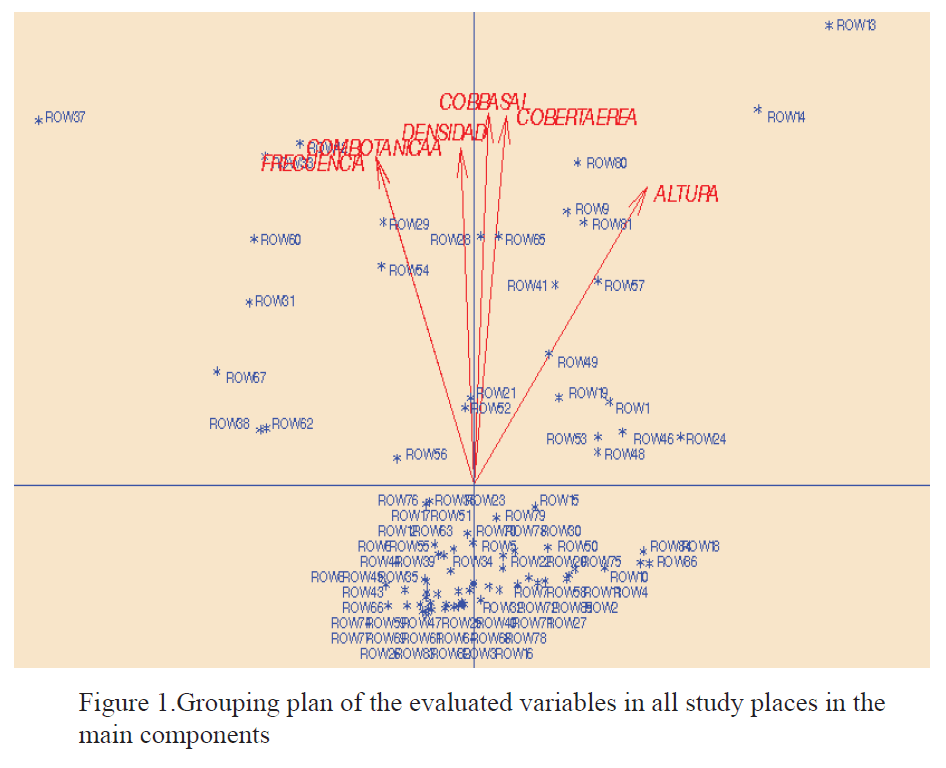
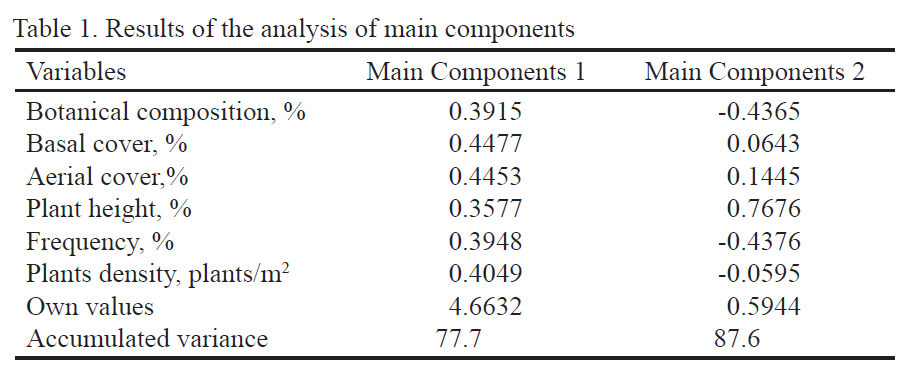
<body><![CDATA[<p align="justify"><font size="2" face="Verdana, Arial, Helvetica, sans-serif">This research was carried  out in the P&aacute;ramo grasslands ecosystem in eight protected areas that Ecuador  maintains in the whole inter-Andean corridor, with the participation of the  Ministry of Environment. The plant characterization was carried out by means of  field expeditions, every two months, during three years. &nbsp;</font></p>     <p align="justify"><font size="2" face="Verdana, Arial, Helvetica, sans-serif">The grasses, legumes and weeds were separated and  measured and it was <em>in situ</em> evaluated their botanical composition. Among  the grasses, those species with some forage interest were separated, that was  expressed in percentage, frequency (the presence or absence in each sampling  transept), density (the number of plants per square meter existent in the  exclusion places during the evaluation was measured), height (a quadrant was  establish in the experimental units) and in the place a sample of 10 plants  were take. The height was taken, from the plant base up to the terminal mean of  the highest leaf. The basal and aerial cover was measured. Regarding the cover,  expressed by percent, it was determined by means of canfield line method, the  area that takes the plant in the crown as in their middle part, when evaluating  their basal and aerial&nbsp; cover,  respectively (CIAT 1992 and Hitchcock 1927). </font></p>     <p align="justify"><font size="2" face="Verdana, Arial, Helvetica, sans-serif">The observations were recorded during two periods per  year, and in each one at 60, 90, 120, 150 and    180 d, for a total of 36 evaluations in each study place. The evaluation was  carried out by means of lineal transepts of seven meters in zigzag, with  inflection points each a meter, to obtain ten observations per each exclusion.  There were taken in total 360 samples per evaluation place in each grass  specie. This was use to identified the tree plants of the Ecuador high Andean  area, in form, function and origin terms.</font></p>     <p align="justify"><font size="2" face="Verdana, Arial, Helvetica, sans-serif">Measures corresponding to  each botanical characteristic were carried out and there were registered by  means of the International Plant Genetic Resources Institute methodology (IPGRI  1988 and CIAT 2003), which allowed evaluating the botanical characters of high  heritability, easily visible or measurable, expressed in a consistent way in  all environments. These ones were statistically evaluated, by means of the main  components analysis and of cluster. </font></p>     <p align="justify">&nbsp;</p>     <p align="justify"><strong><font size="3" face="Verdana, Arial, Helvetica, sans-serif">RESULTS AND DISCUSSION</font></strong></p>     <p align="justify"><font size="2" face="Verdana, Arial, Helvetica, sans-serif">The Analysis of the Main Components, for all study  places, showed that in the first two components was accumulated 87.63 % of the  total variability. In the first and second, was accumulated 77.7 and 87.6 % of  the variability, respectively. There were stood as variables of high weight in  the first component, basal cover, aerial cover and density; while in the second  were the botanical composition, plant height and frequency (<a href="/img/revistas/cjas/v49n3/f0116315.gif">figure 1</a>). This  showed that these are the most important variables that characterized the  species of natural and naturalized grasses in the study places, for which was  taking into account the selection from eigen values, higher to 0.39 (<a href="/img/revistas/cjas/v49n3/t0116315.gif">table 1</a>).</font></p>     
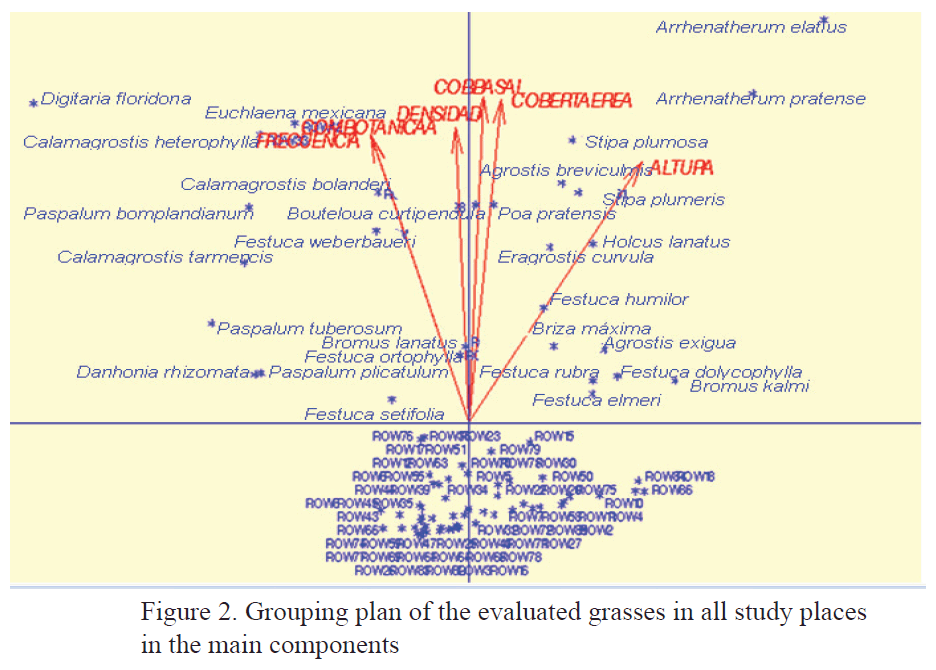
<p align="justify"><font size="2" face="Verdana, Arial, Helvetica, sans-serif">When analyzing the species distribution in the level  formed by the first two components, great variability was verified, due to the  dispersion showed. There were stood as those of better performance 29 species,  located above the axis of the component PC1, on the base of the considered  characters, which represented 33% of the total (<a href="/img/revistas/cjas/v49n3/f0216315.gif">figure 2</a>). </font></p>     
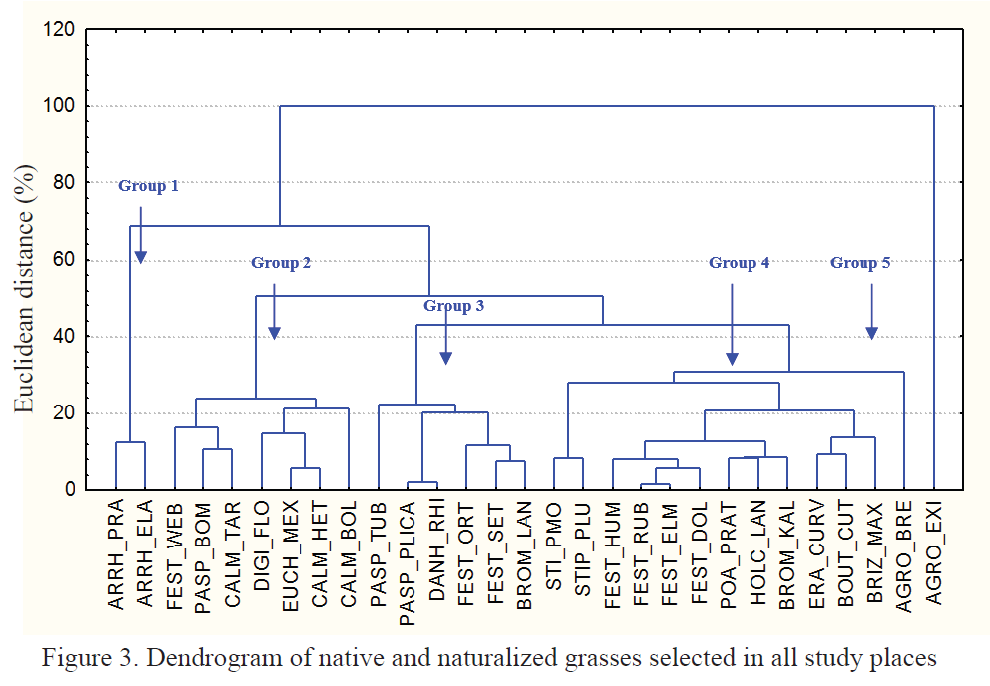
<p align="justify"><font size="2" face="Verdana, Arial, Helvetica, sans-serif">This variability could be related, in general way, with  the cosmopolitan character that the grasses family represents, from the Polar  Circle to Ecuador, and from mountains top up to the sea (Mena 2012).It is  considered that grasses species constitutes, approximately, between 25 and 45 %  of the earth plant cover (De la Cruz <em>et al.</em> 2009) and also, a few  ecological formations lack of them (Mena 2012).</font></p>     <p align="justify"><font size="2" face="Verdana, Arial, Helvetica, sans-serif">The analysis of hierarchical cluster and of complete  ligament on the base of the Euclidean distance, carried out with the 29 species  of better performance (<a href="/img/revistas/cjas/v49n3/f0316315.gif">figure 3</a>), allowed conforming five different groups.</font></p>     
]]></body>
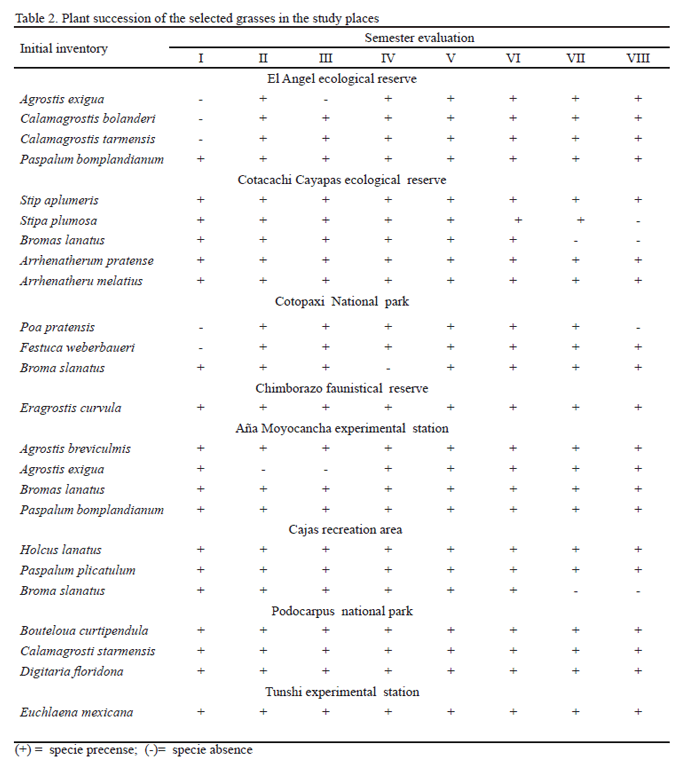
<body><![CDATA[<p align="justify"><font size="2" face="Verdana, Arial, Helvetica, sans-serif">Group I, compound by the <em>Arrhenatherum elatius</em> and <em>Arrhenatherum pratense</em> species, was which of the best performance,  from the characters basal cover, aerial cover and density. These species are  only in the Cotacachi Cayapaz Ecological Reserve, since more than 85 years ago  they were introduced by the natives from Europe, and they have reached high  grade of adaptation to the rigorous conditions of the soil and climate that  prevail in this place (Chaparro 2012).</font></p>     <p align="justify"><font size="2" face="Verdana, Arial, Helvetica, sans-serif">Group II collect the <em>Calamagrostis bolanderi</em>, <em>Calamagrostis  heterophylla</em>, <em>Euchlaena mexicana</em>, <em>Digitaria floridona</em>, <em>Calamagrostis  tarmencis</em>, <em>Paspalum bonplandianum</em> and <em>Festuca weberbaueri</em> species, and showed the highest values in the botanical composition and density  indexes. These species grow associated to an abundant plants community, due to  their sprout- shaped and semi-erect growth habit, that confers them, advantages  in the competition for light and nutrients (Hofstede and Medina 1995).In this  group, <em>Calamagrostis tarmencis</em> was located, that is one of the higher  distribution in the Ecuadorian P&aacute;ramo grasslands ecosystems.&nbsp; </font></p>     <p align="justify"><font size="2" face="Verdana, Arial, Helvetica, sans-serif">The <em>Euchlaena mexicana </em>specie is only in Tunshi Experimental Station. Thanks to  their botanical composition and density, survives associated to great quantity  of improved grasses. While, <em>Digitaria floridon</em> is located in Podocarpus  National Park, being this one natural specie of this ecosystem. The rest of  species that constitutes the group, specifically those of Calamagrostis genus,  are in most of the researched places. They are heathlands native species, where  they are ready with great abundance (Sarmiento 2000 and Berg 1999). </font></p>     <p align="justify"><font size="2" face="Verdana, Arial, Helvetica, sans-serif">Group III was constitutes by  the <em>Bromus lanatus</em>, <em>Festuca setifolia</em>, <em>Festuca ortophylla</em>, <em>Danhonia rhizomata</em>, <em>Paspalum plicatulum</em> and <em>Paspalum tuberosum</em> species, with intermediate values in frequency and density, but with the lowest  in the botanical composition, aerial and basal cover. The <em>Danhonia rhizomata</em>, <em>Paspalum plicatulum</em> and <em>Paspalum tuberosum</em> species are confined  to a specific place, which showed few distributions of them in the Ecuadorian  heathland. </font></p>     <p align="justify"><font size="2" face="Verdana, Arial, Helvetica, sans-serif">&nbsp;The group IV  joined higher number of species: <em>Agrostis breviculmis</em>, <em>Briza maxima</em>, <em>Bouteloua curtipendula</em>, <em>Eragrostis curvula</em>, <em>Bromas kalmi</em>, <em>Holcus  lanatus</em>, <em>Poa pratensis</em>, <em>Festuca dolycophylla</em>, <em>Festuca  elmeri</em>, <em>Festuca rubra</em>, <em>Festuca humilor</em>, <em>Stipa plumeris</em> and <em>Stipa plumosa</em>. It was characterized for present intermediate  values of botanical composition, aerial and basal cover, and low values in  frequency and density; while&nbsp; group V,  that gathered the <em>Agrostis exigua</em> specie, showed values in the botanical  composition, frequency and density, very near to the group IV, but low value in  the basal and aerial cover. The <em>Agrostis exigua</em> specie was in seven of  the eight researched places, which showed its wide distribution in the  Ecuadorian heathland. In the group IV the highest number of endemic grasses  from the Ecuadorian heathland was included: <em>Agrostis breviculmis</em>, <em>Bouteloua  curtipendula</em>, <em>Poa pratensis</em>, <em>Stipa plumeris</em> and <em>Stipa  plumosa</em>. These ones, in spite of not presenting the highest values in the  considered characters, could being of interest to maintain the ecosystems  balance, being the species of high adaptation grade and to highlight in the  plant succession. </font></p>     <p align="justify"><font size="2" face="Verdana, Arial, Helvetica, sans-serif">The <em>in situ</em> selected species showed that when  analyzing their performance in the plant succession, only 18 species showed  good performance, at least, in a place during great part of the period that  takes the evaluation (<a href="/img/revistas/cjas/v49n3/t0216315.gif">table 2</a>). These species were those of more persistence  and adaptation to the ecosystem and, consequently, those of better conditions  to face the competition between plants. Balslev and De Vries (1991) stated that  the forces that limit or favor the succession are similar to those that take  place by the species subsistence.</font></p>     
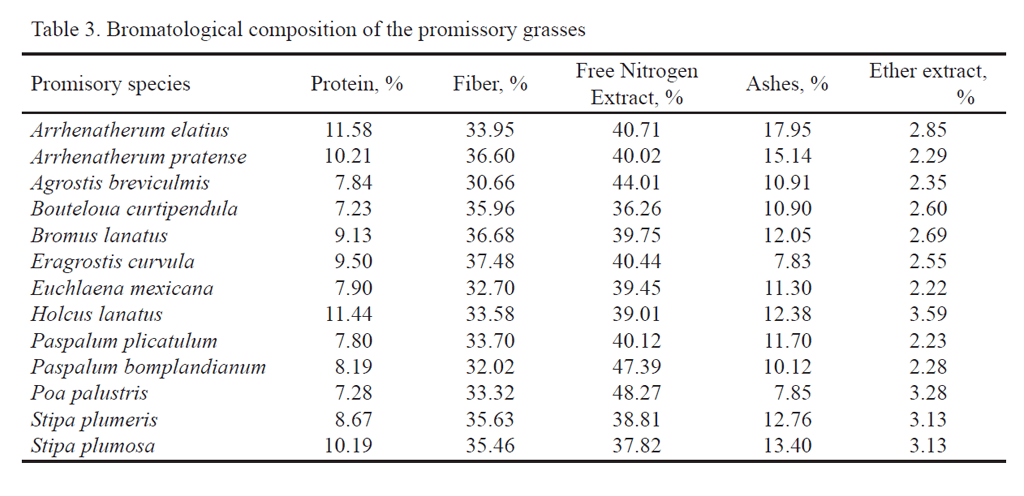
<p align="justify"><font size="2" face="Verdana, Arial, Helvetica, sans-serif">Bernal (2000) and Aguirre  (2012) showed subsystem examples in the Ecuadorian heathland, where the meadows  formed by the Agrostis-Juncus complex have been aggressively invaded by <em>Rubis  constrictus</em> (murra) until the tenth year, when they covered forty percent  of the area, and affected the grasses species presence. </font></p>     <p align="justify"><font size="2" face="Verdana, Arial, Helvetica, sans-serif">As result of the  bromatological analysis carried out to the selected species, the best results  in <em>Arrhenatherum elatius</em>, <em>A. pratense</em>, <em>Holcus lanatus</em>, <em>Stipa  plumeris</em> and <em>S. plumosa</em> were obtained, that showed better  performance, regarding the protein content and ashes. Concerning fiber content,  the <em>Poa pratensis</em>, <em>Paspalum bomplandianum</em>, <em>P. plicatulum</em> and <em>Agrostis breviculmis</em> species were identified as more promissory    (<a href="/img/revistas/cjas/v49n3/t0316315.gif">table 3</a>). </font></p>     
<p align="justify"><font size="2" face="Verdana, Arial, Helvetica, sans-serif">The <em>Arrhenatherum elatius</em> (11.58 %), <em>Holcus  lanatus</em> (11.44 %) and <em>Stipa plumosa</em> (10.19 %) showed the best  performance in protein content (<a href="/img/revistas/cjas/v49n3/t0316315.gif">table 3</a>), with appropriate values for natural  and naturalized grasses species from Andean heathlands. These values are above  to that informed by Chaparro (2012), who showed values of 7 and 10.04 % for <em>Festuca  elatior</em>and <em>Bromus cantharticus</em> species, considered as promissory.</font></p>     
<p align="justify"><font size="2" face="Verdana, Arial, Helvetica, sans-serif">It is recommended to evaluate the <em>ex situ</em> agroproductive performance of <em>Arrhenatherum elatius</em>, <em>Holcus lanatus</em> and <em>Arrhenatherum pratense</em> promissory species in their bromatological  composition and to know their forage potential as a new alternative in the  Ecuador cattle production.</font></p>     ]]></body>
<body><![CDATA[<p align="justify">&nbsp;</p>     <p align="justify"><strong><font size="3" face="Verdana, Arial, Helvetica, sans-serif">REFERENCES</font></strong></p>     <!-- ref --><p align="justify"><font size="2" face="Verdana, Arial, Helvetica, sans-serif">Aguirre, C. 2012. <em>Programa para un manejo forestal  sustentable en el instituto ecuatoriano forestal y de &aacute;reas naturales y vida  silvestre. Diagn&oacute;stico de la Investigaci&oacute;n Forestal en el Ecuador</em>. Ecuador:  ITTO,&nbsp; INEFAN, 72-79 p.    </font></p>     <p align="justify"><font size="2" face="Verdana, Arial, Helvetica, sans-serif">Balslev, H. &amp; De Vries, T. 1991. &lsquo;&lsquo;Life forms and species richness in a bunch grass paramo on Mount Cotopaxi,  Ecuador. Tropical ecosystems: systems characteristics, utilization patterns,  and conservation issues&rsquo;&rsquo;. In: <em>Proceedings of the International and  Interdisciplinary Symposium</em>, Quito: ECOCIENCIA, p. 45.</font></p>     <!-- ref --><p align="justify"><font size="2" face="Verdana, Arial, Helvetica, sans-serif">Berg, K. 1999. <em>A field  survey of avian diversity at the Bilsa Biological Station, Province of  Esmeraldas, Ecuador</em>. Quito:  Fundaci&oacute;n Jatun Sacha, 35 p.    </font></p>     <!-- ref --><p align="justify"><font size="2" face="Verdana, Arial, Helvetica, sans-serif">Bernal, F. 2000. <em>Manejo de P&aacute;ramos y Zonas de  Altura. Relaciones Socio-Organizativas y Legales en el P&aacute;ramo y otras Zonas de  Altura</em>. Quito, Ecuador: CAMAREM-IEDECA, 45 p.    </font></p>     <!-- ref --><p align="justify"><font size="2" face="Verdana, Arial, Helvetica, sans-serif">Chaparro, J. 2012. <em>Beneficios de los ecosistemas de  p&aacute;ramo, organizaciones y pol&iacute;ticas de conservaci&oacute;n</em>. 1st ed., Boyac&aacute;,  Colombia: Cupido, 20 p.    </font></p>     <!-- ref --><p align="justify"><font size="2" face="Verdana, Arial, Helvetica, sans-serif">CIAT 1992. <em>Los bancos gen&eacute;ticos y la alimentaci&oacute;n  mundial</em>. Cali, Colombia.    </font></p>     <!-- ref --><p align="justify"><font size="2" face="Verdana, Arial, Helvetica, sans-serif">CIAT 2003. <em>Manual para la colecci&oacute;n, preservaci&oacute;n y  caracterizaci&oacute;n de recursos forrajeros tropicales</em>. Cali. Colombia, 71-74 p.    </font></p>     <p align="justify"><font size="2" face="Verdana, Arial, Helvetica, sans-serif">Crespo, P. 2012. <em>Puentes entre alturas.  Sistematizaci&oacute;n del Proyecto &ldquo;P&aacute;ramo Andino en Venezuela, Colombia, Ecuador y  Per&uacute;</em>. Rodr&iacute;guez M. (ed.), Quito, Ecuador: CONDENSAN.</font></p>     <!-- ref --><p align="justify"><font size="2" face="Verdana, Arial, Helvetica, sans-serif">Cuesta, F., Sevink, J., Llamb&iacute;, L., De Bi&egrave;vre, B.  &amp; Posner, J. 2014. <em>Avances en investigaci&oacute;n para la conservaci&oacute;n de los  p&aacute;ramos andinos</em>. Quito, Ecuador: CONDESAN.    </font></p>     <!-- ref --><p align="justify"><font size="2" face="Verdana, Arial, Helvetica, sans-serif">Cuesta, L., Sevink, M., Llamb&iacute;, T., De Bi&egrave;vre, G.  &amp; Posner, H. 2014. <em>La diversidad de los p&aacute;ramos andinos en el espacio y  en el tiempo. Avances en Investigaci&oacute;n para la Conservaci&oacute;n en los P&aacute;ramos  Andinos</em>. Quito: CONDESAN, 7-40 p.    </font></p>     ]]></body>
<body><![CDATA[<!-- ref --><p align="justify"><font size="2" face="Verdana, Arial, Helvetica, sans-serif">De la Cruz, R., Mena V&aacute;sconez, P., Morales, M., Ortiz,  P., Ram&oacute;n, G., Rivadeneira, S., Su&aacute;rez, e, Ter&aacute;n, J. F. &amp; Vel&aacute;squez, C.  2009. <em>Gente y ambiente de p&aacute;ramo: realidades y perspectivas en el Ecuador</em>.  Quito: EcoCiencia-Abya Yala.    </font></p>     <!-- ref --><p align="justify"><font size="2" face="Verdana, Arial, Helvetica, sans-serif">Hitchcock, A. 1927. <em>Manual  of the grasses of the Ecuador, Peru and Bolivia</em>. Herbarium (ed.), New York,  14 - 26 p.    </font></p>     <p align="justify"><font size="2" face="Verdana, Arial, Helvetica, sans-serif">Hoftede, R. &amp; Medina, G.  1995. &lsquo;&lsquo;The effects of grazing and burning on soil and plant nutrient  concentrations in Colombian Paramo Grasslands&rsquo;&rsquo;. <em>Plant and Soil</em>, 173: 111.</font></p>     <!-- ref --><p align="justify"><font size="2" face="Verdana, Arial, Helvetica, sans-serif">IPGRI 1988. <em>Consejo Internacional para Recursos  Gen&eacute;ticos de Plantas</em>. Roma, Italia: Recursos gen&eacute;ticos de las plantas,  23-35 p.    </font></p>     <!-- ref --><p align="justify"><font size="2" face="Verdana, Arial, Helvetica, sans-serif">L&oacute;pez, F. 1988. <em>Adaptaci&oacute;n de especies forrajeras  andinas a un sistema silvopastoril</em>. Degree Thesis, Universidad Nacional de  Loja, Loja, Ecuador.    </font></p>     <!-- ref --><p align="justify"><font size="2" face="Verdana, Arial, Helvetica, sans-serif">Mena, P. 2010. <em>Los p&aacute;ramos ecuatorianos: Paisajes  diversos, fr&aacute;giles y estrat&eacute;gicos</em>. Quito, Ecuador: Ecociencia, 57 p.    </font></p>     <!-- ref --><p align="justify"><font size="2" face="Verdana, Arial, Helvetica, sans-serif">Mena, P. 2012. <em>Gente y Ambiente de P&aacute;ramo:  Realidades y Perspectivas en el Ecuador</em>. Quito, Ecuador: Ecociencia, 34 p.    </font></p>     <!-- ref --><p align="justify"><font size="2" face="Verdana, Arial, Helvetica, sans-serif">Monasterio, M. 2003. <em>Caracterizaci&oacute;n ecol&oacute;gica del  clima en el P&aacute;ramo</em>. Quito, Ecuador: Ayala, 23 p.    </font></p>     <!-- ref --><p align="justify"><font size="2" face="Verdana, Arial, Helvetica, sans-serif">Paladines, O. &amp; J&aacute;come, C. 1999. <em>Factores que  determinan la producci&oacute;n primaria de los pastizales en los ecosistemas h&uacute;medos  de la zona altoandina de la Sierra en especial de la provincia del Carchi</em>.  , Available: &lt;www.cip.org.pe/informes cinific/n5620&gt;,  [Consulted:&nbsp;April 14, 2015].    </font></p>     <!-- ref --><p align="justify"><font size="2" face="Verdana, Arial, Helvetica, sans-serif">Paladines, O. &amp; Leal, J. 1997. <em>Recomendaciones  para evaluar germoplasma bajo pastoreo. Manejo y productividad de las praderas</em>.  CONDENSAN. CIAT, 321-245 p.    </font></p>     <!-- ref --><p align="justify"><font size="2" face="Verdana, Arial, Helvetica, sans-serif">Pujos, L. 2013. <em>Diversidad flor&iacute;stica a diferente  altitud en el ecosistema p&aacute;ramo de tres comunidades de la organizaci&oacute;n de  segundo grado uni&oacute;n de organizaciones del pueblo Chibuleo</em>. Degree Thesis,  Escuela Superior Polit&eacute;cnica de Chimborazo, Ecuador.    </font></p>     <!-- ref --><p align="justify"><font size="2" face="Verdana, Arial, Helvetica, sans-serif">  Sarmiento, F. 2000. <em>Breaking Mountain Paradigms: Ecological Effects on  Human Impacts in Man-aged Tropandean Landscapes</em>. 423 - 431  p.    </font></p>     <p>&nbsp;</p>     <p>&nbsp;</p>     <p align="justify"><font size="2" face="Verdana, Arial, Helvetica, sans-serif">Received: July 17, 2015    <br> Accepted: July 21, 2015</font></p>     <p align="justify">&nbsp;</p>     <p align="justify">&nbsp;</p>     <p align="justify"><font size="2" face="Verdana, Arial, Helvetica, sans-serif"><i>L. Fiallos,</i> Escuela Superior Politécnica de Chimborazo, Facultad de Ciencias Pecuarias Riobamba- Ecuador.    Email: <a href="mailto:luisfior@yahoo.es">luisfior@yahoo.es</a></font></p>     ]]></body>
<body><![CDATA[ ]]></body><back>
<ref-list>
<ref id="B1">
<nlm-citation citation-type="book">
<person-group person-group-type="author">
<name>
<surname><![CDATA[Aguirre,]]></surname>
<given-names><![CDATA[C.]]></given-names>
</name>
</person-group>
<source><![CDATA[Programa para un manejo forestal sustentable en el instituto ecuatoriano forestal y de áreas naturales y vida silvestre. Diagnóstico de la Investigación Forestal en el Ecuador]]></source>
<year>2012</year>
<page-range>72-79</page-range><publisher-loc><![CDATA[Ecuador ]]></publisher-loc>
<publisher-name><![CDATA[ITTO, INEFAN]]></publisher-name>
</nlm-citation>
</ref>
<ref id="B2">
<nlm-citation citation-type="book">
<person-group person-group-type="author">
<name>
<surname><![CDATA[Balslev]]></surname>
<given-names><![CDATA[H.]]></given-names>
</name>
<name>
<surname><![CDATA[De Vries]]></surname>
<given-names><![CDATA[T.]]></given-names>
</name>
</person-group>
<article-title xml:lang="nd"><![CDATA[Life forms and species richness in a bunch grass paramo on Mount Cotopaxi, Ecuador. Tropical ecosystems: systems characteristics, utilization patterns, and conservation issues]]></article-title>
<source><![CDATA[]]></source>
<year>1991</year>
<page-range>45</page-range><publisher-loc><![CDATA[Quito ]]></publisher-loc>
<publisher-name><![CDATA[ECOCIENCIA]]></publisher-name>
</nlm-citation>
</ref>
<ref id="B3">
<nlm-citation citation-type="book">
<person-group person-group-type="author">
<name>
<surname><![CDATA[Berg]]></surname>
<given-names><![CDATA[K.]]></given-names>
</name>
</person-group>
<source><![CDATA[A field survey of avian diversity at the Bilsa Biological Station, Province of Esmeraldas, Ecuador]]></source>
<year>1999</year>
<page-range>35</page-range><publisher-loc><![CDATA[Quito ]]></publisher-loc>
<publisher-name><![CDATA[Fundación Jatun Sacha]]></publisher-name>
</nlm-citation>
</ref>
<ref id="B4">
<nlm-citation citation-type="book">
<person-group person-group-type="author">
<name>
<surname><![CDATA[Bernal]]></surname>
<given-names><![CDATA[F.]]></given-names>
</name>
</person-group>
<source><![CDATA[Manejo de Páramos y Zonas de Altura. Relaciones Socio-Organizativas y Legales en el Páramo y otras Zonas de Altura]]></source>
<year>2000</year>
<page-range>45</page-range><publisher-loc><![CDATA[Quito, Ecuador ]]></publisher-loc>
<publisher-name><![CDATA[CAMAREM-IEDECA]]></publisher-name>
</nlm-citation>
</ref>
<ref id="B5">
<nlm-citation citation-type="book">
<person-group person-group-type="author">
<name>
<surname><![CDATA[Chaparro]]></surname>
<given-names><![CDATA[J.]]></given-names>
</name>
</person-group>
<source><![CDATA[Beneficios de los ecosistemas de páramo, organizaciones y políticas de conservación]]></source>
<year>2012</year>
<edition>1st</edition>
<page-range>20</page-range><publisher-loc><![CDATA[Boyacá, Colombia ]]></publisher-loc>
<publisher-name><![CDATA[Cupido]]></publisher-name>
</nlm-citation>
</ref>
<ref id="B6">
<nlm-citation citation-type="">
<person-group person-group-type="author">
<name>
<surname><![CDATA[CIAT]]></surname>
</name>
</person-group>
<source><![CDATA[Los bancos genéticos y la alimentación mundial]]></source>
<year>1992</year>
<publisher-loc><![CDATA[Cali, Colombia ]]></publisher-loc>
</nlm-citation>
</ref>
<ref id="B7">
<nlm-citation citation-type="">
<person-group person-group-type="author">
<name>
<surname><![CDATA[CIAT]]></surname>
</name>
</person-group>
<source><![CDATA[Manual para la colección, preservación y caracterización de recursos forrajeros tropicales]]></source>
<year>2003</year>
<page-range>71-74</page-range><publisher-loc><![CDATA[Cali. Colombia ]]></publisher-loc>
</nlm-citation>
</ref>
<ref id="B8">
<nlm-citation citation-type="book">
<person-group person-group-type="author">
<name>
<surname><![CDATA[Crespo]]></surname>
<given-names><![CDATA[P.]]></given-names>
</name>
<name>
<surname><![CDATA[Rodríguez]]></surname>
<given-names><![CDATA[M.]]></given-names>
</name>
</person-group>
<source><![CDATA[Puentes entre alturas. Sistematización del Proyecto “Páramo Andino en Venezuela, Colombia, Ecuador y Perú]]></source>
<year>2012</year>
<publisher-loc><![CDATA[Quito, Ecuador ]]></publisher-loc>
<publisher-name><![CDATA[CONDENSAN]]></publisher-name>
</nlm-citation>
</ref>
<ref id="B9">
<nlm-citation citation-type="book">
<person-group person-group-type="author">
<name>
<surname><![CDATA[Cuesta,]]></surname>
<given-names><![CDATA[F.]]></given-names>
</name>
<name>
<surname><![CDATA[Sevink]]></surname>
<given-names><![CDATA[J.]]></given-names>
</name>
<name>
<surname><![CDATA[Llambí]]></surname>
<given-names><![CDATA[L.]]></given-names>
</name>
<name>
<surname><![CDATA[De Bièvre]]></surname>
<given-names><![CDATA[B.]]></given-names>
</name>
<name>
<surname><![CDATA[Posner]]></surname>
<given-names><![CDATA[J.]]></given-names>
</name>
</person-group>
<source><![CDATA[Avances en investigación para la conservación de los páramos andinos]]></source>
<year>2014</year>
<publisher-loc><![CDATA[Quito, Ecuador ]]></publisher-loc>
<publisher-name><![CDATA[CONDESAN]]></publisher-name>
</nlm-citation>
</ref>
<ref id="B10">
<nlm-citation citation-type="book">
<person-group person-group-type="author">
<name>
<surname><![CDATA[Cuesta]]></surname>
<given-names><![CDATA[L.]]></given-names>
</name>
<name>
<surname><![CDATA[Sevink]]></surname>
<given-names><![CDATA[M.]]></given-names>
</name>
<name>
<surname><![CDATA[Llambí]]></surname>
<given-names><![CDATA[T.]]></given-names>
</name>
<name>
<surname><![CDATA[De Bièvre]]></surname>
<given-names><![CDATA[G.]]></given-names>
</name>
<name>
<surname><![CDATA[Posner]]></surname>
<given-names><![CDATA[H.]]></given-names>
</name>
</person-group>
<source><![CDATA[La diversidad de los páramos andinos en el espacio y en el tiempo. Avances en Investigación para la Conservación en los Páramos Andinos]]></source>
<year>2014</year>
<page-range>7-40</page-range><publisher-loc><![CDATA[Quito ]]></publisher-loc>
<publisher-name><![CDATA[CONDESAN]]></publisher-name>
</nlm-citation>
</ref>
<ref id="B11">
<nlm-citation citation-type="book">
<person-group person-group-type="author">
<name>
<surname><![CDATA[De la Cruz]]></surname>
<given-names><![CDATA[R.]]></given-names>
</name>
<name>
<surname><![CDATA[Mena Vásconez]]></surname>
<given-names><![CDATA[P.]]></given-names>
</name>
<name>
<surname><![CDATA[Morales]]></surname>
<given-names><![CDATA[M.]]></given-names>
</name>
<name>
<surname><![CDATA[Ortiz]]></surname>
<given-names><![CDATA[P.]]></given-names>
</name>
<name>
<surname><![CDATA[Ramón]]></surname>
<given-names><![CDATA[G.]]></given-names>
</name>
<name>
<surname><![CDATA[Rivadeneira]]></surname>
<given-names><![CDATA[S.]]></given-names>
</name>
<name>
<surname><![CDATA[Suárez]]></surname>
<given-names><![CDATA[e]]></given-names>
</name>
<name>
<surname><![CDATA[Terán]]></surname>
<given-names><![CDATA[J. F.]]></given-names>
</name>
<name>
<surname><![CDATA[Velásquez]]></surname>
<given-names><![CDATA[C.]]></given-names>
</name>
</person-group>
<source><![CDATA[Gente y ambiente de páramo: realidades y perspectivas en el Ecuador]]></source>
<year>2009</year>
<publisher-loc><![CDATA[Quito ]]></publisher-loc>
<publisher-name><![CDATA[EcoCiencia-Abya Yala]]></publisher-name>
</nlm-citation>
</ref>
<ref id="B12">
<nlm-citation citation-type="">
<person-group person-group-type="author">
<name>
<surname><![CDATA[Hitchcock]]></surname>
<given-names><![CDATA[A.]]></given-names>
</name>
</person-group>
<source><![CDATA[Manual of the grasses of the Ecuador, Peru and Bolivia]]></source>
<year>1927</year>
<page-range>14 - 26</page-range><publisher-loc><![CDATA[New York ]]></publisher-loc>
</nlm-citation>
</ref>
<ref id="B13">
<nlm-citation citation-type="journal">
<person-group person-group-type="author">
<name>
<surname><![CDATA[Hoftede]]></surname>
<given-names><![CDATA[R.]]></given-names>
</name>
<name>
<surname><![CDATA[Medina]]></surname>
<given-names><![CDATA[G.]]></given-names>
</name>
</person-group>
<article-title xml:lang="nd"><![CDATA[The effects of grazing and burning on soil and plant nutrient concentrations in Colombian Paramo Grasslands]]></article-title>
<source><![CDATA[Plant and Soil]]></source>
<year>1995</year>
<volume>173</volume>
<page-range>111</page-range></nlm-citation>
</ref>
<ref id="B14">
<nlm-citation citation-type="book">
<person-group person-group-type="author">
<name>
<surname><![CDATA[IPGRI]]></surname>
</name>
</person-group>
<source><![CDATA[Consejo Internacional para Recursos Genéticos de Plantas]]></source>
<year>1988</year>
<page-range>23-35</page-range><publisher-loc><![CDATA[Roma, Italia ]]></publisher-loc>
<publisher-name><![CDATA[Recursos genéticos de las plantas]]></publisher-name>
</nlm-citation>
</ref>
<ref id="B15">
<nlm-citation citation-type="book">
<person-group person-group-type="author">
<name>
<surname><![CDATA[López]]></surname>
<given-names><![CDATA[F.]]></given-names>
</name>
</person-group>
<source><![CDATA[Adaptación de especies forrajeras andinas a un sistema silvopastoril]]></source>
<year>1988</year>
<publisher-loc><![CDATA[Loja, Ecuador ]]></publisher-loc>
<publisher-name><![CDATA[Universidad Nacional de Loja]]></publisher-name>
</nlm-citation>
</ref>
<ref id="B16">
<nlm-citation citation-type="book">
<person-group person-group-type="author">
<name>
<surname><![CDATA[Mena]]></surname>
<given-names><![CDATA[P.]]></given-names>
</name>
</person-group>
<source><![CDATA[Los páramos ecuatorianos: Paisajes diversos, frágiles y estratégicos]]></source>
<year>2010</year>
<page-range>57</page-range><publisher-loc><![CDATA[Quito, Ecuador ]]></publisher-loc>
<publisher-name><![CDATA[Ecociencia]]></publisher-name>
</nlm-citation>
</ref>
<ref id="B17">
<nlm-citation citation-type="book">
<person-group person-group-type="author">
<name>
<surname><![CDATA[Mena]]></surname>
<given-names><![CDATA[P.]]></given-names>
</name>
</person-group>
<source><![CDATA[Gente y Ambiente de Páramo: Realidades y Perspectivas en el Ecuador]]></source>
<year>2012</year>
<page-range>34</page-range><publisher-loc><![CDATA[Quito, Ecuador ]]></publisher-loc>
<publisher-name><![CDATA[Ecociencia]]></publisher-name>
</nlm-citation>
</ref>
<ref id="B18">
<nlm-citation citation-type="book">
<person-group person-group-type="author">
<name>
<surname><![CDATA[Monasterio]]></surname>
<given-names><![CDATA[M.]]></given-names>
</name>
</person-group>
<source><![CDATA[Caracterización ecológica del clima en el Páramo]]></source>
<year>2003</year>
<page-range>23</page-range><publisher-loc><![CDATA[Quito, Ecuador ]]></publisher-loc>
<publisher-name><![CDATA[Ayala]]></publisher-name>
</nlm-citation>
</ref>
<ref id="B19">
<nlm-citation citation-type="">
<person-group person-group-type="author">
<name>
<surname><![CDATA[Paladines]]></surname>
<given-names><![CDATA[O.]]></given-names>
</name>
<name>
<surname><![CDATA[Jácome]]></surname>
<given-names><![CDATA[C.]]></given-names>
</name>
</person-group>
<source><![CDATA[Factores que determinan la producción primaria de los pastizales en los ecosistemas húmedos de la zona altoandina de la Sierra en especial de la provincia del Carchi]]></source>
<year>1999</year>
</nlm-citation>
</ref>
<ref id="B20">
<nlm-citation citation-type="book">
<person-group person-group-type="author">
<name>
<surname><![CDATA[Paladines]]></surname>
<given-names><![CDATA[O.]]></given-names>
</name>
<name>
<surname><![CDATA[Leal]]></surname>
<given-names><![CDATA[J.]]></given-names>
</name>
</person-group>
<source><![CDATA[Recomendaciones para evaluar germoplasma bajo pastoreo. Manejo y productividad de las praderas]]></source>
<year>1997</year>
<page-range>321-245</page-range><publisher-name><![CDATA[CONDENSAN. CIAT]]></publisher-name>
</nlm-citation>
</ref>
<ref id="B21">
<nlm-citation citation-type="book">
<person-group person-group-type="author">
<name>
<surname><![CDATA[Pujos]]></surname>
<given-names><![CDATA[L.]]></given-names>
</name>
</person-group>
<source><![CDATA[Diversidad florística a diferente altitud en el ecosistema páramo de tres comunidades de la organización de segundo grado unión de organizaciones del pueblo Chibuleo]]></source>
<year>2013</year>
<publisher-loc><![CDATA[Ecuador ]]></publisher-loc>
<publisher-name><![CDATA[Escuela Superior Politécnica de Chimborazo]]></publisher-name>
</nlm-citation>
</ref>
<ref id="B22">
<nlm-citation citation-type="">
<person-group person-group-type="author">
<name>
<surname><![CDATA[Sarmiento]]></surname>
<given-names><![CDATA[F.]]></given-names>
</name>
</person-group>
<source><![CDATA[Breaking Mountain Paradigms: Ecological Effects on Human Impacts in Man-aged Tropandean Landscapes]]></source>
<year>2000</year>
<page-range>423 - 431</page-range></nlm-citation>
</ref>
</ref-list>
</back>
</article>