<?xml version="1.0" encoding="ISO-8859-1"?><article xmlns:mml="http://www.w3.org/1998/Math/MathML" xmlns:xlink="http://www.w3.org/1999/xlink" xmlns:xsi="http://www.w3.org/2001/XMLSchema-instance">
<front>
<journal-meta>
<journal-id>2079-3480</journal-id>
<journal-title><![CDATA[Cuban Journal of Agricultural Science]]></journal-title>
<abbrev-journal-title><![CDATA[Cuban J. Agric. Sci.]]></abbrev-journal-title>
<issn>2079-3480</issn>
<publisher>
<publisher-name><![CDATA[Editorial del Instituto de Ciencia Animal]]></publisher-name>
</publisher>
</journal-meta>
<article-meta>
<article-id>S2079-34802015000400005</article-id>
<title-group>
<article-title xml:lang="en"><![CDATA[Genetic parameters of growth traits in Cuban Zebu through the multi-trait animal model and reaction norm model]]></article-title>
<article-title xml:lang="es"><![CDATA[Parámetros genéticos de rasgos de crecimiento en el Cebú Cubano mediante modelo animal bicarácter y de norma de reacción]]></article-title>
</title-group>
<contrib-group>
<contrib contrib-type="author">
<name>
<surname><![CDATA[Rodríguez]]></surname>
<given-names><![CDATA[Yusleiby]]></given-names>
</name>
<xref ref-type="aff" rid="A01"/>
</contrib>
<contrib contrib-type="author">
<name>
<surname><![CDATA[Ponce de León]]></surname>
<given-names><![CDATA[Raquel]]></given-names>
</name>
<xref ref-type="aff" rid="A01"/>
</contrib>
<contrib contrib-type="author">
<name>
<surname><![CDATA[Rodríguez]]></surname>
<given-names><![CDATA[Manuel]]></given-names>
</name>
<xref ref-type="aff" rid="A02"/>
</contrib>
</contrib-group>
<aff id="A01">
<institution><![CDATA[,Instituto de Ciencia Animal  ]]></institution>
<addr-line><![CDATA[San José de las Lajas Mayabeque]]></addr-line>
<country>Cuba</country>
</aff>
<aff id="A02">
<institution><![CDATA[,Centro de Investigaciones para el Mejoramiento Animal de la Ganadería Tropical  ]]></institution>
<addr-line><![CDATA[ ]]></addr-line>
</aff>
<pub-date pub-type="pub">
<day>00</day>
<month>12</month>
<year>2015</year>
</pub-date>
<pub-date pub-type="epub">
<day>00</day>
<month>12</month>
<year>2015</year>
</pub-date>
<volume>49</volume>
<numero>4</numero>
<fpage>465</fpage>
<lpage>469</lpage>
<copyright-statement/>
<copyright-year/>
<self-uri xlink:href="http://scielo.sld.cu/scielo.php?script=sci_arttext&amp;pid=S2079-34802015000400005&amp;lng=en&amp;nrm=iso"></self-uri><self-uri xlink:href="http://scielo.sld.cu/scielo.php?script=sci_abstract&amp;pid=S2079-34802015000400005&amp;lng=en&amp;nrm=iso"></self-uri><self-uri xlink:href="http://scielo.sld.cu/scielo.php?script=sci_pdf&amp;pid=S2079-34802015000400005&amp;lng=en&amp;nrm=iso"></self-uri><abstract abstract-type="short" xml:lang="en"><p><![CDATA[A multi-trait animal model (15,904 data) and a reaction norm model (13,068 data) were studied, in order to estimate genetic parameters and environmental awareness of the weight at 18 months (P18) and (TDG) of Cuban Zebu during the performance test for future sires. The animals were born between 1981 and 2012 and were the offspring of 295 parents. Multi-trait animal model allowed to obtain the solutions of fixed effect of from the group of contemporaries, heritabilities and genetic tendencies of P18 and trial daily gain TDG. Later, a reaction norm model of sire type was considered, with the group of contemporaries (herd-year-three-month period of animal birth) as fix effect the effect of random regression of sire (cubic, square and linear Legendre polynomials) through an environmental gradient, expressed as solution of fix effect, so a total of 6 environmental classes were created. Estimated values of heritability, through the animal model, were 0.20 ± 0.02 and 0.28 ± 0.02 for TDG and P18, respectively, with a genetic correlation of 0.94 among them. Using the reaction norm model, the estimates varied from 0.13±0.04 to 0.43±0.08, and the highest corresponded to favorable environments or positive gradients. Correlation values, very close to 1, indicate the non-existence of genotype x environment interaction in most of the cases. However, there may be correlations lower than 0.8 in the most unfavorable environment, which indicates that sires selected in favorable environments may not have the same performance after passing to unfavorable environments]]></p></abstract>
<abstract abstract-type="short" xml:lang="es"><p><![CDATA[Se estudiaron dos modelos, uno animal bicarácter (15904 datos) y otro de norma de reacción (13068datos) para estimar los parámetros genéticos y la sensibilidad ambiental de peso a los 18 meses (P18) y ganancia diaria en prueba (GPD) del Cebú Cubano d. Los animales nacieron entre 1981 y 2012 y eran hijos de 295 padres. El modelo animal bicaracter permitió obtener las soluciones del efecto fijo del grupo de contemporáneos, las heredabilidades y tendencias genéticas de P18 y GPD Posteriormente se consideró un modelo de norma de reacción de tipo semental, con el grupo de contemporáneos (rebaño-año-trimestre de nacimiento) como efecto fijo y el efecto de la regresión aleatoria del padre (Polinomio de Legendre lineal, cuadrático y cúbico) a través de un gradiente ambiental, expresado como la solución del efecto fijo, para lo que se crearon un total de seis clases ambientales. Los valores estimados de heredabilidad mediante el modelo animal fueron de 0.20 ± 0.02 y 0.28 ± 0.02 para GPD y P18 respectivamente, con una correlación genética entre ellos de 0.94. Mediante el modelo de norma de reacción, los estimados variaron de 0.13±0.04 a 0.43±0.08 y los mayores correspondieron al ambiente favorables o gradientes positivos. Los valores de correlación, muy cercanos a uno indican la no existencia de interacción genotipo x ambiente en la mayoría de los casos. Sin embargo, en el ambiente más desfavorable puede manifestarse correlaciones menores que 0.8, lo que indica que los sementales seleccionados en ambientes favorables, podrían no comportarse de la misma forma al pasar a ambientes desfavorables]]></p></abstract>
<kwd-group>
<kwd lng="en"><![CDATA[Performance test]]></kwd>
<kwd lng="en"><![CDATA[genetic correlation]]></kwd>
<kwd lng="en"><![CDATA[environmental gradient]]></kwd>
<kwd lng="es"><![CDATA[Prueba de comportamiento]]></kwd>
<kwd lng="es"><![CDATA[correlación genética]]></kwd>
<kwd lng="es"><![CDATA[gradiente ambiental]]></kwd>
</kwd-group>
</article-meta>
</front><body><![CDATA[ <p align="right"><font size="2" face="Verdana, Arial, Helvetica,   sans-serif"><b>ORIGINAL ARTICLE</b></font></p>     <p>&nbsp;</p>     <p align="justify"><font size="4" face="Verdana, Arial, Helvetica, sans-serif"><b>Genetic parameters of growth traits in Cuban Zebu through the    multi-trait animal model and reaction norm model</b></font></p>     <p align="justify">&nbsp;</p>     <p align="justify"><font size="3" face="Verdana, Arial, Helvetica, sans-serif"><b>Parámetros genéticos de rasgos de crecimiento en el Cebú Cubano mediante modelo animal bicarácter y de norma de reacción</b></font></p>     <p align="justify">&nbsp;</p>     <p align="justify">&nbsp;</p>     <p align="justify"><font size="2" face="Verdana, Arial, Helvetica, sans-serif"><b>Yusleiby Rodríguez,</b><sup><b>I</b></sup><b> Raquel Ponce de León,</b><sup><b>I</b></sup><b> Manuel Rodríguez,</b><sup><b>II</b></sup></font></p>     <p align="justify"><font size="2" face="Verdana, Arial, Helvetica, sans-serif"><b> </b></font><font size="2" face="Verdana, Arial, Helvetica, sans-serif"><sup>I</sup>Instituto de Ciencia Animal, Apartado Postal 24, San José de las Lajas, Mayabeque, Cuba.    <br>   <sup>II</sup>Centro de Investigaciones para el Mejoramiento Animal de la Ganadería Tropical. </font></p>     ]]></body>
<body><![CDATA[<p align="justify">&nbsp;</p>     <p align="justify">&nbsp;</p> <hr align="JUSTIFY">     <p align="justify"><font size="2" face="Verdana, Arial, Helvetica, sans-serif"><b>ABSTRACT</b></font></p>     <p align="justify"><font size="2" face="Verdana, Arial, Helvetica, sans-serif"><span style="line-height:106%; font-family:'Verdana','sans-serif'; font-size:10.0pt; ">A multi-trait animal model (15,904 data) and a  reaction norm model (13,068 data) were studied, in order to estimate genetic  parameters and environmental awareness of the weight at 18 months (P18) and  (TDG) of Cuban Zebu during the performance test for future sires. The animals were  born between 1981 and 2012 and were the offspring of 295 parents. Multi-trait  animal model allowed to obtain the solutions of fixed effect of from the group  of contemporaries, heritabilities and genetic tendencies of P18 and trial daily  gain TDG. Later, a reaction norm model of sire type was considered, with the  group of contemporaries (herd-year-three-month period of animal birth) as fix  effect the effect of random regression of sire (cubic, square and linear  Legendre polynomials) through an environmental gradient, expressed as solution  of fix effect, so a total of 6 environmental classes were created. Estimated  values of heritability, through the animal model, were 0.20 &plusmn; 0.02 and 0.28 &plusmn;  0.02 for TDG and P18, respectively, with a genetic correlation of 0.94 among  them. Using the reaction norm model, the estimates varied from 0.13&plusmn;0.04 to  0.43&plusmn;0.08, and the highest corresponded to favorable environments or positive  gradients. Correlation values, very close to 1, indicate the non-existence of  genotype x environment interaction in most of the cases. However, there may be  correlations lower than 0.8 in the most unfavorable environment, which  indicates that sires selected in favorable environments may not have the same  performance after passing to unfavorable environments</span>.</font></p>     <p align="justify"><font size="2" face="Verdana, Arial, Helvetica, sans-serif"><b>Key words:</b> <span style="line-height:106%; font-family:'Verdana','sans-serif'; font-size:10.0pt; ">Performance test, genetic correlation,  environmental gradient</span>.</font></p> <hr align="JUSTIFY">     <p align="justify"><font size="2" face="Verdana, Arial, Helvetica, sans-serif"><b>RESUMEN</b></font></p>     <p align="justify"><font size="2" face="Verdana, Arial, Helvetica, sans-serif"><span style="line-height:106%; font-family:'Verdana','sans-serif'; font-size:10.0pt; ">Se  estudiaron dos modelos, uno animal bicar&aacute;cter (15904 datos) y otro de norma de  reacci&oacute;n (13068datos) para estimar los par&aacute;metros gen&eacute;ticos y la sensibilidad  ambiental de peso a los 18 meses (P18) y ganancia diaria en prueba (GPD) del  Ceb&uacute; Cubano d. Los animales nacieron entre 1981 y 2012 y eran hijos de 295  padres. El modelo animal bicaracter permiti&oacute; obtener las soluciones del efecto  fijo del grupo de contempor&aacute;neos, las heredabilidades y tendencias gen&eacute;ticas de  P18 y GPD Posteriormente se consider&oacute; un modelo de norma de reacci&oacute;n de tipo  semental, con el grupo de contempor&aacute;neos (reba&ntilde;o-a&ntilde;o-trimestre de nacimiento)  como efecto fijo y el efecto de la regresi&oacute;n aleatoria del padre (Polinomio de  Legendre lineal, cuadr&aacute;tico y c&uacute;bico) a trav&eacute;s de un gradiente ambiental,  expresado como la soluci&oacute;n del efecto fijo, para lo que se crearon un total de  seis clases ambientales. Los valores estimados de heredabilidad mediante el  modelo animal fueron de 0.20 &plusmn; 0.02 y 0.28 &plusmn; 0.02 para GPD y P18 respectivamente,  con una correlaci&oacute;n gen&eacute;tica entre ellos de 0.94. Mediante el modelo de norma  de reacci&oacute;n, los estimados variaron de 0.13&plusmn;0.04 a 0.43&plusmn;0.08 y los mayores  correspondieron al ambiente favorables o gradientes positivos. Los valores de  correlaci&oacute;n, muy cercanos a uno indican la no existencia de interacci&oacute;n  genotipo x ambiente en la mayor&iacute;a de los casos. Sin embargo, en el ambiente m&aacute;s  desfavorable puede manifestarse correlaciones menores que 0.8, lo que indica  que los sementales seleccionados en ambientes favorables, podr&iacute;an no  comportarse de la misma forma al pasar a ambientes desfavorables</span>.</font></p>     <p align="justify"><font size="2" face="Verdana, Arial, Helvetica, sans-serif"><b>Palabras    clave:</b> <span style="line-height:106%; font-family:'Verdana','sans-serif'; font-size:10.0pt; ">Prueba  de comportamiento, correlaci&oacute;n gen&eacute;tica, gradiente ambiental</span>.</font></p> <hr align="JUSTIFY">     <p align="justify">&nbsp;</p>     <p align="justify">&nbsp;</p>        ]]></body>
<body><![CDATA[<p align="justify"><font size="2" face="Verdana, Arial, Helvetica, sans-serif"><b><font size="3">INTRODUCTION</font></b></font></p>       <p align="justify"><font size="2" face="Verdana, Arial, Helvetica, sans-serif"> <span style="font-family:'Verdana','sans-serif'; font-size:10.0pt; ">Nowadays, in Cuba, estimation of breeding value of sires is performed  through a single-trait animal model that estimates the genetic value of all  evaluated animals, and the bulls with the highest breeding value for liveweight  at the end of the test are selected. However, the possible existence of  genotype-environment interaction is not considered, despite the candidates to  parents of the next generation should be evaluated and selected under  conditions that may not be the same as those for exploiting their offspring.  The emerging of models of random regression and reaction norm opened new  possibilities for IGA evaluations. Thanks to artificial insemination, the  performance of the offspring of the same bull may be compared under different  environmental conditions (countries, geographic regions, even in an  environmental gradient). During the last years, several studies have used  random regression with linear Legendre polynomials to evaluate the possible  environmental awareness, relating the variation of the norm inclination  coefficient as an indicator of IGA importance (Corr&ecirc;a <em>et al.</em> 2009 and  Pegolo 2009)</span>.</font></p>       <p align="justify">&nbsp;</p>       <p align="justify"><font size="3" face="Verdana, Arial, Helvetica, sans-serif"> <b>MATERIALS AND METHODS</b> </font></p>       <p align="justify"><font size="2" face="Verdana, Arial, Helvetica, sans-serif"> </font><span style="font-family:'Verdana','sans-serif'; font-size:10.0pt; ">This  study used records of performance test for future sires from Cuban Zebu breed,  born between 1981 and 2012, in five genetic enterprises: Camilo Cienfuegos  (Pinar del R&iacute;o), San Juan (Matanzas), San Lino (Cienfuegos), Abra G&uuml;in&iacute;a (Villa  Clara), Rescate de Sanguil&iacute; (Camag&uuml;ey) and Manuel Fajardo      (Granma).</span></p>       <p align="justify" class="Cuerpodetexto"><span style="letter-spacing:.1pt; font-family:'Verdana','sans-serif'; font-size:10.0pt; ">The values of final weight were fitted to 18 months (P18)  and the variable trial daily gain (TDG) was created as the difference between  final and initial weight, divided into the days that lasted the test. Two  groups of contemporaries were created using the information of herd, year and  three-month period of animal birth. </span><span style="font-family:'Verdana','sans-serif'; font-size:10.0pt; ">&nbsp;&nbsp;</span></p>       <p align="justify" class="Cuerpodetexto"><span style="font-family:'Verdana','sans-serif'; font-size:10.0pt; ">A multi-trait animal model was used for analyzing P18 and  TDG, which considered the group of contemporaries as fix effect and the animal  and error as random effects. This first file with data was composed by 15,904  observations with 580 groups of contemporaries and pedigree had a total of  40,594 observations and included 1,852 sires and 22,990 mothers. </span><span style="font-family:'Verdana','sans-serif'; font-size:10.0pt; "> </span></p>       <p align="justify" class="Cuerpodetexto"><span style="font-family:'Verdana','sans-serif'; font-size:10.0pt; ">From  this first model, heritabilities and genetic correlation were obtained between  both traits, as well as solutions (minimum square means for fix effect). This  solution (in the case of TDG) was used for creating an environmental gradient  (6 classes) for the reaction norm model, with values that varied from -330 to  390. In addition, the genetic tendencies of the two traits, analyzed in the  animal model, were estimated, as the regression of the mean of breeding value  of the population during the birth year.&nbsp; </span></p>       <p align="justify" class="Cuerpodetexto"><span style="font-family:'Verdana','sans-serif'; font-size:10.0pt; ">The  reaction norm model (sire type) had a pedigree file with 295 sires, 187  paternal grandparents and      86 maternal grandparents. This model considered the random regression of sire  in the environmental gradient or management group and was composed by 13.068  records and 548 groups of contemporaries. Groups with less than 5 individuals  were removed, as well as those parents with less than 10 kids and not  represented, at least, by 3 environmental classes.</span></p>       <p align="justify"><span style="font-family:'Verdana','sans-serif'; font-size:10.0pt; ">The used general model was  represented as follows:</span> </p>       ]]></body>
<body><![CDATA[<p align="center"><a name="e1"></a></p>     <p align="center"><img src="../img/revistas/cjas/v49n4/e0105415.gif" width="350" height="71" longdesc="/img/revistas/cjas/v49n4/e0105415.gif"></p>     
<p align="justify" class="Cuerpodetexto"><span style="font-family:'Verdana','sans-serif'; font-size:10.0pt; ">where:</span></p>       <p align="justify" class="Cuerpodetexto"><span style="font-family:'Verdana','sans-serif'; font-size:10.0pt; ">&nbsp;<em>y<sub>ij</sub></em>is the weight value of  the j-th kid belonging to the i-th sire</span></p>       <p align="justify" class="Cuerpodetexto"><em><span style="font-family:'Verdana','sans-serif'; font-size:10.0pt; ">GC<sub>ij</sub></span></em><span style="font-family:'Verdana','sans-serif'; font-size:10.0pt; ">&nbsp;is  the fix effect of the group of contemporaries belonging to the progeny of the  i-th sire </span></p>       <p align="justify" class="Cuerpodetexto"><em><span style="font-family:'Verdana','sans-serif'; font-size:10.0pt; ">&alpha;<sub>ij</sub></span></em><span style="font-family:'Verdana','sans-serif'; font-size:10.0pt; ">&Oslash;<em><sub>m</sub></em> (<em>GA<sub>ij</sub></em>) represents the random regression of the i-th     <br>     sire <em>&alpha;<sub>ij</sub></em>) in the environmental group</span></p>       <p align="justify" class="Cuerpodetexto"><em><span style="font-family:'Verdana','sans-serif'; font-size:10.0pt; ">GA<sub>ij</sub></span></em><span style="font-family:'Verdana','sans-serif'; font-size:10.0pt; ">and &Oslash;<em><sub>m</sub></em> represent the  coefficient of Legendre polynomial of m order</span></p>       <p align="justify"><span style="font-family:'Verdana','sans-serif'; font-size:10.0pt; ">Variants were tested in the  order of Legendre polynomials (linear, square and cubic). The Wombat software  (Meyer 2006) was used for calculating genetic parameters, as well as the matrix  of (co) variances of random regression coefficients</span><font size="2" face="Verdana, Arial, Helvetica, sans-serif">.</font></p>       <p align="justify">&nbsp;</p>       ]]></body>
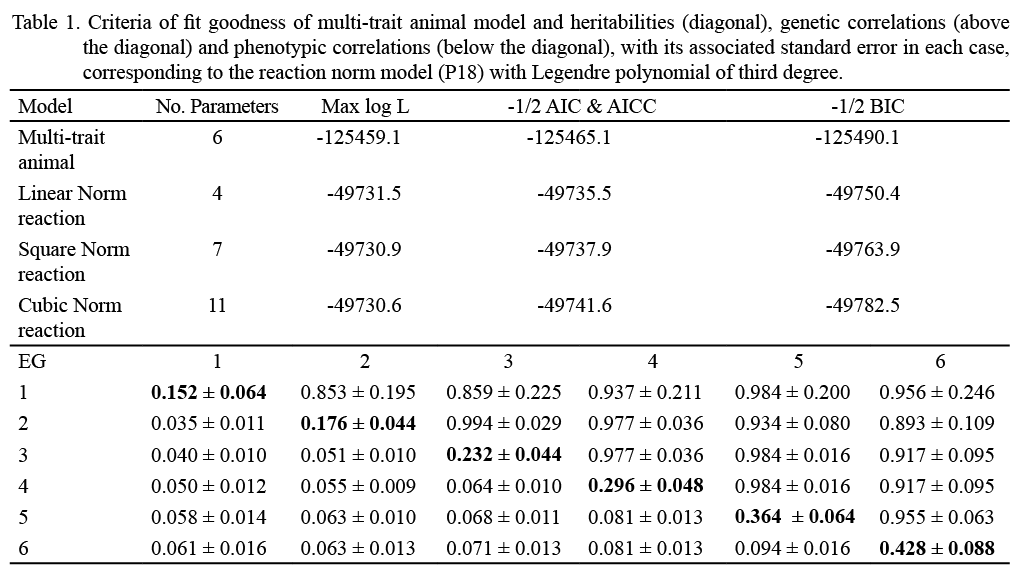
<body><![CDATA[<p align="justify"><font size="3" face="Verdana, Arial, Helvetica, sans-serif"><b>RESULTS AND DISCUSSION</b></font></p>       <p align="justify" class="Cuerpodetexto"><span style="font-family:'Verdana','sans-serif'; font-size:10.0pt; "><a href="/img/revistas/cjas/v49n4/t0105415.gif">Table  1</a> shows the goodness of fit criteria of the used models, having the multi-trait  model the best fit, which is caused by the highest number of observations used  in it. Within the reaction norm, there are few differences but the best fit was  obtained for the Legendre polynomial of third degree. </span></p>       
<p align="justify"><span style="letter-spacing:.2pt; font-family:'Verdana','sans-serif'; font-size:10.0pt; ">Heritability  estimates (h<sup>2</sup>), according to the multi-trait model, were 0.20 &plusmn; 0.02  and 0.28 &plusmn; 0.02 for TDG and P18 respectively, with a genetic correlation of  0.9413 among them, which indicates that both characters are determined by the  same group of genes. Therefore, it can be selected by any of them with similar  results for the genetic progress of      population</span><font size="2" face="Verdana, Arial, Helvetica, sans-serif">.</font></p>         <p align="justify" class="Cuerpodetexto"><span style="font-family:'Verdana','sans-serif'; font-size:10.0pt; ">Genetic  tendencies for P18 (y = 0.404x+0.051, with R&sup2; = 0.903) and TDG (y = 0.404x +  0.051, with      R&sup2; = 0.903) show a slight growth through the years for the studied traits,  which indicates a low genetic progress for these traits, adding the increased  generational intervals of current animal husbandry. </span></p>       <p align="justify"><span style="letter-spacing:.2pt; font-family:'Verdana','sans-serif'; font-size:10.0pt; ">Using  the norm reaction model, the highest h<sup>2</sup> estimates were obtained in  the favorable environmental extreme (<a href="/img/revistas/cjas/v49n4/f0105415.gif">figure 1</a>). Points of minimum heritability  were in the negative region of the environmental gradient (between -130 and  -30), following the tendency of higher genetic variances in the positive  environments. This result was obtained according to the literature for  regression models with first degree polynomials (Fikse <em>et al.</em> 2003).  However, it is different from that described by Pegolo&nbsp; (2009) for Nellore cattle in Brazil, using a  similar methodology. This author found that the way of calculating  environmental descriptors influenced on the estimation of genetic parameters of  the analyzed population, being the models with cubic polynomials able to  identify heterogeneity details among the environments, mainly the unfavorable  ones</span><font size="2" face="Verdana, Arial, Helvetica, sans-serif">.</font></p>       
<p align="justify" class="Cuerpodetexto"><span style="font-family:'Verdana','sans-serif'; font-size:10.0pt; ">In  a previous study, Rodr&iacute;guez <em>et al.</em> (2014) analyzed a similar model for  final weight in this same genotype and using, as gradient, the standard mean of  gain in the corresponding groups of contemporaries, considering the gradient as  18 and 8 environmental classes. In this case, the authors obtained a different  performance, where the lowest values of h<sup>2</sup> were represented in the  mean gradients.</span></p>       <p align="justify" class="Cuerpodetexto"><span style="letter-spacing:.2pt; font-family:'Verdana','sans-serif'; font-size:10.0pt; "><a href="/img/revistas/cjas/v49n4/f0105415.gif">Table 1</a> also shows that most of genetic correlations among  the different environmental classes were positive and had values very close to  1. The possible explanation (Falconer and Mackay 1996) is that this trait may  be partially controlled by the same group of genes in each environment, and,  therefore, the genetic merit is similar for all the environmental subclasses.  However, it is important to highlight that the most negative extreme (class 1),  taking into account the error values, could show correlations lower than 0.8,  which indicates that sires selected in favorable environments may not have a  similar performance in these unfavorable environments (negative      gradients). &nbsp;</span></p>       
<p align="justify" class="Cuerpodetexto"><span style="font-family:'Verdana','sans-serif'; font-size:10.0pt; ">It is possible to carry out a process of selection by P18  or TDG in Cuban Zebu, regarding the values of obtained heritabilities, with a  better fit for the multi-trait model, counting on a higher number of observations  and without the restrictions of the reaction model.</span></p>       <p align="justify"><span style="letter-spacing:.2pt; font-family:'Verdana','sans-serif'; font-size:10.0pt; ">This  study did not show an environmental awareness among the mean and positive  gradients. However, among the negative extremes and the rest, it should be  considered with caution because it showed significant values</span><font size="2" face="Verdana, Arial, Helvetica, sans-serif">.</font></p>     <p align="justify">&nbsp;</p>     ]]></body>
<body><![CDATA[<p align="justify"><font size="2" face="Verdana, Arial, Helvetica, sans-serif"><font size="3"><b>REFERENCES</b></font></font></p>     <p align="justify" style="text-indent:0.0pt;line-height:normal;"><span style="font-family:'Verdana','sans-serif'; font-size:10.0pt; ">Corr&ecirc;a, M. B. B., Dionello, N. J. L. &amp; Cardoso, F. F. 2009.  &ldquo;Caracteriza&ccedil;&atilde;o da intera&ccedil;&atilde;o gen&oacute;tipo-ambiente e compara&ccedil;&atilde;o entre modelos para  ajuste do ganho p&oacute;s-desmama de bovinos Devon via normas de rea&ccedil;&atilde;o&rdquo;. <em>Revista  Brasileira de Zootecnia</em>, 38 (8): 1468&ndash;1477.</span></p>     <!-- ref --><p align="justify" style="text-indent:0.0pt;line-height:normal;"><span style="font-family:'Verdana','sans-serif'; font-size:10.0pt; ">Falconer, D. S. &amp; Mackay, T. F. C. 1996. </span><em><span style="font-family:'Verdana','sans-serif'; font-size:10.0pt; ">Introduction to Quantitative Genetics</span></em><span style="font-family:'Verdana','sans-serif'; font-size:10.0pt; ">. Essex, England: Longman  Group Ltd, 464 p.    </span></p>     <p align="justify" style="text-indent:0.0pt;line-height:normal;"><span style="font-family:'Verdana','sans-serif'; font-size:10.0pt; ">Fikse, W. F., Rekaya, R. &amp;  Weigel, K. A. 2003. &ldquo;Assessment of environmental descriptors for studying  genotype by environment interaction&rdquo;. <em>Livestock production science</em>, 82  (2): 223&ndash;231.</span></p>     <p align="justify" style="text-indent:0.0pt;line-height:normal;"><span style="font-family:'Verdana','sans-serif'; font-size:10.0pt; ">Meyer, K. 2006. &ldquo;&lsquo;WOMBAT&rsquo; &ndash;  Digging deep for quantitative genetic analyses by restricted maximum  likelihood&rdquo;. In: <em>World Congress on genetic applied to Livestock Production</em>,  Belo Horizonte, p. 8.</span></p>     <!-- ref --><p align="justify" style="text-indent:0.0pt;line-height:normal;"><span style="font-family:'Verdana','sans-serif'; font-size:10.0pt; ">Pegolo, N. T. 2009. <em>Intera&ccedil;&atilde;o gen&oacute;tipo-ambiente e sensibilidade  ambiental em bovinos de corte</em>. Ph.D. Thesis, Departamento de Gen&eacute;tica.  Faculdade de Medicina de Ribeir&atilde;o Preto. Universidade de S&atilde;o Paulo, Brasil.    </span></p>     <p align="justify" style="margin-bottom:.0001pt;text-indent:0.0pt;line-height:normal;"><span style="font-family:'Verdana','sans-serif'; font-size:10.0pt; ">Rodr&iacute;guez, Y., Ponce de Le&oacute;n, R., Tamassia, N. &amp;  Nunes, H. 2014. </span><span style="font-family:'Verdana','sans-serif'; font-size:10.0pt; ">&ldquo;Influences  of environmental descriptor for detect genotype by environmental interaction in  Cuban Zebu population&rdquo;. In: <em>Proceedings, 10th World Congress of Genetics  Applied to Livestock Production</em>, Canada.</span></p>     <p align="justify">&nbsp;</p>     ]]></body>
<body><![CDATA[<p align="justify">&nbsp;</p>     <p align="justify"><font size="2" face="Verdana, Arial, Helvetica, sans-serif">Received: November 24, 2015    <br>   Accepted: January 10, 2016</font></p>     <p align="justify">&nbsp;</p>     <p align="justify">&nbsp;</p>     <p align="justify"><font size="2" face="Verdana, Arial, Helvetica, sans-serif"><i>Yusleiby Rodríguez,</i> Instituto de Ciencia Animal, Apartado Postal 24, San José de las Lajas, Mayabeque, Cuba.    Email: <a href="mailto:yusleiby@ica.co.cu">yusleiby@ica.co.cu</a></font></p>      ]]></body><back>
<ref-list>
<ref id="B1">
<nlm-citation citation-type="journal">
<person-group person-group-type="author">
<name>
<surname><![CDATA[Corrêa]]></surname>
<given-names><![CDATA[M. B. B.]]></given-names>
</name>
<name>
<surname><![CDATA[Dionello]]></surname>
<given-names><![CDATA[N. J. L.]]></given-names>
</name>
<name>
<surname><![CDATA[Cardoso]]></surname>
<given-names><![CDATA[F. F.]]></given-names>
</name>
</person-group>
<article-title xml:lang="nd"><![CDATA[Caracterização da interação genótipo-ambiente e comparação entre modelos para ajuste do ganho pós-desmama de bovinos Devon via normas de reação]]></article-title>
<source><![CDATA[Revista Brasileira de Zootecnia]]></source>
<year>2009</year>
<volume>38</volume>
<numero>8</numero>
<issue>8</issue>
<page-range>1468-1477</page-range></nlm-citation>
</ref>
<ref id="B2">
<nlm-citation citation-type="book">
<person-group person-group-type="author">
<name>
<surname><![CDATA[Falconer]]></surname>
<given-names><![CDATA[D. S.]]></given-names>
</name>
<name>
<surname><![CDATA[Mackay]]></surname>
<given-names><![CDATA[T. F. C.]]></given-names>
</name>
</person-group>
<source><![CDATA[Introduction to Quantitative Genetics]]></source>
<year>1996</year>
<page-range>464</page-range><publisher-loc><![CDATA[Essex, England ]]></publisher-loc>
<publisher-name><![CDATA[Longman Group Ltd]]></publisher-name>
</nlm-citation>
</ref>
<ref id="B3">
<nlm-citation citation-type="journal">
<person-group person-group-type="author">
<name>
<surname><![CDATA[Fikse]]></surname>
<given-names><![CDATA[W. F.]]></given-names>
</name>
<name>
<surname><![CDATA[Rekaya]]></surname>
<given-names><![CDATA[R.]]></given-names>
</name>
<name>
<surname><![CDATA[Weigel]]></surname>
<given-names><![CDATA[K. A.]]></given-names>
</name>
</person-group>
<article-title xml:lang="nd"><![CDATA[Assessment of environmental descriptors for studying genotype by environment interaction]]></article-title>
<source><![CDATA[Livestock production science]]></source>
<year>2003</year>
<volume>82</volume>
<numero>2</numero>
<issue>2</issue>
<page-range>223-231</page-range></nlm-citation>
</ref>
<ref id="B4">
<nlm-citation citation-type="">
<person-group person-group-type="author">
<name>
<surname><![CDATA[Meyer]]></surname>
<given-names><![CDATA[K.]]></given-names>
</name>
</person-group>
<article-title xml:lang="nd"><![CDATA[‘WOMBAT’ - Digging deep for quantitative genetic analyses by restricted maximum likelihood]]></article-title>
<source><![CDATA[]]></source>
<year>2006</year>
<page-range>8</page-range><publisher-loc><![CDATA[Belo Horizonte ]]></publisher-loc>
</nlm-citation>
</ref>
<ref id="B5">
<nlm-citation citation-type="book">
<person-group person-group-type="author">
<name>
<surname><![CDATA[Pegolo]]></surname>
<given-names><![CDATA[N. T.]]></given-names>
</name>
</person-group>
<source><![CDATA[Interação genótipo-ambiente e sensibilidade ambiental em bovinos de corte]]></source>
<year>2009</year>
<publisher-loc><![CDATA[Brasil ]]></publisher-loc>
<publisher-name><![CDATA[Departamento de Genética. Faculdade de Medicina de Ribeirão Preto. Universidade de São Paulo]]></publisher-name>
</nlm-citation>
</ref>
<ref id="B6">
<nlm-citation citation-type="">
<person-group person-group-type="author">
<name>
<surname><![CDATA[Rodríguez]]></surname>
<given-names><![CDATA[Y.]]></given-names>
</name>
<name>
<surname><![CDATA[Ponce de León]]></surname>
<given-names><![CDATA[R.]]></given-names>
</name>
<name>
<surname><![CDATA[Tamassia]]></surname>
<given-names><![CDATA[N.]]></given-names>
</name>
<name>
<surname><![CDATA[Nunes]]></surname>
<given-names><![CDATA[H.]]></given-names>
</name>
</person-group>
<article-title xml:lang="nd"><![CDATA[Influences of environmental descriptor for detect genotype by environmental interaction in Cuban Zebu population]]></article-title>
<source><![CDATA[]]></source>
<year>2014</year>
<publisher-loc><![CDATA[Canada ]]></publisher-loc>
</nlm-citation>
</ref>
</ref-list>
</back>
</article>