<?xml version="1.0" encoding="ISO-8859-1"?><article xmlns:mml="http://www.w3.org/1998/Math/MathML" xmlns:xlink="http://www.w3.org/1999/xlink" xmlns:xsi="http://www.w3.org/2001/XMLSchema-instance">
<front>
<journal-meta>
<journal-id>2079-3480</journal-id>
<journal-title><![CDATA[Cuban Journal of Agricultural Science]]></journal-title>
<abbrev-journal-title><![CDATA[Cuban J. Agric. Sci.]]></abbrev-journal-title>
<issn>2079-3480</issn>
<publisher>
<publisher-name><![CDATA[Editorial del Instituto de Ciencia Animal]]></publisher-name>
</publisher>
</journal-meta>
<article-meta>
<article-id>S2079-34802016000100007</article-id>
<title-group>
<article-title xml:lang="en"><![CDATA[Performance of replacement Cuban Charolais females in a silvopastoral system compared to a monoculture]]></article-title>
<article-title xml:lang="es"><![CDATA[Comportamiento de hembras de reemplazo Charolais de Cuba en un sistema silvopastoril con respecto a un monocultivo]]></article-title>
</title-group>
<contrib-group>
<contrib contrib-type="author">
<name>
<surname><![CDATA[Vega]]></surname>
<given-names><![CDATA[Ana M]]></given-names>
</name>
<xref ref-type="aff" rid="A01"/>
</contrib>
<contrib contrib-type="author">
<name>
<surname><![CDATA[Herrera]]></surname>
<given-names><![CDATA[R. S]]></given-names>
</name>
<xref ref-type="aff" rid="A02"/>
</contrib>
<contrib contrib-type="author">
<name>
<surname><![CDATA[Torres]]></surname>
<given-names><![CDATA[Verena]]></given-names>
</name>
<xref ref-type="aff" rid="A02"/>
</contrib>
<contrib contrib-type="author">
<name>
<surname><![CDATA[Lamela]]></surname>
<given-names><![CDATA[L]]></given-names>
</name>
<xref ref-type="aff" rid="A03"/>
</contrib>
<contrib contrib-type="author">
<name>
<surname><![CDATA[Montejo]]></surname>
<given-names><![CDATA[I]]></given-names>
</name>
<xref ref-type="aff" rid="A03"/>
</contrib>
<contrib contrib-type="author">
<name>
<surname><![CDATA[Santana]]></surname>
<given-names><![CDATA[A]]></given-names>
</name>
<xref ref-type="aff" rid="A01"/>
</contrib>
<contrib contrib-type="author">
<name>
<surname><![CDATA[Cino]]></surname>
<given-names><![CDATA[Delia M]]></given-names>
</name>
<xref ref-type="aff" rid="A02"/>
</contrib>
</contrib-group>
<aff id="A01">
<institution><![CDATA[,Universidad de Granma  ]]></institution>
<addr-line><![CDATA[Bayamo Granma]]></addr-line>
</aff>
<aff id="A02">
<institution><![CDATA[,Instituto de Ciencia Animal  ]]></institution>
<addr-line><![CDATA[San José de las Lajas Mayabeque]]></addr-line>
</aff>
<aff id="A03">
<institution><![CDATA[,Estación Experimental de Pastos y Forrajes Indio Hatuey  ]]></institution>
<addr-line><![CDATA[Perico Matanzas]]></addr-line>
</aff>
<pub-date pub-type="pub">
<day>00</day>
<month>03</month>
<year>2016</year>
</pub-date>
<pub-date pub-type="epub">
<day>00</day>
<month>03</month>
<year>2016</year>
</pub-date>
<volume>50</volume>
<numero>1</numero>
<fpage>51</fpage>
<lpage>59</lpage>
<copyright-statement/>
<copyright-year/>
<self-uri xlink:href="http://scielo.sld.cu/scielo.php?script=sci_arttext&amp;pid=S2079-34802016000100007&amp;lng=en&amp;nrm=iso"></self-uri><self-uri xlink:href="http://scielo.sld.cu/scielo.php?script=sci_abstract&amp;pid=S2079-34802016000100007&amp;lng=en&amp;nrm=iso"></self-uri><self-uri xlink:href="http://scielo.sld.cu/scielo.php?script=sci_pdf&amp;pid=S2079-34802016000100007&amp;lng=en&amp;nrm=iso"></self-uri><abstract abstract-type="short" xml:lang="en"><p><![CDATA[The productive performance of growing females of the Cuban Charolais breed under a silvopastoral system with Leucaena leucocephala cv. Peru, in a 3 x 5 sowing frame, associated with an improved grass (Cynodon nlemfuensis) was studied compared to a monoculture. The experiment was conducted at the Empresa de Genética y Cría “Manuel Fajardo”, Granma province, Cuba. Thirty animals per cycle were used and the experiment lasted three years. Data were processed through a multivariate analysis and measurement of the impact index. The best live weights gains with 0.55 kg.animal.d-1 and age at incorporation to reproduction of the females of 19 months of age were obtained in the leucaena silvopastoral system. The best gain and the lowest cost per animals were recorded in the silvopastoral system. It is recommended using this leucaena sowing density for maintaining favorable total pasture productions, live weight gains and adequate weight for age relationship at the incorporation in rearing systems of replacement Cuban Charolais growing females]]></p></abstract>
<abstract abstract-type="short" xml:lang="es"><p><![CDATA[Se estudió el comportamiento productivo de hembras en crecimiento de la raza Charolais de Cuba en silvopastoreo con Leucaena leucocephala vc. Perú, en marco de siembra 3 x 5, asociada a gramínea mejorada (Cynodon nlemfuensis), con respecto a un monocultivo. La investigación se realizó en la Empresa de Genética y Cría “Manuel Fajardo”, Granma, Cuba. Se utilizaron 30 animales por ciclo y el experimento duró tres años. La información se procesó mediante análisis multivariado y medición del índice de impacto. Las mejores ganancias de peso vivo, con 0.55 kg.animal.d-1 y edad de incorporación a la reproducción de las hembras de 19 meses se obtuvieron en el silvopastoreo con leucaena. La mayor ganancia y el menor costo por animal se registraron en el silvopastoreo. Se recomienda utilizar esta densidad de siembra de leucaena para sostener favorables producciones totales de pasto, ganancias de peso vivo y adecuada relación de peso por edad a la incorporación en sistemas de crianza de hembras bovinas en crecimiento Charolais de Cuba, destinadas al reemplazo]]></p></abstract>
<kwd-group>
<kwd lng="en"><![CDATA[Charolais]]></kwd>
<kwd lng="en"><![CDATA[age at incorporation]]></kwd>
<kwd lng="en"><![CDATA[live weight gain]]></kwd>
<kwd lng="en"><![CDATA[silvopastoral system]]></kwd>
<kwd lng="en"><![CDATA[monoculture]]></kwd>
<kwd lng="es"><![CDATA[Charolais]]></kwd>
<kwd lng="es"><![CDATA[edad de incorporación]]></kwd>
<kwd lng="es"><![CDATA[ganancia de peso]]></kwd>
<kwd lng="es"><![CDATA[silvopastoreo]]></kwd>
<kwd lng="es"><![CDATA[monocultivo]]></kwd>
</kwd-group>
</article-meta>
</front><body><![CDATA[ <p align="right"><strong>Cuban Journal  of Agricultural Science, 50(1): 51-59, 2016, ISSN: 2079-3480</strong></p>     <p align="right">&nbsp;</p>     <p align="right"><font size="2" face="Verdana, Arial, Helvetica, sans-serif"><b>ORIGINAL ARTICLE</b></font></p>     <p align="justify">&nbsp;</p>     <p align="justify"><font size="4" face="Verdana, Arial, Helvetica, sans-serif"><b>Performance of replacement Cuban Charolais females in a silvopastoral system compared to a monoculture</b></font></p>     <p align="justify">&nbsp;</p>     <p align="justify"><font size="3" face="Verdana, Arial, Helvetica, sans-serif"><b>Comportamiento de hembras de reemplazo Charolais  de Cuba en un sistema silvopastoril  con respecto a un monocultivo</b></font></p>     <p align="justify">&nbsp;</p>     <p align="justify">&nbsp;</p>     <p align="justify"><font size="2" face="Verdana, Arial, Helvetica, sans-serif"><b>Ana M. Vega,</b><sup><b>I</b></sup><b> R. S. Herrera,</b><sup><b>II</b></sup><b> Verena Torres,</b><sup><b>II</b></sup><b> L. Lamela,</b><sup><b>III</b></sup><b> I.  Montejo,</b><sup><b>III</b></sup><b> A. Santana,</b><sup><b>I</b></sup><b> Delia M. Cino,</b><sup><b>II</b></sup></font></p>     ]]></body>
<body><![CDATA[<p align="justify"><font size="2" face="Verdana, Arial, Helvetica, sans-serif"><b> </b></font><font size="2" face="Verdana, Arial, Helvetica, sans-serif"><sup>I</sup>Universidad de Granma, Apartado Postal 21, Bayamo, Granma. C.P. 85 100.    <br>   <sup>II</sup>Instituto de Ciencia Animal, Apartado Postal 24, San José de las Lajas, Mayabeque.     <br>   <sup>III</sup>Estación Experimental de Pastos y Forrajes “Indio Hatuey”, España Republicana, Perico, Matanzas. </font></p>     <p align="justify">&nbsp;</p>     <p align="justify">&nbsp;</p> <hr align="JUSTIFY">     <p align="justify"><font size="2" face="Verdana, Arial, Helvetica, sans-serif"><b>ABSTRACT</b></font></p>     <p align="justify"><font size="2" face="Verdana, Arial, Helvetica, sans-serif"><span style=" font-family:'Verdana','sans-serif'; font-size:10.0pt; ">The  productive performance of growing females of the Cuban Charolais breed under a  silvopastoral system with <em>Leucaena leucocephala</em> cv. Peru, in a 3 x 5  sowing frame, associated with an improved grass (<em>Cynodon nlemfuensis</em>)  was studied compared to a monoculture. The experiment was conducted at the  Empresa de Gen&eacute;tica y Cr&iacute;a &ldquo;Manuel Fajardo&rdquo;, Granma province, Cuba.&nbsp; Thirty animals per cycle were used and the  experiment lasted three years.&nbsp; Data were  processed through a multivariate analysis and measurement of the impact  index.&nbsp; The best live weights gains with  0.55 kg.animal.d<sup>-1</sup> and age at incorporation to reproduction of the  females of 19 months of age were obtained in the leucaena silvopastoral  system.&nbsp; The best gain and the lowest  cost per animals were recorded in the silvopastoral system.&nbsp; It is recommended using this leucaena sowing  density for maintaining favorable total pasture productions, live weight gains  and adequate weight for age relationship at the incorporation in rearing  systems of replacement Cuban Charolais growing females</span>.</font></p>     <p align="justify"><font size="2" face="Verdana, Arial, Helvetica, sans-serif"><b>Key words:</b> Charolais, age at incorporation, live weight gain, silvopastoral system, monoculture.</font></p> <hr align="JUSTIFY">     <p align="justify"><font size="2" face="Verdana, Arial, Helvetica, sans-serif"><b>RESUMEN</b></font></p>     <p align="justify"><font size="2" face="Verdana, Arial, Helvetica, sans-serif"><span style=" font-family:'Verdana','sans-serif'; font-size:10.0pt; ">Se  estudi&oacute; el comportamiento productivo de hembras en crecimiento de la raza  Charolais de Cuba en silvopastoreo con <em>Leucaena leucocephala</em> vc. Per&uacute;,  en marco de siembra 3 x 5, asociada a gram&iacute;nea mejorada (<em>Cynodon nlemfuensis</em>),  con respecto a un monocultivo. La investigaci&oacute;n se realiz&oacute; en la Empresa de  Gen&eacute;tica y Cr&iacute;a &ldquo;Manuel Fajardo&rdquo;, Granma, Cuba. Se utilizaron 30 animales por  ciclo y el experimento dur&oacute; tres a&ntilde;os. La informaci&oacute;n se proces&oacute; mediante  an&aacute;lisis multivariado y medici&oacute;n del &iacute;ndice de impacto. Las mejores ganancias  de peso vivo, con 0.55 kg.animal.d<sup>-1</sup> y edad de incorporaci&oacute;n a la  reproducci&oacute;n de las hembras de 19 meses se obtuvieron en el silvopastoreo con  leucaena. La mayor ganancia y el menor costo por animal se registraron en el  silvopastoreo. Se recomienda utilizar esta densidad de siembra de leucaena para  sostener favorables producciones totales de pasto, ganancias de peso vivo y  adecuada relaci&oacute;n de peso por edad a la incorporaci&oacute;n en sistemas de crianza de  hembras bovinas en crecimiento Charolais de Cuba, destinadas al reemplazo</span>.</font></p>     ]]></body>
<body><![CDATA[<p align="justify"><font size="2" face="Verdana, Arial, Helvetica, sans-serif"><b>Palabras    clave:</b>    Charolais, edad de incorporación, ganancia de peso, silvopastoreo, monocultivo.</font></p> <hr align="JUSTIFY">     <p align="justify">&nbsp;</p>     <p align="justify">&nbsp;</p>     <p align="justify"><font size="2" face="Verdana, Arial, Helvetica, sans-serif"><b><font size="3">INTRODUCTION</font></b></font></p>       <p align="justify" class="Cuerpodetexto" style="text-indent:0in;"><span style=" font-family:'Verdana','sans-serif'; font-size:10.0pt; ">The  bovine breed Charolais is multipurpose (meat, milk and work), very useful for  crossings in view of its capacity for adaptation, precocity, rusticity,  robustness and tendency to gain weight at any age, traits which are determined  by its effectiveness in the use of nutrients, excellent feed conversion,  reproductive efficacy, maternal ability and efficient assimilation of great  variety of forage and native flora of poor nutritional content (<span style="letter-spacing:-.1pt; ">D&iacute;az 2008 y Vega <em>et al.</em> 2013</span>).</span></p>       <p align="justify" class="Cuerpodetexto" style="text-indent:0in;"><span style="font-family:'Verdana','sans-serif'; font-size:10.0pt; ">Data  from the Empresa de Gen&eacute;tica y Cr&iacute;a &ldquo;Manuel Fajardo&rdquo; in Granma province, Cuba  indicate that under the present production conditions, live weight gains of the  Charolais do not surpass 200 g.animal<sup>-1</sup> and ages at incorporation  are superior to 20 months.&nbsp; Therefore,  the need of the integrated evaluation with growing Charolais females in  grass-legume grazing systems due to the advantages presented by the inclusion  of legume trees for the efficient and friendly with the environment livestock  exploitation, implicating improvements in the weight for age relationship at  incorporation, in the replacement index and in the better use of the beneficial  life of the females besides guaranteeing the needed animals for the growth of  the cattle mass.</span></p>       <p align="justify"><span style=" font-family:'Verdana','sans-serif'; font-size:10.0pt; ">The objective of this paper  was to study the productive performance of replacement Cuban Charolais females  under a silvopastoral system with <em>Leucaena leucocephala</em>-<em>Cynodon  nlemfuensis</em> and <em>Cynodon nlemfuensis</em> grazing</span><font size="2" face="Verdana, Arial, Helvetica, sans-serif">.</font>   </p>       <p align="justify">&nbsp;</p>     <p align="justify"><font size="2" face="Verdana, Arial, Helvetica, sans-serif"><b><font size="3">MATERIALS AND METHODS</font></b></font></p>     <p align="justify" class="Cuerpodetexto" style="text-indent:0in;"><span style=" font-family:'Verdana','sans-serif'; font-size:10.0pt; ">The  study was carried out for three years at the &ldquo;San Jos&eacute; del Retiro&rdquo; farm  belonging to the Empresa de Gen&eacute;tica y Cr&iacute;a &ldquo;Manuel Fajardo&rdquo; in Jiguan&iacute;  municipality, Granma province, Cuba, located at 115 m a.s.l. in a brown soil  with carbonates (Hern&aacute;ndez <em>et al.</em> 2015) and slightly flat relief.</span></p>     ]]></body>
<body><![CDATA[<p align="justify" class="Cuerpodetexto" style="text-indent:0in;"><span style="font-family:'Verdana','sans-serif'; font-size:10.0pt; ">The  annual mean temperature was of 25.4&ordm;C with means of 23.9 &ordm;C and 26.8 &ordm;C in the  dry and rainy periods, respectively.&nbsp;  Throughout the experiment the annual mean rainfall was of 939 mm, 225.7  mm corresponded to the dry period.&nbsp;  Relative humidity was of 81.7 % with values of 81 and 82 % in the dry  and rainy periods, respectively.</span></p>     <p align="justify" class="Cuerpodetexto" style="text-indent:0in;"><span style="font-family:'Verdana','sans-serif'; font-size:10.0pt; ">Two  treatments were established: <em>Leucaena leucocephala</em>-<em>Cynodon  nlemfuensis</em> silvopastoral system and <em>Cynodon nlemfuensis</em> monoculture. The total area was of 26.40 ha distributed in 24 paddocks of  similar size, 12 for each treatment. Thirty Cuban Charolais were used, 15  animals per treatment. The experiment was replicated during two successive  grazing cycles for three years, for a total of 60 animals.</span></p>     <p align="justify" class="Cuerpodetexto" style="text-indent:0in;"><span style="font-family:'Verdana','sans-serif'; font-size:10.0pt; ">Females  were grouped in homogenous lots according to live weight (168 kg in cycle 1 and  155 in cycle II) and 8 months of age in both cycles.&nbsp; Animals had free access to mineral salt, grazed  14 h daily and were maintained in a corral during the night with water, but  without feeds.&nbsp; A stocking rate of 1.10  animals.ha<sup>-1</sup> was used with resting times of 77 and 110 d per paddock  in the rainy and dry periods, respectively.&nbsp;  No fertilization or irrigation was applied.</span></p>     <p align="justify" class="Cuerpodetexto" style="text-indent:0in;"><span style="font-family:'Verdana','sans-serif'; font-size:10.0pt; ">Life  weight was established by weighing all animals on fast every 28 d for  calculating average daily gain (ADG) and accumulated in the period, length of  the stage until the incorporation and age at the start of&nbsp; incorporation (Preston and Willis 1970) and  biomass availability, according to Mart&iacute;nez <em>et al.</em> (1990). In addition,  data on rainfall, temperature and evaporation were taken from the  meteorological station of the Instituto de Recursos Hidr&aacute;ulicos of the  municipality of Jiguan&iacute;, Granma.</span></p>     <p align="justify"><span style=" font-family:'Verdana','sans-serif'; font-size:10.0pt; ">For the economic analysis  of the growing cattle rearing (females), a herd of 120 animals was taken as  scale, simulating a productive herd with a stocking rate of 1.10 animal.ha<sup>-1</sup>.  Primary data were the starting point for assessing the two productive  alternatives. Index cards were prepared of the cost.treatment<sup>-1</sup> and  the fixed expenses were considered (depreciation of pastures, equipments and  facilities) and the variables (feeding, salaries and veterinary expenses, among  others), involved in the rearing process of the growing cattle, according the  price list of 2012 (Consejo de Ministros 2015). The methodology for the  determination of the impact index (MEMI), developed by Torres <em>et al.</em> (2007) was applied for the statistical analysis</span><font size="2" face="Verdana, Arial, Helvetica, sans-serif">.</font> </p>     <p align="justify">&nbsp;</p>     <p align="justify"><font size="2" face="Verdana, Arial, Helvetica, sans-serif"><b><font size="3">RESULTS AND DISCUSSION</font></b></font></p>     <p align="justify" class="Cuerpodetexto" style="text-indent:0in;"><span style=" font-family:'Verdana','sans-serif'; font-size:10.0pt; ">The  analysis of the main component (MC) evidenced the presence of four components  with eigenvalues higher than the unit accounting for 82.22 % of the variability  in the systems. MC1 was designated as animal component, since it represented  the weight and weight gains. MC2 was assigned to the feed-age, because it  consisted of the availability and age at incorporation.&nbsp; MC3, climate, it was constituted by the  temperature and rainfall.&nbsp; MC4 was  represented as initial age since it included that variable (<a href="/img/revistas/cjas/v50n1/t0107116.gif">table 1</a>).</span></p>     
<p align="justify" class="Cuerpodetexto" style="text-indent:0in;"><span style="font-family:'Verdana','sans-serif'; font-size:10.0pt; ">In  MC1, gains per animal and weight were the variables with important  preponderance factors, accounting for 33.83 % of the variability of the  systems. This indicated its importance in technologies relating the female  Charolais incorporation.</span></p>     <p align="justify" class="Cuerpodetexto" style="text-indent:0in;"><span style="font-family:'Verdana','sans-serif'; font-size:10.0pt; ">The  MC2 feed-age showed a positive relationship for the availability and an inverse  relationship for the age at&nbsp;  incorporation of the Charolais female:&nbsp;  This accounted for 18.72 % of the variability and the relationship  between feed availability and age at incorporation of the female: greater  availability will decrease age at&nbsp;  incorporation and vice versa.&nbsp;  Also, together to MC1 this relationship contributed to account for 52.56  % of the variability.</span></p>     ]]></body>
<body><![CDATA[<p align="justify" class="Cuerpodetexto" style="text-indent:0in;"><span style="font-family:'Verdana','sans-serif'; font-size:10.0pt; ">MC3  climate, rainfall and temperature outstood as of highest preponderance in a  direct relationship and accounted for 15.81 % of the variability.&nbsp; The magnitude of these variables is  determined by its influence on biomass availability and animal welfare.</span></p>     <p align="justify" class="Cuerpodetexto" style="text-indent:0in;"><span style="font-family:'Verdana','sans-serif'; font-size:10.0pt; ">The  fourth component, age at starting, accounted for 13.86 % of the variability,  linked to the growth processes of the animals which are determined by the  performance of the variables integrating the above described components.</span></p>     <p align="justify" class="Cuerpodetexto" style="text-indent:0in;"><span style="font-family:'Verdana','sans-serif'; font-size:10.0pt; ">Regarding  the animal impact, the most represented variables were weight gain (kg.animal<sup>-1</sup> and    kg.animal<sup>-1</sup>d<sup>-1</sup>) and weight that attained values of 0.93,  0.92 and 0.67, respectively. The introduction of the silvopastoral system only  reached values lower to zero (<a href="/img/revistas/cjas/v50n1/f0107116.gif">figure 1</a>) from April to July, period coinciding  with the lack of water supply in cyle 1 (silvopastoral system and  monoculture).&nbsp; However, it must be  highlighted that the highest impact indexes obtained coincide with the rainy  period and beginning of the dry in both cycles of the introduction of the technology.</span></p>     
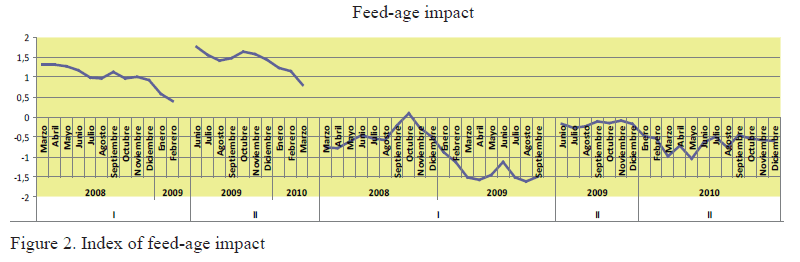
<p align="justify" class="Cuerpodetexto" style="text-indent:0in;"><span style="font-family:'Verdana','sans-serif'; font-size:10.0pt; ">The  monoculture presented variables with similar situation in the weight and gains,  although it was not superior to the cycles of the silvopastoral system.&nbsp; The highest values were obtained in both  cycles in the silvopastoral system agreeing with the highest feed availability.</span></p>     <p align="justify" class="Cuerpodetexto" style="text-indent:0in;"><span style="font-family:'Verdana','sans-serif'; font-size:10.0pt; ">In  spite of the above mentioned, weight gains increased favoring the silvopastoral  system in both cycles and highest values were found where the tree was present.  However, the high temperature during the rainy and part of the dry periods  probably influenced on these results, considering that consumption and animal  welfare could have been affected to a lesser extent, in the silvopastoral  system compared to the monoculture of improved pasture (&Aacute;lvarez and Milera  2014).</span></p>     <p align="justify" class="Cuerpodetexto" style="text-indent:0in;"><span style="font-family:'Verdana','sans-serif'; font-size:10.0pt; ">The  water stress could have also affected the weight gain results, since water is a  vital element, and in very few opportunities its importance is considered.&nbsp; By its nature this resource is one of the  most important for the development and success of the productive processes,  since it fulfills fundamental physiological functions in the animal&rsquo;s  organism.&nbsp; Depending from the type of  feed, the objective of production and the climate, water consumption varies,  although it can be considered that is equal to 10 % of live weight.&nbsp; It is known that for the heifer category is  38 L.animal<sup>-1</sup>.d<sup>-1</sup> (Garc&iacute;a 2011). Hence, the lack of water  can explain the negative values during the assessment, which were higher in  cycle 1 of the silvopastoral system, due to the higher bromatological  composition of the diet by the presence of leucaena.</span></p>     <p align="justify" class="Cuerpodetexto" style="text-indent:0in;"><span style=" letter-spacing:.2pt; font-family:'Verdana','sans-serif'; font-size:10.0pt; ">If considered that animals could have been submitted to a  certain lack of water, the analysis carried out demonstrated the impact that  this could have had on live weight and gains, in both cycles, with the  different treatments. However, it would be imperative to realize future  experiments in which it would be possible determining, under these same  conditions, the effect of the lack of water on the studied indicators.</span><span style="font-family:'Verdana','sans-serif'; font-size:10.0pt; "> </span></p>     <p align="justify" class="Cuerpodetexto" style="text-indent:0in;"><span style="font-family:'Verdana','sans-serif'; font-size:10.0pt; "><a href="/img/revistas/cjas/v50n1/f0207116.gif">Figure 2</a> shows the effect of the feed and age at&nbsp; incorporation. These latter performed above  zero only when the silvopastoral technique was introduced, even in the dry  period, due to the fact that feed availability was increased with the legume  inclusion that improved the quality of the diet.&nbsp; Nonetheless, in both cycles, animals grazed  in the monoculture and only October occupied a value of 0.09.&nbsp; The rest of the months showed negative  values.&nbsp; In the same way performed age at&nbsp; incorporation in both treatments. This  demonstrated that feeding has impact on age at incorporation to reproduction of  the replacement female, since on existing higher availability and quality of  the feed, ages at incorporation could decrease or vice versa, as evidenced in  the evaluation of the Charolais replacement females (Iglesias <em>et al.</em> 2012).</span></p>     
<p align="justify" class="Cuerpodetexto" style="text-indent:0in;"><span style=" letter-spacing:.1pt; font-family:'Verdana','sans-serif'; font-size:10.0pt; ">In animals of the cycles corresponding to monoculture,  which consumed only pastures and mineral salts, the first only contributed with  8 to 8.7 % of protein.&nbsp; These animals did  not receive the benefits of the legume trees that contribute to the fixation of  atmospheric nitrogen what justify values attained (</span><span style="font-family:'Verdana','sans-serif'; font-size:10.0pt; ">Murgueito  2011 and Fern&aacute;ndez <em>et al.</em> 2014<span style="letter-spacing:.1pt; ">).</span></span></p>     <p align="justify" class="Cuerpodetexto" style="text-indent:0in;"><span style="font-family:'Verdana','sans-serif'; font-size:10.0pt; ">The  agronomic-productive performance in the areas evolved with the stability in the  time and attained high biomass production in the cycles represented by the  silvopastoral technology (Uribe <em>et al.</em> 2011), which was of special  importance, since it was attained under totally natural conditions, without the  application of any type of fertilizer or irrigation.&nbsp; Probably, this biomass production in the  system did not limit animal consumption however this did not occur in the  monoculture where the yield in the dry period was low, less than 20 % of its  annual yield.</span></p>     ]]></body>
<body><![CDATA[<p align="justify" class="Cuerpodetexto" style="text-indent:0in;"><span style="font-family:'Verdana','sans-serif'; font-size:10.0pt; ">The  climatic variables that were represented by rainfall, temperature and  evaporation, in both cycles, demonstrated their effect on the rainy period as  in the dry, although the evaporation had lower significance (<a href="/img/revistas/cjas/v50n1/f0307116.gif">figure 3</a>).&nbsp; Rainfall occurrence propitiated higher feed  availability (biomass). Especially in the case of the silvopastoral system, it  also increased the protein contents and digestibility of the grass and the  legume (Molina <em>et al.</em> 2009).</span></p>     
<p align="justify" class="Cuerpodetexto" style="text-indent:0in;"><span style="font-family:'Verdana','sans-serif'; font-size:10.0pt; ">The highest feed availability in the rainy period  regarding the dry which marks the seasonal nature of the biomass production is  related to the age at&nbsp; incorporation and weight,  according to Milera <em>et al.</em> (2012). However, the genotype used in this  study is expressed in animals which are high feed converters, which allows  obtaining higher weight, especially in the silvopastoral system compared to the  monoculture, in spite of being both under similar climatic conditions during  the experimental period.&nbsp; Animal  incorporated to the silvopastoral technology could not be exposed, in a direct  form, to the high temperatures of the evaluated period, due to the shade  projected by the trees. This supplied a favorable environment, greater welfare  and stress decrease, allowing higher intake (&Aacute;lvarez and Milera 2014), since  shade is one of the mildness offered by trees in the cattle productive systems.</span><span style="font-family:'Verdana','sans-serif'; font-size:10.0pt; "> </span></p>     <p align="justify" class="Cuerpodetexto" style="text-indent:0in;"><span style="font-family:'Verdana','sans-serif'; font-size:10.0pt; ">In  this region during the greatest part of the year, and in some hours of the day,  the climatic conditions are adverse for the implantation of cattle systems with  specialized breeds where the presence of trees is not included. The indices of  temperature and relative humidity, for example, exhibit extreme values  throughout almost all the year and influence on the reproductive performance of  the breeds. This was demonstrated by Ben&iacute;tez <em>et al.</em> (2009) who indicated  that the Charolais breed had better performance than the Zebu and the Criolla.</span></p>     <p align="justify" class="Cuerpodetexto" style="text-indent:0in;"><span style="font-family:'Verdana','sans-serif'; font-size:10.0pt; ">As last impact variable in the silvopastoral technology,  the initial age coincides with weaning of the Charolais females. Animals weaned  at nine months, approximately attained positive values in both treatments,  which were higher where trees were incorporated demonstrating the impact at the  animals in this stage (<a href="/img/revistas/cjas/v50n1/f0407116.gif">figure 4</a>).&nbsp; This  variable, although was the last regarding to its impact was determinant in the  age to&nbsp; incorporation, gain and weight of  the animals, since it was demonstrated that when the requirements of the  animals are covered, better productive indicators can be attained (Iglesias <em>et  al.</em> 2012). It is necessary to restate that with the introduction of the  silvopastoral technology, daily gains and weight were higher and, thus, age  at&nbsp; incorporation was optimized.</span><span style="font-family:'Verdana','sans-serif'; font-size:10.0pt; "> </span></p>     
<p align="justify" class="Cuerpodetexto" style="text-indent:0in;"><span style="font-family:'Verdana','sans-serif'; font-size:10.0pt; ">Cost  index cards of these systems are shown in <a href="/img/revistas/cjas/v50n1/t0207116.gif">table 2</a> and were prepared based on a  herd of 120 animals. The comparative analysis of cycles I and II of the  introduction of the silvopastoral technology indicated increase in the total  incomes, as consequence of the weight gain increase.&nbsp; In cycle I, as in II, economic incomes  improved by 5.6 %, which was favorable.</span></p>     
<p align="justify" class="Cuerpodetexto" style="text-indent:0in;"><span style="font-family:'Verdana','sans-serif'; font-size:10.0pt; ">In  both treatments satisfactory economic indicators were registered.&nbsp; However, they were more favorable for females  in the silvopastoral system, with costs.animal<sup>-1</sup>.kg live weight and  produced weight and higher    benefit/cost relationship.&nbsp; In the  silvopastoral treatment the importance of decreasing the duration of the  rearing stage was verified, since in cycle II only 273 d were invested,  regarding the 366 d of cycle I, being thus even more economic the performance  of these indicators.</span></p>     <p align="justify" class="Cuerpodetexto" style="text-indent:0in;"><span style="font-family:'Verdana','sans-serif'; font-size:10.0pt; ">In  this system (silvopastoral), feeding expenses did not surpass 10 % regarding  the total, due that the diet of the animals improves the contribution of <em>L.  leucocephala</em>. The most expensive element of the system was the purchase of  animals which was higher to 80 % of the expenses.&nbsp; On the matter, Cino&nbsp; (2008) indicated that this aspect is the strongest  element of the rearing and fattening cost of bovines, but it grants  profitability to the system.</span></p>     <p align="justify" class="Cuerpodetexto" style="text-indent:0in;"><span style="font-family:'Verdana','sans-serif'; font-size:10.0pt; ">In  cycle I as in II, the economic incomes improved (<a href="/img/revistas/cjas/v50n1/t0207116.gif">table 2</a>), favoring the  silvopastoral system by 5.92 and 0.94 %, respectively, which is considered an  acceptable result (Gonz&aacute;lez and Alcar&aacute;z 2013).</span></p>     
<p align="justify" class="Cuerpodetexto" style="text-indent:0in;"><span style="font-family:'Verdana','sans-serif'; font-size:10.0pt; ">Results  obtained during three years of researchs evidenced that the advantages of the  silvopastoral systems regarding the monoculture of star grass as for its  productive and economic efficiency.&nbsp; For  that, it is necessary to consider as main premise the adequate establishment of  the system and strict fulfillment of the technological discipline requiring the  exploitation of this system. It must be underlined that results were obtained  under commercial production conditions and in soils under degradation process.</span></p>     <p align="justify"><span style=" font-family:'Verdana','sans-serif'; font-size:10.0pt; ">It is recommended to extend  this system to other units of commercial production, as well as realizing  future investigations involving the aspects related with the climate, soil and  animal and plant nutrition</span><font size="2" face="Verdana, Arial, Helvetica, sans-serif">.</font></p>     ]]></body>
<body><![CDATA[<p align="justify">&nbsp;</p>     <p align="justify"><font size="2" face="Verdana, Arial, Helvetica, sans-serif"><b><font size="3">ACKNOWLEDGEMENTS</font></b></font></p>     <p align="justify"><font size="2" face="Verdana, Arial, Helvetica, sans-serif"><span style=" font-family:'Verdana','sans-serif'; font-size:10.0pt; ">Thanks  are due to the Empresa de Gen&eacute;tica y Cr&iacute;a &ldquo;Manuel Fajardo&rdquo;, from Jiguan&iacute;  municipality, Granma province, Cuba and to the workers for the help offered for  conducting this investigation</span>.</font></p>      <p align="justify">&nbsp;</p>      <p align="justify"><font size="2" face="Verdana, Arial, Helvetica, sans-serif"><font size="3"><b>REFERENCES</b></font></font></p>     <p align="justify" class="MsoBibliography"><span style=" font-family:'Verdana','sans-serif'; font-size:10.0pt; ">&Aacute;lvarez A. 2014.  &lsquo;&lsquo;Contribuci&oacute;n de los sistemas agroforestales a la mitigaci&oacute;n y a la adaptaci&oacute;n  al cambio clim&aacute;tico&rsquo;&rsquo;. In: <em>III Convenci&oacute;n Internacional Agrodesarrollo 2014</em>,  Matanzas, Cuba: EEPF Indio Hatuey, pp. 321&ndash;324, ISBN: 978-959-7138-18-1.</span></p>     <p align="justify" class="MsoBibliography"><span style="font-family:'Verdana','sans-serif'; font-size:10.0pt; ">Ben&iacute;tez D.,  Ricardo Y., Viamontes M. I., Romero A., Guevara O., Torres V., Miranda M.,  Guerra J. &amp; Olivera C. 2009. &lsquo;&lsquo;Alternativas tecnol&oacute;gicas para la hembra  vacuna de reemplazo en el Valle del Cauto&rsquo;&rsquo;. </span><em><span style="font-family:'Verdana','sans-serif'; font-size:10.0pt; ">Cuban Journal of  Agricultural Science</span></em><span style="font-family:'Verdana','sans-serif'; font-size:10.0pt; ">, 43 (4), Available:  &lt;<a href="http://repositoriodigital.academica.mx/jspui/handle/987654321/387113" target="_blank">http://repositoriodigital.academica.mx/jspui/handle/987654321/387113</a>&gt;,  [Accessed:&nbsp;February 12, 2016].</span></p>     <p align="justify" class="MsoBibliography"><span style="font-family:'Verdana','sans-serif'; font-size:10.0pt; ">Cino D., D&iacute;az  A., Castillo E. &amp; Vega A. 2014. &lsquo;&lsquo;Sistemas silvopastoriles con Leucaena  leucocephala en tecnolog&iacute;as vacunas: un an&aacute;lisis econ&oacute;mico financiero&rsquo;&rsquo;. In: <em>III  Convenci&oacute;n Internacional Agrodesarrollo 2014</em>, Matanzas, Cuba: EEPF Indio  Hatuey, pp. 993&ndash;998, ISBN: 978-959-7138-18-1.</span></p>     <!-- ref --><p align="justify" class="MsoBibliography"><span style="font-family:'Verdana','sans-serif'; font-size:10.0pt; ">Consejo de  Ministros. 2015. <em>Precios m&aacute;ximos de acopio en pesos cubanos (CUP), para la  contrataci&oacute;n de los productos: arroz, frijol, tabaco, ganado bovino en pie y  leche fresca por las entidades estatales</em>. cod. 7734-2015.    </span></p>     ]]></body>
<body><![CDATA[<!-- ref --><p align="justify" class="MsoBibliography"><span style="font-family:'Verdana','sans-serif'; font-size:10.0pt; ">D&iacute;az A. 2008. <em>Producci&oacute;n  de carne bovina en pastoreo con gram&iacute;neas y leguminosas</em>. Ph.D. Thesis,  Instituto de Ciencia Animal, La Habana, Cuba.    </span></p>     <p align="justify" class="MsoBibliography"><span style="font-family:'Verdana','sans-serif'; font-size:10.0pt; ">Fern&aacute;ndez L. A.,  Rodr&iacute;guez H., Mu&ntilde;oz D., Rivero A., Canel J., Rivero L. E. &amp; Cabrera Y.  2014. &lsquo;&lsquo;Elaboraci&oacute;n de un balance de nitr&oacute;geno en unidades de producci&oacute;n de  leche&rsquo;&rsquo;. In: <em>III Convenci&oacute;n Internacional Agrodesarrollo 2014</em>, Matanzas,  Cuba: EEPF Indio Hatuey, pp. 1062&ndash;1067, ISBN: 978-959-7138-18-1.</span></p>     <p align="justify" class="MsoBibliography"><span style="font-family:'Verdana','sans-serif'; font-size:10.0pt; ">Gonz&aacute;lez P. J.  M. &amp; Alcaraz V. J. V. 2014. &lsquo;&lsquo;Cultivo y costos de un sistema silvopastoril  intensivo (sspi) a base de gramineas y Leucaena leucocephala estudio de caso en  tepalcatepec, michoac&aacute;n, m&eacute;xico&rsquo;&rsquo;. <em>INCEPTUM Revista de Investigaci&oacute;n en  Ciencias de la Administraci&oacute;n</em>, 8 (15), pp. 277&ndash;292, ISSN: 1870-526X,  2007-9494.</span></p>     <p align="justify" class="MsoBibliography"><span style="font-family:'Verdana','sans-serif'; font-size:10.0pt; ">Hern&aacute;ndez A.,  P&eacute;rez J., Bosch D. &amp; Castro N. 2015. <em>Clasificaci&oacute;n de los suelos de Cuba  2015</em>. Mayabeque, Cuba: Ediciones INCA, 93 p., ISBN: 978-959-7023-77-7.</span></p>     <p align="justify" class="MsoBibliography"><span style="font-family:'Verdana','sans-serif'; font-size:10.0pt; ">Iglesias J. M.,  Sim&oacute;n L., Milera M. &amp; Lamela L. 1997. &lsquo;&lsquo;Sistemas de producci&oacute;n bovina a  base de pastos y forrajes&rsquo;&rsquo;. <em>Pastos y Forrajes</em>, 20 (1), pp. 73&ndash;100,  ISSN: 2078-8452.</span></p>     <p align="justify" class="MsoBibliography"><span style="font-family:'Verdana','sans-serif'; font-size:10.0pt; ">Mart&iacute;nez J.,  Milera M., Remy V., Yepes I. &amp; Hern&aacute;ndez J. 1990. &lsquo;&lsquo;Un m&eacute;todo &aacute;gil para  estimar la disponibilidad de pasto en una vaquer&iacute;a comercial&rsquo;&rsquo;. <em>Pastos y  Forrajes</em>, 14 (2), pp. 101&ndash;112, ISSN: 2078-8452.</span></p>     <p align="justify" class="MsoBibliography"><span style="font-family:'Verdana','sans-serif'; font-size:10.0pt; ">Milera M., Remy  V. A., Machado R., Mart&iacute;n G. J., Ojeda F., P&eacute;rez A., Wencomo H. B., Toral O.,  Iglesias J. M. &amp; L&oacute;pez O. 2012. &lsquo;&lsquo;Importancia de las plantas prote&iacute;nicas  para la producci&oacute;n animal en Cuba&rsquo;&rsquo;. In: <em>II Convenci&oacute;n Internacional  Agrodesarrollo 2012</em>, Matanzas, Cuba: EEPF Indio Hatuey, pp. 309&ndash;315, ISBN:  978-959-7138-12-9.</span></p>     <p align="justify" class="MsoBibliography"><span style="font-family:'Verdana','sans-serif'; font-size:10.0pt; ">Molina C. H.,  Molina C. H., Molina J. E. &amp; Molina J. P. 2009. &lsquo;&lsquo;Carne, leche y mejor  ambiente en el sistema silvopastoril intensivo con <em>Leucaena leucocephala</em> (Lam.) de Wit MIMOSACEAE&rsquo;&rsquo;. In: Murgueitio R. E., Naranjo R. J. F. &amp;  Cuartas C. C. A. (eds.), <em>Ganader&iacute;a del futuro: investigaci&oacute;n para el  desarrollo</em>, Cali, Colombia: Fundaci&oacute;n CIPAV, pp. 41&ndash;65, ISBN:  978-958-9386-58-3.</span></p>     <p align="justify" class="MsoBibliography"><span style="font-family:'Verdana','sans-serif'; font-size:10.0pt; ">Murgueito E.  2011. &lsquo;&lsquo;Ganader&iacute;a del futuro&rsquo;&rsquo;. In: <em>III Congreso sobre sistemas  silvopastoriles intensivos para la ganader&iacute;a sostenible del siglo XXI</em>, pp.  1&ndash;7.</span></p>     ]]></body>
<body><![CDATA[<!-- ref --><p align="justify" class="MsoBibliography"><span style="font-family:'Verdana','sans-serif'; font-size:10.0pt; ">Preston T. R. &amp; Willis M. S. 1970. <em>Intensive Beef Production</em>.  1st ed., Oxford, New York: Pergamon Press, 536 p., ISBN: 978-0-08-015652-1.    </span></p>     <p align="justify" class="MsoBibliography"><span style="font-family:'Verdana','sans-serif'; font-size:10.0pt; ">Torres V., Ramos  N., Lizazo D., Monteagudo F. &amp; Noda A. 2008. &lsquo;&lsquo;Modelo estad&iacute;stico para la  medici&oacute;n del impacto de la innovaci&oacute;n o transferencia tecnol&oacute;gica en la rama  agropecuaria&rsquo;&rsquo;. <em>Cuban Journal of Agricultural Science</em>, 42, p. 133, ISSN:  2079-3480.</span></p>     <p align="justify" class="MsoBibliography"><span style="font-family:'Verdana','sans-serif'; font-size:10.0pt; ">Uribe F.,  Zuluaga A. F., Valencia L., Murgueitio E., Zapata A., Solarte L. &amp; Soto R.  B. 2011. <em>Establecimiento y manejo de sistemas silvopastoriles</em>. Proyecto  ganader&iacute;a colombiana sostenible, Bogot&aacute;, Colombia: GEF, Banco Mundial, FEDEGAN,  CIPAV, Fondo Accion, TN, p. 78, ISBN:&nbsp;  978-958-8498-35-5, Available:  &lt;<a href="http://www.cipav.org.co/pdf/1.Establecimiento.y.manejo.de.SSP.pdf" target="_blank">http://www.cipav.org.co/pdf/1.Establecimiento.y.manejo.de.SSP.pdf</a>&gt;,  [Accessed:&nbsp;February 12, 2016].</span></p>     <!-- ref --><p align="justify" class="MsoBibliography"><span style="font-family:'Verdana','sans-serif'; font-size:10.0pt; ">Vega A. 2012. <em>Crianza  de hembras de reemplazo Charolaise de Cuba, en silvopastoreo con Leucaena  leucocephala y Cynodon nlemfuensis</em>. Ph.D. Thesis, Instituto de Ciencia  Animal, La Habana, Cuba.    </span></p>     <p align="justify"><span style="font-family:'Verdana','sans-serif'; font-size:10.0pt; ">Vega  A. M., Herrera R. S., Lamela L., Santana A. A. &amp; Rodr&iacute;guez G. A. 2013.  &lsquo;&lsquo;Evaluaci&oacute;n en Silvopastoreo y monocultivo de hembras Charolaise en  crecimiento en el oriente cubano&rsquo;&rsquo;. <em>REDVET. Revista Electr&oacute;nica de  Veterinaria</em>, 14 (2), pp. 1&ndash;10, ISSN: 1695-7504</span><font size="2" face="Verdana, Arial, Helvetica, sans-serif">.</font> </p>     <p align="justify">&nbsp;</p>     <p align="justify">&nbsp;</p>     <p align="justify"><font size="2" face="Verdana, Arial, Helvetica, sans-serif">Received: February 8, 2016    ]]></body>
<body><![CDATA[<br>   Accepted: April 20, 2016</font></p>     <p align="justify">&nbsp;</p>     <p align="justify">&nbsp;</p>     <p align="justify"><font size="2" face="Verdana, Arial, Helvetica, sans-serif"><i>Ana M. Vega,</i> Universidad de Granma, Apartado Postal 21, Bayamo, Granma. C.P. 85 100.    Email: <a href="mailto:avegaa@udg.co.cu">avegaa@udg.co.cu</a></font></p>      ]]></body><back>
<ref-list>
<ref id="B1">
<nlm-citation citation-type="book">
<person-group person-group-type="author">
<name>
<surname><![CDATA[Álvarez]]></surname>
<given-names><![CDATA[A.]]></given-names>
</name>
</person-group>
<article-title xml:lang="nd"><![CDATA[Contribución de los sistemas agroforestales a la mitigación y a la adaptación al cambio climático]]></article-title>
<source><![CDATA[]]></source>
<year>2014</year>
<page-range>321-324</page-range><publisher-loc><![CDATA[Matanzas, Cuba ]]></publisher-loc>
<publisher-name><![CDATA[EEPF Indio Hatuey]]></publisher-name>
</nlm-citation>
</ref>
<ref id="B2">
<nlm-citation citation-type="journal">
<person-group person-group-type="author">
<name>
<surname><![CDATA[Benítez]]></surname>
<given-names><![CDATA[D.]]></given-names>
</name>
<name>
<surname><![CDATA[Ricardo]]></surname>
<given-names><![CDATA[Y.]]></given-names>
</name>
<name>
<surname><![CDATA[Viamontes]]></surname>
<given-names><![CDATA[M. I.]]></given-names>
</name>
<name>
<surname><![CDATA[Romero]]></surname>
<given-names><![CDATA[A.]]></given-names>
</name>
<name>
<surname><![CDATA[Guevara]]></surname>
<given-names><![CDATA[O.]]></given-names>
</name>
<name>
<surname><![CDATA[Torres]]></surname>
<given-names><![CDATA[V.]]></given-names>
</name>
<name>
<surname><![CDATA[Miranda]]></surname>
<given-names><![CDATA[M.]]></given-names>
</name>
<name>
<surname><![CDATA[Guerra]]></surname>
<given-names><![CDATA[J.]]></given-names>
</name>
<name>
<surname><![CDATA[Olivera]]></surname>
<given-names><![CDATA[C.]]></given-names>
</name>
</person-group>
<article-title xml:lang="nd"><![CDATA[Alternativas tecnológicas para la hembra vacuna de reemplazo en el Valle del Cauto]]></article-title>
<source><![CDATA[Cuban Journal of Agricultural Science]]></source>
<year>2009</year>
<volume>43</volume>
<numero>4</numero>
<issue>4</issue>
</nlm-citation>
</ref>
<ref id="B3">
<nlm-citation citation-type="book">
<person-group person-group-type="author">
<name>
<surname><![CDATA[Cino]]></surname>
<given-names><![CDATA[D.]]></given-names>
</name>
<name>
<surname><![CDATA[Díaz]]></surname>
<given-names><![CDATA[A.]]></given-names>
</name>
<name>
<surname><![CDATA[Castillo]]></surname>
<given-names><![CDATA[E.]]></given-names>
</name>
<name>
<surname><![CDATA[Vega]]></surname>
<given-names><![CDATA[A.]]></given-names>
</name>
</person-group>
<article-title xml:lang="nd"><![CDATA[Sistemas silvopastoriles con Leucaena leucocephala en tecnologías vacunas: un análisis económico financiero]]></article-title>
<source><![CDATA[]]></source>
<year>2014</year>
<page-range>993-998</page-range><publisher-loc><![CDATA[Matanzas, Cuba ]]></publisher-loc>
<publisher-name><![CDATA[EEPF Indio Hatuey]]></publisher-name>
</nlm-citation>
</ref>
<ref id="B4">
<nlm-citation citation-type="">
<person-group person-group-type="author">
<name>
<surname><![CDATA[Consejo de Ministros]]></surname>
</name>
</person-group>
<source><![CDATA[Precios máximos de acopio en pesos cubanos (CUP), para la contratación de los productos: arroz, frijol, tabaco, ganado bovino en pie y leche fresca por las entidades estatales]]></source>
<year>2015</year>
</nlm-citation>
</ref>
<ref id="B5">
<nlm-citation citation-type="book">
<person-group person-group-type="author">
<name>
<surname><![CDATA[Díaz]]></surname>
<given-names><![CDATA[A.]]></given-names>
</name>
</person-group>
<source><![CDATA[Producción de carne bovina en pastoreo con gramíneas y leguminosas]]></source>
<year>2008</year>
<publisher-loc><![CDATA[La Habana, Cuba ]]></publisher-loc>
<publisher-name><![CDATA[Instituto de Ciencia Animal]]></publisher-name>
</nlm-citation>
</ref>
<ref id="B6">
<nlm-citation citation-type="book">
<person-group person-group-type="author">
<name>
<surname><![CDATA[Fernández]]></surname>
<given-names><![CDATA[L. A.]]></given-names>
</name>
<name>
<surname><![CDATA[Rodríguez]]></surname>
<given-names><![CDATA[H.]]></given-names>
</name>
<name>
<surname><![CDATA[Muñoz]]></surname>
<given-names><![CDATA[D.]]></given-names>
</name>
<name>
<surname><![CDATA[Rivero]]></surname>
<given-names><![CDATA[A.]]></given-names>
</name>
<name>
<surname><![CDATA[Canel]]></surname>
<given-names><![CDATA[J.]]></given-names>
</name>
<name>
<surname><![CDATA[Rivero]]></surname>
<given-names><![CDATA[L. E.]]></given-names>
</name>
<name>
<surname><![CDATA[Cabrera]]></surname>
<given-names><![CDATA[Y.]]></given-names>
</name>
</person-group>
<article-title xml:lang="nd"><![CDATA[Elaboración de un balance de nitrógeno en unidades de producción de leche]]></article-title>
<source><![CDATA[]]></source>
<year>2014</year>
<page-range>1062-1067</page-range><publisher-loc><![CDATA[Matanzas, Cuba ]]></publisher-loc>
<publisher-name><![CDATA[EEPF Indio Hatuey]]></publisher-name>
</nlm-citation>
</ref>
<ref id="B7">
<nlm-citation citation-type="journal">
<person-group person-group-type="author">
<name>
<surname><![CDATA[González]]></surname>
<given-names><![CDATA[P. J. M.]]></given-names>
</name>
<name>
<surname><![CDATA[Alcaraz]]></surname>
<given-names><![CDATA[V. J. V.]]></given-names>
</name>
</person-group>
<article-title xml:lang="nd"><![CDATA[Cultivo y costos de un sistema silvopastoril intensivo (sspi) a base de gramineas y Leucaena leucocephala estudio de caso en tepalcatepec, michoacán, méxico]]></article-title>
<source><![CDATA[INCEPTUM Revista de Investigación en Ciencias de la Administración]]></source>
<year>2014</year>
<volume>8</volume>
<numero>15</numero>
<issue>15</issue>
<page-range>277-292</page-range></nlm-citation>
</ref>
<ref id="B8">
<nlm-citation citation-type="book">
<person-group person-group-type="author">
<name>
<surname><![CDATA[Hernández]]></surname>
<given-names><![CDATA[J. A.]]></given-names>
</name>
<name>
<surname><![CDATA[Pérez]]></surname>
<given-names><![CDATA[J. J. M.]]></given-names>
</name>
<name>
<surname><![CDATA[Bosch]]></surname>
<given-names><![CDATA[I. D.]]></given-names>
</name>
<name>
<surname><![CDATA[Castro]]></surname>
<given-names><![CDATA[S. N.]]></given-names>
</name>
</person-group>
<source><![CDATA[Clasificación de los suelos de Cuba 2015]]></source>
<year>2015</year>
<page-range>93</page-range><publisher-loc><![CDATA[Mayabeque, Cuba ]]></publisher-loc>
<publisher-name><![CDATA[Ediciones INCA]]></publisher-name>
</nlm-citation>
</ref>
<ref id="B9">
<nlm-citation citation-type="journal">
<person-group person-group-type="author">
<name>
<surname><![CDATA[Iglesias]]></surname>
<given-names><![CDATA[J. M.]]></given-names>
</name>
<name>
<surname><![CDATA[Simón]]></surname>
<given-names><![CDATA[L.]]></given-names>
</name>
<name>
<surname><![CDATA[Milera]]></surname>
<given-names><![CDATA[M.]]></given-names>
</name>
<name>
<surname><![CDATA[Lamela]]></surname>
<given-names><![CDATA[L.]]></given-names>
</name>
</person-group>
<article-title xml:lang="nd"><![CDATA[Sistemas de producción bovina a base de pastos y forrajes]]></article-title>
<source><![CDATA[Pastos y Forrajes]]></source>
<year>1997</year>
<volume>20</volume>
<numero>1</numero>
<issue>1</issue>
<page-range>73-100</page-range></nlm-citation>
</ref>
<ref id="B10">
<nlm-citation citation-type="journal">
<person-group person-group-type="author">
<name>
<surname><![CDATA[Martínez]]></surname>
<given-names><![CDATA[J.]]></given-names>
</name>
<name>
<surname><![CDATA[Milera]]></surname>
<given-names><![CDATA[M.]]></given-names>
</name>
<name>
<surname><![CDATA[Remy]]></surname>
<given-names><![CDATA[V.]]></given-names>
</name>
<name>
<surname><![CDATA[Yepes]]></surname>
<given-names><![CDATA[I.]]></given-names>
</name>
<name>
<surname><![CDATA[Hernández]]></surname>
<given-names><![CDATA[J.]]></given-names>
</name>
</person-group>
<article-title xml:lang="nd"><![CDATA[Un método ágil para estimar la disponibilidad de pasto en una vaquería comercial]]></article-title>
<source><![CDATA[Pastos y Forrajes]]></source>
<year>1990</year>
<volume>14</volume>
<numero>2</numero>
<issue>2</issue>
<page-range>101-112</page-range></nlm-citation>
</ref>
<ref id="B11">
<nlm-citation citation-type="book">
<person-group person-group-type="author">
<name>
<surname><![CDATA[Milera]]></surname>
<given-names><![CDATA[M.]]></given-names>
</name>
<name>
<surname><![CDATA[Remy]]></surname>
<given-names><![CDATA[V. A.]]></given-names>
</name>
<name>
<surname><![CDATA[Machado]]></surname>
<given-names><![CDATA[R.]]></given-names>
</name>
<name>
<surname><![CDATA[Martín]]></surname>
<given-names><![CDATA[G. J.]]></given-names>
</name>
<name>
<surname><![CDATA[Ojeda]]></surname>
<given-names><![CDATA[F.]]></given-names>
</name>
<name>
<surname><![CDATA[Pérez]]></surname>
<given-names><![CDATA[A.]]></given-names>
</name>
<name>
<surname><![CDATA[Wencomo]]></surname>
<given-names><![CDATA[H. B.]]></given-names>
</name>
<name>
<surname><![CDATA[Toral]]></surname>
<given-names><![CDATA[O.]]></given-names>
</name>
<name>
<surname><![CDATA[Iglesias]]></surname>
<given-names><![CDATA[J. M.]]></given-names>
</name>
<name>
<surname><![CDATA[López]]></surname>
<given-names><![CDATA[O.]]></given-names>
</name>
</person-group>
<article-title xml:lang="nd"><![CDATA[Importancia de las plantas proteínicas para la producción animal en Cuba]]></article-title>
<source><![CDATA[]]></source>
<year>2012</year>
<page-range>309-315</page-range><publisher-loc><![CDATA[Matanzas, Cuba ]]></publisher-loc>
<publisher-name><![CDATA[EEPF Indio Hatuey]]></publisher-name>
</nlm-citation>
</ref>
<ref id="B12">
<nlm-citation citation-type="book">
<person-group person-group-type="author">
<name>
<surname><![CDATA[Molina]]></surname>
<given-names><![CDATA[C. H.]]></given-names>
</name>
<name>
<surname><![CDATA[Molina]]></surname>
<given-names><![CDATA[C. H.]]></given-names>
</name>
<name>
<surname><![CDATA[Molina]]></surname>
<given-names><![CDATA[J. E.]]></given-names>
</name>
<name>
<surname><![CDATA[Molina]]></surname>
<given-names><![CDATA[J. P.]]></given-names>
</name>
</person-group>
<article-title xml:lang="nd"><![CDATA[Carne, leche y mejor ambiente en el sistema silvopastoril intensivo con Leucaena leucocephala (Lam.) de Wit MIMOSACEAE]]></article-title>
<person-group person-group-type="editor">
<name>
<surname><![CDATA[Murgueitio]]></surname>
<given-names><![CDATA[R. E.]]></given-names>
</name>
<name>
<surname><![CDATA[Naranjo]]></surname>
<given-names><![CDATA[R. J. F.]]></given-names>
</name>
<name>
<surname><![CDATA[Cuartas]]></surname>
<given-names><![CDATA[C. C. A.]]></given-names>
</name>
</person-group>
<source><![CDATA[Ganadería del futuro: investigación para el desarrollo]]></source>
<year>2009</year>
<page-range>41-65</page-range><publisher-loc><![CDATA[Cali, Colombia ]]></publisher-loc>
<publisher-name><![CDATA[Fundación CIPAV]]></publisher-name>
</nlm-citation>
</ref>
<ref id="B13">
<nlm-citation citation-type="">
<person-group person-group-type="author">
<name>
<surname><![CDATA[Murgueito]]></surname>
<given-names><![CDATA[E.]]></given-names>
</name>
</person-group>
<article-title xml:lang="nd"><![CDATA[Ganadería del futuro]]></article-title>
<source><![CDATA[]]></source>
<year>2011</year>
<page-range>1-7</page-range></nlm-citation>
</ref>
<ref id="B14">
<nlm-citation citation-type="book">
<person-group person-group-type="author">
<name>
<surname><![CDATA[Preston]]></surname>
<given-names><![CDATA[T. R.]]></given-names>
</name>
<name>
<surname><![CDATA[Willis]]></surname>
<given-names><![CDATA[M. S.]]></given-names>
</name>
</person-group>
<source><![CDATA[Intensive Beef Production]]></source>
<year>1970</year>
<edition>1st</edition>
<page-range>536</page-range><publisher-loc><![CDATA[Oxford, New York ]]></publisher-loc>
<publisher-name><![CDATA[Pergamon Press]]></publisher-name>
</nlm-citation>
</ref>
<ref id="B15">
<nlm-citation citation-type="journal">
<person-group person-group-type="author">
<name>
<surname><![CDATA[Torres]]></surname>
<given-names><![CDATA[V.]]></given-names>
</name>
<name>
<surname><![CDATA[Ramos]]></surname>
<given-names><![CDATA[N.]]></given-names>
</name>
<name>
<surname><![CDATA[Lizazo]]></surname>
<given-names><![CDATA[D.]]></given-names>
</name>
<name>
<surname><![CDATA[Monteagudo]]></surname>
<given-names><![CDATA[F.]]></given-names>
</name>
<name>
<surname><![CDATA[Noda]]></surname>
<given-names><![CDATA[A.]]></given-names>
</name>
</person-group>
<article-title xml:lang="nd"><![CDATA[Modelo estadístico para la medición del impacto de la innovación o transferencia tecnológica en la rama agropecuaria]]></article-title>
<source><![CDATA[Cuban Journal of Agricultural Science]]></source>
<year>2008</year>
<volume>42</volume>
<page-range>133</page-range></nlm-citation>
</ref>
<ref id="B16">
<nlm-citation citation-type="book">
<person-group person-group-type="author">
<name>
<surname><![CDATA[Uribe]]></surname>
<given-names><![CDATA[F.]]></given-names>
</name>
<name>
<surname><![CDATA[Zuluaga]]></surname>
<given-names><![CDATA[A. F.]]></given-names>
</name>
<name>
<surname><![CDATA[Valencia]]></surname>
<given-names><![CDATA[L.]]></given-names>
</name>
<name>
<surname><![CDATA[Murgueitio]]></surname>
<given-names><![CDATA[E.]]></given-names>
</name>
<name>
<surname><![CDATA[Zapata]]></surname>
<given-names><![CDATA[A.]]></given-names>
</name>
<name>
<surname><![CDATA[Solarte]]></surname>
<given-names><![CDATA[L.]]></given-names>
</name>
<name>
<surname><![CDATA[Soto]]></surname>
<given-names><![CDATA[R. B.]]></given-names>
</name>
</person-group>
<source><![CDATA[Establecimiento y manejo de sistemas silvopastoriles]]></source>
<year>2011</year>
<page-range>78</page-range><publisher-loc><![CDATA[Bogotá, Colombia ]]></publisher-loc>
<publisher-name><![CDATA[GEF, Banco Mundial, FEDEGAN, CIPAV, Fondo Accion, TN]]></publisher-name>
</nlm-citation>
</ref>
<ref id="B17">
<nlm-citation citation-type="book">
<person-group person-group-type="author">
<name>
<surname><![CDATA[Vega]]></surname>
<given-names><![CDATA[A.]]></given-names>
</name>
</person-group>
<source><![CDATA[Crianza de hembras de reemplazo Charolaise de Cuba, en silvopastoreo con Leucaena leucocephala y Cynodon nlemfuensis]]></source>
<year>2012</year>
<publisher-loc><![CDATA[La Habana, Cuba ]]></publisher-loc>
<publisher-name><![CDATA[Instituto de Ciencia Animal]]></publisher-name>
</nlm-citation>
</ref>
<ref id="B18">
<nlm-citation citation-type="journal">
<person-group person-group-type="author">
<name>
<surname><![CDATA[Vega]]></surname>
<given-names><![CDATA[A. M.]]></given-names>
</name>
<name>
<surname><![CDATA[Herrera]]></surname>
<given-names><![CDATA[R. S.]]></given-names>
</name>
<name>
<surname><![CDATA[Lamela]]></surname>
<given-names><![CDATA[L.]]></given-names>
</name>
<name>
<surname><![CDATA[Santana]]></surname>
<given-names><![CDATA[A. A.]]></given-names>
</name>
<name>
<surname><![CDATA[Rodríguez]]></surname>
<given-names><![CDATA[G. A.]]></given-names>
</name>
</person-group>
<article-title xml:lang="nd"><![CDATA[Evaluación en Silvopastoreo y monocultivo de hembras Charolaise en crecimiento en el oriente cubano]]></article-title>
<source><![CDATA[REDVET. Revista Electrónica de Veterinaria]]></source>
<year>2013</year>
<volume>14</volume>
<numero>2</numero>
<issue>2</issue>
<page-range>1-10</page-range></nlm-citation>
</ref>
</ref-list>
</back>
</article>