<?xml version="1.0" encoding="ISO-8859-1"?><article xmlns:mml="http://www.w3.org/1998/Math/MathML" xmlns:xlink="http://www.w3.org/1999/xlink" xmlns:xsi="http://www.w3.org/2001/XMLSchema-instance">
<front>
<journal-meta>
<journal-id>2079-3480</journal-id>
<journal-title><![CDATA[Cuban Journal of Agricultural Science]]></journal-title>
<abbrev-journal-title><![CDATA[Cuban J. Agric. Sci.]]></abbrev-journal-title>
<issn>2079-3480</issn>
<publisher>
<publisher-name><![CDATA[Editorial del Instituto de Ciencia Animal]]></publisher-name>
</publisher>
</journal-meta>
<article-meta>
<article-id>S2079-34802016000100008</article-id>
<title-group>
<article-title xml:lang="en"><![CDATA[Clinical characteristics of induced estrus with hormones, and its relation with gestation percentage in nulliparous female water buffaloes]]></article-title>
<article-title xml:lang="es"><![CDATA[Características clínicas del estro inducido con hormonas y su relación con el porcentaje de gestación en búfalas de río nulíparas]]></article-title>
</title-group>
<contrib-group>
<contrib contrib-type="author">
<name>
<surname><![CDATA[Gallego]]></surname>
<given-names><![CDATA[C]]></given-names>
</name>
<xref ref-type="aff" rid="A01"/>
</contrib>
<contrib contrib-type="author">
<name>
<surname><![CDATA[Oba]]></surname>
<given-names><![CDATA[Eunice]]></given-names>
</name>
<xref ref-type="aff" rid="A04"/>
</contrib>
<contrib contrib-type="author">
<name>
<surname><![CDATA[Alonso]]></surname>
<given-names><![CDATA[J.C]]></given-names>
</name>
<xref ref-type="aff" rid="A02"/>
</contrib>
<contrib contrib-type="author">
<name>
<surname><![CDATA[Fraga]]></surname>
<given-names><![CDATA[L.M]]></given-names>
</name>
<xref ref-type="aff" rid="A01"/>
</contrib>
<contrib contrib-type="author">
<name>
<surname><![CDATA[García López]]></surname>
<given-names><![CDATA[R]]></given-names>
</name>
<xref ref-type="aff" rid="A01"/>
</contrib>
<contrib contrib-type="author">
<name>
<surname><![CDATA[Méndez]]></surname>
<given-names><![CDATA[Mildred]]></given-names>
</name>
<xref ref-type="aff" rid="A01"/>
</contrib>
<contrib contrib-type="author">
<name>
<surname><![CDATA[Padrón]]></surname>
<given-names><![CDATA[E]]></given-names>
</name>
<xref ref-type="aff" rid="A03"/>
</contrib>
</contrib-group>
<aff id="A01">
<institution><![CDATA[,Instituto de Ciencia Animal  ]]></institution>
<addr-line><![CDATA[San José de las Lajas Mayabeque]]></addr-line>
<country>Cuba</country>
</aff>
<aff id="A02">
<institution><![CDATA[,Universidad Agraria de La Habana Fructuoso Rodríguez Pérez  ]]></institution>
<addr-line><![CDATA[San José de las Lajas Mayabeque]]></addr-line>
<country>Cuba</country>
</aff>
<aff id="A03">
<institution><![CDATA[,Empresa Genética Pecuaria El Cangre  ]]></institution>
<addr-line><![CDATA[ Mayabeque]]></addr-line>
<country>Cuba</country>
</aff>
<aff id="A04">
<institution><![CDATA[,Universidad Estatal Paulista Campo de Botucatú ]]></institution>
<addr-line><![CDATA[ San Paulo]]></addr-line>
<country>Brasil</country>
</aff>
<pub-date pub-type="pub">
<day>00</day>
<month>03</month>
<year>2016</year>
</pub-date>
<pub-date pub-type="epub">
<day>00</day>
<month>03</month>
<year>2016</year>
</pub-date>
<volume>50</volume>
<numero>1</numero>
<fpage>61</fpage>
<lpage>69</lpage>
<copyright-statement/>
<copyright-year/>
<self-uri xlink:href="http://scielo.sld.cu/scielo.php?script=sci_arttext&amp;pid=S2079-34802016000100008&amp;lng=en&amp;nrm=iso"></self-uri><self-uri xlink:href="http://scielo.sld.cu/scielo.php?script=sci_abstract&amp;pid=S2079-34802016000100008&amp;lng=en&amp;nrm=iso"></self-uri><self-uri xlink:href="http://scielo.sld.cu/scielo.php?script=sci_pdf&amp;pid=S2079-34802016000100008&amp;lng=en&amp;nrm=iso"></self-uri><abstract abstract-type="short" xml:lang="en"><p><![CDATA[An amount of 82 nulliparous female water buffaloes were studied to compare the signs of induced estrus with hormone protocols (P). Treatments PI (n=29), PII (n=28) and PIII (n=25) received 2.0 mg of estradiol benzoate and intravaginal device of progesterone for nine days. After removing the device, 0.5 mg of prostaglandin F2&#945;, 500 IU of equine chorionic gonadotropin and 0.5 mg of estradiol cypionate (PI and PII) were applied. In PIII, cypionate was replaced by 1000 IU of human chorionic gonadotropin after 48 h. Inseminations were carried out between 48-50 (PI), 56- 58 (PII) and 14-16 h (PIII) after the last hormone. A generalized linear mixed model was applied, which considered the protocol as fixed effect, and the animal nested in the protocol as random effect. Tukey-Kramer test was applied for the multiple comparisons. The animals of PI showed higher swollen vulva (77.5 %) and higher pink coloration of the vaginal vestibule (75.2 %) than those from PII (16.7 and 16.26 %) and PIII (15.4 and 13.26%). Female buffaloes of PI (61.6 %) and PII (81.2 %) showed higher secretions than those of PIII (22.8 %). Uterine texcitement, tone cervical passage and insemination time showed no differences among protocols. Cervical passage showed a positive and high correlation with the gestation percentage. This last was negatively related to excitement and time during the insemination. It can be concluded that differences in the expression of signs had no influence on the percentage of gestation among protocols]]></p></abstract>
<abstract abstract-type="short" xml:lang="es"><p><![CDATA[Se estudiaron 82 búfalas nulíparas para comparar los signos del estro inducido con tres protocolos hormonales (P). Los P I (n=29), P II (n=28) y P III (n=25) recibieron 2.0 mg de benzoato de estradiol y un dispositivo intravaginal de progesterona durante nueve días. Al retirarse el dispositivo, se aplicó 0.5 mg de prostaglandina F2&#945;, 500 UI de gonadotropina coriónica equina y 0.5 mg de cipionato de estradiol (PI y PII). En el PIII se sustituyó el cipionato por 1000 UI de gonadotropina coriónica humana 48 h posteriores. Las inseminaciones se realizaron entre 48-50 (PI), 56-58 (PII) y 14-16 h (PIII) después de la última hormona. Se aplicó un modelo lineal generalizado mixto, que consideró al protocolo como efecto fijo y como aleatorio, al animal anidado en el protocolo. Se aplicó dócima de Tukey-Kramer para la comparación múltiple de medias. Los animales del PI mostraron mayor edema vulvar (77.5 %) y coloración rosada del vestíbulo vaginal (75.2 %) que los del PII (16.7 y 16.26 %) y PIII (15.4 y 13.26%). Las búfalas de los PI (61.6 %) y PII (81.2 %) mostraron mayores secreciones que en el PIII (22.8 %).La turgencia uterina, excitemento, permeabilidad cervical y tiempo de inseminación no mostraron diferencias entre los protocolos. La permeabilidad cervical mostró correlación positiva y alta con el porcentaje de gestación. Este último se relacionó negativamente con el excitemento y tiempo durante la inseminación. Se concluye que las diferencias en la expresión de los signos no influyeron en el porcentaje de gestación entre los protocolos]]></p></abstract>
<kwd-group>
<kwd lng="en"><![CDATA[female buffaloes]]></kwd>
<kwd lng="en"><![CDATA[clinical signs]]></kwd>
<kwd lng="en"><![CDATA[estrus]]></kwd>
<kwd lng="en"><![CDATA[hormonal protocol]]></kwd>
<kwd lng="es"><![CDATA[búfalas]]></kwd>
<kwd lng="es"><![CDATA[signos clínicos]]></kwd>
<kwd lng="es"><![CDATA[estro]]></kwd>
<kwd lng="es"><![CDATA[protocolo hormonal]]></kwd>
</kwd-group>
</article-meta>
</front><body><![CDATA[ <p align="right"><strong>Cuban Journal  of Agricultural Science, 50(1): 61-69, 2016, ISSN: 2079-3480</strong></p>     <p align="right">&nbsp;</p>     <p align="right"><font size="2" face="Verdana, Arial, Helvetica, sans-serif"><b>ORIGINAL ARTICLE</b></font></p>     <p align="justify">&nbsp;</p>     <p align="justify"><font size="4" face="Verdana, Arial, Helvetica, sans-serif"><b>Clinical characteristics of induced estrus with hormones, and its relation with gestation percentage in nulliparous female water buffaloes</b></font></p>     <p align="justify">&nbsp;</p>     <p align="justify"><font size="3" face="Verdana, Arial, Helvetica, sans-serif"><b>Características clínicas del estro inducido con hormonas y su relación con el porcentaje de gestación en búfalas de río nulíparas</b></font></p>     <p align="justify">&nbsp;</p>     <p align="justify">&nbsp;</p>     <p align="justify"><font size="2" face="Verdana, Arial, Helvetica, sans-serif"><b>C. Gallego,</b><sup><b>I</b></sup><b> Eunice Oba,</b><sup><b>IV</b></sup><b> J.C. Alonso,</b><sup><b>II</b></sup><b> L.M. Fraga,</b><sup><b>I</b></sup><b> R. Garc&iacute;a L&oacute;pez,</b><sup><b>I</b></sup><b> Mildred M&eacute;ndez,</b><sup><b>I</b></sup><b> E. Padr&oacute;n,</b><sup><b>III</b></sup></font></p>     ]]></body>
<body><![CDATA[<p align="justify"><font size="2" face="Verdana, Arial, Helvetica, sans-serif"><b> </b></font><font size="2" face="Verdana, Arial, Helvetica, sans-serif"><sup>I</sup>Instituto de Ciencia Animal, Apartado Postal 24, San José de las Lajas, Mayabeque, Cuba.    <br>   <sup>II</sup>Universidad Agraria de La Habana “Fructuoso Rodríguez Pérez”, Carretera de Tapaste y Autopista Nacional, San José de las Lajas, Mayabeque, Cuba.     <br>   <sup>III</sup>Empresa Genética Pecuaria “El Cangre”, Mayabeque, Cuba.    <br>   <sup>I</sup><sup>V</sup>Universidad Estatal Paulista, Campo de Botucatú, San Paulo, Brasil. </font></p>     <p align="justify">&nbsp;</p>     <p align="justify">&nbsp;</p> <hr align="JUSTIFY">     <p align="justify"><font size="2" face="Verdana, Arial, Helvetica, sans-serif"><b>ABSTRACT</b></font></p>     <p align="justify"><font size="2" face="Verdana, Arial, Helvetica, sans-serif"><span style=" letter-spacing:.1pt; font-family:'Verdana','sans-serif'; font-size:10.0pt; ">An amount of 82 nulliparous female water buffaloes were studied to  compare the signs of induced estrus with hormone protocols (P). Treatments PI  (n=29), PII (n=28) and PIII (n=25) received  2.0 mg of estradiol benzoate and intravaginal device of progesterone for nine  days. After removing the device, 0.5 mg of prostaglandin F<sub>2&alpha;</sub>, 500 IU  of equine chorionic gonadotropin and 0.5 mg of estradiol cypionate (PI and PII)  were applied. In PIII, cypionate was replaced by 1000 IU of human chorionic  gonadotropin after 48 h. Inseminations were carried out between 48-50 (PI), 56- 58 (PII) and 14-16 h (PIII) after the last hormone. A generalized linear mixed  model was applied, which considered the protocol as fixed effect, and the  animal nested in the protocol as random effect. Tukey-Kramer test was applied  for the multiple comparisons. The animals of PI showed higher swollen vulva  (77.5 %) and higher pink coloration of the vaginal vestibule (75.2 %) than  those from PII (16.7 and 16.26 %) and PIII (15.4 and 13.26%). Female buffaloes  of PI (61.6 %) and PII (81.2 %) showed higher secretions than those of PIII  (22.8 %). Uterine texcitement, tone cervical passage and insemination time  showed no differences among protocols. Cervical passage showed a positive and  high correlation with the gestation percentage. This last was negatively  related to excitement and time during the insemination. It can be concluded  that differences in the expression of signs had no influence on the percentage  of gestation among protocols</span>.</font></p>     <p align="justify"><font size="2" face="Verdana, Arial, Helvetica, sans-serif"><b>Key words:</b> female buffaloes, clinical signs, estrus, hormonal protocol.</font></p> <hr align="JUSTIFY">     <p align="justify"><font size="2" face="Verdana, Arial, Helvetica, sans-serif"><b>RESUMEN</b></font></p>     ]]></body>
<body><![CDATA[<p align="justify"><font size="2" face="Verdana, Arial, Helvetica, sans-serif"><span style=" font-family:'Verdana','sans-serif'; font-size:10.0pt; ">Se  estudiaron 82 b&uacute;falas nul&iacute;paras para comparar los signos del estro inducido con  tres protocolos hormonales (P). Los P I (n=29), P II (n=28) y P III (n=25)  recibieron 2.0 mg de benzoato de estradiol y un dispositivo intravaginal de  progesterona durante nueve d&iacute;as. Al retirarse el dispositivo, se aplic&oacute; 0.5 mg  de prostaglandina F<sub>2&alpha;</sub>, 500 UI de gonadotropina cori&oacute;nica equina y  0.5 mg de cipionato de estradiol (PI y PII). En el PIII se sustituy&oacute; el  cipionato por 1000 UI de gonadotropina cori&oacute;nica humana 48 h posteriores. Las  inseminaciones se realizaron entre 48-50 (PI), 56-58 (PII) y  14-16 h (PIII) despu&eacute;s de la &uacute;ltima hormona. Se aplic&oacute; un modelo lineal  generalizado mixto, que consider&oacute; al protocolo como efecto fijo y como  aleatorio, al animal anidado en el protocolo. Se aplic&oacute; d&oacute;cima de Tukey-Kramer  para la comparaci&oacute;n m&uacute;ltiple de medias. Los animales del PI mostraron mayor  edema vulvar (77.5 %) y coloraci&oacute;n rosada del vest&iacute;bulo vaginal (75.2 %) que  los del PII (16.7 y  16.26 %) y PIII (15.4 y 13.26%). Las b&uacute;falas de los PI (61.6 %) y PII (81.2 %)  mostraron mayores secreciones que en el PIII (22.8 %).La turgencia uterina,  excitemento, permeabilidad cervical y tiempo de inseminaci&oacute;n no mostraron  diferencias entre los protocolos. La permeabilidad cervical mostr&oacute; correlaci&oacute;n  positiva y alta con el porcentaje de gestaci&oacute;n. Este &uacute;ltimo se relacion&oacute;  negativamente con el excitemento y tiempo durante la inseminaci&oacute;n. Se concluye  que las diferencias en la expresi&oacute;n de los signos no influyeron en el  porcentaje de gestaci&oacute;n entre los protocolos</span>.</font></p>     <p align="justify"><font size="2" face="Verdana, Arial, Helvetica, sans-serif"><b>Palabras    clave:</b>    búfalas, signos clínicos, estro, protocolo hormonal.</font></p> <hr align="JUSTIFY">     <p align="justify">&nbsp;</p>     <p align="justify">&nbsp;</p>     <p align="justify"><font size="2" face="Verdana, Arial, Helvetica, sans-serif"><b><font size="3">INTRODUCTION</font></b></font></p>       <p align="justify" class="Cuerpodetexto" style="text-indent:0in;"><span style=" font-family:'Verdana','sans-serif'; font-size:10.0pt; ">The  use of artificial insemination (AI) in genetic programs of Bufalipso in Cuba is  not in the same proportion than bovine cattle, which leads to a delay in the  genetic process and the desired productive levels (Fraga <em>et al.</em> 2013).  The main causes that limit the extensive use of AI in female buffaloes is the  heat detection and the most appropriate moment to carry it out, because the  clinical signs of estrus are less evident (Rossi <em>et al.</em> 2014).&nbsp; </span></p>       <p align="justify" class="Cuerpodetexto" style="text-indent:0in;"><span style="font-family:'Verdana','sans-serif'; font-size:10.0pt; ">Several  therapies of estrus synchronization are developed for the increase of fertility  (Mohan and Prakash 2010). The most practiced ones are those that synchronize  the wave of follicular development, estrus and ovulation, so animals can be  inseminated at fixed time (FTAI). Nevertheless, it is necessary to contribute  to the knowledge of endocrine and ethologic factors that take part in the  period of sexual behaviour, in order to develop strategies to improve fertility  of species (Porto Filho <em>et al.</em> 2014).</span></p>       <p align="justify" class="Cuerpodetexto" style="text-indent:0in;"><span style=" letter-spacing:.2pt; font-family:'Verdana','sans-serif'; font-size:10.0pt; ">Occurrence, intensity and duration of provoked estrus may  vary according to the different hormonal therapies. Mohan and Prakash (2010)  stated that this performance may contribute to efficiency of hormonal treatments  from the response of reproductive organs, as consequences of hormonal action.  Quirino <em>et al.</em> (2013) and Mirmahmoudi <em>et al.</em> (2014) studied the  expression of several clinical symptoms and signs of natural and induced  estrus. However, there are no studies that refer the performance of estrus  during the FTAI with the use of different hormonal      protocols.</span><span style="font-family:'Verdana','sans-serif'; font-size:10.0pt; "> </span></p>       <p align="justify"><span style=" font-family:'Verdana','sans-serif'; font-size:10.0pt; ">The objective of this study  was to compare the percentage of expression of clinical signs of estrus and  other aspects during the FTAI, and its relation to gestation percentage, with  the use of different hormonal protocols that contain steroidal hormones  (progesterone and estrogens) prostaglandins F<sub>2&alpha;</sub>, human (hCG) and  equine chorionic gonadotropin (eCG) during the period of low breeding season</span><font size="2" face="Verdana, Arial, Helvetica, sans-serif">.</font>   </p>       <p align="justify">&nbsp;</p>     ]]></body>
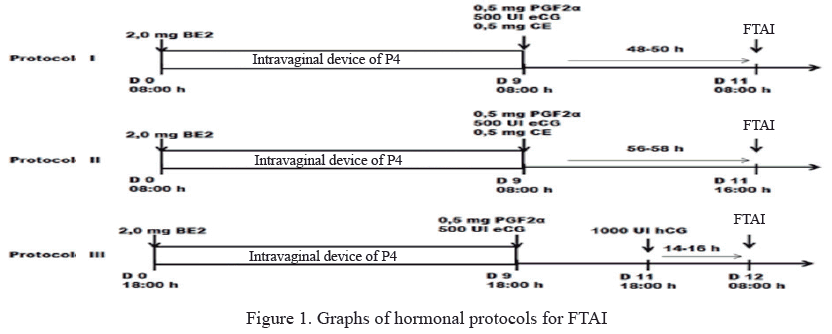
<body><![CDATA[<p align="justify"><font size="2" face="Verdana, Arial, Helvetica, sans-serif"><b><font size="3">MATERIALS AND METHODS</font></b></font></p>     <p align="justify" class="Cuerpodetexto" style="text-indent:0in;"><em><span style=" letter-spacing:.2pt; font-family:'Verdana','sans-serif'; font-size:10.0pt; ">Stage of study, localization and selection of animals</span></em><span style="font-family:'Verdana','sans-serif'; font-size:10.0pt; ">. This research was carried out in July, in a development  unit belonging to Empresa Pecuaria Gen&eacute;tica &ldquo;El Cangre&rdquo; (Latitude 23&ordm; 5.35&rsquo;  North; Longitude 82&ordm; 30.5&rsquo; West), located in G&uuml;ines, Mayabeque province, Cuba.</span><span style=" font-family:'Verdana','sans-serif'; font-size:10.0pt; "> </span></p>     <p align="justify" class="Cuerpodetexto" style="text-indent:0in;"><span style=" letter-spacing:.1pt; font-family:'Verdana','sans-serif'; font-size:10.0pt; ">An amount of 82 nulliparous female water buffaloes with 23  months old, 378.62 &plusmn; 23.78 kg of liveweight and 3.0 points of body condition.  These animals showed no gynecological anomalies at transrectal palpitation and  were free of infect-contagious diseases (brucellosis and tuberculosis).</span></p>     <p align="justify" class="Cuerpodetexto" style="text-indent:0in;"><em><span style="font-family:'Verdana','sans-serif'; font-size:10.0pt; ">Management  and feeding</span></em><span style="font-family:'Verdana','sans-serif'; font-size:10.0pt; ">. During daytime, animals had access  to a continuous grazing (06:00 am up to 07:00 pm), with ponds and natural  shadow. At night, they remained stabulated and water at will. Star grass (<em>Cynodon  nlemfuensis</em>) prevailed as base feed, without fertilization or irrigation,  and, in lower proportion, some varieties like hurricane grass (<em>Botriochloa  pertusa</em>) and bahia grass (<em>Paspalum notatum</em>). Grasses under those  conditions showed an availability of 37.0 kg of DM. female buffalo<sup>-1</sup> during rainy season, which allowed to cover the requirements on a dry  basis.&nbsp;&nbsp;&nbsp;&nbsp;&nbsp; </span></p>     <p align="justify" class="Cuerpodetexto" style="text-indent:0in;"><em><span style="font-family:'Verdana','sans-serif'; font-size:10.0pt; ">E<span style="letter-spacing:.2pt; ">xperimental procedure</span></span></em><span style="font-family:'Verdana','sans-serif'; font-size:10.0pt; ">. Three groups of female buffaloes were created, which  represented the evaluated protocols (P). The animals of PI (n=29), PII (n=28)  and PIII (n=25) received 2.0 mg of estradiol benzoate (BE<sub>2</sub>,  Ourofino&reg;) intramuscularly (IM) and a progesterone-releasing intravaginal  device (PRID of P<sub>4</sub>, Tecnopec&reg;) for nine days. Female buffaloes of PI  and PII received 0.5 mg of prostaglandin F<sub>2&alpha;</sub> (PGF<sub>2&alpha;</sub>,  Ciosin&reg;), 500 international units (IU) of equine chorionic gonadotropin (eCG,  Novormon&reg;) and    0.5 mg estradiol cypionate (EC<sub>2</sub>, E.C.P&reg;) (IM), after withdrawing the  ID of P<sub>4</sub>. Animals of PIII received the same hormonal treatment,  except the CE<sub>2</sub>. At    48 h after the treatment, 1000 IU of human chorionic gonadotropin (hCG,  Chorulon&reg;) were applied (<a href="/img/revistas/cjas/v50n1/f0108116.gif">Figure 1</a>). </span></p>     
<p align="justify" class="Cuerpodetexto" style="text-indent:0in;"><span style="font-family:'Verdana','sans-serif'; font-size:10.0pt; ">FTAI was conducted between 48-50 h in PI    (08:00 am), 56-58 h in PII (04:00 pm) and 14-16 h in PIII (08:00 am), after the  last hormonal application. At the time of the FTAI, signs of estrus (swollen  vulva, vaginal vestibule coloration, mucus discharge cervico-uterine tone, and  color of uterine horns) and other aspects during insemination (excitement,  cervical passage and time of FTAI &le; 60 s) were evaluated, with the purpose of  comparing the expression percentage among hormonal protocols. Pregnancy  diagnosis was performed at 45 d through the rectum (manual and ultrasound).</span><span style="font-family:'Verdana','sans-serif'; font-size:10.0pt; "> </span></p>     <p align="justify" class="Cuerpodetexto" style="text-indent:0in;"><em><span style="font-family:'Verdana','sans-serif'; font-size:10.0pt; ">Statistical  analysis</span></em><span style="font-family:'Verdana','sans-serif'; font-size:10.0pt; ">. Data were processed using a generalized  linear mixed model (Wolfinger and O'Connell 1993), using the PROC GLIMMIX of  SAS (2010) version 9.3. All variables were considered as binomial (1 presence  and absence 0) and the model took into account a binomial distribution and the  logit was considered as bond function, offering the retransformed values. The  treatment (hormonal protocol: three levels) was considered as fixed effect and  the animals (25-29) nested in this treatment were used as random effect.  Covariables of liveweight (LW) and age at the moment of FTAI were evaluated,  which were not considered in the final model because they were not significant.</span></p>     <p align="justify" class="Cuerpodetexto" style="text-indent:0in;"><span style="font-family:'Verdana','sans-serif'; font-size:10.0pt; ">The  test of Tukey, modified by Kramer (1956) for multiple comparison of means, with  significance level of P &lt;0.05, was applied. By means of PROC MEANS of SAS  (2010), position and dispersion statistics (mean, standard deviation,  coefficient of variation, minimum and maximum values) were determined to  binomial variables that showed no differences among hormonal protocols, in  order to know their general performance. The CORR procedure of SAS (2013)  program were used to estimate Pearson correlations among the variables studied  for each hormonal protocol.</span></p>     <p align="justify" class="Cuerpodetexto" style="text-indent:0in;"><span style="font-family:'Verdana','sans-serif'; font-size:10.0pt; ">The  following model was used: </span></p>     <p align="justify" class="Cuerpodetexto" style="text-indent:0in;"><span style="font-family:'Verdana','sans-serif'; font-size:10.0pt; ">Y<em><sub>jk</sub></em>=  &mu;+ A<em><sub>j</sub></em>+ C<em><sub>j</sub></em>(A<em><sub>k</sub></em>) +e<em><sub>jk</sub></em></span></p>     ]]></body>
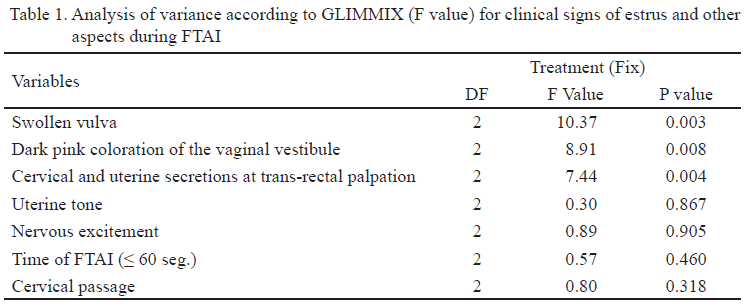
<body><![CDATA[<p align="justify" class="Cuerpodetexto" style="text-indent:0in;"><span style="font-family:'Verdana','sans-serif'; font-size:10.0pt; ">Where:</span></p>     <p align="justify" class="Cuerpodetexto" style="text-indent:0in;"><span style="font-family:'Verdana','sans-serif'; font-size:10.0pt; ">Y<em><sub>jk</sub></em>=  f(&micro;) expected phenotypic value of studied variables, according to the function  of specific bond </span></p>     <p align="justify" class="Cuerpodetexto" style="text-indent:0in;"><span style="font-family:'Verdana','sans-serif'; font-size:10.0pt; ">&mu;  = mean or intercept</span></p>     <p align="justify" class="Cuerpodetexto" style="text-indent:0in;"><span style="font-family:'Verdana','sans-serif'; font-size:10.0pt; ">A<em><sub>j</sub></em>&nbsp; = fixed effect of the&nbsp; j-th hormonal protocol    (k= I, II, III)</span></p>     <p align="justify" class="Cuerpodetexto" style="text-indent:0in;"><span style="font-family:'Verdana','sans-serif'; font-size:10.0pt; ">C<em><sub>k</sub></em> (A<em><sub>j</sub></em>) = random effecto of the k-th female buffalo nested in  the <em>j-th</em> hormonal protocolo </span></p>     <p align="justify"><span style=" font-family:'Verdana','sans-serif'; font-size:10.0pt; ">e<em><sub>jk</sub></em>=  random error due to each observation    NID~(0, s<sup><span style="text-transform:uppercase; ">2</span></sup><sub>e</sub>)</span></p>     <p align="justify">&nbsp;</p>     <p align="justify"><font size="2" face="Verdana, Arial, Helvetica, sans-serif"><b><font size="3">RESULTS AND DISCUSSION</font></b></font></p>     <p align="justify" class="Cuerpodetexto" style="text-indent:0in;"><span style=" font-family:'Verdana','sans-serif'; font-size:10.0pt; ">Swollen  vulva, dark pink coloration of vaginal vestibule and the presence of mucus  discharge cervico-uterine at transrectal palpation were signs that showed differences  among hormonal protocols (<a href="/img/revistas/cjas/v50n1/t0108116.gif">Table 1</a>), while the uterine tone, nervous excitement,  time of    FTAI &le; 60 s and cervical passage showed no significant effect.</span></p>     
<p align="justify" class="Cuerpodetexto" style="text-indent:0in;"><span style="font-family:'Verdana','sans-serif'; font-size:10.0pt; ">Percentages  and differences between treatments suggest that heat of animals from protocol I  had better expression, although it had no influence on pregnancy percentage  (<a href="/img/revistas/cjas/v50n1/f0208116.gif">figure 2</a>). Results could be related to an increase of estrogen concentration  in blood of animals and, consequently, a superior expression of heat  performance during the period of the observation. In general, during other  hours after the application or not of CE<sub>2</sub> (II and III), the signs  occurred in a reduced percentage of animals. This performance could be caused  by the time since the implementation of CE<sub>2</sub> until the observation  during the FTAI. This period of time was shorter (PI = 48-50 h) with respect to  the other hormonal protocols (PII = 56-58 h and PIII = 62-64 h).</span></p>     
]]></body>
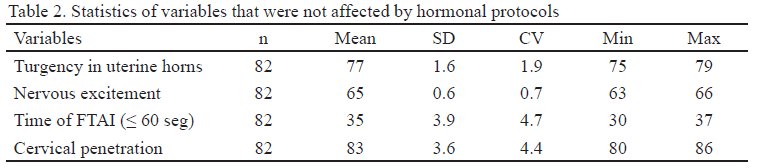
<body><![CDATA[<p align="justify" class="Cuerpodetexto" style="text-indent:0in;"><span style="font-family:'Verdana','sans-serif'; font-size:10.0pt; ">These  results are based on evidence from studies of Mohan <em>et al.</em> (2009), but  in lactating animals. These authors found that 100% of female buffaloes showed  the highest concentrations of estradiol in the blood during the first 24 h  (range 12-26 h) after application of BE<sub>2</sub>, with a tendency to  gradually decrease.</span></p>     <p align="justify" class="Cuerpodetexto" style="text-indent:0in;"><span style="font-family:'Verdana','sans-serif'; font-size:10.0pt; ">Similar  results reported Mohan and Prakash (2010), who also observed that, in 60% of  animals of the same productive category, there was a period of time from the  treatment at the beginning of swollen vulva with a range between 18.2 &plusmn; 1.01  and 40.0 &plusmn; 1.85 h, using the Heatsynch&reg; protocol. Hiremath (2013) reported that  67.8% of female buffaloes in milk production showed equal clinical signs  between 36 and 48 h, after using BE<sub>2</sub>, 24 h after the removal of  PRIDP<sub>4</sub>.</span></p>     <p align="justify" class="Cuerpodetexto" style="text-indent:0in;"><span style="font-family:'Verdana','sans-serif'; font-size:10.0pt; ">Research  conducted by Kajaysri <em>et al.</em> (2015) also demonstrated increased  expression of clinical signs of estrus between 32 and 36 h after removal of the  release device of P<sub>4</sub> (CIDR&reg;). </span></p>     <p align="justify" class="Cuerpodetexto" style="text-indent:0in;"><span style="font-family:'Verdana','sans-serif'; font-size:10.0pt; ">Similar  performances were reported by Pancarci <em>et al.</em> (2002) and Mohan and  Prakash (2010), who found 86 and 60 % of female buffaloes with visible  secretions, when using CE<sub>2</sub> and BE<s><sub>2</sub></s> as ovulation  synchronizer, respectively. These authors described a range of appearance  between 22 and 44 h.</span></p>     <p align="justify" class="Cuerpodetexto" style="text-indent:0in;"><span style=" letter-spacing:.2pt; font-family:'Verdana','sans-serif'; font-size:10.0pt; ">This study showed that swollen vulva and secretions  remained during a slightly superior period, which could be caused by the  frequency and experience of estrus detection, by the nutritional state of  animals, dosage and type of hormone. </span><span style="font-family:'Verdana','sans-serif'; font-size:10.0pt; ">CE<sub>2</sub><span style="letter-spacing:.2pt; ">, the estradiol ester used in PI and PII, has an  average life in blood superior to BE<sub>2</sub>. This effect could explain  most of the permanence of signs observed in this research. The study method of  heat also influenced on the results because the observation was only performed  during the FTAI. Manipulation and stimulation of the insemination catheter in  genital organs could increase uterine contractions that stimulate the fluid  evacuation.</span></span></p>     <p align="justify" class="Cuerpodetexto" style="text-indent:0in;"><span style="font-family:'Verdana','sans-serif'; font-size:10.0pt; ">Other  possible differences may be related to productive and reproductive category  because most of the previous studies were performed in milk-producer  multiparous female buffaloes. Sartori and Mendes (2010) stated that cows,  during lactation, show a period of lower estrus, due to a decrease of estradiol  concentrations circulating in blood, as a consequence of a more accelerated  hepatic metabolism.</span></p>     <p align="justify" class="Cuerpodetexto" style="text-indent:0in;"><span style="font-family:'Verdana','sans-serif'; font-size:10.0pt; ">The uterine tone and cervical passage showed a high  percentage (75-79 and 80-86 %, respectively) in all hormonal protocols (<a href="/img/revistas/cjas/v50n1/t0208116.gif">table  2</a>). Mohan <em>et al.</em> (2009) pointed out, as a distinct characteristic, the  strong increase of uterine tone and cervical dilatation during natural or  induced estrus, apart from the used hormones. However, Atanasov <em>et al.</em> (2011) found no differences in uterine tone when the animals presented  follicules with lower or higher diameter than 10.0 mm<sup>-1</sup>. Studies  conducted by Martin <em>et al.</em> (2009) and Lima <em>et al.</em> (2011)&nbsp; confirm the high sensitivity of the uterus to  the effect of estradiol, due to the high number of estrogen receptors, more  than in other segments of the genital tract.</span><span style="font-family:'Verdana','sans-serif'; font-size:10.0pt; "> </span></p>     
<p align="justify" class="Cuerpodetexto" style="text-indent:0in;"><span style=" letter-spacing:.1pt; font-family:'Verdana','sans-serif'; font-size:10.0pt; ">The action of the eCG stimulating follicle could be the  cause of not having differences in the turgidity of uterine horns and cervical  passage among protocols because this hormone provokes an increase in the  development of dominating follicles and, consequently, an increase of estrogen  concentration in blood of follicular origin. The nervous excitement of animals  showed a similar performance in all protocols, which could justify the  insemination of only between 30 and 37 % of female buffaloes during a time &le; 60  s (<a href="/img/revistas/cjas/v50n1/t0208116.gif">table 2</a>). </span></p>     
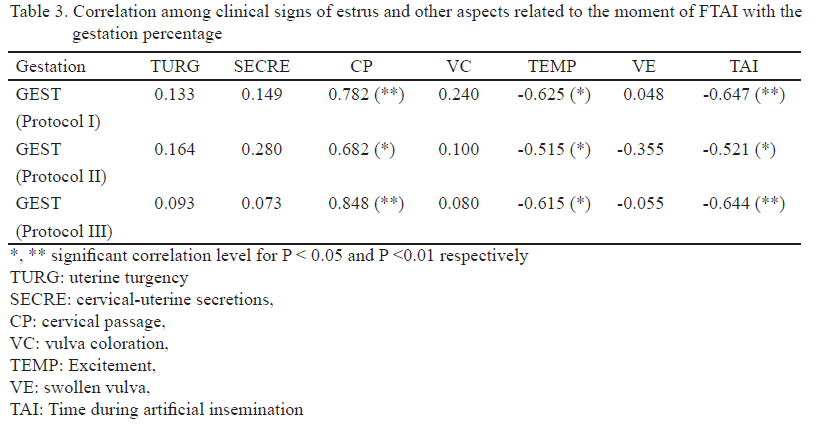
<p align="justify" class="Cuerpodetexto" style="text-indent:0in;"><span style="font-family:'Verdana','sans-serif'; font-size:10.0pt; ">The time during the AI and excitement showed a negative  and mean correlation with gestation in all hormonal protocols (<a href="/img/revistas/cjas/v50n1/t0308116.gif">table 3</a>), which  could have an influence on the act of insemination technique and, consequently,  on fertility of animals. Nervous excitement of animals could be related to  management and scarce daily contact with humans (without milking). This  performance was similar to that reported by Tito <em>et al.</em> (2010), who  stated that young animals may be stressed faster. According to these authors,  frequent moving, attempts to go back, muscular contractions, defecation and jumps,  at the moment of FTAI, may have a negative influence on the skills of the  technician and, consequently, on the insemination time.&nbsp; </span><span style="font-family:'Verdana','sans-serif'; font-size:10.0pt; "> </span></p>     
<p align="justify" class="Cuerpodetexto" style="text-indent:0in;"><span style="font-family:'Verdana','sans-serif'; font-size:10.0pt; ">Vendruscolo <em>et al.</em> (2005) demonstrated that the  speed of FTAI has a significant influence on gestation percentage, and it is  related to cervical passage and excitement of animals. The statistical analysis  of that study evidenced that probability of animals to gestate, from the AI  performed before two minutes, was 3.45 times higher than when the time was    superior.</span><span style="font-family:'Verdana','sans-serif'; font-size:10.0pt; "> </span></p>     ]]></body>
<body><![CDATA[<p align="justify" class="Cuerpodetexto" style="text-indent:0in;"><span style="font-family:'Verdana','sans-serif'; font-size:10.0pt; ">Cervical passage and gestation also showed high and  positive relation (<a href="/img/revistas/cjas/v50n1/t0308116.gif">table 3</a>). Not exposing the spermatozoids to defense cells  (neutrophils and lymphocytes) located in the cervix, advancing the sperm route  and locating the semen in areas of the uterine area, which contain higher  concentration of substances that stimulate the acrosome reaction and neutralize  handicapping factors of seminal plasma, could avoid the decrease of its  concentration, the energy waste and increase of fertilizing ability (Vecchio <em>et  al.</em>&nbsp; 2013).</span><span style="font-family:'Verdana','sans-serif'; font-size:10.0pt; "> </span></p>     
<p align="justify"><span style=" font-family:'Verdana','sans-serif'; font-size:10.0pt; ">It can be concluded that  there are differences in the expression of clinical signs of estrus (swollen  vulva, dark pink coloration of the vaginal vestibule and cervical and uterine  secretions), according to the used hormonal protocols, although they had no  influence on gestation percentage. Fertility of animals is favored by cervical  passage. However, it is affected with the increase of excitement and the time  of FTAI is extended, which are practical aspects to be considered in order to  improve reproductive indexes for future insemination    programs</span><font size="2" face="Verdana, Arial, Helvetica, sans-serif">.</font> </p>     <p align="justify">&nbsp;</p>     <p align="justify"><font size="2" face="Verdana, Arial, Helvetica, sans-serif"><b><font size="3">ACKNOWLEDGEMENTS </font></b></font></p>     <p align="justify"><font size="2" face="Verdana, Arial, Helvetica, sans-serif"><span style=" font-family:'Verdana','sans-serif'; font-size:10.0pt; ">Thanks  to the Coordinaci&oacute;n de Perfeccionamiento para la Educaci&oacute;n Superior de la Rep&uacute;blica  de Brasil (CAPES) for the financing (Project 96/2010) and to the Empresa  Gen&eacute;tica Pecuaria &ldquo;El Cangre&rdquo; for facilitating the implementation of this study</span>.</font></p>     <p align="justify">&nbsp;</p>      <p align="justify"><font size="2" face="Verdana, Arial, Helvetica, sans-serif"><font size="3"><b>REFERENCES</b></font></font></p>     <p align="justify" class="MsoBibliography"><span style=" font-family:'Verdana','sans-serif'; font-size:10.0pt; ">Atanasov A., Yotov S., Antonov A. &amp;  Kolev P. 2011. </span><span style="font-family:'Verdana','sans-serif'; font-size:10.0pt; ">&lsquo;&lsquo;Induction of  oestrus and conception rates in Bulgarian Murrah buffaloes after fixed-time  artificial insemination (A preliminary study)&rsquo;&rsquo;. </span><em><span style="font-family:'Verdana','sans-serif'; font-size:10.0pt; ">Bulgarian  Journal of Veterinary Medicine</span></em><span style="font-family:'Verdana','sans-serif'; font-size:10.0pt; ">, 14 (3), pp. 165&ndash;170,  ISSN: 1311-1477, 1313-3543.</span></p>     <p align="justify" class="MsoBibliography"><span style="font-family:'Verdana','sans-serif'; font-size:10.0pt; ">Fraga B. L. M., Cino N. D. M., Guzman M.  G., Garcia O. Y., Dulzaide M., Fernandez G. D. &amp; Rodriguez L. A. 2013. </span><span style="font-family:'Verdana','sans-serif'; font-size:10.0pt; ">&lsquo;&lsquo;An integrated study on milk and beef production  conducted at Macun Buffalo Enterprise in Cuba. Some results and  recommendations&rsquo;&rsquo;. <em>Buffalo Bulletin</em>, 32 (2), pp. 1174&ndash;1174, ISSN:  0125-6726.</span></p>     <p align="justify" class="MsoBibliography"><span style="font-family:'Verdana','sans-serif'; font-size:10.0pt; ">Hiremath S. S.  2013. &lsquo;&lsquo;Controlled breeding and reproductive management in buffaloes-using EAZI  breed CIDR&rsquo;&rsquo;. <em>Buffalo Bulletin</em>, 32 (2), pp. 418&ndash;422, ISSN: 0125-6726.</span></p>     ]]></body>
<body><![CDATA[<p align="justify" class="MsoBibliography"><span style="font-family:'Verdana','sans-serif'; font-size:10.0pt; ">Kajaysri J.,  Chumchoung C. &amp; Photikanit G. 2015. &lsquo;&lsquo;Estrus and ovulation responses in  anestrus postpartum swamp buffaloes following synchronization with a controlled  internal drug release device and prostaglandin F2</span><span style="font-family:'Verdana','sans-serif'; font-size:10.0pt; ">&alpha;</span><span style="font-family:'Verdana','sans-serif'; font-size:10.0pt; "> based protocolos&rsquo;&rsquo;. <em>Buffalo Bulletin</em>, 34 (3),  ISSN: 0125-6726, Available:  &lt;<a href="https://www.researchgate.net/profile/Jatuporn_Kajaysri/publication/282641248_ESTRUS_AND_OVULATION_RESPONSES_IN_ANESTRUS_POSTPARTUM_SWAMP_BUFFALOES_FOLLOWING_SYNCHRONIZATION_WITH_A_CONTROLLED_INTERNAL_DRUG_RELEASE_DEVICE_AND_PROSTAGLANDIN_F2_BASED_PROTOCOLS/links/5614bff508ae983c1b40bc91.pdf" target="_blank">https://www.researchgate.net/profile/Jatuporn_Kajaysri/publication/282641248_ESTRUS_AND_OVULATION_RESPONSES_IN_ANESTRUS_POSTPARTUM_SWAMP_BUFFALOES_FOLLOWING_SYNCHRONIZATION_WITH_A_CONTROLLED_INTERNAL_DRUG_RELEASE_DEVICE_AND_PROSTAGLANDIN_F2_BASED_PROTOCOLS/links/5614bff508ae983c1b40bc91.pdf</a>&gt;,  [Accessed:&nbsp;February 28, 2016].</span></p>     <p align="justify" class="MsoBibliography"><span style="font-family:'Verdana','sans-serif'; font-size:10.0pt; ">Kramer C. Y.  1956. &lsquo;&lsquo;Extension of Multiple Range Tests to Group Means with Unequal Numbers  of Replications&rsquo;&rsquo;. <em>Biometrics</em>, 12 (3), pp. 307&ndash;310, ISSN: 0006-341X,  DOI: 10.2307/3001469.</span></p>     <p align="justify" class="MsoBibliography"><span style="font-family:'Verdana','sans-serif'; font-size:10.0pt; ">Lima R. S.,  Martin I., Marques Filho W. C., Rodrigues M. M. P., Laufer-Amorim R. &amp;  Ferreira J. C. P. 2011. </span><span style="font-family:'Verdana','sans-serif'; font-size:10.0pt; ">&lsquo;&lsquo;Detec&ccedil;&atilde;o imunoistoqu&iacute;mica de receptores  de estr&oacute;geno e progesterona no endom&eacute;trio de vacas Nelore (<em>Bos taurus  indicus</em>) durante o anestro p&oacute;s-parto&rsquo;&rsquo;. <em>Arquivo Brasileiro de Medicina  Veterin&aacute;ria e Zootecnia</em>, 63 (4), pp. 791&ndash;798, ISSN: 0102-0935, DOI:  10.1590/S0102-09352011000400001.</span></p>     <p align="justify" class="MsoBibliography"><span style="font-family:'Verdana','sans-serif'; font-size:10.0pt; ">Martin I.,  Torres Neto R., Oba E., Buratini Jr J., Binelli M., Laufer-Amorim R. &amp;  Ferreira J. 2008. &lsquo;&lsquo;Immunohistochemical Detection of Receptors for Oestrogen  and Progesterone in Endometrial Glands and Stroma during the Oestrous Cycle in  Nelore (<em>Bos taurus indicus</em>) Cows&rsquo;&rsquo;. <em>Reproduction in Domestic Animals</em>,  43 (4), pp. 415&ndash;421, ISSN: 1439-0531, DOI: 10.1111/j.1439-0531.2007.00928.x.</span></p>     <p align="justify" class="MsoBibliography"><span style="font-family:'Verdana','sans-serif'; font-size:10.0pt; ">Mirmahmoudi  R., Souri M. &amp; Prakash B. S. 2014. &lsquo;&lsquo;Endocrine changes, timing of  ovulation, ovarian follicular growth and efficacy of a novel protocol (<em>Estradoublesynch</em>)  for synchronization of ovulation and timed artificial insemination in Murrah  buffaloes (<em>Bubalus bubalis</em>)&rsquo;&rsquo;. <em>Theriogenology</em>, 81 (2), pp.  237&ndash;242, ISSN: 0093-691X, DOI: 10.1016/j.theriogenology.2013.09.016.</span></p>     <p align="justify" class="MsoBibliography"><span style="font-family:'Verdana','sans-serif'; font-size:10.0pt; ">Mohan K. &amp;  Prakash B. S. 2009. &lsquo;&lsquo;Changes in endogenous estrogens and expression of  behaviors associated with estrus during the periovulatory period in Heatsynch  treated Murrah buffaloes (<em>Bubalus bubalis</em>)&rsquo;&rsquo;. <em>Tropical Animal Health  and Production</em>, 42 (5), pp. 947&ndash;952, ISSN: 0049-4747, 1573-7438, DOI:  10.1007/s11250-009-9512-7.</span></p>     <p align="justify" class="MsoBibliography"><span style="font-family:'Verdana','sans-serif'; font-size:10.0pt; ">Mohan K.,  Sarkar M. &amp; Prakash B. S. 2009. &lsquo;&lsquo;Efficiency of Heatsynch protocol in  estrus synchronization, ovulation and conception of dairy buffaloes (<em>Bubalus  bubalis</em>)&rsquo;&rsquo;. <em>Asian-Australasian Journal of Animal Sciences</em>, 22 (6),  pp. 774&ndash;780, ISSN: 1011-2367.</span></p>     <p align="justify" class="MsoBibliography"><span style="font-family:'Verdana','sans-serif'; font-size:10.0pt; ">Pancarci S.  M., Jordan E. R., Risco C. A., Schouten M. J., Lopes F. L., Moreira F. &amp;  Thatcher W. W. 2002. &lsquo;&lsquo;Use of Estradiol Cypionate in a Presynchronized Timed  Artificial Insemination Program for Lactating Dairy Cattle&rsquo;&rsquo;. <em>Journal of  Dairy Science</em>, 85 (1), pp. 122&ndash;131, ISSN: 0022-0302, DOI:  10.3168/jds.S0022-0302(02)74060-5.</span></p>     <p align="justify" class="MsoBibliography"><span style="font-family:'Verdana','sans-serif'; font-size:10.0pt; ">Porto-Filho R.  M., Gimenes L. U., Monteiro B. M., Carvalho N. A. T., Ghuman S. P. S.,  Madureira E. H. &amp; Baruselli P. S. 2014. &lsquo;&lsquo;Detection of estrous behavior in  buffalo heifers by radiotelemetry following PGF<sub>2</sub></span><sub><span style="font-family:'Verdana','sans-serif'; font-size:10.0pt; ">&alpha;</span></sub><span style="font-family:'Verdana','sans-serif'; font-size:10.0pt; "> administration during the early or late luteal  phase&rsquo;&rsquo;. <em>Animal Reproduction Science</em>, 144 (3&ndash;4), pp. 90&ndash;94, ISSN:  0378-4320, DOI: 10.1016/j.anireprosci.2013.12.006.</span></p>     <p align="justify" class="MsoBibliography"><span style="font-family:'Verdana','sans-serif'; font-size:10.0pt; ">Quirino C.,  Madella O. A., Pacheco A., Almaguer Y., Font H. &amp; Montes I. 2013. </span><span style="font-family:'Verdana','sans-serif'; font-size:10.0pt; ">&lsquo;&lsquo;Comportamento  sexual em b&uacute;falas da regi&atilde;o norte do estado de Rio de Janeiro-Brasil&rsquo;&rsquo;. In: <em>IV  Congreso de Producci&oacute;n Animal Tropical</em>, La Habana, Cuba: EDICA, ISBN:  978-959-7171-49-2.</span></p>     ]]></body>
<body><![CDATA[<p align="justify" class="MsoBibliography"><span style="font-family:'Verdana','sans-serif'; font-size:10.0pt; ">Rossi P., Vecchio D., Neglia G., Di Palo  R., Gasparrini B., D&rsquo;Occhio M. J. &amp; Campanile G. 2014. </span><span style="font-family:'Verdana','sans-serif'; font-size:10.0pt; ">&lsquo;&lsquo;Seasonal fluctuations in the response of Italian  Mediterranean buffaloes to synchronization of ovulation and timed artificial  insemination&rsquo;&rsquo;. <em>Theriogenology</em>, 82 (1), pp. 132&ndash;137, ISSN: 0093-691X,  DOI: 10.1016/j.theriogenology.2014.03.005.</span></p>     <p align="justify" class="MsoBibliography"><span style="font-family:'Verdana','sans-serif'; font-size:10.0pt; ">Sartori R.  &amp; Guardieiro M. M. 2010. &lsquo;&lsquo;Nutritional factors associated with reproduction  in heifers and cows&rsquo;&rsquo;. </span><em><span style="font-family:'Verdana','sans-serif'; font-size:10.0pt; ">Revista Brasileira de Zootecnia</span></em><span style="font-family:'Verdana','sans-serif'; font-size:10.0pt; ">,  39, pp. 422&ndash;432, ISSN: 1516-3598, DOI: 10.1590/S1516-35982010001300047.</span></p>     <!-- ref --><p align="justify" class="MsoBibliography"><span style="font-family:'Verdana','sans-serif'; font-size:10.0pt; ">SAS Institute. </span><span style="font-family:'Verdana','sans-serif'; font-size:10.0pt; ">2010. <em>Statistical Analysis Software SAS/STAT<sup>&reg;</sup></em>.  version 9.0.2, Cary, N.C., USA: SAS Institute Inc, ISBN: 978-1-60764-599-3,  Available: &lt;<a href="http://www.sas.com/en_us/software/analytics/stat.html#" target="_blank">http://www.sas.com/en_us/software/analytics/stat.html#</a>&gt;    .</span></p>     <p align="justify" class="MsoBibliography"><span style="font-family:'Verdana','sans-serif'; font-size:10.0pt; ">Titto E. A.  L., Titto C. G., Gatto E. G., Noronha C. M. S., Mour&atilde;o G. B., Filho J. C. M. N.  &amp; Pereira A. M. F. 2010. &lsquo;&lsquo;Reactivity of Nellore steers in two feedlot  housing systems and its relationship with plasmatic cortisol&rsquo;&rsquo;. <em>Livestock  Science</em>, 129 (1&ndash;3), pp. 146&ndash;150, ISSN: 1871-1413, DOI:  10.1016/j.livsci.2010.01.017.</span></p>     <p align="justify" class="MsoBibliography"><span style="font-family:'Verdana','sans-serif'; font-size:10.0pt; ">Vecchio D.,  Rossi P., Neglia G., Longobardi V., Salzano A., Bifulco G. &amp; Campanile G.  2013. &lsquo;&lsquo;Comparison of two synchronization protocols for timed artificial  insemination in acyclic Italian Mediterranean buffalo cows out of the breeding  season&rsquo;&rsquo;. </span><em><span style="font-family:'Verdana','sans-serif'; font-size:10.0pt; ">Buffalo Bulletin</span></em><span style="font-family:'Verdana','sans-serif'; font-size:10.0pt; ">, 32 (2), pp. 479&ndash;479,  ISSN: 0125-6726.</span></p>     <p align="justify" class="MsoBibliography"><span style="font-family:'Verdana','sans-serif'; font-size:10.0pt; ">Vendruscolo M., Kozicki L. E., Segui M. S.,  Weiss R. R. &amp; Santos I. V. 2006. &lsquo;&lsquo;Rela&ccedil;&atilde;o entre a dura&ccedil;&atilde;o do ato da  insemina&ccedil;&atilde;o artificial em bovinos e a fertilidade&rsquo;&rsquo;. </span><em><span style="font-family:'Verdana','sans-serif'; font-size:10.0pt; ">Archives of Veterinary Science</span></em><span style="font-family:'Verdana','sans-serif'; font-size:10.0pt; ">, 10 (2), ISSN: 1517-784X, DOI:  10.5380/avs.v10i2.4421.</span></p>     <p align="justify"><span style="font-family:'Verdana','sans-serif'; font-size:10.0pt; ">Wolfinger R. &amp;  O&rsquo;connell M. 1993. &lsquo;&lsquo;Generalized linear mixed models a pseudo-likelihood  approach&rsquo;&rsquo;. </span><em><span style="font-family:'Verdana','sans-serif'; font-size:10.0pt; ">Journal  of Statistical Computation and Simulation</span></em><span style="font-family:'Verdana','sans-serif'; font-size:10.0pt; ">, 48 (3-4), pp. 233&ndash;243, ISSN: 0094-9655, DOI:  10.1080/00949659308811554</span><font size="2" face="Verdana, Arial, Helvetica, sans-serif">.</font> </p>     <p align="justify">&nbsp;</p>     <p align="justify">&nbsp;</p>     ]]></body>
<body><![CDATA[<p align="justify"><font size="2" face="Verdana, Arial, Helvetica, sans-serif">Received: February 26, 2015    <br>   Accepted: March 30, 2016</font></p>     <p align="justify">&nbsp;</p>     <p align="justify">&nbsp;</p>     <p align="justify"><font size="2" face="Verdana, Arial, Helvetica, sans-serif"><i>C. Gallego,</i> Instituto de Ciencia Animal, Apartado Postal 24, San José de las Lajas, Mayabeque, Cuba.    Email: <a href="mailto:cgallego@ica.co.cu">cgallego@ica.co.cu</a></font></p>      ]]></body><back>
<ref-list>
<ref id="B1">
<nlm-citation citation-type="journal">
<person-group person-group-type="author">
<name>
<surname><![CDATA[Atanasov]]></surname>
<given-names><![CDATA[A.]]></given-names>
</name>
<name>
<surname><![CDATA[Yotov]]></surname>
<given-names><![CDATA[S.]]></given-names>
</name>
<name>
<surname><![CDATA[Antonov]]></surname>
<given-names><![CDATA[A.]]></given-names>
</name>
<name>
<surname><![CDATA[Kolev]]></surname>
<given-names><![CDATA[P.]]></given-names>
</name>
</person-group>
<article-title xml:lang="nd"><![CDATA[Induction of oestrus and conception rates in Bulgarian Murrah buffaloes after fixed-time artificial insemination (A preliminary study)]]></article-title>
<source><![CDATA[Bulgarian Journal of Veterinary Medicine]]></source>
<year>2011</year>
<volume>14</volume>
<numero>3</numero>
<issue>3</issue>
<page-range>165-170</page-range></nlm-citation>
</ref>
<ref id="B2">
<nlm-citation citation-type="journal">
<person-group person-group-type="author">
<name>
<surname><![CDATA[Fraga]]></surname>
<given-names><![CDATA[B. L. M.]]></given-names>
</name>
<name>
<surname><![CDATA[Cino]]></surname>
<given-names><![CDATA[N. D. M.]]></given-names>
</name>
<name>
<surname><![CDATA[Guzman]]></surname>
<given-names><![CDATA[M. G.]]></given-names>
</name>
<name>
<surname><![CDATA[Garcia]]></surname>
<given-names><![CDATA[O. Y.]]></given-names>
</name>
<name>
<surname><![CDATA[Dulzaide]]></surname>
<given-names><![CDATA[M.]]></given-names>
</name>
<name>
<surname><![CDATA[Fernandez]]></surname>
<given-names><![CDATA[G. D.]]></given-names>
</name>
<name>
<surname><![CDATA[Rodriguez]]></surname>
<given-names><![CDATA[L. A.]]></given-names>
</name>
</person-group>
<article-title xml:lang="nd"><![CDATA[An integrated study on milk and beef production conducted at Macun Buffalo Enterprise in Cuba. Some results and recommendations]]></article-title>
<source><![CDATA[Buffalo Bulletin]]></source>
<year>2013</year>
<volume>32</volume>
<numero>2</numero>
<issue>2</issue>
<page-range>1174-1174</page-range></nlm-citation>
</ref>
<ref id="B3">
<nlm-citation citation-type="journal">
<person-group person-group-type="author">
<name>
<surname><![CDATA[Hiremath]]></surname>
<given-names><![CDATA[S. S.]]></given-names>
</name>
</person-group>
<article-title xml:lang="nd"><![CDATA[Controlled breeding and reproductive management in buffaloes-using EAZI breed CIDR]]></article-title>
<source><![CDATA[Buffalo Bulletin]]></source>
<year>2013</year>
<volume>32</volume>
<numero>2</numero>
<issue>2</issue>
<page-range>418-422</page-range></nlm-citation>
</ref>
<ref id="B4">
<nlm-citation citation-type="journal">
<person-group person-group-type="author">
<name>
<surname><![CDATA[Kajaysri]]></surname>
<given-names><![CDATA[J.]]></given-names>
</name>
<name>
<surname><![CDATA[Chumchoung]]></surname>
<given-names><![CDATA[C.]]></given-names>
</name>
<name>
<surname><![CDATA[Photikanit]]></surname>
<given-names><![CDATA[G.]]></given-names>
</name>
</person-group>
<article-title xml:lang="nd"><![CDATA[Estrus and ovulation responses in anestrus postpartum swamp buffaloes following synchronization with a controlled internal drug release device and prostaglandin F2a based protocolos]]></article-title>
<source><![CDATA[Buffalo Bulletin]]></source>
<year>2015</year>
<volume>34</volume>
<numero>3</numero>
<issue>3</issue>
</nlm-citation>
</ref>
<ref id="B5">
<nlm-citation citation-type="journal">
<person-group person-group-type="author">
<name>
<surname><![CDATA[Kramer]]></surname>
<given-names><![CDATA[C. Y.]]></given-names>
</name>
</person-group>
<article-title xml:lang="nd"><![CDATA[Extension of Multiple Range Tests to Group Means with Unequal Numbers of Replications]]></article-title>
<source><![CDATA[Biometrics]]></source>
<year>1956</year>
<volume>12</volume>
<numero>3</numero>
<issue>3</issue>
<page-range>307-310</page-range></nlm-citation>
</ref>
<ref id="B6">
<nlm-citation citation-type="journal">
<person-group person-group-type="author">
<name>
<surname><![CDATA[Lima]]></surname>
<given-names><![CDATA[R. S.]]></given-names>
</name>
<name>
<surname><![CDATA[Martin]]></surname>
<given-names><![CDATA[I.]]></given-names>
</name>
<name>
<surname><![CDATA[Marques Filho]]></surname>
<given-names><![CDATA[W. C.]]></given-names>
</name>
<name>
<surname><![CDATA[Rodrigues]]></surname>
<given-names><![CDATA[M. M. P.]]></given-names>
</name>
<name>
<surname><![CDATA[Laufer-Amorim]]></surname>
<given-names><![CDATA[R.]]></given-names>
</name>
<name>
<surname><![CDATA[Ferreira]]></surname>
<given-names><![CDATA[J. C. P.]]></given-names>
</name>
</person-group>
<article-title xml:lang="nd"><![CDATA[Detecção imunoistoquímica de receptores de estrógeno e progesterona no endométrio de vacas Nelore (Bos taurus indicus) durante o anestro pós-parto]]></article-title>
<source><![CDATA[Arquivo Brasileiro de Medicina Veterinária e Zootecnia]]></source>
<year>2011</year>
<volume>63</volume>
<numero>4</numero>
<issue>4</issue>
<page-range>791-798</page-range></nlm-citation>
</ref>
<ref id="B7">
<nlm-citation citation-type="journal">
<person-group person-group-type="author">
<name>
<surname><![CDATA[Martin]]></surname>
<given-names><![CDATA[I.]]></given-names>
</name>
<name>
<surname><![CDATA[Torres Neto]]></surname>
<given-names><![CDATA[R.]]></given-names>
</name>
<name>
<surname><![CDATA[Oba]]></surname>
<given-names><![CDATA[E.]]></given-names>
</name>
<name>
<surname><![CDATA[Buratini Jr]]></surname>
<given-names><![CDATA[J.]]></given-names>
</name>
<name>
<surname><![CDATA[Binelli]]></surname>
<given-names><![CDATA[M.]]></given-names>
</name>
<name>
<surname><![CDATA[Laufer-Amorim]]></surname>
<given-names><![CDATA[R.]]></given-names>
</name>
<name>
<surname><![CDATA[Ferreira]]></surname>
<given-names><![CDATA[J.]]></given-names>
</name>
</person-group>
<article-title xml:lang="nd"><![CDATA[Immunohistochemical Detection of Receptors for Oestrogen and Progesterone in Endometrial Glands and Stroma during the Oestrous Cycle in Nelore (Bos taurus indicus) Cows]]></article-title>
<source><![CDATA[Reproduction in Domestic Animals]]></source>
<year>2008</year>
<volume>43</volume>
<numero>4</numero>
<issue>4</issue>
<page-range>415-421</page-range></nlm-citation>
</ref>
<ref id="B8">
<nlm-citation citation-type="journal">
<person-group person-group-type="author">
<name>
<surname><![CDATA[Mirmahmoudi]]></surname>
<given-names><![CDATA[R.]]></given-names>
</name>
<name>
<surname><![CDATA[Souri]]></surname>
<given-names><![CDATA[M.]]></given-names>
</name>
<name>
<surname><![CDATA[Prakash]]></surname>
<given-names><![CDATA[B. S.]]></given-names>
</name>
</person-group>
<article-title xml:lang="nd"><![CDATA[Endocrine changes, timing of ovulation, ovarian follicular growth and efficacy of a novel protocol (Estradoublesynch) for synchronization of ovulation and timed artificial insemination in Murrah buffaloes (Bubalus bubalis)]]></article-title>
<source><![CDATA[Theriogenology]]></source>
<year>2014</year>
<volume>81</volume>
<numero>2</numero>
<issue>2</issue>
<page-range>237-242</page-range></nlm-citation>
</ref>
<ref id="B9">
<nlm-citation citation-type="journal">
<person-group person-group-type="author">
<name>
<surname><![CDATA[Mohan]]></surname>
<given-names><![CDATA[K.]]></given-names>
</name>
<name>
<surname><![CDATA[Prakash]]></surname>
<given-names><![CDATA[B. S.]]></given-names>
</name>
</person-group>
<article-title xml:lang="nd"><![CDATA[Changes in endogenous estrogens and expression of behaviors associated with estrus during the periovulatory period in Heatsynch treated Murrah buffaloes (Bubalus bubalis)]]></article-title>
<source><![CDATA[Tropical Animal Health and Production]]></source>
<year>2009</year>
<volume>42</volume>
<numero>5</numero>
<issue>5</issue>
<page-range>947-952</page-range></nlm-citation>
</ref>
<ref id="B10">
<nlm-citation citation-type="journal">
<person-group person-group-type="author">
<name>
<surname><![CDATA[Mohan]]></surname>
<given-names><![CDATA[K.]]></given-names>
</name>
<name>
<surname><![CDATA[Sarkar]]></surname>
<given-names><![CDATA[M.]]></given-names>
</name>
<name>
<surname><![CDATA[Prakash]]></surname>
<given-names><![CDATA[B. S.]]></given-names>
</name>
</person-group>
<article-title xml:lang="nd"><![CDATA[Efficiency of Heatsynch protocol in estrus synchronization, ovulation and conception of dairy buffaloes (Bubalus bubalis)]]></article-title>
<source><![CDATA[Asian-Australasian Journal of Animal Sciences]]></source>
<year>2009</year>
<volume>22</volume>
<numero>6</numero>
<issue>6</issue>
<page-range>774-780</page-range></nlm-citation>
</ref>
<ref id="B11">
<nlm-citation citation-type="journal">
<person-group person-group-type="author">
<name>
<surname><![CDATA[Pancarci]]></surname>
<given-names><![CDATA[S. M.]]></given-names>
</name>
<name>
<surname><![CDATA[Jordan]]></surname>
<given-names><![CDATA[E. R.]]></given-names>
</name>
<name>
<surname><![CDATA[Risco]]></surname>
<given-names><![CDATA[C. A.]]></given-names>
</name>
<name>
<surname><![CDATA[Schouten]]></surname>
<given-names><![CDATA[M. J.]]></given-names>
</name>
<name>
<surname><![CDATA[Lopes]]></surname>
<given-names><![CDATA[F. L.]]></given-names>
</name>
<name>
<surname><![CDATA[Moreira]]></surname>
<given-names><![CDATA[F.]]></given-names>
</name>
<name>
<surname><![CDATA[Thatcher]]></surname>
<given-names><![CDATA[W. W.]]></given-names>
</name>
</person-group>
<article-title xml:lang="nd"><![CDATA[Use of Estradiol Cypionate in a Presynchronized Timed Artificial Insemination Program for Lactating Dairy Cattle]]></article-title>
<source><![CDATA[Journal of Dairy Science]]></source>
<year>2002</year>
<volume>85</volume>
<numero>1</numero>
<issue>1</issue>
<page-range>122-131</page-range></nlm-citation>
</ref>
<ref id="B12">
<nlm-citation citation-type="journal">
<person-group person-group-type="author">
<name>
<surname><![CDATA[Porto-Filho]]></surname>
<given-names><![CDATA[R. M.]]></given-names>
</name>
<name>
<surname><![CDATA[Gimenes]]></surname>
<given-names><![CDATA[L. U.]]></given-names>
</name>
<name>
<surname><![CDATA[Monteiro]]></surname>
<given-names><![CDATA[B. M.]]></given-names>
</name>
<name>
<surname><![CDATA[Carvalho]]></surname>
<given-names><![CDATA[N. A. T.]]></given-names>
</name>
<name>
<surname><![CDATA[Ghuman]]></surname>
<given-names><![CDATA[S. P. S.]]></given-names>
</name>
<name>
<surname><![CDATA[Madureira]]></surname>
<given-names><![CDATA[E. H.]]></given-names>
</name>
<name>
<surname><![CDATA[Baruselli]]></surname>
<given-names><![CDATA[P. S.]]></given-names>
</name>
</person-group>
<article-title xml:lang="nd"><![CDATA[Detection of estrous behavior in buffalo heifers by radiotelemetry following PGF2a administration during the early or late luteal phase]]></article-title>
<source><![CDATA[Animal Reproduction Science]]></source>
<year>2014</year>
<volume>144</volume>
<numero>3-4</numero>
<issue>3-4</issue>
<page-range>90-94</page-range></nlm-citation>
</ref>
<ref id="B13">
<nlm-citation citation-type="book">
<person-group person-group-type="author">
<name>
<surname><![CDATA[Quirino]]></surname>
<given-names><![CDATA[C.]]></given-names>
</name>
<name>
<surname><![CDATA[Madella]]></surname>
<given-names><![CDATA[O. A.]]></given-names>
</name>
<name>
<surname><![CDATA[Pacheco]]></surname>
<given-names><![CDATA[A.]]></given-names>
</name>
<name>
<surname><![CDATA[Almaguer]]></surname>
<given-names><![CDATA[Y.]]></given-names>
</name>
<name>
<surname><![CDATA[Font]]></surname>
<given-names><![CDATA[H.]]></given-names>
</name>
<name>
<surname><![CDATA[Montes]]></surname>
<given-names><![CDATA[I.]]></given-names>
</name>
</person-group>
<article-title xml:lang="nd"><![CDATA[Comportamento sexual em búfalas da região norte do estado de Rio de Janeiro-Brasil]]></article-title>
<source><![CDATA[]]></source>
<year>2013</year>
<publisher-loc><![CDATA[La Habana, Cuba ]]></publisher-loc>
<publisher-name><![CDATA[EDICA]]></publisher-name>
</nlm-citation>
</ref>
<ref id="B14">
<nlm-citation citation-type="journal">
<person-group person-group-type="author">
<name>
<surname><![CDATA[Rossi]]></surname>
<given-names><![CDATA[P.]]></given-names>
</name>
<name>
<surname><![CDATA[Vecchio]]></surname>
<given-names><![CDATA[D.]]></given-names>
</name>
<name>
<surname><![CDATA[Neglia]]></surname>
<given-names><![CDATA[G.]]></given-names>
</name>
<name>
<surname><![CDATA[Di Palo]]></surname>
<given-names><![CDATA[R.]]></given-names>
</name>
<name>
<surname><![CDATA[Gasparrini]]></surname>
<given-names><![CDATA[B.]]></given-names>
</name>
<name>
<surname><![CDATA[D’Occhio]]></surname>
<given-names><![CDATA[M. J.]]></given-names>
</name>
<name>
<surname><![CDATA[Campanile]]></surname>
<given-names><![CDATA[G.]]></given-names>
</name>
</person-group>
<article-title xml:lang="nd"><![CDATA[Seasonal fluctuations in the response of Italian Mediterranean buffaloes to synchronization of ovulation and timed artificial insemination]]></article-title>
<source><![CDATA[Theriogenology]]></source>
<year>2014</year>
<volume>82</volume>
<numero>1</numero>
<issue>1</issue>
<page-range>132-137</page-range></nlm-citation>
</ref>
<ref id="B15">
<nlm-citation citation-type="journal">
<person-group person-group-type="author">
<name>
<surname><![CDATA[Sartori]]></surname>
<given-names><![CDATA[R.]]></given-names>
</name>
<name>
<surname><![CDATA[Guardieiro]]></surname>
<given-names><![CDATA[M. M.]]></given-names>
</name>
</person-group>
<article-title xml:lang="nd"><![CDATA[Nutritional factors associated with reproduction in heifers and cows]]></article-title>
<source><![CDATA[Revista Brasileira de Zootecnia]]></source>
<year>2010</year>
<volume>39</volume>
<page-range>422-432</page-range></nlm-citation>
</ref>
<ref id="B16">
<nlm-citation citation-type="book">
<source><![CDATA[Statistical Analysis Software SAS/STAT®]]></source>
<year>2010</year>
<publisher-loc><![CDATA[Cary, N.C., USA ]]></publisher-loc>
<publisher-name><![CDATA[SAS Institute Inc]]></publisher-name>
</nlm-citation>
</ref>
<ref id="B17">
<nlm-citation citation-type="journal">
<person-group person-group-type="author">
<name>
<surname><![CDATA[Titto]]></surname>
<given-names><![CDATA[E. A. L.]]></given-names>
</name>
<name>
<surname><![CDATA[Titto]]></surname>
<given-names><![CDATA[C. G.]]></given-names>
</name>
<name>
<surname><![CDATA[Gatto]]></surname>
<given-names><![CDATA[E. G.]]></given-names>
</name>
<name>
<surname><![CDATA[Noronha]]></surname>
<given-names><![CDATA[C. M. S.]]></given-names>
</name>
<name>
<surname><![CDATA[Mourão]]></surname>
<given-names><![CDATA[G. B.]]></given-names>
</name>
<name>
<surname><![CDATA[Filho]]></surname>
<given-names><![CDATA[J. C. M. N.]]></given-names>
</name>
<name>
<surname><![CDATA[Pereira]]></surname>
<given-names><![CDATA[A. M. F.]]></given-names>
</name>
</person-group>
<article-title xml:lang="nd"><![CDATA[Reactivity of Nellore steers in two feedlot housing systems and its relationship with plasmatic cortisol]]></article-title>
<source><![CDATA[Livestock Science]]></source>
<year>2010</year>
<volume>129</volume>
<numero>1-3</numero>
<issue>1-3</issue>
<page-range>146-150</page-range></nlm-citation>
</ref>
<ref id="B18">
<nlm-citation citation-type="journal">
<person-group person-group-type="author">
<name>
<surname><![CDATA[Vecchio]]></surname>
<given-names><![CDATA[D.]]></given-names>
</name>
<name>
<surname><![CDATA[Rossi]]></surname>
<given-names><![CDATA[P.]]></given-names>
</name>
<name>
<surname><![CDATA[Neglia]]></surname>
<given-names><![CDATA[G.]]></given-names>
</name>
<name>
<surname><![CDATA[Longobardi]]></surname>
<given-names><![CDATA[V.]]></given-names>
</name>
<name>
<surname><![CDATA[Salzano]]></surname>
<given-names><![CDATA[A.]]></given-names>
</name>
<name>
<surname><![CDATA[Bifulco]]></surname>
<given-names><![CDATA[G.]]></given-names>
</name>
<name>
<surname><![CDATA[Campanile]]></surname>
<given-names><![CDATA[G.]]></given-names>
</name>
</person-group>
<article-title xml:lang="nd"><![CDATA[Comparison of two synchronization protocols for timed artificial insemination in acyclic Italian Mediterranean buffalo cows out of the breeding season]]></article-title>
<source><![CDATA[Buffalo Bulletin]]></source>
<year>2013</year>
<volume>32</volume>
<numero>2</numero>
<issue>2</issue>
<page-range>479-479</page-range></nlm-citation>
</ref>
<ref id="B19">
<nlm-citation citation-type="journal">
<person-group person-group-type="author">
<name>
<surname><![CDATA[Vendruscolo]]></surname>
<given-names><![CDATA[M.]]></given-names>
</name>
<name>
<surname><![CDATA[Kozicki]]></surname>
<given-names><![CDATA[L. E.]]></given-names>
</name>
<name>
<surname><![CDATA[Segui]]></surname>
<given-names><![CDATA[M. S.]]></given-names>
</name>
<name>
<surname><![CDATA[Weiss]]></surname>
<given-names><![CDATA[R. R.]]></given-names>
</name>
<name>
<surname><![CDATA[Santos]]></surname>
<given-names><![CDATA[I. V.]]></given-names>
</name>
</person-group>
<article-title xml:lang="nd"><![CDATA[Relação entre a duração do ato da inseminação artificial em bovinos e a fertilidade]]></article-title>
<source><![CDATA[Archives of Veterinary Science]]></source>
<year>2006</year>
<volume>10</volume>
<numero>2</numero>
<issue>2</issue>
</nlm-citation>
</ref>
<ref id="B20">
<nlm-citation citation-type="journal">
<person-group person-group-type="author">
<name>
<surname><![CDATA[Wolfinger]]></surname>
<given-names><![CDATA[R.]]></given-names>
</name>
<name>
<surname><![CDATA[O’connell]]></surname>
<given-names><![CDATA[M.]]></given-names>
</name>
</person-group>
<article-title xml:lang="nd"><![CDATA[Generalized linear mixed models a pseudo-likelihood approach]]></article-title>
<source><![CDATA[Journal of Statistical Computation and Simulation]]></source>
<year>1993</year>
<volume>48</volume>
<numero>3-4</numero>
<issue>3-4</issue>
<page-range>233-243</page-range></nlm-citation>
</ref>
</ref-list>
</back>
</article>