<?xml version="1.0" encoding="ISO-8859-1"?><article xmlns:mml="http://www.w3.org/1998/Math/MathML" xmlns:xlink="http://www.w3.org/1999/xlink" xmlns:xsi="http://www.w3.org/2001/XMLSchema-instance">
<front>
<journal-meta>
<journal-id>2079-3480</journal-id>
<journal-title><![CDATA[Cuban Journal of Agricultural Science]]></journal-title>
<abbrev-journal-title><![CDATA[Cuban J. Agric. Sci.]]></abbrev-journal-title>
<issn>2079-3480</issn>
<publisher>
<publisher-name><![CDATA[Editorial del Instituto de Ciencia Animal]]></publisher-name>
</publisher>
</journal-meta>
<article-meta>
<article-id>S2079-34802016000100012</article-id>
<title-group>
<article-title xml:lang="en"><![CDATA[Combination of the underutilised legumes Canavalia ensiformis (L.) D.C. and Canavalia ensiformis (L.) D.C. with sorghum: integrated assessment of their potential as conserved ruminant feed]]></article-title>
<article-title xml:lang="es"><![CDATA[Combinación de sorgo con las leguminosas subutilizadas Canavalia ensiformis (L.) D.C. y Mucuna pruriens (L.) DC: evaluación integrada de sus potenciales como alimento conservado para rumiantes]]></article-title>
</title-group>
<contrib-group>
<contrib contrib-type="author">
<name>
<surname><![CDATA[Lima-Orozco]]></surname>
<given-names><![CDATA[R.]]></given-names>
</name>
<xref ref-type="aff" rid="A01"/>
</contrib>
<contrib contrib-type="author">
<name>
<surname><![CDATA[Van Daele]]></surname>
<given-names><![CDATA[I.]]></given-names>
</name>
<xref ref-type="aff" rid="A03"/>
</contrib>
<contrib contrib-type="author">
<name>
<surname><![CDATA[Álvarez-Hernández]]></surname>
<given-names><![CDATA[U.]]></given-names>
</name>
<xref ref-type="aff" rid="A02"/>
</contrib>
<contrib contrib-type="author">
<name>
<surname><![CDATA[Fievez]]></surname>
<given-names><![CDATA[V.]]></given-names>
</name>
<xref ref-type="aff" rid="A03"/>
</contrib>
</contrib-group>
<aff id="A01">
<institution><![CDATA[,Universidad Central Marta Abreu de Las Villas (UCLV)  ]]></institution>
<addr-line><![CDATA[Santa Clara ]]></addr-line>
<country>Cuba</country>
</aff>
<aff id="A02">
<institution><![CDATA[,Centro de Investigaciones agropecuarias (CIAP)  ]]></institution>
<addr-line><![CDATA[Santa Clara ]]></addr-line>
<country>Cuba</country>
</aff>
<aff id="A03">
<institution><![CDATA[,Ghent University  ]]></institution>
<addr-line><![CDATA[ Melle]]></addr-line>
<country>Belgium</country>
</aff>
<pub-date pub-type="pub">
<day>00</day>
<month>03</month>
<year>2016</year>
</pub-date>
<pub-date pub-type="epub">
<day>00</day>
<month>03</month>
<year>2016</year>
</pub-date>
<volume>50</volume>
<numero>1</numero>
<fpage>99</fpage>
<lpage>103</lpage>
<copyright-statement/>
<copyright-year/>
<self-uri xlink:href="http://scielo.sld.cu/scielo.php?script=sci_arttext&amp;pid=S2079-34802016000100012&amp;lng=en&amp;nrm=iso"></self-uri><self-uri xlink:href="http://scielo.sld.cu/scielo.php?script=sci_abstract&amp;pid=S2079-34802016000100012&amp;lng=en&amp;nrm=iso"></self-uri><self-uri xlink:href="http://scielo.sld.cu/scielo.php?script=sci_pdf&amp;pid=S2079-34802016000100012&amp;lng=en&amp;nrm=iso"></self-uri><abstract abstract-type="short" xml:lang="en"><p><![CDATA[The present research studied the integrated assessment of the potential as conserved ruminant feed of combined sorghum-Jack bean or Velvet bean.Data of whole plant sorghum silage supplemented with dry beans of Jack beans (JB) and whole plant sorghum-Jack beans silage or whole plant sorghum-Velvet bean (VB) silage from Lima-Orozco et al. (2014) were used to assess the integration of agronomic considerations in an overall evaluation including biomass production, nutritive value and conservation quality. The metabolisable energy (ME) content of the combined sorghum-JB silages was 1.26 times greater than the ME content of pure sorghum silage supplemented with dry beans from JB. Additionally a greater amount of protein digestible in the small intestine (dCPSI) was observed (62.9 vs 43.5 g/kg DM). It was concluded that the ME content and dCPSI of the sorghum-JB silages are 1.26 or 1.44 times higher than sorghum-JB silage or for pure sorghum silage supplemented with dry beans from JB. Moreover, a much larger surface is required for the sorghum silage and dry JB alternative. Hence, combined sorghum-JBsilage seemed the best alternative studied here in terms of DM yield, dCPSI and ME supply]]></p></abstract>
<abstract abstract-type="short" xml:lang="es"><p><![CDATA[Esta investigación estudió la evaluación integrada del potencial como alimento conservado para rumiantes de la combinación sorgo-canavalia o mucuna. Se utilizaron los datos del ensilaje de la planta entera de sorgo suplementada con granos secos de canavalia y el ensilaje de la planta entera de sorgo-canavalia o el ensilaje de la planta entera de sorgo con mucuna según Lima-Orozco et al. (2014) para evaluar la integración de las consideraciones agronómicas en la evaluación general que incluyó producción de biomasa, valor nutritivo y calidad de la conservación. La energía metabolizable (EM) de los ensilajes combinados de sorgo-canavalia fue 1.26 veces mayor que el contenido de EM del ensilaje de sorgo puro supplementado con granos secos de canavalia. Adicionalmente, se observó una mayor cantidad de proteína digerible en el intestino delgado (dPBID) (62.9 vs. 43.5 g/kg MS). Se concluye que el contenido de EM y dPBID de los ensilajes de sorgo-canavalia son 1.26 o 1.44 veces superiores que el ensilaje de sorgo-canavalia o para el ensilaje de sorgo puro con granos secos de canavalia. Por otra parte, se requiere una superficie mayor para el ensilaje de sorgo y la alternativa de granos secos de canavalia. Por tanto, la combinación del ensilaje de sorgo-canavalia pareció la mejor alternativa estudiada aquí en términos de MS, rendimiento, dPBD and suministro de EM]]></p></abstract>
<kwd-group>
<kwd lng="en"><![CDATA[sorghun]]></kwd>
<kwd lng="en"><![CDATA[seasonal legumes]]></kwd>
<kwd lng="en"><![CDATA[silage]]></kwd>
<kwd lng="es"><![CDATA[sorghun]]></kwd>
<kwd lng="es"><![CDATA[leguminosas]]></kwd>
<kwd lng="es"><![CDATA[ensilage]]></kwd>
</kwd-group>
</article-meta>
</front><body><![CDATA[ <p align="right"><strong>Cuban Journal  of Agricultural Science, 50(1): 99-103, 2016, ISSN: 2079-3480</strong></p>     <p align="right">&nbsp;</p>     <p align="right"><font size="2" face="Verdana, Arial, Helvetica, sans-serif"><b>ORIGINAL ARTICLE</b></font></p>     <p align="justify">&nbsp;</p>     <p align="justify"><font size="4" face="Verdana, Arial, Helvetica, sans-serif"><b>Combination of the underutilised legumes <em>Canavalia ensiformis</em> (L.) D.C. and <em>Canavalia ensiformis</em> (L.) D.C. with sorghum: integrated assessment of their potential as conserved ruminant feed</b></font></p>     <p align="justify">&nbsp;</p>     <p align="justify"><font size="3" face="Verdana, Arial, Helvetica, sans-serif"><b>Combinación de sorgo con las leguminosas subutilizadas <em>Canavalia ensiformis</em> (L.) D.C. y <em>Mucuna pruriens</em> (L.) DC: evaluación integrada de sus potenciales como alimento conservado para rumiantes</b></font></p>     <p align="justify">&nbsp;</p>     <p align="justify">&nbsp;</p>     <p align="justify"><font size="2" face="Verdana, Arial, Helvetica, sans-serif"><b>R. Lima-Orozco,</b><sup><b>I,II,III</b></sup><b> I. Van Daele,</b><sup><b>III</b></sup><b> U. &Aacute;lvarez-Hern&aacute;ndez,</b><sup><b>II,IV</b></sup><b> V. Fievez,</b><sup><b>III</b></sup></font></p>     ]]></body>
<body><![CDATA[<p align="justify"><font size="2" face="Verdana, Arial, Helvetica, sans-serif"><b> </b></font><font size="2" face="Verdana, Arial, Helvetica, sans-serif"><sup>I</sup>Universidad Central “Marta Abreu” de Las Villas (UCLV), Department of Veterinary Medicine and Zootechny,  Carretera a Camajuaní km 6 ½, 54830 Santa Clara, Cuba.    <br>   <sup>II</sup>UCLV, Centro de Investigaciones agropecuarias (CIAP), Carretera a Camajuaní km 6 ½, 54830 Santa Clara, Cuba.     <br>   <sup>III</sup>Ghent University, LANUPRO, Proefhoevestraat 10, 9090 Melle, Belgium.    <br>   <sup>I</sup><sup>V</sup>Universidad Central “Marta Abreu” de Las Villas (UCLV), Department of Agronomy, Carretera a Camajuaní km 6 ½, 54830 Santa Clara, Cuba. </font></p>     <p align="justify">&nbsp;</p>     <p align="justify">&nbsp;</p> <hr align="JUSTIFY">     <p align="justify"><font size="2" face="Verdana, Arial, Helvetica, sans-serif"><b>ABSTRACT</b></font></p>     <p align="justify"><font size="2" face="Verdana, Arial, Helvetica, sans-serif"><span style="letter-spacing:.2pt; font-family:'Verdana','sans-serif'; font-size:10.0pt; ">The present research studied the integrated assessment of the potential  as conserved ruminant feed of combined sorghum-Jack bean or Velvet bean.Data of  whole plant sorghum silage supplemented with dry beans of Jack beans (JB) and  whole plant sorghum-Jack beans silage or whole plant sorghum-Velvet bean (VB)  silage from Lima-Orozco <em>et al.</em> (2014) were used to assess the  integration of agronomic considerations in an overall evaluation including  biomass production, nutritive value and conservation quality. The metabolisable  energy (ME) content of the combined sorghum-JB silages was 1.26 times greater  than the ME content of pure sorghum silage supplemented with dry beans from JB.  Additionally a greater amount of protein digestible in the small intestine  (dCPSI) was observed (62.9 vs 43.5 g/kg DM). It was concluded that the ME  content and dCPSI of the sorghum-JB silages are 1.26 or 1.44 times higher than  sorghum-JB silage or for pure sorghum silage supplemented with dry beans from  JB. Moreover, a much larger surface is required for the sorghum silage and dry  JB alternative. Hence, combined sorghum-JBsilage seemed the best alternative  studied here in terms of DM yield, dCPSI and ME supply</span>.</font></p>     <p align="justify"><font size="2" face="Verdana, Arial, Helvetica, sans-serif"><b>Key words:</b> sorghun, seasonal legumes, silage.</font></p> <hr align="JUSTIFY">     <p align="justify"><font size="2" face="Verdana, Arial, Helvetica, sans-serif"><b>RESUMEN</b></font></p>     ]]></body>
<body><![CDATA[<p align="justify"><font size="2" face="Verdana, Arial, Helvetica, sans-serif"><span style="letter-spacing:-.2pt; font-family:'Verdana','sans-serif'; font-size:10.0pt; ">Esta investigaci&oacute;n estudi&oacute; la evaluaci&oacute;n integrada del  potencial como alimento conservado para rumiantes de la combinaci&oacute;n  sorgo-canavalia o mucuna. Se utilizaron los datos del ensilaje de la planta  entera de sorgo suplementada con granos secos de canavalia y el ensilaje de la  planta entera de sorgo-canavalia o el ensilaje de la planta entera de sorgo con  mucuna seg&uacute;n Lima-Orozco <em>et al.</em> (2014) para evaluar la integraci&oacute;n de  las consideraciones agron&oacute;micas en la evaluaci&oacute;n general que incluy&oacute; producci&oacute;n  de biomasa, valor nutritivo y calidad de la conservaci&oacute;n.&nbsp; La energ&iacute;a metabolizable (EM) de los  ensilajes combinados de sorgo-canavalia fue 1.26 veces mayor que el contenido  de EM del ensilaje de sorgo puro supplementado con granos secos de canavalia.&nbsp; Adicionalmente, se observ&oacute; una mayor cantidad  de prote&iacute;na digerible en el intestino delgado (dPBID) (62.9 vs. 43.5 g/kg  MS).&nbsp; Se concluye que el contenido de EM  y dPBID de los ensilajes de sorgo-canavalia son 1.26 o 1.44 veces superiores  que el ensilaje de sorgo-canavalia o para el ensilaje de sorgo puro con granos  secos de canavalia.&nbsp; Por otra parte, se  requiere una superficie mayor para el ensilaje de sorgo y la alternativa de  granos secos de canavalia. Por tanto, la combinaci&oacute;n del ensilaje de  sorgo-canavalia pareci&oacute; la mejor alternativa estudiada aqu&iacute; en t&eacute;rminos de MS,  rendimiento, dPBD and suministro de EM</span>.</font></p>     <p align="justify"><font size="2" face="Verdana, Arial, Helvetica, sans-serif"><b>Palabras    clave:</b>    sorghun, leguminosas, ensilage.</font></p> <hr align="JUSTIFY">     <p align="justify">&nbsp;</p>     <p align="justify">&nbsp;</p>     <p align="justify"><font size="2" face="Verdana, Arial, Helvetica, sans-serif"><b><font size="3">INTRODUCTION</font></b></font></p>     <p align="justify"><font size="2" face="Verdana, Arial, Helvetica, sans-serif"><span style="letter-spacing:.1pt; font-family:'Verdana','sans-serif'; font-size:10.0pt; ">In tropics, grasses have been, by tradition and for practical point of  view, the most used forage for conservation. However, recently legumes (herbaceous  and woody) become more important in ruminant feeding. Despite their importance,  few studies have been carried out to assess their application in  practice(Ojeda, 2000). In previous reports the potential of ensiled sorghum (<em>Sorghum  bicolor </em>(L.) Moench)-soybean (<em>Glycine max.</em> L. Merril)(Lima-Orozco <em>et  al.</em> 2013) and sorghum-Jack bean (<em>Canavalia ensiformis </em>(L.) DC.) or  sorghum-Velvet bean (<em>Mucuna pruriens </em>(L.) (Lima-Orozco <em>et al.</em>2014)  as a ruminant feed were shown. However, has not been reported an integration of  agronomic considerations in an overall evaluation including biomass production,  nutritive value and conservation quality. Hence, the aim of the present  research was to study the integrated assessment of the potential as conserved  ruminant feed of combined sorghum-Jack bean or Velvet bean</span>.</font></p>     <p align="justify">&nbsp;</p>     <p align="justify"><font size="2" face="Verdana, Arial, Helvetica, sans-serif"><b><font size="3">MATERIALS AND METHODS</font></b></font></p>     <p align="justify" class="Cuerpodetexto" style="text-indent:0in;"><span style="letter-spacing:.1pt; font-family:'Verdana','sans-serif'; font-size:10.0pt; ">Data of whole plant sorghum silage supplemented with dry  beans of Jack beans (JB) and whole plant sorghum-Jack beans silage or whole  plant sorghum-Velvet bean (VB) silage from Lima-Orozco <em>et al.</em> (2014)  were used to assess the integration of agronomic considerations in an overall  evaluation including biomass production, nutritive value and conservation  quality.</span><span style="font-family:'Verdana','sans-serif'; font-size:10.0pt; "> </span></p>     <p align="justify" class="Cuerpodetexto" style="text-indent:0in;"><span style="font-family:'Verdana','sans-serif'; font-size:10.0pt; ">The  metabolisable energy (ME) and the digestible CP at the small intestine  (dCPSI)of&nbsp; whole plant sorghum silage  supplemented with dry beans of Jack beans, whole plant sorghum-Jack beans  silage and whole plant sorghum-Velvet bean were calculated from data reported  byLima-Orozco <em>et al.</em>(2014)in both <em>in vitro</em> rumen degradability  (12 h) and the <em>in vitro</em> small intestine digestibility as follows: </span></p>     ]]></body>
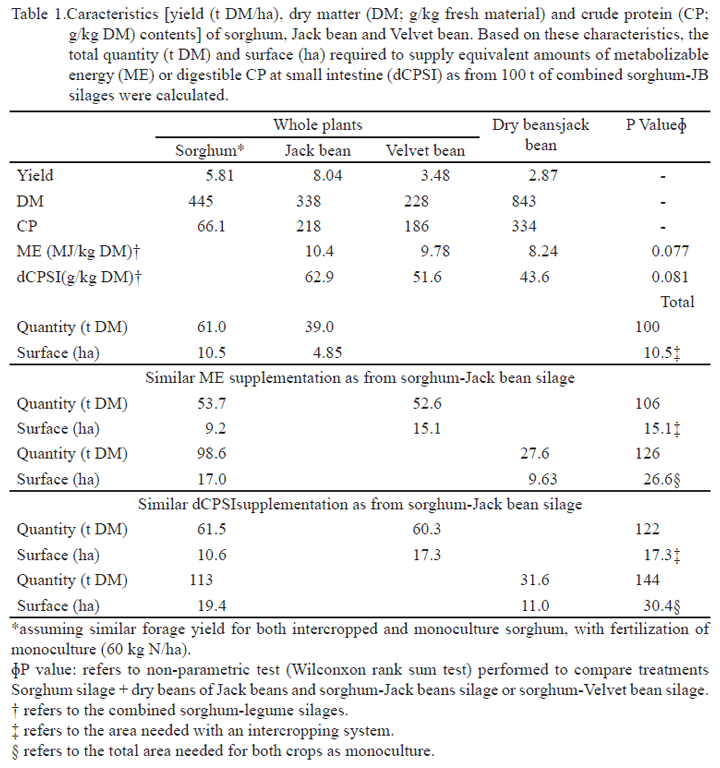
<body><![CDATA[<p align="justify" class="Cuerpodetexto" style="text-indent:0in;"><em><span style="font-family:'Verdana','sans-serif'; font-size:10.0pt; ">ME=  (ER+ESI)</span></em><span style="font-family:'Verdana','sans-serif'; font-size:10.0pt; ">/0.62, where ER is the net energy from  acetate (874 kJ/mol), propionate (1535 kJ/mol) and butyrate (2192 kJ/mol)  produced in the rumen; ESI is the net energy calculated from digestible OM in  the small intestine as 16.7 kJ/g OM and 0.62 is the net energy to ME ratio for  cows at maintenance.</span></p>     <p align="justify" class="Cuerpodetexto" style="text-indent:0in;"><em><span style="font-family:'Verdana','sans-serif'; font-size:10.0pt; ">dCPSI<sub>(g/kg  DM)</sub>=MIN(dCPR)</span></em><span style="font-family:'Verdana','sans-serif'; font-size:10.0pt; ">*0.75*0.85+<em>dbpCPSl</em>, <span style="letter-spacing:.1pt; ">where dCPR (g/kg DM) is the microbial protein  produced based on the supply of effectively rumen degradable CP (g/kg DM);dMP(g/kg DM) is the amount of microbial protein calculated based  on apparently rumen degradable organic matter (ARDOM) as    187.5 g CP/kg ARDOM (with ARDOM calculated from the net production of acetate,  propionate and butyrateas 162*(acetate/2+propionate/2+butyrate)); <em>MIN  (dCPR)</em> means that calculation of the microbial protein depends on whether  the availability of rumen degradable protein (dCPR) or fermentable energy (dMP)  is the limiting factor for microbial protein production (Tamminga <em>et al.</em> 1994); the factors 0.75 and 0.85 represent the amino acid contents of microbial  protein and intestinal digestibility of microbial amino acids, respectively  (Tamminga <em>et al.</em>1994); dbpCPSI is the intestinal digestible bypass CP.  In the current trial, dCPR always exceeded dMP and hence, the microbial protein  was determined from the energy released during fermentation.</span></span></p>     <p align="justify"><span style="font-family:'Verdana','sans-serif'; font-size:10.0pt; ">Differences of theME and  dCPSIbetween treatments (sorghum silage + dry beans of Jack beans and  sorghum-Jack beans silage or sorghum-Velvet bean silage) were compared by a one  way ANOVA by means of a non-parametricWilcoxon rank sum test performed with jmp  (jmp 9.0.2 copyright (c) 2010 SAS Institute Inc.)</span><font size="2" face="Verdana, Arial, Helvetica, sans-serif">.</font> </p>     <p align="justify">&nbsp;</p>     <p align="justify"><font size="2" face="Verdana, Arial, Helvetica, sans-serif"><b><font size="3">RESULTS AND DISCUSSION</font></b></font></p>     <p align="justify" class="Cuerpodetexto" style="text-indent:0in;"><span style="letter-spacing:.2pt; font-family:'Verdana','sans-serif'; font-size:10.0pt; ">JB showed higher forage and grain yield (<a href="/img/revistas/cjas/v50n1/t0112116.gif">table 1</a>) as  compared with VB (grain yield; 1.24 t DM/ha). Assessment of ensiling quality  showed that, with a proportion of 50:50 of fresh whole sorghum plants and fresh  whole JB plants, a sufficient feed quality for ruminants could be reached  (Lima-Orozco <em>et al.</em> 2014). When pure sorghum silage is supplemented with  stored dry grains form JB, 88g of sorghum silage is required per 100 g of FM  (78 g on DM basis) to reach a similar CP content as for the combined  sorghum-legume silage.To obtain the equivalent ME supply from combined whole plant  sorghum-JB silage and sorghum-VB silage or pure sorghum silage supplemented  with JB dry grains, 6 and 26 % more DM is required, respectively (<a href="/img/revistas/cjas/v50n1/t0112116.gif">table 1</a>).  More importantly, this corresponds to a demand of 1.4 to 2.5 times the surface  required to co-culture sorghum-JB forage. When sorghum silage is supplemented  with dry beans from JB, an equivalent dCPSI supply as from sorghum-JB silages  requires 44% more feed. Moreover, the area required to produce sorghum and JB  as monocultures is 2.90 times the surface required for sorghum-JB  intercropping.To supply similar dCPSi from combined sorghum-VB silages 1.65  times more surface is required.</span> </p>     
<p align="justify" class="Cuerpodetexto" style="text-indent:0in;"><span style="font-family:'Verdana','sans-serif'; font-size:10.0pt; ">Given the world&rsquo;s population growth, substantial increase  of agriculture production while simultaneously decreasing its environmental  footprint, is required. In their analysis for solutions to this dilemma Foley <em>et  al.</em> (2011) indicated agriculture expansion should be halted and increasing  food production should be reached by closing crop yield gaps on existing  agricultural land. Hence, within this context, protein alternatives not only  should be compared in terms of nutritive value but also the surface required  for supply of comparable amounts of energy and digestible proteinshould be  considered.</span><span style="font-family:'Verdana','sans-serif'; font-size:10.0pt; "> </span></p>     <p align="justify" class="Cuerpodetexto" style="text-indent:0in;"><span style="font-family:'Verdana','sans-serif'; font-size:10.0pt; ">The  grain and forage yield reached by JB in the current study is similar to what  has been reported by D&iacute;az (2000) and show the potential of this crop inruminant  feeding systems as yields are considerably greater than those of other legumes  e.g. VB as reported in this work (<a href="/img/revistas/cjas/v50n1/t0112116.gif">Table 1</a>) or soybean in previous reports  (Lima-Orozco <em>et al.</em> 2013). </span></p>     
<p align="justify" class="Cuerpodetexto" style="text-indent:0in;"><span style="letter-spacing:.25pt; font-family:'Verdana','sans-serif'; font-size:10.0pt; ">A dCPSI supply equal to that from mixed sorghum-JB silage  requires 22 t DM extra from sorghum-VB silages or 44 t DM extra from sorghum  silage supplemented with dry bean form JB. Similarly,    8 t DM extra is needed from whole plant sorghum and soybean silages(Lima-Orozco <em>et al.</em> 2013).In addition, more hectares are needed to produce sorghum  silage supplemented with dry beans with the extra cost of sorghum </span><span style="font-family:'Verdana','sans-serif'; font-size:10.0pt; ">fertilization      (60 kg N/ha)<span style="letter-spacing:.25pt; ">. Additionally, this amount of  sorghum silage supplemented with dry beans would supply a lower amount of ME.  Grains from VB were not considered here as an alternative given their lower  yield and a longer growing period (180-200 d)as compared w</span><span style="letter-spacing:.1pt; ">ith JB or soybean for which only        120-140 d or 90-120 d (D&iacute;az 2000) are needed, respectively. These harvesting  times are similar to previous reports and are influenced among others by the  legume        species/cultivar and harvesting season (D&iacute;az 2000; Lima-Orozco <em>et al.</em> 2013).</span></span></p>     <p align="justify"><span style="letter-spacing:.35pt; font-family:'Verdana','sans-serif'; font-size:10.0pt; ">It was  concluded that the ME content and dCPSIof the sorghum-JB silages are1.26 or  1.44 times higher than sorghum-JB silage or for pure sorghum silage  supplemented with dry beans from JB. Moreover, a much larger surface is  required for the sorghum silage and dry JB grains alternative. Hence, combined  sorghum-JB silage seemed the best alternative studied here in terms of DM  yield, dCPSI and    MEsupply</span><font size="2" face="Verdana, Arial, Helvetica, sans-serif">.</font> </p>     ]]></body>
<body><![CDATA[<p align="justify">&nbsp;</p>     <p align="justify"><font size="2" face="Verdana, Arial, Helvetica, sans-serif"><b><font size="3">ACKNOWLEDGEMENTS</font></b></font></p>     <p align="justify"><font size="2" face="Verdana, Arial, Helvetica, sans-serif"><span style="letter-spacing:.2pt; font-family:'Verdana','sans-serif'; font-size:10.0pt; ">The authors would like to thank to VLIR-USO for a short research grant  to R. Lima Orozco and to the commission of Scientific Research of the Faculty  of Bioscience Engineering of UGent for travel grant of Inge Van Daele, to the  staff of the Laboratory for Animal Nutrition and Animal Product Quality of  UGent and to the staff from the Experimental Stations in CIAP of UCLVfor the  technical assistance during this research</span>.</font></p>     <p align="justify">&nbsp;</p>      <p align="justify"><font size="2" face="Verdana, Arial, Helvetica, sans-serif"><font size="3"><b>REFERENCES</b></font></font></p>     <p align="justify" class="MsoBibliography"><span style="font-family:'Verdana','sans-serif'; font-size:10.0pt; ">D&iacute;az, M. F. 2003. &lsquo;&lsquo;Producci&oacute;n y  caracterizaci&oacute;n de forrajes y granos de leguminosas temporales para la  alimentaci&oacute;n animal&rsquo;&rsquo;. </span><em><span style="font-family:'Verdana','sans-serif'; font-size:10.0pt; ">Cuban  Journal of Agricultural Science</span></em><span style="font-family:'Verdana','sans-serif'; font-size:10.0pt; ">, 37 (1), pp. 65&ndash;71, ISSN: 2079-3480.</span></p>     <p align="justify" class="MsoBibliography"><span style="font-family:'Verdana','sans-serif'; font-size:10.0pt; ">Foley, J. A.,  Ramankutty, N., Brauman, K. A., Cassidy, E. S., Gerber, J. S., Johnston, M.,  Mueller, N. D., O&rsquo;Connell, C., Ray, D. K., West, P. C., Balzer, C., Bennett, E.  M., Carpenter, S. R., Hill, J., Monfreda, C., Polasky, S., Rockstr&ouml;m, J.,  Sheehan, J., Siebert, S., Tilman, D. &amp; Zaks, D. P. M. 2011. &lsquo;&lsquo;Solutions for  a cultivated planet&rsquo;&rsquo;. <em>Nature</em>, 478 (7369), pp. 337&ndash;342, ISSN: 0028-0836,  DOI: 10.1038/nature10452.</span></p>     <p align="justify" class="MsoBibliography"><span style="font-family:'Verdana','sans-serif'; font-size:10.0pt; ">Lima-Orozco, R., Castro, A. A. &amp;  Fievez, V. 2013. </span><span style="font-family:'Verdana','sans-serif'; font-size:10.0pt; ">&lsquo;&lsquo;Ensiled  sorghum and soybean as ruminant feed in the tropics, with emphasis on Cuba&rsquo;&rsquo;. <em>Grass  and Forage Science</em>, 68 (1), pp. 20&ndash;32, ISSN: 1365-2494, DOI:  10.1111/j.1365-2494.2012.00890.x.</span></p>     <p align="justify" class="MsoBibliography"><span style="font-family:'Verdana','sans-serif'; font-size:10.0pt; ">Lima-Orozco,  R., Van Daele, I., &Aacute;lvarez, H. U. &amp; Fievez, V. 2014. &lsquo;&lsquo;Combined  conservation of jack bean and velvet bean with sorghum: evaluation of lab-scale  silages and <em>in vitro</em> assessment of their nutritive value&rsquo;&rsquo;. <em>The  Journal of Agricultural Science</em>, 152 (06), pp. 967&ndash;980, ISSN: 1469-5146,  DOI: 10.1017/S0021859614000148.</span></p>     <p align="justify" class="MsoBibliography"><span style="font-family:'Verdana','sans-serif'; font-size:10.0pt; ">Ojeda, F.  2000. &lsquo;&lsquo;Harvesting and ensiling techniques&rsquo;&rsquo;. In: <em>Silage Making in the  Tropics with Particular Emphasis on Smallholders</em>, Rome: FAO, ISBN:  978-92-5-104500-8.</span></p>     ]]></body>
<body><![CDATA[<!-- ref --><p align="justify"><span style="font-family:'Verdana','sans-serif'; font-size:10.0pt; ">SAS Institute. 2010. <em>Statistical  Analysis Software SAS/STAT<sup>&reg;</sup></em>. version 9.0.2, Cary, N.C., USA: SAS  Institute Inc, ISBN: 978-1-60764-599-3, Available: &lt;<a href="http://www.sas.com/en_us/software/analytics/stat.html#" target="_blank">http://www.sas.com/en_us/software/analytics/stat.html#</a>&gt;    </span><font size="2" face="Verdana, Arial, Helvetica, sans-serif">.</font> </p>     <p align="justify">&nbsp;</p>     <p align="justify">&nbsp;</p>     <p align="justify"><font size="2" face="Verdana, Arial, Helvetica, sans-serif">Received: November 25, 2015    <br>   Accepted: March 8, 2016</font></p>     <p align="justify">&nbsp;</p>     <p align="justify">&nbsp;</p>     <p align="justify"><font size="2" face="Verdana, Arial, Helvetica, sans-serif"><i>R. Lima-Orozco,</i> Universidad Central “Marta Abreu” de Las Villas (UCLV), Department of Veterinary Medicine and Zootechny,  Carretera a Camajuaní km 6 ½, 54830 Santa Clara, Cuba.    Email: <a href="mailto:raciello@uclv.edu.cu">raciello@uclv.edu.cu</a></font></p>      ]]></body><back>
<ref-list>
<ref id="B1">
<nlm-citation citation-type="journal">
<person-group person-group-type="author">
<name>
<surname><![CDATA[Díaz]]></surname>
<given-names><![CDATA[M. F.]]></given-names>
</name>
</person-group>
<article-title xml:lang="nd"><![CDATA[Producción y caracterización de forrajes y granos de leguminosas temporales para la alimentación animal]]></article-title>
<source><![CDATA[Cuban Journal of Agricultural Science]]></source>
<year>2003</year>
<volume>37</volume>
<numero>1</numero>
<issue>1</issue>
<page-range>65-71</page-range></nlm-citation>
</ref>
<ref id="B2">
<nlm-citation citation-type="journal">
<person-group person-group-type="author">
<name>
<surname><![CDATA[Foley]]></surname>
<given-names><![CDATA[J. A.]]></given-names>
</name>
<name>
<surname><![CDATA[Ramankutty]]></surname>
<given-names><![CDATA[N.]]></given-names>
</name>
<name>
<surname><![CDATA[Brauman]]></surname>
<given-names><![CDATA[K. A.]]></given-names>
</name>
<name>
<surname><![CDATA[Cassidy]]></surname>
<given-names><![CDATA[E. S.]]></given-names>
</name>
<name>
<surname><![CDATA[Gerber]]></surname>
<given-names><![CDATA[J. S.]]></given-names>
</name>
<name>
<surname><![CDATA[Johnston]]></surname>
<given-names><![CDATA[M.]]></given-names>
</name>
<name>
<surname><![CDATA[Mueller]]></surname>
<given-names><![CDATA[N. D.]]></given-names>
</name>
<name>
<surname><![CDATA[O’Connell]]></surname>
<given-names><![CDATA[C.]]></given-names>
</name>
<name>
<surname><![CDATA[Ray]]></surname>
<given-names><![CDATA[D. K.]]></given-names>
</name>
<name>
<surname><![CDATA[West]]></surname>
<given-names><![CDATA[P. C.]]></given-names>
</name>
<name>
<surname><![CDATA[Balzer]]></surname>
<given-names><![CDATA[C.]]></given-names>
</name>
<name>
<surname><![CDATA[Bennett]]></surname>
<given-names><![CDATA[E. M.]]></given-names>
</name>
<name>
<surname><![CDATA[Carpenter]]></surname>
<given-names><![CDATA[S. R.]]></given-names>
</name>
<name>
<surname><![CDATA[Hill]]></surname>
<given-names><![CDATA[J.]]></given-names>
</name>
<name>
<surname><![CDATA[Monfreda]]></surname>
<given-names><![CDATA[C.]]></given-names>
</name>
<name>
<surname><![CDATA[Polasky]]></surname>
<given-names><![CDATA[S.]]></given-names>
</name>
<name>
<surname><![CDATA[Rockström]]></surname>
<given-names><![CDATA[J.]]></given-names>
</name>
<name>
<surname><![CDATA[Sheehan]]></surname>
<given-names><![CDATA[J.]]></given-names>
</name>
<name>
<surname><![CDATA[Siebert]]></surname>
<given-names><![CDATA[S.]]></given-names>
</name>
<name>
<surname><![CDATA[Tilman]]></surname>
<given-names><![CDATA[D.]]></given-names>
</name>
<name>
<surname><![CDATA[Zaks]]></surname>
<given-names><![CDATA[D. P. M.]]></given-names>
</name>
</person-group>
<article-title xml:lang="nd"><![CDATA[Solutions for a cultivated planet]]></article-title>
<source><![CDATA[Nature]]></source>
<year>2011</year>
<volume>478</volume>
<numero>7369</numero>
<issue>7369</issue>
<page-range>337-342</page-range></nlm-citation>
</ref>
<ref id="B3">
<nlm-citation citation-type="journal">
<person-group person-group-type="author">
<name>
<surname><![CDATA[Lima-Orozco]]></surname>
<given-names><![CDATA[R.]]></given-names>
</name>
<name>
<surname><![CDATA[Castro]]></surname>
<given-names><![CDATA[A. A.]]></given-names>
</name>
<name>
<surname><![CDATA[Fievez]]></surname>
<given-names><![CDATA[V.]]></given-names>
</name>
</person-group>
<article-title xml:lang="nd"><![CDATA[Ensiled sorghum and soybean as ruminant feed in the tropics, with emphasis on Cuba]]></article-title>
<source><![CDATA[Grass and Forage Science]]></source>
<year>2013</year>
<volume>68</volume>
<numero>1</numero>
<issue>1</issue>
<page-range>20-32</page-range></nlm-citation>
</ref>
<ref id="B4">
<nlm-citation citation-type="journal">
<person-group person-group-type="author">
<name>
<surname><![CDATA[Lima-Orozco]]></surname>
<given-names><![CDATA[R.]]></given-names>
</name>
<name>
<surname><![CDATA[Van Daele]]></surname>
<given-names><![CDATA[I.]]></given-names>
</name>
<name>
<surname><![CDATA[Álvarez]]></surname>
<given-names><![CDATA[H. U.]]></given-names>
</name>
<name>
<surname><![CDATA[Fievez]]></surname>
<given-names><![CDATA[V.]]></given-names>
</name>
</person-group>
<article-title xml:lang="nd"><![CDATA[Combined conservation of jack bean and velvet bean with sorghum: evaluation of lab-scale silages and in vitro assessment of their nutritive value]]></article-title>
<source><![CDATA[The Journal of Agricultural Science]]></source>
<year>2014</year>
<volume>152</volume>
<numero>06</numero>
<issue>06</issue>
<page-range>967-980</page-range></nlm-citation>
</ref>
<ref id="B5">
<nlm-citation citation-type="book">
<person-group person-group-type="author">
<name>
<surname><![CDATA[Ojeda]]></surname>
<given-names><![CDATA[F.]]></given-names>
</name>
</person-group>
<article-title xml:lang="nd"><![CDATA[Harvesting and ensiling techniques]]></article-title>
<source><![CDATA[Silage Making in the Tropics with Particular Emphasis on Smallholders]]></source>
<year>2000</year>
<publisher-loc><![CDATA[Rome ]]></publisher-loc>
<publisher-name><![CDATA[FAO]]></publisher-name>
</nlm-citation>
</ref>
<ref id="B6">
<nlm-citation citation-type="book">
<source><![CDATA[Statistical Analysis Software SAS/STAT®]]></source>
<year>2010</year>
<publisher-loc><![CDATA[Cary, N.C., USA ]]></publisher-loc>
<publisher-name><![CDATA[SAS Institute Inc]]></publisher-name>
</nlm-citation>
</ref>
</ref-list>
</back>
</article>