<?xml version="1.0" encoding="ISO-8859-1"?><article xmlns:mml="http://www.w3.org/1998/Math/MathML" xmlns:xlink="http://www.w3.org/1999/xlink" xmlns:xsi="http://www.w3.org/2001/XMLSchema-instance">
<front>
<journal-meta>
<journal-id>2079-3480</journal-id>
<journal-title><![CDATA[Cuban Journal of Agricultural Science]]></journal-title>
<abbrev-journal-title><![CDATA[Cuban J. Agric. Sci.]]></abbrev-journal-title>
<issn>2079-3480</issn>
<publisher>
<publisher-name><![CDATA[Editorial del Instituto de Ciencia Animal]]></publisher-name>
</publisher>
</journal-meta>
<article-meta>
<article-id>S2079-34802016000100013</article-id>
<title-group>
<article-title xml:lang="en"><![CDATA[Effect of the use of fermentation promoters with or without probiotics on the profile of fatty acids, amino acids and cholesterol of milk from grazing cows]]></article-title>
<article-title xml:lang="es"><![CDATA[Efecto de la utilización de los promotores de la fermentación, con probióticos o sin ellos, en el perfil de ácidos grasos, aminoácidos y colesterol de la leche de vacas en pastoreo]]></article-title>
</title-group>
<contrib-group>
<contrib contrib-type="author">
<name>
<surname><![CDATA[Galina]]></surname>
<given-names><![CDATA[M.A.]]></given-names>
</name>
<xref ref-type="aff" rid="A01"/>
</contrib>
<contrib contrib-type="author">
<name>
<surname><![CDATA[Elías]]></surname>
<given-names><![CDATA[A.]]></given-names>
</name>
<xref ref-type="aff" rid="A02"/>
</contrib>
<contrib contrib-type="author">
<name>
<surname><![CDATA[Vázquez]]></surname>
<given-names><![CDATA[P.]]></given-names>
</name>
<xref ref-type="aff" rid="A03"/>
</contrib>
<contrib contrib-type="author">
<name>
<surname><![CDATA[Pineda]]></surname>
<given-names><![CDATA[J.]]></given-names>
</name>
<xref ref-type="aff" rid="A04"/>
</contrib>
<contrib contrib-type="author">
<name>
<surname><![CDATA[López]]></surname>
<given-names><![CDATA[B.]]></given-names>
</name>
<xref ref-type="aff" rid="A01"/>
</contrib>
<contrib contrib-type="author">
<name>
<surname><![CDATA[Velázquez]]></surname>
<given-names><![CDATA[M.A.]]></given-names>
</name>
<xref ref-type="aff" rid="A01"/>
</contrib>
</contrib-group>
<aff id="A01">
<institution><![CDATA[,Universidad Nacional Autónoma de México Facultad de Estudios Superiores Cuautitlán ]]></institution>
<addr-line><![CDATA[ ]]></addr-line>
</aff>
<aff id="A02">
<institution><![CDATA[,Instituto de Ciencia Animal  ]]></institution>
<addr-line><![CDATA[ ]]></addr-line>
<country>Cuba</country>
</aff>
<aff id="A03">
<institution><![CDATA[,Instituto Politécnico Nacional México  ]]></institution>
<addr-line><![CDATA[ ]]></addr-line>
</aff>
<aff id="A04">
<institution><![CDATA[,Universidad de Colima  ]]></institution>
<addr-line><![CDATA[ ]]></addr-line>
</aff>
<pub-date pub-type="pub">
<day>00</day>
<month>03</month>
<year>2016</year>
</pub-date>
<pub-date pub-type="epub">
<day>00</day>
<month>03</month>
<year>2016</year>
</pub-date>
<volume>50</volume>
<numero>1</numero>
<fpage>105</fpage>
<lpage>120</lpage>
<copyright-statement/>
<copyright-year/>
<self-uri xlink:href="http://scielo.sld.cu/scielo.php?script=sci_arttext&amp;pid=S2079-34802016000100013&amp;lng=en&amp;nrm=iso"></self-uri><self-uri xlink:href="http://scielo.sld.cu/scielo.php?script=sci_abstract&amp;pid=S2079-34802016000100013&amp;lng=en&amp;nrm=iso"></self-uri><self-uri xlink:href="http://scielo.sld.cu/scielo.php?script=sci_pdf&amp;pid=S2079-34802016000100013&amp;lng=en&amp;nrm=iso"></self-uri><abstract abstract-type="short" xml:lang="en"><p><![CDATA[This study reviews the development and use of fermentation promoters and probiotics on the profile of fatty acids, amino acids and cholesterol of milk from grazing cows. A herd of 35 cows (511 ± 12 kg), which were in the middle of lactation, Zebu crossings, over a silvopastoral system with star grass (Cynodon plectostachyus) and brachiaria (Brachiaria brizantha), and browsing legumes, with 3 kg of fermented promoters (FP), were provided with 1.5 kg of lactobacilli per day as supplement (LAB). The grazing area was 20.9 ha. Another herd of 28 animals (514 ±14 kg), grazing on 18.5 ha, supplemented with 6 kg/d of a commercial concentrate with 160 g of commercial probioric (CP), was used. An amount of 8 commercial milks were sampled. The milk from the three treatments was weighed each week. The average of production was 17 kg for LAB, of 14 kg/d in silvopastoril system (SP) and 16 kg in CP (P<0.05). The saturated fatty acids and unsaturated fatty acids showed differences in the three treatments (P<0.05). Polyunsaturated fatty acids, omega 3 and conjugated linoleic acid were 34%, 46% and 68% higher in CP, silvopastoral system and LAB compared to commercial milk (CM). Results have demonstrated that grazing diverse green fresh forages improve milk quality due to the increase of unsaturated fatty acids. The LAB allowed a decrease of biohydrogenation. LAB and SP provided the milks with highest amount of omega 3]]></p></abstract>
<abstract abstract-type="short" xml:lang="es"><p><![CDATA[En este estudio se hace una revisión del desarrollo y utilización de los promotores de la fermentación y probióticos y su efecto en el perfil de ácidos grasos, colesterol y aminoácidos de la leche en pastoreo. Se utilizó un hato de 35 vacas (511 ± 12 kg), cruzas Cebú, en la mitad de la lactación, en sistema silvopastoril de estrella (Cynodon plectostachyus) e insurgente (Brachiaria brizantha), con ramoneo de leguminosas, con 3 kg de promotores de la fermentación, a los que se les adicionó 1.5 kg al día de lactobacilos como suplemento. El área de pastoreo fue de 20.9 ha. Se utilizó además un hato de 28 animales (514 ±14 kg) en pastoreo en 18.5 ha, suplementados con 6 kg/d de un concentrado comercial con 160 g de probiótico comercial. Se muestrearon ocho leches comerciales. Se pesó la leche de los tres tratamientos cada semana. El promedio de producción fue de 17 kg para lactobacilos, de 14 kg/d en sistema silvopastoril y 16 kg en concentrado comercial (P < 0.05). Los ácidos grasos saturados y ácidos grasos no saturados mostraron diferencias en los tres tratamientos (P < 0.05). Los ácidos grasos polinsaturados, el omega 3 y el ácido linoleico conjugado fueron 34 %, 46 % y 68 % mayores en concentrado comercial, sistema silvopastoril y lactobacilos, con respecto a la leche comercial. Los resultados demostraron que el pastoreo de forrajes frescos verdes diversos mejora la calidad de la leche, debido al incremento de ácidos grasos no saturados. Los lactobacilos permitieron que disminuyera la biohidrogenación. Con los lactobacilos y el sistema silvopastoril se obtuvieron las leches con mayor cantidad de omega]]></p></abstract>
<kwd-group>
<kwd lng="en"><![CDATA[probiotic]]></kwd>
<kwd lng="en"><![CDATA[quality]]></kwd>
<kwd lng="en"><![CDATA[milk]]></kwd>
<kwd lng="en"><![CDATA[cows]]></kwd>
<kwd lng="en"><![CDATA[tropic]]></kwd>
<kwd lng="es"><![CDATA[probiótico]]></kwd>
<kwd lng="es"><![CDATA[calidad]]></kwd>
<kwd lng="es"><![CDATA[leche]]></kwd>
<kwd lng="es"><![CDATA[vacas]]></kwd>
<kwd lng="es"><![CDATA[trópico]]></kwd>
</kwd-group>
</article-meta>
</front><body><![CDATA[ <p align="right"><strong>Cuban Journal  of Agricultural Science, 50(1): 105-120, 2016, ISSN: 2079-3480</strong></p>     <p align="right">&nbsp;</p>     <p align="right"><font size="2" face="Verdana, Arial, Helvetica, sans-serif"><b>ORIGINAL ARTICLE</b></font></p>     <p align="justify">&nbsp;</p>     <p align="justify"><font size="4" face="Verdana, Arial, Helvetica, sans-serif"><b>Effect of the use of fermentation promoters with or without probiotics on the profile of fatty acids, amino acids and cholesterol of milk from grazing cows</b></font></p>     <p align="justify">&nbsp;</p>     <p align="justify"><font size="3" face="Verdana, Arial, Helvetica, sans-serif"><b>Efecto de la utilización de los promotores de la fermentación, con probióticos o sin ellos, en el perfil de ácidos grasos, aminoácidos y colesterol de la leche de vacas en pastoreo</b></font></p>     <p align="justify">&nbsp;</p>     <p align="justify">&nbsp;</p>     <p align="justify"><font size="2" face="Verdana, Arial, Helvetica, sans-serif"><b>M.A. Galina,</b><sup><b>I</b></sup><b> A. El&iacute;as,</b><sup><b>II</b></sup><b> P. V&aacute;zquez,</b><sup><b>III</b></sup><b> J. Pineda,</b><sup><b>IV</b></sup><b> B. L&oacute;pez,</b><sup><b>I</b></sup><b> M.A.Vel&aacute;zquez,</b><sup><b>I</b></sup></font></p>     ]]></body>
<body><![CDATA[<p align="justify"><font size="2" face="Verdana, Arial, Helvetica, sans-serif"><b> </b></font><font size="2" face="Verdana, Arial, Helvetica, sans-serif"><sup>I</sup>Facultad de Estudios Superiores Cuautitlán Universidad Nacional Autónoma de México.    <br>   <sup>II</sup>Instituto de Ciencia Animal, Cuba.     <br>   <sup>III</sup>CICATA Instituto Politécnico Nacional México.    <br>   <sup>I</sup><sup>V</sup>FMVZ Universidad de Colima. </font></p>     <p align="justify">&nbsp;</p>     <p align="justify">&nbsp;</p> <hr align="JUSTIFY">     <p align="justify"><font size="2" face="Verdana, Arial, Helvetica, sans-serif"><b>ABSTRACT</b></font></p>     <p align="justify"><font size="2" face="Verdana, Arial, Helvetica, sans-serif"><span style="letter-spacing:.2pt; font-family:'Verdana','sans-serif'; font-size:10.0pt; ">This study reviews the development and use of fermentation promoters and  probiotics on the profile of fatty acids, amino acids and cholesterol of milk  from grazing cows. A herd of 35 cows (511 &plusmn; 12 kg), which were in the middle of  lactation, Zebu crossings, over a silvopastoral system with star grass (<em>Cynodon  plectostachyus</em>) and brachiaria (<em>Brachiaria brizantha</em>), and browsing  legumes, with 3 kg of fermented promoters (FP), were provided with 1.5 kg of  lactobacilli per day as supplement (LAB). The grazing area was 20.9 ha. Another  herd of 28 animals (514 &plusmn;14 kg), grazing on 18.5 ha, supplemented with 6 kg/d  of a commercial concentrate with 160 g of commercial probioric (CP), was used.  An amount of 8 commercial milks were sampled. The milk from the three  treatments was weighed each week. The average of production was 17 kg for LAB,  of 14 kg/d in silvopastoril system (SP) and 16 kg in CP (P&lt;0.05). The  saturated fatty acids and unsaturated fatty acids showed differences in the  three treatments (P&lt;0.05). Polyunsaturated fatty acids, omega 3 and  conjugated linoleic acid were 34%, 46% and 68% higher in CP, silvopastoral system  and LAB compared to commercial milk (CM). Results have demonstrated that  grazing diverse green fresh forages improve milk quality due to the increase of  unsaturated fatty acids. The LAB allowed a decrease of biohydrogenation. LAB  and SP provided the milks with highest amount of  omega 3</span>.</font></p>     <p align="justify"><font size="2" face="Verdana, Arial, Helvetica, sans-serif"><b>Key words:</b> probiotic, quality, milk, cows, tropic.</font></p> <hr align="JUSTIFY">     <p align="justify"><font size="2" face="Verdana, Arial, Helvetica, sans-serif"><b>RESUMEN</b></font></p>     ]]></body>
<body><![CDATA[<p align="justify"><font size="2" face="Verdana, Arial, Helvetica, sans-serif"><span style="letter-spacing:-.1pt; font-family:'Verdana','sans-serif'; font-size:10.0pt; ">En este estudio se hace una revisi&oacute;n del desarrollo y  utilizaci&oacute;n de los promotores de la fermentaci&oacute;n y probi&oacute;ticos y su efecto en  el perfil de &aacute;cidos grasos, colesterol y amino&aacute;cidos de la leche en pastoreo.  Se utiliz&oacute; un hato de 35 vacas (511 &plusmn; 12 kg), cruzas Ceb&uacute;, en la mitad de la  lactaci&oacute;n, en&nbsp; sistema silvopastoril de  estrella (<em>Cynodon plectostachyus</em>) e insurgente (<em>Brachiaria brizantha</em>),  con ramoneo de leguminosas, con 3 kg de promotores de la fermentaci&oacute;n, a los  que se les adicion&oacute; 1.5 kg al d&iacute;a de lactobacilos como suplemento. El &aacute;rea de pastoreo fue de 20.9  ha. Se utiliz&oacute; adem&aacute;s un hato de 28 animales (514 &plusmn;14 kg) en pastoreo en 18.5  ha, suplementados con 6 kg/d de un concentrado comercial con 160 g de  probi&oacute;tico comercial. Se muestrearon ocho leches comerciales. Se pes&oacute; la leche  de los tres tratamientos cada semana. El promedio de producci&oacute;n fue de 17 kg  para lactobacilos, de 14 kg/d en sistema silvopastoril y 16 kg en concentrado  comercial (P &lt; 0.05). Los &aacute;cidos grasos saturados y &aacute;cidos grasos no  saturados mostraron diferencias en los tres tratamientos (P &lt; 0.05). Los  &aacute;cidos grasos polinsaturados, el omega 3 y el&nbsp;  &aacute;cido linoleico conjugado fueron&nbsp;  34 %, 46 % y 68 % mayores en concentrado comercial, sistema  silvopastoril y lactobacilos,&nbsp; con  respecto a la leche comercial. Los resultados demostraron que el pastoreo de  forrajes frescos verdes diversos mejora la calidad de la leche, debido al incremento  de &aacute;cidos grasos no saturados. Los lactobacilos permitieron que disminuyera la  biohidrogenaci&oacute;n. Con los lactobacilos y el sistema silvopastoril se obtuvieron  las leches con mayor cantidad de omega</span>.</font></p>     <p align="justify"><font size="2" face="Verdana, Arial, Helvetica, sans-serif"><b>Palabras    clave:</b>    probiótico, calidad, leche, vacas, trópico.</font></p> <hr align="JUSTIFY">     <p align="justify">&nbsp;</p>     <p align="justify">&nbsp;</p>     <p align="justify"><font size="2" face="Verdana, Arial, Helvetica, sans-serif"><b><font size="3">INTRODUCTION</font></b></font></p>       <p align="justify" class="Cuerpodetexto" style="text-indent:0in;"><span style="letter-spacing:.2pt; font-family:'Verdana','sans-serif'; font-size:10.0pt; ">The original studies on management of ruminal fermentation  were carried out by Cuban researchers (El&iacute;as, 1971), with a posterior large  revision on its use (El&iacute;as 1983). Later, several studies were published in  Mexico, about the effect of FP on different species and grazing systems, with  an increase on the use of cellulose of fiber forages due to a significant  increase on cellulolitic bacteria population (Galina <em>et al.</em> 2000, 2002,  2003, Galina <em>et al.</em> 2004abc, Ort&iacute;z <em>et al.</em> 2001, 2002 and Puga <em>et  al.</em> 2001abc).On the other hand, the knowledge about the importance of  nitrogen degradation, by ruminal microorganisms, has allowed a rational  inclusion of urea on diets, plus mechanical or chemical treatments of forages  that improve their digestibility, with the use of FP and LAB (</span><span style="letter-spacing:-.1pt; font-family:'Verdana','sans-serif'; font-size:10.0pt; ">Galindo and Marrero 2005, Ortiz <em>et al.</em> 2007, </span><span style="font-family:'Verdana','sans-serif'; font-size:10.0pt; ">Guti&eacute;rrez <em>et al.</em> 2012ab).&nbsp; The formation of microbial intestinal  digestible protein (PDIM) may reach 80% or more in diets containing an abundant  production of ruminal microorganisms in formulas supplemented with non-protein  nitrogen sources, while with commercial concentrates, most of the intestinal  digestible protein comes from food (PDIA). Therefore, several techniques have  been used for protecting protein against the action of ruminal microorganisms  (El&iacute;as      1983).</span><span style="font-family:'Verdana','sans-serif'; font-size:10.0pt; "> </span></p>       <p align="justify" class="Cuerpodetexto" style="text-indent:0in;"><span style="letter-spacing:.1pt; font-family:'Verdana','sans-serif'; font-size:10.0pt; ">Grasses and some legumes provide the base for animal  feeding in tropical husbandry. It is characterized by a group of genera and  species, and by their wide adaptation to different environments, known as  &ldquo;plasticity&rdquo; (Peters <em>et al.</em> 2010 and Tittonell<em>et al.</em> 2010).It is  possible to use these forages efficiently when bacterial populations of rumen  cover the energy requirements, essential nitrogen constituents, minerals and  other nutrients (El&iacute;as 1983). Otherwise, it could reduce its intake and usage,  which could be corrected with the use of activators of ruminal fermentation  that increase digestive efficiency (Puga <em>et al.</em> 2001abc). The responses  to the use of microbial activators, which are more frequently repeated in these  studies, are associated to the production of volatile fatty acids (VFA),  modification of ruminal pH and increase of bacteria that are responsible for  fiber degradation (Lila <em>et al.</em> 2004).</span><span style="font-family:'Verdana','sans-serif'; font-size:10.0pt; "> </span></p>       <p align="justify" class="Cuerpodetexto" style="text-indent:0in;"><span style="font-family:'Verdana','sans-serif'; font-size:10.0pt; ">During  the last years, the Institute of Animal Science (ICA) from Cuba has developed a  biologically active product called VITAFERT, enriched with yeasts and  lactobacilli, organic acids of short carbonated chains, trace elements and a  low pH (El&iacute;as and Herrera 2008 and Gutierrez <em>et al.</em> 2012ab). This  product has been used as microbial additive in pigs and calves, to prevent or  decrease diarrheas, as growth stimulant for non-ruminant animals, and in the  ruminal fermentation of cattle (Guti&eacute;rrez 2005).</span></p>       <p align="justify" class="Cuerpodetexto" style="text-indent:0in;"><span style="font-family:'Verdana','sans-serif'; font-size:10.0pt; ">From the first decade of this century, modifications on  the use of lactic bacteria in ruminants were added to the original works on  ruminal fermentation (El&iacute;as and Herrera, 2008). This demonstrated its  effectiveness on digestibility of fibrous forages (Galina <em>et al.</em> 2007ab  and Guti&eacute;rrez <em>et al.</em> 2012ab). The results of all these researches have  had a significantly higher effect on fiber degradation in the rumen that has  allowed the development of alternative management systems with or without LAB  supplementation to improve product quality (Gutierrez <em>et al. </em>2012a). </span><span style="font-family:'Verdana','sans-serif'; font-size:10.0pt; "> </span></p>       <p align="justify" class="Cuerpodetexto" style="text-indent:0in;"><span style="font-family:'Verdana','sans-serif'; font-size:10.0pt; ">On the other hand, studies on the profile of  polyunsaturated fatty acids (PUFAs), mainly linoleic acid (LA, C18.3 cis-9,  cis-12) and conjugated alpha linoleic acid (CLA, C18:3 cis-9, cis-12, cis-15),  have demonstrated that they can be found, in high proportions, in lipids of  forage and of some supplements (Shen 2011, Castillo <em>et al.</em> 2013, Zened <em>et  al.</em> 2013 and Rubino 2014). These acids are part of the diet of ruminants  and, depending on their concentration, modify the profile of fatty acids from  milk and meat. Their composition is characterized by having a higher volume of  unsaturated fatty acids than of saturated ones, which increase their saturation  because of the process of BH in the rumen (Castillo <em>et al.</em> 2013).  Several factors that affect the process of BH from LA and CLA have been  studies, as well as nutritional strategies showing positive results in the  increase of trans-vaccenic acid (C18:2 trans-11, TVA) and conjugated linoleic  acid (Cis18:2 cis-9, trans-11, CLA) in milk (</span><span style="font-family:'Verdana','sans-serif'; font-size:10.0pt; ">Galina <em>et al.</em> 2009a,&nbsp; 2010, 2012<span style="letter-spacing:.2pt; ">). These compounds have potential benefit effects  to human health (Harfoot and Hazlewood 1997, O&acute;shea<em>et al.</em> 1998, Herrera <em>et  al.</em> 2004 and Khanal 2004).&nbsp;&nbsp; </span></span></p>       ]]></body>
<body><![CDATA[<p align="justify" class="Cuerpodetexto" style="text-indent:0in;"><span style="font-family:'Verdana','sans-serif'; font-size:10.0pt; ">Lactic probiotics (LAB) may be an important alternative,  mainly if the profile of unsaturated fatty acids of the product is taken into  consideration (Galina <em>et al.</em> 2012). In ruminants, the microbial flora is  used for expanding most of the nutrients, which are later absorbed in the  intestine of animals (Newbold<em>et al.</em> 2005). Therefore, different  biotechnological systems have been developed in order to manipulate the  microbiological activities of the fermentation chamber of bovines (Newbold<em>et  al.</em> 2005). Unsaturated fatty acids, produced during the hydrolysis of  lipids of diets, are saturated by ruminal microorganisms, through BH, requiring  H<sub>2 </sub>to develop (Jin <em>et al.</em> 2008 and Castillo <em>et al.</em> 2013).The best intermediary for BH is the polyunsaturated fatty acids (PUFA),  while the conjugated linoleic acid (CLA) and the trans-vaccenic acid (trans 11  C18:1 TVA) are the best intermediary for ruminal bacteria. The CLA derives from  linoleic acid (C 18:2) and from &alpha; linoleic acid (C 18:3) (Castillo etal. 2013).  An advisable manipulation of ruminal fermentation may increase the main forms  of CLA, such as isomers cis 19, trans 11 C 18:2, c9,T11 CLA (Newbold<em>et al.</em> 2005). Due to the removal of CLA as intermediary depends on BH, maybe it is  possible to increase this process, providing electron receptors as an  alternative.Ruminal lactic bacteria may use these electrons to decrease BH, and  they do not produce methane. Therefore, it is important to study the effect of  BH of lactic supplements, to improve the profile of fatty acids from milk  (Galina <em>et al.</em> 2012).</span><span style="font-family:'Verdana','sans-serif'; font-size:10.0pt; "> </span></p>       <p align="justify" class="Cuerpodetexto" style="text-indent:0in;"><span style="font-family:'Verdana','sans-serif'; font-size:10.0pt; ">The objective of this study was to revise the progress in  the management of ruminal fermentation, particularly evaluate the effect of LAB  supplement on milk production and its profile of essential fatty acids in  animals grazing and browsing in a mixed system of grasslands and tropical  forest, with or without the use of RF, alone or together with LAB, compared to  commercial concentrates supplementation (COM)</span><font size="2" face="Verdana, Arial, Helvetica, sans-serif">.</font></p>     <p align="justify">&nbsp;</p>     <p align="justify"><font size="2" face="Verdana, Arial, Helvetica, sans-serif"><b><font size="3">MATERIALS AND METHODS</font></b></font></p>     <p align="justify" class="Cuerpodetexto" style="text-indent:0in;"><span style="font-family:'Verdana','sans-serif'; font-size:10.0pt; ">The  study was carried out in&ldquo;El Fresno&rdquo; farm, Suchitl&aacute;n, Colima, at 19&deg;23&rsquo; N,  103&deg;41&rsquo; W, and    1,400 m o.s.l. According to K&ouml;ppen, the climate is classified as Aw1 (w), with  rains from July to October, 1,000 mm per year. Dry period lasts from 8 to 9  months, with an average temperature of 25&deg;C.</span></p>     <p align="justify" class="Cuerpodetexto" style="text-indent:0in;"><span style="font-family:'Verdana','sans-serif'; font-size:10.0pt; ">A  herd of 35 milking cows was used, which were in the middle of lactation(511 &plusmn;  12 kg), and Zebu crossed. The animals were grazing in a silvopastoral system  (SP) since July, which contained a mixture of tropical grasses from &ldquo;zacates&rdquo;:  star grass (<em>Cynodon plectostachyus</em>) and brachiaria (<em>Brachiaria  brizantha</em>), with browsing of legumes in tropical forest, supplemented with    3 kg of ruminal fermentation agent, with or without the addition of 1.5 kg/day  of a probiotic of lactic bacteria (LAB) as a supplement during the  silvopastoral period. The total grazing area was 20.9 ha, with a mixture of  tropical grasses from &ldquo;zacates&rdquo;: star grass (<em>Cynodon plectostachyus</em>) and  brachiaria (<em>Brachiaria brizantha</em>), accompanied by browsing of legumes in  tropical forest. The browsed tropical forest included <em>Mimosa pudica</em>, <em>Plumera  rubra</em>, <em>Bunchosia palmeri</em>, <em>Cordia alliodora</em>, <em>C. dentata</em>, <em>Platymiscium fasiocarpum</em>, <em>Erythroxylum mexicanum</em>, <em>E.  rotundifolium</em>, <em>Caesalpina plumeria</em>, <em>Guttarda elliptica, Randiaca  pitata, Caesalpina coriaria </em>and <em>Desmodium spp</em>. The stocking rate was  between 3.6 and 5.9 AU/ha.</span></p>     <p align="justify" class="Cuerpodetexto" style="text-indent:0in;"><span style="font-family:'Verdana','sans-serif'; font-size:10.0pt; ">At  the same time, a second herd of 28 animals (514 &plusmn;14 kg) was used, which were  grazing in 16.5 ha of a silvopastoral system, supplemented with 6 kg of a  commercial concentrate per milking cow of 160 g of CP (COM). The milk of the  three treatments was weighed individually each week during the observation.  Samples were taken, every week, from the milk of each group to measure fatty  acids.&nbsp; </span></p>     <p align="justify" class="Cuerpodetexto" style="text-indent:0in;"><span style="letter-spacing:.2pt; font-family:'Verdana','sans-serif'; font-size:10.0pt; ">During the study, the forage exceeded the capacity of  voluntary intake of lactation cows. The supplementation with probiotics (LAB)  contained around 4 x 10<sup>7</sup>cfu of lactic bacteria, composed by <em>Lactobacilos  plantarum, L. delbrueckii, L. helvaticus; Lactoccocus lactis, Leuconostoc  mesenteroides</em>, and <em>Bifidus spp. </em>over a mixture of 35% molasses and  65% cheese serum. The fermentation promoter (3kg/d) contained a mixture of  molasses (18%), cotton meal (16%), rice skin (10%), maize (14%), poultry manure  (10%), fish meal (8%), beef fat (5%), salt (4%), lime, calcium carbonate (3%),  cement (1%),&nbsp; mineral salts (2%),&nbsp; calcium orthophosphate (2%), urea (5%) and  ammonia sulfate (2%). The volumes of ingested dry matter were calculated per  each cow, taking representative samples in grazing, based on the energy and  protein needs for maintenance, growth, milk production and physiological state,  according to the methodology, which uses the system of milk forage units.  (Jarrige 1995)</span><span style="font-family:'Verdana','sans-serif'; font-size:10.0pt; "> </span></p>     <p align="justify" class="Cuerpodetexto" style="text-indent:0in;"><span style="font-family:'Verdana','sans-serif'; font-size:10.0pt; ">The  analysis of fatty acid methyl esters (FAME) was performed by separate  extraction, using gas chromatography (Varian model 3800), equipped with an  automatic sampling (CP 8410) and a FID detector. The chromatographer has a  capillary column of fused silica (60 m, 0.25 mm (id) 0.25 micra; DB 23 film, J  and W Supelco). FAME peaks were identified by comparison with retention times,  with a known mixture of fatty acid standards (Sigma-Aldrich).</span></p>     <p align="justify" class="Cuerpodetexto" style="text-indent:0in;"><span style="font-family:'Verdana','sans-serif'; font-size:10.0pt; ">The volatile compounds were determined using the modified  technique of dynamic headspace. Samples were purged by bubbling helium and  extraction was carried out for 60 min with helium at a rate of    50 mL/min. Volatile components were absorbed into a glass trap, filled with 0.20  mg of Tenax TA,    60/80 sieve and 0.05 mg of Carbopack C, 40/60 sieve. Thermal desorption was  performed by a heating trap at 220 &deg;C for 5 minutes with a flow of helium  carrier gas (50 mL/min) in an automatic system of thermal desorption (TDS2,  Gerstel GmbH).The gas analysis was performed with a chromatographer, model  Agilent 6890 GC N, connected to a detector of selective quadrupole mass  (TME),model 5973. A capillary column of fused silica, covered with dimethyl  polysiloxane (HP 1, Agilent Technologies, USA) with 30 m, 0.32 mm (id), 0.25  micra of film thickness, was used to analyze the volatile profile of milk.  Operating conditions were in a helium flow of 1.2 mL/min, the transfer line to  the ME at 250 &deg;C of splitless open interface. Thermal desorption was performed  at    220 &deg;C for 5 minutes with a flow of helium carrier gas (50 mL/min), in an  automatic thermal desorption system (TDS2, Gerstel GmbH).Operating conditions  were in a helium flow of 1.2 mL/min, the transfer line to the ME at 250 &deg;C of  splitless open interface. The temperature of the program was 10 min at    40 &deg;C, with heating speed of 10 &deg;C/min up to a peak of calibrated 150 &deg;C for 12  min. The scanned mass spectrometer ranged from 29m/z to 400m/z in 0.5 s of  cycle time. The ion source was set at 230 &deg;C and spectra were obtained by  electron impact (70 eV). The detected volatile compounds were identified by the  study of DM spectra, compared to data of Wiley (Wiley and Son, Germany).Each  sample was analyzed in duplicate. Profiles of volatile fatty acids in milk were  expressed as percentages. The chromatographer performs an automatic sampling  (CP 8410) with FID detector.The chromatographer has a capillary column of fused  silica (60 m, 0.25 mm (id) 0.25 micra with DB 23 film, J and W,Supelco). FAME  peaks were identified by comparison with retention times, with those of a known  mixture of fatty acid standards (Sigma-Aldrich). The standard CLA (cis-9,  trans-10, cis-12 3%) was obtained from Larodan (Malm&ouml;, Sweden).</span></p>     ]]></body>
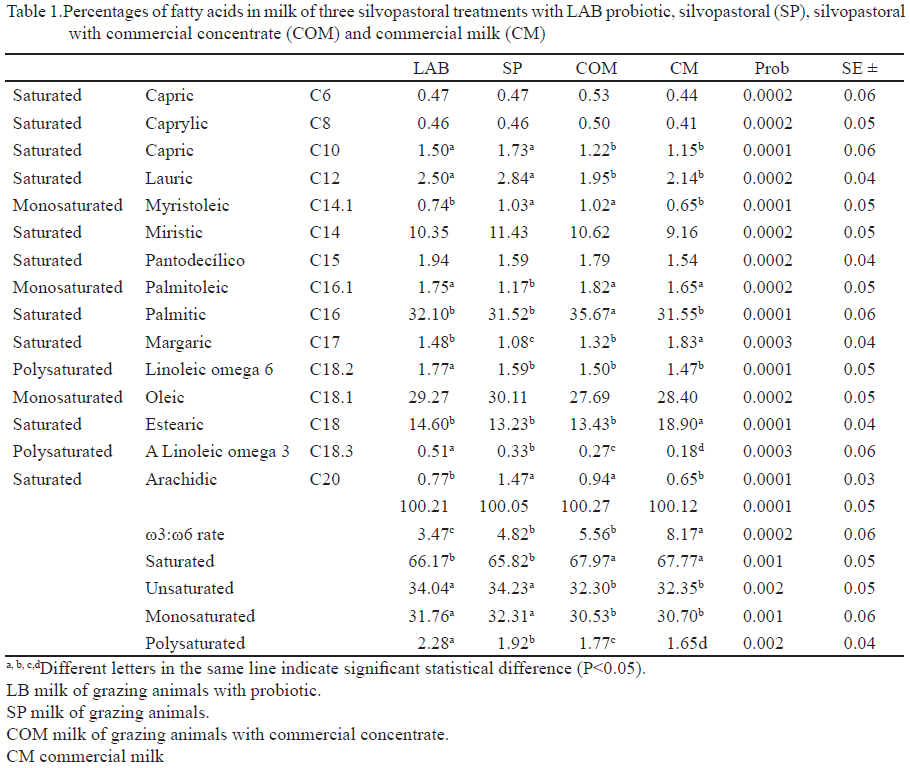
<body><![CDATA[<p align="justify" class="Cuerpodetexto" style="text-indent:0in;"><span style="font-family:'Verdana','sans-serif'; font-size:10.0pt; ">Results  were calculated by ANDEVA model, using a completely randomized arrangement:</span></p>     <p align="justify" class="Cuerpodetexto" style="text-indent:0in;"><span style="font-family:'Verdana','sans-serif'; font-size:10.0pt; ">Yij  = &mu;+ti+Ej</span></p>     <p align="justify" class="Cuerpodetexto" style="text-indent:0in;"><span style="font-family:'Verdana','sans-serif'; font-size:10.0pt; ">Yij=  values of fatty acids&nbsp;&nbsp;&nbsp;&nbsp;&nbsp;&nbsp;&nbsp;&nbsp;&nbsp;&nbsp;&nbsp;&nbsp;  i=1,2..., 4&nbsp;&nbsp;&nbsp;&nbsp;&nbsp; j=1,2...,8</span></p>     <p align="justify" class="Cuerpodetexto" style="text-indent:0in;"><span style="font-family:'Verdana','sans-serif'; font-size:10.0pt; ">&mu;=  general mean</span></p>     <p align="justify" class="Cuerpodetexto" style="text-indent:0in;"><span style="font-family:'Verdana','sans-serif'; font-size:10.0pt; ">ti=  effect of the i-th treatment</span></p>     <p align="justify"><span style="font-family:'Verdana','sans-serif'; font-size:10.0pt; ">Ej= effect of random error</span><font size="2" face="Verdana, Arial, Helvetica, sans-serif">.</font> </p>     <p align="justify">&nbsp;</p>     <p align="justify"><font size="2" face="Verdana, Arial, Helvetica, sans-serif"><b><font size="3">RESULTS</font></b></font></p>     <p align="justify" class="Cuerpodetexto" style="text-indent:0in;"><span style="letter-spacing:.1pt; font-family:'Verdana','sans-serif'; font-size:10.0pt; ">The average of milk in both groups was 17.5, (LAB); 14.1  (SP) and 16.5 (COM) kg/d (P&lt;0.05).The feeding system affected significantly  the profile of fatty acids in the milk of the studied cows. This effect was  measured by the content of fatty acids from feeding systems, in percentages of  saturated and unsaturated LAB 66.17:34.04%; SP 65.82:34.23%; COM 67.97:32.30%;  CM 67.77:32.35%, as <a href="/img/revistas/cjas/v50n1/t0113116.gif">table 1</a> shows. The content of polyunsaturated fatty acids,  omega-3 was LAB 0.51%, SP 0.33% and COM 0.27% superior to those of commercial  milk (CM), which had 0.18% of average. Results of omega 6 were 1.77 % LAB, 1.59  % SP and 1.50% COM, while commercial milk had an average of 1.47% (P&lt;0.05).  The relation omega 6/omega 3 was 3.47:1 LAB; 4.82:1 SP; 5.16 COM and 8.17  commercial.</span><span style="font-family:'Verdana','sans-serif'; font-size:10.0pt; "> </span></p>     
<p align="justify" class="Cuerpodetexto" style="text-indent:0in;"><span style="font-family:'Verdana','sans-serif'; font-size:10.0pt; ">Regarding  saturated fatty acids, CM and COM were superior to the milk of grazing animals,  which showed no differences among them (P&gt;0.05). Unsaturated fatty acids had  a similar performance but LAB and SP were superior to COM and CM  (P&gt;0.05).Differences among the four milks were found in the percentage of  polyunsaturated fatty acids, being intermedia LAB the highest for SP and COM  and the lowest for CM (P&gt;0.05). The analysis of variance showed that the  feeding system only modified the concentration of polyunsaturated fatty acids  (P&lt;0.01). However, monounsaturated fatty acids were only affected  (P&lt;0.01) between LAB and SP compared to COM and CM. Regarding  polyunsaturated fatty acids, LAB had the highest (P&lt;0.05) percentage,  superior to the remaining types of milk. There was significant effect  (P&lt;0.01) of feeding system over the different types of milk.</span></p>     ]]></body>
<body><![CDATA[<p align="justify" class="Cuerpodetexto" style="text-indent:0in;"><span style="letter-spacing:.2pt; font-family:'Verdana','sans-serif'; font-size:10.0pt; ">Regarding the profile of amino acids (<a href="/img/revistas/cjas/v50n1/t0213116.gif">table 2</a>), there was  only significant differences (P&lt;0.05) in lysine and histidine of essential  amino acids. However, there was no interaction among factors in the analysis of  variance. Lysine concentration was higher in milk with probiotic (1.27%) than  in CM (1.04%). Histidine was higher in LB (0.44%) than in CM (0.33) (P&lt;0.05).</span></p>     
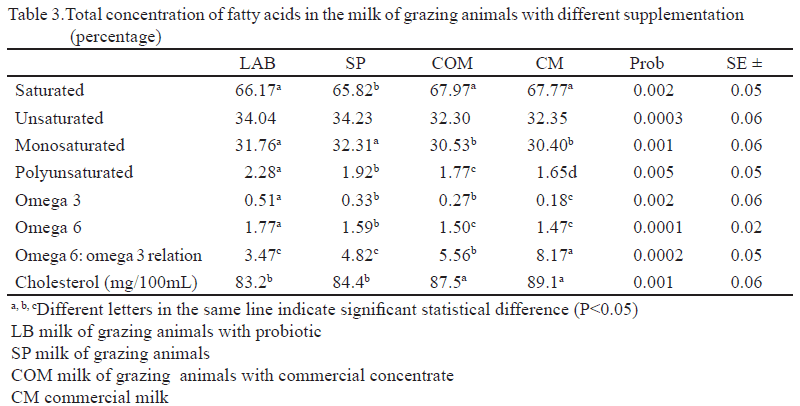
<p align="justify" class="Cuerpodetexto" style="text-indent:0in;"><span style="letter-spacing:.35pt; font-family:'Verdana','sans-serif'; font-size:10.0pt; "><a href="/img/revistas/cjas/v50n1/t0313116.gif">Table 3</a> presents a summary of the content of saturated,  monosaturated, and polyunsaturated fatty acids. There is a higher percentage of  saturated in COM and CM compared to LAB and SAP. However, it is particularly  important the difference in the content of omega 3, being higher in milks of  pastors, especially in those supplemented with probiotics. After analyzing the  cholesterol content in different types of samples, LAB recorded a content of  83.2 mg/100 mL and SP registered    84.4 mg/100mL, showing significant differences with COM (87.5 mg/100 mL) and  CM(89.1 mg/100 mL). In this regard, the feeding system, with or without  probiotics, showed lower amount of cholesterol in both treatments.</span></p>     
<p align="justify"><span style="letter-spacing:.35pt; font-family:'Verdana','sans-serif'; font-size:10.0pt; ">An  important element is the relation omega    6/omega 3, which, in this observation, was 3.47 for LAB and 4.82 for SP,  slightly within a range lower than 5, while the same silvopastoral system, when  supplemented with commercial concentrate, has a relation from 5.56 to 1,  probably blocking the beneficial effect of omega 3, and the average of  commercial milk went from 8.17 to 1. This was superior to the limits that allow  a beneficial use for humans</span><font size="2" face="Verdana, Arial, Helvetica, sans-serif">.</font> </p>     <p align="justify">&nbsp;</p>     <p align="justify"><font size="2" face="Verdana, Arial, Helvetica, sans-serif"><b><font size="3">DISCUSSION</font></b></font></p>     <p align="justify" class="Cuerpodetexto" style="text-indent:0in;"><span style="font-family:'Verdana','sans-serif'; font-size:10.0pt; ">The  performance of ingestion and rumination has been widely documented, regarding  the nature of diet, essentially, its superior plant maturity and provided  fitness. These are aspects that could on influence the filling of organs and  dry matter degradation rate in the digestive tract (Van Soest 1982).The  fermentation promoters (FP) have demonstrated to have the elements that allow a  better utilization of cell walls due to several factors including the presence  of a source of soluble carbohydrates to offer energy as ATP of anaerobic  bacteria (Galina <em>et al.</em>2003).</span></p>     <p align="justify" class="Cuerpodetexto" style="text-indent:0in;"><span style="letter-spacing:.1pt; font-family:'Verdana','sans-serif'; font-size:10.0pt; ">By analyzing the ruminal liquor, the pH values obtained  with the use of FP were &plusmn; 6.9 even when there is no single consensus of pH  value where the functioning of ruminal microbiota is optimized. The figures found  in all treatments are between the physiological limits of 6.0 and 7.2 (El&iacute;as  1971, 1983, Calsamiglia <em>et al.</em> 2002 and Krause and Oetzel 2006), as  optimal values to guarantee the digestion of cellulose, and favor the increase  of growth rate of    cellulitic/hemicellulolitic microorganisms, their enzymatic activity and the  products of their metabolism (Marrero 2005). The values of pH reached with the  FP have a positive effect exerted by microbial activators to stimulate  bacterial growth and contribute to increase the DM intake, mainly NDF (Puga <em>et  al.</em>  2001abc).</span><span style="font-family:'Verdana','sans-serif'; font-size:10.0pt; "> </span></p>     <p align="justify" class="Cuerpodetexto" style="text-indent:0in;"><span style="font-family:'Verdana','sans-serif'; font-size:10.0pt; ">Casta&ntilde;eda <em>et al.</em> 2010 achieved similar results in  the performance of goats and sheep, because they demonstrated an increase of  VFAs concentrations from 2 and 8 hours after food ingestion. At the same time,  these authors reached a negative correlation    (r<sup>2</sup> = 0.454, P &lt;0.01) between pH and the concentrations of these  organic acids. A similar performance is possible with the use of RF/LAB at this  level indicates that in the ruminal mixed ecosystem had to be influenced not  only by the concentration of these acids, but also by other factors such as the  buffering capacity of the medium (Ramos and Antonio 2009 and Galina <em>et al.</em> 2009ab).This should have occurred in these treatments, as a result of increased  chewing and rumination, as it was previously stated, which brings about a  higher production and segregation of saliva (Guti&eacute;rrez <em>et al.</em> 2012ab).The possibility of buffering these substances (carbonates and  phosphates), plus urea, and amounts of VFAs, acetic and lactic acids, contained  in LAB, and produced in the rumen, together with pH stability, should  substantially improve the synthesis of microbial protein (El&iacute;as 1983), and,  consequently, increase animal response.</span><span style="font-family:'Verdana','sans-serif'; font-size:10.0pt; "> </span></p>     <p align="justify" class="Cuerpodetexto" style="text-indent:0in;"><span style="font-family:'Verdana','sans-serif'; font-size:10.0pt; "><span style="letter-spacing:.2pt; ">According to  Smith (1975), it is possible to estimate the ruminal microbial mass from the  AGVs concentrations. Studies carried out in Cuba determined the optimum level  of 6 mL kg LW<sup>-1</sup> of LAB in the ration, for increased production of  microbial biomass (Gutierrez <em>et al.</em>2012ab). This evidences better  ruminal fermentation and, consequently, more degradation of forage enriched in  cell walls and microbial mass, which becomes part of digesta as bypass protein  of excellent amino acid composition, leaves the rumen and is absorbed in the  small intestine (L&oacute;pez    2009). </span></span></p>     <p align="justify" class="Cuerpodetexto" style="text-indent:0in;"><span style="font-family:'Verdana','sans-serif'; font-size:10.0pt; ">Although there are several <em>in vivo</em> studies  describing improvements in degradation rate of DM in the diet of cattle  consuming basically fiber, with the addition of microbial additives from mixed  cultures of yeast and lactobacilli, such as those conducted by Flores (2000)  when using 1% of strains of <em>Lactobacillus plantarum </em>in a basic diet  containing concentrate and alfalfa, where improvements in degradability were  obtained in other studies developed by Castillo (2009) and Guti&eacute;rrez <em>et al.</em>(2012ab)  evaluated microbial preparations of <em>S. cerevisiae</em>, related to  characteristics of ruminal fermentation in cows fed fiber diets, and found an  increase of cellulolitic and total viable bacteria. With the use of LAB, there  was a significant improvement in the content of essential fatty acids of milk  from the animals (Galina <em>et al.</em> 2009 and El&iacute;as <em>et al.</em> 2010).&nbsp; Nevertheless, differences found in the  ingestion of DM and NDF with LAB diet, regarding other treatments of this  study, can be attributed to similar effects to those previously achieved in  cattle, and thus, an increase of disappearance rate of fibrous material in the  rumen, similar to that described by Galina <em>et al.</em> (2007)</span><span style="font-family:'Verdana','sans-serif'; font-size:10.0pt; ">. </span></p>     ]]></body>
<body><![CDATA[<p align="justify" class="Cuerpodetexto" style="text-indent:0in;"><span style="font-family:'Verdana','sans-serif'; font-size:10.0pt; ">Gutierrez <em>et al.</em> (2012 ab) stated that, in all  treatments with probiotics at different times during incubation kinetics, there  were high levels of DM degradation despite the high fiber content, although  previously it had low digestibility in fibrous forages, defined as materials of  low nutritional value (P&eacute;rez Infante 2010), with high levels of NDF and effects  on ruminal degradation Vergara and Araujo (2006) found a negative correlation  of fiber material with ruminal digestion. </span></p>     <p align="justify" class="Cuerpodetexto" style="text-indent:0in;"><span style="font-family:'Verdana','sans-serif'; font-size:10.0pt; ">&nbsp;The results  with LAB in the ration suggest that there are major changes in the ruminal  microbial activity, resulting in an increased of fermentation ability of structural  carbohydrates, by degrading complex carbonated chains and release simple  strings that were used by cellulolytic bacteria, as energy sources for their  growth since their beginning, plus the contribution of LAB with peptides and  amino acids within its true protein (El&iacute;as, 1983 and Galina <em>et al., </em>2008ab<em>, </em>2009a). This is demonstrated during the kinetics performance of the curve,  where LAB stimulatory activity was observed, perhaps associated to living  cells, plus their activity in the ruminal liquor, since the beginning of  degradation kinetics and its extension (Gutierrez <em>et al.</em> 2012b).</span></p>     <p align="justify" class="Cuerpodetexto" style="text-indent:0in;"><span style="letter-spacing:.2pt; font-family:'Verdana','sans-serif'; font-size:10.0pt; ">In studies of Gutierrez <em>et al.</em> (2012ab), with the  use of probiotics, the response to the characteristics during degradation  kinetics of DM showed that soluble fraction (A) was the same in all treatments,  mainly because the incubated fibrous material was the same (<em>B. brizantha</em> hay). This indicator was estimated from the material lost during bag washing,  at zero hour, without ruminal incubation. In this regard, it can be stated that  the values of potential degradation (A + B) were determined, primarily, by the  insoluble, but degradable, fraction (B).This fraction, according to Ort&iacute;z <em>et  al.</em> (2007)in studies developed with grasses, express the permanence time of  this type of feed in the rumen, and it is related to the time of adaptation and  colonization of microorganisms to degrade this fraction. At the same time,  there is a high degradation rate (c) of insoluble fraction (B) with values of  2.9 h<sup>-1</sup>. Similarly, the highest value of effective degradability  (ED) of the potentially degradable fraction was determined by the lowest  ruminal turnover rate (2% h). In the latter, the effective degradation  decreases with the increase of ruminal turnover rate. This confirms the  importance of using effective degradation and not the potential one, for  calculating diet, as proposed by Leichtle and Cristian (2005).</span><span style="font-family:'Verdana','sans-serif'; font-size:10.0pt; "> </span></p>     <p align="justify" class="Cuerpodetexto" style="text-indent:0in;"><span style="font-family:'Verdana','sans-serif'; font-size:10.0pt; ">Regarding the product quality, the minimum content of  saturated fatty acids (SFA) was found in the milk of grazing animals, being significantly  superior when the probiotic was added. The literature states that a low content  of SFA may favor human health because of the information accumulated of the  effect of blocking of blood vessels on coronary diseases (Pfeuffer and  Schrezenmeir 2000). Results of the present study explain that the feeding  system, in general, and specifically free grazing in a silvopastoral system,  allows each cow, mainly in forage-diversity areas, to form a diet according to  their own needs, which have a good effect on nutritional characteristics of  milk, making it favorable for health. The highest content of trans-fatty acids  was present in grazing milk. Negative effects of trans-fatty acids on health  were considered similar to those reported for saturated fatty acids (Sicchiari,  2008) until recently. Negative effects of trans-fatty acids on coronary  pathologies and cytotoxicity were determined from observations on the  metabolism of hydrogenated fatty acids, produced during the manufacturing of  industrial feeds. Trans derived from processes of ruminal biohydrogenation,  like those produced by rumen, have demonstrated positive effects on human  health (Wencelov&aacute; <em>et al.</em> 2015). In the present study, this fact was  observed for most of C18:1 transvaccenic acids, though the action of 9  desaturation, where it is metabolized in C18: 2 11 trans 9 cis, which  represents one of the most important precursor of beneficial CLA (Castillo <em>et  al.</em> 2013). Therefore, after having this relatively new knowledge, the role  of trans fatty acids in the feeding system of ruminants in free grazing have to  be reevaluated for producing a &ldquo;better&rdquo; milk for the health of the consumer.  This fact is a great concern in Mexico because a big part of the population  suffers from obesity or overweight, which may be translated into degenerative  chronic diseases, mainly coronary changes (Rubino 2014).</span></p>     <p align="justify" class="Cuerpodetexto" style="text-indent:0in;"><span style="font-family:'Verdana','sans-serif'; font-size:10.0pt; ">The  beneficial effect of omega 3 and omega 6 polyunsaturated acids have been  abundantly documented (Colavilla <em>et al.</em> 2014). New studies have  demonstrated the importance of maintaining a rate lower than 5:1 between omega  6 and omega 3, because superior concentrations block the beneficial effects of  omega 3, affecting health (<span style="letter-spacing:-.2pt; ">Colavilla <em>et  al.</em> 2014 y Rubino 2014</span>). Only LAB with 3.48 and SP with 4.79 reached  this parameter while grazing supplemented with commercial concentrates is  slightly superior (5.54) and the average of 8 commercial milks was 8.40, which  means that the little contained omega 3 would have no effect on health because  it is blocked by omega 6 (Simopoulos 2002 and Strandvik 2011). </span></p>     <p align="justify" class="Cuerpodetexto" style="text-indent:0in;"><span style="font-family:'Verdana','sans-serif'; font-size:10.0pt; ">&nbsp;Even though the differences demonstrated  between the two systems, omega 3/omega 6 relation and CLA values were favorable  for both systems, which demonstrates the importance of biohydrogenation in milk  production, which decreases with the use of lactic bacteria. Significant  differences in the profile of beneficial fatty acids from the milk of grazing  or stabulated animals, with the addition of a supplement of lactic acid  bacteria, compared to commercial milk, demonstrates the importance of  biohydrogenation in the ruminal metabolism for milk quality and consumer health  (Galina <em>et al.</em> 2013).</span></p>     <p align="justify"><span style="letter-spacing:.1pt; font-family:'Verdana','sans-serif'; font-size:10.0pt; ">Results  of BH with LAB were similar to those obtained in diets supplemented with  organic acids or plant with oils (Wencelov&aacute; <em>et al.</em> 2015), which suggests  that lactic acid bacteria have a form of ruminal fermentation that may have a  similar effect, and results in a better quality of milk (Galina <em>et al.</em> 2012). Therefore, several observations have been performed, comparing feeding  system in stabulation or grazing with or without the use of lactic bacteria  supplementation. The significant differences in the profile of essential fatty  acids among the milks of grazing animals, with the addition of lactic bacteria  supplementation, compared to commercial milk, demonstrated the importance of BH  in ruminal metabolism for milk quality and consumer health. Then, animals from  silvopastoral system with supplementation of PF and probiotics were those that  produced significantly better quality milk, compared to grazing without  probiotics or those stabulated with or without probiotics</span><font size="2" face="Verdana, Arial, Helvetica, sans-serif">.</font> </p>     <p align="justify">&nbsp;</p>     <p align="justify"><font size="2" face="Verdana, Arial, Helvetica, sans-serif"><b><font size="3">CONCLUSIONS</font></b></font></p>     <p align="justify"><font size="2" face="Verdana, Arial, Helvetica, sans-serif"><span style="letter-spacing:.1pt; font-family:'Verdana','sans-serif'; font-size:10.0pt; ">Results have demonstrated that the two feeding systems in grazing, even  if both are mainly composed of fresh green forages, improve the quality of milk  probably due to an increase of USFA in diets. Nevertheless, due to the decrease  of BH using LAB, there is a production of better quality milk in their profile  of essential fatty acids, and a favorable significant difference was observed,  even compared to SP (P &le; 0.05), which meant that with a decrease of BH due to  lactic flora that decreases when there is a substrate with higher diversity of  forages, as in the case of animals in LAB</span>.</font></p>     ]]></body>
<body><![CDATA[<p align="justify">&nbsp;</p>     <p align="justify"><font size="2" face="Verdana, Arial, Helvetica, sans-serif"><b><font size="3">ACKNOWLEDGEMENTS</font></b></font></p>     <p align="justify"><font size="2" face="Verdana, Arial, Helvetica, sans-serif"><span style="font-family:'Verdana','sans-serif'; font-size:10.0pt; ">The  authors would like to thank PAPIIT UNAM IT 202014-3 and C&aacute;tedra CONS-207 of  FES-Cuautitl&aacute;n UNAM</span>.</font></p>     <p align="justify">&nbsp;</p>      <p align="justify"><font size="2" face="Verdana, Arial, Helvetica, sans-serif"><font size="3"><b>REFERENCES</b></font></font></p>     <p align="justify" class="MsoBibliography"><span style="font-family:'Verdana','sans-serif'; font-size:10.0pt; ">Calsamiglia,  S., Ferret, A. &amp; Devant, M. 2002. &lsquo;&lsquo;Effects of pH and pH Fluctuations on  Microbial Fermentation and Nutrient Flow from a Dual-Flow Continuous Culture  System&rsquo;&rsquo;. <em>Journal of Dairy Science</em>, 85 (3): 574&ndash;579, ISSN: 0022-0302,  DOI: 10.3168/jds.S0022-0302(02)74111-8, PMID: 11949862, 11949862.</span></p>     <!-- ref --><p align="justify" class="MsoBibliography"><span style="font-family:'Verdana','sans-serif'; font-size:10.0pt; ">Castillo, C.  Y. 2009. </span><em><span style="font-family:'Verdana','sans-serif'; font-size:10.0pt; ">Fermentaci&oacute;n in-vitro para obtener la levadura Candida  norvengensis en mezcla de alfalfa con bagazo de manzana fermentado y sus  efectos sobre la actividad microbiana ruminal</span></em><span style="font-family:'Verdana','sans-serif'; font-size:10.0pt; ">. Ph.D. Thesis,  Universidad Aut&oacute;noma de Chihuahua, M&eacute;xico.    </span></p>     <p align="justify" class="MsoBibliography"><span style="font-family:'Verdana','sans-serif'; font-size:10.0pt; ">Castillo, V. J., Olivera, A. M. &amp;  Carulla, F. J. 2013. </span><span style="font-family:'Verdana','sans-serif'; font-size:10.0pt; ">&lsquo;&lsquo;Description  of the biochemistry mechanism of polyunsaturated fatty acid ruminal biohydrogenation:  a review&rsquo;&rsquo;. </span><em><span style="font-family:'Verdana','sans-serif'; font-size:10.0pt; ">Revista U.D.C.A Actualidad &amp;amp;  Divulgaci&oacute;n Cient&iacute;fica</span></em><span style="font-family:'Verdana','sans-serif'; font-size:10.0pt; ">, 16 (2): 459&ndash;468, ISSN: 0123-4226.</span></p>     <p align="justify" class="MsoBibliography"><span style="font-family:'Verdana','sans-serif'; font-size:10.0pt; ">Colavita, G., Amadoro, C. &amp; Mignogna,  R. 2014. &lsquo;&lsquo;Rapporto omega6/omega3 e GPA nel Latte Nobile in Molise&rsquo;&rsquo;. In:  Rubino R., <em>Il Modello Latte Nobile: Un&rsquo;altra via &egrave; possibile</em>, Italia:  Caseus, pp. 118&ndash;128, Available:  &lt;<a href="https://aperto.unito.it/retrieve/handle/2318/149692/26118/Cavallero_Lombardi-Paesaggi%20agrari%2c%20polifitismo%20e%20alimentazione%20animale%20Anfosc-def.pdf" target="_blank">https://aperto.unito.it/retrieve/handle/2318/149692/26118/Cavallero_Lombardi-Paesaggi%20agrari%2c%20polifitismo%20e%20alimentazione%20animale%20Anfosc-def.pdf</a>&gt;,  [Consulted:&nbsp;April 4, 2016].</span></p>     ]]></body>
<body><![CDATA[<!-- ref --><p align="justify" class="MsoBibliography"><span style="font-family:'Verdana','sans-serif'; font-size:10.0pt; ">El&iacute;as, A.  1971. <em>The rumen bacteria of animals feed on molases-urea diet</em>. </span><span style="font-family:'Verdana','sans-serif'; font-size:10.0pt; ">Ph.D.  Thesis, Universidad Aberdeen, Escocia, 180 p.    </span></p>     <p align="justify" class="MsoBibliography"><span style="font-family:'Verdana','sans-serif'; font-size:10.0pt; ">El&iacute;as, A. 1983. &lsquo;&lsquo;Digesti&oacute;n de pastos y  forrajes tropicales&rsquo;&rsquo;. In: <em>Los pastos en Cuba</em>, vol. 2, La Habana, Cuba:  Instituto de Ciencia Animal, pp. 187&ndash;246, Available:  &lt;<a href="http://www.sidalc.net/cgi-bin/wxis.exe/?IsisScript=catalco.xis&method=post&formato=2&cantidad=1&expresion=mfn=030111" target="_blank">http://www.sidalc.net/cgi-bin/wxis.exe/?IsisScript=catalco.xis&amp;method=post&amp;formato=2&amp;cantidad=1&amp;expresion=mfn=030111</a>&gt;,  [Consulted:&nbsp;March 2, 2016].</span></p>     <!-- ref --><p align="justify" class="MsoBibliography"><span style="font-family:'Verdana','sans-serif'; font-size:10.0pt; ">El&iacute;as, A., Chilibroste, P., Michelena, J.  B., Iri&ntilde;iz, J. &amp; Rodr&iacute;guez, D. 2010. <em>Evaluaci&oacute;n de ACTIVIOL y MEBA con  ensilaje de sorgo y despunte de ca&ntilde;a de az&uacute;car: valor nutritivo,  fermentabilidad in- vivo e in- vitro y pruebas con animales en crecimiento y  vacas lecheras</em>. Potencial de uso de forrajes de baja calidad en la alimentaci&oacute;n  de rumiantes, con &eacute;nfasis en subproductos de la ca&ntilde;a de az&uacute;car, Rep&uacute;blica de  Uruguay.    </span></p>     <p align="justify" class="MsoBibliography"><span style="font-family:'Verdana','sans-serif'; font-size:10.0pt; ">El&iacute;as, A. &amp; Herrera, F. R. 2008. &lsquo;&lsquo;El  VITAFERT en el tracto gastro-intestinal&rsquo;&rsquo;. In: <em>Producci&oacute;n de alimentos para  animales a trav&eacute;s de procesos biotecnol&oacute;gicos sencillos con el empleo de  microorganismos ben&eacute;ficos activados (MEBA)</em>, La Habana, Cuba: Instituto de  Ciencia&nbsp; Animal, p. 8.</span></p>     <!-- ref --><p align="justify" class="MsoBibliography"><span style="font-family:'Verdana','sans-serif'; font-size:10.0pt; ">Flores, M. N. 2000. <em>Elaboraci&oacute;n de  cultivos microbianos a partir de coco, su utilizaci&oacute;n en dietas para borregos  en engorde</em>. M.Sc. Thesis, Instituto Nacional de Nutrici&oacute;n, Salvador  Zubiran, M&eacute;xico.    </span></p>     <p align="justify" class="MsoBibliography"><span style="font-family:'Verdana','sans-serif'; font-size:10.0pt; ">Galina, M. A., Delgado, P. M., Ort&iacute;z, R. M.  A., Pineda, L. J. &amp; Puga, D. C. 2009a. &lsquo;&lsquo;Cin&eacute;tica ruminal y crecimiento de  cabritos suplementados con un probi&oacute;tico de bacterias &aacute;cido-l&aacute;cticas&rsquo;&rsquo;. <em>Pastos  y Forrajes</em>, 32 (4): 1&ndash;1, ISSN: 0864-0394.</span></p>     <p align="justify" class="MsoBibliography"><span style="font-family:'Verdana','sans-serif'; font-size:10.0pt; ">Galina, M. A., Guerrero, M., Puga, C. D.  &amp; Haenlein, G. F. W. 2004a. </span><span style="font-family:'Verdana','sans-serif'; font-size:10.0pt; ">&lsquo;&lsquo;Effects  of slow-intake urea supplementation on goat kids pasturing natural Mexican  rangeland&rsquo;&rsquo;. <em>Small Ruminant Research</em>, 55 (1): 85&ndash;95, ISSN: 0921-4488,  DOI: 10.1016/j.smallrumres.2003.09.011.</span></p>     ]]></body>
<body><![CDATA[<p align="justify" class="MsoBibliography"><span style="font-family:'Verdana','sans-serif'; font-size:10.0pt; ">Galina, M. A.,  Guerrero, M., Puga, C. &amp; Haenlein, G. F. W. 2004b. &lsquo;&lsquo;Effect of a  slow-intake urea supplementation on growing kids fed corn stubble or alfalfa  with a balanced concentrate&rsquo;&rsquo;. <em>Small Ruminant Research</em>, 53 (1&ndash;2): 29&ndash;38,  ISSN: 0921-4488, DOI: 10.1016/j.smallrumres.2003.08.009.</span></p>     <p align="justify" class="MsoBibliography"><span style="font-family:'Verdana','sans-serif'; font-size:10.0pt; ">Galina, M. A.,  Guerrero, M., Serrano, G., Morales, R. &amp; Haenlein, G. F. W. 2000. &lsquo;&lsquo;Effect  of complex catalytic supplementation with non-protein nitrogen on the ruminal  ecosystem of growing goats pasturing on shrub land in Mexico&rsquo;&rsquo;. <em>Small  Ruminant Research</em>, 36 (1): 33&ndash;42, ISSN: 0921-4488, DOI:  10.1016/S0921-4488(99)00115-7.</span></p>     <p align="justify" class="MsoBibliography"><span style="font-family:'Verdana','sans-serif'; font-size:10.0pt; ">Galina, M. A.,  Hummel, J. D., S&aacute;nchez, M. &amp; Haenlein, G. F. W. 2004c. &lsquo;&lsquo;Fattening  Rambouillet lambs with corn stubble or alfalfa, slow intake urea  supplementation or balanced concentrate&rsquo;&rsquo;. <em>Small Ruminant Research</em>, 53  (1&ndash;2): 89&ndash;98, ISSN: 0921-4488, DOI: 10.1016/j.smallrumres.2003.08.008.</span></p>     <p align="justify" class="MsoBibliography"><span style="font-family:'Verdana','sans-serif'; font-size:10.0pt; ">Galina, M. A.,  Ortiz, R. M. A., Delgado, P. M. &amp; Pineda, L. J. 2007a. &lsquo;&lsquo;Effect of a lactic  probiotic supplementation on goat kids growth&rsquo;&rsquo;. In: <em>XII Seminar of the  sub-NY FAO- CIHEAM on Sheep and Goat Nutrition</em>, Thessaloniki, Greece, p.  11.</span></p>     <p align="justify" class="MsoBibliography"><span style="font-family:'Verdana','sans-serif'; font-size:10.0pt; ">Galina, M. A., Ortiz, R. M. A. &amp;  Guerrero, M. 2007b. &lsquo;&lsquo;Desarrollo de cabras con o sin suplementaci&oacute;n, con un  probi&oacute;tico de bacterias l&aacute;cticas&rsquo;&rsquo;. In: <em>V Congreso de Especialistas en  Peque&ntilde;os Rumiantes y Cam&eacute;lidos Sudamericanos</em>, Mendoza, Argentina: Instituto  Nacional de Tecnolog&iacute;a Agropecuaria (INTA), Universidad Juan Agust&iacute;n Maza y Universidad  de Buenos Aires, p. 11.</span></p>     <p align="justify" class="MsoBibliography"><span style="font-family:'Verdana','sans-serif'; font-size:10.0pt; ">Galina, M. A., Ortiz, R. M. A., Guerrero,  M. &amp; El&iacute;as, A. 2008a. &lsquo;&lsquo;Efecto de un ensilado de ma&iacute;z solo o inoculado con  probi&oacute;ticos l&aacute;cticos y adicionado con un suplemento nitrogenado de lento  consumo en ovinos&rsquo;&rsquo;. <em>Avances en Investigaci&oacute;n Agropecuaria</em>, 12 (2):  23&ndash;34, ISSN: 0188-7890.</span></p>     <p align="justify" class="MsoBibliography"><span style="font-family:'Verdana','sans-serif'; font-size:10.0pt; ">Galina, M. A., Ortiz, R. M. A., Guerrero,  M., Mondrag&oacute;n, D. F., Franco, N. J. L. &amp; El&iacute;as, A. 2008b. &lsquo;&lsquo;Engorda de  ovinos con silo de ma&iacute;z, silo inoculado con un probi&oacute;tico l&aacute;ctico, solo o  adicionado con un suplemento de liberaci&oacute;n lenta de nitr&oacute;geno&rsquo;&rsquo;. <em>Avances en  Investigaci&oacute;n Agropecuaria</em>, 12 (2): 23&ndash;24, ISSN: 0188-7890.</span></p>     <p align="justify" class="MsoBibliography"><span style="font-family:'Verdana','sans-serif'; font-size:10.0pt; ">Galina, M. A., Ortiz-Rubio, M. A.,  Mondrag&oacute;n, F., Delgado-Pert&iacute;&ntilde;ez, M. &amp; El&iacute;as, A. 2009b. &lsquo;&lsquo;Rendimiento de  terneros alimentados con silo de ma&iacute;z o l&aacute;ctico con un promotor de la  fermentaci&oacute;n ruminal&rsquo;&rsquo;. <em>Archivos de Zootecnia</em>, 58 (223): 383&ndash;393, ISSN:  0004-0592.</span></p>     <p align="justify" class="MsoBibliography"><span style="font-family:'Verdana','sans-serif'; font-size:10.0pt; ">Galina, M. A., P&eacute;rez-Gil, F., Ortiz, R. M.  A., Hummel, J. D. &amp; &Oslash;rskov, R. E. 2003. </span><span style="font-family:'Verdana','sans-serif'; font-size:10.0pt; ">&lsquo;&lsquo;Effect of slow release urea supplementation on  fattening of steers fed sugar cane tops (Saccharum officinarum) and maize (Zea  mays): ruminal fermentation, feed intake and digestibility&rsquo;&rsquo;. <em>Livestock  Production Science</em>, 83 (1): 1&ndash;11, ISSN: 0301-6226, DOI:  10.1016/S0301-6226(03)00045-9.</span></p>     <p align="justify" class="MsoBibliography"><span style="font-family:'Verdana','sans-serif'; font-size:10.0pt; ">Galina, M. A.,  Ruiz, G. &amp; Ortiz, M. A. 2002. </span><span style="font-family:'Verdana','sans-serif'; font-size:10.0pt; ">&lsquo;&lsquo;Ceba de bovinos con  punta de ca&ntilde;a y planta de ma&iacute;z suplementados con bloque proteico de urea o  concentrado&rsquo;&rsquo;. <em>Pastos y Forrajes</em>, 25 (3): 209&ndash;221, ISSN: 2078-8452.</span></p>     ]]></body>
<body><![CDATA[<p align="justify" class="MsoBibliography"><span style="font-family:'Verdana','sans-serif'; font-size:10.0pt; ">Galina, M., Guerrero, M., Pineda, J.,  Ort&iacute;z, M. &amp; Osnaya, F. 2012. &lsquo;&lsquo;Efecto de la biohidrogenaci&oacute;n ruminal de  probi&oacute;ticos l&aacute;cticos, en la engorda de bovinos&rsquo;&rsquo;. In: <em>XXXVI Congreso  Nacional de Buiatr&iacute;a</em>, Yucat&aacute;n, M&eacute;xico: Asociaci&oacute;n Mexicana de M&eacute;dicos  Veterinarios Especialistas en Bovinos, A. C., pp. 753&ndash;761.</span></p>     <p align="justify" class="MsoBibliography"><span style="font-family:'Verdana','sans-serif'; font-size:10.0pt; ">Galina, M., Guerrero, M., Pineda, J.,  Ort&iacute;z, M. &amp; Osnaya, F. 2013. &lsquo;&lsquo;Efecto de la biohidrogenaci&oacute;n ruminal de  probi&oacute;ticos l&aacute;cticos, en la engorda de bovinos&rsquo;&rsquo;. In: <em>XXXVII Congreso  Nacional de Buiatr&iacute;a</em>, Guerrero, M&eacute;xico: Asociaci&oacute;n Mexicana de M&eacute;dicos  Veterinarios Especialistas en Bovinos, A. C., pp. 533&ndash;538.</span></p>     <p align="justify" class="MsoBibliography"><span style="font-family:'Verdana','sans-serif'; font-size:10.0pt; ">Galina, M., Pineda, L. J. &amp; Morales, R.  2010. &lsquo;&lsquo;Suplementaci&oacute;n en pastoreo de cabras lecheras con una fuente de  liberaci&oacute;n lenta de nitr&oacute;geno (SLNN) con o sin la adici&oacute;n de un probi&oacute;tico de  bacterias l&aacute;cticas&rsquo;&rsquo;. In: <em>III Congreso de Producci&oacute;n Animal Tropical y I  Simposio FOCAL</em>, La Habana, Cuba: Instituto de Ciencia Animal, ISBN:  978-959-7171-31-7.</span></p>     <p align="justify" class="MsoBibliography"><span style="font-family:'Verdana','sans-serif'; font-size:10.0pt; ">Galindo, J. &amp; Marrero, Y. 2005.  &lsquo;&lsquo;Manipulaci&oacute;n de la fermentaci&oacute;n microbiana ruminal&rsquo;&rsquo;. </span><em><span style="font-family:'Verdana','sans-serif'; font-size:10.0pt; ">Cuban Journal of Agricultural Science</span></em><span style="font-family:'Verdana','sans-serif'; font-size:10.0pt; ">, 39 (especial): 439&ndash;450, ISSN: 2079-3480.</span></p>     <!-- ref --><p align="justify" class="MsoBibliography"><span style="font-family:'Verdana','sans-serif'; font-size:10.0pt; ">Guti&eacute;rrez, B.  R. 2005. </span><em><span style="font-family:'Verdana','sans-serif'; font-size:10.0pt; ">Actividad probi&oacute;tica de un producto biofermentado  (VITAFER), en pollos de ceba</span></em><span style="font-family:'Verdana','sans-serif'; font-size:10.0pt; ">. M.Sc. Thesis, Instituto  de Ciencia Animal, La Habana, Cuba, 52 p.    </span></p>     <p align="justify" class="MsoBibliography"><span style="font-family:'Verdana','sans-serif'; font-size:10.0pt; ">Guti&eacute;rrez, D., El&iacute;as, A., Galina, M.,  Garc&iacute;a, R., Herrera, F., Jord&aacute;n, H. &amp; Sarduy, L. 2012a. &lsquo;&lsquo;Efecto del  aditivo VITAFERT en el consumo de la materia seca y fibra en detergente neutro  de cabras alimentadas con heno de <em>Brachiaria brizanta</em>&rsquo;&rsquo;. In: <em>II Foro  internacional de Ciencia e Innovaci&oacute;n Tecnol&oacute;gica</em>, Colima, M&eacute;xico:  Puertabierta Editores, pp. 318&ndash;322, ISBN: 978-607-95853-7-2.</span></p>     <p align="justify" class="MsoBibliography"><span style="font-family:'Verdana','sans-serif'; font-size:10.0pt; ">Guti&eacute;rrez, D., El&iacute;as, A., Galina, M.,  Garc&iacute;a, R., Herrera, F., Jord&aacute;n, H. &amp; Sarduy, L. 2012b. &lsquo;&lsquo;Influencia de un  aditivo microbiano en el consumo voluntario de materia seca e indicadores de la  fermentaci&oacute;n ruminal en cabras alimentadas con heno de <em>Brachiaria brizanta</em>&rsquo;&rsquo;.  In: <em>II Foro internacional de Ciencia e Innovaci&oacute;n Tecnol&oacute;gica</em>, Colima,  M&eacute;xico: Puertabierta Editores, pp. 312&ndash;317, ISBN: 978-607-95853-7-2.</span></p>     <p align="justify" class="MsoBibliography"><span style="font-family:'Verdana','sans-serif'; font-size:10.0pt; ">Hartfoot, C.  G. &amp; Hazlewood, G. P. 1997. &lsquo;&lsquo;Lipid metabolism in the rumen&rsquo;&rsquo;. In: Hobson  P. N. &amp; Stewart C. S., <em>The Rumen Microbial Ecosystem</em>, 2nd ed., New  York, USA: Blackie Academic &amp; Professional, pp. 382&ndash;426, ISBN:  978-94-009-1453-7.</span></p>     <p align="justify" class="MsoBibliography"><span style="font-family:'Verdana','sans-serif'; font-size:10.0pt; ">Herrera, J. A., Shahabuddin, A. K. M.,  Faisal, M., Ersheng, G., Wei, Y., Lixia, D., Gandaho, T. &amp; Jaramillo, P. L.  2004. &lsquo;&lsquo;Efectos de la suplementaci&oacute;n oral con calcio y &aacute;cido linoleico  conjugado en primigr&aacute;vidas de alto riesgo&rsquo;&rsquo;. </span><em><span style="font-family:'Verdana','sans-serif'; font-size:10.0pt; ">Colombia M&eacute;dica</span></em><span style="font-family:'Verdana','sans-serif'; font-size:10.0pt; ">, 35 (1): 31&ndash;37, ISSN: 1657-9534.</span></p>     ]]></body>
<body><![CDATA[<!-- ref --><p align="justify" class="MsoBibliography"><span style="font-family:'Verdana','sans-serif'; font-size:10.0pt; ">Jarrige, R.  1995. <em>Nutrition des ruminants domestiques: Ingestion et digestion</em>.  Editions Quae, 932 p., ISBN: 978-2-7380-0629-5, Available: &lt;<a href="https://books.google.com.cu/books?id=pIbmTs7_DDIC&redir_esc=y" target="_blank">https://books.google.com.cu/books?id=pIbmTs7_DDIC&amp;redir_esc=y</a>&gt;,  [Consulted:&nbsp;April 4, 2016].    </span></p>     <p align="justify" class="MsoBibliography"><span style="font-family:'Verdana','sans-serif'; font-size:10.0pt; ">Jin, G. L.,  Choi, S. H., Lee, H. G., Kim, Y. J. &amp; Song, M. K. 2008. &lsquo;&lsquo;Effects of  monensin and fish oil on conjugated linoleic acid production by rumen microbes  in Holstein cows fed diets supplemented with soybean oil and sodium  bicarbonate&rsquo;&rsquo;. <em>Asian-Australasian Journal of Animal Sciences</em>, 21:  1728&ndash;1735, ISSN: 1976-5517, 1011-2367.</span></p>     <p align="justify" class="MsoBibliography"><span style="font-family:'Verdana','sans-serif'; font-size:10.0pt; ">Khanal, R. C.  2004. &lsquo;&lsquo;Potential health benefits of conjugated linoleic acid (CLA): A review&rsquo;&rsquo;. <em>Asian-Australasian Journal of Animal Sciences</em>, 17 (9): 1315&ndash;1328, ISSN:  1976-5517, 1011-2367.</span></p>     <p align="justify" class="MsoBibliography"><span style="font-family:'Verdana','sans-serif'; font-size:10.0pt; ">Krause, K. M.  &amp; Oetzel, G. R. 2006. &lsquo;&lsquo;Understanding and preventing subacute ruminal  acidosis in dairy herds: A review&rsquo;&rsquo;. <em>Animal Feed Science and Technology</em>,  126 (3&ndash;4): 215&ndash;236, ISSN: 0377-8401, DOI: 10.1016/j.anifeedsci.2005.08.004.</span></p>     <p align="justify" class="MsoBibliography"><span style="font-family:'Verdana','sans-serif'; font-size:10.0pt; ">Ku, V. J. C.  2010. </span><span style="font-family:'Verdana','sans-serif'; font-size:10.0pt; ">&lsquo;&lsquo;Requerimientos  de energ&iacute;a en rumiantes en el tr&oacute;pico. Implicaciones del concepto de  mantenimiento. Taller de fisiolog&iacute;a y procesos fermentativos&rsquo;&rsquo;. In: <em>III  Congreso de Producci&oacute;n Animal Tropical y I Simposio FOCAL</em>, La Habana, Cuba:  Instituto de Ciencia&nbsp; Animal, ISBN:  978-959-7171-31-7.</span></p>     <!-- ref --><p align="justify" class="MsoBibliography"><span style="font-family:'Verdana','sans-serif'; font-size:10.0pt; ">Leichtle, S. &amp; Cristian, J. 2005. <em>Degradabilidad  ruminal de henos de praderas de la zona sur de Chile</em>. Graduate Theses,  Universidad Austral de Chile, Facultad de Ciencias Agrarias, Chile, 18 p.    </span></p>     <p align="justify" class="MsoBibliography"><span style="font-family:'Verdana','sans-serif'; font-size:10.0pt; ">Lila, Z. A.,  Mohammed, N., Ysui, T., Kutokawa, Y., Kanda, S. &amp; Itabashi, H. 2004.  &lsquo;&lsquo;Effects of <em>Saccharomyces cerevisiae</em> twin of live cells on mixed  ruminal microorganism fermentation <em>in vitro</em>&rsquo;&rsquo;. </span><em><span style="font-family:'Verdana','sans-serif'; font-size:10.0pt; ">Journal  of Dairy Science</span></em><span style="font-family:'Verdana','sans-serif'; font-size:10.0pt; ">, 82: 1847&ndash;1854, ISSN: 0022-0302.</span></p>     <!-- ref --><p align="justify" class="MsoBibliography"><span style="font-family:'Verdana','sans-serif'; font-size:10.0pt; ">L&oacute;pez, R. J. 2009. <em>Efecto de la  suplementaci&oacute;n con concentrado en indicadores de la fisiolog&iacute;a digestiva y  consumo de nutrientes en becerros </em>(<em>Bubalus bubalis</em>)<em> alimentados  con pasto estrella </em>(<em>Cynodon nlemfuensis</em>). Ph.D. Thesis, Instituto de  Ciencia Animal, La Habana, Cuba, 140 p.    </span></p>     <!-- ref --><p align="justify" class="MsoBibliography"><span style="font-family:'Verdana','sans-serif'; font-size:10.0pt; ">Marrero, Y. R. 2005. <em>Las levaduras como  mejoradoras de la fermentaci&oacute;n ruminal de dietas con alto contenido de fibra</em>.  Ph.D. Thesis, Instituto de Ciencia Animal, La Habana, Cuba, 104 p.    </span></p>     <p align="justify" class="MsoBibliography"><span style="font-family:'Verdana','sans-serif'; font-size:10.0pt; ">Newbold, C.  J., L&oacute;pez, S., Nelson, N., Ouda, J. O., Wallace, R. J. &amp; Moss, A. R. 2005.  &lsquo;&lsquo;Propionate precursors and other metabolic intermediates as possible  alternative electron acceptors to methanogenesis in ruminal fermentation <em>in  vitro</em>&rsquo;&rsquo;. <em>British Journal of Nutrition</em>, 94 (01): 27&ndash;35, ISSN:  1475-2662, DOI: 10.1079/BJN20051445.</span></p>     <p align="justify" class="MsoBibliography"><span style="font-family:'Verdana','sans-serif'; font-size:10.0pt; ">Offner, A.,  Bach, A. &amp; Sauvant, D. 2003. &lsquo;&lsquo;Quantitative review of in situ starch  degradation in the rumen&rsquo;&rsquo;. <em>Animal Feed Science and Technology</em>, 106  (1&ndash;4): 81&ndash;93, ISSN: 0377-8401, DOI: 10.1016/S0377-8401(03)00038-5.</span></p>     <p align="justify" class="MsoBibliography"><span style="font-family:'Verdana','sans-serif'; font-size:10.0pt; ">&Oslash;rskov, E. R.  &amp; McDonald, I. 1979. &lsquo;&lsquo;The estimation of protein degradability in the rumen  from incubation measurements weighted according to rate of passage&rsquo;&rsquo;. <em>The  Journal of Agricultural Science</em>, 92 (2): 499&ndash;503, ISSN: 0021-8596.</span></p>     <p align="justify" class="MsoBibliography"><span style="font-family:'Verdana','sans-serif'; font-size:10.0pt; ">Ortiz, R. A.,  Haenlein, G. F. W. &amp; Galina, M. 2001. &lsquo;&lsquo;Effects on feed intake and body  weight gain when substituting maize with sugar cane in diets for Zebu steers  complemented with slow release urea supplements&rsquo;&rsquo;. <em>International Journal  Animal Science</em>, 16: 239&ndash;245.</span></p>     <p align="justify" class="MsoBibliography"><span style="font-family:'Verdana','sans-serif'; font-size:10.0pt; ">Ortiz, R. M.  A., Galina, M. A. &amp; Carmona, M. M. A. 2002. &lsquo;&lsquo;Effect of a slow non-protein  nitrogen ruminal supplementation on improvement of <em>Cynodon nlemfuensis</em> or <em>Brachiaria brizanta</em> utilization by Zebu steers&rsquo;&rsquo;. <em>Livestock  Production Science</em>, 78 (2): 125&ndash;131, ISSN: 0301-6226, DOI:  10.1016/S0301-6226(02)00089-1.</span></p>     <p align="justify" class="MsoBibliography"><span style="font-family:'Verdana','sans-serif'; font-size:10.0pt; ">Ortiz, R. M.  A., &Oslash;rskov, E. R., Milne, J. &amp; Galina, H. M. A. 2007. &lsquo;&lsquo;Effect of different  sources of nitrogen on <em>in situ</em> degradability and feed intake of Zebu  cattle fed sugarcane tops (<em>Saccharum officinarum</em>)&rsquo;&rsquo;. <em>Animal Feed  Science and Technology</em>, 139 (3&ndash;4): 143&ndash;158, ISSN: 0377-8401, DOI:  10.1016/j.anifeedsci.2007.01.016.</span></p>     <p align="justify" class="MsoBibliography"><span style="font-family:'Verdana','sans-serif'; font-size:10.0pt; ">O&rsquo;Shea, M.,  Lawless, F., Stanton, C. &amp; Devery, R. 1998. &lsquo;&lsquo;Conjugated linoleic acid in  bovine milk fat: a food-based approach to cancer chemoprevention&rsquo;&rsquo;. <em>Trends  in Food Science &amp; Technology</em>, 9 (5): 192&ndash;196, ISSN: 0924-2244, DOI:  10.1016/S0924-2244(98)00036-3.</span></p>     ]]></body>
<body><![CDATA[<p align="justify" class="MsoBibliography"><span style="font-family:'Verdana','sans-serif'; font-size:10.0pt; ">P&eacute;rez, I. F.  2010. </span><span style="font-family:'Verdana','sans-serif'; font-size:10.0pt; ">&lsquo;&lsquo;Estimado  de la calidad del pasto y los forrajes verdes cuando la disponibilidad no es  limitante&rsquo;&rsquo;. In: <em>Ganader&iacute;a del Futuro Producci&oacute;n y Eficiencia</em>, La  Habana, Cuba: Palcogra, p. 33.</span></p>     <p align="justify" class="MsoBibliography"><span style="font-family:'Verdana','sans-serif'; font-size:10.0pt; ">Peters, M., van der Hoek, R. &amp;  Schultze, K. R. 2010. &lsquo;&lsquo;Los pastos y forrajes en el tr&oacute;pico - retos en el marco  de un desarrollo sostenible&rsquo;&rsquo;. In: <em>III Congreso de Producci&oacute;n Animal  Tropical, V Foro Latinoamericano de Pastos y Forrajes</em>, La Habana, Cuba:  Instituto de Ciencia Animal, ISBN: 978-959-7171-31-7.</span></p>     <p align="justify" class="MsoBibliography"><span style="font-family:'Verdana','sans-serif'; font-size:10.0pt; ">Pfeuffer, M.  &amp; Schrezenmeir, J. 2000. &lsquo;&lsquo;Bioactive substances in milk with properties  decreasing risk of cardiovascular diseases&rsquo;&rsquo;. <em>British Journal of Nutrition</em>,  84 (S1): 155&ndash;159, ISSN: 0007-1145, 1475-2662.</span></p>     <p align="justify" class="MsoBibliography"><span style="font-family:'Verdana','sans-serif'; font-size:10.0pt; ">Puga, D. C.,  Galina, H. M., P&eacute;rez-Gil, R. F., Sangin&eacute;s, G. L., Aguilera, B. A. &amp;  Haenlein, G. F. W. 2001a. &lsquo;&lsquo;Effect of a controlled-release urea supplement on  rumen fermentation in sheep fed a diet of sugar cane tops (<em>Saccharum  officinarum</em>), corn stubble (<em>Zea mays</em>) and King grass (<em>Pennisetum  purpureum</em>)&rsquo;&rsquo;. <em>Small Ruminant Research</em>, 39 (3): 269&ndash;276, ISSN:  0921-4488, DOI: 10.1016/S0921-4488(00)00196-6.</span></p>     <p align="justify" class="MsoBibliography"><span style="font-family:'Verdana','sans-serif'; font-size:10.0pt; ">Puga, D. C.,  Galina, H. M., Per&eacute;z-Gil, R. F., Sangines, G. L., Aguilera, B. A., Haenlein, G.  F. W., Barajas, C. R. &amp; Herrera, H. J. G. 2001b. &lsquo;&lsquo;Effect of a  controlled-release urea supplementation on feed intake, digestibility, nitrogen  balance and ruminal kinetics of sheep fed low quality tropical forage&rsquo;&rsquo;. <em>Small  Ruminant Research</em>, 41 (1): 9&ndash;18, ISSN: 0921-4488, DOI:  10.1016/S0921-4488(01)00171-7.</span></p>     <p align="justify" class="MsoBibliography"><span style="font-family:'Verdana','sans-serif'; font-size:10.0pt; ">Puga, D. C.,  Galina, M. A., P&eacute;rez, G. F., Rosado, J. &amp; Murillo, J. C. 2001c. </span><span style="font-family:'Verdana','sans-serif'; font-size:10.0pt; ">&lsquo;&lsquo;Efecto  de un Alimento Complejo Catal&iacute;tico sobre el pH, amon&iacute;aco (N-NH<sub>3</sub>)  ruminal y la desaparici&oacute;n in situ de <em>Cynodon nlemfuensis, Cynodon dactylon,  Panicum m&aacute;ximum</em> y <em>Brachiaria brizanta</em> en bovinos en Pastoreo en el  Tr&oacute;pico Mexicano&rsquo;&rsquo;. <em>Pastos y Forrajes</em>, 24 (2): 157&ndash;166, ISSN: 0864-0394,  2078-8452.</span></p>     <p align="justify" class="MsoBibliography"><span style="font-family:'Verdana','sans-serif'; font-size:10.0pt; ">Ram&iacute;rez, O. R., Ram&iacute;rez, L. R. G. &amp;  L&oacute;pez, G. F. 2002. &lsquo;&lsquo;Factores estructurales de la pared celular del forraje que  afectan su digestibilidad&rsquo;&rsquo;. <em>Ciencia UANL</em>, 5 (2): 180, ISSN: 1405-9177.</span></p>     <p align="justify" class="MsoBibliography"><span style="font-family:'Verdana','sans-serif'; font-size:10.0pt; ">Ramos, N. &amp; Antonio, J. 2009.  &lsquo;&lsquo;Acidosis Ruminal y su Relaci&oacute;n con la Fibra de la Dieta y la&nbsp; Composici&oacute;n de Leche en Vacas Lecheras&rsquo;&rsquo;. In: <em>Seminario Avanzado de investigaci&oacute;n Cajamarca</em>, Sistema de Revisiones en  Investigaci&oacute;n Veterinaria de San Marcos (Sirives), pp. 2&ndash;3, Available:  &lt;<a href="http://www.uv.mx/personal/rloeza/files/2013/12/acidosis_nino.pdf" target="_blank">http://www.uv.mx/personal/rloeza/files/2013/12/acidosis_nino.pdf</a>&gt;,  [Consulted:&nbsp;April 4, 2016].</span></p>     <p align="justify" class="MsoBibliography"><span style="font-family:'Verdana','sans-serif'; font-size:10.0pt; ">Rubino, R. 2014. <em>Il Modello Latte  Nobile: Un&rsquo;altra via &egrave; possibile</em>. </span><span style="font-family:'Verdana','sans-serif'; font-size:10.0pt; ">Italia: Caseus, 191 p., Available: &lt;<a href="https://aperto.unito.it/retrieve/handle/2318/149692/26118/Cavallero_Lombardi-Paesaggi%20agrari%2c%20polifitismo%20e%20alimentazione%20animale%20Anfosc-def.pdf" target="_blank">https://aperto.unito.it/retrieve/handle/2318/149692/26118/Cavallero_Lombardi-Paesaggi%20agrari%2c%20polifitismo%20e%20alimentazione%20animale%20Anfosc-def.pdf</a>&gt;,  [Consulted:&nbsp;April 4, 2016].</span></p>     <p align="justify" class="MsoBibliography"><span style="font-family:'Verdana','sans-serif'; font-size:10.0pt; ">Secchiari, P.  L. 2008. &lsquo;&lsquo;Nutritional and nutraceutical value of foods of animal origin&rsquo;&rsquo;. <em>Italian  Journal of Agronomy</em>, 3 (1): 73&ndash;101, ISSN: 1125-4718.</span></p>     ]]></body>
<body><![CDATA[<p align="justify" class="MsoBibliography"><span style="font-family:'Verdana','sans-serif'; font-size:10.0pt; ">Shen, X.,  Dannenberger, D., Nuernberg, K., Nuernberg, G. &amp; Zhao, R. 2011. &lsquo;&lsquo;<em>Trans</em>-18:1  and CLA Isomers in Rumen and Duodenal Digesta of Bulls Fed n-3 and n-6  PUFA-Based Diets&rsquo;&rsquo;. <em>Lipids</em>, 46 (9): 831&ndash;841, ISSN: 0024-4201, 1558-9307,  DOI: 10.1007/s11745-011-3586-5.</span></p>     <p align="justify" class="MsoBibliography"><span style="font-family:'Verdana','sans-serif'; font-size:10.0pt; ">Simopoulos, A.  P. 2002. &lsquo;&lsquo;The importance of the ratio of omega-6/omega-3 essential fatty  acids&rsquo;&rsquo;. <em>Biomedicine &amp; Pharmacotherapy</em>, 56 (8): 365&ndash;379, ISSN:  0753-3322, PMID: 12442909.</span></p>     <p align="justify" class="MsoBibliography"><span style="font-family:'Verdana','sans-serif'; font-size:10.0pt; ">Smith, R. H.  1975. &lsquo;&lsquo;Nitrogen metabolism in the rumen and the composition and nutritive  value of nitrogen compounds entering the duodenum&rsquo;&rsquo;. In: McDonald I. W. &amp;  Warner A. C. I. (eds.), <em>Digestion and metabolism in the ruminant.</em>,  Armidale, Australia: University of New England Publishing Unit., pp. 399&ndash;415,  ISBN: 978-0-85834-086-2, Available:  &lt;<a href="http://www.cabdirect.org/abstracts/19770435059.html;jsessionid=0B0DDBB9D51103DD61E748465DE71236" target="_blank">http://www.cabdirect.org/abstracts/19770435059.html;jsessionid=0B0DDBB9D51103DD61E748465DE71236</a>&gt;,  [Consulted:&nbsp;April 4, 2016].</span></p>     <p align="justify" class="MsoBibliography"><span style="font-family:'Verdana','sans-serif'; font-size:10.0pt; ">Strandvik, B.  2011. &lsquo;&lsquo;The omega-6/omega-3 ratio is of importance!&rsquo;&rsquo;. <em>Prostaglandins,  Leukotrienes and Essential Fatty Acids</em>, 85 (6): 405&ndash;406, ISSN: 0952-3278,  DOI: 10.1016/j.plefa.2011.09.001.</span></p>     <p align="justify" class="MsoBibliography"><span style="font-family:'Verdana','sans-serif'; font-size:10.0pt; ">Tittonell, P.,  Rufino, M. C., Janssen, B. H. &amp; Giller, K. E. 2009. &lsquo;&lsquo;Carbon and nutrient  losses during manure storage under traditional and improved practices in  smallholder crop-livestock systems&mdash;evidence from Kenya&rsquo;&rsquo;. <em>Plant and Soil</em>,  328 (1-2): 253&ndash;269, ISSN: 0032-079X, 1573-5036, DOI: 10.1007/s11104-009-0107-x.</span></p>     <!-- ref --><p align="justify" class="MsoBibliography"><span style="font-family:'Verdana','sans-serif'; font-size:10.0pt; ">van Soest, P.  J. 1982. <em>Nutritional ecology of the ruminant. Ruminant metabolism,  nutritional strategies, the cellulolytic fermentation and the chemistry of  forages and plant fibers.</em> Oregon: O &amp; B Books, Inc., 24 p., ISBN:  978-0-9601586-0-7, Available: &lt;<a href="http://www.cabdirect.org/abstracts/19821437561.html" target="_blank">http://www.cabdirect.org/abstracts/19821437561.html</a>&gt;,  [Consulted:&nbsp;April 4, 2016].    </span></p>     <p align="justify" class="MsoBibliography"><span style="font-family:'Verdana','sans-serif'; font-size:10.0pt; ">Vergara, L. J. &amp; Araujo, F. O. 2006.  &lsquo;&lsquo;Producci&oacute;n, composici&oacute;n qu&iacute;mica y degradabilidad ruminal in situ de <em>Brachiaria  humidicola</em> (Rendle) Schweick en el bosque seco tropical&rsquo;&rsquo;. <em>Revista  Cient&iacute;fica</em>, 16 (3): 239&ndash;248, ISSN: 0798-2259.</span></p>     <p align="justify" class="MsoBibliography"><span style="font-family:'Verdana','sans-serif'; font-size:10.0pt; ">Wencelov&aacute;, M., V&aacute;radyov&aacute;, Z., Mihalikov&aacute;,  K., &#268;obanov&aacute;, K., Plach&aacute;, I., Prista&scaron;, P., Jal&#269;, D. &amp; Ki&scaron;idayov&aacute;, S. 2015. </span><span style="font-family:'Verdana','sans-serif'; font-size:10.0pt; ">&lsquo;&lsquo;Rumen fermentation pattern, lipid metabolism and the  microbial community of sheep fed a high-concentrate diet supplemented with a  mix of medicinal plants&rsquo;&rsquo;. <em>Small Ruminant Research</em>, 125: 64&ndash;72, ISSN:  0921-4488, DOI: 10.1016/j.smallrumres.2015.01.028.</span></p>     <p align="justify"><span style="font-family:'Verdana','sans-serif'; font-size:10.0pt; ">Zened, A., Enjalbert, F.,  Nicot, M. C. &amp; Troegeler-Meynadier, A. 2013. &lsquo;&lsquo;Starch plus sunflower oil  addition to the diet of dry dairy cows results in a <em>trans</em>-11 to <em>trans</em>-10  shift of biohydrogenation&rsquo;&rsquo;. </span><em><span style="font-family:'Verdana','sans-serif'; font-size:10.0pt; ">Journal of Dairy Science</span></em><span style="font-family:'Verdana','sans-serif'; font-size:10.0pt; ">, 96 (1): 451&ndash;459, ISSN:  0022-0302, DOI: 10.3168/jds.2012-5690</span><font size="2" face="Verdana, Arial, Helvetica, sans-serif">.</font> </p>     ]]></body>
<body><![CDATA[<p align="justify">&nbsp;</p>     <p align="justify">&nbsp;</p>     <p align="justify"><font size="2" face="Verdana, Arial, Helvetica, sans-serif">Received: November 24, 2015    <br>   Accepted: May 5, 2016</font></p>     <p align="justify">&nbsp;</p>     <p align="justify">&nbsp;</p>     <p align="justify"><font size="2" face="Verdana, Arial, Helvetica, sans-serif"><i>M.A. Galina,</i> Facultad de Estudios Superiores Cuautitlán Universidad Nacional Autónoma de México.    Email: <a href="mailto:miguelgalina@hotmail.com">miguelgalina@hotmail.com</a></font></p>      ]]></body><back>
<ref-list>
<ref id="B1">
<nlm-citation citation-type="journal">
<person-group person-group-type="author">
<name>
<surname><![CDATA[Calsamiglia]]></surname>
<given-names><![CDATA[S.]]></given-names>
</name>
<name>
<surname><![CDATA[Ferret]]></surname>
<given-names><![CDATA[A.]]></given-names>
</name>
<name>
<surname><![CDATA[Devant]]></surname>
<given-names><![CDATA[M.]]></given-names>
</name>
</person-group>
<article-title xml:lang="nd"><![CDATA[Effects of pH and pH Fluctuations on Microbial Fermentation and Nutrient Flow from a Dual-Flow Continuous Culture System]]></article-title>
<source><![CDATA[Journal of Dairy Science]]></source>
<year>2002</year>
<volume>85</volume>
<numero>3</numero>
<issue>3</issue>
<page-range>574-579</page-range></nlm-citation>
</ref>
<ref id="B2">
<nlm-citation citation-type="book">
<person-group person-group-type="author">
<name>
<surname><![CDATA[Castillo]]></surname>
<given-names><![CDATA[C. Y.]]></given-names>
</name>
</person-group>
<source><![CDATA[Fermentación in-vitro para obtener la levadura Candida norvengensis en mezcla de alfalfa con bagazo de manzana fermentado y sus efectos sobre la actividad microbiana ruminal]]></source>
<year>2009</year>
<publisher-loc><![CDATA[México ]]></publisher-loc>
<publisher-name><![CDATA[Universidad Autónoma de Chihuahua]]></publisher-name>
</nlm-citation>
</ref>
<ref id="B3">
<nlm-citation citation-type="journal">
<person-group person-group-type="author">
<name>
<surname><![CDATA[Castillo]]></surname>
<given-names><![CDATA[V. J.]]></given-names>
</name>
<name>
<surname><![CDATA[Olivera]]></surname>
<given-names><![CDATA[A. M.]]></given-names>
</name>
<name>
<surname><![CDATA[Carulla]]></surname>
<given-names><![CDATA[F. J.]]></given-names>
</name>
</person-group>
<article-title xml:lang="nd"><![CDATA[Description of the biochemistry mechanism of polyunsaturated fatty acid ruminal biohydrogenation: a review]]></article-title>
<source><![CDATA[Revista U.D.C.A Actualidad & Divulgación Científica]]></source>
<year>2013</year>
<volume>16</volume>
<numero>2</numero>
<issue>2</issue>
<page-range>459-468</page-range></nlm-citation>
</ref>
<ref id="B4">
<nlm-citation citation-type="book">
<person-group person-group-type="author">
<name>
<surname><![CDATA[Colavita]]></surname>
<given-names><![CDATA[G.]]></given-names>
</name>
<name>
<surname><![CDATA[Amadoro]]></surname>
<given-names><![CDATA[C.]]></given-names>
</name>
<name>
<surname><![CDATA[Mignogna]]></surname>
<given-names><![CDATA[R.]]></given-names>
</name>
</person-group>
<article-title xml:lang="nd"><![CDATA[Rapporto omega6/omega3 e GPA nel Latte Nobile in Molise]]></article-title>
<source><![CDATA[Il Modello Latte Nobile: Un’altra via è possibile]]></source>
<year>2014</year>
<page-range>118-128</page-range><publisher-loc><![CDATA[Italia ]]></publisher-loc>
<publisher-name><![CDATA[Caseus]]></publisher-name>
</nlm-citation>
</ref>
<ref id="B5">
<nlm-citation citation-type="book">
<person-group person-group-type="author">
<name>
<surname><![CDATA[Elías]]></surname>
<given-names><![CDATA[A.]]></given-names>
</name>
</person-group>
<source><![CDATA[The rumen bacteria of animals feed on molases-urea diet]]></source>
<year>1971</year>
<page-range>180</page-range><publisher-loc><![CDATA[Escocia ]]></publisher-loc>
<publisher-name><![CDATA[Universidad Aberdeen]]></publisher-name>
</nlm-citation>
</ref>
<ref id="B6">
<nlm-citation citation-type="book">
<person-group person-group-type="author">
<name>
<surname><![CDATA[Elías]]></surname>
<given-names><![CDATA[A.]]></given-names>
</name>
</person-group>
<article-title xml:lang="nd"><![CDATA[Digestión de pastos y forrajes tropicales]]></article-title>
<person-group person-group-type="editor">
<name>
<surname><![CDATA[Ugarte]]></surname>
<given-names><![CDATA[J.]]></given-names>
</name>
<name>
<surname><![CDATA[Herrera]]></surname>
<given-names><![CDATA[R.]]></given-names>
</name>
<name>
<surname><![CDATA[Ruiz]]></surname>
<given-names><![CDATA[R.]]></given-names>
</name>
<name>
<surname><![CDATA[García]]></surname>
<given-names><![CDATA[R.]]></given-names>
</name>
<name>
<surname><![CDATA[Vázquez]]></surname>
<given-names><![CDATA[C.]]></given-names>
</name>
<name>
<surname><![CDATA[Senra]]></surname>
<given-names><![CDATA[A.]]></given-names>
</name>
</person-group>
<source><![CDATA[Los pastos en Cuba]]></source>
<year>1983</year>
<volume>2</volume>
<page-range>187-246</page-range><publisher-loc><![CDATA[La Habana, Cuba ]]></publisher-loc>
<publisher-name><![CDATA[Instituto de Ciencia Animal]]></publisher-name>
</nlm-citation>
</ref>
<ref id="B7">
<nlm-citation citation-type="">
<person-group person-group-type="author">
<name>
<surname><![CDATA[Elías]]></surname>
<given-names><![CDATA[A.]]></given-names>
</name>
<name>
<surname><![CDATA[Chilibroste]]></surname>
<given-names><![CDATA[P.]]></given-names>
</name>
<name>
<surname><![CDATA[Michelena]]></surname>
<given-names><![CDATA[J. B.]]></given-names>
</name>
<name>
<surname><![CDATA[Iriñiz]]></surname>
<given-names><![CDATA[J.]]></given-names>
</name>
<name>
<surname><![CDATA[Rodríguez]]></surname>
<given-names><![CDATA[D.]]></given-names>
</name>
</person-group>
<source><![CDATA[Evaluación de ACTIVIOL y MEBA con ensilaje de sorgo y despunte de caña de azúcar: valor nutritivo, fermentabilidad in- vivo e in- vitro y pruebas con animales en crecimiento y vacas lecheras]]></source>
<year>2010</year>
<publisher-loc><![CDATA[República de Uruguay ]]></publisher-loc>
</nlm-citation>
</ref>
<ref id="B8">
<nlm-citation citation-type="book">
<person-group person-group-type="author">
<name>
<surname><![CDATA[Elías]]></surname>
<given-names><![CDATA[A.]]></given-names>
</name>
<name>
<surname><![CDATA[Herrera]]></surname>
<given-names><![CDATA[F. R.]]></given-names>
</name>
</person-group>
<article-title xml:lang="nd"><![CDATA[El VITAFERT en el tracto gastro-intestinal]]></article-title>
<source><![CDATA[Producción de alimentos para animales a través de procesos biotecnológicos sencillos con el empleo de microorganismos benéficos activados (MEBA)]]></source>
<year>2008</year>
<page-range>8</page-range><publisher-loc><![CDATA[La Habana, Cuba ]]></publisher-loc>
<publisher-name><![CDATA[Instituto de Ciencia Animal]]></publisher-name>
</nlm-citation>
</ref>
<ref id="B9">
<nlm-citation citation-type="book">
<person-group person-group-type="author">
<name>
<surname><![CDATA[Flores]]></surname>
<given-names><![CDATA[M. N.]]></given-names>
</name>
</person-group>
<source><![CDATA[Elaboración de cultivos microbianos a partir de coco, su utilización en dietas para borregos en engorde]]></source>
<year>2000</year>
<publisher-loc><![CDATA[Salvador Zubiran, México ]]></publisher-loc>
<publisher-name><![CDATA[Instituto Nacional de Nutrición]]></publisher-name>
</nlm-citation>
</ref>
<ref id="B10">
<nlm-citation citation-type="book">
<person-group person-group-type="author">
<name>
<surname><![CDATA[Galina]]></surname>
<given-names><![CDATA[M.]]></given-names>
</name>
<name>
<surname><![CDATA[Guerrero]]></surname>
<given-names><![CDATA[M.]]></given-names>
</name>
<name>
<surname><![CDATA[Pineda]]></surname>
<given-names><![CDATA[J.]]></given-names>
</name>
<name>
<surname><![CDATA[Ortíz]]></surname>
<given-names><![CDATA[M.]]></given-names>
</name>
<name>
<surname><![CDATA[Osnaya]]></surname>
<given-names><![CDATA[F.]]></given-names>
</name>
</person-group>
<article-title xml:lang="nd"><![CDATA[Efecto de la biohidrogenación ruminal de probióticos lácticos, en la engorda de bovinos]]></article-title>
<source><![CDATA[]]></source>
<year>2012</year>
<page-range>753-761</page-range><publisher-loc><![CDATA[Yucatán, México ]]></publisher-loc>
<publisher-name><![CDATA[Asociación Mexicana de Médicos Veterinarios Especialistas en Bovinos, A. C.]]></publisher-name>
</nlm-citation>
</ref>
<ref id="B11">
<nlm-citation citation-type="book">
<person-group person-group-type="author">
<name>
<surname><![CDATA[Galina]]></surname>
<given-names><![CDATA[M.]]></given-names>
</name>
<name>
<surname><![CDATA[Guerrero]]></surname>
<given-names><![CDATA[M.]]></given-names>
</name>
<name>
<surname><![CDATA[Pineda]]></surname>
<given-names><![CDATA[J.]]></given-names>
</name>
<name>
<surname><![CDATA[Ortíz]]></surname>
<given-names><![CDATA[M.]]></given-names>
</name>
<name>
<surname><![CDATA[Osnaya]]></surname>
<given-names><![CDATA[F.]]></given-names>
</name>
</person-group>
<article-title xml:lang="nd"><![CDATA[Efecto de la biohidrogenación ruminal de probióticos lácticos, en la engorda de bovinos]]></article-title>
<source><![CDATA[]]></source>
<year>2013</year>
<page-range>533-538</page-range><publisher-loc><![CDATA[Guerrero, México ]]></publisher-loc>
<publisher-name><![CDATA[Asociación Mexicana de Médicos Veterinarios Especialistas en Bovinos, A. C.]]></publisher-name>
</nlm-citation>
</ref>
<ref id="B12">
<nlm-citation citation-type="book">
<person-group person-group-type="author">
<name>
<surname><![CDATA[Galina]]></surname>
<given-names><![CDATA[M.]]></given-names>
</name>
<name>
<surname><![CDATA[Pineda]]></surname>
<given-names><![CDATA[L. J.]]></given-names>
</name>
<name>
<surname><![CDATA[Morales]]></surname>
<given-names><![CDATA[R.]]></given-names>
</name>
</person-group>
<article-title xml:lang="nd"><![CDATA[Suplementación en pastoreo de cabras lecheras con una fuente de liberación lenta de nitrógeno (SLNN) con o sin la adición de un probiótico de bacterias lácticas]]></article-title>
<source><![CDATA[]]></source>
<year>2010</year>
<publisher-loc><![CDATA[La Habana, Cuba ]]></publisher-loc>
<publisher-name><![CDATA[Instituto de Ciencia Animal]]></publisher-name>
</nlm-citation>
</ref>
<ref id="B13">
<nlm-citation citation-type="journal">
<person-group person-group-type="author">
<name>
<surname><![CDATA[Galina]]></surname>
<given-names><![CDATA[M. A.]]></given-names>
</name>
<name>
<surname><![CDATA[Delgado]]></surname>
<given-names><![CDATA[P. M.]]></given-names>
</name>
<name>
<surname><![CDATA[Ortíz]]></surname>
<given-names><![CDATA[R. M. A.]]></given-names>
</name>
<name>
<surname><![CDATA[Pineda]]></surname>
<given-names><![CDATA[L. J.]]></given-names>
</name>
<name>
<surname><![CDATA[Puga]]></surname>
<given-names><![CDATA[D. C.]]></given-names>
</name>
</person-group>
<article-title xml:lang="nd"><![CDATA[Cinética ruminal y crecimiento de cabritos suplementados con un probiótico de bacterias ácido-lácticas]]></article-title>
<source><![CDATA[Pastos y Forrajes]]></source>
<year>2009</year>
<volume>32</volume>
<numero>4</numero>
<issue>4</issue>
<page-range>1-1</page-range></nlm-citation>
</ref>
<ref id="B14">
<nlm-citation citation-type="journal">
<person-group person-group-type="author">
<name>
<surname><![CDATA[Galina]]></surname>
<given-names><![CDATA[M. A.]]></given-names>
</name>
<name>
<surname><![CDATA[Guerrero]]></surname>
<given-names><![CDATA[M.]]></given-names>
</name>
<name>
<surname><![CDATA[Puga]]></surname>
<given-names><![CDATA[C.]]></given-names>
</name>
<name>
<surname><![CDATA[Haenlein]]></surname>
<given-names><![CDATA[G. F. W.]]></given-names>
</name>
</person-group>
<article-title xml:lang="nd"><![CDATA[Effect of a slow-intake urea supplementation on growing kids fed corn stubble or alfalfa with a balanced concentrate]]></article-title>
<source><![CDATA[Small Ruminant Research]]></source>
<year>2004</year>
<volume>53</volume>
<numero>1-2</numero>
<issue>1-2</issue>
<page-range>29-38</page-range></nlm-citation>
</ref>
<ref id="B15">
<nlm-citation citation-type="journal">
<person-group person-group-type="author">
<name>
<surname><![CDATA[Galina]]></surname>
<given-names><![CDATA[M. A.]]></given-names>
</name>
<name>
<surname><![CDATA[Guerrero]]></surname>
<given-names><![CDATA[M.]]></given-names>
</name>
<name>
<surname><![CDATA[Puga]]></surname>
<given-names><![CDATA[C. D.]]></given-names>
</name>
<name>
<surname><![CDATA[Haenlein]]></surname>
<given-names><![CDATA[G. F. W.]]></given-names>
</name>
</person-group>
<article-title xml:lang="nd"><![CDATA[Effects of slow-intake urea supplementation on goat kids pasturing natural Mexican rangeland]]></article-title>
<source><![CDATA[Small Ruminant Research]]></source>
<year>2004</year>
<volume>55</volume>
<numero>1</numero>
<issue>1</issue>
<page-range>85-95</page-range></nlm-citation>
</ref>
<ref id="B16">
<nlm-citation citation-type="journal">
<person-group person-group-type="author">
<name>
<surname><![CDATA[Galina]]></surname>
<given-names><![CDATA[M. A.]]></given-names>
</name>
<name>
<surname><![CDATA[Guerrero]]></surname>
<given-names><![CDATA[M.]]></given-names>
</name>
<name>
<surname><![CDATA[Serrano]]></surname>
<given-names><![CDATA[G.]]></given-names>
</name>
<name>
<surname><![CDATA[Morales]]></surname>
<given-names><![CDATA[R.]]></given-names>
</name>
<name>
<surname><![CDATA[Haenlein]]></surname>
<given-names><![CDATA[G. F. W.]]></given-names>
</name>
</person-group>
<article-title xml:lang="nd"><![CDATA[Effect of complex catalytic supplementation with non-protein nitrogen on the ruminal ecosystem of growing goats pasturing on shrub land in Mexico]]></article-title>
<source><![CDATA[Small Ruminant Research]]></source>
<year>2000</year>
<volume>36</volume>
<numero>1</numero>
<issue>1</issue>
<page-range>33-42</page-range></nlm-citation>
</ref>
<ref id="B17">
<nlm-citation citation-type="journal">
<person-group person-group-type="author">
<name>
<surname><![CDATA[Galina]]></surname>
<given-names><![CDATA[M. A.]]></given-names>
</name>
<name>
<surname><![CDATA[Hummel]]></surname>
<given-names><![CDATA[J. D.]]></given-names>
</name>
<name>
<surname><![CDATA[Sánchez]]></surname>
<given-names><![CDATA[M.]]></given-names>
</name>
<name>
<surname><![CDATA[Haenlein]]></surname>
<given-names><![CDATA[G. F. W.]]></given-names>
</name>
</person-group>
<article-title xml:lang="nd"><![CDATA[Fattening Rambouillet lambs with corn stubble or alfalfa, slow intake urea supplementation or balanced concentrate]]></article-title>
<source><![CDATA[Small Ruminant Research]]></source>
<year>2004</year>
<volume>53</volume>
<numero>1-2</numero>
<issue>1-2</issue>
<page-range>89-98</page-range></nlm-citation>
</ref>
<ref id="B18">
<nlm-citation citation-type="">
<person-group person-group-type="author">
<name>
<surname><![CDATA[Galina]]></surname>
<given-names><![CDATA[M. A.]]></given-names>
</name>
<name>
<surname><![CDATA[Ortiz]]></surname>
<given-names><![CDATA[R. M. A.]]></given-names>
</name>
<name>
<surname><![CDATA[Delgado]]></surname>
<given-names><![CDATA[P. M.]]></given-names>
</name>
<name>
<surname><![CDATA[Pineda]]></surname>
<given-names><![CDATA[L. J.]]></given-names>
</name>
</person-group>
<article-title xml:lang="nd"><![CDATA[Effect of a lactic probiotic supplementation on goat kids growth]]></article-title>
<source><![CDATA[]]></source>
<year>2007</year>
<page-range>11</page-range><publisher-loc><![CDATA[Thessaloniki, Greece ]]></publisher-loc>
</nlm-citation>
</ref>
<ref id="B19">
<nlm-citation citation-type="book">
<person-group person-group-type="author">
<name>
<surname><![CDATA[Galina]]></surname>
<given-names><![CDATA[M. A.]]></given-names>
</name>
<name>
<surname><![CDATA[Ortiz]]></surname>
<given-names><![CDATA[R. M. A.]]></given-names>
</name>
<name>
<surname><![CDATA[Guerrero]]></surname>
<given-names><![CDATA[M.]]></given-names>
</name>
</person-group>
<article-title xml:lang="nd"><![CDATA[Desarrollo de cabras con o sin suplementación, con un probiótico de bacterias lácticas]]></article-title>
<source><![CDATA[]]></source>
<year>2007</year>
<page-range>11</page-range><publisher-loc><![CDATA[Mendoza, Argentina ]]></publisher-loc>
<publisher-name><![CDATA[Instituto Nacional de Tecnología Agropecuaria (INTA), Universidad Juan Agustín Maza y Universidad de Buenos Aires]]></publisher-name>
</nlm-citation>
</ref>
<ref id="B20">
<nlm-citation citation-type="journal">
<person-group person-group-type="author">
<name>
<surname><![CDATA[Galina]]></surname>
<given-names><![CDATA[M. A.]]></given-names>
</name>
<name>
<surname><![CDATA[Ortiz]]></surname>
<given-names><![CDATA[R. M. A.]]></given-names>
</name>
<name>
<surname><![CDATA[Guerrero]]></surname>
<given-names><![CDATA[M.]]></given-names>
</name>
<name>
<surname><![CDATA[Elías]]></surname>
<given-names><![CDATA[A.]]></given-names>
</name>
</person-group>
<article-title xml:lang="nd"><![CDATA[Efecto de un ensilado de maíz solo o inoculado con probióticos lácticos y adicionado con un suplemento nitrogenado de lento consumo en ovinos]]></article-title>
<source><![CDATA[Avances en Investigación Agropecuaria]]></source>
<year>2008</year>
<volume>12</volume>
<numero>2</numero>
<issue>2</issue>
<page-range>23-34</page-range></nlm-citation>
</ref>
<ref id="B21">
<nlm-citation citation-type="journal">
<person-group person-group-type="author">
<name>
<surname><![CDATA[Galina]]></surname>
<given-names><![CDATA[M. A.]]></given-names>
</name>
<name>
<surname><![CDATA[Ortiz]]></surname>
<given-names><![CDATA[R. M. A.]]></given-names>
</name>
<name>
<surname><![CDATA[Guerrero]]></surname>
<given-names><![CDATA[M.]]></given-names>
</name>
<name>
<surname><![CDATA[Mondragón]]></surname>
<given-names><![CDATA[D. F.]]></given-names>
</name>
<name>
<surname><![CDATA[Franco]]></surname>
<given-names><![CDATA[N. J. L.]]></given-names>
</name>
<name>
<surname><![CDATA[Elías]]></surname>
<given-names><![CDATA[A.]]></given-names>
</name>
</person-group>
<article-title xml:lang="nd"><![CDATA[Engorda de ovinos con silo de maíz, silo inoculado con un probiótico láctico, solo o adicionado con un suplemento de liberación lenta de nitrógeno]]></article-title>
<source><![CDATA[Avances en Investigación Agropecuaria]]></source>
<year>2008</year>
<volume>12</volume>
<numero>2</numero>
<issue>2</issue>
<page-range>23-24</page-range></nlm-citation>
</ref>
<ref id="B22">
<nlm-citation citation-type="journal">
<person-group person-group-type="author">
<name>
<surname><![CDATA[Galina]]></surname>
<given-names><![CDATA[M. A.]]></given-names>
</name>
<name>
<surname><![CDATA[Ortiz-Rubio]]></surname>
<given-names><![CDATA[M. A.]]></given-names>
</name>
<name>
<surname><![CDATA[Mondragón]]></surname>
<given-names><![CDATA[F.]]></given-names>
</name>
<name>
<surname><![CDATA[Delgado-Pertíñez]]></surname>
<given-names><![CDATA[M.]]></given-names>
</name>
<name>
<surname><![CDATA[Elías]]></surname>
<given-names><![CDATA[A.]]></given-names>
</name>
</person-group>
<article-title xml:lang="nd"><![CDATA[Rendimiento de terneros alimentados con silo de maíz o láctico con un promotor de la fermentación ruminal]]></article-title>
<source><![CDATA[Archivos de Zootecnia]]></source>
<year>2009</year>
<volume>58</volume>
<numero>223</numero>
<issue>223</issue>
<page-range>383-393</page-range></nlm-citation>
</ref>
<ref id="B23">
<nlm-citation citation-type="journal">
<person-group person-group-type="author">
<name>
<surname><![CDATA[Galina]]></surname>
<given-names><![CDATA[M. A.]]></given-names>
</name>
<name>
<surname><![CDATA[Pérez-Gil]]></surname>
<given-names><![CDATA[F.]]></given-names>
</name>
<name>
<surname><![CDATA[Ortiz]]></surname>
<given-names><![CDATA[R. M. A.]]></given-names>
</name>
<name>
<surname><![CDATA[Hummel]]></surname>
<given-names><![CDATA[J. D.]]></given-names>
</name>
<name>
<surname><![CDATA[Ørskov]]></surname>
<given-names><![CDATA[R. E.]]></given-names>
</name>
</person-group>
<article-title xml:lang="nd"><![CDATA[Effect of slow release urea supplementation on fattening of steers fed sugar cane tops (Saccharum officinarum) and maize (Zea mays): ruminal fermentation, feed intake and digestibility]]></article-title>
<source><![CDATA[Livestock Production Science]]></source>
<year>2003</year>
<volume>83</volume>
<numero>1</numero>
<issue>1</issue>
<page-range>1-11</page-range></nlm-citation>
</ref>
<ref id="B24">
<nlm-citation citation-type="journal">
<person-group person-group-type="author">
<name>
<surname><![CDATA[Galina]]></surname>
<given-names><![CDATA[M. A.]]></given-names>
</name>
<name>
<surname><![CDATA[Ruiz]]></surname>
<given-names><![CDATA[G.]]></given-names>
</name>
<name>
<surname><![CDATA[Ortiz]]></surname>
<given-names><![CDATA[M. A.]]></given-names>
</name>
</person-group>
<article-title xml:lang="nd"><![CDATA[Ceba de bovinos con punta de caña y planta de maíz suplementados con bloque proteico de urea o concentrado]]></article-title>
<source><![CDATA[Pastos y Forrajes]]></source>
<year>2002</year>
<volume>25</volume>
<numero>3</numero>
<issue>3</issue>
<page-range>209-221</page-range></nlm-citation>
</ref>
<ref id="B25">
<nlm-citation citation-type="journal">
<person-group person-group-type="author">
<name>
<surname><![CDATA[Galindo]]></surname>
<given-names><![CDATA[J.]]></given-names>
</name>
<name>
<surname><![CDATA[Marrero]]></surname>
<given-names><![CDATA[Y.]]></given-names>
</name>
</person-group>
<article-title xml:lang="nd"><![CDATA[Manipulación de la fermentación microbiana ruminal]]></article-title>
<source><![CDATA[Cuban Journal of Agricultural Science]]></source>
<year>2005</year>
<volume>39</volume>
<numero>especial</numero>
<issue>especial</issue>
<page-range>439-450</page-range></nlm-citation>
</ref>
<ref id="B26">
<nlm-citation citation-type="book">
<person-group person-group-type="author">
<name>
<surname><![CDATA[Gutiérrez]]></surname>
<given-names><![CDATA[B. R.]]></given-names>
</name>
</person-group>
<source><![CDATA[Actividad probiótica de un producto biofermentado (VITAFER), en pollos de ceba]]></source>
<year>2005</year>
<page-range>52</page-range><publisher-loc><![CDATA[La Habana, Cuba ]]></publisher-loc>
<publisher-name><![CDATA[Instituto de Ciencia Animal]]></publisher-name>
</nlm-citation>
</ref>
<ref id="B27">
<nlm-citation citation-type="book">
<person-group person-group-type="author">
<name>
<surname><![CDATA[Gutiérrez]]></surname>
<given-names><![CDATA[D.]]></given-names>
</name>
<name>
<surname><![CDATA[Elías]]></surname>
<given-names><![CDATA[A.]]></given-names>
</name>
<name>
<surname><![CDATA[Galina]]></surname>
<given-names><![CDATA[M.]]></given-names>
</name>
<name>
<surname><![CDATA[García]]></surname>
<given-names><![CDATA[R.]]></given-names>
</name>
<name>
<surname><![CDATA[Herrera]]></surname>
<given-names><![CDATA[F.]]></given-names>
</name>
<name>
<surname><![CDATA[Jordán]]></surname>
<given-names><![CDATA[H.]]></given-names>
</name>
<name>
<surname><![CDATA[Sarduy]]></surname>
<given-names><![CDATA[L.]]></given-names>
</name>
</person-group>
<article-title xml:lang="nd"><![CDATA[Efecto del aditivo VITAFERT en el consumo de la materia seca y fibra en detergente neutro de cabras alimentadas con heno de Brachiaria brizanta]]></article-title>
<source><![CDATA[]]></source>
<year>2012</year>
<page-range>318-322</page-range><publisher-loc><![CDATA[Colima, México ]]></publisher-loc>
<publisher-name><![CDATA[Puertabierta Editores]]></publisher-name>
</nlm-citation>
</ref>
<ref id="B28">
<nlm-citation citation-type="book">
<person-group person-group-type="author">
<name>
<surname><![CDATA[Gutiérrez]]></surname>
<given-names><![CDATA[D.]]></given-names>
</name>
<name>
<surname><![CDATA[Elías]]></surname>
<given-names><![CDATA[A.]]></given-names>
</name>
<name>
<surname><![CDATA[Galina]]></surname>
<given-names><![CDATA[M.]]></given-names>
</name>
<name>
<surname><![CDATA[García]]></surname>
<given-names><![CDATA[R.]]></given-names>
</name>
<name>
<surname><![CDATA[Herrera]]></surname>
<given-names><![CDATA[F.]]></given-names>
</name>
<name>
<surname><![CDATA[Jordán]]></surname>
<given-names><![CDATA[H.]]></given-names>
</name>
<name>
<surname><![CDATA[Sarduy]]></surname>
<given-names><![CDATA[L.]]></given-names>
</name>
</person-group>
<article-title xml:lang="nd"><![CDATA[Influencia de un aditivo microbiano en el consumo voluntario de materia seca e indicadores de la fermentación ruminal en cabras alimentadas con heno de Brachiaria brizanta]]></article-title>
<source><![CDATA[]]></source>
<year>2012</year>
<page-range>312-317</page-range><publisher-loc><![CDATA[Colima, México ]]></publisher-loc>
<publisher-name><![CDATA[Puertabierta Editores]]></publisher-name>
</nlm-citation>
</ref>
<ref id="B29">
<nlm-citation citation-type="book">
<person-group person-group-type="author">
<name>
<surname><![CDATA[Hartfoot]]></surname>
<given-names><![CDATA[C. G.]]></given-names>
</name>
<name>
<surname><![CDATA[Hazlewood]]></surname>
<given-names><![CDATA[G. P.]]></given-names>
</name>
</person-group>
<article-title xml:lang="nd"><![CDATA[Lipid metabolism in the rumen]]></article-title>
<source><![CDATA[The Rumen Microbial Ecosystem]]></source>
<year>1997</year>
<edition>2nd</edition>
<page-range>382-426</page-range><publisher-loc><![CDATA[New York, USA ]]></publisher-loc>
<publisher-name><![CDATA[Blackie Academic & Professional]]></publisher-name>
</nlm-citation>
</ref>
<ref id="B30">
<nlm-citation citation-type="journal">
<person-group person-group-type="author">
<name>
<surname><![CDATA[Herrera]]></surname>
<given-names><![CDATA[J. A.]]></given-names>
</name>
<name>
<surname><![CDATA[Shahabuddin]]></surname>
<given-names><![CDATA[A. K. M.]]></given-names>
</name>
<name>
<surname><![CDATA[Faisal]]></surname>
<given-names><![CDATA[M.]]></given-names>
</name>
<name>
<surname><![CDATA[Ersheng]]></surname>
<given-names><![CDATA[G.]]></given-names>
</name>
<name>
<surname><![CDATA[Wei]]></surname>
<given-names><![CDATA[Y.]]></given-names>
</name>
<name>
<surname><![CDATA[Lixia]]></surname>
<given-names><![CDATA[D.]]></given-names>
</name>
<name>
<surname><![CDATA[Gandaho]]></surname>
<given-names><![CDATA[T.]]></given-names>
</name>
<name>
<surname><![CDATA[Jaramillo]]></surname>
<given-names><![CDATA[P. L.]]></given-names>
</name>
</person-group>
<article-title xml:lang="nd"><![CDATA[Efectos de la suplementación oral con calcio y ácido linoleico conjugado en primigrávidas de alto riesgo]]></article-title>
<source><![CDATA[Colombia Médica]]></source>
<year>2004</year>
<volume>35</volume>
<numero>1</numero>
<issue>1</issue>
<page-range>31-37</page-range></nlm-citation>
</ref>
<ref id="B31">
<nlm-citation citation-type="book">
<person-group person-group-type="author">
<name>
<surname><![CDATA[Jarrige]]></surname>
<given-names><![CDATA[R.]]></given-names>
</name>
</person-group>
<source><![CDATA[Nutrition des ruminants domestiques: Ingestion et digestion]]></source>
<year>1995</year>
<page-range>932</page-range><publisher-name><![CDATA[Editions Quae]]></publisher-name>
</nlm-citation>
</ref>
<ref id="B32">
<nlm-citation citation-type="journal">
<person-group person-group-type="author">
<name>
<surname><![CDATA[Jin]]></surname>
<given-names><![CDATA[G. L.]]></given-names>
</name>
<name>
<surname><![CDATA[Choi]]></surname>
<given-names><![CDATA[S. H.]]></given-names>
</name>
<name>
<surname><![CDATA[Lee]]></surname>
<given-names><![CDATA[H. G.]]></given-names>
</name>
<name>
<surname><![CDATA[Kim]]></surname>
<given-names><![CDATA[Y. J.]]></given-names>
</name>
<name>
<surname><![CDATA[Song]]></surname>
<given-names><![CDATA[M. K.]]></given-names>
</name>
</person-group>
<article-title xml:lang="nd"><![CDATA[Effects of monensin and fish oil on conjugated linoleic acid production by rumen microbes in Holstein cows fed diets supplemented with soybean oil and sodium bicarbonate]]></article-title>
<source><![CDATA[Asian-Australasian Journal of Animal Sciences]]></source>
<year>2008</year>
<volume>21</volume>
<page-range>1728-1735</page-range></nlm-citation>
</ref>
<ref id="B33">
<nlm-citation citation-type="journal">
<person-group person-group-type="author">
<name>
<surname><![CDATA[Khanal]]></surname>
<given-names><![CDATA[R. C.]]></given-names>
</name>
</person-group>
<article-title xml:lang="nd"><![CDATA[Potential health benefits of conjugated linoleic acid (CLA): A review]]></article-title>
<source><![CDATA[Asian-Australasian Journal of Animal Sciences]]></source>
<year>2004</year>
<volume>17</volume>
<numero>9</numero>
<issue>9</issue>
<page-range>1315-1328</page-range></nlm-citation>
</ref>
<ref id="B34">
<nlm-citation citation-type="journal">
<person-group person-group-type="author">
<name>
<surname><![CDATA[Krause]]></surname>
<given-names><![CDATA[K. M.]]></given-names>
</name>
<name>
<surname><![CDATA[Oetzel]]></surname>
<given-names><![CDATA[G. R.]]></given-names>
</name>
</person-group>
<article-title xml:lang="nd"><![CDATA[Understanding and preventing subacute ruminal acidosis in dairy herds: A review]]></article-title>
<source><![CDATA[Animal Feed Science and Technology]]></source>
<year>2006</year>
<volume>126</volume>
<numero>3-4</numero>
<issue>3-4</issue>
<page-range>215-236</page-range></nlm-citation>
</ref>
<ref id="B35">
<nlm-citation citation-type="book">
<person-group person-group-type="author">
<name>
<surname><![CDATA[Ku]]></surname>
<given-names><![CDATA[V. J. C.]]></given-names>
</name>
</person-group>
<article-title xml:lang="nd"><![CDATA[Requerimientos de energía en rumiantes en el trópico. Implicaciones del concepto de mantenimiento. Taller de fisiología y procesos fermentativos]]></article-title>
<source><![CDATA[]]></source>
<year>2010</year>
<publisher-loc><![CDATA[La Habana, Cuba ]]></publisher-loc>
<publisher-name><![CDATA[Instituto de Ciencia Animal]]></publisher-name>
</nlm-citation>
</ref>
<ref id="B36">
<nlm-citation citation-type="book">
<person-group person-group-type="author">
<name>
<surname><![CDATA[Leichtle]]></surname>
<given-names><![CDATA[S.]]></given-names>
</name>
<name>
<surname><![CDATA[Cristian]]></surname>
<given-names><![CDATA[J.]]></given-names>
</name>
</person-group>
<source><![CDATA[Degradabilidad ruminal de henos de praderas de la zona sur de Chile]]></source>
<year>2005</year>
<page-range>18</page-range><publisher-loc><![CDATA[Chile ]]></publisher-loc>
<publisher-name><![CDATA[Universidad Austral de Chile, Facultad de Ciencias Agrarias]]></publisher-name>
</nlm-citation>
</ref>
<ref id="B37">
<nlm-citation citation-type="journal">
<person-group person-group-type="author">
<name>
<surname><![CDATA[Lila]]></surname>
<given-names><![CDATA[Z. A.]]></given-names>
</name>
<name>
<surname><![CDATA[Mohammed]]></surname>
<given-names><![CDATA[N.]]></given-names>
</name>
<name>
<surname><![CDATA[Ysui]]></surname>
<given-names><![CDATA[T.]]></given-names>
</name>
<name>
<surname><![CDATA[Kutokawa]]></surname>
<given-names><![CDATA[Y.]]></given-names>
</name>
<name>
<surname><![CDATA[Kanda]]></surname>
<given-names><![CDATA[S.]]></given-names>
</name>
<name>
<surname><![CDATA[Itabashi]]></surname>
<given-names><![CDATA[H.]]></given-names>
</name>
</person-group>
<article-title xml:lang="nd"><![CDATA[Effects of Saccharomyces cerevisiae twin of live cells on mixed ruminal microorganism fermentation in vitro]]></article-title>
<source><![CDATA[Journal of Dairy Science]]></source>
<year>2004</year>
<volume>82</volume>
<page-range>1847-1854</page-range></nlm-citation>
</ref>
<ref id="B38">
<nlm-citation citation-type="book">
<person-group person-group-type="author">
<name>
<surname><![CDATA[López]]></surname>
<given-names><![CDATA[R. J.]]></given-names>
</name>
</person-group>
<source><![CDATA[Efecto de la suplementación con concentrado en indicadores de la fisiología digestiva y consumo de nutrientes en becerros (Bubalus bubalis) alimentados con pasto estrella (Cynodon nlemfuensis)]]></source>
<year>2009</year>
<page-range>140</page-range><publisher-loc><![CDATA[La Habana, Cuba ]]></publisher-loc>
<publisher-name><![CDATA[Instituto de Ciencia Animal]]></publisher-name>
</nlm-citation>
</ref>
<ref id="B39">
<nlm-citation citation-type="book">
<person-group person-group-type="author">
<name>
<surname><![CDATA[Marrero]]></surname>
<given-names><![CDATA[Y. R.]]></given-names>
</name>
</person-group>
<source><![CDATA[Las levaduras como mejoradoras de la fermentación ruminal de dietas con alto contenido de fibra]]></source>
<year>2005</year>
<page-range>104</page-range><publisher-loc><![CDATA[La Habana, Cuba ]]></publisher-loc>
<publisher-name><![CDATA[Instituto de Ciencia Animal]]></publisher-name>
</nlm-citation>
</ref>
<ref id="B40">
<nlm-citation citation-type="journal">
<person-group person-group-type="author">
<name>
<surname><![CDATA[Newbold]]></surname>
<given-names><![CDATA[C. J.]]></given-names>
</name>
<name>
<surname><![CDATA[López]]></surname>
<given-names><![CDATA[S.]]></given-names>
</name>
<name>
<surname><![CDATA[Nelson]]></surname>
<given-names><![CDATA[N.]]></given-names>
</name>
<name>
<surname><![CDATA[Ouda]]></surname>
<given-names><![CDATA[J. O.]]></given-names>
</name>
<name>
<surname><![CDATA[Wallace]]></surname>
<given-names><![CDATA[R. J.]]></given-names>
</name>
<name>
<surname><![CDATA[Moss]]></surname>
<given-names><![CDATA[A. R.]]></given-names>
</name>
</person-group>
<article-title xml:lang="nd"><![CDATA[Propionate precursors and other metabolic intermediates as possible alternative electron acceptors to methanogenesis in ruminal fermentation in vitro]]></article-title>
<source><![CDATA[British Journal of Nutrition]]></source>
<year>2005</year>
<volume>94</volume>
<numero>01</numero>
<issue>01</issue>
<page-range>27-35</page-range></nlm-citation>
</ref>
<ref id="B41">
<nlm-citation citation-type="journal">
<person-group person-group-type="author">
<name>
<surname><![CDATA[Offner]]></surname>
<given-names><![CDATA[A.]]></given-names>
</name>
<name>
<surname><![CDATA[Bach]]></surname>
<given-names><![CDATA[A.]]></given-names>
</name>
<name>
<surname><![CDATA[Sauvant]]></surname>
<given-names><![CDATA[D.]]></given-names>
</name>
</person-group>
<article-title xml:lang="nd"><![CDATA[Quantitative review of in situ starch degradation in the rumen]]></article-title>
<source><![CDATA[Animal Feed Science and Technology]]></source>
<year>2003</year>
<volume>106</volume>
<numero>1-4</numero>
<issue>1-4</issue>
<page-range>81-93</page-range></nlm-citation>
</ref>
<ref id="B42">
<nlm-citation citation-type="journal">
<person-group person-group-type="author">
<name>
<surname><![CDATA[Ørskov]]></surname>
<given-names><![CDATA[E. R.]]></given-names>
</name>
<name>
<surname><![CDATA[McDonald]]></surname>
<given-names><![CDATA[I.]]></given-names>
</name>
</person-group>
<article-title xml:lang="nd"><![CDATA[The estimation of protein degradability in the rumen from incubation measurements weighted according to rate of passage]]></article-title>
<source><![CDATA[The Journal of Agricultural Science]]></source>
<year>1979</year>
<volume>92</volume>
<numero>2</numero>
<issue>2</issue>
<page-range>499-503</page-range></nlm-citation>
</ref>
<ref id="B43">
<nlm-citation citation-type="journal">
<person-group person-group-type="author">
<name>
<surname><![CDATA[Ortiz]]></surname>
<given-names><![CDATA[R. A.]]></given-names>
</name>
<name>
<surname><![CDATA[Haenlein]]></surname>
<given-names><![CDATA[G. F. W.]]></given-names>
</name>
<name>
<surname><![CDATA[Galina]]></surname>
<given-names><![CDATA[M.]]></given-names>
</name>
</person-group>
<article-title xml:lang="nd"><![CDATA[Effects on feed intake and body weight gain when substituting maize with sugar cane in diets for Zebu steers complemented with slow release urea supplements]]></article-title>
<source><![CDATA[International Journal Animal Science]]></source>
<year>2001</year>
<volume>16</volume>
<page-range>239-245</page-range></nlm-citation>
</ref>
<ref id="B44">
<nlm-citation citation-type="journal">
<person-group person-group-type="author">
<name>
<surname><![CDATA[Ortiz]]></surname>
<given-names><![CDATA[R. M. A.]]></given-names>
</name>
<name>
<surname><![CDATA[Galina]]></surname>
<given-names><![CDATA[M. A.]]></given-names>
</name>
<name>
<surname><![CDATA[Carmona]]></surname>
<given-names><![CDATA[M. M. A.]]></given-names>
</name>
</person-group>
<article-title xml:lang="nd"><![CDATA[Effect of a slow non-protein nitrogen ruminal supplementation on improvement of Cynodon nlemfuensis or Brachiaria brizanta utilization by Zebu steers]]></article-title>
<source><![CDATA[Livestock Production Science]]></source>
<year>2002</year>
<volume>78</volume>
<numero>2</numero>
<issue>2</issue>
<page-range>125-131</page-range></nlm-citation>
</ref>
<ref id="B45">
<nlm-citation citation-type="journal">
<person-group person-group-type="author">
<name>
<surname><![CDATA[Ortiz]]></surname>
<given-names><![CDATA[R. M. A.]]></given-names>
</name>
<name>
<surname><![CDATA[Ørskov]]></surname>
<given-names><![CDATA[E. R.]]></given-names>
</name>
<name>
<surname><![CDATA[Milne]]></surname>
<given-names><![CDATA[J.]]></given-names>
</name>
<name>
<surname><![CDATA[Galina]]></surname>
<given-names><![CDATA[H. M. A.]]></given-names>
</name>
</person-group>
<article-title xml:lang="nd"><![CDATA[Effect of different sources of nitrogen on in situ degradability and feed intake of Zebu cattle fed sugarcane tops (Saccharum officinarum)]]></article-title>
<source><![CDATA[Animal Feed Science and Technology]]></source>
<year>2007</year>
<volume>139</volume>
<numero>3-4</numero>
<issue>3-4</issue>
<page-range>143-158</page-range></nlm-citation>
</ref>
<ref id="B46">
<nlm-citation citation-type="journal">
<person-group person-group-type="author">
<name>
<surname><![CDATA[O’Shea]]></surname>
<given-names><![CDATA[M.]]></given-names>
</name>
<name>
<surname><![CDATA[Lawless]]></surname>
<given-names><![CDATA[F.]]></given-names>
</name>
<name>
<surname><![CDATA[Stanton]]></surname>
<given-names><![CDATA[C.]]></given-names>
</name>
<name>
<surname><![CDATA[Devery]]></surname>
<given-names><![CDATA[R.]]></given-names>
</name>
</person-group>
<article-title xml:lang="nd"><![CDATA[Conjugated linoleic acid in bovine milk fat: a food-based approach to cancer chemoprevention]]></article-title>
<source><![CDATA[Trends in Food Science & Technology]]></source>
<year>1998</year>
<volume>9</volume>
<numero>5</numero>
<issue>5</issue>
<page-range>192-196</page-range></nlm-citation>
</ref>
<ref id="B47">
<nlm-citation citation-type="book">
<person-group person-group-type="author">
<name>
<surname><![CDATA[Pérez]]></surname>
<given-names><![CDATA[I. F.]]></given-names>
</name>
</person-group>
<article-title xml:lang="nd"><![CDATA[Estimado de la calidad del pasto y los forrajes verdes cuando la disponibilidad no es limitante]]></article-title>
<source><![CDATA[Ganadería del Futuro Producción y Eficiencia]]></source>
<year>2010</year>
<page-range>33</page-range><publisher-loc><![CDATA[La Habana, Cuba ]]></publisher-loc>
<publisher-name><![CDATA[Palcogra]]></publisher-name>
</nlm-citation>
</ref>
<ref id="B48">
<nlm-citation citation-type="book">
<person-group person-group-type="author">
<name>
<surname><![CDATA[Peters]]></surname>
<given-names><![CDATA[M.]]></given-names>
</name>
<name>
<surname><![CDATA[van der Hoek]]></surname>
<given-names><![CDATA[R.]]></given-names>
</name>
<name>
<surname><![CDATA[Schultze]]></surname>
<given-names><![CDATA[K. R.]]></given-names>
</name>
</person-group>
<article-title xml:lang="nd"><![CDATA[Los pastos y forrajes en el trópico - retos en el marco de un desarrollo sostenible]]></article-title>
<source><![CDATA[]]></source>
<year>2010</year>
<publisher-loc><![CDATA[La Habana, Cuba ]]></publisher-loc>
<publisher-name><![CDATA[Instituto de Ciencia Animal]]></publisher-name>
</nlm-citation>
</ref>
<ref id="B49">
<nlm-citation citation-type="journal">
<person-group person-group-type="author">
<name>
<surname><![CDATA[Pfeuffer]]></surname>
<given-names><![CDATA[M.]]></given-names>
</name>
<name>
<surname><![CDATA[Schrezenmeir]]></surname>
<given-names><![CDATA[J.]]></given-names>
</name>
</person-group>
<article-title xml:lang="nd"><![CDATA[Bioactive substances in milk with properties decreasing risk of cardiovascular diseases]]></article-title>
<source><![CDATA[British Journal of Nutrition]]></source>
<year>2000</year>
<volume>84</volume>
<numero>S1</numero>
<issue>S1</issue>
<page-range>155-159</page-range></nlm-citation>
</ref>
<ref id="B50">
<nlm-citation citation-type="journal">
<person-group person-group-type="author">
<name>
<surname><![CDATA[Puga]]></surname>
<given-names><![CDATA[D. C.]]></given-names>
</name>
<name>
<surname><![CDATA[Galina]]></surname>
<given-names><![CDATA[H. M.]]></given-names>
</name>
<name>
<surname><![CDATA[Pérez-Gil]]></surname>
<given-names><![CDATA[R. F.]]></given-names>
</name>
<name>
<surname><![CDATA[Sanginés]]></surname>
<given-names><![CDATA[G. L.]]></given-names>
</name>
<name>
<surname><![CDATA[Aguilera]]></surname>
<given-names><![CDATA[B. A.]]></given-names>
</name>
<name>
<surname><![CDATA[Haenlein]]></surname>
<given-names><![CDATA[G. F. W.]]></given-names>
</name>
</person-group>
<article-title xml:lang="nd"><![CDATA[Effect of a controlled-release urea supplement on rumen fermentation in sheep fed a diet of sugar cane tops (Saccharum officinarum), corn stubble (Zea mays) and King grass (Pennisetum purpureum)]]></article-title>
<source><![CDATA[Small Ruminant Research]]></source>
<year>2001</year>
<volume>39</volume>
<numero>3</numero>
<issue>3</issue>
<page-range>269-276</page-range></nlm-citation>
</ref>
<ref id="B51">
<nlm-citation citation-type="journal">
<person-group person-group-type="author">
<name>
<surname><![CDATA[Puga]]></surname>
<given-names><![CDATA[D. C.]]></given-names>
</name>
<name>
<surname><![CDATA[Galina]]></surname>
<given-names><![CDATA[H. M.]]></given-names>
</name>
<name>
<surname><![CDATA[Peréz-Gil]]></surname>
<given-names><![CDATA[R. F.]]></given-names>
</name>
<name>
<surname><![CDATA[Sangines]]></surname>
<given-names><![CDATA[G. L.]]></given-names>
</name>
<name>
<surname><![CDATA[Aguilera]]></surname>
<given-names><![CDATA[B. A.]]></given-names>
</name>
<name>
<surname><![CDATA[Haenlein]]></surname>
<given-names><![CDATA[G. F. W.]]></given-names>
</name>
<name>
<surname><![CDATA[Barajas]]></surname>
<given-names><![CDATA[C. R.]]></given-names>
</name>
<name>
<surname><![CDATA[Herrera]]></surname>
<given-names><![CDATA[H. J. G.]]></given-names>
</name>
</person-group>
<article-title xml:lang="nd"><![CDATA[Effect of a controlled-release urea supplementation on feed intake, digestibility, nitrogen balance and ruminal kinetics of sheep fed low quality tropical forage]]></article-title>
<source><![CDATA[Small Ruminant Research]]></source>
<year>2001</year>
<volume>41</volume>
<numero>1</numero>
<issue>1</issue>
<page-range>9-18</page-range></nlm-citation>
</ref>
<ref id="B52">
<nlm-citation citation-type="journal">
<person-group person-group-type="author">
<name>
<surname><![CDATA[Puga]]></surname>
<given-names><![CDATA[D. C.]]></given-names>
</name>
<name>
<surname><![CDATA[Galina]]></surname>
<given-names><![CDATA[M. A.]]></given-names>
</name>
<name>
<surname><![CDATA[Pérez]]></surname>
<given-names><![CDATA[G. F.]]></given-names>
</name>
<name>
<surname><![CDATA[Rosado]]></surname>
<given-names><![CDATA[J.]]></given-names>
</name>
<name>
<surname><![CDATA[Murillo]]></surname>
<given-names><![CDATA[J. C.]]></given-names>
</name>
</person-group>
<article-title xml:lang="nd"><![CDATA[Efecto de un Alimento Complejo Catalítico sobre el pH, amoníaco (N-NH3) ruminal y la desaparición in situ de Cynodon nlemfuensis, Cynodon dactylon, Panicum máximum y Brachiaria brizanta en bovinos en Pastoreo en el Trópico Mexicano]]></article-title>
<source><![CDATA[Pastos y Forrajes]]></source>
<year>2001</year>
<volume>24</volume>
<numero>2</numero>
<issue>2</issue>
<page-range>157-166</page-range></nlm-citation>
</ref>
<ref id="B53">
<nlm-citation citation-type="journal">
<person-group person-group-type="author">
<name>
<surname><![CDATA[Ramírez]]></surname>
<given-names><![CDATA[O. R.]]></given-names>
</name>
<name>
<surname><![CDATA[Ramírez]]></surname>
<given-names><![CDATA[L. R. G.]]></given-names>
</name>
<name>
<surname><![CDATA[López]]></surname>
<given-names><![CDATA[G. F.]]></given-names>
</name>
</person-group>
<article-title xml:lang="nd"><![CDATA[Factores estructurales de la pared celular del forraje que afectan su digestibilidad]]></article-title>
<source><![CDATA[Ciencia UANL]]></source>
<year>2002</year>
<volume>5</volume>
<numero>2</numero>
<issue>2</issue>
<page-range>180</page-range></nlm-citation>
</ref>
<ref id="B54">
<nlm-citation citation-type="book">
<person-group person-group-type="author">
<name>
<surname><![CDATA[Ramos]]></surname>
<given-names><![CDATA[N.]]></given-names>
</name>
<name>
<surname><![CDATA[Antonio]]></surname>
<given-names><![CDATA[J.]]></given-names>
</name>
</person-group>
<article-title xml:lang="nd"><![CDATA[Acidosis Ruminal y su Relación con la Fibra de la Dieta y la Composición de Leche en Vacas Lecheras]]></article-title>
<source><![CDATA[]]></source>
<year>2009</year>
<page-range>2-3</page-range><publisher-name><![CDATA[Sistema de Revisiones en Investigación Veterinaria de San Marcos (Sirives)]]></publisher-name>
</nlm-citation>
</ref>
<ref id="B55">
<nlm-citation citation-type="book">
<person-group person-group-type="author">
<name>
<surname><![CDATA[Rubino]]></surname>
<given-names><![CDATA[R.]]></given-names>
</name>
</person-group>
<source><![CDATA[Il Modello Latte Nobile: Un’altra via è possibile]]></source>
<year>2014</year>
<page-range>191</page-range><publisher-loc><![CDATA[Italia ]]></publisher-loc>
<publisher-name><![CDATA[Caseus]]></publisher-name>
</nlm-citation>
</ref>
<ref id="B56">
<nlm-citation citation-type="journal">
<person-group person-group-type="author">
<name>
<surname><![CDATA[Secchiari]]></surname>
<given-names><![CDATA[P. L.]]></given-names>
</name>
</person-group>
<article-title xml:lang="nd"><![CDATA[Nutritional and nutraceutical value of foods of animal origin]]></article-title>
<source><![CDATA[Italian Journal of Agronomy]]></source>
<year>2008</year>
<volume>3</volume>
<numero>1</numero>
<issue>1</issue>
<page-range>73-101</page-range></nlm-citation>
</ref>
<ref id="B57">
<nlm-citation citation-type="journal">
<person-group person-group-type="author">
<name>
<surname><![CDATA[Shen]]></surname>
<given-names><![CDATA[X.]]></given-names>
</name>
<name>
<surname><![CDATA[Dannenberger]]></surname>
<given-names><![CDATA[D.]]></given-names>
</name>
<name>
<surname><![CDATA[Nuernberg]]></surname>
<given-names><![CDATA[K.]]></given-names>
</name>
<name>
<surname><![CDATA[Nuernberg]]></surname>
<given-names><![CDATA[G.]]></given-names>
</name>
<name>
<surname><![CDATA[Zhao]]></surname>
<given-names><![CDATA[R.]]></given-names>
</name>
</person-group>
<article-title xml:lang="nd"><![CDATA[Trans-18:1 and CLA Isomers in Rumen and Duodenal Digesta of Bulls Fed n-3 and n-6 PUFA-Based Diets]]></article-title>
<source><![CDATA[Lipids]]></source>
<year>2011</year>
<volume>46</volume>
<numero>9</numero>
<issue>9</issue>
<page-range>831-841</page-range></nlm-citation>
</ref>
<ref id="B58">
<nlm-citation citation-type="journal">
<person-group person-group-type="author">
<name>
<surname><![CDATA[Simopoulos]]></surname>
<given-names><![CDATA[A. P.]]></given-names>
</name>
</person-group>
<article-title xml:lang="nd"><![CDATA[The importance of the ratio of omega-6/omega-3 essential fatty acids]]></article-title>
<source><![CDATA[Biomedicine & Pharmacotherapy]]></source>
<year>2002</year>
<volume>56</volume>
<numero>8</numero>
<issue>8</issue>
<page-range>365-379</page-range></nlm-citation>
</ref>
<ref id="B59">
<nlm-citation citation-type="book">
<person-group person-group-type="author">
<name>
<surname><![CDATA[Smith]]></surname>
<given-names><![CDATA[R. H.]]></given-names>
</name>
</person-group>
<article-title xml:lang="nd"><![CDATA[Nitrogen metabolism in the rumen and the composition and nutritive value of nitrogen compounds entering the duodenum]]></article-title>
<person-group person-group-type="editor">
<name>
<surname><![CDATA[McDonald]]></surname>
<given-names><![CDATA[I. W.]]></given-names>
</name>
<name>
<surname><![CDATA[Warner]]></surname>
<given-names><![CDATA[A. C. I.]]></given-names>
</name>
</person-group>
<source><![CDATA[Digestion and metabolism in the ruminant.]]></source>
<year>1975</year>
<page-range>399-415</page-range><publisher-loc><![CDATA[Armidale, Australia ]]></publisher-loc>
<publisher-name><![CDATA[University of New England Publishing Unit.]]></publisher-name>
</nlm-citation>
</ref>
<ref id="B60">
<nlm-citation citation-type="journal">
<person-group person-group-type="author">
<name>
<surname><![CDATA[Strandvik]]></surname>
<given-names><![CDATA[B.]]></given-names>
</name>
</person-group>
<article-title xml:lang="nd"><![CDATA[The omega-6/omega-3 ratio is of importance!]]></article-title>
<source><![CDATA[Prostaglandins, Leukotrienes and Essential Fatty Acids]]></source>
<year>2011</year>
<volume>85</volume>
<numero>6</numero>
<issue>6</issue>
<page-range>405-406</page-range></nlm-citation>
</ref>
<ref id="B61">
<nlm-citation citation-type="journal">
<person-group person-group-type="author">
<name>
<surname><![CDATA[Tittonell]]></surname>
<given-names><![CDATA[P.]]></given-names>
</name>
<name>
<surname><![CDATA[Rufino]]></surname>
<given-names><![CDATA[M. C.]]></given-names>
</name>
<name>
<surname><![CDATA[Janssen]]></surname>
<given-names><![CDATA[B. H.]]></given-names>
</name>
<name>
<surname><![CDATA[Giller]]></surname>
<given-names><![CDATA[K. E.]]></given-names>
</name>
</person-group>
<article-title xml:lang="nd"><![CDATA[Carbon and nutrient losses during manure storage under traditional and improved practices in smallholder crop-livestock systems-evidence from Kenya]]></article-title>
<source><![CDATA[Plant and Soil]]></source>
<year>2009</year>
<volume>328</volume>
<numero>1-2</numero>
<issue>1-2</issue>
<page-range>253-269</page-range></nlm-citation>
</ref>
<ref id="B62">
<nlm-citation citation-type="book">
<person-group person-group-type="author">
<name>
<surname><![CDATA[van Soest]]></surname>
<given-names><![CDATA[P. J.]]></given-names>
</name>
</person-group>
<source><![CDATA[Nutritional ecology of the ruminant. Ruminant metabolism, nutritional strategies, the cellulolytic fermentation and the chemistry of forages and plant fibers.]]></source>
<year>1982</year>
<page-range>24</page-range><publisher-loc><![CDATA[Oregon ]]></publisher-loc>
<publisher-name><![CDATA[O & B Books, Inc.]]></publisher-name>
</nlm-citation>
</ref>
<ref id="B63">
<nlm-citation citation-type="journal">
<person-group person-group-type="author">
<name>
<surname><![CDATA[Vergara]]></surname>
<given-names><![CDATA[L. J.]]></given-names>
</name>
<name>
<surname><![CDATA[Araujo]]></surname>
<given-names><![CDATA[F. O.]]></given-names>
</name>
</person-group>
<article-title xml:lang="nd"><![CDATA[Producción, composición química y degradabilidad ruminal in situ de Brachiaria humidicola (Rendle) Schweick en el bosque seco tropical]]></article-title>
<source><![CDATA[Revista Científica]]></source>
<year>2006</year>
<volume>16</volume>
<numero>3</numero>
<issue>3</issue>
<page-range>239-248</page-range></nlm-citation>
</ref>
<ref id="B64">
<nlm-citation citation-type="journal">
<person-group person-group-type="author">
<name>
<surname><![CDATA[Wencelová]]></surname>
<given-names><![CDATA[M.]]></given-names>
</name>
<name>
<surname><![CDATA[Váradyová]]></surname>
<given-names><![CDATA[Z.]]></given-names>
</name>
<name>
<surname><![CDATA[Mihaliková]]></surname>
<given-names><![CDATA[K.]]></given-names>
</name>
<name>
<surname><![CDATA[Cobanová]]></surname>
<given-names><![CDATA[K.]]></given-names>
</name>
<name>
<surname><![CDATA[Plachá]]></surname>
<given-names><![CDATA[I.]]></given-names>
</name>
<name>
<surname><![CDATA[Pristaš]]></surname>
<given-names><![CDATA[P.]]></given-names>
</name>
<name>
<surname><![CDATA[Jalc]]></surname>
<given-names><![CDATA[D.]]></given-names>
</name>
<name>
<surname><![CDATA[Kišidayová]]></surname>
<given-names><![CDATA[S.]]></given-names>
</name>
</person-group>
<article-title xml:lang="nd"><![CDATA[Rumen fermentation pattern, lipid metabolism and the microbial community of sheep fed a high-concentrate diet supplemented with a mix of medicinal plants]]></article-title>
<source><![CDATA[Small Ruminant Research]]></source>
<year>2015</year>
<volume>125</volume>
<page-range>64-72</page-range></nlm-citation>
</ref>
<ref id="B65">
<nlm-citation citation-type="journal">
<person-group person-group-type="author">
<name>
<surname><![CDATA[Zened]]></surname>
<given-names><![CDATA[A.]]></given-names>
</name>
<name>
<surname><![CDATA[Enjalbert]]></surname>
<given-names><![CDATA[F.]]></given-names>
</name>
<name>
<surname><![CDATA[Nicot]]></surname>
<given-names><![CDATA[M. C.]]></given-names>
</name>
<name>
<surname><![CDATA[Troegeler-Meynadier]]></surname>
<given-names><![CDATA[A.]]></given-names>
</name>
</person-group>
<article-title xml:lang="nd"><![CDATA[Starch plus sunflower oil addition to the diet of dry dairy cows results in a trans-11 to trans-10 shift of biohydrogenation]]></article-title>
<source><![CDATA[Journal of Dairy Science]]></source>
<year>2013</year>
<volume>96</volume>
<numero>1</numero>
<issue>1</issue>
<page-range>451-459</page-range></nlm-citation>
</ref>
</ref-list>
</back>
</article>