<?xml version="1.0" encoding="ISO-8859-1"?><article xmlns:mml="http://www.w3.org/1998/Math/MathML" xmlns:xlink="http://www.w3.org/1999/xlink" xmlns:xsi="http://www.w3.org/2001/XMLSchema-instance">
<front>
<journal-meta>
<journal-id>2079-3480</journal-id>
<journal-title><![CDATA[Cuban Journal of Agricultural Science]]></journal-title>
<abbrev-journal-title><![CDATA[Cuban J. Agric. Sci.]]></abbrev-journal-title>
<issn>2079-3480</issn>
<publisher>
<publisher-name><![CDATA[Editorial del Instituto de Ciencia Animal]]></publisher-name>
</publisher>
</journal-meta>
<article-meta>
<article-id>S2079-34802016000200003</article-id>
<title-group>
<article-title xml:lang="en"><![CDATA[Milk production and reproduction in cows with different proportions of Bos taurus x Bos indicus genes]]></article-title>
<article-title xml:lang="es"><![CDATA[Producción de leche y reproducción en vacas con diferentes proporciones de genes Bos taurus x Bos indicus]]></article-title>
</title-group>
<contrib-group>
<contrib contrib-type="author">
<name>
<surname><![CDATA[Hernández]]></surname>
<given-names><![CDATA[Arelis]]></given-names>
</name>
<xref ref-type="aff" rid="A01"/>
</contrib>
<contrib contrib-type="author">
<name>
<surname><![CDATA[Ponce de León]]></surname>
<given-names><![CDATA[Raquel E.]]></given-names>
</name>
<xref ref-type="aff" rid="A01"/>
</contrib>
</contrib-group>
<aff id="A01">
<institution><![CDATA[,Instituto de Ciencia Animal  ]]></institution>
<addr-line><![CDATA[San José de Las Lajas Mayabeque]]></addr-line>
<country>Cuba</country>
</aff>
<pub-date pub-type="pub">
<day>00</day>
<month>06</month>
<year>2016</year>
</pub-date>
<pub-date pub-type="epub">
<day>00</day>
<month>06</month>
<year>2016</year>
</pub-date>
<volume>50</volume>
<numero>2</numero>
<fpage>193</fpage>
<lpage>203</lpage>
<copyright-statement/>
<copyright-year/>
<self-uri xlink:href="http://scielo.sld.cu/scielo.php?script=sci_arttext&amp;pid=S2079-34802016000200003&amp;lng=en&amp;nrm=iso"></self-uri><self-uri xlink:href="http://scielo.sld.cu/scielo.php?script=sci_abstract&amp;pid=S2079-34802016000200003&amp;lng=en&amp;nrm=iso"></self-uri><self-uri xlink:href="http://scielo.sld.cu/scielo.php?script=sci_pdf&amp;pid=S2079-34802016000200003&amp;lng=en&amp;nrm=iso"></self-uri><abstract abstract-type="short" xml:lang="en"><p><![CDATA[In order to evaluate genetic and environmental factors that influence on milk production and reproduction in cows with different proportions of Bos taurus x Bos indicus genes, an amount of 19,643 lactations of Mambí de Cuba (3/4 Holstein ¼ Zebu) cows and 15,925 lactations of Siboney de Cuba (5/8 Holstein 3/8 Zebu) cows were used, which belonged to three cattle farms, during the parturition years, from 1987 to 2012. The studied traits were accumulated milk production up to 305 d (L305), lactation duration (LD), milk production per day (MPD), period between parturition and gestation (PPG), period between parturitions (PP) and milk production per day during the period between parturitions (MPPP). A linear mix model was applied with the use of MIXED procedure of SAS. Fixed effects included genetic groups, herd, lactation number, year, parturition season, interactions of genetic group x lactation number, genetic group x parturition year and genetic group x parturition season. The cow nested in the herd and the error were considered as random effects. Mambí de Cuba and Siboney de Cuba cows showed similar reproductive performance and lactation duration. However, milk productions were superior in Mambí de Cuba cows in 84.43 kg, 0.29 kg/d and 0.69 kg/d, for L305, MPD and MPPP, respectively. It can be concluded that there was better milk performance in Mambí de Cuba and similar averages for reproductive periods and lactation duration]]></p></abstract>
<abstract abstract-type="short" xml:lang="es"><p><![CDATA[Para evaluar los factores genéticos y ambientales que influyen en la producción de leche y la reproducción de vacas con diferentes proporciones de genes Bos taurus x Bos indicus se utilizaron 19 643 lactancias de vacas Mambí de Cuba (3/4 Holstein ¼ Cebú) y 15 925 lactancias del Siboney de Cuba (5/8 Holstein 3/8 Cebú), pertenecientes a tres ganaderías, durante los años de parto 1987 - 2012. Los rasgos estudiados fueron la producción de leche acumulada hasta 305 d (L305), duración de la lactancia (DL), producción de leche por día (LPD), intervalo parto gestación (IPG), intervalo entre partos (IPP) y producción de leche por día de intervalo entre partos (LIPP). Se aplicó un modelo lineal mixto mediante el uso del procedimiento MIXED del SAS. Como efectos fijos se incluyó el grupo genético, rebaño, número de lactancia, año, época de parto, interacciones grupo genético x número de lactancia, grupo genético x año de parto y grupo genético x época de parto. Los aleatorios fueron la vaca anidada dentro del rebaño y el error. Las vacas Mambí de Cuba y Siboney de Cuba mostraron similar comportamiento reproductivo y duración de la lactancia. Sin embargo, las producciones lecheras fueron superiores en el Mambí de Cuba en 84.43 kg, 0.29 kg/d y 0.69 kg/d, para L305, LPD y LIPP, respectivamente. Se concluye que hubo mejor comportamiento lechero en el Mambí de Cuba y promedios similares para los intervalos reproductivos y la duración de la lactancia]]></p></abstract>
<kwd-group>
<kwd lng="en"><![CDATA[milk production]]></kwd>
<kwd lng="en"><![CDATA[reproduction]]></kwd>
<kwd lng="en"><![CDATA[genetic groups]]></kwd>
<kwd lng="en"><![CDATA[environmental effects]]></kwd>
<kwd lng="es"><![CDATA[producción de leche]]></kwd>
<kwd lng="es"><![CDATA[reproducción]]></kwd>
<kwd lng="es"><![CDATA[grupos genéticos]]></kwd>
<kwd lng="es"><![CDATA[efectos ambientales]]></kwd>
</kwd-group>
</article-meta>
</front><body><![CDATA[ <p align="right"><font size="2" face="Verdana, Arial, Helvetica, sans-serif"><b>Cuban Journal  of Agricultural Science, 50(2): 193-203, 2016, ISSN: 2079-3480</b></font></p>     <p align="right">&nbsp;</p>     <p align="right"><font size="2" face="Verdana, Arial, Helvetica, sans-serif"><b>ORIGINAL ARTICLE</b></font></p>     <p align="justify">&nbsp;</p>     <p align="justify"><font size="4" face="Verdana, Arial, Helvetica, sans-serif">  <b>Milk production and reproduction in cows with different proportions of <em>Bos taurus</em> x <em>Bos indicus</em> genes</b></font></p>      <p align="justify">&nbsp;</p>     <p align="justify"><font size="3" face="Verdana, Arial, Helvetica, sans-serif">  <b>Producción de leche y reproducción en vacas con diferentes proporciones de genes <em>Bos taurus</em> x <em>Bos indicus</em></b></font></p>      <p align="justify">&nbsp;</p>     <p align="justify">&nbsp;</p>     <p align="justify"><font size="2" face="Verdana, Arial, Helvetica, sans-serif">  <b>Arelis Hernández,</b><b> Raquel E. Ponce de León</b></font></p>     ]]></body>
<body><![CDATA[<p align="justify"><font size="2" face="Verdana, Arial, Helvetica, sans-serif"><b> </b></font><font size="2" face="Verdana, Arial, Helvetica, sans-serif">Instituto de Ciencia Animal, Apartado Postal 24, San José de Las Lajas, Mayabeque, Cuba. </font></p>     <p align="justify">&nbsp;</p>     <p align="justify">&nbsp;</p> <hr align="JUSTIFY">     <p align="justify"><font size="2" face="Verdana, Arial, Helvetica, sans-serif"><b>ABSTRACT</b></font></p>     <p align="justify"><font size="2" face="Verdana, Arial, Helvetica, sans-serif"><span style="font-family:'Verdana','sans-serif'; font-size:10.0pt; ">In  order to evaluate genetic and environmental factors that influence on milk  production and reproduction in cows with different proportions of <em>Bos taurus</em> x <em>Bos indicus</em> genes, an amount of  19,643 lactations of Mamb&iacute; de Cuba (3/4 Holstein &frac14; Zebu) cows and 15,925  lactations of Siboney de Cuba (5/8 Holstein 3/8 Zebu) cows were used, which  belonged to three cattle farms, during the parturition years, from 1987 to  2012. The studied traits were accumulated milk production up to 305 d (L305),  lactation duration (LD), milk production per day (MPD), period between  parturition and gestation (PPG), period between parturitions (PP) and milk  production per day during the period between parturitions (MPPP). A linear mix  model was applied with the use of MIXED procedure of SAS. Fixed effects  included genetic groups, herd, lactation number, year, parturition season,  interactions of genetic group x lactation number, genetic group x parturition  year and genetic group x parturition season. The cow nested in the herd and the  error were considered as random effects. Mamb&iacute; de Cuba and Siboney de Cuba cows  showed similar reproductive performance and lactation duration. However, milk  productions were superior in Mamb&iacute; de Cuba cows in 84.43 kg, 0.29 kg/d and 0.69  kg/d, for L305, MPD and MPPP, respectively. It can be concluded that there was  better milk performance in Mamb&iacute; de Cuba and similar averages for reproductive  periods and lactation  duration</span>.</font></p>     <p align="justify"><font size="2" face="Verdana, Arial, Helvetica, sans-serif"><b>Key words:</b> milk production, reproduction, genetic groups, environmental effects.</font></p> <hr align="JUSTIFY">     <p align="justify"><font size="2" face="Verdana, Arial, Helvetica, sans-serif"><b>RESUMEN</b></font></p>     <p align="justify"><font size="2" face="Verdana, Arial, Helvetica, sans-serif"><span style="font-family:'Verdana','sans-serif'; font-size:10.0pt; ">Para  evaluar los factores gen&eacute;ticos y ambientales que influyen en la producci&oacute;n de  leche y la reproducci&oacute;n de vacas con diferentes proporciones de genes <em>Bos  taurus</em> x <em>Bos indicus</em> se utilizaron  19 643 lactancias de vacas Mamb&iacute; de Cuba (3/4 Holstein &frac14; Ceb&uacute;) y 15 925  lactancias del Siboney de Cuba (5/8 Holstein 3/8 Ceb&uacute;), pertenecientes a tres  ganader&iacute;as, durante los a&ntilde;os de parto <span style="letter-spacing:-.2pt; ">1987 -  2012</span>. Los rasgos estudiados fueron la producci&oacute;n de leche acumulada  hasta 305 d (L305), duraci&oacute;n de la lactancia (DL), producci&oacute;n de leche por d&iacute;a  (LPD), intervalo parto gestaci&oacute;n (IPG), intervalo entre partos (IPP) y  producci&oacute;n de leche por d&iacute;a de intervalo entre partos (LIPP). Se aplic&oacute; un  modelo lineal mixto mediante el uso del procedimiento MIXED del SAS. Como  efectos fijos se incluy&oacute; el grupo gen&eacute;tico, reba&ntilde;o, n&uacute;mero de lactancia, a&ntilde;o,  &eacute;poca de parto, interacciones grupo gen&eacute;tico x n&uacute;mero de lactancia, grupo  gen&eacute;tico x a&ntilde;o de parto y grupo gen&eacute;tico x &eacute;poca de parto. Los aleatorios  fueron la vaca anidada dentro del reba&ntilde;o y el error. Las vacas Mamb&iacute; de Cuba y  Siboney de Cuba mostraron similar comportamiento reproductivo y duraci&oacute;n de la  lactancia. Sin embargo, las producciones lecheras fueron superiores en el Mamb&iacute;  de Cuba en 84.43 kg, 0.29 kg/d&nbsp; y 0.69  kg/d, para L305, LPD y LIPP, respectivamente. Se concluye que hubo mejor  comportamiento lechero en el Mamb&iacute; de Cuba y promedios similares para los  intervalos reproductivos y la duraci&oacute;n de la lactancia</span>.</font></p>     <p align="justify"><font size="2" face="Verdana, Arial, Helvetica, sans-serif"><b>Palabras    clave:</b>    producción de leche, reproducción, grupos genéticos, efectos ambientales.</font></p> <hr align="JUSTIFY">     <p align="justify">&nbsp;</p>     ]]></body>
<body><![CDATA[<p align="justify">&nbsp;</p>     <p align="justify"><font size="2" face="Verdana, Arial, Helvetica, sans-serif"><b><font size="3">INTRODUCTION</font></b></font></p>     <p align="justify" class="Cuerpodetexto" style="margin-top:12.0pt;margin-right:0cm;margin-bottom:5.95pt;margin-left:0cm;text-indent:0cm;"><span style="font-family:'Verdana','sans-serif'; font-size:10.0pt; ">Development  of new breeds is a very important resource for genetic improvement in tropical  areas (L&oacute;pez 1982). In Cuba, the program of genetic improvement for milk  production started in the 60&acute;s. It pursued the formation of new breeds from two  more adapted breeds to the country: Zebu and Criolla (L&oacute;pez &amp; Ribas 1993).  For the creation of Mamb&iacute; de Cuba    (3/4 Holstein 1/4 Zebu) and Siboney de Cuba (5/8 Holstein 3/8 Zebu), wide  populations based on Zebu and semen of imported Holstein bulls, with high  breeding values, were taken. Inter se mattings with selection were conducted to  stabilize each crossing.</span></p>     <p align="justify" class="Cuerpodetexto" style="margin-top:12.0pt;margin-right:0cm;margin-bottom:5.95pt;margin-left:0cm;text-indent:0cm;"><span style="font-family:'Verdana','sans-serif'; font-size:10.0pt; ">Crossings  are a simple method to increase health and efficiency of plants and animals  because they allow to introduce favorable genes from other breeds, remove  depression caused by consanguinity, maintain genic interactions causing  heterosis and complementarity (VanRaden &amp; Sanders 2003). Most of females  destined to milk production in Cuba, which belong to genetic herds, are  crossbred animals. Out of them, 56.4% of all the females from milk producing  breeds, included in genetic herds, are Siboney de Cuba and Siboney crosses,  15.5 % belong to Mamb&iacute; de Cuba and Mamb&iacute; crosses and 6.5% is Holstein. Genetic  improvement is aimed to these breeds.</span></p>     <p align="justify" class="Cuerpodetexto" style="margin-top:12.0pt;margin-right:0cm;margin-bottom:5.95pt;margin-left:0cm;text-indent:0cm;"><span style="letter-spacing:.2pt; font-family:'Verdana','sans-serif'; font-size:10.0pt; ">Several  studies have been related to milk production and reproduction of Siboney de  Cuba and Mamb&iacute; de Cuba (Ribas <em>et al.</em> 2004, Gonz&aacute;lez <em>et al.</em> 2008,  Fern&aacute;ndez &amp; Tronco 2011, Hern&aacute;ndez <em>et al.</em> 2011, Portales <em>et al.</em> 2012). However, there are no studies that evaluate the animals of both breeds  together under production conditions, with the objective of comparing the  advantages of the use of one or the other breed proportion. The objective of  this study was to evaluate genetic and environmental factors that influence on  milk production and reproduction of cows with different proportions of <em>Bos  taurus</em> x <em>Bos indicus</em> genes</span><font size="2" face="Verdana, Arial, Helvetica, sans-serif">.</font></p>     <p align="justify">&nbsp;</p>     <p align="justify"><font size="2" face="Verdana, Arial, Helvetica, sans-serif"><b><font size="3">MATERIALS AND METHODS</font></b></font></p>     <p align="justify" class="Cuerpodetexto" style="margin-top:12.0pt;margin-right:0cm;margin-bottom:5.95pt;margin-left:0cm;text-indent:0cm;"><span style="letter-spacing:.1pt; font-family:'Verdana','sans-serif'; font-size:10.0pt; ">Records of milk production and reproduction of genetic  groups of Mamb&iacute; de Cuba (3/4 Holstein &frac14; Zebu) and Siboney de Cuba (5/8 Holstein  3/8 Zebu) were used, from digital information from the Centro Nacional de  Control Pecuario (CENCOP). These records, from 1987 to 2012, belong to animals  from three cattle enterprises (Empresa Pecuaria Gen&eacute;tica de Matanzas, Camilo  Cienfuegos and Los Naranjos), located at the occidental region from the  Republic of Cuba.</span><span style="font-family:'Verdana','sans-serif'; font-size:10.0pt; "> </span></p>     <p align="justify" class="Cuerpodetexto" style="margin-top:12.0pt;margin-right:0cm;margin-bottom:5.95pt;margin-left:0cm;text-indent:0cm;"><span style="letter-spacing:.2pt; font-family:'Verdana','sans-serif'; font-size:10.0pt; ">The feeding system of cows was based on grazing. Lactating  cows consumed, mainly, star grass (<em>Cynodon nlemfuensis</em>), pangola grass (<em>Digitaria  decumbens</em>) and guinea grass (<em>Panicum maximum</em>), and some natural  grasses. After 2000, the introduction of <em>Penisetum purpureum</em> cv. Cuba  CT-115 began, which was destined to grazing and as strategic reserve during  drought periods. From 2001, the offering of dehydrated dry grains with solubles  (DDGS), at a rate of 0.46 kg/L since the second liter produced, approximately.</span><span style="font-family:'Verdana','sans-serif'; font-size:10.0pt; "> </span></p>     <p align="justify" class="Cuerpodetexto" style="margin-top:12.0pt;margin-right:0cm;margin-bottom:5.95pt;margin-left:0cm;text-indent:0cm;"><span style="font-family:'Verdana','sans-serif'; font-size:10.0pt; ">During  dry period, it was supplemented with sugar cane (<em>Saccharum officinarum</em>),  king grass (<em>Penisetum purpureum</em>) in form of forage and citric peel,  according to availability. Urea and mineral salts were part of the  complementary feeds, according to the requirements of the diet.</span></p>     ]]></body>
<body><![CDATA[<p align="justify" class="Cuerpodetexto" style="margin-top:12.0pt;margin-right:0cm;margin-bottom:5.95pt;margin-left:0cm;text-indent:0cm;"><span style="font-family:'Verdana','sans-serif'; font-size:10.0pt; ">Non lactating females were under the same grazing  conditions. At 30 days before parturition, these animals received  supplementation with concentrate, regarding its availability, without  surpassing     <br>   2-3 kg/cow/d. From 1991 to 2000, cows received no supplementation before  parturition. Mechanical milking was performed twice a day. Periods between each  milking were 10 and 14 h. Grazing periods in the main enterprises were the  usual ones (morning, afternoon and night).</span><span style="font-family:'Verdana','sans-serif'; font-size:10.0pt; "> </span></p>     <p align="justify" class="Cuerpodetexto" style="margin-top:12.0pt;margin-right:0cm;margin-bottom:5.95pt;margin-left:0cm;text-indent:0cm;"><span style="font-family:'Verdana','sans-serif'; font-size:10.0pt; ">Lactations with less than 100 d (4.57 % of data) were  eliminated, as well as with parturition ages inferior to 24 months (0.31 % of  data), milk productions with less than 300 kg (3.98 % of data) and lactations  superior to the tenth (0.16% of data). The combination herd-year-parturition  season was considered as contemporary groups. Parturition season was grouped in  rainy (from May to October) and dry (from November to April).</span><span style="font-family:'Verdana','sans-serif'; font-size:10.0pt; "> </span></p>     <p align="justify" class="Cuerpodetexto" style="margin-top:12.0pt;margin-right:0cm;margin-bottom:5.95pt;margin-left:0cm;text-indent:0cm;"><span style="font-family:'Verdana','sans-serif'; font-size:10.0pt; ">Studied  sample showed 35,568 lactations, from    13,270 cows. Out of them, 19,643 lactations corresponded to Mamb&iacute; de Cuba  (7,089 cows) and 15,925 to Siboney de Cuba (6,181 cows). The studied traits  were accumulated milk production up to 305 d (L305), lactation duration (LD),  milk production per day (MPD), period between parturition and gestation (PPG),  period between parturitions (PP) and milk production per day during the period  between parturitions (MPPP). The MPD was estimated as the quotient of L305  between LD and the MPPP was calculated as the quotient of L305 between PP.&nbsp; </span></p>     <p align="justify" class="Cuerpodetexto" style="margin-top:12.0pt;margin-right:0cm;margin-bottom:5.95pt;margin-left:0cm;text-indent:0cm;"><span style="font-family:'Verdana','sans-serif'; font-size:10.0pt; ">A  mix linear model was applied through the use of MIXED procedure of SAS, 9.3  version (SAS Institute 2013). This model included fixed effects of genetic  group, herd, number of lactation, year, parturition season, and interactions of  genetic group x lactation number, genetic group x parturition year and genetic  group x parturition season. The cow nested in the herd and the error were considered  as random effects. The used model was:</span></p>     <p align="justify" class="Cuerpodetexto" style="margin-top:12.0pt;margin-right:0cm;margin-bottom:5.95pt;margin-left:0cm;text-indent:0cm;"><span style="font-family:'Verdana','sans-serif'; font-size:10.0pt; ">Y<sub>ijklmn</sub>=  &micro;+ G<sub>i</sub>+ R<sub>j</sub>+ NL<sub>k</sub>+ AP<sub>l</sub>+ EP<sub>m</sub>+  (GxNL)<sub>ik</sub> + (GxAP)<sub>il</sub> + (GxEP)<sub>im</sub> + V<sub>n</sub>(R<sub>j</sub>)  + e<sub>ijklmn</sub></span></p>     <p align="justify" class="Cuerpodetexto" style="margin-top:12.0pt;margin-right:0cm;margin-bottom:5.95pt;margin-left:0cm;text-indent:0cm;"><span style="font-family:'Verdana','sans-serif'; font-size:10.0pt; ">Where:</span></p>     <p align="justify" class="Cuerpodetexto" style="margin-top:12.0pt;margin-right:0cm;margin-bottom:5.95pt;margin-left:0cm;text-indent:0cm;"><span style="font-family:'Verdana','sans-serif'; font-size:10.0pt; ">Y<sub>ijklmn</sub>=  vector of cow observations,</span></p>     <p align="justify" class="Cuerpodetexto" style="margin-top:12.0pt;margin-right:0cm;margin-bottom:5.95pt;margin-left:0cm;text-indent:0cm;"><span style="font-family:'Verdana','sans-serif'; font-size:10.0pt; ">&micro;=  common means for all the observations,</span></p>     <p align="justify" class="Cuerpodetexto" style="margin-top:12.0pt;margin-right:0cm;margin-bottom:5.95pt;margin-left:0cm;text-indent:0cm;"><span style="font-family:'Verdana','sans-serif'; font-size:10.0pt; ">G<sub>i</sub>=  fixed effect of the i-th genetic group of the cow (i= 1, 2)</span></p>     ]]></body>
<body><![CDATA[<p align="justify" class="Cuerpodetexto" style="margin-top:12.0pt;margin-right:0cm;margin-bottom:5.95pt;margin-left:0cm;text-indent:0cm;"><span style="font-family:'Verdana','sans-serif'; font-size:10.0pt; ">R<sub>j</sub>=  fixed effect of the j-th herd (j= 1,&hellip;, 216) </span></p>     <p align="justify" class="Cuerpodetexto" style="margin-top:12.0pt;margin-right:0cm;margin-bottom:5.95pt;margin-left:0cm;text-indent:0cm;"><span style="font-family:'Verdana','sans-serif'; font-size:10.0pt; ">NL<sub>k</sub>=  fixed effect of the k-th number of lactation (k=1,&hellip;, 10) </span></p>     <p align="justify" class="Cuerpodetexto" style="margin-top:12.0pt;margin-right:0cm;margin-bottom:5.95pt;margin-left:0cm;text-indent:0cm;"><span style="font-family:'Verdana','sans-serif'; font-size:10.0pt; ">AP<sub>l</sub>=  fixed effect of the l-th year of parturition (l= 1987,&hellip;, 2012) </span></p>     <p align="justify" class="Cuerpodetexto" style="margin-top:12.0pt;margin-right:0cm;margin-bottom:5.95pt;margin-left:0cm;text-indent:0cm;"><span style="font-family:'Verdana','sans-serif'; font-size:10.0pt; ">EP<sub>m</sub>=  fixed effect of the m-th parturition season (m=rainy, dry) </span></p>     <p align="justify" class="Cuerpodetexto" style="margin-top:12.0pt;margin-right:0cm;margin-bottom:5.95pt;margin-left:0cm;text-indent:0cm;"><span style="font-family:'Verdana','sans-serif'; font-size:10.0pt; ">(GxNL)<sub>ik</sub> = effect of the interaction of i-th genetic group of cow with the k-th  lactation number (ik=1,..,20)</span></p>     <p align="justify" class="Cuerpodetexto" style="margin-top:12.0pt;margin-right:0cm;margin-bottom:5.95pt;margin-left:0cm;text-indent:0cm;"><span style="font-family:'Verdana','sans-serif'; font-size:10.0pt; ">(GxAP)<sub>il</sub> = effect of the interaction of i-th genetic group of cow with the l-th parturition  year (il=1,..,52)</span></p>     <p align="justify" class="Cuerpodetexto" style="margin-top:12.0pt;margin-right:0cm;margin-bottom:5.95pt;margin-left:0cm;text-indent:0cm;"><span style="font-family:'Verdana','sans-serif'; font-size:10.0pt; ">(GxEP)<sub>im</sub>=  effect of the interaction of i-th genetic group of cow with the m-th  parturition season (im=1,..,4)</span></p>     <p align="justify" class="Cuerpodetexto" style="margin-top:12.0pt;margin-right:0cm;margin-bottom:5.95pt;margin-left:0cm;text-indent:0cm;"><span style="font-family:'Verdana','sans-serif'; font-size:10.0pt; ">V<sub>n</sub>(R<sub>j</sub>)  = random effect of the n-the cow (n=1, &hellip;,13 270) nested in the j-th herd (j=  1,&hellip;, 216) ~ NID (0, &sigma;<sup>2</sup>v),</span></p>     <p align="justify" class="Cuerpodetexto" style="margin-top:12.0pt;margin-right:0cm;margin-bottom:5.95pt;margin-left:0cm;text-indent:0cm;"><span style="font-family:'Verdana','sans-serif'; font-size:10.0pt; ">e<sub>ijklmn</sub>=  random error associated to each observation ~ NID (0, &sigma;<sup>2</sup>e).</span></p>     <div align="justify"><span style="font-family:'Verdana','sans-serif'; font-size:10.0pt; ">Tukey-Kramer test was  applied for the multiple comparison of means of the minimum squares, according  to Kramer (1956)</span><font size="2" face="Verdana, Arial, Helvetica, sans-serif">.</font> </div>     ]]></body>
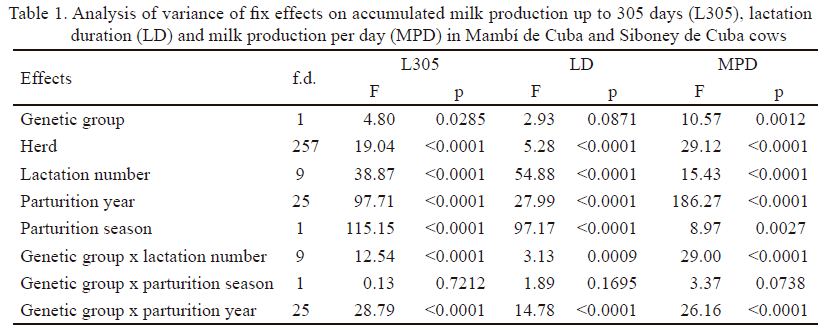
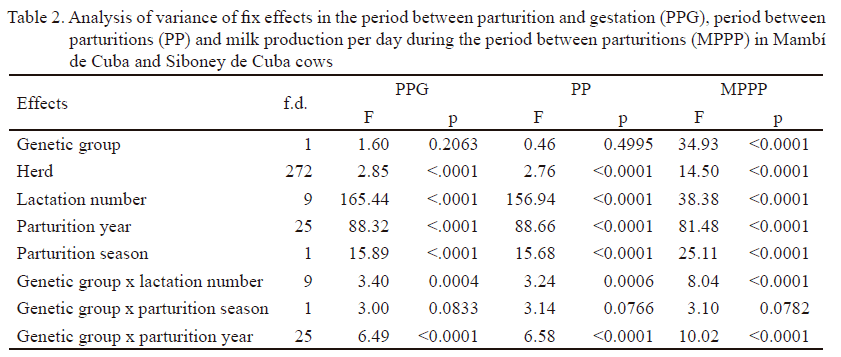
<body><![CDATA[<p align="justify">&nbsp;</p>     <p align="justify"><font size="2" face="Verdana, Arial, Helvetica, sans-serif"><b><font size="3">RESULTS AND DISCUSSION</font></b></font></p>     <p align="justify" class="Cuerpodetexto" style="margin-top:12.0pt;margin-right:0cm;margin-bottom:5.95pt;margin-left:0cm;text-indent:0cm;"><span style="font-family:'Verdana','sans-serif'; font-size:10.0pt; ">The  analysis of variance (<a href="/img/revistas/cjas/v50n2/t0103216.gif">table 1</a> and <a href="/img/revistas/cjas/v50n2/t0203216.gif">2</a>) showed that studied fix effects were  significant, except the effect of genetic group on lactation duration, period  between parturition and gestation and period between parturitions, as well as  the effect of the interaction of genetic group and parturition season, in which  none of the studied traits were affected.</span></p>     
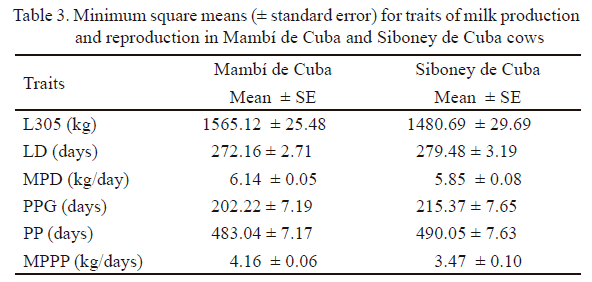
<p align="justify" class="Cuerpodetexto" style="margin-top:12.0pt;margin-right:0cm;margin-bottom:5.95pt;margin-left:0cm;text-indent:0cm;"><span style="letter-spacing:.2pt; font-family:'Verdana','sans-serif'; font-size:10.0pt; ">Herd effect was significant in all the studied traits.  This performance may be caused by differences on management of milking groups,  instability in the staff that performs this task and services, together with  the variations in feeding due to availability and quality of grasses. It may be  also caused by differences in the amount of grazing areas presenting paddocking  and to the presence of breed groups with different potential for milk  production, among other    factors.</span><span style="font-family:'Verdana','sans-serif'; font-size:10.0pt; "> </span></p>     <p align="justify" class="Cuerpodetexto" style="margin-top:12.0pt;margin-right:0cm;margin-bottom:5.95pt;margin-left:0cm;text-indent:0cm;"><span style="font-family:'Verdana','sans-serif'; font-size:10.0pt; ">Estimated  averages for traits of milk production and reproduction of Mamb&iacute; de Cuba and  Siboney de Cuba (<a href="/img/revistas/cjas/v50n2/t0303216.gif">table 3</a>) cows show similar reproductive performance and  lactation duration. However, milk productions of Mamb&iacute; de Cuba were superior to  those of Siboney de Cuba with 84.43 kg, 0.29 kg/d and 0.69 kg/d for L305, MPD  and MPPP, respectively.</span></p>     
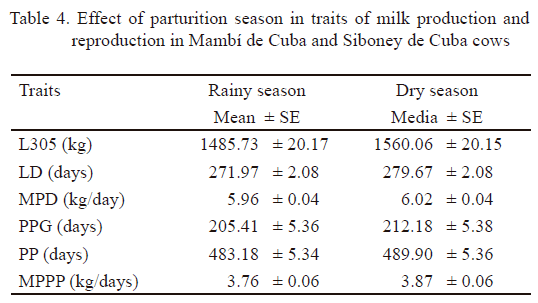
<p align="justify" class="Cuerpodetexto" style="margin-top:12.0pt;margin-right:0cm;margin-bottom:5.95pt;margin-left:0cm;text-indent:0cm;"><span style="font-family:'Verdana','sans-serif'; font-size:10.0pt; ">These results are in agreement with those of Ponce de Le&oacute;n <em>et al.</em> (1988), who compared 424 first and second lactations of 5/8H x  3/8Z, &frac34; H x &frac14; Z and purebred Holstein through the use of a sample of    80 animals per genotype, in two cattle farm. Crossings had high potential for  milk production (4,018 and 3,692 kg for &frac34; H x &frac14; Z and 5/8H x 3/8Z,  respectively), superior to Holstein (3,533 kg) and good reproductive  performance. There were no differences among crosses in liveweight and  reproduction but milk production favored 3/4H 1/4Z. Holstein performance was  affected due to their coexistence with the other crossed animals, mainly in the  worst herd. Regarding the crossings, there were three times more losses due to  reproductive and health problems up to the third lactation.</span><span style="font-family:'Verdana','sans-serif'; font-size:10.0pt; "> </span></p>     <p align="justify" class="Cuerpodetexto" style="margin-top:12.0pt;margin-right:0cm;margin-bottom:5.95pt;margin-left:0cm;text-indent:0cm;"><span style="font-family:'Verdana','sans-serif'; font-size:10.0pt; ">Researches conducted by L&oacute;pez <em>et al.</em> (2009), in  three herds of crossed bovines (&frac34; Holstein (H) x &frac14; Zebu (Z), &frac34; Brown Swiss (S)  x &frac14; Z, 1/2H x 1/2Z y 1/2S x 1/2Z) in Veracruz, Mexico, showed that the racial  group also had significant effect on milk production. Cows of &frac34;H x &frac14;C cross  showed better milk production per lactation and moderate performances in  lactation duration, days open and periods between parturitions, compared to  other racial groups, with an increase of 51.4, 50.8 and 29.5 % in milk  production per lactation, time at the peak of lactation and lactation duration,  respectively. These cited authors attribute this performance to the improvement  of the environment due to the inclusion of concentrate complements and to  milking management without the support of calves.</span></p>     <p align="justify" class="Cuerpodetexto" style="margin-top:12.0pt;margin-right:0cm;margin-bottom:5.95pt;margin-left:0cm;text-indent:0cm;"><span style="letter-spacing:.1pt; font-family:'Verdana','sans-serif'; font-size:10.0pt; ">Results of this study coincide with those of Hern&aacute;ndez <em>et  al.</em> (2000), who, in a study in the Mexican tropic, reported that genotype  (1/2 Holstein x &frac12; Zebu, &frac12; Brown Swiss x &frac12; Zebu and &frac12; Holstein x &frac14; Brown Swiss x  &frac14; Zebu) had a significant effect on milk production, but it did not affect the  period between parturitions. However, these results have no agreement with  those of L&oacute;pez <em>et al.</em> (2010), who evaluated the reproductive performance  in different crosses of <em>Bos taurus</em> x <em>Bos indicus</em> in Mexico. These  authors confirmed that, with increase of the percentage of <em>Bos taurus</em> genes, there was also an increase in the period between parturitions. In this  respect, L&oacute;pez <em>et al.</em> (2006, 2009)&nbsp;  stated, in previous studies, that the increase of&nbsp; PPG in animals with higher proportion of <em>Bos  taurus</em> genes is partially explained by the increase of milk production of  these genotypes. In this research, despite of obtaining the best milk  production in &frac34; H x &frac14; Z animals, regarding the 5/8 H x 3/8 Z, it had no  negative influence on its reproductive performance, which evidenced the  adaptation ability of this genotype to tropical environment.</span><span style="font-family:'Verdana','sans-serif'; font-size:10.0pt; "> </span></p>     <p align="justify" class="Cuerpodetexto" style="margin-top:12.0pt;margin-right:0cm;margin-bottom:5.95pt;margin-left:0cm;text-indent:0cm;"><span style="font-family:'Verdana','sans-serif'; font-size:10.0pt; ">Parturition season also affected all the traits studied in  Mamb&iacute; de Cuba and Siboney de Cuba cows, with higher means during dry season  (<a href="/img/revistas/cjas/v50n2/t0403216.gif">table 4</a>). A difference of 75 kg for milk production, in favor of dry season,  was mainly because the environment during this season was fresher, which  favored an appropriate metabolic comfort for milk production. Similar results  were confirmed in other studies under different tropical conditions (Garc&iacute;a  2005, L&oacute;pez <em>et al.</em> 2009). Regarding reproductive periods, it was  concluded that those animals that delivered during rainy season showed shorter  PPG and PP, with differences of 6.8 d regarding dry season. This performance  agrees with reports of L&oacute;pez <em>et al.</em> (2010) in different <em>Bos taurus</em> x <em>Bos indicus</em> crossings, in a Mexican commercial cattle farm, but with  higher differences, 50 and 30 d for PPG and PP, respectively. This response is  basically related to a higher food availability, which favors reproductive  activity.</span><span style="font-family:'Verdana','sans-serif'; font-size:10.0pt; "> </span></p>     
<p align="justify" class="Cuerpodetexto" style="margin-top:12.0pt;margin-right:0cm;margin-bottom:5.95pt;margin-left:0cm;text-indent:0cm;"><span style="font-family:'Verdana','sans-serif'; font-size:10.0pt; ">Regarding  those studied genetic groups, it is necessary to analyze differences among  them, taking into consideration lactation number and years of study because the  interaction of genotype x lactation number and genotype x parturition year  affected all the studied traits.</span></p>     ]]></body>
<body><![CDATA[<p align="justify" class="Cuerpodetexto" style="margin-top:12.0pt;margin-right:0cm;margin-bottom:5.95pt;margin-left:0cm;text-indent:0cm;"><span style="font-family:'Verdana','sans-serif'; font-size:10.0pt; "><a href="/img/revistas/cjas/v50n2/f0103216.gif">Figure  1</a> shows the effect of genotype x lactation number interaction on milk  production. There were differences only in milk productions of the second  lactation (1739.28 &plusmn; 25.96 kg vs. 1578.43&plusmn;  28.02 kg) and the fifth (1656.60 &plusmn; 28.48 kg vs. 1490.80&plusmn; 32.80 kg). In both, milk production of Mamb&iacute; de Cuba was superior, with  differences of 160.85 and 165.8 kg, regarding Siboney de Cuba.</span></p>     
<p align="justify" class="Cuerpodetexto" style="margin-top:12.0pt;margin-right:0cm;margin-bottom:5.95pt;margin-left:0cm;text-indent:0cm;"><span style="font-family:'Verdana','sans-serif'; font-size:10.0pt; ">The effect of genotype x lactation number interaction on  lactation duration showed differences among the studied genotypes during the  third (282.12 &plusmn; 2.83 days vs. 293.93 &plusmn; 3.18 d) and fourth lactation (274.83 &plusmn;  2.93 d vs. 288.49 &plusmn; 3.34 d). Siboney de Cuba showed better lactations than  Mamb&iacute; de Cuba for the third and fourth lactation, with 11.81 and 13.66 d,  respectively. However, studies conducted by L&oacute;pez <em>et al.</em> (2009) in cows  with different proportions of <em>Bos taurus</em> genes, and by Salamanca &amp;  Bentez (2012) in crossbred cows, demonstrated that lactation number had no  influence on lactation duration.</span><span style="font-family:'Verdana','sans-serif'; font-size:10.0pt; "> </span></p>     <p align="justify" class="Cuerpodetexto" style="margin-top:12.0pt;margin-right:0cm;margin-bottom:5.95pt;margin-left:0cm;text-indent:0cm;"><span style="font-family:'Verdana','sans-serif'; font-size:10.0pt; ">Period  between parturition and gestation (<a href="/img/revistas/cjas/v50n2/f0203216.gif">figure 2</a>) only differed among genotypes of  the first parturition (278.21 &plusmn; 7.21 d vs. 315.96 &plusmn; 6.82 d), with higher means  for Siboney de Cuba. There was a similar performance in the period between  parturitions, with differences in the first parturition and higher means for  Siboney de Cuba (588.21 &plusmn; 6.81 d) regarding Mamb&iacute; de Cuba (557.17 &plusmn; 7.19 d). In  both breed groups, there was a progressive decrease of the period between  parturition and gestation, and between parturitions, with increase of  parturition number. This performance may be, generally, a consequence of the  removal of cows with reproductive difficulties from the herd. Garc&iacute;a <em>et al.</em> (2002, 2003), L&oacute;pez <em>et al.</em> (2010) also confirmed&nbsp; a reduction on the period between  parturitions, while parturition number increased.</span></p>     
<p align="justify" class="Cuerpodetexto" style="margin-top:12.0pt;margin-right:0cm;margin-bottom:5.95pt;margin-left:0cm;text-indent:0cm;"><span style="font-family:'Verdana','sans-serif'; font-size:10.0pt; ">The highest milk production were obtained in the period  1987-1990 (<a href="/img/revistas/cjas/v50n2/f0303216.gif">figure 3</a>), with higher means in Mamb&iacute; de Cuba cows, which surpassed  those of Siboney in 935, 541, 622 and 633 kg every year. However, there was a  general tendency to decrease in both breeds, which could have been motivated by  a fast increase of the amount of animals. In the period of 1991-2001, similar  results were obtained, with a tendency to radical decrease of production in  general. This can be explained because this period corresponds to a time of  economic limitations in Cuba, in which inputs decreased and could not maintain  a consistent supply of feedstuff to lactating cows, so food was mainly based on  pasture, without irrigation or fertilization.&nbsp; </span><span style="font-family:'Verdana','sans-serif'; font-size:10.0pt; "> </span></p>     
<p align="justify" class="Cuerpodetexto" style="margin-top:12.0pt;margin-right:0cm;margin-bottom:5.95pt;margin-left:0cm;text-indent:0cm;"><span style="font-family:'Verdana','sans-serif'; font-size:10.0pt; ">From 2002 to 2007, there was slight increase of  productions and differences among breeds were observed. Mamb&iacute; de Cuba from 2002  to 2004 was superior, with means of 1,850.30 &plusmn; 44.30, 1,917.56 &plusmn; 50.65 and  1,761.85 &plusmn; 35.41 kg. During the period between 2005 and 2007, Siboney de Cuba  had higher productions with means of 1,717.45 &plusmn; 37.03, 1,969.33 &plusmn; 35.60 and  2,019.82 &plusmn; 33.64 kg.&nbsp; In the period of  2008-2009, the performance was similar. In 2012, the Siboney de Cuba obtained  higher averages (1,757.67 &plusmn; 34.12 kg) than Mamb&iacute; de Cuba (1448.85&plusmn;  32.07 kg).</span><span style="font-family:'Verdana','sans-serif'; font-size:10.0pt; "> </span></p>     <p align="justify" class="Cuerpodetexto" style="margin-top:12.0pt;margin-right:0cm;margin-bottom:5.95pt;margin-left:0cm;text-indent:0cm;"><span style="font-family:'Verdana','sans-serif'; font-size:10.0pt; ">Mej&iacute;a <em>et al.</em> (2010) reported that the effect of year on milk production is  difficult to explain, because it is usually a result of incorporation and exit  animals, of their exposure to favorable environments during some years and  unfavorable during others. It may also be a result of staff, management and  administrative changes.</span></p>     <p align="justify" class="Cuerpodetexto" style="margin-top:12.0pt;margin-right:0cm;margin-bottom:5.95pt;margin-left:0cm;text-indent:0cm;"><span style="font-family:'Verdana','sans-serif'; font-size:10.0pt; ">Lactation  duration showed an irregular performance. There were only differences in the  averages of both breeds in 1993 (242.46 &plusmn; 5.32 d vs. 298.06 &plusmn; 8.19 d), 1997  (280.80 &plusmn; 4.25 vs. 347.45 &plusmn; 4.57 d), 1998 (291.96 &plusmn; 4.51 d vs. 322.17 &plusmn; 4.90  d), 2004 (315.91 &plusmn; 3.88 d vs. 276.77 &plusmn; 3.88 d), 2009 (254.66 &plusmn; 3.39 d vs.  276.12 &plusmn; 3.54 d) and 2011 (263.39 &plusmn; 3.42 d vs. 283.42 &plusmn; 3.41 d). During these  years, lactation duration was superior in Siboney de Cuba, except in 2004.</span></p>     <p align="justify" class="Cuerpodetexto" style="margin-top:12.0pt;margin-right:0cm;margin-bottom:5.95pt;margin-left:0cm;text-indent:0cm;"><span style="font-family:'Verdana','sans-serif'; font-size:10.0pt; ">Values  of the period between parturition and gestation (<a href="/img/revistas/cjas/v50n2/f0403216.gif">figure 4</a>) were similar in the  period from 1987 to 1990, with averages of 72.20 &plusmn; 19.31 and 128.07 &plusmn; 25.46 d.  From 1991, these values increased and reached the highest averages in 1993,  with 403.03 &plusmn; 10.81 d in Mamb&iacute; de Cuba and 471.41 &plusmn; 10.87 d in Siboney de Cuba.</span></p>     
<p align="justify" class="Cuerpodetexto" style="margin-top:12.0pt;margin-right:0cm;margin-bottom:5.95pt;margin-left:0cm;text-indent:0cm;"><span style="font-family:'Verdana','sans-serif'; font-size:10.0pt; ">Later,  they began to decrease. The remarkable increase of reproductive periods during  this time was mainly caused by feeding limitations previously referred, which  caused difficulties in cows to get pregnant, because, according to Peron  (1975), there is an interaction between nutrition and the appearance of    heat.</span></p>     <p align="justify" class="Cuerpodetexto" style="margin-top:12.0pt;margin-right:0cm;margin-bottom:5.95pt;margin-left:0cm;text-indent:0cm;"><span style="font-family:'Verdana','sans-serif'; font-size:10.0pt; ">There  were also problems of abortions and management. Reproduction was performed by  direct mating, which affected the increase in the number of services per  gestation. In the period 1996-2012, averages were between 152.73 &plusmn; 9.25 and  225.09 &plusmn; 9.52 d for Mamb&iacute; de Cuba and between 117.00 &plusmn; 9.28 and 270.99 &plusmn; 10.63  days for Siboney de Cuba. In the studied period, there were only differences  between breeds in 1998, averaging 213.64 &plusmn; 9.10 d for Mamb&iacute; de Cuba and 270.99  &plusmn; 9.63 d for Siboney de Cuba, which corroborates a similar reproductive  performance between the two breeds.</span></p>     ]]></body>
<body><![CDATA[<p align="justify" class="Cuerpodetexto" style="margin-top:12.0pt;margin-right:0cm;margin-bottom:5.95pt;margin-left:0cm;text-indent:0cm;"><span style="font-family:'Verdana','sans-serif'; font-size:10.0pt; ">The results of this study  showed similar averages for reproductive periods and lactation duration for  both breeds and higher milk productions in Mamb&iacute; de Cuba. There was better  performance of milk production of Mamb&iacute; de Cuba with respect to Siboney de Cuba  in the period before 1990, with the highest productions, although with a  tendency to decrease. However, during the years after 1990, with dietary  restrictions, there was instability in the performance of the two genetic  groups. Milk production was higher in Mamb&iacute; de Cuba between 2002 and 2004. For  Siboney de Cuba, it was higher in the next three years</span><font size="2" face="Verdana, Arial, Helvetica, sans-serif">.</font></p>     <p align="justify">&nbsp;</p>     <p align="justify"><font size="2" face="Verdana, Arial, Helvetica, sans-serif"><font size="3"><b>REFERENCES</b></font></font></p>     <p align="justify" class="MsoBibliography" style="margin-top:12.0pt;margin-right:0cm;margin-bottom:5.95pt;margin-left:0cm;text-align:justify;"><span style="font-family:'Verdana','sans-serif'; font-size:10.0pt; ">Fern&aacute;ndez,  F. J. &amp; Tronco, S. M. A. 2011. &ldquo;Influencia de factores no gen&eacute;ticos en la  producci&oacute;n de leche del Siboney de Cuba&rdquo;. <em>Revista  de Salud Animal</em>, 33 (2): 76&ndash;82, ISSN: 0253-570X.</span></p>     <!-- ref --><p align="justify" class="MsoBibliography" style="margin-top:12.0pt;margin-right:0cm;margin-bottom:5.95pt;margin-left:0cm;text-align:justify;"><span style="font-family:'Verdana','sans-serif'; font-size:10.0pt; ">Garc&iacute;a,  C. R. 2005. <em>Producci&oacute;n de leche de vacas  con diferente porcentaje de genes Bos Taurus en el tr&oacute;pico mexicano</em>. M.Sc.  Thesis, Universidad Aut&oacute;noma Chapingo, M&eacute;xico.    </span></p>     <p align="justify" class="MsoBibliography" style="margin-top:12.0pt;margin-right:0cm;margin-bottom:5.95pt;margin-left:0cm;text-align:justify;"><span style="font-family:'Verdana','sans-serif'; font-size:10.0pt; ">Garc&iacute;a,  G. A., C&aacute;rdenas, C. A., Monterrosa, V., Valencia, L. &amp; Maldonado, J. G.  2002. &ldquo;Caracterizaci&oacute;n productiva y reproductiva de las explotaciones ganaderas  del bajo cauca y el litoral atl&aacute;ntico antioque&ntilde;os. I. Haciendas la Leyenda y la  Candelaria&rdquo;. <em>Revista Colombiana de  Ciencias Pecuarias</em>, 15 (3): 293&ndash;301, ISSN: 0120-0690.</span></p>     <p align="justify" class="MsoBibliography" style="margin-top:12.0pt;margin-right:0cm;margin-bottom:5.95pt;margin-left:0cm;text-align:justify;"><span style="font-family:'Verdana','sans-serif'; font-size:10.0pt; ">Garc&iacute;a,  G. A., Maldonado, J. G. &amp; Garc&iacute;a, J. G. 2003. &ldquo;Caracterizaci&oacute;n productiva y  reproductiva de las explotaciones ganaderas del bajo cauca y el litoral  atl&aacute;ntico antioque&ntilde;os. II. Comportamiento de cuatro grupos raciales <em>Bos indicus</em> en un sistema de bosque seco  tropical (bs-T)&rdquo;. <em>Revista Colombiana de  Ciencias Pecuarias</em>, 16 (2): 117&ndash;125, ISSN: 0120-0690.</span></p>     <p align="justify" class="MsoBibliography" style="margin-top:12.0pt;margin-right:0cm;margin-bottom:5.95pt;margin-left:0cm;text-align:justify;"><span style="font-family:'Verdana','sans-serif'; font-size:10.0pt; ">Gonz&aacute;lez,  P. D., Guerra, D., &Eacute;vora, J. C., Gonz&aacute;lez, S. &amp; Ortiz, J. 2008. &ldquo;An&aacute;lisis  uni y multicar&aacute;cter para las 4 primeras lactancias de vacas Siboney de Cuba&rdquo;. <em>Ciencia y Tecnolog&iacute;a Ganadera</em>, 2 (3):  141&ndash;146, ISSN: 1999-4494, 1998-3050.</span></p>     <p align="justify" class="MsoBibliography" style="margin-top:12.0pt;margin-right:0cm;margin-bottom:5.95pt;margin-left:0cm;text-align:justify;"><span style="font-family:'Verdana','sans-serif'; font-size:10.0pt; ">Hern&aacute;ndez,  A., Ponce de Le&oacute;n, R., Garc&iacute;a, S. M., Guzm&aacute;n, G. &amp; Mora, M. 2011. </span><span style="font-family:'Verdana','sans-serif'; font-size:10.0pt; ">&ldquo;Genetic  assessment of the dairy cattle Mambi de Cuba&rdquo;. <em>Cuban Journal of Agricultural Science</em>, 45 (4): 355&ndash;359, ISSN:  2079-3480.</span></p>     ]]></body>
<body><![CDATA[<p align="justify" class="MsoBibliography" style="margin-top:12.0pt;margin-right:0cm;margin-bottom:5.95pt;margin-left:0cm;text-align:justify;"><span style="font-family:'Verdana','sans-serif'; font-size:10.0pt; ">Hern&aacute;ndez,  R. E., Segura, C. V. M., Segura, C. J. C. &amp; Osorio, A. M. M. 2000. </span><span style="font-family:'Verdana','sans-serif'; font-size:10.0pt; ">&ldquo;Calving  interval, lactation length and milk production in a dual purpose herd in  Yucat&aacute;n, Mexico&rdquo;. <em>Agrociencia (M&eacute;xico)</em>,  34 (6): 699&ndash;705, ISSN: 1405-3195.</span></p>     <p align="justify" class="MsoBibliography" style="margin-top:12.0pt;margin-right:0cm;margin-bottom:5.95pt;margin-left:0cm;text-align:justify;"><span style="font-family:'Verdana','sans-serif'; font-size:10.0pt; ">Kramer, C. Y. 1956. &ldquo;Extension of  Multiple Range Tests to Group Means with Unequal Numbers of Replications&rdquo;. </span><em><span style="font-family:'Verdana','sans-serif'; font-size:10.0pt; ">Biometrics</span></em><span style="font-family:'Verdana','sans-serif'; font-size:10.0pt; ">, 12 (3): 307, ISSN: 0006-341X, DOI:  10.2307/3001469.</span></p>     <!-- ref --><p align="justify" class="MsoBibliography" style="margin-top:12.0pt;margin-right:0cm;margin-bottom:5.95pt;margin-left:0cm;text-align:justify;"><span style="font-family:'Verdana','sans-serif'; font-size:10.0pt; ">L&oacute;pez,  D. 1982. <em>Caracterizaci&oacute;n de la poblaci&oacute;n  base de un nuevo genotipo lechero tropical: El Siboney de Cuba</em>. Ph.D.  Thesis, ISCAH - ICA, La Habana, Cuba, 201 p.    </span></p>     <p align="justify" class="MsoBibliography" style="margin-top:12.0pt;margin-right:0cm;margin-bottom:5.95pt;margin-left:0cm;text-align:justify;"><span style="font-family:'Verdana','sans-serif'; font-size:10.0pt; ">L&oacute;pez, D. &amp; Ribas, M. 1993. &ldquo;New  dairy cattle breeds. Results in Cuba&rdquo;. <em>Cuban  Journal of Agricultural Science</em>, 27 (1): 1&ndash;10, ISSN: 2079-3480.</span></p>     <p align="justify" class="MsoBibliography" style="margin-top:12.0pt;margin-right:0cm;margin-bottom:5.95pt;margin-left:0cm;text-align:justify;"><span style="font-family:'Verdana','sans-serif'; font-size:10.0pt; ">L&oacute;pez,  O. R., D&iacute;az, H. M., Garc&iacute;a, M. J. G., N&uacute;&ntilde;ez, R. &amp; Mart&iacute;nez, H. P. A. 2010.  &ldquo;Eventos reproductivos de vacas con diferente porcentaje de genes <em>Bos taurus</em> en el tr&oacute;pico mexicano&rdquo;. <em>Revista Mexicana de Ciencias Pecuarias</em>,  1 (4): 325&ndash;336, ISSN: 2007-1124.</span></p>     <p align="justify" class="MsoBibliography" style="margin-top:12.0pt;margin-right:0cm;margin-bottom:5.95pt;margin-left:0cm;text-align:justify;"><span style="font-family:'Verdana','sans-serif'; font-size:10.0pt; ">L&oacute;pez,  O. R., Vite, C. C., Garc&iacute;a, M. J. G. &amp; Mart&iacute;nez, H. P. A. 2009. </span><span style="font-family:'Verdana','sans-serif'; font-size:10.0pt; ">&ldquo;Reproductive  and milk yield performance of crossbred cows with different proportions of <em>Bos taurus</em> genes&rdquo;. </span><em><span style="font-family:'Verdana','sans-serif'; font-size:10.0pt; ">Archivos  de Zootecnia</span></em><span style="font-family:'Verdana','sans-serif'; font-size:10.0pt; ">, 58  (224): 683&ndash;694, ISSN: 0004-0592.</span></p>     <p align="justify" class="MsoBibliography" style="margin-top:12.0pt;margin-right:0cm;margin-bottom:5.95pt;margin-left:0cm;text-align:justify;"><span style="font-family:'Verdana','sans-serif'; font-size:10.0pt; ">L&oacute;pez,  R., Thomas, M. G., Hallford, D. M., Keisler, D. H., Silver, G. A., Obeidat, B.  S., Garc&iacute;a, M. D. &amp; Krehbiel, C. R. 2006. </span><span style="font-family:'Verdana','sans-serif'; font-size:10.0pt; ">&ldquo;Case study:  Metabolic hormone profiles and evaluation of associations of metabolic hormones  with body fat and reproductive characteristics of Angus, Brangus, and Brahman  heifers&rdquo;. <em>The Professional Animal  Scientist</em>, 22 (3): 273&ndash;282, ISSN: 1080-7446, DOI:  10.15232/S1080-7446(15)31104-9.</span></p>     <p align="justify" class="MsoBibliography" style="margin-top:12.0pt;margin-right:0cm;margin-bottom:5.95pt;margin-left:0cm;text-align:justify;"><span style="font-family:'Verdana','sans-serif'; font-size:10.0pt; ">Mej&iacute;a, B. G. T., Maga&ntilde;a, J. G., Segura,  C. J. C., Delgado, R. &amp; Estrada, L. R. J. 2010. </span><span style="font-family:'Verdana','sans-serif'; font-size:10.0pt; ">&ldquo;Comportamiento reproductivo y  productivo de vacas <em>Bos indicus, Bos  taurus</em> y sus cruces en un sistema de producci&oacute;n vaca: cr&iacute;a en Yucat&aacute;n,  M&eacute;xico&rdquo;. <em>Tropical and Subtropical  Agroecosystems</em>, 12 (2): 289&ndash;301, ISSN: 1870-0462.</span></p>     <p align="justify" class="MsoBibliography" style="margin-top:12.0pt;margin-right:0cm;margin-bottom:5.95pt;margin-left:0cm;text-align:justify;"><span style="font-family:'Verdana','sans-serif'; font-size:10.0pt; ">Per&oacute;n,  N. 1975. &ldquo;Alg&uacute;n aspecto sobre nutrici&oacute;n y reproducci&oacute;n en bovino&rdquo;. <em>Revista Cubana de Reproducci&oacute;n Animal</em>,  1: 60, ISSN: 0138-6700.</span></p>     ]]></body>
<body><![CDATA[<p align="justify" class="MsoBibliography" style="margin-top:12.0pt;margin-right:0cm;margin-bottom:5.95pt;margin-left:0cm;text-align:justify;"><span style="font-family:'Verdana','sans-serif'; font-size:10.0pt; ">Ponce  de Le&oacute;n, R., de Bien, R. &amp; Caran, N. 1988. </span><span style="font-family:'Verdana','sans-serif'; font-size:10.0pt; ">&ldquo;A comparison  between Holstein, &frac34; . &frac14; and 5/8 . 3/8 holstein-Zebu in their first two  lactations&rdquo;. <em>Cuban Journal of  Agricultural Science</em>, 22 (2): 121&ndash;127, ISSN: 2079-3480.</span></p>     <p align="justify" class="MsoBibliography" style="margin-top:12.0pt;margin-right:0cm;margin-bottom:5.95pt;margin-left:0cm;text-align:justify;"><span style="font-family:'Verdana','sans-serif'; font-size:10.0pt; ">Portales,  A., Gonz&aacute;lez, P. D., Guerra, D., &Eacute;vora, J. C. &amp; Acosta, M. 2012.  &ldquo;Par&aacute;metros gen&eacute;ticos de&nbsp; las  caracter&iacute;sticas de&nbsp; leche, incorporaci&oacute;n  y&nbsp; parto en ganado Siboney de Cuba&rdquo;. <em>Ciencia y Tecnolog&iacute;a Ganadera</em>, 6 (1):  27&ndash;33, ISSN: 1999-4494, 1998-3050.</span></p>     <p align="justify" class="MsoBibliography" style="margin-top:12.0pt;margin-right:0cm;margin-bottom:5.95pt;margin-left:0cm;text-align:justify;"><span style="font-family:'Verdana','sans-serif'; font-size:10.0pt; ">Ribas,  M., Guti&eacute;rrez, M., Mora, M., &Eacute;vora, J. C. &amp; Gonz&aacute;lez, S. 2004. </span><span style="font-family:'Verdana','sans-serif'; font-size:10.0pt; ">&ldquo;Productive and  reproductive performance of Siboney de Cuba in two regions&rdquo;. <em>Cuban Journal of Agricultural Science</em>,  38 (2): 121&ndash;126, ISSN: 2079-3480.</span></p>     <p align="justify" class="MsoBibliography" style="margin-top:12.0pt;margin-right:0cm;margin-bottom:5.95pt;margin-left:0cm;text-align:justify;"><span style="font-family:'Verdana','sans-serif'; font-size:10.0pt; ">Salamanca, C. A. &amp; Bentez, M. J.  2012. </span><span style="font-family:'Verdana','sans-serif'; font-size:10.0pt; ">&ldquo;Producci&oacute;n de leche de vacas mestizas  del Sistema Doble Prop&oacute;sito en el municipio de Arauca&rdquo;. <em>REDVET. Revista Electr&oacute;nica de Veterinaria</em>, 13 (7): 1&ndash;15, ISSN:  1695-7504.</span></p>     <!-- ref --><p align="justify" class="MsoBibliography" style="margin-top:12.0pt;margin-right:0cm;margin-bottom:5.95pt;margin-left:0cm;text-align:justify;"><span style="font-family:'Verdana','sans-serif'; font-size:10.0pt; ">SAS  Institute 2013. <em>Statistical Analysis  Software SAS/STAT&reg;</em>. version 9.3, Cary, N.C., USA: SAS Institute Inc,  Available: &lt;<a href="http://www.sas.com/en_us/software/analytics/stat.html#" target="_blank">http://www.sas.com/en_us/software/analytics/stat.html#</a>&gt;    .</span></p>     <p align="justify" class="MsoBibliography" style="margin-top:12.0pt;margin-right:0cm;margin-bottom:5.95pt;margin-left:0cm;text-align:justify;"><span style="font-family:'Verdana','sans-serif'; font-size:10.0pt; ">VanRaden, P. M. &amp; Sanders, A. H. 2003. &ldquo;Economic  Merit of Crossbred and Purebred US Dairy Cattle&rdquo;. </span><em><span style="font-family:'Verdana','sans-serif'; font-size:10.0pt; ">Journal of Dairy Science</span></em><span style="font-family:'Verdana','sans-serif'; font-size:10.0pt; ">, 86  (3): 1036&ndash;1044, ISSN: 00220302, DOI: 10.3168/jds.S0022-0302(03)73687-X</span><font size="2" face="Verdana, Arial, Helvetica, sans-serif">.</font></p>     <p align="justify">&nbsp;</p>     <p align="justify">&nbsp;</p>     <p align="justify"><font size="2" face="Verdana, Arial, Helvetica, sans-serif">Received: 2/2/2016    ]]></body>
<body><![CDATA[<br>   Accepted: 1/7/2016</font></p>     <p align="justify">&nbsp;</p>     <p align="justify">&nbsp;</p>     <p align="justify"><font size="2" face="Verdana, Arial, Helvetica, sans-serif"><i>Arelis Hernández,</i> Instituto de Ciencia Animal, Apartado Postal 24, San José de Las Lajas, Mayabeque, Cuba.  Email: <a href="mailto:arelishdez@ica.co.cu">arelishdez@ica.co.cu</a></font></p>      ]]></body><back>
<ref-list>
<ref id="B1">
<nlm-citation citation-type="journal">
<person-group person-group-type="author">
<name>
<surname><![CDATA[Fernández]]></surname>
<given-names><![CDATA[F. J.]]></given-names>
</name>
<name>
<surname><![CDATA[Tronco]]></surname>
<given-names><![CDATA[S. M. A.]]></given-names>
</name>
</person-group>
<article-title xml:lang="nd"><![CDATA[Influencia de factores no genéticos en la producción de leche del Siboney de Cuba]]></article-title>
<source><![CDATA[Revista de Salud Animal]]></source>
<year>2011</year>
<volume>33</volume>
<numero>2</numero>
<issue>2</issue>
<page-range>76-82</page-range></nlm-citation>
</ref>
<ref id="B2">
<nlm-citation citation-type="book">
<person-group person-group-type="author">
<name>
<surname><![CDATA[García]]></surname>
<given-names><![CDATA[C. R.]]></given-names>
</name>
</person-group>
<source><![CDATA[Producción de leche de vacas con diferente porcentaje de genes Bos Taurus en el trópico mexicano]]></source>
<year>2005</year>
<publisher-loc><![CDATA[México ]]></publisher-loc>
<publisher-name><![CDATA[Universidad Autónoma Chapingo]]></publisher-name>
</nlm-citation>
</ref>
<ref id="B3">
<nlm-citation citation-type="journal">
<person-group person-group-type="author">
<name>
<surname><![CDATA[García]]></surname>
<given-names><![CDATA[G. A.]]></given-names>
</name>
<name>
<surname><![CDATA[Cárdenas]]></surname>
<given-names><![CDATA[C. A.]]></given-names>
</name>
<name>
<surname><![CDATA[Monterrosa]]></surname>
<given-names><![CDATA[V.]]></given-names>
</name>
<name>
<surname><![CDATA[Valencia]]></surname>
<given-names><![CDATA[L.]]></given-names>
</name>
<name>
<surname><![CDATA[Maldonado]]></surname>
<given-names><![CDATA[J. G.]]></given-names>
</name>
</person-group>
<article-title xml:lang="nd"><![CDATA[Caracterización productiva y reproductiva de las explotaciones ganaderas del bajo cauca y el litoral atlántico antioqueños. I. Haciendas la Leyenda y la Candelaria]]></article-title>
<source><![CDATA[Revista Colombiana de Ciencias Pecuarias]]></source>
<year>2002</year>
<volume>15</volume>
<numero>3</numero>
<issue>3</issue>
<page-range>293-301</page-range></nlm-citation>
</ref>
<ref id="B4">
<nlm-citation citation-type="journal">
<person-group person-group-type="author">
<name>
<surname><![CDATA[García]]></surname>
<given-names><![CDATA[G. A.]]></given-names>
</name>
<name>
<surname><![CDATA[Maldonado]]></surname>
<given-names><![CDATA[J. G.]]></given-names>
</name>
<name>
<surname><![CDATA[García]]></surname>
<given-names><![CDATA[J. G.]]></given-names>
</name>
</person-group>
<article-title xml:lang="nd"><![CDATA[Caracterización productiva y reproductiva de las explotaciones ganaderas del bajo cauca y el litoral atlántico antioqueños. II. Comportamiento de cuatro grupos raciales Bos indicus en un sistema de bosque seco tropical (bs-T)]]></article-title>
<source><![CDATA[Revista Colombiana de Ciencias Pecuarias]]></source>
<year>2003</year>
<volume>16</volume>
<numero>2</numero>
<issue>2</issue>
<page-range>117-125</page-range></nlm-citation>
</ref>
<ref id="B5">
<nlm-citation citation-type="journal">
<person-group person-group-type="author">
<name>
<surname><![CDATA[González]]></surname>
<given-names><![CDATA[P. D.]]></given-names>
</name>
<name>
<surname><![CDATA[Guerra]]></surname>
<given-names><![CDATA[D.]]></given-names>
</name>
<name>
<surname><![CDATA[Évora]]></surname>
<given-names><![CDATA[J. C.]]></given-names>
</name>
<name>
<surname><![CDATA[González]]></surname>
<given-names><![CDATA[S.]]></given-names>
</name>
<name>
<surname><![CDATA[Ortiz]]></surname>
<given-names><![CDATA[J.]]></given-names>
</name>
</person-group>
<article-title xml:lang="nd"><![CDATA[Análisis uni y multicarácter para las 4 primeras lactancias de vacas Siboney de Cuba]]></article-title>
<source><![CDATA[Ciencia y Tecnología Ganadera]]></source>
<year>2008</year>
<volume>2</volume>
<numero>3</numero>
<issue>3</issue>
<page-range>141-146</page-range></nlm-citation>
</ref>
<ref id="B6">
<nlm-citation citation-type="journal">
<person-group person-group-type="author">
<name>
<surname><![CDATA[Hernández]]></surname>
<given-names><![CDATA[A.]]></given-names>
</name>
<name>
<surname><![CDATA[Ponce de León]]></surname>
<given-names><![CDATA[R.]]></given-names>
</name>
<name>
<surname><![CDATA[García]]></surname>
<given-names><![CDATA[S. M.]]></given-names>
</name>
<name>
<surname><![CDATA[Guzmán]]></surname>
<given-names><![CDATA[G.]]></given-names>
</name>
<name>
<surname><![CDATA[Mora]]></surname>
<given-names><![CDATA[M.]]></given-names>
</name>
</person-group>
<article-title xml:lang="nd"><![CDATA[Genetic assessment of the dairy cattle Mambi de Cuba]]></article-title>
<source><![CDATA[Cuban Journal of Agricultural Science]]></source>
<year>2011</year>
<volume>45</volume>
<numero>4</numero>
<issue>4</issue>
<page-range>355-359</page-range></nlm-citation>
</ref>
<ref id="B7">
<nlm-citation citation-type="journal">
<person-group person-group-type="author">
<name>
<surname><![CDATA[Hernández]]></surname>
<given-names><![CDATA[R. E.]]></given-names>
</name>
<name>
<surname><![CDATA[Segura]]></surname>
<given-names><![CDATA[C. V. M.]]></given-names>
</name>
<name>
<surname><![CDATA[Segura]]></surname>
<given-names><![CDATA[C. J. C.]]></given-names>
</name>
<name>
<surname><![CDATA[Osorio]]></surname>
<given-names><![CDATA[A. M. M.]]></given-names>
</name>
</person-group>
<article-title xml:lang="nd"><![CDATA[Calving interval, lactation length and milk production in a dual purpose herd in Yucatán, Mexico]]></article-title>
<source><![CDATA[Agrociencia (México)]]></source>
<year>2000</year>
<volume>34</volume>
<numero>6</numero>
<issue>6</issue>
<page-range>699-705</page-range></nlm-citation>
</ref>
<ref id="B8">
<nlm-citation citation-type="journal">
<person-group person-group-type="author">
<name>
<surname><![CDATA[Kramer]]></surname>
<given-names><![CDATA[C. Y.]]></given-names>
</name>
</person-group>
<article-title xml:lang="nd"><![CDATA[Extension of Multiple Range Tests to Group Means with Unequal Numbers of Replications]]></article-title>
<source><![CDATA[Biometrics]]></source>
<year>1956</year>
<volume>12</volume>
<numero>3</numero>
<issue>3</issue>
<page-range>307</page-range></nlm-citation>
</ref>
<ref id="B9">
<nlm-citation citation-type="book">
<person-group person-group-type="author">
<name>
<surname><![CDATA[López]]></surname>
<given-names><![CDATA[D.]]></given-names>
</name>
</person-group>
<source><![CDATA[Caracterización de la población base de un nuevo genotipo lechero tropical: El Siboney de Cuba]]></source>
<year>1982</year>
<page-range>201</page-range><publisher-loc><![CDATA[La Habana, Cuba ]]></publisher-loc>
<publisher-name><![CDATA[ISCAH - ICA]]></publisher-name>
</nlm-citation>
</ref>
<ref id="B10">
<nlm-citation citation-type="journal">
<person-group person-group-type="author">
<name>
<surname><![CDATA[López]]></surname>
<given-names><![CDATA[D.]]></given-names>
</name>
<name>
<surname><![CDATA[Ribas]]></surname>
<given-names><![CDATA[M.]]></given-names>
</name>
</person-group>
<article-title xml:lang="nd"><![CDATA[New dairy cattle breeds. Results in Cuba]]></article-title>
<source><![CDATA[Cuban Journal of Agricultural Science]]></source>
<year>1993</year>
<volume>27</volume>
<numero>1</numero>
<issue>1</issue>
<page-range>1-10</page-range></nlm-citation>
</ref>
<ref id="B11">
<nlm-citation citation-type="journal">
<person-group person-group-type="author">
<name>
<surname><![CDATA[López]]></surname>
<given-names><![CDATA[O. R.]]></given-names>
</name>
<name>
<surname><![CDATA[Díaz]]></surname>
<given-names><![CDATA[H. M.]]></given-names>
</name>
<name>
<surname><![CDATA[García]]></surname>
<given-names><![CDATA[M. J. G.]]></given-names>
</name>
<name>
<surname><![CDATA[Núñez]]></surname>
<given-names><![CDATA[R.]]></given-names>
</name>
<name>
<surname><![CDATA[Martínez]]></surname>
<given-names><![CDATA[H. P. A.]]></given-names>
</name>
</person-group>
<article-title xml:lang="nd"><![CDATA[Eventos reproductivos de vacas con diferente porcentaje de genes Bos taurus en el trópico mexicano]]></article-title>
<source><![CDATA[Revista Mexicana de Ciencias Pecuarias]]></source>
<year>2010</year>
<volume>1</volume>
<numero>4</numero>
<issue>4</issue>
<page-range>325-336</page-range></nlm-citation>
</ref>
<ref id="B12">
<nlm-citation citation-type="journal">
<person-group person-group-type="author">
<name>
<surname><![CDATA[López]]></surname>
<given-names><![CDATA[O. R.]]></given-names>
</name>
<name>
<surname><![CDATA[Vite]]></surname>
<given-names><![CDATA[C. C.]]></given-names>
</name>
<name>
<surname><![CDATA[García]]></surname>
<given-names><![CDATA[M. J. G.]]></given-names>
</name>
<name>
<surname><![CDATA[Martínez]]></surname>
<given-names><![CDATA[H. P. A.]]></given-names>
</name>
</person-group>
<article-title xml:lang="nd"><![CDATA[Reproductive and milk yield performance of crossbred cows with different proportions of Bos taurus genes]]></article-title>
<source><![CDATA[Archivos de Zootecnia]]></source>
<year>2009</year>
<volume>58</volume>
<numero>224</numero>
<issue>224</issue>
<page-range>683-694</page-range></nlm-citation>
</ref>
<ref id="B13">
<nlm-citation citation-type="journal">
<person-group person-group-type="author">
<name>
<surname><![CDATA[López]]></surname>
<given-names><![CDATA[R.]]></given-names>
</name>
<name>
<surname><![CDATA[Thomas]]></surname>
<given-names><![CDATA[M. G.]]></given-names>
</name>
<name>
<surname><![CDATA[Hallford]]></surname>
<given-names><![CDATA[D. M.]]></given-names>
</name>
<name>
<surname><![CDATA[Keisler]]></surname>
<given-names><![CDATA[D. H.]]></given-names>
</name>
<name>
<surname><![CDATA[Silver]]></surname>
<given-names><![CDATA[G. A.]]></given-names>
</name>
<name>
<surname><![CDATA[Obeidat]]></surname>
<given-names><![CDATA[B. S.]]></given-names>
</name>
<name>
<surname><![CDATA[García]]></surname>
<given-names><![CDATA[M. D.]]></given-names>
</name>
<name>
<surname><![CDATA[Krehbiel]]></surname>
<given-names><![CDATA[C. R.]]></given-names>
</name>
</person-group>
<article-title xml:lang="nd"><![CDATA[Case study: Metabolic hormone profiles and evaluation of associations of metabolic hormones with body fat and reproductive characteristics of Angus, Brangus, and Brahman heifers]]></article-title>
<source><![CDATA[The Professional Animal Scientist]]></source>
<year>2006</year>
<volume>22</volume>
<numero>3</numero>
<issue>3</issue>
<page-range>273-282</page-range></nlm-citation>
</ref>
<ref id="B14">
<nlm-citation citation-type="journal">
<person-group person-group-type="author">
<name>
<surname><![CDATA[Mejía]]></surname>
<given-names><![CDATA[B. G. T.]]></given-names>
</name>
<name>
<surname><![CDATA[Magaña]]></surname>
<given-names><![CDATA[J. G.]]></given-names>
</name>
<name>
<surname><![CDATA[Segura]]></surname>
<given-names><![CDATA[C. J. C.]]></given-names>
</name>
<name>
<surname><![CDATA[Delgado]]></surname>
<given-names><![CDATA[R.]]></given-names>
</name>
<name>
<surname><![CDATA[Estrada]]></surname>
<given-names><![CDATA[L. R. J.]]></given-names>
</name>
</person-group>
<article-title xml:lang="nd"><![CDATA[Comportamiento reproductivo y productivo de vacas Bos indicus, Bos taurus y sus cruces en un sistema de producción vaca: cría en Yucatán, México]]></article-title>
<source><![CDATA[Tropical and Subtropical Agroecosystems]]></source>
<year>2010</year>
<volume>12</volume>
<numero>2</numero>
<issue>2</issue>
<page-range>289-301</page-range></nlm-citation>
</ref>
<ref id="B15">
<nlm-citation citation-type="journal">
<person-group person-group-type="author">
<name>
<surname><![CDATA[Perón]]></surname>
<given-names><![CDATA[N.]]></given-names>
</name>
</person-group>
<article-title xml:lang="nd"><![CDATA[Algún aspecto sobre nutrición y reproducción en bovino]]></article-title>
<source><![CDATA[Revista Cubana de Reproducción Animal]]></source>
<year>1975</year>
<volume>1</volume>
<page-range>60</page-range></nlm-citation>
</ref>
<ref id="B16">
<nlm-citation citation-type="journal">
<person-group person-group-type="author">
<name>
<surname><![CDATA[Ponce de León]]></surname>
<given-names><![CDATA[R.]]></given-names>
</name>
<name>
<surname><![CDATA[de Bien]]></surname>
<given-names><![CDATA[R.]]></given-names>
</name>
<name>
<surname><![CDATA[Caran]]></surname>
<given-names><![CDATA[N.]]></given-names>
</name>
</person-group>
<article-title xml:lang="nd"><![CDATA[A comparison between Holstein, ¾ . ¼ and 5/8 . 3/8 holstein-Zebu in their first two lactations]]></article-title>
<source><![CDATA[Cuban Journal of Agricultural Science]]></source>
<year>1988</year>
<volume>22</volume>
<numero>2</numero>
<issue>2</issue>
<page-range>121-127</page-range></nlm-citation>
</ref>
<ref id="B17">
<nlm-citation citation-type="journal">
<person-group person-group-type="author">
<name>
<surname><![CDATA[Portales]]></surname>
<given-names><![CDATA[A.]]></given-names>
</name>
<name>
<surname><![CDATA[González]]></surname>
<given-names><![CDATA[P. D.]]></given-names>
</name>
<name>
<surname><![CDATA[Guerra]]></surname>
<given-names><![CDATA[D.]]></given-names>
</name>
<name>
<surname><![CDATA[Évora]]></surname>
<given-names><![CDATA[J. C.]]></given-names>
</name>
<name>
<surname><![CDATA[Acosta]]></surname>
<given-names><![CDATA[M.]]></given-names>
</name>
</person-group>
<article-title xml:lang="nd"><![CDATA[Parámetros genéticos de las características de leche, incorporación y parto en ganado Siboney de Cuba]]></article-title>
<source><![CDATA[Ciencia y Tecnología Ganadera]]></source>
<year>2012</year>
<volume>6</volume>
<numero>1</numero>
<issue>1</issue>
<page-range>27-33</page-range></nlm-citation>
</ref>
<ref id="B18">
<nlm-citation citation-type="journal">
<person-group person-group-type="author">
<name>
<surname><![CDATA[Ribas]]></surname>
<given-names><![CDATA[M.]]></given-names>
</name>
<name>
<surname><![CDATA[Gutiérrez]]></surname>
<given-names><![CDATA[M.]]></given-names>
</name>
<name>
<surname><![CDATA[Mora]]></surname>
<given-names><![CDATA[M.]]></given-names>
</name>
<name>
<surname><![CDATA[Évora]]></surname>
<given-names><![CDATA[J. C.]]></given-names>
</name>
<name>
<surname><![CDATA[González]]></surname>
<given-names><![CDATA[S.]]></given-names>
</name>
</person-group>
<article-title xml:lang="nd"><![CDATA[Productive and reproductive performance of Siboney de Cuba in two regions]]></article-title>
<source><![CDATA[Cuban Journal of Agricultural Science]]></source>
<year>2004</year>
<volume>38</volume>
<numero>2</numero>
<issue>2</issue>
<page-range>121-126</page-range></nlm-citation>
</ref>
<ref id="B19">
<nlm-citation citation-type="journal">
<person-group person-group-type="author">
<name>
<surname><![CDATA[Salamanca]]></surname>
<given-names><![CDATA[C. A.]]></given-names>
</name>
<name>
<surname><![CDATA[Bentez]]></surname>
<given-names><![CDATA[M. J.]]></given-names>
</name>
</person-group>
<article-title xml:lang="nd"><![CDATA[Producción de leche de vacas mestizas del Sistema Doble Propósito en el municipio de Arauca]]></article-title>
<source><![CDATA[REDVET. Revista Electrónica de Veterinaria]]></source>
<year>2012</year>
<volume>13</volume>
<numero>7</numero>
<issue>7</issue>
<page-range>1-15</page-range></nlm-citation>
</ref>
<ref id="B20">
<nlm-citation citation-type="book">
<person-group person-group-type="author">
<name>
<surname><![CDATA[SAS Institute]]></surname>
</name>
</person-group>
<source><![CDATA[Statistical Analysis Software SAS/STAT®]]></source>
<year>2013</year>
<publisher-loc><![CDATA[Cary, N.C., USA ]]></publisher-loc>
<publisher-name><![CDATA[SAS Institute Inc]]></publisher-name>
</nlm-citation>
</ref>
<ref id="B21">
<nlm-citation citation-type="journal">
<person-group person-group-type="author">
<name>
<surname><![CDATA[VanRaden]]></surname>
<given-names><![CDATA[P. M.]]></given-names>
</name>
<name>
<surname><![CDATA[Sanders]]></surname>
<given-names><![CDATA[A. H.]]></given-names>
</name>
</person-group>
<article-title xml:lang="nd"><![CDATA[Economic Merit of Crossbred and Purebred US Dairy Cattle]]></article-title>
<source><![CDATA[Journal of Dairy Science]]></source>
<year>2003</year>
<volume>86</volume>
<numero>3</numero>
<issue>3</issue>
<page-range>1036-1044</page-range></nlm-citation>
</ref>
</ref-list>
</back>
</article>