<?xml version="1.0" encoding="ISO-8859-1"?><article xmlns:mml="http://www.w3.org/1998/Math/MathML" xmlns:xlink="http://www.w3.org/1999/xlink" xmlns:xsi="http://www.w3.org/2001/XMLSchema-instance">
<front>
<journal-meta>
<journal-id>2079-3480</journal-id>
<journal-title><![CDATA[Cuban Journal of Agricultural Science]]></journal-title>
<abbrev-journal-title><![CDATA[Cuban J. Agric. Sci.]]></abbrev-journal-title>
<issn>2079-3480</issn>
<publisher>
<publisher-name><![CDATA[Editorial del Instituto de Ciencia Animal]]></publisher-name>
</publisher>
</journal-meta>
<article-meta>
<article-id>S2079-34802016000200004</article-id>
<title-group>
<article-title xml:lang="en"><![CDATA[The productive efficiency of rearing herds in Pastaza, Ecuador]]></article-title>
<article-title xml:lang="es"><![CDATA[La eficiencia productiva de rebaños de cría en Pastaza, Ecuador]]></article-title>
</title-group>
<contrib-group>
<contrib contrib-type="author">
<name>
<surname><![CDATA[Benítez]]></surname>
<given-names><![CDATA[D.G.]]></given-names>
</name>
<xref ref-type="aff" rid="A01"/>
</contrib>
<contrib contrib-type="author">
<name>
<surname><![CDATA[Torres]]></surname>
<given-names><![CDATA[Verena]]></given-names>
</name>
<xref ref-type="aff" rid="A02"/>
</contrib>
<contrib contrib-type="author">
<name>
<surname><![CDATA[Vargas Burgos]]></surname>
<given-names><![CDATA[J.C.]]></given-names>
</name>
<xref ref-type="aff" rid="A03"/>
</contrib>
<contrib contrib-type="author">
<name>
<surname><![CDATA[Soria]]></surname>
<given-names><![CDATA[Sandra]]></given-names>
</name>
<xref ref-type="aff" rid="A03"/>
</contrib>
</contrib-group>
<aff id="A01">
<institution><![CDATA[,Instituto de Investigaciones Agropecuarias  ]]></institution>
<addr-line><![CDATA[ Granma]]></addr-line>
<country>Cuba</country>
</aff>
<aff id="A02">
<institution><![CDATA[,Instituto de Ciencia Animal  ]]></institution>
<addr-line><![CDATA[San José de las Lajas ]]></addr-line>
<country>Cuba</country>
</aff>
<aff id="A03">
<institution><![CDATA[,Universidad Estatal Amazónica  ]]></institution>
<addr-line><![CDATA[ ]]></addr-line>
<country>Ecuador</country>
</aff>
<pub-date pub-type="pub">
<day>00</day>
<month>06</month>
<year>2016</year>
</pub-date>
<pub-date pub-type="epub">
<day>00</day>
<month>06</month>
<year>2016</year>
</pub-date>
<volume>50</volume>
<numero>2</numero>
<fpage>205</fpage>
<lpage>213</lpage>
<copyright-statement/>
<copyright-year/>
<self-uri xlink:href="http://scielo.sld.cu/scielo.php?script=sci_arttext&amp;pid=S2079-34802016000200004&amp;lng=en&amp;nrm=iso"></self-uri><self-uri xlink:href="http://scielo.sld.cu/scielo.php?script=sci_abstract&amp;pid=S2079-34802016000200004&amp;lng=en&amp;nrm=iso"></self-uri><self-uri xlink:href="http://scielo.sld.cu/scielo.php?script=sci_pdf&amp;pid=S2079-34802016000200004&amp;lng=en&amp;nrm=iso"></self-uri><abstract abstract-type="short" xml:lang="en"><p><![CDATA[In order to identify the factors determing the productive efficiency in the rearing- fattening system in Pastaza province, located in the Ecuadorian Amazonia, a non-experimental design was used which controlled the effects of the climatic areas and height levels. For the information processing the Statistical Model of Impact Measuring (MEMI) was applied. It was found that the factors which determine the efficiency of meat production in cattle rearing were reproduction, land relief and looses in the herd, these factors explain 85.54% of the system accumulated variance. These factors are related with the productive process efficiency, relief characteristics, environmental degradation and animals looses. The rearing- fattening systems are classified in four groups, differentiated by the herd size which exploit, the relief where are located, the production process efficiency and the impact they have on the environment. The productive efficiency is low and it correspond with the widespread exploitation alternatives, which are not fit to the environment demands, and with the ability to use the land on which these production processes are developed. It is possible to implement sustainable alternatives of meat production from cattle rearing-fattening systems, if the production systems are fit to the environments demands where these systems are developed]]></p></abstract>
<abstract abstract-type="short" xml:lang="es"><p><![CDATA[Para identificar los factores que determinan la eficiencia productiva en el sistema cría-ceba en la provincia de Pastaza, ubicada en la Amazonia ecuatoriana, se utilizó un diseño no experimental que controló los efectos de piso climático y rangos de altura. Para el procesamiento de la información se aplicó el Modelo Estadístico de Medición de Impacto (MEMI). Se encontró que los factores que determinan la eficiencia en la producción de carne en el ganado de cría fueron la reproducción, el relieve del terreno y las pérdidas en el rebaño, que explicaron en conjunto 85.54% de la varianza acumulada del sistema. Estos factores se relacionan con la eficacia del proceso reproductivo, las características del relieve, la degradación del entorno y las pérdidas de animales. Los sistemas cría-ceba se tipifican en cuatro grupos, diferenciados por el tamaño del rebaño que explotan, el relieve donde se ubican, la eficacia del proceso de producción y el impacto que provocan en el entorno. La eficiencia productiva es baja y se corresponde con las alternativas de explotación generalizadas, que no se adecuan a las exigencias del entorno, y con la capacidad de uso de los suelos donde se desarrollan estos procesos productivos. Es posible implementar alternativas sostenibles de producción de carne a partir de los sistemas ganaderos cría-ceba, si se adecuan los programas de producción a las exigencias del entorno donde se desarrollan dichos sistemas]]></p></abstract>
<kwd-group>
<kwd lng="en"><![CDATA[animal husbandry]]></kwd>
<kwd lng="en"><![CDATA[impact model]]></kwd>
<kwd lng="en"><![CDATA[productive chain]]></kwd>
<kwd lng="en"><![CDATA[Amazonia]]></kwd>
<kwd lng="es"><![CDATA[ganadería]]></kwd>
<kwd lng="es"><![CDATA[modelo impacto]]></kwd>
<kwd lng="es"><![CDATA[cadena productiva]]></kwd>
<kwd lng="es"><![CDATA[Amazonia]]></kwd>
</kwd-group>
</article-meta>
</front><body><![CDATA[ <p align="right"><font size="2" face="Verdana, Arial, Helvetica, sans-serif"><b>Cuban Journal  of Agricultural Science, 50(2): 205-213, 2016, ISSN: 2079-3480</b></font></p>     <p align="right">&nbsp;</p>     <p align="right"><font size="2" face="Verdana, Arial, Helvetica, sans-serif"><b>ORIGINAL ARTICLE</b></font></p>     <p align="justify">&nbsp;</p>     <p align="justify"><font size="4" face="Verdana, Arial, Helvetica, sans-serif">  <b>The productive efficiency of rearing herds in Pastaza, Ecuador</b></font></p>      <p align="justify">&nbsp;</p>     <p align="justify"><font size="3" face="Verdana, Arial, Helvetica, sans-serif">  <b>La eficiencia productiva de rebaños de cría en Pastaza, Ecuador</b></font></p>      <p align="justify">&nbsp;</p>     <p align="justify">&nbsp;</p>     <p align="justify"><font size="2" face="Verdana, Arial, Helvetica, sans-serif">  <b>D.G. Benítez,</b><sup><b>I,III</b></sup> <b> Verena Torres,</b><sup><b>II</b></sup> <b> J.C. Vargas Burgos,</b><sup><b>III</b></sup> <b> Sandra Soria,</b><sup><b>III</b></sup>  </font></p>     ]]></body>
<body><![CDATA[<p align="justify"><font size="2" face="Verdana, Arial, Helvetica, sans-serif"><b> </b></font><font size="2" face="Verdana, Arial, Helvetica, sans-serif">    <sup>I</sup>Instituto de Investigaciones Agropecuarias “Jorge Dimitrov”, Carretera Bayamo-Manzanillo,  km 16 ½, Bayamo CP 85100, Granma, Cuba.    <br>   <sup>II</sup>Instituto de Ciencia Animal, Apartado Postal 24, San José de las Lajas, Cuba.     <br>   <sup>III</sup>Universidad Estatal Amazónica,  km. 2½, vía Puyo - Tena (Paso Lateral), Ecuador. </font></p>     <p align="justify">&nbsp;</p>     <p align="justify">&nbsp;</p> <hr align="JUSTIFY">     <p align="justify"><font size="2" face="Verdana, Arial, Helvetica, sans-serif"><b>ABSTRACT</b></font></p>     <p align="justify"><font size="2" face="Verdana, Arial, Helvetica, sans-serif"><span style="font-family:'Verdana','sans-serif'; font-size:10.0pt; ">In order to identify the factors determing the  productive efficiency in the rearing- fattening system in Pastaza province,  located in the Ecuadorian Amazonia, a non-experimental design was used which  controlled the effects of the climatic areas and height levels. For the  information processing the Statistical Model of Impact Measuring (MEMI) was  applied. It was found that the factors which determine the efficiency of meat  production in cattle rearing were reproduction, land relief and looses in the  herd, these factors explain 85.54% of the system accumulated variance. These  factors are related with the productive process efficiency, relief  characteristics, environmental degradation and animals looses. The rearing-  fattening systems are classified in four groups, differentiated by the herd  size which exploit, the relief where are located, the production process  efficiency and the impact they have on the environment. The productive efficiency  is low and it correspond with the widespread exploitation alternatives, which  are not fit to the environment demands, and with the ability to use the land on  which these production processes are developed. It is possible to implement  sustainable alternatives of meat production from cattle rearing-fattening  systems, if the production systems are fit to the environments demands where  these systems are  developed</span>.</font></p>     <p align="justify"><font size="2" face="Verdana, Arial, Helvetica, sans-serif"><b>Key words:</b> animal husbandry, impact model, productive chain, Amazonia.</font></p> <hr align="JUSTIFY">     <p align="justify"><font size="2" face="Verdana, Arial, Helvetica, sans-serif"><b>RESUMEN</b></font></p>     <p align="justify"><font size="2" face="Verdana, Arial, Helvetica, sans-serif"><span style="letter-spacing:-.1pt; font-family:'Verdana','sans-serif'; font-size:10.0pt; ">Para identificar los factores que determinan la  eficiencia productiva en el sistema cr&iacute;a-ceba en la provincia de Pastaza,  ubicada en la Amazonia ecuatoriana, se utiliz&oacute; un dise&ntilde;o no experimental que  control&oacute; los efectos de piso clim&aacute;tico y rangos de altura. Para el procesamiento  de la informaci&oacute;n se aplic&oacute; el Modelo Estad&iacute;stico de Medici&oacute;n de Impacto  (MEMI). Se encontr&oacute; que los factores que determinan la eficiencia en la  producci&oacute;n de carne en el ganado de cr&iacute;a fueron la reproducci&oacute;n, el relieve del  terreno y las p&eacute;rdidas en el reba&ntilde;o, que explicaron en conjunto 85.54% de la  varianza acumulada del sistema. Estos factores se relacionan con la eficacia  del proceso reproductivo, las caracter&iacute;sticas del relieve, la degradaci&oacute;n del  entorno y las p&eacute;rdidas de animales. Los sistemas cr&iacute;a-ceba se tipifican en  cuatro grupos, diferenciados por el tama&ntilde;o del reba&ntilde;o que explotan, el relieve  donde se ubican, la&nbsp; eficacia del proceso  de producci&oacute;n y el impacto que provocan en el entorno. La eficiencia productiva  es baja y se corresponde con las alternativas de explotaci&oacute;n generalizadas, que  no se adecuan a las exigencias del entorno, y con la capacidad de uso de los  suelos donde se desarrollan estos procesos productivos. Es posible implementar  alternativas sostenibles de producci&oacute;n de carne a partir de los sistemas  ganaderos cr&iacute;a-ceba, si se adecuan los programas de producci&oacute;n a las exigencias  del entorno donde se desarrollan dichos sistemas</span>.</font></p>     ]]></body>
<body><![CDATA[<p align="justify"><font size="2" face="Verdana, Arial, Helvetica, sans-serif"><b>Palabras    clave:</b>    ganadería, modelo impacto, cadena productiva, Amazonia.</font></p> <hr align="JUSTIFY">     <p align="justify">&nbsp;</p>     <p align="justify">&nbsp;</p>     <p align="justify"><font size="2" face="Verdana, Arial, Helvetica, sans-serif"><b><font size="3">INTRODUCTION</font></b></font></p>     <p align="justify" class="Cuerpodetexto" style="margin-top:12.0pt;margin-right:0cm;margin-bottom:5.95pt;margin-left:0cm;text-indent:0cm;"><span style="font-family:'Verdana','sans-serif'; font-size:10.0pt; ">The  potential for agricultural production of the Ecuadorian Amazon Region (EAR) is  limited, due to the edaphoclimatic characteristics of this area. Only a few  crops can be easily adapted to extreme climatic conditions and poor  agricultural potential of soils (Nieto &amp; Caicedo 2011, Vargas <em>et al.</em> 2015a). From the    413 000 ha declared as agricultural frontier, 85% is used in livestock systems,  with growth in the last 13 years of 45 620 ha, representing increases of 70.9%  with respect to the surface in livestock use in 2000. This area grows at the  expense of the existing forests areas in that year, with impacts that tend to  accentuate the environmental deterioration of the EAR, which has a marked  influence on the global stability of the planet climate (Vargas <em>et al.</em> 2015b).</span></p>     <p align="justify" class="Cuerpodetexto" style="margin-top:12.0pt;margin-right:0cm;margin-bottom:5.95pt;margin-left:0cm;text-indent:0cm;"><span style="font-family:'Verdana','sans-serif'; font-size:10.0pt; ">The  conducting of traditional production alternatives, not suited to the Amazon  Biome, when interact with the ecosystems fragility of the province, lead to low  production efficiency, a decrease of economic results and the increase of the  negative impact of this economic activity in the environment. The alternatives  of generalized production are based on tethering grazing. In this type of  grazing, the animals stay confined in a certain area, controlled by a rope,  which material varies according to the producer possibilities, but it should  always be resistant to animals traction during their movement to the fresh  grass twice a day and to the permanent humidity conditions&nbsp; which are subject to. A reduced amount of  producers used electrical fences for controlling the animals, and a grass  surface per animal similar to the one used in tethering grazing is    established.</span></p>     <p align="justify" class="Cuerpodetexto" style="margin-top:12.0pt;margin-right:0cm;margin-bottom:5.95pt;margin-left:0cm;text-indent:0cm;"><span style="font-family:'Verdana','sans-serif'; font-size:10.0pt; ">As  grass complement, balanced or concentrates are used which are provided without  a rational pattern. The intake frequency of these concentrates varies, from two  to three times a week, even once a day. Providing minerals is considered a  necessity. Popular formulas in the market are used for this purpose, which  design does not consider soil limitations and environmental characteristics of  Amazonia.</span></p>     <p align="justify" class="Cuerpodetexto" style="margin-top:12.0pt;margin-right:0cm;margin-bottom:5.95pt;margin-left:0cm;text-indent:0cm;"><span style="letter-spacing:.1pt; font-family:'Verdana','sans-serif'; font-size:10.0pt; ">Pastaza province has 5.9% of the bovine mass from the EAR.  The rearing- fattening herds represent    42.6 % of existing farms in the province. It is estimated that has a herd  higher to 20.000 heads, they annually produce 1400 calves for fattening and  1020 heads of replacement females, suitable for reproduction (ESPAC 2014).</span><span style="font-family:'Verdana','sans-serif'; font-size:10.0pt; "> </span></p>     <p align="justify" class="Cuerpodetexto" style="margin-top:12.0pt;margin-right:0cm;margin-bottom:5.95pt;margin-left:0cm;text-indent:0cm;"><span style="font-family:'Verdana','sans-serif'; font-size:10.0pt; ">The objective of this  research was to identify the factors which determine the productive efficiency  in the primary link of the meat production chain in the rearing &ndash; fattening systems  in Pastaza, Ecuador</span><font size="2" face="Verdana, Arial, Helvetica, sans-serif">.</font></p>     <p align="justify">&nbsp;</p>     ]]></body>
<body><![CDATA[<p align="justify"><font size="2" face="Verdana, Arial, Helvetica, sans-serif"><b><font size="3">MATERIALS AND METHODS</font></b></font></p>     <p align="justify" class="Cuerpodetexto" style="margin-top:12.0pt;margin-right:0cm;margin-bottom:5.95pt;margin-left:0cm;text-indent:0cm;"><span style="letter-spacing:.2pt; font-family:'Verdana','sans-serif'; font-size:10.0pt; ">Pastaza, province from the Republic of Ecuador, is located  in the center of the Ecuadorian Amazon Region, between the coordinates 1&ordm; 10&acute;  SL and 78&ordm; 10 WL and 2&ordm; 35&acute; SL, and 76&ordm; 40&acute; WL. It has    29.773 km<sup>2</sup> of surface, equivalent to 25.5 % of the EAR and 12 % of  national territory. It is characterized by having 81 % of its territory  occupied with non intervened woods, which have in their ecosystems an  extraordinary richness of natural resources and biodiversity. Due to the nature  of its relief, climate and edaphic formation of its woods, it is considered as  a fragile territory, especially opposed to the use of economical activities  that affect its woods and ecosystems (ATPA 2014).</span><span style="font-family:'Verdana','sans-serif'; font-size:10.0pt; "> </span></p>     <p align="justify" class="Cuerpodetexto" style="margin-top:12.0pt;margin-right:0cm;margin-bottom:5.95pt;margin-left:0cm;text-indent:0cm;"><em><span style="letter-spacing:.1pt; font-family:'Verdana','sans-serif'; font-size:10.0pt; ">Diagnosis and survey</span></em><span style="font-family:'Verdana','sans-serif'; font-size:10.0pt; ">. A survey with 40 variables was used to evaluate the  performance in the productive environmental and economic dimensions of cattle  rearing &ndash;fattening systems in Pastaza. This tool was applied according to a  non-experimental design, which controlled the effects of climatic areas and  height levels. These effects determine differences in the edaphoclimatic  performance of the territory located in the agricultural frontier of the  province, that modify the productivity of cattle rearing ecosystems and animal  performance.</span></p>     <p align="justify" class="Cuerpodetexto" style="margin-top:12.0pt;margin-right:0cm;margin-bottom:5.95pt;margin-left:0cm;text-indent:0cm;"><em><span style="font-family:'Verdana','sans-serif'; font-size:10.0pt; ">Sample  size</span></em><span style="font-family:'Verdana','sans-serif'; font-size:10.0pt; ">. Farms having a herd of more than 10  cattle heads, and more than five years of consecutive activity were considered  as population of this study. The sample size was determined from the 850 farms  existing in this territory under the rearing &ndash;fattening system(INEC 2015).The  maximum variance criterion was applied (Torres 1987, 2015, Snedecor &amp;  Cochran 1989) to guarantee an adequate sample size for all the variables to  measure. The sample value of s<sup>2 </sup>was considered as 31.2 muestral was  considered with 3 % of prefixed error and 95 % of reliability level. The  estimated sample size was 170 farms.</span></p>     <p align="justify" class="Cuerpodetexto" style="margin-top:12.0pt;margin-right:0cm;margin-bottom:5.95pt;margin-left:0cm;text-indent:0cm;"><span style="font-family:'Verdana','sans-serif'; font-size:10.0pt; ">The field work demonstrated that in specific sectors the  amount of existing farms decreased, due to different causes, associated to the  change of productive activity, loss or sale of herds because of the effect of  devastating diseases or lack of profitability leading to farm abandonment. The  amount of visited farms was reduced to 120 due to these conditions. From the  calculated variance for the real sample obtained, the statistics were  calculated again and the validity of the sample was demonstrated for the  research purpose.</span><span style="font-family:'Verdana','sans-serif'; font-size:10.0pt; "> </span></p>     <p align="justify" class="Cuerpodetexto" style="margin-top:12.0pt;margin-right:0cm;margin-bottom:5.95pt;margin-left:0cm;text-indent:0cm;"><em><span style="font-family:'Verdana','sans-serif'; font-size:10.0pt; ">Creation  of a data matrix</span></em><span style="font-family:'Verdana','sans-serif'; font-size:10.0pt; ">. The surveys information was  tabulated in a data matrix organized in Excel. The visited cattle rearing  systems were located in lines and the study object variables were located in  columns. Each database was strictly examined and those farms that lacked of  relevant information were removed, because the survey taker did not specified  with precision the section. Besides, the cases in which appeared atypical  values or those not having more than five years of consecutive activity and a  minimal amount of animals of ten or more cattle heads were eliminated. As a  result it was a sample size of 86 farms, which is big enough to endure the  evaluation validity of cattle rearing &ndash;fattening system in Pastaza province. </span></p>     <p align="justify" class="Cuerpodetexto" style="margin-top:12.0pt;margin-right:0cm;margin-bottom:5.95pt;margin-left:0cm;text-indent:0cm;"><em><span style="letter-spacing:.2pt; font-family:'Verdana','sans-serif'; font-size:10.0pt; ">Determing  factors in the productive efficiency.</span></em><span style="font-family:'Verdana','sans-serif'; font-size:10.0pt; "> To  identify the variables and indicators which define the main changes in the  productive and environmental dimensions, The Statistical Model of Impact  Measuring (SMIM) was used (Torres <em>et al.</em> 2013), it also allows to typify  the performance of livestock units. The identified groups and the variables of  interest that influence on productive efficiency, the negative environmental  effect of cattle rearing in the environment and risks associated to  sustainability of meat production from the rearing cattle in Pastaza were  combined. The data was processed by the statistical software IBM-SPSS 22 (IBM  Corporation 2012)</span><font size="2" face="Verdana, Arial, Helvetica, sans-serif">.</font></p>     <p align="justify">&nbsp;</p>     <p align="justify"><font size="2" face="Verdana, Arial, Helvetica, sans-serif"><b><font size="3">RESULTS AND DISCUSSION</font></b></font></p>     <p align="justify" class="Cuerpodetexto" style="margin-top:12.0pt;margin-right:0cm;margin-bottom:5.95pt;margin-left:0cm;text-indent:0cm;"><span style="font-family:'Verdana','sans-serif'; font-size:10.0pt; ">The  14% of the territory of Pastaza province is part of the agricultural frontier,  85% of this is used in livestock. The 38% of the land dedicated to livestock  systems is located in areas not conducive to the grazing development,  increasing conflicts caused by this anthropic activity in an area that must be  used to the development of protective forests and forestry.</span></p>     ]]></body>
<body><![CDATA[<p align="justify" class="Cuerpodetexto" style="margin-top:12.0pt;margin-right:0cm;margin-bottom:5.95pt;margin-left:0cm;text-indent:0cm;"><span style="font-family:'Verdana','sans-serif'; font-size:10.0pt; ">From  the view that the eigenvalue was higher than one, three factors that determine  the productive efficiency of livestock systems dedicated to cattle rearing  (<a href="/img/revistas/cjas/v50n2/t0104216.gif">table 1</a>) were identified. The first component, which is the reproduction, is  related to management indicators that define the reproductive efficiency, and  contributes 44.75% of the accumulated variance explaining the fitted model.</span></p>     
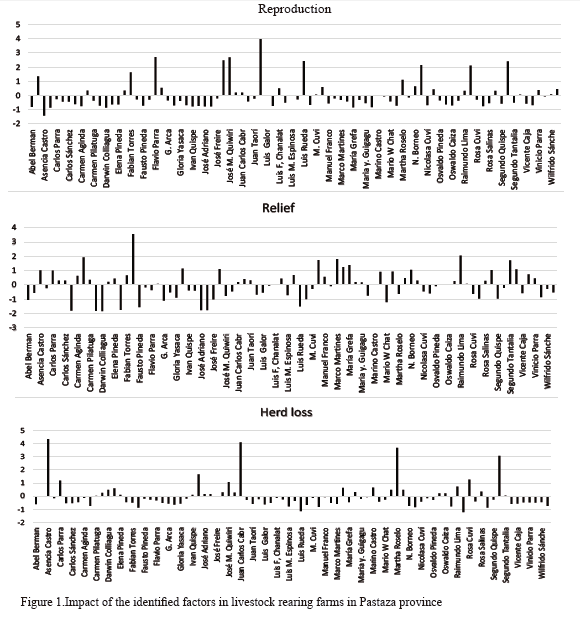
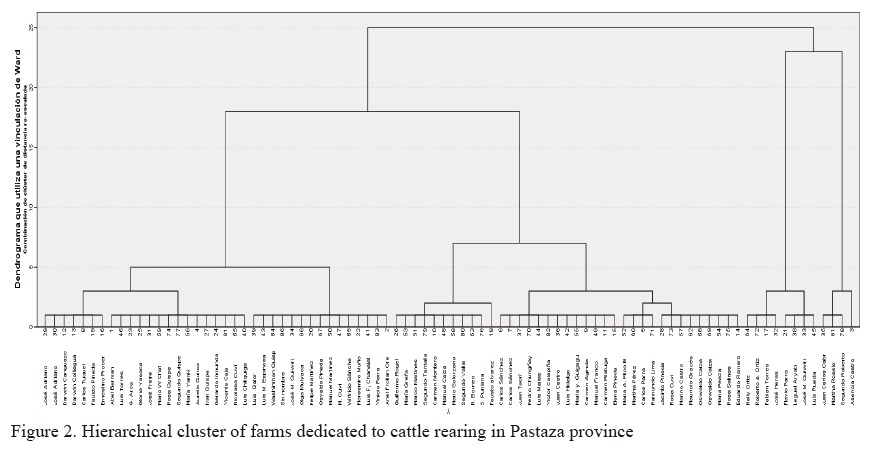
<p align="justify" class="Cuerpodetexto" style="margin-top:12.0pt;margin-right:0cm;margin-bottom:5.95pt;margin-left:0cm;text-indent:0cm;"><span style="font-family:'Verdana','sans-serif'; font-size:10.0pt; ">The  reproduction is the livestock process that defines the herd structure, the  relative production potential that is expected to be obtained, the feeding  program set up to ensure high and stable productions, the health system  modeling, the expected sales volume, the insurance which should provide for the  farm management and production practices that must be set for the optimal  system performance (Ben&iacute;tez 2010, Moreno <em>et al.</em> 2011, FAO &amp; FIL  2012). It also defines part of the productive potential of the farm, as it  determines the number of calves sold or used for the fattening process in the  beef production, which is associated in turn with the birth of herds or the  number of births that are obtained for every hundred females in reproduction  for a certain period (Benitez 2010, Viamonte 2010).</span></p>     <p align="justify" class="Cuerpodetexto" style="margin-top:12.0pt;margin-right:0cm;margin-bottom:5.95pt;margin-left:0cm;text-indent:0cm;"><span style="letter-spacing:.1pt; font-family:'Verdana','sans-serif'; font-size:10.0pt; ">Reproductive efficiency is determined, in turn, by the  method used to serve female reproducers, by the body condition of herds, which  reflects the feeding program and the sire quality. The 75. 6% of rearing herds  are served by the mating system. In 82.6% of these cases the reproductive  method of intensive reproduction is used to gestate the female reproducers,  which is proven if quality sires are maintained and it is efficiently conducts  the sire management (Viamonte 2010).</span><span style="font-family:'Verdana','sans-serif'; font-size:10.0pt; "> </span></p>     <p align="justify" class="Cuerpodetexto" style="margin-top:12.0pt;margin-right:0cm;margin-bottom:5.95pt;margin-left:0cm;text-indent:0cm;"><span style="letter-spacing:.2pt; font-family:'Verdana','sans-serif'; font-size:10.0pt; ">With the relief land component is explained up to 66.93 %  of the accumulated variance by the fitted model. This component is related to  variables that indicate the environmental situation of these livestock systems.  The land slope, the rainfall pattern, the maximum intensity of rains that fall  during the rainy season, the infiltration capacity of soil and the land  covering conditions the erosion danger, which expressed by gullies or furrows  which are forms perpendicular to the slope in the grazing lands. The extension  and intensity of the erosion increase as the land slope increases. With the  land slope exponentially increases the speed of drainage, the rain erosive  ability and land degradation associated to these natural phenomena (FAO 2000,  Murgueitio <em>et al.</em> 2006, Ibrahim <em>et al.</em> 2007).</span></p>     <p align="justify" class="Cuerpodetexto" style="margin-top:12.0pt;margin-right:0cm;margin-bottom:5.95pt;margin-left:0cm;text-indent:0cm;"><span style="font-family:'Verdana','sans-serif'; font-size:10.0pt; ">The  degradation by erosion is also related to the area percentage considered  adequate for grazing, which are those with slopes lower than 30 %. In Pastaza,  38 % of the area in livestock use are in slopes not recommended for grazing,  and 45 % on slopes ranging between 15 and 30 %. These land characteristics  exacerbate the erosion danger of a territory whose rainfall pattern varies from  over 5000 mm per year on the climate areas Montano Bajo until 3500 mm annual  near the Amazon plain (Benitez 2015).</span></p>     <p align="justify" class="Cuerpodetexto" style="margin-top:12.0pt;margin-right:0cm;margin-bottom:5.95pt;margin-left:0cm;text-indent:0cm;"><span style="font-family:'Verdana','sans-serif'; font-size:10.0pt; ">The third component, which corresponds to losses in the  herd, is related to deaths occurring during the year in all existing categories  and deaths caused by accidents. This phenomenon occurs when the animals which  are subjected to tethering on rough slopes try to reach fresh grasses and fall,  breaking his spine. Accidents represent 86.5 % of the losses in livestock  rearing from Pastaza province (INEC 2015). With this component is explained  85.54 % of the accumulated variance of the model. </span><span style="font-family:'Verdana','sans-serif'; font-size:10.0pt; "> </span></p>     <p align="justify" class="Cuerpodetexto" style="margin-top:12.0pt;margin-right:0cm;margin-bottom:5.95pt;margin-left:0cm;text-indent:0cm;"><span style="font-family:'Verdana','sans-serif'; font-size:10.0pt; "><a href="/img/revistas/cjas/v50n2/f0104216.gif">Figure  1</a> shows the impact of these components on each farms evaluated in the  rearing-fattening system, where each farm represented on the x axis obtains  three indicators in a scale of values that indicates their relative situation  regarding the rest of the evaluated farms, which are represented by colored  bars in the y-axis. <a href="/img/revistas/cjas/v50n2/f0204216.gif">Figure 2</a> shows the hierarchical cluster obtained by  grouping farms from the impacts of the identified components and when selecting  a differences index of 55.43. <a href="/img/revistas/cjas/v50n2/t0204216.gif">Table 2</a> shows the rearing-fattening systems  classification in Pastaza.</span></p>     
<p align="justify" class="Cuerpodetexto" style="margin-top:12.0pt;margin-right:0cm;margin-bottom:5.95pt;margin-left:0cm;text-indent:0cm;"><span style="font-family:'Verdana','sans-serif'; font-size:10.0pt; ">The  first group constitutes 43% of the evaluated systems. It consists of farms that  are located 855&plusmn;  239 mo.s.l on slopes of 21 &plusmn; 11 %. They cover an area in animal husbandry of  22.4 &plusmn; 12.9 ha, with 79 % of own area for grazing and has 13 &plusmn; 10.3ha of forest  and 0.8 &plusmn; 0.9 ha in crops. The herd is 19 &plusmn; 11 heads, of which 42 % are cows.  The birth rate is 63 &plusmn; 22% and the stocking rate 1.2&plusmn; 1.4UGM.ha<sup>-1</sup>,  higher than the capacity supported by the system, so that producers are forced  to lease an area, equivalent to 9.3% of the exploit area, to complete the  biomass deficit of their respective livestock systems.</span></p>     <p align="justify" class="Cuerpodetexto" style="margin-top:12.0pt;margin-right:0cm;margin-bottom:5.95pt;margin-left:0cm;text-indent:0cm;"><span style="font-family:'Verdana','sans-serif'; font-size:10.0pt; ">The second group corresponds to 4.7 % of the evaluated  systems. They are farms that are located at 903 &plusmn; 35 77 mo.s.l on slopes&nbsp; of&nbsp; 35&plusmn;  17 %, covering an area of 42.5&plusmn; 34 ha, with 33.8% of own area for grazing. They  have 13 &plusmn; 11.6 ha of forest and 1.5&plusmn;  1.3 ha in crops. Their herd is 55 &plusmn; 41 heads, of which 38.2 are cows. The birth  rate is 67 &plusmn; 23 %, with stocking rate of 1.4&plusmn;1.1 UGM.ha<sup>-1</sup>, much  higher than the capacity supported by the system, so that producers complete  the biomass deficit of their systems with a surface lease equivalent to19.5 %  of the exploit area. The relief characteristics and the biomass production are  reflected in the body condition of the herd, which is evident in a poor  feeding.</span></p>     <p align="justify" class="Cuerpodetexto" style="margin-top:12.0pt;margin-right:0cm;margin-bottom:5.95pt;margin-left:0cm;text-indent:0cm;"><span style="font-family:'Verdana','sans-serif'; font-size:10.0pt; ">The  third group consists of 43 % of the evaluated farms, which are located at 974 &plusmn;  119 mo.s.l on slopes of 47 &plusmn; 16 %, which cover with animal husbandry an area of  26.7 &plusmn; 15.4 ha, with 31.2% of own area for grazing. They have 14.6 &plusmn; 12.2 ha of  forest and 1.4 &plusmn; 1.3ha in crops. The herd is 18 &plusmn; 8 cabezas, of which 33.3 %  are cows. The birth rate is 73 &plusmn; 22 %, the stocking rate is  0.8 &plusmn; 0.4 UGM.ha<sup>-1</sup>and leases the equivalent to 9 % of the area  exploiting to complete the biomass lack of the livestock system. The body  condition of the herd is about 2.8 units.</span></p>     ]]></body>
<body><![CDATA[<p align="justify" class="Cuerpodetexto" style="margin-top:12.0pt;margin-right:0cm;margin-bottom:5.95pt;margin-left:0cm;text-indent:0cm;"><span style="letter-spacing:.2pt; font-family:'Verdana','sans-serif'; font-size:10.0pt; ">The  fourth group is 9.3% of the evaluated farms, which are located at 897 &plusmn;268  mo.s.l on slopes of    32 &plusmn; 15%. They cover in livestock activity an area of 60.8 &plusmn; 44.4 ha, with 70.9  % of the area for grazing, they have 14.6 &plusmn; 12.2 ha of forest and 1.4&plusmn;  1.3 ha in crops. Their herd is 67 &plusmn; 9 heads, of which    47.8 % are cows. The birth rate is 70 &plusmn; 22 %, the stocking rate is 2.0 &plusmn; 2  UGM.ha<sup>-1</sup> and leases the equivalent to 19.4 % of the area exploiting  to complete the biomass deficit of their livestock systems. The body condition  of the herd is about 3.4 units. By the extension of their farms, producers  reach the highest sales volume of    cattle</span><font size="2" face="Verdana, Arial, Helvetica, sans-serif">.</font></p>     <p align="justify">&nbsp;</p>     <p align="justify"><font size="2" face="Verdana, Arial, Helvetica, sans-serif"><font size="3"><b>CONCLUSIONS</b></font></font></p>     <p align="justify" class="Cuerpodetexto" style="margin-top:12.0pt;margin-right:0cm;margin-bottom:5.95pt;margin-left:0cm;text-indent:0cm;"><span style="font-family:'Verdana','sans-serif'; font-size:10.0pt; ">Factors  determing productive efficiency of cattle rearing fattening systems in Pastaza  province, as well as the classified farms groups, are related to the  effectiveness of the productive process and the characteristics of land relief,  which is related to environment degradation and looses in the herd.&nbsp;&nbsp; </span></p>     <p align="justify" class="Cuerpodetexto" style="margin-top:12.0pt;margin-right:0cm;margin-bottom:5.95pt;margin-left:0cm;text-indent:0cm;"><span style="font-family:'Verdana','sans-serif'; font-size:10.0pt; ">The  productive efficiency which is obtain in livestock rearing -fattening systems  in Pastaza province is low and is related to alternatives of widespread exploitation,  which do not suit to the environment needs and the capacity of soil use in  which these production processes are developed.</span></p>     <p align="justify" class="Cuerpodetexto" style="margin-top:12.0pt;margin-right:0cm;margin-bottom:5.95pt;margin-left:0cm;text-indent:0cm;"><span style="font-family:'Verdana','sans-serif'; font-size:10.0pt; ">It is possible to implement  sustainable alternatives of meat production from livestock rearing-fattening  systems, if production programs are adapted to the environment where these  systems are developed</span><font size="2" face="Verdana, Arial, Helvetica, sans-serif">.</font></p>     <p align="justify">&nbsp;</p>     <p align="justify"><font size="2" face="Verdana, Arial, Helvetica, sans-serif"><font size="3"><b>REFERENCES</b></font></font></p>     <!-- ref --><p align="justify" class="MsoBibliography" style="margin-top:12.0pt;margin-right:0cm;margin-bottom:5.95pt;margin-left:0cm;text-align:justify;"><span style="font-family:'Verdana','sans-serif'; font-size:10.0pt; ">ATPA 2014. <em>Reconversi&oacute;n Agroproductiva Sostenible en la Amazon&iacute;a  ecuatoriana</em>. Quito: Ministerio de la Agricultura, Ganader&iacute;a, Acuacultura y  Pesca, p. 91, Available: &lt;<a href="http://www.desarrolloamazonico.gob.ec/atpa-agenda-de-transformacion-productiva-amazonica-2/" target="_blank">http://www.desarrolloamazonico.gob.ec/atpa-agenda-de-transformacion-productiva-amazonica-2/</a>&gt;,  [Consulted:&nbsp;April 12, 2016].    </span></p>     ]]></body>
<body><![CDATA[<p align="justify" class="MsoBibliography" style="margin-top:12.0pt;margin-right:0cm;margin-bottom:5.95pt;margin-left:0cm;text-align:justify;"><span style="font-family:'Verdana','sans-serif'; font-size:10.0pt; ">Ben&iacute;tez, D. 2015. &ldquo;Los ecosistemas en uso ganadero en Pastaza&rdquo;. In: <em>Retos  y posibilidades para una ganader&iacute;a sostenible en la provincia de Pastaza de la  Amazonia ecuatoriana</em>, Puyo, Ecuador: Universidad Estatal Amaz&oacute;nica, p. 174,  ISBN: 978-9942-932-16-7.</span></p>     <!-- ref --><p align="justify" class="MsoBibliography" style="margin-top:12.0pt;margin-right:0cm;margin-bottom:5.95pt;margin-left:0cm;text-align:justify;"><span style="font-family:'Verdana','sans-serif'; font-size:10.0pt; ">Ben&iacute;tez, J. D. G. 2010. <em>Tecnolog&iacute;as para la producci&oacute;n ganadera  sostenible en ecosistemas fr&aacute;giles y degradados</em>. Cuba: Bayamo, 190 p., ISBN:  978-959-223-183-2.    </span></p>     <!-- ref --><p align="justify" class="MsoBibliography" style="margin-top:12.0pt;margin-right:0cm;margin-bottom:5.95pt;margin-left:0cm;text-align:justify;"><span style="font-family:'Verdana','sans-serif'; font-size:10.0pt; ">ESPAC. 2014. <em>Bases de datos. Encuesta de Superficie y Producci&oacute;n  Agropecuaria Continua (BBD)</em>. , Available:  &lt;<a href="http://www.ecuadorencifras.gob.ec/encuestas-de-superficie-y-producción-agropecuaria-continua-bbd/" target="_blank">http://www.ecuadorencifras.gob.ec/encuestas-de-superficie-y-producci&oacute;n-agropecuaria-continua-bbd/</a>&gt;,  [Consulted:&nbsp;November 30, 2015].    </span></p>     <!-- ref --><p align="justify" class="MsoBibliography" style="margin-top:12.0pt;margin-right:0cm;margin-bottom:5.95pt;margin-left:0cm;text-align:justify;"><span style="font-family:'Verdana','sans-serif'; font-size:10.0pt; ">FAO 2000. <em>Manual de pr&aacute;cticas integradas de manejo y conservaci&oacute;n de  suelos</em>. vol. 8, FAO, 240 p., ISBN: 978-92-5-304417-7, Available:  &lt;<a href="https://books.google.com.cu/books/about/Manual_de_pr%C3%A1cticas_integradas_de_manej.html?id=-kZCpFv-W1EC&redir_esc=y" target="_blank">https://books.google.com.cu/books/about/Manual_de_pr%C3%A1cticas_integradas_de_manej.html?id=-kZCpFv-W1EC&amp;redir_esc=y</a>&gt;,  [Consulted:&nbsp;April 4, 2016].    </span></p>     <!-- ref --><p align="justify" class="MsoBibliography" style="margin-top:12.0pt;margin-right:0cm;margin-bottom:5.95pt;margin-left:0cm;text-align:justify;"><span style="font-family:'Verdana','sans-serif'; font-size:10.0pt; ">FAO &amp; FIL 2012. <em>Gu&iacute;a de Buenas Pr&aacute;cticas en Explotaciones  Lecheras</em>. (ser. Directrices FAO: Producci&oacute;n y Sanidad Animal, no. ser. 8),  Roma, Italia: FAO, ISBN: 978-92-5-306957-6, Available:  &lt;<a href="http://www.fao.org/docrep/015/ba0027s/ba0027s00.htm" target="_blank">http://www.fao.org/docrep/015/ba0027s/ba0027s00.htm</a>&gt;,  [Consulted:&nbsp;April 10, 2016].    </span></p>     <!-- ref --><p align="justify" class="MsoBibliography" style="margin-top:12.0pt;margin-right:0cm;margin-bottom:5.95pt;margin-left:0cm;text-align:justify;"><span style="font-family:'Verdana','sans-serif'; font-size:10.0pt; ">IBM Corporation 2012. <em>IBM SPSS Statistics</em>.  version 21.0, [Windows], Multiplataforma, U.S: IBM Corporation, Available:  &lt;<a href="http://www.ibm.com" target="_blank">http://www.ibm.com</a>&gt;    .</span></p>     <p align="justify" class="MsoBibliography" style="margin-top:12.0pt;margin-right:0cm;margin-bottom:5.95pt;margin-left:0cm;text-align:justify;"><span style="font-family:'Verdana','sans-serif'; font-size:10.0pt; ">Ibrahim, M., Villanueva, C. &amp; Casasola, F. 2007. &ldquo;Sistemas silvopastoriles  como una herramienta para el mejoramiento de la productividad y rehabilitaci&oacute;n  ecol&oacute;gica de paisajes ganaderos en Centro Am&eacute;rica&rdquo;. <em>Archivos  Latinoamericanos de Producci&oacute;n Animal</em>, 15 (Supl. 1): 74&ndash;84, ISSN:  1022-1301.</span></p>     <!-- ref --><p align="justify" class="MsoBibliography" style="margin-top:12.0pt;margin-right:0cm;margin-bottom:5.95pt;margin-left:0cm;text-align:justify;"><span style="font-family:'Verdana','sans-serif'; font-size:10.0pt; ">INEC, 2015. 2015. <em>&Iacute;ndices de la Actividad Econ&oacute;mica</em>. , Available:  &lt;<a href="http://www.inec.gob.ec/estadísticas/" target="_blank">http://www.inec.gob.ec/estad&iacute;sticas/</a>&gt;, [Consulted:&nbsp;April 12, 2016].    </span></p>     <!-- ref --><p align="justify" class="MsoBibliography" style="margin-top:12.0pt;margin-right:0cm;margin-bottom:5.95pt;margin-left:0cm;text-align:justify;"><span style="font-family:'Verdana','sans-serif'; font-size:10.0pt; ">Moreno, S. J. A., Alcalzar, A. H. &amp; Guzm&aacute;n, G. M. 2011. <em>Ganader&iacute;a  Ecol&oacute;gica: Manejo reproductivo de la hembra bovina</em>. Tanijo J. C. &amp;  Cardona O. (eds.), 2011: Cieniagro, ISBN: 798-3-8442-0470-4.    </span></p>     <p align="justify" class="MsoBibliography" style="margin-top:12.0pt;margin-right:0cm;margin-bottom:5.95pt;margin-left:0cm;text-align:justify;"><span style="font-family:'Verdana','sans-serif'; font-size:10.0pt; ">Murgueitio, E., Cuellar, P., Ibrahim, M., Gobbi, J., Cuartas, C. A.,  Naranjo, J. F., Zapata, A., Mej&iacute;a, C. E., Zuluaga, A. F. &amp; Casasola, F.  2006. &ldquo;Adopci&oacute;n de Sistemas Agroforestales Pecuarios&rdquo;. <em>Pastos y Forrajes</em>,  29 (4): 365&ndash;381, ISSN: 2078-8452.</span></p>     <!-- ref --><p align="justify" class="MsoBibliography" style="margin-top:12.0pt;margin-right:0cm;margin-bottom:5.95pt;margin-left:0cm;text-align:justify;"><span style="font-family:'Verdana','sans-serif'; font-size:10.0pt; ">Nieto, C. C. &amp; Caicedo, V. C. 2011. <em>An&aacute;lisis reflexivo sobre el  desarrollo agropecuario sostenible en la Amazonia ecuatoriana</em>. (ser.  Publicaci&oacute;n Miscelanea, no. ser. 405), Joya de los Sacha, Ecuador: IINIAP-EECA,  102 p.    </span></p>     <!-- ref --><p align="justify" class="MsoBibliography" style="margin-top:12.0pt;margin-right:0cm;margin-bottom:5.95pt;margin-left:0cm;text-align:justify;"><span style="font-family:'Verdana','sans-serif'; font-size:10.0pt; ">Snedecor, G. W. &amp; Cochran, W. G. 1989. <em>Statistical  Methods</em>. 8th ed., Iowa State University Press, 503 p., ISBN:  978-0-8138-1561-9, Available:  &lt;<a href="http://www.amazon.com/Statistical-Methods-George-W-Snedecor/dp/0813815614" target="_blank">http://www.amazon.com/Statistical-Methods-George-W-Snedecor/dp/0813815614</a>&gt;,  [Consulted:&nbsp;April 4, 2016].    </span></p>     <p align="justify" class="MsoBibliography" style="margin-top:12.0pt;margin-right:0cm;margin-bottom:5.95pt;margin-left:0cm;text-align:justify;"><span style="font-family:'Verdana','sans-serif'; font-size:10.0pt; ">Torres, C. V. 2015. &ldquo;Aspectos estad&iacute;sticos a considerar en el dise&ntilde;o,  muestreo, procesamiento e interpretaci&oacute;n de datos en la investigaci&oacute;n de  sistemas productivos agropecuarios&rdquo;. In: <em>Retos y posibilidades para una  ganader&iacute;a sostenible en la provincia de Pastaza de la Amazonia ecuatoriana</em>,  Puyo, Ecuador: Universidad Estatal Amaz&oacute;nica, p. 174, ISBN: 978-9942-932-16-7.</span></p>     <p align="justify" class="MsoBibliography" style="margin-top:12.0pt;margin-right:0cm;margin-bottom:5.95pt;margin-left:0cm;text-align:justify;"><span style="font-family:'Verdana','sans-serif'; font-size:10.0pt; ">Torres, V. 1987. &ldquo;M&eacute;todo visual para estimar la disponibilidad del  pasto. 2. Determinaci&oacute;n del tama&ntilde;o de muestra&rdquo;. <em>Cuban Journal of  Agricultural Science</em>, 21 (2): 117&ndash;121, ISSN: 2079-3480.</span></p>     <p align="justify" class="MsoBibliography" style="margin-top:12.0pt;margin-right:0cm;margin-bottom:5.95pt;margin-left:0cm;text-align:justify;"><span style="font-family:'Verdana','sans-serif'; font-size:10.0pt; ">Torres, V., Cobo, R., Sanchez, L. &amp; Raez, N. 2013. </span><span style="font-family:'Verdana','sans-serif'; font-size:10.0pt; ">&ldquo;Statistical tool for  measuring the impact of milk production on the local development of a province  in Cuba&rdquo;. <em>Livestock Research for Rural Development</em>, 25 (9)ISSN: 0121-3784,  Available: &lt;<a href="http://www.lrrd.cipav.org.co/lrrd25/9/torr25159.htm" target="_blank">http://www.lrrd.cipav.org.co/lrrd25/9/torr25159.htm</a>&gt;,  [Consulted:&nbsp;April 8, 2016].</span></p>     <p align="justify" class="MsoBibliography" style="margin-top:12.0pt;margin-right:0cm;margin-bottom:5.95pt;margin-left:0cm;text-align:justify;"><span style="font-family:'Verdana','sans-serif'; font-size:10.0pt; ">Vargas, J., Ben&iacute;tez, D., Bravo, C., Leonard, I., P&eacute;rez, M., Torres, V.,  R&iacute;os, S. &amp; Torres, A. 2015a. <em>Retos y posibilidades para una ganader&iacute;a  sostenible en la provincia de Pastaza de la Amazonia ecuatoriana</em>. Puyo,  Ecuador: Universidad Estatal Amaz&oacute;nica, 174 p., ISBN: 978-9942-932-16-7.</span></p>     <p align="justify" class="MsoBibliography" style="margin-top:12.0pt;margin-right:0cm;margin-bottom:5.95pt;margin-left:0cm;text-align:justify;"><span style="font-family:'Verdana','sans-serif'; font-size:10.0pt; ">Vargas, J. C., Ben&iacute;tez, D. G., Verena, T., R&iacute;os, S. &amp; Soria, S.  2015b. &ldquo;Factores que determinan la eficiencia de la producci&oacute;n de leche en  sistemas de doble prop&oacute;sito en la provincia de Pastaza, Ecuador&rdquo;. <em>Cuban  Journal of Agricultural Science</em>, 49 (1): 17&ndash;21, ISSN: 2079-3480.</span></p>     <!-- ref --><div align="justify"><span style="font-family:'Verdana','sans-serif'; font-size:10.0pt; ">Viamonte, M. I. 2010. <em>Sistema integrado de manejo para incrementar la  productividad en vacas&nbsp; de la raza  Criolla cubana</em>. Ph.D. Thesis, Universidad de Granma, Bayamo, Granma</span><font size="2" face="Verdana,     Arial, Helvetica, sans-serif">.</font> </div>     <p align="justify">&nbsp;</p>     <p align="justify">&nbsp;</p>     ]]></body>
<body><![CDATA[<p align="justify"><font size="2" face="Verdana, Arial, Helvetica, sans-serif">Received: 25/11/2015    <br>   Accepted: 20/6/2016</font></p>     <p align="justify">&nbsp;</p>     <p align="justify">&nbsp;</p>     <p align="justify"><font size="2" face="Verdana, Arial, Helvetica, sans-serif"><i>D.G. Benítez,</i> Instituto de Investigaciones Agropecuarias “Jorge Dimitrov”, Carretera Bayamo-Manzanillo,  km 16 ½, Bayamo CP 85100, Granma, Cuba.  Email: <a href="mailto:dioclesbenitezjimenez@gmail.com">dioclesbenitezjimenez@gmail.com</a></font></p>      ]]></body><back>
<ref-list>
<ref id="B1">
<nlm-citation citation-type="book">
<person-group person-group-type="author">
<name>
<surname><![CDATA[ATPA]]></surname>
</name>
</person-group>
<source><![CDATA[Reconversión Agroproductiva Sostenible en la Amazonía ecuatoriana]]></source>
<year>2014</year>
<page-range>91</page-range><publisher-loc><![CDATA[Quito ]]></publisher-loc>
<publisher-name><![CDATA[Ministerio de la Agricultura, Ganadería, Acuacultura y Pesca]]></publisher-name>
</nlm-citation>
</ref>
<ref id="B2">
<nlm-citation citation-type="book">
<person-group person-group-type="author">
<name>
<surname><![CDATA[Benítez]]></surname>
<given-names><![CDATA[D.]]></given-names>
</name>
</person-group>
<article-title xml:lang="nd"><![CDATA[Los ecosistemas en uso ganadero en Pastaza]]></article-title>
<source><![CDATA[Retos y posibilidades para una ganadería sostenible en la provincia de Pastaza de la Amazonia ecuatoriana]]></source>
<year>2015</year>
<page-range>174</page-range><publisher-loc><![CDATA[Puyo, Ecuador ]]></publisher-loc>
<publisher-name><![CDATA[Universidad Estatal Amazónica]]></publisher-name>
</nlm-citation>
</ref>
<ref id="B3">
<nlm-citation citation-type="book">
<person-group person-group-type="author">
<name>
<surname><![CDATA[Benítez]]></surname>
<given-names><![CDATA[J. D. G.]]></given-names>
</name>
</person-group>
<source><![CDATA[Tecnologías para la producción ganadera sostenible en ecosistemas frágiles y degradados]]></source>
<year>2010</year>
<page-range>190</page-range><publisher-loc><![CDATA[Cuba ]]></publisher-loc>
<publisher-name><![CDATA[Bayamo]]></publisher-name>
</nlm-citation>
</ref>
<ref id="B4">
<nlm-citation citation-type="">
<person-group person-group-type="author">
<name>
<surname><![CDATA[ESPAC]]></surname>
</name>
</person-group>
<source><![CDATA[Bases de datos. Encuesta de Superficie y Producción Agropecuaria Continua (BBD)]]></source>
<year>2014</year>
</nlm-citation>
</ref>
<ref id="B5">
<nlm-citation citation-type="book">
<person-group person-group-type="author">
<name>
<surname><![CDATA[FAO]]></surname>
</name>
</person-group>
<source><![CDATA[Manual de prácticas integradas de manejo y conservación de suelos]]></source>
<year>2000</year>
<volume>8</volume>
<page-range>240</page-range><publisher-name><![CDATA[FAO]]></publisher-name>
</nlm-citation>
</ref>
<ref id="B6">
<nlm-citation citation-type="book">
<person-group person-group-type="author">
<name>
<surname><![CDATA[FAO]]></surname>
</name>
<name>
<surname><![CDATA[FIL]]></surname>
</name>
</person-group>
<source><![CDATA[Guía de Buenas Prácticas en Explotaciones Lecheras]]></source>
<year>2012</year>
<publisher-loc><![CDATA[Roma, Italia ]]></publisher-loc>
<publisher-name><![CDATA[FAO]]></publisher-name>
</nlm-citation>
</ref>
<ref id="B7">
<nlm-citation citation-type="book">
<person-group person-group-type="author">
<name>
<surname><![CDATA[IBM Corporation]]></surname>
</name>
</person-group>
<source><![CDATA[IBM SPSS Statistics]]></source>
<year>2012</year>
<publisher-loc><![CDATA[U.S ]]></publisher-loc>
<publisher-name><![CDATA[IBM Corporation]]></publisher-name>
</nlm-citation>
</ref>
<ref id="B8">
<nlm-citation citation-type="journal">
<person-group person-group-type="author">
<name>
<surname><![CDATA[Ibrahim]]></surname>
<given-names><![CDATA[M.]]></given-names>
</name>
<name>
<surname><![CDATA[Villanueva]]></surname>
<given-names><![CDATA[C.]]></given-names>
</name>
<name>
<surname><![CDATA[Casasola]]></surname>
<given-names><![CDATA[F.]]></given-names>
</name>
</person-group>
<article-title xml:lang="nd"><![CDATA[Sistemas silvopastoriles como una herramienta para el mejoramiento de la productividad y rehabilitación ecológica de paisajes ganaderos en Centro América]]></article-title>
<source><![CDATA[Archivos Latinoamericanos de Producción Animal]]></source>
<year>2007</year>
<volume>15</volume>
<numero>Supl. 1</numero>
<issue>Supl. 1</issue>
<page-range>74-84</page-range></nlm-citation>
</ref>
<ref id="B9">
<nlm-citation citation-type="">
<person-group person-group-type="author">
<name>
<surname><![CDATA[INEC]]></surname>
<given-names><![CDATA[2015]]></given-names>
</name>
</person-group>
<source><![CDATA[Índices de la Actividad Económica]]></source>
<year>2015</year>
</nlm-citation>
</ref>
<ref id="B10">
<nlm-citation citation-type="book">
<person-group person-group-type="author">
<name>
<surname><![CDATA[Moreno]]></surname>
<given-names><![CDATA[S. J. A.]]></given-names>
</name>
<name>
<surname><![CDATA[Alcalzar]]></surname>
<given-names><![CDATA[A. H.]]></given-names>
</name>
<name>
<surname><![CDATA[Guzmán]]></surname>
<given-names><![CDATA[G. M.]]></given-names>
</name>
<name>
<surname><![CDATA[Tanijo]]></surname>
<given-names><![CDATA[J. C.]]></given-names>
</name>
<name>
<surname><![CDATA[Cardona]]></surname>
<given-names><![CDATA[O.]]></given-names>
</name>
</person-group>
<source><![CDATA[Ganadería Ecológica: Manejo reproductivo de la hembra bovina]]></source>
<year>2011</year>
<publisher-loc><![CDATA[2011 ]]></publisher-loc>
<publisher-name><![CDATA[Cieniagro]]></publisher-name>
</nlm-citation>
</ref>
<ref id="B11">
<nlm-citation citation-type="journal">
<person-group person-group-type="author">
<name>
<surname><![CDATA[Murgueitio]]></surname>
<given-names><![CDATA[E.]]></given-names>
</name>
<name>
<surname><![CDATA[Cuellar]]></surname>
<given-names><![CDATA[P.]]></given-names>
</name>
<name>
<surname><![CDATA[Ibrahim]]></surname>
<given-names><![CDATA[M.]]></given-names>
</name>
<name>
<surname><![CDATA[Gobbi]]></surname>
<given-names><![CDATA[J.]]></given-names>
</name>
<name>
<surname><![CDATA[Cuartas]]></surname>
<given-names><![CDATA[C. A.]]></given-names>
</name>
<name>
<surname><![CDATA[Naranjo]]></surname>
<given-names><![CDATA[J. F.]]></given-names>
</name>
<name>
<surname><![CDATA[Zapata]]></surname>
<given-names><![CDATA[A.]]></given-names>
</name>
<name>
<surname><![CDATA[Mejía]]></surname>
<given-names><![CDATA[C. E.]]></given-names>
</name>
<name>
<surname><![CDATA[Zuluaga]]></surname>
<given-names><![CDATA[A. F.]]></given-names>
</name>
<name>
<surname><![CDATA[Casasola]]></surname>
<given-names><![CDATA[F.]]></given-names>
</name>
</person-group>
<article-title xml:lang="nd"><![CDATA[Adopción de Sistemas Agroforestales Pecuarios]]></article-title>
<source><![CDATA[Pastos y Forrajes]]></source>
<year>2006</year>
<volume>29</volume>
<numero>4</numero>
<issue>4</issue>
<page-range>365-381</page-range></nlm-citation>
</ref>
<ref id="B12">
<nlm-citation citation-type="book">
<person-group person-group-type="author">
<name>
<surname><![CDATA[Nieto]]></surname>
<given-names><![CDATA[C. C.]]></given-names>
</name>
<name>
<surname><![CDATA[Caicedo]]></surname>
<given-names><![CDATA[V. C.]]></given-names>
</name>
</person-group>
<source><![CDATA[Análisis reflexivo sobre el desarrollo agropecuario sostenible en la Amazonia ecuatoriana]]></source>
<year>2011</year>
<page-range>102</page-range><publisher-loc><![CDATA[Joya de los Sacha, Ecuador ]]></publisher-loc>
<publisher-name><![CDATA[IINIAP-EECA]]></publisher-name>
</nlm-citation>
</ref>
<ref id="B13">
<nlm-citation citation-type="book">
<person-group person-group-type="author">
<name>
<surname><![CDATA[Snedecor]]></surname>
<given-names><![CDATA[G. W.]]></given-names>
</name>
<name>
<surname><![CDATA[Cochran]]></surname>
<given-names><![CDATA[W. G.]]></given-names>
</name>
</person-group>
<source><![CDATA[Statistical Methods]]></source>
<year>1989</year>
<edition>8th</edition>
<page-range>503</page-range><publisher-name><![CDATA[Iowa State University Press]]></publisher-name>
</nlm-citation>
</ref>
<ref id="B14">
<nlm-citation citation-type="book">
<person-group person-group-type="author">
<name>
<surname><![CDATA[Torres]]></surname>
<given-names><![CDATA[C. V.]]></given-names>
</name>
</person-group>
<article-title xml:lang="nd"><![CDATA[Aspectos estadísticos a considerar en el diseño, muestreo, procesamiento e interpretación de datos en la investigación de sistemas productivos agropecuarios]]></article-title>
<source><![CDATA[Retos y posibilidades para una ganadería sostenible en la provincia de Pastaza de la Amazonia ecuatoriana]]></source>
<year>2015</year>
<page-range>174</page-range><publisher-loc><![CDATA[Puyo, Ecuador ]]></publisher-loc>
<publisher-name><![CDATA[Universidad Estatal Amazónica]]></publisher-name>
</nlm-citation>
</ref>
<ref id="B15">
<nlm-citation citation-type="journal">
<person-group person-group-type="author">
<name>
<surname><![CDATA[Torres]]></surname>
<given-names><![CDATA[V.]]></given-names>
</name>
</person-group>
<article-title xml:lang="nd"><![CDATA[Método visual para estimar la disponibilidad del pasto. 2. Determinación del tamaño de muestra]]></article-title>
<source><![CDATA[Cuban Journal of Agricultural Science]]></source>
<year>1987</year>
<volume>21</volume>
<numero>2</numero>
<issue>2</issue>
<page-range>117-121</page-range></nlm-citation>
</ref>
<ref id="B16">
<nlm-citation citation-type="journal">
<person-group person-group-type="author">
<name>
<surname><![CDATA[Torres]]></surname>
<given-names><![CDATA[V.]]></given-names>
</name>
<name>
<surname><![CDATA[Cobo]]></surname>
<given-names><![CDATA[R.]]></given-names>
</name>
<name>
<surname><![CDATA[Sanchez]]></surname>
<given-names><![CDATA[L.]]></given-names>
</name>
<name>
<surname><![CDATA[Raez]]></surname>
<given-names><![CDATA[N.]]></given-names>
</name>
</person-group>
<article-title xml:lang="nd"><![CDATA[Statistical tool for measuring the impact of milk production on the local development of a province in Cuba]]></article-title>
<source><![CDATA[Livestock Research for Rural Development]]></source>
<year>2013</year>
<volume>25</volume>
<numero>9</numero>
<issue>9</issue>
</nlm-citation>
</ref>
<ref id="B17">
<nlm-citation citation-type="book">
<person-group person-group-type="author">
<name>
<surname><![CDATA[Vargas]]></surname>
<given-names><![CDATA[J.]]></given-names>
</name>
<name>
<surname><![CDATA[Benítez]]></surname>
<given-names><![CDATA[D.]]></given-names>
</name>
<name>
<surname><![CDATA[Bravo]]></surname>
<given-names><![CDATA[C.]]></given-names>
</name>
<name>
<surname><![CDATA[Leonard]]></surname>
<given-names><![CDATA[I.]]></given-names>
</name>
<name>
<surname><![CDATA[Pérez]]></surname>
<given-names><![CDATA[M.]]></given-names>
</name>
<name>
<surname><![CDATA[Torres]]></surname>
<given-names><![CDATA[V.]]></given-names>
</name>
<name>
<surname><![CDATA[Ríos]]></surname>
<given-names><![CDATA[S.]]></given-names>
</name>
<name>
<surname><![CDATA[Torres]]></surname>
<given-names><![CDATA[A.]]></given-names>
</name>
</person-group>
<source><![CDATA[Retos y posibilidades para una ganadería sostenible en la provincia de Pastaza de la Amazonia ecuatoriana]]></source>
<year>2015</year>
<page-range>174</page-range><publisher-loc><![CDATA[Puyo, Ecuador ]]></publisher-loc>
<publisher-name><![CDATA[Universidad Estatal Amazónica]]></publisher-name>
</nlm-citation>
</ref>
<ref id="B18">
<nlm-citation citation-type="journal">
<person-group person-group-type="author">
<name>
<surname><![CDATA[Vargas]]></surname>
<given-names><![CDATA[J. C.]]></given-names>
</name>
<name>
<surname><![CDATA[Benítez]]></surname>
<given-names><![CDATA[D. G.]]></given-names>
</name>
<name>
<surname><![CDATA[Verena]]></surname>
<given-names><![CDATA[T.]]></given-names>
</name>
<name>
<surname><![CDATA[Ríos]]></surname>
<given-names><![CDATA[S.]]></given-names>
</name>
<name>
<surname><![CDATA[Soria]]></surname>
<given-names><![CDATA[S.]]></given-names>
</name>
</person-group>
<article-title xml:lang="nd"><![CDATA[Factores que determinan la eficiencia de la producción de leche en sistemas de doble propósito en la provincia de Pastaza, Ecuador]]></article-title>
<source><![CDATA[Cuban Journal of Agricultural Science]]></source>
<year>2015</year>
<volume>49</volume>
<numero>1</numero>
<issue>1</issue>
<page-range>17-21</page-range></nlm-citation>
</ref>
<ref id="B19">
<nlm-citation citation-type="book">
<person-group person-group-type="author">
<name>
<surname><![CDATA[Viamonte]]></surname>
<given-names><![CDATA[M. I.]]></given-names>
</name>
</person-group>
<source><![CDATA[Sistema integrado de manejo para incrementar la productividad en vacas de la raza Criolla cubana]]></source>
<year>2010</year>
<publisher-loc><![CDATA[Bayamo, Granma ]]></publisher-loc>
<publisher-name><![CDATA[Universidad de Granma]]></publisher-name>
</nlm-citation>
</ref>
</ref-list>
</back>
</article>