<?xml version="1.0" encoding="ISO-8859-1"?><article xmlns:mml="http://www.w3.org/1998/Math/MathML" xmlns:xlink="http://www.w3.org/1999/xlink" xmlns:xsi="http://www.w3.org/2001/XMLSchema-instance">
<front>
<journal-meta>
<journal-id>2079-3480</journal-id>
<journal-title><![CDATA[Cuban Journal of Agricultural Science]]></journal-title>
<abbrev-journal-title><![CDATA[Cuban J. Agric. Sci.]]></abbrev-journal-title>
<issn>2079-3480</issn>
<publisher>
<publisher-name><![CDATA[Editorial del Instituto de Ciencia Animal]]></publisher-name>
</publisher>
</journal-meta>
<article-meta>
<article-id>S2079-34802016000200006</article-id>
<title-group>
<article-title xml:lang="en"><![CDATA[Performance of male bovines under intensive grazing of pasture and shrub legumes during dry period in Valle del Cauto, Cuba]]></article-title>
<article-title xml:lang="es"><![CDATA[Conducta de machos bovinos en pastoreo intensivo de gramíneas y leguminosas arbustivas en época poco lluviosa en el Valle del Cauto, Cuba]]></article-title>
</title-group>
<contrib-group>
<contrib contrib-type="author">
<name>
<surname><![CDATA[Ledea]]></surname>
<given-names><![CDATA[J.L.]]></given-names>
</name>
<xref ref-type="aff" rid="A01"/>
</contrib>
<contrib contrib-type="author">
<name>
<surname><![CDATA[Ray]]></surname>
<given-names><![CDATA[J. V.]]></given-names>
</name>
<xref ref-type="aff" rid="A01"/>
</contrib>
<contrib contrib-type="author">
<name>
<surname><![CDATA[Cabrera]]></surname>
<given-names><![CDATA[Y.]]></given-names>
</name>
<xref ref-type="aff" rid="A02"/>
</contrib>
<contrib contrib-type="author">
<name>
<surname><![CDATA[Nuviola]]></surname>
<given-names><![CDATA[Y.]]></given-names>
</name>
<xref ref-type="aff" rid="A01"/>
</contrib>
<contrib contrib-type="author">
<name>
<surname><![CDATA[Benítez]]></surname>
<given-names><![CDATA[D. G.]]></given-names>
</name>
<xref ref-type="aff" rid="A01"/>
</contrib>
</contrib-group>
<aff id="A01">
<institution><![CDATA[,Instituto de Investigaciones Agropecuarias  ]]></institution>
<addr-line><![CDATA[Bayamo Granma]]></addr-line>
<country>Cuba</country>
</aff>
<aff id="A02">
<institution><![CDATA[,Empresa Agropecuaria José Nemesio Figueredo  ]]></institution>
<addr-line><![CDATA[ ]]></addr-line>
<country>Cuba</country>
</aff>
<pub-date pub-type="pub">
<day>00</day>
<month>06</month>
<year>2016</year>
</pub-date>
<pub-date pub-type="epub">
<day>00</day>
<month>06</month>
<year>2016</year>
</pub-date>
<volume>50</volume>
<numero>2</numero>
<fpage>225</fpage>
<lpage>233</lpage>
<copyright-statement/>
<copyright-year/>
<self-uri xlink:href="http://scielo.sld.cu/scielo.php?script=sci_arttext&amp;pid=S2079-34802016000200006&amp;lng=en&amp;nrm=iso"></self-uri><self-uri xlink:href="http://scielo.sld.cu/scielo.php?script=sci_abstract&amp;pid=S2079-34802016000200006&amp;lng=en&amp;nrm=iso"></self-uri><self-uri xlink:href="http://scielo.sld.cu/scielo.php?script=sci_pdf&amp;pid=S2079-34802016000200006&amp;lng=en&amp;nrm=iso"></self-uri><abstract abstract-type="short" xml:lang="en"><p><![CDATA[The effect of improved pastures, combined and associated with shrub legumes, on the performance of Charolais males and &#8540; Charolais x &#8541; Zebu was studied in a representative area of Valle del Cauto during dry season. A completely randomized design and an intensive rotational grazing system were applied. Two grazing areas were established: 1) association of Megathyrsus + Leucaena and 2) combination of Megathyrsus + Cenchrus. Grazing was conducted during daylight hours, from 7:00 am to 5:00 pm, in paddocks of 0.28 ha with long periods of rotation. An amount of 10 animals were used in each treatment. The results showed that, in the association, the habit of grazing and lying varied according to genotype (P&#8805;0.10). Only the habit of grazing herbaceous plants had significant effect (P &#8804; 0.05). In the combination, all the activities showed significant effects for different confidence levels. Crossbred animals tended to spend less time consuming plants (P &#8805; 0.10), while the time for resting was significantly superior compared to Charolais (P &#8804; 0.05). Shrub component of associations had a compensatory effect on the performance of males in evaluation because there were no significant differences at a confidence level of 95%. The animals of both genotypes concentrated the highest time for grazing in the initial period of the morning and at the end of the afternoon. The applied grazing system maintained the performance pattern of meat-producer males during dry season]]></p></abstract>
<abstract abstract-type="short" xml:lang="es"><p><![CDATA[Se estudió el efecto de pastos mejorados, combinados y asociados con leguminosas arbustivas, en la conducta de machos Charolais y &#8540; Charolais x &#8541; Cebú en una zona representativa del Valle del Cauto durante el período poco lluvioso. Se aplicó un diseño completamente aleatorizado y un sistema basado en el pastoreo rotacional intensivo. Se establecieron dos áreas de pastoreo: 1) asociación de Megathyrsus + Leucaena y 2) combinación de Megathyrsus + Cenchrus. El pastoreo se condujo en horario diurno, desde las 7:00 a.m. a 5:00 p.m., en potreros de 0.28 ha con intervalos prolongados de rotación. Se utilizaron 10 animales en cada tratamiento. Los resultados mostraron que en la asociación el hábito de pastar y echarse varió según el genotipo (P &#8805; 0.10). Solo el hábito de pastar herbáceas tuvo efecto significativo (P &#8804; 0.05). En la combinación, todas las actividades mostraron efectos significativos para diferentes niveles de confianza. Los animales cruzados tendieron a dedicar menos tiempo al consumo de pastos (P &#8805; 0.10), mientras que el destinado al descanso fue significativamente superior con respecto a los Charolais (P &#8804; 0.05). El componente arbustivo de las asociaciones tuvo un efecto compensatorio en la conducta de los machos en evaluación, al no encontrarse diferencias significativas a un nivel de confianza de 95 %. Los animales de ambos genotipos concentraron el mayor tiempo para el pastoreo en el período inicial de la mañana y al final de la tarde. El sistema de pastoreo aplicado mantuvo el patrón de conducta de machos de carne durante la época poco lluviosa]]></p></abstract>
<kwd-group>
<kwd lng="en"><![CDATA[grasses]]></kwd>
<kwd lng="en"><![CDATA[intensive grazing]]></kwd>
<kwd lng="en"><![CDATA[associations]]></kwd>
<kwd lng="en"><![CDATA[genotypes]]></kwd>
<kwd lng="es"><![CDATA[gramíneas]]></kwd>
<kwd lng="es"><![CDATA[pastoreo intensivo]]></kwd>
<kwd lng="es"><![CDATA[asociaciones]]></kwd>
<kwd lng="es"><![CDATA[genotipos]]></kwd>
</kwd-group>
</article-meta>
</front><body><![CDATA[ <p align="right"><font size="2" face="Verdana, Arial, Helvetica, sans-serif"><b>Cuban Journal  of Agricultural Science, 50(2): 225-233, 2016, ISSN: 2079-3480</b></font></p>     <p align="right">&nbsp;</p>     <p align="right"><font size="2" face="Verdana, Arial, Helvetica, sans-serif"><b>ORIGINAL ARTICLE</b></font></p>     <p align="justify">&nbsp;</p>     <p align="justify"><font size="4" face="Verdana, Arial, Helvetica, sans-serif">  <b>Performance of male bovines under intensive grazing of pasture and shrub legumes during dry period in Valle del Cauto, Cuba</b></font></p>      <p align="justify">&nbsp;</p>     <p align="justify"><font size="3" face="Verdana, Arial, Helvetica, sans-serif">  <b>Conducta de machos bovinos en pastoreo intensivo de gramíneas y leguminosas arbustivas en época poco lluviosa en el Valle del Cauto, Cuba</b></font></p>      <p align="justify">&nbsp;</p>     <p align="justify">&nbsp;</p>     <p align="justify"><font size="2" face="Verdana, Arial, Helvetica, sans-serif">  <b>J.L. Ledea,</b><sup><b>I</b></sup> <b> J. V. Ray,</b><sup><b>I</b></sup> <b> Y. Cabrera,</b><sup><b>II</b></sup> <b> Y. Nuviola,</b><sup><b>I</b></sup> <b> D. G. Benítez,</b><sup><b>I</b></sup>  </font></p>     ]]></body>
<body><![CDATA[<p align="justify"><font size="2" face="Verdana, Arial, Helvetica, sans-serif"><b> </b></font><font size="2" face="Verdana, Arial, Helvetica, sans-serif">    <sup>I</sup>Instituto de Investigaciones Agropecuarias “Jorge Dimitrov”, Carretera de Manzanillo, km. 16½.  Apartado Postal 2140. Bayamo, Granma, Cuba.    <br>   <sup>II</sup>Empresa Agropecuaria “José Nemesio Figueredo”, Río Cauto, Cuba. </font></p>     <p align="justify">&nbsp;</p>     <p align="justify">&nbsp;</p> <hr align="JUSTIFY">     <p align="justify"><font size="2" face="Verdana, Arial, Helvetica, sans-serif"><b>ABSTRACT</b></font></p>     <p align="justify"><font size="2" face="Verdana, Arial, Helvetica, sans-serif"><span style="letter-spacing:.2pt; font-family:'Verdana','sans-serif'; font-size:10.0pt; ">The effect of improved pastures, combined and associated with shrub  legumes, on the performance of Charolais males and &#8540; Charolais x &#8541; Zebu was  studied in a representative area of Valle del Cauto during dry season. A  completely randomized design and an intensive rotational grazing system were  applied. Two grazing areas were established: 1) association of Megathyrsus +  Leucaena and 2) combination of Megathyrsus + Cenchrus. Grazing was conducted  during daylight hours, from 7:00 am to 5:00 pm, in paddocks of 0.28 ha with  long periods of rotation. An amount of 10 animals were used in each treatment.  The results showed that, in the association, the habit of grazing and lying  varied according to genotype (P&ge;0.10). Only the habit of grazing herbaceous  plants had significant effect (P &le; 0.05). In the combination, all the  activities showed significant effects for different confidence levels.  Crossbred animals tended to spend less time consuming plants (P &ge; 0.10), while  the time for resting was significantly superior compared to Charolais (P &le;  0.05). Shrub component of associations had a compensatory effect on the  performance of males in evaluation because there were no significant  differences at a confidence level of 95%. The animals of both genotypes  concentrated the highest time for grazing in the initial period of the morning  and at the end of the afternoon. The applied grazing system maintained the  performance pattern of meat-producer males during dry season</span>.</font></p>     <p align="justify"><font size="2" face="Verdana, Arial, Helvetica, sans-serif"><b>Key words:</b> grasses, intensive grazing, associations, genotypes.</font></p> <hr align="JUSTIFY">     <p align="justify"><font size="2" face="Verdana, Arial, Helvetica, sans-serif"><b>RESUMEN</b></font></p>     <p align="justify"><font size="2" face="Verdana, Arial, Helvetica, sans-serif"><span style="letter-spacing:-.2pt; font-family:'Verdana','sans-serif'; font-size:10.0pt; ">Se estudi&oacute; el efecto de pastos mejorados, combinados y  asociados con leguminosas arbustivas, en la conducta de machos Charolais y &#8540;  Charolais x &#8541; Ceb&uacute; en una zona representativa del Valle del Cauto durante el  per&iacute;odo poco lluvioso. Se aplic&oacute; un dise&ntilde;o completamente aleatorizado y un  sistema basado en el pastoreo rotacional intensivo. Se establecieron dos &aacute;reas  de pastoreo: 1) asociaci&oacute;n de Megathyrsus + Leucaena y 2) combinaci&oacute;n de  Megathyrsus + Cenchrus. El pastoreo se condujo en horario diurno, desde las  7:00 a.m. a 5:00 p.m., en potreros de 0.28 ha con intervalos prolongados de  rotaci&oacute;n. Se utilizaron 10 animales en cada tratamiento. Los resultados  mostraron que en la asociaci&oacute;n el h&aacute;bito de pastar y echarse&nbsp; vari&oacute; seg&uacute;n el genotipo (P &ge; 0.10). Solo el  h&aacute;bito de pastar herb&aacute;ceas tuvo efecto significativo (P &le; 0.05). En la  combinaci&oacute;n, todas las actividades mostraron efectos significativos para  diferentes niveles de confianza. Los animales cruzados tendieron&nbsp; a dedicar menos tiempo al consumo de pastos  (P &ge; 0.10), mientras que el destinado al descanso fue significativamente  superior con respecto a los Charolais (P &le; 0.05). El componente arbustivo de  las asociaciones tuvo un efecto compensatorio en la conducta de los machos en  evaluaci&oacute;n, al no encontrarse diferencias significativas a un nivel de  confianza de 95 %. Los animales de ambos genotipos concentraron el mayor tiempo  para el pastoreo en el per&iacute;odo inicial de la ma&ntilde;ana y al final de la tarde. El  sistema de pastoreo aplicado mantuvo el patr&oacute;n de conducta de machos de carne  durante la &eacute;poca poco lluviosa</span>.</font></p>     <p align="justify"><font size="2" face="Verdana, Arial, Helvetica, sans-serif"><b>Palabras    clave:</b>    gramíneas, pastoreo intensivo, asociaciones, genotipos.</font></p> <hr align="JUSTIFY">     ]]></body>
<body><![CDATA[<p align="justify">&nbsp;</p>     <p align="justify">&nbsp;</p>     <p align="justify"><font size="2" face="Verdana, Arial, Helvetica, sans-serif"><b><font size="3">INTRODUCTION</font></b></font></p>     <p align="justify" class="Cuerpodetexto" style="margin-top:12.0pt;margin-right:0cm;margin-bottom:5.95pt;margin-left:0cm;text-indent:0cm;"><span style="font-family:'Verdana','sans-serif'; font-size:10.0pt; ">Valle  del Cauto is a plain dominated by the Cauto river basin in the eastern region  of Cuba. It covers an area of 4.5 thousands km<sup>2</sup> (Benitez <em>et al.</em> 2007) and occupies areas from four eastern provinces (Holgu&iacute;n, Las Tunas,  Granma and Santiago de Cuba). </span></p>     <p align="justify" class="Cuerpodetexto" style="margin-top:12.0pt;margin-right:0cm;margin-bottom:5.95pt;margin-left:0cm;text-indent:0cm;"><span style="letter-spacing:.1pt; font-family:'Verdana','sans-serif'; font-size:10.0pt; ">Due to the characteristics of this region, the practice of  cattle rearing in the Valle del Cauto is one of its main economic source,  representing 90% of cattle rearing in the eastern territory (Fajardo 2008), in  an area of 167.103 ha. However, the high risk of drought, deterioration of  ecosystems and inappropriate agricultural practices cause, in general, a low  productive efficiency and that the full productive potential of herds is not  expressed, which base their feeding on pasture and forages.</span><span style="font-family:'Verdana','sans-serif'; font-size:10.0pt; "> </span></p>     <p align="justify" class="Cuerpodetexto" style="margin-top:12.0pt;margin-right:0cm;margin-bottom:5.95pt;margin-left:0cm;text-indent:0cm;"><span style="font-family:'Verdana','sans-serif'; font-size:10.0pt; ">There  are several technologies for the diet based on pasture and forage. One of them  is the intensive grazing, which requires more advanced feeding techniques and  soils with better conditions for cattle rearing use (Ray 2000). Currently,  great efforts are destined to increase productivity by increasing animal  production (Cabrera 2012). These may include the introduction of silvopastoral  systems with high density of tree    legumes.</span></p>     <p align="justify" class="Cuerpodetexto" style="margin-top:12.0pt;margin-right:0cm;margin-bottom:5.95pt;margin-left:0cm;text-indent:0cm;"><span style="font-family:'Verdana','sans-serif'; font-size:10.0pt; ">Pastoral  systems were designed to increase weight gain and productivity of meat and milk  herd, respectively. However, this productivity and increase of liveweight are  directly associated with production systems that use pasture as a basic feed on  the diet (Mannetje and    Haydock 1963).</span></p>     <p align="justify" class="Cuerpodetexto" style="margin-top:12.0pt;margin-right:0cm;margin-bottom:5.95pt;margin-left:0cm;text-indent:0cm;"><span style="font-family:'Verdana','sans-serif'; font-size:10.0pt; ">It  is known that animals modify substantially their performance when kept in  grazing systems of high density, unlike those raised under extensive conditions  (Ray 2000), so changes should expect when management of intensive grazing is  combined with high tree    densities.</span></p>     <p align="justify" class="Cuerpodetexto" style="margin-top:12.0pt;margin-right:0cm;margin-bottom:5.95pt;margin-left:0cm;text-indent:0cm;"><span style="font-family:'Verdana','sans-serif'; font-size:10.0pt; ">In  Latin America, the factors that determine the productivity of cattle grazing  have studied (Senra 2005). However, the problems that determine their  performance are rarely discussed. It is important to know the processes of  selection and intake of diet intended for grazing cattle, because it will help  specialists and producers to optimize management and improve productive performance  of animals.</span></p>     <p align="justify" class="Cuerpodetexto" style="margin-top:12.0pt;margin-right:0cm;margin-bottom:5.95pt;margin-left:0cm;text-indent:0cm;"><span style="font-family:'Verdana','sans-serif'; font-size:10.0pt; ">&nbsp;In Cuba, since the 90s, the use of trees for  the production of ruminants has been developed and researches have been  conducted, focused on improving feeding and animal productivity (Sim&oacute;n 1996,  Sim&oacute;n and Francisco 2000). Studies on densities up to    555 plants/ha (Iglesias 2003) in association with <em>Megathyrsus maximum</em> have also been developed. However, there are only few studies carried out with  densities superior to 5,000 shrubs per hectare. </span></p>     ]]></body>
<body><![CDATA[<p align="justify" class="Cuerpodetexto" style="margin-top:12.0pt;margin-right:0cm;margin-bottom:5.95pt;margin-left:0cm;text-indent:0cm;"><span style="font-family:'Verdana','sans-serif'; font-size:10.0pt; ">The objective of this study was to determine the  performance of Charolais and &#8540; Charolais x &#8541; Zebu males, maintained in a system  based on intensive grazing of improved grasses, combined and associated with  high density of shrub legumes, during dry season in a representative area of  Cauto Valley</span><font size="2" face="Verdana, Arial, Helvetica, sans-serif">.</font></p>     <p align="justify">&nbsp;</p>     <p align="justify"><font size="2" face="Verdana, Arial, Helvetica, sans-serif"><b><font size="3">MATERIALS AND METHODS</font></b></font></p>     <p align="justify" class="Cuerpodetexto" style="margin-top:12.0pt;margin-right:0cm;margin-bottom:5.95pt;margin-left:0cm;text-indent:0cm;"><span style="letter-spacing:.2pt; font-family:'Verdana','sans-serif'; font-size:10.0pt; ">This study was developed during dry season (November-May)  in the cattle farm from the Estaci&oacute;n Experimental de Pastos y Forrajes of the  Instituto de Investigaciones Agropecuarias &quot;Jorge Dimitrov&quot;,  representative ecosystem of Valle del Cauto, located at 10&frac12; km far from the  city of Bayamo, at 20&ordm; 18 '13''&nbsp; N and  76&deg; 39 '48'' West. The climate of this region is classified as relatively humid  tropical (Barranco and D&iacute;az 1989) and is the most extense of the plains of  Cuba. It is characterized by presenting two well-defined rainy seasons. Annual  rains vary from 630 to 1,025 mm, with periods of severe drought in dry season,  representing 15.3% of the total per year. The mean annual temperature is 26 &deg;C,  maximum of    19.7 &deg;C and minimum of 33 &deg;C, with relative humidity of 77%. Prevailing winds  are from East-West and North-Northeast, and reach an average speed of  11 km.h<sup>-1</sup> (Rosell <em>et al.</em> 2003).</span></p>     <p align="justify" class="Cuerpodetexto" style="margin-top:12.0pt;margin-right:0cm;margin-bottom:5.95pt;margin-left:0cm;text-indent:0cm;"><em><span style="font-family:'Verdana','sans-serif'; font-size:10.0pt; ">Animals,  treatments and design</span></em><span style="font-family:'Verdana','sans-serif'; font-size:10.0pt; ">. Castrated male bovines  from nested Charolais and &#8540; Charolais x  &#8541; Zebu genotypes were used, which were considered as the two treatments,  distributed in a completely randomized design. </span></p>     <p align="justify" class="Cuerpodetexto" style="margin-top:12.0pt;margin-right:0cm;margin-bottom:5.95pt;margin-left:0cm;text-indent:0cm;"><em><span style="font-family:'Verdana','sans-serif'; font-size:10.0pt; ">Experimental  procedure</span></em><span style="font-family:'Verdana','sans-serif'; font-size:10.0pt; ">. A system for growth and fattening was  used, based on the intensive grazing in areas of improved grasses, combined and  associated with shrub legumes, without the use of concentrated supplement. </span></p>     <p align="justify" class="Cuerpodetexto" style="margin-top:12.0pt;margin-right:0cm;margin-bottom:5.95pt;margin-left:0cm;text-indent:0cm;"><span style="font-family:'Verdana','sans-serif'; font-size:10.0pt; ">The  system had two grazing areas, which had a rotational intensive management: a)  association of <em>Megathyrsus maximum</em> (Guinea Likoni) + <em>Leucaena  leucocephala</em> (Megathyrsus + Leucaena), and b) combination of <em>Megathyrsus  maximum</em> (Guinea Likoni) + <em>Cenchrus ciliaris</em> (Megathyrsus +  Cenchrus). Ten animals were used in each treatment.</span></p>     <p align="justify" class="Cuerpodetexto" style="margin-top:12.0pt;margin-right:0cm;margin-bottom:5.95pt;margin-left:0cm;text-indent:0cm;"><span style="font-family:'Verdana','sans-serif'; font-size:10.0pt; ">&nbsp;Grazing was conducted during daytime (10 h),  in paddocks of 0.28 ha. Each area had 10 paddocks with permanent access to  water during grazing. Grazing intensity was variable depending on the  availability of dry matter in each rotation, which determined the time for  occupying each paddock. </span></p>     <p align="justify" class="Cuerpodetexto" style="margin-top:12.0pt;margin-right:0cm;margin-bottom:5.95pt;margin-left:0cm;text-indent:0cm;"><span style="font-family:'Verdana','sans-serif'; font-size:10.0pt; ">The  system was characterized by including long periods of rest: 70 d in the associations  and 80 d in the combination.</span></p>     <p align="justify" class="Cuerpodetexto" style="margin-top:12.0pt;margin-right:0cm;margin-bottom:5.95pt;margin-left:0cm;text-indent:0cm;"><span style="font-family:'Verdana','sans-serif'; font-size:10.0pt; ">Botanic  composition was determined at the beginning of dry season composition, by the  method of dry weight ranges (Mannetje and Haydock 1963) (<a href="/img/revistas/cjas/v50n2/t0106216.gif">Table 1</a>).</span></p>     
]]></body>
<body><![CDATA[<p align="justify" class="Cuerpodetexto" style="margin-top:12.0pt;margin-right:0cm;margin-bottom:5.95pt;margin-left:0cm;text-indent:0cm;"><span style="font-family:'Verdana','sans-serif'; font-size:10.0pt; ">Grass yield was determined by visual estimation method  (Haydock and Shaw 1975). In the case of shrubs (leucaena), a physical count of  the plants was carried out. Then, ten plants were selected per row for weighing  leaves and stems under 3 mm. The average of dry basis was multiplied by the  total number of plants. <a href="/img/revistas/cjas/v50n2/t0206216.gif">Table 2</a> presents the values of availability per animal.  The content of dry matter and crude protein were determined by techniques of Latimer<span style="letter-spacing:.2pt; "> (2012).</span></span></p>     
<p align="justify" class="Cuerpodetexto" style="margin-top:12.0pt;margin-right:0cm;margin-bottom:5.95pt;margin-left:0cm;text-indent:0cm;"><span style="letter-spacing:.1pt; font-family:'Verdana','sans-serif'; font-size:10.0pt; ">The performance of grazing animals was followed by visual  observation every 15 min. for 10 h of day grazing for three consecutive days.  The time used for grazing (herbaceous and shrubs), walking, lying, standing and  drinking, was calculated by the formula described by Petit (1972). These  observations were carried out in an area of association and another of  combination. The animals grazed from 7:00 am to 5:00 pm. After grazing, they  were confined to a pen where king grass forage (<em>Pennisetum purpureum</em>) of  low quality (6% CP) was provided, at the rate of    10 kg .animal.d<sup>-1</sup>.</span><span style="font-family:'Verdana','sans-serif'; font-size:10.0pt; "> </span></p>     <p align="justify" class="Cuerpodetexto" style="margin-top:12.0pt;margin-right:0cm;margin-bottom:5.95pt;margin-left:0cm;text-indent:0cm;"><em><span style="font-family:'Verdana','sans-serif'; font-size:10.0pt; ">Statistical analysis</span></em><span style="font-family:'Verdana','sans-serif'; font-size:10.0pt; ">. In order to test data normality, the test of  Kolmogorov-Smirnov was applied, and the test of Bartle was used for determining  homogeneity of variance. Descriptive statistic was performed to all grass  indicators and the analysis of variance was applied to each of the activities  of animal performance (grazing, walking, lying, standing and drinking), in  which the effect of genotype (two) was controlled in each grazing area. The  activity of grazing was characterized, considering effects of genotype and time  of the day (three) on each grazing area. For mean comparison, the test of  Newman-Keuls (Steel and Torrie 1992) was applied</span><font size="2" face="Verdana, Arial, Helvetica, sans-serif">.</font></p>     <p align="justify">&nbsp;</p>     <p align="justify"><font size="2" face="Verdana, Arial, Helvetica, sans-serif"><b><font size="3">RESULTS AND DISCUSSION</font></b></font></p>     <p align="justify" class="Cuerpodetexto" style="margin-top:12.0pt;margin-right:0cm;margin-bottom:5.95pt;margin-left:0cm;text-indent:0cm;"><span style="font-family:'Verdana','sans-serif'; font-size:10.0pt; ">There  are many interesting results from analysis of variance carried out to the  activities of performance of bovine males in an association area and other of  combination during day time in dry season (<a href="/img/revistas/cjas/v50n2/t0306216.gif">table 3</a>). In the grazing area of the  association of Megathyrsus + Leucaena, there was only effect of the genotype    (P &lt; 0.05) on the activity of grazing herbaceous plants. Grazing and lying  showed a tendency (P &lt; 0.01) to change, according to genotype. In the rest  of the activities, the performance of the two genotypes was similar (P &lt;  0.05).</span></p>     
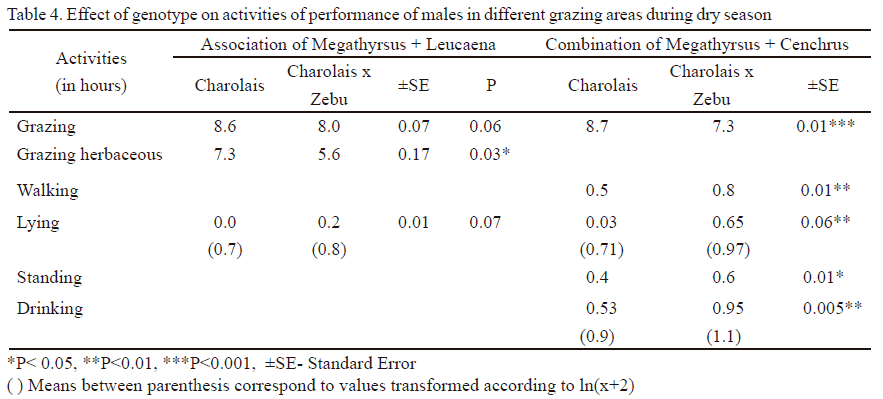
<p align="justify" class="Cuerpodetexto" style="margin-top:12.0pt;margin-right:0cm;margin-bottom:5.95pt;margin-left:0cm;text-indent:0cm;"><span style="font-family:'Verdana','sans-serif'; font-size:10.0pt; ">In  the grazing area with the combination of Megathyrsus + Cenchrus, the  significant effect of genotype influenced on the performance of males, because  there were values lower than P &lt; 0.05 in all the observed activities.</span></p>     <p align="justify" class="Cuerpodetexto" style="margin-top:12.0pt;margin-right:0cm;margin-bottom:5.95pt;margin-left:0cm;text-indent:0cm;"><span style="letter-spacing:.2pt; font-family:'Verdana','sans-serif'; font-size:10.0pt; ">These results suggest that shrub component and high  availability of dry matter modify, at a certain degree, the performance of  grazing males, when systems of associations and combinations of improved and  associated grasses are used. This criteria coincide with L&oacute;pez <em>et al.</em> (2010), who stated that grasses provide a coarse food and dry matter, while  legumes, due to their high content of proteins, may be used as supplement or  complement of diet for grazing    animals. </span><span style="font-family:'Verdana','sans-serif'; font-size:10.0pt; "> </span></p>     <p align="justify" class="Cuerpodetexto" style="margin-top:12.0pt;margin-right:0cm;margin-bottom:5.95pt;margin-left:0cm;text-indent:0cm;"><span style="font-family:'Verdana','sans-serif'; font-size:10.0pt; "><a href="/img/revistas/cjas/v50n2/t0406216.gif">Table  4</a> shows that animals of Charolais genotype had a tendency to spend more time  grazing (P &lt; 0.10), a significantly higher time (P &lt; 0.05) for grazing  herbaceous plants and a tendency to dedicate less time    (P &lt; 0.10) to be lying, regarding those from &#8540; Charolais x &#8541; Zebu genotype.  This information indicates that crossed animals obtained the feed in less time,  which allowed to dedicate more time to rest.&nbsp;&nbsp;&nbsp; </span></p>     
<p align="justify" class="Cuerpodetexto" style="margin-top:12.0pt;margin-right:0cm;margin-bottom:5.95pt;margin-left:0cm;text-indent:0cm;"><span style="font-family:'Verdana','sans-serif'; font-size:10.0pt; ">In  the area of combination of Megathyrsus + Cenchrus, as it is evident in <a href="/img/revistas/cjas/v50n2/t0406216.gif">table 4</a>,  the performance per genotype had a similar tendency, although with highly  significant differences. Charolais animals dedicated significantly more time to  grazing (P &le; 0.001) and less to walking (P &le; 0.01), to lying (P&le;0.05) and to  drinking (P &le; 0.01) than Charolais x Zebu animals.</span></p>     
]]></body>
<body><![CDATA[<p align="justify" class="Cuerpodetexto" style="margin-top:12.0pt;margin-right:0cm;margin-bottom:5.95pt;margin-left:0cm;text-indent:0cm;"><span style="font-family:'Verdana','sans-serif'; font-size:10.0pt; ">In  this area of grasses, like in that of association, crossed animals dedicated  less time to obtaining the necessary feed and more time to rest than purebred  animals. This could be determined by their lower requirements regarding  Charolais animals (Pereda <em>et al.</em> 2005).</span></p>     <p align="justify" class="Cuerpodetexto" style="margin-top:12.0pt;margin-right:0cm;margin-bottom:5.95pt;margin-left:0cm;text-indent:0cm;"><span style="font-family:'Verdana','sans-serif'; font-size:10.0pt; "><a href="/img/revistas/cjas/v50n2/t0506216.gif">Table  5</a> presents mean values of walking, standing and lying for both genotypes in the  association area.&nbsp;&nbsp; </span></p>     
<p align="justify" class="Cuerpodetexto" style="margin-top:12.0pt;margin-right:0cm;margin-bottom:5.95pt;margin-left:0cm;text-indent:0cm;"><span style="font-family:'Verdana','sans-serif'; font-size:10.0pt; ">The  averages obtained from the activities of each area (<a href="/img/revistas/cjas/v50n2/t0406216.gif">table 4</a> and <a href="/img/revistas/cjas/v50n2/t0506216.gif">5</a>) are similar  to the performance pattern of animals under intensive grazing&nbsp; (Ray <em>et al.</em> 2000). This is different  form the other grazing systems due to the low times used for walking, increase  of time in resting (lying and standing) and the regulation of the increase of  grazing time (grass intake), due to the high availability of dry matter that  characterizes these systems. It is significant the time animals used for  walking in the area of combination of grasses, where crossed animals completed  0.8 h, and Charolais (P &le; 0.01) used    0.5 h, which indicates higher time for selection. P&eacute;rez <em>et al.</em> (2008)  stated similar times for walking in animals grazing in a system of eight  paddocks with high availability of dry matter. </span></p>     
<p align="justify" class="Cuerpodetexto" style="margin-top:12.0pt;margin-right:0cm;margin-bottom:5.95pt;margin-left:0cm;text-indent:0cm;"><span style="font-family:'Verdana','sans-serif'; font-size:10.0pt; ">After characterizing the habit of grazing in the areas of  association and combination during different day times, there was only effect  of the period    (P &le; 0.05), without considering the animal genotype, so the performance of both  genotypes was similar in each period. <a href="/img/revistas/cjas/v50n2/f0106216.gif">Figure 1</a> shows the habits of grazing  shrubs and herbaceous plants in the association of Megathyrsus + Leucaena in  the different moments of the day.</span> </p>     
<p align="justify" class="Cuerpodetexto" style="margin-top:12.0pt;margin-right:0cm;margin-bottom:5.95pt;margin-left:0cm;text-indent:0cm;"><span style="font-family:'Verdana','sans-serif'; font-size:10.0pt; ">The  percentage of animals grazing shrubs was similar (P &ge; 0.05) between 7:00 a.m.  and 5:00 p.m. (17.4-18.8%). However, animals grazing herbaceous plants were  characterized by concentrate their grazing during the times of the lowest  temperature    (7:00 a.m. -11:00 a.m. and 3:00 p.m. - 5:00 p.m.), so their best meals are carried  out at the beginning of the day and at the end of the afternoon. From 11:00  a.m. to    3:00 p.m., time of the maximum heat in Cuba, even though when the association  with shrubs of leucaena favors the welfare of animals, the percentage of those  grazing herbaceous was reduced (P &le; 0.05), from more than 70 % in the extreme  periods up to 50.8 % in this intermediate  stage. </span></p>     <p align="justify" class="Cuerpodetexto" style="margin-top:12.0pt;margin-right:0cm;margin-bottom:5.95pt;margin-left:0cm;text-indent:0cm;"><span style="font-family:'Verdana','sans-serif'; font-size:10.0pt; ">In the combination of grasses (<a href="/img/revistas/cjas/v50n2/f0206216.gif">figure 2</a>), grazing habits  had a similar tendency to that shown in the area of association. Values ranged  between 83.2 and 85.3% in the extreme periods, versus 67.5 % of animals grazing  in the intermediate (noon). This performance could be caused by high  temperatures present during these times that provoke an endocrine unbalance in  animals. They, before the effect of caloric stress, show a adrenocortical  response, with a marked increase of cortisol levels that increase rectal  temperature and respiratory frequency (L&oacute;pez <em>et al.</em> 2010). Besides,  digestive processes produce metabolic heat that should be balanced by the  animal with their environment in order to achieve a comfort zone. On the  contrary, it will be necessary to carry out considerable physiological  adjustments (Sim&oacute;n <em>et al.</em> 2010), stopping or reducing food intake as  compensatory mechanisms on heat production during the times of heat stress, as  it is evident in the associations and combination.</span><span style="font-family:'Verdana','sans-serif'; font-size:10.0pt; "> </span></p>     
<p align="justify" class="Cuerpodetexto" style="margin-top:12.0pt;margin-right:0cm;margin-bottom:5.95pt;margin-left:0cm;text-indent:0cm;"><span style="font-family:'Verdana','sans-serif'; font-size:10.0pt; ">This performance of animals during grazing  coincides with reports of Ray <em>et al.</em> (2000) in dairy cows under  intensive grazing. In addition, it is similar to the statements about animals  concentrated in two large grazing, one at the sunrise and the other at the    sunset.</span></p>     <p align="justify" class="Cuerpodetexto" style="margin-top:12.0pt;margin-right:0cm;margin-bottom:5.95pt;margin-left:0cm;text-indent:0cm;"><span style="font-family:'Verdana','sans-serif'; font-size:10.0pt; ">In  general, the performance of males coincides with the statements for  meat-producer animals under grazing conditions with concentrated supplementation  (Ben&iacute;tez <em>et al.</em> 1993), demonstrating the potential of areas with  improved, combined and associated grasses, with high density of shrub legumes,  to maintain an appropriate performance pattern of growth-fattening animals, due  to the high availability that favors selection and nutritional quality.</span></p>     <p align="justify" class="Cuerpodetexto" style="margin-top:12.0pt;margin-right:0cm;margin-bottom:5.95pt;margin-left:0cm;text-indent:0cm;"><span style="letter-spacing:.2pt; font-family:'Verdana','sans-serif'; font-size:10.0pt; ">It is concluded that the system of intensive  grazing of improved, combined and associated grasses, and high density of shrub  legumes and prolonged periods of rest by the animals during the dry season,  maintains the performance pattern of Charolais and Charolais x Zebu males. The  superior shrub component within the associations corrects for differences in  the times dedicated to grazing and resting by the    genotypes</span><font size="2" face="Verdana, Arial, Helvetica, sans-serif">.</font></p>       <p align="justify">&nbsp;</p>     ]]></body>
<body><![CDATA[<p align="justify"><font size="2" face="Verdana, Arial, Helvetica, sans-serif"><font size="3"><b>ACKNOWLEDGEMENTS </b></font></font></p>      <p align="justify"><span style="font-family:'Verdana','sans-serif'; font-size:10.0pt; ">Thanks  to Jos&eacute; Cruz Tejeda, engineer in Agronomy, for the support provided during all  the evaluation and data collection period</span>.</p>     <p align="justify">&nbsp;</p>     <p align="justify"><font size="2" face="Verdana, Arial, Helvetica, sans-serif"><font size="3"><b>REFERENCES</b></font></font></p>     <p align="justify" class="MsoBibliography" style="margin-top:12.0pt;margin-right:0cm;margin-bottom:5.95pt;margin-left:0cm;text-align:justify;"><span style="font-family:'Verdana','sans-serif'; font-size:10.0pt; ">Barranco,  G. &amp; D&iacute;az, L. R. 1989. &ldquo;Clima&rdquo;. In: <em>Nuevo atlas nacional de Cuba</em>,  Academia de Ciencias de Cuba, Instituto de Geografia, Instituto Cubano de  Geodesia y Cartografia, Available: &lt;<a href="http://agris.fao.org/agris-search/search.do?recordID=XF2015023344" target="_blank">http://agris.fao.org/agris-search/search.do?recordID=XF2015023344</a>&gt;,  [Consulted:&nbsp;May 30, 2016].</span></p>     <p align="justify" class="MsoBibliography" style="margin-top:12.0pt;margin-right:0cm;margin-bottom:5.95pt;margin-left:0cm;text-align:justify;"><span style="font-family:'Verdana','sans-serif'; font-size:10.0pt; ">Ben&iacute;tez,  D. G., Boza, P., Santiago, O., Ray, J. V. &amp; D&iacute;az, M. 1993.  &ldquo;Particularidades de la vaca de cr&iacute;a&rdquo;. In: <em>Recomendaciones para&nbsp; la&nbsp;  alimentaci&oacute;n y el manejo del ganado de cr&iacute;a y las hembras vacunas de  reemplazo</em>, La Habana, Cuba: Academia, pp. 1&ndash;43.</span></p>     <p align="justify" class="MsoBibliography" style="margin-top:12.0pt;margin-right:0cm;margin-bottom:5.95pt;margin-left:0cm;text-align:justify;"><span style="font-family:'Verdana','sans-serif'; font-size:10.0pt; ">Ben&iacute;tez,  D., Ram&iacute;rez, A., D&iacute;az, M., Ray, J., Guerra, J. &amp; Vegas, A. 2007.  &ldquo;Comportamiento de machos vacunos en un sistema racional de pastoreo en el  Valle del Cauto&rdquo;. <em>Cuban Journal of Agricultural Science</em>, 41(3): 227&ndash;230,  ISSN: 2079-3480.</span></p>     <!-- ref --><p align="justify" class="MsoBibliography" style="margin-top:12.0pt;margin-right:0cm;margin-bottom:5.95pt;margin-left:0cm;text-align:justify;"><span style="font-family:'Verdana','sans-serif'; font-size:10.0pt; ">Cabrera,  Y. 2012. <em>Comportamiento de machos Charolais y Charolais x Ceb&uacute; en pastos  mejorados durante la &eacute;poca poco lluviosa en el valle del Cauto</em>. Graduated  Thesis, Universidad de Granma, Granma, Cuba.    </span></p>     <p align="justify" class="MsoBibliography" style="margin-top:12.0pt;margin-right:0cm;margin-bottom:5.95pt;margin-left:0cm;text-align:justify;"><span style="font-family:'Verdana','sans-serif'; font-size:10.0pt; ">Fajardo,  R. H. 2008. &ldquo;La innovaci&oacute;n tecnol&oacute;gica en la producci&oacute;n pecuaria en la  provincia de Granma: Una necesidad impostergable&rdquo;. <em>Revista Electr&oacute;nica  Granma Ciencia</em>, 12(1), ISSN: 1027-975X, Available:  &lt;<a href="http://www.grciencia.granma.inf.cu/vol12/1/2008_12_n1.a8.pdf" target="_blank">http://www.grciencia.granma.inf.cu/vol12/1/2008_12_n1.a8.pdf</a>&gt;,  [Consulted:&nbsp;May 30, 2016].</span></p>     ]]></body>
<body><![CDATA[<p align="justify" class="MsoBibliography" style="margin-top:12.0pt;margin-right:0cm;margin-bottom:5.95pt;margin-left:0cm;text-align:justify;"><span style="font-family:'Verdana','sans-serif'; font-size:10.0pt; ">Haydock, K. &amp; Shaw, N. 1975. &ldquo;The comparative  yield method for estimating dry matter yield of pasture&rdquo;. <em>Australian Journal  of Experimental Agriculture</em>, 15(76): 663&ndash;670, ISSN: 0816-1089, DOI: 10.1071/EA9750663.</span></p>     <!-- ref --><p align="justify" class="MsoBibliography" style="margin-top:12.0pt;margin-right:0cm;margin-bottom:5.95pt;margin-left:0cm;text-align:justify;"><span style="font-family:'Verdana','sans-serif'; font-size:10.0pt; ">Iglesias, M. J. 2003. </span><em><span style="font-family:'Verdana','sans-serif'; font-size:10.0pt; ">Los Sistemas Silvopastoriles, una alternativa para la  crianza de bovinos j&oacute;venes en condiciones de bajos insumos</span></em><span style="font-family:'Verdana','sans-serif'; font-size:10.0pt; ">. Ph.D. Thesis, Instituto de Ciencia Animal, Mayabeque,  Cuba.    </span></p>     <!-- ref --><p align="justify" class="MsoBibliography" style="margin-top:12.0pt;margin-right:0cm;margin-bottom:5.95pt;margin-left:0cm;text-align:justify;"><span style="font-family:'Verdana','sans-serif'; font-size:10.0pt; ">Latimer,  G. W. 2012. </span><em><span style="font-family:'Verdana','sans-serif'; font-size:10.0pt; ">Official Methods of Analysis of AOAC International</span></em><span style="font-family:'Verdana','sans-serif'; font-size:10.0pt; ">. 19th ed.,  Gaithersburg, Md.: AOAC International, ISBN: 978-0-935584-83-7, Available:  &lt;<a href="http://www.amazon.com/Official-Methods-Analysis-OFFICIAL-ANALYSIS/dp/0935584838/ref=pd_sim_sbs_14_1?ie=UTF8&dpID=31iikC-xl2L&dpSrc=sims&preST=_AC_UL160_SR160,160_&refRID=101AB94246X0EM9N7XMW" target="_blank">http://www.amazon.com/Official-Methods-Analysis-OFFICIAL-ANALYSIS/dp/0935584838/ref=pd_sim_sbs_14_1?ie=UTF8&amp;dpID=31iikC-xl2L&amp;dpSrc=sims&amp;preST=_AC_UL160_SR160%2C160_&amp;refRID=101AB94246X0EM9N7XMW</a>&gt;,  [Consulted:&nbsp;April 1, 2016].    </span></p>     <p align="justify" class="MsoBibliography" style="margin-top:12.0pt;margin-right:0cm;margin-bottom:5.95pt;margin-left:0cm;text-align:justify;"><span style="font-family:'Verdana','sans-serif'; font-size:10.0pt; ">L&oacute;pez,  O., Sim&oacute;n, L., Lamela, L. &amp; S&aacute;nchez, T. 2010. &ldquo;Evaluaci&oacute;n productiva de  hembras en desarrollo de genotipos lecheros en una asociaci&oacute;n de gram&iacute;neas con  leucaena&rdquo;. </span><em><span style="font-family:'Verdana','sans-serif'; font-size:10.0pt; ">Pastos y Forrajes</span></em><span style="font-family:'Verdana','sans-serif'; font-size:10.0pt; ">, 33(2): 1&ndash;1,  ISSN: 0864-0394.</span></p>     <p align="justify" class="MsoBibliography" style="margin-top:12.0pt;margin-right:0cm;margin-bottom:5.95pt;margin-left:0cm;text-align:justify;"><span style="font-family:'Verdana','sans-serif'; font-size:10.0pt; ">Mannetje, L. &amp; Haydock&dagger;, K. P. 1963. &ldquo;The  Dry-Weight-Rank Method for the Botanical Analysis of Pasture&rdquo;. <em>Grass and  Forage Science</em>, 18(4): 268&ndash;275, ISSN: 1365-2494, DOI:  10.1111/j.1365-2494.1963.tb00362.x.</span></p>     <p align="justify" class="MsoBibliography" style="margin-top:12.0pt;margin-right:0cm;margin-bottom:5.95pt;margin-left:0cm;text-align:justify;"><span style="font-family:'Verdana','sans-serif'; font-size:10.0pt; ">Pereda, S. M. E., Gonz&aacute;lez, M. S. S., Arjona, S. E.,  Bueno, A. G. &amp; Mendoza, M. G. D. 2005. </span><span style="font-family:'Verdana','sans-serif'; font-size:10.0pt; ">&ldquo;Ajuste  de modelos de crecimiento y c&aacute;lculo de requerimientos nutricionales para  bovinos Brahman en Tamaulipas, Mexico&rdquo;. <em>Agrociencia</em>, 39(1): 19&ndash;27, ISSN:  1405-3195.</span></p>     <p align="justify" class="MsoBibliography" style="margin-top:12.0pt;margin-right:0cm;margin-bottom:5.95pt;margin-left:0cm;text-align:justify;"><span style="font-family:'Verdana','sans-serif'; font-size:10.0pt; ">P&eacute;rez,  E., Soca, M., D&iacute;az, L. &amp; Corzo, M. 2008. &ldquo;Comportamiento etol&oacute;gico de  bovinos en sistemas silvopastoriles en Chiapas, M&eacute;xico&rdquo;. <em>Pastos y Forrajes</em>,  31(2): 1&ndash;1, ISSN: 0864-0394.</span></p>     <p align="justify" class="MsoBibliography" style="margin-top:12.0pt;margin-right:0cm;margin-bottom:5.95pt;margin-left:0cm;text-align:justify;"><span style="font-family:'Verdana','sans-serif'; font-size:10.0pt; ">Petit,  M. 1972. &ldquo;Emploi du temps des troupeaux de vaches m&egrave;res et leur veaux sur les p&acirc;turages  d&rsquo;altitude de l&rsquo;Aubrac&rdquo;. <em>Annales de zootechnie</em>, 21(1): 5&ndash;27, ISSN:  0003-424X.</span></p>     ]]></body>
<body><![CDATA[<p align="justify" class="MsoBibliography" style="margin-top:12.0pt;margin-right:0cm;margin-bottom:5.95pt;margin-left:0cm;text-align:justify;"><span style="font-family:'Verdana','sans-serif'; font-size:10.0pt; ">Ray,  J., Ben&iacute;tez, D., Tandron, I., Vega, A. &amp; Guerra, J. 2000. &ldquo;Conducta de  vacas 5/8 Holstein x 3/8 Ceb&uacute; en pastoreo racional Voisin y pastoreo  fraccionado en condiciones de bajos insumos&rdquo;. <em>Cuban Journal of Agricultural  Science</em>, 34(4): 295&ndash;301, ISSN: 2079-3480.</span></p>     <!-- ref --><p align="justify" class="MsoBibliography" style="margin-top:12.0pt;margin-right:0cm;margin-bottom:5.95pt;margin-left:0cm;text-align:justify;"><span style="font-family:'Verdana','sans-serif'; font-size:10.0pt; ">Ray,  J. V. 2000. <em>Sistema de pastoreo racional para la producci&oacute;n de leche con  bajos insumos en suelo Vertisol</em>. Ph.D. Thesis, Instituto de Ciencia Animal,  La Habana, Cuba.    </span></p>     <!-- ref --><p align="justify" class="MsoBibliography" style="margin-top:12.0pt;margin-right:0cm;margin-bottom:5.95pt;margin-left:0cm;text-align:justify;"><span style="font-family:'Verdana','sans-serif'; font-size:10.0pt; ">Rosell,  P. A., Lemes, B., Jim&eacute;nez, A., Pe&ntilde;a, S. &amp; Mil&aacute;n, C. 2003. <em>Diagn&oacute;stico  Urbano-Ambiental</em>. Ciudad de Bayamo, Granma, Cuba: OPPM Bayamo.    </span></p>     <p align="justify" class="MsoBibliography" style="margin-top:12.0pt;margin-right:0cm;margin-bottom:5.95pt;margin-left:0cm;text-align:justify;"><span style="font-family:'Verdana','sans-serif'; font-size:10.0pt; ">Senra,  A. 2005. &ldquo;&Iacute;ndices para controlar la eficiencia y sostenibilidad del ecosistema  del pastizal en la explotaci&oacute;n bovina&rdquo;. <em>Cuban Journal of Agricultural  Science</em>, 39(1): 13&ndash;22, ISSN: 2079-3480.</span></p>     <p align="justify" class="MsoBibliography" style="margin-top:12.0pt;margin-right:0cm;margin-bottom:5.95pt;margin-left:0cm;text-align:justify;"><span style="font-family:'Verdana','sans-serif'; font-size:10.0pt; ">Sim&oacute;n,  L. 1996. &ldquo;Rol de los &aacute;rboles y arbustos multiprop&oacute;sitos en las fincas  ganaderas&rdquo;. In: Clavero, T. (ed.), <em>Leguminosas Forrajeras Arb&oacute;reas en la  Agricultura Tropical</em>, Venezuela: Centro de Transferencia de Tecnolog&iacute;a en  Pastos y Forrajes, La Universidad del Zulia, pp. 41&ndash;47.</span></p>     <p align="justify" class="MsoBibliography" style="margin-top:12.0pt;margin-right:0cm;margin-bottom:5.95pt;margin-left:0cm;text-align:justify;"><span style="font-family:'Verdana','sans-serif'; font-size:10.0pt; ">Sim&oacute;n,  L. &amp; Francisco, A. G. 2000. &ldquo;Potencialidades productivas del  Silvopastoreo&rdquo;. In: <em>IV Taller Internacional Silvopastoril &ldquo;Los &aacute;rboles y arbustos  en la ganader&iacute;a tropical</em>, Matanzas, Cuba: EEPF &lsquo;Indio Hatuey&rsquo;, p. 467.</span></p>     <p align="justify" class="MsoBibliography" style="margin-top:12.0pt;margin-right:0cm;margin-bottom:5.95pt;margin-left:0cm;text-align:justify;"><span style="font-family:'Verdana','sans-serif'; font-size:10.0pt; ">Sim&oacute;n,  L., L&oacute;pez, O. &amp; &Aacute;lvarez, D. 2010. &ldquo;Evaluaci&oacute;n de vacas de doble prop&oacute;sito  de genotipos Holstein x Ceb&uacute; en sistemas de pastoreo arborizado. II. B&iacute;paras&rdquo;. <em>Pastos  y Forrajes</em>, 33(2): 197&ndash;202, ISSN: 0864-0394.</span></p>     <!-- ref --><div align="justify"><span style="font-family:'Verdana','sans-serif'; font-size:10.0pt; ">Steel,  R. G. D. &amp; Torrie, J. H. 1992. </span><em><span style="font-family:'Verdana','sans-serif'; font-size:10.0pt; ">Bioestad&iacute;stica. Principios y procedimientos</span></em><span style="font-family:'Verdana','sans-serif'; font-size:10.0pt; ">. 2nd ed., M&eacute;xico:  McGraw-Hill-Interamericana, 622 p</span><font size="2" face="Verdana,     Arial, Helvetica, sans-serif">.</font> </div>     <p align="justify">&nbsp;</p>     <p align="justify">&nbsp;</p>     <p align="justify"><font size="2" face="Verdana, Arial, Helvetica, sans-serif">Received: 3/7/2015    <br>   Accepted: 18/7/2016</font></p>     <p align="justify">&nbsp;</p>     <p align="justify">&nbsp;</p>     <p align="justify"><font size="2" face="Verdana, Arial, Helvetica, sans-serif"><i>J.L. Ledea,</i> Instituto de Investigaciones Agropecuarias “Jorge Dimitrov”, Carretera de Manzanillo, km. 16½.  Apartado Postal 2140. Bayamo, Granma, Cuba.  Email: <a href="mailto:ledea@dimitrov.cu">ledea@dimitrov.cu</a></font></p>      ]]></body><back>
<ref-list>
<ref id="B1">
<nlm-citation citation-type="book">
<person-group person-group-type="author">
<name>
<surname><![CDATA[Barranco]]></surname>
<given-names><![CDATA[G.]]></given-names>
</name>
<name>
<surname><![CDATA[Díaz]]></surname>
<given-names><![CDATA[L. R.]]></given-names>
</name>
</person-group>
<article-title xml:lang="nd"><![CDATA[Clima]]></article-title>
<source><![CDATA[Nuevo atlas nacional de Cuba]]></source>
<year>1989</year>
<publisher-name><![CDATA[Academia de Ciencias de Cuba, Instituto de Geografia, Instituto Cubano de Geodesia y Cartografia]]></publisher-name>
</nlm-citation>
</ref>
<ref id="B2">
<nlm-citation citation-type="journal">
<person-group person-group-type="author">
<name>
<surname><![CDATA[Benítez]]></surname>
<given-names><![CDATA[D.]]></given-names>
</name>
<name>
<surname><![CDATA[Ramírez]]></surname>
<given-names><![CDATA[A.]]></given-names>
</name>
<name>
<surname><![CDATA[Díaz]]></surname>
<given-names><![CDATA[M.]]></given-names>
</name>
<name>
<surname><![CDATA[Ray]]></surname>
<given-names><![CDATA[J.]]></given-names>
</name>
<name>
<surname><![CDATA[Guerra]]></surname>
<given-names><![CDATA[J.]]></given-names>
</name>
<name>
<surname><![CDATA[Vegas]]></surname>
<given-names><![CDATA[A.]]></given-names>
</name>
</person-group>
<article-title xml:lang="nd"><![CDATA[Comportamiento de machos vacunos en un sistema racional de pastoreo en el Valle del Cauto]]></article-title>
<source><![CDATA[Cuban Journal of Agricultural Science]]></source>
<year>2007</year>
<volume>41</volume>
<numero>3</numero>
<issue>3</issue>
<page-range>227-230</page-range></nlm-citation>
</ref>
<ref id="B3">
<nlm-citation citation-type="book">
<person-group person-group-type="author">
<name>
<surname><![CDATA[Benítez]]></surname>
<given-names><![CDATA[D. G.]]></given-names>
</name>
<name>
<surname><![CDATA[Boza]]></surname>
<given-names><![CDATA[P.]]></given-names>
</name>
<name>
<surname><![CDATA[Santiago]]></surname>
<given-names><![CDATA[O.]]></given-names>
</name>
<name>
<surname><![CDATA[Ray]]></surname>
<given-names><![CDATA[J. V.]]></given-names>
</name>
<name>
<surname><![CDATA[Díaz]]></surname>
<given-names><![CDATA[M.]]></given-names>
</name>
</person-group>
<article-title xml:lang="nd"><![CDATA[Particularidades de la vaca de cría]]></article-title>
<source><![CDATA[Recomendaciones para la alimentación y el manejo del ganado de cría y las hembras vacunas de reemplazo]]></source>
<year>1993</year>
<page-range>1-43</page-range><publisher-loc><![CDATA[La Habana, Cuba ]]></publisher-loc>
<publisher-name><![CDATA[Academia]]></publisher-name>
</nlm-citation>
</ref>
<ref id="B4">
<nlm-citation citation-type="book">
<person-group person-group-type="author">
<name>
<surname><![CDATA[Cabrera]]></surname>
<given-names><![CDATA[Y.]]></given-names>
</name>
</person-group>
<source><![CDATA[Comportamiento de machos Charolais y Charolais x Cebú en pastos mejorados durante la época poco lluviosa en el valle del Cauto]]></source>
<year>2012</year>
<publisher-loc><![CDATA[Granma, Cuba ]]></publisher-loc>
<publisher-name><![CDATA[Universidad de Granma]]></publisher-name>
</nlm-citation>
</ref>
<ref id="B5">
<nlm-citation citation-type="journal">
<person-group person-group-type="author">
<name>
<surname><![CDATA[Fajardo]]></surname>
<given-names><![CDATA[R. H.]]></given-names>
</name>
</person-group>
<article-title xml:lang="nd"><![CDATA[La innovación tecnológica en la producción pecuaria en la provincia de Granma: Una necesidad impostergable]]></article-title>
<source><![CDATA[Revista Electrónica Granma Ciencia]]></source>
<year>2008</year>
<volume>12</volume>
<numero>1</numero>
<issue>1</issue>
</nlm-citation>
</ref>
<ref id="B6">
<nlm-citation citation-type="journal">
<person-group person-group-type="author">
<name>
<surname><![CDATA[Haydock]]></surname>
<given-names><![CDATA[K.]]></given-names>
</name>
<name>
<surname><![CDATA[Shaw]]></surname>
<given-names><![CDATA[N.]]></given-names>
</name>
</person-group>
<article-title xml:lang="nd"><![CDATA[The comparative yield method for estimating dry matter yield of pasture]]></article-title>
<source><![CDATA[Australian Journal of Experimental Agriculture]]></source>
<year>1975</year>
<volume>15</volume>
<numero>76</numero>
<issue>76</issue>
<page-range>663-670</page-range></nlm-citation>
</ref>
<ref id="B7">
<nlm-citation citation-type="book">
<person-group person-group-type="author">
<name>
<surname><![CDATA[Iglesias]]></surname>
<given-names><![CDATA[M. J.]]></given-names>
</name>
</person-group>
<source><![CDATA[Los Sistemas Silvopastoriles, una alternativa para la crianza de bovinos jóvenes en condiciones de bajos insumos]]></source>
<year>2003</year>
<publisher-loc><![CDATA[Mayabeque, Cuba ]]></publisher-loc>
<publisher-name><![CDATA[Instituto de Ciencia Animal]]></publisher-name>
</nlm-citation>
</ref>
<ref id="B8">
<nlm-citation citation-type="book">
<person-group person-group-type="author">
<name>
<surname><![CDATA[Latimer]]></surname>
<given-names><![CDATA[G. W.]]></given-names>
</name>
</person-group>
<source><![CDATA[Official Methods of Analysis of AOAC International]]></source>
<year>2012</year>
<edition>19th</edition>
<publisher-loc><![CDATA[Gaithersburg, Md. ]]></publisher-loc>
<publisher-name><![CDATA[AOAC International]]></publisher-name>
</nlm-citation>
</ref>
<ref id="B9">
<nlm-citation citation-type="journal">
<person-group person-group-type="author">
<name>
<surname><![CDATA[López]]></surname>
<given-names><![CDATA[O.]]></given-names>
</name>
<name>
<surname><![CDATA[Simón]]></surname>
<given-names><![CDATA[L.]]></given-names>
</name>
<name>
<surname><![CDATA[Lamela]]></surname>
<given-names><![CDATA[L.]]></given-names>
</name>
<name>
<surname><![CDATA[Sánchez]]></surname>
<given-names><![CDATA[T.]]></given-names>
</name>
</person-group>
<article-title xml:lang="nd"><![CDATA[Evaluación productiva de hembras en desarrollo de genotipos lecheros en una asociación de gramíneas con leucaena]]></article-title>
<source><![CDATA[Pastos y Forrajes]]></source>
<year>2010</year>
<volume>33</volume>
<numero>2</numero>
<issue>2</issue>
<page-range>1-1</page-range></nlm-citation>
</ref>
<ref id="B10">
<nlm-citation citation-type="journal">
<person-group person-group-type="author">
<name>
<surname><![CDATA[Mannetje]]></surname>
<given-names><![CDATA[L.]]></given-names>
</name>
<name>
<surname><![CDATA[Haydock†]]></surname>
<given-names><![CDATA[K. P.]]></given-names>
</name>
</person-group>
<article-title xml:lang="nd"><![CDATA[The Dry-Weight-Rank Method for the Botanical Analysis of Pasture]]></article-title>
<source><![CDATA[Grass and Forage Science]]></source>
<year>1963</year>
<volume>18</volume>
<numero>4</numero>
<issue>4</issue>
<page-range>268-275</page-range></nlm-citation>
</ref>
<ref id="B11">
<nlm-citation citation-type="journal">
<person-group person-group-type="author">
<name>
<surname><![CDATA[Pereda]]></surname>
<given-names><![CDATA[S. M. E.]]></given-names>
</name>
<name>
<surname><![CDATA[González]]></surname>
<given-names><![CDATA[M. S. S.]]></given-names>
</name>
<name>
<surname><![CDATA[Arjona]]></surname>
<given-names><![CDATA[S. E.]]></given-names>
</name>
<name>
<surname><![CDATA[Bueno]]></surname>
<given-names><![CDATA[A. G.]]></given-names>
</name>
<name>
<surname><![CDATA[Mendoza]]></surname>
<given-names><![CDATA[M. G. D.]]></given-names>
</name>
</person-group>
<article-title xml:lang="nd"><![CDATA[Ajuste de modelos de crecimiento y cálculo de requerimientos nutricionales para bovinos Brahman en Tamaulipas, Mexico]]></article-title>
<source><![CDATA[Agrociencia]]></source>
<year>2005</year>
<volume>39</volume>
<numero>1</numero>
<issue>1</issue>
<page-range>19-27</page-range></nlm-citation>
</ref>
<ref id="B12">
<nlm-citation citation-type="journal">
<person-group person-group-type="author">
<name>
<surname><![CDATA[Pérez]]></surname>
<given-names><![CDATA[E.]]></given-names>
</name>
<name>
<surname><![CDATA[Soca]]></surname>
<given-names><![CDATA[M.]]></given-names>
</name>
<name>
<surname><![CDATA[Díaz]]></surname>
<given-names><![CDATA[L.]]></given-names>
</name>
<name>
<surname><![CDATA[Corzo]]></surname>
<given-names><![CDATA[M.]]></given-names>
</name>
</person-group>
<article-title xml:lang="nd"><![CDATA[Comportamiento etológico de bovinos en sistemas silvopastoriles en Chiapas, México]]></article-title>
<source><![CDATA[Pastos y Forrajes]]></source>
<year>2008</year>
<volume>31</volume>
<numero>2</numero>
<issue>2</issue>
<page-range>1-1</page-range></nlm-citation>
</ref>
<ref id="B13">
<nlm-citation citation-type="journal">
<person-group person-group-type="author">
<name>
<surname><![CDATA[Petit]]></surname>
<given-names><![CDATA[M.]]></given-names>
</name>
</person-group>
<article-title xml:lang="nd"><![CDATA[Emploi du temps des troupeaux de vaches mères et leur veaux sur les pâturages d’altitude de l’Aubrac]]></article-title>
<source><![CDATA[Annales de zootechnie]]></source>
<year>1972</year>
<volume>21</volume>
<numero>1</numero>
<issue>1</issue>
<page-range>5-27</page-range></nlm-citation>
</ref>
<ref id="B14">
<nlm-citation citation-type="journal">
<person-group person-group-type="author">
<name>
<surname><![CDATA[Ray]]></surname>
<given-names><![CDATA[J.]]></given-names>
</name>
<name>
<surname><![CDATA[Benítez]]></surname>
<given-names><![CDATA[D.]]></given-names>
</name>
<name>
<surname><![CDATA[Tandron]]></surname>
<given-names><![CDATA[I.]]></given-names>
</name>
<name>
<surname><![CDATA[Vega]]></surname>
<given-names><![CDATA[A.]]></given-names>
</name>
<name>
<surname><![CDATA[Guerra]]></surname>
<given-names><![CDATA[J.]]></given-names>
</name>
</person-group>
<article-title xml:lang="nd"><![CDATA[Conducta de vacas 5/8 Holstein x 3/8 Cebú en pastoreo racional Voisin y pastoreo fraccionado en condiciones de bajos insumos]]></article-title>
<source><![CDATA[Cuban Journal of Agricultural Science]]></source>
<year>2000</year>
<volume>34</volume>
<numero>4</numero>
<issue>4</issue>
<page-range>295-301</page-range></nlm-citation>
</ref>
<ref id="B15">
<nlm-citation citation-type="book">
<person-group person-group-type="author">
<name>
<surname><![CDATA[Ray]]></surname>
<given-names><![CDATA[J. V.]]></given-names>
</name>
</person-group>
<source><![CDATA[Sistema de pastoreo racional para la producción de leche con bajos insumos en suelo Vertisol]]></source>
<year>2000</year>
<publisher-loc><![CDATA[La Habana, Cuba ]]></publisher-loc>
<publisher-name><![CDATA[Instituto de Ciencia Animal]]></publisher-name>
</nlm-citation>
</ref>
<ref id="B16">
<nlm-citation citation-type="book">
<person-group person-group-type="author">
<name>
<surname><![CDATA[Rosell]]></surname>
<given-names><![CDATA[P. A.]]></given-names>
</name>
<name>
<surname><![CDATA[Lemes]]></surname>
<given-names><![CDATA[B.]]></given-names>
</name>
<name>
<surname><![CDATA[Jiménez]]></surname>
<given-names><![CDATA[A.]]></given-names>
</name>
<name>
<surname><![CDATA[Peña]]></surname>
<given-names><![CDATA[S.]]></given-names>
</name>
<name>
<surname><![CDATA[Milán]]></surname>
<given-names><![CDATA[C.]]></given-names>
</name>
</person-group>
<source><![CDATA[Diagnóstico Urbano-Ambiental]]></source>
<year>2003</year>
<publisher-loc><![CDATA[Ciudad de Bayamo, Granma, Cuba ]]></publisher-loc>
<publisher-name><![CDATA[OPPM Bayamo]]></publisher-name>
</nlm-citation>
</ref>
<ref id="B17">
<nlm-citation citation-type="journal">
<person-group person-group-type="author">
<name>
<surname><![CDATA[Senra]]></surname>
<given-names><![CDATA[A.]]></given-names>
</name>
</person-group>
<article-title xml:lang="nd"><![CDATA[Índices para controlar la eficiencia y sostenibilidad del ecosistema del pastizal en la explotación bovina]]></article-title>
<source><![CDATA[Cuban Journal of Agricultural Science]]></source>
<year>2005</year>
<volume>39</volume>
<numero>1</numero>
<issue>1</issue>
<page-range>13-22</page-range></nlm-citation>
</ref>
<ref id="B18">
<nlm-citation citation-type="book">
<person-group person-group-type="author">
<name>
<surname><![CDATA[Simón]]></surname>
<given-names><![CDATA[L.]]></given-names>
</name>
</person-group>
<article-title xml:lang="nd"><![CDATA[Rol de los árboles y arbustos multipropósitos en las fincas ganaderas]]></article-title>
<person-group person-group-type="editor">
<name>
<surname><![CDATA[Clavero]]></surname>
<given-names><![CDATA[T.]]></given-names>
</name>
</person-group>
<source><![CDATA[Leguminosas Forrajeras Arbóreas en la Agricultura Tropical]]></source>
<year>1996</year>
<page-range>41-47</page-range><publisher-loc><![CDATA[Venezuela ]]></publisher-loc>
<publisher-name><![CDATA[Centro de Transferencia de Tecnología en Pastos y Forrajes, La Universidad del Zulia]]></publisher-name>
</nlm-citation>
</ref>
<ref id="B19">
<nlm-citation citation-type="book">
<person-group person-group-type="author">
<name>
<surname><![CDATA[Simón]]></surname>
<given-names><![CDATA[L.]]></given-names>
</name>
<name>
<surname><![CDATA[Francisco]]></surname>
<given-names><![CDATA[A. G.]]></given-names>
</name>
</person-group>
<article-title xml:lang="nd"><![CDATA[Potencialidades productivas del Silvopastoreo]]></article-title>
<source><![CDATA[]]></source>
<year>2000</year>
<page-range>467</page-range><publisher-loc><![CDATA[Matanzas, Cuba ]]></publisher-loc>
<publisher-name><![CDATA[EEPF ‘Indio Hatuey’]]></publisher-name>
</nlm-citation>
</ref>
<ref id="B20">
<nlm-citation citation-type="journal">
<person-group person-group-type="author">
<name>
<surname><![CDATA[Simón]]></surname>
<given-names><![CDATA[L.]]></given-names>
</name>
<name>
<surname><![CDATA[López]]></surname>
<given-names><![CDATA[O.]]></given-names>
</name>
<name>
<surname><![CDATA[Álvarez]]></surname>
<given-names><![CDATA[D.]]></given-names>
</name>
</person-group>
<article-title xml:lang="nd"><![CDATA[Evaluación de vacas de doble propósito de genotipos Holstein x Cebú en sistemas de pastoreo arborizado. II. Bíparas]]></article-title>
<source><![CDATA[Pastos y Forrajes]]></source>
<year>2010</year>
<volume>33</volume>
<numero>2</numero>
<issue>2</issue>
<page-range>197-202</page-range></nlm-citation>
</ref>
<ref id="B21">
<nlm-citation citation-type="book">
<person-group person-group-type="author">
<name>
<surname><![CDATA[Steel]]></surname>
<given-names><![CDATA[R. G. D.]]></given-names>
</name>
<name>
<surname><![CDATA[Torrie]]></surname>
<given-names><![CDATA[J. H.]]></given-names>
</name>
</person-group>
<source><![CDATA[Bioestadística. Principios y procedimientos]]></source>
<year>1992</year>
<edition>2nd</edition>
<page-range>622</page-range><publisher-loc><![CDATA[México ]]></publisher-loc>
<publisher-name><![CDATA[McGraw-Hill-Interamericana]]></publisher-name>
</nlm-citation>
</ref>
</ref-list>
</back>
</article>