<?xml version="1.0" encoding="ISO-8859-1"?><article xmlns:mml="http://www.w3.org/1998/Math/MathML" xmlns:xlink="http://www.w3.org/1999/xlink" xmlns:xsi="http://www.w3.org/2001/XMLSchema-instance">
<front>
<journal-meta>
<journal-id>2079-3480</journal-id>
<journal-title><![CDATA[Cuban Journal of Agricultural Science]]></journal-title>
<abbrev-journal-title><![CDATA[Cuban J. Agric. Sci.]]></abbrev-journal-title>
<issn>2079-3480</issn>
<publisher>
<publisher-name><![CDATA[Editorial del Instituto de Ciencia Animal]]></publisher-name>
</publisher>
</journal-meta>
<article-meta>
<article-id>S2079-34802016000200010</article-id>
<title-group>
<article-title xml:lang="en"><![CDATA[Effect of different nitrogen levels and irrigation techniques on the ruminal degradation of the crude protein of maize]]></article-title>
<article-title xml:lang="es"><![CDATA[Efecto de diferentes niveles de nitrógeno y técnicas de riego en la degradación ruminal de la proteína bruta del maíz]]></article-title>
</title-group>
<contrib-group>
<contrib contrib-type="author">
<name>
<surname><![CDATA[Barajas]]></surname>
<given-names><![CDATA[R.]]></given-names>
</name>
<xref ref-type="aff" rid="A01"/>
</contrib>
<contrib contrib-type="author">
<name>
<surname><![CDATA[Díaz]]></surname>
<given-names><![CDATA[T.]]></given-names>
</name>
<xref ref-type="aff" rid="A02"/>
</contrib>
<contrib contrib-type="author">
<name>
<surname><![CDATA[Flores]]></surname>
<given-names><![CDATA[L.R.]]></given-names>
</name>
<xref ref-type="aff" rid="A02"/>
</contrib>
<contrib contrib-type="author">
<name>
<surname><![CDATA[Partida]]></surname>
<given-names><![CDATA[L.]]></given-names>
</name>
<xref ref-type="aff" rid="A02"/>
</contrib>
<contrib contrib-type="author">
<name>
<surname><![CDATA[Martínez]]></surname>
<given-names><![CDATA[M.]]></given-names>
</name>
<xref ref-type="aff" rid="A03"/>
</contrib>
<contrib contrib-type="author">
<name>
<surname><![CDATA[Lomelí]]></surname>
<given-names><![CDATA[J.J.]]></given-names>
</name>
<xref ref-type="aff" rid="A01"/>
</contrib>
<contrib contrib-type="author">
<name>
<surname><![CDATA[Velázquez]]></surname>
<given-names><![CDATA[T de J.]]></given-names>
</name>
<xref ref-type="aff" rid="A02"/>
</contrib>
</contrib-group>
<aff id="A01">
<institution><![CDATA[,Universidad Autónoma de Sinaloa Facultad de Medicina Veterinaria y Zootecnia ]]></institution>
<addr-line><![CDATA[Culiacán Sinaloa]]></addr-line>
<country>México</country>
</aff>
<aff id="A02">
<institution><![CDATA[,Universidad Autónoma de Sinaloa Facultad de Agronomía ]]></institution>
<addr-line><![CDATA[Culiacán Sinaloa]]></addr-line>
<country>México</country>
</aff>
<aff id="A03">
<institution><![CDATA[,Instituto de Ciencia Animal  ]]></institution>
<addr-line><![CDATA[San José de las Lajas Mayabeque]]></addr-line>
<country>Cuba</country>
</aff>
<pub-date pub-type="pub">
<day>00</day>
<month>06</month>
<year>2016</year>
</pub-date>
<pub-date pub-type="epub">
<day>00</day>
<month>06</month>
<year>2016</year>
</pub-date>
<volume>50</volume>
<numero>2</numero>
<fpage>259</fpage>
<lpage>266</lpage>
<copyright-statement/>
<copyright-year/>
<self-uri xlink:href="http://scielo.sld.cu/scielo.php?script=sci_arttext&amp;pid=S2079-34802016000200010&amp;lng=en&amp;nrm=iso"></self-uri><self-uri xlink:href="http://scielo.sld.cu/scielo.php?script=sci_abstract&amp;pid=S2079-34802016000200010&amp;lng=en&amp;nrm=iso"></self-uri><self-uri xlink:href="http://scielo.sld.cu/scielo.php?script=sci_pdf&amp;pid=S2079-34802016000200010&amp;lng=en&amp;nrm=iso"></self-uri><abstract abstract-type="short" xml:lang="en"><p><![CDATA[In order to determine the effect of ruminal degradation of maize crude protein obtained with two levels of nitrogen (300 and 400 kg ha-1) and two irrigation techniques (gravity and drip), dacron bags (10 x 18 cm) which contained 5 g of maize were used. By introducing a cannula, the bags were inoculated for 0, 3, 6, 12 and 24 h in the rumen of four heifers. A completely randomized design was applied with factorial arrangement 2x2 of the treatments (nitrogen and irrigation technique).There were not statistical differences between the interactions of the variables under study (P < 0.05).However, drip irrigation vs gravity (8.72 vs 8.05%) and fertilization with 400 vs 300 kg de N ha-1 (8.52 vs. 8.25 %) increased (P &#8804; 0.05) the crude protein content of the grain. The treatments did not affect (P &#8805; 0.21) the PC solubility (19.4 ± 2.85 %).The ruminal degradation of the maize CP in the different incubation times did not change (P &#8805; 0.20) by the maize grain obtained by means of irrigation technique or N levels used in maize production. The ruminal degradation rate of CP (0.10 ± 0.03) did not change (P &#8805; 0.13) by the treatments. The percentage of crude protein effectively degraded in the rumen (42.14 ± 2.83 %) was similar (P &#8805; 0.48) between treatments. Although the schemes of nitrogen levels or irrigation technique can modify the crude protein content in the maize grain, this did not influence on the characteristics of ruminal degradation of its crude protein]]></p></abstract>
<abstract abstract-type="short" xml:lang="es"><p><![CDATA[Para determinar el efecto de la degradación ruminal de proteína bruta de maíz obtenido con dos niveles de nitrógeno (300 y 400 kg ha-1) y dos técnicas de riego (gravedad y goteo), se utilizaron bolsas de dacrón (10 x 18 cm) que contenían 5 g de maíz. Mediante la introducción de una cánula, las bolsas se inocularon durante 0, 3, 6, 12 y 24 h en el rumen de cuatro vaquillas. Se aplicó un diseño completamente al azar con arreglo factorial 2 x 2 de los tratamientos (nitrógeno y técnica de riego). No se presentaron diferencias estadísticas entre las interacciones de las variables en estudio . Sin embargo, el riego por goteo vs gravedad (8.72 vs 8.05%) y la fertilización con 400 vs 300 kg de N ha-1 (8.52 vs. 8.25 %) incrementaron (P &#8804; 0.05) el contenido de la proteína bruta del grano. Los tratamientos no afectaron (P &#8805; 0.21) la solubilidad de la PB (19.4 ± 2.85 %). La degradación ruminal de la PB de maíz en los diferentes tiempos de incubación no se modificó (P &#8805; 0.20) por el grano de maíz obtenido mediante la técnica de riego ni por los niveles de N usados en la producción de maíz. La tasa de degradación ruminal de PB (0.10 ± 0.03) no se alteró (P &#8805; 0.13) por los tratamientos. El porcentaje de proteína bruta efectivamente degradada en rumen (42.14 ± 2.83 %) fue similar (P &#8805; 0.48) entre los distintos tratamientos. Aunque los esquemas de niveles de nitrógeno o técnica de riego pueden modificar el contenido de proteína bruta en el grano de maíz, esto no influyó en las características de degradación ruminal de su proteína bruta]]></p></abstract>
<kwd-group>
<kwd lng="en"><![CDATA[irrigation techniques]]></kwd>
<kwd lng="en"><![CDATA[fermentation pattern]]></kwd>
<kwd lng="en"><![CDATA[solubility]]></kwd>
<kwd lng="es"><![CDATA[técnicas de riego]]></kwd>
<kwd lng="es"><![CDATA[patrón de fermentación]]></kwd>
<kwd lng="es"><![CDATA[solubilidad]]></kwd>
</kwd-group>
</article-meta>
</front><body><![CDATA[ <p align="right"><font size="2" face="Verdana, Arial, Helvetica, sans-serif"><b>Cuban Journal  of Agricultural Science, 50(2): 259-266, 2016, ISSN: 2079-3480</b></font></p>     <p align="right">&nbsp;</p>     <p align="right"><font size="2" face="Verdana, Arial, Helvetica, sans-serif"><b>ORIGINAL ARTICLE</b></font></p>     <p align="justify">&nbsp;</p>     <p align="justify"><font size="4" face="Verdana, Arial, Helvetica, sans-serif">  <b>Effect of different nitrogen levels and irrigation techniques on the ruminal degradation of the crude protein of maize</b></font></p>      <p align="justify">&nbsp;</p>     <p align="justify"><font size="3" face="Verdana, Arial, Helvetica, sans-serif">  <b>Efecto de diferentes niveles de nitrógeno y técnicas de riego en la degradación ruminal de la proteína bruta del maíz</b></font></p>      <p align="justify">&nbsp;</p>     <p align="justify">&nbsp;</p>     <p align="justify"><font size="2" face="Verdana, Arial, Helvetica, sans-serif">  <b>Barajas R.,</b><sup><b>I</b></sup> <b> Díaz T.,</b><sup><b>II</b></sup> <b> Flores L.R.,</b><sup><b>II</b></sup> <b> Partida L.,</b><sup><b>II</b></sup> <b> Martínez M.,</b><sup><b>III</b></sup> <b> Lomelí J. J.,</b><sup><b>I</b></sup> <b> Velázquez T de J.,</b><sup><b>II</b></sup>  </font></p>     ]]></body>
<body><![CDATA[<p align="justify"><font size="2" face="Verdana, Arial, Helvetica, sans-serif"><b> </b></font><font size="2" face="Verdana, Arial, Helvetica, sans-serif">    <sup>I</sup>Facultad de Medicina Veterinaria y Zootecnia de la Universidad Autónoma de Sinaloa, Culiacán, Sinaloa, México.    <br>   <sup>II</sup>Facultad de Agronomía de la Universidad Autónoma de Sinaloa. Apdo. Postal 1057, Culiacán, Sinaloa,  México, CP 80000 .     <br>   <sup>III</sup>Instituto de Ciencia Animal. Apartado Postal 24. San José de las Lajas, Mayabeque, Cuba.</font></p>     <p align="justify">&nbsp;</p>     <p align="justify">&nbsp;</p> <hr align="JUSTIFY">     <p align="justify"><font size="2" face="Verdana, Arial, Helvetica, sans-serif"><b>ABSTRACT</b></font></p>     <p align="justify"><font size="2" face="Verdana, Arial, Helvetica, sans-serif"><span style="letter-spacing:.2pt; font-family:'Verdana','sans-serif'; font-size:10.0pt; ">In order to determine the effect of ruminal degradation of maize crude  protein obtained with two levels of nitrogen (300 and 400 kg ha<sup>-1</sup>)  and two irrigation techniques (gravity and drip), dacron bags (10 x 18 cm)  which contained 5 g of maize were used. By introducing a cannula, the bags were  inoculated for 0, 3, 6, 12 and 24 h in the rumen of four heifers. A completely  randomized design was applied with factorial arrangement 2x2 of the treatments  (nitrogen and irrigation technique).There were not statistical differences  between the interactions of the variables under study (P &lt; 0.05).However,  drip irrigation vs gravity (8.72 vs 8.05%) and fertilization with 400 vs 300 kg  de N ha<sup>-1</sup> (8.52 vs. 8.25 %) increased (P &le; 0.05) the crude protein  content of the grain. The treatments did not affect (P &ge; 0.21) the PC  solubility (19.4 &plusmn; 2.85 %).The ruminal degradation of the maize CP in the  different incubation times did not change (P &ge; 0.20) by the maize grain  obtained by means of irrigation technique or N levels used in maize production.  The ruminal degradation rate of CP (0.10</span></font> <font size="2" face="Verdana, Arial, Helvetica, sans-serif"><span style="letter-spacing:.2pt; font-family:'Verdana','sans-serif'; font-size:10.0pt; ">&plusmn; 0.03) did not change (P &ge; 0.13) by the treatments. The percentage of crude  protein effectively degraded in the rumen (42.14</span></font><span style="letter-spacing:.2pt; font-family:'Verdana','sans-serif'; font-size:10.0pt;"> </span><font size="2" face="Verdana, Arial, Helvetica, sans-serif"><span style="letter-spacing:.2pt; font-family:'Verdana','sans-serif'; font-size:10.0pt; ">&plusmn; 2.83 %) was similar (P &ge; 0.48) between treatments. Although the schemes of  nitrogen levels or irrigation technique can modify the crude protein content in  the maize grain, this did not influence on the characteristics of ruminal  degradation of its crude protein</span>.</font></p>     <p align="justify"><font size="2" face="Verdana, Arial, Helvetica, sans-serif"><b>Key words:</b> irrigation techniques, fermentation pattern, solubility.</font></p> <hr align="JUSTIFY">     <p align="justify"><font size="2" face="Verdana, Arial, Helvetica, sans-serif"><b>RESUMEN</b></font></p>     <p align="justify"><font size="2" face="Verdana, Arial, Helvetica, sans-serif"><span style="font-family:'Verdana','sans-serif'; font-size:10.0pt; ">Para  determinar el efecto de la degradaci&oacute;n ruminal de prote&iacute;na bruta de ma&iacute;z  obtenido con dos niveles de nitr&oacute;geno (300 y 400 kg ha<sup>-1</sup>) y dos  t&eacute;cnicas de riego (gravedad y goteo), se utilizaron bolsas de dacr&oacute;n (10 x 18  cm) que conten&iacute;an 5 g de ma&iacute;z. Mediante la introducci&oacute;n de una c&aacute;nula, las  bolsas se inocularon durante 0, 3, 6, 12 y 24 h en el rumen de cuatro vaquillas.  Se aplic&oacute; un dise&ntilde;o completamente al azar con arreglo factorial 2 x 2 de los  tratamientos (nitr&oacute;geno y t&eacute;cnica de riego). No se presentaron diferencias  estad&iacute;sticas entre las interacciones de las&nbsp;  variables en estudio  . Sin embargo, el riego por goteo vs gravedad (8.72 vs 8.05%) y la  fertilizaci&oacute;n con 400 vs 300 kg de N ha<sup>-1</sup> (8.52 vs. 8.25 %)  incrementaron (P &le; 0.05) el contenido de la prote&iacute;na bruta del grano. Los  tratamientos no afectaron (P &ge; 0.21) la solubilidad de la PB (19.4 &plusmn; 2.85 %).  La degradaci&oacute;n ruminal de la PB de ma&iacute;z en los diferentes tiempos de incubaci&oacute;n  no se modific&oacute; (P &ge; 0.20) por el grano de ma&iacute;z obtenido mediante la t&eacute;cnica de  riego ni por los niveles de N usados en la producci&oacute;n de ma&iacute;z. La tasa de  degradaci&oacute;n ruminal de PB (0.10 &plusmn; 0.03) no se alter&oacute; (P &ge; 0.13) por los  tratamientos. El porcentaje de prote&iacute;na bruta efectivamente degradada en rumen  (42.14 &plusmn; 2.83 %) fue similar (P &ge; 0.48) entre los distintos tratamientos.  Aunque los esquemas de niveles de nitr&oacute;geno o t&eacute;cnica de riego pueden modificar  el contenido de prote&iacute;na bruta en el grano de ma&iacute;z, esto no influy&oacute; en&nbsp; las caracter&iacute;sticas de degradaci&oacute;n ruminal de  su prote&iacute;na bruta</span>.</font></p>     ]]></body>
<body><![CDATA[<p align="justify"><font size="2" face="Verdana, Arial, Helvetica, sans-serif"><b>Palabras    clave:</b>    técnicas de riego, patrón de fermentación, solubilidad.</font></p> <hr align="JUSTIFY">     <p align="justify">&nbsp;</p>     <p align="justify">&nbsp;</p>     <p align="justify"><font size="2" face="Verdana, Arial, Helvetica, sans-serif"><b><font size="3">INTRODUCTION</font></b></font></p>     <p align="justify" class="Cuerpodetexto" style="margin-top:12.0pt;margin-right:0cm;margin-bottom:5.95pt;margin-left:0cm;text-indent:0cm;"><span style="font-family:'Verdana','sans-serif'; font-size:10.0pt; ">The  maize ranks third of cultivated area in the world, where more than 118 million  hectares are planted with average production of about 600 million tons per year  (Irfan <em>et al.</em> 2014) surface.</span></p>     <p align="justify" class="Cuerpodetexto" style="margin-top:12.0pt;margin-right:0cm;margin-bottom:5.95pt;margin-left:0cm;text-indent:0cm;"><span style="font-family:'Verdana','sans-serif'; font-size:10.0pt; ">High  doses of nitrogen fertilization increase the crude protein concentration in  modern maize hybrids (Ferreira <em>et al.</em> 2005). Moreover, the uniform  application and high irrigation doses modify the protein content in the grain,  due to the ease of high production and assimilates translocation (Aydinsakir <em>et  al.</em> 2013, Khalili <em>et al.</em>  2013).</span></p>     <p align="justify" class="Cuerpodetexto" style="margin-top:12.0pt;margin-right:0cm;margin-bottom:5.95pt;margin-left:0cm;text-indent:0cm;"><span style="font-family:'Verdana','sans-serif'; font-size:10.0pt; ">Shah <em>et al.</em> (2003) found that drip irrigation produces a grain with high  crude protein content than those found in maize irrigated by gravity. It is not  known whether this change in the maize content has some influence on the  ruminal degradation characteristics of maize protein. However, this grain is  characterized by its importance as energy source for animal feeding, because it  is rich in carbohydrates, as referred Ramalho <em>et al.</em> (2006). These  authors showed that the starch sources are important in high producing animals,  since they require high energy levels in the diet so that they can express  their genetic potential.</span></p>     <p align="justify" class="Cuerpodetexto" style="margin-top:12.0pt;margin-right:0cm;margin-bottom:5.95pt;margin-left:0cm;text-indent:0cm;"><span style="font-family:'Verdana','sans-serif'; font-size:10.0pt; ">The  starch digestibility in dairy cows improves with maize diets, with mean  particle size. However, although milk production and protein increases, the fat  production in the milk is reduced (Danes <em>et al.</em> 2013). Protein  supplements are an essential component of feed rations for cows of high dairy  yield (Hork&yacute; 2014). In addition, the modernization of agricultural practices,  aimed to increase maize production, modifies, to some extent, the chemical  composition of the grain, which leads to modify the diet for animal. </span></p>     <p align="justify" class="Cuerpodetexto" style="margin-top:12.0pt;margin-right:0cm;margin-bottom:5.95pt;margin-left:0cm;text-indent:0cm;"><span style="letter-spacing:-.1pt; font-family:'Verdana','sans-serif'; font-size:10.0pt; ">The  objective of this experiment was to determine the nitrogen influence, at doses  of 300 or 400 kg N ha<sup>-1</sup></span><span style="letter-spacing:.1pt; font-family:'Verdana','sans-serif'; font-size:10.0pt; ">, and gravity or drip  irrigation on the characteristics of the ruminal degradation of crude protein  of white    maize</span><font size="2" face="Verdana, Arial, Helvetica, sans-serif">.</font></p>     <p align="justify">&nbsp;</p>     ]]></body>
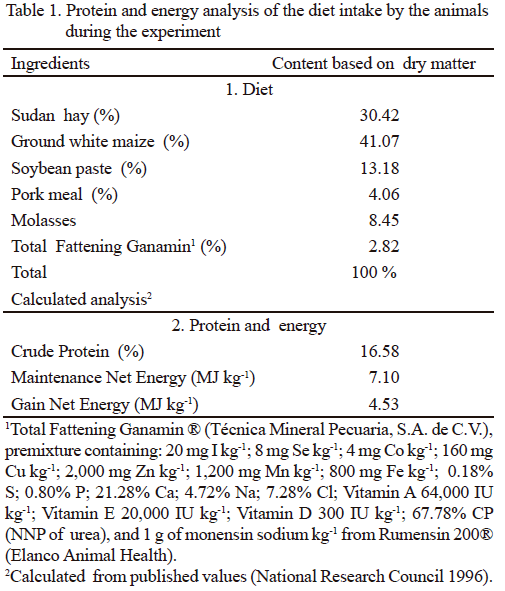
<body><![CDATA[<p align="justify"><font size="2" face="Verdana, Arial, Helvetica, sans-serif"><b><font size="3">MATERIALS AND METHODS</font></b></font></p>     <p align="justify" class="Cuerpodetexto" style="margin-top:12.0pt;margin-right:0cm;margin-bottom:5.95pt;margin-left:0cm;text-indent:0cm;"><span style="font-family:'Verdana','sans-serif'; font-size:10.0pt; ">The  research was conducted at Facultad de Medicina Veterinaria y Zootecnia de la  Universidad Aut&oacute;noma de Sinaloa in Culiacan, Sinaloa, Mexico, located at 24&deg;  50 'NL, 107 &deg; 26' WL and 57.34 m o.s.l high. The climate of this area is  classified as dry tropical, with average annual temperature of 24.8 &deg; C,  average annual rainfall of 645.6 mm and prevailing rains in summer. The annual  average relative humidity is 68%.</span></p>     <p align="justify" class="Cuerpodetexto" style="margin-top:12.0pt;margin-right:0cm;margin-bottom:5.95pt;margin-left:0cm;text-indent:0cm;"><span style="letter-spacing:.1pt; font-family:'Verdana','sans-serif'; font-size:10.0pt; ">A total of four Criollas x Simental heifers of 320 &plusmn; 20 kg  average weight were used, with permanent ruminal cannula (C-4 Diamond&reg;) of 10cm  internal diameter. They were housed in individual pens (3.0 x 6.0 m) with  feeder and drinker. Fifteen days before the experiment, the animals were  adapted to intake a diet with 16.58 % of crude protein (CP); 7.10 MJ kg<sup>-1</sup> of maintenance Net Energy (mNE), with relation 30:70 of forage: concentrate.  The diet composition is show in <a href="/img/revistas/cjas/v50n2/t0110216.gif">table 1</a>.</span> </p>     
<p align="justify" class="Cuerpodetexto" style="margin-top:12.0pt;margin-right:0cm;margin-bottom:5.95pt;margin-left:0cm;text-indent:0cm;"><span style="letter-spacing:.2pt; font-family:'Verdana','sans-serif'; font-size:10.0pt; ">During the adaptation and development of measurements, the  diet was offered <em>ad libitum  </em>(105 % of the intake of the previous day) in a single ration (0800). The  food was served fresh and those which not intake was daily took away. Heifers  had permanent access to clean and fresh water. On the third day of the  beginning of the adaptation phase, the animals were internally and externally  wormed (Closantel&reg;, Cheminova of Mexico and Clorfenvifos&reg;, Laboratorios  Novartis) also 5 mL of vitamins A, D and E (Vitaflow&reg;; Virbac) was  intramuscularly injected.</span><span style="font-family:'Verdana','sans-serif'; font-size:10.0pt; "> </span></p>     <p align="justify" class="Cuerpodetexto" style="margin-top:12.0pt;margin-right:0cm;margin-bottom:5.95pt;margin-left:0cm;text-indent:0cm;"><span style="font-family:'Verdana','sans-serif'; font-size:10.0pt; ">Samples of 20 kg of white maize (hybrid Pantera from  Asgrow Company) were used, which came from an experiment developed in a  semiarid climate with summer rains and mean annual precipitation of 800mm. The  soil was clayey, with field capacity (FC) of 57.5%, permanent wilting point  (PWP) of 36.7%, bulk density (Bd) of 1.27 g cm<sup>-3</sup>, organic matter  content of 0.82% (up 60 cm depth) and total nitrogen content of 0.037%, with  different types of management: nitrogen fertilization with 300 or 400 kg ha<sup>-1</sup> and drip irrigation or gravity, which constituted the treatments of this  experiment</span><span style="font-family:'Verdana','sans-serif'; font-size:10.0pt; ">.</span></p>     <p align="justify" class="Cuerpodetexto" style="margin-top:12.0pt;margin-right:0cm;margin-bottom:5.95pt;margin-left:0cm;text-indent:0cm;"><span style="font-family:'Verdana','sans-serif'; font-size:10.0pt; ">In order to evaluate the ruminal fermentation conditions  during the test, soybean paste was included, when considering the available  information about the performance of this ingredient in rumen. Samples were  grounded at a particle size of 2 mm (Vanzant <em>et al.</em> 1998). In dacron  bags (10 x 18 cm) 5 g of sample were placed on wet basis (13.21 mg cm<sup>-2</sup> ratio). The bags were tied with a nylon string and a space of 10 cm between  each pair was left. One of the bags, with a weight of 200 g, was placed at the  end of the line. At the upper end of the line 70 cm to be tied to the top of  the cannula were left. Samples (150 g) of each of the maize introduced into the  bags and of the soybean paste were taken. The maize samples were dried in a  forced air oven at 105 &deg;C for 24 h (AOAC 2012) to determine the amount of dry  matter introduced in the bags. The bags were incubated in the rumen for 3, 6,  12 and 24 h and placed in reverse order to the incubation time. It was taken as  the start time the moment in which the animals received the food (0800). When  incubation time finish, the bags were removed from the rumen and washed with  water until they were clean (Nocek 1988). </span></p>     <p align="justify" class="Cuerpodetexto" style="margin-top:12.0pt;margin-right:0cm;margin-bottom:5.95pt;margin-left:0cm;text-indent:0cm;"><span style="font-family:'Verdana','sans-serif'; font-size:10.0pt; ">Solubility was determined by  immersing dacron bags in a    0.15 N solution of NaCl in distilled water at 39 &deg;C for 5 min (Owens and Zinn  1982). The bags were dried in oven at 50 &ordm;C for 48 h and weighed. The contents  of a couple of bags was a composite sample, to which it was determined CP (N x  6.25 Kjeldahl) (AOAC 2012). With the results, the ruminal degradation of CP was  calculated (Schneider and Flatt 1975).</span></p>     <p align="justify" class="Cuerpodetexto" style="margin-top:12.0pt;margin-right:0cm;margin-bottom:5.95pt;margin-left:0cm;text-indent:0cm;"><span style="font-family:'Verdana','sans-serif'; font-size:10.0pt; ">The  results of the ruminal degradation of crude protein (CP) to different  incubation times were used to calculate the indicators of the kinetics of  ruminal degradation with the negative exponential model proposed by &Oslash;rskov and  McDonald (1979) by the equation <em>P = a + b</em> (<em>1 - e<sup>-ct</sup></em>),  where:</span></p>     <p align="justify" class="Cuerpodetexto" style="margin-top:12.0pt;margin-right:0cm;margin-bottom:5.95pt;margin-left:0cm;text-indent:0cm;"><em><span style="font-family:'Verdana','sans-serif'; font-size:10.0pt; ">P</span></em><span style="font-family:'Verdana','sans-serif'; font-size:10.0pt; "> &ndash; potentially degradable protein&nbsp; </span></p>     <p align="justify" class="Cuerpodetexto" style="margin-top:12.0pt;margin-right:0cm;margin-bottom:5.95pt;margin-left:0cm;text-indent:0cm;"><em><span style="font-family:'Verdana','sans-serif'; font-size:10.0pt; ">a</span></em><span style="font-family:'Verdana','sans-serif'; font-size:10.0pt; "> &ndash; soluble fraction</span></p>     ]]></body>
<body><![CDATA[<p align="justify" class="Cuerpodetexto" style="margin-top:12.0pt;margin-right:0cm;margin-bottom:5.95pt;margin-left:0cm;text-indent:0cm;"><em><span style="font-family:'Verdana','sans-serif'; font-size:10.0pt; ">b</span></em><span style="font-family:'Verdana','sans-serif'; font-size:10.0pt; "> - insoluble fraction but degradable of CP in rumen, there was enough time for  it </span></p>     <p align="justify" class="Cuerpodetexto" style="margin-top:12.0pt;margin-right:0cm;margin-bottom:5.95pt;margin-left:0cm;text-indent:0cm;"><em><span style="font-family:'Verdana','sans-serif'; font-size:10.0pt; ">c</span></em><span style="font-family:'Verdana','sans-serif'; font-size:10.0pt; "> &ndash; constant degradation rate of the fraction b</span></p>     <p align="justify" class="Cuerpodetexto" style="margin-top:12.0pt;margin-right:0cm;margin-bottom:5.95pt;margin-left:0cm;text-indent:0cm;"><em><span style="font-family:'Verdana','sans-serif'; font-size:10.0pt; ">t</span></em><span style="font-family:'Verdana','sans-serif'; font-size:10.0pt; "> &ndash; time</span></p>     <p align="justify" class="Cuerpodetexto" style="margin-top:12.0pt;margin-right:0cm;margin-bottom:5.95pt;margin-left:0cm;text-indent:0cm;"><span style="font-family:'Verdana','sans-serif'; font-size:10.0pt; ">Once  obtained the indicators, the CP effectively degraded in the rumen was  calculated with the formula: </span></p>     <p align="justify" class="Cuerpodetexto" style="margin-top:12.0pt;margin-right:0cm;margin-bottom:5.95pt;margin-left:0cm;text-indent:0cm;"><span style="font-family:'Verdana','sans-serif'; font-size:10.0pt; "><em>P = a + ((b c) / (c + k))</em> suggested by &Oslash;rskov and McDonald (1979), where  &quot;k&quot; represents the rate of small particles flow through the rumen.  According to the proportion of forage and concentrate of the diet offered to  animals,    k = 0.03 depending on the type of intake diet (&Oslash;rskov 1988).</span></p>     <p align="justify" class="Cuerpodetexto" style="margin-top:12.0pt;margin-right:0cm;margin-bottom:5.95pt;margin-left:0cm;text-indent:0cm;"><span style="font-family:'Verdana','sans-serif'; font-size:10.0pt; ">Analysis of variance on the  basis of a completely randomized design with factorial arrangement 2 x 2 was  applied (Hicks 1973). A value of &alpha; = 0.05 to accept statistical difference was  fitted. The calculations were performed using version 8 of the software package  Statistix<sup>TM</sup> (Statistix 2003)</span><font size="2" face="Verdana, Arial, Helvetica, sans-serif">.</font></p>     <p align="justify">&nbsp;</p>     <p align="justify"><font size="2" face="Verdana, Arial, Helvetica, sans-serif"><b><font size="3">RESULTS AND DISCUSSION</font></b></font></p>     <p align="justify" class="Cuerpodetexto" style="margin-top:12.0pt;margin-right:0cm;margin-bottom:5.95pt;margin-left:0cm;text-indent:0cm;"><span style="letter-spacing:.2pt; font-family:'Verdana','sans-serif'; font-size:10.0pt; ">The results of variance analysis for the studied variables  indicated that there was no interaction between the study factors (P &gt;  0.05). However, the content of crude protein (CP) in the maize which received  drip irrigation was higher (P &le; 0.05) than the gravity irrigation (8.72 vs.  8.05%), which can be attributed to the efficiency of distribution of water and  nutrients (N) with drip irrigation technique. These results agree with that  informed by Shah <em>et al.</em> (2003). The maize that received the highest dose  of N ha<sup>-1</sup> (400 kg) had a higher content (P &le; 0.05) of CP with  respect to the fertilized with 300 kg ha<sup>-1</sup> of N (8.52 vs. 8.25%). It  is expected that at higher concentration of nitrogen in the soil, the amount  translocated to the grain maize from the root system is higher, which increases  the CP content. This result agrees with that found by Ferreira <em>et al.</em> (2005), who appreciated increase in protein content in the grain as increased  the amount of N applied in four maize hybrids. The average value of 8.39% of CP  found in this experiment in grains of white maize from the Pantera of Asgrow  hybrid, although it was lower at 9.8 &plusmn; .55% attributed by the National Research  Council (1996), they corresponds with the CP values between 8% and 9%, which  are normally found in modern maize hybrids released from the nineties (Lykos  and Varga 1995, Ferreira <em>et al.</em> 2005, Corona <em>et al.</em>  2006).</span></p>     <p align="justify" class="Cuerpodetexto" style="margin-top:12.0pt;margin-right:0cm;margin-bottom:5.95pt;margin-left:0cm;text-indent:0cm;"><span style="font-family:'Verdana','sans-serif'; font-size:10.0pt; ">The fermentation pattern that showed the CP of the soybean  paste in this experiment is described in the equation P = 31.78 + 53.38 (1 &ndash; e <sup>-.076  t</sup>);    R<sup>2</sup> = 0.96 (P &le; 0.001). The solubility of 31.78% of the soybean paste  CP was close to the values of 28.5% and 29% referred in others papers  (Kirkpatrick and Kennelly 1987 Canbolat <em>et al.</em> 2007). The percentage  degradation of CP in soybean paste at  24 h of incubation in rumen was 85.16%, 88.7% value close to that informed by  Kirkpatrick and Kennelly (1987) in Holstein heifers. The fermentation pattern  in rumen exhibited by soybean paste coincides with expectations according to  the information available in the literature (Kirkpatrick and Kennelly 1987,  Canbolat <em>et al.</em> 2007), so it is assumed that the conditions which  prevailed in rumen during the test were normal. The results obtained with maize  and the comparison between the different treatments can be considered reliable.</span><span style="font-family:'Verdana','sans-serif'; font-size:10.0pt; "> </span></p>     ]]></body>
<body><![CDATA[<p align="justify" class="Cuerpodetexto" style="margin-top:12.0pt;margin-right:0cm;margin-bottom:5.95pt;margin-left:0cm;text-indent:0cm;"><span style="letter-spacing:.1pt; font-family:'Verdana','sans-serif'; font-size:10.0pt; ">The influence of treatments on the ruminal degradation of  maize CP is presented in <a href="/img/revistas/cjas/v50n2/t0210216.gif">Table 2</a>. The different fertilization and irrigation  schemes did not change (p &le; 0.21) the solubility of the maize CP, which was as  average 19.4 &plusmn; 2.85 %. This value was close to the 22.3% found by Lykos and  Varga (1995) in ground yellow maize. The treatments had no effect (P &le; 0.20) on  the ruminal degradability of maize CP in any of incubation times. The average  value (38.49 &plusmn; 4.18%) obtained at 12 h and the 49.71 &plusmn; 4.59 %, found at 24 h in  this experiment, are close to 40 and 48 % estimated by Wanderley <em>et al.</em> (1993) in yellow maize at the same incubation times, after correcting the  influence of microbial contamination. The degradation rate of the maize CP was  similar (P &le; 0.13) in the different treatments averaging 0.10 &plusmn; 0.03. This  value is in the range between 0.08 and 0.10, established by the National  Research Council (1996) for the cracked yellow maize. The maize CP effectively  degraded in the rumen was similar (P &le; 0.48) between the four treatments, with  an average of 42.14 &plusmn; 2.83 %. This value, calculated on the basis of nylon bags  technique, corresponds with 41.87 % determined by Prigge <em>et al.</em> (1978)  in dry rolled maize, when measuring duodenal flow, and with 43% calculated by  Stern <em>et al.</em> (1983) for maize gluten protein. Barajas and Zinn (1998),  with measurements from the flow to the duodenum in heifers, estimated at 42.8%  the ruminal degradation of the protein of dry cracked yellow maize. Corona <em>et  al.</em> (2006) measured the flow to the duodenum in steers fed maize dry  processing or steam- flaked from four hybrids, with CP content ranging between  8.1 and 8.7%. These authors found no influence of grain protein level on the  ruminal degradation of CP, which estimated at 44.8%. The National Research  Council (1996) attributed to dry rolled maize a content of 45% of CP degradable  in rumen.</span><span style="font-family:'Verdana','sans-serif'; font-size:10.0pt; "> </span></p>     
<p align="justify" class="Cuerpodetexto" style="margin-top:12.0pt;margin-right:0cm;margin-bottom:5.95pt;margin-left:0cm;text-indent:0cm;"><span style="font-family:'Verdana','sans-serif'; font-size:10.0pt; ">Although  the fertilization and irrigation schemes allow modify the CP content of maize  grain (Shah <em>et al.</em> 2003, Ferreira <em>et al.</em> 2005), apparently have  no major effect on the rate or extent to which their proteins are degraded in  the rumen , confirming the findings of Redd <em>et al.</em> (1975). These authors  did not observed change in the amount of protein that came to abomasums in  young bull fed with normal maize or opaque-2 maize, which is a variety with  higher crude protein content. Harrelson <em>et al.</em> (2009) found no  differences in ruminal degradation of six maize hybrids dry processed.</span></p>     <p align="justify" class="Cuerpodetexto" style="margin-top:12.0pt;margin-right:0cm;margin-bottom:5.95pt;margin-left:0cm;text-indent:0cm;"><span style="font-family:'Verdana','sans-serif'; font-size:10.0pt; ">The difference in the crude  protein content of the grain, as a result of the different management which was  given to the maize, did not influence on the extent of protein degradation by  ruminal microbiota</span><font size="2" face="Verdana, Arial, Helvetica, sans-serif">.</font></p>     <p align="justify">&nbsp;</p>     <p align="justify"><font size="2" face="Verdana, Arial, Helvetica, sans-serif"><font size="3"><b>REFERENCES</b></font></font></p>     <p align="justify" class="MsoBibliography" style="margin-top:12.0pt;margin-right:0cm;margin-bottom:5.95pt;margin-left:0cm;text-align:justify;"><span style="font-family:'Verdana','sans-serif'; font-size:10.0pt; ">Aydinsakir, K., Erdal, S., Buyuktas, D., Bastug, R. &amp; Toker, R.  2013. &ldquo;The influence of regular deficit irrigation applications on water use,  yield, and quality components of two corn (<em>Zea mays</em> L.) genotypes&rdquo;. <em>Agricultural  Water Management</em>, 128: 65&ndash;71, ISSN: 0378-3774, DOI:  10.1016/j.agwat.2013.06.013.</span></p>     <p align="justify" class="MsoBibliography" style="margin-top:12.0pt;margin-right:0cm;margin-bottom:5.95pt;margin-left:0cm;text-align:justify;"><span style="font-family:'Verdana','sans-serif'; font-size:10.0pt; ">Barajas, R. &amp; Zinn, R. A. 1998. &ldquo;The feeding value of dry-rolled and  steam-flaked corn in finishing diets for feedlot cattle: influence of protein  supplementation&rdquo;. <em>Journal of animal science</em>, 76(7): 1744&ndash;1752, ISSN:  0021-8812, DOI: /1998.7671744x.</span></p>     <p align="justify" class="MsoBibliography" style="margin-top:12.0pt;margin-right:0cm;margin-bottom:5.95pt;margin-left:0cm;text-align:justify;"><span style="font-family:'Verdana','sans-serif'; font-size:10.0pt; ">Canbolat, O., Kamalak, A., Efe, E., Sahin, M. &amp; Ozkan, C. O. 2007.  &ldquo;Effect of heat treatment on <em>in situ</em> rumen degradability and <em>in vitro</em> gas production of full-fat soyabeans and soyabean meal&rdquo;. <em>South African  Journal of Animal Science</em>, 35(3): 186&ndash;194, ISSN: 2221-4062, DOI:  10.4314/sajas.v35i3.4058.</span></p>     <p align="justify" class="MsoBibliography" style="margin-top:12.0pt;margin-right:0cm;margin-bottom:5.95pt;margin-left:0cm;text-align:justify;"><span style="font-family:'Verdana','sans-serif'; font-size:10.0pt; ">Corona, L., Owens, F. N. &amp; Zinn, R. A. 2006. &ldquo;Impact of corn  vitreousness and processing on site and extent of digestion by feedlot cattle&rdquo;. <em>Journal of Animal Science</em>, 84(11): 3020&ndash;3031, ISSN: 0021-8812,  1525-3163, DOI: 10.2527/jas.2005-603.</span></p>     <p align="justify" class="MsoBibliography" style="margin-top:12.0pt;margin-right:0cm;margin-bottom:5.95pt;margin-left:0cm;text-align:justify;"><span style="font-family:'Verdana','sans-serif'; font-size:10.0pt; ">Danes, M. A. C., Chagas, L. J., Pedroso, A. M. &amp; Santos, F. A. P.  2013. &ldquo;Effect of protein supplementation on milk production and metabolism of  dairy cows grazing tropical grass&rdquo;. <em>Journal of Dairy Science</em>, 96(1):  407&ndash;419, ISSN: 0022-0302, DOI: 10.3168/jds.2012-5607.</span></p>     ]]></body>
<body><![CDATA[<p align="justify" class="MsoBibliography" style="margin-top:12.0pt;margin-right:0cm;margin-bottom:5.95pt;margin-left:0cm;text-align:justify;"><span style="font-family:'Verdana','sans-serif'; font-size:10.0pt; ">Ferreira,&nbsp; da S. P. R., Strieder,  M. L., da Silva, C. R. P., Rambo, L., Sangoi, L., Argenta, G., Forsthofer, E.  L. &amp; Alves,&nbsp; da S. A. 2005. &ldquo;Grain  yield and kernel crude protein content increases of maize hybrids with late  nitrogen side-dressing&rdquo;. <em>Scientia Agr&iacute;cola</em>, 62(5): 487&ndash;492, ISSN:  0103-9016, DOI: 10.1590/S0103-90162005000500014.</span></p>     <p align="justify" class="MsoBibliography" style="margin-top:12.0pt;margin-right:0cm;margin-bottom:5.95pt;margin-left:0cm;text-align:justify;"><span style="font-family:'Verdana','sans-serif'; font-size:10.0pt; ">Harrelson, F. W., Luebbe, M. K., Meyer, N. F., Erickson, G. E.,  Klopfenstein, T. J., Jackson, D. S. &amp; Fithian, W. A. 2009. &ldquo;Influence of  corn hybrid and processing method on nutrient digestibility, finishing  performance, and carcass characteristics&rdquo;. <em>Journal of Animal Science</em>,  87(7): 2323&ndash;2332, ISSN: 0021-8812, 1525-3163, DOI: 10.2527/jas.2008-1527.</span></p>     <!-- ref --><p align="justify" class="MsoBibliography" style="margin-top:12.0pt;margin-right:0cm;margin-bottom:5.95pt;margin-left:0cm;text-align:justify;"><span style="font-family:'Verdana','sans-serif'; font-size:10.0pt; ">Hicks, C. R. 1973. <em>Fundamental concepts in the design of experiments</em>.  Michigan, USA: Holt, Rinehart and Winston, 372 p., ISBN: 978-0-03-080132-7,  Available:  &lt;<a href="https://books.google.co.in/books/about/Fundamental_concepts_in_the_design_of_ex.html?id=TuVQAAAAMAAJ" target="_blank">https://books.google.co.in/books/about/Fundamental_concepts_in_the_design_of_ex.html?id=TuVQAAAAMAAJ</a>&gt;,  [Consulted:&nbsp;May 19, 2016].    </span></p>     <p align="justify" class="MsoBibliography" style="margin-top:12.0pt;margin-right:0cm;margin-bottom:5.95pt;margin-left:0cm;text-align:justify;"><span style="font-family:'Verdana','sans-serif'; font-size:10.0pt; ">Hork&yacute;, P. 2014. &ldquo;Effect of Protein Concentrate Supplement on the  Qualitative and Quantitative Parameters of Milk from Dairy Cows in Organic  Farming&rdquo;. <em>Annals of Animal Science</em>, 14(2): 341&ndash;352, ISSN: 1642-3402,  DOI: 10.2478/aoas-2014-0008.</span></p>     <p align="justify" class="MsoBibliography" style="margin-top:12.0pt;margin-right:0cm;margin-bottom:5.95pt;margin-left:0cm;text-align:justify;"><span style="font-family:'Verdana','sans-serif'; font-size:10.0pt; ">Irfan, M., Arshad, M., Shakoor, A. &amp; Anjum, L. 2014. &ldquo;Impact of  irrigation management practices and water quality on maize production and water  use efficiency&rdquo;. <em>The Journal of Animal &amp; Plant Sciences</em>, 24(5):  1518&ndash;1524, ISSN: 1018-7081.</span></p>     <p align="justify" class="MsoBibliography" style="margin-top:12.0pt;margin-right:0cm;margin-bottom:5.95pt;margin-left:0cm;text-align:justify;"><span style="font-family:'Verdana','sans-serif'; font-size:10.0pt; ">Khalili, M., Naghavi, M. R., Aboughadareh, A. P. &amp; Rad, H. N. 2013.  &ldquo;Effects of Drought Stress on Yield and Yield Components in Maize cultivars (<em>Zea  mays</em> L.)&rdquo;. <em>International Journal of Agronomy and Plant Production</em>,  4(4): 809&ndash;812, ISSN: 2051-1914.</span></p>     <p align="justify" class="MsoBibliography" style="margin-top:12.0pt;margin-right:0cm;margin-bottom:5.95pt;margin-left:0cm;text-align:justify;"><span style="font-family:'Verdana','sans-serif'; font-size:10.0pt; ">Kirkpatrick, B. K. &amp; Kennelly, J. J. 1987. &ldquo;<em>In situ</em> degradability of protein and dry matter from single protein sources and from a  total diet&rdquo;. <em>Journal of Animal Science</em>, 65(2): 567&ndash;576, ISSN: 0021-8812,  DOI: 10.2134/jas1987.652567x.</span></p>     <!-- ref --><p align="justify" class="MsoBibliography" style="margin-top:12.0pt;margin-right:0cm;margin-bottom:5.95pt;margin-left:0cm;text-align:justify;"><span style="font-family:'Verdana','sans-serif'; font-size:10.0pt; ">Latimer, G. W. 2012. <em>Official Methods of Analysis of AOAC  International</em>. 19th ed., Gaithersburg, Md.: AOAC International, ISBN:  978-0-935584-83-7, Available:  &lt;<a href="http://www.amazon.com/Official-Methods-Analysis-OFFICIAL-ANALYSIS/dp/0935584838/ref=pd_sim_sbs_14_1?ie=UTF8&dpID=31iikC-xl2L&dpSrc=sims&preST=_AC_UL160_SR160%2C160_&refRID=101AB94246X0EM9N7XMW" target="_blank">http://www.amazon.com/Official-Methods-Analysis-OFFICIAL-ANALYSIS/dp/0935584838/ref=pd_sim_sbs_14_1?ie=UTF8&amp;dpID=31iikC-xl2L&amp;dpSrc=sims&amp;preST=_AC_UL160_SR160%2C160_&amp;refRID=101AB94246X0EM9N7XMW</a>&gt;,  [Consulted:&nbsp;April 1, 2016].    </span></p>     ]]></body>
<body><![CDATA[<p align="justify" class="MsoBibliography" style="margin-top:12.0pt;margin-right:0cm;margin-bottom:5.95pt;margin-left:0cm;text-align:justify;"><span style="font-family:'Verdana','sans-serif'; font-size:10.0pt; ">Lykos, T. &amp; Varga, G.  A. 1995. </span><span style="font-family:'Verdana','sans-serif'; font-size:10.0pt; ">&ldquo;Effects of  processing method on degradation characteristics of protein and carbohydrate  sources <em>in situ</em>&rdquo;. <em>Journal of Dairy Science</em>, 78(8): 1789&ndash;1801,  ISSN: 0022-0302, DOI: 10.3168/jds.S0022-0302(95)76804-7.</span></p>     <!-- ref --><p align="justify" class="MsoBibliography" style="margin-top:12.0pt;margin-right:0cm;margin-bottom:5.95pt;margin-left:0cm;text-align:justify;"><span style="font-family:'Verdana','sans-serif'; font-size:10.0pt; ">National Research Council 1996. <em>Nutrient Requirements of Beef Cattle</em>.  7th ed., Washington, D.C.: National Academies Press, ISBN: 978-0-309-06934-2,  Available: &lt;<a href="http://www.nap.edu/catalog/9791" target="_blank">http://www.nap.edu/catalog/9791</a>&gt;, [Consulted:&nbsp;May 19,  2016].    </span></p>     <p align="justify" class="MsoBibliography" style="margin-top:12.0pt;margin-right:0cm;margin-bottom:5.95pt;margin-left:0cm;text-align:justify;"><span style="font-family:'Verdana','sans-serif'; font-size:10.0pt; ">Nocek, J. E. 1988. &ldquo;<em>In situ</em> and other methods to estimate ruminal  protein and energy digestibility: a review&rdquo;. <em>Journal of Dairy Science</em>,  71(8): 2051&ndash;2069, ISSN: 0022-0302, DOI: 10.3168/jds.S0022-0302(88)79781-7.</span></p>     <!-- ref --><p align="justify" class="MsoBibliography" style="margin-top:12.0pt;margin-right:0cm;margin-bottom:5.95pt;margin-left:0cm;text-align:justify;"><span style="font-family:'Verdana','sans-serif'; font-size:10.0pt; ">&Oslash;rskov, E. R. 1988. </span><em><span style="font-family:'Verdana','sans-serif'; font-size:10.0pt; ">Nutrici&oacute;n proteica de los rumiantes</span></em><span style="font-family:'Verdana','sans-serif'; font-size:10.0pt; ">.  Zaragoza, Espa&ntilde;a: Acribia, 178 p., ISBN: 978-84-200-0627-7.    </span></p>     <p align="justify" class="MsoBibliography" style="margin-top:12.0pt;margin-right:0cm;margin-bottom:5.95pt;margin-left:0cm;text-align:justify;"><span style="font-family:'Verdana','sans-serif'; font-size:10.0pt; ">&Oslash;rskov, E. R. &amp; McDonald, I. 1979. &ldquo;The estimation of protein  degradability in the rumen from incubation measurements weighted according to  rate of passage&rdquo;. <em>The Journal of Agricultural Science</em>, 92(2): 499&ndash;503,  ISSN: 1469-5146, DOI: 10.1017/S0021859600063048.</span></p>     <p align="justify" class="MsoBibliography" style="margin-top:12.0pt;margin-right:0cm;margin-bottom:5.95pt;margin-left:0cm;text-align:justify;"><span style="font-family:'Verdana','sans-serif'; font-size:10.0pt; ">Owens, F. N. &amp; Zinn, R. A. 1982. &ldquo;The standard reference system of  protein bypass estimation&rdquo;. In: Owens, F. N. (ed.), <em>Protein Requirements for  Cattle: Symposium</em>, Stillwater, Oklahoma: Oklahoma State University, p. 363,  MP-109.</span></p>     <p align="justify" class="MsoBibliography" style="margin-top:12.0pt;margin-right:0cm;margin-bottom:5.95pt;margin-left:0cm;text-align:justify;"><span style="font-family:'Verdana','sans-serif'; font-size:10.0pt; ">Prigge, E. C., Galyean, M. L., Owens, F. N., Wagner, D. G. &amp;  Johnson, R. R. 1978. &ldquo;Microbial Protein Synthesis in Steers Fed Processed Corn  Rations&rdquo;. <em>Journal of Animal Science</em>, 46(1): 249&ndash;254, ISSN: 0021-8812,  DOI: 10.2134/jas1978.461249x.</span></p>     <p align="justify" class="MsoBibliography" style="margin-top:12.0pt;margin-right:0cm;margin-bottom:5.95pt;margin-left:0cm;text-align:justify;"><span style="font-family:'Verdana','sans-serif'; font-size:10.0pt; ">Ramalho, R. P., Ferreira,  M. de A., V&eacute;ras, A. S. C., Lima, L. E. de &amp; Rocha, V. R. R. A. 2006.  &ldquo;Substitui&ccedil;&atilde;o do milho pela raspa de mandioca em dietas para vacas prim&iacute;paras  em lacta&ccedil;&atilde;o&rdquo;. <em>Revista Brasileira de Zootecnia</em>, 35(3): 1221&ndash;1227, ISSN:  1806-9290.</span></p>     ]]></body>
<body><![CDATA[<p align="justify" class="MsoBibliography" style="margin-top:12.0pt;margin-right:0cm;margin-bottom:5.95pt;margin-left:0cm;text-align:justify;"><span style="font-family:'Verdana','sans-serif'; font-size:10.0pt; ">Redd, T. L., Boling, J.  A., Bradley, N. W. &amp; Ely, D. G. 1975. </span><span style="font-family:'Verdana','sans-serif'; font-size:10.0pt; ">&ldquo;Abomasal Amino Acids and Plasma Nitrogen Constituents  in the Bovine Fed Normal or Corn&rdquo;. <em>Journal of Animal Science</em>, 40(3):  567&ndash;572, ISSN: 0021-8812, DOI: 10.2134/jas1975.403567x.</span></p>     <!-- ref --><p align="justify" class="MsoBibliography" style="margin-top:12.0pt;margin-right:0cm;margin-bottom:5.95pt;margin-left:0cm;text-align:justify;"><span style="font-family:'Verdana','sans-serif'; font-size:10.0pt; ">Schneider, B. H. &amp; Flatt, W. P. 1975. <em>The evaluation of feeds  through digestibility experiments</em>. Georgia, U.S.A: University of Georgia  Press, 456 p., Available:  &lt;<a href="https://books.google.com.cu/books/about/The_evaluation_of_feeds_through_digestib.html?id=M9MqAQAAMAAJ&redir_esc=y" target="_blank">https://books.google.com.cu/books/about/The_evaluation_of_feeds_through_digestib.html?id=M9MqAQAAMAAJ&amp;redir_esc=y</a>&gt;,  [Consulted:&nbsp;May 19, 2016].    </span></p>     <p align="justify" class="MsoBibliography" style="margin-top:12.0pt;margin-right:0cm;margin-bottom:5.95pt;margin-left:0cm;text-align:justify;"><span style="font-family:'Verdana','sans-serif'; font-size:10.0pt; ">Shah, S. H., Ahmad, F., Saleem, M. F. &amp; Zamir, S. I. 2003. &ldquo;Effect  of planting patterns on water use efficiency and agronomic characteristics of  maize (<em>Zea mays</em> L.)&rdquo;. <em>Pakistan Journal of Water Resources</em>, 7(2):  11&ndash;14, ISSN: 1021-5409.</span></p>     <p align="justify" class="MsoBibliography" style="margin-top:12.0pt;margin-right:0cm;margin-bottom:5.95pt;margin-left:0cm;text-align:justify;"><span style="font-family:'Verdana','sans-serif'; font-size:10.0pt; ">Statistix 2003. <em>Statistix 8: User&rsquo;s Manual</em>. Tallahassee, FL:  Analytical Software, 396 p., ISBN: 978-1-881789-06-2, Available:  &lt;<a href="https://books.google.com.cu/books/about/Statistix_8.html?id=-x_mAAAACAAJ&redir_esc=y" target="_blank">https://books.google.com.cu/books/about/Statistix_8.html?id=-x_mAAAACAAJ&amp;redir_esc=y</a>&gt;,  [Consulted:&nbsp;May 19, 2016].</span></p>     <p align="justify" class="MsoBibliography" style="margin-top:12.0pt;margin-right:0cm;margin-bottom:5.95pt;margin-left:0cm;text-align:justify;"><span style="font-family:'Verdana','sans-serif'; font-size:10.0pt; ">Stern, M. D., Rode, L. M., Prange, R. W., Stauffacher, R. H. &amp;  Satter, L. D. 1983. &ldquo;Ruminal Protein Degradation of Corn Gluten Meal in  Lactating Dairy Cattle Fitted with Duodenal T-Type Cannulae&rdquo;. <em>Journal of  Animal Science</em>, 56(1): 194&ndash;205, ISSN: 0021-8812, DOI:  10.2134/jas1983.561194x.</span></p>     <p align="justify" class="MsoBibliography" style="margin-top:12.0pt;margin-right:0cm;margin-bottom:5.95pt;margin-left:0cm;text-align:justify;"><span style="font-family:'Verdana','sans-serif'; font-size:10.0pt; ">Vanzant, E. S., Cochran, R. C. &amp; Titgemeyer, E. C. 1998.  &ldquo;Standardization of <em>in situ</em> techniques for ruminant feedstuff  evaluation&rdquo;. <em>Journal of animal science</em>, 76(10): 2717&ndash;2729, ISSN:  0021-8812, DOI: /1998.76102717x.</span></p>     <div align="justify"><span style="font-family:'Verdana','sans-serif'; font-size:10.0pt; ">Wanderley, R. C., Huber, J.  T., Wu, Z., Pessarakli, M. &amp; Fontes, C. 1993. &ldquo;Influence of microbial  colonization of feed particles on determination of nitrogen degradability by in  situ incubation&rdquo;. </span><em><span style="font-family:'Verdana','sans-serif'; font-size:10.0pt; ">Journal  of animal science</span></em><span style="font-family:'Verdana','sans-serif'; font-size:10.0pt; ">,  71(11): 3073&ndash;3077, ISSN: 0021-8812, DOI: /1993.71113073x</span><font size="2" face="Verdana, Arial, Helvetica, sans-serif">.</font> </div>     <p align="justify">&nbsp;</p>     <p align="justify">&nbsp;</p>     ]]></body>
<body><![CDATA[<p align="justify"><font size="2" face="Verdana, Arial, Helvetica, sans-serif">Received: 5/5/2015    <br>   Accepted: 11/7/2016</font></p>     <p align="justify">&nbsp;</p>     <p align="justify">&nbsp;</p>     <p align="justify"><font size="2" face="Verdana, Arial, Helvetica, sans-serif"><i>Barajas R.,</i> Facultad de Medicina Veterinaria y Zootecnia de la Universidad Autónoma de Sinaloa, Culiacán, Sinaloa, México.  Email: <a href="mailto:tdiaz10@hotmail.com">tdiaz10@hotmail.com</a></font></p>      ]]></body><back>
<ref-list>
<ref id="B1">
<nlm-citation citation-type="journal">
<person-group person-group-type="author">
<name>
<surname><![CDATA[Aydinsakir]]></surname>
<given-names><![CDATA[K.]]></given-names>
</name>
<name>
<surname><![CDATA[Erdal]]></surname>
<given-names><![CDATA[S.]]></given-names>
</name>
<name>
<surname><![CDATA[Buyuktas]]></surname>
<given-names><![CDATA[D.]]></given-names>
</name>
<name>
<surname><![CDATA[Bastug]]></surname>
<given-names><![CDATA[R.]]></given-names>
</name>
<name>
<surname><![CDATA[Toker]]></surname>
<given-names><![CDATA[R.]]></given-names>
</name>
</person-group>
<article-title xml:lang="nd"><![CDATA[The influence of regular deficit irrigation applications on water use, yield, and quality components of two corn (Zea mays L.) genotypes]]></article-title>
<source><![CDATA[Agricultural Water Management]]></source>
<year>2013</year>
<volume>128</volume>
<page-range>65-71</page-range></nlm-citation>
</ref>
<ref id="B2">
<nlm-citation citation-type="journal">
<person-group person-group-type="author">
<name>
<surname><![CDATA[Barajas]]></surname>
<given-names><![CDATA[R.]]></given-names>
</name>
<name>
<surname><![CDATA[Zinn]]></surname>
<given-names><![CDATA[R. A.]]></given-names>
</name>
</person-group>
<article-title xml:lang="nd"><![CDATA[The feeding value of dry-rolled and steam-flaked corn in finishing diets for feedlot cattle: influence of protein supplementation]]></article-title>
<source><![CDATA[Journal of animal science]]></source>
<year>1998</year>
<volume>76</volume>
<numero>7</numero>
<issue>7</issue>
<page-range>1744-1752</page-range></nlm-citation>
</ref>
<ref id="B3">
<nlm-citation citation-type="journal">
<person-group person-group-type="author">
<name>
<surname><![CDATA[Canbolat]]></surname>
<given-names><![CDATA[O.]]></given-names>
</name>
<name>
<surname><![CDATA[Kamalak]]></surname>
<given-names><![CDATA[A.]]></given-names>
</name>
<name>
<surname><![CDATA[Efe]]></surname>
<given-names><![CDATA[E.]]></given-names>
</name>
<name>
<surname><![CDATA[Sahin]]></surname>
<given-names><![CDATA[M.]]></given-names>
</name>
<name>
<surname><![CDATA[Ozkan]]></surname>
<given-names><![CDATA[C. O.]]></given-names>
</name>
</person-group>
<article-title xml:lang="nd"><![CDATA[Effect of heat treatment on in situ rumen degradability and in vitro gas production of full-fat soyabeans and soyabean meal]]></article-title>
<source><![CDATA[South African Journal of Animal Science]]></source>
<year>2007</year>
<volume>35</volume>
<numero>3</numero>
<issue>3</issue>
<page-range>186-194</page-range></nlm-citation>
</ref>
<ref id="B4">
<nlm-citation citation-type="journal">
<person-group person-group-type="author">
<name>
<surname><![CDATA[Corona]]></surname>
<given-names><![CDATA[L.]]></given-names>
</name>
<name>
<surname><![CDATA[Owens]]></surname>
<given-names><![CDATA[F. N.]]></given-names>
</name>
<name>
<surname><![CDATA[Zinn]]></surname>
<given-names><![CDATA[R. A.]]></given-names>
</name>
</person-group>
<article-title xml:lang="nd"><![CDATA[Impact of corn vitreousness and processing on site and extent of digestion by feedlot cattle]]></article-title>
<source><![CDATA[Journal of Animal Science]]></source>
<year>2006</year>
<volume>84</volume>
<numero>11</numero>
<issue>11</issue>
<page-range>3020-3031</page-range></nlm-citation>
</ref>
<ref id="B5">
<nlm-citation citation-type="journal">
<person-group person-group-type="author">
<name>
<surname><![CDATA[Danes]]></surname>
<given-names><![CDATA[M. A. C.]]></given-names>
</name>
<name>
<surname><![CDATA[Chagas]]></surname>
<given-names><![CDATA[L. J.]]></given-names>
</name>
<name>
<surname><![CDATA[Pedroso]]></surname>
<given-names><![CDATA[A. M.]]></given-names>
</name>
<name>
<surname><![CDATA[Santos]]></surname>
<given-names><![CDATA[F. A. P.]]></given-names>
</name>
</person-group>
<article-title xml:lang="nd"><![CDATA[Effect of protein supplementation on milk production and metabolism of dairy cows grazing tropical grass]]></article-title>
<source><![CDATA[Journal of Dairy Science]]></source>
<year>2013</year>
<volume>96</volume>
<numero>1</numero>
<issue>1</issue>
<page-range>407-419</page-range></nlm-citation>
</ref>
<ref id="B6">
<nlm-citation citation-type="journal">
<person-group person-group-type="author">
<name>
<surname><![CDATA[Ferreira]]></surname>
<given-names><![CDATA[da S. P. R.]]></given-names>
</name>
<name>
<surname><![CDATA[Strieder]]></surname>
<given-names><![CDATA[M. L.]]></given-names>
</name>
<name>
<surname><![CDATA[da Silva]]></surname>
<given-names><![CDATA[C. R. P.]]></given-names>
</name>
<name>
<surname><![CDATA[Rambo]]></surname>
<given-names><![CDATA[L.]]></given-names>
</name>
<name>
<surname><![CDATA[Sangoi]]></surname>
<given-names><![CDATA[L.]]></given-names>
</name>
<name>
<surname><![CDATA[Argenta]]></surname>
<given-names><![CDATA[G.]]></given-names>
</name>
<name>
<surname><![CDATA[Forsthofer]]></surname>
<given-names><![CDATA[E. L.]]></given-names>
</name>
<name>
<surname><![CDATA[Alves]]></surname>
<given-names><![CDATA[da S. A.]]></given-names>
</name>
</person-group>
<article-title xml:lang="nd"><![CDATA[Grain yield and kernel crude protein content increases of maize hybrids with late nitrogen side-dressing]]></article-title>
<source><![CDATA[Scientia Agrícola]]></source>
<year>2005</year>
<volume>62</volume>
<numero>5</numero>
<issue>5</issue>
<page-range>487-492</page-range></nlm-citation>
</ref>
<ref id="B7">
<nlm-citation citation-type="journal">
<person-group person-group-type="author">
<name>
<surname><![CDATA[Harrelson]]></surname>
<given-names><![CDATA[F. W.]]></given-names>
</name>
<name>
<surname><![CDATA[Luebbe]]></surname>
<given-names><![CDATA[M. K.]]></given-names>
</name>
<name>
<surname><![CDATA[Meyer]]></surname>
<given-names><![CDATA[N. F.]]></given-names>
</name>
<name>
<surname><![CDATA[Erickson]]></surname>
<given-names><![CDATA[G. E.]]></given-names>
</name>
<name>
<surname><![CDATA[Klopfenstein]]></surname>
<given-names><![CDATA[T. J.]]></given-names>
</name>
<name>
<surname><![CDATA[Jackson]]></surname>
<given-names><![CDATA[D. S.]]></given-names>
</name>
<name>
<surname><![CDATA[Fithian]]></surname>
<given-names><![CDATA[W. A.]]></given-names>
</name>
</person-group>
<article-title xml:lang="nd"><![CDATA[Influence of corn hybrid and processing method on nutrient digestibility, finishing performance, and carcass characteristics]]></article-title>
<source><![CDATA[Journal of Animal Science]]></source>
<year>2009</year>
<volume>87</volume>
<numero>7</numero>
<issue>7</issue>
<page-range>2323-2332</page-range></nlm-citation>
</ref>
<ref id="B8">
<nlm-citation citation-type="book">
<person-group person-group-type="author">
<name>
<surname><![CDATA[Hicks]]></surname>
<given-names><![CDATA[C. R.]]></given-names>
</name>
</person-group>
<source><![CDATA[Fundamental concepts in the design of experiments]]></source>
<year>1973</year>
<page-range>372</page-range><publisher-loc><![CDATA[Michigan, USA ]]></publisher-loc>
<publisher-name><![CDATA[Holt, Rinehart and Winston]]></publisher-name>
</nlm-citation>
</ref>
<ref id="B9">
<nlm-citation citation-type="journal">
<person-group person-group-type="author">
<name>
<surname><![CDATA[Horký]]></surname>
<given-names><![CDATA[P.]]></given-names>
</name>
</person-group>
<article-title xml:lang="nd"><![CDATA[Effect of Protein Concentrate Supplement on the Qualitative and Quantitative Parameters of Milk from Dairy Cows in Organic Farming]]></article-title>
<source><![CDATA[Annals of Animal Science]]></source>
<year>2014</year>
<volume>14</volume>
<numero>2</numero>
<issue>2</issue>
<page-range>341-352</page-range></nlm-citation>
</ref>
<ref id="B10">
<nlm-citation citation-type="journal">
<person-group person-group-type="author">
<name>
<surname><![CDATA[Irfan]]></surname>
<given-names><![CDATA[M.]]></given-names>
</name>
<name>
<surname><![CDATA[Arshad]]></surname>
<given-names><![CDATA[M.]]></given-names>
</name>
<name>
<surname><![CDATA[Shakoor]]></surname>
<given-names><![CDATA[A.]]></given-names>
</name>
<name>
<surname><![CDATA[Anjum]]></surname>
<given-names><![CDATA[L.]]></given-names>
</name>
</person-group>
<article-title xml:lang="nd"><![CDATA[Impact of irrigation management practices and water quality on maize production and water use efficiency]]></article-title>
<source><![CDATA[The Journal of Animal & Plant Sciences]]></source>
<year>2014</year>
<volume>24</volume>
<numero>5</numero>
<issue>5</issue>
<page-range>1518-1524</page-range></nlm-citation>
</ref>
<ref id="B11">
<nlm-citation citation-type="journal">
<person-group person-group-type="author">
<name>
<surname><![CDATA[Khalili]]></surname>
<given-names><![CDATA[M.]]></given-names>
</name>
<name>
<surname><![CDATA[Naghavi]]></surname>
<given-names><![CDATA[M. R.]]></given-names>
</name>
<name>
<surname><![CDATA[Aboughadareh]]></surname>
<given-names><![CDATA[A. P.]]></given-names>
</name>
<name>
<surname><![CDATA[Rad]]></surname>
<given-names><![CDATA[H. N.]]></given-names>
</name>
</person-group>
<article-title xml:lang="nd"><![CDATA[Effects of Drought Stress on Yield and Yield Components in Maize cultivars (Zea mays L.)]]></article-title>
<source><![CDATA[International Journal of Agronomy and Plant Production]]></source>
<year>2013</year>
<volume>4</volume>
<numero>4</numero>
<issue>4</issue>
<page-range>809-812</page-range></nlm-citation>
</ref>
<ref id="B12">
<nlm-citation citation-type="journal">
<person-group person-group-type="author">
<name>
<surname><![CDATA[Kirkpatrick]]></surname>
<given-names><![CDATA[B. K.]]></given-names>
</name>
<name>
<surname><![CDATA[Kennelly]]></surname>
<given-names><![CDATA[J. J.]]></given-names>
</name>
</person-group>
<article-title xml:lang="nd"><![CDATA[In situ degradability of protein and dry matter from single protein sources and from a total diet]]></article-title>
<source><![CDATA[Journal of Animal Science]]></source>
<year>1987</year>
<volume>65</volume>
<numero>2</numero>
<issue>2</issue>
<page-range>567-576</page-range></nlm-citation>
</ref>
<ref id="B13">
<nlm-citation citation-type="book">
<person-group person-group-type="author">
<name>
<surname><![CDATA[Latimer]]></surname>
<given-names><![CDATA[G. W.]]></given-names>
</name>
</person-group>
<source><![CDATA[Official Methods of Analysis of AOAC International]]></source>
<year>2012</year>
<edition>19th</edition>
<publisher-loc><![CDATA[Gaithersburg, Md. ]]></publisher-loc>
<publisher-name><![CDATA[AOAC International]]></publisher-name>
</nlm-citation>
</ref>
<ref id="B14">
<nlm-citation citation-type="journal">
<person-group person-group-type="author">
<name>
<surname><![CDATA[Lykos]]></surname>
<given-names><![CDATA[T.]]></given-names>
</name>
<name>
<surname><![CDATA[Varga]]></surname>
<given-names><![CDATA[G. A.]]></given-names>
</name>
</person-group>
<article-title xml:lang="nd"><![CDATA[Effects of processing method on degradation characteristics of protein and carbohydrate sources in situ]]></article-title>
<source><![CDATA[Journal of Dairy Science]]></source>
<year>1995</year>
<volume>78</volume>
<numero>8</numero>
<issue>8</issue>
<page-range>1789-1801</page-range></nlm-citation>
</ref>
<ref id="B15">
<nlm-citation citation-type="book">
<person-group person-group-type="author">
<name>
<surname><![CDATA[National Research Council]]></surname>
</name>
</person-group>
<source><![CDATA[Nutrient Requirements of Beef Cattle]]></source>
<year>1996</year>
<edition>7th</edition>
<publisher-loc><![CDATA[Washington, D.C. ]]></publisher-loc>
<publisher-name><![CDATA[National Academies Press]]></publisher-name>
</nlm-citation>
</ref>
<ref id="B16">
<nlm-citation citation-type="journal">
<person-group person-group-type="author">
<name>
<surname><![CDATA[Nocek]]></surname>
<given-names><![CDATA[J. E.]]></given-names>
</name>
</person-group>
<article-title xml:lang="nd"><![CDATA[In situ and other methods to estimate ruminal protein and energy digestibility: a review]]></article-title>
<source><![CDATA[Journal of Dairy Science]]></source>
<year>1988</year>
<volume>71</volume>
<numero>8</numero>
<issue>8</issue>
<page-range>2051-2069</page-range></nlm-citation>
</ref>
<ref id="B17">
<nlm-citation citation-type="book">
<person-group person-group-type="author">
<name>
<surname><![CDATA[Ørskov]]></surname>
<given-names><![CDATA[E. R.]]></given-names>
</name>
</person-group>
<source><![CDATA[Nutrición proteica de los rumiantes]]></source>
<year>1988</year>
<page-range>178</page-range><publisher-loc><![CDATA[Zaragoza, España ]]></publisher-loc>
<publisher-name><![CDATA[Acribia]]></publisher-name>
</nlm-citation>
</ref>
<ref id="B18">
<nlm-citation citation-type="journal">
<person-group person-group-type="author">
<name>
<surname><![CDATA[Ørskov]]></surname>
<given-names><![CDATA[E. R.]]></given-names>
</name>
<name>
<surname><![CDATA[McDonald]]></surname>
<given-names><![CDATA[I.]]></given-names>
</name>
</person-group>
<article-title xml:lang="nd"><![CDATA[The estimation of protein degradability in the rumen from incubation measurements weighted according to rate of passage]]></article-title>
<source><![CDATA[The Journal of Agricultural Science]]></source>
<year>1979</year>
<volume>92</volume>
<numero>2</numero>
<issue>2</issue>
<page-range>499-503</page-range></nlm-citation>
</ref>
<ref id="B19">
<nlm-citation citation-type="book">
<person-group person-group-type="author">
<name>
<surname><![CDATA[Owens]]></surname>
<given-names><![CDATA[F. N.]]></given-names>
</name>
<name>
<surname><![CDATA[Zinn]]></surname>
<given-names><![CDATA[R. A.]]></given-names>
</name>
</person-group>
<article-title xml:lang="nd"><![CDATA[The standard reference system of protein bypass estimation]]></article-title>
<person-group person-group-type="editor">
<name>
<surname><![CDATA[Owens]]></surname>
<given-names><![CDATA[F. N.]]></given-names>
</name>
</person-group>
<source><![CDATA[]]></source>
<year>1982</year>
<page-range>363</page-range><publisher-loc><![CDATA[Stillwater, Oklahoma ]]></publisher-loc>
<publisher-name><![CDATA[Oklahoma State University]]></publisher-name>
</nlm-citation>
</ref>
<ref id="B20">
<nlm-citation citation-type="journal">
<person-group person-group-type="author">
<name>
<surname><![CDATA[Prigge]]></surname>
<given-names><![CDATA[E. C.]]></given-names>
</name>
<name>
<surname><![CDATA[Galyean]]></surname>
<given-names><![CDATA[M. L.]]></given-names>
</name>
<name>
<surname><![CDATA[Owens]]></surname>
<given-names><![CDATA[F. N.]]></given-names>
</name>
<name>
<surname><![CDATA[Wagner]]></surname>
<given-names><![CDATA[D. G.]]></given-names>
</name>
<name>
<surname><![CDATA[Johnson]]></surname>
<given-names><![CDATA[R. R.]]></given-names>
</name>
</person-group>
<article-title xml:lang="nd"><![CDATA[Microbial Protein Synthesis in Steers Fed Processed Corn Rations]]></article-title>
<source><![CDATA[Journal of Animal Science]]></source>
<year>1978</year>
<volume>46</volume>
<numero>1</numero>
<issue>1</issue>
<page-range>249-254</page-range></nlm-citation>
</ref>
<ref id="B21">
<nlm-citation citation-type="journal">
<person-group person-group-type="author">
<name>
<surname><![CDATA[Ramalho]]></surname>
<given-names><![CDATA[R. P.]]></given-names>
</name>
<name>
<surname><![CDATA[Ferreira]]></surname>
<given-names><![CDATA[M. de A.]]></given-names>
</name>
<name>
<surname><![CDATA[Véras]]></surname>
<given-names><![CDATA[A. S. C.]]></given-names>
</name>
<name>
<surname><![CDATA[Lima]]></surname>
<given-names><![CDATA[L. E. de]]></given-names>
</name>
<name>
<surname><![CDATA[Rocha]]></surname>
<given-names><![CDATA[V. R. R. A.]]></given-names>
</name>
</person-group>
<article-title xml:lang="nd"><![CDATA[Substituição do milho pela raspa de mandioca em dietas para vacas primíparas em lactação]]></article-title>
<source><![CDATA[Revista Brasileira de Zootecnia]]></source>
<year>2006</year>
<volume>35</volume>
<numero>3</numero>
<issue>3</issue>
<page-range>1221-1227</page-range></nlm-citation>
</ref>
<ref id="B22">
<nlm-citation citation-type="journal">
<person-group person-group-type="author">
<name>
<surname><![CDATA[Redd]]></surname>
<given-names><![CDATA[T. L.]]></given-names>
</name>
<name>
<surname><![CDATA[Boling]]></surname>
<given-names><![CDATA[J. A.]]></given-names>
</name>
<name>
<surname><![CDATA[Bradley]]></surname>
<given-names><![CDATA[N. W.]]></given-names>
</name>
<name>
<surname><![CDATA[Ely]]></surname>
<given-names><![CDATA[D. G.]]></given-names>
</name>
</person-group>
<article-title xml:lang="nd"><![CDATA[Abomasal Amino Acids and Plasma Nitrogen Constituents in the Bovine Fed Normal or Corn]]></article-title>
<source><![CDATA[Journal of Animal Science]]></source>
<year>1975</year>
<volume>40</volume>
<numero>3</numero>
<issue>3</issue>
<page-range>567-572</page-range></nlm-citation>
</ref>
<ref id="B23">
<nlm-citation citation-type="book">
<person-group person-group-type="author">
<name>
<surname><![CDATA[Schneider]]></surname>
<given-names><![CDATA[B. H.]]></given-names>
</name>
<name>
<surname><![CDATA[Flatt]]></surname>
<given-names><![CDATA[W. P.]]></given-names>
</name>
</person-group>
<source><![CDATA[The evaluation of feeds through digestibility experiments]]></source>
<year>1975</year>
<page-range>456</page-range><publisher-loc><![CDATA[Georgia, U.S.A ]]></publisher-loc>
<publisher-name><![CDATA[University of Georgia Press]]></publisher-name>
</nlm-citation>
</ref>
<ref id="B24">
<nlm-citation citation-type="journal">
<person-group person-group-type="author">
<name>
<surname><![CDATA[Shah]]></surname>
<given-names><![CDATA[S. H.]]></given-names>
</name>
<name>
<surname><![CDATA[Ahmad]]></surname>
<given-names><![CDATA[F.]]></given-names>
</name>
<name>
<surname><![CDATA[Saleem]]></surname>
<given-names><![CDATA[M. F.]]></given-names>
</name>
<name>
<surname><![CDATA[Zamir]]></surname>
<given-names><![CDATA[S. I.]]></given-names>
</name>
</person-group>
<article-title xml:lang="nd"><![CDATA[Effect of planting patterns on water use efficiency and agronomic characteristics of maize (Zea mays L.)]]></article-title>
<source><![CDATA[Pakistan Journal of Water Resources]]></source>
<year>2003</year>
<volume>7</volume>
<numero>2</numero>
<issue>2</issue>
<page-range>11-14</page-range></nlm-citation>
</ref>
<ref id="B25">
<nlm-citation citation-type="book">
<person-group person-group-type="author">
<name>
<surname><![CDATA[Statistix]]></surname>
</name>
</person-group>
<source><![CDATA[Statistix 8: User’s Manual]]></source>
<year>2003</year>
<page-range>396</page-range><publisher-loc><![CDATA[Tallahassee, FL ]]></publisher-loc>
<publisher-name><![CDATA[Analytical Software]]></publisher-name>
</nlm-citation>
</ref>
<ref id="B26">
<nlm-citation citation-type="journal">
<person-group person-group-type="author">
<name>
<surname><![CDATA[Stern]]></surname>
<given-names><![CDATA[M. D.]]></given-names>
</name>
<name>
<surname><![CDATA[Rode]]></surname>
<given-names><![CDATA[L. M.]]></given-names>
</name>
<name>
<surname><![CDATA[Prange]]></surname>
<given-names><![CDATA[R. W.]]></given-names>
</name>
<name>
<surname><![CDATA[Stauffacher]]></surname>
<given-names><![CDATA[R. H.]]></given-names>
</name>
<name>
<surname><![CDATA[Satter]]></surname>
<given-names><![CDATA[L. D.]]></given-names>
</name>
</person-group>
<article-title xml:lang="nd"><![CDATA[Ruminal Protein Degradation of Corn Gluten Meal in Lactating Dairy Cattle Fitted with Duodenal T-Type Cannulae]]></article-title>
<source><![CDATA[Journal of Animal Science]]></source>
<year>1983</year>
<volume>56</volume>
<numero>1</numero>
<issue>1</issue>
<page-range>194-205</page-range></nlm-citation>
</ref>
<ref id="B27">
<nlm-citation citation-type="journal">
<person-group person-group-type="author">
<name>
<surname><![CDATA[Vanzant]]></surname>
<given-names><![CDATA[E. S.]]></given-names>
</name>
<name>
<surname><![CDATA[Cochran]]></surname>
<given-names><![CDATA[R. C.]]></given-names>
</name>
<name>
<surname><![CDATA[Titgemeyer]]></surname>
<given-names><![CDATA[E. C.]]></given-names>
</name>
</person-group>
<article-title xml:lang="nd"><![CDATA[Standardization of in situ techniques for ruminant feedstuff evaluation]]></article-title>
<source><![CDATA[Journal of animal science]]></source>
<year>1998</year>
<volume>76</volume>
<numero>10</numero>
<issue>10</issue>
<page-range>2717-2729</page-range></nlm-citation>
</ref>
<ref id="B28">
<nlm-citation citation-type="journal">
<person-group person-group-type="author">
<name>
<surname><![CDATA[Wanderley]]></surname>
<given-names><![CDATA[R. C.]]></given-names>
</name>
<name>
<surname><![CDATA[Huber]]></surname>
<given-names><![CDATA[J. T.]]></given-names>
</name>
<name>
<surname><![CDATA[Wu]]></surname>
<given-names><![CDATA[Z.]]></given-names>
</name>
<name>
<surname><![CDATA[Pessarakli]]></surname>
<given-names><![CDATA[M.]]></given-names>
</name>
<name>
<surname><![CDATA[Fontes]]></surname>
<given-names><![CDATA[C.]]></given-names>
</name>
</person-group>
<article-title xml:lang="nd"><![CDATA[Influence of microbial colonization of feed particles on determination of nitrogen degradability by in situ incubation]]></article-title>
<source><![CDATA[Journal of animal science]]></source>
<year>1993</year>
<volume>71</volume>
<numero>11</numero>
<issue>11</issue>
<page-range>3073-3077</page-range></nlm-citation>
</ref>
</ref-list>
</back>
</article>