<?xml version="1.0" encoding="ISO-8859-1"?><article xmlns:mml="http://www.w3.org/1998/Math/MathML" xmlns:xlink="http://www.w3.org/1999/xlink" xmlns:xsi="http://www.w3.org/2001/XMLSchema-instance">
<front>
<journal-meta>
<journal-id>2079-3480</journal-id>
<journal-title><![CDATA[Cuban Journal of Agricultural Science]]></journal-title>
<abbrev-journal-title><![CDATA[Cuban J. Agric. Sci.]]></abbrev-journal-title>
<issn>2079-3480</issn>
<publisher>
<publisher-name><![CDATA[Editorial del Instituto de Ciencia Animal]]></publisher-name>
</publisher>
</journal-meta>
<article-meta>
<article-id>S2079-34802016000300003</article-id>
<title-group>
<article-title xml:lang="en"><![CDATA[Effect of milk replacers on growth curves up to 90 days old in developing Siboney de Cuba females]]></article-title>
<article-title xml:lang="es"><![CDATA[Efecto de reemplazantes lecheros en las curvas de crecimiento hasta noventa días de edad de hembras Siboney de Cuba en desarrollo]]></article-title>
</title-group>
<contrib-group>
<contrib contrib-type="author">
<name>
<surname><![CDATA[Alonso]]></surname>
<given-names><![CDATA[Á.C.]]></given-names>
</name>
<xref ref-type="aff" rid="A01"/>
</contrib>
<contrib contrib-type="author">
<name>
<surname><![CDATA[Soto]]></surname>
<given-names><![CDATA[L. D.]]></given-names>
</name>
<xref ref-type="aff" rid="A01"/>
</contrib>
<contrib contrib-type="author">
<name>
<surname><![CDATA[Chongo]]></surname>
<given-names><![CDATA[Bertha]]></given-names>
</name>
<xref ref-type="aff" rid="A02"/>
</contrib>
<contrib contrib-type="author">
<name>
<surname><![CDATA[Torres]]></surname>
<given-names><![CDATA[Verena]]></given-names>
</name>
<xref ref-type="aff" rid="A02"/>
</contrib>
<contrib contrib-type="author">
<name>
<surname><![CDATA[Zamora]]></surname>
<given-names><![CDATA[A.]]></given-names>
</name>
<xref ref-type="aff" rid="A02"/>
</contrib>
</contrib-group>
<aff id="A01">
<institution><![CDATA[,Empresa Pecuaria Genética Camilo Cienfuegos  ]]></institution>
<addr-line><![CDATA[Consolación del Sur Pinar del Río]]></addr-line>
<country>Cuba</country>
</aff>
<aff id="A02">
<institution><![CDATA[,Instituto de Ciencia Animal  ]]></institution>
<addr-line><![CDATA[San José de Las Lajas Mayabeque]]></addr-line>
<country>Cuba</country>
</aff>
<pub-date pub-type="pub">
<day>00</day>
<month>09</month>
<year>2016</year>
</pub-date>
<pub-date pub-type="epub">
<day>00</day>
<month>09</month>
<year>2016</year>
</pub-date>
<volume>50</volume>
<numero>3</numero>
<fpage>355</fpage>
<lpage>364</lpage>
<copyright-statement/>
<copyright-year/>
<self-uri xlink:href="http://scielo.sld.cu/scielo.php?script=sci_arttext&amp;pid=S2079-34802016000300003&amp;lng=en&amp;nrm=iso"></self-uri><self-uri xlink:href="http://scielo.sld.cu/scielo.php?script=sci_abstract&amp;pid=S2079-34802016000300003&amp;lng=en&amp;nrm=iso"></self-uri><self-uri xlink:href="http://scielo.sld.cu/scielo.php?script=sci_pdf&amp;pid=S2079-34802016000300003&amp;lng=en&amp;nrm=iso"></self-uri><abstract abstract-type="short" xml:lang="en"><p><![CDATA[Under production conditions, the effect of two technologies of milk replacers on growth curves (up to 90 days) of developing Siboney de Cuba females was evaluated. For that purpose, 30 females were used, randomly divided, at their arrival to the rearing unit, into two groups (15 animals each). For growth analysis, linear (linear, square linear and square logarithmic models) and non-linear (logistic, Gompertz and Richards) regression models were tested. For linear models, gains were estimated by the least square method. For non-linear ones, the interactive method of Marquardt was applied. The best adjustment was determined from different statistical criteria. ANOVA was applied for weights and daily mean gains, reached in different moments. The square logarithmic model had the best fit of growth, with R² =&gt; 0.93 and P < 0.001 in both treatments, from which the performance of liveweight increase in other group of animals may be predicted, with the use of similar combinations per treatment. Daily mean gain and liveweight, up to 90 d, differed in both treatments after a month of birth. For females of the second treatment, daily mean gains were near 500 g/animal/d, and liveweight was around 69.2 kg up to weaning]]></p></abstract>
<abstract abstract-type="short" xml:lang="es"><p><![CDATA[En condiciones de producción se evaluó el efecto de dos tecnologías de reemplazantes lecheros en las curvas de crecimiento (hasta 90 d de edad) de hembras Siboney de Cuba en desarrollo. Se emplearon para ello 30 hembras, divididas aleatoriamente al llegar a la recría en dos grupos (15 animales cada uno). Para el análisis del crecimiento, se probaron modelos de regresión lineal (lineal, lineal cuadrático y cuadrático logarítmico) y no lineal (logístico, Gompertz y Richards). Para los modelos lineales, se estimaron las ganancias por el método de los mínimos cuadrados. Para los no lineales, se aplicó el método iterativo de Marquardt. El mejor ajuste se determinó a partir de diferentes criterios estadísticos. Se aplicó ANOVA a los pesos y ganancias medias diarias alcanzadas en diferentes momentos. El modelo que mejor ajustó el crecimiento fue el cuadrático logarítmico, con R² =&gt; 0.93 y P < 0.001 en ambos tratamientos, a partir del cual se puede predecir el comportamiento del incremento de peso vivo en otro grupo de animales, si se utilizan combinaciones similares por tratamiento. La ganancia media diaria y el peso vivo, hasta los 90 d, difirieron en ambos tratamientos (P < 0.001) después de un mes del nacimiento. Para las hembras del segundo tratamiento, las ganancias medias diarias estuvieron próximas a los 500 g/ animal/d, y el peso vivo muy cercano a 69.2 kg hasta el destete]]></p></abstract>
<kwd-group>
<kwd lng="en"><![CDATA[milk replacers]]></kwd>
<kwd lng="en"><![CDATA[growth curves]]></kwd>
<kwd lng="en"><![CDATA[Siboney de Cuba females]]></kwd>
<kwd lng="es"><![CDATA[remplazantes lecheros]]></kwd>
<kwd lng="es"><![CDATA[curvas de crecimiento]]></kwd>
<kwd lng="es"><![CDATA[hembras Siboney de Cuba]]></kwd>
</kwd-group>
</article-meta>
</front><body><![CDATA[ <p align="right"><font size="2" face="Verdana, Arial, Helvetica, sans-serif"><b>Cuban Journal  of Agricultural Science, 50(3): 355-364, 2016, ISSN: 2079-3480</b></font></p>     <p align="right">&nbsp;</p>     <p align="right"><font size="2" face="Verdana, Arial, Helvetica, sans-serif"><b>ORIGINAL ARTICLE</b></font></p>     <p align="justify">&nbsp;</p>     <p align="justify"><font size="4" face="Verdana, Arial, Helvetica, sans-serif">  <b>Effect of milk replacers on growth curves up to 90 days old in developing Siboney de Cuba females</b></font></p>      <p align="justify">&nbsp;</p>     <p align="justify"><font size="3" face="Verdana, Arial, Helvetica, sans-serif">  <b>Efecto de reemplazantes lecheros en las curvas de crecimiento hasta noventa días de edad de hembras Siboney de Cuba en desarrollo</b></font></p>      <p align="justify">&nbsp;</p>     <p align="justify">&nbsp;</p>     <p align="justify"><font size="2" face="Verdana, Arial, Helvetica, sans-serif">  <b>Á.C. Alonso,</b><sup><b>I</b></sup> <b> L. D. Soto,</b><sup><b>I</b></sup> <b> Bertha Chongo,</b><sup><b>II</b></sup> <b> Verena Torres,</b><sup><b>II</b></sup> <b> A. Zamora,</b><sup><b>II</b></sup>  </font></p>     ]]></body>
<body><![CDATA[<p align="justify"><font size="2" face="Verdana, Arial, Helvetica, sans-serif"><b> </b></font><font size="2" face="Verdana, Arial, Helvetica, sans-serif">    <sup>I</sup>Dirección Técnica de Desarrollo. Empresa Pecuaria Genética “Camilo Cienfuegos”. Consolación del Sur,  Pinar del Río, Cuba.    <br>   <sup>II</sup>Instituto de Ciencia Animal. Apartado Postal 24. San José de Las Lajas, Mayabeque, Cuba. </font></p>     <p align="justify">&nbsp;</p>     <p align="justify">&nbsp;</p> <hr align="JUSTIFY">     <p align="justify"><font size="2" face="Verdana, Arial, Helvetica, sans-serif"><b>ABSTRACT</b></font></p>     <p align="justify" class="resumen" style="margin-top:12.0pt;"><span style="line-height:120%; letter-spacing:.2pt; font-family:'Verdana','sans-serif'; font-size:10.0pt; ">Under production conditions, the effect of two  technologies of milk replacers on growth curves (up to 90 days) of developing  Siboney de Cuba females was evaluated. For that purpose,    30 females were used, randomly divided, at their arrival to the rearing unit,  into two groups (15 animals each). For growth analysis, linear (linear, square  linear and square logarithmic models) and non-linear (logistic, Gompertz and  Richards) regression models were tested. For linear models, gains were  estimated by the least square method. For non-linear ones, the interactive  method of Marquardt was applied. The best adjustment was determined from  different statistical criteria. ANOVA was applied for weights and daily mean  gains, reached in different moments. The square logarithmic model had the best  fit of growth, with R<sup>2</sup> =&gt; 0.93 and P &lt; 0.001 in both  treatments, from which the performance of liveweight increase in other group of  animals may be predicted, with the use of similar combinations per treatment.  Daily mean gain and liveweight, up to 90 d, differed in both treatments after a  month of birth. For females of the second treatment, daily mean gains were near  500 g/animal/d, and liveweight was around 69.2 kg up to weaning.</span><span style="line-height:120%; font-family:'Verdana','sans-serif'; font-size:10.0pt; "> </span></p>     <div align="justify"><strong><span style="line-height:107%; font-family:'Verdana','sans-serif'; font-size:10.0pt; ">Key words:</span></strong><span style="font-family:'Verdana','sans-serif'; font-size:10.0pt; "> milk replacers, growth curves, Siboney de Cuba    females</span><font size="2" face="Verdana, Arial, Helvetica, sans-serif">.</font> </div> <hr align="JUSTIFY">     <p align="justify"><font size="2" face="Verdana, Arial, Helvetica, sans-serif"><b>RESUMEN</b></font></p>     <p align="justify" class="resumen" style="margin-top:12.0pt;margin-right:0cm;margin-bottom:.0001pt;margin-left:0cm;"><span style="line-height:120%; letter-spacing:-.2pt; font-family:'Verdana','sans-serif'; font-size:10.0pt; color:windowtext; ">En condiciones de  producci&oacute;n se evalu&oacute; el efecto de dos tecnolog&iacute;as de reemplazantes lecheros en  las curvas de crecimiento (hasta 90 d de edad) de hembras Siboney de Cuba en  desarrollo. Se emplearon para ello    30 hembras, divididas aleatoriamente al llegar a la recr&iacute;a en dos grupos    (15 animales cada uno). Para el an&aacute;lisis del crecimiento, se probaron modelos  de regresi&oacute;n lineal (lineal, lineal cuadr&aacute;tico y cuadr&aacute;tico logar&iacute;tmico) y no  lineal (log&iacute;stico, Gompertz y Richards). Para los modelos lineales, se  estimaron las ganancias por el m&eacute;todo de los m&iacute;nimos cuadrados. Para los no  lineales, se aplic&oacute; el m&eacute;todo iterativo de Marquardt. El mejor ajuste se  determin&oacute; a partir de diferentes criterios estad&iacute;sticos. Se aplic&oacute; ANOVA a los  pesos y ganancias medias diarias alcanzadas en diferentes momentos. El modelo  que mejor ajust&oacute; el crecimiento fue el cuadr&aacute;tico logar&iacute;tmico, con R<sup>2</sup> =&gt; 0.93 y P &lt; 0.001 en ambos tratamientos, a partir del cual se puede  predecir el comportamiento del incremento de peso vivo en otro grupo de  animales, si se utilizan combinaciones similares por tratamiento. La ganancia  media diaria y el peso vivo, hasta los     <br> 90 d, difirieron en ambos tratamientos (P &lt; 0.001) despu&eacute;s de un mes del  nacimiento. Para las hembras del segundo tratamiento, las ganancias medias  diarias estuvieron pr&oacute;ximas a los 500 g/ animal/d, y el peso vivo muy cercano a  69.2 kg hasta el destete.</span></p>     ]]></body>
<body><![CDATA[<p align="justify" class="resumen" style="margin-top:12.0pt;margin-right:0cm;margin-bottom:.0001pt;margin-left:0cm;"><strong><span style="line-height:107%; font-family:'Verdana','sans-serif'; font-size:10.0pt; ">Palabras clave:</span></strong><span style="font-family:'Verdana','sans-serif'; font-size:10.0pt; "> remplazantes lecheros, curvas de crecimiento, hembras  Siboney de Cuba</span><font size="2" face="Verdana, Arial, Helvetica, sans-serif">.</font></p> <hr align="JUSTIFY">     <p align="justify">&nbsp;</p>     <p align="justify">&nbsp;</p>     <p align="justify"><font size="2" face="Verdana, Arial, Helvetica, sans-serif"><b><font size="3">INTRODUCTION</font></b></font></p>     <p align="justify" class="Cuerpodetexto" style="margin-top:12.0pt;text-indent:0cm;"><span style="line-height:120%; letter-spacing:.1pt; font-family:'Verdana','sans-serif'; font-size:10.0pt; color:windowtext; ">Siboney de Cuba  genotype appears as part of a genetic improvement program in Cuba, directed to  achieve milk production levels according to the needs of the country. This  genotype is characterized by its adaptation ability in tropical areas,  expressed in heat tolerance, acceptable rates of growth and development, and an  early incorporation with good levels of prolificacy, as described by L&oacute;pez  (1983) and Gregorich (1992).</span><span style="line-height:120%; font-family:'Verdana','sans-serif'; font-size:10.0pt; color:windowtext; "> </span></p>     <p align="justify" class="Cuerpodetexto" style="margin-top:12.0pt;text-indent:0cm;"><span style="line-height:120%; letter-spacing:.2pt; font-family:'Verdana','sans-serif'; font-size:10.0pt; color:windowtext; ">At international  level, researches conducted in calves during the first stages of life coincide  in pointing out the marked physiological changes, occurring during the  transition from pre-ruminant (provided with milk or milk replacers) to ruminant  (intake of concentrate, hay and grasses) during the first weeks of life.  Nutritionists and producers show more and more interest every day for the  weaning stage due to the physiological changes expressed during this period and  its impact on animal performance (Ybalmea 2011, Chongo <em>et al.</em> 2013).</span><span style="font-family:'Verdana','sans-serif'; font-size:10.0pt; color:windowtext; "> </span></p>     <p align="justify" class="Cuerpodetexto" style="margin-top:12.0pt;text-indent:0cm;"><span style="font-family:'Verdana','sans-serif'; font-size:10.0pt; color:windowtext; ">Describing and  predicting growth curves during this stage contributes to the characterization  of these used production systems, and provides, at the same time, useful  information for the development of selection strategies in correspondence to  the used technology.</span><span style="font-family:'Verdana','sans-serif'; font-size:10.0pt; color:windowtext; "> </span></p>     <p align="justify" class="Cuerpodetexto" style="margin-top:12.0pt;text-indent:0cm;"><span style="font-family:'Verdana','sans-serif'; font-size:10.0pt; color:windowtext; ">The objective of this study was to  describe the growth curve up to 90 d old of Siboney de Cuba females, fed with  two technologies of milk replacers in systems of artificial rearing unit.</span></p>     <p align="justify" class="subtitulo" style="margin-top:12.0pt;margin-right:0cm;margin-bottom:.0001pt;margin-left:0cm;text-align:justify;"><span style="font-family:'Verdana','sans-serif'; font-size:10.0pt; color:windowtext; ">&nbsp;</span></p>     <p align="justify" class="subtitulo" style="margin-top:12.0pt;margin-right:0cm;margin-bottom:.0001pt;margin-left:0cm;text-align:justify;"><span style="line-height:120%; font-family:'Verdana','sans-serif'; font-size:13.0pt; color:windowtext; "><b>MATERIALS AND METHODS</b></span></p>     ]]></body>
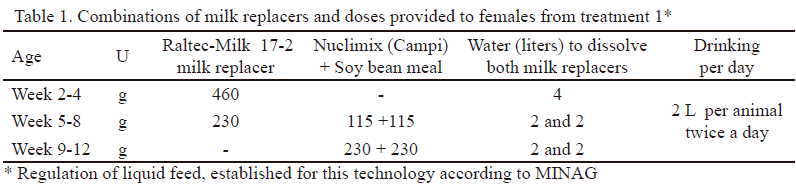
<body><![CDATA[<p align="justify" class="Cuerpodetexto" style="margin-top:12.0pt;text-indent:0cm;"><span style="font-family:'Verdana','sans-serif'; font-size:10.0pt; color:windowtext; ">This study was conducted at the artificial  rearing unit 246,&nbsp; with 50.39 ha of  surface, belonging to the Unidad Empresarial de Base (UEB) &ldquo;Loma de Candelaria&rdquo;  from Empresa Pecuaria Gen&eacute;tica &ldquo;Camilo Cienfuegos&rdquo;, located at southeast of  Pinar del R&iacute;o province, Cuba.</span></p>     <p align="justify" class="Cuerpodetexto" style="margin-top:12.0pt;text-indent:0cm;"><span style="font-family:'Verdana','sans-serif'; font-size:10.0pt; color:windowtext; ">An amount of 30 Siboney de Cuba female  calves were used. These animals were born in December, 2013, and were between 7  and 9 d old at their arrival to the rearing unit. The number of their tattoo  and ear tag was individually controlled and they were weighed in a DI-162 Model  (Digital) scale, according to the method of weighing technique established by  the Cuban regulations (NC 74 - 49). Later, these animals were randomly divided  into two groups (15 animals each) and were located in previously cleaned and disinfected  individual cribs, with free access to water and long hay at will, starting from  30 d.</span></p>     <p align="justify" class="Cuerpodetexto" style="margin-top:12.0pt;text-indent:0cm;"><span style="font-family:'Verdana','sans-serif'; font-size:10.0pt; color:windowtext; ">During all the studied stage, hay was  produced in the same unit, from the hand-made reaping of pangola (<em>Digitaria  decumbens</em>) and star grass (<em>Cynodon nlemfuensis</em>). For the  experimental development, four types of milk replacers were used, and soybean  meal for completing one of the used formulations. Combinations of milk  replacers, as well as doses provided to females per treatment are described in  <a href="/img/revistas/cjas/v50n3/t0103316.gif">tables 1</a> and <a href="/img/revistas/cjas/v50n3/t0203316.gif">2</a>. </span></p>     
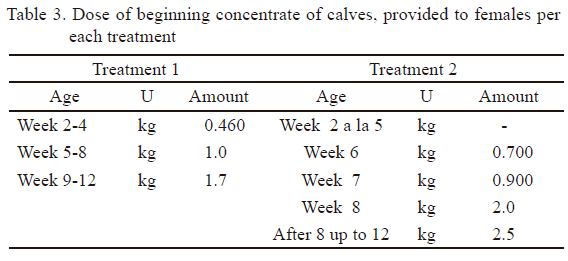
<p align="justify" class="Cuerpodetexto" style="margin-top:12.0pt;text-indent:0cm;"><span style="font-family:'Verdana','sans-serif'; font-size:10.0pt; color:windowtext; ">Milk replacer was prepared in aluminum  containers of 20 L, which were poured hot water between 45 and 50 &ordm;C, from a  solar heater installed at the unit. The water was mixed with the amounts of  milk replacer designed for each stage. Later, liquid feed was offered to the  calves at a temperature between 37 and 39 &ordm;C.</span></p>     <p align="justify" class="Cuerpodetexto" style="margin-top:12.0pt;text-indent:0cm;"><span style="font-family:'Verdana','sans-serif'; font-size:10.0pt; color:windowtext; ">Doses of starting concentrate were  also included and the rules established for each stage up to 90 d were used  (<a href="/img/revistas/cjas/v50n3/t0303316.gif">table 3</a>)</span></p>     
<p align="justify" class="Cuerpodetexto" style="margin-top:12.0pt;text-indent:0cm;"><span style="font-family:'Verdana','sans-serif'; font-size:10.0pt; color:windowtext; ">After 30 d, female calves from each  treatment were individually weighed during the first hours of the morning with  their stomach empty. The result of liveweight (LW) was individually controlled.  Weighing procedure was carried out the same way every month, up to 90 d.</span></p>     <p align="justify" class="Cuerpodetexto" style="margin-top:12.0pt;text-indent:0cm;"><span style="line-height:107%; font-family:'Verdana','sans-serif'; font-size:10.0pt; ">For processing all the  obtained data, three non-linear and three linear regression models, which are  most used ones to estimate animal performance, according to Ratkowsky (1983)</span><span style="font-family:'Verdana','sans-serif'; font-size:10.0pt; color:windowtext; ">: </span></p>     <p align="center"><a name="f3"></a></p>     <p align="center"><img src="../img/revistas/cjas/v50n3/f0303316.gif" width="448" height="249" longdesc="/img/revistas/cjas/v50n3/f0303316.gif"></p>     
<p align="justify" class="Cuerpodetexto" style="margin-top:12.0pt;text-indent:0cm;"><span style="line-height:120%; font-family:'Verdana','sans-serif'; font-size:10.0pt; color:windowtext; ">where: </span></p>     ]]></body>
<body><![CDATA[<p align="justify" class="Cuerpodetexto" style="margin-top:12.0pt;text-indent:0cm;"><span style="font-family:'Verdana','sans-serif'; font-size:10.0pt; color:windowtext; ">y = LW or daily mean gain (DMG) </span></p>     <p align="justify" class="Cuerpodetexto" style="margin-top:12.0pt;text-indent:0cm;"><span style="font-family:'Verdana','sans-serif'; font-size:10.0pt; color:windowtext; ">age =animal age</span></p>     <p align="justify" class="Cuerpodetexto" style="margin-top:12.0pt;text-indent:0cm;"><span style="font-family:'Verdana','sans-serif'; font-size:10.0pt; color:windowtext; ">alpha (a), beta (b) and gamma (c) =  parameters</span></p>     <p align="justify" class="Cuerpodetexto" style="margin-top:12.0pt;text-indent:0cm;"><span style="line-height:120%; letter-spacing:.2pt; font-family:'Verdana','sans-serif'; font-size:10.0pt; color:windowtext; ">Parameter  estimations were determined by the method of least squares, in the case of  linear regression, and by the iterative method of Marquardt (1963), for the  non-linear models (Logistic, Gompertz and Richards). </span><span style="font-family:'Verdana','sans-serif'; font-size:10.0pt; color:windowtext; "> </span></p>     <p align="justify" class="Cuerpodetexto" style="margin-top:12.0pt;text-indent:0cm;"><span style="font-family:'Verdana','sans-serif'; font-size:10.0pt; color:windowtext; ">Statistical  criteria for selecting the model of the best fit were performed according to  indicators described by Guerra <em>et al.</em> (2003) and Fern&aacute;ndez (2004):</span><span style="font-family:'Verdana','sans-serif'; font-size:10.0pt; color:windowtext; "> </span></p>     <p align="justify" class="Cuerpodetexto" style="margin-top:12.0pt;text-indent:0cm;"><span style="font-family:'Verdana','sans-serif'; font-size:10.0pt; color:windowtext; ">1.&nbsp;&nbsp;&nbsp;&nbsp;&nbsp;&nbsp; Determination  coefficient (R<sup>2</sup>)</span></p>     <p align="justify" class="Cuerpodetexto" style="margin-top:12.0pt;text-indent:0cm;"><span style="font-family:'Verdana','sans-serif'; font-size:10.0pt; color:windowtext; ">2.&nbsp;&nbsp;&nbsp;&nbsp;&nbsp;&nbsp; Parameters  of models (a, b, c)</span></p>     <p align="justify" class="Cuerpodetexto" style="margin-top:12.0pt;text-indent:0cm;"><span style="font-family:'Verdana','sans-serif'; font-size:10.0pt; color:windowtext; ">3.&nbsp;&nbsp;&nbsp;&nbsp;&nbsp;&nbsp; Mean  square of the error (MSe)</span></p>     <p align="justify" class="Cuerpodetexto" style="margin-top:12.0pt;text-indent:0cm;"><span style="font-family:'Verdana','sans-serif'; font-size:10.0pt; color:windowtext; ">4.&nbsp;&nbsp;&nbsp;&nbsp;&nbsp;&nbsp; Standard  error of model parameters SE(a), SE(b), SE(c)</span></p>     <p align="justify" class="Cuerpodetexto" style="margin-top:12.0pt;text-indent:0cm;"><span style="font-family:'Verdana','sans-serif'; font-size:10.0pt; color:windowtext; ">5.&nbsp;&nbsp;&nbsp;&nbsp;&nbsp;&nbsp; Model  significance </span></p>     ]]></body>
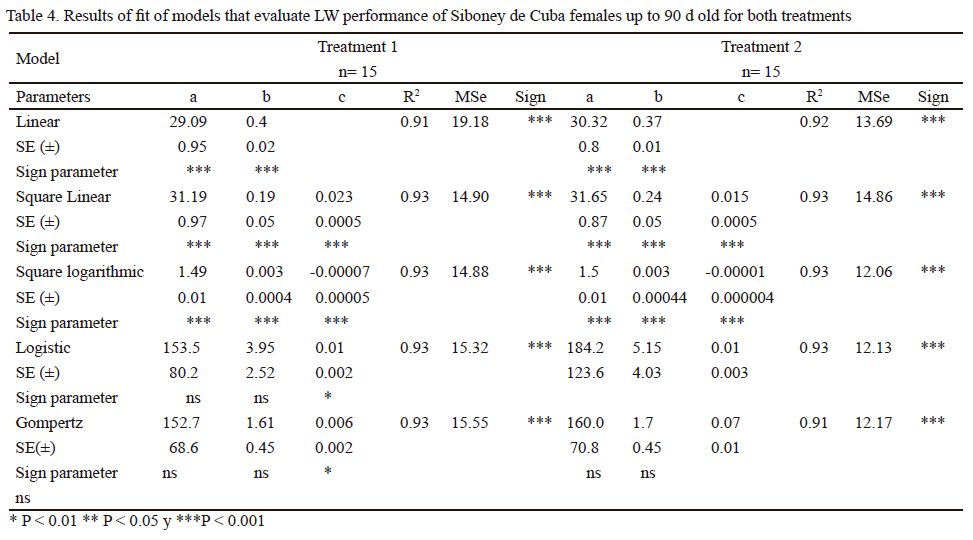
<body><![CDATA[<p align="justify" class="Cuerpodetexto" style="margin-top:12.0pt;text-indent:0cm;"><span style="font-family:'Verdana','sans-serif'; font-size:10.0pt; color:windowtext; ">6.&nbsp;&nbsp;&nbsp;&nbsp;&nbsp;&nbsp; Residual  Analysis</span></p>     <p align="justify" class="Cuerpodetexto" style="margin-top:12.0pt;text-indent:0cm;"><span style="font-family:'Verdana','sans-serif'; font-size:10.0pt; color:windowtext; ">Gathered information was processed by  the statistical package SPSS, version 11.5.1 (Visauta 1998, IBM Corporation  2003). For evaluating liveweights and daily mean gains, the multiple range test  of Duncan (1955) was also used, which allowed the comparison between treatments  by Infostat package, version 1.0 (Di Rienzo <em>et al.</em> 2001).</span></p>     <p align="justify" class="subtitulo" style="margin-top:12.0pt;margin-right:0cm;margin-bottom:.0001pt;margin-left:0cm;text-align:justify;"><span style="font-family:'Verdana','sans-serif'; font-size:10.0pt; color:windowtext; ">&nbsp;</span></p>     <p align="justify" class="subtitulo" style="margin-top:12.0pt;margin-right:0cm;margin-bottom:.0001pt;margin-left:0cm;text-align:justify;"><span style="line-height:120%; font-family:'Verdana','sans-serif'; font-size:13.0pt; color:windowtext; "><b>RESULTS AND DISCUSSION</b> </span></p>     <p align="justify" class="Cuerpodetexto" style="margin-top:12.0pt;text-indent:0cm;"><span style="font-family:'Verdana','sans-serif'; font-size:10.0pt; color:windowtext; ">Growth modeling with application of  linear and non-linear models to developing females (up to 90 d), fed different  combinations of milk replacers, was based on the descriptive analysis of what  happened at this growth stage in two feeding systems used in artificial  rearing.</span></p>     <p align="justify" class="Cuerpodetexto" style="margin-top:12.0pt;text-indent:0cm;"><span style="font-family:'Verdana','sans-serif'; font-size:10.0pt; color:windowtext; ">Evaluating growth (up to weaning age)  of Siboney de Cuba females, at this important stage, allows to predict the  performance of LW developments at early ages. In addition, it also allows to  evaluate biologically important parameters in a stage considered as slow growth  stage during the life of bovines, in which significant physiological changes  within their digestive system occur. These changes depend, in a large extent,  on the used feeding systems. </span></p>     <p align="justify" class="Cuerpodetexto" style="margin-top:12.0pt;text-indent:0cm;"><span style="font-family:'Verdana','sans-serif'; font-size:10.0pt; color:windowtext; ">Among the evaluated models (linear and  non-linear), Richards model was discarded because it showed no significant fit  in LW.</span></p>     <p align="justify" class="Cuerpodetexto" style="margin-top:12.0pt;text-indent:0cm;"><span style="font-family:'Verdana','sans-serif'; font-size:10.0pt; color:windowtext; ">By comparing the fit of models that  evaluate LW performance in Siboney de Cuba females, up to 90 d old for both  treatments (<a href="/img/revistas/cjas/v50n3/t0403316.gif">table 4</a>), it was demonstrated that all showed a very good fit,  because of the flexibility they have (Arias <em>et al.</em> 2010), with high and  similar determination coefficients (R<sup>2</sup>), indicating good precision  in estimated liveweights.</span></p>     
<p align="justify" class="Cuerpodetexto" style="margin-top:12.0pt;text-indent:0cm;"><span style="font-family:'Verdana','sans-serif'; font-size:10.0pt; color:windowtext; ">Although all models show high R<sup>2</sup> fit and differed among them (P &lt;0.001) for the linear model (treatment 1)  and Gompertz (treatment 2) (<a href="/img/revistas/cjas/v50n3/t0203316.gif">Table 2</a>), these presented the lowest coefficients  with 0.91. However, for the other models, R<sup>2</sup> values, in both  treatments, had the best fit, with 0.93 and differ among them (P &lt;0.001).  Similar results were obtained by Robert-Grani&eacute; <em>et al.</em> (2002), Mej&iacute;as  (2008) and Alonso <em>et al.</em> (2014) in R<sup>2 </sup>fit, describing growth  curves in cattle. These authors agree to inform, as in this study, linear  growth in certain phases of the curve.</span></p>     
<p align="justify" class="Cuerpodetexto" style="margin-top:12.0pt;text-indent:0cm;"><span style="font-family:'Verdana','sans-serif'; font-size:10.0pt; color:windowtext; ">For selecting the best fit model, MSe  is another statistical criterion to consider. In both treatments, the square  logarithmic model showed lower values than the rest of the tested models, with  values of 14.88 and 12.86, respectively. This allowed to estimate, with more  precision, the effects of studied factors and, in turn, explain the existence  of a lower variance in LW analysis, which is similar to that described by de  Freitas (2005) and Alonso (2015). This result expresses, to a large extent, the  variability of liveweights of females until the age at weaning at each  weighing. Likewise, it also allows the selection of this model as the one with  the best goodness of fit for both treatments.</span></p>     ]]></body>
<body><![CDATA[<p align="justify" class="Cuerpodetexto" style="margin-top:12.0pt;text-indent:0cm;"><span style="font-family:'Verdana','sans-serif'; font-size:10.0pt; color:windowtext; ">After fitting the model, residuals  were calculated (<a href="/img/revistas/cjas/v50n3/f0103316.gif">figure 1</a>), which, according to Torres <em>et al.</em> (2012), is  an essential procedure for knowing their general performance and determining whether  there is a underestimation or overestimation at any part of growth models  (Fabens 1965).</span></p>     
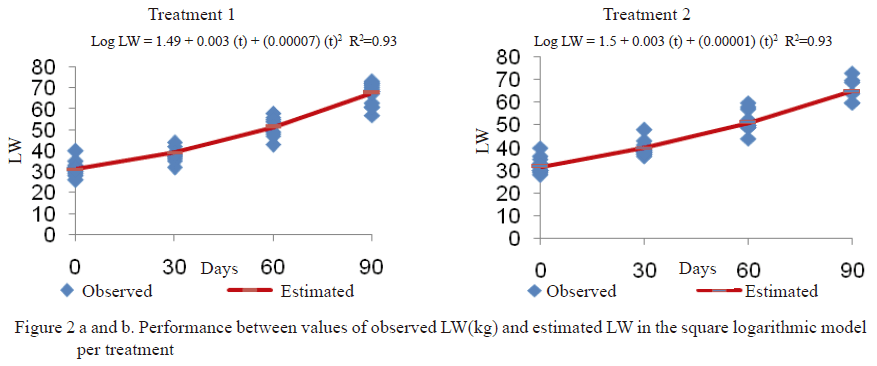
<p align="justify" class="Cuerpodetexto" style="margin-top:12.0pt;text-indent:0cm;"><span style="line-height:120%; letter-spacing:.1pt; font-family:'Verdana','sans-serif'; font-size:10.0pt; color:windowtext; ">Dispersion range  of residuals in both treatments was between 0.1 and -0.1, with higher  concentration between 0.05 and -0.05, indicating good accuracy in the observed  liveweights. For females of treatment 2, fitted weights showed lower  dispersion, especially at 60 and 90 d, which is related to the little  difference found between the weights observed in both weighings and liveweights  calculated by the model fitted for a similar stage. In general, for both  treatments, performance of residuals for the model of best fit was random,  which is similar to results reported by Alonso (2015) for the same stage.</span></p>     <p align="justify" class="Cuerpodetexto" style="margin-top:12.0pt;text-indent:0cm;"><span style="font-family:'Verdana','sans-serif'; font-size:10.0pt; color:windowtext; ">In the analysis of model parameters,  parameter a of the square logarithmic model showed that the value reached for  treatment 1 was 1.49, while for treatment 2, it showed similar results with 1.5  (P &lt;0.001), and least standard errors for both cases up to weaning age.  These results are indicators of development to reach the asymptotic weight of  the female under study. However, it cannot be stated that these are the ones  that predict mean weight with which females reach maturity, because she still  has a long period of growth and development to evaluate.</span></p>     <p align="justify" class="Cuerpodetexto" style="margin-top:12.0pt;text-indent:0cm;"><span style="font-family:'Verdana','sans-serif'; font-size:10.0pt; color:windowtext; ">For parameter b of  the selected model, results for both treatments presented the same values  (0.003) of high significance and low standard errors, which is related to the  LW at birth, being very similar, because females of treatment 1 had a mean LW  of 31.8 kg, while those from the second treatment had    31.5 kg. </span><span style="font-family:'Verdana','sans-serif'; font-size:10.0pt; color:windowtext; "> </span></p>     <p align="justify" class="Cuerpodetexto" style="margin-top:12.0pt;text-indent:0cm;"><span style="font-family:'Verdana','sans-serif'; font-size:10.0pt; color:windowtext; ">Finally, the  parameter c of the selected model indicates values of -0.00007 and SE 0.00005  of high significance for females of treatment 1, while females of treatment 2,  with -0.00001 and SE 0.00004, show similar and highly significant values in  this parameter. These results refer to an adequate growth speed for females in  both treatments, although much better for those of treatment 2, in a phase in  which bovines grows more slowly, in correspondence with reports of Torres <em>et  al.</em> (2012) and Alonso (2015),who state that animals with high growth values  represent an early maturity, compared to those of similar initial    weight.</span></p>     <p align="justify" class="Cuerpodetexto" style="margin-top:12.0pt;text-indent:0cm;"><span style="font-family:'Verdana','sans-serif'; font-size:10.0pt; color:windowtext; ">In <a href="/img/revistas/cjas/v50n3/f0203316.gif">figure 2 a and  b</a>, the performance between observed LW values and estimated LW of the square  logarithmic model, for both treatments, was similar, for each studied cases,  which confirms the correct model selection. This result coincides with studies  of Guerra <em>et al.</em> (2003), Mej&iacute;as (2008), Alonso <em>et al.</em> (2014), and  Alonso (2015) regarding the goodness of fit of linear models to express the  standard growth curve in the early stages of any living organism.</span></p>     
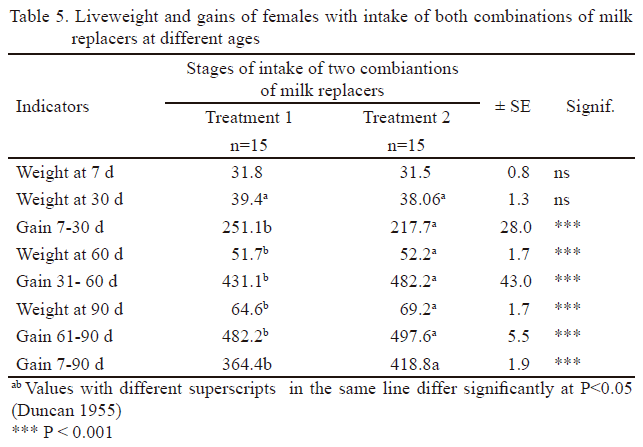
<p align="justify" class="Cuerpodetexto" style="margin-top:12.0pt;text-indent:0cm;"><span style="font-family:'Verdana','sans-serif'; font-size:10.0pt; color:windowtext; ">Although females  from treatment 1 showed a good fit in observed and estimated LW values,  treatment 2, from the second month of life, marked a favorable difference of  observed weights with higher variability. The same happened in this treatment  at 90 d of    age.</span></p>     <p align="justify" class="Cuerpodetexto" style="margin-top:12.0pt;text-indent:0cm;"><span style="font-family:'Verdana','sans-serif'; font-size:10.0pt; color:windowtext; ">This may be  related to 2.5 kg of concentrate, provided to females from treatment 2 after  week 8, which, joined to intake of certain level of fiber (hay) at will, may  contribute to a better assimilation of ration and the best use of nutrient  content of solid feeds. Ruminants, as poly-gastric animals, start to ingest  these feeds after the sixth week of age (Plaza and Ybalmea 2008), if it is  compared with 1.7 kg of concentrate supplied to females for the same stage,  together with the offering of certain level of fiber (hay) at will and the  liquid diet was maintained up to week 12, including 230 g of soybean meal,  which is difficult to assimilate by the calf at this stage. </span><span style="font-family:'Verdana','sans-serif'; font-size:10.0pt; color:windowtext; "> </span></p>     <p align="justify" class="Cuerpodetexto" style="margin-top:12.0pt;text-indent:0cm;"><span style="font-family:'Verdana','sans-serif'; font-size:10.0pt; color:windowtext; ">The previous  explanation, together with the supply of RaltecMilk-17-1 and RaltecStar T-1 to  females from treatment 2, from the second to the seventh week, allowed the  earliest weaning in this group, and daily mean gains of 482.22 g/d in the  second month of life and 497.61 g/d in the third (<a href="/img/revistas/cjas/v50n3/t0503316.gif">table 5</a>). These values were  superior to the gains obtained in treatment 1. As a consequence, next to the  third month of age (84 d), calves could double the LW they were born with, which  corresponds to the stated Johnson (1996) and Ybalmea <em>et al.</em> (2013).</span></p>     
<p align="justify" class="Cuerpodetexto" style="margin-top:12.0pt;text-indent:0cm;"><span style="font-family:'Verdana','sans-serif'; font-size:10.0pt; color:windowtext; "><a href="/img/revistas/cjas/v50n3/t0503316.gif">Table 5</a> shows LW  and gains of females with intake of both combinations of milk replacers at  different ages during the experimental period. LW of females, from 7 to 30 d of  the experimental period, had no significant differences among treatments. After  this stage, females from treatment 1 are disadvantaged regarding those from  treatment 2, with inferior weights in each weighing, which differed (P  &lt;0.001) between them at 60 and 90 d. These results are related to  characteristics and presentation of combined feeds offered in the second  treatment. According Stobo <em>et al.</em> (1966, cit. by Guerreiro 1991) and  Lesmeister and Heinrichs (2004), the inclusion of amounts of beginning  concentrate, together with fiber intake (long hay, offered at will), improves  ruminal and reticular capacity, may increase the weight of tissues, and exerts  a physical stimulation in the early development of digestive tract in a complex  stage for the improvement of calf gastrointestinal system, especially near 60 d  old, corresponding to results of Plaza and Ybalmea (2008).</span></p>     
]]></body>
<body><![CDATA[<p align="justify" class="Cuerpodetexto" style="margin-top:12.0pt;text-indent:0cm;"><span style="font-family:'Verdana','sans-serif'; font-size:10.0pt; color:windowtext; ">The DMG up to 30 d  differ among treatments (P &lt;0.001) and were better in the females from  treatment 1 regarding those from 2, because of the presence of a calf with  gastro-enteric disorders in this    treatment. </span></p>     <p align="justify" class="Cuerpodetexto" style="margin-top:12.0pt;text-indent:0cm;"><span style="font-family:'Verdana','sans-serif'; font-size:10.0pt; color:windowtext; ">In the second and  third month, the DMG obtained in treatment 2 were superior to 450 g/d,  confirming the efficiency of feed conversion, which was offered through the  used combinations. Although calves, due to their natural and physiological  condition, do not like to consume dry feeds at early ages (Ybalmea    2011). Animals will accept better this feed if it is palatable and has  granulated appearance. This contributes to increased ruminal fermentation from  very early ages (Plaza 1983, Chongo <em>et al.</em> 2013), with good efficiency,  reflected on high LW increase indexes.</span></p>     <p align="justify" class="Cuerpodetexto" style="margin-top:12.0pt;text-indent:0cm;"><span style="font-family:'Verdana','sans-serif'; font-size:10.0pt; color:windowtext; ">Responses of calves from treatment 1  could be associate to the presence of soybean meal in the feed offered during  the first stage of life. It is known that meal is difficult to assimilate by  the calf after the first month of birth, due to its possible antitrypsic and  antigenic effect, and to the limited availability of intestinal amylase,  vegetable oils and fats, which are the worst used by calves, according to  Toullec <em>et al.</em> (1975, 1994) and Ybalmea (2011).<span style="letter-spacing:.2pt; "> </span></span></p>     <p align="justify" class="Cuerpodetexto" style="margin-top:12.0pt;text-indent:0cm;"><span style="font-family:'Verdana','sans-serif'; font-size:10.0pt; color:windowtext; ">It may be  concluded that, among linear models, the square logarithmic had the best fit to  express growth curves up to 90 d of age in Siboney of Cuba females, regardless  of the use of different milk replacers, and of the combination of RaltecMilk  17-1 with RaltecStar T-1 obtained more favorable DMG from 30 to    90 d after birth. These values were very close to the    500 g/animal/d, and 69.2 kg of mean LW up to weaning, with respect to the use of  the combination of Raltec-Milk 17-2 and Nuclimix (Campi) plus soybean    meal.</span></p>     <p align="justify" class="Cuerpodetexto" style="margin-top:12.0pt;text-indent:0cm;"><span style="line-height:107%; letter-spacing:.2pt; font-family:'Verdana','sans-serif'; font-size:10.0pt; ">Thanks  to the Empresa Pecuaria Gen&eacute;tica &ldquo;Camilo Cienfuegos&rdquo;, to workers of the  artificial rearing unit 246 to allow the completion of the research pr</span><span style="line-height:107%; font-family:'Verdana','sans-serif'; font-size:10.0pt; ">ocess and to the Department of Biomathematics from the Institute of Animal  Science for their help in data processing</span><span style="font-family:'Verdana','sans-serif'; font-size:10.0pt; color:windowtext; ">.</span></p>     <p align="justify" class="Cuerpodetexto" style="margin-top:12.0pt;text-indent:0cm;"><span style="font-family:'Verdana','sans-serif'; font-size:10.0pt; color:windowtext; ">&nbsp;</span></p>     <p align="justify" class="subtitulo" style="margin-top:12.0pt;margin-right:0cm;margin-bottom:.0001pt;margin-left:0cm;text-align:justify;"><span style="font-family:'Verdana','sans-serif'; font-size:13.0pt; color:windowtext; "><b>REFERENCES</b></span></p>     <p align="justify" class="referencias" style="margin-top:12.0pt;margin-right:0cm;margin-bottom:.0001pt;margin-left:0cm;text-indent:0cm;"><span style="font-family:'Verdana','sans-serif'; font-size:10.0pt; color:windowtext; ">Alonso, A. C. 2015. Factores que afectan los indicadores de eficiencia en  la producci&oacute;n de hembras en desarrollo Siboney de Cuba hasta primera  lactancia,&nbsp; en la U.E.B &quot;Loma de  Candelaria&quot;. Ph.D. Thesis, Instituto de Ciencia Animal, Mayabeque, Cuba,  110 p.</span></p>     <p align="justify" class="referencias" style="margin-top:12.0pt;margin-right:0cm;margin-bottom:.0001pt;margin-left:0cm;text-indent:0cm;"><span style="font-family:'Verdana','sans-serif'; font-size:10.0pt; color:windowtext; ">Alonso, &Aacute;. C., Chongo, B., Zamora, A., Torres, V., Noda, A. C. &amp;  Acosta, F. 2014. </span><span style="font-family:'Verdana','sans-serif'; font-size:10.0pt; color:windowtext; ">&ldquo;Growth curves of developing Siboney de Cuba females, up to  18 months old&rdquo;. </span><span style="font-family:'Verdana','sans-serif'; font-size:10.0pt; color:windowtext; ">Cuban Journal of Agricultural Science,  48(3): 227&ndash;234.</span></p>     <p align="justify" class="referencias" style="margin-top:12.0pt;margin-right:0cm;margin-bottom:.0001pt;margin-left:0cm;text-indent:0cm;"><span style="font-family:'Verdana','sans-serif'; font-size:10.0pt; color:windowtext; ">Arias, Y., Gonzales, P. D., Montes, I. &amp; Dom&iacute;nguez, A. 2010. &ldquo;Estimaci&oacute;n  de la curva de crecimiento en futuros sementales de la raza buffalypso&rdquo;.  Ciencia y Tecnolog&iacute;a Ganadera, 4(3): 136&ndash;142, ISSN: 1999-4494, 1998-3050.</span></p>     ]]></body>
<body><![CDATA[<p align="justify" class="referencias" style="margin-top:12.0pt;margin-right:0cm;margin-bottom:.0001pt;margin-left:0cm;text-indent:0cm;"><span style="font-family:'Verdana','sans-serif'; font-size:10.0pt; color:windowtext; ">Chongo, B., Zamora, A., Mart&iacute;nez, Y. &amp; Alonso, A. 2013. &ldquo;Actualidad y  perspectivas de la crianza de terneros. Retos para el tr&oacute;pico&rdquo;. In: IV Congreso  Internacional de Producci&oacute;n Animal, Cuba: Instituto de Ciencia Animal, p. 2102,  ISBN: 978-959-7171-49-2.</span></p>     <p align="justify" class="referencias" style="margin-top:12.0pt;margin-right:0cm;margin-bottom:.0001pt;margin-left:0cm;text-indent:0cm;"><span style="font-family:'Verdana','sans-serif'; font-size:10.0pt; color:windowtext; ">de Freitas, A. R. 2005. &ldquo;Curvas de crescimento na produ&ccedil;&atilde;o animal&rdquo;. Revista  Brasileira de Zootecnia, 34(3), ISSN: 1516-3598, DOI:  10.1590/S1516-35982005000300010.</span></p>     <!-- ref --><p align="justify" class="referencias" style="margin-top:12.0pt;margin-right:0cm;margin-bottom:.0001pt;margin-left:0cm;text-indent:0cm;"><span style="font-family:'Verdana','sans-serif'; font-size:10.0pt; color:windowtext; ">Di Rienzo, J. A., Casanoves, F., Balzarini, M. G., Gonz&aacute;lez, L., Tablada,  M. &amp; Robledo, C. W. 2001. InfoStat. version 2001, [Windows], Universidad  Nacional de C&oacute;rdoba, Argentina: Grupo InfoStat, Available:  &lt;<a href="http://www.infostat.com.ar/" target="_blank">http://www.infostat.com.ar/</a>&gt;    .</span></p>     <p align="justify" class="referencias" style="margin-top:12.0pt;margin-right:0cm;margin-bottom:.0001pt;margin-left:0cm;text-indent:0cm;"><span style="font-family:'Verdana','sans-serif'; font-size:10.0pt; color:windowtext; ">Duncan,  D. B. 1955. &ldquo;Multiple Range and Multiple F Tests&rdquo;. Biometrics, 11(1): 1&ndash;42,  ISSN: 0006-341X, DOI: 10.2307/3001478.</span></p>     <p align="justify" class="referencias" style="margin-top:12.0pt;margin-right:0cm;margin-bottom:.0001pt;margin-left:0cm;text-indent:0cm;"><span style="font-family:'Verdana','sans-serif'; font-size:10.0pt; color:windowtext; ">Fabens,  A. J. 1965. &ldquo;Properties and fitting of the Von Bertalanffy growth curve&rdquo;. </span><span style="font-family:'Verdana','sans-serif'; font-size:10.0pt; color:windowtext; ">Growth, 29(3): 265&ndash;289, ISSN: 0017-4793.</span></p>     <p align="justify" class="referencias" style="margin-top:12.0pt;margin-right:0cm;margin-bottom:.0001pt;margin-left:0cm;text-indent:0cm;"><span style="font-family:'Verdana','sans-serif'; font-size:10.0pt; color:windowtext; ">Fern&aacute;ndez, L. 2004. Modelos Estad&iacute;sticos&ndash;Matem&aacute;ticos en el an&aacute;lisis de la  curva de lactancia y factores que afectan en el genotipo Siboney de Cuba. Ph.D.  Thesis, Universidad Agraria de La Habana, La Habana, Cuba, 113 p.</span></p>     <!-- ref --><p align="justify" class="referencias" style="margin-top:12.0pt;margin-right:0cm;margin-bottom:.0001pt;margin-left:0cm;text-indent:0cm;"><span style="font-family:'Verdana','sans-serif'; font-size:10.0pt; color:windowtext; ">Gregorich, J. 1992. Comportamiento de la actividad estral y la fertilidad  en reba&ntilde;os Siboney. Graduated Thesis, Universidad de Granma, Granma, Cuba, 72  p.    </span></p>     <p align="justify" class="referencias" style="margin-top:12.0pt;margin-right:0cm;margin-bottom:.0001pt;margin-left:0cm;text-indent:0cm;"><span style="font-family:'Verdana','sans-serif'; font-size:10.0pt; color:windowtext; ">Guerra, C. W., Cabrera, A. &amp; Fern&aacute;ndez, L. 2003. </span><span style="font-family:'Verdana','sans-serif'; font-size:10.0pt; color:windowtext; ">&ldquo;Criteria  for the selection of statistical models in scientific research&rdquo;. </span><span style="font-family:'Verdana','sans-serif'; font-size:10.0pt; color:windowtext; ">Cuban Journal of Agricultural Science, 37(1): 3&ndash;10, ISSN: 2079-3480.</span></p>     ]]></body>
<body><![CDATA[<!-- ref --><p align="justify" class="referencias" style="margin-top:12.0pt;margin-right:0cm;margin-bottom:.0001pt;margin-left:0cm;text-indent:0cm;"><span style="font-family:'Verdana','sans-serif'; font-size:10.0pt; color:windowtext; ">Guerreiro, R. 1991. Factores que influyen en el comportamiento en la recr&iacute;a  Anacaona, de la Empresa Pecuaria Gen&eacute;tica Bacuranao. Graduated Thesis,  Universidad Agraria de La Habana, La Habana, Cuba, 84 p.    </span></p>     <p align="justify" class="referencias" style="margin-top:12.0pt;margin-right:0cm;margin-bottom:.0001pt;margin-left:0cm;text-indent:0cm;"><span style="font-family:'Verdana','sans-serif'; font-size:10.0pt; color:windowtext; ">IBM  Corporation 2003. IBM SPSS Statistics. version 11.5, [Windows], U.S: IBM  Corporation, Available: &lt;<a href="http://www.ibm.com" target="_blank">http://www.ibm.com</a>&gt;.</span></p>     <p align="justify" class="referencias" style="margin-top:12.0pt;margin-right:0cm;margin-bottom:.0001pt;margin-left:0cm;text-indent:0cm;"><span style="font-family:'Verdana','sans-serif'; font-size:10.0pt; color:windowtext; ">Johnson,  E. R. 1996. &ldquo;Neonatal growth and development of the bovine stomach&rdquo;. Animal  Production in Australia, 21: 211&ndash;214, ISSN: 0728-5965.</span></p>     <p align="justify" class="referencias" style="margin-top:12.0pt;margin-right:0cm;margin-bottom:.0001pt;margin-left:0cm;text-indent:0cm;"><span style="font-family:'Verdana','sans-serif'; font-size:10.0pt; color:windowtext; ">Lesmeister,  K. E. &amp; Heinrichs, A. J. 2004. &ldquo;Effects of Corn Processing on Growth  Characteristics, Rumen Development, and Rumen Parameters in Neonatal Dairy  Calves&rdquo;. Journal of Dairy Science, 87(10): 3439&ndash;3450, ISSN: 0022-0302, DOI:  10.3168/jds.S0022-0302 (04)73479-7.</span></p>     <!-- ref --><p align="justify" class="referencias" style="margin-top:12.0pt;margin-right:0cm;margin-bottom:.0001pt;margin-left:0cm;text-indent:0cm;"><span style="font-family:'Verdana','sans-serif'; font-size:10.0pt; color:windowtext; ">L&oacute;pez,  D. 1983. </span><span style="font-family:'Verdana','sans-serif'; font-size:10.0pt; color:windowtext; ">Caracter&iacute;sticas de la poblaci&oacute;n base de un nuevo genotipo  lechero tropical: El Siboney de Cuba. Ph.D. Thesis, Instituto Superior de  Ciencias Agropecuarias de La Habana&nbsp;  &laquo;Fructuoso Rodr&iacute;guez P&eacute;rez&raquo;, La Habana, Cuba, 221 p.    </span></p>     <p align="justify" class="referencias" style="margin-top:12.0pt;margin-right:0cm;margin-bottom:.0001pt;margin-left:0cm;text-indent:0cm;"><span style="font-family:'Verdana','sans-serif'; font-size:10.0pt; color:windowtext; ">Marquardt,  D. W. 1963. &ldquo;An Algorithm for Least-Squares Estimation of Nonlinear  Parameters&rdquo;. Journal of the Society for Industrial and Applied Mathematics,  11(2): 431&ndash;441, ISSN: 0368-4245, 2168-3484, DOI: 10.1137/0111030.</span></p>     <!-- ref --><p align="justify" class="referencias" style="margin-top:12.0pt;margin-right:0cm;margin-bottom:.0001pt;margin-left:0cm;text-indent:0cm;"><span style="font-family:'Verdana','sans-serif'; font-size:10.0pt; color:windowtext; ">Mej&iacute;as, R. A. 2008. Sistema para la producci&oacute;n de hembras bovinas de  reposici&oacute;n con asociaci&oacute;n de gram&iacute;neas con leguminosas. Ph.D. Thesis, Instituto  de Ciencia Animal, La Habana, Cuba, 108 p.    </span></p>     ]]></body>
<body><![CDATA[<!-- ref --><p align="justify" class="referencias" style="margin-top:12.0pt;margin-right:0cm;margin-bottom:.0001pt;margin-left:0cm;text-indent:0cm;"><span style="font-family:'Verdana','sans-serif'; font-size:10.0pt; color:windowtext; ">Plaza, J. 1983. Efecto del alimento fibroso en el comportamiento y  desarrollo ruminal de los terneros. Ph.D. Thesis, Instituto de Ciencia Animal,  La Habana, Cuba, 201 p.    </span></p>     <p align="justify" class="referencias" style="margin-top:12.0pt;margin-right:0cm;margin-bottom:.0001pt;margin-left:0cm;text-indent:0cm;"><span style="font-family:'Verdana','sans-serif'; font-size:10.0pt; color:windowtext; ">Plaza,  J. &amp; Ybalmea, R. 2008. &ldquo;Effect of whole milk and milk replacers on the  behavior of replacement female calves&rdquo;. Cuban Journal of Agricultural Science,  42(4): 351&ndash;354, ISSN: 2079-3480.</span></p>     <!-- ref --><p align="justify" class="referencias" style="margin-top:12.0pt;margin-right:0cm;margin-bottom:.0001pt;margin-left:0cm;text-indent:0cm;"><span style="font-family:'Verdana','sans-serif'; font-size:10.0pt; color:windowtext; ">Ratkowsky,  D. A. 1983. Nonlinear regression modeling: a unified practical approach. (ser.  Statistics, textbooks and monographs, no. ser. 48), New York: M. Dekker, 276  p., ISBN: 978-0-8247-1907-4.    </span></p>     <p align="justify" class="referencias" style="margin-top:12.0pt;margin-right:0cm;margin-bottom:.0001pt;margin-left:0cm;text-indent:0cm;"><span style="font-family:'Verdana','sans-serif'; font-size:10.0pt; color:windowtext; ">Robert-Grani&eacute;,  C., Heude, B. &amp; Foulley, J. L. 2002. &ldquo;Modelling the growth curve of  Maine-Anjou beef cattle using heteroskedastic random coefficients models&rdquo;.  Genetics Selection Evolution, 34(4): 423, ISSN: 1297-9686, DOI:  10.1186/1297-9686-34-4-423.</span></p>     <p align="justify" class="referencias" style="margin-top:12.0pt;margin-right:0cm;margin-bottom:.0001pt;margin-left:0cm;text-indent:0cm;"><span style="font-family:'Verdana','sans-serif'; font-size:10.0pt; color:windowtext; ">Stobo,  I. J., Roy, J. H. &amp; Gaston, H. J. 1966. &ldquo;Rumen development in the calf. 1.  The effect of diets containing different proportions of concentrates to hay on  rumen development&rdquo;. The British Journal of Nutrition, 20(2): 171&ndash;188, ISSN:  0007-1145.</span></p>     <p align="justify" class="referencias" style="margin-top:12.0pt;margin-right:0cm;margin-bottom:.0001pt;margin-left:0cm;text-indent:0cm;"><span style="font-family:'Verdana','sans-serif'; font-size:10.0pt; color:windowtext; ">Torres,  V., Barbosa, I., Meyer, R., Noda, A. &amp; Sarduy, L. 2012. &ldquo;Criteria of  goodness of fit test in the selection of non-linear models for the description  of biological performances&rdquo;. Cuban Journal of Agricultural Science, 46(4):  345&ndash;350, ISSN: 2079-3480. </span></p>     <p align="justify" class="referencias" style="margin-top:12.0pt;margin-right:0cm;margin-bottom:.0001pt;margin-left:0cm;text-indent:0cm;"><span style="font-family:'Verdana','sans-serif'; font-size:10.0pt; color:windowtext; ">Toullec,  R., Lall&egrave;s, J. P. &amp; Bouchez, P. 1994. &ldquo;Replacement of skim milk with soya  bean protein concentrates and whey in milk replacers for veal calves&rdquo;. Animal  Feed Science and Technology, 50(1&ndash;2): 101&ndash;112, ISSN: 0377-8401, DOI:  10.1016/0377-8401(94)90012-4.</span></p>     <p align="justify" class="referencias" style="margin-top:12.0pt;margin-right:0cm;margin-bottom:.0001pt;margin-left:0cm;text-indent:0cm;"><span style="font-family:'Verdana','sans-serif'; font-size:10.0pt; color:windowtext; ">Toullec,  R., Patureau-Mirand, P., Thivend, P. &amp; Vermorel, M. 1975. </span><span style="font-family:'Verdana','sans-serif'; font-size:10.0pt; color:windowtext; ">&ldquo;Bases physiologiques de la realisation des aliments d&rsquo;allaitement pour  veaux&rdquo;. Alimentation et la Vie, 63: 70, ISSN: 0065-6267.</span></p>     ]]></body>
<body><![CDATA[<!-- ref --><p align="justify" class="referencias" style="margin-top:12.0pt;margin-right:0cm;margin-bottom:.0001pt;margin-left:0cm;text-indent:0cm;"><span style="font-family:'Verdana','sans-serif'; font-size:10.0pt; color:windowtext; ">Visauta, V. B. 1998. An&aacute;lisis estad&iacute;stico con SPSS para Windows: estad&iacute;stica  multivariante. Madrid, Espa&ntilde;a: McGraw-Hill, 358 p., ISBN: 978-84-481-2074-0.    </span></p>     <!-- ref --><p align="justify" class="referencias" style="margin-top:12.0pt;margin-right:0cm;margin-bottom:.0001pt;margin-left:0cm;text-indent:0cm;"><span style="font-family:'Verdana','sans-serif'; font-size:10.0pt; color:windowtext; ">Ybalmea, R. 2011. Contribuci&oacute;n al uso de reemplazantes lecheros de  producci&oacute;n nacional en la alimentaci&oacute;n de terneros. Ph.D. Thesis, Instituto de  Ciencia Animal, La Habana, Cuba, 143 p.    </span></p>     <p align="justify" class="referencias" style="margin-top:12.0pt;margin-right:0cm;margin-bottom:.0001pt;margin-left:0cm;text-indent:0cm;"><span style="line-height:107%; font-family:'Verdana','sans-serif'; font-size:10.0pt; ">Ybalmea, R., Alonso, A.,  Marrero, D. &amp; Fern&aacute;ndez, L. 2013. &ldquo;Uso de reemplazantes lecheros (RL), en  la crianza artificial de terneros, en condiciones de producci&oacute;n&rdquo;. In: IV  Congreso Internacional de Producci&oacute;n Animal, Cuba: Instituto de Ciencia Animal,  pp. 2108&ndash;2113, ISBN: 978-959-7171-49-2</span><font size="2" face="Verdana, Arial, Helvetica, sans-serif">.</font></p>     <p align="justify">&nbsp;</p>     <p align="justify">&nbsp;</p>     <p align="justify"><font size="2" face="Verdana, Arial, Helvetica, sans-serif">Received: 18/7/2016    <br> Accepted: 28/10/2016</font></p>     <p align="justify">&nbsp;</p>     ]]></body>
<body><![CDATA[<p align="justify">&nbsp;</p>     <p align="justify"><font size="2" face="Verdana, Arial, Helvetica, sans-serif"><i>Á.C. Alonso,</i> Dirección Técnica de Desarrollo. Empresa Pecuaria Genética “Camilo Cienfuegos”. Consolación del Sur,  Pinar del Río, Cuba.    Email: <a href="mailto:elyjorge@nauta.cu">elyjorge@nauta.cu</a></font></p>      ]]></body><back>
<ref-list>
<ref id="B1">
<nlm-citation citation-type="book">
<person-group person-group-type="author">
<name>
<surname><![CDATA[Alonso]]></surname>
<given-names><![CDATA[A. C.]]></given-names>
</name>
</person-group>
<source><![CDATA[]]></source>
<year>2015</year>
<page-range>110</page-range><publisher-loc><![CDATA[Mayabeque, Cuba ]]></publisher-loc>
<publisher-name><![CDATA[Instituto de Ciencia Animal]]></publisher-name>
</nlm-citation>
</ref>
<ref id="B2">
<nlm-citation citation-type="journal">
<person-group person-group-type="author">
<name>
<surname><![CDATA[Alonso]]></surname>
<given-names><![CDATA[Á. C.]]></given-names>
</name>
<name>
<surname><![CDATA[Chongo]]></surname>
<given-names><![CDATA[B.]]></given-names>
</name>
<name>
<surname><![CDATA[Zamora]]></surname>
<given-names><![CDATA[A.]]></given-names>
</name>
<name>
<surname><![CDATA[Torres]]></surname>
<given-names><![CDATA[V.]]></given-names>
</name>
<name>
<surname><![CDATA[Noda]]></surname>
<given-names><![CDATA[A. C.]]></given-names>
</name>
<name>
<surname><![CDATA[Acosta]]></surname>
<given-names><![CDATA[F.]]></given-names>
</name>
</person-group>
<article-title xml:lang="nd"><![CDATA[Curvas de crecimiento de hembras en desarrollo Siboney de Cuba, hasta 18 meses de edad]]></article-title>
<source><![CDATA[Cuban Journal of Agricultural Science]]></source>
<year>2014</year>
<volume>48</volume>
<numero>3</numero>
<issue>3</issue>
<page-range>227–234</page-range></nlm-citation>
</ref>
<ref id="B3">
<nlm-citation citation-type="journal">
<person-group person-group-type="author">
<name>
<surname><![CDATA[Arias]]></surname>
<given-names><![CDATA[Y.]]></given-names>
</name>
<name>
<surname><![CDATA[Gonzales]]></surname>
<given-names><![CDATA[P. D.]]></given-names>
</name>
<name>
<surname><![CDATA[Montes]]></surname>
<given-names><![CDATA[I.]]></given-names>
</name>
<name>
<surname><![CDATA[Domínguez]]></surname>
<given-names><![CDATA[A.]]></given-names>
</name>
</person-group>
<article-title xml:lang="nd"><![CDATA[Estimación de la curva de crecimiento en futuros sementales de la raza buffalypso]]></article-title>
<source><![CDATA[Ciencia y Tecnología Ganadera]]></source>
<year>2010</year>
<volume>4</volume>
<numero>3</numero>
<issue>3</issue>
<page-range>136–142</page-range></nlm-citation>
</ref>
<ref id="B4">
<nlm-citation citation-type="book">
<person-group person-group-type="author">
<name>
<surname><![CDATA[Chongo]]></surname>
<given-names><![CDATA[B.]]></given-names>
</name>
<name>
<surname><![CDATA[Zamora]]></surname>
<given-names><![CDATA[A.]]></given-names>
</name>
<name>
<surname><![CDATA[Martínez]]></surname>
<given-names><![CDATA[Y.]]></given-names>
</name>
<name>
<surname><![CDATA[Alonso]]></surname>
<given-names><![CDATA[A.]]></given-names>
</name>
</person-group>
<article-title xml:lang="nd"><![CDATA[Actualidad y perspectivas de la crianza de terneros. Retos para el trópico]]></article-title>
<source><![CDATA[]]></source>
<year>2013</year>
<page-range>2102</page-range><publisher-loc><![CDATA[Cuba ]]></publisher-loc>
<publisher-name><![CDATA[Instituto de Ciencia Animal]]></publisher-name>
</nlm-citation>
</ref>
<ref id="B5">
<nlm-citation citation-type="journal">
<person-group person-group-type="author">
<name>
<surname><![CDATA[de Freitas]]></surname>
<given-names><![CDATA[A. R.]]></given-names>
</name>
</person-group>
<article-title xml:lang="nd"><![CDATA[Curvas de crescimento na produção animal]]></article-title>
<source><![CDATA[Revista Brasileira de Zootecnia]]></source>
<year>2005</year>
<volume>34</volume>
<numero>3</numero>
<issue>3</issue>
</nlm-citation>
</ref>
<ref id="B6">
<nlm-citation citation-type="book">
<person-group person-group-type="author">
<name>
<surname><![CDATA[Di Rienzo]]></surname>
<given-names><![CDATA[J. A.]]></given-names>
</name>
<name>
<surname><![CDATA[Casanoves]]></surname>
<given-names><![CDATA[F.]]></given-names>
</name>
<name>
<surname><![CDATA[Balzarini]]></surname>
<given-names><![CDATA[M. G.]]></given-names>
</name>
<name>
<surname><![CDATA[González]]></surname>
<given-names><![CDATA[L.]]></given-names>
</name>
<name>
<surname><![CDATA[Tablada]]></surname>
<given-names><![CDATA[M.]]></given-names>
</name>
<name>
<surname><![CDATA[Robledo]]></surname>
<given-names><![CDATA[C. W.]]></given-names>
</name>
</person-group>
<source><![CDATA[InfoStat]]></source>
<year>2001</year>
<publisher-loc><![CDATA[Universidad Nacional de Córdoba, Argentina ]]></publisher-loc>
<publisher-name><![CDATA[Grupo InfoStat]]></publisher-name>
</nlm-citation>
</ref>
<ref id="B7">
<nlm-citation citation-type="journal">
<person-group person-group-type="author">
<name>
<surname><![CDATA[Duncan]]></surname>
<given-names><![CDATA[D. B.]]></given-names>
</name>
</person-group>
<article-title xml:lang="nd"><![CDATA[Multiple Range and Multiple F Tests]]></article-title>
<source><![CDATA[Biometrics]]></source>
<year>1955</year>
<volume>11</volume>
<numero>1</numero>
<issue>1</issue>
<page-range>1–42</page-range></nlm-citation>
</ref>
<ref id="B8">
<nlm-citation citation-type="journal">
<person-group person-group-type="author">
<name>
<surname><![CDATA[Fabens]]></surname>
<given-names><![CDATA[A. J.]]></given-names>
</name>
</person-group>
<article-title xml:lang="nd"><![CDATA[Properties and fitting of the Von Bertalanffy growth curve]]></article-title>
<source><![CDATA[Growth]]></source>
<year>1965</year>
<volume>29</volume>
<numero>3</numero>
<issue>3</issue>
<page-range>265–289</page-range></nlm-citation>
</ref>
<ref id="B9">
<nlm-citation citation-type="book">
<person-group person-group-type="author">
<name>
<surname><![CDATA[Fernández]]></surname>
<given-names><![CDATA[L.]]></given-names>
</name>
</person-group>
<source><![CDATA[Modelos Estadísticos–Matemáticos en el análisis de la curva de lactancia y factores que afectan en el genotipo Siboney de Cuba]]></source>
<year>2004</year>
<page-range>113</page-range><publisher-loc><![CDATA[La Habana, Cuba ]]></publisher-loc>
<publisher-name><![CDATA[Universidad Agraria de La Habana]]></publisher-name>
</nlm-citation>
</ref>
<ref id="B10">
<nlm-citation citation-type="book">
<person-group person-group-type="author">
<name>
<surname><![CDATA[Gregorich]]></surname>
<given-names><![CDATA[J.]]></given-names>
</name>
</person-group>
<source><![CDATA[Comportamiento de la actividad estral y la fertilidad en rebaños Siboney]]></source>
<year>1992</year>
<page-range>72</page-range><publisher-loc><![CDATA[Granma, Cuba ]]></publisher-loc>
<publisher-name><![CDATA[Universidad de Granma]]></publisher-name>
</nlm-citation>
</ref>
<ref id="B11">
<nlm-citation citation-type="journal">
<person-group person-group-type="author">
<name>
<surname><![CDATA[Guerra]]></surname>
<given-names><![CDATA[C. W.]]></given-names>
</name>
<name>
<surname><![CDATA[Cabrera]]></surname>
<given-names><![CDATA[A.]]></given-names>
</name>
<name>
<surname><![CDATA[Fernández]]></surname>
<given-names><![CDATA[L.]]></given-names>
</name>
</person-group>
<article-title xml:lang="nd"><![CDATA[Criterios para la selección de modelos estadísticos en la investigación científica]]></article-title>
<source><![CDATA[Cuban Journal of Agricultural Science]]></source>
<year>2003</year>
<volume>37</volume>
<numero>1</numero>
<issue>1</issue>
<page-range>3–10</page-range></nlm-citation>
</ref>
<ref id="B12">
<nlm-citation citation-type="book">
<person-group person-group-type="author">
<name>
<surname><![CDATA[Guerreiro]]></surname>
<given-names><![CDATA[R.]]></given-names>
</name>
</person-group>
<source><![CDATA[Factores que influyen en el comportamiento en la recría Anacaona, de la Empresa Pecuaria Genética Bacuranao]]></source>
<year>1991</year>
<page-range>84</page-range><publisher-loc><![CDATA[La Habana, Cuba ]]></publisher-loc>
<publisher-name><![CDATA[Universidad Agraria de La Habana]]></publisher-name>
</nlm-citation>
</ref>
<ref id="B13">
<nlm-citation citation-type="journal">
<person-group person-group-type="author">
<name>
<surname><![CDATA[Johnson]]></surname>
<given-names><![CDATA[E. R.]]></given-names>
</name>
</person-group>
<article-title xml:lang="nd"><![CDATA[Neonatal growth and development of the bovine stomach]]></article-title>
<source><![CDATA[Animal Production in Australia]]></source>
<year>1996</year>
<volume>21</volume>
<page-range>211–214</page-range></nlm-citation>
</ref>
<ref id="B14">
<nlm-citation citation-type="journal">
<person-group person-group-type="author">
<name>
<surname><![CDATA[Lesmeister]]></surname>
<given-names><![CDATA[K. E.]]></given-names>
</name>
<name>
<surname><![CDATA[Heinrichs]]></surname>
<given-names><![CDATA[A. J.]]></given-names>
</name>
</person-group>
<article-title xml:lang="nd"><![CDATA[Effects of Corn Processing on Growth Characteristics, Rumen Development, and Rumen Parameters in Neonatal Dairy Calves]]></article-title>
<source><![CDATA[Journal of Dairy Science]]></source>
<year>2004</year>
<volume>87</volume>
<numero>10</numero>
<issue>10</issue>
<page-range>3439–3450</page-range></nlm-citation>
</ref>
<ref id="B15">
<nlm-citation citation-type="book">
<person-group person-group-type="author">
<name>
<surname><![CDATA[López]]></surname>
<given-names><![CDATA[D.]]></given-names>
</name>
</person-group>
<source><![CDATA[Características de la población base de un nuevo genotipo lechero tropical: El Siboney de Cuba]]></source>
<year>1983</year>
<page-range>221</page-range><publisher-loc><![CDATA[La Habana, Cuba ]]></publisher-loc>
<publisher-name><![CDATA[Instituto Superior de Ciencias Agropecuarias de La Habana «Fructuoso Rodríguez Pérez»]]></publisher-name>
</nlm-citation>
</ref>
<ref id="B16">
<nlm-citation citation-type="journal">
<person-group person-group-type="author">
<name>
<surname><![CDATA[Marquardt]]></surname>
<given-names><![CDATA[D. W.]]></given-names>
</name>
</person-group>
<article-title xml:lang="nd"><![CDATA[An Algorithm for Least-Squares Estimation of Nonlinear Parameters]]></article-title>
<source><![CDATA[Journal of the Society for Industrial and Applied Mathematics]]></source>
<year>1963</year>
<volume>11</volume>
<numero>2</numero>
<issue>2</issue>
<page-range>431–441</page-range></nlm-citation>
</ref>
<ref id="B17">
<nlm-citation citation-type="book">
<person-group person-group-type="author">
<name>
<surname><![CDATA[Mejías]]></surname>
<given-names><![CDATA[R. A.]]></given-names>
</name>
</person-group>
<source><![CDATA[Sistema para la producción de hembras bovinas de reposición con asociación de gramíneas con leguminosas]]></source>
<year>2008</year>
<page-range>108</page-range><publisher-loc><![CDATA[La Habana, Cuba ]]></publisher-loc>
<publisher-name><![CDATA[Instituto de Ciencia Animal]]></publisher-name>
</nlm-citation>
</ref>
<ref id="B18">
<nlm-citation citation-type="book">
<person-group person-group-type="author">
<name>
<surname><![CDATA[Plaza]]></surname>
<given-names><![CDATA[J.]]></given-names>
</name>
</person-group>
<source><![CDATA[Efecto del alimento fibroso en el comportamiento y desarrollo ruminal de los terneros]]></source>
<year>1983</year>
<page-range>201</page-range><publisher-loc><![CDATA[La Habana, Cuba ]]></publisher-loc>
<publisher-name><![CDATA[Instituto de Ciencia Animal]]></publisher-name>
</nlm-citation>
</ref>
<ref id="B19">
<nlm-citation citation-type="journal">
<person-group person-group-type="author">
<name>
<surname><![CDATA[Plaza]]></surname>
<given-names><![CDATA[J.]]></given-names>
</name>
<name>
<surname><![CDATA[Ibalmea]]></surname>
<given-names><![CDATA[R.]]></given-names>
</name>
</person-group>
<article-title xml:lang="nd"><![CDATA[Efecto de la leche entera y los reemplazadores lecheros en el comportamiento de terneras de reposición]]></article-title>
<source><![CDATA[Cuban Journal of Agricultural Science]]></source>
<year>2008</year>
<volume>42</volume>
<numero>4</numero>
<issue>4</issue>
<page-range>351–354</page-range></nlm-citation>
</ref>
<ref id="B20">
<nlm-citation citation-type="book">
<person-group person-group-type="author">
<name>
<surname><![CDATA[Ratkowsky]]></surname>
<given-names><![CDATA[D. A.]]></given-names>
</name>
</person-group>
<source><![CDATA[Nonlinear regression modeling: a unified practical approach]]></source>
<year>1983</year>
<page-range>276</page-range><publisher-loc><![CDATA[New York ]]></publisher-loc>
<publisher-name><![CDATA[M. Dekker]]></publisher-name>
</nlm-citation>
</ref>
<ref id="B21">
<nlm-citation citation-type="journal">
<person-group person-group-type="author">
<name>
<surname><![CDATA[Robert-Granié]]></surname>
<given-names><![CDATA[C.]]></given-names>
</name>
<name>
<surname><![CDATA[Heude]]></surname>
<given-names><![CDATA[B.]]></given-names>
</name>
<name>
<surname><![CDATA[Foulley]]></surname>
<given-names><![CDATA[J. L.]]></given-names>
</name>
</person-group>
<article-title xml:lang="nd"><![CDATA[Modelling the growth curve of Maine-Anjou beef cattle using heteroskedastic random coefficients models]]></article-title>
<source><![CDATA[Genetics Selection Evolution]]></source>
<year>2002</year>
<volume>34</volume>
<numero>4</numero>
<issue>4</issue>
<page-range>423</page-range></nlm-citation>
</ref>
<ref id="B22">
<nlm-citation citation-type="journal">
<person-group person-group-type="author">
<name>
<surname><![CDATA[Stobo]]></surname>
<given-names><![CDATA[I. J.]]></given-names>
</name>
<name>
<surname><![CDATA[Roy]]></surname>
<given-names><![CDATA[J. H.]]></given-names>
</name>
<name>
<surname><![CDATA[Gaston]]></surname>
<given-names><![CDATA[H. J.]]></given-names>
</name>
</person-group>
<article-title xml:lang="nd"><![CDATA[Rumen development in the calf. 1. The effect of diets containing different proportions of concentrates to hay on rumen development]]></article-title>
<source><![CDATA[The British Journal of Nutrition]]></source>
<year>1966</year>
<volume>20</volume>
<numero>2</numero>
<issue>2</issue>
<page-range>171–188</page-range></nlm-citation>
</ref>
<ref id="B23">
<nlm-citation citation-type="journal">
<person-group person-group-type="author">
<name>
<surname><![CDATA[Torres]]></surname>
<given-names><![CDATA[V.]]></given-names>
</name>
<name>
<surname><![CDATA[Barbosa]]></surname>
<given-names><![CDATA[I.]]></given-names>
</name>
<name>
<surname><![CDATA[Meyer]]></surname>
<given-names><![CDATA[R.]]></given-names>
</name>
<name>
<surname><![CDATA[Noda]]></surname>
<given-names><![CDATA[A.]]></given-names>
</name>
<name>
<surname><![CDATA[Sarduy]]></surname>
<given-names><![CDATA[L.]]></given-names>
</name>
</person-group>
<article-title xml:lang="nd"><![CDATA[Criterios de bondad de ajuste en la selección de modelos no lineales en la descripción de comportamientos biológicos]]></article-title>
<source><![CDATA[Cuban Journal of Agricultural Science]]></source>
<year>2012</year>
<volume>46</volume>
<numero>4</numero>
<issue>4</issue>
<page-range>345–350</page-range></nlm-citation>
</ref>
<ref id="B24">
<nlm-citation citation-type="journal">
<person-group person-group-type="author">
<name>
<surname><![CDATA[Toullec]]></surname>
<given-names><![CDATA[R.]]></given-names>
</name>
<name>
<surname><![CDATA[Lallès]]></surname>
<given-names><![CDATA[J. P.]]></given-names>
</name>
<name>
<surname><![CDATA[Bouchez]]></surname>
<given-names><![CDATA[P.]]></given-names>
</name>
</person-group>
<article-title xml:lang="nd"><![CDATA[Replacement of skim milk with soya bean protein concentrates and whey in milk replacers for veal calves]]></article-title>
<source><![CDATA[Animal Feed Science and Technology]]></source>
<year>1994</year>
<volume>50</volume>
<numero>1–2</numero>
<issue>1–2</issue>
<page-range>101–112</page-range></nlm-citation>
</ref>
<ref id="B25">
<nlm-citation citation-type="journal">
<person-group person-group-type="author">
<name>
<surname><![CDATA[Toullec]]></surname>
<given-names><![CDATA[R.]]></given-names>
</name>
<name>
<surname><![CDATA[Patureau-Mirand]]></surname>
<given-names><![CDATA[P.]]></given-names>
</name>
<name>
<surname><![CDATA[Thivend]]></surname>
<given-names><![CDATA[P.]]></given-names>
</name>
<name>
<surname><![CDATA[Vermorel]]></surname>
<given-names><![CDATA[M.]]></given-names>
</name>
</person-group>
<article-title xml:lang="nd"><![CDATA[Bases physiologiques de la realisation des aliments d’allaitement pour veaux]]></article-title>
<source><![CDATA[Alimentation et la Vie]]></source>
<year>1975</year>
<volume>63</volume>
<page-range>70</page-range></nlm-citation>
</ref>
<ref id="B26">
<nlm-citation citation-type="book">
<person-group person-group-type="author">
<name>
<surname><![CDATA[Visauta]]></surname>
<given-names><![CDATA[V. B.]]></given-names>
</name>
</person-group>
<source><![CDATA[Análisis estadístico con SPSS para Windows: estadística multivariante]]></source>
<year>1998</year>
<page-range>358</page-range><publisher-loc><![CDATA[Madrid, España ]]></publisher-loc>
<publisher-name><![CDATA[McGraw-Hill]]></publisher-name>
</nlm-citation>
</ref>
<ref id="B27">
<nlm-citation citation-type="book">
<person-group person-group-type="author">
<name>
<surname><![CDATA[Ybalmea]]></surname>
<given-names><![CDATA[R.]]></given-names>
</name>
</person-group>
<source><![CDATA[Contribución al uso de reemplazantes lecheros de producción nacional en la alimentación de terneros]]></source>
<year>2011</year>
<page-range>143</page-range><publisher-loc><![CDATA[La Habana, Cuba ]]></publisher-loc>
<publisher-name><![CDATA[Instituto de Ciencia Animal]]></publisher-name>
</nlm-citation>
</ref>
<ref id="B28">
<nlm-citation citation-type="book">
<person-group person-group-type="author">
<name>
<surname><![CDATA[Ybalmea]]></surname>
<given-names><![CDATA[R.]]></given-names>
</name>
<name>
<surname><![CDATA[Alonso]]></surname>
<given-names><![CDATA[A.]]></given-names>
</name>
<name>
<surname><![CDATA[Marrero]]></surname>
<given-names><![CDATA[D.]]></given-names>
</name>
<name>
<surname><![CDATA[Fernández]]></surname>
<given-names><![CDATA[L.]]></given-names>
</name>
</person-group>
<article-title xml:lang="nd"><![CDATA[Uso de reemplazantes lecheros (RL), en la crianza artificial de terneros, en condiciones de producción]]></article-title>
<source><![CDATA[]]></source>
<year>2013</year>
<page-range>2108–2113</page-range><publisher-loc><![CDATA[Cuba ]]></publisher-loc>
<publisher-name><![CDATA[Instituto de Ciencia Animal]]></publisher-name>
</nlm-citation>
</ref>
<ref id="B29">
<nlm-citation citation-type="book">
<source><![CDATA[IBM SPSS Statistics]]></source>
<year>2003</year>
<publisher-loc><![CDATA[U.S ]]></publisher-loc>
<publisher-name><![CDATA[IBM Corporation]]></publisher-name>
</nlm-citation>
</ref>
</ref-list>
</back>
</article>