<?xml version="1.0" encoding="ISO-8859-1"?><article xmlns:mml="http://www.w3.org/1998/Math/MathML" xmlns:xlink="http://www.w3.org/1999/xlink" xmlns:xsi="http://www.w3.org/2001/XMLSchema-instance">
<front>
<journal-meta>
<journal-id>2079-3480</journal-id>
<journal-title><![CDATA[Cuban Journal of Agricultural Science]]></journal-title>
<abbrev-journal-title><![CDATA[Cuban J. Agric. Sci.]]></abbrev-journal-title>
<issn>2079-3480</issn>
<publisher>
<publisher-name><![CDATA[Editorial del Instituto de Ciencia Animal]]></publisher-name>
</publisher>
</journal-meta>
<article-meta>
<article-id>S2079-34802016000300004</article-id>
<title-group>
<article-title xml:lang="en"><![CDATA[Meat yield of grazing river buffalos (Bubalus bubalis)]]></article-title>
<article-title xml:lang="es"><![CDATA[Rendimiento en carne de búfalos de agua (Bubalus bubalis) en pastoreo]]></article-title>
</title-group>
<contrib-group>
<contrib contrib-type="author">
<name>
<surname><![CDATA[Fundora]]></surname>
<given-names><![CDATA[O.]]></given-names>
</name>
<xref ref-type="aff" rid="A01"/>
</contrib>
<contrib contrib-type="author">
<name>
<surname><![CDATA[Fernández]]></surname>
<given-names><![CDATA[D.]]></given-names>
</name>
<xref ref-type="aff" rid="A02"/>
</contrib>
<contrib contrib-type="author">
<name>
<surname><![CDATA[Sánchez]]></surname>
<given-names><![CDATA[Lyhen]]></given-names>
</name>
<xref ref-type="aff" rid="A01"/>
</contrib>
<contrib contrib-type="author">
<name>
<surname><![CDATA[González]]></surname>
<given-names><![CDATA[María E.]]></given-names>
</name>
<xref ref-type="aff" rid="A01"/>
</contrib>
</contrib-group>
<aff id="A01">
<institution><![CDATA[,Instituto de Ciencia Animal  ]]></institution>
<addr-line><![CDATA[San José de las Lajas Mayabeque]]></addr-line>
<country>Cuba</country>
</aff>
<aff id="A02">
<institution><![CDATA[,Empresa Pecuaria Macún  ]]></institution>
<addr-line><![CDATA[Sagua la Grande Villa Clara]]></addr-line>
<country>Cuba</country>
</aff>
<pub-date pub-type="pub">
<day>00</day>
<month>09</month>
<year>2016</year>
</pub-date>
<pub-date pub-type="epub">
<day>00</day>
<month>09</month>
<year>2016</year>
</pub-date>
<volume>50</volume>
<numero>3</numero>
<fpage>365</fpage>
<lpage>370</lpage>
<copyright-statement/>
<copyright-year/>
<self-uri xlink:href="http://scielo.sld.cu/scielo.php?script=sci_arttext&amp;pid=S2079-34802016000300004&amp;lng=en&amp;nrm=iso"></self-uri><self-uri xlink:href="http://scielo.sld.cu/scielo.php?script=sci_abstract&amp;pid=S2079-34802016000300004&amp;lng=en&amp;nrm=iso"></self-uri><self-uri xlink:href="http://scielo.sld.cu/scielo.php?script=sci_pdf&amp;pid=S2079-34802016000300004&amp;lng=en&amp;nrm=iso"></self-uri><abstract abstract-type="short" xml:lang="en"><p><![CDATA[In order to determine grazing river buffalos meat yield, 40 river buffalos (20 Buffalypso and 20 Carabao), with final liveweights of 412.0 and 394.2 kg, started with 170 and 184 kg, respectively, were used. These animals were grazing in an area of 77ha, divided into four paddocks composed by Dichantium annulatum, Digitaria decumbens, Dichantium caricosum, Bothriochloa pertusa, Paspalum notatum and Mimosa pudica, which constituted 95.6% y 87% of the botanical composition, and available dry matter yield of 2.2 t.ha-1 and 0.8 t.ha-1 during rainy or dry periods, respectively. Meat yield, bromatological composition and some physical properties were determined. Total meat yield per surface unit was higher in Buffalypso (72 kg) than in Carabao (62 kg). In addition, weight proportion of hindquarters regarding carcass was higher (P < 0.001) in Buffalypso (50.6%), compared to Carabao (48.8 %), but this did not affect yield of first quality meat in carcass (17.5 vs. 17.1%, respectively). Likewise, short loin proportion regarding total first quality meat (15.0 and 14.2 %) was superior (P < 0.05) in Buffalypso. However, proportions of inside round (22.3 and 23.1%) and tenderloin (6.9 and 7.5%) were lower (P < 0.05 and P < 0.01) in this breed. It can be concluded that total and first quality meat is similar in both breeds, although they showed different proportions in forequarters and hindquarters, and in cuts of first quality meat, while the yield of total meat per surface unit is superior in Buffalypso breed]]></p></abstract>
<abstract abstract-type="short" xml:lang="es"><p><![CDATA[Para determinar el rendimiento en carne de búfalos en pastoreo, se utilizaron 40 búfalos (20 Buffalypso y 20 Carabao) con pesos vivos finales de 412.0 y 394.2 kg, iniciados con 170 y 184 kg, respectivamente. Los animales se encontraban en pastoreo de 77 ha, divididas en cuatro cuartones compuestos por Dichantium annulatum, Digitaria decumbens, Dichantium caricosum, Bothriochloa pertusa, Paspalum notatum y Mimosa pudica, que conformaron 95.6% y 87% de la composición botánica, con rendimiento de materia seca disponible en lluvias y seca de 2.2 t.ha-1 y 0.8 t.ha-1 respectivamente. Se determinó el rendimiento en carne, la composición bromatológica y algunas de sus propiedades físicas. El rendimiento en carne total por hectárea fue mayor en los Buffalypso (72 kg) que los Carabao (62 kg). También la proporción en peso de los cuartos traseros con respecto a la canal fue mayor (P < 0.001) en los Buffalypso (50.6%) en comparación con los Carabao (48.8 %), pero esto no afectó el rendimiento en carne de primera en la canal (17.5 vs 17.1%, respectivamente). Asimismo, la proporción de riñonada con respecto al total de carne de primera (15.0 y 14.2 %) fue superior (P < 0.05) en el Buffalypso. Contrariamente, las proporciones de cañada (22.3 y 23.1%) y filete (6.9 y 7.5%) fueron menores (P < 0.05 y P < 0.01) en esta raza. Se concluye que el rendimiento en carne total y de primera es similar en ambas razas, a pesar de mostrar diferentes proporciones en los cuartos delanteros y traseros y en los cortes de la carne de primera, mientras que el rendimiento en carne total por unidad de superficie es superior en los búfalos Buffalypso]]></p></abstract>
<kwd-group>
<kwd lng="en"><![CDATA[river buffalos]]></kwd>
<kwd lng="en"><![CDATA[meat]]></kwd>
<kwd lng="en"><![CDATA[yield]]></kwd>
<kwd lng="en"><![CDATA[composition]]></kwd>
<kwd lng="es"><![CDATA[búfalos]]></kwd>
<kwd lng="es"><![CDATA[carne]]></kwd>
<kwd lng="es"><![CDATA[rendimiento]]></kwd>
<kwd lng="es"><![CDATA[composición]]></kwd>
</kwd-group>
</article-meta>
</front><body><![CDATA[ <p align="right"><font size="2" face="Verdana, Arial, Helvetica, sans-serif"><b>Cuban Journal  of Agricultural Science, 50(3): 365-370, 2016, ISSN: 2079-3480</b></font></p>     <p align="right">&nbsp;</p>     <p align="right"><font size="2" face="Verdana, Arial, Helvetica, sans-serif"><b>ORIGINAL ARTICLE</b></font></p>     <p align="justify">&nbsp;</p>     <p align="justify"><font size="4" face="Verdana, Arial, Helvetica, sans-serif">  <b>Meat yield of grazing river buffalos (<em>Bubalus bubalis</em>)</b></font></p>      <p align="justify">&nbsp;</p>     <p align="justify"><font size="3" face="Verdana, Arial, Helvetica, sans-serif">  <b>Rendimiento en carne de búfalos de agua (<em>Bubalus bubalis</em>)  en pastoreo</b></font></p>      <p align="justify">&nbsp;</p>     <p align="justify">&nbsp;</p>     <p align="justify"><font size="2" face="Verdana, Arial, Helvetica, sans-serif">  <b>O. Fundora,</b><sup><b>I</b></sup> <b> D. Fernández,</b><sup><b>II</b></sup> <b> Lyhen Sánchez,</b><sup><b>I</b></sup> <b> María E. González,</b><sup><b>I</b></sup>  </font></p>     ]]></body>
<body><![CDATA[<p align="justify"><font size="2" face="Verdana, Arial, Helvetica, sans-serif"><b> </b></font><font size="2" face="Verdana, Arial, Helvetica, sans-serif">    <sup>I</sup>Instituto de Ciencia Animal, Apartado Postal  24, San José de las Lajas,  Mayabeque, Cuba.    <br>   <sup>II</sup>Empresa Pecuaria Macún, Sagua la Grande, Villa Clara, Cuba. </font></p>     <p align="justify">&nbsp;</p>     <p align="justify">&nbsp;</p> <hr align="JUSTIFY">     <p align="justify"><font size="2" face="Verdana, Arial, Helvetica, sans-serif"><b>ABSTRACT</b></font></p>     <p align="justify" class="resumen" style="margin-top:12.0pt;"><span style="line-height:120%; letter-spacing:.1pt; font-family:'Verdana','sans-serif'; font-size:10.0pt; color:windowtext; ">In order to determine grazing river  buffalos meat yield, 40 river buffalos (20 Buffalypso and 20 Carabao), with  final liveweights of 412.0 and 394.2 kg, started with 170 and 184 kg,  respectively, were used. These animals were grazing in an area of 77ha, divided  into four paddocks composed by <em>Dichantium annulatum</em>, <em>Digitaria  decumbens</em>, <em>Dichantium caricosum</em>, <em>Bothriochloa pertusa</em>, <em>Paspalum  notatum</em> and <em>Mimosa pudica</em>, which constituted 95.6% y 87% of the  botanical composition, and available dry matter yield of 2.2 t.ha<sup>-1</sup> and    0.8 t.ha<sup>-1</sup> during rainy or dry periods, respectively. Meat yield,  bromatological composition and some physical properties were determined. Total  meat yield per surface unit was higher in Buffalypso (72 kg) than in Carabao    (62 kg). In addition, weight proportion of hindquarters regarding carcass was  higher (P &lt; 0.001) in Buffalypso (50.6%), compared to Carabao (48.8 %), but  this did not affect yield of first quality meat in carcass (17.5 vs. 17.1%,  respectively). Likewise, short loin proportion regarding total first quality  meat (15.0 and 14.2 %) was superior (P &lt; 0.05) in Buffalypso. However,  proportions of inside round (22.3 and 23.1%) and tenderloin (6.9 and 7.5%) were  lower  (P &lt; 0.05 and P &lt; 0.01) in this breed. It can be concluded that total and  first quality meat is similar in both breeds, although they showed different  proportions in forequarters and hindquarters, and in cuts of first quality  meat, while the yield of total meat per surface unit is superior in Buffalypso  breed</span><span style="line-height:120%; font-family:'Verdana','sans-serif'; font-size:10.0pt; color:windowtext; ">.</span></p>     <div align="justify"><strong><span style="line-height:107%; font-family:'Verdana','sans-serif'; font-size:10.0pt; ">Key words:</span></strong><span style="font-family:'Verdana','sans-serif'; font-size:10.0pt; "> river  buffalos, meat, yield, composition</span><font size="2" face="Verdana, Arial, Helvetica, sans-serif">.</font> </div> <hr align="JUSTIFY">     <p align="justify"><font size="2" face="Verdana, Arial, Helvetica, sans-serif"><b>RESUMEN</b></font></p>     <p align="justify" class="resumen" style="margin-top:12.0pt;"><span style="line-height:120%; letter-spacing:-.2pt; font-family:'Verdana','sans-serif'; font-size:10.0pt; color:windowtext; ">Para determinar el  rendimiento en carne de b&uacute;falos en pastoreo, se utilizaron 40 b&uacute;falos (20  Buffalypso y 20 Carabao) con pesos vivos finales de 412.0 y 394.2 kg, iniciados  con 170 y 184 kg, respectivamente. Los animales se encontraban en pastoreo de  77 ha, divididas en cuatro cuartones compuestos por <em>Dichantium annulatum</em>, <em>Digitaria decumbens</em>, <em>Dichantium caricosum</em>, <em>Bothriochloa  pertusa</em>, <em>Paspalum notatum</em> y <em>Mimosa pudica</em>, que conformaron  95.6% y 87% de la composici&oacute;n bot&aacute;nica, con rendimiento de materia seca  disponible en lluvias y seca de 2.2 t.ha<sup>-1</sup> y 0.8 t.ha<sup>-1</sup> respectivamente. Se determin&oacute; el rendimiento en carne, la composici&oacute;n  bromatol&oacute;gica y algunas de sus propiedades f&iacute;sicas. El rendimiento en carne  total por hect&aacute;rea fue mayor en los Buffalypso (72 kg) que los Carabao (62  kg).&nbsp; Tambi&eacute;n la proporci&oacute;n en peso de  los cuartos traseros con respecto a la canal fue mayor (P &lt; 0.001) en los  Buffalypso (50.6%) en comparaci&oacute;n con los Carabao (48.8 %), pero esto no afect&oacute;  el rendimiento en carne de primera en la canal (17.5 vs 17.1%,  respectivamente). Asimismo, la proporci&oacute;n de ri&ntilde;onada con respecto al total de  carne de primera (15.0 y 14.2 %) fue superior    (P &lt; 0.05) en el Buffalypso. Contrariamente, las proporciones de ca&ntilde;ada  (22.3 y 23.1%) y filete (6.9 y 7.5%) fueron menores (P &lt; 0.05 y P &lt; 0.01)  en esta raza. Se concluye que el rendimiento en carne total y de primera es  similar en ambas razas, a pesar de mostrar diferentes proporciones en los  cuartos delanteros y traseros y en los cortes de la carne de primera, mientras  que el rendimiento en carne total por unidad de superficie es superior en los  b&uacute;falos Buffalypso.</span><span style="line-height:120%; font-family:'Verdana','sans-serif'; font-size:10.0pt; color:windowtext; "> </span></p>     <div align="justify"><strong><span style="line-height:107%; font-family:'Verdana','sans-serif'; font-size:10.0pt; ">Palabras clave:</span></strong><span style="font-family:'Verdana','sans-serif'; font-size:10.0pt; "> b&uacute;falos,  carne, rendimiento, composici&oacute;n</span><font size="2" face="Verdana, Arial, Helvetica, sans-serif">.</font> </div> <hr align="JUSTIFY">     ]]></body>
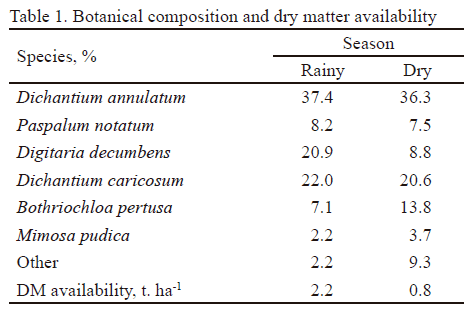
<body><![CDATA[<p align="justify">&nbsp;</p>     <p align="justify">&nbsp;</p>     <p align="justify" class="subtitulo" style="margin-top:12.0pt;text-align:justify;"><span style="line-height:120%; font-family:'Verdana','sans-serif'; font-size:13.0pt; color:windowtext; "><b>INTRODUCTION</b></span></p>     <p align="justify" class="Cuerpodetexto" style="margin-top:12.0pt;text-indent:0cm;"><span style="line-height:120%; font-family:'Verdana','sans-serif'; font-size:10.0pt; color:windowtext; ">Characteristics of river buffalo  carcasses have been less studied than that of other ruminant species, like  bovines. </span></p>     <p align="justify" class="Cuerpodetexto" style="margin-top:12.0pt;text-indent:0cm;"><span style="font-family:'Verdana','sans-serif'; font-size:10.0pt; color:windowtext; ">Several factors affect carcass  indicators and fractioning in fattening bovines. Some of them are system of  management and feeding, growth speed of these animals, liveweight and age at  slaughter, breed, sexual condition and others&nbsp;  (Torrescano <em>et al.</em> 2010). Probably, these same factors affect  indicators in fattening river buffalos under similar management and feeding  systems.</span></p>     <p align="justify" class="Cuerpodetexto" style="margin-top:12.0pt;text-indent:0cm;"><span style="font-family:'Verdana','sans-serif'; font-size:10.0pt; color:windowtext; ">Studies conducted to evaluate  characteristics of river buffalo carcasses indicated that these are similar to  those of bovines. Despite the high weight of skin and head, meat proportion is  almost the same (Uriyapongson 2013). However, due to low selection of river  buffalo species for meat production, it is important to know its  characteristics.</span></p>     <p align="justify" class="Cuerpodetexto" style="margin-top:12.0pt;text-indent:0cm;"><span style="font-family:'Verdana','sans-serif'; font-size:10.0pt; color:windowtext; ">The objective of this study is to  compare yield of total meat, first quality meat and cuts of interest, and to  determine chemical composition and some physical properties of meat in two  river buffalo breeds in Cuba.</span></p>     <p align="justify" class="subtitulo" style="margin-top:12.0pt;text-align:justify;"><span style="font-family:'Verdana','sans-serif'; font-size:10.0pt; color:windowtext; ">&nbsp;</span></p>     <p align="justify" class="subtitulo" style="margin-top:12.0pt;text-align:justify;"><span style="font-family:'Verdana','sans-serif'; font-size:13.0pt; color:windowtext; "><b>MATERIALS AND METHODS</b></span></p>     <p align="justify" class="Cuerpodetexto" style="margin-top:12.0pt;text-indent:0cm;"><span style="line-height:120%; letter-spacing:.1pt; font-family:'Verdana','sans-serif'; font-size:10.0pt; color:windowtext; ">An amount of 40  river buffalos were used (20 Buffalypso and 20 Carabao), located in a grazing  area of 77 ha, belonging to the Empresa Pecuaria Mac&uacute;n from Villa Clara  province. They were all grazing together in paddocks with <em>Dichantium  annulatum</em>, <em>Paspalum notatum</em>, <em>Digitaria decumbens</em>, <em>Dichantium  caricosum</em>, Botriocloa pertusa and <em>Mimosa pudica</em>. <a href="/img/revistas/cjas/v50n3/t0104316.gif">Table 1</a> shows  botanical composition and dry matter availability in the pasture.</span></p>     
]]></body>
<body><![CDATA[<p align="justify" class="Cuerpodetexto" style="margin-top:12.0pt;text-indent:0cm;"><span style="font-family:'Verdana','sans-serif'; font-size:10.0pt; color:windowtext; ">Water buffalos were slaughter with a  liveweight near 400 kg, at the slaughter house from Macum enterprise. After  slaughter, each quarter in cold carcass was weighed, after 24h of maturation.  Each of the parts, constituting first and second quality meat, were also  weighed.</span></p>     <p align="justify" class="Cuerpodetexto" style="margin-top:12.0pt;text-indent:0cm;"><span style="font-family:'Verdana','sans-serif'; font-size:10.0pt; color:windowtext; ">An analysis of covariance (Di Rienzo <em>et  al.</em> 2008) was performed to variables of cold carcass, hindquarters and  forequarters weights. An analysis of proportions was applied to forequarters,  hindquarters, first quality meat, second quality meat and total meat in  relation to carcasses. Hot carcass was taken as concomitant variable. Later, an  analysis of variance was performed according to the model of simple  classification. The test of LSD Fisher (1935) was applied for P &lt; 0.05. The  rest of variables related to first quality meat cuts was analyzed through an  analysis of variance, according to a completely randomized design.</span></p>     <p align="justify" class="Cuerpodetexto" style="margin-top:12.0pt;text-indent:0cm;"><span style="font-family:'Verdana','sans-serif'; font-size:10.0pt; color:windowtext; ">A sample of Longissimus dorsi was  taken from the hot carcass of each Buffalypso animal to determine  bromatological composition, according to AOAC (2016), and water retention  capacity, according to the method described by Lawrie (1998). </span></p>     <p align="justify" class="Cuerpodetexto" style="margin-top:12.0pt;text-indent:0cm;"><span style="font-family:'Verdana','sans-serif'; font-size:10.0pt; color:windowtext; ">Before maturation at 4 &ordm;C, pH was  measured in situ, in incisions performed in five points of the part,  introducing an electrode of a pH meter, standardized at a pH from 4 to 6.8.  Temperature was also recorded with a thermometer in the same points of the  incisions performed to measure pH. Texture was determined with the  Warner-Bratzer knife, according to the procedure described by Lepetit and  Culioli (1994).&nbsp;&nbsp;&nbsp;&nbsp;&nbsp; </span></p>     <p align="justify" class="subtitulo" style="margin-top:12.0pt;text-align:justify;"><span style="font-family:'Verdana','sans-serif'; font-size:10.0pt; color:windowtext; ">&nbsp;</span></p>     <p align="justify" class="subtitulo" style="margin-top:12.0pt;text-align:justify;"><span style="font-family:'Verdana','sans-serif'; font-size:13.0pt; color:windowtext; "><b>RESULTS AND DISCUSSION</b></span></p>     <p align="justify" class="Cuerpodetexto" style="margin-top:12.0pt;text-indent:0cm;"><span style="font-family:'Verdana','sans-serif'; font-size:10.0pt; color:windowtext; ">Covariables were significant, only for  variables cold carcass, forequarters and hindquarters in absolute values  (weight in kg), which are shown in <a href="/img/revistas/cjas/v50n3/t0204316.gif">table 2</a>. Hindquarters were superior and  forequarters were inferior in river buffalos of Buffalypso breed.</span></p>     
<p align="justify" class="Cuerpodetexto" style="margin-top:12.0pt;text-indent:0cm;"><span style="font-family:'Verdana','sans-serif'; font-size:10.0pt; color:windowtext; ">Hindquarters in proportion (%),  regarding carcass, were also superior in Buffalypso. According to Mendes and de  Lima (2011), this is the portion that contains the most valuable cuts, also  observed in cows and some water buffalo breeds by Mendes <em>et al.</em> (1997)  and Nogueira <em>et al.</em> (2006). In Carabao river buffalos, the contrary  happened, but proportion of first quality meat and second quality meat,  regarding the carcass, was similar in both breeds (<a href="/img/revistas/cjas/v50n3/t0304316.gif">table 3</a>).</span></p>     
<p align="justify" class="Cuerpodetexto" style="margin-top:12.0pt;text-indent:0cm;"><span style="font-family:'Verdana','sans-serif'; font-size:10.0pt; color:windowtext; ">In Carabao river buffalos, the best  development of forequarters, regarding the hindquarter, may be a result of  their more frequent use for working with different agricultural implements in  different countries, compared to animals from breeds involved in the formation  of Buffalypso, which has been destined mostly to milk production.</span></p>     <p align="justify" class="Cuerpodetexto" style="margin-top:12.0pt;text-indent:0cm;"><span style="font-family:'Verdana','sans-serif'; font-size:10.0pt; color:windowtext; ">Meat production per ha unit was  superior in Buffalypso breed. This result was related to weight at slaughter,  which was also higher in Buffalypso animals, due to the best productive  performance demonstrated by this breed during growth, according to reports from  Fundora (2015).</span></p>     ]]></body>
<body><![CDATA[<p align="justify" class="Cuerpodetexto" style="margin-top:12.0pt;text-indent:0cm;"><span style="line-height:107%; font-family:'Verdana','sans-serif'; font-size:10.0pt; ">There were also similar  proportions for first quality meat and second quality meat regarding total meat  in both breeds </span><span style="font-family:'Verdana','sans-serif'; font-size:10.0pt; color:windowtext; ">(<a href="#f1">figure 1</a>).</span></p>     <p align="center"><a name="f1"></a></p>     <p align="center"><img src="../img/revistas/cjas/v50n3/f0104316.gif" width="472" height="277" longdesc="/img/revistas/cjas/v50n3/f0104316.gif"></p>     
<p align="justify" class="Cuerpodetexto" style="margin-top:12.0pt;text-indent:0cm;"><span style="line-height:120%; font-family:'Verdana','sans-serif'; font-size:10.0pt; color:windowtext; ">Similarity of proportion of first  quality meat in relation to carcass in animals from both breeds could be  related to particular characteristics of different cuts of this region in each  breed, despite being located in the hindquarters where Buffalypso showed the  best development.</span></p>     <p align="justify" class="Cuerpodetexto" style="margin-top:12.0pt;text-indent:0cm;"><span style="line-height:120%; letter-spacing:.1pt; font-family:'Verdana','sans-serif'; font-size:10.0pt; color:windowtext; "><a href="/img/revistas/cjas/v50n3/t0404316.gif">Table 4</a> shows  percentage of special cuts of first quality meat. Knuckle, rump and eye round  had no significant differences between breeds. Carabao water buffalos produced  higher proportion of inside round and tenderloin, and less kidney in relation  to Buffalypso animals. However, in absolute terms, river buffalos of Buffalypso  breed produced 6 kg more of total meat. Out of them, 3.9 kg were second quality  meat and    2.1 kg were first quality meat. Except the tenderloin, which had a similar  weight in both breeds, the rest of first quality meat cuts weighed more in  Buffalypso animals, as a consequence of the highest liveweight reached by this  animals (Fundora 2015) and their carcasses at slaughter.</span> </p>     
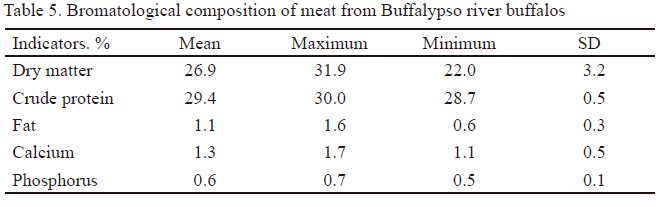
<p align="justify" class="Cuerpodetexto" style="margin-top:12.0pt;text-indent:0cm;"><span style="font-family:'Verdana','sans-serif'; font-size:10.0pt; color:windowtext; "><a href="/img/revistas/cjas/v50n3/t0504316.gif">Table 5</a> shows the bromatological  composition of meat from Buffalypso breed river buffalos. Mean values of dry  matter and nutrients were similar to those reported by other authors  (Andrighetto <em>et al.</em> 2008). High protein level in meat samples could  contribute to marbled meat, only with the adequate intermuscular fat level,  according to reports of Reback (2011).</span></p>     
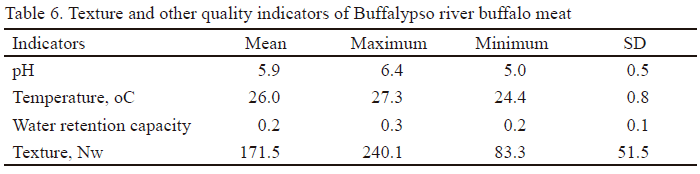
<p align="justify" class="Cuerpodetexto" style="margin-top:12.0pt;text-indent:0cm;"><span style="line-height:120%; letter-spacing:.2pt; font-family:'Verdana','sans-serif'; font-size:10.0pt; color:windowtext; ">Two of the most  important elements of meat are texture and water retention capacity. As <a href="/img/revistas/cjas/v50n3/t0604316.gif">table 6</a>  shows, meat may be classified as tender when texture values are relatively low,  while water retention capacity is appropriate. In bovines, Sa&ntilde;udo <em>et al.</em> (2004) observed similar results in animals of inferior ages. This suggests that  buffalos used in this study, slaughtered with around 2 years old, produce  tender meats. Specific characteristics of this species, related to their  longevity that is superior to bovines, may contribute to this result.</span><span style="font-family:'Verdana','sans-serif'; font-size:10.0pt; color:windowtext; "> </span></p>     
<p align="justify" class="Cuerpodetexto" style="margin-top:12.0pt;text-indent:0cm;"><span style="font-family:'Verdana','sans-serif'; font-size:10.0pt; color:windowtext; ">These results,  related to the high protein level and texture (<a href="/img/revistas/cjas/v50n3/t0504316.gif">tables 5</a> and <a href="/img/revistas/cjas/v50n3/t0604316.gif">6</a>), together with  reports from other authors that refer a meat with nutraceutical effects (Reback  2011), indicate the need to continue studies on river buffalo meat and carcasses,  in this and other feeding and management systems, to reach a competitive meat  destined to market and, particularly, to people that need to consume proteins  from healthy protein sources.</span> </p>     
<p align="justify" class="Cuerpodetexto" style="margin-top:12.0pt;text-indent:0cm;"><span style="line-height:107%; font-family:'Verdana','sans-serif'; font-size:10.0pt; ">It can be concluded that  yield of total and first quality meat is similar in both breeds, despite  showing different proportions in forequarters and hindquarters and in first  quality meat cuts</span><span style="font-family:'Verdana','sans-serif'; font-size:10.0pt; color:windowtext; ">.</span></p>     <p align="justify" class="MsoNormal" style="margin-top:12.0pt;text-align:justify;"><span style="line-height:107%; font-family:'Verdana','sans-serif'; font-size:10.0pt; ">&nbsp;</span></p>     ]]></body>
<body><![CDATA[<p align="justify" class="subtitulo" style="margin-top:12.0pt;text-align:justify;"><span style="font-family:'Verdana','sans-serif'; font-size:13.0pt; color:windowtext; "><b>REFERENCES</b></span></p>     <p align="justify" class="referencias" style="margin-top:12.0pt;margin-right:0cm;margin-bottom:.0001pt;margin-left:0cm;text-indent:0cm;"><span style="font-family:'Verdana','sans-serif'; font-size:10.0pt; color:windowtext; ">Andrighetto, C., Mendes, J. A., de Oliveira, R. R., Rodrigues, &Eacute;.,  Bianchini, W. &amp; de Lima, F. C. 2008. &ldquo;Caracter&iacute;sticas fisico-qu&iacute;micas e  sensoriais da carne de bubalinos Murrah abatidos em diferentes per&iacute;odos de  confinamento&rdquo;. </span><span style="font-family:'Verdana','sans-serif'; font-size:10.0pt; color:windowtext; ">Revista Brasileira de Zootecnia, 37(12): 2179&ndash;2184, ISSN:  1806-9290, DOI: 10.1590/S1516-35982008001200015.</span></p>     <p align="justify" class="referencias" style="margin-top:12.0pt;margin-right:0cm;margin-bottom:.0001pt;margin-left:0cm;text-indent:0cm;"><span style="font-family:'Verdana','sans-serif'; font-size:10.0pt; color:windowtext; ">AOAC.  2016. Official methods of analysis of AOAC International. 20th ed., Rockville,  MD: AOAC International, ISBN: 978-0-935584-87-5, Available:  &lt;<a href="http://www.directtextbook.com/isbn/9780935584875" target="_blank">http://www.directtextbook.com/isbn/9780935584875</a>&gt;, [Consulted: September  22, 2016].</span></p>     <!-- ref --><p align="justify" class="referencias" style="margin-top:12.0pt;margin-right:0cm;margin-bottom:.0001pt;margin-left:0cm;text-indent:0cm;"><span style="font-family:'Verdana','sans-serif'; font-size:10.0pt; color:windowtext; ">Di Rienzo, J. A., Casanoves, F., Balzarini, M. G., Gonz&aacute;lez, L., Tablada,  M. &amp; Robledo, C. W. 2008. InfoStat. version 2008, [Windows], Universidad  Nacional de C&oacute;rdoba, Argentina: Grupo InfoStat, Available:  &lt;<a href="http://www.infostat.com.ar/" target="_blank">http://www.infostat.com.ar/</a>&gt;    .</span></p>     <!-- ref --><p align="justify" class="referencias" style="margin-top:12.0pt;margin-right:0cm;margin-bottom:.0001pt;margin-left:0cm;text-indent:0cm;"><span style="font-family:'Verdana','sans-serif'; font-size:10.0pt; color:windowtext; ">Fisher,  R. A. 1935. The design of experiments. Edinburgh: Oliver and Boyd.    </span></p>     <p align="justify" class="referencias" style="margin-top:12.0pt;margin-right:0cm;margin-bottom:.0001pt;margin-left:0cm;text-indent:0cm;"><span style="font-family:'Verdana','sans-serif'; font-size:10.0pt; color:windowtext; ">Fundora,  O. 2015. &ldquo;Performance of river buffaloes (<em>Bubalus bubalis</em>) from  Buffalypso breed in feeding systems based on grazing: fifteen years of  researches in the Instituto de Ciencia Animal&rdquo;. Cuban Journal of Agricultural  Science, 49(2): 161&ndash;171, ISSN: 2079-3480.</span></p>     <p align="justify" class="referencias" style="margin-top:12.0pt;margin-right:0cm;margin-bottom:.0001pt;margin-left:0cm;text-indent:0cm;"><span style="font-family:'Verdana','sans-serif'; font-size:10.0pt; color:windowtext; ">Lawrie,  R. A. 1998. &ldquo;The storage and preservation of meat. II. Moisture control&rdquo;. In:  Lawrie&rsquo;s meat science, 6th ed., Cambridge: Woodhead Pub., p. 180, ISBN:  978-1-85573-395-4.</span></p>     <p align="justify" class="referencias" style="margin-top:12.0pt;margin-right:0cm;margin-bottom:.0001pt;margin-left:0cm;text-indent:0cm;"><span style="font-family:'Verdana','sans-serif'; font-size:10.0pt; color:windowtext; ">Lepetit,  J. &amp; Culioli, J. 1994. &ldquo;Mechanical properties of meat&rdquo;. </span><span style="font-family:'Verdana','sans-serif'; font-size:10.0pt; color:windowtext; ">Meat Science, 36(1&ndash;2): 203&ndash;237, ISSN: 03091740, DOI: 10.1016/0309<sup>-1</sup>740(94)90042-6.</span></p>     ]]></body>
<body><![CDATA[<p align="justify" class="referencias" style="margin-top:12.0pt;margin-right:0cm;margin-bottom:.0001pt;margin-left:0cm;text-indent:0cm;"><span style="font-family:'Verdana','sans-serif'; font-size:10.0pt; color:windowtext; ">Mendes, A. J. &amp; de Lima, F. C. 2011. &ldquo;Evaluaci&oacute;n de canales y calidad  de la carne de b&uacute;falo&rdquo;. Revista Tecnolog&iacute;a en Marcha, 24(5): 36&ndash;59, ISSN:  2215-3241.</span></p>     <p align="justify" class="referencias" style="margin-top:12.0pt;margin-right:0cm;margin-bottom:.0001pt;margin-left:0cm;text-indent:0cm;"><span style="font-family:'Verdana','sans-serif'; font-size:10.0pt; color:windowtext; ">Mendes, J. A., de Alencar, F. C. A., de Freitas, J. A., Soares, J. E.,  Rosales, R. L. R., Dutra,&nbsp; de R. F. &amp;  Cesar,&nbsp; de Q. A. 1997. &ldquo;Rendimento de  carca&ccedil;a e de cortes b&aacute;sicos de bovinos e bubalinos, abatidos em diferentes  est&aacute;dios de maturidade&rdquo;. Revista Brasileira de Zootecnia, 26(5): 1048&ndash;1054,  ISSN: 1806-9290.</span></p>     <p align="justify" class="referencias" style="margin-top:12.0pt;margin-right:0cm;margin-bottom:.0001pt;margin-left:0cm;text-indent:0cm;"><span style="font-family:'Verdana','sans-serif'; font-size:10.0pt; color:windowtext; ">Nogueira, B. F. M. P. F., Mendes, J. A., Andrighetto, C., Bortoleto, A. N.,  de Lima, C., Rodrigues, &Eacute;. &amp; Marinho, S. S. M. 2006. &ldquo;Rendimentos de  carca&ccedil;a, dos cortes comerciais e da por&ccedil;&atilde;o comest&iacute;vel de bubalinos Murrah castrados  abatidos com diferentes per&iacute;odos de confinamento&rdquo;. Revista Brasileira de  Zootecnia, 35(6): 2427&ndash;2433, ISSN: 1806-9290, DOI:  10.1590/S1516-35982006000800032.</span></p>     <p align="justify" class="referencias" style="margin-top:12.0pt;margin-right:0cm;margin-bottom:.0001pt;margin-left:0cm;text-indent:0cm;"><span style="font-family:'Verdana','sans-serif'; font-size:10.0pt; color:windowtext; ">Reback, G. E. 2011. &ldquo;Avances en los estudios de la composici&oacute;n de &aacute;cidos  grasos de la carne de b&uacute;falos&rdquo;. In: VI Simposio de B&uacute;falos de Europa y Am&eacute;rica,  La Habana, Cuba: Editorial Universitaria, p. 3, ISBN: 978-959<sup>-</sup>16-1392-9.</span></p>     <p align="justify" class="referencias" style="margin-top:12.0pt;margin-right:0cm;margin-bottom:.0001pt;margin-left:0cm;text-indent:0cm;"><span style="font-family:'Verdana','sans-serif'; font-size:10.0pt; color:windowtext; ">Sa&ntilde;udo, C., Macie, E. S., Olleta, J. L., Villarroel, M., Panea, B. &amp;  Albert&#305;&#769;, P. 2004. </span><span style="font-family:'Verdana','sans-serif'; font-size:10.0pt; color:windowtext; ">&ldquo;The effects of slaughter weight, breed type and ageing time  on beef meat quality using two different texture devices&rdquo;. </span><span style="font-family:'Verdana','sans-serif'; font-size:10.0pt; color:windowtext; ">Meat Science, 66(4): 925&ndash;932, ISSN: 03091740, DOI:  10.1016/j.meatsci.2003.08.005.</span></p>     <p align="justify" class="referencias" style="margin-top:12.0pt;margin-right:0cm;margin-bottom:.0001pt;margin-left:0cm;text-indent:0cm;"><span style="font-family:'Verdana','sans-serif'; font-size:10.0pt; color:windowtext; ">Torrescano, U. G. R., S&aacute;nchez, E. A., V&aacute;squez, P. M. G., Paz, P. R. &amp;  Pardo, G. D. A. 2010. &ldquo;Caracterizaci&oacute;n de canales y de carne de bovino de  animales engordados en la zona centro de Sonora&rdquo;. Revista Mexicana de Ciencias  Pecuarias, 1(2): 157&ndash;168, ISSN: 2007-1124.</span></p>     <p align="justify" class="referencias" style="margin-top:12.0pt;margin-right:0cm;margin-bottom:.0001pt;margin-left:0cm;text-indent:0cm;"><span style="font-family:'Verdana','sans-serif'; font-size:10.0pt; ">Uriyapongson, S. 2013.  &ldquo;Buffalo and Buffalo Meat in Thailand&rdquo;. Buffalo Bulletin, 32(sp. 1): 329&ndash;332,  ISSN: 0125-6726</span><font size="2" face="Verdana, Arial, Helvetica, sans-serif">.</font></p>     <p align="justify">&nbsp;</p>     <p align="justify">&nbsp;</p>     <p align="justify"><font size="2" face="Verdana, Arial, Helvetica, sans-serif">Received: 20/11/2014    ]]></body>
<body><![CDATA[<br> Accepted: 23/6/2016</font></p>     <p align="justify">&nbsp;</p>     <p align="justify">&nbsp;</p>     <p align="justify"><font size="2" face="Verdana, Arial, Helvetica, sans-serif"><i>O. Fundora,</i> Instituto de Ciencia Animal, Apartado Postal  24, San José de las Lajas,  Mayabeque, Cuba.    Email: <a href="mailto:ofundora@ica.co.cu">ofundora@ica.co.cu</a></font></p>      ]]></body><back>
<ref-list>
<ref id="B1">
<nlm-citation citation-type="journal">
<person-group person-group-type="author">
<name>
<surname><![CDATA[Andrighetto]]></surname>
<given-names><![CDATA[C.]]></given-names>
</name>
<name>
<surname><![CDATA[Mendes]]></surname>
<given-names><![CDATA[J. A.]]></given-names>
</name>
<name>
<surname><![CDATA[de Oliveira]]></surname>
<given-names><![CDATA[R. R.]]></given-names>
</name>
<name>
<surname><![CDATA[Rodrigues]]></surname>
<given-names><![CDATA[É.]]></given-names>
</name>
<name>
<surname><![CDATA[Bianchini]]></surname>
<given-names><![CDATA[W.]]></given-names>
</name>
<name>
<surname><![CDATA[de Lima]]></surname>
<given-names><![CDATA[F. C.]]></given-names>
</name>
</person-group>
<article-title xml:lang="nd"><![CDATA[Características fisico-químicas e sensoriais da carne de bubalinos Murrah abatidos em diferentes períodos de confinamento]]></article-title>
<source><![CDATA[Revista Brasileira de Zootecnia]]></source>
<year>2008</year>
<volume>37</volume>
<numero>12</numero>
<issue>12</issue>
<page-range>2179–2184</page-range></nlm-citation>
</ref>
<ref id="B2">
<nlm-citation citation-type="book">
<person-group person-group-type="author">
<name>
<surname><![CDATA[Di Rienzo]]></surname>
<given-names><![CDATA[J. A.]]></given-names>
</name>
<name>
<surname><![CDATA[Casanoves]]></surname>
<given-names><![CDATA[F.]]></given-names>
</name>
<name>
<surname><![CDATA[Balzarini]]></surname>
<given-names><![CDATA[M. G.]]></given-names>
</name>
<name>
<surname><![CDATA[González]]></surname>
<given-names><![CDATA[L.]]></given-names>
</name>
<name>
<surname><![CDATA[Tablada]]></surname>
<given-names><![CDATA[M.]]></given-names>
</name>
<name>
<surname><![CDATA[Robledo]]></surname>
<given-names><![CDATA[C. W.]]></given-names>
</name>
</person-group>
<source><![CDATA[InfoStat]]></source>
<year>2008</year>
<publisher-loc><![CDATA[Universidad Nacional de Córdoba, Argentina ]]></publisher-loc>
<publisher-name><![CDATA[Grupo InfoStat]]></publisher-name>
</nlm-citation>
</ref>
<ref id="B3">
<nlm-citation citation-type="book">
<person-group person-group-type="author">
<name>
<surname><![CDATA[Fisher]]></surname>
<given-names><![CDATA[R. A.]]></given-names>
</name>
</person-group>
<source><![CDATA[The design of experiments]]></source>
<year>1935</year>
<publisher-loc><![CDATA[Edinburgh ]]></publisher-loc>
<publisher-name><![CDATA[Oliver and Boyd]]></publisher-name>
</nlm-citation>
</ref>
<ref id="B4">
<nlm-citation citation-type="journal">
<person-group person-group-type="author">
<name>
<surname><![CDATA[Fundora]]></surname>
<given-names><![CDATA[O.]]></given-names>
</name>
</person-group>
<article-title xml:lang="nd"><![CDATA[Performance of river buffaloes (Bubalus bubalis) from Buffalypso breed in feeding systems based on grazing: fifteen years of researches in the Instituto de Ciencia Animal]]></article-title>
<source><![CDATA[Cuban Journal of Agricultural Science]]></source>
<year>2015</year>
<volume>49</volume>
<numero>2</numero>
<issue>2</issue>
<page-range>161–171</page-range></nlm-citation>
</ref>
<ref id="B5">
<nlm-citation citation-type="book">
<person-group person-group-type="author">
<name>
<surname><![CDATA[Latimer]]></surname>
<given-names><![CDATA[G. W.]]></given-names>
</name>
</person-group>
<source><![CDATA[Official methods of analysis of AOAC International]]></source>
<year>2016</year>
<edition>20th</edition>
<publisher-loc><![CDATA[Rockville, MD ]]></publisher-loc>
<publisher-name><![CDATA[AOAC International]]></publisher-name>
</nlm-citation>
</ref>
<ref id="B6">
<nlm-citation citation-type="book">
<person-group person-group-type="author">
<name>
<surname><![CDATA[Lawrie]]></surname>
<given-names><![CDATA[R. A.]]></given-names>
</name>
</person-group>
<article-title xml:lang="nd"><![CDATA[The storage and preservation of meat. II. Moisture control]]></article-title>
<source><![CDATA[Lawrie’s meat science]]></source>
<year>1998</year>
<edition>6th</edition>
<page-range>180</page-range><publisher-loc><![CDATA[Cambridge ]]></publisher-loc>
<publisher-name><![CDATA[Woodhead Pub.]]></publisher-name>
</nlm-citation>
</ref>
<ref id="B7">
<nlm-citation citation-type="journal">
<person-group person-group-type="author">
<name>
<surname><![CDATA[Lepetit]]></surname>
<given-names><![CDATA[J.]]></given-names>
</name>
<name>
<surname><![CDATA[Culioli]]></surname>
<given-names><![CDATA[J.]]></given-names>
</name>
</person-group>
<article-title xml:lang="nd"><![CDATA[Mechanical properties of meat]]></article-title>
<source><![CDATA[Meat Science]]></source>
<year>1994</year>
<volume>36</volume>
<numero>1–2</numero>
<issue>1–2</issue>
<page-range>203–237</page-range></nlm-citation>
</ref>
<ref id="B8">
<nlm-citation citation-type="journal">
<person-group person-group-type="author">
<name>
<surname><![CDATA[Mendes]]></surname>
<given-names><![CDATA[A. J.]]></given-names>
</name>
<name>
<surname><![CDATA[de Lima]]></surname>
<given-names><![CDATA[F. C.]]></given-names>
</name>
</person-group>
<article-title xml:lang="nd"><![CDATA[Evaluación de canales y calidad de la carne de búfalo]]></article-title>
<source><![CDATA[Revista Tecnología en Marcha]]></source>
<year>2011</year>
<volume>24</volume>
<numero>5</numero>
<issue>5</issue>
<page-range>36–59</page-range></nlm-citation>
</ref>
<ref id="B9">
<nlm-citation citation-type="journal">
<person-group person-group-type="author">
<name>
<surname><![CDATA[Mendes]]></surname>
<given-names><![CDATA[J. A.]]></given-names>
</name>
<name>
<surname><![CDATA[de Alencar]]></surname>
<given-names><![CDATA[F. C. A.]]></given-names>
</name>
<name>
<surname><![CDATA[de Freitas]]></surname>
<given-names><![CDATA[J. A.]]></given-names>
</name>
<name>
<surname><![CDATA[Soares]]></surname>
<given-names><![CDATA[J. E.]]></given-names>
</name>
<name>
<surname><![CDATA[Rosales]]></surname>
<given-names><![CDATA[R. L. R.]]></given-names>
</name>
<name>
<surname><![CDATA[Dutra]]></surname>
<given-names><![CDATA[de R. F.]]></given-names>
</name>
<name>
<surname><![CDATA[Cesar]]></surname>
<given-names><![CDATA[de Q. A.]]></given-names>
</name>
</person-group>
<article-title xml:lang="nd"><![CDATA[Rendimento de carcaça e de cortes básicos de bovinos e bubalinos, abatidos em diferentes estádios de maturidade]]></article-title>
<source><![CDATA[Revista Brasileira de Zootecnia]]></source>
<year>1997</year>
<volume>26</volume>
<numero>5</numero>
<issue>5</issue>
<page-range>1048–1054</page-range></nlm-citation>
</ref>
<ref id="B10">
<nlm-citation citation-type="journal">
<person-group person-group-type="author">
<name>
<surname><![CDATA[Nogueira]]></surname>
<given-names><![CDATA[B. F. M. P. F.]]></given-names>
</name>
<name>
<surname><![CDATA[Mendes]]></surname>
<given-names><![CDATA[J. A.]]></given-names>
</name>
<name>
<surname><![CDATA[Andrighetto]]></surname>
<given-names><![CDATA[C.]]></given-names>
</name>
<name>
<surname><![CDATA[Bortoleto]]></surname>
<given-names><![CDATA[A. N.]]></given-names>
</name>
<name>
<surname><![CDATA[de Lima]]></surname>
<given-names><![CDATA[C.]]></given-names>
</name>
<name>
<surname><![CDATA[Rodrigues]]></surname>
<given-names><![CDATA[É.]]></given-names>
</name>
<name>
<surname><![CDATA[Marinho]]></surname>
<given-names><![CDATA[S. S. M.]]></given-names>
</name>
</person-group>
<article-title xml:lang="nd"><![CDATA[Rendimentos de carcaça, dos cortes comerciais e da porção comestível de bubalinos Murrah castrados abatidos com diferentes períodos de confinamento]]></article-title>
<source><![CDATA[Revista Brasileira de Zootecnia]]></source>
<year>2006</year>
<volume>35</volume>
<numero>6</numero>
<issue>6</issue>
<page-range>2427–2433</page-range></nlm-citation>
</ref>
<ref id="B11">
<nlm-citation citation-type="book">
<person-group person-group-type="author">
<name>
<surname><![CDATA[Reback]]></surname>
<given-names><![CDATA[G. E.]]></given-names>
</name>
</person-group>
<article-title xml:lang="nd"><![CDATA[Avances en los estudios de la composición de ácidos grasos de la carne de búfalos]]></article-title>
<source><![CDATA[]]></source>
<year>2011</year>
<page-range>3</page-range><publisher-loc><![CDATA[La Habana, Cuba ]]></publisher-loc>
<publisher-name><![CDATA[Editorial Universitaria]]></publisher-name>
</nlm-citation>
</ref>
<ref id="B12">
<nlm-citation citation-type="journal">
<person-group person-group-type="author">
<name>
<surname><![CDATA[Sañudo]]></surname>
<given-names><![CDATA[C.]]></given-names>
</name>
<name>
<surname><![CDATA[Macie]]></surname>
<given-names><![CDATA[E. S.]]></given-names>
</name>
<name>
<surname><![CDATA[Olleta]]></surname>
<given-names><![CDATA[J. L.]]></given-names>
</name>
<name>
<surname><![CDATA[Villarroel]]></surname>
<given-names><![CDATA[M.]]></given-names>
</name>
<name>
<surname><![CDATA[Panea]]></surname>
<given-names><![CDATA[B.]]></given-names>
</name>
<name>
<surname><![CDATA[Alberti´]]></surname>
<given-names><![CDATA[P.]]></given-names>
</name>
</person-group>
<article-title xml:lang="nd"><![CDATA[The effects of slaughter weight, breed type and ageing time on beef meat quality using two different texture devices]]></article-title>
<source><![CDATA[Meat Science]]></source>
<year>2004</year>
<volume>66</volume>
<numero>4</numero>
<issue>4</issue>
<page-range>925–932</page-range></nlm-citation>
</ref>
<ref id="B13">
<nlm-citation citation-type="journal">
<person-group person-group-type="author">
<name>
<surname><![CDATA[Torrescano]]></surname>
<given-names><![CDATA[U. G. R.]]></given-names>
</name>
<name>
<surname><![CDATA[Sánchez]]></surname>
<given-names><![CDATA[E. A.]]></given-names>
</name>
<name>
<surname><![CDATA[Vásquez]]></surname>
<given-names><![CDATA[P. M. G.]]></given-names>
</name>
<name>
<surname><![CDATA[Paz]]></surname>
<given-names><![CDATA[P. R.]]></given-names>
</name>
<name>
<surname><![CDATA[Pardo]]></surname>
<given-names><![CDATA[G. D. A.]]></given-names>
</name>
</person-group>
<article-title xml:lang="nd"><![CDATA[Caracterización de canales y de carne de bovino de animales engordados en la zona centro de Sonora]]></article-title>
<source><![CDATA[Revista Mexicana de Ciencias Pecuarias]]></source>
<year>2010</year>
<volume>1</volume>
<numero>2</numero>
<issue>2</issue>
<page-range>157–168</page-range></nlm-citation>
</ref>
<ref id="B14">
<nlm-citation citation-type="journal">
<person-group person-group-type="author">
<name>
<surname><![CDATA[Uriyapongson]]></surname>
<given-names><![CDATA[S.]]></given-names>
</name>
</person-group>
<article-title xml:lang="nd"><![CDATA[Buffalo and Buffalo Meat in Thailand]]></article-title>
<source><![CDATA[Buffalo Bulletin]]></source>
<year>2013</year>
<volume>32</volume>
<numero>sp. 1</numero>
<issue>sp. 1</issue>
<page-range>329–332</page-range></nlm-citation>
</ref>
</ref-list>
</back>
</article>