<?xml version="1.0" encoding="ISO-8859-1"?><article xmlns:mml="http://www.w3.org/1998/Math/MathML" xmlns:xlink="http://www.w3.org/1999/xlink" xmlns:xsi="http://www.w3.org/2001/XMLSchema-instance">
<front>
<journal-meta>
<journal-id>2079-3480</journal-id>
<journal-title><![CDATA[Cuban Journal of Agricultural Science]]></journal-title>
<abbrev-journal-title><![CDATA[Cuban J. Agric. Sci.]]></abbrev-journal-title>
<issn>2079-3480</issn>
<publisher>
<publisher-name><![CDATA[Editorial del Instituto de Ciencia Animal]]></publisher-name>
</publisher>
</journal-meta>
<article-meta>
<article-id>S2079-34802016000300005</article-id>
<title-group>
<article-title xml:lang="en"><![CDATA[Effect of different doses of an injectable compound of Cu, Zn and Mn on bio-productive indicators of milking cows]]></article-title>
<article-title xml:lang="es"><![CDATA[Efecto de diferentes dosis de un compuesto inyectable de Cu, Zn y Mn en parámetros bioproductivos de la vaca lechera]]></article-title>
</title-group>
<contrib-group>
<contrib contrib-type="author">
<name>
<surname><![CDATA[Noval]]></surname>
<given-names><![CDATA[E.]]></given-names>
</name>
<xref ref-type="aff" rid="A01"/>
</contrib>
<contrib contrib-type="author">
<name>
<surname><![CDATA[Ramón]]></surname>
<given-names><![CDATA[J.]]></given-names>
</name>
<xref ref-type="aff" rid="A01"/>
</contrib>
<contrib contrib-type="author">
<name>
<surname><![CDATA[García-López]]></surname>
<given-names><![CDATA[R.]]></given-names>
</name>
<xref ref-type="aff" rid="A02"/>
</contrib>
<contrib contrib-type="author">
<name>
<surname><![CDATA[Jiménez]]></surname>
<given-names><![CDATA[J.]]></given-names>
</name>
<xref ref-type="aff" rid="A03"/>
</contrib>
</contrib-group>
<aff id="A01">
<institution><![CDATA[,Universidad Central de las Villas Marta Abreu  ]]></institution>
<addr-line><![CDATA[Santa Clara Villa Clara]]></addr-line>
<country>Cuba</country>
</aff>
<aff id="A02">
<institution><![CDATA[,Instituto de Ciencia Animal  ]]></institution>
<addr-line><![CDATA[San José de las Lajas Mayabeque]]></addr-line>
</aff>
<aff id="A03">
<institution><![CDATA[,Unidad Básica de Producción Agropecuaria Desembarco del Granma  ]]></institution>
<addr-line><![CDATA[Santa Clara Villa Clara]]></addr-line>
</aff>
<pub-date pub-type="pub">
<day>00</day>
<month>09</month>
<year>2016</year>
</pub-date>
<pub-date pub-type="epub">
<day>00</day>
<month>09</month>
<year>2016</year>
</pub-date>
<volume>50</volume>
<numero>3</numero>
<fpage>371</fpage>
<lpage>380</lpage>
<copyright-statement/>
<copyright-year/>
<self-uri xlink:href="http://scielo.sld.cu/scielo.php?script=sci_arttext&amp;pid=S2079-34802016000300005&amp;lng=en&amp;nrm=iso"></self-uri><self-uri xlink:href="http://scielo.sld.cu/scielo.php?script=sci_abstract&amp;pid=S2079-34802016000300005&amp;lng=en&amp;nrm=iso"></self-uri><self-uri xlink:href="http://scielo.sld.cu/scielo.php?script=sci_pdf&amp;pid=S2079-34802016000300005&amp;lng=en&amp;nrm=iso"></self-uri><abstract abstract-type="short" xml:lang="en"><p><![CDATA[Different doses of an injectable compound of Cu, Zn and Mn on bio-productive indicators of milking cows. Four groups were formed, with seven cows each, belonging to Siboney de Cuba (5/8 Holstein 3/8 Zebu) breed genotype, with eight months of gestation. Each group was assigned with the following treatments: A) control; B) 25 mg of Cu, 50 mg of Zn and 25 of Mn; C) 50 mg of Cu, 100 mg of Zn and 50 mg of Mn and D) 75 mg of Cu, 150 mg of Zn and 75 mg of Mn, provided every two months up to completing three applications. Serum concentrations of Cu and Zn and bio-productive indicators were evaluated. Two groups with five cows were formed: one of them received C treatment and the other, used as control, was destined to evaluate hepatic reserves of Cu, Zn and Mn. C and D treatments increased significantly (P< 0.05) serum concentrations of Cu and Zn regarding the rest of them. C treatment increased significantly (P< 0.05) the hepatic levels of Zn and Cu, and Mn (P < 0.001). Reproductive indicators were better (P<0.05) in cows that received C and D treatments, showing the highest levels of milk production (P< 0.05), after 60 d of lactation, regarding A and B groups. It can be concluded that C and D treatment were more effective to reestablish the organic levels of these microelements and favor productive and reproductive indicators of animals]]></p></abstract>
<abstract abstract-type="short" xml:lang="es"><p><![CDATA[Se evaluaron diferentes dosis de un compuesto inyectable de Cu, Zn y Mn en los parámetros bioproductivos de la vaca lechera. Se formaron cuatro grupos, de siete vacas cada uno, pertenecientes al genotipo racial Siboney de Cuba (5/8 Holstein 3/8 Cebú), con ocho meses de gestación. A cada grupo se le asignaron los tratamientos siguientes: A) control; B) 25 mg de Cu, 50 mg de Zn y 25 de Mn; C) 50 mg de Cu, 100 mg de Zn y 50 mg de Mn y D) 75 mg de Cu, 150 mg de Zn y 75 mg de Mn, administrados cada dos meses hasta completar tres aplicaciones. Se evaluaron las concentraciones séricas de Cu y Zn y los indicadores bioproductivos. Se conformaron dos grupos de cinco vacas: uno recibió el tratamiento C y otro, utilizado como control, se destinó a evaluar las reservas hepáticas de Cu, Zn y Mn. Los tratamientos C y D aumentaron significativamente (P< 0.05) las concentraciones séricas de Cu y Zn con respectos a los restantes. El tratamiento C incrementó significativamente (P< 0.05) los niveles hepáticos de Zn y Cu y Mn (P < 0.001). Los indicadores reproductivos fueron mejores (P< 0.05) en las vacas que recibieron los tratamientos C y D, que mostraron mayores niveles de producción láctea (P< 0.05), a partir de los 60 d de lactancia, con respecto a los grupos A y B. Se concluye que los tratamientos C y D resultaron más eficaces para restablecer los niveles orgánicos de estos microelementos y favorecer los indicadores reproductivos y productivos de los animales]]></p></abstract>
<kwd-group>
<kwd lng="en"><![CDATA[copper]]></kwd>
<kwd lng="en"><![CDATA[zinc]]></kwd>
<kwd lng="en"><![CDATA[manganese]]></kwd>
<kwd lng="en"><![CDATA[doses]]></kwd>
<kwd lng="en"><![CDATA[injectable]]></kwd>
<kwd lng="en"><![CDATA[indicator]]></kwd>
<kwd lng="en"><![CDATA[milking cows]]></kwd>
<kwd lng="es"><![CDATA[cobre]]></kwd>
<kwd lng="es"><![CDATA[zinc]]></kwd>
<kwd lng="es"><![CDATA[manganeso]]></kwd>
<kwd lng="es"><![CDATA[dosis]]></kwd>
<kwd lng="es"><![CDATA[inyectable]]></kwd>
<kwd lng="es"><![CDATA[parámetros]]></kwd>
<kwd lng="es"><![CDATA[vaca lechera]]></kwd>
</kwd-group>
</article-meta>
</front><body><![CDATA[ <p align="right"><font size="2" face="Verdana, Arial, Helvetica, sans-serif"><b>Cuban Journal  of Agricultural Science, 50(3): 371-380, 2016, ISSN: 2079-3480</b></font></p>     <p align="right">&nbsp;</p>     <p align="right"><font size="2" face="Verdana, Arial, Helvetica, sans-serif"><b>ORIGINAL ARTICLE</b></font></p>     <p align="justify">&nbsp;</p>     <p align="justify"><font size="4" face="Verdana, Arial, Helvetica, sans-serif">  <b>Effect of different doses of an injectable compound of Cu, Zn and Mn  on bio-productive indicators of milking cows</b></font></p>      <p align="justify">&nbsp;</p>     <p align="justify"><font size="3" face="Verdana, Arial, Helvetica, sans-serif">  <b>Efecto de diferentes dosis de un compuesto inyectable de Cu, Zn y Mn en parámetros bioproductivos de la vaca lechera</b></font></p>      <p align="justify">&nbsp;</p>     <p align="justify">&nbsp;</p>     <p align="justify"><font size="2" face="Verdana, Arial, Helvetica, sans-serif">  <b>E. Noval,</b><sup><b>I</b></sup> <b> J. Ramón,</b><sup><b>I</b></sup> <b> R. García-López,</b><sup><b>II</b></sup> <b> J. Jiménez,</b><sup><b>III</b></sup>  </font></p>     ]]></body>
<body><![CDATA[<p align="justify"><font size="2" face="Verdana, Arial, Helvetica, sans-serif"><b> </b></font><font size="2" face="Verdana, Arial, Helvetica, sans-serif">    <sup>I</sup>Departamento de Medicina Veterinaria y Zootecnia. Facultad de Ciencias Agropecuarias. Universidad Central de las  Villas “Marta Abreu”. Carretera a Camajuaní, km 5,5. Santa Clara (54830), Villa Clara, Cuba.    <br>   <sup>II</sup>Instituto de Ciencia Animal, Apartado Postal 24, San José de las Lajas, Mayabeque.     <br>   <sup>III</sup>Unidad Básica de Producción Agropecuaria “Desembarco del Granma”. Antón Díaz, Santa Clara. Villa Clara. </font></p>     <p align="justify">&nbsp;</p>     <p align="justify">&nbsp;</p> <hr align="JUSTIFY">     <p align="justify"><font size="2" face="Verdana, Arial, Helvetica, sans-serif"><b>ABSTRACT</b></font></p>     <p align="justify" class="resumen" style="margin-top:12.0pt;"><span style="line-height:120%; letter-spacing:.2pt; font-family:'Verdana','sans-serif'; font-size:10.0pt; color:windowtext; ">Different doses of an injectable compound of Cu, Zn and Mn  on bio-productive indicators of milking cows. Four groups were formed, with  seven cows each, belonging to Siboney de Cuba    (5/8 Holstein 3/8 Zebu) breed genotype, with eight months of gestation. Each  group was assigned with the following treatments: A) control; B) 25 mg of Cu,  50 mg of Zn and 25 of Mn; C)  50 mg of Cu, 100 mg of Zn and 50 mg of Mn and D) 75 mg of Cu, 150 mg of Zn and  75 mg of Mn, provided every two months up to completing three applications.  Serum concentrations of Cu and Zn and bio-productive indicators were evaluated.  Two groups with five cows were formed: one of them received C treatment and the  other, used as control, was destined to evaluate hepatic reserves of Cu, Zn and  Mn. C and D treatments increased significantly (P&lt; 0.05) serum  concentrations of Cu and Zn regarding the rest of them. C treatment increased  significantly (P&lt; 0.05) the hepatic levels of Zn and Cu, and Mn (P &lt;  0.001). Reproductive indicators were better (P&lt;0.05) in cows that received C  and D treatments, showing the highest levels of milk production (P&lt; 0.05),  after 60 d of lactation, regarding A and B groups. It can be concluded that C  and D treatment were more effective to reestablish the organic levels of these  microelements and favor productive and reproductive indicators of animals.</span><span style="line-height:120%; font-family:'Verdana','sans-serif'; font-size:10.0pt; color:windowtext; ">&nbsp;&nbsp;&nbsp;&nbsp;&nbsp; </span></p>     <div align="justify"><strong><span style="line-height:107%; font-family:'Verdana','sans-serif'; font-size:10.0pt; ">Key words:</span></strong><span style="font-family:'Verdana','sans-serif'; font-size:10.0pt; "> copper,  zinc, manganese, doses, injectable, indicator, milking cows</span><font size="2" face="Verdana, Arial, Helvetica, sans-serif">.</font> </div> <hr align="JUSTIFY">     <p align="justify"><font size="2" face="Verdana, Arial, Helvetica, sans-serif"><b>RESUMEN</b></font></p>     <p align="justify" class="resumen" style="margin-top:12.0pt;"><span style="line-height:120%; font-family:'Verdana','sans-serif'; font-size:10.0pt; color:windowtext; ">Se evaluaron diferentes dosis de un  compuesto inyectable de Cu, Zn y Mn en los par&aacute;metros bioproductivos de la vaca  lechera. Se formaron cuatro grupos, de siete vacas cada uno, pertenecientes al  genotipo racial Siboney de Cuba (5/8 Holstein 3/8 Ceb&uacute;), con ocho meses de  gestaci&oacute;n. A cada grupo se le asignaron los tratamientos siguientes: A)  control; B) 25 mg de Cu, 50 mg de Zn y 25 de Mn; C) 50 mg de Cu, 100 mg de Zn y  50 mg de Mn y D) 75 mg de Cu, 150 mg de Zn y 75 mg de Mn, administrados cada  dos meses hasta completar tres aplicaciones. Se evaluaron las concentraciones  s&eacute;ricas de Cu y Zn y los indicadores bioproductivos. Se conformaron dos grupos  de cinco vacas: uno recibi&oacute; el tratamiento C y otro, utilizado como control, se  destin&oacute; a evaluar las reservas hep&aacute;ticas de Cu, Zn y Mn. Los tratamientos C y D  aumentaron significativamente (P&lt; 0.05) las concentraciones s&eacute;ricas de Cu y Zn  con respectos a los restantes. El tratamiento C increment&oacute; significativamente  (P&lt; 0.05) los niveles hep&aacute;ticos de Zn y Cu y Mn (P &lt; 0.001). Los  indicadores reproductivos fueron mejores (P&lt; 0.05) en las vacas que  recibieron los tratamientos C y D, que mostraron mayores niveles de producci&oacute;n  l&aacute;ctea (P&lt; 0.05), a partir de los 60 d de lactancia, con respecto a los  grupos A y B. Se concluye que los tratamientos C y D resultaron m&aacute;s eficaces  para restablecer los niveles org&aacute;nicos de estos microelementos y favorecer los  indicadores reproductivos y productivos de los animales.</span></p>     ]]></body>
<body><![CDATA[<div align="justify"><strong><span style="line-height:107%; font-family:'Verdana','sans-serif'; font-size:10.0pt; ">Palabras clave:</span></strong><span style="font-family:'Verdana','sans-serif'; font-size:10.0pt; "> cobre, zinc,  manganeso, dosis, inyectable, par&aacute;metros, vaca lechera</span><font size="2" face="Verdana, Arial, Helvetica, sans-serif">.</font> </div> <hr align="JUSTIFY">     <p align="justify">&nbsp;</p>     <p align="justify">&nbsp;</p>     <p align="justify"><font size="2" face="Verdana, Arial, Helvetica, sans-serif"><b><font size="3">INTRODUCTION</font></b></font></p>     <p align="justify" class="Cuerpodetexto" style="margin-top:12.0pt;text-indent:0cm;"><span style="line-height:120%; font-family:'Verdana','sans-serif'; font-size:10.0pt; color:windowtext; ">Bovine milk production in Cuba is  developed under grazing conditions, with climatic and management conditions  that are negative and affect the intake of coarse food with low level of yield  and quality. During dry period, nutritional deficit is intensified. Mineral  supplementation is poor and lacking of trace minerals (Garc&iacute;a <em>et al.</em> 2010a). </span></p>     <p align="justify" class="Cuerpodetexto" style="margin-top:12.0pt;text-indent:0cm;"><span style="font-family:'Verdana','sans-serif'; font-size:10.0pt; color:windowtext; ">Feeds for bovine cattle not always  fulfill the requirements of milking cows for production and, many times, the  contribution of trace minerals is unknown (Genther and Hansen 2014). Zn, Cu and  Mn are affected due to the antagonism of Mo, Fe, S, and Ca concentrations,  among other minerals supplied by feeds (Nayeri <em>et al.</em> 2014).&nbsp; </span></p>     <p align="justify" class="Cuerpodetexto" style="margin-top:12.0pt;text-indent:0cm;"><span style="font-family:'Verdana','sans-serif'; font-size:10.0pt; color:windowtext; ">In Cuba, there are severe deficiencies  of Cu and Zn in milking cows, in the western (Valera <em>et al.</em> 2011,  Figueredo 2016),&nbsp; central (Garc&iacute;a <em>et  al.</em> 2010a, Noval <em>et al.</em> 2014) and eastern (Fajardo <em>et al.</em> 2011, Galindo <em>et al.</em> 2014) regions.</span></p>     <p align="justify" class="Cuerpodetexto" style="margin-top:12.0pt;text-indent:0cm;"><span style="font-family:'Verdana','sans-serif'; font-size:10.0pt; color:windowtext; ">Mineral supplementation in milking  cows have a beneficial effect on the immune condition of the animal, resistance  to diseases, feed intake (McDowell and Arthington 2005), energy and oxidative  metabolism (Spears and Weiss 2008) and reproduction (Nemec <em>et al.</em> 2012).</span></p>     <p align="justify" class="Cuerpodetexto" style="margin-top:12.0pt;text-indent:0cm;"><span style="line-height:120%; letter-spacing:.1pt; font-family:'Verdana','sans-serif'; font-size:10.0pt; color:windowtext; ">Zn, Cu and Mn have  an important function on fertility of milking cows (Nayeri <em>et al.</em> 2014).  In Cuba, a negative correlation was demonstrated (p&lt; 0.05) between cupremia  and reproductive indicators, in a range of serum copper between 9.8 &plusmn; 1.0 and  14.0 &plusmn; 0.9 &mu;mol/L. It was also confirmed that deficiency of this microelement  is a significant risk factor for the appearance of anestrus and repetition of  service (Garc&iacute;a <em>et al.</em> 2010b).</span><span style="font-family:'Verdana','sans-serif'; font-size:10.0pt; color:windowtext; "> </span></p>     <p align="justify" class="Cuerpodetexto" style="margin-top:12.0pt;text-indent:0cm;"><span style="font-family:'Verdana','sans-serif'; font-size:10.0pt; color:windowtext; ">Parental supplementation of minerals  reduces the interactions occurring during its ingestion and absorption, avoids  mineral antagonism and increases organic reserves of the animal (Pogge <em>et  al.</em> 2012). Injectable supply of Cu every two months, up to completing three  applications, increased cupremia and hepatic reserve, and benefited  reproductive performance of bovine females (Garc&iacute;a <em>et al.</em> 2012a, b).</span></p>     ]]></body>
<body><![CDATA[<p align="justify" class="Cuerpodetexto" style="margin-top:12.0pt;text-indent:0cm;"><span style="font-family:'Verdana','sans-serif'; font-size:10.0pt; color:windowtext; ">The objective of this study was to  evaluate different doses of an injectable compound of Cu, Zn and Mn on bio-productive  indicators of milking cows.</span></p>     <p align="justify" class="subtitulo" style="margin-top:12.0pt;text-align:justify;"><span style="font-family:'Verdana','sans-serif'; font-size:10.0pt; color:windowtext; ">&nbsp;</span></p>     <p align="justify" class="subtitulo" style="margin-top:12.0pt;text-align:justify;"><span style="line-height:120%; font-family:'Verdana','sans-serif'; font-size:13.0pt; color:windowtext; "><b>MATERIALS AND METHODS</b></span></p>     <p align="justify" class="Cuerpodetexto" style="margin-top:12.0pt;text-indent:0cm;"><span style="font-family:'Verdana','sans-serif'; font-size:10.0pt; color:windowtext; ">This research was carried out during  dry period (November-May) of 2011, in a milking herd from a Unidad B&aacute;sica de  Producci&oacute;n Cooperativa (UBPC) from the central region of Cuba, with a  predominance of typical carbonated brown soils (Hern&aacute;ndez <em>et al.</em>    2015).</span></p>     <p align="justify" class="Cuerpodetexto" style="margin-top:12.0pt;text-indent:0cm;"><span style="font-family:'Verdana','sans-serif'; font-size:10.0pt; color:windowtext; ">Animals under study were grazing in a  rotational system of natural grasses during the day. At night, they were  grazing in areas of <em>Pennisetum purpureum</em> cv. Cuba CT-115, associated  with <em>Neonotonia wightii</em> and <em>Teramnus labialis</em>.</span></p>     <p align="justify" class="Cuerpodetexto" style="margin-top:12.0pt;text-indent:0cm;"><span style="font-family:'Verdana','sans-serif'; font-size:10.0pt; color:windowtext; ">Supplementation was accomplished  according to DDGs productive level, at a rate of 2.4 kg DM and urea (0.08 kg  DM). Cows were manually milked, at double milking and with a restrained  suckling system.</span></p>     <p align="justify" class="Cuerpodetexto" style="margin-top:12.0pt;text-indent:0cm;"><em><span style="line-height:120%; letter-spacing:.2pt; font-family:'Verdana','sans-serif'; font-size:10.0pt; color:windowtext; ">Experimental  design</span></em><span style="font-family:'Verdana','sans-serif'; font-size:10.0pt; color:windowtext; ">. The  effect of supplementation with Cu, Zn and Mn on blood serum was evaluated, as  well as the productive and reproductive response of cows. An amount of 28  crossbred Holstein x Zebu cows, with eight months of gestation, between six and  seven years old, in the&nbsp; third and fourth  gestation, was used. Body condition (BC) was between three and four at a scale  of five points (Parker 1989), with 11.8 &plusmn; 1.2 L cow<sup>-1</sup> day<sup>-1</sup> as mean of previous milk    production.</span><span style="font-family:'Verdana','sans-serif'; font-size:10.0pt; color:windowtext; "> </span></p>     <p align="justify" class="Cuerpodetexto" style="margin-top:12.0pt;text-indent:0cm;"><span style="font-family:'Verdana','sans-serif'; font-size:10.0pt; color:windowtext; ">Four groups of seven animals were  established, randomly distributed. Treatments consisted on a control group,  which had no parenteral supplementation of the mineral elements of this study.  The other three groups received a supplementation of 25, 50, 25; 50, 100, 50  and 75, 150, 75 mg of Cu, Zn and Mn, respectively. </span></p>     <p align="justify" class="Cuerpodetexto" style="margin-top:12.0pt;text-indent:0cm;"><span style="font-family:'Verdana','sans-serif'; font-size:10.0pt; color:windowtext; ">All the animals showed serum  deficiency of Cu and Zn (concentrations inferior to 11.77 and 12.62 &micro;mol/L,  respectively). From a clinical point of view, they were healthy according to a  previous diagnose (Sotolongo 2007). The lack of Mn, diagnosed in herds, was  determined by its deficiency on soil and grass (Noval <em>et al.</em> 2014).</span></p>     <p align="justify" class="Cuerpodetexto" style="margin-top:12.0pt;text-indent:0cm;"><span style="font-family:'Verdana','sans-serif'; font-size:10.0pt; color:windowtext; ">The first supply of micro-elements was  performed at eight months of gestation and it was repeated every two months up  to completing three applications (30 and 90 d after parturition). Every animal  underwent a dynamics of cupremia and zinc supplementation, before and every 15  d after the supply of treatments for two months. The maximum serum  concentration of Cu and Zn was determined, as well as the time of declination  of these values. At 60 d, a final sampling was performed to determine the  appearance or not of hypo-cupremia and hypo-zinc supplementation during this  period.</span></p>     ]]></body>
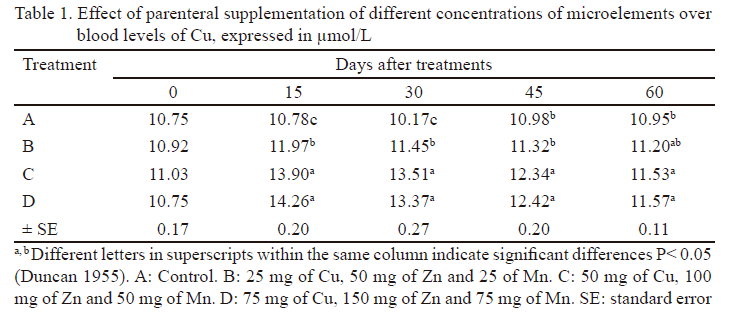
<body><![CDATA[<p align="justify" class="Cuerpodetexto" style="margin-top:12.0pt;text-indent:0cm;"><span style="font-family:'Verdana','sans-serif'; font-size:10.0pt; color:windowtext; ">From the results of this experiment,  two experimental groups were established, with five cows each. One was used as  control and the other was parenterally supplemented with C dose. Animal  selection was performed according to previously described inclusion criteria,  although they were animals destined to sacrifice due to their low milk  production. The influence of the supply of these microelements on hepatic  reserves was evaluated. Animals were slaughtered at 15 d after the application  of the product, which coincided with the peak of cupremia and zinc  supplementation, determined during the previous stage.</span></p>     <p align="justify" class="Cuerpodetexto" style="margin-top:12.0pt;text-indent:0cm;"><em><span style="font-family:'Verdana','sans-serif'; font-size:10.0pt; color:windowtext; ">Sample taking, used procedures and  techniques</span></em><span style="font-family:'Verdana','sans-serif'; font-size:10.0pt; color:windowtext; ">. Through jugular  venipuncture, 10 mL of blood were taken, before and every fifteen days after  treatment. These samples were located in sterilized and demineralized  anticoagulant tubes. Later, they were centrifuged at 3,500 rpm for 10 min.,  obtaining the blood serum. Liver samples were taken during the 15 min. after  the animal slaughter. Samples from the ventral edge of the right lobule (15 cm<sup>3</sup>)  were obtained, with a previous general inspection of this viscera in order to  discard any alteration. </span></p>     <p align="justify" class="Cuerpodetexto" style="margin-top:12.0pt;text-indent:0cm;"><span style="font-family:'Verdana','sans-serif'; font-size:10.0pt; color:windowtext; ">Samples of blood serum and hepatic  tissue were preserved at -10 &ordm;C up to the analysis. Determinations of Cu, Zn  and Mn were performed by atomic absorption spectrophotometry (Miles <em>et al.</em> 2001), with a SP-9 equipment, PYE UNICAM brand, according to procedures of  manufacturer.</span></p>     <p align="justify" class="Cuerpodetexto" style="margin-top:12.0pt;text-indent:0cm;"><em><span style="font-family:'Verdana','sans-serif'; font-size:10.0pt; color:windowtext; ">Calculation of reproductive indicators</span></em><span style="font-family:'Verdana','sans-serif'; font-size:10.0pt; color:windowtext; ">. The main reproductive indicators (parturition-first  insemination period (PFIP), service period (SP), parturition-parturition period  (PPP), insemination index (II) and percentage of gestation at first service)  were determined according to procedures recommended by Brito (2010). In  addition, milk production of each animal was determined during the first 240 d  of lactation.</span></p>     <p align="justify" class="Cuerpodetexto" style="margin-top:12.0pt;text-indent:0cm;"><span style="font-family:'Verdana','sans-serif'; font-size:10.0pt; color:windowtext; ">Milk weighing. Weighing of individual  milk production per month was carried out by means of a certified scale,  dynamometer type and graduated in kilograms. </span></p>     <p align="justify" class="Cuerpodetexto" style="margin-top:12.0pt;text-indent:0cm;"><em><span style="font-family:'Verdana','sans-serif'; font-size:10.0pt; color:windowtext; ">Statistical procedure</span></em><span style="font-family:'Verdana','sans-serif'; font-size:10.0pt; color:windowtext; ">. In order to compare concentrations of Cu and Zn in blood  serum among the different groups in each sampling, reproductive indicators (PFIP,  SP, PPP and II) and milk production in each weighing, an analysis of variance  of simple classification (ANOVA) was performed. Duncan (1955) test was used to  compare means in the cases with significant differences, with a previous  verification of variance homogeneity. Comparison of hepatic reserves of  microelements was conducted through t-Student test for independent samples.  Statgraphics Centurion (StatPoint Technologies 2010) program was used for each  procedure.</span></p>     <p align="justify" class="subtitulo" style="margin-top:12.0pt;text-align:justify;"><span style="font-family:'Verdana','sans-serif'; font-size:10.0pt; color:windowtext; ">&nbsp;</span></p>     <p align="justify" class="subtitulo" style="margin-top:12.0pt;text-align:justify;"><span style="font-family:'Verdana','sans-serif'; font-size:13.0pt; color:windowtext; "><b>RESULTS AND DISCUSSION</b> </span></p>     <p align="justify" class="Cuerpodetexto" style="margin-top:12.0pt;text-indent:0cm;"><span style="font-family:'Verdana','sans-serif'; font-size:10.0pt; color:windowtext; "><a href="/img/revistas/cjas/v50n3/t0105316.gif">Table 1</a> shows results of parenteral  supplementation of the different studied doses on Cu levels in blood. At the  beginning of this research (day 0), there were no significant differences among  the four groups. However, levels of cupremia were significantly superior    (P&lt; 0.001) in treatments with 50, 100, 50 and 75, 150, 75 mg of Cu, Zn and  Mn respectively, at 15, 30 and 45 d, regarding the control group and the  treatment with 25, 50 and 25 mg of Cu, Zn and Mn, respectively. At 60 d, there  were no differences (P &gt; 0.05) in cupremia among the groups supplemented  with 25, 50, 25; 50, 100 and 50; 75, 150 and 75 mg of and Mn, respectively. The  same happened between control and treatment with 25, 50 and 25 mg de Cu, Zn and  Mn.</span></p>     
<p align="justify" class="Cuerpodetexto" style="margin-top:12.0pt;text-indent:0cm;"><span style="font-family:'Verdana','sans-serif'; font-size:10.0pt; color:windowtext; ">Cu blood levels, for C and D  treatments, reached standard physiological patterns for bovine species  (McDowell and Arthington 2005) and they maintained for 60 d, moment in which  they began to decrease under the critical limit of deficiency, suggested by  McDowell and Arthington (2005).&nbsp; </span></p>     ]]></body>
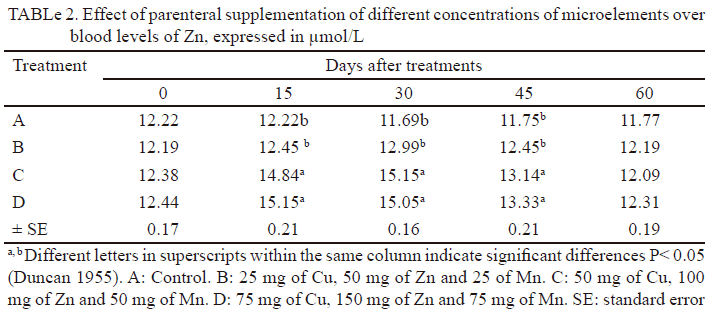
<body><![CDATA[<p align="justify" class="Cuerpodetexto" style="margin-top:12.0pt;text-indent:0cm;"><span style="font-family:'Verdana','sans-serif'; font-size:10.0pt; color:windowtext; ">These results are similar to those  obtained by Garc&iacute;a <em>et al.</em> (2012a), who increased cupremia and reached  its peak at five days after treatment, when it is stabilized up to 15 d, and  began to have a significant decrease and hypo-cupremia appears (&lt; 11.77  &micro;mol/L) at 60 d. </span></p>     <p align="justify" class="Cuerpodetexto" style="margin-top:12.0pt;text-indent:0cm;"><span style="font-family:'Verdana','sans-serif'; font-size:10.0pt; color:windowtext; ">Garc&iacute;a <em>et al.</em> (2012a) conducted  determinations of serum Cu every five days, which may be the cause for the  non-coincidence of cupremia peak regarding the results of this study. Another  aspect that could have influenced is that those authors provided Cu alone, and  this study supplemented it combined with Zn and    Mn.</span></p>     <p align="justify" class="Cuerpodetexto" style="margin-top:12.0pt;text-indent:0cm;"><span style="font-family:'Verdana','sans-serif'; font-size:10.0pt; color:windowtext; "><a href="/img/revistas/cjas/v50n3/t0205316.gif">Table 2</a> shows blood levels of Zn at  different moments, before and after the parenteral application of mineral  compounds. Before the supplementation (day 0) and at 60 d, there were no  differences (P&gt;0.05) among treatments. However, treatments with 50, 100, 50  and 75, 150, 75 mg of Cu, Zn and Mn, respectively, were superior to control  group and to the one of lowest concentration of minerals under study at 15, 30  and 45 d. Values of zinc supplementation were superior to standard (12.62  &micro;mol/L) physiological values (McDowell and Arthington 2005).</span></p>     
<p align="justify" class="Cuerpodetexto" style="margin-top:12.0pt;text-indent:0cm;"><span style="font-family:'Verdana','sans-serif'; font-size:10.0pt; color:windowtext; ">&nbsp;In Angus and Simental cattle, with parenteral  supplementation of Cu, Zn, and Mn, cupremia tended to increase. Serum  concentrations of Zn and Mn had a significant increase at 15 d after treatment  regarding control, while Mn tended to be superior (Pogge <em>et al.</em> 2012).</span></p>     <p align="justify" class="Cuerpodetexto" style="margin-top:12.0pt;text-indent:0cm;"><span style="font-family:'Verdana','sans-serif'; font-size:10.0pt; color:windowtext; ">Concentration of microelements on the  hepatic tissue (<a href="/img/revistas/cjas/v50n3/t0305316.gif">table 3</a>) had statistical differences on Zn (P&lt;0.05), Cu and  Mn (P&lt;0.001) levels, favoring the animals treated with the injectable  compound of these microelements. In all cases, their hepatic concentrations  reached superior values to those of the physiological limits for bovine  species, reported by Garc&iacute;a <em>et al.</em> (2012a), after studying Cu  supplementation on milking cows.</span></p>     
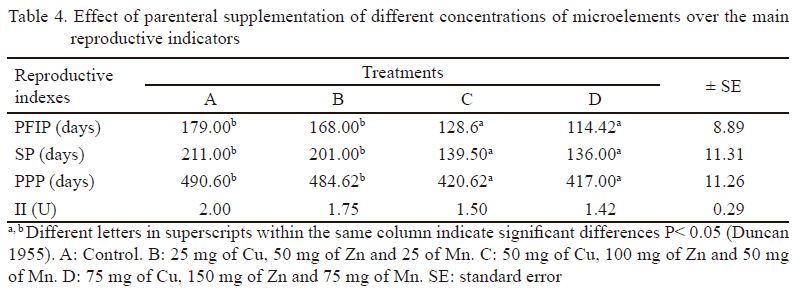
<p align="justify" class="Cuerpodetexto" style="margin-top:12.0pt;text-indent:0cm;"><span style="font-family:'Verdana','sans-serif'; font-size:10.0pt; color:windowtext; ">Liver Zn and Cu concentrations of this  research are similar to other publications, pointing out that hepatic Zn ranges  between 100 and 400 mg/kg on dry basis, and Cu varies from 200 to 300 mg/kg.  Concentrations become toxic when their levels on this organ are superior to 900  mg/kg on dry basis (McDowell and Arthington    2005).</span></p>     <p align="justify" class="Cuerpodetexto" style="margin-top:12.0pt;text-indent:0cm;"><span style="font-family:'Verdana','sans-serif'; font-size:10.0pt; color:windowtext; ">In this study, hepatic levels of Mn  are similar to those reported by NRC (2001), and range between 10 and 24 mg/kg  on dry basis. In addition, liver Mn concentrations are directly proportional to  those of this mineral on the consumed feed.</span></p>     <p align="justify" class="Cuerpodetexto" style="margin-top:12.0pt;text-indent:0cm;"><span style="font-family:'Verdana','sans-serif'; font-size:10.0pt; color:windowtext; ">C treatment (50 mg of Cu, 100 mg of Zn  and 50 mg of Mn) was used for evaluating concentration of those mineral on  hepatic tissue because serum concentrations of Cu and Zn of animals  supplemented with this treatment differed significantly from the group of cows  treated with D dose. In addition, in C treatment, a lower concentration of  microelements under study was used, so it was more economic.</span></p>     <p align="justify" class="Cuerpodetexto" style="margin-top:12.0pt;text-indent:0cm;"><span style="font-family:'Verdana','sans-serif'; font-size:10.0pt; color:windowtext; ">Determination of hepatic concentrations  is the most precise method for evaluating organic reserves of these minerals,  especially Cu and Zn, and also for determining the efficiency of the  supplementation because the liver is the reserve organ and it is the accurate  indicator of the state of these minerals in the organism (Rosa <em>et al.</em> 2008).&nbsp;&nbsp;&nbsp;&nbsp;&nbsp; </span></p>     <p align="justify" class="Cuerpodetexto" style="margin-top:12.0pt;text-indent:0cm;"><span style="font-family:'Verdana','sans-serif'; font-size:10.0pt; color:windowtext; ">Reproductive performance of these  animals was favored by treatments with 50, 100, 50; 75, 150,    75 mg of Cu, Zn and Mn, respectively (<a href="/img/revistas/cjas/v50n3/t0405316.gif">table 4</a>). In these treatments, there was  a significant (P &lt; 0.001) reduction of the PFIP, SP, PPP and II, regarding  the group control and that of lowest concentration.</span></p>     
]]></body>
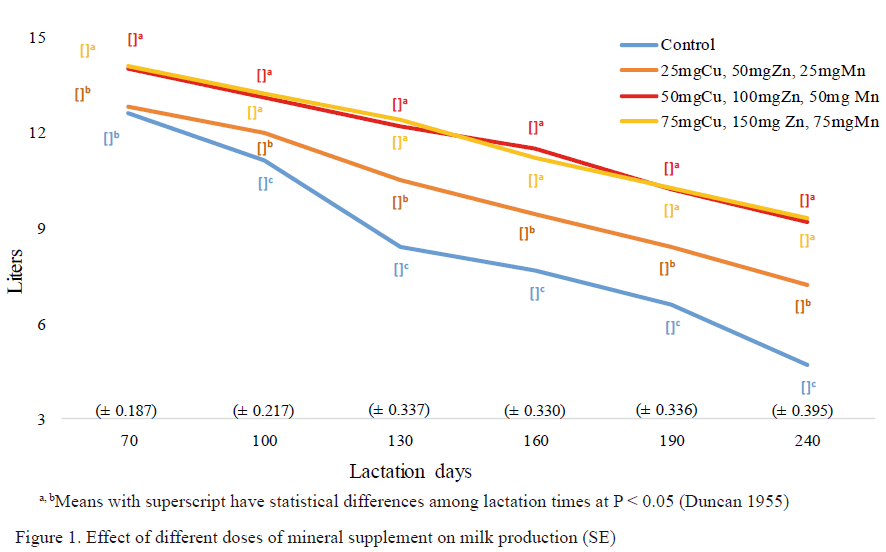
<body><![CDATA[<p align="justify" class="Cuerpodetexto" style="margin-top:12.0pt;text-indent:0cm;"><span style="font-family:'Verdana','sans-serif'; font-size:10.0pt; color:windowtext; ">Supplementation of a mineral compound  of Zn, Cu, Mn and Co glucoheptonate reduced parturition-first insemination  periods and parturition-gestation in 12 and 62 d, respectively, in milking  cows, compared with the group that received no treatment. In the supplemented  animals, conception services were 1.80 and, in control group, 2.60, as reported  by Uchida <em>et al.</em> (2001).</span></p>     <p align="justify" class="Cuerpodetexto" style="margin-top:12.0pt;text-indent:0cm;"><span style="font-family:'Verdana','sans-serif'; font-size:10.0pt; color:windowtext; ">&nbsp;<span style="letter-spacing:.2pt; ">According to  reports of Campbell <em>et al.</em> (1999), in an experiment in which inorganic  and organic minerals were supplemented to cows with voluntary waiting periods  of 60 d, there were no differences in days at the first service,  parturition-conception periods and first service to gestation, and services per  gestation among animals, according to the mineral source.</span></span></p>     <p align="justify" class="Cuerpodetexto" style="margin-top:12.0pt;text-indent:0cm;"><span style="font-family:'Verdana','sans-serif'; font-size:10.0pt; color:windowtext; ">In Cuba, injectable Cu supplementation  favored reproductive performance of animals with hypo-cupremic and  normal-cupremic animals, with cupremia next to 14 &micro;mol/L / L (Garcia <em>et al.</em> 2012b). Parenteral supply of 50 mg Cu in female bovines at eight months of  gestation, without knowing the state of serum Cu, favored postpartum  reproductive performance (Figueredo 2016).</span></p>     <p align="justify" class="Cuerpodetexto" style="margin-top:12.0pt;text-indent:0cm;"><span style="font-family:'Verdana','sans-serif'; font-size:10.0pt; color:windowtext; ">Milk production  means of groups supplemented with 50, 100, 50; 75, 150, 75 mg&nbsp; of Cu, Zn and Mn, respectively, had no  significant differences. However, there were differences regarding control  group and that of lower concentration of Cu, Zn and Mn    (<a href="/img/revistas/cjas/v50n3/f0105316.gif">figure 1</a>).</span> </p>     
<p align="justify" class="Cuerpodetexto" style="margin-top:12.0pt;text-indent:0cm;"><span style="font-family:'Verdana','sans-serif'; font-size:10.0pt; color:windowtext; ">Significant increase of milk  production of groups supplemented with 50,&nbsp;  100, 50; 75, 150, 75 mg of Cu, Zn and Mn, respectively, regarding  control group and that of the lowest applied doses,&nbsp; could be favored by the significant increase  provoked by supplementation to blood and hepatic concentrations of Cu (<a href="/img/revistas/cjas/v50n3/t0105316.gif">table 1</a>)  and Zn (<a href="/img/revistas/cjas/v50n3/t0205316.gif">table 2</a>).</span></p>     
<p align="justify" class="Cuerpodetexto" style="margin-top:12.0pt;text-indent:0cm;"><span style="font-family:'Verdana','sans-serif'; font-size:10.0pt; color:windowtext; ">Rises of milk  production increased mineral requirements and marginal deficiencies of  microelements, decreased productive levels and affected the functioning of many  enzymes and proteins, involving different physiological, biochemical and metabolic  processes, as well as the functioning of immune system, contributing to  decrease productive potential and defenses of the organism (McDowell &amp;  Arthington 2005).</span><span style="font-family:'Verdana','sans-serif'; font-size:10.0pt; color:windowtext; "> </span></p>     <p align="justify" class="Cuerpodetexto" style="margin-top:12.0pt;text-indent:0cm;"><span style="font-family:'Verdana','sans-serif'; font-size:10.0pt; color:windowtext; ">Cu requirements during lactation are  0.15 mg/kg of milk produced during early lactation (&lt; 100 days). Levels of  0.5 mg of Cu are introduced to fetus, placenta and uterine tissues every day,  increasing the requirements from 1.5 to 2 mg/day during the last month of  gestation. Mn requirements during gestation grow up to    0.3 mg/day at the end of it, and its concentrations are 0.16 mg/kg in colostrum  and 0.03 mg/kg in milk. Those of Zn, 12 mg/day are retained during gestation up  to  190 days and at the end of it are duplicated (ARC &amp; CAB 1980). Zn content  in milk is 4 mg/kg, ranging from 3.4 to 5.8 mg/kg (NRC 2001).</span></p>     <p align="justify" class="Cuerpodetexto" style="margin-top:12.0pt;text-indent:0cm;"><span style="font-family:'Verdana','sans-serif'; font-size:10.0pt; color:windowtext; ">Therefore, transition period increases  Cu, Zn and Mn requirements in milking cows and it is the most adequate moment  for its supplementation. Similar results to those of this experiment were  obtained in the supply of 50 mg of Cu, parenterally, in female bovines at eight  months of gestation. It produced an increase of cupremia, immunoglobulin,  decreases mastitis and favored postpartum reproductive performance (Figueredo  2016).</span></p>     <p align="justify" class="Cuerpodetexto" style="margin-top:12.0pt;text-indent:0cm;"><span style="font-family:'Verdana','sans-serif'; font-size:10.0pt; color:windowtext; ">Oral mineral supplementation to  milking cows, three weeks before parturition, increase milk production in the  moment of lactation peak (Kincaid &amp; Socha 2004), between 2.9 and 3.2 % in  the thirteenth week (Siciliano-Jones <em>et al.</em> 2008) and in the fourteenth  week (Hackbart <em>et al.</em> 2010).</span></p>     <p align="justify" class="Cuerpodetexto" style="margin-top:12.0pt;text-indent:0cm;"><span style="font-family:'Verdana','sans-serif'; font-size:10.0pt; color:windowtext; ">Supplementing an  amino acid complex including Zn, Cu and Mn favors dry matter intake and the  functioning of many metalloenzymes like Cu-Zn- superoxide dismutase, carbonic  anhydrase, alcohol dehydrogenase, carboxypeptidase, alkaline phosphatase and  RNA polymerase, which act on metabolism of carbohydrates, proteins, lipids and  nucleic acids, improving the performance of milking cows (NRC 2001). </span><span style="font-family:'Verdana','sans-serif'; font-size:10.0pt; color:windowtext; "> </span></p>     ]]></body>
<body><![CDATA[<p align="justify" class="Cuerpodetexto" style="margin-top:12.0pt;text-indent:0cm;"><span style="font-family:'Verdana','sans-serif'; font-size:10.0pt; color:windowtext; ">Benefits of  organic supplements of Cu, Zn and Mn include prevention of mastitis,  improvement of fertility and reduction of incidences of podal injuries (Uchida <em>et  al.</em> 2001, Kellogg <em>et al.</em> 2003, 2004), digestibility of nutrients and  udder health (Machado <em>et al.</em> 2014).</span><span style="font-family:'Verdana','sans-serif'; font-size:10.0pt; color:windowtext; "> </span></p>     <p align="justify" class="Cuerpodetexto" style="margin-top:12.0pt;text-indent:0cm;"><span style="font-family:'Verdana','sans-serif'; font-size:10.0pt; color:windowtext; ">Zn-deficient animals have a low intake  and deficient use of nutrients (McDowell &amp; Arthington 2005). In this sense,  Rosa <em>et al.</em> (2008) state that even with initial symptoms of Zn  deficiency, there is a reduction of food efficiency and low production and  secretion of hormones.</span></p>     <p align="justify" class="Cuerpodetexto" style="margin-top:12.0pt;text-indent:0cm;"><span style="line-height:107%; font-family:'Verdana','sans-serif'; font-size:10.0pt; ">It can be concluded that  parenteral supplementation of 50 mg of Cu, 100 mg of Zn and 50 mg of Mn in  milking cows from 8 months of gestation was the most efficient to reestablish  organic levels of these microelements and favors reproductive and productive  performance of treated animals</span><span style="font-family:'Verdana','sans-serif'; font-size:10.0pt; color:windowtext; ">. </span></p>     <p align="justify" class="MsoNormal" style="margin-top:12.0pt;text-align:justify;"><span style="line-height:107%; font-family:'Verdana','sans-serif'; font-size:10.0pt; ">&nbsp;</span></p>     <p align="justify" class="subtitulo" style="margin-top:12.0pt;text-align:justify;"><span style="font-family:'Verdana','sans-serif'; font-size:13.0pt; color:windowtext; "><b>REFERENCES</b></span></p>     <p align="justify" class="referencias" style="margin-top:12.0pt;margin-right:0cm;margin-bottom:.0001pt;margin-left:0cm;text-indent:0cm;"><span style="font-family:'Verdana','sans-serif'; font-size:10.0pt; color:windowtext; ">ARC  (Agricultural Research Council) &amp; CAB (Commonwealth Agricultural Bureaux)  1980. The Nutrient requirements of ruminant livestock: technical review. Great  Britain: Agricultural Research Council - Commonwealth Agricultural Bureaux, 376  p., ISBN: 978-0-85198-459-9, Available:  &lt;<a href="https://books.google.com.cu/books?id=m2g_AAAAYAAJ&source=gbs_navlinks_s&redir_esc=y" target="_blank">https://books.google.com.cu/books?id=m2g_AAAAYAAJ&amp;source=gbs_navlinks_s&amp;redir_esc=y</a>&gt;,  [Consulted: June 23, 2016].</span></p>     <!-- ref --><p align="justify" class="referencias" style="margin-top:12.0pt;margin-right:0cm;margin-bottom:.0001pt;margin-left:0cm;text-indent:0cm;"><span style="font-family:'Verdana','sans-serif'; font-size:10.0pt; color:windowtext; ">Brito, C. R. 2010. Patolog&iacute;a de la reproducci&oacute;n animal. call no. 636, La Habana,  Cuba: F&eacute;lix Varela, 369 p., ISBN: 978-959-07<sup>-1</sup>279<sup>-1</sup>.    </span></p>     <p align="justify" class="referencias" style="margin-top:12.0pt;margin-right:0cm;margin-bottom:.0001pt;margin-left:0cm;text-indent:0cm;"><span style="font-family:'Verdana','sans-serif'; font-size:10.0pt; color:windowtext; ">Campbell,  M. H., Miller, J. K. &amp; Schrick, F. N. 1999. &ldquo;Effect of Additional Cobalt,  Copper, Manganese, and Zinc on Reproduction and Milk Yield of Lactating Dairy  Cows Receiving Bovine Somatotropin&rdquo;. Journal of Dairy Science, 82(5):  1019&ndash;1025, ISSN: 0022-0302, DOI: 10.3168/jds.S0022-0302(99)75322-1.</span></p>     <p align="justify" class="referencias" style="margin-top:12.0pt;margin-right:0cm;margin-bottom:.0001pt;margin-left:0cm;text-indent:0cm;"><span style="font-family:'Verdana','sans-serif'; font-size:10.0pt; color:windowtext; ">Duncan,  D. B. 1955. &ldquo;Multiple Range and Multiple F Tests&rdquo;. </span><span style="font-family:'Verdana','sans-serif'; font-size:10.0pt; color:windowtext; ">Biometrics, 11(1): 1&ndash;42, ISSN: 0006-341X, DOI: 10.2307/3001478.</span></p>     ]]></body>
<body><![CDATA[<p align="justify" class="referencias" style="margin-top:12.0pt;margin-right:0cm;margin-bottom:.0001pt;margin-left:0cm;text-indent:0cm;"><span style="font-family:'Verdana','sans-serif'; font-size:10.0pt; color:windowtext; ">Fajardo, H., Viamonte, M. I., Rond&oacute;n, G., Garc&iacute;a, L. R., Guti&eacute;rrez, O.,  S&aacute;nchez, M. &amp; Gonz&aacute;lez, N. 2011. &ldquo;Hembras bovinas lecheras en pastoreo en  el Valle del Cauto. II.&nbsp; Caracterizaci&oacute;n  del perfil metab&oacute;lico y su influencia en la&nbsp;  reproducci&oacute;n&rdquo;. Ciencia y Tecnolog&iacute;a Ganadera, 5(2&ndash;3): 113&ndash;123, ISSN:  1999-4494, 1998-3050.</span></p>     <!-- ref --><p align="justify" class="referencias" style="margin-top:12.0pt;margin-right:0cm;margin-bottom:.0001pt;margin-left:0cm;text-indent:0cm;"><span style="font-family:'Verdana','sans-serif'; font-size:10.0pt; color:windowtext; ">Figueredo, Y. 2016. Efecto del cobre parenteral en las inmunoglobulinas  s&eacute;ricas, mastitis subcl&iacute;nica y comportamiento reproductivo de vacas preparto  Siboney de Cuba. M.Sc. Thesis, Centro de Investigaciones para el mejoramiento  Animal en la Ganader&iacute;a tropical (CIMAGT), La Habana, Cuba, 68 p.    </span></p>     <p align="justify" class="referencias" style="margin-top:12.0pt;margin-right:0cm;margin-bottom:.0001pt;margin-left:0cm;text-indent:0cm;"><span style="font-family:'Verdana','sans-serif'; font-size:10.0pt; color:windowtext; ">Galindo, J., Guti&eacute;rrez, O., Ramayo, M. &amp; Leyva, L. 2014. </span><span style="font-family:'Verdana','sans-serif'; font-size:10.0pt; color:windowtext; ">&ldquo;Mineral  status of cows and its relationship with the soil-plant system in a dairy unit  of the Eastern region of Cuba&rdquo;. Cuban Journal of Agricultural Science, 48(3):  241&ndash;245, ISSN: 2079-3480.</span></p>     <p align="justify" class="referencias" style="margin-top:12.0pt;margin-right:0cm;margin-bottom:.0001pt;margin-left:0cm;text-indent:0cm;"><span style="font-family:'Verdana','sans-serif'; font-size:10.0pt; color:windowtext; ">Garc&iacute;a,  D. J. R., Joseph, A. J., Cuesta, M. M., Qui&ntilde;ones, R. R., Munyori, N. H.,  Figueredo, R. J. M. &amp; Mollineda, T. &Aacute;. 2012a. &ldquo;Effects of parenteral  supplementation of Cu in female cattle with different levels of cupremia&rdquo;. </span><span style="font-family:'Verdana','sans-serif'; font-size:10.0pt; color:windowtext; ">Archives Animal Breeding, 55(2): 113&ndash;122, ISSN: 0003-9438.</span></p>     <p align="justify" class="referencias" style="margin-top:12.0pt;margin-right:0cm;margin-bottom:.0001pt;margin-left:0cm;text-indent:0cm;"><span style="font-family:'Verdana','sans-serif'; font-size:10.0pt; color:windowtext; ">Garc&iacute;a, D. J. R., Munyori, N. H., Cuesta, M. M., Qui&ntilde;ones, R. R.,  Figueredo, R. J. M., Noval, A. E. &amp; Mollineda, T. &Aacute;. 2012b. </span><span style="font-family:'Verdana','sans-serif'; font-size:10.0pt; color:windowtext; ">&ldquo;Therapeutic  efficacy and pharmacological safety of parenteral supplementation of different  concentrations of copper in cows&rdquo;. </span><span style="font-family:'Verdana','sans-serif'; font-size:10.0pt; color:windowtext; ">Archives Animal Breeding, 55(1): 25&ndash;35,  ISSN: 0003-9438.</span></p>     <p align="justify" class="referencias" style="margin-top:12.0pt;margin-right:0cm;margin-bottom:.0001pt;margin-left:0cm;text-indent:0cm;"><span style="font-family:'Verdana','sans-serif'; font-size:10.0pt; color:windowtext; ">Garc&iacute;a, J. R., Cuesta, M., Garc&iacute;a L&oacute;pez, R., Qui&ntilde;ones, R., Figueredo, J.  M., Faure, R., Pedroso, R. &amp; Mollineda, &Aacute;. 2010a. </span><span style="font-family:'Verdana','sans-serif'; font-size:10.0pt; color:windowtext; ">&ldquo;Characterization  of the content of microelements in the soil-plant-animal system and its  influence on cattle reproduction in the central region of Cuba.&rdquo;. </span><span style="font-family:'Verdana','sans-serif'; font-size:10.0pt; color:windowtext; ">Cuban Journal of Agricultural Science, 44(3): 227&ndash;231, ISSN: 2079-3480.</span></p>     <p align="justify" class="referencias" style="margin-top:12.0pt;margin-right:0cm;margin-bottom:.0001pt;margin-left:0cm;text-indent:0cm;"><span style="font-family:'Verdana','sans-serif'; font-size:10.0pt; color:windowtext; ">Garc&iacute;a, J. R., Garc&iacute;a L&oacute;pez, R., Cuesta, M., Figueredo, J. M., Qui&ntilde;ones,  R., Faure, R., Pedroso, R. &amp; Mollineda, &Aacute;. 2010b. </span><span style="font-family:'Verdana','sans-serif'; font-size:10.0pt; color:windowtext; ">&ldquo;Blood copper  levels and their influence on reproductive indicators of cows in tropical  conditions.&rdquo;. Cuban Journal of Agricultural Science, 44(3): 233&ndash;239, ISSN:  2079-3480.</span></p>     <p align="justify" class="referencias" style="margin-top:12.0pt;margin-right:0cm;margin-bottom:.0001pt;margin-left:0cm;text-indent:0cm;"><span style="font-family:'Verdana','sans-serif'; font-size:10.0pt; color:windowtext; ">Genther,  O. N. &amp; Hansen, S. L. 2014. &ldquo;A multielement trace mineral injection  improves liver copper and selenium concentrations and manganese superoxide  dismutase activity in beef steers&rdquo;. Journal of Animal Science, 92(2): 695&ndash;704,  ISSN: 0021-8812, 1525-3163, DOI: 10.2527/jas.2013-7066.</span></p>     <p align="justify" class="referencias" style="margin-top:12.0pt;margin-right:0cm;margin-bottom:.0001pt;margin-left:0cm;text-indent:0cm;"><span style="font-family:'Verdana','sans-serif'; font-size:10.0pt; color:windowtext; ">Hackbart,  K. S., Ferreira, R. M., Dietsche, A. A., Socha, M. T., Shaver, R. D., Wiltbank,  M. C. &amp; Fricke, P. M. 2010. &ldquo;Effect of dietary organic zinc, manganese,  copper, and cobalt supplementation on milk production, follicular growth,  embryo quality, and tissue mineral concentrations in dairy cows&rdquo;. Journal of  Animal Science, 88(12): 3856&ndash;3870, ISSN: 0021-8812, 1525-3163, DOI:  10.2527/jas.2010-3055.</span></p>     ]]></body>
<body><![CDATA[<!-- ref --><p align="justify" class="referencias" style="margin-top:12.0pt;margin-right:0cm;margin-bottom:.0001pt;margin-left:0cm;text-indent:0cm;"><span style="font-family:'Verdana','sans-serif'; font-size:10.0pt; color:windowtext; ">Hern&aacute;ndez,  J. A., P&eacute;rez, J. J. M., Bosch, I. D. &amp; Castro, S. N. 2015. </span><span style="font-family:'Verdana','sans-serif'; font-size:10.0pt; color:windowtext; ">Clasificaci&oacute;n de los suelos de Cuba 2015. Mayabeque, Cuba: Ediciones INCA,  93 p., ISBN: 978-959-7023-77-7.    </span></p>     <p align="justify" class="referencias" style="margin-top:12.0pt;margin-right:0cm;margin-bottom:.0001pt;margin-left:0cm;text-indent:0cm;"><span style="font-family:'Verdana','sans-serif'; font-size:10.0pt; color:windowtext; ">Kellogg,  D. W., Socha, M. T., Tomlinson, D. J. &amp; Johnson, A. B. 2003. &ldquo;Effects of  Feeding Cobalt Glucoheptonate and Metal Specific Amino Acid Complexes of Zinc,  Manganese, and Copper on Lactation and Reproductive Performance of Dairy Cows&rdquo;.  The Professional Animal Scientist, 19(1): 1&ndash;9, ISSN: 1080-7446, 1525-318X, DOI:  10.15232/S1080-7446(15)31367-X.</span></p>     <p align="justify" class="referencias" style="margin-top:12.0pt;margin-right:0cm;margin-bottom:.0001pt;margin-left:0cm;text-indent:0cm;"><span style="font-family:'Verdana','sans-serif'; font-size:10.0pt; color:windowtext; ">Kellogg,  D. W., Tomlinson, D. J., Socha, M. T. &amp; Johnson, A. B. 2004. &ldquo;Effects of  Zinc Methionine Complex on Milk Production and Somatic Cell Count of Dairy  Cows: Twelve-Trial Summary&rdquo;. The Professional Animal Scientist, 20(4): 295&ndash;301,  ISSN: 1080-7446, DOI: 10.15232/S1080-7446(15)31318-8.</span></p>     <p align="justify" class="referencias" style="margin-top:12.0pt;margin-right:0cm;margin-bottom:.0001pt;margin-left:0cm;text-indent:0cm;"><span style="font-family:'Verdana','sans-serif'; font-size:10.0pt; color:windowtext; ">Kincaid,  R. L. &amp; Socha, M. T. 2004. &ldquo;Inorganic Versus Complexed Trace Mineral  Supplements on Performance of Dairy Cows&rdquo;. The Professional Animal Scientist,  20(1): 66&ndash;73, ISSN: 1080-7446, DOI: 10.15232/S1080-7446(15)31274-2.</span></p>     <p align="justify" class="referencias" style="margin-top:12.0pt;margin-right:0cm;margin-bottom:.0001pt;margin-left:0cm;text-indent:0cm;"><span style="font-family:'Verdana','sans-serif'; font-size:10.0pt; color:windowtext; ">Machado,  V. S., Oikonomou, G., Lima, S. F., Bicalho, M. L. S., Kacar, C., Foditsch, C.,  Felippe, M. J., Gilbert, R. O. &amp; Bicalho, R. C. 2014. &ldquo;The effect of  injectable trace minerals (selenium, copper, zinc, and manganese) on peripheral  blood leukocyte activity and serum superoxide dismutase activity of lactating  Holstein cows&rdquo;. The Veterinary Journal, 200(2): 299&ndash;304, ISSN: 1090-0233, DOI:  10.1016/j.tvjl.2014.02.026.</span></p>     <!-- ref --><p align="justify" class="referencias" style="margin-top:12.0pt;margin-right:0cm;margin-bottom:.0001pt;margin-left:0cm;text-indent:0cm;"><span style="font-family:'Verdana','sans-serif'; font-size:10.0pt; color:windowtext; ">McDowell,  L. R. &amp; Arthington, J. D. 2005. </span><span style="font-family:'Verdana','sans-serif'; font-size:10.0pt; color:windowtext; ">Minerales para Rumiantes en Pastoreo en  Regiones Tropicales. </span><span style="font-family:'Verdana','sans-serif'; font-size:10.0pt; color:windowtext; ">4th ed., E.E.U.U: University of Florida-IFAS, 91 p.    </span></p>     <!-- ref --><p align="justify" class="referencias" style="margin-top:12.0pt;margin-right:0cm;margin-bottom:.0001pt;margin-left:0cm;text-indent:0cm;"><span style="font-family:'Verdana','sans-serif'; font-size:10.0pt; color:windowtext; ">Miles,  P. H., Wilkinson, N. S. &amp; McDowell, L. R. 2001. Analysis of minerals for  animal nutrition research. 3rd ed., Gainesville, USA: Department of Animal  Science, University of Florida.    </span></p>     ]]></body>
<body><![CDATA[<p align="justify" class="referencias" style="margin-top:12.0pt;margin-right:0cm;margin-bottom:.0001pt;margin-left:0cm;text-indent:0cm;"><span style="font-family:'Verdana','sans-serif'; font-size:10.0pt; color:windowtext; ">Nayeri, A., Upah, N. C., Sucu, E., Sanz-Fernandez, M. V., DeFrain, J. M.,  Gorden, P. J. &amp; Baumgard, L. H. 2014. </span><span style="font-family:'Verdana','sans-serif'; font-size:10.0pt; color:windowtext; ">&ldquo;Effect of the  ratio of zinc amino acid complex to zinc sulfate on the performance of Holstein  cows&rdquo;. Journal of Dairy Science, 97(7): 4392&ndash;4404, ISSN: 0022-0302, DOI: 10.3168/jds.2013-7541.</span></p>     <p align="justify" class="referencias" style="margin-top:12.0pt;margin-right:0cm;margin-bottom:.0001pt;margin-left:0cm;text-indent:0cm;"><span style="font-family:'Verdana','sans-serif'; font-size:10.0pt; color:windowtext; ">Nemec,  L. M., Richards, J. D., Atwell, C. A., Diaz, D. E., Zanton, G. I. &amp;  Gressley, T. F. 2012. &ldquo;Immune responses in lactating Holstein cows supplemented  with Cu, Mn, and Zn as sulfates or methionine hydroxy analogue chelates&rdquo;. Journal  of Dairy Science, 95(8): 4568&ndash;4577, ISSN: 0022-0302, DOI:  10.3168/jds.2012-5404.</span></p>     <p align="justify" class="referencias" style="margin-top:12.0pt;margin-right:0cm;margin-bottom:.0001pt;margin-left:0cm;text-indent:0cm;"><span style="font-family:'Verdana','sans-serif'; font-size:10.0pt; color:windowtext; ">Noval,  A. E., Garc&iacute;a, D. J. R., Garc&iacute;a, L. R., Qui&ntilde;ones, R. R. &amp; Mollineda, T. &Aacute;.  2014. </span><span style="font-family:'Verdana','sans-serif'; font-size:10.0pt; color:windowtext; ">&ldquo;Caracterizaci&oacute;n de algunos componentes qu&iacute;micos, en  suelos de diferentes agroecosistemas ganaderos&rdquo;. </span><span style="font-family:'Verdana','sans-serif'; font-size:10.0pt; color:windowtext; ">Centro Agr&iacute;cola,  41(1): 25&ndash;31, ISSN: 2072-2001, 0253-5785.</span></p>     <p align="justify" class="referencias" style="margin-top:12.0pt;margin-right:0cm;margin-bottom:.0001pt;margin-left:0cm;text-indent:0cm;"><span style="font-family:'Verdana','sans-serif'; font-size:10.0pt; color:windowtext; ">NRC  (National Research Council) (ed.). 2001. Nutrient requirements of dairy cattle.  7th ed., call no. SF203 .N883 2001, Washington, D.C: National Academy Press,  381 p., ISBN: 978-0-309-06997-7.</span></p>     <p align="justify" class="referencias" style="margin-top:12.0pt;margin-right:0cm;margin-bottom:.0001pt;margin-left:0cm;text-indent:0cm;"><span style="font-family:'Verdana','sans-serif'; font-size:10.0pt; color:windowtext; ">Parker,  R. 1989. &ldquo;Body condition scoring of dairy cattle&rdquo;. Factsheet, 410/20, ISSN:  1198-712X.</span></p>     <p align="justify" class="referencias" style="margin-top:12.0pt;margin-right:0cm;margin-bottom:.0001pt;margin-left:0cm;text-indent:0cm;"><span style="font-family:'Verdana','sans-serif'; font-size:10.0pt; color:windowtext; ">Pogge,  D. J., Richter, E. L., Drewnoski, M. E. &amp; Hansen, S. L. 2012. &ldquo;Mineral  concentrations of plasma and liver after injection with a trace mineral complex  differ among Angus and Simmental cattle&rdquo;. Journal of Animal Science, 90(8):  2692&ndash;2698, ISSN: 0021-8812, 1525-3163, DOI: 10.2527/jas.2011-4482.</span></p>     <p align="justify" class="referencias" style="margin-top:12.0pt;margin-right:0cm;margin-bottom:.0001pt;margin-left:0cm;text-indent:0cm;"><span style="font-family:'Verdana','sans-serif'; font-size:10.0pt; color:windowtext; ">Rosa, D.  E., Fazzio, L. E., Picco, S. J., Furnus, C. &amp; Mattioli, G. A. 2008. </span><span style="font-family:'Verdana','sans-serif'; font-size:10.0pt; color:windowtext; ">&ldquo;Metabolismo y deficiencia de zinc en bovinos&rdquo;. Analecta Veterinaria,  28(2): 34&ndash;44, ISSN: 1514-2590.</span></p>     <p align="justify" class="referencias" style="margin-top:12.0pt;margin-right:0cm;margin-bottom:.0001pt;margin-left:0cm;text-indent:0cm;"><span style="font-family:'Verdana','sans-serif'; font-size:10.0pt; color:windowtext; ">Siciliano-Jones, J. L., Socha, M. T., Tomlinson, D. J. &amp; DeFrain, J. M.  2008. </span><span style="font-family:'Verdana','sans-serif'; font-size:10.0pt; color:windowtext; ">&ldquo;Effect of Trace Mineral Source on Lactation Performance,  Claw Integrity, and Fertility of Dairy Cattle&rdquo;. Journal of Dairy Science,  91(5): 1985&ndash;1995, ISSN: 0022-0302, DOI: 10.3168/jds.2007-0779, PMID: 18420629,  18420629.</span></p>     <!-- ref --><p align="justify" class="referencias" style="margin-top:12.0pt;margin-right:0cm;margin-bottom:.0001pt;margin-left:0cm;text-indent:0cm;"><span style="font-family:'Verdana','sans-serif'; font-size:10.0pt; color:windowtext; ">Sotolongo,  J. 2007. </span><span style="font-family:'Verdana','sans-serif'; font-size:10.0pt; color:windowtext; ">Medicina interna veterinaria. La Habana, Cuba: F&eacute;lix  Varela, ISBN: 978-959-07-0549-6.    </span></p>     ]]></body>
<body><![CDATA[<p align="justify" class="referencias" style="margin-top:12.0pt;margin-right:0cm;margin-bottom:.0001pt;margin-left:0cm;text-indent:0cm;"><span style="font-family:'Verdana','sans-serif'; font-size:10.0pt; color:windowtext; ">Spears,  J. W. &amp; Weiss, W. P. 2008. &ldquo;Role of antioxidants and trace elements in  health and immunity of transition dairy cows&rdquo;. The Veterinary Journal, 176(1):  70&ndash;76, ISSN: 1090-0233, DOI: 10.1016/j.tvjl.2007.12.015.</span></p>     <!-- ref --><p align="justify" class="referencias" style="margin-top:12.0pt;margin-right:0cm;margin-bottom:.0001pt;margin-left:0cm;text-indent:0cm;"><span style="font-family:'Verdana','sans-serif'; font-size:10.0pt; color:windowtext; ">StatPoint  Technologies 2010. Statgraphics Centurion. (ser. Centurion), version 16.1 (XV),  [Windows], Available:  &lt;<a href="http://statgraphics-centurion.software.informer.com/download/" target="_blank">http://statgraphics-centurion.software.informer.com/download/</a>&gt;    .</span></p>     <p align="justify" class="referencias" style="margin-top:12.0pt;margin-right:0cm;margin-bottom:.0001pt;margin-left:0cm;text-indent:0cm;"><span style="font-family:'Verdana','sans-serif'; font-size:10.0pt; color:windowtext; ">Uchida,  K., Mandebvu, P., Ballard, C. S., Sniffen, C. J. &amp; Carter, M. P. 2001.  &ldquo;Effect of feeding a combination of zinc, manganese and copper amino acid  complexes, and cobalt glucoheptonate on performance of early lactation high  producing dairy cows&rdquo;. Animal Feed Science and Technology, 93(3&ndash;4): 193&ndash;203,  ISSN: 0377-8401, DOI: 10.1016/S0377-8401(01)00279-6.</span></p>     <p align="justify" class="referencias" style="margin-top:12.0pt;margin-right:0cm;margin-bottom:.0001pt;margin-left:0cm;text-indent:0cm;"><span style="font-family:'Verdana','sans-serif'; font-size:10.0pt; ">Valera, M., Guti&eacute;rrez, O.,  Gallego, C., Oramas, A. &amp; S&aacute;nchez, L. 2011. &ldquo;Macro y microelementos  sangu&iacute;neos en reba&ntilde;os lecheros en pastoreo, pertenecientes al Instituto de  Ciencia Animal. Nota t&eacute;cnica&rdquo;. Cuban Journal of Agricultural Science, 45(2):  121&ndash;122, ISSN: 2079-3480</span><font size="2" face="Verdana, Arial, Helvetica, sans-serif">.</font></p>     <p align="justify">&nbsp;</p>     <p align="justify">&nbsp;</p>     <p align="justify"><font size="2" face="Verdana, Arial, Helvetica, sans-serif">Received: 13/3/2015    <br> Accepted: 7/6/2016</font></p>     <p align="justify">&nbsp;</p>     ]]></body>
<body><![CDATA[<p align="justify">&nbsp;</p>     <p align="justify"><font size="2" face="Verdana, Arial, Helvetica, sans-serif"><i>E. Noval,</i> Departamento de Medicina Veterinaria y Zootecnia. Facultad de Ciencias Agropecuarias. Universidad Central de las  Villas “Marta Abreu”. Carretera a Camajuaní, km 5,5. Santa Clara (54830), Villa Clara, Cuba.    Email: <a href="mailto:ernestona@uclv.edu.cu">ernestona@uclv.edu.cu</a></font></p>      ]]></body><back>
<ref-list>
<ref id="B1">
<nlm-citation citation-type="book">
<person-group person-group-type="author">
<name>
<surname><![CDATA[Brito]]></surname>
<given-names><![CDATA[C. R.]]></given-names>
</name>
</person-group>
<source><![CDATA[Patología de la reproducción animal]]></source>
<year>2010</year>
<page-range>369</page-range><publisher-loc><![CDATA[La Habana, Cuba ]]></publisher-loc>
<publisher-name><![CDATA[Félix Varela]]></publisher-name>
</nlm-citation>
</ref>
<ref id="B2">
<nlm-citation citation-type="journal">
<person-group person-group-type="author">
<name>
<surname><![CDATA[Campbell]]></surname>
<given-names><![CDATA[M. H.]]></given-names>
</name>
<name>
<surname><![CDATA[Miller]]></surname>
<given-names><![CDATA[J. K.]]></given-names>
</name>
<name>
<surname><![CDATA[Schrick]]></surname>
<given-names><![CDATA[F. N.]]></given-names>
</name>
</person-group>
<article-title xml:lang="nd"><![CDATA[Effect of Additional Cobalt, Copper, Manganese, and Zinc on Reproduction and Milk Yield of Lactating Dairy Cows Receiving Bovine Somatotropin]]></article-title>
<source><![CDATA[Journal of Dairy Science]]></source>
<year>1999</year>
<volume>82</volume>
<numero>5</numero>
<issue>5</issue>
<page-range>1019–1025</page-range></nlm-citation>
</ref>
<ref id="B3">
<nlm-citation citation-type="journal">
<person-group person-group-type="author">
<name>
<surname><![CDATA[Duncan]]></surname>
<given-names><![CDATA[D. B.]]></given-names>
</name>
</person-group>
<article-title xml:lang="nd"><![CDATA[Multiple Range and Multiple F Tests]]></article-title>
<source><![CDATA[Biometrics]]></source>
<year>1955</year>
<volume>11</volume>
<numero>1</numero>
<issue>1</issue>
<page-range>1–42</page-range></nlm-citation>
</ref>
<ref id="B4">
<nlm-citation citation-type="journal">
<person-group person-group-type="author">
<name>
<surname><![CDATA[Fajardo]]></surname>
<given-names><![CDATA[H.]]></given-names>
</name>
<name>
<surname><![CDATA[Viamonte]]></surname>
<given-names><![CDATA[M. I.]]></given-names>
</name>
<name>
<surname><![CDATA[Rondón]]></surname>
<given-names><![CDATA[G.]]></given-names>
</name>
<name>
<surname><![CDATA[García]]></surname>
<given-names><![CDATA[L. R.]]></given-names>
</name>
<name>
<surname><![CDATA[Gutiérrez]]></surname>
<given-names><![CDATA[O.]]></given-names>
</name>
<name>
<surname><![CDATA[Sánchez]]></surname>
<given-names><![CDATA[M.]]></given-names>
</name>
<name>
<surname><![CDATA[González]]></surname>
<given-names><![CDATA[N.]]></given-names>
</name>
</person-group>
<article-title xml:lang="nd"><![CDATA[Hembras bovinas lecheras en pastoreo en el Valle del Cauto. II. Caracterización del perfil metabólico y su influencia en la reproducción]]></article-title>
<source><![CDATA[Ciencia y Tecnología Ganadera]]></source>
<year>2011</year>
<volume>5</volume>
<numero>2–3</numero>
<issue>2–3</issue>
<page-range>113–123</page-range></nlm-citation>
</ref>
<ref id="B5">
<nlm-citation citation-type="book">
<person-group person-group-type="author">
<name>
<surname><![CDATA[Figueredo]]></surname>
<given-names><![CDATA[Y.]]></given-names>
</name>
</person-group>
<source><![CDATA[Efecto del cobre parenteral en las inmunoglobulinas séricas, mastitis subclínica y comportamiento reproductivo de vacas preparto Siboney de Cuba]]></source>
<year>2016</year>
<page-range>68</page-range><publisher-loc><![CDATA[La Habana, Cuba ]]></publisher-loc>
<publisher-name><![CDATA[Centro de Investigaciones para el mejoramiento Animal en la Ganadería tropical (CIMAGT)]]></publisher-name>
</nlm-citation>
</ref>
<ref id="B6">
<nlm-citation citation-type="journal">
<person-group person-group-type="author">
<name>
<surname><![CDATA[Galindo]]></surname>
<given-names><![CDATA[J.]]></given-names>
</name>
<name>
<surname><![CDATA[Gutiérrez]]></surname>
<given-names><![CDATA[O.]]></given-names>
</name>
<name>
<surname><![CDATA[Ramayo]]></surname>
<given-names><![CDATA[M.]]></given-names>
</name>
<name>
<surname><![CDATA[Leyva]]></surname>
<given-names><![CDATA[L.]]></given-names>
</name>
</person-group>
<article-title xml:lang="nd"><![CDATA[Mineral status of cows and its relationship with the soil-plant system in a dairy unit of the Eastern region of Cuba]]></article-title>
<source><![CDATA[Cuban Journal of Agricultural Science]]></source>
<year>2014</year>
<volume>48</volume>
<numero>3</numero>
<issue>3</issue>
<page-range>241–245</page-range></nlm-citation>
</ref>
<ref id="B7">
<nlm-citation citation-type="journal">
<person-group person-group-type="author">
<name>
<surname><![CDATA[García]]></surname>
<given-names><![CDATA[D. J. R.]]></given-names>
</name>
<name>
<surname><![CDATA[Joseph]]></surname>
<given-names><![CDATA[A. J.]]></given-names>
</name>
<name>
<surname><![CDATA[Cuesta]]></surname>
<given-names><![CDATA[M. M.]]></given-names>
</name>
<name>
<surname><![CDATA[Quiñones]]></surname>
<given-names><![CDATA[R. R.]]></given-names>
</name>
<name>
<surname><![CDATA[Munyori]]></surname>
<given-names><![CDATA[N. H.]]></given-names>
</name>
<name>
<surname><![CDATA[Figueredo]]></surname>
<given-names><![CDATA[R. J. M.]]></given-names>
</name>
<name>
<surname><![CDATA[Mollineda]]></surname>
<given-names><![CDATA[T. Á.]]></given-names>
</name>
</person-group>
<article-title xml:lang="nd"><![CDATA[Effects of parenteral supplementation of Cu in female cattle with different levels of cupremia]]></article-title>
<source><![CDATA[Archives Animal Breeding]]></source>
<year>2012</year>
<volume>55</volume>
<numero>2</numero>
<issue>2</issue>
<page-range>113–122</page-range></nlm-citation>
</ref>
<ref id="B8">
<nlm-citation citation-type="journal">
<person-group person-group-type="author">
<name>
<surname><![CDATA[García]]></surname>
<given-names><![CDATA[D. J. R.]]></given-names>
</name>
<name>
<surname><![CDATA[Munyori]]></surname>
<given-names><![CDATA[N. H.]]></given-names>
</name>
<name>
<surname><![CDATA[Cuesta]]></surname>
<given-names><![CDATA[M. M.]]></given-names>
</name>
<name>
<surname><![CDATA[Quiñones]]></surname>
<given-names><![CDATA[R. R.]]></given-names>
</name>
<name>
<surname><![CDATA[Figueredo]]></surname>
<given-names><![CDATA[R. J. M.]]></given-names>
</name>
<name>
<surname><![CDATA[Noval]]></surname>
<given-names><![CDATA[A. E.]]></given-names>
</name>
<name>
<surname><![CDATA[Mollineda]]></surname>
<given-names><![CDATA[T. Á.]]></given-names>
</name>
</person-group>
<article-title xml:lang="nd"><![CDATA[Therapeutic efficacy and pharmacological safety of parenteral supplementation of different concentrations of copper in cows]]></article-title>
<source><![CDATA[Archives Animal Breeding]]></source>
<year>2012</year>
<volume>55</volume>
<numero>1</numero>
<issue>1</issue>
<page-range>25–35</page-range></nlm-citation>
</ref>
<ref id="B9">
<nlm-citation citation-type="journal">
<person-group person-group-type="author">
<name>
<surname><![CDATA[García]]></surname>
<given-names><![CDATA[J. R.]]></given-names>
</name>
<name>
<surname><![CDATA[Cuesta]]></surname>
<given-names><![CDATA[M.]]></given-names>
</name>
<name>
<surname><![CDATA[García López]]></surname>
<given-names><![CDATA[R.]]></given-names>
</name>
<name>
<surname><![CDATA[Quiñones]]></surname>
<given-names><![CDATA[R.]]></given-names>
</name>
<name>
<surname><![CDATA[Figueredo]]></surname>
<given-names><![CDATA[J. M.]]></given-names>
</name>
<name>
<surname><![CDATA[Faure]]></surname>
<given-names><![CDATA[R.]]></given-names>
</name>
<name>
<surname><![CDATA[Pedroso]]></surname>
<given-names><![CDATA[R.]]></given-names>
</name>
<name>
<surname><![CDATA[Mollineda]]></surname>
<given-names><![CDATA[Á.]]></given-names>
</name>
</person-group>
<article-title xml:lang="nd"><![CDATA[Characterization of the content of microelements in the soil-plant-animal system and its influence on cattle reproduction in the central region of Cuba.]]></article-title>
<source><![CDATA[Cuban Journal of Agricultural Science]]></source>
<year>2010</year>
<volume>44</volume>
<numero>3</numero>
<issue>3</issue>
<page-range>227–231</page-range></nlm-citation>
</ref>
<ref id="B10">
<nlm-citation citation-type="journal">
<person-group person-group-type="author">
<name>
<surname><![CDATA[García]]></surname>
<given-names><![CDATA[J. R.]]></given-names>
</name>
<name>
<surname><![CDATA[García López]]></surname>
<given-names><![CDATA[R.]]></given-names>
</name>
<name>
<surname><![CDATA[Cuesta]]></surname>
<given-names><![CDATA[M.]]></given-names>
</name>
<name>
<surname><![CDATA[Figueredo]]></surname>
<given-names><![CDATA[J. M.]]></given-names>
</name>
<name>
<surname><![CDATA[Quiñones]]></surname>
<given-names><![CDATA[R.]]></given-names>
</name>
<name>
<surname><![CDATA[Faure]]></surname>
<given-names><![CDATA[R.]]></given-names>
</name>
<name>
<surname><![CDATA[Pedroso]]></surname>
<given-names><![CDATA[R.]]></given-names>
</name>
<name>
<surname><![CDATA[Mollineda]]></surname>
<given-names><![CDATA[Á.]]></given-names>
</name>
</person-group>
<article-title xml:lang="nd"><![CDATA[Blood copper levels and their influence on reproductive indicators of cows in tropical conditions.]]></article-title>
<source><![CDATA[Cuban Journal of Agricultural Science]]></source>
<year>2010</year>
<volume>44</volume>
<numero>3</numero>
<issue>3</issue>
<page-range>233–239</page-range></nlm-citation>
</ref>
<ref id="B11">
<nlm-citation citation-type="journal">
<person-group person-group-type="author">
<name>
<surname><![CDATA[Genther]]></surname>
<given-names><![CDATA[O. N.]]></given-names>
</name>
<name>
<surname><![CDATA[Hansen]]></surname>
<given-names><![CDATA[S. L.]]></given-names>
</name>
</person-group>
<article-title xml:lang="nd"><![CDATA[A multielement trace mineral injection improves liver copper and selenium concentrations and manganese superoxide dismutase activity in beef steers]]></article-title>
<source><![CDATA[Journal of Animal Science]]></source>
<year>2014</year>
<volume>92</volume>
<numero>2</numero>
<issue>2</issue>
<page-range>695–704</page-range></nlm-citation>
</ref>
<ref id="B12">
<nlm-citation citation-type="journal">
<person-group person-group-type="author">
<name>
<surname><![CDATA[Hackbart]]></surname>
<given-names><![CDATA[K. S.]]></given-names>
</name>
<name>
<surname><![CDATA[Ferreira]]></surname>
<given-names><![CDATA[R. M.]]></given-names>
</name>
<name>
<surname><![CDATA[Dietsche]]></surname>
<given-names><![CDATA[A. A.]]></given-names>
</name>
<name>
<surname><![CDATA[Socha]]></surname>
<given-names><![CDATA[M. T.]]></given-names>
</name>
<name>
<surname><![CDATA[Shaver]]></surname>
<given-names><![CDATA[R. D.]]></given-names>
</name>
<name>
<surname><![CDATA[Wiltbank]]></surname>
<given-names><![CDATA[M. C.]]></given-names>
</name>
<name>
<surname><![CDATA[Fricke]]></surname>
<given-names><![CDATA[P. M.]]></given-names>
</name>
</person-group>
<article-title xml:lang="nd"><![CDATA[Effect of dietary organic zinc, manganese, copper, and cobalt supplementation on milk production, follicular growth, embryo quality, and tissue mineral concentrations in dairy cows]]></article-title>
<source><![CDATA[Journal of Animal Science]]></source>
<year>2010</year>
<volume>88</volume>
<numero>12</numero>
<issue>12</issue>
<page-range>3856–3870</page-range></nlm-citation>
</ref>
<ref id="B13">
<nlm-citation citation-type="book">
<person-group person-group-type="author">
<name>
<surname><![CDATA[Hernández]]></surname>
<given-names><![CDATA[J. A.]]></given-names>
</name>
<name>
<surname><![CDATA[Pérez]]></surname>
<given-names><![CDATA[J. J. M.]]></given-names>
</name>
<name>
<surname><![CDATA[Bosch]]></surname>
<given-names><![CDATA[I. D.]]></given-names>
</name>
<name>
<surname><![CDATA[Castro]]></surname>
<given-names><![CDATA[S. N.]]></given-names>
</name>
</person-group>
<source><![CDATA[Clasificación de los suelos de Cuba 2015]]></source>
<year>2015</year>
<page-range>93</page-range><publisher-loc><![CDATA[Mayabeque, Cuba ]]></publisher-loc>
<publisher-name><![CDATA[Ediciones INCA]]></publisher-name>
</nlm-citation>
</ref>
<ref id="B14">
<nlm-citation citation-type="journal">
<person-group person-group-type="author">
<name>
<surname><![CDATA[Kellogg]]></surname>
<given-names><![CDATA[D. W.]]></given-names>
</name>
<name>
<surname><![CDATA[Socha]]></surname>
<given-names><![CDATA[M. T.]]></given-names>
</name>
<name>
<surname><![CDATA[Tomlinson]]></surname>
<given-names><![CDATA[D. J.]]></given-names>
</name>
<name>
<surname><![CDATA[Johnson]]></surname>
<given-names><![CDATA[A. B.]]></given-names>
</name>
</person-group>
<article-title xml:lang="nd"><![CDATA[Effects of Feeding Cobalt Glucoheptonate and Metal Specific Amino Acid Complexes of Zinc, Manganese, and Copper on Lactation and Reproductive Performance of Dairy Cows]]></article-title>
<source><![CDATA[The Professional Animal Scientist]]></source>
<year>2003</year>
<volume>19</volume>
<numero>1</numero>
<issue>1</issue>
<page-range>1–9</page-range></nlm-citation>
</ref>
<ref id="B15">
<nlm-citation citation-type="journal">
<person-group person-group-type="author">
<name>
<surname><![CDATA[Kellogg]]></surname>
<given-names><![CDATA[D. W.]]></given-names>
</name>
<name>
<surname><![CDATA[Tomlinson]]></surname>
<given-names><![CDATA[D. J.]]></given-names>
</name>
<name>
<surname><![CDATA[Socha]]></surname>
<given-names><![CDATA[M. T.]]></given-names>
</name>
<name>
<surname><![CDATA[Johnson]]></surname>
<given-names><![CDATA[A. B.]]></given-names>
</name>
</person-group>
<article-title xml:lang="nd"><![CDATA[Effects of Zinc Methionine Complex on Milk Production and Somatic Cell Count of Dairy Cows: Twelve-Trial Summary]]></article-title>
<source><![CDATA[The Professional Animal Scientist]]></source>
<year>2004</year>
<volume>20</volume>
<numero>4</numero>
<issue>4</issue>
<page-range>295–301</page-range></nlm-citation>
</ref>
<ref id="B16">
<nlm-citation citation-type="journal">
<person-group person-group-type="author">
<name>
<surname><![CDATA[Kincaid]]></surname>
<given-names><![CDATA[R. L.]]></given-names>
</name>
<name>
<surname><![CDATA[Socha]]></surname>
<given-names><![CDATA[M. T.]]></given-names>
</name>
</person-group>
<article-title xml:lang="nd"><![CDATA[Inorganic Versus Complexed Trace Mineral Supplements on Performance of Dairy Cows]]></article-title>
<source><![CDATA[The Professional Animal Scientist]]></source>
<year>2004</year>
<volume>20</volume>
<numero>1</numero>
<issue>1</issue>
<page-range>66–73</page-range></nlm-citation>
</ref>
<ref id="B17">
<nlm-citation citation-type="journal">
<person-group person-group-type="author">
<name>
<surname><![CDATA[Machado]]></surname>
<given-names><![CDATA[V. S.]]></given-names>
</name>
<name>
<surname><![CDATA[Oikonomou]]></surname>
<given-names><![CDATA[G.]]></given-names>
</name>
<name>
<surname><![CDATA[Lima]]></surname>
<given-names><![CDATA[S. F.]]></given-names>
</name>
<name>
<surname><![CDATA[Bicalho]]></surname>
<given-names><![CDATA[M. L. S.]]></given-names>
</name>
<name>
<surname><![CDATA[Kacar]]></surname>
<given-names><![CDATA[C.]]></given-names>
</name>
<name>
<surname><![CDATA[Foditsch]]></surname>
<given-names><![CDATA[C.]]></given-names>
</name>
<name>
<surname><![CDATA[Felippe]]></surname>
<given-names><![CDATA[M. J.]]></given-names>
</name>
<name>
<surname><![CDATA[Gilbert]]></surname>
<given-names><![CDATA[R. O.]]></given-names>
</name>
<name>
<surname><![CDATA[Bicalho]]></surname>
<given-names><![CDATA[R. C.]]></given-names>
</name>
</person-group>
<article-title xml:lang="nd"><![CDATA[The effect of injectable trace minerals (selenium, copper, zinc, and manganese) on peripheral blood leukocyte activity and serum superoxide dismutase activity of lactating Holstein cows]]></article-title>
<source><![CDATA[The Veterinary Journal]]></source>
<year>2014</year>
<volume>200</volume>
<numero>2</numero>
<issue>2</issue>
<page-range>299–304</page-range></nlm-citation>
</ref>
<ref id="B18">
<nlm-citation citation-type="book">
<person-group person-group-type="author">
<name>
<surname><![CDATA[McDowell]]></surname>
<given-names><![CDATA[L. R.]]></given-names>
</name>
<name>
<surname><![CDATA[Arthington]]></surname>
<given-names><![CDATA[J. D.]]></given-names>
</name>
</person-group>
<source><![CDATA[Minerales para Rumiantes en Pastoreo en Regiones Tropicales]]></source>
<year>2005</year>
<edition>4th</edition>
<page-range>91</page-range><publisher-loc><![CDATA[E.E.U.U ]]></publisher-loc>
<publisher-name><![CDATA[University of Florida-IFAS]]></publisher-name>
</nlm-citation>
</ref>
<ref id="B19">
<nlm-citation citation-type="book">
<person-group person-group-type="author">
<name>
<surname><![CDATA[Miles]]></surname>
<given-names><![CDATA[P. H.]]></given-names>
</name>
<name>
<surname><![CDATA[Wilkinson]]></surname>
<given-names><![CDATA[N. S.]]></given-names>
</name>
<name>
<surname><![CDATA[McDowell]]></surname>
<given-names><![CDATA[L. R.]]></given-names>
</name>
</person-group>
<source><![CDATA[Analysis of minerals for animal nutrition research]]></source>
<year>2001</year>
<edition>3rd</edition>
<publisher-loc><![CDATA[Gainesville, USA ]]></publisher-loc>
<publisher-name><![CDATA[Department of Animal Science, University of Florida]]></publisher-name>
</nlm-citation>
</ref>
<ref id="B20">
<nlm-citation citation-type="journal">
<person-group person-group-type="author">
<name>
<surname><![CDATA[Nayeri]]></surname>
<given-names><![CDATA[A.]]></given-names>
</name>
<name>
<surname><![CDATA[Upah]]></surname>
<given-names><![CDATA[N. C.]]></given-names>
</name>
<name>
<surname><![CDATA[Sucu]]></surname>
<given-names><![CDATA[E.]]></given-names>
</name>
<name>
<surname><![CDATA[Sanz-Fernandez]]></surname>
<given-names><![CDATA[M. V.]]></given-names>
</name>
<name>
<surname><![CDATA[DeFrain]]></surname>
<given-names><![CDATA[J. M.]]></given-names>
</name>
<name>
<surname><![CDATA[Gorden]]></surname>
<given-names><![CDATA[P. J.]]></given-names>
</name>
<name>
<surname><![CDATA[Baumgard]]></surname>
<given-names><![CDATA[L. H.]]></given-names>
</name>
</person-group>
<article-title xml:lang="nd"><![CDATA[Effect of the ratio of zinc amino acid complex to zinc sulfate on the performance of Holstein cows]]></article-title>
<source><![CDATA[Journal of Dairy Science]]></source>
<year>2014</year>
<volume>97</volume>
<numero>7</numero>
<issue>7</issue>
<page-range>4392–4404</page-range></nlm-citation>
</ref>
<ref id="B21">
<nlm-citation citation-type="journal">
<person-group person-group-type="author">
<name>
<surname><![CDATA[Nemec]]></surname>
<given-names><![CDATA[L. M.]]></given-names>
</name>
<name>
<surname><![CDATA[Richards]]></surname>
<given-names><![CDATA[J. D.]]></given-names>
</name>
<name>
<surname><![CDATA[Atwell]]></surname>
<given-names><![CDATA[C. A.]]></given-names>
</name>
<name>
<surname><![CDATA[Diaz]]></surname>
<given-names><![CDATA[D. E.]]></given-names>
</name>
<name>
<surname><![CDATA[Zanton]]></surname>
<given-names><![CDATA[G. I.]]></given-names>
</name>
<name>
<surname><![CDATA[Gressley]]></surname>
<given-names><![CDATA[T. F.]]></given-names>
</name>
</person-group>
<article-title xml:lang="nd"><![CDATA[Immune responses in lactating Holstein cows supplemented with Cu, Mn, and Zn as sulfates or methionine hydroxy analogue chelates]]></article-title>
<source><![CDATA[Journal of Dairy Science]]></source>
<year>2012</year>
<volume>95</volume>
<numero>8</numero>
<issue>8</issue>
<page-range>4568–4577</page-range></nlm-citation>
</ref>
<ref id="B22">
<nlm-citation citation-type="journal">
<person-group person-group-type="author">
<name>
<surname><![CDATA[Noval]]></surname>
<given-names><![CDATA[A. E.]]></given-names>
</name>
<name>
<surname><![CDATA[García]]></surname>
<given-names><![CDATA[D. J. R.]]></given-names>
</name>
<name>
<surname><![CDATA[García]]></surname>
<given-names><![CDATA[L. R.]]></given-names>
</name>
<name>
<surname><![CDATA[Quiñones]]></surname>
<given-names><![CDATA[R. R.]]></given-names>
</name>
<name>
<surname><![CDATA[Mollineda]]></surname>
<given-names><![CDATA[T. Á.]]></given-names>
</name>
</person-group>
<article-title xml:lang="nd"><![CDATA[Caracterización de algunos componentes químicos, en suelos de diferentes agroecosistemas ganaderos]]></article-title>
<source><![CDATA[Centro Agrícola]]></source>
<year>2014</year>
<volume>41</volume>
<numero>1</numero>
<issue>1</issue>
<page-range>25–31</page-range></nlm-citation>
</ref>
<ref id="B23">
<nlm-citation citation-type="journal">
<person-group person-group-type="author">
<name>
<surname><![CDATA[Parker]]></surname>
<given-names><![CDATA[R.]]></given-names>
</name>
</person-group>
<article-title xml:lang="nd"><![CDATA[Body condition scoring of dairy cattle]]></article-title>
<source><![CDATA[Factsheet]]></source>
<year>1989</year>
<volume>410/20</volume>
</nlm-citation>
</ref>
<ref id="B24">
<nlm-citation citation-type="journal">
<person-group person-group-type="author">
<name>
<surname><![CDATA[Pogge]]></surname>
<given-names><![CDATA[D. J.]]></given-names>
</name>
<name>
<surname><![CDATA[Richter]]></surname>
<given-names><![CDATA[E. L.]]></given-names>
</name>
<name>
<surname><![CDATA[Drewnoski]]></surname>
<given-names><![CDATA[M. E.]]></given-names>
</name>
<name>
<surname><![CDATA[Hansen]]></surname>
<given-names><![CDATA[S. L.]]></given-names>
</name>
</person-group>
<article-title xml:lang="nd"><![CDATA[Mineral concentrations of plasma and liver after injection with a trace mineral complex differ among Angus and Simmental cattle]]></article-title>
<source><![CDATA[Journal of Animal Science]]></source>
<year>2012</year>
<volume>90</volume>
<numero>8</numero>
<issue>8</issue>
<page-range>2692–2698</page-range></nlm-citation>
</ref>
<ref id="B25">
<nlm-citation citation-type="journal">
<person-group person-group-type="author">
<name>
<surname><![CDATA[Rosa]]></surname>
<given-names><![CDATA[D. E.]]></given-names>
</name>
<name>
<surname><![CDATA[Fazzio]]></surname>
<given-names><![CDATA[L. E.]]></given-names>
</name>
<name>
<surname><![CDATA[Picco]]></surname>
<given-names><![CDATA[S. J.]]></given-names>
</name>
<name>
<surname><![CDATA[Furnus]]></surname>
<given-names><![CDATA[C.]]></given-names>
</name>
<name>
<surname><![CDATA[Mattioli]]></surname>
<given-names><![CDATA[G. A.]]></given-names>
</name>
</person-group>
<article-title xml:lang="nd"><![CDATA[Metabolismo y deficiencia de zinc en bovinos]]></article-title>
<source><![CDATA[Analecta Veterinaria]]></source>
<year>2008</year>
<volume>28</volume>
<numero>2</numero>
<issue>2</issue>
<page-range>34–44</page-range></nlm-citation>
</ref>
<ref id="B26">
<nlm-citation citation-type="journal">
<person-group person-group-type="author">
<name>
<surname><![CDATA[Siciliano-Jones]]></surname>
<given-names><![CDATA[J. L.]]></given-names>
</name>
<name>
<surname><![CDATA[Socha]]></surname>
<given-names><![CDATA[M. T.]]></given-names>
</name>
<name>
<surname><![CDATA[Tomlinson]]></surname>
<given-names><![CDATA[D. J.]]></given-names>
</name>
<name>
<surname><![CDATA[DeFrain]]></surname>
<given-names><![CDATA[J. M.]]></given-names>
</name>
</person-group>
<article-title xml:lang="nd"><![CDATA[Effect of Trace Mineral Source on Lactation Performance, Claw Integrity, and Fertility of Dairy Cattle]]></article-title>
<source><![CDATA[Journal of Dairy Science]]></source>
<year>2008</year>
<volume>91</volume>
<numero>5</numero>
<issue>5</issue>
<page-range>1985–1995</page-range></nlm-citation>
</ref>
<ref id="B27">
<nlm-citation citation-type="book">
<person-group person-group-type="author">
<name>
<surname><![CDATA[Sotolongo]]></surname>
<given-names><![CDATA[J.]]></given-names>
</name>
</person-group>
<source><![CDATA[Medicina interna veterinaria]]></source>
<year>2007</year>
<publisher-loc><![CDATA[La Habana, Cuba ]]></publisher-loc>
<publisher-name><![CDATA[Félix Varela]]></publisher-name>
</nlm-citation>
</ref>
<ref id="B28">
<nlm-citation citation-type="journal">
<person-group person-group-type="author">
<name>
<surname><![CDATA[Spears]]></surname>
<given-names><![CDATA[J. W.]]></given-names>
</name>
<name>
<surname><![CDATA[Weiss]]></surname>
<given-names><![CDATA[W. P.]]></given-names>
</name>
</person-group>
<article-title xml:lang="nd"><![CDATA[Role of antioxidants and trace elements in health and immunity of transition dairy cows]]></article-title>
<source><![CDATA[The Veterinary Journal]]></source>
<year>2008</year>
<volume>176</volume>
<numero>1</numero>
<issue>1</issue>
<page-range>70–76</page-range></nlm-citation>
</ref>
<ref id="B29">
<nlm-citation citation-type="journal">
<person-group person-group-type="author">
<name>
<surname><![CDATA[Uchida]]></surname>
<given-names><![CDATA[K.]]></given-names>
</name>
<name>
<surname><![CDATA[Mandebvu]]></surname>
<given-names><![CDATA[P.]]></given-names>
</name>
<name>
<surname><![CDATA[Ballard]]></surname>
<given-names><![CDATA[C. S.]]></given-names>
</name>
<name>
<surname><![CDATA[Sniffen]]></surname>
<given-names><![CDATA[C. J.]]></given-names>
</name>
<name>
<surname><![CDATA[Carter]]></surname>
<given-names><![CDATA[M. P.]]></given-names>
</name>
</person-group>
<article-title xml:lang="nd"><![CDATA[Effect of feeding a combination of zinc, manganese and copper amino acid complexes, and cobalt glucoheptonate on performance of early lactation high producing dairy cows]]></article-title>
<source><![CDATA[Animal Feed Science and Technology]]></source>
<year>2001</year>
<volume>93</volume>
<numero>3–4</numero>
<issue>3–4</issue>
<page-range>193–203</page-range></nlm-citation>
</ref>
<ref id="B30">
<nlm-citation citation-type="journal">
<person-group person-group-type="author">
<name>
<surname><![CDATA[Valera]]></surname>
<given-names><![CDATA[M.]]></given-names>
</name>
<name>
<surname><![CDATA[Gutiérrez]]></surname>
<given-names><![CDATA[O.]]></given-names>
</name>
<name>
<surname><![CDATA[Gallego]]></surname>
<given-names><![CDATA[C.]]></given-names>
</name>
<name>
<surname><![CDATA[Oramas]]></surname>
<given-names><![CDATA[A.]]></given-names>
</name>
<name>
<surname><![CDATA[Sánchez]]></surname>
<given-names><![CDATA[L.]]></given-names>
</name>
</person-group>
<article-title xml:lang="nd"><![CDATA[Macro y microelementos sanguíneos en rebaños lecheros en pastoreo, pertenecientes al Instituto de Ciencia Animal. Nota técnica]]></article-title>
<source><![CDATA[Cuban Journal of Agricultural Science]]></source>
<year>2011</year>
<volume>45</volume>
<numero>2</numero>
<issue>2</issue>
<page-range>121–122</page-range></nlm-citation>
</ref>
<ref id="B31">
<nlm-citation citation-type="book">
<source><![CDATA[The Nutrient requirements of ruminant livestock: technical review]]></source>
<year>1980</year>
<page-range>376</page-range><publisher-loc><![CDATA[Great Britain ]]></publisher-loc>
<publisher-name><![CDATA[Agricultural Research Council - Commonwealth Agricultural Bureaux]]></publisher-name>
</nlm-citation>
</ref>
<ref id="B32">
<nlm-citation citation-type="book">
<source><![CDATA[Nutrient requirements of dairy cattle]]></source>
<year>2001</year>
<edition>7th</edition>
<page-range>381</page-range><publisher-loc><![CDATA[Washington, D.C ]]></publisher-loc>
<publisher-name><![CDATA[National Academy Press]]></publisher-name>
</nlm-citation>
</ref>
<ref id="B33">
<nlm-citation citation-type="">
<source><![CDATA[Statgraphics Centurion]]></source>
<year>2010</year>
</nlm-citation>
</ref>
</ref-list>
</back>
</article>