<?xml version="1.0" encoding="ISO-8859-1"?><article xmlns:mml="http://www.w3.org/1998/Math/MathML" xmlns:xlink="http://www.w3.org/1999/xlink" xmlns:xsi="http://www.w3.org/2001/XMLSchema-instance">
<front>
<journal-meta>
<journal-id>2079-3480</journal-id>
<journal-title><![CDATA[Cuban Journal of Agricultural Science]]></journal-title>
<abbrev-journal-title><![CDATA[Cuban J. Agric. Sci.]]></abbrev-journal-title>
<issn>2079-3480</issn>
<publisher>
<publisher-name><![CDATA[Editorial del Instituto de Ciencia Animal]]></publisher-name>
</publisher>
</journal-meta>
<article-meta>
<article-id>S2079-34802016000300006</article-id>
<title-group>
<article-title xml:lang="en"><![CDATA[Metabolic and reproductive state of Holstein cattle in the Carchi region, Ecuador]]></article-title>
<article-title xml:lang="es"><![CDATA[Estado metabólico y reproductivo del ganado Holstein en la región del Carchi, Ecuador]]></article-title>
</title-group>
<contrib-group>
<contrib contrib-type="author">
<name>
<surname><![CDATA[Balarezo]]></surname>
<given-names><![CDATA[L. R.]]></given-names>
</name>
<xref ref-type="aff" rid="A01"/>
</contrib>
<contrib contrib-type="author">
<name>
<surname><![CDATA[García-Díaz]]></surname>
<given-names><![CDATA[J. R.]]></given-names>
</name>
<xref ref-type="aff" rid="A02"/>
</contrib>
<contrib contrib-type="author">
<name>
<surname><![CDATA[Hernández-Barreto]]></surname>
<given-names><![CDATA[M. A.]]></given-names>
</name>
<xref ref-type="aff" rid="A02"/>
</contrib>
<contrib contrib-type="author">
<name>
<surname><![CDATA[García López]]></surname>
<given-names><![CDATA[R.]]></given-names>
</name>
<xref ref-type="aff" rid="A03"/>
</contrib>
</contrib-group>
<aff id="A01">
<institution><![CDATA[,Universidad Politécnica del Carchi  ]]></institution>
<addr-line><![CDATA[ Carchi]]></addr-line>
<country>Ecuador</country>
</aff>
<aff id="A02">
<institution><![CDATA[,Universidad Central Marta Abreu  ]]></institution>
<addr-line><![CDATA[ Villa Clara]]></addr-line>
<country>Cuba</country>
</aff>
<aff id="A03">
<institution><![CDATA[,Instituto de Ciencia Animal  ]]></institution>
<addr-line><![CDATA[San José de las Lajas Mayabeque]]></addr-line>
<country>Cuba</country>
</aff>
<pub-date pub-type="pub">
<day>00</day>
<month>09</month>
<year>2016</year>
</pub-date>
<pub-date pub-type="epub">
<day>00</day>
<month>09</month>
<year>2016</year>
</pub-date>
<volume>50</volume>
<numero>3</numero>
<fpage>381</fpage>
<lpage>392</lpage>
<copyright-statement/>
<copyright-year/>
<self-uri xlink:href="http://scielo.sld.cu/scielo.php?script=sci_arttext&amp;pid=S2079-34802016000300006&amp;lng=en&amp;nrm=iso"></self-uri><self-uri xlink:href="http://scielo.sld.cu/scielo.php?script=sci_abstract&amp;pid=S2079-34802016000300006&amp;lng=en&amp;nrm=iso"></self-uri><self-uri xlink:href="http://scielo.sld.cu/scielo.php?script=sci_pdf&amp;pid=S2079-34802016000300006&amp;lng=en&amp;nrm=iso"></self-uri><abstract abstract-type="short" xml:lang="en"><p><![CDATA[In order to evaluate the metabolic and reproductive state of dairy Holstein herds and the main factors affecting their reproductive indicators in Carchi province, Ecuador, a total 150 cows were selected. The main biochemical variables of 73 animals in the rainy season and 77 in the dry season were studied, the main indicators of reproductive efficiency and their relation with the metabolic state were also studied. Factors affecting reproductive indicators were determined by means of a multifactorial analysis of variance, using the Bonferroni test to compare the means. In the rainy and dry season, increases in beta-hydroxybutyrate were diagnosed in 68.4 % and 71% of the samples in relation to critical limits and blood urea nitrogen in 30 % and 33 % of them, poor body condition in 56 % and 61% of the animals and low concentrations of albumin in 30 and 33 % and phosphorus in 63 and 64.3% of the samples in each period of the year. The 70% of the animals showed calcium deficiency in the dry season. Cows had in very bad condition the reproductive indicators and body condition influenced (P <0.001) at conception calving and intrapartum intervals and gestational services, as well as (P <0.01) at first-service calving and interestral intervals. The state of beta-hydroxybutyrate (P <0.01) and the three-month period in which the artificial insemination (P <0.05) was performed were also influenced on these reproductive parameters. It is concluded that in the studied herds are deficiencies of energy, protein and phosphorus with poor reproductive performance, in which beta-hydroxybutyrate, body condition and the trimester of the year in which artificial insemination is performed are significantly influenced]]></p></abstract>
<abstract abstract-type="short" xml:lang="es"><p><![CDATA[Para evaluar el estado metabólico y reproductivo de rebaños Holstein lecheros y los factores principales que inciden en sus indicadores reproductivos en la provincia del Carchi, Ecuador se seleccionaron 150 vacas. Se estudiaron las principales variables bioquímicas de 73 animales en el período lluvioso y 77 en el poco lluvioso, los principales indicadores de eficiencia reproductiva y su relación con el estado metabólico. Se determinaron los factores que inciden en los indicadores reproductivos mediante un análisis de varianza multifactorial, con la aplicación de la prueba de Bonferroni para comparar las medias. En el período lluvioso y poco lluvioso, se diagnosticaron aumentos del betahidroxibutirato en 68.4 y 71 % de las muestras en relación con los límites críticos y del nitrógeno ureico en sangre en 30 y 33 % de ellas, mala condición corporal en 56 y 61 % de los animales y bajas concentraciones de albúmina en 30 y 33 % y de fósforo en 63 y 64.3% de las muestras en cada período del año. El 70 % de los animales mostró deficiencia de calcio en la época poco lluviosa. Las vacas tenían deteriorados los indicadores reproductivos y la condición corporal influyó (P < 0.001) en los intervalos parto concepción e interpartal y los servicios por gestación, así como (P < 0.01) en los intervalos parto primer servicio e interestral. También influyeron en esos parámetros reproductivos el estado del betahidroxibutirato (P < 0.01) y el trimestre en que se efectuó la insemnación artificial (P < 0.05). Se concluye que en los rebaños estudiados existen deficiencias de energía, proteínas y fósforo con pobre comportamiento reproductivo, en el que influyen significativamente el betahidroxibutirato, la condición corporal y el trimestre del año en que se realiza la inseminación artificial]]></p></abstract>
<kwd-group>
<kwd lng="en"><![CDATA[deficiencies]]></kwd>
<kwd lng="en"><![CDATA[dairy Holstein]]></kwd>
<kwd lng="en"><![CDATA[body condition]]></kwd>
<kwd lng="en"><![CDATA[metabolic profile]]></kwd>
<kwd lng="en"><![CDATA[reproductive indicators]]></kwd>
<kwd lng="en"><![CDATA[bovines]]></kwd>
<kwd lng="es"><![CDATA[deficiencias]]></kwd>
<kwd lng="es"><![CDATA[Holstein lechero]]></kwd>
<kwd lng="es"><![CDATA[condición corporal]]></kwd>
<kwd lng="es"><![CDATA[perfil metabólico]]></kwd>
<kwd lng="es"><![CDATA[indicadores reproductivos]]></kwd>
<kwd lng="es"><![CDATA[bovinos]]></kwd>
</kwd-group>
</article-meta>
</front><body><![CDATA[ <p align="right"><font size="2" face="Verdana, Arial, Helvetica, sans-serif"><b>Cuban Journal  of Agricultural Science, 50(3): 381-392, 2016, ISSN: 2079-3480</b></font></p>     <p align="right">&nbsp;</p>     <p align="right"><font size="2" face="Verdana, Arial, Helvetica, sans-serif"><b>ORIGINAL ARTICLE</b></font></p>     <p align="justify">&nbsp;</p>     <p align="justify"><font size="4" face="Verdana, Arial, Helvetica, sans-serif">  <b>Metabolic and reproductive state of Holstein cattle in the  Carchi region, Ecuador</b></font></p>      <p align="justify">&nbsp;</p>     <p align="justify"><font size="3" face="Verdana, Arial, Helvetica, sans-serif">  <b>Estado metabólico y reproductivo del ganado Holstein en la región del Carchi, Ecuador</b></font></p>      <p align="justify">&nbsp;</p>     <p align="justify">&nbsp;</p>     <p align="justify"><font size="2" face="Verdana, Arial, Helvetica, sans-serif">  <b>L. R. Balarezo,</b><sup><b>I</b></sup> <b> J. R. García-Díaz,</b><sup><b>II</b></sup> <b> M. A. Hernández-Barreto,</b><sup><b>II</b></sup> <b> R. García López,</b><sup><b>III</b></sup>  </font></p>     ]]></body>
<body><![CDATA[<p align="justify"><font size="2" face="Verdana, Arial, Helvetica, sans-serif"><b> </b></font><font size="2" face="Verdana, Arial, Helvetica, sans-serif">    <sup>I</sup>Escuela de Desarrollo Integral Agropecuario, Facultad de Industrias Agropecuarias y Ciencias Ambientales,  Universidad Politécnica del Carchi. Calle Antisana y Av. Universitaria Tulcán, Carchi, Ecuador.    <br>   <sup>II</sup>Departamento de Medicina Veterinaria y Zootecnia, Facultad de Ciencias Agropecuarias, Universidad Central  “Marta Abreu”, Las Villas. Carretera a Camajuaní km 5 ½. Santa Clara. CP 54830, Villa Clara, Cuba.     <br>   <sup>III</sup>Instituto de Ciencia Animal, Apartado Postal 24, San José de las Lajas, Mayabeque, Cuba. </font></p>     <p align="justify">&nbsp;</p>     <p align="justify">&nbsp;</p> <hr align="JUSTIFY">     <p align="justify"><font size="2" face="Verdana, Arial, Helvetica, sans-serif"><b>ABSTRACT</b></font></p>     <p align="justify" class="resumen" style="margin-top:12.0pt;"><span style="line-height:120%; letter-spacing:.1pt; font-family:'Verdana','sans-serif'; font-size:10.0pt; color:windowtext; ">In order to evaluate the metabolic and  reproductive state of dairy Holstein herds and the main factors affecting their  reproductive indicators in Carchi province, Ecuador, a total 150 cows were  selected. The main biochemical variables of 73 animals in the rainy season and  77 in the dry season were studied, the main indicators of reproductive  efficiency and their relation with the metabolic state were also studied.  Factors affecting reproductive indicators were determined by means of a  multifactorial analysis of variance, using the Bonferroni test to compare the  means. In the rainy and dry season, increases in beta-hydroxybutyrate were  diagnosed in    68.4 % and 71% of the samples in relation to critical limits and blood urea  nitrogen in 30 % and 33 % of them, poor body condition in 56 % and 61% of the  animals and low concentrations of albumin in 30 and 33 % and phosphorus in 63  and 64.3% of the samples in each period of the year. The 70% of the animals  showed calcium deficiency in the dry season. Cows had in very bad condition the  reproductive indicators and body condition influenced (P &lt;0.001) at  conception calving and intrapartum intervals and gestational services, as well  as (P &lt;0.01) at first-service calving and interestral intervals. The state  of beta-hydroxybutyrate (P &lt;0.01) and the three-month period in which the  artificial insemination (P &lt;0.05) was performed were also influenced on  these reproductive parameters. It is concluded that in the studied herds are  deficiencies of energy, protein and phosphorus with poor reproductive  performance, in which beta-hydroxybutyrate, body condition and the trimester of  the year in which artificial insemination is performed are significantly  influenced.</span><span style="line-height:120%; font-family:'Verdana','sans-serif'; font-size:10.0pt; color:windowtext; "> </span></p>     <div align="justify"><strong><span style="line-height:107%; font-family:'Verdana','sans-serif'; font-size:10.0pt; ">Key words:</span></strong><span style="font-family:'Verdana','sans-serif'; font-size:10.0pt; "> deficiencies,  dairy Holstein, body condition, metabolic profile, reproductive indicators,  bovines</span><font size="2" face="Verdana, Arial, Helvetica, sans-serif">.</font> </div> <hr align="JUSTIFY">     <p align="justify"><font size="2" face="Verdana, Arial, Helvetica, sans-serif"><b>RESUMEN</b></font></p>     <p align="justify" class="resumen" style="margin-top:12.0pt;"><span style="line-height:120%; font-family:'Verdana','sans-serif'; font-size:10.0pt; color:windowtext; ">Para evaluar el estado metab&oacute;lico y  reproductivo de reba&ntilde;os Holstein lecheros y los factores principales que  inciden en sus indicadores reproductivos en la provincia del Carchi, Ecuador se  seleccionaron 150 vacas. Se estudiaron las principales variables bioqu&iacute;micas de  73 animales en el per&iacute;odo lluvioso y 77 en el poco lluvioso, los principales  indicadores de eficiencia reproductiva y su relaci&oacute;n con el estado metab&oacute;lico.  Se determinaron los factores que inciden en los indicadores reproductivos  mediante un an&aacute;lisis de varianza multifactorial, con la aplicaci&oacute;n de la prueba  de Bonferroni para comparar las medias. En el per&iacute;odo lluvioso y poco lluvioso,  se diagnosticaron aumentos del betahidroxibutirato en 68.4 y 71 % de las  muestras en relaci&oacute;n con los l&iacute;mites cr&iacute;ticos y del nitr&oacute;geno ureico en sangre  en 30 y 33 % de ellas, mala condici&oacute;n corporal en 56 y 61 % de los animales y  bajas concentraciones de alb&uacute;mina en 30 y 33 % y de f&oacute;sforo en 63 y 64.3% de  las muestras en cada per&iacute;odo del a&ntilde;o. El 70 % de los animales mostr&oacute;  deficiencia de calcio en la &eacute;poca poco lluviosa. Las vacas ten&iacute;an deteriorados  los indicadores reproductivos y la condici&oacute;n corporal influy&oacute; (P &lt; 0.001) en  los intervalos parto concepci&oacute;n e interpartal y los servicios por gestaci&oacute;n,  as&iacute; como (P &lt; 0.01) en los intervalos parto primer servicio e interestral.  Tambi&eacute;n influyeron en esos par&aacute;metros reproductivos el estado del  betahidroxibutirato (P &lt; 0.01) y el trimestre en que se efectu&oacute; la  insemnaci&oacute;n artificial (P &lt; 0.05). Se concluye que en los reba&ntilde;os estudiados  existen deficiencias de energ&iacute;a, prote&iacute;nas y f&oacute;sforo con pobre comportamiento  reproductivo, en el que influyen significativamente el betahidroxibutirato, la  condici&oacute;n corporal y el trimestre del a&ntilde;o en&nbsp;  que se realiza la inseminaci&oacute;n artificial.</span></p>     ]]></body>
<body><![CDATA[<div align="justify"><strong><span style="line-height:107%; font-family:'Verdana','sans-serif'; font-size:10.0pt; ">Palabras clave:</span></strong><span style="font-family:'Verdana','sans-serif'; font-size:10.0pt; "> deficiencias, Holstein  lechero, condici&oacute;n corporal, perfil metab&oacute;lico, indicadores reproductivos,  bovinos</span><font size="2" face="Verdana, Arial, Helvetica, sans-serif">.</font> </div> <hr align="JUSTIFY">     <p align="justify">&nbsp;</p>     <p align="justify">&nbsp;</p>     <p align="justify"><font size="2" face="Verdana, Arial, Helvetica, sans-serif"><b><font size="3">INTRODUCTION</font></b></font></p>     <p align="justify" class="Cuerpodetexto" style="margin-top:12.0pt;text-indent:0cm;"><span style="line-height:120%; font-family:'Verdana','sans-serif'; font-size:10.0pt; color:windowtext; ">The low reproductive efficiency  negatively affects profitability (Hess <em>et al.</em>2005, Flamenbaum and Galon  2010) and is attributed to inadequate reproductive management practices,  environmental factors, genotype and reproductive diseases, although the most  important are the nutritional factors that cause disorder at the level of the  hypothalamic-hypophysis -ovary axis, which cause anestrus or an-ovulatory  cycles due to a failure in the synthesis or gonadotropins release, causing an  ovarian hypo-function (Monta&ntilde;o and Ruiz 2005, Macrae <em>et al.</em> 2006,  Llewellyn <em>et al. </em>2007).</span></p>     <p align="justify" class="Cuerpodetexto" style="margin-top:12.0pt;text-indent:0cm;"><span style="line-height:120%; letter-spacing:.1pt; font-family:'Verdana','sans-serif'; font-size:10.0pt; color:windowtext; ">In Carchi  province, Ecuador, the specialized dairy herds have production levels of    15-18 L / cow<sup>-1</sup> d<sup>-1 </sup>(Balarezo <em>et al.</em> 2015), which  together with the edaphic component and food base can favor the appearance of  metabolic alterations associated with protein and energy nutrition. However,  there are no scientific publications on the nutritional and metabolic state of  these herds.</span><span style="font-family:'Verdana','sans-serif'; font-size:10.0pt; color:windowtext; "> </span></p>     <p align="justify" class="Cuerpodetexto" style="margin-top:12.0pt;text-indent:0cm;"><span style="font-family:'Verdana','sans-serif'; font-size:10.0pt; color:windowtext; ">Metabolic state studies are a useful  tool because they express, directly or indirectly, the level of each  circulating metabolite in blood, plasma or serum, which allows characterizing  the metabolic pathways, intake, egress or biotransformation of the ingredients  of the intake ration by the animals (Villa <em>et al.</em> 1999, &Aacute;lvarez 2001,  Ceballos <em>et al.</em> 2002).</span></p>     <p align="justify" class="Cuerpodetexto" style="margin-top:12.0pt;text-indent:0cm;"><span style="line-height:120%; letter-spacing:.2pt; font-family:'Verdana','sans-serif'; font-size:10.0pt; color:windowtext; ">In a dairy farm  from Carchi province, calving first service intervals (CFSI), calving  conception (CCI) and intrapartum (IPI) were 110, 167 and    434 d respectively, with 1.64 inseminations to achieve gestation (Revelo 2013)  and for the province in general. The Holstein Friesian Association from Ecuador  (HFAE) reports 187 and 470 d for the CCI and IPI respectively, with 2.14  services per gestation (S/G), which are equivalent to percentages of gestations  at the first service and birthrate of 46.72 and 77.7%, respectively.</span><span style="font-family:'Verdana','sans-serif'; font-size:10.0pt; color:windowtext; "> </span></p>     <p align="justify" class="Cuerpodetexto" style="margin-top:12.0pt;text-indent:0cm;"><span style="font-family:'Verdana','sans-serif'; font-size:10.0pt; color:windowtext; ">The above results  show that the postpartum anestrus (PPA), the repetition of service or both  reproductive problems coexist in the territory, although the data are imprecise  and questionable. In Revelo (2013) studies, the indicators are estimated from  20 cows, a small and unrepresentative sample of bovine cattle from this  scenario. The data provided by the HFAE are absolute values, which is unknown  how they were    determined.</span><span style="font-family:'Verdana','sans-serif'; font-size:10.0pt; color:windowtext; "> </span></p>     <p align="justify" class="Cuerpodetexto" style="margin-top:12.0pt;text-indent:0cm;"><span style="font-family:'Verdana','sans-serif'; font-size:10.0pt; color:windowtext; ">The objective of this study is to  evaluate the metabolic and reproductive state of dairy Holstein herds and the  main factors that influence on their reproductive indicators in Carchi  province, in the Andean region of Ecuador.</span></p>     ]]></body>
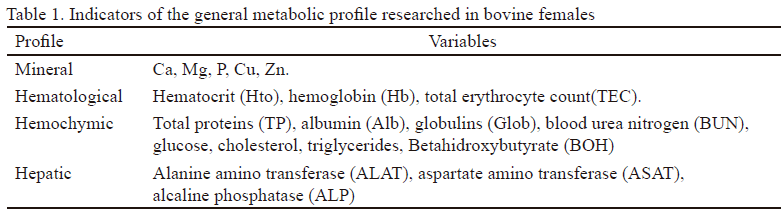
<body><![CDATA[<p align="justify" class="subtitulo" style="margin-top:12.0pt;text-align:justify;"><span style="font-family:'Verdana','sans-serif'; font-size:10.0pt; color:windowtext; ">&nbsp;</span></p>     <p align="justify" class="subtitulo" style="margin-top:12.0pt;text-align:justify;"><span style="line-height:120%; font-family:'Verdana','sans-serif'; font-size:13.0pt; color:windowtext; "><b>MATERIALS AND METHODS</b> &nbsp;</span></p>     <p align="justify" class="Cuerpodetexto" style="margin-top:12.0pt;text-indent:0cm;"><span style="font-family:'Verdana','sans-serif'; font-size:10.0pt; color:windowtext; ">The study was carried out in three  dairy herds from Tufi&ntilde;o parish, Tulcan canton, Carchi province, Ecuador,  representative of the region livestock. This region is located between the 1&ordm;  12 and 43 &quot;NL and the 78 &ordm;, 33, 12&quot; 02 WL, to 2990 and 3450 m o.s.l.  The sum of annual precipitations in the territory is 1000 mm; the rainy season is  September-January and the dry season February-August. The average temperature  is 12 &deg;C, with minimums and maximums of 2 and 15 &deg;C, respectively. In the farms  irrigation of grasses is applied from natural sources (rivers) and  fertilization with doses of 200-300 kg of N<sup>2</sup>/ha<sup><span style="letter-spacing:.1pt; ">-1</span></sup>/year<sup>-1</sup>.</span></p>     <p align="justify" class="Cuerpodetexto" style="margin-top:12.0pt;text-indent:0cm;"><span style="font-family:'Verdana','sans-serif'; font-size:10.0pt; color:windowtext; ">The three farms use a time-restricted  rotational grazing system with an electric fence, with a global stocking rate  of 2.5 ha<sup>-1</sup> animals grazing  24h a day the artificial grasses Kingston (<em>Lolium perenne</em> var.), One  fifty (<em>Lolium perenne</em> var. ), Banquete (<em>Lolium perenne</em> var.),  Bluegrass (<em>Dactylus glomeratta</em>), white clover (<em>Trifolium repens</em>)  and naturalized, Kikuyo (<em>Pennisetum clandestinum</em>) and Holco (<em>Holcus  lannatus</em>).</span></p>     <p align="justify" class="Cuerpodetexto" style="margin-top:12.0pt;text-indent:0cm;"><span style="font-family:'Verdana','sans-serif'; font-size:10.0pt; color:windowtext; ">In the farms under study, it is not  supplemented with concentrate and the mineral supplement is supplied to g<span style="letter-spacing:-.1pt; ">uarantee availability between 100 and 150  g/animal/ d</span>. The supplement has a Ca: P ratio of 2.25: 1, ideal for  dairy cows (McDowell and Arthington 2005). Cows were manually milked twice a  day. The first milking took place between 4 and 6 a.m. and the second, between  3 and 4 p.m. The artificial rearing of the calf is applied from the third day  of birth.</span></p>     <p align="justify" class="Cuerpodetexto" style="margin-top:12.0pt;text-indent:0cm;"><span style="font-family:'Verdana','sans-serif'; font-size:10.0pt; color:windowtext; ">The detection of heat was performed  from 5-9 a.m. and from 3-7 p.m. by a trained man, as well as the use of  auxiliary methods, such as painting at the base of the cow's tail. The  insemination was carried out using the deep cervical method by an experienced  technician, with technical efficiency between 60 and 65 % in the last four  years and the use of frozen semen in straws of proven fertility bulls.</span></p>     <p align="justify" class="Cuerpodetexto" style="margin-top:12.0pt;text-indent:0cm;"><span style="font-family:'Verdana','sans-serif'; font-size:10.0pt; color:windowtext; ">Considering the nutritional  requirements of dairy cows (NRC 2001), in the herds are covered the needs of  crude protein, P, Mg and Mn in the rainy and dry periods, but not those of  metabolizable energy, Ca, Cu and Zn ( Balarezo 2015, unpublished data). Of the  three farms, 150 crossbred dairy Holstein cows were selected between second to  fourth lactation, with average milk production between 15.37 and 15.388 L cow<sup>1</sup>day<sup>-1</sup> and body condition (BC) at calving between 2.5 and 4 in the five points scale.  The animals selection was performed according to the methodology described by  &Aacute;lvarez (2001).</span></p>     <p align="justify" class="Cuerpodetexto" style="margin-top:12.0pt;text-indent:0cm;"><span style="font-family:'Verdana','sans-serif'; font-size:10.0pt; color:windowtext; ">In the rainy season (RS), 73 animals  (29, 22 and 22 from farms 1, 2 and 3, respectively) were researched and 77  animals in the dry season (DS) (36, 17 and 24 from farms 1, 2 and 3,  respectively). The main variables of the metabolic state were studied (<a href="/img/revistas/cjas/v50n3/t0106316.gif">table  1</a>).</span></p>     
<p align="justify" class="Cuerpodetexto" style="margin-top:12.0pt;text-indent:0cm;"><span style="font-family:'Verdana','sans-serif'; font-size:10.0pt; color:windowtext; ">The blood was extracted by coccygeal  venipuncture and deposited in IDEXX VetTube &trade; tubes (IDEXX LABORATORIES VetLab&reg;  USA), previously sterilized and demineralized.</span></p>     <p align="justify" class="Cuerpodetexto" style="margin-top:12.0pt;text-indent:0cm;"><span style="font-family:'Verdana','sans-serif'; font-size:10.0pt; color:windowtext; ">For the hematological analyzes, 5 mL  were deposited with EDTA (1 mg / mL blood) and for biochemical indicators 10  mL, without anticoagulant. It was centrifuged at 3500 g for 15 minutes and the  blood serum was obtained, which was frozen at -10 &deg;C until their analysis.</span></p>     ]]></body>
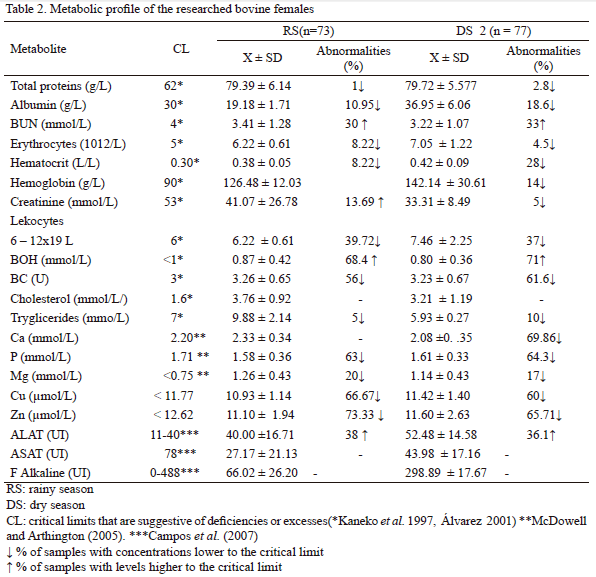
<body><![CDATA[<p align="justify" class="Cuerpodetexto" style="margin-top:12.0pt;text-indent:0cm;"><span style="font-family:'Verdana','sans-serif'; font-size:10.0pt; color:windowtext; ">The hematological  indicators were determined on an IDEXX VetAutoread &trade; (IDEXX LABORATORIES  VetLab&reg; USA) and biochemicals on an IDEXX VetTest&reg; (IDEXX LABORATORIES VetLab&reg;  USA) high-tech dry dish biochemical analyzer according to the manufacturer's  procedures and the use of commercial kits. The minerals were determined by  atomic absorption spectroscopy on a SP-9 spectrophotometer from PYE UNICAM. All  analyzes were carried out in the veterinary diagnostic laboratory of &quot;Carlos  Mart&iacute;nez Hoyos&quot; Veterinary Clinic from Nari&ntilde;o University, Colombia.</span><span style="font-family:'Verdana','sans-serif'; font-size:10.0pt; color:windowtext; "> </span></p>     <p align="justify" class="Cuerpodetexto" style="margin-top:12.0pt;text-indent:0cm;"><span style="font-family:'Verdana','sans-serif'; font-size:10.0pt; color:windowtext; ">The relation  between the metabolic state of the animals and the reproductive performance was  evaluated, for which the intervals calving first service of insemination (CFS),  calving conception (CC), calving-calving (CC), birth rate (BR), percentage of  gestations at first service, services per conception(S/C) and interestrual  intervals (IEI) were determined from the individual records, according to the  methodologies described by Gonz&aacute;lez (2001) and Soto (2001). Body condition (BC)  was diagnosed by clinical examination and classified on the five-point scale  (Parker    1989).</span><span style="font-family:'Verdana','sans-serif'; font-size:10.0pt; color:windowtext; "> </span></p>     <p align="justify" class="Cuerpodetexto" style="margin-top:12.0pt;text-indent:0cm;"><span style="font-family:'Verdana','sans-serif'; font-size:10.0pt; color:windowtext; ">The descriptive statisticians of each  metabolic or reproductive variable were obtained. The main factors affecting  reproductive indicators were determined using multifactorial analysis of  variance (multifactorial ANOVA),using as explanatory factors the classification  of BOH and BUN, body condition, farm and trimesters of calving and Artificial  Insemination (AI) and as dependent variables to CFSI, CCI, IPI, S/C and IEI.  The Bonferroni test was used to compare the means. The statistical package  Statgraphis Centurion Ver. XV.II (StatPoint Technologies 2010) was used in all  processing.</span></p>     <p align="justify" class="subtitulo" style="margin-top:12.0pt;text-align:justify;"><span style="font-family:'Verdana','sans-serif'; font-size:10.0pt; color:windowtext; ">&nbsp;</span></p>     <p align="justify" class="subtitulo" style="margin-top:12.0pt;text-align:justify;"><span style="font-family:'Verdana','sans-serif'; font-size:13.0pt; color:windowtext; "><b>RESULTS AND DISCUSSION</b> </span></p>     <p align="justify" class="Cuerpodetexto" style="margin-top:12.0pt;text-indent:0cm;"><span style="font-family:'Verdana','sans-serif'; font-size:10.0pt; color:windowtext; ">The alanine amino transferase (ALAT),  aspartate amino transferase (ASAT) and alkaline phosphatase (ALP) (<a href="/img/revistas/cjas/v50n3/t0206316.gif">Table 2</a>) are  among the physiological parameters for the species (Kaneko <em>et al.</em> 1997),  and are similar to that reported for some bovine breeds belonging to B. taurus  species under tropical conditions (Villa <em>et al.</em> 1999, Campos <em>et al.</em> 2007). The ALAT was high in 38% of the animals, which may be due to hepatic  Fasciola infestation or to a liver damage caused by the crude protein excess in  the diet intake by the animals (Fajardo 2009).</span></p>     
<p align="justify" class="Cuerpodetexto" style="margin-top:12.0pt;text-indent:0cm;"><span style="font-family:'Verdana','sans-serif'; font-size:10.0pt; color:windowtext; ">There were slight deficiencies of  albumin, hemoglobin, hematocrit and poor body condition, with variable  percentages of samples with deficient values. Increases in BUN and BOH were  found (<a href="/img/revistas/cjas/v50n3/t0206316.gif">table 2</a>), which show alterations related to protein and energy  nutrition. The nitrogen and energy compounds act in the Central Nervous System  (CNS), their deficiencies suppress or diminish the amplitude and frequency of  GnRH discharges from the hypothalamus and pituitary gonadotropins, thus  diminishing reproductive capacity (Deiros <em>et al.</em> 2004).</span></p>     
<p align="justify" class="Cuerpodetexto" style="margin-top:12.0pt;text-indent:0cm;"><span style="font-family:'Verdana','sans-serif'; font-size:10.0pt; color:windowtext; ">More than 60 % of blood serum samples  were deficient in P, Cu and Zn, and Mg (<a href="/img/revistas/cjas/v50n3/t0206316.gif">table 2</a>). Nutrient balances for the  researched herds show that the requirements of P and Mg of these macroelements  are covered, suggesting that hypophosphoremia and hypomagnesemia diagnosed may  be due to antagonistic relations in the absorption and assimilation of both  minerals (McDowell and Arthington 2005).</span></p>     
<p align="justify" class="Cuerpodetexto" style="margin-top:12.0pt;text-indent:0cm;"><span style="font-family:'Verdana','sans-serif'; font-size:10.0pt; color:windowtext; ">In Ecuador, there  are no publications on macroelements levels in blood serum of dairy cows, but P  deficiency is the most frequent mineral deficiency in grazing cattle (McDowell  and Arthington 2005). In Cuba, P and Mg deficiencies have been found in several  researchers in the soil-plant-animal system (Fajardo 2009, Viamonte 2010,  Garc&iacute;a <em>et al.</em> 2011, Noval <em>et al.</em> 2014).</span><span style="font-family:'Verdana','sans-serif'; font-size:10.0pt; color:windowtext; "> </span></p>     <p align="justify" class="Cuerpodetexto" style="margin-top:12.0pt;text-indent:0cm;"><span style="font-family:'Verdana','sans-serif'; font-size:10.0pt; color:windowtext; ">The hypocupremia  was diagnosed in 66.67 and 60% of the samples in the rainy and dry seasons,  respectively, and the hypocinemia in 73.33 and 65.71% in the same order. The Cu  and Zn deficiencies diagnosed are primary, and are due to the fact that the  contents of these microelements in the grasses do not cover the requirements of  the researched    animals.</span></p>     ]]></body>
<body><![CDATA[<p align="justify" class="Cuerpodetexto" style="margin-top:12.0pt;text-indent:0cm;"><span style="font-family:'Verdana','sans-serif'; font-size:10.0pt; color:windowtext; ">The CFSI, CCI and  IPI (<a href="/img/revistas/cjas/v50n3/t0306316.gif">table 3</a>) did not significantly differ between the farms and were too long,  according to the reference parameters for the dairy cattle under ideal  conditions of exploitation, which they consider as optimal from 60 to 70 d; 85  to 90 d and 365 to 395 d for each, according to Gonz&aacute;lez (2001), Soto (2001)  reports, who indicated that S/C can be evaluated as    bad.</span><span style="font-family:'Verdana','sans-serif'; font-size:10.0pt; color:windowtext; "> </span></p>     
<p align="justify" class="Cuerpodetexto" style="margin-top:12.0pt;text-indent:0cm;"><span style="font-family:'Verdana','sans-serif'; font-size:10.0pt; color:windowtext; ">The calving first service interval  (CFSI) should not exceed the voluntary waiting period by more than    18 d (Gonz&aacute;lez 2001). In this study, CFSI was 45 d, but only 5.32 % of the cows  showed CFSI lower than    65 d. Otherwise, in 48.9 % of cows, this indicator exceeds  150 d, showing that there is a too long period of postpartum anestrus, probably  due to phosphorus deficiency, low body condition, BOH and BUN increase (<a href="/img/revistas/cjas/v50n3/t0206316.gif">table  2</a>), associated with energy deficiencies and excess of degradable proteins in  rumen or N<sub>2</sub>.</span></p>     
<p align="justify" class="Cuerpodetexto" style="margin-top:12.0pt;text-indent:0cm;"><span style="font-family:'Verdana','sans-serif'; font-size:10.0pt; color:windowtext; ">The CCI is too long, the average value  is higher than 270 d in all herds (<a href="/img/revistas/cjas/v50n3/t0306316.gif">table 3</a>), and in farm 2 it exceeds    340 d. Only 6.5 % of the cows had CCI lower than 90 d and in contrast, 65.2 %  of them had it higher to 180 d. A CCI higher than 120 d shows absence of cyclic  ovarian activity or errors in heat detection, that is to say, a pre-service  anestrus of a functional or management type (Gonz&aacute;lez 2002). In Cuba, it was  proven that between 45 and 80% of reproductive disorders of cattle raised on  grazing were associated with deficiencies and food imbalances (Fajardo 2009,  Viamonte 2010, Garc&iacute;a <em>et al.</em> 2011).</span></p>     
<p align="justify" class="Cuerpodetexto" style="margin-top:12.0pt;text-indent:0cm;"><span style="font-family:'Verdana','sans-serif'; font-size:10.0pt; color:windowtext; ">Gonz&aacute;lez (2002) and  Bahonar <em>et al.</em> </span><span style="font-family:'Verdana','sans-serif'; font-size:10.0pt; color:windowtext; ">(2009) point out that other factors may affect the CCI,  such as lactation, parity, development of uterine involution, type of calving  and postpartum infections. For each additional day above 120 d of CCI, are lost  between 3.19 and 5.41 USD (De Vries 2006). The average values of this indicator  in the 92 cows selected in this study exceed 177 d this value, and generate an  additional total loss of 16 299 production days, which would represent a  negative economic impact, fluctuating between 51 993.81 and 88 177.59 USD in  the studied period.</span><span style="font-family:'Verdana','sans-serif'; font-size:10.0pt; color:windowtext; "> </span></p>     <p align="justify" class="Cuerpodetexto" style="margin-top:12.0pt;text-indent:0cm;"><span style="font-family:'Verdana','sans-serif'; font-size:10.0pt; color:windowtext; ">The average IPI ranged between 554 and  622 d and the birthrate between 58 and 65 %. Both indicators can be classified  as bad (Gonz&aacute;lez 2001). Only 8.7 % of the females had a IPI lower than 405 d,  44.6 % between 406 and 599 d, and, even more serious, 44.5 % of the cows above  600 d. Due to the metabolic state of cows, indicating nutritional imbalances,  regardless of whether there is adequate technological discipline in  reproductive management in the farms (Balarezo <em>et al.</em> 2015), the  extension of CCI and IPI can be attributed to pre-service anestrus of  functional type.</span></p>     <p align="justify" class="Cuerpodetexto" style="margin-top:12.0pt;text-indent:0cm;"><span style="font-family:'Verdana','sans-serif'; font-size:10.0pt; color:windowtext; ">In the studied herds, more than 3.4  S/C are needed (<a href="/img/revistas/cjas/v50n3/t0306316.gif">table 3</a>). When this indicator is higher than 2.5 it constitutes  a severe fertility problem and is equivalent to less than 40% of pregnancies at  the first insemination service (Gonz&aacute;lez 2001). Only 29.3 % of the cows needed  1 or 2 S/C, 70.7 % required three or four inseminations to be gestating, that  is, lower than 33.3 % of gestation to the first service. The 3.6 % of the  females needed more than five inseminations to achieve gestation. The results  show that in the studied herds more than 70 % of the females are repetitive.</span></p>     
<p align="justify" class="Cuerpodetexto" style="margin-top:12.0pt;text-indent:0cm;"><span style="font-family:'Verdana','sans-serif'; font-size:10.0pt; color:windowtext; ">The interestral  intervals (IEI) averaged 27 d in the three herds (<a href="/img/revistas/cjas/v50n3/t0306316.gif">table 3</a>). In 30.6 % of cows,  the IEI was equal to or lower than 21 d; 10.2 % between 21 and 24 d; 4.5 %  between 25 and 27 d and 11.3 % between 28 and 30 d. In 43 %, it is higher than  30 d, indicating post-service anestrus (Soto 2001) or fertilization disorders  and/or late embryonic deaths, which may be due to failures in maternal  recognition of gestation, due to insufficient production of bovine trophoblastic  protein (bTP<sup>-1</sup>) (Thatcher <em>et al.</em> 1989). The latter may be due  to energy deficit in animals (Inskeep 2004, Lucy 2007) and insufficient  progesterone (Raheem 2015).</span><span style="font-family:'Verdana','sans-serif'; font-size:10.0pt; color:windowtext; "> </span></p>     
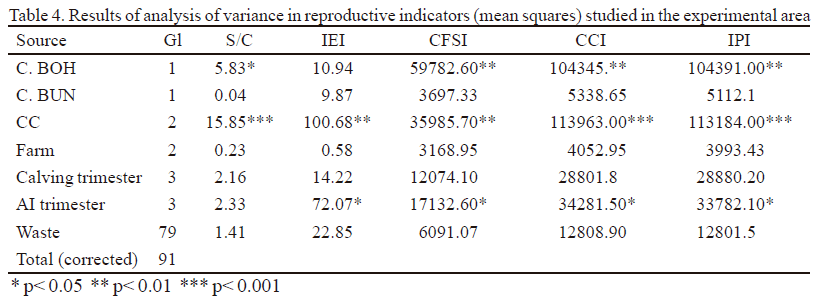
<p align="justify" class="Cuerpodetexto" style="margin-top:12.0pt;text-indent:0cm;"><span style="font-family:'Verdana','sans-serif'; font-size:10.0pt; color:windowtext; "><a href="/img/revistas/cjas/v50n3/t0406316.gif">Table 4</a> shows the influence of some  factors on the main reproductive indicators evaluated. The state of the BOH,  body condition and artificial insemination trimester significantly influence on  the CFSI, CCI and IPI. In addition, the BOH and BC affected the S/C and BC and  the trimester from AI to IEI.</span></p>     
<p align="justify" class="Cuerpodetexto" style="margin-top:12.0pt;text-indent:0cm;"><span style="font-family:'Verdana','sans-serif'; font-size:10.0pt; color:windowtext; ">Energy and protein were related to the  reproductive process (Viamonte 2010). The results of this study confirmed the  observations, in the sense that infertility and subfertility constitute a  multifactorial phenomenon, in which feeding is of great influence (Pedroso <em>et  al.</em> 2003).</span></p>     <p align="justify" class="Cuerpodetexto" style="margin-top:12.0pt;text-indent:0cm;"><span style="font-family:'Verdana','sans-serif'; font-size:10.0pt; color:windowtext; "><a href="/img/revistas/cjas/v50n3/t0506316.gif">Table 5</a> shows the  values of the main reproductive indicators in the different studied factors.  These results coincide with studies that showed that cows submitted during the  prep and post calving at a low energy level had a longer post-partum anestrus  than animals submitted to a high energy input (Revilla <em>et al.</em> 2001).  P&eacute;rez <em>et al.</em> (2001) observed that it is not only important to achieve  adequate BC at calving, but it is necessary to maintain it during the first  20-30 postpartum.</span><span style="font-family:'Verdana','sans-serif'; font-size:10.0pt; color:windowtext; "> </span></p>     
]]></body>
<body><![CDATA[<p align="justify" class="Cuerpodetexto" style="margin-top:12.0pt;text-indent:0cm;"><span style="font-family:'Verdana','sans-serif'; font-size:10.0pt; color:windowtext; ">The first  postpartum ovulation is directly related to BC at calving and energy and  protein intake (Santos <em>et al.</em> 2009). In Cuba, globulins, BUN and BC, at  calving and 30 d postpartum, have a significant effect (P &lt;0.01) on the  restart of postpartum ovarian activity and first luteal activity, while total  proteins, cholesterol, hemoglobin, hematocrit and phosphorus had causal  relations (P &lt;0.05) with them (Viamonte 2010). A BC of 3.5- 4.0 at calving  allows the cow to have more energy reserves to face lactation and restart its  new estral cycle, joined to a better postpartum reproductive performance (Webb <em>et  al.</em> 2004, Korea <em>et al.</em> 2008, Mulligan <em>et al.</em>2008).</span><span style="font-family:'Verdana','sans-serif'; font-size:10.0pt; color:windowtext; "> </span></p>     <p align="justify" class="Cuerpodetexto" style="margin-top:12.0pt;text-indent:0cm;"><span style="line-height:120%; letter-spacing:.45pt; font-family:'Verdana','sans-serif'; font-size:10.0pt; color:windowtext; ">The cattle have  the capacity to compensate the energy deficit in the ration by mobilizing body  fat (Wettemann <em>et al.</em> 2003), which leads to an increase in BOH (Roche  2007) as occurred in this research. It is possible to find a combined effect of  BC on lactation days and energy balance in follicular development and, therefore,  on the first postpartum ovulation (Galvis <em>et al.</em> 2007). With respect to  the influence of protein on the reproduction of the bovine female, it is  admitted that its low ingestion affects its reproductive performance (Ciccioli <em>et  al.</em> 2003). In contrast, high protein intakes may affect reproduction in  dairy cows and heifers (Butler <em>et al.</em> 1996), as well as pituitary and  ovarian functions (Kane <em>et al.</em> 2004).</span><span style="font-family:'Verdana','sans-serif'; font-size:10.0pt; color:windowtext; "> </span></p>     <p align="justify" class="Cuerpodetexto" style="margin-top:12.0pt;text-indent:0cm;"><span style="font-family:'Verdana','sans-serif'; font-size:10.0pt; color:windowtext; ">The lack, as  excess of nitrogen inputs in feed ration, can lead to reproductive problems  (Deiros <em>et al.</em> 2004). The plasma urea is related to energy balance and  reproductive parameters in dairy cattle. In animals in which the BC decreased  from calving to the first artificial insemination, significantly higher values  of plasma urea were diagnosed than in those cows that maintained or increased  their reserves (Deiros <em>et al.</em> 2004).The urea had a direct effect on the  beginning of ovarian activity and the first luteal activity, at 90 d  postpartum, which is related to the loss of BC (Viamonte 2010).</span><span style="font-family:'Verdana','sans-serif'; font-size:10.0pt; color:windowtext; "> </span></p>     <p align="justify" class="Cuerpodetexto" style="margin-top:12.0pt;text-indent:0cm;"><span style="font-family:'Verdana','sans-serif'; font-size:10.0pt; color:windowtext; ">When there is lack of energy or when  the crude protein in the diet is excessive, not all the NH<sub>3</sub> produced  in rumen can be converted to microbial protein, when it over-passes the rumen  wall and is transported to the liver, where it is converted to urea which is  released into the blood (Correa and Cu&eacute;llar 2004). As plasma urea and NH3  concentrations increase, the pH of the uterine lumen is reduced and the  secretion of the endometrial glands is affected during the early luteal phase  (Razz and Clavero 2004).</span></p>     <p align="justify" class="Cuerpodetexto" style="margin-top:12.0pt;text-indent:0cm;"><span style="font-family:'Verdana','sans-serif'; font-size:10.0pt; color:windowtext; ">The excess of urea  at 60 to 90 d postpartum had negative effects on the conception rate at the  first service of cows and acted in synergy with milk production and lactation  number in the open days to the first service (Guo <em>et al.</em>2004). These  results suggest that the negative effect of urea on reproduction may be related  to the individual state of cows, which may be the cause that the BUN blood  concentrations did not significantly influence on the reproductive indicators  of cows, which had different lactations, lactation d and production levels at  the time of sampling.</span></p>     <p align="justify" class="Cuerpodetexto" style="margin-top:12.0pt;text-indent:0cm;"><span style="line-height:107%; font-family:'Verdana','sans-serif'; font-size:10.0pt; ">It is concluded that in the  studied herds there are metabolic imbalances, mainly deficiency of protein,  energy, phosphorus and Mg, with a marked deterioration of reproductive  indicators, in which significantly influence the beta-hydroxybutyrate state, body  condition and the trimester of the year in which the artificial insemination is  performed</span><span style="font-family:'Verdana','sans-serif'; font-size:10.0pt; color:windowtext; ">.</span></p>     <p align="justify" class="MsoNormal" style="margin-top:12.0pt;text-align:justify;"><span style="line-height:107%; font-family:'Verdana','sans-serif'; font-size:10.0pt; ">&nbsp;</span></p>     <p align="justify" class="subtitulo" style="margin-top:12.0pt;text-align:justify;"><span style="font-family:'Verdana','sans-serif'; font-size:13.0pt; color:windowtext; "><b>REFERENCES</b></span></p>     <!-- ref --><p align="justify" class="referencias" style="margin-top:12.0pt;margin-right:0cm;margin-bottom:.0001pt;margin-left:0cm;text-indent:0cm;"><span style="font-family:'Verdana','sans-serif'; font-size:10.0pt; color:windowtext; ">&Aacute;lvarez, C. J. L. 2001. Bioqu&iacute;mica nutricional y metab&oacute;lica del bovino en  el tr&oacute;pico. (ser. Colecci&oacute;n ciencia y tecnolog&iacute;a), Medell&iacute;n, Colombia:  Universidad de Antioquia, 201 p.    </span></p>     ]]></body>
<body><![CDATA[<p align="justify" class="referencias" style="margin-top:12.0pt;margin-right:0cm;margin-bottom:.0001pt;margin-left:0cm;text-indent:0cm;"><span style="font-family:'Verdana','sans-serif'; font-size:10.0pt; color:windowtext; ">Bahonar,  A. R., Azizzadeh, M., Stevenson, M. A., Vojgani, M. &amp; Mahmoudi, M. 2009.  &ldquo;Factors affecting days open in Holstein dairy cattle in Khorasan Razavi  province, Iran; A Cox proportional hazard model&rdquo;. Journal of Animal and  Veterinary Advances, 8(4): 747&ndash;754, ISSN: 1680-5593.</span></p>     <p align="justify" class="referencias" style="margin-top:12.0pt;margin-right:0cm;margin-bottom:.0001pt;margin-left:0cm;text-indent:0cm;"><span style="font-family:'Verdana','sans-serif'; font-size:10.0pt; color:windowtext; ">Balarezo,  L., Garc&iacute;a, J. R. &amp; Hern&aacute;ndez, M. A. 2015. </span><span style="font-family:'Verdana','sans-serif'; font-size:10.0pt; color:windowtext; ">&ldquo;Estado  metab&oacute;lico y reproductivo en ganado lechero en la regi&oacute;n de El Carchi,  Ecuador&rdquo;. In: V Congreso de Producci&oacute;n Animal, La Habana, Cuba: Instituto de  Ciencia Animal, ISBN: 978-959-7171-70-6.</span></p>     <p align="justify" class="referencias" style="margin-top:12.0pt;margin-right:0cm;margin-bottom:.0001pt;margin-left:0cm;text-indent:0cm;"><span style="font-family:'Verdana','sans-serif'; font-size:10.0pt; color:windowtext; ">Butler,  W. R., Calaman, J. J. &amp; Beam, S. W. 1996. &ldquo;Plasma and milk urea nitrogen in  relation to pregnancy rate in lactating dairy cattle&rdquo;. Journal of Animal  Science, 74(4): 858, ISSN: 0021-8812, DOI: 10.2527/1996.744858x.</span></p>     <p align="justify" class="referencias" style="margin-top:12.0pt;margin-right:0cm;margin-bottom:.0001pt;margin-left:0cm;text-indent:0cm;"><span style="font-family:'Verdana','sans-serif'; font-size:10.0pt; color:windowtext; ">Campos,  G. R., Cubillos, C. &amp; Rodas, &Aacute;. G. 2007. </span><span style="font-family:'Verdana','sans-serif'; font-size:10.0pt; color:windowtext; ">&ldquo;Indicadores  metab&oacute;licos en razas lecheras especializadas en condiciones tropicales en  Colombia&rdquo;. Acta Agron&oacute;mica, 56(2): 85&ndash;92, ISSN: 2323-0118.</span></p>     <p align="justify" class="referencias" style="margin-top:12.0pt;margin-right:0cm;margin-bottom:.0001pt;margin-left:0cm;text-indent:0cm;"><span style="font-family:'Verdana','sans-serif'; font-size:10.0pt; color:windowtext; ">Ceballos, M. A., Villa, N. A., Boh&oacute;rquez, A., Quiceno, J., Jaramillo, M.  &amp; Giraldo, G. 2002. &ldquo;An&aacute;lisis de los resultados de perfiles metab&oacute;licos en  lecher&iacute;as del tr&oacute;pico alto del eje cafetero colombiano&rdquo;. Revista Colombiana de  Ciencias Pecuarias, 15(1): 26&ndash;35, ISSN: 0120-0690.</span></p>     <p align="justify" class="referencias" style="margin-top:12.0pt;margin-right:0cm;margin-bottom:.0001pt;margin-left:0cm;text-indent:0cm;"><span style="font-family:'Verdana','sans-serif'; font-size:10.0pt; color:windowtext; ">Ciccioli, N. H., Wettemann, R. P., Spicer, L. J., Lents, C. A., White, F.  J. &amp; Keisler, D. H. 2003. </span><span style="font-family:'Verdana','sans-serif'; font-size:10.0pt; color:windowtext; ">&ldquo;Influence of body condition at calving and postpartum  nutrition on endocrine function and reproductive performance of primiparous  beef cows&rdquo;. Journal of Animal Science, 81(12): 3107&ndash;3120, ISSN: 1525-3163, DOI:  10.2527/2003.81123107x.</span></p>     <p align="justify" class="referencias" style="margin-top:12.0pt;margin-right:0cm;margin-bottom:.0001pt;margin-left:0cm;text-indent:0cm;"><span style="font-family:'Verdana','sans-serif'; font-size:10.0pt; color:windowtext; ">Corea,  G. E. E., Alvarado, P. J. F. &amp; Leyton, B. L. V. 2008. </span><span style="font-family:'Verdana','sans-serif'; font-size:10.0pt; color:windowtext; ">&ldquo;Efecto del cambio en la condici&oacute;n corporal, raza y n&uacute;mero de partos en el  desempe&ntilde;o reproductivo de vacas lecheras&rdquo;. Agronom&iacute;a Mesoamericana, 19(2):  251&ndash;259, ISSN: 2215-3608, 1021-7444.</span></p>     <p align="justify" class="referencias" style="margin-top:12.0pt;margin-right:0cm;margin-bottom:.0001pt;margin-left:0cm;text-indent:0cm;"><span style="font-family:'Verdana','sans-serif'; font-size:10.0pt; color:windowtext; ">Correa, H. J. &amp; Cu&eacute;llar, A. E. 2004. &ldquo;Aspectos clave del ciclo de la  &uacute;rea con relaci&oacute;n al metabolismo energ&eacute;tico y proteico en vacas lactantes&rdquo;.  Revista Colombiana de Ciencias Pecuarias, 17(1): 29&ndash;38, ISSN: 0120-0690.</span></p>     <p align="justify" class="referencias" style="margin-top:12.0pt;margin-right:0cm;margin-bottom:.0001pt;margin-left:0cm;text-indent:0cm;"><span style="font-family:'Verdana','sans-serif'; font-size:10.0pt; color:windowtext; ">De Vries, A. 2006. &ldquo;Economic Value of Pregnancy in Dairy Cattle&rdquo;. Journal  of Dairy Science, 89(10): 3876&ndash;3885, ISSN: 0022-0302, DOI:  10.3168/jds.S0022-0302(06)72430-4.</span></p>     <p align="justify" class="referencias" style="margin-top:12.0pt;margin-right:0cm;margin-bottom:.0001pt;margin-left:0cm;text-indent:0cm;"><span style="font-family:'Verdana','sans-serif'; font-size:10.0pt; color:windowtext; ">Deiros, J., Quintela, L. A., Pe&ntilde;a, A. I., Becerra, J. J., Barrio, M.,  Alonso, G., Varela, B. &amp; Herrad&oacute;n, P. G. 2004. &ldquo;Urea plasm&aacute;tica: relaci&oacute;n  con el equilibrio energ&eacute;tico y par&aacute;metros reproductivos en vacuno lechero&rdquo;.  Archivos de zootecnia, 53(202): 141&ndash;151, ISSN: 0004-0592.</span></p>     ]]></body>
<body><![CDATA[<!-- ref --><p align="justify" class="referencias" style="margin-top:12.0pt;margin-right:0cm;margin-bottom:.0001pt;margin-left:0cm;text-indent:0cm;"><span style="font-family:'Verdana','sans-serif'; font-size:10.0pt; color:windowtext; ">Fajardo, H. 2009. Suplementaci&oacute;n mineral estrat&eacute;gica de hembras bovinas  lecheras en pastoreo y su influencia en la reproducci&oacute;n en el Valle del Cauto.  Ph.D. Thesis, Instituto de Ciencia Animal, La Habana, Cuba, 124 p.    </span></p>     <p align="justify" class="referencias" style="margin-top:12.0pt;margin-right:0cm;margin-bottom:.0001pt;margin-left:0cm;text-indent:0cm;"><span style="font-family:'Verdana','sans-serif'; font-size:10.0pt; color:windowtext; ">Flamenbaum,  I. &amp; Galon, N. 2010. &ldquo;Management of Heat Stress to Improve Fertility in  Dairy Cows in Israel&rdquo;. Journal of Reproduction and Development, 56(Suppl.):  36&ndash;41, ISSN: 1348-4400, 0916-8818, DOI: 10.1262/jrd.1056S36.</span></p>     <p align="justify" class="referencias" style="margin-top:12.0pt;margin-right:0cm;margin-bottom:.0001pt;margin-left:0cm;text-indent:0cm;"><span style="font-family:'Verdana','sans-serif'; font-size:10.0pt; color:windowtext; ">Galvis, R., Agudelo, D. &amp; Saffon, A. 2007. </span><span style="font-family:'Verdana','sans-serif'; font-size:10.0pt; color:windowtext; ">&ldquo;Body Condition,  lipoprotein profiles and ovarian activity in Holstein cows during early  lactation&rdquo;. </span><span style="font-family:'Verdana','sans-serif'; font-size:10.0pt; color:windowtext; ">Revista Colombiana de Ciencias Pecuarias, 20(1): 16&ndash;29,  ISSN: 0120-0690.</span></p>     <p align="justify" class="referencias" style="margin-top:12.0pt;margin-right:0cm;margin-bottom:.0001pt;margin-left:0cm;text-indent:0cm;"><span style="font-family:'Verdana','sans-serif'; font-size:10.0pt; color:windowtext; ">Garc&iacute;a, D. J. R., Cuesta, M. M., Silveira, P. E. A., Qui&ntilde;ones, R. R.,  Hern&aacute;ndez, B. M. A. &amp; Mollineda, T. &Aacute;. 2011. &ldquo;Desequilibrios&nbsp; metab&oacute;licos&nbsp;  con&nbsp; especial&nbsp; referencia&nbsp;  a&nbsp; las&nbsp;&nbsp; carenciales&nbsp;&nbsp;&nbsp; de&nbsp;&nbsp;&nbsp;  minerales&nbsp;&nbsp;&nbsp; asociadas&nbsp;&nbsp;&nbsp; a&nbsp;&nbsp;&nbsp;  problemas&nbsp;&nbsp;&nbsp;&nbsp; reproductivos&nbsp;&nbsp; en&nbsp;&nbsp;  vacas&nbsp;&nbsp; lecheras&nbsp;&nbsp; de&nbsp;&nbsp;  Cuba&rdquo;. Revista Electr&oacute;nica de Veterinaria, 12(12), ISSN: 1695-7504,  Available:  &lt;<a href="http://www.veterinaria.org/revistas/redvet/n121211/121101.pdf" target="_blank">http://www.veterinaria.org/revistas/redvet/n121211/121101.pdf</a>&gt;,  [Consulted: November 3, 2016].</span></p>     <!-- ref --><p align="justify" class="referencias" style="margin-top:12.0pt;margin-right:0cm;margin-bottom:.0001pt;margin-left:0cm;text-indent:0cm;"><span style="font-family:'Verdana','sans-serif'; font-size:10.0pt; color:windowtext; ">Gonz&aacute;lez, S. C. 2001. Reproducci&oacute;n Bovina. Venezuela: Fundaci&oacute;n GIRARZ, 437  p., ISBN: 980-296-826-0, Available: &lt;<a href="http://www.avpa.ula.ve/libros_nacionales.html" target="_blank">http://www.avpa.ula.ve/libros_nacionales.html</a>&gt;,  [Consulted: November 4, 2016].    </span></p>     <p align="justify" class="referencias" style="margin-top:12.0pt;margin-right:0cm;margin-bottom:.0001pt;margin-left:0cm;text-indent:0cm;"><span style="font-family:'Verdana','sans-serif'; font-size:10.0pt; color:windowtext; ">Gonz&aacute;lez, S. C. 2002. &ldquo;Pasos para lograr el diagn&oacute;stico y la soluci&oacute;n del  problema reproductivo a trav&eacute;s de la evaluaci&oacute;n de la eficiencia reproductiva&rdquo;. </span><span style="font-family:'Verdana','sans-serif'; font-size:10.0pt; color:windowtext; ">Venezuela  Bovina, 53: 50&ndash;65.</span></p>     <p align="justify" class="referencias" style="margin-top:12.0pt;margin-right:0cm;margin-bottom:.0001pt;margin-left:0cm;text-indent:0cm;"><span style="font-family:'Verdana','sans-serif'; font-size:10.0pt; color:windowtext; ">Guo, K.,  Russek-Cohen, E., A.Varner, M. &amp; Kohn, R. A. 2004. &ldquo;Effects of Milk Urea  Nitrogen and Other Factors on Probability of Conception of Dairy Cows&rdquo;. Journal  of Dairy Science, 87(6): 1878&ndash;1885, ISSN: 0022-0302, DOI:  10.3168/jds.S0022-0302(04)73346-9.</span></p>     <p align="justify" class="referencias" style="margin-top:12.0pt;margin-right:0cm;margin-bottom:.0001pt;margin-left:0cm;text-indent:0cm;"><span style="font-family:'Verdana','sans-serif'; font-size:10.0pt; color:windowtext; ">Hess, B.  W., Lake, S. L., Scholljegerdes, E. J., Weston, T. R., Nayigihugu, V., Molle,  J. D. C. &amp; Moss, G. E. 2005. &ldquo;Nutritional controls of beef cow  reproduction&rdquo;. Journal of Animal Science, 83(13_suppl): E90&ndash;E106, ISSN:  1525-3163, DOI: 10.2527/2005.8313_supplE90x.</span></p>     ]]></body>
<body><![CDATA[<p align="justify" class="referencias" style="margin-top:12.0pt;margin-right:0cm;margin-bottom:.0001pt;margin-left:0cm;text-indent:0cm;"><span style="font-family:'Verdana','sans-serif'; font-size:10.0pt; color:windowtext; ">Inskeep,  E. K. 2004. &ldquo;Preovulatory, postovulatory, and postmaternal recognition effects  of concentrations of progesterone on embryonic survival in the cow&rdquo;. Journal of  Animal Science, 82(13_suppl): E24, ISSN: 1525-3163, DOI:  10.2527/2004.8213_supplE24x.</span></p>     <p align="justify" class="referencias" style="margin-top:12.0pt;margin-right:0cm;margin-bottom:.0001pt;margin-left:0cm;text-indent:0cm;"><span style="font-family:'Verdana','sans-serif'; font-size:10.0pt; color:windowtext; ">Kane, K.  K., Hawkins, D. E., Pulsipher, G. D., Denniston, D. J., Krehbiel, C. R.,  Thomas, M. G., Petersen, M. K., Hallford, D. M., Remmenga, M. D., Roberts, A.  J. &amp; Keisler, D. H. 2004. &ldquo;Effect of increasing levels of undegradable  intake protein on metabolic and endocrine factors in estrous cycling beef  heifers&rdquo;. Journal of Animal Science, 82(1): 283&ndash;291, ISSN: 1525-3163, DOI:  10.2527/2004.821283x.</span></p>     <!-- ref --><p align="justify" class="referencias" style="margin-top:12.0pt;margin-right:0cm;margin-bottom:.0001pt;margin-left:0cm;text-indent:0cm;"><span style="font-family:'Verdana','sans-serif'; font-size:10.0pt; color:windowtext; ">Kaneko,  J. J., Harvey, J. W. &amp; Bruss, M. 1997. Clinical biochemistry of domestic  animals. 5th ed., San Diego, Calif.: Academic Press, 932 p., ISBN:  978-0-12-396305-5, Available:  &lt;<a href="https://www.elsevier.com/books/clinical-biochemistry-of-domestic-animals/kaneko/978-0-12-396305-5" target="_blank">https://www.elsevier.com/books/clinical-biochemistry-of-domestic-animals/kaneko/978-0-12-396305-5</a>&gt;,  [Consulted: November 4, 2016].    </span></p>     <p align="justify" class="referencias" style="margin-top:12.0pt;margin-right:0cm;margin-bottom:.0001pt;margin-left:0cm;text-indent:0cm;"><span style="font-family:'Verdana','sans-serif'; font-size:10.0pt; color:windowtext; ">Llewellyn,  S., Fitzpatrick, R., Kenny, D. A., Murphy, J. J., Scaramuzzi, R. J. &amp;  Wathes, D. C. 2007. &ldquo;Effect of negative energy balance on the insulin-like  growth factor system in pre-recruitment ovarian follicles of post partum dairy  cows&rdquo;. Reproduction, 133(3): 627&ndash;639, ISSN: 1470-1626, 1741-7899, DOI: 10.1530/REP-06-0122.</span></p>     <p align="justify" class="referencias" style="margin-top:12.0pt;margin-right:0cm;margin-bottom:.0001pt;margin-left:0cm;text-indent:0cm;"><span style="font-family:'Verdana','sans-serif'; font-size:10.0pt; color:windowtext; ">Lucy, M.  C. 2007. &ldquo;The bovine dominant ovarian follicle&rdquo;. Journal of Animal Science,  85(13_suppl): E89, ISSN: 1525-3163, DOI: 10.2527/jas.2006-663.</span></p>     <p align="justify" class="referencias" style="margin-top:12.0pt;margin-right:0cm;margin-bottom:.0001pt;margin-left:0cm;text-indent:0cm;"><span style="font-family:'Verdana','sans-serif'; font-size:10.0pt; color:windowtext; ">Macrae,  A. I., Whitaker, D. A., Burrough, E., Dowell, A. &amp; Kelly, J. M. 2006. &ldquo;Use  of metabolic profiles for the assessment of dietary adequacy in UK dairy  herds&rdquo;. Veterinary Record, 159(20): 655&ndash;661, ISSN: 0042-4900, 2042-7670, DOI:  10.1136/vr.159.20.655.</span></p>     <!-- ref --><p align="justify" class="referencias" style="margin-top:12.0pt;margin-right:0cm;margin-bottom:.0001pt;margin-left:0cm;text-indent:0cm;"><span style="font-family:'Verdana','sans-serif'; font-size:10.0pt; color:windowtext; ">McDowell,  L. R. &amp; Arthington, J. D. 2005. </span><span style="font-family:'Verdana','sans-serif'; font-size:10.0pt; color:windowtext; ">Minerales para rumiantes en pastoreo en  regiones tropicales. 4th ed., Gainesville, USA: Universidad de la Florida, 91  p.    </span></p>     <p align="justify" class="referencias" style="margin-top:12.0pt;margin-right:0cm;margin-bottom:.0001pt;margin-left:0cm;text-indent:0cm;"><span style="font-family:'Verdana','sans-serif'; font-size:10.0pt; color:windowtext; ">Monta&ntilde;o, E. L. &amp; Ruiz, C. Z. T. 2005. &ldquo;&iquest;Por qu&eacute; no ovulan los primeros  fol&iacute;culos dominantes de las vacas ceb&uacute; posparto en el tr&oacute;pico colombiano?&rdquo;.  Revista Colombiana de Ciencias Pecuarias, 18(2): 127&ndash;135, ISSN: 0120-0690.</span></p>     ]]></body>
<body><![CDATA[<p align="justify" class="referencias" style="margin-top:12.0pt;margin-right:0cm;margin-bottom:.0001pt;margin-left:0cm;text-indent:0cm;"><span style="font-family:'Verdana','sans-serif'; font-size:10.0pt; color:windowtext; ">Mulligan, F. J., O&rsquo;Grady, L., Gath, V. P., Rice, D. A. &amp; Doherty, M. L.  2008. </span><span style="font-family:'Verdana','sans-serif'; font-size:10.0pt; color:windowtext; ">&ldquo;Nutrition and fertility in dairy cows&rdquo;. Irish Veterinary  Journal, 60(5): 311&ndash;316, ISSN: 2046-0481.</span></p>     <p align="justify" class="referencias" style="margin-top:12.0pt;margin-right:0cm;margin-bottom:.0001pt;margin-left:0cm;text-indent:0cm;"><span style="font-family:'Verdana','sans-serif'; font-size:10.0pt; color:windowtext; ">National  Research Council (NRC). 2001. Nutrient requirements of dairy cattle. (ser.  Nutrient requirements of domestic animals), Washington, D.C.: National Academy  Press, 381 p., ISBN: 978-0-309-51521-4, Available:  &lt;<a href="http://public.eblib.com/choice/publicfullrecord.aspx?p=3375185" target="_blank">http://public.eblib.com/choice/publicfullrecord.aspx?p=3375185</a>&gt;, [Consulted:  November 4, 2016].</span></p>     <p align="justify" class="referencias" style="margin-top:12.0pt;margin-right:0cm;margin-bottom:.0001pt;margin-left:0cm;text-indent:0cm;"><span style="font-family:'Verdana','sans-serif'; font-size:10.0pt; color:windowtext; ">Noval, A. E., Garc&iacute;a, D. J. R., Garc&iacute;a, L. R., Qui&ntilde;ones, R. R. &amp;  Mollineda, T. &Aacute;. 2014. &ldquo;Caracterizaci&oacute;n de algunos componentes qu&iacute;micos, en  suelos de diferentes agroecosistemas ganaderos&rdquo;. </span><span style="font-family:'Verdana','sans-serif'; font-size:10.0pt; color:windowtext; ">Centro Agr&iacute;cola,  41(1): 25&ndash;31, ISSN: 0253-5785, 2072-2001.</span></p>     <p align="justify" class="referencias" style="margin-top:12.0pt;margin-right:0cm;margin-bottom:.0001pt;margin-left:0cm;text-indent:0cm;"><span style="font-family:'Verdana','sans-serif'; font-size:10.0pt; color:windowtext; ">Parker,  R. 1989. &ldquo;Body condition scoring of dairy cattle&rdquo;. Factsheet AGNES, 410: 420,  ISSN: 1198-712X.</span></p>     <p align="justify" class="referencias" style="margin-top:12.0pt;margin-right:0cm;margin-bottom:.0001pt;margin-left:0cm;text-indent:0cm;"><span style="font-family:'Verdana','sans-serif'; font-size:10.0pt; color:windowtext; ">Pedroso,  R., Roller, F. &amp; L&oacute;pez, L. 2003. </span><span style="font-family:'Verdana','sans-serif'; font-size:10.0pt; color:windowtext; ">&ldquo;Relaci&oacute;n entre la condici&oacute;n corporal,  estado metab&oacute;lico y la fertilidad de la hembra bovina&rdquo;. Revista Cubana  Reproducci&oacute;n Animal, 29(2): 231&ndash;235, ISSN: 0258-6495.</span></p>     <p align="justify" class="referencias" style="margin-top:12.0pt;margin-right:0cm;margin-bottom:.0001pt;margin-left:0cm;text-indent:0cm;"><span style="font-family:'Verdana','sans-serif'; font-size:10.0pt; color:windowtext; ">P&eacute;rez, H. P., S&aacute;nchez,&nbsp; del R. C.  &amp; Gallegos, S. J. 2001. &ldquo;Anestro postparto y alternativas de manejo del  amamantamiento en vacas de doble prop&oacute;sito en tr&oacute;pico&rdquo;. Revista de  Investigaci&oacute;n Agraria: Producci&oacute;n y Sanidad Animales, 16(2): 257&ndash;270, ISSN:  0213-5035.</span></p>     <p align="justify" class="referencias" style="margin-top:12.0pt;margin-right:0cm;margin-bottom:.0001pt;margin-left:0cm;text-indent:0cm;"><span style="font-family:'Verdana','sans-serif'; font-size:10.0pt; color:windowtext; ">Raheem, K. A. 2015. </span><span style="font-family:'Verdana','sans-serif'; font-size:10.0pt; color:windowtext; ">&ldquo;An insight into maternal recognition of pregnancy in  mammalian species&rdquo;. Journal of the Saudi Society of Agricultural Sciences,  ISSN: 1658-077X, DOI: 10.1016/j.jssas.2015.01.002, Article in Press.</span></p>     <p align="justify" class="referencias" style="margin-top:12.0pt;margin-right:0cm;margin-bottom:.0001pt;margin-left:0cm;text-indent:0cm;"><span style="font-family:'Verdana','sans-serif'; font-size:10.0pt; color:windowtext; ">Razz, R. &amp; Clavero, T. 2004. &ldquo;Niveles de urea, f&oacute;sforo, glucosa e  insulina de vacas en orde&ntilde;o suplementadas con concentrado en un sistema de <em>Panicum  maximum </em>y<em> Leucaena leucocephala</em>&rdquo;. Revista Cient&iacute;fica, 14(4):  365&ndash;369, ISSN: 0798-2259.</span></p>     <p align="justify" class="referencias" style="margin-top:12.0pt;margin-right:0cm;margin-bottom:.0001pt;margin-left:0cm;text-indent:0cm;"><span style="font-family:'Verdana','sans-serif'; font-size:10.0pt; color:windowtext; ">Revelo, G. A. 2013. Evaluaci&oacute;n del desempe&ntilde;o reproductivo del hato lechero  de la Hacienda &lsquo;Sandial&rsquo; localizada en el cant&oacute;n Montufar, provincia del Carchi  en el per&iacute;odo 2011- 2013. Graduated Thesis, Universidad San Francisco de Quito,  Quito, Ecuador, 83 p.</span></p>     <p align="justify" class="referencias" style="margin-top:12.0pt;margin-right:0cm;margin-bottom:.0001pt;margin-left:0cm;text-indent:0cm;"><span style="font-family:'Verdana','sans-serif'; font-size:10.0pt; color:windowtext; ">Revilla, R., Blasco, J., Sanju&aacute;n, L., Casas&uacute;, J., Sanz, A. &amp; Villalba,  D. 2001. &ldquo;Manejo reproductivo de reba&ntilde;os de vacas nodrizas&rdquo;. In: XXIV Curso  Internacional de Reproducci&oacute;n Animal, Madrid, Espa&ntilde;a: INIA, p. 100.</span></p>     ]]></body>
<body><![CDATA[<p align="justify" class="referencias" style="margin-top:12.0pt;margin-right:0cm;margin-bottom:.0001pt;margin-left:0cm;text-indent:0cm;"><span style="font-family:'Verdana','sans-serif'; font-size:10.0pt; color:windowtext; ">Roche,  J. R. 2007. &ldquo;Milk production responses to pre- and postcalving dry matter  intake in grazing dairy cows&rdquo;. Livestock Science, 110(1&ndash;2): 12&ndash;24, ISSN:  1871-1413, DOI: 10.1016/j.livsci.2006.08.016.</span></p>     <p align="justify" class="referencias" style="margin-top:12.0pt;margin-right:0cm;margin-bottom:.0001pt;margin-left:0cm;text-indent:0cm;"><span style="font-family:'Verdana','sans-serif'; font-size:10.0pt; color:windowtext; ">Santos,  J. E. P., Rutigliano, H. M. &amp; Filho, M. F. S. 2009. &ldquo;Risk factors for  resumption of postpartum estrous cycles and embryonic survival in lactating  dairy cows&rdquo;. Animal Reproduction Science, 110(3&ndash;4): 207&ndash;221, ISSN: 0378-4320,  DOI: 10.1016/j.anireprosci.2008.01.014.</span></p>     <p align="justify" class="referencias" style="margin-top:12.0pt;margin-right:0cm;margin-bottom:.0001pt;margin-left:0cm;text-indent:0cm;"><span style="font-family:'Verdana','sans-serif'; font-size:10.0pt; color:windowtext; ">Soto, B.  E. 2001. </span><span style="font-family:'Verdana','sans-serif'; font-size:10.0pt; color:windowtext; ">&ldquo;Mejora reproductiva mediante el control hormonal de la  actividad ov&aacute;rica postparto en vacas mestizas de doble prop&oacute;sito&rdquo;. In:  Gonz&aacute;lez, S. C. (ed.), Reproducci&oacute;n Bovina, Venezuela: Fundaci&oacute;n GIRARZ, pp.  323&ndash;331, ISBN: 980-296-826-0, Available:  &lt;<a href="http://www.avpa.ula.ve/libros_nacionales.html" target="_blank">http://www.avpa.ula.ve/libros_nacionales.html</a>&gt;, [Consulted: November 4,  2016].</span></p>     <!-- ref --><p align="justify" class="referencias" style="margin-top:12.0pt;margin-right:0cm;margin-bottom:.0001pt;margin-left:0cm;text-indent:0cm;"><span style="font-family:'Verdana','sans-serif'; font-size:10.0pt; color:windowtext; ">StatPoint  Technologies. 2010. Statgraphics Centurion. (ser. Centurion), version 16.1  (XV), [Windows], Available:  &lt;<a href="http://statgraphics-centurion.software.informer.com/download/" target="_blank">http://statgraphics-centurion.software.informer.com/download/</a>&gt;    .</span></p>     <p align="justify" class="referencias" style="margin-top:12.0pt;margin-right:0cm;margin-bottom:.0001pt;margin-left:0cm;text-indent:0cm;"><span style="font-family:'Verdana','sans-serif'; font-size:10.0pt; color:windowtext; ">Thatcher,  W. W., Hansen, P. J., Gross, T. S., Helmer, S. D., Plante, C. &amp; Bazer, F.  W. 1989. &ldquo;Antiluteolytic effects of bovine trophoblast protein-1&rdquo;. Journal of  reproduction and fertility. </span><span style="font-family:'Verdana','sans-serif'; font-size:10.0pt; color:windowtext; ">Supplement, 37: 91&ndash;99, ISSN: 0449-3087.</span></p>     <!-- ref --><p align="justify" class="referencias" style="margin-top:12.0pt;margin-right:0cm;margin-bottom:.0001pt;margin-left:0cm;text-indent:0cm;"><span style="font-family:'Verdana','sans-serif'; font-size:10.0pt; color:windowtext; ">Viamonte, M. I. 2010. Sistema integrado de manejo para incrementar la  productividad en vacas de la raza Criolla cubana. Ph.D. Thesis, Instituto de  Ciencia Animal, La Habana, Cuba, 128 p.    </span></p>     <p align="justify" class="referencias" style="margin-top:12.0pt;margin-right:0cm;margin-bottom:.0001pt;margin-left:0cm;text-indent:0cm;"><span style="font-family:'Verdana','sans-serif'; font-size:10.0pt; color:windowtext; ">Villa, N. A., Ceballos, A., Ceron, D. &amp; Serna, C. A. 1999. &ldquo;Valores  bioqu&iacute;micos sangu&iacute;neos en hembras brahman bajo condiciones de pastoreo&rdquo;. </span><span style="font-family:'Verdana','sans-serif'; font-size:10.0pt; color:windowtext; ">Pesquisa  Agropecu&aacute;ria Brasileira, 34(12): 2339&ndash;2343, ISSN: 0100-204X, DOI:  10.1590/S0100-204X1999001200021.</span></p>     <p align="justify" class="referencias" style="margin-top:12.0pt;margin-right:0cm;margin-bottom:.0001pt;margin-left:0cm;text-indent:0cm;"><span style="font-family:'Verdana','sans-serif'; font-size:10.0pt; color:windowtext; ">Webb,  R., Garnsworthy, P. C., Gong, J. G. &amp; Armstrong, D. G. 2004. &ldquo;Control of  follicular growth: Local interactions and nutritional influences&rdquo;. Journal of  Animal Science, 82(13_suppl): E63&ndash;E74, ISSN: 1525-3163, DOI:  10.2527/2004.8213_supplE63x.</span></p>     ]]></body>
<body><![CDATA[<p align="justify" class="referencias" style="margin-top:12.0pt;margin-right:0cm;margin-bottom:.0001pt;margin-left:0cm;text-indent:0cm;"><span style="font-family:'Verdana','sans-serif'; font-size:10.0pt; ">Wettemann, R. P., Lents, C.  A., Ciccioli, N. H., White, F. J. &amp; Rubio, I. 2003. &ldquo;Nutritional- and  suckling-mediated anovulation in beef cows&rdquo;. Journal of Animal Science,  81(14_suppl_2): E48&ndash;E59, ISSN: 1525-3163, DOI: 10.2527/2003.8114_suppl_2E48x</span><font size="2" face="Verdana, Arial, Helvetica, sans-serif">.</font></p>     <p align="justify">&nbsp;</p>     <p align="justify">&nbsp;</p>     <p align="justify"><font size="2" face="Verdana, Arial, Helvetica, sans-serif">Received: 28/1/2016    <br> Accepted: 28/10/2016</font></p>     <p align="justify">&nbsp;</p>     <p align="justify">&nbsp;</p>     <p align="justify"><font size="2" face="Verdana, Arial, Helvetica, sans-serif"><i>L. R. Balarezo,</i> Escuela de Desarrollo Integral Agropecuario, Facultad de Industrias Agropecuarias y Ciencias Ambientales,  Universidad Politécnica del Carchi. Calle Antisana y Av. Universitaria Tulcán, Carchi, Ecuador .    Email: <a href="mailto:luis.balarezo@upec.edu.ec"> luis.balarezo@upec.edu.ec</a></font></p>      ]]></body><back>
<ref-list>
<ref id="B1">
<nlm-citation citation-type="book">
<person-group person-group-type="author">
<name>
<surname><![CDATA[Álvarez]]></surname>
<given-names><![CDATA[C. J. L.]]></given-names>
</name>
</person-group>
<source><![CDATA[Bioquímica nutricional y metabólica del bovino en el trópico]]></source>
<year>2001</year>
<page-range>201</page-range><publisher-loc><![CDATA[Medellín, Colombia ]]></publisher-loc>
<publisher-name><![CDATA[Universidad de Antioquia]]></publisher-name>
</nlm-citation>
</ref>
<ref id="B2">
<nlm-citation citation-type="journal">
<person-group person-group-type="author">
<name>
<surname><![CDATA[Bahonar]]></surname>
<given-names><![CDATA[A. R.]]></given-names>
</name>
<name>
<surname><![CDATA[Azizzadeh]]></surname>
<given-names><![CDATA[M.]]></given-names>
</name>
<name>
<surname><![CDATA[Stevenson]]></surname>
<given-names><![CDATA[M. A.]]></given-names>
</name>
<name>
<surname><![CDATA[Vojgani]]></surname>
<given-names><![CDATA[M.]]></given-names>
</name>
<name>
<surname><![CDATA[Mahmoudi]]></surname>
<given-names><![CDATA[M.]]></given-names>
</name>
</person-group>
<article-title xml:lang="nd"><![CDATA[Factors affecting days open in Holstein dairy cattle in Khorasan Razavi province, Iran; A Cox proportional hazard model]]></article-title>
<source><![CDATA[Journal of Animal and Veterinary Advances]]></source>
<year>2009</year>
<volume>8</volume>
<numero>4</numero>
<issue>4</issue>
<page-range>747–754</page-range></nlm-citation>
</ref>
<ref id="B3">
<nlm-citation citation-type="book">
<person-group person-group-type="author">
<name>
<surname><![CDATA[Balarezo]]></surname>
<given-names><![CDATA[L.]]></given-names>
</name>
<name>
<surname><![CDATA[García]]></surname>
<given-names><![CDATA[J. R.]]></given-names>
</name>
<name>
<surname><![CDATA[Hernández]]></surname>
<given-names><![CDATA[M. A.]]></given-names>
</name>
</person-group>
<article-title xml:lang="nd"><![CDATA[Estado metabólico y reproductivo en ganado lechero en la región de El Carchi, Ecuador]]></article-title>
<source><![CDATA[]]></source>
<year>2015</year>
<publisher-loc><![CDATA[La Habana, Cuba ]]></publisher-loc>
<publisher-name><![CDATA[Instituto de Ciencia Animal]]></publisher-name>
</nlm-citation>
</ref>
<ref id="B4">
<nlm-citation citation-type="journal">
<person-group person-group-type="author">
<name>
<surname><![CDATA[Butler]]></surname>
<given-names><![CDATA[W. R.]]></given-names>
</name>
<name>
<surname><![CDATA[Calaman]]></surname>
<given-names><![CDATA[J. J.]]></given-names>
</name>
<name>
<surname><![CDATA[Beam]]></surname>
<given-names><![CDATA[S. W.]]></given-names>
</name>
</person-group>
<article-title xml:lang="nd"><![CDATA[Plasma and milk urea nitrogen in relation to pregnancy rate in lactating dairy cattle]]></article-title>
<source><![CDATA[Journal of Animal Science]]></source>
<year>1996</year>
<volume>74</volume>
<numero>4</numero>
<issue>4</issue>
<page-range>858</page-range></nlm-citation>
</ref>
<ref id="B5">
<nlm-citation citation-type="journal">
<person-group person-group-type="author">
<name>
<surname><![CDATA[Campos]]></surname>
<given-names><![CDATA[G. R.]]></given-names>
</name>
<name>
<surname><![CDATA[Cubillos]]></surname>
<given-names><![CDATA[C.]]></given-names>
</name>
<name>
<surname><![CDATA[Rodas]]></surname>
<given-names><![CDATA[Á. G.]]></given-names>
</name>
</person-group>
<article-title xml:lang="nd"><![CDATA[Indicadores metabólicos en razas lecheras especializadas en condiciones tropicales en Colombia]]></article-title>
<source><![CDATA[Acta Agronómica]]></source>
<year>2007</year>
<volume>56</volume>
<numero>2</numero>
<issue>2</issue>
<page-range>85–92</page-range></nlm-citation>
</ref>
<ref id="B6">
<nlm-citation citation-type="journal">
<person-group person-group-type="author">
<name>
<surname><![CDATA[Ceballos]]></surname>
<given-names><![CDATA[M. A.]]></given-names>
</name>
<name>
<surname><![CDATA[Villa]]></surname>
<given-names><![CDATA[N. A.]]></given-names>
</name>
<name>
<surname><![CDATA[Bohórquez]]></surname>
<given-names><![CDATA[A.]]></given-names>
</name>
<name>
<surname><![CDATA[Quiceno]]></surname>
<given-names><![CDATA[J.]]></given-names>
</name>
<name>
<surname><![CDATA[Jaramillo]]></surname>
<given-names><![CDATA[M.]]></given-names>
</name>
<name>
<surname><![CDATA[Giraldo]]></surname>
<given-names><![CDATA[G.]]></given-names>
</name>
</person-group>
<article-title xml:lang="nd"><![CDATA[Análisis de los resultados de perfiles metabólicos en lecherías del trópico alto del eje cafetero colombiano]]></article-title>
<source><![CDATA[Revista Colombiana de Ciencias Pecuarias]]></source>
<year>2002</year>
<volume>15</volume>
<numero>1</numero>
<issue>1</issue>
<page-range>26–35</page-range></nlm-citation>
</ref>
<ref id="B7">
<nlm-citation citation-type="journal">
<person-group person-group-type="author">
<name>
<surname><![CDATA[Ciccioli]]></surname>
<given-names><![CDATA[N. H.]]></given-names>
</name>
<name>
<surname><![CDATA[Wettemann]]></surname>
<given-names><![CDATA[R. P.]]></given-names>
</name>
<name>
<surname><![CDATA[Spicer]]></surname>
<given-names><![CDATA[L. J.]]></given-names>
</name>
<name>
<surname><![CDATA[Lents]]></surname>
<given-names><![CDATA[C. A.]]></given-names>
</name>
<name>
<surname><![CDATA[White]]></surname>
<given-names><![CDATA[F. J.]]></given-names>
</name>
<name>
<surname><![CDATA[Keisler]]></surname>
<given-names><![CDATA[D. H.]]></given-names>
</name>
</person-group>
<article-title xml:lang="nd"><![CDATA[Influence of body condition at calving and postpartum nutrition on endocrine function and reproductive performance of primiparous beef cows]]></article-title>
<source><![CDATA[Journal of Animal Science]]></source>
<year>2003</year>
<volume>81</volume>
<numero>12</numero>
<issue>12</issue>
<page-range>3107–3120</page-range></nlm-citation>
</ref>
<ref id="B8">
<nlm-citation citation-type="journal">
<person-group person-group-type="author">
<name>
<surname><![CDATA[Corea]]></surname>
<given-names><![CDATA[G. E. E.]]></given-names>
</name>
<name>
<surname><![CDATA[Alvarado]]></surname>
<given-names><![CDATA[P. J. F.]]></given-names>
</name>
<name>
<surname><![CDATA[Leyton]]></surname>
<given-names><![CDATA[B. L. V.]]></given-names>
</name>
</person-group>
<article-title xml:lang="nd"><![CDATA[Efecto del cambio en la condición corporal, raza y número de partos en el desempeño reproductivo de vacas lecheras]]></article-title>
<source><![CDATA[Agronomía Mesoamericana]]></source>
<year>2008</year>
<volume>19</volume>
<numero>2</numero>
<issue>2</issue>
<page-range>251–259</page-range></nlm-citation>
</ref>
<ref id="B9">
<nlm-citation citation-type="journal">
<person-group person-group-type="author">
<name>
<surname><![CDATA[Correa]]></surname>
<given-names><![CDATA[H. J.]]></given-names>
</name>
<name>
<surname><![CDATA[Cuéllar]]></surname>
<given-names><![CDATA[A. E.]]></given-names>
</name>
</person-group>
<article-title xml:lang="nd"><![CDATA[Aspectos clave del ciclo de la úrea con relación al metabolismo energético y proteico en vacas lactantes]]></article-title>
<source><![CDATA[Revista Colombiana de Ciencias Pecuarias]]></source>
<year>2004</year>
<volume>17</volume>
<numero>1</numero>
<issue>1</issue>
<page-range>29–38</page-range></nlm-citation>
</ref>
<ref id="B10">
<nlm-citation citation-type="journal">
<person-group person-group-type="author">
<name>
<surname><![CDATA[De Vries]]></surname>
<given-names><![CDATA[A.]]></given-names>
</name>
</person-group>
<article-title xml:lang="nd"><![CDATA[Economic Value of Pregnancy in Dairy Cattle]]></article-title>
<source><![CDATA[Journal of Dairy Science]]></source>
<year>2006</year>
<volume>89</volume>
<numero>10</numero>
<issue>10</issue>
<page-range>3876–3885</page-range></nlm-citation>
</ref>
<ref id="B11">
<nlm-citation citation-type="journal">
<person-group person-group-type="author">
<name>
<surname><![CDATA[Deiros]]></surname>
<given-names><![CDATA[J.]]></given-names>
</name>
<name>
<surname><![CDATA[Quintela]]></surname>
<given-names><![CDATA[L. A.]]></given-names>
</name>
<name>
<surname><![CDATA[Peña]]></surname>
<given-names><![CDATA[A. I.]]></given-names>
</name>
<name>
<surname><![CDATA[Becerra]]></surname>
<given-names><![CDATA[J. J.]]></given-names>
</name>
<name>
<surname><![CDATA[Barrio]]></surname>
<given-names><![CDATA[M.]]></given-names>
</name>
<name>
<surname><![CDATA[Alonso]]></surname>
<given-names><![CDATA[G.]]></given-names>
</name>
<name>
<surname><![CDATA[Varela]]></surname>
<given-names><![CDATA[B.]]></given-names>
</name>
<name>
<surname><![CDATA[Herradón]]></surname>
<given-names><![CDATA[P. G.]]></given-names>
</name>
</person-group>
<article-title xml:lang="nd"><![CDATA[Urea plasmática: relación con el equilibrio energético y parámetros reproductivos en vacuno lechero]]></article-title>
<source><![CDATA[Archivos de zootecnia]]></source>
<year>2004</year>
<volume>53</volume>
<numero>202</numero>
<issue>202</issue>
<page-range>141–151</page-range></nlm-citation>
</ref>
<ref id="B12">
<nlm-citation citation-type="book">
<person-group person-group-type="author">
<name>
<surname><![CDATA[Fajardo]]></surname>
<given-names><![CDATA[H.]]></given-names>
</name>
</person-group>
<source><![CDATA[Suplementación mineral estratégica de hembras bovinas lecheras en pastoreo y su influencia en la reproducción en el Valle del Cauto]]></source>
<year>2009</year>
<page-range>124</page-range><publisher-loc><![CDATA[La Habana, Cuba ]]></publisher-loc>
<publisher-name><![CDATA[Instituto de Ciencia Animal]]></publisher-name>
</nlm-citation>
</ref>
<ref id="B13">
<nlm-citation citation-type="journal">
<person-group person-group-type="author">
<name>
<surname><![CDATA[Flamenbaum]]></surname>
<given-names><![CDATA[I.]]></given-names>
</name>
<name>
<surname><![CDATA[Galon]]></surname>
<given-names><![CDATA[N.]]></given-names>
</name>
</person-group>
<article-title xml:lang="nd"><![CDATA[Management of Heat Stress to Improve Fertility in Dairy Cows in Israel]]></article-title>
<source><![CDATA[Journal of Reproduction and Development]]></source>
<year>2010</year>
<volume>56</volume>
<numero>Suppl.</numero>
<issue>Suppl.</issue>
<page-range>36–41</page-range></nlm-citation>
</ref>
<ref id="B14">
<nlm-citation citation-type="journal">
<person-group person-group-type="author">
<name>
<surname><![CDATA[Galvis]]></surname>
<given-names><![CDATA[R.]]></given-names>
</name>
<name>
<surname><![CDATA[Agudelo]]></surname>
<given-names><![CDATA[D.]]></given-names>
</name>
<name>
<surname><![CDATA[Saffon]]></surname>
<given-names><![CDATA[A.]]></given-names>
</name>
</person-group>
<article-title xml:lang="nd"><![CDATA[Body Condition, lipoprotein profiles and ovarian activity in Holstein cows during early lactation]]></article-title>
<source><![CDATA[Revista Colombiana de Ciencias Pecuarias]]></source>
<year>2007</year>
<volume>20</volume>
<numero>1</numero>
<issue>1</issue>
<page-range>16–29</page-range></nlm-citation>
</ref>
<ref id="B15">
<nlm-citation citation-type="journal">
<person-group person-group-type="author">
<name>
<surname><![CDATA[García]]></surname>
<given-names><![CDATA[D. J. R.]]></given-names>
</name>
<name>
<surname><![CDATA[Cuesta]]></surname>
<given-names><![CDATA[M. M.]]></given-names>
</name>
<name>
<surname><![CDATA[Silveira]]></surname>
<given-names><![CDATA[P. E. A.]]></given-names>
</name>
<name>
<surname><![CDATA[Quiñones]]></surname>
<given-names><![CDATA[R. R.]]></given-names>
</name>
<name>
<surname><![CDATA[Hernández]]></surname>
<given-names><![CDATA[B. M. A.]]></given-names>
</name>
<name>
<surname><![CDATA[Mollineda]]></surname>
<given-names><![CDATA[T. Á.]]></given-names>
</name>
</person-group>
<article-title xml:lang="nd"><![CDATA[Desequilibrios metabólicos con especial referencia a las carenciales de minerales asociadas a problemas reproductivos en vacas lecheras de Cuba]]></article-title>
<source><![CDATA[Revista Electrónica de Veterinaria]]></source>
<year>2011</year>
<volume>12</volume>
<numero>12</numero>
<issue>12</issue>
</nlm-citation>
</ref>
<ref id="B16">
<nlm-citation citation-type="book">
<person-group person-group-type="author">
<name>
<surname><![CDATA[González]]></surname>
<given-names><![CDATA[S. C.]]></given-names>
</name>
</person-group>
<source><![CDATA[Reproducción Bovina]]></source>
<year>2001</year>
<page-range>437</page-range><publisher-loc><![CDATA[Venezuela ]]></publisher-loc>
<publisher-name><![CDATA[Fundación GIRARZ]]></publisher-name>
</nlm-citation>
</ref>
<ref id="B17">
<nlm-citation citation-type="journal">
<person-group person-group-type="author">
<name>
<surname><![CDATA[González]]></surname>
<given-names><![CDATA[S. C.]]></given-names>
</name>
</person-group>
<article-title xml:lang="nd"><![CDATA[Pasos para lograr el diagnóstico y la solución del problema reproductivo a través de la evaluación de la eficiencia reproductiva]]></article-title>
<source><![CDATA[Venezuela Bovina]]></source>
<year>2002</year>
<volume>53</volume>
<page-range>50–65</page-range></nlm-citation>
</ref>
<ref id="B18">
<nlm-citation citation-type="journal">
<person-group person-group-type="author">
<name>
<surname><![CDATA[Guo]]></surname>
<given-names><![CDATA[K.]]></given-names>
</name>
<name>
<surname><![CDATA[Russek-Cohen]]></surname>
<given-names><![CDATA[E.]]></given-names>
</name>
<name>
<surname><![CDATA[A.Varner]]></surname>
<given-names><![CDATA[M.]]></given-names>
</name>
<name>
<surname><![CDATA[Kohn]]></surname>
<given-names><![CDATA[R. A.]]></given-names>
</name>
</person-group>
<article-title xml:lang="nd"><![CDATA[Effects of Milk Urea Nitrogen and Other Factors on Probability of Conception of Dairy Cows]]></article-title>
<source><![CDATA[Journal of Dairy Science]]></source>
<year>2004</year>
<volume>87</volume>
<numero>6</numero>
<issue>6</issue>
<page-range>1878–1885</page-range></nlm-citation>
</ref>
<ref id="B19">
<nlm-citation citation-type="journal">
<person-group person-group-type="author">
<name>
<surname><![CDATA[Hess]]></surname>
<given-names><![CDATA[B. W.]]></given-names>
</name>
<name>
<surname><![CDATA[Lake]]></surname>
<given-names><![CDATA[S. L.]]></given-names>
</name>
<name>
<surname><![CDATA[Scholljegerdes]]></surname>
<given-names><![CDATA[E. J.]]></given-names>
</name>
<name>
<surname><![CDATA[Weston]]></surname>
<given-names><![CDATA[T. R.]]></given-names>
</name>
<name>
<surname><![CDATA[Nayigihugu]]></surname>
<given-names><![CDATA[V.]]></given-names>
</name>
<name>
<surname><![CDATA[Molle]]></surname>
<given-names><![CDATA[J. D. C.]]></given-names>
</name>
<name>
<surname><![CDATA[Moss]]></surname>
<given-names><![CDATA[G. E.]]></given-names>
</name>
</person-group>
<article-title xml:lang="nd"><![CDATA[Nutritional controls of beef cow reproduction]]></article-title>
<source><![CDATA[Journal of Animal Science]]></source>
<year>2005</year>
<volume>83</volume>
<numero>13_suppl</numero>
<issue>13_suppl</issue>
<page-range>E90–E106</page-range></nlm-citation>
</ref>
<ref id="B20">
<nlm-citation citation-type="journal">
<person-group person-group-type="author">
<name>
<surname><![CDATA[Inskeep]]></surname>
<given-names><![CDATA[E. K.]]></given-names>
</name>
</person-group>
<article-title xml:lang="nd"><![CDATA[Preovulatory, postovulatory, and postmaternal recognition effects of concentrations of progesterone on embryonic survival in the cow]]></article-title>
<source><![CDATA[Journal of Animal Science]]></source>
<year>2004</year>
<volume>82</volume>
<numero>13_suppl</numero>
<issue>13_suppl</issue>
<page-range>E24</page-range></nlm-citation>
</ref>
<ref id="B21">
<nlm-citation citation-type="journal">
<person-group person-group-type="author">
<name>
<surname><![CDATA[Kane]]></surname>
<given-names><![CDATA[K. K.]]></given-names>
</name>
<name>
<surname><![CDATA[Hawkins]]></surname>
<given-names><![CDATA[D. E.]]></given-names>
</name>
<name>
<surname><![CDATA[Pulsipher]]></surname>
<given-names><![CDATA[G. D.]]></given-names>
</name>
<name>
<surname><![CDATA[Denniston]]></surname>
<given-names><![CDATA[D. J.]]></given-names>
</name>
<name>
<surname><![CDATA[Krehbiel]]></surname>
<given-names><![CDATA[C. R.]]></given-names>
</name>
<name>
<surname><![CDATA[Thomas]]></surname>
<given-names><![CDATA[M. G.]]></given-names>
</name>
<name>
<surname><![CDATA[Petersen]]></surname>
<given-names><![CDATA[M. K.]]></given-names>
</name>
<name>
<surname><![CDATA[Hallford]]></surname>
<given-names><![CDATA[D. M.]]></given-names>
</name>
<name>
<surname><![CDATA[Remmenga]]></surname>
<given-names><![CDATA[M. D.]]></given-names>
</name>
<name>
<surname><![CDATA[Roberts]]></surname>
<given-names><![CDATA[A. J.]]></given-names>
</name>
<name>
<surname><![CDATA[Keisler]]></surname>
<given-names><![CDATA[D. H.]]></given-names>
</name>
</person-group>
<article-title xml:lang="nd"><![CDATA[Effect of increasing levels of undegradable intake protein on metabolic and endocrine factors in estrous cycling beef heifers]]></article-title>
<source><![CDATA[Journal of Animal Science]]></source>
<year>2004</year>
<volume>82</volume>
<numero>1</numero>
<issue>1</issue>
<page-range>283–291</page-range></nlm-citation>
</ref>
<ref id="B22">
<nlm-citation citation-type="book">
<person-group person-group-type="author">
<name>
<surname><![CDATA[Kaneko]]></surname>
<given-names><![CDATA[J. J.]]></given-names>
</name>
<name>
<surname><![CDATA[Harvey]]></surname>
<given-names><![CDATA[J. W.]]></given-names>
</name>
<name>
<surname><![CDATA[Bruss]]></surname>
<given-names><![CDATA[M.]]></given-names>
</name>
</person-group>
<source><![CDATA[Clinical biochemistry of domestic animals]]></source>
<year>1997</year>
<edition>5th</edition>
<page-range>932</page-range><publisher-loc><![CDATA[San Diego, Calif. ]]></publisher-loc>
<publisher-name><![CDATA[Academic Press]]></publisher-name>
</nlm-citation>
</ref>
<ref id="B23">
<nlm-citation citation-type="journal">
<person-group person-group-type="author">
<name>
<surname><![CDATA[Llewellyn]]></surname>
<given-names><![CDATA[S.]]></given-names>
</name>
<name>
<surname><![CDATA[Fitzpatrick]]></surname>
<given-names><![CDATA[R.]]></given-names>
</name>
<name>
<surname><![CDATA[Kenny]]></surname>
<given-names><![CDATA[D. A.]]></given-names>
</name>
<name>
<surname><![CDATA[Murphy]]></surname>
<given-names><![CDATA[J. J.]]></given-names>
</name>
<name>
<surname><![CDATA[Scaramuzzi]]></surname>
<given-names><![CDATA[R. J.]]></given-names>
</name>
<name>
<surname><![CDATA[Wathes]]></surname>
<given-names><![CDATA[D. C.]]></given-names>
</name>
</person-group>
<article-title xml:lang="nd"><![CDATA[Effect of negative energy balance on the insulin-like growth factor system in pre-recruitment ovarian follicles of post partum dairy cows]]></article-title>
<source><![CDATA[Reproduction]]></source>
<year>2007</year>
<volume>133</volume>
<numero>3</numero>
<issue>3</issue>
<page-range>627–639</page-range></nlm-citation>
</ref>
<ref id="B24">
<nlm-citation citation-type="journal">
<person-group person-group-type="author">
<name>
<surname><![CDATA[Lucy]]></surname>
<given-names><![CDATA[M. C.]]></given-names>
</name>
</person-group>
<article-title xml:lang="nd"><![CDATA[The bovine dominant ovarian follicle]]></article-title>
<source><![CDATA[Journal of Animal Science]]></source>
<year>2007</year>
<volume>85</volume>
<numero>13_suppl</numero>
<issue>13_suppl</issue>
<page-range>E89</page-range></nlm-citation>
</ref>
<ref id="B25">
<nlm-citation citation-type="journal">
<person-group person-group-type="author">
<name>
<surname><![CDATA[Macrae]]></surname>
<given-names><![CDATA[A. I.]]></given-names>
</name>
<name>
<surname><![CDATA[Whitaker]]></surname>
<given-names><![CDATA[D. A.]]></given-names>
</name>
<name>
<surname><![CDATA[Burrough]]></surname>
<given-names><![CDATA[E.]]></given-names>
</name>
<name>
<surname><![CDATA[Dowell]]></surname>
<given-names><![CDATA[A.]]></given-names>
</name>
<name>
<surname><![CDATA[Kelly]]></surname>
<given-names><![CDATA[J. M.]]></given-names>
</name>
</person-group>
<article-title xml:lang="nd"><![CDATA[Use of metabolic profiles for the assessment of dietary adequacy in UK dairy herds]]></article-title>
<source><![CDATA[Veterinary Record]]></source>
<year>2006</year>
<volume>159</volume>
<numero>20</numero>
<issue>20</issue>
<page-range>655–661</page-range></nlm-citation>
</ref>
<ref id="B26">
<nlm-citation citation-type="book">
<person-group person-group-type="author">
<name>
<surname><![CDATA[McDowell]]></surname>
<given-names><![CDATA[L. R.]]></given-names>
</name>
<name>
<surname><![CDATA[Arthington]]></surname>
<given-names><![CDATA[J. D.]]></given-names>
</name>
</person-group>
<source><![CDATA[Minerales para rumiantes en pastoreo en regiones tropicales]]></source>
<year>2005</year>
<edition>4th</edition>
<page-range>91</page-range><publisher-loc><![CDATA[Gainesville, USA ]]></publisher-loc>
<publisher-name><![CDATA[Universidad de la Florida]]></publisher-name>
</nlm-citation>
</ref>
<ref id="B27">
<nlm-citation citation-type="journal">
<person-group person-group-type="author">
<name>
<surname><![CDATA[Montaño]]></surname>
<given-names><![CDATA[E. L.]]></given-names>
</name>
<name>
<surname><![CDATA[Ruiz]]></surname>
<given-names><![CDATA[C. Z. T.]]></given-names>
</name>
</person-group>
<article-title xml:lang="nd"><![CDATA[¿Por qué no ovulan los primeros folículos dominantes de las vacas cebú posparto en el trópico colombiano?]]></article-title>
<source><![CDATA[Revista Colombiana de Ciencias Pecuarias]]></source>
<year>2005</year>
<volume>18</volume>
<numero>2</numero>
<issue>2</issue>
<page-range>127–135</page-range></nlm-citation>
</ref>
<ref id="B28">
<nlm-citation citation-type="journal">
<person-group person-group-type="author">
<name>
<surname><![CDATA[Mulligan]]></surname>
<given-names><![CDATA[F. J.]]></given-names>
</name>
<name>
<surname><![CDATA[O’Grady]]></surname>
<given-names><![CDATA[L.]]></given-names>
</name>
<name>
<surname><![CDATA[Gath]]></surname>
<given-names><![CDATA[V. P.]]></given-names>
</name>
<name>
<surname><![CDATA[Rice]]></surname>
<given-names><![CDATA[D. A.]]></given-names>
</name>
<name>
<surname><![CDATA[Doherty]]></surname>
<given-names><![CDATA[M. L.]]></given-names>
</name>
</person-group>
<article-title xml:lang="nd"><![CDATA[Nutrition and fertility in dairy cows]]></article-title>
<source><![CDATA[Irish Veterinary Journal]]></source>
<year>2008</year>
<volume>60</volume>
<numero>5</numero>
<issue>5</issue>
<page-range>311–316</page-range></nlm-citation>
</ref>
<ref id="B29">
<nlm-citation citation-type="journal">
<person-group person-group-type="author">
<name>
<surname><![CDATA[Noval]]></surname>
<given-names><![CDATA[A. E.]]></given-names>
</name>
<name>
<surname><![CDATA[García]]></surname>
<given-names><![CDATA[D. J. R.]]></given-names>
</name>
<name>
<surname><![CDATA[García]]></surname>
<given-names><![CDATA[L. R.]]></given-names>
</name>
<name>
<surname><![CDATA[Quiñones]]></surname>
<given-names><![CDATA[R. R.]]></given-names>
</name>
<name>
<surname><![CDATA[Mollineda]]></surname>
<given-names><![CDATA[T. Á.]]></given-names>
</name>
</person-group>
<article-title xml:lang="nd"><![CDATA[Caracterización de algunos componentes químicos, en suelos de diferentes agroecosistemas ganaderos]]></article-title>
<source><![CDATA[Centro Agrícola]]></source>
<year>2014</year>
<volume>41</volume>
<numero>1</numero>
<issue>1</issue>
<page-range>25–31</page-range></nlm-citation>
</ref>
<ref id="B30">
<nlm-citation citation-type="journal">
<person-group person-group-type="author">
<name>
<surname><![CDATA[Parker]]></surname>
<given-names><![CDATA[R.]]></given-names>
</name>
</person-group>
<article-title xml:lang="nd"><![CDATA[Body condition scoring of dairy cattle]]></article-title>
<source><![CDATA[Factsheet AGNES]]></source>
<year>1989</year>
<volume>410</volume>
<page-range>420</page-range></nlm-citation>
</ref>
<ref id="B31">
<nlm-citation citation-type="journal">
<person-group person-group-type="author">
<name>
<surname><![CDATA[Pedroso]]></surname>
<given-names><![CDATA[R.]]></given-names>
</name>
<name>
<surname><![CDATA[Roller]]></surname>
<given-names><![CDATA[F.]]></given-names>
</name>
<name>
<surname><![CDATA[López]]></surname>
<given-names><![CDATA[L.]]></given-names>
</name>
</person-group>
<article-title xml:lang="nd"><![CDATA[Relación entre la condición corporal, estado metabólico y la fertilidad de la hembra bovina]]></article-title>
<source><![CDATA[Revista Cubana Reproducción Animal]]></source>
<year>2003</year>
<volume>29</volume>
<numero>2</numero>
<issue>2</issue>
<page-range>231–235</page-range></nlm-citation>
</ref>
<ref id="B32">
<nlm-citation citation-type="journal">
<person-group person-group-type="author">
<name>
<surname><![CDATA[Pérez]]></surname>
<given-names><![CDATA[H. P.]]></given-names>
</name>
<name>
<surname><![CDATA[Sánchez]]></surname>
<given-names><![CDATA[del R. C.]]></given-names>
</name>
<name>
<surname><![CDATA[Gallegos]]></surname>
<given-names><![CDATA[S. J.]]></given-names>
</name>
</person-group>
<article-title xml:lang="nd"><![CDATA[Anestro postparto y alternativas de manejo del amamantamiento en vacas de doble propósito en trópico]]></article-title>
<source><![CDATA[Revista de Investigación Agraria: Producción y Sanidad Animales]]></source>
<year>2001</year>
<volume>16</volume>
<numero>2</numero>
<issue>2</issue>
<page-range>257–270</page-range></nlm-citation>
</ref>
<ref id="B33">
<nlm-citation citation-type="journal">
<person-group person-group-type="author">
<name>
<surname><![CDATA[Raheem]]></surname>
<given-names><![CDATA[K. A.]]></given-names>
</name>
</person-group>
<article-title xml:lang="nd"><![CDATA[An insight into maternal recognition of pregnancy in mammalian species]]></article-title>
<source><![CDATA[Journal of the Saudi Society of Agricultural Sciences]]></source>
<year>2015</year>
</nlm-citation>
</ref>
<ref id="B34">
<nlm-citation citation-type="journal">
<person-group person-group-type="author">
<name>
<surname><![CDATA[Razz]]></surname>
<given-names><![CDATA[R.]]></given-names>
</name>
<name>
<surname><![CDATA[Clavero]]></surname>
<given-names><![CDATA[T.]]></given-names>
</name>
</person-group>
<article-title xml:lang="nd"><![CDATA[Niveles de urea, fósforo, glucosa e insulina de vacas en ordeño suplementadas con concentrado en un sistema de Panicum maximum y Leucaena leucocephala]]></article-title>
<source><![CDATA[Revista Científica]]></source>
<year>2004</year>
<volume>14</volume>
<numero>4</numero>
<issue>4</issue>
<page-range>365–369</page-range></nlm-citation>
</ref>
<ref id="B35">
<nlm-citation citation-type="book">
<person-group person-group-type="author">
<name>
<surname><![CDATA[Revelo]]></surname>
<given-names><![CDATA[G. A.]]></given-names>
</name>
</person-group>
<source><![CDATA[Evaluación del desempeño reproductivo del hato lechero de la Hacienda ‘Sandial’ localizada en el cantón Montufar, provincia del Carchi en el período 2011- 2013]]></source>
<year>2013</year>
<page-range>83</page-range><publisher-loc><![CDATA[Quito, Ecuador ]]></publisher-loc>
<publisher-name><![CDATA[Universidad San Francisco de Quito]]></publisher-name>
</nlm-citation>
</ref>
<ref id="B36">
<nlm-citation citation-type="book">
<person-group person-group-type="author">
<name>
<surname><![CDATA[Revilla]]></surname>
<given-names><![CDATA[R.]]></given-names>
</name>
<name>
<surname><![CDATA[Blasco]]></surname>
<given-names><![CDATA[J.]]></given-names>
</name>
<name>
<surname><![CDATA[Sanjuán]]></surname>
<given-names><![CDATA[L.]]></given-names>
</name>
<name>
<surname><![CDATA[Casasú]]></surname>
<given-names><![CDATA[J.]]></given-names>
</name>
<name>
<surname><![CDATA[Sanz]]></surname>
<given-names><![CDATA[A.]]></given-names>
</name>
<name>
<surname><![CDATA[Villalba]]></surname>
<given-names><![CDATA[D.]]></given-names>
</name>
</person-group>
<article-title xml:lang="nd"><![CDATA[Manejo reproductivo de rebaños de vacas nodrizas]]></article-title>
<source><![CDATA[]]></source>
<year>2001</year>
<page-range>100</page-range><publisher-loc><![CDATA[Madrid, España ]]></publisher-loc>
<publisher-name><![CDATA[INIA]]></publisher-name>
</nlm-citation>
</ref>
<ref id="B37">
<nlm-citation citation-type="journal">
<person-group person-group-type="author">
<name>
<surname><![CDATA[Roche]]></surname>
<given-names><![CDATA[J. R.]]></given-names>
</name>
</person-group>
<article-title xml:lang="nd"><![CDATA[Milk production responses to pre- and postcalving dry matter intake in grazing dairy cows]]></article-title>
<source><![CDATA[Livestock Science]]></source>
<year>2007</year>
<volume>110</volume>
<numero>1–2</numero>
<issue>1–2</issue>
<page-range>12–24</page-range></nlm-citation>
</ref>
<ref id="B38">
<nlm-citation citation-type="journal">
<person-group person-group-type="author">
<name>
<surname><![CDATA[Santos]]></surname>
<given-names><![CDATA[J. E. P.]]></given-names>
</name>
<name>
<surname><![CDATA[Rutigliano]]></surname>
<given-names><![CDATA[H. M.]]></given-names>
</name>
<name>
<surname><![CDATA[Filho]]></surname>
<given-names><![CDATA[M. F. S.]]></given-names>
</name>
</person-group>
<article-title xml:lang="nd"><![CDATA[Risk factors for resumption of postpartum estrous cycles and embryonic survival in lactating dairy cows]]></article-title>
<source><![CDATA[Animal Reproduction Science]]></source>
<year>2009</year>
<volume>110</volume>
<numero>3–4</numero>
<issue>3–4</issue>
<page-range>207–221</page-range></nlm-citation>
</ref>
<ref id="B39">
<nlm-citation citation-type="book">
<person-group person-group-type="author">
<name>
<surname><![CDATA[Soto]]></surname>
<given-names><![CDATA[B. E.]]></given-names>
</name>
</person-group>
<article-title xml:lang="nd"><![CDATA[Mejora reproductiva mediante el control hormonal de la actividad ovárica postparto en vacas mestizas de doble propósito]]></article-title>
<person-group person-group-type="editor">
<name>
<surname><![CDATA[González]]></surname>
<given-names><![CDATA[S. C.]]></given-names>
</name>
</person-group>
<source><![CDATA[Reproducción Bovina]]></source>
<year>2001</year>
<page-range>323–331</page-range><publisher-loc><![CDATA[Venezuela ]]></publisher-loc>
<publisher-name><![CDATA[Fundación GIRARZ]]></publisher-name>
</nlm-citation>
</ref>
<ref id="B40">
<nlm-citation citation-type="">
<person-group person-group-type="author">
<name>
<surname><![CDATA[StatPoint Technologies]]></surname>
</name>
</person-group>
<source><![CDATA[Statgraphics Centurion]]></source>
<year>2010</year>
</nlm-citation>
</ref>
<ref id="B41">
<nlm-citation citation-type="journal">
<person-group person-group-type="author">
<name>
<surname><![CDATA[Thatcher]]></surname>
<given-names><![CDATA[W. W.]]></given-names>
</name>
<name>
<surname><![CDATA[Hansen]]></surname>
<given-names><![CDATA[P. J.]]></given-names>
</name>
<name>
<surname><![CDATA[Gross]]></surname>
<given-names><![CDATA[T. S.]]></given-names>
</name>
<name>
<surname><![CDATA[Helmer]]></surname>
<given-names><![CDATA[S. D.]]></given-names>
</name>
<name>
<surname><![CDATA[Plante]]></surname>
<given-names><![CDATA[C.]]></given-names>
</name>
<name>
<surname><![CDATA[Bazer]]></surname>
<given-names><![CDATA[F. W.]]></given-names>
</name>
</person-group>
<article-title xml:lang="nd"><![CDATA[Antiluteolytic effects of bovine trophoblast protein-1]]></article-title>
<source><![CDATA[Journal of reproduction and fertility. Supplement]]></source>
<year>1989</year>
<volume>37</volume>
<page-range>91–99</page-range></nlm-citation>
</ref>
<ref id="B42">
<nlm-citation citation-type="book">
<person-group person-group-type="author">
<name>
<surname><![CDATA[Viamonte]]></surname>
<given-names><![CDATA[M. I.]]></given-names>
</name>
</person-group>
<source><![CDATA[Sistema integrado de manejo para incrementar la productividad en vacas de la raza Criolla cubana]]></source>
<year>2010</year>
<page-range>128</page-range><publisher-loc><![CDATA[La Habana, Cuba ]]></publisher-loc>
<publisher-name><![CDATA[Instituto de Ciencia Animal]]></publisher-name>
</nlm-citation>
</ref>
<ref id="B43">
<nlm-citation citation-type="journal">
<person-group person-group-type="author">
<name>
<surname><![CDATA[Villa]]></surname>
<given-names><![CDATA[N. A.]]></given-names>
</name>
<name>
<surname><![CDATA[Ceballos]]></surname>
<given-names><![CDATA[A.]]></given-names>
</name>
<name>
<surname><![CDATA[Ceron]]></surname>
<given-names><![CDATA[D.]]></given-names>
</name>
<name>
<surname><![CDATA[Serna]]></surname>
<given-names><![CDATA[C. A.]]></given-names>
</name>
</person-group>
<article-title xml:lang="nd"><![CDATA[Valores bioquímicos sanguíneos en hembras brahman bajo condiciones de pastoreo]]></article-title>
<source><![CDATA[Pesquisa Agropecuária Brasileira]]></source>
<year>1999</year>
<volume>34</volume>
<numero>12</numero>
<issue>12</issue>
<page-range>2339–2343</page-range></nlm-citation>
</ref>
<ref id="B44">
<nlm-citation citation-type="journal">
<person-group person-group-type="author">
<name>
<surname><![CDATA[Webb]]></surname>
<given-names><![CDATA[R.]]></given-names>
</name>
<name>
<surname><![CDATA[Garnsworthy]]></surname>
<given-names><![CDATA[P. C.]]></given-names>
</name>
<name>
<surname><![CDATA[Gong]]></surname>
<given-names><![CDATA[J. G.]]></given-names>
</name>
<name>
<surname><![CDATA[Armstrong]]></surname>
<given-names><![CDATA[D. G.]]></given-names>
</name>
</person-group>
<article-title xml:lang="nd"><![CDATA[Control of follicular growth: Local interactions and nutritional influences]]></article-title>
<source><![CDATA[Journal of Animal Science]]></source>
<year>2004</year>
<volume>82</volume>
<numero>13_suppl</numero>
<issue>13_suppl</issue>
<page-range>E63–E74</page-range></nlm-citation>
</ref>
<ref id="B45">
<nlm-citation citation-type="journal">
<person-group person-group-type="author">
<name>
<surname><![CDATA[Wettemann]]></surname>
<given-names><![CDATA[R. P.]]></given-names>
</name>
<name>
<surname><![CDATA[Lents]]></surname>
<given-names><![CDATA[C. A.]]></given-names>
</name>
<name>
<surname><![CDATA[Ciccioli]]></surname>
<given-names><![CDATA[N. H.]]></given-names>
</name>
<name>
<surname><![CDATA[White]]></surname>
<given-names><![CDATA[F. J.]]></given-names>
</name>
<name>
<surname><![CDATA[Rubio]]></surname>
<given-names><![CDATA[I.]]></given-names>
</name>
</person-group>
<article-title xml:lang="nd"><![CDATA[Nutritional- and suckling-mediated anovulation in beef cows]]></article-title>
<source><![CDATA[Journal of Animal Science]]></source>
<year>2003</year>
<volume>81</volume>
<numero>14_suppl_2</numero>
<issue>14_suppl_2</issue>
<page-range>E48–E59</page-range></nlm-citation>
</ref>
<ref id="B46">
<nlm-citation citation-type="book">
<source><![CDATA[Nutrient requirements of dairy cattle]]></source>
<year>2001</year>
<page-range>381</page-range><publisher-loc><![CDATA[Washington, D.C. ]]></publisher-loc>
<publisher-name><![CDATA[National Academy Press]]></publisher-name>
</nlm-citation>
</ref>
</ref-list>
</back>
</article>