<?xml version="1.0" encoding="ISO-8859-1"?><article xmlns:mml="http://www.w3.org/1998/Math/MathML" xmlns:xlink="http://www.w3.org/1999/xlink" xmlns:xsi="http://www.w3.org/2001/XMLSchema-instance">
<front>
<journal-meta>
<journal-id>2079-3480</journal-id>
<journal-title><![CDATA[Cuban Journal of Agricultural Science]]></journal-title>
<abbrev-journal-title><![CDATA[Cuban J. Agric. Sci.]]></abbrev-journal-title>
<issn>2079-3480</issn>
<publisher>
<publisher-name><![CDATA[Editorial del Instituto de Ciencia Animal]]></publisher-name>
</publisher>
</journal-meta>
<article-meta>
<article-id>S2079-34802016000300007</article-id>
<title-group>
<article-title xml:lang="en"><![CDATA[Effect of five inclusion levels of mulberry (Morus alba cv. cubana) on methanogens and some main cellulolytic populations within rumen liquor of water buffalos (Bubalus bubalis)]]></article-title>
<article-title xml:lang="es"><![CDATA[Efecto de cinco niveles de inclusión de morera (Morus alba vc cubana) en los metanógenos y algunas de las poblaciones celulolíticas principales presentes en el líquido ruminal de búfalos de río (Bubalus bubalis)]]></article-title>
</title-group>
<contrib-group>
<contrib contrib-type="author">
<name>
<surname><![CDATA[González]]></surname>
<given-names><![CDATA[Niurca]]></given-names>
</name>
<xref ref-type="aff" rid="A01"/>
</contrib>
<contrib contrib-type="author">
<name>
<surname><![CDATA[Abdalla]]></surname>
<given-names><![CDATA[Adibe L.]]></given-names>
</name>
<xref ref-type="aff" rid="A02"/>
</contrib>
<contrib contrib-type="author">
<name>
<surname><![CDATA[Galindo]]></surname>
<given-names><![CDATA[Juana]]></given-names>
</name>
<xref ref-type="aff" rid="A01"/>
</contrib>
<contrib contrib-type="author">
<name>
<surname><![CDATA[Regina Santos]]></surname>
<given-names><![CDATA[María]]></given-names>
</name>
<xref ref-type="aff" rid="A02"/>
</contrib>
<contrib contrib-type="author">
<name>
<surname><![CDATA[Louvandini]]></surname>
<given-names><![CDATA[Patricia]]></given-names>
</name>
<xref ref-type="aff" rid="A02"/>
</contrib>
<contrib contrib-type="author">
<name>
<surname><![CDATA[Louvandini]]></surname>
<given-names><![CDATA[Helder]]></given-names>
</name>
<xref ref-type="aff" rid="A02"/>
</contrib>
</contrib-group>
<aff id="A01">
<institution><![CDATA[,Instituto de Ciencia Animal  ]]></institution>
<addr-line><![CDATA[San José de las Lajas Mayabeque]]></addr-line>
<country>Cuba</country>
</aff>
<aff id="A02">
<institution><![CDATA[,Universidad de São Paulo  ]]></institution>
<addr-line><![CDATA[ ]]></addr-line>
<country>Brasil</country>
</aff>
<pub-date pub-type="pub">
<day>00</day>
<month>09</month>
<year>2016</year>
</pub-date>
<pub-date pub-type="epub">
<day>00</day>
<month>09</month>
<year>2016</year>
</pub-date>
<volume>50</volume>
<numero>3</numero>
<fpage>393</fpage>
<lpage>402</lpage>
<copyright-statement/>
<copyright-year/>
<self-uri xlink:href="http://scielo.sld.cu/scielo.php?script=sci_arttext&amp;pid=S2079-34802016000300007&amp;lng=en&amp;nrm=iso"></self-uri><self-uri xlink:href="http://scielo.sld.cu/scielo.php?script=sci_abstract&amp;pid=S2079-34802016000300007&amp;lng=en&amp;nrm=iso"></self-uri><self-uri xlink:href="http://scielo.sld.cu/scielo.php?script=sci_pdf&amp;pid=S2079-34802016000300007&amp;lng=en&amp;nrm=iso"></self-uri><abstract abstract-type="short" xml:lang="en"><p><![CDATA[In order to study the effect of five inclusion levels of mulberry (Morus alba cv. cubana) on methanogens and some main cellulolytic populations within rumen liquor of water buffalos (Bubalus bubalis), and contribute to the knowledge of the action mechanism by which the Cuban variety of mulberry reduces ruminal methanogenesis, an in vitro fermentation was carried out and five inclusion levels (0, 15, 20, 25 and 30%) of M. alba vc. cubana to a diet based on star grass (Cynodon nlemfuensis) were evaluated. Total, methanogenic and cellulolytic (Fibrobacter succinogenes, Ruminococcus albus) bacteria, and fungi were identified and quantified by polymerase chain reaction in real time. The percentage of cellulolytic and methanogenic bacteria, regarding total bacteria population was evaluated, as well as the delta delta Ct (&#916;&#916;Ct) and the expression of different ruminal microbial populations, in relation to control treatment. The inclusion of M. alba cv. cubana did not affect the studied ruminal microbial populations. The percentage of representation of F. succinogenes, R. albus and methanogens, regarding total bacteria was not affected with the inclusion of this variety of mulberry on the diet. Values of &#916;&#916;Ct and expression relative to control treatment of microbial populations evidenced that diets containing mulberry tree had the same difference and the same expression relative to the control treatment. It can be concluded that inclusion of M. alba cv. cubana on diet not affect the main microbial populations that degrade the fiber in the rumen, which could be used as a strategy for reducing methane production in the rumen. The mechanism by which this plant is able to reduce ruminal methanogenesis is not through direct effect on methanogens]]></p></abstract>
<abstract abstract-type="short" xml:lang="es"><p><![CDATA[Para estudiar el efecto de la inclusión de diferentes niveles de morera (Morus alba vc cubana) en los metanógenos y algunas de las principales poblaciones de microorganismos celulolíticos del rumen de búfalos de río (Bubalus bubalis), y contribuir al conocimiento del mecanismo de acción mediante el cual la variedad cubana de morera reduce la metanogénesis ruminal, se realizó una fermentación in vitro y se evaluaron cinco niveles de inclusión (0, 15, 20, 25 y 30 %) de M. alba vc cubana a una dieta base de pasto estrella (Cynodon nlemfuensis). Se identificaron y cuantificaron bacterias totales, metanogénicas, celulolíticas (Fibrobacter succinogenes, Ruminococcus albus) y hongos mediante la reacción en cadena de la polimerasa en tiempo real. Se determinó el porciento de bacterias celulolíticas y metanogénicas relativo a la población de bacterias totales, el delta delta Ct (&#8710;&#8710;Ct) y la expresión de las diferentes poblaciones microbianas ruminales relativo al tratamiento control. La inclusión de M. alba vc cubana no afectó las poblaciones microbianas ruminales estudiadas. El porcentaje de representación de F. succinogenes, R. albus y metanógenos con respecto a las bacterias totales tampoco se afectó con la inclusión de esta variedad de morera en la dieta. Los valores de &#8710;&#8710;Ct y la expresión relativa al tratamiento control de las poblaciones microbianas evidenciaron que las dietas que contenían morera tuvieron la misma diferencia y la misma expresión relativa al tratamiento control. Se concluye que la inclusión de M. alba vc cubana en la dieta no afecta las principales poblaciones microbianas que degradan la fibra en el rumen, lo que podría utilizarse como estrategia para reducir la producción de metano en el rumen. El mecanismo por el que esta planta logra reducir la metanogénesis ruminal no es por efecto directo sobre los metanógenos]]></p></abstract>
<kwd-group>
<kwd lng="en"><![CDATA[mulberry]]></kwd>
<kwd lng="en"><![CDATA[cellulolytic microorganisms]]></kwd>
<kwd lng="en"><![CDATA[real time polymerase chain reaction]]></kwd>
<kwd lng="en"><![CDATA[methane]]></kwd>
<kwd lng="en"><![CDATA[rumen]]></kwd>
<kwd lng="es"><![CDATA[Morera]]></kwd>
<kwd lng="es"><![CDATA[microorganismos celulolíticos]]></kwd>
<kwd lng="es"><![CDATA[reacción en cadena de la polimerasa en tiempo real]]></kwd>
<kwd lng="es"><![CDATA[metano]]></kwd>
<kwd lng="es"><![CDATA[rumen]]></kwd>
</kwd-group>
</article-meta>
</front><body><![CDATA[ <p align="right"><font size="2" face="Verdana, Arial, Helvetica, sans-serif"><b>Cuban Journal  of Agricultural Science, 50(3): 393-402, 2016, ISSN: 2079-3480</b></font></p>     <p align="right">&nbsp;</p>     <p align="right"><font size="2" face="Verdana, Arial, Helvetica, sans-serif"><b>ORIGINAL ARTICLE</b></font></p>     <p align="justify">&nbsp;</p>     <p align="justify"><font size="4" face="Verdana, Arial, Helvetica, sans-serif">  <b>Effect of five inclusion levels of mulberry (<em>Morus alba</em> cv. cubana) on methanogens and some main cellulolytic populations within rumen liquor of water buffalos (<em>Bubalus bubalis</em>)</b></font></p>      <p align="justify">&nbsp;</p>     <p align="justify"><font size="3" face="Verdana, Arial, Helvetica, sans-serif">  <b>Efecto de cinco niveles de inclusión de morera (<em>Morus alba</em> vc cubana) en  los metanógenos y algunas de las poblaciones celulolíticas principales presentes en el líquido ruminal de búfalos de río (<em>Bubalus bubalis</em>)</b></font></p>      <p align="justify">&nbsp;</p>     <p align="justify">&nbsp;</p>     <p align="justify"><font size="2" face="Verdana, Arial, Helvetica, sans-serif">  <b>Niurca González,</b><sup><b>I</b></sup> <b> Adibe L. Abdalla,</b><sup><b>II</b></sup> <b> Juana Galindo,</b><sup><b>I</b></sup> <b> Mar&iacute;a Regina Santos,</b><sup><b>II</b></sup> <b> Patricia Louvandini,</b><sup><b>II</b></sup> <b> Helder Louvandini,</b><sup><b>II</b></sup>  </font></p>     ]]></body>
<body><![CDATA[<p align="justify"><font size="2" face="Verdana, Arial, Helvetica, sans-serif"><b> </b></font><font size="2" face="Verdana, Arial, Helvetica, sans-serif">    <sup>I</sup>Instituto de Ciencia Animal. Apartado Postal 24, San José de las Lajas, Mayabeque, Cuba.    <br>   <sup>II</sup>Centro de Energía Nuclear para la Agricultura. Laboratorio de Nutrición Animal. Universidad de São Paulo. Brasil. </font></p>     <p align="justify">&nbsp;</p>     <p align="justify">&nbsp;</p> <hr align="JUSTIFY">     <p align="justify"><font size="2" face="Verdana, Arial, Helvetica, sans-serif"><b>ABSTRACT</b></font></p>     <p align="justify" class="resumen" style="margin-top:12.0pt;"><span style="line-height:120%; letter-spacing:.2pt; font-family:'Verdana','sans-serif'; font-size:10.0pt; color:windowtext; ">In order to study the effect of five  inclusion levels of mulberry (<em>Morus alba</em> cv. cubana) on methanogens and  some main cellulolytic populations within rumen liquor of water buffalos (<em>Bubalus  bubalis</em>), and contribute to the knowledge of the action mechanism by which  the Cuban variety of mulberry reduces ruminal methanogenesis, an <em>in vitro</em> fermentation was carried out and five inclusion levels (0, 15, 20, 25 and 30%)  of <em>M. alba</em> vc. cubana to a diet based on star grass (<em>Cynodon nlemfuensis</em>)  were evaluated. Total, methanogenic and cellulolytic (<em>Fibrobacter  succinogenes</em>, <em>Ruminococcus albus</em>) bacteria, and fungi were  identified and quantified by polymerase chain reaction in real time. The  percentage of cellulolytic and methanogenic bacteria, regarding total bacteria  population was evaluated, as well as the delta delta Ct (&Delta;&Delta;Ct) and the  expression of different ruminal microbial populations, in relation to control  treatment. The inclusion of <em>M. alba</em> cv. cubana did not affect the  studied ruminal microbial populations. The percentage of representation of <em>F.  succinogenes</em>, <em>R. albus</em> and methanogens, regarding total bacteria was  not affected with the inclusion of this variety of mulberry on the diet. Values  of &Delta;&Delta;Ct and expression relative to control treatment of microbial populations  evidenced that diets containing mulberry tree had the same difference and the  same expression relative to the control treatment. It can be concluded that  inclusion of <em>M. alba</em> cv. cubana on diet not affect the main microbial  populations that degrade the fiber in the rumen, which could be used as a  strategy for reducing methane production in the rumen. The mechanism by which  this plant is able to reduce ruminal methanogenesis is not through direct effect  on methanogens</span><span style="line-height:120%; font-family:'Verdana','sans-serif'; font-size:10.0pt; color:windowtext; ">.</span></p>     <div align="justify"><strong><span style="line-height:107%; font-family:'Verdana','sans-serif'; font-size:10.0pt; ">Key words:</span></strong><span style="font-family:'Verdana','sans-serif'; font-size:10.0pt; "> mulberry,  cellulolytic microorganisms, real time polymerase chain reaction, methane,  rumen</span><font size="2" face="Verdana, Arial, Helvetica, sans-serif">.</font> </div> <hr align="JUSTIFY">     <p align="justify"><font size="2" face="Verdana, Arial, Helvetica, sans-serif"><b>RESUMEN</b></font></p>     <p align="justify" class="resumen" style="margin-top:12.0pt;"><span style="line-height:120%; font-family:'Verdana','sans-serif'; font-size:10.0pt; color:windowtext; ">Para estudiar el efecto de la inclusi&oacute;n  de diferentes niveles de morera (<em>Morus alba</em> vc cubana) en los  metan&oacute;genos y algunas de las principales poblaciones de microorganismos  celulol&iacute;ticos del rumen de b&uacute;falos de r&iacute;o (<em>Bubalus bubalis</em>), y  contribuir al conocimiento del mecanismo de acci&oacute;n mediante el cual la variedad  cubana de morera reduce la metanog&eacute;nesis ruminal, se realiz&oacute; una fermentaci&oacute;n <em>in  vitro</em> y se evaluaron cinco niveles de inclusi&oacute;n (0, 15, 20, 25 y 30 %) de <em>M.  alba</em> vc cubana a una dieta base de pasto estrella (<em>Cynodon nlemfuensis</em>).  Se identificaron y cuantificaron bacterias totales, metanog&eacute;nicas,  celulol&iacute;ticas (<em>Fibrobacter succinogenes</em>, <em>Ruminococcus albus</em>) y  hongos mediante la reacci&oacute;n en cadena de la polimerasa en tiempo real. Se  determin&oacute; el porciento de bacterias celulol&iacute;ticas y metanog&eacute;nicas relativo a la  poblaci&oacute;n de bacterias totales, el delta delta Ct (&#8710;&#8710;Ct) y la expresi&oacute;n de las  diferentes poblaciones microbianas ruminales relativo al tratamiento control.  La inclusi&oacute;n de <em>M. alba</em> vc cubana no afect&oacute; las poblaciones microbianas  ruminales estudiadas. El porcentaje de representaci&oacute;n de <em>F. succinogenes</em>, <em>R. albus</em> y metan&oacute;genos con respecto a las bacterias totales tampoco se  afect&oacute; con la inclusi&oacute;n de esta variedad de morera en la dieta. Los valores de  &#8710;&#8710;Ct y la expresi&oacute;n relativa al tratamiento control de las poblaciones  microbianas evidenciaron que las dietas que conten&iacute;an morera tuvieron la misma  diferencia y la misma expresi&oacute;n relativa al tratamiento control. Se concluye  que la inclusi&oacute;n de <em>M. alba</em> vc cubana en la dieta no afecta las  principales poblaciones microbianas que degradan la fibra en el rumen, lo que  podr&iacute;a utilizarse como estrategia para reducir la producci&oacute;n de metano en el  rumen. El mecanismo por el que esta planta logra reducir la metanog&eacute;nesis  ruminal no es por&nbsp; efecto directo sobre  los metan&oacute;genos.</span></p>     <div align="justify"><strong><span style="line-height:107%; font-family:'Verdana','sans-serif'; font-size:10.0pt; ">Palabras clave:</span></strong><span style="font-family:'Verdana','sans-serif'; font-size:10.0pt; "> Morera,  microorganismos celulol&iacute;ticos, reacci&oacute;n en cadena de la polimerasa en tiempo  real, metano, rumen</span><font size="2" face="Verdana, Arial, Helvetica, sans-serif">.</font> </div> <hr align="JUSTIFY">     ]]></body>
<body><![CDATA[<p align="justify">&nbsp;</p>     <p align="justify">&nbsp;</p>     <p align="justify"><font size="2" face="Verdana, Arial, Helvetica, sans-serif"><b><font size="3">INTRODUCTION</font></b></font></p>     <p align="justify" class="Cuerpodetexto" style="margin-top:12.0pt;text-indent:0cm;"><span style="line-height:120%; font-family:'Verdana','sans-serif'; font-size:10.0pt; color:windowtext; ">In most of tropical countries,  ruminant production is limited due to the low quality of feed provided to them,  which are nitrogen deficient and low digestibility. There are different  researches that search for alternatives to improve feed quality. Mulberry is  used for ruminant nutrition and its leaves are provided as a main source of  feed for sheep and goats (Bakshi and Wadhwa 2007). This plant has also been  used for substituting concentrates in diets cows, sheep, goats and buffalos  (Anbarasu <em>et al.</em> 2004, Kandylis <em>et al.</em> 2009, Foiklang <em>et al.</em> 2011). </span></p>     <p align="justify" class="Cuerpodetexto" style="margin-top:12.0pt;text-indent:0cm;"><span style="line-height:120%; letter-spacing:.2pt; font-family:'Verdana','sans-serif'; font-size:10.0pt; color:windowtext; ">Mulberry grows  under varies climatic conditions (Foiklang <em>et al.</em> 2011) and have a great  capacity of biomass production. Its leaves have a great content of protein  (from 15.0 % to 27.6 % of DM) and high in vivo digestibility of DM (from 75 %  to 85 %) (Ba <em>et al.</em> 2005). Therefore, it has a high potential as  protein-rich forage for animal production (Tan <em>et al.</em> 2012). This plant  has also been evaluated as part of nutritional strategies, based on use of tree  and shrub species to reduce methane production by ruminants.</span><span style="font-family:'Verdana','sans-serif'; font-size:10.0pt; color:windowtext; "> </span></p>     <p align="justify" class="Cuerpodetexto" style="margin-top:12.0pt;text-indent:0cm;"><span style="font-family:'Verdana','sans-serif'; font-size:10.0pt; color:windowtext; ">Delgado <em>et al.</em> (2007) and Gonz&aacute;lez <em>et al.</em> </span><span style="font-family:'Verdana','sans-serif'; font-size:10.0pt; color:windowtext; ">(2010) studied the effect of inclusion of different levels  of mulberry on control of ruminal methanogenesis. These authors found that 25  and 30 % of inclusion reduced the formation of this <em>in vitro</em> gas, which  is very beneficial. It is also known the negative impact of methane emission to  the environment, and losses from 2 to 12 % of energy from feed consumed by the  animal, as a consequence of the formation of this gas within the rumen. In  addition to this potential to reduce methane formation in the rumen, there are  properties and potentialities of this plant for its use in ruminant feed.</span><span style="font-family:'Verdana','sans-serif'; font-size:10.0pt; color:windowtext; "> </span></p>     <p align="justify" class="Cuerpodetexto" style="margin-top:12.0pt;text-indent:0cm;"><span style="line-height:120%; letter-spacing:.1pt; font-family:'Verdana','sans-serif'; font-size:10.0pt; color:windowtext; ">Decrease of  methane formation in the rumen can be obtained by many action mechanisms.  Direct inhibition of methanogens is one of them (McAllister and Newbold 2008).  However, it is not known the mechanism by which mulberry decreased ruminal  methanogenesis, in studies conducted by Delgado <em>et al.</em> (2007) and  Gonz&aacute;lez <em>et al.</em> (2010). In addition, it is also necessary to know the  effect of this plant on some of the main ruminal populations that are involved  in fibrous material degradation, because strategies for controlling ruminal  methanogenesis are effective, only if they are able to reduce the formation of  this gas without affecting microbial populations that degrade fiber (Soliva <em>et  al.</em> 2003).</span><span style="font-family:'Verdana','sans-serif'; font-size:10.0pt; color:windowtext; "> </span></p>     <p align="justify" class="Cuerpodetexto" style="margin-top:12.0pt;text-indent:0cm;"><span style="font-family:'Verdana','sans-serif'; font-size:10.0pt; color:windowtext; ">The objective of  this study was to analyze the effect of different inclusion levels of mulberry  (<em>M. alba</em> cv cubana) on methanogenic microorganisms and some of the main  cellulolytic populations (<em>Fibrobacter succinogenes</em>, <em>Ruminococcus  flavefaciens</em> and fungi) from the rumen of water buffalos (<em>Bubalus  bubalis</em>), and contribute to the knowledge of the action mechanism by which  mulberry tree reduces ruminal methanogenesis.</span><span style="font-family:'Verdana','sans-serif'; font-size:10.0pt; color:windowtext; "> </span></p>     <p align="justify" class="subtitulo" style="margin-top:12.0pt;text-align:justify;"><span style="font-family:'Verdana','sans-serif'; font-size:10.0pt; color:windowtext; ">&nbsp;</span></p>     <p align="justify" class="subtitulo" style="margin-top:12.0pt;text-align:justify;"><span style="line-height:120%; font-family:'Verdana','sans-serif'; font-size:13.0pt; color:windowtext; "><b>MATERIALS AND METHODS</b> </span></p>     ]]></body>
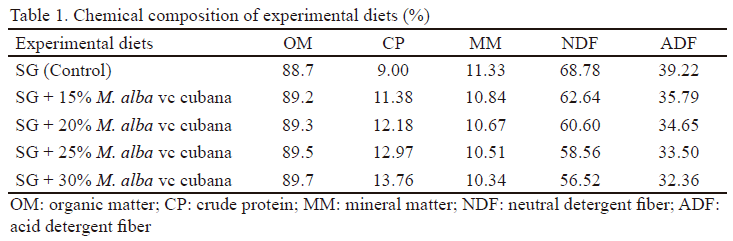
<body><![CDATA[<p align="justify" class="Cuerpodetexto" style="margin-top:12.0pt;text-indent:0cm;"><span style="font-family:'Verdana','sans-serif'; font-size:10.0pt; color:windowtext; ">The research was conducted in  cooperation between the Institute of Animal Science (ICA, initials in Spanish),  from Cuba, and the University of S&atilde;o Paulo (CENA/USP) from Brazil. <em>In vitro</em> fermentation took place at ICA, according to the technique described by  Theodorou <em>et al.</em> (1994). Molecular techniques were implemented at CENA /  USP. </span></p>     <p align="justify" class="Cuerpodetexto" style="margin-top:12.0pt;text-indent:0cm;"><em><span style="font-family:'Verdana','sans-serif'; font-size:10.0pt; color:windowtext; ">Animals and diet</span></em><span style="font-family:'Verdana','sans-serif'; font-size:10.0pt; color:windowtext; ">. Two adult male water buffalos (Murrah  breed), with a single cannula in rumen and average weight of 453 kg were used  as donors of ruminal liquor. Animals were housed in individual cubicles, with  shade and free access to water and feed. All received star grass (<em>Cynodon  nlemfuensis</em>)    forage.</span><span style="font-family:'Verdana','sans-serif'; font-size:10.0pt; color:windowtext; "> </span></p>     <p align="justify" class="Cuerpodetexto" style="margin-top:12.0pt;text-indent:0cm;"><em><span style="font-family:'Verdana','sans-serif'; font-size:10.0pt; color:windowtext; ">Experimental diets</span></em><span style="font-family:'Verdana','sans-serif'; font-size:10.0pt; color:windowtext; ">. Five diets were evaluated: 1) 100% star  grass (SG) (control), 2) SG + 15% <em>M. alba</em> cv. cubana, 3) SG + 20% <em>M.  alba</em> cv. cubana, 4) SG + 25% <em>M. alba</em> cv. cubana and 5) SG + 30 % <em>M.  alba</em> cv. cubana.</span></p>     <p align="justify" class="Cuerpodetexto" style="margin-top:12.0pt;text-indent:0cm;"><span style="font-family:'Verdana','sans-serif'; font-size:10.0pt; color:windowtext; ">Mulberry plants came  from the Estaci&oacute;n Experimental de Pastos y Forrajes &ldquo;Indio Hatuey&rdquo;, Matanzas  province, Cuba. </span><span style="font-family:'Verdana','sans-serif'; font-size:10.0pt; color:windowtext; ">These  plants grew in a red ferrallitic soil and were fertilized with chicken manure.  Their leaves with petioles and young stems were manually cut, simulating animal  selection. The SG was cut by hand in grazing areas from the Institute of Animal  Science, Cuba. The plant material was dried in an oven at 60 &deg;C and ground in  hammer mill up to reach a particle size of 1mm</span><span style="font-family:'Verdana','sans-serif'; font-size:10.0pt; color:windowtext; ">.</span></p>     <p align="justify" class="Cuerpodetexto" style="margin-top:12.0pt;text-indent:0cm;"><span style="font-family:'Verdana','sans-serif'; font-size:10.0pt; color:windowtext; ">&nbsp;The experimental diets underwent the analysis  of chemical composition according to AOAC (2016) and fibrous fractions were  analyzed according to Goering and van Soest (1970). <a href="/img/revistas/cjas/v50n3/t0107316.gif">Table 1</a> shows the chemical  composition of the experimental diets.</span></p>     
<p align="justify" class="Cuerpodetexto" style="margin-top:12.0pt;text-indent:0cm;"><em><span style="font-family:'Verdana','sans-serif'; font-size:10.0pt; color:windowtext; ">Experimental Procedure</span></em><span style="font-family:'Verdana','sans-serif'; font-size:10.0pt; color:windowtext; ">. An amount of 0.5 g from each of the treatments were weighed  and added to the corresponding glass bottles of 100 ml. </span></p>     <p align="justify" class="Cuerpodetexto" style="margin-top:12.0pt;text-indent:0cm;"><span style="font-family:'Verdana','sans-serif'; font-size:10.0pt; color:windowtext; ">Ruminal liquor of fastening animals  was extracted through the cannula, with the help of a vacuum pump. The liquor  was stored in a thermos to ensure adequate temperature conditions (39 &deg;C) and  anaerobiosis during transport to the laboratory.</span></p>     <p align="justify" class="Cuerpodetexto" style="margin-top:12.0pt;text-indent:0cm;"><span style="font-family:'Verdana','sans-serif'; font-size:10.0pt; color:windowtext; ">Ruminal content of both animals was  mixed and filtered through muslin. The resulting solid was added a small  portion of buffer solution of Menke and Steingass (1988). This solution was  agitated for a few seconds in a domestic blender to release microorganisms  adhered to fiber. Later, filtrate of this portion was added to liquid fraction.  Ruminal liquor was maintained in a CO<sub>2 </sub>atmosphere.</span></p>     <p align="justify" class="Cuerpodetexto" style="margin-top:12.0pt;text-indent:0cm;"><span style="font-family:'Verdana','sans-serif'; font-size:10.0pt; color:windowtext; ">Each bottle was  added 50 mL of a mixture of rumen liquor and buffer solution of Menke and  Steingass (1988), in a 1:3 (v/v) proportion, and they were sealed with a butyl  and agrafe stopper. Bottles without substrate were included as targets for  correcting the effect of ruminal liquor in volumes of produced gas. All bottles  were placed in a temperature controlled bath of 39 &deg;C</span><span style="font-family:'Verdana','sans-serif'; font-size:10.0pt; color:windowtext; ">. </span></p>     <p align="justify" class="Cuerpodetexto" style="margin-top:12.0pt;text-indent:0cm;"><span style="font-family:'Verdana','sans-serif'; font-size:10.0pt; color:windowtext; ">At 0 and 12 h of incubation, samples  of each treatment were taken for identification and quantification by RT-PCR of  populations of <em>Fibrobacter succinogenes</em>, <em>Ruminococcus flavefaciens</em> and total methanogens. Subsequently, they were placed in a freezer at -20 &deg;C  for further determination.</span></p>     ]]></body>
<body><![CDATA[<p align="justify" class="Cuerpodetexto" style="margin-top:12.0pt;text-indent:0cm;"><span style="font-family:'Verdana','sans-serif'; font-size:10.0pt; color:windowtext; ">Values of Ct (threshold cycle), which  is the cycle at which fluorescence is considered detectable in the exponential  phase of PCR reaction, were obtained to determine the &Delta;Ct, &Delta;&Delta;Ct, expression of  these microbial populations related to control treatment and the percentage of  cellulolytic and methanogenic bacteria in relation to total bacteria  population.</span></p>     <p align="justify" class="Cuerpodetexto" style="margin-top:12.0pt;text-indent:0cm;"><span style="font-family:'Verdana','sans-serif'; font-size:10.0pt; color:windowtext; ">Counting of protozoa, preserved in 10%  of formaldehyde, was performed. They were counted with Neubauer chamber using  an optical microscopy, after dyeing with a solution of gentian violet at 0.01%  in glacial acetic acid. </span></p>     <p align="justify" class="Cuerpodetexto" style="margin-top:12.0pt;text-indent:0cm;"><em><span style="font-family:'Verdana','sans-serif'; font-size:10.0pt; color:windowtext; ">DNA extraction</span></em><span style="font-family:'Verdana','sans-serif'; font-size:10.0pt; color:windowtext; ">. Cell disruption was achieved by freezing-thawing with  liquid nitrogen. DNA was obtained using a matrix (glassmilk), joined to it and  later released from it, when dissolved in double-distilled water (Makkar and  McSweeney 2005). DNA concentration and sample purity (OD 260 nm/280 nm OD) were  determined by absorbance at 260 nm and 280 nm in a Nanodrop 1000  spectrophotometer.</span></p>     <p align="justify" class="Cuerpodetexto" style="margin-top:12.0pt;text-indent:0cm;"><em><span style="font-family:'Verdana','sans-serif'; font-size:10.0pt; color:windowtext; ">RT- PCR.</span></em><span style="font-family:'Verdana','sans-serif'; font-size:10.0pt; color:windowtext; "> Extracted DNA was amplified with pairs of primers for  bacteria, fungi, <em>R. flavefaciens</em>, <em>F. succinogenes</em> and ruminal  methanogens, according to the description of&nbsp;  Denman and McSweeney (2006) and Denman <em>et al.</em> (2007). </span></p>     <p align="justify" class="Cuerpodetexto" style="margin-top:12.0pt;text-indent:0cm;"><span style="font-family:'Verdana','sans-serif'; font-size:10.0pt; color:windowtext; ">DNA samples were taken to a final  concentration of 10ng&bull;&micro;L<sup>-1</sup> and amplification reaction was carried  out with each of the specific primers (total bacteria, fungi, <em>F.  succinogenes</em>, <em>R. flavefaciens</em> and methanogens) was performed.  Primers were used at a concentration of 10mM and the SYBR Green 490 was also  used. Final reaction volume was 25 &micro;L. </span></p>     <p align="justify" class="Cuerpodetexto" style="margin-top:12.0pt;text-indent:0cm;"><span style="font-family:'Verdana','sans-serif'; font-size:10.0pt; color:windowtext; ">DNA amplification was performed in an  Applied Biosystem thermocycler, according to the following program: 1 cycle of  50 &deg;C 2 min. and 95 &deg;C 2 min., 40 cycles of 95 &deg;C 15 sec. and 60 &deg;C 1 min; 1  cycle of 95 &deg;C 2 min., 60 &deg;C 15 sec and 95 &deg; C 15 sec.</span></p>     <p align="justify" class="Cuerpodetexto" style="margin-top:12.0pt;text-indent:0cm;"><span style="font-family:'Verdana','sans-serif'; font-size:10.0pt; color:windowtext; ">The amounts of studied microbial  populations were expressed as proportion of total bacteria (&Delta;Ct). These &Delta;Ct  values were calculated by the difference between the Ct value of target gene  and the reference gene (16S rRNA of bacteria). The &Delta;&Delta;Ct was determined by the  difference between the &Delta;Ct of target groups from experimental diets and &Delta;Ct of  target groups from control diet. Percentage of <em>F. succinogenes</em> and <em>R.  flavefaciens</em>, in relation to total bacterial population, was calculated  from &Delta;Ct values as 100 &times; (2&Delta;Ct)<sup>-1</sup> and the expression of target  groups related to control treatment as 2-&Delta;&Delta;Ct (Denman and McSweeney 2006). </span></p>     <p align="justify" class="Cuerpodetexto" style="margin-top:12.0pt;text-indent:0cm;"><em><span style="font-family:'Verdana','sans-serif'; font-size:10.0pt; color:windowtext; ">Experimental design and statistical  analysis</span></em><span style="font-family:'Verdana','sans-serif'; font-size:10.0pt; color:windowtext; ">. A completely randomized  design with 5x2 factorial arrangement (5 experimental diets and 2 h of  sampling) was used. Four replications were carried out.</span></p>     <p align="justify" class="Cuerpodetexto" style="margin-top:12.0pt;text-indent:0cm;"><span style="font-family:'Verdana','sans-serif'; font-size:10.0pt; color:windowtext; ">INFOSTAT statistical program was used  for processing results, which was proposed by Di Rienzo <em>et al.</em> (2012).  Multiple comparisons test of Duncan (1955) was applied on necessary cases. </span></p>     <p align="justify" class="subtitulo" style="margin-top:12.0pt;text-align:justify;"><span style="font-family:'Verdana','sans-serif'; font-size:10.0pt; color:windowtext; ">&nbsp;</span></p>     ]]></body>
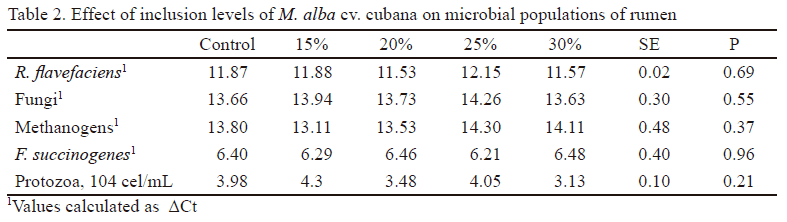
<body><![CDATA[<p align="justify" class="subtitulo" style="margin-top:12.0pt;text-align:justify;"><span style="font-family:'Verdana','sans-serif'; font-size:13.0pt; color:windowtext; "><b>RESULTS AND DISCUSSION</b></span></p>     <p align="justify" class="Cuerpodetexto" style="margin-top:12.0pt;text-indent:0cm;"><span style="font-family:'Verdana','sans-serif'; font-size:10.0pt; color:windowtext; ">There were no  significant interactions among experimental diets and hours of sampling for the  studied variables, nor differences among individual factors (experimental diet  and hours) for any of the selected indicators. Therefore, only the results of  the effect of treatments on each variable are presented.</span><span style="font-family:'Verdana','sans-serif'; font-size:10.0pt; color:windowtext; "> </span></p>     <p align="justify" class="Cuerpodetexto" style="margin-top:12.0pt;text-indent:0cm;"><span style="font-family:'Verdana','sans-serif'; font-size:10.0pt; color:windowtext; ">Currently, the  characterization of complex microbial communities by molecular techniques is  widely used and counting of microorganisms have been replaced by traditional  culture methods (Saro <em>et al.</em> 2014). The study of ruminal microorganisms  under the effect of different feeding strategies does not escape from this  tendency. In this sense, real-time PCR has become a powerful tool that allows a  fast quantification of these microorganisms. The design of specific primers has  allowed their identification and quantification by this technique. In this  experiment, identification and quantification of populations of microorganisms  involved in fiber degradation in the rumen (<em>F. succinogenes</em>, <em>R.  flavefaciens</em> and fungi) and total methanogens by RT-PCR (<a href="/img/revistas/cjas/v50n3/t0207316.gif">Table 2</a>) indicated  that the inclusion of <em>M. alba</em> cv cubana did not affect any of these  ruminal populations. These results allowed to complement and corroborate those  obtained by Gonz&aacute;lez <em>et al.</em> (2011), after evaluating the effect of four  varieties of mulberry on the population of methanogens and cellulolytic  microorganisms, quantified by culture techniques.</span><span style="font-family:'Verdana','sans-serif'; font-size:10.0pt; color:windowtext; "> </span></p>     
<p align="justify" class="Cuerpodetexto" style="margin-top:12.0pt;text-indent:0cm;"><span style="font-family:'Verdana','sans-serif'; font-size:10.0pt; color:windowtext; ">Secondary plant metabolites (saponins,  flavonoids and tannins) have demonstrated the ability to manipulate ruminal  fermentation in a favorable manner, which reduces the formation of methane in  the rumen (Hu <em>et al.</em> 2005, Patra <em>et al.</em> 2006). Saponins reduce protozoa  counts because the latter are more sensitive to changes caused by these  compounds in their cell membranes (Moss <em>et al.</em> 2000). According to Goel <em>et  al.</em> (2008), these compounds increase the proliferation of fiber-degrading  bacteria and inhibit fungal population. Maldonado <em>et al.</em> (2000) and  Garc&iacute;a (2003) determined saponin concentration in <em>M. alba</em> and found no  presence of this compound in the plant. The absence of saponins in mulberry  could then explain that no variations were found in populations of cellulolytic  microorganisms (<em>R. flavefaciens</em>, <em>F. succinogenes</em> and fungi) and  protozoa with the inclusion of this plant on the diet.</span></p>     <p align="justify" class="Cuerpodetexto" style="margin-top:12.0pt;text-indent:0cm;"><span style="font-family:'Verdana','sans-serif'; font-size:10.0pt; color:windowtext; ">Condensed tannins  present in some plants have demonstrated to be toxic to methanogens (Hess <em>et  al.</em> 2003, Tavendale <em>et al.</em> 2005). In previous studies, Gonz&aacute;lez <em>et  al.</em> (2010) determined the composition of condensed tannins of this mulberry  variety and found no appreciable amounts of this compound. The fact that  mulberry shows no saponins and tannins in its composition could explain that  their inclusion on the diet had no negative effect on the population of  methanogens</span><span style="font-family:'Verdana','sans-serif'; font-size:10.0pt; color:windowtext; ">.</span></p>     <p align="justify" class="Cuerpodetexto" style="margin-top:12.0pt;text-indent:0cm;"><span style="font-family:'Verdana','sans-serif'; font-size:10.0pt; color:windowtext; ">Defaunation or reduction of protozoa  is one of the methods used for reducing methanogens. It is stated that  methanogens establish an ecto- and endosymbiotic relationship with rumen  protozoa (Finlay <em>et al.</em> 1994, Ohene-Adjei <em>et al.</em> 2007). Many of  methanogens are observed on the outer surface of ciliated protozoa from rumen.  Therefore, when the number of protozoa decreases, generally methanogens are  also reduced and, consequently, ruminal methane production diminishes  (Kobayashi 2010). In this study, the inclusion of mulberry cv. cubana on the  diet did not affect protozoa counts, so the amounts of methanogens were not  affected either.</span></p>     <p align="justify" class="Cuerpodetexto" style="margin-top:12.0pt;text-indent:0cm;"><span style="font-family:'Verdana','sans-serif'; font-size:10.0pt; color:windowtext; "><a href="/img/revistas/cjas/v50n3/t0307316.gif">Table 3</a> shows that  representation percentage of <em>F. succinogenes</em> and <em>R. flavefaciens</em> regarding total bacteria population was not affected by the inclusion of <em>M.  alba</em> cv. cubana on diet. It is important to point out that in all  treatments, <em>F. succinogenes</em> had a higher percentage of representation  than <em>R. flavefaciens</em>. This result coincides with that obtained by  McSweeney <em>et al.</em> (2007) and Hung <em>et al.</em> (2013), who listed some  bacterial populations in the rumen of animals fed different diets and found  that <em>F. succinogenes</em> was the predominant cellulolytic bacteria. The  highest representation of <em>F. succinogenes</em>, found in this study, was  favorable, taking into account that it is one of the cellulolytic bacteria with  higher potentialities for fiber degradation (Kobayashi 2010). Therefore,  animals could make better use of the fiber component of    feeds.</span><span style="font-family:'Verdana','sans-serif'; font-size:10.0pt; color:windowtext; "> </span></p>     
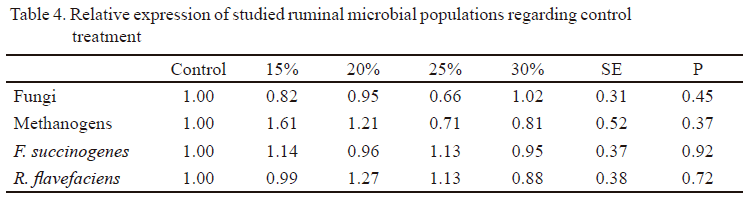
<p align="justify" class="Cuerpodetexto" style="margin-top:12.0pt;text-indent:0cm;"><span style="font-family:'Verdana','sans-serif'; font-size:10.0pt; color:windowtext; ">Values of &Delta;&Delta;Ct (<a href="/img/revistas/cjas/v50n3/f0107316.gif">figure 1</a>) and the  expression related to control treatment of ruminal microbial populations,  identified and quantified (<a href="/img/revistas/cjas/v50n3/t0407316.gif">Table 4</a>), demonstrated that all treatments including <em>M. alba</em> cv. cubana showed similar differences and expression related to  control treatment for all microbial populations. These variables showed that  inclusion levels of 15, 20, 25 and 30% of this Cuban variety in the ration did  not affect populations of <em>F. succinogenes</em>, <em>R. flavefaciens</em> fungi  and methanogens rumen.</span></p>     
<p align="justify" class="Cuerpodetexto" style="margin-top:12.0pt;text-indent:0cm;"><span style="font-family:'Verdana','sans-serif'; font-size:10.0pt; color:windowtext; ">Ruminal  methanogens are a specialized group of microorganisms having the function of  producing methane during the use of energy from food into the organ (Attwood <em>et  al.</em> 2008, Liu <em>et al.</em> 2013, Chuntrakort <em>et al.</em> 2014,  Khiaosa-ard &amp; Zebeli 2014). In this study, the inclusion of this Cuban  variety of mulberry did not reduce this microbial population numbers, so  reductions of ruminal methane production should not be expected either.  However, Gonzalez <em>et al.</em> (2012), when evaluating the same inclusion  levels of this variety on the control of ruminal methanogenesis, found that all  levels reduced methane production. Gonzalez <em>et al.</em> (2014), when  evaluated the effect of these levels of mulberry on methanogen population by  the molecular technique of denaturing gradient gel electrophoresis (DGGE),  found no negative effects on these microorganisms. Therefore, it can be stated  that reduction of methane production with the inclusion of 15, 20, 25 and 30%  of <em>M. alba</em> cv. cubana is no because of direct effect of this plant on  methanogens.</span><span style="font-family:'Verdana','sans-serif'; font-size:10.0pt; color:windowtext; "> </span></p>     <p align="justify" class="Cuerpodetexto" style="margin-top:12.0pt;text-indent:0cm;"><span style="font-family:'Verdana','sans-serif'; font-size:10.0pt; color:windowtext; ">&nbsp;It is a favorable factor that studied  cellulolytic populations within the rumen have not been affected by the  inclusion of <em>M. alba</em> cv. cubana in the diet. Therefore, assuming the use  of this variety as a strategy for controlling rumen methanogenesis, it would be  carried out with the guarantee that it will not affect the main microbial  populations degrading fiber nor their degradation process in the rumen. </span></p>     ]]></body>
<body><![CDATA[<p align="justify" class="Cuerpodetexto" style="margin-top:12.0pt;text-indent:0cm;"><span style="font-family:'Verdana','sans-serif'; font-size:10.0pt; color:windowtext; ">Inclusion of <em>M. alba</em> cv. cubana  on the diet does not affect methanogens or the main microbial populations that  degrade the fiber in the rumen, which could be used as a strategy for reducing  methane production in the rumen. The mechanism by which this plant reduces  ruminal methanogenesis is not the direct effect on methanogens.</span></p>     <p align="justify" class="subtitulo" style="margin-top:12.0pt;text-align:justify;"><span style="font-family:'Verdana','sans-serif'; font-size:10.0pt; color:windowtext; ">&nbsp;</span></p>     <p align="justify" class="subtitulo" style="margin-top:12.0pt;text-align:justify;"><span style="font-family:'Verdana','sans-serif'; font-size:13.0pt; color:windowtext; "><b>ACKNOWLEDGEMENTS</b></span></p>     <div align="justify"><span style="line-height:107%; font-family:'Verdana','sans-serif'; font-size:10.0pt; ">Thanks to FAO/OIEA (Food  and Agriculture Organization/International Atomic Energy Agency) program and to  the Coordination and Improvement of Staff at Superior Level (CAPES, Brazil) for  the financial support</span><span style="font-family:'Verdana','sans-serif'; font-size:10.0pt; color:windowtext; ">.</span> </div>     <p align="justify" class="MsoNormal" style="margin-top:12.0pt;text-align:justify;"><span style="line-height:107%; font-family:'Verdana','sans-serif'; font-size:10.0pt; ">&nbsp;</span></p>     <p align="justify" class="subtitulo" style="margin-top:12.0pt;text-align:justify;"><span style="font-family:'Verdana','sans-serif'; font-size:13.0pt; color:windowtext; "><b>REFERENCES</b></span></p>     <p align="justify" class="referencias" style="margin-top:12.0pt;margin-right:0cm;margin-bottom:.0001pt;margin-left:0cm;text-indent:0cm;"><span style="font-family:'Verdana','sans-serif'; font-size:10.0pt; color:windowtext; ">Anbarasu,  C., Dutta, N., Sharma, K. &amp; Rawat, M. 2004. &ldquo;Response of goats to partial  replacement of dietary protein by a leaf meal mixture containing Leucaena  leucocephala, <em>Morus alba</em> and <em>Tectona grandis</em>&rdquo;. Small Ruminant  Research, 51(1): 47&ndash;56, ISSN: 0921-4488, DOI: 10.1016/S0921-4488(03)00203-7.</span></p>     <p align="justify" class="referencias" style="margin-top:12.0pt;margin-right:0cm;margin-bottom:.0001pt;margin-left:0cm;text-indent:0cm;"><span style="font-family:'Verdana','sans-serif'; font-size:10.0pt; color:windowtext; ">AOAC.  2016. Official methods of analysis of AOAC International. 20th ed., Rockville,  MD: AOAC International, ISBN: 978-0-935584-87-5, OCLC: 950056914, Available:  &lt;<a href="http://www.directtextbook.com/isbn/9780935584875" target="_blank">http://www.directtextbook.com/isbn/9780935584875</a>&gt;, [Consulted: September  22, 2016].</span></p>     <p align="justify" class="referencias" style="margin-top:12.0pt;margin-right:0cm;margin-bottom:.0001pt;margin-left:0cm;text-indent:0cm;"><span style="font-family:'Verdana','sans-serif'; font-size:10.0pt; color:windowtext; ">Attwood,  G. T., Kelly, W. J., Altermann, E. H. &amp; Leahy, S. C. 2008. &ldquo;Analysis of the  Methanobrevibacter ruminantium draft genome: understanding methanogen biology  to inhibit their action in the rumen&rdquo;. Australian Journal of Experimental  Agriculture, 48(2): 83&ndash;88, ISSN: 0816-1089, DOI: 10.1071/EA07269.</span></p>     <p align="justify" class="referencias" style="margin-top:12.0pt;margin-right:0cm;margin-bottom:.0001pt;margin-left:0cm;text-indent:0cm;"><span style="font-family:'Verdana','sans-serif'; font-size:10.0pt; color:windowtext; ">Ba, N.  X., Giang, V. D. &amp; Ngoan, L. D. 2005. &ldquo;Ensiling of mulberry foliage (<em>Morus  alba</em>) and the nutritive value of mulberry foliage silage for goats in  central Vietnam&rdquo;. Livestock Research for Rural Development, 17(2), ISSN:  0121-3784.</span></p>     ]]></body>
<body><![CDATA[<p align="justify" class="referencias" style="margin-top:12.0pt;margin-right:0cm;margin-bottom:.0001pt;margin-left:0cm;text-indent:0cm;"><span style="font-family:'Verdana','sans-serif'; font-size:10.0pt; color:windowtext; ">Bakshi,  M. P. S. &amp; Wadhwa, M. 2007. &ldquo;Tree leaves as complete feed for goat bucks&rdquo;.  Small Ruminant Research, 69(1&ndash;3): 74&ndash;78, ISSN: 0921-4488, DOI: 10.1016/j.smallrumres.2005.12.009.</span></p>     <p align="justify" class="referencias" style="margin-top:12.0pt;margin-right:0cm;margin-bottom:.0001pt;margin-left:0cm;text-indent:0cm;"><span style="font-family:'Verdana','sans-serif'; font-size:10.0pt; color:windowtext; ">Chuntrakort,  P., Otsuka, M., Hayashi, K., Takenaka, A., Udchachon, S. &amp; Sommart, K.  2014. &ldquo;The effect of dietary coconut kernels, whole cottonseeds and sunflower  seeds on the intake, digestibility and enteric methane emissions of Zebu beef  cattle fed rice straw based diets&rdquo;. </span><span style="font-family:'Verdana','sans-serif'; font-size:10.0pt; color:windowtext; ">Livestock Science, 161: 80&ndash;89, ISSN:  1871-1413, DOI: 10.1016/j.livsci.2014.01.003.</span></p>     <p align="justify" class="referencias" style="margin-top:12.0pt;margin-right:0cm;margin-bottom:.0001pt;margin-left:0cm;text-indent:0cm;"><span style="font-family:'Verdana','sans-serif'; font-size:10.0pt; color:windowtext; ">Delgado, D. C., Gonz&aacute;lez, R., Galindo, J., Cairo, J. &amp; Almeida, M.  2007. &ldquo;Potencialidad de <em>Trichantera gigantea</em> y <em>Morus alba</em> para reducir  la producci&oacute;n ruminal de metano <em>in vitro</em>&rdquo;. </span><span style="font-family:'Verdana','sans-serif'; font-size:10.0pt; color:windowtext; ">Cuban Journal of  Agricultural Science, 41(4): 339&ndash;342, ISSN: 2079-3480.</span></p>     <p align="justify" class="referencias" style="margin-top:12.0pt;margin-right:0cm;margin-bottom:.0001pt;margin-left:0cm;text-indent:0cm;"><span style="font-family:'Verdana','sans-serif'; font-size:10.0pt; color:windowtext; ">Denman,  S. E. &amp; McSweeney, C. S. 2006. &ldquo;Development of a real-time PCR assay for  monitoring anaerobic fungal and cellulolytic bacterial populations within the  rumen: Real-time PCR assay of the rumen anaerobic fungal population&rdquo;. FEMS  Microbiology Ecology, 58(3): 572&ndash;582, ISSN: 0168-6496, 1574-6941, DOI:  10.1111/j.1574-6941.2006.00190.x.</span></p>     <p align="justify" class="referencias" style="margin-top:12.0pt;margin-right:0cm;margin-bottom:.0001pt;margin-left:0cm;text-indent:0cm;"><span style="font-family:'Verdana','sans-serif'; font-size:10.0pt; color:windowtext; ">Denman,  S. E., Tomkins, N. W. &amp; McSweeney, C. S. 2007. &ldquo;Quantitation and diversity  analysis of ruminal methanogenic populations in response to the  antimethanogenic compound bromochloromethane: Monitoring of rumen methanogenic  Archaea&rdquo;. </span><span style="font-family:'Verdana','sans-serif'; font-size:10.0pt; color:windowtext; ">FEMS Microbiology Ecology, 62(3): 313&ndash;322, ISSN:  0168-6496, 1574-6941, DOI: 10.1111/j.1574-6941.2007.00394.x.</span></p>     <p align="justify" class="referencias" style="margin-top:12.0pt;margin-right:0cm;margin-bottom:.0001pt;margin-left:0cm;text-indent:0cm;"><span style="font-family:'Verdana','sans-serif'; font-size:10.0pt; color:windowtext; ">Di Rienzo, J. A., Casanoves, F., Balzarini, M. G., Gonz&aacute;lez, L., Tablada,  M. &amp; Robledo, C. W. 2012. InfoStat. version 2012, [Windows], Universidad  Nacional de C&oacute;rdoba, Argentina: Grupo InfoStat, Available: &lt;<a href="http://www.infostat.com.ar/" target="_blank">http://www.infostat.com.ar/</a>&gt;.</span></p>     <p align="justify" class="referencias" style="margin-top:12.0pt;margin-right:0cm;margin-bottom:.0001pt;margin-left:0cm;text-indent:0cm;"><span style="font-family:'Verdana','sans-serif'; font-size:10.0pt; color:windowtext; ">Duncan,  D. B. 1955. &ldquo;Multiple Range and Multiple F Tests&rdquo;. Biometrics, 11(1): 1&ndash;42,  ISSN: 0006-341X, DOI: 10.2307/3001478.</span></p>     <p align="justify" class="referencias" style="margin-top:12.0pt;margin-right:0cm;margin-bottom:.0001pt;margin-left:0cm;text-indent:0cm;"><span style="font-family:'Verdana','sans-serif'; font-size:10.0pt; color:windowtext; ">Finlay,  B. J., Esteban, G., Clarke, K. J., Williams, A. G., Embley, T. M. &amp; Hirt,  R. P. 1994. &ldquo;Some rumen ciliates have endosymbiotic methanogens&rdquo;. FEMS  Microbiology Letters, 117(2): 157&ndash;161, ISSN: 0378-1097, 1574-6968, DOI:  10.1111/j.1574-6968.1994.tb06758.x.</span></p>     <p align="justify" class="referencias" style="margin-top:12.0pt;margin-right:0cm;margin-bottom:.0001pt;margin-left:0cm;text-indent:0cm;"><span style="font-family:'Verdana','sans-serif'; font-size:10.0pt; color:windowtext; ">Foiklang,  S., Wanapat, M. &amp; Toburan, W. 2011. &ldquo;Effects of various plant protein  sources in high-quality feed block on feed intake, rumen fermentation, and  microbial population in swamp buffalo&rdquo;. Tropical Animal Health and Production,  43(8): 1517&ndash;1524, ISSN: 0049-4747, 1573-7438, DOI: 10.1007/s11250-011-9836-y.</span></p>     <p align="justify" class="referencias" style="margin-top:12.0pt;margin-right:0cm;margin-bottom:.0001pt;margin-left:0cm;text-indent:0cm;"><span style="font-family:'Verdana','sans-serif'; font-size:10.0pt; color:windowtext; ">Garc&iacute;a,  D. 2003. </span><span style="font-family:'Verdana','sans-serif'; font-size:10.0pt; color:windowtext; ">Efecto de los principales factores que influyen en la  composici&oacute;n fitoqu&iacute;mica de <em>Morus alba</em> (Linn.). Master Thesis,  Universidad de Matanzas &lsquo;Camilo Cienfuegos&rsquo; - EEPF &lsquo;Indio Hatuey&rsquo;, Matanzas,  Cuba.</span></p>     ]]></body>
<body><![CDATA[<p align="justify" class="referencias" style="margin-top:12.0pt;margin-right:0cm;margin-bottom:.0001pt;margin-left:0cm;text-indent:0cm;"><span style="font-family:'Verdana','sans-serif'; font-size:10.0pt; color:windowtext; ">Goel,  G., Makkar, H. P. S. &amp; Becker, K. 2008. &ldquo;Changes in microbial community  structure, methanogenesis and rumen fermentation in response to saponin-rich  fractions from different plant materials&rdquo;. Journal of Applied Microbiology,  105(3): 770&ndash;777, ISSN: 1364-5072, 1365-2672, DOI: 10.1111/j.1365-2672.2008.03818.x.</span></p>     <p align="justify" class="referencias" style="margin-top:12.0pt;margin-right:0cm;margin-bottom:.0001pt;margin-left:0cm;text-indent:0cm;"><span style="font-family:'Verdana','sans-serif'; font-size:10.0pt; color:windowtext; ">Goering,  H. K. &amp; Van Soest, P. J. 1970. Forage fiber analysis: apparatus, reagents,  procedures, and some applications. (ser. Agriculture Handbook, no. ser. 379),  Washington, D.C.: Agricultural Research Service, U.S. Dept. of Agriculture, 20  p., OCLC: 13295375.</span></p>     <p align="justify" class="referencias" style="margin-top:12.0pt;margin-right:0cm;margin-bottom:.0001pt;margin-left:0cm;text-indent:0cm;"><span style="font-family:'Verdana','sans-serif'; font-size:10.0pt; color:windowtext; ">Gonz&aacute;lez, N., Galindo, J., Aldana, A. I., Moreira, O. &amp; Sarduy, L. R.  2011. </span><span style="font-family:'Verdana','sans-serif'; font-size:10.0pt; color:windowtext; ">&ldquo;Effect of four mulberry (<em>Morus alba</em> Linn.) varieties  on microbial population and fermentative products with rumen liquid from river  buffaloes (<em>Bubalus bubalis</em>) under <em>in vitro</em> conditions&rdquo;. Cuban  Journal of Agricultural Science, 45(4): 399&ndash;404, ISSN: 2079-3480.</span></p>     <p align="justify" class="referencias" style="margin-top:12.0pt;margin-right:0cm;margin-bottom:.0001pt;margin-left:0cm;text-indent:0cm;"><span style="font-family:'Verdana','sans-serif'; font-size:10.0pt; color:windowtext; ">Gonz&aacute;lez,  N., Galindo, J., Aldana, A. I., Moreira, O. &amp; Sarduy, L. R. 2012. &ldquo;Effect  of different inclusion levels of <em>Morus alba</em> Linn cv. cubana on the  methane fermentation and production under <em>in vitro</em> conditions with rumen  liquor from river buffaloes (<em>Bubalus bubalis</em>)&rdquo;. Cuban Journal of  Agricultural Science, 46(2): 151&ndash;157, ISSN: 2079-3480.</span></p>     <p align="justify" class="referencias" style="margin-top:12.0pt;margin-right:0cm;margin-bottom:.0001pt;margin-left:0cm;text-indent:0cm;"><span style="font-family:'Verdana','sans-serif'; font-size:10.0pt; color:windowtext; ">Gonz&aacute;lez,  N., Galindo, J., Aldana, A. I., Moreira, O., Sarduy, L. R., Abdalla, L. A.  &amp; Santos, M. R. 2010. &ldquo;Evaluation of different varieties of mulberry (<em>Morus  alba</em>) in the control of the methanogenesis in buffalo rumen liquid&rdquo;. Cuban  Journal of Agricultural Science, 44(1): 37&ndash;41, ISSN: 2079-3480.</span></p>     <p align="justify" class="referencias" style="margin-top:12.0pt;margin-right:0cm;margin-bottom:.0001pt;margin-left:0cm;text-indent:0cm;"><span style="font-family:'Verdana','sans-serif'; font-size:10.0pt; color:windowtext; ">Gonz&aacute;lez,  N., Galindo, J., Navarrete, A. A., Abdalla, A. L. &amp; Tsai, S. M. 2014.  &ldquo;Determination of the effect of <em>Morus alba</em> cv. cubana on the population  of methanogens within the rumen liquor of water buffaloes, using the Denaturing  Gradient Gel Electrophoresis (DGGE)&rdquo;. Cuban Journal of Agricultural Science,  48(3): 253&ndash;257, ISSN: 2079-3480.</span></p>     <p align="justify" class="referencias" style="margin-top:12.0pt;margin-right:0cm;margin-bottom:.0001pt;margin-left:0cm;text-indent:0cm;"><span style="font-family:'Verdana','sans-serif'; font-size:10.0pt; color:windowtext; ">Hess, H.  D., Kreuzer, M., D&#305;&#769;az, T. E., Lascano, C. E., Carulla, J. E., Soliva, C. R.  &amp; Machm&uuml;ller, A. 2003. &ldquo;Saponin rich tropical fruits affect fermentation  and methanogenesis in faunated and defaunated rumen fluid&rdquo;. Animal Feed Science  and Technology, 109(1&ndash;4): 79&ndash;94, ISSN: 0377-8401, DOI:  10.1016/S0377-8401(03)00212-8.</span></p>     <p align="justify" class="referencias" style="margin-top:12.0pt;margin-right:0cm;margin-bottom:.0001pt;margin-left:0cm;text-indent:0cm;"><span style="font-family:'Verdana','sans-serif'; font-size:10.0pt; color:windowtext; ">Hu, W.  L., Liu, J. X., Ye, J. A., Wu, Y. M. &amp; Guo, Y. Q. 2005. &ldquo;Effect of tea  saponin on rumen fermentation <em>in vitro</em>&rdquo;. Animal Feed Science and  Technology, 120(3&ndash;4): 333&ndash;339, ISSN: 0377-8401, DOI:  10.1016/j.anifeedsci.2005.02.029.</span></p>     <p align="justify" class="referencias" style="margin-top:12.0pt;margin-right:0cm;margin-bottom:.0001pt;margin-left:0cm;text-indent:0cm;"><span style="font-family:'Verdana','sans-serif'; font-size:10.0pt; color:windowtext; ">Hung, L.  V., Wanapat, M. &amp; Cherdthong, A. 2013. &ldquo;Effects of Leucaena leaf pellet on  bacterial diversity and microbial protein synthesis in swamp buffalo fed on  rice straw&rdquo;. Livestock Science, 151(2&ndash;3): 188&ndash;197, ISSN: 1871-1413, DOI:  10.1016/j.livsci.2012.11.011.</span></p>     <p align="justify" class="referencias" style="margin-top:12.0pt;margin-right:0cm;margin-bottom:.0001pt;margin-left:0cm;text-indent:0cm;"><span style="font-family:'Verdana','sans-serif'; font-size:10.0pt; color:windowtext; ">Kandylis,  K., Hadjigeorgiou, I. &amp; Harizanis, P. 2009. &ldquo;The nutritive value of  mulberry leaves (<em>Morus alba</em>) as a feed supplement for sheep&rdquo;. Tropical  Animal Health and Production, 41(1): 17&ndash;24, ISSN: 0049-4747, 1573-7438, DOI:  10.1007/s11250-008-9149-y.</span></p>     ]]></body>
<body><![CDATA[<p align="justify" class="referencias" style="margin-top:12.0pt;margin-right:0cm;margin-bottom:.0001pt;margin-left:0cm;text-indent:0cm;"><span style="font-family:'Verdana','sans-serif'; font-size:10.0pt; color:windowtext; ">Khiaosa-ard,  R. &amp; Zebeli, Q. 2014. &ldquo;Cattle&rsquo;s variation in rumen ecology and metabolism  and its contributions to feed efficiency&rdquo;. Livestock Science, 162: 66&ndash;75, ISSN:  1871-1413, DOI: 10.1016/j.livsci.2014.01.005.</span></p>     <p align="justify" class="referencias" style="margin-top:12.0pt;margin-right:0cm;margin-bottom:.0001pt;margin-left:0cm;text-indent:0cm;"><span style="font-family:'Verdana','sans-serif'; font-size:10.0pt; color:windowtext; ">Kobayashi,  Y. 2010. &ldquo;Abatement of Methane Production from Ruminants: Trends in the  Manipulation of Rumen Fermentation&rdquo;. Asian-Australasian Journal of Animal  Sciences, 23(3): 410&ndash;416, ISSN: 1011-2367, 1976-5517, DOI:  10.5713/ajas.2010.r.01.</span></p>     <p align="justify" class="referencias" style="margin-top:12.0pt;margin-right:0cm;margin-bottom:.0001pt;margin-left:0cm;text-indent:0cm;"><span style="font-family:'Verdana','sans-serif'; font-size:10.0pt; color:windowtext; ">Liu, C.,  Zhu, Z. P., Shang, B., Chen, Y. X., Guo, T. J. &amp; Luo, Y. M. 2013.  &ldquo;Long-term effects of ensiled cornstalk diet on methane emission, rumen  fermentation, methanogenesis and weight gain in sheep&rdquo;. Small Ruminant  Research, 115(1&ndash;3): 15&ndash;20, ISSN: 0921-4488, DOI:  10.1016/j.smallrumres.2013.07.011.</span></p>     <!-- ref --><p align="justify" class="referencias" style="margin-top:12.0pt;margin-right:0cm;margin-bottom:.0001pt;margin-left:0cm;text-indent:0cm;"><span style="font-family:'Verdana','sans-serif'; font-size:10.0pt; color:windowtext; ">Makkar,  H. P. S. &amp; McSweeney, C. S. (eds.). 2005. Methods in Gut Microbial Ecology  for Ruminants. Berlin-Heidelberg: Springer-Verlag, ISBN: 978-1-4020-3790-0,  Available: &lt;<a href="http://link.springer.com/10.1007/1-4020-3791-0" target="_blank">http://link.springer.com/10.1007/1-4020-3791-0</a>&gt;, [Consulted:  September 22, 2016].    </span></p>     <p align="justify" class="referencias" style="margin-top:12.0pt;margin-right:0cm;margin-bottom:.0001pt;margin-left:0cm;text-indent:0cm;"><span style="font-family:'Verdana','sans-serif'; font-size:10.0pt; color:windowtext; ">Maldonado, M., Grande, D., Aranda, E. &amp; P&eacute;rez-Gil, F. 2000. &ldquo;Evaluaci&oacute;n  de &aacute;rboles forrajeros tropicales para la alimentaci&oacute;n de rumiantes en Tabasco,  M&eacute;xico&rdquo;. In: IV Taller Internacional Silvopastoril &lsquo;Los &aacute;rboles y arbustos en  la ganader&iacute;a tropical&rsquo;, Matanzas, Cuba: EEPF &lsquo;Indio Hatuey&rsquo;, pp. 135&ndash;142, ISBN:  978-959-16-0285-5.</span></p>     <p align="justify" class="referencias" style="margin-top:12.0pt;margin-right:0cm;margin-bottom:.0001pt;margin-left:0cm;text-indent:0cm;"><span style="font-family:'Verdana','sans-serif'; font-size:10.0pt; color:windowtext; ">McAllister,  T. A. &amp; Newbold, C. J. 2008. &ldquo;Redirecting rumen fermentation to reduce  methanogenesis&rdquo;. Australian Journal of Experimental Agriculture, 48(2): 7,  ISSN: 0816-1089, DOI: 10.1071/EA07218.</span></p>     <p align="justify" class="referencias" style="margin-top:12.0pt;margin-right:0cm;margin-bottom:.0001pt;margin-left:0cm;text-indent:0cm;"><span style="font-family:'Verdana','sans-serif'; font-size:10.0pt; color:windowtext; ">McSweeney,  C. S., Denman, S. E., Wright, A. D. G. &amp; Yu, Z. 2007. &ldquo;Application of  Recent DNA/RNA-based Techniques in Rumen Ecology&rdquo;. Asian-Australasian Journal  of Animal Sciences, 20(2): 283&ndash;294, ISSN: 1011-2367, 1976-5517, DOI:  10.5713/ajas.2007.283.</span></p>     <p align="justify" class="referencias" style="margin-top:12.0pt;margin-right:0cm;margin-bottom:.0001pt;margin-left:0cm;text-indent:0cm;"><span style="font-family:'Verdana','sans-serif'; font-size:10.0pt; color:windowtext; ">Menke,  K. H. &amp; Steingass, H. 1988. &ldquo;Estimation of the energetic feed value  obtained from chemical analysis and <em>in vitro</em> gas production using rumen  fluid&rdquo;. Animal Research and Development, 28(1): 7&ndash;55, ISSN: 0340-3165.</span></p>     <p align="justify" class="referencias" style="margin-top:12.0pt;margin-right:0cm;margin-bottom:.0001pt;margin-left:0cm;text-indent:0cm;"><span style="font-family:'Verdana','sans-serif'; font-size:10.0pt; color:windowtext; ">Moss, A.  R., Jouany, J. P. &amp; Newbold, J. 2000. &ldquo;Methane production by ruminants: its  contribution to global warming&rdquo;. Annales de Zootechnie, 49(3): 231&ndash;253, ISSN:  0003-424X, 1297-9651, DOI: 10.1051/animres:2000119.</span></p>     ]]></body>
<body><![CDATA[<p align="justify" class="referencias" style="margin-top:12.0pt;margin-right:0cm;margin-bottom:.0001pt;margin-left:0cm;text-indent:0cm;"><span style="font-family:'Verdana','sans-serif'; font-size:10.0pt; color:windowtext; ">Ohene-Adjei,  S., Teather, R. M., Ivan, M. &amp; Forster, R. J. 2007. &ldquo;Postinoculation  Protozoan Establishment and Association Patterns of Methanogenic Archaea in the  Ovine Rumen&rdquo;. Applied and Environmental Microbiology, 73(14): 4609&ndash;4618, ISSN:  0099-2240, DOI: 10.1128/AEM.02687-06.</span></p>     <p align="justify" class="referencias" style="margin-top:12.0pt;margin-right:0cm;margin-bottom:.0001pt;margin-left:0cm;text-indent:0cm;"><span style="font-family:'Verdana','sans-serif'; font-size:10.0pt; color:windowtext; ">Patra,  A. K., Kamra, D. N. &amp; Agarwal, N. 2006. &ldquo;Effect of plant extracts on <em>in  vitro</em> methanogenesis, enzyme activities and fermentation of feed in rumen  liquor of buffalo&rdquo;. Animal Feed Science and Technology, 128(3&ndash;4): 276&ndash;291,  ISSN: 0377-8401, DOI: 10.1016/j.anifeedsci.2005.11.001.</span></p>     <p align="justify" class="referencias" style="margin-top:12.0pt;margin-right:0cm;margin-bottom:.0001pt;margin-left:0cm;text-indent:0cm;"><span style="font-family:'Verdana','sans-serif'; font-size:10.0pt; color:windowtext; ">Saro,  C., Ranilla, M. J., Tejido, M. L. &amp; Carro, M. D. 2014. &ldquo;Influence of forage  type in the diet of sheep on rumen microbiota and fermentation  characteristics&rdquo;. Livestock Science, 160: 52&ndash;59, ISSN: 1871-1413, DOI:  10.1016/j.livsci.2013.12.005.</span></p>     <p align="justify" class="referencias" style="margin-top:12.0pt;margin-right:0cm;margin-bottom:.0001pt;margin-left:0cm;text-indent:0cm;"><span style="font-family:'Verdana','sans-serif'; font-size:10.0pt; color:windowtext; ">Soliva,  C. R., Hess, H. D., Meile, L., Kreuzer, M. &amp; Machm&uuml;ller, A. 2003.  &ldquo;Suppression of ruminal methanogenesis by dietary means: apparent inconsistency  between methane formation and counts of microbes involved in methanogenesis&rdquo;.  Tropical and Subtropical Agroecosystems, 3: 209&ndash;213, ISSN: 1870-0462.</span></p>     <p align="justify" class="referencias" style="margin-top:12.0pt;margin-right:0cm;margin-bottom:.0001pt;margin-left:0cm;text-indent:0cm;"><span style="font-family:'Verdana','sans-serif'; font-size:10.0pt; color:windowtext; ">Tan, N.  D., Wanapat, M., Uriyapongson, S., Cherdthong, A. &amp; Pilajun, R. 2012.  &ldquo;Enhancing Mulberry Leaf Meal with Urea by Pelleting to Improve Rumen  Fermentation in Cattle&rdquo;. Asian-Australasian Journal of Animal Sciences, 25(4):  452&ndash;461, ISSN: 1011-2367, 1976-5517, DOI: 10.5713/ajas.2011.11270.</span></p>     <p align="justify" class="referencias" style="margin-top:12.0pt;margin-right:0cm;margin-bottom:.0001pt;margin-left:0cm;text-indent:0cm;"><span style="font-family:'Verdana','sans-serif'; font-size:10.0pt; color:windowtext; ">Tavendale,  M. H., Meagher, L. P., Pacheco, D., Walker, N., Attwood, G. T. &amp;  Sivakumaran, S. 2005. &ldquo;Methane production from <em>in vitro</em> rumen  incubations with <em>Lotus pedunculatus</em> and <em>Medicago sativa</em>, and  effects of extractable condensed tannin fractions on methanogenesis&rdquo;. Animal  Feed Science and Technology, 123&ndash;124: 403&ndash;419, ISSN: 0377-8401, DOI: 10.1016/j.anifeedsci.2005.04.037.</span></p>     <p align="justify" class="referencias" style="margin-top:12.0pt;margin-right:0cm;margin-bottom:.0001pt;margin-left:0cm;text-indent:0cm;"><span style="font-family:'Verdana','sans-serif'; font-size:10.0pt; ">Theodorou, M. K., Williams,  B. A., Dhanoa, M. S., McAllan, A. B. &amp; France, J. 1994. &ldquo;A simple gas  production method using a pressure transducer to determine the fermentation  kinetics of ruminant feeds&rdquo;. Animal Feed Science and Technology, 48(3&ndash;4):  185&ndash;197, ISSN: 0377-8401, DOI: 10.1016/0377-8401(94)90171-6</span><font size="2" face="Verdana, Arial, Helvetica, sans-serif">.</font></p>     <p align="justify">&nbsp;</p>     <p align="justify">&nbsp;</p>     <p align="justify"><font size="2" face="Verdana, Arial, Helvetica, sans-serif">Received: 29/3/2016    ]]></body>
<body><![CDATA[<br> Accepted: 16/9/2016</font></p>     <p align="justify">&nbsp;</p>     <p align="justify">&nbsp;</p>     <p align="justify"><font size="2" face="Verdana, Arial, Helvetica, sans-serif"><i>Niurca González,</i> Instituto de Ciencia Animal. Apartado Postal 24, San José de las Lajas, Mayabeque, Cuba .    Email: <a href="mailto:ngonzalez@ica.co.cu">ngonzalez@ica.co.cu</a></font></p>      ]]></body><back>
<ref-list>
<ref id="B1">
<nlm-citation citation-type="book">
<person-group person-group-type="author">
<name>
<surname><![CDATA[Makkar]]></surname>
<given-names><![CDATA[H. P. S.]]></given-names>
</name>
<name>
<surname><![CDATA[McSweeney]]></surname>
<given-names><![CDATA[C. S.]]></given-names>
</name>
</person-group>
<source><![CDATA[Methods in Gut Microbial Ecology for Ruminants]]></source>
<year>2005</year>
<publisher-loc><![CDATA[Berlin-Heidelberg ]]></publisher-loc>
<publisher-name><![CDATA[Springer-Verlag]]></publisher-name>
</nlm-citation>
</ref>
<ref id="B2">
<nlm-citation citation-type="journal">
<person-group person-group-type="author">
<name>
<surname><![CDATA[Anbarasu]]></surname>
<given-names><![CDATA[C.]]></given-names>
</name>
<name>
<surname><![CDATA[Dutta]]></surname>
<given-names><![CDATA[N.]]></given-names>
</name>
<name>
<surname><![CDATA[Sharma]]></surname>
<given-names><![CDATA[K.]]></given-names>
</name>
<name>
<surname><![CDATA[Rawat]]></surname>
<given-names><![CDATA[M.]]></given-names>
</name>
</person-group>
<article-title xml:lang="nd"><![CDATA[Response of goats to partial replacement of dietary protein by a leaf meal mixture containing Leucaena leucocephala, Morus alba and Tectona grandis]]></article-title>
<source><![CDATA[Small Ruminant Research]]></source>
<year>2004</year>
<volume>51</volume>
<numero>1</numero>
<issue>1</issue>
<page-range>47–56</page-range></nlm-citation>
</ref>
<ref id="B3">
<nlm-citation citation-type="journal">
<person-group person-group-type="author">
<name>
<surname><![CDATA[Attwood]]></surname>
<given-names><![CDATA[G. T.]]></given-names>
</name>
<name>
<surname><![CDATA[Kelly]]></surname>
<given-names><![CDATA[W. J.]]></given-names>
</name>
<name>
<surname><![CDATA[Altermann]]></surname>
<given-names><![CDATA[E. H.]]></given-names>
</name>
<name>
<surname><![CDATA[Leahy]]></surname>
<given-names><![CDATA[S. C.]]></given-names>
</name>
</person-group>
<article-title xml:lang="nd"><![CDATA[Analysis of the Methanobrevibacter ruminantium draft genome: understanding methanogen biology to inhibit their action in the rumen]]></article-title>
<source><![CDATA[Australian Journal of Experimental Agriculture]]></source>
<year>2008</year>
<volume>48</volume>
<numero>2</numero>
<issue>2</issue>
<page-range>83–88</page-range></nlm-citation>
</ref>
<ref id="B4">
<nlm-citation citation-type="journal">
<person-group person-group-type="author">
<name>
<surname><![CDATA[Ba]]></surname>
<given-names><![CDATA[N. X.]]></given-names>
</name>
<name>
<surname><![CDATA[Giang]]></surname>
<given-names><![CDATA[V. D.]]></given-names>
</name>
<name>
<surname><![CDATA[Ngoan]]></surname>
<given-names><![CDATA[L. D.]]></given-names>
</name>
</person-group>
<article-title xml:lang="nd"><![CDATA[Ensiling of mulberry foliage (Morus alba) and the nutritive value of mulberry foliage silage for goats in central Vietnam]]></article-title>
<source><![CDATA[Livestock Research for Rural Development]]></source>
<year>2005</year>
<volume>17</volume>
<numero>2</numero>
<issue>2</issue>
</nlm-citation>
</ref>
<ref id="B5">
<nlm-citation citation-type="journal">
<person-group person-group-type="author">
<name>
<surname><![CDATA[Bakshi]]></surname>
<given-names><![CDATA[M. P. S.]]></given-names>
</name>
<name>
<surname><![CDATA[Wadhwa]]></surname>
<given-names><![CDATA[M.]]></given-names>
</name>
</person-group>
<article-title xml:lang="nd"><![CDATA[Tree leaves as complete feed for goat bucks]]></article-title>
<source><![CDATA[Small Ruminant Research]]></source>
<year>2007</year>
<volume>69</volume>
<numero>1–3</numero>
<issue>1–3</issue>
<page-range>74–78</page-range></nlm-citation>
</ref>
<ref id="B6">
<nlm-citation citation-type="journal">
<person-group person-group-type="author">
<name>
<surname><![CDATA[Chuntrakort]]></surname>
<given-names><![CDATA[P.]]></given-names>
</name>
<name>
<surname><![CDATA[Otsuka]]></surname>
<given-names><![CDATA[M.]]></given-names>
</name>
<name>
<surname><![CDATA[Hayashi]]></surname>
<given-names><![CDATA[K.]]></given-names>
</name>
<name>
<surname><![CDATA[Takenaka]]></surname>
<given-names><![CDATA[A.]]></given-names>
</name>
<name>
<surname><![CDATA[Udchachon]]></surname>
<given-names><![CDATA[S.]]></given-names>
</name>
<name>
<surname><![CDATA[Sommart]]></surname>
<given-names><![CDATA[K.]]></given-names>
</name>
</person-group>
<article-title xml:lang="nd"><![CDATA[The effect of dietary coconut kernels, whole cottonseeds and sunflower seeds on the intake, digestibility and enteric methane emissions of Zebu beef cattle fed rice straw based diets]]></article-title>
<source><![CDATA[Livestock Science]]></source>
<year>2014</year>
<volume>161</volume>
<page-range>80–89</page-range></nlm-citation>
</ref>
<ref id="B7">
<nlm-citation citation-type="journal">
<person-group person-group-type="author">
<name>
<surname><![CDATA[Delgado]]></surname>
<given-names><![CDATA[D. C.]]></given-names>
</name>
<name>
<surname><![CDATA[González]]></surname>
<given-names><![CDATA[R.]]></given-names>
</name>
<name>
<surname><![CDATA[Galindo]]></surname>
<given-names><![CDATA[J.]]></given-names>
</name>
<name>
<surname><![CDATA[Cairo]]></surname>
<given-names><![CDATA[J.]]></given-names>
</name>
<name>
<surname><![CDATA[Almeida]]></surname>
<given-names><![CDATA[M.]]></given-names>
</name>
</person-group>
<article-title xml:lang="nd"><![CDATA[Potencialidad de Trichantera gigantea y Morus alba para reducir la producción ruminal de metano in vitro]]></article-title>
<source><![CDATA[Cuban Journal of Agricultural Science]]></source>
<year>2007</year>
<volume>41</volume>
<numero>4</numero>
<issue>4</issue>
<page-range>339–342</page-range></nlm-citation>
</ref>
<ref id="B8">
<nlm-citation citation-type="journal">
<person-group person-group-type="author">
<name>
<surname><![CDATA[Denman]]></surname>
<given-names><![CDATA[S. E.]]></given-names>
</name>
<name>
<surname><![CDATA[McSweeney]]></surname>
<given-names><![CDATA[C. S.]]></given-names>
</name>
</person-group>
<article-title xml:lang="nd"><![CDATA[Development of a real-time PCR assay for monitoring anaerobic fungal and cellulolytic bacterial populations within the rumen: Real-time PCR assay of the rumen anaerobic fungal population]]></article-title>
<source><![CDATA[FEMS Microbiology Ecology]]></source>
<year>2006</year>
<volume>58</volume>
<numero>3</numero>
<issue>3</issue>
<page-range>572–582</page-range></nlm-citation>
</ref>
<ref id="B9">
<nlm-citation citation-type="journal">
<person-group person-group-type="author">
<name>
<surname><![CDATA[Denman]]></surname>
<given-names><![CDATA[S. E.]]></given-names>
</name>
<name>
<surname><![CDATA[Tomkins]]></surname>
<given-names><![CDATA[N. W.]]></given-names>
</name>
<name>
<surname><![CDATA[McSweeney]]></surname>
<given-names><![CDATA[C. S.]]></given-names>
</name>
</person-group>
<article-title xml:lang="nd"><![CDATA[Quantitation and diversity analysis of ruminal methanogenic populations in response to the antimethanogenic compound bromochloromethane: Monitoring of rumen methanogenic Archaea]]></article-title>
<source><![CDATA[FEMS Microbiology Ecology]]></source>
<year>2007</year>
<volume>62</volume>
<numero>3</numero>
<issue>3</issue>
<page-range>313–322</page-range></nlm-citation>
</ref>
<ref id="B10">
<nlm-citation citation-type="book">
<person-group person-group-type="author">
<name>
<surname><![CDATA[Di Rienzo]]></surname>
<given-names><![CDATA[J. A.]]></given-names>
</name>
<name>
<surname><![CDATA[Casanoves]]></surname>
<given-names><![CDATA[F.]]></given-names>
</name>
<name>
<surname><![CDATA[Balzarini]]></surname>
<given-names><![CDATA[M. G.]]></given-names>
</name>
<name>
<surname><![CDATA[González]]></surname>
<given-names><![CDATA[L.]]></given-names>
</name>
<name>
<surname><![CDATA[Tablada]]></surname>
<given-names><![CDATA[M.]]></given-names>
</name>
<name>
<surname><![CDATA[Robledo]]></surname>
<given-names><![CDATA[C. W.]]></given-names>
</name>
</person-group>
<source><![CDATA[InfoStat]]></source>
<year>2012</year>
<publisher-loc><![CDATA[Universidad Nacional de Córdoba, Argentina ]]></publisher-loc>
<publisher-name><![CDATA[Grupo InfoStat]]></publisher-name>
</nlm-citation>
</ref>
<ref id="B11">
<nlm-citation citation-type="journal">
<person-group person-group-type="author">
<name>
<surname><![CDATA[Duncan]]></surname>
<given-names><![CDATA[D. B.]]></given-names>
</name>
</person-group>
<article-title xml:lang="nd"><![CDATA[Multiple Range and Multiple F Tests]]></article-title>
<source><![CDATA[Biometrics]]></source>
<year>1955</year>
<volume>11</volume>
<numero>1</numero>
<issue>1</issue>
<page-range>1–42</page-range></nlm-citation>
</ref>
<ref id="B12">
<nlm-citation citation-type="journal">
<person-group person-group-type="author">
<name>
<surname><![CDATA[Finlay]]></surname>
<given-names><![CDATA[B. J.]]></given-names>
</name>
<name>
<surname><![CDATA[Esteban]]></surname>
<given-names><![CDATA[G.]]></given-names>
</name>
<name>
<surname><![CDATA[Clarke]]></surname>
<given-names><![CDATA[K. J.]]></given-names>
</name>
<name>
<surname><![CDATA[Williams]]></surname>
<given-names><![CDATA[A. G.]]></given-names>
</name>
<name>
<surname><![CDATA[Embley]]></surname>
<given-names><![CDATA[T. M.]]></given-names>
</name>
<name>
<surname><![CDATA[Hirt]]></surname>
<given-names><![CDATA[R. P.]]></given-names>
</name>
</person-group>
<article-title xml:lang="nd"><![CDATA[Some rumen ciliates have endosymbiotic methanogens]]></article-title>
<source><![CDATA[FEMS Microbiology Letters]]></source>
<year>1994</year>
<volume>117</volume>
<numero>2</numero>
<issue>2</issue>
<page-range>157–161</page-range></nlm-citation>
</ref>
<ref id="B13">
<nlm-citation citation-type="journal">
<person-group person-group-type="author">
<name>
<surname><![CDATA[Foiklang]]></surname>
<given-names><![CDATA[S.]]></given-names>
</name>
<name>
<surname><![CDATA[Wanapat]]></surname>
<given-names><![CDATA[M.]]></given-names>
</name>
<name>
<surname><![CDATA[Toburan]]></surname>
<given-names><![CDATA[W.]]></given-names>
</name>
</person-group>
<article-title xml:lang="nd"><![CDATA[Effects of various plant protein sources in high-quality feed block on feed intake, rumen fermentation, and microbial population in swamp buffalo]]></article-title>
<source><![CDATA[Tropical Animal Health and Production]]></source>
<year>2011</year>
<volume>43</volume>
<numero>8</numero>
<issue>8</issue>
<page-range>1517–1524</page-range></nlm-citation>
</ref>
<ref id="B14">
<nlm-citation citation-type="book">
<person-group person-group-type="author">
<name>
<surname><![CDATA[García]]></surname>
<given-names><![CDATA[D.]]></given-names>
</name>
</person-group>
<source><![CDATA[Efecto de los principales factores que influyen en la composición fitoquímica de Morus alba (Linn.)]]></source>
<year>2003</year>
<publisher-loc><![CDATA[Matanzas, Cuba ]]></publisher-loc>
<publisher-name><![CDATA[Universidad de Matanzas ‘Camilo Cienfuegos’ - EEPF ‘Indio Hatuey’]]></publisher-name>
</nlm-citation>
</ref>
<ref id="B15">
<nlm-citation citation-type="journal">
<person-group person-group-type="author">
<name>
<surname><![CDATA[Goel]]></surname>
<given-names><![CDATA[G.]]></given-names>
</name>
<name>
<surname><![CDATA[Makkar]]></surname>
<given-names><![CDATA[H. P. S.]]></given-names>
</name>
<name>
<surname><![CDATA[Becker]]></surname>
<given-names><![CDATA[K.]]></given-names>
</name>
</person-group>
<article-title xml:lang="nd"><![CDATA[Changes in microbial community structure, methanogenesis and rumen fermentation in response to saponin-rich fractions from different plant materials]]></article-title>
<source><![CDATA[Journal of Applied Microbiology]]></source>
<year>2008</year>
<volume>105</volume>
<numero>3</numero>
<issue>3</issue>
<page-range>770–777</page-range></nlm-citation>
</ref>
<ref id="B16">
<nlm-citation citation-type="book">
<person-group person-group-type="author">
<name>
<surname><![CDATA[Goering]]></surname>
<given-names><![CDATA[H. K.]]></given-names>
</name>
<name>
<surname><![CDATA[Van Soest]]></surname>
<given-names><![CDATA[P. J.]]></given-names>
</name>
</person-group>
<source><![CDATA[Forage fiber analysis: apparatus, reagents, procedures, and some applications]]></source>
<year>1970</year>
<page-range>20</page-range><publisher-loc><![CDATA[Washington, D.C. ]]></publisher-loc>
<publisher-name><![CDATA[Agricultural Research Service, U.S. Dept. of Agriculture]]></publisher-name>
</nlm-citation>
</ref>
<ref id="B17">
<nlm-citation citation-type="journal">
<person-group person-group-type="author">
<name>
<surname><![CDATA[González]]></surname>
<given-names><![CDATA[N.]]></given-names>
</name>
<name>
<surname><![CDATA[Galindo]]></surname>
<given-names><![CDATA[J.]]></given-names>
</name>
<name>
<surname><![CDATA[Aldana]]></surname>
<given-names><![CDATA[A. I.]]></given-names>
</name>
<name>
<surname><![CDATA[Moreira]]></surname>
<given-names><![CDATA[O.]]></given-names>
</name>
<name>
<surname><![CDATA[Sarduy]]></surname>
<given-names><![CDATA[L. R.]]></given-names>
</name>
</person-group>
<article-title xml:lang="nd"><![CDATA[Effect of four mulberry (Morus alba Linn.) varieties on microbial population and fermentative products with rumen liquid from river buffaloes (Bubalus bubalis) under in vitro conditions]]></article-title>
<source><![CDATA[Cuban Journal of Agricultural Science]]></source>
<year>2011</year>
<volume>45</volume>
<numero>4</numero>
<issue>4</issue>
<page-range>399–404</page-range></nlm-citation>
</ref>
<ref id="B18">
<nlm-citation citation-type="journal">
<person-group person-group-type="author">
<name>
<surname><![CDATA[González]]></surname>
<given-names><![CDATA[N.]]></given-names>
</name>
<name>
<surname><![CDATA[Galindo]]></surname>
<given-names><![CDATA[J.]]></given-names>
</name>
<name>
<surname><![CDATA[Aldana]]></surname>
<given-names><![CDATA[A. I.]]></given-names>
</name>
<name>
<surname><![CDATA[Moreira]]></surname>
<given-names><![CDATA[O.]]></given-names>
</name>
<name>
<surname><![CDATA[Sarduy]]></surname>
<given-names><![CDATA[L. R.]]></given-names>
</name>
</person-group>
<article-title xml:lang="nd"><![CDATA[Effect of different inclusion levels of Morus alba Linn cv. Cubana on the methane fermentation and production under in vitro conditions with rumen liquor from river buffaloes (Bubalus bubalis)]]></article-title>
<source><![CDATA[Cuban Journal of Agricultural Science]]></source>
<year>2012</year>
<volume>46</volume>
<numero>2</numero>
<issue>2</issue>
<page-range>151–157</page-range></nlm-citation>
</ref>
<ref id="B19">
<nlm-citation citation-type="journal">
<person-group person-group-type="author">
<name>
<surname><![CDATA[González]]></surname>
<given-names><![CDATA[N.]]></given-names>
</name>
<name>
<surname><![CDATA[Galindo]]></surname>
<given-names><![CDATA[J.]]></given-names>
</name>
<name>
<surname><![CDATA[Aldana]]></surname>
<given-names><![CDATA[A. I.]]></given-names>
</name>
<name>
<surname><![CDATA[Moreira]]></surname>
<given-names><![CDATA[O.]]></given-names>
</name>
<name>
<surname><![CDATA[Sarduy]]></surname>
<given-names><![CDATA[L. R.]]></given-names>
</name>
<name>
<surname><![CDATA[Abdalla]]></surname>
<given-names><![CDATA[L. A.]]></given-names>
</name>
<name>
<surname><![CDATA[Santos]]></surname>
<given-names><![CDATA[M. R.]]></given-names>
</name>
</person-group>
<article-title xml:lang="nd"><![CDATA[Evaluation of different varieties of mulberry (Morus alba) in the control of the methanogenesis in buffalo rumen liquid]]></article-title>
<source><![CDATA[Cuban Journal of Agricultural Science]]></source>
<year>2010</year>
<volume>44</volume>
<numero>1</numero>
<issue>1</issue>
<page-range>37–41</page-range></nlm-citation>
</ref>
<ref id="B20">
<nlm-citation citation-type="journal">
<person-group person-group-type="author">
<name>
<surname><![CDATA[González]]></surname>
<given-names><![CDATA[N.]]></given-names>
</name>
<name>
<surname><![CDATA[Galindo]]></surname>
<given-names><![CDATA[J.]]></given-names>
</name>
<name>
<surname><![CDATA[Navarrete]]></surname>
<given-names><![CDATA[A. A.]]></given-names>
</name>
<name>
<surname><![CDATA[Abdalla]]></surname>
<given-names><![CDATA[A. L.]]></given-names>
</name>
<name>
<surname><![CDATA[Tsai]]></surname>
<given-names><![CDATA[S. M.]]></given-names>
</name>
</person-group>
<article-title xml:lang="nd"><![CDATA[Determination of the effect of Morus alba cv. Cubana on the population of methanogens within the rumen liquor of water buffaloes, using the Denaturing Gradient Gel Electrophoresis (DGGE)]]></article-title>
<source><![CDATA[Cuban Journal of Agricultural Science]]></source>
<year>2014</year>
<volume>48</volume>
<numero>3</numero>
<issue>3</issue>
<page-range>253–257</page-range></nlm-citation>
</ref>
<ref id="B21">
<nlm-citation citation-type="journal">
<person-group person-group-type="author">
<name>
<surname><![CDATA[Hess]]></surname>
<given-names><![CDATA[H. D.]]></given-names>
</name>
<name>
<surname><![CDATA[Kreuzer]]></surname>
<given-names><![CDATA[M.]]></given-names>
</name>
<name>
<surname><![CDATA[Di´az]]></surname>
<given-names><![CDATA[T. E.]]></given-names>
</name>
<name>
<surname><![CDATA[Lascano]]></surname>
<given-names><![CDATA[C. E.]]></given-names>
</name>
<name>
<surname><![CDATA[Carulla]]></surname>
<given-names><![CDATA[J. E.]]></given-names>
</name>
<name>
<surname><![CDATA[Soliva]]></surname>
<given-names><![CDATA[C. R.]]></given-names>
</name>
<name>
<surname><![CDATA[Machmüller]]></surname>
<given-names><![CDATA[A.]]></given-names>
</name>
</person-group>
<article-title xml:lang="nd"><![CDATA[Saponin rich tropical fruits affect fermentation and methanogenesis in faunated and defaunated rumen fluid]]></article-title>
<source><![CDATA[Animal Feed Science and Technology]]></source>
<year>2003</year>
<volume>109</volume>
<numero>1–4</numero>
<issue>1–4</issue>
<page-range>79–94</page-range></nlm-citation>
</ref>
<ref id="B22">
<nlm-citation citation-type="journal">
<person-group person-group-type="author">
<name>
<surname><![CDATA[Hu]]></surname>
<given-names><![CDATA[W. L.]]></given-names>
</name>
<name>
<surname><![CDATA[Liu]]></surname>
<given-names><![CDATA[J. X.]]></given-names>
</name>
<name>
<surname><![CDATA[Ye]]></surname>
<given-names><![CDATA[J. A.]]></given-names>
</name>
<name>
<surname><![CDATA[Wu]]></surname>
<given-names><![CDATA[Y. M.]]></given-names>
</name>
<name>
<surname><![CDATA[Guo]]></surname>
<given-names><![CDATA[Y. Q.]]></given-names>
</name>
</person-group>
<article-title xml:lang="nd"><![CDATA[Effect of tea saponin on rumen fermentation in vitro]]></article-title>
<source><![CDATA[Animal Feed Science and Technology]]></source>
<year>2005</year>
<volume>120</volume>
<numero>3–4</numero>
<issue>3–4</issue>
<page-range>333–339</page-range></nlm-citation>
</ref>
<ref id="B23">
<nlm-citation citation-type="journal">
<person-group person-group-type="author">
<name>
<surname><![CDATA[Hung]]></surname>
<given-names><![CDATA[L. V.]]></given-names>
</name>
<name>
<surname><![CDATA[Wanapat]]></surname>
<given-names><![CDATA[M.]]></given-names>
</name>
<name>
<surname><![CDATA[Cherdthong]]></surname>
<given-names><![CDATA[A.]]></given-names>
</name>
</person-group>
<article-title xml:lang="nd"><![CDATA[Effects of Leucaena leaf pellet on bacterial diversity and microbial protein synthesis in swamp buffalo fed on rice straw]]></article-title>
<source><![CDATA[Livestock Science]]></source>
<year>2013</year>
<volume>151</volume>
<numero>2–3</numero>
<issue>2–3</issue>
<page-range>188–197</page-range></nlm-citation>
</ref>
<ref id="B24">
<nlm-citation citation-type="journal">
<person-group person-group-type="author">
<name>
<surname><![CDATA[Kandylis]]></surname>
<given-names><![CDATA[K.]]></given-names>
</name>
<name>
<surname><![CDATA[Hadjigeorgiou]]></surname>
<given-names><![CDATA[I.]]></given-names>
</name>
<name>
<surname><![CDATA[Harizanis]]></surname>
<given-names><![CDATA[P.]]></given-names>
</name>
</person-group>
<article-title xml:lang="nd"><![CDATA[The nutritive value of mulberry leaves (Morus alba) as a feed supplement for sheep]]></article-title>
<source><![CDATA[Tropical Animal Health and Production]]></source>
<year>2009</year>
<volume>41</volume>
<numero>1</numero>
<issue>1</issue>
<page-range>17–24</page-range></nlm-citation>
</ref>
<ref id="B25">
<nlm-citation citation-type="journal">
<person-group person-group-type="author">
<name>
<surname><![CDATA[Khiaosa-ard]]></surname>
<given-names><![CDATA[R.]]></given-names>
</name>
<name>
<surname><![CDATA[Zebeli]]></surname>
<given-names><![CDATA[Q.]]></given-names>
</name>
</person-group>
<article-title xml:lang="nd"><![CDATA[Cattle’s variation in rumen ecology and metabolism and its contributions to feed efficiency]]></article-title>
<source><![CDATA[Livestock Science]]></source>
<year>2014</year>
<volume>162</volume>
<page-range>66–75</page-range></nlm-citation>
</ref>
<ref id="B26">
<nlm-citation citation-type="journal">
<person-group person-group-type="author">
<name>
<surname><![CDATA[Kobayashi]]></surname>
<given-names><![CDATA[Y.]]></given-names>
</name>
</person-group>
<article-title xml:lang="nd"><![CDATA[Abatement of Methane Production from Ruminants: Trends in the Manipulation of Rumen Fermentation]]></article-title>
<source><![CDATA[Asian-Australasian Journal of Animal Sciences]]></source>
<year>2010</year>
<volume>23</volume>
<numero>3</numero>
<issue>3</issue>
<page-range>410–416</page-range></nlm-citation>
</ref>
<ref id="B27">
<nlm-citation citation-type="book">
<person-group person-group-type="author">
<name>
<surname><![CDATA[Latimer]]></surname>
<given-names><![CDATA[G. W.]]></given-names>
</name>
</person-group>
<source><![CDATA[Official methods of analysis of AOAC International]]></source>
<year>2016</year>
<edition>20th</edition>
<publisher-loc><![CDATA[Rockville, MD ]]></publisher-loc>
<publisher-name><![CDATA[AOAC International]]></publisher-name>
</nlm-citation>
</ref>
<ref id="B28">
<nlm-citation citation-type="journal">
<person-group person-group-type="author">
<name>
<surname><![CDATA[Liu]]></surname>
<given-names><![CDATA[C.]]></given-names>
</name>
<name>
<surname><![CDATA[Zhu]]></surname>
<given-names><![CDATA[Z. P.]]></given-names>
</name>
<name>
<surname><![CDATA[Shang]]></surname>
<given-names><![CDATA[B.]]></given-names>
</name>
<name>
<surname><![CDATA[Chen]]></surname>
<given-names><![CDATA[Y. X.]]></given-names>
</name>
<name>
<surname><![CDATA[Guo]]></surname>
<given-names><![CDATA[T. J.]]></given-names>
</name>
<name>
<surname><![CDATA[Luo]]></surname>
<given-names><![CDATA[Y. M.]]></given-names>
</name>
</person-group>
<article-title xml:lang="nd"><![CDATA[Long-term effects of ensiled cornstalk diet on methane emission, rumen fermentation, methanogenesis and weight gain in sheep]]></article-title>
<source><![CDATA[Small Ruminant Research]]></source>
<year>2013</year>
<volume>115</volume>
<numero>1–3</numero>
<issue>1–3</issue>
<page-range>15–20</page-range></nlm-citation>
</ref>
<ref id="B29">
<nlm-citation citation-type="book">
<person-group person-group-type="author">
<name>
<surname><![CDATA[Maldonado]]></surname>
<given-names><![CDATA[M.]]></given-names>
</name>
<name>
<surname><![CDATA[Grande]]></surname>
<given-names><![CDATA[D.]]></given-names>
</name>
<name>
<surname><![CDATA[Aranda]]></surname>
<given-names><![CDATA[E.]]></given-names>
</name>
<name>
<surname><![CDATA[Pérez-Gil]]></surname>
<given-names><![CDATA[F.]]></given-names>
</name>
</person-group>
<article-title xml:lang="nd"><![CDATA[Evaluación de árboles forrajeros tropicales para la alimentación de rumiantes en Tabasco, México]]></article-title>
<source><![CDATA[]]></source>
<year>2000</year>
<page-range>135–142</page-range><publisher-loc><![CDATA[Matanzas, Cuba ]]></publisher-loc>
<publisher-name><![CDATA[EEPF ‘Indio Hatuey’]]></publisher-name>
</nlm-citation>
</ref>
<ref id="B30">
<nlm-citation citation-type="journal">
<person-group person-group-type="author">
<name>
<surname><![CDATA[McAllister]]></surname>
<given-names><![CDATA[T. A.]]></given-names>
</name>
<name>
<surname><![CDATA[Newbold]]></surname>
<given-names><![CDATA[C. J.]]></given-names>
</name>
</person-group>
<article-title xml:lang="nd"><![CDATA[Redirecting rumen fermentation to reduce methanogenesis]]></article-title>
<source><![CDATA[Australian Journal of Experimental Agriculture]]></source>
<year>2008</year>
<volume>48</volume>
<numero>2</numero>
<issue>2</issue>
<page-range>7</page-range></nlm-citation>
</ref>
<ref id="B31">
<nlm-citation citation-type="journal">
<person-group person-group-type="author">
<name>
<surname><![CDATA[McSweeney]]></surname>
<given-names><![CDATA[C. S.]]></given-names>
</name>
<name>
<surname><![CDATA[Denman]]></surname>
<given-names><![CDATA[S. E.]]></given-names>
</name>
<name>
<surname><![CDATA[Wright]]></surname>
<given-names><![CDATA[A. D. G.]]></given-names>
</name>
<name>
<surname><![CDATA[Yu]]></surname>
<given-names><![CDATA[Z.]]></given-names>
</name>
</person-group>
<article-title xml:lang="nd"><![CDATA[Application of Recent DNA/RNA-based Techniques in Rumen Ecology]]></article-title>
<source><![CDATA[Asian-Australasian Journal of Animal Sciences]]></source>
<year>2007</year>
<volume>20</volume>
<numero>2</numero>
<issue>2</issue>
<page-range>283–294</page-range></nlm-citation>
</ref>
<ref id="B32">
<nlm-citation citation-type="journal">
<person-group person-group-type="author">
<name>
<surname><![CDATA[Menke]]></surname>
<given-names><![CDATA[K. H.]]></given-names>
</name>
<name>
<surname><![CDATA[Steingass]]></surname>
<given-names><![CDATA[H.]]></given-names>
</name>
</person-group>
<article-title xml:lang="nd"><![CDATA[Estimation of the energetic feed value obtained from chemical analysis and in vitro gas production using rumen fluid]]></article-title>
<source><![CDATA[Animal Research and Development]]></source>
<year>1988</year>
<volume>28</volume>
<numero>1</numero>
<issue>1</issue>
<page-range>7–55</page-range></nlm-citation>
</ref>
<ref id="B33">
<nlm-citation citation-type="journal">
<person-group person-group-type="author">
<name>
<surname><![CDATA[Moss]]></surname>
<given-names><![CDATA[A. R.]]></given-names>
</name>
<name>
<surname><![CDATA[Jouany]]></surname>
<given-names><![CDATA[J. P.]]></given-names>
</name>
<name>
<surname><![CDATA[Newbold]]></surname>
<given-names><![CDATA[J.]]></given-names>
</name>
</person-group>
<article-title xml:lang="nd"><![CDATA[Methane production by ruminants: its contribution to global warming]]></article-title>
<source><![CDATA[Annales de Zootechnie]]></source>
<year>2000</year>
<volume>49</volume>
<numero>3</numero>
<issue>3</issue>
<page-range>231–253</page-range></nlm-citation>
</ref>
<ref id="B34">
<nlm-citation citation-type="journal">
<person-group person-group-type="author">
<name>
<surname><![CDATA[Ohene-Adjei]]></surname>
<given-names><![CDATA[S.]]></given-names>
</name>
<name>
<surname><![CDATA[Teather]]></surname>
<given-names><![CDATA[R. M.]]></given-names>
</name>
<name>
<surname><![CDATA[Ivan]]></surname>
<given-names><![CDATA[M.]]></given-names>
</name>
<name>
<surname><![CDATA[Forster]]></surname>
<given-names><![CDATA[R. J.]]></given-names>
</name>
</person-group>
<article-title xml:lang="nd"><![CDATA[Postinoculation Protozoan Establishment and Association Patterns of Methanogenic Archaea in the Ovine Rumen]]></article-title>
<source><![CDATA[Applied and Environmental Microbiology]]></source>
<year>2007</year>
<volume>73</volume>
<numero>14</numero>
<issue>14</issue>
<page-range>4609–4618</page-range></nlm-citation>
</ref>
<ref id="B35">
<nlm-citation citation-type="journal">
<person-group person-group-type="author">
<name>
<surname><![CDATA[Patra]]></surname>
<given-names><![CDATA[A. K.]]></given-names>
</name>
<name>
<surname><![CDATA[Kamra]]></surname>
<given-names><![CDATA[D. N.]]></given-names>
</name>
<name>
<surname><![CDATA[Agarwal]]></surname>
<given-names><![CDATA[N.]]></given-names>
</name>
</person-group>
<article-title xml:lang="nd"><![CDATA[Effect of plant extracts on in vitro methanogenesis, enzyme activities and fermentation of feed in rumen liquor of buffalo]]></article-title>
<source><![CDATA[Animal Feed Science and Technology]]></source>
<year>2006</year>
<volume>128</volume>
<numero>3–4</numero>
<issue>3–4</issue>
<page-range>276–291</page-range></nlm-citation>
</ref>
<ref id="B36">
<nlm-citation citation-type="journal">
<person-group person-group-type="author">
<name>
<surname><![CDATA[Saro]]></surname>
<given-names><![CDATA[C.]]></given-names>
</name>
<name>
<surname><![CDATA[Ranilla]]></surname>
<given-names><![CDATA[M. J.]]></given-names>
</name>
<name>
<surname><![CDATA[Tejido]]></surname>
<given-names><![CDATA[M. L.]]></given-names>
</name>
<name>
<surname><![CDATA[Carro]]></surname>
<given-names><![CDATA[M. D.]]></given-names>
</name>
</person-group>
<article-title xml:lang="nd"><![CDATA[Influence of forage type in the diet of sheep on rumen microbiota and fermentation characteristics]]></article-title>
<source><![CDATA[Livestock Science]]></source>
<year>2014</year>
<volume>160</volume>
<page-range>52–59</page-range></nlm-citation>
</ref>
<ref id="B37">
<nlm-citation citation-type="journal">
<person-group person-group-type="author">
<name>
<surname><![CDATA[Soliva]]></surname>
<given-names><![CDATA[C. R.]]></given-names>
</name>
<name>
<surname><![CDATA[Hess]]></surname>
<given-names><![CDATA[H. D.]]></given-names>
</name>
<name>
<surname><![CDATA[Meile]]></surname>
<given-names><![CDATA[L.]]></given-names>
</name>
<name>
<surname><![CDATA[Kreuzer]]></surname>
<given-names><![CDATA[M.]]></given-names>
</name>
<name>
<surname><![CDATA[Machmüller]]></surname>
<given-names><![CDATA[A.]]></given-names>
</name>
</person-group>
<article-title xml:lang="nd"><![CDATA[Suppression of ruminal methanogenesis by dietary means: apparent inconsistency between methane formation and counts of microbes involved in methanogenesis]]></article-title>
<source><![CDATA[Tropical and Subtropical Agroecosystems]]></source>
<year>2003</year>
<volume>3</volume>
<page-range>209–213</page-range></nlm-citation>
</ref>
<ref id="B38">
<nlm-citation citation-type="journal">
<person-group person-group-type="author">
<name>
<surname><![CDATA[Tan]]></surname>
<given-names><![CDATA[N. D.]]></given-names>
</name>
<name>
<surname><![CDATA[Wanapat]]></surname>
<given-names><![CDATA[M.]]></given-names>
</name>
<name>
<surname><![CDATA[Uriyapongson]]></surname>
<given-names><![CDATA[S.]]></given-names>
</name>
<name>
<surname><![CDATA[Cherdthong]]></surname>
<given-names><![CDATA[A.]]></given-names>
</name>
<name>
<surname><![CDATA[Pilajun]]></surname>
<given-names><![CDATA[R.]]></given-names>
</name>
</person-group>
<article-title xml:lang="nd"><![CDATA[Enhancing Mulberry Leaf Meal with Urea by Pelleting to Improve Rumen Fermentation in Cattle]]></article-title>
<source><![CDATA[Asian-Australasian Journal of Animal Sciences]]></source>
<year>2012</year>
<volume>25</volume>
<numero>4</numero>
<issue>4</issue>
<page-range>452–461</page-range></nlm-citation>
</ref>
<ref id="B39">
<nlm-citation citation-type="journal">
<person-group person-group-type="author">
<name>
<surname><![CDATA[Tavendale]]></surname>
<given-names><![CDATA[M. H.]]></given-names>
</name>
<name>
<surname><![CDATA[Meagher]]></surname>
<given-names><![CDATA[L. P.]]></given-names>
</name>
<name>
<surname><![CDATA[Pacheco]]></surname>
<given-names><![CDATA[D.]]></given-names>
</name>
<name>
<surname><![CDATA[Walker]]></surname>
<given-names><![CDATA[N.]]></given-names>
</name>
<name>
<surname><![CDATA[Attwood]]></surname>
<given-names><![CDATA[G. T.]]></given-names>
</name>
<name>
<surname><![CDATA[Sivakumaran]]></surname>
<given-names><![CDATA[S.]]></given-names>
</name>
</person-group>
<article-title xml:lang="nd"><![CDATA[Methane production from in vitro rumen incubations with Lotus pedunculatus and Medicago sativa, and effects of extractable condensed tannin fractions on methanogenesis]]></article-title>
<source><![CDATA[Animal Feed Science and Technology]]></source>
<year>2005</year>
<volume>123–124</volume>
<page-range>403–419</page-range></nlm-citation>
</ref>
<ref id="B40">
<nlm-citation citation-type="journal">
<person-group person-group-type="author">
<name>
<surname><![CDATA[Theodorou]]></surname>
<given-names><![CDATA[M. K.]]></given-names>
</name>
<name>
<surname><![CDATA[Williams]]></surname>
<given-names><![CDATA[B. A.]]></given-names>
</name>
<name>
<surname><![CDATA[Dhanoa]]></surname>
<given-names><![CDATA[M. S.]]></given-names>
</name>
<name>
<surname><![CDATA[McAllan]]></surname>
<given-names><![CDATA[A. B.]]></given-names>
</name>
<name>
<surname><![CDATA[France]]></surname>
<given-names><![CDATA[J.]]></given-names>
</name>
</person-group>
<article-title xml:lang="nd"><![CDATA[A simple gas production method using a pressure transducer to determine the fermentation kinetics of ruminant feeds]]></article-title>
<source><![CDATA[Animal Feed Science and Technology]]></source>
<year>1994</year>
<volume>48</volume>
<numero>3–4</numero>
<issue>3–4</issue>
<page-range>185–197</page-range></nlm-citation>
</ref>
</ref-list>
</back>
</article>