<?xml version="1.0" encoding="ISO-8859-1"?><article xmlns:mml="http://www.w3.org/1998/Math/MathML" xmlns:xlink="http://www.w3.org/1999/xlink" xmlns:xsi="http://www.w3.org/2001/XMLSchema-instance">
<front>
<journal-meta>
<journal-id>2079-3480</journal-id>
<journal-title><![CDATA[Cuban Journal of Agricultural Science]]></journal-title>
<abbrev-journal-title><![CDATA[Cuban J. Agric. Sci.]]></abbrev-journal-title>
<issn>2079-3480</issn>
<publisher>
<publisher-name><![CDATA[Editorial del Instituto de Ciencia Animal]]></publisher-name>
</publisher>
</journal-meta>
<article-meta>
<article-id>S2079-34802016000300011</article-id>
<title-group>
<article-title xml:lang="en"><![CDATA[Mucuna pruriens grain meal, germinated and non- germinated, for broilers: their effect on physiological indicators]]></article-title>
<article-title xml:lang="es"><![CDATA[Harina de granos de Mucuna pruriens, germinados y sin germinar, para pollos de ceba: su efecto en indicadores fisiológicos]]></article-title>
</title-group>
<contrib-group>
<contrib contrib-type="author">
<name>
<surname><![CDATA[Martínez-Pérez]]></surname>
<given-names><![CDATA[Madeleidy]]></given-names>
</name>
<xref ref-type="aff" rid="A01"/>
</contrib>
<contrib contrib-type="author">
<name>
<surname><![CDATA[Díaz]]></surname>
<given-names><![CDATA[María Felicia]]></given-names>
</name>
<xref ref-type="aff" rid="A01"/>
</contrib>
<contrib contrib-type="author">
<name>
<surname><![CDATA[Hernández]]></surname>
<given-names><![CDATA[Yasmila]]></given-names>
</name>
<xref ref-type="aff" rid="A01"/>
</contrib>
<contrib contrib-type="author">
<name>
<surname><![CDATA[Sarmiento]]></surname>
<given-names><![CDATA[Mariela]]></given-names>
</name>
<xref ref-type="aff" rid="A01"/>
</contrib>
<contrib contrib-type="author">
<name>
<surname><![CDATA[Sarduy]]></surname>
<given-names><![CDATA[Lucía]]></given-names>
</name>
<xref ref-type="aff" rid="A01"/>
</contrib>
<contrib contrib-type="author">
<name>
<surname><![CDATA[Sierra]]></surname>
<given-names><![CDATA[F.]]></given-names>
</name>
<xref ref-type="aff" rid="A01"/>
</contrib>
</contrib-group>
<aff id="A01">
<institution><![CDATA[,Instituto de Ciencia Animal  ]]></institution>
<addr-line><![CDATA[San José de Las Lajas Mayabeque]]></addr-line>
<country>Cuba</country>
</aff>
<pub-date pub-type="pub">
<day>00</day>
<month>09</month>
<year>2016</year>
</pub-date>
<pub-date pub-type="epub">
<day>00</day>
<month>09</month>
<year>2016</year>
</pub-date>
<volume>50</volume>
<numero>3</numero>
<fpage>435</fpage>
<lpage>443</lpage>
<copyright-statement/>
<copyright-year/>
<self-uri xlink:href="http://scielo.sld.cu/scielo.php?script=sci_arttext&amp;pid=S2079-34802016000300011&amp;lng=en&amp;nrm=iso"></self-uri><self-uri xlink:href="http://scielo.sld.cu/scielo.php?script=sci_abstract&amp;pid=S2079-34802016000300011&amp;lng=en&amp;nrm=iso"></self-uri><self-uri xlink:href="http://scielo.sld.cu/scielo.php?script=sci_pdf&amp;pid=S2079-34802016000300011&amp;lng=en&amp;nrm=iso"></self-uri><abstract abstract-type="short" xml:lang="en"><p><![CDATA[In order to evaluate the replacement of soybean by Mucuna pruriens (mucuna) grain meal, germinated and non- germinated, in physiological indicators of broilers, a total of 30 male broilers of 21 d of age were used, distributed according to completely randomized design with three treatments. These consisted of an equal number of experimental diets for grower and finisher, respectively: control (maize-soybean paste) and the inclusion of soybean paste by 10% of grain meal of the raw and germinated legume of the ration. Caecal, health and morphometric indicators of the gastrointestinal tract (GIT) were studied. To the latter, Pearson correlation was performed and, later, multivariate analysis using the principal components method. There was a correlation between the 27 variables studied in the morphometric indicators. The production of total short chain fatty acids (SCFA) in cecum was lower with the inclusion of grain meal of the non-germinated legume compared with the rest of treatments that did not differ between each other (176.44 vs 208.30 and 211.20 meq/L). No differences were observed for the immunological organs, blood indicators and main components of carcass and live weight. It is concluded that when supplying diets to birds with mucuna grains, germinated and non-germinating, the GIT weight was modified to make a more efficient use of the food and did not affect the health or the body composition of the broiler which intake the diet]]></p></abstract>
<abstract abstract-type="short" xml:lang="es"><p><![CDATA[Para evaluar la sustitución de soya por harina de granos de Mucuna pruriens (mucuna), germinados y sin germinar, en indicadores fisiológicos de pollos de engorde, se utilizaron 30 pollos de ceba machos, de 21 d de edad, distribudos según diseño completamente aleatorizado con tres tratamientos. Estos consistieron en igual número de dietas experimentales para crecimiento y acabado, respectivamente: control (maíz-pasta de soya) y la inclusión de pasta de soya por 10 % de harina de granos de la leguminosa cruda y germinada de la ración. Se estudiaron indicadores fermentativos cecales, de salud y morfométricos del tracto gastrointestinal (TGI). A estos últimos, se les realizó correlación de Pearson y, posteriormente, análisis multivariado por el método de componentes principales. Hubo correlación entre las 27 variables en estudio de los indicadores morfométricos. La producción de ácidos grasos de cadena corta (AGCC) totales en ciego fue menor con la inclusión de harina de granos de la leguminosa sin germinar en comparación con el resto de los tratamientos que no difirieron entre sí (176.44 vs 208.30 y 211.20 meq/L). No se observaron diferencias para los órganos inmunológicos, indicadores sanguíneos y principales componentes de las canales y peso vivo. Se concluye que al suministrar dietas a las aves con granos de mucuna, germinados y sin germinar, se modificó el peso del TGI para hacer un uso más eficiente del alimento y no afectar la salud ni la composición corporal de los pollos de ceba que la consumen]]></p></abstract>
<kwd-group>
<kwd lng="en"><![CDATA[legume]]></kwd>
<kwd lng="en"><![CDATA[germination]]></kwd>
<kwd lng="en"><![CDATA[physiology]]></kwd>
<kwd lng="en"><![CDATA[birds]]></kwd>
<kwd lng="es"><![CDATA[leguminosa]]></kwd>
<kwd lng="es"><![CDATA[germinación]]></kwd>
<kwd lng="es"><![CDATA[fisiología]]></kwd>
<kwd lng="es"><![CDATA[aves]]></kwd>
</kwd-group>
</article-meta>
</front><body><![CDATA[ <p align="right"><font size="2" face="Verdana, Arial, Helvetica, sans-serif"><b>Cuban Journal  of Agricultural Science, 50(3): 435-443, 2016, ISSN: 2079-3480</b></font></p>     <p align="right">&nbsp;</p>     <p align="right"><font size="2" face="Verdana, Arial, Helvetica, sans-serif"><b>ORIGINAL ARTICLE</b></font></p>     <p align="right">&nbsp;</p>     <p align="justify"><font size="4" face="Verdana, Arial, Helvetica, sans-serif">  <b><em>Mucuna pruriens</em> grain meal, germinated and non- germinated, for broilers: their effect on physiological indicators</b></font></p>      <p align="justify">&nbsp;</p>     <p align="justify"><font size="3" face="Verdana, Arial, Helvetica, sans-serif">  <b>Harina de granos de <em>Mucuna pruriens</em>, germinados y sin germinar, para pollos de ceba: su efecto en indicadores fisiológicos</b></font></p>      <p align="justify">&nbsp;</p>     <p align="justify">&nbsp;</p>     <p align="justify"><font size="2" face="Verdana, Arial, Helvetica, sans-serif">  <b>Madeleidy Martínez-Pérez,</b><b> María Felicia Díaz,</b><b> Yasmila Hernández,</b><b> Mariela Sarmiento,</b><b> Lucía Sarduy,</b><b> F. Sierra</b></font></p>     ]]></body>
<body><![CDATA[<p align="justify"><font size="2" face="Verdana, Arial, Helvetica, sans-serif"><b> </b></font><font size="2" face="Verdana, Arial, Helvetica, sans-serif">Instituto de Ciencia Animal, km 47 ½ Carretera Central, San José de Las Lajas, Mayabeque, Cuba. </font></p>     <p align="justify">&nbsp;</p>     <p align="justify">&nbsp;</p> <hr align="JUSTIFY">     <p align="justify"><font size="2" face="Verdana, Arial, Helvetica, sans-serif"><b>ABSTRACT</b></font></p>     <p align="justify" class="resumen" style="margin-top:12.0pt;"><span style="line-height:120%; letter-spacing:.1pt; font-family:'Verdana','sans-serif'; font-size:10.0pt; color:windowtext; ">In order to evaluate the replacement of  soybean by <em>Mucuna pruriens</em> (mucuna) grain meal, germinated and non-  germinated, in physiological indicators of broilers, a total of 30 male  broilers of    21 d of age were used, distributed according to completely randomized design  with three treatments. These consisted of an equal number of experimental diets  for grower and finisher, respectively: control (maize-soybean paste) and the  inclusion of soybean paste by 10% of grain meal of the raw and germinated  legume of the ration. Caecal, health and morphometric indicators of the  gastrointestinal tract (GIT) were studied. To the latter, Pearson correlation  was performed and, later, multivariate analysis using the principal components  method. There was a correlation between the 27 variables studied in the  morphometric indicators. The production of total short chain fatty acids (SCFA)  in cecum was lower with the inclusion of grain meal of the non-germinated  legume compared with the rest of treatments that did not differ between each  other (176.44 vs 208.30 and 211.20 meq/L). No differences were observed for the  immunological organs, blood indicators and main components of carcass and live  weight. It is concluded that when supplying diets to birds with mucuna grains,  germinated and non-germinating, the GIT weight was modified to make a more  efficient use of the food and did not affect the health or the body composition  of the broiler which intake the diet.</span><span style="line-height:120%; font-family:'Verdana','sans-serif'; font-size:10.0pt; color:windowtext; "> </span></p>     <div align="justify"><strong><span style="line-height:107%; font-family:'Verdana','sans-serif'; font-size:10.0pt; ">Key words:</span></strong><span style="font-family:'Verdana','sans-serif'; font-size:10.0pt; "> legume,  germination, physiology, birds</span><font size="2" face="Verdana, Arial, Helvetica, sans-serif">.</font> </div> <hr align="JUSTIFY">     <p align="justify"><font size="2" face="Verdana, Arial, Helvetica, sans-serif"><b>RESUMEN</b></font></p>     <p align="justify" class="resumen" style="margin-top:12.0pt;"><span style="line-height:120%; letter-spacing:-.1pt; font-family:'Verdana','sans-serif'; font-size:10.0pt; color:windowtext; ">Para evaluar la  sustituci&oacute;n de soya por harina de granos de <em>Mucuna pruriens</em> (mucuna),  germinados y sin germinar, en indicadores fisiol&oacute;gicos de pollos de engorde, se  utilizaron 30 pollos de ceba machos, de 21 d de edad, distribudos seg&uacute;n dise&ntilde;o  completamente aleatorizado con tres tratamientos. Estos consistieron en igual  n&uacute;mero de dietas experimentales para crecimiento y acabado, respectivamente:  control (ma&iacute;z-pasta de soya) y la inclusi&oacute;n de pasta de soya por    10 % de harina de granos de la leguminosa cruda y germinada de la raci&oacute;n. Se  estudiaron indicadores fermentativos cecales, de salud y morfom&eacute;tricos del  tracto gastrointestinal (TGI). A estos &uacute;ltimos, se les realiz&oacute; correlaci&oacute;n de  Pearson y, posteriormente, an&aacute;lisis multivariado por el m&eacute;todo de componentes  principales. Hubo correlaci&oacute;n entre las  27 variables en estudio de los indicadores morfom&eacute;tricos. La producci&oacute;n de  &aacute;cidos grasos de cadena corta (AGCC) totales en ciego fue menor con la  inclusi&oacute;n de harina de granos de la leguminosa sin germinar en comparaci&oacute;n con  el resto de los tratamientos que no difirieron entre s&iacute; (176.44 vs 208.30 y  211.20 meq/L). No se observaron diferencias para los &oacute;rganos inmunol&oacute;gicos,  indicadores sangu&iacute;neos y principales componentes de las canales y peso vivo. Se  concluye que al suministrar dietas a las aves con granos de mucuna, germinados  y sin germinar, se modific&oacute; el peso del TGI para hacer un uso m&aacute;s eficiente del  alimento y no&nbsp; afectar la salud ni la  composici&oacute;n corporal de los pollos de ceba que la consumen.</span><span style="line-height:120%; font-family:'Verdana','sans-serif'; font-size:10.0pt; color:windowtext; "> </span></p>     <div align="justify"><strong><span style="line-height:107%; font-family:'Verdana','sans-serif'; font-size:10.0pt; ">Palabras clave:</span></strong><span style="font-family:'Verdana','sans-serif'; font-size:10.0pt; "> leguminosa,  germinaci&oacute;n, fisiolog&iacute;a, aves</span><font size="2" face="Verdana, Arial, Helvetica, sans-serif">.</font> </div> <hr align="JUSTIFY">     <p align="justify">&nbsp;</p>     ]]></body>
<body><![CDATA[<p align="justify">&nbsp;</p>     <p align="justify"><font size="2" face="Verdana, Arial, Helvetica, sans-serif"><b><font size="3">INTRODUCTION</font></b></font></p>     <p align="justify" class="Cuerpodetexto" style="margin-top:12.0pt;text-indent:0cm;"><span style="line-height:120%; letter-spacing:.1pt; font-family:'Verdana','sans-serif'; font-size:10.0pt; color:windowtext; ">Legume grains have  been widely studied. They highlight as a source of protein and other nutrients,  attractive for animal feeding (Brand <em>et al.</em>, 2004, Carbonaro <em>et al.</em> 2015). The disadvantages of its use are related to the presence of  anti-nutritional factors (ANFs) (Elizalde <em>et al.</em> 2009, Huang <em>et al.</em> 2014). For this reason, different alternative methods have been used to  attenuate or reduce these limitations, as in the case of germination.</span></p>     <p align="justify" class="Cuerpodetexto" style="margin-top:12.0pt;text-indent:0cm;"><span style="line-height:120%; font-family:'Verdana','sans-serif'; font-size:10.0pt; color:windowtext; ">According to Sarmento (2012) and  Ben&iacute;tez <em>et al.</em> (2013), the germination process generally improves the  nutritional quality of legumes, not only by reducing the anti-nutrient  components but also by increasing the levels of free amino acids, usable  carbohydrates, dietary fiber and other components.</span></p>     <p align="justify" class="Cuerpodetexto" style="margin-top:12.0pt;text-indent:0cm;"><span style="font-family:'Verdana','sans-serif'; font-size:10.0pt; color:windowtext; ">D&iacute;az <em>et al.</em> (2009) studied three variants of the germination process in temporal grain  legumes (<em>Canavalia ensiformes</em>, <em>Mucuna pruriens</em>, <em>Vigna  unguiculata </em>and<em> Glycinemax</em>) and concluded that, given the practical  feasibility of obtaining them, the variant of illumination intervals could be  used for studies in animal feeding.</span><span style="font-family:'Verdana','sans-serif'; font-size:10.0pt; color:windowtext; "> </span></p>     <p align="justify" class="Cuerpodetexto" style="margin-top:12.0pt;text-indent:0cm;"><span style="font-family:'Verdana','sans-serif'; font-size:10.0pt; color:windowtext; ">Although the  chemical composition and physical characteristics of this variant have been  widely studied, little has been reported of its use in monogastric animals.  Therefore, the objective of this study was to determine the morphometric,  fermentative and health indicators in broilers that intake grain meal,  germinated and non-germinating, of <em>Mucuna pruriens</em> (mucuna) in the  ration</span><span style="font-family:'Verdana','sans-serif'; font-size:10.0pt; color:windowtext; ">.</span></p>     <p align="justify" class="subtitulo" style="margin-top:12.0pt;text-align:justify;"><span style="font-family:'Verdana','sans-serif'; font-size:10.0pt; color:windowtext; ">&nbsp;</span></p>     <p align="justify" class="subtitulo" style="margin-top:12.0pt;text-align:justify;"><span style="line-height:120%; font-family:'Verdana','sans-serif'; font-size:13.0pt; color:windowtext; "><b>MATERIALS AND METHODS</b></span></p>     <p align="justify" class="Cuerpodetexto" style="margin-top:12.0pt;text-indent:0cm;"><em><span style="font-family:'Verdana','sans-serif'; font-size:10.0pt; color:windowtext; ">Animals and diets.</span></em><span style="font-family:'Verdana','sans-serif'; font-size:10.0pt; color:windowtext; "> Thirty male broilers (hybrid HE21) were used, with 765g as  average and 21d of age. They were randomly allocated in individual cages for  metabolism, with dimensions of 40 x 40 x 40 cm. During the experimentation  period, the animals had free access to water and food.</span></p>     <p align="justify" class="Cuerpodetexto" style="margin-top:12.0pt;text-indent:0cm;"><span style="font-family:'Verdana','sans-serif'; font-size:10.0pt; color:windowtext; ">The experimental treatments consisted  on three diets for grower and finisher (<a href="/img/revistas/cjas/v50n3/t0111316.gif">table 1</a>), elaborated according to NRC  (1994): I) control (maize-soybean paste); 2) inclusion of 10% of mucuna grain  meal without germinating in the ration; 3) inclusion of 10% of meal of  germinated mucuna grain.</span></p>     
]]></body>
<body><![CDATA[<p align="justify" class="Cuerpodetexto" style="margin-top:12.0pt;text-indent:0cm;"><em><span style="font-family:'Verdana','sans-serif'; font-size:10.0pt; color:windowtext; ">Obtaining of mucuna grain meal,  germinated and non- germinated</span></em><span style="font-family:'Verdana','sans-serif'; font-size:10.0pt; color:windowtext; ">.  The grains of mucuna, pint variety, were obtained from a plantation of the farm  ICA, located in Mayabeque province, Cuba.</span></p>     <p align="justify" class="Cuerpodetexto" style="margin-top:12.0pt;text-indent:0cm;"><span style="font-family:'Verdana','sans-serif'; font-size:10.0pt; color:windowtext; ">The germination process was carried  out in the Grasses and Forages Department from the Instituto de Ciencia Animal.  Light intervals of 12 h light and an equal amount of darkness were used for 96  h, as described by D&iacute;az <em>et al.</em> (2004).</span></p>     <p align="justify" class="Cuerpodetexto" style="margin-top:12.0pt;text-indent:0cm;"><span style="font-family:'Verdana','sans-serif'; font-size:10.0pt; color:windowtext; ">Both grains, germinated and  non-germinated, were dried in a stove at 60 &ordm;C for 48 h. Then they were ground  in a hammer mill to obtain the meal. They were kept in sacks until the moment  of their use.</span></p>     <p align="justify" class="Cuerpodetexto" style="margin-top:12.0pt;text-indent:0cm;"><em><span style="font-family:'Verdana','sans-serif'; font-size:10.0pt; color:windowtext; ">Experimental procedure</span></em><span style="font-family:'Verdana','sans-serif'; font-size:10.0pt; color:windowtext; ">. The experiment was carried out at the Instituto de Ciencia  Animal.</span></p>     <p align="justify" class="Cuerpodetexto" style="margin-top:12.0pt;text-indent:0cm;"><span style="font-family:'Verdana','sans-serif'; font-size:10.0pt; color:windowtext; ">At 42 d, the animals were weighed and  individually slaughtered two hours and thirty minutes after feed ingestion by  the jugular vein bleeding method described by S&aacute;nchez (1990). Subsequently, the  abdominal cavity was opened and accessory organs (liver and pancreas) and  immunological (Bursa of Fabricius and spleen) and digestive tract were removed.  The latter was divided for their analysis in crop, proventriculus, gizzard,  small intestine (duodenum, jejunum, ileum), caecuma and final portion (colon and  rectum).</span></p>     <p align="justify" class="Cuerpodetexto" style="margin-top:12.0pt;text-indent:0cm;"><span style="font-family:'Verdana','sans-serif'; font-size:10.0pt; color:windowtext; ">The digestive organs were weighed full  and empty (eliminating the digestive contents by moving the index finger and  thumb to empty them) in a technical balance brand SARTORIUS.</span></p>     <p align="justify" class="Cuerpodetexto" style="margin-top:12.0pt;text-indent:0cm;"><span style="line-height:120%; letter-spacing:.2pt; font-family:'Verdana','sans-serif'; font-size:10.0pt; color:windowtext; ">The skin and the  feathers were separated from the canals after eviscerated. The heart and fat  content were weighed. Subsequently, the primary cuts (legs and breast) were  made. For the statistical analysis, the weights were expressed as relative to  live weight (LW).</span></p>     <p align="justify" class="Cuerpodetexto" style="margin-top:12.0pt;text-indent:0cm;"><em><span style="font-family:'Verdana','sans-serif'; font-size:10.0pt; color:windowtext; ">Caecal fermentative indicators</span></em><span style="font-family:'Verdana','sans-serif'; font-size:10.0pt; color:windowtext; ">. The total short chain fatty acid determinations (total  SCFA) were performed in appropriate dilutions, after centrifugation at 3,000  rpm. a gram of caecal content in 1:10 dilution with distilled water, and after  discarding the precipitate (Ly <em>et al.</em>, 1980). The sample fermentation  was stopped by the addition of mercuric bichloride at10 % (0.02 mL). The  distillation method in steam stripping equipment Pennington (1952) was used.</span></p>     <p align="justify" class="Cuerpodetexto" style="margin-top:12.0pt;text-indent:0cm;"><span style="font-family:'Verdana','sans-serif'; font-size:10.0pt; color:windowtext; ">The pH was determined with a pH  digital meter (WPA, English manufacturing CD-70 serie) before subjecting the  sample to centrifugation.</span></p>     <p align="justify" class="Cuerpodetexto" style="margin-top:12.0pt;text-indent:0cm;"><em><span style="font-family:'Verdana','sans-serif'; font-size:10.0pt; color:windowtext; ">Hematological indicators</span></em><span style="font-family:'Verdana','sans-serif'; font-size:10.0pt; color:windowtext; ">. To measure the hematocrit, the blood filled of capillaries  for micro-hematocrit was performed to a third part. These were sealed with a  burner and centrifuged for 10 minutes at 3 500 r.p.m. Subsequently, the reading  was performed in a Hawkley micro-hematocrit equipment, manufactured in England  with a mobile scale reader that allowed it to be placed in the level of the  hematic sediments. The reading was then proceeded.</span></p>     ]]></body>
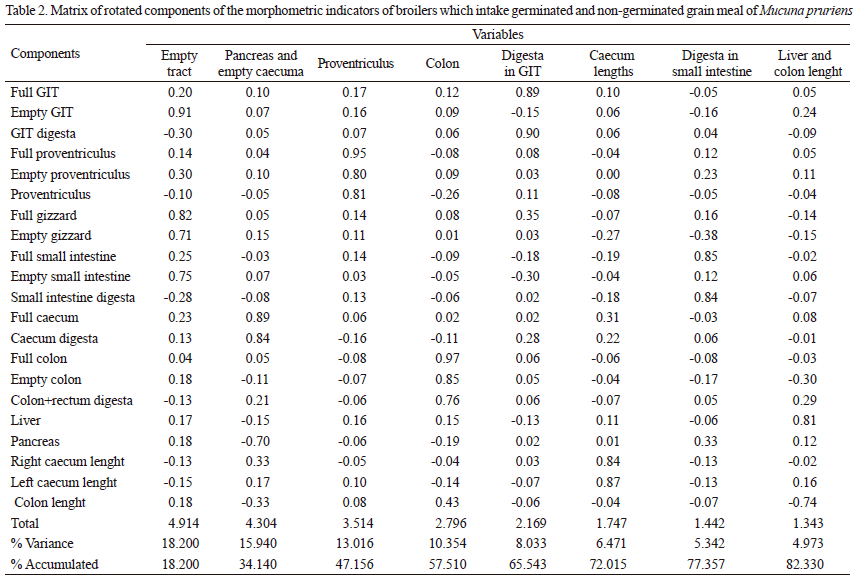
<body><![CDATA[<p align="justify" class="Cuerpodetexto" style="margin-top:12.0pt;text-indent:0cm;"><span style="font-family:'Verdana','sans-serif'; font-size:10.0pt; color:windowtext; ">To measure hemoglobin, the  cyanometahemoglobin method described by Crosby <em>et al.</em> (1954) was used.     <br>   0.2 mL of diluted blood was taken with 5 mL of Drabkin reagent, and after 10  minutes was read at 540 nm. Distilled water was used as control.</span></p>     <p align="justify" class="Cuerpodetexto" style="margin-top:12.0pt;text-indent:0cm;"><em><span style="font-family:'Verdana','sans-serif'; font-size:10.0pt; color:windowtext; ">Statistical methods.</span></em><span style="font-family:'Verdana','sans-serif'; font-size:10.0pt; color:windowtext; "> To the 27 morphometric measures related to the weights of  the different sections, full and empty, as well as the digesta contents,  Pearson correlation were performed and later, multivariate analysis using the  principal components method. The SPSS statistical system on Windows XP, version  15.0.1 (IBM Corporation 2006) was used.</span></p>     <p align="justify" class="Cuerpodetexto" style="margin-top:12.0pt;text-indent:0cm;"><span style="font-family:'Verdana','sans-serif'; font-size:10.0pt; color:windowtext; ">For the rest of  the indicators, a completely randomized design with three treatments was used,  which consisted on experimental diets and ten repetitions of one animal. For  the analysis of the results, the computerized statistical package INFOSTAT (Di  Rienzo <em>et al.</em> 2012) was used. The mean values were compared by the  Duncan test (1955) in necessary cases.</span><span style="font-family:'Verdana','sans-serif'; font-size:10.0pt; color:windowtext; "> </span></p>     <p align="justify" class="subtitulo" style="margin-top:12.0pt;text-align:justify;"><span style="font-family:'Verdana','sans-serif'; font-size:10.0pt; color:windowtext; ">&nbsp;</span></p>     <p align="justify" class="subtitulo" style="margin-top:12.0pt;text-align:justify;"><span style="font-family:'Verdana','sans-serif'; font-size:13.0pt; color:windowtext; "><b>RESULTS AND DISCUSSION</b></span></p>     <p align="justify" class="Cuerpodetexto" style="margin-top:12.0pt;text-indent:0cm;"><span style="font-family:'Verdana','sans-serif'; font-size:10.0pt; color:windowtext; ">There was correlation between the 27  variables of the morphometric indicators under study. Eight of them explained  the measures related to the weights of the different sections, full and empty,  as well as the digesta content, with eigen values higher than 1. The  contribution of these variables to the system was 82 % of the accumulated  variance. <a href="/img/revistas/cjas/v50n3/t0211316.gif">Table 2</a> shows the weight coefficients: empty tract, pancreas and full  caecuma, colon, proventriculus, digesta in the gastrointestinal tract (GIT),  caecum lengths, digesta in the small intestine, liver and colon length.</span></p>     
<p align="justify" class="Cuerpodetexto" style="margin-top:12.0pt;text-indent:0cm;"><span style="font-family:'Verdana','sans-serif'; font-size:10.0pt; color:windowtext; ">In the empty tract there was a high  contribution of the weight variables of GIT, gizzard and small intestine. This  performance was to be expected, since according to Mateos <em>et al.</em> (2006),  the TGI of birds is flexible anatomically and physiologically, allowing them to  adapt better to different food circumstances. This group of researchers also  suggested that during the transit by the GIT, the fiber swells to a variable  degree, increasing the voluminosity and chyme weight, aspects observed in  previous researchers with raw and germinated soybean grain (Mart&iacute;nez <em>et al.</em> 2013). Therefore, it is possible to expect a higher size of the GIT in birds  which intake raw and germinated mucuna, as well as that the effect varies  according to the characteristics of this fiber, since its main effect can be  related to phenomena of mere physical distension.</span></p>     <p align="justify" class="Cuerpodetexto" style="margin-top:12.0pt;text-indent:0cm;"><span style="font-family:'Verdana','sans-serif'; font-size:10.0pt; color:windowtext; ">The birds fit the enzymes release and  modify the transit speed of the digestive content to maximize food digestion  and nutrient absorption (Mateos <em>et al.</em> 2002), which may induce higher  function of the small intestine to degrade fibrous food. In this organ, the  biliary secretions flow from the liver, the gallbladder and the pancreas, which  secrete the pancreatic juice. In addition, in the walls of the intestinal  mucosa there are other tubular glands, possibly homologous to those of Br&uuml;nner  of mammals, which secrete mucus, and those of Lieberk&uuml;hn, which secrete  intestinal juice (Denbow 2000). In the presence of the food, the enzymatic  secretion of each of them is activated to carry out the digestive process,  which allows establishing a high correlation between the weight of the small  intestine full and the digesta in this section, when using the Mucuna grain,  non- germinated and germinated.</span></p>     <p align="justify" class="Cuerpodetexto" style="margin-top:12.0pt;text-indent:0cm;"><span style="font-family:'Verdana','sans-serif'; font-size:10.0pt; color:windowtext; ">The portion colon + rectum is of small  length and the food passage time is short, so it must be very efficient in the  nutrients absorption (Alvarez <em>et al.</em> 2014). Perhaps, for this reason,  there is a close relation between the weights of the section full and empty and  digesta, by including the germinated mucuna as raw in the diet of broilers.</span></p>     ]]></body>
<body><![CDATA[<p align="justify" class="Cuerpodetexto" style="margin-top:12.0pt;text-indent:0cm;"><span style="font-family:'Verdana','sans-serif'; font-size:10.0pt; color:windowtext; ">High coefficients  in the weight of the full caeca and in their digesta contents were observed, as  well as in the length of the right and left (<a href="/img/revistas/cjas/v50n3/t0211316.gif">table 2</a>). Duke (1997) stated that  the bird, in order to increase its fermentative capacity against a coarse feed,  can increase the size and length of its organs and, in particular, of the  caecuma.</span> </p>     
<p align="justify" class="Cuerpodetexto" style="margin-top:12.0pt;text-indent:0cm;"><span style="font-family:'Verdana','sans-serif'; font-size:10.0pt; color:windowtext; ">In the germinated and non-germinated  grain of mucuna, Cantera (2011) found high apparent density, which is  positively related to the occupied volume. Hence, this performance could be due  to the physiological adaptation of the bird, due to the increase of the  permanence time of the food in this organ so that it increases the digestive  capacity, microbial mass and fermentation end products. This was reported by  Eastwood (1992) and Carew <em>et al.</em> (2003).</span></p>     <p align="justify" class="Cuerpodetexto" style="margin-top:12.0pt;text-indent:0cm;"><span style="font-family:'Verdana','sans-serif'; font-size:10.0pt; color:windowtext; ">There were no differences between  treatments and between control and grain meal of germinated mucuna, while both  differed from non- germinated legume, where total SCFA were lower (<a href="/img/revistas/cjas/v50n3/t0311316.gif">table 3</a>). In  general, it is considered that the caeca inside the digestive tract of the  birds constitute the fundamental site where the fiber digestion occurs, due to  the great fermentative activity that they have (Sav&oacute;n 2002) by the bacteria  presence (Apajalahti and Kettunen 2002) and cellulolytic fungi (Rodr&iacute;guez <em>et  al.</em> 1996), which show an adaptive response to the values of the diet  fraction (Varel <em>et al.</em> 1984). It is very probable that the non-germinate  grains have effect on the populations of these microorganisms, so that the  production of these compounds at the cecal level decreases.</span></p>     
<p align="justify" class="Cuerpodetexto" style="margin-top:12.0pt;text-indent:0cm;"><span style="font-family:'Verdana','sans-serif'; font-size:10.0pt; color:windowtext; ">There were not differences for the  immunological organs (<a href="/img/revistas/cjas/v50n3/t0411316.gif">table 4</a>). It seems that the levels of anti-nutritional  factors which contributes the germinated and non- germinated legume do not  cause damage to animal health, although Aguilera <em>et al.</em> (2013) reported  that the process improves the values of enzymes inhibitors and  inositol-phosphates and increases the phenolic compounds and the antioxidant  activity.</span></p>     
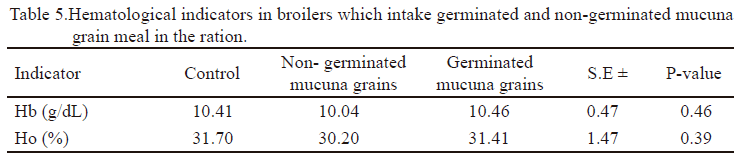
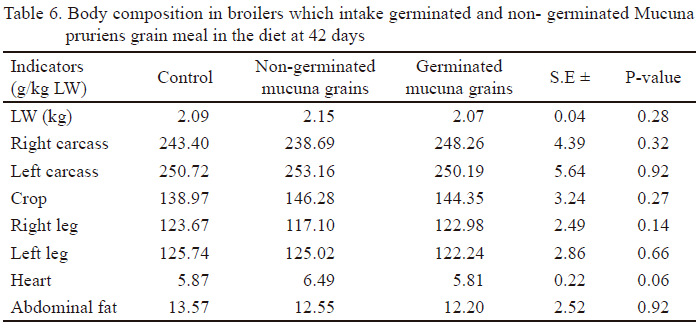
<p align="justify" class="Cuerpodetexto" style="margin-top:12.0pt;text-indent:0cm;"><span style="font-family:'Verdana','sans-serif'; font-size:10.0pt; color:windowtext; ">According to Giambrone (1996), when  the ratio between the weights of the Bursa of Fabricius and the live weight of  the animal, is higher than unit, the birds are not immunodepressed. This is in  correspondence with what was found in the analysis of blood indicators (<a href="/img/revistas/cjas/v50n3/t0511316.gif">table  5</a>) and the main components of the carcass and live weight (<a href="/img/revistas/cjas/v50n3/t0611316.gif">table 6</a>), since  differences between treatments were not observed. Therefore, it can be inferred  that the intake of mucuna grain, germinated and non - germinated, does not  cause immunological damage and promotes good body weight and body composition  in animals.</span></p>     
<p align="justify" class="Cuerpodetexto" style="margin-top:12.0pt;text-indent:0cm;"><span style="line-height:107%; letter-spacing:.45pt; font-family:'Verdana','sans-serif'; font-size:10.0pt; ">From  the obtained results, it is concluded that when feeding diets to the birds with  germinated and non- germinated mucuna grain, the gastrointestinal tract weight  was modified and the production of total cecal SCFA increased, in order to make  a more efficient use of the food. It was also verified that the meal of the raw  and germinated legume does not affect the health or the body composition of  broilers which intake it, when are included at levels of 10 % in the diets</span><span style="font-family:'Verdana','sans-serif'; font-size:10.0pt; color:windowtext; ">.</span><span style="font-family:'Verdana','sans-serif'; font-size:10.0pt; color:windowtext; "> </span></p>     <p align="justify" class="subtitulo" style="margin-top:12.0pt;text-align:justify;"><span style="font-family:'Verdana','sans-serif'; font-size:10.0pt; color:windowtext; ">&nbsp;</span></p>     <p align="justify" class="subtitulo" style="margin-top:12.0pt;text-align:justify;"><span style="font-family:'Verdana','sans-serif'; font-size:13.0pt; color:windowtext; "><b>REFERENCES</b></span></p>     <p align="justify" class="referencias" style="margin-top:12.0pt;margin-right:0cm;margin-bottom:.0001pt;margin-left:0cm;text-indent:0cm;"><span style="font-family:'Verdana','sans-serif'; font-size:10.0pt; color:windowtext; ">Aguilera, Y., D&iacute;az, M. F., Jim&eacute;nez, T., Ben&iacute;tez, V., Herrera, T., Cuadrado,  C., Mart&iacute;n-Pedrosa, M. &amp; Mart&iacute;n-Cabrejas, M. A. 2013. </span><span style="font-family:'Verdana','sans-serif'; font-size:10.0pt; color:windowtext; ">&ldquo;Changes  in Nonnutritional Factors and Antioxidant Activity during Germination of  Nonconventional Legumes&rdquo;. Journal of Agricultural and Food Chemistry, 61(34):  8120&ndash;8125, ISSN: 0021-8561, 1520-5118, DOI: 10.1021/jf4022652.</span></p>     <!-- ref --><p align="justify" class="referencias" style="margin-top:12.0pt;margin-right:0cm;margin-bottom:.0001pt;margin-left:0cm;text-indent:0cm;"><span style="font-family:'Verdana','sans-serif'; font-size:10.0pt; color:windowtext; ">&Aacute;lvarez, D. C. A.,  P&eacute;rez, E. H. &amp; Quincosa, T. J. 2014. </span><span style="font-family:'Verdana','sans-serif'; font-size:10.0pt; color:windowtext; ">Fisiolog&iacute;a animal b&aacute;sica. 2nd ed., La  Habana, Cuba: F&eacute;lix Varela, ISBN: 978-959-07-1948-6.    </span></p>     <p align="justify" class="referencias" style="margin-top:12.0pt;margin-right:0cm;margin-bottom:.0001pt;margin-left:0cm;text-indent:0cm;"><span style="font-family:'Verdana','sans-serif'; font-size:10.0pt; color:windowtext; ">Apajalahti, J. &amp;Kettunen, A. 2002. &ldquo;Efecto de la dieta sobre la flora  microbiana&nbsp; en el tracto gastrointestinal  de aves&rdquo;. In: Rebollar, P. G., Blas, C. de &amp; Mateos, G. G. (eds.), XVIII  Curso de especializaci&oacute;n FEDNA: avances en nutrici&oacute;n y alimentaci&oacute;n animal,  Barcelona, Espa&ntilde;a: Fundaci&oacute;n Espa&ntilde;ola para el Desarrollo de la Nutrici&oacute;n  Animal, p. 204, Available:  &lt;<a href="http://www.acorex.es/EN/pienso/Efectodeladietasobrelafloramicrobianaeneltractogastrointestinaldeaves.pdf" target="_blank">http://www.acorex.es/EN/pienso/Efectodeladietasobrelafloramicrobianaeneltractogastrointestinaldeaves.pdf</a>&gt;,  [Consulted: September 29, 2016].</span></p>     <p align="justify" class="referencias" style="margin-top:12.0pt;margin-right:0cm;margin-bottom:.0001pt;margin-left:0cm;text-indent:0cm;"><span style="font-family:'Verdana','sans-serif'; font-size:10.0pt; color:windowtext; ">Ben&iacute;tez, V., Cantera, S., Aguilera, Y., Moll&aacute;, E., Esteban, R. M., D&iacute;az, M.  F. &amp; Mart&iacute;n-Cabrejas, M. A. 2013. </span><span style="font-family:'Verdana','sans-serif'; font-size:10.0pt; color:windowtext; ">&ldquo;Impact of germination on starch,  dietary fiber and physicochemical properties in non-conventional legumes&rdquo;. Food  Research International, 50(1): 64&ndash;69, ISSN: 0963-9969, DOI:  10.1016/j.foodres.2012.09.044.</span></p>     <p align="justify" class="referencias" style="margin-top:12.0pt;margin-right:0cm;margin-bottom:.0001pt;margin-left:0cm;text-indent:0cm;"><span style="font-family:'Verdana','sans-serif'; font-size:10.0pt; color:windowtext; ">Brand, T. S.,  Brandt, D. A. &amp; Cruywagen, C. W. 2004. &ldquo;Chemical composition, true  metabolisable energy content and amino acid availability of grain legumes for  poultry&rdquo;. South African Journal of Animal Science, 34(2): 116&ndash;122, ISSN:  2221-4062, 0375-1589, DOI: 10.4314/sajas.v34i2.3815.</span></p>     <!-- ref --><p align="justify" class="referencias" style="margin-top:12.0pt;margin-right:0cm;margin-bottom:.0001pt;margin-left:0cm;text-indent:0cm;"><span style="font-family:'Verdana','sans-serif'; font-size:10.0pt; color:windowtext; ">Cantera, S. 2011. Influencia del proceso de germinaci&oacute;n sobre los  carbohidratos y propiedades tecnofuncionales en leguminosas no convencionales.  Graduated Thesis, Universidad Aut&oacute;noma de Madrid, Espa&ntilde;a, 35 p.    </span></p>     <p align="justify" class="referencias" style="margin-top:12.0pt;margin-right:0cm;margin-bottom:.0001pt;margin-left:0cm;text-indent:0cm;"><span style="font-family:'Verdana','sans-serif'; font-size:10.0pt; color:windowtext; ">Carbonaro, M., Maselli, P. &amp;Nucara, A. 2015. </span><span style="font-family:'Verdana','sans-serif'; font-size:10.0pt; color:windowtext; ">&ldquo;Structural aspects  of legume proteins and nutraceutical properties&rdquo;. Food Research International,  76: 19&ndash;30, ISSN: 0963-9969, DOI: 10.1016/j.foodres.2014.11.007.</span></p>     <p align="justify" class="referencias" style="margin-top:12.0pt;margin-right:0cm;margin-bottom:.0001pt;margin-left:0cm;text-indent:0cm;"><span style="font-family:'Verdana','sans-serif'; font-size:10.0pt; color:windowtext; ">Carew, L. B.,  Hardy, D., Weis, J., Alster, F., Mischler, S. A., Gernat, A. &amp; Zakrzewska,  E. I. 2003. &ldquo;Heating raw velvet beans (<em>Mucuna pruriens</em>) reverses some  anti-nutritional effects on organ growth, blood chemistry, and organ histology  in growing chickens&rdquo;. Tropical and Subtropical Agroecosystems, 1(2&ndash;3): 267&ndash;275,  ISSN: 1870-0462.</span></p>     <p align="justify" class="referencias" style="margin-top:12.0pt;margin-right:0cm;margin-bottom:.0001pt;margin-left:0cm;text-indent:0cm;"><span style="font-family:'Verdana','sans-serif'; font-size:10.0pt; color:windowtext; ">Crosby, W. H.,  Munn, J. I. &amp; Furth, F. W. 1954. &ldquo;Standardizing a method for clinical  hemoglobinometry&rdquo;. United States Armed Forces Medical Journal, 5(5): 693&ndash;703,  ISSN: 0566-0777.</span></p>     <p align="justify" class="referencias" style="margin-top:12.0pt;margin-right:0cm;margin-bottom:.0001pt;margin-left:0cm;text-indent:0cm;"><span style="font-family:'Verdana','sans-serif'; font-size:10.0pt; color:windowtext; ">Denbow, D. M. 2000.  &ldquo;Gastrointestinal Anatomy and Physiology&rdquo;. In: Causey, W. G. (ed.), Sturkie&rsquo;s  Avian Physiology, 5th ed., San Diego: Academic Press, pp. 299&ndash;325, ISBN:  978-0-12-747605-6, Available:  &lt;<a href="http://www.sciencedirect.com/science/article/pii/B9780127476056500134" target="_blank">http://www.sciencedirect.com/science/article/pii/B9780127476056500134</a>&gt;,  [Consulted: September 29, 2016].</span></p>     ]]></body>
<body><![CDATA[<!-- ref --><p align="justify" class="referencias" style="margin-top:12.0pt;margin-right:0cm;margin-bottom:.0001pt;margin-left:0cm;text-indent:0cm;"><span style="font-family:'Verdana','sans-serif'; font-size:10.0pt; color:windowtext; ">Di Rienzo, J. A., Casanoves, F., Balzarini, M. G., Gonz&aacute;lez, L., Tablada,  M. &amp; Robledo, C. W. 2012. InfoStat. version 2012, [Windows], Universidad  Nacional de C&oacute;rdoba, Argentina: Grupo InfoStat, Available:  &lt;<a href="http://www.infostat.com.ar/" target="_blank">http://www.infostat.com.ar/</a>&gt;    .</span></p>     <p align="justify" class="referencias" style="margin-top:12.0pt;margin-right:0cm;margin-bottom:.0001pt;margin-left:0cm;text-indent:0cm;"><span style="font-family:'Verdana','sans-serif'; font-size:10.0pt; color:windowtext; ">D&iacute;az, M. F., Mart&iacute;n-Cabrejas, M. &Aacute;., Coto, G., Gonz&aacute;lez, A., Torres, V.  &amp;Noda, A. 2009. &ldquo;Germinados de Leguminosa. Una opci&oacute;n para la producci&oacute;n  animal en Cuba&rdquo;. Revista ACPA, 2: 54, ISSN: 0138-6247.</span></p>     <p align="justify" class="referencias" style="margin-top:12.0pt;margin-right:0cm;margin-bottom:.0001pt;margin-left:0cm;text-indent:0cm;"><span style="font-family:'Verdana','sans-serif'; font-size:10.0pt; color:windowtext; ">D&iacute;az, M. F., Torres, V., Gonz&aacute;lez, A. &amp;Noda, A. 2004. </span><span style="font-family:'Verdana','sans-serif'; font-size:10.0pt; color:windowtext; ">&ldquo;Biotransformations  in the germination of <em>Vigna unguiculata</em>&rdquo;. Cuban Journal of Agricultural  Science, 38(1): 87&ndash;92, ISSN: 2079-3480.</span></p>     <p align="justify" class="referencias" style="margin-top:12.0pt;margin-right:0cm;margin-bottom:.0001pt;margin-left:0cm;text-indent:0cm;"><span style="font-family:'Verdana','sans-serif'; font-size:10.0pt; color:windowtext; ">Duke, G. E. 1997.  &ldquo;Gastrointestinal physiology and nutrition in wild birds&rdquo;. Proceedings of the  Nutrition Society, 56(3): 1049&ndash;1056, ISSN: 0029-6651, 1475-2719, DOI:  10.1079/PNS19970109.</span></p>     <p align="justify" class="referencias" style="margin-top:12.0pt;margin-right:0cm;margin-bottom:.0001pt;margin-left:0cm;text-indent:0cm;"><span style="font-family:'Verdana','sans-serif'; font-size:10.0pt; color:windowtext; ">Duncan, D. B. 1955.  &ldquo;Multiple Range and Multiple F Tests&rdquo;. Biometrics, 11(1): 1&ndash;42, ISSN:  0006-341X, DOI: 10.2307/3001478.</span></p>     <p align="justify" class="referencias" style="margin-top:12.0pt;margin-right:0cm;margin-bottom:.0001pt;margin-left:0cm;text-indent:0cm;"><span style="font-family:'Verdana','sans-serif'; font-size:10.0pt; color:windowtext; ">Eastwood, M. A.  1992. &ldquo;The Physiological Effect of Dietary Fiber: An Update&rdquo;. Annual Review of  Nutrition, 12(1): 19&ndash;35, ISSN: 0199-9885, 1545-4312, DOI:  10.1146/annurev.nu.12.070192.000315.</span></p>     <p align="justify" class="referencias" style="margin-top:12.0pt;margin-right:0cm;margin-bottom:.0001pt;margin-left:0cm;text-indent:0cm;"><span style="font-family:'Verdana','sans-serif'; font-size:10.0pt; color:windowtext; ">Elizalde, A. D. D.,  Porrilla, Y. P. &amp; Chaparro, D. C. C. 2009. </span><span style="font-family:'Verdana','sans-serif'; font-size:10.0pt; color:windowtext; ">&ldquo;Factores  antinutricionales en semillas&rdquo;. Biotecnolog&iacute;a en el Sector Agropecuario y  Agroindustrial, 7(1): 45&ndash;54, ISSN: 1692-3561.</span></p>     <p align="justify" class="referencias" style="margin-top:12.0pt;margin-right:0cm;margin-bottom:.0001pt;margin-left:0cm;text-indent:0cm;"><span style="font-family:'Verdana','sans-serif'; font-size:10.0pt; color:windowtext; ">Giambrone, J. J. 1996. &ldquo;Inmunosupresi&oacute;n en las aves: causas y prevenci&oacute;n&rdquo;. </span><span style="font-family:'Verdana','sans-serif'; font-size:10.0pt; color:windowtext; ">Avicultura  Profesional, 14(5): 42&ndash;47, ISSN: 0736-2056.</span></p>     <p align="justify" class="referencias" style="margin-top:12.0pt;margin-right:0cm;margin-bottom:.0001pt;margin-left:0cm;text-indent:0cm;"><span style="font-family:'Verdana','sans-serif'; font-size:10.0pt; color:windowtext; ">Huang, X., Cai, W.  &amp; Xu, B. 2014. &ldquo;Kinetic changes of nutrients and antioxidant capacities of  germinated soybean (<em>Glycine max</em> L.) and mung bean (<em>Vigna radiata</em> L.) with germination time&rdquo;. Food Chemistry, 143: 268&ndash;276, ISSN: 0308-8146, DOI:  10.1016/j.foodchem.2013.07.080.</span></p>     ]]></body>
<body><![CDATA[<!-- ref --><p align="justify" class="referencias" style="margin-top:12.0pt;margin-right:0cm;margin-bottom:.0001pt;margin-left:0cm;text-indent:0cm;"><span style="font-family:'Verdana','sans-serif'; font-size:10.0pt; color:windowtext; ">IBM Corporation  2006. IBM SPSS Statistics. version 15.0.1, [Windows], Multiplataforma, U.S: IBM  Corporation, Available: &lt;<a href="http://www.ibm.com" target="_blank">http://www.ibm.com</a>&gt;    .</span></p>     <p align="justify" class="referencias" style="margin-top:12.0pt;margin-right:0cm;margin-bottom:.0001pt;margin-left:0cm;text-indent:0cm;"><span style="font-family:'Verdana','sans-serif'; font-size:10.0pt; color:windowtext; ">Ly, J., Dom&iacute;nguez, L. &amp; Grau, A. 1980. &ldquo;Miel final y desperdicios  procesados en la ceba de cerdos. 1. Niveles de AGV en dietas y contenido  digestivo&rdquo;. Ciencia y T&eacute;cnica en la Agricultura. Ganado Porcino, 3: 89, ISSN:  0138-8738.</span></p>     <p align="justify" class="referencias" style="margin-top:12.0pt;margin-right:0cm;margin-bottom:.0001pt;margin-left:0cm;text-indent:0cm;"><span style="font-family:'Verdana','sans-serif'; font-size:10.0pt; color:windowtext; ">Mart&iacute;nez, M., D&iacute;az, M. F., Hern&aacute;ndez, Y., Sarmiento, M. &amp; Sierra, F.  2013. &ldquo;Sustituci&oacute;n de pasta de soya comercial (Glycinemax) por harina de frijol  de soya germinada y sin germinar en dietas de pollos de engorde&rdquo;. </span><span style="font-family:'Verdana','sans-serif'; font-size:10.0pt; color:windowtext; ">Livestock  Research for Rural Development, 25(7), ISSN: 0121-3784, Available:  &lt;<a href="http://www.lrrd.cipav.org.co/lrrd25/7/mart25120.htm" target="_blank">http://www.lrrd.cipav.org.co/lrrd25/7/mart25120.htm</a>&gt;, [Consulted:  September 29, 2016].</span></p>     <p align="justify" class="referencias" style="margin-top:12.0pt;margin-right:0cm;margin-bottom:.0001pt;margin-left:0cm;text-indent:0cm;"><span style="font-family:'Verdana','sans-serif'; font-size:10.0pt; color:windowtext; ">Mateos, G. G., L&aacute;zaro, R. Y., Gonz&aacute;lez, J. M., Jim&eacute;nez, E. &amp; Vicente,  B. 2006. &ldquo;Efectos de la fibra diet&eacute;tica en piensos de iniciaci&oacute;n para pollitos  y lechones&rdquo;. In: XXII Curso de Especializaci&oacute;n FEDNA, Barcelona, Espa&ntilde;a:  Fundaci&oacute;n Espa&ntilde;ola para el Desarrollo de la Nutrici&oacute;n Animal, p. 39.</span></p>     <p align="justify" class="referencias" style="margin-top:12.0pt;margin-right:0cm;margin-bottom:.0001pt;margin-left:0cm;text-indent:0cm;"><span style="font-family:'Verdana','sans-serif'; font-size:10.0pt; color:windowtext; ">Mateos, G. G., L&aacute;zaro, R. Y. &amp; Gracia, M. I. 2002. &ldquo;Modificaciones  nutricionales y problem&aacute;tica digestiva en aves&rdquo;. In: Rebollar, P. G., Blas, C.  de &amp; Mateos, G. G. (eds.), XVIII Curso de especializaci&oacute;n FEDNA: avances en  nutrici&oacute;n y alimentaci&oacute;n animal, Barcelona, Espa&ntilde;a: Fundaci&oacute;n Espa&ntilde;ola para el  Desarrollo de la Nutrici&oacute;n Animal, p. 204, Available:  &lt;<a href="http://www.acorex.es/EN/pienso/Efectodeladietasobrelafloramicrobianaeneltractogastrointestinaldeaves.pdf" target="_blank">http://www.acorex.es/EN/pienso/Efectodeladietasobrelafloramicrobianaeneltractogastrointestinaldeaves.pdf</a>&gt;,  [Consulted: September 29, 2016].</span></p>     <!-- ref --><p align="justify" class="referencias" style="margin-top:12.0pt;margin-right:0cm;margin-bottom:.0001pt;margin-left:0cm;text-indent:0cm;"><span style="font-family:'Verdana','sans-serif'; font-size:10.0pt; color:windowtext; ">NRC, (National  Research Council) 1994. Nutrient Requirements of Poultry. 9th ed., Washington,  D.C.: National Academies Press, ISBN: 978-0-309-04892-7, Available:  &lt;<a href="http://www.nap.edu/catalog/2114" target="_blank">http://www.nap.edu/catalog/2114</a>&gt;, [Consulted: September 29, 2016].    </span></p>     <p align="justify" class="referencias" style="margin-top:12.0pt;margin-right:0cm;margin-bottom:.0001pt;margin-left:0cm;text-indent:0cm;"><span style="font-family:'Verdana','sans-serif'; font-size:10.0pt; color:windowtext; ">Pennington, R. J.  1952. &ldquo;The metabolism of short-chain fatty acids in the sheep. 1. Fatty acid  utilization and ketone body production by rumen epithelium and other tissues&rdquo;.  BiochemicalJournal, 51(2): 251&ndash;258, ISSN: 0264-6021.</span></p>     <p align="justify" class="referencias" style="margin-top:12.0pt;margin-right:0cm;margin-bottom:.0001pt;margin-left:0cm;text-indent:0cm;"><span style="font-family:'Verdana','sans-serif'; font-size:10.0pt; color:windowtext; ">Rodr&iacute;guez, Z.,  Galindo, J., Marrero, A. I., Boucourt, R., El&iacute;as, A. &amp;River&iacute;, Z. 1996. &ldquo;A  note on the isolation of anaerobic cellulolytic fungi in the caecum of  broilers&rdquo;. </span><span style="font-family:'Verdana','sans-serif'; font-size:10.0pt; color:windowtext; ">Cuban Journal of AgriculturalScience, 30(3): 201&ndash;202,  ISSN: 2079-3480.</span></p>     ]]></body>
<body><![CDATA[<!-- ref --><p align="justify" class="referencias" style="margin-top:12.0pt;margin-right:0cm;margin-bottom:.0001pt;margin-left:0cm;text-indent:0cm;"><span style="font-family:'Verdana','sans-serif'; font-size:10.0pt; color:windowtext; ">S&aacute;nchez, A. 1990. Enfermedades de las aves. La Habana, Cuba: ENPES, 285 p.    </span></p>     <!-- ref --><p align="justify" class="referencias" style="margin-top:12.0pt;margin-right:0cm;margin-bottom:.0001pt;margin-left:0cm;text-indent:0cm;"><span style="font-family:'Verdana','sans-serif'; font-size:10.0pt; color:windowtext; ">Sarmento, T. R. 2012. Impacto del procesamiento sobre la pared celular y  las propiedades hipogluc&eacute;micas y tecnofuncionales de leguminosas. PhD Thesis,  Universidad Aut&oacute;noma de Madrid, Madrid, Espa&ntilde;a, 269 p.    </span></p>     <p align="justify" class="referencias" style="margin-top:12.0pt;margin-right:0cm;margin-bottom:.0001pt;margin-left:0cm;text-indent:0cm;"><span style="font-family:'Verdana','sans-serif'; font-size:10.0pt; color:windowtext; ">Sav&oacute;n, L. 2002. </span><span style="font-family:'Verdana','sans-serif'; font-size:10.0pt; color:windowtext; ">&ldquo;High fibrous feed for monogastric. Characterization of the  fibrous matrix and its effects on the digestive physiology&rdquo;. Cuban Journal of  Agricultural Science, 36(2): 91&ndash;102, ISSN: 2079-3480.</span></p>     <p align="justify" class="referencias" style="margin-top:12.0pt;margin-right:0cm;margin-bottom:.0001pt;margin-left:0cm;text-indent:0cm;"><span style="line-height:107%; font-family:'Verdana','sans-serif'; font-size:10.0pt; ">Varel, V. H., Pond, W. G.  &amp; Yen, J. T. 1984. &ldquo;Influence of Dietary Fiber on the Performance and  Cellulase Activity of Growing-Finishing Swine&rdquo;. Journal of Animal Science,  59(2): 388, ISSN: 0021-8812, DOI: 10.2527/jas1984.592388x</span><font size="2" face="Verdana, Arial, Helvetica, sans-serif">.</font></p>     <p align="justify">&nbsp;</p>     <p align="justify">&nbsp;</p>     <p align="justify"><font size="2" face="Verdana, Arial, Helvetica, sans-serif">Received: 01/08/2016    <br> Accepted: 28/09/2016</font></p>     ]]></body>
<body><![CDATA[<p align="justify">&nbsp;</p>     <p align="justify">&nbsp;</p>     <p align="justify"><font size="2" face="Verdana, Arial, Helvetica, sans-serif"><i>Madeleidy Martínez-Pérez,</i> Instituto de Ciencia Animal, km 47 ½ Carretera Central, San José de Las Lajas, Mayabeque, Cuba.    Email: <a href="mailto:mademar@ica.co.cu">mademar@ica.co.cu</a></font></p>      ]]></body><back>
<ref-list>
<ref id="B1">
<nlm-citation citation-type="journal">
<person-group person-group-type="author">
<name>
<surname><![CDATA[Aguilera]]></surname>
<given-names><![CDATA[Y.]]></given-names>
</name>
<name>
<surname><![CDATA[Díaz]]></surname>
<given-names><![CDATA[M. F.]]></given-names>
</name>
<name>
<surname><![CDATA[Jiménez]]></surname>
<given-names><![CDATA[T.]]></given-names>
</name>
<name>
<surname><![CDATA[Benítez]]></surname>
<given-names><![CDATA[V.]]></given-names>
</name>
<name>
<surname><![CDATA[Herrera]]></surname>
<given-names><![CDATA[T.]]></given-names>
</name>
<name>
<surname><![CDATA[Cuadrado]]></surname>
<given-names><![CDATA[C.]]></given-names>
</name>
<name>
<surname><![CDATA[Martín-Pedrosa]]></surname>
<given-names><![CDATA[M.]]></given-names>
</name>
<name>
<surname><![CDATA[Martín-Cabrejas]]></surname>
<given-names><![CDATA[M. A.]]></given-names>
</name>
</person-group>
<article-title xml:lang="nd"><![CDATA[Changes in Nonnutritional Factors and Antioxidant Activity during Germination of Nonconventional Legumes]]></article-title>
<source><![CDATA[Journal of Agricultural and Food Chemistry]]></source>
<year>2013</year>
<volume>61</volume>
<numero>34</numero>
<issue>34</issue>
<page-range>8120–8125</page-range></nlm-citation>
</ref>
<ref id="B2">
<nlm-citation citation-type="book">
<person-group person-group-type="author">
<name>
<surname><![CDATA[Álvarez]]></surname>
<given-names><![CDATA[D. C. A.]]></given-names>
</name>
<name>
<surname><![CDATA[Pérez]]></surname>
<given-names><![CDATA[E. H.]]></given-names>
</name>
<name>
<surname><![CDATA[Quincosa]]></surname>
<given-names><![CDATA[T. J.]]></given-names>
</name>
</person-group>
<source><![CDATA[Fisiología animal básica]]></source>
<year>2014</year>
<edition>2nd</edition>
<publisher-loc><![CDATA[La Habana, Cuba ]]></publisher-loc>
<publisher-name><![CDATA[Félix Varela]]></publisher-name>
</nlm-citation>
</ref>
<ref id="B3">
<nlm-citation citation-type="book">
<person-group person-group-type="author">
<name>
<surname><![CDATA[Apajalahti]]></surname>
<given-names><![CDATA[J.]]></given-names>
</name>
<name>
<surname><![CDATA[Kettunen]]></surname>
<given-names><![CDATA[A.]]></given-names>
</name>
</person-group>
<article-title xml:lang="nd"><![CDATA[Efecto de la dieta sobre la flora microbiana en el tracto gastrointestinal de aves]]></article-title>
<person-group person-group-type="editor">
<name>
<surname><![CDATA[Rebollar]]></surname>
<given-names><![CDATA[P. G.]]></given-names>
</name>
<name>
<surname><![CDATA[Blas]]></surname>
<given-names><![CDATA[C. de]]></given-names>
</name>
<name>
<surname><![CDATA[Mateos]]></surname>
<given-names><![CDATA[G. G.]]></given-names>
</name>
</person-group>
<source><![CDATA[XVIII Curso de especialización FEDNA: avances en nutrición y alimentación animal]]></source>
<year>2002</year>
<page-range>204</page-range><publisher-loc><![CDATA[Barcelona, España ]]></publisher-loc>
<publisher-name><![CDATA[Fundación Española para el Desarrollo de la Nutrición Animal]]></publisher-name>
</nlm-citation>
</ref>
<ref id="B4">
<nlm-citation citation-type="journal">
<person-group person-group-type="author">
<name>
<surname><![CDATA[Benítez]]></surname>
<given-names><![CDATA[V.]]></given-names>
</name>
<name>
<surname><![CDATA[Cantera]]></surname>
<given-names><![CDATA[S.]]></given-names>
</name>
<name>
<surname><![CDATA[Aguilera]]></surname>
<given-names><![CDATA[Y.]]></given-names>
</name>
<name>
<surname><![CDATA[Mollá]]></surname>
<given-names><![CDATA[E.]]></given-names>
</name>
<name>
<surname><![CDATA[Esteban]]></surname>
<given-names><![CDATA[R. M.]]></given-names>
</name>
<name>
<surname><![CDATA[Díaz]]></surname>
<given-names><![CDATA[M. F.]]></given-names>
</name>
<name>
<surname><![CDATA[Martín-Cabrejas]]></surname>
<given-names><![CDATA[M. A.]]></given-names>
</name>
</person-group>
<article-title xml:lang="nd"><![CDATA[Impact of germination on starch, dietary fiber and physicochemical properties in non-conventional legumes]]></article-title>
<source><![CDATA[Food Research International]]></source>
<year>2013</year>
<volume>50</volume>
<numero>1</numero>
<issue>1</issue>
<page-range>64–69</page-range></nlm-citation>
</ref>
<ref id="B5">
<nlm-citation citation-type="journal">
<person-group person-group-type="author">
<name>
<surname><![CDATA[Brand]]></surname>
<given-names><![CDATA[T. S.]]></given-names>
</name>
<name>
<surname><![CDATA[Brandt]]></surname>
<given-names><![CDATA[D. A.]]></given-names>
</name>
<name>
<surname><![CDATA[Cruywagen]]></surname>
<given-names><![CDATA[C. W.]]></given-names>
</name>
</person-group>
<article-title xml:lang="nd"><![CDATA[Chemical composition, true metabolisable energy content and amino acid availability of grain legumes for poultry]]></article-title>
<source><![CDATA[South African Journal of Animal Science]]></source>
<year>2004</year>
<volume>34</volume>
<numero>2</numero>
<issue>2</issue>
<page-range>116–122</page-range></nlm-citation>
</ref>
<ref id="B6">
<nlm-citation citation-type="book">
<person-group person-group-type="author">
<name>
<surname><![CDATA[Cantera]]></surname>
<given-names><![CDATA[S.]]></given-names>
</name>
</person-group>
<source><![CDATA[Influencia del proceso de germinación sobre los carbohidratos y propiedades tecnofuncionales en leguminosas no convencionales]]></source>
<year>2011</year>
<page-range>35</page-range><publisher-loc><![CDATA[España ]]></publisher-loc>
<publisher-name><![CDATA[Universidad Autónoma de Madrid]]></publisher-name>
</nlm-citation>
</ref>
<ref id="B7">
<nlm-citation citation-type="journal">
<person-group person-group-type="author">
<name>
<surname><![CDATA[Carbonaro]]></surname>
<given-names><![CDATA[M.]]></given-names>
</name>
<name>
<surname><![CDATA[Maselli]]></surname>
<given-names><![CDATA[P.]]></given-names>
</name>
<name>
<surname><![CDATA[Nucara]]></surname>
<given-names><![CDATA[A.]]></given-names>
</name>
</person-group>
<article-title xml:lang="nd"><![CDATA[Structural aspects of legume proteins and nutraceutical properties]]></article-title>
<source><![CDATA[Food Research International]]></source>
<year>2015</year>
<volume>76</volume>
<page-range>19–30</page-range></nlm-citation>
</ref>
<ref id="B8">
<nlm-citation citation-type="journal">
<person-group person-group-type="author">
<name>
<surname><![CDATA[Carew]]></surname>
<given-names><![CDATA[L. B.]]></given-names>
</name>
<name>
<surname><![CDATA[Hardy]]></surname>
<given-names><![CDATA[D.]]></given-names>
</name>
<name>
<surname><![CDATA[Weis]]></surname>
<given-names><![CDATA[J.]]></given-names>
</name>
<name>
<surname><![CDATA[Alster]]></surname>
<given-names><![CDATA[F.]]></given-names>
</name>
<name>
<surname><![CDATA[Mischler]]></surname>
<given-names><![CDATA[S. A.]]></given-names>
</name>
<name>
<surname><![CDATA[Gernat]]></surname>
<given-names><![CDATA[A.]]></given-names>
</name>
<name>
<surname><![CDATA[Zakrzewska]]></surname>
<given-names><![CDATA[E. I.]]></given-names>
</name>
</person-group>
<article-title xml:lang="nd"><![CDATA[Heating raw velvet beans (Mucuna pruriens) reverses some anti-nutritional effects on organ growth, blood chemistry, and organ histology in growing chickens]]></article-title>
<source><![CDATA[Tropical and Subtropical Agroecosystems]]></source>
<year>2003</year>
<volume>1</volume>
<numero>2–3</numero>
<issue>2–3</issue>
<page-range>267–275</page-range></nlm-citation>
</ref>
<ref id="B9">
<nlm-citation citation-type="journal">
<person-group person-group-type="author">
<name>
<surname><![CDATA[Crosby]]></surname>
<given-names><![CDATA[W. H.]]></given-names>
</name>
<name>
<surname><![CDATA[Munn]]></surname>
<given-names><![CDATA[J. I.]]></given-names>
</name>
<name>
<surname><![CDATA[Furth]]></surname>
<given-names><![CDATA[F. W.]]></given-names>
</name>
</person-group>
<article-title xml:lang="nd"><![CDATA[Standardizing a method for clinical hemoglobinometry]]></article-title>
<source><![CDATA[United States Armed Forces Medical Journal]]></source>
<year>1954</year>
<volume>5</volume>
<numero>5</numero>
<issue>5</issue>
<page-range>693–703</page-range></nlm-citation>
</ref>
<ref id="B10">
<nlm-citation citation-type="book">
<person-group person-group-type="author">
<name>
<surname><![CDATA[Denbow]]></surname>
<given-names><![CDATA[D. M.]]></given-names>
</name>
</person-group>
<article-title xml:lang="nd"><![CDATA[Gastrointestinal Anatomy and Physiology]]></article-title>
<person-group person-group-type="editor">
<name>
<surname><![CDATA[Causey]]></surname>
<given-names><![CDATA[W. G.]]></given-names>
</name>
</person-group>
<source><![CDATA[Sturkie’s Avian Physiology]]></source>
<year>2000</year>
<edition>5th</edition>
<page-range>299–325</page-range><publisher-loc><![CDATA[San Diego ]]></publisher-loc>
<publisher-name><![CDATA[Academic Press]]></publisher-name>
</nlm-citation>
</ref>
<ref id="B11">
<nlm-citation citation-type="book">
<person-group person-group-type="author">
<name>
<surname><![CDATA[Di Rienzo]]></surname>
<given-names><![CDATA[J. A.]]></given-names>
</name>
<name>
<surname><![CDATA[Casanoves]]></surname>
<given-names><![CDATA[F.]]></given-names>
</name>
<name>
<surname><![CDATA[Balzarini]]></surname>
<given-names><![CDATA[M. G.]]></given-names>
</name>
<name>
<surname><![CDATA[González]]></surname>
<given-names><![CDATA[L.]]></given-names>
</name>
<name>
<surname><![CDATA[Tablada]]></surname>
<given-names><![CDATA[M.]]></given-names>
</name>
<name>
<surname><![CDATA[Robledo]]></surname>
<given-names><![CDATA[C. W.]]></given-names>
</name>
</person-group>
<source><![CDATA[InfoStat]]></source>
<year>2012</year>
<publisher-loc><![CDATA[Universidad Nacional de Córdoba, Argentina ]]></publisher-loc>
<publisher-name><![CDATA[Grupo InfoStat]]></publisher-name>
</nlm-citation>
</ref>
<ref id="B12">
<nlm-citation citation-type="journal">
<person-group person-group-type="author">
<name>
<surname><![CDATA[Díaz]]></surname>
<given-names><![CDATA[M. F.]]></given-names>
</name>
<name>
<surname><![CDATA[Martín-Cabrejas]]></surname>
<given-names><![CDATA[M. Á.]]></given-names>
</name>
<name>
<surname><![CDATA[Coto]]></surname>
<given-names><![CDATA[G.]]></given-names>
</name>
<name>
<surname><![CDATA[González]]></surname>
<given-names><![CDATA[A.]]></given-names>
</name>
<name>
<surname><![CDATA[Torres]]></surname>
<given-names><![CDATA[V.]]></given-names>
</name>
<name>
<surname><![CDATA[Noda]]></surname>
<given-names><![CDATA[A.]]></given-names>
</name>
</person-group>
<article-title xml:lang="nd"><![CDATA[Germinados de Leguminosa. Una opción para la producción animal en Cuba]]></article-title>
<source><![CDATA[Revista ACPA]]></source>
<year>2009</year>
<volume>2</volume>
<page-range>54</page-range></nlm-citation>
</ref>
<ref id="B13">
<nlm-citation citation-type="journal">
<person-group person-group-type="author">
<name>
<surname><![CDATA[Díaz]]></surname>
<given-names><![CDATA[M. F.]]></given-names>
</name>
<name>
<surname><![CDATA[Torres]]></surname>
<given-names><![CDATA[V.]]></given-names>
</name>
<name>
<surname><![CDATA[González]]></surname>
<given-names><![CDATA[A.]]></given-names>
</name>
<name>
<surname><![CDATA[Noda]]></surname>
<given-names><![CDATA[A.]]></given-names>
</name>
</person-group>
<article-title xml:lang="nd"><![CDATA[Biotransformations in the germination of Vigna unguiculata]]></article-title>
<source><![CDATA[Cuban Journal of Agricultural Science]]></source>
<year>2004</year>
<volume>38</volume>
<numero>1</numero>
<issue>1</issue>
<page-range>87–92</page-range></nlm-citation>
</ref>
<ref id="B14">
<nlm-citation citation-type="journal">
<person-group person-group-type="author">
<name>
<surname><![CDATA[Duke]]></surname>
<given-names><![CDATA[G. E.]]></given-names>
</name>
</person-group>
<article-title xml:lang="nd"><![CDATA[Gastrointestinal physiology and nutrition in wild birds]]></article-title>
<source><![CDATA[Proceedings of the Nutrition Society]]></source>
<year>1997</year>
<volume>56</volume>
<numero>3</numero>
<issue>3</issue>
<page-range>1049–1056</page-range></nlm-citation>
</ref>
<ref id="B15">
<nlm-citation citation-type="journal">
<person-group person-group-type="author">
<name>
<surname><![CDATA[Duncan]]></surname>
<given-names><![CDATA[D. B.]]></given-names>
</name>
</person-group>
<article-title xml:lang="nd"><![CDATA[Multiple Range and Multiple F Tests]]></article-title>
<source><![CDATA[Biometrics]]></source>
<year>1955</year>
<volume>11</volume>
<numero>1</numero>
<issue>1</issue>
<page-range>1–42</page-range></nlm-citation>
</ref>
<ref id="B16">
<nlm-citation citation-type="journal">
<person-group person-group-type="author">
<name>
<surname><![CDATA[Eastwood]]></surname>
<given-names><![CDATA[M. A.]]></given-names>
</name>
</person-group>
<article-title xml:lang="nd"><![CDATA[The Physiological Effect of Dietary Fiber: An Update]]></article-title>
<source><![CDATA[Annual Review of Nutrition]]></source>
<year>1992</year>
<volume>12</volume>
<numero>1</numero>
<issue>1</issue>
<page-range>19–35</page-range></nlm-citation>
</ref>
<ref id="B17">
<nlm-citation citation-type="journal">
<person-group person-group-type="author">
<name>
<surname><![CDATA[Elizalde]]></surname>
<given-names><![CDATA[A. D. D.]]></given-names>
</name>
<name>
<surname><![CDATA[Porrilla]]></surname>
<given-names><![CDATA[Y. P.]]></given-names>
</name>
<name>
<surname><![CDATA[Chaparro]]></surname>
<given-names><![CDATA[D. C. C.]]></given-names>
</name>
</person-group>
<article-title xml:lang="nd"><![CDATA[Factores antinutricionales en semillas]]></article-title>
<source><![CDATA[Biotecnología en el Sector Agropecuario y Agroindustrial]]></source>
<year>2009</year>
<volume>7</volume>
<numero>1</numero>
<issue>1</issue>
<page-range>45–54</page-range></nlm-citation>
</ref>
<ref id="B18">
<nlm-citation citation-type="journal">
<person-group person-group-type="author">
<name>
<surname><![CDATA[Giambrone]]></surname>
<given-names><![CDATA[J. J.]]></given-names>
</name>
</person-group>
<article-title xml:lang="nd"><![CDATA[Inmunosupresión en las aves: causas y prevención]]></article-title>
<source><![CDATA[Avicultura Profesional]]></source>
<year>1996</year>
<volume>14</volume>
<numero>5</numero>
<issue>5</issue>
<page-range>42–47</page-range></nlm-citation>
</ref>
<ref id="B19">
<nlm-citation citation-type="journal">
<person-group person-group-type="author">
<name>
<surname><![CDATA[Huang]]></surname>
<given-names><![CDATA[X.]]></given-names>
</name>
<name>
<surname><![CDATA[Cai]]></surname>
<given-names><![CDATA[W.]]></given-names>
</name>
<name>
<surname><![CDATA[Xu]]></surname>
<given-names><![CDATA[B.]]></given-names>
</name>
</person-group>
<article-title xml:lang="nd"><![CDATA[Kinetic changes of nutrients and antioxidant capacities of germinated soybean (Glycine max L.) and mung bean (Vigna radiata L.) with germination time]]></article-title>
<source><![CDATA[Food Chemistry]]></source>
<year>2014</year>
<volume>143</volume>
<page-range>268–276</page-range></nlm-citation>
</ref>
<ref id="B20">
<nlm-citation citation-type="book">
<person-group person-group-type="author">
<name>
<surname><![CDATA[IBM Corporation]]></surname>
</name>
</person-group>
<source><![CDATA[IBM SPSS Statistics]]></source>
<year>2006</year>
<publisher-loc><![CDATA[U.S ]]></publisher-loc>
<publisher-name><![CDATA[IBM Corporation]]></publisher-name>
</nlm-citation>
</ref>
<ref id="B21">
<nlm-citation citation-type="journal">
<person-group person-group-type="author">
<name>
<surname><![CDATA[Ly]]></surname>
<given-names><![CDATA[J.]]></given-names>
</name>
<name>
<surname><![CDATA[Domínguez]]></surname>
<given-names><![CDATA[L.]]></given-names>
</name>
<name>
<surname><![CDATA[Grau]]></surname>
<given-names><![CDATA[A.]]></given-names>
</name>
</person-group>
<article-title xml:lang="nd"><![CDATA[Miel final y desperdicios procesados en la ceba de cerdos. 1. Niveles de AGV en dietas y contenido digestivo]]></article-title>
<source><![CDATA[Ciencia y Técnica en la Agricultura. Ganado Porcino]]></source>
<year>1980</year>
<volume>3</volume>
<page-range>89</page-range></nlm-citation>
</ref>
<ref id="B22">
<nlm-citation citation-type="journal">
<person-group person-group-type="author">
<name>
<surname><![CDATA[Martínez]]></surname>
<given-names><![CDATA[M.]]></given-names>
</name>
<name>
<surname><![CDATA[Díaz]]></surname>
<given-names><![CDATA[M. F.]]></given-names>
</name>
<name>
<surname><![CDATA[Hernández]]></surname>
<given-names><![CDATA[Y.]]></given-names>
</name>
<name>
<surname><![CDATA[Sarmiento]]></surname>
<given-names><![CDATA[M.]]></given-names>
</name>
<name>
<surname><![CDATA[Sierra]]></surname>
<given-names><![CDATA[F.]]></given-names>
</name>
</person-group>
<article-title xml:lang="nd"><![CDATA[Sustitución de pasta de soya comercial (Glycine max) por harina de frijol de soya germinada y sin germinar en dietas de pollos de engorde]]></article-title>
<source><![CDATA[Livestock Research for Rural Development]]></source>
<year>2013</year>
<volume>25</volume>
<numero>7</numero>
<issue>7</issue>
</nlm-citation>
</ref>
<ref id="B23">
<nlm-citation citation-type="book">
<person-group person-group-type="author">
<name>
<surname><![CDATA[Mateos]]></surname>
<given-names><![CDATA[G. G.]]></given-names>
</name>
<name>
<surname><![CDATA[Lázaro]]></surname>
<given-names><![CDATA[R. Y.]]></given-names>
</name>
<name>
<surname><![CDATA[González]]></surname>
<given-names><![CDATA[J. M.]]></given-names>
</name>
<name>
<surname><![CDATA[Jiménez]]></surname>
<given-names><![CDATA[E.]]></given-names>
</name>
<name>
<surname><![CDATA[Vicente]]></surname>
<given-names><![CDATA[B.]]></given-names>
</name>
</person-group>
<article-title xml:lang="nd"><![CDATA[Efectos de la fibra dietética en piensos de iniciación para pollitos y lechones]]></article-title>
<source><![CDATA[XXII Curso de Especialización FEDNA]]></source>
<year>2006</year>
<page-range>39</page-range><publisher-loc><![CDATA[Barcelona, España ]]></publisher-loc>
<publisher-name><![CDATA[Fundación Española para el Desarrollo de la Nutrición Animal]]></publisher-name>
</nlm-citation>
</ref>
<ref id="B24">
<nlm-citation citation-type="book">
<person-group person-group-type="author">
<name>
<surname><![CDATA[Mateos]]></surname>
<given-names><![CDATA[G. G.]]></given-names>
</name>
<name>
<surname><![CDATA[Lázaro]]></surname>
<given-names><![CDATA[R. Y.]]></given-names>
</name>
<name>
<surname><![CDATA[Gracia]]></surname>
<given-names><![CDATA[M. I.]]></given-names>
</name>
</person-group>
<article-title xml:lang="nd"><![CDATA[Modificaciones nutricionales y problemática digestiva en aves]]></article-title>
<person-group person-group-type="editor">
<name>
<surname><![CDATA[Rebollar]]></surname>
<given-names><![CDATA[P. G.]]></given-names>
</name>
<name>
<surname><![CDATA[Blas]]></surname>
<given-names><![CDATA[C. de]]></given-names>
</name>
<name>
<surname><![CDATA[Mateos]]></surname>
<given-names><![CDATA[G. G.]]></given-names>
</name>
</person-group>
<source><![CDATA[XVIII Curso de especialización FEDNA: avances en nutrición y alimentación animal]]></source>
<year>2002</year>
<page-range>204</page-range><publisher-loc><![CDATA[Barcelona, España ]]></publisher-loc>
<publisher-name><![CDATA[Fundación Española para el Desarrollo de la Nutrición Animal]]></publisher-name>
</nlm-citation>
</ref>
<ref id="B25">
<nlm-citation citation-type="book">
<person-group person-group-type="author">
<name>
<surname><![CDATA[NRC]]></surname>
<given-names><![CDATA[(National Research Council)]]></given-names>
</name>
</person-group>
<source><![CDATA[Nutrient Requirements of Poultry]]></source>
<year>1994</year>
<edition>9th</edition>
<publisher-loc><![CDATA[Washington, D.C. ]]></publisher-loc>
<publisher-name><![CDATA[National Academies Press]]></publisher-name>
</nlm-citation>
</ref>
<ref id="B26">
<nlm-citation citation-type="journal">
<person-group person-group-type="author">
<name>
<surname><![CDATA[Pennington]]></surname>
<given-names><![CDATA[R. J.]]></given-names>
</name>
</person-group>
<article-title xml:lang="nd"><![CDATA[The metabolism of short-chain fatty acids in the sheep. 1. Fatty acid utilization and ketone body production by rumen epithelium and other tissues]]></article-title>
<source><![CDATA[Biochemical Journal]]></source>
<year>1952</year>
<volume>51</volume>
<numero>2</numero>
<issue>2</issue>
<page-range>251–258</page-range></nlm-citation>
</ref>
<ref id="B27">
<nlm-citation citation-type="journal">
<person-group person-group-type="author">
<name>
<surname><![CDATA[Rodríguez]]></surname>
<given-names><![CDATA[Z.]]></given-names>
</name>
<name>
<surname><![CDATA[Galindo]]></surname>
<given-names><![CDATA[J.]]></given-names>
</name>
<name>
<surname><![CDATA[Marrero]]></surname>
<given-names><![CDATA[A. I.]]></given-names>
</name>
<name>
<surname><![CDATA[Boucourt]]></surname>
<given-names><![CDATA[R.]]></given-names>
</name>
<name>
<surname><![CDATA[Elías]]></surname>
<given-names><![CDATA[A.]]></given-names>
</name>
<name>
<surname><![CDATA[Riverí]]></surname>
<given-names><![CDATA[Z.]]></given-names>
</name>
</person-group>
<article-title xml:lang="nd"><![CDATA[Una nota sobre el aislamiento de hongos celulolíticos anaerobios en el ciego de pollos de engorde]]></article-title>
<source><![CDATA[Cuban Journal of Agricultural Science]]></source>
<year>1996</year>
<volume>30</volume>
<numero>3</numero>
<issue>3</issue>
<page-range>201–202</page-range></nlm-citation>
</ref>
<ref id="B28">
<nlm-citation citation-type="book">
<person-group person-group-type="author">
<name>
<surname><![CDATA[Sánchez]]></surname>
<given-names><![CDATA[A.]]></given-names>
</name>
</person-group>
<source><![CDATA[Enfermedades de las aves]]></source>
<year>1990</year>
<page-range>285</page-range><publisher-loc><![CDATA[La Habana, Cuba ]]></publisher-loc>
<publisher-name><![CDATA[ENPES]]></publisher-name>
</nlm-citation>
</ref>
<ref id="B29">
<nlm-citation citation-type="book">
<person-group person-group-type="author">
<name>
<surname><![CDATA[Sarmento]]></surname>
<given-names><![CDATA[T. R.]]></given-names>
</name>
</person-group>
<source><![CDATA[Impacto del procesamiento sobre la pared celular y las propiedades hipoglucémicas y tecnofuncionales de leguminosas]]></source>
<year>2012</year>
<page-range>269</page-range><publisher-loc><![CDATA[Madrid, España ]]></publisher-loc>
<publisher-name><![CDATA[Universidad Autónoma de Madrid]]></publisher-name>
</nlm-citation>
</ref>
<ref id="B30">
<nlm-citation citation-type="journal">
<person-group person-group-type="author">
<name>
<surname><![CDATA[Savón]]></surname>
<given-names><![CDATA[L.]]></given-names>
</name>
</person-group>
<article-title xml:lang="nd"><![CDATA[Alimentos altos en fibra para especies monogástricas. Caracterización de la matriz fibrosa y sus efectos en la fisiología digestiva]]></article-title>
<source><![CDATA[Cuban Journal of Agricultural Science]]></source>
<year>2002</year>
<volume>36</volume>
<numero>2</numero>
<issue>2</issue>
<page-range>91–102</page-range></nlm-citation>
</ref>
<ref id="B31">
<nlm-citation citation-type="journal">
<person-group person-group-type="author">
<name>
<surname><![CDATA[Varel]]></surname>
<given-names><![CDATA[V. H.]]></given-names>
</name>
<name>
<surname><![CDATA[Pond]]></surname>
<given-names><![CDATA[W. G.]]></given-names>
</name>
<name>
<surname><![CDATA[Yen]]></surname>
<given-names><![CDATA[J. T.]]></given-names>
</name>
</person-group>
<article-title xml:lang="nd"><![CDATA[Influence of Dietary Fiber on the Performance and Cellulase Activity of Growing-Finishing Swine]]></article-title>
<source><![CDATA[Journal of Animal Science]]></source>
<year>1984</year>
<volume>59</volume>
<numero>2</numero>
<issue>2</issue>
<page-range>388</page-range></nlm-citation>
</ref>
</ref-list>
</back>
</article>