<?xml version="1.0" encoding="ISO-8859-1"?><article xmlns:mml="http://www.w3.org/1998/Math/MathML" xmlns:xlink="http://www.w3.org/1999/xlink" xmlns:xsi="http://www.w3.org/2001/XMLSchema-instance">
<front>
<journal-meta>
<journal-id>2079-3480</journal-id>
<journal-title><![CDATA[Cuban Journal of Agricultural Science]]></journal-title>
<abbrev-journal-title><![CDATA[Cuban J. Agric. Sci.]]></abbrev-journal-title>
<issn>2079-3480</issn>
<publisher>
<publisher-name><![CDATA[Editorial del Instituto de Ciencia Animal]]></publisher-name>
</publisher>
</journal-meta>
<article-meta>
<article-id>S2079-34802016000300017</article-id>
<title-group>
<article-title xml:lang="en"><![CDATA[Study of the chemical soil fertility in the biomass bank technology of Pennisetum purpureum Schum cv. CUBA CT-115 with different exploitation years]]></article-title>
<article-title xml:lang="es"><![CDATA[Estudio de la fertilidad química del suelo en la tecnología de banco de biomasa de Pennisetum purpureum Schum vc. CUBA CT-115 con diferentes años de explotación]]></article-title>
</title-group>
<contrib-group>
<contrib contrib-type="author">
<name>
<surname><![CDATA[Crespo]]></surname>
<given-names><![CDATA[G.]]></given-names>
</name>
<xref ref-type="aff" rid="A01"/>
</contrib>
<contrib contrib-type="author">
<name>
<surname><![CDATA[Martínez]]></surname>
<given-names><![CDATA[R.O.]]></given-names>
</name>
<xref ref-type="aff" rid="A01"/>
</contrib>
</contrib-group>
<aff id="A01">
<institution><![CDATA[,Instituto de Ciencia Animal  ]]></institution>
<addr-line><![CDATA[San José de las Lajas Mayabeque]]></addr-line>
<country>Cuba</country>
</aff>
<pub-date pub-type="pub">
<day>00</day>
<month>09</month>
<year>2016</year>
</pub-date>
<pub-date pub-type="epub">
<day>00</day>
<month>09</month>
<year>2016</year>
</pub-date>
<volume>50</volume>
<numero>3</numero>
<fpage>497</fpage>
<lpage>502</lpage>
<copyright-statement/>
<copyright-year/>
<self-uri xlink:href="http://scielo.sld.cu/scielo.php?script=sci_arttext&amp;pid=S2079-34802016000300017&amp;lng=en&amp;nrm=iso"></self-uri><self-uri xlink:href="http://scielo.sld.cu/scielo.php?script=sci_abstract&amp;pid=S2079-34802016000300017&amp;lng=en&amp;nrm=iso"></self-uri><self-uri xlink:href="http://scielo.sld.cu/scielo.php?script=sci_pdf&amp;pid=S2079-34802016000300017&amp;lng=en&amp;nrm=iso"></self-uri><abstract abstract-type="short" xml:lang="en"><p><![CDATA[The change of chemical fertility of a ferrallitic red brown soil in the biomass bank technology of Pennisetum purpureum Cuba CT-115 was researched with different years of exploitation (6, 12 and 18 years, respectively). The pH indicators (in KCL), MO, N, P, K, Ca and Mg were researched. The data were subjected to variance analysis, according to simple classification model and the t-Student test was used in necessary cases. With the longer time of exploitation of 18 years, there was significant increase (P < 0.0001) of the OM (3.07 to 5.16 %), followed by the biomass bank with 12 years (3.04 to 3.71%), while the P content significantly decreased (P < 0.0056) in the biomass bank of 18 years (57.84 to 39.21 ppm),but did not varied in 12 years. The soil in the biomass bank of 6 years did not showed variation of the studied chemical indicators. The results indicated that there is an increase of the soil OM as it is higher the exploitation time of the biomass bank and P content decrease. It is recommended that, under similar soil conditions, the monitoring of the soil fertility state, mainly of the P assimilable content, from 6 years of uninterrupted exploitation with this technology]]></p></abstract>
<abstract abstract-type="short" xml:lang="es"><p><![CDATA[Se investigó el cambio de la fertilidad química de un suelo ferralítico pardo rojizo en la tecnología de banco de biomasa de Pennisetum purpureum Cuba CT-115 con diferentes años de explotación (6, 12 y 18 años, respectivamente). Se investigaron los indicadores pH (en KCl), MO, N, P, K, Ca y Mg. Los datos se sometieron al análisis de varianza, según modelo de clasificación simple y se utilizó la dócima de t-Student en los casos necesarios. Con el mayor tiempo de explotación de 18 años, se produjo incremento significativo (P < 0.0001) de la MO (3.07 a 5.16 %), seguido del banco de biomasa con 12 años (3.04 a 3.71%), mientras que el contenido de P disminuyó significativamente (P < 0.0056) en el banco de biomasa de 18 años (57.84 a 39.21 ppm), pero no varió en el de12 años. El suelo en el banco de biomasa de 6 años no mostró variación de los indicadores químicos estudiados. Los resultados indicaron que se produce incremento del contenido de MO del suelo a medida que es mayor el tiempo de explotación del banco de biomasa y decrece el contenido de P. Se recomienda que, en similares condiciones de suelo, el monitoreo del estado de fertilidad del suelo, principalmente del contenido de P asimilable, a partir de los 6 años de explotación ininterrumpida con esta tecnología]]></p></abstract>
<kwd-group>
<kwd lng="en"><![CDATA[biomass bank cv. Cuba CT-115]]></kwd>
<kwd lng="en"><![CDATA[exploitation years]]></kwd>
<kwd lng="en"><![CDATA[chemical indicators]]></kwd>
<kwd lng="es"><![CDATA[banco de biomasa vc. Cuba CT-115]]></kwd>
<kwd lng="es"><![CDATA[años de explotación]]></kwd>
<kwd lng="es"><![CDATA[indicadores químicos]]></kwd>
</kwd-group>
</article-meta>
</front><body><![CDATA[ <p align="right"><font size="2" face="Verdana, Arial, Helvetica, sans-serif"><b>Cuban Journal  of Agricultural Science, 50(3): 497-502, 2016, ISSN: 2079-3480</b></font></p>     <p align="right">&nbsp;</p>     <p align="right"><font size="2" face="Verdana, Arial, Helvetica, sans-serif"><b>ORIGINAL ARTICLE</b></font></p>     <p align="justify">&nbsp;</p>     <p align="justify"><font size="4" face="Verdana, Arial, Helvetica, sans-serif">  <b>Study of the chemical soil fertility in the biomass bank technology of <em>Pennisetum purpureum</em> Schum cv. CUBA CT-115 with different exploitation years</b></font></p>      <p align="justify">&nbsp;</p>     <p align="justify"><font size="3" face="Verdana, Arial, Helvetica, sans-serif">  <b>Estudio de la fertilidad química del suelo en la tecnología de banco de biomasa de <em>Pennisetum purpureum</em> Schum vc. CUBA CT-115 con diferentes años de explotación</b></font></p>      <p align="justify">&nbsp;</p>     <p align="justify">&nbsp;</p>     <p align="justify"><font size="2" face="Verdana, Arial, Helvetica, sans-serif">  <b>G. Crespo,</b><b> R.O. Martínez</b></font></p>     ]]></body>
<body><![CDATA[<p align="justify"><font size="2" face="Verdana, Arial, Helvetica, sans-serif"><b> </b></font><font size="2" face="Verdana, Arial, Helvetica, sans-serif">Instituto de Ciencia Animal, Apartado Postal 24, San José de las Lajas, Mayabeque, Cuba. </font></p>     <p align="justify">&nbsp;</p>     <p align="justify">&nbsp;</p> <hr align="JUSTIFY">     <p align="justify"><font size="2" face="Verdana, Arial, Helvetica, sans-serif"><b>ABSTRACT</b></font></p>     <p align="justify" class="resumen" style="margin-top:12.0pt;"><span style="line-height:120%; font-family:'Verdana','sans-serif'; font-size:10.0pt; color:windowtext; ">The change of chemical fertility of a ferrallitic red brown  soil in the biomass bank technology of <em>Pennisetum purpureum </em>Cuba CT-115  was researched with different years of exploitation (6, 12 and 18 years,  respectively). The pH indicators (in KCL), MO, N, P, K, Ca and Mg were  researched. The data were subjected to variance analysis, according to simple  classification model and the t-Student test was used in necessary cases. With  the longer time of exploitation of 18 years, there was significant increase (P  &lt; 0.0001) of the OM (3.07 to 5.16 %), followed by the biomass bank with    12 years (3.04 to 3.71%), while the P content significantly decreased    (P &lt; 0.0056) in the biomass bank of 18 years (57.84 to    39.21 ppm),but did not varied in 12 years. The soil in the biomass bank of 6  years did not showed variation of the studied chemical indicators. The results  indicated that there is an increase of the soil OM as it is higher the  exploitation time of the biomass bank and P content decrease. It is recommended  that, under similar soil conditions, the monitoring of the soil fertility  state, mainly of the P assimilable content, from 6 years of uninterrupted  exploitation with this  technology.</span></p>     <div align="justify"><strong><span style="line-height:107%; font-family:'Verdana','sans-serif'; font-size:10.0pt; ">Key words:</span></strong><span style="font-family:'Verdana','sans-serif'; font-size:10.0pt; "> biomass bank  cv. Cuba CT-115, exploitation years, chemical indicators</span><font size="2" face="Verdana, Arial, Helvetica, sans-serif">.</font> </div> <hr align="JUSTIFY">     <p align="justify"><font size="2" face="Verdana, Arial, Helvetica, sans-serif"><b>RESUMEN</b></font></p>     <p align="justify" class="resumen" style="margin-top:12.0pt;"><span style="line-height:120%; font-family:'Verdana','sans-serif'; font-size:10.0pt; color:windowtext; ">Se investig&oacute; el cambio de la fertilidad  qu&iacute;mica de un suelo ferral&iacute;tico pardo rojizo en la tecnolog&iacute;a de banco de  biomasa de <em><span style="letter-spacing:.1pt; ">Pennisetum purpureum </span></em>Cuba  CT-115 con diferentes a&ntilde;os de explotaci&oacute;n (6, 12 y 18 a&ntilde;os, respectivamente).  Se investigaron los indicadores pH (en KCl), MO, N, P, K, Ca y Mg. Los datos se  sometieron al an&aacute;lisis de varianza, seg&uacute;n modelo de clasificaci&oacute;n simple y se  utiliz&oacute; la d&oacute;cima de t-Student en los casos necesarios. Con el mayor tiempo de  explotaci&oacute;n de 18 a&ntilde;os, se produjo incremento significativo (P &lt; 0.0001) de  la MO (3.07 a 5.16 %), seguido del banco de biomasa con 12 a&ntilde;os (3.04 a 3.71%),  mientras que el contenido de P disminuy&oacute; significativamente    (P &lt; 0.0056) en el banco de biomasa de 18 a&ntilde;os (57.84 a 39.21 ppm), pero no  vari&oacute; en el de12 a&ntilde;os. El suelo en el banco de biomasa de 6 a&ntilde;os no mostr&oacute;  variaci&oacute;n de los indicadores qu&iacute;micos estudiados. Los resultados indicaron que  se produce incremento del contenido de MO del suelo a medida que es mayor el  tiempo de explotaci&oacute;n del banco de biomasa y decrece el contenido de P. Se  recomienda que, en similares condiciones de suelo, el monitoreo del estado de  fertilidad del suelo, principalmente del contenido de P asimilable, a partir de  los 6 a&ntilde;os de explotaci&oacute;n ininterrumpida con esta tecnolog&iacute;a.</span></p>     <div align="justify"><strong><span style="line-height:107%; font-family:'Verdana','sans-serif'; font-size:10.0pt; ">Palabras clave:</span></strong><span style="font-family:'Verdana','sans-serif'; font-size:10.0pt; "> banco de  biomasa vc. Cuba CT-115, a&ntilde;os de explotaci&oacute;n, indicadores qu&iacute;micos</span><font size="2" face="Verdana, Arial, Helvetica, sans-serif">.</font> </div> <hr align="JUSTIFY">     <p align="justify">&nbsp;</p>     ]]></body>
<body><![CDATA[<p align="justify">&nbsp;</p>     <p align="justify"><font size="2" face="Verdana, Arial, Helvetica, sans-serif"><b><font size="3">INTRODUCTION</font></b></font></p>     <p align="justify" class="Cuerpodetexto" style="margin-top:12.0pt;text-indent:0cm;"><span style="line-height:120%; font-family:'Verdana','sans-serif'; font-size:10.0pt; color:windowtext; ">The main problem of tropical cattle is  the lack of food for animals during the dry season, which could last from 6 to  7 months uninterruptedly and it is the critical period for cattle rearing.</span></p>     <p align="justify" class="Cuerpodetexto" style="margin-top:12.0pt;text-indent:0cm;"><span style="line-height:120%; letter-spacing:.1pt; font-family:'Verdana','sans-serif'; font-size:10.0pt; color:windowtext; ">The variety Cuba  CT-115 of <em>Pennisetum purpureum</em> was obtained by the issue culture  technique, from king grass corns at the Instituto de Ciencia Animal,&nbsp; plant that proved to be able to store feed in  the field for the drought period, resist grazing, has high content of sugars  and produce favorable regrowth and tillering after grazing (Valenciaga <em>et  al.</em> 2009, Fortes <em>et al.</em> 2012), useful characteristics to fulfill the  needs of this    season. </span></p>     <p align="justify" class="Cuerpodetexto" style="margin-top:12.0pt;text-indent:0cm;"><span style="line-height:120%; letter-spacing:.2pt; font-family:'Verdana','sans-serif'; font-size:10.0pt; color:windowtext; ">The technology for  the use of Cuba CT-115 as biomass bank has had wide acceptance by the Cuban  producers. The provinces Villa Clara, Cienfuegos, Pinar del R&iacute;o and Granma are  highlighted, whose producers considered that its productive results have been  driven by sowing and the use of Cuba CT-115 in grazing. Other provinces, as  Guant&aacute;namo, Las Tunas and Santiago de Cuba, consider that this technology is  one of the best options for solving their current feeding problems in the dry  period (Mart&iacute;nez 2010).</span></p>     <p align="justify" class="Cuerpodetexto" style="margin-top:12.0pt;text-indent:0cm;"><span style="font-family:'Verdana','sans-serif'; font-size:10.0pt; color:windowtext; ">In milk production, the technology  allowed increasing productivity by area, from less than 500 L ha<sup>-1</sup> to levels above 2000 L ha<sup>-1</sup> and the economic gains will exceed the  3,000 Cuban pesos (Mart&iacute;nez 2010). However, the effect that will have the  application of this technology to long - term on the chemical characteristics  of soils it is not known.</span></p>     <p align="justify" class="Cuerpodetexto" style="margin-top:12.0pt;text-indent:0cm;"><span style="font-family:'Verdana','sans-serif'; font-size:10.0pt; color:windowtext; ">The objective of this study was to  research the performance of chemical fertility of the soil, depending on the  exploitation time of biomass bank technology of Cuba CT-115 in an Eutric  ferrallitic red brown soil from Mayabeque province, Cuba. </span></p>     <p align="justify" class="subtitulo" style="margin-top:12.0pt;text-align:justify;"><span style="font-family:'Verdana','sans-serif'; font-size:10.0pt; color:windowtext; ">&nbsp;</span></p>     <p align="justify" class="subtitulo" style="margin-top:12.0pt;text-align:justify;"><span style="line-height:120%; font-family:'Verdana','sans-serif'; font-size:13.0pt; color:windowtext; "><b>MATERIALS AND METHODS</b></span></p>     <p align="justify" class="Cuerpodetexto" style="margin-top:12.0pt;text-indent:0cm;"><span style="font-family:'Verdana','sans-serif'; font-size:10.0pt; color:windowtext; ">The research was conducted in an  experimental dairy farm from the Instituto de Ciencia Animal, where the Biomass  Bank technology of Cuba CT-115 is developed. The    100 cows from the dairy had very similar characteristics, in terms of number of  lactations, milk production, age and liveweight. The grazing hours and rest in  the shade buildings and the supply of mineral salts and water were similar for  all animals.</span></p>     ]]></body>
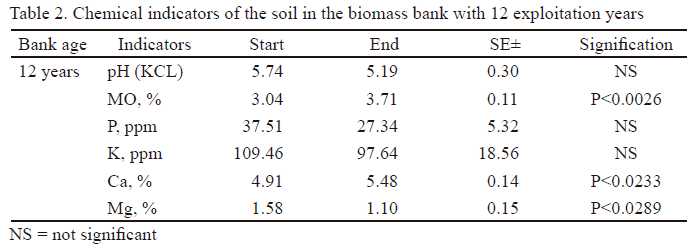
<body><![CDATA[<p align="justify" class="Cuerpodetexto" style="margin-top:12.0pt;text-indent:0cm;"><span style="font-family:'Verdana','sans-serif'; font-size:10.0pt; color:windowtext; ">This dairy unit occupies an area of 60  ha and is divided into paddocks of 0.8 ha each, on average. The 33% of the area  is planted with <em>P. purpureum</em> cv. Cuba CT-115, which is used as biomass  bank. The remaining 67% of the area, that is, 42 ha, is divided into    52 paddocks, in which predominate short grasses, as star grass (<em>Cynodon  nlemfuensis</em>), brachiaria (<em>Brachiaria decumbens</em>), tejana (<em>Paspalum  notatum</em>), jiribilla (<em>Dichantium annulatum</em>), guinea mombaza (<em>Megathirzus  maximus</em> cv. Mombaza) and others.</span></p>     <p align="justify" class="Cuerpodetexto" style="margin-top:12.0pt;text-indent:0cm;"><span style="font-family:'Verdana','sans-serif'; font-size:10.0pt; color:windowtext; ">The soil samplings in the biomass bank  were carried out in the paddocks which have 6, 12 and 18 exploitation years,  respectively. The predominant soil in this area of the dairy unit is the Eutric  ferrallitic red brown, on marly limestone (Hern&aacute;ndez <em>et al.</em> 2015).</span></p>     <p align="justify" class="Cuerpodetexto" style="margin-top:12.0pt;text-indent:0cm;"><em><span style="font-family:'Verdana','sans-serif'; font-size:10.0pt; color:windowtext; ">Experimental  procedure</span></em><span style="font-family:'Verdana','sans-serif'; font-size:10.0pt; color:windowtext; ">.  First of all the representative paddocks of the biomass bank of Cuba CT-115  which fulfill with the different exploitation times indicated were selected.  This was carried out from the analysis of dispersion and position statistics  (X, DS and CV) for botanical composition and soil cover, so that those paddocks  with the values of these statistics closer to the mean were chosen. Thus, the  paddocks 6 (6years), 20 (12years) and 80 (18years) were sampled.</span><span style="font-family:'Verdana','sans-serif'; font-size:10.0pt; color:windowtext; "> </span></p>     <p align="justify" class="Cuerpodetexto" style="margin-top:12.0pt;text-indent:0cm;"><span style="font-family:'Verdana','sans-serif'; font-size:10.0pt; color:windowtext; ">In each paddock of 1.5 ha each, an  initial soil sampling was performed before planting Cuba CT - 115. Then, in  2014, the sampling was repeated, with the same procedure as the first time.</span></p>     <p align="justify" class="Cuerpodetexto" style="margin-top:12.0pt;text-indent:0cm;"><span style="font-family:'Verdana','sans-serif'; font-size:10.0pt; color:windowtext; ">The soil samples  were extracted with helicoidal drill, at a depth of 0 &ndash; 20 cm, in nine points  distributed on the diagonals of each paddock. In each of these points, five  partial samples were taken which were uniformly mixed to form 18 samples in  total, formed by paddocks. These sampling were carried out at the beginning of the  rainy season, that is, between 15 and 30 June. </span><span style="font-family:'Verdana','sans-serif'; font-size:10.0pt; color:windowtext; "> </span></p>     <p align="justify" class="Cuerpodetexto" style="margin-top:12.0pt;text-indent:0cm;"><span style="font-family:'Verdana','sans-serif'; font-size:10.0pt; color:windowtext; ">All soil samples were air dried and  then milled and passed through a sieve with holes of 1mm. 50 g of each were  used for the analysis in the laboratory. To each sample was determined pH in  KCl (potentiometer) and organic matter (OM) (Walkley &amp; Black, cit. by  Jackson 1970), nitrogen (N) (Latimer 2012), phosphorus (P), potassium (K)  (Oniani 1964), calcium (Ca) and magnesium (Mg) (Paneque <em>et al.</em> 2010).</span></p>     <p align="justify" class="Cuerpodetexto" style="margin-top:12.0pt;text-indent:0cm;"><em><span style="font-family:'Verdana','sans-serif'; font-size:10.0pt; color:windowtext; ">Statistical  analysis of the results</span></em><span style="font-family:'Verdana','sans-serif'; font-size:10.0pt; color:windowtext; ">. A completely randomized design was applied, with two  treatments and 18 repetitions. The treatments were the state of soil fertility,  at the beginning and end of each exploitation time, while the repetitions were  formed by the    18 sampling points in each case. An analysis of variance was performed,  according to simple classification model. The t-Student test was used, in  necessary cases. The statistical package proposed by Di Rienzo <em>et al.</em> (2012 was used.</span><span style="font-family:'Verdana','sans-serif'; font-size:10.0pt; color:windowtext; "> </span></p>     <p align="justify" class="subtitulo" style="margin-top:12.0pt;text-align:justify;"><span style="font-family:'Verdana','sans-serif'; font-size:10.0pt; color:windowtext; ">&nbsp;</span></p>     <p align="justify" class="subtitulo" style="margin-top:12.0pt;text-align:justify;"><span style="font-family:'Verdana','sans-serif'; font-size:13.0pt; color:windowtext; "><b>RESULTS AND DISCUSSION</b> </span></p>     <p align="justify" class="Cuerpodetexto" style="margin-top:12.0pt;text-indent:0cm;"><span style="font-family:'Verdana','sans-serif'; font-size:10.0pt; color:windowtext; ">One of the most significant results in  this research was the highest increase found in the OM content of the soil in  the area with higher exploitation time of the biomass bank (<a href="/img/revistas/cjas/v50n3/t0117316.gif">tables 1</a> and <a href="/img/revistas/cjas/v50n3/t0217316.gif">2</a>).</span></p>     
]]></body>
<body><![CDATA[<p align="justify" class="Cuerpodetexto" style="margin-top:12.0pt;text-indent:0cm;"><span style="font-family:'Verdana','sans-serif'; font-size:10.0pt; color:windowtext; ">Several researchers indicated that the  type of vegetation have marked influence on the content and nature of the soil  OM (Carvalho <em>et al.</em> 2010). Most of them agree that the exploitation time  with perennial plant species have higher effect than with annual crops (Ernst  &amp; Siri-Prieto 2009).</span></p>     <p align="justify" class="Cuerpodetexto" style="margin-top:12.0pt;text-indent:0cm;"><span style="font-family:'Verdana','sans-serif'; font-size:10.0pt; color:windowtext; ">In a previous research, conducted in  an area near this experiment, Lok <em>et al.</em> (2009) found increased&nbsp; of OM content and assimilable N of the soil  in the&nbsp; biomass bank that already had  more than 10 exploitation years. In this research, the mentioned authors identified  that the litter which was accumulated on the soil, and the high root  development of Cuba CT-115 (up to 50 cm deep) were the main causes of that  performance.</span></p>     <p align="justify" class="Cuerpodetexto" style="margin-top:12.0pt;text-indent:0cm;"><span style="font-family:'Verdana','sans-serif'; font-size:10.0pt; color:windowtext; ">Also Crespo <em>et al.</em> (2004)  estimated that the Cuba CT-115, which occupied 15% of the area in a diversified  system, produced 2.58 t DM ha<sup>-1</sup> of litter in a year. Taking into  account this value, it could be estimated that in 18 years (maximum time  studied in this experiment) the total amount of accumulated litter may have  been considerable. There is no doubt that this high amount of litter, produced  by the plants of CT-115 in the biomass bank, could be the main cause of the  increase of OM content in the soil.</span></p>     <p align="justify" class="Cuerpodetexto" style="margin-top:12.0pt;text-indent:0cm;"><span style="font-family:'Verdana','sans-serif'; font-size:10.0pt; color:windowtext; ">It has been proved  that detritivores soil organisms, such as millipedes (Glomeridesmida),  mealybugs (Hemiptera) and snails (Pulmonata) acts above the soil surface as epigean  organisms that, when feeding on litter, help to its fragmentation and begin the  decomposition process, thus increasing the exhibition area for the microflora  attack. The soil engineers, which are form by consumer groups of OM, such as  worms (Haplotaxida), termites (Isoptera) and ants (Hymenoptera), have a  specific effect within the soil, which causes changes of their physico-chemical  properties with the formation of stable aggregates, which favors the movement  and water retention, gas exchange and the total content of OM (Lavelle    2000).</span><span style="font-family:'Verdana','sans-serif'; font-size:10.0pt; color:windowtext; "> </span></p>     <p align="justify" class="Cuerpodetexto" style="margin-top:12.0pt;text-indent:0cm;"><span style="font-family:'Verdana','sans-serif'; font-size:10.0pt; color:windowtext; ">Although with 12  exploitation years, the OM content increased with respect to the initial value  (<a href="/img/revistas/cjas/v50n3/t0217316.gif">table 2</a>) this increase was not as marked as in the bank with 18 years of  continuous management , which could be due to the lower volume of litter  accumulated in the first case.</span> </p>     
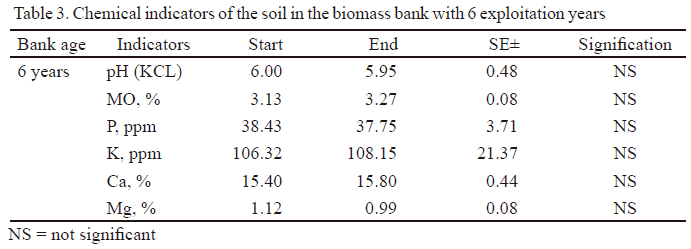
<p align="justify" class="Cuerpodetexto" style="margin-top:12.0pt;text-indent:0cm;"><span style="font-family:'Verdana','sans-serif'; font-size:10.0pt; color:windowtext; ">The increase of Ca content in the soil  in the biomass bank with higher exploitation ages (18 and 12 years) agree with  that found by Crespo &amp; Otero (2011), when researching the fertility  performance of a brown soil with carbonate 1.5 years after sowing the Cuba  CT-115. These authors attributed this performance to the contribution of Ca  that the roots of this plant made, which in addition of having high depth and  biomass than the remaining grasses that are commonly used in grasslands (Lok <em>et  al.</em> 2009).</span></p>     <p align="justify" class="Cuerpodetexto" style="margin-top:12.0pt;text-indent:0cm;"><span style="font-family:'Verdana','sans-serif'; font-size:10.0pt; color:windowtext; ">In the soil of the biomass bank with 6  exploitation years (<a href="/img/revistas/cjas/v50n3/t0317316.gif">table 3</a>) there was not significant variation in the soil  chemical indicators which were analyzed.</span></p>     
<p align="justify" class="Cuerpodetexto" style="margin-top:12.0pt;text-indent:0cm;"><span style="font-family:'Verdana','sans-serif'; font-size:10.0pt; color:windowtext; ">The absence of change in the values of  the soil indicators in the biomass bank with 6 exploitation years indicates  that, initially, the supply of nutrients in the soil was high (Oniani 1964,  Paneque <em>et al.</em> 2010), enough to supply the Cuba CT-115 requirements with  the performed management. However, the marked decrease of P content in the soil  in the bank with 18 exploitation years, indicates the need to begin monitoring  the state of soil fertility in these areas from 6 exploitation    years.</span></p>     <p align="justify" class="Cuerpodetexto" style="margin-top:12.0pt;text-indent:0cm;"><span style="font-family:'Verdana','sans-serif'; font-size:10.0pt; color:windowtext; ">Vanden Bygaart <em>et  al.</em> (2010) found in 27 experiments in Canada that the re-monitoring of the  soil during 30 years in the areas occupied by permanent grasslands, has shown  marked OM increases in these areas, with respect to what happens in areas with  annual crops.</span><span style="font-family:'Verdana','sans-serif'; font-size:10.0pt; color:windowtext; "> </span></p>     <p align="justify" class="Cuerpodetexto" style="margin-top:12.0pt;text-indent:0cm;"><span style="line-height:107%; font-family:'Verdana','sans-serif'; font-size:10.0pt; ">The results of this  research showed that there is increase of the organic matter content of the  soil as it is higher the exploitation time of biomass bank with the Cuba CT-115  variety and, under similar conditions, will have to monitor the soil fertility  state, mainly the content of assimilable P, from 6 exploitation years of this  technology</span><span style="font-family:'Verdana','sans-serif'; font-size:10.0pt; color:windowtext; ">.</span><span style="font-family:'Verdana','sans-serif'; font-size:10.0pt; color:windowtext; "> </span></p>     ]]></body>
<body><![CDATA[<p align="justify" class="MsoNormal" style="margin-top:12.0pt;text-align:justify;"><span style="line-height:107%; font-family:'Verdana','sans-serif'; font-size:10.0pt; ">&nbsp;</span></p>     <p align="justify" class="subtitulo" style="margin-top:12.0pt;text-align:justify;"><span style="font-family:'Verdana','sans-serif'; font-size:13.0pt; color:windowtext; "><b>REFERENCES</b> </span></p>     <p align="justify" class="referencias" style="margin-top:12.0pt;margin-right:0cm;margin-bottom:.0001pt;margin-left:0cm;text-indent:0cm;"><span style="font-family:'Verdana','sans-serif'; font-size:10.0pt; color:windowtext; ">Carvalho, J. L. N., Raucci, G. S., Cerri, C. E. P., Bernoux, M., Feigl, B.  J., Wruck, F. J. &amp; Cerri, C. C. 2010. </span><span style="font-family:'Verdana','sans-serif'; font-size:10.0pt; color:windowtext; ">&ldquo;Impact of pasture,  agriculture and crop-livestock systems on soil C stocks in Brazil&rdquo;. Soil and  Tillage Research, 110(1): 175&ndash;186, ISSN: 0167-1987, DOI:  10.1016/j.still.2010.07.011.</span></p>     <p align="justify" class="referencias" style="margin-top:12.0pt;margin-right:0cm;margin-bottom:.0001pt;margin-left:0cm;text-indent:0cm;"><span style="font-family:'Verdana','sans-serif'; font-size:10.0pt; color:windowtext; ">Crespo,  G., Lok, S. &amp; Rodr&iacute;guez, I. 2004. &ldquo;Production of leaf litter and contribution  of N, P and K in two grasslands with different species composition&rdquo;. Cuban  Journal of Agricultural Science, 38(1): 97&ndash;101, ISSN: 2079-3480.</span></p>     <p align="justify" class="referencias" style="margin-top:12.0pt;margin-right:0cm;margin-bottom:.0001pt;margin-left:0cm;text-indent:0cm;"><span style="font-family:'Verdana','sans-serif'; font-size:10.0pt; color:windowtext; ">Crespo,  G. &amp; Otero, L. 2011. &ldquo;Effect of the plantation of <em>Pennisetum purpureum</em> cv. Cuba CT-115 on the variation of the physico-chemical properties of the  soils in the Picadura farm, Cuba&rdquo;. Cuban Journal of Agricultural Science,  45(4): 429&ndash;433, ISSN: 2079-3480.</span></p>     <!-- ref --><p align="justify" class="referencias" style="margin-top:12.0pt;margin-right:0cm;margin-bottom:.0001pt;margin-left:0cm;text-indent:0cm;"><span style="font-family:'Verdana','sans-serif'; font-size:10.0pt; color:windowtext; ">Di  Rienzo, J. A., Casanoves, F., Balzarini, M. G., Gonz&aacute;lez, L., Tablada, M. &amp;  Robledo, C. W. 2012. </span><span style="font-family:'Verdana','sans-serif'; font-size:10.0pt; color:windowtext; ">InfoStat. version 2012, [Windows],  Universidad Nacional de C&oacute;rdoba, Argentina: Grupo InfoStat, Available:  &lt;<a href="http://www.infostat.com.ar/" target="_blank">http://www.infostat.com.ar/</a>&gt;    .</span></p>     <p align="justify" class="referencias" style="margin-top:12.0pt;margin-right:0cm;margin-bottom:.0001pt;margin-left:0cm;text-indent:0cm;"><span style="font-family:'Verdana','sans-serif'; font-size:10.0pt; color:windowtext; ">Ernst,  O. &amp; Siri-Prieto, G. 2009. &ldquo;Impact of perennial pasture and tillage systems  on carbon input and soil quality indicators&rdquo;. Soil and Tillage Research,  105(2): 260&ndash;268, ISSN: 0167-1987, DOI: 10.1016/j.still.2009.08.001.</span></p>     <p align="justify" class="referencias" style="margin-top:12.0pt;margin-right:0cm;margin-bottom:.0001pt;margin-left:0cm;text-indent:0cm;"><span style="font-family:'Verdana','sans-serif'; font-size:10.0pt; color:windowtext; ">Fortes,  D., Herrera, R. S., Garc&iacute;a, M., Cruz, A. M. &amp; Romero, A. 2012. &ldquo;Chemical  composition of <em>Pennisetum purpureum</em> cv. Cuba CT-115 used as biomass bank&rdquo;.  Cuban Journal of Agricultural Science, 46(3): 321&ndash;329, ISSN: 2079-3480.</span></p>     <!-- ref --><p align="justify" class="referencias" style="margin-top:12.0pt;margin-right:0cm;margin-bottom:.0001pt;margin-left:0cm;text-indent:0cm;"><span style="font-family:'Verdana','sans-serif'; font-size:10.0pt; color:windowtext; ">Hern&aacute;ndez,  J. A., P&eacute;rez, J. J. M., Bosch, I. D. &amp; Castro, S. N. 2015. </span><span style="font-family:'Verdana','sans-serif'; font-size:10.0pt; color:windowtext; ">Clasificaci&oacute;n de los suelos de Cuba 2015. Mayabeque, Cuba: Ediciones INCA,  93 p., ISBN: 978-959-7023-77-7.    </span></p>     <p align="justify" class="referencias" style="margin-top:12.0pt;margin-right:0cm;margin-bottom:.0001pt;margin-left:0cm;text-indent:0cm;"><span style="font-family:'Verdana','sans-serif'; font-size:10.0pt; color:windowtext; ">Jackson, M. L. 1970. An&aacute;lisis qu&iacute;mico de suelos. 2nd ed., Barcelona,  Espa&ntilde;a: Omega, 662 p., OCLC: 37132181, Available:  &lt;<a href="http://www.redbiblioucacue.com/opac_css/index.php?lvl=notice_display&id=12846" target="_blank">http://www.redbiblioucacue.com/opac_css/index.php?lvl=notice_display&amp;id=12846</a>&gt;,  [Consulted: July 17, 2016].</span></p>     <!-- ref --><p align="justify" class="referencias" style="margin-top:12.0pt;margin-right:0cm;margin-bottom:.0001pt;margin-left:0cm;text-indent:0cm;"><span style="font-family:'Verdana','sans-serif'; font-size:10.0pt; color:windowtext; ">Latimer,  G. W. 2012. Official Methods of Analysis of AOAC International. 19th ed.,  Gaithersburg, Md.: AOAC International, ISBN: 978-0-935584-83-7, Available:  &lt;<a href="http://www.amazon.com/Official-Methods-Analysis-OFFICIAL-ANALYSIS/dp/0935584838/ref=pd_sim_sbs_14_1?ie=UTF8&dpID=31iikC-xl2L&dpSrc=sims&preST=_AC_UL160_SR160%2C160_&refRID=101AB94246X0EM9N7XMW" target="_blank">http://www.amazon.com/Official-Methods-Analysis-OFFICIAL-ANALYSIS/dp/0935584838/ref=pd_sim_sbs_14_1?ie=UTF8&amp;dpID=31iikC-xl2L&amp;dpSrc=sims&amp;preST=_AC_UL160_SR160%2C160_&amp;refRID=101AB94246X0EM9N7XMW</a>&gt;,  [Consulted: April 1, 2016].    </span></p>     <p align="justify" class="referencias" style="margin-top:12.0pt;margin-right:0cm;margin-bottom:.0001pt;margin-left:0cm;text-indent:0cm;"><span style="font-family:'Verdana','sans-serif'; font-size:10.0pt; color:windowtext; ">Lavelle,  P. 2000. &ldquo;Ecological challenges for soil science&rdquo;. </span><span style="font-family:'Verdana','sans-serif'; font-size:10.0pt; color:windowtext; ">Soil Science, 165(1): 73&ndash;86, ISSN: 0038-075X, 1538-9243.</span></p>     <p align="justify" class="referencias" style="margin-top:12.0pt;margin-right:0cm;margin-bottom:.0001pt;margin-left:0cm;text-indent:0cm;"><span style="font-family:'Verdana','sans-serif'; font-size:10.0pt; color:windowtext; ">Lok, S., Crespo, G., Torres, V., Fraga, S. &amp; Noda, A. 2009. </span><span style="font-family:'Verdana','sans-serif'; font-size:10.0pt; color:windowtext; ">&ldquo;Impact  of the technology of biomass bank of <em>Pennisetum purpureum</em> cv. Cuba  CT-115 on the soil-plant-animal system of a dairy unit with cattle&rdquo;. Cuban  Journal of Agricultural Science, 43(3): 297&ndash;303, ISSN: 2079-3480.</span></p>     <p align="justify" class="referencias" style="margin-top:12.0pt;margin-right:0cm;margin-bottom:.0001pt;margin-left:0cm;text-indent:0cm;"><span style="font-family:'Verdana','sans-serif'; font-size:10.0pt; color:windowtext; ">Mart&iacute;nez, R. O. 2010. &ldquo;Bancos de Biomasa con pasto elefante Cuba CT-115  para solucionar el d&eacute;ficit de alimento durante la seca en la producci&oacute;n de  leche y carne&rdquo;. In: III Congreso de Producci&oacute;n Animal Tropical, La Habana,  Cuba: Instituto de Ciencia Animal, ISBN: 978-959-7171-31-7.</span></p>     <p align="justify" class="referencias" style="margin-top:12.0pt;margin-right:0cm;margin-bottom:.0001pt;margin-left:0cm;text-indent:0cm;"><span style="font-family:'Verdana','sans-serif'; font-size:10.0pt; color:windowtext; ">Oniani, O. G. 1964. &ldquo;Determinaci&oacute;n del f&oacute;sforo y potasio del suelo en una  misma soluci&oacute;n de los suelos Krasnozen y Pods&oacute;licos en Georgia&rdquo;. Agrojima, 6:  25.</span></p>     <!-- ref --><p align="justify" class="referencias" style="margin-top:12.0pt;margin-right:0cm;margin-bottom:.0001pt;margin-left:0cm;text-indent:0cm;"><span style="font-family:'Verdana','sans-serif'; font-size:10.0pt; color:windowtext; ">Paneque, P. V. M., Cala&ntilde;a, N. J. M., Calder&oacute;n, V. M., Borges, B. Y.,  Hern&aacute;ndez, G. T. C. &amp; Caruncho, C. M. 2010. Manual de t&eacute;cnicas anal&iacute;ticas  para an&aacute;lisis de suelo, foliar, abonos org&aacute;nicos y fertilizantes qu&iacute;micos. La  Habana, Cuba: Ediciones INCA, 157 p., ISBN: 978-959-7023-51-7, Available:  &lt;<a href="http://mst.ama.cu/578/" target="_blank">http://mst.ama.cu/578/</a>&gt;, [Consulted: January 27, 2016].    </span></p>     ]]></body>
<body><![CDATA[<p align="justify" class="referencias" style="margin-top:12.0pt;margin-right:0cm;margin-bottom:.0001pt;margin-left:0cm;text-indent:0cm;"><span style="font-family:'Verdana','sans-serif'; font-size:10.0pt; color:windowtext; ">Valenciaga, D., Chongo, B., Herrera, R. S., Torres, V., Oramas, A. &amp;  Herrera, M. 2009. </span><span style="font-family:'Verdana','sans-serif'; font-size:10.0pt; color:windowtext; ">&ldquo;Effect of regrowth age on <em>in vitro</em> dry matter  digestibility of <em>Pennisetum purpureum</em> cv. CUBA CT-115&rdquo;. Cuban Journal of  Agricultural Science, 43(1): 79&ndash;82, ISSN: 2079-3480.</span></p>     <p align="justify" class="referencias" style="margin-top:12.0pt;margin-right:0cm;margin-bottom:.0001pt;margin-left:0cm;text-indent:0cm;"><span style="font-family:'Verdana','sans-serif'; font-size:10.0pt; ">VandenBygaart, A. J.,  Bremer, E., McConkey, B. G., Janzen, H. H., Angers, D. A., Carter, M. R.,  Drury, C. F., Lafond, G. P. &amp; McKenzie, R. H. 2010. &ldquo;Soil organic carbon  stocks on long-term agroecosystem experiments in Canada&rdquo;. Canadian Journal of  Soil Science, 90(4): 543&ndash;550, ISSN: 0008-4271, DOI: 10.4141/cjss10028</span><font size="2" face="Verdana, Arial, Helvetica, sans-serif">.</font></p>     <p align="justify">&nbsp;</p>     <p align="justify">&nbsp;</p>     <p align="justify"><font size="2" face="Verdana, Arial, Helvetica, sans-serif">Received: 10/06/2015    <br> Accepted: 06/07/2016</font></p>     <p align="justify">&nbsp;</p>     <p align="justify">&nbsp;</p>     <p align="justify"><font size="2" face="Verdana, Arial, Helvetica, sans-serif"><i>G. Crespo,</i> Instituto de Ciencia Animal, Apartado Postal 24, San José de las Lajas, Mayabeque, Cuba.    Email: <a href="mailto:gcrespo@ica.co.cu">gcrespo@ica.co.cu</a></font></p>      ]]></body><back>
<ref-list>
<ref id="B1">
<nlm-citation citation-type="journal">
<person-group person-group-type="author">
<name>
<surname><![CDATA[Carvalho]]></surname>
<given-names><![CDATA[J. L. N.]]></given-names>
</name>
<name>
<surname><![CDATA[Raucci]]></surname>
<given-names><![CDATA[G. S.]]></given-names>
</name>
<name>
<surname><![CDATA[Cerri]]></surname>
<given-names><![CDATA[C. E. P.]]></given-names>
</name>
<name>
<surname><![CDATA[Bernoux]]></surname>
<given-names><![CDATA[M.]]></given-names>
</name>
<name>
<surname><![CDATA[Feigl]]></surname>
<given-names><![CDATA[B. J.]]></given-names>
</name>
<name>
<surname><![CDATA[Wruck]]></surname>
<given-names><![CDATA[F. J.]]></given-names>
</name>
<name>
<surname><![CDATA[Cerri]]></surname>
<given-names><![CDATA[C. C.]]></given-names>
</name>
</person-group>
<article-title xml:lang="nd"><![CDATA[Impact of pasture, agriculture and crop-livestock systems on soil C stocks in Brazil]]></article-title>
<source><![CDATA[Soil and Tillage Research]]></source>
<year>2010</year>
<volume>110</volume>
<numero>1</numero>
<issue>1</issue>
<page-range>175–186</page-range></nlm-citation>
</ref>
<ref id="B2">
<nlm-citation citation-type="journal">
<person-group person-group-type="author">
<name>
<surname><![CDATA[Crespo]]></surname>
<given-names><![CDATA[G.]]></given-names>
</name>
<name>
<surname><![CDATA[Lok]]></surname>
<given-names><![CDATA[S.]]></given-names>
</name>
<name>
<surname><![CDATA[Rodríguez]]></surname>
<given-names><![CDATA[I.]]></given-names>
</name>
</person-group>
<article-title xml:lang="nd"><![CDATA[Production of leaf litter and contribution of N, P and K in two grasslands with different species composition]]></article-title>
<source><![CDATA[Cuban Journal of Agricultural Science]]></source>
<year>2004</year>
<volume>38</volume>
<numero>1</numero>
<issue>1</issue>
<page-range>97–101</page-range></nlm-citation>
</ref>
<ref id="B3">
<nlm-citation citation-type="journal">
<person-group person-group-type="author">
<name>
<surname><![CDATA[Crespo]]></surname>
<given-names><![CDATA[G.]]></given-names>
</name>
<name>
<surname><![CDATA[Otero]]></surname>
<given-names><![CDATA[L.]]></given-names>
</name>
</person-group>
<article-title xml:lang="nd"><![CDATA[Effect of the plantation of Pennisetum purpureum cv. Cuba CT-115 on the variation of the physico-chemical properties of the soils in the Picadura farm, Cuba]]></article-title>
<source><![CDATA[Cuban Journal of Agricultural Science]]></source>
<year>2011</year>
<volume>45</volume>
<numero>4</numero>
<issue>4</issue>
<page-range>429–433</page-range></nlm-citation>
</ref>
<ref id="B4">
<nlm-citation citation-type="book">
<person-group person-group-type="author">
<name>
<surname><![CDATA[Di Rienzo]]></surname>
<given-names><![CDATA[J. A.]]></given-names>
</name>
<name>
<surname><![CDATA[Casanoves]]></surname>
<given-names><![CDATA[F.]]></given-names>
</name>
<name>
<surname><![CDATA[Balzarini]]></surname>
<given-names><![CDATA[M. G.]]></given-names>
</name>
<name>
<surname><![CDATA[González]]></surname>
<given-names><![CDATA[L.]]></given-names>
</name>
<name>
<surname><![CDATA[Tablada]]></surname>
<given-names><![CDATA[M.]]></given-names>
</name>
<name>
<surname><![CDATA[Robledo]]></surname>
<given-names><![CDATA[C. W.]]></given-names>
</name>
</person-group>
<source><![CDATA[InfoStat]]></source>
<year>2012</year>
<publisher-loc><![CDATA[Universidad Nacional de Córdoba, Argentina ]]></publisher-loc>
<publisher-name><![CDATA[Grupo InfoStat]]></publisher-name>
</nlm-citation>
</ref>
<ref id="B5">
<nlm-citation citation-type="journal">
<person-group person-group-type="author">
<name>
<surname><![CDATA[Ernst]]></surname>
<given-names><![CDATA[O.]]></given-names>
</name>
<name>
<surname><![CDATA[Siri-Prieto]]></surname>
<given-names><![CDATA[G.]]></given-names>
</name>
</person-group>
<article-title xml:lang="nd"><![CDATA[Impact of perennial pasture and tillage systems on carbon input and soil quality indicators]]></article-title>
<source><![CDATA[Soil and Tillage Research]]></source>
<year>2009</year>
<volume>105</volume>
<numero>2</numero>
<issue>2</issue>
<page-range>260–268</page-range></nlm-citation>
</ref>
<ref id="B6">
<nlm-citation citation-type="journal">
<person-group person-group-type="author">
<name>
<surname><![CDATA[Fortes]]></surname>
<given-names><![CDATA[D.]]></given-names>
</name>
<name>
<surname><![CDATA[Herrera]]></surname>
<given-names><![CDATA[R. S.]]></given-names>
</name>
<name>
<surname><![CDATA[García]]></surname>
<given-names><![CDATA[M.]]></given-names>
</name>
<name>
<surname><![CDATA[Cruz]]></surname>
<given-names><![CDATA[A. M.]]></given-names>
</name>
<name>
<surname><![CDATA[Romero]]></surname>
<given-names><![CDATA[A.]]></given-names>
</name>
</person-group>
<article-title xml:lang="nd"><![CDATA[Chemical composition of Pennisetum purpureum cv. Cuba CT-115 used as biomass bank]]></article-title>
<source><![CDATA[Cuban Journal of Agricultural Science]]></source>
<year>2012</year>
<volume>46</volume>
<numero>3</numero>
<issue>3</issue>
<page-range>321–329</page-range></nlm-citation>
</ref>
<ref id="B7">
<nlm-citation citation-type="book">
<person-group person-group-type="author">
<name>
<surname><![CDATA[Hernández]]></surname>
<given-names><![CDATA[J. A.]]></given-names>
</name>
<name>
<surname><![CDATA[Pérez]]></surname>
<given-names><![CDATA[J. J. M.]]></given-names>
</name>
<name>
<surname><![CDATA[Bosch]]></surname>
<given-names><![CDATA[I. D.]]></given-names>
</name>
<name>
<surname><![CDATA[Castro]]></surname>
<given-names><![CDATA[S. N.]]></given-names>
</name>
</person-group>
<source><![CDATA[Clasificación de los suelos de Cuba 2015]]></source>
<year>2015</year>
<page-range>93</page-range><publisher-loc><![CDATA[Mayabeque, Cuba ]]></publisher-loc>
<publisher-name><![CDATA[Ediciones INCA]]></publisher-name>
</nlm-citation>
</ref>
<ref id="B8">
<nlm-citation citation-type="book">
<person-group person-group-type="author">
<name>
<surname><![CDATA[Jackson]]></surname>
<given-names><![CDATA[M. L.]]></given-names>
</name>
</person-group>
<source><![CDATA[Análisis químico de suelos]]></source>
<year>1970</year>
<edition>2nd</edition>
<page-range>662</page-range><publisher-loc><![CDATA[Barcelona, España ]]></publisher-loc>
<publisher-name><![CDATA[Omega]]></publisher-name>
</nlm-citation>
</ref>
<ref id="B9">
<nlm-citation citation-type="book">
<person-group person-group-type="author">
<name>
<surname><![CDATA[Latimer]]></surname>
<given-names><![CDATA[G. W.]]></given-names>
</name>
</person-group>
<source><![CDATA[Official Methods of Analysis of AOAC International]]></source>
<year>2012</year>
<edition>19th</edition>
<publisher-loc><![CDATA[Gaithersburg, Md. ]]></publisher-loc>
<publisher-name><![CDATA[AOAC International]]></publisher-name>
</nlm-citation>
</ref>
<ref id="B10">
<nlm-citation citation-type="journal">
<person-group person-group-type="author">
<name>
<surname><![CDATA[Lavelle]]></surname>
<given-names><![CDATA[P.]]></given-names>
</name>
</person-group>
<article-title xml:lang="nd"><![CDATA[Ecological challenges for soil science]]></article-title>
<source><![CDATA[Soil Science]]></source>
<year>2000</year>
<volume>165</volume>
<numero>1</numero>
<issue>1</issue>
<page-range>73–86</page-range></nlm-citation>
</ref>
<ref id="B11">
<nlm-citation citation-type="journal">
<person-group person-group-type="author">
<name>
<surname><![CDATA[Lok]]></surname>
<given-names><![CDATA[S.]]></given-names>
</name>
<name>
<surname><![CDATA[Crespo]]></surname>
<given-names><![CDATA[G.]]></given-names>
</name>
<name>
<surname><![CDATA[Torres]]></surname>
<given-names><![CDATA[V.]]></given-names>
</name>
<name>
<surname><![CDATA[Fraga]]></surname>
<given-names><![CDATA[S.]]></given-names>
</name>
<name>
<surname><![CDATA[Noda]]></surname>
<given-names><![CDATA[A.]]></given-names>
</name>
</person-group>
<article-title xml:lang="nd"><![CDATA[Impact of the technology of biomass bank of Pennisetum purpureum cv. Cuba CT-115 on the soil-plant-animal system of a dairy unit with cattle]]></article-title>
<source><![CDATA[Cuban Journal of Agricultural Science]]></source>
<year>2009</year>
<volume>43</volume>
<numero>3</numero>
<issue>3</issue>
<page-range>297–303</page-range></nlm-citation>
</ref>
<ref id="B12">
<nlm-citation citation-type="book">
<person-group person-group-type="author">
<name>
<surname><![CDATA[Martínez]]></surname>
<given-names><![CDATA[R. O.]]></given-names>
</name>
</person-group>
<article-title xml:lang="nd"><![CDATA[Bancos de Biomasa con pasto elefante Cuba CT-115 para solucionar el déficit de alimento durante la seca en la producción de leche y carne]]></article-title>
<source><![CDATA[]]></source>
<year>2010</year>
<publisher-loc><![CDATA[La Habana, Cuba ]]></publisher-loc>
<publisher-name><![CDATA[Instituto de Ciencia Animal]]></publisher-name>
</nlm-citation>
</ref>
<ref id="B13">
<nlm-citation citation-type="journal">
<person-group person-group-type="author">
<name>
<surname><![CDATA[Oniani]]></surname>
<given-names><![CDATA[O. G.]]></given-names>
</name>
</person-group>
<article-title xml:lang="nd"><![CDATA[Determinación del fósforo y potasio del suelo en una misma solución de los suelos Krasnozen y Podsólicos en Georgia]]></article-title>
<source><![CDATA[Agrojima]]></source>
<year>1964</year>
<volume>6</volume>
<page-range>25</page-range></nlm-citation>
</ref>
<ref id="B14">
<nlm-citation citation-type="book">
<person-group person-group-type="author">
<name>
<surname><![CDATA[Paneque]]></surname>
<given-names><![CDATA[P. V. M.]]></given-names>
</name>
<name>
<surname><![CDATA[Calaña]]></surname>
<given-names><![CDATA[N. J. M.]]></given-names>
</name>
<name>
<surname><![CDATA[Calderón]]></surname>
<given-names><![CDATA[V. M.]]></given-names>
</name>
<name>
<surname><![CDATA[Borges]]></surname>
<given-names><![CDATA[B. Y.]]></given-names>
</name>
<name>
<surname><![CDATA[Hernández]]></surname>
<given-names><![CDATA[G. T. C.]]></given-names>
</name>
<name>
<surname><![CDATA[Caruncho]]></surname>
<given-names><![CDATA[C. M.]]></given-names>
</name>
</person-group>
<source><![CDATA[Manual de técnicas analíticas para análisis de suelo, foliar, abonos orgánicos y fertilizantes químicos]]></source>
<year>2010</year>
<page-range>157</page-range><publisher-loc><![CDATA[La Habana, Cuba ]]></publisher-loc>
<publisher-name><![CDATA[Ediciones INCA]]></publisher-name>
</nlm-citation>
</ref>
<ref id="B15">
<nlm-citation citation-type="journal">
<person-group person-group-type="author">
<name>
<surname><![CDATA[Valenciaga]]></surname>
<given-names><![CDATA[D.]]></given-names>
</name>
<name>
<surname><![CDATA[Chongo]]></surname>
<given-names><![CDATA[B.]]></given-names>
</name>
<name>
<surname><![CDATA[Herrera]]></surname>
<given-names><![CDATA[R. S.]]></given-names>
</name>
<name>
<surname><![CDATA[Torres]]></surname>
<given-names><![CDATA[V.]]></given-names>
</name>
<name>
<surname><![CDATA[Oramas]]></surname>
<given-names><![CDATA[A.]]></given-names>
</name>
<name>
<surname><![CDATA[Herrera]]></surname>
<given-names><![CDATA[M.]]></given-names>
</name>
</person-group>
<article-title xml:lang="nd"><![CDATA[Effect of regrowth age on in vitro dry matter digestibility of Pennisetum purpureum cv. CUBA CT-115]]></article-title>
<source><![CDATA[Cuban Journal of Agricultural Science]]></source>
<year>2009</year>
<volume>43</volume>
<numero>1</numero>
<issue>1</issue>
<page-range>79–82</page-range></nlm-citation>
</ref>
<ref id="B16">
<nlm-citation citation-type="journal">
<person-group person-group-type="author">
<name>
<surname><![CDATA[VandenBygaart]]></surname>
<given-names><![CDATA[A. J.]]></given-names>
</name>
<name>
<surname><![CDATA[Bremer]]></surname>
<given-names><![CDATA[E.]]></given-names>
</name>
<name>
<surname><![CDATA[McConkey]]></surname>
<given-names><![CDATA[B. G.]]></given-names>
</name>
<name>
<surname><![CDATA[Janzen]]></surname>
<given-names><![CDATA[H. H.]]></given-names>
</name>
<name>
<surname><![CDATA[Angers]]></surname>
<given-names><![CDATA[D. A.]]></given-names>
</name>
<name>
<surname><![CDATA[Carter]]></surname>
<given-names><![CDATA[M. R.]]></given-names>
</name>
<name>
<surname><![CDATA[Drury]]></surname>
<given-names><![CDATA[C. F.]]></given-names>
</name>
<name>
<surname><![CDATA[Lafond]]></surname>
<given-names><![CDATA[G. P.]]></given-names>
</name>
<name>
<surname><![CDATA[McKenzie]]></surname>
<given-names><![CDATA[R. H.]]></given-names>
</name>
</person-group>
<article-title xml:lang="nd"><![CDATA[Soil organic carbon stocks on long-term agroecosystem experiments in Canada]]></article-title>
<source><![CDATA[Canadian Journal of Soil Science]]></source>
<year>2010</year>
<volume>90</volume>
<numero>4</numero>
<issue>4</issue>
<page-range>543–550</page-range></nlm-citation>
</ref>
</ref-list>
</back>
</article>