<?xml version="1.0" encoding="ISO-8859-1"?><article xmlns:mml="http://www.w3.org/1998/Math/MathML" xmlns:xlink="http://www.w3.org/1999/xlink" xmlns:xsi="http://www.w3.org/2001/XMLSchema-instance">
<front>
<journal-meta>
<journal-id>0034-7493</journal-id>
<journal-title><![CDATA[Revista Cubana de Cirugía]]></journal-title>
<abbrev-journal-title><![CDATA[Rev Cubana Cir]]></abbrev-journal-title>
<issn>0034-7493</issn>
<publisher>
<publisher-name><![CDATA[Editorial Ciencias Médicas]]></publisher-name>
</publisher>
</journal-meta>
<article-meta>
<article-id>S0034-74931997000200012</article-id>
<title-group>
<article-title xml:lang="es"><![CDATA[Herniorrafia inguinal: Técnica por sobrecapas de Fascia Transversalis]]></article-title>
</title-group>
<contrib-group>
<contrib contrib-type="author">
<name>
<surname><![CDATA[Goderich Lalán]]></surname>
<given-names><![CDATA[José Miguel]]></given-names>
</name>
<xref ref-type="aff" rid="A01"/>
</contrib>
<contrib contrib-type="author">
<name>
<surname><![CDATA[Goderich López]]></surname>
<given-names><![CDATA[Danisela]]></given-names>
</name>
<xref ref-type="aff" rid="A01"/>
</contrib>
</contrib-group>
<aff id="A01">
<institution><![CDATA[,Hospital General Clinicoquirúrgico  ]]></institution>
<addr-line><![CDATA[Santiago de Cuba ]]></addr-line>
</aff>
<pub-date pub-type="pub">
<day>00</day>
<month>08</month>
<year>1997</year>
</pub-date>
<pub-date pub-type="epub">
<day>00</day>
<month>08</month>
<year>1997</year>
</pub-date>
<volume>36</volume>
<numero>2</numero>
<fpage>161</fpage>
<lpage>167</lpage>
<copyright-statement/>
<copyright-year/>
<self-uri xlink:href="http://scielo.sld.cu/scielo.php?script=sci_arttext&amp;pid=S0034-74931997000200012&amp;lng=en&amp;nrm=iso"></self-uri><self-uri xlink:href="http://scielo.sld.cu/scielo.php?script=sci_abstract&amp;pid=S0034-74931997000200012&amp;lng=en&amp;nrm=iso"></self-uri><self-uri xlink:href="http://scielo.sld.cu/scielo.php?script=sci_pdf&amp;pid=S0034-74931997000200012&amp;lng=en&amp;nrm=iso"></self-uri><abstract abstract-type="short" xml:lang="es"><p><![CDATA[Se realizó un estudio descriptivo, prospectivo, observacional y longitudinal para evaluar los resultados obtenidos con la aplicación de una técnica de reparación herniaria inguinal (original del autor) por sobrecapas de fascia transversalis, en la que se afronta una primera capa de ésta en sutura continua, desde la proyección del tubérculo púbico hasta obliterar el anillo inguinal profundo, después de lo cual se crea una segunda capa al afrontar el arco aponeurótico del transverso a la cintilla iliopubiana. Luego de un seguimiento superior a los 10 años, se comprobó que de 1 475 pacientes sólo hubo recidivas en 1,2 %; éstas fueron más frecuentes en los hombres, en las hernias del tipo indirecto y en los pacientes con más de 45 años. El mayor número de recidivas ocurrió entre el primer y tercer año de operado. Se recomienda introducir esta nueva técnica en la práctica quirúrgica, y cumplir las indicaciones y el proceder señalado por el autor]]></p></abstract>
<abstract abstract-type="short" xml:lang="en"><p><![CDATA[A descriptive, prospective, observational, and longitudinal study was performed to evaluate the results obtained with the application of a technique for the repair of inguinal hernia (the author's original technique) by overlayers of fascia transversalis, in which the first layer is copped with the use of continuos suture from the projection of the pubic tubercle until the obliteration of the deep inguinal rign, creating a second layer when copping the aponeurotic arch of the transverse to the iliopubic eminence. After a follow-up longer than 10 years, it was proved that out of 1 475 patients, only 1,2 % presented with recurrences. Relapses were more frequent in males, in indirect hernias and in patients over 45 years of age. The greatest number of recurrences occurred between the first and the third year after the operation. It is recommended to introduce this new technique within the surgical practice and to comply with the indications for the procedure made by the author]]></p></abstract>
<kwd-group>
<kwd lng="es"><![CDATA[HERNIA INGUINAL]]></kwd>
<kwd lng="es"><![CDATA[TECNICAS QUIRURGICAS]]></kwd>
<kwd lng="es"><![CDATA[FASCIA]]></kwd>
<kwd lng="en"><![CDATA[HERNIA INGUINAL]]></kwd>
<kwd lng="en"><![CDATA[SURGERY, OPERATIVE]]></kwd>
<kwd lng="en"><![CDATA[FASCIA]]></kwd>
</kwd-group>
</article-meta>
</front><body><![CDATA[   Hospital General Clinicoquir&uacute;rgico, Santiago de Cuba <H2>Herniorrafia inguinal. T&eacute;cnica por sobrecapas de <i>Fascia Transversalis</i></H2> <I>Dr. Jos&eacute; Miguel Goderich Lal&aacute;n<SUP>1</SUP> y Dra. Danisela Goderich L&oacute;pez<SUP>2</SUP></I>      <P><I>1</I> Doctor en Ciencias M&eacute;dicas. Especialista de II Grado en Cirug&iacute;a General. Profesor Titular.     <BR><SUP>2</SUP> Residente de II a&ntilde;o en Cirug&iacute;a General. <H4> RESUMEN</H4> Se realiz&oacute; un estudio descriptivo, prospectivo, observacional y longitudinal para evaluar los resultados obtenidos con la aplicaci&oacute;n de una t&eacute;cnica de reparaci&oacute;n herniaria inguinal (original del autor) por sobrecapas de <I>fascia transversalis,</I> en la que se afronta una primera capa de &eacute;sta en sutura continua, desde la proyecci&oacute;n del tub&eacute;rculo p&uacute;bico hasta obliterar el anillo inguinal profundo, despu&eacute;s de lo cual se crea una segunda capa al afrontar el arco aponeur&oacute;tico del transverso a la cintilla iliopubiana. Luego de un seguimiento superior a los 10 a&ntilde;os, se comprob&oacute; que de 1 475 pacientes s&oacute;lo hubo recidivas en 1,2 %; &eacute;stas fueron m&aacute;s frecuentes en los hombres, en las hernias del tipo indirecto y en los pacientes con m&aacute;s de 45 a&ntilde;os. El mayor n&uacute;mero de recidivas ocurri&oacute; entre el primer y tercer a&ntilde;o de operado. Se recomienda introducir esta nueva t&eacute;cnica en la pr&aacute;ctica quir&uacute;rgica, y cumplir las indicaciones y el proceder se&ntilde;alado por el autor.      <P><I>Descriptores DeCS: </I>HERNIA INGUINAL/cirug&iacute;a; TECNICAS QUIRURGICAS/m&eacute;todos; FASCIA.      <P>La soluci&oacute;n quir&uacute;rgica de la hernia inguinal ha inquietado a los cirujanos desde los mismos albores de la medicina, y se han ideado variados m&eacute;todos para su reparaci&oacute;n, algunos de los cuales a&uacute;n se utilizan.<SUP>1,2</SUP> Junto a otros factores, la t&eacute;cnica operatoria resulta determinante para evitar las recidivas que afectan seriamente la salud del paciente intervenido, pues &eacute;ste es un ser humano vulnerable que ha sido afectado en su condici&oacute;n psicosocial y muy particularmente en la esfera econ&oacute;mica.<SUP>3</SUP>      <P>De ah&iacute; que sin rechazar otros aspectos estudiados y aplicados hasta el momento para prevenir las recidivas, iniciamos la b&uacute;squeda en factores anat&oacute;micos y fisiol&oacute;gicos de inter&eacute;s quir&uacute;rgico, pues aunque existen m&uacute;ltiples t&eacute;cnicas en nuestro medio, las cifras de recidivas se mantienen entre 4,5 y 15 %. Partimos del criterio anat&oacute;mico funcional de que la <I>fascia transversalis</I> (FT) es el elemento fundamental en la reparaci&oacute;n de la hernia inguinal, por cuanto constituye la estructura activa del sost&eacute;n y refuerzo de la regi&oacute;n, y que permite mantener la fisiolog&iacute;a antiherniaria.      <P>El cierre anat&oacute;mico del anillo inguinal profundo y el refuerzo de la pared posterior del conducto son pilares del tratamiento.      <P>El presente trabajo tiene como objetivo evaluar el resultado de un nuevo procedimiento quir&uacute;rgico (original del autor) para la reparaci&oacute;n herniaria inguinal, mediante el seguimiento posoperatorio por m&aacute;s de 10 a&ntilde;os. <H4> MARCO TE&Oacute;RICO</H4> La FT es la l&aacute;mina celulosa o aponeur&oacute;tica que cubre la cara profunda del m&uacute;sculo transverso y ocupa toda la extensi&oacute;n de la regi&oacute;n inguinal, por delante del peritoneo. Al nivel del anillo inguinal profundo se introduce la aponeurosis infundibiliforme en este conducto y forma parte de las envolturas del cord&oacute;n,<SUP>4,5</SUP> un poco m&aacute;s abajo, en el anillo crural, la FT se junta primeramente con el borde posterior del arco crural, el cual se encuentra bastante encorvado hacia atr&aacute;s y forma con &eacute;l un verdadero canal de concavidad superior, por el que transita el cord&oacute;n.<SUP>6</SUP>      <P>La placa fascioaponeur&oacute;tica o fasciotendinosa, que es la uni&oacute;n de la FT con las 2 hojas fasciales del transverso, se extiende desde el arco aponeur&oacute;tico del transverso a la cintilla iliopubiana hasta su inserci&oacute;n en la cresta pect&iacute;nea, forma uno de los elementos del ligamento de Cooper<SUP>7</SUP> y posee un gran valor para la reparaci&oacute;n quir&uacute;rgica. En los trabajos de <I>Mc Vay</I>,<SUP>8</SUP> <I>Nyhus</I><SUP>9</SUP> y <I>Madden</I><SUP>10</SUP> se demuestra la continuidad anat&oacute;mica de la FT, o mejor dicho, de la placa fascioaponeur&oacute;tica. A esta forma de la FT, que a la manera de un diafragma cierra toda la parte del anillo crural que no est&aacute; ocupado, se le da el nombre de <I>septum crural</I>.<SUP>11</SUP>      <P>Para <I>Nyhus</I><SUP>7</SUP> hay 4 importantes an&aacute;logos de la FT: el ligamento aponeur&oacute;tico del transverso, el arco aponeur&oacute;tico del transverso, el ligamento iliop&uacute;bico y el ligamento iliopect&iacute;neo. <I>Testut</I><SUP>12</SUP> incluye adem&aacute;s el ligamento de Henle y el ligamento interfoveolar de Hesselbach.      ]]></body>
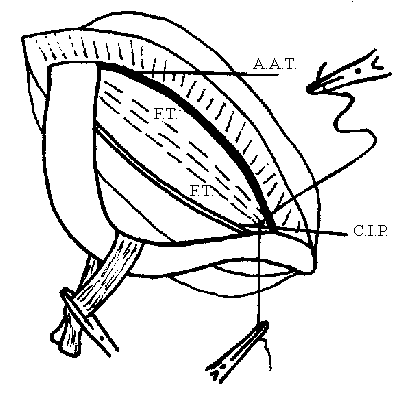
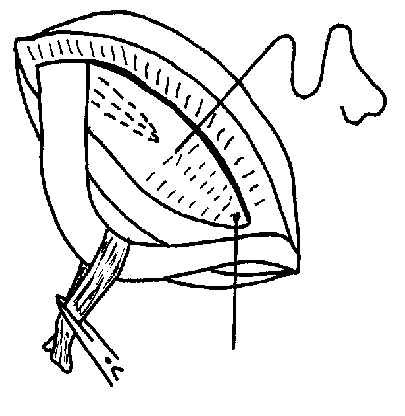
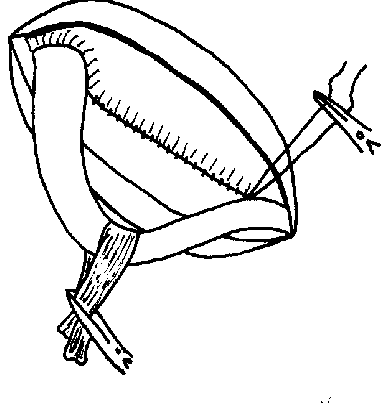
<body><![CDATA[<P>El arco aponeur&oacute;tico del transverso del abdomen puede unirse con el arco aponeur&oacute;tico del oblicuo menor y dar lugar a un "tend&oacute;n conjunto",<SUP>10,12</SUP> pero ello ocurre s&oacute;lo en el 5 al 10 % de los pacientes.<SUP>13</SUP> Lo habitual es que la aponeurosis del transverso se una con la del oblicuo menor al nivel de la vaina del recto. <H4> M&Eacute;TODOS</H4> Se realiz&oacute; un estudio prospectivo, descriptivo, observacional y longitudinal sobre los resultados de la introducci&oacute;n en la pr&aacute;ctica de una t&eacute;cnica (original del autor) para la reparaci&oacute;n quir&uacute;rgica de la hernia inguinal.      <P>La revisi&oacute;n te&oacute;rica se efectu&oacute; en la d&eacute;cada del 70 al 80, lo que nos motiv&oacute; a llevar a cabo las primeras experiencias en 1981.      <P>Durante 1982 y 1983, cuando se realiz&oacute; el dise&ntilde;o experimental del artificio t&eacute;cnico para la reparaci&oacute;n del anillo inguinal profundo (tesis en opci&oacute;n al grado cient&iacute;fico de Candidato a Doctor en Ciencias M&eacute;dicas), se practicaron intervenciones experimentales en cad&aacute;veres frescos y formolizados, tanto en la Facultad de Medicina No. 2 del Instituto Superior de Ciencias M&eacute;dicas de Santiago de Cuba, como en algunos hospitales. Pero ya en este &uacute;ltimo a&ntilde;o se hicieron las primeras operaciones en vivo y comenz&oacute; su aplicaci&oacute;n en varios centros asistenciales de &eacute;sta y de otras provincias.      <P>El universo de trabajo estuvo constituido por todos los pacientes con el diagn&oacute;stico de hernia inguinal en cualesquiera de sus variedades, operados por esta t&eacute;cnica.      <P>En todos los casos el an&aacute;lisis de las variables se clasific&oacute; como caracterizaci&oacute;n cl&iacute;nica. La recidiva se registr&oacute; inmediatamente despu&eacute;s de su comprobaci&oacute;n cl&iacute;nica. <H4> T&Eacute;CNICA QUIR&Uacute;RGICA</H4>  <UL>     <LI> Anestesia local y sedaci&oacute;n.</LI>      <LI> Despu&eacute;s de abordar la regi&oacute;n por incisi&oacute;n oblicua y apertura de la pared anterior del conducto, se diseca y a&iacute;sla el cord&oacute;n esperm&aacute;tico.</LI>      <LI> Resecci&oacute;n circular del m&uacute;sculo crem&aacute;ster.</LI>      <LI> Disecci&oacute;n, aislamiento, ligadura alta y resecci&oacute;n de los sacos indirectos o invaginaci&oacute;n de los directos.</LI>      <LI> Sutura continua con hilos irreabsorbibles u otros de reabsorci&oacute;n lenta n&uacute;meros 4 &oacute; 5 ceros gastrointestinal, que comenzando en el tub&eacute;rculo p&uacute;bico (figura 1) engloba la FT en la zona d&eacute;bil y del defecto en "V" hasta el anillo inguinal profundo, donde se suturan los bordes del arco aponeur&oacute;tico del transverso (AAT) por encima y la cintilla iliopubiana (CIP) por debajo para obliterar adecuadamente el anillo (figura 2).</LI>     ]]></body>
<body><![CDATA[</UL>      <CENTER>   <A HREF="/img/revistas/cir/v36n2/f02297.gif"><IMG SRC="/img/revistas/cir/v36n2/f02297.gif" ALT="Figura 2" VSPACE=10 BORDER=0 HEIGHT=178 WIDTH=175></A>  </CENTER>      
<CENTER>FIGURA 1. <I>Sutura continua para crear una capa de </I>fascia transversalis<I> con </I>fascia transversalis<I> desde la proyecci&oacute;n de tub&eacute;rculo p&uacute;blico.</I></CENTER>      <CENTER>   <A HREF="/img/revistas/cir/v36n2/f03297.gif"><IMG SRC="/img/revistas/cir/v36n2/f03297.gif" ALT="Figura 2" VSPACE=10 BORDER=0 HEIGHT=176 WIDTH=172></A>  </CENTER>      
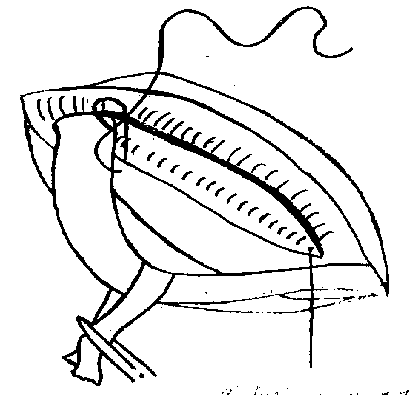
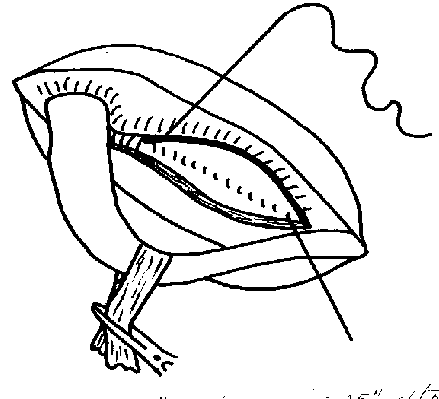
<CENTER>FIGURA 2. <I>Continuaci&oacute;n de la sutura en direcci&oacute;n al anillo inguinal profundo, cerrando el defecto en V de </I>fascia transversalis.</CENTER>  <UL>     <LI> Se imbrica el hilo (figura 3) y se contin&uacute;a en direcci&oacute;n al tub&eacute;rculo p&uacute;bico; se engloba solo CIP y AAT (figura 4), donde es nuevamente anudado (figura 5).</LI>     </UL>      <CENTER>   <A HREF="/img/revistas/cir/v36n2/f04297.gif"><IMG SRC="/img/revistas/cir/v36n2/f04297.gif" ALT="Figura 3" VSPACE=10 BORDER=0 HEIGHT=162 WIDTH=168></A>  </CENTER>      
<CENTER>FIGURA 3. <I>Para obliterar el anillo inguinal profundo, se entrecruza el hilo tomando arco aponeur&oacute;tico del transverso y cintilla iliopubiana.</I></CENTER>      <CENTER>   <A HREF="/img/revistas/cir/v36n2/f05297.gif"><IMG SRC="/img/revistas/cir/v36n2/f05297.gif" ALT="Figura 4" VSPACE=10 BORDER=0 HEIGHT=186 WIDTH=205></A>  </CENTER>      
]]></body>
<body><![CDATA[<CENTER></CENTER>      <CENTER>FIGURA 4. <I>Se va creando la sobrecapa afrontando el arco aponeur&oacute;tico del transverso a la cintilla iliopubiana hasta llegar al inicio de la sutura.</I></CENTER>      <CENTER>   <A HREF="/img/revistas/cir/v36n2/f06297.gif"><IMG SRC="/img/revistas/cir/v36n2/f06297.gif" ALT="Figura 5" VSPACE=10 BORDER=0 HEIGHT=192 WIDTH=184></A>  </CENTER>      
<CENTER>FIGURA 5. <I>Finaliza el proceder con un nuevo anudado del hilo de sutura y creada la sobrecapa de </I>fascia transversalis.</CENTER>  <UL>     <LI> Si es necesario se realiza incisi&oacute;n relajadora.</LI>      <LI> Se coloca el cord&oacute;n en el nuevo lecho y se cierra el conducto con sutura continua de catgut cromado 00 en la aponeurosis del oblicuo mayor.</LI>     </UL> Posibilidades alternativas: Otras anestesias, incisiones transversas; si el anillo inguinal profundo estuviese muy dilatado se precisa su cierre mediante el rechazo del borde muscular o por los artificios t&eacute;cnicos de <I>Camayd Zogbe</I><SUP>14</SUP> o del propio autor (Goderich JM. Artificio t&eacute;cnico y factores de recidiva [trabajo para optar por el grado cient&iacute;fico de Candidato a Doctor en Ciencias M&eacute;dicas], Cuba, 1990, SILAC 1995; 3(1):53-57).      <P>Indicaciones de la t&eacute;cnica: hernias inguinales indirectas, directas, combinadas y reproducidas.      <P>Para la recolecci&oacute;n del dato primario se elabor&oacute; un formulario que contemplaba las variables de inter&eacute;s para la investigaci&oacute;n.      <P>El procesamiento estad&iacute;stico de la informaci&oacute;n se realiz&oacute; mediante f&oacute;rmula aritm&eacute;tica simple y c&aacute;lculos porcentuales; y para su an&aacute;lisis se aplic&oacute; el estad&iacute;grafo X<SUP>2</SUP> de Pearson y la prueba de la probabilidad exacta de Fisher.      ]]></body>
<body><![CDATA[<P>Para la discusi&oacute;n nos basamos en los resultados de las pruebas estad&iacute;sticas y en un proceso l&oacute;gico deductivo, que nos permiti&oacute; llegar a las conclusiones del estudio.      <P>El seguimiento cl&iacute;nico de los pacientes lo realiz&oacute; directamente el autor, independientemente de que no todos fueron operados por &eacute;l, en consultas a los 15, 30, 90 y 180 d&iacute;as, a los 3 a&ntilde;os y luego cada 3 a&ntilde;os, como m&iacute;nimo por espacio de una d&eacute;cada. <H4> RESULTADOS</H4>  <UL>     <LI> Operados:1 611 pacientes.</LI>      <LI> De ellos:1 475 pacientes seguidos por 10 a&ntilde;os como m&iacute;nimo (1 421 hombres y 54 mujeres).</LI>      <LI> El grupo et&aacute;reo m&aacute;s frecuente fue el de 15 a 30 a&ntilde;os.</LI>      <LI> La unidad de medida paciente coincide con la unidad de enfermedad y con la unidad de proceder; o sea, un paciente equivale a una hernia inguinal y a una t&eacute;cnica quir&uacute;rgica.</LI>      <LI> Recidivas:19, con predominio en el sexo masculino y en la variedad indirecta.</LI>      <LI> Tanto por ciento de recidivas: 1,2.</LI>     </UL>  <H4> DISCUSI&Oacute;N</H4> En la serie investigada hubo predominio del sexo masculino, tal y como se&ntilde;alan <I>Magnunson</I><SUP>15</SUP> e <I>Ingimarson</I><SUP>16</SUP> en sus respectivos trabajos; es decir, que la muestra est&aacute; acorde con el estudio, al igual que la representaci&oacute;n de la edad.<SUP>17</SUP>      <P>En cuanto a la distribuci&oacute;n por grupos et&aacute;reos y tipo de hernia, tambi&eacute;n coincide con los autores antes mencionados.<SUP>15,16</SUP>      ]]></body>
<body><![CDATA[<P>El &iacute;ndice de recidivas por sexo es elocuente en la cifra que se aporta, cuando se compara con el de otros estudios que informan en el &aacute;mbito nacional y en mi trabajo de doctorado 4,5 % (Opus Cit.) y en el plano internacional 1,8 y 8,9 %.<SUP>18-20</SUP>      <P>El mayor n&uacute;mero de recidivas ocurri&oacute; proporcionalmente en los pacientes de m&aacute;s de 45 a&ntilde;os. En el anciano, la herniorrafia inguinal requiere de cuidados especiales por la propia biolog&iacute;a del envejecimiento,<SUP>21</SUP> y en esto concordamos con <I>Deysine</I>,<SUP>22</SUP> quien sugiere una mayor utilizaci&oacute;n en el paciente geri&aacute;trico de las t&eacute;cnicas de superposici&oacute;n de las capas de <I>fascia</I>. Entendemos que en el caso de bilateralidad herniaria se debe operar primero la hernia mayor y la que m&aacute;s s&iacute;ntomas provoque al enfermo, y la otra despu&eacute;s de 6 meses.      <P>Los estad&iacute;grafos demuestran que la reproducci&oacute;n es m&aacute;s frecuente en la variedad indirecta y en las reproducidas, con relativa independencia del sexo, acorde con lo planteado por <I>Nyhus</I>.<SUP>23</SUP>      <P>El mayor n&uacute;mero de recidivas se constat&oacute; en los 3 primeros a&ntilde;os, de ah&iacute; la importancia del seguimiento sistem&aacute;tico a largo plazo de estos pacientes, tal y como se&ntilde;alan <I>Binotto</I><SUP>24</SUP> y <I>Deriugina</I>.<SUP>25</SUP> <H4> SUMMARY</H4> A descriptive, prospective, observational, and longitudinal study was performed to evaluate the results obtained with the application of a technique for the repair of inguinal hernia (the author's original technique) by overlayers of fascia transversalis, in which the first layer is copped with the use of continuos suture from the projection of the pubic tubercle until the obliteration of the deep inguinal rign, creating a second layer when copping the aponeurotic arch of the transverse to the iliopubic eminence. After a follow-up longer than 10 years, it was proved that out of 1 475 patients, only 1,2 % presented with recurrences. Relapses were more frequent in males, in indirect hernias and in patients over 45 years of age. The greatest number of recurrences occurred between the first and the third year after the operation. It is recommended to introduce this new technique within the surgical practice and to comply with the indications for the procedure made by the author.      <P><I>Subject headings:</I> HERNIA INGUINAL/surgery; SURGERY, OPERATIVE/ /methods; FASCIA. <H4> REFERENCIAS BIBLIOGR&Aacute;FICAS</H4>  <OL>     <!-- ref --><LI> <FONT SIZE=-1>Premuda L. The History of inguinal herniorraphy. Int Surg 1986;71:138-40.</FONT></LI>    <!-- ref --><LI> <FONT SIZE=-1>Premuda L. L'ernia inguinale prima di Bassini: Comezioni etecniche. Arch Soc Ital Cir 1985;7-17.</FONT></LI>    <!-- ref --><LI> <FONT SIZE=-1>Hern&aacute;ndez A. Repercusi&oacute;n socioecon&oacute;mica de la hernia inguinal. Rev Cubana Cir 1976;15(1):19-46.</FONT></LI>    <!-- ref --><LI> <FONT SIZE=-1>Mc Vay CB. Groin hernioplasty: Cooper ligament repair. En: Nihus LM. Hernias. 3 ed. Philadelphia: Editorial Lippincott, 1989:119-36.</FONT></LI>    <!-- ref --><LI> <FONT SIZE=-1>Nyhus LM. Select topic in hernia introduction. World J Surg 1989;13:489-98.</FONT></LI>    <!-- ref --><LI> <FONT SIZE=-1>Babier J. Cooper ligament repair: An undape. World J Surg 1989;13:499-505.</FONT></LI>    <!-- ref --><LI> <FONT SIZE=-1>Nyhus LM. The peritoneal approach and the iliopubic tract repair of inguinal hernia. En: Nyhus LM. Hernia. 3 ed. Philadelphia: Editorial Lippincott, 1989:154-88.</FONT></LI>    <!-- ref --><LI> <FONT SIZE=-1>Mc Vay CB. The normal and pathologic anatomy of the transversus abdominal muscle in inguinal and femoral hernia. Surg Clin North Am 1971;51(6):1251-61.</FONT></LI>    <!-- ref --><LI> <FONT SIZE=-1>Nyhus L, Bombeck C. Hernias. <I>En</I>: Sabiston, Tratado de patolog&iacute;a quir&uacute;rgica. La Habana: Editorial Cient&iacute;fico-T&eacute;cnica, 1983:1313-32 (Serie Edici&oacute;n Revolucionaria).</FONT></LI>    <!-- ref --><LI> <FONT SIZE=-1>Madden J. The anatomy and repair of inguinal hernias. Surg Clin North Am 1971;51(6):1269-92.</FONT></LI>    <!-- ref --><LI> <FONT SIZE=-1>Takveb KS. On modern principles of operative intervention for inguinal hernias. Khir 1984;3:67-70.</FONT></LI>    <!-- ref --><LI> <FONT SIZE=-1>Testut L. Tratado de anatom&iacute;a humana. 9 ed. Barcelona: Editorial Salvat, 1966;t1:966-79.</FONT></LI>    <!-- ref --><LI> <FONT SIZE=-1>Goderich JM. Consideraciones anat&oacute;micas para el tratamiento quir&uacute;rgico de la hernia inguinal. Rev Cubana Cir (Edic Esp "Cirug&iacute;a 86") 1986:614-9.</FONT></LI>    <!-- ref --><LI> <FONT SIZE=-1>Camayd Zogbe E, Abraham Arrap J, Camayd Esteva JA. Plastia del anillo inguinal profundo. Rev Cubana Cir 1983;22(4):321-6.</FONT></LI>    <!-- ref --><LI> <FONT SIZE=-1>Magnunson JB. Recurrence after inguinal hernioplasty. A retrospective analysis of 122 cases. Acta Chir Scand 1983;149(21):157-9.</FONT></LI>    <!-- ref --><LI> <FONT SIZE=-1>Ingimarson O, Pack I. Inguinal and femoral hernias. Acta Chir Scand 1984;148(3):313-6.</FONT></LI>    <!-- ref --><LI> <FONT SIZE=-1>Lichtenstein I. Herniorraphy. A personal experience with 6 321 cases. Am J Surg 1987;153;553-9.</FONT></LI>    <!-- ref --><LI> <FONT SIZE=-1>Beiliner S. Inguinal hernia: A Handi copping condition. JAMA 1983;249(6):217-23.</FONT></LI>    <!-- ref --><LI> <FONT SIZE=-1>Wantz GE. The canadian repair personal observation. World J Surg 1989;13:516-21.</FONT></LI>    <!-- ref --><LI> <FONT SIZE=-1>Palumbo L. Primary inguinal hernioplasty. Arch Surg 1963;87: 949-56.</FONT></LI>    <!-- ref --><LI> <FONT SIZE=-1>Nehme AE. Groin hernia in elderly patients management and prognosis. Am J Surg 1983;146(8):257-60.</FONT></LI>    <!-- ref --><LI> <FONT SIZE=-1>Deysine M. Herniorraphy in the elderly. Am J Surg 1992; 153:387-91.</FONT></LI>    <!-- ref --><LI> <FONT SIZE=-1>Nyhus LM. Individualization of the hernia repair: A new era. Surgery 1993;114:1-2.</FONT></LI>    <!-- ref --><LI> <FONT SIZE=-1>Binotto F. The modifed shouldice inguinal hernioplasty. Minerva Chir 1994:46(23-24):1255-60.</FONT></LI>    <!-- ref --><LI> <FONT SIZE=-1>Deriugina MS. Long-term results of the surgical treatment of complicated inguinal hernias. Klin Khir 1992(2);31-3.</FONT></LI>    </OL> Recibido: 1ro de julio de 1996. Aprobado: marzo de 1997.      <P>Dr. <I>Jos&eacute; Miguel Goderich Lal&aacute;n</I>. Aguilera No. 1308 (altos) municipio Santiago de Cuba, provincia Santiago de Cuba, Cuba.        ]]></body><back>
<ref-list>
<ref id="B1">
<nlm-citation citation-type="journal">
<person-group person-group-type="author">
<name>
<surname><![CDATA[Premuda]]></surname>
<given-names><![CDATA[L]]></given-names>
</name>
</person-group>
<article-title xml:lang="en"><![CDATA[The History of inguinal herniorraphy]]></article-title>
<source><![CDATA[Int Surg]]></source>
<year>1986</year>
<volume>71</volume>
<page-range>138-40</page-range></nlm-citation>
</ref>
<ref id="B2">
<nlm-citation citation-type="journal">
<person-group person-group-type="author">
<name>
<surname><![CDATA[Premuda]]></surname>
<given-names><![CDATA[L]]></given-names>
</name>
</person-group>
<article-title xml:lang="fr"><![CDATA[L'ernia inguinale prima di Bassini: Comezioni etecniche]]></article-title>
<source><![CDATA[Arch Soc Ital Cir]]></source>
<year>1985</year>
<page-range>7-17</page-range></nlm-citation>
</ref>
<ref id="B3">
<nlm-citation citation-type="journal">
<person-group person-group-type="author">
<name>
<surname><![CDATA[Hernández]]></surname>
<given-names><![CDATA[A]]></given-names>
</name>
</person-group>
<article-title xml:lang="en"><![CDATA[Repercusión socioeconómica de la hernia inguinal]]></article-title>
<source><![CDATA[Rev Cubana Cir]]></source>
<year>1976</year>
<volume>15</volume>
<numero>1</numero>
<issue>1</issue>
<page-range>19-46</page-range></nlm-citation>
</ref>
<ref id="B4">
<nlm-citation citation-type="">
<person-group person-group-type="author">
<name>
<surname><![CDATA[Mc Vay]]></surname>
<given-names><![CDATA[CB]]></given-names>
</name>
</person-group>
<article-title xml:lang="en"><![CDATA[Groin hernioplasty: Cooper ligament repair]]></article-title>
<person-group person-group-type="editor">
<name>
<surname><![CDATA[Nihus]]></surname>
<given-names><![CDATA[LM]]></given-names>
</name>
</person-group>
<source><![CDATA[Hernias]]></source>
<year>1989</year>
<edition>3 ed</edition>
<page-range>119-36</page-range></nlm-citation>
</ref>
<ref id="B5">
<nlm-citation citation-type="journal">
<person-group person-group-type="author">
<name>
<surname><![CDATA[Nyhus]]></surname>
<given-names><![CDATA[LM]]></given-names>
</name>
</person-group>
<article-title xml:lang="en"><![CDATA[Select topic in hernia introduction]]></article-title>
<source><![CDATA[World J Surg]]></source>
<year>1989</year>
<volume>13</volume>
<page-range>489-98</page-range></nlm-citation>
</ref>
<ref id="B6">
<nlm-citation citation-type="journal">
<person-group person-group-type="author">
<name>
<surname><![CDATA[Babier]]></surname>
<given-names><![CDATA[J]]></given-names>
</name>
</person-group>
<article-title xml:lang="en"><![CDATA[Cooper ligament repair: An undape]]></article-title>
<source><![CDATA[World J Surg]]></source>
<year>1989</year>
<volume>13</volume>
<page-range>499-505</page-range></nlm-citation>
</ref>
<ref id="B7">
<nlm-citation citation-type="">
<person-group person-group-type="author">
<name>
<surname><![CDATA[Nyhus]]></surname>
<given-names><![CDATA[LM]]></given-names>
</name>
</person-group>
<article-title xml:lang="en"><![CDATA[The peritoneal approach and the iliopubic tract repair of inguinal hernia]]></article-title>
<person-group person-group-type="editor">
<name>
<surname><![CDATA[Nyhus]]></surname>
<given-names><![CDATA[LM]]></given-names>
</name>
</person-group>
<source><![CDATA[Hernia]]></source>
<year>1989</year>
<edition>3 ed</edition>
<page-range>154-88</page-range></nlm-citation>
</ref>
<ref id="B8">
<nlm-citation citation-type="journal">
<person-group person-group-type="author">
<name>
<surname><![CDATA[Mc Vay]]></surname>
<given-names><![CDATA[CB]]></given-names>
</name>
</person-group>
<article-title xml:lang="en"><![CDATA[The normal and pathologic anatomy of the transversus abdominal muscle in inguinal and femoral hernia]]></article-title>
<source><![CDATA[Surg Clin North Am]]></source>
<year>1971</year>
<volume>51</volume>
<numero>6</numero>
<issue>6</issue>
<page-range>1251-61</page-range></nlm-citation>
</ref>
<ref id="B9">
<nlm-citation citation-type="">
<person-group person-group-type="author">
<name>
<surname><![CDATA[Nyhus]]></surname>
<given-names><![CDATA[L]]></given-names>
</name>
<name>
<surname><![CDATA[Bombeck]]></surname>
<given-names><![CDATA[C]]></given-names>
</name>
</person-group>
<article-title xml:lang="es"><![CDATA[Hernias]]></article-title>
<source><![CDATA[Sabiston, Tratado de patología quirúrgica]]></source>
<year>1983</year>
<page-range>1313-32</page-range></nlm-citation>
</ref>
<ref id="B10">
<nlm-citation citation-type="journal">
<person-group person-group-type="author">
<name>
<surname><![CDATA[Madden]]></surname>
<given-names><![CDATA[J]]></given-names>
</name>
</person-group>
<article-title xml:lang="en"><![CDATA[The anatomy and repair of inguinal hernias]]></article-title>
<source><![CDATA[Surg Clin North Am]]></source>
<year>1971</year>
<volume>51</volume>
<numero>6</numero>
<issue>6</issue>
<page-range>1269-92</page-range></nlm-citation>
</ref>
<ref id="B11">
<nlm-citation citation-type="journal">
<person-group person-group-type="author">
<name>
<surname><![CDATA[Takveb]]></surname>
<given-names><![CDATA[KS]]></given-names>
</name>
</person-group>
<article-title xml:lang="en"><![CDATA[On modern principles of operative intervention for inguinal hernias]]></article-title>
<source><![CDATA[Khir]]></source>
<year>1984</year>
<volume>3</volume>
<page-range>67-70</page-range></nlm-citation>
</ref>
<ref id="B12">
<nlm-citation citation-type="">
<person-group person-group-type="author">
<name>
<surname><![CDATA[Testut]]></surname>
<given-names><![CDATA[L]]></given-names>
</name>
</person-group>
<source><![CDATA[Tratado de anatomía humana]]></source>
<year>1966</year>
<edition>9 ed</edition>
<page-range>966-79</page-range></nlm-citation>
</ref>
<ref id="B13">
<nlm-citation citation-type="journal">
<person-group person-group-type="author">
<name>
<surname><![CDATA[Goderich]]></surname>
<given-names><![CDATA[JM]]></given-names>
</name>
</person-group>
<article-title xml:lang="es"><![CDATA[Consideraciones anatómicas para el tratamiento quirúrgico de la hernia inguinal]]></article-title>
<source><![CDATA[Rev Cubana Cir (Edic Esp Cirugía 86]]></source>
<year>1986</year>
<page-range>614-9</page-range></nlm-citation>
</ref>
<ref id="B14">
<nlm-citation citation-type="journal">
<person-group person-group-type="author">
<name>
<surname><![CDATA[Camayd Zogbe]]></surname>
<given-names><![CDATA[E]]></given-names>
</name>
<name>
<surname><![CDATA[Abraham Arrap]]></surname>
<given-names><![CDATA[J]]></given-names>
</name>
<name>
<surname><![CDATA[Camayd Esteva]]></surname>
<given-names><![CDATA[JA]]></given-names>
</name>
</person-group>
<article-title xml:lang="es"><![CDATA[Plastia del anillo inguinal profundo]]></article-title>
<source><![CDATA[Rev Cubana Cir]]></source>
<year>1983</year>
<volume>22</volume>
<numero>4</numero>
<issue>4</issue>
<page-range>321-6</page-range></nlm-citation>
</ref>
<ref id="B15">
<nlm-citation citation-type="journal">
<person-group person-group-type="author">
<name>
<surname><![CDATA[Magnunson]]></surname>
<given-names><![CDATA[JB]]></given-names>
</name>
</person-group>
<article-title xml:lang="en"><![CDATA[Recurrence after inguinal hernioplasty: A retrospective analysis of 122 cases]]></article-title>
<source><![CDATA[Acta Chir Scand]]></source>
<year>1983</year>
<volume>149</volume>
<numero>21</numero>
<issue>21</issue>
<page-range>157-9</page-range></nlm-citation>
</ref>
<ref id="B16">
<nlm-citation citation-type="journal">
<person-group person-group-type="author">
<name>
<surname><![CDATA[Ingimarson]]></surname>
<given-names><![CDATA[O]]></given-names>
</name>
<name>
<surname><![CDATA[Pack]]></surname>
<given-names><![CDATA[I]]></given-names>
</name>
</person-group>
<article-title xml:lang="en"><![CDATA[Inguinal and femoral hernias]]></article-title>
<source><![CDATA[Acta Chir Scand]]></source>
<year>1984</year>
<volume>148</volume>
<numero>3</numero>
<issue>3</issue>
<page-range>313-6</page-range></nlm-citation>
</ref>
<ref id="B17">
<nlm-citation citation-type="journal">
<person-group person-group-type="author">
<name>
<surname><![CDATA[Lichtenstein]]></surname>
<given-names><![CDATA[I]]></given-names>
</name>
</person-group>
<article-title xml:lang="en"><![CDATA[Herniorraphy: A personal experience with 6 321 cases]]></article-title>
<source><![CDATA[Am J Surg]]></source>
<year>1987</year>
<volume>153</volume>
<page-range>553-9</page-range></nlm-citation>
</ref>
<ref id="B18">
<nlm-citation citation-type="journal">
<person-group person-group-type="author">
<name>
<surname><![CDATA[Beiliner]]></surname>
<given-names><![CDATA[S]]></given-names>
</name>
</person-group>
<article-title xml:lang="es"><![CDATA[Inguinal hernia: A Handi copping condition]]></article-title>
<source><![CDATA[JAMA]]></source>
<year>1983</year>
<volume>249</volume>
<numero>6</numero>
<issue>6</issue>
<page-range>217-23</page-range></nlm-citation>
</ref>
<ref id="B19">
<nlm-citation citation-type="journal">
<person-group person-group-type="author">
<name>
<surname><![CDATA[Wantz]]></surname>
<given-names><![CDATA[GE]]></given-names>
</name>
</person-group>
<article-title xml:lang="en"><![CDATA[The canadian repair personal observation]]></article-title>
<source><![CDATA[World J Surg]]></source>
<year>1989</year>
<volume>13</volume>
<page-range>516-21</page-range></nlm-citation>
</ref>
<ref id="B20">
<nlm-citation citation-type="journal">
<person-group person-group-type="author">
<name>
<surname><![CDATA[Palumbo]]></surname>
<given-names><![CDATA[L]]></given-names>
</name>
</person-group>
<article-title xml:lang="en"><![CDATA[Primary inguinal hernioplasty]]></article-title>
<source><![CDATA[Arch Surg]]></source>
<year>1963</year>
<volume>87</volume>
<page-range>949-56</page-range></nlm-citation>
</ref>
<ref id="B21">
<nlm-citation citation-type="journal">
<person-group person-group-type="author">
<name>
<surname><![CDATA[Nehme]]></surname>
<given-names><![CDATA[AE]]></given-names>
</name>
</person-group>
<article-title xml:lang="en"><![CDATA[Groin hernia in elderly patients management and prognosis]]></article-title>
<source><![CDATA[Am J Surg]]></source>
<year>1983</year>
<volume>146</volume>
<numero>8</numero>
<issue>8</issue>
<page-range>257-60</page-range></nlm-citation>
</ref>
<ref id="B22">
<nlm-citation citation-type="journal">
<person-group person-group-type="author">
<name>
<surname><![CDATA[Deysine]]></surname>
<given-names><![CDATA[M]]></given-names>
</name>
</person-group>
<article-title xml:lang="en"><![CDATA[Herniorraphy in the elderly]]></article-title>
<source><![CDATA[Am J Surg]]></source>
<year>1992</year>
<volume>153</volume>
<page-range>387-91</page-range></nlm-citation>
</ref>
<ref id="B23">
<nlm-citation citation-type="journal">
<person-group person-group-type="author">
<name>
<surname><![CDATA[Nyhus]]></surname>
<given-names><![CDATA[LM]]></given-names>
</name>
</person-group>
<article-title xml:lang="en"><![CDATA[Individualization of the hernia repair: A new era]]></article-title>
<source><![CDATA[Surgery]]></source>
<year>1993</year>
<volume>114</volume>
<page-range>1-2</page-range></nlm-citation>
</ref>
<ref id="B24">
<nlm-citation citation-type="journal">
<person-group person-group-type="author">
<name>
<surname><![CDATA[Binotto]]></surname>
<given-names><![CDATA[F]]></given-names>
</name>
</person-group>
<article-title xml:lang="en"><![CDATA[The modifed shouldice inguinal hernioplasty]]></article-title>
<source><![CDATA[Minerva Chir]]></source>
<year>1994</year>
<volume>46</volume>
<numero>23-24</numero>
<issue>23-24</issue>
<page-range>1255-60</page-range></nlm-citation>
</ref>
<ref id="B25">
<nlm-citation citation-type="journal">
<person-group person-group-type="author">
<name>
<surname><![CDATA[Deriugina]]></surname>
<given-names><![CDATA[MS]]></given-names>
</name>
</person-group>
<article-title xml:lang="en"><![CDATA[Long-term results of the surgical treatment of complicated inguinal hernias]]></article-title>
<source><![CDATA[Klin Khir]]></source>
<year>1992</year>
<numero>2</numero>
<issue>2</issue>
<page-range>31-3</page-range></nlm-citation>
</ref>
</ref-list>
</back>
</article>