<?xml version="1.0" encoding="ISO-8859-1"?><article xmlns:mml="http://www.w3.org/1998/Math/MathML" xmlns:xlink="http://www.w3.org/1999/xlink" xmlns:xsi="http://www.w3.org/2001/XMLSchema-instance">
<front>
<journal-meta>
<journal-id>0034-7493</journal-id>
<journal-title><![CDATA[Revista Cubana de Cirugía]]></journal-title>
<abbrev-journal-title><![CDATA[Rev Cubana Cir]]></abbrev-journal-title>
<issn>0034-7493</issn>
<publisher>
<publisher-name><![CDATA[Editorial Ciencias Médicas]]></publisher-name>
</publisher>
</journal-meta>
<article-meta>
<article-id>S0034-74932011000300006</article-id>
<title-group>
<article-title xml:lang="es"><![CDATA[Tumores del timo y cirugía]]></article-title>
<article-title xml:lang="en"><![CDATA[Tumors of thymus and surgery]]></article-title>
</title-group>
<contrib-group>
<contrib contrib-type="author">
<name>
<surname><![CDATA[Martín González]]></surname>
<given-names><![CDATA[Miguel Ángel]]></given-names>
</name>
<xref ref-type="aff" rid="A01"/>
</contrib>
<contrib contrib-type="author">
<name>
<surname><![CDATA[Fuentes Valdés]]></surname>
<given-names><![CDATA[Edelberto]]></given-names>
</name>
<xref ref-type="aff" rid="A01"/>
</contrib>
<contrib contrib-type="author">
<name>
<surname><![CDATA[Corona Mancebo]]></surname>
<given-names><![CDATA[Sixto]]></given-names>
</name>
<xref ref-type="aff" rid="A01"/>
</contrib>
<contrib contrib-type="author">
<name>
<surname><![CDATA[Zoilo Placeres]]></surname>
<given-names><![CDATA[Augusto]]></given-names>
</name>
<xref ref-type="aff" rid="A01"/>
</contrib>
<contrib contrib-type="author">
<name>
<surname><![CDATA[Pérez Palenzuela]]></surname>
<given-names><![CDATA[Javier]]></given-names>
</name>
<xref ref-type="aff" rid="A01"/>
</contrib>
<contrib contrib-type="author">
<name>
<surname><![CDATA[Martín González]]></surname>
<given-names><![CDATA[Antonio Ernesto]]></given-names>
</name>
<xref ref-type="aff" rid="A01"/>
</contrib>
</contrib-group>
<aff id="A01">
<institution><![CDATA[,Hospital clinicoquirúrgico Hermanos Ameijeiras  ]]></institution>
<addr-line><![CDATA[La Habana ]]></addr-line>
<country>Cuba</country>
</aff>
<pub-date pub-type="pub">
<day>00</day>
<month>09</month>
<year>2011</year>
</pub-date>
<pub-date pub-type="epub">
<day>00</day>
<month>09</month>
<year>2011</year>
</pub-date>
<volume>50</volume>
<numero>3</numero>
<fpage>295</fpage>
<lpage>301</lpage>
<copyright-statement/>
<copyright-year/>
<self-uri xlink:href="http://scielo.sld.cu/scielo.php?script=sci_arttext&amp;pid=S0034-74932011000300006&amp;lng=en&amp;nrm=iso"></self-uri><self-uri xlink:href="http://scielo.sld.cu/scielo.php?script=sci_abstract&amp;pid=S0034-74932011000300006&amp;lng=en&amp;nrm=iso"></self-uri><self-uri xlink:href="http://scielo.sld.cu/scielo.php?script=sci_pdf&amp;pid=S0034-74932011000300006&amp;lng=en&amp;nrm=iso"></self-uri><abstract abstract-type="short" xml:lang="es"><p><![CDATA[Introducción: los tumores del timo constituyen menos del 1 % de todas las neoplasias, y es la cirugía el tratamiento de elección. Objetivos: conocer el tipo de tratamiento quirúrgico y la magnitud de la resección, así como la relación con el tamaño del tumor, el sangrado, el tiempo quirúrgico, la morbilidad y la mortalidad. Métodos: se realizó un estudio prospectivo en 22 pacientes con tumor mediastinal, que tuvieron criterios de cirugía durante el ingreso en los servicios de neurología o cirugía general del hospital "Hermanos Ameijeiras", desde enero de 2007 hasta febrero de 2009. Los resultados se presentan en por cientos y se empleó el chi cuadrado en la relación de variables. Resultados: 12 fueron del sexo femenino (54,5 %). El tratamiento más empleado fue la esternotomía total en 9 pacientes (40,9 %), el tiempo quirúrgico varió de 50 a 260 min con mediana de 127,5, mientras el sangrado por encima de 100 mL estuvo asociado a un tiempo quirúrgico de 61 a 180 min (p= 0,036). Se complicaron 11 pacientes (50 %) y hubo 1 fallecido (4,5 %). El tamaño del tumor varió de 3,5 a 20 cm. El paciente con tumor neuroendocrino recidivó a los 10 meses, mientras los pacientes con timomas no muestran hasta la fecha recidiva local ni se ha comprobado actividad metastásica. Conclusión: la cirugía constituye el paso más importante en el tratamiento de los tumores mediastinales, y se logra, en la gran mayoría, la resección completa, a pesar del tamaño y la relación con estructuras vecinas.]]></p></abstract>
<abstract abstract-type="short" xml:lang="en"><p><![CDATA[Introduction: the tumors of thymus account for less than 1 % of all neoplasms and the choice treatment is the surgery. Objectives: to know the type of surgical treatment and the magnitude of resection, as well as the relationship with the tumor size, bleeding, surgical time and morbidity and mortality. Methods: a prospective study was conducted in 20 patients presenting with mediastinum tumor with surgery criteria over the admission in the services of neurology or general surgery of the "Hermanos Ameijeiras" Clinical Surgical Hospital from January, 2007 to February, 2009. Results are showed in percentages and variables relation Chi² was the test used. Results: twelve patients were of female sex (54.5 %). The more applied treatment was the total sternotomy in 9 patients (40.9 %), surgical time varied from 50 to 260 min with a mean of 127.5, whereas the bleeding over of 100 mL was associated with a surgical time from 61 to 180 min (p= 0.036). Eleven patients have complications (50 %) with a death (4.5 %). The tumor size varied from 3.5 to 20 cm. The patients with neuroendocrine tumor have a relapse at 10 months, whereas in patients with thymoma until now there was neither relapse nor metastatic activity. Conclusion: surgery is the more important step in the treatment of mediastinum tumors and in most of them it is possible a total resection despite its size and the relationship with neighbouring structures.]]></p></abstract>
<kwd-group>
<kwd lng="es"><![CDATA[timoma]]></kwd>
<kwd lng="es"><![CDATA[timectomía]]></kwd>
<kwd lng="es"><![CDATA[videotoracoscopia]]></kwd>
<kwd lng="es"><![CDATA[miastenia grave]]></kwd>
<kwd lng="en"><![CDATA[thymoma]]></kwd>
<kwd lng="en"><![CDATA[thymectomy]]></kwd>
<kwd lng="en"><![CDATA[video-thoracoscopy]]></kwd>
<kwd lng="en"><![CDATA[myasthenia gravis]]></kwd>
</kwd-group>
</article-meta>
</front><body><![CDATA[ <div align="right">       <p><font face="Verdana" size="2"><B>ART&Iacute;CULOS ORIGINALES </B></font></p>       <p><B> </B></p> </div> <B>      <P>      <P>      <P><font face="Verdana" size="4">Tumores del timo y cirug&iacute;a </font>      <P>      <P><font face="Verdana" size="2"><b><font size="3">Tumors of thymus and surgery</font></b></font>      <P>     <P>     ]]></body>
<body><![CDATA[<P>      <P>      <P><font face="Verdana" size="2">Miguel &Aacute;ngel Mart&iacute;n Gonz&aacute;lez,<SUP>I</SUP>    Edelberto Fuentes Vald&eacute;s,<SUP>II</SUP> Sixto Corona Mancebo,<SUP>III</SUP>    Augusto Zoilo Placeres,<SUP>IV</SUP> Javier P&eacute;rez Palenzuela,<SUP>IV</SUP>    Antonio Ernesto Mart&iacute;n Gonz&aacute;lez<SUP>V</SUP></font>  </B>      <P>      <P><font face="Verdana" size="2"><SUP>I</SUP>Especialista de II Grado en Cirug&iacute;a    General. Instructor. Hospital clinicoquir&uacute;rgico &quot;Hermanos Ameijeiras&quot;.    La Habana, Cuba.    <br>   </font><font face="Verdana" size="2"><SUP>II</SUP>Doctor en Ciencias M&eacute;dicas.    Especialista de II Grado en Cirug&iacute;a General. Profesor Titular y Consultante.    Hospital clinicoquir&uacute;rgico &quot;Hermanos Ameijeiras&quot;. La Habana,    Cuba.    <br>   </font><font face="Verdana" size="2"><SUP>III</SUP>Especialista de II Grado    en Cirug&iacute;a General. Profesor Titular y Consultante. Hospital clinicoquir&uacute;rgico    &quot;Hermanos Ameijeiras&quot;. La Habana, Cuba.    <br>   </font><font face="Verdana" size="2"><SUP>IV</SUP>Especialista de I Grado en    Cirug&iacute;a General. Hospital clinicoquir&uacute;rgico &quot;Hermanos Ameijeiras&quot;.    La Habana, Cuba.    <br>   </font><font face="Verdana" size="2"><SUP>V</SUP>Especialista de I Grado en    Medicina Intensiva. Hospital clinicoquir&uacute;rgico &quot;Hermanos Ameijeiras&quot;.    La Habana, Cuba.</font>     <P>     ]]></body>
<body><![CDATA[<P>  <hr size="1" noshade> <font face="Verdana" size="2"><B>RESUMEN </B></font>      <p><font face="Verdana" size="2"><B>Introducci&oacute;n: </b>los tumores del timo    constituyen menos del 1 % de todas las neoplasias, y es la cirug&iacute;a el    tratamiento de elecci&oacute;n.    <br>   </font><font face="Verdana" size="2"><B>Objetivos:</B> conocer el tipo de tratamiento    quir&uacute;rgico y la magnitud de la resecci&oacute;n, as&iacute; como la relaci&oacute;n    con el tama&ntilde;o del tumor, el sangrado, el tiempo quir&uacute;rgico, la    morbilidad y la mortalidad.    <br>   </font><font face="Verdana" size="2"><B>M&eacute;todos:</B> se realiz&oacute;    un estudio prospectivo en 22 pacientes con tumor mediastinal, que tuvieron criterios    de cirug&iacute;a durante el ingreso en los servicios de neurolog&iacute;a o    cirug&iacute;a general del hospital &quot;Hermanos Ameijeiras&quot;, desde enero    de 2007 hasta febrero de 2009. Los resultados se presentan en por cientos y    se emple&oacute; el chi cuadrado en la relaci&oacute;n de variables.    <br>   </font><font face="Verdana" size="2"><B>Resultados:</B> 12 fueron del sexo femenino    (54,5 %). El tratamiento m&aacute;s empleado fue la esternotom&iacute;a total    en 9 pacientes (40,9 %), el tiempo quir&uacute;rgico vari&oacute; de 50 a 260    min con mediana de 127,5, mientras el sangrado por encima de 100 mL estuvo asociado    a un tiempo quir&uacute;rgico de 61 a 180 min (p= 0,036). Se complicaron 11    pacientes (50 %) y hubo 1 fallecido (4,5 %). El tama&ntilde;o del tumor vari&oacute;    de 3,5 a 20 cm. El paciente con tumor neuroendocrino recidiv&oacute; a los 10    meses, mientras los pacientes con timomas no muestran hasta la fecha recidiva    local ni se ha comprobado actividad metast&aacute;sica.    <br>   </font><font face="Verdana" size="2"><B>Conclusi&oacute;n:</B> la cirug&iacute;a    constituye el paso m&aacute;s importante en el tratamiento de los tumores mediastinales,    y se logra, en la gran mayor&iacute;a, la resecci&oacute;n completa, a pesar    del tama&ntilde;o y la relaci&oacute;n con estructuras vecinas. </font> </p>     <P>      <P><font face="Verdana" size="2"><B>Palabras clave:</B> timoma, timectom&iacute;a,    videotoracoscopia, miastenia grave. </font>  <hr size="1" noshade> <b><font size="2" face="Verdana">ABSTRACT</font></b>      <p><font face="Verdana" size="2"><b>Introduction: </b>the tumors of thymus account    for less than 1 % of all neoplasms and the choice treatment is the surgery.    <br>   <b>Objectives</b>: to know the type of    surgical treatment and the magnitude of resection, as well as the relationship    with the tumor size, bleeding, surgical time and morbidity and mortality.    ]]></body>
<body><![CDATA[<br>   <b>Methods</b>: a prospective study was    conducted in 20 patients presenting with mediastinum tumor with surgery criteria    over the admission in the services of neurology or general surgery of the &quot;Hermanos    Ameijeiras&quot; Clinical Surgical Hospital from January, 2007 to February,    2009. Results are showed in percentages and variables relation Chi<sup>2</sup>    was the test used.    <br>   </font><font face="Verdana" size="2"><b>Results</b>: twelve patients were of    female sex (54.5 %). The more applied treatment was the total sternotomy in    9 patients (40.9 %), surgical time varied from 50 to 260 min with a mean of    127.5, whereas the bleeding over of 100 mL was associated with a surgical time    from 61 to 180 min (p= 0.036). Eleven patients have complications (50 %) with    a death (4.5 %). The tumor size varied from 3.5 to 20 cm. The patients with    neuroendocrine tumor have a relapse at 10 months, whereas in patients with thymoma    until now there was neither relapse nor metastatic activity.    <br>   </font><font face="Verdana" size="2"><b>Conclusion</b>: surgery is the more    important step in the treatment of mediastinum tumors and in most of them it    is possible a total resection despite its size and the relationship with neighbouring    structures. </font> </p>     <p><font face="Verdana" size="2"><b>Key words</b>: thymoma, thymectomy, video-thoracoscopy,    myasthenia gravis.</font>  <hr size="1" noshade>     <p>&nbsp;</p>     <p>&nbsp;</p>     <P>      <P>      <P><font face="Verdana" size="3"><B>INTRODUCCI&Oacute;N</B></font><font face="Verdana" size="2">    </font>      <P>      ]]></body>
<body><![CDATA[<P><font face="Verdana" size="2">El timo es una gl&aacute;ndula que participa    en los mecanismos de maduraci&oacute;n y diferenciaci&oacute;n linfocitaria.    Su tama&ntilde;o aumenta hasta la pubertad, para luego involucionar.<SUP>1 </SUP>Los    tumores del timo constituyen menos del 1 % de todas las neoplasias, son de una    biolog&iacute;a compleja y de una etiolog&iacute;a no bien conocida, y se pueden    originar de cualquiera de los elementos celulares que lo componen, como: los    tumores t&iacute;micos epiteliales (timoma, carcinoma t&iacute;mico y tumores    neuroendocrinos), tumores de c&eacute;lulas germinales, linfoides y hematopoy&eacute;ticas,    as&iacute; como los mesenquimales.<SUP>2</SUP> </font>     <P><font face="Verdana" size="2">El timoma es la neoplasia m&aacute;s com&uacute;n    del mediastino anterosuperior,<SUP>3-5</SUP> y es el segundo m&aacute;s frecuente    de los tumores mediastinales.<SUP>5</SUP> Antiguamente se agrupaba bajo el t&eacute;rmino    de timoma a todos los tumores originados en el timo, pero en la actualidad,    y luego de los estudios de <I>Levine</I> y <I>Rosai,</I> solo se llaman as&iacute;    aquellos que derivan de las c&eacute;lulas epiteliales del timo.<SUP>6</SUP>    </font>     <P><font face="Verdana" size="2">La cirug&iacute;a constituye el paso m&aacute;s    importante en el tratamiento de estos tumores, y es la v&iacute;a transesternal    la forma m&aacute;s empleada. Con el objetivo de conocer nuestros resultados    en el tratamiento quir&uacute;rgico de los tumores mediastinales es que realizamos    el siguiente trabajo.</font>      <P>      <P>      <P><font face="Verdana" size="3"><B>M&Eacute;TODOS</B></font><font face="Verdana" size="2">    </font>      <P>      <P><font face="Verdana" size="2">Se realiz&oacute; un estudio prospectivo de todos    los pacientes con diagn&oacute;stico de tumor mediastinal que ingresaron en    los servicios de neurolog&iacute;a o cirug&iacute;a general del hospital &quot;Hermanos    Ameijeiras&quot;, desde enero de 2007 hasta febrero de 2009 que fueran operados    de timectom&iacute;a. </font>     <P>      <P>      ]]></body>
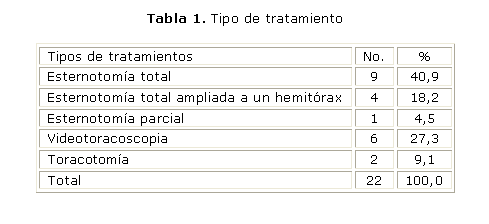
<body><![CDATA[<P><font face="Verdana" size="3"><B>RESULTADOS</B></font><font face="Verdana" size="2">    </font>      <P>      <P><font face="Verdana" size="2">De los 22 pacientes, 12 eran del sexo femenino    (54,5 %). La edad vari&oacute; de 26 a 82 a&ntilde;os, con una mediana de 46,5.    El 72,7 % (16) ten&iacute;a sobrepeso o era obeso. De los 12 casos con miastenia    grave, 10 se clasificaron como II B (clasificaci&oacute;n de <I>Osserman</I>),    y 2 como II A. El tratamiento m&aacute;s empleado fue la estenotom&iacute;a    total en 9 pacientes (40,9 %) (<a href="#tab1">tabla 1</a>).<B> </B>De los 6    operados por m&iacute;nimo acceso se convirtieron 2, uno por no soportar la    ventilaci&oacute;n selectiva, y otro ante la sospecha de infiltraci&oacute;n    vascular, que no se confirm&oacute; en la cirug&iacute;a abierta. </font>      <P align="center"><a name="tab1"></a><img src="/img/revistas/cir/v50n3/t0107311.gif" width="489" height="224">      
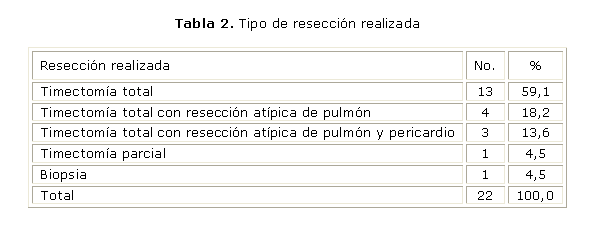
<P>      <P>      <P><font face="Verdana" size="2">No fue resecable 1 caso (4,5 %) por infiltraci&oacute;n    amplia de los vasos mediastinales, en otro se realiz&oacute; la resecci&oacute;n    parcial por infiltraci&oacute;n del miocardio (4,5 %), mientras en 20 (90,9    %) la resecci&oacute;n fue total. La timectom&iacute;a total con la grasa perit&iacute;mica    fue el tipo de resecci&oacute;n m&aacute;s empleada (<a href="/img/revistas/cir/v50n3/t0207311.gif">tabla    2</a>). </font>      
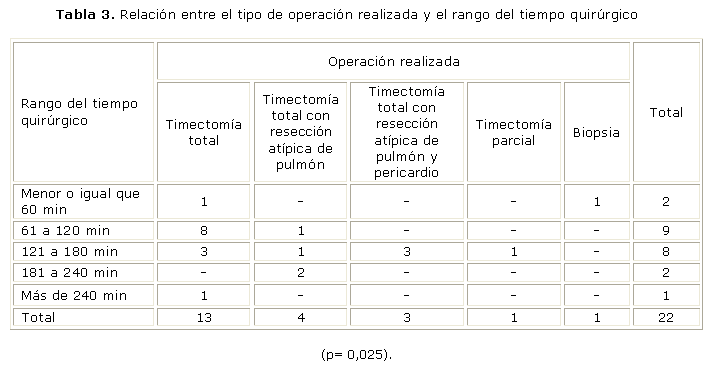
<P>      <P>      <P><font face="Verdana" size="2">El tiempo quir&uacute;rgico vari&oacute; de 50    a 260 min con una mediana de 127,5. No tuvo relaci&oacute;n con la v&iacute;a    de tratamiento (p= 0,564). La mayor&iacute;a de las timectom&iacute;as totales    se realizaron entre 61 y 120 min, mientras que casi todas las resecciones ampliadas    se realizaron entre los 121 y 240 min (<a href="/img/revistas/cir/v50n3/t0307311.gif">tabla 3</a>).    </font>      
]]></body>
<body><![CDATA[<P>      <P>      <P><font face="Verdana" size="2">El sangrado estuvo entre los 100 y 500 mL en    11 (50 %), en 6 fue menos de 100 mL (37,3 %), en 4 estuvo entre 500 y 1 000    mL (18,2 %), y en 1 fue m&aacute;s de 1&#160;000 mL (4,5 %), sin guardar relaci&oacute;n    estad&iacute;stica con el proceder ni el tipo de resecci&oacute;n (p= 0,479    y p= 0,194 respectivamente). El sangrado por encima de 100 mL estuvo asociado    con un tiempo quir&uacute;rgico de 61 a 180 min (p= 0,036). La sonda de drenaje    se mantuvo de 2 a 72 h con una mediana de 39,4. </font>     <P><font face="Verdana" size="2">Se complicaron 11 pacientes (50 %), 5 por causa    respiratoria (22,7 %), 3 relacionadas con la miastenia (13,6 %) y con el proceder    quir&uacute;rgico respectivamente, de esta &uacute;ltima 2 hemot&oacute;rax    residuales y una par&aacute;lisis transitoria del nervio fr&eacute;nico izquierdo.    Hubo 1 fallecido (4,5 %) a las 2 h de la cirug&iacute;a, por arritmia cardiovascular,    en una paciente que, adem&aacute;s de la resecci&oacute;n del tumor y el pericardio,    se le practic&oacute; una traqueostom&iacute;a por estenosis traqueal isqu&eacute;mica.    El tama&ntilde;o del tumor vari&oacute; de 3,5 a 20 cm, con una mediana de 7.    Hubo relaci&oacute;n entre el proceder quir&uacute;rgico y el tama&ntilde;o    del tumor, ya que en las 4 esternotom&iacute;as que se ampliaron con toracotom&iacute;a    (<a href="#fig1">Fig.</a>) el tumor ten&iacute;a m&aacute;s de 10 cm,<B> </B>la    videotoracoscopia por debajo de los 4,5 cm y entre los 5 y 9,5 cm la esternotom&iacute;a    total<B> </B>(p= 0,032). </font>     <P>     <P align="center"><a name="fig1"></a><img src="/img/revistas/cir/v50n3/f0107311.jpg" width="580" height="358">      
<P>      <P>      <P><font face="Verdana" size="2">De todos los tumores, en solo 2 (9,1 %) se encontr&oacute;    tejido t&iacute;mico ect&oacute;pico en la grasa perit&iacute;mica, 19 eran    timomas (86,4 %) (<a href="/img/revistas/cir/v50n3/t0407311.gif">tabla 4</a>), de los cuales solo 11    se asociaron con miastenia grave (57,9 %), enfermedad tambi&eacute;n asociada    a un timolipoma. Seg&uacute;n la clasificaci&oacute;n de <I>Masaoka,</I> 12    de los timomas (54,5 %), pertenecieron al estadio I, 1 (4,5 %) al II, 3 (13,6    %) al III, 1 (4,5 %) al IV A, y 2 (9,1 %) al IV B. Por la clasificaci&oacute;n    del la OMS pertenecen al grupo A, 2 (9,1 %), 1 al AB (4,5 %), 5 al B1 (22,7    %), 1 al B2 (4,5 %), 4 al B3 (18,2 %) y 6 al C (27,3 %). El paciente del tumor    neuroendocrino recidiv&oacute; a los 10 meses, mientras los pacientes con timomas    no muestran hasta la fecha recidiva local ni se ha comprobado actividad metast&aacute;sica.    </font>     
<P>      ]]></body>
<body><![CDATA[<P>      <P>      <P><font face="Verdana" size="3"><B>DISCUSI&Oacute;N</B> </font>      <P>      <P><font face="Verdana" size="2">Los timomas se pueden asociar a enfermedades    autoinmunes, de ellas la miastenia grave es la m&aacute;s frecuente,<SUP>3,7,8</SUP>    ya que puede estar presente entre el 30 y el 60 % de estos enfermos,<SUP>3</SUP>    en especial los clasificados como B1 y B2.<SUP>9,10</SUP> </font>     <P><font face="Verdana" size="2">La cirug&iacute;a constituye el paso m&aacute;s    importante en el tratamiento a estos tumores, porque permite conocer el estadio    que tiene el paciente, la clasificaci&oacute;n histol&oacute;gica, y al mismo    tiempo, se realiza la primera parte del tratamiento.<SUP>11</SUP> Despu&eacute;s    de la cirug&iacute;a, la clasificaci&oacute;n de <I>Masaoka</I>, la histol&oacute;gica    de la OMS, y la resecci&oacute;n completa de la lesi&oacute;n, constituyen los    factores pron&oacute;sticos m&aacute;s importantes.<SUP>12-14</SUP> </font>     <P><font face="Verdana" size="2">En el tratamiento de los timomas en estadio I-II    de <I>Masaoka</I>, es fundamental la resecci&oacute;n quir&uacute;rgica del    timo con las estructuras adyacentes,<SUP>15,16</SUP> y la forma m&aacute;s empleada    es la v&iacute;a transesternal,<SUP>3,13,17</SUP> aunque en la actualidad la    videotoracoscopia en tumores peque&ntilde;os y que respeten la c&aacute;psula,    va ganando espacio.<SUP>17,18</SUP> El carcinoma t&iacute;mico difiere del timoma    en los cambios citopatol&oacute;gicos malignos, la invasi&oacute;n local extensa    y el gran potencial de met&aacute;stasis, lo que constituye un reto en el tratamiento    quir&uacute;rgico.<SUP>19</SUP> </font>     <P>      <P>      <P><font face="Verdana" size="3"><B>REFERENCIAS BIBLIOGR&Aacute;FICAS</B> </font>      ]]></body>
<body><![CDATA[<P>      <!-- ref --><P><font face="Verdana" size="2">1. Heinen FL. Cervical thymus. A case report    and literature review. Arch Argent Pediatr. 2009 Apr;107(2):168-70.     </font>      <!-- ref --><P><font face="Verdana" size="2">2. M&uuml;ller- Hermelink HK, Engel P, Kuo TT,    Str&ouml;bel PH, Mark A, Harris NL, et al. Tumours of the Thymous: Introduction.    En: Travis WD, Brambilla E, M&uuml;ller- Hermelink HK, Harris CC (Eds). World    Health Organization Classification of tumours. Pathology and Genetics of Tumours    of Lungs, Pleura, Thymus and Heart. Lyon: IARC Press; 2004. p. 148-51.     </font>     <!-- ref --><P><font face="Verdana" size="2">3. Kesler KA, Wright CD, Loehrer PJ Sr. Thymoma:    current medical and surgical management. Semin Neurol. 2004 Mar;24(1):63-73.        </font>      <!-- ref --><P><font face="Verdana" size="2">4. Kurup A, Loehrer PJ Sr. Thymoma and thymic    carcinoma: therapeutic approaches. Clin Lung Cancer. 2004 Jul;6(1):28-32.     </font>      <!-- ref --><P><font face="Verdana" size="2">5. Lau CL, Davis RD. The Mediastinum. En: Townsend    CM, Beauchamp RD, Evers BM, Mattox KC. (Eds.). Sabiston Textbook of Surgery.    The Biological Basis of Modern Surgical Practice. 17<SUP>th</SUP> ed. Philadelphia:    Elsevier Saunders; 2004. p.1 735-62.     </font>     <!-- ref --><P><font face="Verdana" size="2">6. Levine GD, Rosai J. Thymic hyperplasia and    neoplasia: a review of current concepts. Hum Pathol. 1978 Sep;9(5):495-515.        </font>      <!-- ref --><P><font face="Verdana" size="2">7. Skeie GO, Romi F. Paraneoplastic myasthenia    gravis: immunological and clinical aspects. Eur J Neurol. 2008 Oct;15(10):1    029-33.     </font>      <!-- ref --><P><font face="Verdana" size="2">8. Tormoehlen LM, Pascuzzi RM. Thymoma, myasthenia    gravis, and other paraneoplastic syndromes. Hematol Oncol Clin North Am. 2008    Jun;22(3):509-26.     </font>      <!-- ref --><P><font face="Verdana" size="2">9. Okumura M, Fujii Y, Shiono H, Inoue M, Minami    M, Utsumi T, et al. Immunological function of thymoma and pathogenesis of paraneoplastic    myasthenia gravis. Gen Thorac Cardiovasc Surg. 2008 Apr;56(4):143-50.     </font>      <!-- ref --><P><font face="Verdana" size="2">10. Okumura M, Shiono H, Minami M, Inoue M, Utsumi    T, Kadota Y, et al. Clinical and pathological aspects of thymic epithelial tumors.    Gen Thorac Cardiovasc Surg. 2008 Jan;56(1):10-6.     </font>      <!-- ref --><P><font face="Verdana" size="2">11. Girard N, Mornex F, Van Houtte P, Cordier    JF, van Schil P. Thymoma: a focus on current therapeutic management. Thorac    Oncol. 2009 Jan;4(1):119-26.     </font>      <!-- ref --><P><font face="Verdana" size="2">12. Wright CD. Management of thymomas. Crit Rev    Oncol Hematol. 2008 Feb;65(2):109-20.     </font>      <!-- ref --><P><font face="Verdana" size="2">13. Stremmel C, Passlick B. Surgery of mediastinal    tumors. Chirurg. 2008 Jan;79(1):9-10, 12-7.     </font>      <!-- ref --><P><font face="Verdana" size="2">14. Lalle M, Bellini V, Antimi M. Medical treatment    for thymoma: an update. Clin Ter. 2008 Mar-Apr;159(2):91-5.     </font>      <!-- ref --><P><font face="Verdana" size="2">15. Kaiser LR. Surgical treatment of thymic epithelial    neoplasms. Hematol Oncol Clin North Am. 2008 Jun;22(3):475-88.     </font>      <!-- ref --><P><font face="Verdana" size="2">16. Casey EM, Kiel PJ, Loehrer PJ Sr. Clinical    management of thymoma patients. Hematol Oncol Clin North Am. 2008 Jun;22(3):457-73.        </font>      <!-- ref --><P><font face="Verdana" size="2">17. R&uuml;ckert JC, Ismail M, Swierzy M, Braumann    C, Badakhshi H, Rogalla P, et al. Minimally invasive thymus surgery. Chirurg.    2008 Jan;79(1):18, 20-5.     </font>      <!-- ref --><P><font face="Verdana" size="2">18. Port JL, Ginsberg RJ. Surgery for thymoma.    Chest Surg Clin N Am. 2001 May;11(2):421-37.     </font>      <!-- ref --><P><font face="Verdana" size="2">19. Ayadi-Kaddour A, Bacha D, Smati B, Kilani    T, El Mezni F. Primary thymic carcinomas. Three cases and a review of the literature.    Rev Pneumol Clin. 2009 Apr;65(2):113-7.     </font>     <P>     ]]></body>
<body><![CDATA[<P>      <P>      <P>      <P>      <P>      <P><font face="Verdana" size="2">Recibido: 8 de febrero de 2011.    <br>   </font><font face="Verdana" size="2">Aprobado: 19 de marzo 2011. </font>     <P>     <P>      <P>      ]]></body>
<body><![CDATA[<P><font face="Verdana" size="2"><I>Miguel &Aacute;ngel Mart&iacute;n Gonz&aacute;lez.    </I>Hospital clinicoquir&uacute;rgico &quot;Hermanos Ameijeiras&quot;. Calle    San L&aacute;zaro y Belascoa&iacute;n, municipio Centro Habana. La Habana, Cuba.    Correo electr&oacute;nico: <U><FONT  COLOR="#0000ff"><a href="mailto:miguelmg@infomed.sld.cu">miguelmg@infomed.sld.cu</a></FONT></U>    </font>       ]]></body><back>
<ref-list>
<ref id="B1">
<label>1</label><nlm-citation citation-type="journal">
<person-group person-group-type="author">
<name>
<surname><![CDATA[Heinen]]></surname>
<given-names><![CDATA[FL]]></given-names>
</name>
</person-group>
<article-title xml:lang="en"><![CDATA[Cervical thymus: A case report and literature review]]></article-title>
<source><![CDATA[Arch Argent Pediatr.]]></source>
<year>2009</year>
<month> A</month>
<day>pr</day>
<volume>107</volume>
<numero>2</numero>
<issue>2</issue>
<page-range>168-70</page-range></nlm-citation>
</ref>
<ref id="B2">
<label>2</label><nlm-citation citation-type="book">
<person-group person-group-type="author">
<name>
<surname><![CDATA[Müller- Hermelink]]></surname>
<given-names><![CDATA[HK]]></given-names>
</name>
<name>
<surname><![CDATA[Engel]]></surname>
<given-names><![CDATA[P]]></given-names>
</name>
<name>
<surname><![CDATA[Kuo]]></surname>
<given-names><![CDATA[TT]]></given-names>
</name>
<name>
<surname><![CDATA[Ströbel]]></surname>
<given-names><![CDATA[PH]]></given-names>
</name>
<name>
<surname><![CDATA[Mark]]></surname>
<given-names><![CDATA[A]]></given-names>
</name>
<name>
<surname><![CDATA[Harris]]></surname>
<given-names><![CDATA[NL]]></given-names>
</name>
</person-group>
<article-title xml:lang="en"><![CDATA[Tumours of the Thymous: Introduction]]></article-title>
<person-group person-group-type="editor">
<name>
<surname><![CDATA[Travis]]></surname>
<given-names><![CDATA[WD]]></given-names>
</name>
<name>
<surname><![CDATA[Brambilla]]></surname>
<given-names><![CDATA[E]]></given-names>
</name>
<name>
<surname><![CDATA[Müller- Hermelink]]></surname>
<given-names><![CDATA[HK]]></given-names>
</name>
<name>
<surname><![CDATA[Harris]]></surname>
<given-names><![CDATA[CC]]></given-names>
</name>
</person-group>
<collab>World Health Organization Classification of tumours</collab>
<source><![CDATA[Pathology and Genetics of Tumours of Lungs, Pleura, Thymus and Heart]]></source>
<year>2004</year>
<page-range>148-51</page-range><publisher-loc><![CDATA[Lyon ]]></publisher-loc>
<publisher-name><![CDATA[IARC Press]]></publisher-name>
</nlm-citation>
</ref>
<ref id="B3">
<label>3</label><nlm-citation citation-type="journal">
<person-group person-group-type="author">
<name>
<surname><![CDATA[Kesler]]></surname>
<given-names><![CDATA[KA]]></given-names>
</name>
<name>
<surname><![CDATA[Wright]]></surname>
<given-names><![CDATA[CD]]></given-names>
</name>
<name>
<surname><![CDATA[Loehrer]]></surname>
<given-names><![CDATA[PJ Sr]]></given-names>
</name>
</person-group>
<article-title xml:lang="en"><![CDATA[Thymoma: current medical and surgical management]]></article-title>
<source><![CDATA[Semin Neurol.]]></source>
<year>2004</year>
<month> M</month>
<day>ar</day>
<volume>24</volume>
<numero>1</numero>
<issue>1</issue>
<page-range>63-73</page-range></nlm-citation>
</ref>
<ref id="B4">
<label>4</label><nlm-citation citation-type="journal">
<person-group person-group-type="author">
<name>
<surname><![CDATA[Kurup]]></surname>
<given-names><![CDATA[A]]></given-names>
</name>
<name>
<surname><![CDATA[Loehrer]]></surname>
<given-names><![CDATA[PJ Sr]]></given-names>
</name>
</person-group>
<article-title xml:lang="en"><![CDATA[Thymoma and thymic carcinoma: therapeutic approaches]]></article-title>
<source><![CDATA[Clin Lung Cancer.]]></source>
<year>2004</year>
<month> J</month>
<day>ul</day>
<volume>6</volume>
<numero>1</numero>
<issue>1</issue>
<page-range>28-32</page-range></nlm-citation>
</ref>
<ref id="B5">
<label>5</label><nlm-citation citation-type="book">
<person-group person-group-type="author">
<name>
<surname><![CDATA[Lau]]></surname>
<given-names><![CDATA[CL]]></given-names>
</name>
<name>
<surname><![CDATA[Davis]]></surname>
<given-names><![CDATA[RD]]></given-names>
</name>
</person-group>
<article-title xml:lang="en"><![CDATA[The Mediastinum]]></article-title>
<person-group person-group-type="editor">
<name>
<surname><![CDATA[Townsend]]></surname>
<given-names><![CDATA[CM]]></given-names>
</name>
<name>
<surname><![CDATA[Beauchamp]]></surname>
<given-names><![CDATA[RD]]></given-names>
</name>
<name>
<surname><![CDATA[Evers]]></surname>
<given-names><![CDATA[BM]]></given-names>
</name>
<name>
<surname><![CDATA[Mattox]]></surname>
<given-names><![CDATA[KC]]></given-names>
</name>
</person-group>
<source><![CDATA[Sabiston Textbook of Surgery. The Biological Basis of Modern Surgical Practice]]></source>
<year>2004</year>
<edition>17</edition>
<page-range>1735-62</page-range><publisher-loc><![CDATA[Philadelphia ]]></publisher-loc>
<publisher-name><![CDATA[Elsevier Saunders]]></publisher-name>
</nlm-citation>
</ref>
<ref id="B6">
<label>6</label><nlm-citation citation-type="journal">
<person-group person-group-type="author">
<name>
<surname><![CDATA[Levine]]></surname>
<given-names><![CDATA[GD]]></given-names>
</name>
<name>
<surname><![CDATA[Rosai]]></surname>
<given-names><![CDATA[J]]></given-names>
</name>
</person-group>
<article-title xml:lang="en"><![CDATA[Thymic hyperplasia and neoplasia: a review of current concepts]]></article-title>
<source><![CDATA[Hum Pathol.]]></source>
<year>1978</year>
<month> S</month>
<day>ep</day>
<volume>9</volume>
<numero>5</numero>
<issue>5</issue>
<page-range>495-515</page-range></nlm-citation>
</ref>
<ref id="B7">
<label>7</label><nlm-citation citation-type="journal">
<person-group person-group-type="author">
<name>
<surname><![CDATA[Skeie]]></surname>
<given-names><![CDATA[GO]]></given-names>
</name>
<name>
<surname><![CDATA[Romi]]></surname>
<given-names><![CDATA[F]]></given-names>
</name>
</person-group>
<article-title xml:lang="en"><![CDATA[Paraneoplastic myasthenia gravis: immunological and clinical aspects]]></article-title>
<source><![CDATA[Eur J Neurol.]]></source>
<year>2008</year>
<month> O</month>
<day>ct</day>
<volume>15</volume>
<numero>10</numero>
<issue>10</issue>
<page-range>1 029-33</page-range></nlm-citation>
</ref>
<ref id="B8">
<label>8</label><nlm-citation citation-type="journal">
<person-group person-group-type="author">
<name>
<surname><![CDATA[Tormoehlen]]></surname>
<given-names><![CDATA[LM]]></given-names>
</name>
<name>
<surname><![CDATA[Pascuzzi]]></surname>
<given-names><![CDATA[RM]]></given-names>
</name>
</person-group>
<article-title xml:lang="en"><![CDATA[Thymoma, myasthenia gravis, and other paraneoplastic syndromes]]></article-title>
<source><![CDATA[Hematol Oncol Clin North Am]]></source>
<year>2008</year>
<month> J</month>
<day>un</day>
<volume>22</volume>
<numero>3</numero>
<issue>3</issue>
<page-range>509-26</page-range></nlm-citation>
</ref>
<ref id="B9">
<label>9</label><nlm-citation citation-type="journal">
<person-group person-group-type="author">
<name>
<surname><![CDATA[Okumura]]></surname>
<given-names><![CDATA[M]]></given-names>
</name>
<name>
<surname><![CDATA[Fujii]]></surname>
<given-names><![CDATA[Y]]></given-names>
</name>
<name>
<surname><![CDATA[Shiono]]></surname>
<given-names><![CDATA[H]]></given-names>
</name>
<name>
<surname><![CDATA[Inoue]]></surname>
<given-names><![CDATA[M]]></given-names>
</name>
<name>
<surname><![CDATA[Minami]]></surname>
<given-names><![CDATA[M]]></given-names>
</name>
<name>
<surname><![CDATA[Utsumi]]></surname>
<given-names><![CDATA[T]]></given-names>
</name>
</person-group>
<article-title xml:lang="en"><![CDATA[Immunological function of thymoma and pathogenesis of paraneoplastic myasthenia gravis]]></article-title>
<source><![CDATA[Gen Thorac Cardiovasc Surg]]></source>
<year>2008</year>
<month> A</month>
<day>pr</day>
<volume>56</volume>
<numero>4</numero>
<issue>4</issue>
<page-range>143-50</page-range></nlm-citation>
</ref>
<ref id="B10">
<label>10</label><nlm-citation citation-type="journal">
<person-group person-group-type="author">
<name>
<surname><![CDATA[Okumura]]></surname>
<given-names><![CDATA[M]]></given-names>
</name>
<name>
<surname><![CDATA[Shiono]]></surname>
<given-names><![CDATA[H]]></given-names>
</name>
<name>
<surname><![CDATA[Minami]]></surname>
<given-names><![CDATA[M]]></given-names>
</name>
<name>
<surname><![CDATA[Inoue]]></surname>
<given-names><![CDATA[M]]></given-names>
</name>
<name>
<surname><![CDATA[Utsumi]]></surname>
<given-names><![CDATA[T]]></given-names>
</name>
<name>
<surname><![CDATA[Kadota]]></surname>
<given-names><![CDATA[Y]]></given-names>
</name>
</person-group>
<article-title xml:lang="en"><![CDATA[Clinical and pathological aspects of thymic epithelial tumors]]></article-title>
<source><![CDATA[Gen Thorac Cardiovasc Surg]]></source>
<year>2008</year>
<month> J</month>
<day>an</day>
<volume>56</volume>
<numero>1</numero>
<issue>1</issue>
<page-range>10-6</page-range></nlm-citation>
</ref>
<ref id="B11">
<label>11</label><nlm-citation citation-type="journal">
<person-group person-group-type="author">
<name>
<surname><![CDATA[Girard]]></surname>
<given-names><![CDATA[N]]></given-names>
</name>
<name>
<surname><![CDATA[Mornex]]></surname>
<given-names><![CDATA[F]]></given-names>
</name>
<name>
<surname><![CDATA[Van Houtte]]></surname>
<given-names><![CDATA[P]]></given-names>
</name>
<name>
<surname><![CDATA[Cordier]]></surname>
<given-names><![CDATA[JF]]></given-names>
</name>
<name>
<surname><![CDATA[van Schil]]></surname>
<given-names><![CDATA[P]]></given-names>
</name>
</person-group>
<article-title xml:lang="en"><![CDATA[Thymoma: a focus on current therapeutic management]]></article-title>
<source><![CDATA[Thorac Oncol.]]></source>
<year>2009</year>
<month> J</month>
<day>an</day>
<volume>4</volume>
<numero>1</numero>
<issue>1</issue>
<page-range>119-26</page-range></nlm-citation>
</ref>
<ref id="B12">
<label>12</label><nlm-citation citation-type="journal">
<person-group person-group-type="author">
<name>
<surname><![CDATA[Wright]]></surname>
<given-names><![CDATA[CD]]></given-names>
</name>
</person-group>
<article-title xml:lang="en"><![CDATA[Management of thymomas]]></article-title>
<source><![CDATA[Crit Rev Oncol Hematol]]></source>
<year>2008</year>
<month> F</month>
<day>eb</day>
<volume>65</volume>
<numero>2</numero>
<issue>2</issue>
<page-range>109-20</page-range></nlm-citation>
</ref>
<ref id="B13">
<label>13</label><nlm-citation citation-type="journal">
<person-group person-group-type="author">
<name>
<surname><![CDATA[Stremmel]]></surname>
<given-names><![CDATA[C]]></given-names>
</name>
<name>
<surname><![CDATA[Passlick]]></surname>
<given-names><![CDATA[B]]></given-names>
</name>
</person-group>
<article-title xml:lang="en"><![CDATA[Surgery of mediastinal tumors]]></article-title>
<source><![CDATA[Chirurg]]></source>
<year>2008</year>
<month> J</month>
<day>an</day>
<volume>79</volume>
<numero>1</numero>
<issue>1</issue>
<page-range>12-7</page-range></nlm-citation>
</ref>
<ref id="B14">
<label>14</label><nlm-citation citation-type="journal">
<person-group person-group-type="author">
<name>
<surname><![CDATA[Lalle]]></surname>
<given-names><![CDATA[M]]></given-names>
</name>
<name>
<surname><![CDATA[Bellini]]></surname>
<given-names><![CDATA[V]]></given-names>
</name>
<name>
<surname><![CDATA[Antimi]]></surname>
<given-names><![CDATA[M]]></given-names>
</name>
</person-group>
<article-title xml:lang="en"><![CDATA[Medical treatment for thymoma: an update]]></article-title>
<source><![CDATA[Clin Ter.]]></source>
<year>2008</year>
<month> M</month>
<day>ar</day>
<volume>159</volume>
<numero>2</numero>
<issue>2</issue>
<page-range>91-5</page-range></nlm-citation>
</ref>
<ref id="B15">
<label>15</label><nlm-citation citation-type="journal">
<person-group person-group-type="author">
<name>
<surname><![CDATA[Kaiser]]></surname>
<given-names><![CDATA[LR]]></given-names>
</name>
</person-group>
<article-title xml:lang="en"><![CDATA[Surgical treatment of thymic epithelial neoplasms]]></article-title>
<source><![CDATA[Hematol Oncol Clin North Am]]></source>
<year>2008</year>
<month> J</month>
<day>un</day>
<volume>22</volume>
<numero>3</numero>
<issue>3</issue>
<page-range>475-88</page-range></nlm-citation>
</ref>
<ref id="B16">
<label>16</label><nlm-citation citation-type="journal">
<person-group person-group-type="author">
<name>
<surname><![CDATA[Casey]]></surname>
<given-names><![CDATA[EM]]></given-names>
</name>
<name>
<surname><![CDATA[Kiel]]></surname>
<given-names><![CDATA[PJ]]></given-names>
</name>
<name>
<surname><![CDATA[Loehrer]]></surname>
<given-names><![CDATA[PJ Sr]]></given-names>
</name>
</person-group>
<article-title xml:lang="en"><![CDATA[Clinical management of thymoma patients]]></article-title>
<source><![CDATA[Hematol Oncol Clin North Am]]></source>
<year>2008</year>
<month> J</month>
<day>un</day>
<volume>22</volume>
<numero>3</numero>
<issue>3</issue>
<page-range>457-73</page-range></nlm-citation>
</ref>
<ref id="B17">
<label>17</label><nlm-citation citation-type="journal">
<person-group person-group-type="author">
<name>
<surname><![CDATA[Rückert]]></surname>
<given-names><![CDATA[JC]]></given-names>
</name>
<name>
<surname><![CDATA[Ismail]]></surname>
<given-names><![CDATA[M]]></given-names>
</name>
<name>
<surname><![CDATA[Swierzy]]></surname>
<given-names><![CDATA[M]]></given-names>
</name>
<name>
<surname><![CDATA[Braumann]]></surname>
<given-names><![CDATA[C]]></given-names>
</name>
<name>
<surname><![CDATA[Badakhshi]]></surname>
<given-names><![CDATA[H]]></given-names>
</name>
<name>
<surname><![CDATA[Rogalla]]></surname>
<given-names><![CDATA[P]]></given-names>
</name>
</person-group>
<article-title xml:lang="en"><![CDATA[Minimally invasive thymus surgery]]></article-title>
<source><![CDATA[Chirurg]]></source>
<year>2008</year>
<month> J</month>
<day>an</day>
<volume>79</volume>
<numero>1</numero>
<issue>1</issue>
<page-range>18, 20-5</page-range></nlm-citation>
</ref>
<ref id="B18">
<label>18</label><nlm-citation citation-type="journal">
<person-group person-group-type="author">
<name>
<surname><![CDATA[Port]]></surname>
<given-names><![CDATA[JL]]></given-names>
</name>
<name>
<surname><![CDATA[Ginsberg]]></surname>
<given-names><![CDATA[RJ]]></given-names>
</name>
</person-group>
<article-title xml:lang="en"><![CDATA[Surgery for thymoma]]></article-title>
<source><![CDATA[Chest Surg Clin N Am]]></source>
<year>2001</year>
<month> M</month>
<day>ay</day>
<volume>11</volume>
<numero>2</numero>
<issue>2</issue>
<page-range>421-37</page-range></nlm-citation>
</ref>
<ref id="B19">
<label>19</label><nlm-citation citation-type="journal">
<person-group person-group-type="author">
<name>
<surname><![CDATA[Ayadi-Kaddour]]></surname>
<given-names><![CDATA[A]]></given-names>
</name>
<name>
<surname><![CDATA[Bacha]]></surname>
<given-names><![CDATA[D]]></given-names>
</name>
<name>
<surname><![CDATA[Smati]]></surname>
<given-names><![CDATA[B]]></given-names>
</name>
<name>
<surname><![CDATA[Kilani]]></surname>
<given-names><![CDATA[T]]></given-names>
</name>
<name>
<surname><![CDATA[El Mezni]]></surname>
<given-names><![CDATA[F]]></given-names>
</name>
</person-group>
<article-title xml:lang="en"><![CDATA[Primary thymic carcinomas: Three cases and a review of the literature]]></article-title>
<source><![CDATA[Rev Pneumol Clin.]]></source>
<year>2009</year>
<month> A</month>
<day>pr</day>
<volume>65</volume>
<numero>2</numero>
<issue>2</issue>
<page-range>113-7</page-range></nlm-citation>
</ref>
</ref-list>
</back>
</article>