<?xml version="1.0" encoding="ISO-8859-1"?><article xmlns:mml="http://www.w3.org/1998/Math/MathML" xmlns:xlink="http://www.w3.org/1999/xlink" xmlns:xsi="http://www.w3.org/2001/XMLSchema-instance">
<front>
<journal-meta>
<journal-id>0034-7507</journal-id>
<journal-title><![CDATA[Revista Cubana de Estomatología]]></journal-title>
<abbrev-journal-title><![CDATA[Rev Cubana Estomatol]]></abbrev-journal-title>
<issn>0034-7507</issn>
<publisher>
<publisher-name><![CDATA[Editorial Ciencias Médicas]]></publisher-name>
</publisher>
</journal-meta>
<article-meta>
<article-id>S0034-75072010000200012</article-id>
<title-group>
<article-title xml:lang="es"><![CDATA[Síndrome de ectrodactilia, displasia ectodérmica y labio-paladar hendidos]]></article-title>
<article-title xml:lang="en"><![CDATA[Syndrome of Ectrodactylism, ectodermic dysplasia and lip-cleft palate]]></article-title>
</title-group>
<contrib-group>
<contrib contrib-type="author">
<name>
<surname><![CDATA[Salazar Fernández]]></surname>
<given-names><![CDATA[Mario A.]]></given-names>
</name>
<xref ref-type="aff" rid="A01"/>
</contrib>
<contrib contrib-type="author">
<name>
<surname><![CDATA[Romero de León]]></surname>
<given-names><![CDATA[Elías]]></given-names>
</name>
<xref ref-type="aff" rid="A01"/>
</contrib>
<contrib contrib-type="author">
<name>
<surname><![CDATA[Menchaca Flores]]></surname>
<given-names><![CDATA[Pedro N.]]></given-names>
</name>
<xref ref-type="aff" rid="A01"/>
</contrib>
<contrib contrib-type="author">
<name>
<surname><![CDATA[Torre Martinez]]></surname>
<given-names><![CDATA[Hilda H. H.]]></given-names>
</name>
<xref ref-type="aff" rid="A01"/>
</contrib>
<contrib contrib-type="author">
<name>
<surname><![CDATA[Sepúlveda Infante]]></surname>
<given-names><![CDATA[Rogelio]]></given-names>
</name>
<xref ref-type="aff" rid="A01"/>
</contrib>
</contrib-group>
<aff id="A01">
<institution><![CDATA[,Facultad de Odontología Universidad Autónoma de Nuevo León ]]></institution>
<addr-line><![CDATA[Monterrey ]]></addr-line>
<country>México</country>
</aff>
<pub-date pub-type="pub">
<day>00</day>
<month>06</month>
<year>2010</year>
</pub-date>
<pub-date pub-type="epub">
<day>00</day>
<month>06</month>
<year>2010</year>
</pub-date>
<volume>47</volume>
<numero>2</numero>
<fpage>236</fpage>
<lpage>242</lpage>
<copyright-statement/>
<copyright-year/>
<self-uri xlink:href="http://scielo.sld.cu/scielo.php?script=sci_arttext&amp;pid=S0034-75072010000200012&amp;lng=en&amp;nrm=iso"></self-uri><self-uri xlink:href="http://scielo.sld.cu/scielo.php?script=sci_abstract&amp;pid=S0034-75072010000200012&amp;lng=en&amp;nrm=iso"></self-uri><self-uri xlink:href="http://scielo.sld.cu/scielo.php?script=sci_pdf&amp;pid=S0034-75072010000200012&amp;lng=en&amp;nrm=iso"></self-uri><abstract abstract-type="short" xml:lang="es"><p><![CDATA[El presente trabajo se propone reportar a un paciente masculino de 12 años de edad con presencia de la tríada completa del síndrome ectrodactilia, displasia ectodérmica y labio-paladar hendidos (EEC); señalar los hallazgos clínicos encontrados en las valoraciones, así como los tratamientos realizados. Es un síndrome autonómico dominante, con penetración incompleta y expresividad variable. Esta conjunción de signos y síntomas puede llevar a la confusión con otro tipo de entidades clínicas, y ocasionar un diagnóstico erróneo del paciente. La hendidura de labio y ausencia del conducto lagrimal no es una combinación usual en otras condiciones. Se hace mención de las manifestaciones clínicas reportadas en la literatura, y se enfatiza en las manifestaciones maxilofaciales y dentales. Los dos hermanos del paciente se consideraron normales o exentos de este síndrome.]]></p></abstract>
<abstract abstract-type="short" xml:lang="en"><p><![CDATA[In present paper is reported the case of a patient presenting with the complete triad of Ectrodactylism syndrome, ectodermic dysplasia and lip-cleft palate, to mention the clinical findings present in assessments as well as the treatments applied. The syndrome is characterized by the triad Ectrodactylism, ectodermic dysplasia and cleft (EEC) and it is autosomal dominant with incomplete penetration and a variable expressiveness. This group of signs and symptoms may be cofounded with other clinical entities, leading to a mistake diagnosis of patient. Lip cleft and lack of lacrimal duct is not a usual combination in other conditions. This is the clinical case of a male patient aged 12 with the syndrome of: Ectrodactylism, ectodermic dysplasia and lip-cleft palate. Clinical manifestations reported in literature are mentioned emphasizing the maxillofacial and dental manifestations. The two brothers of patient were normal or free of this syndrome. It is very important that the professionals charged of oral and maxillofacial health, as well the Stomatology students of Bachelor degree of postgraduate level, be able to identify, diagnose and to work in a multidisciplinary way to arrive to definite diagnosis of patients presenting with EEC syndrome and to apply the appropriate treatments.]]></p></abstract>
<kwd-group>
<kwd lng="es"><![CDATA[síndrome]]></kwd>
<kwd lng="es"><![CDATA[ectrodactilia]]></kwd>
<kwd lng="es"><![CDATA[displasia ectodérmica]]></kwd>
<kwd lng="es"><![CDATA[labio-paladar hendidos]]></kwd>
<kwd lng="es"><![CDATA[síndrome EEC]]></kwd>
<kwd lng="en"><![CDATA[Syndrome]]></kwd>
<kwd lng="en"><![CDATA[Ectrodactylism]]></kwd>
<kwd lng="en"><![CDATA[ectodermic dysplasia]]></kwd>
<kwd lng="en"><![CDATA[lip-cleft palate]]></kwd>
<kwd lng="en"><![CDATA[EEC syndrome]]></kwd>
</kwd-group>
</article-meta>
</front><body><![CDATA[ <P ALIGN="RIGHT"><FONT FACE="Verdana, Arial, Helvetica, sans-serif" SIZE="2"><B>PRESENTACI&Oacute;N  DE CASOS</B></FONT></P>    <P>&nbsp;</P>    <P><FONT FACE="Verdana, Arial, Helvetica, sans-serif" SIZE="2"><FONT SIZE="4"><B>S&iacute;ndrome  de ectrodactilia, displasia ectod&eacute;rmica y labio-paladar hendidos</B></FONT></FONT></P>    <P>&nbsp;</P><B>    <P>      <P><FONT FACE="Verdana, Arial, Helvetica, sans-serif" SIZE="3">Syndrome of Ectrodactylism,  ectodermic dysplasia and lip-cleft palate</FONT>    <P>    <P>    <P>     <P>     ]]></body>
<body><![CDATA[<P><FONT FACE="Verdana, Arial, Helvetica, sans-serif" SIZE="2">Mario  A. Salazar Fern&aacute;ndez<SUP>I</SUP>; El&iacute;as Romero de Le&oacute;n<SUP>II</SUP>;  Pedro N. Menchaca Flores<SUP>III</SUP>; Hilda H. H. Torre Martinez<SUP>III</SUP>;  Rogelio Sep&uacute;lveda Infante<SUP>IV</SUP></FONT></B>     <P>     <P><FONT FACE="Verdana, Arial, Helvetica, sans-serif" SIZE="2"><SUP>I  </SUP>Licenciado en Odontolog&iacute;a. Graduado del Posgrado de Ortodoncia. Facultad  de Odontolog&iacute;a, Universidad Aut&oacute;noma de Nuevo Le&oacute;n, M&eacute;xico.    <BR></FONT><FONT FACE="Verdana, Arial, Helvetica, sans-serif" SIZE="2"><SUP>II</SUP>  Licenciado en Odontolog&iacute;a. Pat&oacute;logo Bucal. Facultad de Odontolog&iacute;a,  Universidad Aut&oacute;noma de Nuevo Le&oacute;n, M&eacute;xico.    <BR></FONT><FONT FACE="Verdana, Arial, Helvetica, sans-serif" SIZE="2"><SUP>III</SUP>  Licenciado en Odontolog&iacute;a. Profesor del Posgrado de Ortodoncia. Facultad  de Odontolog&iacute;a, Universidad Aut&oacute;noma de Nuevo Le&oacute;n, M&eacute;xico.    <BR></FONT><FONT FACE="Verdana, Arial, Helvetica, sans-serif" SIZE="2"><SUP>IV</SUP>  Licenciado en Odontolog&iacute;a. Profesor del Departamento de Patolog&iacute;a  Bucal y del Departamento de Odontolog&iacute;a Preventiva y Social. Facultad de  Odontolog&iacute;a, Universidad Aut&oacute;noma de Nuevo Le&oacute;n, M&eacute;xico.</FONT>    <P>    <P>    <P><hr size="1" noshade>    <P><FONT FACE="Verdana, Arial, Helvetica, sans-serif" SIZE="2"><B>RESUMEN</B>  </FONT></P>    ]]></body>
<body><![CDATA[<P><FONT FACE="Verdana, Arial, Helvetica, sans-serif" SIZE="2">El presente  trabajo se propone reportar a un paciente masculino de 12 a&ntilde;os de edad  con presencia de la tr&iacute;ada completa del s&iacute;ndrome ectrodactilia,  displasia ectod&eacute;rmica y labio-paladar hendidos (EEC); se&ntilde;alar los  hallazgos cl&iacute;nicos encontrados en las valoraciones, as&iacute; como los  tratamientos realizados. </FONT>    <P><FONT FACE="Verdana, Arial, Helvetica, sans-serif" SIZE="2">Es  un s&iacute;ndrome auton&oacute;mico dominante, con penetraci&oacute;n incompleta  y expresividad variable. Esta conjunci&oacute;n de signos y s&iacute;ntomas puede  llevar a la confusi&oacute;n con otro tipo de entidades cl&iacute;nicas, y ocasionar  un diagn&oacute;stico err&oacute;neo del paciente. La hendidura de labio y ausencia  del conducto lagrimal no es una combinaci&oacute;n usual en otras condiciones.  </FONT>    <P><FONT FACE="Verdana, Arial, Helvetica, sans-serif" SIZE="2">Se hace  menci&oacute;n de las manifestaciones cl&iacute;nicas reportadas en la literatura,  y se enfatiza en las manifestaciones maxilofaciales y dentales. Los dos hermanos  del paciente se consideraron normales o exentos de este s&iacute;ndrome. </FONT>    <P>      <P><FONT FACE="Verdana, Arial, Helvetica, sans-serif" SIZE="2"><I>Palabras clave:</I>  s&iacute;ndrome, ectrodactilia, displasia ectod&eacute;rmica, labio-paladar hendidos,  s&iacute;ndrome EEC. <hr size="1" noshade></FONT>    <P>     <P><FONT FACE="Verdana, Arial, Helvetica, sans-serif" SIZE="2"><B>ABSTRACT</B>  </FONT>    <P><FONT FACE="Verdana, Arial, Helvetica, sans-serif" SIZE="2">In present  paper is reported the case of a patient presenting with the complete triad of  Ectrodactylism syndrome, ectodermic dysplasia and lip-cleft palate, to mention  the clinical findings present in assessments as well as the treatments applied.  The syndrome is characterized by the triad Ectrodactylism, ectodermic dysplasia  and cleft (EEC) and it is autosomal dominant with incomplete penetration and a  variable expressiveness. This group of signs and symptoms may be cofounded with  other clinical entities, leading to a mistake diagnosis of patient. Lip cleft  and lack of lacrimal duct is not a usual combination in other conditions. This  is the clinical case of a male patient aged 12 with the syndrome of: Ectrodactylism,  ectodermic dysplasia and lip-cleft palate. Clinical manifestations reported in  literature are mentioned emphasizing the maxillofacial and dental manifestations.  The two brothers of patient were normal or free of this syndrome. It is very important  that the professionals charged of oral and maxillofacial health, as well the Stomatology  students of Bachelor degree of postgraduate level, be able to identify, diagnose  and to work in a multidisciplinary way to arrive to definite diagnosis of patients  presenting with EEC syndrome and to apply the appropriate treatments. </FONT>    <P>      <P><FONT FACE="Verdana, Arial, Helvetica, sans-serif" SIZE="2"><I>Key words</I>:  Syndrome, Ectrodactylism, ectodermic dysplasia, lip-cleft palate, EEC syndrome.<hr size="1" noshade></FONT>    ]]></body>
<body><![CDATA[<P>&nbsp;</P>    <P><FONT FACE="Verdana, Arial, Helvetica, sans-serif" SIZE="2">  </FONT></P>    <P>     <P>     <P><FONT FACE="Verdana, Arial, Helvetica, sans-serif" SIZE="3"><B>INTRODUCCI&Oacute;N</B>  </FONT>     <P><FONT FACE="Verdana, Arial, Helvetica, sans-serif" SIZE="2">Generalmente  se les reconoce a <I>R&uuml;diger</I> y colaboradores en 1970, haber hecho la  asociaci&oacute;n de ectrodactilia, displasia ectod&eacute;rmica y labio-paladar  hendidos, e integrarlos como un s&iacute;ndrome.<SUP>1-3 </SUP>Sin embargo <I>Cockayne</I>  en 1936 y <I>Walker</I> y <I>Clodius</I> en 1963 ya hab&iacute;an reportado la  asociaci&oacute;n de las manifestaciones del s&iacute;ndrome,<SUP>1,4,5</SUP>  as&iacute; como <I>Eckoldt</I> y <I>Martens</I> en 1804.<SUP>6,7</SUP> </FONT>      <P><FONT FACE="Verdana, Arial, Helvetica, sans-serif" SIZE="2">El s&iacute;ndrome  resulta de una anomal&iacute;a del desarrollo que afecta simult&aacute;neamente  a los tejidos ectod&eacute;rmicos y mesod&eacute;rmicos.<SUP>2,8-10</SUP> Se menciona  en la literatura un patr&oacute;n heredado auton&oacute;mico dominante, con expresividad  variable y penetraci&oacute;n incompleta.<SUP>11-15</SUP> </FONT>     <P><FONT FACE="Verdana, Arial, Helvetica, sans-serif" SIZE="2">En  los pacientes con este s&iacute;ndrome se han reportado las siguientes manifestaciones  cl&iacute;nicas:</FONT>     <P><FONT FACE="Verdana, Arial, Helvetica, sans-serif" SIZE="2">-  Alteraciones faciales como hipoplasia del tercio medio de la cara,<SUP>2,8,9,15</SUP>  arcos supraorbitarios prominentes,<SUP>2</SUP> labio hendido bilateral acompa&ntilde;ado  de paladar hendido<SUP>2,6-8,10,12,15</SUP> y queilitis.<SUP>2</SUP> </FONT>     <P><FONT FACE="Verdana, Arial, Helvetica, sans-serif" SIZE="2">-  Alteraciones oft&aacute;lmicas como blefaritis,<SUP>2,12</SUP> dacriocistitis,<SUP>2,8,9,13</SUP>  queratoconjuntivitis,<SUP>2</SUP> fotofobia,<SUP>2,8,9,12</SUP> obstrucci&oacute;n  del conducto lacrimonasal,<SUP>3,12,13</SUP> disminuci&oacute;n visual,<SUP>3</SUP>  disminuci&oacute;n de la secreci&oacute;n lacrimal,<SUP>2,7-9,12</SUP> opacidad  de la c&oacute;rnea,<SUP>2,4,7,9</SUP> y ep&iacute;fora.<SUP>4,7,13</SUP> </FONT>      ]]></body>
<body><![CDATA[<P><FONT FACE="Verdana, Arial, Helvetica, sans-serif" SIZE="2">- Alteraciones  cut&aacute;neas como hiperqueratosis,<SUP>2,7,8</SUP> hipopigmentaci&oacute;n  de la piel,<SUP>2-4,7,8,12</SUP> dermatitis at&oacute;pica,<SUP>2</SUP> pelo corporal  escaso y seco,<SUP>2,4,6-10,12,13,16</SUP> cejas y pesta&ntilde;as escasas,<SUP>2,7-10</SUP>  gl&aacute;ndulas seb&aacute;ceas escasas,<SUP>2,9</SUP> nevos pigmentados,<SUP>3</SUP>  y piel seca.<SUP>4,7,9,12,15</SUP> </FONT>     <P><FONT FACE="Verdana, Arial, Helvetica, sans-serif" SIZE="2">-  Anomal&iacute;as digitales como ectrodactilia,<SUP>1,2,8-10,12,13,15</SUP> sindactilia,<SUP>1,2,4,7-10,12,13,15</SUP>  braquidactilia,<SUP>1</SUP> clindodactilia,<SUP>2</SUP> u&ntilde;as deformes y  displ&aacute;sicas,<SUP>2,3,7,13 </SUP>y camptodactilia. </FONT>     <P><FONT FACE="Verdana, Arial, Helvetica, sans-serif" SIZE="2">-  Anomal&iacute;as del sistema genitourinario como malformaciones renales,<SUP>7</SUP>  ausencia renal, ri&ntilde;&oacute;n hipopl&aacute;sico, hidronefrosis,<SUP>7,10</SUP>  hipospadias, y criptorquidia. </FONT>     <P><FONT FACE="Verdana, Arial, Helvetica, sans-serif" SIZE="2">-  Anomal&iacute;as dentales como hipodoncia,<SUP>1,3,6,8,10</SUP> anomal&iacute;as  de forma y tama&ntilde;o,<SUP>1,2,6-10</SUP> anomal&iacute;as de estructura, <SUP>1-3,7-10,12</SUP>  y maloclusi&oacute;n. </FONT>     <P><FONT FACE="Verdana, Arial, Helvetica, sans-serif" SIZE="2">-  Como otras manifestaciones asociadas se reportan hernia inguinal, disminuci&oacute;n  auditiva,<SUP>1-3,7,12,13,16</SUP> otitis media,<SUP>3</SUP> xerostom&iacute;a,<SUP>2,8</SUP>  ligera par&aacute;lisis facial,<SUP>1</SUP> deformaci&oacute;n del pabell&oacute;n  auricular,<SUP>1</SUP> ausencia del conducto de Stensen,<SUP>2</SUP> susceptibilidad  a la caries dental<SUP>2,3,8</SUP> y candidiasis bucal.<SUP>2,3</SUP> </FONT>      <P>    <BR><FONT FACE="Verdana, Arial, Helvetica, sans-serif" SIZE="2"><B>REPORTE  DE UN CASO</B> </FONT>    <P><FONT FACE="Verdana, Arial, Helvetica, sans-serif" SIZE="2">Paciente  D.M, masculino de 12 a&ntilde;os de edad que fue remitido a la Cl&iacute;nica  del Posgrado de Ortodoncia, para valoraci&oacute;n de maloclusi&oacute;n severa.  El paciente es hijo de un matrimonio no consangu&iacute;neo y tiene 2 hermanos  normales. </FONT>    <P>     <P><FONT FACE="Verdana, Arial, Helvetica, sans-serif" SIZE="2"><B>    ]]></body>
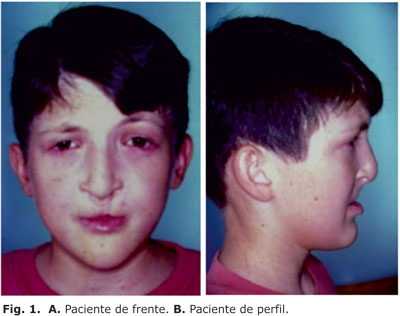
<body><![CDATA[<BR>Antecedentes</B>  </FONT>    <P><FONT FACE="Verdana, Arial, Helvetica, sans-serif" SIZE="2">Debido a  los padecimientos encontrados en el paciente se le realizaron los siguientes procedimientos  quir&uacute;rgicos: queilorrafia por hendidura labial bilateral, y palatorrafia  por paladar hendido, ureterostom&iacute;a, remoci&oacute;n de diverticulum y reconstrucci&oacute;n  uretral, orquiopexia, tratamiento por obstrucci&oacute;n uretral, reparaci&oacute;n  del paladar blando y cirug&iacute;a secundaria del labio superior. </FONT>    <P><FONT FACE="Verdana, Arial, Helvetica, sans-serif" SIZE="2">El  padre del paciente mencion&oacute; que uno de los ri&ntilde;ones del paciente  no funciona. </FONT>    <P>     <P><FONT FACE="Verdana, Arial, Helvetica, sans-serif" SIZE="2"><B>    <BR>  Examen cl&iacute;nico extrabucal</B> </FONT>     <P><FONT FACE="Verdana, Arial, Helvetica, sans-serif" SIZE="2"><I>Cara</I>:  Hipoplasia del tercio medio de la cara, que muestra cicatrices en el labio superior,  debidas a cirug&iacute;a para reparar labio hendido bilateral (<A HREF="#fig1">Figs.  1</A><B> </B>y<B> </B><A HREF="#fig2">2</A>).</FONT>    <P ALIGN="CENTER"><A HREF="#fig1"><IMG SRC="/img/revistas/est/v47n2/f0112210.jpg" WIDTH="400" HEIGHT="316" BORDER="0"></A><A NAME="fig1"></A>    
<P ALIGN="CENTER"><IMG SRC="/img/revistas/est/v47n2/f0212210.jpg" WIDTH="300" HEIGHT="289" BORDER="0"><A NAME="fig2"></A>    
<P><FONT FACE="Verdana, Arial, Helvetica, sans-serif" SIZE="2"><I>    ]]></body>
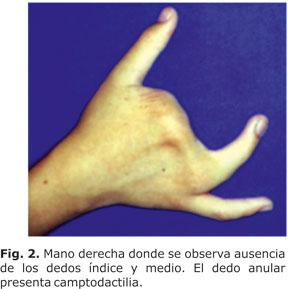
<body><![CDATA[<BR>Ojos</I>:  El examen de los ojos muestra eritema de los m&aacute;rgenes palpebrales, conjuntivitis  bilateral y ausencia de lagrimeo. En un ojo hay ausencia del conducto lacrimonasal,  y en el otro, antecedentes de dacriocistitis recurrente. El examen auditivo revela  ligera p&eacute;rdida de audici&oacute;n y otitis media bilateral. </FONT>    <P><FONT FACE="Verdana, Arial, Helvetica, sans-serif" SIZE="2"><I>Manos</I>:  La mano izquierda es normal, mientras que en la derecha se observa ausencia de  los dedos &iacute;ndice y medio. El dedo anular presenta camptodactilia (<A HREF="#fig3">Fig.  3</A>). </FONT>    <P ALIGN="CENTER"><IMG SRC="/img/revistas/est/v47n2/f0312210.jpg" WIDTH="300" HEIGHT="264" BORDER="0"><A NAME="fig3"></A>    
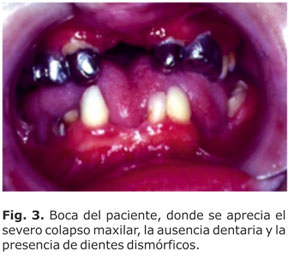
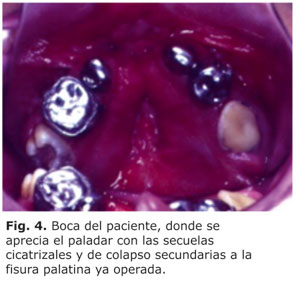
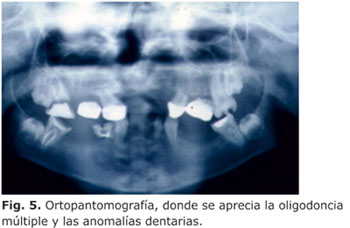
<P>    <BR>      <P>     <P><FONT FACE="Verdana, Arial, Helvetica, sans-serif" SIZE="2"><B>Examen cl&iacute;nico  intrabucal </B> </FONT>    <P><FONT FACE="Verdana, Arial, Helvetica, sans-serif" SIZE="2">El  examen cl&iacute;nico y radiogr&aacute;fico (ortopantomograf&iacute;a) muestra  una dentici&oacute;n mixta con ausencia de numerosas piezas dentales secundarias.  De los dientes presentes, algunos est&aacute;n cubiertos con coronas met&aacute;licas  y otros muestran anomal&iacute;as de forma, tama&ntilde;o y estructura, con una  maloclusi&oacute;n muy marcada (<A HREF="#fig4">Figs. 4</A> y <A HREF="#fig5">5</A>).  </FONT>    <P ALIGN="CENTER"><IMG SRC="/img/revistas/est/v47n2/f0412210.jpg" WIDTH="300" HEIGHT="283" BORDER="0"><A NAME="fig4"></A>    
<P ALIGN="CENTER"><IMG SRC="/img/revistas/est/v47n2/f0512210.jpg" WIDTH="350" HEIGHT="228" BORDER="0"><A NAME="fig5"></A>    
]]></body>
<body><![CDATA[<P><FONT FACE="Verdana, Arial, Helvetica, sans-serif" SIZE="2">    <BR>El  paladar revela reparaci&oacute;n quir&uacute;rgica por hendidura (Fig. 4). </FONT>    <P>    <BR>      <P><FONT FACE="Verdana, Arial, Helvetica, sans-serif" SIZE="2"><B>Diagn&oacute;stico</B>  </FONT>     <P><FONT FACE="Verdana, Arial, Helvetica, sans-serif" SIZE="2">El paciente  presenta el s&iacute;ndrome de ectrodactilia, displasia ectod&eacute;rmica y labio-paladar  hendidos. </FONT>     <P>    <BR>     <P><FONT FACE="Verdana, Arial, Helvetica, sans-serif" SIZE="2"><B>Plan  de tratamiento</B> </FONT>     <P><FONT FACE="Verdana, Arial, Helvetica, sans-serif" SIZE="2">El  paciente debe ser valorado y tratado por un equipo de profesionales que incluya  dermat&oacute;logo, oftalm&oacute;logo, ur&oacute;logo, otorrinolaring&oacute;logo,  audi&oacute;logo, logofoniatra, odontopediatra, ortodoncista y cirujano maxilofacial.  Debe tenerse en mente que las deficiencias auditivas y oculares empeoran de manera  progresiva.</FONT>     ]]></body>
<body><![CDATA[<P>    <P>     <P><FONT FACE="Verdana, Arial, Helvetica, sans-serif" SIZE="2"><B><FONT SIZE="3">CONCLUSIONES</FONT></B>  </FONT>    <P><FONT FACE="Verdana, Arial, Helvetica, sans-serif" SIZE="2">Es de vital  importancia que los profesionales encargados de la salud bucal y maxilofacial,  as&iacute; como los estudiantes de odontolog&iacute;a, tanto de licenciatura como  de posgrado, sean capaces de identificar, de diagnosticar, y de trabajar multidisciplinariamente  para llegar al diagn&oacute;stico definitivo de pacientes con s&iacute;ndrome  EEC, y efectuar los tratamientos adecuados.</FONT>    <P>    <P>     <P><FONT FACE="Verdana, Arial, Helvetica, sans-serif" SIZE="2"><B><FONT SIZE="3">REFERENCIAS  BIBLIOGR&Aacute;FICAS</FONT></B> </FONT>    <!-- ref --><P><FONT FACE="Verdana, Arial, Helvetica, sans-serif" SIZE="2">1.  Robinson GC, Wildervanck LS, Chiang TP. Ectrodactyly, Ectodermal Dysplasia and  Cleft Lip-Palate Syndrome. It&#180;s association with conductive hearing loss.  The Journal of Pediatrics. 1973;82:107-9. </FONT>    <!-- ref --><P><FONT FACE="Verdana, Arial, Helvetica, sans-serif" SIZE="2">2.  Pries C, Mittelman D, Miller M, Solomon LM, Pashayan HM, Pruzansky S. The EEC  Syndrome. Am J Dis Child. 1974;127:840_4. </FONT>    <!-- ref --><P><FONT FACE="Verdana, Arial, Helvetica, sans-serif" SIZE="2">3.  Bystrom EB, Sanger RG, Stewart R. The Syndrome of Ectrodactyly, Ectodermal Dysplasia  and Clefting (EEC). J Oral Surgery. 1975;33:192-8. </FONT>    <!-- ref --><P><FONT FACE="Verdana, Arial, Helvetica, sans-serif" SIZE="2">4.  Moshegov CN, Daya SM. Ectrodactyly-Ectodermal Dysplasia-Clefting (EEC) Syndrome.  Arch Ophthalmol. 1996;114:1290-1. </FONT>    <!-- ref --><P><FONT FACE="Verdana, Arial, Helvetica, sans-serif" SIZE="2">5.  Gorlin RJ, Pindborg JJ, Cohen MM. Syndrome of the Head and Neck. New York: McGraw-Hill  Book Company; 1976. </FONT>    <!-- ref --><P><FONT FACE="Verdana, Arial, Helvetica, sans-serif" SIZE="2">6.  Penchaszadeh VB, Negroti TC. Ectrodactyly-Ectodermal Dysplasia-Clefting (EEC)  Syndrome: Dominant inheritance and variable expression. J Med Genet. 1976;13:281-4.  </FONT>    <!-- ref --><P><FONT FACE="Verdana, Arial, Helvetica, sans-serif" SIZE="2">7. Buss  PW, Hughes HE, Clarke A. Twenty tour cases of the EEC Syndrome: Clinical Presentation  and Management. J Med Gent. 1995;32:716-23. </FONT>    <!-- ref --><P><FONT FACE="Verdana, Arial, Helvetica, sans-serif" SIZE="2">8.  Umerez C, Sosa RD, Simosa V. S&iacute;ndrome de Ectrodactilia, Displasia Ectod&eacute;rmica,  Hendidura (EEC): Revisi&oacute;n de la Literatura. Reporte de un caso. Acta Odontol  Venez. [online]. Jun. 2002, vol. 40, no. 2 [citado: 17 Septiembre 2009]. p. 172-6.  Disponible en: <A HREF="%3Chttp://www.scielo.org.ve/scielo.php?script=sci_arttext&pid=S000163652002000200013&%20Ing=es&nrm=iso%3E" TARGET="_blank">http://www.scielo.org.ve/scielo.php?script=sci_arttext&amp;pid=S000163652002000200013&amp;  Ing=es&amp;nrm=iso</A> ISSN 00016365. </FONT>    <!-- ref --><P><FONT FACE="Verdana, Arial, Helvetica, sans-serif" SIZE="2">9.  Fiorentini de ASF, Solari PH. Displasia ectod&eacute;rmica, ectrodactilia e fissura  l&aacute;bio-palatal: manifesta&ccedil;&otilde;es oculares da s&iacute;ndrome  em relato de caso. Arq Bras Oftalmol. 2007; 70,1: S&atilde;o Paulo, v. 70, no.  1, Feb. 2007. Available from <A HREF="http://www.scielo.br/scielo.php?script=sci_arttext&pid=S0004-27492007%20000100023&lng=en&nrm=iso" TARGET="_blank">http://www.scielo.br/scielo.php?script=sci_arttext&amp;pid=S0004-27492007  000100023&amp;lng=en&amp;nrm=iso</A> Access on 17 Sept. 2009. doi: 10.1590/S0004-27492007000100023.  </FONT>    <!-- ref --><P><FONT FACE="Verdana, Arial, Helvetica, sans-serif" SIZE="2">10. Balci  S, Engis O, Okten G, Murat S, Gurosu G, Kandemir B. A 19 year follow-up of a patient  with type 3 Ectrodactyly-Ectodermal Dysplasia-Clefting Syndrome who developed  non Hodgkin lymphoma. Oral Sur Oral Med Oral Pathol Oral Radiol Endo. 2009;108:91-5.  </FONT>    <!-- ref --><P><FONT FACE="Verdana, Arial, Helvetica, sans-serif" SIZE="2">11. Soriaso  L, Biamino E, Garelli E, Ferrero GB, Silengo MC. A novel H208D TP63 mutation in  a familial case of ectrodactyly-ectodermal dyspasia lip/palate s&iacute;ndrome  without clefting. Clinical and Experimental Dermatology. 2009;34(8):726-8. Publisher  online: 29 Jul 2009. Available from: <A HREF="http://dx.doi.org/10.1111/j.1365-2230.2009.03451.x" TARGET="_blank">http://dx.doi.org/10.1111/j.1365-2230.2009.03451.x</A>  </FONT>    <!-- ref --><P><FONT FACE="Verdana, Arial, Helvetica, sans-serif" SIZE="2">12. Kumar  HN, Kugar TS, Rao RJ, Kodkany S. EEC Syndrome. Indian J Ophtalmol [online]. 2007;  55:162-3. Available from: <A HREF="http://www.ijo.in/text.asp?2007/55/2/162/30725" TARGET="_blank">http://www.ijo.in/text.asp?2007/55/2/162/30725</A>  </FONT>    <!-- ref --><P><FONT FACE="Verdana, Arial, Helvetica, sans-serif" SIZE="2">13. Thakkar  S, Marfatia T. EEC syndrome sans clefting: Variable clinical presentations in  a family. Indian J Dermatol Venereol Leprol. 2007;73(1):46-8 </FONT>    <!-- ref --><P><FONT FACE="Verdana, Arial, Helvetica, sans-serif" SIZE="2">14.  Holder ME, Martin DC, Escande F, Manouvier SH. A new mutation in TP63 is associated  with age related pathology. European Journal of Human Genetics. 2007;15:1115-20.  doi:10.1038/sj.ejhg.5201888; published in line 4 july 2007. </FONT>    <!-- ref --><P><FONT FACE="Verdana, Arial, Helvetica, sans-serif" SIZE="2">15.  Cyriac MJ, Lashpa E. Lobster_Claw hand: A manifestation of EEC syndrome. Indian  J Dermatol Venereol Leprol [online]. 2006;72:54_6. Available from: <a href="http://www.ijdvl.com/text?2006/72/1/54/19721">http://www.ijdvl.com/text?2006/72/1/54/19721</a></FONT><a href="http://www.ijdvl.com/text?2006/72/1/54/19721"></U></a> </FONT>    <!-- ref --><P><FONT FACE="Verdana, Arial, Helvetica, sans-serif" SIZE="2">16.  Skarzynski H, Podskarbi-Fayette R. Treatment of otorhinolaryngological manifestations  of three rare genetic syndromes: Branchio-oculo-facial (BOF), Ectrodactyly ectodermal  dysplasia clefting (EEC) and Focal dermal hypoplasia (Goltz syndrome). Int J Pediatric  Otorhinolaryngol. 2009;73(1):143-51.</FONT>    <P>    <P>    <P><FONT FACE="Verdana, Arial, Helvetica, sans-serif" SIZE="2">Recibido:  5 de febrero de 2010.    <BR>Aprobado: 17 de marzo de 2010.</FONT>    <P>     <P>    <P>     ]]></body>
<body><![CDATA[<P><FONT FACE="Verdana, Arial, Helvetica, sans-serif" SIZE="2"><I>Dr.  El&iacute;as Romero de Le&oacute;n</I>. Facultad de Odontolog&iacute;a, Universidad  Aut&oacute;noma de Nuevo Le&oacute;n, Monterrey, M&eacute;xico. E- mail: <U><FONT  COLOR="#0000ff"><A HREF="mailto:eromero42@hotmail.com">eromero42@hotmail.com</A></FONT></U>  </FONT>       ]]></body><back>
<ref-list>
<ref id="B1">
<label>1</label><nlm-citation citation-type="journal">
<person-group person-group-type="author">
<name>
<surname><![CDATA[Robinson]]></surname>
<given-names><![CDATA[GC]]></given-names>
</name>
<name>
<surname><![CDATA[Wildervanck]]></surname>
<given-names><![CDATA[LS]]></given-names>
</name>
<name>
<surname><![CDATA[Chiang]]></surname>
<given-names><![CDATA[TP.]]></given-names>
</name>
</person-group>
<article-title xml:lang="en"><![CDATA[Ectrodactyly, Ectodermal Dysplasia and Cleft Lip-Palate Syndrome.: It´s association with conductive hearing loss.]]></article-title>
<source><![CDATA[The Journal of Pediatrics]]></source>
<year>1973</year>
<volume>82</volume>
<page-range>107-9</page-range></nlm-citation>
</ref>
<ref id="B2">
<label>2</label><nlm-citation citation-type="journal">
<person-group person-group-type="author">
<name>
<surname><![CDATA[Pries]]></surname>
<given-names><![CDATA[C]]></given-names>
</name>
<name>
<surname><![CDATA[Mittelman]]></surname>
<given-names><![CDATA[D]]></given-names>
</name>
<name>
<surname><![CDATA[Miller]]></surname>
<given-names><![CDATA[M]]></given-names>
</name>
<name>
<surname><![CDATA[Solomon]]></surname>
<given-names><![CDATA[LM]]></given-names>
</name>
<name>
<surname><![CDATA[Pashayan]]></surname>
<given-names><![CDATA[HM]]></given-names>
</name>
<name>
<surname><![CDATA[Pruzansky]]></surname>
<given-names><![CDATA[S]]></given-names>
</name>
</person-group>
<article-title xml:lang="en"><![CDATA[The EEC Syndrome]]></article-title>
<source><![CDATA[Am J Dis Child.]]></source>
<year>1974</year>
<volume>127</volume>
<page-range>840_4</page-range></nlm-citation>
</ref>
<ref id="B3">
<label>3</label><nlm-citation citation-type="journal">
<person-group person-group-type="author">
<name>
<surname><![CDATA[Bystrom]]></surname>
<given-names><![CDATA[EB]]></given-names>
</name>
<name>
<surname><![CDATA[Sanger]]></surname>
<given-names><![CDATA[RG]]></given-names>
</name>
<name>
<surname><![CDATA[Stewart]]></surname>
<given-names><![CDATA[R]]></given-names>
</name>
</person-group>
<article-title xml:lang="en"><![CDATA[The Syndrome of Ectrodactyly, Ectodermal Dysplasia and Clefting (EEC)]]></article-title>
<source><![CDATA[J Oral Surgery.]]></source>
<year>1975</year>
<volume>33</volume>
<page-range>192-8</page-range></nlm-citation>
</ref>
<ref id="B4">
<label>4</label><nlm-citation citation-type="journal">
<person-group person-group-type="author">
<name>
<surname><![CDATA[Moshegov]]></surname>
<given-names><![CDATA[CN]]></given-names>
</name>
<name>
<surname><![CDATA[Daya]]></surname>
<given-names><![CDATA[SM]]></given-names>
</name>
</person-group>
<article-title xml:lang="en"><![CDATA[Ectrodactyly-Ectodermal Dysplasia-Clefting (EEC) Syndrome]]></article-title>
<source><![CDATA[Arch Ophthalmol.]]></source>
<year>1996</year>
<volume>114</volume>
<page-range>1290-1</page-range></nlm-citation>
</ref>
<ref id="B5">
<label>5</label><nlm-citation citation-type="book">
<person-group person-group-type="author">
<name>
<surname><![CDATA[Gorlin]]></surname>
<given-names><![CDATA[RJ]]></given-names>
</name>
<name>
<surname><![CDATA[Pindborg]]></surname>
<given-names><![CDATA[JJ]]></given-names>
</name>
<name>
<surname><![CDATA[Cohen]]></surname>
<given-names><![CDATA[MM.]]></given-names>
</name>
</person-group>
<source><![CDATA[Syndrome of the Head and Neck.]]></source>
<year>1976</year>
<publisher-loc><![CDATA[New York ]]></publisher-loc>
<publisher-name><![CDATA[McGraw-Hill Book Company]]></publisher-name>
</nlm-citation>
</ref>
<ref id="B6">
<label>6</label><nlm-citation citation-type="journal">
<person-group person-group-type="author">
<name>
<surname><![CDATA[Penchaszadeh]]></surname>
<given-names><![CDATA[VB]]></given-names>
</name>
<name>
<surname><![CDATA[Negroti]]></surname>
<given-names><![CDATA[TC]]></given-names>
</name>
</person-group>
<article-title xml:lang="en"><![CDATA[Ectrodactyly-Ectodermal Dysplasia-Clefting (EEC) Syndrome: Dominant inheritance and variable expression]]></article-title>
<source><![CDATA[J Med Genet.]]></source>
<year>1976</year>
<volume>13</volume>
<page-range>281-4</page-range></nlm-citation>
</ref>
<ref id="B7">
<label>7</label><nlm-citation citation-type="journal">
<person-group person-group-type="author">
<name>
<surname><![CDATA[Buss]]></surname>
<given-names><![CDATA[PW]]></given-names>
</name>
<name>
<surname><![CDATA[Hughes]]></surname>
<given-names><![CDATA[HE]]></given-names>
</name>
<name>
<surname><![CDATA[Clarke]]></surname>
<given-names><![CDATA[A]]></given-names>
</name>
</person-group>
<article-title xml:lang="en"><![CDATA[Twenty tour cases of the EEC Syndrome: Clinical Presentation and Management]]></article-title>
<source><![CDATA[J Med Gent.]]></source>
<year>1995</year>
<volume>32</volume>
<page-range>716-23</page-range></nlm-citation>
</ref>
<ref id="B8">
<label>8</label><nlm-citation citation-type="journal">
<person-group person-group-type="author">
<name>
<surname><![CDATA[Umerez]]></surname>
<given-names><![CDATA[C]]></given-names>
</name>
<name>
<surname><![CDATA[Sosa]]></surname>
<given-names><![CDATA[RD]]></given-names>
</name>
<name>
<surname><![CDATA[Simosa]]></surname>
<given-names><![CDATA[V.]]></given-names>
</name>
</person-group>
<article-title xml:lang="es"><![CDATA[Síndrome de Ectrodactilia, Displasia Ectodérmica, Hendidura (EEC):: Revisión de la Literatura. Reporte de un caso.]]></article-title>
<source><![CDATA[Acta Odontol Venez]]></source>
<year>Jun.</year>
<month> 2</month>
<day>00</day>
<volume>40</volume>
<numero>2</numero>
<issue>2</issue>
<page-range>172-6</page-range></nlm-citation>
</ref>
<ref id="B9">
<label>9</label><nlm-citation citation-type="journal">
<person-group person-group-type="author">
<name>
<surname><![CDATA[Fiorentini de]]></surname>
<given-names><![CDATA[ASF]]></given-names>
</name>
<name>
<surname><![CDATA[Solari]]></surname>
<given-names><![CDATA[PH.]]></given-names>
</name>
</person-group>
<article-title xml:lang="pt"><![CDATA[Displasia ectodérmica, ectrodactilia e fissura lábio-palatal:: manifestações oculares da síndrome em relato de caso.]]></article-title>
<source><![CDATA[Arq Bras Oftalmol]]></source>
<year>2007</year>
<month>Fe</month>
<day>b.</day>
<volume>70</volume>
<numero>1</numero>
<issue>1</issue>
</nlm-citation>
</ref>
<ref id="B10">
<label>10</label><nlm-citation citation-type="">
<person-group person-group-type="author">
<name>
<surname><![CDATA[Balci]]></surname>
<given-names><![CDATA[S]]></given-names>
</name>
<name>
<surname><![CDATA[Engis]]></surname>
<given-names><![CDATA[O]]></given-names>
</name>
<name>
<surname><![CDATA[Okten]]></surname>
<given-names><![CDATA[G]]></given-names>
</name>
<name>
<surname><![CDATA[Murat]]></surname>
<given-names><![CDATA[S]]></given-names>
</name>
<name>
<surname><![CDATA[Gurosu]]></surname>
<given-names><![CDATA[G]]></given-names>
</name>
<name>
<surname><![CDATA[Kandemir]]></surname>
<given-names><![CDATA[B.]]></given-names>
</name>
</person-group>
<article-title xml:lang="en"><![CDATA[A 19 year follow-up of a patient with type 3 Ectrodactyly-Ectodermal Dysplasia-Clefting Syndrome who developed non Hodgkin lymphoma.]]></article-title>
<source><![CDATA[]]></source>
<year></year>
</nlm-citation>
</ref>
<ref id="B11">
<label>11</label><nlm-citation citation-type="journal">
<person-group person-group-type="author">
<name>
<surname><![CDATA[Soriaso]]></surname>
<given-names><![CDATA[L]]></given-names>
</name>
<name>
<surname><![CDATA[Biamino]]></surname>
<given-names><![CDATA[E]]></given-names>
</name>
<name>
<surname><![CDATA[Garelli]]></surname>
<given-names><![CDATA[E]]></given-names>
</name>
<name>
<surname><![CDATA[Ferrero]]></surname>
<given-names><![CDATA[GB]]></given-names>
</name>
<name>
<surname><![CDATA[Silengo]]></surname>
<given-names><![CDATA[MC.]]></given-names>
</name>
</person-group>
<article-title xml:lang="en"><![CDATA[A novel H208D TP63 mutation in a familial case of ectrodactyly-ectodermal dyspasia lip/palate síndrome without clefting.]]></article-title>
<source><![CDATA[Clinical and Experimental Dermatology]]></source>
<year>2009</year>
<volume>34</volume>
<numero>8</numero>
<issue>8</issue>
<page-range>726-8</page-range></nlm-citation>
</ref>
<ref id="B12">
<label>12</label><nlm-citation citation-type="journal">
<person-group person-group-type="author">
<name>
<surname><![CDATA[Kumar]]></surname>
<given-names><![CDATA[HN]]></given-names>
</name>
<name>
<surname><![CDATA[Kugar]]></surname>
<given-names><![CDATA[TS]]></given-names>
</name>
<name>
<surname><![CDATA[Rao]]></surname>
<given-names><![CDATA[RJ]]></given-names>
</name>
<name>
<surname><![CDATA[Kodkany]]></surname>
<given-names><![CDATA[S.]]></given-names>
</name>
</person-group>
<article-title xml:lang="en"><![CDATA[EEC Syndrome.]]></article-title>
<source><![CDATA[Indian J Ophtalmol]]></source>
<year>2007</year>
<volume>55</volume>
<page-range>162-3</page-range></nlm-citation>
</ref>
<ref id="B13">
<label>13</label><nlm-citation citation-type="journal">
<person-group person-group-type="author">
<name>
<surname><![CDATA[Thakkar]]></surname>
<given-names><![CDATA[S]]></given-names>
</name>
<name>
<surname><![CDATA[Marfatia]]></surname>
<given-names><![CDATA[T]]></given-names>
</name>
</person-group>
<article-title xml:lang="en"><![CDATA[EEC syndrome sans clefting: Variable clinical presentations in a family]]></article-title>
<source><![CDATA[Indian J Dermatol Venereol Leprol.]]></source>
<year>2007</year>
<volume>73</volume>
<numero>1</numero>
<issue>1</issue>
<page-range>46-8</page-range></nlm-citation>
</ref>
<ref id="B14">
<label>14</label><nlm-citation citation-type="journal">
<person-group person-group-type="author">
<name>
<surname><![CDATA[Holder]]></surname>
<given-names><![CDATA[ME]]></given-names>
</name>
<name>
<surname><![CDATA[Martin]]></surname>
<given-names><![CDATA[DC]]></given-names>
</name>
<name>
<surname><![CDATA[Escande]]></surname>
<given-names><![CDATA[F]]></given-names>
</name>
<name>
<surname><![CDATA[Manouvier]]></surname>
<given-names><![CDATA[SH.]]></given-names>
</name>
</person-group>
<article-title xml:lang="en"><![CDATA[A new mutation in TP63 is associated with age related pathology.]]></article-title>
<source><![CDATA[European Journal of Human Genetics]]></source>
<year>2007</year>
<volume>15</volume>
<page-range>1115-20</page-range></nlm-citation>
</ref>
<ref id="B15">
<label>15</label><nlm-citation citation-type="journal">
<person-group person-group-type="author">
<name>
<surname><![CDATA[Cyriac]]></surname>
<given-names><![CDATA[MJ]]></given-names>
</name>
<name>
<surname><![CDATA[Lashpa]]></surname>
<given-names><![CDATA[E.]]></given-names>
</name>
</person-group>
<article-title xml:lang="en"><![CDATA[Lobster_Claw hand:: A manifestation of EEC syndrome.]]></article-title>
<source><![CDATA[Indian J Dermatol Venereol Leprol]]></source>
<year>2006</year>
<volume>72</volume>
<page-range>54_6</page-range></nlm-citation>
</ref>
<ref id="B16">
<label>16</label><nlm-citation citation-type="journal">
<person-group person-group-type="author">
<name>
<surname><![CDATA[Skarzynski]]></surname>
<given-names><![CDATA[H]]></given-names>
</name>
<name>
<surname><![CDATA[Podskarbi-Fayette]]></surname>
<given-names><![CDATA[R]]></given-names>
</name>
</person-group>
<article-title xml:lang="en"><![CDATA[Treatment of otorhinolaryngological manifestations of three rare genetic syndromes: Branchio-oculo-facial (BOF), Ectrodactyly ectodermal dysplasia clefting (EEC) and Focal dermal hypoplasia (Goltz syndrome)]]></article-title>
<source><![CDATA[Int J Pediatric Otorhinolaryngol.]]></source>
<year>2009</year>
<volume>73</volume>
<numero>1</numero>
<issue>1</issue>
<page-range>143-51</page-range></nlm-citation>
</ref>
</ref-list>
</back>
</article>