<?xml version="1.0" encoding="ISO-8859-1"?><article xmlns:mml="http://www.w3.org/1998/Math/MathML" xmlns:xlink="http://www.w3.org/1999/xlink" xmlns:xsi="http://www.w3.org/2001/XMLSchema-instance">
<front>
<journal-meta>
<journal-id>0034-7507</journal-id>
<journal-title><![CDATA[Revista Cubana de Estomatología]]></journal-title>
<abbrev-journal-title><![CDATA[Rev Cubana Estomatol]]></abbrev-journal-title>
<issn>0034-7507</issn>
<publisher>
<publisher-name><![CDATA[Editorial Ciencias Médicas]]></publisher-name>
</publisher>
</journal-meta>
<article-meta>
<article-id>S0034-75072015000200008</article-id>
<title-group>
<article-title xml:lang="en"><![CDATA[Oral monitoring of a pediatric patient during chemotherapy treatment]]></article-title>
<article-title xml:lang="es"><![CDATA[Monitoreo oral de un paciente pediátrico durante el tratamiento de quimioterapia]]></article-title>
</title-group>
<contrib-group>
<contrib contrib-type="author">
<name>
<surname><![CDATA[Lima Arrais Ribeiro]]></surname>
<given-names><![CDATA[Isabella]]></given-names>
</name>
<xref ref-type="aff" rid="A01"/>
</contrib>
<contrib contrib-type="author">
<name>
<surname><![CDATA[Gondim Valença]]></surname>
<given-names><![CDATA[Ana Maria]]></given-names>
</name>
<xref ref-type="aff" rid="A02"/>
</contrib>
<contrib contrib-type="author">
<name>
<surname><![CDATA[Ferreti Bonan]]></surname>
<given-names><![CDATA[Paulo Rogério]]></given-names>
</name>
<xref ref-type="aff" rid="A02"/>
</contrib>
<contrib contrib-type="author">
<name>
<surname><![CDATA[Galbiatti de Carvalho Carlo]]></surname>
<given-names><![CDATA[Fabíola]]></given-names>
</name>
<xref ref-type="aff" rid="A02"/>
</contrib>
</contrib-group>
<aff id="A01">
<institution><![CDATA[,Federal University of Paraiba Departement of Statistic ]]></institution>
<addr-line><![CDATA[João Pessoa ]]></addr-line>
<country>Brazil</country>
</aff>
<aff id="A02">
<institution><![CDATA[,Federal University of Paraiba Departement of Clinic and Social Dentistry ]]></institution>
<addr-line><![CDATA[João Pessoa ]]></addr-line>
<country>Brazil</country>
</aff>
<pub-date pub-type="pub">
<day>00</day>
<month>06</month>
<year>2015</year>
</pub-date>
<pub-date pub-type="epub">
<day>00</day>
<month>06</month>
<year>2015</year>
</pub-date>
<volume>52</volume>
<numero>2</numero>
<fpage>196</fpage>
<lpage>201</lpage>
<copyright-statement/>
<copyright-year/>
<self-uri xlink:href="http://scielo.sld.cu/scielo.php?script=sci_arttext&amp;pid=S0034-75072015000200008&amp;lng=en&amp;nrm=iso"></self-uri><self-uri xlink:href="http://scielo.sld.cu/scielo.php?script=sci_abstract&amp;pid=S0034-75072015000200008&amp;lng=en&amp;nrm=iso"></self-uri><self-uri xlink:href="http://scielo.sld.cu/scielo.php?script=sci_pdf&amp;pid=S0034-75072015000200008&amp;lng=en&amp;nrm=iso"></self-uri><abstract abstract-type="short" xml:lang="en"><p><![CDATA[Oral side effects must be expected during cancer treatment on pediatric patients. Monitoring side effects on oral cavity of antineoplastic therapy is desirable but sometimes performed without criteria. The purpose of this article is to describe an oral monitoring in an male with Hodgkin lymphoma during chemotherapy treatment using an Oral Assessment Guide. An 11-yr-old male was assisted during all treatment of chemotherapy against Hodgkin's lymphoma in the dental sector of a hospital of reference of João Pessoa, Paraíba, Brazil. The Oral Assessment Guide was applied by a calibrate examiner and was observed the emergence of ulcerative lesions on the labial mucosa emerged on two different periods (D15- primary cycle; D15-second cycle) and the major values of oral mucositis were verified in D1 e D15 periods of second cycle of chemotherapy. Monitoring oral side effects during antineoplastic therapy could prevent severe oral complications and avoid to associate systemic complications.]]></p></abstract>
<abstract abstract-type="short" xml:lang="es"><p><![CDATA[Los efectos secundarios orales se manifiestan durante el tratamiento del cáncer en los pacientes pediátricos. El monitoreo de los efectos secundarios en la cavidad oral de la terapia antineoplásica es deseable, pero a veces se realiza sin criterios. El propósito de este artículo es describir un monitoreo oral en un niño con linfoma de Hodgkin durante el tratamiento de quimioterapia, empleando una guía de evaluación oral. Un niño de 11 años de edad fue asistido durante todo el tratamiento de quimioterapia contra un linfoma de Hodgkin en el sector odontológico de un hospital de referencia de João Pessoa, Paraíba, Brasil. La guía de evaluación oral fue aplicada por un examinador calibrado. Se observó la aparición de lesiones ulcerosas en la mucosa labial que aparecieron en dos períodos diferentes (D15- primer ciclo; D15-segundo ciclo) y los valores más altos de la mucositis oral se verificaron en períodos D1 e D15 del segundo ciclo de quimioterapia. El seguimiento de los efectos secundarios orales durante la terapia antineoplásica podría prevenir las complicaciones orales graves y evitar complicaciones sistémicas asociadas.]]></p></abstract>
<kwd-group>
<kwd lng="en"><![CDATA[Hodgkin lymphoma]]></kwd>
<kwd lng="en"><![CDATA[pediatric cancer]]></kwd>
<kwd lng="en"><![CDATA[oral mucositis]]></kwd>
<kwd lng="es"><![CDATA[linfoma de Hodgkin]]></kwd>
<kwd lng="es"><![CDATA[cáncer pediátrico]]></kwd>
<kwd lng="es"><![CDATA[mucositis oral]]></kwd>
</kwd-group>
</article-meta>
</front><body><![CDATA[ <p align="right"><font face="Verdana" size="2"><b>PRESENTACI&#211;N DE CASO</b></font></p>     <p align="left">&nbsp;</p>     <p><font face="Verdana" size="2"><b><font size="4">Oral monitoring of a pediatric    patient during chemotherapy treatment</font></b></font></p>     <p>&nbsp;</p>     <p><b><font face="Verdana, Arial, Helvetica, sans-serif" size="3">Monitoreo oral    de un paciente pedi&aacute;trico durante el tratamiento de quimioterapia</font></b></p>     <p>&nbsp;</p>     <p>&nbsp; </p>     <p><font face="Verdana" size="2"> <b>Isabella Lima Arrais Ribeiro,<sup>I</sup>    Ana Maria Gondim Valen&#231;a,<sup>II</sup> Paulo Rog&#233;rio Ferreti Bonan,<sup>II</sup>    Fab&#237;ola Galbiatti de Carvalho Carlo<sup>II</sup> </b></font></p>     <p> <font face="Verdana" size="2"><sup>I</sup> Departament of Statistic, Federal    University of Paraiba, Jo&#227;o Pessoa, Brazil. <br/>   <sup>II</sup> Department of Clinic and Social Dentistry, Federal University    of Paraiba, Jo&#227;o Pessoa, Brazil.</font></p>     <p>&nbsp;</p>     ]]></body>
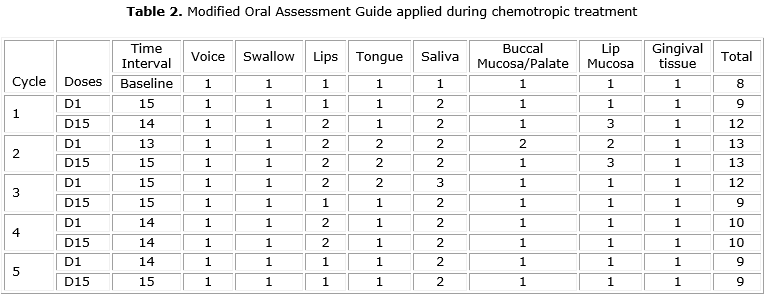
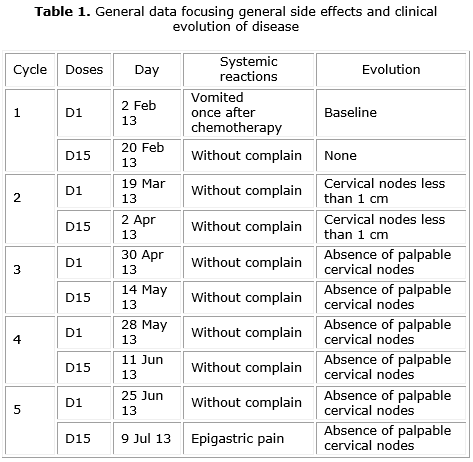
<body><![CDATA[<br> <hr> <font face="Verdana" size="2"><b>ABSTRACT</b> </font>     <p><font face="Verdana" size="2"> Oral side effects must be expected during cancer    treatment on pediatric patients. Monitoring side effects on oral cavity of antineoplastic    therapy is desirable but sometimes performed without criteria. The purpose of    this article is to describe an oral monitoring in an male with Hodgkin lymphoma    during chemotherapy treatment using an Oral Assessment Guide. An 11-yr-old male    was assisted during all treatment of chemotherapy against Hodgkin's lymphoma    in the dental sector of a hospital of reference of Jo&#227;o Pessoa, Para&#237;ba,    Brazil. The Oral Assessment Guide was applied by a calibrate examiner and was    observed the emergence of ulcerative lesions on the labial mucosa emerged on    two different periods (D15- primary cycle; D15-second cycle) and the major values    of oral mucositis were verified in D1 e D15 periods of second cycle of chemotherapy.    Monitoring oral side effects during antineoplastic therapy could prevent severe    oral complications and avoid to associate systemic complications. </font></p>     <p> <font face="Verdana" size="2"><b>Key words: </b> Hodgkin lymphoma, pediatric    cancer, oral mucositis.</font></p> <hr> <font face="Verdana" size="2"><b>RESUMEN</b> </font>     <p><font face="Verdana" size="2"> Los efectos secundarios orales se manifiestan    durante el tratamiento del c&#225;ncer en los pacientes pedi&#225;tricos. El    monitoreo de los efectos secundarios en la cavidad oral de la terapia antineopl&#225;sica    es deseable, pero a veces se realiza sin criterios. El prop&#243;sito de este    art&#237;culo es describir un monitoreo oral en un ni&#241;o con linfoma de    Hodgkin durante el tratamiento de quimioterapia, empleando una gu&#237;a de    evaluaci&#243;n oral. Un<b> </b>ni&#241;o de 11 a&#241;os de edad fue asistido    durante todo el tratamiento de quimioterapia contra un linfoma de Hodgkin en    el sector odontol&#243;gico de un hospital de referencia de Jo&#227;o Pessoa,    Para&#237;ba, Brasil. La gu&#237;a de evaluaci&#243;n oral fue aplicada por    un examinador calibrado. Se observ&#243; la aparici&#243;n de lesiones ulcerosas    en la mucosa labial que aparecieron en dos per&#237;odos diferentes (D15- primer    ciclo; D15-segundo ciclo) y los valores m&#225;s altos de la mucositis oral    se verificaron en per&#237;odos D1 e D15 del segundo ciclo de quimioterapia.<b>    </b>El seguimiento de los efectos secundarios orales durante la terapia antineopl&#225;sica    podr&#237;a prevenir las complicaciones orales graves y evitar complicaciones    sist&#233;micas asociadas. </font></p>     <p> <font face="Verdana" size="2"><b>Palabras clave:</b> linfoma de Hodgkin, c&#225;ncer    pedi&#225;trico, mucositis oral.</font></p> <hr>     <p>&nbsp;</p>     <p>&nbsp;</p>     <p><font face="Verdana" size="2"><b><font size="3">INTRODUCTION</font></b> </font></p>     <p><font face="Verdana" size="2"> Patients with leukemia or lymphoma undergoing    chemotherapy frequently develop alterations of the oral cavity.<sup>1</sup>    A direct effect of the drug on the oral mucosa or the associated myelosuppressive    action are the two main mechanisms associated with side effects such as mucositis,    dry mouth, bleeding, bone alterations, teeth disorders, pain and infections.<sup>1-3</sup>    An ongoing oral assessment must be performed to promote the early identification    of oral complications. </font></p>     <p><font face="Verdana" size="2"> A previous instrument used developed by Nebraska    University, the Oral Assessment Guide (OAG) showed as a comprehensive, accurate    tool for assessing oral integrity in children with cancer during and after chemotherapy.<sup>1</sup>    The OAG is a guide of oral evaluation initially proposed by Eilers, Peterson    and Berger in 1988<sup>4</sup> and modified for Cheng et al. (2004)<sup>5</sup>    to assess changes in the oral mucosa resulting from antineoplastic treatment    using chemotherapy. This instrument allows to evaluate 8 items, according to    the scales of impaired oral health, with assigned values &#8203;&#8203;1-3 for    each item, as follows: 1 for conditions where it is checked normality; 2, for    the verification of mild to moderate changes in relation to the epithelial integrity    or function and 3 for a severe impairment. At the end, the total checked for    mucositis varies from 8 to 24, without a cutoff between these values &#8203;&#8203;for    the estimation of mucositis. </font></p>     ]]></body>
<body><![CDATA[<p><font face="Verdana" size="2"> The purpose of this article is to describe an    oral monitoring in an 11 year-old male with Hodgkin lymphoma during chemotherapy    treatment using a modified Oral Assessment Guide. </font></p>     <p>    <br>   <font face="Verdana" size="2"><b><font size="3">    <br>   DESCRIPTION OF CASE</font></b> </font></p>     <p><font face="Verdana" size="2"> An 11 year-old, male, non caucasian patient    was referred to reference hospital on Paraiba state, Brazil, with initial complaint    of a swelling on the right supraclavicular with progressive growth. Lymph node    biopsy was taken revealing Hodgkin Lymphoma with positiveness to EBV and sparse    immunostaing to CD30. Therapy with chemotherapy administration was instituted    following the protocol: 26 mg of Doxorubicin- IV for 30 min (D1 and D15), 10    mg of Bleomycin - IV for 30 min (D1 and D15); 6 mg of Vimblastine (IV push)    (D1 and D15); 375 mg of Dacarbazine - IV for 120 min (D1 and D15) with a total    of 5 cycles. Moreover, it was prescribed Sulfamethoxazole + Trimethoprim suspension    orally for 12/12 h, 3 times per week in continuous use. The general recorder    of patient evolution during chemotherapy is described on <a href="#tab1_08">table    1</a>. </font></p>     <p align="center"> <font face="Verdana" size="2"><a name="tab1_08"></a><img src="/img/revistas/est/v52n2/t0108215.gif" width="473" height="462">    </font></p>     <p><font face="Verdana" size="2">     <br>   At diagnosis, we evaluated the oral cavity and DMFT was equal to 3, due to the    presence of two teeth restored without caries (permanent maxillary right second    molar and primary mandibular right first molar), with restored before the antineoplastic    treatment and a restored tooth with dental caries (primary mandibular right    second molar). Need to improve daily oral hygiene was percept, which has been    shown and monitored throughout treatment. </font></p>     <p><font face="Verdana" size="2"> During the treatment, OAG was applied by a calibrate    examiner during D1 and D15, inside the cycles, and the obtained values are described    on <a href="/img/revistas/est/v52n2/t0208215.gif">table 2</a>. On this index, we assigned a value of    1 to 3, according to the progressive morbidity. </font></p>     <p align="left"><font face="Verdana" size="2">During the assessments, ulcerative    lesions on the labial mucosa emerged on two different periods (12 Mar 13 and    2 Apr 13) (<a href="#fig1_08">Fig.</a>). These mucositis events were coincident    with higher levels of OAG. Palliative treatment for these two episodes of mucositis    was the application of mucolaser (ECCO Fibras e Dispositivos/Brazil; n/s &#8211;    040401; model &#8211; BM0004A; Power &#8211; 120 Mw; Doses &#8211; 7 J/cm<sup>2</sup>;    Time doses &#8211; 33 sec.) with clinical improvement. </font></p>     ]]></body>
<body><![CDATA[<p align="center"> <font face="Verdana" size="2"><a name="fig1_08"></a><img src="/img/revistas/est/v52n2/f0108215.jpg" width="393" height="516">    </font></p>     <p>&nbsp; </p>     <p> <font face="Verdana" size="2"><b><font size="3">DISCUSSION</font></b> </font></p>     <p><font face="Verdana" size="2"> Oral Assessment Guide and oral hygiene care    regimen could be clinically useful in improving oral assessment and hygiene    in children with cancer during and after chemotherapy.<sup>1</sup> Oral complications    could be inflammatory and ulcerative conditions and meant each category achieved    a score of 2 or a total score greater than 9.<sup>1</sup> In this case, mucositis    events were coincident with higher levels of OAG. Oral vigilance is desirable    to avoid major complications. To illustrate this, an interview and oral examination    was conducted on 150 pediatric cancer patients receiving standard dose chemotherapy    showed a relative high prevalence of chemotherapy-induced oral mucositis and    oral infections. The chemotherapeutic antimetabolites were the most frequently    associated with oral complications than other types of chemotherapy.<sup>2</sup>    </font></p>     <p><font face="Verdana" size="2"> The mucositis induced by chemotherapy occurs    because during the primary damage response phase is initiate a series of interacting    biological events as the activation of a number transcription factors, such    as NF-KB, Wnt, P-53 and their associated cronical pathways.<sup>5-7</sup> Each    cycle of chemotherapy incurs in increased risk to develop mucositis.<sup>8-10</sup>    </font></p>     <p><font face="Verdana" size="2"> Thus, monitoring the oral health of the patient,    and the use of palliative treatments are needed to prevent injuries that might    compromise the pediatric patients in antineoplastic therapy of cancer.<sup>6-8</sup>    Such monitoring can be done using the OAG, which allows the monitoring of different    locations where mucositis can occur in the oral cavity.<sup>11,12</sup> </font></p>     <p><font face="Verdana" size="2"> Monitoring oral side effects during antineoplastic    therapy could prevent severe oral complications and avoid to associate systemic    complications and we recommended OAG, which proved to be efficient on detect    mucositis upset and other oral alterations on oral cavity caused by chemotherapy.    </font></p>     <p>&nbsp; </p>     <p> <font face="Verdana" size="2"><b><font size="3">BIBLIOGRAPHIC REFERENCES</font></b>    </font></p>     <!-- ref --><p><font face="Verdana" size="2"> 1. Chen CF, Wang RH, Cheng SN, Chang YC. Assessment    of chemotherapy-induced oral complications in children with cancer. J Pediatr    Oncol Nurs. 2004;21(1):33-9.     </font></p>     <!-- ref --><p><font face="Verdana" size="2"> 2. Jensen SB, Peterson DE. Oral mucosal injury    caused by cancer therapies: current management and new frontiers in research.    Journal of Oral Pathology <i>&amp;</i> Medicine. 2014;43(2):81-90.     </font></p>     <!-- ref --><p><font face="Verdana" size="2"> 3. Lopes IA, Nogueira DN, Lopes IA. Oral manifestations    of chemotherapy in children from a cancer treatment center. 2012;12(1):113-9.        </font></p>     <!-- ref --><p><font face="Verdana" size="2"> 4. Eilers J, Berger AM, Peterson MC. Development,    testing, and application of the oral assessment. Oncol Nurs Forum. 1988;15:325-30.        </font></p>     <!-- ref --><p><font face="Verdana" size="2"> 5. Cheng KKF, Chang AM, Yuenc MP. Prevention    of oral mucositis in paediatric patients treated with chemotherapy: a randomised    crossover trial comparing two protocols of oral care. European Journal of Cancer.    2004;40:1208&#8211;16.     </font></p>     <!-- ref --><p><font face="Verdana" size="2"> 6. Dhillon J, Kalra GK, Mathur V. Oral health    in children with leucemia. Indian Journal of Palliative Care. 2012;18(1):12-8.        </font></p>     <!-- ref --><p><font face="Verdana" size="2"> 7. Kutob AF, Gue S, Revesz T, Logan RM, Keefe    D. Prevention of oral mucositis in children receiving cancer therapy: A systematic    review and evidence-based analysis. 2013;49(2):102-7.     </font></p>     <!-- ref --><p><font face="Verdana" size="2"> 8. Barbosa AM, Ribeiro DM, Caldo-Teixeira AS.    Conhecimentos e pr&#225;ticas em sa&#250;de bucal com crian&#231;as hospitalizadas    com c&#226;ncer. Ci&#234;ncia &amp; Sa&#250;de Coletiva. 2010;15(1):1113-22.        </font></p>     <!-- ref --><p><font face="Verdana" size="2"> 9. Sonis ST. The Epidemiology and Risk Assessment    of Mucositis. Oral mucositis. 2012:15-24.     </font></p>     <!-- ref --><p><font face="Verdana" size="2"> 10. Sonis ST. Mucositis: The impact, biology    and therapeutic opportunities of oral mucositis. Oral Oncol. 2009;45(12):1015-20.        </font></p>     <!-- ref --><p><font face="Verdana" size="2"> 11. Cheng KKF, Lee V, Li CH, Goggins W, Thompson    DR, Yuen HL, et al. Incidence and risk factors of oral mucositis in paediatric    and adolescent patients undergoing chemotherapy. Oral Oncology. 2011;47(3):153&#8211;62.        </font></p>     <!-- ref --><p><font face="Verdana" size="2"> 12. Val&#233;ra M-C, Noirrit-Esclassan M, Pasquet    M, Vaysse F. Oral complications and dental care in children with acute lymphoblastic    leukaemia. Journal of Pathology <i>&amp;</i> Medicine. 2014;43(8):122-6.     </font></p>     <p>&nbsp;</p>     <p>&nbsp;</p>     <p><font face="Verdana" size="2">Recibido: </font><font face="Verdana, Arial, Helvetica, sans-serif" size="2" color="#000000">10    de mayo de 2014</font><font color="#000000">.</font>    <br>   <font face="Verdana" size="2">Aprobado: 4 de enero de 2015. </font></p>     <p>&nbsp;</p>     <p>&nbsp; </p>     <p> <font face="Verdana" size="2"><i>Isabella Lima Arrais Ribeiro. </i> Posgraduate    program in Decision Models and Health, Departament of Statistic. University    city s/n. Jo&#227;o Pessoa, Brazil. </font>    ]]></body>
<body><![CDATA[<br>   <font face="Verdana" size="2">Correo electr&#243;nico: <a href="mailto:isabella_arrais@yahoo.com">isabella_arrais@yahoo.com</a>    </font></p>      ]]></body><back>
<ref-list>
<ref id="B1">
<label>1</label><nlm-citation citation-type="journal">
<person-group person-group-type="author">
<name>
<surname><![CDATA[Chen]]></surname>
<given-names><![CDATA[CF]]></given-names>
</name>
<name>
<surname><![CDATA[Wang]]></surname>
<given-names><![CDATA[RH]]></given-names>
</name>
<name>
<surname><![CDATA[Cheng]]></surname>
<given-names><![CDATA[SN]]></given-names>
</name>
<name>
<surname><![CDATA[Chang]]></surname>
<given-names><![CDATA[YC]]></given-names>
</name>
</person-group>
<article-title xml:lang="en"><![CDATA[Assessment of chemotherapy-induced oral complications in children with cancer]]></article-title>
<source><![CDATA[J Pediatr Oncol Nurs]]></source>
<year>2004</year>
<volume>21</volume>
<numero>1</numero>
<issue>1</issue>
<page-range>33-9</page-range></nlm-citation>
</ref>
<ref id="B2">
<label>2</label><nlm-citation citation-type="journal">
<person-group person-group-type="author">
<name>
<surname><![CDATA[Jensen]]></surname>
<given-names><![CDATA[SB]]></given-names>
</name>
<name>
<surname><![CDATA[Peterson]]></surname>
<given-names><![CDATA[DE]]></given-names>
</name>
</person-group>
<article-title xml:lang="en"><![CDATA[Oral mucosal injury caused by cancer therapies: current management and new frontiers in research]]></article-title>
<source><![CDATA[Journal of Oral Pathology & Medicine]]></source>
<year>2014</year>
<volume>43</volume>
<numero>2</numero>
<issue>2</issue>
<page-range>81-90</page-range></nlm-citation>
</ref>
<ref id="B3">
<label>3</label><nlm-citation citation-type="">
<person-group person-group-type="author">
<name>
<surname><![CDATA[Lopes]]></surname>
<given-names><![CDATA[IA]]></given-names>
</name>
<name>
<surname><![CDATA[Nogueira]]></surname>
<given-names><![CDATA[DN]]></given-names>
</name>
<name>
<surname><![CDATA[Lopes]]></surname>
<given-names><![CDATA[IA]]></given-names>
</name>
</person-group>
<article-title xml:lang="en"><![CDATA[Oral manifestations of chemotherapy in children from a cancer treatment center]]></article-title>
<source><![CDATA[]]></source>
<year></year>
</nlm-citation>
</ref>
<ref id="B4">
<label>4</label><nlm-citation citation-type="journal">
<person-group person-group-type="author">
<name>
<surname><![CDATA[Eilers]]></surname>
<given-names><![CDATA[J]]></given-names>
</name>
<name>
<surname><![CDATA[Berger]]></surname>
<given-names><![CDATA[AM]]></given-names>
</name>
<name>
<surname><![CDATA[Peterson]]></surname>
<given-names><![CDATA[MC]]></given-names>
</name>
</person-group>
<article-title xml:lang="en"><![CDATA[Development, testing, and application of the oral assessment]]></article-title>
<source><![CDATA[Oncol Nurs Forum]]></source>
<year>1988</year>
<volume>15</volume>
<page-range>325-30</page-range></nlm-citation>
</ref>
<ref id="B5">
<label>5</label><nlm-citation citation-type="journal">
<person-group person-group-type="author">
<name>
<surname><![CDATA[Cheng]]></surname>
<given-names><![CDATA[KKF]]></given-names>
</name>
<name>
<surname><![CDATA[Chang]]></surname>
<given-names><![CDATA[AM]]></given-names>
</name>
<name>
<surname><![CDATA[Yuenc]]></surname>
<given-names><![CDATA[MP]]></given-names>
</name>
</person-group>
<article-title xml:lang="en"><![CDATA[Prevention of oral mucositis in paediatric patients treated with chemotherapy: a randomised crossover trial comparing two protocols of oral care]]></article-title>
<source><![CDATA[European Journal of Cancer]]></source>
<year>2004</year>
<volume>40</volume>
<page-range>1208-16</page-range></nlm-citation>
</ref>
<ref id="B6">
<label>6</label><nlm-citation citation-type="journal">
<person-group person-group-type="author">
<name>
<surname><![CDATA[Dhillon]]></surname>
<given-names><![CDATA[J]]></given-names>
</name>
<name>
<surname><![CDATA[Kalra]]></surname>
<given-names><![CDATA[GK]]></given-names>
</name>
<name>
<surname><![CDATA[Mathur]]></surname>
<given-names><![CDATA[V]]></given-names>
</name>
</person-group>
<article-title xml:lang="en"><![CDATA[Oral health in children with leucemia]]></article-title>
<source><![CDATA[Indian Journal of Palliative Care]]></source>
<year>2012</year>
<volume>18</volume>
<numero>1</numero>
<issue>1</issue>
<page-range>12-8</page-range></nlm-citation>
</ref>
<ref id="B7">
<label>7</label><nlm-citation citation-type="">
<person-group person-group-type="author">
<name>
<surname><![CDATA[Kutob]]></surname>
<given-names><![CDATA[AF]]></given-names>
</name>
<name>
<surname><![CDATA[Gue]]></surname>
<given-names><![CDATA[S]]></given-names>
</name>
<name>
<surname><![CDATA[Revesz]]></surname>
<given-names><![CDATA[T]]></given-names>
</name>
<name>
<surname><![CDATA[Logan]]></surname>
<given-names><![CDATA[RM]]></given-names>
</name>
<name>
<surname><![CDATA[Keefe]]></surname>
<given-names><![CDATA[D]]></given-names>
</name>
</person-group>
<article-title xml:lang="en"><![CDATA[Prevention of oral mucositis in children receiving cancer therapy: A systematic review and evidence-based analysis]]></article-title>
<source><![CDATA[]]></source>
<year></year>
</nlm-citation>
</ref>
<ref id="B8">
<label>8</label><nlm-citation citation-type="journal">
<person-group person-group-type="author">
<name>
<surname><![CDATA[Barbosa]]></surname>
<given-names><![CDATA[AM]]></given-names>
</name>
<name>
<surname><![CDATA[Ribeiro]]></surname>
<given-names><![CDATA[DM]]></given-names>
</name>
<name>
<surname><![CDATA[Caldo-Teixeira]]></surname>
<given-names><![CDATA[AS]]></given-names>
</name>
</person-group>
<article-title xml:lang="pt"><![CDATA[Conhecimentos e práticas em saúde bucal com crianças hospitalizadas com câncer]]></article-title>
<source><![CDATA[Ciência & Saúde Coletiva]]></source>
<year>2010</year>
<volume>15</volume>
<numero>1</numero>
<issue>1</issue>
<page-range>1113-22</page-range></nlm-citation>
</ref>
<ref id="B9">
<label>9</label><nlm-citation citation-type="journal">
<person-group person-group-type="author">
<name>
<surname><![CDATA[Sonis]]></surname>
<given-names><![CDATA[ST]]></given-names>
</name>
</person-group>
<article-title xml:lang="en"><![CDATA[The Epidemiology and Risk Assessment of Mucositis]]></article-title>
<source><![CDATA[Oral mucositis]]></source>
<year>2012</year>
<page-range>15-24</page-range></nlm-citation>
</ref>
<ref id="B10">
<label>10</label><nlm-citation citation-type="journal">
<person-group person-group-type="author">
<name>
<surname><![CDATA[Sonis]]></surname>
<given-names><![CDATA[ST]]></given-names>
</name>
</person-group>
<article-title xml:lang="en"><![CDATA[Mucositis: The impact, biology and therapeutic opportunities of oral mucositis]]></article-title>
<source><![CDATA[Oral Oncol]]></source>
<year>2009</year>
<volume>45</volume>
<numero>12</numero>
<issue>12</issue>
<page-range>1015-20</page-range></nlm-citation>
</ref>
<ref id="B11">
<label>11</label><nlm-citation citation-type="journal">
<person-group person-group-type="author">
<name>
<surname><![CDATA[Cheng]]></surname>
<given-names><![CDATA[KKF]]></given-names>
</name>
<name>
<surname><![CDATA[Lee]]></surname>
<given-names><![CDATA[V]]></given-names>
</name>
<name>
<surname><![CDATA[Li]]></surname>
<given-names><![CDATA[CH]]></given-names>
</name>
<name>
<surname><![CDATA[Goggins]]></surname>
<given-names><![CDATA[W]]></given-names>
</name>
<name>
<surname><![CDATA[Thompson]]></surname>
<given-names><![CDATA[DR]]></given-names>
</name>
<name>
<surname><![CDATA[Yuen]]></surname>
<given-names><![CDATA[HL]]></given-names>
</name>
</person-group>
<article-title xml:lang="en"><![CDATA[Incidence and risk factors of oral mucositis in paediatric and adolescent patients undergoing chemotherapy]]></article-title>
<source><![CDATA[Oral Oncology]]></source>
<year>2011</year>
<volume>47</volume>
<numero>3</numero>
<issue>3</issue>
<page-range>153-62</page-range></nlm-citation>
</ref>
<ref id="B12">
<label>12</label><nlm-citation citation-type="journal">
<person-group person-group-type="author">
<name>
<surname><![CDATA[Valéra M-C]]></surname>
</name>
<name>
<surname><![CDATA[Noirrit-Esclassan]]></surname>
<given-names><![CDATA[M]]></given-names>
</name>
<name>
<surname><![CDATA[Pasquet]]></surname>
<given-names><![CDATA[M]]></given-names>
</name>
<name>
<surname><![CDATA[Vaysse]]></surname>
<given-names><![CDATA[F]]></given-names>
</name>
</person-group>
<article-title xml:lang="en"><![CDATA[Oral complications and dental care in children with acute lymphoblastic leukaemia]]></article-title>
<source><![CDATA[Journal of Pathology & Medicine]]></source>
<year>2014</year>
<volume>43</volume>
<numero>8</numero>
<issue>8</issue>
<page-range>122-6</page-range></nlm-citation>
</ref>
</ref-list>
</back>
</article>