<?xml version="1.0" encoding="ISO-8859-1"?><article xmlns:mml="http://www.w3.org/1998/Math/MathML" xmlns:xlink="http://www.w3.org/1999/xlink" xmlns:xsi="http://www.w3.org/2001/XMLSchema-instance">
<front>
<journal-meta>
<journal-id>0034-7507</journal-id>
<journal-title><![CDATA[Revista Cubana de Estomatología]]></journal-title>
<abbrev-journal-title><![CDATA[Rev Cubana Estomatol]]></abbrev-journal-title>
<issn>0034-7507</issn>
<publisher>
<publisher-name><![CDATA[Editorial Ciencias Médicas]]></publisher-name>
</publisher>
</journal-meta>
<article-meta>
<article-id>S0034-75072015000200009</article-id>
<title-group>
<article-title xml:lang="en"><![CDATA[Basal cell adenoma in upper lip: case report]]></article-title>
<article-title xml:lang="es"><![CDATA[Adenoma de células basales en el labio superior: reporte de un caso]]></article-title>
</title-group>
<contrib-group>
<contrib contrib-type="author">
<name>
<surname><![CDATA[Beanes]]></surname>
<given-names><![CDATA[Graziele]]></given-names>
</name>
<xref ref-type="aff" rid="A01"/>
</contrib>
<contrib contrib-type="author">
<name>
<surname><![CDATA[Lins]]></surname>
<given-names><![CDATA[Liliane]]></given-names>
</name>
<xref ref-type="aff" rid="A02"/>
</contrib>
<contrib contrib-type="author">
<name>
<surname><![CDATA[Fernando Pereira Falcão]]></surname>
<given-names><![CDATA[Antônio]]></given-names>
</name>
<xref ref-type="aff" rid="A01"/>
</contrib>
</contrib-group>
<aff id="A01">
<institution><![CDATA[,Federal University of Bahia Faculty of Dentistry ]]></institution>
<addr-line><![CDATA[Salvador Bahia]]></addr-line>
<country>Brazil</country>
</aff>
<aff id="A02">
<institution><![CDATA[,Federal University of Bahia Faculty of Medicine Bahiana School Medicine and Public Health]]></institution>
<addr-line><![CDATA[Salvador Bahia]]></addr-line>
</aff>
<pub-date pub-type="pub">
<day>00</day>
<month>06</month>
<year>2015</year>
</pub-date>
<pub-date pub-type="epub">
<day>00</day>
<month>06</month>
<year>2015</year>
</pub-date>
<volume>52</volume>
<numero>2</numero>
<fpage>202</fpage>
<lpage>207</lpage>
<copyright-statement/>
<copyright-year/>
<self-uri xlink:href="http://scielo.sld.cu/scielo.php?script=sci_arttext&amp;pid=S0034-75072015000200009&amp;lng=en&amp;nrm=iso"></self-uri><self-uri xlink:href="http://scielo.sld.cu/scielo.php?script=sci_abstract&amp;pid=S0034-75072015000200009&amp;lng=en&amp;nrm=iso"></self-uri><self-uri xlink:href="http://scielo.sld.cu/scielo.php?script=sci_pdf&amp;pid=S0034-75072015000200009&amp;lng=en&amp;nrm=iso"></self-uri><abstract abstract-type="short" xml:lang="en"><p><![CDATA[Basal cell adenoma is a rare benign salivary gland neoplasm that accounts for 1 to 3 % of all salivary gland tumors. Most cases occur in major salivary glands and are rare in minor salivary glands. Describe a clinical case of basal cell adenoma. A 76-year-old Caucasian Brazilian woman presents with a slow-growing asymptomatic lesion of the upper lip. Physical examination revealed a nodular lesion 1.1 cm in size. The lesion was firm to palpation and the surrounding mucosa had normal color and appearance, without any ulceration. The tumor was surgically removed by excisional biopsy. Biopsy confirmed basal cell adenoma. A systematic literature review was carried out in PubMed, Lilacs and SciELO databases. The review included all articles published before 1992. Until 1991 no differentiation was made between basal cell adenoma and canalicular adenoma. Both pathologies were classified as monomorphic adenoma. This is the seventh case of upper lip basal cell adenoma reported in the literature between 1992 and 2014. Three of the seven cases reported were from Brazil.]]></p></abstract>
<abstract abstract-type="short" xml:lang="es"><p><![CDATA[El adenoma de células basales es una neoplasia de la glándula salival raro benigno que representa a 1 a 3 % de todos los tumores de las glándulas salivales. La mayoría de los casos ocurren en las glándulas salivales mayores, siendo poco frecuente en las glándulas salivales menores. El objetivo de este estudio fue describir un caso clínico de adenoma de células basales. Una mujer brasileña de raza caucásica de 76 años de edad, quien se queja de un crecimiento lento y asintomático de una lesión en el labio superior. El examen físico reveló una lesión nodular de 1,1 cm de tamaño. La lesión era firme a la palpación y la mucosa circundante tenía color normal y la apariencia, sin ulceración. El tumor fue extirpado quirúrgicamente mediante una biopsia por escisión. La biopsia confirmó adenoma de células basales. Se realizó una revisión sistemática de la literatura se en las bases de datos PubMed, Lilacs y SciELO. Incluimos en esta revisión todos los artículos publicados antes de 1992. Hasta 1991, no se hizo la diferenciación entre adenoma de células basales y adenoma canalicular. Ambas patologías fueron clasificadas como adenoma monomórfico. Este es el séptimo caso de adenoma de células basales de labio superior reportado en la literatura entre 1992 y 2014. Tres de los siete casos reportados provinieron de Brasil.]]></p></abstract>
<kwd-group>
<kwd lng="en"><![CDATA[adenoma]]></kwd>
<kwd lng="en"><![CDATA[basal cell]]></kwd>
<kwd lng="en"><![CDATA[pleomorphic adenoma]]></kwd>
<kwd lng="en"><![CDATA[lip neoplasms]]></kwd>
<kwd lng="es"><![CDATA[adenoma]]></kwd>
<kwd lng="es"><![CDATA[basocelular]]></kwd>
<kwd lng="es"><![CDATA[adenoma pleomorfo]]></kwd>
<kwd lng="es"><![CDATA[neoplasias de los labios]]></kwd>
</kwd-group>
</article-meta>
</front><body><![CDATA[ <p align="right"><font face="Verdana" size="2"><b>PRESENTACI&#211;N DE CASO</b></font></p>     <p>&nbsp; </p>     <p> <font face="Verdana" size="2"><b><font size="4">Basal cell adenoma in upper    lip: case report</font></b> </font></p>     <p>&nbsp;</p>     <p><font face="Verdana" size="3"><b><font color="#000000">Adenoma de c&eacute;lulas    basales en el labio superior: reporte de un caso</font></b></font></p>     <p>&nbsp;</p>     <p>&nbsp;</p>     <p><font face="Verdana" size="2"> <b>Graziele Beanes,<sup>I</sup> Liliane Lins,<sup>II</sup>    Ant&#244;nio Fernando Pereira Falc&#227;o<sup>I</sup> </b></font></p>     <p> <font face="Verdana" size="2"><sup>I</sup> Faculty of Dentistry, Federal University    of Bahia, Salvador, Bahia, Brazil. </font>    <br>   <font face="Verdana" size="2"><sup>II</sup> Faculty of Medicine, Federal University    of Bahia. Bahiana School of Medicine and Public Health, Salvador, Bahia.</font></p>     ]]></body>
<body><![CDATA[<p>&nbsp;</p>     <p>&nbsp;</p> <hr> <font face="Verdana" size="2"><b>ABSTRACT</b> </font>     <p><font face="Verdana" size="2"> </font><font face="Verdana, Arial, Helvetica, sans-serif" size="2">Basal    cell adenoma is a rare benign salivary gland neoplasm that accounts for 1 to    3 % of all salivary gland tumors. Most cases occur in major salivary glands    and are rare in minor salivary glands. Describe a clinical case of basal cell    adenoma. A 76-year-old Caucasian Brazilian woman presents with a slow-growing    asymptomatic lesion of the upper lip. Physical examination revealed a nodular    lesion 1.1 cm in size. The lesion was firm to palpation and the surrounding    mucosa had normal color and appearance, without any ulceration. The tumor was    surgically removed by excisional biopsy. Biopsy confirmed basal cell adenoma.    A systematic literature review was carried out in PubMed, Lilacs and SciELO    databases. The review included all articles published before 1992. Until 1991    no differentiation was made between basal cell adenoma and canalicular adenoma.    Both pathologies were classified as monomorphic adenoma. This is the seventh    case of upper lip basal cell adenoma reported in the literature between 1992    and 2014. Three of the seven cases reported were from Brazil. </font></p>     <p> <font face="Verdana, Arial, Helvetica, sans-serif" size="2"><b>Key words:</b>    adenoma, basal cell, pleomorphic adenoma, lip neoplasms.</font></p> <hr> <font face="Verdana" size="2"><b>RESUMEN</b> </font>     <p><font face="Verdana" size="2"> El adenoma de c&#233;lulas basales es una neoplasia    de la gl&#225;ndula salival raro benigno que representa a 1 a 3 % de todos los    tumores de las gl&#225;ndulas salivales. La mayor&#237;a de los casos ocurren    en las gl&#225;ndulas salivales mayores, siendo poco frecuente en las gl&#225;ndulas    salivales menores. El objetivo de este estudio fue describir un caso cl&#237;nico    de adenoma de c&#233;lulas basales. Una mujer brasile&#241;a de raza cauc&#225;sica    de 76 a&#241;os de edad, quien se queja de un crecimiento lento y asintom&#225;tico    de una lesi&#243;n en el labio superior. El examen f&#237;sico revel&#243; una    lesi&#243;n nodular de 1,1 cm de tama&#241;o. La lesi&#243;n era firme a la    palpaci&#243;n y la mucosa circundante ten&#237;a color normal y la apariencia,    sin ulceraci&#243;n. El tumor fue extirpado quir&#250;rgicamente mediante una    biopsia por escisi&#243;n. La biopsia confirm&#243; adenoma de c&#233;lulas    basales. Se realiz&#243; una revisi&#243;n sistem&#225;tica de la literatura    se en las bases de datos PubMed, Lilacs y SciELO. Incluimos en esta revisi&#243;n    todos los art&#237;culos publicados antes de 1992. Hasta 1991, no se hizo la    diferenciaci&#243;n entre adenoma de c&#233;lulas basales y adenoma canalicular.    Ambas patolog&#237;as fueron clasificadas como adenoma monom&#243;rfico. Este    es el s&#233;ptimo caso de adenoma de c&#233;lulas basales de labio superior    reportado en la literatura entre 1992 y 2014. Tres de los siete casos reportados    provinieron de Brasil. </font></p>     <p><font face="Verdana" size="2"><b>Palabras clave:</b> adenoma, basocelular,    adenoma pleomorfo, neoplasias de los labios.</font></p> <hr>     <p>&nbsp;</p>     <p>&nbsp;</p>     <p><font face="Verdana" size="2"><b><font size="3">    <br>   INTRODUCTION</font></b> </font></p>     ]]></body>
<body><![CDATA[<p><font face="Verdana" size="2"> Basal cell adenoma (BCA) is a rare benign salivary    gland neoplasm that accounts to 1 to 3 % of all salivary gland tumours. Most    cases occur in the major salivary glands (75 % parotid and 5 % submandibular    glands), being rare in minor salivary glands. Tumors of the salivary glands    may show morphological diversity and wide variety of biological behaviors. These    characteristics, as well their rarity have hindered its diagnosis and classification.<sup>1</sup>    </font></p>     <p><font face="Verdana" size="2"> Basal cell adenoma, canalicular adenoma, the    Warthin's tumor and oncocytoma were classified as monomorphic adenomas (MA)    by the World Health Organization (WHO) in 1972. MA was considered a variant    of pleomorphic adenoma, presenting few chondroid and myxomatous components.    Till 1991, no differentiation was made between BCA and canalicular adenoma;    both pathologies being classified as monomorphic adenoma.<sup>1</sup> From 1992    till now, only six cases of BCA in upper lip have been described in the literature.<sup>2-6</sup>    </font></p>     <p><font face="Verdana" size="2"> The aim of this study is to report a clinical    case of basal cell adenoma in upper lip. </font></p>     <p> <font face="Verdana" size="2"><b>    <br>   <font size="3">    <br>   CASE REPORT</font></b> </font></p>     <p><font face="Verdana" size="2"> A 76-year-old Caucasian woman was admitted in    the Stomatology Clinic of the Faculty of Dentistry, Federal University of Bahia,    Brazil, complaining of a slow-growing and asymptomatic lesion in upper lip.    The patient reported that the lesion begun 3 months ago, as well the history    of thyroid and breast cancers with metastasis to axillary lymph nodes. </font></p>     <p><font face="Verdana" size="2"> Intraoral examination has shown a delimited    nodule measuring 1.1 cm in diameter, in the right side of the upper lip. The    lesion was firm to palpation and the surrounding mucosa had normal color and    aspect, with no ulceration (<a href="#fig1_09">Fig. 1</a>). </font></p>     <p align="center"> <font face="Verdana" size="2">    <br>   <a name="fig1_09"></a><img src="/img/revistas/est/v52n2/f0109215.jpg" width="393" height="349"> </font></p>     ]]></body>
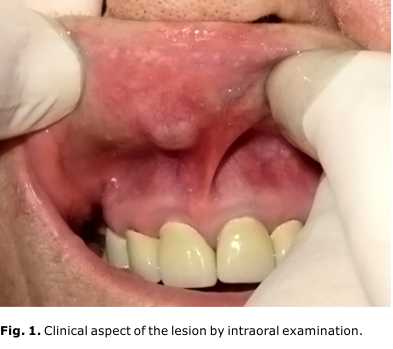
<body><![CDATA[<p><font face="Verdana" size="2">The clinical suspicion of adenoma of minor salivary    glands was made. The tumour was surgically removed by excisional biopsy, under    local anesthesia. The specimen was sent for histopathological examination and    was stained with hematoxylin-eosin (H<i>&amp;</i>E). The histopathological analysis    has shown an atrophic parakeratinized stratified squamous epithelium without    atypical aspects. The underlying lamina propria was infiltrated by multiple    well-defined lobules composed of basaloid cells arranged in tubular-trabecular    pattern. Individually, the cells showed rounded and oval nuclei, with eosinophilic    cytoplasm, surrounded by a fibro-hyaline stroma. The presence of cystic areas    was observed on the periphery of the lobules without calcification. The conclusion    was Basal Cell Adenoma (<a href="#fig2_09">Fig. 2</a>). No recurrence was observed    after eight years of follow-up. </font></p>     <p align="center"> <font face="Verdana" size="2"><a name="fig2_09"></a><img src="/img/revistas/est/v52n2/f0209215.jpg" width="398" height="372">    </font></p>     <p><font face="Verdana" size="2">     <br>   This study protocols were approved by the Ethical Review Board of the Faculty    of Dentistry of Federal University of Bahia, protocol number 103728, and are    in accordance to the Brazilian National Health Council Resolution 466/12, as    well as the Sixth Revision of the Declaration of Helsinki, 2008. </font></p>     <p>&nbsp; </p>     <p> <font face="Verdana" size="2"><b><font size="3">DISCUSSION</font></b> </font></p>     <p><font face="Verdana" size="2"> A systematic literature review was carried out    in Jun 2014, using PubMed, Lilacs and Scielo databases. The following terms    were used: "basal cell adenoma upper lip" and "monomorphic adenoma upper lip".    </font></p>     <p><font face="Verdana" size="2"> We have included in this review all papers reporting    upper lip BCA cases, from 1992 to 2014, with no language restriction, and have    excluded literature reviews. The search has identified a total of five papers,    including six patients.<sup>2-6</sup> For one case,<sup>5</sup> there was no    information about gender, age, and lesion recurrence. Considering the present    case and the other five from literature review, all tumours were painless and    had no history of recurrence after excisional biopsy. Age ranged from 51 to    76 years. There were four males and two females. Three cases came from Brazil,    two from Greece, one from Spain, and one from Japan. </font></p>     <p><font face="Verdana" size="2"> In the past, BCA, canalicular adenoma, the Warthin's    tumour and oncocytoma were classified as monomorphic adenomas. Since 1992, the    term monomorphic adenoma has been no longer used by WHO and the tumours, previously    classified as MA, were individually described. BCA is a salivary gland benign    tumour comprised of basaloid cells arranged in a solid, trabecular, tubular    and/or membranous pattern.<sup>1,7</sup> </font></p>     <p><font face="Verdana" size="2"> The parotid gland is the most frequent site    of BCA occurrence, followed by the submandibular gland. BCA is extremely rare    in minor salivary glands. Although a 2:1 female:male ratio is reported in literature,<sup>7</sup>    in this series, cases of upper lip BCA were more frequent among males, with    a 2:1 sex ratio. </font></p>     ]]></body>
<body><![CDATA[<p><font face="Verdana" size="2"> Three out the six reported cases came from Brazil,    spread over three different states of the country. </font></p>     <p><font face="Verdana" size="2"> The mean age (65 years, ranging from 51 to 76)    of the BCA patients was according to literature.<sup>1,7</sup> All BCA cases    included in this review were painless and the time of the lesions progression    ranged from 3 months to 5 years. The dimensions of the tumours ranged from 0.5    to 4.0 cm. BCA is usually described as a small and painless tumour, usually    ranging from few millimeters to 3-4 cm. Secondary signs, such as the presence    of ulceration or bleeding, are rare.<sup>8</sup> </font></p>     <p><font face="Verdana" size="2"> In all clinical cases, included in this study,    excisional biopsy was performed to remove the lesion. No recurrent cases were    reported after follow-up periods varying from six to 96 months. </font></p>     <p><font face="Verdana" size="2"> Histologically, BCA is characterized by the    presence of basaloid cells and lack of the myxochondroid stromal component of    pleomorphic adenoma. There are four patterns of histopathological BCA: solid,    trabecular, tubular, and membranous. Mixed patterns may occur,<sup>7</sup> as    in the tubular-trabecular case reported in this paper. </font></p>     <p><font face="Verdana" size="2"> Differential diagnosis must consider pleomorphic    adenoma; mucocele, sialoadenite and Warthin&#8217;s tumour. Distinction between    the BCA and malignant tumours is of great importance, particularly to avoid    unnecessary aggressive therapy. Among malignancies, the basal cell adenocarcinoma    requires special attention in the differential diagnosis<sup> </sup>followed    by adenoid cystic carcinoma, basaloide squamous cell carcinoma, carcinoma ex    pleomorphic adenoma, basal cell carcinoma, metastatic basal cell carcinoma and    sialoblastoma.<sup>1,9</sup> </font></p>     <p><font face="Verdana" size="2"> According to literature, BCA recurrence rate    varies depending of the histological type of the lesion. For solid and trabecular    variants, recurrence is almost nonexistent. The membranous type is most commonly    associated with recurrence and this may be a result of multicentricity of the    lesion. There are few reported cases of BCA malignant transformation and this    rare condition is associated to the membranous subtype.<sup>7</sup> Knowledge    about upper lip BCA specific characteristics is limited. Therefore, caution    is needed when comparing characteristics, drawn from literature, of BCAs from    all sites with upper lip BCA. </font></p>     <p><font face="Verdana" size="2"> This is the seventh case of upper lip BCA reported    in literature from 1992 to 2014. Till 1992 there was no differentiation between    cases of BCA and canalicular adenoma, both pathologies being classified as monomorphic    adenoma. Although BCA affects mainly elderly women, we found a 2:1 male: female    ratio concerning the cases of upper lip BCA reported. Three out of the seven    reported cases came from Brazil. No recurrence was observed in 6 to 96 months    follow-up after lesion excision. The specific features of the seven upper lip    BCA cases reported here reinforces the importance to perform a correct diagnosis    of nodule lesions in upper lip in order to establish adequate treatment. </font></p>     <p> <font face="Verdana" size="2"><b>    <br>       <br>       ]]></body>
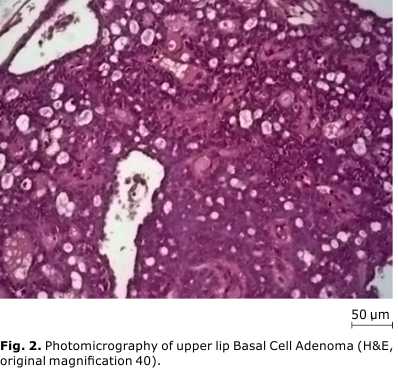
<body><![CDATA[<br>       <br>       <br>   Conflict of interests </b> </font></p>     <p><font face="Verdana" size="2"> The authors declare no conflict of interests    in this paper. </font></p>     <p>&nbsp; </p>     <p><font face="Verdana" size="2"><b><font size="3">BIBLIOGRAPHIC REFERENCES</font></b>    </font></p>     <!-- ref --><p><font face="Verdana" size="2"> 1. Barnes L, Eveson JW, Reichart P, Sidransky    D. Pathology and genetics of head and neck tumours. World Health Organization    Classification of Tumours. 1st ed. Lyon: IARC; 2005. p. 259-60.     </font></p>     <!-- ref --><p><font face="Verdana" size="2"> 2. Minicucci EM, Campos EBP, Weber SAT, Domingues    MAC, Ribeiro DA. Basal Cell Adenoma of the Upper Lip from Minor Salivary Gland    Origin. European Journal of Dentistry. 2008;2:213-6.     </font></p>     ]]></body>
<body><![CDATA[<!-- ref --><p><font face="Verdana" size="2"> 3. Antoniades D, Epivatianos A, Markopoulos    A, Kolokotronis A, Zaraboukas T. Coexistence of Mucous Retention Cyst and Basal    Cell Adenoma Arising from the Lining Epithelium of the Cyst. Med Princ Pract.    2009;18:248-252.     </font></p>     <!-- ref --><p><font face="Verdana" size="2"> 4. Soares ECS, Costa FWG, Bezerra MF, Alves    APNN, Sousa FB. Adenoma de c&#233;lulas basais em l&#225;bio superior. Rev Ga&#250;cha    Odontol. 2010;58(4):533-6.     </font></p>     <!-- ref --><p><font face="Verdana" size="2"> 5. Vicandi B, Jim&#233;nez-Heffernan JA, L&#243;pez-Ferrer    P, Gonz&#225;lez-Peramato P, Patr&#243;n M, Viguer JM. Fine needle aspiration    cytology of basal cell adenoma of the salivary gland: a cytohistological correlation    study of 35 cases. Cytopathology;2012(23):315&#8211;9. DOI: 10.1111/j.1365-2303.2011.00899.x.        </font></p>     <!-- ref --><p><font face="Verdana" size="2"> 6. Kudok M, Harada H, Sato I, Omura K, Ishii    Y. A case of basal cell adenoma of the upper lip. Case Rep Med. 2014. DOI: 10.1155/2014/795356    </font><!-- ref --><p><font face="Verdana" size="2"> 7. Ara&#250;jo VC. Basal cell adenoma. In: Pathology    and genetics of head and neck tumours.WHO Classification of Head and Neck Tumours.    IARC Press; 2005. p. 261-2.     </font></p>     <!-- ref --><p><font face="Verdana" size="2"> 8. Pires FR, Pringle GA, Almeida OP, Chen S.    Intra-oral minor salivary gland tumours: A clinicopathological study of 546    cases. Oral Oncology. 2007;43:463-70.     </font></p>     <!-- ref --><p><font face="Verdana" size="2"> 9. Kawata R, Yoshimur K, Lee K, Araki M, Takenaka    H, Tsuji M. Basal cell adenoma of the parotid gland: a clinicopathological study    of nine cases&#8212;basal cell adenoma versus pleomorphic adenoma and Warthin&#8217;s    tumour. Eur Arch Otorhinolaryngol. 2010;267:779-83.    </font></p>     <p>&nbsp;</p>     <p>&nbsp;</p>     <p><font face="Verdana" size="2"> Recibido: 7 de julio de 2014. </font>    <br>   <font face="Verdana" size="2">Aprobado: 12 de agosto de 2014.</font></p>     <p>&nbsp;</p>     <p>&nbsp;</p>     <p> <font face="Verdana" size="2"><i>Ant&#244;nio Fernando Pereira Falc&#227;o.</i>    Faculty of Dentistry, Federal University of Bahia. Rua Ara&#250;jo Pinho, 62,    Salvador, Bahia, Brazil. ZIP CODE: 40110-150. </font>    ]]></body>
<body><![CDATA[<br>   <font face="Verdana" size="2">Correo electr&#243;nico: <a href="mailto:afpfalcao@hotmail.com">afpfalcao@hotmail.com</a>    </font></p>      ]]></body><back>
<ref-list>
<ref id="B1">
<label>1</label><nlm-citation citation-type="book">
<person-group person-group-type="author">
<name>
<surname><![CDATA[Barnes]]></surname>
<given-names><![CDATA[L]]></given-names>
</name>
<name>
<surname><![CDATA[Eveson]]></surname>
<given-names><![CDATA[JW]]></given-names>
</name>
<name>
<surname><![CDATA[Reichart]]></surname>
<given-names><![CDATA[P]]></given-names>
</name>
<name>
<surname><![CDATA[Sidransky]]></surname>
<given-names><![CDATA[D]]></given-names>
</name>
</person-group>
<source><![CDATA[Pathology and genetics of head and neck tumours: World Health Organization Classification of Tumours]]></source>
<year>2005</year>
<edition>1st</edition>
<page-range>259-60</page-range><publisher-loc><![CDATA[Lyon ]]></publisher-loc>
<publisher-name><![CDATA[IARC]]></publisher-name>
</nlm-citation>
</ref>
<ref id="B2">
<label>2</label><nlm-citation citation-type="journal">
<person-group person-group-type="author">
<name>
<surname><![CDATA[Minicucci]]></surname>
<given-names><![CDATA[EM]]></given-names>
</name>
<name>
<surname><![CDATA[Campos]]></surname>
<given-names><![CDATA[EBP]]></given-names>
</name>
<name>
<surname><![CDATA[Weber]]></surname>
<given-names><![CDATA[SAT]]></given-names>
</name>
<name>
<surname><![CDATA[Domingues]]></surname>
<given-names><![CDATA[MAC]]></given-names>
</name>
<name>
<surname><![CDATA[Ribeiro]]></surname>
<given-names><![CDATA[DA]]></given-names>
</name>
</person-group>
<article-title xml:lang="en"><![CDATA[Basal Cell Adenoma of the Upper Lip from Minor Salivary Gland Origin]]></article-title>
<source><![CDATA[European Journal of Dentistry]]></source>
<year>2008</year>
<volume>2</volume>
<page-range>213-6</page-range></nlm-citation>
</ref>
<ref id="B3">
<label>3</label><nlm-citation citation-type="journal">
<person-group person-group-type="author">
<name>
<surname><![CDATA[Antoniades]]></surname>
<given-names><![CDATA[D]]></given-names>
</name>
<name>
<surname><![CDATA[Epivatianos]]></surname>
<given-names><![CDATA[A]]></given-names>
</name>
<name>
<surname><![CDATA[Markopoulos]]></surname>
<given-names><![CDATA[A]]></given-names>
</name>
<name>
<surname><![CDATA[Kolokotronis]]></surname>
<given-names><![CDATA[A]]></given-names>
</name>
<name>
<surname><![CDATA[Zaraboukas]]></surname>
<given-names><![CDATA[T]]></given-names>
</name>
</person-group>
<article-title xml:lang="en"><![CDATA[Coexistence of Mucous Retention Cyst and Basal Cell Adenoma Arising from the Lining Epithelium of the Cyst]]></article-title>
<source><![CDATA[Med Princ Pract]]></source>
<year>2009</year>
<volume>18</volume>
<page-range>248-252</page-range></nlm-citation>
</ref>
<ref id="B4">
<label>4</label><nlm-citation citation-type="journal">
<person-group person-group-type="author">
<name>
<surname><![CDATA[Soares]]></surname>
<given-names><![CDATA[ECS]]></given-names>
</name>
<name>
<surname><![CDATA[Costa]]></surname>
<given-names><![CDATA[FWG]]></given-names>
</name>
<name>
<surname><![CDATA[Bezerra]]></surname>
<given-names><![CDATA[MF]]></given-names>
</name>
<name>
<surname><![CDATA[Alves]]></surname>
<given-names><![CDATA[APNN]]></given-names>
</name>
<name>
<surname><![CDATA[Sousa]]></surname>
<given-names><![CDATA[FB]]></given-names>
</name>
</person-group>
<article-title xml:lang="pt"><![CDATA[Adenoma de células basais em lábio superior]]></article-title>
<source><![CDATA[Rev Gaúcha Odontol]]></source>
<year>2010</year>
<volume>58</volume>
<numero>4</numero>
<issue>4</issue>
<page-range>533-6</page-range></nlm-citation>
</ref>
<ref id="B5">
<label>5</label><nlm-citation citation-type="journal">
<person-group person-group-type="author">
<name>
<surname><![CDATA[Vicandi]]></surname>
<given-names><![CDATA[B]]></given-names>
</name>
<name>
<surname><![CDATA[Jiménez-Heffernan]]></surname>
<given-names><![CDATA[JA]]></given-names>
</name>
<name>
<surname><![CDATA[López-Ferrer]]></surname>
<given-names><![CDATA[P]]></given-names>
</name>
<name>
<surname><![CDATA[González-Peramato]]></surname>
<given-names><![CDATA[P]]></given-names>
</name>
<name>
<surname><![CDATA[Patrón]]></surname>
<given-names><![CDATA[M]]></given-names>
</name>
<name>
<surname><![CDATA[Viguer]]></surname>
<given-names><![CDATA[JM]]></given-names>
</name>
</person-group>
<article-title xml:lang="en"><![CDATA[Fine needle aspiration cytology of basal cell adenoma of the salivary gland: a cytohistological correlation study of 35 cases]]></article-title>
<source><![CDATA[Cytopathology]]></source>
<year>2012</year>
<numero>23</numero>
<issue>23</issue>
<page-range>315-9</page-range></nlm-citation>
</ref>
<ref id="B6">
<label>6</label><nlm-citation citation-type="journal">
<person-group person-group-type="author">
<name>
<surname><![CDATA[Kudok]]></surname>
<given-names><![CDATA[M]]></given-names>
</name>
<name>
<surname><![CDATA[Harada]]></surname>
<given-names><![CDATA[H]]></given-names>
</name>
<name>
<surname><![CDATA[Sato]]></surname>
<given-names><![CDATA[I]]></given-names>
</name>
<name>
<surname><![CDATA[Omura]]></surname>
<given-names><![CDATA[K]]></given-names>
</name>
<name>
<surname><![CDATA[Ishii]]></surname>
<given-names><![CDATA[Y]]></given-names>
</name>
</person-group>
<article-title xml:lang="en"><![CDATA[A case of basal cell adenoma of the upper lip]]></article-title>
<source><![CDATA[Case Rep Med]]></source>
<year>2014</year>
</nlm-citation>
</ref>
<ref id="B7">
<label>7</label><nlm-citation citation-type="book">
<person-group person-group-type="author">
<name>
<surname><![CDATA[Araújo]]></surname>
<given-names><![CDATA[VC]]></given-names>
</name>
</person-group>
<article-title xml:lang="en"><![CDATA[Basal cell adenoma]]></article-title>
<source><![CDATA[Pathology and genetics of head and neck tumours: WHO Classification of Head and Neck Tumours]]></source>
<year>2005</year>
<page-range>261-2</page-range><publisher-name><![CDATA[IARC Press]]></publisher-name>
</nlm-citation>
</ref>
<ref id="B8">
<label>8</label><nlm-citation citation-type="journal">
<person-group person-group-type="author">
<name>
<surname><![CDATA[Pires]]></surname>
<given-names><![CDATA[FR]]></given-names>
</name>
<name>
<surname><![CDATA[Pringle]]></surname>
<given-names><![CDATA[GA]]></given-names>
</name>
<name>
<surname><![CDATA[Almeida]]></surname>
<given-names><![CDATA[OP]]></given-names>
</name>
<name>
<surname><![CDATA[Chen]]></surname>
<given-names><![CDATA[S]]></given-names>
</name>
</person-group>
<article-title xml:lang="en"><![CDATA[Intra-oral minor salivary gland tumours: A clinicopathological study of 546 cases]]></article-title>
<source><![CDATA[Oral Oncology]]></source>
<year>2007</year>
<volume>43</volume>
<page-range>463-70</page-range></nlm-citation>
</ref>
<ref id="B9">
<label>9</label><nlm-citation citation-type="journal">
<person-group person-group-type="author">
<name>
<surname><![CDATA[Kawata]]></surname>
<given-names><![CDATA[R]]></given-names>
</name>
<name>
<surname><![CDATA[Yoshimur]]></surname>
<given-names><![CDATA[K]]></given-names>
</name>
<name>
<surname><![CDATA[Lee]]></surname>
<given-names><![CDATA[K]]></given-names>
</name>
<name>
<surname><![CDATA[Araki]]></surname>
<given-names><![CDATA[M]]></given-names>
</name>
<name>
<surname><![CDATA[Takenaka]]></surname>
<given-names><![CDATA[H]]></given-names>
</name>
<name>
<surname><![CDATA[Tsuji]]></surname>
<given-names><![CDATA[M]]></given-names>
</name>
</person-group>
<article-title xml:lang="en"><![CDATA[Basal cell adenoma of the parotid gland: a clinicopathological study of nine cases-basal cell adenoma versus pleomorphic adenoma and Warthin's tumour]]></article-title>
<source><![CDATA[Eur Arch Otorhinolaryngol]]></source>
<year>2010</year>
<volume>267</volume>
<page-range>779-83</page-range></nlm-citation>
</ref>
</ref-list>
</back>
</article>