<?xml version="1.0" encoding="ISO-8859-1"?><article xmlns:mml="http://www.w3.org/1998/Math/MathML" xmlns:xlink="http://www.w3.org/1999/xlink" xmlns:xsi="http://www.w3.org/2001/XMLSchema-instance">
<front>
<journal-meta>
<journal-id>0034-7507</journal-id>
<journal-title><![CDATA[Revista Cubana de Estomatología]]></journal-title>
<abbrev-journal-title><![CDATA[Rev Cubana Estomatol]]></abbrev-journal-title>
<issn>0034-7507</issn>
<publisher>
<publisher-name><![CDATA[Editorial Ciencias Médicas]]></publisher-name>
</publisher>
</journal-meta>
<article-meta>
<article-id>S0034-75072017000400003</article-id>
<title-group>
<article-title xml:lang="en"><![CDATA[Knowledge about von Willebrand's disease among dental students]]></article-title>
<article-title xml:lang="es"><![CDATA[Conocimiento acerca de la enfermedad de Von Willebrand entre estudiantes de Odontología]]></article-title>
</title-group>
<contrib-group>
<contrib contrib-type="author">
<name>
<surname><![CDATA[Arrais Ribeiro]]></surname>
<given-names><![CDATA[Isabella Lima]]></given-names>
</name>
<xref ref-type="aff" rid="A01"/>
</contrib>
<contrib contrib-type="author">
<name>
<surname><![CDATA[de Miranda Luna]]></surname>
<given-names><![CDATA[Adolfo Saraiva]]></given-names>
</name>
<xref ref-type="aff" rid="A01"/>
</contrib>
<contrib contrib-type="author">
<name>
<surname><![CDATA[Melo de Queiroz Oliveira]]></surname>
<given-names><![CDATA[Ana Caroline]]></given-names>
</name>
<xref ref-type="aff" rid="A01"/>
</contrib>
<contrib contrib-type="author">
<name>
<surname><![CDATA[Dias de Castro]]></surname>
<given-names><![CDATA[Ricardo]]></given-names>
</name>
<xref ref-type="aff" rid="A01"/>
</contrib>
</contrib-group>
<aff id="A01">
<institution><![CDATA[,Federal University of Paraíba  ]]></institution>
<addr-line><![CDATA[João Pessoa-Paraíba (PB]]></addr-line>
<country>Brazil</country>
</aff>
<pub-date pub-type="pub">
<day>00</day>
<month>12</month>
<year>2017</year>
</pub-date>
<pub-date pub-type="epub">
<day>00</day>
<month>12</month>
<year>2017</year>
</pub-date>
<volume>54</volume>
<numero>4</numero>
<fpage>1</fpage>
<lpage>8</lpage>
<copyright-statement/>
<copyright-year/>
<self-uri xlink:href="http://scielo.sld.cu/scielo.php?script=sci_arttext&amp;pid=S0034-75072017000400003&amp;lng=en&amp;nrm=iso"></self-uri><self-uri xlink:href="http://scielo.sld.cu/scielo.php?script=sci_abstract&amp;pid=S0034-75072017000400003&amp;lng=en&amp;nrm=iso"></self-uri><self-uri xlink:href="http://scielo.sld.cu/scielo.php?script=sci_pdf&amp;pid=S0034-75072017000400003&amp;lng=en&amp;nrm=iso"></self-uri><kwd-group>
<kwd lng="en"><![CDATA[dental care]]></kwd>
<kwd lng="en"><![CDATA[dental education]]></kwd>
<kwd lng="en"><![CDATA[dental treatment]]></kwd>
<kwd lng="es"><![CDATA[cuidado dental]]></kwd>
<kwd lng="es"><![CDATA[educación dental]]></kwd>
<kwd lng="es"><![CDATA[tratamiento dental]]></kwd>
</kwd-group>
</article-meta>
</front><body><![CDATA[ <p align="right"> <font face="Verdana, Arial, Helvetica, sans-serif" size="2"><b>ART</b><b>&#205;</b><b>C</b><b>U</b><b>LO    ORIGINAL</b> </font></p>     <p>&nbsp; </p>     <p> <font face="Verdana, Arial, Helvetica, sans-serif" size="2"><b><font size="4">Knowledge    about von Willebrand's disease among dental students</font></b> </font></p>     <p>&nbsp;</p>     <p> <font face="Verdana, Arial, Helvetica, sans-serif" size="2"><b> <font size="3">Conocimiento    acerca de la enfermedad de Von Willebrand entre estudiantes de </font></b> <font size="3"><b>O</b><b>dontolog&#237;a</b>    </font></font></p>     <p>&nbsp;</p>     <p>&nbsp; </p>     <p> <font face="Verdana, Arial, Helvetica, sans-serif" size="2"><b> Isabella Lima    Arrais Ribeiro, Adolfo Saraiva de Miranda Luna, Ana Caroline Melo de Queiroz    Oliveira, Ricardo Dias de Castro </b> </font></p>     <p><font face="Verdana, Arial, Helvetica, sans-serif" size="2">Federal University    of Para&#237;ba. Jo&#227o Pessoa-Para&#237;ba (PB), Brazil. </font></p>     <p>&nbsp;</p>     ]]></body>
<body><![CDATA[<p>&nbsp;</p> <hr align="center" size="2" width="100%"/>     <p><font face="Verdana, Arial, Helvetica, sans-serif" size="2"><b>ABSTRACT</b>    </font></p>     <p><font face="Verdana, Arial, Helvetica, sans-serif" size="2"> <b>Introduction:</b>    Von Willebrand's disease is the most common bleeding disorder, and is still    underdiagnosed for several reasons, including lack of knowledge about the disease.    <br>   <b>Objective:</b> to evaluate the knowledge about dental care for patients with    von Willebrand's disease in students who attended the last academic year of    an undergraduate dental program. </font>    <br>   <font face="Verdana, Arial, Helvetica, sans-serif" size="2"><b>Methods:</b>    a questionnaire with objective questions was applied to 87 students in order    to obtain data on the following variables of interest: gender, term of the program,    knowledge about the disease, knowledge about the involved coagulation factor,    tests for diagnosis, signs and symptoms, procedures necessary during patient    care, and medications that should be avoided in von Willebrand's disease. The    data were analyzed using IBM SPSS (21.0) at a significance level of 5 %.    <br>   <b>Results:</b> only 21 students (21.14 %) reported having some knowledge about    von Willebrand's disease: 49.02 % correctly answered that the coagulation factor    is involved in von Willebrand's disease, and 29.4 % correctly answered to the    question about the diagnostic tests.    <br>   <b>Conclusions</b>: students attending the final academic year of an undergraduate    dental program have limited knowledge about von Willebrand's disease. </font></p>     <p> <font face="Verdana, Arial, Helvetica, sans-serif" size="2"><b>Keywords:</b>    dental care; dental education; dental treatment. </font></p> <hr align="center" size="2" width="100%"/>     <p><font face="Verdana, Arial, Helvetica, sans-serif" size="2"><b>RESUMEN</b>    </font></p>     <p> <font face="Verdana, Arial, Helvetica, sans-serif" size="2"><b>Introducci&#243;n:</b>    la enfermedad de Von Willebrand es el trastorno hemorr&#225;gico m&#225;s com&#250;n, y todav&#237;a    est&#225; infradiagnosticada por varias razones, incluyendo la falta de conocimiento    acerca de la enfermedad.     ]]></body>
<body><![CDATA[<br>   <b>Objetivo:</b>    evaluar el conocimiento acerca del cuidado dental para pacientes con la enfermedad    de Von Willebrand<b> </b>en<b> </b>los estudiantes que asistieron al &#250;ltimo    a&#241;o de un programa de odontolog&#237;a de pregrado.     <br>   </font><font face="Verdana, Arial, Helvetica, sans-serif" size="2"><b>M&#233;todos:</b>    se aplic&#243; un cuestionario con preguntas objetivas a 87 estudiantes para    obtener datos sobre las siguientes variables de inter&#233;s: g&#233;nero, t&#233;rmino    del programa, conocimiento acerca de la enfermedad, conocimiento sobre el factor    de coagulaci&#243;n implicado, pruebas para el diagn&#243;stico, signos y s&#237;ntomas,    procedimientos necesarios durante el cuidado de pacientes y los medicamentos    que deben evitarse en la enfermedad de Von Willebrand. Los datos fueron analizados    utilizando IBM SPSS (21.0) a un nivel de significaci&#243;n del 5 %.     <br>   </font><font face="Verdana, Arial, Helvetica, sans-serif" size="2"><b>Resultados:    </b> solo 21 estudiantes (21,14 %) reportaron tener alg&#250;n conocimiento sobre    la enfermedad de Von Willebrand: 49,02 % respondi&#243; correctamente cu&#225;l es el    factor de coagulaci&#243;n que est&#225; involucrado en enfermedad de Von Willebrand,    y el 29,4 % respondi&#243; correctamente a la pregunta sobre las pruebas diagn&#243;sticas.    <br>   </font><font face="Verdana, Arial, Helvetica, sans-serif" size="2"><b>Conclusion</b><b>es</b><b>:</b>    los estudiantes que asisten al &#250;ltimo a&#241;o de un programa de odontolog&#237;a    de grado tienen un conocimiento limitado acerca de la enfermedad de Von Willebrand.    </font></p>     <p> <font face="Verdana, Arial, Helvetica, sans-serif" size="2"><b>Palabras clave:</b>    cuidado dental; educaci&#243;n dental; tratamiento dental. </font></p> <hr align="center" size="2" width="100%"/>     <p>&nbsp;</p>     <p>&nbsp;</p> <h1><font face="Verdana, Arial, Helvetica, sans-serif" size="2"><font size="3">INTRODUCTION    </font> </font></h1>     <p><font face="Verdana, Arial, Helvetica, sans-serif" size="2"> The Von Willebrand    Disease (VWD) is an inherited bleeding disorder that results from quantitative    and/or qualitative abnormalities of the Von Willebrand factor (VWF).<sup>1</sup>    The VWF has two main functions: binding to subendothelial collagen and platelets,    with consequent promotion of platelet plug formation at endothelial injury sites,    and binding to and transport of coagulation factor VIII (FVIII), protecting    it from proteolytic degradation in the plasma.<sup>2</sup> Individuals with    VWD exhibit a high frequency of oral bleeding, especially after surgical procedures    and mucosal trauma.<sup>1-3</sup> </font></p>     <p><font face="Verdana, Arial, Helvetica, sans-serif" size="2"> Individuals with    VWD are at high risk of bleeding during dental procedures, and dentists are    thus responsible for their safety, for which purpose they should work jointly    with haematologists during the clinical planning of treatments.<sup>3,4</sup>    </font></p>     <p><font face="Verdana, Arial, Helvetica, sans-serif" size="2"> To provide the    best care to patients with VWD, some precautions are needed relative to the    prescription of medications and use of anaesthetics as well as during procedures.<sup>5</sup>    Dentists should ensure that their offices are equipped with adequate means to    control bleeding so that they are available for the treatment of patients with    VWD.<sup>3,5,6</sup> </font></p>     ]]></body>
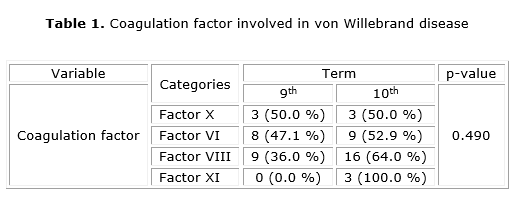
<body><![CDATA[<p><font face="Verdana, Arial, Helvetica, sans-serif" size="2"> Dental students    should be prepared to address patients with bleeding disorders, acquiring sound    theoretical bases for their clinical approach to individuals with VWD. Therefore,    the aim of the present study was to assess the knowledge that students attending    the last year of an undergraduate dentistry programme had about dental care    for patients with VWD. </font></p>     <p>&nbsp;</p> <h1><font face="Verdana, Arial, Helvetica, sans-serif" size="2"><font size="3">METHODS    </font></font></h1>     <p><font face="Verdana, Arial, Helvetica, sans-serif" size="2"> The present quantitative,    exploratory and descriptive study was conducted at the Dental Teaching Clinic    of the University Centre of Jo&#227;o Pessoa, Para&#237;ba, Brazil. </font></p>     <p><font face="Verdana, Arial, Helvetica, sans-serif" size="2"> The study was    approved by a Human Research Ethics Committee (CAAE: 44659315.5.0000.5176).    </font></p>     <p><font face="Verdana, Arial, Helvetica, sans-serif" size="2"> A total of 111    students concluding the Dentistry Programme (56 attending the next-to-last and    55 the last term) represented the study population. The calculated sample size    (using software Epi Info) was 87 participants, with a margin of error of 5 %    and a confidence interval of 95 %. Therefore, a questionnaire containing objective    questions was administered to 87 students to gather data on the following variables    of interest: gender; programme term; knowledge about VWD; knowledge about the    coagulation factor involved in VWD; tests to diagnose VWD; signs and symptoms    of VWD; procedures required during care of VWD patients; and medications that    should be avoided. </font></p>     <p><font face="Verdana, Arial, Helvetica, sans-serif" size="2"> The data corresponding    to all 87 respondents, including the subgroup of 51 students who answered all    of the questions, were entered into a Microsoft Excel spreadsheet and subjected    to descriptive (absolute and percent frequencies) and inferential statistical    analyses. On inferential analysis, tests were applied to investigate possible    associations between the variables of interest (chi-squared and Fisher' exact    tests); the significance level was set to 5 %. All of the analyses were performed    in IBM SPSS (21.0). </font></p>     <p>&nbsp;</p> <h1><font face="Verdana, Arial, Helvetica, sans-serif" size="2"> <font size="3">RESULTS    </font></font></h1>     <p><font face="Verdana, Arial, Helvetica, sans-serif" size="2"> Eighty-seven students    answered the questionnaire; 25 (28.7 %) were male and 62 (71.3 %) female, and    41 (47.1 %) attended the 9<sup>th</sup> term of the programme and 46 (52.9 %)    the 10<sup>th</sup> term. A total of 66 (75.86 %) students reported not having    any knowledge about VWD, whereas 21 (24.14 %) stated they knew about it. Given    their lack of knowledge on VWD, 36 (41.3 %) participants chose not to complete    the questionnaire; 51 (58.6 %) students completed the questionnaire, including    some who had reported not knowing anything about the disease. </font></p>     <p><font face="Verdana, Arial, Helvetica, sans-serif" size="2"> In the present    study, only 24.14 % of the undergraduate students enrolled in the last year    of an undergraduate dentistry programme reported having knowledge about VWD.    </font></p>     <p><font face="Verdana, Arial, Helvetica, sans-serif" size="2"> Of the students    who answered the full questionnaire, 49.02 % correctly answered the question    on what VWD is (<a href="#tab1">table 1</a>), indicating that FVIII is the coagulation    factor involved; of these, most (64 %) attended the 10 <sup>th</sup> (last term)    of the programme. </font></p>     ]]></body>
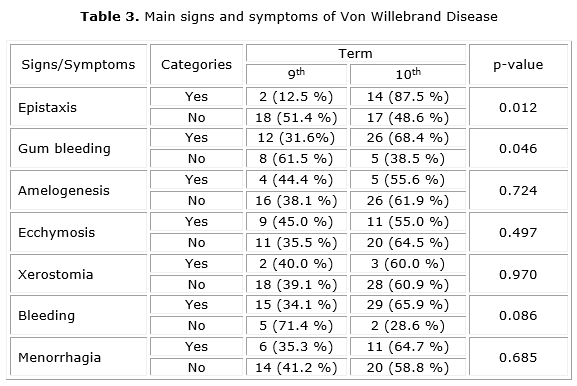
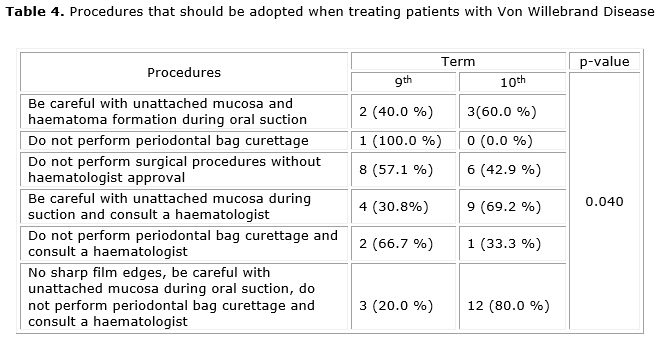
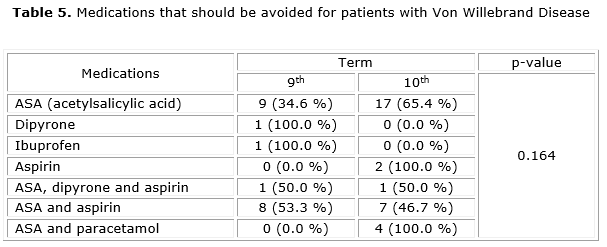
<body><![CDATA[<p><font face="Verdana, Arial, Helvetica, sans-serif" size="2"> Among the participants    attending the 10<sup>th</sup> term, 73.3 % answered this question correctly    (<a href="/img/revistas/est/v54n4/t02_1368.gif">table 2</a>). </font></p>     <p><font face="Verdana, Arial, Helvetica, sans-serif" size="2"> The results described    in <a href="#tab3">table 3</a> indicate a difference in the responses corresponding    to the occurrence of epistaxis and gum bleeding among patients with VWD between    the 9<sup>th</sup> and 10<sup>th</sup> term students. </font></p>     <p><font face="Verdana, Arial, Helvetica, sans-serif" size="2"> The <a href="/img/revistas/est/v54n4/t04_1368.gif">table    4</a> shows the differences between the answers given by the students attending    the last and next-to-last terms of the undergraduate dentistry programme as    concerns the care of patients with VWD. Among the 31 students enrolled in the    10<sup>th</sup> term, 12 (38.70 %) listed the largest number of and most pertinent    procedures, compared with only 3 (20.0 %) among the students attending the 9<sup>th</sup>    term. </font></p>     <p><font face="Verdana, Arial, Helvetica, sans-serif" size="2"> Relative to the    medications that should be avoided for patients with VWD, none of the participants    gave the fully correct answer, but many named drugs that are contraindicated    in these patients (3,14). This gap in the students' knowledge is noteworthy,    as incorrect drug prescriptions might cause bleeding and put the patient's life    at risk (<a href="/img/revistas/est/v54n4/t05_1368.gif">table 5</a>). </font></p>     <p align="center"><a name="tab1"></a><img src="/img/revistas/est/v54n4/t01_1368.gif" width="517" height="198"></p>     <p align="center"><a name="tab3"></a><img src="/img/revistas/est/v54n4/t03_1368.gif" width="577" height="386"></p>     <p>&nbsp;</p>     <p><font face="Verdana, Arial, Helvetica, sans-serif" size="2"><b><font size="3">DISCUSSION</font></b>    </font></p>     <p><font face="Verdana, Arial, Helvetica, sans-serif" size="2"> The Von Willebrand    Disease is the most common bleeding disorder, with a prevalence of up to one    case per 100 inhabitants,<sup>7</sup> although it is unknown by most clinicians.<sup>8</sup>    And, although know, it is underdiagnosed for several reasons,<sup>8</sup> including    lack of knowledge about the disease and its clinical presentation among health    care providers, unavailability of diagnostic e aren't discussion laboratory    tests and technical difficulties in the performance of the diagnostic tests.<sup>3</sup>    </font></p>     <p><font face="Verdana, Arial, Helvetica, sans-serif" size="2"> Diagnosis of VWD    is difficult because is based on laboratory testing and demands persistence    from doctors and/or dentists.<sup>1,2</sup> Still, depending on the functional    site that is affected, different specific tests are needed to demonstrate the    problem, and thus, a complex set of quantitative and functional measurements    of VWF and FVIII levels and activity are required.<sup>1,2,9</sup> </font></p>     ]]></body>
<body><![CDATA[<p><font face="Verdana, Arial, Helvetica, sans-serif" size="2"> The haemorrhagic    manifestations typical of VWD include ecchymosis after trauma (even low-intensity    trauma), epistaxis (nosebleeds), gum bleeding and menorrhagia.<sup>3,9</sup>    Among women, the latter may be the only symptom of disease. In the present study,    less than thirty percent of the participants correctly answered the question    on the testing needed to detect the disease. While measurement of the levels    of coagulation factors is the initial test, it is not the most precise one,    and thus, additional, more specific the results assessments are needed to reach    conclusive results. Coagulation tests might indicate the presence of a coagulopathy,    but neither they nor a blood cell count are able to identify VWD.<sup>1,8</sup>    </font></p>     <p><font face="Verdana, Arial, Helvetica, sans-serif" size="2"> The occurrence    of these conditions "epistaxis" and "gum bleeding" among patients with VWD was    mainly reported by the students enrolled in the 10<sup>th</sup> term. Relative    to these particular signs/symptoms, lectures specifically addressing the management    of patients with special needs, especially ones with bleeding disorders, are    needed because many dental procedures are invasive, and even minimal interventions    involve a risk of death in this population of patients.<sup>10-12 </sup>According    to <i>Marques et al</i>.,<sup>5</sup> some precautions are needed to meet the    needs of patients with bleeding disorders, particularly as concerns prescription    of medications, use of anaesthetics and care during procedures to minimise the    occurrence of tissue trauma. </font></p>     <p><font face="Verdana, Arial, Helvetica, sans-serif" size="2"> In the case of    patients with bleeding disorders, pain associated with dental procedures should    be treated with paracetamol or dipyrone derivatives.<sup>5,7,8</sup> Aspirin    and its derivatives are contraindicated due to being platelet aggregation inhibitors.    The use of anti-inflammatory drugs is restricted due to their anti-aggregation    activity.<sup>13,14</sup> Prescription requires previous consultation with a    haematologist. </font></p>     <p><font face="Verdana, Arial, Helvetica, sans-serif" size="2"> The present study    concluded that students attending the last year of an undergraduate dentistry    programme had limited knowledge about von Willebrand disease. The students who    had accurate knowledge on what this disease is and how to diagnose it did not    know what its signs and symptoms are nor what medications should be avoided    when treating patients with it, and these findings applied particularly to the    students enrolled in the next-to-last term. </font></p>     <p>&nbsp; </p>     <p> <font face="Verdana, Arial, Helvetica, sans-serif" size="2"><b><font size="3">Conflicto    de </font></b> <font size="3"><b>intereses</b> </font></font></p>     <p><font face="Verdana, Arial, Helvetica, sans-serif" size="2"> Los autores no    declaran conflicto de intereses. </font></p>     <p>&nbsp; </p>     <p> <font face="Verdana, Arial, Helvetica, sans-serif" size="2"><b><font size="3">BIBLIOGRAPHIC    REFERENCES</font></b> </font></p>     <!-- ref --><p><font face="Verdana, Arial, Helvetica, sans-serif" size="2"> 1. Veyradier A.    Von Willebrand Factor-A New Target for TTP Treatment? New England Journal of    Medicine. 2016;374(6):583-5.     </font></p>     <!-- ref --><p><font face="Verdana, Arial, Helvetica, sans-serif" size="2"> 2. For&#233;s R, Lario    A, Gil S, Campo-Ca&#241;averal JL, Gomez-De-Antonio D, Laporta R, et al. Von Willebrand    Factor Deficiency Corrected by Lung Transplantation. Transplantation. 2015;99(12):2663-4.        </font></p>     <!-- ref --><p><font face="Verdana, Arial, Helvetica, sans-serif" size="2"> 3. Zaliuniene    R, Peciuliene V, Brukiene V, Aleksejuniene J. Hemophilia and oral health. Stomatologija    2014;16(4):127-31.     </font></p>     <!-- ref --><p><font face="Verdana, Arial, Helvetica, sans-serif" size="2"> 4. Chapin J, Bamme    J, Hsu F, Christos P, DeSancho M. Outcomes in Patients with Hemophilia and von    Willebrand Disease Undergoing Invasive or Surgical Procedures. Clinical and    Applied Thrombosis/Hemostasis. 2016;22(5):1-8.     </font></p>     <!-- ref --><p><font face="Verdana, Arial, Helvetica, sans-serif" size="2"> 5. Marques RVCF,    Conde DM, Lopes FF, Alves CMC. Atendimento odontol&#243;gico em pacientes com Hemofilia    e Doen&#231;a de von Willebrand. Arquivos em Odontologia. 2010;46(3):176-80.     </font></p>     <!-- ref --><p><font face="Verdana, Arial, Helvetica, sans-serif" size="2"> 6. Dall'Magro    AK, Ribeiro AA, Shenkel A, Samuelsson M, Studzinski MS, Almeida D. Manejo odontol&#243;gico    de pacientes com coagulopatias-revis&#227;o de literatura e relato de caso: s&#237;ndrome    de Bernard Soulier. RFO UPF. 2011;16(2):193-9.     </font></p>     <!-- ref --><p><font face="Verdana, Arial, Helvetica, sans-serif" size="2"> 7. de Miranda    Chaves Netto H, Monteiro Aarestrup F, Olate S, de Albergaria-Barbosa J, Mazzonetto    R, Miranda Chaves M. Atenci&#243;n odontol&#243;gica a pacientes con enfermedad de Von    Willebrand. Avances en Odontoestomatolog&#237;a. 2010;26(3):131-7.     </font></p>     <!-- ref --><p><font face="Verdana, Arial, Helvetica, sans-serif" size="2"> 8. Carcao M, Seary    M, Casas M, Winter L, Stain A, Judd P. Dental disease in type 3 von Willebrand    disease: a neglected problem. Haemophilia. 2010;16(6):943-8.     </font></p>     <!-- ref --><p><font face="Verdana, Arial, Helvetica, sans-serif" size="2"> 9. Cohen H, Figueroa    R, Quek S, Abbas A. Platelets and bleeding in the dental patient. It's not always    from" blood thinners". Von Willebrand disease--clinical assessment and case    report. Journal of the New Jersey Dental Association. 2013;84(2):28.     </font></p>     <p><font face="Verdana, Arial, Helvetica, sans-serif" size="2"> 10. Valera MC,    Kemoun P, Cousty S, Sie P, Payrastre B. Inherited platelet disorders and oral    health. Journal of Oral Pathology &amp; Medicine. 2013;42(2):115-24. </font></p>     <!-- ref --><p><font face="Verdana, Arial, Helvetica, sans-serif" size="2"> 11. Dalati M,    Kudsi Z, Koussayer L, Dalati M, Mawla M. Bleeding disorders seen in the dental    practice. Dental Update. 2012;39:266-70.     </font></p>     ]]></body>
<body><![CDATA[<!-- ref --><p><font face="Verdana, Arial, Helvetica, sans-serif" size="2"> 12. Nickles K,    Wohlfeil M, Alesci S, Miesbach W, Eickholz P. Comprehensive treatment of periodontitis    in patients with von Willebrand disease. Journal of Periodontology. 2010;81(10):1432-40.        </font></p>     <!-- ref --><p><font face="Verdana, Arial, Helvetica, sans-serif" size="2"> 13. Amer AI, Almushayt    AS, El Meligy OAES. Emergency Endodontic Treatment for von Willebrand's Disease    Patient. J Oral Sci. 2014;1(1):1-4.     </font></p>     <!-- ref --><p><font face="Verdana, Arial, Helvetica, sans-serif" size="2"> 14. Aparna M.    von Willebrand Disease in Dental Clinic: An Exclusive Case Report with Review    of Literature. Journal of Contemporary Dentistr.y 2015;5(2):107-12.     </font></p>     <p>&nbsp;</p>     <p>&nbsp;</p>     <p><font face="Verdana, Arial, Helvetica, sans-serif" size="2">Recibido: 14 de    septiembre de 2016.     <br>   </font><font face="Verdana, Arial, Helvetica, sans-serif" size="2">Aprobado:    11 de julio de 2017. </font></p>     ]]></body>
<body><![CDATA[<p>&nbsp;</p>     <p>&nbsp;</p>     <p> <font face="Verdana, Arial, Helvetica, sans-serif" size="2"><i>Isabella Lima    Arrais Ribeiro</i>. Federal University of Para&#237;ba. Centre of Health Sciences.    E-mail: <a href="mailto:isabella_arrais@yahoo.com">isabella_arrais@yahoo.com</a>    </font></p>      ]]></body><back>
<ref-list>
<ref id="B1">
<label>1</label><nlm-citation citation-type="journal">
<person-group person-group-type="author">
<name>
<surname><![CDATA[Veyradier]]></surname>
<given-names><![CDATA[A]]></given-names>
</name>
</person-group>
<article-title xml:lang="en"><![CDATA[Von Willebrand Factor-A New Target for TTP Treatment]]></article-title>
<source><![CDATA[New England Journal of Medicine]]></source>
<year>2016</year>
<volume>374</volume>
<numero>6</numero>
<issue>6</issue>
<page-range>583-5</page-range></nlm-citation>
</ref>
<ref id="B2">
<label>2</label><nlm-citation citation-type="journal">
<person-group person-group-type="author">
<name>
<surname><![CDATA[Forés]]></surname>
<given-names><![CDATA[R]]></given-names>
</name>
<name>
<surname><![CDATA[Lario]]></surname>
<given-names><![CDATA[A]]></given-names>
</name>
<name>
<surname><![CDATA[Gil]]></surname>
<given-names><![CDATA[S]]></given-names>
</name>
<name>
<surname><![CDATA[Campo-Cañaveral]]></surname>
<given-names><![CDATA[JL]]></given-names>
</name>
<name>
<surname><![CDATA[Gomez-De-Antonio]]></surname>
<given-names><![CDATA[D]]></given-names>
</name>
<name>
<surname><![CDATA[Laporta]]></surname>
<given-names><![CDATA[R]]></given-names>
</name>
</person-group>
<article-title xml:lang="en"><![CDATA[Von Willebrand Factor Deficiency Corrected by Lung Transplantation]]></article-title>
<source><![CDATA[Transplantation]]></source>
<year>2015</year>
<volume>99</volume>
<numero>12</numero>
<issue>12</issue>
<page-range>2663-4</page-range></nlm-citation>
</ref>
<ref id="B3">
<label>3</label><nlm-citation citation-type="journal">
<person-group person-group-type="author">
<name>
<surname><![CDATA[Zaliuniene]]></surname>
<given-names><![CDATA[R]]></given-names>
</name>
<name>
<surname><![CDATA[Peciuliene]]></surname>
<given-names><![CDATA[V]]></given-names>
</name>
<name>
<surname><![CDATA[Brukiene]]></surname>
<given-names><![CDATA[V]]></given-names>
</name>
<name>
<surname><![CDATA[Aleksejuniene]]></surname>
<given-names><![CDATA[J]]></given-names>
</name>
</person-group>
<article-title xml:lang="en"><![CDATA[Hemophilia and oral health]]></article-title>
<source><![CDATA[Stomatologija]]></source>
<year>2014</year>
<volume>16</volume>
<numero>4</numero>
<issue>4</issue>
<page-range>127-31</page-range></nlm-citation>
</ref>
<ref id="B4">
<label>4</label><nlm-citation citation-type="journal">
<person-group person-group-type="author">
<name>
<surname><![CDATA[Chapin]]></surname>
<given-names><![CDATA[J]]></given-names>
</name>
<name>
<surname><![CDATA[Bamme]]></surname>
<given-names><![CDATA[J]]></given-names>
</name>
<name>
<surname><![CDATA[Hsu]]></surname>
<given-names><![CDATA[F]]></given-names>
</name>
<name>
<surname><![CDATA[Christos]]></surname>
<given-names><![CDATA[P]]></given-names>
</name>
<name>
<surname><![CDATA[DeSancho]]></surname>
<given-names><![CDATA[M]]></given-names>
</name>
</person-group>
<article-title xml:lang="en"><![CDATA[Outcomes in Patients with Hemophilia and von Willebrand Disease Undergoing Invasive or Surgical Procedures]]></article-title>
<source><![CDATA[Clinical and Applied Thrombosis/Hemostasis]]></source>
<year>2016</year>
<volume>22</volume>
<numero>5</numero>
<issue>5</issue>
<page-range>1-8</page-range></nlm-citation>
</ref>
<ref id="B5">
<label>5</label><nlm-citation citation-type="journal">
<person-group person-group-type="author">
<name>
<surname><![CDATA[Marques]]></surname>
<given-names><![CDATA[RVCF]]></given-names>
</name>
<name>
<surname><![CDATA[Conde]]></surname>
<given-names><![CDATA[DM]]></given-names>
</name>
<name>
<surname><![CDATA[Lopes]]></surname>
<given-names><![CDATA[FF]]></given-names>
</name>
<name>
<surname><![CDATA[Alves]]></surname>
<given-names><![CDATA[CMC]]></given-names>
</name>
</person-group>
<article-title xml:lang="pt"><![CDATA[Atendimento odontológico em pacientes com Hemofilia e Doença de von Willebrand]]></article-title>
<source><![CDATA[Arquivos em Odontologia]]></source>
<year>2010</year>
<volume>46</volume>
<numero>3</numero>
<issue>3</issue>
<page-range>176-80</page-range></nlm-citation>
</ref>
<ref id="B6">
<label>6</label><nlm-citation citation-type="journal">
<person-group person-group-type="author">
<name>
<surname><![CDATA[Dall'Magro]]></surname>
<given-names><![CDATA[AK]]></given-names>
</name>
<name>
<surname><![CDATA[Ribeiro]]></surname>
<given-names><![CDATA[AA]]></given-names>
</name>
<name>
<surname><![CDATA[Shenkel]]></surname>
<given-names><![CDATA[A]]></given-names>
</name>
<name>
<surname><![CDATA[Samuelsson]]></surname>
<given-names><![CDATA[M]]></given-names>
</name>
<name>
<surname><![CDATA[Studzinski]]></surname>
<given-names><![CDATA[MS]]></given-names>
</name>
<name>
<surname><![CDATA[Almeida]]></surname>
<given-names><![CDATA[D]]></given-names>
</name>
</person-group>
<article-title xml:lang="pt"><![CDATA[Manejo odontológico de pacientes com coagulopatias-revisão de literatura e relato de caso: síndrome de Bernard Soulier]]></article-title>
<source><![CDATA[RFO UPF]]></source>
<year>2011</year>
<volume>16</volume>
<numero>2</numero>
<issue>2</issue>
<page-range>193-9</page-range></nlm-citation>
</ref>
<ref id="B7">
<label>7</label><nlm-citation citation-type="journal">
<person-group person-group-type="author">
<name>
<surname><![CDATA[de Miranda Chaves Netto]]></surname>
<given-names><![CDATA[H]]></given-names>
</name>
<name>
<surname><![CDATA[Monteiro Aarestrup]]></surname>
<given-names><![CDATA[F]]></given-names>
</name>
<name>
<surname><![CDATA[Olate]]></surname>
<given-names><![CDATA[S]]></given-names>
</name>
<name>
<surname><![CDATA[de Albergaria-Barbosa]]></surname>
<given-names><![CDATA[J]]></given-names>
</name>
<name>
<surname><![CDATA[Mazzonetto]]></surname>
<given-names><![CDATA[R]]></given-names>
</name>
<name>
<surname><![CDATA[Miranda Chaves]]></surname>
<given-names><![CDATA[M]]></given-names>
</name>
</person-group>
<article-title xml:lang="es"><![CDATA[Atención odontológica a pacientes con enfermedad de Von Willebrand]]></article-title>
<source><![CDATA[Avances en Odontoestomatología]]></source>
<year>2010</year>
<volume>26</volume>
<numero>3</numero>
<issue>3</issue>
<page-range>131-7</page-range></nlm-citation>
</ref>
<ref id="B8">
<label>8</label><nlm-citation citation-type="journal">
<person-group person-group-type="author">
<name>
<surname><![CDATA[Carcao]]></surname>
<given-names><![CDATA[M]]></given-names>
</name>
<name>
<surname><![CDATA[Seary]]></surname>
<given-names><![CDATA[M]]></given-names>
</name>
<name>
<surname><![CDATA[Casas]]></surname>
<given-names><![CDATA[M]]></given-names>
</name>
<name>
<surname><![CDATA[Winter]]></surname>
<given-names><![CDATA[L]]></given-names>
</name>
<name>
<surname><![CDATA[Stain]]></surname>
<given-names><![CDATA[A]]></given-names>
</name>
<name>
<surname><![CDATA[Judd]]></surname>
<given-names><![CDATA[P]]></given-names>
</name>
</person-group>
<article-title xml:lang="en"><![CDATA[Dental disease in type 3 von Willebrand disease: a neglected problem]]></article-title>
<source><![CDATA[Haemophilia]]></source>
<year>2010</year>
<volume>16</volume>
<numero>6</numero>
<issue>6</issue>
<page-range>943-8</page-range></nlm-citation>
</ref>
<ref id="B9">
<label>9</label><nlm-citation citation-type="journal">
<person-group person-group-type="author">
<name>
<surname><![CDATA[Cohen]]></surname>
<given-names><![CDATA[H]]></given-names>
</name>
<name>
<surname><![CDATA[Figueroa]]></surname>
<given-names><![CDATA[R]]></given-names>
</name>
<name>
<surname><![CDATA[Quek]]></surname>
<given-names><![CDATA[S]]></given-names>
</name>
<name>
<surname><![CDATA[Abbas]]></surname>
<given-names><![CDATA[A]]></given-names>
</name>
</person-group>
<article-title xml:lang="en"><![CDATA[Platelets and bleeding in the dental patient: It's not always from" blood thinners". Von Willebrand disease--clinical assessment and case report]]></article-title>
<source><![CDATA[Journal of the New Jersey Dental Association]]></source>
<year>2013</year>
<volume>84</volume>
<numero>2</numero>
<issue>2</issue>
<page-range>28</page-range></nlm-citation>
</ref>
<ref id="B10">
<label>10</label><nlm-citation citation-type="journal">
<person-group person-group-type="author">
<name>
<surname><![CDATA[Valera]]></surname>
<given-names><![CDATA[MC]]></given-names>
</name>
<name>
<surname><![CDATA[Kemoun]]></surname>
<given-names><![CDATA[P]]></given-names>
</name>
<name>
<surname><![CDATA[Cousty]]></surname>
<given-names><![CDATA[S]]></given-names>
</name>
<name>
<surname><![CDATA[Sie]]></surname>
<given-names><![CDATA[P]]></given-names>
</name>
<name>
<surname><![CDATA[Payrastre]]></surname>
<given-names><![CDATA[B]]></given-names>
</name>
</person-group>
<article-title xml:lang="en"><![CDATA[Inherited platelet disorders and oral health]]></article-title>
<source><![CDATA[Journal of Oral Pathology & amp; Medicine]]></source>
<year>2013</year>
<volume>42</volume>
<numero>2</numero>
<issue>2</issue>
<page-range>115-24</page-range></nlm-citation>
</ref>
<ref id="B11">
<label>11</label><nlm-citation citation-type="journal">
<person-group person-group-type="author">
<name>
<surname><![CDATA[Dalati]]></surname>
<given-names><![CDATA[M]]></given-names>
</name>
<name>
<surname><![CDATA[Kudsi]]></surname>
<given-names><![CDATA[Z]]></given-names>
</name>
<name>
<surname><![CDATA[Koussayer]]></surname>
<given-names><![CDATA[L]]></given-names>
</name>
<name>
<surname><![CDATA[Dalati]]></surname>
<given-names><![CDATA[M]]></given-names>
</name>
<name>
<surname><![CDATA[Mawla]]></surname>
<given-names><![CDATA[M]]></given-names>
</name>
</person-group>
<article-title xml:lang="en"><![CDATA[Bleeding disorders seen in the dental practice]]></article-title>
<source><![CDATA[Dental Update]]></source>
<year>2012</year>
<volume>39</volume>
<page-range>266-70</page-range></nlm-citation>
</ref>
<ref id="B12">
<label>12</label><nlm-citation citation-type="journal">
<person-group person-group-type="author">
<name>
<surname><![CDATA[Nickles]]></surname>
<given-names><![CDATA[K]]></given-names>
</name>
<name>
<surname><![CDATA[Wohlfeil]]></surname>
<given-names><![CDATA[M]]></given-names>
</name>
<name>
<surname><![CDATA[Alesci]]></surname>
<given-names><![CDATA[S]]></given-names>
</name>
<name>
<surname><![CDATA[Miesbach]]></surname>
<given-names><![CDATA[W]]></given-names>
</name>
<name>
<surname><![CDATA[Eickholz]]></surname>
<given-names><![CDATA[P]]></given-names>
</name>
</person-group>
<article-title xml:lang="en"><![CDATA[Comprehensive treatment of periodontitis in patients with von Willebrand disease]]></article-title>
<source><![CDATA[Journal of Periodontology]]></source>
<year>2010</year>
<volume>81</volume>
<numero>10</numero>
<issue>10</issue>
<page-range>1432-40</page-range></nlm-citation>
</ref>
<ref id="B13">
<label>13</label><nlm-citation citation-type="journal">
<person-group person-group-type="author">
<name>
<surname><![CDATA[Amer]]></surname>
<given-names><![CDATA[AI]]></given-names>
</name>
<name>
<surname><![CDATA[Almushayt]]></surname>
<given-names><![CDATA[AS]]></given-names>
</name>
<name>
<surname><![CDATA[El Meligy]]></surname>
<given-names><![CDATA[OAES]]></given-names>
</name>
</person-group>
<article-title xml:lang="en"><![CDATA[Emergency Endodontic Treatment for von Willebrand's Disease Patient]]></article-title>
<source><![CDATA[J Oral Sci]]></source>
<year>2014</year>
<volume>1</volume>
<numero>1</numero>
<issue>1</issue>
<page-range>1-4</page-range></nlm-citation>
</ref>
<ref id="B14">
<label>14</label><nlm-citation citation-type="journal">
<person-group person-group-type="author">
<name>
<surname><![CDATA[Aparna]]></surname>
<given-names><![CDATA[M]]></given-names>
</name>
</person-group>
<article-title xml:lang="en"><![CDATA[von Willebrand Disease in Dental Clinic: An Exclusive Case Report with Review of Literature]]></article-title>
<source><![CDATA[Journal of Contemporary Dentistry]]></source>
<year>2015</year>
<volume>5</volume>
<numero>2</numero>
<issue>2</issue>
<page-range>107-12</page-range></nlm-citation>
</ref>
</ref-list>
</back>
</article>