<?xml version="1.0" encoding="ISO-8859-1"?><article xmlns:mml="http://www.w3.org/1998/Math/MathML" xmlns:xlink="http://www.w3.org/1999/xlink" xmlns:xsi="http://www.w3.org/2001/XMLSchema-instance">
<front>
<journal-meta>
<journal-id>0034-7515</journal-id>
<journal-title><![CDATA[Revista Cubana de Farmacia]]></journal-title>
<abbrev-journal-title><![CDATA[Rev Cubana Farm]]></abbrev-journal-title>
<issn>0034-7515</issn>
<publisher>
<publisher-name><![CDATA[Editorial Ciencias Médicas]]></publisher-name>
</publisher>
</journal-meta>
<article-meta>
<article-id>S0034-75152010000400004</article-id>
<title-group>
<article-title xml:lang="en"><![CDATA[Technological development and stability study of meprobamate immediate released tablets]]></article-title>
<article-title xml:lang="es"><![CDATA[Desarrollo tecnológico y estudio de estabilidad de tabletas de liberación inmediata de meprobamato]]></article-title>
</title-group>
<contrib-group>
<contrib contrib-type="author">
<name>
<surname><![CDATA[Fernández Cervera]]></surname>
<given-names><![CDATA[Mirna]]></given-names>
</name>
<xref ref-type="aff" rid="A01"/>
</contrib>
<contrib contrib-type="author">
<name>
<surname><![CDATA[Pérez Sánchez]]></surname>
<given-names><![CDATA[Irela]]></given-names>
</name>
<xref ref-type="aff" rid="A01"/>
</contrib>
<contrib contrib-type="author">
<name>
<surname><![CDATA[Izquierdo Castro]]></surname>
<given-names><![CDATA[Adalberto]]></given-names>
</name>
<xref ref-type="aff" rid="A02"/>
</contrib>
<contrib contrib-type="author">
<name>
<surname><![CDATA[Jiménez Cuéllar]]></surname>
<given-names><![CDATA[Bárbara]]></given-names>
</name>
<xref ref-type="aff" rid="A02"/>
</contrib>
<contrib contrib-type="author">
<name>
<surname><![CDATA[Yarie Camara]]></surname>
<given-names><![CDATA[Fatoumata]]></given-names>
</name>
<xref ref-type="aff" rid="A01"/>
</contrib>
<contrib contrib-type="author">
<name>
<surname><![CDATA[Fernández]]></surname>
<given-names><![CDATA[Eutimio Gustavo]]></given-names>
</name>
<xref ref-type="aff" rid="A03"/>
</contrib>
</contrib-group>
<aff id="A02">
<institution><![CDATA[,Novatec Laboratories  ]]></institution>
<addr-line><![CDATA[Havana City ]]></addr-line>
<country>Cuba</country>
</aff>
<aff id="A03">
<institution><![CDATA[,Inorganic Chemistry Department Center for engineering and Chemical Researches ]]></institution>
<addr-line><![CDATA[Havana ]]></addr-line>
<country>Cuba</country>
</aff>
<aff id="A01">
<institution><![CDATA[,Institute of Pharmacy and Food unuversity of Havana ]]></institution>
<addr-line><![CDATA[Havana City ]]></addr-line>
<country>Cuba</country>
</aff>
<pub-date pub-type="pub">
<day>00</day>
<month>12</month>
<year>2010</year>
</pub-date>
<pub-date pub-type="epub">
<day>00</day>
<month>12</month>
<year>2010</year>
</pub-date>
<volume>44</volume>
<numero>4</numero>
<fpage>456</fpage>
<lpage>464</lpage>
<copyright-statement/>
<copyright-year/>
<self-uri xlink:href="http://scielo.sld.cu/scielo.php?script=sci_arttext&amp;pid=S0034-75152010000400004&amp;lng=en&amp;nrm=iso"></self-uri><self-uri xlink:href="http://scielo.sld.cu/scielo.php?script=sci_abstract&amp;pid=S0034-75152010000400004&amp;lng=en&amp;nrm=iso"></self-uri><self-uri xlink:href="http://scielo.sld.cu/scielo.php?script=sci_pdf&amp;pid=S0034-75152010000400004&amp;lng=en&amp;nrm=iso"></self-uri><abstract abstract-type="short" xml:lang="en"><p><![CDATA[The behavior of different technological variants of fast release tablets of Meprobamato (400 mg) obtained by wet granulation. The desintegration time and the percentage of the dissolved drug showed a significant dependence of the sodium lauryl sulfate /sodium croscarmelose ratios present in formulae. The physical and chemical properties of tablets were assessed during 6 months (accelerated stability and dring 24 months (useful life), respectively. From the formulae selected it was possible to obtain granulates and tablets with organoleptic, physicomechanical and technological properties, demonstrating the feasibility of the process of fabrication of this product. Results showed the good stability in the immediate release of Meprobamato tablets selected. The in vitro dissolution hasn't significant differences, thus, neither the time elapsed nor the composition of formula inluenced on the percentages of dissolved drug. The assessment demonstrated significant differences, however, assessed formulae fulfilled with official pharmaceutical specifications during 24 months.]]></p></abstract>
<abstract abstract-type="short" xml:lang="es"><p><![CDATA[Se estudió el comportamiento de diferentes variantes tecnológicas de tabletas de liberación inmediata de meprobamato (400 mg), obtenidas por granulación húmeda. El tiempo de desintegración y el porcentaje de fármaco disuelto mostraron dependencia significativa con las proporciones del lauril sulfato de sodio/croscarmelosa sódica en las formulaciones. Se evaluaron las propiedades físicas y químicas de las tabletas durante 6 meses (estabilidad acelerada) y 24 meses (de vida útil), respectivamente. Se obtuvieron a partir de las formulaciones seleccionadas granulados y tabletas con propiedades organolépticas, físico-mecánicas y tecnológicas satisfactorias, lo que indicó la factibilidad del proceso de fabricación de este producto. Los resultados demostraron la buena estabilidad de las formulaciones de tabletas de liberación inmediata de meprobamato seleccionadas. La disolución in vitro no mostró diferencias significativas, por lo que ni el tiempo transcurrido ni la composición de la formulación influyeron sobre los porcentajes del fármaco disuelto. La valoración mostró diferencias significativas, sin embargo, las formulaciones evaluadas cumplieron con las especificaciones farmacéuticas oficiales durante 24 meses.]]></p></abstract>
<kwd-group>
<kwd lng="en"><![CDATA[Meprobamate]]></kwd>
<kwd lng="en"><![CDATA[stability study]]></kwd>
<kwd lng="en"><![CDATA[fast release tablets]]></kwd>
<kwd lng="en"><![CDATA[drug dissolution]]></kwd>
<kwd lng="es"><![CDATA[Meprobamato]]></kwd>
<kwd lng="es"><![CDATA[estudio de estabilidad]]></kwd>
<kwd lng="es"><![CDATA[tabletas de liberación rápida]]></kwd>
<kwd lng="es"><![CDATA[disolución de fármaco]]></kwd>
</kwd-group>
</article-meta>
</front><body><![CDATA[ <div align="right">       <p><font size="2" face="Verdana"> <b>ART&Iacute;CULOS ORIGINALES</b></font></p>       <p>&nbsp;</p> </div>     <P><font size="4" face="Verdana"><b>Technological development and stability study    of meprobamate immediate released tablets</b></font>     <P>     <P>      <P><b><font size="3" face="Verdana">Desarrollo tecnol&oacute;gico y estudio de    estabilidad de tabletas de liberaci&oacute;n inmediata de meprobamato</font></b>     <P>     <P>     <P>      ]]></body>
<body><![CDATA[<P>      <P><b><font size="2" face="Verdana">Mirna Fern&aacute;ndez Cervera<SUP>I</SUP>; Irela P&eacute;rez    S&aacute;nchez<SUP>I</SUP>; Adalberto Izquierdo Castro<SUP>II</SUP>; B&aacute;rbara Jim&eacute;nez    Cu&eacute;llar<SUP>II</SUP>; Fatoumata Yarie CamaraI; Eutimio Gustavo Fern&aacute;ndez<SUP>III</SUP>    </font></b>     <P>      <P><font size="2" face="Verdana"><SUP>I</SUP>Institute of Pharmacy and Food. University    of Havana. Havana City, Cuba.    <br>   <SUP>II</SUP>Novatec Laboratories. Havana City, Cuba.    <br>   <font size="2" face="Verdana"><sup>III</sup></font>Inorganic Chemistry Department.    Center for Engineering and Chemical Researches. Havana, Cuba.</font>      <P>     <P>      <P> <hr size="1" noshade>     <p><b><font size="2" face="Verdana">ABSTRACT </font></b>      ]]></body>
<body><![CDATA[<p><font size="2" face="Verdana">The behavior of different technological variants    of fast release tablets of Meprobamato (400 mg) obtained by wet granulation.    The desintegration time and the percentage of the dissolved drug showed a significant    dependence of the sodium lauryl sulfate /sodium croscarmelose ratios present    in formulae. The physical and chemical properties of tablets were assessed during    6 months (accelerated stability and dring 24 months (useful life), respectively.    From the formulae selected it was possible to obtain granulates and tablets    with organoleptic, physicomechanical and technological properties, demonstrating    the feasibility of the process of fabrication of this product. Results showed    the good stability in the immediate release of Meprobamato tablets selected.    The in vitro dissolution hasn't significant differences, thus, neither the time    elapsed nor the composition of formula inluenced on the percentages of dissolved    drug. The assessment demonstrated significant differences, however, assessed    formulae fulfilled with official pharmaceutical specifications during 24 months.    </font>      <p><font size="2" face="Verdana"><b>Key words:</b> Meprobamate, stability study,    fast release tablets, drug dissolution.</font>  <hr size="1" noshade>     <P><font size="2" face="Verdana"><b>RESUMEN </b></font>      <p><font size="2" face="Verdana">Se estudi&oacute; el comportamiento de diferentes    variantes tecnol&oacute;gicas de tabletas de liberaci&oacute;n inmediata de    meprobamato (400 mg), obtenidas por granulaci&oacute;n h&uacute;meda. El tiempo    de desintegraci&oacute;n y el porcentaje de f&aacute;rmaco disuelto mostraron    dependencia significativa con las proporciones del lauril sulfato de sodio/croscarmelosa    s&oacute;dica en las formulaciones. Se evaluaron las propiedades f&iacute;sicas    y qu&iacute;micas de las tabletas durante 6 meses (estabilidad acelerada) y    24 meses (de vida &uacute;til), respectivamente. Se obtuvieron a partir de las    formulaciones seleccionadas granulados y tabletas con propiedades organol&eacute;pticas,    f&iacute;sico-mec&aacute;nicas y tecnol&oacute;gicas satisfactorias, lo que    indic&oacute; la factibilidad del proceso de fabricaci&oacute;n de este producto.    Los resultados demostraron la buena estabilidad de las formulaciones de tabletas    de liberaci&oacute;n inmediata de meprobamato seleccionadas. La disoluci&oacute;n    in vitro no mostr&oacute; diferencias significativas, por lo que ni el tiempo    transcurrido ni la composici&oacute;n de la formulaci&oacute;n influyeron sobre    los porcentajes del f&aacute;rmaco disuelto. La valoraci&oacute;n mostr&oacute;    diferencias significativas, sin embargo, las formulaciones evaluadas cumplieron    con las especificaciones farmac&eacute;uticas oficiales durante 24 meses. </font>      <p><font size="2" face="Verdana"><b>Palabras clave:</b> Meprobamato, estudio de    estabilidad, tabletas de liberaci&oacute;n r&aacute;pida, disoluci&oacute;n    de f&aacute;rmaco. </font> <hr size="1" noshade>     <P>     <P><font size="3"><b><font face="Verdana">INTRODUCTION </font></b></font>     <P><font size="2" face="Verdana">Careful selection of the excipients, components    of all pharmaceutical products, is essential for the development of stable and    effective dosage forms.<SUP>1,2</SUP> For an efficient development of stable formulations    a two-step procedure should be recommended. First, design and optimization of    pharmaceutical formulation with appropriate technological properties and minimum    trials. For that purpose statistical methods have been widely used.<SUP>3</SUP> Then, further    studies on complete model formulation with selected excipients should be conducted    to verify the actual stability of the drug in the final dosage form and identify    the most suitable composition in order to maximize drug stability.<SUP>4,5</SUP> </font>     <P><font size="2" face="Verdana">Stability parameters are useful for drug formulation    and storage conditions, good practical decisions have to be made on the basis    of the most important parameters like drug dissolution to solid dosage forms.    </font>     <P><font size="2" face="Verdana">Nowadays, meprobamate is not a drug with a broad    commercial spectrum. Lately, meprobamate has been replaced by the benzodiazepines<SUP>6</SUP>    but it is still very used in some countries like Cuba as muscle relaxant. </font>     ]]></body>
<body><![CDATA[<P><font size="2" face="Verdana">In our first work<SUP>7</SUP> was applied a D-Optimal    mixture design for optimization of meprobamate immediate released tablet formulations,    elaborated by wet granulation. The excipients included in that study were maize    starch (filler), Kollidom K25<SUP>&#174</SUP>; (binder), sodium lauryl sulfate    (surfactant) and Acdisol<SUP>&#174</SUP>; (disintegrant). Different granulate and tablet    properties were modeled as functions of those four ingredient percentages. The    optimization criteria for this medicament were a maximum percentage of drug    dissolution and a high granulate flowability. On the basis of those results,    an optimized formulation of meprobamate tablet (400 mg) was found. </font>      <P><font size="2" face="Verdana">The purpose of the present paper was to verify    the behavior of different technological assays of meprobamate (400 mg) immediate    released tablets and stability study, during 24 months, of the selected formulations.    </font>     <P>      <P><font size="2" face="Verdana"> <b><font size="3">METHODS </font></b></font>      <P>    <br>     <P><font size="2" face="Verdana"><b>Materials </b></font>      <P><font size="2" face="Verdana">For the purposes of this study, commonly used    excipients were chosen: maize starch (Roquette, Italia), polyvinylpyrrolidone    (Kollidon K25<SUP>&#174</SUP>;) (Basf, Alemania), sodium lauryl sulphate (Basf, Alemania)    and sodium croscarmellosa (Acdisol<SUP>&#174</SUP>) (Blanver, Brasil). The active pharmaceutical    ingredient was Meprobamate (Xinan, China). All other chemical and solvents were    of analytical reagent grade. Distilled water was used in the preparations. </font>     <P>    <br>     ]]></body>
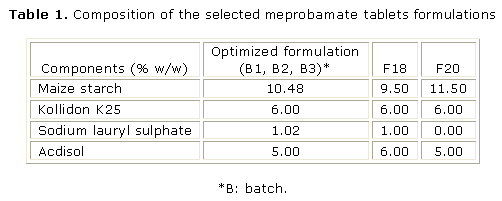
<body><![CDATA[<P><font size="2" face="Verdana"><b>Preparation of meprobamate tablets </b></font>      <P><font size="2" face="Verdana">On the basis of previous results, three batches    (B1, B2 and B3) of the optimized tablet formulation were elaborated. Besides,    of other two formulations, F18 and F20 (one batch), were included in the present    study. The composition of the meprobamate tablets formulations is listed in    <a href="#t1">Table 1</a>. The tablets were prepared as described previously.<SUP>7</SUP>    Wet massing and drying of meprobamate granules was performed using a fluidized    bed drier Glatt<SUP>&#174</SUP>; model GPCG (Germany). Each tablet of 600 mg    containing 400 mg meprobamate was compressed on a rotary tablet machine (Killian,    model TX 40 AM, Germany) using flat-faced, beveled punches of 12,7 mm diameter    at a speed of 110 tablet/min. The hardness of the tablets was fixed at 8 &#177;    1 Kgf/Monsanto and the height at 4.5 mm &#177; 5 %. </font>     <P align="center"><img src="/img/revistas/far/v44n4/t0104410.gif" width="502" height="201"> <a name="t1"></a>     
<P>    <br>     <P><b><font size="2" face="Verdana">Determination of the granulate properties    </font></b>      <P><font size="2" face="Verdana">The particle size characterization was performed    by applying a shaking sieve with a set of sieves consisting of sieves with 1250,    800, 630, 450, 250, 125 <font face="Symbol">m</font>m apertures. For the determination    of bulk and tap densities, an appropriate amount of the sample was poured in    a 100 mL tared graduated cylinder. The volume was then read directly from the    cylinder and used to calculate the bulk density according to the mass/volume    ratio. For tap density the cylinder was tapped 1 000 times using a tap density    analyzer (Erweka SVM1, Germany). The granulate flow rate was measured by a glass    funnel with a round orifice of 120 mm, its outlet is separated 100 mm respect    to a horizontal surface, and with a wall angle of 45 degrees.<SUP>8</SUP> </font>      <P>    <br>     <P><font size="2" face="Verdana"><b>Determination of the physical-mechanical properties    of meprobamate tablets </b></font>      ]]></body>
<body><![CDATA[<P><font size="2" face="Verdana">The percentages of friability and the resistance    to abrasion were examined by using a Pharma Test, model TTSR-A (Germany) friabilator    and Pharma Test, model TTSR-A (Germany) abrasion tester. Tablet height was measured    with 0-1 inch Ultra-Micrometer Fowler (USA). The disintegration time in seconds    was determined by using a SOTAX-typeDT2 (Switzerland) apparatus. Deionized water    at 37 &#177; 1 &#176;C was used as immersion medium. All measurements were made    in triplicate. </font>     <P>    <br>     <P><font size="2" face="Verdana"><b>Determination of in vitro dissolution of meprobamate    tablets </b></font>      <P><font size="2" face="Verdana">The U.S.P basket method was used for all the    in vitro dissolution studies by using a PHARMA TEST, model PTW S3C (Germany)    dissolutor. The deionized water was used as dissolution medium. The rate of    stirring was 100 rpm. The meprobamate tablets were placed in 900 mL of deionized    water for 30 minutes. Six tablets of each formulation were determined. The mean    and S.D of dissolved meprobamate were calculated. The amounts of model substance    released from tablets were analyzed and identified using a HPLC KNAUER (Germany)    like is described in U.S.P method.<SUP>9</SUP> </font>     <P>    <br>     <P><font size="2" face="Verdana"><b>Assay </b></font>      <P><font size="2" face="Verdana">The amount of model substance in tablets was    analyzed employing chromatographic technique using a HPLC KNAUER (Germany) like    is described in U.S.P method9. The samples were chromatographed on reverse phase    L1 (C18) (25 x 4.6 mm, 5 &#181;m particle size) column (Phenomenex, USA). All    chromatographic runs were performed using water and acetonitrile (70/30) as    the mobile phase. The parameters employed were: flow rate was 1.0 mL/min, UV    detection at 200 nm, column temperature 25 &#176;C and at injection volume 20    &#181;L. The technique was previously validated.<SUP>10</SUP> </font>     <P>    ]]></body>
<body><![CDATA[<br>     <P><font size="2" face="Verdana"><b>Stability study </b></font>      <P><font size="2" face="Verdana">Selected tablets batches were packaged in PVC    and aluminium blisters and kept at 40 &#177; 2 &#176;C / 75 &#177; 5 % RH for    6 months (accelerated study) and 30 &#177; 2 &#176;C/70 &#177; 5 % RH for 24    months (long-term study). Samples were withdrawn at initial time, 6, 12 and    24 months for evaluation of drug content and in vitro drug release.</font>     <P>    <br>     <P><b><font size="2" face="Verdana">Data analysis </font></b>      <P><font size="2" face="Verdana">The technological and analytical properties of    all formulations were treated by STATGRAPHICS PLUS version 5.1 (Statistical    Graphics Corp., EUA) software. </font>     <P>      <P>      <P><b><font size="3" face="Verdana">RESULTS </font></b>  </p>     ]]></body>
<body><![CDATA[<p><font size="2" face="Verdana">Granulates and meprobamate tablet properties    of the selected formulations are summarized in <a href="/img/revistas/far/v44n4/t0204410.gif">Table    2</a>. </font></p>     
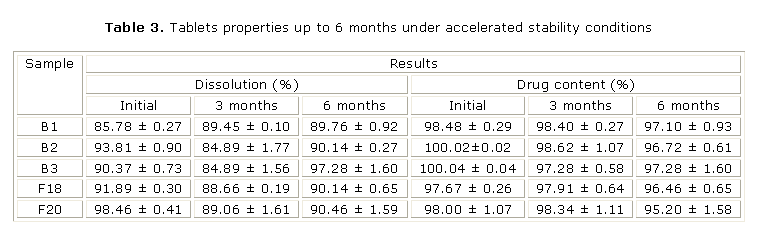
<p align="center">&nbsp;</p>     <P><font size="2" face="Verdana">The dissolved drug percentage and the results    of the drug content and in vitro drug release corresponding to the accelerated    study are showed in <a href="/img/revistas/far/v44n4/t0304410.gif">Table 3</a>. </font>     
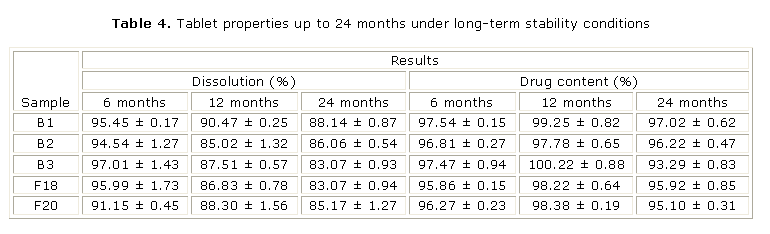
<P><font size="2" face="Verdana">With regard to the long-term stability of the    selected formulations, the values obtained are found in <a href="/img/revistas/far/v44n4/t0404410.gif">Table    4</a>. </font>      
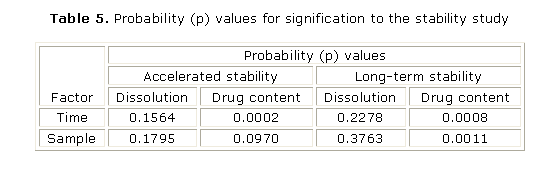
<P><font size="2" face="Verdana">From the selected formulations were obtained    granulates and tablets with satisfactory organoleptic, physical-mechanical and    technological properties, demonstrating the feasibility from the process of    production of this product. </font> </p>     <p><font size="2" face="Verdana">The comparative analysis (least significant difference    at p= 0.05) was done for drug content and in vitro drug release results from    the accelerated and long-term stability studies (<a href="#t5">Tabla 5</a>).    </font> </p>     <P align="center"><img src="/img/revistas/far/v44n4/t0504410.gif" width="554" height="176"><a name="t5"></a>      
<P align="center">     <P>      <P>      ]]></body>
<body><![CDATA[<P><font size="3"><b><font face="Verdana">DISCUSSION </font></b></font>      <P><font size="2" face="Verdana">The high dose and the poor flow properties of    this pharmaceutical active substance conduced to use wet granulation as elaboration    method for meprobamate tablets.7 Independent of composition of formulations,    distribution of particle size showed a normal behaviour (Dmax&lt; Dcritic= 0.457,    p&gt; 0.20; n= 8; <font face="Symbol">a</font>= 0.05). No significant difference    (p&gt; 0.05) was found between all granules: mean particle size (p = 0.5059);    tap density (p= 0.1619) and bulk density (p= 0.2617). The granule properties    were independent of the excipient proportions evaluated. </font>      <P><font size="2" face="Verdana">In order to determine if tablet properties are    affected by composition of the formulations analysis of simple variance was    applied. No significant difference was found between these tablets properties:    height (p= 0.6974); hardness (p= 0.4057) and mean weight (p= 0.9767). Three    formulations showed good tensile strength with an acceptable disintegration    time. Disintegration time less than 900 second was selected as the expected    disintegration time. The disintegration time showed a significant dependence    (p= 0.0494) with maize starch, sodium lauryl sulphate/sodium croscarmellosa    proportions. The equation [1], which describes the behavior of disintegration    time, was: </font>     <P><font size="2" face="Verdana">Disintegration= 20.791 maize starch + 347.386    sodium lauryl sulphate/sodium croscarmellosa - 69.095 [1] </font>     <P><font size="2" face="Verdana">From the equation [1], it can be seen that the    minimum disintegration time corresponded with the minimum values of sodium lauryl    sulphate and acdisol proportions studied. The coefficient of sodium lauryl sulphate    / sodium croscarmellosa was largest, showed that the effect of combination of    them was the main influence factor on disintegration of the tablets. </font>     <P><font size="2" face="Verdana">The dissolved drug percentage (Table 3) showed    the following behavior [2]: </font>     <P><font size="2" face="Verdana">Dissolved drug= 0.017 maize starch - 40.844 sodium    lauryl sulphate/sodium croscarmellosa + 98.2589 [2] </font>      <P><font size="2" face="Verdana">From the equation [2] it can be concluded that    relation of sodium lauryl sulphate and acdisol has more influence on the dissolved    drug percentage of the tablets. Equation [2] indicates that the percentages    of dissolved drug decreases with increasing sodium lauryl sulphate/sodium croscarmellosa    ratio. The better results for dissolution are obtained in middle of the range    for sodium lauryl sulfate.<SUP>7</SUP> </font>     <P><font size="2" face="Verdana">Physical and chemical parameters of Meprobamate    tablets were independent of the composition of the selected formulations, even    for in vitro dissolution. According to the described composition of formulations    all tablets showed a favourable disintegrating time (t&lt; 900 s), the percentages    of dissolved drug higher than 80 % (Q <font face="Symbol">&sup3;</font> 75 %    in 30 min) and values of assay from between 90 and 110 % are within an acceptable    limits. It could be stated that after 6 months aging the selected formulations    satisfied the official pharmaceutical specifications.<SUP>9</SUP> </font>      <P><font size="2" face="Verdana">The percentages of dissolved drug higher than    80 % during two years and the values of assay higher of 95 % are considered    as being acceptable. Three formulations also kept all the rest official pharmaceutical    specifications.<SUP>9</SUP> According to the stability study was verified that the formulations    showed high chemical stability during 24 months. </font>     ]]></body>
<body><![CDATA[<P><font size="2" face="Verdana">Accelerated stability testing (high temperature,    humidity) can be helpful in judging the long-term stability of a tablet package    system. In addition to the stability data generated on the optimal formula,    stability data generated on similar formulations can be sometimes be used as    supportive stability data.<SUP>11</SUP> </font>     <P><font size="2" face="Verdana">The in vitro drug release did not reveal any    significant difference, indicating no effect of time and the composition of    formulations on percentages of dissolved drug. After 6 months, drug content    showed significant differences. However, three formulations kept it between    9 and 110 %, which are within acceptable limits.<SUP>9</SUP> </font>      <P>     <P>      <P><font size="3"><b><font face="Verdana">CONCLUSIONS </font></b></font>      <P><font size="2" face="Verdana">The disintegration time and dissolved drug percentage    showed a significant dependence with sodium lauryl sulphate/sodium croscarmellosa    proportions. In vitro drug release did not reveal any significant difference,    indicating no effect of time and the composition of formulations on percentages    of dissolved drug. On the basis of the present results, the selected meprobamate    immediate released tablets formulations showed good stability, with optimum    disintegration times and in vitro drug release during 24 months, and all the    rest official pharmaceutical specifications. </font>     <P>      <P>      <P>      <P><font size="3"><b><font face="Verdana">REFERENCES </font></b></font>      ]]></body>
<body><![CDATA[<!-- ref --><P><font size="2" face="Verdana">1. Serajuddin ATM, Thakur AB, Ghosal RN, Fakes    MG, Ranadive SA, Morris KH, et al. Selection of solid dosage form composition    through drug-excipient compatibility testing. J Pharm Sci. 1999;88:696-704.    </font>      <!-- ref --><P><font size="2" face="Verdana">2. Furlanetto S, Cirri M, Maestrelli F, Corti    G, Mura P. Study of formulation variables influencing the drug release rate    from matrix tablets by experimental design. Eur J Pharm Biopharm. 2006;62:77-84.    </font>      <!-- ref --><P><font size="2" face="Verdana">3. Fern&aacute;ndez EG, Fern&aacute;ndez Cervera    M, Oliveira RT, Berm&uacute;dez B, P&eacute;rez I, Mor&oacute;n Y, et al. Dise&ntilde;os    de experimentos en tecnolog&iacute;a y control de los medicamentos. Lat Am J    Pharm. 2008;27(2):286-96. </font>      <!-- ref --><P><font size="2" face="Verdana">4. Mura P, Furnaletto S, Cirri M, Maestrelli    F, Marras AM, Pinzauti S. Optimization of glybenclamide tablet composition through    the combined use of differential scanning calorimetry and D-optimal mixture    experimental design. J Pharm Biomed Anal. 2004;37:65-71. </font>      <!-- ref --><P><font size="2" face="Verdana">5. Huang BY, Tsai YH, Lee SH, Chang J, Wu P.    Optimization of pH-independent release of nicardipine hydrochloride extended-release    matrix tablets using response surface methodology. Int J Pharm. 2005;289:87-95.    </font>      <!-- ref --><P><font size="2" face="Verdana">6. Frey H, Bartels I. Felbamate and meprobamate:    a comparison of their anticonvulsant properties. Epilepsy Res. 1997;27:151-64.    </font>      <!-- ref --><P><font size="2" face="Verdana">7. Fern&aacute;ndez Cervera M, Mar&iacute;n Y,    Fern&aacute;ndez EG, P&eacute;rez I. Jim&eacute;nez B. Optimization of a meprobamate    fast released tablet formulation using mixture design. Lat Am J Pharm. 2008;27(1):62-7.    </font>      <!-- ref --><P><font size="2" face="Verdana">8. Iraizoz A, Bilbao O, Barrios MA. Conferencias    de Tecnolog&iacute;a Farmac&eacute;utica II. La Habana: Facultad de Farmacia    y Alimentos. Universidad de La Habana, ENPES; 1990. p. 170-81. </font>      <!-- ref --><P><font size="2" face="Verdana">9. United States Pharmacopoeial Convention. Meprobamate    Oral Suspension. Meprobamate Tablets. USP 27. Rockville: Mack Printing; 2004.    p. 1167. </font>      <!-- ref --><P><font size="2" face="Verdana">10. Jim&eacute;nez Cuella B. Desarrollo de una    nueva formulaci&oacute;n de tabletas de meprobamato 400 mg. Tesis en opci&oacute;n    al grado de M&aacute;ster en Tecnolog&iacute;a y Control de los Medicamentos.    La Habana: Instituto de Farmacia y Alimentos. Universidad de La Habana. 2008.    </font>      <!-- ref --><P><font size="2" face="Verdana">11. Garnet EP, Baley GJ, McCurdy VE, Banker GS.    Pharmaceutical dosage forms: Tablets. Vol. 1. New York: Marcel Dekker; 1989.    p. 85-7.</font>     <P>     <P>      <P>      <P>      <P><font size="2" face="Verdana, Arial, Helvetica, sans-serif">Recibido: June    8, 2010.    <br>   Aprobado: July 17, 2010</font>     <P>     <P>     <P><font size="2" face="Verdana">Dra. <i>C. Mirna Fern&aacute;ndez Cervera</i>.    Institute of Pharmacy and Food, University of Havana. Street 23 No. 21425 be/    214 and 222, La Coronela, La Lisa, Havana City, 13600. Cuba. E-mail: <a href="mailto:mirnafc@yahoo.com">mirnafc@yahoo.com</a>    </font>      ]]></body>
<body><![CDATA[<P>       ]]></body><back>
<ref-list>
<ref id="B1">
<label>1</label><nlm-citation citation-type="journal">
<person-group person-group-type="author">
<name>
<surname><![CDATA[Serajuddin]]></surname>
<given-names><![CDATA[ATM]]></given-names>
</name>
<name>
<surname><![CDATA[Thakur]]></surname>
<given-names><![CDATA[AB]]></given-names>
</name>
<name>
<surname><![CDATA[Ghosal]]></surname>
<given-names><![CDATA[RN]]></given-names>
</name>
<name>
<surname><![CDATA[Fakes]]></surname>
<given-names><![CDATA[MG]]></given-names>
</name>
<name>
<surname><![CDATA[Ranadive]]></surname>
<given-names><![CDATA[SA]]></given-names>
</name>
<name>
<surname><![CDATA[Morris]]></surname>
<given-names><![CDATA[KH]]></given-names>
</name>
</person-group>
<article-title xml:lang="en"><![CDATA[Selection of solid dosage form composition through drug-excipient compatibility testing]]></article-title>
<source><![CDATA[J Pharm Sci.]]></source>
<year>1999</year>
<volume>88</volume>
<page-range>696-704</page-range></nlm-citation>
</ref>
<ref id="B2">
<label>2</label><nlm-citation citation-type="journal">
<person-group person-group-type="author">
<name>
<surname><![CDATA[Furlanetto]]></surname>
<given-names><![CDATA[S]]></given-names>
</name>
<name>
<surname><![CDATA[Cirri]]></surname>
<given-names><![CDATA[M]]></given-names>
</name>
<name>
<surname><![CDATA[Maestrelli]]></surname>
<given-names><![CDATA[F]]></given-names>
</name>
<name>
<surname><![CDATA[Corti]]></surname>
<given-names><![CDATA[G]]></given-names>
</name>
<name>
<surname><![CDATA[Mura]]></surname>
<given-names><![CDATA[P]]></given-names>
</name>
</person-group>
<article-title xml:lang="en"><![CDATA[Study of formulation variables influencing the drug release rate from matrix tablets by experimental design]]></article-title>
<source><![CDATA[Eur J Pharm Biopharm.]]></source>
<year>2006</year>
<volume>62</volume>
<page-range>77-84</page-range></nlm-citation>
</ref>
<ref id="B3">
<label>3</label><nlm-citation citation-type="journal">
<person-group person-group-type="author">
<name>
<surname><![CDATA[Fernández]]></surname>
<given-names><![CDATA[EG]]></given-names>
</name>
<name>
<surname><![CDATA[Fernández Cervera]]></surname>
<given-names><![CDATA[M]]></given-names>
</name>
<name>
<surname><![CDATA[Oliveira]]></surname>
<given-names><![CDATA[RT]]></given-names>
</name>
<name>
<surname><![CDATA[Bermúdez]]></surname>
<given-names><![CDATA[B]]></given-names>
</name>
<name>
<surname><![CDATA[Pérez]]></surname>
<given-names><![CDATA[I]]></given-names>
</name>
<name>
<surname><![CDATA[Morón]]></surname>
<given-names><![CDATA[Y]]></given-names>
</name>
</person-group>
<article-title xml:lang="es"><![CDATA[Diseños de experimentos en tecnología y control de los medicamentos]]></article-title>
<source><![CDATA[Lat Am J Pharm.]]></source>
<year>2008</year>
<volume>27</volume>
<numero>2</numero>
<issue>2</issue>
<page-range>286-96</page-range></nlm-citation>
</ref>
<ref id="B4">
<label>4</label><nlm-citation citation-type="journal">
<person-group person-group-type="author">
<name>
<surname><![CDATA[Mura]]></surname>
<given-names><![CDATA[P]]></given-names>
</name>
<name>
<surname><![CDATA[Furnaletto]]></surname>
<given-names><![CDATA[S]]></given-names>
</name>
<name>
<surname><![CDATA[Cirri]]></surname>
<given-names><![CDATA[M]]></given-names>
</name>
<name>
<surname><![CDATA[Maestrelli]]></surname>
<given-names><![CDATA[F]]></given-names>
</name>
<name>
<surname><![CDATA[Marras]]></surname>
<given-names><![CDATA[AM]]></given-names>
</name>
<name>
<surname><![CDATA[Pinzauti]]></surname>
<given-names><![CDATA[S]]></given-names>
</name>
</person-group>
<article-title xml:lang="en"><![CDATA[Optimization of glybenclamide tablet composition through the combined use of differential scanning calorimetry and D-optimal mixture experimental design]]></article-title>
<source><![CDATA[J Pharm Biomed Anal.]]></source>
<year>2004</year>
<volume>37</volume>
<page-range>65-71</page-range></nlm-citation>
</ref>
<ref id="B5">
<label>5</label><nlm-citation citation-type="journal">
<person-group person-group-type="author">
<name>
<surname><![CDATA[Huang]]></surname>
<given-names><![CDATA[BY]]></given-names>
</name>
<name>
<surname><![CDATA[Tsai]]></surname>
<given-names><![CDATA[YH]]></given-names>
</name>
<name>
<surname><![CDATA[Lee]]></surname>
<given-names><![CDATA[SH]]></given-names>
</name>
<name>
<surname><![CDATA[Chang]]></surname>
<given-names><![CDATA[J]]></given-names>
</name>
<name>
<surname><![CDATA[Wu]]></surname>
<given-names><![CDATA[P]]></given-names>
</name>
</person-group>
<article-title xml:lang="en"><![CDATA[Optimization of pH-independent release of nicardipine hydrochloride extended-release matrix tablets using response surface methodology]]></article-title>
<source><![CDATA[Int J Pharm.]]></source>
<year>2005</year>
<volume>289</volume>
<page-range>87-95</page-range></nlm-citation>
</ref>
<ref id="B6">
<label>6</label><nlm-citation citation-type="journal">
<person-group person-group-type="author">
<name>
<surname><![CDATA[Frey]]></surname>
<given-names><![CDATA[H]]></given-names>
</name>
<name>
<surname><![CDATA[Bartels]]></surname>
<given-names><![CDATA[I]]></given-names>
</name>
</person-group>
<article-title xml:lang="en"><![CDATA[Felbamate and meprobamate: a comparison of their anticonvulsant properties]]></article-title>
<source><![CDATA[Epilepsy Res.]]></source>
<year>1997</year>
<volume>27</volume>
<page-range>151-64</page-range></nlm-citation>
</ref>
<ref id="B7">
<label>7</label><nlm-citation citation-type="journal">
<person-group person-group-type="author">
<name>
<surname><![CDATA[Fernández Cervera]]></surname>
<given-names><![CDATA[M]]></given-names>
</name>
<name>
<surname><![CDATA[Marín]]></surname>
<given-names><![CDATA[Y]]></given-names>
</name>
<name>
<surname><![CDATA[Fernández]]></surname>
<given-names><![CDATA[EG]]></given-names>
</name>
<name>
<surname><![CDATA[Pérez]]></surname>
<given-names><![CDATA[I]]></given-names>
</name>
<name>
<surname><![CDATA[Jiménez]]></surname>
<given-names><![CDATA[B]]></given-names>
</name>
</person-group>
<article-title xml:lang="en"><![CDATA[Optimization of a meprobamate fast released tablet formulation using mixture design]]></article-title>
<source><![CDATA[Lat Am J Pharm.]]></source>
<year>2008</year>
<volume>27</volume>
<numero>1</numero>
<issue>1</issue>
<page-range>62-7</page-range></nlm-citation>
</ref>
<ref id="B8">
<label>8</label><nlm-citation citation-type="book">
<person-group person-group-type="author">
<name>
<surname><![CDATA[Iraizoz]]></surname>
<given-names><![CDATA[A]]></given-names>
</name>
<name>
<surname><![CDATA[Bilbao]]></surname>
<given-names><![CDATA[O]]></given-names>
</name>
<name>
<surname><![CDATA[Barrios]]></surname>
<given-names><![CDATA[MA.]]></given-names>
</name>
</person-group>
<source><![CDATA[Conferencias de Tecnología Farmacéutica II.]]></source>
<year>1990</year>
<page-range>p. 170-81</page-range><publisher-loc><![CDATA[La Habana ]]></publisher-loc>
<publisher-name><![CDATA[ENPES]]></publisher-name>
</nlm-citation>
</ref>
<ref id="B9">
<label>9</label><nlm-citation citation-type="book">
<collab>United States Pharmacopoeial Convention.</collab>
<source><![CDATA[Meprobamate Oral Suspension.: Meprobamate Tablets. USP 27.]]></source>
<year>2004</year>
<page-range>p. 1167</page-range><publisher-loc><![CDATA[Rockville ]]></publisher-loc>
<publisher-name><![CDATA[Mack Printing]]></publisher-name>
</nlm-citation>
</ref>
<ref id="B10">
<label>10</label><nlm-citation citation-type="">
<person-group person-group-type="author">
<name>
<surname><![CDATA[Jiménez Cuella]]></surname>
<given-names><![CDATA[B.]]></given-names>
</name>
</person-group>
<source><![CDATA[Desarrollo de una nueva formulación de tabletas de meprobamato 400 mg.]]></source>
<year></year>
</nlm-citation>
</ref>
<ref id="B11">
<label>11</label><nlm-citation citation-type="book">
<person-group person-group-type="author">
<name>
<surname><![CDATA[Garnet]]></surname>
<given-names><![CDATA[EP]]></given-names>
</name>
<name>
<surname><![CDATA[Baley]]></surname>
<given-names><![CDATA[GJ]]></given-names>
</name>
<name>
<surname><![CDATA[McCurdy]]></surname>
<given-names><![CDATA[VE]]></given-names>
</name>
<name>
<surname><![CDATA[Banker]]></surname>
<given-names><![CDATA[GS.]]></given-names>
</name>
</person-group>
<source><![CDATA[Pharmaceutical dosage forms:: Tablets.]]></source>
<year>1989</year>
<page-range>p. 85-7</page-range><publisher-loc><![CDATA[New York ]]></publisher-loc>
<publisher-name><![CDATA[Marcel Dekker]]></publisher-name>
</nlm-citation>
</ref>
</ref-list>
</back>
</article>