<?xml version="1.0" encoding="ISO-8859-1"?><article xmlns:mml="http://www.w3.org/1998/Math/MathML" xmlns:xlink="http://www.w3.org/1999/xlink" xmlns:xsi="http://www.w3.org/2001/XMLSchema-instance">
<front>
<journal-meta>
<journal-id>0034-7515</journal-id>
<journal-title><![CDATA[Revista Cubana de Farmacia]]></journal-title>
<abbrev-journal-title><![CDATA[Rev Cubana Farm]]></abbrev-journal-title>
<issn>0034-7515</issn>
<publisher>
<publisher-name><![CDATA[Editorial Ciencias Médicas]]></publisher-name>
</publisher>
</journal-meta>
<article-meta>
<article-id>S0034-75152013000300004</article-id>
<title-group>
<article-title xml:lang="en"><![CDATA[Stability study of Raloxifene tablets]]></article-title>
<article-title xml:lang="es"><![CDATA[Estudio de estabilidad realizado en tabletas de Raloxifeno]]></article-title>
</title-group>
<contrib-group>
<contrib contrib-type="author">
<name>
<surname><![CDATA[Rodríguez Chanfrau]]></surname>
<given-names><![CDATA[Jorge Enrique]]></given-names>
</name>
<xref ref-type="aff" rid="A01"/>
</contrib>
<contrib contrib-type="author">
<name>
<surname><![CDATA[Díaz Polanco]]></surname>
<given-names><![CDATA[Iverlys]]></given-names>
</name>
<xref ref-type="aff" rid="A01"/>
</contrib>
<contrib contrib-type="author">
<name>
<surname><![CDATA[López Armas]]></surname>
<given-names><![CDATA[Marilyn]]></given-names>
</name>
<xref ref-type="aff" rid="A01"/>
</contrib>
</contrib-group>
<aff id="A01">
<institution><![CDATA[,Centro de Investigaciones y Desarrollo de Medicamentos  ]]></institution>
<addr-line><![CDATA[La Habana ]]></addr-line>
<country>Cuba</country>
</aff>
<pub-date pub-type="pub">
<day>00</day>
<month>09</month>
<year>2013</year>
</pub-date>
<pub-date pub-type="epub">
<day>00</day>
<month>09</month>
<year>2013</year>
</pub-date>
<volume>47</volume>
<numero>3</numero>
<fpage>315</fpage>
<lpage>323</lpage>
<copyright-statement/>
<copyright-year/>
<self-uri xlink:href="http://scielo.sld.cu/scielo.php?script=sci_arttext&amp;pid=S0034-75152013000300004&amp;lng=en&amp;nrm=iso"></self-uri><self-uri xlink:href="http://scielo.sld.cu/scielo.php?script=sci_abstract&amp;pid=S0034-75152013000300004&amp;lng=en&amp;nrm=iso"></self-uri><self-uri xlink:href="http://scielo.sld.cu/scielo.php?script=sci_pdf&amp;pid=S0034-75152013000300004&amp;lng=en&amp;nrm=iso"></self-uri><abstract abstract-type="short" xml:lang="en"><p><![CDATA[Introduction: Raloxifene is a selective estrogen receptor modulator from the benzothiophene family. Several clinical trials have shown that raloxifene reduces bone loss rate in the spinal column and may increase bone mass at certain sites. Objective: to determine the physical and chemical stabilities of raloxifene tablets. Methods. three pilot scale batches of 5 kg each were prepared. In vitro dissolution, chemical stability, photostability and humidity studies were carried out. Samples were collected at 0, 1, 2, 3 and 6 months for the accelerated stability study and at 0, 6, 12, 18 and 24 months for the shelf life stability study. Chemical stability was determined using high performance liquid chromatography analytical method, which was developed and validated prior to the study. Results: in the accelerated stability study, the percentages of dissolved drug were more than 90 % and drug content porcentages were between 90 % and 110 %. Humidity conditions affected the chemical stability of the tablets. Conclusions: All raloxifene tablet batches formulations were stable for 24 months in the studied containers stored at 32 ± 2 ºC and waterproof. In vitro drug release dissolution showed good results for 24 months.]]></p></abstract>
<abstract abstract-type="short" xml:lang="es"><p><![CDATA[Introducción: el raloxifeno es un modulador selectivo del receptor estrogénico perteneciente a la familia de los benzotiofenos. Varios ensayos clínicos han mostrado que el raloxifeno reduce la pérdida del hueso en la espina dorsal y puede aumentar la masa de hueso en ciertos sitios. Objetivo: determinar la estabilidad física y química de las tabletas de raloxifeno. Métodos: se prepararon tres lotes a escala piloto de 5 kg cada uno. Se realizaron estudios de disolución in vitro, estabilidad química, fotoestabilidad y humedad. Se colectaron las muestras al tiempo 0, 1, 2, 3 y 6 meses para el estudio de estabilidad acelerado y a tiempo 0, 6, 12, 18 y 24 meses para la estabilidad por vida de estante. Se determinó la estabilidad química aplicando un método de análisis por cromatografía líquida de alta resolución, desarrollado y validado previamente. Resultados: en estudio de estabilidad acelerada, el ensayo de disolución in vitro mostró disolución del ingrediente activo en concentraciones mayores al 90 %, mientras que la concentración se mantuvo entre el 90 y 110 %. Los estudios en condiciones de humedad afectaron la estabilidad química del medicamento. Conclusiones: todos los lotes de la formulación de tabletas de raloxifeno resultaron estables por 24 meses en los envases estudiados, almacenados a la temperatura de 32 ± 2 ºC y protegidos de la humedad. Las tabletas presentan una buena disolución in vitro durante los 24 meses.]]></p></abstract>
<kwd-group>
<kwd lng="en"><![CDATA[Raloxifene]]></kwd>
<kwd lng="en"><![CDATA[stability]]></kwd>
<kwd lng="en"><![CDATA[in vitro dissolution]]></kwd>
<kwd lng="en"><![CDATA[tablets]]></kwd>
<kwd lng="es"><![CDATA[raloxifeno]]></kwd>
<kwd lng="es"><![CDATA[estabilidad]]></kwd>
<kwd lng="es"><![CDATA[disolución in vitro]]></kwd>
<kwd lng="es"><![CDATA[tabletas]]></kwd>
</kwd-group>
</article-meta>
</front><body><![CDATA[ <div align="right">     <p><font size="2" face="Verdana"><B>ART&Iacute;CULO ORIGINAL</B></font></p>    <p ALIGN="LEFT"><font size="4" face="Verdana">    <br>  <B>Stability study of Raloxifene tablets </B></font> </p></div><B>    <P>&nbsp; </B>     <P><b></b><font face="Geneva, Arial, Helvetica, san-serif" color="#000000" size="3"><b><font face="Verdana, Arial, Helvetica, sans-serif">Estudio  de estabilidad realizado en tabletas de Raloxifeno</font> </b></font> <B>     <P>&nbsp;    <P>&nbsp;  </B>     <p></p><B>     <P>     ]]></body>
<body><![CDATA[<P>     <P>     <P><font size="2" face="Verdana">Dr. C. Jorge Enrique  Rodr&iacute;guez Chanfrau, MSc. Iverlys D&iacute;az Polanco, T&eacute;c. Marilyn  L&oacute;pez Armas </font> </B>     <P>     <P>     <P><font size="2" face="Verdana">Centro  de Investigaciones y Desarrollo de Medicamentos. La Habana, Cuba.</font>     <P>&nbsp;     <P>&nbsp;      <P>     <P>     ]]></body>
<body><![CDATA[<P>     <P>     <P> <hr size="1" noshade>     <P><FONT FACE="Verdana, Arial, Helvetica, sans-serif" SIZE="2"><B>ABSTRACT</B></FONT>      <P><FONT SIZE="2" FACE="Verdana"><B>Introduction:</B> Raloxifene is a selective  estrogen receptor modulator from the benzothiophene family. Several clinical trials  have shown that raloxifene reduces bone loss rate in the spinal column and may  increase bone mass at certain sites.    <BR> <B>Objective:</B> to determine the physical  and chemical stabilities of raloxifene tablets.    <BR> <B>Methods:</B> three pilot  scale batches of 5 kg each were prepared. In vitro dissolution, chemical stability,  photostability and humidity studies were carried out. Samples were collected at  0, 1, 2, 3 and 6 months for the accelerated stability study and at 0, 6, 12, 18  and 24 months for the shelf life stability study. Chemical stability was determined  using high performance liquid chromatography analytical method, which was developed  and validated prior to the study.    <BR> <B>Results:</B> in the accelerated stability  study, the percentages of dissolved drug were more than 90 % and drug content  porcentages were between 90 % and 110 %. Humidity conditions affected the chemical  stability of the tablets. Conclusions: All raloxifene tablet batches formulations  were stable for 24 months in the studied containers stored at 32 &plusmn; 2 &ordm;C  and waterproof.<I> In vitro</I> drug release dissolution showed good results for  24 months. </FONT>     <P><FONT SIZE="2" FACE="Verdana"><B>Key words:</B> Raloxifene,  stability, <I>in vitro</I> dissolution, tablets.</FONT></P><hr size="1" noshade>      <P><FONT SIZE="2" FACE="Verdana"><B>RESUMEN     ]]></body>
<body><![CDATA[<BR>     <BR> </B></FONT><B> </B>     <P>      <P><FONT SIZE="2" FACE="Verdana"><B>Introducci&oacute;n:</B> el raloxifeno es  un modulador selectivo del receptor estrog&eacute;nico perteneciente a la familia  de los benzotiofenos. Varios ensayos cl&iacute;nicos han mostrado que el raloxifeno  reduce la p&eacute;rdida del hueso en la espina dorsal y puede aumentar la masa  de hueso en ciertos sitios.    <BR> </FONT><FONT SIZE="2" FACE="Verdana"><B>Objetivo:</B>  determinar la estabilidad f&iacute;sica y qu&iacute;mica de las tabletas de raloxifeno.    <BR>  </FONT><FONT SIZE="2" FACE="Verdana"><B>M&eacute;todos:</B> se prepararon tres  lotes a escala piloto de 5 kg cada uno. Se realizaron estudios de disoluci&oacute;n  <I>in vitro</I>, estabilidad qu&iacute;mica, fotoestabilidad y humedad. Se colectaron  las muestras al tiempo 0, 1, 2, 3 y 6 meses para el estudio de estabilidad acelerado  y a tiempo 0, 6, 12, 18 y 24 meses para la estabilidad por vida de estante. Se  determin&oacute; la estabilidad qu&iacute;mica aplicando un m&eacute;todo de an&aacute;lisis  por cromatograf&iacute;a l&iacute;quida de alta resoluci&oacute;n, desarrollado  y validado previamente.    <BR> </FONT><FONT SIZE="2" FACE="Verdana"><B>Resultados:</B>  en estudio de estabilidad acelerada, el ensayo de disoluci&oacute;n <I>in vitro</I>  mostr&oacute; disoluci&oacute;n del ingrediente activo en concentraciones mayores  al 90 %, mientras que la concentraci&oacute;n se mantuvo entre el 90 y 110 %.  Los estudios en condiciones de humedad afectaron la estabilidad qu&iacute;mica  del medicamento.    <BR> </FONT><FONT SIZE="2" FACE="Verdana"><B>Conclusiones:</B>  todos los lotes de la formulaci&oacute;n de tabletas de raloxifeno resultaron  estables por 24 meses en los envases estudiados, almacenados a la temperatura  de 32 &#177; 2 &#186;C y protegidos de la humedad. Las tabletas presentan una  buena disoluci&oacute;n <I>in vitro </I>durante los 24 meses. </FONT>     <P>     <P><FONT SIZE="2" FACE="Verdana"><B>Palabras  clave:</B> raloxifeno, estabilidad, disoluci&oacute;n <I>in vitro</I>, tabletas.  </FONT><hr size="1" noshade>     ]]></body>
<body><![CDATA[<p>&nbsp;</p>    <p>&nbsp;</p>    <P>     <P><font size="3" face="Verdana"><B>INTRODUCTION</B>  </font>     <P><font size="2" face="Verdana">Raloxifene is a selective estrogens receptor  modulator, which belongs to the benzothiophene family. Estrogen receptor binding  causes acivation and blocking<B> </B>of certain strogenic pathways. Thus, raloxifene  is an estrogen agonist/antagonist, commonly referred to as a selective estrogen  receptor modulator. The results of several clinical trials have shown that raloxifene  decreases bone resorption and reduces biochemical markers of bone turnover to  the premenopausal range.<SUP>1-6</SUP> </font>     <P><font size="2" face="Verdana">The  raloxifene is supplied in a tablet dosage form for oral administration. Each tablet  contains 60 mg of raloxifene HCl, which is the molar equivalent of 55.71 mg of  free base. It<B> </B>is indicated to reduce the<B> </B>risk of invasive breast  cancer in postmenopausal women with osteoporosis.<SUP>4,5</SUP> </font>     <P><font size="2" face="Verdana">The  physicochemical and biological properties of the active substance are the most  important characteristics when the generic pharmaceutical dosage form was developed.  At the same time, it is necessary to develop an analytical method validated according  to international literature.<SUP>7,8</SUP> </font>     <P><font size="2" face="Verdana">The  most common reactions observed in pharmaceutical dosage forms are hydrolysis,  dehydration, isomerization, oxidation, photodegradation, and some specific interactions  with formulation components (excipients and their impurities).<SUP>9 </SUP>Evaluating  the stability parameters is useful to drug formulation and is helpful to know  about the storage conditions. In long-term studies, the formulation stability  will dictate the shelf life of the marketed product.<SUP>10-13</SUP> </font>     <P><font size="2" face="Verdana">The  objective of this work was to evaluate the raloxifene tablet stability. </font>      <P>&nbsp;     ]]></body>
<body><![CDATA[<P><font face="Verdana" size="2"><B><font size="3">METHODS</font></B> </font>      <P><font size="2" face="Verdana">Three pilot scale batches of 5 kg, equivalent  to 27778 tablets each one (08001, 08002 and 08003)<B> </B>were prepared. Raloxifene  hydrochloride (BTP Pharmaceutical Co. Lim.) of pharmaceutical quality was used  as active pharmaceutical ingredients.<SUP>14</SUP> </font>     <P><font size="2" face="Verdana">Polyvinylpyrrolidone  (Kollidon K 25<SUP>&#174;</SUP>) (Germany), Lactose (China), Sodium Starch Glicolate  (Brazil), Polysorbate 80 (Germany), Microcrystalline Cellulose (Avicel PH 101)  (Germany) Magnesium Estearate (China) were used in the preparation of the tablet  core. The coating formulation consisted of Policoat (YS 1-7003) polymers and Tartracine  suspended in ethanol. </font>     <P><font size="2" face="Verdana">Raloxifene hydrochloride  tablets of 60 mg were prepared by wet granulation method. All ingredients were  mixed (Planetary granulation equipment model HOBART, Germany) and manufactured  using a rotary tablet machine (MANESTY F3, Italy) equipped with flat, bevelled  edge, punches, 8 mm in diameter, to an average hardness of 5 &#177; 1 kgf and  an average weight of 180 &#177; 10 mg. Each batch was analyzed and subsequently  packaged in PVC and aluminium blisters and high-density polyethylene plastic bottle.  </font>     <P>    <br>     <P><font size="2" face="Verdana"><B>Analytical assay</B> </font>      <P><font size="2" face="Verdana">Chemical stability was determined by high performance  liquid chromatography<B> </B>(HPLC) method according to the criteria proposed  by CECMED.<SUP>13</SUP> The analyses were performed using the<B> </B>HPLC KNAUER  (Germany) equipment under the following conditions: C18 column, mobile phase (methanol,  water and trietanolamine in the ratio of 70:30:0.1 v/v), injection volume of 20  </font><font face="Symbol" size="2"> </font><font face="Verdana, Arial, Helvetica, sans-serif" size="2">&#181;</font><font size="2" face="Verdana">L,  flow rate of 1.5 mL/min and </font><font face="Symbol" size="2">l</font><font size="2" face="Verdana">=  286 nm, using a previously validated method.<SUP>15</SUP> </font>     <P>    <br>     ]]></body>
<body><![CDATA[<P><font size="2" face="Verdana"><B>Determination  of <I>in vitro</I> dissolution of raloxifene tablets</B> </font>     <P><font size="2" face="Verdana">Dissolution  process was carried out following the U.S.P general method.<SUP>14 </SUP>PHARMA  TEST, model PTW S3C model (Germany) dissolution apparatus with paddles was used.  An agitation rate of 100 rpm for 60 min, 900 mL of 0.1 mol/L hydrochloric acid  solution as dissolution medium and 37 &#177; 0.1 &#186;C temperature were the  experimental conditions. All samples were added to the medium,<B> </B>withdrawn  and filtered by<B> </B>0.45 &#181;m pore diameter filter. The analysis of dissolved  raloxifene was according above mentioned the HPLC method . </font>     <P>    <br>     <P><font size="2" face="Verdana"><B>Stability  study</B> </font>     <P><font size="2" face="Verdana">Tablets representing the three  batches were placed in containers for accelerated (40 &#177; 2 &#176;C/75 &#177;  5 % RH for 6 months) and long-term (30 &#177; 2 &#176;C/70 &#177; 5 % RH for 24  months) stability studies. Samples were collected at 0, 1, 2, 3 and 6 months (accelerated  stability studies) and at 0, 6, 12, 18 and 24 months (long-term stability studies)  for chemical stability and <I>in vitro</I> dissolution tests. Experimental results  were expressed as means &#177; SD. </font>     <P>    <br>     <P><font size="2" face="Verdana"><B>Photostability  and humidity studies</B> </font>     <P><font size="2" face="Verdana">Samples of each  batch were placed<B> </B>in sealed<B> </B>clear glass containers and<B> </B>exposed  to light source during 90 days following the ICH test conditions for photostability  test.<SUP>16</SUP> On the other hand, samples of each batch were placed into a  humidity chamber at 84, 92 and 98 % during 180 days. At the end of both studies,  the samples were analyzed. Experimental results were expressed as means &#177;  SD. </font>     ]]></body>
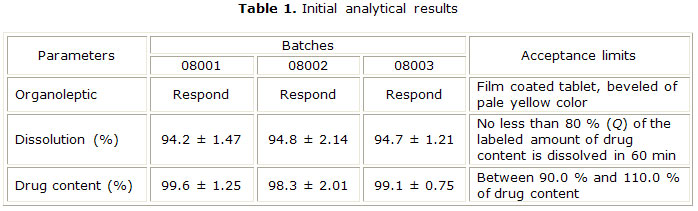
<body><![CDATA[<P>&nbsp;     <P>     <P>     <P><font size="3" face="Verdana"><B>RESULTS</B> </font>      <P><font size="2" face="Verdana"><a href="/img/revistas/far/v47n3/t0104313.jpg">Table  1</a> shows the quality control results of each batch before packing. These results  comply<B> </B>with the quality control parameters indicated in the analysis methods  (Rodr&iacute;guez Chanfrau JE, L&oacute;pez Armas M. Raloxifeno tabletas. T&eacute;cnica  de fabricante N&#186; PT 11001. CIDEM. 2011) </font>     
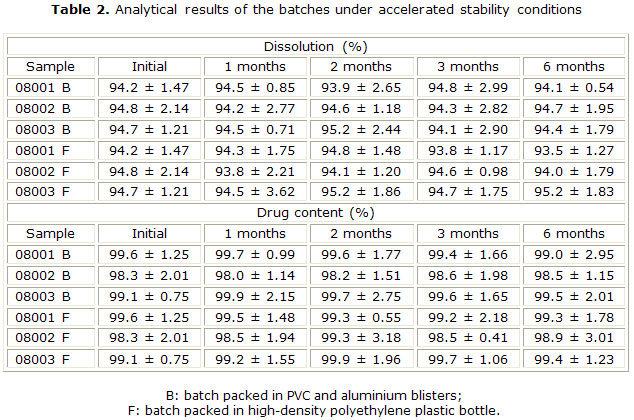
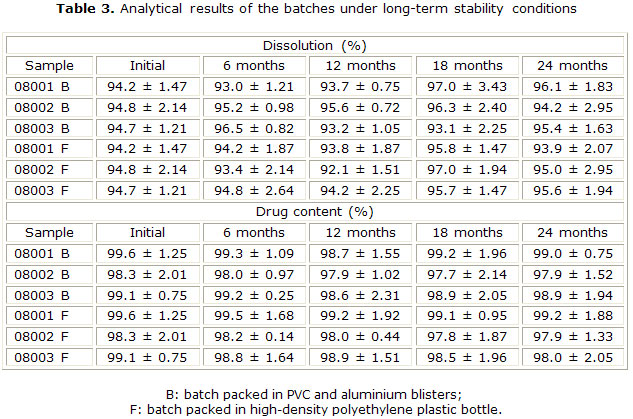
<P><font size="2" face="Verdana"><a href="/img/revistas/far/v47n3/t0204313.jpg">Table  2</a> shows the results of accelerated stability studies and <a href="/img/revistas/far/v47n3/t0304313.jpg">table  3</a> shows the results of long-term stability studies in both studied containers.  The results showed that the raloxifene tablets fulfilled<B> </B>the quality specifications  after 6 months and 24 months, respectively. Similar results were observed for  photostability studies after 90 days (<a href="#tab4">table 4</a>). </font>     
<br>      <br>     <br>     <P align="center"><IMG SRC="/img/revistas/far/v47n3/t0404313.jpg" WIDTH="529" HEIGHT="255"><a name="tab4"></a>      
]]></body>
<body><![CDATA[<P><font size="2" face="Verdana">    <br> The humidity conditions that were used affected  the chemical stability of raloxifene tablets (<a href="#fig1">Fig.</a>). Serious<B>  </B>affects were observed when the tablets were packed in high density polyethylene  plastic bottle.</font>     <P align="center"><font size="2" face="Verdana">    <br> <img src="/img/revistas/far/v47n3/f0104313.jpg" width="432" height="349">  <a name="fig1"></a>    
<br>     <br> </font>     <br>     <P><font size="2" face="Verdana">A statistical  comparison among the containers used in different relative humidity conditions  showed that there was not significant differences to 84% (p= 0.3469). However,  when the content of humidity is increased there was a statistically significant  difference in the raloxifene content (p= 0.0014 and p = 0.0006 for 92 % and 98  %, respectively). However, during this study changes in the organoleptic characteristics  of the samples were not observed. </font>     <P>&nbsp;     <P>     ]]></body>
<body><![CDATA[<P><font size="3" face="Verdana"><B>DISCUSSION</B>  </font>     <P><font size="2" face="Verdana">The main factors that affect the drug  stability are the temperature, pH, relative humidity of the environment, light,  oxygen, physical form and particle size of the drug and excipients.<SUP>9 </SUP>Stability  studies provide information about some factors which influence the stability of  a pharmaceutical preparation under study. </font>     <P><font size="2" face="Verdana">In  our accelerated stability study, the percentages of dissolved drug were higher  than 90 % (Q 80 % in 60 min) and drug content porcentages were between 90 % and  110 % in both containers. These results demonstrated that the temperature does  not affect the product quality under the selected<B> </B>working conditions. Similar  results were obtained in the photostability study. These results were similar  to those reported for <I>Srinivas </I>et al.<SUP>17</SUP> which demonstrated that  degradation was not observed in Raloxifene HCl sample when subjected to stress  conditions such as light and heat. </font>     <P><font size="2" face="Verdana">Humidity  conditions affected the chemical stability of the tablets. Raloxifene content  decreased when the percentage relative humidity increased. The greatest effect  was observed when the tablets were packed in high-density polyethylene plastic  bottle (approximately 2 % at 84 % HR, 7 % at 92 % HR and 9 % at 98 % HR) compared  to the tablets packed in PVC (approximately 1 % at 84 % HR, 3 % at 92 % HR and  7 % at 98 % HR).<B> </B>Therefore, the humidity has an impact on the quality product  regardless of the type of container used. This parameter should be controlled  during the storage of the product. </font>     <P><font size="2" face="Verdana">The  most common reaction observed in pharmaceutical products is the hydrolysis. The  relative humidity of the atmosphere affects the development of this process which  is the main mechanism of drug degradation in solid state and in solution.<SUP>18,19</SUP>  </font>     <P><font size="2" face="Verdana">Functional groups derived from carboxylic  acid are common in pharmaceuticals and it is well-known that drug easily suffers  degradation by hydrolysis when water is present, due to the existence of hydrogen  or hydroxyl ions that likely catalyzes hydrolytic reactions.<SUP>18</SUP> </font>      <P><font size="2" face="Verdana">Raloxifene is a polyhydroxylated non-steroidal  compound with a benzothiophene core that presents a carboxylic group in their  chemical structure. This chemical group suffers the typical reactions of the carboxylic  acids in presence of water. Four impurities ([2- (4-hydroxyphenyl)- 6-hydroxybenzo[b]thien-3-yl][4-[2-(1-piperidinyl)ethoxy]phenyl]methanone  N-oxide; 6-Methylsulfonyloxy-2-[(4-methylsulfonyloxy)phenyl] benzothiophene; 6-Methylsulfonyloxy-2[(4-methyl  sulfonyloxy)phenyl]-3-[[4(2-piperidinyl)ethoxy]benzoyl]benzothiophene Hydrochloride  and 4-[2-(piperidinyl)ethoxy]benzoic acid) have been isolated during the degradation  processes of raloxifene according the report of <I>Srinivas</I> et al.<SUP>17</SUP>  In this study the degradation products could not be determined, but the results  of humidity study indicated that in presence of water the active principle suffers  a degradation process which is more prominent when the tablets are packed in high-density  polyethylene plastic bottle. </font>     <P><font size="2" face="Verdana">On the basis  of these present results, the raloxifene tablets formulation was stable with optimum  <I>in vitro</I> drug release during 24 months in the studied containers, stored  at 32 &#177; 2 &#186;C and protected from humidity. </font>     <P>&nbsp;     <P>     ]]></body>
<body><![CDATA[<P><font size="3" face="Verdana"><B>REFERENCES</B>  </font>     <P>     <!-- ref --><P><font size="2" face="Verdana">1. Delmas PD, Bjarnason NH, Mitlak  BH. Effects of raloxifene on bone mineral density, serum cholesterol concentrations,  and uterine endometrium in postmenopausal women. N Engl J Med.1997;337:1641-7.      </font>     <!-- ref --><P><font size="2" face="Verdana">2. Ettinger B, Black DM, Mitlak BH, Knickerbocker  RK, Nickelsen T, Genant HK, Christiansen C, Delmas PD, Zanchetta JR, Stakkestad  J, Gluer CC, Krueger K, et al. Reduction of vertebral fracture risk in postmenopausal  women with osteoporosis treated with raloxifene: results from a 3-year randomized  clinical trial. Multiple Outcomes of Raloxifene Evaluation (MORE) Investigators.  JAMA.<I> </I>1999;282(7):637-45.     </font>     <!-- ref --><P><font size="2" face="Verdana">3. Lippman  ME, Krueger KA, Eckert S, Sashegyi A, Walls EL, Jamal S, et al. Indicators of  lifetime estrogen exposure: effect on breast cancer incidence and interaction  with raloxifene therapy in the multiple outcomes of raloxifene evaluation study  participants. J Clin Oncol.<I> </I>2001;19(12):3111-6.     </font>     <!-- ref --><P><font size="2" face="Verdana">4.  D'Amelio P, Muratore M, Tinelli F, Tamone C, Cosentino L, Quarta E, Calcagnile  F, Carlo Isaia G. Effect of raloxifene and clodronate on bone density in postmenopausal  osteoporotic women. Int J Tissue React.<I> </I>2003;25(2):73-8.     </font>     ]]></body>
<body><![CDATA[<!-- ref --><P><font size="2" face="Verdana">5.  Weinstein RS, Parfitt AM, Marcus R, Greenwald M, Crans G, Muchmore DB. Effects  of raloxifene, hormone replacement therapy, and placebo on bone turnover in postmenopausal  women. Osteoporos Int.<I> </I>2003;14(10):814-22.     </font>     <!-- ref --><P><font size="2" face="Verdana">6.  Heringa M. Review on raloxifene: profile of a selective estrogens receptor modulator.  Int J Clin Pharmacol Ther.<I> </I>2003;41(8):331-45.     </font>     <!-- ref --><P><font size="2" face="Verdana">7.  Ahlert J. ICH Q8: Pharmaceutical Development. Regulatory Requirements Directed  by the New Note for Guidance (EMEA/CHMP/167068/2004) in Comparison to the Previous  Guideline (CPMP/QWP/155/96). A Critical View from the Generic Pharmaceutical Industry.  Bonn: ICH; 2007. p. 34-40.     </font>     <!-- ref --><P><font size="2" face="Verdana">8. United  States Pharmacopoeial Convention. USP XXXI. M&eacute;todos generales. The United  States Pharmacopoeia Convention. 31 ed. Rockville: Mack Printing; 2008. p. 752-7.      </font>     <!-- ref --><P><font size="2" face="Verdana">9. Narang A, Rao V, Raghavan K. Excipient  compatibility. In. Developing solid oral dosage forms, Pharmaceutical theory and  practice. Cap. 6. ed. New York: Elservier Inc.; 2009. p. 125-45.     </font>     ]]></body>
<body><![CDATA[<!-- ref --><P><font size="2" face="Verdana">10.  Fern&aacute;ndez Cervera M, P&eacute;rez S&aacute;nchez I, Izquierdo Castro A,  Jim&eacute;nez Cuellar B, Yarie Camara F, Gustavo Fern&aacute;ndez E. Technological  development and stability study of meprobamate immediate released tablets. Rev  Cubana Farm. 2010;44(4):456-64.     </font>     <!-- ref --><P><font size="2" face="Verdana">11. Waterman  KC, Adami RC. Accelerated ageing: prediction of chemical stability of pharmaceuticals.  Int J Pharm. 2005;293:101-25.     </font>     <!-- ref --><P><font size="2" face="Verdana">12. Steele  G, Austin T. Preformulation Investigations using Small Amounts of Compound as  an Aid to Candidate Drug Selection and Early Development. In Gibson M. (ed). Pharmaceutical  Preformulation and Formulation. 2nd ed. New York: Informa Healthcare USA, Inc.;  2009. p. 17-129.     </font>     <!-- ref --><P><font size="2" face="Verdana">13. Regulaci&oacute;n  No 23. Requerimientos de los estudios de estabilidad para el registro de nuevos  ingredientes farmac&eacute;uticos activos. Centro Estatal para el Control de Medicamentos  (CECMED). La Habana, 2000. Disponible en: <U><a href="http://www.cecmed.sld.cu/Pages/Reg_EvalEL.htm" target="_blank">http://www.cecmed.sld.cu/Pages/Reg_EvalEL.htm</a><FONT  COLOR="#0000ff"> </FONT></U> </font>     <!-- ref --><P><font size="2" face="Verdana">14. United  States Pharmacopoeial Convention. USP XXXIII. The United States Pharmacopoeia  Convention. 33 ed. Rockville: Mack Printing; 2010. p. 294, 4549.     </font>     <!-- ref --><P><font size="2" face="Verdana">15.  Rodr&iacute;guez Chanfrau JE, L&oacute;pez Armas M. Validaci&oacute;n de un m&eacute;todo  de an&aacute;lisis para la determinaci&oacute;n de raloxifeno en una formulaci&oacute;n  cubana. Rev Cubana Farm. (en proceso de aparici&oacute;n).     </font>     <!-- ref --><P><font size="2" face="Verdana">16.  ICH. Stability Testing: Photostability Testing of New Drug Substances and Products.  ICH. Harmonised Tripartite Guideline Q1B. International Conference on Harmonisation  of Technical Requirements for Registration of Pharmaceuticals for Human Use. Geneva:  ICH; 1996.     </font>     <!-- ref --><P><font size="2" face="Verdana">17. Srinivas G, Kanumula G,  Madhavan P, Kishore Kumar K, Rama Koti Reddy Y, Vishnu Priya M, et al. Development  and validation of stability indicating method for the quantitative determination  of Raloxifene hydrochloride and its related impurities using UPLC. J Chem Pharm  Res. 2011;3(1):553-62.     </font>     <!-- ref --><P><font size="2" face="Verdana">18. Zhou D, Porter  W, Zhang G. Drug Stability and Degradation Studies. In. Developing solid oral  dosage forms, Pharmaceutical theory and practice. Cap. 5. New York: Elservier  Inc.; 2009. p. 87-124.     </font>     <!-- ref --><P><font size="2" face="Verdana">19. Kontny MJ.  Distribution of water in solid pharmaceutical systems. Drug Development and Industrial  Pharmacy. 1988;14(14):1991-2027.     </font>     <P>&nbsp;     ]]></body>
<body><![CDATA[<P>&nbsp;     <P>     <P><font size="2" face="Verdana">Recibido:  4 de marzo de 2013.    <br> </font><font size="2" face="Verdana">Aprobado: 6 de mayo  de 2013. </font>     <P>&nbsp;     <P>&nbsp;     <P>     <P><font size="2" face="Verdana"><I>Jorge Enrique  Rodr&iacute;guez Chanfrau.</I> Centro de Investigaci&oacute;n y Desarrollo de  Medicamentos (CIDEM). Ave. 26 No. 1605 entre Boyeros y Puentes Grandes. CP 10600.  Plaza de la Revoluci&oacute;n. La Habana, Cuba. Correo electr&oacute;nico: <U><a href="mailto:jorge.rodriguez@infomed.sld.cu">jorge.rodriguez@infomed.sld.cu</a></U></font>       ]]></body><back>
<ref-list>
<ref id="B1">
<label>1</label><nlm-citation citation-type="journal">
<person-group person-group-type="author">
<name>
<surname><![CDATA[Delmas]]></surname>
<given-names><![CDATA[PD]]></given-names>
</name>
<name>
<surname><![CDATA[Bjarnason]]></surname>
<given-names><![CDATA[NH]]></given-names>
</name>
<name>
<surname><![CDATA[Mitlak]]></surname>
<given-names><![CDATA[BH]]></given-names>
</name>
</person-group>
<article-title xml:lang="en"><![CDATA[Effects of raloxifene on bone mineral density, serum cholesterol concentrations, and uterine endometrium in postmenopausal women]]></article-title>
<source><![CDATA[N Engl J Med.]]></source>
<year>1997</year>
<volume>337</volume>
<page-range>1641-7</page-range></nlm-citation>
</ref>
<ref id="B2">
<label>2</label><nlm-citation citation-type="journal">
<person-group person-group-type="author">
<name>
<surname><![CDATA[Ettinger]]></surname>
<given-names><![CDATA[B]]></given-names>
</name>
<name>
<surname><![CDATA[Black]]></surname>
<given-names><![CDATA[DM]]></given-names>
</name>
<name>
<surname><![CDATA[Mitlak]]></surname>
<given-names><![CDATA[BH]]></given-names>
</name>
<name>
<surname><![CDATA[Knickerbocker]]></surname>
<given-names><![CDATA[RK]]></given-names>
</name>
<name>
<surname><![CDATA[Nickelsen]]></surname>
<given-names><![CDATA[T]]></given-names>
</name>
<name>
<surname><![CDATA[Genant]]></surname>
<given-names><![CDATA[HK]]></given-names>
</name>
<name>
<surname><![CDATA[Christiansen]]></surname>
<given-names><![CDATA[C]]></given-names>
</name>
<name>
<surname><![CDATA[Delmas]]></surname>
<given-names><![CDATA[PD]]></given-names>
</name>
<name>
<surname><![CDATA[Zanchetta]]></surname>
<given-names><![CDATA[JR]]></given-names>
</name>
<name>
<surname><![CDATA[Stakkestad]]></surname>
<given-names><![CDATA[J]]></given-names>
</name>
<name>
<surname><![CDATA[Gluer]]></surname>
<given-names><![CDATA[CC]]></given-names>
</name>
<name>
<surname><![CDATA[Krueger]]></surname>
<given-names><![CDATA[K]]></given-names>
</name>
</person-group>
<article-title xml:lang="en"><![CDATA[Reduction of vertebral fracture risk in postmenopausal women with osteoporosis treated with raloxifene: results from a 3-year randomized clinical trial. Multiple Outcomes of Raloxifene Evaluation (MORE) Investigators]]></article-title>
<source><![CDATA[JAMA]]></source>
<year>1999</year>
<volume>282</volume>
<numero>7</numero>
<issue>7</issue>
<page-range>637-45</page-range></nlm-citation>
</ref>
<ref id="B3">
<label>3</label><nlm-citation citation-type="journal">
<person-group person-group-type="author">
<name>
<surname><![CDATA[Lippman]]></surname>
<given-names><![CDATA[ME]]></given-names>
</name>
<name>
<surname><![CDATA[Krueger]]></surname>
<given-names><![CDATA[KA]]></given-names>
</name>
<name>
<surname><![CDATA[Eckert]]></surname>
<given-names><![CDATA[S]]></given-names>
</name>
<name>
<surname><![CDATA[Sashegyi]]></surname>
<given-names><![CDATA[A]]></given-names>
</name>
<name>
<surname><![CDATA[Walls]]></surname>
<given-names><![CDATA[EL]]></given-names>
</name>
<name>
<surname><![CDATA[Jamal]]></surname>
<given-names><![CDATA[S]]></given-names>
</name>
</person-group>
<article-title xml:lang="en"><![CDATA[Indicators of lifetime estrogen exposure: effect on breast cancer incidence and interaction with raloxifene therapy in the multiple outcomes of raloxifene evaluation study participants]]></article-title>
<source><![CDATA[J Clin Oncol.]]></source>
<year>2001</year>
<volume>19</volume>
<numero>12</numero>
<issue>12</issue>
<page-range>3111-6</page-range></nlm-citation>
</ref>
<ref id="B4">
<label>4</label><nlm-citation citation-type="journal">
<person-group person-group-type="author">
<name>
<surname><![CDATA[D'Amelio]]></surname>
<given-names><![CDATA[P]]></given-names>
</name>
<name>
<surname><![CDATA[Muratore]]></surname>
<given-names><![CDATA[M]]></given-names>
</name>
<name>
<surname><![CDATA[Tinelli]]></surname>
<given-names><![CDATA[F]]></given-names>
</name>
<name>
<surname><![CDATA[Tamone]]></surname>
<given-names><![CDATA[C]]></given-names>
</name>
<name>
<surname><![CDATA[Cosentino]]></surname>
<given-names><![CDATA[L]]></given-names>
</name>
<name>
<surname><![CDATA[Quarta]]></surname>
<given-names><![CDATA[E]]></given-names>
</name>
<name>
<surname><![CDATA[Calcagnile]]></surname>
<given-names><![CDATA[F]]></given-names>
</name>
<name>
<surname><![CDATA[Carlo Isaia]]></surname>
<given-names><![CDATA[G]]></given-names>
</name>
</person-group>
<article-title xml:lang="en"><![CDATA[Effect of raloxifene and clodronate on bone density in postmenopausal osteoporotic women]]></article-title>
<source><![CDATA[Int J Tissue React.]]></source>
<year>2003</year>
<volume>25</volume>
<numero>2</numero>
<issue>2</issue>
<page-range>73-8</page-range></nlm-citation>
</ref>
<ref id="B5">
<label>5</label><nlm-citation citation-type="journal">
<person-group person-group-type="author">
<name>
<surname><![CDATA[Weinstein]]></surname>
<given-names><![CDATA[RS]]></given-names>
</name>
<name>
<surname><![CDATA[Parfitt]]></surname>
<given-names><![CDATA[AM]]></given-names>
</name>
<name>
<surname><![CDATA[Marcus]]></surname>
<given-names><![CDATA[R]]></given-names>
</name>
<name>
<surname><![CDATA[Greenwald]]></surname>
<given-names><![CDATA[M]]></given-names>
</name>
<name>
<surname><![CDATA[Crans]]></surname>
<given-names><![CDATA[G]]></given-names>
</name>
<name>
<surname><![CDATA[Muchmore]]></surname>
<given-names><![CDATA[DB]]></given-names>
</name>
</person-group>
<article-title xml:lang="en"><![CDATA[Effects of raloxifene, hormone replacement therapy, and placebo on bone turnover in postmenopausal women]]></article-title>
<source><![CDATA[Osteoporos Int.]]></source>
<year>2003</year>
<volume>14</volume>
<numero>10</numero>
<issue>10</issue>
<page-range>814-22</page-range></nlm-citation>
</ref>
<ref id="B6">
<label>6</label><nlm-citation citation-type="journal">
<person-group person-group-type="author">
<name>
<surname><![CDATA[Heringa]]></surname>
<given-names><![CDATA[M]]></given-names>
</name>
</person-group>
<article-title xml:lang="en"><![CDATA[Review on raloxifene: profile of a selective estrogens receptor modulator]]></article-title>
<source><![CDATA[Int J Clin Pharmacol Ther.]]></source>
<year>2003</year>
<volume>41</volume>
<numero>8</numero>
<issue>8</issue>
<page-range>331-45</page-range></nlm-citation>
</ref>
<ref id="B7">
<label>7</label><nlm-citation citation-type="book">
<person-group person-group-type="author">
<name>
<surname><![CDATA[Ahlert]]></surname>
<given-names><![CDATA[J]]></given-names>
</name>
</person-group>
<source><![CDATA[ICH Q8: Pharmaceutical Development. Regulatory Requirements Directed by the New Note for Guidance (EMEA/CHMP/167068/2004) in Comparison to the Previous Guideline (CPMP/QWP/155/96). A Critical View from the Generic Pharmaceutical Industry]]></source>
<year>2007</year>
<page-range>34-40</page-range><publisher-loc><![CDATA[Bonn ]]></publisher-loc>
<publisher-name><![CDATA[ICH]]></publisher-name>
</nlm-citation>
</ref>
<ref id="B8">
<label>8</label><nlm-citation citation-type="book">
<collab>United States Pharmacopoeial Convention</collab>
<source><![CDATA[USP XXXI. Métodos generales. The United States Pharmacopoeia Convention]]></source>
<year>2008</year>
<edition>31</edition>
<page-range>752-7</page-range><publisher-name><![CDATA[Rockville: Mack Printing]]></publisher-name>
</nlm-citation>
</ref>
<ref id="B9">
<label>9</label><nlm-citation citation-type="book">
<person-group person-group-type="author">
<name>
<surname><![CDATA[Narang]]></surname>
<given-names><![CDATA[A]]></given-names>
</name>
<name>
<surname><![CDATA[Rao]]></surname>
<given-names><![CDATA[V]]></given-names>
</name>
<name>
<surname><![CDATA[Raghavan]]></surname>
<given-names><![CDATA[K]]></given-names>
</name>
</person-group>
<article-title xml:lang="en"><![CDATA[Excipient compatibility]]></article-title>
<source><![CDATA[Developing solid oral dosage forms, Pharmaceutical theory and practice]]></source>
<year>2009</year>
<edition>6. ed</edition>
<page-range>125-45</page-range><publisher-loc><![CDATA[New York ]]></publisher-loc>
<publisher-name><![CDATA[Elservier Inc]]></publisher-name>
</nlm-citation>
</ref>
<ref id="B10">
<label>10</label><nlm-citation citation-type="journal">
<person-group person-group-type="author">
<name>
<surname><![CDATA[Fernández Cervera]]></surname>
<given-names><![CDATA[M]]></given-names>
</name>
<name>
<surname><![CDATA[Pérez Sánchez]]></surname>
<given-names><![CDATA[I]]></given-names>
</name>
<name>
<surname><![CDATA[Izquierdo Castro]]></surname>
<given-names><![CDATA[A]]></given-names>
</name>
<name>
<surname><![CDATA[Jiménez Cuellar]]></surname>
<given-names><![CDATA[B]]></given-names>
</name>
<name>
<surname><![CDATA[Yarie Camara]]></surname>
<given-names><![CDATA[F]]></given-names>
</name>
<name>
<surname><![CDATA[Gustavo Fernández]]></surname>
<given-names><![CDATA[E]]></given-names>
</name>
</person-group>
<article-title xml:lang="en"><![CDATA[Technological development and stability study of meprobamate immediate released tablets]]></article-title>
<source><![CDATA[Rev Cubana Farm.]]></source>
<year>2010</year>
<volume>44</volume>
<numero>4</numero>
<issue>4</issue>
<page-range>456-64</page-range></nlm-citation>
</ref>
<ref id="B11">
<label>11</label><nlm-citation citation-type="journal">
<person-group person-group-type="author">
<name>
<surname><![CDATA[Waterman]]></surname>
<given-names><![CDATA[KC]]></given-names>
</name>
<name>
<surname><![CDATA[Adami]]></surname>
<given-names><![CDATA[RC]]></given-names>
</name>
</person-group>
<article-title xml:lang="en"><![CDATA[Accelerated ageing: prediction of chemical stability of pharmaceuticals]]></article-title>
<source><![CDATA[Int J Pharm.]]></source>
<year>2005</year>
<volume>293</volume>
<page-range>101-25</page-range></nlm-citation>
</ref>
<ref id="B12">
<label>12</label><nlm-citation citation-type="book">
<person-group person-group-type="author">
<name>
<surname><![CDATA[Steele]]></surname>
<given-names><![CDATA[G]]></given-names>
</name>
<name>
<surname><![CDATA[Austin]]></surname>
<given-names><![CDATA[T]]></given-names>
</name>
</person-group>
<article-title xml:lang="en"><![CDATA[Preformulation Investigations using Small Amounts of Compound as an Aid to Candidate Drug Selection and Early Development]]></article-title>
<person-group person-group-type="editor">
<name>
<surname><![CDATA[Gibson]]></surname>
<given-names><![CDATA[M]]></given-names>
</name>
</person-group>
<source><![CDATA[Pharmaceutical Preformulation and Formulation]]></source>
<year>2009</year>
<edition>2</edition>
<page-range>17-129</page-range><publisher-loc><![CDATA[New York ]]></publisher-loc>
<publisher-name><![CDATA[Informa Healthcare USA, Inc]]></publisher-name>
</nlm-citation>
</ref>
<ref id="B13">
<label>13</label><nlm-citation citation-type="">
<source><![CDATA[Regulación No 23. Requerimientos de los estudios de estabilidad para el registro de nuevos ingredientes farmacéuticos activos. Centro Estatal para el Control de Medicamentos (CECMED)]]></source>
<year>2000</year>
<publisher-loc><![CDATA[La Habana ]]></publisher-loc>
</nlm-citation>
</ref>
<ref id="B14">
<label>14</label><nlm-citation citation-type="book">
<collab>United States Pharmacopoeial Convention</collab>
<source><![CDATA[USP XXXIII. The United States Pharmacopoeia Convention]]></source>
<year>2010</year>
<edition>33</edition>
<page-range>4549</page-range><publisher-name><![CDATA[Rockville: Mack Printing]]></publisher-name>
</nlm-citation>
</ref>
<ref id="B15">
<label>15</label><nlm-citation citation-type="journal">
<person-group person-group-type="author">
<name>
<surname><![CDATA[Rodríguez Chanfrau]]></surname>
<given-names><![CDATA[JE]]></given-names>
</name>
<name>
<surname><![CDATA[López Armas]]></surname>
<given-names><![CDATA[M]]></given-names>
</name>
</person-group>
<article-title xml:lang="es"><![CDATA[Validación de un método de análisis para la determinación de raloxifeno en una formulación cubana]]></article-title>
<source><![CDATA[Rev Cubana Farm]]></source>
<year></year>
</nlm-citation>
</ref>
<ref id="B16">
<label>16</label><nlm-citation citation-type="confpro">
<collab>ICH</collab>
<source><![CDATA[Stability Testing: Photostability Testing of New Drug Substances and Products. ICH. Harmonised Tripartite Guideline Q1B]]></source>
<year></year>
<conf-name><![CDATA[ International Conference on Harmonisation of Technical Requirements for Registration of Pharmaceuticals for Human Use]]></conf-name>
<conf-date>1996</conf-date>
<conf-loc>Geneva </conf-loc>
</nlm-citation>
</ref>
<ref id="B17">
<label>17</label><nlm-citation citation-type="journal">
<person-group person-group-type="author">
<name>
<surname><![CDATA[Srinivas]]></surname>
<given-names><![CDATA[G]]></given-names>
</name>
<name>
<surname><![CDATA[Kanumula]]></surname>
<given-names><![CDATA[G]]></given-names>
</name>
<name>
<surname><![CDATA[Madhavan]]></surname>
<given-names><![CDATA[P]]></given-names>
</name>
<name>
<surname><![CDATA[Kishore Kumar]]></surname>
<given-names><![CDATA[K]]></given-names>
</name>
<name>
<surname><![CDATA[Rama Koti Reddy]]></surname>
<given-names><![CDATA[Y]]></given-names>
</name>
<name>
<surname><![CDATA[Vishnu Priya]]></surname>
<given-names><![CDATA[M]]></given-names>
</name>
</person-group>
<article-title xml:lang="en"><![CDATA[Development and validation of stability indicating method for the quantitative determination of Raloxifene hydrochloride and its related impurities using UPLC]]></article-title>
<source><![CDATA[J Chem Pharm Res.]]></source>
<year>2011</year>
<volume>3</volume>
<numero>1</numero>
<issue>1</issue>
<page-range>553-62</page-range></nlm-citation>
</ref>
<ref id="B18">
<label>18</label><nlm-citation citation-type="book">
<person-group person-group-type="author">
<name>
<surname><![CDATA[Zhou]]></surname>
<given-names><![CDATA[D]]></given-names>
</name>
<name>
<surname><![CDATA[Porter]]></surname>
<given-names><![CDATA[W]]></given-names>
</name>
<name>
<surname><![CDATA[Zhang]]></surname>
<given-names><![CDATA[G]]></given-names>
</name>
</person-group>
<article-title xml:lang="en"><![CDATA[Drug Stability and Degradation Studies]]></article-title>
<source><![CDATA[Developing solid oral dosage forms, Pharmaceutical theory and practice. Cap. 5]]></source>
<year>2009</year>
<page-range>87-124</page-range><publisher-loc><![CDATA[New York ]]></publisher-loc>
<publisher-name><![CDATA[Elservier Inc]]></publisher-name>
</nlm-citation>
</ref>
<ref id="B19">
<label>19</label><nlm-citation citation-type="journal">
<person-group person-group-type="author">
<name>
<surname><![CDATA[Kontny]]></surname>
<given-names><![CDATA[MJ]]></given-names>
</name>
</person-group>
<article-title xml:lang="en"><![CDATA[Distribution of water in solid pharmaceutical systems]]></article-title>
<source><![CDATA[Drug Development and Industrial Pharmacy.]]></source>
<year>1988</year>
<volume>14</volume>
<numero>14</numero>
<issue>14</issue>
<page-range>1991-2027</page-range></nlm-citation>
</ref>
</ref-list>
</back>
</article>