<?xml version="1.0" encoding="ISO-8859-1"?><article xmlns:mml="http://www.w3.org/1998/Math/MathML" xmlns:xlink="http://www.w3.org/1999/xlink" xmlns:xsi="http://www.w3.org/2001/XMLSchema-instance">
<front>
<journal-meta>
<journal-id>0034-7515</journal-id>
<journal-title><![CDATA[Revista Cubana de Farmacia]]></journal-title>
<abbrev-journal-title><![CDATA[Rev Cubana Farm]]></abbrev-journal-title>
<issn>0034-7515</issn>
<publisher>
<publisher-name><![CDATA[Editorial Ciencias Médicas]]></publisher-name>
</publisher>
</journal-meta>
<article-meta>
<article-id>S0034-75152013000300010</article-id>
<title-group>
<article-title xml:lang="en"><![CDATA[In vitro antiproliferative effect of fractions from the caribbean marine sponge Myrmekioderma gyroderma]]></article-title>
<article-title xml:lang="es"><![CDATA[Efecto antiproliferativo in vitro de fracciones obtenidas en un extracto de la esponja marina Myrmekioderma gyroderma existente en el mar Caribe]]></article-title>
</title-group>
<contrib-group>
<contrib contrib-type="author">
<name>
<surname><![CDATA[Márquez Fernández]]></surname>
<given-names><![CDATA[Diana]]></given-names>
</name>
<xref ref-type="aff" rid="A01"/>
</contrib>
<contrib contrib-type="author">
<name>
<surname><![CDATA[Márquez Fernández]]></surname>
<given-names><![CDATA[Edna]]></given-names>
</name>
<xref ref-type="aff" rid="A02"/>
</contrib>
<contrib contrib-type="author">
<name>
<surname><![CDATA[Thomas]]></surname>
<given-names><![CDATA[Olivier P]]></given-names>
</name>
<xref ref-type="aff" rid="A03"/>
</contrib>
<contrib contrib-type="author">
<name>
<surname><![CDATA[Martínez Martínez]]></surname>
<given-names><![CDATA[Alejandro]]></given-names>
</name>
<xref ref-type="aff" rid="A01"/>
</contrib>
</contrib-group>
<aff id="A01">
<institution><![CDATA[,Facultad de Química Farmacéutica Universidad de Antioquia ]]></institution>
<addr-line><![CDATA[Medellín ]]></addr-line>
<country>Colombia</country>
</aff>
<aff id="A02">
<institution><![CDATA[,Universidad Nacional de Colombia Sede Medellín  ]]></institution>
<addr-line><![CDATA[ ]]></addr-line>
<country>Colombia</country>
</aff>
<aff id="A03">
<institution><![CDATA[,Instituto de Química de Nice Universidad de Nice-Sophia Antipolis ]]></institution>
<addr-line><![CDATA[Nice ]]></addr-line>
<country>Francia</country>
</aff>
<pub-date pub-type="pub">
<day>00</day>
<month>09</month>
<year>2013</year>
</pub-date>
<pub-date pub-type="epub">
<day>00</day>
<month>09</month>
<year>2013</year>
</pub-date>
<volume>47</volume>
<numero>3</numero>
<fpage>368</fpage>
<lpage>378</lpage>
<copyright-statement/>
<copyright-year/>
<self-uri xlink:href="http://scielo.sld.cu/scielo.php?script=sci_arttext&amp;pid=S0034-75152013000300010&amp;lng=en&amp;nrm=iso"></self-uri><self-uri xlink:href="http://scielo.sld.cu/scielo.php?script=sci_abstract&amp;pid=S0034-75152013000300010&amp;lng=en&amp;nrm=iso"></self-uri><self-uri xlink:href="http://scielo.sld.cu/scielo.php?script=sci_pdf&amp;pid=S0034-75152013000300010&amp;lng=en&amp;nrm=iso"></self-uri><abstract abstract-type="short" xml:lang="en"><p><![CDATA[Introduction: studies performed to Myrmekioderma genus sponges show phospholipid fatty acids, volatile compounds, sterols, bioactive cyclic diterpenes, sesquiterpenes, lineal diterpenes and glycolipid ethers. Objetive: to evaluate the antiproliferative effect of seven fractions (F1-F7) obtained by flash column chromatography from the most bioactive extract of the sponge Myrmekioderma gyroderma, and to analyze the chemical composition of the most active fraction. Methods: samples of dried sponge were extracted with two different solvents: CH2Cl2 (2 x 50 mL), and CH3OH (2 x 50 mL). Each fraction was evaluated on tumor cell derived cell lines; and the cell growth, and viability were determined by a colorimeter assay using sulforhodamine B. Fatty acids structure of the most active fraction was possible by GC-MS analysis of the methyl ester, and pyrrolidine derivatives. Results: the fraction with higher activity on the assessed tumor cell lines is F4 due to it totally inhibited MDA-MB-231, and HT29 cell line growth to 5, and 25 µg/mL concentration (IC50< 1 µg/mL). Fatty acids identified in bioactive F4 fraction of the M. gyroderma sponge can be classified on the following groups: lineal chain saturated, branched-saturated, unsaturated, and a 3-hydroxy acid. Conclusions: 43 fatty acids among saturated, branched-saturated, and unsaturated were identified out of the F4 fraction with activity on the cell lines derived of breast cancer MDA-MB-231, colon carcinoma HT29, and lung carcinoma cells A-549. These results show the growth inhibitory effect shown by the fractions, on the tumor cell lines, depends on the dose.]]></p></abstract>
<abstract abstract-type="short" xml:lang="es"><p><![CDATA[Introducción: los estudios realizados a esponjas del género Myrmekioderma muestran la presencia de ácidos grasos de fosfolípidos, compuestos volátiles, esteroles, diterpenos cíclicos bioactivos, sesquiterpenos, diterpenos lineales y éteres glicolipídicos. Objetivo: evaluar el efecto antiproliferativo de siete fracciones (F1-F7) obtenidas por cromatografía en columna instantánea del extracto más activo de la esponja Myrmekioderma gyroderma, y analizar la composición química de la fracción más activa. Métodos: se extrajeron las muestras de esponja seca con dos solventes diferentes: CH2Cl2 (2 x 50 mL) y CH3OH (2 x 50 mL). Se evaluó cada fracción en líneas celulares derivadas de células tumorales, y se determinó el crecimiento celular y la viabilidad mediante un ensayo colorimétrico usando sulforhodamina B. Se realizó la identificación de los ácidos grasos de la fracción más activa mediante el análisis por cromatografía de gases acoplada a espectrometría de masas de los derivados ésteres metílicos y pirrolididas. Resultados: la fracción más activa fue la F4, debido a que inhibió totalmente el crecimiento de las líneas celulares MDA-MB-231 y HT29 a 5 y 25 µg/mL (IC50< 1 µg/mL). Los ácidos grasos identificados se pueden clasificar en los siguientes grupos: saturados de cadena lineal, saturados-ramificados, insaturados y un hidroxiácido. Se identificaron 43 ácidos grasos entre saturados, saturados-ramificados e insaturados en la fracción con mayor actividad sobre las líneas celulares derivadas de cáncer de mama MDA-MB-231, carcinoma de colon HT29 y carcinoma de pulmón A-549. Conclusiones: los resultados muestran que el efecto inhibitorio del crecimiento de las fracciones sobre las líneas celulares evaluadas depende de la dosis.]]></p></abstract>
<kwd-group>
<kwd lng="en"><![CDATA[antiproliferative activity]]></kwd>
<kwd lng="en"><![CDATA[fatty acids]]></kwd>
<kwd lng="en"><![CDATA[Myrmekioderma gyroderma]]></kwd>
<kwd lng="es"><![CDATA[actividad antiproliferativa]]></kwd>
<kwd lng="es"><![CDATA[ácidos grasos]]></kwd>
<kwd lng="es"><![CDATA[Myrmekioderma gyroderma]]></kwd>
</kwd-group>
</article-meta>
</front><body><![CDATA[ <div align="right">     <p><font size="2" face="Verdana"><B>PRODUCTO NATURAL</B></font></p>    <p>&nbsp;</p></div>    <P>      <P><b><font size="4" face="Verdana"><I>In vitro</I> antiproliferative effect of  fractions from the caribbean marine sponge <I>Myrmekioderma gyroderma</I> </font></b>      <P>&nbsp;     <P> <font size="3" face="Verdana"><b>Efecto antiproliferativo <i>in vitro</i>  de fracciones obtenidas en un extracto de la esponja marina <i>Myrmekioderma gyroderma</i>  existente en el mar Caribe</b></font> <B>     <P>&nbsp; </B>     <P><B><B></B> </b><B>     <P>     ]]></body>
<body><![CDATA[<P><font size="2" face="Verdana">Dra.  C. Diana M&aacute;rquez Fern&aacute;ndez,<SUP>I</SUP> Dra. C. Edna M&aacute;rquez  Fern&aacute;ndez,<SUP>II </SUP>Dr. C. Olivier P. Thomas,<SUP>III</SUP> Dr. C.  Alejandro Mart&iacute;nez Mart&iacute;nez<SUP>I</SUP></font> </B>     <P>     <P><font size="2" face="Verdana"><SUP>I  </SUP>Facultad de Qu&iacute;mica Farmac&eacute;utica, Universidad de Antioquia.  Medell&iacute;n, Colombia.    <br> <SUP>II </SUP>Universidad Nacional de Colombia  Sede Medell&iacute;n. Medell&iacute;n, Colombia.    <br> <SUP>III </SUP>Instituto  de Qu&iacute;mica de Nice, Universidad de Nice-Sophia Antipolis. Nice, Francia.  </font>     <P>&nbsp;     <P>&nbsp; <hr size="1" noshade>     <P><font size="2" face="Verdana"><B>ABSTRACT  </B></font>     <p><font size="2" face="Verdana"><b>Introduction: </b>studies performed  to Myrmekioderma genus sponges show phospholipid fatty acids, volatile compounds,  sterols, bioactive cyclic diterpenes, sesquiterpenes, lineal diterpenes and glycolipid  ethers.    <br> <b>Objetive: </b>to evaluate the antiproliferative effect of seven  fractions (F1-F7) obtained by flash column chromatography from the most bioactive  extract of the sponge <i>Myrmekioderma gyroderma</i>,<i> </i>and to analyze the  chemical composition of the most active fraction.    ]]></body>
<body><![CDATA[<br> <b>Methods:</b> s<i>amples  </i>of <i>dried sponge </i>were extracted with two different solvents: CH<sub>2</sub>Cl<sub>2</sub>  (2 x 50 mL), and CH<sub>3</sub>OH (2 x 50 mL). Each fraction was evaluated on  tumor cell derived cell lines; and the cell growth, and viability were determined  by a colorimeter assay using sulforhodamine B. Fatty acids structure of the most  active fraction was possible by GC-MS analysis of the methyl ester, and pyrrolidine  derivatives.    <br> <b>Results:</b> the fraction with higher activity on the assessed  tumor cell lines is F4 due to it totally inhibited MDA-MB-231, and HT29 cell line  growth to 5, and 25 </font><font face="Verdana, Arial, Helvetica, sans-serif" size="2">&#181;</font><font size="2" face="Verdana">g/mL  concentration (IC<sub>50</sub>&lt; 1 </font><font face="Verdana, Arial, Helvetica, sans-serif" size="2">&#181;</font><font size="2" face="Verdana">g/mL).  Fatty acids identified in bioactive F4 fraction of the <i>M. gyroderma</i> sponge  can be classified on the following groups: lineal chain saturated, branched-saturated,  unsaturated, and a 3-hydroxy acid.    <br> <b>Conclusions:</b> 43 fatty acids among  saturated, branched-saturated, and unsaturated were identified out of the F4 fraction  with activity on the cell lines derived of breast cancer MDA-MB-231, colon carcinoma  HT29, and lung carcinoma cells A-549. These results show the growth inhibitory  effect shown by the fractions, on the tumor cell lines, depends on the dose. </font>      <p><font size="2" face="Verdana"><b>Key words: </b>antiproliferative activity,  fatty acids, <i>Myrmekioderma gyroderma</i>. </font>     <P>&nbsp; <hr size="1" noshade>      <p><font size="2" face="Verdana"><b>RESUMEN </b></font>     <p><font size="2" face="Verdana"><b>Introducci&oacute;n:  </b>los estudios realizados a esponjas del g&eacute;nero<b> </b>Myrmekioderma  muestran la presencia de &aacute;cidos grasos de fosfol&iacute;pidos, compuestos  vol&aacute;tiles, esteroles, diterpenos c&iacute;clicos bioactivos, sesquiterpenos,  diterpenos lineales y &eacute;teres glicolip&iacute;dicos.    <br> </font><font size="2" face="Verdana"><b>Objetivo:  </b>evaluar el efecto antiproliferativo de siete fracciones<b> </b>(F1-F7) obtenidas  por cromatograf&iacute;a en columna instant&aacute;nea del extracto m&aacute;s  activo de la esponja <i>Myrmekioderma gyroderma</i>, y analizar la composici&oacute;n  qu&iacute;mica de la fracci&oacute;n m&aacute;s activa.    <br> </font><font size="2" face="Verdana"><b>M&eacute;todos:</b>  se extrajeron las muestras de esponja seca con dos solventes diferentes: CH<sub>2</sub>Cl<sub>2</sub>  (2 x 50 mL) y CH<sub>3</sub>OH (2 x 50 mL). Se evalu&oacute; cada fracci&oacute;n  en l&iacute;neas celulares derivadas de c&eacute;lulas tumorales, y se determin&oacute;  el crecimiento celular y la viabilidad mediante un ensayo colorim&eacute;trico  usando sulforhodamina B. Se realiz&oacute; la identificaci&oacute;n de los &aacute;cidos  grasos de la fracci&oacute;n m&aacute;s activa mediante el an&aacute;lisis por  cromatograf&iacute;a de gases acoplada a espectrometr&iacute;a de masas de los  derivados &eacute;steres met&iacute;licos y pirrolididas.    <br> </font><font size="2" face="Verdana"><b>Resultados:</b>  la fracci&oacute;n m&aacute;s activa fue la F4, debido a que inhibi&oacute; totalmente  el crecimiento de las l&iacute;neas celulares MDA-MB-231 y HT29 a 5 y 25 </font><font face="Verdana, Arial, Helvetica, sans-serif" size="2">&#181;</font><font size="2" face="Verdana">g/mL  (IC<sub>50</sub>&lt; 1 </font><font face="Verdana, Arial, Helvetica, sans-serif" size="2">&#181;</font><font size="2" face="Verdana">g/mL).  Los &aacute;cidos grasos identificados se pueden clasificar en los siguientes  grupos: saturados de cadena lineal, saturados-ramificados, insaturados y un hidroxi&aacute;cido.  Se identificaron 43 &aacute;cidos grasos entre saturados, saturados-ramificados  e insaturados en la fracci&oacute;n con mayor actividad sobre las l&iacute;neas  celulares derivadas de c&aacute;ncer de mama MDA-MB-231, carcinoma de colon HT29  y carcinoma de pulm&oacute;n A-549.    ]]></body>
<body><![CDATA[<br> </font><font size="2" face="Verdana"><b>Conclusiones:</b>  los resultados muestran que el efecto inhibitorio del crecimiento de las fracciones  sobre las l&iacute;neas celulares evaluadas depende de la dosis. </font>     <p><font size="2" face="Verdana"><b>Palabras  clave: </b>actividad antiproliferativa, &aacute;cidos grasos, <i>Myrmekioderma  gyroderma.</i></font> <hr size="1" noshade>     <p>&nbsp;</p>    <p>&nbsp;     <P>     <P><font size="3" face="Verdana"><B>INTRODUCTION</B>  </font>     <P><font size="2" face="Verdana"><I>Myrmekioderma gyroderma</I> sponge  (class: <I>Demospongiae</I>, order: <I>Halichondrida</I>, family: <I>Desmoxyidae</I>)  (Alcolado, 1984) lives in the Caribbean Sea.<SUP>1</SUP> Studies performed on  sponges Myrmekioderma genus show phospholipid fatty acids identification in <I>M.  dendyi</I>,<SUP>2</SUP> and <I>M. styx</I><SUP>3</SUP> sponges. Fatty acid, volatile  compounds, and sterols present in the lipophilic extract of <I>M. granulata</I>  sponge are active against several pathogenic microorganisms.<SUP>4</SUP> Diterpenes,  cyanthiwigins AA-AA, isolated from the <I>M. styx</I> sponge collected in Jamaica,  showed activity against hepatitis B virus (HBV); <I>Mycobacterium tuberculosis</I>  (Mtb) strain H37Rv at 43 mg/mL EC<SUB>50</SUB>, and 50 % inhibition at 6.25 mg/mL;  the human immunodeficiency virus (HIV-1) with 42.1 mM EC<SUB>50</SUB>; and against  human primary tumor cells at<SUB> </SUB>3.1-18 mM IC<SUB>50</SUB>. Styxone A and  B, styxlactone,<SUP>5,6</SUP> lineal diterpenes,<SUP>7</SUP> and glycolipid ethers<SUP>8</SUP>  were also isolated from the <I>M. styx</I> sponge. </font>     <P><font size="2" face="Verdana">Mono-O-alquyl-glycosyl  glycerols, which cause reverting in tumor cell morphology;<SUP>9</SUP> sesquiterpenes  bisabolene type with inhibiting activity of the gastric ATPase,<SUP>10</SUP> such  as (<I>S</I>)-(+)-curcuphenol with activity on lines of cancer cells, enzymes,  parasites, such as <I>P. falciparum</I> and microorganisms<SUP>11</SUP> have been  isolated from <I>Myrmekioderma sp</I> sponge. About Colombian sponges <I>M. gyroderma  </I>and<I> M. rea </I>there is a study in which sterol compositions and their  phylogenetic relationships were evaluated.<SUP>1</SUP> </font>     <P><font size="2" face="Verdana">Aiming  to contribute with the search of antitumor compounds of potential interest in  the cancer treatment, and to generate data on the sponge chemistry, the effect  of fractions obtained from the ethanolic extract of <I>Myrmekioderma gyroderma</I>  sponge on the growth of the breast (MDA-MB-231), colon (HT29), and lung (A549)  tumor cell lines, was evaluated; and the chemical composition of the most active  fraction was analyzed. </font>     <P>&nbsp;     ]]></body>
<body><![CDATA[<P> <font size="2" face="Verdana"><B><font size="3">METHODS    <br>  </font></B></font><font size="2" face="Verdana"><B>    <br>     <br> </B></font> <B>     <P><font size="2" face="Verdana">General  experimental procedures</font> </B>     <P><font size="2" face="Verdana">Solvents  employed for extraction and fractions were analysis grade (Merck<SUP>&#174;</SUP>),  and HPLC-grade solvents were used without further purification in HPLC separations.  HPLC purifications were carried out on a Waters equipment (pump 600 E, autoinjector  417, and photodiode array detector 996) coupled with an evaporative light-scattering  detector (ELSD) SEDEX 55. The following chromatographic conditions were used:  a Phenomenex<SUP>&#174;</SUP> column C<SUB>18 </SUB>(250 mm x 10 mm, 5 <font color="#000000">&#181;</font>m),  using as mobile phase acetonitrile/water (30:70) under isocratic conditions for  5 minutes, later gradient mode for 10 min in acetonitrile/water (80:20), and later  under isocratic conditions for 25 min in 100 % acetonitrile. A 3 mL/min flow rate;  100 &#181;L volume injection; and 210 nm wavelength detector were used. NMR experiments  were performed on a Bruker ARX 500 spectrometer. Chemical shifts are recorded  in ppm with CDCl<SUB>3</SUB> (</font><font face="Symbol" size="2">d </font><font size="2" face="Verdana">  7.26 for <SUP>1</SUP>H) as internal standard. </font>     <P><font size="2" face="Verdana">The  analyses by gas chromatography - mass spectrometry (GC-MS) were performed in an  Agilent<SUP>&#174;</SUP> 6890N gas chromatographer coupled to an Agilent<SUP>&#174;</SUP>  5973N mass spectrometer. For the (GC-MS) analysis of the methyl esters of the  fatty acids, a 19091S, HP5MS Agilent<SUP>&#174;</SUP><SUP> </SUP>(0.25 mm x 30  m x 0.25 &#181;m) column at a maximum 350 &#186;C temperature was used. The schedule  of the oven was as follows: starting temperature 150 &#186;C at a 10 &#186;C gradient  up to a final 300 &#186;C temperature. Splitless mode at 200 &#186;C temperature,  13.2 psi pressure, and 14.1 mL/min total flow for the injection. The auxiliary  detector temperature was 300 &#186;C. The scan mode in the mass detector was used  at a mass interval of 30-600 amu. The injection volume was 5.0 </font><font face="Verdana, Arial, Helvetica, sans-serif" size="2">&#181;</font><font size="2" face="Verdana">L,  and the analysis time was 35 minutes. For the GC-MS analysis of the pyrrolidine  derivatives from the fatty acids, a 19091J-433, HP-5 Agilent<SUP>&#174;</SUP>  (0.25 mm x 30 m x 0.25 &#181;m) column was used at 350 &#186;C top temperature.  The schedule of the column was as follows: starting temperature 150 &#186;C (1  min)-200 &#186;C (5 &#186;C/min-3 min)-250 &#186;C (3 &#186;C/min-4 min)-300 &#186;C  (5 &#186;C/min-5.33 min). Splitless mode was used for the injection. The injector's  temperature was 250 &#186;C, 13.1 psi pressure, and 14.1 mL/min total flow. Auxiliary  detector's temperature was 300 &#186;C. Scan mode in the mass detector at 30-600  amu mass interval was used. The injection volume was 3.0 </font><font face="Verdana, Arial, Helvetica, sans-serif" size="2">&#181;</font><font size="2" face="Verdana">L,  and the analysis time was 90 minutes. </font>     <P>    <br>     <P><font size="2" face="Verdana"><B>Sampling  and identification</B> </font>     ]]></body>
<body><![CDATA[<P><font size="2" face="Verdana">Samples were collected  by scuba divers from reef in habitats at 15 to 21 m depths of in the Urab&aacute;  Gulf (Colombia), in 2002 and were kept frozen until their use. Strange materials  and/or organisms were removed from samples with a knife. Samples were frozen (-10  &#176;C) as soon as possible and transferred to the laboratory where they were  cut in small pieces, and dried (40 &#176;C). Identification was carried out by  Dr. Sven Zea (Colombia), sponge taxonomy expert, and two reference samples are  in the <i>Laboratorio de Productos Naturales Marinos de la Universidad de Antioquia  (Medell&iacute;n, Colombia)</i> with voucher N&#186; PNM-23. </font>     <P>    <br>     <P><font size="2" face="Verdana"><B>Extracting  and fractioning</B> </font>     <P><font size="2" face="Verdana">Dried samples were  extracted with two different solvents: CH<SUB>2</SUB>Cl<SUB>2</SUB> (2 x 50 mL),  and CH<SUB>3</SUB>OH (2 x 50 mL). Each extraction was developed with mechanical  shaking in amber glass flasks at room temperature. Each extract was filtered,  and concentrated under vacuum on a rotary evaporator (Heidolph) at low temperature  (40 &#176;C). The ethanol extract was subjected to a C<SUB>18</SUB> reversed-phase  flash column, eluting with 500 mL of the following eluotropic series: H<SUB>2</SUB>O,  H<SUB>2</SUB>O/CH<SUB>3</SUB>OH (1:1), H<SUB>2</SUB>O/CH<SUB>3</SUB>OH (1:3),  CH<SUB>3</SUB>OH, CH<SUB>3</SUB>OH/CH<SUB>2</SUB>Cl<SUB>2</SUB> (3:1), CH<SUB>3</SUB>O  H/CH<SUB>2</SUB>Cl<SUB>2</SUB> (1:1), and CH<SUB>2</SUB>Cl<SUB>2</SUB>. Each fraction  was concentrated under vacuum on a rotary evaporator at low temperature (40 &#176;C),  and later evaluated on tumor cell derived cell lines. Fractions were named in  the same order each solvent elution was, that is: F1, F2, F3, F4, F5, F6, F7;  and the F4 fraction was separated by reversed-phase HPLC. </font>     <P>    <br>     <P><font size="2" face="Verdana"><B>Biological  assay</B> </font>     <P><font size="2" face="Verdana">The cell growth and viability  were determined by a colorimeter assay using sulforhodamine B, SRB.<SUP>12</SUP>  The colorimetric assay estimates cell number indirectly by staining total cellular  protein with the dye SRB (12). The <I>in vitro</I> activity of the extracts was  evaluated against cultured human cancer cells of A-549 lung carcinoma, HT29 colon  adenocarcinoma, and MDA-MB-231 breast carcinoma at three concentrations: 1 </font><font face="Verdana, Arial, Helvetica, sans-serif" size="2">&#181;</font><font size="2" face="Verdana">g/mL,  5 </font><font face="Verdana, Arial, Helvetica, sans-serif" size="2">&#181;</font><font size="2" face="Verdana">g/mL,  and 25 </font><font face="Verdana, Arial, Helvetica, sans-serif" size="2">&#181;</font><font size="2" face="Verdana">g/mL.  According to National Cancer Institute guidelines, extracts and fractions with  IC<SUB>50</SUB> values &lt; 20 </font><font face="Verdana, Arial, Helvetica, sans-serif" size="2">&#181;</font><font size="2" face="Verdana">g/mL  were considered active.<SUP>13</SUP> </font>     <P>    ]]></body>
<body><![CDATA[<br>     <P><font size="2" face="Verdana"><B>Preparation  of methyl esters and pyrrolidine derivatives of the fatty acids </B> </font>     <P><font size="2" face="Verdana">The  HPLC obtained fractions of fatty acids from the <I>M. gyroderma </I>sponge were  added diazomethane aiming to get methyl esters from the fatty acids. 100 &#181;g  of methyl esters were added 1 000 <font color="#000000">&#181;</font>L of pyrrolidine,  and 100 &#181;L glacial acetic acid for getting pyrrolidine derivatives. The mix  was boiled at 100 &#186;C in an open reflux for 90 minutes. Reaction was monitored  using thin layer chromatography comparing with a sample of methyl esters using  hexane/ethyl acetate (2:1) as mobile phase, and silica gel F<SUB>254</SUB> as  stationary phase. Both derivative samples were analyzed by GC-MS. </font>     <P>&nbsp;      <P>     <p><font size="3" face="Verdana"><B>RESULTS</B></font></p>    <p>    <br> <font size="2" face="Verdana"><b>Bioassays</b></font></p><B></B>      <P><font size="2" face="Verdana"><a href="#fig1">Figure 1</a> shows <I>M. gyroderma</I>sponge  fraction with the highest activity on the assessed tumor cell lines is F4 since  it totally inhibited MDA-MB-231, and HT29 cell line growth to 5, and 25 </font><font face="Verdana, Arial, Helvetica, sans-serif" size="2">&#181;</font><font size="2" face="Verdana">g/mL  concentration(IC<SUB>50</SUB>&lt; 1 </font><font face="Verdana, Arial, Helvetica, sans-serif" size="2">&#181;</font><font size="2" face="Verdana">g/mL),  respectively. </font>     <P align="center">    ]]></body>
<body><![CDATA[<br> <img src="/img/revistas/far/v47n3/f0110313.jpg" width="415" height="403">  <a name="fig1"></a>     
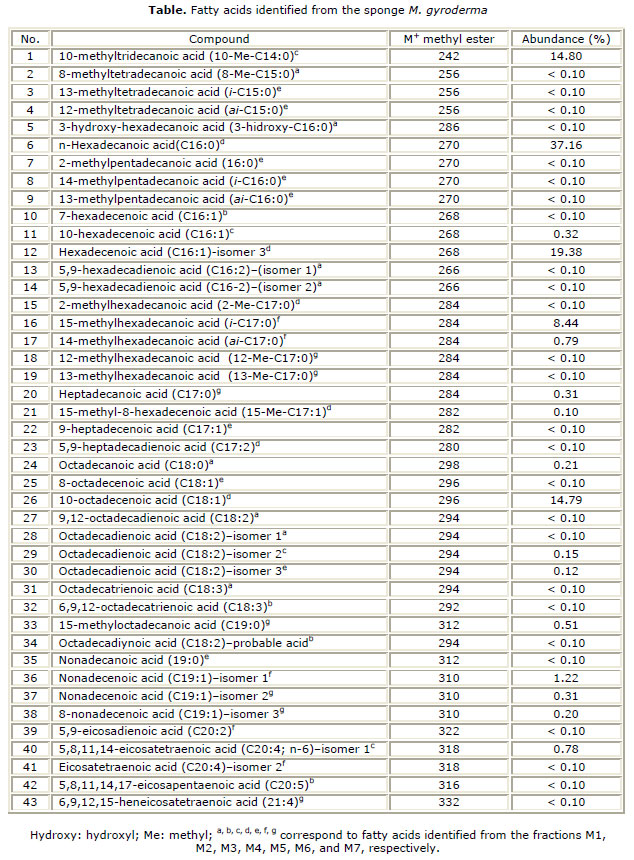
<P>    <br>     <P><font size="2" face="Verdana"><B>Fractionation  of F4 fraction by HPLC</B> </font>     <P><font size="2" face="Verdana">The HPLC fractioning  of the most active fraction (F4) resulted on the collection of sixteen fractions  named M1 to M16. <I>M. gyroderma </I>sponge HPLC obtained fractions were analyzed  by <SUP>1</SUP>H-NMR, and fatty acid characteristic signals were observed on the  obtained spectra. Fatty acids structure identification was possible by GC-MS analysis  of the methyl ester, and pyrrolidine derivatives. 43 fatty acids (C<SUB>14</SUB>-C<SUB>21</SUB>)  distributed in the different fractions obtained by HPLC were identified from the  fraction of free fatty acids of the <I>M. gyroderma </I>sponge. Results are shown  in <a href="/img/revistas/far/v47n3/t0110313.jpg">table</a>. </font>     
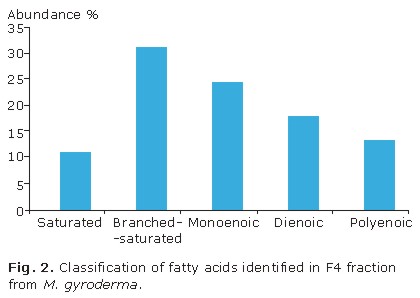
<P><font size="2" face="Verdana">Fatty  acids identified in bioactive F4 fraction of the <I>M. gyroderma</I> sponge can  be classified on the following groups: lineal chain saturated, branched-saturated,  unsaturated, and a 3-hydroxy acid. <a href="#fig2">Figure 2</a> shows fatty acids  that are more abundant are in order: branched-saturated (32.5 %), monoenoic (25.6  %), dienoic (18.6 %), polyenoic (14.0 %), and lineal chain saturated (11.6 %).  Unsaturated fatty acids are the most commonly found in the fraction and correspond  to 55.8 % abundance. </font>     <P align="center">    <br> <img src="/img/revistas/far/v47n3/f0210313.jpg" width="420" height="298">  <a name="fig2"></a>     
<P>&nbsp;     <P><font size="2" face="Verdana"><B><font size="3">DISCUSSION</font></B>  </font>     ]]></body>
<body><![CDATA[<P><font size="2" face="Verdana">A549 cell line was totally inhibited  on its growth at a 25 <font color="#000000">&#181;</font>g/mL concentration, and  at 5 <font color="#000000">&#181;</font>g/mL one, the same fraction inhibited  its cell line growth in 71 % (IC<SUB>50</SUB> 3.10 <font color="#000000">&#181;</font>g/mL).  1 <font color="#000000">&#181;</font>g/mL concentration completely inhibited HT29  cell line growth, and diminished 72 % MDA-MB-231, and 22 % A549 cell line growth;  respectively. For its part, F3 fraction inhibited 76 %, 71 % and 12 % MDA-MB-231,  HT29 and A549 cell line growth; respectively. On the other hand F5 fraction inhibited  65 %, 39 %, and 45 % MDA-MB-231, HT29 and A549 cell line growth, respectively,  at a 25 <font color="#000000">&#181;</font>g/mL concentration. F6 fraction inhibited  26 % A549 cell line growth, and the other cell lines were inhibited in less proportion.  </font>     <P><font size="2" face="Verdana" color="#000000">Fatty acid characteristic  signals observed on the obtained spectra were: a triplet </font><font face="Symbol" size="2">d</font>  <font size="2" face="Verdana" color="#000000">0.8-0.9 ppm signal, corresponding  to methyl group; a </font><font face="Symbol" size="2">d</font> <font size="2" face="Verdana" color="#000000">1.2-1.4  </font><font size="2" face="Verdana">ppm characteristic signal, of methylene groups;  the displaced multiplet signals between </font><font face="Symbol" size="2">d</font>  <font size="2" face="Verdana">1.5 ppm, and </font><font face="Symbol" size="2">d</font>  <font size="2" face="Verdana">3.0 ppm, corresponding to methyl groups close to  carboxyl group; being a triplet signal evident in </font><font face="Symbol" size="2">d</font>  <font size="2" face="Verdana">2.3 ppm, corresponding to the two protons of the  methyl group directly linked to the carbonyl group.<SUP>14</SUP> The proton of  the hydroxy-bearing carbon generated a multiplet at </font><font face="Symbol" size="2">d</font>  <font size="2" face="Verdana">3.50 ppm.<SUP>15</SUP> Olefinic protons characteristic  signals were also observed due to the presence of a multiplet removed to <FONT  COLOR="#ff0000"> </FONT></font><font face="Symbol" size="2">d</font> <font size="2" face="Verdana">5.3  ppm.<SUP>16</SUP> </font>     <P><font size="2" face="Verdana">The mass spectra of  methyl ester derivatives allowed determining whether the compound was a saturated  fatty acid by observing the presence of characteristic fragments such as: <I>m/z</I>  74 base peak, which comes from a McLafferty type rearrangement; the ion at <I>m/z</I>  [M-43]<SUP>+</SUP>, which represents the loss of C<SUB>3</SUB> units (2 to 4 carbons);  and the ion at <I>m/z</I> [M-31]<SUP>+</SUP> , which represents the loss of a  methoxyl ion.<SUP>17</SUP> The mass spectra of methyl esters of unsaturated fatty  acids showed the presence of an ion at <I>m/z</I> [M-32]<SUP>+</SUP>, which represents  the loss of methanol; the ion at <I>m/z</I> 74, which is less abundant than in  saturated fatty acids; and the ion at <I>m/z</I> 55, which is usually the base  peak of the [C<SUB>n</SUB>H<SUB>2n-1</SUB>]<SUP>+</SUP> series.<SUP>14</SUP> The  pyrrolidine derivatives allowed the location of the double bonds, and branches.<SUP>16</SUP>  A double bond is present between the <I>n</I> and <I>n</I>+1 carbons in the molecule,  if a 12 amu rather than a 14 amu interval is observed, among the most intense  peaks of the fragments containing <I>n</I> and <I>n</I>-1 carbon atoms.<SUP>16</SUP>  </font>     <P><font size="2" face="Verdana">Mass spectrum analysis of the methyl  esters of the free fatty acid obtained from the <I>M. gyroderma</I> sponge revealed  the presence of fatty acids, which showed a base peak of <I>m/z</I> 81, a diagnostic  ion of fatty acids with </font><font face="Symbol" size="2">D</font><font size="2" face="Verdana"><SUP>5,9</SUP>  unsaturations, which is a characteristic pattern of the demospongic acids.<SUP>18</SUP>  This pattern was observed in the mass spectrum of the pyrrolidine derivatives  of the same fatty acids in which the <I>m/z</I> 180 ion was observed, which is  characteristic of the </font><font face="Symbol" size="2">D</font><font size="2" face="Verdana"><SUP>5,9</SUP>  fatty acids.<SUP>18</SUP> The identification of the compounds was based on the  comparison of the published mass spectra, and retention times.<SUP>14</SUP> </font>      <P><font size="2" face="Verdana">For the case of the hydroxylated fatty acid identified  in the M1 fraction, methyl ester mass spectrum showed the <I>m/z</I> 286 molecular  ion, corresponding to the molecular formula C<SUB>17</SUB>H<SUB>34</SUB>O<SUB>2</SUB>.  The base peak at <I>m/z</I> 103 is produced by a characteristic cleavage <I>alpha</I>  to the carbon with the hydroxyl group, and defines its position.<SUP>17</SUP>  </font>     <P><font size="2" face="Verdana">Composition of fatty acids identified  in this work was compared with composition reported for the phospholipid fraction  of the <I>M. styx</I> sponge,<SUP>3</SUP> and it was found that both fraction  common fatty acids are: 8-Me-C15:0, C16:2; </font><font face="Symbol" size="2">D</font><font size="2" face="Verdana"><SUP>5,9</SUP>,  C18:0, C20:4; n-6, C16:0, ai-C15:0, i-C15:0, ai-C16:0, i-C17:0, ai-C17:0, C17:0.  A 25.6 % similarity between both fractions was observed. </font>     <P><font size="2" face="Verdana">Biological  activity results indicate that the greatest inhibitory effect in growth was observed  in HT29 (IC<SUB>50</SUB>&lt; 1.00 &#181;g/mL) tumor cells, which growth was totally  inhibited by F4 fraction in the three assessed concentrations (1, 5 and 25 <font color="#000000">&#181;</font>g/mL);  it was followed by MDA-MB-231 (IC<SUB>50</SUB>&lt; 1.00 <font color="#000000">&#181;</font>g/mL)  tumor line with total growth inhibition at 5 and 25 &#181;g/mL concentrations;  and finally A549 (IC<SUB>50</SUB> 3.10 <font color="#000000">&#181;</font>g/mL)  cell line, which growth was totally inhibited at a 25 &#181;g/mL concentration.  The most sensible cell line was MDA-MB-231, as it is the only cell line showing  more than 50 % inhibition for three out of four assessed fractions (F4, F3, and  F5), cell line HT29 (F4 and F3) follows, and finally A549 (F4) cell line. </font>      <P><font size="2" face="Verdana"> Comparison of the obtained IC<SUB>50 </SUB>with  the National Cancer Institute extract suggested values of 20 &#181;g/mL;<SUP>13</SUP>  it was found that F4 fraction exhibited antiproliferative activity in the three  assessed cell lines, which lead to chemical study for determining its composition.  </font>     <P><font size="2" face="Verdana">Three groups of fatty acids showing greater  abundance, and which could be responsible of the analyzed tumor lines growth inhibition,  were found in F4 fraction: hexadecanoic or palmitic acid (37.16 %); monounsaturated  fatty acids (C<SUB>14</SUB>-C<SUB>22</SUB>), among which the most abundant are  the hexadecenoic (19.38 %), and 10-octadecenoic (14.79 %) acids; and <I>iso</I>  and <I>anteiso</I> branched-saturated fatty acids C<SUB>15</SUB>-C<SUB>17</SUB>.  </font>     <P><font size="2" face="Verdana">The most abundant component of the analyzed  fraction is the hexadecanoic (palmitic acid) which, at a 12.5 to 50 <font color="#000000">&#181;</font>M/mL  concentration, showed selective cytotoxic activity against human leukemia cells  (MOLT-4, HL60, K-562), but not on normal cells HDF; it also induces apoptosis  in MOLT-4 cell lines at 50 <font color="#000000">&#181;</font>g/mL concentration,  and presents <I>in vivo</I> antitumor activity in mice trials. It is considered  that a molecular target for this compound is the topoisomerase I, and that it  does not affect topoisomerase II.<SUP>19</SUP> </font>     ]]></body>
<body><![CDATA[<P><font size="2" face="Verdana">Monounsaturated  fatty acids were found in abundance in F4 fraction (36.34 %), and it is possible  that these compounds have <I>cis</I> position double link, which would partially  explains the activity observed in such fraction, due to what has been reported  that <I>cis</I>-monounsaturated fatty acids (C<SUB>14</SUB>-C<SUB>22</SUB>) are  known as DNA topoisomerase I inhibitors.<SUP>20</SUP> Besides, it has been reported  that <I>cis</I>-C18:1 fatty acid is an inhibitor of the human telomerase with  an IC<SUB>50</SUB> of 8.6 &#181;M;<SUP>21</SUP> and the presence of 8-octadecenoic,  and 10-octadecenoic, with &lt; 0.10 %, and 14.79 % abundance respectively, was  found in F4 fraction. 9,12-octadecadienoic acid was also found in the same fraction,  and it has also been reported that this acid with the first double link in <I>cis</I>  configuration becomes a mammal DNA polymerase inhibitor.<SUP>22</SUP> </font>      <P><font size="2" face="Verdana">C<SUB>15</SUB>-C<SUB>17 </SUB>(<I>iso</I> and  <I>anteiso</I>) branched-saturated fatty acids identified in bioactive F4 fraction  also contribute to antiproliferative activity, as it has been reported that these  compounds have inhibitory activity on topoisomerase I.<SUP>23</SUP> 15-methylhexadecanoic  acid (i-C17:0) with 8.44 % abundance, 14-methylhexadecanoic acid (<I>ai</I>-C17:0)  with 0.79 % abundance; and 13-methyltetradecanoic acid (<I>i</I>-C15:0), 12-methyltetradecanoic  acid (<I>ai</I>-C15:0), 14-methylpentadecanoic acid (<I>i</I>-C16:0), and 13-methylpentadecanoic  acid (<I>ai</I>-C16:0) with an abundance less than 0.10 % each, are found in the  tested fraction. </font>     <P><font size="2" face="Verdana">Another antiproliferative  interest fraction component is 5,8,11,14,17-eicosapentaenoic acid (n-3 acid),  which is found in traces in M2 fraction (&lt; 0.10 %). It has been indicated that  n-3 fatty acids are powerful inhibitors of lipoxygenase-enzymes involved in illnesses  such as Alzheimer, arteriosclerosis, and cancer.<SUP>24</SUP> </font>     <P><font size="2" face="Verdana">3-hydroxyhexadecanoic  acid presence suggests the existence of an endosymbiotic relationship between  the sponge, and a microorganism; as this kind of fatty acids (3-hidroxylated)  has been found in microbial lipids (rhamnolipids).<SUP>14,25</SUP> 3-hidroxylated  fatty acids have shown antimycotic activity between 10 and 100 &#181;g/mL MIC.<SUP>25</SUP>  </font>     <P><font size="2" face="Verdana">In conclusion, 43 fatty acids (among  saturated, branched-saturated, and unsaturated), were identified out of the F4  fraction with activity on the cell lines derived from breast cancer MDA-MB-231,  colon carcinoma HT29, and lung carcinoma cells A-549. This is the first report  on biological activity of fractions of the <I>Myrmekioderma gyroderma</I> sponge  on cell lines derived from breast cancer MDA-MB-231, colon carcinoma HT29, and  lung carcinoma cells A-549; and on the chemical composition of a bioactive fraction  of this sponge. These results illustrate that the growth inhibitory effect shown  by the fractions on the tumor cell lines depends on the dose. </font>     <P>     <P><font size="2" face="Verdana"><B>    <br>  <font size="3">Acknowledgments</font></B> </font>     <P><font size="2" face="Verdana">Authors  thank to professor Sven Zea, of the Universidad Nacional de Colombia, for the  animal material identification; and the Universidad de Antioquia, the Universidad  Nacional de Colombia sede Medell&iacute;n, and Colciencias for the financing of  the project 11150520268. This work fulfills what is stated in the contract of  access to derived product for scientific research with no commercial interest  N&#176; 28 between the Ministerio de Ambiente, Vivienda y Desarrollo Territorial;  and Alejandro Mart&iacute;nez M., professor at the Universidad de Antioquia. </font>      <P>     ]]></body>
<body><![CDATA[<P>&nbsp;     <P><font size="2" face="Verdana"><B><font size="3">REFERENCES</font></B>  </font>     <!-- ref --><P><font size="2" face="Verdana">1. Castellanos L, Zea S, Osorno O, Duque  C. Phylogenetic analysis of the order <I>Halichondria </I>(Porifera, Demospongiae),  using 3</font><font face="Symbol" size="2">b</font><font size="2" face="Verdana">-hydroxysterols  as chemical characters. Biochem Systemat Ecol.<I> </I>2003;31:1163-83.     </font>      <!-- ref --><P><font size="2" face="Verdana">2. Genin E, Wielgosz-Collin G, Njinkou&eacute;  JM, Velosaotsy NE, Kornprobst JM, Gouygou JP, et al. New trends in phospholipid  class composition of marine sponges. Comp Biochem Physiol. 2008;B 150<I>:</I>427-31.      </font>     <!-- ref --><P><font size="2" face="Verdana">3. Carballeira NM, Reyes ED, Shalabi  F. Identification of novel iso/anteiso nonacosadienoic acids from the phospholipids  of the sponges <I>Chondrosia remiformis</I> and <I>Myrmekioderma styx</I>. J Nat  Prod. 1993;56:1850-5.     </font>     <!-- ref --><P><font size="2" face="Verdana">4. Mishra PM, Sree  A, Baliarsingh S. Antibacterial study and fatty acid analysis of lipids of the  sponge <I>Myrmekioderma granulata</I>. Chem Nat Comp. 2009;45:621-4.     </font>     ]]></body>
<body><![CDATA[<!-- ref --><P><font size="2" face="Verdana">5.  Peng J, Franzblau SG, Zhang F, Hamann MT. Novel sesquiterpenes and a lactone from  the Jamaican sponge <I>Myrmekioderma styx.</I> Tetrahedron Lett. 2002;43:9699-702.      </font>     <!-- ref --><P><font size="2" face="Verdana">6. Peng J, Avery MA, Hamann<I> </I>MT.  Cyanthiwigin AC and AD, two novel diterpene skeletons from the Jamaican sponge  <I>Myrmekioderma styx. </I>Organic Lett. 2003;5:4575-8.     </font>     <!-- ref --><P><font size="2" face="Verdana">7.  Albrizio S, Fattorusso E, Magno S, Mangoni<I> </I>A. Linear diterpenes from the  Caribbean sponge, <I>Myrmekioderma styx</I>. J Nat Prod. 1992;55:1287-93.     </font>      <!-- ref --><P><font size="2" face="Verdana">8. Letourneux Y, Brunel JM, Fern&aacute;ndez  R, Dherbomez M, Debitus C. Isolation and characterization of new tetrahydropyranyl  substituted sesquiterpene and Myrmekiodermin glycolipid ether isolated from the  marine sponge Myrmekioderma. Heterocycl Comm. 2005;11: 291-8.     </font>     <!-- ref --><P><font size="2" face="Verdana">9.  Aoki S, Higuchi K, Kato A, Murakami N, Kobayashi M. Myrmekiosides A and B, novel  mono-<I>O</I>-alkyl-diglycosylglycerols reversing tumor cell morphology of <I>ras</I>-transformed  cells from a marine sponge of <I>Myrmekioderma</I> sp. Tetrahedron. 1999;55:14865-70.      </font>     ]]></body>
<body><![CDATA[<!-- ref --><P><font size="2" face="Verdana">10. Fusetani N, Sugano M, Matsunaga S,  Hashimoto K. (+)-Curcuphenol and dehydrocurcuphenol, novel sesquiterpenes which  inhibit H,K-ATPase, from a marine sponge <I>Epipolasis sp</I>. Experientia. 1987;43:1234-5.      </font>     <!-- ref --><P><font size="2" face="Verdana">11. Gul W, Hammond NL, Yousaf M, Peng  J, Holley A, Hamann MT. Chemical transformation and biological studies of marine  sesquiterpene (S)-(+)-curcuphenol and its analogs. Biochim Biophys Acta. 2007;1770:1513-9.      </font>     <!-- ref --><P><font size="2" face="Verdana">12. Rubinstein LV, Shoemaker RH, Paull  KD, Simon RM, Tosini S, Skehan P, et al. Comparison of <i>in</i> <i>vitro</i>  anticancer-drug-screening data generated with a tetrazolium assay versus a protein  assay against a diverse panel of human tumor cell lines. J Natl Cancer Inst. 1990;82:1113-8.      </font>     <!-- ref --><P><font size="2" face="Verdana">13. Boyd MR. The NCI <I>in vitro</I>  anticancer drug discovery screen: concept, implementation, and operation, 1985-1995.  In: Teicher BA, editor. Anticancer drug development guide; preclinical screening,  clinical trials and approval. Totowa: Humana Press; 1997. p. 23-42.     </font>     <!-- ref --><P><font size="2" face="Verdana">14.  Christie WW. The Lipid Library. [Internet]. The American Oil Chemists Society.  2010. Available from: <U><a href="http://www.lipidlibrary.co.uk" target="_blank">http://www.lipidlibrary.co.uk</a></U>  </font>     <!-- ref --><P><font size="2" face="Verdana">15. Jakob B, Voss G, Gerlach H. Synthesis  of (S)- and (R)-3- hydroxyhexadecanoic acid. Tetrahedron Asymmetry. 1996;7:3255-62.      </font>     <!-- ref --><P><font size="2" face="Verdana">16. Andersson BA, Holman RT. Pyrrolidides  for mass spectrometric determination of the position of the double bond in monounsaturated  fatty acids. Lipids. 1974;9:185-90.     </font>     <!-- ref --><P><font size="2" face="Verdana">17.  Ryhage R, Stenhagen E. Mass spectrometric studies. VI. Methyl esters of normal  chain oxo-, hydroxy-, methoxy- and epoxy-acids. Arkiv Kemi. 1960;15:545-74.     </font>      <!-- ref --><P><font size="2" face="Verdana">18. Carballeira NM, Negr&oacute;n V, Reyes ED.<B>  </B>Novel monounsaturated fatty acids from the sponges <I>Amphimedon compressa</I>  and <I>Mycale laevis</I>. J Nat Prod. 1992;55:333-9.     </font>     <!-- ref --><P><font size="2" face="Verdana">19.  Harada H, Yamashita U, Kurihara H, Fukushi E, Kawabata J, Kamei Y. Antitumor activity  of palmitic acid found as a selective cytotoxic substance in a marine red alga.  Anticancer Res. 2002;22:2587-90.     </font>     <!-- ref --><P><font size="2" face="Verdana">20.  Suzuki H, Yosida TH. Frequency of sister-chromatid exchanges depending on the  amount of 5-bromodeoxyuridine incorporated into parental DNA. Mutation Res. 1983;111:277-82.      </font>     <!-- ref --><P><font size="2" face="Verdana">21. Oda M, Ueno T, Kasai N, Takahashi  H, Yoshida H, Sugawara F, Sakaguchi K, Hayashi H, Mizushina Y. Inhibition of telomerase  by linear-chain fatty acids: a structural analysis. Biochem<I> </I>J. 2002;367:329-34.      </font>     <!-- ref --><P><font size="2" face="Verdana">22. Mizushina Y, Tanaka N, Yagi H, Kurosawa  T, Onoue M, Seto H, et al. Fatty acids selectively inhibit eukaryotic DNA polymerase  activities <I>in vitro</I>. Biochim Biophys Acta. 1996;1308:256-62.     </font>     <!-- ref --><P><font size="2" face="Verdana">23.  Lee HK, Lee DS, Kim J, Kim JS, Im KS, Jung JH. Topoisomerase I inhibitors from  the Streptomyces sp. strain KM86-9B isolated from a marine sponge. Arch Pharm  Res. 1998:21:729-33.     </font>     <!-- ref --><P><font size="2" face="Verdana">24. Jacquot C, McGinley  CM, Plata E, Holman TR, van der Donk W. Synthesis of 11-thialinoleic acid and  14-thialinoleic acid, inhibitors of soybean and human lipoxygenases. Org Biomol  Chem. 2008;6:4242-52.     </font>     <!-- ref --><P><font size="2" face="Verdana">25. Yano I, Ohno  Y, Masui M, Kato K, Yabuuchi E, Ohyama A. Occurrence of 2- and 3-hydroxy fatty  acids in high concentrations in the extractable and bound lipids of <I>Flavobacterium  meningosepticum</I> and <I>Flavobacterium</I> IIb. Lipids. 1976;11:685-8.     </font>      <P>&nbsp;     <P>&nbsp;     <P>     <P><font size="2" face="Verdana">Recibido: 23 de marzo de 2013.    <br>  </font><font size="2" face="Verdana">Aprobado: 29 de mayo de 2013. </font>     <P>&nbsp;      <P>&nbsp;     <P>     <P><font size="2" face="Verdana"><I>Diana M&aacute;rquez.</I> Facultad  de Qu&iacute;mica Farmac&eacute;utica, Universidad de Antioquia. Calle 57 No.  53-108, Bloque 2, Laboratorio 131. Apartado A&eacute;reo 1226. Medell&iacute;n,  Colombia.</font>      ]]></body>
<body><![CDATA[ ]]></body><back>
<ref-list>
<ref id="B1">
<label>1</label><nlm-citation citation-type="journal">
<person-group person-group-type="author">
<name>
<surname><![CDATA[Castellanos]]></surname>
<given-names><![CDATA[L]]></given-names>
</name>
<name>
<surname><![CDATA[Zea]]></surname>
<given-names><![CDATA[S]]></given-names>
</name>
<name>
<surname><![CDATA[Osorno]]></surname>
<given-names><![CDATA[O]]></given-names>
</name>
<name>
<surname><![CDATA[Duque]]></surname>
<given-names><![CDATA[C]]></given-names>
</name>
</person-group>
<article-title xml:lang="en"><![CDATA[Phylogenetic analysis of the order Halichondria (Porifera, Demospongiae), using 3b-hydroxysterols as chemical characters]]></article-title>
<source><![CDATA[Biochem Systemat Ecol.]]></source>
<year>2003</year>
<volume>31</volume>
<page-range>1163-83</page-range></nlm-citation>
</ref>
<ref id="B2">
<label>2</label><nlm-citation citation-type="journal">
<person-group person-group-type="author">
<name>
<surname><![CDATA[Genin]]></surname>
<given-names><![CDATA[E]]></given-names>
</name>
<name>
<surname><![CDATA[Wielgosz-Collin]]></surname>
<given-names><![CDATA[G]]></given-names>
</name>
<name>
<surname><![CDATA[Njinkoué]]></surname>
<given-names><![CDATA[JM]]></given-names>
</name>
<name>
<surname><![CDATA[Velosaotsy]]></surname>
<given-names><![CDATA[NE]]></given-names>
</name>
<name>
<surname><![CDATA[Kornprobst]]></surname>
<given-names><![CDATA[JM]]></given-names>
</name>
<name>
<surname><![CDATA[Gouygou]]></surname>
<given-names><![CDATA[JP]]></given-names>
</name>
</person-group>
<article-title xml:lang="en"><![CDATA[New trends in phospholipid class composition of marine sponges]]></article-title>
<source><![CDATA[Comp Biochem Physiol.]]></source>
<year>2008</year>
<volume>B 150</volume>
<page-range>427-31</page-range></nlm-citation>
</ref>
<ref id="B3">
<label>3</label><nlm-citation citation-type="journal">
<person-group person-group-type="author">
<name>
<surname><![CDATA[Carballeira]]></surname>
<given-names><![CDATA[NM]]></given-names>
</name>
<name>
<surname><![CDATA[Reyes]]></surname>
<given-names><![CDATA[ED]]></given-names>
</name>
<name>
<surname><![CDATA[Shalabi]]></surname>
<given-names><![CDATA[F]]></given-names>
</name>
</person-group>
<article-title xml:lang="en"><![CDATA[Identification of novel iso/anteiso nonacosadienoic acids from the phospholipids of the sponges Chondrosia remiformis and Myrmekioderma styx]]></article-title>
<source><![CDATA[J Nat Prod.]]></source>
<year>1993</year>
<volume>56</volume>
<page-range>1850-5</page-range></nlm-citation>
</ref>
<ref id="B4">
<label>4</label><nlm-citation citation-type="journal">
<person-group person-group-type="author">
<name>
<surname><![CDATA[Mishra]]></surname>
<given-names><![CDATA[PM]]></given-names>
</name>
<name>
<surname><![CDATA[Sree]]></surname>
<given-names><![CDATA[A]]></given-names>
</name>
<name>
<surname><![CDATA[Baliarsingh]]></surname>
<given-names><![CDATA[S]]></given-names>
</name>
</person-group>
<article-title xml:lang="en"><![CDATA[Antibacterial study and fatty acid analysis of lipids of the sponge Myrmekioderma granulata]]></article-title>
<source><![CDATA[Chem Nat Comp.]]></source>
<year>2009</year>
<volume>45</volume>
<page-range>621-4</page-range></nlm-citation>
</ref>
<ref id="B5">
<label>5</label><nlm-citation citation-type="journal">
<person-group person-group-type="author">
<name>
<surname><![CDATA[Peng]]></surname>
<given-names><![CDATA[J]]></given-names>
</name>
<name>
<surname><![CDATA[Franzblau]]></surname>
<given-names><![CDATA[SG]]></given-names>
</name>
<name>
<surname><![CDATA[Zhang]]></surname>
<given-names><![CDATA[F]]></given-names>
</name>
<name>
<surname><![CDATA[Hamann]]></surname>
<given-names><![CDATA[MT]]></given-names>
</name>
</person-group>
<article-title xml:lang="en"><![CDATA[Novel sesquiterpenes and a lactone from the Jamaican sponge Myrmekioderma styx]]></article-title>
<source><![CDATA[Tetrahedron Lett.]]></source>
<year>2002</year>
<volume>43</volume>
<page-range>9699-702</page-range></nlm-citation>
</ref>
<ref id="B6">
<label>6</label><nlm-citation citation-type="journal">
<person-group person-group-type="author">
<name>
<surname><![CDATA[Peng]]></surname>
<given-names><![CDATA[J]]></given-names>
</name>
<name>
<surname><![CDATA[Avery]]></surname>
<given-names><![CDATA[MA]]></given-names>
</name>
<name>
<surname><![CDATA[Hamann]]></surname>
<given-names><![CDATA[MT]]></given-names>
</name>
</person-group>
<article-title xml:lang="en"><![CDATA[Cyanthiwigin AC and AD, two novel diterpene skeletons from the Jamaican sponge Myrmekioderma styx]]></article-title>
<source><![CDATA[Organic Lett.]]></source>
<year>2003</year>
<volume>5</volume>
<page-range>4575-8</page-range></nlm-citation>
</ref>
<ref id="B7">
<label>7</label><nlm-citation citation-type="journal">
<person-group person-group-type="author">
<name>
<surname><![CDATA[Albrizio]]></surname>
<given-names><![CDATA[S]]></given-names>
</name>
<name>
<surname><![CDATA[Fattorusso]]></surname>
<given-names><![CDATA[E]]></given-names>
</name>
<name>
<surname><![CDATA[Magno]]></surname>
<given-names><![CDATA[S]]></given-names>
</name>
<name>
<surname><![CDATA[Mangoni]]></surname>
<given-names><![CDATA[A]]></given-names>
</name>
</person-group>
<article-title xml:lang="en"><![CDATA[Linear diterpenes from the Caribbean sponge, Myrmekioderma styx]]></article-title>
<source><![CDATA[J Nat Prod.]]></source>
<year>1992</year>
<volume>55</volume>
<page-range>1287-93</page-range></nlm-citation>
</ref>
<ref id="B8">
<label>8</label><nlm-citation citation-type="journal">
<person-group person-group-type="author">
<name>
<surname><![CDATA[Letourneux]]></surname>
<given-names><![CDATA[Y]]></given-names>
</name>
<name>
<surname><![CDATA[Brunel]]></surname>
<given-names><![CDATA[JM]]></given-names>
</name>
<name>
<surname><![CDATA[Fernández]]></surname>
<given-names><![CDATA[R]]></given-names>
</name>
<name>
<surname><![CDATA[Dherbomez]]></surname>
<given-names><![CDATA[M]]></given-names>
</name>
<name>
<surname><![CDATA[Debitus]]></surname>
<given-names><![CDATA[C]]></given-names>
</name>
</person-group>
<article-title xml:lang="en"><![CDATA[Isolation and characterization of new tetrahydropyranyl substituted sesquiterpene and Myrmekiodermin glycolipid ether isolated from the marine sponge Myrmekioderma]]></article-title>
<source><![CDATA[Heterocycl Comm.]]></source>
<year>2005</year>
<volume>11</volume>
<page-range>291-8</page-range></nlm-citation>
</ref>
<ref id="B9">
<label>9</label><nlm-citation citation-type="journal">
<person-group person-group-type="author">
<name>
<surname><![CDATA[Aoki]]></surname>
<given-names><![CDATA[S]]></given-names>
</name>
<name>
<surname><![CDATA[Higuchi]]></surname>
<given-names><![CDATA[K]]></given-names>
</name>
<name>
<surname><![CDATA[Kato]]></surname>
<given-names><![CDATA[A]]></given-names>
</name>
<name>
<surname><![CDATA[Murakami]]></surname>
<given-names><![CDATA[N]]></given-names>
</name>
<name>
<surname><![CDATA[Kobayashi]]></surname>
<given-names><![CDATA[M]]></given-names>
</name>
</person-group>
<article-title xml:lang="en"><![CDATA[Myrmekiosides A and B, novel mono-O-alkyl-diglycosylglycerols reversing tumor cell morphology of ras-transformed cells from a marine sponge of Myrmekioderma sp]]></article-title>
<source><![CDATA[Tetrahedron.]]></source>
<year>1999</year>
<volume>55</volume>
<page-range>14865-70</page-range></nlm-citation>
</ref>
<ref id="B10">
<label>10</label><nlm-citation citation-type="journal">
<person-group person-group-type="author">
<name>
<surname><![CDATA[Fusetani]]></surname>
<given-names><![CDATA[N]]></given-names>
</name>
<name>
<surname><![CDATA[Sugano]]></surname>
<given-names><![CDATA[M]]></given-names>
</name>
<name>
<surname><![CDATA[Matsunaga]]></surname>
<given-names><![CDATA[S]]></given-names>
</name>
<name>
<surname><![CDATA[Hashimoto]]></surname>
<given-names><![CDATA[K]]></given-names>
</name>
</person-group>
<article-title xml:lang="en"><![CDATA[(+)-Curcuphenol and dehydrocurcuphenol, novel sesquiterpenes which inhibit H,K-ATPase, from a marine sponge Epipolasis sp]]></article-title>
<source><![CDATA[Experientia.]]></source>
<year>1987</year>
<volume>43</volume>
<page-range>1234-5</page-range></nlm-citation>
</ref>
<ref id="B11">
<label>11</label><nlm-citation citation-type="journal">
<person-group person-group-type="author">
<name>
<surname><![CDATA[Gul]]></surname>
<given-names><![CDATA[W]]></given-names>
</name>
<name>
<surname><![CDATA[Hammond]]></surname>
<given-names><![CDATA[NL]]></given-names>
</name>
<name>
<surname><![CDATA[Yousaf]]></surname>
<given-names><![CDATA[M]]></given-names>
</name>
<name>
<surname><![CDATA[Peng]]></surname>
<given-names><![CDATA[J]]></given-names>
</name>
<name>
<surname><![CDATA[Holley]]></surname>
<given-names><![CDATA[A]]></given-names>
</name>
<name>
<surname><![CDATA[Hamann]]></surname>
<given-names><![CDATA[MT]]></given-names>
</name>
</person-group>
<article-title xml:lang="en"><![CDATA[Chemical transformation and biological studies of marine sesquiterpene (S)-(+)-curcuphenol and its analogs]]></article-title>
<source><![CDATA[Biochim Biophys Acta.]]></source>
<year>2007</year>
<volume>1770</volume>
<page-range>1513-9</page-range></nlm-citation>
</ref>
<ref id="B12">
<label>12</label><nlm-citation citation-type="journal">
<person-group person-group-type="author">
<name>
<surname><![CDATA[Rubinstein]]></surname>
<given-names><![CDATA[LV]]></given-names>
</name>
<name>
<surname><![CDATA[Shoemaker]]></surname>
<given-names><![CDATA[RH]]></given-names>
</name>
<name>
<surname><![CDATA[Paull]]></surname>
<given-names><![CDATA[KD]]></given-names>
</name>
<name>
<surname><![CDATA[Simon]]></surname>
<given-names><![CDATA[RM]]></given-names>
</name>
<name>
<surname><![CDATA[Tosini]]></surname>
<given-names><![CDATA[S]]></given-names>
</name>
<name>
<surname><![CDATA[Skehan]]></surname>
<given-names><![CDATA[P]]></given-names>
</name>
</person-group>
<article-title xml:lang="en"><![CDATA[Comparison of in vitro anticancer-drug-screening data generated with a tetrazolium assay versus a protein assay against a diverse panel of human tumor cell lines]]></article-title>
<source><![CDATA[J Natl Cancer Inst.]]></source>
<year>1990</year>
<volume>82</volume>
<page-range>1113-8</page-range></nlm-citation>
</ref>
<ref id="B13">
<label>13</label><nlm-citation citation-type="book">
<person-group person-group-type="author">
<name>
<surname><![CDATA[Boyd]]></surname>
<given-names><![CDATA[MR]]></given-names>
</name>
</person-group>
<article-title xml:lang="en"><![CDATA[The NCI in vitro anticancer drug discovery screen: concept, implementation, and operation, 1985-1995]]></article-title>
<person-group person-group-type="editor">
<name>
<surname><![CDATA[Teicher]]></surname>
<given-names><![CDATA[BA]]></given-names>
</name>
</person-group>
<source><![CDATA[Anticancer drug development guide; preclinical screening, clinical trials and approval]]></source>
<year>1997</year>
<page-range>23-42</page-range><publisher-loc><![CDATA[Totowa ]]></publisher-loc>
<publisher-name><![CDATA[Humana Press]]></publisher-name>
</nlm-citation>
</ref>
<ref id="B14">
<label>14</label><nlm-citation citation-type="book">
<person-group person-group-type="author">
<name>
<surname><![CDATA[Christie]]></surname>
<given-names><![CDATA[WW]]></given-names>
</name>
</person-group>
<source><![CDATA[The Lipid Library]]></source>
<year>2010</year>
<publisher-name><![CDATA[The American Oil Chemists Society]]></publisher-name>
</nlm-citation>
</ref>
<ref id="B15">
<label>15</label><nlm-citation citation-type="journal">
<person-group person-group-type="author">
<name>
<surname><![CDATA[Jakob]]></surname>
<given-names><![CDATA[B]]></given-names>
</name>
<name>
<surname><![CDATA[Voss]]></surname>
<given-names><![CDATA[G]]></given-names>
</name>
<name>
<surname><![CDATA[Gerlach]]></surname>
<given-names><![CDATA[H]]></given-names>
</name>
</person-group>
<article-title xml:lang="en"><![CDATA[Synthesis of (S)- and (R)-3- hydroxyhexadecanoic acid]]></article-title>
<source><![CDATA[Tetrahedron Asymmetry.]]></source>
<year>1996</year>
<volume>7</volume>
<page-range>3255-62</page-range></nlm-citation>
</ref>
<ref id="B16">
<label>16</label><nlm-citation citation-type="journal">
<person-group person-group-type="author">
<name>
<surname><![CDATA[Andersson]]></surname>
<given-names><![CDATA[BA]]></given-names>
</name>
<name>
<surname><![CDATA[Holman]]></surname>
<given-names><![CDATA[RT]]></given-names>
</name>
</person-group>
<article-title xml:lang="en"><![CDATA[Pyrrolidides for mass spectrometric determination of the position of the double bond in monounsaturated fatty acids]]></article-title>
<source><![CDATA[Lipids.]]></source>
<year>1974</year>
<volume>9</volume>
<page-range>185-90</page-range></nlm-citation>
</ref>
<ref id="B17">
<label>17</label><nlm-citation citation-type="journal">
<person-group person-group-type="author">
<name>
<surname><![CDATA[Ryhage]]></surname>
<given-names><![CDATA[R]]></given-names>
</name>
<name>
<surname><![CDATA[Stenhagen]]></surname>
<given-names><![CDATA[E]]></given-names>
</name>
</person-group>
<article-title xml:lang="en"><![CDATA[Mass spectrometric studies. VI. Methyl esters of normal chain oxo-, hydroxy-, methoxy- and epoxy-acids]]></article-title>
<source><![CDATA[Arkiv Kemi.]]></source>
<year>1960</year>
<volume>15</volume>
<page-range>545-74</page-range></nlm-citation>
</ref>
<ref id="B18">
<label>18</label><nlm-citation citation-type="journal">
<person-group person-group-type="author">
<name>
<surname><![CDATA[Carballeira]]></surname>
<given-names><![CDATA[NM]]></given-names>
</name>
<name>
<surname><![CDATA[Negrón]]></surname>
<given-names><![CDATA[V]]></given-names>
</name>
<name>
<surname><![CDATA[Reyes]]></surname>
<given-names><![CDATA[ED]]></given-names>
</name>
</person-group>
<article-title xml:lang="en"><![CDATA[Novel monounsaturated fatty acids from the sponges Amphimedon compressa and Mycale laevis]]></article-title>
<source><![CDATA[J Nat Prod.]]></source>
<year>1992</year>
<volume>55</volume>
<page-range>333-9</page-range></nlm-citation>
</ref>
<ref id="B19">
<label>19</label><nlm-citation citation-type="journal">
<person-group person-group-type="author">
<name>
<surname><![CDATA[Harada]]></surname>
<given-names><![CDATA[H]]></given-names>
</name>
<name>
<surname><![CDATA[Yamashita]]></surname>
<given-names><![CDATA[U]]></given-names>
</name>
<name>
<surname><![CDATA[Kurihara]]></surname>
<given-names><![CDATA[H]]></given-names>
</name>
<name>
<surname><![CDATA[Fukushi]]></surname>
<given-names><![CDATA[E]]></given-names>
</name>
<name>
<surname><![CDATA[Kawabata]]></surname>
<given-names><![CDATA[J]]></given-names>
</name>
<name>
<surname><![CDATA[Kamei]]></surname>
<given-names><![CDATA[Y]]></given-names>
</name>
</person-group>
<article-title xml:lang="en"><![CDATA[Antitumor activity of palmitic acid found as a selective cytotoxic substance in a marine red alga]]></article-title>
<source><![CDATA[Anticancer Res.]]></source>
<year>2002</year>
<volume>22</volume>
<page-range>2587-90</page-range></nlm-citation>
</ref>
<ref id="B20">
<label>20</label><nlm-citation citation-type="journal">
<person-group person-group-type="author">
<name>
<surname><![CDATA[Suzuki]]></surname>
<given-names><![CDATA[H]]></given-names>
</name>
<name>
<surname><![CDATA[Yosida]]></surname>
<given-names><![CDATA[TH]]></given-names>
</name>
</person-group>
<article-title xml:lang="en"><![CDATA[Frequency of sister-chromatid exchanges depending on the amount of 5-bromodeoxyuridine incorporated into parental DNA]]></article-title>
<source><![CDATA[Mutation Res.]]></source>
<year>1983</year>
<volume>111</volume>
<page-range>277-82</page-range></nlm-citation>
</ref>
<ref id="B21">
<label>21</label><nlm-citation citation-type="journal">
<person-group person-group-type="author">
<name>
<surname><![CDATA[Oda]]></surname>
<given-names><![CDATA[M]]></given-names>
</name>
<name>
<surname><![CDATA[Ueno]]></surname>
<given-names><![CDATA[T]]></given-names>
</name>
<name>
<surname><![CDATA[Kasai]]></surname>
<given-names><![CDATA[N]]></given-names>
</name>
<name>
<surname><![CDATA[Takahashi]]></surname>
<given-names><![CDATA[H]]></given-names>
</name>
<name>
<surname><![CDATA[Yoshida]]></surname>
<given-names><![CDATA[H]]></given-names>
</name>
<name>
<surname><![CDATA[Sugawara]]></surname>
<given-names><![CDATA[F]]></given-names>
</name>
<name>
<surname><![CDATA[Sakaguchi]]></surname>
<given-names><![CDATA[K]]></given-names>
</name>
<name>
<surname><![CDATA[Hayashi]]></surname>
<given-names><![CDATA[H]]></given-names>
</name>
<name>
<surname><![CDATA[Mizushina]]></surname>
<given-names><![CDATA[Y]]></given-names>
</name>
</person-group>
<article-title xml:lang="en"><![CDATA[Inhibition of telomerase by linear-chain fatty acids: a structural analysis]]></article-title>
<source><![CDATA[Biochem J.]]></source>
<year>2002</year>
<volume>367</volume>
<page-range>329-34</page-range></nlm-citation>
</ref>
<ref id="B22">
<label>22</label><nlm-citation citation-type="journal">
<person-group person-group-type="author">
<name>
<surname><![CDATA[Mizushina]]></surname>
<given-names><![CDATA[Y]]></given-names>
</name>
<name>
<surname><![CDATA[Tanaka]]></surname>
<given-names><![CDATA[N]]></given-names>
</name>
<name>
<surname><![CDATA[Yagi]]></surname>
<given-names><![CDATA[H]]></given-names>
</name>
<name>
<surname><![CDATA[Kurosawa]]></surname>
<given-names><![CDATA[T]]></given-names>
</name>
<name>
<surname><![CDATA[Onoue]]></surname>
<given-names><![CDATA[M]]></given-names>
</name>
<name>
<surname><![CDATA[Seto]]></surname>
<given-names><![CDATA[H]]></given-names>
</name>
</person-group>
<article-title xml:lang="en"><![CDATA[Fatty acids selectively inhibit eukaryotic DNA polymerase activities in vitro]]></article-title>
<source><![CDATA[Biochim Biophys Acta.]]></source>
<year>1996</year>
<volume>1308</volume>
<page-range>256-62</page-range></nlm-citation>
</ref>
<ref id="B23">
<label>23</label><nlm-citation citation-type="journal">
<person-group person-group-type="author">
<name>
<surname><![CDATA[Lee]]></surname>
<given-names><![CDATA[HK]]></given-names>
</name>
<name>
<surname><![CDATA[Lee]]></surname>
<given-names><![CDATA[DS]]></given-names>
</name>
<name>
<surname><![CDATA[Kim]]></surname>
<given-names><![CDATA[J]]></given-names>
</name>
<name>
<surname><![CDATA[Kim]]></surname>
<given-names><![CDATA[JS]]></given-names>
</name>
<name>
<surname><![CDATA[Im]]></surname>
<given-names><![CDATA[KS]]></given-names>
</name>
<name>
<surname><![CDATA[Jung]]></surname>
<given-names><![CDATA[JH]]></given-names>
</name>
</person-group>
<article-title xml:lang="en"><![CDATA[Topoisomerase I inhibitors from the Streptomyces sp: strain KM86-9B isolated from a marine sponge]]></article-title>
<source><![CDATA[Arch Pharm Res.]]></source>
<year>1998</year>
<volume>21</volume>
<page-range>729-33</page-range></nlm-citation>
</ref>
<ref id="B24">
<label>24</label><nlm-citation citation-type="journal">
<person-group person-group-type="author">
<name>
<surname><![CDATA[Jacquot]]></surname>
<given-names><![CDATA[C]]></given-names>
</name>
<name>
<surname><![CDATA[McGinley]]></surname>
<given-names><![CDATA[CM]]></given-names>
</name>
<name>
<surname><![CDATA[Plata]]></surname>
<given-names><![CDATA[E]]></given-names>
</name>
<name>
<surname><![CDATA[Holman]]></surname>
<given-names><![CDATA[TR]]></given-names>
</name>
<name>
<surname><![CDATA[van der Donk]]></surname>
<given-names><![CDATA[W]]></given-names>
</name>
</person-group>
<article-title xml:lang="en"><![CDATA[Synthesis of 11-thialinoleic acid and 14-thialinoleic acid, inhibitors of soybean and human lipoxygenases]]></article-title>
<source><![CDATA[Org Biomol Chem.]]></source>
<year>2008</year>
<volume>6</volume>
<page-range>4242-52</page-range></nlm-citation>
</ref>
<ref id="B25">
<label>25</label><nlm-citation citation-type="journal">
<person-group person-group-type="author">
<name>
<surname><![CDATA[Yano]]></surname>
<given-names><![CDATA[I]]></given-names>
</name>
<name>
<surname><![CDATA[Ohno]]></surname>
<given-names><![CDATA[Y]]></given-names>
</name>
<name>
<surname><![CDATA[Masui]]></surname>
<given-names><![CDATA[M]]></given-names>
</name>
<name>
<surname><![CDATA[Kato]]></surname>
<given-names><![CDATA[K]]></given-names>
</name>
<name>
<surname><![CDATA[Yabuuchi]]></surname>
<given-names><![CDATA[E]]></given-names>
</name>
<name>
<surname><![CDATA[Ohyama]]></surname>
<given-names><![CDATA[A]]></given-names>
</name>
</person-group>
<article-title xml:lang="en"><![CDATA[Occurrence of 2- and 3-hydroxy fatty acids in high concentrations in the extractable and bound lipids of Flavobacterium meningosepticum and Flavobacterium IIb]]></article-title>
<source><![CDATA[Lipids.]]></source>
<year>1976</year>
<volume>11</volume>
<page-range>685-8</page-range></nlm-citation>
</ref>
</ref-list>
</back>
</article>
