<?xml version="1.0" encoding="ISO-8859-1"?><article xmlns:mml="http://www.w3.org/1998/Math/MathML" xmlns:xlink="http://www.w3.org/1999/xlink" xmlns:xsi="http://www.w3.org/2001/XMLSchema-instance">
<front>
<journal-meta>
<journal-id>0034-7515</journal-id>
<journal-title><![CDATA[Revista Cubana de Farmacia]]></journal-title>
<abbrev-journal-title><![CDATA[Rev Cubana Farm]]></abbrev-journal-title>
<issn>0034-7515</issn>
<publisher>
<publisher-name><![CDATA[Editorial Ciencias Médicas]]></publisher-name>
</publisher>
</journal-meta>
<article-meta>
<article-id>S0034-75152013000300011</article-id>
<title-group>
<article-title xml:lang="en"><![CDATA[Development and evaluation of tablets from spray dried extract of yerba mate (Ilex paraguariensis St. Hil A)]]></article-title>
<article-title xml:lang="es"><![CDATA[Desarrollo y evaluación de las tabletas de extracto seco por aspersión de yerba mate (Ilex paraguariensis St. Hil A)]]></article-title>
</title-group>
<contrib-group>
<contrib contrib-type="author">
<name>
<surname><![CDATA[Roman]]></surname>
<given-names><![CDATA[Juliana]]></given-names>
</name>
<xref ref-type="aff" rid="A01"/>
</contrib>
<contrib contrib-type="author">
<name>
<surname><![CDATA[Garcia]]></surname>
<given-names><![CDATA[Cassia Virginia]]></given-names>
</name>
<xref ref-type="aff" rid="A02"/>
</contrib>
<contrib contrib-type="author">
<name>
<surname><![CDATA[Loureiro Mendez]]></surname>
<given-names><![CDATA[Andreas Sebastian]]></given-names>
</name>
<xref ref-type="aff" rid="A02"/>
</contrib>
<contrib contrib-type="author">
<name>
<surname><![CDATA[Barcellos da Silva]]></surname>
<given-names><![CDATA[Fabiana Ernestina]]></given-names>
</name>
<xref ref-type="aff" rid="A01"/>
</contrib>
</contrib-group>
<aff id="A01">
<institution><![CDATA[,Universidade Regional Integrada do Alto Uruguai e das Missões-URI  ]]></institution>
<addr-line><![CDATA[Erechim RS]]></addr-line>
<country>Brasil</country>
</aff>
<aff id="A02">
<institution><![CDATA[,Universidade Federal do Pampa-UNIPAMPA  ]]></institution>
<addr-line><![CDATA[Uruguaiana RS]]></addr-line>
<country>Brasil</country>
</aff>
<aff id="A03">
<institution><![CDATA[,Faculdade de Farmácia Universidade Federal do Rio Grande do Sul-UFRGS ]]></institution>
<addr-line><![CDATA[Porto Alegre RS]]></addr-line>
<country>Brasil</country>
</aff>
<pub-date pub-type="pub">
<day>00</day>
<month>09</month>
<year>2013</year>
</pub-date>
<pub-date pub-type="epub">
<day>00</day>
<month>09</month>
<year>2013</year>
</pub-date>
<volume>47</volume>
<numero>3</numero>
<fpage>379</fpage>
<lpage>388</lpage>
<copyright-statement/>
<copyright-year/>
<self-uri xlink:href="http://scielo.sld.cu/scielo.php?script=sci_arttext&amp;pid=S0034-75152013000300011&amp;lng=en&amp;nrm=iso"></self-uri><self-uri xlink:href="http://scielo.sld.cu/scielo.php?script=sci_abstract&amp;pid=S0034-75152013000300011&amp;lng=en&amp;nrm=iso"></self-uri><self-uri xlink:href="http://scielo.sld.cu/scielo.php?script=sci_pdf&amp;pid=S0034-75152013000300011&amp;lng=en&amp;nrm=iso"></self-uri><abstract abstract-type="short" xml:lang="en"><p><![CDATA[Introduction: yerba mate (Ilex paraguariensis St. Hil A) is a South American plant species of Aquifoliaceae family. The presence of methylxanhtines and clorogenic acids was reported in this species. These compounds have antioxidant activity and could be included in tablets, a pharmaceutical form presently unavailable in the market. Objective: to develop tablets containing yerba mate spray dried extract. Methods: the tablets were produced by direct compression with yerba mate dried extract. The dried extract was evaluated for yield, repose angle, compressibility index, residual moisture and caffeine content. The tablets were evaluated in the following parameters: external appearance, weight, hardness, friability, disintegration and caffeine content. Results: the tablets complied with the general pharmacopoeial specifications. Conclusions: this method is effective to produce tablets containing spray dried extract from yerba mate.]]></p></abstract>
<abstract abstract-type="short" xml:lang="es"><p><![CDATA[Introducción: la yerba mate (Ilex paraguariensis St. Hil A) es una planta de América del Sur, de la familia Aquifoliaceae. Para esta especie se informó la presencia de ácidos clorogénico y metilxantinas. Estos compuestos tienen actividad antioxidante y podría incluirse en tabletas, una forma farmacéutica que no está disponible. Objetivo: desarrollar comprimidos que contienen extracto seco por aspersión de yerba mate. Métodos: se produjeron comprimidos por compresión directa. Se determinaron al extracto seco los parámetros de rendimiento, ángulo de reposo, índice de compresibilidad, humedad y contenido de cafeína, y a los comprimidos, apariencia externa, peso, dureza, friabilidad, desintegración y contenido de cafeína. Resultados: los comprimidos cumplieron con las especificaciones generales planteadas en farmacopeas. Conclusión: el método empleado es eficaz en la producción de comprimidos que contienen extracto seco de yerba mate.]]></p></abstract>
<kwd-group>
<kwd lng="en"><![CDATA[Ilex paraguariensis St. Hil. A]]></kwd>
<kwd lng="en"><![CDATA[caffeine]]></kwd>
<kwd lng="en"><![CDATA[tablets]]></kwd>
<kwd lng="en"><![CDATA[direct compression]]></kwd>
<kwd lng="en"><![CDATA[yerba mate]]></kwd>
<kwd lng="es"><![CDATA[Ilex paraguariensis St. Hil. A]]></kwd>
<kwd lng="es"><![CDATA[cafeína]]></kwd>
<kwd lng="es"><![CDATA[tabletas]]></kwd>
<kwd lng="es"><![CDATA[compresión directa]]></kwd>
<kwd lng="es"><![CDATA[yerba mate]]></kwd>
</kwd-group>
</article-meta>
</front><body><![CDATA[ <div align="right">     <p><font size="2" face="Verdana"><B>PRODUCTO NATURAL</B></font></p>    <p>&nbsp;</p></div><B>      <P>     <P><font size="4" face="Verdana">Development and evaluation of tablets from  spray dried extract of yerba mate (<I>Ilex paraguariensis</I> St. Hil A) </font>      <P>&nbsp;     <P><font size="3" face="Verdana">Desarrollo y evaluaci&oacute;n de las tabletas  de extracto seco por aspersi&oacute;n de yerba mate (<i>Ilex paraguariensis</i>  St. Hil A)</font><font size="2" face="Verdana"><b>    <br> </b></font>     <P><font size="3" face="Verdana">    <br>  </font> </B>     ]]></body>
<body><![CDATA[<p>&nbsp;</p><B>     <P>     <P><font size="2" face="Verdana">MSc. Juliana Roman,<SUP>  I</SUP> Dra. Cassia Virginia Garcia,<SUP>II, III</SUP> Dra. Andreas Sebastian  Loureiro Mendez,<SUP>II</SUP> Dra. Fabiana Ernestina Barcellos da Silva<SUP>I,  II</SUP></font> </B>     <P><font size="2" face="Verdana"><SUP>I </SUP>Universidade  Regional Integrada do Alto Uruguai e das Miss&otilde;es-URI. Erechim, RS, Brasil.    <br>  </font><font size="2" face="Verdana"><SUP>II </SUP>N&uacute;cleo de Pesquisa em  F&aacute;rmacos e Medicamentos-Universidade Federal do Pampa-UNIPAMPA. Uruguaiana,  RS, Brasil.    <br> </font><font size="2" face="Verdana"><SUP>III </SUP>Faculdade  de Farm&aacute;cia, Universidade Federal do Rio Grande do Sul-UFRGS. Porto Alegre,  RS, Brasil. </font>     <P>&nbsp;     <P>&nbsp; <hr size="1" noshade>     <P><font size="2" face="Verdana"><B>ABSTRACT    <br>  </B></font>    ]]></body>
<body><![CDATA[<br> <font face="Verdana, Arial, Helvetica, sans-serif" size="2"><b>Introduction:</b>  yerba mate (<i>Ilex paraguariensis</i> St. Hil A) is a South American plant species  of Aquifoliaceae family. The presence of methylxanhtines and clorogenic acids  was reported in this species. These compounds have antioxidant activity and could  be included in tablets, a pharmaceutical form presently unavailable in the market.    <br>  <b>Objective:</b> to develop tablets containing yerba mate spray dried extract.      <br> <b>Methods: </b>the tablets were produced by direct compression with yerba  mate dried extract. The dried extract was evaluated for yield, repose angle, compressibility  index, residual moisture and caffeine content. The tablets were evaluated in the  following parameters: external appearance, weight, hardness, friability, disintegration  and caffeine content.     <br> <b>Results:</b> the tablets complied with the general  pharmacopoeial specifications.     <br> <b>Conclusions:</b> this method is effective  to produce tablets containing spray dried extract from yerba mate.</font>     <p><font face="Verdana, Arial, Helvetica, sans-serif" size="2"><b>Key  words:</b> <i>Ilex paraguariensis</i> St. Hil. A, caffeine, tablets, direct compression,  yerba mate.</font></p><hr size="1" noshade>     <P><font size="2" face="Verdana"><B>RESUMEN  </B></font>     <P><font size="2" face="Verdana"><B>Introducci&oacute;n:</b> la yerba  mate (<I>Ilex paraguariensis </I>St. Hil A) es una planta de Am&eacute;rica del  Sur, de la familia Aquifoliaceae. Para esta especie se inform&oacute; la presencia  de &aacute;cidos clorog&eacute;nico y metilxantinas. Estos compuestos tienen actividad  antioxidante y podr&iacute;a incluirse en tabletas, una forma farmac&eacute;utica  que no est&aacute; disponible.    <br> <B>Objetivo:</B> desarrollar comprimidos que  contienen extracto seco por aspersi&oacute;n de yerba mate.    <br> <B>M&eacute;todos:</B>  se produjeron comprimidos por compresi&oacute;n directa. Se determinaron al extracto  seco los par&aacute;metros de rendimiento, &aacute;ngulo de reposo, &iacute;ndice  de compresibilidad, humedad y contenido de cafe&iacute;na, y a los comprimidos,  apariencia externa, peso, dureza, friabilidad, desintegraci&oacute;n y contenido  de cafe&iacute;na.    ]]></body>
<body><![CDATA[<br> </font><font size="2" face="Verdana"><B>Resultados: </B>los  comprimidos cumplieron con las especificaciones generales planteadas en farmacopeas.    <br>  </font><font size="2" face="Verdana"><B>Conclusi&oacute;n:</B> el m&eacute;todo  empleado es eficaz en la producci&oacute;n de comprimidos que contienen extracto  seco de yerba mate. </font>     <P><font size="2" face="Verdana"><B>Palabras clave:</B>  <I>Ilex paraguariensis</I> St. Hil. A, cafe&iacute;na, tabletas, compresi&oacute;n  directa, yerba mate. </font> <hr size="1" noshade>     <p>&nbsp;</p>    <P>&nbsp;     <P><font size="2" face="Verdana"><B><font size="3">INTRODUCTION</font></B>  </font>     <P> <font size="2" face="Verdana"><I>Ilex paraguariensis</I> St. Hil.  A is a herbal medicine of South America, family Aquifoliaceae. Currently, its  aerial parts are used for beverage preparations </font><font size="2" face="Verdana">(</font><font face="Verdana, Arial, Helvetica, sans-serif" size="2">&quot;</font><font size="2" face="Verdana">chimarr&atilde;o</font><font face="Verdana, Arial, Helvetica, sans-serif" size="2">&quot;</font><font size="2" face="Verdana">  and </font><font face="Verdana, Arial, Helvetica, sans-serif" size="2">&quot;</font><font size="2" face="Verdana">terer&ecirc;</font><font face="Verdana, Arial, Helvetica, sans-serif" size="2">&quot;</font><font size="2" face="Verdana">).  These beverages are prepared by infusion or decoction of commercial product denominated  </font><font face="Verdana, Arial, Helvetica, sans-serif" size="2">&quot;</font><font size="2" face="Verdana">yerba  mate</font><font face="Verdana, Arial, Helvetica, sans-serif" size="2">&quot;</font><font size="2" face="Verdana">,  obtained after industrial processing of aerial part of <I>Ilex paraguariensis</I>  St Hill A.</font>     <P><font size="2" face="Verdana">The industrial processing of  <I>Ilex paraguariensis</I> St. Hill A involves different stages (green leaves,  </font><font face="Verdana, Arial, Helvetica, sans-serif" size="2">&quot;</font><font size="2" face="Verdana">zapecado</font><font face="Verdana, Arial, Helvetica, sans-serif" size="2">&quot;</font><font size="2" face="Verdana">,  drying, forced or natural aging) which can modify the qualitative and quantitative  composition and the pharmacological activities. According to various studies,  <I>Ilex paraguariensis</I> St Hill A is rich in a variety of bioactive compounds  (such as saponines, polyphenols and methylxantines) and has several beneficial  effects to the organism.<SUP>1-8 </SUP>The bioactive compound (methylxanthines  class) present in highest concentration in<I> </I>leaves is caffeine. This way,  caffeine content in this material<I> </I>has been broadly studied.<SUP>9,10</SUP>  Caffeine levels in <I>Ilex paraguariensis</I> St Hill A ranging from 0.16 % in  old leaves to 1.4 % in young leaves.<SUP>11 </SUP>According <i>Isolabella</i>  et al. main compounds, caffeoyl derivatives, methylxanthines and flavonoids obtained  after </font><font face="Verdana, Arial, Helvetica, sans-serif" size="2">&quot;</font><font size="2" face="Verdana">zapecado</font><font face="Verdana, Arial, Helvetica, sans-serif" size="2">&quot;</font><font size="2" face="Verdana">,  drying and aging stages possess higher content of biologically active principles  when compared with green leaves.<SUP>12</SUP></font>     <P><font size="2" face="Verdana">Caffeine  levels in <I>Ilex paraguariensis</I> St Hill A may be increased in processed yerba  mate due humidity and temperature conditions used in industrial process.<SUP>13</SUP>  Thus, processed yerba mate can be serving as a source for obtaining extracts that  can be used in tablets production. For this potential requires that this extract  is in powder form. Spray-drying, a well-characterized pharmaceutical operation  is ideally suitable to producing solid amorphous dispersions due to its rapid  drying kinetics.<SUP>14,15</SUP> According to different authors the physical and  chemical properties of particles can be changed by varying the spray drying parameters.<SUP>16,17</SUP></font>      <P><font size="2" face="Verdana">Thereafter, the dried extracts used in solid  oral dosage forms productions allowed direct incorporation in blended and posterior  direct compression. Thus it is possible to produce tablets (provided with appropriate  technological conditions) from only two processes: blend and compression. The  direct compression method is fast and simple, but requires the use of excipients  with good flow and compressibility properties, such as microcrystalline cellulose,  magnesium stearate and colloidal silicon dioxide.<SUP>18</SUP> Tablets obtained  by direct compression are considered an attractive alternative to traditional  granulation (wet and dry granulation), since it requires fewer steps and saves  time and costs.<SUP>19</SUP></font>     ]]></body>
<body><![CDATA[<P><font size="2" face="Verdana">Thus, the  objective of this study is to develop tablets containing spray dried extract from  yerba mate<I> </I>by direct compression. </font>     <P>&nbsp;     <P> <font size="3" face="Verdana"><B>METHODS  </B></font>     <P><font size="2" face="Verdana"><B>    <br> Solvents, reagents and pharmaceuticals  excipients    <br>     <br> </b>Reference substance used was caffeine provided by Sigma-Aldrich  (purity in 99.0 %). For dried extract and tablets developments the following materials  were used: microcrystalline cellulose PH 101 (Valdequ&iacute;mica, Brazil), magnesium  stearate (Valdequ&iacute;mica, Brazil), calcium phosphate dibasic anhydrous (All  Chemistry, Brazil), colloidal silicon dioxide (Viafarma, Brazil), mannitol (G&ecirc;nix,  Brazil) and talc (All Chemistry, Brazil). Metanol was HPLC grade. Ultra pure water  was supplied by a Mili-Q water purifier system from Millipore (Bedford, MA, USA).  All of them were from pharmaceutical grade. </font>     <P><font size="2" face="Verdana"><B>    <br>  Equipment    <br>     ]]></body>
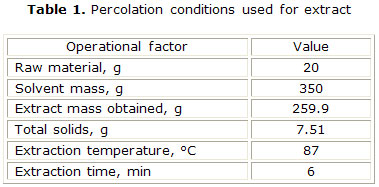
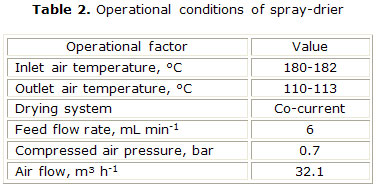
<body><![CDATA[<br> </B>The equipment used were: Disintegration apparatus, model  301 BC (Nova Etica, Brazil); Analytical balance, model BL 210S (Sartorius, Brazil);  Compression machine Monopress model LM-1 (Lemaq, Brazil); Durometer, model 298  (kgf/Nova Etica, Brazil); Friability apparatus, model 300 (Nova Etica, Brazil);  LabPlant Laboratory Scale Spray dryer model SD-O6 (Keison, England); Extractor  by percolation (Bialetti, Italy); High efficiency liquid chromatography (HPLC)  equipment model 1100S (Agilent, United States); V-blender model MP-3 (Erli, Brazil)  an Infrared balance model ID-200 (Marte, Brazil) . </font>     <P><font size="2" face="Verdana"><B>    <br>  Plant material    <br>     <br> </B>The Rei Verde Yerba Mate (Ervateira Rei Verde/RS-Brasil)  avaliable in local market, containing leaves:branches ratio of 70:30 (w/w). This  yerba mate passed through all stages of industrial processing (blanching, drying,  milling and aging) and was used to aqueous extract production. Aqueous extracts  were prepared with this material in order to compare to the preparation used by  people. </font>     <P><font size="2" face="Verdana"><B>    <br> Dried extract development    <br>      <br> </B>Initially, aqueous extract was produced by percolation of processed <i>yerba  mate</i> in appropriate extractor according to the specifications described by  Valduga.<SUP>20</SUP> This equipment consists of lower chamber to solvent, an  intermediate compartment to sample and a top compartment to extract. The extraction  was performed using water and processed yerba mate in an extractor at 87 &#176;C.  The extracts obtained were clarified in a lab scale continuous centrifuge, which  retained most of the insoluble solids. Data on percolation conditions and drug:solvent  ratio are shown in <a href="#tab1">table 1</a>. </font>     <P><font size="2" face="Verdana">A  dried extract was prepared by spray drying of the suspension containing 15 % (w/w)  colloidal silicon dioxide and 75 % (w/w) aqueous extract. During the atomization  procedure, the suspension was mixed with a magnetic stirring bar and dried using  a spray-dried model LabPlant SD-O6. A summary of operational conditions employed  during spray-drying is shown in <a href="#tab2">table 2</a>. </font>     ]]></body>
<body><![CDATA[<P><font size="2" face="Verdana">The  dried extracts were weighted to analyze the total extract yield and yield of caffeine.  The reported results, as illustrated in <a href="#ecu1">equations 1</a>, <a href="#ecu2">2</a>  and <a href="#ecu3">3</a>, include the total extract yield (%), the yield of caffeine  from the yerba (%), and the content of caffeine (%) in dried extract respectively:</font>      <P align="center"><img src="/img/revistas/far/v47n3/e0111313.jpg" width="345" height="48"><a name="ecu1"></a>    
<br>      <br>     <br>     <P align="center"><img src="/img/revistas/far/v47n3/e0211313.jpg" width="336" height="43"><A NAME="ecu2"></A>    
<br>      <br>     <br> <img src="/img/revistas/far/v47n3/e0311313.jpg" width="346" height="33"><a name="ecu3"></a>      
<P>    ]]></body>
<body><![CDATA[<br>     <P>     <P><font size="2" face="Verdana">All reported weights and percentages  are dry basis unless specified otherwise. All the extraction trials were carried  out in triplicate. The following parameters were evaluated in dried extract: bulk  density, tapped density, repose angle, compressibility index and moisture content.  As caffeine is the major compound in extracts, it was chosen to evaluate the content  and uniformity of formulations developed. The caffeine analysis was conducted  by HPLC.    <br>     <br>     <br>     <br> </font>     <P align="center"><img src="/img/revistas/far/v47n3/t0111303.jpg" width="379" height="187">  <a name="tab1"></a>    
<br>     <br>     ]]></body>
<body><![CDATA[<br>     <P align="center"><img src="/img/revistas/far/v47n3/t0211313.jpg" width="377" height="189"><a name="tab2"></a>    
<br>      <br>     <br>     <P><font size="2" face="Verdana"><B>Blends containing dried extract    <br>      <br> </B>Three blends were tested for repose angle and compressibility index.  For blend time determination, the formulations were blended in V-blender. Three  aliquots were taken at 10, 15 and 20 min in random localization. The aliquots  were transferred to 100 mL volumetric flask and completed with mobile phase. After  shaking, samples were filtered and caffeine determination performed by HPLC. The  mean and standard deviation were obtained in each time period. The blend time  chosen was that presented lowest standard deviation. The selected blend was compressed  by direct compression. </font>     <P><font size="2" face="Verdana"><B>    <br> Tablets  development    ]]></body>
<body><![CDATA[<br>     <br> </B>The following parameters were evaluated in tablets: external  appearance, hardness, friability, disintegration, assay and content uniformity.  The validation of methodology for tablets assay was performed. </font>     <P><font size="2" face="Verdana"><B>    <br>  Samples preparation    <br>     <br> </B>Caffeine content in dried extracts, blends and  tablets was performed by validated HPLC method. Samples were weighed (equivalent  weight of 5 mg caffeine) and brought up to 100 mL with mobile phase. After 20  min in ultrasonic bath, samples were filtered and diluted in mobile phase. </font>      <P><font size="2" face="Verdana"><B>    <br> High performance liquid chromatography    <br>      <br> </B>The HPLC analysis were carried out on a AGILENT 1100S System (USA) consisting  of a separation module with integrated column heater and auto-sampler, while detection  was carried out on a photodiode array detector coupled online with a multi-wavelength  ultraviolet detector. Separation of compounds was carried out on a C18 column  (Zorbax; 250 x 4.6 mm; 5 </font><font face="Verdana, Arial, Helvetica, sans-serif" size="2">&#181;</font><font size="2" face="Verdana">m)  and UV detection was carried out using 280 nm. Mobile phase was composed of methanol  and water (40:60) and injection volume was 10 &#181;L. The software for control  of equipment and data acquisition was CHEMSTATION. </font>     ]]></body>
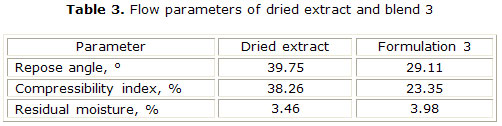
<body><![CDATA[<P>&nbsp;     <P> <font size="2" face="Verdana"><B><font size="3">RESULTS  </font></B></font>     <P><font size="2" face="Verdana"><B>    <br> Dried extract development    <br>      <br> </b>The aqueous extract obtained by percolation presented green color and  characteristic smell. Data on aqueous extract are shown in <a href="#tab1">table  1</a>. This extract was used in dried extract preparation. Colloidal silicon dioxide  was used in dried extract preparation. The concentration used was 15 % over the  total solids present in the aqueous extract. The appearance of macroscopic nebulized  obtained was finely powdered with pale green/yellow, characteristic odor and non-adherent.  The yield obtained was 75.17 %. The expected caffeine content of dried extract,  estimated by mass balance and neglecting any losses, was 13 mg g<SUP>-1</SUP>.  Data on flow parameters of dried extract are show <a href="#tab3">table 3</a>.  The total extract yield (%), the yield of caffeine from the yerba (%) and the  content of caffeine (%) in dried extract were 75.17, 1.72 and 1.29, respectively.  </font>     <p align="center">    <br> <img src="/img/revistas/far/v47n3/t0311313.jpg" width="502" height="126"><a name="tab3"></a></p>    
<P><font size="2" face="Verdana"><B>    <br>      ]]></body>
<body><![CDATA[<br> Characterization and quality control of dried extract    <br>     <br> </B>The repose  angle and compressibility index of dried extract are showed in <a href="#tab3">table  3</a>. Adjuvants have been added at dried extract to improve the flow characteristics,  as described in <a href="/img/revistas/far/v47n3/t0411313.jpg">table 4</a>.  Other parameters were evaluated in dried extract, as residual moisture and caffeine  content. The residual moisture content presented on dried extract was 3.5 %. In  analysis by HPLC, caffeine content in dried extract was 1.3 % (w/w). </font>     
<P><font size="2" face="Verdana"><B>    <br>  Tablets development    <br>     <br> </B>The three developed blends were evaluated for  repose angle and compressibility index. The formulation with better repose angle  and compressibility index was blend 3. This formulation was selected for tablet  development and yours flow parameters are shown in <a href="#tab3">table 3</a>.  Blend time for selected formulation was 20 min. After blended, the powders were  compressed, presenting suitable hardness after machine adjustment. Yerba mate  tablets presented uniform color and concave shape, without irregularities in the  surface. The tablets were obtained with 12 mm diameter, 3.5 mm thick and 702.4  &#177; 6.2 mg (CV= 0.88 %) average weight. Hardness (12.35 kgf/Nova Etica model  298) and friability index obtained (0.22 %) indicates a high friction resistance  in coating operations, packaging and transport. The tablets were tested using  disintegration medium 0.1 N HCl and distilled water. In both media, the sample  showed complete disintegration within 20 min. The average content obtained was  103.5 &#177; 1.47 %, considering a theoretical quantity of 5 mg caffeine per tablet.  The results for content uniformity ranged from 101.25 to 105.86 % of caffeine  with CV= 1.51 %, which is in accordance with the specifications.<SUP>21</SUP>  </font>     <P>&nbsp;     <P><font size="2" face="Verdana"><B><font size="3">DISCUSSION</font></B>  </font>     <P><font size="2" face="Verdana">The dried extract showed to have suitable  characteristics for tablets production. Values for repose angle between 25&#176;  and 30&#176; characterize a good flow.<SUP>22,23</SUP> Thus, the dried extract  obtained can be classified as acceptable material flow. However, the addition  of appropriate adjuvants improved the blend characteristics, allowing the powder  direct compression without a prior granulation stage. The addition of colloidal  silicon dioxide in liquid extracts is usual to reduce the adherence of the material  to the equipment and improve the dry powder shape (spherical), size distribution  and flowability.<SUP>24</SUP> In accordance with Pingali et al (2009) simultaneous  presence of colloidal silicon dioxide and talc leads to substantial decreases  in cohesiveness, causing major improvements in flowability of powder.<SUP>25</SUP>  These excipients were included in formulations and produced blends with acceptable  flow. </font>     ]]></body>
<body><![CDATA[<P><font size="2" face="Verdana">The residual moisture is an important  parameter to be evaluated during the development of solid dosage forms, particularly  extracts obtained from plants. High levels of residual moisture can cause changes  in physical characteristics such as size distribution and flow.<SUP>26</SUP> The  analysis of caffeine from the spray-dried extract and solid dosage form are important  to evaluate the overall process efficiency and reproducibility because this metabolite  can undergo thermal or chemical degradation during the process. This way, residual  moisture and caffeine content were evaluated and considered appropriate to tablets  production. </font>     <P><font size="2" face="Verdana">The tablets were produced  without lamination and capping defects. Average weight was considered appropriate  in accordance with the recommendations of Brazilian Pharmacopoeia.<SUP>21</SUP>  The hardness was considered appropriate and the value (12.35 kgf) can be associated  with compressive forces because of large mannitol (thinner) and microcrystalline  cellulose (diluent and binder) amounts.<SUP>27 </SUP> </font>     <P><font size="2" face="Verdana">The  tablets containing dried extract of yerba mate were obtained with appropriate  technological characteristics. The dried extract showed good flow characteristics  favoring its use in tablets production by direct compression. The tablets developed  are appropriate for production in large scale, since all technological tests were  in accordance with pharmacopoeial specifications (weight, appearance, hardness,  friability, disintegration, content uniformity and caffeine content). Studies  involving <I>in vivo</I> and <I>in vitro</I> bioavailability are necessary for  registration this new pharmaceutical product. </font>     <P>&nbsp;     <P>     <P><font size="3" face="Verdana"><B>Acknowledgements</B>  </font>     <P><font size="2" face="Verdana">The authors thank FURI for financial  support. </font>     <P>&nbsp;     <P>     <P><font size="3" face="Verdana"><B>REFERENCES </B></font><font size="2" face="Verdana">  </font>     ]]></body>
<body><![CDATA[<!-- ref --><P><font size="2" face="Verdana">1. Bracesco N, Sanchez AG, Contreras  V, Menini T, Gugliucci A. Recent advances on Ilex paraguariensis research: minireview.  J Ethnopharmacol. 2011;136(3):378-84.     </font>     <!-- ref --><P><font size="2" face="Verdana">2.  Heck CI, de Mejia EG. Yerba Mate Tea (Ilex paraguariensis): a comprehensive review  on chemistry, health implications and technological considerations.<I> </I>J Food  Sci. 2007;72(9):R138-51.     </font>     <!-- ref --><P><font size="2" face="Verdana">3. Gugliucci  A, Bastos DHM, Schulze J, Souza MFF. Caffeic and chlorogenic acids in <I>Ilex  paraguariensis</I> extracts are the main inhibitors of AGE generation by methylglyoxal  in model proteins. Fitoterapia. 2009;80:339-44.     </font>     <!-- ref --><P><font size="2" face="Verdana">4.  Mosimann ALP, Wilhelm-Filho D, da Silva EL. Aqueous extract of Ilex paraguariensis  attenuates the progression of atherosclerosis in cholesterol-fed rabbits. BioFactors.  2006;26(1):59-70.     </font>     <!-- ref --><P><font size="2" face="Verdana">5. Bastos DHM, Ishimoto  EY, Marques MOM, Ferri AF, Torres EAFS. Essential oil and antioxidant activity  of green Mate and Mate tea (<I>Ilex paraguariensis</I>) infusions. J Food Comp  Anal. 2006;19:538-43.     </font>     ]]></body>
<body><![CDATA[<!-- ref --><P><font size="2" face="Verdana">6. Paganini Stein  FL, Schmidt B, Furlong EB, Souza-Soares LA, Soares MC, Vaz MR, Mucillo Baisch  AL. Vascular responses to extractable fractions of Ilex paraguariensis in rats  fed standard and high-cholesterol diets. Biol Res Nurs. 2005;7(2):146-56.     </font>      <!-- ref --><P><font size="2" face="Verdana">7. Gorzalczany S, Filip R, Alonso MR, Mi&ntilde;o  J, Ferraro GE, Acevedo C. Choleretic effect and intestinal propulsion of `mate'  (Ilex paraguariensis) and its substitutes or adulterants. J Ethnopharmacol. 2001;75:291-4.      </font>     <!-- ref --><P><font size="2" face="Verdana">8. Silva RA, Bueno ALS, Gallon CW, Gomes  LF, Kaiser S, Pavei C, Ortega GG, Kucharski LC, Jahn MP. The effect of aqueous  extract of gross and commercial yerba mate (Ilex paraguariensis) on intra-abdominal  and epididymal fat and glucose levels in male Wistar rats. Fitoterapia. 2010;82:818-26.      </font>     <!-- ref --><P><font size="2" face="Verdana">9. Athayde ML, Coelho GC, Schenkel E.  Populational diversity on methylxanthines content of Mat&eacute; (<I>Ilex paraguariensis  </I>A. St. Hill., Aquifoliaceae). Lat Am J Pharm. 2007;26(2):275-9.     </font>     <!-- ref --><P><font size="2" face="Verdana">10.  Athayde ML, Coelho CC, Schenkel EP. Caffeine and theobromine in epicuticular wax  of Ilex paraguariensis A. St.-Hil. Phytochemistry. 2000;55(7):853-7.     </font>     ]]></body>
<body><![CDATA[<!-- ref --><P><font size="2" face="Verdana">11.  Rates SMK. Metilxantinas. In: Sim&otilde;es CM, Schenkel EP, Gosmann G, Palazzo  de Mello JC, Mentz LA, Petrovick PR, editors. Farmacognosia: da planta ao medicamento.  Porto Alegre: UFSC/UFRGS; 2004. p. 199-222.     </font>     <!-- ref --><P><font size="2" face="Verdana">12.  Isolabella S, Cogoi L, Lopez P, Anesini C, Ferraro G, Filip R. Study of the bioactive  compounds variation during yerba mate (<I>Ilex paraguariensis</I>) processing.  Food Chemistry. 2010;122(3):695-9.     </font>     <!-- ref --><P><font size="2" face="Verdana">13.  Turner S, Cogoi L, Isobella S, Filip R, Anesini C. Evaluation of the antioxidant  activity and polyphenols content of <I>Ilex paraguariensis</I> (Mate) during industrialization.  Adv J Food Sci Technol. 2011;3:23-30.     </font>     <!-- ref --><P><font size="2" face="Verdana">14.  Dobry DE, Setell DM, Baumann JM, Ray RJ, Graham LJ, Beverinck RAA. A Model-Based  Methodology for Spray-Drying Process Development. J Pharm Innov. 2009;4(3):133-42.      </font>     <!-- ref --><P><font size="2" face="Verdana">15. Oliveira OW, Petrovick PR. Secagem  por aspers&atilde;o (<I>spray drying</I>) de extratos vegetais: bases e aplica&ccedil;&otilde;es.  Rev Bras Farmacogn. 2010;20(4):641-50.     </font>     ]]></body>
<body><![CDATA[<!-- ref --><P><font size="2" face="Verdana">16.  Rattes ALR, Oliveira WP. Spray drying conditions and encapsulating composition  effects on formation and properties of sodium diclofenac microparticles. Powder  Technol. 2007;171(1):7-14.     </font>     <!-- ref --><P><font size="2" face="Verdana">17. Esposito  E, Roncarati R, Cortesi R, Cervelatti F, Nastruzzi C. Production of Eudragit microparticles  by spray-drying technique: influence of experimental parameters on morphological  and dimensional characteristics. Pharm Dev Technol. 2000;5(2):267-78.     </font>      <!-- ref --><P><font size="2" face="Verdana">18. Silva FEB, Ziech C, Pavoni GD, Pasquali R.  Desenvolvimento de comprimidos contendo fluconazol por compress&atilde;o direta.  Lat Am J Pharm. 2009;28(4):604-8.     </font>     <!-- ref --><P><font size="2" face="Verdana">19.  Al-Mohizea AM, Ahmed MO, Al-Jenoobi FI, Mahrous GM<I>,</I> Abdel-Rahman AA. Formulation  and evaluation of dried yeast tablets using different techniques. Eur J Pharm  Biopharm. 2007;67(1):253-9.     </font>     <!-- ref --><P><font size="2" face="Verdana">20. Valduga  AT, Battestin V, Finzer JRD. Secagem de extratos de erva mate em secador por atomiza&ccedil;&atilde;o.  Ci&ecirc;nc Tecnol Aliment. 2003;23(2):184-9.     </font>     ]]></body>
<body><![CDATA[<!-- ref --><P><font size="2" face="Verdana">21.  Brasil. Farmacop&eacute;ia Brasileira. II Vol. Bras&iacute;lia: Ag&ecirc;ncia  Nacional de Vigil&acirc;ncia Sanit&aacute;ria (ANVISA); 2010.     </font>     <!-- ref --><P><font size="2" face="Verdana">22.  Lachman L, Lieberman HA, Kanig JL. Theory and practice in the pharmaceutical industry.  Lisboa: Calouste Gulbenkian; 2001.     </font>     <!-- ref --><P><font size="2" face="Verdana">23.  Aulton ME. Delineamento de Formas Farmac&ecirc;uticas. Porto Alegre: ARTMED, 2005.      </font>     <!-- ref --><P><font size="2" face="Verdana">24. Runha FP, Cordeiro DS, Pereira CAM,  Vilegas J, Oliveira WP. Production of dry extracts of medicinal Brazilian plants  by spouted bed process: development of the process and evaluation of thermal degradation  during drying operation. Food Biop Process. 2001;79:1-9.     </font>     <!-- ref --><P><font size="2" face="Verdana">25.  Pingali KC, Saranteas K, Foroughi R, Muzzio FJ. Practical methods for improving  flow properties of active pharmaceutical ingredients<I>. </I>Drug Dev Ind Pharm.  2009;35(12):1460-9.     </font>     ]]></body>
<body><![CDATA[<!-- ref --><P><font size="2" face="Verdana">26. Farias MR. Avalia&ccedil;&atilde;o  da qualidade de mat&eacute;rias-primas vegetais<I>.</I> In: Sim&otilde;es CM,  Schenkel EP, Gosmann G, Palazzo de Mello JC, Mentz LA, Petrovick PR, editors.  Farmacognosia: da planta ao medicamento. Porto Alegre: UFSC/UFRGS, 2004: p.199-222.      </font>     <!-- ref --><P><font size="2" face="Verdana">27. Pasqualoto KFM, Funck JAB, Silva  FEB, Kratz C. Development and Evaluation of Amoxicillin Formulations by Direct  Compression: Influence of the Adjuvants on Physicomechanical and Biopharmaceutical  Properties of the Tablets. Acta Farm Bonaerense. 2005;24(1):39-47.     </font>     <P>&nbsp;      <P>&nbsp;     <P>     <P><font size="2" face="Verdana">Recibido: 23 de marzo de 2013.    <br> </font><font size="2" face="Verdana">Aprobado:  29 de mayo de 2013. </font>     <P>&nbsp;     ]]></body>
<body><![CDATA[<P>&nbsp;     <P>     <P><font size="2" face="Verdana"><I>Fabiana  Ernestina Barcellos da Silva.</I> Faculdade de Farm&aacute;cia, Universidade Federal  do R&iacute;o Grande do Sul-UFRGS. Porto Alegre, RS, Brasil. Correo electr&oacute;nico:  <U><a href="mailto:fabianasilva@unipampa.edu.br">fabianasilva@unipampa.edu.br</a></U></font>       ]]></body><back>
<ref-list>
<ref id="B1">
<label>1</label><nlm-citation citation-type="journal">
<person-group person-group-type="author">
<name>
<surname><![CDATA[Bracesco]]></surname>
<given-names><![CDATA[N]]></given-names>
</name>
<name>
<surname><![CDATA[Sanchez]]></surname>
<given-names><![CDATA[AG]]></given-names>
</name>
<name>
<surname><![CDATA[Contreras]]></surname>
<given-names><![CDATA[V]]></given-names>
</name>
<name>
<surname><![CDATA[Menini]]></surname>
<given-names><![CDATA[T]]></given-names>
</name>
<name>
<surname><![CDATA[Gugliucci]]></surname>
<given-names><![CDATA[A]]></given-names>
</name>
</person-group>
<article-title xml:lang="en"><![CDATA[Recent advances on Ilex paraguariensis research: minireview]]></article-title>
<source><![CDATA[J Ethnopharmacol.]]></source>
<year>2011</year>
<volume>136</volume>
<numero>3</numero>
<issue>3</issue>
<page-range>378-84</page-range></nlm-citation>
</ref>
<ref id="B2">
<label>2</label><nlm-citation citation-type="journal">
<person-group person-group-type="author">
<name>
<surname><![CDATA[Heck]]></surname>
<given-names><![CDATA[CI]]></given-names>
</name>
<name>
<surname><![CDATA[de Mejia]]></surname>
<given-names><![CDATA[EG]]></given-names>
</name>
</person-group>
<article-title xml:lang="en"><![CDATA[Yerba Mate Tea (Ilex paraguariensis): a comprehensive review on chemistry, health implications and technological considerations]]></article-title>
<source><![CDATA[J Food Sci.]]></source>
<year>2007</year>
<volume>72</volume>
<numero>9</numero>
<issue>9</issue>
<page-range>R138-51</page-range></nlm-citation>
</ref>
<ref id="B3">
<label>3</label><nlm-citation citation-type="journal">
<person-group person-group-type="author">
<name>
<surname><![CDATA[Gugliucci]]></surname>
<given-names><![CDATA[A]]></given-names>
</name>
<name>
<surname><![CDATA[Bastos]]></surname>
<given-names><![CDATA[DHM]]></given-names>
</name>
<name>
<surname><![CDATA[Schulze]]></surname>
<given-names><![CDATA[J]]></given-names>
</name>
<name>
<surname><![CDATA[Souza]]></surname>
<given-names><![CDATA[MFF]]></given-names>
</name>
</person-group>
<article-title xml:lang="en"><![CDATA[Caffeic and chlorogenic acids in Ilex paraguariensis extracts are the main inhibitors of AGE generation by methylglyoxal in model proteins]]></article-title>
<source><![CDATA[Fitoterapia.]]></source>
<year>2009</year>
<volume>80</volume>
<page-range>339-44</page-range></nlm-citation>
</ref>
<ref id="B4">
<label>4</label><nlm-citation citation-type="journal">
<person-group person-group-type="author">
<name>
<surname><![CDATA[Mosimann]]></surname>
<given-names><![CDATA[ALP]]></given-names>
</name>
<name>
<surname><![CDATA[Wilhelm-Filho]]></surname>
<given-names><![CDATA[D]]></given-names>
</name>
<name>
<surname><![CDATA[da Silva]]></surname>
<given-names><![CDATA[EL]]></given-names>
</name>
</person-group>
<article-title xml:lang="en"><![CDATA[Aqueous extract of Ilex paraguariensis attenuates the progression of atherosclerosis in cholesterol-fed rabbits]]></article-title>
<source><![CDATA[BioFactors.]]></source>
<year>2006</year>
<volume>26</volume>
<numero>1</numero>
<issue>1</issue>
<page-range>59-70</page-range></nlm-citation>
</ref>
<ref id="B5">
<label>5</label><nlm-citation citation-type="journal">
<person-group person-group-type="author">
<name>
<surname><![CDATA[Bastos]]></surname>
<given-names><![CDATA[DHM]]></given-names>
</name>
<name>
<surname><![CDATA[Ishimoto]]></surname>
<given-names><![CDATA[EY]]></given-names>
</name>
<name>
<surname><![CDATA[Marques]]></surname>
<given-names><![CDATA[MOM]]></given-names>
</name>
<name>
<surname><![CDATA[Ferri]]></surname>
<given-names><![CDATA[AF]]></given-names>
</name>
<name>
<surname><![CDATA[Torres]]></surname>
<given-names><![CDATA[EAFS]]></given-names>
</name>
</person-group>
<article-title xml:lang="en"><![CDATA[Essential oil and antioxidant activity of green Mate and Mate tea (Ilex paraguariensis) infusions]]></article-title>
<source><![CDATA[J Food Comp Anal.]]></source>
<year>2006</year>
<volume>19</volume>
<page-range>538-43</page-range></nlm-citation>
</ref>
<ref id="B6">
<label>6</label><nlm-citation citation-type="journal">
<person-group person-group-type="author">
<name>
<surname><![CDATA[Paganini Stein]]></surname>
<given-names><![CDATA[FL]]></given-names>
</name>
<name>
<surname><![CDATA[Schmidt]]></surname>
<given-names><![CDATA[B]]></given-names>
</name>
<name>
<surname><![CDATA[Furlong]]></surname>
<given-names><![CDATA[EB]]></given-names>
</name>
<name>
<surname><![CDATA[Souza-Soares]]></surname>
<given-names><![CDATA[LA]]></given-names>
</name>
<name>
<surname><![CDATA[Soares]]></surname>
<given-names><![CDATA[MC]]></given-names>
</name>
<name>
<surname><![CDATA[Vaz]]></surname>
<given-names><![CDATA[MR]]></given-names>
</name>
<name>
<surname><![CDATA[Mucillo Baisch]]></surname>
<given-names><![CDATA[AL]]></given-names>
</name>
</person-group>
<article-title xml:lang="en"><![CDATA[Vascular responses to extractable fractions of Ilex paraguariensis in rats fed standard and high-cholesterol diets]]></article-title>
<source><![CDATA[Biol Res Nurs.]]></source>
<year>2005</year>
<volume>7</volume>
<numero>2</numero>
<issue>2</issue>
<page-range>146-56</page-range></nlm-citation>
</ref>
<ref id="B7">
<label>7</label><nlm-citation citation-type="journal">
<person-group person-group-type="author">
<name>
<surname><![CDATA[Gorzalczany]]></surname>
<given-names><![CDATA[S]]></given-names>
</name>
<name>
<surname><![CDATA[Filip]]></surname>
<given-names><![CDATA[R]]></given-names>
</name>
<name>
<surname><![CDATA[Alonso]]></surname>
<given-names><![CDATA[MR]]></given-names>
</name>
<name>
<surname><![CDATA[Miño]]></surname>
<given-names><![CDATA[J]]></given-names>
</name>
<name>
<surname><![CDATA[Ferraro]]></surname>
<given-names><![CDATA[GE]]></given-names>
</name>
<name>
<surname><![CDATA[Acevedo]]></surname>
<given-names><![CDATA[C]]></given-names>
</name>
</person-group>
<article-title xml:lang="en"><![CDATA[Choleretic effect and intestinal propulsion of `mate' (Ilex paraguariensis) and its substitutes or adulterants]]></article-title>
<source><![CDATA[J Ethnopharmacol.]]></source>
<year>2001</year>
<volume>75</volume>
<page-range>291-4</page-range></nlm-citation>
</ref>
<ref id="B8">
<label>8</label><nlm-citation citation-type="journal">
<person-group person-group-type="author">
<name>
<surname><![CDATA[Silva]]></surname>
<given-names><![CDATA[RA]]></given-names>
</name>
<name>
<surname><![CDATA[Bueno]]></surname>
<given-names><![CDATA[ALS]]></given-names>
</name>
<name>
<surname><![CDATA[Gallon]]></surname>
<given-names><![CDATA[CW]]></given-names>
</name>
<name>
<surname><![CDATA[Gomes]]></surname>
<given-names><![CDATA[LF]]></given-names>
</name>
<name>
<surname><![CDATA[Kaiser]]></surname>
<given-names><![CDATA[S]]></given-names>
</name>
<name>
<surname><![CDATA[Pavei]]></surname>
<given-names><![CDATA[C]]></given-names>
</name>
<name>
<surname><![CDATA[Ortega]]></surname>
<given-names><![CDATA[GG]]></given-names>
</name>
<name>
<surname><![CDATA[Kucharski]]></surname>
<given-names><![CDATA[LC]]></given-names>
</name>
<name>
<surname><![CDATA[Jahn]]></surname>
<given-names><![CDATA[MP]]></given-names>
</name>
</person-group>
<article-title xml:lang="en"><![CDATA[The effect of aqueous extract of gross and commercial yerba mate (Ilex paraguariensis) on intra-abdominal and epididymal fat and glucose levels in male Wistar rats]]></article-title>
<source><![CDATA[Fitoterapia.]]></source>
<year>2010</year>
<volume>82</volume>
<page-range>818-26</page-range></nlm-citation>
</ref>
<ref id="B9">
<label>9</label><nlm-citation citation-type="journal">
<person-group person-group-type="author">
<name>
<surname><![CDATA[Athayde]]></surname>
<given-names><![CDATA[ML]]></given-names>
</name>
<name>
<surname><![CDATA[Coelho]]></surname>
<given-names><![CDATA[GC]]></given-names>
</name>
<name>
<surname><![CDATA[Schenkel]]></surname>
<given-names><![CDATA[E]]></given-names>
</name>
</person-group>
<article-title xml:lang="en"><![CDATA[St: Hill Aquifoliaceae).]]></article-title>
<source><![CDATA[Lat Am J Pharm.]]></source>
<year>2007</year>
<volume>26</volume>
<numero>2</numero>
<issue>2</issue>
<page-range>275-9</page-range></nlm-citation>
</ref>
<ref id="B10">
<label>10</label><nlm-citation citation-type="journal">
<person-group person-group-type="author">
<name>
<surname><![CDATA[Athayde]]></surname>
<given-names><![CDATA[ML]]></given-names>
</name>
<name>
<surname><![CDATA[Coelho]]></surname>
<given-names><![CDATA[CC]]></given-names>
</name>
<name>
<surname><![CDATA[Schenkel]]></surname>
<given-names><![CDATA[EP]]></given-names>
</name>
</person-group>
<article-title xml:lang="en"><![CDATA[Caffeine and theobromine in epicuticular wax of Ilex paraguariensis A: St]]></article-title>
<source><![CDATA[-Hil. Phytochemistry.]]></source>
<year>2000</year>
<volume>55</volume>
<numero>7</numero>
<issue>7</issue>
<page-range>853-7</page-range></nlm-citation>
</ref>
<ref id="B11">
<label>11</label><nlm-citation citation-type="book">
<person-group person-group-type="author">
<name>
<surname><![CDATA[Rates]]></surname>
<given-names><![CDATA[SMK]]></given-names>
</name>
</person-group>
<article-title xml:lang="es"><![CDATA[Metilxantinas]]></article-title>
<person-group person-group-type="editor">
<name>
<surname><![CDATA[Simões]]></surname>
<given-names><![CDATA[CM]]></given-names>
</name>
<name>
<surname><![CDATA[Schenkel]]></surname>
<given-names><![CDATA[EP]]></given-names>
</name>
<name>
<surname><![CDATA[Gosmann]]></surname>
<given-names><![CDATA[G]]></given-names>
</name>
<name>
<surname><![CDATA[Palazzo de Mello]]></surname>
<given-names><![CDATA[JC]]></given-names>
</name>
<name>
<surname><![CDATA[Mentz]]></surname>
<given-names><![CDATA[LA]]></given-names>
</name>
<name>
<surname><![CDATA[Petrovick]]></surname>
<given-names><![CDATA[PR]]></given-names>
</name>
</person-group>
<source><![CDATA[Farmacognosia: da planta ao medicamento]]></source>
<year>2004</year>
<page-range>199-222</page-range><publisher-loc><![CDATA[Porto Alegre ]]></publisher-loc>
<publisher-name><![CDATA[UFSC/UFRGS]]></publisher-name>
</nlm-citation>
</ref>
<ref id="B12">
<label>12</label><nlm-citation citation-type="journal">
<person-group person-group-type="author">
<name>
<surname><![CDATA[Isolabella]]></surname>
<given-names><![CDATA[S]]></given-names>
</name>
<name>
<surname><![CDATA[Cogoi]]></surname>
<given-names><![CDATA[L]]></given-names>
</name>
<name>
<surname><![CDATA[Lopez]]></surname>
<given-names><![CDATA[P]]></given-names>
</name>
<name>
<surname><![CDATA[Anesini]]></surname>
<given-names><![CDATA[C]]></given-names>
</name>
<name>
<surname><![CDATA[Ferraro]]></surname>
<given-names><![CDATA[G]]></given-names>
</name>
<name>
<surname><![CDATA[Filip]]></surname>
<given-names><![CDATA[R]]></given-names>
</name>
</person-group>
<article-title xml:lang="en"><![CDATA[Study of the bioactive compounds variation during yerba mate (Ilex paraguariensis) processing]]></article-title>
<source><![CDATA[Food Chemistry.]]></source>
<year>2010</year>
<volume>122</volume>
<numero>3</numero>
<issue>3</issue>
<page-range>695-9</page-range></nlm-citation>
</ref>
<ref id="B13">
<label>13</label><nlm-citation citation-type="journal">
<person-group person-group-type="author">
<name>
<surname><![CDATA[Turner]]></surname>
<given-names><![CDATA[S]]></given-names>
</name>
<name>
<surname><![CDATA[Cogoi]]></surname>
<given-names><![CDATA[L]]></given-names>
</name>
<name>
<surname><![CDATA[Isobella]]></surname>
<given-names><![CDATA[S]]></given-names>
</name>
<name>
<surname><![CDATA[Filip]]></surname>
<given-names><![CDATA[R]]></given-names>
</name>
<name>
<surname><![CDATA[Anesini]]></surname>
<given-names><![CDATA[C]]></given-names>
</name>
</person-group>
<article-title xml:lang="en"><![CDATA[Evaluation of the antioxidant activity and polyphenols content of Ilex paraguariensis (Mate) during industrialization]]></article-title>
<source><![CDATA[Adv J Food Sci Technol.]]></source>
<year>2011</year>
<volume>3</volume>
<page-range>23-30</page-range></nlm-citation>
</ref>
<ref id="B14">
<label>14</label><nlm-citation citation-type="journal">
<person-group person-group-type="author">
<name>
<surname><![CDATA[Dobry]]></surname>
<given-names><![CDATA[DE]]></given-names>
</name>
<name>
<surname><![CDATA[Setell]]></surname>
<given-names><![CDATA[DM]]></given-names>
</name>
<name>
<surname><![CDATA[Baumann]]></surname>
<given-names><![CDATA[JM]]></given-names>
</name>
<name>
<surname><![CDATA[Ray]]></surname>
<given-names><![CDATA[RJ]]></given-names>
</name>
<name>
<surname><![CDATA[Graham]]></surname>
<given-names><![CDATA[LJ]]></given-names>
</name>
<name>
<surname><![CDATA[Beverinck]]></surname>
<given-names><![CDATA[RAA]]></given-names>
</name>
</person-group>
<article-title xml:lang="en"><![CDATA[A Model-Based Methodology for Spray-Drying Process Development]]></article-title>
<source><![CDATA[J Pharm Innov.]]></source>
<year>2009</year>
<volume>4</volume>
<numero>3</numero>
<issue>3</issue>
<page-range>133-42</page-range></nlm-citation>
</ref>
<ref id="B15">
<label>15</label><nlm-citation citation-type="journal">
<person-group person-group-type="author">
<name>
<surname><![CDATA[Oliveira]]></surname>
<given-names><![CDATA[OW]]></given-names>
</name>
<name>
<surname><![CDATA[Petrovick]]></surname>
<given-names><![CDATA[PR]]></given-names>
</name>
</person-group>
<article-title xml:lang="pt"><![CDATA[Secagem por aspersão (spray drying) de extratos vegetais: bases e aplicações]]></article-title>
<source><![CDATA[Rev Bras Farmacogn.]]></source>
<year>2010</year>
<volume>20</volume>
<numero>4</numero>
<issue>4</issue>
<page-range>641-50</page-range></nlm-citation>
</ref>
<ref id="B16">
<label>16</label><nlm-citation citation-type="journal">
<person-group person-group-type="author">
<name>
<surname><![CDATA[Rattes]]></surname>
<given-names><![CDATA[ALR]]></given-names>
</name>
<name>
<surname><![CDATA[Oliveira]]></surname>
<given-names><![CDATA[WP]]></given-names>
</name>
</person-group>
<article-title xml:lang="en"><![CDATA[Spray drying conditions and encapsulating composition effects on formation and properties of sodium diclofenac microparticles]]></article-title>
<source><![CDATA[Powder Technol.]]></source>
<year>2007</year>
<volume>171</volume>
<numero>1</numero>
<issue>1</issue>
<page-range>7-14</page-range></nlm-citation>
</ref>
<ref id="B17">
<label>17</label><nlm-citation citation-type="journal">
<person-group person-group-type="author">
<name>
<surname><![CDATA[Esposito]]></surname>
<given-names><![CDATA[E]]></given-names>
</name>
<name>
<surname><![CDATA[Roncarati]]></surname>
<given-names><![CDATA[R]]></given-names>
</name>
<name>
<surname><![CDATA[Cortesi]]></surname>
<given-names><![CDATA[R]]></given-names>
</name>
<name>
<surname><![CDATA[Cervelatti]]></surname>
<given-names><![CDATA[F]]></given-names>
</name>
<name>
<surname><![CDATA[Nastruzzi]]></surname>
<given-names><![CDATA[C]]></given-names>
</name>
</person-group>
<article-title xml:lang="en"><![CDATA[Production of Eudragit microparticles by spray-drying technique: influence of experimental parameters on morphological and dimensional characteristics]]></article-title>
<source><![CDATA[Pharm Dev Technol.]]></source>
<year>2000</year>
<volume>5</volume>
<numero>2</numero>
<issue>2</issue>
<page-range>267-78</page-range></nlm-citation>
</ref>
<ref id="B18">
<label>18</label><nlm-citation citation-type="journal">
<person-group person-group-type="author">
<name>
<surname><![CDATA[Silva]]></surname>
<given-names><![CDATA[FEB]]></given-names>
</name>
<name>
<surname><![CDATA[Ziech]]></surname>
<given-names><![CDATA[C]]></given-names>
</name>
<name>
<surname><![CDATA[Pavoni]]></surname>
<given-names><![CDATA[GD]]></given-names>
</name>
<name>
<surname><![CDATA[Pasquali]]></surname>
<given-names><![CDATA[R]]></given-names>
</name>
</person-group>
<article-title xml:lang="es"><![CDATA[Desenvolvimento de comprimidos contendo fluconazol por compressão direta]]></article-title>
<source><![CDATA[Lat Am J Pharm.]]></source>
<year>2009</year>
<volume>28</volume>
<numero>4</numero>
<issue>4</issue>
<page-range>604-8</page-range></nlm-citation>
</ref>
<ref id="B19">
<label>19</label><nlm-citation citation-type="journal">
<person-group person-group-type="author">
<name>
<surname><![CDATA[Al-Mohizea]]></surname>
<given-names><![CDATA[AM]]></given-names>
</name>
<name>
<surname><![CDATA[Ahmed]]></surname>
<given-names><![CDATA[MO]]></given-names>
</name>
<name>
<surname><![CDATA[Al-Jenoobi]]></surname>
<given-names><![CDATA[FI]]></given-names>
</name>
<name>
<surname><![CDATA[Mahrous]]></surname>
<given-names><![CDATA[GM]]></given-names>
</name>
<name>
<surname><![CDATA[Abdel-Rahman]]></surname>
<given-names><![CDATA[AA]]></given-names>
</name>
</person-group>
<article-title xml:lang="en"><![CDATA[Formulation and evaluation of dried yeast tablets using different techniques]]></article-title>
<source><![CDATA[Eur J Pharm Biopharm.]]></source>
<year>2007</year>
<volume>67</volume>
<numero>1</numero>
<issue>1</issue>
<page-range>253-9</page-range></nlm-citation>
</ref>
<ref id="B20">
<label>20</label><nlm-citation citation-type="journal">
<person-group person-group-type="author">
<name>
<surname><![CDATA[Valduga]]></surname>
<given-names><![CDATA[AT]]></given-names>
</name>
<name>
<surname><![CDATA[Battestin]]></surname>
<given-names><![CDATA[V]]></given-names>
</name>
<name>
<surname><![CDATA[Finzer]]></surname>
<given-names><![CDATA[JRD]]></given-names>
</name>
</person-group>
<article-title xml:lang="pt"><![CDATA[Secagem de extratos de erva mate em secador por atomização]]></article-title>
<source><![CDATA[Ciênc Tecnol Aliment.]]></source>
<year>2003</year>
<volume>23</volume>
<numero>2</numero>
<issue>2</issue>
<page-range>184-9</page-range></nlm-citation>
</ref>
<ref id="B21">
<label>21</label><nlm-citation citation-type="book">
<source><![CDATA[Brasil. Farmacopéia Brasileira. II Vol]]></source>
<year>2010</year>
<publisher-loc><![CDATA[Brasília ]]></publisher-loc>
<publisher-name><![CDATA[Agência Nacional de Vigilância Sanitária (ANVISA)]]></publisher-name>
</nlm-citation>
</ref>
<ref id="B22">
<label>22</label><nlm-citation citation-type="book">
<person-group person-group-type="author">
<name>
<surname><![CDATA[Lachman]]></surname>
<given-names><![CDATA[L]]></given-names>
</name>
<name>
<surname><![CDATA[Lieberman]]></surname>
<given-names><![CDATA[HA]]></given-names>
</name>
<name>
<surname><![CDATA[Kanig]]></surname>
<given-names><![CDATA[JL]]></given-names>
</name>
</person-group>
<source><![CDATA[Theory and practice in the pharmaceutical industry]]></source>
<year>2001</year>
<publisher-loc><![CDATA[Lisboa ]]></publisher-loc>
<publisher-name><![CDATA[Calouste Gulbenkian]]></publisher-name>
</nlm-citation>
</ref>
<ref id="B23">
<label>23</label><nlm-citation citation-type="book">
<person-group person-group-type="author">
<name>
<surname><![CDATA[Aulton]]></surname>
<given-names><![CDATA[ME]]></given-names>
</name>
</person-group>
<source><![CDATA[Delineamento de Formas Farmacêuticas]]></source>
<year>2005</year>
<publisher-loc><![CDATA[Porto Alegre ]]></publisher-loc>
<publisher-name><![CDATA[ARTMED]]></publisher-name>
</nlm-citation>
</ref>
<ref id="B24">
<label>24</label><nlm-citation citation-type="journal">
<person-group person-group-type="author">
<name>
<surname><![CDATA[Runha]]></surname>
<given-names><![CDATA[FP]]></given-names>
</name>
<name>
<surname><![CDATA[Cordeiro]]></surname>
<given-names><![CDATA[DS]]></given-names>
</name>
<name>
<surname><![CDATA[Pereira]]></surname>
<given-names><![CDATA[CAM]]></given-names>
</name>
<name>
<surname><![CDATA[Vilegas]]></surname>
<given-names><![CDATA[J]]></given-names>
</name>
<name>
<surname><![CDATA[Oliveira]]></surname>
<given-names><![CDATA[WP]]></given-names>
</name>
</person-group>
<article-title xml:lang="en"><![CDATA[Production of dry extracts of medicinal Brazilian plants by spouted bed process: development of the process and evaluation of thermal degradation during drying operation]]></article-title>
<source><![CDATA[Food Biop Process.]]></source>
<year>2001</year>
<volume>79</volume>
<page-range>1-9</page-range></nlm-citation>
</ref>
<ref id="B25">
<label>25</label><nlm-citation citation-type="journal">
<person-group person-group-type="author">
<name>
<surname><![CDATA[Pingali]]></surname>
<given-names><![CDATA[KC]]></given-names>
</name>
<name>
<surname><![CDATA[Saranteas]]></surname>
<given-names><![CDATA[K]]></given-names>
</name>
<name>
<surname><![CDATA[Foroughi]]></surname>
<given-names><![CDATA[R]]></given-names>
</name>
<name>
<surname><![CDATA[Muzzio]]></surname>
<given-names><![CDATA[FJ]]></given-names>
</name>
</person-group>
<article-title xml:lang="en"><![CDATA[Practical methods for improving flow properties of active pharmaceutical ingredients]]></article-title>
<source><![CDATA[Drug Dev Ind Pharm.]]></source>
<year>2009</year>
<volume>35</volume>
<numero>12</numero>
<issue>12</issue>
<page-range>1460-9</page-range></nlm-citation>
</ref>
<ref id="B26">
<label>26</label><nlm-citation citation-type="book">
<person-group person-group-type="author">
<name>
<surname><![CDATA[Farias]]></surname>
<given-names><![CDATA[MR]]></given-names>
</name>
</person-group>
<article-title xml:lang="pt"><![CDATA[Avaliação da qualidade de matérias-primas vegetais]]></article-title>
<person-group person-group-type="editor">
<name>
<surname><![CDATA[Simões]]></surname>
<given-names><![CDATA[CM]]></given-names>
</name>
<name>
<surname><![CDATA[Schenkel]]></surname>
<given-names><![CDATA[EP]]></given-names>
</name>
<name>
<surname><![CDATA[Gosmann]]></surname>
<given-names><![CDATA[G]]></given-names>
</name>
<name>
<surname><![CDATA[Palazzo de Mello]]></surname>
<given-names><![CDATA[JC]]></given-names>
</name>
<name>
<surname><![CDATA[Mentz]]></surname>
<given-names><![CDATA[LA]]></given-names>
</name>
<name>
<surname><![CDATA[Petrovick]]></surname>
<given-names><![CDATA[PR]]></given-names>
</name>
</person-group>
<source><![CDATA[Farmacognosia: da planta ao medicamento]]></source>
<year>2004</year>
<page-range>199-222</page-range><publisher-loc><![CDATA[Porto Alegre ]]></publisher-loc>
<publisher-name><![CDATA[UFSC/UFRGS]]></publisher-name>
</nlm-citation>
</ref>
<ref id="B27">
<label>27</label><nlm-citation citation-type="journal">
<person-group person-group-type="author">
<name>
<surname><![CDATA[Pasqualoto]]></surname>
<given-names><![CDATA[KFM]]></given-names>
</name>
<name>
<surname><![CDATA[Funck]]></surname>
<given-names><![CDATA[JAB]]></given-names>
</name>
<name>
<surname><![CDATA[Silva]]></surname>
<given-names><![CDATA[FEB]]></given-names>
</name>
<name>
<surname><![CDATA[Kratz]]></surname>
<given-names><![CDATA[C]]></given-names>
</name>
</person-group>
<article-title xml:lang="en"><![CDATA[Development and Evaluation of Amoxicillin Formulations by Direct Compression: Influence of the Adjuvants on Physicomechanical and Biopharmaceutical Properties of the Tablets]]></article-title>
<source><![CDATA[Acta Farm Bonaerense.]]></source>
<year>2005</year>
<volume>24</volume>
<numero>1</numero>
<issue>1</issue>
<page-range>39-47</page-range></nlm-citation>
</ref>
</ref-list>
</back>
</article>