<?xml version="1.0" encoding="ISO-8859-1"?><article xmlns:mml="http://www.w3.org/1998/Math/MathML" xmlns:xlink="http://www.w3.org/1999/xlink" xmlns:xsi="http://www.w3.org/2001/XMLSchema-instance">
<front>
<journal-meta>
<journal-id>0034-7515</journal-id>
<journal-title><![CDATA[Revista Cubana de Farmacia]]></journal-title>
<abbrev-journal-title><![CDATA[Rev Cubana Farm]]></abbrev-journal-title>
<issn>0034-7515</issn>
<publisher>
<publisher-name><![CDATA[Editorial Ciencias Médicas]]></publisher-name>
</publisher>
</journal-meta>
<article-meta>
<article-id>S0034-75152014000400012</article-id>
<title-group>
<article-title xml:lang="en"><![CDATA[Evaluation of calcium and magnesium citrate from Cuban dolomite]]></article-title>
<article-title xml:lang="es"><![CDATA[Evaluación de citrato de calcio y magnesio obtenido de dolomitas cubanas]]></article-title>
</title-group>
<contrib-group>
<contrib contrib-type="author">
<name>
<surname><![CDATA[Rodríguez Chanfrau]]></surname>
<given-names><![CDATA[Jorge E]]></given-names>
</name>
<xref ref-type="aff" rid="A01"/>
</contrib>
<contrib contrib-type="author">
<name>
<surname><![CDATA[Martínez Álvarez]]></surname>
<given-names><![CDATA[Luis]]></given-names>
</name>
<xref ref-type="aff" rid="A01"/>
</contrib>
<contrib contrib-type="author">
<name>
<surname><![CDATA[Bermello Crespo]]></surname>
<given-names><![CDATA[Addis]]></given-names>
</name>
<xref ref-type="aff" rid="A01"/>
</contrib>
</contrib-group>
<aff id="A01">
<institution><![CDATA[,Centro de Investigaciones y Desarrollo de Medicamentos  ]]></institution>
<addr-line><![CDATA[La Habana ]]></addr-line>
<country>Cuba</country>
</aff>
<pub-date pub-type="pub">
<day>00</day>
<month>12</month>
<year>2014</year>
</pub-date>
<pub-date pub-type="epub">
<day>00</day>
<month>12</month>
<year>2014</year>
</pub-date>
<volume>48</volume>
<numero>4</numero>
<fpage>636</fpage>
<lpage>645</lpage>
<copyright-statement/>
<copyright-year/>
<self-uri xlink:href="http://scielo.sld.cu/scielo.php?script=sci_arttext&amp;pid=S0034-75152014000400012&amp;lng=en&amp;nrm=iso"></self-uri><self-uri xlink:href="http://scielo.sld.cu/scielo.php?script=sci_abstract&amp;pid=S0034-75152014000400012&amp;lng=en&amp;nrm=iso"></self-uri><self-uri xlink:href="http://scielo.sld.cu/scielo.php?script=sci_pdf&amp;pid=S0034-75152014000400012&amp;lng=en&amp;nrm=iso"></self-uri><kwd-group>
<kwd lng="en"><![CDATA[Calcium and magnesium citrate]]></kwd>
<kwd lng="en"><![CDATA[dolomite]]></kwd>
<kwd lng="en"><![CDATA[X-ray diffractometry]]></kwd>
<kwd lng="en"><![CDATA[infrared spectroscopy]]></kwd>
<kwd lng="en"><![CDATA[differential scanning calorimetry]]></kwd>
<kwd lng="en"><![CDATA[thermogravimetric analysis]]></kwd>
<kwd lng="es"><![CDATA[citrato de calcio y magnesio]]></kwd>
<kwd lng="es"><![CDATA[dolomita]]></kwd>
<kwd lng="es"><![CDATA[difracción de rayos X]]></kwd>
<kwd lng="es"><![CDATA[espectroscopia infrarroja]]></kwd>
<kwd lng="es"><![CDATA[calorimetría diferencial de barrido]]></kwd>
<kwd lng="es"><![CDATA[análisis termogravimétrico]]></kwd>
</kwd-group>
</article-meta>
</front><body><![CDATA[ <p align="right"> <FONT SIZE="2" FACE="Verdana"><b></b></FONT></p>     <p align="right">  <FONT SIZE="2" FACE="Verdana"><b>PRODUCTO NATURAL</b></FONT></p>    <p align="right">&nbsp;</p>    <p>  <FONT SIZE="2" FACE="Verdana"><b><FONT SIZE="4">Evaluation of calcium and magnesium  citrate from Cuban dolomite</FONT></b> </FONT></p>    <p>&nbsp; </p>    <p> <FONT SIZE="2" FACE="Verdana"><b><FONT SIZE="3">Evaluaci&#243;n  de citrato de calcio y magnesio obtenido de dolomitas cubanas</FONT></b> </FONT></p>    <p>&nbsp;</p>    <p>&nbsp;  </p>     <p> <FONT SIZE="2" FACE="Verdana"><b>DrC. Jorge E. Rodr&#237;guez Chanfrau, MSc.    </b> <b>Luis Mart&iacute;nez &Aacute;lvarez, Lic. Addis Bermello Crespo</b>    </FONT></p>     <p><FONT SIZE="2" FACE="Verdana">Centro  de Investigaciones y Desarrollo de Medicamentos. La Habana, Cuba. </FONT></p>    ]]></body>
<body><![CDATA[<p>&nbsp;</p>    <p>&nbsp;  </p><HR SIZE="1" noshade>    <p><FONT SIZE="2" FACE="Verdana"><b>ABSTRACT</b> </FONT></p>    <p>  <FONT SIZE="2" FACE="Verdana"><b>Introduction: </b> calcium and magnesium salts  are used as nutritional supplements obtained from natural sources such as dolomite,  which is a double complex of calcium and magnesium carbonate. In search of a calcium  raw material with greater bioavailability, a process of obtaining calcium and  magnesium citrate salt from dolomite deposits was developed. </FONT>    <BR><FONT SIZE="2" FACE="Verdana"><b>Objective:  </b> to evaluate calcium and magnesium citrate from dolomite. </FONT>    <BR><FONT SIZE="2" FACE="Verdana"><b>Methods:  </b> chemical and technological analysis, Powder X-ray Diffractometry attenuated  total reflection-Fourier transform infrared spectrometry (ATR-FTIR), differential  scanning calorimetry and thermogravimetric analysis were all used. <b>    <BR>Results:  </b>the chemical analysis confirmed the existence of calcium (over 10 %), and  of magnesium (4.5 and 5 %) whereas citric acid content was under 3 %, The levels  of toxic metals were below the maximum allowable limits for pharmaceutical products.  The density values were below those of the dolomite, with high porosity and flow  deficit. The X-ray diffractomery indicated that dolomite was transformed into  calcium and magnesium citrate salts whereas, the infrared spectra showed the presence  of characteristic COO&#175;, -OH and -CH<sub>2</sub> groups of citrates. The differential  scanning calorimetry showed that salt had three endothermic peaks at 101.7 &#186;C,  167.1 &#186;C y 194.6 &#186;C and on the other hand, termogravimetry analysis  confirmed that 30.9 % of the total mass is lost at temperatures lower than 295  &#186;C. </FONT>    <BR><FONT SIZE="2" FACE="Verdana"><b>Conclusions: </b> the presence  of calcium and magnesium citrate salt is corroborated </FONT></p>     <p><FONT SIZE="2" FACE="Verdana"><b>Keywords: </b> Calcium and magnesium citrate,    dolomite, X-ray diffractometry, infrared spectroscopy, differential scanning    calorimetry, thermogravimetric analysis. </FONT></p> <HR SIZE="1" noshade>    <p><FONT SIZE="2" FACE="Verdana"><b>RESUMEN</b></FONT></p>    ]]></body>
<body><![CDATA[<p>  <FONT SIZE="2" FACE="Verdana"><b>Introducci&#243;n:</b> las sales de calcio y  magnesio son utilizadas como suplementos nutricionales y se obtienen a partir  de fuentes naturales, dentro de las cuales se encuentra la dolomita, que es un  complejo doble de carbonato de calcio y magnesio. En la b&#250;squeda de una materia  prima de calcio con mayor biodisponibilidad, ha sido desarrollado un proceso de  obtenci&#243;n de sales de citrato de calcio y magnesio a partir de dolomitas.  </FONT>    <BR><FONT SIZE="2" FACE="Verdana"><b>Objetivo:</b> evaluar el citrato de  calcio y magnesio obtenido a partir de dolomita. <b>    <BR>M&#233;todos:</b> se emplearon  m&#233;todos de an&#225;lisis qu&#237;micos y tecnol&#243;gicos, difracci&#243;n  de rayos X, reflexi&#243;n total atenuada en el infrarrojo medio con transformada  de Fourier, calorimetr&#237;a diferencial de barrido y an&#225;lisis termogravim&#233;trico.  </FONT>    <BR><FONT SIZE="2" FACE="Verdana"><b>Resultados:</b> los resultados del  an&#225;lisis qu&#237;mico demostraron la presencia de calcio (superior al 10  %) y magnesio (entre 4,5 y 5 %), mientras que el contenido de &#225;cido c&#237;trico  fue menor al 3 %. Los niveles de metales t&#243;xicos estaban por debajo de los  l&#237;mites m&#225;ximos permisibles para productos farmac&#233;uticos. Los valores  de densidades fueron inferiores a las densidades de la dolomita, con la presencia  de un elevado porcentaje de porosidad y deficiente flujo. El an&#225;lisis por  difracci&#243;n de rayos X demostr&#243; que la dolomita fue transformada en sales  de citrato de calcio y magnesio, mientras que los espectros infrarrojos mostraron  que las principales absorciones se corresponden con las de los grupos COO&#175;,  -OH y -CH<sub>2</sub>, caracter&#237;sticas todas de citratos. Los estudios por  calorimetr&#237;a diferencial de barrido indicaron que la sal presentaba tres  transiciones endot&#233;rmicas a 101,7 &#186;C, 167,1 &#186;C y 194,6 &#186;C,  y el an&#225;lisis termogravim&#233;trico corrobor&#243; que a temperaturas menores  de 295 &#186;C ocurre una p&#233;rdida de masa que representa el 30,9 % de la  masa total. </FONT>    <BR><FONT SIZE="2" FACE="Verdana"><b>Conclusiones:</b> se corrobora  la presencia de sal de citrato de calcio y magnesio. </FONT></p>    <p><FONT SIZE="2" FACE="Verdana"><b>Palabras  clave:</b> citrato de calcio y magnesio, dolomita, difracci&#243;n de rayos X,  espectroscopia infrarroja, calorimetr&#237;a diferencial de barrido, an&#225;lisis  termogravim&#233;trico.</FONT></p><HR SIZE="1" noshade>    <p>&nbsp;</p>    <p>&nbsp; </p>    <p> <FONT SIZE="2" FACE="Verdana"><b><FONT SIZE="3">INTRODUCTION</FONT></b>  </FONT></p>    <p><FONT SIZE="2" FACE="Verdana"> Osteoporosis, a disease affecting  several million older people worldwide, is a condition that must be prevented  from childhood. Osteoporosis may be prevented by increasing peak bone mass or  decreasing the rate of bone loss with aging. Calcium supplementation of the diet  could result in a greater peak bone mass and hence could reduce the risk of fracture  in later life. It could also reduce fracture risk during childhood, because these  fractures are related to low bone mineral density.<sup>1-4</sup> </FONT></p>    ]]></body>
<body><![CDATA[<p><FONT SIZE="2" FACE="Verdana">  Calcium from carbonate and citrate are the most common forms of calcium supplements.  Calcium carbonate, the most cost-effective form, should be taken with a meal to  ensure optimal absorption. Calcium citrate can be taken without food and is the  supplement of choice for individuals with achlorhydria or who are taking histamine-2  blockers or protein-pump inhibitors.<sup>5,6 </sup>On the other hand, magnesium  is an important mineral in the body. It is present in more than 300 enzymatic  systems, where it is crucial for energy production and other metabolic functions.  The heart, brain and kidneys cannot function without adequate levels of this nutrient.<sup>5,7,8</sup>  </FONT></p>    <p><FONT SIZE="2" FACE="Verdana"> Calcium is an essential nutrient  required in substantial amounts, but many diets are deficient in calcium making  supplementation necessary or desirable. The absorption of calcium from dietary  supplements has been studied by many methods. Some studies have shown the more  soluble calcium citrate to be somewhat better absorbed than the relatively insoluble  calcium carbonate.<sup>9-11</sup> </FONT></p>    <p><FONT SIZE="2" FACE="Verdana">  Several obtaining processes of raw materials with high contents of calcium have  been reported. A process to obtain calcium and magnesium citrate from dolomite  has been developed. This process consists on making react dolomite with citric  acid.<sup>12</sup> This study aimed to evaluation of calcium and magnesium citrate  from dolomite. </FONT></p>    <p> <FONT SIZE="2" FACE="Verdana"><b><FONT SIZE="3">    <BR>METHODS</FONT></b>  </FONT></p>    <p> <FONT SIZE="2" FACE="Verdana">    <BR>MATERIALS </FONT></p>    <p><FONT SIZE="2" FACE="Verdana">  Calcium and magnesium citrate salt was obtained at bench scale from dolomite in  accordance with the procedure described in our earlier paper.<sup>12 </sup> Dolomite  (GEOMINERA, Cuba) and citric acid (Proquibasa, Spain) were used. </FONT></p>    <p>  <FONT SIZE="2" FACE="Verdana"><b>    <BR></b>EVALUATION OF CALCIUM AND MAGNESIUM CITRATE  SALTS </FONT></p>    ]]></body>
<body><![CDATA[<p> <FONT SIZE="2" FACE="Verdana"><b>    <BR>Chemical evaluation</b>  </FONT></p>    <p><FONT SIZE="2" FACE="Verdana"> Calcium and magnesium determination  (complexometric method) and citric acid determination (volumetric method) were  used according to<i> Rodr&iacute;guez</i>,<I> et al.</I><sup>13</sup> Moisture  content and total ash according to USP were determined.<sup>14</sup> </FONT></p>    <p>  <FONT SIZE="2" FACE="Verdana"><b>    <BR>Determination of toxic metals and </b> <b>trace  minerals</b> </FONT></p>    <p><FONT SIZE="2" FACE="Verdana"> An atomic absorption  spectrophotometer (AAS) Pye Unicam (model PU9100X, England) was employed for the  analysis of Aluminium, Iron, Mercury, Cadmium, Lead, Nickel, Sodium, Manganese,  Copper, Cobalt, Zinc and Silver.<sup>15</sup> The samples were dissolved in 0.1  M hydrochloric acid solution. The lamps employed were of hollow cathode type.  The standard curve was prepared employing standard solutions of each metal (SIGMA)  under the same instrument conditions as the samples. All sample analysis was triplicates.  </FONT></p>    <p><FONT SIZE="2" FACE="Verdana"> Silicon and Fluorine were determined  by spectrophotometric method according to the norm of the Central Laboratory of  Minerals.<sup>16,17 </sup>While the arsenic was determined according to the USP.<sup>14</sup>  </FONT></p>    <p> <FONT SIZE="2" FACE="Verdana"><b>    <BR>Bulk and Tapped Density (Hausner&#180;s  Ratio and Carr&#180;s Compressional Index)</b> </FONT></p>    <p><FONT SIZE="2" FACE="Verdana">  The density parameters were determined using an appropriate amount of the sample  was poured in a 100 mL tared graduated cylinder. The volume was then read directly  from the cylinder and used to calculate the bulk density according to the mass/volume  ratio. For tap density the cylinder was tapped 1000 times using a tap density  analyzer (Erweka SVM1, Germany). The flow rate was measured by a glass funnel  with a round orifice of 120 mm, its outlet is separated 100 mm respect to a horizontal  surface, and with a wall angle of 45 degrees. The values were used for the calculation  of Hausner's ratio and Carr's compressional index.<sup>14,18</sup> </FONT></p>    ]]></body>
<body><![CDATA[<p>  <FONT SIZE="2" FACE="Verdana"><b>    <BR>Powder particle size analysis.</b> </FONT></p>    <p><FONT SIZE="2" FACE="Verdana">  The particle size distribution was measured using a laser scattering particle  size analyzer (model LS 230, Beckman Coulter, USA). For measurement, the sample  was diluted to less than 0.02 % w/w to prevent multiples scattering effects. The  size distribution of sample powders was determined by dispersing them in absolute  ethanol and analyzing them with the same laser scattering spectrophotometer. Determinations  were done in triplicate. The powder was characterized as the average particle  size (&#956;m). </FONT></p>    <p> <FONT SIZE="2" FACE="Verdana"><b>    <BR>Powder X-ray  Diffractometry</b> </FONT></p>    <p><FONT SIZE="2" FACE="Verdana"> The salts were  exposed to CuK&#945; radiation (40 kv x 30 mA) in the step-scan mode with increments  of 0.2&#176; 2&#952; in a Philips (model PW 1218, England) wide-angle X-ray diffractometer.  The Bragg-Brentano focusing geometry was used, with a 1&#186; incident aperture  slip, a 0.15&#186; detector slit and a scintillation counter as the detector.  The measuring time was 3 s/step. </FONT></p>    <p> <FONT SIZE="2" FACE="Verdana"><b>    <BR>Attenuated  Total Reflection-Fourier Transform Infrared Spectrometry (ATR-FTIR)</b> </FONT></p>    <p><FONT SIZE="2" FACE="Verdana">  ATR-FTIR spectra were recorded by using an NICOLET spectrometer (model IR100,  USA) with ATR (Thunderdome Swap-Top 0074-150) and spherical glass of germanium.  The spectra were recorded over a range of 4000-700 cm<sup>&#8722;1</sup> with  a resolution of 4 cm<sup>&#8722;1</sup> </FONT></p>    <p> <FONT SIZE="2" FACE="Verdana"><b>    ]]></body>
<body><![CDATA[<BR>Differential  Scanning Calorimetry</b> </FONT></p>    <p><FONT SIZE="2" FACE="Verdana"> Differential  scanning calorimetry (DSC) thermograms of calcium and magnesium citrate salts  were obtained by using a differential scanning calorimeter (DSC 20, METTLER TC  10, Switzerland). Samples were accurately weighed into aluminium pans and sealed.  In this method, a small hole was made at the top of the pan in order to allow  the release of moisture. The measurements were performed at a heating rate of  5 &#176;C/min from 30 &#176;C to 550 &#176;C. </FONT></p>    <p> <FONT SIZE="2" FACE="Verdana"><b>    <BR>Thermogravimetric  Analysis</b> </FONT></p>    <p><FONT SIZE="2" FACE="Verdana"> Thermogravimetric analyses  (TGA) were performed by using a thermogravimetric analyzer (TG 50, METTLER TC  10, Switzerland). The measurements were carried out at 30 &#176;C to 750 &#176;C  at a heating rate of 10 &#176;C/min. </FONT></p>    <p> <FONT SIZE="2" FACE="Verdana"><b>    <BR><FONT SIZE="3">RESULTS</FONT></b>  </FONT></p>    <p><FONT SIZE="2" FACE="Verdana"> The <A HREF="#tab1">table 1</A> show  the results of chemical evaluation and determination of toxic metals and trace  minerals. The presence of calcium superior at 10 %, magnesium (between 4.5 and  5 %) and citric acid content smaller to 3 %, were demonstrated. </FONT></p>    <p ALIGN="CENTER"><IMG src="/img/revistas/far/v48n4/t0112414.gif" WIDTH="403" HEIGHT="396"><A NAME="tab1"></A></p>    <p><FONT SIZE="2" FACE="Verdana">  The analysis by atomic absorption of nickel, sodium, manganese, copper, cobalt,  zinc and silver showed that the concentration of these trace minerals was smaller  than the limits of detection of the method (0.1 p.p.m.). While the concentrations  of the other analyzed trace minerals are below 0,1 %. The levels of toxic metals  were below the permissible maximum limits (F&lt; 10 &#956;g/g, Cd&lt; 2 &#956;g/g,  Pb&lt; 10 &#956;g/g, Hg&lt; 5 &#956;g/g y As&lt; 3 &#956;g/g)<sup>14</sup> for  pharmaceutical products, while the moisture content are smaller that 5 %. </FONT></p>    ]]></body>
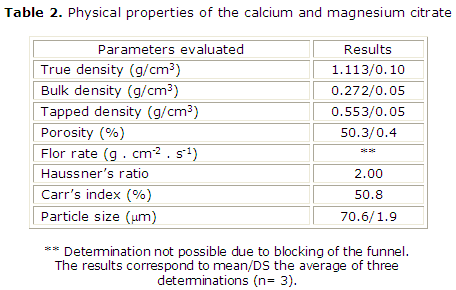
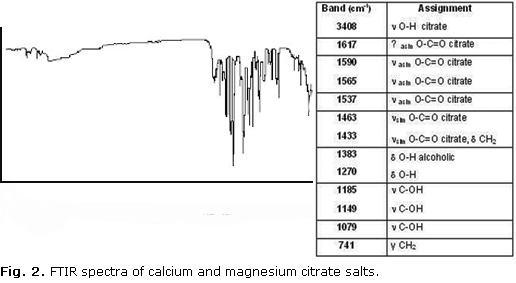
<body><![CDATA[<p><FONT SIZE="2" FACE="Verdana">  <A HREF="#tab2">Table 2</A> show the physical properties of the sample. Concerning  the sample density, descending values of true density &gt; tapped density &gt;  bulk density were observed. The high values of Hausner's ratio and Carr's index  are indicative of an extremely poor flow according to USP<sup>14</sup> causing  their inability to flow. A high porosity percentage was observed motivated maybe  by the packaging type of the solid mass. The particle size was considered appropriate.  </FONT></p>    <p ALIGN="CENTER"><IMG src="/img/revistas/far/v48n4/t0212414.gif" WIDTH="456" HEIGHT="290"><A NAME="tab2"></A></p>    <p><FONT SIZE="2" FACE="Verdana">  The XRD patterns of the sample exhibited peaks at 16.8; 9.4; 8.6; 7.6; 4.82; 4.77;  4.71; 4.64; 3.89; 3.82 y 3.14 &#197; (<a href="#fig1">Fig. 1</a>). It is observed  that the XRD patterns of the sample exhibited peaks similar to the calcium citrate,  but lightly displaced. <sup>19</sup> In our opinion this can be due to the presence  of magnesium in the compound.</FONT></p>    <p align="center">    <br> <img src="/img/revistas/far/v48n4/f0112414.jpg" width="539" height="392">  <a name="fig1"></a></p>    <p><FONT SIZE="2" FACE="Verdana">     <br> The FTIR spectra  of calcium and magnesium citrate salts are illustrated in <a href="#fig2">figure  2</a>. The presence of COO&#175;, -OH and -CH<sub>2</sub> characteristic groups  of citrates was observed. The FTIR spectra of the sample exhibited similar bands  to those reported in the literature for calcium citrate and magnesium citrate.<sup>20,21  </sup>In the FTIR spectra of the sample, the bands at 1445 and 727 cm<sup>&#8722;1  </sup>(characteristic to dolomite) and the bands at 1 420, 877 and 714 cm<sup>&#8722;1  </sup>(characteristic to calcite) are not observed.</FONT></p>    <p align="center">    <br>  <img src="/img/revistas/far/v48n4/f0212414.jpg" width="516" height="283"> <a name="fig2"></a></p>     <p><FONT SIZE="2" FACE="Verdana"> <B>    ]]></body>
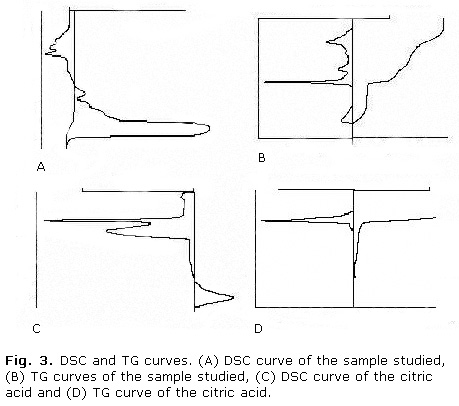
<body><![CDATA[<br>   </B><a href="#fig3">Figure 3</a> a shows the DSC curves of the sample studied.    The DSC curves of the sample are characterized by three endothermic peaks in    the temperature range 100-200 &#176;C (101.7 &#186;C, 167.1 &#186;C and 194.6    &#186;C) and a broad exothermic peaks in the temperature 487.2 &#176;C (<A HREF="#fig3">Fig.    3</A>, A). On the other hand, TG analysis showed that 75.7 % of the total mass    was eliminated between 100 and 700 &#186;C, of them 30.9 % was eliminated to    temperatures smaller than 295 &#186;C (<A HREF="#fig3">Fig. 3</A>, B).    <BR>   </FONT></p>    <p ALIGN="CENTER"><IMG src="/img/revistas/far/v48n4/f0312414.jpg" WIDTH="459" HEIGHT="406"><A NAME="fig3"></A></p>    <p><FONT SIZE="2" FACE="Verdana">      <BR>   DSC curve of the citric acid are characterized by two endothermic peaks in the    temperature range below to 220 &#176;C (157 &#186;C and 207 &#186;C). While,    TG analysis showed that 99 % of the total mass is eliminated to same range of    temperature (<A HREF="#fig3">Fig. 3</A>, C and D). </FONT></p>     <p> <FONT SIZE="2" FACE="Verdana"><b>    <BR><FONT SIZE="3">DISCUSION</FONT></b></FONT></p>    <p><FONT SIZE="2" FACE="Verdana">  A powder of white colour, soluble in hydrochloric acid solution and insoluble  in water was obtained by technological process developed by <i>Rodr&#237;guez</i>,  <i>et al</i><sup>.12 </sup>Calcium and magnesium are the main components in the  sample. On the other hand, the low concentration of trace minerals and toxic elements  demonstrate the high purity of the sample. </FONT></p>    <p><FONT SIZE="2" FACE="Verdana">  True density is defined as the density of the material itself; it is the average  mass of the particles divided by the solid volume. Bulk density is the mass per  unit volume of a loose powder bed. The unit volume includes the spaces between  the particles, and the envelope volumes of the particles themselves. Powder bulk  density depends primarily on particle size distribution, particle shape, and the  tendency of particles to adhere to each other. While, tapped density of a powder  is the ratio of the mass of the powder to the volume occupied by the powder after  it has been tapped for a defined period of time.<sup>22</sup> The density is an  essential parameter in the characterization of the powders. </FONT></p>    <p><FONT SIZE="2" FACE="Verdana">  In our study, the results showed that the samples have low bulk and tapped densities  but inside the range of most pharmaceutical powders (0.1-0.7 g/mL). <sup>22</sup>  These bulk and tapped densities are inferior to densities reported in dolomite  samples (bulk densities between 0.972 and 1,097; tapped densities between 1.444  a 1.543).<sup>23</sup> </FONT></p>    ]]></body>
<body><![CDATA[<p><FONT SIZE="2" FACE="Verdana"> Porosity can  be derived from powder density, and is an important characteristic of the materials.  The high porosity percentage observed was motivated maybe by the packaging type  open of the solid mass, indicating the tendency of the material to form agglomerates,  affecting the rheology properties of the samples. The flow behavior was faulty.  The high values of Hausner's ratio and Carr's index observed in the sample denote  their inability to flow.<sup>14</sup> </FONT></p>    <p><FONT SIZE="2" FACE="Verdana">  Is known the presence of electrostatic charge affect the flow properties of the  material. Therefore, the results are logical.<sup>24-26</sup> The particle size  was considered appropriate. </FONT></p>    <p><FONT SIZE="2" FACE="Verdana"> The XRD  patterns and FTIR spectra of the sample are different to the XRD patterns and  FTIR spectra of the dolomite.<sup>23 </sup>This is important because the transformation  of the mineral in citrate is demonstrated. </FONT></p>    <p><FONT SIZE="2" FACE="Verdana">  The citrate salts to smaller temperatures of 200 &#186;C are characterized by  the presence of one endothermic peak due to processes of dehydration.<sup>21 </sup>Besides  the endothermic transition of the water, the analyzed sample presents two endothermic  transitions due to the citric acid presence. The analysis for DSC and TG of the  citric acid sample corroborates these results. A process of dehydration of the  sample and decomposition of the present citric acid in the sample were corroborated  by means of the thermal study </FONT></p>    <p><FONT SIZE="2" FACE="Verdana"> In  conclusion, the result of the study shows that the developed technological process  transforms the dolomite in calcium and magnesium citrate salt.</FONT></p>    <p>    <BR><FONT SIZE="2" FACE="Verdana"><b><FONT SIZE="3">REFERENCES</FONT>  </b> </FONT></p>    <!-- ref --><p> <FONT SIZE="2" FACE="Verdana">1.<b> </b> Abad Manteca L, Izquierdo  E, Andr&#233;s M, Vega G, Mendo M, P&#233;rez Castrillon JL. Prevalencia de osteoporosis  en pacientes con s&#237;ndrome coronario agudo. Rev Osteoporos Metab Miner. 2010;2(1):15-22.      </FONT></p>    <!-- ref --><p> <FONT SIZE="2" FACE="Verdana">2.<b> </b> Blake GM, Fogelman I.  An update on dual-energy X-ray absorptiometry. Semin Nucl Med. 2010;40(1):62-73.      </FONT></p>    <!-- ref --><p> <FONT SIZE="2" FACE="Verdana">3.<b> </b> Goulding A, Jones IE,  Taylor RW, Williams SM, Manning PJ. Bone mineral density and body composition  in boys with distal forearm fractures: a dual-energy X-ray absorptiometry study.  J Pediatr. 2001;139:509-15.     </FONT></p>    <!-- ref --><p> <FONT SIZE="2" FACE="Verdana">4.<b>  </b> Ma D, Jones G. The association between bone mineral density, metacarpal morphometry,  and upper limb fractures in children: a population-based case-control study. J  Clin Endocrinol Metab. 2003;88:1486-91.     </FONT></p>    <!-- ref --><p> <FONT SIZE="2" FACE="Verdana">5.<b>  </b> FAO/WHO. Human, Vitamin and Mineral Requeriments. Report of a joint FAO/WHO  expert consultation. Cap. 11 (Calcium); Cap. 14 (Magnesium). Bangkok: FAO/WHO;  2001. p. 151-73, 223-33.     </FONT></p>    <!-- ref --><p> <FONT SIZE="2" FACE="Verdana">6.<b> </b>  Sweet MG, Sweet JM, Jeremiah MP, Galazka SS. Diagnosis and treatment of osteoporosis.  Am Fam Physician. 2009;79(3):193-200.     </FONT></p>    <!-- ref --><p> <FONT SIZE="2" FACE="Verdana">7.<b>  </b> Ranade VV, Somberg JC. Bioavailability and pharmacokinetics of magnesium  after administration of magnesium salts to humans. Am J Ther.<i> </i> 2001;8(5):345-57.      </FONT></p>    <!-- ref --><p> <FONT SIZE="2" FACE="Verdana">8.<b> </b> Whang R. Magnesium deficiency:  Pathogenesis, prevalence and clinical implication. Am J Med. 1987;87:24-9.     </FONT></p>    <!-- ref --><p>  <FONT SIZE="2" FACE="Verdana">9.<b> </b> Hanzlik R, Fowler S, Fisher D. Relative  Bioavailability of Calcium from Calcium Formate, Calcium Citrate, and Calcium  Carbonate. JPET. 2005;313(3):1217-22.     </FONT></p>    <!-- ref --><p> <FONT SIZE="2" FACE="Verdana">10.<b>  </b> Heaney RP. Factors influencing the measurement of bioavailability, taking  calcium as a model. J Nutr.<i> </i>2001;131:S1334-48.     </FONT></p>    <!-- ref --><p> <FONT SIZE="2" FACE="Verdana">11.<b>  </b> Sakhaee K, Bhuket T, Adams-Huet B, Sudhaker Rao D. Meta-analysis of calcium  bioavailability: a comparison of calcium citrate with calcium carbonate. Am J  Ther. 1999;6:313-21.     </FONT></p>     <!-- ref --><p> <FONT SIZE="2" FACE="Verdana">12.<b> </b> Rodr&#237;guez Chanfrau JE, Graveran    T, Rodr&#237;guez I, D&#237;az I, Roberto Y, Mateus L, et al. Proceso de obtenci&#243;n    de citrato de calcio y magnesio a partir de dolom&#237;ta. Patente CO1F 1/00;    A61K 33/06, A61K 9/00, C07C 51/41. Certificado 22794. 2002.     </FONT></p>     <!-- ref --><p> <FONT SIZE="2" FACE="Verdana">13.<b> </b>  Rodr&#237;guez Chanfrau JE, Lagarto Parra A, Bueno Pav&#243;n V, Guerra Sardi&#241;a  I, Vega Hurtado Y. Effectiveness of washout process to obtain calcium and magnesium  citrate at bench scale. Rev Cubana Farm. 2010;45(1):5-12.     </FONT></p>    <!-- ref --><p> <FONT SIZE="2" FACE="Verdana">14.<b>  </b> USP. United States Pharmacopoeia 31. US Pharmacopoeia Convention, Inc. Washington  DC: USP; 2008. p. 149, 753-7, 1914-7, 2834-8.     </FONT></p>    <!-- ref --><p> <FONT SIZE="2" FACE="Verdana">15.<b>  </b> Agilent Technologies. Flame Atomic Absorption Spectrometry. Analytical Methods.  10ma ed. New York: Agilent Technologies, Inc.; 2012. p. 15-82.     </FONT></p>    <p>  <FONT SIZE="2" FACE="Verdana">16.<b> </b> L.M.C. S&#237;lice. T&#233;cnica de  an&#225;lisis. Laboratorio Central de Minerales "Jos&#233; Issac del Corral".  Cuba: MINBAS; 1988. </FONT></p>    <!-- ref --><p> <FONT SIZE="2" FACE="Verdana">17.<b> </b> L.M.C.  Fl&#250;or. T&#233;cnica de an&#225;lisis. Laboratorio Central de Minerales "Jos&#233;  Issac del Corral". Cuba: MINBAS;1988.     </FONT></p>    ]]></body>
<body><![CDATA[<!-- ref --><p> <FONT SIZE="2" FACE="Verdana">18.<b>  </b> Iraizoz A, Bilbao O, Barrios MA. Conferencias de Tecnolog&#237;a Farmac&#233;utica.  La Habana: Editorial ENPES; 1990. p. 111-241.     </FONT></p>    <!-- ref --><p> <FONT SIZE="2" FACE="Verdana">19.<b>  </b> JCPDS-ICDD. X-ray Diffraction Data. International Centre for Diffraction  Data. USA. 1996.     </FONT></p>    <!-- ref --><p> <FONT SIZE="2" FACE="Verdana">20.<b> </b> SDBS.  ASTRIO-DB: Spectral database for organic compounds. National Institute of Advanced  Industrial Science and Technology. 2008. [citado 23 nov 2013]. Disponible en:  <u><a href="http://riodboi.ibase.aist.go.jp/sdbs/" TARGET="_blank">http://riodboi.ibase.aist.go.jp/sdbs/</a></u>  </FONT><!-- ref --><p> <FONT SIZE="2" FACE="Verdana">21.<b> </b> Wagner C, Ferrer E, Baran  E. Spectroscopic and thermal behaviour of complex compounds useful for magnesium  supplementation. Acta Farm Bonaerense. 1999;18(1):5-12.     </FONT></p>    <!-- ref --><p> <FONT SIZE="2" FACE="Verdana">22.<b>  </b> Amidon GE, Secreast PJ, Mudie D. Particle, powder, and compact characterization.  In: Oiu Y, Chen Y, Zhang G. Developing solid oral dosage forms, Pharmaceutical  theory and practice. Cap. 8. New York: Elservier Inc.; 2009. p. 163-70.     </FONT></p>    <!-- ref --><p>  <FONT SIZE="2" FACE="Verdana">23.<b> </b> Rodr&#237;guez Chanfrau JE, Llanes Gonz&#225;lez  A, Roberto Y. Physical, chemical physical and technological characterization of  a Cuban dolomite deposit for its possible use as a nutritional supplement source.  Rev Aliment. 1999;305:61-5.     </FONT></p>    <!-- ref --><p> <FONT SIZE="2" FACE="Verdana">24.<b>  </b> Drusch S, Serfert Y, Schwarz K. Microencapsulation of fish oil with <i>n-</i>octenylsuccinate-derivatised  starch: flow properties and oxidative stability. Eur J Lipid Sci Technol. 2006;108:501-12.      </FONT></p>    <!-- ref --><p> <FONT SIZE="2" FACE="Verdana">25.<b> </b> Abatzoglou N, Simard  J. Prediction of segregation tendency occurrence in dry particulate pharmaceutical  mixtures: development of a mathematical tool adapted for granular systems application.  Pharm Develop Tech. 2005;1:59-70.     </FONT></p>    <!-- ref --><p> <FONT SIZE="2" FACE="Verdana">26.<b>  </b> D&#228;r A. Tecnolog&#237;a Farmac&#233;utica. Madrid: Editorial Arcibia;  1979. p. 22-4.    </FONT></p>    <p>&nbsp;</p>    <p>&nbsp;</p>    <p><FONT SIZE="2" FACE="Verdana">Recibido:  24 de julio de 2014.    ]]></body>
<body><![CDATA[<BR>Aprobado: 30 de agosto de 2014<I>.</I></FONT></p>    <p>&nbsp; </p>    <p>&nbsp;</p>    <p><FONT SIZE="2" FACE="Verdana"><i>Jorge  E. Rodr&#237;guez Chanfrau.</i> Centro de Investigaciones y Desarrollo de Medicamentos.  BioCubaFarma. Ave 26 No. 1605 CP 10600. Nuevo Vedado, La Habana, Cuba. Correo  electr&#243;nico: <a href="mailto:jorge.rodriguez@infomed.sld.cu">jorge.rodriguez@infomed.sld.cu</a>  </FONT></p>       ]]></body><back>
<ref-list>
<ref id="B1">
<label>1</label><nlm-citation citation-type="journal">
<person-group person-group-type="author">
<name>
<surname><![CDATA[Abad Manteca]]></surname>
<given-names><![CDATA[L]]></given-names>
</name>
<name>
<surname><![CDATA[Izquierdo]]></surname>
<given-names><![CDATA[E]]></given-names>
</name>
<name>
<surname><![CDATA[Andrés]]></surname>
<given-names><![CDATA[M]]></given-names>
</name>
<name>
<surname><![CDATA[Vega]]></surname>
<given-names><![CDATA[G]]></given-names>
</name>
<name>
<surname><![CDATA[Mendo]]></surname>
<given-names><![CDATA[M]]></given-names>
</name>
<name>
<surname><![CDATA[Pérez Castrillon]]></surname>
<given-names><![CDATA[JL]]></given-names>
</name>
</person-group>
<article-title xml:lang="es"><![CDATA[Prevalencia de osteoporosis en pacientes con síndrome coronario agudo]]></article-title>
<source><![CDATA[Rev Osteoporos Metab Miner]]></source>
<year>2010</year>
<volume>2</volume>
<numero>1</numero>
<issue>1</issue>
<page-range>15-22</page-range></nlm-citation>
</ref>
<ref id="B2">
<label>2</label><nlm-citation citation-type="journal">
<person-group person-group-type="author">
<name>
<surname><![CDATA[Blake]]></surname>
<given-names><![CDATA[GM]]></given-names>
</name>
<name>
<surname><![CDATA[Fogelman]]></surname>
<given-names><![CDATA[I]]></given-names>
</name>
</person-group>
<article-title xml:lang="en"><![CDATA[An update on dual-energy X-ray absorptiometry]]></article-title>
<source><![CDATA[Semin Nucl Med]]></source>
<year>2010</year>
<volume>40</volume>
<numero>1</numero>
<issue>1</issue>
<page-range>62-73</page-range></nlm-citation>
</ref>
<ref id="B3">
<label>3</label><nlm-citation citation-type="journal">
<person-group person-group-type="author">
<name>
<surname><![CDATA[Goulding]]></surname>
<given-names><![CDATA[A]]></given-names>
</name>
<name>
<surname><![CDATA[Jones]]></surname>
<given-names><![CDATA[IE]]></given-names>
</name>
<name>
<surname><![CDATA[Taylor]]></surname>
<given-names><![CDATA[RW]]></given-names>
</name>
<name>
<surname><![CDATA[Williams]]></surname>
<given-names><![CDATA[SM]]></given-names>
</name>
<name>
<surname><![CDATA[Manning]]></surname>
<given-names><![CDATA[PJ]]></given-names>
</name>
</person-group>
<article-title xml:lang="en"><![CDATA[Bone mineral density and body composition in boys with distal forearm fractures: a dual-energy X-ray absorptiometry study]]></article-title>
<source><![CDATA[J Pediatr]]></source>
<year>2001</year>
<volume>139</volume>
<page-range>509-15</page-range></nlm-citation>
</ref>
<ref id="B4">
<label>4</label><nlm-citation citation-type="journal">
<person-group person-group-type="author">
<name>
<surname><![CDATA[Ma]]></surname>
<given-names><![CDATA[D]]></given-names>
</name>
<name>
<surname><![CDATA[Jones]]></surname>
<given-names><![CDATA[G]]></given-names>
</name>
</person-group>
<article-title xml:lang="en"><![CDATA[The association between bone mineral density, metacarpal morphometry, and upper limb fractures in children: a population-based case-control study]]></article-title>
<source><![CDATA[J Clin Endocrinol Metab]]></source>
<year>2003</year>
<volume>88</volume>
<page-range>1486-91</page-range></nlm-citation>
</ref>
<ref id="B5">
<label>5</label><nlm-citation citation-type="book">
<collab>FAO/WHO</collab>
<source><![CDATA[Human, Vitamin and Mineral Requeriments. Report of a joint FAO/WHO expert consultation. Cap. 11 (Calcium); Cap. 14 (Magnesium)]]></source>
<year>2001</year>
<page-range>151-73, 223-33</page-range><publisher-loc><![CDATA[Bangkok ]]></publisher-loc>
<publisher-name><![CDATA[FAO/WHO]]></publisher-name>
</nlm-citation>
</ref>
<ref id="B6">
<label>6</label><nlm-citation citation-type="journal">
<person-group person-group-type="author">
<name>
<surname><![CDATA[Sweet]]></surname>
<given-names><![CDATA[MG]]></given-names>
</name>
<name>
<surname><![CDATA[Sweet]]></surname>
<given-names><![CDATA[JM]]></given-names>
</name>
<name>
<surname><![CDATA[Jeremiah]]></surname>
<given-names><![CDATA[MP]]></given-names>
</name>
<name>
<surname><![CDATA[Galazka]]></surname>
<given-names><![CDATA[SS]]></given-names>
</name>
</person-group>
<article-title xml:lang="en"><![CDATA[Diagnosis and treatment of osteoporosis]]></article-title>
<source><![CDATA[Am Fam Physician]]></source>
<year>2009</year>
<volume>79</volume>
<numero>3</numero>
<issue>3</issue>
<page-range>193-200</page-range></nlm-citation>
</ref>
<ref id="B7">
<label>7</label><nlm-citation citation-type="journal">
<person-group person-group-type="author">
<name>
<surname><![CDATA[Ranade]]></surname>
<given-names><![CDATA[VV]]></given-names>
</name>
<name>
<surname><![CDATA[Somberg]]></surname>
<given-names><![CDATA[JC]]></given-names>
</name>
</person-group>
<article-title xml:lang="en"><![CDATA[Bioavailability and pharmacokinetics of magnesium after administration of magnesium salts to humans]]></article-title>
<source><![CDATA[Am J Ther]]></source>
<year>2001</year>
<volume>8</volume>
<numero>5</numero>
<issue>5</issue>
<page-range>345-57</page-range></nlm-citation>
</ref>
<ref id="B8">
<label>8</label><nlm-citation citation-type="journal">
<person-group person-group-type="author">
<name>
<surname><![CDATA[Whang]]></surname>
<given-names><![CDATA[R]]></given-names>
</name>
</person-group>
<article-title xml:lang="en"><![CDATA[Magnesium deficiency: Pathogenesis, prevalence and clinical implication]]></article-title>
<source><![CDATA[Am J Med]]></source>
<year>1987</year>
<volume>87</volume>
<page-range>24-9</page-range></nlm-citation>
</ref>
<ref id="B9">
<label>9</label><nlm-citation citation-type="journal">
<person-group person-group-type="author">
<name>
<surname><![CDATA[Hanzlik]]></surname>
<given-names><![CDATA[R]]></given-names>
</name>
<name>
<surname><![CDATA[Fowler]]></surname>
<given-names><![CDATA[S]]></given-names>
</name>
<name>
<surname><![CDATA[Fisher]]></surname>
<given-names><![CDATA[D]]></given-names>
</name>
</person-group>
<article-title xml:lang="en"><![CDATA[Relative Bioavailability of Calcium from Calcium Formate, Calcium Citrate, and Calcium Carbonate]]></article-title>
<source><![CDATA[JPET]]></source>
<year>2005</year>
<volume>313</volume>
<numero>3</numero>
<issue>3</issue>
<page-range>1217-22</page-range></nlm-citation>
</ref>
<ref id="B10">
<label>10</label><nlm-citation citation-type="journal">
<person-group person-group-type="author">
<name>
<surname><![CDATA[Heaney]]></surname>
<given-names><![CDATA[RP]]></given-names>
</name>
</person-group>
<article-title xml:lang="en"><![CDATA[Factors influencing the measurement of bioavailability, taking calcium as a model]]></article-title>
<source><![CDATA[J Nutr]]></source>
<year>2001</year>
<volume>131</volume>
<page-range>S1334-48</page-range></nlm-citation>
</ref>
<ref id="B11">
<label>11</label><nlm-citation citation-type="journal">
<person-group person-group-type="author">
<name>
<surname><![CDATA[Sakhaee]]></surname>
<given-names><![CDATA[K]]></given-names>
</name>
<name>
<surname><![CDATA[Bhuket]]></surname>
<given-names><![CDATA[T]]></given-names>
</name>
<name>
<surname><![CDATA[Adams-Huet]]></surname>
<given-names><![CDATA[B]]></given-names>
</name>
<name>
<surname><![CDATA[Sudhaker Rao]]></surname>
<given-names><![CDATA[D]]></given-names>
</name>
</person-group>
<article-title xml:lang="en"><![CDATA[Meta-analysis of calcium bioavailability: a comparison of calcium citrate with calcium carbonate]]></article-title>
<source><![CDATA[Am J Ther]]></source>
<year>1999</year>
<volume>6</volume>
<page-range>313-21</page-range></nlm-citation>
</ref>
<ref id="B12">
<label>12</label><nlm-citation citation-type="">
<person-group person-group-type="author">
<name>
<surname><![CDATA[Rodríguez Chanfrau]]></surname>
<given-names><![CDATA[JE]]></given-names>
</name>
<name>
<surname><![CDATA[Graveran]]></surname>
<given-names><![CDATA[T]]></given-names>
</name>
<name>
<surname><![CDATA[Rodríguez]]></surname>
<given-names><![CDATA[I]]></given-names>
</name>
<name>
<surname><![CDATA[Díaz]]></surname>
<given-names><![CDATA[I]]></given-names>
</name>
<name>
<surname><![CDATA[Roberto]]></surname>
<given-names><![CDATA[Y]]></given-names>
</name>
<name>
<surname><![CDATA[Mateus]]></surname>
<given-names><![CDATA[L]]></given-names>
</name>
</person-group>
<source><![CDATA[Proceso de obtención de citrato de calcio y magnesio a partir de dolomíta]]></source>
<year>2002</year>
</nlm-citation>
</ref>
<ref id="B13">
<label>13</label><nlm-citation citation-type="journal">
<person-group person-group-type="author">
<name>
<surname><![CDATA[Rodríguez Chanfrau]]></surname>
<given-names><![CDATA[JE]]></given-names>
</name>
<name>
<surname><![CDATA[Lagarto Parra]]></surname>
<given-names><![CDATA[A]]></given-names>
</name>
<name>
<surname><![CDATA[Bueno Pavón]]></surname>
<given-names><![CDATA[V]]></given-names>
</name>
<name>
<surname><![CDATA[Guerra Sardiña]]></surname>
<given-names><![CDATA[I]]></given-names>
</name>
<name>
<surname><![CDATA[Vega Hurtado]]></surname>
<given-names><![CDATA[Y]]></given-names>
</name>
</person-group>
<article-title xml:lang="en"><![CDATA[Effectiveness of washout process to obtain calcium and magnesium citrate at bench scale]]></article-title>
<source><![CDATA[Rev Cubana Farm]]></source>
<year>2010</year>
<volume>45</volume>
<numero>1</numero>
<issue>1</issue>
<page-range>5-12</page-range></nlm-citation>
</ref>
<ref id="B14">
<label>14</label><nlm-citation citation-type="book">
<collab>USP</collab>
<source><![CDATA[United States Pharmacopoeia 31. US Pharmacopoeia Convention, Inc]]></source>
<year>2008</year>
<page-range>149, 753-7, 1914-7, 2834-8</page-range><publisher-loc><![CDATA[Washington DC ]]></publisher-loc>
<publisher-name><![CDATA[USP]]></publisher-name>
</nlm-citation>
</ref>
<ref id="B15">
<label>15</label><nlm-citation citation-type="book">
<collab>Agilent Technologies</collab>
<source><![CDATA[Flame Atomic Absorption Spectrometry. Analytical Methods]]></source>
<year>2012</year>
<edition>10ma</edition>
<page-range>15-82</page-range><publisher-loc><![CDATA[New York ]]></publisher-loc>
<publisher-name><![CDATA[Agilent Technologies, Inc.]]></publisher-name>
</nlm-citation>
</ref>
<ref id="B16">
<label>16</label><nlm-citation citation-type="book">
<person-group person-group-type="author">
<name>
<surname><![CDATA[Sílice]]></surname>
<given-names><![CDATA[C]]></given-names>
</name>
</person-group>
<source><![CDATA[Técnica de análisis. Laboratorio Central de Minerales "José Issac del Corral"]]></source>
<year>1988</year>
<publisher-name><![CDATA[MINBAS]]></publisher-name>
</nlm-citation>
</ref>
<ref id="B17">
<label>17</label><nlm-citation citation-type="book">
<collab>L.M.C.</collab>
<source><![CDATA[Flúor. Técnica de análisis. Laboratorio Central de Minerales "José Issac del Corral"]]></source>
<year>1988</year>
<publisher-name><![CDATA[MINBAS]]></publisher-name>
</nlm-citation>
</ref>
<ref id="B18">
<label>18</label><nlm-citation citation-type="book">
<person-group person-group-type="author">
<name>
<surname><![CDATA[Iraizoz]]></surname>
<given-names><![CDATA[A]]></given-names>
</name>
<name>
<surname><![CDATA[Bilbao]]></surname>
<given-names><![CDATA[O]]></given-names>
</name>
<name>
<surname><![CDATA[Barrios]]></surname>
<given-names><![CDATA[MA]]></given-names>
</name>
</person-group>
<source><![CDATA[Conferencias de Tecnología Farmacéutica]]></source>
<year>1990</year>
<page-range>111-24</page-range><publisher-loc><![CDATA[La Habana ]]></publisher-loc>
<publisher-name><![CDATA[Editorial ENPES]]></publisher-name>
</nlm-citation>
</ref>
<ref id="B19">
<label>19</label><nlm-citation citation-type="">
<collab>JCPDS-ICDD</collab>
<source><![CDATA[X-ray Diffraction Data. International Centre for Diffraction Data]]></source>
<year>1996</year>
</nlm-citation>
</ref>
<ref id="B20">
<label>20</label><nlm-citation citation-type="">
<collab>SDBS</collab>
<source><![CDATA[ASTRIO-DB: Spectral database for organic compounds. National Institute of Advanced Industrial Science and Technology]]></source>
<year>2008</year>
</nlm-citation>
</ref>
<ref id="B21">
<label>21</label><nlm-citation citation-type="journal">
<person-group person-group-type="author">
<name>
<surname><![CDATA[Wagner]]></surname>
<given-names><![CDATA[C]]></given-names>
</name>
<name>
<surname><![CDATA[Ferrer]]></surname>
<given-names><![CDATA[E]]></given-names>
</name>
<name>
<surname><![CDATA[Baran]]></surname>
<given-names><![CDATA[E]]></given-names>
</name>
</person-group>
<article-title xml:lang="en"><![CDATA[Spectroscopic and thermal behaviour of complex compounds useful for magnesium supplementation]]></article-title>
<source><![CDATA[Acta Farm Bonaerense]]></source>
<year>1999</year>
<volume>18</volume>
<numero>1</numero>
<issue>1</issue>
<page-range>5-12</page-range></nlm-citation>
</ref>
<ref id="B22">
<label>22</label><nlm-citation citation-type="book">
<person-group person-group-type="author">
<name>
<surname><![CDATA[Amidon]]></surname>
<given-names><![CDATA[GE]]></given-names>
</name>
<name>
<surname><![CDATA[Secreast]]></surname>
<given-names><![CDATA[PJ]]></given-names>
</name>
<name>
<surname><![CDATA[Mudie]]></surname>
<given-names><![CDATA[D]]></given-names>
</name>
</person-group>
<article-title xml:lang="en"><![CDATA[Particle, powder, and compact characterization]]></article-title>
<person-group person-group-type="editor">
<name>
<surname><![CDATA[Oiu]]></surname>
<given-names><![CDATA[Y]]></given-names>
</name>
<name>
<surname><![CDATA[Chen]]></surname>
<given-names><![CDATA[Y]]></given-names>
</name>
<name>
<surname><![CDATA[Zhang]]></surname>
<given-names><![CDATA[G]]></given-names>
</name>
</person-group>
<source><![CDATA[Developing solid oral dosage forms, Pharmaceutical theory and practice. Cap. 8]]></source>
<year>2009</year>
<page-range>163-70</page-range><publisher-loc><![CDATA[New York ]]></publisher-loc>
<publisher-name><![CDATA[Elservier Inc]]></publisher-name>
</nlm-citation>
</ref>
<ref id="B23">
<label>23</label><nlm-citation citation-type="journal">
<person-group person-group-type="author">
<name>
<surname><![CDATA[Rodríguez Chanfrau]]></surname>
<given-names><![CDATA[JE]]></given-names>
</name>
<name>
<surname><![CDATA[Llanes González]]></surname>
<given-names><![CDATA[A]]></given-names>
</name>
<name>
<surname><![CDATA[Roberto]]></surname>
<given-names><![CDATA[Y]]></given-names>
</name>
</person-group>
<article-title xml:lang="en"><![CDATA[Physical, chemical physical and technological characterization of a Cuban dolomite deposit for its possible use as a nutritional supplement source]]></article-title>
<source><![CDATA[Rev Aliment]]></source>
<year>1999</year>
<volume>305</volume>
<page-range>61-5</page-range></nlm-citation>
</ref>
<ref id="B24">
<label>24</label><nlm-citation citation-type="journal">
<person-group person-group-type="author">
<name>
<surname><![CDATA[Drusch]]></surname>
<given-names><![CDATA[S]]></given-names>
</name>
<name>
<surname><![CDATA[Serfert]]></surname>
<given-names><![CDATA[Y]]></given-names>
</name>
<name>
<surname><![CDATA[Schwarz]]></surname>
<given-names><![CDATA[K]]></given-names>
</name>
</person-group>
<article-title xml:lang="en"><![CDATA[Microencapsulation of fish oil with n-octenylsuccinate-derivatised starch: flow properties and oxidative stability]]></article-title>
<source><![CDATA[Eur J Lipid Sci Technol]]></source>
<year>2006</year>
<volume>108</volume>
<page-range>501-12</page-range></nlm-citation>
</ref>
<ref id="B25">
<label>25</label><nlm-citation citation-type="journal">
<person-group person-group-type="author">
<name>
<surname><![CDATA[Abatzoglou]]></surname>
<given-names><![CDATA[N]]></given-names>
</name>
<name>
<surname><![CDATA[Simard]]></surname>
<given-names><![CDATA[J]]></given-names>
</name>
</person-group>
<article-title xml:lang="en"><![CDATA[Prediction of segregation tendency occurrence in dry particulate pharmaceutical mixtures: development of a mathematical tool adapted for granular systems application]]></article-title>
<source><![CDATA[Pharm Develop Tech]]></source>
<year>2005</year>
<volume>1</volume>
<page-range>59-70</page-range></nlm-citation>
</ref>
<ref id="B26">
<label>26</label><nlm-citation citation-type="book">
<person-group person-group-type="author">
<name>
<surname><![CDATA[Där]]></surname>
<given-names><![CDATA[A]]></given-names>
</name>
</person-group>
<source><![CDATA[Tecnología Farmacéutica]]></source>
<year>1979</year>
<page-range>22-4</page-range><publisher-loc><![CDATA[Madrid ]]></publisher-loc>
<publisher-name><![CDATA[Editorial Arcibia]]></publisher-name>
</nlm-citation>
</ref>
</ref-list>
</back>
</article>